Ananda Mandir
269 Cedar Grove Lane Somerset, NJ 08873


Ananda Mandir
269 Cedar Grove Lane Somerset, NJ 08873
NO. 1215
We will soon find two new guests in the White House frequently. They are Kamala Harris, a black woman of Indianand Jamaican descent, and Doug Emhoff, a white American, whom she chose as her husband. Kamala’smother, Shyamala Gopalan, a staunch Hindu from South India, and her father, Donald Harris, a blackChristian from Jamaica also had an interracial marriage.
These two couples remind us of the interracial romance depicted in “Mississippi Masala”, a film that Iwatched recently for the second time. In my first viewing, I did not observe the many messages that Mira Nair conveyed throughout the movie. At the time, I viewed it merely as a love story between an Indian woman brought up in Africa and the US, and an African American man she meets in Mississippi. Now I realize that this interracial romance is perhaps an allegory for exploring the racial identity and coalitionbuilding between communities of color in the United States. It is a spicy love story that stirs up adisplaced Indian lover and her African American lover in the bubbling pot of deep south. At the end of the movie, as the lovers decide to leave Mississippi, a stronghold of white supremacist sentiment, we anticipate the possibility of racial coalition between blacks and Asians.
With Kamala’s parents, Shyamala Gopalan and Professor Donald Harris, we see a
By Mandira Chattopadhyay
parallel case. Both immigrated to the United States, and in time became champions in their own right: her mother in breast cancer research and her father a professor of eco-
ding ceremony at the motel to go dancing in a black club. She rejects the wealthy Indian suitor, preferring to date Demetrius, a black man. In the birthday celebration of

nomics at Stanford. To immigrate to America in the nineteen sixties, particularity for a Jamaican black person and a South Asian woman was no small feat.
Kamala’s parents met at UC Berkeley where their shared earnest passion for civil rights brought themtogether. They were part of an activist group that became the Afro-American Association. Similarly, Kamala Harris entered a new married life with Doug Emhoff, a white American who shared her passion. Both are lawyers and they both believe in the progress of the world. With their match, the different races are seen to exist and exert a completion of their marriage.
The film “Mississippi Masala’ portrays the heroine as a rebellious young immigrant. She willingly leaves the traditional Indian wed-
BASANTI PUJA*
Sosthi Sunday April 18
Saptami Monday April 19
Ashtami & Sondhi Puja Tuesday April 20
Basanti Nabami, Wednesday April 21
RamNabami & Satyanarayan Puja
Dashami Thursday April 22
of Shyamala Gopalan and Donald Harris. Kamala had a close relationship with her Indian grandfather, who likely taught her the importance of strength of character and perseverance. The significant career and social accomplishment of her immigrant par-
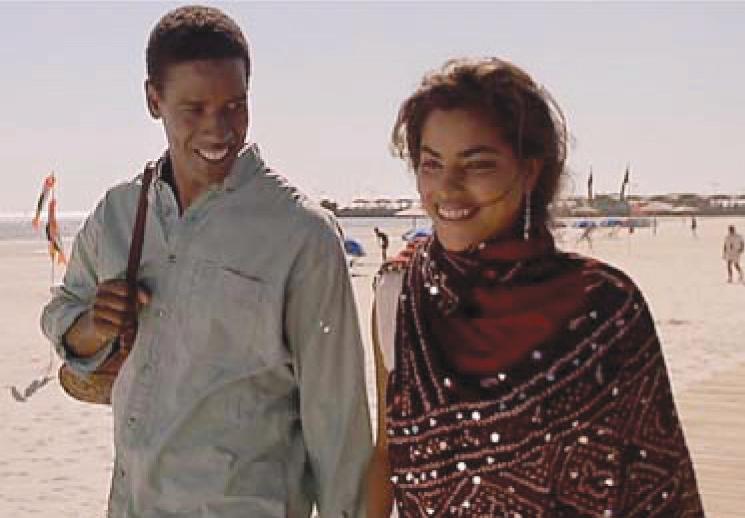
Demetrius’ grandfather, she maintains her cultural identity as an Indian. Likewise, in Kamala’s life, we see how her mother fostered from her early childhood to embrace both religions. Her mother Shyamala was intent on celebrating the black and Jamaican ethnicities of Kamala and Maya (her sister) by attending both the black Baptist church and Hindu temples.
In ‘Mississippi Masala’, Meena and Demetrius provide a lesson about a coalition between a black and an Asian. The movie demonstrates the difficulty of racial coalition between the Asians and blacks. Kamala’s personal philosophy and the key choices she made in her career supported by her husband are testaments of real effort in that direction.
ents were clearly the pivotal markers for the two sisters. She is honing her victory as she enters the premises of the White House holding the hand of a white man tight. When they entered gracefully in the White House, it was strikingly remarkable to see the charming Kamala Harris. Her eyes travel everywhere; she is very much aware of her surroundings. It is really a paradigm shift in the White House.
Calendar of Events (Dates are subject to Change) Please check our website frequently www.anandamandir.org Tel: 732-873-9821
NOTE: If a particular Puja time is not listed, please contact temple or visit our website: anandamandir.org
AprIl(*)
NABABArsho
Thursday, 15
BAsANtI pujA
Sunday, 18, Sosthi
Monday, 19, Saptami
Tuesday, 20, AshtAMI& sANdhI pujA
Wednesday, 21, BAsANtI NABAMI, rAM NABAMI & sAtyANArAyAN pujA
Thursday, 22, Dashami
sahitya o Alochana (*) Cultural program (*)
MAy (*)
shyAMA pujA
Sunday, 10
AkhshAyA trItIA
Friday, 14
rAMthAkur sMArANotsov sAtyANArAyAN pujA & kIrtAN
Sunday, 16
sahitya o Alochana (*)
Saturday, 27 Cultural program (*)
juNe (*)
FAlAhArINI kAlI pujA
Wednesday, 09
sAtyANArAyAN pujA
Sunday, 20
sNAN jAtrA
Sunday, 24
sahitya o Alochana (*) Cultural program (*)
july (*)
shyAMA pujA
Friday, 09
rAthjAtrA
Monday, 12
BIpAdtArINI pujA
Saturday, 17
puNorjAtrA & sAtyANArAyAN pujA
Monday, 19
Guru purNIMA
Saturday, 24
In the USA, the union of black and white is not always welcomed. However, the life of Harris shows that it is widely accepted and it is no wonder that it is accepted in the White House as well. Kamala witnessed the heights achieved by her parents in their international marriage, when such a partnership was socially unacceptable to many, and this instilled in her the same character and grit evident in the lives
Harris does not go to the White House with many frills but with a bucket of ‘masala’, and we are not familiar with it. As the daughter of immigrants, the vice president has a genuine understanding of the experience of immigrating to the USA. The difficulties with adapting to a different life in a new world and navigating the roadblocks in the paths of the browns and blacks in this country were nothing new to her.
In “Mississippi Masala” I was particularly moved by the transformation of Meena’s father as Meena and Demetrius left Mississippi. Throughout the period that Meena’s family was in Mississippi; her father was shown as being completely obsessed with his property in
*For Timing and other details, please visit our Website continue to page 7 }
sahitya o Alochana(*) Cultural program (*)
(*) See www.anandamandir.org or Call Mandir for details
Special Religious Services: Upon request, the priest of Ananda Mandir offers services such as in-house Shraddhas, Rituals associated with Cremations (Antyesti Kriya), Shraddha Anniversaries, Pre-wedding rituals (Naandimukh, Ashirwad, etc.), Upanayan (Paitey), Annaprasan, Wedding Ceremonies & Wedding Anniversaries, Griha Prabesh (Bhumi Puja), Consecrations of new cars (New Car Pujas) and others. If you have needs for any of the above or more, please feel free to contact Biswabhai @ 732-873-9821
Ananda sangbad
A Periodical Newsletter Published By
ANANdA MANdIr
(A Tax-Exempt, Non-Profit Organization)
269 Cedar Grove Lane Somerset, NJ 08873
Phone: 732-873-9821
Website: www.anandamandir.0rg ***
Guru Chakravarty Executive Editor
All queries, articles, news reports and letters should be directed to guruchakravarty@yahoo.com
Phone: 908-752-3065 ***
For general information, please contact the following executives of Ananda Mandir:
jai prakash Biswas President
debajyoti Chatterji Vice President
Anjan lahiri Vice President
Ashok rakhit Vice President
Arun Bhowmik General Secretary
Chanu das Treasurer
pradip Majumdar Assistant Treasurer

Light at the end of the tunnel is getting brighter. Now that the way to avoid the deadly disease of COVID-19 is known, people are lining up for vaccination. The ones who got the vaccine are emboldened to learn that they are not going to die from this after all when they go to restaurants or travel in planes.
The problem is that enough vaccines are not yet available for everyone who wants to get it. The manufacturers of the vaccine are handcuffed by the size of their producing capability to satisfy the demand of the society. Center for Disease Control (CDC) has rationed as to who will get them first, and who will be allowed later, based on age and vulnerability of the people. Still, eligible people do not have easy access to proper information and source to register for vaccination. The situation is a little chaotic at the moment.
As of this writing, only about 10% of the US population has received the shot in two doses in their arms. The requirement of two doses of Pfizer or Moderna delays the
process a little bit as it keeps others waiting for a longer time. The new vaccine by Johnson & Johnson is going to provide a major relief in that regard as only one shot of it is needed.
So, what happens in the interim until all the eligible people are vaccinated? Besides, vaccines are still not available for children under 16. Can the vaccinated people roam around freely and do anything they like? Not so, says CDC. They are still required to wear masks, and to do the things recommended for good hygiene. At the moment, CDC is preparing guidelines about this situation. According to Dr. Anthony Fauci, regarded as the Guru of COVID-19 disease, the “Herd Immunity” needs to be achieved before we achieve normalcy. To achieve Herd Immunity, 7585% of the community needs be vaccinated, estimated by Dr. Fauci. Much work remains for the government to get the necessary quantity of vaccines manufactured and to distribute them efficiently. Still, the battle is not over. Other variants of the virus
are looming and affecting the population. Scientists are busy to find the answer to combat the variants, and they may come up with a different form of the current vaccines. However, the hope is, according to science, that the current vaccines will put up a strong fight to the variants and hopefully blunt their activity. According to some polls, two-thirds of Americans are either somewhat or very worried about these variants that have triggered huge overseas outbreaks and are now spreading in the United States.Yet in recent days Dr. Fauci have begun sounding less pessimistic about the dangers of a new variant-driven wave, and more optimistic about a return to something resembling normal life as soon as this summer. “There’s a really good chance that we will do fine, at least in the immediate future”, he said.
The CDC is pushing to open the schools. They tell us that in spite of not getting vaccinated, the children will be safe in schools. However, they do have recommendations about what needs to be
done in terms of proximity, ventilation and hygiene before starting classes. Still, six feet distancing is not feasible at most schools as the available space won’t allow it. Besides, the teachers and other school employees are fighting to get themselves vaccinated before opening the schools. Many parents are fearful that although children seem to be immune, they may still get the virus and bring it home to infect their parents.
All in all, things are moving in the right direction. More and more people are getting vaccinated towards achieving the goal of Herd Immunity. Hospitalization and death rates are coming down. We are not out of the woods yet, but at least we can hope to get to the normalcy back. The community of Ananda Mandir is looking forward to celebrating the puja activities as before the pandemics, and also awaiting the opening of the Tagore Hall to get together with friends. Spring is in the air!
Guru Chakravarty Executive Editor, Ananda Sangbad
We ask all the readers to send their comments and views, irrespective of pro or con, because that will serve as guidance to us. Here are the three letters:
Dear Pronoyda,
I read your article “A SELF INTROSPECTION” and I must say that your thoughts are very real and well-articulated. I could easily identify myself with your idea of life “In this imaginary world, I am just a part of the process without any individual entity, but a sublime manifestation of nature”.
At this point of my life, I try to find out the true meaning of life, but it always circles around the aggregation of particles or molecules devoid of soul which we can only imagine and without being able to see or sense yet we enjoy being a carrier of this “soul”.
Pronoyda, your felicitous article will definitely induce thoughts in many minds to find out the real reason for his/her life in the mundane world. Please write many more articles like this.
Warm Regards, Dilip Chakrabarti New Jersey
Article:
“Happiness in this Unhappy World” by Basab Dasgupta
Dear Mr. Dasgupta:
I read and enjoyed your article, ‘Happiness in this unhappy world’ in the Ananda Sangbad of January 2021. I agree 100% with your sentiments. Your comments about posting happy vacation pictures on Facebook reminded me of a comment/article by a lady in the Time a couple of years ago. This was when the pandemic of people posting pictures of all their happy moments on Facebook was going out of control. And, of course, she made it clear that she did not like this practice too much. She mentioned how one day she saw a picture posted by a good friend, who was off to Australia or some such place and that she (the friend) and her husband were having dinner at some expensive place and she (the writer) felt a twinge of envy. A few weeks later, she met the friend who had come back to the States and mentioned that she saw the picture she (the friend) had posted, showing her and her husband enjoying a fabulous dinner in the distant land. The friend broke down crying; she said that was the last picture of them together as they broke up soon after that.
The last line of the article was: I felt good. No, it was not schadenfreude she was talking about - her point was: don’t post pictures of each and every ‘happy’ moment of your life on Facebook (mainly to make others envious?)
Thanks.
Probal
Sanyal Syracuse, NY
“Did You Know?”
By Pradip R Das
(A nostalgic visit to history of Kolkata)
Dear Sir,
In the well written article of Pradip R. Das in your January 2021 Ananda Sangbad, it was mentioned that David Hare established the Hindu College in 1817 with 20 scholars. But the birth of the Hindu College occurred a little differently.
Lord Wellesley was the colonial administrator for the British East India Company around 1817 when the company decided to spend two hundred thousand rupees for the educational system of native Indians: one hundred thousand for the Hindu community and the other hundred thousand for the Muslim community.
The Muslim community decided to use the money for their traditional Madrasa education.
The Hindu community wanted to use it for their traditional Sanskrit Toll education. But then entered a dynamic man into the picture - Raja Rammohan Roy, the father of modern India whose Raja title, given by the Mughal Emperor, was never recognized by the British, although in 1829 he was accepted as the Mughal envoy to the British court.
Raja Rammohan Roy, along with the young reformist Rani Rashmoni and a few others, wanted to use that money for the Western system of education. The Hindus in his group were very wealthy people, making money by doing business with the British East India Company. They felt that society could progress fast if Indians were educated through the British system. There was a tug-of- war between the reformist and traditional groups until, eventually, it was decided that only Hindu students could be educated at the Hindu College, but the system of education will be based on the Western model. Hindu college was established in 1817, the first English system school in undivided India.
David Hare, a watchmaker, established a separate school named the Hare School in 1918, a year after Hindu College was founded.
About seven years later, in 1824, a Sanskrit Toll school was founded and headed by the secretary Mahesh Chandra Nyayratna Bhattacharya, a Sanskrit scholar during the Governor-Generalship of Lord Amherst. After 18 years, in 1851, Ishwar Chandra Vidyasagar became the principal of that school and allowed non-Brahmins to enter as students. In 1870, that school was incorporated as a regular school.
All those three schools were situated next to each other. And the street was named College Street. In 1855, Hindu College split into the Hindu School and the Presidency College and both became government institutions. And non-Hindus started getting admission in Presidency College.
Sincerely, Pranab Das, Staten Island, NY
(A former student of Hindu School)
By jayashree Chatterjee
1835. Almost 200 years have gone by since then. But 1835 was a landmark year in the variegated history of 19th century Bengal. In that year, the British established Medical College Bengal, the first medical college in British India. The college has a rich history, and many people played an important role in establishing it. And also, right from the start, its alumni members made a name for themselves.
But perhaps it’s best to go back to 1757 when Clive won the Battle of Plassey and so gave the British a firm footing in Bengal and India. Seven years later, in 1764, the East India Company created the Indian Medical Service to take care of the medical needs of Europeans in India. The doctors came from Britain and were attached to regiments and given military ranks. In the early days of the service, when a doctor first arrived in India, he spent a short time in Calcutta, Bombay or Madras learning about tropical diseases etc., and then joined his regiment where his main duties, among seeing to other medical necessities, were bandaging wounds, and using laudanum or belladonna as painkillers (chloroform was not known in those early days) etc. It was also his duty to perform amputations but according to an officer who was in India in the 1850s, none of the amputations of the leg that he knew of ended successfully.
After two years of service with a regiment, a doctor was given the option of staying on in the military or moving to the civil branch, and to jobs like becoming a civil surgeon.
Helping all these doctors were “subordinate assistants.” In 1822, the British established “The Native Medical Institution” to teach medical science in Indian languages to Indians who wished to work in these positions.
Meanwhile, in 1813, when the British Parliament had renewed the East India Company’s charter, it had stated that the Company must spend one lakh of rupees on education, including “a knowledge of the sciences”. 10 years later, in 1823, the Committee of Public Instruction was set up in Bengal, and the Anglicists, those who believed in western education, in this committee convinced the Governor General Lord Bentinck that he should found a medical college in Calcutta. Among the Indian businessmen who financed this venture was
Dwarakanath Tagore, who made a major contribution.
Then many decades passed by and today, in New Jersey, we have several doctors who graduated from Calcutta Medical College. Two of them, one of whom joined the college 3 years after Indian independence, and the other, in the 1970s, have stories to tell that add interesting verbal pictures to the grand collage that is the history of Medical College.
It was in 1950 that Mohanlal Lahiri, a young Bengali whose family had just moved to Calcutta from Benares, walked into India’s then-premier medical institution as a first-year student. There were four medical colleges in Calcutta at the time, (the other 3 were Nilratan Sarkar, National Medical and R.G. Kar Medical College) but Mohanlal had applied to only this college because it had such a high reputation.
Mohanlal Lahiri had wanted to become a doctor since he was in the seventh grade. Two of his siblings, a sister and a brother, had died of diphtheria when they were children. Since then, his father had always voiced the hope that his son would become a doctor. This oft-stated expectation had instilled the resolve to follow this particular vocation in young Mohanlal’s mind.
In the first year of the history of Medical College, 100 students had applied for admission. 20 were selected to join the 29 others who had been pre-selected, and so the college had 49 students in all.
When Dr. Lahiri joined the college in 1950, there were 120 first year students; now, according to the college’s website, 250 students are admitted each year.
“At first, my fellow classmates were not very friendly,” recalls Dr. Lahiri. “They were all from West Bengal, and mostly from Calcutta. The majority had gone to colleges like Presidency, Scottish Church or St. Xavier’s. There was one student from Vidyasagar College, and they laughed at him, and at me because they said I was from mero desh. We Bengalis can be very provincial at times.” But once the other students saw how academically bright both the student from Vidyasagar College and Mohanlal Lahiri were, their attitude changed.
There was one class during those first days that made an indelible impression on Dr. Lahiri. It was the class held by Prof. Pasupati Bose.
“We gathered in the Anatomy Lecture Theatre”, reminisces Dr. Lahiri. “It was a hall meant for 500 but we were only 120 students in the first year. Yet the hall was full. We later heard that doctors and professors had come to attend the lecture.
“Prof. Bose spent only the last 5 minutes of his lecture talking about purely medical matters. He drew a human cell on the blackboard and explained what it was. He spent the preceding 55 minutes saying something that I will never forget. ‘If you think you will be Dr. Bidhan Chandra Roy and earn lots of money, then get out right now and leave this place. Go! Stay only if you are filled with a missionary spirit and want to help distressed human beings!’
“He was a doctor with high principles,” Dr. Lahiri continues. “H was patriotic and so wouldn’t accept a British scholarship to go to Britain for further studies. He would not eat Bengali sweets because they were made from milk, and so many infants didn’t get enough milk to drink.
“Later, he became principal of Medical College and then Director of Health Services.”
When Medical College, Calcutta was first established, one of the concerns was that Hindu students would not want to dissect dead bodies. At first, students were given wax models to dissect. Then, in 1836, some scholars say that Madhusudan Gupta became the first student to dissect a dead body. (Others claim that there were four more students who did so – Umacharan Set, Rajkrishna De, Dwarakanath Gupta and Nabin Chandra Mitra.) It is widely believed that a gun salute was fired at Fort William to commemorate the event. Be that as it may; what is also noteworthy is that Dwarakanath Tagore was so committed to making education at the college a success that, as a form of encouragement, he tried to be present when these dissections started taking place.
Dr. Lahiri recalls that during his time at the college, four students were given one body to dissect. The strong smell of formaldehyde was always present, but they soon got used to it. He says that none of the students had any problems with dissecting bodies. However, on the first day of classes, during an orientation visit to the hospital where a minor surgery was being performed, one of the students fainted at the sight of blood. That student went on to
By pradip r. das
Author’s Note: “The world is a book, and those who do not travel read only a page”… St. Augustine (Algerian-Roman philosopher and theologian)
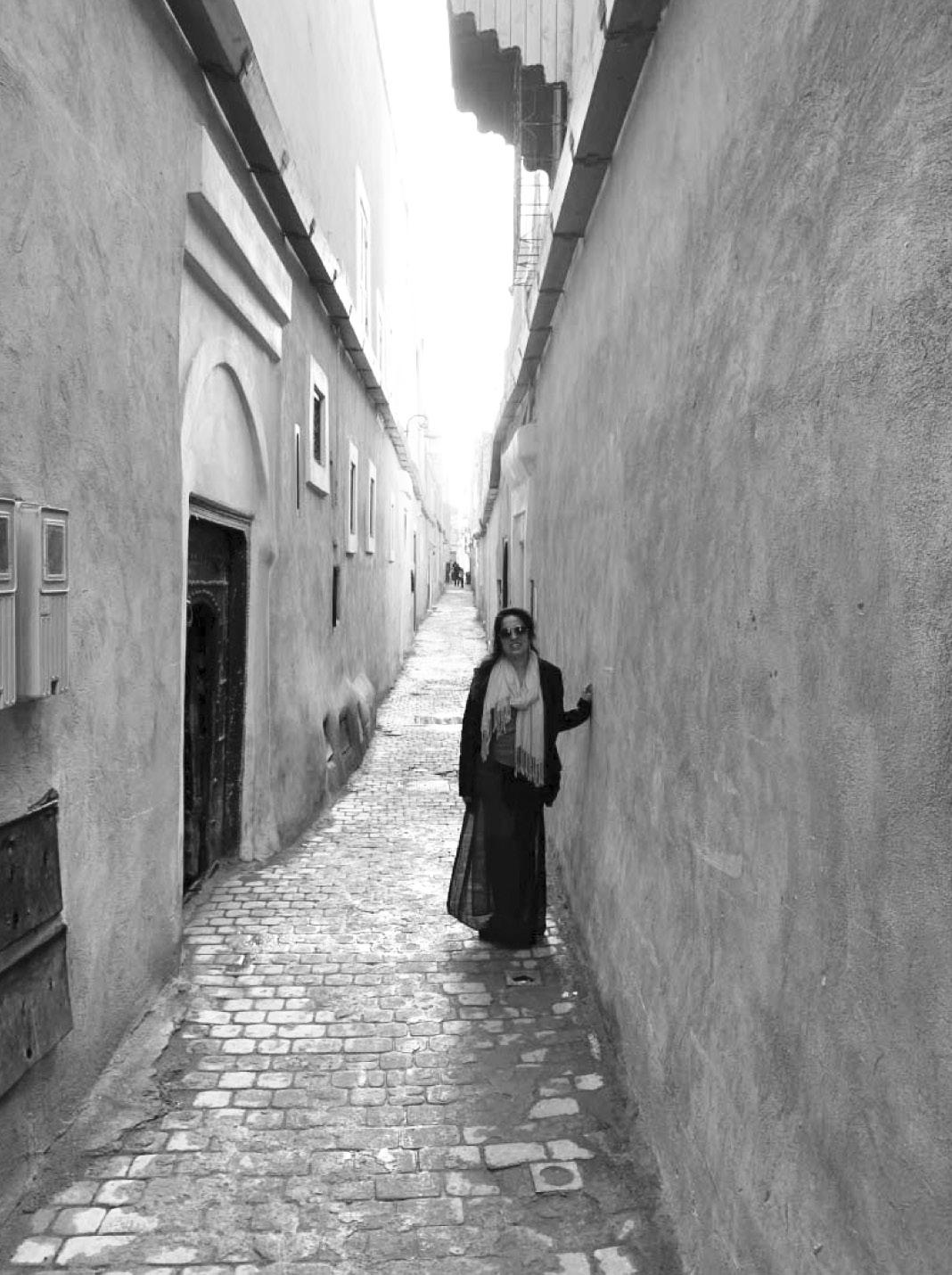
Marrakech is a city in southwestern Morocco and a tourist favorite, the other two being Casablanca and Fes. It is a city which is home to mosques, palaces, gardens and bustling souks. The old historic part of the town, Medina, designated as a UNESCO World Heritage site in 1985, has high stone walls and is divided into quarters which serve the local community. Typically, each quarter has its mosque, bathhouse (hammam), a bread oven communally used, usually a madrassa and a water fountain. Medina is distinctively different in character from the new city of Marrakech.
The city’s fortunes and prominence ebbed and flowed depending on which dynasty ruled it. In relatively recent times, Marrakech was conquered by the French in 1912 and became a part of the French protectorate of Morocco. It attained independence in 1956.
On the way back from a seven-night family vacation in Portugal in late November/early December 2019, my family and I spent four nights in Marrakech. Our direct flight on RyanAir from
man”; let me coin another for those who have never visited Marrakech... “When in Marrakech, stay in a Riyad”. It is a unique experience. Riyads have simple narrow and low ceiling entrances which open into an inner courtyard surrounded by rooms. The Riyad can have two floors, like ours did, with bedrooms on the top level and also a rooftop terrace adorned with a garden. The bathrooms were all fitted with western facilities. The most notable feature of a Riyad is that there is no window in any room which looks outside, only inside to get the view of the inner courtyard. Our Riyad came with a maid who came every morning to clean the place and also make breakfast as ordered- Moroccan tea and breads and pancakes with honey or regular western breakfast. Interestingly, these women worked inside with jeans and t-shirts but put on their burkas or niqabs before stepping outside.
cle of Jemma el-Fna has been repeated daily.
After lunch at a fancy Moroccan restaurant, “Al Fassia”, in the new city where we took a taxi to from Medina, we visited the Jardin Majorelle
Porto, Portugal to Menara airport in Marrakech lasted roughly five hours. That was our first visit to Africa. It was the 5th of December. Our flight landed in Marrakech around 9 pm local time and it was colder than we expected. Although it was early December, we had assumed that being in Africa it would be a bit warmer. We were mildly surprised but prepared.
We had made arrangements for a car from the airport to our planned stay at a Riyad. A Cadillac Escalade transported us to a square in Medina by around 10:30 pm; we did feel a bit uncomfortable with most of the shops in the square being closed and their lights off. We were totally unprepared for the next phase of the transportation where our luggage was transferred from the car to a hand pushed two wheeled wooden cart of the primitive kind. We followed it being pushed by a local who we neither understood nor he us. After a ten minute walk through a maze of alleys, barely adequately lit and quite empty, we reached the door of our Riyad on a lonely alley.
“When in Rome, be a Ro-
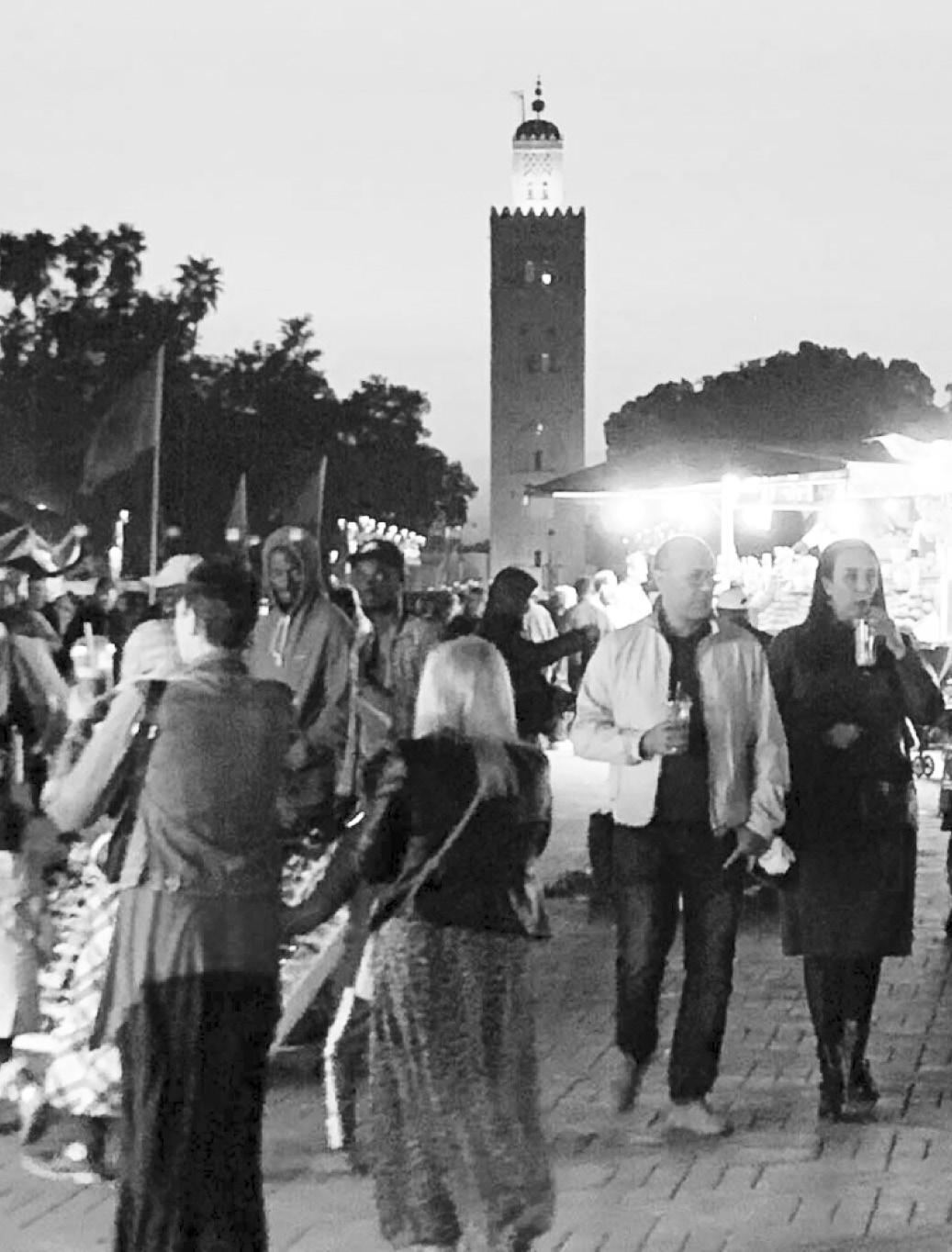
On the first day, we explored Medina on foot. The central hub of Medina is a square and marketplace, Jemma el-Fna, which dates back to 1062 when Marrakech was founded by the Almoravids. In this square, local market stalls carry all kinds of produce, viz., orange juice, spices, traditional medicines, mint leaves and stalls carrying an assortment of gewgaws. Snake charmers and monkey trainers entertain the crowds too. One has to be careful when taking pictures. Always ask first otherwise the owners are adamant about high fees for the privilege of taking photos with their pets. After sunset, Jemma el-Fna portrays a different life with numerous restaurants opening their doors to feed customers; the ones with rooftop seating arrangements are the most crowded. From there one can view the lively Jemma el-Fna by night while dining. “Tagine” is the most commonly known of all Moroccan delicacies. It is both a dish and a conical earthenware cooking pot. It is served on the table in the cooking pot itself and is consumed steaming hot. One should definitely try the lamb tagine. The performers who liven up the evening with their performances are the Berber musicians, Gnaoua dancers, acrobats and slapstick comedians. Down the years, the traditional specta-
The queue to buy admission tickets for this beautifully landscaped garden was long. This is a botanical garden, which has been designed by a landscape artist and it is fully adorned with exotic plants, pools, fountains and a Berber museum. It was created by the French artist, Jacques Majorelle around 1923 and was opened to the public in 1947.It was later bought and restored by the French designer, the late Yves Saint Laurent and his partner Pierre Berge. One can easily spend a couple of hours or more leisurely walking on the winding paths amongst the bamboo trees, cacti, palm trees and other exotic plants. Opportunities are plentiful around the pools, fountains and pergolas to take pictures to your heart’s content. We were particularly awed by a huge pond full of water lilies. On the way out, and as recommended, we stopped at the cafe for some ginger juice and Moroccan tea.
On the second day of our stay, we hired a local English speaking guide for a walking tour of some of the city’s landmarks. A young man, perhaps in his thirties showed up at our Riyad promptly at 9 a.m. He was a schoolteacher in the city and did part-time tour guiding to supplement his income and sustain his family. As we followed him to our starting point, the main square, Jemma el-Fna, we learnt why it is uncommon to find English speaking people around. Since Marrakech was a French protectorate at some point in its history, French and Arabic are taught in schools, not English. As a result, and to our initial astonishment, even the average person we met on the streets knew French.
Koutoubiamosque, which was easily viewable from the main square, was our first stop. Our guide proceeded to narrate that this mosque was from the twelfth century and the oldest in Marrakech. In the nineteenth century, booksellers assembled at its base - and hence the name, from kutubiyyin (booksellers). On Its minaret, a shiny brass spire kept its shine all year-around using
an old Moroccan but scientific technique, of filling the sphere with a mineral-rich salt, which kept the spire from oxidizing. As is customary, the faithful were called to prayer five times a day. Then it became interesting when we asked the guide if we could go inside to take a look. He promptly asked us if we were Muslims and since we were not, we could not go inside. This was in contrast to our experience a few years ago in Istanbul. We could enter mosques there, including the famed “Blue Mosque’’. Our next stop was the Bahia Palace. Not only is it interesting but it is also one of the best-preserved historic sites in Marrakech. Built on over two acres of land in the midst of the Marrakech medina, this palace has one hundred and fifty rooms, including a harem section. On entering, we passed through lush gardens, a small Riyad and rooms elegantly decorated in the Moroccan style with carved stucco and cedarwood. The palace houses council rooms with impressive zellige tiled fireplaces and cedarwood floors and colorful stained-glass windows. (For those interested in knowing more about this palace after it was taken over by the French in the early nineteen hundred, Edith Wharton’s book “In Morocco”, describing her stay during the French Protectorate years, is a fine resource.)
What we thought would be a brief stop at the Saadian Tombs turned out to be a much longer affair because of the long lines to enter. A series of mausoleums and tombs and cemetery gardens make up this site that house the remains of important figures from the Saadi Dynasty, which ruled Morocco from 1549 to 1659. Upon the fall of this dynasty, the tombs were sealed off and hidden but eventually uncovered in 1917. The main mausoleum, belonging to Ahmed el-Mansour, the Hall of Twelve Columns, was constructed from Italian Carrara marble, with honeycomb designed muqarnas (ornamental vaulting), and gold inlay. Some of his closest family members and descendants are also laid to rest in this mausoleum. This site is the main attraction and groups of about ten visitors were allowed inside at a time to view. Throughout the gar-
continue to page 6 }
| continue from page 3
get his MRCP from Britain and become a well-known doctor!
Medical College’s distinguished alumni members include doctors like Upendranath Brahmachari who discovered the cure for Kalaazar (Dr. Brahmachari was knighted for his achievements in the medical field and given the title of Rai Bahadur), Dr. Bidhan Chandra Roy and many others. Dr. Lahiri interacted with some of these well-known doctors. One of his professors was Dr. Sailen Sen who was Dr. Rajendra Prasad’s physician and treated the President for asthma. Dr. Lahiri has a fund of fond memories of Dr. Bidhan Chandra Roy, who had both MRCP and FRCS degrees. (Even today, Dr. Lahiri points out, it is rare for a doctor to have both degrees.) Dr. Roy was always invited to speak at the Medical College Foundation Day celebrations, and Dr. Lahiri remembers that on one such occasion, Dr. Roy was asked why he had gone to the trouble of getting an FRCS degree when he never performed surgery.
“I watched the surgeons carefully in order to learn how to be precise and practical,” Dr. Lahiri recalls Dr. Roy saying. “I wanted that sense of discipline.”
When Dr. Lahiri became a house physician, the monthly salary was only Rs. 50, and so the house physicians went on strike. They had their own expenses to meet – and, in many cases, those of their parents and younger siblings. (The hospital was not paralyzed, Dr. Lahiri is careful to point out to me; there were other doctors on duty.) Dr. Roy intervened at once and asked 5 or 6 house physicians to meet with him. Dr. Lahiri was one of them. “When we finished speaking, Dr. Roy immediately picked up the phone, and told the concerned person to raise our salary to Rs. 75,” recalls Dr. Lahiri.
Dr. Lahiri also describes an important encounter that Dr. Roy had with Mahatma Gandhi, one that few people know about. During the Quit India Movement, Gandhi, who was on hunger strike, became very frail due to severe anemia. Together with this, since he walked through villages wearing flip-flops on his feet, hookworms attached themselves to his skin,
entered his intestines and caused his hemoglobin to fall dangerously low. The medicine to remedy this condition was made by Glaxo, a British company, and since Gandhi was advocating the boycott of British goods, he refused to take the medicine. Eventually, Dr. Roy was called upon to speak to the Mahatma. Dr. Roy convinced him that if he wanted to continue with his extremely valuable work, it was more important for him to live and carry on the crusade. And he could only do this if he took the medicine. Gandhi listened to his advice.
Dr. Lahiri’s last story about Dr. Roy concerns the day the eminent doctor took his last breath. When news of his death became known, hundreds of people lined up to pay him their respects, and Dr. Lahiri joined the queue. “The line kept moving but there was one person, a very tall person, who stood before the body, seemingly immobilized. It was Satyajit Ray. He could never forget all the encouragement that Dr. Roy had given him and the big role he had played in helping him find funding for Pather Panchali.”
Another well-known doctor whom Dr. Lahiri remembers is Dr. Sailen Sen. “Dr. Sailen Sen was an eminent physician. He was also affluent.” So, he probably had little knowledge of the economic conditions of others. “One day, 4 or 5 of us students were with him in the General Ward. He told me to take a patient’s pulse. I put my finger on the patient’s wrist and asked a friend to lend me his watch. Dr.Sen asked me why I wasn’t using my own watch. I replied that I didn’t have one. ‘You should be ashamed of yourself!’ he yelled at me. ‘I want to take you to the balcony and throw you out of here!’”
When, in 1844, Dwarakanth Tagore was making preparations for his second visit to England, he requested the Council for Education to allow him to sponsor two medical students to go with him to Britain for higher studies. The Council decided to sponsor two more students. Three of these students, Dwaraka Nath Bose, Bhola Nath Bose and Gopal Chunder Seal, passed the MRCS, the Member of the Royal College of Surgeons exam, and returned to India to join the covenanted Medical Service. The fourth, Surjee Coomar
Chukerbutty, stayed on to get an MD degree from the University College of London. Then he became the first Indian to pass the Indian Medical Service examination and joined the covenanted Indian Medical Service.
When Dr. Lahiri became a house physician, he got assigned to the chest department. Following that, he was sent to the pulmonary department at the TB Hospital in then Kanchrapara. But he wanted to work on his MD thesis, and so he needed to be associated with a teaching hospital. But all such hospitals were in Calcutta. About a year a half later, he was transferred to the Infectious Diseases Hospital where he worked with diphtheria patients. As time went by, he decided to give up working on his MD thesis and to go abroad. “The future seemed bleak in India,” he says, talking about that time in his life.
Dr. Lahiri got his MRCP degree from England and worked in both England and the US before deciding to move to the US permanently. He worked for 62 years as an Internal Medicine and Pulmonary specialist, and was affiliated with Robert Wood Johnson University Hospital, Somerset, New Jersey. He retired about two years ago after making his mark in the New Jersey medical community.
To go back to the history of Calcutta Medical College, in 1883 Kadambini Ganguly became the first woman to join that institution, and it was not easy for her to do so. Her greatest supporter was her husband, Dwarakanath Ganguly who was influenced by the progressive views of Akshay Kumar Datta, a well-known member of the Brahmo movement. Ganguly believed in women’s emancipation and education, and he helped his wife to enroll in Calcutta Medical College. After she graduated, he sent her abroad for further medical studies. She was awarded the LRCP and LRCS from the Universities of Edinburgh and Glasgow, and the DFPS from Dublin.
When New Jersey-based pediatrician Aparna Mallik joined Calcutta Medical College in the early 1970s, almost a century after Kadambini Ganguly, the situation regarding Indian women joining the medical profession had changed completely. It was so widely accepted that
Dr. Mallik does not recollect people speaking that much about Kadambini Ganguly. By the time she entered 9th grade, Aparna was sure that this was the profession for her. Her father had wanted to be a doctor but had had to drop out of medical college due to family reasons. But he nurtured the hope that one of his children would accomplish what he had been unable to do. This proved to be a source of inspiration for his daughter. When Aparna joined Calcutta Medical College, Bimal Chandra Das, her dactar dadu, her maternal grandmother’s eldest brother, who was a Calcutta Medical College doctor and well-known in his profession, was absolutely elated. This doctor, who was also the eldest brother of the famous revolutionary Bina Das, sent a van full of all his medical textbooks to Aparna. “Some of them were first edition books,” says Dr. Mallik, recalling the sheer happiness that filled her when the van arrived at her house, “and most of them were too old for me to use. But I kept all of them because they filled me with such enthusiasm.”
“I was both very excited and a bit scared,” remembers Dr. Mallik when talking about her first day at Medical College. “The buildings were so impressive, so old, and so grand. The Internal Medicine building, and its staircase were awe-inspiring, as was the big auditorium of the Anatomy Lecture Hall. I still remember the drawing on the black board. It was of the muscular skeletal system.”
What was her first day at the Dissection Hall like? Was she nauseated by the thought of having to cut dead bodies? “No, not in any way,’” responds Dr. Mallik. “In fact, what I remember is how clean and gleaming white the marble floor and the tables of the Dissection Hall were. And above all was the overwhelming emotion that resonated through me. I felt I was becoming part of something very big.”
The Medical College that Dr. Mallik went to was very different, in many ways, from the one that Kadambini Ganguly attended. One very important difference was that some of Dr. Mallik’s teachers were women. Dr. Mallik remembers Meera di, her first-year anatomy teacher, with great fondness. “She was soft-spoken and digni-
fied, and a great teacher,” says Dr. Mallik. “I cannot recall her last name, but I remember how she inspired me.” Dr. Sital Ghosh was another teacher who made an impression on Dr. Mallik. She was doing the internal medicine part of her rotating internship, and here was this teacher who was the opposite of Meera di in some ways – he was “loud and intimidating” at first; but “I learned a lot from him”.
Talking about her specialization, Dr. Mallik says she always wanted to become a pediatrician. One of her OBGYN professors tried to motivate her into entering the OBGYN field but Dr. Mallik had already made up her mind.
“When I was coming towards the end of my time as a senior house staff,” reminisces Dr. Mallik, her voice taking on part of the enthusiasm she clearly felt at the time, “I attended a conference organized by the Spastic Institute of India. I was very impressed by the work that was being done.” It increased her resolve to dedicate herself to pediatrics.
In 1980 Dr. Mallik came to the US. She did her residency in General Pediatrics at Robert Wood Johnson Hospital, and then a fellowship in Neurodevelopmental Pediatrics. She is board certified in General Pediatrics, Neurodevelopmental Pediatrics, and Developmental and Behavioral Pediatrics. She has made her mark in her field and is a fulltime faculty member at St. Joseph’s Medical Hospital at Paterson, NJ and so is involved in teaching, and in treating patients at the clinic.
Was there any time in her career when she faced any kind of discrimination for being a woman? “Yes, one time,” she says. “When I was doing my rotating internship in Calcutta, I was supposed to go to the village of Pagla Chandi to stay and work there for a month. Severe flooding broke out in the area just before I was due to leave and so four of us women doctors were told not to go. Only our male colleagues were allowed to do so. I always felt very sorry about that.”
Today there are many other colleges in India that offer commendable medical studies and that have well-known alumni. But the institution that led the way always has a special place in the history of western medical instruction in the country.
There is an existential crisis in print medium including newspapers. It has been at least a decade since I have gotten newspaper deliveries at my house. The newspaper that was avidly quartered, shared and read when I lived with my parents, has no longer any utility in my home now. We used to subscribe to ‘The Hindu’ and that was the only newspaper and opinion that I read growing up in Chennai. I knew that some people subscribed to the ‘Indian Express’ and I was very keen on visiting those houses and reading their stash of newspaper because they ran serialized Tarzan comics. Just 3 blocks a day, but I used to read at least 30 of them, to be able to follow the story while my parents chatted over tea and snacks. Being used to the 10-15 odd pages that was the strict structure of ‘The Hindu’, I found it a little disconcerting to read the ‘The Telegraph’ or any other newspaper.
Coming to this country, it was a pleasure and challenge to see the bountiful harvest that was the weekend edition of the newspaper. There were sections fit for everybody in the family, but strangely enough the international news was sparse or non-existent in any of the local newspapers. The sports section was munificent but
By tathagata Ghosh
did not represent the sports I liked. I used to subscribe to the weekly magazine Newsweek till it literally keeled over and dissolved into a digital version. I did not find this palatable and quit subscribing to it. I have stopped my newspaper subscription too, years ago.
Newspapers and print journalism are dying. It has fallen victim to technology. Newspapers were gravely impacted by TV but were gut-punch flattened by the internet for about two decades now. Newspaper circulation has dropped to the lowest levels in the recent years since it has been tracked from the 1940’s. Barely 10% of the population of the US subscribe to newspapers. As everybody knows, there is an explosion of news and information, but they have come from nontraditional sources, not from the newspaper rooms. Just a few days ago, in Feb 2021, the McClatchy newspaper chain filed for bankruptcy. McClatchy owns media companies in 14 states and has been floundering financially for a few years now.
Newspapers depended on advertisements and tight advertisement budgets have
now been distributed over multiple channels progressively more on online channels. Print advertisements have roughly declined to a quarter of what it used to be previously. Newspaper circulation has fallen to their lowest level in 2018 since 1940 and year over year there have been declines in the range of 5% or so. Newspaper advertising that is the life blood for the health of this industry has fallen more than 50% in a span of 10 years from 2008 to 2018. This has resulted in a death spiral for newspapers. As money dries up, newspapers have to lay off people and reduce the size of the magazine. The quality suffers and readers flee, as the prices of these newspapers start to trend upwards to keep up with the burgeoning costs. It was around 2015 that corporate spend on internet advertising overtook print media advertising (which included newspaper and magazines). Employment in the newspaper industry has fallen by 50% in the same time period and layoffs continue across the industry. This hemorrhaging of the print journalism has now led to study in that field being characterized
as the worst possible career choice.
Print journalism has been characterized as the fourth estate of democracy. This is as important to the health of a society as the other branches of government. They are supposed to be the guardians of the truth not the purveyors of sensationalism. While the lure of lucre has enticed many away from this role the stalwarts of the industry continue to be well-respected and widely quoted. The analysis and diligent reporting that are the hallmarks of journalistic excellence can be found not only in the national newspapers but often in the local newspapers too. Alas the local newspapers are an endangered species; the national newspapers are still surviving but not be very financially well-off, and ominous sign.
Confoundingly enough, in one country, print journalism continues to thrive and actually expand. That is in India. The number of paid newspapers continues to grow year over year. The growth is most in Hindi newspapers. The growth in newspapers is despite the growth and the reach of the internet in India.
Maybe culturally, the newspapers have always been the source of reliable news while television news is ephemeral and partisan and the flotsam of news on the internet is just too ubiquitous to be taken seriously. Interestingly enough, the advertisers have continued to remain loyal to the newspapers. Can this solitary hopeful beacon continue while newspaper readership is crumbling in all the Western countries?
The responsibility of the health of newspapers rests on the community. It lies with every one of us to support this. For the price of a coffee on the weekends, one can definitely subscribe to a newspaper. It is something that every family can do and huge fillip to the industry. The business model of newspapers may need to change to remain afloat in this new economy. I hope there is a turnaround in the fortunes of print journalism in the USA and there will be a day where every household will have 1.5 children, 2 cars, multiple TV’s and computers and one newspaper on their driveway every morning.
References: https://www.pewresearch. org/fact-tank/2020/02/14/ fast-facts-about-the-newspaper-industrys-financialstruggles/
| continue from page 3
dens were tombs of sixty-six more princes and other prominent figures.
The last place our guide took us to was a Berber showroom with the not-so-subtle intention of helping a local business make some sale. Although several of the world famed Berber carpets caught our fancy, we refrained from making any purchases, although being assured that they could be shipped to anywhere in the world. In another part of the showroom, we were ushered into an area which housed local medicinal products, Moroccan teas and a vast collection of oil-based fragrances. We did make some small purchases here.
No visit to Marrakech is complete without visiting the Souk Semmarine, located north of Jemma el-Fna, (Souk is an Arabian marketplace or bazaar). This was within easy walking distance of our Riyad, so we visited this souk more than once. It is easy to
be overwhelmed by the fusion of sounds, colors, sights and smells of this enormous place, perhaps because it resembles our New Market in Kolkata, but perhaps more diverse in the items being sold. Pottery and brass items need special mention, besides the various food shops, trinket stalls and leather good products. My wife and daughter purchased a few bibelots from some of the stores they visited. And yes, haggling is allowed and customary. A word of caution, it is easy to get lost in the maze of lanes and array of shops in this souk. For westerners, in particular, the atmosphere inside the Souk Semmarine would seem both magical and mystical. For us who are from Asia, we could make some mental comparisons with similar markets in our own countries.
On the last day in Marrakech, we wanted to do something adventurous and were left deciding between either a camel ride or Quad bike rid-
ing... we chose the latter. It was a half day program, first with a car ride from Medina to a quad bike rental place, near the desert, about 5 miles from the city. We had less than 30 minutes training on operating those four-wheel ATV’s and then set off in a caravan with the trainer in the lead quad. Following him were us four in our family and a German couple who lived in Madrid. On this very thrilling ride, we crossed several different terrains over the rocky desert and beautiful palm groves. We took a break at a Berber house to taste some mint tea and Moroccan crepes, and then retraced our path back to the quad rental shop. Overall, a very stimulating riding experience, the likes of which neither my wife nor I had had before. That we could even endure such a bone rattling drive was a miracle!
(*most historical facts as narrated by the local Moroccan guide; a few obtained from the internet. The photos are personal.)
reported by Mita sinha, Chair, puja Committee
We are struggling with snow, cold winter, and of course, the COVID-19 pandemic since last year. We still have 2 to 3 months of winter to push through. The Mandir is closed to visitors for months because of the virus spread. All our pujas are still happening as scheduled. Some members are bold enough to brave the cold weather and managed to come to the temple quite regularly.
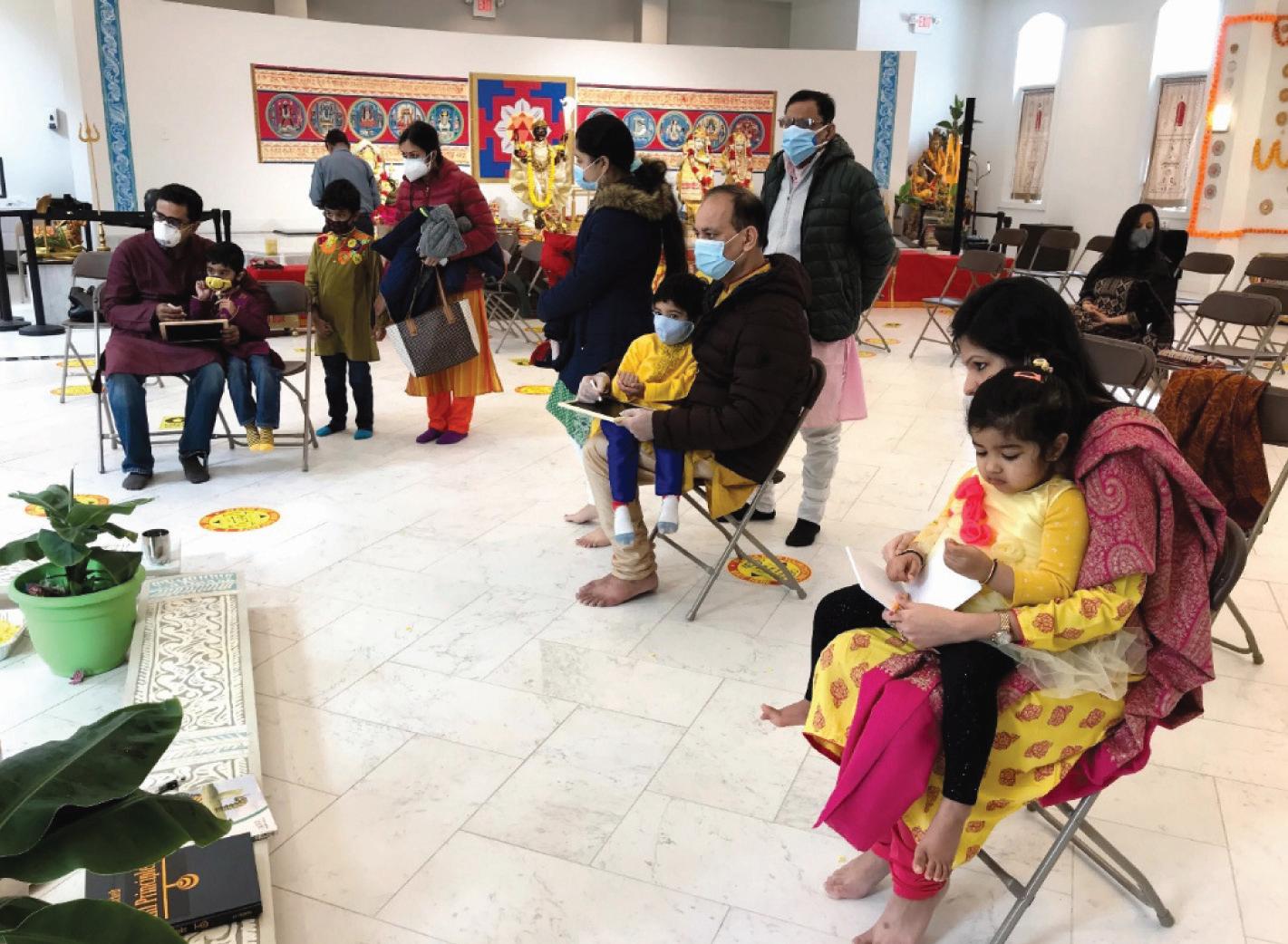
The month of February ended with our popular Saraswati Puja and Hate Khori for the kids 2 to 3 years of age, on the 16th. The temple was open from 8 am to 4 pm. The entire Saraswati puja was streamed virtually. 125 visitors attended this puja and boxed foods were distributed to everyone after the puja was done. Members and devotees who could not come to the Mandir were able to watch the puja from home. Hate Khori is the ceremony performed during Saraswati Puja to introduce education to young children. It is also known as first writing ceremony. It is precious to watch little kids struggling to write Bangla letters on their
slate sitting with their parents. The smile on their faceswere priceless when they received the gifts from the Mandir, a drawing book and a box of crayons. Bani Bandana was celebrated on the 20th, with a wonderful cultural program. This is always done on the weekend to accommodate the children/ parents, who are not able to attend Saraswati Puja in a weekday. Like every year, this program was specifically designed to showcase the performances by the children. In spite of cold weather, snow and
slush,A lot of people came to the temple and enjoyed the special day.
On March 11th we had our Maha Shivaratri. Shivaratri is an annual Hindu festival, gives reverence to Lord Shiva. This festival is also known as great night of Shiva. Maha Shivaratri is observed by remembering Lord Shiva and chanting mantras, prayers, and fasting. Devotees of Lord Shiva stays awake all night praying and offering milk, sweets, leaves etc. to Lord Shiva. On this day the temple stayed open from 3 pm to 3 am next morning. Number of our members spend the night in the temple chanting and offering milk, juices and water to Lord Shiva. This is a very special and
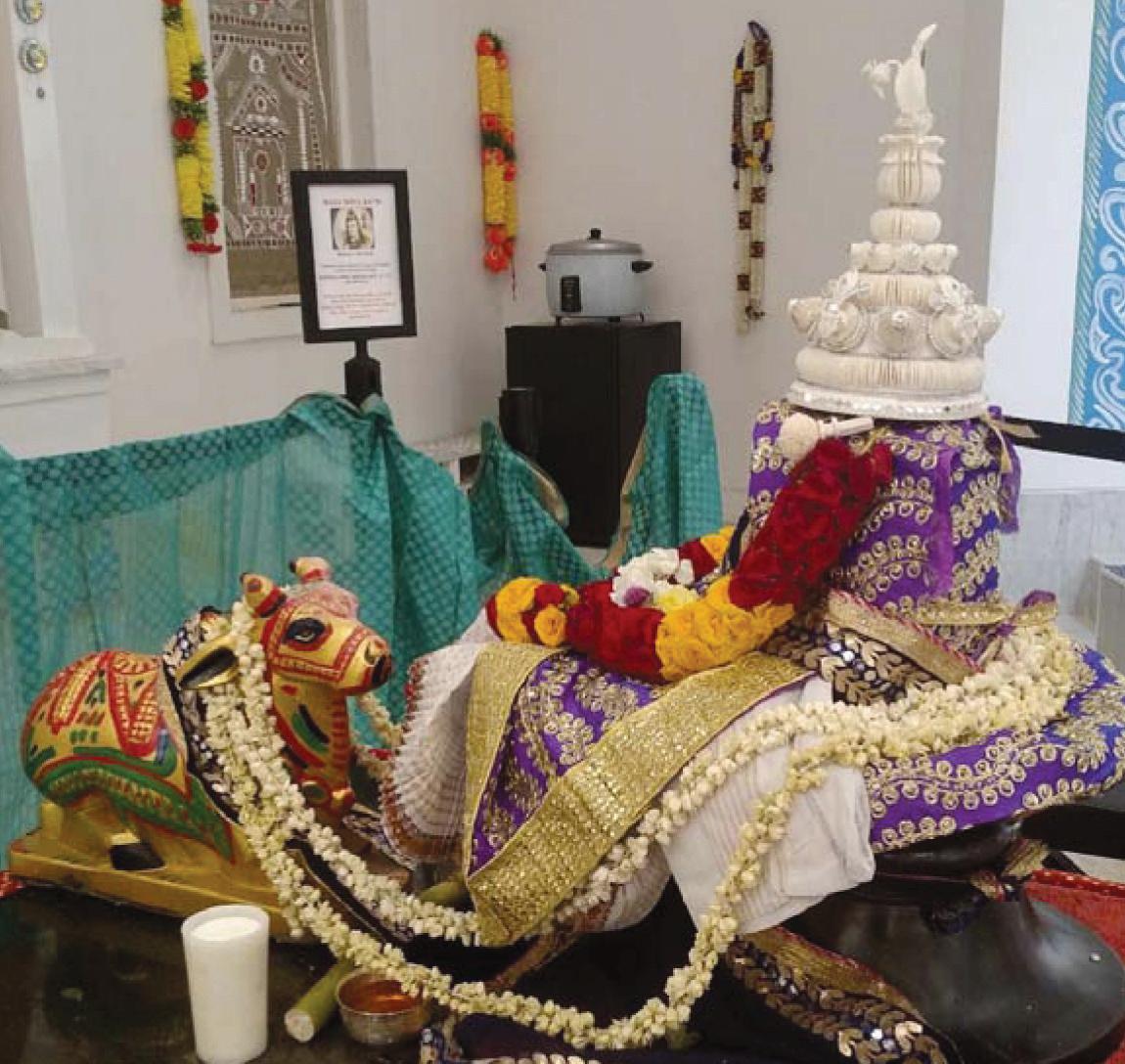
auspicious day for Hindus.
The monthly Shyama Puja was celebrated on March 12. We had good attendance in the Mandir for this puja. Members have started to visit the temple more often because some of them are vaccinated now and they feel safe. We are still following the CDC guidelines inside the temple with mask wearing and maintaining distancing.
On March 28, we plan to have the festival of Holi and followed by Satyanarayan Puja. Holi is a popular ancient Hindu festival, also
known as “festival of colors” and the festival of love. The festival signifies the triumph of good over evil. Also, Holi celebrates the arrival of spring. This festival is originated and predominantly celebrated in India but has also spread to other parts of Asia and the Western world through the diaspora from the Indian subcontinent. People smear colored powder on each other. In the evening people visits their friends and family.
At Ananda Mandir we
continue to page 9 }
By Amrita kangle
Kolhapur city is located in the large Indian State of Maharashtra. Scenically situated on the banks of the Panchganga River, it is surrounded by the Sahyadri mountain ranges and is known for its historical forts, temples and royal palaces. The city is famous for the Kolhapuri Saaj necklace. This is an extremely chunky piece of heavy gold jewelry with traditional motifs and is generally right on top of a woman’s wish list. Jaggery and Kolhapuri chappals are also synonymous with the place as is its vibrant, spicy and mouthwatering cuisine. I present here a beloved recipe which is guaranteed to satisfy your taste buds since it is
to answer all your questions!
INGREDIENTS
l 2.5 lbs. Goat meat with bone
l 2 tbsp. ginger-garlic paste
l 1 tsp Turmeric
l 4 tsp Red Chili powder
l 1/2 cup plain thick yogurt
SPICE
l 3 tbsps. Garam Masala Powder
l 2 tsp Garlic julienned
l Cloves 8, Cinnamon 6 medium sticks, a tsp of whole black peppercorns, 2 green cardamoms
l 2 halves of a dried coconut- grated and lightly dryroasted
l 1/2 cup White Sesame Seeds lightly roasted
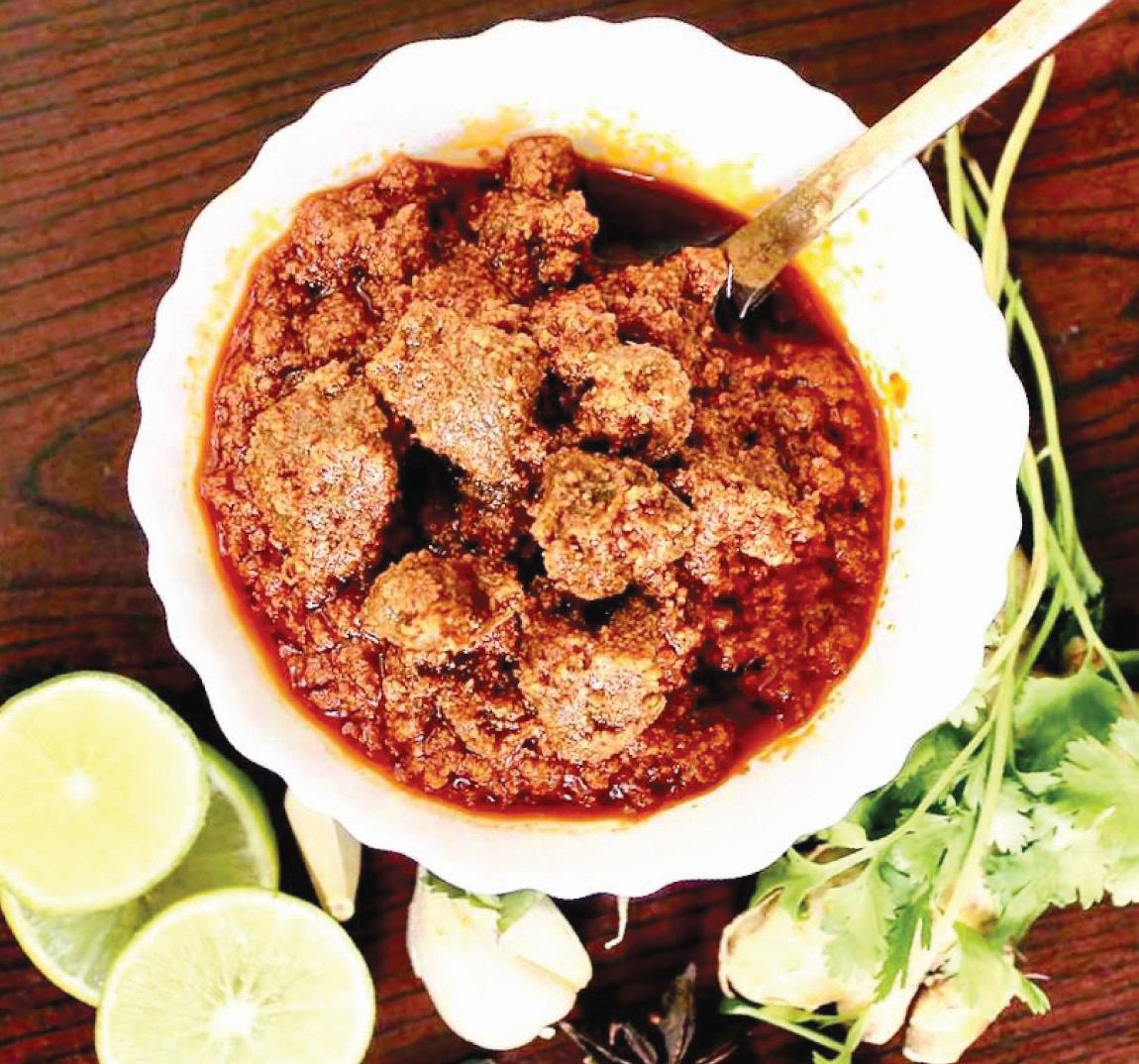
so finger-licking good. Being married to a Maharashtrian I have had the added advantage of being able to indulge my gluttony and partake of cuisines from both the East and the West coast of India and have left no stone unturned in trying to cook all the delicious recipes from both the States. If you have any questions at all about this recipe, please do reach out and I will be very happy
l 1 tbsp. Poppy Seeds lightly roasted
l Juice of 2 large Limes
l 2 cups of oil
l 2 tbsp Coriander-Cumin powder
l 2 tbsp Kolhapuri Kanda Masala (available in any Indian Store)
COOKING
1. Wash the meat thoroughly. Apply the gingergarlic paste, salt, yogurt,
red chili powder and Garam Masala powder. Cook in a pressure cooker WITHOUT adding water for about 3 whistles. The meat will release its own water and this you will need to dry off once the steam is released and you open the lid. Once the mutton is dry, take off the flame and allow to cool.
2. In a separate vessel add together the roasted dry coconut, sesame seeds, poppy seeds, salt to taste and some chili powder. Crush and mix together lightly with your fingers. Add the cloves-cinnamon-peppercorn-cardamomsKolhapuri Kanda Masala- coriander cumin masala mix on top and keep aside.
3. Add 1/2 cup oil in a pan and lightly fry the cooked mutton pieces in batches of 4 and keep aside in a wide bottomed pan. Do not over fry the meat pieces; just fry them very lightly.
4. In the same pan pour the remaining oil and heat upto smoking point. Quickly add the julienned garlic. Now very quickly pour this hot oil on the dry spice mix of poppy, sesame etc. that was kept aside in the vessel. This will ensure that the clove, cinnamon etc. will get nicely aromatic due to the hot oil.
5. Add this mix to the fried mutton pieces and mix thoroughly so that all the pieces are coated thoroughly. Once it is cooled, add the lime juice to it and mix thoroughly.
6. You may need to increase the quantity of oil since pickles always need more oil to enhance their taste. This preparation can last upto a week when refrigerated.
Fine cut green chilies can be fried crisp and added on top to enhance the flavor of the dish.
Do not overcook the mutton in the pressure cooker in the first place since it is to be fried again. It is to remain a little firm.
| continue from page 8
put color powder on the feet of lord Krishna and Radha and then on each other, but because of COVID-19 that will not happen this year. I hope next year things will get normal for all of us to be able to enjoy this festival with fun and color. We are eagerly waiting for the temple to open to all visitors. Ananda Mandir is a very special place for all of us. We pray, eat and socialize in here together. We are like a family here and we invite anyone interested to come and share thecamaraderie with us. Stay safe and we will see you all soon at Ananda Mandir.
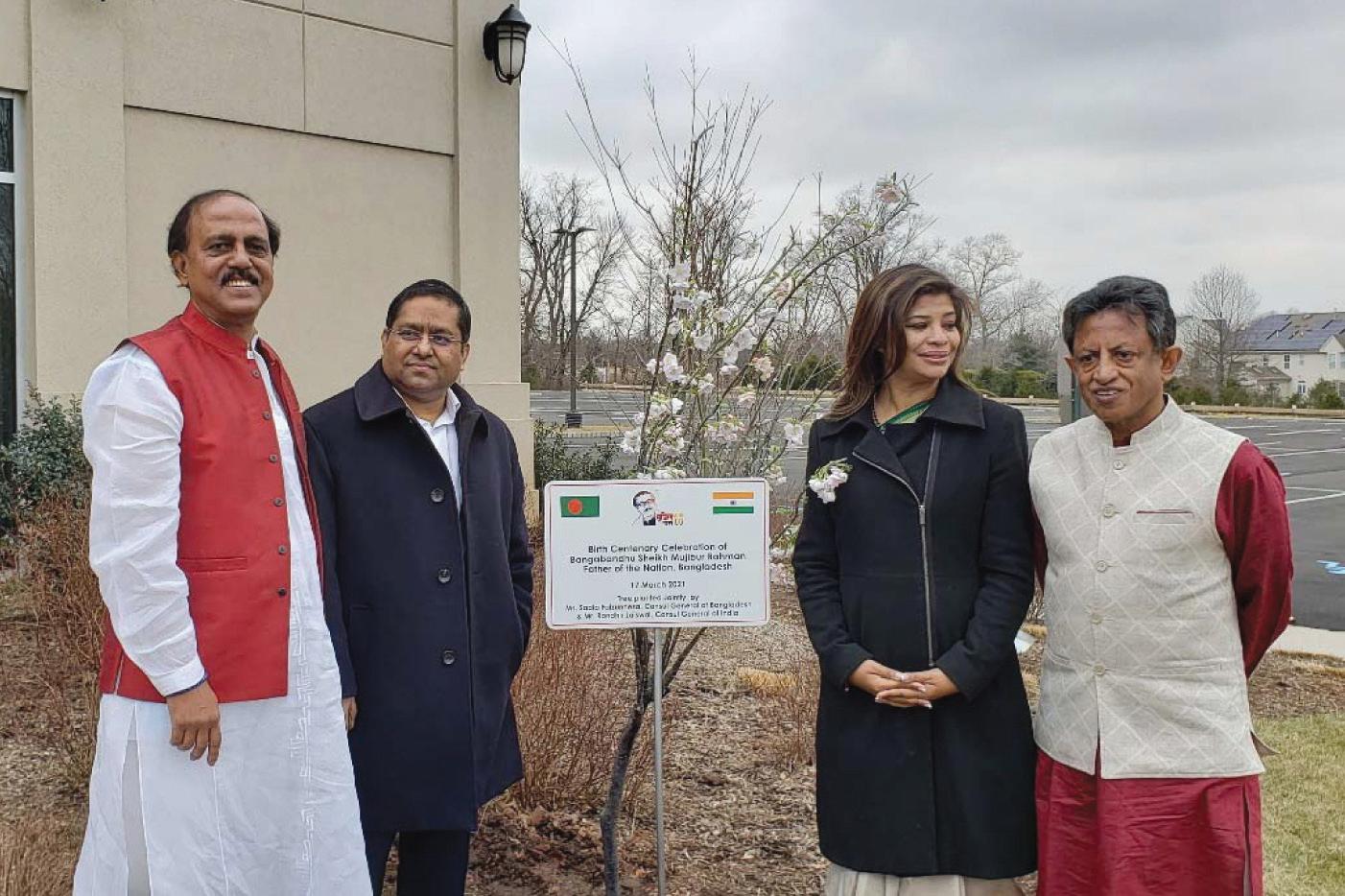
Abirth centenary celebration of Bangabandhu Sheikh Mujibur Rahman, regarded as Father of the Nation of Bangladesh, was celebrated at Ananda Mandir premises on 17th March, 2021. The occasion was graced by the presence of Ms. Sadia Faizunnesa, the Consul general of Bangladesh, and Mr. Randhir Jaiswal, the Consul General of India. A tree plantation ceremony was planned for the occasion. The entire celebration took place in the Tagore Hall. Arun Bhowmik thanked the people for coming in to participate in the program. Ashok Rakhit reminded us of the close ties between the Bengalis from the East and the West. It is a celebration for all Bengalis, he told us. He continued with narration of the history of Sheikh Mujib’s leadership in the liberation movement, leading up to the creation of Bangladesh in March 26, 1971. Jaiprakash Biswas, who was born in Bangladesh and grew up there expressed his gratitude to the Bangabandhu for bringing independence to the country.
Ms. Faizunnesa started her speech in Bengali, saying that since all the attendees know Bangla, it is appropriate to talk in Bengali. Later, she spoke in English. Bangabandhu was not just the friend of Banga or Bangladesh, but a friend of the world, she said. Although Mujib’s dream of turning Bangladesh into “Sonar Bangla” (Golden Bangla)
did not materialize because of his untimely death, Bangladesh is progressing rapidly under the leadership of Sheikh Hasina, the current Prime Minister, and the daughter of Mujib himself. Bangladesh rose from the status of least developed country to the rank of one of the top developing countries, according to a report of the United Nations. She listed many areas of achievement by Bangladesh.
Mr. Jaiswal followed with a short speech about sacrifices made by Sheikh Mujib in creating Bangladesh.
Mitan Roychowdhury started the musical part of the program with the US National Anthem in her stunning voice. That was followed by the trio of Jafar Billah, Subarna Majumdar and Arun Bhowmik to sing “Amar Sonar Bangla”, followed by “Janoganomano…” both the national anthems created by Nobel Laureate Rabindranath Thakur. And the final song was the one that became synonymous with the independence war of Bangladesh at the time:
The tree planting ceremony was perfumed outside the Tagore Hall with active participation by Ms. Faizunnesa and Mr. Jaiswal. The whole program was well organized and it brought back some well-deserved and fun-filled time for the community.
By Basab dasgupta
Typically, the Japanese in general and especially the corporate businesspeople appear very serious and do not seem to have any sense of humor. During the entire period that I worked at Sony, I seldom got an opportunity to open a presentation by cracking a joke or two, which is so typical in an American company, or to make sarcastic funny comments during a business meeting. It was all serious business during working hours.
They relaxed quite a bit after work though. They consumed large amounts of alcohol which certainly helped them to relax. They would open up about various topics, but even then, they were somewhat restrained.
However, I gradually learned that the Japanese do have a wonderful sense of humor, especially when compared to people from the other neighboring Asian countries. They were intelligent enough and understood the English language well to appreciate the subtleties of a joke and knew when to laugh and when not to. They understood differences between innocent inane jokes versus humor with some sort of message.
On joining Sony, I had my business cards printed with the letters “PhD” after my name. Since there were not many doctorates in the entire company, I thought that it would draw attention because the Japanese were known to be very thorough in their inspection of the information on business cards.
Mr. Ito, an engineer in Japan, was frequently assigned as my escort during my visits to Japan, mainly because of his ability to communicate in English and his friendly nature. He was also my first point of contact for technical communications with Sony, Japan.
One of my early projects was approving and introducing copper wire from a US vendor, Phelps-Dodge. I had numerous exchanges with Mr. Ito where I was very emphatic about the need for expedited approval of their wire for cost reduction reasons and was a loud promoter of their quality. When I met Mr. Itofor the first time in person, I handed him my business card. He looked at
the card, pointed to the letter “PhD” on my card and asked with a smile “Phelps Dodge?” We both laughed out loud. He was basically teasing me that perhaps I had become a salesperson for Phelps Dodge. This incident was my first awakening to the Japanese sense of humor.
I do not know how my comedic talents gradually spread throughout the organization. It probably started with my speech at Harlan May’s farewell dinnerbut the audience there was mostly Americans. I also gave some humorous speeches on other occasions, mainly to impress Sharon, an HR manager, who I had a thing for. Eventually, I became the main attraction as a speaker with a biting sense of humor no matter what the occasion was, a farewell dinner or Christmas party or even a business dinner. I used every occasion to make fun of the Japanese way of doing business, their personalities and habits as well as some real issues we were facing in business. Much to my surprise, the Japanese members just lapped up my humor.
I clearly remember one such speech during the period when Mr. S. Takahashi was my boss in San Diego, and this was also the period shortly after my divorce. Mr. Takahashi was a very quiet individual, a perfect gentleman and he had one of those stoic faces, without any expression or reaction regardless of the situation. I said, “As many of you know, I have been living by myself lately and I spend a lot of my time talking to the walls. I am so happy that Mr. Takahashi is my boss because now, I practice by talking to Mr. Takahashi before I talk to the walls.” Mr. Suzuki, one of the executives from the TV plant in Mexico was literally rolling on the table laughing.
Mr. Suzuki started referring to me as “the man with the golden tongue”.
I got the biggest response to my jokes from the Japanese audience when I made fun of the politics going on in the top-level management circle. One example was on an occasion when I was telling the story of how I got to be the Vice President (of course, not the real story).
Mr. Suehiro Nakamura used to be the president of the
Sony TV operation in UK, before returning to Japan. The TV plant in UK was located in a small town, named Bridgend, about an hour by train from Cardiff in Wales. He was known to be openly promoting the career paths of a number of people, who were his subordinates at Bridgend, and they were placed in important executive positions at various Sony facilities throughout the world.
The understanding was that, if you worked for Nakamura in Bridgend, your future was bright. I told the audience (Nakamura was not in the audience): “One day, I was feeling so depressed and frustrated in my job because of all the politics that I decided to take my own life. I went to the Coronado Bridge and stood at the end of the bridge, ready to jump into the San Diego Bay. Right at that moment, Mr. Nakamura happened to be there and saw me. He said ‘Oh, you are at bridge end. You must be promoted.”
My personal favorite is one of the stories I told during my farewell speech in honor of Mr. T. Hasebe on the eve of his return to Japan. Hasebe was the head of Sony Engineering and Manufacturing reporting to Mr. Carl Yankowski, who was the president of Sony Electronics. There was some rumor about conflicts between Mr. Yankowski and Hasebe and a few people even wondered if that was the cause of Hasebe’s return to Japan. In my speech, I was offering my tribute to Hasebe and said at one point “When I think of Mr. Hasebe, there is only one other leader who comes to my mind and who I can compare him with; that is Bill Clinton.”
All ears in the room perked up because this was the time when Bill Clinton’s scandalous affair with Monica Lewinsky was the hot news item. Some folks seemed a little worried about what I might end up saying. I continued, “Just like the US economy prospered under Bill Clinton’s presidency, Sony made enormous profit under Hasebe’s leadership. Just like Clinton, Mr. Hasebe loved to play golf and Hasebe told everyone,“I had no improper relation with that man –Carl Yankowski,”, basically modifying the infamous Clinton denial. The audience just loved it. Even Mr.
Hasebe, who did not like me much, laughed out loud and told me, “What are you doing at Sony? You should be performing in Las Vegas.”
Even though many Japanese had a keen sense of humor, I never saw them taking the podium and cracking jokes publicly. The only incident that came close was when Taku Miyanaga was making fun of all of my engineering efforts including local design and introduction of local vendors, facing stiff opposition from the design engineers in Japan. Miyanaga said “...it is an epic battle between Dr. Who and Dr. No…”. Dr. Who was me because people had difficulty in pronouncing my last name and Dr. No was the Japanese engineering group who said “no” to all of my proposals.
On another occasion, Mr. Sugiyama was speaking at a farewell party for Mr. Misono who was well-known for his rather young appearance compared to his age. Sugiyama tried to be humorous by commenting on “… Misono-san’s young-looking body...” My turn came next and I used Sugiyama’s comment as an impromptu introduction to my speech; I said, “I do not know Mr. Misono well enough to say if he has a young- looking body or not …..”.
It was understandable why Japanese members were hesitant to crack jokes. Apart from their inability to speak fluent English they also lacked the delivery, various pauses and some facial expressions needed to tell a good joke. My impression by watching various programs on Japanese TVs, even though I did not understand the language, was that the humor Japanese people were familiar with were rather gross.
Even though they did not tell jokes themselves, I used to be occasionally teased, even by high level executives, in order to get a funny response. Most of the time, I did not disappoint them. During one business dinner, Mr. Nakamura, who was known to be a golf fanatic, was telling me “You Indians must love sex. How else can you have one billion people in your country?” I responded by saying, “Nakamura-san, Indian people are poor, and sex is the only free recreation available to them. If they had money, of course, they would rather
play golf, just like you”. On another occasion, he asked me “What does ‘San’ in ‘San Diego’ mean?” I immediately responded “It means saint; you know, same as in Japanese. Like Nakamura-san means Saint Nakamura”.
Mr. Kunitake Ando (who eventually became the president of global Sony) asked me during a business dinner “Basab, what is your religion?” I responded by saying that “I follow my own religion.” Mr. Ando did not accept such a vague sarcastic answer and asked, “But who do you worship?” I answered calmly, “Mr. Ando.”
Mr. Kawakyu was the head of the Sony TV division in the US during a part of my tenure at Sony. On one occasion, I was invited to a business dinner hosted by him, where all the remaining invitees were higher in rank and status than me and most of them were Japanese. I was flattered by this invitation and thought that perhaps my long-cherished climb on the corporate ladder was finally coming to fruition. As soon as I entered the designated area of the restaurant, Mr. Kawakyu waved at me and asked me to sit down right next to him! I started to wonder about the reason behind all this attention. Finally, it became clear when he asked me to tell him some jokes. It was a kind of an anti-climactic end to my long anticipation. I do not remember what jokes I told him, but he reciprocated, and I vividly remember his story.
I will paraphrase and condense Mr. Kawakyu’s somewhat long and not so funny story as follows. A young couple was making out in an open farm field at night. A UFO landed not too far from them. Two Martians – one male and one female –came out of the UFO and approached the human couple on the field. They proposed that they swap partners. The couple on earth looked at each other and thought for a few seconds but decided to go for it because they realized this was really a once in alifetime opportunity. They just made one condition between themselves. Each partner must tell everything in the most intimate details about what happened during their respective encounters afterwards.
The male Martian took the
Editor’s Note: This is a new column of factual stories of “Unexpected Kindness from Strangers” as experienced by the writers. Our readers are encouraged to participate in this column to share their own factual stories. The articles below are the first in this series.
By debajyoti Chatterji
Bad news travels fast. Bad events get publicity. Bad deeds receive notoriety.
What about good news, good events or good deeds? Are they destined to be ignored, forgotten or considered as simple aberrations of normal human behavior?
I don’t pretend to have a universally acceptable answer. But I can vouch from my own experience that good people do good deeds everywhere on a daily basis, without any expectation of gratitude, gain or glory. They don’t attract attention, but their kind deeds remain imprinted forever in the minds of the individuals who benefit from the unexpected kindness from unexpected sources under everyday circumstances. I will recall three such experiences from two countries and five decades apart to make my case.
The first experience took place in New Delhi back in the summer of 1968. After spending 18 months as a graduate student in the US, I was back in India – to get married to my childhood sweetheart. New Delhi was a stopover, my ultimate destination was Puri. Since I had several hours to kill in New Delhi before catching my flight for Kolkata, I decided to exchange some traveler’s checks for rupees. The bank at the airport was closed for some reason, so I had to locate a bank in the city that could handle traveler’s checks. I rented an auto-rickshaw and asked the driver to take me to the nearest bank. No luck at the first bank he took me to. It was not authorized to handle foreign exchange transactions. The same happened at the next bank he found. Fortunately, a clerk at this bank told me that I had to go to a particular branch of State Bank of India and gave me the address. The auto driver knew the place well and was happy to take me there.
Back in the 1960s the banking system in India was rather bureaucratic, to put it politely. You had to go to one counter to deposit a check, wait for an inordinate amount of time for signature verification and account balance check, and then get called at another counter to receive a “token” –a brass medallion of sorts – that acted as a kind of temporary receipt. Then at a fixed time in the afternoon like 2 pm or 3 pm, you would return to the bank and stand in a line at the cashier’s counter. There you would present your token to receive the cash.
I knew this drill and was afraid
that I would have to go through this dreadful process at the bank while suffering from my serious jet lag. Little did I know that I was in for a most unexpected, pleasant surprise.
When I spoke with the clerk at the counter that was supposedly for travelers check and other exotic transactions, his face showed clear signs of irritation. He curtly told me that cashing of travelers checks required approval of Bada Sahib and he was not in! As I was pleading with him and explaining that I was in town for only a few hours and badly needed Indian rupees, a bank official approached the clerk. The clerk immediately stood up to show respect to this gentleman. Clearly, this was an officer of some sorts. After a couple of minutes, this gentleman introduced himself to me as the Assistant Branch Manager and invited me to his office.
Once I was seated in his office, he assured me that my travelers’ checks will be cashed immediately, and I will receive the funds in his office within a few minutes. Then he asked me if I would like a cup of tea or coffee – and without waiting for my answer, ordered tea for both of us. He went on to ask why I have American Express travelers’ checks. Did I live in the US?
When I told him that I was a student in America, he became even more curious. Isn’t college really expensive in America? How could I afford such expenses? When I explained that I was studying on a full scholarship, his respect for me knew no bounds!
“You make all of us so proud!”, he went on and on, genuinely impressed by the fact that a young man from a small town (Puri, I had told him was my hometown) could study in America on “full scholarship”, etc.
It was almost lunch time, so the gentleman “suggested” that I should have at least a “light lunch”. He called his office peon, and paying no attention to my objections, ordered samosa, sandwich and a bottle of coke (a luxury item in India in those days) for me! When the peon returned, he took out his wallet and paid for the lunch. It was a genuine, self-less act of Indian hospitality by a middle-class government employee who could ill afford to treat a complete stranger whom he was never going to see again.
After I finished my lunch, I was handed over my passport and the cash, and the gentleman came out of the bank building and hailed an auto for me. I thanked him profusely and took off.
Fast forward to the year 2000. We were living in Chester, New Jersey.
I was expecting a check from someone for $9000 – quite a nice sum 20 years ago. But the check did not arrive even after I waited for almost ten days. I was wondering if I should contact the sender to find out if he had actually mailed the check.
One evening my phone rang, and it was clearly an Indian woman on the other end. She asked if I was “Mr. Chatterji”, and when I replied in the affirmative, she told me that she had picked up a $9000 check from the sidewalk of the Main Street in Chester. She had tracked me down from the phone book and wondered if she should come down to our home and hand over the check to me.
I was simply stunned. I quickly regained my composure and volunteered to drive over to her home and pick up the check myself. She gave me her address and my wife and I went over to her home in a nearby town, with a bottle of wine in my hand to thank her. There I learned the full story.
The check was simply lying on the sidewalk with its front side up. The woman saw the $9000 figure and thought that the check was probably some kind of fake or promotional junk. Out of sheer curiosity, she picked it up and realized that it was genuine – and saw that it was intended for an Indian! But there was no envelope nearby to determine the address of the check’s destination. She decided to take the check home and try to find the address. It so happened that she was a postal clerk in a nearby town, so it was relatively easy for her to find my address and phone number.
The young woman and her husband were relieved that the check had been reunited with its rightful owner – and insisted that we have tea with them. Another example of traditional Indian hospitality at its best! We thanked them profusely and took leave after enjoying the tea.
In 2014, my wife and I were visiting the Palace of the Maharaja of Mysore. It is one of the largest and most impressive royal palaces I have seen anywhere. It is now a museum that attracts huge crowds all the time.
To keep the palace clean and safe, one has to leave the shoes at a small building and then walk about 150 ft to the main entrance to the palace. Security guards were at the door, and every tourist had to go through metal detectors and handbag searches. And that’s when I ran into trouble.
I had my DSLR camera with me, and the security guard told me that I was not allowed to take the camera inside. I had no idea that cameras were not allowed in such a major tourist attraction, so I argued with the guard in Hindi-English mixture, and then started pleading with him, promising that I will not take a single photograph of the interior. But the security guard was not going to break the rules. Disappointed, I turned to my wife, and told her in Bengali that we will just walk outside on the vast, lush green lawn and take photos and go home.
As I was going through the exchange with the guard, another unformed officer was observing us without making any comments. From his demeanor, he seemed to be in a more senior position. Just when my wife and I turned around to leave, he came over to me and told us, in good English, that we should dop off the camera at the camera kiosk and come back. Then he came out of the building and pointed out the camera kiosk. It was at least 700 ft away, at the “gopuram” near the very entrance to the vast complex! That would mean that we would have to retrieve our shoes and go back to camera kiosk, return to the shoe shed, take off our shoes, walk on the pebbled walkway barefoot, etc. I politely told this gentleman that “looks like we are out of luck this time” – and I headed back to the shoe shed.
Just when we were about to get our shoes back, there was a gentle tap on my shoulder. It was the senior guard. He signaled us to follow him. When we reached the security check point, we were waved through without a word. The gentleman simply winked at me, as if reminding me of my promise of not taking any photographs inside. To make him happy, I swung the camera to my back. And I kept my promise of “no photography inside”!
We would have missed all of the marvelous wonders inside this grand palace if this gentleman had not come forward to break the rules and give us an opportunity that we will always remember.
By ranjana sanyal
It was a long and bitterly cold day. With temperatures in the teens, my tenminute walk from the Ronald McDonald House to Sloan that afternoon, the deep freeze seemed to permeate every bone in my body. What else could you expect on Friday the 13th, I muttered to Rushil, Riju’s childhood friend, who had joined us for the week, part of an extensive support network keeping us afloat.
We had been in the City for four days by then. We had arrived before daybreak on January 9th. Riju and I in the backseat with me holding my son’s frail hand, Ujjal at the wheel and his brother Joy beside him in the passenger seat. Life had taken us on a wild and unimaginably rocky roller coaster ride by then, but that is a story for another time. For now, let me tell you about that Friday afternoon.
I arrived at the hospital and took the elevator to the now familiar pediatric ICU on the 9th floor where my seventeen-year-old son was recovering from his life saving surgery on January 9th. Ujjal and his brother Joy were already there. My brotherin- law was leaving for India that evening and Ujjal would be dropping him off to JFK airport soon. Rushil, Riju’s brother from another mother, my friend Sangita’s son, would be keeping vigil at Riju’s bedside along with me.
We said our goodbyes to Joy, speaking in the hushed tones which we were now accustomed to using. Riju was sleeping restlessly. He had told me the previous day that he wanted to be awakened when Kaku left for the airport. “I want to say goodbye”, he said. “No!”- I had thought to myself instantly. No Goodbyes! I hated the word! It made my blood turn icy cold, convincing me that my son was uttering it for the last time. So, as Joy was leaving, I did not wake Riju up. Instead, as Joy and Ujjal left, I prayed with every fiber in my being that the next time Riju met his beloved Kaku it would be under happier circumstances, that there would be a next time… that no matter what the circumstances, there would be a next time.
Rushil and I sat reading and talking quietly while Riju stirred, his restless pain filled body unable to fall into deep sleep despite the intravenous painkillers coursing through his body. In a while, as the sun disappeared and last light of the day gradually faded, the nurse came in to do her routine checks. Riju woke up and upon seeing me, asked,
“Where is Kaku, Ma?
“He left Babu”, I said. “He has a flight to catch, remember?”
“Yes, yes I know”, Riju said. “But he left without saying goodbye?!”
“Well, you were sleeping so I decided not to wake you up Babu…you will see him again when we visit India, or he visits us…” I trailed off noticing Riju’s eyes well up.
“No” he said emphatically. “What if I can never see him again Ma? How could you? You never do anything that I tell you to! It’s all your fault Ma! I’ll never forgive you!”.
“Hush Aniket”, said the nurse soothingly, as she saw him getting agitated.
“It’s OK. Are you in pain?”
For a split second, I thought the question was directed at me. “Are you in pain?” A question as simple and yet as deep as one could ever be. Suddenly I felt like I could not breathe. I motioned to Rushil gesturing that I was going to the waiting area. He walked out of the room with me, sensing my mood, telling me to take my time. “Riju will be fine, Mashi”, he said. “Go get yourself a cup of tea.”
I went into the family waiting area of the pediatric in-patient unit and sat on one of the bright blue chairs. The area was bright, cheery, and well-lit with glass block walls and bright play areas. It was deserted now, well past the visiting hours filled with the bustle of families. Seeing that I was alone, I sagged back into the chair and let the long pent up tears flow.
I don’t know how long I sat there, crying, not seeming to be able to cauterize the wound that was bleeding through the tears. My life had been a series of mistakes. Of promises that I had not kept and duties that I had left un-
fulfilled. Riju’s cancer was a manifestation of all that was wrong with me. Suddenly, I became aware that there was someone standing in front of me. A tall and bulky elderly woman stood in front of me. Even after all these years, I cannot remember the color of her skin so I cannot tell you what her race was. I just remember the aura of gentleness that she exuded.
“What’s the matter, sweetheart? “, she said gently. I have been cleaning this area for a while now and have been noticing you crying. Anything wrong? Well, it’s Sloan, so of course I know…” She smiled gently as she left the sentence unfinished.
Everything is wrong, I sobbed. There is nothing that I can do right. This is all because if me…it is all my fault. I can never forgive myself.
She put the mop down on the floor and knelt beside me and said something that I will never forget. “I forgive you”, she said. I looked at her, completely surprised but instantly calmed. The janitor’s words, spoken quietly but with such conviction stopped the flow of tears.
“I do”, she said, with a smile. “He does too”.
“You mean my son?” I asked incredulously. How did she know that Riju was upset or about anything else for that matter?
She gave me a broad smile. “I meant God! He forgives you and I do too. You must forgive yourself too.”
“But… you don’t know”, I said … and with that, without asking her if she had time to listen to my story, I began to talk. I have no idea how long I spoke. I told her everything. I opened up the deep dark corners of my heart allowing her to listen and perhaps judge. She just listened quietly while I spoke and opening up my heart and soul, allowing her to sweep and mop and make me whole again.
I don’t remember the Janitor’s name. I don’t remember asking her what her name was. I don’t remember the color of her skin. But to this day I remember every detail of our conversation. I remember above all, how a stranger, came in and gave me permission to forgive myself.
By tilottama Bose
We stared at the piece of mail with growing dismay, afraid to open it, knowing what it contained. The white envelope assumed a personality of its own, overshadowing the sturdy wooden table, the comfort of the worn couch in the tiny student apartment and the shadow of the pine tree dancing on the floor. Suddenly, the baby’s gurgling distracted me - he was busy trying to put his big toe in his mouth and addressed it rather sternly as it kept poking his chin, instead. I took in the sight completely and bathed in the love of his existence like only a mother can.
It was 6 months ago that we had finally decided that the public health service was not a space where I wanted to have my prenatal care and childbirth and found ourselves at Dr. Blackbird’s office. In the tiny town of Picayune which usually lived up to its name, the one gynecologist and obstetrician’s office was not hard to locate either in the yellow pages or on the map. I was filled with guilt!!! I was on a dependent student visa and had no insurance. This private medical service would not be covered by the stunt that the two kind ladies at the health office had pulled for me. Two perfect strangers managed to get my pre- and post-natal and childbirth expenses, covered by the system, claiming that I was put in the situation by an American citizen, albeit to be born!!! But that expansive gesture would not cover Dr. Blackbird’s fees.
The doctor was tall and elderly. His white beard was neatly trimmed and coupled with his lean frame, did not lend itself to the Clausian quality that white beards are prone to do. We explained our financial situation to him, his laser focus blue eyes parsing every word, while we made our case to pay him in installments. After some thought, he agreed and asked us not to worry. We still did,
but the experience of carrying life within me soon put most worries in the back of my mind.
But now, the envelope had to be opened and the payments had to start. There were times when putting food on the table was a struggle and an added payment would strain our daily existence to a breaking point. The easy way out was to write home, but my self-respect would not allow me to take that course. My father already took every excuse he could find to send me money in the guise of gifts for every occasion, real or made-up, and I finally had to ask him to stop and save the gifts for the day I meet him next.
With some resolve, the new father picked up the envelope. I must’ve stopped breathing as he stared at the bill, for when he smiled incredulously and said $1500 was what we owed, the sudden rush of oxygen swooping in made me dizzy. This stranger had only charged us for a few ultrasounds which he could not write off but had completely written off every other fee and expense!!! It further stated we could pay the amount over a year. I was overwhelmed with a deepening sense of gratitude and made it a point to write to him, thanking him profusely for his kindness and incredible generosity. In the warped stories of American self-centeredness that haphazardly rears its head in conversations in India, such anecdotes of everyday kindness never make the cut.
And then, 18 years after that moment, a young man and his mother searched in vain for the Doctor’s office, only to be told that he had passed, and no known family remained in the small town. My first hometown in this country 26 years ago where I birthed my first child, Picayune had risen well above its name, to hold a precious forever place in our family’s memory.
Here are a few things taken for granted before the pandemics, but are sorely missed now:
1. Sitting on a plane in a long flight to India and munching on complimentary drinks and watching one movie after another.
2. Going to Parties at friend’s homes. Ah, what a fun it was with unlimited food and drinks, with special Bengali culinary.
3. Smiling at people while walking in the neighborhood. With the mask on, nobody can tell who is smiling, and who isn’t.
4. Waiting in the car line to pick up the grandkids from school. Withstand a stare from the teachers who want to make sure that the kids are not going with the wrong people.
5. Waiting in the car line with kids for school bus. Chance to start your day feeling good is no more.
6. Sensory experience of walking into Movie Theater. No more smelling the buttery goodness of a huge basket of popcorn.
7. Giving a Hug. Who knew shaking hands and hugging would be something that would be replaced by a “Namaskar” in Indian style?
8. Going to Class. Online classes are tough and boring. How do the Universities get away with charging the full fees to the students?
9. Getting dressed up to go out. Now we don’t use our best dress when we go out. Who cares?
10. Going out to eat with friends at work. No more Friday lunches with friends, knowing that there is no urgency to return to work.
11. Taking care of a sick relative.
Being physically present with loved ones when they really need us is not an option.
Source- Adapted from Internet
Aphysicist and entrepreneur who cut an imposing figure, he did more than anyone to make optical research a priority in government and corporate budgets.
Narinder S. Kapany in a laboratory at Imperial College London in 1955. The work he did there with his fellow scientist Harold Hopkins marked the birth of the now-ubiquitous communications technology known as fiber optics.
When Narinder S. Kapany was in high school in the 1940s in Dehradun, an Indian city in the Himalayan foothills, his science teacher told him that light travels only in straight lines. By then he had already spent years playing around with a box camera, and he knew that light could at least be
Credit...Joseph McKeown/Getty Imagesturned in different directions, through lenses and prisms.
Something about the teacher’s attitude, he later said, made him want to go further, to prove him wrong by figuring out how to actually bend light.
By the time he entered graduate school at Imperial College London in 1952, he realized that he wasn’t alone.
he Pfizer and Moderna vaccines are a new type of vaccine called mRNA (Messenger Ribonucleic acid). To trigger an immune response, many vaccines put a weakened or inactivated germ into our bodies. Not mRNA vaccines. Instead, they teach our cells how to make a protein—or even just a piece of a protein—that triggers an immune response.
The Johnson & Johnson vaccine does not use mRNA. Rather, it’s what’s known as an adenovirus vector vaccine. It uses the more established approach of employing a harmless cold virus to deliver a gene that carries the blueprint for the spiky protein found on the surface of the coronavirus.
About 10% of the population has been fully vaccinated so far. According to the Cent-
ers for Disease Control and Prevention (CDC), a person who is vaccinated against COVID-19 can still be infected with or “carry” the virus that causes COVID-19 while not feeling sick or having symptoms. Experts call this “asymptomatic infection.”
Vaccination in India –Covaxin and Covishield
India’s Covaxin, the homegrown governmentbacked vaccine, manufactured by Bharat Biotech, has an efficacy rate of 81%, preliminary data from its phase 3 trial shows. Covaxin is an inactivated vaccine which means that it is made up of killed coronaviruses, making it safe to be injected into the body. Bharat Biotech used a sample of the coronavirus, isolated by India’s National Institute of Virology.
The drug regulator has also given the green light to the Oxford-AstraZeneca vaccine, known as Covishield in India, to be used. The OxfordAstraZeneca vaccine is being manufactured locally by the Serum Institute of India, the world’s largest vaccine manufacturer. The vaccine is made from a weakened version of a common cold virus (known as an adenovirus) from chimpanzees.
The country launched its vaccine drive, the world’s largest inoculation effort, in early January. It has vaccinated more than 20 million people so far - healthcare and frontline workers were given priority in the first phase. People over 60 and those who are between 45 and 59 but have other illnesses are now
Source: Internet
For decades researchers across Europe had been studying ways to transmit light through flexible glass fibers. But a host of technical challenges, not to mention World War II, had set them back. He persuaded one of those scientists, Harold Hopkins, to hire him as a research assistant, and the two clicked. Professor Hopkins, a formidable theoretician, provided the ideas; Dr. Kapany, more technically minded, figured out the practical side. In 1954, the pair announced a breakthrough in the journal Nature, demonstrating how to bundle thousands of impossibly thin glass fibers together and then connect them end to end.
Their paper, along with a separate article by another author in the same issue, marked the birth of fiber optics, the now-ubiquitous communications technology that carries phone calls, television shows and billions of cat memes around the world every day.
In later years, journalists took to calling Dr. Kapany the “father of fiber optics,” and several even claimed that he had been robbed of the 2009 Nobel Prize in Physics, which instead went to Charles Kao for his own groundbreaking work in fiber optics.
Source: Article by Clay Risen
Published Jan. 7, 2021Updated Jan. 11, 2021
| continue from page 12
young woman to the UFO, while the female Martian stayed behind on the field with the man. After some time, after all the activities were over, the male Martian returned with the woman and took his partner back to the UFO; they took off. The man could not wait even for a second, “Tell me, what happened in the UFO, how was it?” The woman said, “Well, it started kind of in a ho-hum way, but then the alien told me to pull his ears and I did; then he became highly passionate! How was your experience?” The man kind of shrugged it off, “Well it was kind of ok, I guess; the only thing that really bothered me is that she started to pull my ears half-way through the act.”
I laughed out of politeness, but I found the entire episode kind of strange and pathetic and felt sorry for Kawakyu because it seemed that his pent-up urge to crack jokes had found a way through some rather gross humor. Mr. Kawakyu was transferred to Sony-Germany shortly thereafter. Several years later I met some Japanese manager from Sony-Germany at a Tokyo business meeting. I asked him if he knew Mr. Kawakyu. The gentleman said “Which Kawakyu?” and then added with a smile, “This Kawakyu?” while pulling his ears. We both got a kick out of it. It seemed that Mr. Kawakyu had found a world-wide audience with his stock of one joke.
I accepted all this fame and attention with a grain of salt. As my colleague and good friend, John Pion commented, “this is good for your job security. You cannot fire a guy you drink and laugh with.”
reported by pradip r. das
HSBC bank selected Garden State Cultural Association for recognition, from amongst a dozen applicants of east coast non-profit organizations, for performing significant and notable philanthropic work. As part of this recognition, HSBC donated $5000 to GSCA for philanthropic use locally and globally. This was indeed a great honor for GSCA. A special note of thanks to long time GSCA member Bidip Sinha who facilitated this.
Five US based organizations focusing on combating hunger relief and women’s’ causes received minor equal shares from this donation, while MUKTI India received the major share.
On Saturday, December 10, 2020, GSCA concluded its activities for the year with its annual holiday party. This was a virtual event exclusively for its members. Several children’s items were presented starting with an adorable fashion walk, with children as young as three participating with glee. Group performances by young adults, both songs and dances, were a treat to hear and watch including some mother daughter duos. A light drama, again by children, came next. A holiday party without holiday melodies is incomplete, this included several traditional holiday tunes. A lively and very entertaining Zumba dance performance by the group “Bolly Zumba”, an in-house GSCA group of members, entertained viewers with their rhythmic and animated performances.
To top it off, GSCA volunteers delivered tastefully decorated gift baskets to members’ homes. GSCA members enjoyed this party in style, sitting in the comforts of their own homes.
All in all, a wonderful evening for members being entertained by this online event.
On a bright sunny weekend of February 20/21, GSCA celebrated its first community puja of the year, albeit
virtually. Our priest, Guru Chakravarty, braved the cold morning to travel to the venue to perform the puja with his characteristic care and diligence. The puja proceedings were streamed live to members from the Metuchen Fire Squad, which was this year’s venue for GSCA’s Saraswati puja. Being mindful of safety and health guidelines under the current pandemic conditions, dedicated members/volunteers did a remarkable job of setting up for and assisting during the puja. Members enjoyed the puja ambience from the comfort of their own homes. However, “Haatekhori” was sorely missed. Puja prasad and food boxes were distributed to members.
The cultural programs, also streamed, started with children’s arts/crafts display via short videos. Participants as young as five performed songs and recitation and dance items. A short skit by two high schoolers had a contemporary theme. Backdrops and background effects were superb, as well as video editing. Other items to follow in this segment of In-house/local programs consisted of an Odissi dance recital, GSCA youth programs. Finally, an item comprising fusion of Indian classical and modern dances was beautifully presented.
The overseas artists’ segment of the evening’s cultural program started with folk songs by West Bengal’s first all-female professional group, “Maadal”, originally established in Kolkata in 2002. Apart from the five female singers, there were three accompanying musicians. This group primarily focuses on showcasing the rich and varied folk tradition of both Bengals.
Shruti Natok by the father and son duo of Shantilal and Rwitobroto Mukherjee entertained all audiences by their two thematic items; one based on family and the other, a political satire. Their quality performance kept all absorbed.
To cap off the evening, Aritra Dasgupta, a playback singer and composer from Kolkata entertained all with his mellifluous voice in both Bengali and Hindi melodies, many from the yesteryears.
ICC Garden State has celebrated its Saraswati Puja on February 21st. The puja started virtually at 12 PM. Our priest Suddhasatta Acharya has performed the socially distanced puja which was streamed virtually on platforms such as YouTube and Facebook by Arpita Gupta. All arrangements were beautifully done by Anindita Chakravarty. Pushpanjali was performed virtually by members.
In the evening the cultural program was the highlight of the day. An in-house program with a talent show featuring ICC’s youth which showcased song and dance, Kabita, narration and instru-
mental performances. A program named “Surer Nodir Dukool-Rabi O Nazrul” was performed on the day. The script was written by Sanghamitra Bhattacharya. The song was directed by Anasuya De. The narration was done by Arpita Gupta, Sutapa Chakraborty, Sushmita Roychoudhury, and Jayashree Pain. A variety of Rabindra Nazrul songs were performed by Anasuya De, Paramita Chowdhury, Nilay Hait, Moumita Sarkar, Sheena Mithoo Bhattacharyya, Gopa Mukherjee, Sunith Roy and Babhrabi Chakraborty.
A melodious vocal program from Swagata Music School was presented.
RDM School by Mitra Purakayastha performed a dance program “Saraswati Bandana” and “Anjali Laho Mor Sangeete”.
A star-studded overseas program “Song De Bosonti” was brought to you by various artists such as: Rupankar Bagchi, Upal, Poushali Bannerjee, Madhubanti, Parashmita and Anindya Chatterjee.
Members enjoyed the whole day from the virtual puja until the cultural and overseas programs throughout the evening. The program’s flawless video editing and streaming work was put together by Arpita Gupta and Timirant Gupta.
“Ananda Sandhya” Programs Are Back Now on Our Digital Platform!
Contact Arun Bhowmik for details
Tuesday, February 16th, 2021 NJPA celebrated Saraswati Puja from home. Since its very beginning, fifty years ago, it has been a tradition at NJPA to celebrate Saraswati Puja. However, in order to protect others from transmission of a deadly disease it was decided not to celebrate this occasion in a public space. Hence, prayers to Ma Saraswati were offered from our homes.
The Year starts with the Yogic Goddess of Learning Saraswati. Saraswati is beyond the senses, her rejection of all that is base and materialistic. She rejoices in the power of the mind as the patron of pure Yogic wisdom. She embodies all that is pure and sublime in Nature and in the peace mountain lake of the Mind, bestowing the cooling peace of meditation. So, the Yogic Process stresses on turning the senses
inwards and thus develop concentration. One can taste real freedom from fear and manipulation and develop clarity to evolve oneself.
Yogic Education builds Character, Concentration, Consciousness, as Thomas Paine wrote, “The mind once enlightened cannot again become dark. Whatever is my right as a man is also the right of another; and it becomes my duty to guarantee as well as to possess.”
Yogic Practice can be a Mind shaking event every day as we tend to fall asleep. It can bring civility and behavioral change. Yogic Psychology understands that the human being is born faulty with a monkey mind, and needs Spiritual Discipline, else the modern education system remain setup for failure, and becomes resource-intensive, time-consuming, with counseling to change human behavior.
Saraswati is the Yogic symbol of the mind that is calm not chaotic. That means one whose mind has stopped chattering and risen over the senses. Developing higher powers will help improve behavior, culture, character, education, productivity, fulfillment, and avoid needless gadgets, gossip, politics, parties, commutes, dressing up. Be able to work and study long hours remote. This of kind spiritual development and mental toughness will be more needed for deeper fulfillment, learning to be alone, as has been experienced during these Covid times.
Till we meet again, have a cozy winter and an Introspective New Year of Yogic Consciousness.
Information about upcoming events will be available on our Facebook page “NJPA Parivar.”
(December 17, 1936 - March 10, 2021)
Born in Kolkata, Provat graduated from Vidyasagar College (Calcutta University) and later completed Chartered Accountancy program. Provat worked for Duncan Brothers for fifteen years as a senior accountant. He was then posted as Senior Auditor to their tea gardens, responsible for auditing 42 properties. In that capacity, he traveled widely in North Bengal, Assam and Bhutan. Provat came to the US in 1978 with his wife, Mita, and two young children, and joined the Hospitality Investment Group in Philadelphia. After living in Pennsylvania for a short period, the family moved to Randolph, NJ, and lived there for 37 years. He retired from full-time work in 2010. Provat and Mita moved in 2018 to their present home in the Canal Walk community, near Ananda Mandir.
Provat and his wife, Mita, have been members of Ananda Mandir for over ten years and are considered as two of the most devoted members of the organization. As the chair of our Puja Committee. Mita is present at virtually every puja, and Provat was always there with her to support in every way he could. Provat was known to all our regular temple visitors, and the community remembers him as a gentle, kind, friendly, deeply spiritual and thoughtful individual who was always willing to help.
Provat is survived by his wife, Mita, his son, Parikhit, and daughter, Paramita, and two granddaughters from his son and a grandson from his daughter. He is also survived by a sister, Anjali Basu, living in Kolkata.
We will truly miss Provat. May his soul find eternal peace. Our sincere condolences to Mita and the family.
You can access your donation history and check the completeness of our records. If you find donations that are not recorded or are recorded incorrectly, you could bring such omissions/errors to our attention. To access your donations history, look at the drop-down menu under “Members Corner” – and click on “Members Log In”. If you created a user id and a password before, use those to log in, and under “What would you like to do” question, click on “My Donations” to see your donations over the past 8 years (and the cumulative donations total before 2011).
Please note that you can become an Associate Member of Ananda Mandir by donating a minimum of $100. Your subsequent donations of $50 or more are credited to your account. When your total cumulative donation reaches $1000, you become a Life Member. Your support, small or large, is most welcome and sincerely appreciated.

Ananda Mandir is happy to announce the winners of annual “Kishalay Award for Writing Excellence” for the year 2020. Originally established in the 2016 for US based high/middle school attending children of Ananda Mandir members and their kin, the award aims at inspiring the contestants in the development of superior writing skills and engagement in community activities including that of the host organization.
First Prize
Anshini is a ten-year-old fifth grader at Montgomery Middle School. As is evident in her current accolade, writing has fascinated her from a very young age. She loves to indulge in creating fantastical mystery that often draws on her everyday life and surroundings. When she is not thinking about her next plot, she can be found painting, singing, or playing with her dog “Chitrakoot.”
Diya is a fifteen-year-old tenth grader from Plainsboro, NJ. A keen observer of the social and cultural dynamics in her intimate world, she in her writings demonstrates a penchant for examining these issues looking underneath the veneer and baring open the unsightly truth that, in her mind, needs to be confronted.

Anooshka Sen
Honorable Mention
Anooshka is an eight-yearold 2nd grader from Summit, NJ. She is an avid reader with varied interests and loves to dabble in the wonders of our physical universe. Her writing is regularly featured in “Kisholoy,” an Ananda Mandir publication for the youth. An art enthusiast focusing both on painting and the performance, she takes interest in playing the violin and dancing as well.
Sreya is a ten-year-old 5th grader from Potomac, MD. An enrollee in her school’s “Gifted and Talented” program, she has a strong penchant for anything and everything about the arts and technology, especially dance, robotics, math, and, of course, Harry Potter. As young as she is, she has her eyes set on the healthcare profession when she grows up.
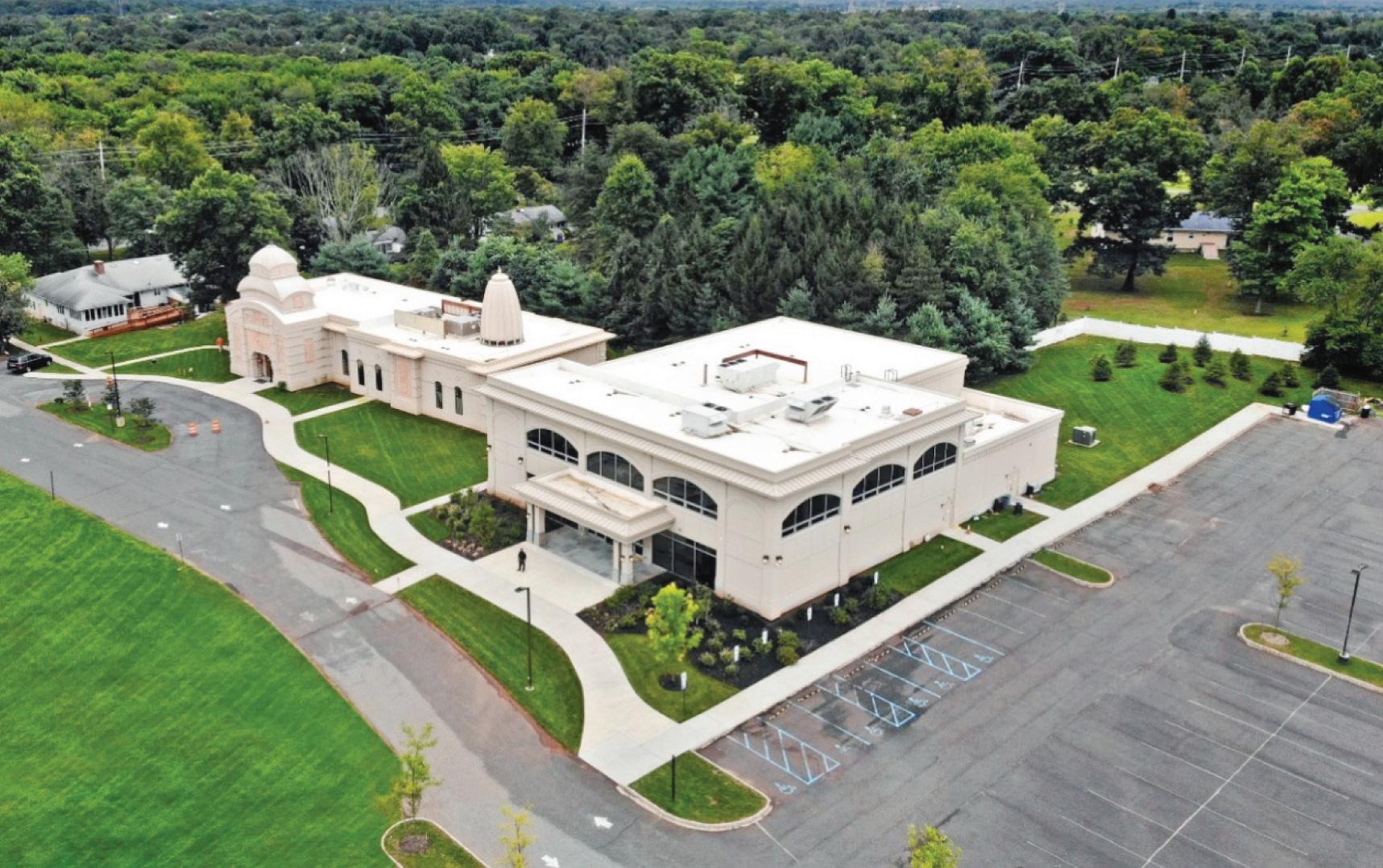
A 12,000 square foot, multi-purpose facilitythat serves all members as anauditorium (with stage and audio-visual capabilities) as well as a community hall, and offers classrooms and meeting rooms. Ideal for your religious, educational, cultural and social events! For more info, please email TagoreHall@anandamandir.org Or call 732-873-8300