The American Prospect needs champions who believe in an optimistic future for America and the world, and in TAP’s mission to connect progressive policy with viable majority politics.
You can provide enduring financial support in the form of bequests, stock donations, retirement account distributions and other instruments, many with immediate tax benefits.
Is this right for you? To learn more about ways to share your wealth with The American Prospect, check out Prospect.org/LegacySociety
Your support will help us make a difference long into the future
51 Ryan Cooper on Cadillac Desert: The American West and Its Disappearing Water
How plutonomy, premiumization, and social media squeeze the middle class By
The Historic Reversal of Cultural Affordability By Paul
AI’s real contribution to humanity could be maximizing corporate profit by preying on personal data to raise prices. In fact, it’s already happening. By David Dayen
Regulatory capture is at the root of the affordability crisis in electricity. Public power could offer a way out.
By James Baratta
Middlemen, our economy’s most shadowy characters, sit in between buyers and sellers and get rich in the process. It can even be a matter of life or death.
55 Adam M. Lowenstein on Gilded Rage: Elon Musk and the Radicalization of Silicon Valley and Stealing the Future: Sam Bankman-Fried, Elite Fraud, and the Cult of Techno-Utopia
58 Rhoda Feng on The Age of Extraction: How Tech Platforms Conquered the Economy and Threaten Our Future Prosperity 61 A.A. Dowd on Sinners 64 Parting Shot: A Breakup Letter to Capitalism By Francesca Fiorentini
Extreme weather and changes in seasonal patterns are fundamentally altering the landscape, in cities and in farming communities. You’re going to pay for it.
We’re in an affordability crisis because workers aren’t being paid at the same levels they earned in the past.
How unemployment in the Trump era shapes Black women’s lives when maternal care and food choices are in the mix By Naomi
Bethune
, election results
reinforced our instincts that the cost of living is the subject of greatest concern in America right now. Zohran Mamdani came out of nowhere by stressing on a minute-by-minute basis that New York City needed to be a more affordable place to live. On the other end of the Democratic ideological spectrum, Mikie Sherrill and Abigail Spanberger targeted their campaigns at high electricity, health care, and housing prices, and trounced Republican opponents by double digits.
Every candidate I’ve talked to who is running next year has listed affordability as their main concern. But this slogan, while compelling to the broad mass of people who feel like they’re running to stand still in this economy, lacks specificity. Why are we in an affordability crisis? What is causing it? What policies can help us out of it?
My view is that affordability is a cumulative problem. The recent post-pandemic inflation galvanized a long-standing sense that the middle-class lifestyle was moving out of reach for a lot of people. People have been struggling with health care costs for decades; they called it the Affordable Care Act for a reason. Student loans swelled as states stopped providing inexpensive higher education to residents. The average age of a first-time homebuyer is now 40, and the average age of any homebuyer went from 39 to 59 over the last 15 years.
Elizabeth Warren talked about this more than 20 years ago in the book she co-authored called The Two-Income Trap. The stay-at-home mother used to be a key safety net for families; if trouble emerged, she could go to work. Now, that second income is necessary for survival, and child care expenses—which used to be covered in the stay-at-home-mom age—are responsible for the poverty of 134,000 families a year.
Inflation since the pandemic just added costs for retail goods like groceries onto family budgets that were already stressed. The need for community after lockdowns sent the cost of experiences soaring. And corporate profits surged after the pandemic and have stayed at that level since.
In this issue, we wanted to pull out the more endemic drivers behind these trends, to look beyond Donald Trump’s contribution or other short-term factors. We started from the premise that if you don’t understand why things are getting unaffordable, you won’t be able to fix it.
I think what we’ve reported gives policymakers the potential to form a comprehensive affordability agenda. It would involve policies that boost wages and rebalance the relationship between corporations and their workers. It would simplify markets to prevent intermediaries from excessive profit-taking. It would boost public investment and public provisioning and prevent abuses of market power that lead to high prices. It would restore consumer protections to stop us from being trapped and surveilled. It would deal with disruptions from a warming planet to our typical growing patterns.
I hope this issue helps you understand both deeper causes and prospective remedies, and that affordability can become more than just a political buzzword. —David Dayen
EXECUTIVE EDITOR DAVID DAYEN
FOUNDING CO-EDITORS
ROBERT KUTTNER, PAUL STARR CO-FOUNDER ROBERT B. REICH
EDITOR AT LARGE HAROLD MEYERSON
EXECUTIVE EDITOR David Dayen
SENIOR EDITORS GABRIELLE GURLEY, RYAN COOPER
FOUNDING CO-EDITORS Robert Kuttner, Paul Starr
CO-FOUNDER Robert B. Reich
EDITOR AT LARGE Harold Meyerson
MANAGING EDITOR AND DIRECTOR OF EDITORIAL OPERATIONS
CAITLIN PENZEYMOOG
SENIOR EDITOR Gabrielle Gurley
ART DIRECTOR JANDOS ROTHSTEIN
MANAGING EDITOR Ryan Cooper
ASSOCIATE EDITOR SUSANNA BEISER
ART DIRECTOR Jandos Rothstein
STAFF WRITER WHITNEY WIMBISH
ASSOCIATE EDITOR Susanna Beiser
STAFF WRITER Hassan Kanu
WRITING FELLOWS EMMA JANSSEN, JAMES BARATTA, NAOMI BETHUNE
WRITING FELLOW Luke Goldstein
INTERNS BRANDON MALAVE, CHARLIE MCGILL, EYCES TUBBS, ELLA TUMMEL
INTERNS Thomas Balmat, Lia Chien, Gerard Edic, Katie Farthing
CONTRIBUTING EDITORS AUSTIN AHLMAN, MARCIA ANGELL, GABRIEL ARANA, DAVID BACON, JAMELLE BOUIE, JONATHAN COHN, ANN CRITTENDEN, GARRETT EPPS, JEFF FAUX, FRANCESCA FIORENTINI, MICHELLE GOLDBERG, GERSHOM GORENBERG, E.J. GRAFF, JONATHAN GUYER, BOB HERBERT, ARLIE HOCHSCHILD, CHRISTOPHER JENCKS, JOHN B. JUDIS, RANDALL KENNEDY, BOB MOSER, KAREN PAGET, SARAH POSNER, JEDEDIAH PURDY, ROBERT D. PUTNAM, RICHARD ROTHSTEIN, ADELE M. STAN, DEBORAH A. STONE, MAUREEN TKACIK, MICHAEL TOMASKY, PAUL WALDMAN, SAM WANG, WILLIAM JULIUS WILSON, JULIAN ZELIZER
CONTRIBUTING EDITORS Austin Ahlman, Marcia Angell, Gabriel Arana, David Bacon, Jamelle Bouie, Jonathan Cohn, Ann Crittenden, Garrett Epps, Jeff Faux, Francesca Fiorentini, Michelle Goldberg, Gershom Gorenberg, E.J. Graff, Jonathan Guyer, Bob Herbert, Arlie Hochschild, Christopher Jencks, John B. Judis, Randall Kennedy, Bob Moser, Karen Paget, Sarah Posner, Jedediah Purdy, Robert D. Putnam, Richard Rothstein, Adele M. Stan, Deborah A. Stone, Maureen Tkacik, Michael Tomasky, Paul Waldman, Sam Wang, William Julius Wilson, Matthew Yglesias, Julian Zelizer
PUBLISHER MITCHELL GRUMMON
PUBLISHER Ellen J. Meany
ASSOCIATE PUBLISHER MAX HORTEN ADMINISTRATIVE COORDINATOR LAUREN PFEIL
PUBLIC RELATIONS SPECIALIST Tisya Mavuram
ADMINISTRATIVE COORDINATOR Lauren Pfeil
BOARD OF DIRECTORS DAN CANTOR, DAVID DAYEN, REBECCA DIXON, SHANTI FRY, STANLEY B. GREENBERG, MITCHELL GRUMMON, JACOB S. HACKER, AMY HANAUER, JONATHAN HART, DERRICK JACKSON, RANDALL KENNEDY, ROBERT KUTTNER, ELI LUBEROFF, LINDSAY OWENS, MILES RAPOPORT, ADELE SIMMONS, GANESH SITARAMAN, PAUL STARR, MICHAEL STERN, VALERIE WILSON
BOARD OF DIRECTORS David Dayen, Rebecca Dixon, Shanti Fry, Stanley B. Greenberg, Jacob S. Hacker, Amy Hanauer, Jonathan Hart, Derrick Jackson, Randall Kennedy, Robert Kuttner, Ellen J. Meany, Javier Morillo, Miles Rapoport, Janet Shenk, Adele Simmons, Ganesh Sitaraman, Paul Starr, Michael Stern, Valerie Wilson
Every digital membership level includes the option to receive our print magazine by mail, or a renewal of your current print subscription. Plus, you’ll have your choice of newsletters, discounts on Prospect merchandise, access to Prospect events, and much more. Find out more at prospect.org/membership
You may log in to your account to renew, or for a change of address, to give a gift or purchase back issues, or to manage your payments. You will need your account number and zip-code from the label:
PRINT SUBSCRIPTION RATES $60 (U.S. ONLY) $72 (CANADA AND OTHER INTERNATIONAL) CUSTOMER SERVICE 202-776-0730 OR info@prospect.org
PRINT SUBSCRIPTION RATES $60 (U.S. ONLY) $72 (CANADA AND OTHER INTERNATIONAL)
CUSTOMER SERVICE 202-776-0730 OR INFO@PROSPECT.ORG
MEMBERSHIPS prospect.org/membership REPRINTS prospect.org/permissions
MEMBERSHIPS PROSPECT.ORG/ MEMBERSHIP
REPRINTS PROSPECT.ORG/PERMISSIONS
VOL. 36, NO. 6. The American Prospect (ISSN 1049 -7285)
Published bimonthly by American Prospect, Inc., 1225 Eye Street NW, Suite 600, Washington, D.C. 20005. Periodicals postage paid at Washington, D.C., and additional mailing offices. Copyright ©2025 by American Prospect, Inc. All rights reserved. No part of this periodical may be reproduced without consent. The American Prospect® is a registered trademark of American Prospect, Inc. POSTMASTER: Please send address changes to American Prospect, 1225 Eye St. NW, Ste. 600, Washington, D.C. 20005. PRINTED IN THE U.S.A.
Vol. 35, No. 3. The American Prospect (ISSN 1049 -7285) Published bimonthly by American Prospect, Inc., 1225 Eye Street NW, Suite 600, Washington, D.C. 20005. Periodicals postage paid at Washington, D.C., and additional mailing offices. Copyright ©2024 by American Prospect, Inc. All rights reserved. No part of this periodical may be reproduced without consent. The American Prospect ® is a registered trademark of American Prospect, Inc. POSTMASTER: Please send address changes to American Prospect, 1225 Eye St. NW, Ste. 600, Washington, D.C. 20005. PRINTED IN THE U.S.A.
ACCOUNT NUMBER ZIP-CODE
EXPIRATION DATE & MEMBER LEVEL, IF APPLICABLE
To renew your subscription by mail, please send your mailing address along with a check or money order for $60 (U.S. only) or $72 (Canada and other international) to: The American Prospect 1225 Eye Street NW, Suite 600, Washington, D.C. 20005 info@prospect.org | 1-202-776-0730
By Robert Kuttner
Prices have been rising across the economy in ways that are both visible and opaque. There are short-term drivers of inflation due to President Trump’s mismanagement of the economy. But the deeper drivers result from the degradation of capitalism.
For example, the lethal combination of digital technology and tech monopolies picks your pocket in countless ways. Instead of technical advances leading to greater convenience and lower cost, as they logically should, they create strategies for opportunistic price hikes.
When Amazon uses its deep knowledge of consumer preferences to rig markets and undermine competitors, higher prices are passed along. When HP makes it illegal or impossible for consumers to use cheaper non-HP cartridges in their printers, it can charge exorbitant prices. If you are prohibited from repairing your own car or your own iPhone, or as a farmer, prohibited from sav-
ing seed for next year’s planting, that invites monopoly profits built on higher prices. Costs rise because the rules are rigged.
It isn’t just the increasing cost of health insurance, but the tax on your time when a health system of byzantine complexity requires you to waste hours to get a simple referral or get a claim paid. Middlemen and algorithms, both in the business of denying claims, are a direct cost to the system and a source of rising out-of-pocket prices to patients. If insurance doesn’t pay, you do. These middlemen also function as a drain on doctor time and thus a tax on doctors’ incomes, as well as a debasement of medical services
In this special issue of the Prospect, we take stock of several hidden drivers of rising costs. David Dayen explores all the ways that technology allows sellers of any product that uses the internet to take advantage of surveillance capitalism to personalize prices
and charge more than the market price that would be produced by ordinary supply and demand. It’s another case of monopoly pricing power, facilitated by invasive technology.
As Emma Janssen writes, plutocracy is a driver of the affordability crisis. The top 10 percent of income earners now do close to half of the spending, by some estimates. This has led to “premiumization,” where airline seats, concert tickets, and even staple goods are priced for wealthier people because they are the primary buyers. That in turn drives prices higher for everyone else, as anyone who buys a ticket to a concert or a sporting event appreciates. Antitrust policy has thus far failed to curb obvious abuses by middlemen ticket sellers. Paul Starr writes in a sidebar that these trends invert the 20th-century pattern of affordable culture, beginning with nickel movie tickets and cheap bleacher seats.
As the concert ticket example shows,
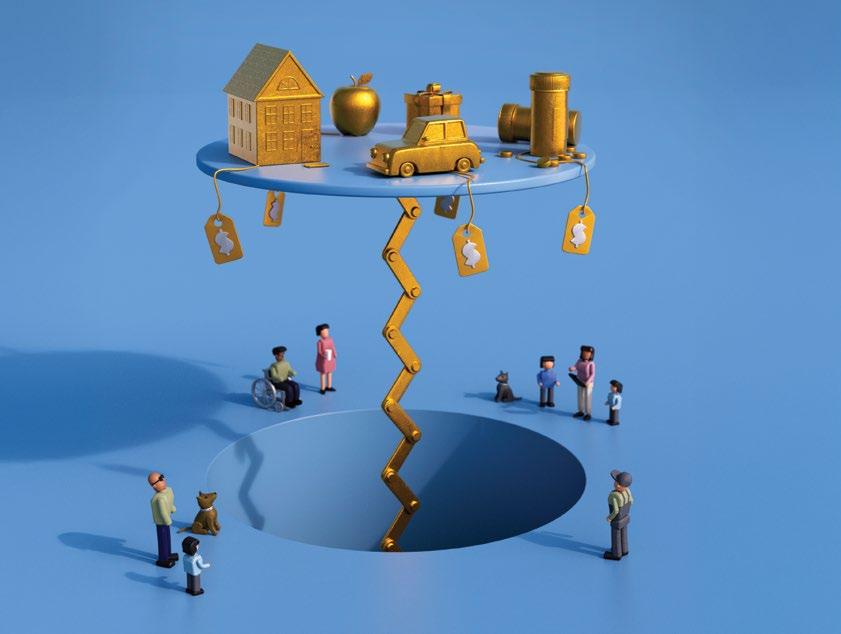
middlemen are drivers of the affordability crisis. As Whitney Curry Wimbish writes, across the economy, from pharmaceuticals to real estate to meatpacking and more, middlemen sit in between suppliers and customers and squeeze out a layer of profit for themselves, taking advantage of their knowledge of industries and typically concentrated control of the supply chain.
Regulatory capture, as James Baratta points out, is another source of price increases. Baratta’s focus is on electricity rates, and the failure of state public utility commissions to protect ratepayers from extractive price hikes based on dubious economic models used by utility companies. There is an even more subtle and insidious version of regulatory capture, in which regulations themselves are used to enforce industry’s anti-competitive strategies.
As Cory Doctorow observes in his indispensable book Enshittification (reviewed in
our October issue), far more sinister than traditional regulatory capture is regulatory fusion , in which industry designs laws and rules to thwart competition and raise profits. Using provisions of the industrywritten 1998 Digital Millennium Copyright Act, Apple makes it a copyright violation for technicians to use non-Apple parts for most repairs to Apple products. The preposterous doctrine is that if an inferior non-Apple part caused the product to fail, that could reduce consumer confidence in Apple’s brand. There is even a name for this doctrine: tarnishment.
Trump’s contribution to rising prices adds to these long-term abuses. Eric Winograd, a senior vice president at AllianceBernstein, calculates that Trump’s tariffs have added about one percentage point to the core inflation rate, though other estimates that account for Trump’s numerous exemptions
of various products and industries put the number at 0.6 to 0.7 percent.
But tariffs are only the beginning of Trump’s impact on prices. The remedy for opportunistic price hikes in so many sectors is the resurrection of antitrust. Internet innovators grew from purveyors of ingenuity and user convenience into extractive monopolies largely because antitrust enforcement ceased to exist from late in the Carter administration until Joe Biden’s appointments of some of the smartest students of abuses and their remedies: Lina Khan at the FTC, Jonathan Kanter at the Justice Department, Rohit Chopra at the CFPB, and Tim Wu (whose latest book is reviewed in these pages) as competition policy chief at the White House.
These agencies had just gotten serious about reversing four decades of corporate market power when the antitrust revolution was reversed by Trump. As antitrust
enforcement has been aborted, private equity companies have been buying up traditionally local firms in order to use market power to raise prices, in sectors as diverse as pest control operations, HVAC companies, and veterinary practices
In addition, Trump’s shutting down of Biden’s industrial policies has raised prices. Electric power costs have lately risen far faster than the general rate of inflation. Trump’s policy of killing renewable-energy projects, in order to raise profits for oil and gas companies, contributes to this price rise, by taking away power that might otherwise come onto the grid and alleviate demand. So does the failure to regulate the extensive use of electric power by data centers used by tech companies.
There was a time when we needed to shift to solar and wind in order to help address climate change. But now that renewables are cheaper than most fossil fuels, we need to make that shift because it saves money. Instead, Trump promotes more costly oil and gas.
It is hard to quantify precisely how much all of Trump’s policies taken together have added to price inflation, but a very conservative estimate would be about two percentage points. That may not sound like a lot, but it is the difference between a baseline inflation rate of 2.5 percent and a rate of 4.5 percent. And that difference is not just a hidden tax on consumers. It has knock-on effects.
With inflation at 2.5 percent, the Federal Reserve is willing to reduce interest rates in order to reduce unemployment. But when price increases approach 4 percent, the Fed worries more about inflation. At a time when unemployment rates are rising, policies that raise prices tie the Fed’s hands. This paradoxically could make things more unaffordable for low-income workers, if a loose job market keeps wages from rising.
It’s not clear whether there will be any more rate cuts in the near future, and there may even be rate increases. A Fed policy of tighter money means that people pay more for their mortgage loans, their credit card debt, their student loans, and consumers pay more when small businesses pay more for credit.
Trump’s cuts in programs such as SNAP and Medicaid are another form of indirect price hikes; even worse, they are price hikes that hit the poor. If your food stamp allotment is reduced, you have to pay more out of pocket in order to eat. If your Medicaid

Higher
is cut, you pay out of pocket or do without. The failure to address climate change, and Trump’s reversal of long-standing policies aimed at preserving the environment, also add to costs. As destructive storms become more severe and frequent, the costs of recovery and of homeowner insurance relentlessly rise, some borne by consumers directly and some by taxpayers. This natural-world aspect of hidden inflation is addressed in another of our special articles, by Gabrielle Gurley.
Some years ago, there was a debate among economists and policymakers about whether the Consumer Price Index should be adjusted downward to reflect improvements in quality. A 2020 car was simply a better car than a 1980 car, so some of the nominal price inflation actually represented a superior product. Likewise coffee: In 1970, a cup of coffee only cost a dime, but the swill was undrinkable. Coffee today is a lot more expensive, but it is palatable. In practice, the Bureau of Labor Statistics did some minor revisions to adjust for quality improvements. Today, we might need to do the reverse. We are paying more money for products and services whose quality has deteriorated. And in many cases, the deterioration has been deliberate. Indeed, the business model of the tech giants is to systematically degrade the quality of products and services. Products are needlessly complex from the perspective of the consumer, but the complexity adds to the surveillance. Same
with tech services. This is the essence of what Doctorow calls enshittification. Doctorow tells the story of how Google deliberately slowed down its search process in order to make more time for its system to festoon the search results with annoying ads that embody everything that Google knows about the user’s buying habits.
In conventional economics, wages and prices are two different aspects of the economy. But whether people can afford to live decently is a function of what they earn applied to what they have to pay to live. The same technology that allows tech monopolists to gouge consumers enables them to treat workers like serfs and evade the protections of labor law. As Harold Meyerson writes in his piece, the cost of living is higher because earnings are lower. And earnings are lower because of both the weakening of the labor movement and the sidelining of the National Labor Relations Board.
In addition, tech allows employers to double down on the old practice of denying that workers are payroll employees protected by labor laws. From Uber drivers and UPS contractors to chicken farmers and fast-food workers, the company controls and monitors every aspect of the work, but the employer pretends that the workers are independent contractors. This represents a toxic marriage of app technology and market power. The effect is to batter down earnings.
And as Naomi Bethune writes, all of the predations tend to hit racial and ethnic minorities harder, because African Americans and Latinos are more economically

vulnerable to begin with. Trump’s war on DEI only increases the vulnerability.
Even apart from the predations of extractive and invasive capitalism, other sources of the relentless rise in prices are the result of policy failures that predate the abuses of surveillance capitalism and Donald Trump by decades.
Housing is out of reach for so many Americans because America has failed to build enough houses. Houses were cheap after World War II mainly because cheap farmland was being converted to suburbia, with the help of federal highway and mortgage policies. The cheap land is gone, and homebuilder consolidation has distorted markets. Trump’s tariffs have caused a rise in building costs, and his proposal to privatize the secondary mortgage market would make financing more expensive.
Housing tax breaks are tilted toward more expensive homes, and toward homeowners over renters. The sheer purchasing power of the oligarchy also bids up prices. Local regulatory barriers also raise costs, but many zoning restrictions also reflect the political power of oligarchs, who don’t want riffraff in their neighborhoods.
The bipartisan failure to regulate new financial scams such as subprime mortgages added to the pressure on housing. Millions of homeowners, disproportionately Black and Hispanic, lost their homes in the wake of the subprime collapse. Congress passed legislation to allow for mortgage refinancing for duped homeowners, but
the Obama administration failed to carry it out. You might think that scads of vacant and foreclosed houses would lead to lower prices via the law of supply and demand. But the same regulatory failure led private equity companies to swoop in, buy houses, and jack up prices and rents, while making homebuilders reluctant to build the additional units we need.
Public policy has also failed to produce an adequate supply of affordable rental housing. The rental housing that we do subsidize is done in wildly inefficient ways, for the convenience and profit of landlords and developers. Our failure to have a true socialhousing sector reflects power imbalances between oligarchs and ordinary citizens.
The cost of higher education is out of sight because legislators, Republican and Democrat alike, permitted universities to inflate costs via the student loan program, and then piled debt onto generations of students and graduates. State legislatures compounded the damage by reducing direct appropriations to public universities that were free to state residents until a generation ago, substituting tuition and fees. It now costs more to attend a state university than what a private university cost when I was a student.
Health care costs also keep rising because the United States has failed to adopt an efficient program of universal public health insurance, as every other major country has done. To compound the damage, policymakers have allowed a plague of for-profit middlemen to take over hospitals, nursing homes, and doctors’ practices. In many hos-
pitals, people of means hire private nurses because the hospital’s own nursing staff is so stretched thin and overworked by costcutting aimed at siphoning profits. A hidden price hike, if you can afford it. If the U.S. had a universal nonprofit insurance system, it would save about 6 percent of GDP. That’s $1.2 trillion a year.
There was a time when the abuses of capitalism were relatively straightforward and transparent. Large corporations sought to combine into monopolies. The remedy was enactment and enforcement of antitrust laws. Corporations tried to pay their workers as little as possible and to break their unions. The remedy was the Wagner Act, guaranteeing workers the right to organize and join unions. Bankers tried to swindle investors for their own enrichment. The remedy was tougher banking and securities laws, prohibiting conflicts of interest. Corporations tried to cheat consumers with tricky terms and shoddy products. The remedy was the proconsumer legislation of the 1960s and 1970s.
But today’s corporate and financial abuses are hidden in a web of algorithms and apps, reinforced by regulations that actually help tech companies cheat consumers rather than protect them. It takes a complex, deeply knowledgeable, and radical critique of capitalism as currently practiced to get serious about remedies. That does not describe about half of the current Democratic Party, which is on the take from these same industries.
One of the many tragedies of Joe Biden was that he was a feeble spokesman for his own good policies. He hired the most knowledgeable people in the country to revive antitrust and apply it to new abuses. But Biden did poorly at narrating the significance of these policies to ordinary Americans coping with rising prices. As I’ve written elsewhere, many of these policies and people reflected the work of Sen. Elizabeth Warren, who was a superb narrator of what they meant and why we needed them. But we ended up with the soul of Elizabeth Warren in the feckless persona of Joe Biden.
If we can make the heroic assumption that Trump will not be president forever, and that there will be an opportunity to pick up where Biden and Warren left off, America’s next leaders will need to be even more radical in their understanding and remediation of capitalism, which has become even more debased since Trump took office. n
By Emma Janssen
We are living in a new Gilded Age. The first, from roughly 1870 to 1890, was marked by dramatic inequality: Wealthy monopolists like bank tycoons and railroad barons saw their fortunes boom as the country industrialized, while the poor, particularly in the post-Reconstruction South, continued to suffer. A cast of corrupt men controlled the flow of capital and political power, shaping the country around their will. Thus it was not a golden age, but a gilded one—a veneer of prosperity hiding the real economic and social rot below.
Today, with a president obsessed with gold and material wealth, the Second Gilded Age metaphors write themselves; just look at the literally gilded add-ons to the Oval Office. Tens of millions of Americans rely on government food and medical assistance that Republicans have voted to cut; some Americans use “buy now, pay later” apps to pay for their rent and groceries; and wages can’t keep up with inflation. But the wealthy are doing just fine. The stock market is up 48 percent since 2022; luxury-brand purchases are holding strong; and Elon Musk is about to get a $1 trillion pay package. Our country is dramatically unequal, and it’s only getting worse.
The rich have a gravitational pull on the economy, dragging it in their direction. According to economic researchers at Moody’s Analytics, the top 10 percent of Americans earners are now doing almost half of the spending. Even those economists who dispute this specific number concede that the wealthiest Americans are doing an outsized amount of consumer spending. The wealth of the top 10 percent is up to $113 trillion, up $5 trillion just between April and July, according to Federal Reserve data. The top 1 percent holds $52 trillion in wealth, a new record.
That matters for several reasons. First, it produces an unclear picture of the economy. Even though the majority of Americans are feeling the squeeze of inflation and rising unemployment, the ultra-wealthy are doing well enough to keep spending, which makes it look like everyone has kept spending.
If you stop looking at averages and check the wealth of who’s actually spending, you can better understand the economic realities for the majority of Americans: There’s one line steadily going up, and another going down. That’s why some call ours a “K-shaped” economy—two lines headed in opposite directions. Others call it a plu-
tonomy, a portmanteau of “plutocrat” and “economy,” signaling the disproportional power of the ultra-wealthy over our entire financial system.
There’s another reason that this wealth and spending inequality matters: It makes things more expensive for everyone.
Corporations know that the wealthy have a distortionary impact on the economy, as they continue to spend while everyone else flounders. Citigroup executives coined the term “plutonomy” almost exactly 20 years ago in a memo sent to investors. The bankers didn’t coin the term as an intellectual exercise; the goal was to curate stocks accordingly. Identifying the country’s “plutonomy” was a way to marshal the movers of American capitalism, giving them a framework to continue making money. Corporations have taken note. If wealthy consumers are responsible for the lion’s share of spending, the logic goes, companies might as well raise their prices—the primary buyers can afford it.
“If you can come up with something that [rich people will] regard as special, you can really make a lot of money selling to

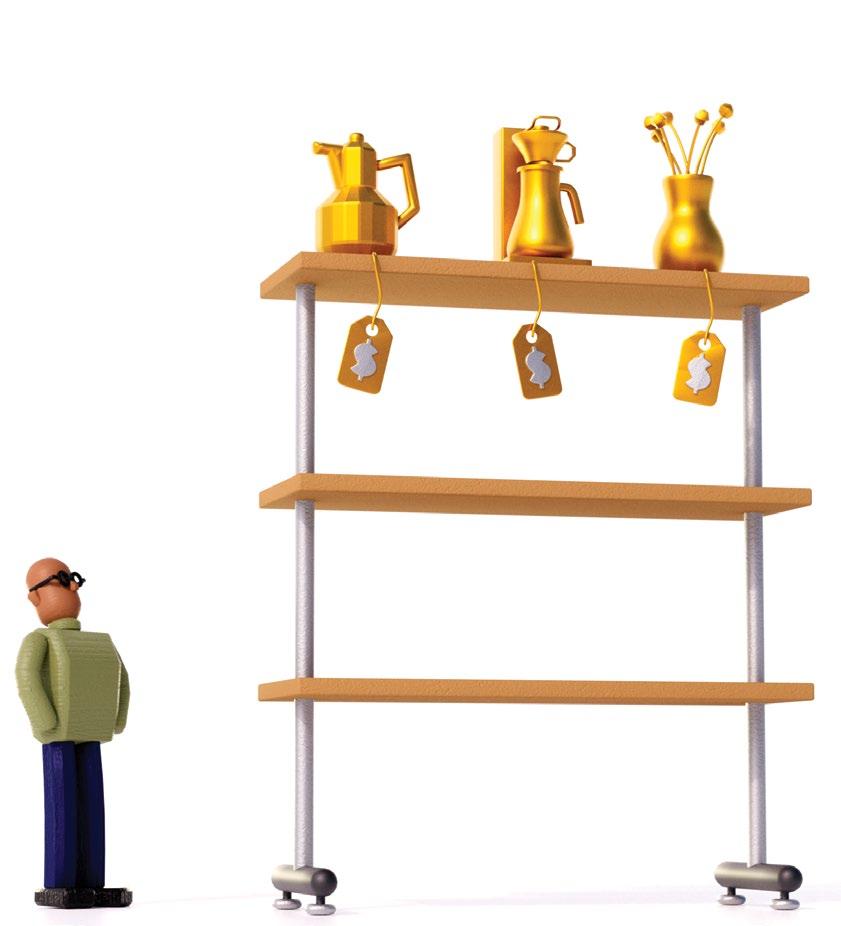
Companies like Dyson cater their products to wealthier customers who do more of the spending.

them,” said Robert Frank , a professor of management and economics at Cornell. “So, a lot of the ingenuity in the economy gets directed to things that we would think of as less than essential.”
That’s the idea behind premiumization, a marketing trend that encourages companies to brand their products as high-end and sell them to wealthier consumers. A Forbes article describes premiumization as a “strategic move by consumer brands to elevate product offerings and charge higher prices.” The push for premiumization is largely driven by demand—wealthier consumers have more money to spend and are looking for “premium” ways to spend it—but it is also spurred on by inflation, which pushes companies to justify price hikes with a shiny exterior.
“If I tell you that I raised your price … because I need to increase my profitability, you’re probably just going to go away,” said Z. John Zhang, a professor of marketing at the University of Pennsylvania. “But if I tell you that I raised my price because … I pro -
duced a better product for you, that sounds like a better message.”
Michael Rapino, the CEO of Live Nation, the owner of the loathed, fee-grabbing event ticketing operator Ticketmaster, was blunt about this in an interview with The New York Times ’ Andrew Ross Sorkin. “I think music has been underappreciated,” he said. “It’s like a badge of honor to spend 70 grand for a Knicks courtside [seat], they beat me up if we charge $800 for Beyoncé … we have a lot of runway left.”
Once you learn the term, it’s hard not to see premiumization everywhere. Demand for new luxury goods is outstripped only by demand for used luxury goods from websites like The RealReal. Apple and Dyson (maker of $1,000 vacuums as well as $400 hair dryers) have long embraced premium aesthetics to sell their products, but so have more surprising companies: WD-40, the company that makes the eponymous lubricant, found that they could charge more by selling cans with “smart straws” that spray the oil in both a stream and a mist.
Airplanes are becoming premiumization delivery systems, with seats that were once considered basic economy now sold as premium because they are in the front of the plane. The half-decent seat pitch (referring to the distance between your seat and the seat in front of you) that was once standard has now become a luxury that passengers will pay for to avoid the even more cramped seats in the back. Some first-class “suites” now have doors, caviar service, and even free pajamas.
Changes to Disney resorts reveal premiumization in perhaps its most concentrated form. Whereas traveling to Disneyland or Disney World was once a rite of passage for the middle class, visitors now shell out for access to the front of the line for rides; those booking a guide or staying at a Disney property get priority. (Until 2021, that FastPass service was free, as long as patrons returned to the ride in a specific time window.) There’s a lounge in Disney’s EPCOT that has a $179-per-person prix fixe snack and champagne; Disney’s Grand
Social media has ratcheted up the status competition, making the clothes we wear and the weddings we throw visible to everyone we know.
a measure of the average change over time in prices Americans pay for a new car with roughly similar features. That data tells us that, between 1980 and 2025, the price of a new car doubled. But when you look at what consumers are actually spending on new cars, it’s now somewhere around six times as much as it was in 1980. Are today’s cars three times better than they were in 1980? Maybe. But if consumers don’t actually need cars that are three times as good, and are buying them anyway, it points to two possible reasons: They’re paying for the status of the car, or premium options are the majority of what’s for sale.
to more wealth and consumption in an hour of scrolling than some of their grandparents ever saw in a lifetime. Just take the social media hubbub around ultra-wealthy Anant Ambani’s Mumbai wedding in 2024 or the TikTok-fueled tween obsession with Drunk Elephant, a skin care brand that will run you $72 for a moisturizer. The $250 billion influencer industry is selling their lifestyles to us, whether or not we can afford them.
Floridian hotel on the resort grounds has a Michelin-starred restaurant; there’s a secret Club 33 in the theme parks that is invitation-only. Instead of providing a common experience, Disney caters to the rich, putting a velvet rope around the most American vacation there is.
An increase in costs and luxuries doesn’t just affect wealthy spenders. Middle-class Americans see the same advertisements, watch the same influencer vlogs, and thus feel pressure to make the same purchases. And sometimes it’s not just psychological pressure, but simple logistics: If the only hair dryer at your beauty supply store is a Dyson, and you need a hair dryer, you will end up paying more.
J.W. Mason , an associate professor of economics at John Jay College at the City University of New York, compares this to a kind of premiumization that some companies turned to during World War II, when the country put caps on the price of goods to manage runaway inflation. The price controls were quite effective at slowing massive inflation, but some companies found a clever way around the caps by only stocking high-end items, so they could say they didn’t raise their prices, but still charge a premium. While today’s businesses aren’t responding to the same artificial price caps, consumers are feeling something similar when their only options are premium-ized and marked up.
We can see some evidence that consumers are responding to premiumization by buying more expensive versions of the same products. Using data from the U.S. Bureau of Labor Statistics, I looked at the Consumer Price Index for new vehicles, yielding
Another good example is weddings. Within just a few years, event planners have noticed a steep rise in couples wanting to tie the knot away from home. Market research confirms it: The destination wedding industry grew by $7 billion between 2022 and 2023. By 2027, the industry will be worth more than $78 billion. “If what people are buying isn’t just the material thing, but the kind of status and display that goes with it, then people may feel that they have to buy more expensive versions,” said Mason.
This jostling for status has a real economic impact. A study of U.K. consumers found that around 40 percent of Brits had been invited to a destination wedding in the past year, and the average cost of attendance lands around $2,500. Of those who attended, over 30 percent put the travel expenses on their credit cards. Others used buy now, pay later services or even took out loans.
It’s a natural thing to feel the pressure of “keeping up with the Joneses,” but that becomes a lot harder in a plutonomy, when the Joneses are really, really rich. It’s also harder to tune out the lifestyles of our neighbors now that they’re all over our phones. Social media has ratcheted up the status competition, making the clothes we wear and the weddings we throw visible to everyone we know, and often to thousands of strangers too. It’s a digital form of the upsell: Instead of the fast-food clerk asking if you want fries with that, thousands of people streaming through your feed are telling you to take that vacation, go to that five-star hotel, and live your best life. We’re living in the FOMO economy.
In the early days of Facebook and Instagram, users could keep up with how their friends were living; now, with TikTok’s boom and algorithms designed to push content from strangers, users are exposed
Frank, who wrote the 2013 book Falling Behind: How Rising Inequality Harms the Middle Class, was careful to note that the blame for our plutonomy shouldn’t fall on consumers, whether it be the wealthy who are indulging in luxuries or the middle- and working-class people who feel pressure to spend more than they have. The wealthy “do what everybody does who has more money: They spend more, they build bigger, they buy faster, they travel farther,” he said. “That’s not a moral indictment of them. I mean, that’s what poor people do when they get more money. That’s what middle-class people do when they get more. Rich people do that too,” he said.
If anyone should be blamed for our rapidly increasing consumer inequality, Frank argues, it’s policymakers who refuse to tax the wealthy. “When [the wealthy] just bid up the prices of penthouse apartments, there’s only so many of them with views of Central Park to go around,” he said. If the government taxed the exorbitantly wealthy, “all that money that went into that could have been used to buy things that are actually useful for everybody.”
To Mike Pierce, the executive director of debtor advocacy group Protect Borrowers, corporate America deserves much of the blame, too. When speaking about plutonomy and premiumization, “it’s really easy to tell a story about how people are living beyond their means,” Pierce said. “But the real story here is about big financial companies seeing that precarity, that vulnerability, and trying to get rich off of it.”
The middle class is taught, through carefully designed marketing and social media, to identify more with the rich than the poor. This class misalignment keeps them striving for the upward mobility our economic mythology promises them, even though so many are just one medical emergency or car crash away from poverty.
“The people in the middle aren’t resentful of the lifestyles of the rich,” Frank said. “They want to see pictures and footage of
mansions and yachts. They think, usually incorrectly, they’ll be rich someday. What’s it going to be like?”
On October 29, Chipotle, purveyors of burritos and slop bowls, had a difficult earnings call. CEO Scott Boatwright described the “consumer headwinds” the company has been experiencing as consumers who make below $100,000 per year have stopped eating out. The executives offered a succinct explanation: Everyone who isn’t wealthy is feeling the weight of unemployment, student loan repayments, and slow wage growth. These low- to middle-class consumers account for 40 percent of Chipotle’s sales, so losing them threatens their whole business model. Chipotle is not alone. Other fast-casual chains are seeing depressed sales. Walmart, Kohl’s, and discount store Dollar General have noticed their lowestearning customers spending less and less. Growing numbers of back-to-school shopping families have struggled to outfit their kids this year. Americans making over $100,000 a year have seen their consumer sentiment climb in 2025, while those under $100,000 are gloomy.
If Chipotle is missing a major chunk of its customer base, it’s likely they’ll be forced to raise the prices for everyone else to make up for it. Maybe they’ll use premiumization to justify those price hikes (special guacamole or healthful tortillas, perhaps). Regardless of their strategy, low- and middle-class consumers lose. If prices go up, eating out at Chipotle becomes less of a casual weekday lunch and more of a once-in-a-while treat. And, generalizing this conclusion to other goods and services not of the burrito bowl variety, it’s clear that the goalposts of a comfortable middle-class lifestyle have just moved further back.
Pierce took a second lesson from the Chipotle earnings call. “It’s downstream from that moment when the C-suite is finally waking up to the fact that people can’t afford the stuff they’re selling,” he said. “They haven’t been able to afford the stuff they’re selling for a while now, and easy access to debt is masking that sickness in the economy.”
Indeed, wide-open access to lines of credit is one tool that has emerged to keep Americans spending like influencers—or even just staying afloat—despite economic trouble. With the proliferation of “buy now, pay later” companies like Klarna and
is one tool that has emerged to keep Americans spending like influencers.
“We know that inequality is psychologically discomforting to people,” said Bernstein. “If you’re a billionaire, and the person you think you’re competing with is a trillionaire, you feel like you’re falling behind … I think for most middle-class people, falling behind means falling behind on the rent.”
Affirm, which allow consumers to put purchases on credit and pay off their debt over a number of weeks, Americans can keep buying what they always have, even if they don’t actually have the money in hard cash.
While the majority of buy now, pay later purchases are for general “stuff,” like furniture and clothing, an alarming number of Americans are using these debt services for absolute essentials. A quarter of buy now, pay later users have used the services to pay their rent, according to a poll commissioned by Protect Borrowers and Groundwork Collaborative. One in three have used it to pay for medical or dental care. Perhaps most harrowingly, nearly 40 percent have used buy now, pay later to make a payment on another debt, such as a credit card payment.
Those numbers are a stark reminder that middle- and working-class Americans aren’t greedy or overindulgent; instead, they are just trying to live in accordance with the model set by generations past, where a meal out or a new sweater didn’t require taking on debt. In our new Gilded Age, that’s a much harder prospect.
These Americans “go to work every day, they bring home the paycheck that they command in our economy, and it just doesn’t go far enough,” said Pierce. “And so, they’re figuring out how to live the same kind of life that their parents lived, and to do that often involves a tremendous amount of consumer debt.”
Jared Bernstein, former chair of the White House Council of Economic Advisers under President Biden, emphasized to me that for increasing numbers of Americans, the issue isn’t whether they can afford a destination wedding or a new car. Instead, it’s whether they can put food on the table while also paying off student loans and the electricity bill.
Whether they’re taking on debt to buy the products and experiences social media markets as the trappings of a good middle-class life, or taking on debt just to make rent, those in the middle are feeling the squeeze of an economy by and for the wealthy. Our ideas of how to live and what to buy are often warped, as if in a funhouse mirror, by the ultra-rich and the companies that design products toward them.
Soon, Pierce told me, he thinks people will start to miss their buy now, pay later payments en masse. Those companies are directly linked to consumer bank accounts, so people will start getting charged overdraft fees if they don’t have enough when “pay later” becomes “pay now.” Pierce sees the buy now, pay later economy as a house of cards threatening collapse as debt catches up with consumers.
I asked him if he worries about the shifting goalposts of middle-class life—the idea that we need luxury cars and new clothes and destination weddings to keep up with the wealthy. He agreed that our plutonomy is psychologically destructive, but fears something far worse.
“I certainly do worry about what it means for the American dream and the way people think about their role in the economy if this keeps up,” he said. “But I worry more about what it means if people don’t actually have any agency in that position, and at some point Wall Street pulls the rug right out from under them.”
Those of us who are “too poor to afford life, but too high-income to get help,” as Elizabeth Pancotti, managing director of policy and advocacy at Groundwork Collaborative, put it, are caught between a plutonomy that pushes prices higher and a lower class that, under the Trump administration, is rapidly having the social safety net pulled out from under them.
“You really get squeezed by both sides by this phenomenon of prices going up as things get luxurious, and you don’t get any help from the bottom,” she said. “And I think that window is expanding as our social safety net shrinks as the wealthy get even richer.” n
“Everyone is a V.I.P.” was the motto of the Disney theme parks for decades after the opening of Disneyland in 1955. A broad middle class could afford a trip to a Disney park, and visitors had equal access to the attractions once they were there.

Unfortunately, America is a long way from that middleclass ideal today.
Disney and other companies now make more money from people with high incomes, and they tailor their services accordingly. So much for the old Disney theme song: “When you wish upon a star / Makes no difference who you are.”
The original Disney vision reflected a long history of popular cultural affordability that once set America apart. At the time of the American Revolution and during the first half of the 19th century, European countries levied stamp taxes on newspapers, to raise their prices and block the growth of a cheap working-class press that might cause trouble. In contrast, as I showed in my book The Creation of the Media , Americans didn’t just revolt against the British stamp taxes; their new government subsidized newspapers and later magazines through below-cost postal rates. (Low-cost “media mail” rates for books and periodicals exist to this day, though they are much less significant than they once were.) In the 1830s and 1840s, a revolution of cheap print brought a popularly oriented “penny press.” That development initially had more to do with the popular politics of Jacksonian America than with technological advances in printing technology. Entre -
preneurs developed faster presses to satisfy a market the partisan papers pioneered.
The late 19th and early 20th centuries saw a series of low-cost innovations in popular culture. As working people had more discretionary income and free time, showmen found they could make money based on what historian David Nasaw calls a “new calculus of public entertainment”—lower prices and larger audiences. The new venues had to be cheap but respectable. Like the penny papers, some were named for their low price, from dime museums and penny arcades to nickelodeons, the first popular venues for movies.
Free public elementary and secondary education, public libraries, land grant colleges with low tuition, and the 20th century’s mass media—including free, over-the-air radio and television—all fit into this tradition. New Deal programs supported artists, musicians, writers, and actors and left cultural legacies across the country. Public broadcasting and the early vision of the internet as a cornucopia of free culture also aimed to fulfill the old ideals that originally motivated cheap postal rates for publications.
The economist William Baumol raised a famous caution about cultural afford -
ability. The costs of cultural production, according to “Baumol’s law,” necessarily rise relative to other goods because productivity in culture cannot keep pace. His illustration was a live musical performance, which will always take musicians the same time. That’s true but of limited relevance to what has been happening lately.
How commercially produced culture is designed and priced depends on the distribution of income. In a society where the top 5 or 10 percent have gotten richer and dominate consumer spending, many companies unsurprisingly have reoriented their business. Management consultant Daniel Currell wrote in The New York Times in August that “Disney’s ethos began to change in the 1990s as it increased its luxury offerings, but only after the economic shock of the pandemic did the company seem to more fully abandon any pretense of being a middle-class institution.”
As a consultant, Currell says he saw “industry after industry” use data analytics “to shift their focus to the big spenders” in their customer base. “Whereas in the 1970s and before, the revenue driving corporate profits came from the middle class, by the 1990s it was clear that the big money was at the top.”
A different political leadership might resist these tendencies. Not only might it use taxes and other measures to ensure that the gains from economic growth are more widely shared; it might also find new ways to do what earlier generations did in making culture and education more affordable. Today, however, the Trump administration is not just cutting back but eliminating federal support of the arts and education, supposedly for populist reasons. It’s popular access that will suffer.

Americans don’t need to do anything unprecedented to respond to current trends and policies. They just need to remember a great American tradition of making culture affordable.
—Paul Starr
AI’s real contribution to humanity could be maximizing corporate profit by preying on personal data to raise prices. In fact, it’s already happening.
By David Dayen
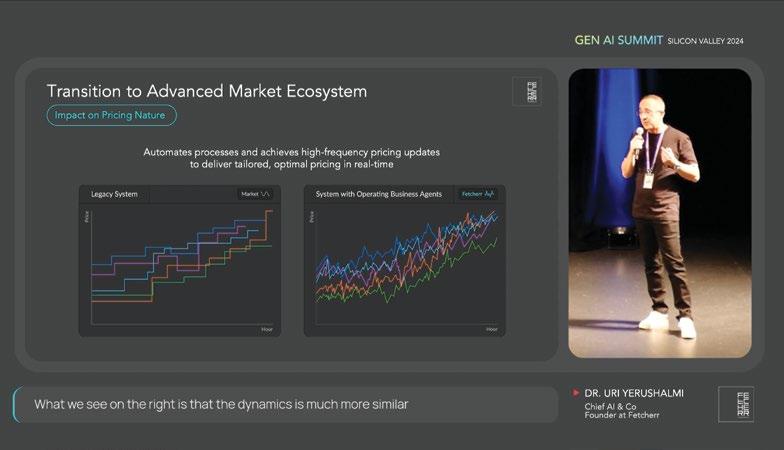
Earlier this year, a slightly balding man in spectacles, a black T-shirt, and bright hightop sneakers gave a presentation about how his computer can predict what you want to buy. His name is Dr. Uri Yerushalmi, co-founder and chief artificial intelligence officer of Fetcherr, an Israeli-based pricing consultant used by a half dozen airlines around the world.
“While most of us in the AI community have been focusing on building models that are generating either text or image, in Fetcherr we have been focusing during the last five years on building large market models,” Yerushalmi said. Trained on years of market data—prices, orders, competitors, regulation, stock prices, even the weather— Fetcherr’s “business agents” aim to simulate market dynamics, assist pricing analysts, and even automatically price tickets.
One presentation slide stuck out. It showed price fluctuations before the use of Fetcherr’s system and after. In the before graph, prices are relatively static and straight. After Fetcherr, the jagged lines pulse with staccato rhythms. “The dynamic is much more similar to dynam-
ics in NASDAQ or capital markets where the prices change much more frequently,” said Yerushalmi, “because every time something in the market changes, there is an immediate response.”
Yerushalmi once ran AI for a high-speed stock trading firm. He approaches pricing like a science experiment, engaging in constant real-time testing and tweaking to maximize corporate profits. Fetcherr boasts of delivering annual “revenue uplift” of over 10 percent. The guinea pigs for these tests, the ones being separated from their cash, are you and me.
AI can depict you as an anime character. It can respond half-intelligently to questions about the Franco-Prussian War or concentrations of sulfur in the upper atmosphere. It can delight and distract and maybe help you get work done. But none of that is as prized by corporate America as its data-driven approach to the previously conjectural world of pricing.
“That’s the use case they don’t want you to talk about. That’s why we’re building all these data centers,” said Lee Hepner, senior legal counsel for the American Eco -
nomic Liberties Project. “As we have built social media platforms that shape the flow of information across society, now we are building the platforms that control the flow of money.”
Technology-fueled pricing is more widespread than once thought, presenting serious policy challenges in an age where affordability is on everyone’s minds. AI bots are colluding with one another, anticipating consumer choices, and accumulating surplus—that is, transferring wealth—for the businesses that employ them. It’s part of why corporate profits hit record highs after the pandemic and have stayed there.
The public recoils at the thought of seeing prices tick up based on when they like to get lunch or what device they’re using. When Delta, which employs Fetcherr as a pricing agent, announced on an earnings call this summer that up to 20 percent of its flights would be priced using AI by the end of the year, the outcry was so intense that the company claimed its critics were peddling “misinformation.”

Policymakers and advocates have united to crack down on some tactics, winning real legislative victories from coast to coast. But every step government takes can be countered by AI price-setters. How can consumers keep up?
“What worries me is that it will become hyperefficient to price discriminate and to charge more in ways that ordinary people will not be able to combat,” said Doha Mekki, the top deputy at the Justice Department’s Antitrust Division under Joe Biden. “And it will make a very bad cost-of-living crisis even worse.”
A year ago, I wrote about what I termed surveillance pricing: companies offering individualized prices based on personal data. The idea was that a business equipped with granular information about demographics, purchase history, social and financial interactions, or even medical status could exploit a customer’s willingness to pay. Uber could charge more when a rider booked on a company credit card; people aren’t as pricesensitive when someone else is paying. Delta could jack up fares after learning that a traveler needs to attend a funeral; desperation could translate into opportunity.
I couldn’t be certain how many businesses
used surveillance pricing. The proliferation of third-party pricing consultants touting “digital pricing transformations” seemed like a strong indicator. But concealment was key to the strategy, to minimize the anger generated by charging different prices to different people. For instance, when a reporter at SFGate logged in to hotel booking platforms using his regular IP address in high-wage San Francisco, he received a quote of $829 a night. But when he used a virtual private network set up to originate from Phoenix or Kansas City, prices were more than $500 less. Without a public price, it takes research to understand if someone is being ripped off.
A month after my report, Lina Khan’s Federal Trade Commission announced an investigation into surveillance pricing, seeking information from eight third-party consultants. The agency only had a short time to conduct the study before the changeover of power in Washington. But days before Donald Trump’s inauguration, it issued “research summaries” of the work done thus far. (Trump’s FTC has yet to finish the study.)
Stephanie Nguyen, the FTC ’s chief technologist under Khan, told me those eight pricing consultants were working with
over 250 clients, suggesting broad reach across the economy. Services included individually targeted pricing, segmentation of customers based on their profiles, and ranking tools that alter what products people see atop a web page or search. A customer clicking on fast shipping, for example, suggests an urgency that would lead them to tolerate higher prices. The key to surveillance pricing is data. Nguyen and Sam Levine, the FTC ’s former head of the Bureau of Consumer Protection, recently wrote a paper about how customers deliver that data when they sign up for loyalty programs. Enticed by promised discounts and concierge treatment, customers consent to data collection that allows companies to build intricate social graphs; one customer profile created by the grocery chain Kroger stretched to 62 pages. The discounts often aren’t maintained or are curtailed, loyalty card fees expand over time, and the more loyal a customer, the more data is collected and the more they pay over time, according to the report.
One case study is the McDonald’s app, which has 185 million users and provides seamless access on smartphones, our per-

sonal data-spewing machines. According to a recent earnings call, after downloading the app, a customer goes from 10.5 annual McDonald’s visits on average to 26. McDonald’s clearly wants its customers on the app. Its popular Monopoly game gives out stickers on the packaging of items like Big Macs and fries; you collect the right ones to win big prizes. But this year, instead of filling out a physical game board, Monopoly pieces now must be scanned into the app.
“This is about taxing people who don’t turn over their data, and manipulating people who do,” Levine said. “Do we really want a world in which you will have to pay a premium if you want to shop anonymously?”
Surveillance pricing is just one technology that companies use to set prices. Surge pricing accelerates supply and demand to raise prices when more people want the product or service. Subscription pricing offers products for a monthly fee, a steady stream of revenue from absent-minded customers that can feature deceptive sign-ups and impossible cancellation policies. Trump’s FTC sued Uber for a subscription service that takes as many as 23 screens and 32 actions to cancel;
Amazon Prime’s cancellation policy, the subject of a separate FTC settlement that cost the company $2.5 billion, was internally nicknamed “Iliad Flow,” like the tortuous war Odysseus waged in the Greek epic.
Electronic shelf tags at Walmart and other grocers have triggered fears of endlessly changing prices while you shop. FIFA has confirmed use of differential pricing for World Cup events based on demand, something New York City Mayor-elect Zohran Mamdani has criticized. “They can become a tool for pure extraction and leave everybody paying what they shouldn’t,” said Kevin Erickson of the Future of Music Coalition, which monitors event ticketing.
One of the most insidious uses of technology is on the wage side. An issue brief from the Washington Center for Equitable Growth focused on how companies are using personal data to set worker pay, something first seen in the ride-hailing industry. Twenty AI consultants offer surveillance wage services to clients in logistics, manufacturing, retail, finance, education, transportation, technology, and health care, which is “the new Uber in a lot
of ways,” said Veena Dubal, a law professor at the University of California and coauthor of the report.
The AI systems can adjust worker pay in real time, and offer different wages to people doing the same work. They can adjust wages based on performance data, customer feedback, and even factors off the job, such as “predictive analytics that attempt to determine a worker’s potential tolerance for low pay,” the report notes. Most of these wagesetting practices are opaque to workers or their bargaining representatives.
“This is becoming normalized,” Dubal said. “It fundamentally undermines the well-worn and very American idea that hard work should result in higher pay.”
The result of these strategies is that supply and demand no longer solely determines price, as in textbook economics. AI-based pricing has become more critical than sale volume or product quality. Customers seeking a fair deal are simply outworked, unable to avoid being targeted. “There used to be moments where you really blew it, you had to buy a last-minute airline ticket and they’ve got you,” said
Tim Wu, former competition policy chief in the Biden White House. “That’s really daily life now.”
Consumers used to benefit from what economists would call imperfect information. The uncertainty of defining the optimal price, and the ability in open markets for new businesses to undercut competitors, gave consumers a fighting chance to get a deal, or just to manage their life without being tracked and prodded. Technology eliminates that information inefficiency. “What these technologies are about is eliminating all risk for the shareholder,” Hepner said. “There’s no more error. It is a well-oiled extraction machine.”
Even advocates have been surprised by the furiousness of the response to technologyaided pricing. As post-pandemic inflation swelled, AI trickery was a tangible, easy-tounderstand depiction of an economy rigged against ordinary people, and the lack of transparency and unpredictability vexed consumers. “It was hiding in plain sight and everyone has found it and you just can’t unsee it,” said Lindsay Owens, executive director of the Groundwork Collaborative.
Politicians looking for anti-inflation messaging rode the wave of constituent anger. Sen. Ruben Gallego (D-AZ) challenged Delta’s palpable glee over surveillance pricing in an earnings call, and when Delta responded that they wouldn’t actually target customers using their personal data, Gallego didn’t let up. After all, Delta’s president Glen Hauenstein said on the earnings call that “to get [travelers] the right offer in your hand at the right time” is the “Holy Grail,” which sure sounds like surveillance pricing. “Delta is telling their investors one thing, and then turning around and telling the public another,” Gallego said in a statement.
House Democrats proposed a bill to ban surveillance pricing and surveillance wagesetting. So-called “drip pricing,” where junk
Supply and demand no longer solely determines price, as in textbook economics.
fees are added during a sale, was effectively banned in event ticketing and hotel stays by an FTC rule finalized in May. But with GOP control of Washington, the real action has moved to the states. Surveillance pricing bans were introduced in California, Colorado, Georgia, Illinois, and Minnesota; surge pricing bans for grocery stores and restaurants were introduced in New York and Maine. By July, 24 states had seen bills introduced over some form of technologyaided pricing, according to a tracker from Consumer Reports.
In a major win this year, the nation’s two largest blue states explicitly banned algorithmic price-fixing, a tactic famously used by RealPage, which aggregated data from landlords across a city and recommended coordinated rent hikes. Joe Biden’s Justice Department sued RealPage, reaching settlements with corporate landlords vowing to end the practice. But data aggregators like Agri Stats and PotatoTrac already do this for meat and produce, and states wanted to prevent tech-enabled collusion from expanding. Advocates were pushing on an open door; housing is the biggest monthly expense people have. “When RealPage came out, it quickly mapped onto something people feel viscerally,” said Samantha Gordon, chief advocacy officer at TechEquity, which lobbied on the California tech pricing bills. Moreover, since price-fixing is illegal when human beings enter a smoke-filled room and collude, extending that to algorithmic collusion made sense to lawmakers.
That was the concept behind California’s AB 325, which states that “common pricing algorithms,” whether informed through public or nonpublic competitor data, violate the Cartwright Act, California’s antitrust law. The law lowers the evidence standard to prove an algorithmic pricing conspiracy. It also prohibits anyone from distributing a pricing tool that coerces the setting of a recommended price, protecting small businesses along with consumers, explained Hepner, who was active in drafting the bill. “We saw mom-and-pop businesses swept up into these pricing schemes,” he said. “If you want to get the buy box on Amazon, you have to use their smart pricing tool. You have to give up independent decision-making authority to participate in the economy.”
After seven rounds of amendments, AB 325 passed and Gov. Gavin Newsom (D-CA) signed it in October. Days later, Gov. Kathy Hochul (D-NY) signed S.7882, another pro -
hibition on coordinated price-fixing via software, though limited to rental housing. The New York law also blocks landlords from using algorithms to set “lease renewal terms, ideal occupancy levels, or other lease terms and conditions.” Cities like Jersey City, Philadelphia, Minneapolis, and Seattle have enacted similar citywide collusion bans, and 51 algorithmic price-fixing bills were introduced nationwide in just the 2025 legislative session. It’s “a potentially very powerful first step in tilting some of this economy back in favor of consumers,” Hepner said.
Surveillance pricing bills have not seen the same success, though their failure revealed critical information. In California, AB 446, which would have banned pricing based on personal data, was held back, giving sponsors time to build support next year. That’s because businesses across the economy, even ones not suspected of surveillance pricing, swarmed Sacramento to defend their practices. “It was fascinating over the course of that legislative process to see the opposition come out and openly say, ‘Hey, we’re actually doing this, you mean we can’t do this anymore?’” Hepner told me. Some economists allege that tech pricing crackdowns threaten discounts and other potential benefits for consumers. But it’s hard to believe that companies would hire the most sophisticated engineers to figure out how to reduce their revenues. As Nguyen told me, the argument to preserve discounts boils down to this: “You can have privacy or low prices, but you can’t have both.”
A modest breakthrough came in New York, which passed a disclosure law requiring that relevant transactions include a pop-up stating: “This price was set by an algorithm using your personal data.” The National Retail Federation sued to block the law, but in October, a federal judge dismissed the case, ruling that the disclaimer “is plainly factual.”
Advocates believe that the legal victory will give policymakers permission to revisit the topic. But the fierce pushback showed that AI-based pricing was no longer a speculative harm. “So many companies and industries trying to kill [surveillance pricing bans] told us everything we need to know on why everything is getting more and more expensive,” Gordon concluded.
RealPage got the message as well. As the price-fixing bills worked their way through statehouses, the company announced it was acquiring Livble, a
property management software tool. With Livble integrated into their platform, RealPage said, residents could subdivide rental payments into installments based on real-time cash flow landlords can see. In other words, RealPage was trying out surveillance pricing.
These technological shifts from one scheme to the next make it difficult for policymakers to stay ahead of the curve. For example, Lyft, one of the early adopters of surge pricing, reacted to rider anger about the service being more expensive precisely when they needed it most by moving to something called Price Lock, a subscription-based pricing tool that caps fares on targeted routes—for a monthly fee.
Another tactic involves redefining basic terms. When Delta claimed it would not use personal data, it added that it was merely “enhanc[ing] our existing fare pricing processes” with AI. “The lack of regulations about this and the way people’s data can be collected and used allows them to play around with what they are calling personal data and use,”
said Ben Winters, director of AI and privacy at the Consumer Federation of America. This forces policymakers to think more broadly, even on the outer edges of the possible. “I do worry that we’re always going to be chasing the companies,” said Sam Levine. “I think companies need to advertise a price publicly that’s available to all consumers … there should be a basic principle to advertise a price and it’s deceptive to charge more than that.”
Levine’s testimony to Congress this summer hits on another option: limiting collection of personal data, rather than just its usage. “‘Surveillance pricing’ is only possible because of how companies collect, share, and weaponize our personal data,” he told lawmakers, while arguing that relying on outdated tools to safeguard privacy risked further abuse.
Consumer protection and anti-monopoly experts are warming to this idea of cutting the data off at the source. Companies, after all, provide a full road map of what they collect in the privacy policies almost nobody reads. Levine and Nguyen’s loyalty
program paper documents privacy policies, finding that rental car giant Hertz admits to collecting demographic and behavioral data, Home Depot tracks Wi-Fi usage inside their stores, and Macy’s captures customer driver’s licenses. Much of this data is sold to third-party data brokers, who share it with other businesses. A data minimization standard could prevent use of personal information for pricing, Winters suggested. Mekki added that antitrust law recognizes that antitrust remedies often call for disgorgement of whatever gives companies an unfair advantage in the marketplace. Applied to surveillance pricing, that would argue for destroying the data allowing them to price-set. “If you can be forced to give up money or property, it stands to reason that you need to give up data,” she said.
The bipartisan American Privacy Rights Act introduced last year would have limited collection of certain kinds of data and given people the ability to opt out of having their data used to target them or sold to third parties. But this is at least the third major com-

The best way to get at surveillance pricing might not be to go after the data, but rather those who receive, share, and process it.
data with. Data sales could be considered unfair or deceptive under state consumer protection laws. And even when customers consent to having their data collected, they may not be consenting to transferring that data to third parties. “State enforcers should be thinking, under what circumstances is it lawful for companies to share personal data with pricing consultants?” Levine said.
economic silos,” Hepner said. “You cannot comparison shop anymore. You cannot predict what a price is supposed to be anymore.”
prehensive privacy bill in the internet era that’s gone nowhere in Congress; too many companies are invested in the surveillance economy to let it be legislated out of existence.
“This is a textbook example of people not getting what they want,” said Wu, whose recent book The Age of Extraction highlights Big Tech platform-ization multiplying across the economy. “Is there anyone in America who wants less privacy or thinks it’s fine, or really wants targeted ads? The constituency is zero … In 20 years of privacy laws, there hasn’t been a single vote. This is not even a conspiracy. The tech industry lobbyists specialize in one thing: killing privacy laws.”
Some states have fared better, with a dozen passing limitations on data collection or letting consumers opt out of targeted ads or sale of personal data. California updated its policy this legislative session by passing AB 566, which allows internet users to opt out of data collection at the browser level, rather than having to go website by website.
But practically all privacy legislation has carve-outs for “bona fide loyalty programs,” giving companies an escape hatch under the guise of offering discounts. Even given that, however, loyalty programs are not exempt from “excessive” collection under these statutes that is not reasonably necessary. Maryland recently finalized a privacy law that prevents companies from conditioning loyalty programs on the sale of data, despite industry pushback.
The best way to get at this activity might not be to go after the data, but rather those who receive, share, and process it. That includes companies acting as data brokers by selling and trading data, and the thirdparty pricing consultants they share the
Under Lina Khan, the FTC made headway by looking at these agglomerations of data as unfair practices, and subsequently prohibiting the sale of sensitive data, like when someone visits an abortion clinic. Today’s FTC has walked away from this enforcement, but their past work outlines a path for states to argue that targeted pricing is similarly unfair.
AI pricing won’t look the same in five years as it does now, but we have hints of where it’s going. That’s why the role of Fetcherr is more interesting than Delta’s meandering explanations for how it uses AI. Airlines have been at the forefront of every pricing innovation of the past 30 years, from junk fees to differential pricing to loyalty programs. What’s the next frontier?
Fetcherr, which closed $90 million in funding in 2024 and another $42 million this year, tells you right on its website: “hyperpersonalization at scale.” (Or at least, it used to tell you that, before it scrubbed this section.) “We’re talking about understanding each customer as an individual, optimizing every interaction for maximum value,” the now-redacted section states, detailing how its AI model uses data points like “customer lifetime value, past purchase behaviors, and the real-time context of each booking inquiry” to give each passenger their own product bundle at a bespoke price. The goal isn’t just a pleasant customer experience—it’s “revenue growth.” Robby Nissan, a Fetcherr co-founder, has said publicly that its AI systems can “manipulat[e] the market in order to gain more profit.” There’s not a lot of mystery here.
There are other airline pricing consultants, like Peter Thiel–backed FLYR and PROS and Air Price IQ. But the pitch is the same: maximizing travelers’ willingness to pay by analyzing reams of data. If you want to see the dystopia of perfect information accurately predicting exactly how much you’ll pay for a service, just book a flight this Christmas. “It’s a very real example of how AIbased pricing schemes put consumers into
This is facilitated by a concentrated economy where markets aren’t as open to alternatives to AI-optimized schemes. But AI pricing may shrink choice even further. For example, Delta recently stopped flying from LAX to London Heathrow Airport, despite the popularity of the route. Virgin Atlantic still makes the LAX-Heathrow trip; it’s a joint venture partner with Delta, and perhaps as important, both of them use Fetcherr. Was canceling the route an AI-enabled suggestion to benefit another client? We will never know.
Large market models running millions of price tests with thousands of input signals could short-circuit restrictions on surveillance pricing or data minimization. If it’s all just simulations, after all, is it really using personal data?
Another future is glimpsed in the rise of AI agents that shop for you. Chat GPT users will soon be able to link their PayPal accounts for instant purchases based on chatbot recommendations. Walmart has partnered with OpenAI for e-commerce as well. Autonomous bots with a linked bank account could even shop on their own, something a new AI agent lobby is trying to facilitate in Washington.
There’s little transparency on how products are recommended, how prices are derived, or whether AI agents will act in the interest of consumers or the retailers they’re partnering with. “You’re delegating purchasing power to one algorithm to interface with another,” said Ben Winters. “You’re getting people signed up into these systems where they have no control.”
But there’s also a brighter future possible, one where the backlash to nonstop data collection and pricing subterfuge accelerates, and people simply demand a fair price. Polling shows that the public is deeply skeptical that AI will work in their favor. Consumers may not have much control, but they do hold the dollars companies need to thrive, and they can withhold them from companies that treat them poorly.
“I think it’s possible that this is headed back to cost-based pricing,” said Owens, whose book Gouged about the new era of pricing releases next year. “It’s the way companies priced for decades … There is a world where the outcome is transparent, public, predictable pricing.” n
Regulatory capture is at the root of the affordability crisis in electricity. Public power could offer a way out.
By James Baratta
Electricity is a public good, dating back to when rural electrification was a pressing need for the nation during the New Deal era. Yet control over this essential service today rests largely in the hands of private monopolies known as investor-owned utilities (IOUs), which provide power to nearly 70 percent of utility customers in the U.S. These monopolies are regulated at the state level by public utility commissions, which are responsible for setting rates. Utilities must justify any rate increases and convince regulators of the need for their actions. But 2025 may be the year that this regulatory framework collapses under its own contradictions
In just the first half of the year, IOU s requested approval for an unprecedented $29 billion in additional revenue. They cited growing electricity demand, including from data centers powering artificial intelligence, needed upgrades to aging infrastructure, and mandates to decarbonize in several states. Yet rate hikes have also translated into skyrocketing CEO compensation and record-breaking profits for shareholders. And in many parts of the country, IOU rates are rising much faster than those of their municipally owned counterparts.
This has put unbearable weight on customers. Electric bills are increasing at twice the rate of inflation on average. More than 52 million Americans were unable to pay their electric bills at least once last year, and on an annual basis, roughly three million people who cannot afford these bills have their electricity shut off.
The myriad factors driving up electricity demand are “actually just shining a spotlight on the fundamental design of the utility system,” Isaac Sevier, founder and executive director of Public Grids, told the Prospect. And that design is badly broken, with public utility commissions either too confused or too captured to resist an onslaught of IOU pressure to approve rate hikes. Sevier believes this necessitates a rethink of how utilities deliver power in the U.S., and how to protect those who pay for it.
He wants to restore a promising and proven alternative—public power. The movement to reclaim democratic control over utilities has cemented itself in communities across the country. In their outreach, public power advocates have connected soaring electricity prices with the need to trigger a paradigm shift in the fundamental design of the utility system, one
that decouples investment planning from shareholder profits.
According to consulting firm ICF, load growth in the U.S. is projected to increase by 25 percent over the next five years. One of the biggest and most scrutinized factors for this is the historic expansion of data centers. Big Tech hyperscalers plan to spend up to $400 billion on the data center buildout just this year. To meet the colossal demand for AI and cloud services, data centers will more than double their 2024 energy consumption by the end of the decade.
Just keeping up with all that demand would be costly for utilities. But a number of other issues are converging at once to squeeze the system.
For instance, adding more power would meet demand and keep rates low, but interconnection queues can take years to hook up energy sources. As Grist reported, utilities “are now putting more than half of their expenditures into transmission and distribution through the end of the decade.” This has led to shortages of critical grid assets.
More critically, IOUs have been slow to implement transformative upgrades like non-wires alternatives, which reduce reli-
ance on traditional transmission infrastructure, and are instead plowing capital into legacy assets like poles and wires, with customers footing the bill. The IOU financial model disincentivizes grid improvements that would simply make things more efficient, as the Department of Energy (DOE) acknowledged in a report last year. Unlike investments in traditional infrastructure, modernizing the grid does not contribute to the growth of a utility’s rate base.
Tariffs on metals like steel and aluminum have put upward pressure on construction expenses, further stalling grid upgrades and making it more costly to rebuild after disaster strikes. Hardening the grid is already an expensive endeavor ratepayers must finance. In California, utilities have spent more on underground transmission lines and passed insurance costs on to customers, while utilities in the Southeast have been known to seek higher rates to cover the cost of rebuilding after hurricanes.
As the Trump administration pursues its policy of “American energy dominance,” the U.S. has continued to export more natural gas than it imports and is actively expanding its export capacity. That presents another problem for ratepayers, who find themselves more exposed to global gas market price
swings. In 2022, U.S. households saw electric bills go up by almost 15 percent when the Russian invasion of Ukraine caused gas prices to spike.
Trump’s full-frontal assault on renewables threatens to drive up electricity prices even further. Over the summer, he ordered the Treasury Department to “strictly enforce” the termination of wind and solar energy credits. In other words, it is now official policy to make clean-energy projects, which accounted for almost all new U.S. electrical generating capacity in the first four months of 2025, as unprofitable as possible.
Fitting this together, you have the elements of a perfect storm: There’s a greater need for power at precisely the moment when there are limits, both real and artificial, on how much supply can be added. But against the backdrop of these factors, the IOUs are using their immense influence to push for even higher rates than the economic fundamentals would indicate. As a result, faith in the regulatory compact appears to be waning.
IOUs enjoy the benefits of a regulatory system they built for themselves decades ago. They enabled the concept of public utility commissions as the electricity industry was
built in the early 20th century, vowing that this setup would keep the rapaciousness of the profit motive in check. In reality, the idea was to cement private ownership of utilities and resist municipal control. And it set the stage for the shenanigans that we see today.
“The whole thing is like the emperor’s new clothes,” said Mark Ellis, a senior fellow at the American Economic Liberties Project and an independent expert witness who testifies before state utility commissions. In a recent report, Ellis provided evidence that unwarranted rate increases cost customers $50 billion per year, or about $300 for every U.S. household. “Many people know what’s going on is wrong,” he said, “but they’re all playing along because they’re afraid to call it out.”
In his past life, Ellis was the chief economist at Sempra Energy, a consultant with McKinsey, an analyst for ExxonMobil, and an engineer for SoCal Edison. At times, he feels like the little boy in Hans Christian Andersen’s fairy tale who says aloud what others know but won’t admit.
Regulators set electricity rates through a process known as cost-of-service regulation. The ratemaking process, in theory, is a delicate balancing act. On the one hand, public utility commissions that review utili-

utility commissions and utilities has given the latter carte blanche to squeeze ratepayers.
consulting firms, Ellis says, scour the country to testify in 90 percent of all commission rate cases, using economic models to estimate rates of return that are not used in any other area of finance. Ellis acknowledges that the legal standard “doesn’t necessarily say what model to use,” but in his paper, he explains that the models IOUs use seem to be a means to an end.
ity overinvestment. The idea is to establish a market for equity capital that links financial incentives to regulatory outcomes and affordability by replacing “the current system of regulators setting utility returns with actual market competition for utility equity investment,” Ellis wrote in a Real Clear Energy article he co-authored in October.
ties’ requests have the goal of ensuring that any rate increases are just and reasonable. On the other, they are pressured to set rates high enough so utilities can cover operating costs, maintenance, and expansion projects.
The rate charged for electricity is supposed to equal operating costs, the cost of the capital investment, and a “just and reasonable” profit; in sum, this is known as the rate of return. All shareholder-owned companies finance their capital expenditures through a blend of debt and equity; IOUs are no different. Calculating a utility’s cost of debt is relatively straightforward, but its cost of equity, which is not directly observable, must be estimated. This becomes a key variable, and the way that additional capital expenditures can translate into higher profits. Even in the context of needing massive upgrades to decarbonize and meet expanding demand, IOUs are overinvesting, typically in the kinds of activities that don’t benefit consumers or the environment, but instead juice returns.
The Supreme Court has long upheld that rate of return should equal the “cost of capital,” as determined by financial markets. Yet any cursory look at the stock prices of major IOUs shows that something is wrong. These staid, low-risk companies that are supposed to be earning tightly regulated profits are actually some of the most dazzling gainers on Wall Street. An RMI report earlier this year found that the top 20 IOUs were trading at an 81 percent premium, because their return on equity was far higher than their cost of equity.
The canyon of information asymmetry between public utility commissions and the utilities they regulate has given the latter carte blanche to squeeze ratepayers. Four
For example, many consultants use an “expected earnings” analysis that arrives at a rate of return based primarily on future forecasts that the company expects to receive, a totally circular analysis. The Federal Energy Regulatory Commission banned the expected earnings model from use in federal hearings in 2022, but it continues to be used at the state level.
Whenever ratepayer advocates use their own witnesses and their own economic models, they come up with wildly different figures for what the rate of return should be. They are so different, in fact, that most public utility commissions wind up throwing those numbers out, so committed are they to utility industry dogma. Herein lies the fundamental ratemaking dilemma: Public utility commissions have seldom acted as a fiscal boundary to minimize operating costs. In fact, it’s just the opposite.
There are signs that policymakers are beginning to get fed up with the continued burdening of the public with higher costs, without improvements to grid reliability that might justify them. This past year, lawmakers in six states introduced measures to limit utilities’ return on equity, the key variable that is overestimated to give utilities excess profits. Legislation in New York and Rhode Island seeks to cap return on equity at 4 percent, while legislators in Massachusetts and New Jersey have proposed new regulatory guidance that would require public utility commissions to minimize return on equity.
To keep rates just and reasonable, enhance reliability, and accelerate the energy transition, Ellis launched MarketClear Utility Capital with the goal of delivering attractive returns on utility assets without shifting unnecessary costs onto ratepayers. In conjunction, he has proposed a new investment model for regulated utilities: competitive direct equity (CDE).
IOUs generate roughly $2 in shareholder value for every dollar they invest in infrastructure. CDE would eliminate this “capital bias,” which is the driving force behind util-
“Under CDE , utilities would earn only their actual market-based cost of capital, removing the reward for excess spending,” he continued. “With capital bias eliminated, regulators could implement meaningful performance-based incentives that are better aligned with the public interest.”
When public utility commissioners take the rare step of striving to keep rates just and reasonable, they risk their careers.
According to the Energy and Policy Institute (EPI), IOUs “often use donations to charitable organizations as a means to encourage organizations to support their political agenda.” Avangrid, which owns electric and gas utilities in Connecticut, has been especially combative toward the state’s Public Utilities Regulatory Authority (PURA). In 2023, several charitable organizations receiving donations from the Avangrid Foundation called on PURA to “moderate” a draft decision in which regulators rejected a rate hike requested by the company’s Connecticut-based subsidiary, United Illuminating. PURA upheld the decision.
Allegations lodged against Avangrid President and CEO Pedro Azagra Blázquez suggest he made “thinly veiled” efforts to pressure PURA to play ball. In a letter first obtained by CT Mirror, PURA General Counsel Scott Muska accused Azagra Blázquez of implying that the company would reduce its investment in the state if commissioners continued to hand down “adverse rulings.” Muska also alleged that Azagra Blázquez had offered opportunities for “international exposure” to then-PURA Chair Marissa P. Gillett in exchange for her support. (The Spanish multinational electric utility conglomerate Iberdrola is Avangrid’s parent company.)
Gillett resigned from her post this past fall following intense backlash—particularly by Avangrid—over her efforts to boost cost savings and modernize Connecticut’s approach to ratemaking through performance-based regulation (PBR), which despite its flaws, is premised on realigning utilities’ incentive structure with the public interest. Under Gillett’s leadership, PURA reined in IOU prof-
it margins, advanced its Equitable Modern Grid initiative, and created the Office of Education, Outreach and Enforcement, “which has become a national model for public engagement and is even being replicated in other states and at the federal level,” she wrote in her resignation letter.
Utilities took PURA to the state Supreme Court five times during her tenure, all of them ending in PURA victories. Other lawsuits remain active. The pushback on Gillett’s attempts at reform was a constant, including public records requests designed to embarrass her and her team. Opponents claimed that Gillett sought to restrict access to staff from other members of the commission, and one state lawmaker threatened impeachment proceedings and suggested that Gillett lied under oath.
The series of episodes “exacted a real emotional toll both for me personally, as well as my family, and for my team,” Gillett wrote in her letter. “I did not make this decision lightly, but there is only so much that one individual can reasonably endure, or ask of their family, while doing their best to serve our state.”
Meanwhile, the lucrative nature of the modern utility industry has drawn in a troubling yet familiar face: private equity. The core incentive of the IOU financial model ties profit to capital spending. Private equity ownership turbocharges this incentive. In theory, a private equity owner could generate multiplicative returns by piling on debt and accelerating a utility’s capital deployment. Utilities also enjoy predictable cash flows and guaranteed cost recovery. That bodes well for BlackRock and Blackstone, which have been pursuing utility acquisitions to cash in on the AI data center boom.
In October, the Minnesota Public Utilities Commission met to approve BlackRockowned Global Infrastructure Partners’ acquisition of ALLETE, the parent company of Minnesota Power. Previously, Ellis had testified before this commission, arguing that the transaction “proves, unequivocally, that Minnesota Power’s authorized rate of return is excessive, and that excessive [rates of return] are the key motivation for the transaction and the root cause of the forecast unprecedented rate increases.” But a settlement between ALLETE and the Minnesota Department of Commerce, endorsing the sale, made the October proceeding in St. Paul all but a formality.
When I attended the hearing, a fellow

journalist was approached by an attorney for the buyers, Dan Lipschultz. He used to be on the commission, revealing a popular tactic for industry: hiring former regulators to influence their ex-colleagues. During deliberations, commissioners assured critics that they had the authority to hold the buyers accountable if anything untoward happened. “I really became convinced … when I realized that the goal here was to grow this Minnesota company,” said Commissioner John Tuma, who was initially a skeptic of the deal. He cited organized labor’s support; it had already been reported that Lipschultz ghostwrote a comment letter from the North Central States Regional Council of Carpenters and International Union of Operating Engineers Local 49. Tuma also cited another benefit from the BlackRock purchase: the possibility of a new utility owner willing to make investments being attractive to data centers.
In the end, the vote was unanimous in support of the acquisition.
As part of the $6.2 billion deal, Global Infrastructure Partners made several commitments, including a one-year moratorium on rate increases and a modest reduction to its authorized return on equity. But critics argue the concessions are not enough to pre-
Jessica Cook (left) and Andy Barbour, organizers with Milwaukee DSA’s Power to the People campaign, want to municipalize investor-owned We Energies.
vent excessive rate increases over the long term. “Even with concessions made, the deal is still a bad deal for Minnesotans,” Alissa Jean Schafer, climate and energy director at the Private Equity Stakeholder Project, an expert witness in the case, said at the time.
The inability of public utility commissions to keep costs down for customers sits squarely at the center of the affordability crisis. It also reflects the failure of technocratic liberalization, which as Sevier observed in an October report he co-authored, “has failed at its core promise of increasing competition, without lowering costs for working people, stabilizing costs, making services more reliable, increasing energy conservation, reducing private utility opposition to rooftop solar, and slowing upward wealth redistribution.”
If regulatory capture is to blame, what might a viable alternative look like?
“Public power is the most sensible solution to answer these big questions,” Sevier told the Prospect.
This idea has appealed to a growing number of community organizers across the country who contend that cutting shareholders out of the equation would free up additional resources to strengthen the grid,
enhance reliability, ease ratepayers’ debt burdens, and expand benefits for workers. There are existing models going back centuries that have delivered cheaper power and maintained energy democracy with public input.
“We’re part of a national movement … something that gets lost a little bit when you’re working at a local level,” Jessica Cook, an organizer with Milwaukee DSA’s Power to the People campaign, told the Prospect. Cook is also legislative assistant to Alderperson Alex Brower, who represents the city’s Third District. The first socialist to win a Milwaukee Common Council seat in 77 years, Brower campaigned on replacing We Energies, an investor-owned electric and gas utility that serves more than two million Wisconsinites. Greater Milwaukee is its largest service area.
“We Energies acts like they own this town,” Brower said in an interview with the Prospect. “People are fed up, and they’ve realized the profit motive driving We Energies is to blame.”
In the last three years, the Public Service Commission of Wisconsin has approved two consecutive rate increases: an 8.8 percent base-rate increase, effective January 2023, and a cumulative increase of 12.38 percent for 2025 and 2026. “People are already hurting,” Alexander Hagler, a 35-year-old Milwaukee resident and owner of Kuumba Juice & Coffee, told the Prospect. “Electricity is like the air we breathe,” he added, describing it as one of the “many different resources in our society that we need to bring under the control of the people.”
Power to the People, which started in Milwaukee three years ago, has called on the city to replace We Energies with a municipal or cooperative utility, which would require a majority vote from the Milwaukee Common Council. Organizers have proposed funding the acquisition through tax-exempt municipal bonds, lowering the cost of capital without jeopardizing the city’s credit rating so long as a dedicated utility enterprise fund is established.
The campaign runs weekly canvasses and phone banks, speaking directly to ratepayers’ frustration and offering an established alternative. “People are looking for something,” said Audra Hale, an organizer with Power to the People and at-large executive committee member at Milwaukee DSA
The day before we spoke, Hale and other canvassers collected over 300 signatures for the campaign’s petition to replace We Ener-
gies at a local No Kings Day protest. Nearly 14,000 people have now signed that petition, which Brower will eventually submit to the Common Council.
“We’re trying to convince my colleagues that this is a good idea,” Brower said, adding that Power to the People has been “doubling down” on canvassing in districts whose alderpersons “can be moved.” To date, no other alderpersons have come out to publicly support the campaign. With an election coming up in 2026, Milwaukee DSA is trying to change that by endorsing candidates who support Power to the People and running challengers against those who do not.
During a canvass in late October, volunteers split into two groups to collect signatures in District 6. I tagged along with the second group; we stopped at four different laundromats. Among the volunteers was Andy Barbour, co-chair of Milwaukee DSA . He spoke with a resident who, having been a We Energies employee, declined to sign the petition due to concerns over their pension. But the message seemed to stick; Barbour was pleasantly surprised when that same resident convinced a friend to sign on.
At one point, another resident who added her name to the petition claimed that We Energies had shut off her electricity after she missed a payment. “They suck … We’ve got to come together,” she said. By 3 p.m., canvassers had collected close to 60 signatures.
Despite the “success rate” of its canvasses, Barbour said Power to the People will need to “prepare for the fights ahead, because we know they are coming.”
Utilities have spent big to prevent public power campaigns from gaining traction in communities across the country. “Utilities are trying to make it as difficult as possible for cities to liberate themselves from corporations who do not care about actually delivering affordable service [and] would rather enrich themselves to increase returns for their shareholders,” said Shelby Green, a research and communications manager at EPI.
And they have been successful. As Maine Public reported, the parent companies of Central Maine Power and Versant Power spent tens of millions of dollars to defeat public power at the ballot box in 2023. Avangrid, which also owns Central Maine Power, contributed more than $18 million to the paradoxically named utility front group Maine Affordable Energy, while Maine
Energy Progress received approximately $15 million from Enmax, the parent company of Versant Power. Our Power, the advocacy group behind the municipalization effort, only raised about $236,000.
Yet as electric rates skyrocket, this spending may mean nothing to angry voters. In Georgia, an industry front group called Power for Tomorrow spent almost $200,000 this year around the Georgia Public Service Commission race, an off-year special election where two Republican incumbents who had approved six rate increases over a twoyear period were running for re-election.
Democrats Alicia M. Johnson and Peter Hubbard campaigned on affordability and reliability, laying the blame for recent rate increases on excessive profit margins and the slow pace of decarbonization. Despite the spending against them, they became the first Democrats in Georgia to win a nonfederal statewide election in nearly 20 years, smoking the Republican incumbents by 26 points. “Affordability is front and center in voters’ minds, and today they overwhelmingly said they’re tired of subsidizing corporate interests at the expense of their families,” Hubbard said on election night.
With affordability front and center, the public power movement has an opportunity to reclaim the narrative around public power. Next year, Ann Arbor for Public Power will submit a ballot proposal asking voters to create a consumer-owned utility that would replace DTE Energy, an electric and gas utility holding company serving more than three million customers across southeastern Michigan. Meanwhile, public power organizers in Clearwater, Florida, and Tucson, Arizona, pressed local officials to rigorously consider municipalization after the cities had commissioned feasibility studies. In September, the Clearwater City Council authorized an appraisal process to further evaluate the viability of a consumer-owned utility. (We Stand for Energy, a utility front group backed by the Edison Electric Institute, promptly blasted the idea in a social media ad campaign.)
“The electricity system connects all of us to one another in the country, no matter who you are or where you live, which makes it an incredible site for building back our relationships and our social fabric,” Sevier said. “We have to rebuild trust and to demonstrate that our infrastructure can serve a public good, not a private profit.” n
Middlemen, our economy’s most shadowy characters, sit in between buyers and sellers and get rich in the process. It can even be a matter of life or death.
By Whitney Curry Wimbish
Cole William Schmidtknecht was about to turn 23 last year, when he went to Walgreens on a cold January day in Appleton, Wisconsin, to pick up some medicine. He expected his Advair Diskus inhaler to cost what it always had under his prescription drug plan, between $35 and $66.86. But when he got to the counter that day, the pharmacist told him insurance no longer covered it and that there was no alterna-
tive, though the lawsuit his parents brought showed a generic version should have been covered. His options were to pay $539.19, a 700 percent increase, or leave. So he left.
For the next 120 hours, Cole suffered slow, constant torture. He repeatedly struggled to draw breath. He tried to use an outdated “rescue” inhaler. It didn’t work. He texted his dad Bil, a fellow asthmatic, saying he couldn’t breathe. He began to asphyxiate.
By the time his roommate drove him to the emergency room, Cole was “unconscious, pulseless, and appeared blue.” Medical staff gave him two rounds of adrenaline and performed two rounds of CPR , a four-minute race against time to wake him up. They lost.
Cole remained unconscious, his throat so constricted that workers strained to intubate him, his brain starved of oxygen. For six days, he lingered on a ventilator in the

intensive care unit “until doctors finally informed his parents … that he was beyond help.” Cole was pronounced dead 11 days after his trip to Walgreens. The immediate cause of death: asthma.
“Cole was forced to choose between his medication and his rent. He chose to pay his rent,” Rep. Jake Auchincloss (D-MA) told Congress almost a year later.
But who forced him? Who decided his inhaler was no longer covered? Not UnitedHealthcare, his $448 billion insurance company, nor the drug company. Cole’s grieving parents pieced it together: The decider was Optum Rx, a UnitedHealthcare subsidiary.
Optum is less well known than UnitedHealth but enormously powerful; it’s one of just three pharmacy benefit managers (PBMs) that control almost 80 percent of about 6.6
billion prescriptions nationwide. It manages drug transactions for insurance plans, negotiating prices with drug manufacturers and reimbursing pharmacists. And it controls the formulary, the list of drugs that get covered. When Optum drops a drug for whatever reason, people like Cole Schmidtknecht suffer.
PBMs are a particularly rapacious type of middleman, just one of many responsible for turbocharging America’s affordability crisis. As the Federal Trade Commission (FTC) put it last year: PBMs “profit at the expense of patients and independent pharmacists” by hiking up drug prices and imposing “unfair, arbitrary, and harmful” contracts on independent pharmacies.
When we think about our family budgets, we don’t factor in the intermediaries who take a profit by sitting in between the
things we need and want and the companies that produce them. Middlemen can enable critically important transactions to proceed across time zones and geographical borders. But in the process, said Columbia Law School professor Kathryn Judge, middlemen “acquire a whole host of advantages that they very often systematically exploit to their own advantage and to the disadvantages of the parties they’re trying to connect.” They are the spine running down the entire global economy.
If you want to understand why things have gotten so expensive, you need to understand middlemen, and why they may have too much power.
Some middlemen are obvious, their greed easy to spot. Take real estate agents who

secure homes for people. California Attorney General Rob Bonta sued agents for price-gouging during ongoing wildfires; the problem is so rampant he’s sent agents more than 750 warning letters. Or meatpacking giants Cargill, Hormel Foods, JBS , and Tyson Foods, which take in livestock from farmers and ranchers, process the meat, and sell it to grocery stores. Concentration and collusion in the industry lead to bulging profits for the middlemen; in October, the leading meatpackers settled two separate price-fixing lawsuits for a total of $295.5 million, raising beef and pork prices on at least 36 million people.
Wall Street is home to a host of intermediaries, like asset managers, which are allowed to charge mutual fund investors a “12b-1 fee” for “distribution.” In the common tongue: These middlemen charge you for the advertisements they direct at you. Sometimes, they charge millions more than they’re allowed, as the Securities and Exchange Commission found in a long-running investigation a decade ago. Artificial intelligence has produced new permutations, such as the AI bots hedge funds use as middlemen to execute trades. Studies show that these bots invariably begin to work in sync, acting as an allegedly unintentional price-fixing cabal.
Technology has given rise to yet more middlemen seeking their share of your money. Platforms like Amazon and eBay are middlemen for e-commerce. Real estate broker websites Realtor.com, Redfin, and Zillow compete against their human counterparts. Then there are the middlemen that purport to make life easier by exploiting cheap labor to add even more distance between you and your food, like DoorDash, Instacart, FreshDirect, and Uber Eats. These services can increase the price of an item by 75 percent, as Streetsblog NYC reported in August.
OpenAI has spun visions of building God in a machine and improving every aspect of daily life. But the company’s real aspiration is to join the middleman legion. At a Wall Street Journal tech conference in November, OpenAI chief financial officer Sarah Friar is reported to have indicated that the company is seeking creative commercial deals, like demanding a revenue share of profits from any pharmaceutical company that discovers new products using ChatGPT. OpenAI plans to also take a cut from any Walmart or Shopify sale made after a ChatGPT search.
Some middlemen are success stories, Judge said. Etsy, for example, makes it possible for artists and craftspeople to scale up their small businesses and find new customers. Yet it too is extractive, making it possible for CEO Josh Silverman to draw compensation of nearly $18 million last year, about 84 times the pay of the median employee, according to the company’s most recent proxy statement. Now add to that the $62,856

the company spent on his security services, the $9,900 match for his 401(k) plan, and the multimillion-dollar base, bonus, security, retirement, and travel payments for the other four top executives. The company even paid $15,028 for former chief operating and marketing officer Raina Moskowitz’s tax preparation last year.
These are entities in need of reform, especially as more Americans struggle to pay their bills and maintain shelter. In this, lawmakers and regulators have failed. Many middlemen have powerful lobbyists to sway elected officials in their favor. They also hold all the information, Judge said, allowing them to manipulate lawmakers and the general public, who lack the expertise to fact-check them.
In 2005, for example, when various states realized that there was a rise in predatory
Intermediaries take a profit by existing in between the things we want or need and the companies that produce them.
lending and sought to implement rules to protect people against them, intermediaries worked overtime to put out the message that restraints on their conduct were bad for Americans. This would make it harder to
Real estate agents, rideshare firms, and meatpackers are examples of middlemen.
securitize loans, which makes them better and cheaper, their argument went. Lawmakers backed off, securitization continued—and then 2008 came around.
“Intermediaries understand so well their domain, they are oftentimes able to spin out stories about what looks good for the consumer is actually bad for the consumer,” Judge said.
The convoluted economy of health care is designed to make it a breeding ground for graft and middlemen. They usually come promising discounts or pledging to simplify the system. Take Payer Matrix, a middleman offering patients “alternative funding” for high out-of-pocket costs, which can leave them exposed to losing approvals or coverage. Or group purchasing organizations, which buy medical supplies in bulk on behalf of hospitals. They take such a big cut from medical suppliers that few can afford to make the low-margin supplies without winning one of their contracts. As a result, the U.S. faces an ongoing epidemic of drug
shortages, an example of the risk that middlemen present even beyond higher prices. Beyond simply failing to regulate PBMs, some lawmakers collude with them. The FTC accused GPOs last fall of joining those quintessential middlemen in making insulin unaffordable.
The main beneficiary of PBM s is PBM s, which pay their executives millions while denying people like Cole the medicine they need to live. They are a uniquely American enterprise; the U.S. runs virtually the entire $609.13 billion global PBM market, all but 3 percent, according to consultancy Fortune Business Insights. The market is expected to grow to $898.77 billion in the next seven years, more than the gross domestic product of Sweden or Taiwan. Why? Because the patient population is locked into contracts with private health insurance companies, and because of “favorable government regulations supporting PBM s,” the consultancy said.
The PBM that denied Cole’s inhaler, Optum Rx, is run by Patrick Conway, who just a few years ago resigned from his job as the CEO of BlueCross BlueShield of North Carolina, after cops arrested him in Raleigh for driving drunk, crashing into a tractor trailer, and endangering his two young daughters who were in the car with him. During the encounter, Conway was “absolutely belligerent,” cussed out the cops, threatened to call the governor, refused a breathalyzer, and began kicking and pounding on the holding cell, to which officers responded by slapping him in shackles. BlueCross board members reportedly sought to cover it up, but when they failed it didn’t really matter because the rules don’t apply to high-placed individuals in the U.S. and it takes much more than two child abuse misdemeanors and a careless and reckless driving charge to bring them down, or even require they serve jail time. So while Conway had to quit his CEO gig, which paid him $3.59 million in his last year on the job, the practicing pediatrician focused on “self-
care” and quickly got a new position. Now his paycheck is even bigger, “a little north of $4 million” as of 2023, he told Congress.
A few years back, all the leading PBMs joined forces with insurance companies. Optum Rx is part of a huge parent company, in this case $300 billion colossus UnitedHealth Group. Express Scripts is part of Cigna; one way it makes money is by rejecting claims without ever looking at them, ProPublica found. Another is by overcharging the U.S. military’s health insurance an average of $484 per generic drug compared to other pharmacies, according to a recent investigation by The Lever. CVS Caremark, the third of the Big Three PBMs, is a subsidiary of the nearly $100 billion CVS Health, as is insurer Aetna. The family of companies also includes the pharmacy CVS; all PBMs own mail-order pharmacies as well. Executives self-deal with ease, steering the prescriptions managed by their PBM to their ubiquitous drugstores.
Optum expects revenue growth this year of $18 billion, or 13 percent, Conway said in UnitedHealth’s most recent earnings call. What accounts for such great wads of money? “At Optum Rx, client retention remains high and consistent with past years,” he told investors.
That is because PBMs are a cartel. Their clients are private insurers, drug manufacturers, and pharmacies, all of which sign secret contracts with terms the other clients do not get to see. The rest of us don’t get to see them, either. But we can understand how they work by decoding the euphemistic language typical of industries that want your eyes to glaze over.
Drug manufacturers pay PBM s secret “rebates” and other fees to put their drugs on the insurer’s formulary. Another word for “rebate” is “kickback.” (Another word for “kickback” is “bribe.”) The formulary is the list of drugs the insurer will cover. By 2018, the total cost of drug kickbacks was $153 billion. Now, it’s $356 billion.
The amount of money PBMs pay the drug manufacturer is the “manufacturer net price.” They might give part of the kickback to the health plans, or to lower patient costs, which is the whole promise these middlemen make. But they can keep it if they want, and they don’t have to tell the health plan or patients how much it was.
Usually, kickbacks are a percentage of a drug’s list price. That means pricier drugs give PBMs a bigger payout, which is why PBMs inflate drug prices. The median annual list

Pharmacy benefit managers determine whether drugs like Ozempic (top) or Advair are covered by health plans.
price for new drugs was $370,000 last year, according to a Reuters analysis this spring, up from $300,000 in 2023 and $222,000 in 2022. A much bigger survey, led by Harvard Medical School assistant professor Dr. Benjamin N. Rome, found prices for new drugs increased by 20 percent every year between 2008 and 2021, and that “even after drugs are marketed, manufacturers routinely increase prices over time.” Most countries negotiate prices with drug companies directly at launch, but we are the exceptional nation.
PBM contracts disfavor independent pharmacies so severely that they are closing across the country, as the Prospect ’s David Dayen has reported. Yet they control so many transactions that pharmacies can’t survive without them. To get into a PBM’s network, pharmacies must agree to a take-it-or-else contract where the PBM reimburses them for every drug sold, a payment called the “maximum allowable cost” that is a secret between the PBM and the pharmacy. The health plan is then required to reimburse the PBM for that amount. But the PBM can demand more and keep the difference, and they don’t have to say that’s what they’re doing.
The secret contracts between PBMs and pharmacies are designed to hide vital information from customers. They forbid pharmacists from telling customers about lower-priced drug options, on the threat of

kicking the pharmacist out of their network. PBM s force pharmacists to charge secret “co-pays” on some drugs, Dayen reported in 2017, except they aren’t co-pays. They’re a fee for the PBM.
To blame PBMs solely for drug price-gouging would be selling the problem short, said Antonio Ciaccia, president of Three Axis Advisors, a consultancy and researcher that exposes problems in the prescription drug supply chain. But “what makes PBMs uniquely problematic is that the system relies upon their purity. They are intended to be the counterweight in the environment.” He likened PBMs to a firefighter in the gasoline business. The system relies on
Thirteen of the 15 most-lobbied bills in Congress in 2024 were connected to PBMs.
them being good, he said, without incentives for them to be good.
PBM executive thuggery was on public display not long ago. Throughout the spring and summer of 2023, the House Oversight Committee listened to drugmakers, pharmacists, and doctors like oncologist Miriam J. Atkins describe how PBMs controlled what treatments she provides to patients, when, and how, remarking that she spends “countless hours” fighting with them “to get my patients evidence-based, lifesaving treatment they need.” She described a 63-year-old woman with metastatic gastrointestinal stromal cell cancer who was “required to pay a $1,500 a month insurance co-pay to her PBM ” to get a lifesaving drug, even though the doctor’s own practice could provide it for $128 a month. “In essence, PBMs are practicing medicine without a license or regard for my patients,” Atkins said. “It is simply all about their profits and not my patients.”
Drug industry trade group Pharmaceutical Research and Manufacturers of America (PhRMA) COO Lori Reilly said in the hearing that typical PBM kickbacks from drug companies are more than 50 percent of the cost of the drug, that they limit patients’ access to lower-cost drugs, deny and limit access to biosimilar and generic medicine, and refuse to put cheaper insulin and lowerpriced hepatitis C drugs on their formulary list. Reilly referenced a GAO report finding that patients paid four times more than their insurance company in 79 of the top 100 most frequently rebated drugs. “This happens nowhere else in the healthcare system,” Reilly said. “If you go to the hospital or the doctor’s office, you pay the negotiated rate, not the high list price.”
At some level, this finger-pointing from the drug industry is an attempt to deflect blame for high prices. And yes, it can be entertaining to watch mafiosi bicker. But in this case, what their spin seeks to hide is
not just executives’ complicity in our affordability crisis, but a pile of dead bodies. Also in that hearing was “JC” Scott, president and CEO of the PBM lobbyist Pharmaceutical Care Management Association (PCMA). PBMs represent “only six percent of the drug dollar,” he whined. Reilly corrected him, referring to a Nephron Research study showing that 42 cents of every prescription dollar goes to PBMs. “The six cents that was quoted by Mr. Scott actually neglects to include the profits that they receive from specialty pharmacies, which is one of the largest drivers of profit that they receive,” Reilly said.
Then in July, lawmakers came for the dons, demanding leaders of the Big Three explain themselves. CEOs from Optum, CVS, and Express Scripts stonewalled their way through the hearing. They gestured right back at the drug companies, blaming them for jacking up prices. But they wouldn’t commit to capping generic drug price markups to no more than 885 percent. The answers were so outrageous that as they were speaking, “dozens of pharmacists” texted committee chair James Comer (R-KY) to accuse them of falsehoods, prompting him to remind the executives that they were under oath.
The following month, Comer told the three men they had lied during the hearing and directed them to correct their statements or risk up to five years in jail plus hundreds of thousands in fines. They refused. None of the companies responded to requests for comment on their executives’ performance before Congress.
“Pharmacy benefit managers today are the worst kind of middlemen. You stop competition, you prevent transparency, you manipulate markets, and you make our health care system more complicated,” said former Rep. Katie Porter (D-CA) in the hearing Federal lawmakers across party lines have proposed multiple laws to stop PBM price-gouging. A bipartisan reform, the result of years of negotiations, was inserted into a year-end spending package in 2024, which would have required PBM s to share rebates with patients, prevented upselling to costlier branded medications, and stopped steering to PBM-affiliated pharmacies. It appeared that Congress would finally crack down on this middleman. But in the middle of the night, Boer trillionaire and Trump frenemy Elon Musk sent a tweet attacking the spending bill, essentially for being too long. Lawmakers radically edited it and took out PBM reform.
A few days later, Musk quote-tweeted a Tucker Carlson Show clip explaining how 30 percent of a prescription’s cost is a kickback to a PBM. If Ozempic costs $1,000 a month, $300 is going to middlemen, Carlson’s guest said. Musk responded: “What is a ‘pharmacy benefit manager’?”
Even small changes to PBMs would be meaningful, said pharmacist Benjamin Jolley, who runs an independent pharmacy in Salt Lake City, Utah, and is a fellow with the American Economic Liberties Project. “If we could split out the distribution networks from three giant companies to as few as six, I think that would change the market a lot,” he said, with the potential to dramatically change market dynamics.
But PBMs are opposed to any changes and are spending record amounts to stop them. Thirteen of the 15 most-lobbied bills in Congress in 2024 were connected to PBMs. Seven focused on them directly. So far this year, PBM lobbyist PCMA has spent nearly $10.5 million on lobbying, according to OpenSecrets. Last year, it spent $17.5 million.
With the fight against the PBM cartel in Washington sputtering, some states have taken up the cause, with varying degrees of success. Twenty-four states last year enacted 33 PBM reform bills, and as of this spring, lawmakers had proposed 1,250 more. Ohio and Kentucky actually created public PBMs for their state Medicaid programs, eliminating the middleman. The states saved hundreds of millions of dollars in the first couple of years, while increasing dispensing fees to pharmacists and improving access for patients. Several other states have plans to move to public PBMs.
In Wisconsin, Senate Bill 203, a proposal lawmakers are calling “Cole’s Act,” would only allow PBMs to remove a drug from the list of covered medicines when someone renews their insurance coverage, among other protections. PCMA sent two lobbyists to speak against the new law, Cole’s father Bil told me, but “the Senate didn’t fall for their bullshit” and it is still under consideration.
The lawsuit Bil and his wife Shanon brought is another way the fight continues. Bil has dedicated his life to the “David vs. Goliath” battle, quitting his job, founding Patient Protector to advocate for those who have been harmed by PBMs, and becoming for a time the director of patient experience at AffirmedRX, a public benefit corporation he says provides the type of service,
transparency, and care that middlemen should. But the company laid him off when it was forced to cut costs, yet another symptom of PBMs’ death grip on the market. Bil also appeared in a Modern Medical Mafia documentary about PBM s, which UnitedHealthcare forced Prime Video and Vimeo to take down, a move The New York Times characterized as part of “an aggressive and wide-ranging campaign to quiet critics.” It is still up on YouTube, which Bil worries may not last long.
The Schmidtknechts’ lawsuit is against Optum Rx, Walgreens Boots Alliance, and the Walgreens Pharmacy on West Northland Avenue in Appleton. It alleges that the pharmacist told Cole his inhaler was no longer covered, even though Wisconsin law requires Optum Rx to give patients 30 days’ notice about those kinds of changes. The pharmacist did not contact Cole’s prescribing physician about three other more affordable alternatives as they were supposed to, provide any work-arounds, offer a generic alternative, or call OptumRx to request an exception, or any other steps to help, it says.
Optum Rx’s response was to say the situation was sad but not their fault, because ERISA preempts the plaintiffs’ wrongful death claim. A judge rejected that argument in July, so the case will proceed.
Asked for a comment regarding Cole’s death, an Optum Rx spokeswoman blamed Cole himself, saying he had not filled a prescription for his Advair Diskus inhaler using his pharmacy benefit “in nearly two years.” She shifted the blame to his job, too, saying the inhaler “was no longer covered on the formulary due to a health plan change made by his employer.” Besides, she said, Optum had informed the pharmacy that three other medications were covered, “each for a $5 copay.”
The story of middlemen in America is about more than commerce. As Judge points out in her book Direct: The Rise of the Middleman Economy and the Power of Going to the Source , while middlemen do raise prices, the disconnect between buyers and sellers robs us of the meaningful relationship that comes from organizing ourselves differently. Knocking back the supremacy of economic middlemen is “a structural challenge,” Judge said, “so that means we have to fight it and then we have to fight it again.” She described the need for a broader dialogue about who the economy really serves,
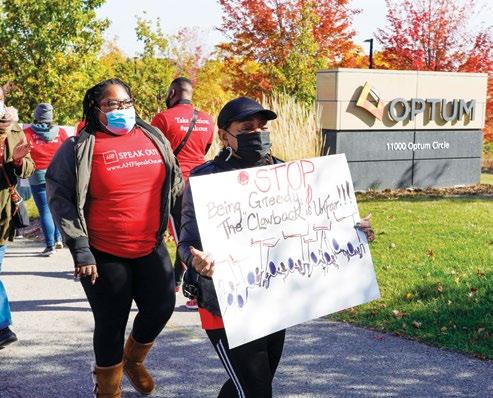
Middlemen rob us of the meaningful relationship that comes from organizing ourselves differently.
and how the ever-lengthening supply chain reflects American’s growing sense of disconnection and alienation.
“When people are dealing directly in person,” Judge said, “you’re more likely to trust them and go away with good feelings, and there’s a real value in that.”
Dr. Harriet Fraad, a psychotherapist who examines how capitalism affects our personal lives, said that arranging the economy so that nothing is clear and everything is a possible scam goes far beyond making life more expensive, and carries real political implications. It arrests Americans’ ability to trust other people, she told me, which undermines our ability to organize against rising fascism. When every interaction is a pos-
Optum is one of the three big PBMs that control about 80 percent of prescription drug transactions.
sible shakedown, “you withhold your belief in connecting with other people to make life better,” Fraad said. “That is a real enemy of the kind of unity for people to make change.”
And while the practice of buying directly may not apply to the acquisition of pharmaceuticals in the same way it might to buying produce directly from a farmer, that spark of connection is still alive at independent pharmacies, where pharmacists are more likely to have time to speak with their clients and care about their well-being.
Proof of that came to Bil and Shanon in the days after Cole’s death. Bil worked at the same company as Cole, was on the same insurance, and uses the same inhaler. When Shanon went to pick it up, the pharmacist said it was no longer covered. But because she had gone to an independent pharmacy, the pharmacist stayed after hours to figure out how to get Bil his medicine, and Shanon walked away with a new prescription.
Had Cole likewise gone to an independent pharmacy, “he’d probably be here, and that’s what just pisses me off beyond belief,” Bil said. When he and Shanon put the pieces together after she came home that night, they stood in the living room, weeping, hugging, and decided then that “this just fucking can’t happen again,” Bil said. “No one else needs to die.” n
Captive pricing follows when customers have no choices. Policymakers can do something about it.
We’ve all been there. You’re in a stadium or an airport or a movie theater, and you head to the concession stand.

You know that you’ll pay through the nose— $9.47 for a water and a little bag of hard pretzels, $22.89 for a large popcorn bucket, $28 for a beer. The choices are simple: don’t buy or get gouged.
Captive pricing is spreading into more of our everyday transactions. Businesses without competition can easily take advantage of customers. But a new report from the Vanderbilt Policy Accelerator suggests that we should not be resigned to shelling out big bucks when there are no alternatives.
The federal government, states, and even private litigants can attack captive pricing, argues Brian Shearer, a former top official at the Consumer Financial Protection Bureau. Multiple federal agencies can use prohibitions on unfair and deceptive acts and practices (UDAP) for this purpose. And while the Trump administration has obliterated consumer protection, most states have their own UDAP statutes, which can apply to situations where consumers are given no choice but unfair prices.
“Just because it is something that we are all aware of and resigned to and hate doesn’t make it legal,” says Shearer. “I would argue that that’s a more egregious form of unfair practice. You’re not being stabbed in the back, you’re being stabbed in the front.”
This kind of pricing is popping up across the economy because it’s lucrative. When you move from the airport to the airplane, you are gouged if you want Wi-Fi or a better seat or a checked bag; the rent-seeking is cumulative. Auto dealerships upsell overpriced extras like dubious security systems or “guaranteed asset protection” insurance,
grinding down customers until they assent. Ambulance, airlift services, and anesthesia are out-of-network options in health care that extort from patients in an emergency; many of these businesses have been taken over by private equity firms . Paying rent through a website or app now often comes with unavoidable “processing” or “convenience” fees. And literally captive customers in our nation’s prisons endure outrageous costs for basic necessities in the commissary and phone calls to loved ones; incarcerated people are the only Americans who must buy a stamp to send email.
“One reason prices are so high is because customers are captive,” Shearer says. “That is not a free and fair market.”
Policymakers have tried to deal with this. “Street pricing” rules at a lot of airports limit prices to no more than 18 percent above the price outside the airport. But that can be tough to enforce without constant monitoring and isn’t applicable in other contexts. (There’s no “street price” of anesthesia.)
Shearer’s solution is the unfair practice statute, orginated in the FTC Act in 1914 and adopted by states in the 1960s and 70s. He envisions a three-pronged approach: State attorneys general or consumer protection agencies could enforce UDAP on a case-by-case basis. Enforcers could also write specific regulations about stadium or hospital pricing, and state legislators could also pen laws with prescriptive prohibitions for captive venues.
This belt-andsuspenders approach
has a better chance of working. “Sometimes companies wait for enforcement to come to them, the deterrent effect is not effective,” Shearer says. “Passing a new rule or law has a better impact on the broader group of companies that aren’t getting sued.”
Most state UDAP laws allow for a private right of action. No individual is going to sue over a $20 beer at the Oasis that should have been $8, but class-action lawsuits can fight unfair pricing. Normally, arbitration agreements and class certification difficulties are hindrances to this type of private enforcement. But with captive pricing, arbitration may not apply: the consumer has a contract with the airplane, and the airport is just capitalizing on captivity, for example. And class members are similarly situated, because the unfair prices are publicly posted and everyone pays them.
After an off-year election that largely turned on affordability, policymakers should flock to take on captive pricing, Shearer says. “State attorneys general that want to do something about cost of living and corporate corruption can do something visible that makes people feel like they’re addressing the thing in their daily lives.”
—David Dayen

Extreme weather and changes in seasonal patterns are fundamentally altering the landscape, in cities and in farming communities. You’re going to pay for it.



Twenty years ago, Hurricane Katrina unleashed a levee-busting catastrophe on New Orleans that woke Americans up to the fabled city’s precarious relationship with water. But it’s not just tropical storms that unleash flooding; the fierce thunderstorms that wind up long before hurricane season can also bring NOLA to grief. In April, a period of flash flooding captured national headlines. Ten inches of rain pelted the Algiers neighborhood on the western flank of the Mississippi River; other areas of the city saw up to seven inches—more rainfall than the city usually sees during the entire month.
“New Orleans is facing, I would say, like a seven-layer cake of challenges in regard to flooding,” says Jessica Dandridge-Smith, executive director of The Water Collaborative of Greater New Orleans, a regional water policy, education, and equity organization.
Climate change delivers constant reminders of how humans have completely disrupted the ways water cycles around the planet. There’s more precipitation in some places and next to no rainfall in others, or alternating seasons of flooding and drought. Persistent drought threatens the supply of fresh water, while heavy and more frequent rains, like the ones New Orleans experiences, stress inadequate stormwater systems that struggle to prevent flooding. All of these events complicate whether people can afford the one substance that they can’t live without, and renders the simple act of turning on a faucet a budget-busting financial decision.
Civilizations have prospered according to the rhythms of the natural world. And even in the Anthropocene, societies continue to grow crops and raise livestock that flour -
ish in their environments. For everything else, they turn to global markets. But climate change–fueled natural disasters and shifting weather patterns have hit hard, disrupting where humans live, right along with their traditional agricultural practices. These upheavals mean that people are left scrambling, in some cases almost daily, to respond to a world in constant flux.
Climate change is an affordability issue that demands reassessing the pearl-clutchers’ claims that expensive solutions only burden people with higher costs. This era’s threats should prompt the realization that inaction (or worse, retrenchment) is prompting price hikes right now, which people find intolerable. By contrast, the policy responses and environmental adaptations needed to grapple with the crisis can potentially decrease consumer prices, as the progress in the renewable-energy sector shows.
A warming planet can cause more suffering, more disease, and even mass deaths. But even if you don’t live in a danger zone made more treacherous by climate change, the higher prices you pay for everyday goods—even something as basic as water— mean that no one escapes the impacts.
Affordable water is an oxymoron in New Orleans. The American Water Works Association defines water affordability as “the ability of a customer to pay the water bill in full and on time without jeopardizing the customer’s ability to pay for other essential expenses.” Water affordability is a monumental stressor in a place where the poverty rate is nearly 23 percent and the median income is $55,580. A 2024 investigation by
By Gabrielle Gurley
The Lens, a New Orleans–area public-interest newsroom, found that water bills average $115.44 each month, more than twice that of comparable Southern cities
Not only do New Orleanians already pay premium water and sewer rates, but the infrastructure that delivers drinking water, carries out sewage, and pumps out floodwater is more than a century old, and chronic needs to upgrade or repair contribute to the high rates that residents will continue to pay.
New Orleans stays dry for the most part because its massive, antique system of dozens of pumps, catch basins, drainage pipes, and aboveground and underground canals keeps it that way. At times, this is not enough—the April rains overwhelmed the pumps in certain sections. A system built for the weather patterns of the 20th century can’t keep up with the heavier rainfall of the 21st.
Much of the city’s difficulties rest with the wildly dysfunctional and despised entity that runs the system: the Sewerage and Water Board of New Orleans (SWBNO). This dysfunction extends to predatory billing practices and water shutoffs that are a regular occurrence in the city. It’s bad enough that working families and seniors are paying the cost of climate change through progressively higher water and sewer bills; it’s worse that those bills are sometimes erroneous.
Gov. Jeff Landry (R-LA) finally convened a special task force to get to the bottom of a myriad of issues, including ongoing maintenance failures despite hundreds of millions of federal, state, and local investments; billing snafus; and no small amount of corruption. The inquiry confirmed what residents and businesses already knew about water “affordability” in New Orleans: “The SWBNO billing crisis may very well be the single biggest hindrance on daily quality of life.”
“Low-income families and those on fixed incomes simply cannot tolerate a ‘surprise’ high water bill,” the task force report reads. “A fairly typical complaint was an inaccurate [water usage] reading leading to a massive bill that was either auto drafted out of the customer’s account or double billed.”
To partially address the lack of confidence in billing, the SWBNO finally launched a system with an outside vendor to work with customers who owe $50 or more to pay their bills interest-free without incurring additional penalties or having their water shut off. As of September, 23,000 customers have been able to catch up on payments and the utility has recovered nearly $19 million in past-
due revenue, with an estimated $24 million projected to be paid through the program.
Dandridge-Smith, who once had her water shut off for two months when she was between jobs, says the program appears to be making progress. “But the issue that still remains is that our water bills are high, so the residents are feeling the burden,” she said. “And frankly, the utility is feeling the burden.”
New Orleans isn’t alone. Many municipalities face astronomical water rates at a time when energy bills are also soaring. An April 2025 Bank of America report indicated that in March Americans’ median monthly water utility payments increased more than 7 percent year over year. Durango, Colorado, ratepayers face a 10 to 20 percent hike; San Diego will see a 30 percent hike. Broomfield, Colorado, approved a 50 percent increase. All are blaming aging infrastructure, and shifting climate patterns are at the heart of those unanticipated costs.
Helping people pay their bills is not the same as making sure that water flows to homes at a reasonable cost. “What we really need are affordability solutions that address [bringing] bills down to a level that a household can afford to pay based on their income,” says Mary Grant, who directs the Public Water for All campaign at Food & Water Watch, a national advocacy group.
To address the city’s massive stormwater infrastructure issues, New Orleans residents passed a $50 million bond proposition to improve drainage and stormwater management facilities. Another proposal being debated is a stormwater fee to begin to chip away at the $1 billion in improvements over the next decade that the SWBNO needs to make. According to a Water Collaborative survey conducted earlier this year, a majority of New Orleanians are willing to acquiesce to a fee in return for modern stormwater infrastructure that can offer relief from flooding during smaller storms— as long as the SWBNO isn’t collecting the fee. New Orleans Mayor-elect Helena Moreno has said that she supports a regional entity to monitor and address drinking water issues, as well as the stormwater fee. She’s no fan of the SWBNO either.
But the demands of problems like lead pipe replacement and treating drinking water from the Mississippi River for pollutants and salt water intrusion due to sea level rise mean that recurring infrastructure costs still get passed on to consumers. The SWBNO runs its own power plant to help power older
change plays havoc with crops as much as it does with water, leading to sticker shock at the grocery store.
segments of the system, a cost that even the utility admits is not sustainable.
During the COVID -19 pandemic, New Orleans had access to the federal Low Income Household Water Assistance Program (LIHWAP), a federal program that mirrored the existing federal home heating assistance program. Congress provided more than $1 billion in funding across the country, sparing more than a million low-income households from shutoffs and bills that they could not pay.
The need is still there, but LIHWAP isn’t; the program expired in 2022. A proposal to restart the program introduced in July by Reps. Eric Sorenson (D-IL), Rob Bresnahan (R-PA), and several other members of Congress is going nowhere fast, given the lack of interest in social programs in Congress and the White House.
But New Orleans never properly utilized LIHWAP during COVID to assist ratepayers, says Dandridge-Smith. “We have a state that, oftentimes, either intentionally or unintentionally, does not mobilize federal dollars to the people who need it the most. This is a constant problem across all issues, and then you have a city that is essentially drowning in its own aging and failing infrastructure,” she says.
Climate change plays havoc with crops as much as it does with water, leading to sticker shock at the grocery store, one of American consumers’ biggest concerns.
The role of climate can sometimes be surprising. When faced with high coffee prices, many people might blame President Trump’s tariffs on coffee-producing regions like Brazil and Vietnam. But droughts in the region near the equator known as the “coffee belt” sent prices to an all-time high before any tariffs were imposed.
Climate-fueled drought in the Great

Plains states have thinned out cattle herds, also leading to higher beef prices. Houston Public Media reported that prices reached $6.32 per pound in September for 100 percent ground beef, the highest ever—and after a drought, ranchers expect to see price increases for the next couple of years.
Every day, there seems to be a new weather-related food disaster. Olive oil prices skyrocketed in early 2024 due to drought. That spring, high temperatures in Ghana and Ivory Coast, home to 60 percent of the world’s cocoa, took those prices up by threefold. By summer, a heat wave in Asia spiked Japanese rice prices by 48 percent and Korean cabbage prices by 70 percent.
Heavy rains can also ruin fertile soil. A November report from the United Nations Development Programme finds that more than 90 percent of all countries will see lower crop yields because of climate change by the end of the century, even after accounting for farmers adapting to weather changes.
One reason for lower crop yields is changes in the seasons. Trees have adapted to the climate by blossoming earlier, for example,
which makes fruits and nuts more vulnerable to spring cold snaps and frosts that can wipe out a whole harvest. That’s what happened to hazelnuts this year in Turkey, the country that accounts for 73 percent of the global supply. The projected 40 percent loss of hazelnut yields translates into a 30 percent increase in price.
In addition to risk from seasonal patterns, a hotter climate can become a breeding ground for pathogens that can debilitate the food supply. The New World screwworm, a parasitic fly whose larvae feed on warmblooded animals like cows and other livestock, has been virtually eradicated in the United States since the 1970s. But it returned to Panama in 2022, has been reported in southern Mexico, and is threatening domestic cattle herds this year, leading to a ban on Mexican livestock to contain the damage.
Bird flu, which reappeared in the U.S. this fall, has also been spurred by a warming planet. Changes in migratory patterns have led to diseased birds flying into new places, leaving those areas vulnerable to outbreaks.
Both Brazil, the world’s biggest producer
of oranges, and the U.S. have been slammed by citrus greening, spread by an insect, the Asian citrus psyllid. About 50 percent of Brazil’s crop has been infected, while Florida’s production has dropped more than 92 percent in the past two decades. Severe weather has also plagued Florida orange producers: Hurricane Milton destroyed 20 percent of the state’s orange crop.
These alternating seasons of flood and drought, as well as disease and insect infestations, leave agricultural producers wrestling with the basic questions of whether they can afford to keep juggling different climate adaptation strategies.
For two straight years, summer torrents led to extreme flooding in Vermont, with mudslides and washouts that destroyed entire farms and pulverized town centers. A July 10, 2023, deluge across the state lasted 48 hours, produced nearly a foot of rain in the worst-hit enclaves, and led to a federal disaster declaration. Exactly one year later to the day, the remnants of Hurricane Beryl struck some of the same towns that had been inundated before.

It had been more than a decade since Tropical Storm Irene meandered up the East Coast and introduced Vermonters to their own new climate strangeness: severe flooding from weather systems that originate in the tropics. During the decade it took to recover, some Vermonters began to see Irene as a “one-off.” It wasn’t.
This past summer delivered another weird, unwelcome jolt: weeks of extreme drought. The prospect of seasons of inundation and scarcity colors how farmers view the affordability of their enterprises. Huge agribusinesses have fewer water issues, but smaller farmers can experience crises and be driven out of business by extreme events.
Vermont farmers who grow vegetables irrigate their lands with river water or streams and creeks that run through their properties. In the eastern United States, farmers have riparian rights, sourcing their water from nearby bodies of water like streams, rivers, and lakes, or from groundwater via wells. As of 2023, Vermont requires farmers to report their surface water usage annually above a particular threshold. (In
the West, under the doctrine of prior appropriation, farmers access water based on water rights acquired decades ago.)
A 2023 Vermont Agriculture Recovery Task Force survey found that extreme weather left farmers with about a 30 percent loss in annual income; nearly 60 percent reported that their cash flow would go negative. Estimated total drought losses reported through the state’s 2025 Agriculture Drought Survey are $13 million for this year alone.
Maddie Kempner, the policy and organizing director for the Northeast Organic Farming Association of Vermont, explains what it means to local farmers to have uncertain water access. Livestock farmers, for example, have tremendous water demands: “A productive dairy cow needs 50 gallons of drinking water daily,” Kempner says. If a well runs dry, “that means paying to haul water to your farm constantly to keep up with that level of need that your animals have, in order to keep them healthy, alive, and producing the product that is the lifeblood of your business.” It’s also a major cost to bear if the wells that they rely upon

have run dry. They may have to drill new ones, up to a five-figure expense.
To make farming work, some regional growers plant crops like carrots and leafy greens like lettuces that they can harvest in a shorter span of time, rather than vegetables like broccoli or brussels sprouts that take months to mature and are at risk in areas subject to flooding.
Kempner spotlighted another major concern: “They don’t have meaningful crop insurance support or disaster relief programs that work for their operation. Those by and large are designed to work for much larger and less diversified farms and poorly serve our farming community here.”
Farmers also must think about moving heating and cooling systems and other infrastructure to higher ground, or shoring up roads and improving drainage, costs that also run into the tens of thousands of dollars.
“A lot of our farms are living on thin profit margins where they don’t necessarily have extra room in their budget to invest in those kinds of protective measures,” she says.
All of these additional measures add cost

to the produce or beef you buy in the grocery store. And farmers are not just growing the food; they’re buying it, too. “Beyond these climate disasters and extreme weather events, farmers are dealing with the same inflationary pressures as everyone else in general,” says Kempner. “We are facing a pivotal moment in American agriculture, where our population of farmers is aging, and access to farmland and affordability of farmland is a huge challenge for beginning farmers trying
Huge agribusinesses have fewer water issues, but smaller farmers can be driven out of business by extreme events.
to get into farming. These affordability challenges are existential when you think about the future of our food system on the whole.”
In the summer of 2025, flooding wasn’t the problem in Middlebury, Vermont, where commercial beekeeper Curtis Mraz runs the Champlain Valley Apiaries. “We actually produced quite a bit more honey in the years where we had significant flooding,” the fourth-generation beekeeper tells the Prospect. “And we were in a part of Vermont where we didn’t have serious washouts like other parts of the state.”
“That being said,” he continues, “the more it rains, the less a bee can fly. We often as beekeepers talk about fly time. We need clear days; they don’t fly at night. So in the last couple years, we had significant rainfall to the point where fly time was limited.”
Until the beginning of July, the apiary’s bees were very productive, but as the month wore on, the amount of honey dropped off. “If you looked out in the Vermont landscape, you’d see goldenrod coming in in August, but not a single bee dancing across it,” says Mraz. “Beautiful flowers, but because there was a drought, there was no water in the soil, and therefore, no nectar in the flowers for the bees to feed on.”
Mraz and his family have worked with bees for a century, and he has an excellent sense of how the bee ecosystem has changed. “In Vermont, we’re getting into these two seasons, where there’s too much water or too little water: Now it’s either mud season or it’s a drought,” he says. Wet conditions mean that Mraz and his workers spend more time moving equipment around, because it’s too muddy for a truck to drive into the fields. That ends up increasing his labor costs.
Last year, beekeepers lost between 60 and 100 percent of their colonies, Mraz says, and his losses were “in that range.” It’s not just the excess rainfall, but the amount: A deluge, then drought, makes the bees susceptible to disease. Colony collapse disorder is what beekeepers now call a mass bee die-off. But while it’s been forecast for two decades, researchers noticed a serious uptick in 2025.
Colony collapse is an imprecise name. “It’s basically this huge conglomeration of pressures that nobody can truly name,” Mraz says, “although I’ll tell you, it’s pesticides that’s the biggest contributing factor.” He adds that the family’s hives once lived from 10 to 15 years; now they last about three.
A 60 percent colony loss would have been unimaginable previously, he says: “When my great-grandfather was running the business, a 10 percent loss would be a terrible year.”
Some of the practices used on soybeans and other monoculture crops, like the use of pesticides, contribute to the conditions that produce bee colony losses. After a heavy rainfall, pesticides used to treat them wash off into ditches, then streams and other water sources that bees use, and poison them. Neonicotinoids are a class of pesticides that have emerged as a major culprit.
Mraz would like to see a shift in perspectives in using pesticides in the food system at all, especially when the chemicals kill the very bugs that are needed to cultivate crops. But pesticides are used to maintain crop yields that are thinning due to climate change. So the conditions that are killing so many bees have a climate nexus as well. Because the honeybees that migratory beekeepers tend are central to the economics of pollination for crops like almonds, apples, cranberries, and blueberries, there’s a whole passel of scientists and researchers dedicated to the continuation of the species. Mraz worries that the U.S., unlike Canada and the European Union, isn’t moving fast enough to deal with the threat. Vermont is working on a gradual phaseout, but a ban won’t go into effect until 2029.
“Because our agricultural system is so dependent on honeybees, you can always guarantee that somebody will be out there selling more honeybees,” Mraz says. But like most producers, the costs get passed on to his customers.
“My uncle has a saying: We are no longer beekeepers—we’ve all become bee replacers. I just couldn’t help but wonder, is this really the right future?” Mraz asks. “And the reality is if we want to keep this going, there’s not a ton of government subsidy money for us, like there is for corn, soybean farmers, or dairy producers, so we have to ultimately increase the price of our products.”
The financial pressures of adapting to climate shifts and bee colony collapse weigh heavily on the young beekeeper. “Every year, we’ll take those 40 percent of the bees that survive and we’ll turn 200 colonies back into 1,000. But that comes with a huge genetic cost, a huge labor cost, and then, ultimately, every spring, I’m breaking down and crying again and talking to my beekeeper peers who are ready to walk off a cliff—‘How can we do this again?’” n
We’re in an affordability crisis because workers aren’t being paid at the same levels they earned in the past.
By Harold Meyerson
There are, of course, two components to affordability: sellers’ prices and buyers’ incomes. For most American families, buying (or renting) focuses either heavily or entirely on life’s essentials: housing, food, transportation, education, health care, and other forms of care (child, senior). That a clear majority of American families are, at minimum, stressed by these costs is a consequence of not just a host of factors on the sellers’ side, but of one big factor on the buyers’ side: a half-century of wage stagnation, even as investment income has soared. Or, if you prefer, a half-century of buyers’ income stagnation, even as sellers’ income has soared.
If you depend on investments for most of your income, this is a pretty damn good time. The University of Michigan’s November survey of consumer sentiment finds that Americans who don’t own stock have their lowest confidence level in the economy since the survey began querying stock ownership in 1998. An exception to this mood, the survey notes, is found among the largest stock owners, whose assessment of the economy
has actually risen by 11 percent this year.
As Emma Janssen has reported in these pages, marketers are going where the money is, like bank robber Willie Sutton. Firstclass and business-seat travel on the airlines is booming, so much so that seating arrangements on Delta and United are being reconfigured to create more room for the affluent, while coach seats are going unfilled and “discount” airlines struggle. Revenues are up 3 percent this year at the Ritz-Carltons, the Four Seasons, and other luxury hotels, yet down by 3 percent at economy hotels. And when it comes to life’s biggest purchase—a home—the median age of first-time buyers reached 40 this year, an all-time high according to the National Association of Realtors.
“All right,” as John Dos Passos wrote in his U.S.A. trilogy in the depth of the Depression, “we are two nations.”
Life in the nonaffluent nation is getting harder. According to a Brookings Institution analysis from last year, 43 percent of American families don’t earn enough to pay for housing, food, health care, child
care, and transportation; every week, they must juggle which to pay and which not to pay. Among Black and Latino families, those figures rise to 59 percent and 66 percent, respectively.
It has not been ever thus. In the roughly 30 years following the end of World War II, the nation experienced an unprecedented period of broadly shared prosperity, with workers’ incomes rising in tandem with the nation’s growth in productivity. In 1947, workers captured 70 percent of the total national income; today, that has fallen to roughly 59 percent, while investment income has gained at workers’ expense. As a landmark 1995 study by economists Larry Mishel and Jared Bernstein for the Economic Policy Institute (EPI) revealed, a gap between the rise in productivity and the rise in median workers’ wages opened in the mid-1970s and has grown steadily wider since then; the difference between those two rates today is 55 percent . In the years between 1948 and 1979, when the egalitarian legacy of the New Deal was at its apogee, with high levels of unionization and progressive taxation and constraints on the financial sector, productivity grew by 108 percent and median worker’s compensation by 93 percent. In the years between 1979 and 2025, an EPI analysis found productivity grew by 87 percent but median worker’s compensation by a bare 33 percent.
The declining share of national income going to workers hasn’t entirely been the
result of the shift from wage income to investment income. There’s also been a shift in the distribution of corporate income to the most highly paid employees, through stock options and other forms of compensation. A 2021 EPI study shows that between 1979 and 2019, real yearly wages for the bottom 90 percent of workers increased by 26 percent, while the wages of those in the 95th to 99th percentile increased by 75 percent, for those in the top 1 percent by 160 percent, and for those in the top 0.1 percent by 345 percent. Worker pay ratios over the past decade have shown that CEOs usually make about 300 times what their median-paid employee makes, a far cry from the 1960s, when the ratio was roughly 20-to-1. Even as labor unions have largely disappeared in the past 60 years, the union of American CEOs—routinely appointed to the executive compensation committees of corporate boards with the blessing or at the instigation of the CEO whose pay they’re setting—has retained its power, adhering to the creed that an injury to one CEO (by, say, paying him or her less than 300 times what workers make) is an injury to all.
What would America look like if the gap between worker pay and productivity hadn’t opened? A RAND Corporation study from earlier this year found that the bottom 90 percent of wage earners received about 67 percent of all taxable

income in 1975. In 2019, the last year for which this data was available, they received 46.8 percent. Had that bottom 90 percent continued during the past half-century to make the same share of the national income they’d had in 1975, RAND calculates that by 2023 they would have made an addi$79 trillion . Just in the year 2023, they would have made an additional $3.9 trillion. As the size of the bottom 90 percent of the U.S. workforce is roughly 140 million people, that means that the average earner would have made about $28,000 more in 2023 than they actually did.
Where have all those missing $28,000 paychecks gone? Well, our nation was 1,135 billionaires this year, whose aggregate net worth in 2024 came to a cozy $5.7 trillion. That’s $1.8 trillion more than what it would take to cut 140 million $28,000 paychecks.
Corporations aren’t cutting those checks. As EPI ’s Nominal Wage Tracker documents, the 80 percent of corporate income that went to employees in 1980 declined to 71.5 percent this year.
This is the kind of thing that can irritate workers. As I write in mid-November, 3,200 members of the Machinists union have just completed a three-month strike at three Midwestern Boeing plants. Strikers noted that Boeing devoted $68 billion to stock buybacks between 2010 and 2024—funds that could have gone
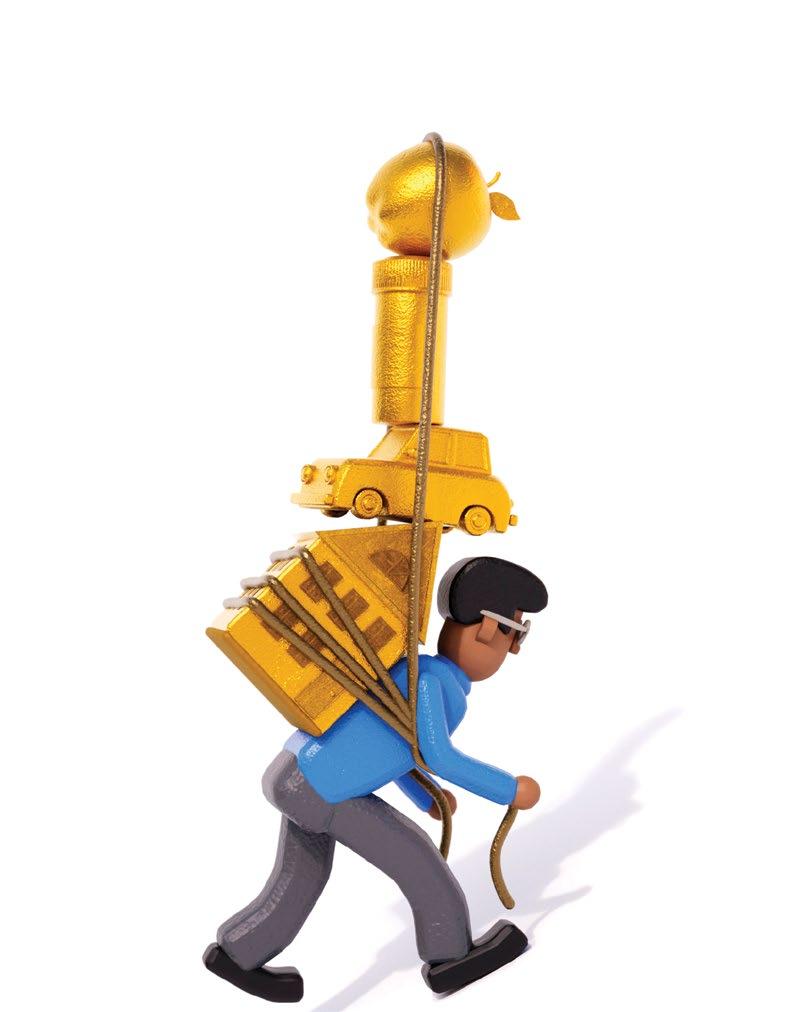
The beginnings of America’s upward redistribution of wealth and income coincide
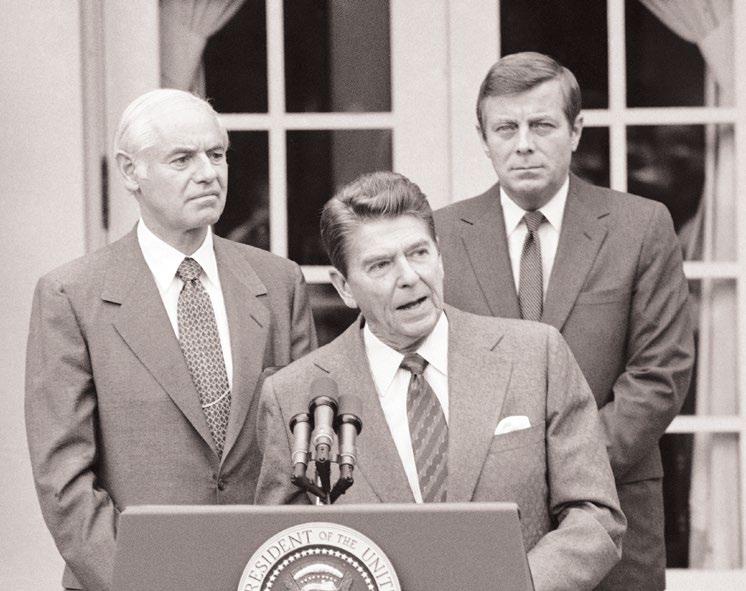
to developing safer and better planes, and better-compensated workers with more secure retirement benefits.
There’s a reason why 1979 has become the last “postwar normal” year, before the massive upward redistribution of wealth and income, in most of these economic studies. In 1980, Ronald Reagan was elected president. In his first few months in office, he signed a law reducing the top income tax rate from 70 percent to 50 percent. (It’s about ten points lower than that today, though most of our super-rich have found ways to get it much closer to zero.) The high marginal tax rates of the postwar decades, peaking at 91 percent during Republican Dwight Eisenhower’s presidency, had effectively put a ceiling on CEO pay. Tesla’s board
would not be committing to pay Elon Musk a trillion bucks if Tesla thrives in the coming years under 1950s-era tax rates, where the feds would take the lion’s share above the top marginal bracket. The pre-Reagan tax rates ensured that America’s billionaires would be few and far between, helping to ensure that workers’ potential income wouldn’t be siphoned upward. Twenty years after Reagan, George W. Bush became the first president to lower taxes on the rich during wartime (a war he decided to start absent a plausible threat), and Donald Trump’s successive cuts make even Reagan and Bush look like Keynesians.
In 1982, Reagan’s appointees to the Securities and Exchange Commission (SEC) changed a rule that enabled shareholders to claim a greater percentage of corporate
wealth. The SEC permitted corporate executives to authorize buybacks of the corporation’s stock, thereby raising the value of the remaining shares on the market. By the 1990s, due to a Clinton-era loophole exempting bonus compensation from corporate taxes, corporations began paying their top executives with shares and options of shares, which made buybacks an easy form of self-enrichment. As economist William Lazonick has exhaustively documented, by the 2000s, most major corporations were diverting more funds to buybacks and dividends than they were investing in growth and research, not to mention employees’ raises.
During his first year in office, Reagan also busted PATCO, the air traffic controllers’ union, firing all its members when they went
on strike. (By contrast, Republican Richard Nixon had allowed all hundreds of thousands of postal workers who’d participated in a wildcat strike in 1970 to return to their jobs: The Republican Party of Nixon’s day was still closer to the accept-the-New-Deal ethos of Eisenhower than the overturn-theNew-Deal ethos of Reagan.) Reagan’s mass firing inspired private-sector CEOs to do the same with their own employees. During the next several years, a representative sample of leading corporations—Phelps Dodge, Greyhound Bus, Boise Cascade, International Paper, Hormel meatpacking—all slashed pay to provoke strikes, then fired the strikers and hired their replacements at a fraction of their original salaries.
During the years of postwar prosperity, strikes were a routine part of the economic landscape, and a major reason why worker pay constituted a decent share of the national income. After PATCO, they nearly disappeared. The number of major strikes plummeted from 286 a year in the 1960s and 1970s, to 83 a year in the 1980s, to 35 a year in the 1990s, to 20 a year in the 2000s. In recent years, the strike has enjoyed a modest revival—autoworkers and teaching assistants have won higher wages by walking picket lines—but unions have shrunk to the point that the fruits of such victories have limited ripple effects.
Reagan wasn’t the sole agent of upward redistribution during this time. Federal Reserve Chair Paul Volcker brought down inflation by raising interest rates so high that people stopped buying cars and construction projects slowed to a trickle. The industrial Midwest never recovered. Between 1979 and 1983, 2.4 million manufacturing jobs vanished. The number of U.S. steelworkers went from 450,000 at the start of the 1980s to 170,000 at decade’s end, even as the wages of those who remained shrank by 17 percent. The decline in auto
manufacturing was even more precipitous, from 760,000 employees in 1978 to 490,000 three years later. These were the jobs whose union contracts had set the standard for the nation’s blue-collar workers.
Finally, also in 1981, at New York’s Pierre Hotel, Jack Welch, General Electric’s new CEO, delivered a kind of inaugural address, which he titled “Growing Fast in a SlowGrowth Economy.” GE, Welch proclaimed, would shed all its divisions that weren’t number one or number two in their markets. If that meant shedding workers, so be it. All that mattered was pushing the company to pre-eminence, and the measure of a company’s pre-eminence was its stock price. Between late 1980 and 1985, Welch reduced the number of GE employees from 411,000 to 299,000. He cut basic research. The company’s stock price soared. And Welch became the model CEO for a corporate America going fully neoliberal.
What the early 1980s inaugurated grew apace over the subsequent 40 years. Emboldened by Reagan’s opposition to unions, CEOs and corporate boards routinely directed their companies to violate the laws that had empowered workers to form and join unions. In 2016 and 2017, employers were charged with violating the National Labor Relations Act in 41.5 percent of all unionization campaigns, often by firing workers involved in those campaigns. The penalties for being found guilty of such charges are negligible, and Democrats’ efforts to amend the NLRA so that the penalties actually have some effect on employer conduct have never been able to win the support of the 60 senators required to break a filibuster to enact such amendments. So it is that most unionized private companies were unionized many decades ago, and almost all the major companies that have been created since (including the two largest privatesector employers, Walmart and Amazon) have rebuffed their employees’ unionization efforts through illegal threats and firings.
to begin bargaining with the Staten Island warehouse workers, who decisively voted to join a union to much fanfare back in April of 2022.
These are among the factors that explain why the rate of American worker unionization has declined from one-third in the middle of the 20th century to just under 10 percent today, and a bare 6 percent in the private sector. Another factor, both in the shrinking of unions and the shrinking of worker pay, is the move of major corporations’ production facilities from the unionized Northern and Midwestern states to the right-to-work, anti-union South. The spread of Southern pay standards to the rest of the nation—a tale whose protagonist is most certainly Walmart—also served to bring down national pay levels in retail. The late 1970s deregulation of the trucking industry, by effectively negating the Teamsters’ nationwide contract with long-distance trucking companies that had covered nearly half of U.S. truck drivers, proved to be a huge hit to drivers’ incomes, by some estimates cutting them in half.
The litany of the limits placed on workers’ ability to win sustaining incomes is long.
Trade deals and offshoring have damaged workers considerably. NAFTA was the nation’s first trade treaty with a low-wage nation (Mexico), and our end-of-the-century trade deal with China greatly exacerbated the depressing effect on American workers’ wages. Both an EPI study and another by MIT ’s David Autor and several co-authors independently concluded that such deals lowered the wage of non-collegegraduate U.S. workers by 5.6 percent, taking an average bite out of their yearly income of roughly $2,000.
The federal minimum wage of $7.25 currently comes to roughly 29 percent of the median full-time worker’s wage. In 1968, the federal minimum wage came to 53 percent of the median full-time worker’s wage.
The litany of the limits placed on workers’ ability to win sustaining incomes is long.
Even when workers have managed to win unionization, that doesn’t mean they actually are able to bargain a first contract. An EPI study showed that 63 percent of the time during 2018, workers in newly unionized companies hadn’t been able to get their employer to agree to a contract within one year of their unionizing, as there’s no law requiring employers to bargain in a timely fashion. Amazon, for instance, has yet even
Worker misclassification as independent contractors (as in the cases of Amazon delivery drivers and Uber and Lyft drivers) reduces incomes, exempts workers from wage and hour legislation, and generally means they lack the benefits (such as health insurance) that customarily accrue to corporate employees. EPI’s 2021 study on the factors reducing workers’ income estimated that nine million American workers were then misclassified, reducing their incomes by anywhere from 15 percent to 30 percent.
A 2019 study by Brandeis University economist David Weil, who was in charge of the Wage and Hour Division of the Department of Labor during the Obama presidency, found that drivers employed directly by UPS, who also worked under a contract with the Teamsters, earned $23.10 an hour, while the “independent contractor” drivers for FedEx earned $14.40 an hour, and those for Amazon, a paltry $5.30 an hour. Amazon is currently in court contesting the unionization of a number of those drivers, making the argument that the 90-year-old National Labor Relations Board is unconstitutional.
Noncompete agreements tucked into employment contracts forbid workers from taking a job with other businesses in the same sector or starting their own businesses in that sector. Initially devised to keep a small number of specialized employees from taking proprietary information to competitor companies, these agreements have now spread to workers at nail salons, barbershops, and just about any other kind of business. An EPI survey of businesses with at least 50 employees found that somewhere between one-quarter and one-half of all private-sector workers were subject to noncompetes. During the Biden presidency, both the Federal Trade Commission (FTC) and the NLRB found this practice to be a violation of law, and the FTC formally banned noncompetes nationwide. But those findings and rules have not been carried over, of course, to their Trump administration successors.
Corporate concentration, as the other feature articles in this issue abundantly document, is a huge factor in price increases afflicting the American consumer. It’s also a factor in limiting American workers’ incomes. In 2017, MIT ’s Autor and other co-authors estimated that the increase in product market concentration accounted for a third of the decline in labor’s share of the national income for the years between 1997 and 2012. The shrinking of employer options relieves employers of the pressure created by workers flocking to higher-paying rivals. In opposing the merger of the Albertsons and Kroger supermarket chains, Biden’s FTC argued that it would lead not only to price hikes but also to lower wages for their workers unless they remained separate companies.
In weighing the relative responsibility of all these factors in creating the widening gap between productivity increases and
median wage increases from 1979 through 2017, a 2021 EPI study by Lawrence Mishel and Josh Bivens concluded that excessive unemployment levels (due chiefly to Federal Reserve policies), the decline of collective bargaining, and globalization (devised by and benefiting corporations) explain roughly 55 percent of that gap, while misclassification of workers, subcontracting, noncompete agreements, and corporate concentration add up to 20 percent.
Over the past 45 years, the fundamentals of the postwar economy that were put in place by the New Deal have been discarded at the behest and insistence of wealthy interests and individuals who’ve sought a much higher share of the national income. Creating a more equitable economy—effectively, reinventing a vibrant American middle class—will be an arduous task. That said, this November’s elections reveal a public that understands the current system isn’t working for them or their neighbors. The affordability solutions put forth by Zohran Mamdani, Abigail Spanberger, and Mikie Sherrill in their successful campaigns are just a start in what will be a long and difficult struggle. Herewith, some suggestions on the path to a more broadly shared prosperity and an affordable future.
First, nothing increases worker bargaining power like full employment. The next Democratic president’s appointees to the Federal Reserve must be committed to raising ordinary Americans’ share of the national income. That requires the low interest rates essential for a thriving economy. Denmark’s policy of providing free job training and up to 90 percent of their salary to laidoff workers has been a success in boosting that nation’s employment levels and mitigating the effects of an economic downturn.
Second, the return of collective bargaining. That necessitates labor law reforms that enable workers to unionize by signing affiliation cards; require employers to recognize unions when their workers have obtained those cards from a majority of employees; require employers to settle on contracts with unionized workers within a fixed time (90 days? 120 days?) or submit to compulsory arbitration; abolish “right to work” laws; make corporations the coemployers of record with their franchises; enable sector-wide bargaining in various sectors, thereby setting the same minimum wage and benefit standards for all of that
This November’s elections reveal a public that understands the current system isn’t working for them or their neighbors.
industry’s employees, unionized or not; and perhaps enable bargaining from “minority” unions to which at least 25 percent of employees belong, so long as no union has achieved majority status. Today, unions are among the most well-thought-of American institutions, getting roughly 70 percent approval ratings in the annual Gallup polls, even as the rate of private-sector unionization is less than one-tenth of that. It’s primarily the weakness of labor law that has spawned this widest of gaps; that law must be changed if that gap is to shrink.
Third, raise the minimum wage to the level of a living wage, sufficient to pay for all life’s essentials. An MIT study this year has estimated the living wage for a family in each of the 50 states, from $22.43 an hour in Mississippi to $34.55 in California. A federal law could mandate such procedures for the states. A paper released in October by California-based economists Martin Carnoy, Michael Reich, and Derek Shearer suggests an anti-inflationary accompaniment to such raises would be a rigorous antitrust policy that would yield more competitive pricing in retailing.
Fourth, family-friendly financial policies. That could begin with a yearly federal payment to families with children, at an initial level of $5,000 per child. A Brookings Institution study has estimated that a middle-income family spends $310,605 to raise one child from birth to 17. The cost of child-rearing is such that it simply deters many families from having children. This is an area where our government must adopt the kind of policies that the governments of most nations with advanced economies have long since enacted. Universal free child care and pre-kindergarten could cut these costs to families, as well as enabling mothers to continue in their careers, which boosts family incomes.
Non-union FedEx drivers and the independent contractors working for Amazon make far less than their unionized delivery driver counterparts.
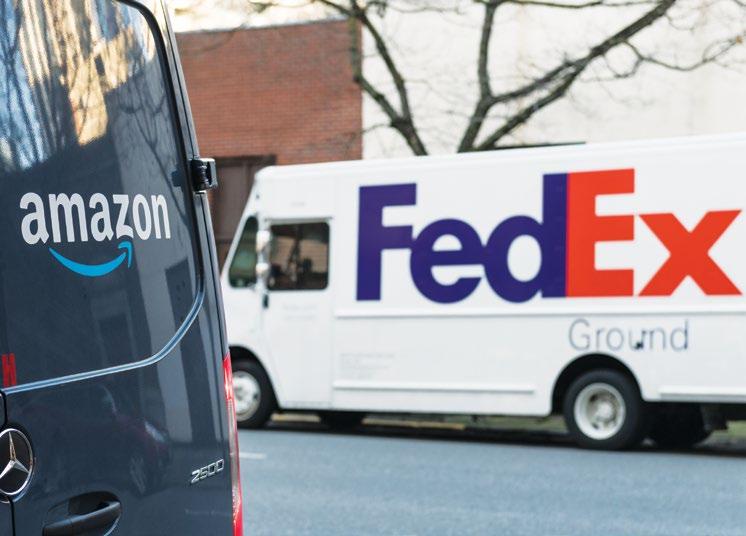
In a recent paper for the Economic Security Project, Becky Chao and Mike Konczal document that Americans generally become parents when their earnings have yet to achieve mid-career levels, making the prospect of having children a financially fraught one. They argue for substantial child tax credits and earned income tax credits to address this structural gap between the costs of parenting and the income levels of young workers. Similarly, they also argue for more generous Social Security payments for the elderly and disabled.
Fifth, a ban on noncompete and forced arbitration clauses in employment contracts.
Sixth, the adoption of industrial policies, such as those advanced during the Biden administration, that revitalize domestic industries and lessen our dependence on imports from low-wage nations that have the effect of reducing the incomes of workers here at home. As the robotization of production work continues, manufacturing and transportation will employ fewer workers than they currently do, but the remaining workers in those sectors should not have their incomes reduced either by foreign competition or by the kinds of employment arrangements and opposition to unions
that currently characterize our economy. Where unions have power, they can insist that smaller workforces receive the benefits of higher productivity, as the longshore unions have succeeded in doing during the past decades of mechanization and containerization, making their members’ jobs the highest-paying blue-collar jobs in America.
Seventh, a thorough reworking of our tax system. Higher taxes on the rich and corporations are clearly needed to fund the kind of programs listed above, and with the nation’s wealth disparities reaching stratospheric proportions, some form of wealth taxes must be adopted as well. The best argument for adopting such a tax is that right now, only the most common and widely held form of wealth—homes—is subjected to that kind of tax. If we can tax the wealth of middle-income families, why can’t we tax the wealth—such as stocks and other investments—of the truly wealthy? Certainly, the capital gains tax should be raised to the level of the income tax on work, and the SEC rule on buybacks should be revoked.
None of this will happen so long as money dominates our politics, so the Supreme Court decisions enabling that domination— Citizens United and Buckley v. Valeo—should
be undone, if not by Democratic-appointed successors to the current justices, then by other work-arounds, such as the current effort in Montana to rewrite the state’s corporate charters so they deny corporations the power to involve themselves in elections. Americans increasingly understand that our current economy isn’t meeting their interests and that it’s rigged to favor the wealthy. A sizable public will welcome candidates who expand the Overton window of economic reforms such as those suggested here, just as there were sizable publics that backed the reforms laid out by Bernie Sanders and Zohran Mamdani in their campaigns. Indeed, a national YouGov poll taken one week after Mamdani’s election showed that every one of his platform planks commanded majority support from the American people, including 69 percent support for raising taxes on corporations and millionaires, 66 percent support for free child care for children from six months to five years, and even 57 percent support for government-owned grocery stores.
There’s no reason why Democrats who don’t call themselves socialists can’t do well running on such reforms. This would be a very opportune time for them to start. n
By Naomi Bethune
When the unemployment rate for African American women hit nearly 7 percent in August, alarms went off in Black communities across the country. One of the most widely reported developments was that in the first half of 2025, 300,000 Black women left the workforce. Coupled with a rapid rise in overall unemployment, some economists warned that this shocking development signaled the strong possibility of a recession or worse.
“The patterns that befall Black workers are frequently the patterns that are predictive of what’s coming for other groups in society at some point later on,” says Adia Harvey Wingfield, a professor of sociology at Washington University. The Bureau of Labor Statistics (BLS) began reporting the unemployment rates for Black women and men in 1972. In 1983, Black women saw their highest rate of unemployment ever, coming in at a whopping 18.6 percent, a product of the recession of 1982. The recessionary pressures ebbed, but the Black-white unemployment gaps persisted: The rates for Black Americans have typically been double those of their white counterparts.
The crusade against diversity, equity, and inclusion (DEI) is also a major factor in job loss among Black women in both
the public and private sectors. “That is an area where you will see more Black workers doing that work: We’re being pushed out and shut down as companies are retreating from these efforts and from that commitment,” says Wingfield. When the Trump administration made the decision to shutter all DEI programs, destroy any related jobs, and prosecute employers who use those frameworks in the name of restoring “merit-based” hiring, Black women did and will continue to suffer the fallout. The private sector has followed suit. National Public Radio reported that there were only 17,700 DEI jobs nationwide in January 2025, down from 20,000 positions in January 2023.
The administration’s retreat on the types of federal data being collected as well as grants to fund race, gender, and poverty research has also had a tremendous impact on progress in understanding the economic hurdles facing Black women. Government officials who offer evidence that throws the credibility of the Trump administration into question have been targeted. After the BLS released a jobs report that showcased a significant slowdown in hiring during the first half of the year, Trump fired the agency’s commissioner, Erika McEntarfer, accusing her of “faking” statistics.
Downsizing the federal workforce has had a tremendous impact on Black women, who constitute around 12 percent of the federal workforce. Although Black women are employed across the government, certain sectors such as education, health, and housing have higher percentages of Black workers. These sectors have seen severe cuts to Black women employees, who often work in administrative or public-facing roles—jobs that are often the first to go during layoffs.
Economic stability for individuals and families depends on stable finances and, especially during periods of unemployment, can even hinge on the availability of emergency funds. “Even when you have high-earning Black women, higher-earning Black families, they’re living those earnings, they’re eating those earnings,” says Anna Branch, the senior vice president for equity at Rutgers University. This is due to the significant gap between Black and white wealth, even within the middle and uppermiddle classes. “The class metric is not a security metric. It doesn’t mean there’s no anxiety, and in some ways … having more meant you had more to lose.”
The systemic racism and sexism Black women face complicate their affordability challenges, which differ dramatically from
those of most white Americans. When Black women lose jobs, household expenditures take a major hit. In the early 21st century, the truism “When white America catches a cold, Black America catches pneumonia” still applies: Black women in the Trump era are finding themselves having to power through these serious economic repercussions.
A 2022 analysis by the Census Bureau found that Black households were more likely to be helmed by a woman, while the Pew Research Center has reported that 1 in 4 Black wives outearn their husbands. When
factors like inflation come into play, Black Americans end up facing extreme financial hardships more than white Americans, particularly in areas where women are primarily responsible for seeking care providers for themselves or their families.
When it comes to expenses related to children, 24 percent of Black women with children at home devote 20 percent of their income to child care, which isn’t cheap: In 2022, families with one child spent between $6,552 and $15,600 a year on full-time day care. For an unemployed woman with a working partner, these expenses carry a deeper
financial burden and may force difficult choices: A woman seeking employment may have to give up child care that she depends on. But what about the costs that mount before a child is born? Maternal care often brings affordability, access, and quality concerns for Black women “We have a maternal health crisis that we are grappling with in this country right now. Black women are three times more likely to die of pregnancyrelated causes compared to their white counterparts,” says Jamila K. Taylor, president of the Institute for Women’s Policy Research. Chronic health conditions like high blood

pressure play a major role in pregnancy, and Black women are 50 percent more likely to be diagnosed with hypertension than white women. High blood pressure, along with diabetes, creates a higher risk of deadly conditions such as preeclampsia. Under the Affordable Care Act (ACA), most health insurance plans (private and public, including enrollment through employment) cover maternity care, including preventative services. By law, plans under the ACA are prohibited from denying coverage for pre-existing conditions during pregnancy.
Mental health disorders can also affect pregnancy outcomes, and certain conditions stem from the pressures of racism. Toxic stress, or “weathering,” is a result of consistent experiences with things such as racial or gender discrimination, poverty, and trauma. Living with the burden of constant stress leads to the weakening of the immune system and can exacerbate other health issues—a cycle expensive to address without health insurance.
undiagnosed if a woman doesn’t see a doctor regularly, and any savings a woman or a household has may end up paying for emergency room care, because she cannot afford regular maternal care visits.
Access to various types of gynecological and obstetrics care is a crucial aspect of the affordability conversation. In the wake of the Dobbs decision overturning Roe v.
Trump administration policies—from levying tariffs to refusing to fully fund SNAP have significantly raised the costs of shopping for healthy food. In 2023, 47.4 million Americans lived in food insecure households and 23.3 percent of Black households experienced food insecurity, which was more than double that of White nonHispanic households, while nearly a third

Losing a job often means that the comprehensive health care coverage that covers most of the costs of pregnancy-related care is terminated. Unemployed Black women have limited choices: COBRA , a temporary and expensive continuation of a health care plan, or out-of-pocket payments for doctor’s appointments. Otherwise, the person can seek out Medicaid, if they qualify. In 2023, Black people made up a little more than 20 percent of enrollees of Medicaid, while constituting around 13.5 percent of the U.S. population. 4.4 million Black women receive their health insurance through Medicaid, and of those around 2.5 million are of reproductive age. But cuts made to Medicaid and the ACA under the One Big Beautiful Bill Act (OBBBA) are projected to increase the number of uninsured Americans by over 14 million.
Black women who find themselves at this crossroads will be forced to make difficult choices, which can further exacerbate preexisting health conditions and toxic stress. “Some people are going to decide to forgo health insurance coverage because that could be one of the largest costs for your household,” says Taylor. It’s not just more expensive to pay out of pocket; pregnancy risks may go
Wade, private clinics that provide abortion services have lost funding and closed across the country. Planned Parenthood was completely defunded under the OBBBA , a major blow to a key provider of low-cost reproductive, sexual health, and family planning services. Traveling for abortion or other reproductive care from states with restrictions and failing to obtain it also comes at a great cost to Black women.
Hospital closures also have a significant impact on people who live in maternity care deserts: In 2020, 1 in 6 Black babies were born in areas with limited or no access to maternity care services. Around 35 percent of counties are classified as maternity care deserts, and they are mostly concentrated in the South, where over half of African Americans live, and the Midwest. Many pregnant people are then forced to travel to access maternal health care, which becomes yet another added cost to ensure a safe pregnancy. In Mississippi, for example, more than 50 percent of counties are defined as maternity care deserts, and in the Mississippi Delta, which is predominantly Black, there is no neonatal intensive care unit. The state’s only facility is in Jackson.
Black women have trouble maintaining the economic security that can make things affordable, from prenatal care to basic necessities.
of Black children lived in food insecure households. Although non-Hispanic white Americans are the highest recipients of Supplemental Nutrition Assistance Program (SNAP) benefits, representing 44.6 percent of adult beneficiaries, Black people constitute about 27 percent.
Similar to the fate of Medicaid under the OBBBA , changes to SNAP eligibility will lead to around three million people losing their benefits, which will have a disproportionate
impact on Black recipients. Although the Special Supplemental Nutrition Program for Women, Infants, and Children (WIC) was not targeted by the OBBBA , changing the requirements to qualify for SNAP (and Medicaid) benefits will produce an indirect impact on the program. It’s been estimated that over three million women and children would lose their income eligibility for WIC if they can no longer access Medicaid. In 2021, more than one million Black women and their children participated in WIC, reflecting a nearly 50 percent participation rate among those who were eligible. During times of personal economic instability, programs such as SNAP and WIC can play a massive role in ensuring that food insecurity does not worsen.
Where an African American woman lives is a prime determinant of food affordability. Just as redlining defines the housing and financial options available to Black people, what some research -
pile up—especially when it’s more difficult than ever to receive governmental assistance to pay for food.
Not having a car and living more than one mile away from a supermarket is the reality for more than 2.2 million Americans and introduces major grocery shopping, travel, and cost issues. On average, white neighborhoods have four times as many supermarkets as some predominantly Black ones. Eight percent of Black Americans live in a census tract that has a supermarket, compared to 31 percent of white people.
Food options in such areas are typically limited to smaller convenience stores, fastfood chains, or even dollar stores, while healthier fare is typically more expensive (especially when factoring in the influence of inflation on cost) and located farther away, forcing community members to choose what’s closer and cheaper, which may be unhealthier. Some Black and lowincome neighborhoods do not host farmers
of Black people. “We know that food insecurity can negatively impact a range of experiences and outcomes, including health and the ability for children to learn,” says LesLeigh Ford, an associate director at the Urban Institute. Poor diet can create or exacerbate health issues such as hypertension and diabetes, conditions that can be expensive to treat—especially when unemployed and/or uninsured. It connects directly back to disparities in health care affordability and access, acting as an insidious cycle that leaves Black communities, and Black women, consistently impacted by structural racism.
Understanding the affordability issues that uniquely impact Black women requires voluminous amounts of real-world economic and demographic data. But many researchers now worry about coming up with reliable federal and state-level statistics on race and gender. “This administration has a policy of rolling back the ways we track diversity, equity, and inclusion,” says Janelle Jones, vice president of policy and program at the Washington Center for Equitable Growth. “It’s going to be really hard to say just how widespread and how hard-felt this is going to be when we don’t actually have the numbers that help us determine that on a regular basis.”

ers call “ food apartheid” occurs in areas where community members have limited or no access to grocery stores with fresh, healthy, and affordable food options. This supermarket scarcity is due primarily to corporate grocers’ own business decision-making.
On average, women are more likely than men to act as the primary grocery shopper in their households, so challenges related to food accessibility and affordability often land on them. During periods of unemployment when one has very little financial stability or savings, these costs
markets, and residents may not have the ability to travel to local markets or farm stands, which limits access to fresh food.
In neighborhoods east of the Anacostia River (Wards 7 and 8) in Washington, D.C., Black residents have long experienced a lack of major grocery options compared to other areas in the city. Ward 8, which is 82 percent Black, contains only a single supermarket, which has been at high risk of closure. Between 2010 and 2020, Wards 7 and 8 lost four of their seven grocery stores
Inconsistent access to healthy food options has long-term effects on the health
These losses will add another layer of work for economists and other analysts trying to devise new policies that will help Black women re-enter the workforce after periods of unemployment that may affect their ability to secure critical maternal care and to budget for groceries. Black women don’t “bounce back” as quickly after times of economic instability, says Ford. “Black folks lost more, and it has taken us a longer time to try to rebuild what we have lost.”
The Trump administration is hell-bent on reversing progress that’s been made over the past decade. As the country leans into an unprecedented social and economic crisis, the future seems bleak. If the past has taught us anything, the ability to persevere despite mounting economic struggles will most definitely frame Black women’s experiences in the years ahead. n
Now more than ever, the support of readers like you is critical to the Prospect ’s mission to cover what’s at stake. Your tax deductible donations literally keep the Prospect team on the job. Check out all the other benefits online today, because we really can’t do this without you. prospect.org/membership

Environmentalists in the 1970s and ’80s internalized a lot of Reaganite politics.
By Ryan Cooper
If there is a single book that put me on a path to becoming a journalist and writer, it is Cadillac Desert: The American West and Its Disappearing Water by Marc Reisner. As someone raised in the Four Corners region of southern Utah and Colorado in a family of river runners, this history of the development of the American West, par -
ticularly its water projects, was a revelation: witty, superbly written, and packed full of riveting stories.
The book came out in 1986, the year I was born, as it happens. In recent years, I have developed some skepticism of the environmental movement as it developed in the 1970s and ’80s. So I recently reread Cadillac Desert to see if it holds up.
I must conclude that, while the book is extremely enjoyable and well worth read-
ing, its basic framework is highly outdated and in places infected with Reaganite politics. Reisner evinces a deep skepticism of government and often relies on neoliberal economics. And this perspective dogs the climate movement to this day.
The basic argument of the book is that the American settlement of the West— that is, more or less everything west of the 100th meridian—was largely a mistake that never should have happened. “Westerners call what they have established out here a civilization, but it would be more accurate to call it a beachhead. And if history is any guide, the odds that we can sustain it would have to be regarded as low.”
Now, I must admit that a scathingly critical view of Western water development is entirely justified. As the book shows in detail, the median water project in the mid-20th century was senseless at best, and many of them were outright atrocities. Glen Canyon Dam in

northern Arizona flooded one of the greatest scenic wonders in the world, on a river that was already over-allocated by the time of its completion in 1963. Lake Powell, created by the dam, has not been full since 1999.
In the book’s most heartrending story, Garrison Dam on the Missouri River in North Dakota flooded the best land of the Mandan, the Hidatsa, and Arikara tribes, splitting the remaining reservations in half, as part of a set of awkwardly stapledtogether pet projects from the Army Corps of Engineers and Bureau of Reclamation. The projects, as usual, grossly violated previous treaties the government had signed with the tribes, and as Reisner put it, made “a whole whose parts, according to their earlier testimony, would cancel out each other’s usefulness.”
Reisner is an exceptionally gifted reporter and storyteller, though the occasional serious error—he claims at one point that the New Deal Public Works Administra -
tion “was also known as the Civil Works Administration and the Works Progress Administration,” which is not true at all, those were three different agencies—makes one doubt his frequent sweeping assertions.
More important, Reisner is a product of the dominant ideologies of his time. For instance, he endlessly criticizes the Bureau of Reclamation for setting up funding schemes whereby hydropower revenues from “cash register” dams would subsidize irrigation projects. “It was as if a conglomerate purchased a dozen money-losing subsidiaries while operating a highly profitable silver mine—a case of horribly bad management which, nonetheless, still leaves the company barely in the black,” he writes. Details of individual projects aside, this idea that public works projects should each pay for themselves individually is straight out of neoliberal dogma.
Reisner’s assumption is that government agencies should behave “like a business,” with every effort measured by its success at produc-
ing a profit in the market. But it is the details of the projects that matter—not the fact that they were set up with subsidy schemes.
That’s obviously not the only way to conceive of government policy. For instance, part of the regulatory structure of the Civil Aeronautics Board prior to airline deregulation in 1978 was taking revenue from high-traffic routes to support service to low-traffic ones. The government wanted profits roughly consistent with the public good—successful airline companies to be sure, but also a decent standard of living for airline workers, as well as knitting the nation together with a strong network of flights and airports.
Another problem with Reisner’s analysis is his distaste for cities. A lengthy chapter of the book is dedicated to Los Angeles’s endless thirst for water, especially its (admittedly appalling and arguably criminal) appropriation of the water in the Owens River Valley. “It is the only megalopolis in North Amer-
America is crying out for a coherent national water policy, and the states would be an obstacle to this no matter how their boundaries were drawn.
ica which is mentioned in the same breath as Mexico City or Djakarta—a place whose insoluble excesses raise the specter of some majestic, stately kind of collapse,” he writes with a clear sense of longing.
But the actual problem with water use in the West, as is eventually made clear by Reisner’s own reporting, is the titanic quantities of water dedicated to relatively low-value crops, especially livestock feed. That water would be far better used for cities; or for high-value, nutritious vegetables, fruits, and nuts; or for recreation and conservation. The water-heavy crops—alfalfa and cotton in particular—can be grown in the Eastern United States with rainwater, rather than heavily subsidized irrigation water in the scorching Western desert.
Cities like Los Angeles and Phoenix use only a small fraction of their states’ water. In California, agriculture accounts for 80 percent of water used by homes and businesses; in Arizona, it is 74 percent of all water use total. Across the entire Colorado River Basin, cattle feed alone accounts for nearly half of water use.
Furthermore, personal water consumption can be reduced through conservation rules, tiered pricing so profligate users pay more, wastewater recycling, and so on. Phoenix has reduced its consumption per resident by almost 30 percent since 1990, meaning roughly flat water use despite a booming population. And when it comes to residential energy use for heating and cooling, even Arizonans in the brutally hot desert use less on average than folks in Minnesota or Boston, because so much is required for heating in cold climates. California is even better.
Therefore, while Reisner’s repeated implications that population growth projections for Southern California are on a “horrifying march,” it really doesn’t hold up. A relatively minor diversion of certain agricultural products would be more than
sufficient to sustain Western cities’ water needs well into the 2100s. The sustainability problem with Western cities involves hideously inefficient, car-dependent sprawl and the resulting carbon emissions, not population growth.
Cadillac Desert remains instructive about the dysfunction in American politics. As Reisner notes, his hero John Wesley Powell (who led the first river expedition down the Colorado River through the Grand Canyon) argued that Western states should be drawn up based on watershed boundaries to avoid conflicts over water rights. They were not— in fact, several of them were drawn on lines of latitude and longitude, about the most senseless option imaginable. Sure enough, Western states have been fighting like cats in a sack over water rights ever since.
The problem of state boundaries is made worse by the structure of the federal government. We do not have a truly federalist system where authority over certain matters is delegated to the regional and local level, but one in which random depopulated rural states get enormously disproportionate power over national policy. That is so because each state gets two senators regardless of population, who can and do seize outsize power for themselves. One of Reisner’s villains, for instance, is Sen. Carl Hayden (D-AZ), who used his chairmanship of the Senate Appropriations Committee to dole out pork-barrel water projects to the districts of favored allies across the country. Sure enough, many of those projects were disastrous.
I would go further than Reisner, however. America is crying out for a coherent national water policy, and states would be an obstacle to this no matter how their boundaries were drawn. After all, there is no inherent reason why water in one watershed should not be used for another, simply because of geographical happenstance. The Central Valley in California, for instance, heavily relies on Colorado River water (where usage rights are admittedly heavily concentrated among a handful of wealthy families, but that is a separate problem). California farmers, mostly in that valley, grow a third of the vegetables in this country, and two-thirds of the fruits and nuts. The core problem is that the United States does not have a true democracy, and as a result struggles mightily to do logical national planning. The Senate is an abject
affront to the principle of “one person, one vote.” We are now seeing the scourge of gerrymandering in the House, where lawmakers choose their own voters. The system of so-called checks and balances between Congress, the executive branch, and the judiciary in practice makes it extremely difficult to pass decent policy.
In particular, the judiciary has evolved into a dominant force. Rather than water policy—or health care, or voting rights, or the environment, or whatever—being consistently ironed out by the people’s elected representatives, it is just as often decided by the random whim of whoever in a black robe happens to be ruling by decree.
A related problem is the American habit of almost never clarifying or streamlining the federal agency system. Because it is so difficult to pass bills, housecleaning measures are deprioritized or forgotten entirely. Rather than agencies and programs being regularly overhauled to fit changing times or new priorities, or just to make logical sense, they are typically piled on top of each other in an ever-increasing tangle of legislative cruft, leading to endless corruption, delays, waste, and confusion. For example, instead of a single water projects agency with a clear set of responsibilities, we have the Bureau of Reclamation and the Army Corps of Engineers, with vague and overlapping mandates.
Cadillac Desert demonstrates, albeit implicitly, how a hypertrophic judiciary combines with America’s deadlocked legislature to make vast swaths of Western water policy dependent on 19th-century legal norms. Back in those days, whoever bought up the water first got to claim dibs, and if they didn’t use their whole allotment it was forfeited. With some exceptions, those norms hold to this day.
This opaque, unfair, byzantine system selects for politicians, judges, and bureaucrats who are good at backroom maneuvers. Rather than power flowing through channels voters can understand, it pools in the hands of obscure, well-placed individuals who are expert at working the mysterious levers of government. All our supposed checks and balances lead to a government where obscure bureaucrats and judges wield enormous authority, with little or no accountability.
Another of Reisner’s villains is Floyd Dominy, commissioner of the Bureau of Reclamation from 1959 to 1969. His behavior bears
a striking resemblance to that of Robert Moses as described by Robert Caro in The Power Broker. Dominy was an ambitious, domineering man who became an expert at Machiavellian scheming, cultivated close relationships with powerful politicians like Hayden, and wielded the resulting power to get what he wanted.
As Reisner shows, the division of responsibility between the Corps and the Bureau combined with the 19th-century legal framework for water use to create an array of terrible water projects. The two agencies fought aggressive turf wars to hoard as many projects for themselves as possible, knowing that whoever got their projects built first would have legal priority. The Missouri River projects were so bad in part because the two agencies got in such a bitter catfight over priority that President Roosevelt threatened to turn them over to a new Tennessee Valley Authority–style agency, after which they hurriedly agreed to just build both plans at once.
But Reisner dismisses the possibility of a single, democratically accountable water agency implementing a clear national plan. Without the rivalry between the Bureau and the Corps, he suggests, things would have been even worse. Had they “really cooperated … there is no telling what they might have built,” he writes.
This anti-government attitude was deeply ingrained in the 20th-century environmental movement, where it remains to this day. The implicit assumption was that if the government wanted to build something, it would be an environmental disaster. That was often correct in the 20th century, but today, with climate change tearing up the country, swift government action to slash carbon emissions is vital, and an anti-government approach is not helping. A transmission line carrying power from a huge New Mexico wind farm to Phoenix broke ground in 2023 after 17 years of administrative delays, many stemming from environmentalist lawsuits.
Reisner’s failure, like so many other liberals of his generation, was that he did not outline a positive agenda for government’s purpose.
The environmental movement’s key legislative achievement, the National Environmental Policy Act (NEPA), does not lay out any direct environmental protection goals. Instead, it merely requires agencies to publish costly and time-consuming environmental impact statements, which are a toehold for lawsuits, leading to slow administrative processes as agencies attempt (often futilely) to lawsuit-proof their work product. Plus, because the judiciary is a structurally conservative institution, NEPA-style proceduralism privileges those with elite connections and money above ordinary citizens or even the executive branch.
Donald Trump, of course, is doing all he can to make climate change worse, including ripping up NEPA via executive order, with assistance from right-wing judges. That will surely harm the climate on net, as Trump has indicated a desire to strangle new renewable-energy projects in additional red tape, and his “Big Beautiful Bill” both cuts off wind and solar subsidies while adding new ones for oil and coal. Still, if and when Democrats do take power again, American infrastructure projects can no longer be so much more costly and slow than those of other nations, especially with the need so pressing. There might be an opportunity to reset American environmental policy away from the courts, and toward a federal government that can act quickly while also protecting the national heritage.
Again, Reisner was largely correct to say that 20th-century Western water policy was done terribly. His failure, like so many other liberals of his generation, was that he did not outline a positive agenda for government’s purpose. As Paul Sabin writes in Public Citizens, “The enduring failure of 1970s liberalism was not that liberals failed to blindly defend traditional New Deal institutions and political coalitions, but rather that liberals failed to adapt and respond effectively to their own substantive critique of the ways that the postwar administrative state threatened nature, community, and individual well-being.” This played into the hands of conservatives, by arguing that government as such could not be trusted to do good, and that the judiciary could be trusted to advance justice.
Today, the federal government and states in the Southwest struggle mightily to deal with chronic water shortages in the Colorado River Basin. Efforts abound to bal-
ance the needs of farmers, native wildlife, American Indian tribes, the many cities in the region, and much more. But those efforts are tremendously hampered by America’s sluggish and hyper-litigious government, and the burdensome legacy of ancient, nonsensical legal precedents.
Climate change does not obey circuit court timetables. What may end up deciding Western water policy is federal emergency decrees going entirely around the usual legal process when the intakes on reservoirs start sucking air and a decision simply must be made. No one, especially not environmentalists, should welcome that outcome. Better to recognize the inevitability of government action and build up state capacity for democratic planning. n
2025 STATEMENT OF OWNERSHIP, MANAGEMENT AND CIRCULATION (REQUIRED BY 39 USC 3685): Publication Title: The American Prospect. Publication #1049-7285. Filing date: Sept 18, 2024. Issue Frequency: Bimonthly. No. of Issues Annually: Six. Annual subscription price: $60. Complete mailing address of general business offices: 1225 Eye St. NW, Suite 600, Washington, DC 20005. Publisher: Mitchell Grummon Editor: David Dayen. Managing Editor:Caity PenzeyMoog. Owner: The American Prospect Inc. Known Bondholders: None. Tax Status Has Not Changed. Most recent single issue date for circulation data: October 2025. Extent and Nature of Circulation: Net press run: Average no. copies each issue during preceding 12 months: 4277. Actual no. copies of most recent single issue: 4234. Paid Circulation: Mailed paid subscriptions: Average no. copies each issue: 2285; Actual no. copies of most recent single issue: 2384. Paid distribution outside the mails and USPS : Average no. copies each issue: 0. Actual no. copies of most recent single issue: 0. Total paid distribution: Average no. copies each issue: 2301. Actual no. copies of most recent single issue: 2301. Free or Nominal Rate Distribution: Average no. copies each issue: 1254. Actual no. copies of most recent single issue: 1256. Mailed at other classes: Average no. copies each issue: 0. Actual no. copies of most recent single issue: 0. Outside the mail: Average no. copies each issue: 588. Actual no. copies of most recent single issue: 588. Total free or nominal rate distribution: Average no. copies each issue: 1865. Actual no. copies of most recent single issue: 1842. Total distribution: Average no. copies each issue: 4227. Actual no. copies of most recent single issue: 4243. Copies not distributed: Average no. copies each issue: 100. Actual no. copies of most recent single issue: 100. Total: Average no. copies each issue: 4227. Actual no. copies of most recent single issue: 4343. Percent paid: Average each issue: 55%. Actual most recent single issue: 56%. Electronic Copy Certification: N/A. I certify that 50% of all my distributed copies are paid above nominal price. I certify that all information furnished on this form is true and complete. Publisher, Mitchell Grummon. November 4th, 2025.
Lies and deceit are still a reliable path to power in America.
By Adam M. Lowenstein


Gilded Rage: Elon Musk and the Radicalization of Silicon Valley
By Jacob Silverman Bloomsbury Continuum
Stealing the Future: Sam BankmanFried, Elite Fraud, and the Cult of Techno-Utopia
By David Z. Morris Repeater
Lyndon Baines Johnson wanted desperately to be president. As a Democrat from Texas, this ambition required him to win the trust of both the racist power brokers who controlled the Jim Crow South and their determined opponents committed to civil rights. Johnson’s ability to find a way owes in part to the work ethic that helped him escape poverty in the Hill Country, as well as his gift for reading and persuading people. But it does not discredit these genuine qualities—or a legacy that includes landmark civil rights legislation—to note that Johnson was also a master of manipulation and deception.
As historian and biographer Robert Caro has shown, Johnson was extraordinarily skilled at telling people what they wanted to hear. Progressives and New Dealers believed that, at his core, Johnson shared their commitment to civil rights, even as their segregationist opponents were just as certain that in his heart, he agreed with them. The economic and social justice achievements that we celebrate today seem not to have been Johnson’s foremost goal. Instead, he had “a hunger for power in its most naked form, for power not to improve the lives of others, but to manipulate and dominate them, to bend them to his will,” Caro writes in the first volume of The Years of Lyndon Johnson.
Caro’s masterpiece is both a work of history and a psychological profile. It is an articulation of what a lust for power looks like when it manifests in someone skilled enough to wield it. And its timeliness is underscored by two new books, which together illuminate that our vulnerability to artifice persists in the age of artificial intelligence.
Jacob Silverman’s Gilded Rage: Elon Musk and the Radicalization of Silicon Valley is a wide-ranging chronicle of how the politics of Silicon Valley curdled into reactionary Trumpism, exposing authoritarian impulses that were lurking there all along. David Z. Morris’s Stealing the Future: Sam Bankman-Fried, Elite Fraud, and the Cult of Techno-Utopia explores the saga of the imprisoned con man and aspiring political influencer to demonstrate that the bankruptcy of his fraudulent cryptocurrency exchange is matched only by the emptiness of the philosophy that shaped him.
Today’s tech elites might appear largely unconnected to the 36th president, beyond the fact that their favorite politicians are determined to roll back as much of his legacy as possible. Yet it is impossible to understand the tech world’s antidemocratic fervor, and the precarity of this moment in history, without understanding their shared mindset. These are people who so ravenously crave power and control that they will say and do whatever it takes to acquire it. They believe that, to paraphrase Peter Thiel’s infamous claim about competition, the truth is for losers. Their end goal was never crypto or ChatGPT or free speech or free markets. “The goal,” as U.S. District Court Judge Lewis Kaplan said of Bankman-Fried before sentencing him to 25 years in federal prison, “was power and influence.”
A few days before Trump was sworn in for a second term—assisted by an astonishing
volume of crypto industry cash—The New York Times published an interview with billionaire venture capitalist Marc Andreessen. He was fuming about what he called “the Deal, with a capital D,” though this deal was not the kind that Silicon Valley VCs were obsessed with. “Nobody ever wrote this down; it was just something everybody understood,” Andreessen said. Under the terms of this unwritten agreement, Silverman writes, “Tech guys would innovate, build cool stuff, and get rich. They’d pay some of it back via foundations and philanthropic work and, sure, the minimum legally required tax payment. The government and regulatory state would cheer from the sidelines and clear the runway for takeoff.”
Andreessen was undoubtedly correct that many Obama-era Democrats idolized Silicon Valley enough to enable its empirebuilding in exchange for its money. (Some still do.) But Andreessen and his elite peers seemed to feel entitled not only to appreciation and acclaim, but to control: the latitude to run their companies however they wanted. And as the companies got bigger and the industries more concentrated and Big Tech’s tentacles further invaded everyday life, their expectations expanded accordingly. Andreessen accused the Biden administration of an “incredible terror campaign to try to kill crypto,” and “a similar campaign to try to kill AI.” What many people saw as the government doing a largely inadequate job of reining in industries rife with predatory scams, Andreessen described as an “exercise of raw authoritarian administrative power.”
Gilded Rage explores the contradictions between the reality and the resentment of Silicon Valley, between billionaires running the most powerful leviathans in the history of the world and simultaneously remaining so perpetually aggrieved. Two such contradictions: The founders who lamented attacks on “free speech” were the most eager cancelers of opinions that triggered them, and those who complained about government leveraging the legal system to drain them of resources were the most aggressive weaponizers of big-money litigation. Another: The VCs who moaned endlessly about the Biden administration suffocating crypto also ginned up an “elite hysteria,” as Silverman calls it, to demand federal taxpayer money to bail out Silicon Valley Bank. Silverman aptly summarizes this fiasco as a crisis “created by politically influential elites, who would soon be saved

by the politicians they influenced but still resented, with their losses socialized among the American people.” (In tech, this is a popular business model.)
For Democrats still tempted to make deals with Big Tech, the obvious lesson is that only total capitulation will placate these executives, so operate accordingly. If you insist on negotiating with the tech industry, do not expect to encounter a goodfaith partner.
More fundamentally, though, to understand the tech mindset is to see that the ultimate goal is domination. Silicon Valley elites apply a different standard to themselves because, quite simply, they believe that they deserve a different set of rules and expectations. Such an entitlement mentality might justify, say, stealing all of humanity’s creative endeavors to feed large language models. It would certainly justify spinning up disingenuous narratives about hypo -
thetical threats, if such stories happened to serve their interests.
Shortly before Thanksgiving 2023, the board of artificial intelligence giant OpenAI (temporarily) fired co-founder and CEO Sam Altman, issuing a brief statement accusing him of not being “consistently candid in his communications.” That turned out to be a euphemism for what one (soon to be former) board member would later describe as “outright lying.” As Karen Hao demonstrates in a revelatory book published earlier this year, Empire of AI: Dreams and Nightmares in Sam Altman’s OpenAI, this appeared to reflect a lifelong pattern. “Sam remembers all these details about you,” a former colleague of Altman tells Hao. “But then part of it is he uses that to figure out how to influence you in different ways.” Altman long maintained that OpenAI was not really a corporation but a public
service, designed to protect humanity from runaway “artificial general intelligence,” or AGI in tech-speak. Hao shows that while AGI is a largely meaningless term, the idea of AGI is extremely useful. “In a vacuum of agreedupon meaning,” she writes, “‘artificial intelligence’ or ‘artificial general intelligence’ can be whatever OpenAI wants.” Altman has called AGI “a ridiculous and meaningless term,” but the meaninglessness appears to be the point. A threat that is existential, inevitable, and entirely theoretical is the ideal cover for when you quietly turn your public service into a for-profit company, as OpenAI did this October.
Sam Bankman-Fried deployed this same tendency for maneuvering and manipulating, for eagerly telling people what they wanted to hear, to great effect. Some aspects of the crypto tycoon’s fraud are complex, and in Stealing the Future Morris, a longtime tech and finance reporter, untangles
them admirably. In short, FTX skyrocketed to a $32 billion valuation based largely on hype, all while Bankman-Friend was stealing customers’ deposits and using them for … whatever he felt like doing.
But Morris is just as appalled by the FTX founder’s ability “to become what other people wanted him to be.” He was outwardly charming—he “trained himself to smile more,” Morris notes—and internally calculating, carefully crafting a disarming reputation for awkward intellectual brilliance and philanthropic earnestness. He recognized the media and cultural ecosystem that conflates wealth with genius, and in high-profile speaking gigs and public appearances, he “played the media like a harp from Hell,” Morris writes.
Morris’s account of Bankman-Fried’s rise and fall is riveting. But the book is even more compelling for exposing the hollowness of the myths cultivated by “technoutopians,” as Morris refers to them, as well as the enablers who cash in on their hype and look the other way (or double down) as the lies and inconsistencies pile up.
The ideology of effective altruism, or EA, was key to Bankman-Fried’s narrative, along with many tech leaders. EA purports to do the “most” good by calculating and measuring how much “value” different types of do-goodery will generate in the future. By this logic, everything that matters can be calculated and measured (a bleak perspective that is nevertheless taken as gospel in much of the corporate world). BankmanFried said repeatedly that his goal was to make as much money as possible, in order to give it away to self-determined good causes, a strategy effective altruists call “earning to give.” He was explicit that it did not matter how he made the money. “More is always better,” Bankman-Fried said.
It is not difficult to see how the tenets of EA, much like the vague promise/threat of AGI , could become a justification for pretty much anything. Indeed, there is a “convenient alignment between technoutopianism’s baseline indifference to present economic conditions and their funders’
To understand the tech mindset is to see that the ultimate goal is domination.
hypercapitalist self-interests,” Morris writes. Yet there’s something especially dangerous about this worldview: If you can make other people believe that you are uniquely qualified to calculate and predict the moral value of different futures, then there is no public consultation or consent required. This is the leap that turns an odd, somewhat pitiful collection of beliefs into an authoritarian undertaking.
In the techno-utopian’s mind, he possesses unique foresight—and “those with foresight,” Morris writes, “would be justified in gathering to themselves vast undemocratic power.” Seeing the future is a prerequisite for stealing it.
In a lot of cases, the prodigious wealth held in the offshore bank accounts and crypto wallets of the tech elites is nearly as fake as Bankman-Fried’s egregious fraud, derived simply from hyping and financializing and speculating and selling at the right time. As Silverman writes in Gilded Rage, “The mega-rich kept getting richer, but most did it without doing much at all—through the miracle of passive income, capital gains, management fees, or inventing digital tokens.”
Yet being part of the ruling class falls short of actually ruling. Tech tycoons are plainly unable to tolerate being subject, even glancingly, to the same laws, regulations, and societal standards as the rest of us. Bankman-Fried complained that American courtrooms were “mini dictatorships, these little fiefdoms.” Prominent CEOs were driven into sputtering frenzies by former Federal Trade Commission chair Lina Khan daring to actively challenge their empires. “I disagree with the idea of unions,” Musk said in 2023. “I just don’t like anything which creates a lords and peasants kind of thing.” (This statement, Silverman notes, came from someone who anointed himself “Technoking.”)
It was probably inevitable, then, that tech would enter another fundamentally performative business: politics. Campaigning is not dissimilar from raising a round of venture capital: You can succeed in the present by offering convincing but ultimately insincere promises about the future. And when you win an election, power is yours immediately. “Power is self-certifying,” Silverman writes. “It legitimizes its wielder.”
Tech elites like Musk and Altman and Bankman-Fried and Peter Thiel and former venture capitalist (and habitual identity-
reinventor) JD Vance seem to share this instinct. To witness their smug backing of Trump and MAGA is to see through some of the artifice that helped obscure their true ambitions for so long. Ironically, it is in their alliance with a compulsive liar that these compulsive liars appear to be at their most honest and authentic.
Gilded Rage and Stealing the Future join Empire of AI as among the most important books of the year. Their articulation of the performative pursuit of power pairs well with an iconic work of philosophy originally published nearly 40 years ago, but newly reissued this year. In On Bullshit, the late Princeton philosopher Harry G. Frankfurt argues that liars know what the truth is but intentionally falsify it; bullshitters operate with “an indifference to how things really are.”
In a new postscript, Frankfurt clarifies that these two categories are not mutually exclusive. Using the example of a cigarette advertiser, Frankfurt points out that the advertiser is both a liar and a bullshitter. The advertiser knows that cigarettes are deadly, and he is trying to deceive you by saying that they are safe. But his main goal is just to sell cigarettes. “The bullshitting advertiser probably wouldn’t mind if what he tells people is true,” Frankfurt writes. “On the other hand, he doesn’t really care one way or the other.”
Near the end of the postscript, Frankfurt warns of the consequences of such indifference. Unlike the wry tone that characterizes much of On Bullshit, here Frankfurt turns earnestly serious. “Indifference to the truth is extremely dangerous,” he intones. “The conduct of civilized life, and the vitality of the institutions that are indispensable to it, depend very fundamentally on respect for the distinction between the true and the false.” To dismiss this distinction, Frankfurt says, is to forfeit “an indispensable human treasure.”
Today’s tech billionaires do not treasure humanity but instead see human beings as treasure, as generators of data and money, as resources to be manipulated and commodified and plundered. The stories they tell may be amorphous and illusory. Their project is not. They are counting on our indifference. n
Adam M. Lowenstein writes about corporate power and political influence. He also publishes “Reframe Your Inbox,” a newsletter of interviews and essays.
Tim Wu’s The Age of Extraction chronicles the way Big Tech platforms have turned against their users.
By Rhoda Feng

The Age of Extraction: How Tech Platforms Conquered the Economy and Threaten Our Future Prosperity
By Tim Wu Knopf
When the British computer scientist Sir Tim Berners-Lee first imagined a network of interlinked documents in the late 1980s, he envisioned something as vast as the cosmos and as open as the sky—a medium in which knowledge would circulate as freely as air. “This is for everyone,” he typed during the 2012 Olympic opening ceremonies in London, reaffirming the principle that had guided him from the start: universality.
Books
(It’s also the title of his new book.) The early web was public infrastructure, not private property, an experiment in what he called “intercreativity,” the ability of groups to make things together.
That aspiration is the distant mirror of the world Tim Wu, Joe Biden’s lead adviser for competition policy in the first two years of his presidency and now a law professor at Columbia, surveys in The Age of Extraction: How Tech Platforms Conquered the Economy and Threaten Our Future Prosperity. He addresses the gnawing sense that everything online, from shopping to streaming to socializing, has been designed not for us but against us. The book follows Wu’s earlier works like The Master Switch , The Attention Merchants, and The Curse of Bigness, offering an accessible genealogy of how societies have built, depended on, and been constrained by systems that mediate access to daily life. Digital platforms hoard personal data, degrade their own products, and devise ever more insidious ways to hold our attention; The Age of Extraction chronicles the loss of control that accompanies this destructive capacity.
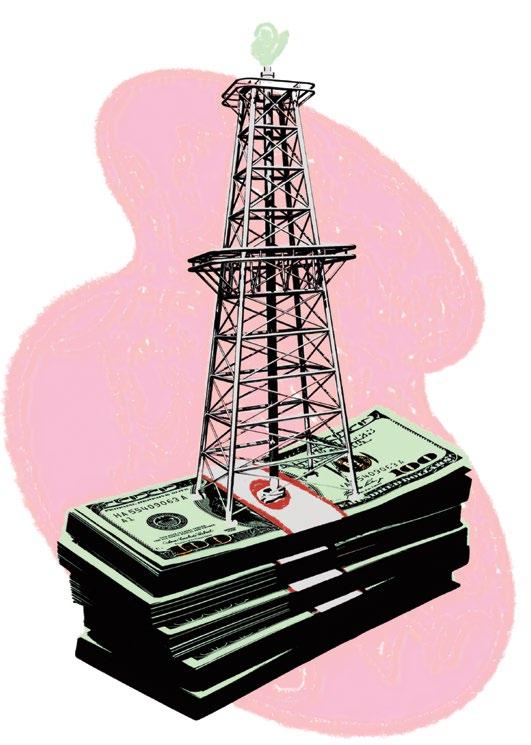
Wu, who coined the phrase “net neutrality” and helped shape the modern case for tech regulation, released his book just as Big Tech’s political power grows—its top oligarchs flanked President Trump at his inauguration—and as the backlash to their dominance and what it has done to daily life fortifies and expands. Just two months ago in these pages, the Prospect reviewed author and internet activist Cory Doctorow’s streetwise, uncommonly lucid
account of the perils of the platform giants: Enshittification: Why Everything Suddenly Got Worse and What to Do About It. It’s not surprising that the two worldviews are similar: Wu and Doctorow attended the same elementary school in Toronto.
Doctorow’s observations are lacerating, and he has a gift for the grotesque analogy. Yet his argument in Enshittification never feels doctrinaire. Beneath his pamphleteer’s fury is a technologist’s love for what the web
once promised and might still become. He reminds us that the internet’s decline wasn’t inevitable—it was policy-driven. Antitrust law atrophied. Venture capital rewarded growth over governance.
Where Doctorow rages from the barricades, Wu lectures from the front of the seminar room. His book, though slimmer and less acrobatic, carries the weight of a seasoned antitrust scholar. Yet he doesn’t avoid gut-level revulsion: In a section about Amazon, he likens the company’s ad racket, which charges third-party sellers premium fees for high placement in search results, to a “Tony Soprano school of business” shakedown.
More than a decade ago, Astra Taylor observed in The People’s Platform that the internet’s architecture has a built-in bias toward monopoly: As network effects take hold—making a service more valuable the more people use it—a few dominant platforms tend to emerge, crowding out the rest. Wu laments how that reality drifted from Berners-Lee’s original aspiration, and what ends it serves: to take more and more from business partners, workers, and consumers in the name of maximizing profits.
It wasn’t always thus. Wu reminds us that platforms are not inventions of Silicon Valley but ancient social technologies. The Greek agora, the Middle Eastern bazaar, the ancient Chinese market town—all were platforms in the original sense: shared spaces that facilitated encounter and exchange. They were, for the most part, neutral. The agora belonged to everyone and to no one; merchants, entertainers, and citizens depended on its openness to trade, argue, and circulate. Over centuries, platforms evolved from civic institutions into physical infrastructures—bridges, ports, rail lines, telegraph networks—whose owners discovered that control over access could be a source of profit.
This shift from hosting to harvesting, in Wu’s telling, marks the start of capitalism’s extractive turn. The Charles River Bridge, a private toll bridge connecting Boston and Charlestown, epitomizes this pivot. Constructed in 1786 and fully paid off by the 1820s, it kept collecting tolls long after its investors had recovered their costs. Those who owned the means of passage could demand tribute from all who crossed, turning the bridge into an “extraction machine.” Railroads later repeated the pattern, transforming farmers and shippers into suppli-
cants who paid for permission to participate in economic life.
In the digital age, the tollbooth has been reborn in algorithmic form. Amazon, Google, and Meta have built the 21st century’s dominant platforms—but instead of civic squares, they more resemble private plazas ringed with turnstiles. For Wu, the familiar metaphor of “walled gardens” no longer suffices. Today’s firms, he writes, “aspire to be fully spun cocoons of life and living,” designed to enclose not only our digital activity but our social and emotional worlds. Meta’s metaverse, Amazon’s home devices, Apple’s app ecosystem—all share this totalizing impulse. The endgame isn’t to sell products but to capture existence itself.
For example, when Google bought Waze, it wasn’t merely acquiring a traffic app; it was absorbing the very information ecosystem that gave a competitor a chance to exist. The purchase showed that the company’s true aim was not innovation but integration—folding a rival service into its own expanding web. Wu laments that the acquisition “marked the end of the era when the Internet was seen as the great equalizer.” Wu’s prose is more measured than Doctorow’s, sometimes to a fault. Where Doctorow calls Amazon’s sponsored results “enshittification,” Wu rather limply describes them as “a pure example of valueless wealth extraction.” His tone is that of a patient diagnostician, noting how once-innovative platforms “stop innovating in terms of quality and begin innovating in ways to cleverly charge more for the same product.”
The process by which companies metastasize from creators into extractors goes something like this: First, they make their platform “essential to transactions”; next, they hobble or buy rivals; then, they clone winners, lock partners in, and finally ratchet up fees for both buyers and sellers. The convenience we prize—our one-click orders, our autoplay queues—becomes, in Wu’s mordant phrase, “a long slow bet on laziness”: a wager that users will tolerate almost any indignity rather than face the costs of leaving.
If the platform extraction model has become the dominant template of 21st-century capitalism, Wu emphasizes that it is by no means confined to technology. Since the 2008 financial crisis, investors have begun platformizing entire industries and reorganizing them around centralized ownership and predictable revenue streams.
In health care, private equity firms have
taken their cues directly from Big Tech, rolling up small- and medium-sized practices into regional networks whose profits depend on cutting labor costs, increasing volume, and raising rates for patients. An “anchor investment” in a large medical practice typically serves as the foundation for the platform, onto which smaller acquisitions are annexed. One study found that private equity acquired more than 1,000 medical practices between 2012 and 2021, and invested hundreds of billions of dollars in health care. Doctors and nurses become nodes in an optimized workflow, squeezed to deliver more services in less time; patients receive “surprise bills” and dwindling attention; and the gains accrue to the platform’s investors—those who now own the bridge between sickness and care. Wu observes a similar logic in housing. Corporate landlords, backed by private equity and data analytics, have begun to treat homes not as dwellings but as housing platforms—networks of properties managed as financial instruments. The goal is not to provide shelter but to extract rent in its most literal and dynamic sense. Rents rise not because maintenance improves but because algorithms say the market will bear it. Fees proliferate: application fees, pet fees, turnover fees, “utility management” fees, even—in the case of one single-family-rental company—“air filter” and “smart home” fees. The platform mentality converts every point of human necessity into a microtransaction. The refusal to treat extraction as purely a digital pathology is provocative. Perhaps what distinguishes the digital realm from the physical world boils down to scale and extractive velocity. Another part of his book traces “the road to serfdom”—a grim progression that begins not with government overreach, as the 20th-century philosopher Friedrich Hayek once warned, but with monopolization, which leads to extraction, and then to mass resentment, democratic failure, and eventually the rise of the strongman. When a few companies control the digital infrastructure of daily life, they also control the channels of speech, commerce, and coordination. A government aligned with those interests can wield the same levers to consolidate political power. The result, Wu warns, is a feedback loop between corporate concentration and political autocracy.
Reading The Age of Extraction after Enshittification can feel like stepping
from a punk show into a policy forum. The decibels drop, but the argument remains urgent. When Wu turns, in the latter half of his book, to artificial intelligence, his restraint gives way to unease. He wonders whether AI will “fortify the platforms or displace them”—whether it will serve as their new moat or their gravedigger. Either outcome, he implies, risks deepening the logic of extraction by automating it. The
“Prosperity, fairness, and growth are not incompatible,” he insists.
The stirrings of a modern antitrust movement may yet offer the most credible path out of digital feudalism. While Wu does not dwell at length on the cultural fallout of extractive capitalism, there’s a strong case to be made, as Kyle Chayka has in his book Filterworld , that our algorithm-driven platforms have also transformed culture into a

danger isn’t necessarily that AI will replace us; it’s that it will perfect the systems that already exploit us.
Wu proposes some familiar remedies: break up monopolies, restore competition, regulate essential platforms as public utilities. “An anti-monopoly program does not ‘create’ competition,” he writes. “Instead, it takes away the most convenient tools for killing it.” He envisions hard caps on how much value a platform can skim from the economy, setting rules that prevent dominant platforms from exploiting their indispensability—requiring, for instance, that they treat all participants equally and refrain from favoring their own products— as well as stricter separations between tech giants and ownership of AI infrastructure.
What Tim BernersLee once envisioned as a universal commons has become a rentier’s paradise.
flattened, homogenized feed. Any cultural democracy worthy of the name should foster a diversity of perspectives rather than churning out predictable content and rewarding mimicry. This is not nostalgia for a pre-internet order but a way to make the future livable—to restore competition, and with it, a measure of public power.
Yet it’s fair to wonder how realistic these prescriptions are in the second Trump administration. According to a recent report by Public Citizen, Trump’s return to power has brought a bonanza for Big Tech. Of the 142 federal investigations and enforcement actions against technology corporations inherited from the previous administration, at least 45 have already been withdrawn or halted. The beneficiaries read like a who’s who of Silicon Valley: Meta, Tesla, SpaceX, PayPal, eBay, and a constellation of cryptocurrency and financial technology firms.
Since the 2024 election cycle began, tech corporations and their executives have spent an estimated $1.2 billion on political influence—$863 million in political spending, $76 million in lobbying, and a further $222 million in payments to Trump’s own businesses. The return on investment has been immediate: a sweeping “AI Action Plan” directing the Federal Trade Commission to review and, where possible, rescind consent decrees that “unduly burden AI innovation.” Among the cases at risk are investigations into OpenAI and Snap for generative AI harms and antitrust cases against Microsoft.
When enforcement collapses, platforms don’t just grow, they metastasize. What Berners-Lee once envisioned as a universal commons has become, under this new regime, a rentier’s paradise. The web’s open protocols have been fenced off; the promise of “intercreativity” has given way to the logic of extraction. We may be waist-deep in the era of the Enshittocene—swiping, scrolling, and tithing to our digital landlords in the form of our attention—but to identify this scourge of platformization is not to say it must stay that way, or that its fate lies entirely in corporate hands. If we are to achieve something like Berners-Lee’s vision of an open, user-driven web, the future will depend less on better algorithms than on better politics. The coming revolution won’t necessarily be digitized; if it comes at all, it will probably arrive in the old-fashioned guise of laws with teeth, regulators who regulate, and a public finally willing to pull the plug on its own exploitation. n
Rhoda Feng writes about theater and books for The New York Times , The Times Literary Supplement , The New Republic , The Nation , Vogue , and more.

Ryan Coogler’s bloodsucker blockbuster is all about Black creative freedom. No wonder the industry saw it as a threat.
By A.A. Dowd
Once every blue or blood moon, Hollywood still manages to rally everyone around a movie. Audiences, critics, the casually curious: All submit to the gravitational pull of a multiplex sensation—no small feat in our hopelessly divided attention economy. Two years ago, it was Barbenheimer, a light-dark double feature for the ages, that captured the collective moviegoing imagination. Has any film since dominated the spotlight to quite the same extent? The closest we got to such a monocultural phenomenon in 2025 was a very different kind of IMAX spectacle: a pulpy, heady, 1930s-set thrill ride that pitted twin Mississippi gangsters against a step-dancing Irish vampire with an ear for a good melody.
Sinners was, in many of the ways that matter, the movie of 2025. Not necessarily the best movie—though you’ll find plenty happy to make that case, now that listmaking season is upon us—and not quite the year’s biggest hit either. Rather, Ryan Coogler’s supersized supernatural blockbuster fused critical and commercial enthusiasm into a kind of mass obsessive fervor. It became, for a few weeks, the film everyone was talking (and raving) about, which doesn’t happen too often in the era of infinite content overload.
That’s not all that Sinners fused. The marketing campaign promised a stylish throwback creature feature from the writer-director of Creed and Black Panther But Coogler had more on his mind than cheap thrills. This wasn’t just his flavor -
fully claustrophobic monster movie, but also his Prohibition-days crime picaresque, his action-packed Western, his Southern Gothic soap opera, his ensemble portrait of a Delta town under the shadow of the KKK , and even his own bluesy riff on an MGM toetapper, complete with numbers that span a century of Black musical expression, like the cinematic equivalent of OutKast’s “B.O.B.” Forget “best.” Sinners may well be the most movie of 2025.
That excess, that genre largesse, hardly put a dent in the film’s popularity. If anything, it fed the impression of a must-see event—a Hollywood epic that really goes for it. Like the film’s messianic troubadour, the aspiring bluesman Sammie (Miles Caton), Sinners struck a chord. The “A” CinemaScore bestowed by opening-night
audiences (essentially unheard of for horror movies) underscored that people were ready to embrace this singularly strange crowd-pleaser on its own terms. No other movie this year so profitably split the difference between popcorn populism and an auteur’s own idiosyncratic preoccupations. No, not even One Battle After Another, another visionary Warner Bros. entertainment topically concerned with the scourge of white nationalism.
Such a watercooler triumph is a boon for the industry at large; at a time when theatrical attendance still hasn’t returned to pre-pandemic numbers, anything driving people back to the movies has to be considered a greater good. Yet the industry response to Sinners, at least as reflected in the initial coverage of its returns, told a different story. One of the towering successes of 2025 was met with a curious skepticism from the bean counters and analysts—a rush to qualify and undercut the good news that bordered on hostility. The Mondaymorning quarterbacking, which clashed hard with the glowing reviews in some of the same publications, unusually framed Coogler’s victory: Somehow, he made the giant hit that Hollywood didn’t want.
It was clear from the end of that first weekend in April, when Sinners premiered to a robust $63.5 million worldwide, that Warner Bros. had something huge on its hands. Clear to everybody, that is, but the box office pundits reporting on its rapidly climbing tallies. “It’s a great result for an original, R-rated horror film that takes place in the 1930s,” began Variety ’s equivocating writeup, before sinking the stake in: “[Y]et the Warner Bros. release has an eye-popping $90 million price tag before global marketing expenses, so profitability remains a ways away.” The article’s pessimistic dismissiveness drew baffled ire from all over. Even Ben Stiller publicly rolled his eyes.
But other publications seemed similarly intent on calling the jumbo-sized soda half full. The New York Times attached a literal asterisk to the jackpot receipts, likewise wondering aloud about the film’s long-term prospects, despite an early audience reaction that had “word of mouth” written all over it. Meanwhile, Business Insider echoed the hand-wringing about profitability. It’s very possible this angle was shaped by Warner Bros. itself. After all, early reportage promised a steep incline for Sinners, assert-
ing that it would need to make a whopping $300 million to recoup both its $90 million budget and the marketing costs. But as an anonymous source told Vulture shortly thereafter, that number was wildly inflated. Sinners exceeded it anyway within a few short weeks.
That the movie shattered the studio’s modest projections for opening weekend is plenty telling, too. Why, exactly, were projections modest for the new film from the director-star team behind the recordbreaking Creed and Black Panther franchises? “Overperformed” is the backhanded compliment often paid to movies by, for, and about Black Americans. Shortsightedness is too innocent an explanation for Hollywood’s historical tendency to underestimate these projects. It’s a pattern that supports a faulty narrative: If films with Black directors and Black stars are considered “risky,” despite all evidence to the contrary, then the industry can continue to treat them that way.
The success of Sinners is a threat to such narratives, which might be one reason publications like Variety encouraged readers to second-guess it. In a broad sense, the film’s undeniable popularity challenges all kinds of conventional wisdom about what audiences are supposed to exclusively desire these days. For one thing, it sticks out starkly in a year otherwise dominated by films designed to appeal to all ages—the video game adaptations, comic-book cinema, and live-action recycling of animated hits situated all around Sinners on the annual box office charts. Coogler’s movie is rated R in the traditional sense; it’s a popcorn movie for grown-ups. The violence and language are explicit, the themes mature. And in liberating himself from the Marvel machine, the filmmaker embraces an untrendy carnality. How often, these days, are the characters in a big-budget action movie this libidinous?
That Sinners sprang solely from Coogler’s impassioned, movie-addled imagination also makes it an outlier at a time when nearly every other hit of comparable magnitude is a sequel, remake, reimagining, or other such return to the proverbial well. In theory, that should be exciting to an industry that’s seen ample proof, these past few years, that not every IP can be milked indefinitely. Just look at the superhero factory Coogler just escaped: Marvel’s biggest success of the year, The Fantastic Four: First Steps, teeters on the
Sinners is a threat to a Hollywood business model built only on regurgitation.
narrow margin separating a hit from a flop. It cost nearly twice what Sinners did, and ended up making a hair less domestically. There’s a clear lesson in the massive turnout for an R-rated period piece not based on something the audience already saw and loved: People crave original visions. They might even be starved for them, if the parallel lucrative runs of Weapons, F1, Materialists, and (on the streaming front) KPop Demon Hunters are any further indication. But is that a message Hollywood is ready or willing to receive? Today’s class of executives, many little more than glorified venture/vulture capitalists, have gone all in on the belief that franchises are where the money is at. So what do they do with the information that they actually aren’t the only (or even a foolproof) recipe for success? What if all their thinking on the matter is wrong? Sinners is a threat to a business model built only on regurgitation, on endless return trips to Jurassic World, on more Toy Stories and feature-length toy commercials.
I’d be willing to wager that at least some of the big money Sinners made in theaters rests on a single arresting image central to its marketing campaign: that electrifying shot of Michael B. Jordan, who plays the film’s twin antihero protagonists, storming right toward the camera in slow motion, firing a massive tommy gun. The scene in question is even more thrilling in context. It arrives late in the movie, after the climax, as a kind of righteous aside: Having already faced a fanged metaphor for the culture that preys on his community, Jordan’s Smoke takes aim at the very nonmetaphorical Klan. You could call the set piece gratuitous (it almost feels like a separate kick-ass revenge movie stuffed into the movie’s closing minutes), but it absolutely feeds into the spirit of a film that’s all about Black Americans taking care of themselves because no one else will. It’s also about the rather wholesome pleasure of seeing murderous bigots put quite literally on blast. Mainstream thrillers like Sinners can
Though set in the past, Sinners fits the current moment, commenting on how white America covets and exploits Black art.
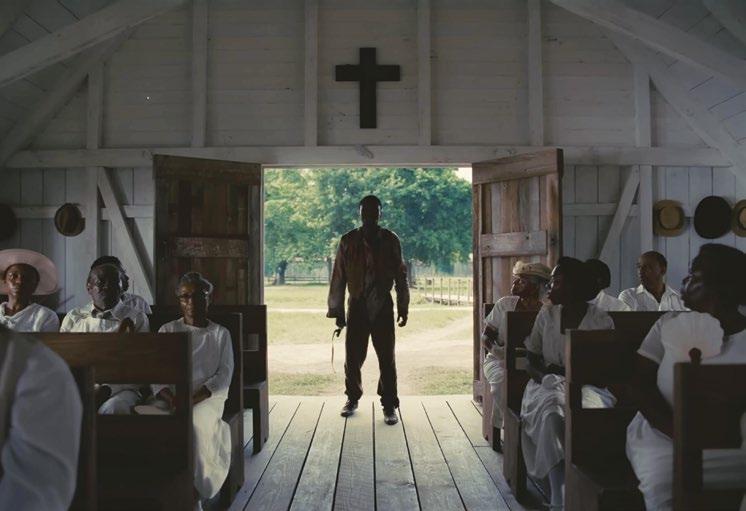
work as escapism: a loud distraction in an air-conditioned room, a break from the problems of your life and the world. But Coogler’s event pictures are more cathartic than that, and less removed. There’s really no way to watch this one in a vacuum. It arrives at a time when racial profiling is now judicially protected government protocol; when Black professionals are being purged from government spaces and historical record; when the president of the United States reaches for “low I.Q.” to describe any person of color who dares criticize his relentless corruption. Though set nearly a century in the past, Sinners resonates plenty with the present moment: It’s a monster movie about living in a country where the monsters are always circling, lies and empty promises on their breath, ill intentions barely concealed by their smiles. That the movie harmonizes with our present moment without letting that song drown everything out is probably another key to the spell it cast over the multiplex this spring. In that way,
One Battle really is the Stack to its Smoke: a twin study in how to gracefully fold the spirit of the times into a genre-bending magnum opus.
Of course, Coogler isn’t just vaguely gesturing toward the inequities of a country built on them. Sinners is after something more specific about how white America covets and exploits Black art. What are the vampires, really, but relentless culture vultures, like the musicians and label honchos who absorbed the sounds of the blues, homogenizing it for a white audience? Coogler’s personal touch on this material is plain enough in the deep love for music running through its plump veins. More than that, though, Sinners announces itself as an allegory of Black artists fighting for ownership—of their work, of their spaces, of their futures. It’s a resonant topic for a filmmaker still navigating the challenges of making big-studio art (sometimes for Disney, no less) without surrendering your soul.
To that end, the film’s politics extend
beyond the borders of every big screen that housed it, and on to the ground the director won behind the scenes. You hear about the bidding war for Sinners, how several major studios scrambled to get their hands on it, and can’t help but picture the vampires of Sinners , all vying for a vein. Except that Coogler turned that feeding frenzy in his own favor, arranging a deal that gave him points on the box office, final cut on the movie, and—in a victory as symbolically significant as it was financially savvy—full retention of rights to the film itself after 25 years. Maybe that historic coup is really what sent a chill down Hollywood’s spine. An artist having full control and ownership of their work? For a studio exec, that’s a thought much scarier than any creature of the night. n
A.A. Dowd is a film critic based in Chicago. His work has appeared in Rolling Stone , The Washington Post , and Vulture. Follow @aadowd.bsky.social.
I’m just not that into you.
Dear Capitalism
(if I can even call you that anymore),
I am writing to you via your AI assistant because apparently you can’t be bothered to answer your emails. Still, I hope this reaches you. I need to tell you that I have had enough. I just can’t be in this relationship anymore. After years of promising to change, swearing that you’re working on it, your behavior has only gotten worse. You are toxic.
You’re more interested in staying out late with Oprah and Bill Gates at Kris Jenner’s birthday party than being by my side when I get sick. When my landlord evicted me from my house for having an “unapproved dog,” you were in outer space. Literally you were in space, joyriding on a rocket with Katy Perry and Gayle King.
When we first started dating, things were so promising. Sure, there were red flags. You stepped ON a homeless person on our first date, but you also got me a Tiffany necklace, so I overlooked that. You swore that my college degree that cost me $20,000 of debt would help me in the professional world. Then the Great Recession happened and I started working at Jamba Juice. When my colleagues and I wanted to form a union, you told me that you were my family and families don’t form alliances against one another. I believed you.
they purchased another consultant company. And then I was let go, because someone there had the same job as me.
When I tried to leave you before, you gaslit me. You told me we could be casual, that we could have an open relationship. You said I could drive for Uber, DoorDash, and Instacart and that being economically polyamorous would give me the freedom
But now, even the fun things we used to do like a concert or a vacation aren’t fun anymore because of all the hidden extra fees. Even if we stay home to rent a movie, you charge me $20, when I’m already paying you $10 a month for your streaming service. And I only get 48 hours to watch it?! Your love is withholding, and always conditional.
I’m older now and this relationship has become tiresome. You have refused therapy time and again, even when it’s court-mandated. You simply blame our problems on me not working hard enough when every year I work more and more hours. You only change your behavior when you get caught cheating by the FTC
and flexibility to be my own boss. But now I spend all day in my car and I still can’t afford health care. You’re a liar.
Even when I’ve given you so much, you turn around and treat me like garbage. When I finally got a desk job at an office management consultant, I worked my butt off quarter after quarter. Our bosses were so pleased that we were meeting every goal,
I’m not saying the relationship was all bad. We’ve had good times. I remember when I won $37 on an Addams Family slot machine in Las Vegas and bought a single drink. That was cool. And in high school, when I saved up my allowance to buy my first pair of UGG boots and Popular Jessica complimented me.
Look, I like you. You have cute handbags and jackets. And maybe in another lifetime we could’ve made it work. But I only have so many years left to live, and I refuse to spend them on the phone with your customer service haggling over a hidden clause in the agreement you made me sign so I could play a phone game.
Lately, I’ve been spending more time with Democratic Socialism. I know that’s not what you want to hear, but I hope that you can be happy for me. They make me want to be a better person. I know you think they’re extreme, but there’s nothing radical about health care for all people in the richest country in the world. There’s nothing extreme about the extremely wealthy paying their fair share in taxes.
Anyway, please give my best to your parents, Feudalism and Slavery. And who knows, maybe we’ll see one another on the street one day.
Take care, Francesca
Did you know you can use your IRA to make donations to the Prospect?
If you’re 70.5 years or older, the Qualified Charitable Distribution allows you to give up to $100,000 directly from your traditional IRA, exempt from federal income tax, even if you don’t need to itemize. Simply direct your IRA Administrator to distribute the funds to the Prospect. Is this right for you? To learn more about ways to share your wealth with The American Prospect, check out Prospect.org/LegacySociety
Your support will help us make a difference long into the future

Join senior editor Ryan Cooper and Alexi the Greek for grounded, novel, and irreverent perspectives on current events and political theory. Access free episodes and excerpts at Prospect.org/podcasts
Support the Prospect with a POWER level membership for access to ALL episodes Prospect.org/membership
The pessimist complains about the wind; the optimist expects it to change; the realist adjusts the sails.
—WILLIAM ARTHUR WARD