2016:12
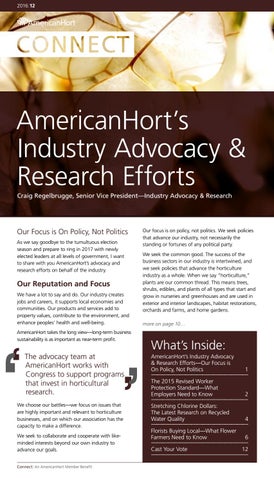
AmericanHort’s Industry Advocacy & Research Efforts Craig Regelbrugge, Senior Vice President—Industry Advocacy & Research
Our Focus is On Policy, Not Politics As we say goodbye to the tumultuous election season and prepare to ring in 2017 with newly elected leaders at all levels of government, I want to share with you AmericanHort’s advocacy and research efforts on behalf of the industry.
Our Reputation and Focus We have a lot to say and do. Our industry creates jobs and careers, it supports local economies and communities. Our products and services add to property values, contribute to the environment, and enhance peoples’ health and well-being. AmericanHort takes the long view—long-term business sustainability is as important as near-term profit.
The advocacy team at AmericanHort works with Congress to support programs that invest in horticultural research. We choose our battles—we focus on issues that are highly important and relevant to horticulture businesses, and on which our association has the capacity to make a difference. We seek to collaborate and cooperate with likeminded interests beyond our own industry to advance our goals. Connect: An AmericanHort Member Benefit
Our focus is on policy, not politics. We seek policies that advance our industry, not necessarily the standing or fortunes of any political party. We seek the common good. The success of the business sectors in our industry is intertwined, and we seek policies that advance the horticulture industry as a whole. When we say “horticulture,” plants are our common thread. This means trees, shrubs, edibles, and plants of all types that start and grow in nurseries and greenhouses and are used in exterior and interior landscapes, habitat restorations, orchards and farms, and home gardens. more on page 10…
What’s Inside: AmericanHort’s Industry Advocacy & Research Efforts—Our Focus is On Policy, Not Politics
1
The 2015 Revised Worker Protection Standard—What Employers Need to Know
2
Stretching Chlorine Dollars: The Latest Research on Recycled Water Quality
4
Florists Buying Local—What Flower Farmers Need to Know
6
Cast Your Vote
12
Business Solutions Organized for Your Business Interests The AmericanHort Knowledge Center is your go-to-resource for information you and your employees need. Visit AmericanHort.org/Connect for more business-building solutions.
SEGMENT KEY
All Industry
Greenhouse
Business Plus
Interior Plantscape
Floral
Landscape
Garden Retail
Generation Next
Nursery
Research
The 2015 Revised Worker Protection Standard—What Employers Need to Know By Mary Ann Rose Editor’s Note: Reprinted with permission from GrowerTalks December 2016
The federal Worker Protection Standard (WPS) protects agricultural workers and pesticide handlers from occupational exposure to pesticides. The responsibility for providing WPS protections rests with the employer. Horticultural growers are most affected by WPS compared to other lessintensive agricultural producers because they have more workers performing hand-labor with pesticide-treated plants. Garden center retailers are also affected if using pesticides with WPS labeling. As an employer or manager, you are required to give workers and pesticide handlers WPS protections when using pesticides that carry WPS labeling. Most conventional pesticides labeled for agricultural uses will carry the WPS statement in the “Agricultural Use Requirements” section of the label.
2 | AmericanHort.org
Major revisions were made to WPS in 2015. A new WPS “How to Comply” manual was released in September 2016, just in time for the first compliance deadline January 2, 2017. Read this manual carefully, because there are changes to each key provision of WPS, including training, central information display, entry restrictions, notification, decontamination supplies, and emergency assistance. The most significant changes affecting horticultural growers are presented here.
Terms Revised WPS introduces some new terminology. “Enclosed space production” replaces references to “greenhouse;” the term is more inclusive, indicating any structure with non-porous coverings that is large enough for someone to enter. “Outdoor production” replaces farms, nurseries, and forests. The “Application Exclusion Zone” (AEZ) is the minimum distance that the applicator must keep between the spray equipment and others during the application to prevent spray contact. The AEZ varies from 0 to 100 feet, depending on the type of application and spray droplet size.
Training The new rules require you to train workers and pesticide handlers each year instead of every five years. Where WPS had previously allowed for a short grace period, your new hires now need the training before working in areas under a restricted entry interval (REI) in the past 30 days. Trainers must be present during the entire worker training and use only EPA-approved training materials that will include some new content. You must keep a record of worker and handler training for two years. WPS now has more stringent requirements for worker trainers. Only certified pesticide applicators or those completing EPA-approved train-the-trainer programs can train workers. You may want additional staff to complete an EPAapproved train-the-trainer program so that your licensed applicators are not tied up training each new worker. Iowa State University just made this much easier to accomplish with an online trainthe-trainer course. The course takes 1-2 hours to complete and is available free of charge at extension.iastate.edu/workerprotection .
REI exceeds 48 hours. Be sure to check the REIs in your pesticide inventory; fortunately, there are relatively few products with REIs exceeding 48 hours. For greenhouses, the requirement to post all applications has been relaxed; posting is now required only when the REI exceeds four hours. You have the option to post signs in the greenhouse or issue verbal warnings when the REI is four hours or less, but consider whether the verbal option is much of an advantage when your workers are used to having all applications posted.
Handler Requirements Handler training content has been expanded. Under revised WPS, pesticide handlers must suspend application if anyone enters the newly defined Application Exclusion Zone (AEZ), even if the zone extends beyond the border of the farm. If using pesticides that require respirators, the handler must have respirator training, medical evaluation, and fit-testing. It should be noted that WPS has no requirements for voluntary use of respirators, but OSHA does require an initial medical evaluation in this case. Quantities of decontamination supplies are now specified for both handlers and workers. When providing emergency assistance in event of a pesticide exposure, there is additional information you must give to the medical provider, including the SDS.
Central Information Display There will be some new additions to the application, safety, and hazard information that is posted at the central display. Safety Data Sheets (SDS) must be available and contact information for both the state lead agency for pesticide enforcement and the nearest medical facility are required. In addition to displaying the application-specific information for 30 days, you will now have to keep a record of the same information and SDS sheets for two years. Workers, their designated representative, or attending medical personnel may request access to these application records.
Entry Restrictions & Notification One new criterion has been added to entry restrictions– “spray quality,” which relates to spray droplet size. Otherwise, greenhouse growers will see few changes in WPS ventilation requirements and entry restrictions. WPS has two methods of notifying workers about applications, verbally or by posting, and the conditions for choosing the method have changed. The “Danger—Keep Out!” signs are now required in outdoor production when the pesticide
The family exemption. If you rely solely on family employees, you are exempt from many WPS requirements, including training, central information display and posting of warnings. The family exemption has been expanded to include spouse, child, sibling, grandparent, grandchild, aunt, uncle, niece, nephew, first cousin, in-laws, foster-parent, child, or sibling and step-parent, child, or sibling. There is no family exemption for any entry restriction, ventilation requirement, or from providing personal protective equipment. more on page 9… 2016:12 | 3
Stretching Chlorine Dollars: The Latest Research on Recycled Water Quality
chlorine is the sum of combined chlorine and free chlorine. Among the three chlorine species, only free chlorine is a good indicator of potential pathogen-killing power. It is important to know that potential may or may not fully translate into real pathogen kill, depending on the pH of the water being treated. This is due to chlorine chemistry. Free chlorine could be hypochlorous acid (HOCl) or hypochlorite ion (OCl-), which have very different pathogenkilling powers. As an example of controlling Escherichia coli, hypochlorous acid is about 20 to 80 times more effective than hypochlorites. Hypochlorous acid and hypochlorite ion co-exist in equilibrium in water and are pH dependent.
By Chuan Hong
In this article, we will discuss the variations of recycled water pH, their potential impact on chlorine chemistry and pathogen-killing power, and additional tips for improved chlorination performance.
Recycled water pH variations Recycled water pH varies greatly and is mostly alkaline. This is exemplified by research at an eastern Virginia nursery where water pH was recorded every 15 minutes for several years. Recycled water pH ranged from 5.3 to 10.5 with most readings >7.0 (63%). This contrasted with the data from an adjacent creek where water pH consistently read between 5.3 and 6.0. The creek received no runoff from the nursery.
100 Creek water
Percentage of pH readings
In 2002, we at Virginia Tech shared an improved chlorination protocol for horticultural businesses. At that time, we recommended 2.0 ppm free chlorine at sprinklers for irrigation water treatment. This recommendation has since been widely used in the ornamental horticulture industry across the country. Chlorination still is by far the most cost-effective water treatment today but its performance is subject to water pH.
Recycled water
80 60 40 20 0
6.0
6.1 to 7.0
7.1 to 8.0
8.1 to 9.0
9.1 to 10.0
Figure 1. Distribution of water pH readings in a runoff retention pond and an adjacent creek
11 6/30/11 10
7/2/11
pH
9 8 7
When pH is 5.0, all chlorine in water is hypochlorous acid, but as water basicity increases, chlorine is increasingly converted from hypochlorous acid to hypochorite ion, a less powerful form (<1/20). Thus, the same level of free chlorine reading could have rather different pathogen-killing powers, depending upon the pH level in waters being treated. Chlorine is most efficacious at pH 5.0 and 5.3; and its pathogen-killing power decreases with the decreasing percentage of hypochorous acid in an increasingly basic water environment. Assuming that OCl- is 1/20 as powerful as HOCl, estimated loss of chlorine pathogen killing power is about 25% at pH 7.0, 84% at pH 8.0, 90% at pH 9.0, and 94% at pH 10.0.
Chlorine chemistry and killing power There are three chlorine species. Free chlorine is the molecule that does the hard work killing pathogens and oxidizing contaminants. When free chlorine molecules oxidize contaminants such as ammonia and other nitrogen-containing organic compounds, they are no longer available for killing pathogens. We call these “tied-up” chlorine molecules combined chlorine. Total 4 | AmericanHort.org
Dynamics of HOCl & OCl (%)
5 0:00 2:00 4:00 6:00 8:00 10:00 12:00 14:00 16:00 18:00 20:00 22:00 Hour
100
100
80
80 HOCl
60
60
OCl
40
40 20
20 0
5
7 pH range of interest
9
Performance of free Cl (%)
6
Figure 2. Examples of extreme diurnal fluctuation in recycled water pH
Steps to improve chlorine performance Chlorine is most efficacious at pH 5.0 to 5.3 but recycled water is mostly alkaline. Any practices that lower the pH level in waters to be treated improve chlorination performance. Based on the latest water quality data from the SCRI project (irrigation-pathgens.info), we recommend the followings:
>10.0
Water pH range
Recycled water pH also fluctuates diurnally, bottoming in the early morning and peaking in the evening. This daily fluctuation could reach 3.5 units. Fluctuation is closely related to photosynthesis activity in the ponds. When the sun rises, algae and other photosynthetically-active agents remove carbon dioxide, a weak acid, from water to make carbohydrate. Consequently, water pH goes up. The process is expedited with rising temperatures, particularly between 9 a.m. and 1 p.m. when water pH rose sharply.
Figure 4. Chlorine tank and gauge
• Placing pump inlet in the middle of water column. As discussed in the first article of this series, water pH could be much lower in the middle than surface water. • Irrigating crops in early morning when water pH at its lowest point of the diurnal cycle. This recommendation should work for all production facilities that are set to turn chlorination on whenever irrigation cuts on. It works particularly well for pond water with pH readings at 9.0 and below. Additional benefits of this practice include reduced lengths of wetness and a drier plant foliage that is suppressive for pathogen growth and disease development. • Taking water pH measurements regularly and acidifying water as needed prior to chlorine injection. This is essential to ensuring the best chlorine performance and economic return. Otherwise, chlorine dollars may be watered down dramatically. Please note that water pH readings must be taken at the depth where your pump inlet is placed and at the time of irrigation as it may change substantially at different depths of water column and different hours of the day. In addition to chlorination, water pH affects the performance of many pesticides, plant growth regulators, and other horticultural practices. These topics will be covered in the future issues of Connect.
0
Figure 3. Water pH-dependent chlorine performance based on hypochlorous acid and hypochlorite ion dynamics in water
Chuan Hong Virginia Tech 1444 Diamond Springs Rd, Hampton Roads Agr Expt Stn Virginia Beach, VA 23455-3315 chhong2@vt.edu
2016:12 | 5
Florists Buying Local—What Flower Farmers Need to Know By Megan Shoenfelt excellent way to expand their operation. Broadening the customer base improves marketing opportunities by increasing operational efficiencies. Wholesale production enables the flower farmer to better plan, prepare, and optimize farm income. But making the transition to sell to wholesale markets and florists needs to be part of a well thought out marketing plan to be successful. This plan begins with the strategy to build new relationships, understand the needs of the florist and wholesale buyers and incorporate the story of the local farm and flowers so the customer can appreciate the value of what they are buying.
Who can resist the color and fragrance of a just-cut fresh, flower? Flower farmers are hoping neighboring florists won’t be able to resist when they come knocking on the shop door hoping to make a sale. Years ago, many farmers had routes into the city to deliver their cuts and we all know what has happened since - cheap imports, labor issues and transportation costs have driven prices down forcing many farmers out of the flower business. But recently, small-scale flower farming is making a comeback. Just as the local food movement has taken hold so has the interest in local flower production. For a number of reasons, florists are recognizing the value and beauty of using locally produced flowers in their arrangements. Florists also are realizing the value in supporting farmers in their community and strengthening the local economy. On the production side, fresh-cut flower production provides a way for family farms to create sustainable enterprises and make a living off the land. Flower-farm operations throughout the mid-west utilize ideal soils, climate, and growing conditions to produce a tremendous variety of specialty floral crops – everything from early bulbs, annuals, perennials and flowering woody stems. Additionally, in recent years, farmers are using low cost season-extension production techniques to have crops available longer throughout the year. Many flower farmers start on a very small scale selling mostly at farmers markets as they perfect their production methods and cropping schedule. Selling directly to a florist or wholesaler can be an 6 | AmericanHort.org
Bob Mangia, manager of Market Blooms at the Columbus North Market, fears that local growers may not be able to meet his needs. He is accustomed to uniform stem length, blossom size and graded product. Also, there is the need for consistency of the flowers and the proper conditioning to maintain a long vase life. As an independent florist located in the midst of a busy year round market, Bob’s gorgeous arrangements feature product shipped in from around the world. Other retail florists question how local flowers can compete with the low cost of imported product that dependably arrives at their shop. How can a flower farmer counter these issues and make the sale? The answer lies in a determination to make it work. Just as the farming community is beginning to grow more and more food for our local communities, growing flowers fulfills and benefits the farm as well as a customer base desiring to buy locally and sustainably. As with the local food movement, the responsibility falls on the farmer to make a compelling argument to charge a little more for a local product. The florist will then need support and help to pass the argument (usually a compelling story about the farm and the farmer) along to the customer. After all, a growing number of consumers are consciously buying regionally produced food. And increasingly, they also see the contradiction of buying flowers produced on another continent for the dinner table. The following can be used as a primer to begin the local flower-farm journey.
Communication and Relationship Building It is usually up to the farmer to make the initial contact to the prospective florist or wholesale buyer. Track down contact names and phone numbers and research the shops in your area. Schedule a convenient time to stop in. Find out their needs and their chief concerns. Have an information sheet prepared listing your primary products, approximate harvest dates, contact information and the “story” of your flower farm - the more personal and endearing, the better. Start the introductions early in the season. Find out if there is a preference to keep in touch when the harvest starts. Will you establish a route so the florist can buy right off the truck or will you set up an ordering system by email or phone?
Consider how season extension techniques could help stretch out the harvest. Getting a crop in extra early or having saleable product well after the frost date is important to grow your business.
Harvest and Post-Harvest Treatment for Specialty Cuts Many of the timing considerations for harvest and post-harvest begin by establishing a time line based on the needs of the florist. Understand when they need to have the product in their shop so you can harvest, cool, condition and deliver on time. The farm crew should have proper training to select and cut for harvest. Clean equipment and proper water treatment are essential to maintain product quality and ensure a long vase life.
Quality and Grade of the Blossoms Florists are looking for uniformity and consistency of the flower products. They may request a specific grade when placing an order for some of the more standard flower varieties. Research the published standards available from numerous resources to become familiar with the grades and tolerances accepted by the florist trade. Bundle, band and sleeve the stems according to these standards. Florists don’t have time to sort through a tangled bucket of blooms. Most buyers will understand that locally grown product may have more variation but will still expect high quality product. As the relationship gets stronger, local florists will learn to be flexible and understand the local market and growing conditions.
Variety Selection Choosing to Grow the Wow Flowers Evaluate your selection of flower varieties and consider growing cuts that have more value due to their special shipping or handling needs. Jennifer Muehler, owner of Hensbury Farm in Lake County, Ohio specializes in dahlias and unique varieties of sunflowers. Her attention to detail and delicate handling practices prevents the usual shattering expected from shipped product. She guarantees her florist customers a high quality product that has been properly conditioned and gently delivered right to their cooler. Select for vibrant colors, long sturdy stems and fragrance. Experiment with fun and unique varieties that can’t easily be found from other sources. Spectacular parrot tulips, romantic heirloom lilacs and large blooming branches can create a lot of excitement.
Labeling Take Every Chance to Get Your Name Out There Each bucket of flowers leaving your farm should be properly labeled. A professional looking label helps market your product by providing important information to the buyer. The label should include farm name, contact information, harvest date and flower name. The label should also have specific instructions about maintaining a certain temperature or other handling requirements if needed. Some buyers may ask the farmer to include a UPC bar code on a label. This helps the buyer keep track of their inventory. Check with the buyer for details and work this out well ahead of your busy harvest time more on page 8…
2016:12 | 7
Florists Buying Local—What Flower Farmers Need to Know…continued from page 7
Delivery Getting the Flowers to Market Making arrangements for delivery may be a challenge in the beginning stages of working with a wholesale buyer or florist. Maintaining product quality, providing the agreed upon quantity and on-time delivery are essential. A farmer can do the delivery, consolidate a load with other growers, or work with a delivery service. Explore these options prior to the busy harvest time. Factor the cost of the delivery into your budget. Delivery vehicles must maintain sanitation standards. Refrigeration units are preferred whenever possible.
Pricing Your Flowers Knowing how to price your product is essential. A grower must know the cost of production and the margin they need in order to make a profit. Armed with this information, you can negotiate with a buyer who wants to source your beautiful and fresh locally grown flowers. The prices received in the wholesale market will be lower than selling directly off the farm or at a retail farmers market. The trade-off is the opportunity to move a greater quantity of product per transaction more efficiently. Kathy Dudley, a flower farmer from Pennsylvania, has owned a full service florist shop and knows both sides of the cost equation. Kathy knows that fair pricing by local farmers can be very competitive in light of increasing shipping and tariff costs of imported product.
Administrative Considerations Establish how orders will be taken. Will you use an order form; a master checklist showing all your products and pricing; a weekly email, or by phone? How much lead-time is needed to harvest and deliver the product? What will you do if you can’t fill the order? Can you substitute? These are some of the issues that can be worked out at the beginning of the season as good communication gets underway. Each transaction should have an accurate and professional looking invoice to accompany the order or be sent in the mail. An invoice can be a prepared on an invoice booklet purchased at a local office supply store or generated on any of the many business computer programs. Include all 8 | AmericanHort.org
your contact information as well as the details of the transaction. Spell out the payment terms expected so there is no misunderstanding about how soon you expect payment. Some informal transactions may be on a cash basis but be prepared to wait 10 days up to 30 days for payments from larger businesses.
On-Going Marketing and Support Sharing the story of the farm and the product go a long way in supporting the local agricultural system. The farmer can support the florist’s effort by providing marketing material, pictures, and participating in special events. The florist can use this material in their advertisements, newsletters and signage. Hosting a farm tour for your florist customers can be a creative way to develop strong partnerships.
In Summary Many local flower farmers have found membership with the Association of Specialty Cut Flower Growers a valuable resource. Through regional and national meetings, growers stay up-todate about exciting new varieties and learn the latest in growing technology to bring their flowers to market. The ASCFG Executive Director, Judy Laushman, has seen changes in her members’ distribution methods in the last several years. “Always innovative in their production methods, our growers also have taken advantage of the ‘buy local’ movement to expand their marketing options beyond farmers’ markets to include florists, wholesalers, and increasingly, weddings and events. This is done with a conscious effort to promote their flowers as unique and local.” Planning at the beginning of the season, preparing for contingencies, maintaining great service and keeping the communication lines open are essential to establishing a successful business relationship between the farmer and the florist. And to keep the local agriculture system going strong, the story of the flower, the farmer and the florist has to be shared. The customer that buys the vibrant bridal bouquet, the holiday centerpiece or beautiful get-well arrangement will appreciate all the local connections and know they are getting something very special. They won’t want to resist! Megan Shoenfelt, Program Coordinator Agroecosystems Management Program Ohio Agricultural Resource and Development Center The Ohio State University (330) 202-3537 | shoenfelt.9@osu.edu
The 2015 Revised Worker Protection Standard—What Employers Need to Know… continued from page 3
Resources for Growers The Pesticide Educational Resources Collaborative (PERC) has been developing EPA-approved materials for Worker Protection. Many useful materials are available for free download on the PERC Site, including the “How to Comply” manual for owners and managers and a quick-reference guide and checklist. WPS worker training videos with updated content are already available for download in English and Spanish versions. Additional EPAapproved materials for training workers and handlers and a trainer reference manual are expected to be available by the end of this year, and a new safety poster will be available next spring. pesticideresources.org/index.html Compliance with most new rules is required by January 2, 2017. Compliance with new training content and Application Exclusion Zone restrictions is delayed until January 1, 2018. You may continue to use old worker and handler training resources up until the 2018 deadline but after that must use new EPA-approved training materials.
Who is protected? WPS protects employees who are exposed to pesticides or pesticide residues on crops. So with minor exceptions, employees not directly involved with handling crops, pesticide applications, and pesticide equipment aren’t covered by WPS. Most protections are limited to 30 days after a pesticide restricted-entry interval expires. WPS does not apply to livestock production or non-agricultural uses, such as lawn and landscape. “Worker.” WPS defines workers as those who receive compensation for tasks related to harvesting, growing, and maintaining crops. WPS protections are required when workers will be within ¼ mile of pesticide-treated areas anytime within 30 days of expiration of a restricted entry interval (REI)). In most greenhouse businesses, this means yearround. Early-Entry Workers are a special category of workers who enter treated areas for certain tasks before the REI has expired. Additional training is required for early-entry workers. “Handler.” WPS defines handlers as those employed to make or assist with pesticide applications, and more broadly, anyone in direct contact with pesticides; for example, someone cleaning sprayer equipment with pesticide residues is a handler.
Mary Ann Rose Ohio State University Extension Pesticide Safety Education Program (614) 247-7489 | rose.155@osu.edu
PRESENTS
Do business? So do we. You + 700 Exhibitors = More options and smarter purchases Make time to make money. July 15–18, 2017 | Columbus, OH USA AmericanHort.org/Cultivate
2016:12 | 9
AmericanHort’s Industry Advocacy & Research Efforts…continued from page 1
Our Priorities Most of AmericanHort’s advocacy activities fall within five overarching topic areas: • Ensuring an Adequate Workforce • Business Practices, Regulation, and Compliance • Critical Tools and Inputs • Plant Health and the Horticultural Marketplace • Research Means Solutions The following summarizes each of these goals and examples of the key issues we’re currently focused on to address them.
Ensuring an Adequate Workforce Situation: Many industry businesses, especially growing and landscape operations, are struggling to find the labor they need to sustain and expand their businesses. Major demographic and lifestyle changes have shaped this reality. Seasonality and the very nature of the work are challenges. Manual labor positions are especially difficult to fill. Though diligent employers fully comply with the law at time of hiring, foreign-born labor—much of it believed to be unauthorized—is a big part of the production labor force. The existing visa programs, H-2A (seasonal agricultural) and H-2B (seasonal nonagricultural) are important to the industry, but both programs are fraught with problems. There is no program for year-round jobs and workers. AmericanHort is well positioned to lead on these issues. We co-chair the Agriculture Coalition for Immigration Reform and the H-2B Workforce Coalition. We also chair the National Immigration Forum Action Fund board. What We’re Doing Right Now: While quietly laying groundwork for possible broader sensible immigration fixes in 2017, right now we’re hard at work defending the existing temporary visa programs, H-2A and H-2B. Especially important is the H-2B returning worker provision, which would allow law-abiding temporary workers to return next year without counting against the program cap. Congress enacted this policy for 2016, but must renew it for 2017. It is crucial that we get Congress to include the H-2B returning worker provision in the omnibus spending bill that it will consider in December. If Congress fails to act, the landscape sector could easily be short 20,000 or more seasonal workers next year. This threatens not only landscape companies, but also growers and the whole supply chain.
10 | AmericanHort.org
Business Regulation and Compliance
Research Means Solutions Situation: Research isn’t an end unto itself, but a means. Because research is often key to resolving challenges that have regulatory or other implications, research funding is an integral component of our advocacy efforts. Beyond the Horticultural Research Institute’s own direct research funding, most activity centers on the Floriculture and Nursery Research Initiative, and Farm Bill-funded research programs.
Situation: AmericanHort has a long history of involvement in federal policy debates with an eye toward ensuring members business profitability and growth. AmericanHort’s members are mostly familyowned or closely held horticultural businesses. Many are multi-generational, and many are diversified. They may encompass propagation, growing, retail, exterior and interior landscape design/installation/ maintenance, landscape distribution, and/or floral components. Human resources, tax reform, and other small business issues affect all AmericanHort members, so our approach is to engage on issues that present special challenges (or opportunities) for our members based on the nature of our industry. What We’re Doing Right Now: The Department of Labor’s (DOL) overtime rule, effective December 1, has thousands of horticulture and other small and family businesses trying to figure out what to do next. Basically, DOL is doubling the minimum salary threshold for the “white collar” exemption and indexing it, pretty much ensuring automatic increases every three years. AmericanHort and the Partnership to Protect Workplace Opportunity (PPWO) have mobilized industry grassroots, and are supporting bills such as H.R.5813 and S.3464, that would reduce the near-term burden and eliminate the long-term indexing. Congressional action, or court intervention are needed to bring relief.
Critical Inputs and Tools Situation: Plant production and successful landscapes require key inputs like water, nutrients, and pest management tools. Federal laws govern pesticide registration and use, and set the basic framework for water quality and nutrient management. While states and sometimes even localities are also on the playing field, AmericanHort is actively involved in federal policy debates so our members have the tools needed to produce and manage plants and landscapes. What We’re Doing Right Now: Concern over pollinator health has contributed to the scrutiny of many crop protection tools used in horticulture. Neonicotinoids have been the primary focus so far; however, the EPA has plans to conduct environmental risk assessments of 76 different pesticides, including herbicides and fungicides in addition to insecticides. Synthetic pyrethroids are a good example. In response, we are developing answers and best practices by directly funding and influencing critical research. We are engaging EPA and other influencers to keep science at the center of these evaluations so that our industry has tools to manage invasive pests, and grow, ship, sell, install, and maintain healthy plants and landscapes.
With traditional horticultural research programs and funding sources under severe stress, “nimbleness” and “leveraging” are watchwords for AmericanHort and our research affiliate, the Horticultural Research Institute.
Plant Health and the Horticultural Marketplace Situation: The industry faces complex challenges in this area, since we are producing and shipping thousands of species and varieties of plants across state and national borders. New plants are the life blood of the industry, and we don’t want access to new varieties unduly restricted. At the same time, new exotic invasive pests and diseases often have major negative consequences in the greenhouse and nursery plant marketplace. Modern-day travel and trade are resulting in unprecedented new pest challenges. Meanwhile, government budgets are strained, and traditional approaches are challenged.
What We’re Doing Right Now: Every year, millions of federal dollars are allocated toward research in the ag sector. USDA National Institute for Food and Agriculture (NIFA) will allocate over $48 million to support critical needs of the specialty crop industry in 2017. Another example is Farm Bill funding to support the prevention and spread of plant pests. The advocacy team at AmericanHort works with Congress to support programs that invest in horticultural research. And, our staff and key leaders serve on review committees to help ensure that these dollars go to good science that is relevant and important to our members and our industry.
Craig Regelbrugge CraigR@AmericanHort.org (202) 789-2900
What We’re Doing Right Now: Over a billion plants grown in the U.S. each year start their lives overseas. These plants—mostly annuals and perennials, are propagated from the Americas to Africa, and are imported as unrooted cuttings. The cuttings must come in free of pests and diseases of concern to the regulators. And, they are highly perishable so any delays mean lost quality or loss of product. So what’s AmericanHort doing? We’re bringing leadership to an industry effort to create a new approach for certifying and expediting the entry process for plant cuttings. This will involve a “systems approach” that sets minimum standards for growing facility design and construction, production and sanitation practices. Companies willing and able to meet the standard would benefit from a streamlined import process. This will mean fewer surprises and delays, and a more secure supply chain, ultimately benefiting U.S. growers, distributors, garden retailers, and landscape professionals.
2016:12 | 11
AmericanHort.org
Š 2016 AmericanHort. All rights reserved. This material may contain confidential information and it is for the sole use of AmericanHort members. The information contained herein is for general guidance and not for the purpose of providing legal advice. It cannot be distributed, reprinted, retransmitted, or otherwise made public without prior written permission by AmericanHort. Please contact the editor at (614) 487-1117 for permission with acknowledgment.
Editorial Staff Laura Kunkle, Editor Gina Zirkle
AmericanHort Connect 2016:12
hello@AmericanHort.org
(614) 487-1117 Main
2130 Stella Court Columbus, Ohio 43215-1033 USA
AmericanHort Mission The mission of AmericanHort is to unite, promote, and advance the horticulture industry through advocacy, collaboration, connectivity, education, market development, and research.
To support this mission and the future of our industry, please cast your vote by Friday, January 6. Visit AmericanHort.org/ballot.
Please cast your vote by Friday, December 30.
The Leadership Committee has selected candidates from across the breadth of the industry to encompass multiple segments, business models, and geographies. A wellbalanced board furthers the mission of AmericanHort: to unite, promote, and advance our industry through advocacy, collaboration, connectivity, education, market development, and research. businesses.
Now, we need your help: will you please vote for the person you think best suits the role?
AmericanHort is governed by a dedicated and passionate Board of Directors. In July 2017, there will be open seats on the Board, and the AmericanHort Leadership Committee has selected several candidates for these positions.
Help Elect the 2017 AmericanHort Board of Directors
Cast Your Vote. Share Your Voice.
VOTE NOW
Name Company Street 2 Street 1 City, State ZIP
Barcode |||||||||||||||||||||||||||||||||||||||||||||||||||||||||||
Mail Sort Line
Electronic Service Requested
2130 Stella Court Columbus, OH 43215 USA AmericanHort.org
Presorted Standard Mail U.S. POSTAGE PAID Columbus, OH Permit No. 1560