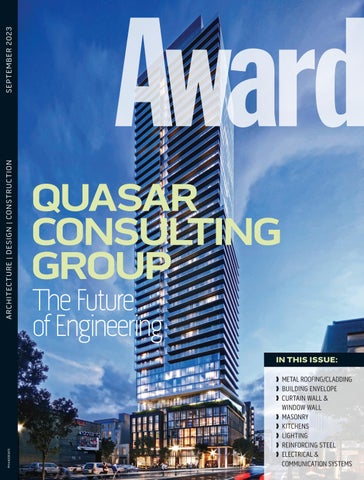

QUASAR CONSULTING GROUP

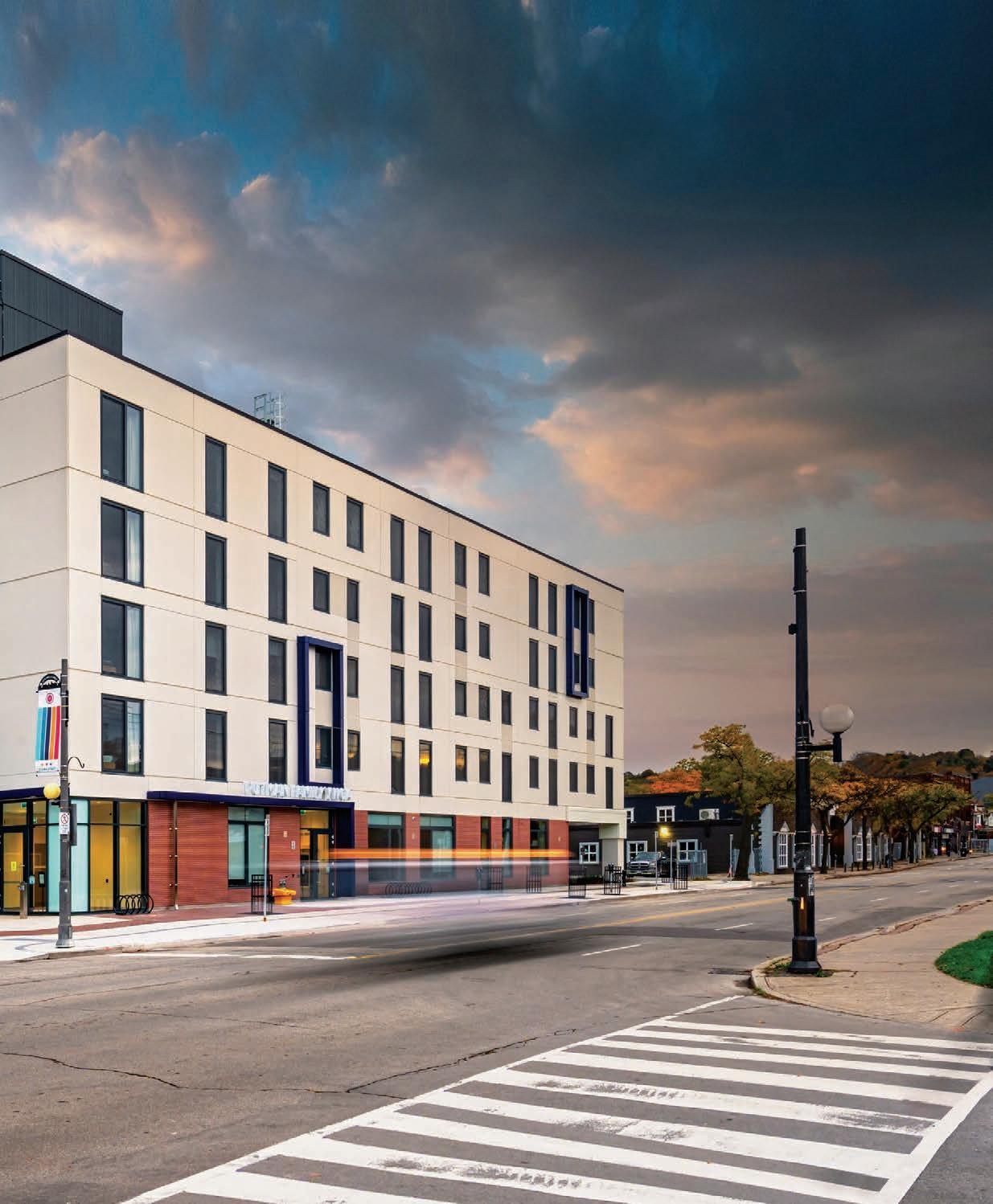
Total Precast Concrete Key Attributes to Passive House Development are:

· Manufactured in local precast facilities under controlled conditions
· The whole building envelope in one composite panel; air barrier, moisture control, insulation and the structure
· Hollowcore floor slabs allow for a much lower depth to span ratio
· Hollowcore provides the lowest GWP per m2 of concrete floor area
· Precast concrete dramatically reduces the construction schedule, site congestion, noise and environmental impacts


For more information and educational presentations check out Learn on Demand, a 24/7/365 Educational Platform. Visit: cpci-learnondemand.com/

For more information on Passive House Total Precast Concrete, visit www.cpci.ca/publications to download your free copies of the Structural Solutions Guide and the Putman Family YWCA Total Precast Concrete Case Study.
Project: The Putman Family YWCA, Hamilton, ON Architect: Kearns Mancini Architects Inc., Toronto, ON

5
RAIC PERSPECTIVE
Moving the RAIC Climate Action and Enablement Plan forward at Congress 2023.
6
THE FUTURE OF ENGINEERING
Sustainability, innovation, and empowerment: inside the world of Quasar.
11
A CLEAR VIEW TO TOMORROW
Remarkable advances reshape Canada’s curtain wall and window wall landscape.
21
SEALING IN SUCCESS
The growing demand for energy-efficient and airtight buildings sparks fascinating breakthroughs in building envelope solutions.
SOLID DEFENCE
The metal roofing and cladding industry shows resilience with larger projects and high-performance designs.
HEART OF STONE
Harnessing diversity and innovations to thrive amidst inflation hurdles in the masonry sector.
SLICE OF DESIGN HEAVEN
Exploring the hottest kitchen trends and products of 2023.
Cutting-edge technology ignites major advancements in the electrical and communications systems industry.
Blending architecture and artistry in state-of-the-art lighting.
Experts weigh in on the future of the sector amidst economic headwinds.
Who We Are
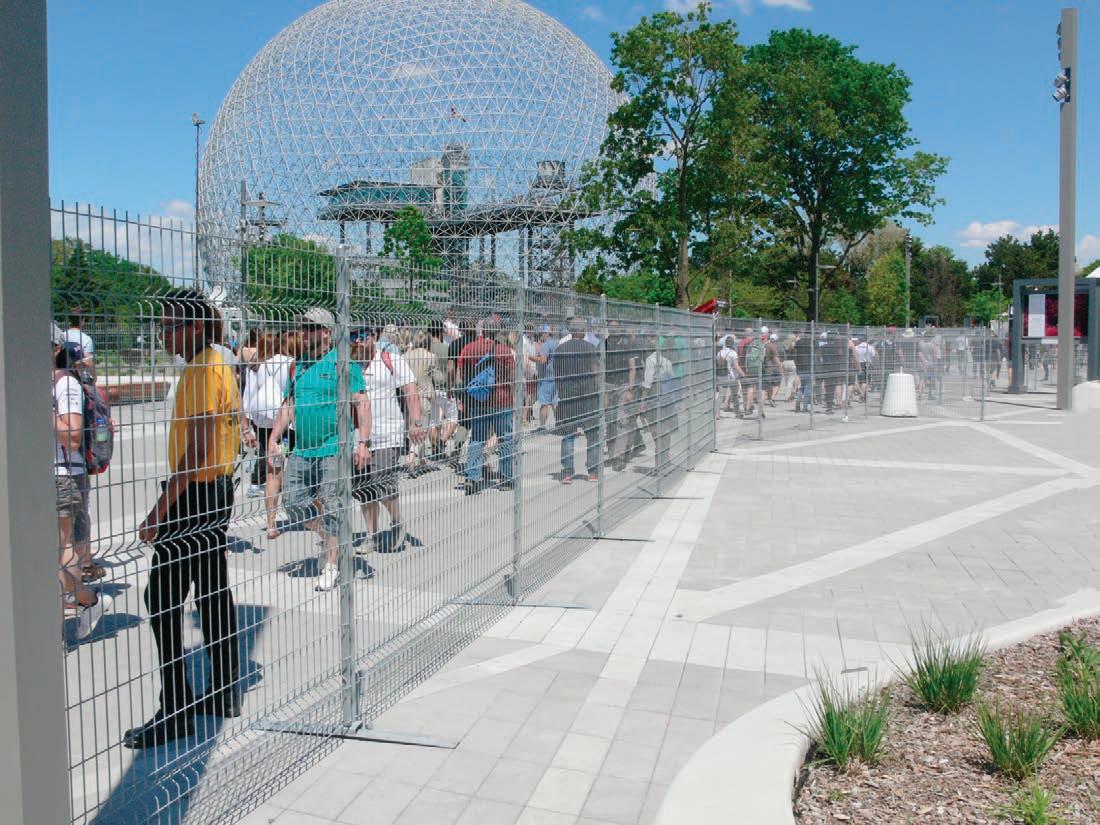
The Fence People Limited has been a Southern Ontario Fence Contractor since 1986. We service the Commercial, Industrial & Institutional industry.
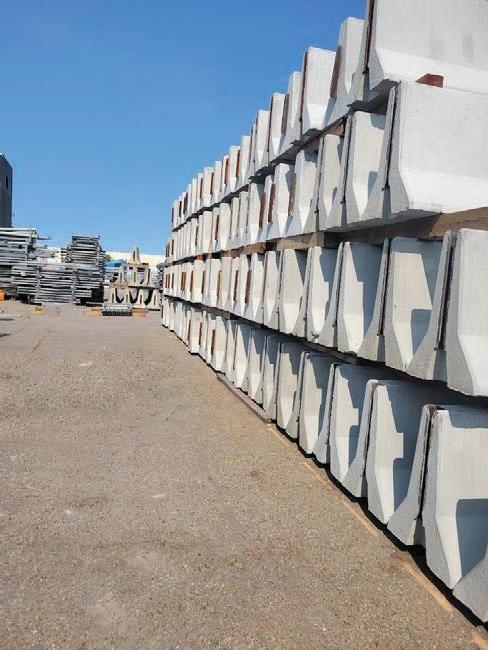
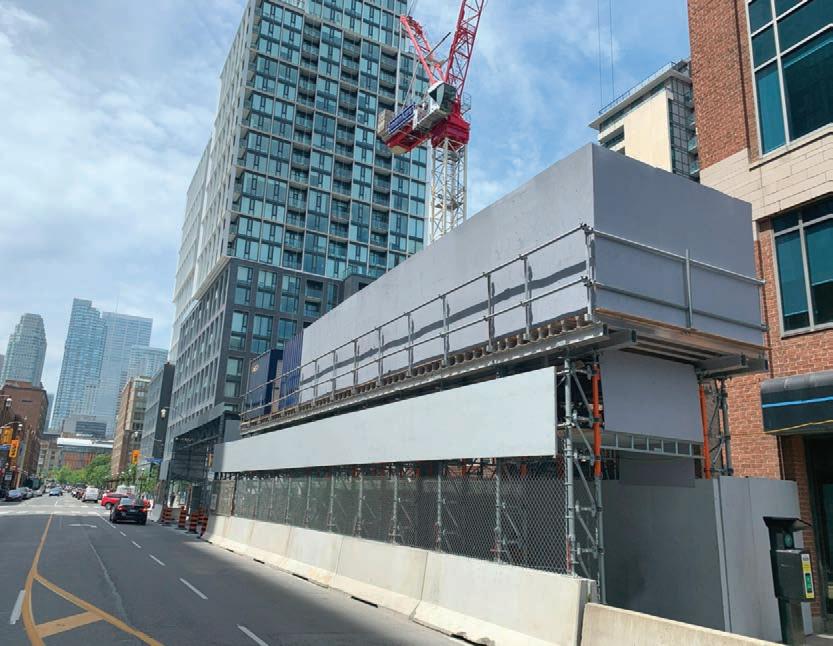
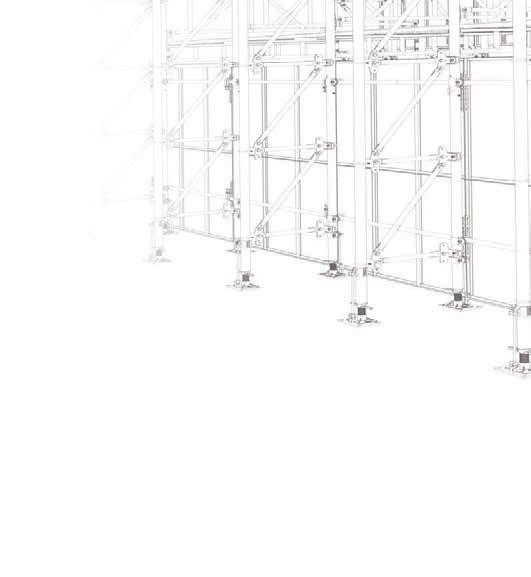
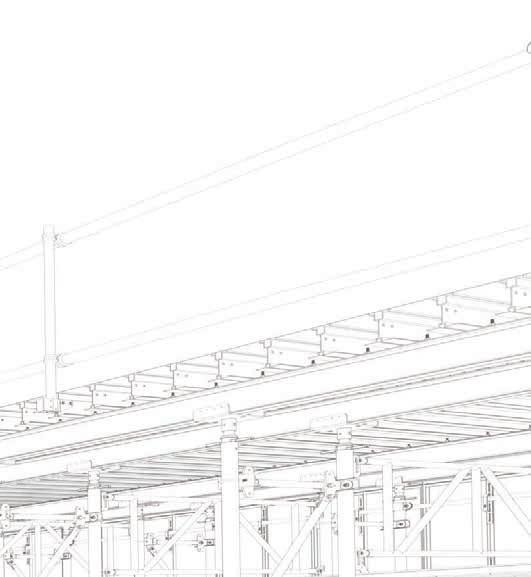
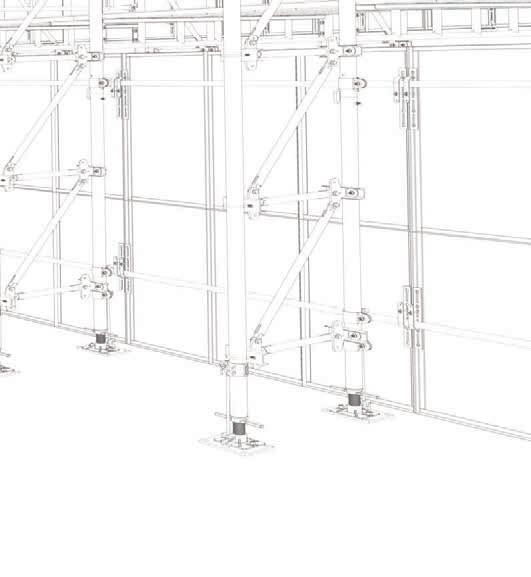
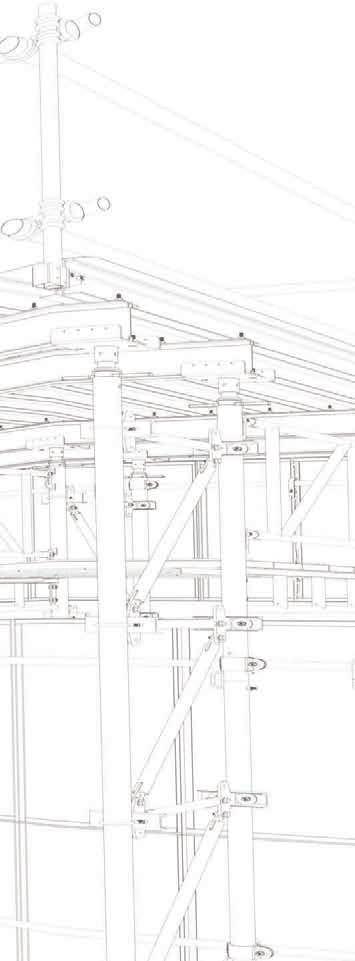
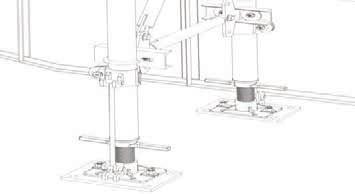
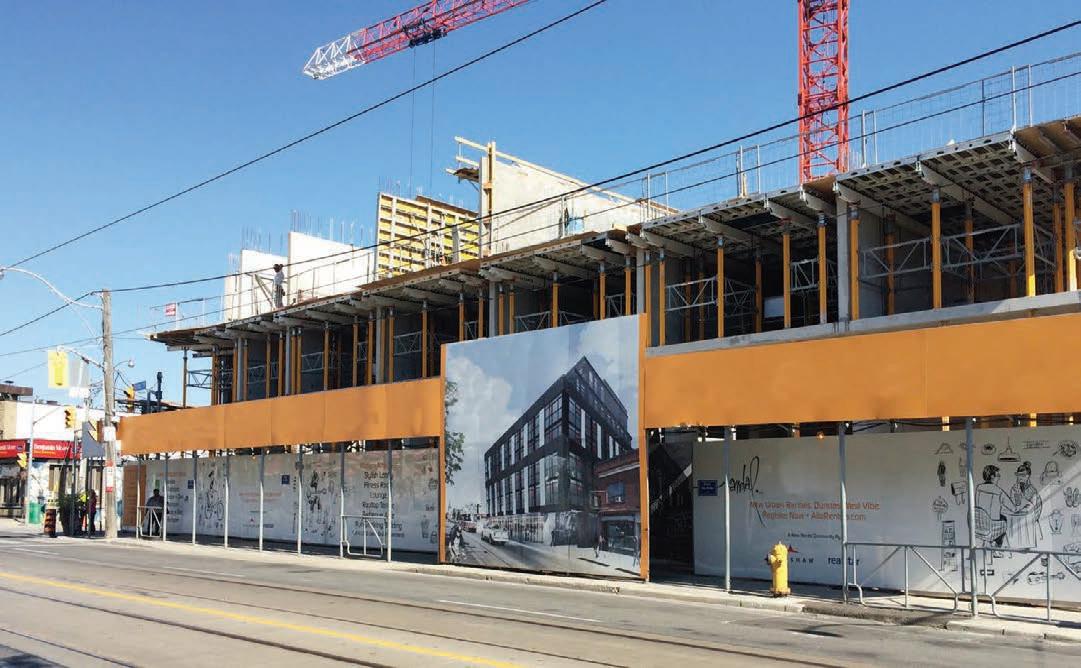
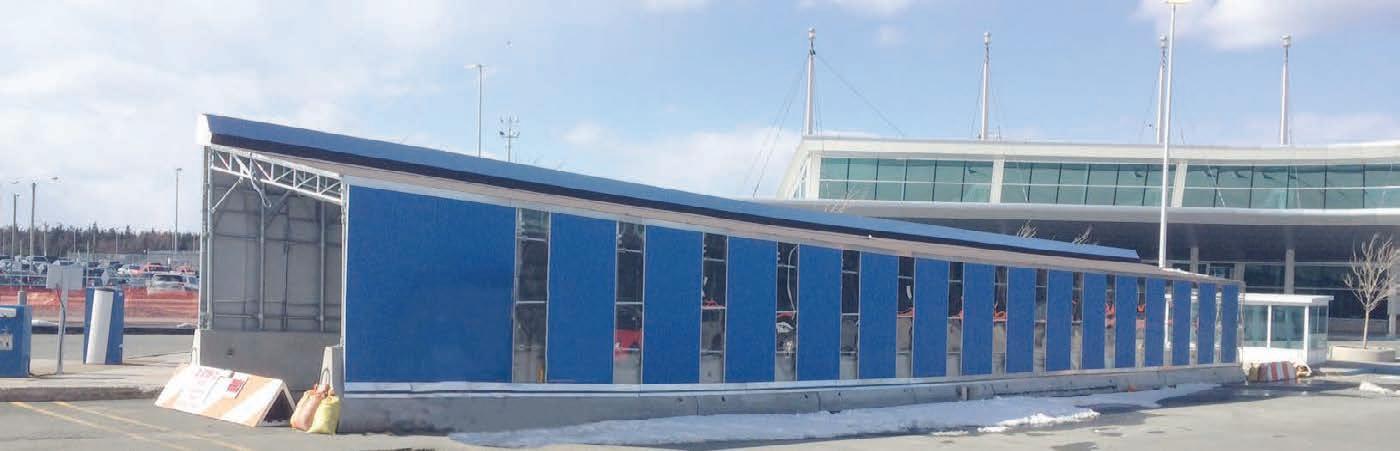
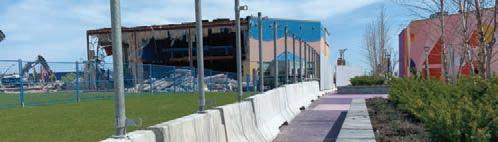
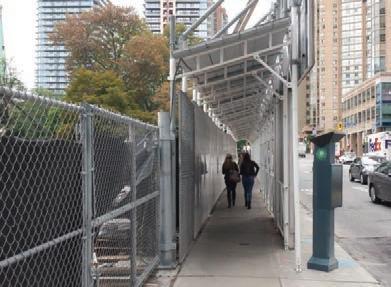
We bring to the market a unique modular Plywood Hoarding, Covered Walkway & Overhead Gate Protection system.
Due to the modular nature of our Products We have the capability of Constructing Various structures & o er many Solutions.
Our in-house Manufacturing Allows us to respond Quickly to Customized Requirements.
•WE SUPPLY YOU WITH DESIGN & ENGINEERING
•ALL PRODUCTS & FINISHES ARE ENVIRONMENT FRIENDLY
•98% OF LUMBER COMPONENTS ARE RECYCLABLE
•WE STRICKLY WORK FROM OUR INVENTORY












SEPTEMBER 2023
VOLUME 37 | NUMBER 3
PUBLISHER
Dan Chapman
dchapman@canadawide.com
604.473.0316
EDITOR Natalie Bruckner nbruckner@canadawide.com
SENIOR
Scott Laurie slaurie@canadawide.com
McLachlan
604.299.2116
1.800.663.0518 subscriptions@canadawide.com



Moving the RAIC Climate Action and Enablement Plan forward at Congress 2023
As a human crisis, climate change urgently requires solutions that will demand collaboration across all professions, sectors of the economy, and spheres of life. This is particularly important for the building sector, which is one of Canada’s highest carbon emitters. Reducing the environmental impact of buildings is vital – but what is the role of architects and architecture in imagining and creating a climateresilient future?
The RAIC Climate Action Engagement and Enablement Plan (CAEEP) builds on a series of resolutions, strategic actions, activities, and events hosted and/or convened by the RAIC that started in October 2019, with the Resolution for Urgent and Sustained Action on Climate and Ecological Health. The resolution, developed and sponsored by the RAIC Committee on Regenerative Environments (CORE), was the RAIC Board’s commitment to develop a Climate Action Plan with a focus on education, advocacy, and practice.
This resolution paved the way for the RAIC board to establish a Climate Action Plan Steering Committee and to embed climate action in the organizations’ strategic priorities.
In 2020, 2021, and 2022, the Climate Jam and Congress on Architecture events provided opportunities for discussion on climate action and architecture, and for advancing the CAEEP. This year, Congress 2023 will be the culmination of 18 months of work by the RAIC Climate Action Engagement and Enablement Plan Steering Committee, in collaboration with working groups that have been actively engaging Canada’s architectural community in the development of the CAP.
For the first time since the Congress on Architecture was launched, this year’s event will take place in person – in Whistler, B.C. on October 2 to 3, 2023. The Congress includes three events over two days.

On October 2, World Architecture Day, the RAIC Congress on Architecture will focus on informing the development of the Climate Action Plan. Framed by a conversation on Indigenous perspectives and ecological knowledges in relation to climate action, the day will also include a look at CAEEP engagement themes to-date and close with an interprofessional discussion focused on collaboration to accelerate action. This event takes place at the Squamish – Lil’wat Cultural Centre, designed by Formline Architecture (formerly Alfred Waugh Architect) in association with contract administration architect Ratio Architecture in 2008, which showcases the culture and history of the two First Nations communities in the Whistler area.
Following this discussion, a World Architecture Day reception will be held in the evening of October 2 at the Audain Art Museum, designed by Patkau Architects and opened in 2016. Architect John Patkau and engineer Stuart Hood (Introba) will share insights on the architectural
challenges, design development, and sustainability goals of the building in the context of the demanding mechanical and environmental requirements for a museum.
Lastly, this year presents a special opportunity – an open access Low-Carbon Education Workshop, which will take place on October 3 at the Fairmont Chateau Whistler. In collaboration with the Canada Green Building Council and supported by the Government of Canada, this architect-specific workshop was developed in collaboration with the RAIC’s Low Carbon Education Advisory Group and key subject-matter experts, and is part of the Sectoral Workforce Solutions Program – a broader project to train and upskill the building design and construction workforce in low-carbon skills. The workshop is offered for free to architects, landscape architects, interns, technologists, and students, and covers the following areas:
1. Climate Change Literacy Foundations
2. Climate-Responsive Design Foundations
3. Making the Case for Change
4. Integrative Design Thinking and Regenerative Design
The aim of the RAIC’s Climate Action Engagement and Enablement Plan process has been to foster a comprehensive and inclusive dialogue for the CAEEP, because everyone has a stake in the future. The more voices we include, the better we can adapt and respond to the impact of the climate crisis.
There is still time to contribute to this process – you can join us in Whistler at Congress 2023 on October 2 to 3, and play your part in shaping a sustainable and resilient future. Registration is open until September 15, 2023. raic.org/2023-congress-architecture A

The Future Of Engineering
Sustainability, innovation, and empowerment: inside the world of Quasar
by NATALIE BRUCKNER | photography & renderings provided by QUASAR CONSULTING GROUP
In the ever-evolving world of engineering consultancy, Quasar Consulting Group (Quasar) shines as a beacon of innovation and excellence. Since its inception in 2018, this visionary firm has had a passion for revolutionizing the construction industry, captivating the hearts of professionals across Canada. With a passion for people, a drive for pushing boundaries, and an unwavering commitment to delivering exceptional results, Quasar is helping transform the landscape of engineering consultancy.
Quasar’s journey started less than a decade ago, as Kenan Huskovic, Quasar’s CEO explains: “On March 12, 2018, through an acquisition from Racon – a mechanical and electrical engineering firm founded in 1993 – Quasar Consulting Group [Quasar] opened its doors. The vision at the time was very simple and stands firm today: to introduce a new type of consulting engineering company to the market that is led by a collection of experienced, recognized industry professionals who share one common vision. We provide uncompromising quality; unmatched service to our employees, clients, and industry partners; and accountability to both staff and clients, all built on a foundation of strong external and internal relationships. This is reflected in our name, which is an acronym for quality, service, accountability, and relationships.”
Over the next couple of years, the company grew relatively quickly and moved into the Woodbridge office in the Summer of 2019. “We grew from 15 people in March 2018 to approximately 60 in early 2020. We opened an office in Ottawa in the fall of 2019, which is now 15 people strong and growing,” says Huskovic.
Quasar’s ascent continued with the acquisitions of Pratus Group in 2021 and Induspec in 2023. Huskovic explains: “Pratus Group – Quasar’s dedicated team of sustainability, building performance, ESG, and commissioning professionals – has driven our designs toward a more sustainable future.” In 2021, Quasar opened its Vancouver office, in 2022 they established their presence in Calgary, and in 2023 they established strong local presence in Northern Ontario through an acquisition of Induspec. Shortly thereafter they opened the North Bay office and also established presence in Montreal.
As the industry continues to undergo rapid transformation, Quasar remains at the forefront, embracing change as an opportunity for growth. The company takes pride in introducing ground-breaking products like the Citizen Care Pod, a COVID-19 smart screening and testing initiative. Huskovic states, “This innovative solution revolutionizes screening and testing, prioritizing public health and safety.” The Intelligent Structural Panel (ISP) is another marvel, streamlining construction while enhancing building performance and sustainability.
Quasar has its finger on the pulse of the industry, anticipating and embracing the changes that lie ahead. “We see the desire for new products and systems rising to meet the needs of our clients and communities – including prefabricated, modular, and volumetric construction and highly smart buildings. We also know that Canada has aggressive net zero targets to reduce greenhouse gas emissions, and the building industry holds in their hands a great amount of opportunity to make change,” says Huskovic.
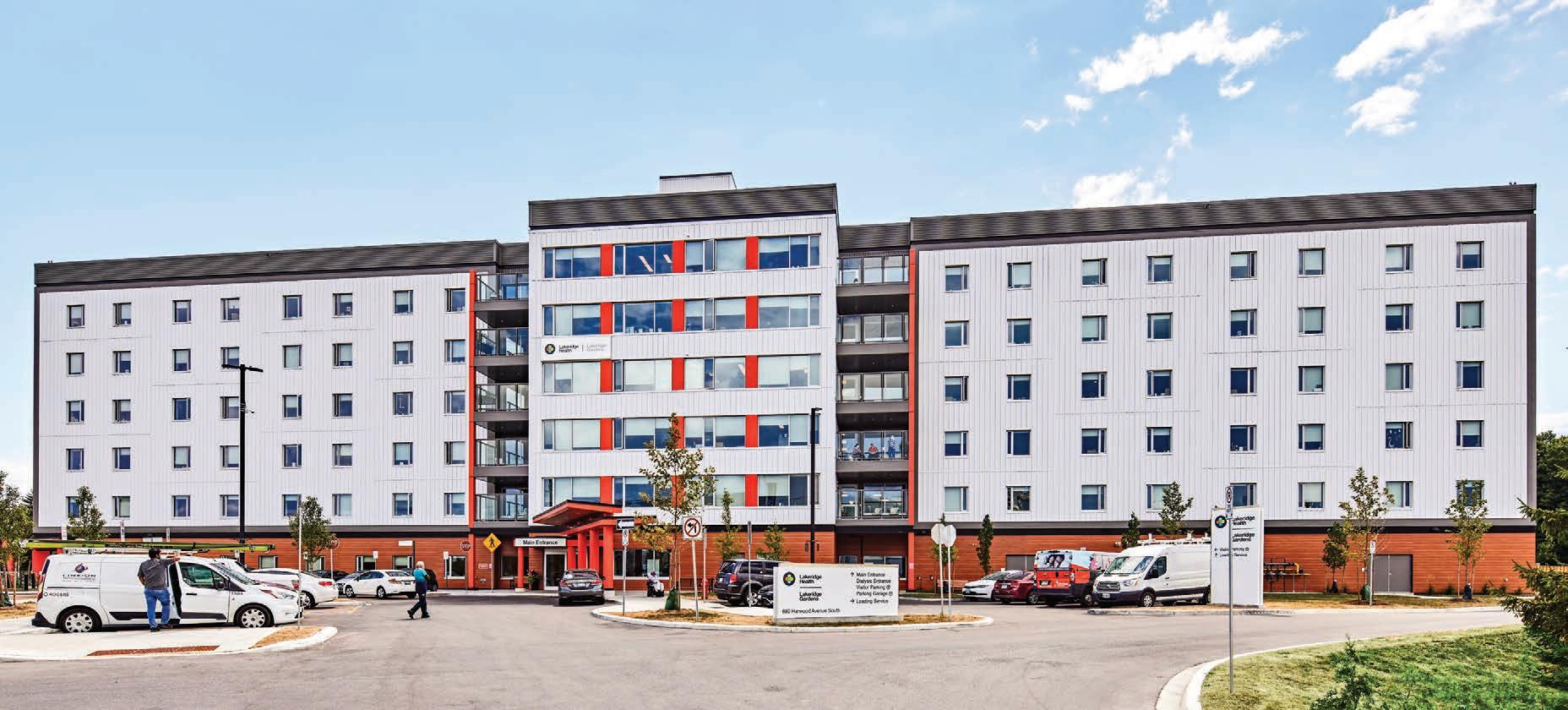
While Quasar has been involved in numerous standout projects, Lakeridge Gardens accelerated long-term care, which was awarded Best Project, Health Care in the ENR 2022 Global Best Projects Awards, is one that demonstrates Quasar’s ability to adapt and pivot. “What is unique about this project is the accelerated schedule for completion of 18 months from the start of design procurement to construction completion. The aggressive schedule was enabled by the extensive use of modular components prefabricated off-site and delivered for final assembly,” Huskovic explains.
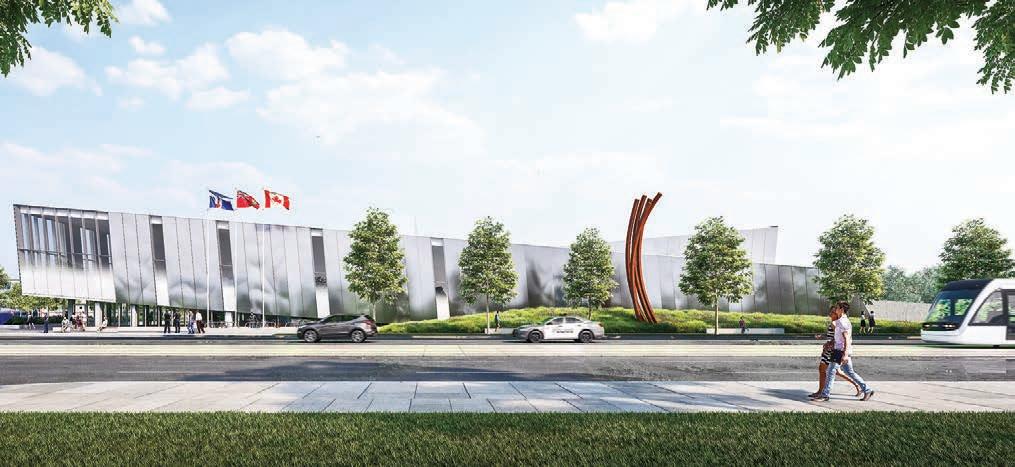
Other projects that showcase the company’s versatility include Toronto General Hospital’s ground-breaking Organ Regeneration Laboratory, the Toronto Zoo Conservation Campus, the Ministry of Education’s new Rapid Build Pilot Program, and Toronto Police Service’s Division 41 – the service’s first facility designed in compliance with the Zero Carbon Building standard, with solar panels and a large green roof.
A visit to any of Quasar’s offices offers a glimpse into their vibrant and collaborative culture. While each office has its unique characteristics, they all share the “Quasar vibe” of openness, camaraderie, and social interaction. “We use our offices to enhance our collaboration, training, and to build relationships both internally and externally – it’s important that we feel comfortable with each other, similar to a work family. Everyone is welcome at any office, no matter the location,” says Huskovic.
When it comes to the future of engineering consultancy and the industry as a whole, the team at Quasar is most excited about the industry’s evolving mindset. “We are excited to see our clients and partners think outside the box when it comes to tackling change in our industry, climate or otherwise, through new processes and technology,” explains Huskovic.
The team is proud to be part of this movement, working hand-in-hand with visionary teams and industry partners who are committed to driving positive change. By collaborating with like-minded individuals and organizations, Quasar believes they can create a better quality of life for communities and contribute to a more sustainable and resilient future.
“We are seeing a shift away from ‘capital-only’ thinking. By working with teams and industry partners who are trying to move the needle by embracing change, we are providing solutions that are holistically more beneficial for the client, their users, and the communities they support. A key example of this is the small, but impactful inclusion of touch-free technology in the residential sector. While it has an impact on design and construction cost, these features have shown to result in a building with increased wellness scores, greater user comfort, and a higher client end-value,” says Huskovic.
Quasar Consulting Group has emerged as a trailblazer in the engineering consultancy field, redefining the boundaries of what is possible. “We are people-first and know that we can continue to drive change in our sphere of influence that creates a better quality of life for our communities,” concludes Huskovic. A


“ We are people-first and know that we can continue to drive change in our sphere of influence that creates a better quality of life for our communities.”
Kenan
RENDERING COURTESY WZMH ARCHITECTS
Huskovic
The Saint, 89 Church Street, Toronto, ON
Organ Regeneration Laboratory, TGH, Toronto, ON
Toronto Police Service 41 Division, Scarborough, ON
Lakeridge Gardens, Ajax, ON
WEST COAST CONTEMPORARY LINE
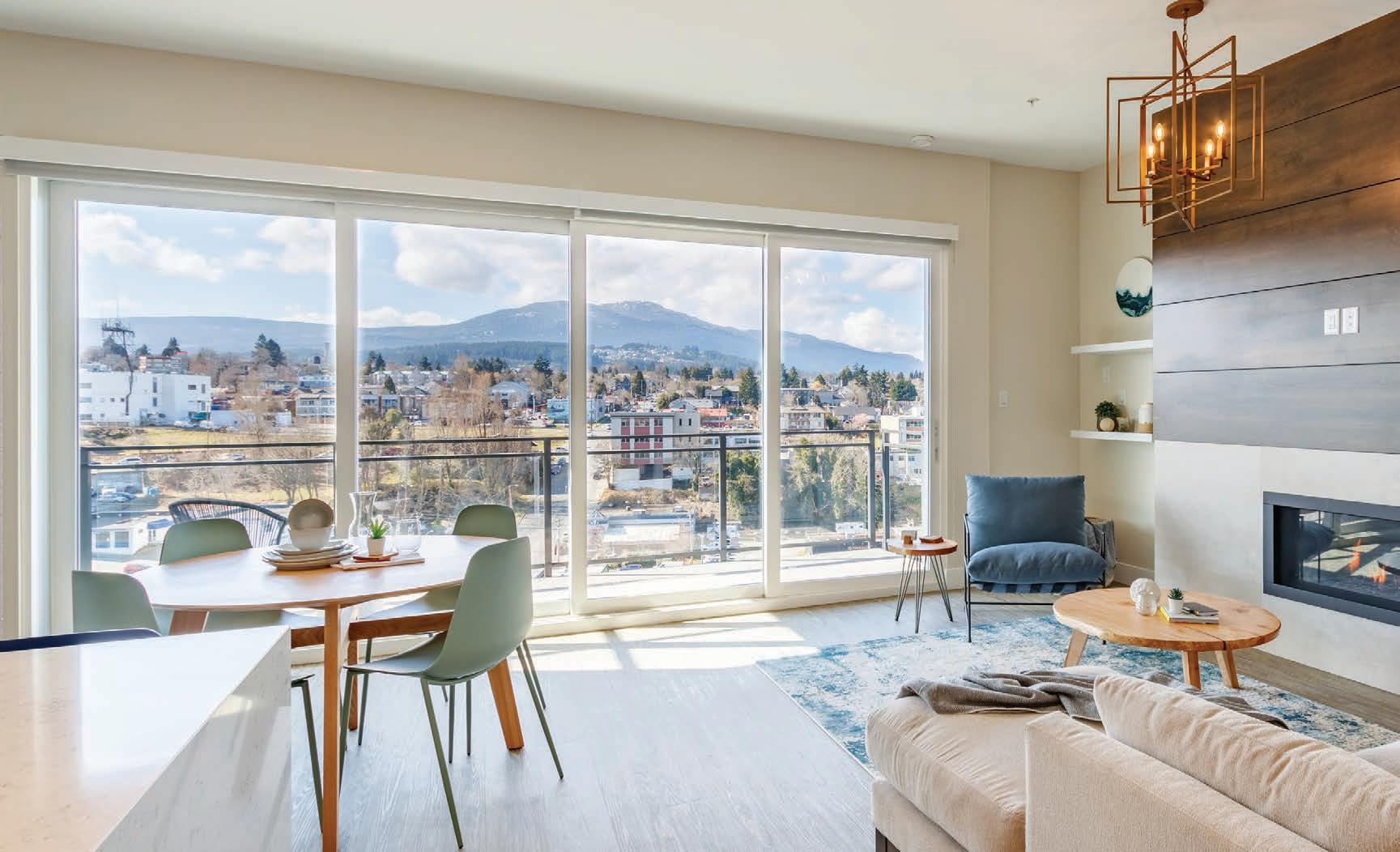
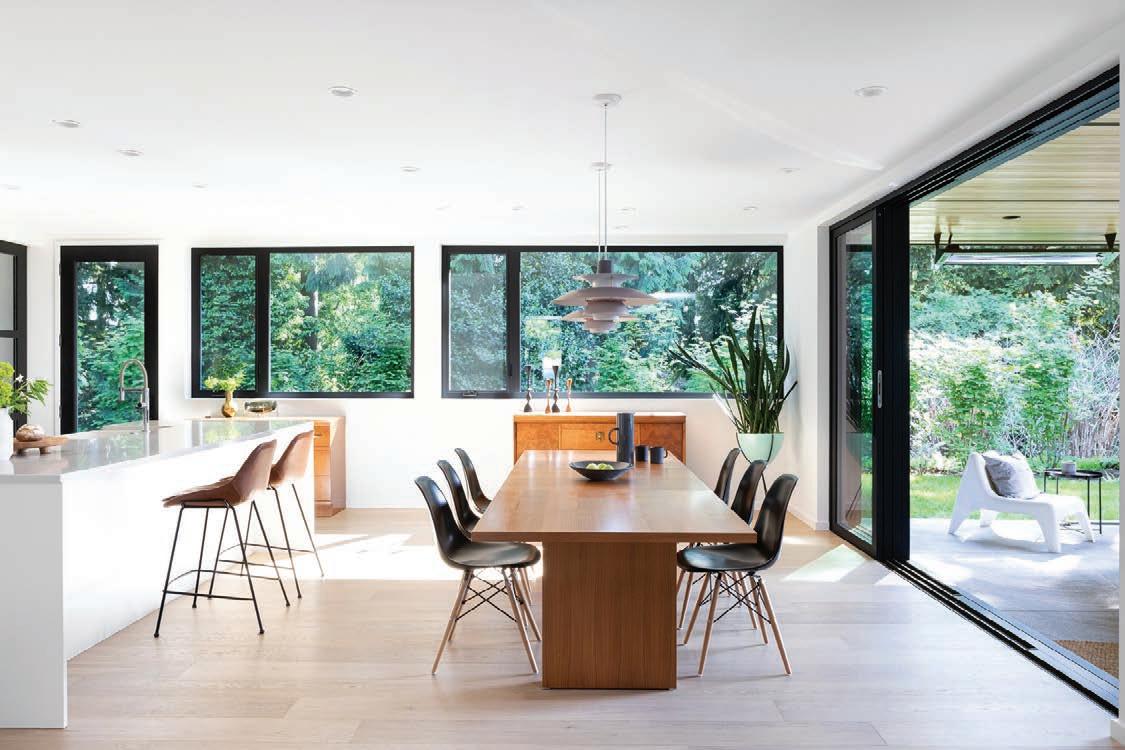

A custom home build is quite often the single largest investment in one’s life. This is a tremendous responsibility to entrust to the construction community.
Understanding this concept and exceeding customers’ expectations are what Westeck strives for and is at the core of the Westeck culture.
BIG PRODUCTS FOR ALL SIZES EMBRACE THE PATIO EXPERIENCE INDOOR/ OUTDOOR LIVING VANCOUVER 1480 Kootenay St, 1‑877‑606‑1166 CHILLIWACK 8104 Evans Rd 1‑877‑606‑1166
westeckwindows.com sales@westeckwindows.com




A Clear View To Tomorrow
Remarkable advances reshape Canada’s curtain wall and window wall landscape
by NATALIE BRUCKNER
As Canada’s curtain wall and window wall industry evolves to meet the changing needs of the built environment, remarkable advancements and transformative shifts are reshaping the landscape. Fuelled by emerging technologies, sustainability objectives, and a quest for enhanced performance, this industry is paving the way for innovative solutions. We delve into the cutting-edge developments and gain valuable insights from industry experts, shedding light on the exciting transformations taking place in Canada’s curtain wall and window wall sector.
EMERGING TRENDS
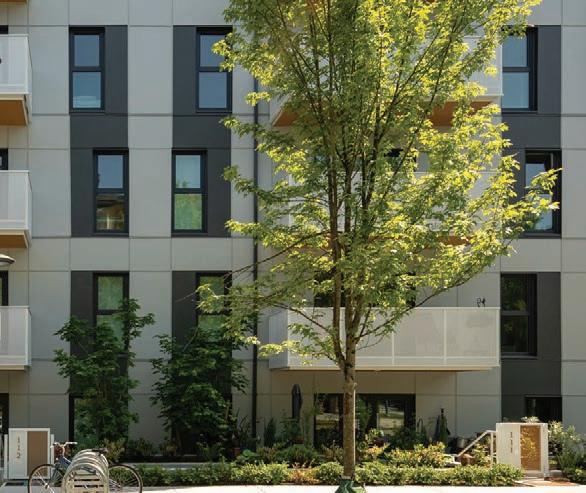
Michael Bousfield, technical director at Cascadia Windows & Doors, has observed a fascinating trend of late: an increasing demand from designers for incorporating opaque elements into window framing systems instead of the actual building. This shift allows designers to strategically incorporate decorative opaque cladding components without disrupting the overall fenestration system covering the entire building.
In the past, building designs have tolerated structural projections that cause thermal bridging. For instance, horizontal concrete eyebrows at multiple floor levels, which were once common, are now considered insulative nightmares. To create depth in the outer skin of buildings without protruding structures, Bousfield says designers seek to integrate depth into exterior elements.
In response to this, Cascadia is actively exploring innovative approaches to design cladding attachment components that can be held by window frames, going beyond the conventional practice of holding glass or metal within the frame. While there isn’t currently an off-the-shelf system available, Cascadia can design a bespoke system tailored to each project’s requirements. However, Bousfield envisions the possibility of a standardized kit of parts becoming available from the factory in the very near future.
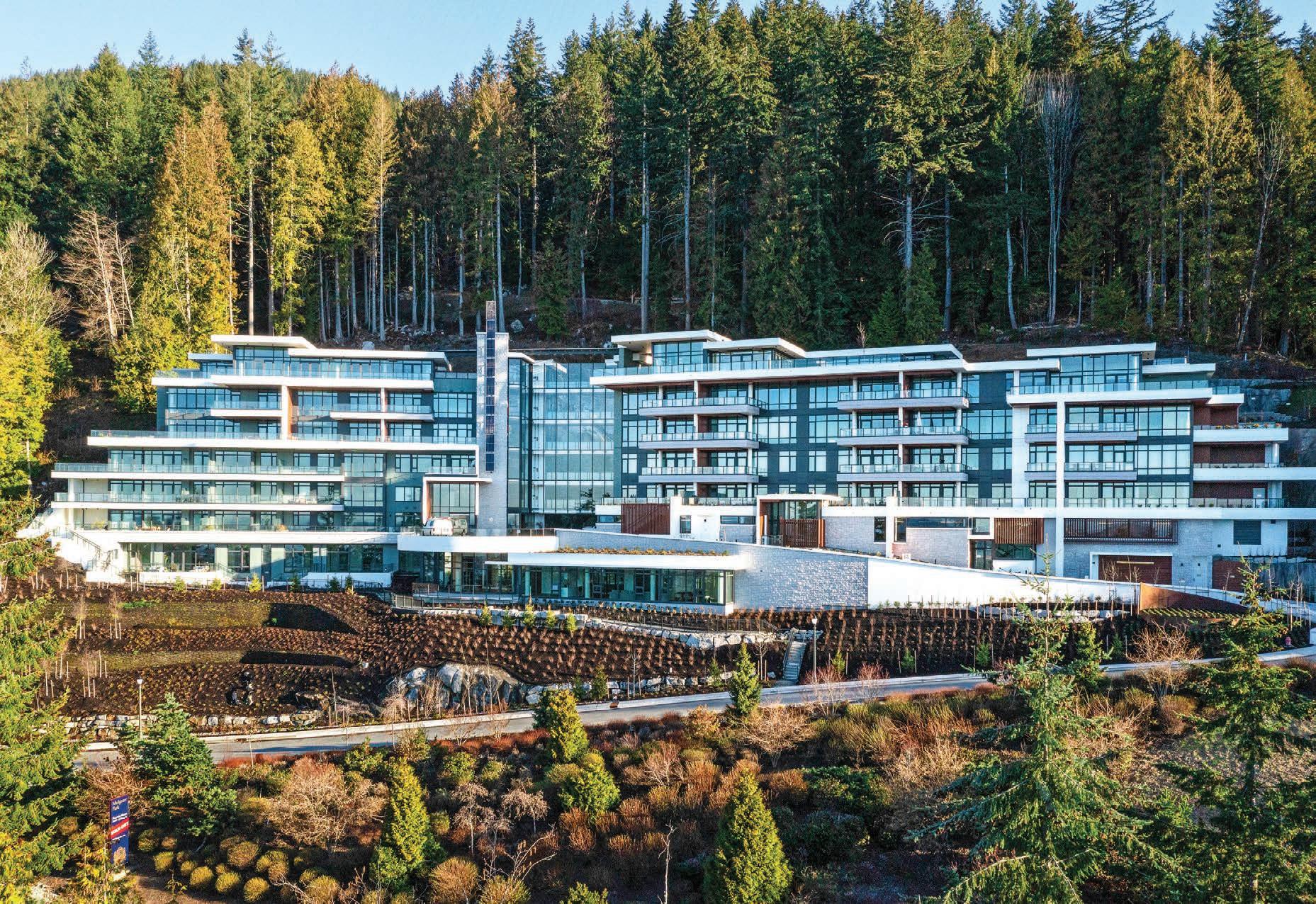
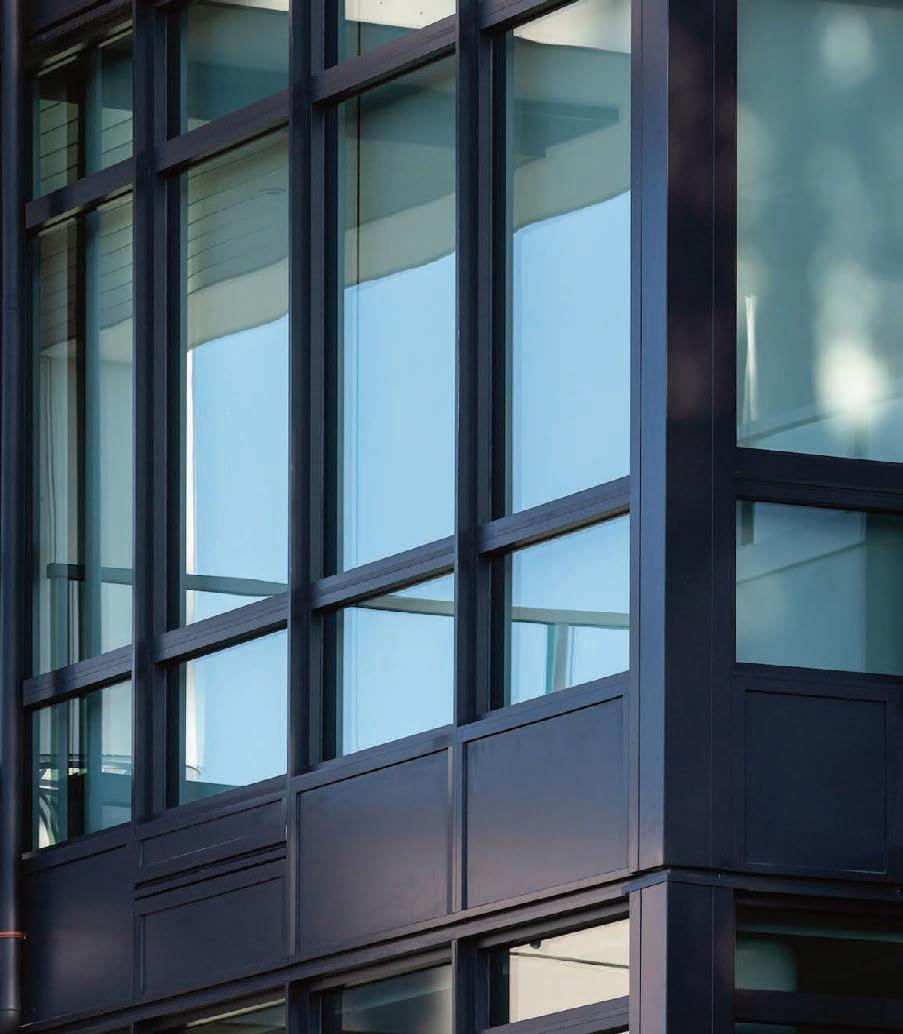
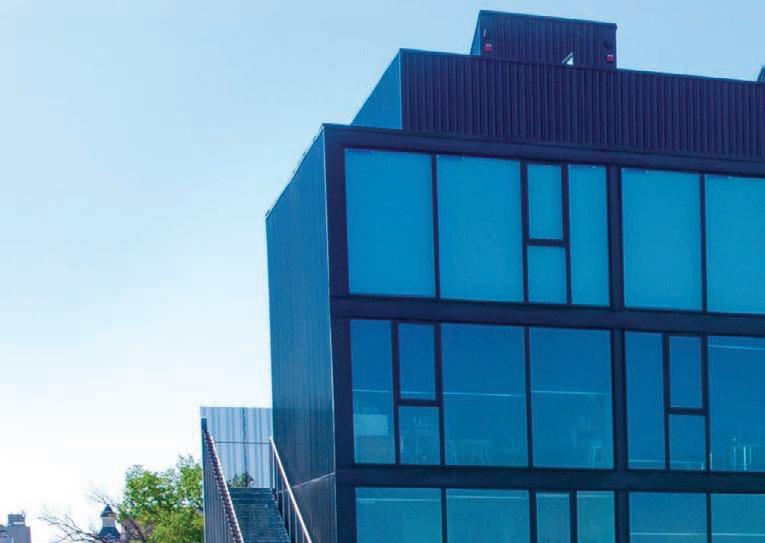
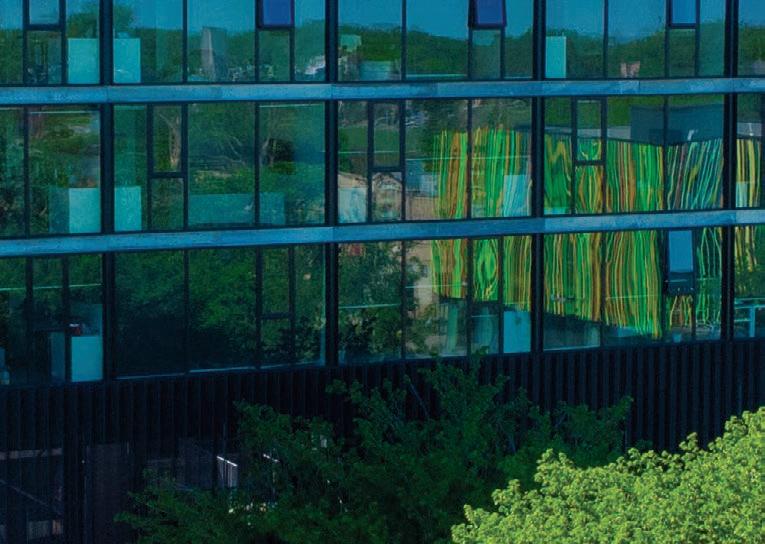
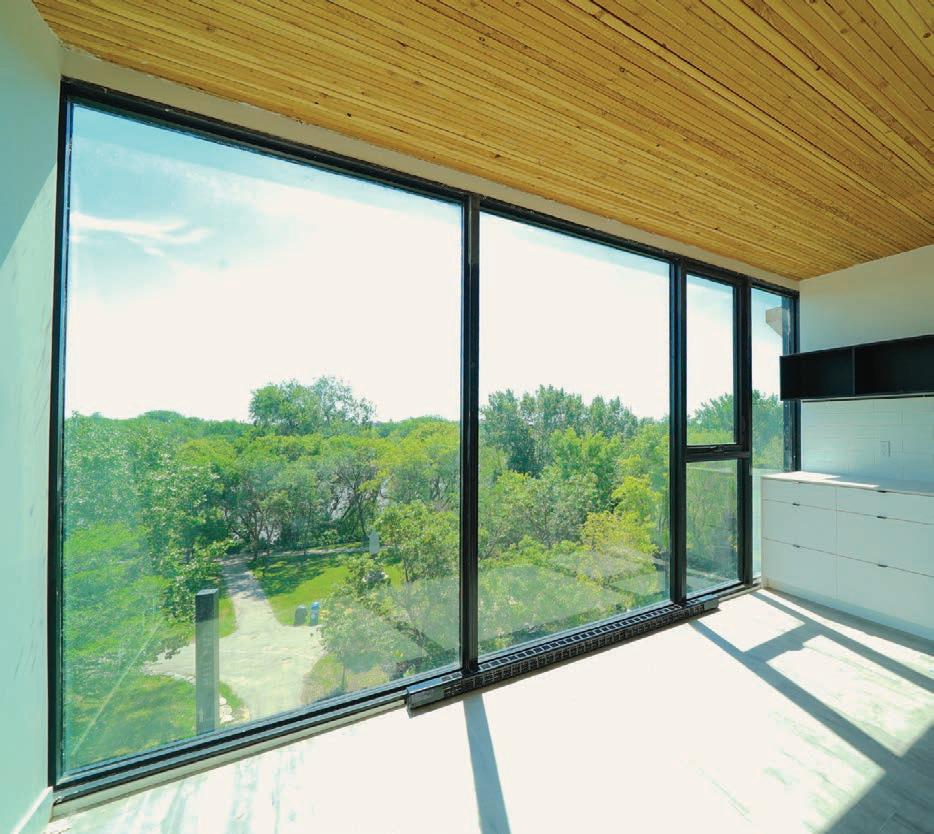
In other news, Cascadia has been actively involved in several noteworthy projects of late. One of these projects is The Courtenay, located in the British Properties at the base of Cypress Mountain in West Vancouver. This particular development showcases a groundbreaking achievement: the world’s first fibreglass window wall.

Another remarkable project Cascadia has been part of is Pacific Point II, situated on Homer Street in Vancouver. This undertaking is a unique rehabilitation project, setting new standards in terms of scale and approach. “For Pacific Point we were tasked with
The Courtenay, West Vancouver, B.C.
Pacific Point II, Vancouver, B.C.



Windows + Doors for Passive House Projects
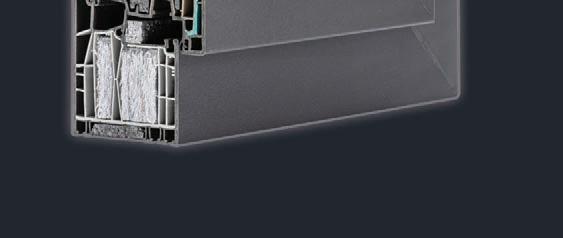
Innotech Windows + Doors is a Canadian manufacturer of high-performance windows and doors. The Defender 88PH+ System combines decades of fenestration knowledge to deliver a robust window and door system that is not only Passive House Institute certified, but that also delivers the air, water and structural performance required for highly sustainable housing developments.
Ask us about the Defender 88PH+ XI: the first Passive House Institute (PHI) cold climate certified window system manufactured in North America!


innotech-windows.com
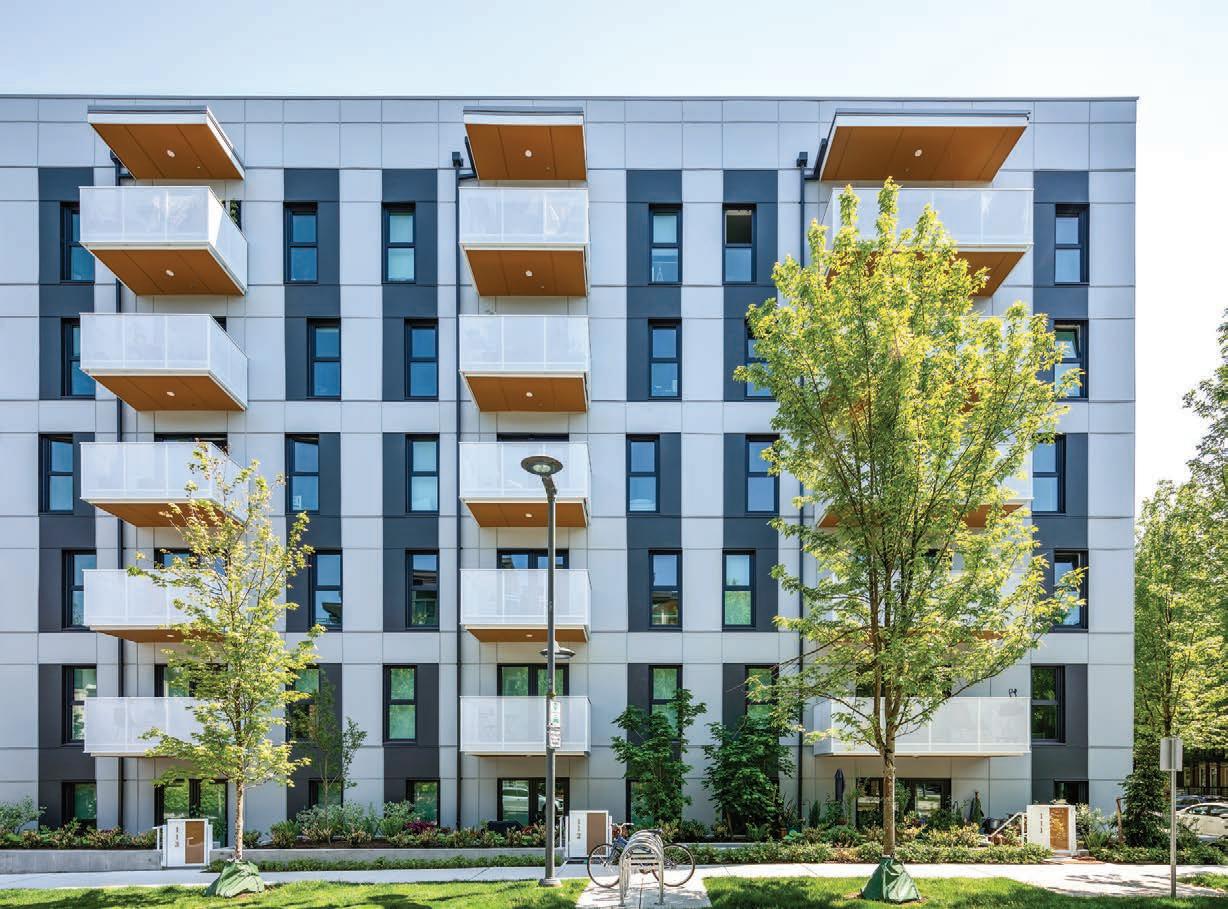
EVOLVE IN VANCOUVER, BC
Passive House Multi-Family Project by ZGF Architects and Peak Construction.
replacing failed aluminum windows with a system that eliminated the requirement for the scope of the rehabilitation to include mechanical system upgrades. The difference is very subtle, aesthetically, but thermally blew the new requirements out the water,” Bousfield says.
INNOVATION AND PERFORMANCE
Innotech Windows + Doors has stepped up to meet the booming demand for high-performance building products and achieved a North American fenestration industry milestone.
Recently the company introduced its highest performing window to date, the Defender 88PH+ XI, which is the first Passive House Institute cold climate certified window manufactured in North America.
“The Defender 88PH+ XI is the cumulative result of continuous improvements learned over two decades of engineering, manufacturing, and installing windows and doors in thousands of projects throughout North America,” says Troy Imbery, president of Innotech Windows + Doors. “We’re very excited to offer our clients a range of window and door systems that not only exceed the requirements of the BC Building Code, but that also meet the rigorous voluntary performance standards of Passive House.”
Achieving high levels of energy performance in buildings such as those required under the BC Energy Step Code requires a high skillset from all building professionals. The Certified Passive House Tradesperson (CPHT) course is offered by Passive House Canada and the British Columbia Institute of Technology throughout the year, both in person
and virtually. The CPHT designation offers tradespeople and other building professionals, including several employees at Innotech Windows + Doors, the skillset required to achieve a net-zero energy future
– now less than a decade away. “As a manufacturer of building products, it’s our responsibility to push the boundaries of performance,” says Imbery. “Our health and the health of our planet depends on it.”




The Future is Fiberglass





•
•
•
INDUSTRY CHANGES
Over the past 12 months, the window wall and curtain wall industry has continued to witness significant changes, particularly in the areas of product delivery and quality. Jim Lebedovich, president at Phoenix Glass says the impact of COVID-19 has led to inflation, resulting in higher costs for lesser service and longer delivery times. He explains that supply chain materials are now predominantly made to order, emphasizing the need for efficient production and delivery processes.
Although Lebedovich says there hasn’t been any groundbreaking new products in the market that he has witnessed, “energy requirements remain a crucial consideration in glazing and wall systems design. Existing products continue to help owners meet stringent targets in this regard.”
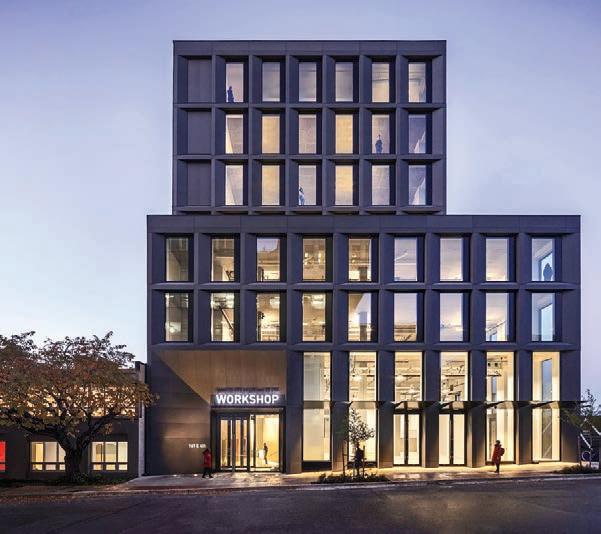
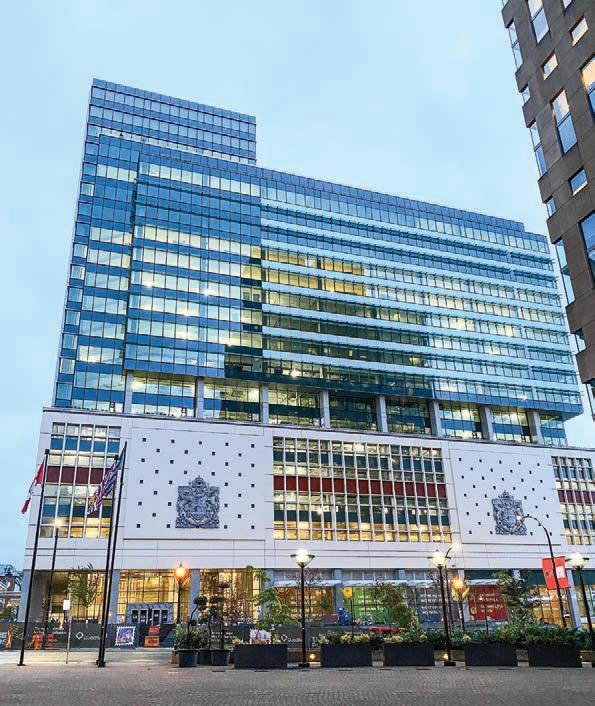
Phoenix Glass has been actively involved in various noteworthy projects of late. “We recently completed works at The Post, which had all sorts of different scopes. We also completed some hybrid curtain wall/wall panel systems for Mondivan and Focal and we have some nice high-performance unitized projects coming up – The Luxe and 360 West 2nd,” says Lebedovich.
Looking ahead, Lebedovich is enthusiastic about integrating curtain wall and wall panel assemblies to meet evolving energy requirements. “We are wellprepared and eager to contribute to the future of the industry in this regard,” he says.
GLASS TECHNOLOGY
The team at Noram Glass has seen some notable trends over the past 12 months, one of which is the use of electrochromic glass, which continues to be implemented in current projects. This innovative glass technology allows for dynamic control of sunlight and glare, enhancing energy efficiency and occupant comfort. Another emerging trend, according to Jess Redlarski at Noram, is the introduction of photovoltaic glass, which is expected to be utilized in the company’s future projects. This type of glass incorporates solar cells to generate renewable energy, while maintaining the transparency and aesthetics of the building envelope.
The company has seen some exciting changes of late as it continues to experience growth and expands its involvement in challenging and sophisticated architectural designs. This signifies Noram’s commitment to pushing boundaries and delivering innovative solutions in the industry.
Noram has also been engaged in some remarkable projects recently. One notable project is The Cooperators Head Office, where Halio’s electrochromic glass has been incorporated. This advanced glass technology provides occupants with control over the amount of daylight and privacy, creating a comfortable working environment. Additionally,

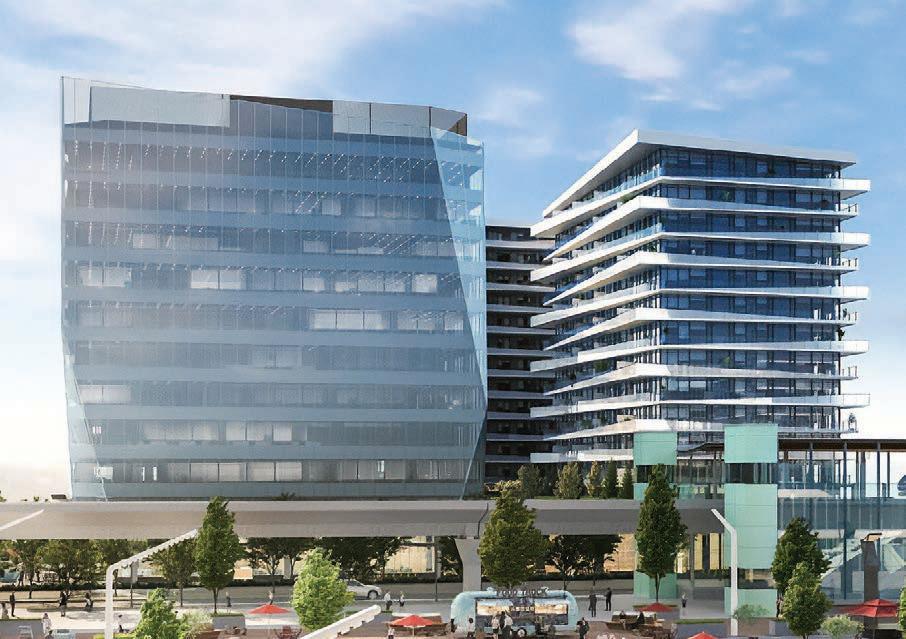

The Post, Vancouver, B.C.
Mondivan, Vancouver, B.C.

Noram has been working on Crosstown, a residential tower featuring a fully unitized curtain wall that combines vision glass and porcelain panels. This design integration adds aesthetic appeal and enhances the building’s overall performance.
RESEARCH AND DEVELOPMENT
With extreme events and disasters becoming more common, RJC Engineers is once again taking the lead to find solutions to protect buildings and as such has been participating in seismic testing of the Natural Hazards Engineering Research Infrastructure (NHERI) TallWood project, currently underway in San Diego, California.
The project, funded by the National Science Foundation, aims to study the earthquake resilience of mass timber buildings by simulating large earthquakes on a 10-storey mass timber structure. RJC’s role in the project is to analyze the impact of seismic events on window integrity, as windows play a crucial role in a building’s energy efficiency and safety.
“The project testing is attempting to detect the point at which window seals fail when subject to lateral building movements. Lateral, or sideways movements of a building can occur in both wind and seismic conditions. Window damage can be hidden and expensive to repair, and unseen breaches can cause larger impacts in energy efficiency and building durability if gone unnoticed,” says Dennis Gam, principal, RJC Engineers.
The findings will be invaluable, especially considering new code requirements are coming to B.C. this fall that will require buildings with high importance and post-disaster occupancies to remain
undamaged for large (but not severe) earthquakes.
“This implies a higher level of structural performance for other aspects of a building, including its enclosure. Our work attempts to quantify this risk and to inform how much repair cost can be affected by damage to window seals,” explains Terry Bergen, managing principal, RJC Engineers.
RJC’s involvement in the research will help inform sustainable building design decisions and reduce the carbon impact of the construction industry. The findings will contribute to the development of seismic
design methodologies and inform the creation of more sustainable and resilient buildings.
“The interaction of structure with building enclosure and functional components of a building is an under-researched area. Although the industry can create building structures that survive earthquakes, what needs to continue to be researched is how to make the building survive while also being occupiable and functional. What form this research takes is to be determined, but more full-scale testing is planned for the future,” says Gam. A
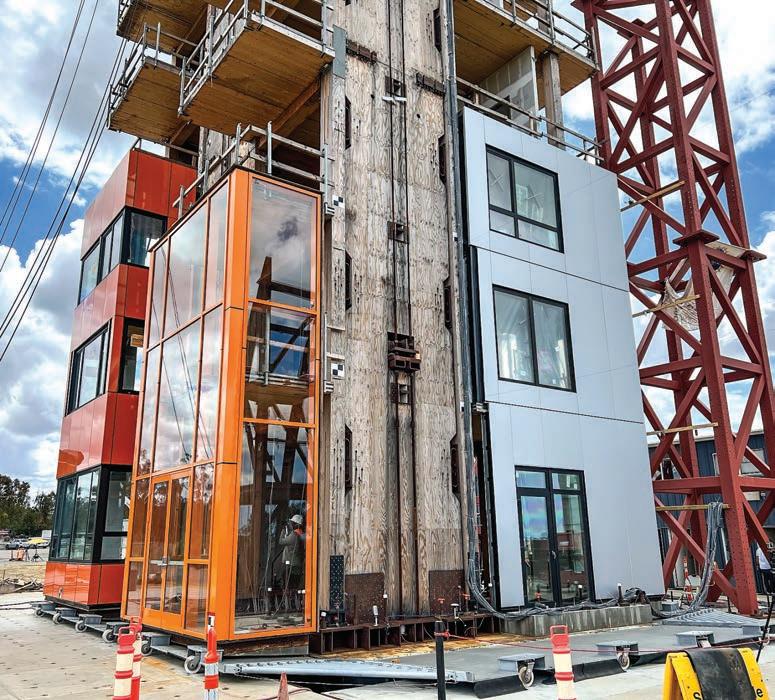
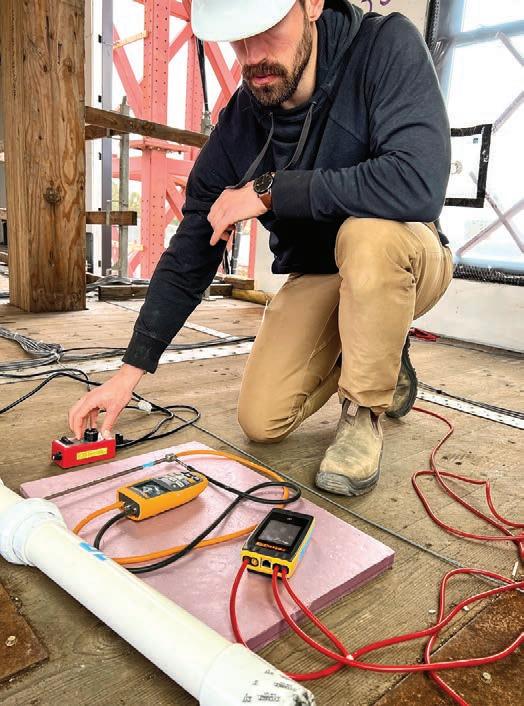




Seismic testing at the Natural Hazards Engineering Research Infrastructure (NHERI) TallWood project, San Diego, CA.










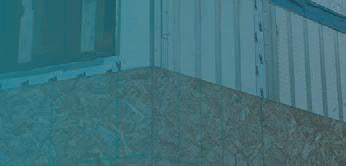
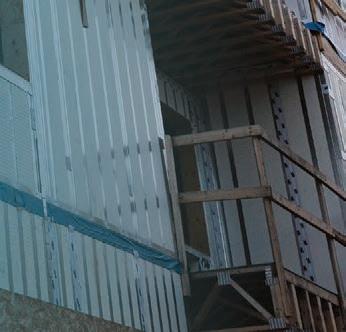





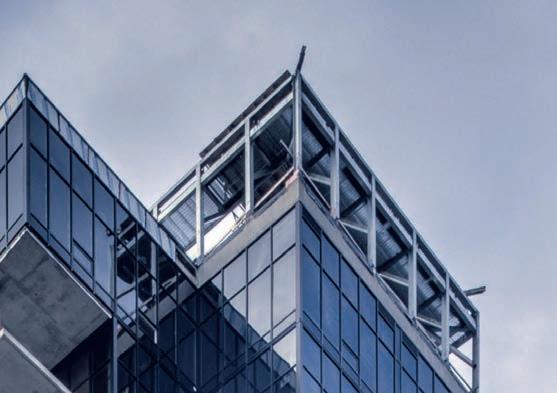






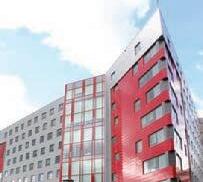
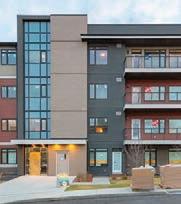
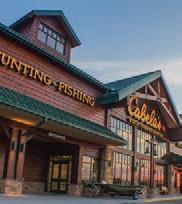

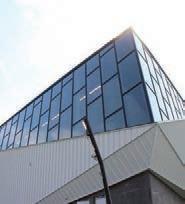


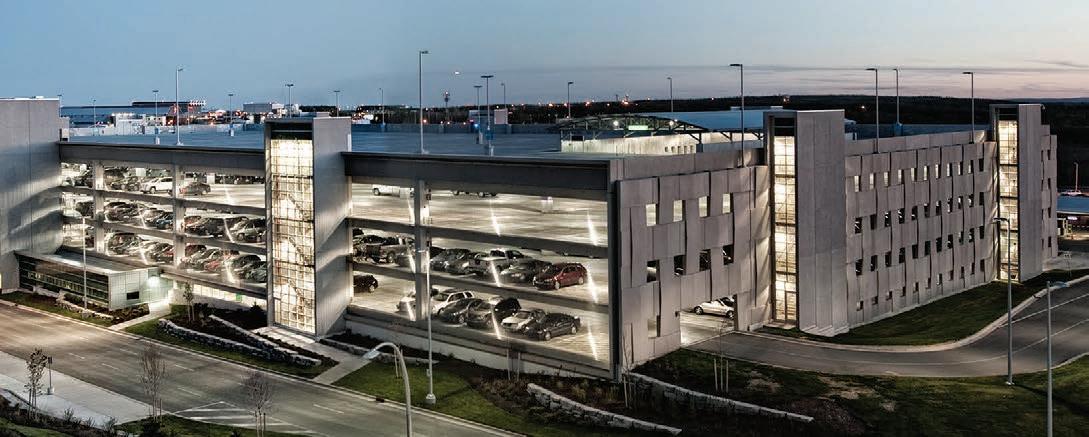


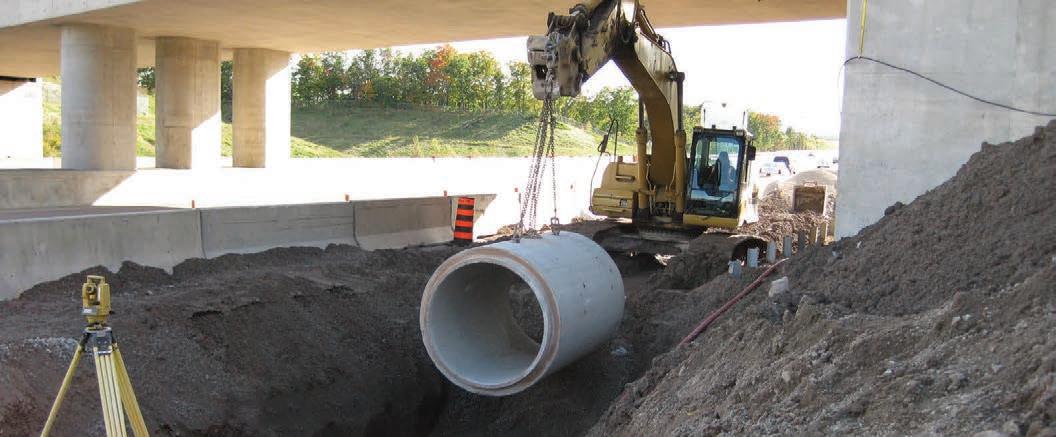
*(CPCQA) CERTIFICATION PROGRAM BY PROCESS OFFERS KEY BENEFITS TO ARCHITECTS, CONTRACTORS, ENGINEERS, GOVERNMENT AUTHORITIES AND OWNERS.
Project: Champagne Quarry Park, Calgary, AB Architect: Gibbs Gage Architects
Sealing In Success
The
growing demand for energy-efficient and airtight buildings sparks fascinating breakthroughs in building envelope solutions
by ROBIN BRUNET
With everything from energy costs to the net zero push affecting the way buildings are constructed, it’s not surprising that some basic concepts driving the green movement have become rote, without much consideration to their meaning. And as far as Jeff Ker, senior technical advisor at Engineered Assemblies (EA), is concerned, one example is the chronically overused term ‘sustainability,’ especially as it applies to building façade envelopes.
EA supplies world-class facade materials backed by leading expertise in RearVentilated Rain Screen (RVRS) sub-structure assemblies. Of late, Ker has been talking with the architectural community to break down what sustainability actually means in his line of work. “First, it means a building must consume less energy to function,” he says. “Then, sustainability applies to materials used –which incidentally must be installed properly. And finally, it means the building has to last and be serviceable.”
Architects have reportedly responded strongly to Ker’s discussions, which pertain to something EA has been promoting of late: its Certified Series, which has been developed in response to the need for transparency, due diligence, and proper installation execution of a correctly detailed RVRS.
EA created the Series in the hope that it will become an industry standard, offering a superior program of delivery and ensuring that all RVRS system installations are conducted properly and that the façade manufacturers’ warranty requirements will be met. This is accomplished by EA uniting the architect, the general contractor, and the subcontractor under a common methodology and “with a software platform to monitor and report on the execution of a proven RVRS design in real time,” according to Ker.
Ker says, “I’ll be continuing my talks because we regard the façade envelope as possibly the most important building component as it is the primary passive environmental control system. As more architects are trying to adopt National Building Code CSA S478 standards, we hope the use of our Certified Series will make the process easier to achieve.”
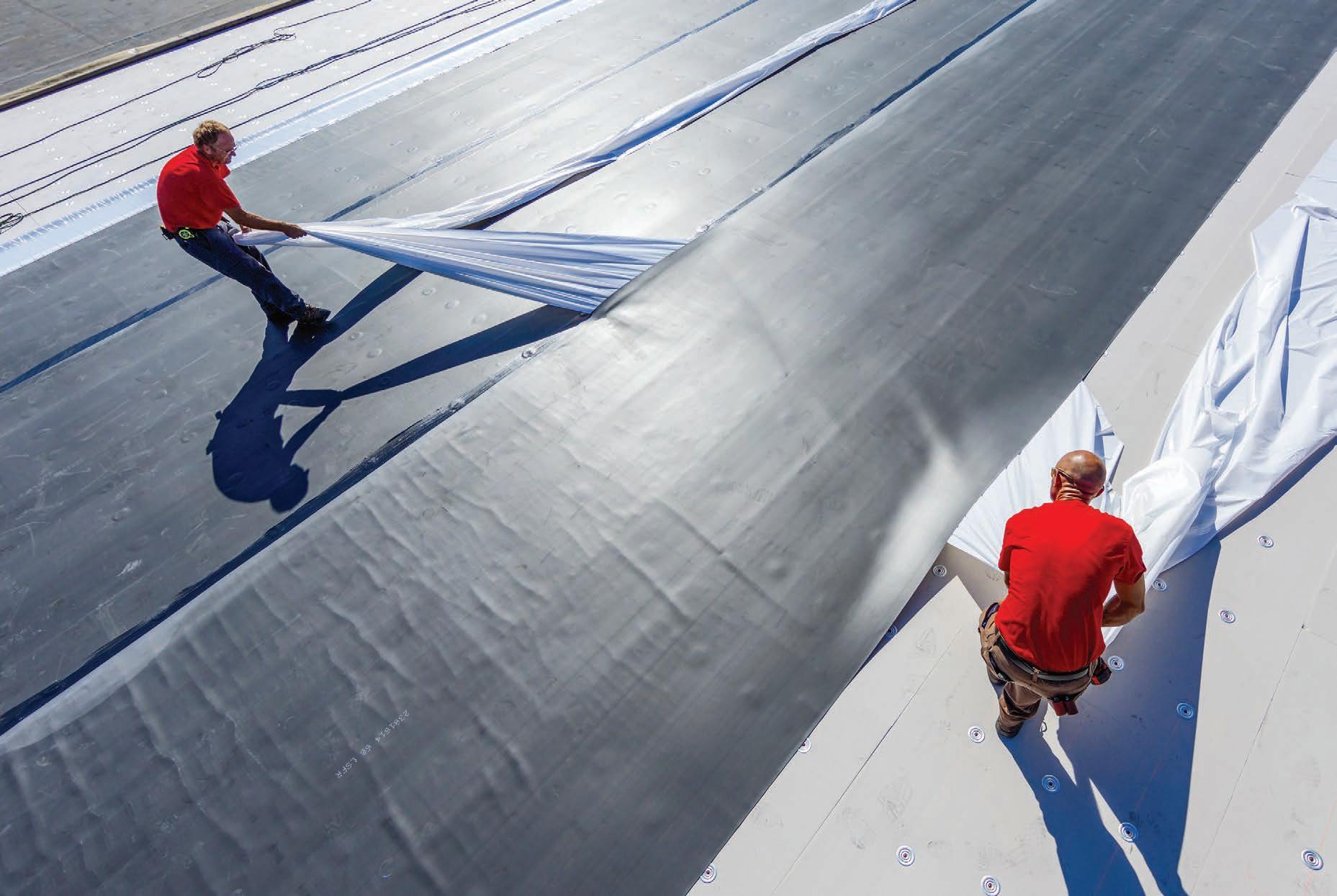
Holcim is a global leader in sustainable building solutions and respected for providing a full range of roofing systems. Jasmeet Deol, senior manager, product marketing for Holcim Building Envelope, reports that “overall in the commercial roofing space, material lead times and availability of raw materials are returning to normal levels. But labour shortages are still an issue, so we strive to provide roofing solutions that help contractors and building owners save time.”
Deol cites the Elevate SA (formerly Firestone SA) product category, a singleply self-adhering membrane roofing system specially designed to allow contractors to install more squares every season and do it up to four times faster. There’s no need to spread or spray adhesive during installation, plus Elevate SA membranes are free of VOCs. “This is not only a great advantage to crews because it improves the installation experience for contractors, but it also benefits owners because businesses can stay open and occupied while the roofing system is being installed,” Deol says.
Installation of the Elevate SA single-ply self-adhering membrane roofing system.
Rear-Ventilated Rain Screen (RVRS) sub-structure assembly.
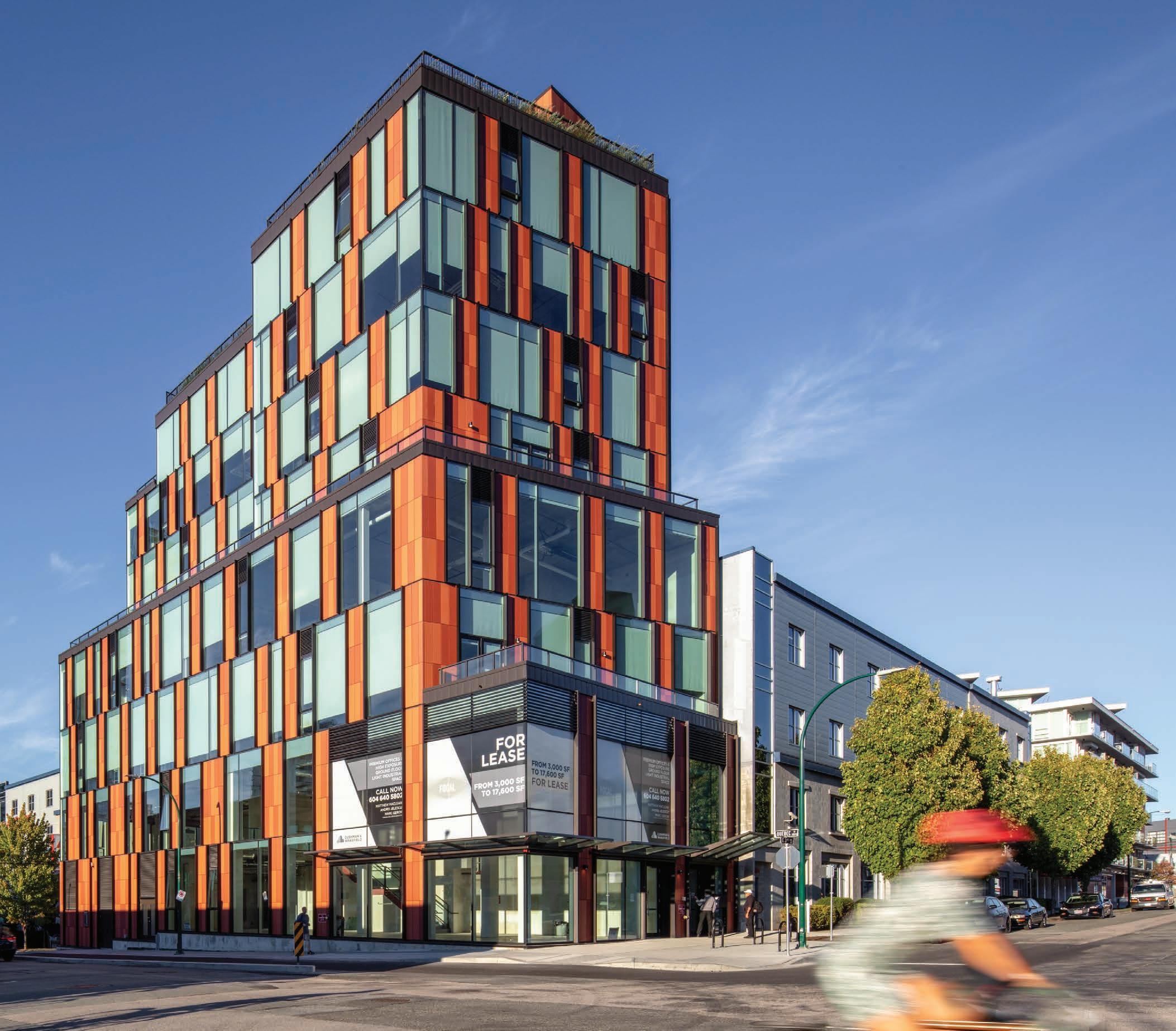
FOCAL ON THIRD

Additionally, thanks to Secure Bond Technology, both RubberGard EPDM SA and UltraPly TPO SA can be installed in temperatures as low as minus seven degrees celcius.
Deol adds, “Our work in Canada, focusing on end of life roof recycling and landfill diversion, continues in collaboration with Geocycle Canada where we co-process roofing products in the production of cement. While that has proven successful, we continue to explore other landfill diversion opportunities as well.”
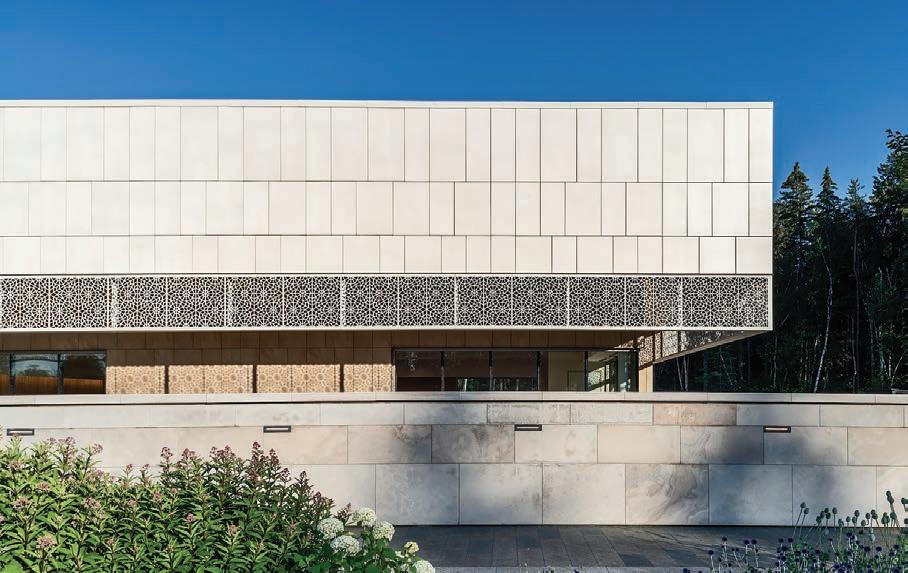
Brian Hall, managing director at the Canadian Precast/Prestressed Concrete Institute (CPCI), reports that in collaboration with RDH Building Science, CPCI has completed a comprehensive report on the air permeance testing of fullscale precast concrete wall assemblies following ASTM E2357. “The test results showed that single-wythe precast and double-wythe insulated precast concrete wall assemblies with properly installed two-stage joints meet and exceed the air barrier system requirements of the National Building Code of Canada,” he says. “The second phase of this testing program that focused on testing the precast wall assemblies for moisture leakage, following ASTM E331, has also been recently completed.”
Hall also credits Malcolm Hachborn, president of M. E. Hachborn Engineering, for recently introducing a new lighter, more energy-efficient and higher-performing cladding precast concrete system called DreamWall. “DreamWall panels are engineered and configured for use in exterior and interior façades,” he says. “If a client desires a high-performance prefabricated wall panel system that is remarkably lightweight, thermally efficient, versatile, durable, and aesthetically pleasing, DreamWall is an outstanding choice.”
Matthieu Danis, product manager, wood fibre at Building Products Canada, says, “Energy efficiency is certainly getting more attention than ever. Although this is more easily said than done, one thing that is certain is that most people understand the importance and value of continuous insulation in the increased performance and energy efficiency of a house. There is also pressure to use higher R-value continuous insulation in the very near future, as building codes are being reviewed and renewed.”
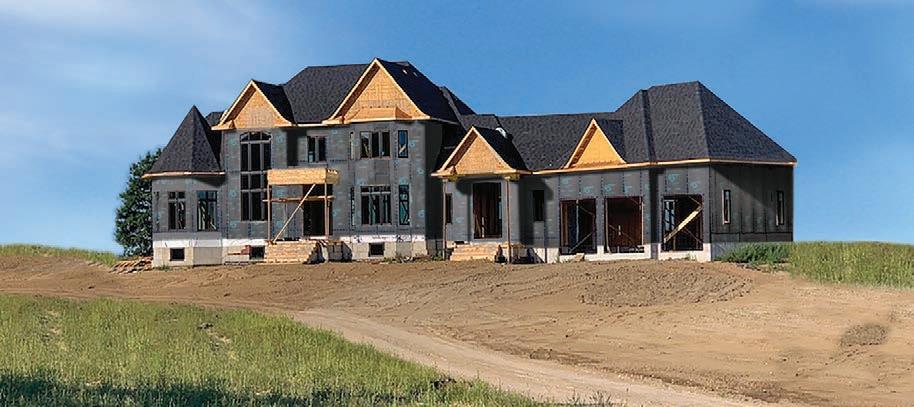
BP offers a complete line of wood fibre-based insulation panels under the Insul-Sheathing brand. All the panels offered in this category use a soft wood fibre panel that is either 7⁄ 16 inch or 1 ⁄2-inch thick. BP’s manufacturing process is unique because it manufactures a high resistance panel with an insulation value of R-3 per inch. Using wood fibre panels that are laminated to synthetic insulation panels results in a panel that is both structural, suitable for most buildings that fall under Part 9 of the National Building Code, and has a much lower upfront embodied carbon due to the use of recycled wood fibres.
All Insul-Sheathing panels provide superior protection of the exterior shell by offering continuous insulation and reducing thermal bridging at framing members.
Sound Solutions provides architects and contractors with an extensive line of product options for both interior and exterior applications from the best North American and European manufacturers. The company also provides extensive design, drafting and modelling capabilities, including comprehensive custom manufacturing when required.
Andrew Rogers, principal at Sound Solutions, reports that he has witnessed “an exponential increase in the use of extruded terracotta for rainscreen cladding, which is very encouraging because in Europe there are no end of roofs made of terracotta that are hundreds of years old. It’s a particularly sustainable material.”
Rogers is also heartened that the increase of terracotta usage is happening at a time when developers are more cost conscious than ever. “They obviously realise that with this material you can create expensive systems, but you can also develop affordable solutions,” he says. “About four years ago we clad the entire Etobicoke General Hospital in terracotta, and the tiles were under $10 per square foot.
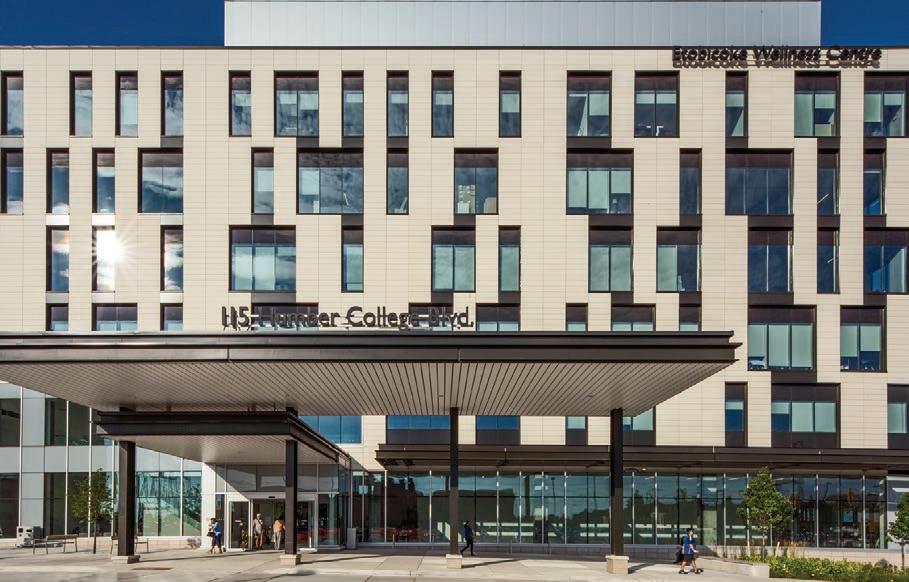
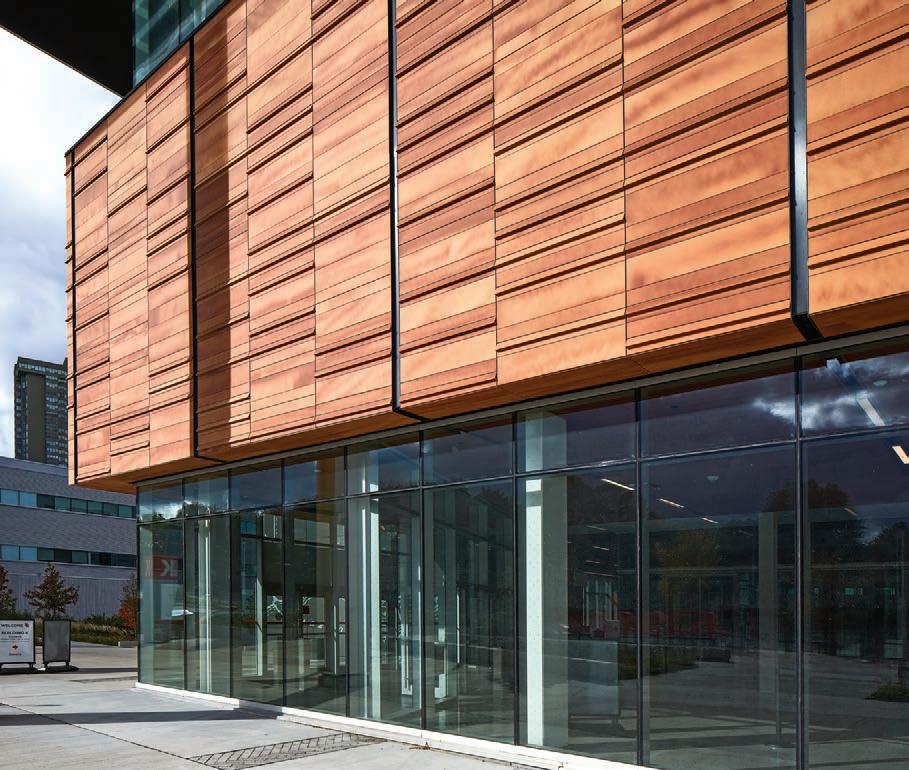
“Typically, we’ve done several projects a year using terracotta, but this year we’re supplying the material on about seven projects, and next year we’ll double that figure. In Canada overall there have been 40 completed projects over the past 15 years, and this number will double in the next two years.”
Joe Baz, product manager for Flynn Canada Ltd. (part of The Flynn Group), says, “With the need for more energy efficient and airtight buildings, Flynn set out to develop a high performing modular wall system. We wanted to utilize the framing of our unitized curtain wall as it is very airtight and watertight but thought of an innovative approach to insulate the outside of the aluminum framing with an insulated metal panel to minimize thermal bridging and maximize performance. This drastically improves the performance to a degree that an effective R value of greater than 40 can be achieved, which is unheard of in this industry.”
Speedwall is a factory-assembled modular exterior wall system that delivers quality and performance levels far beyond what is possible with on-site construction. Built on an aluminum chassis based on Flynn’s 6450 unitized curtain wall system, Speedwall modules are completely self-framed, sealed, and insulated in Flynn’s manufacturing facility, with all windows, doors, and exterior cladding pre-installed. Larger modules mean fewer interfaces between elements, which combined with factory QA and QC equals superior air tightness.
Baz calls the usage of Speedwall “future proofing” because where previous energy codes evaluated the system efficiency of building envelope components in isolation, emerging requirements take more comprehensive thermal bridging calculations into account. The sheer number of interfaces between window and wall components in traditional building envelope construction, coupled with their installation and quality control in the construction site environment – often by multiple trades – renders the final product challenged to meet the incoming codes. But Speedwall delivers the performance required for net-zero energy performance standards.
Etobicoke General Hospital, Etobicoke, ON
Extruded terracotta cladding, Seneca College, North York, ON.
Insul-Sheathing wood fibre-based insulation panels.

From a construction point of view, Speedwall, which will soon be used on the exterior of the new TELUS Ocean building in Victoria – with the components arranged in strips with an architectural sawtooth effect – can enclose an eightstorey building in as little as a month, depending on its design.
Greenstone Building Products also provides a prefab solution. The ICE Panel is an energy-efficient structural insulated building envelope panel for residential and commercial construction. They are made with expanded polystyrene (EPS) insulation and galvanized steel stud structural frames.
“We believe in innovation and continuous improvement, and that technology is the solution to the climate challenges we currently face,” says Tilda Fortier, business manager for Greenstone Building Products. “There is no other panelized assembly like ours and we will continue to develop our technologies to improve our offering.”
The ICE Panels have impressive transverse and compression bearing capabilities, and the unique manufacturing process and connection details completely eliminate thermal bridging, which results in one of the most energy-efficient panelized systems sold today.
“As building performance codes are adopted across the country, we are excited to be able to offer a practical and proven solution to achieve any building performance target,” says Fortier. “Panelized construction and Building Information Modelling [BIM] are relatively new to the building industry, which has a reputation for being slower to innovate and adopt new technologies. And while it does require some forward planning, the benefit to our process is that you can catch errors that might normally not be seen until everything is delivered to the site”.
Douglas Brady, chief strategy officer at Huntsman Building Solutions (HBS), notes that his company is constantly striving to improve the environmental attributes and efficiency of its blowing agents that form air barriers. For example, its popular closed-cell spray foam product, Heatlok Soya HFO, leverages the new HFO (hydrofluoroolefin) blowing agent which was considered a significant step up from the earlier HFC agent, resistant to the most extreme wind loads on the tallest buildings. It is the most environmentally conscious blowing agent produced to date, with a zero ozone depletion potential (ODP) and a global warming potential (GWP) below 1.
But now Huntsman Building Solutions has returned to what Brady describes as “our spray foam roots” with Heatlok Soya HP, the latest addition to HBS closed-cell product portfolio, which was released during summer in Canada. This high-performance insulation solution has improved environmental qualities and achieves a long-term R value higher than 2.0 making it one of the best R values of any HFO product on the market. “We found that HFC blowing agents distributed insulating molecules into the atmosphere and over a five-year period saw a reduction in R values to 1.5-1.9,” Brady says. “The HFO agent has a very weak molecule that does not linger in the atmosphere, plus the R value is maintained.”
In 2023, ongoing advances are being made in the aesthetic appeal of envelopes. Ontario Panelization offers extensive experience in pre-panelized and field-applied exterior wall systems, with finishes that include the Ceramitex Sintered Ceramic Façade system, Alcotex Aluminum Composite Panels, Aluminum Plate, Phenolic Resin Panels, and other products.
Recently, Ontario Panelization gained recognition for an unusual project: on behalf of the Havergal College Upper School it manufactured 11,354 square feet of copper cladding made of 16-ounce copper pans with two-inch single-lock standing seams, which added a textural pattern to the facade. The pan profiles included a sprung edge to help allow for expansion and contraction of the copper during varying weather conditions.
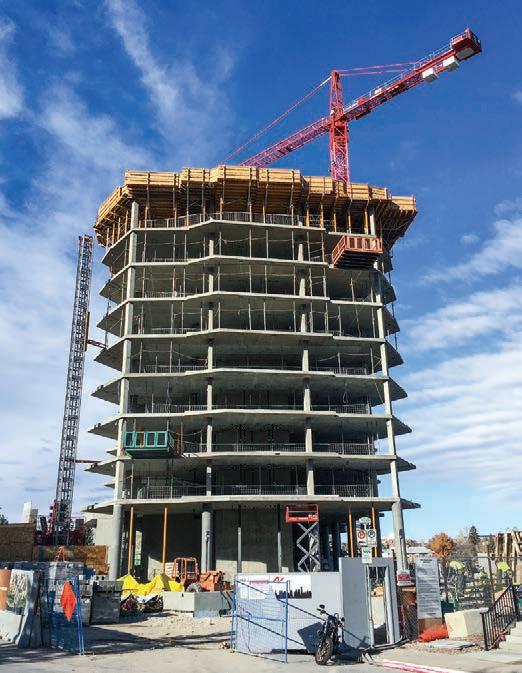
Over the decades, admixtures have played an increasingly important role in improving the integrity of building envelopes, as well as repairing faults. “The idea of basements essentially being tanks is relatively new and is the result of more and more cities prohibiting the drainage of water into storm systems,” says Kevin Yuers, VP product development at Kryton International.
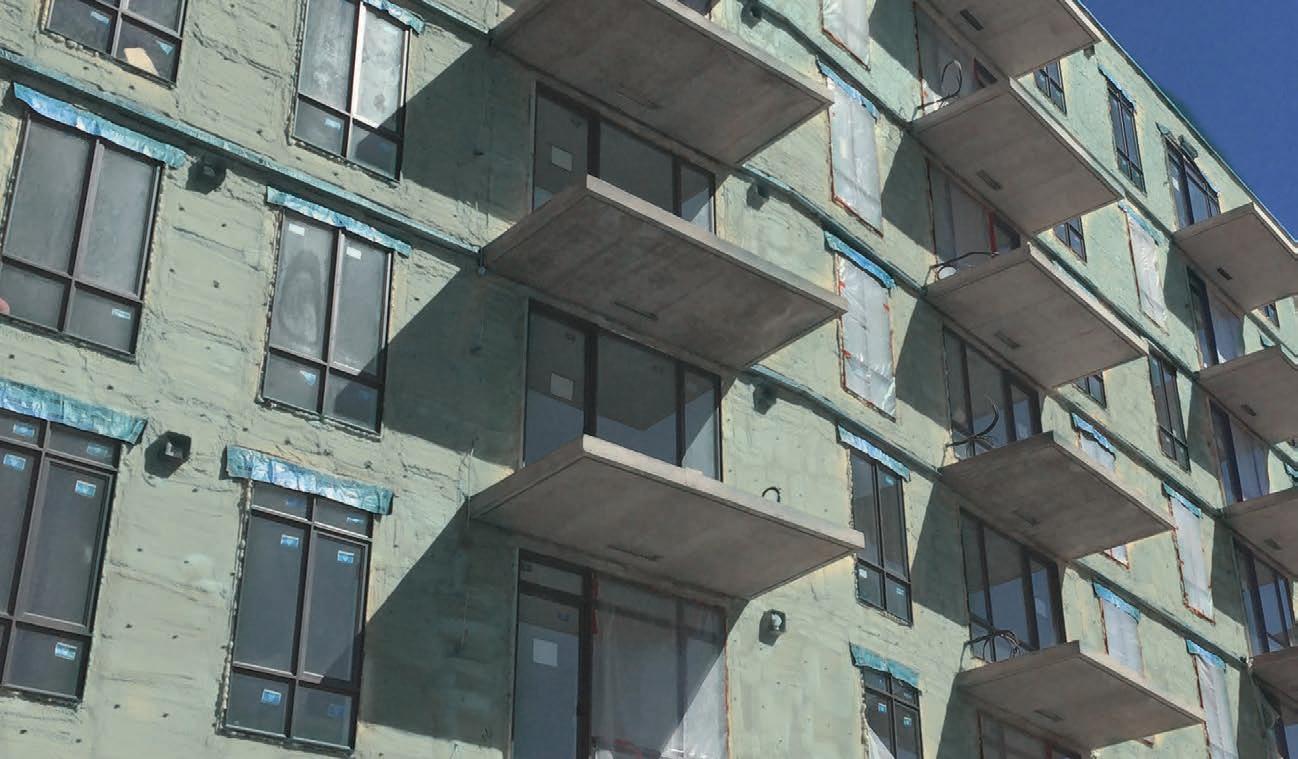
Kryton famously enabled basements to become watertight via application of its Krystol Internal Membrane (KIM), a hydrophilic crystalline admixture that lowers the permeability of concrete and is used instead of surface applied waterproofing membranes. KIM’s Krystol technology chemically reacts with water and un-hydrated cement particles to form insoluble needle-shaped crystals that fill capillary pores and micro-cracks in the concrete, permanently blocking the pathways for water and waterborne contaminants.
Recent projects of note relying on KIM are Concord Gardens from Concord Pacific, the residential estates of which “are built well into the water table, which in Richmond is typically right at ground surface level,” according to Yuers; the high-rise Capstan Village from Pinnacle, also in Richmond, and Concord developments beside Calgary’s Bow River. “Concord recently advertised that its basements were waterproofed with the same technology our company used on the Site C Dam, which was very complimentary,” Yuers says.
Yuers goes on to note that while Kryton doesn’t get heavily involved in building envelopes above grade, “We still offer Hydrostop, a high-performance penetrating sealer used by itself to protect concrete, brick, mortar, and masonry from the damaging effects of water intrusion.” Hydrostop contains a unique blend of silane and siloxane compounds that chemically react with silicates below the surface of the substrate to form an insoluble, waterrepellent barrier.
Finally, Brian Salazar, national business development manager with Euclid Canada, reports that on the repair side of building envelope business his company “is supplying repair products for a lot of residential and commercial buildings as well as admixtures for new precast buildings in Ontario.”
One product in particular is EucoRepair V100, a single component, fast setting, very low shrinkage mortar for trowel applied vertical and overhead concrete repair. EucoRepair V100 contains microfibre, unique additives, and a specialty cementitious blend to optimize the physical properties that fight cracking. The result is a concrete repair material with exceptional engineering properties.
Salazar says, “Cracking is the most frequent cause of concrete repair failure, but EucoRepair V100 is a great solution for high rise facias and any exposed areas where rebar is showing.” This product provides resistance to drying shrinkage, while microfibre provides three-dimensional reinforcement and increased tensile strength. It is also polymer modified for strong adhesion, improved elasticity, and resistance to creep.
Also from Euclid Canada is EucoRepair SCC, a pourable and pumpable selfconsolidating concrete repair mortar that can be placed from 2.5 centimetres up to full depth without extending with aggregate. Salazar says, “It quickly spread into place, filling formwork and encapsulating reinforcement without the need for mechanical consolidation such as vibration.” A
Speedwall modular exterior wall system specified for the TELUS Ocean building, Victoria, B.C.
Krystol Internal Membrane in use at Concord Gardens, Richmond, B.C.
Sustainable


Meet



Approaches
to Abrasion and Erosion Resistance
Use
Reduce
Postpones



























































































































































SOLID DEFENCE
The
metal roofing and cladding industry shows resilience with larger projects and high-performance designs
by ROBIN BRUNET
The more things change, the more they stay the same: that is the case with the metal roofing and cladding market in 2023, and it’s a good thing inasmuch as the elements characterizing the sector over the past number of years – strong sales growth, strong variety of product, and the growing appreciation of high performance and sustainable design – are evident today.
With regard to the concealed fastener metal roof market, Doug Wells, RoofStar Technical Advisor at the Roofing Contractors Association of British Columbia (RCABC), recently examined his association’s database with the expectation that guarantees issued on metal roofing were increasing. “We looked at two blocks: 2017 to 2020 and 2020 to 2023,” he says. “Interestingly, we had the exact same number of projects in each block. But there was a 40 percent increase in squares – a square is a 10-foot by 10-foot area – between the two time frames, meaning that while we don’t have more projects today,
we do have bigger projects.” RCABC offers the only third-party comprehensive metal roof guarantee in the industry.
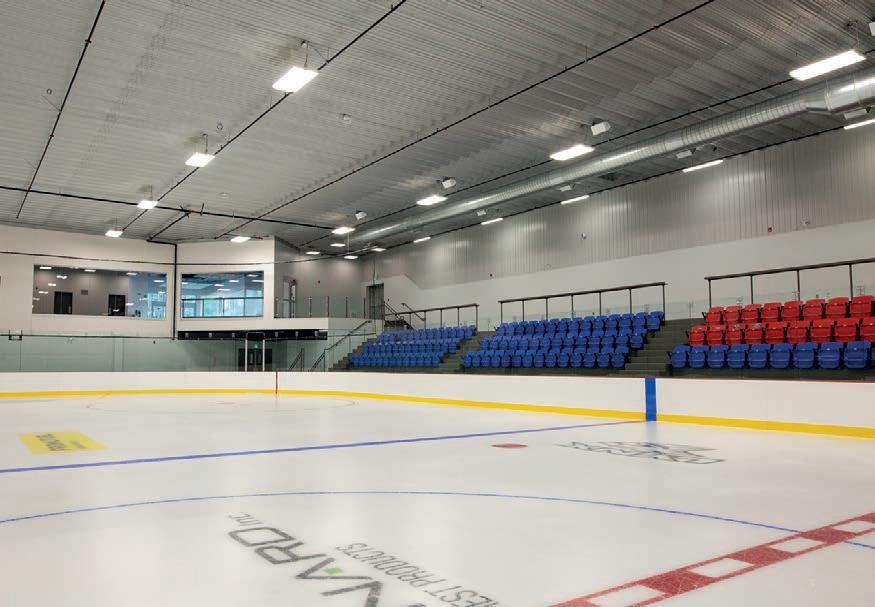
One of those projects is the newly named Rosemary Brown Arena (formerly the South Burnaby Ice Arena), designed by hcma and consisting of 87,000 square feet of space, two full NHL-size ice sheets, and a complex metal roof (with exposed mass timber beams) of various planes and geometries.
Wells goes on to note that, “We’ve also been working with Studio One Architecture on numerous schools. A school in Surrey is replacing a barrel skylight with a metal panel roof that will have a seven-foot elevation and a 14-foot radius engineered by Rimkus Consulting; and Ladner Leisure Centre is getting a replacement roof designed by FaulknerBrowns Architects, all installed by active RCABC members.”
Wells says, “There was no market slowdown during the COVID lockdowns and there is every possibility of growth in the foreseeable future thanks to the desire for metal roofs to provide longer
life cycles in schools and other government institutions, warehouses, and civic arenas.”
The metal cladding sector is no less robust.
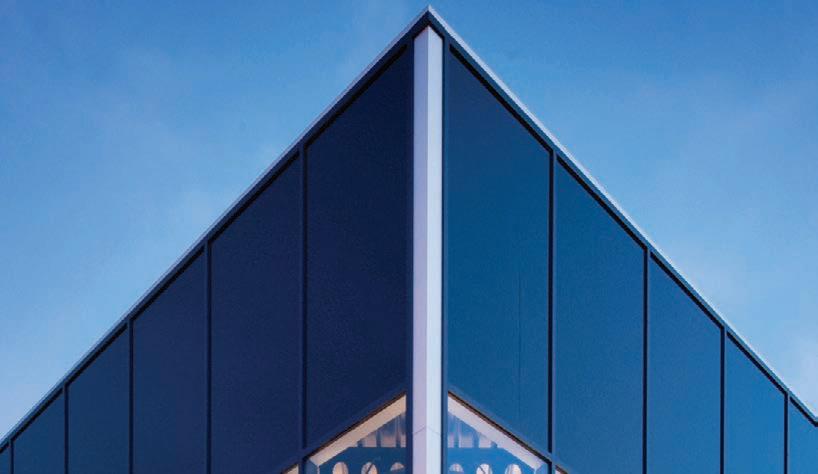
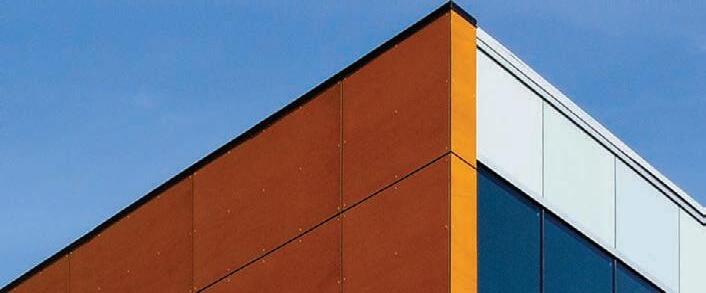
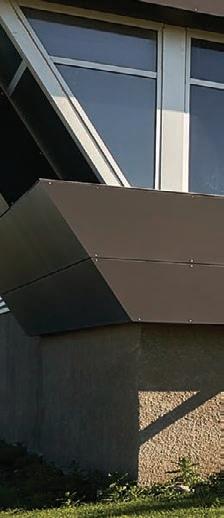
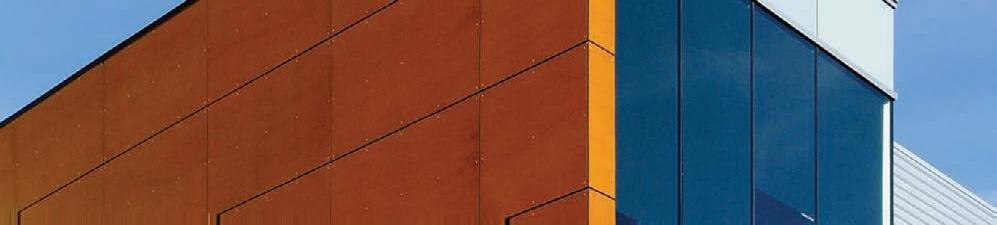
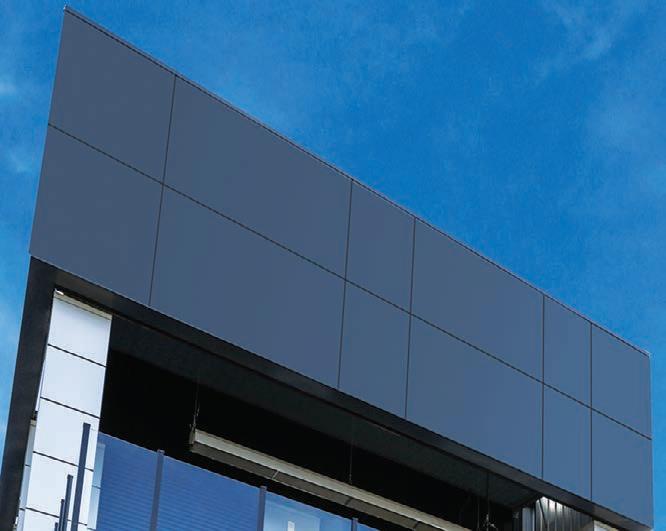
Sobotec, North America’s largest fabricator of metal composites and one of the largest manufacturers of engineered panel systems, recently provided full window wall and integrated aluminum plate panel façade along with other areas of field-installed aluminum plate panels and siding for the 30-storey McMaster University Graduate Student Residence, which is scheduled to open this September.
The building is designed to meet LEED Gold standards and contributes to the ongoing revitalization of downtown Hamilton, with Diamond Schmitt Architects using metal to create a unique lightcatching textural treatment (each vertical strip of cladding is composed of two projected right angled triangle segments that meet on a diagonal line, either creating shadows or reflections, and giving the building a twisting appearance).
Also nearing completion is Transit City 4 and 5 by CentreCourt and SmartCentres, for which Sobotec
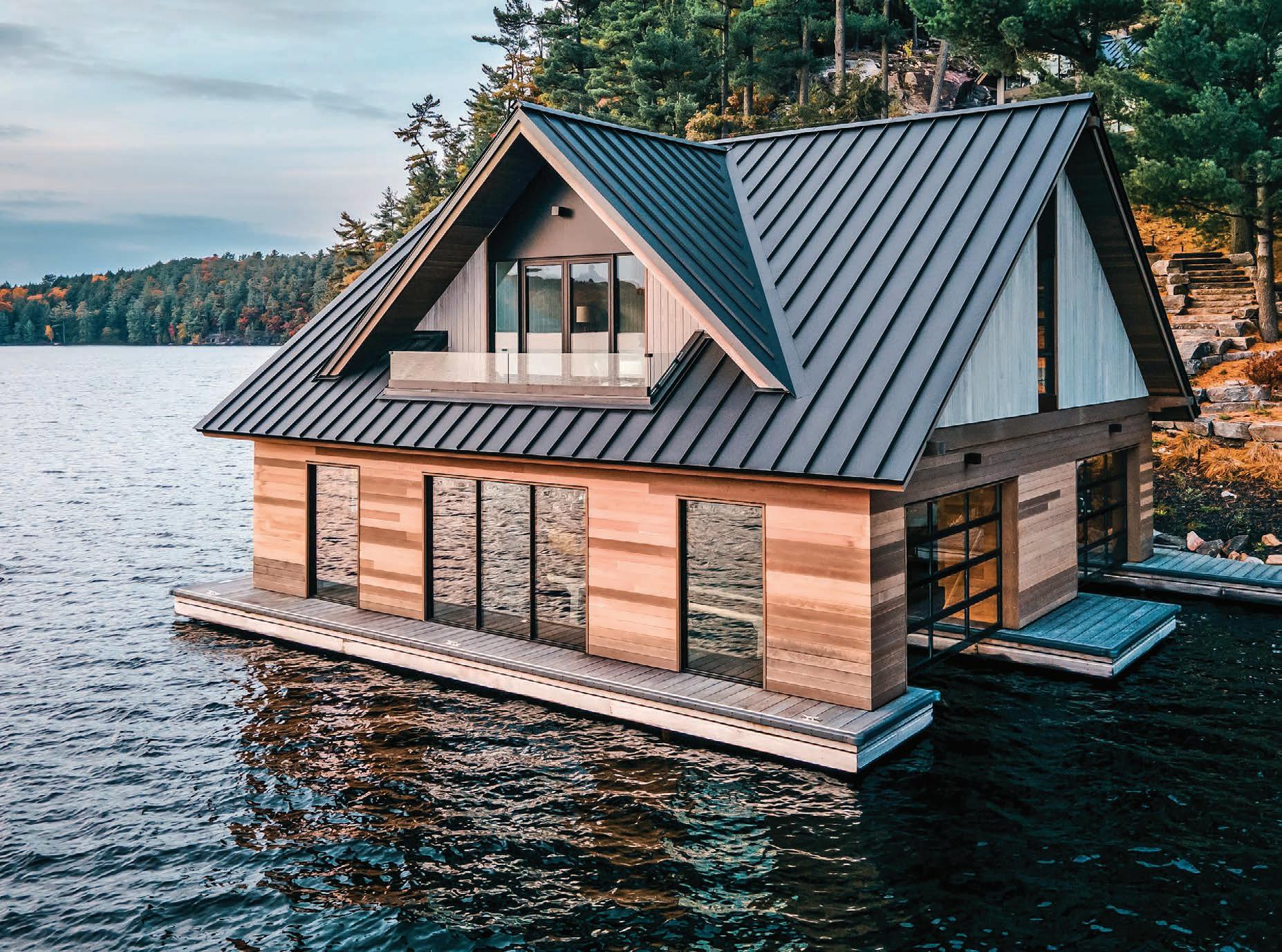
Cascadia Metals’ pre-painted PVDF (polyvinylidene fluoride) steel roofing.














has provided about 25,000 square feet of Aluminum Plate Panels (SL-2000P) along with 10,000 square feet of Stainless Steel Plate panels and 10,000 square feet of Siding. Diamond Schmitt created unique spiral designs and metal panel borders for the 45 and 50-storey edifices, part of the multi-tower Vaughan Metropolitan Centre development.
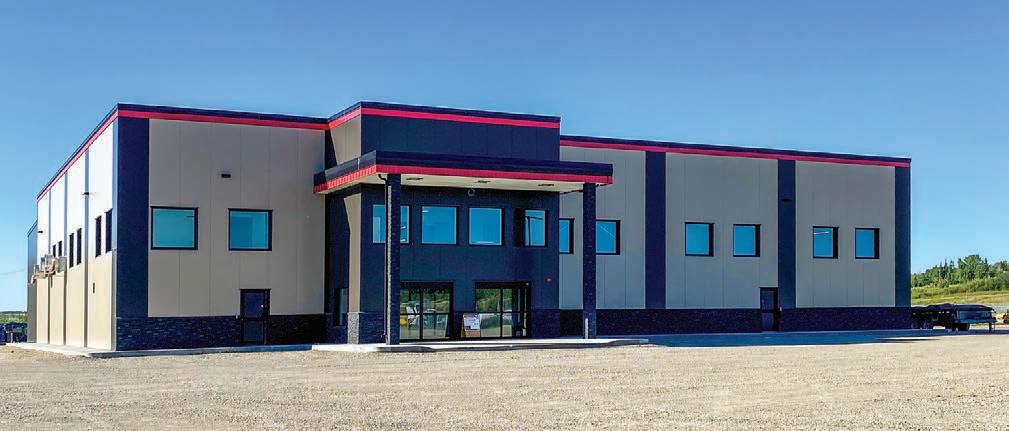
Sean Lepper, VP and general manager at Behlen Industries, echoes the sentiment of his colleagues by noting that, “Business is still strong despite rampant inflation, with metal roofs and cladding being specified for industrial, commercial, recreational, and many other types of projects.
“The biggest challenge overall, and the biggest change in how things are done in this sector, is the ‘new’ energy code, first introduced in 2020, and now coming into effect. Essentially it increases the amount of insulation required for new builds, and that’s driving a lot of thought into how to create wall and roof cavity expansions.”
Lepper goes on to note that “fortunately steel buildings are highly adaptable” and can accommodate this expansion of space “in a cost-effective




manner, in most cases. What it requires is a combination of research and development and testing, in order to ensure that the space created to add more insulation is structurally stable. It also requires some thought with regards to the actual construction process, as added insulation could require a substantial increase in labour for larger-scale projects.”
However, Lepper says there is opportunity to explore insulated metal panels as an option with Behlen, with the potential to offset some additional costs such as the cost of increased labour needs overall: “At Behlen we’re enjoying great success in serving
our various markets, and we’re confident we’ll be able to meet all of the new code requirements.”
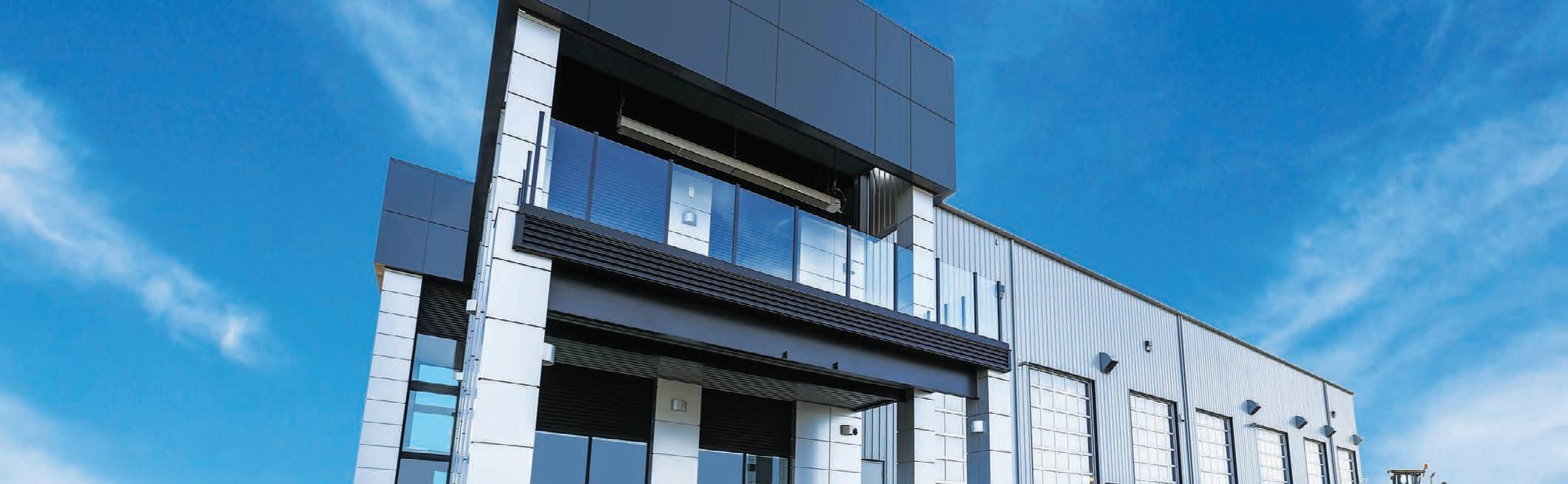
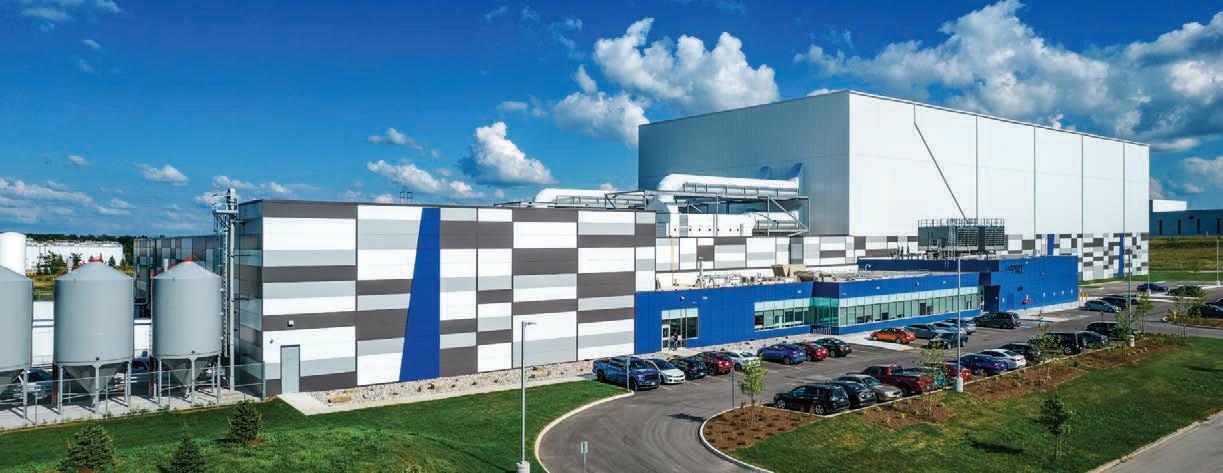
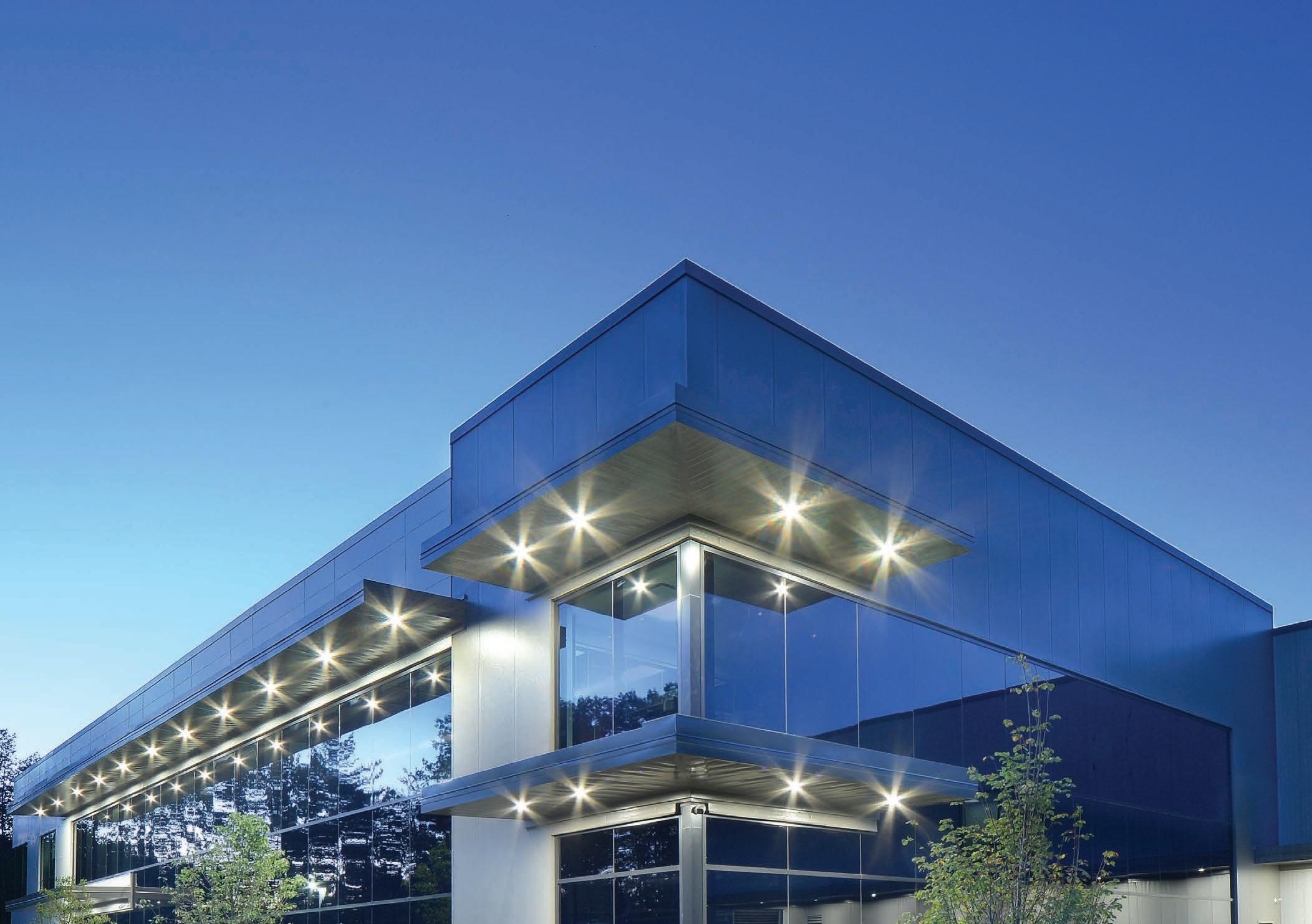
Of course, metal cladding providers have become well known for their insulated metal panel products that go a long way in boosting a building’s energy efficiency. The insulated metal panels and facades available from Kingspan cover a wide range of needs, from projects requiring bold architectural expressions to those large in scale. An example of the latter is the Aspire Food cricket farm and processing centre in London, Ontario, the largest facility of its kind in the world at 165,000 square feet. This project required constant temperatures for insect breeding and storage, and Kingspan’s KS Shadowline interior panels, which deliver the highest R-values on the market and are specifically engineered for controlled environments, were sourced. Also, Optimo panels integrated seamlessly
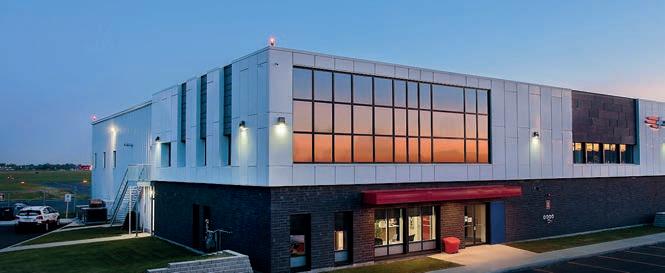





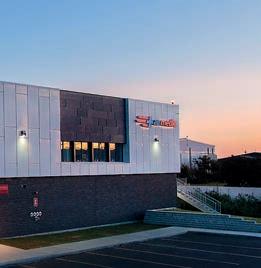
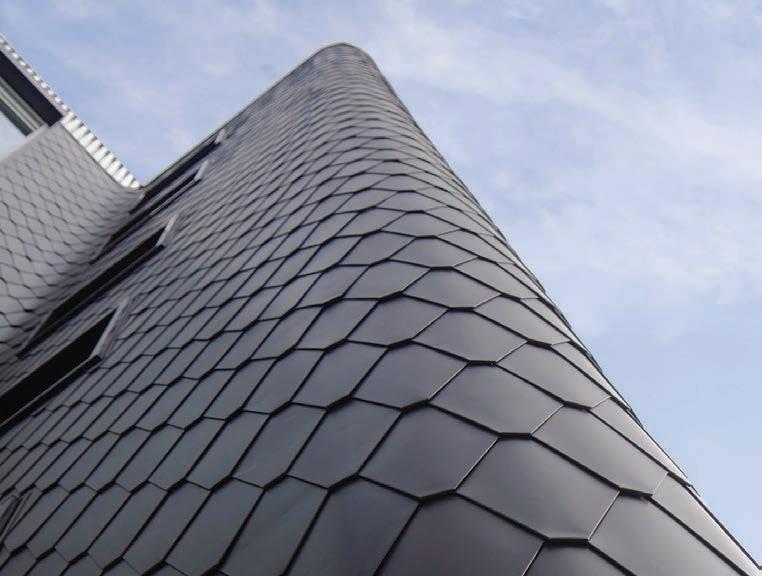


Waywayseecappo First Nation Food Mart, Waywayseecappo, MB
Aspire Food cricket farm, London, ON
EXPERIENCE THE NUCOR ADVANTAGE
As the construction industry has grown more sophisticated, so has the versatility of custom metal building systems. By adopting advanced tools, practices and products, Nucor Buildings Group actively evolves to meet industry demands. Metal building systems are flexible by design and can be tailored to fit the needs of any market, offering the ability to incorporate energy-efficient products like insulated metal panels and advanced insulation systems alongside architectural elements such as stone and glass.
Whether your building is architecturally complex or value engineered, from a 1-million square foot mega project to a small specialty building, we work together with our Authorized Builder Network to offer products and solutions that bring our customers’ dreams to life.

with the KS Shadowline panel joints, providing the airtightness necessary to ensure a steady temperature and a flawless transition between different areas of the processing centre (it also allowed for colourful accents in the exterior design).
In terms of sheer visual appeal, the three-storey addition to Mandeville High School in Louisiana is a prime example of the ability of Kingspan’s Designwall Insulated Metal Panels to create a bold look with custom colours, while integrating into translucent glazing (the Designwall 2000 architectural panels used for the project not only enhance creative freedom, with horizontal and vertical application capability, they also provide maximum thermal efficiency while creating a double barrier against air and water penetration).
North Carolina-based Nucor Corporation bills itself as “North America’s most sustainable steel and steel products company,” and as such it continues to pursue carbon reduction goals (it already has a carbon intensity less than one-third of today’s steel mill average globally), and it continues to make advancements in steel products, the latest of which, Elcyon, is the world’s first sustainable steel plate for offshore wind projects (it has a recycled content in excess of 90 percent and is produced with ¹⁄5 the global blast furnace average for greenhouse gas emissions).

With regard to Nucor Corporation’s heavy involvement in building construction, Adam Scott, senior district sales manager at Nucor Buildings Group, says, “While we’re known for contributing to large-scale projects with large amounts of metal roofing and cladding, we love to fit in smaller projects too. One of our more fortunate strategies in recent years was to acquire two valued insulated metal panel legacy brands, CENTRIA and Metl-Span, which provide a full range of products to service high-end architectural applications in the cold storage and warehousing realms. Specifically, this enabled us to serve the quickly growing non-residential insulated metal panel category.”
Scott says that a new elevated roof insulation system, R-Boost, “is being used in a variety of projects, and the feedback we’re getting is that it is very easy to install. Equally important, this is a high R value solution to projects that must meet stringent energy efficiency codes.”
R-Boost’s unique patent-pending design features a bridge between an initial and secondary layer of blanket insulation, doubling the insulation capacity and meeting energy codes throughout North America. With the Nucor CFR roof panel, R-Boost can realize U-factors as low as 0.026, which in the US meets the requirements of IECC 2018 (Climate Zones 1-8) and ASHRAE 90.1-2016 (Climate Zones 1-8). Moreover, it is designed to work with Nucor Buildings Group’s SS360 roof system. Both the CFR and SS360 panels are well known for their performance, strength, and weather tightness. Nucor CFR and SS360 panels have been tested and approved by Factory Mutual and Underwriters Laboratories for wind uplift as well as hail and fire resistance, and when used in combination with R-Boost, this system provides the highest potential for total building system cost savings (plus, on average, R-Boost installation costs are considerably lower than that of competing systems).
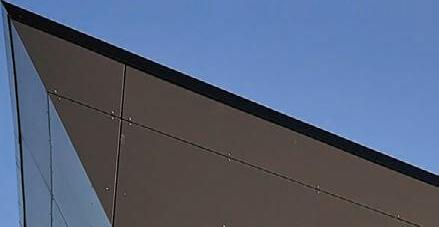
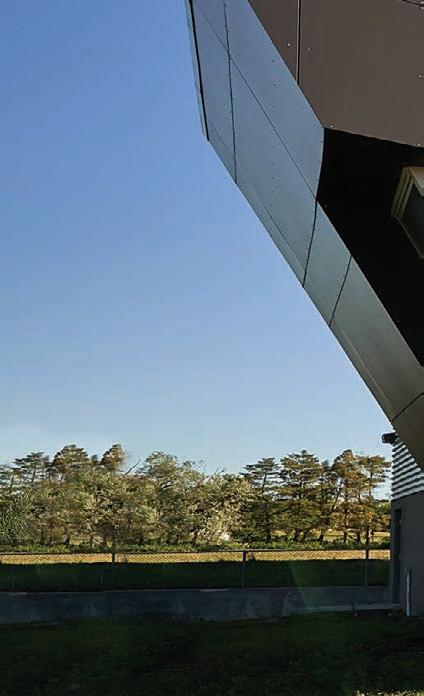
Companies specializing in metal products and components continue to evolve in 2023. Cascadia Metals, the premium metal distributor of coil and sheet products, announced earlier this year that it is now manufacturing a new line of products at its Tubular Division in Brandon. All told, Cascadia’s output in addition to coil and sheet metal includes HSS tubing, merchant bar, rebar, expanded metal, wide flange beam, galvanized fence pipe, and UL/FM rated sprinkler pipe. But Cascadia’s pre-painted PVDF (polyvinylidene fluoride) steel products are of special interest to architects. Available in coil and flat sheet, these products are galvanized and 55 percent aluminum-zinc alloy coated substrates and come in a variety of popular colours, fully supported by industry competitive warranties.
PVDF is a highly non-reactive and pure thermoplastic fluoropolymer used in a variety of applications where the highest purity, strength, and resistance











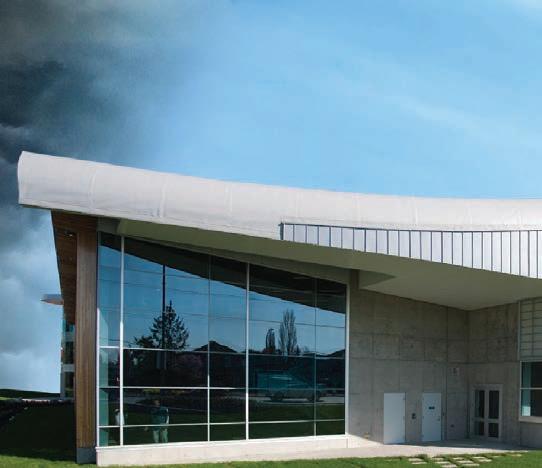






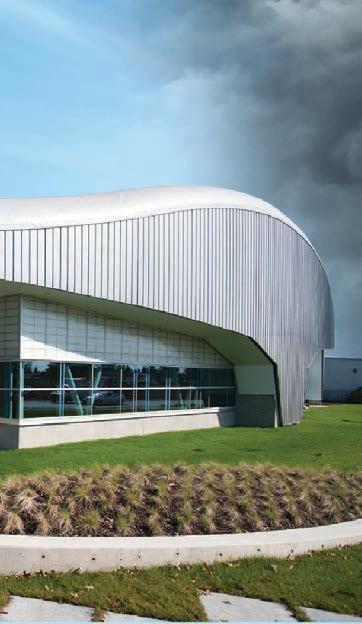


Nucor CFR roof panels, Aerocentre 2, Edmonton, AB.

to solvents, acids, bases, and heat are required. As an added bonus, PVDF has the ability to selfextinguish and generates little smoke in the event of a fire. Designers typically specify PVDF not only to achieve colour vibrancy but also because of the added benefits of flexibility, durability, and low maintenance that only steel can provide.
The metal roofing panels from PAC-CLAD Petersen, a Carlisle company, are coated in PAC-CLAD PVDF coating, applied to both steel and aluminum and originally developed for use in abrasive environments. The PAC-CLAD architectural panels for metal roofing systems are produced in factory-formed lengths of up to 55 feet and have PAC-CLAD Kynar 500 finishes available in 45 colours.

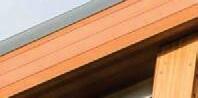
An example of how PAC-CLAD products can contribute to projects requiring a classic appearance is the Coastal Georgia resort hotel on Jekyll Island off the Georgia coast. The hotel’s design featured plenty of outdoor eating and drinking spaces sheltered under spacious overhangs, but these overhangs face the elements all year and required some attention when it came to materials selection. Architects with Ontario-based Chamberlain Group opted for flush aluminum panels installed to look like an old-school clapboard ceiling.
To source those panels, the architects, along with installers Thorne Metal Systems, relied on PAC-CLAD Flush panels for the building’s soffit and overhanging outdoor ceilings. Fabricated from .032- and .040-gauge aluminum, all the panels were finished in Stone White to emphasize the project’s clean, crisp lines.
Finally, Longboard Architectural Products has established itself as a reputable manufacturer of high-quality cladding and soffits for the past 15 years. With a commitment to excellence, the company oversees the entire manufacturing process in-house, from extrusion to powder coating and finishing.



Offering three distinct cladding and soffit systems, Longboard prioritizes ease of installation, sustainability, and superior craftsmanship. All its exterior products and systems are powder coated with AAMA 2604/2605 certified powder, guaranteeing resilience against external elements such as corrosion and UV rays. The systems are available in 12-foot or 24-foot lengths, equipped with a quick screen clip for convenient installation, and offer perforated plank/ panel options and a range of trim choices, including Traditional, Precision, and Craftsman styles.
Longboard’s product lineup also includes a rainscreen system, which is gaining popularity throughout North America. These wall assemblies feature drained and back-ventilated (DBV) rainscreen cladding, effectively managing water and moisture while simultaneously preventing radiant heat gain. Furthermore, they accommodate continuous exterior insulation, improving thermal performance, and contribute to better Indoor Environmental Quality (IEQ).
For those seeking enhanced thermal performance, Longboard’s cladding attachment system, Hitch, stands out. Compatible with any of the aforementioned systems, Hitch offers a thermally broken and intermittent structural approach. Hitch utilizes thermally efficient materials and robust clips, resulting in reduced material requirements, improved thermal efficiency, and significant labour savings. Achieving thermal efficiency levels of up to 94 percent, Hitch can attain effective R-values that surpass R-60, making it an ideal choice for those prioritizing energy efficiency. A

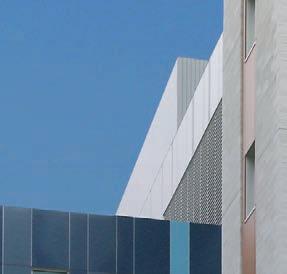
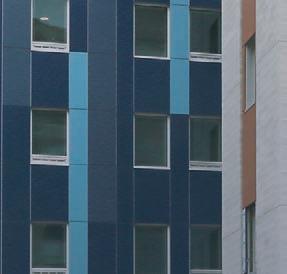







Cascadia Metals’ pre-painted PVDF steel cladding.
PLAYING TOGETHER TO GIVE SUPPORT FOR BC’S KIDS
BC Children’s H osp i tal Foundation would like to thank t he following sponsors and all participants of the 28th A nnual Building for Kids Charity G olf Clas s ic which took place on T hu r sday July 20, 2023.
This sold out event hosted 144 golfers from across the construction and development industry in BC , for a fun filled day at Beach Grove in Tsawwassen, BC.

This year’s tournament successfully raised $472,000, adding to the tournament’s cumulative total of $4.1 million to date. Funds raised will help us enhance the physical space of the Heart Centre to create a more comfortable and healing environment for patients and their families.
For a full list of supporters and to learn more about the event please contact golf committee chair Gavin Yee GYee@ventanaconstruction.com or visit bcchf.ca/bfk
TOURNAMENT SPONSORS

























Heart Of Stone
Harnessing diversity and innovations to thrive amidst inflation hurdles in the masonry sector
by ROBIN BRUNET
Even though masonry is arguably more vulnerable to inflation than other building materials – one example being brick, whose popularity is at least partly driven by developers willing to pay a premium for the product – the category remains resilient in 2023.
For example, Basalite Concrete Products gives developers a huge range of options in building design, not just in terms of diversity of products (ground face, smooth, and split face concrete blocks are part of a masonry range that includes brick, deck blocks, and wall caps) but also advice to contractors and architects regarding everything from suitable admixtures to customized mix designs.
As for innovation, new for 2023 from Endicott are Invisi-Lug clay pavers, whose recessed lugs provide a host of benefits including proper joint spacing to eliminate chipping, as well as the creation of crisp, square edges. The design also eliminates the need for plastic spacers (which on large projects can be a notable expense) and speeds up installation times, with accurate spacing of joins easily achieved.
As with all Endicott products, Invisi-Lug comes in a variety of vibrant colours – including ironspots – that other materials can’t mimic. Equally important is the product’s high durability and incredibly high compressive strength.

Gerald Martin, technical representative at Mutual Materials, echoes the sentiments of many colleagues in the masonry trade by stating, ”Yes, prices overall are going up in the back end, but demand remains strong. Business for us is brisk in 2023, which reflects a healthy economy.”
Accompanying this is something most masonry providers relish: consumer trends that keep manufacturers busy. “With bricks, we’re seeing a growing number of projects in which three blended colours have been specified, something that has been commonplace down south in Seattle and Portland for some time now,” Martin says. “One such current project is the Burnaby Alliance Church, whose architect we worked with to determine the right colours: Seattle Cream, Limestone, and Desert White. The Church is also providing the opportunity for another design trend: the creation of a brick screen wall on one side of the building that allows light to spill into the parkade area.
“Our brick products have also been sourced for the Richmond Centre revitalization, another project in which the architects went with blended brick colours. The same applies to a Kingsway condo development project currently under construction.”
Martin points out that one reason the market for brick continues to grow is that “pockets of cities are being revived and reimagined, and nothing beats brick for imparting warmth and elegance. We’ve also gotten an order for the new Bridge Studios on Lake City Way in Burnaby, a prime example of an ‘industrial’ facility that incorporated brick to reflect a modern design.” Bridge Studios-Lake City will have over one-million-square-feet total floor area, including 21 sound stages, 330,000 square feet of support space, and 150,000 square feet of production office space.
Several years ago, General Shale, the North American subsidiary of Wienerberger (the world’s leading supplier of building materials and infrastructure solutions) acquired Meridian Brick. Today, the rebranded Canada Brick continues to deliver the tremendous product quality that the company was known for since the 1950s, with Red River, General Shale, Columbus, and other products constantly being specified for a wide variety of projects.
Canada Brick recently unveiled new residential brick colours: Hazelton (warm off-white with delicate distressing), Dakota (which exhibits a unique, vertical striated detail reminiscent of watercolours), and Steel City (variable grey with a soft mottled finish, perfect for natural wood or black accents).
King Klinker Thin Brick from I-XL Building Products.
Brickwork detail, Burnaby Alliance Church, Burnaby, B.C.





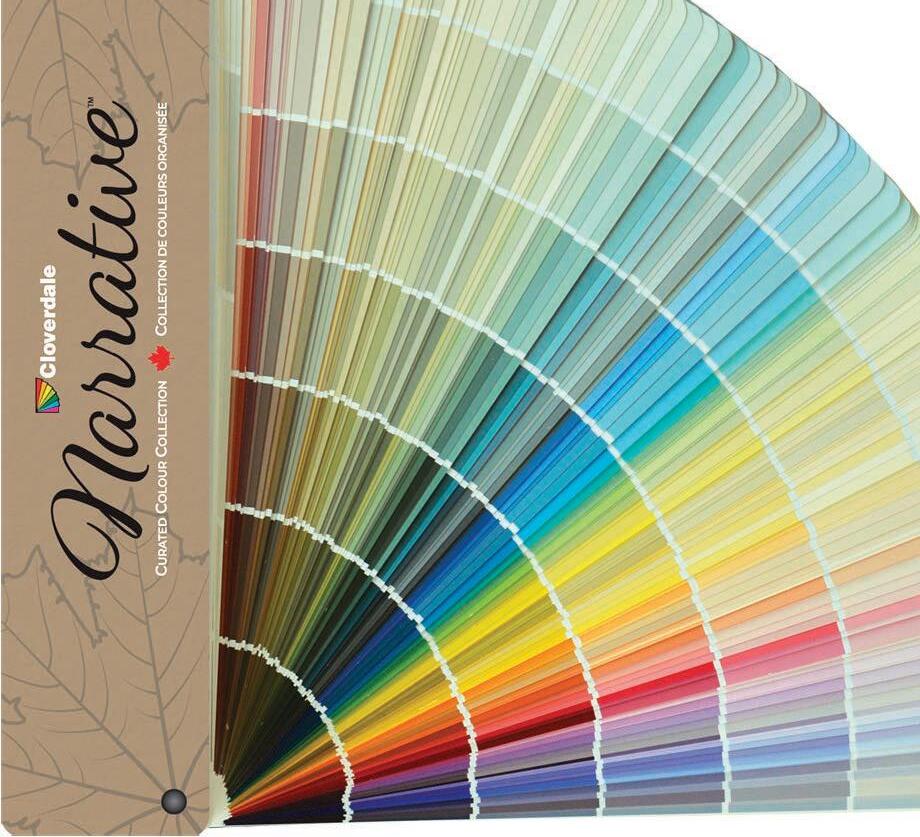
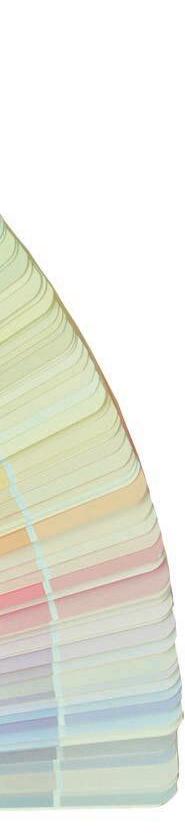
WHAT’S YOUR Colour Narrative?
Urban or Rustic?
Neutral or Colourful?
Modern or Classic?
Find your Colour Narrative in our fullspectrum palette that captures more of the widely specified paint colours from across Canada, determined by our Customers and Colour Experts.






This line is in addition to the new architectural brick colours Creekside, Shadow Ridge, and Spring Hill (each coming in matt and velour finishes that lend a modern elegance to commercial and residential projects) as well as the new White Ash brick featuring an iron spot finish to impart an old-world character. Each of these Architectural Series products is available in Metric Modular, Imperial Modular, Quebec, Ontario, CSR, MAX, Metric Norman, Engineer Norma, and Metric Jumbo sizes.
Canada Brick is another company that is sourced to supply multiple shades of brick to bring projects to vibrant life, an example being the renovation of SaintNoël Chabanel School in Montreal that used three different shades of brown brick to create a spectacular diamond pattern wrapping around the exterior walls, further enhanced with colourful glazed brick insets. The pattern also serves as a target for ball games.
Joe Black, director of sales, Western Canada at I-XL Building Products, reports that in his company’s specialty as a wall material provider, “we’re enjoying expansion and growth. Projects are calling for multiple exterior building materials and have required building supply companies to become more diverse. Therefore, I-XL Building Products has expanded beyond masonry into metal cladding via MAC Metal Architectural, to compete for more wall share.”
That said, Black acknowledges the various trends in the masonry market. “With both manufactured and natural stone, larger format profiles are being specified in blacks, dark greys, and whites. Interior thin brick is really a growing trend, whether inside a home or in restaurants and retail stores, and we’re seeing a lot of rumbled /loft style/old world brick. For both residential and commercial applications, white brick and black brick with a manganese metallic sheen are very popular.”
Just as I-XL diversified into metal cladding, beyond its already existing clay brick product lines (Hebron Brick, Interstate Brick, and Endicott Brick) it also fortified its commitment to providing masonry products by becoming a distributor for King Klinker Thin Brick products throughout Western Canada.
As always, the best masonry manufacturers thrive by listening to feedback. “We get product ideas by listening to our customers, and we’re always coming up with innovative colours and sizes,” says Bradley Belden, president of The Belden
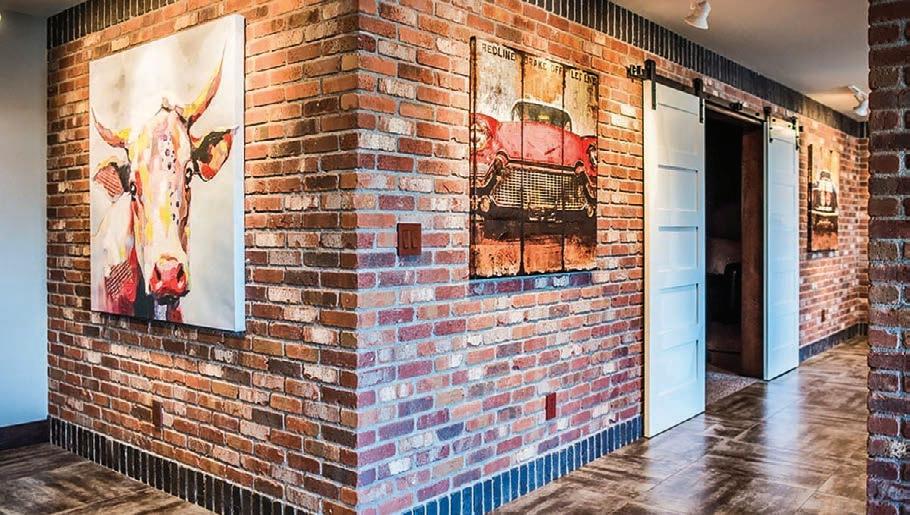


Hebron Americana Rumbled
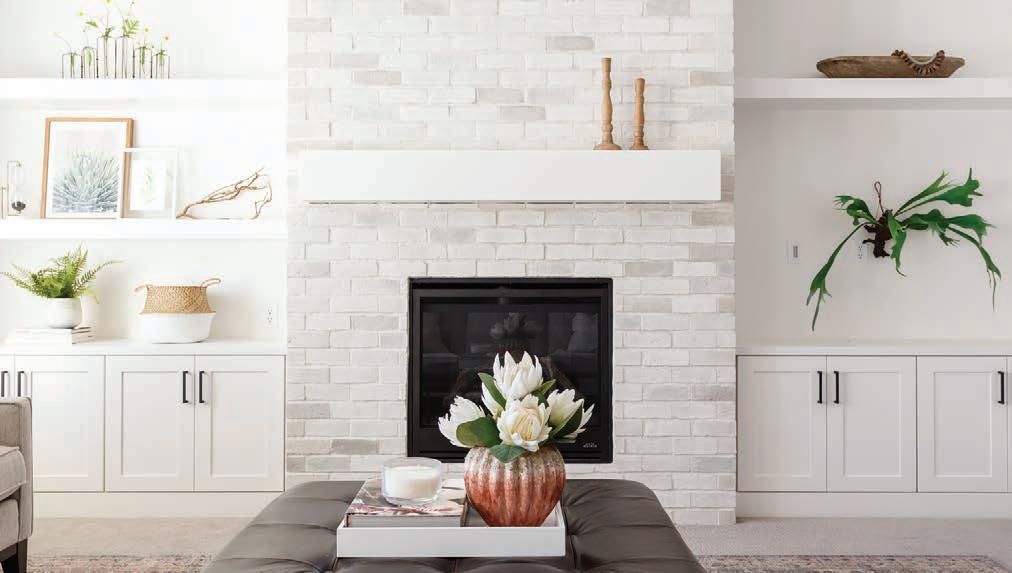
Eldorado Chalk Dust
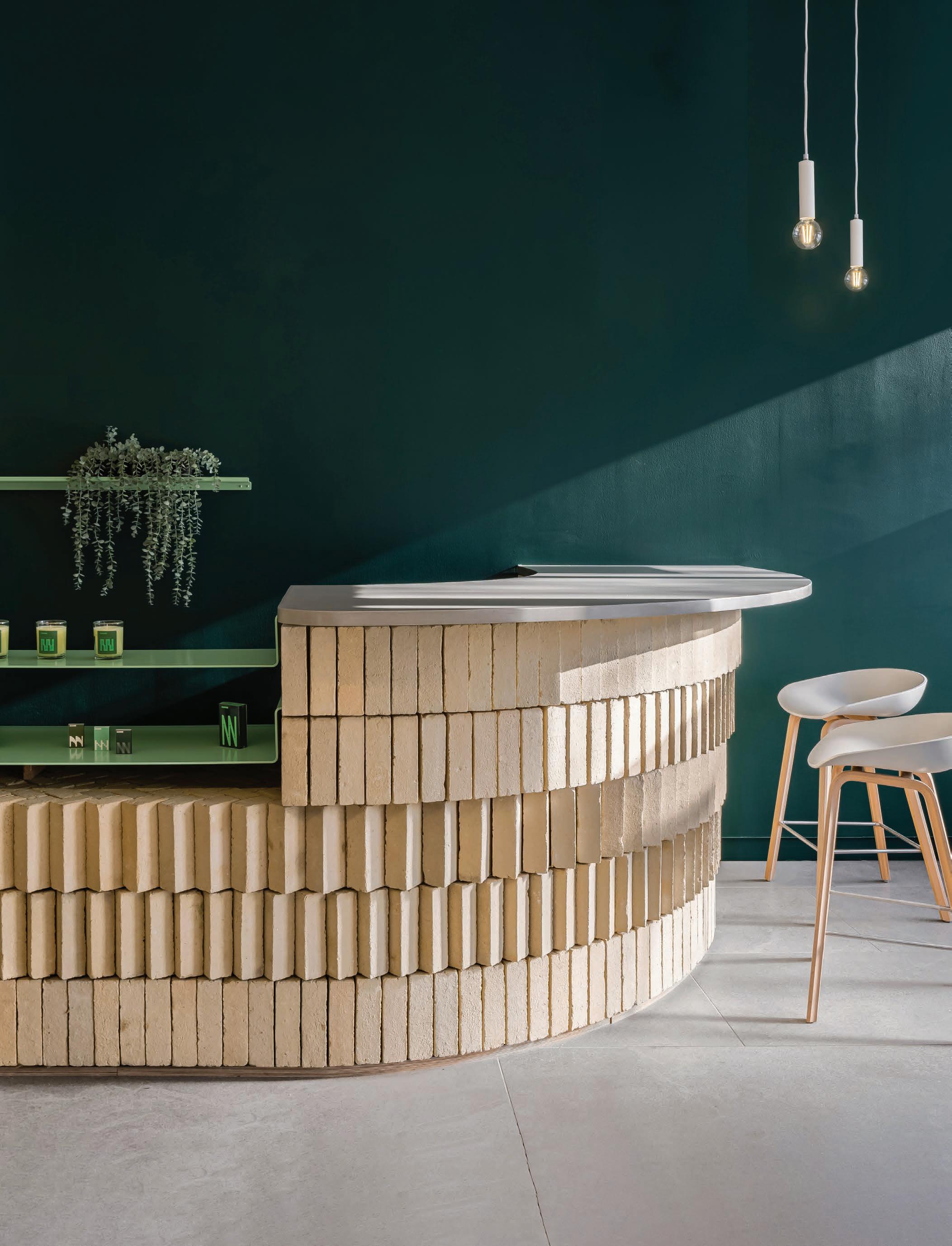
Brick Company in Canton, Ohio. “Overall, Canadians have been more likely than Americans to try new styles and push us to innovate, so it’s no surprise that in 2023 we continue to enjoy great relationships with our distributors in the north and strong demand for our product, even though high interest rates threaten to slow the residential market.”
Emerging from Belden’s five production plants yearly are up to 180 million bricks ranging in size and type from face, thin, oversize, and structural to special shapes, moulded, and more. “We’re small but mighty and aided greatly by a robust research and development process,” Belden says. “We’ve also dipped our toes in the coatings market with ceramic based coatings; we also automated one of our plants so we could dry our bricks prior to firing them in a kiln, in order to coat them and achieve a better, more resilient bond.”
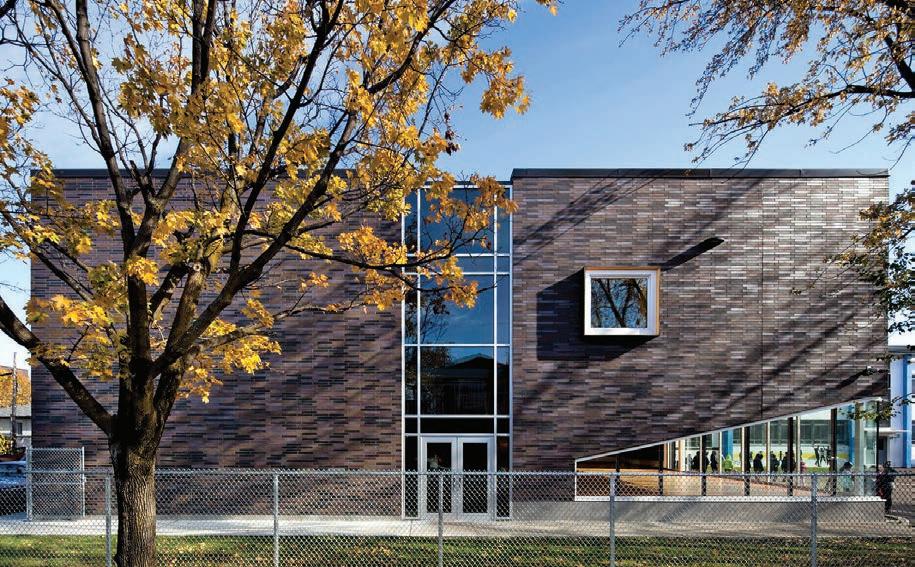
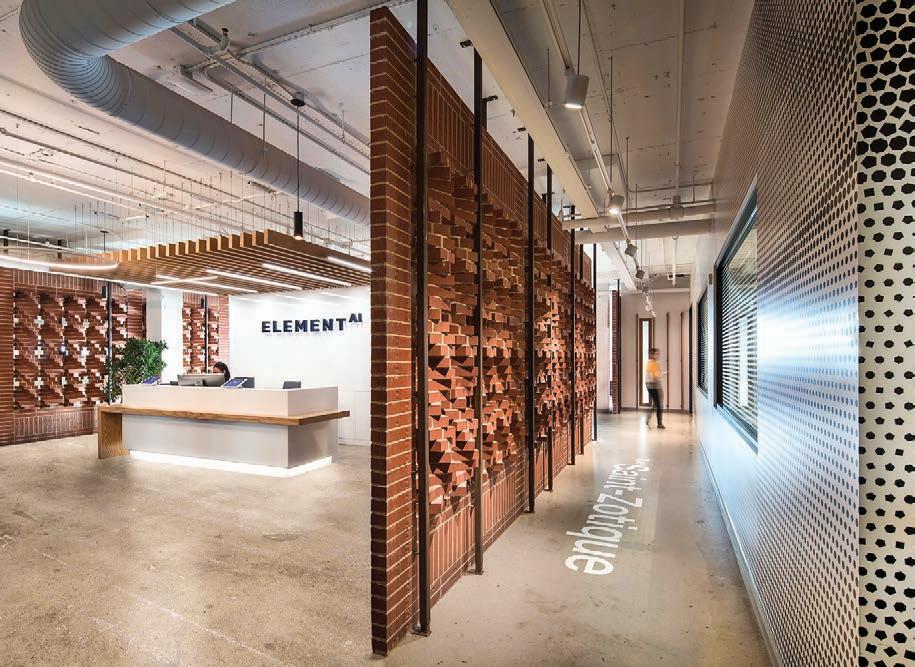
As Belden discusses trends (“we’re working on multi-colours on the same brick, but that product offering is still in the future”), he stresses the importance of developers appreciating the strong thermal performance of brick walls. “We’ve done a lot of work with organizations such as the National Brick Research Center [NBRC] and proven that brick walls carry heat into the night and coolness into hot days,” he says.
Testing with fixed temperature conditions conducted by the NBRC confirms that heat takes two to three times as long to go through a brick wall assembly than it does others. The brick wall’s heat storage capacity is twice the storage capacity of the brick alone. An NBRC test with varying temperature conditions proves that brick walls reduce heat energy movement by 60 percent over the closest competing wall assembly.
Additionally, a brick veneer wall assembly combined with continuous insulation is especially beneficial in cooler climates. Increasing the size of the air space allows continuous insulation to supplement the insulation between the studs, and the NBRC has found that a minor increase in the width of the foundation wall will permit including continuous insulation with no change to the building’s interior space or the exterior appearance. A


Custom Blend of Ashberry, Black Diamond, and Sienna Blend Velour brickwork, René-Guénette Elementary School Montreal, QC.
Commodore Clear Velour brickwork, Element AI offices, Montreal, QC.



Kitchen product manufacturers and suppliers are once again changing the way designers and consumers approach finishing what is arguably the centre of all homes. From imported stone to state-of-the-art technology, the options are boundless.
COUNTERTOPS
Caesarstone Canada unveiled its multi-material portfolio in 2023, with porcelain and stone being added to its current offerings of Quartz and Outdoor Quartz. The expanded portfolio of more than 100 colours tastefully combines the company’s innovative technology with its powerful design passion, empowering consumers to design with freedom. “This is a pivotal moment for Caesarstone,” says Ken Williams, president and CEO of Caesarstone The Americas. “We wanted to make it easy for people to design their dream spaces by offering our multimaterial surface solutions all in one place. Across the world, people choose Caesarstone because we bring joy and freedom to the design process.”
For the new Porcelain range, Caesarstone utilizes its technological expertise and design leadership to capture the visual qualities of a wide range of material types: from natural marble to the industrial aspects of concrete and metal. “The heightened veining, palpable textures, and dynamic patterns of the Porcelain collections are available in a highly curated range of 22,” Williams explains.
A Slice Of Design Heaven
Exploring the hottest kitchen trends and products of 2023
by LAURIE JONES
“Caesarstone’s Porcelain range is extremely hard material that will stay as strong as the day you have it installed.”
The Living Impressions Collection by Formica Canada offers designers a line-up of organic patterns, modern marbles, and a wide selection of 14 new sophisticated surfaces for elevated interiors. Following leading design trends, Formica’s new Residential Collection includes Light and White, Rustic Luxury, and New Classic. “Our homes have become so much more than just living space,” says Christelle Locat-Rainville, marketing director at Formica Canada. “Homeowners are craving simple, minimal spaces that bring them peace and calm, but they also don’t want their homes to feel austere. We’re seeing them seek out materials with natural textures like patina that feel clean while making a statement. And perhaps most importantly, these surfaces need to be maintenance-free and stand up to the rigours of everyday life and multipurpose use.”
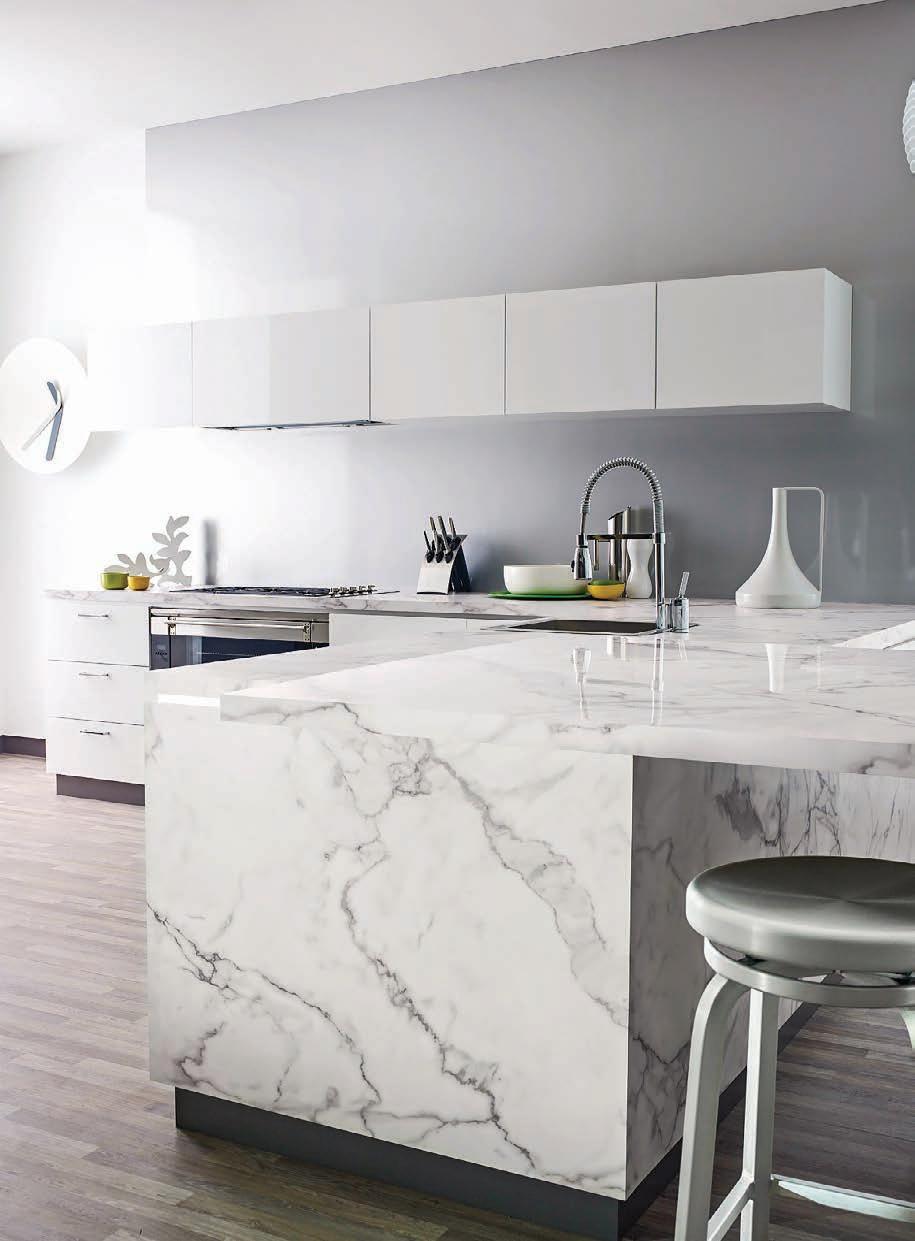
The new 180fx by Formica Canada is a revolutionary surface line that offers true-to-scale granite, stone, and woodgrain patterns with visual drama. Options include: White Alabaster, Manhattan Marble, Mediterranean Marble, Woodland Marble, and Marbled Gray.
The Formica Laminate designs offer surfaces that reflect natural materials such as wood and metal, while being durable, cost effective, and easy to install. Selections include the Patine Series, Patine Concrete, Patine Bronze, Burnished Coin, and Burnished Iron.
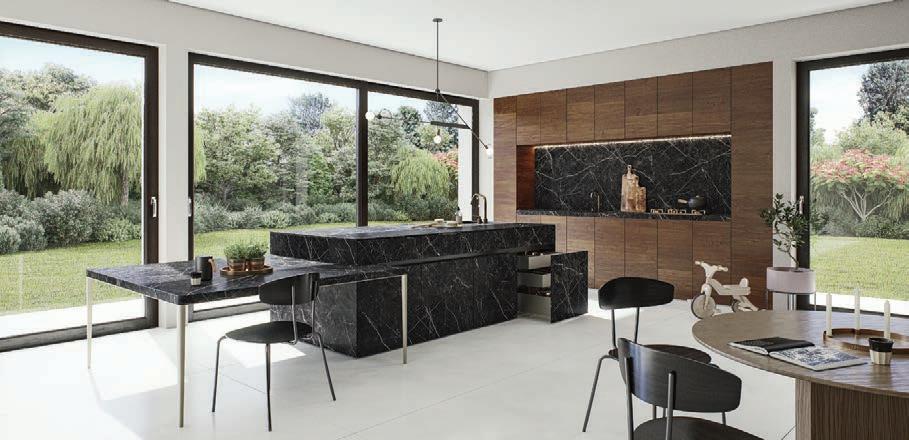
Laminam North America has launched its innovative Diamond Series that infuses light into the surface for a unique effect. The collection is comprised of two new colours, Calacatta Black and Cristallo Gold. Calacatta Black – available in Bocciardato and Polished Starlit surface finishes – captures the elegance of black marble, while incorporating a warm twist with subtle hints of beige. Cristallo Gold – also offered in Polished Starlit and Caress finishes – has a soft aesthetic and veins of beige, amber, and gold, emulating natural crystal patterns on a milky surface.
“Like all Laminam porcelain surfaces, Calacatta Black and Cristallo Gold do not absorb liquids or odours and are stain resistant, making them a popular choice for high-traffic interior areas and outdoor spaces,” says Philip Eeles, president of Laminam North America. “Additionally, the highperforming surfaces have antibacterial properties that prevent the growth of bacteria, making them a safe and hygienic choice for use in kitchens and bathrooms.” Laminam slabs are the first in the world to have obtained the Solid Surfacing for Food Zone certification for contact with food from the American National Standard for Food Equipment.
The Exotic Collection from Vicostone has introduced luxurious and regal surfaces that will make any kitchen come alive. The Tyrol design, inspired by natural Quartzite stone and sea cliffs, features multiple shades of white and dark grey veins. “These jumbo slabs are 130-inch by 65-inch and are available in thicknesses of ³⁄4-inch or 1 ¹⁄4-inch with a polished finish,” says Alicia Meeker, A&D account manager.
Formica in Calacatta Marble.
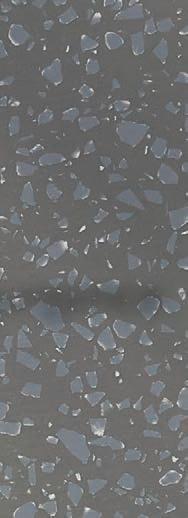
The new Porcelain range from Caesarstone in Smokestone.
System.
Everything. Except ordinary .
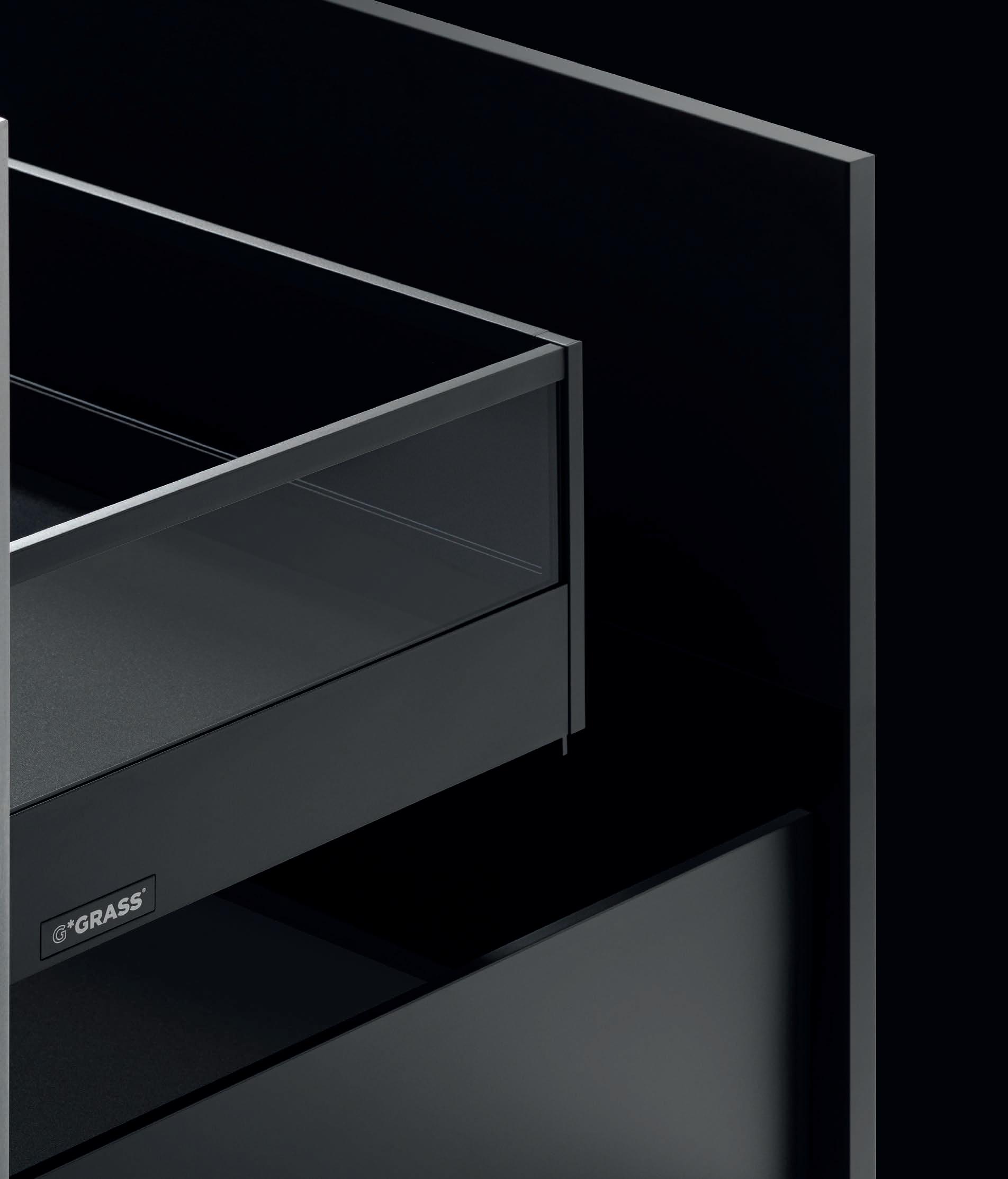
Until recently, the very idea of reducing a drawer side to 8 millimetres and, above all, making industrial production commercially viable would have been unthinkable. The new slim drawer system not only offers the only 8-millimetre one-piece steel drawer side in the world – Vionaro V8 is also the first pure-metal drawer side with no plastic elements. All parts are made of steel and joined using cutting-edge laser welding technology. That produces maximum stability plus longevity and ensures an almost 100 per cent recycling rate.
Vionaro V8 Slim Drawer
Vionaro V8 Slim Drawer System
Vicostone products are stain and heat resistant, with only mild soap and warm water required for clean-up. “Application options are only limited to your imagination, with many clients choosing to use quartz on their backsplash or shower surrounds, for a seamless and grout free option on vertical surfaces, as well as horizontal,” says Meeker. “Vicostone is proud to have many environmental certifications, such as NSF, Greenguard Gold, Declare, as well as a 15-year limited warranty.”
Exotic Stone Ltd. has been working with designers and suppliers to create outdoor living kitchens and JD Singh, owner, says the company can accommodate stone counters for any budget. “We get requests for all types of outdoor projects, from a simple barbecue surround to working counters to full, state-of-the-art chef kitchens. We have also done firepit projects.”
Singh explains while the colour choices vary, most often people are looking for dark tones that are less affected by weather. “We use the Dekton counters that are simple to install so we work with cabinet designers to get a perfect fit for customers.”
CABINETRY
Grass Canada Inc. recently introduced a state-ofthe-art drawer system – the Vionaro V8. “The V8, a revolutionary new drawer box system, is a wood drawer box substitute that is the thinnest double wall drawer box system on the market,” says George Pavlov, regional sales manager, Ontario. “This innovation means the system reduces the footprint that the drawer box occupies in the cabinet. The V8 drawer
system is only eight millimetres, compared to previous drawers, which would have been up to 1.25 inches away from the inside of the cabinet. The compact aspect maximizes the internal volume of the cabinet, and creates more storage in the actual drawer.”
With the constantly decreasing footprint in multi-unit homes, saving every millimetre means extra room and this makes a difference. “With an increase of 20 percent, that’s a lot of space and over the length of a kitchen, this gives the homeowners extra room for books, spices, or other items,” he says. The V8 comes in five heights and is available in three colours.
Sean Gerolimatos, director of research and development at Schluter Systems North America, notes that countertop trends have moved towards large thin tile format, eliminating the traditional grouted look. To accommodate this new fashion, Schluter offers the Kerdi-Board, an extruded foam board with a polystyrene core. “Our Kerdi-Board for kitchen countertops is either one-and-a-half or twoinches thick, and are easy to cut,” he explains. “This creates a waterproof, flat, ready-to-tile substrate, which saves a lot of time during installation.”
Gerolimatos adds that using their profiles with the larger tiles creates a smooth transition for the front of the countertop as well as the transition to the backsplash. “This also enables installations similar to undermount sinks using stone countertops, but the same result can be done with tile.”
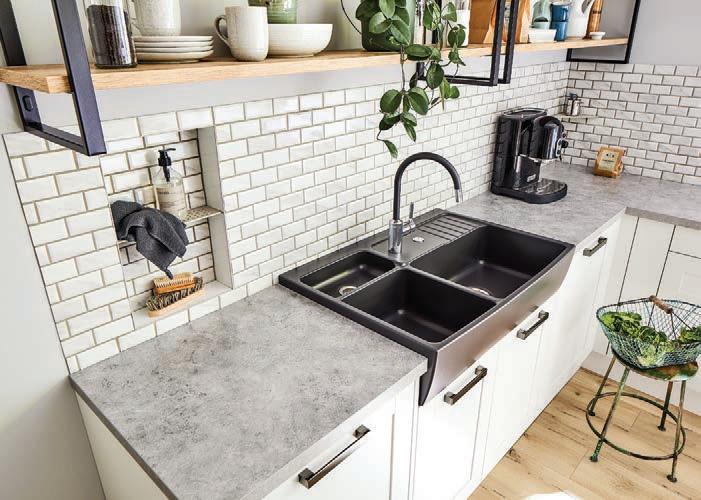
Another Schluter product that is enhancing kitchen designs are stylish metal shelves. “These are either stainless steel or powder coated aluminum
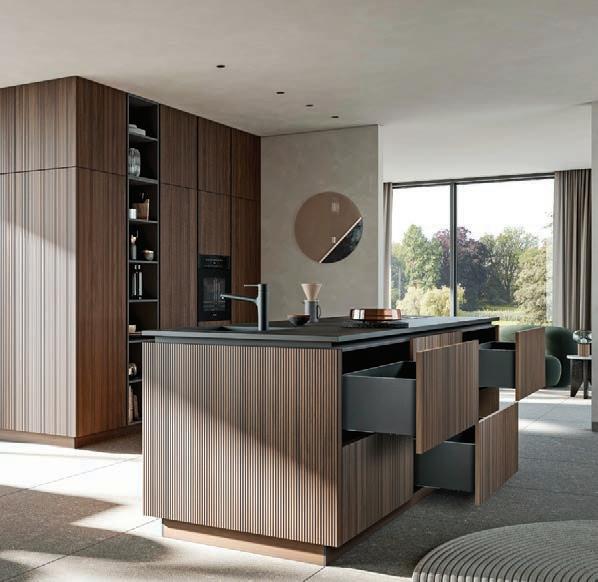
Vionaro V8 drawer system from Grass Canada Inc.
Stylish metal shelves from Schluter Systems North America.
Dare to Accelerate Change
BUILDEX



shelves that have little tabs on the outside, enabling installation on a backsplash, right in the grout joints,” he says. “This addition to a design can be done at the planning stage, as well as a later add-on. They can also be used in shower designs.”
Blum Canada Ltd. launched the Legrabox system that allows for personalization of metal drawers and pull-outs. With slim .5-inch drawer sides, extra space gained inside the drawer can be used in all types of furniture. “The customizable design of Legrabox supports the latest living trends and opens up a wide range of design possibilities,” says Lucy Traetto, marketing representative. “The load carrying capacity of Legrabox is 40 and 70 kilograms, which is easily accommodated thanks to the smooth-running action of the runner systems.” Fitted with the Blumotion S cabinet profile, Legrabox features low opening forces, a synchronised feather-light glide, and gives you the flexibility to implement three different motion technologies.
Traetto adds that the high fronts of Legrabox are becoming a popular design element. “Our special front fixing bracket guarantees maximum stability when opening and closing drawers and pull-outs.” Legrabox pure and Legrabox free offer a selection of matt colours and a premium look in anti-fingerprint stainless steel. In addition to Legrabox pure with matt and metal finishes, the Legrabox free design version allows you to use glass or customized
20 years, but their latest product – the Piano line –adds a new level of sophistication to their projects. “This is a product we’ve used for a while in higher end applications, but now with the escalating cost of real estate, many people are renting,” explains Jason Coroy, president. “This allows developers to install a durable, maintenance-free option. Handleless cabinets are practical, easy to clean, and create a streamlined, cohesive interior scheme.”
Coroy says the thermal fused laminate finish of the cabinets with laser edgebanding creates a seamless edge, and the doors are difficult to tell from real wood. “We have slab, flat styles as well as shaker profiles, with a large variety of colour choices. The slab option has a textured finish that feels like wood. Most people cannot tell the difference between this and a true wood door.”
Coroy adds that Cavupro has approximately 150 different woodgrains and 50 to 60 slab colours, which allows developers to create an array of options for units. “The price point is moderate, which works with many types of developers, including new home spec teams. But we specialize in multifamily, so our production is formatted for that type of supply.”
LIGHTING
Häfele Canada has brought a unique lighting design to the market with the Loox Wireless Adjustable Shelf Lighting System. The plug-andplay LED lighting solution features vertical bus bars, serving as power conduits to the lighting components. This enables the shelf to illuminate the inside
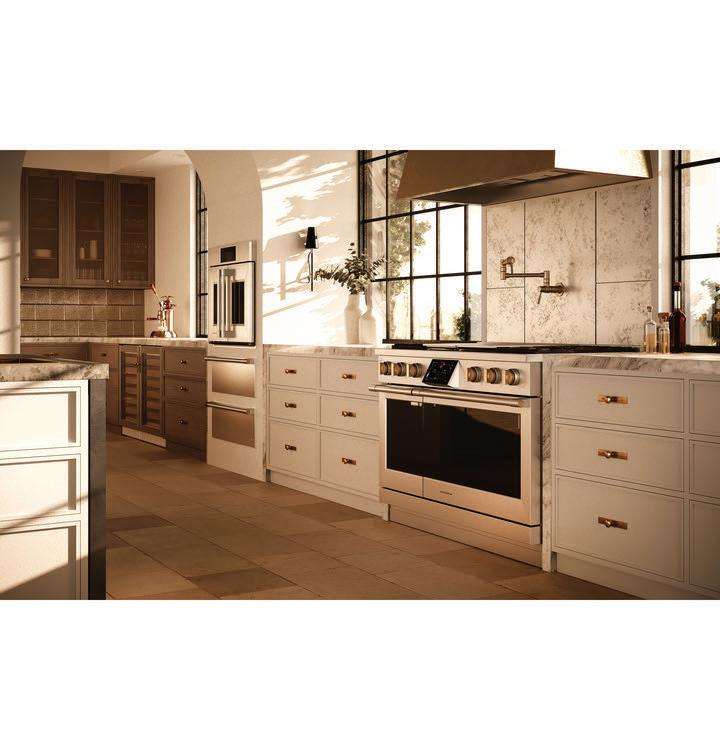














“With a customizable LED lighting strip on one side, the Loox system allows users to select from a range of warm to cool colour temperatures,” says Victor Hassan Ayoub, director of marketing. “The flexibility of adjusting illuminated shelves provides practical solutions for closets, kitchens, and store displays. Thanks to the Loox plug-and-play system, no complicated cabling is required, as the light source is seamlessly connected to the spring contact.” The strip lights are available in four different lengths – 18-inch, 24-inch, 30-inch, and 36-inch. Häfele prides itself on delivering superior performance through its German engineering and innovative technology. Loox products boast an impressive lifespan of 50,000 hours without any degradation in light quality. This translates to approximately 34 years of usage if the lighting is used for an average of four hours per day, or five years if it remains illuminated 24 hours a day. A
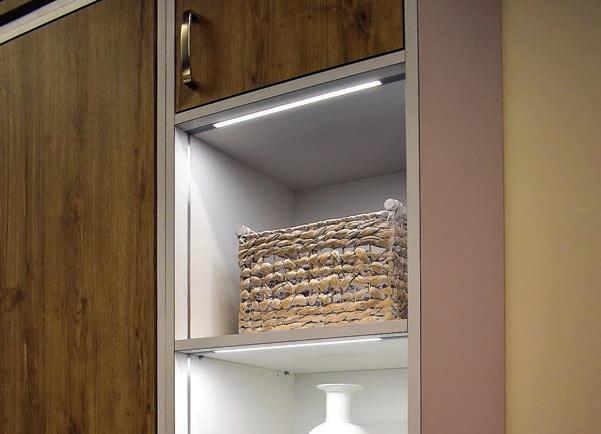


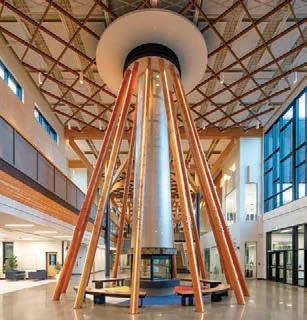
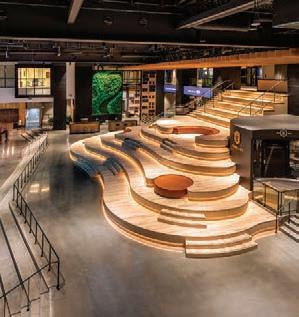


Loox Wireless Adjustable Shelf Lighting System from Häfele Canada.







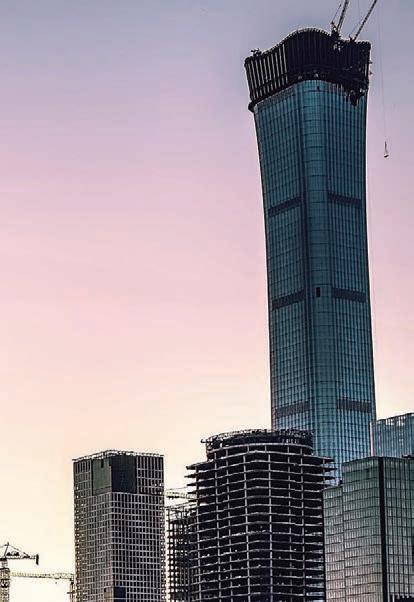



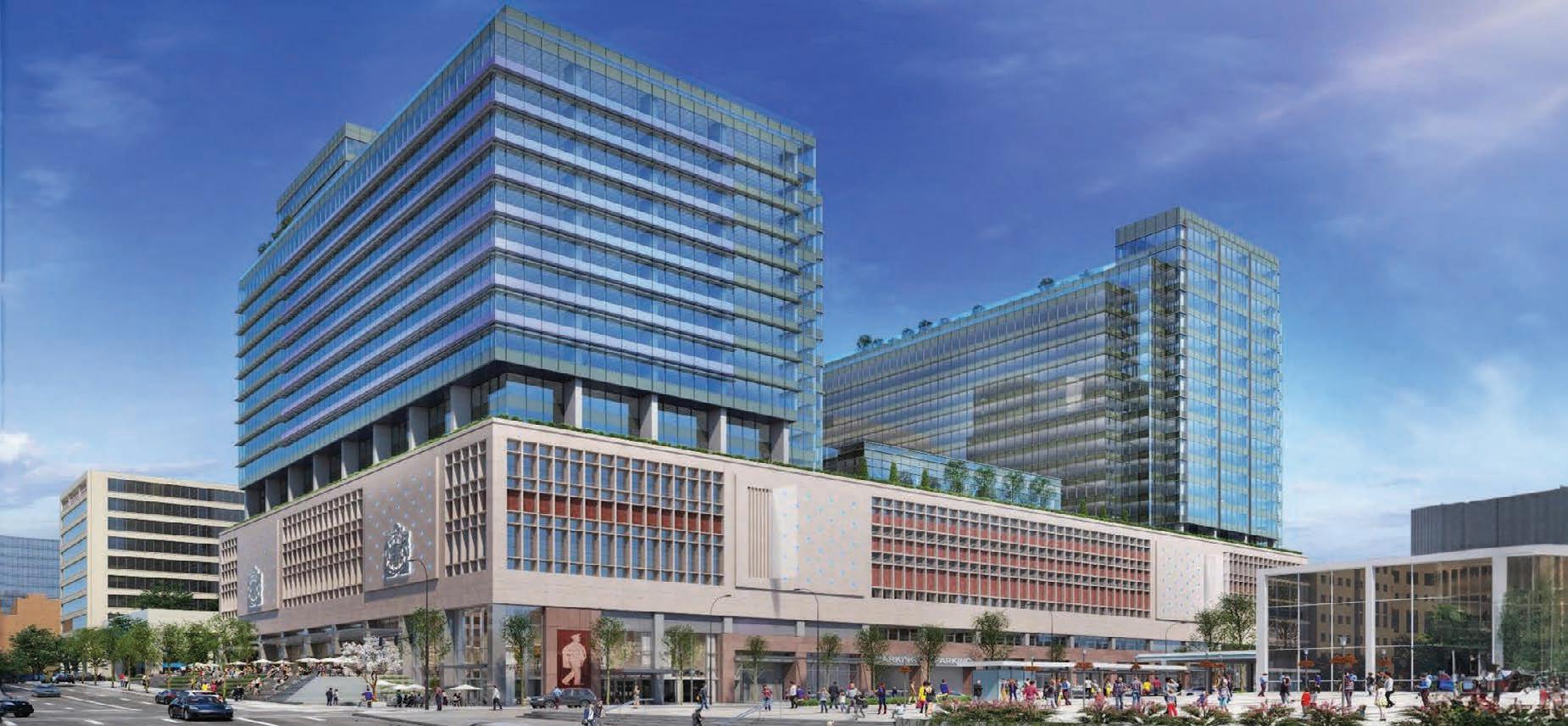
SINCE 1973
A passion for innovation and an enthusiasm for challenging projects have made Western Pacific Enterprises one of BC’s largest electrical contractors. With expertise in Smart Building Technology, and an increasing demand for renewable energy, WPE is well positioned to deliver future-forward designs and installations. WPE is at the forefront of implementing leading edge technology, as demonstrated by our work on The Post, the remarkable redevelopment of a historic Vancouver landmark.
AMPED UP!

Cutting-edge technology ignites major advancements in the electrical and communications systems industry
by NATALIE BRUCKNER
In the vast landscape of Canada’s electrical and communications systems industry, remarkable advancements in electrical engineering have ignited a wave of innovation across various sectors. From the institutional to the commercial, industrial, and multi-unit residential sectors, the application of cutting-edge technology has revolutionized the way we interact with and harness electrical power. These advancements have not only propelled efficiency and sustainability to new heights, but have also paved the way for integrated communications systems that seamlessly connect individuals and organizations.
One of the most significant changes observed of late by Indpreet Kaur, a senior electrical engineer at NDY, is the active pursuit of more efficient methods to generate, store, and utilize electrical energy. Kaur explains, “As technology becomes more prevalent in society, electrical engineers are at the forefront of spearheading these changes. The Internet of Things [IoT] is transforming various industries, enabling the production of new products and services such as smart homes, smart buildings, and automated farming techniques. IoT has impacted industries like healthcare, banking, retail, and manufacturing.”
Moreover, a notable trend highlighted by Kaur is the growing focus on electric vehicle charging stations, solar and wind energy systems, energy storage, smart grids, and cybersecurity. According to Kaur, “Decarbonization will push current infrastructure to its limits. Over the next two decades, we anticipate a 20 percent annual increase in the demand for electrification of vehicles like cars, buses, lorries, and trains. The influence of electric vehicles on the grid is expected to be most prominent starting in 2030. However, these projections could be further increased by industry initiatives, consumer preferences, and new government regulations.”
In addition to the above trends, solar energy holds tremendous potential in shaping the future of power generation on a larger scale, significantly reducing carbon footprint and combating climate change. Kaur explains, “The electricity
industry is crucial for achieving net-zero emissions. To ensure zero, low, or negative emissions in future power generation, the federal government will soon implement the Clean Power Regulations. Canada’s energy future is focused on achieving net-zero greenhouse gas emissions by 2050. This will involve replacing existing technologies with electricity-powered ones, such as heat pumps and electric cars. Increased reliance on electricity will also enhance national energy efficiency, resulting in a projected 22 percent reduction in energy consumption by 2050. Additionally, new technologies and fuels like bioenergy and hydrogen will play crucial roles in reducing challenging-to-address emissions.”
The demand for smart building technology is also increasing with EV charging requirements requested from clients without any specific end-user goal. Ace Johnson, operations manager for Western Pacific Enterprises Ltd. (WPE), explains that “WPE has been involved in numerous design assist projects where we have sat down with clients to go through what some real-use cases look like, so that the client can apply the appropriate system for their project build.”
WPE has recently completed successful installations of smart building systems at 745 Thurlow and The Post (the Canada Post Redevelopment project), and is working with the Oakridge Redevelopment project team early in the construction phase.
There is increasing concern for renewable energy sources and balancing costs. A lot of electrical equipment that utilizes a greener source of energy tends to be more expensive and there is always a struggle to find balance between an energy efficient build versus cost-effective build. WPE has been assisting owners and engineers with example cases from similar projects to apply appropriate design that balances cost and efficiency.
“One of the major drivers of mechanical electrification is when projects don’t manage the energy model carefully enough until after major building components, such as windows and siding, have been procured. This means that mechanical

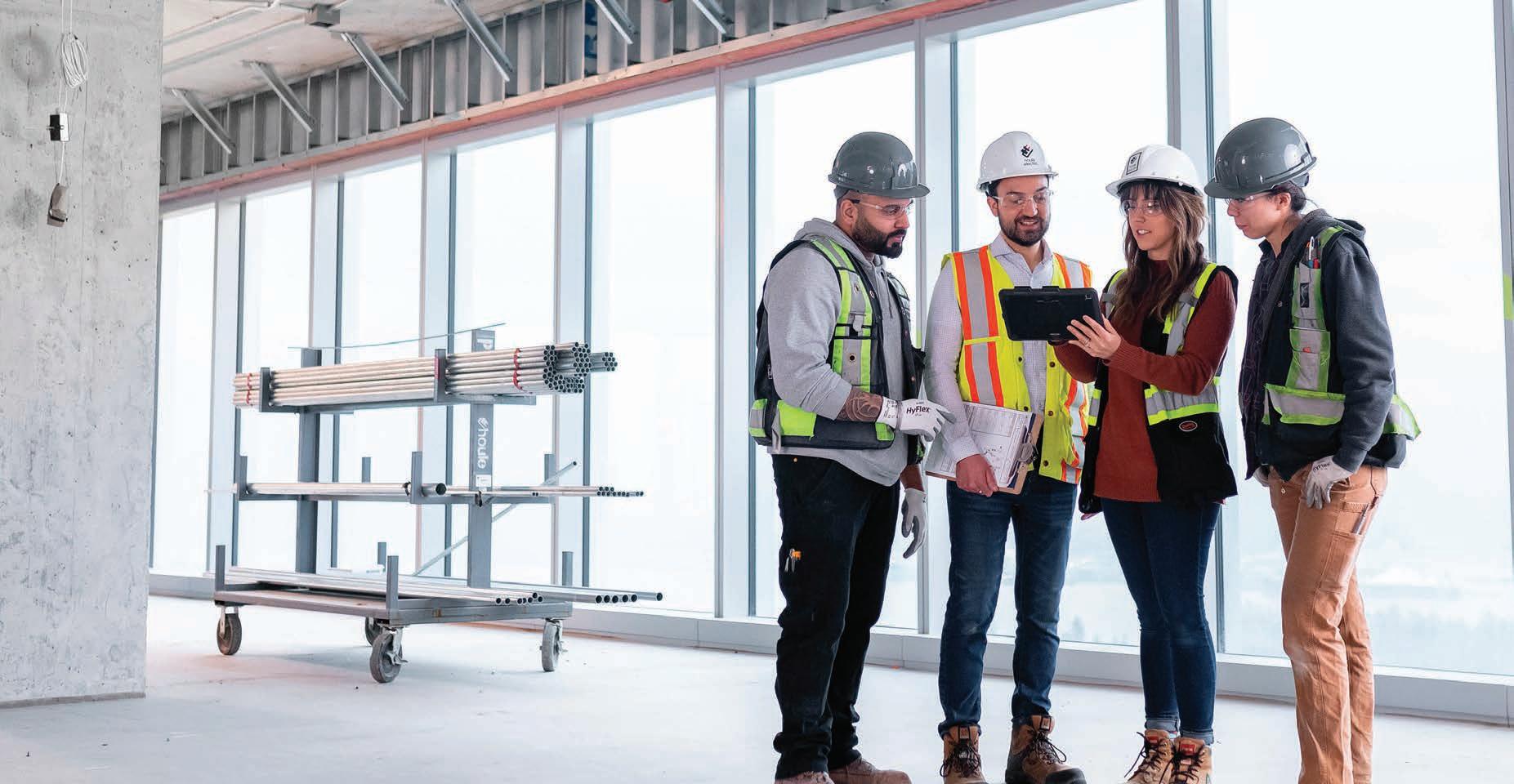
electrification is often an afterthought to remedy the problem. WPE has been actively involved earlier in projects to emphasize the impact mechanical electrification has on the energy model to reduce risk later down the road,” says Johnson.
Ben Rajewski, engineering manager at Williams Engineering, echoes Kaur and Johnson’s sentiments and says the dominant trends he is seeing in the electrical and communications systems industry continue to be electrification and sustainability. Clients are increasingly prioritizing climate change and their carbon footprint, leading to a surge in the demand for the electrification of building systems.
“We have been working on studies to assess the existing building capacity, not only to incorporate EV chargers for all tenants, but also to evaluate the implications of replacing natural gas with electric heating and adding air conditioning to previously non-air-conditioned units,” explains Rajewski. He foresees a future where many buildings will require larger electrical services to accommodate this growing electrification trend.
The increasing electrical demand in buildings poses challenges for electrical utilities to meet the surge in power demand, as well as for building owners to find adequate space for larger electrical equipment. “We will be working with clients to help redesign their spaces to size their new service, accommodate the new electrical equipment in existing spaces, and provide power to the new electrical devices. We have already done this for a variety of clients and expect this trend to continue. Various manufacturers are also making technology that will help share power and not overtax existing services,” Rajewski says.
Williams Engineering has been actively involved with a client in Yellowknife, exploring alternatives to a diesel generator. The focus is on implementing green energy solutions like solar panels with battery storage. Rajewski adds, “We presented the client with several options, and we are now awaiting their decision on whether to proceed with the construction.”
Looking ahead, Rajewski expresses both excitement and caution regarding the impact of AI on building design. While AI can enhance efficiency and offer innovative options, Rajewski emphasizes the ongoing importance of effective communication between engineers and clients, as tasks like drafting may transition more towards editing in the future.
Jonathan Lashin, VP of pre-construction and industrial at Houle, also emphasizes the increasing focus on net-zero buildings, electrification, and moves toward district energy centres and alternative energy systems incorporating cogeneration (cogen). Lashin explains, “We are seeing increasing demand for district energy centres for communities – shifting energy to a centralized and shared facility for multiple buildings versus individual systems in each. This improves efficiencies and reduces losses through the systems. In the shift to investing in sustainable energy, we’re seeing more cogeneration where waste heat is being used to generate alt power, providing reliable standby power and reduced reliance on natural gas. We’re seeing this more with wastewater treatment plants and other industrial facilities.”
Paul Maddox, director of technology sales at Houle, highlights the technological advancements being seen in the industry, stating, “The industry is seeing a rise in IP addressable devices for seamless connectivity. Customers are migrating to Wi-Fi 6 and Wi-Fi 6E for enhanced wireless communication. There is a growing trend toward converged networks, integrating various building systems for improved efficiency. Passive Optical Networks [GPON] infrastructure supports net zero initiatives and sustainability.”
Houle successfully implements many of these cutting-edge electrical and communication solutions into their projects. Lashin mentions, “Notably, we recently completed the base build at The Stack in downtown Vancouver, which
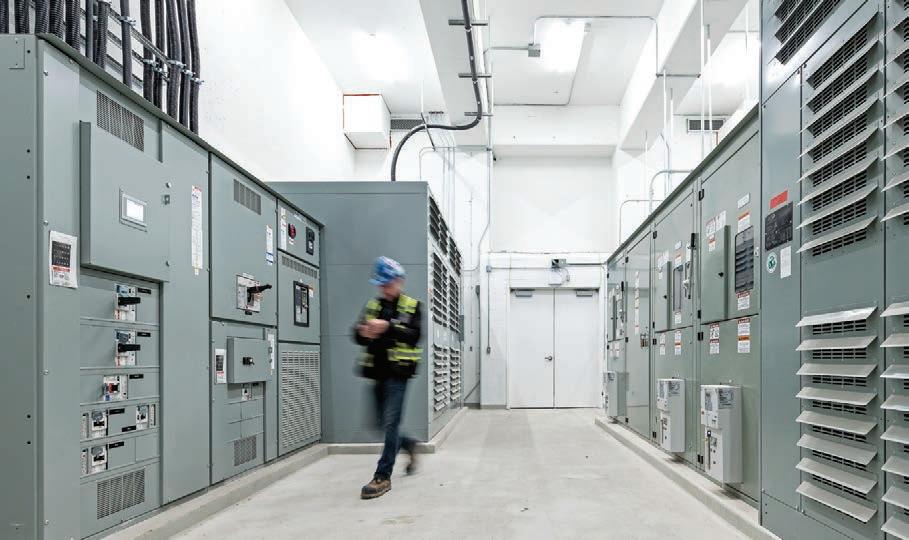

is Vancouver’s tallest and Canada’s greenest commercial high-rise tower. It has been designed to achieve LEED Platinum standards and is the first building to receive the CAGBC’s Zero Carbon Building – Design Standard certification.”
To address these trends, the experts at Houle say early contractor involvement is becoming more important. “We are seeing more opportunities to come in as a design-assist partner and be part of the collaborative team delivering these important projects,” says Maddox.
Nemetz (S/A) & Associates Ltd. has also experienced significant developments in the field of electrical and communications systems of late. According to Steve Nemetz, CEO/president, these include the use of digital enablement for designing smart buildings and advancements in their master planning of Hydro, Telus, and Shaw utilities. There has also been a widespread shift towards fibre among all communication providers, including the implementation of fibre to each residential unit setups. “Smart Building technology using digital enablement is becoming a prominent design feature,” says Nemetz.
In terms of recent projects, Nemetz (S/A) & Associates has been actively involved in several exciting endeavours, such as the Oakridge Redevelopment, Brentwood and Lougheed Town Centres, Metrotown Towers, River Green, and 320 Granville, all of which aptly demonstrate the company’s expertise in electrical and comms systems.
Looking ahead, Nemetz envisions both challenges and opportunities and is particularly enthusiastic about the company’s master planning initiatives, Wired Score certifications (having become Certified wired score professionals), and the growth of their digital enablement department. However, one challenge that lies ahead is raising awareness among developers about the available options and the advantages they offer. “To address this, we are providing seminars on master planning, wired score, and digital enablement to disseminate crucial information,” says Nemetz.
As demand for skilled electrical and communications systems continues to grow, the MCW Group of Companies (MCW) is responding and recently announced the acquisition of Alberta-based Maskell Plenzik & Partners Engineering Inc. (MP&P) – a company that specializes in electrical, lighting, communications, security, and forensic consulting engineering services for the built environment.
“We are excited at the prospect of what MP&P can bring to MCW. Their innovation and expertise in power systems, lighting, communications, life safety, security, urban development, and forensic investigations will further strengthen MCW’s presence in Alberta and allow for continued growth in multiple service areas across Canada,” says James Furlong, managing partner at MCW.
“MP&P was built by passionate, motivated engineers who have earned a strong reputation in delivering creative but practical solutions for our clients, and we see similar values within MCW,” says Ken Maskell, principal of MP&P. “We are thrilled to be joining a larger, national organization to not only provide more value for our clients but to also take on a larger, more diverse range of projects.”
These developments highlight the dynamic nature of the electrical and communications systems industry in Canada. With a focus on electrification, sustainability, renewable energy, and technological advancements, the industry is at the forefront of shaping a future defined by smarter, more connected environments. By embracing innovative solutions and collaborative approaches, engineers, experts, and companies in this field are driving positive change and making significant contributions to efficiency, sustainability, and the overall well-being of communities. A
Charging stations, The Stack, Vancouver, B.C.
Electrical room, The Stack, Vancouver, B.C.
Unveiling the Art of Illumination
Blending architecture and artistry in state-of-the-art lighting
by LAURIE JONES
In the world of lighting, unique design and products are blended to create unique settings, both indoors and out.
For the team at Nemetz (S.A.) & Associates, not only is the lighting design inside important, but a prevalent request on many of their projects is the addition and incorporation of lighting to highlight and enhance the architecture of the building. “With the varying project parametres and desired effects on each building, there are several key aspects of the design process we have to consider,” says Jennifer Lifton, lighting designer.
Lifton adds that detailed discussions are required with the entire design team to ensure an understanding of the intended overall concepts and desired effects. “Renderings and concept images are provided to illustrate the design intent. We also review the architectural details, which are then coordinated and created to ensure mounting, wiring, and other components are incorporated into the design, and not seen as an afterthought.”
The process moves into carefully selecting luminaries appropriate for the intended effect, while also being conscious of the environment, light pollution, and so on. “We also have to co-ordinate controls to provide flexibility to the design, such as colour changing and dimming,” she says. “There is a lot of hands-on collaboration during the design and construction, including mockups, review of materials and onsite aiming and commissioning to ensure initial concepts are met at the end of the project.”
Williams Engineering has worked on a variety of high-end projects that require state-of-the-art lighting systems to facilitate a variety of user needs, such as the ACT Aquatic and Recreation Centre rehabilitation located in Edmonton, Alberta. The community facility features a 25-metre gradual depth swimming pool, whirlpool, and multiple waterslides. The building also houses a gymnasium, outdoor tennis courts, baseball diamonds, soccer fields, volleyball courts, and playgrounds.
“The City of Edmonton identified the need for extensive rehabilitation to address components of the building that had reached their end of service life. Alongside the Marc Boutin Architectural Collaborative Inc. [MBAC], Williams Engineering provided mechanical and electrical engineering
consulting services for the Centre,” says Ben Rajewski, engineering manager, electrical. “The scope of this rehabilitation project included replacements of various mechanical and electrical components of the facility, and the lighting was one of the main focal points for replacement. For the pool specifically, the lighting was replaced with LED uplighting that was directed at the unique architectural ceiling.”
Rajewski explains that the ceiling was created with white acoustical panels that allowed for soft reflection onto the pool surface without glare. Skylights were also integrated into the ceiling to provide natural light into the space. “The design was able to achieve an average of 600 lux on the pool surface, while minimizing reflection on the water. This allows for maximum visibility for lifeguards protecting the pool from the deck and comfortable vision for swimmers,” he says. Within other areas of the facility, the lighting was also replaced with new LED fixtures that greatly reduced the energy usage of the facility. “This rehabilitation resulted in improved accessibility, safety, and sustainability of the entire facility and will reduce future repair costs by upgrading these major systems,” says Rajewski.
Azin Dilmaghani, lighting manager at WSP Canada Inc., says the projects her team works on focuses on architectural lighting that is minimal. “We call it invisible lightning, or hidden lightning. We don’t want to have a presence in the project, but rather we are there to help the architectural features show themselves.” She notes that everyone on the team is architectural or interior designers, which is why they like helping the lighting enhance the features in architectural spaces. “We’re trying to get away from designing separate areas and make them more integrated, but in a minimalist way.”
Dilmaghani explains that most of their projects are commercial, including health, transportation, big government, or institutional projects. “We try to illuminate the spaces without having the lights or fixtures visible, and design it into the architectural detail. There are lots of details involved when you’re working with these kinds of projects, including colour co-ordination with different disciplines to come up with those ideas.”
While Dilmaghani and her team do use readymade products for lighting, there are times when




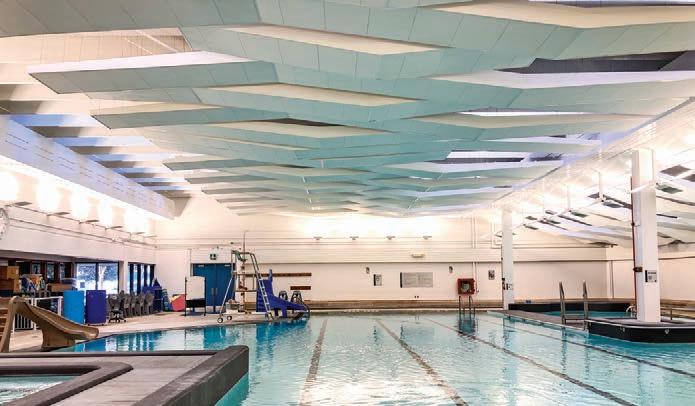
Kuzco Alora Mood pendant lighting.
Motive area light.
Exterior lighting at The Hudson, Victoria, B.C.
The Leaf, Assiniboine Park, Winnipeg, MB
ACT Aquatic and Recreation Centre, Edmonton, AB
they need to go direct to the manufacturer for custom options. “We work with different manufacturers all over the world, not just local ones to make sure we find the best solution for our clients. That’s why we are here.”
Landscape Forms – designer and manufacturer of high-design LED lighting, site furniture, structure, and accessories – introduces Motive, the company’s newest lighting line. Designed by Justin Champaign, Motive blurs the line between indoor and outdoor lighting and expands the possibilities for creating unique settings and accents. “Motive features some firsts for Landscape Forms,” says Marjorie Simmons, CEO, Landscape Forms. “We feature a hidden light source and clear lens in several of the fixtures, which creates interesting and sculptural light effects.” The line includes an outdoor floor lamp, also a first for Landscape Forms.
Motive celebrates the beauty of light and its interaction with objects, architecture, and space. “Motive is one of our most intelligent and sophisticated lighting lines,” says Kirt Martin, VP of marketing and design and chief creative officer. “The hidden light source and clear lens emphasize the sculptural form of the fixture’s interior and at the same time illuminate architecture and space. The lights are experiential and technologically advanced, designed to be decorative elements in important places such as building entrances and art installations. They are both beautiful and functional.”
The floor lamp exemplifies Landscape Forms’ culture of design, technology, and craft. The lamp’s state-of-the-art LED technology strips away all of
the componentry in an ultra-minimalist form. “You see light but don’t see the light source, creating an intriguing effect,” says Martin.
The Motive family includes area lights with clear and diffused lenses, three distribution types, and two pole heights; a path light with diffused lens and two distribution types; an ADA compliant wallmounted light with diffused lens that emits light in 360 degrees; a pendant light with clear lens and Lambertian distribution; and a floor lamp with point source light that can be surface-mounted, hardwired, or freestanding. Motive’s mid-power LED configuration produces smooth, even light, and the lamp and reflector design eliminate glare. Lights are offered in 2700K, 3000K, 3500K, and 4000K temperatures and are UL listed. All are available in a full colour palette and finished with Landscape Forms’ proprietary Pangard II HAPS, VOC, and leadfree polyester powdercoat.
The broad scope of lighting designs created by the award-winning team at Mulvey & Banani Lighting has resulted in projects that range from iconic to serene. “One design we are proud of is The Leaf – Canada’s Diversity Gardens, part of the redevelopment of Assiniboine Park,” says Stephen Kaye, VP. “The concept for this facility creates a multi-seasonal experience over four distinct worlds, or biomes. The Leaf tells Canadian cultural stories through the world of plants.”
Another project that attracts residents and visitors in the downtown Toronto area is the Urban Campfire Benches. The City was resourcing a unique solution to find street seating and engaging lighting. “We used existing tree uplighting power to create
a large-scale, interactive installation that included a programmable colour lighting piece called the Firepit Bench that wraps around the trees.”
In addition to the creative paths, Mulvey & Banani Lighting installations include architectural feature lighting, lighting control integration with systems intelligence, and lighting retrofits for energy efficiency.
Jim Ormshaw, lighting product specialist at Robinson Lighting & Bath, says trends in lighting fixture colours are changing to brass and gold, with black still being a popular choice. “Chrome, pewter, and brushed nickel were the main choices, but the golds and brass are making a resurgence for design installations, as well as consumer preference.”
Ormshaw says at a recent trade show, not only were the colour choices new but also the size of products. “There are a lot of oversized items, including chandeliers and pendant lights, which are well suited for grand entrances. Additionally, manufacturers are now starting to include Colour Changing Temperature [CCT] switches on their fixtures so endusers can easily change from 3,000 to 3,500 to 4,000 Kelvin, each of which creates a different colour temperature. CCT is done by most manufacturers, and I believe that by 2025, it will be an industry standard.”
Regarding new products, Ormshaw notes B.C.based Kuzco Alora Mood introduced approximately 100 new fixtures, giving designers and consumers choices to finish any room. Another supplier, Kichler Lighting – which was purchased two years ago by Masco/Delta Plumbing – offers lighting options that match faucets in kitchens, and matching pendants over the island. A


The Mighty Strong Backbone Of REINFORCING STEEL
Experts weigh in on the future of the sector amidst economic headwinds
by ROBIN BRUNET
Virtually all rebar manufacturers and suppliers are prone to scrutinizing the steel market to try and determine where prices – and demand – are going, and the summer months of 2023 prove yet again that, strictly according to the numbers, the market remains volatile.
While steel prices dropped from peaks earlier in the year, construction steel, aluminum, and other metals remain in high demand. That said, many rebar specialists worry that elevated construction costs brought about by inflation will eventually take their toll.
Duane Kotun, director of administration at Sherwood Steel, presides over a company that fabricates and installs rebar and welded wire mesh for all types of projects in Western Canada and the northern territories. “We’ve had a busy winter and spring and are working full-tilt this summer,” he says. “But my concern is forward: we anticipate slowing periods, partly due to inflation. There’s lots of uncertainty overall, and it doesn’t help that steel prices are all over the map: they shot up during COVID, then came back down to about halfway, then turned upwards a bit, and then they’ve been steady for the past three months.”
Kotun and other rebar specialists in Alberta take some solace from the fact that the province has re-elected a pro-business government. “The thing is with our current economy, people have overreacted and behave like it’s 1929 all over again, so maybe our premier and her team can generate some measure of certainty,” he says.
In the meantime, Sherwood Steel recently completed a soccer centre and supplied product to the $73-million Spruce Grove Civic Centre which, when finished next year, will consist of two arenas, a library, a theatre, gallery, and other amenities within 125,000 square feet of space. “We’re also busy with our bread-and-butter work of parkades and condos, a big driver in Alberta being the push to create new rental housing,” Kotun says.
Matthys van Emmenis, VP operations at A&H Steel Vancouver, notes that inflation has had a slightly different effect in B.C. compared to Alberta. “They’re really two different markets: here, we experienced a dip – especially in the residential sector – when interest rates began rising. Since then, work is picking up, and what has been especially good for us is a backlog of projects that have kept us operating at full capacity.”
A&H Steel Vancouver is currently finishing work on one of Vancouver’s most anticipated – and visually provocative – high-rise residences, The Butterfly, a 556-foot-tall 57-storey luxury tower whose form was inspired by the pipes of church organs. Rebar is especially critical to this project, which, in addition to curved glass, the tower’s façade is comprised of sculptural concrete forms that create a pattern of waving clouds.
Van Emmenis goes on to note that “We’re looking forward to several major projects going into next year, and as far as we can tell, the reinforcing steel sector in general will be kept busy in B.C., especially on industrial work given that a potash facility at Westshore Terminals, the long-awaited LNG terminal, and many other infrastructure projects are expected to get underway soon.” A&H Steel’s facility in Maple Ridge is well positioned to handle the workload, equipped with top-of-the-line machinery and located right next to the Fraser River.
Ron McNeil, CEO and co-founder of LMS Reinforcing Steel Group, describes the current economy as “surprisingly resilient despite headwinds, and B.C. certainly is on good footing with a host of big projects. We’re working on no less than 300 active projects, four of which are especially noteworthy.”
LMS recently began work on the 11-tower Sen áḵw residential development on 10 acres around the south end of Vancouver’s Burrard Street Bridge. The tallest of the towers will rise 59 storeys or 564 feet, and the project’s total floor area is four million square feet.
Pattullo Bridge, New Westminster/Surrey, B.C.





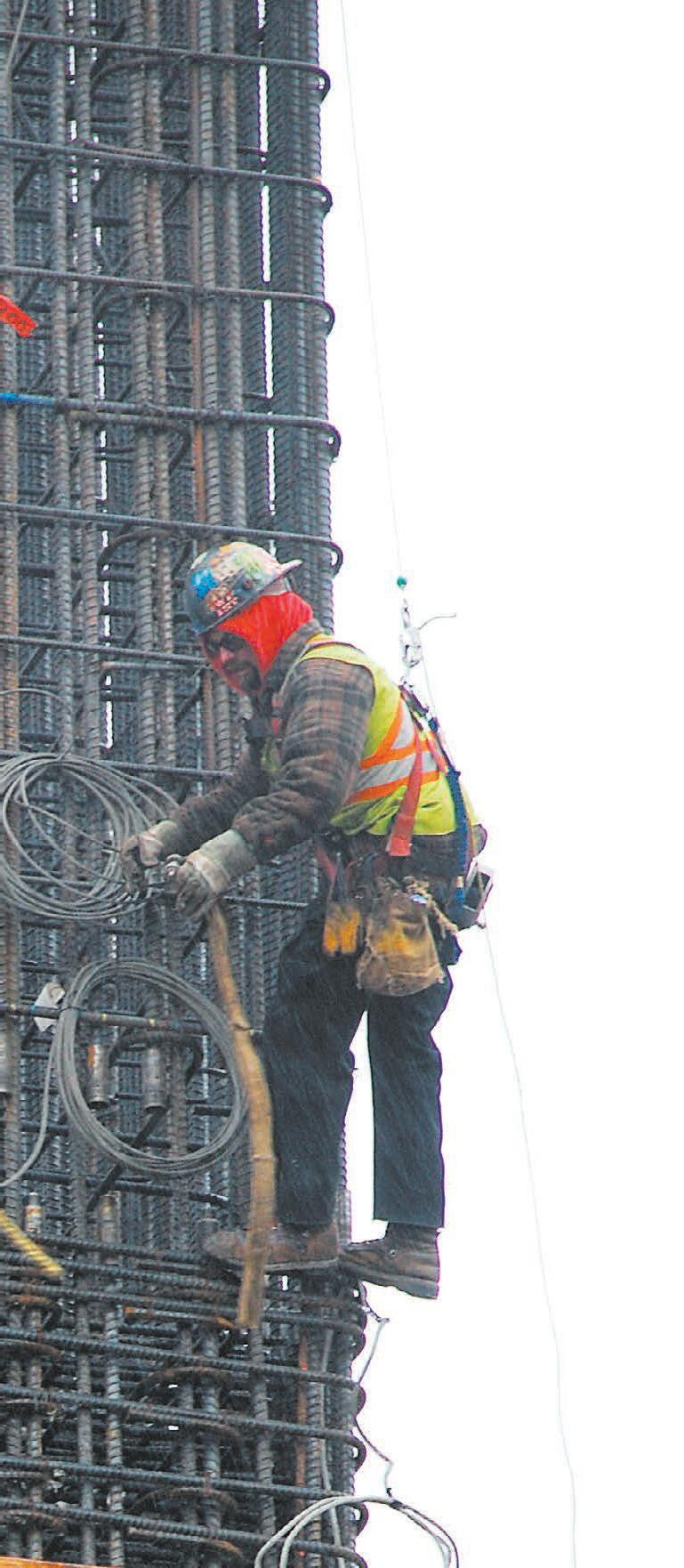







LMS is also busy with Concord Metrotown, located at the future of Downtown Burnaby, the next master-planned community by Concord Pacific consisting of three towers ranging from 33 to 65 storeys, a 66,000-square-foot ‘Sky Park’, and shops and services.
LMS’s other two projects are well known to Lower Mainland residents. Site preparation work on the redevelopment of Oakridge Centre began before the pandemic, but then a decision was made to close the entire mall and expedite the timeline for completing most of the brand new indoor shopping mall and a majority of the nine-acre rooftop public park by 2024. The 28.5-acre mall site also includes three mixed-use towers; other residential buildings and indoor mall areas to the south are also taking shape, and the floor area of the new mall will span 1.2-million square feet, (twice the size of the original mall).
McNeil reports that, “We’re still busy on the Pattullo Bridge replacement, with work expected to wrap next year.” As of March, construction had progressed to the in-river towers’ crossbeam to support the bridge deck – 13 of the 33 segments of the main 548-foot towers have been completed, and work is also well underway on the bridge structures on land.
As for how the rebar market will evolve in the near future, McNeil admits that “I’ve given up trying to figure out where the market is headed. Labour is always top of mind along with safety, and we continue to try and support the industry in that regard.” Specifically, the LMS Academy in-house school supports team members as they pursue continued education, and McNeil’s company provides meaningful opportunities to build long-term careers with upward potential.
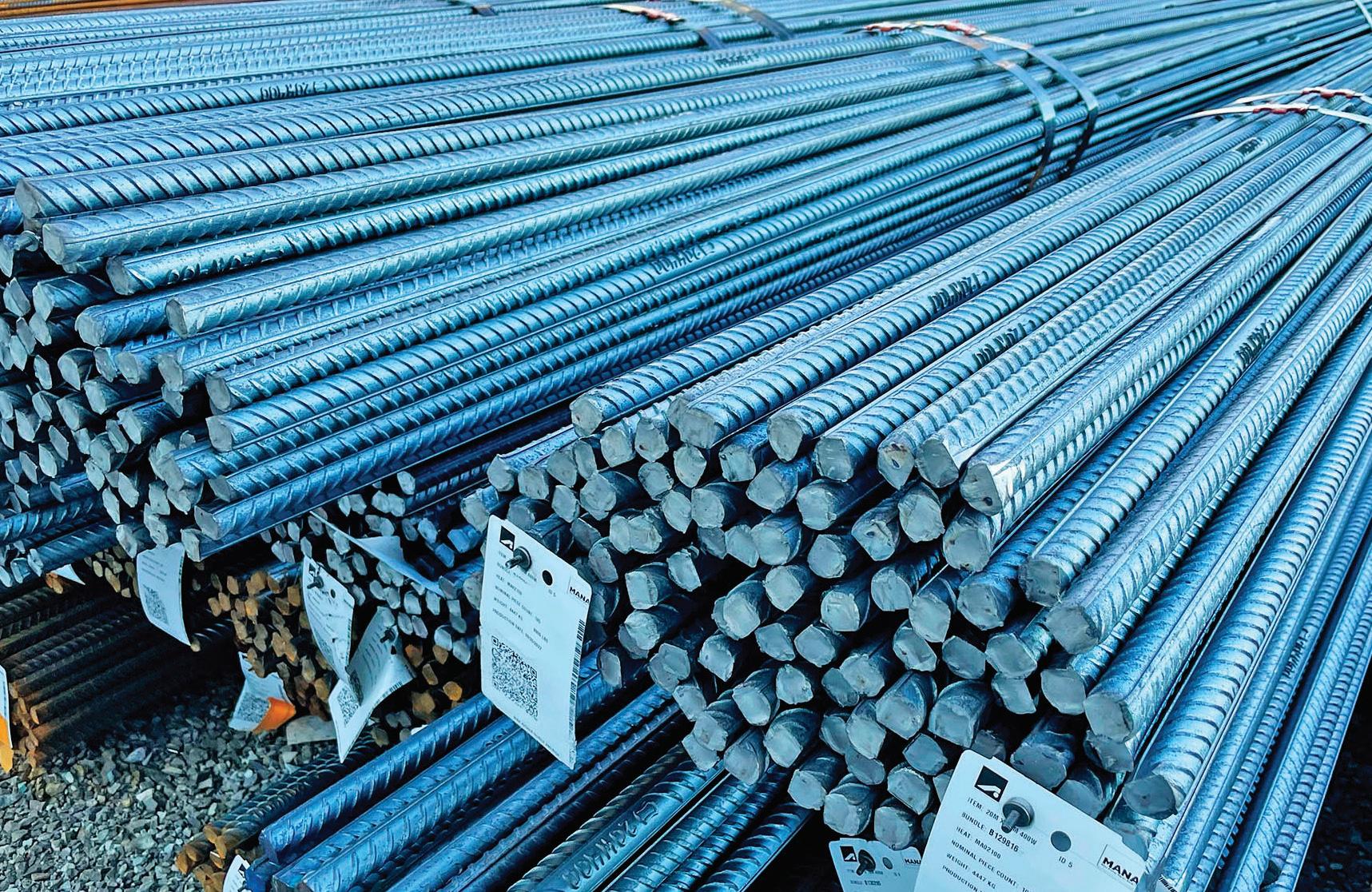


Concord Metrotown, Burnaby, B.C.
Pattullo Bridge, New Westminster/Surrey, B.C.
Since 1985

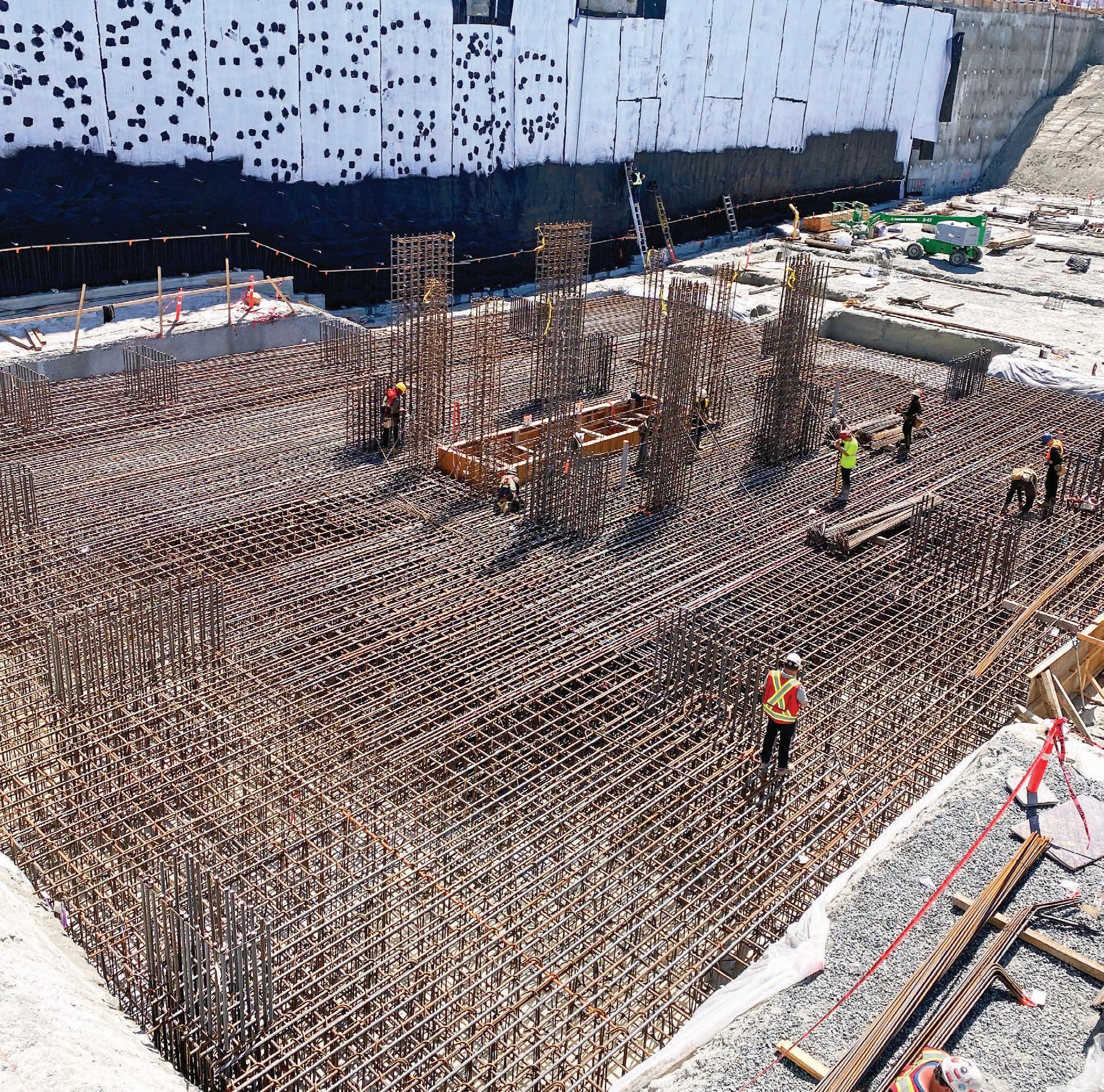
Heritage Steel [heh·ruh·tuhj sti:l] noun
1 : Excellence in Reinforcing Steel Services;
2 : Where People really matter & Safety is priority;
3 : Teamwork & Dedicated Professionals; 4 : Supporting the Community
PRODUCTS
• Black, Stainless & Epoxy Coated
Rebar • Threaded Rebar • Welded
Wire Mesh • Reinforcing Steel
Accessories • Plain Round Bars
• Post Tensioning Systems
• Mechanical Couplers
SERVICES
• Consultation
• Budgeting • Estimating • Detailing
• Fabrication • Installation


MEMBERS OF:







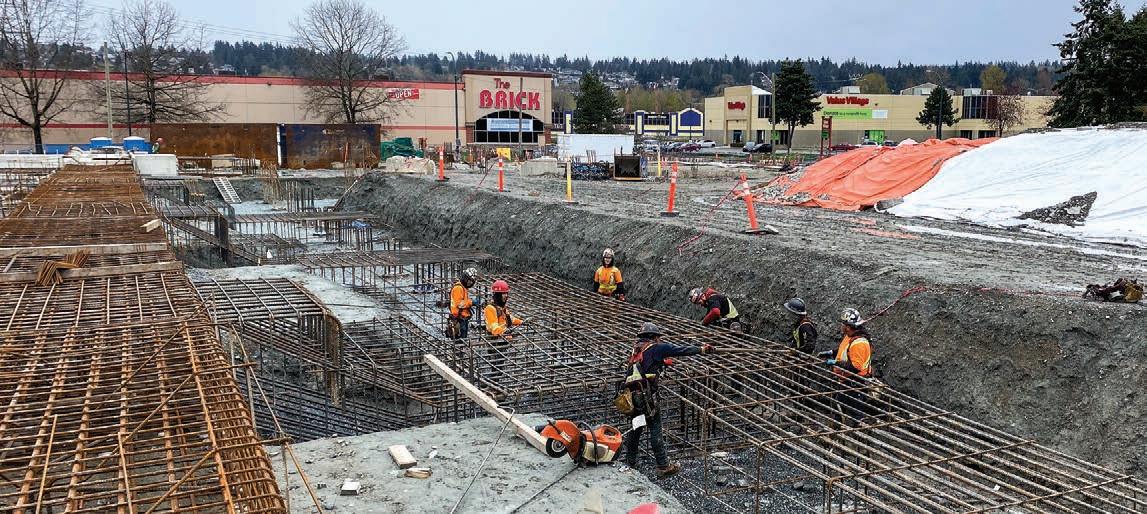
While there seems to be no end of jobs across Canada to bid on, competition to secure projects is as intense as ever. Generally, the more a company can provide a host of services the more likely it is to prevail, and Salit Steel is a case in point: it is made up of an integrated network of companies and partners that together provide a full range of steel solutions through its service centres and rebar fabrication division. Its service centres carry an extensive inventory of carbon and steel products, allowing the company to fulfill orders with tight timelines. And by sourcing steel on a worldwide basis, Salit provides premium service (its dedicated fleet of trucks operate three shifts daily to ensure that rebar gets to job sites precisely when needed).
Salit’s product range is comprehensive and includes cold finished bar, bar grading and expanded metal, structural and mechanical tubing, plate and sheet, wide flange beams, and much more.
Heritage Steel Sales Ltd. of Langley, B.C. is a division of fifth generation family-owned Salit Steel, and Heritage branch manager Steve Selig points out that this organizational structure provides many benefits in uncertain times.







“For example, as part of the Salit group we have a central purchaser who is adept at acting upon the best steel prices based on carefully considered market predictions,” he says. “This is a tremendous asset when the commodities market is so volatile, and it gives me some peace of mind because I’m among the people in our industry who suspect that as inflation continues and more mortgages come due, the large flow of work that we’re currently enjoying could be affected.”
In the meantime, Heritage Steel crews have from 30 to 60 projects on the go at any given time and are working full tilt throughout Greater Vancouver. “We’re working on a project with three residential towers for Cressey Developments in North Vancouver, a massive 196,000-square-foot tilt-up project in Coquitlam, and a major residential development in our homebase of Langley,” Selig says.
Selig goes on to cite Langley as an example of why rebar providers are being kept busy in smaller urban areas once considered rural. “Langley is a place where you see dump trucks and cranes everywhere,” he says. “With more affordable residential developments come people, and with people comes the need for added infrastructure: everything from schools to water and sewer systems.”
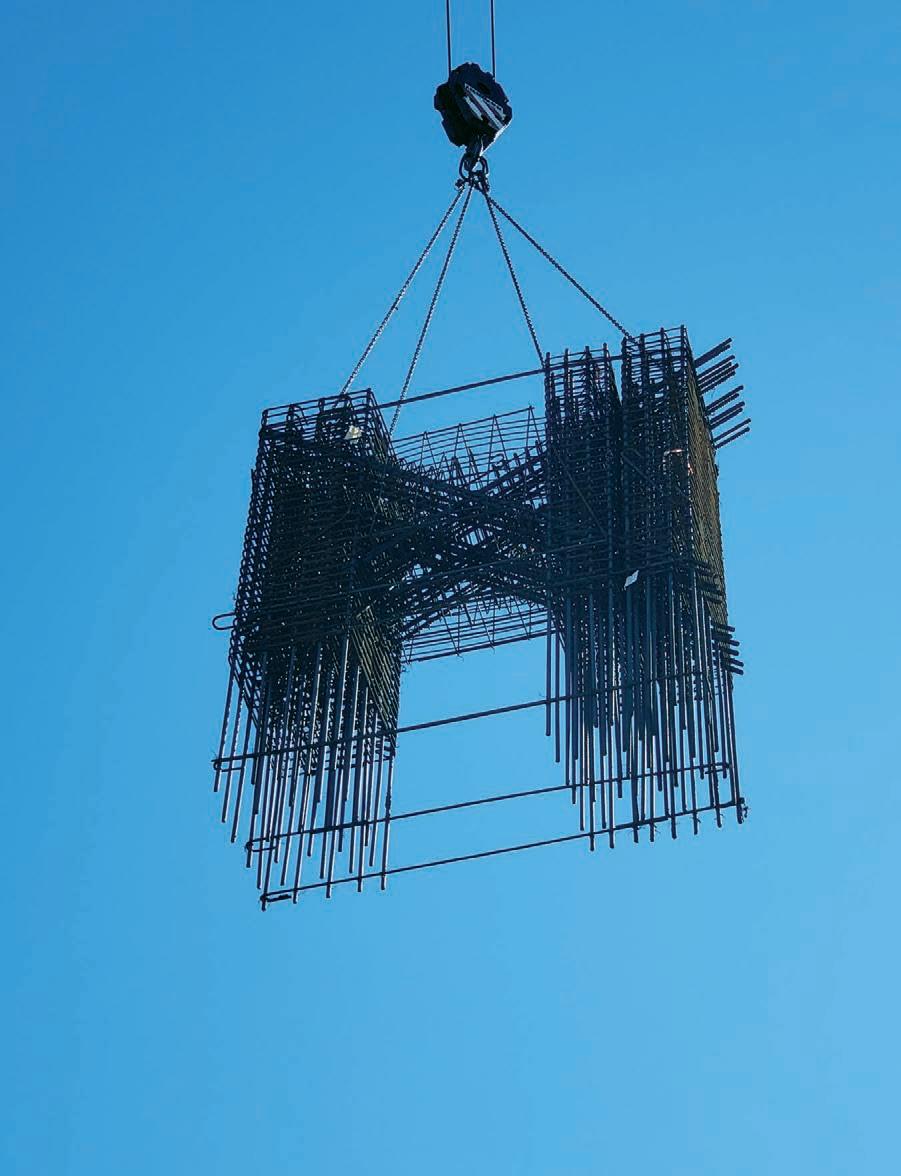

Tilt-up project, Coquitlam, B.C.
EXPRESS REBAR

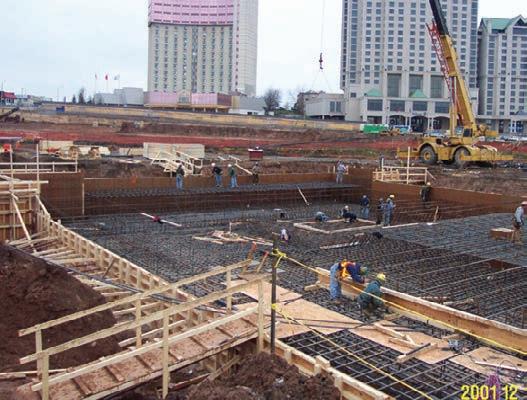
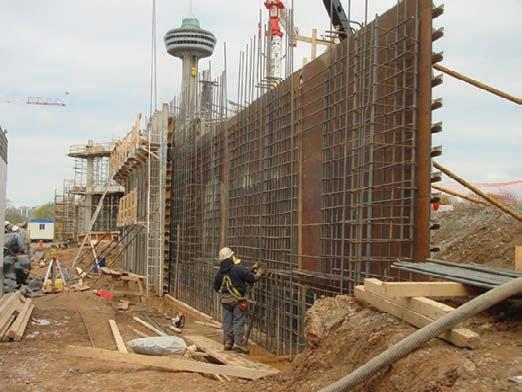

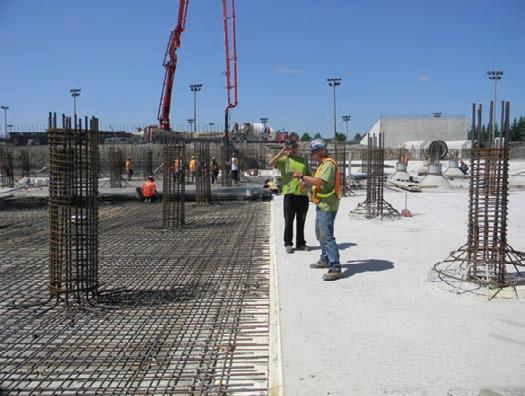


Specifically in Langley, Heritage is supplying 10-million pounds of rebar for The Towers residences, a new project from Vesta Properties that commenced last July and consists of redevelopment of a 74-acre parcel with a mix of towers, mid- and low-rise buildings, duplexes, row homes, and townhouses: over 2,000 homes for up to 6,000 residents altogether.
Selig concludes, “For the time being we’re busy thanks to the need for such projects, and our great work team plus our association with Salit puts us in a really good place. I hope I’m wrong and that opportunities continue to grow. Time will tell.”
As for news on the rebar front in 2023, Kit Steel of Welland, Ontario, has launched an innovative new service for general contractors who need smaller custom orders (or anyone who knows exactly what custom-sized rebar they need and requires quick delivery).
Kit Steel, owned by brothers Mike and Andy Kubes, has made a name for itself for its in-house precision cuts and bends and on-time delivery, with projects such as Glovebox in Kitchener and Our Lady of Hope Catholic School among its extensive portfolio. The new service in question is quickbar.ca, a Shopify store for rebar. Mike Kubes, Kit Steel’s general manager, used his expertise as a web developer and got the idea of using Shopify as a way for contractors to customize length and shapes for rebar orders online.
He says of the platform that launched in June, “We’re targeting this as an allin-one shop for general contractors, and we’ve augmented it with the purchase of a boom truck that can travel in a 160-kilometre radius from our Welland shop and offload rebar orders.
“Given that we provide up to 50 custom sizes of rebar alone, we expect quickbar.ca to be a success – and develop beyond its initial focus of local delivery.” A





Tilt-up project, Coquitlam, B.C.


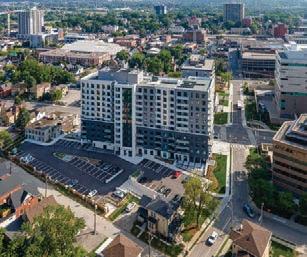
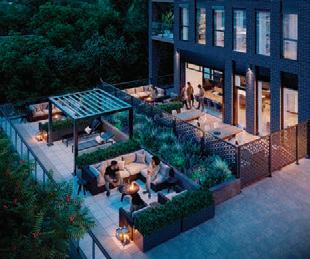
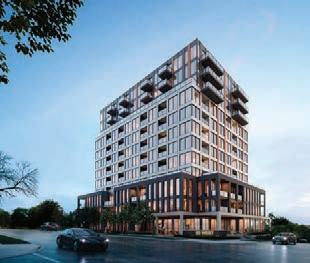
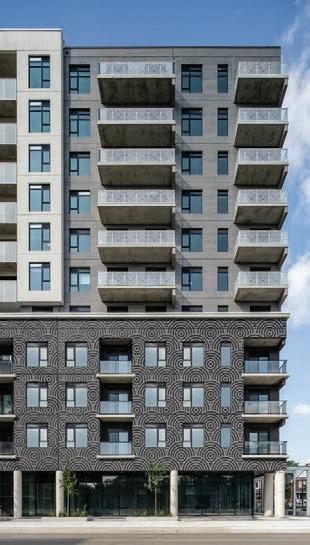

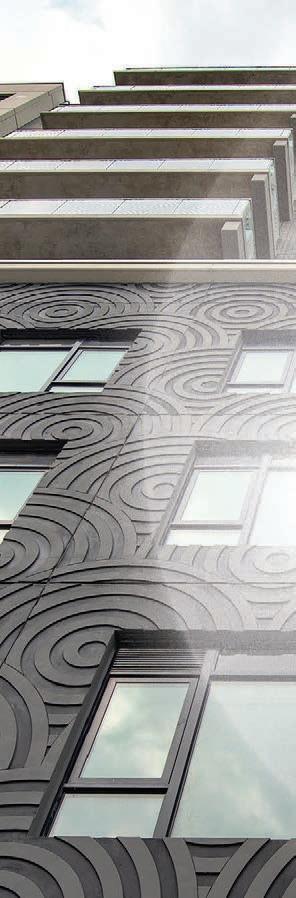


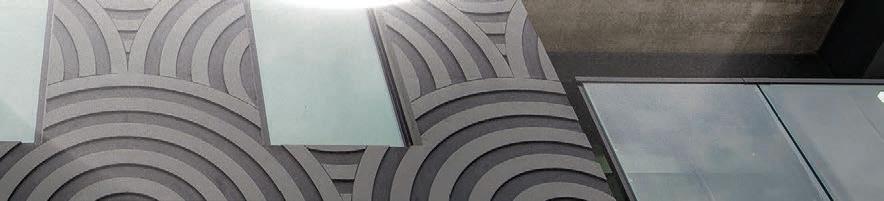

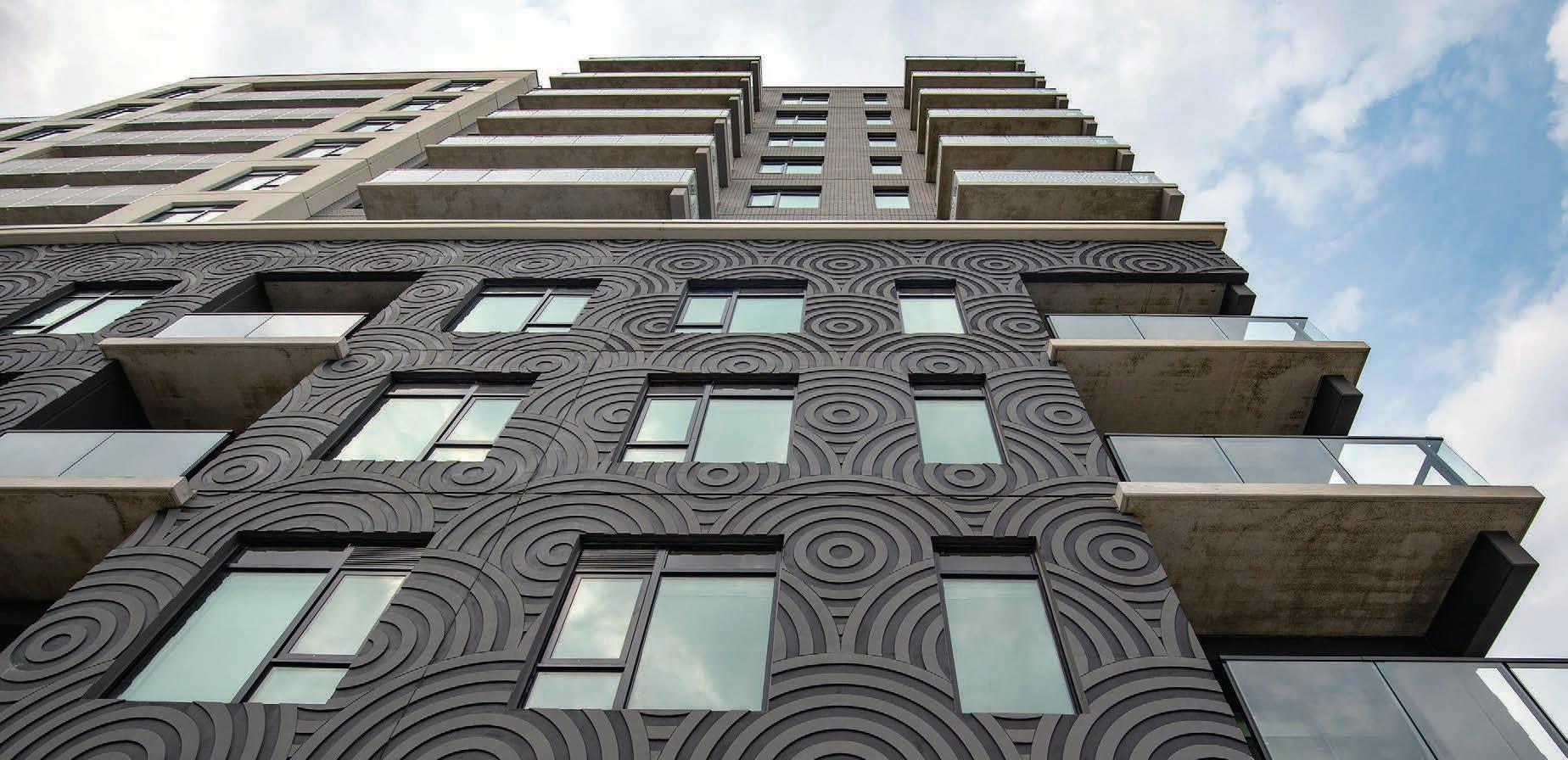
Contestoga.indd
CIVIC 66
by ROBIN BRUNET
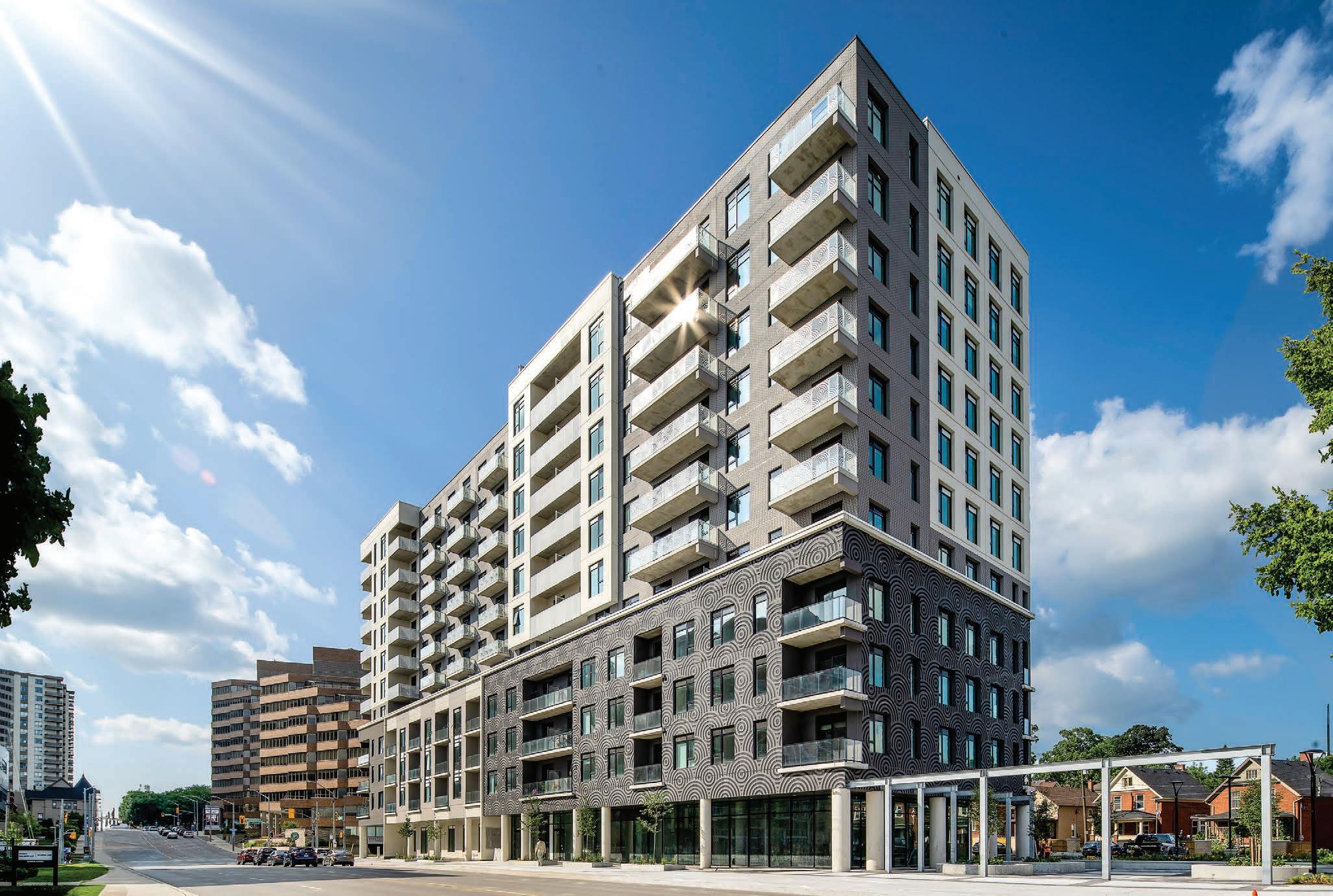
With the restoration of one historic building and the preservation of another, plus a new 11-storey building that pushes the creative boundaries of precast construction, the Civic 66 project in Kitchener is an outstanding addition to that city’s mixed-use residential portfolio and provides a much-needed transition between its residential neighbourhood and downtown core.
Civic 66 houses 170 units with ample underground and surface parking. Amenities include terraces, a pet spa, bike storage, a gym-quality fitness room and yoga studio, and communal areas for co-working and hosting events.
Visually it is a showcase for how precast construction can be used to create an architecturally elaborate structure. Taking elements from the heritage-designated two-storey office building on the same property, the lobbies feature board-formed concrete walls, and circular cast-in-place concrete decorative elements are replicated on the fourstorey podium. A central courtyard
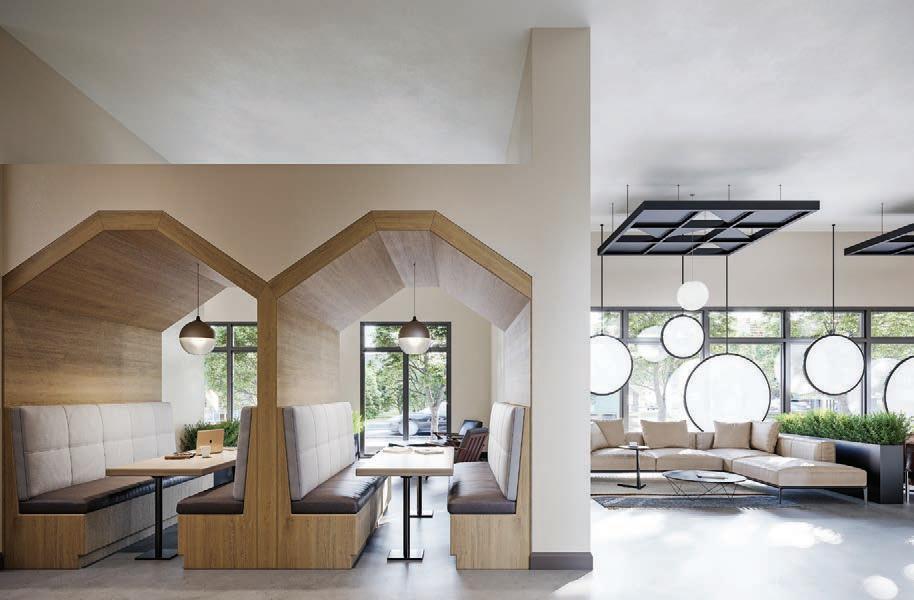
creates a place for community gathering, and patio off the building’s ground floor restaurant space.
Killam Apartment REIT and ABA Architects Inc. also ensured that the new building would be energy efficient, hence, solar panels and geothermal heating contribute to a 63.5 percent energy use reduction and an 86 percent
C02 emission reduction compared to the NECB 2017 reference model.
Carrie Curtis, VP, Ontario and Alberta at Killam, says, “We began focusing on the project five years ago, with an empty corner parking lot that was ideal for development, and when we discovered the office building and two-storey residential home had
heritage status, we were determined to incorporate them into the overall development process.”
Curtis adds that her organization didn’t hesitate to retain ABA and Melloul-Blamey Construction for the job. “We had already established a long-term work relationship with the two parties,” she says. “They understand what we’re trying to achieve, and they share our commitment to reviewing every project we complete with the intention of improving on our successes moving forward.”
Ashleigh Crofts, ABA’s project architect and urban designer, started the design in March of 2018. “After considering several iterations, we chose a nuanced extruded rectangle of 11-storeys as the most appropriate option for the site,” she says. “We broke the massing down with precast banding, contrasting colours, a recessed ground level, insets on the fifth level, and floating volumes, among other elements.
“We paid homage to the ornament and texture of the historic office building with a modern interpretation


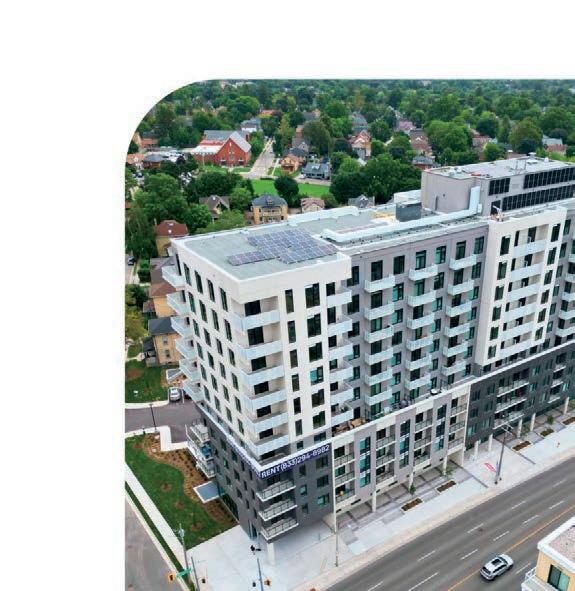

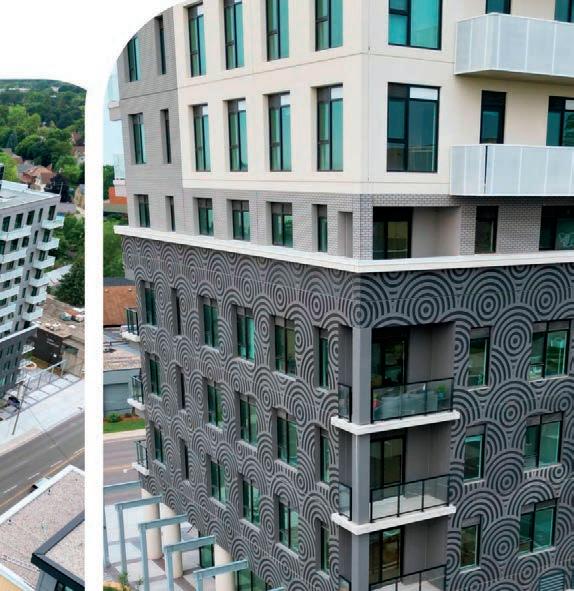


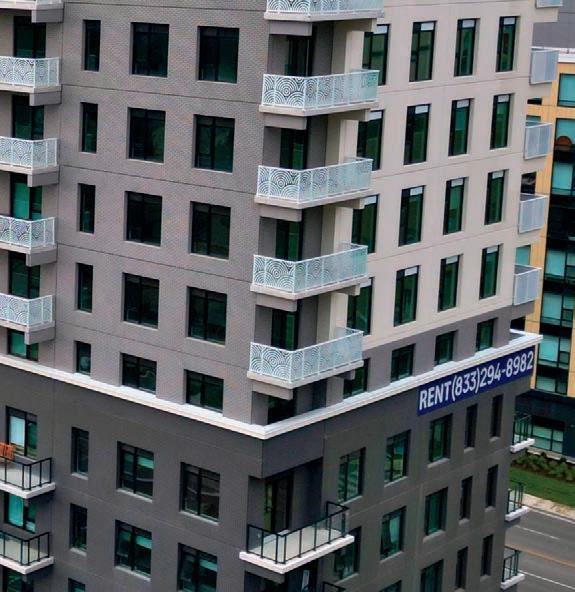






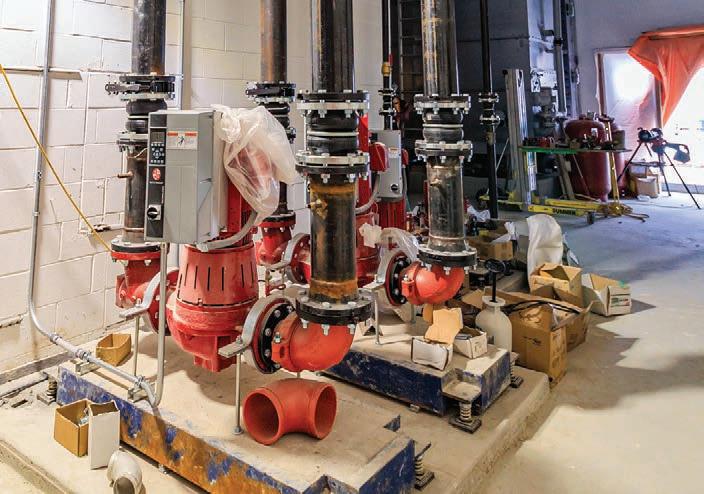

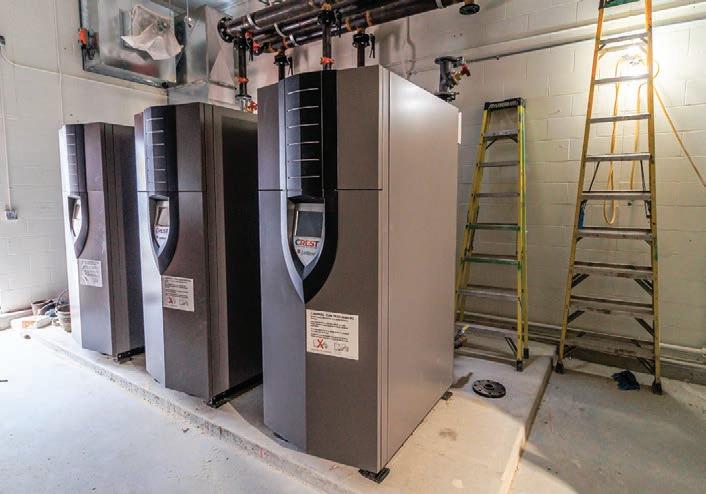
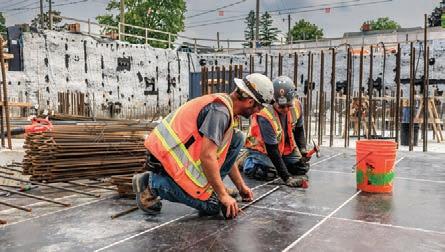


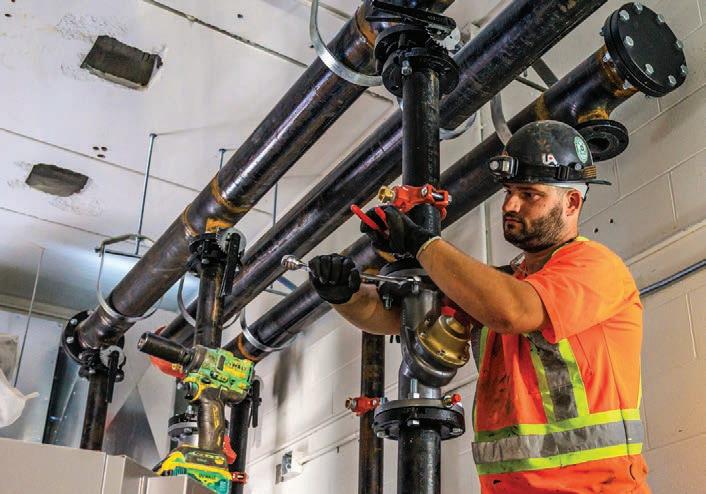



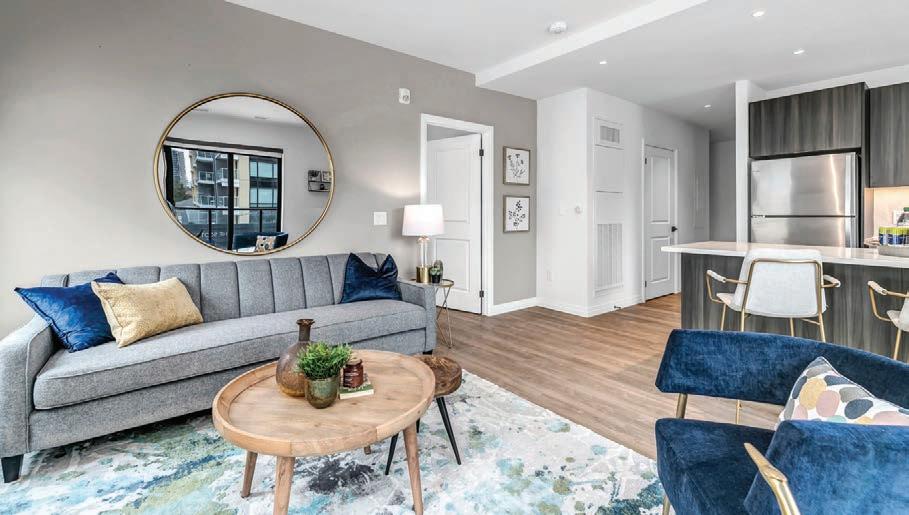

of its sunburst pattern inset into the precast concrete podium, etched into the balcony guards, and perforated into the windscreens.”
Rebecca Mayburry, ABA’s senior interior designer, adds, “The sunburst pattern was also represented in the lobby with circular light fixtures, and we augmented this with lots of fun colours and patterns representing the arts and entertainment components of Kitchener’s downtown.”
Melloul-Blamey broke ground on the site in late 2020, and Brent Smith, ABA’s architectural project manager, says, “Drilling extended as deep as 600 feet for the geothermal system; and since construction was at the height of the pandemic, labour shortages and cost escalation of materials had to be dealt with. There were challenges interfacing the traditional underground parking lot with the precast building components, but precast provided many benefits to construction, one of the most obvious being that the panels arrived on site ready to be installed, with no pouring necessary.”
Another challenge Melloul-Blamey is credited for handling deftly thanks to precise scheduling was the site itself. “There were significant constraints given that our project flanked a busy main street,” Smith explains, adding that careful consideration was also paid to landscaping the edge of the property to help preserve the
privacy of the neighbouring singlefamily residences.
Comparatively small undertakings were executed with equal care. “The heritage home was renovated and repurposed as a two-storey duplex,” says Andrew Bousfield, ABA’s president.
For her part, Curtis is excited by the finished results. “In addition to providing fantastic tenant spaces and urban-style touches such as a garage door-style opening to tenant spaces on the northeast side, Civic 66 fulfills its goal of being a transition from Kitchener’s residential neighbourhood to downtown,” she says. “The architectural details are truly outstanding.” A
LOCATION
66 Weber Street E., Kitchener, Ontario
OWNER/DEVELOPER
Killam Apartment REIT
ARCHITECT
ABA Architects Inc.
GENERAL CONTRACTOR
Melloul-Blamey Construction
STRUCTURAL CONSULTANT
MTE Consultants Inc.
MECHANICAL/ELECTRICAL CONSULTANT
DEI & Associates Inc.
LANDSCAPE ARCHITECT
MHBC Planning Limited
TOTAL SIZE
164,000 square feet
TOTAL COST
$48.5 million
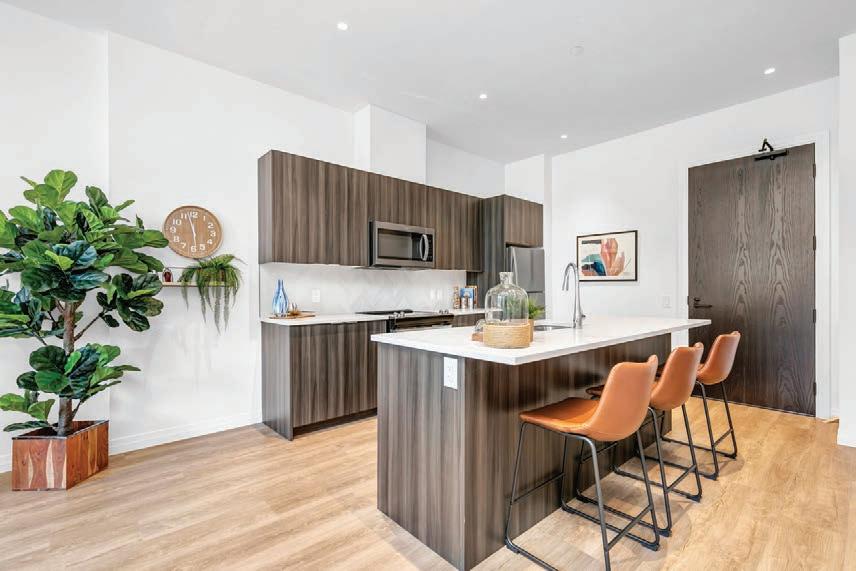
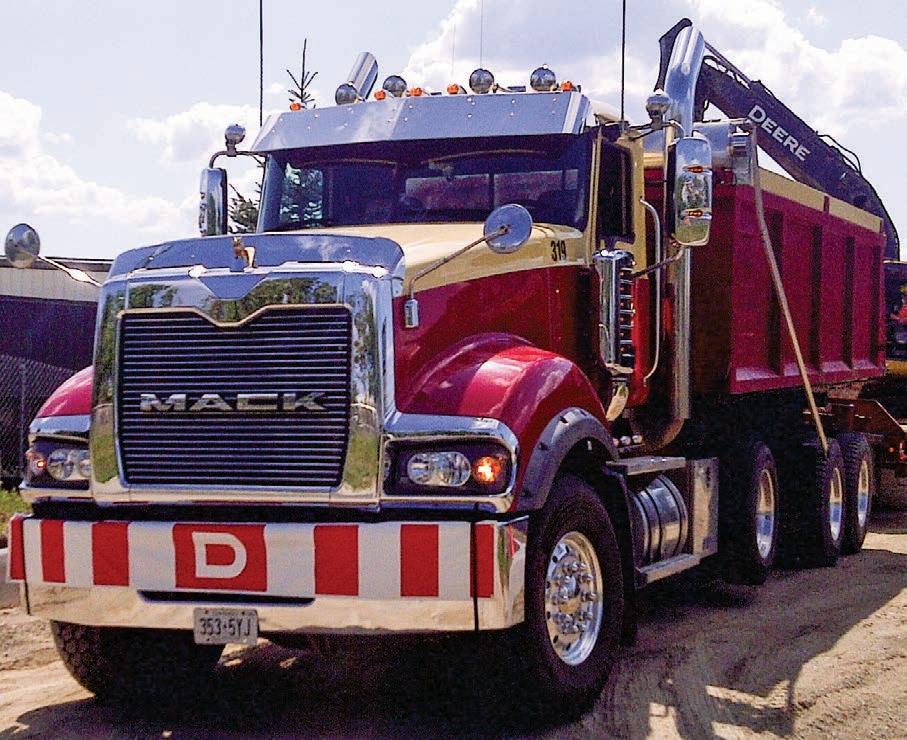


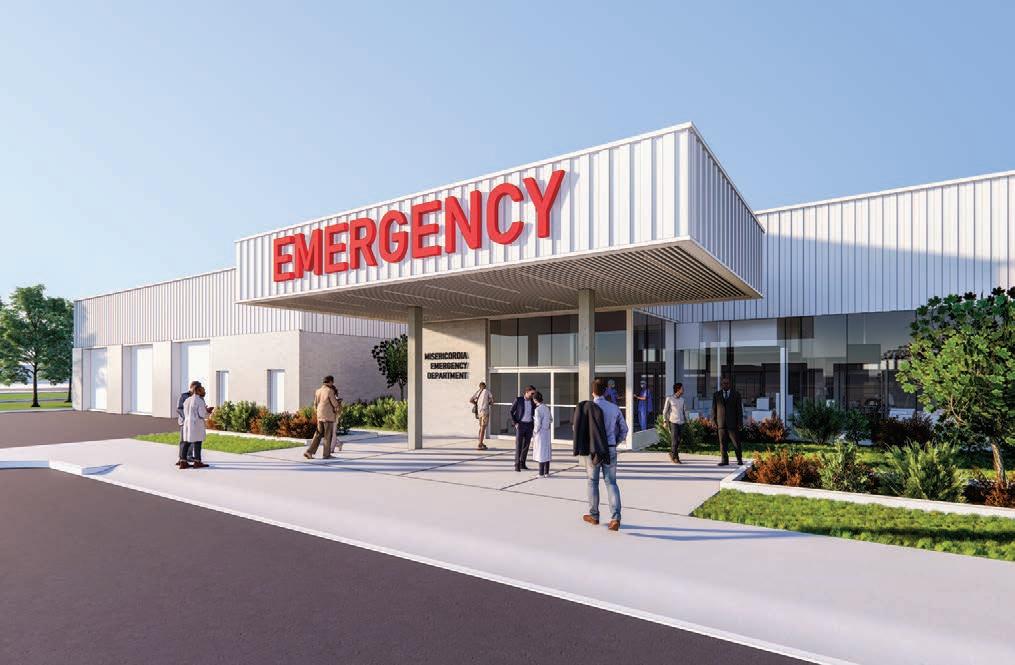
MISERICORDIA HOSPITAL ED
by STACEY MCLACHLAN
Alot has changed in the 50 years since Misericordia Community Hospital’s emergency department was first built. Beyond major advancements in technology, the growing and aging population has been straining the physical space for decades. But sometimes, change can be for the better.
Take, for instance, the new LEED V4 Silver targeted, state-of-the-art emergency facility – operated by Covenant Health and designed by RPK Architects Ltd. – that’s slated to open later this year.
It’s not just that this 5,000-squaremetre expansion will be able to accommodate 60,000 patients annually (although that’s a serious step up from the previous facility, which was originally designed for 25,000, although due to population growth was accommodating closer to 50,000 patients annually). It’s that it aims to address service pressures in the Edmonton area and is a significant step toward meeting the needs of communities in West Edmonton and Northern Alberta, not just today but for generations to come.
“From the outset of the project our team strove to create not just a well-functioning clinical space, but an environment for client-centred care,” explains Jan Kroman, principal architect for RPK. Working with the stakeholders, the team developed a mandate contained in four words: efficient, welcoming, warm, and safe. “These are the concepts that guided everything from space planning to the selection of finishes,” says Kroman.
The brick, white-metal, and white concrete have been designed to be compatible with the existing campus, and the Emergency Department is comfortably connected to the existing hospital. But the interior’s distinct “pod” layout is certainly a dynamic shift from the status quo.
The five pod areas are each intended to serve distinct patient groups. When patients arrive, they’ll enter their designated pod waiting area, each of which is oriented towards a soothing outdoor courtyard. The full-height window glazing allows patients to experience a moment of connection and calm with the outside world during a moment of crisis. Rich planting materials and naturally patinated copper also offer a grounding visual moment.
The vertical striations, as well as a lantern motif (drawn from Covenant Health’s symbology), guide design choices, with each pod entry highlighted via a backlit lantern wall, as well as having the main nursing desk in each department featuring areas of backlit solid surface material.
These dedicated waiting rooms not only contribute to the pleasant aesthetic of the space but also shape the patient experience. The rooms also help offer patients a break from the chaos of the general ED waiting area, exemplifying the ideas of flow and privacy that drove this project from the beginning. Eighteen acute care spaces will provide even more care and a kid-friendly interactive play area is designed to improve the family experience.
The design also includes five isolation rooms (from one in the previous facility), and examination rooms with glass doors instead of curtains for added peace and quiet. Those private isolation rooms feature segregated airflow systems to prevent the spread of germs, infections, and disease.
“The modernized ED at the Misericordia Community Hospital is designed to be more future proof,” says Mike Linn, senior director of capital management for Alberta Health Services. “It’s designed to take on future health-care challenges, such as pandemics.”
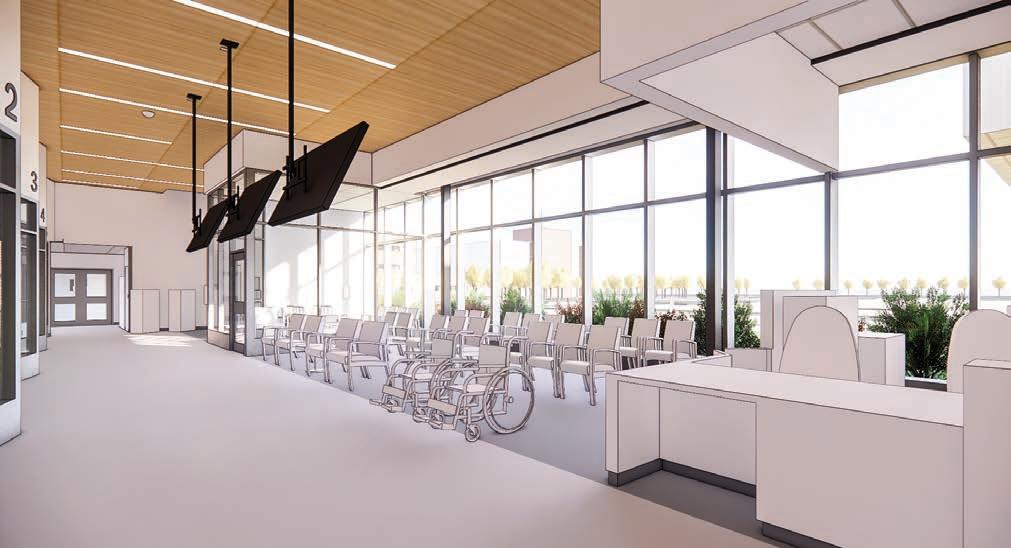

LOCATION
16940 87 Avenue NW, Edmonton, Alberta
OWNER
Alberta Health Services
OPERATOR
Covenant Health
ARCHITECT
RPK Architects Ltd
GENERAL CONTRACTOR
PCL Construction Mgmt
STRUCTURAL CONSULTANT
Fast + Epp
MECHANICAL/ELECTRICAL CONSULTANT
MCW Hemisphere Ltd.
CIVIL CONSULTANT
Arrow Engineering Inc.
TOTAL SIZE
5,000 square metres
TOTAL COST
$85 million
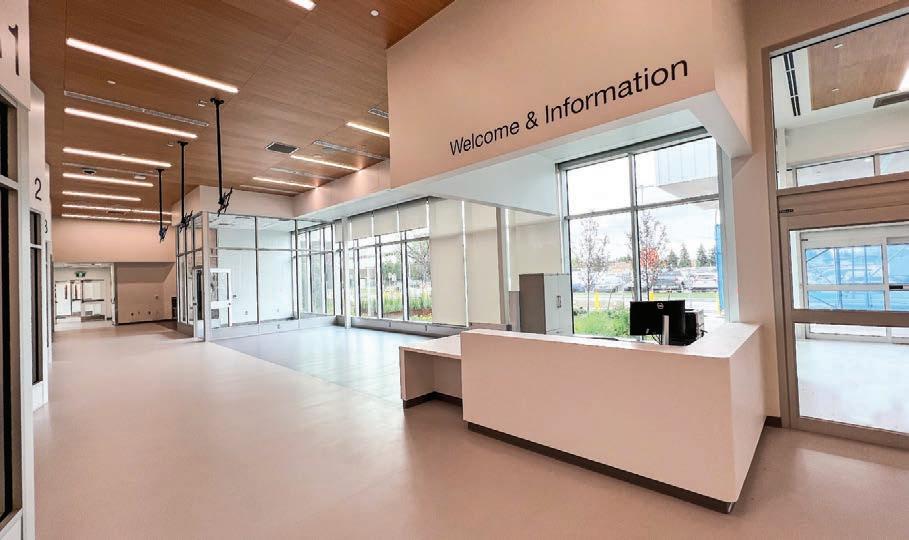
Unsurprisingly, a project of this sensitivity requires extensive care and consideration. “Constructing on an existing and active hospital campus is always a challenge,” says Darren Helboe, senior project manager for general contractor PCL. However, teamwork made the logistical challenges manageable. “The installation, electrical tie-ins, and commissioning of the emergency generators and associated switchgear was in itself an engineering and construction achievement, with significant time and effort being
put in by the project team, all working together to complete this scope with minimal disruption to the hospital.”
Jo Ann Molloy, senior director of operations of Misericordia, concludes by saying, “The shiny new emergency department is slated to open this fall and what staff is looking forward to most isn’t the surface level improvements. Everyone’s excited about how bright, modern and beautiful the space is … but they’re also excited about how it will help them deliver modern care.” A

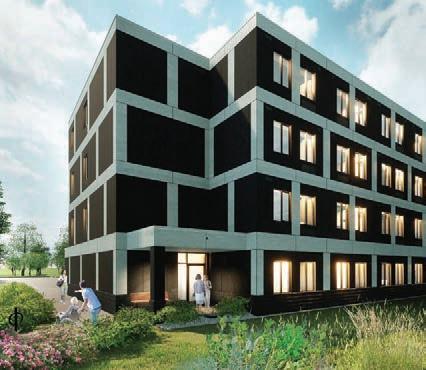
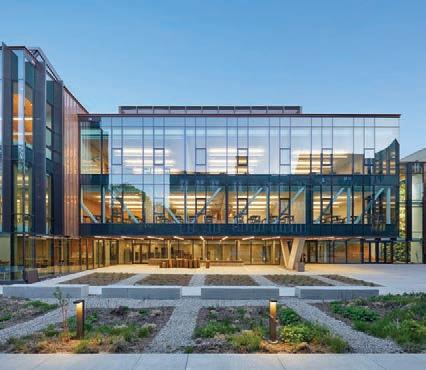

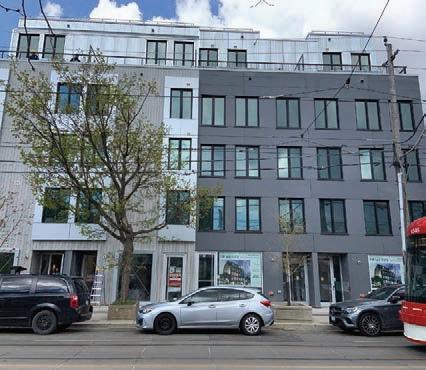
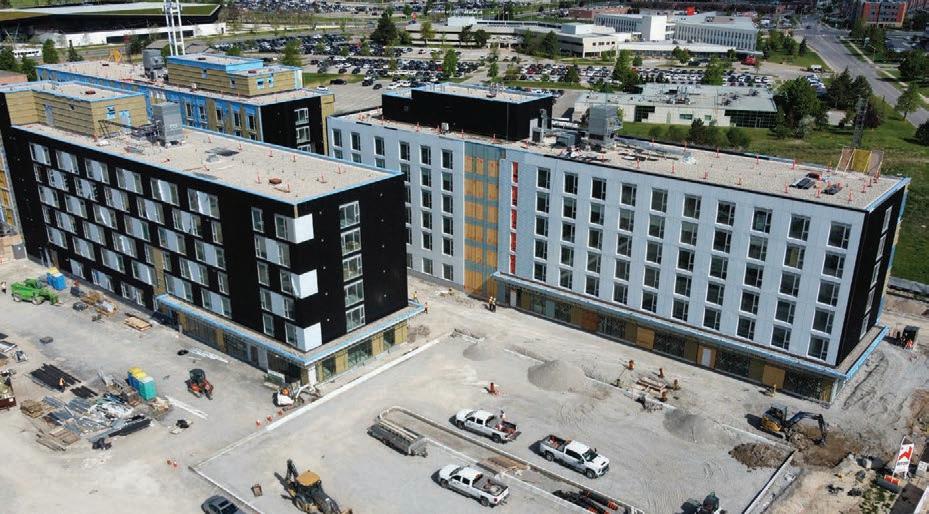

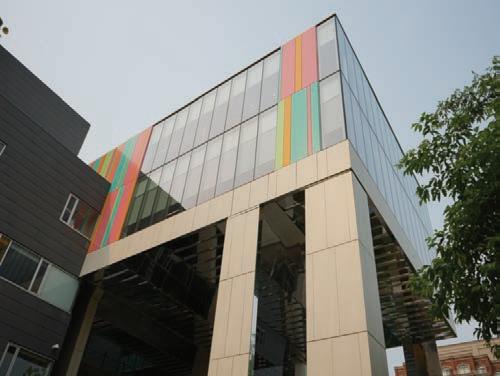
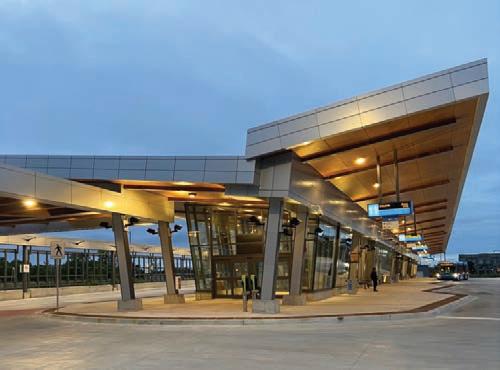
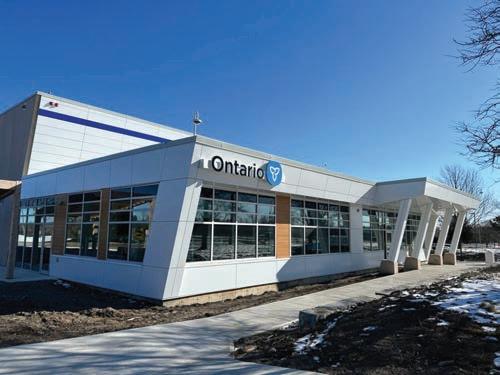
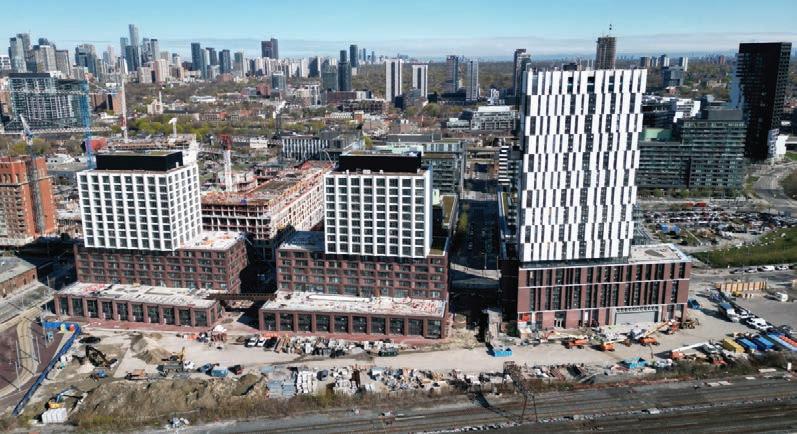


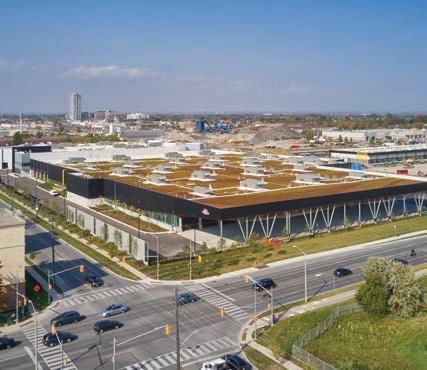

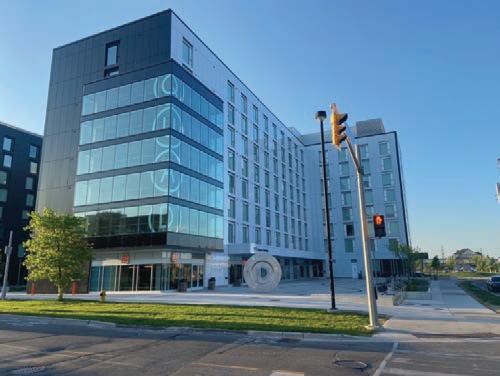

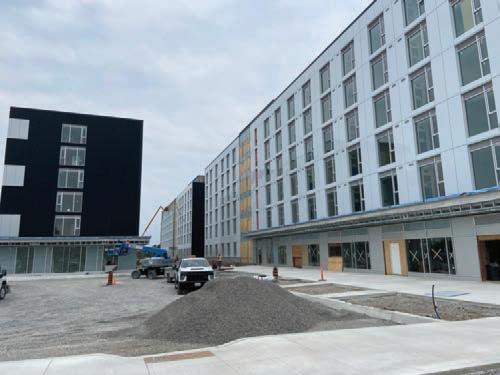
TTC McNicoll Bus Garage
Quad Student Community
VIA Rail TMC Modernization
The Quad 2 Toronto, ON
Lauratina University Sudburry, ON
Parkway Lofts Thorold, ON

PARKWAY LOFTS – BROCK UNIVERSITY
by ROBIN BRUNET
Parkway Lofts is currently being marketed as delivering the best location, amenities, and stylish apartments to elevate the students’ experience – and that’s precisely what development partners Campus Suites and Woodbourne aimed for in creating the three building, 543-bed facility beside Brock University in Thorold, Ontario. Parkway Lofts more than lives up to Campus Suites’ recognition that innovative housing is the most effective means of fostering a sense of community among students. The six-storey buildings offer a host of different fully-furnished suite types, with social lounges, laundry, and study rooms on every floor. There is also instant access to a communal kitchen, large lounge and games room, and a resort-quality gym.
The buildings achieve the dual benefits of being modern in appearance (clean rectangular forms with generous-sized uniform glazing and façade detailing) yet inviting thanks to ground level activity of retail services and amenities, wide walkways with tables and benches, and abundant landscaping.
Inside, the living units and common spaces exhibit clean lines and are filled with natural light. The predominant colour is white with splashes of bold reds, teals, and blues used for areas such as kitchen backsplashes.
Ian Husted, VP, investments at Woodbourne, says, “In 2018 we acquired a property with nine buildings that had been developed to the
east and plenty of space to the west for Parkway. The original design was for six buildings, but when we partnered with Campus Suites we phased the project to cater more to student needs.”
In 2020 the partners retained Architects + Research + Knowledge (ARK) to undertake the redesign, emphasizing east-west connectivity to components such as the Brock campus, business park, a park, and a new recreation facility.
Christophe Gauthier, partner, ARK, says, “Work began with studies to determine how many beds we could incorporate. Also, early on it was decided there would be sunny public spaces between the buildings. The colour scheme of the exteriors would alternate between light and dark to create a checkerboard effect.”
The design of the interior “was to create different layers,” Gauthier says. “When you enter in the middle of each building you will encounter study areas, followed by fitness areas and lounge depending on the building – the cumulative effect being that of a sophisticated urban facility.”
As for the creation of redundancy for items such as in-suite kitchenettes and common kitchens, Gauthier says, “it was a priority to create a balance of private spaces and public spaces to enhance the livability of Parkway.”
As for energy efficiency, Gauthier says, “the three buildings perform 28.3 percent better than the National Energy Code due to components such as heat pumps and especially envelopes with insulation
LOCATION
3451 Schmon Parkway, Thorold, Ontario
OWNER/DEVELOPER
Campus Suites / Woodbourne
ARCHITECT
Architects + Research + Knowledge Inc. (ARK)
GENERAL CONTRACTOR
Buttcon Construction
STRUCTURAL CONSULTANT
Quinn Dressel Associates
MECHANICAL/ELECTRICAL CONSULTANT
Quasar Consulting Group
LANDSCAPE ARCHITECT
Quinn Design Associates Inc.
CIVIL CONSULTANT
Hallex Engineering Ltd.
TOTAL COST
Undisclosed
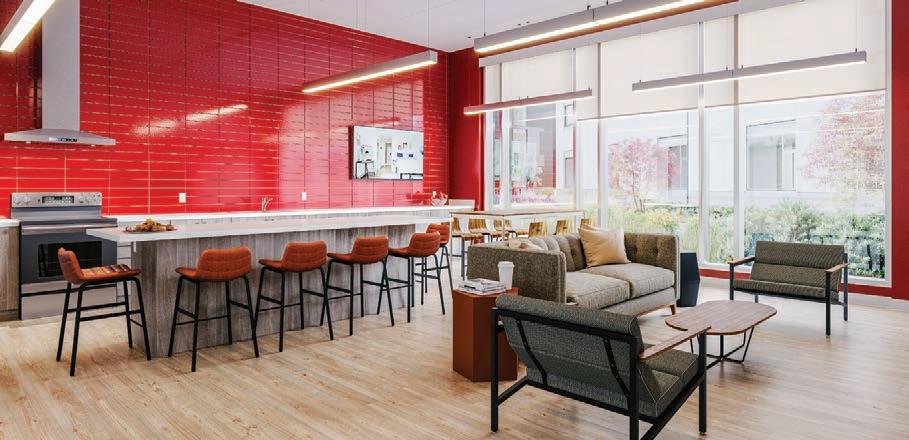

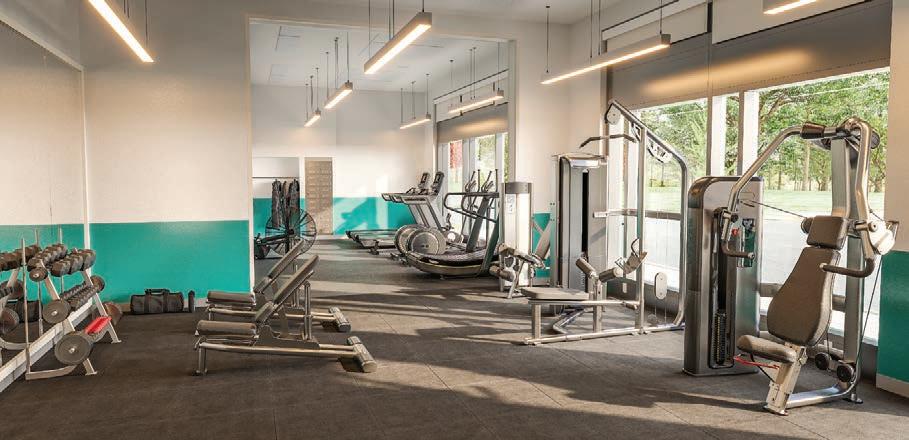







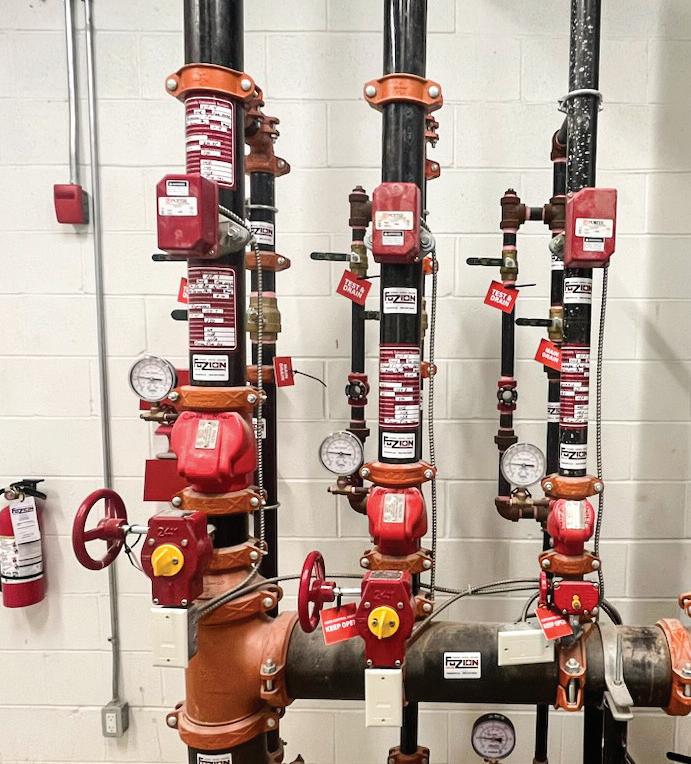
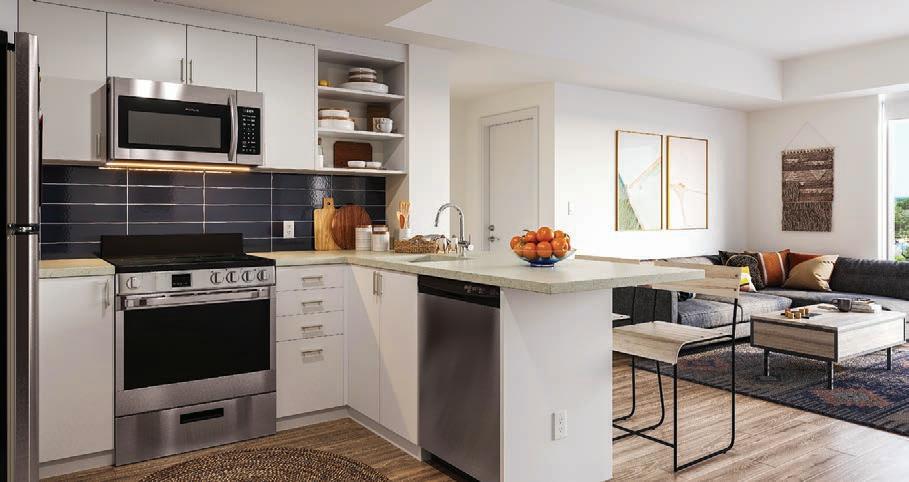
on the outside. The insulation is 125-millimetres thick and was determined by energy modelling.”
Buttcon Construction was tasked with delivering the three Parkway buildings; the company’s reputation for providing high quality workmanship and managing fast-track projects was upheld as it maintained the tight schedule during the waning months of the pandemic and navigated the challenges of material supply and delayed delivery times.
Henry Morton, president at Campus Suites, says of Buttcon’s efficiency, “The first three Parkway buildings were delivered right on
time under the challenging conditions of the lockdowns, and it helped that Buttcon and ARK have collaborated on past projects. Buttcon also shared our focus on risk mitigation and LEAN construction methods.”
Arcnova, well-known for providing building envelope solutions to all kinds of structures, was retained to provide 80,000 square feet of façade. Jay Selcuk, principal/partner, says, “When ARK and Buttcon approached us to fabricate and install the façade system for the project, we pooled our knowledge and experiences to ensure we would finish the project on time, on budget, and with quality.
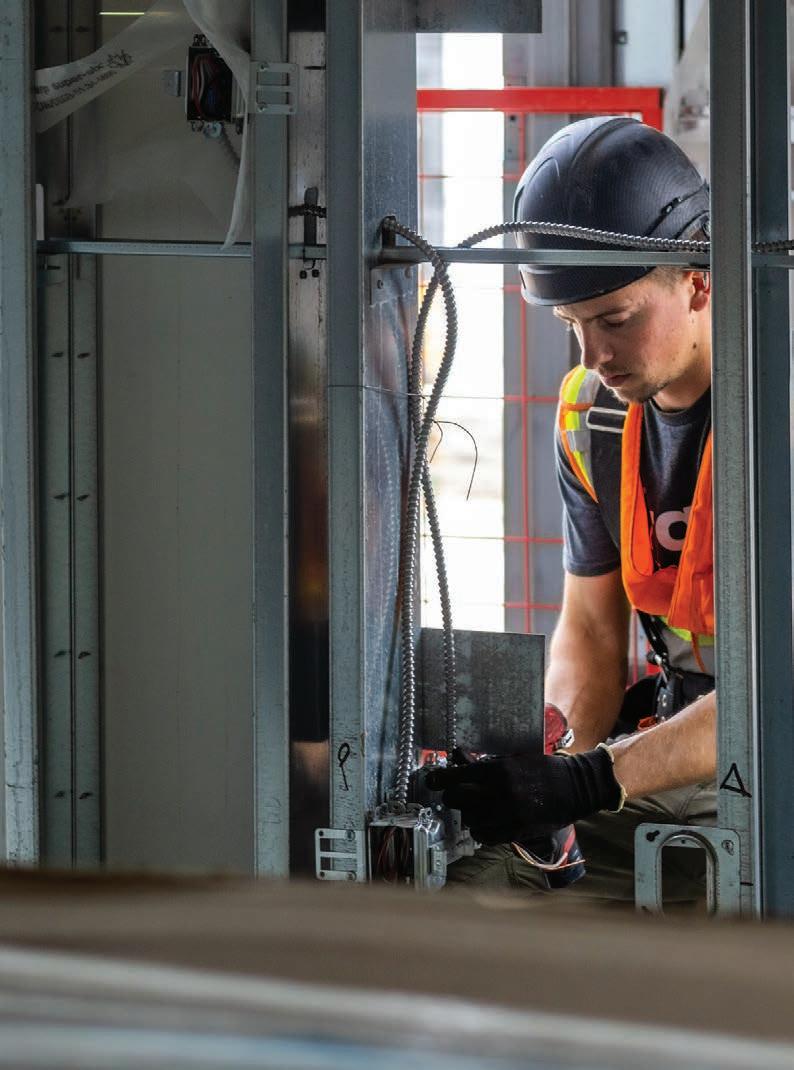

Having previously worked on a similar project with ARK and Buttcon, the process of ordering material, drafting, fabrication, and installation went very smoothly, with onsite work beginning in November 2022 and wrapping up in July of this year.”
While Parkway’s remaining three buildings will be developed over the next few years, the first three buildings are already a hit
with students. “They’ve voted with their feet,” Morton says. “Leasing is strong for this project.”
Morton goes on to note that “Woodbourne pushed us to go the extra mile for this project, and we and ARK loved the challenge.” To which Husted adds, “Going the extra mile meant delivering a true community with nothing overlooked. We couldn’t be happier with the results.” A
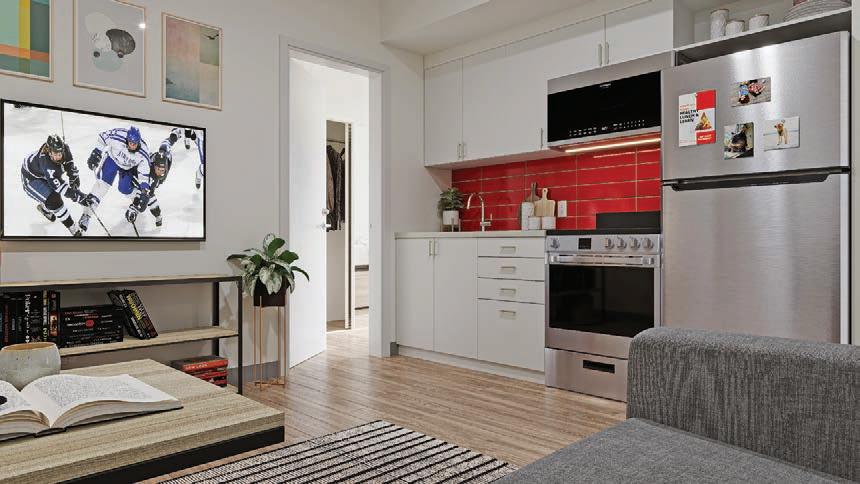



Guiding our client’s every step of the way through a worry-free construction process.
• Construction Management
• Design Build


• Design Assist
• General Contracting
• Pre-Engineered Structures





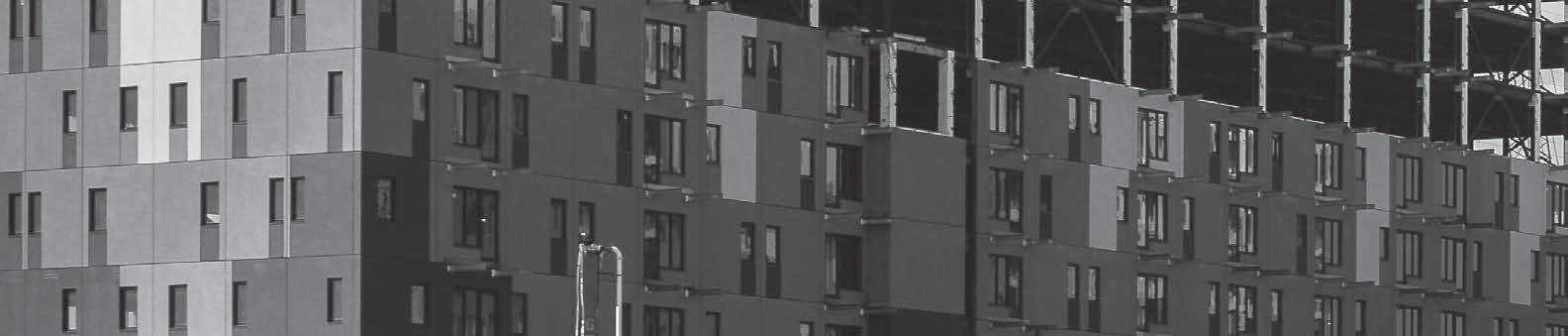



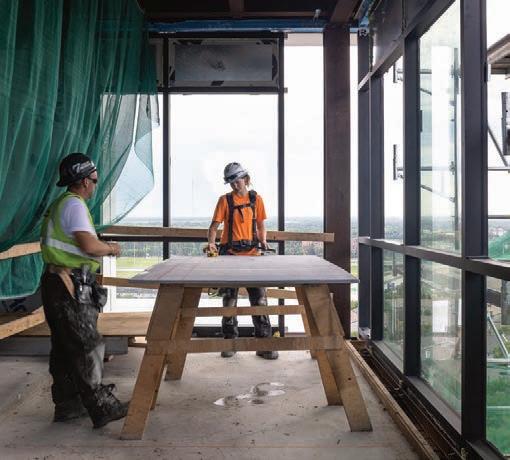
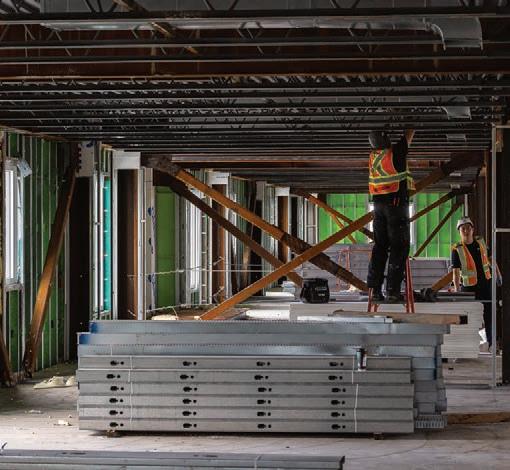


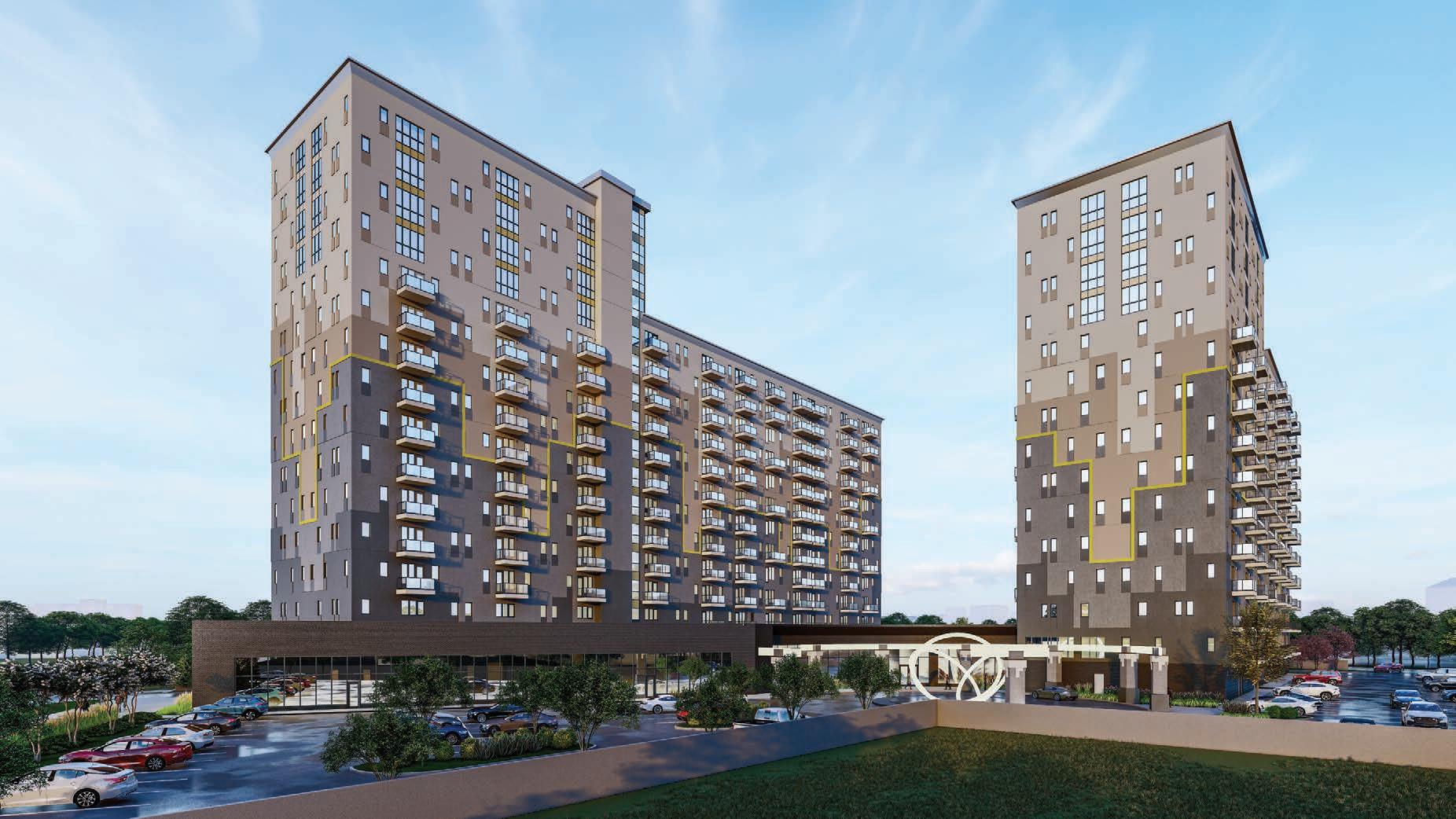
THE HALO
by NATALIE BRUCKNER
Avisionary project has emerged in the neighbourhoods of Richmond West and Fort Richmond in Winnipeg that is reshaping the urban landscape and setting a new standard for rental living. Aptly named The Halo, this architectural marvel is the brainchild of Private Pensions Partners Real Estate LP (P3), a company committed to providing premium rental properties that redefine comfort and luxury.
At the heart of this transformative venture stands Karl Loepp, the chief operating officer of P3, whose company’s passion for excellence and commitment to meeting housing demands have been the driving force behind The Halo’s conception. Loepp recalls the genesis of The Halo, saying, “We looked at this piece of land in South Winnipeg and thought it’s an ideal location for multi-family, purpose-built rental apartments. There’s no secret that there’s a huge demand for rental units across Canada, and our company specifically focuses on apartment rentals.”
Designed in collaboration with Affinity Architecture Inc., The Halo exudes an aura of tranquility, beauty, and opulence. Boasting an array of one, two, and three-bedroom
“built-for-rent” apartments and penthouses, this development epitomizes the pinnacle of effortless rental living. The primary design inspiration and philosophy behind The Halo project, according to Joel Tranq at Affinity Architecture Inc., “revolved around the concept of prefabrication. We sought to exploit the economies of mass fabrication and standardization for cost control and schedule efficiency.”
Rising tall into the sky, the two residential towers – 16 and 15 storeys for the north and south towers respectively – comprise 406 well-appointed units, with an additional 8,400 square feet of commercial space below. The Halo aims to create a vibrant and inclusive community, offering a diverse range of accommodations, from affordable living to lavish comfort. The first tower, inaugurated in March 2023, has already achieved a 90 percent occupancy rate, a testament to the project’s immediate success. With the second tower scheduled for completion in March 2024, The Halo continues to garner immense interest from prospective renters.
Loepp takes pride in the exceptional features that set The Halo apart from the ordinary. “Our look is sexy.

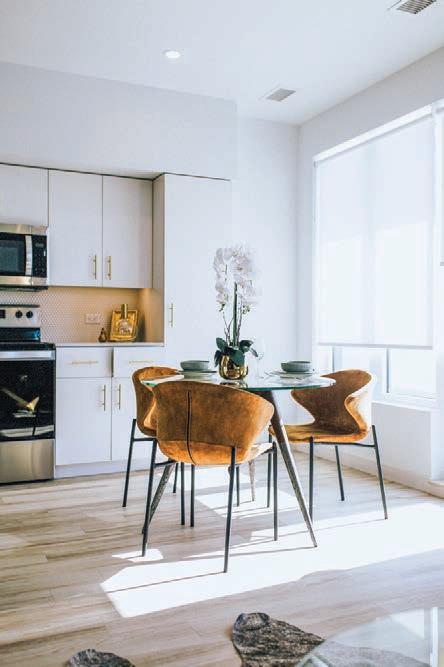
All our products have that, whether that’s design or the colour of innovation. We try to go above and beyond,” he shares. The Halo offers a host of amenities that cater to the residents’ needs and desires, including car wash facilities, a state-of-the-art fitness centre, and serene garden and leisure areas. However, it’s the awe-inspiring two-storey penthouse units that steal the spotlight, boasting floor-to-ceiling glass and glass railing walkways.
The concept of prefabrication was indeed at the core of the design. Archie Milcharek, project manager at M Builds, explains: “The envelope is a prefabricated steel stud, EFIS panelized system which is not uncommon, however, we installed
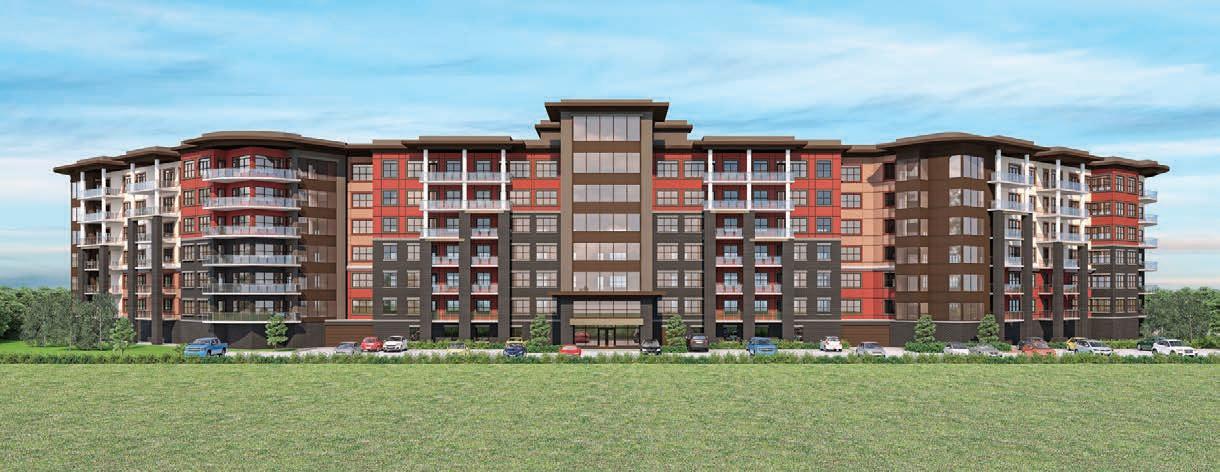
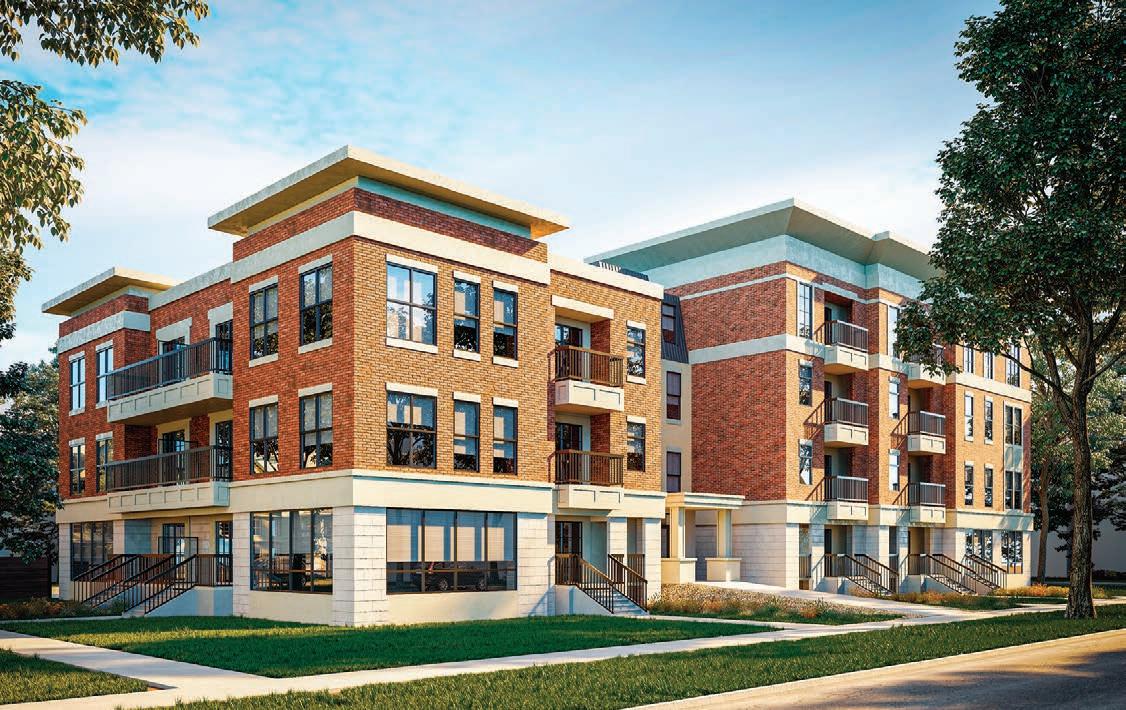
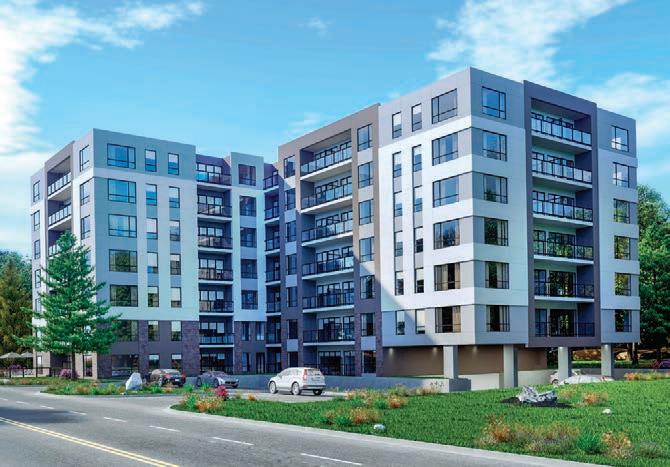
Affinity Architecture is a leader in value-driven design. We help boost ROI for clients who build and manage real-estate assets in Winnipeg and throughout Western Canada.
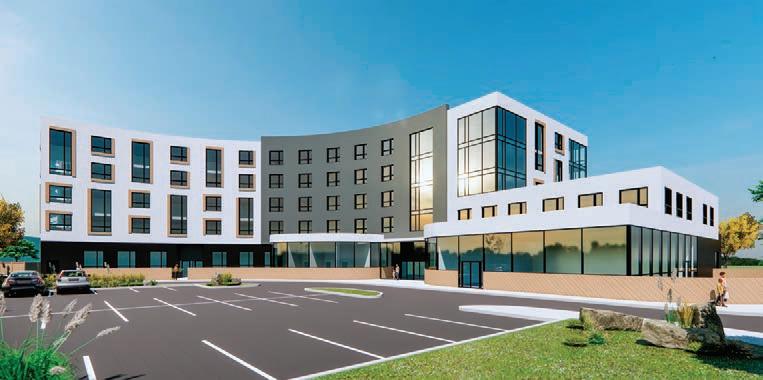
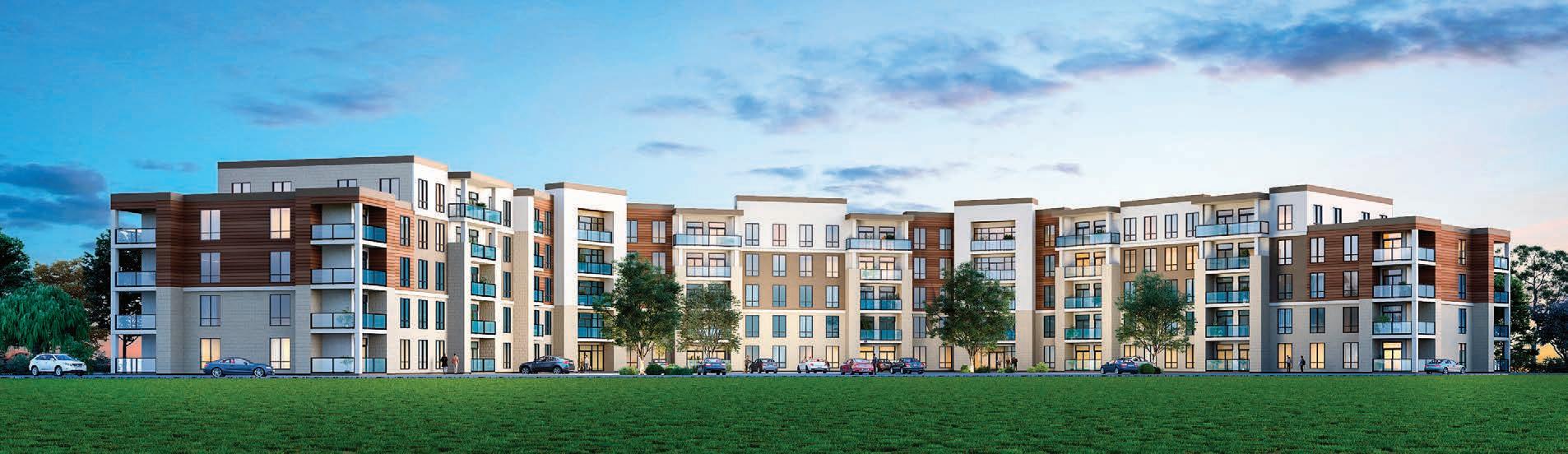
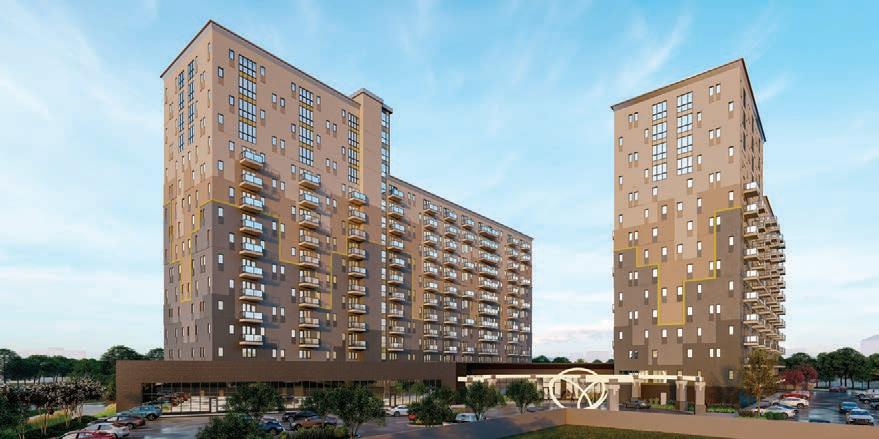
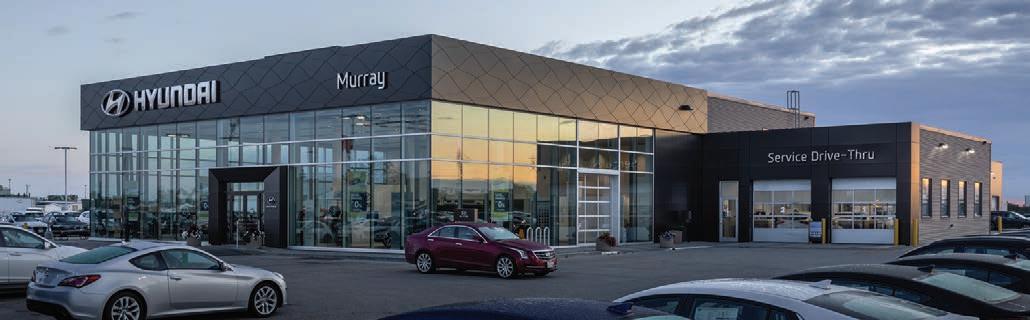
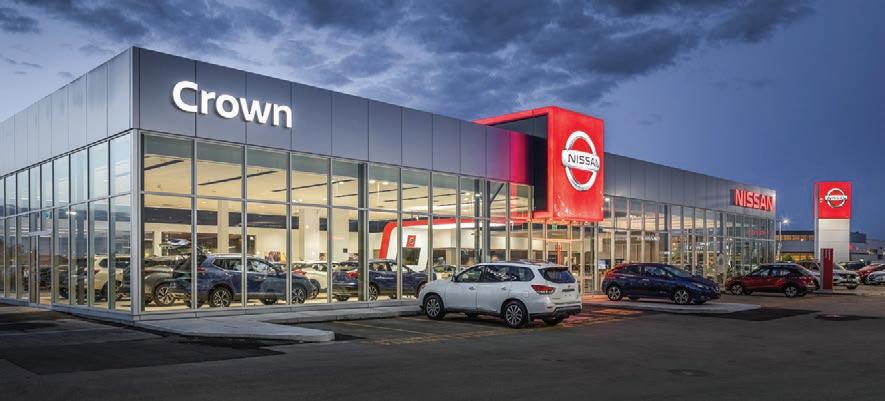
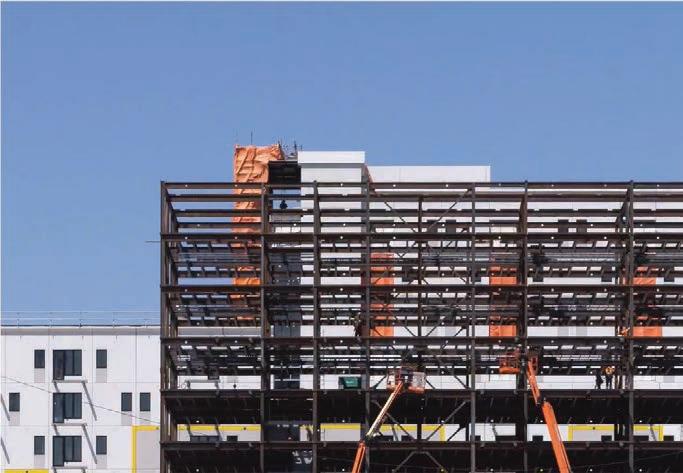


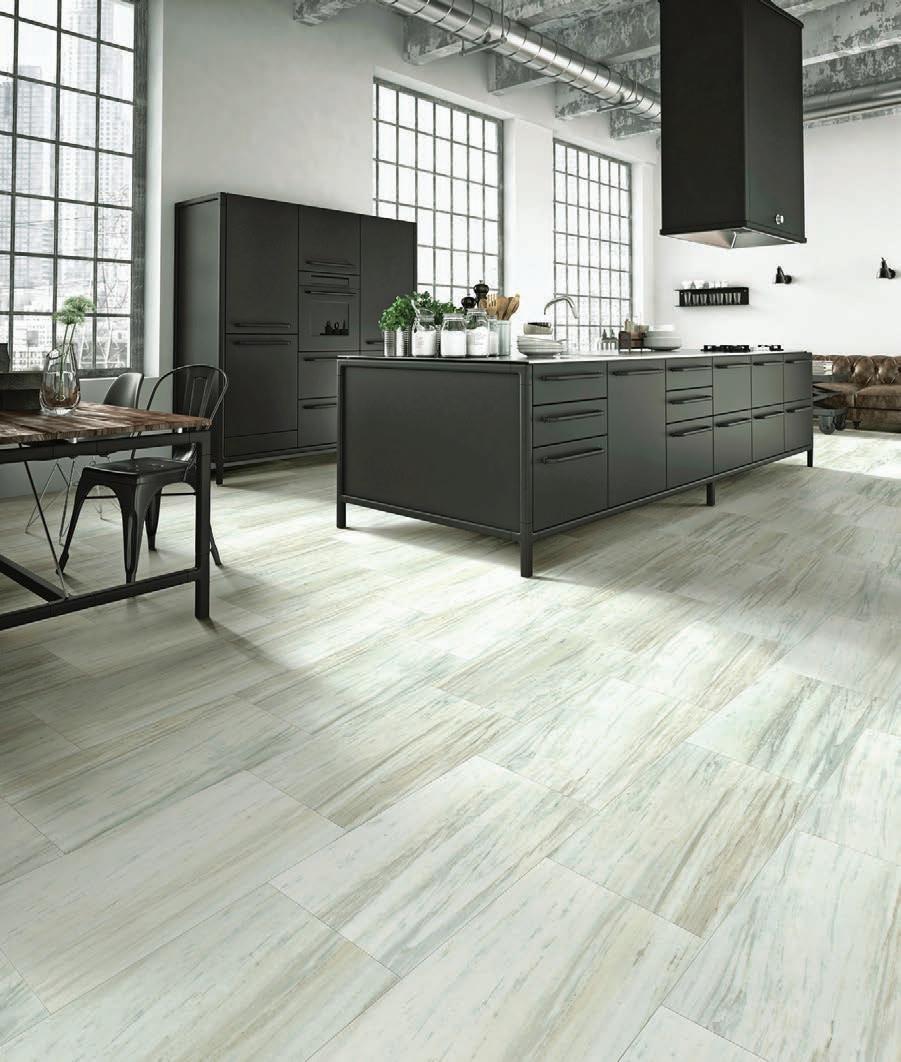


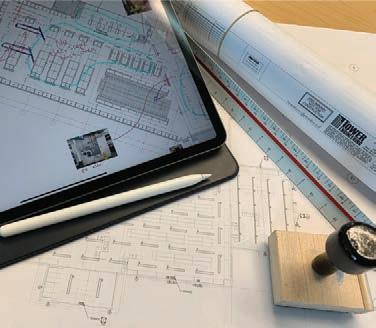



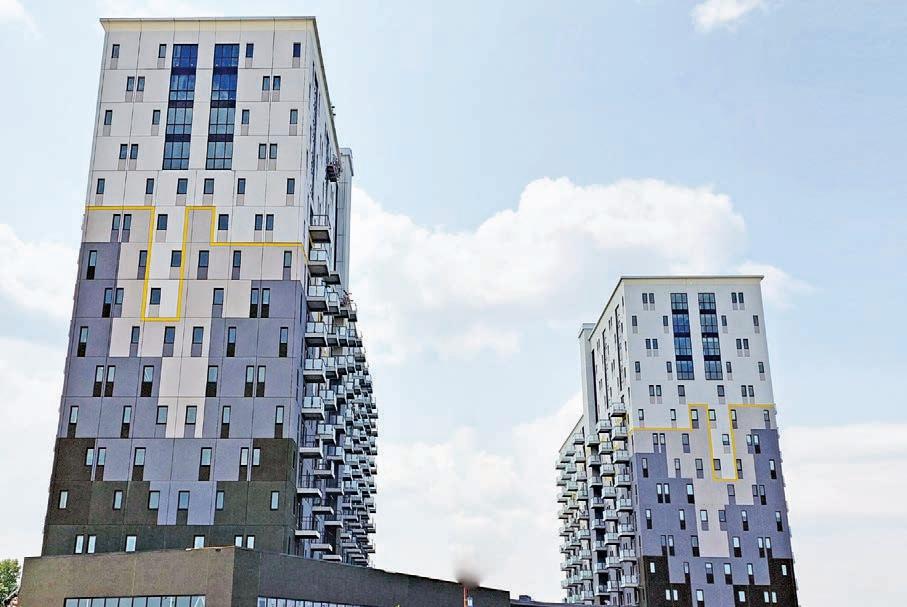







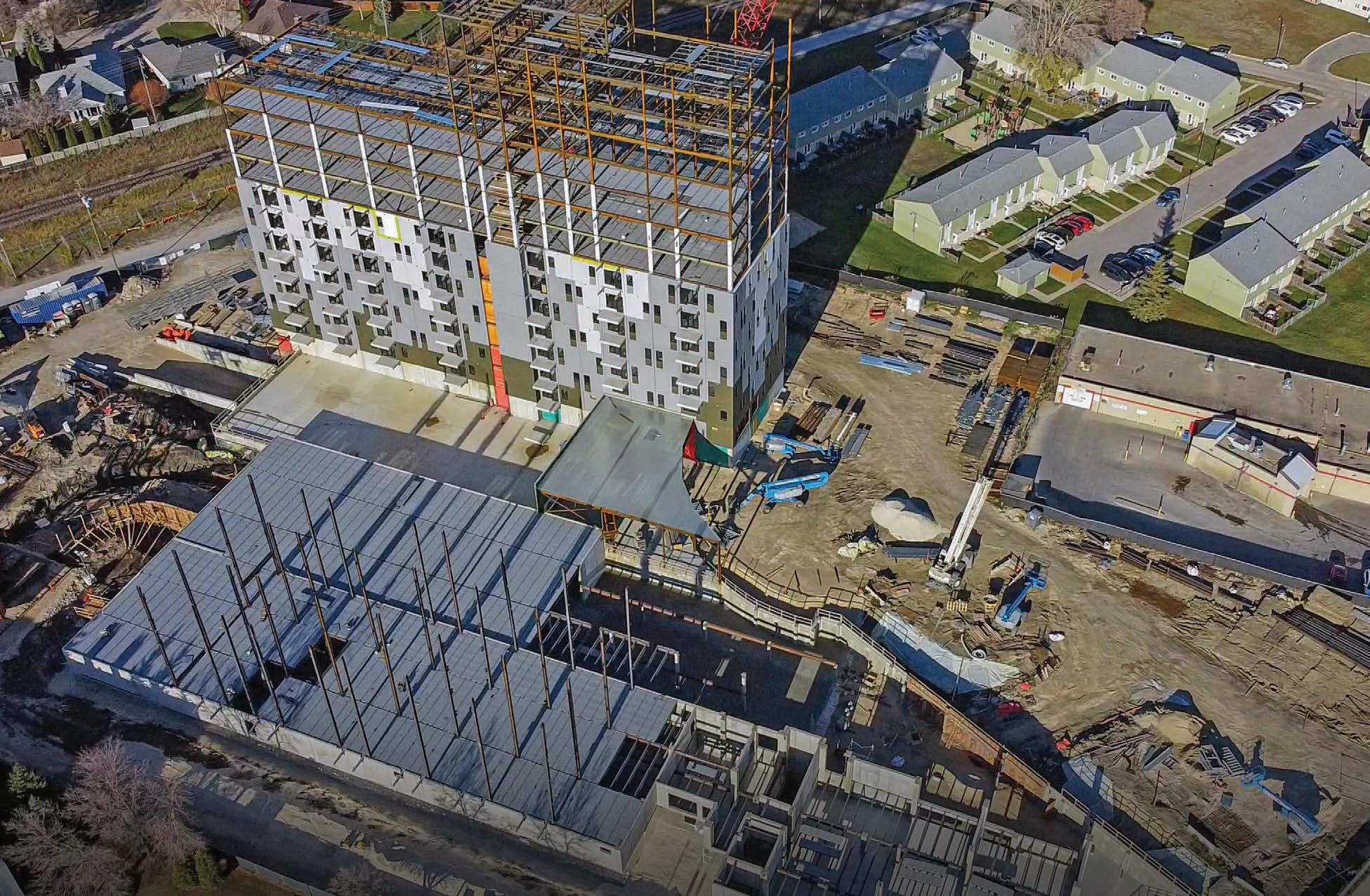

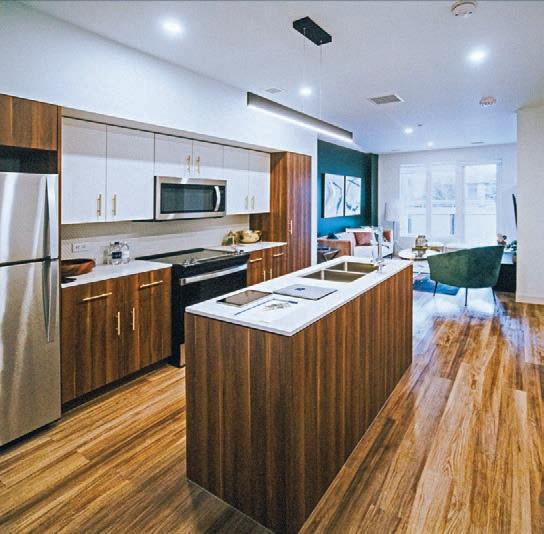
all windows, balcony doors, and flashings as part of the prefab process, making a complete panel prior to hoisting and installation. None of the subtrade partners involved had installed glazing prior to final panel installation, making this process unique; it was very successful.”
Tranq further explains that M Builds proposed the use of a Hambro joist system. “This had several advantages over cast-in-place concrete, particularly for the schedule. A steel skeleton is not only lighter for the foundations but allows for erection through our harsh Winnipeg winters.”
Outboard insulation was a consideration early on in the project, to simplify the building envelope membranes and to mitigate thermal transfer through the prefabricated panel steel studs. The patio doors and operable suite windows are also equipped with multi-point latching for a tight air seal when closed. Every suite is also equipped with an HRV fan-coil – relying on a central boiler and chiller – to perform heat recovery of exhausted suite air.
Adding a touch of vibrancy and character, The Halo proudly showcases public art, a hallmark of P3’s developments. The infusion of colours

and artistic elements throughout the building creates an enchanting ambiance, setting The Halo apart as a true work of art in the city.
As Loepp reflects on The Halo’s defining aspect, he says, “It’s a project that, when you come to the site, you feel like you’ve arrived. It’s a different experience because when you walk into the lobby, you feel like you have walked into a hotel.” The grand lobby, spanning an impressive 7,000 square feet and two storeys, leaves an indelible impression on all who enter, setting the stage for the elevated living experience that awaits within.
In conclusion, Tranq comments: “The project becoming a physical thing is the result of the dedicated efforts from many people. The mutual trust that collaborative parties developed over the course of the project has been an extremely rewarding outcome of this years’ long and ongoing project.” Milcharek agrees, adding: “The level of collaboration from all stakeholders was incredible. I know that sounds a little cliché, but a design assist project model requires dedication from all stakeholders, especially when starting construction in the pandemic, which added to the overall challenges.” A
LOCATION
3015 Pembina Hwy, Winnipeg, Manitoba
OWNER
A+REIT
DEVELOPER
Private Pensions Partners Real Estate LP
ARCHITECT
Affinity Architecture Inc.
CONSTRUCTION MANAGER
M Builds
STRUCTURAL CONSULTANT
Wolfrom Engineering Ltd.
MECHANICAL/ELECTRICAL CONSULTANT
Tower Engineering
LANDSCAPE ARCHITECT
McGowan Russell Group Inc.
TOTAL SIZE
510,000 square feet
TOTAL COST Undisclosed
We are privileged to team up with M Builds and Affinity Architecture to complete The Halo.

CONGRATULATIONS M Builds



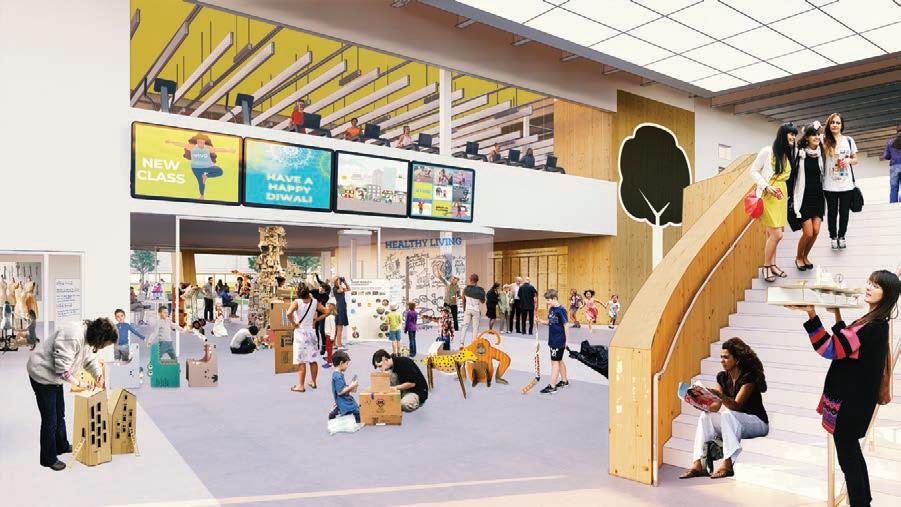

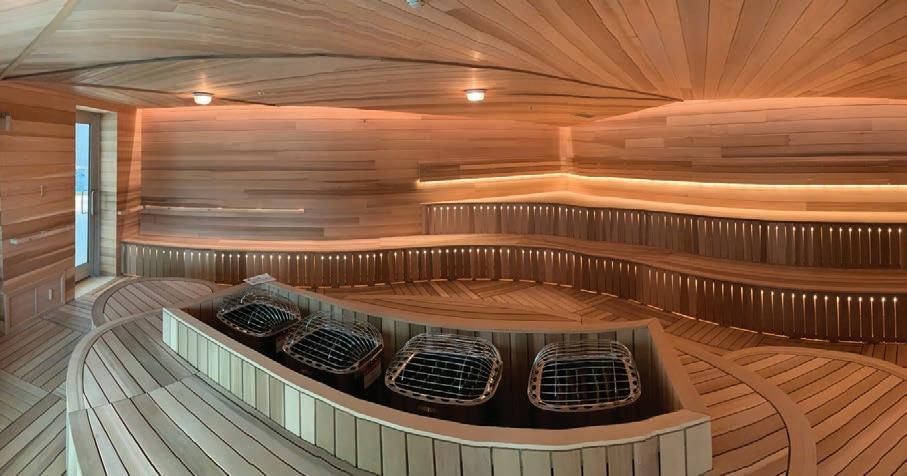
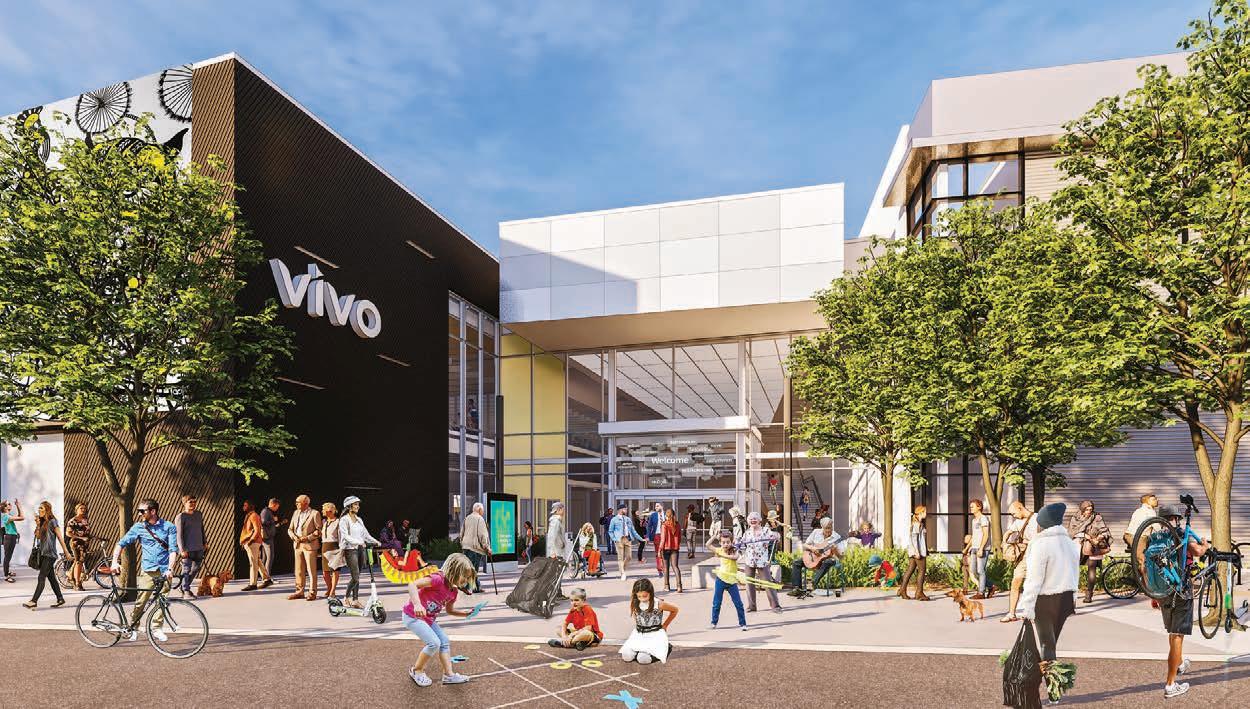
VIVO FOR HEALTHIER GENERATIONS EXPANSION
by NATALIE BRUCKNER
Amidst the bustling streets of north-central Calgary, a transformative project is taking shape – one that aspires to raise healthier generations, unite communities, and inspire innovation. This ambitious endeavour is none other than the Vivo for Healthier Generations expansion project, which aims to elevate the existing facility to new heights, offering an unparalleled space for physical, social, and emotional well-being.
“This expansion and renovation of Vivo for Healthier Generations is about creating the healthy futures we all hope for – for ourselves, our community, and our planet,” says Courtney Cathcart, chair of Vivo’s Board of Directors. The project began construction in April 2021, marking a turning point for the communitydriven recreation centre.
The expansion encompasses an impressive 135,000 square feet of new and renovated space, promising an exceptional array of amenities. Among these is the first-of-its-kind Indoor Park – a pioneering concept that seamlessly integrates nature within urban confines, allowing visitors to reconnect with the outdoors. Complementing this natural retreat is a six-lane, 25-metre pool that beckons swimmers to embrace aquatic activities, while four new community rooms nurture collaboration and creativity among visitors.
Championing innovation, the expansion houses a dedicated research and innovation lab, a space
that fosters experimentation and discovery in the pursuit of improved well-being practices. Furthermore, a 60 percent larger fitness centre stands as a haven for health enthusiasts, offering an environment conducive to holistic wellness. At the heart of the expansion lies the “community hug,” a multifunctional outdoor space designed to host events and gatherings, fostering community cohesion and nurturing social bonds.
The site of this visionary project, once a grass lot, presented numerous challenges, but nothing that EllisDon wasn’t able to overcome. “The presence of an underground river, located six metres beneath the ground, posed significant hurdles during the piling stage. However, we managed to work our way through it,” says James Kennedy, project manager at EllisDon. Innovative architectural design played a pivotal role in the expansion’s design, which seamlessly harmonizes with the existing structure while asserting its unique identity.
“We worked closely with Vivo and the community, and placed a great deal of focus on the inclusivity of the design – not just gender and race but age too. Rather than a big box, it’s a community driven space that is connected on all sides,” explains John Souleles, partner at Dialog.
Cynthia Watson, chief evolution officer, adds: “We wanted the design to resonate with our diverse community by reflecting a balance of elements found in nature - fire, water, earth,

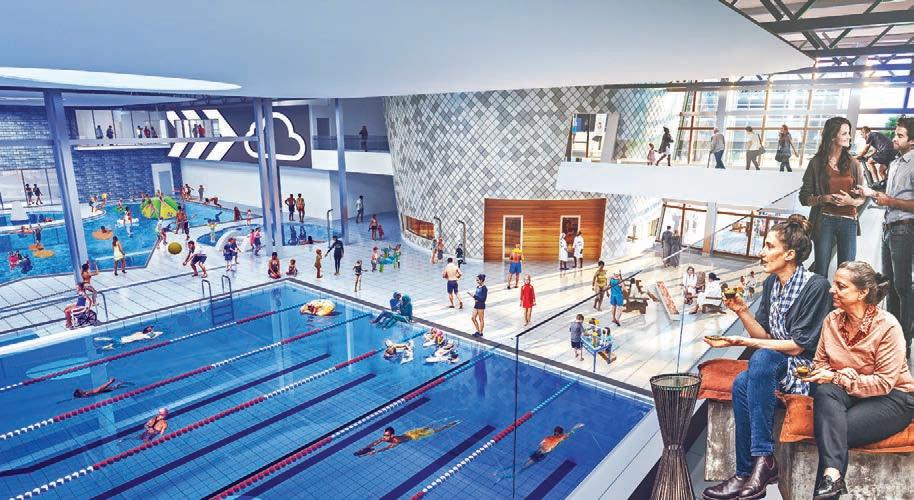
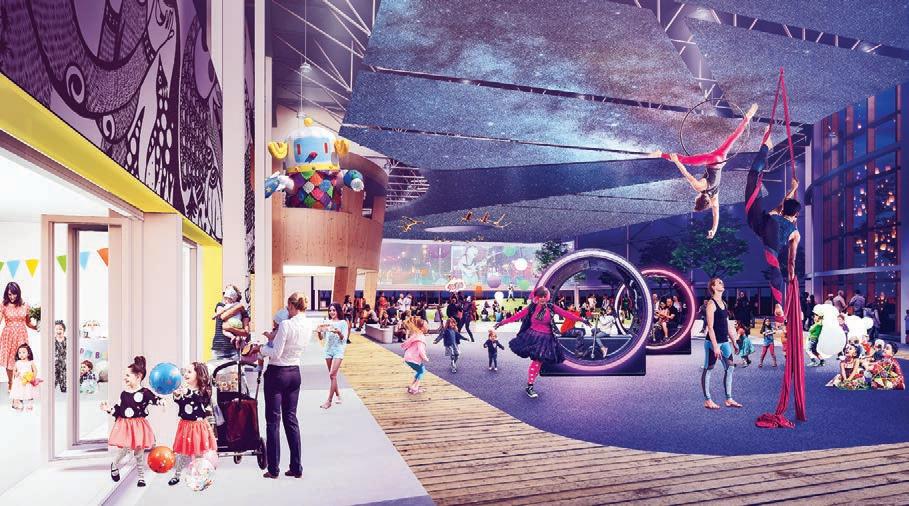
metal, wood - based on universal design principals, so that more people can see themselves at Vivo.”
For the envelope, a thoughtful blend of materials, including corrugated metal cladding and a glass curtain wall, melds gracefully with the surrounding urban fabric.
Sustainability is a cornerstone of the design, evident in the installation of 286 solar panels on a PVC roof, a testament to the project’s commitment to environmental responsibility.
Inside the building, a profound sense of community permeates every detail. The design ethos reflects
Vivo’s community-driven vision, emphasizing a purposeful flow that fosters connections with the outdoors throughout the year. “The biophilic design was a big part of the conversation. This is the notion of having an extension of a living room for the community and can be seen in every element from the huge indoor park to the pool viewing area on the concourse above that also features a new fitness and yoga studio,” says Souleles. Materials selected inside further enhance this indoor/outdoor element and create a warm and inviting space. Wood panels and exquisite millwork
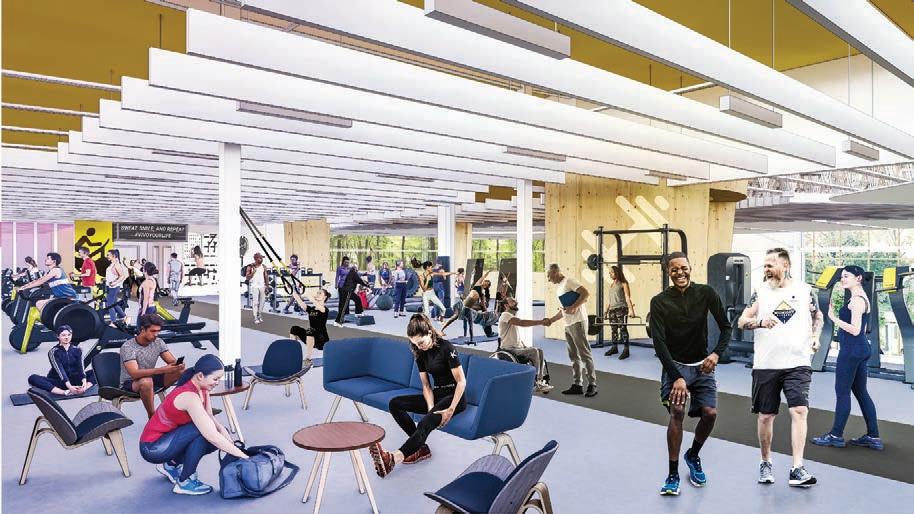
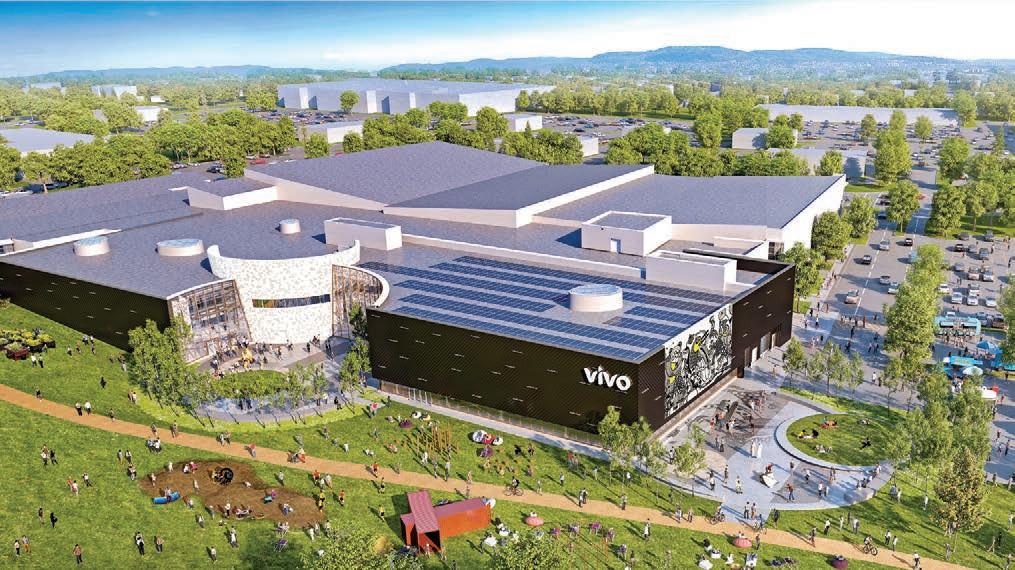
enhance the interior ambiance, lending an inviting touch to the entrance, stairs, and main walkways.
“There are also three new skylights in the pool space and one in the playpark that bring natural light inside the building. A stretched fabric ceiling product from Barrisol was installed above the pool that is very neat and has acoustic and visual benefits, while also reflecting the light back down inside,” says Kennedy.
For Kennedy, the project holds a deeply personal connection. “Being a resident of this neighbourhood, I’ve witnessed firsthand the positive impact Vivo has had on the people and the community. It’s truly inspiring to see how this facility, with its cool and innovative features, is shaping up. Working on this project fills me with immense pride,” says Kennedy.
Vivo for Healthier Generations stands as a testament to the power of collaboration, innovation, and inclusivity, shaping a facility that goes beyond a traditional sports and recreation space. This visionary expansion marks the dawn of a new era for north-central Calgary, where healthier generations will flourish, supported by a vibrant, connected, and nurturing community hub.
“We think that complete communities are important and we are championing that beauty can exist in a suburban environment just as naturally as it can in a downtown environment. This project illustrates what is possible when you unleash the wisdom and generosity of community. We can’t wait to welcome back the community that made it all possible and see how they shape these spaces and bring them to life,” concludes Watson. A
LOCATION
11950 Country Village Link NE, Calgary, Alberta
OWNER/DEVELOPER
Vivo for Healthier Generations
PROJECT MANAGER WSP
ARCHITECT/STRUCTURAL/MECHANICAL/ ELECTRICAL/LANDSCAPE/INTERIOR DESIGN/SUSTAINABILITY CONSULTANT DIALOG
GENERAL CONTRACTOR
EllisDon Construction Services
POOL MECHANICAL CONSULTANT AME Group
TOTAL SIZE
135,000 square feet (new and renovated space)
TOTAL COST
$62 million
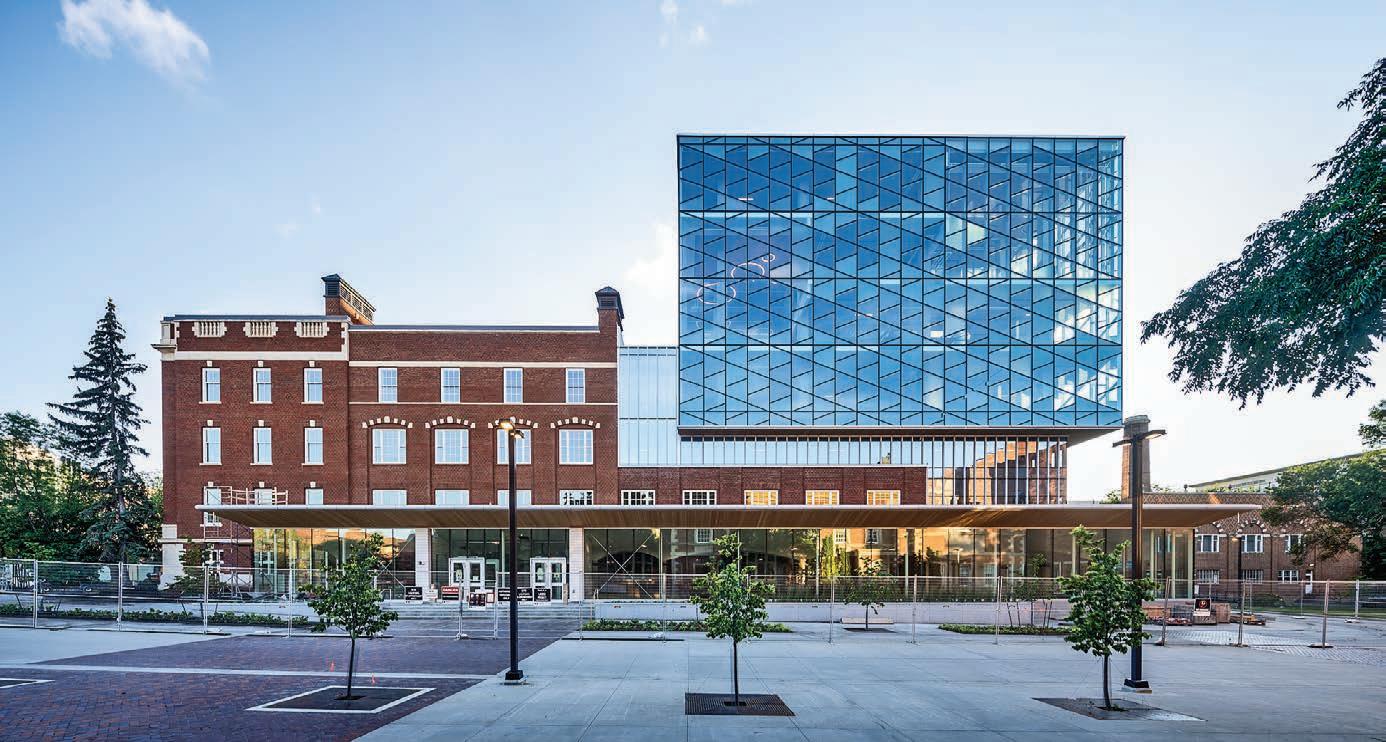
LOCATION
11404 87 Avenue NW, Edmonton, Alberta
OWNER/DEVELOPER
University of Alberta
ARCHITECTS
GEC Architecture (Phase 1 Core and Shell); Zeidler Architects (Phase 2 Fit-Out – Ongoing)
GENERAL CONTRACTOR
Clark Builders
STRUCTURAL CONSULTANT
RJC Engineers
MECHANICAL CONSULTANT
AME Group
ELECTRICAL CONSULTANT
SMP Engineering
TOTAL SIZE
UNIVERSITY COMMONS – UNIVERSITY OF ALBERTA
by STACEY MCLACHLAN
Is it possible to preserve history and change with the times?
The University of Alberta’s striking, revitalised University Commons building – a vision in both brick and glass – suggests the answer is a resounding yes.
What was once a 100-yearold brick building, home to the Dentistry and Pharmacy programs, is now a busy hub of campus life, thanks to a savvy renovation that celebrates the building’s heritage while bringing in 21st-century functionality and sustainability.
When it was originally built back in 1922, it was, as Kelly Hopkin, U of A Manager Campus Architecture describes it, “at the heart of the campus.” Its new function as the University Commons building is an act of reclaiming that original identity, in a way. “It’s where our bus and LRT traffic comes, all of our students arrive here . . . we want to restitch it back into campus, and give it a new life and new vitality,” says Hopkin.
The original brick building now connects to a modern seven-storey tower; together, they house highly functional (but highly flexible spaces) such as a grand entryway, student support services, bookable rooms, multi-purpose spaces, lecture theatres, and even a “calming room” where students can take a moment to find respite.
“We were working with this idea of a university town hall, a place where students and faculty and staff all come together,” explains Richard Blouin, partner at GEC Architecture.


Here, three storeys of balconies overlook the bustling entryway, where students and faculty interact, collaborate, and find inspiration below.
Preserving the heritage and character of the original 1922 building while upgrading its infrastructure for modern needs was a top priority for the construction team, Clark Builders, and the design team. “We salvaged and reused as much as possible,” explains Blouin; even new materials like rubbed bronze and limestone nod to the building’s history. The commitment to blending the old with the new extends to intricate restoration efforts. Plasterwork was delicately reinstalled in the original reading room, and concrete floors were ground down to match the texture of the original terrazzo. “We’ve retained the character as much as we could,” says Hopkin.
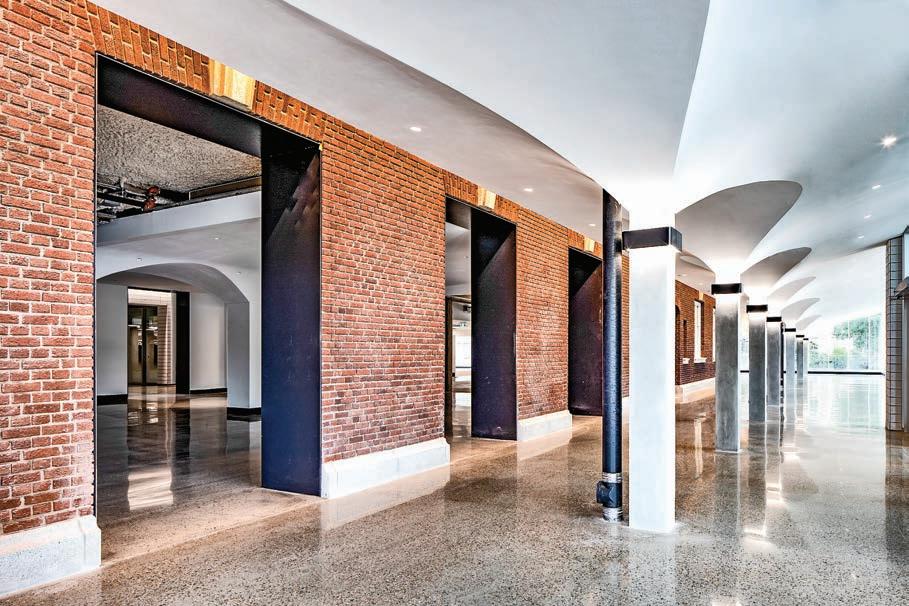
glazing. This section of the design allows natural light to permeate the interiors, reducing the building’s energy
That grand west wing tower stands tall – a modern extension, enveloped in insulated metal panels with triple-pane


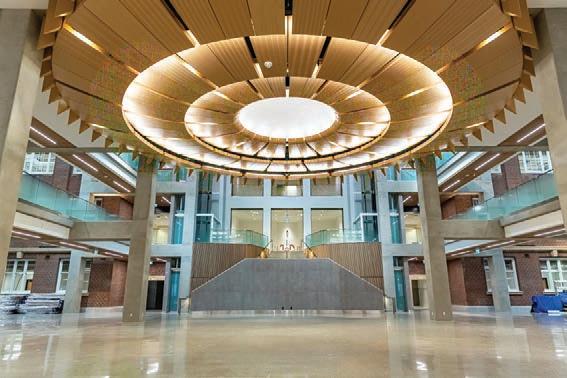
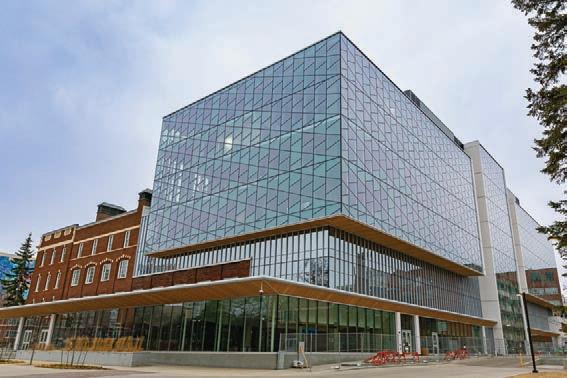

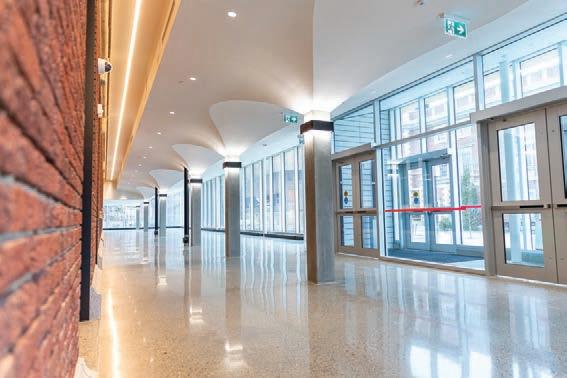
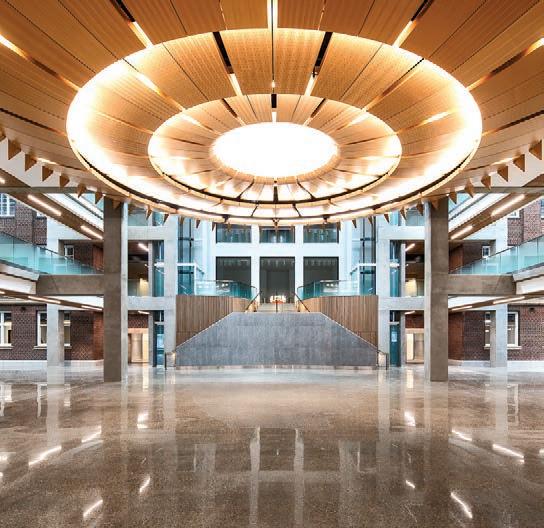


consumption for heating and cooling. Occupants of the top floor take in panoramic views of the downtown skyline. Indigenous identity is celebrated at the heart of the building with the upcoming installation of public art commissioned to recognize a gift to the university from the Rupertsland Institute – Métis Centre of Excellence. The art piece will be located in a space directly below a large circular room designed specifically for community and gatherings. Fins of beautiful hemlock wood define the space and are one more example of the commitment to thoughtful design details at play.
But underneath both the historic and sleek modern portions of the new University Commons lies a LEEDgold-targeting infrastructure. You’ll find all the usual energy-efficient suspects: advanced ventilation and electrical systems, solar panels, lowflow fixtures and low-VOC materials. Ultimately, though, the most sustainable decision here was simply to adapt the building instead of tearing it down and starting fresh.
“The most sustainable building is one that’s already built,” says Blouin. “If a building is loved, and has character, people will take care of it for years to come.” A












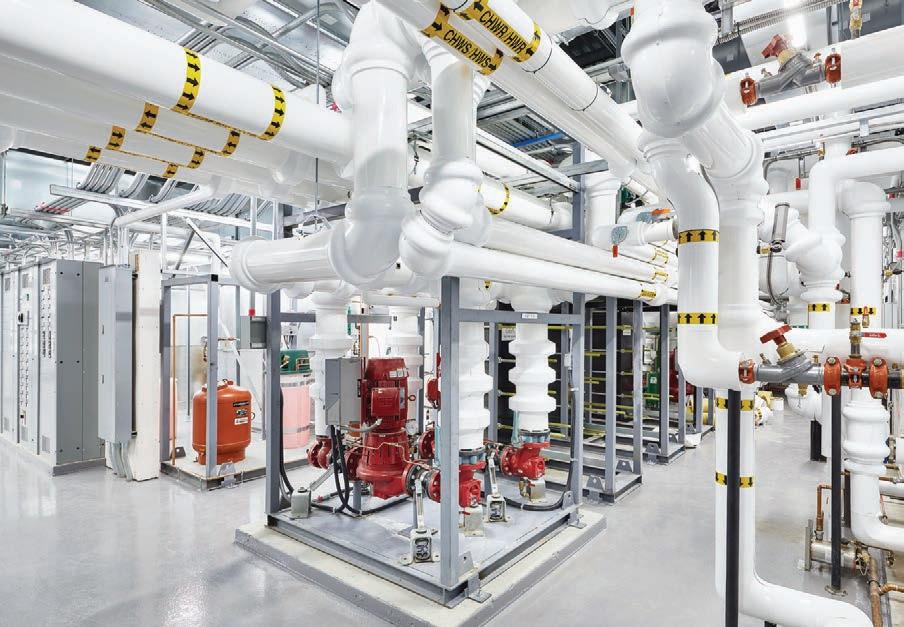



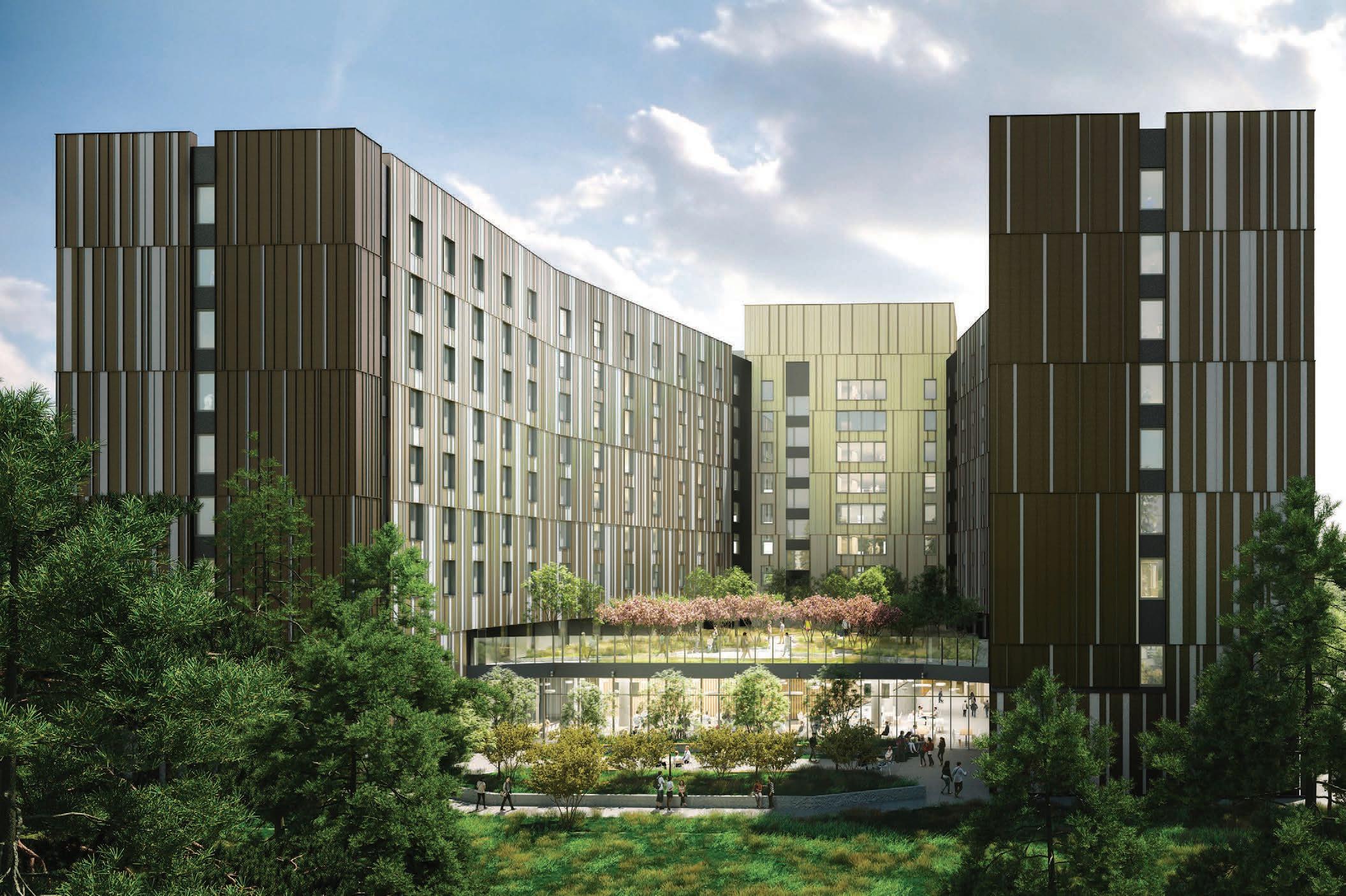

Arcadis is proud of our involvement in the design and construction of University of Toronto Scarborough’s Passive House Student Residence.
Arcadis is the world’s leading company delivering sustainable design, engineering, and consultancy solutions for natural and built assets. We are more than 36,000 people, in over 70 countries, dedicated to improving quality of life.
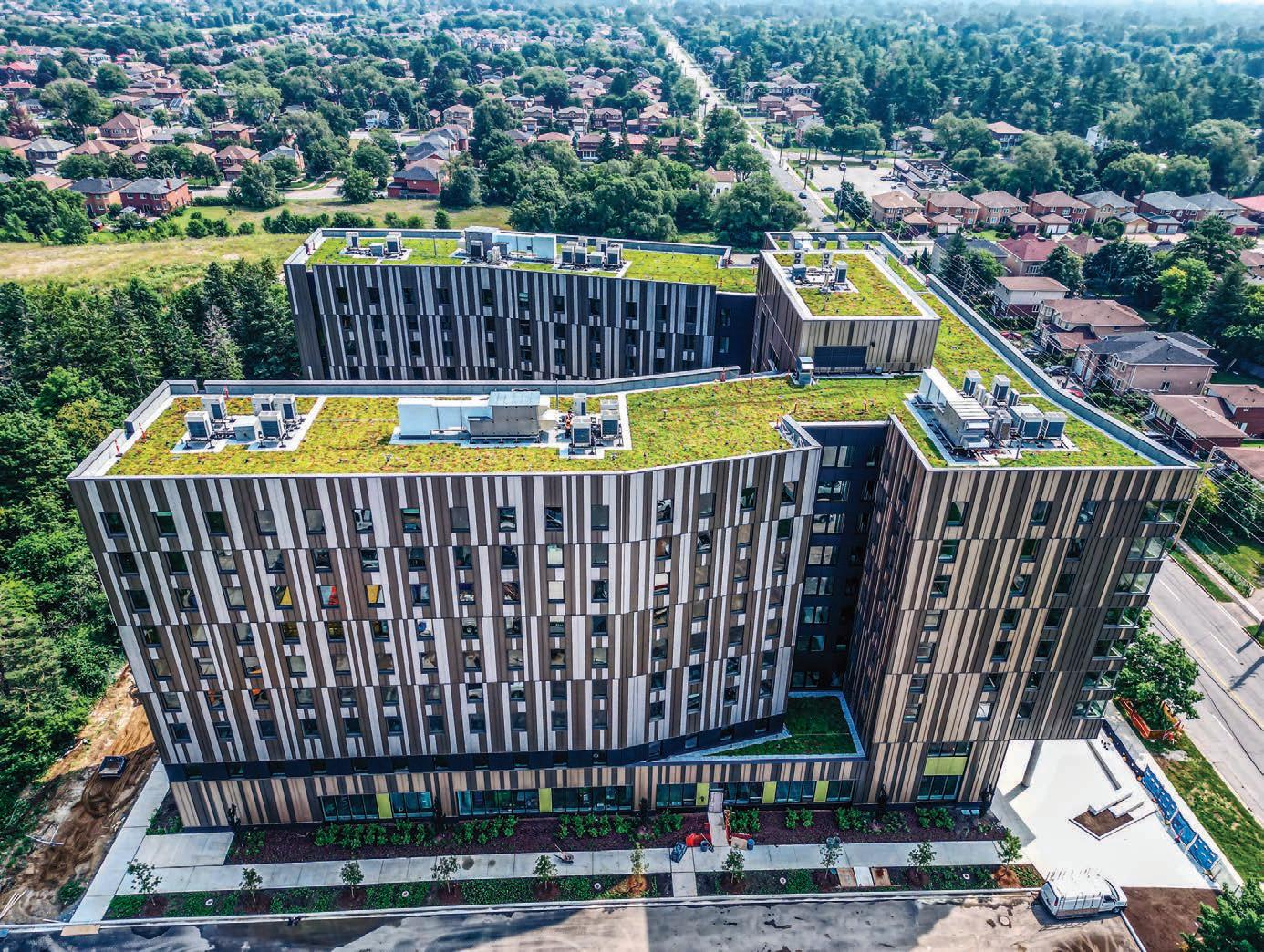
PASSIVE HOUSE STUDENT RESIDENCE –UNIVERSITY OF TORONTO SCARBOROUGH
by ROBIN BRUNET
The 718-bed Passive House
Student Residence at the University of Toronto Scarborough (UTSC) not only advances the northward expansion of the University’s campus, it has also been designed and built following the most rigorous sustainability standard in the world.
Andrew Arifuzzaman, UTSC’s chief administrative officer, says, “We’d looked at passive house technology previously, but we needed the appropriate project that would function well under passive house standards. The new residence building was the perfect opportunity.”
Arifuzzaman cites a host of challenges bringing the project to life: “First was the scale. This was the largest student residence built to passive house [PH] standards in this climate zone. Second was preparing the marketplace. The design and construction industry had not seen a project like this in Canada. We had to do a lot of legwork to get the industry up to speed, which meant multiple iterations of the project with architects and builders.”
The residence is sited and shaped so as many occupied spaces as possible feel a connection to the outside, an ambiance augmented by a large second level landscaped terrace and a grand dining hall at ground level. Dormitory rooms are arranged in clusters, each having their own identity and designed to create a strong sense of home.
Passive House Student Residence required the services of several architecture firms. Handel Architects was the design architect; Core Architects Inc. was retained as the executive architects, and Arcadis IBI Group was the architect of record.
Deborah Moelis, principal at Handel, says, “Handel and Core collaborated to deliver the design. The passive house strategies were developed with the engineers at Steven Winter Associates and Introba. The university then engaged a design build company – Pomerleau – who, with Arcadis and their team, took the design through CDs. The Handel/Core team reviewed construction issues for aesthetics and general conformance with the design documents.”
LOCATION
3300 Ellesmere Road, Scarborough, Ontario
OWNER/DEVELOPER
University of Toronto Scarborough
ARCHITECTS
Handel Architects (design architect); Core Architects (executive architect); Arcadis IBI Group (architect of record)
DESIGN BUILD CONTRACTOR
Pomerleau
STRUCTURAL CONSULTANT EXP
MECHANICAL/ELECTRICAL
MCW Consultants Ltd.
LANDSCAPE ARCHITECT
The Planning Partnership
INTERIOR DESIGN
Handel Architects / Core Architects / Partisans
PASSIVE HOUSE CONSULTANTS
Steven Winter Associates / Introba
TOTAL SIZE
24,620 square metres
TOTAL COST
Undisclosed
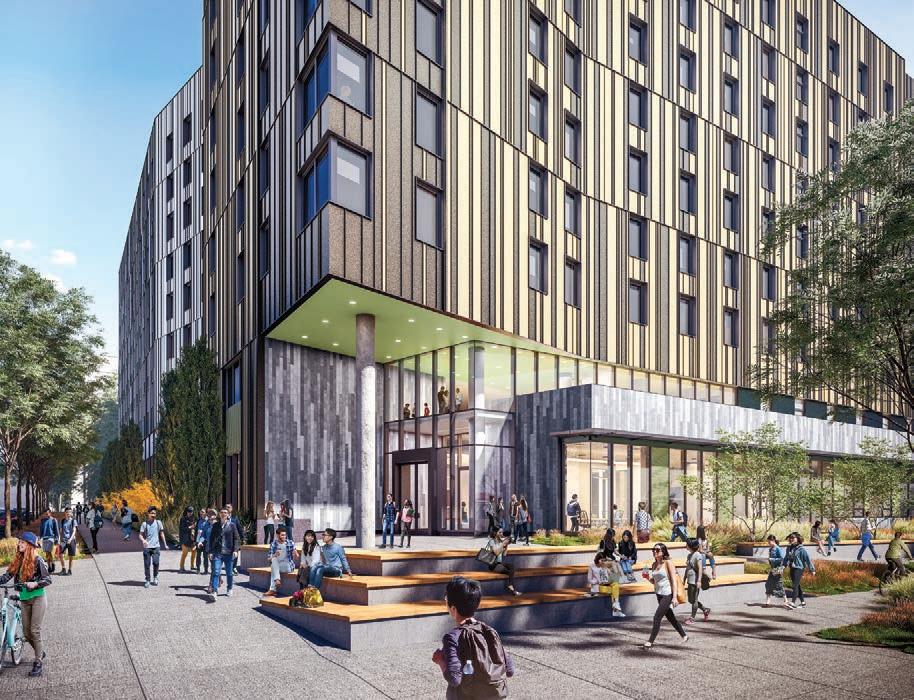
Every detail was carefully considered to meet PH requirements: for example, the window size was determined to maximize exposure to natural light while minimizing potential heat loss and maintaining functional operation, without sacrificing the layout of the internal spaces.
Moelis adds, “The main challenge was actually the 400-seat dining facility.” Arifuzzaman elaborates, “We had to look at innovative ways to bring energy loads down in this area because of the amount of wastewater and heat it would generate from making 3,000 meals daily.”
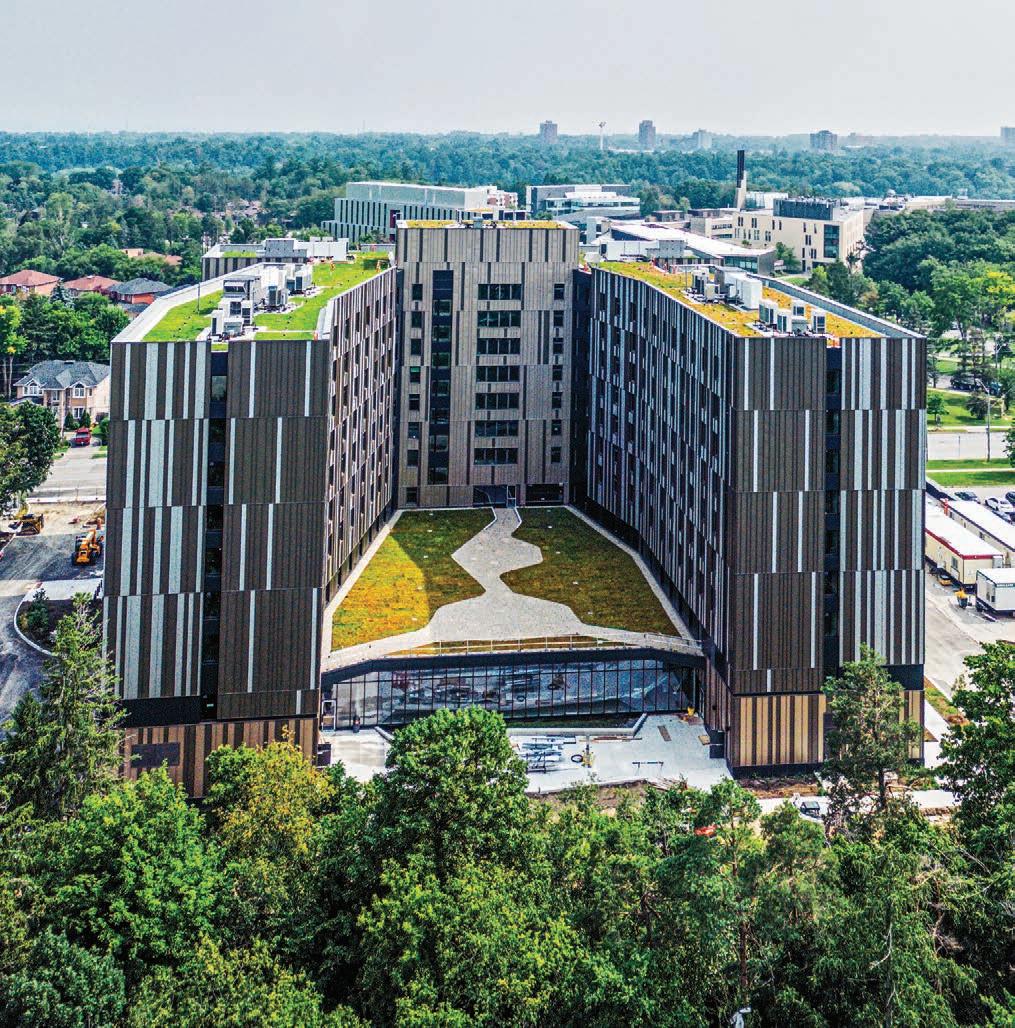
Moelis goes on to note that “the facade is articulated using three colours of standing seam metal cladding that acts as a rainscreen, fastened with thermally broken clips. Behind the waterproofing and exterior sheathing there is mineral wool insulation, and then the interior sheathing and vapour barrier. All seams are carefully taped. The
window frames are thermally broken and infilled with triple low-e glazing.
“The variation in colour and width of the facade material masks the regular spacing of the windows, allowing the facade to read as a whole rather than a regularly punctured surface.”
Michael Faustini, project director with Pomerleau, says that in addition to the main challenge on the project of the Passive House learning curve, undertaking this build amid the pandemic (construction began in July of 2020), presented additional challenges, including the implementation of strict COVID measures on site and dealing with market effects of the lockdowns. But with creative solutions these challenges were overcome. “We anticipated potential price increases that would have been a problem as we were in a fixed price contract, so we ordered equipment as early as we could,” he says.
Pomerleau also relied on energy modelling with enclosure specialist RDH Building Science to ensure that PH criteria was being met: “We had to pay very close attention to the details of the envelope,” Faustini says. “RDH guided us, conducting interim checkpoints along the way.”
Pomerleau enhanced the learning experience by building a 10 foot
by 25 foot on site mockup of the envelope, “so the precise construction process was clear to all parties prior to final installation. The mockup was big enough to include a window and frame, and since the envelope covered about 80 percent of the building exterior it was extremely important we understood how it would be built.”
As for the mechanical systems, a pit in the basement was created to capture hot water from the showers and use it as a heat source; the heat from the cafeteria kitchen was also captured and reused.
Passive House Student Residence will welcome its first round of students in September, and Moelis says, “This project will demonstrate that passive house design is possible at a very large scale.”
Faustini says, “This was a very positive learning experience, and the knowledge we gained was useful as Toronto constantly advances its green standards.”
Arifuzzaman says, “The design is what we hoped it would be, the architecture is very strong. We wanted to give our students a great first year experience, and the fact that we can do this through a sustainable building is something we are proud of.” A









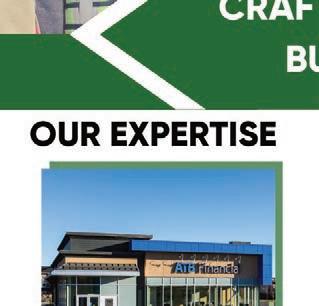
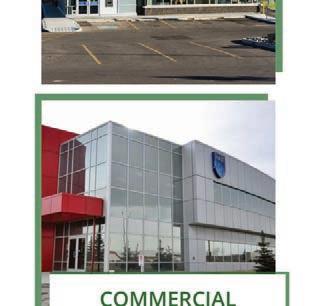



MONTGOMERY HIGH SCHOOL
by ROBIN BRUNET
Were it not for a gamble taken by the Foundations for the Future Charter Academy (FFCA) and GGA-Architecture, the new Montgomery High School would have turned out to be a fundamentally different, and arguably less efficient structure.
That’s because instead of building on the same footprint and orientation of the old Montgomery school, the new Grade 9-12 building, which supports up to 1,000 students, takes full advantage of its terraced site.
Josh Foat, director of facilities at FFCA, explains, “After determining in 2014 that our original school had to be replaced, we developed a three-phase design with another architect – but the project was put on hold due to funding challenges. In 2019 we were asked by the province to restart the design process, moving away from a three-phase building construction to a single phase.
“After a new RFP process, we engaged GGA’s David Wittman to develop a new design – and when he and I inspected the site he was inspired to turn the footprint of our proposed building 90 degrees compared to the existing school footprint and lay the program overtop of the hillside, resulting in a three-storey structure.”
Foat adds, “I loved the idea because it made great use of the upper plateau, and the orientation would provide room for a parking lot to the north and a playing field to the south. Additionally, due to the old school’s orientation, the classrooms looked out onto homes across the street, but by turning our new building 90 degrees we eliminated that and instead created magnificent views of the Bow River from the top level. It was a bold
proposal, and I was sceptical we could stay on budget for such an ambitious project. I’m glad I was proven wrong.”
The Academy’s culture emphasises academic excellence, leadership, and physical education, and therefore required a building that exuded a collegiate ambiance compared to standard high schools. “This manifested itself in numerous ways, from a beautiful grand main entrance to an understated colour palette,” says Wittman. “The masonry, metal panels, and wood accents making up the exterior cladding all had strong horizontal inclinations to match the surrounding landscape.”
Also, the gym floor plan was reduced somewhat to accommodate a three-level climbing wall, oriented outside of the gym in the main hall facing the entrance. “It’s the first thing you see when you come into the entrance and is absolutely unique,” Foat says.
Most significantly, at the confluence of the new school’s three levels is a learning commons featuring tiered seating extending through the tripleheight glazing into the exterior. “By virtue of it being a three-storey space with plateaus on every level, the commons accommodates a variety of uses such as public presentations on the lower level, group study in the middle level, and private study with the Bow River views on the third level,” Wittman says.
The horizontal ribbons of the façade bend inward to wrap around the commons, establishing datums and patterns that find their way through the entire project at every scale.
Early on it was recognized that the south facing commons would be susceptible to solar gain. “So, after
LOCATION
2116 MacKay Road NW, Calgary, Alberta
OWNER/DEVELOPER
Foundations for the Future Charter Academy
ARCHITECT
GGA-Architecture
GENERAL CONTRACTOR
Lear Construction
STRUCTURAL CONSULTANT
TRL & Associates Ltd.
MECHANICAL CONSULTANT
Remedy Engineering
ELECTRICAL CONSULTANT
Designcore Engineering Ltd.
COMMISSIONING CONSULTANT
WSP
TOTAL SIZE
150,048 square feet
TOTAL COST
$43.4 million

considering several options we decided the commons glazing should be electrochromic glass,” Foat says. “It was a considerable investment but would spare us the long-term expense of building environment maintenance to manage heat loads. We included the glass as a change order and wound up using it throughout the entire school.”
Lear Construction began work on site in November of 2021 by demolishing the centre portion of the old school (which was still in use) to establish the footprint of the new cast-in-place concrete/structural steel facility. “Clear and constant communication with the school officials and staff was vital,” says project director David Taylor. “We then knocked down another portion of
the old school to build the parking lot. We had a good laydown area at the top of the hill, but accessing it was tricky in the winter – and it took most of last year to close in the building.”
Taylor adds, “The last phase of work will be to tear down the remaining portion of the old school for the new sports field, and this will occur after the new school achieves occupancy in December of this year.”
For his part, Foat is excited by the progress to date. “Our new school is truly outstanding, thanks to the dedication of the architects, builders, and trades. It has literally been years in the making, but as the project moves further toward completion it’s obvious that the long wait was worthwhile.” A

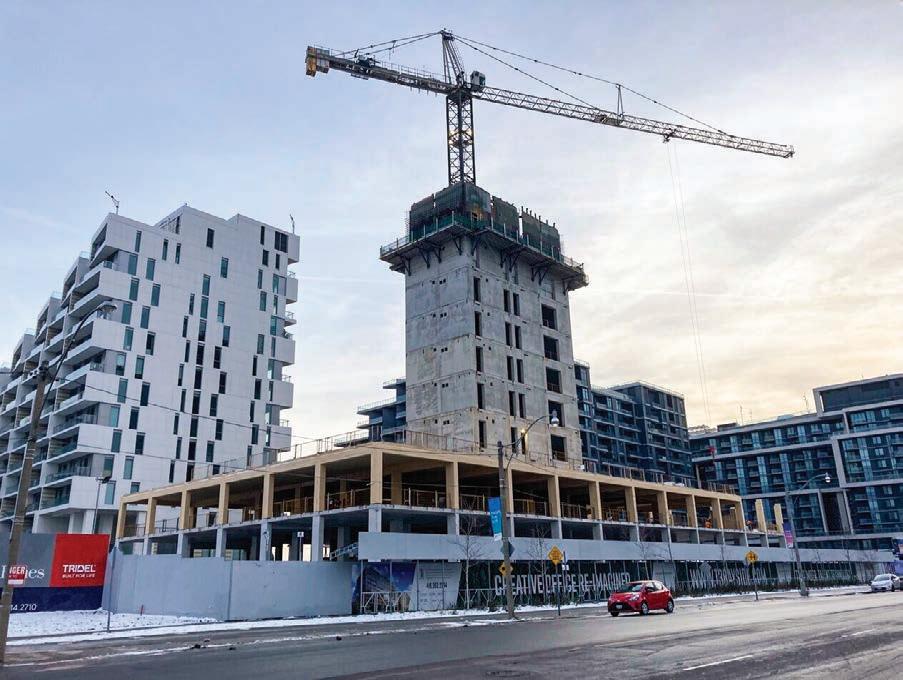
T3 BAYSIDE
by ROBIN BRUNET
Developer Hines’ T3 (Timber, Transit, Technology) concept, most recently expressed in Toronto’s 10-storey cross laminated timber T3 Bayside project, is an effective solution to the drawbacks of converting old warehouses into office space – a trend that continues to be popular across North America.
Myles Millard, managing director of Hines, explains, “Converted warehouses have a fantastic ambiance steeped in heritage that inspires staff creativity, but too many of them leak and are hot in summer and cold in winter. With this in mind, 10 years ago we set out to develop a hybrid product that paired timber with modern amenities and technology.”
T3’s design came from the vintage brick and timber buildings in Minneapolis’ nearby Warehouse Historic District and was first deployed in 2016 in that city’s North Loop, in the form of an all-timber office building. Since then, T3 has become Hines’ prototype for this unique type of office development.
T3 Bayside, designed by Danish architecture firm 3XN with WZMH Architects as the architect of record, departs from the template in major ways. “T3 Bayside is part of a reimaging of Toronto’s waterfront and part of Bayside Toronto, a master-planned community of luxury condominiums, affordable homes, shopping, and restaurant destinations,” Millard

says. “Given the modern ambiance intended for the community, 3XN eliminated the typical exterior warehouse aesthetic in favour of a modern curtain wall, and made the interior timber a showcase.”
The building’s 10-storey design rising 42-metres tall at the highest point is centred around elevating the tenant experience by providing a differentiated platform of amenities, including both a double height tenant lounge and a conference/events facility, a club-quality fitness centre, and a rooftop patio featuring panoramic lake and city views.
LOCATION
251 Queens Quay West, Toronto, Ontario
OWNER/DEVELOPER
Hines
ARCHITECTS
3XN (design architect);
WZMH Architects (architect of record)
CONSTRUCTION MANAGER
Eastern Construction Company
STRUCTURAL CONSULTANT
Magnusson Klemencic Associates
MECHANICAL CONSULTANT
TMP Consulting Engineers
ELECTRICAL CONSULTANT
Mulvey & Banani
LANDSCAPE ARCHITECT
Janet Rosenberg & Studio
TOTAL SIZE
262,000 square feet
TOTAL COST
$115 million
3XN, which also designed two residential buildings in the Bayside community, intended T3 Bayside to reflect the emerging surrounding neighbourhood and principals of live, work, and play. At ground level this translated into retail bleeding into a central plaza that links the building with a future second phase. “The plaza is the public heart of the T3 Bayside project,” 3XN said in a statement. Elsewhere, flexible creative office spaces were a focus, with timber defining the double- and single-height spaces. “The lobby leads via a feature staircase to a fully open second floor tenant lounge and then continues to a double-height corner-oriented conference facility enclosed by glazing for privacy,” Millard says. “It’s a true reinvention of office space.”


The use of wood had many benefits in addition to T3 Bayside laying claim to being the tallest timber office building in North America.
For starters, its release of moisture ensures a naturally regulated and healthy indoor environment. Millard notes that it contributed

significantly to an estimated 40 to 50 percent reduction in embodied carbon when compared to a traditional office building; and according to Kim Herforth Nielsen, founder and creative director at 3XN, timber had the advantage of “reducing construction time and allowing the building’s elements to be easily disassembled and re-used for other purposes.”
Eastern Construction’s extensive portfolio of steel and concrete structures and their recent awardwinning mass timber projects made them the ideal contractor to bring T3 Bayside to life. The project broke ground in the spring of 2020, with the first year spent on caissons, shoring, and excavation.
Following the earthworks, the work on site focused on the concrete structure; the single concrete core was erected followed by the P1, Level 01, and Level 02 concrete slabs. Upon completion of the Level 02 slab, the mass timber installation commenced. Mass timber floors were typically installed in zones with a zone focusing on columns, beams, and panels tied into the concrete core before moving onto another zone on that floor. Once the timber structure was safely ahead, the building enclosure
work began below, starting with the glass curtain wall, and then the roof assembly once the timber structure was fully erected. The mass timber –black spruce – was sourced from the boreal forest of northern Quebec.
Millard says, “The construction process benefitted significantly from lessons learned on past T3 projects, and from Eastern’s expertise with timber projects. We also benefitted from having a large site, with four full truck bays for timber delivery – 148 truckloads in total.”
Millard adds that special attention was given to the precise installation and appearance of exposed ductwork throughout the buildings.
On track for occupancy later this year, T3 Bayside is targeting LEED Gold and WELL Certification and has achieved WiredScore Platinum Certification for its focus on promoting occupant wellness while limiting its impact on the natural environment.
Millard concludes, “This is a huge win for the revitalization of the Toronto waterfront, and as we speak we’re building another T3 in Toronto, T3 Sterling Road, with one in Vancouver planned as well, T3 Mount Pleasant, bringing our global T3 total to 27.” A

COURTYARD RESIDENCE – PHASE 2 – SFU
by NATALIE BRUCKNER
Simon Fraser University (SFU) has long been known for its commitment to academic excellence and creating a vibrant campus community. Staying true to its mission of inspiring and transforming through education, SFU embarked on a monumental project – the Courtyard Residence – a two-building, state-of-the-art housing facility and a pivotal part of Phase 2 of SFU’s five-phase Residence and Housing Redevelopment Masterplan.
The primary objective of the Courtyard Residence is to enrich student life by offering secure and affordable housing for first-year students within a nurturing environment. Jim Meschino, director of campus planning and development, elaborates: “The latest addition to the SFU residence community, Courtyard Residence, features an 11-storey tower that majestically rises above the campus. It encompasses 369 student resident units, shared kitchens, washrooms, and laundry services.”
The residence also houses a new four-storey main administration office of SFU Residence and Housing, and in addition, serves as the new home for The Simon – SFU’s short-term accommodations for campus visitors.
“The 11-storey tower block sits in harmony with the existing Student Residence towers west of this project
and the academic campus to the east. To the north, the project steps down in the form of the four-storey, low-rise building in response to the current streetscape along University Drive,” explains Meeta Lele, architect and project manager at Dialog.
The construction of the Courtyard Residence commenced in January 2021, accompanied by a unique set of challenges. The chosen site, previously occupied by Madge Hogarth House, SFU’s inaugural residence, presented intricate logistics. Ilyich Fitzgerald, project manager at Ledcor, shares insights into the complexities faced: “There was a lot of sloping and rock on the site, so the below-grade foundations were deep. Due to the split-level buildings, we had to build a retaining wall and fill the space in the middle of the two buildings before building outwards. It was a challenging engineering sequence. There was one colossal 30-foot-high wall that required a tremendous amount of backfill, and we had to place a geogrid mat to manage the soil and distribute the weight.”
Given the region’s unpredictable weather, characterized by high winds and relentless rain, the exterior design needed to withstand these conditions. To address this, the team opted for precast panels with varying weights, ensuring both structural
LOCATION
University Drive, Burnaby, B.C.
OWNER/DEVELOPER
Simon Fraser University
ARCHITECT
DIALOG
GENERAL CONTRACTOR
Ledcor Construction Limited
STRUCTURAL CONSULTANT
RJC Engineers
MECHANICAL CONSULTANT
AME Group
ELECTRICAL CONSULTANT
AES Engineering
CIVIL CONSULTANT
Aplin Martin
LANDSCAPE ARCHITECT
PWL Partnership Landscape Architects Inc.
TOTAL SIZE
142,500 square feet
TOTAL COST $113 million
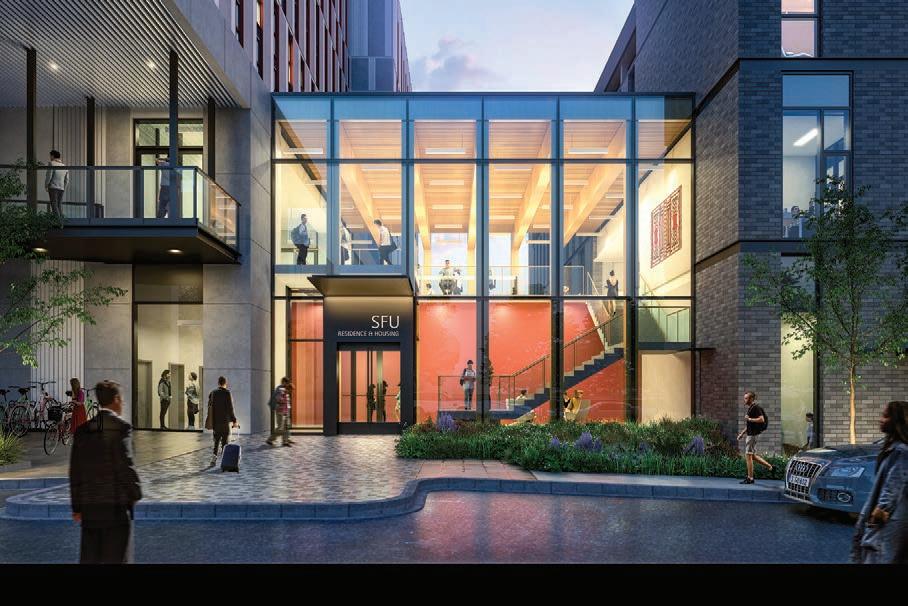
integrity and weather resistance.
“There are 650 panels all weighing anywhere from 5,000 to 20,000 lbs,” explains Fitzgerald.
For the design, Lele explains that inspiration came from Erickson’s form-making legacy on the original SFU campus. “Two characteristics that are echoed in the detailing of the new residence halls’ precast concrete panels are the finely detailed use of concrete and the theme of repeating verticals creating horizontal forms. Alternate contrasting textures and colours create a pattern of repeating verticals that slip and slide to animate the building façade. Red and blue
accents at the windows add a touch of playfulness that continues in the design of the courtyard and breezeway with its series of ‘play’ areas.”
Inside the Courtyard Residence, a harmonious blend of functionality and elegance await the student residents, staff, and visitors. Lele explains that this project is expected to be a hub of activity, adding, “This is best represented in the central lobby where this notion of arrival and confluence is celebrated architecturally with the exposed wood frame structure and the double height entrance volume. Creating a rich public realm was an important design driver and this project does so

by enhancing pedestrian connectivity through and around it, and crafting seamless transitions between indoor and outdoor spaces,” explains Lele.
A varied mix of social spaces are weaved into the project: a spacious house lounge with a full kitchen; quiet areas for smaller groups in the breezeway and courtyard; study areas at each floor; swings and a ping pong table; and an indigenous community space with its own outdoor patio. Wood ceilings add warmth to student lounges and the House Lounge is anchored by a fireplace.
Sustainability was also a top priority, with the team striving to achieve Step Code 4 energy efficiency standard. Meschino explains, “The building is also constructed to WELL certification, taking a holistic approach to health in the built environment by addressing behavior, operations, and design. The innovative design features are not only practical but also visually stunning. In alignment with SFU’s commitment to reconciliation, the buildings are designed to reflect the local Indigenous culture in the region,
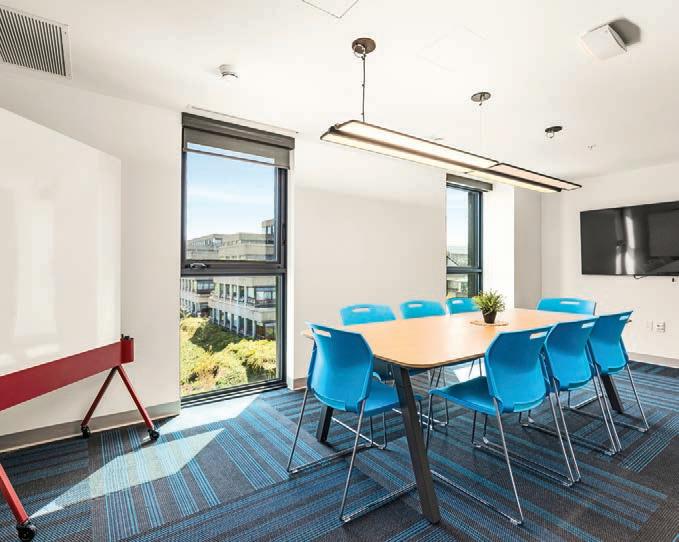
including the Musqueam, Squamish, Kwikwetlem, and Tsleil Waututh Nations. Additionally, it features the Madge Hogarth Sensory Garden, paying homage to the fact that the new residence is built on the former site of SFU’s very first residence.”
Throughout the construction process, Fitzgerald praised the exceptional teamwork and camaraderie of the entire team. “Despite some tough days, mainly due to the weather, the team maintained a great dynamic and made it fun, with the final result standing as a testament to SFU’s
commitment to its student community and the power of teamwork.”
With the opening of the Courtyard Residence, the current number of on-campus student beds on Burnaby campus exceeds 2,450. The B.C. government provided $73 million towards the $113-million project. The Courtyard Residence stands not merely as a building, but as a symbol of SFU’s commitment to nurturing an enriching and supportive environment for its students – one where they can learn, grow, and forge lifelong connections. A


TotalDesign



THERESA C. WILDCAT EARLY LEARNING CENTRE
by NATALIE BRUCKNER

Nestled in the heart of Maskwacîs, Alberta, a profound educational endeavor takes shape – one that not only cherishes Maskwacîs Cree culture, but places students’ needs at its very core. The Theresa C. Wildcat Early Learning Centre, currently under construction just southeast of the existing kindergarten school, stands as a testament to the vision of the Maskwacîs Education School Commission (MESC) and its unwavering commitment to fostering education rooted in Maskwacîs Cree values.
The new Centre – named after the late Theresa C. Wildcat, a member of the Ermineskin Cree Nation, a visionary and dedicated educator, and pioneer in the field of education – is a remarkable space that goes beyond just academics. This 31,000-squarefeet early learning facility is designed to be more than a school; it is a cultural haven that honours the rich traditions and wisdom of the Cree people.
“The journey to building the Centre was long,” explains Brian Wildcat, assistant superintendent at MESC. “It started in 2016 before the amalgamation of MESC [the amalgamation of four community school authorities in Maskwacîs: Ermineskin Cree Nation, Louis Bull Tribe, Montana First Nation, and Samson Cree Nation]. There were issues with the old kindergarten – flooding, leaks, and mould. It was time for a new building.”
Wildcat says that at the same time that the proposal for the new Centre was put forward, MESC also started working with Paul Martin and the Martin Family Initiative on a literacy program for K5 to Grade 3. “That really kickstarted our project, and later that year we got the green light to move ahead,” he says.
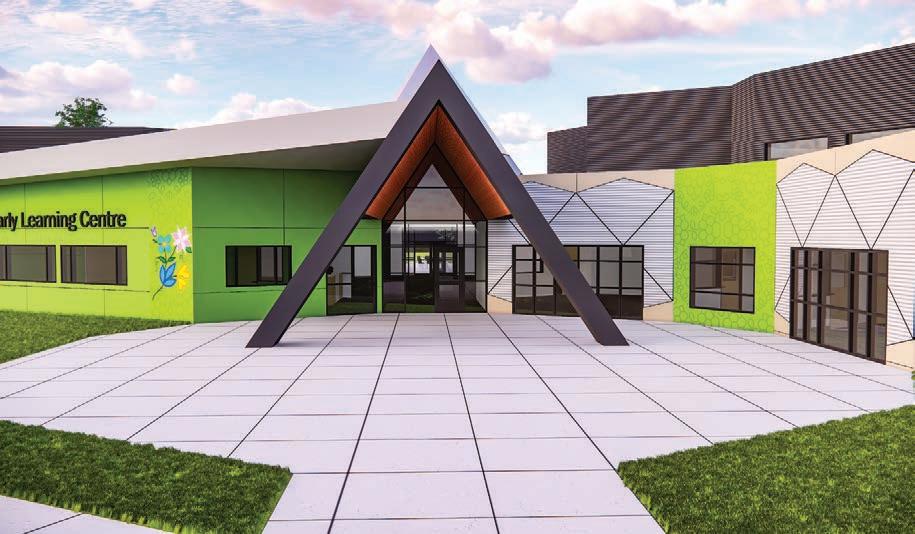

Central to the creation of this educational sanctuary is Jen-Col Construction – a construction company that shares MESC’s vision and has embraced the philosophy of inclusivity, community involvement, and skill development. “We knew how important it was that the community be involved with the construction of their new kindergarten building. We place a special emphasis on working with local First Nations’ labour,
trades, and suppliers whenever possible,” explains Mo Athari, project manager at Jen-Col Construction. “We’re very happy to say we had well over 1,000 man-days of Ermineskin and Maskwacîs community members working on the construction of their kindergarten building.”
Guided by the Maskwacîs Cree values, The Workun Garrick Partnership Architecture and Interior Design embarked on a journey to
LOCATION
Maskwacîs, Alberta
OWNER/DEVELOPER
Maskwacîs Education School Commission
PROJECT MANAGER
Jules-Associates
ARCHITECT
The Workun Garrick Partnership Architecture and Interior Design
GENERAL CONTRACTOR
Jen-Col Construction
STRUCTURAL CONSULTANT
Protostatix Engineering Consultants Inc.
MECHANICAL CONSULTANT
CIMA+
ELECTRICAL CONSULTANT
MCW Consultants Ltd.
TOTAL SIZE
31,000 square feet
TOTAL COST
Undisclosed
design a school that fosters holistic development and encourages joyful learning. “It was integral that the design be unique and truly capture Cree values and that of the community,” says Wildcat.
The design process focused on nurturing young minds through activities and interactive spaces, rejecting the conventional rigid classroom structure. “It’s not every day you come across a 225-student kindergartenonly school. It was an opportunity to have some fun in the design of the school,” says Megan Carroll, associate at The Workun Garrick Partnership.
Materials chosen for the envelope also focussed on providing a modern and sustainable learning environment for the students and staff. “The frame of the building is formed by a system of structural steel beams and columns, while steel studs, metal cladding, and phenolic panels make up most of the exterior finishes.

These materials were chosen for their durability, strength, flexibility, and aesthetic appeal,” explains Athari.
Inside, inspired by the vision of MESC and the aspirations of the Maskwacîs community, the architects designed hexagon-shaped classrooms – spaces that encourage creativity, collaboration, and exploration. “During the design process one of the members of the design committee mentioned it would be nice for the students to learn in round spaces. Kindergarten is about learning through activities and not by sitting in rows facing a front board of a classroom. Because of this, it allowed me the opportunity to experiment with different shaped classrooms. By designing
each classroom in a hexagon shape, it allowed more corners, six instead of four, to create nodes of activity,” explains Carroll.
Incorporating Cree symbolism and aesthetics was indeed paramount to the design process. Throughout the building, the exterior and interior are adorned with floral beadwork and star patterns – a tribute to the community’s identity and traditions. Drum clusters, bright colours, and vaulted triangular entrances welcome visitors, immediately enveloping them in the rich cultural tapestry of Maskwacîs.
At the heart of the building lies the magnificent Community Gathering Space. A dodecagon-shaped area that is adorned with a 12-metre-high tipi
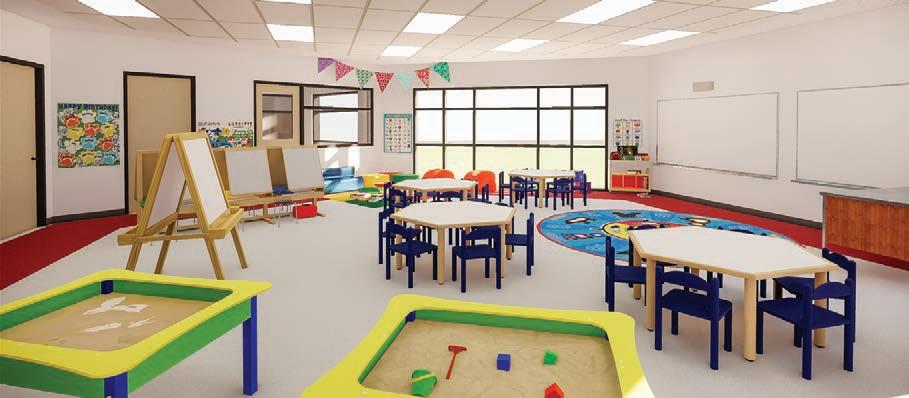
skylight – a powerful symbol of unity, storytelling, and the spirit of togetherness. Here, students and community members alike can gather, share, and learn from one another.
Athari explains that the tipiinspired canopy is constructed with aluminum insulated panels and aluminum-framed glazed window units, which act like a clerestory, allowing natural light and views to enter the building.
The school’s thoughtful layout extends its cultural embrace to each classroom community. With wayfinding symbols, colours, and animals guiding young learners, navigating their educational journey becomes a meaningful experience.
The rainbow-coloured flooring creates a warm and inviting atmosphere, leading students to their uniquely decorated classrooms that inspire wonder and curiosity.
Beyond the walls of the kindergarten building, the architects have crafted outdoor spaces – fire pits, outdoor classrooms, and a land-based learning component. These extensions of the learning environment encourage a profound connection to nature, the community, and the deep-rooted Cree values that shape the foundation of MESC’s mission.
As the Theresa C. Wildcat Early Learning Centre nears completion, the legacy of MESC’s vision is set to touch the lives of K4, K5, and eventually Grade 1 level students, laying a strong foundation for their future. “This is an exciting project for the community. For me personally, the old kindergarten is the last remnants of the residential school in Maskwacîs and having a new building that is owned and operated by the community, for the community, closes that era.” A
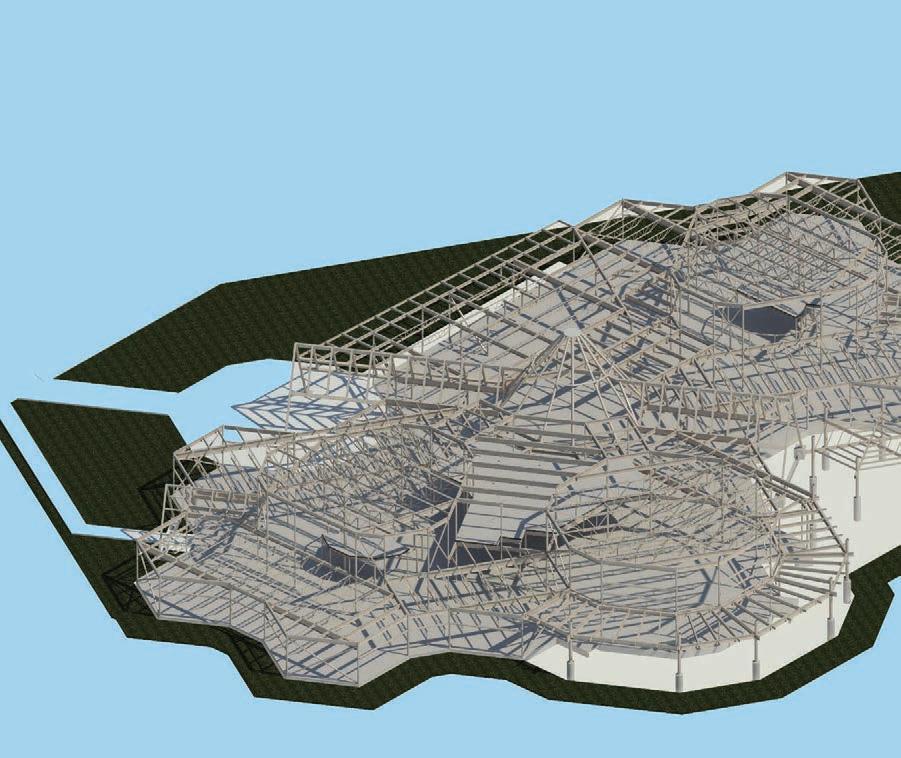
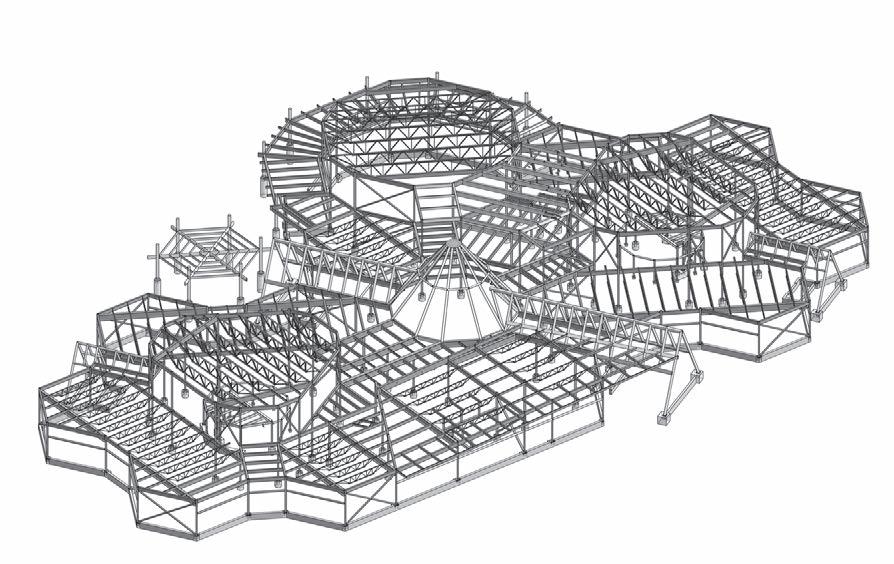




Theresa C. Wildcat Early Learning Centre
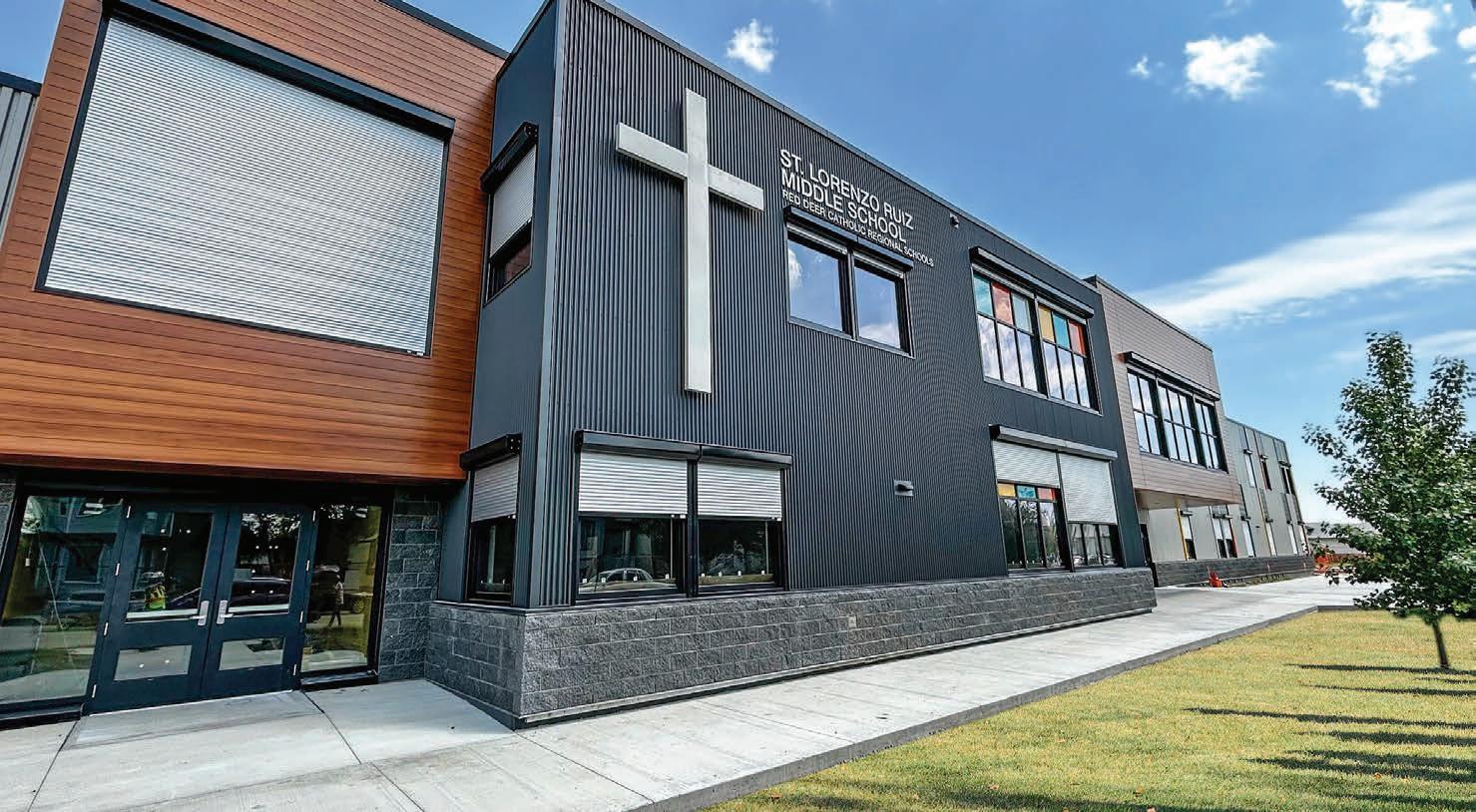
ST. LORENZO RUIZ MIDDLE SCHOOL
by ROBIN BRUNET
The Integrated Project Delivery (IPD) model is well known for involving key parties in the design and construction aspects of a project under a single agreement, thus maximizing efficiencies and reducing waste. Red Deer Catholic Regional Schools had used it successfully on three of its facilities, so when a new middle school was needed to serve a growing population, IPD was the favoured delivery methodology.
St. Lorenzo Ruiz Middle School was developed to accommodate up to 735 students in grades 6 to 9. The $28.2-million facility is located on a greenfield site in Kentwood, and while the narrow site dictated the overall massing of the facility, ambitious programming – as well as many pleasing architectural features – arose from extensive consultation with stakeholders beginning in January of 2021. “Extensive information was gathered from staff and stakeholders about what they wanted and didn’t want,” says Rod Steeves, secretary-treasurer at Red Deer Catholic Regional Division No. 39.
Jenna Kemp, intern architect at Group2 Architecture Interior Design Ltd., says, “We chose not to fully embrace 21st century learning but instead went with closed classrooms combined with open support spaces. This option would support future growth in enrolments.”
Geotechnical testing was completed in early 2021 to understand site conditions, and the results were
used in optimizing layout. A subsequent traffic assessment resulted in the decision to create a bus loop, which would make school pick-ups/ drop-offs safer for students and staff.
St. Lorenzo Ruiz was organized into clusters of programs located at the north end (wood shop, a full band program, a dance/art component connected to the gym, and a computer gaming room). “Grades 8 and 9 were located on the bottom floor and grades 6 to 7 on the next level, both on the south side of the building,” Kemp says. “In the centre of the school are the gathering spaces, which allowed us to create two-storey volumes with lots of glazing on the upper level.”
Wood as an architectural detail was used sparingly but to great effect. “There is a wood appearance at each entrance, and a wood wall and ceiling in the small chapel in the main gathering area,” Kemp says. “Wood was also used for display cases on the second level.”
In addition to creating an exterior mid century modern look with pops of colour, colour was also used for wayfinding. “Dark teal was selected for the main gathering area, programs such as the wood shop and band were designated yellow, and two different colours were selected for the classrooms on the two different levels, with the staircases co-ordinated with those colours,” Kemp explains.
LEED Silver standards were achieved in a variety of ways, including HVAC efficiencies as well as


a roof covered with photovoltaic panels, enough to power the entire school on sunny days.
The IPD process led to Kurt Lowe, technologist at Group2, setting up an office on site so that when issues arose they could be dealt with immediately. Among other benefits, this degree of collaboration enabled the design/production team to bring costs down. One example was the structural steel contractor and engineer working closely with the supplier to modify the design from an open web steel joist to avoid costly material and long delivery times. The structural team designed the floor and roof decks to overlap in the corridors, eliminating beams and providing mechanical and electrical additional space for duct co-ordination.
Ground broke on the project in the spring of 2022. “We had plenty of laydown space but crew parking was a constant challenge as were truck deliveries, given that this is a residential neighbourhood,” says Aaron Giebelhaus, project manager, Clark Builders.
Soil removal and replacement was required due to the unexpected presence of unsuitable B Horizon material. “After that the foundations were constructed in phases using Continuous Flight Auger piles,” Giebelhaus says.
Construction was structural steel frame above slab-on-grade, with structural masonry in the gym, stairwell, and elevators. Materials were
selected for resiliency throughout, including split face block veneer lining the lower exterior of the building, wall tiles in the classrooms, and masonry in the corridors.
Giebelhaus praises the extent to which the IPD method benefitted this project. “We only had a 15 month timeframe to get everything done, and IPD allowed us to assess all budget components and use LEAN construction processes.”
As of July, Rob Coumont, principal of St. Lorenzo Ruiz Middle School, was looking forward to a fall opening. “The architects and builders were fantastic and the spirit of collaboration resulted in a school that is both modern and traditional in appearance, filled with natural light and design features. We couldn’t be happier.” A
LOCATION
150 Kingston Drive, Red Deer, Alberta
OWNER/DEVELOPER
Red Deer Catholic Regional Schools
ARCHITECT
Group2 Architecture Interior Design Ltd.
GENERAL CONTRACTOR
Clark Builders
STRUCTURAL CONSULTANT
RJC Consulting
MECHANICAL/ELECTRICAL/ LEED CONSULTANT
WSP Canada
6,640

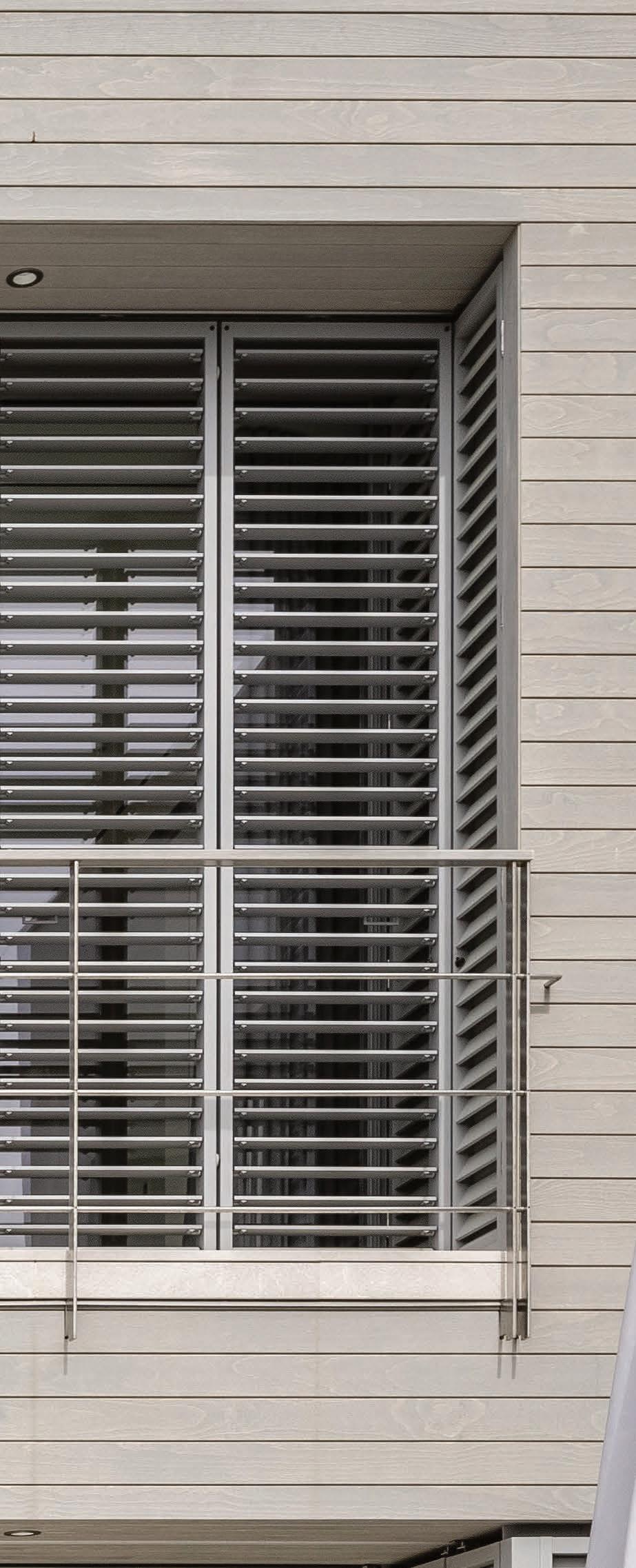
YOUR MASTERPIECE DESERVES THE BEST WOOD PROTECTION
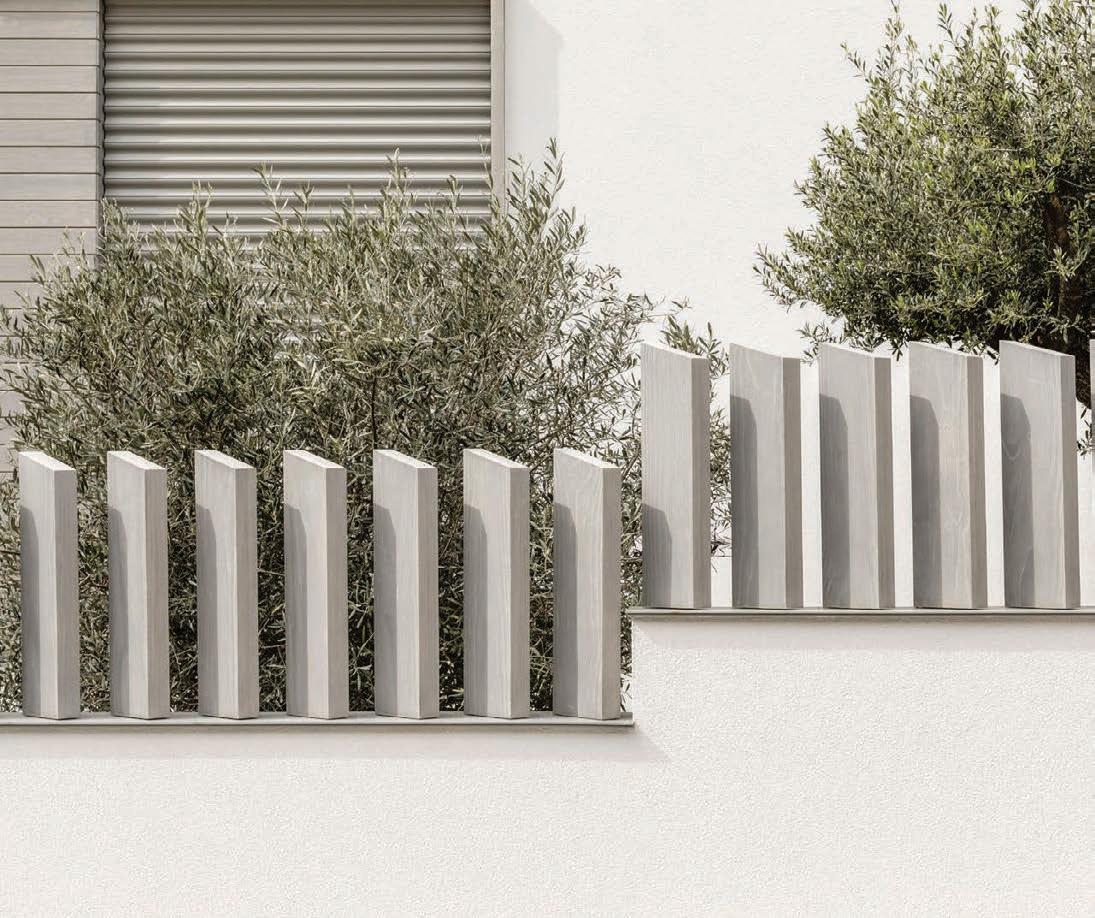
Sansin’s WoodForce offers unparalleled beauty and protection in an environmentally friendly formula –allowing wood to weather gracefully. Contact us about our specification program so we can help you achieve the perfect finish and protection, every time.


Precision Coat factory finishes and treatments deliver the colour, transparency and performance that architects, engineers and builders can count on.

Private Residence Mallorca, Spain