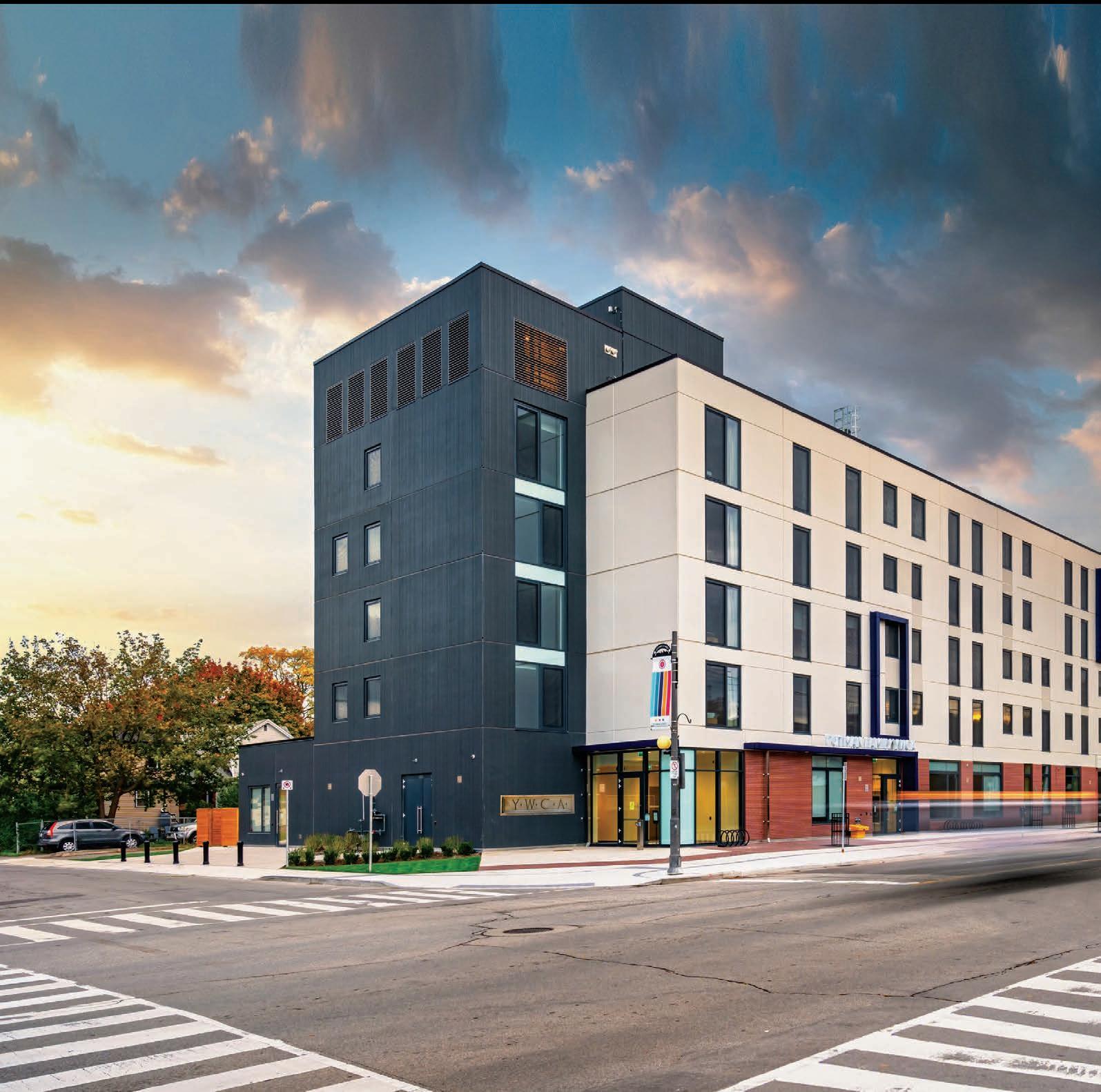
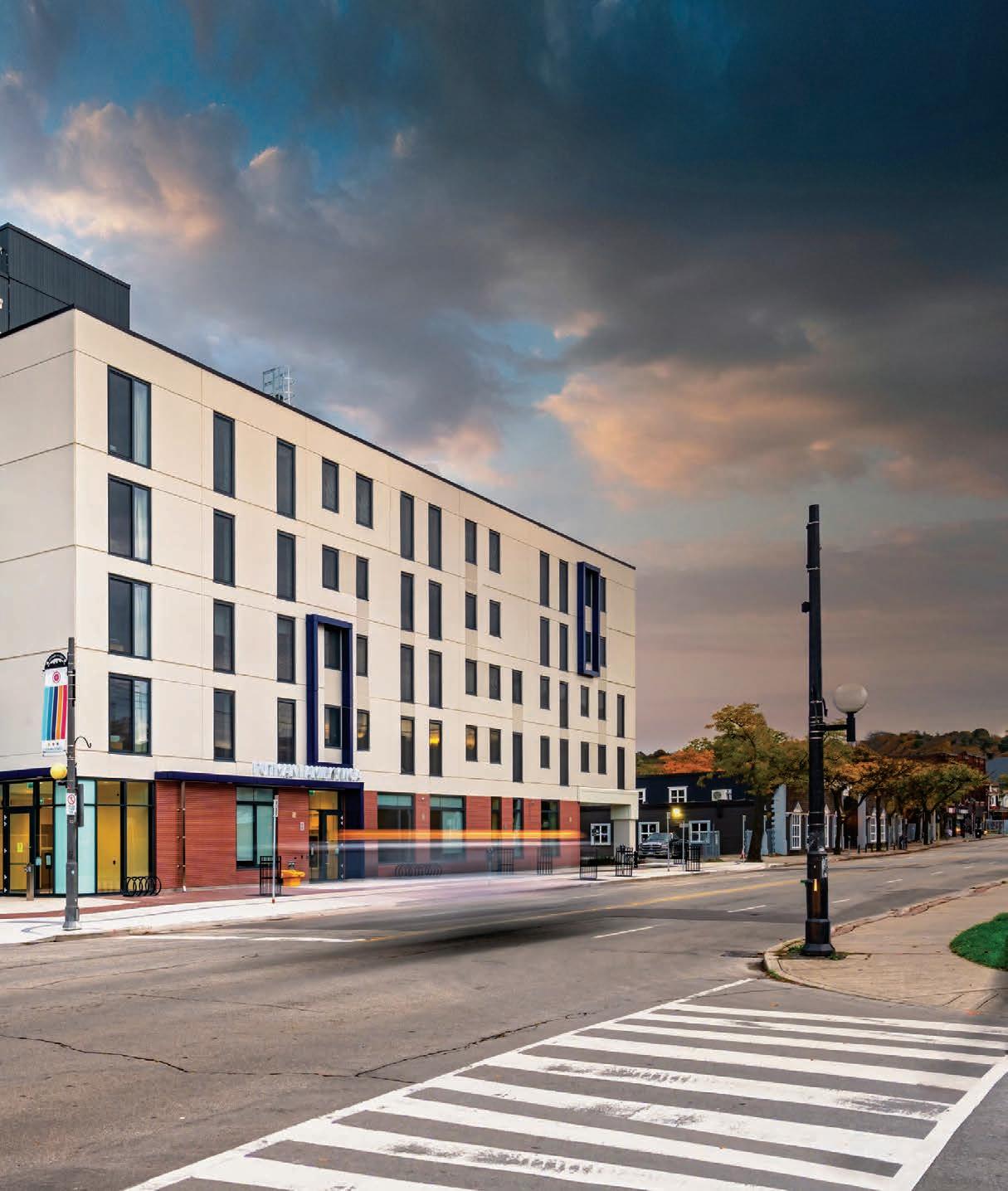
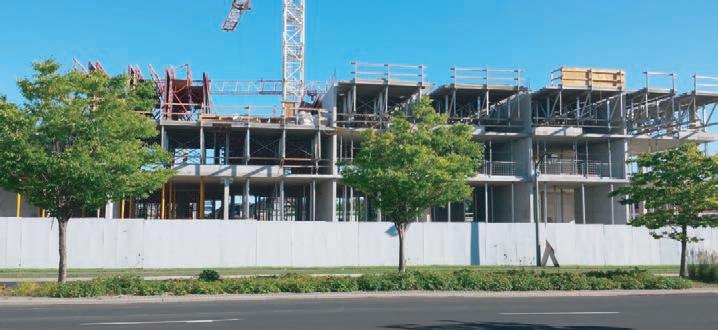
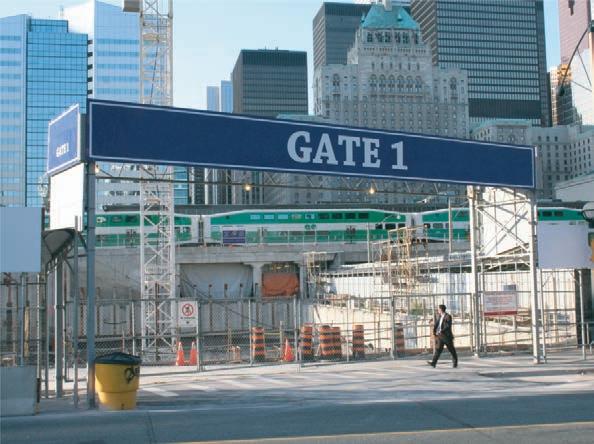
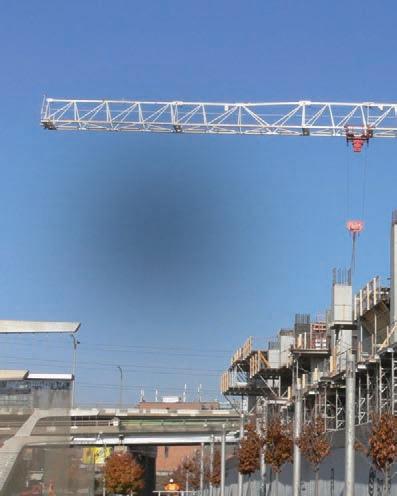
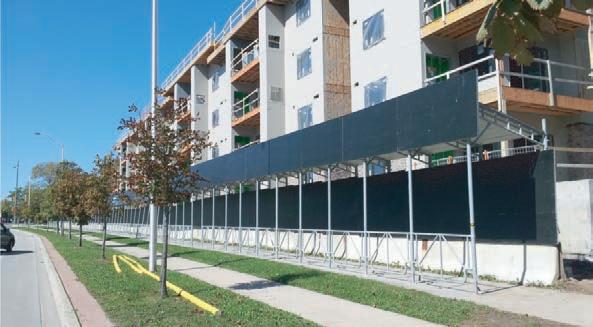
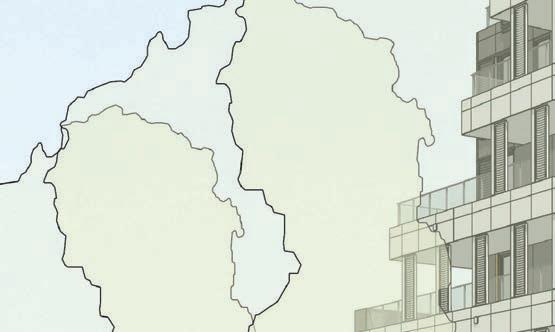
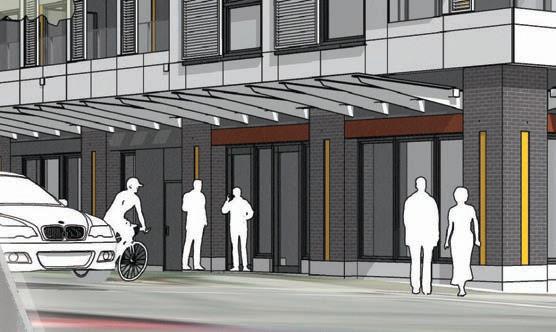
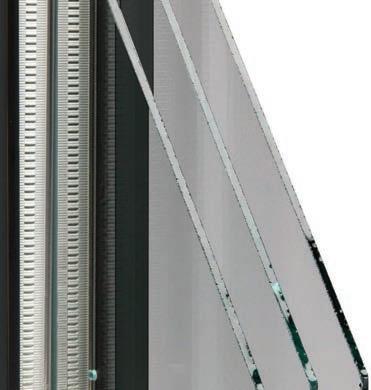
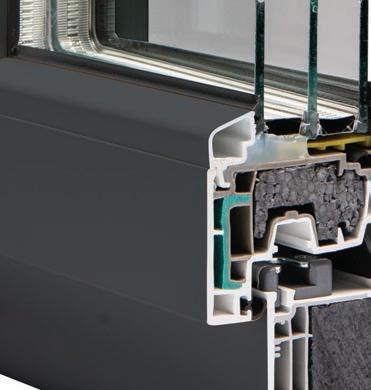
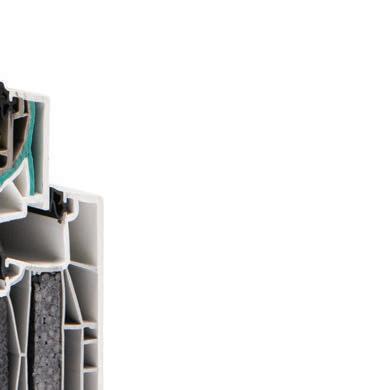
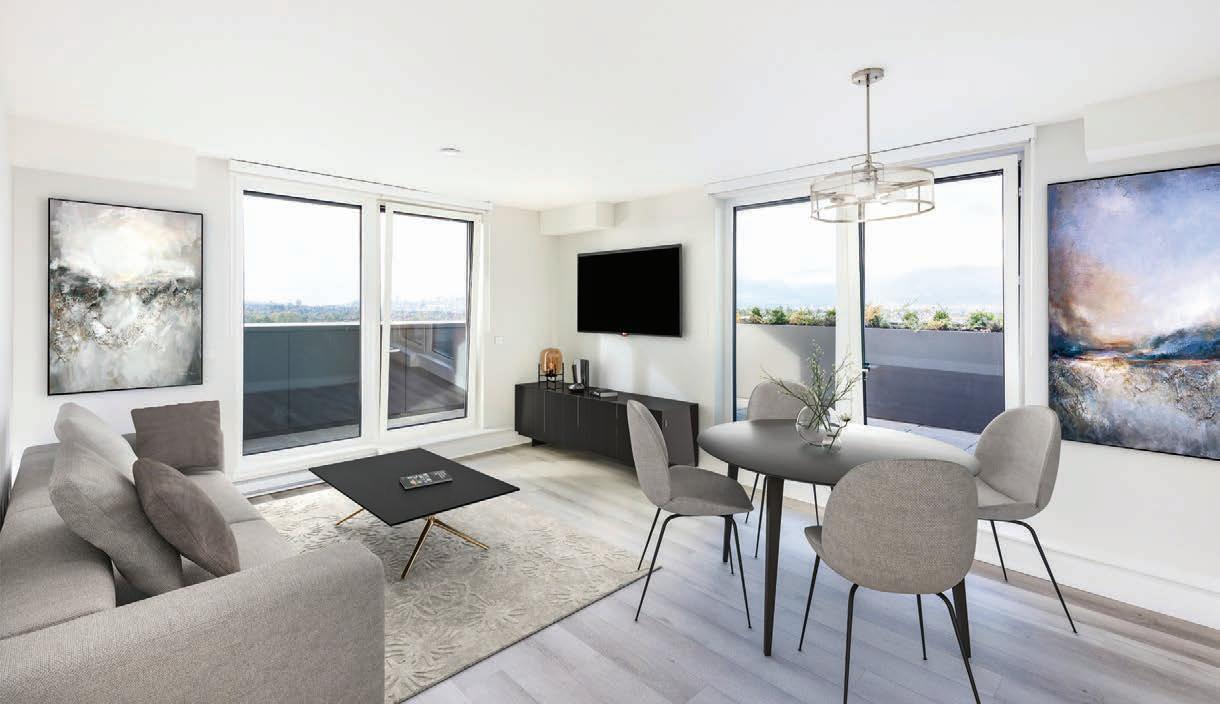
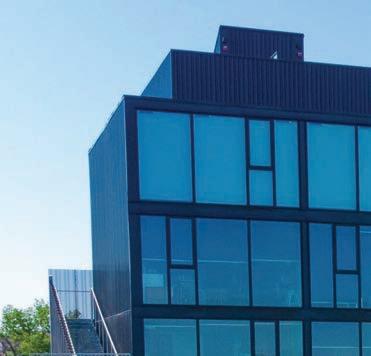
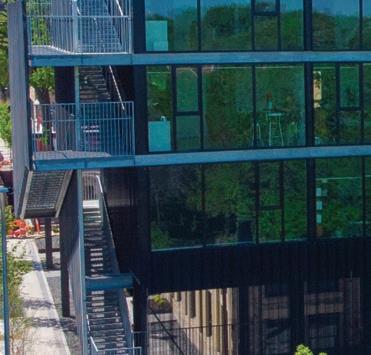
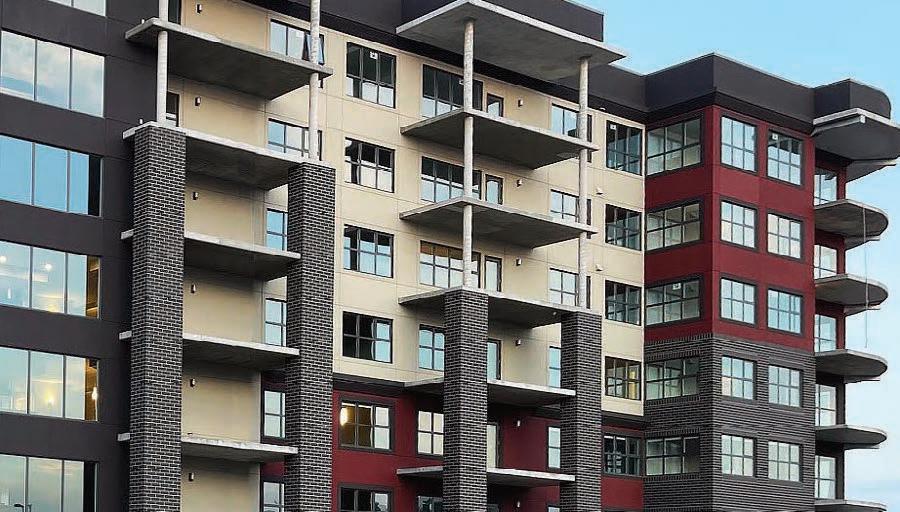
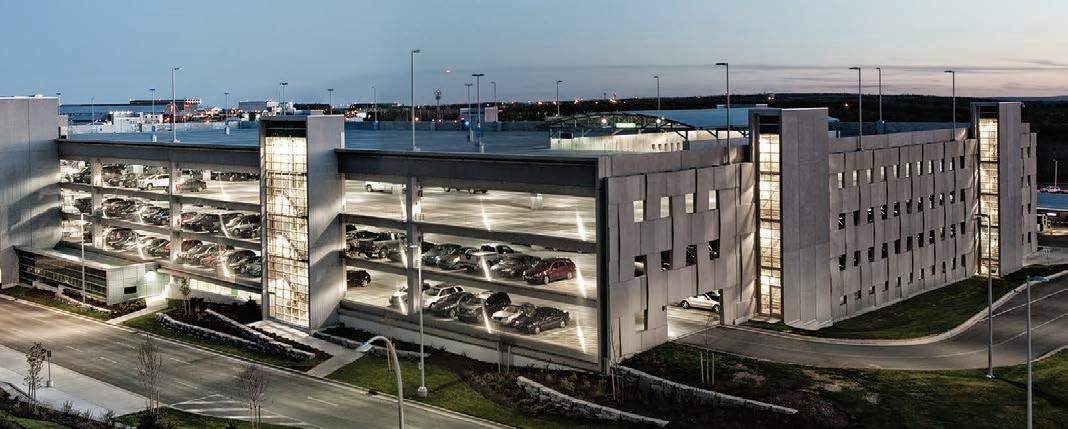
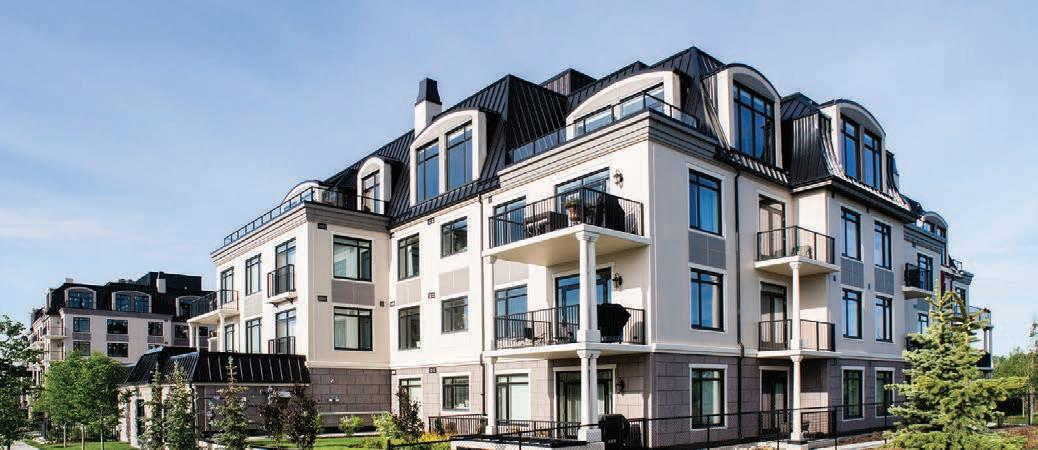
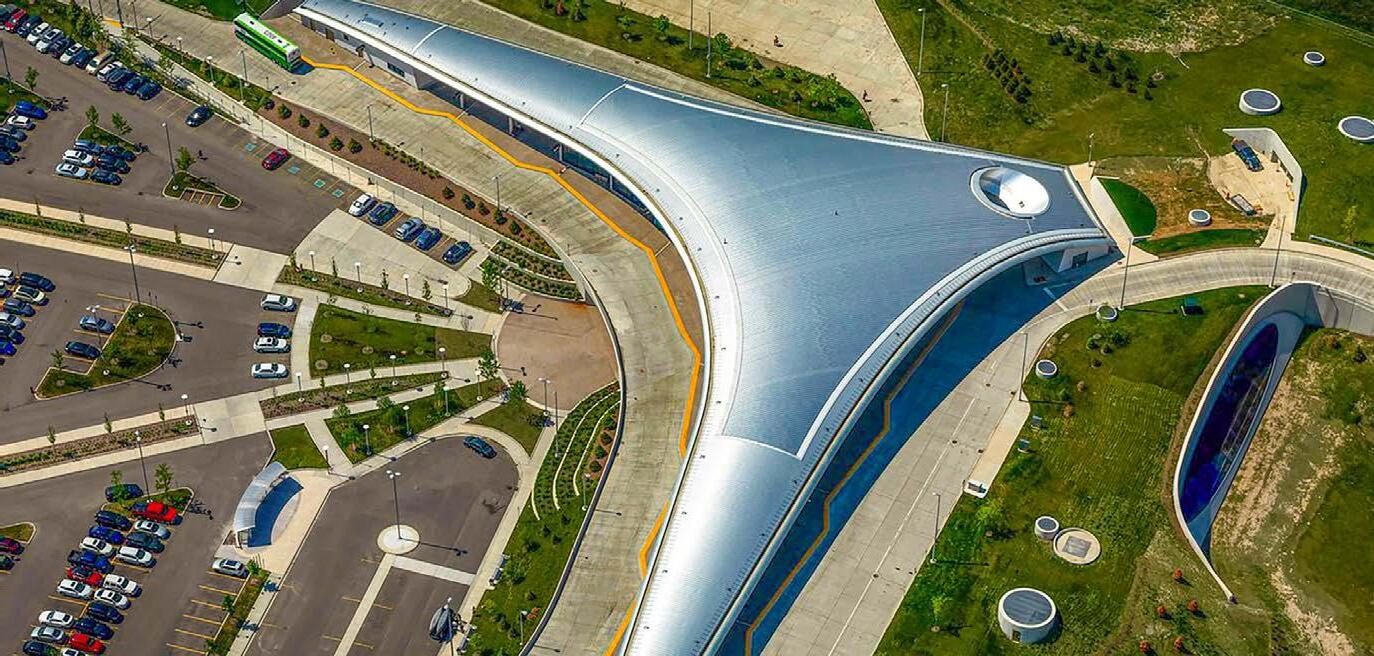
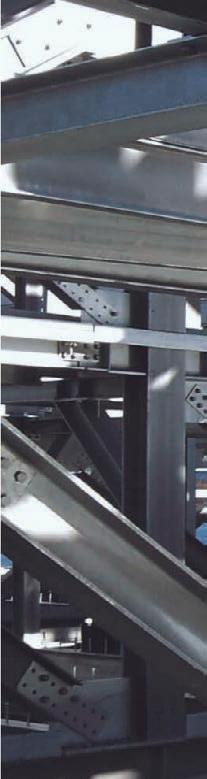
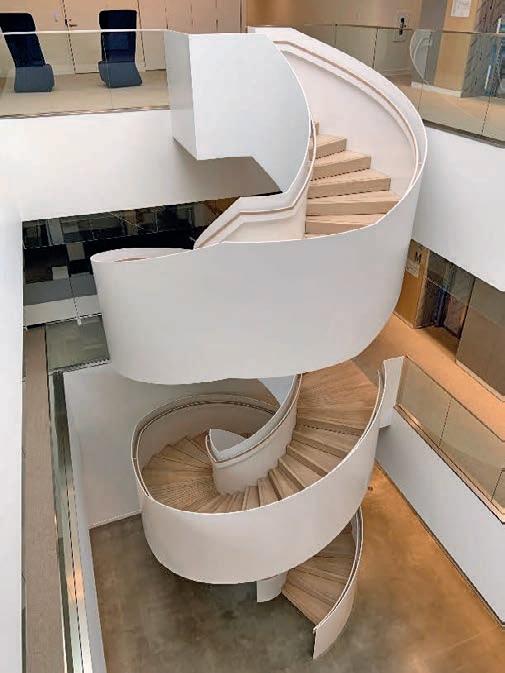
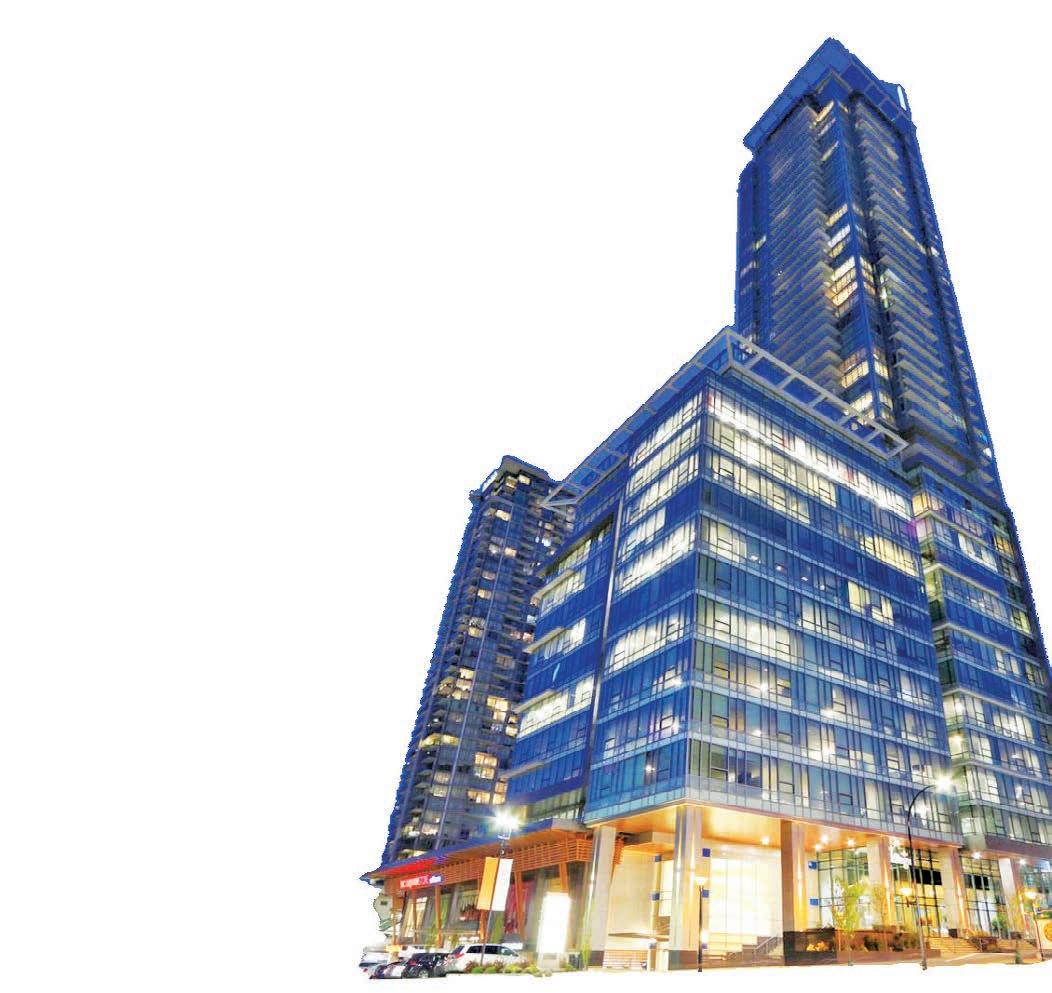
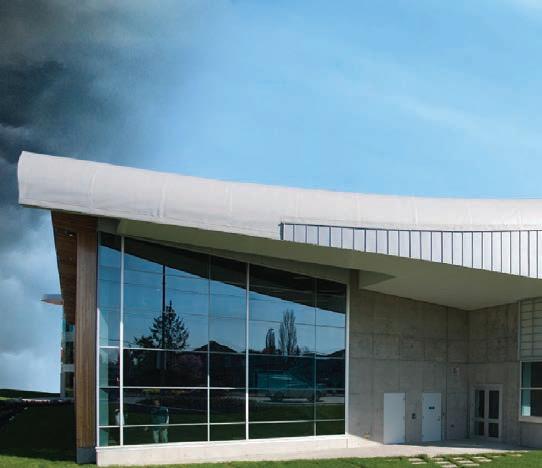
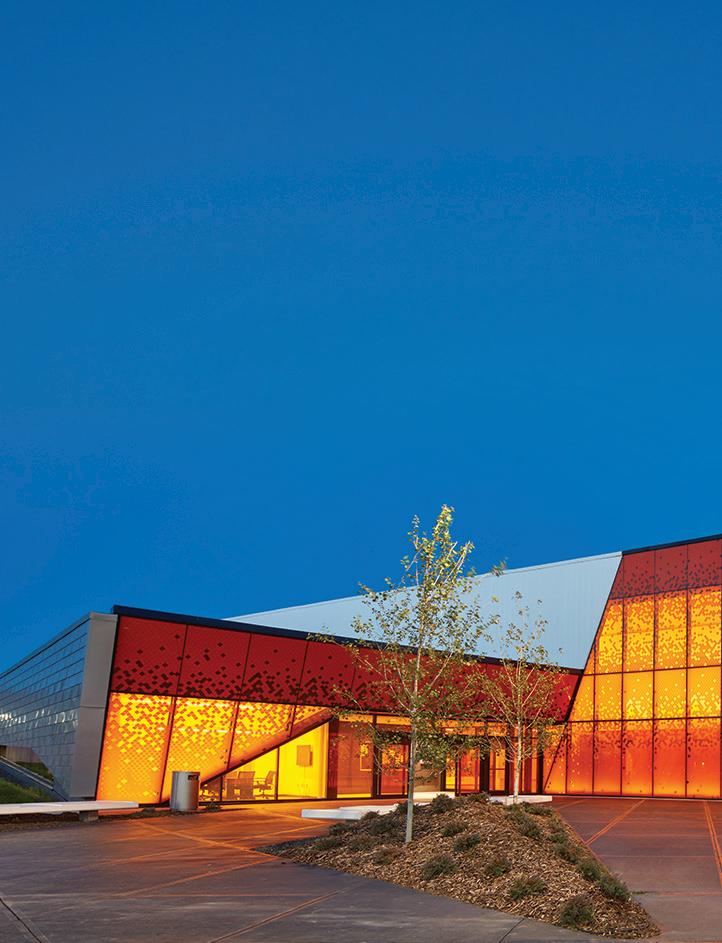
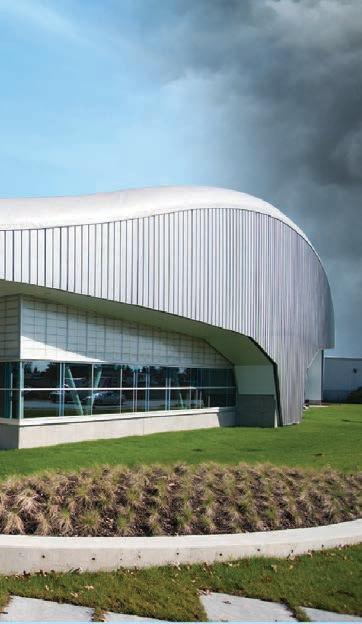
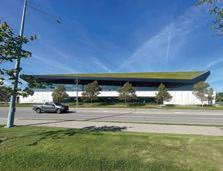
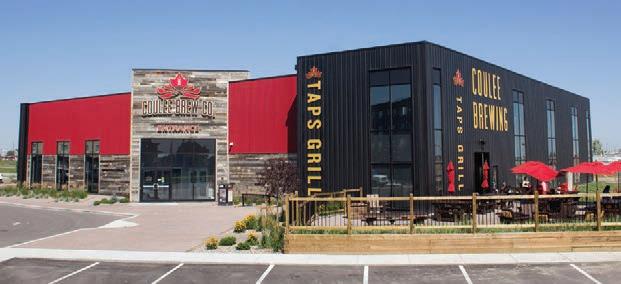
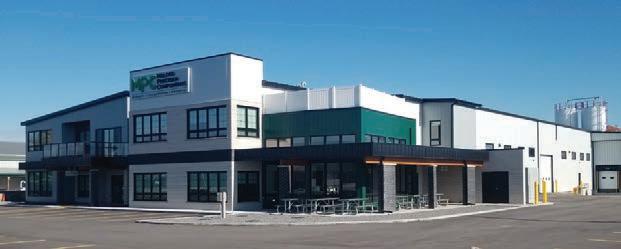
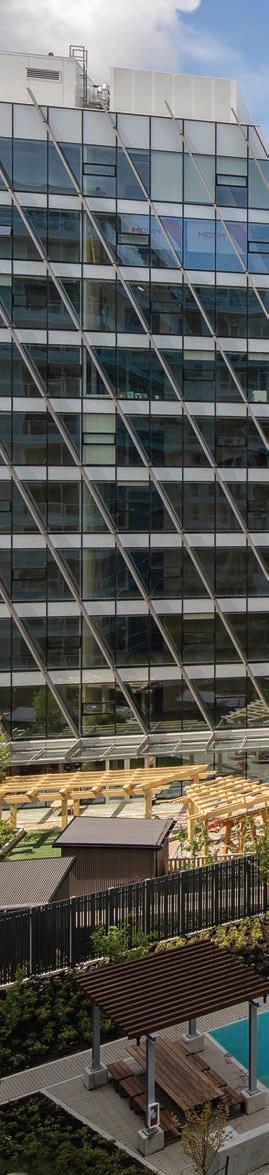
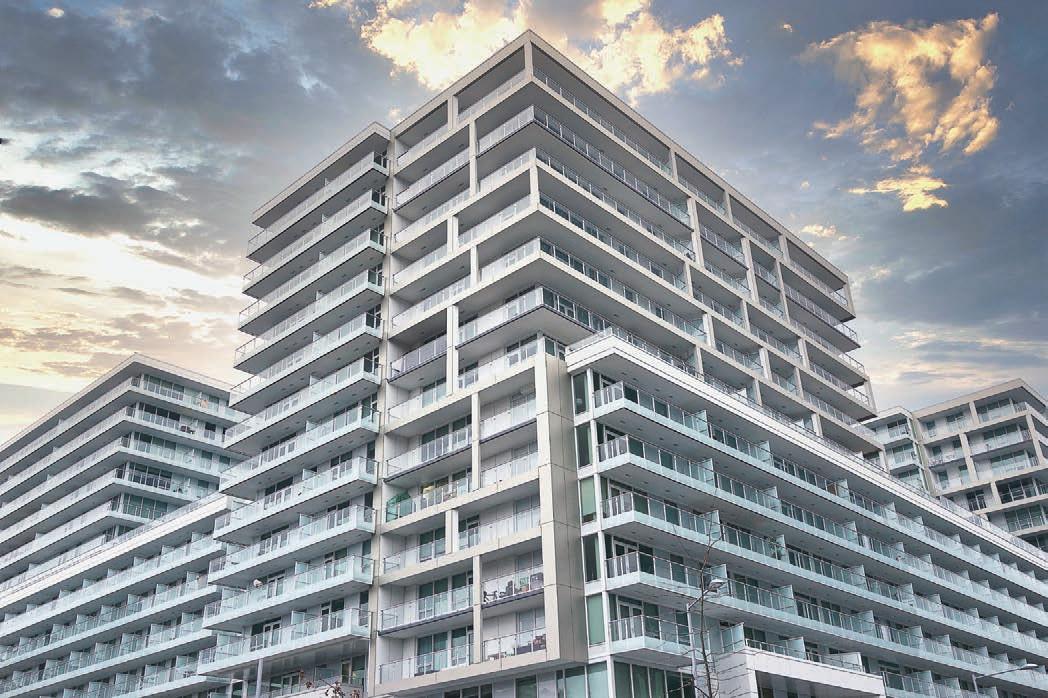
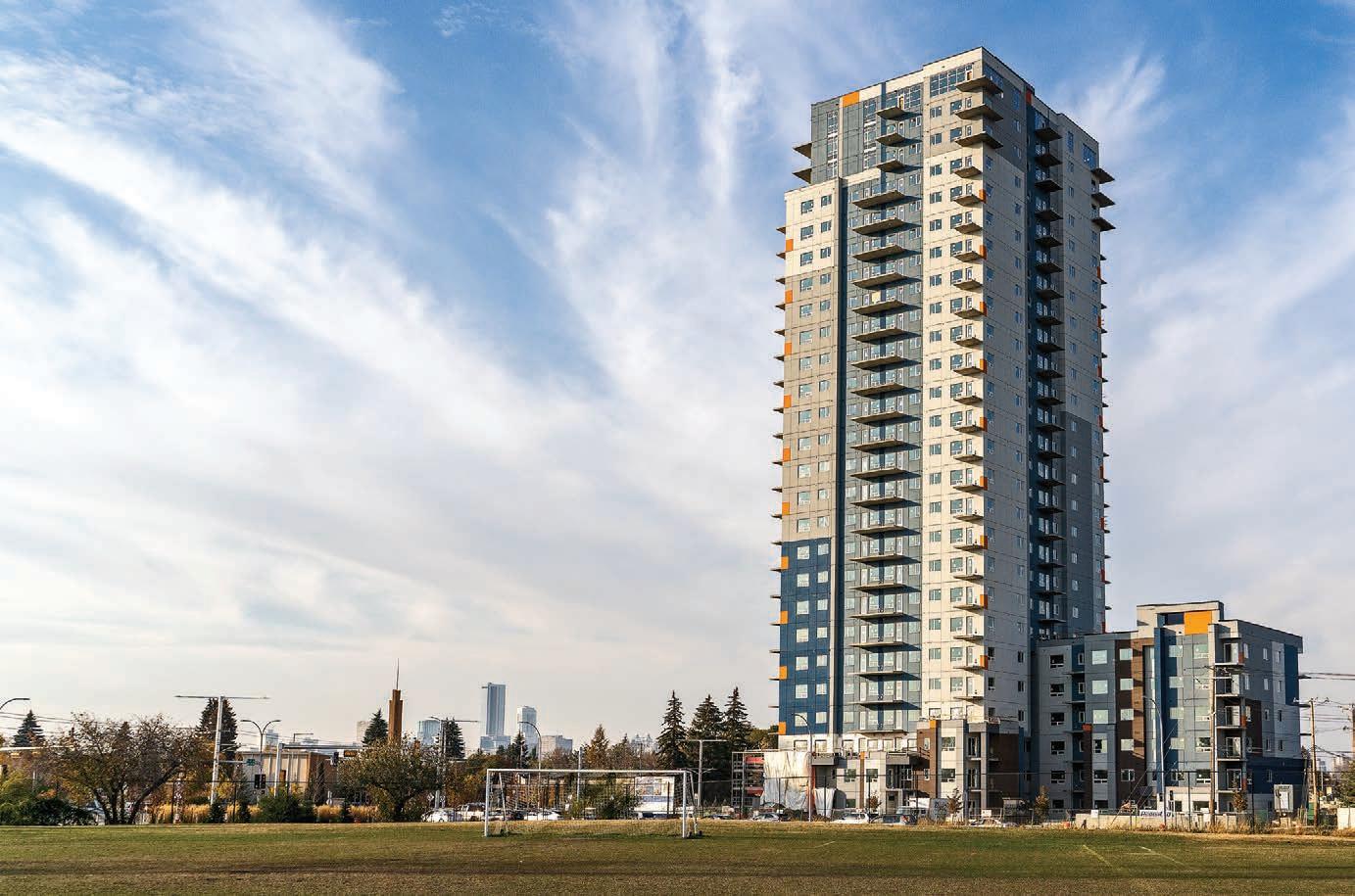
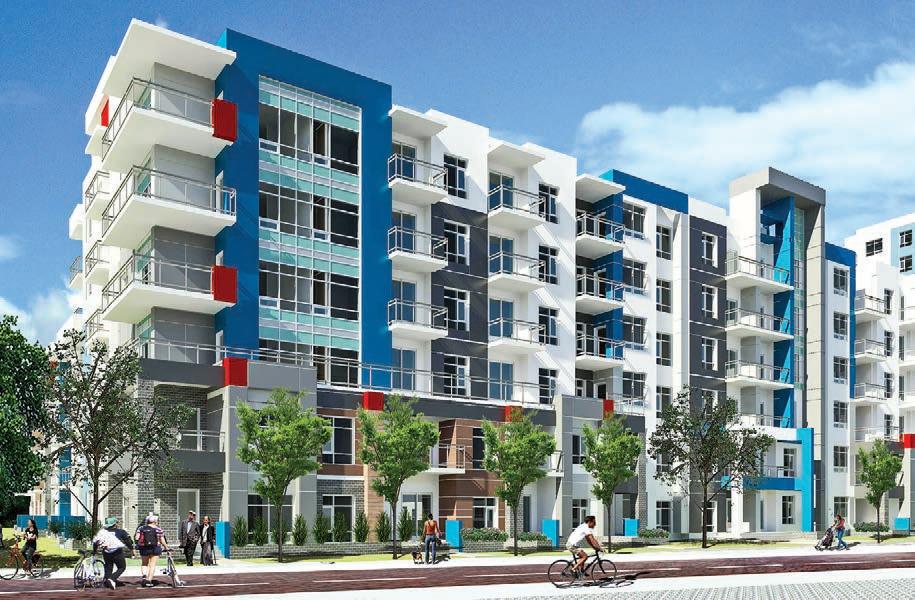
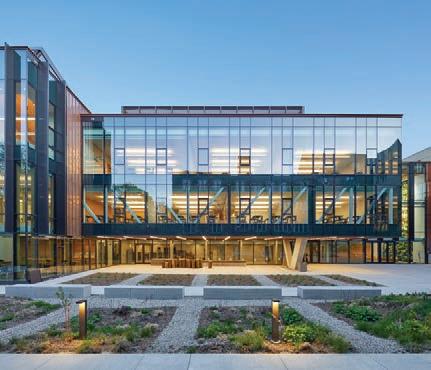
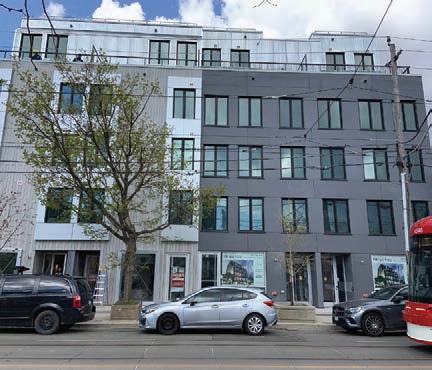
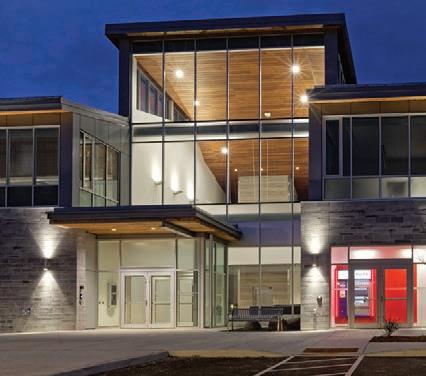
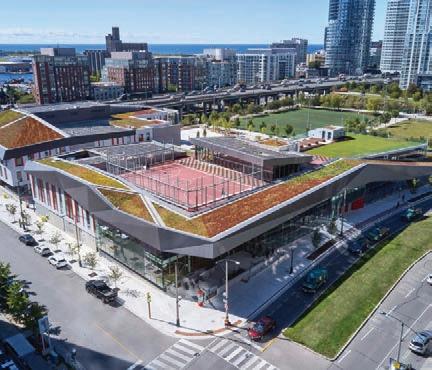
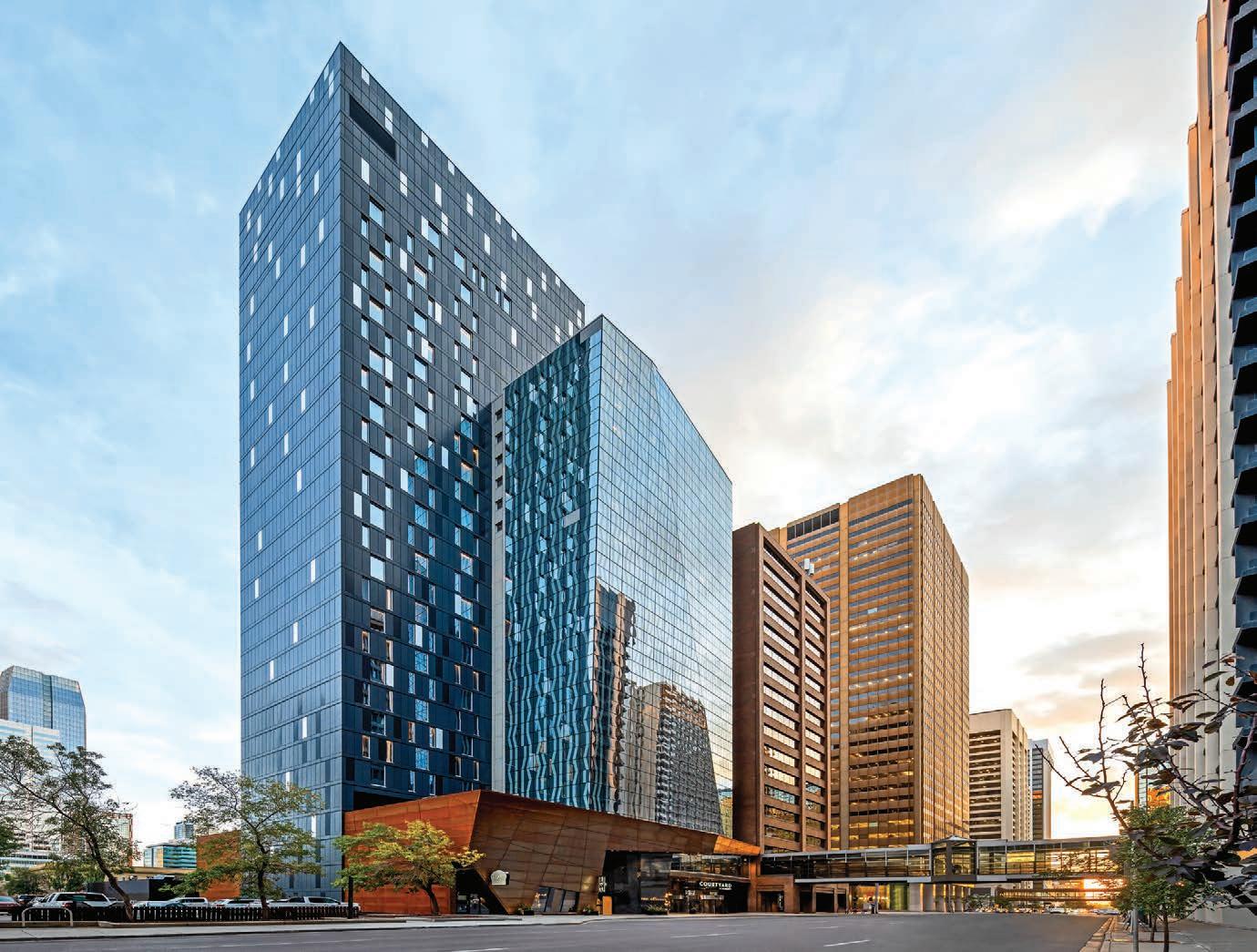
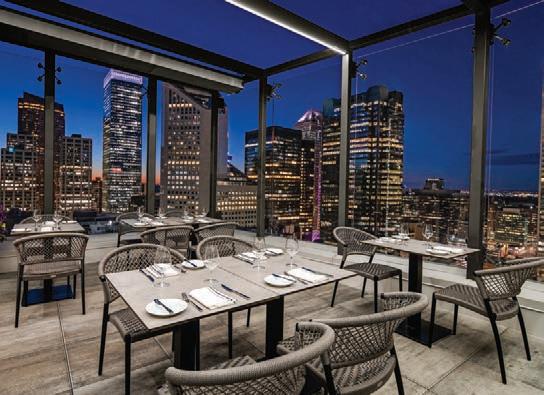
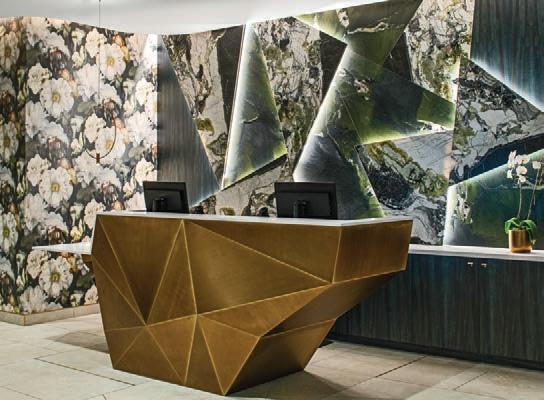
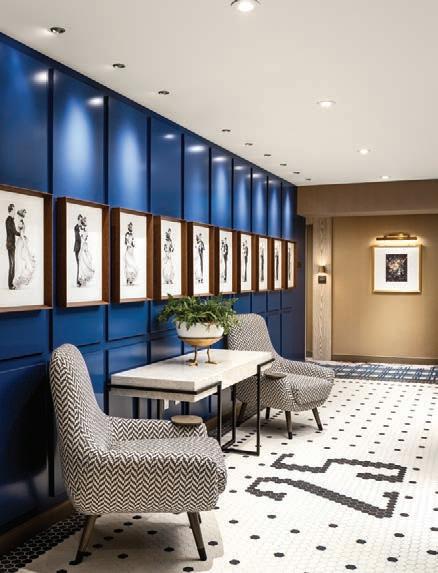
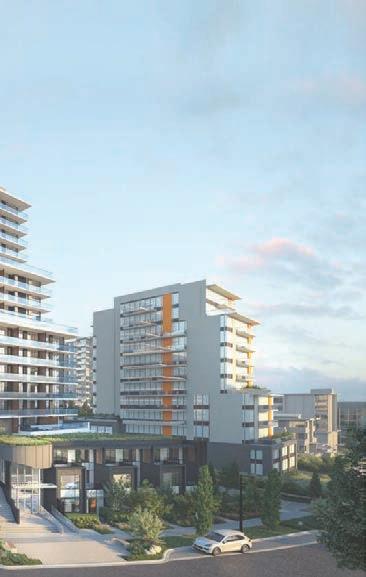
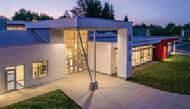
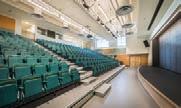
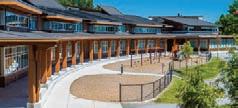
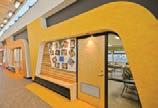
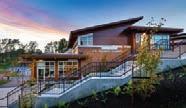
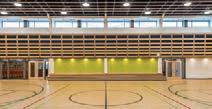
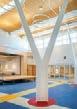
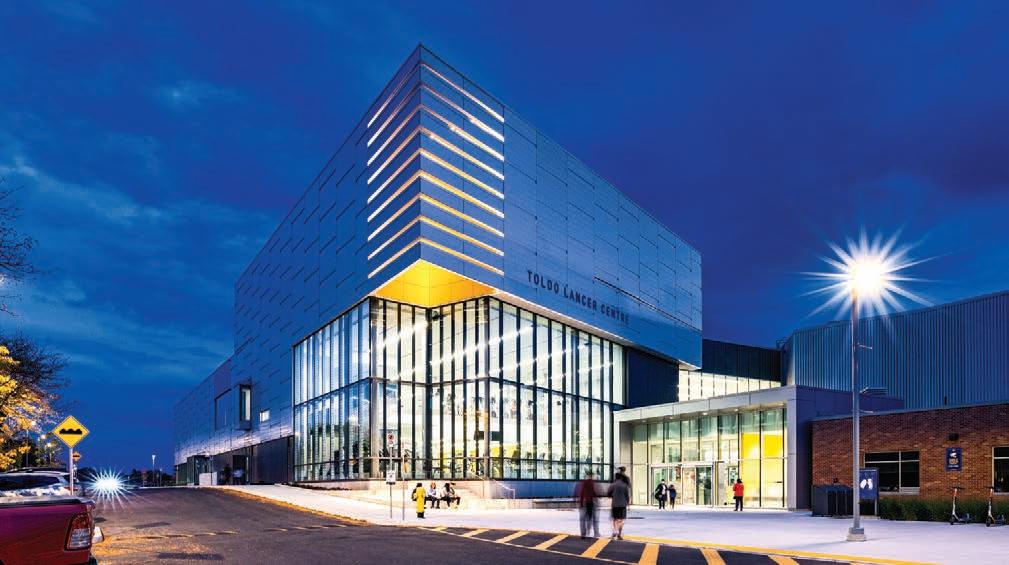
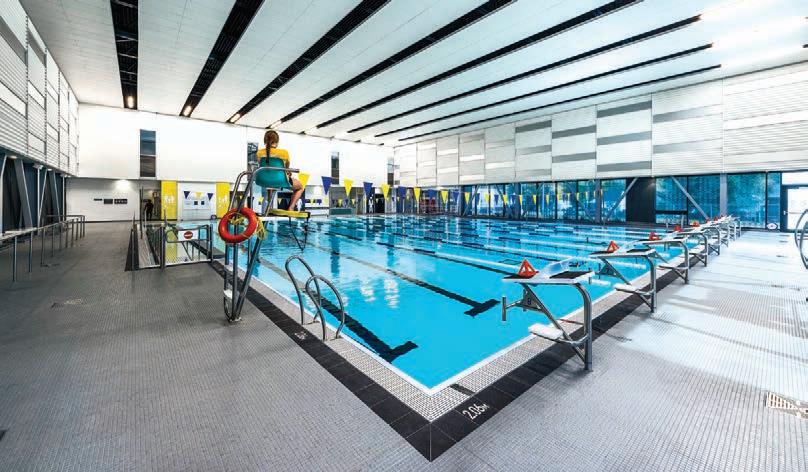
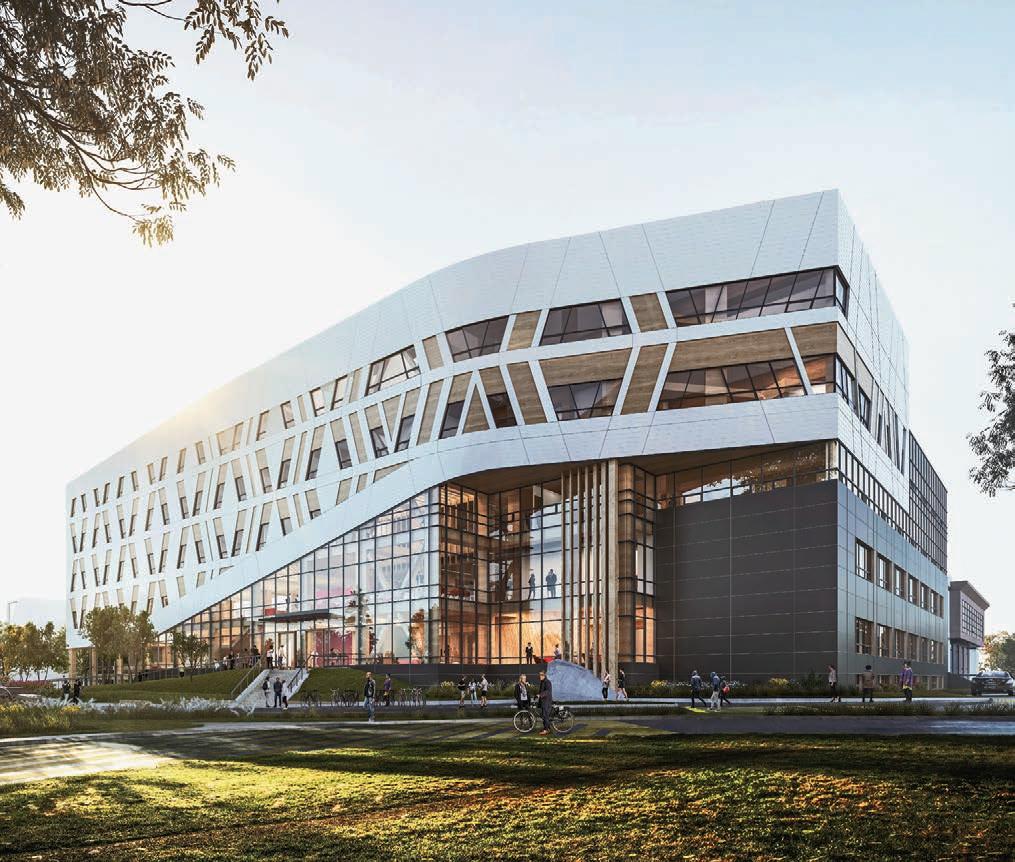
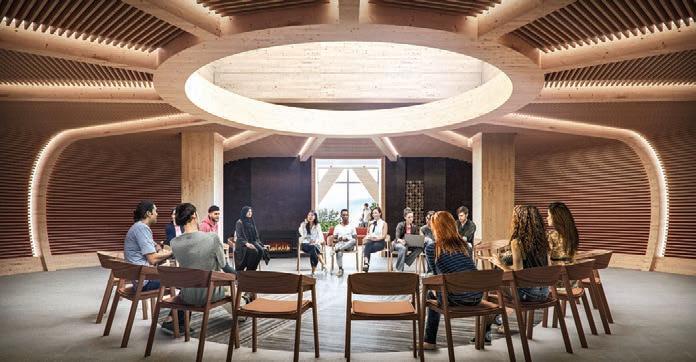
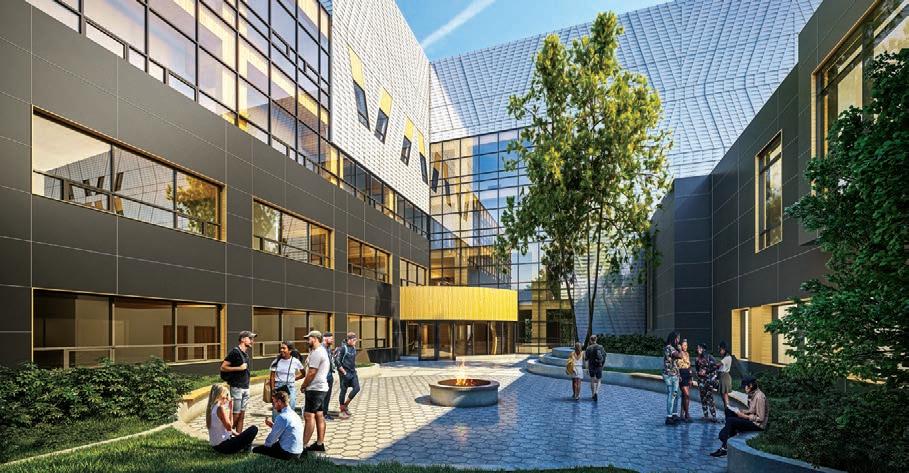
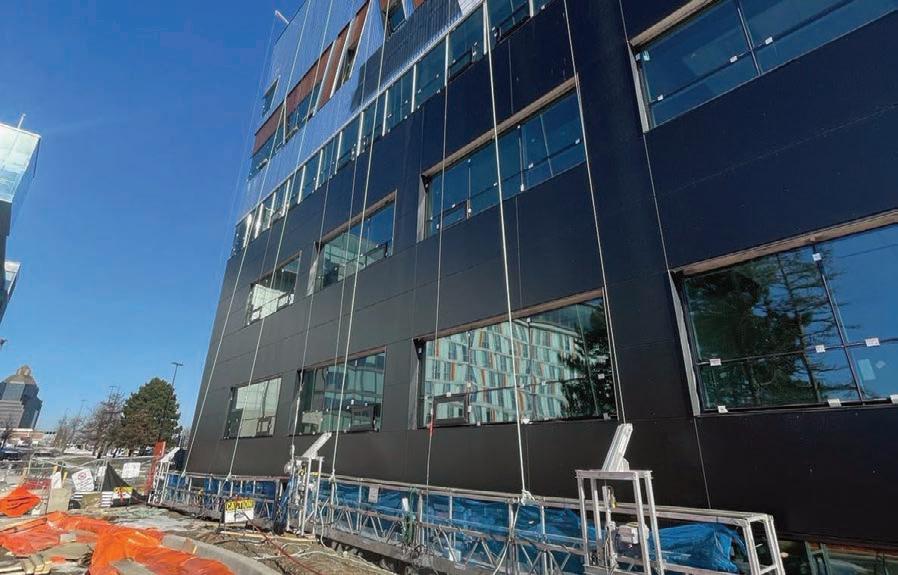
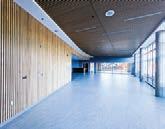
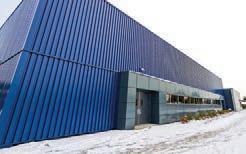
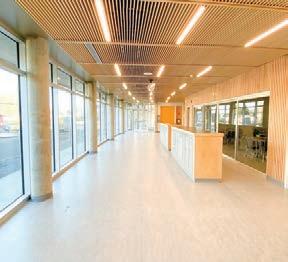
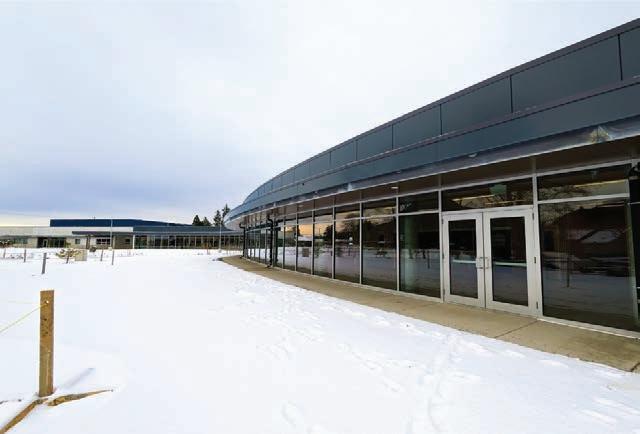
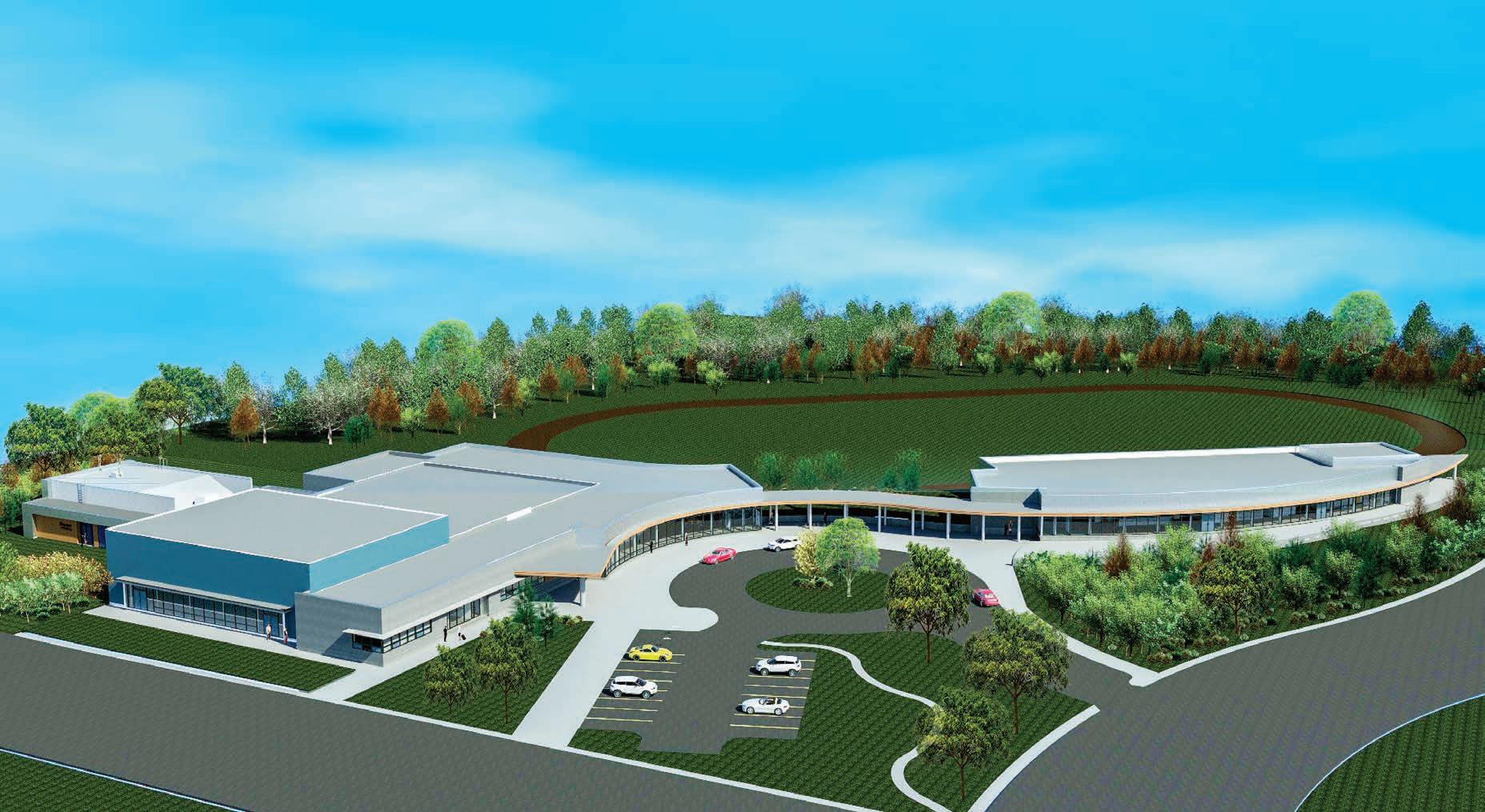
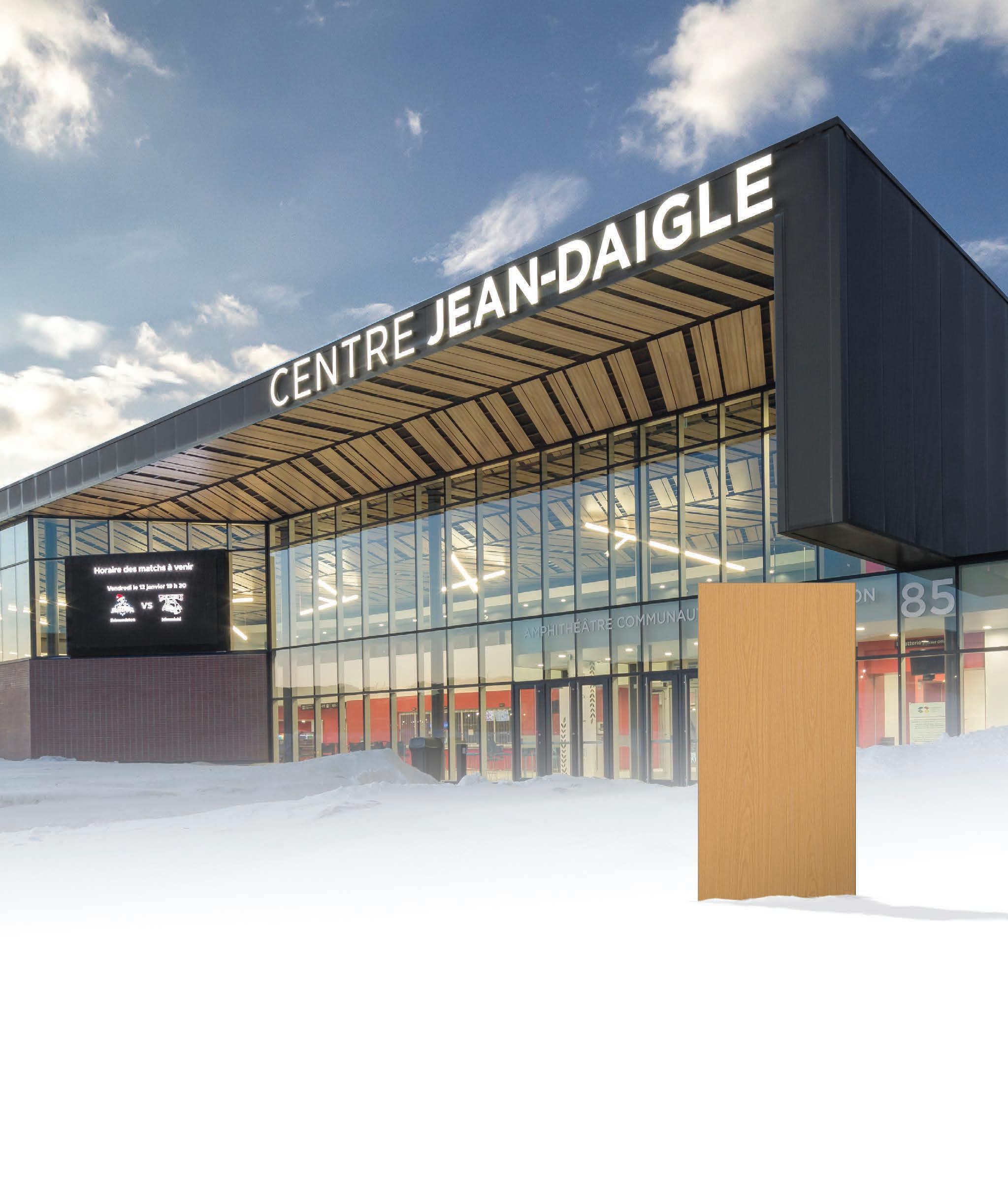
· Manufactured in local precast facilities under controlled conditions
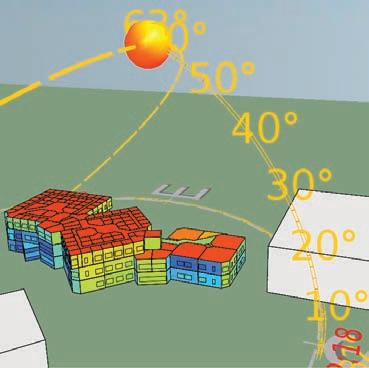
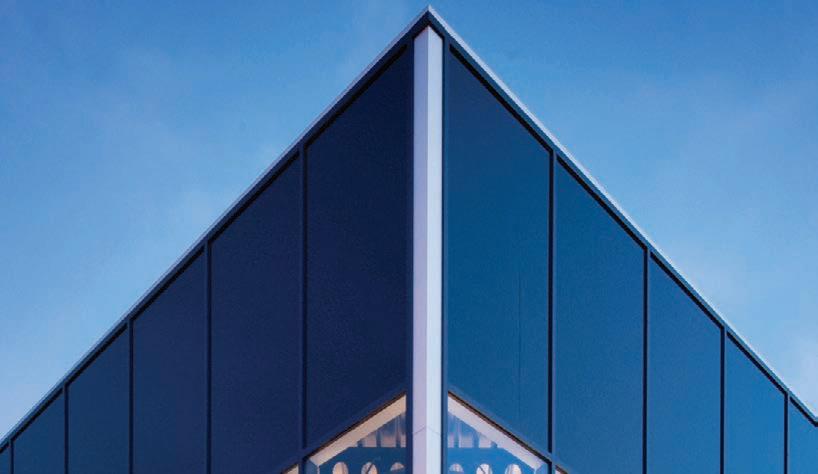
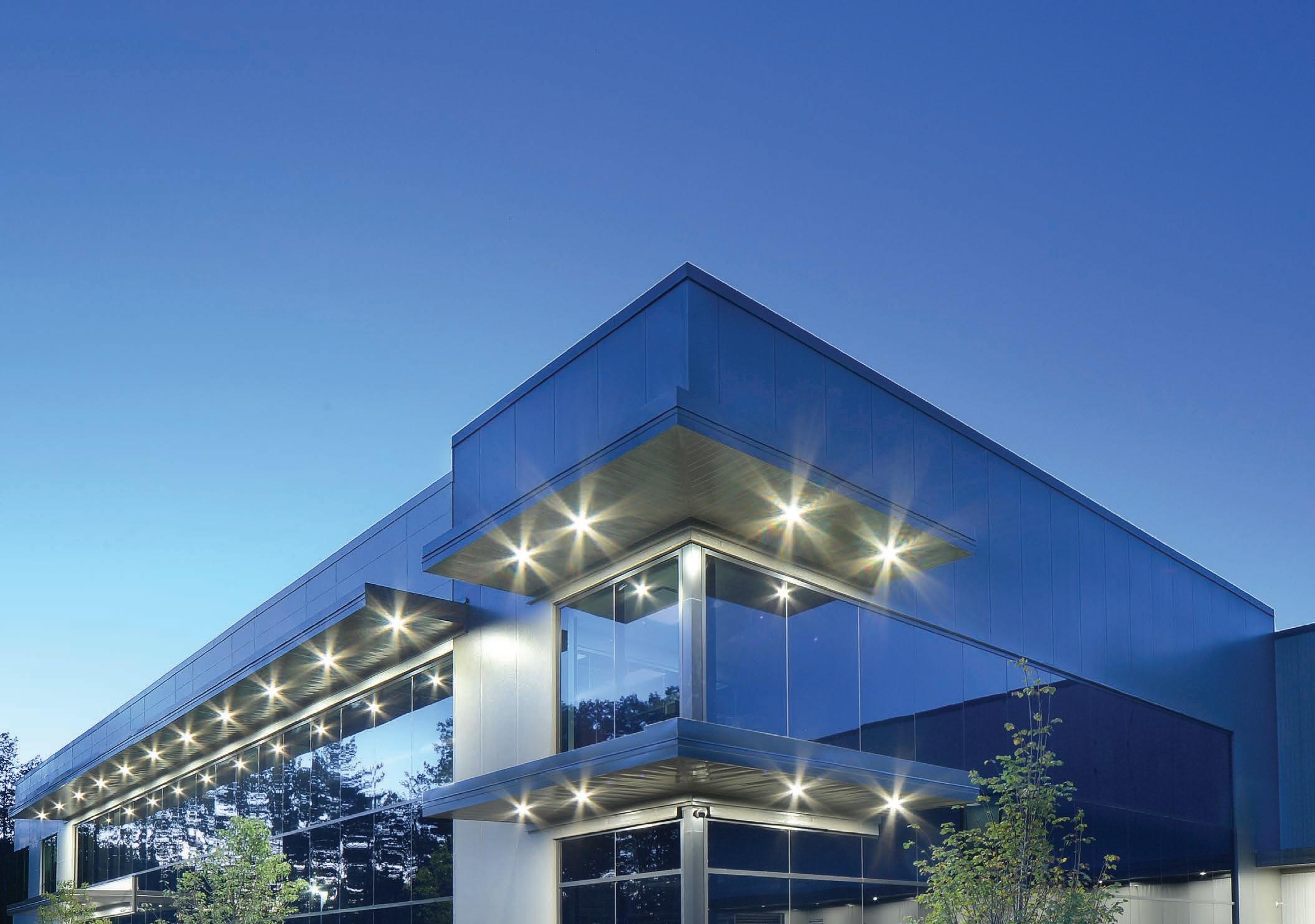
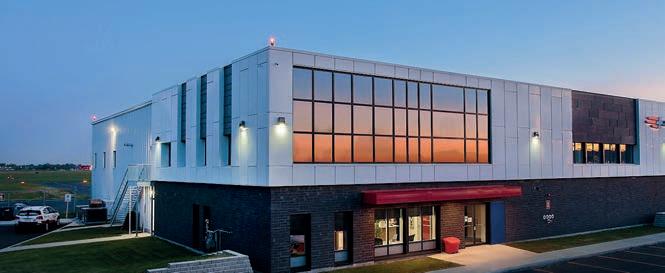
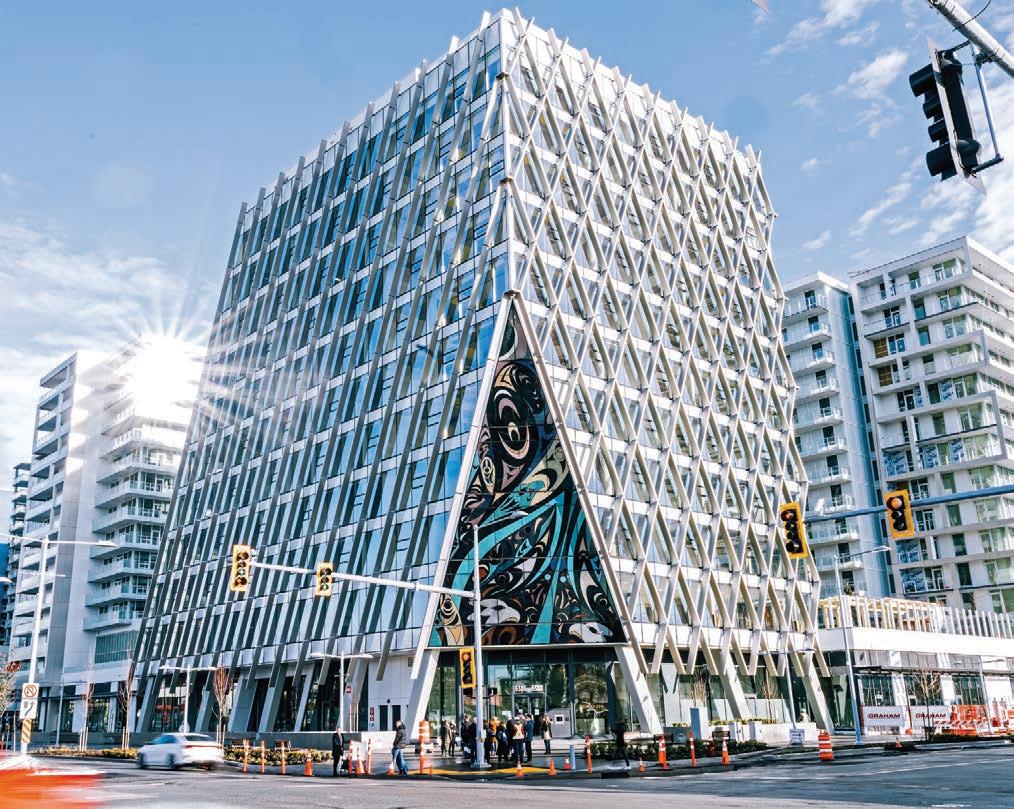
· The whole building envelope in one composite panel; air barrier, moisture control, insulation and the structure
· Hollowcore floor slabs allow for a much lower depth to span ratio
· Hollowcore provides the lowest GWP per m2 of concrete floor area
· Precast concrete dramatically reduces the construction schedule, site congestion, noise and environmental impacts
For more information and educational presentations check out Learn on Demand, a 24/7/365 Educational Platform. Visit: cpci-learnondemand.com/
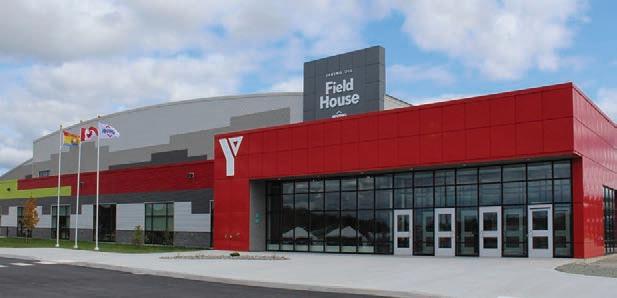
For more information on Passive House Total Precast Concrete, visit www.cpci.ca/publications to download your free copies of the Structural Solutions Guide and the Putman Family YWCA Total Precast Concrete Case Study.
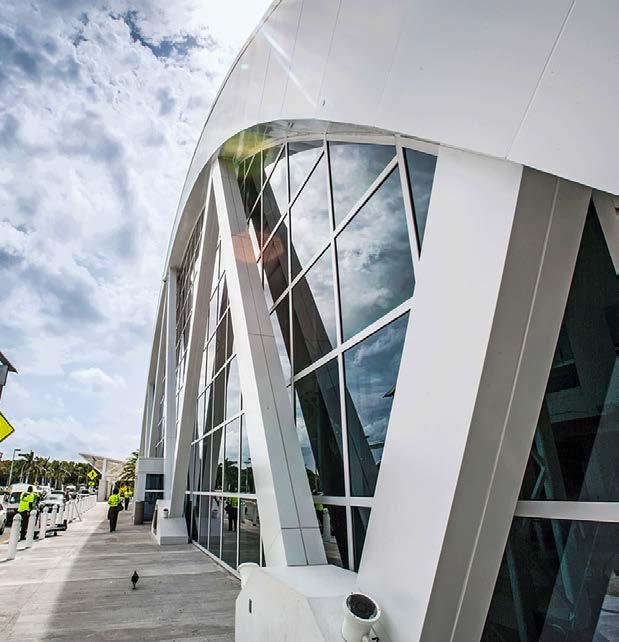
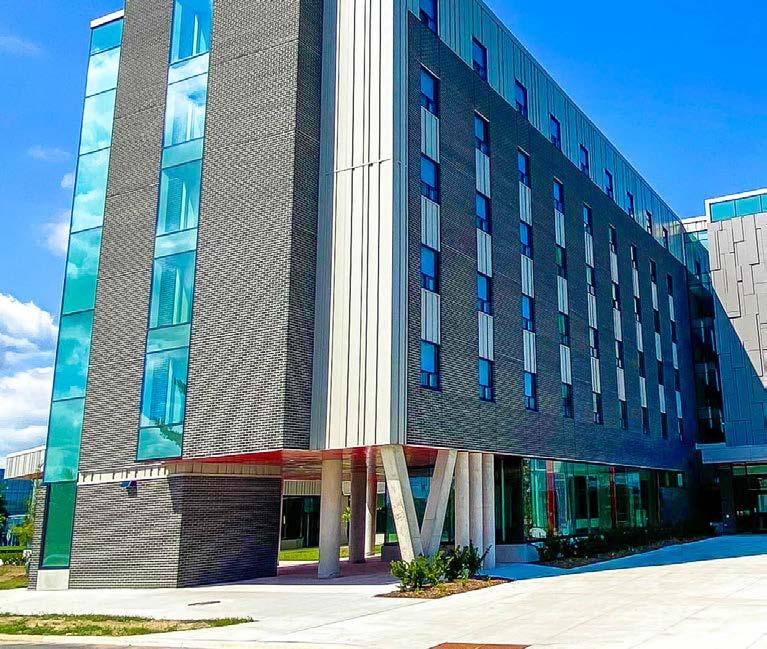
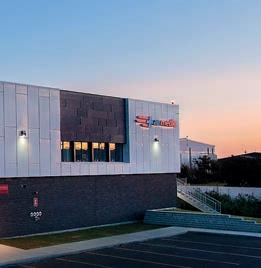
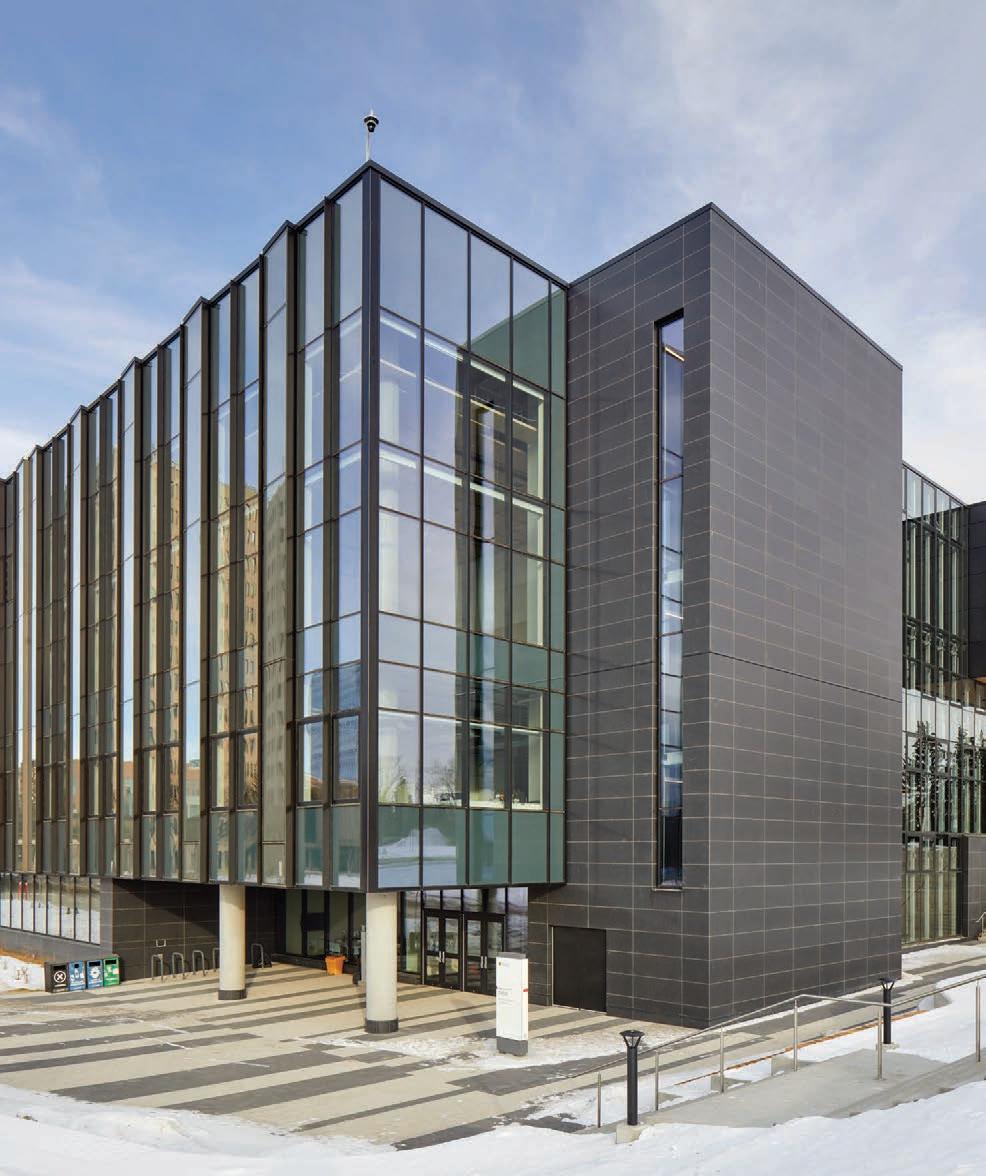
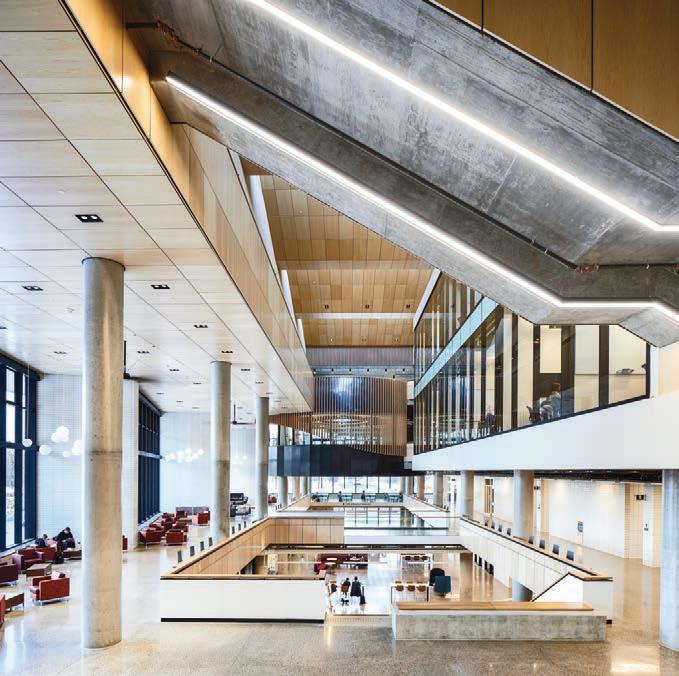
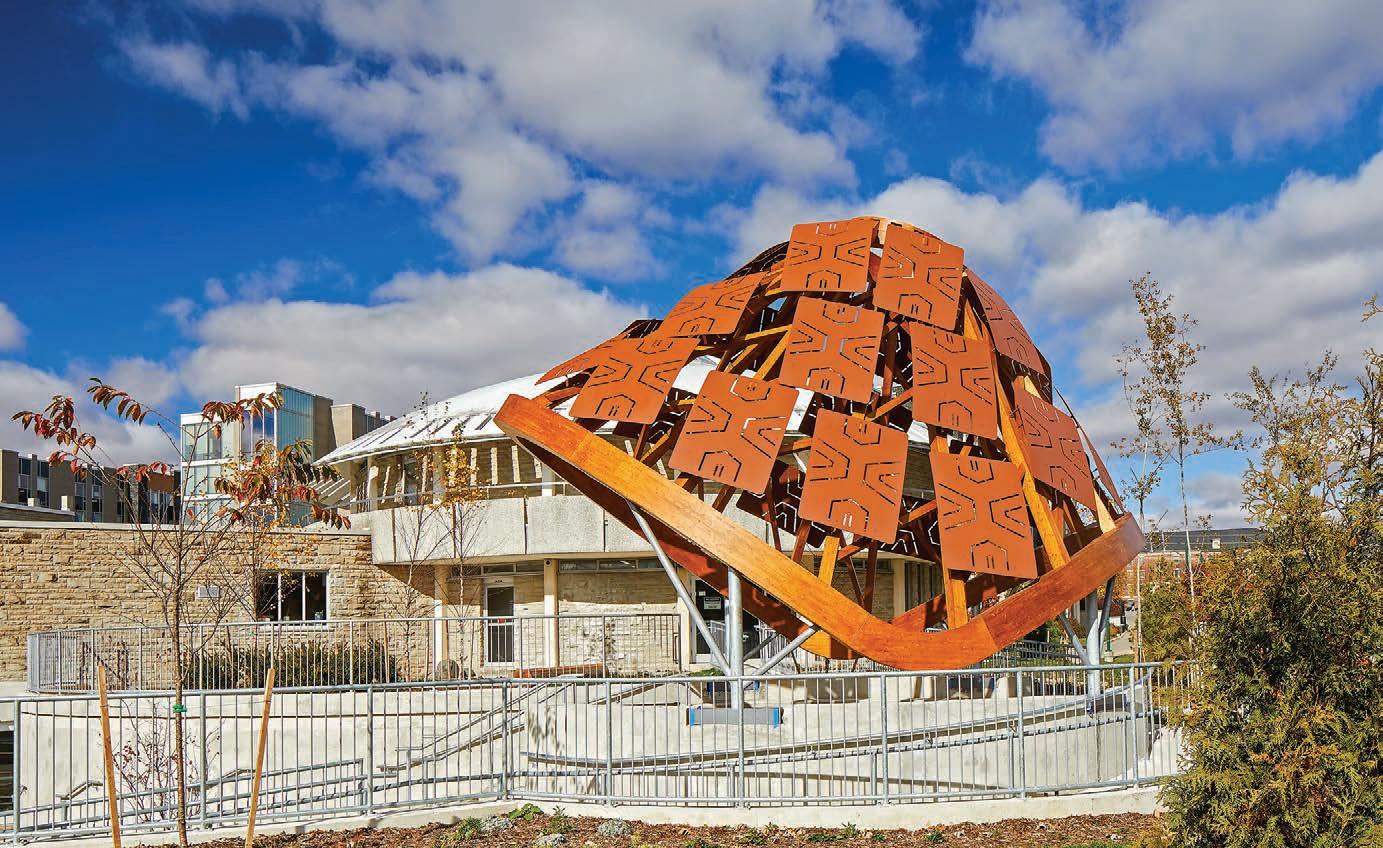
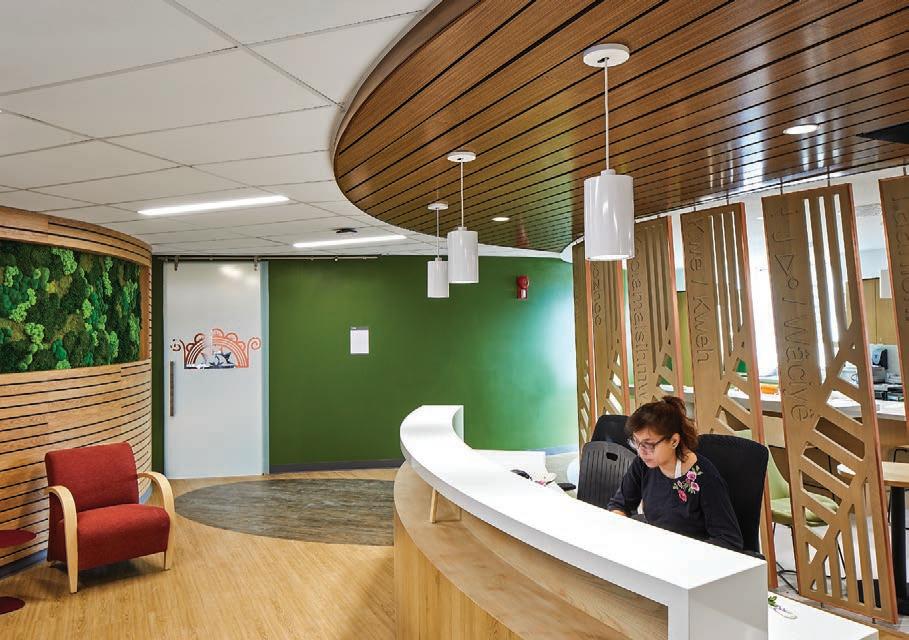
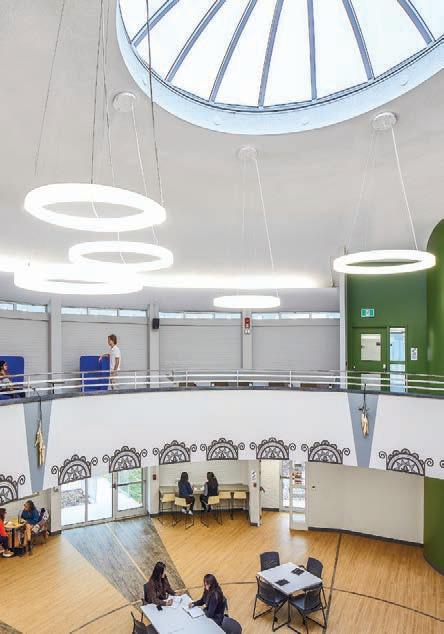
Project: The Putman Family YWCA, Hamilton, ON Architect: Kearns Mancini Architects Inc., Toronto, ON
Adapting to a changing world.
MAKING DREAMS A BUILT REALITY
TKA+D is dedicated to creating a positive impact through beautiful buildings and spaces. 9
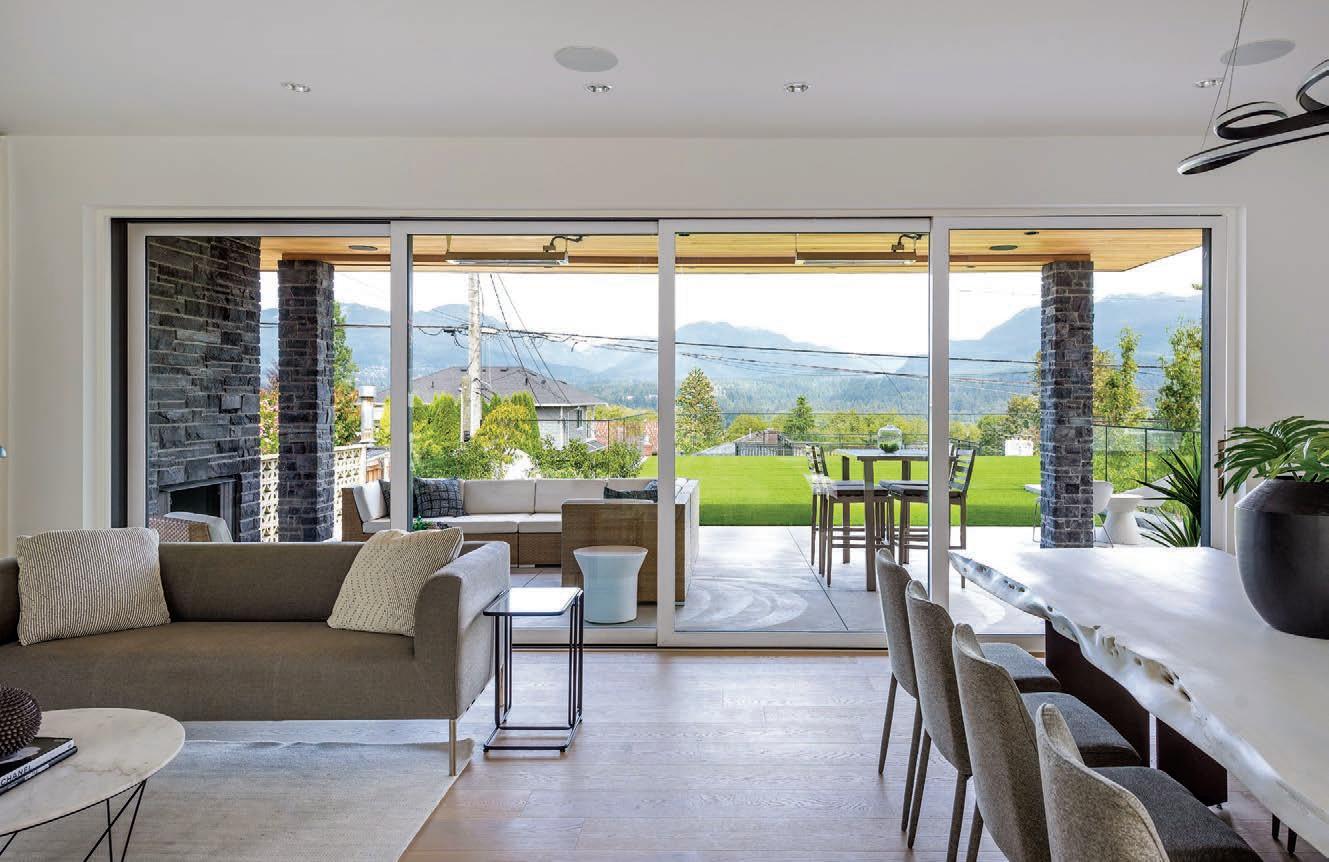
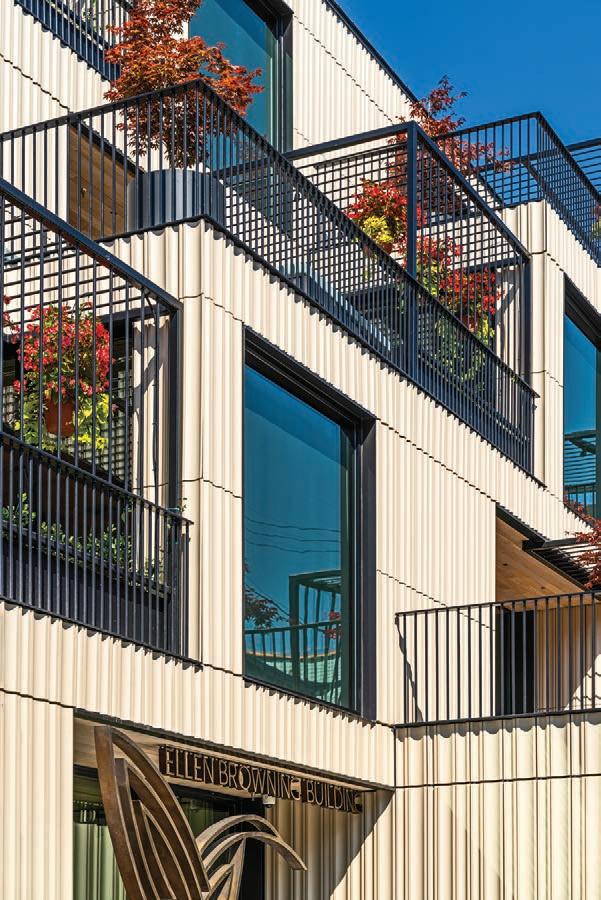
More glass, less frame, and high-performance technology: this is the world of windows.
RENEW
The wide range of innovative restoration products facilitate the move from old to new.
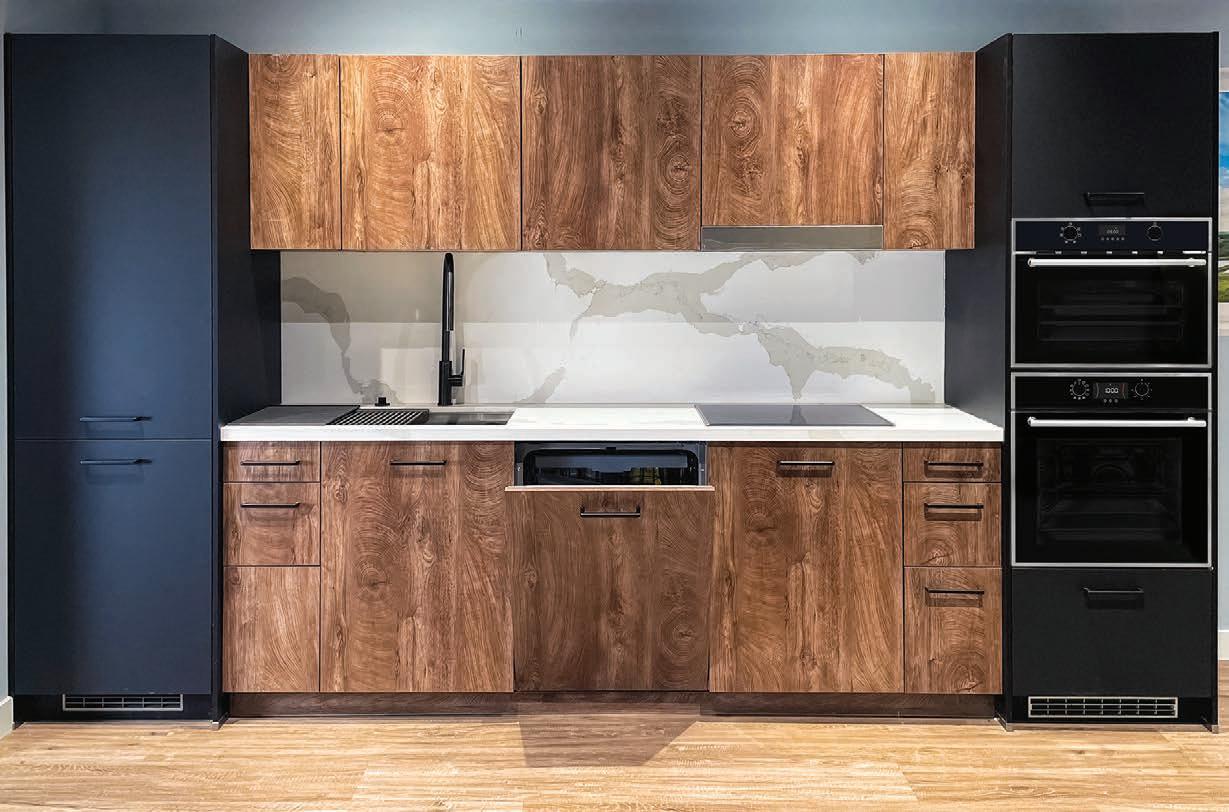
From custom millwork finishes to steam ovens, the appliance sector is taking us into an exciting new realm.
Hard surface flooring trends that are all the rage this year.
Plumbing products provide solutions to sustainability while focussing on convenience and style.
Structural steel continues to prove it is one of the most versatile products available today.
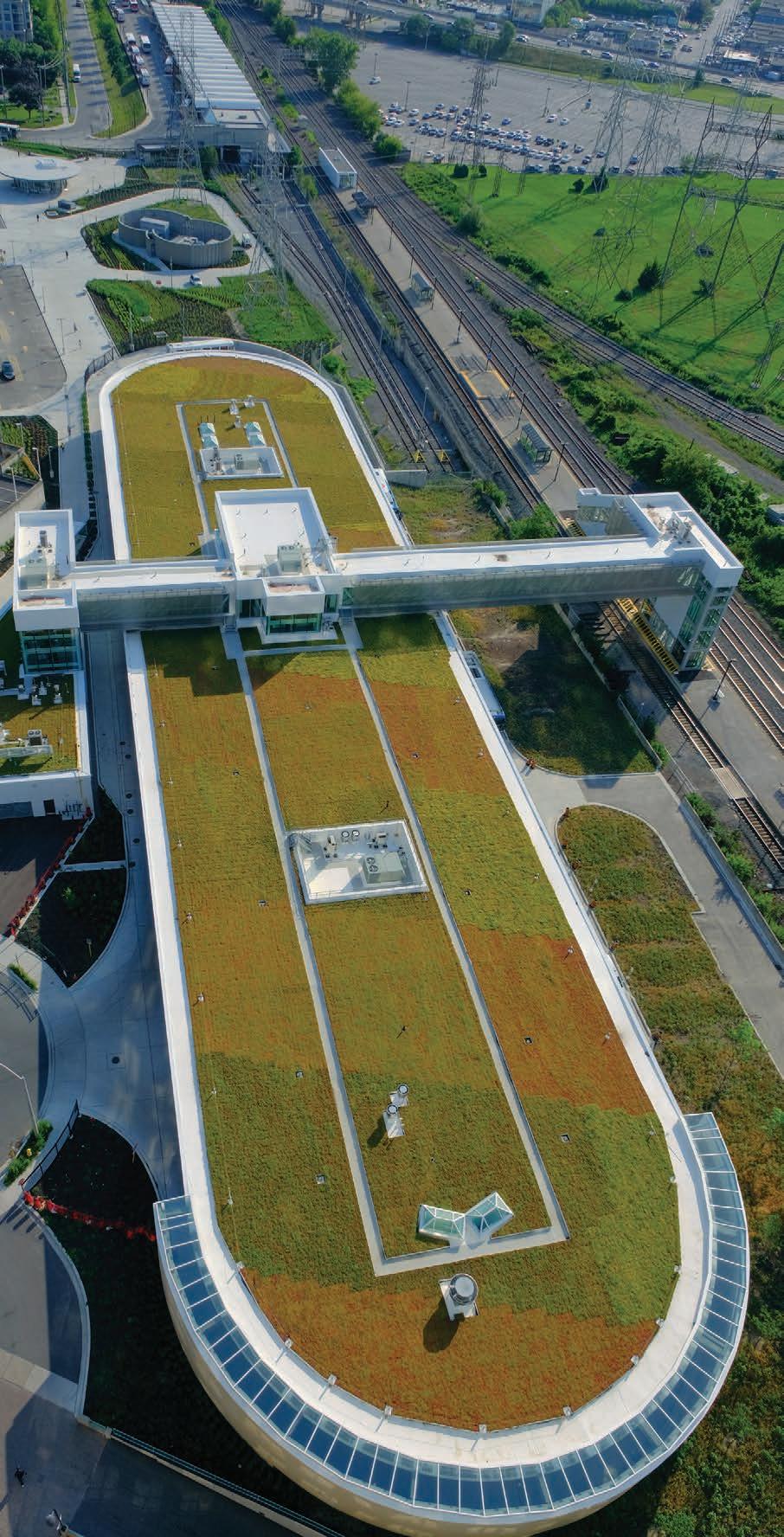
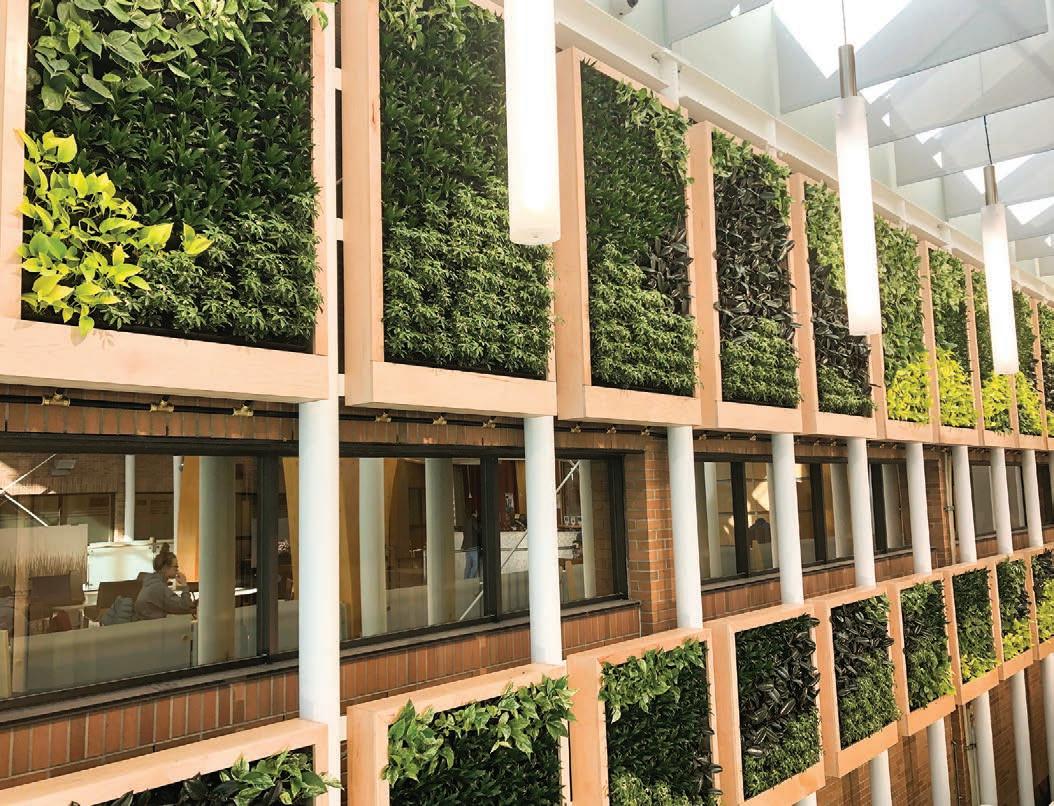
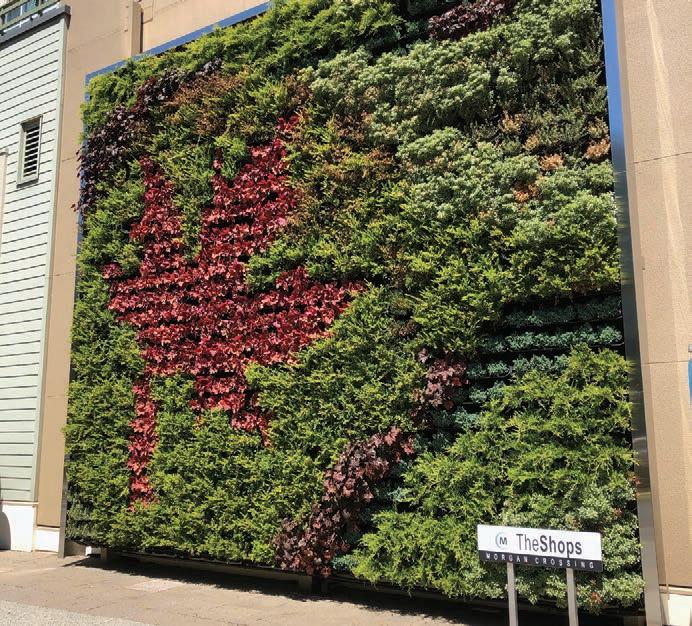
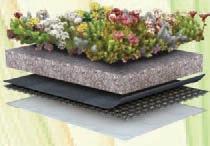
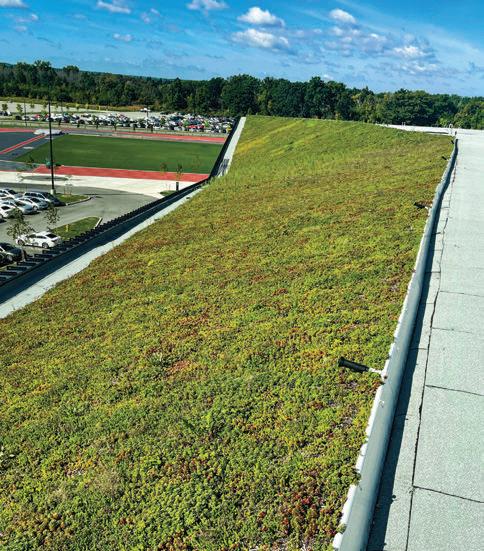
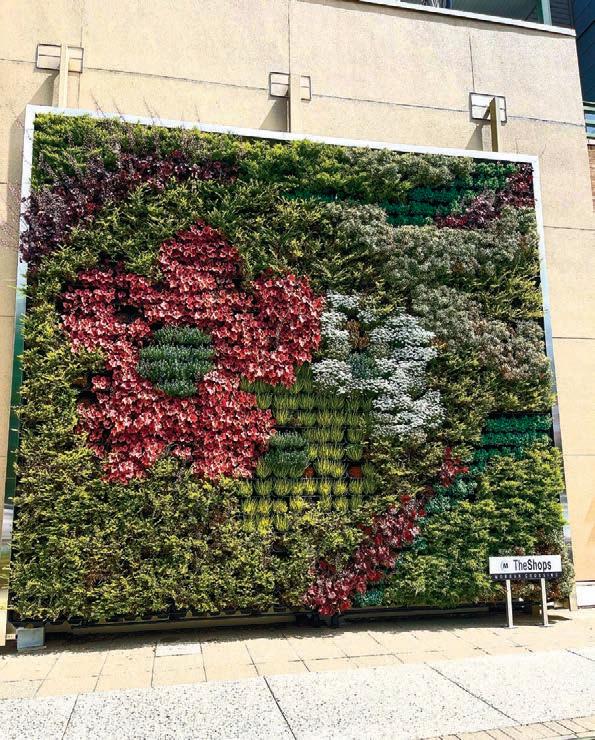
The green roof and green wall market continue to flourish in North America.
Steel buildings are breaking limitations in design as steel shows itself to be a top-of-the-line construction solution.
Brushing up on the latest
by MIKE BRENNAN
Chief Executive Officer
Adapting To A Changing World
The RAIC is excited to be headed to Calgary to host the 2023 Conference on Architecture, May 2 to 6, 2023 at the Hyatt Regency.
Each year the Conference on Architecture brings together architects, interns, students, and associates from across Canada, for an opportunity to build and share knowledge and connect with others in the design and architecture community. This is our first in-person conference since 2019, and we anticipate a strong turn-out as our community is eager to engage, connect, and collaborate.
As the RAIC’s flagship in-person annual event, Conference 2023 is designed to reflect and support our commitment to provide the tools, educational opportunities, and practice supports that empower Canada’s architectural community. The RAIC’s mission emphasizes the role of architecture in creating a better world and in helping humans adapt to major changes faced by communities and societies worldwide. At Conference 2023, we’ll come together for discussions about the built environment that spark new ideas, projects, and partnerships, and open up fresh perspectives on long-standing issues.
Our distinguished guests this year include Keynote Speaker and RAIC Fellow Wanda Dalla Costa, whose groundbreaking work bringing Indigenous ways of knowing and being into architectural practice has created waves in the field. We are also pleased to announce that Her Worship, Jyoti Gondek, Mayor of Calgary will be opening the 2023 Conference, and we will be joined on opening night by Kate Thompson, President and CEO Calgary Municipal Land Corporation.
Our 2023 program is tailored to promote professional and educational success, offering high-quality continuing education sessions focused on eight streams that address key issues in architecture, and provide examples from the forefront of the field. The streams are IndigenousLed Architecture; Climate, Justice, and Resilience; Health, Safety and Accessibility; Equity and Justice; Housing, Planning and Urbanism; History, Heritage and Culture; Innovation in Materials, Technology and Construction; and The Practice and Business of Architecture.
Alongside these educational sessions, Conference 2023 offers many opportunities to learn about the latest developments in the field, find out more about local architecture in Calgary, and meet new colleagues and collaborators. We’ve planned a series of professional and social events where participants can catch up with friends and colleagues, and extend their professional networks.
Conference attendees can join one of eight Architectural Tours that focus on themes such as Calgary Modern Architecture and Downtown Public Art, highlighting local landmarks including the Calgary Central Library and the Platform Innovation Centre and Parkade.
Outside of office hours, the Conference 2023 social events are a great way to relax and enjoy what Calgary has to offer. “Open Access” is an evening event and exhibition that explores themes of social and spatial justice in the contemporary city through the work of three Calgary-based architecture firms - MBAC, Spectacle, and MODA. Our closing event, The Parti, is co-hosted with the University of Calgary School of Architecture, Planning and Landscape and features the inspiring work of the next generation of architects.
Conference 2023 promises a packed five days of learning, networking, socializing, and celebrating the past year’s accomplishments and innovations in Canadian architecture. We hope to see you in Calgary in May! A
RAIC
Making Dreams
A BUILT REALITY
TKA+D is dedicated to creating a positive impact through beautiful buildings and spaces
by NATALIE BRUCKNER | photography courtesy TKA+D
When Craig Taylor immigrated to Canada from Australia in 1999, he had dreams of one day developing an architectural practice with a diverse portfolio of design-focused and environmentally sustainable work; one that would be humble and respectful of clients’ needs and aspirations, rather than using projects to feed the ego.
Armed with a wealth of experience and wanting to better understand his new home country, he joined Architectura and then, a few years later, Christopher Bozyk, bringing with him a great deal of lessons learned while working at BVN in Australia. “I was an associate at BVN, one of Australia’s most respected firms and one that I still admire today. BVN had a strong focus on design and a holistic approach to architecture. They were instrumental in forming my philosophies and design principles,” explains Taylor.
When the time finally came for him to choose the next path of his journey, he explored partnership opportunities but decided that in order to pursue his dream he would need to start from scratch and build his ideal practice from the ground up … and so, in September 2008 he opened the doors of Taylor Kurtz Architecture + Design Inc. (TKA+D).
“At the start it was just me, with the support of my then partner. I had three large projects at the time: a resort in Revelstoke; a major industrial project in Vancouver; and a Passive Haus duplex in Kitsilano. A week later the global financial crisis hit. The resort project died immediately, the duplex ultimately died as the residential market failed to recover, as did the industrial project, which was the renovation of White Spot’s head office site for Shato Holdings,” explains Taylor.
While others may have thrown in the towel, the experience just made Taylor even more determined. “I’m a big believer in accepting things as they are and making the most of them. We can’t change the past so there is no point in having regrets. I think it’s more important to look at the past and learn from the successes and mistakes and focus on how we can influence the future – to change when change is needed and always continue to be our best,” says Taylor. (Incidentally, 10 years later the White Spot project came back and is now a multi-phased full redevelopment of three sites on SE Marine Drive known as the Sunset Industrial Centre.)
This attitude eventually paid off. Today, Vancouver-based TKA+D is a multiple award-winning firm that consists of a team of 45 with five principles and eight associates. “Our leadership group is full of people that have diverse and complementary skills. A great lesson that I learned when I read Robert Kiyosaki’s Rich Dad Poor Dad early in my career was to surround yourself with people that know more than you. I have certainly tried to do that when hiring our wonderful staff,” says Taylor.
Each team member has their own specialty: Patrick Murphy, technical director, leads the development of systems and processes to ensure projects are built to the highest technical standards; Stefan Walsh, sustainability director, makes it a priority to incorporate appropriate sustainability strategies in each project; Kelly Riopelle, cultural director, ensures that TKA+D’s people are aligned with the procedures and values; Craig West, operations director, oversees the development and day-to-day operations of all the systems and processes; and of course Taylor, president and design director, ensures the vision and purpose are realised and the culture and values are maintained and design standards are met.
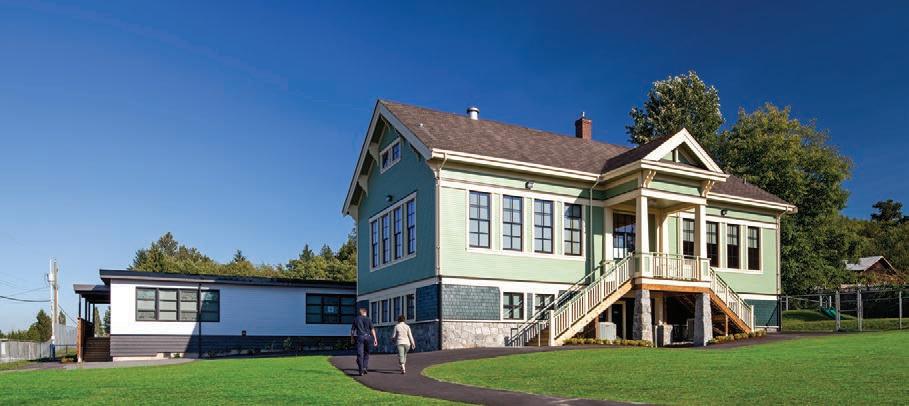
Thanks to this diverse group, TKA+D has managed to build an incredibly diverse portfolio of projects. “While we try to embrace each project with the same level of commitment and excitement, I think there are a few projects that we have completed that have been pivotal in our development as a firm. The first was Kensington Prairie Community Centre for the City of Surrey. This was our very first completed project. It started out as a $500,000 finishes and washroom renovation and grew into $3-million full heritage restoration and seismic upgrade. This project won several awards including Heritage BC’s Outstanding Achievement Award. This project was the start of a wonderful relationship we have developed with the City of Surrey,” explains Taylor.
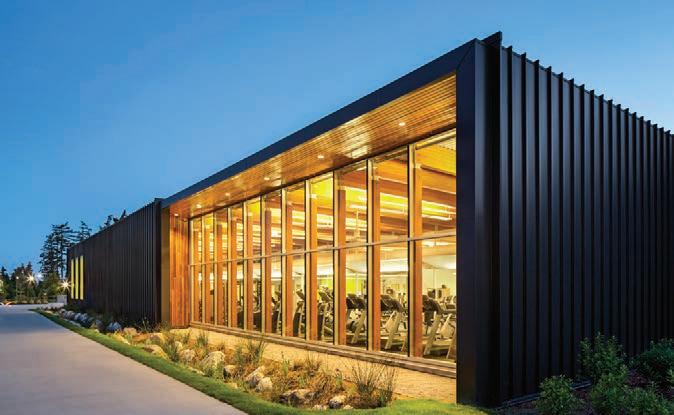
Shortly after the project was completed, TKA+D was awarded the South Surrey Recreation & Arts Centre project – an expansion to the city’s existing facility. “This was perhaps the most rewarding project for me personally. It was a stark contrast to Kensington Prairie in that we adopted a very minimalist and modern approach to the design, enabling us to demonstrate our true design principles. There was great emphasis placed on stakeholder engagement and I believe is evident in the way the facility was embraced by the community and city staff as their own,” explains Taylor.
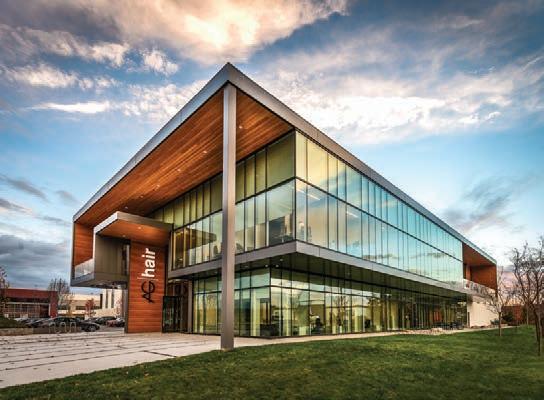
Other projects of note include the build-to-suit office and industrial project for Corix in Langley, B.C., the Beedie project AG Hair in Coquitlam (which resulted in TKA+D going on to work on another 125 projects with Beedie),
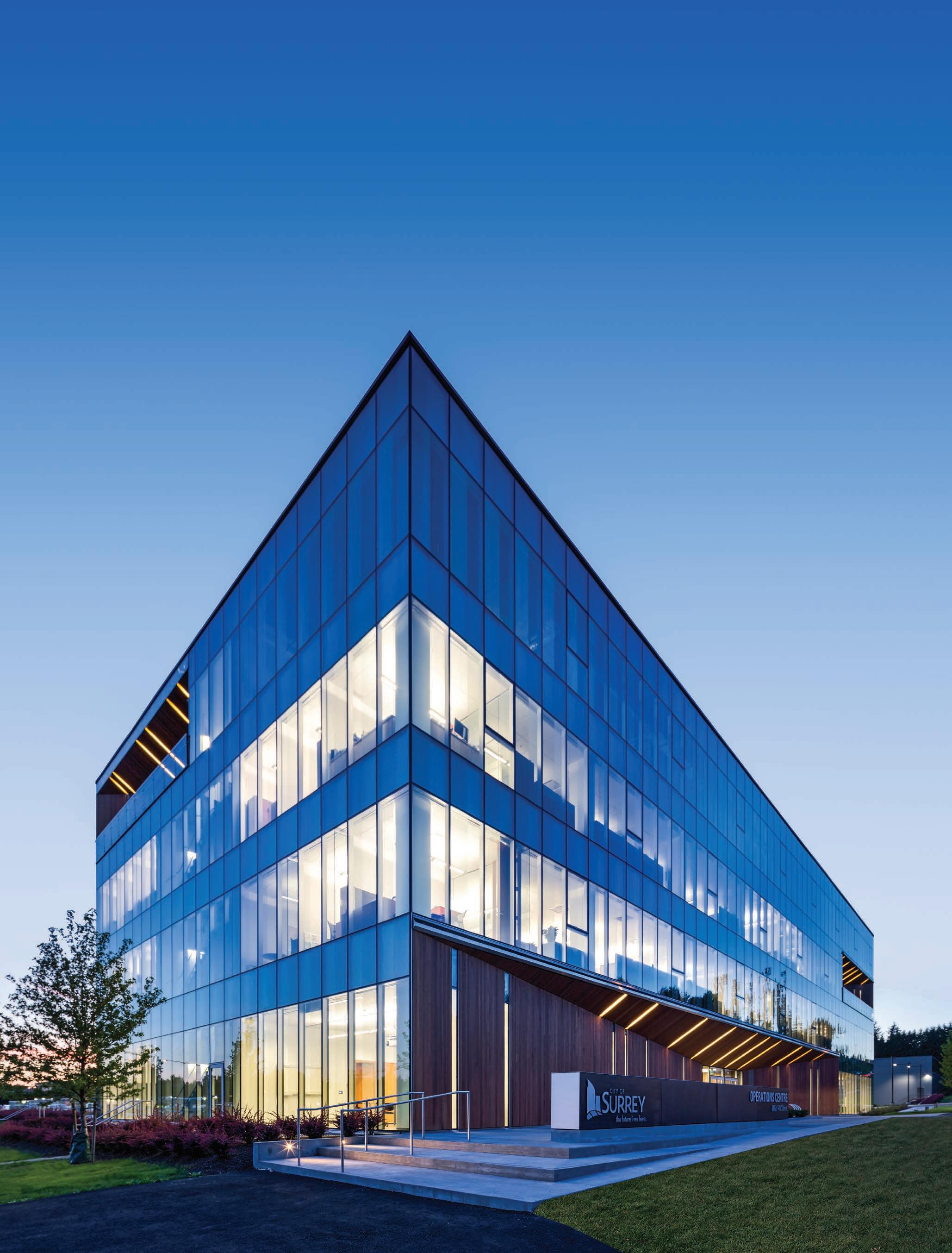
and the Surrey Operations Centre, a joint venture with RDH Architects from Toronto, which demonstrates the importance that partnerships play to TKA+D.
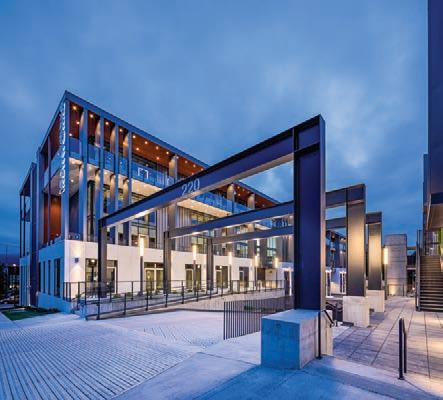
“While we have continued to develop relationships with many clients in many typologies, multi-level, high-density industrial development in urban areas is a field of work that particularly interests us. Ironworks in Vancouver was the first of this typology in modern times in North America and our first project with Conwest Developments. We have since gone on to work on 21 projects together, including several stacked industrial projects. Ironworks has won the UDI Innovation Award, NAIOP Best Industrial Development Award, and was one of only two Canadian finalists in the ULI America’s Awards for Excellence,” says Taylor.
While each project is incredibly unique, at the core of each one lies a sense of humility, design and technical excellence, and environmental sustainability. There is also a distinct sense that the folks at TKA+D truly value people, and that extends beyond the work they do. “Some of the greatest memories I have of TKA+D are of how our people have come together to support each other and those in need. This has been particularly evident at some of the volunteer events like the Food Bank, Arts Umbrella, and Plenty of Plates in Vancouver’s Downtown Eastside,” says Taylor.
As the team at TKA+D get stuck in with what 2023 has to offer, Taylor says he is particularly excited about the future possibilities that lie in the area of sustainability. “As architects and influencers of the built environment, we can and are making a difference. TKA+D has worked on more than 500 projects since 2008 and if we can make small incremental changes in the next 500, we will make a significant reduction in our carbon emissions. Industrial construction practices have slipped beneath the radar for so long and it is time we looked closely at improving things. I believe there is real promise in mass timber for industrial buildings at a huge scale, but it doesn’t just stop there. Small improvements in the thermal performance of a million square foot project can make a huge impact.
“Our purpose at TKA+D is to inspire a wonderful world: one our children deserve. Our mission in the next 10 years is for every project we complete to have a positive impact on our community and the environment, and on our world.” A
South Surrey Recreation & Arts Centre
Ironworks
Kensington Prairie Community Centre
AG Hair
Pane Points
Somewhere in the middle of building energy requirements and everchanging aesthetic tastes, window manufacturers need to strike a balance between form and function – and for 2023, it seems as though they’ve pulled it off. Pairing high-performance materials with high-demand designs, the hottest new window products embrace energy efficiency with plenty of style. Here’s what’s trending now.
GLAZEY DAYS
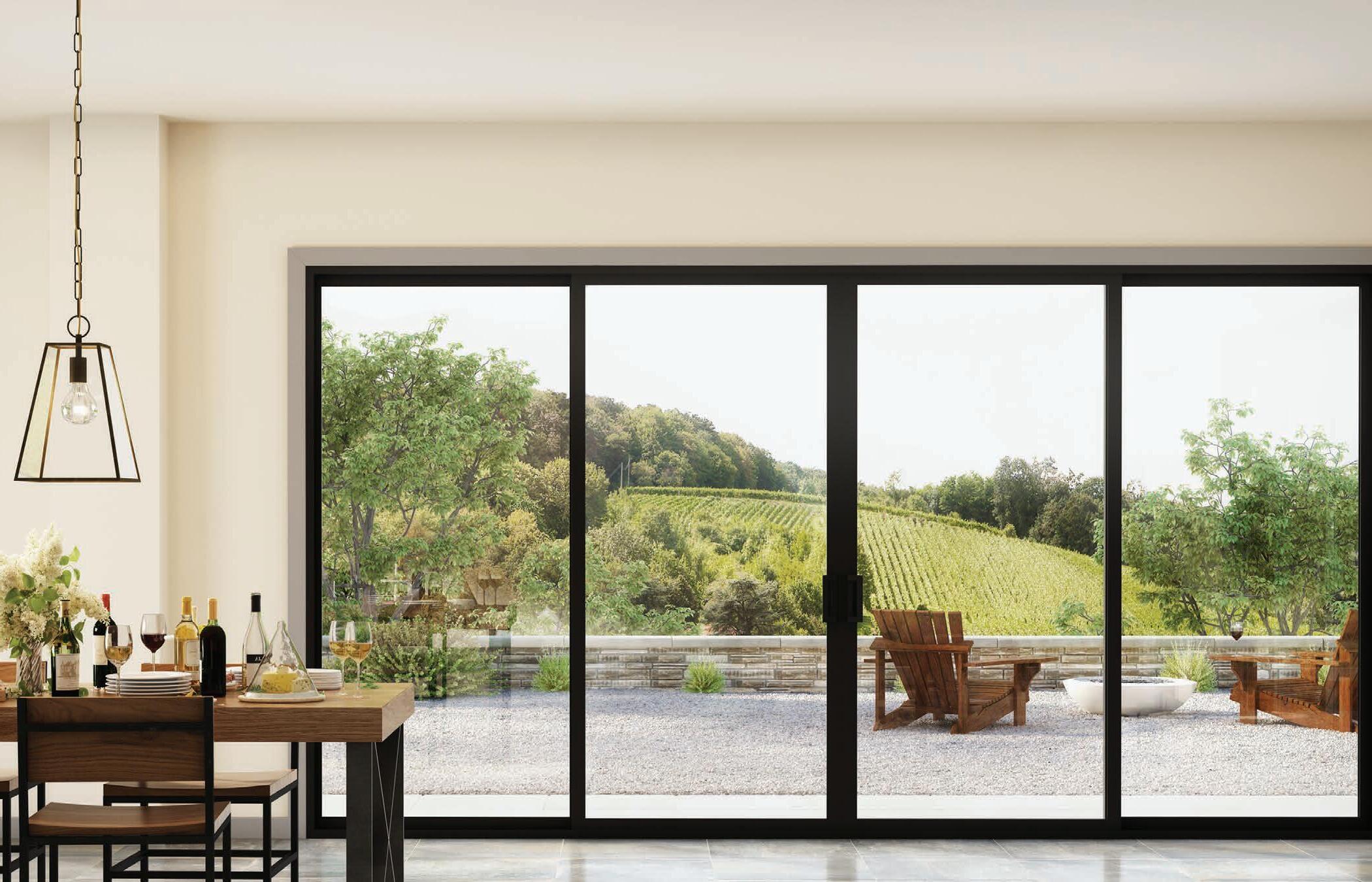
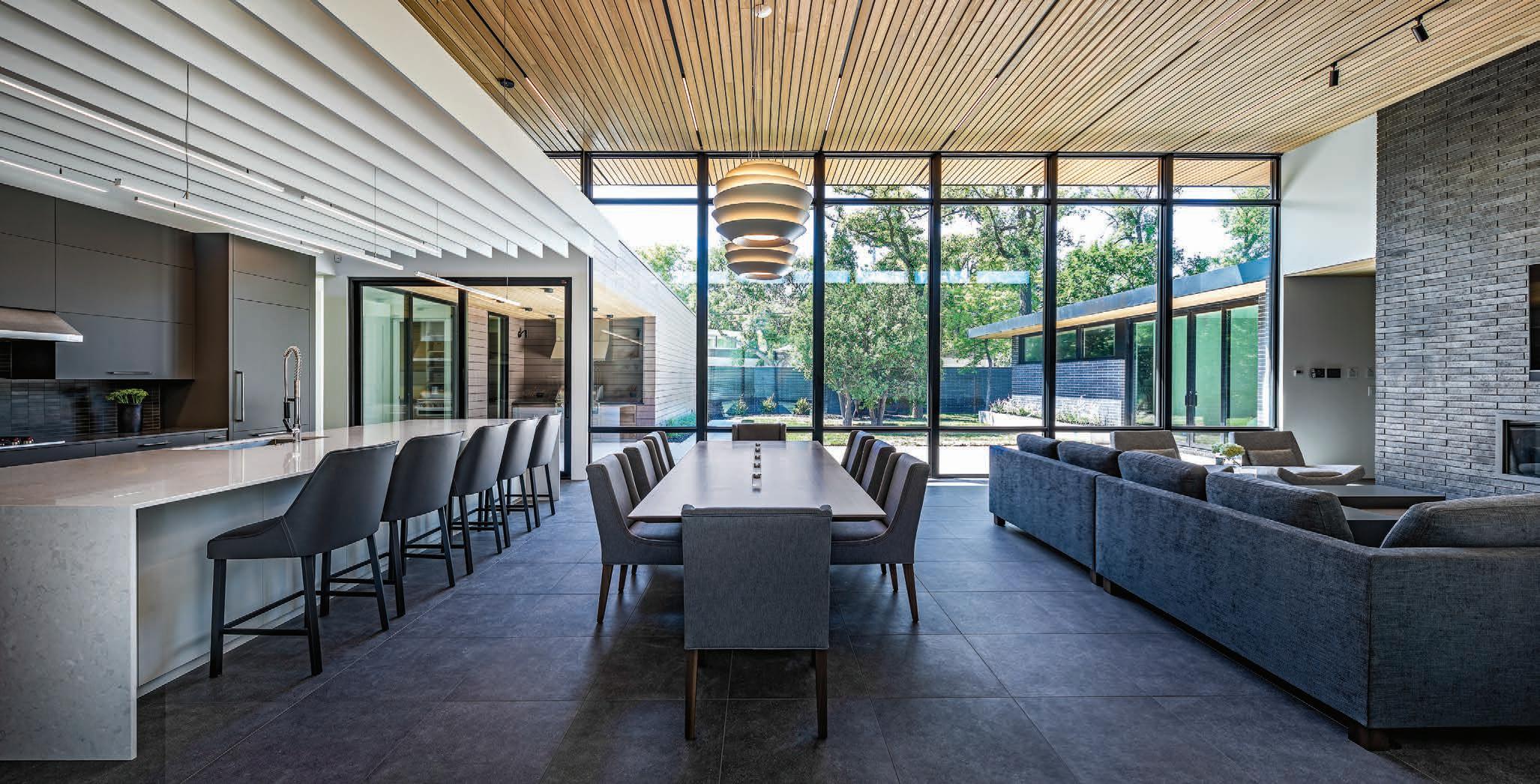
Every year, the window industry takes the physical possibilities to new heights. Window walls continue to be incredibly popular for single-family homes and residential towers alike, and improvements in engineering and technology allow for even bigger, more expansive glazing solutions than ever before. Glass walls can be up to 50 feet in length, according to Toronto’s Magic Windows. It’s a design option that welcomes in views, blurring the line between indoors and outdoors.
As Duxton Windows and Doors so succinctly puts it: “Transparency is the word of this architectural era.” Glass walls allow natural light and beautiful views – though this style does limit the ability to access fresh air. Luckily, options like Duxton’s FiberWall 458 Operator offers an elevation of venting technology, created to meet demand for extra-large casement windows and awnings, with a deep frame and super-strong sash supports.
“Homeowners are increasingly taking the opportunity to add natural light to their spaces,” says Aynsley Dueck, marketing manager for Duxton. But glazing walls needn’t be reserved for newbuilds: homeowners can connect a set of windows into a continuous opening during a renovation, or expand on an existing window with added side or bottom panels.
“A big window with a slim frame is preferred on the market,” says Donna Cui, director of Beijing Northglass Technologies. “The pane is getting bigger and bigger, and the frame is just getting slimmer and slimmer.” Northglass’s thermal break aluminum windows are incredibly strong, and can facilitate these larger sizes easily with beautiful, narrow frames . . . and the company’s high-quality PA66 thermal-break and double-silver and triplesilver low-E coatings keep even oversized windows highly efficient.
Energy Creation also specializes in aluminum, praising it for being high quality and structurally stable. The windows’ triple-pane tempered glass feature low-E, Argon in-fill and a PA55 thermal break. Multi-point locks are heavy-duty, providing security and protection against the elements. By using a powder-coat finish (available in 100 custom colours), Energy Creation creates a no-maintenance frame: no fading, peeling, or chipping here.
INSIDE OUT
In line with the “bringing the outdoors in” trend, All Weather Windows re-launched its Atmosphere
More glass, less frame, and high-performance technology: this is the world of windows
by STACEY MCLACHLAN
Folding Door this winter. The glass door – available in custom sizes up to 38 feet – features a slim profile for a clean and contemporary look that lets light shine inside in abundance. The brand’s Pass Through Window takes the folding concept in a new direction, ideal for connecting a home kitchen to the patio or backyard. It’s a design that invites homeowners to entertain and make the most of their full property. The success of Marvin’s Skycove is perhaps the best example of this desire for a connection with the outdoors. The glass structure creates an extension of usable space, projecting into the open air and creating a nook that surrounds the inhabitant in natural light from every angle. The award-winning Skycove is designed, in Marvin’s words, to “usher in restorative
Skycove from Marvin Windows & Doors.
Windows + Doors for Passive House Projects
Innotech Windows + Doors is a Canadian manufacturer of high-performance windows and doors. The Defender 88PH+ System combines decades of fenestration knowledge to deliver a robust window and door system that is not only Passive House Institute certified, but that also delivers the air, water and structural performance required for highly sustainable housing developments.
light,” adding up to 20 square feet of usable space. Available in four different sizes, each Skycove features a sloped glass roof and high thermal performance; a steel structure makes it strong enough to support multiple people, cozied up on the inviting seat.
HIGH PERFORMANCE
Whatever size window consumers are seeking, it’s all about performance in 2023. “We’re noticing a much higher demand for high-performance windows, including triple pane windows and windows that are Passive House Institute certified,” says Jessica Owen, brand champion for Innotech Windows + Doors. “This comes from a greater understanding of how windows, and how they’re installed, can either support or hinder desired goals, from structural performance, air and water resistance, and thermal performance to overall comfort and durability.”
This educated interest is why Innotech just launched the new Defender 88PH+ XI, the first Passive House Institute cold climate certified window made in North America, and the first Passive House Institute cold climate certified uPVC window in the world. “There’s been an exciting growth of homes and buildings that are designed and built to the Passive House standard,” says Owen. “The result is a demand for much higher performance fenestration that are manufactured in Canada.”
Since the National Building Code changed back in 2018, efficient windows are no longer just a personal choice for projects, they’re essential. This has driven demand for lower window U-values and higher performance.
“The overall building industry has an increased focus on energy conservation at the code compliance level,” explains Michael Bousfield, technical director for Cascadia Windows & Doors. “The effect on windows is that the choices for products is getting constrained to only those that offer higher performance.” Traditionally, windows have been the
lowest energy performers in a building, and often have to be minimized, forcing designers to make a choice between aesthetics and performance. But technological advancements mean that more and more energy-efficient options are available on the market today. For instance, Cascadia’s Universal series was launched five years ago, but the company
WEST COAST CONTEMPORARY LINE
A custom home build is quite often the single largest investment in one’s life. This is a tremendous responsibility to entrust to the construction community.
Understanding this concept and exceeding customers’ expectations are what Westeck strives for and is at the core of the Westeck culture.
BIG PRODUCTS FOR ALL SIZES EMBRACE THE PATIO EXPERIENCE INDOOR/ OUTDOOR LIVING VANCOUVER 1480 Kootenay St, 1‑877‑606‑1166 CHILLIWACK 8104 Evans Rd 1‑877‑606‑1166
westeckwindows.com sales@westeckwindows.com
increases the styles and sizes regularly. “It’s taken over everything we build now,” says Bousfield.
As the idea of green building becomes more mainstream, architects and designers are seeking out sustainability as much as they are seeking out style. “Windows are only getting more energy efficient, with increasing U-values,” says Beijing Northglass Technologies’ Cui.
To be clear, it’s not just architects who care about energy performance: Westeck Windows recently
shared research that found home buyers want to live in energy-efficient homes. Studies suggest that they’re even willing to pay extra for this benefit. Westeck’s PVC GrandView MultiSlide door is designed to accommodate the demand for energy-efficient homes, as well as the interest in custom solutions. Offered in your choice of colour and a variety of panel configurations and sizes (up to 20-feet wide), it’s a hyper-flexible option with unparalleled thermal performance (triple-pane IGUs and dual argon fill).
Dare to Accelerate Change
BUILDEX
BLACK IS THE NEW BLACK
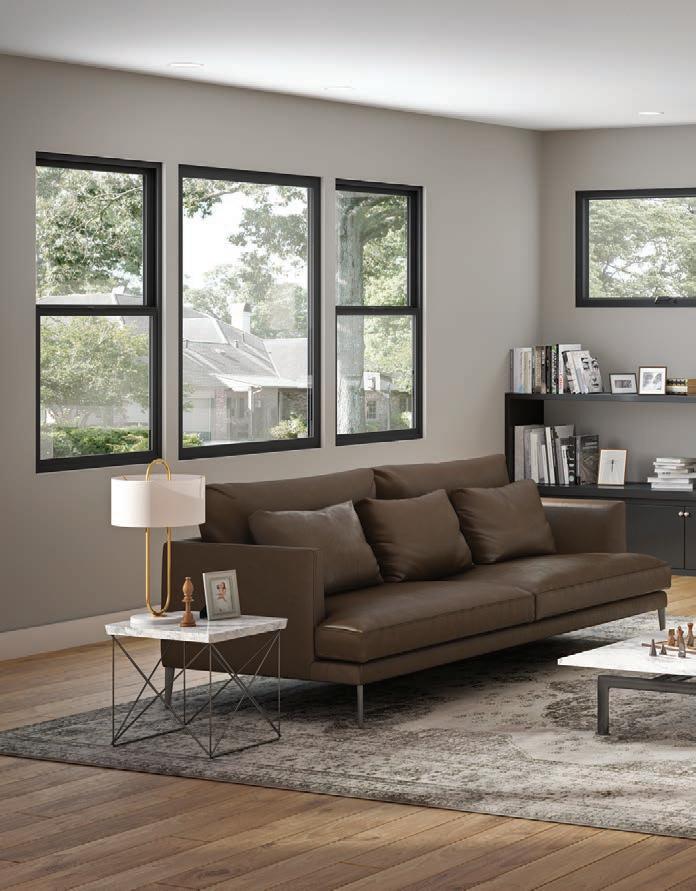
Black window frames continue to be the most popular choice for designers, but in its 2023 trend report, Pella Windows & Doors also noted that jewel-tone frames (think navy blue, rich olive green, and saturated maroon) are increasing in popularity. “Black frames are versatile; they look good with most interior designs,” writes Magic Windows in its own 2023 trend watch. “The powerful contrast they create in relation to a more neutral space is a great statement.”
Of course, when it comes to a coloured frame, not all products are created equal. “By selecting a fibreglass frame instead of a PVC or wood frame, you can easily choose a darker colour,” says Dueck. PVC is challenging to paint, while wood is high maintenance: fibreglass, on the other hand, is the ideal fit for this trend. One of Duxton Windows and Doors’ most popular finishes is espresso, used in multi-family residential projects like the Lakeview building by SUVA Architecture.
Cui notes that not everyone is interested in following the trends or just buying off the shelf; consumers are regularly also seeking customizable window options. “Black, bronze are popular for the exterior, while interiors can be a different colour: white or wood-grain, for example.”
SHAPE SHIFTERS
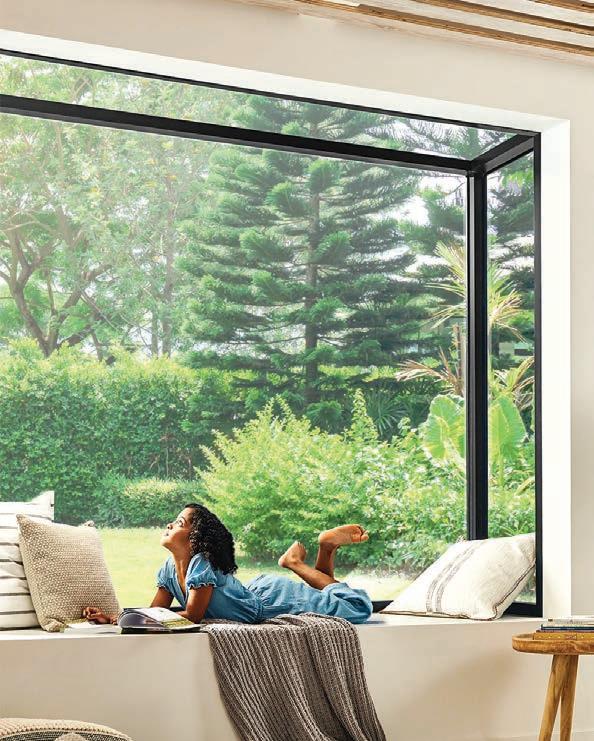
Architects and designers are embracing maximalism and Art Deco styling with non-rectangular windows – you may spot arches, geometric shapes, and round windows in the coming year. Bay and bow windows, specifically, are popping up more frequently in residential projects as of late, according to Pella Windows & Doors. Modern window design includes circles, half circles, hexagons, and pentagons. These new shapes are increasingly being included in home design as a way to add more dimension, according to Magic Windows. Paired with gold hardware or curtain rods, it’s a delightfully decorative look that’s a far cry from the stark minimalism of the past decade.
BACK TO BUSINESS
As we leave the worst of the pandemic in the rear-view mirror, things are looking up for the world of windows. Things are shifting (tentatively) back to normal after a chaotic few years. “We’re seeing an improvement and relaxation to supply chain constraints that have gripped the industry,” says Bousfield. “Just in the last few months, we’ve seen an improvement for glass availability, as well as a plateau of expected cost increases throughout the supply chain. That’s a welcome change. We are cautiously optimistic.” A
Aluflam.indd
*(CPCQA) CERTIFICATION PROGRAM BY PROCESS OFFERS KEY BENEFITS TO ARCHITECTS, CONTRACTORS, ENGINEERS, GOVERNMENT AUTHORITIES AND OWNERS.
Project: Champagne Quarry Park, Calgary, AB Architect: Gibbs Gage Architects
Revive, Refresh, Renew
The wide range of innovative restoration products facilitate the move from old to new
by ROBIN BRUNET
The steady deterioration of all man-made things, and how to restore them, takes up a huge portion of construction activity in Canada, and this focus continues to drive the development of a vast array of products, as well as the skill needed to restore buildings and infrastructure.
A recent prime example was Mapei’s involvement in restoring the top floors of McGill University’s Strathcona Music Building, constructed in 1896 and whose upper levels had suffered internally over the generations from winds and seismic forces.
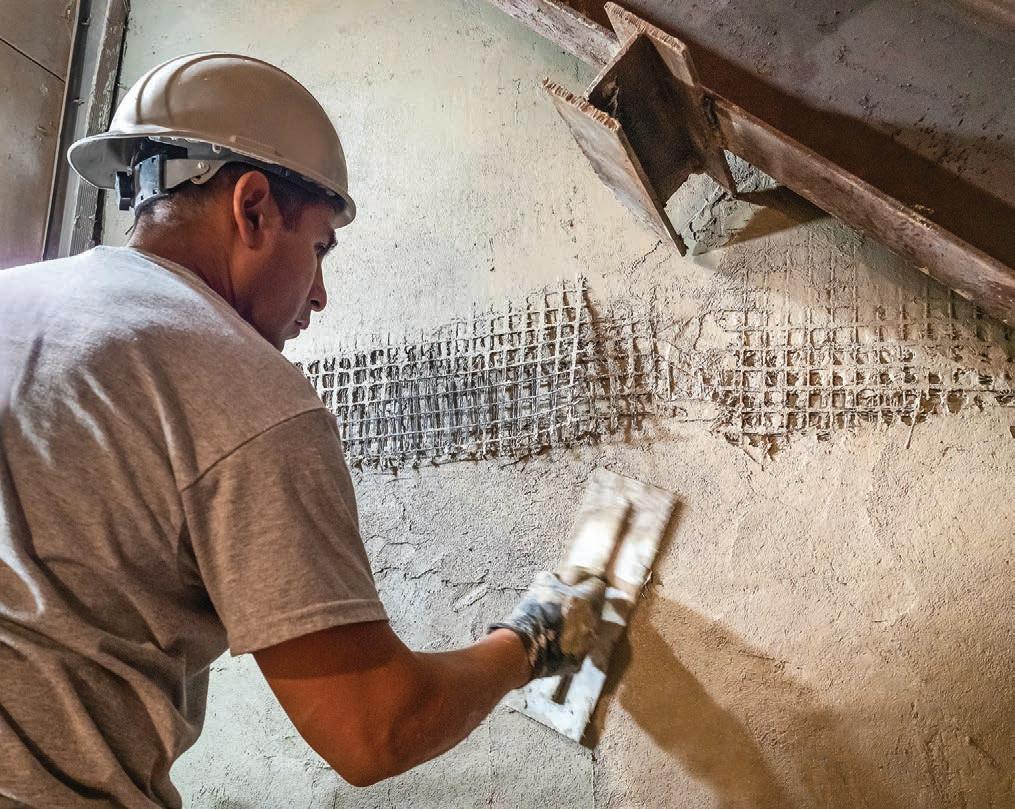
Hamza Ouziame, Mapei engineering and architectural sales representative, says when he and Mapei S.p.A. (Italy) consultant Luca Albertario inspected Strathcona’s interior walls in the spring of 2022, they found they were composed of terracotta bricks dating from the 19th century – and badly needed extra strengthening. “The engineers were looking for a fibre-reinforced polymer [FRP] solution, but FRP would not allow for the breathability of the masonry,” he recalls. “So, we used a fibre-reinforced cementitious matrix [FRCM] option designed for masonry.”
The restoration was undertaken with Mapegrid G 220, an alkali-resistant, glass fibre mesh, set with Planitop HDM Maxi high-ductility pozzolan-reaction, fibre-reinforced mortar. When applied on masonry structures, Mapegrid G 220 makes up for their lack of tensile strength and increases their overall ductility so that stresses are distributed more evenly. The system adheres perfectly to the substrate and its mechanical properties are such that localized stresses always provoke a failure in the substrate rather than at the substrate/strengthening system interface.
“Mapegrid G 220 was the main product, but it required a matrix,” Ouziame says. “The Planitop HDM Maxi mortar is compatible with masonry, allowing breathability. It has a low modulus of elasticity, and together with its moderate compressive strength the products combine to work better with masonry than an FRP system.”
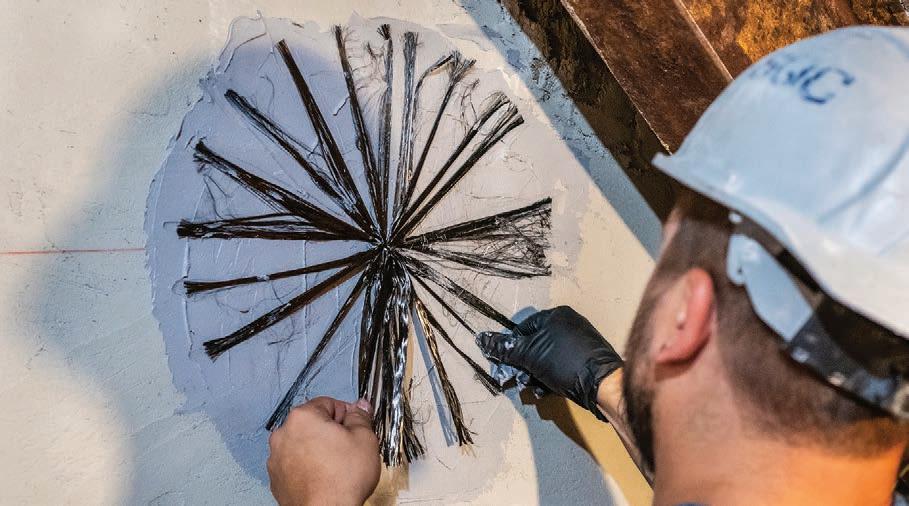
MapeWrap C Fiocco carbon fibre cord was added to assist the long-term bond of the system for the interior. “After preparing the substrate, FRCM adhered strongly to the masonry substrate with no need for transfer connectors,” Ouziame says. “We used mechanical connectors MapeWrap C Fiocco, because we were strengthening the wall from one side of the building.” Ouziame adds: “Heritage buildings in Montreal, Ottawa, Toronto, Quebec City, and elsewhere that need structural strengthening will benefit greatly from this FRCM system solution.”
Huntsman Building Solutions’ Heatlok Soya HFO has been used on a host of building envelope retrofits in 2022, including the low-income project Habitations Jeanne-Mance in Montreal. As for trends, Maxime Duzyk, Huntsman’s global director, building science and engineering, says, “We are seeing more projects changing the insulation systems for under slab applications to spray foam. Also, the D-Max wall assembly is getting a lot of traction both with architects and general contractors because it’s the perfect solution to meet energy efficiency requirements, while increasing productivity on site.”
Duzyk goes on to note, “Retrofit projects are often complicated and the surface upon which products are to be applied is often uneven. Heatlok Soya HFO is an ideal solution for retrofits because the product provides air/vapour barrier properties as well as insulation. The fact that the insulation value per inch is one of the highest also solves a lot of issues with retrofits where the space to insulate is not always enough to meet new requirements with other insulation products.
“Also, foundations are more commonly retrofitted by the exterior, because you can insulate and waterproof them at the same time. Heatlok Soya HFO is the perfect solution to retrofit old foundations from the exterior, and in cases when the water table is high a Polyurea membrane is the best solution for waterproofing and can be applied directly to the spray foam. This provides a high quality assembly that can resist both heat transfer and water infiltration.”
Application of Planitop HDM Maxi high-ductility pozzolan-reaction, fibre-reinforced mortar.
Application of MapeWrap C Fiocco carbon fibre cord.
Application depth-check for Heatlok Soya HFO.
When asked to predict what 2023 holds in store for Huntsman, Duzyk replies, “More requests for D-Max wall assembly and high energy efficiency construction. There is also the labour shortage – it will continue into 2023, and the D-Max assembly is a great solution to counter that as it requires less materials and labour to complete the building envelope.”
Sustainability and lowering carbon emissions continues to be a big vision strategy for Lafarge, and Charles Thibault, director, commercial performance and marketing at Lafarge Canada Inc., points out that “in the restoration sector one strategy is to keep the same envelope as part of the restoration process, since in restoration you create waste and we’re committed to maximizing recycling whenever possible.”
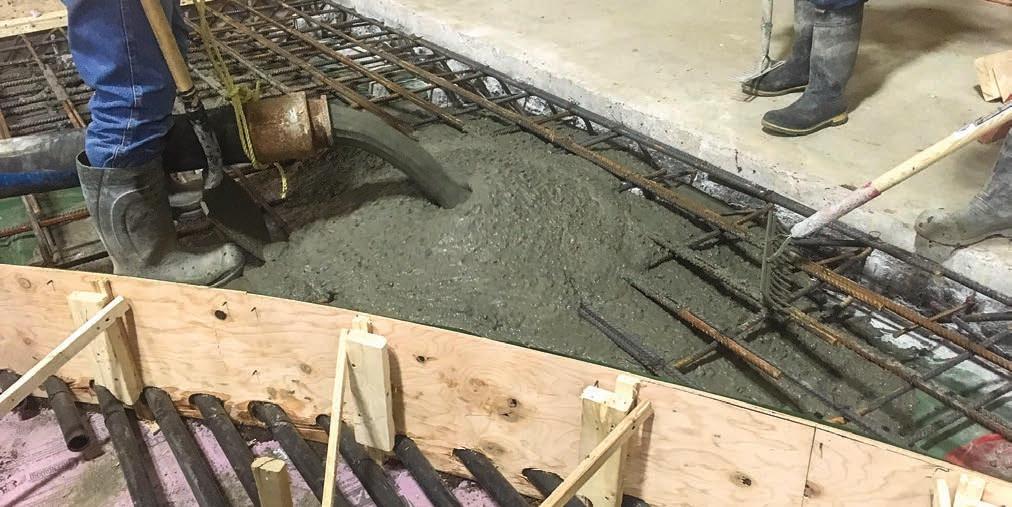
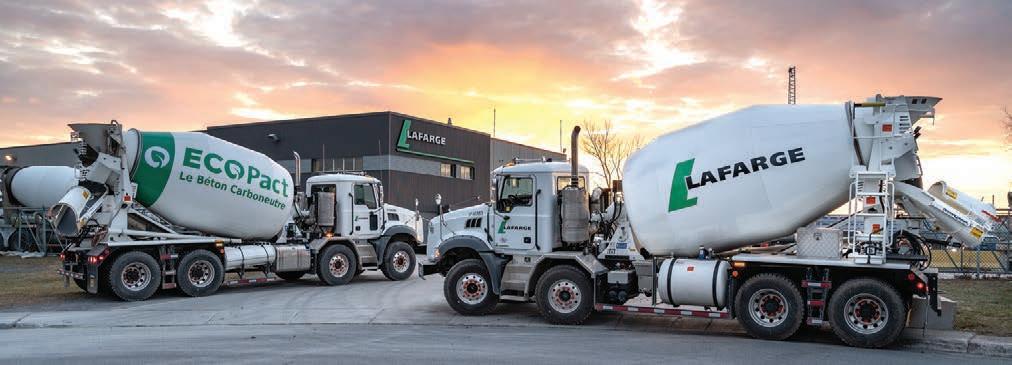
This is why Thibault and his colleagues cite ECOPact as an effective product. ECOPact is Lafarge’s low carbon concrete range available throughout Canada for new or renovation projects, from residential homes to high-rise and civil infrastructures. ECOPact lowers carbon emissions by 30 percent, and Lafarge ensured that ready mix players would be adept at using the product properly by conducting over 200 webinars with 750 people last year. As a result, Lafarge
this year expects 10 percent of its overall sales to derive from ECOPact, with the ultimate target being 30 percent.
Thibault adds, “Lafarge has also benefitted from acquisitions, specifically the purchase of Beton Mobile du Quebec [BMQ], which gives Lafarge three products designed for civil and infrastructure repairs as well as new construction.”
Available in Quebec and Ontario, the products are Ductal (an ultra-highperformance concrete with the superior qualities of resistance to compression, ductility, longevity, eco-efficiency, insulation, and aesthetics); ChronoMax (a rapid-set concrete), and Adhemax (a latex base concrete).
Thibault says of Ductal, “It’s great for use in overlay and in joints for bridges. Its extremely high strength and flexibility approaches that of steel, and we deliver the product in volumetric trucks; you mix as you go, meaning no loaders and less activity, which contributes to our sustainability goals.”
Thibault notes that ChronoMax’s quick setting properties “means less time spent on site, which of course is an advantage for road or bridge work. As for Adhemax, this latex based concrete is also delivered in volumetric trucks due to it being extremely quick setting. The product provides minimal penetration of salt and other chemicals, and it’s great for horizontal or vertical repairs.”
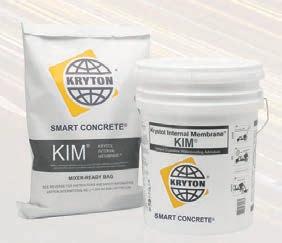
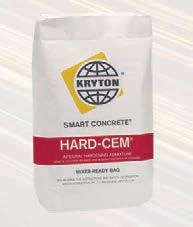
Kevin Yuers, VP of product development at Kryton International Inc., points out that his company famously has a line of products for the restoration market including patch repair, leak repair, and spray-on water repellent. He cites New Gold Inc.’s New Afton Mine near Kamloops as an example of how just one of the products, Kryton’s Hard-Cem admixture, goes a long way in restoring critical infrastructure. “The Afton Mine was a challenge because the concrete was worn down right to the rebar,” he says.
Lafarge ECOPact low carbon concrete.
Application of Kryton’s Hard-Cem admixture.
Transformation that’s more than skin deep.
Lehigh Hanson becomes Heidelberg Materials
We at Lehigh Hanson are pleased to join our global parent company in transitioning to Heidelberg Materials. Our entire North American family of brands is united under this new banner while remaining focused on what we do best: heavy building materials.
While this rebrand is an outward change, it represents a deeper transformation in our company. An evolution that has both responded to — and shaped — our industry.
It reflects a much broader and innovative approach to serving you, our customers, as we lead the industry in sustainability and digital solutions. Material
New Afton Mine, which commenced operations in 2011, employs the blockcaving method that required New Gold to construct a large network of concrete tunnels and passageways beneath their target ore body. The extraction and hauling activities within that area created an extremely abrasive situation for the concrete infrastructure – especially in the truck turning and dumping areas and rock chutes. By 2014, the original concrete in these areas had already worn out and needed to be replaced (with the expectation that replacement would be required every three years).
But the replacement concrete used to remediate these areas contained Kryton’s Hard-Cem admixture, and since then the concrete has resisted abrasion and has not needed to be replaced. As a result, New Gold has been able to skip at least two replacement events and also avoided the process of creating additional concrete with cement, which has allowed the company to reduce its lifetime carbon footprint by 49.5 percent to date.
At Euclid Canada, national business development manager Brian Salazar reports that his company continues to improve its various product lines, “including our self consolidating SCC mixes, which benefits from the inclusion of micro fibres that help reduce shrinkage and corrosion. The substance flows into place with minimal vibration and handling, and it’s great for parking garages and bridges, or anywhere where form and pour techniques have been used.”
Application of EucoRepair SCC from Euclid Admixture Canada.
Salazar is referring to EucoRepair SCC, a pourable and pumpable selfconsolidating concrete repair mortar that can be placed from 2.5 centimetres up to full depth without extending with aggregate. EucoRepair SCC Fast is an accelerated version that allows for faster stripping of forms and earlier return to service. Both products are fortified with micro fibre to increase tensile strength and help prevent plastic shrinkage cracking, and they contain unique polymers that improve adhesion and durability.
The advantages of using a concrete repair mortar that flows into place effortlessly include reduced labour requirements, no vibration or screeding, and faster construction. Often this flowability is achieved by overwatering the mortar, which decreases its strength and can lead to segregation. By incorporating unique water reducing and viscosity modifying additives in EucoRepair SCC and EucoRepair SCC Fast, high flow is achieved without excess water, assuring the strength and stability of the mortar.
Also from Euclid Canada is Eucoweld 2.0, the latest version of a bonding agent that is applied straight to a concrete surface and ideal for form and pour applications. It can be applied wet on wet, and its long open time is such that even if it sits on site for up to a week it still retains 100 percent bonding capability. Repair materials can be placed either after it has dried or while still wet.
Finally, RJC Engineers is continuing a unique undertaking in the realm of restoration by liaising with academe to help advance the tools used in restoration. Specifically, project engineer Peter Dias is working with the civil engineering and materials specialists at the University of Victoria, reviewing and testing a variety of newer commercially available patch products as well as some research and development material generated by post-grad students.
The collaboration has been ongoing for several years now and resulted in, among other things, the confirmation of in-situ material and performance properties of new patch materials. The collaboration and data extracted gives RJC Engineers confidence to specify new restoration approaches, which can help minimize disruption during repair of existing structures, and make it more financially and operationally preferable to extend the life of existing buildings –thus further reducing the lifetime carbon intensity of the physical asset. A
Back To The Future
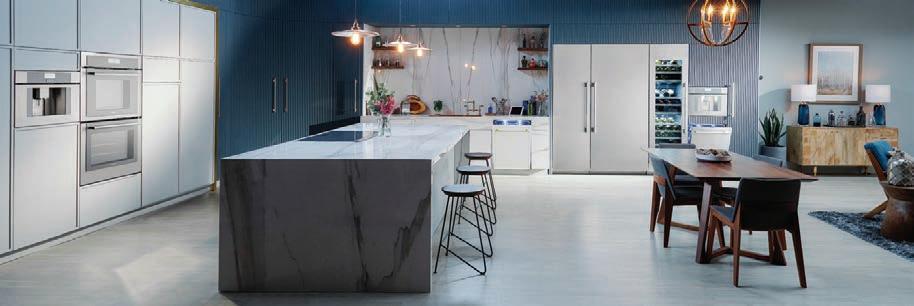
In the modern-day search for convenience and style, appliance manufacturers and distributors have a wide range of choices for kitchens large and small.
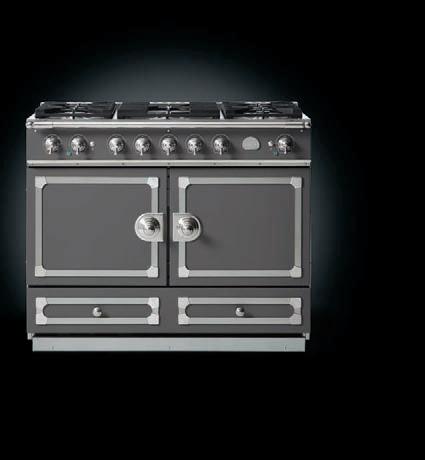
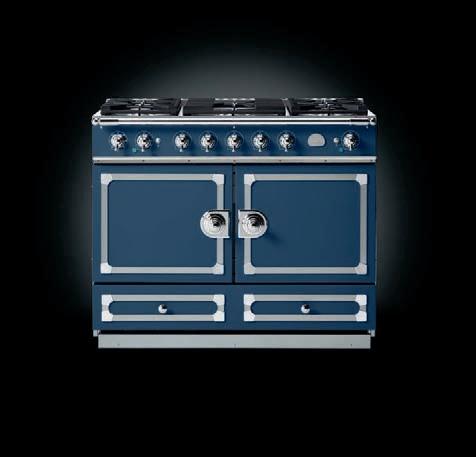
Sylvia McDonald, client relations representative at Midland Appliance, says there is a big trend towards old world kitchens with classical architectural styling. “These timeless homes feature kitchens with custom millwork finishes and beautifully crafted cabinet hardware,” she explains, adding brands such as Officine Gullo from Italy and La Cornue from France are the perfect fit for these traditional residences.
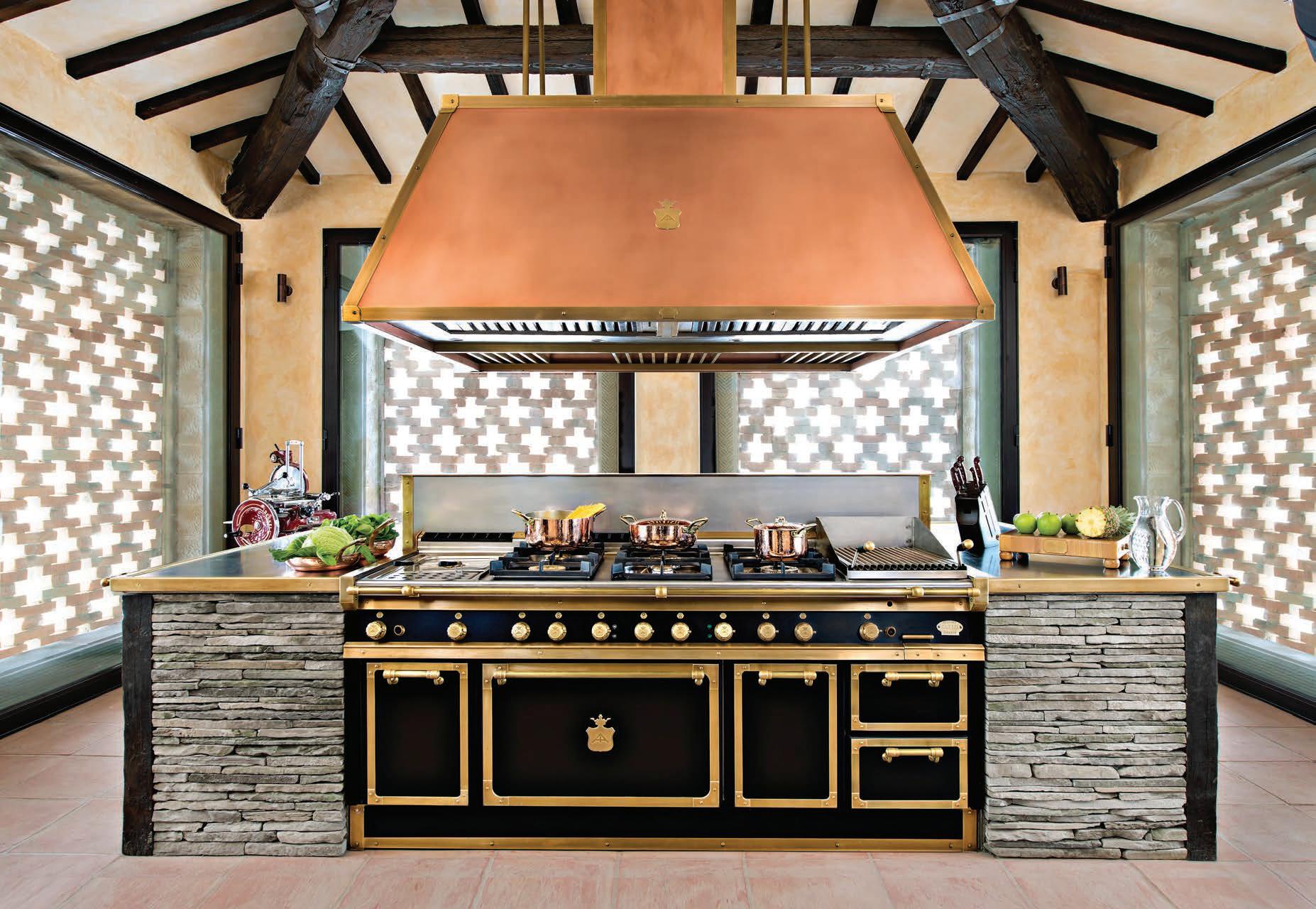
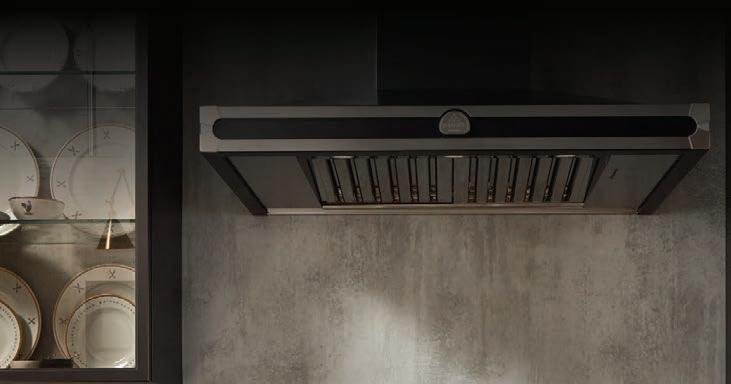
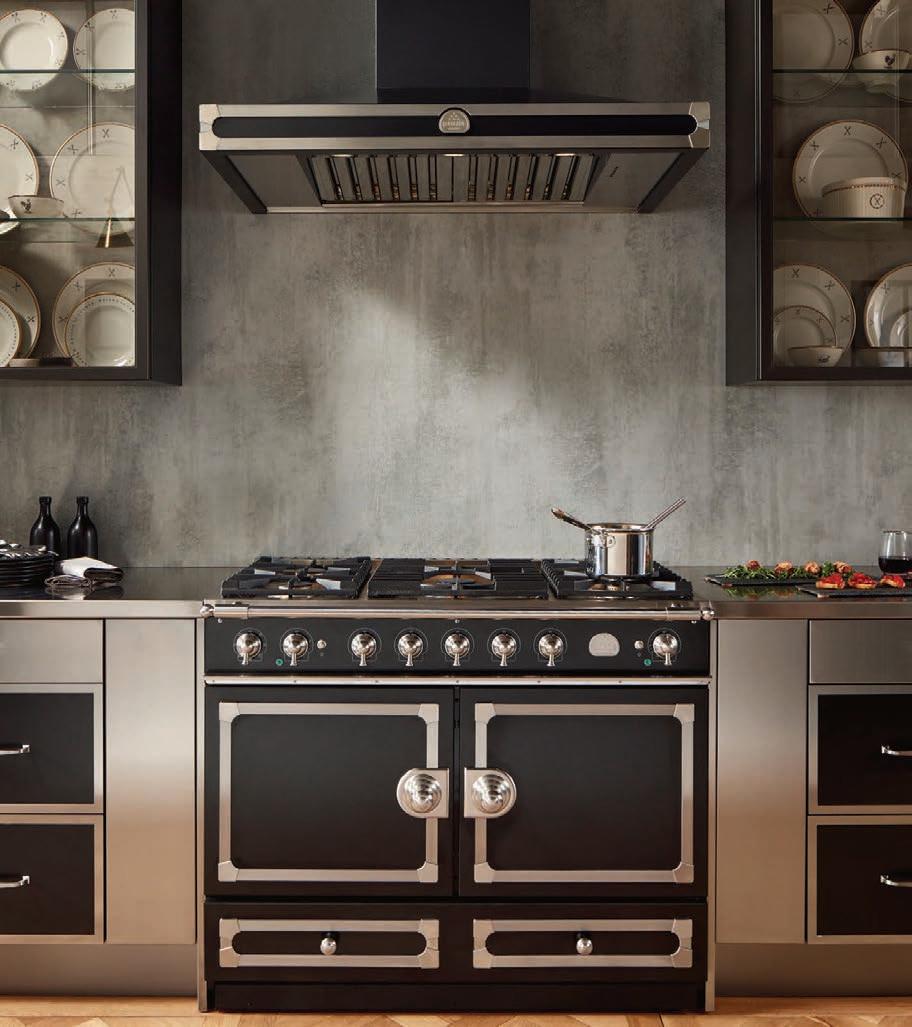
New to the B.C. area, Officine Gullo is available exclusively at Midland Appliance. The ranges and hood fans are handcrafted in Florence, Italy, and are built to bring life to an experience that combines fine dining and culture, celebrating the city,
its art, its culinary tradition, and its craftsmanship. “The Fiorentina range is available in 1,000 custom colours and seven trim options to suit any kitchen,” says McDonald. “Hood fan, fridge, and dishwasher panels are available in custom finishes to co-ordinate the look.” The signature elements of the cooking tops are the solid brass burners, cast iron grills, and the porcelain burner covers, which add endurance and elegance.
La Cornue appliances represent a celebration of the French culinary tradition. Made to order exclusively in France, each range is made by hand, numbered by the craftsmen, and is the embodiment of a specific owner’s vision. “La Cornue ranges are available in 8,000 configurations, colours, finishes, and measurements, and each features La Cornue’s patented signature,” McDonald explains. The culmination of three generations of research,
From custom millwork finishes to steam ovens, the appliance sector is taking us into an exciting new realm
by LAURIE JONES
innovation, and expertise, the Château series is available in seven range sizes – from 30 inch to 71 inch – and can all be viewed at Midland Appliance showrooms. Complementary cabinetry, hoods, rotisserie, and accessories are also available.
Euro-Line Appliances Inc. is working with the Porter & Charles (P&C) line, which features highend, European-designed cooking appliances.
“Chosen by professional kitchen designers and builders, P&C kitchen packages are streamlined and beautifully integrated to work in existing or new kitchens,” says Mark Eglington, president.
Eglington explains that as P&C is a private label company, they have the unique ability to source additional or new products from world-renowned manufacturers based on demand. “This means they are meeting the highest quality production standards at an extremely competitive price.
Handcrafted ranges and hood fans by Officine Gullo.
Addressing the smaller footprint kitchens that are the new normal, P&C offers a varied selection of 24-inch wall units including the Electric Convection Oven, the Electric Multi-Function Oven, the Electric Compact Steam Oven, the Electric Compact Speed Oven, and the Electric Microwave Oven. For larger spaces, the 30-inch Multi-Function Oven is available in four design options.
When it comes to cooktop options, P&C offers electric, induction, and gas choices. “Both the Black Induction Cooktop and the Electric Ceramic Cooktop are very versatile for installation in kitchens of all sizes, including the 12-inch, 24-inch, or 30-inch models,” says Eglington. “The StainlessSteel Gas Cooktops are for larger spaces, but they do start at 24 inches, with 30-inch and 36-inch options also available.” Completing the culinary designs for serious foodies who want a chef-style kitchen, the P&C stainless-steel range line has electric, dual-fuel, and induction models to choose from.
After the meals, clean-up is easier with the P&C dishwashers, with the 18-inch Control Top, two styles of the 24-inch Tall Tub, Top Control, and the 24-inch Tall Tub Front Control models.
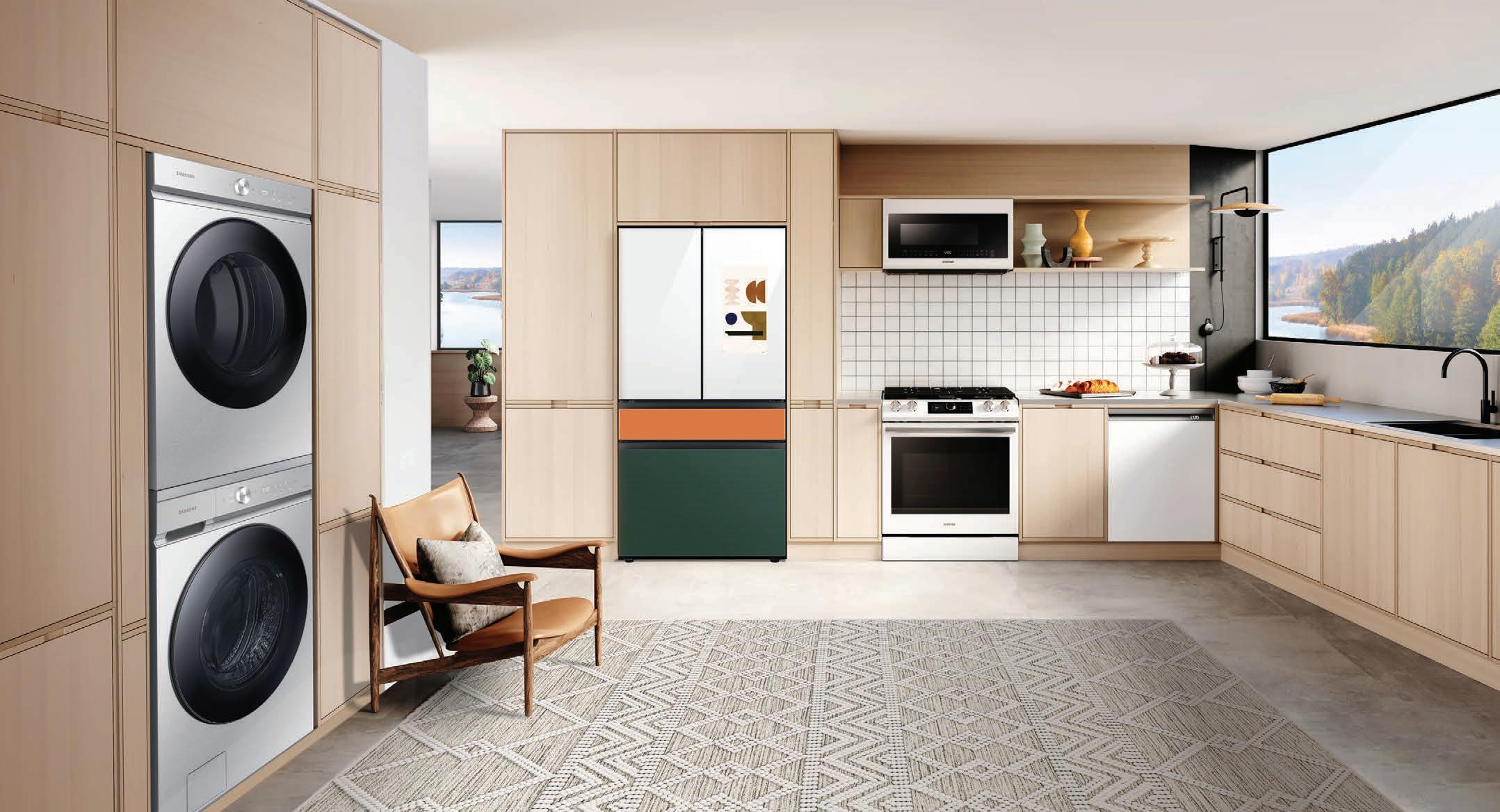
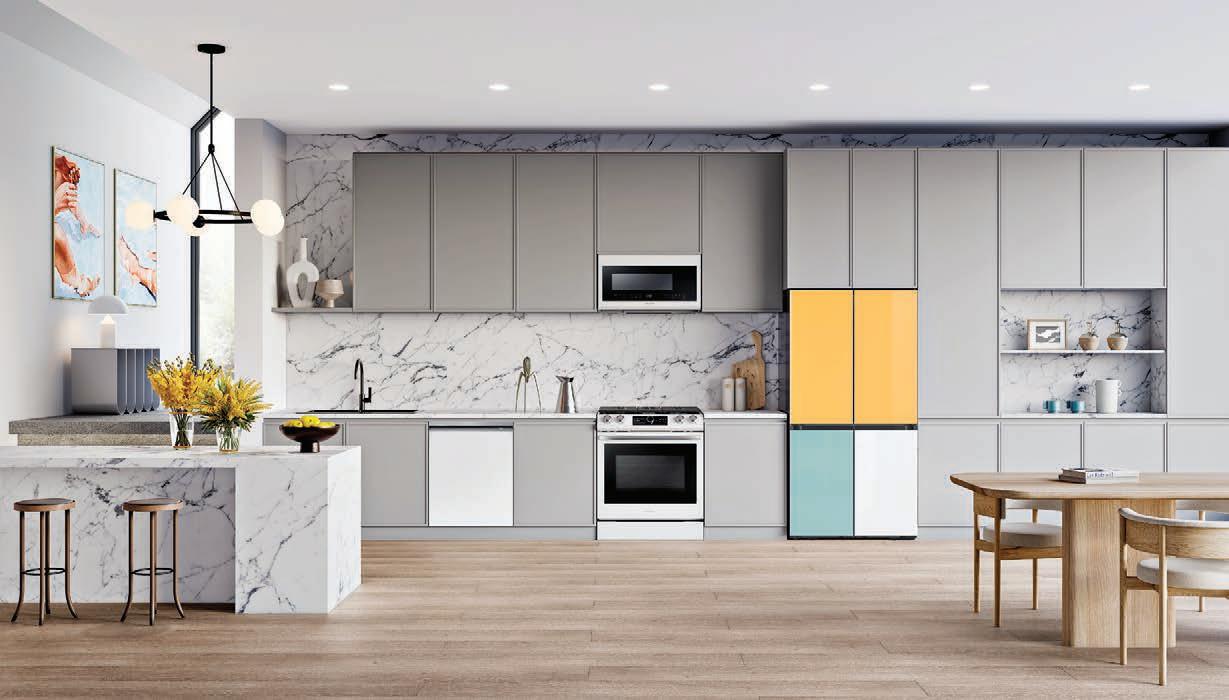
Alan Alibhai, key account manager at Trail Appliances, notes there are three trends currently emerging in the appliance industry: “The first trend is personalization,” he says. “Appliances no longer just serve a utilitarian purpose; they are the centrepiece of our lifestyle. The pandemic has really brought that to the forefront, given all the time we were spending at home. Samsung’s new line, Bespoke, brings technology, innovation, and customization to their products. Starting with their refrigeration lineup, Samsung allows homeowners to alter the appearance of their fridge by switching out panels.”
blend into the season.” The panel changes can also be an easy addition to a renovation for a new look.
The second trend is induction cooking, he says. “Although induction cooking has been available for some time, as most things, the technology has come down in price which makes these units more affordable. Induction bridges the gap between gas and traditional electric. It’s clean energy, highly efficient – it can bring a pot of water to a boil twice as fast as gas – and because it uses electromagnetics under the glass elements, the glass never gets dangerously hot.”
Alibhai explains the freestanding fridges have thin, stainless-steel panels on the front of each door. “Some of the units are four door and some of them have French doors with a freezer drawer. With the use of a suction cup, it’s easy to remove the panel and replace it with coloured or textured panels, all in an effort to personalize and customize the appearance of your appliance. This can complement the décor of the home and the homeowner’s lifestyle. People can change the look to suit their mood, or
He adds they are seeing the popularity of induction growing, particularly in multifamily homes where the cooking areas are smaller and can only accommodate 24-inch appliances.
The third trend Alibhai is seeing is ventless dryers. “Ventless dryers have been around for a long time, particularly in Scandinavia and other parts of Europe. Heat pump technology has developed significantly over the years and since being introduced to North America,
the dryers are gaining acceptance.” He notes the reasons include the convenience of putting the dryer anywhere, for example, in an ensuite. “They’re also extremely efficient, twice as much as a vented dryer, and because it uses low heat and a longer cycle, it is much gentler on fabric.”
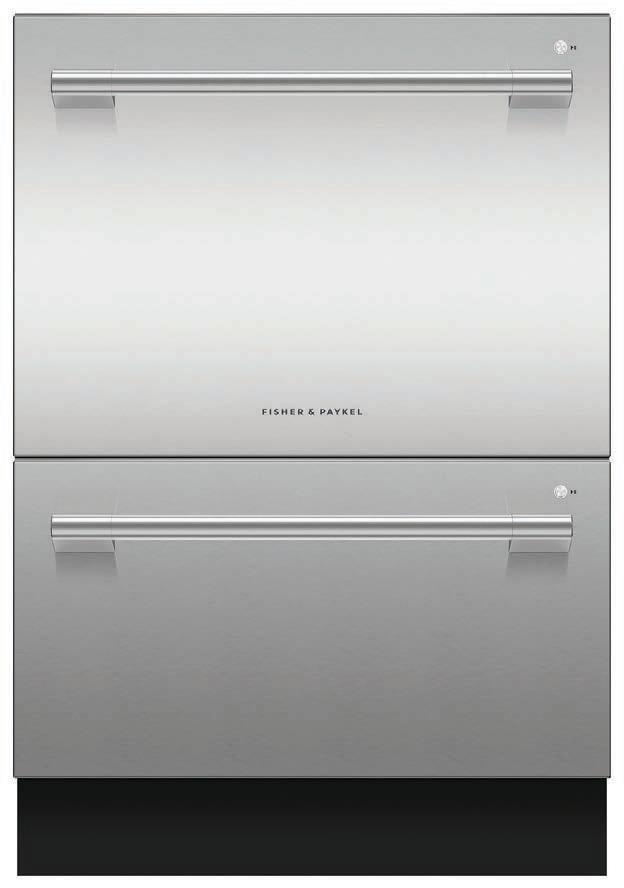
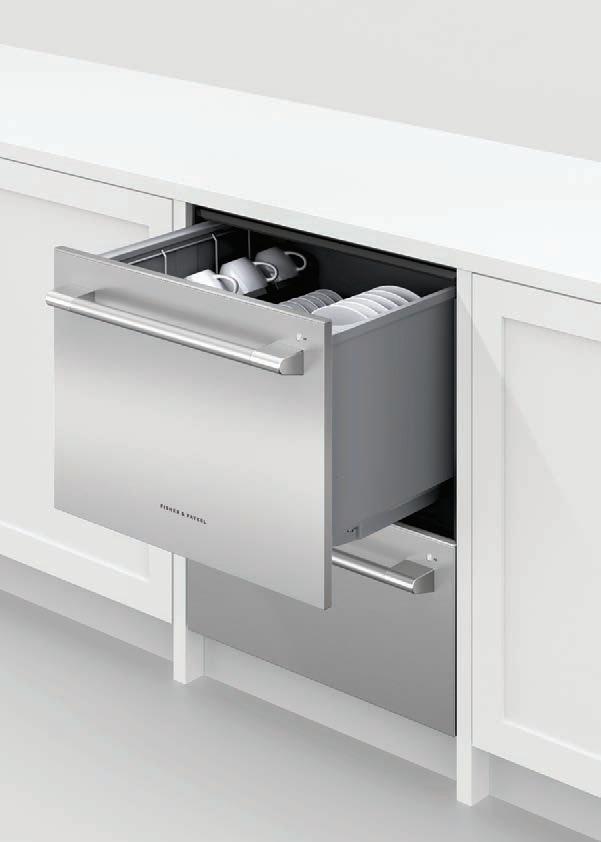
The new Series 11 DishDrawer from Fisher & Paykel – a pioneer of the original ergonomic drawer design for dishwashing – brings continued excellence through technology and performance. Featuring a fully stainless-steel interior, it offers expanded features for a deeper clean, extended flexibility, and class-leading innovation. “This is a very exciting launch for us, especially as the industry is continuing to experience a rise in kitchen remodelling,” says Kevin Dexter, Fisher & Paykel’s North American president. “In 1996 we launched the firstever drawer dishwashing solution and have seen
Small footprint kitchens by Porter & Charles.
Bespoke collection from Samsung.
Series 11 DishDrawer from Fisher & Paykel.
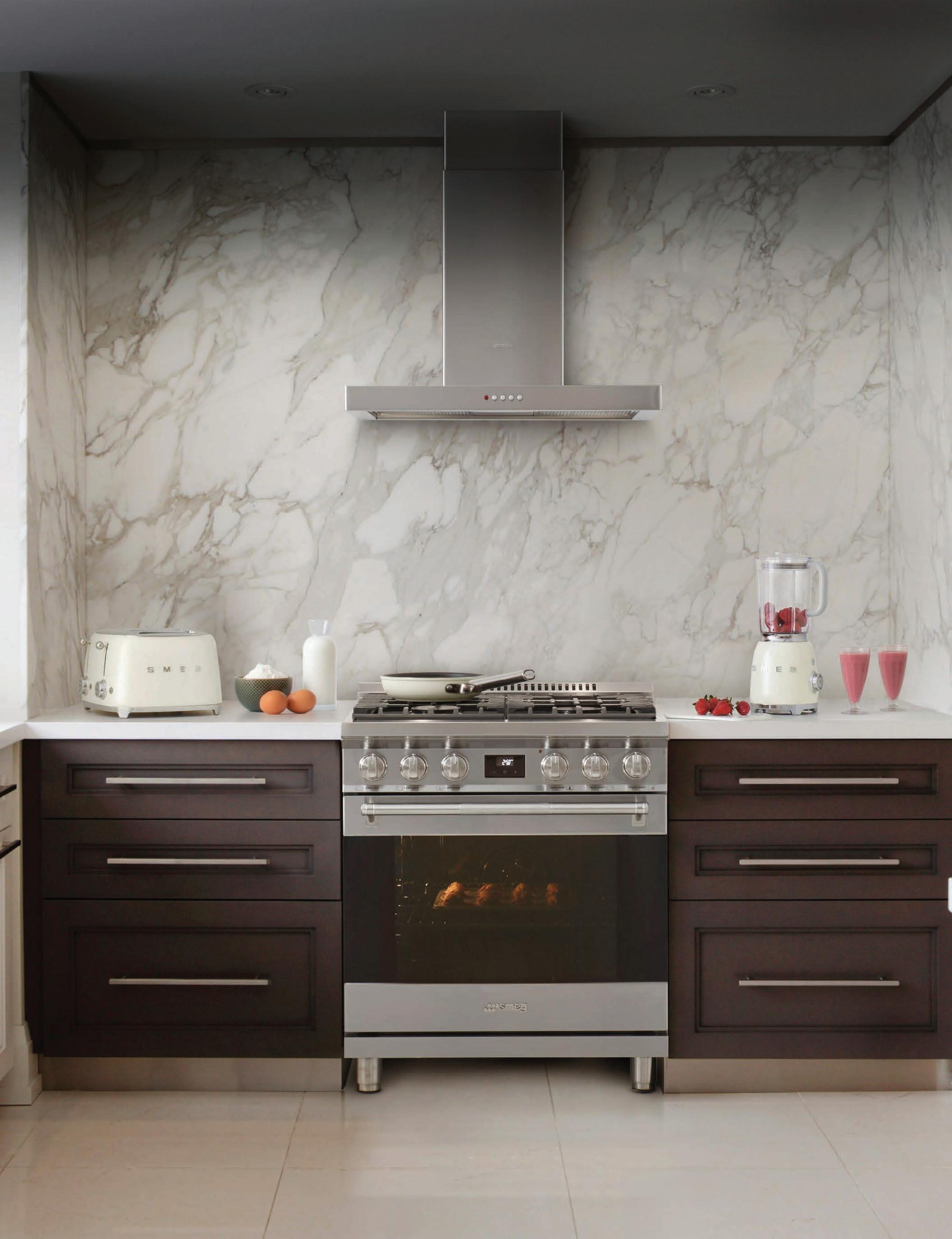
THE BEST THING NEXT TO A SMEG RANGE IS
A SMEG SMALL APPLIANCE
Inspired by the world’s greatest chefs, and beloved by some of the world’s best designers. SMEG’s line of ranges and small appliances cover a multitude of aesthetic styles, sizes, cooking options, and configurations, with an option that’s a perfect fit for every kitchen.
great success with the evolution of this appliance. The new Series 11 DishDrawer brings to market the ultimate cleaning solution; it is adaptable for use and space requirements, design forward, and features industry-leading technology. Within today’s market, this new DishDrawer offers ultimate flexibility and complete design freedom for remodelling, renovation, and new build projects.”
With SmartDrive technology, the DishDrawer features a number of technology enhancements, including a knock-to-pause feature and Wi-Fi capability, allowing users to start, pause, or cancel a wash from their smartphone. The Series 11 DishDrawer is available in single drawer and double drawer models. Both models have received Energy Star Ratings with the Double DishDrawer having received a further accolade: Energy Star Most Efficient rating. The Series 11 DishDrawer offers eight wash programs including: 60 Minute, Auto, Dry +, Eco, Glassware, Heavy, Light, Medium, and 3 Wash Modifiers: Quiet, Rinse and Sanitize. It also includes a new spray arm sensor, which detects jams for increased wash confidence. This appliance is a quiet performer, running at a low decibel rating of 43dBA.
Ideal for entertaining and everyday dishes, the double DishDrawer model allows users the option to run tubs together or separately. Alternatively, two single DishDrawer units can be placed on either side of a kitchen sink for the perfect ergonomic solution. Designed to fit, this appliance can be faced with stainless steel panels or custom integrated cabinet panels.
Series 11 DishDrawer.
Michael Gnat, director of commercial sales for Midnorthern Appliance, says a trend that is coming, albeit slow out of the gate, is induction for cooking. “This is the next evolution for multi-residential projects,” he explains. “The concerns that may be associated with gas are eliminated and the higher
quality of performance that comes with induction over both gas and traditional electric is the driving force behind this. Most manufacturers now have this available. We are using it, a bit, here and there. It does require some ‘buy-in’ from developers as it is a bit more expensive compared to electric and gas.”
Middleby Residential Canada now offers commercial-style cooking technology for homeowners with the Viking line-up. The ultra-premium products include built-in cooking, refrigeration, ventilation, and outdoor products.
The stylish Viking freestanding ranges offer a wide range of burner options, and colours that will blend into any upscale kitchen. The Tuscany brings a taste of Italy with 36-inch, 48-inch or the double oven, 66-inch model. The styles and colours available in this series are sized to meet North American architecture and lifestyles. With options for gas, electric, dual fuel or induction, designers can find the perfect fit for their clients.
The Viking line of Undercounter refrigerators will make an upscale addition to any kitchen, or home bar. Available in 15 inch or 24 inch, the line features refrigeration drawers and beverage centres.
For homes that have incorporated indoor/outdoor living areas, Viking offers premium gas grills ranging in size from 13 inches to 54 inches. Adding to the cooking options are the Viking 5 Series 13-inch double Side Burner and the 20-inch Power Burner, as well as the 30-inch or 42-inch warming drawers. With outdoor ventilation and refrigeration to complete the ultimate home-chef experience, entertaining is a breeze. A
One StepAhead
Hard surface flooring trends that are all the rage this year
by LAURIE JONES
Manufacturers of hard surface flooring continue to offer stunning options that will suit any application in both residential and commercial projects.
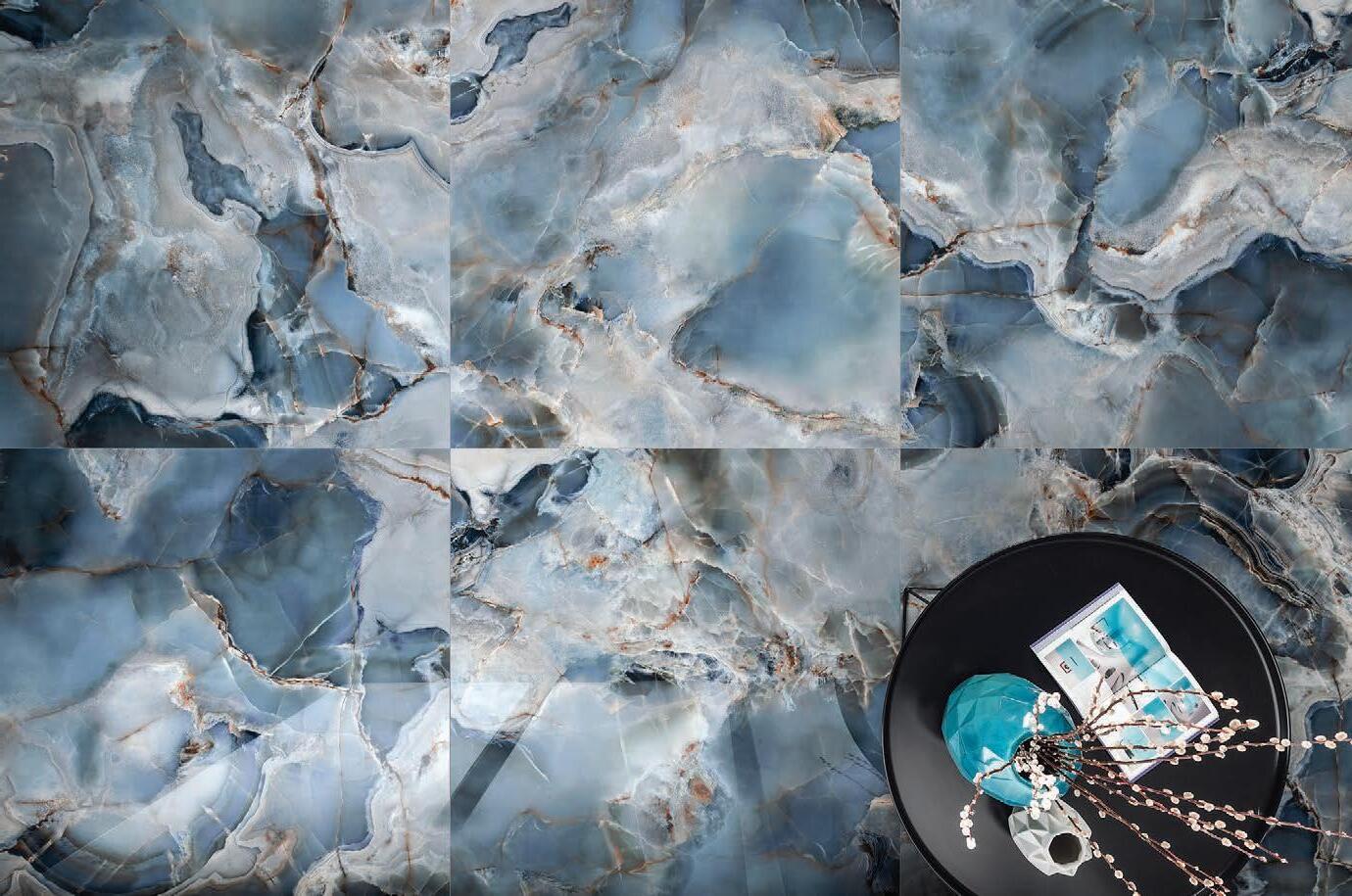
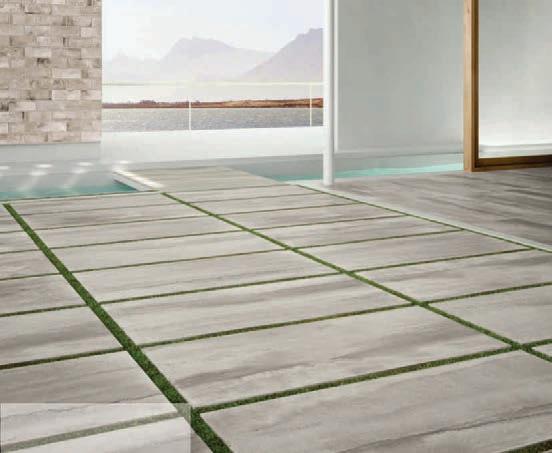
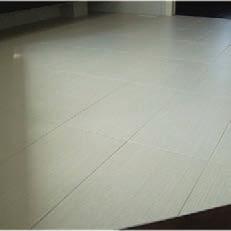
Ames Tile & Stone has introduced the Onice Reale line of floor tiles, a collection of unique designs available in both slab and tile options. “The tiles are 24 inches by 48 inches and are available in matte or polished finishes,” says Nicole Goetz-Turner, product development co-ordinator. “We are often seeing residential installations of the polished option on floors, and in some commercial applications. Because these tiles have a rectified edge – meaning all four sides are perfectly square – it can create a beautiful, seamless look. Having the matching porcelain slab can create some wonderful finishes.”
Goetz-Turner adds that the Onice Reale tiles are available in six colours inspired by Persian influences. The options include Ambra Polished, Cristallo Polished and Matte, Oceano Polished, Opale Polished, Rosa Polished, and Smeraldo Polished. Additional tile selections from Ames Tile & Stone include the Bianco and Marble Lab lines. The Bianco Onice Matte is available in 36-inch by 36-inch, or 36-inch by 72-inch tiles, or the Onice Polished, which is a 36-inch by 72-inch tile option. The Marble Lab Onice Perla Polished line is available in 24-inch by 24-inch or 24-inch by 48-inch tiles, as well as the 24-inch by 24-inch Matte version. The Bianco Travertino Oniciato Matte tiles are available in 36-inch by 36-inch, 36-inch by 72-inch, or the 36-inch by 72-inch polished options.
Goetz-Turner explains that because the product is porcelain it is very low maintenance as it does not need to be resealed like a typical onyx or natural stone. “It can be used in a variety of areas, such as steam showers, and the seamless option creates a little more class. The durability is also another feature so in commercial spaces where the renovations or refinishing is not done frequently, the installation can last for up to 50 years.”
In 2022, the Olympia Tile purchasing team was hard at work attending trade shows in Spain, Italy, and in the U.S. Following closely the design trends of 2022, Olympia Tile is now showcasing new lines that would serve architects and designers well with specifying projects. “First, our Crystal Stone Series is available in 24-inch by 24-inch and 24-inch by 48-inch Matte finish,” says Oren Gal, sales manager, builders and commercial divisions. “This porcelain collection reproduces the beauty and the chromatic variability of salt crystals, using graphics with high richness and depths.”
Available in four colours – White, Dove, Grey, and Smoke – the innovative technology allows this series to show elegant nuances and meticulous details that make the product look as authentic as actual natural stone, Gal explains.
“Our second option, the Chiaro Scuro Series, is stocked in three colours –Deep, Salar, and Cliff. The 24-inch by 24-inch size is available in a matte finish, and the 24-inch by 48-inch size is stocked in a polished finish,” says Gal. “This porcelain is a replica of a popular limestone that is found in Northern Italy. With meticulous patterning and design, Chiaro Scuro Series brings harmonious elegance to this natural stone replica. Due to its wealth of detail and depth of colour, it is sure to be a hit with architects and designers.”
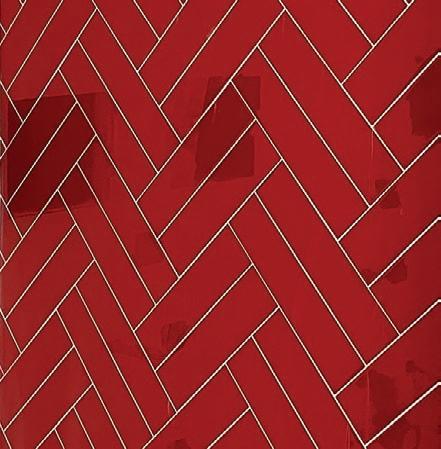
Flesher Marble & Tile has brought back a classic look for modern designers and contractors with the Herringbone tile option. “The Herringbone pattern dates back to the Roman Empire, where it was used in buildings roadways,” says Brent Fisher, general manager. “This interlocking paving system was built on top of a base of crushed stone, which cleverly absorbed the compression of traffic and footfall, making it extremely stable and durable. The pattern was named due to its resemblance to a herring fish skeleton. Other ancient civilizations also used this pattern, including the Egyptians for luxury jewelry and the French used the pattern in parquet flooring. Beyond these applications the Herringbone pattern spread to textiles design and is prominent in todays’ luxury suits.”
In recent years, Herringbone patterned flooring has become extremely popular, and for good reason. “This geometric pattern creates visual interest within a space and offers a luxurious European feel,” Fisher explains. “Like all classic patterns the popularity comes and goes over time. Although the pattern was originally used on roads and eventually wooden floors, it is now the rage in the ceramic/porcelain tile space.”
Herringbone from Flesher Marble & Tile.
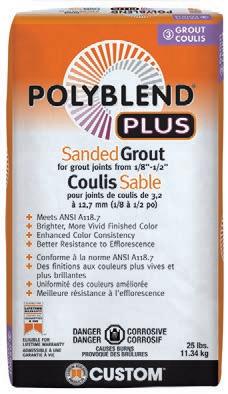
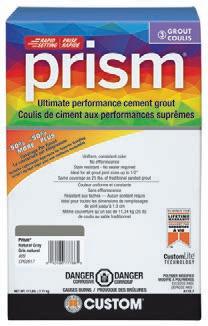
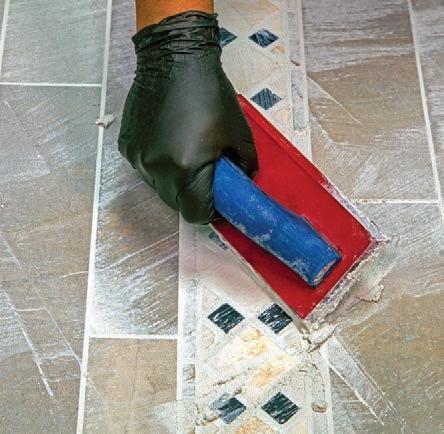
Prism Ultimate Performance Cement Grout from Custom Building Products.
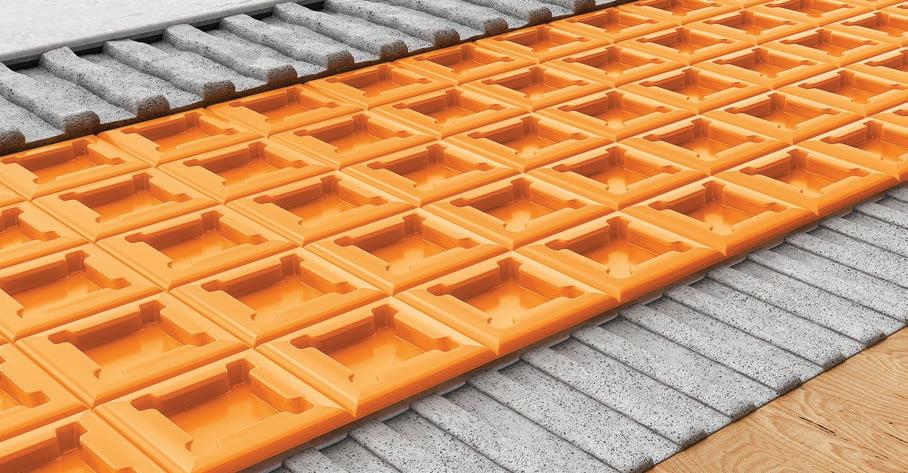
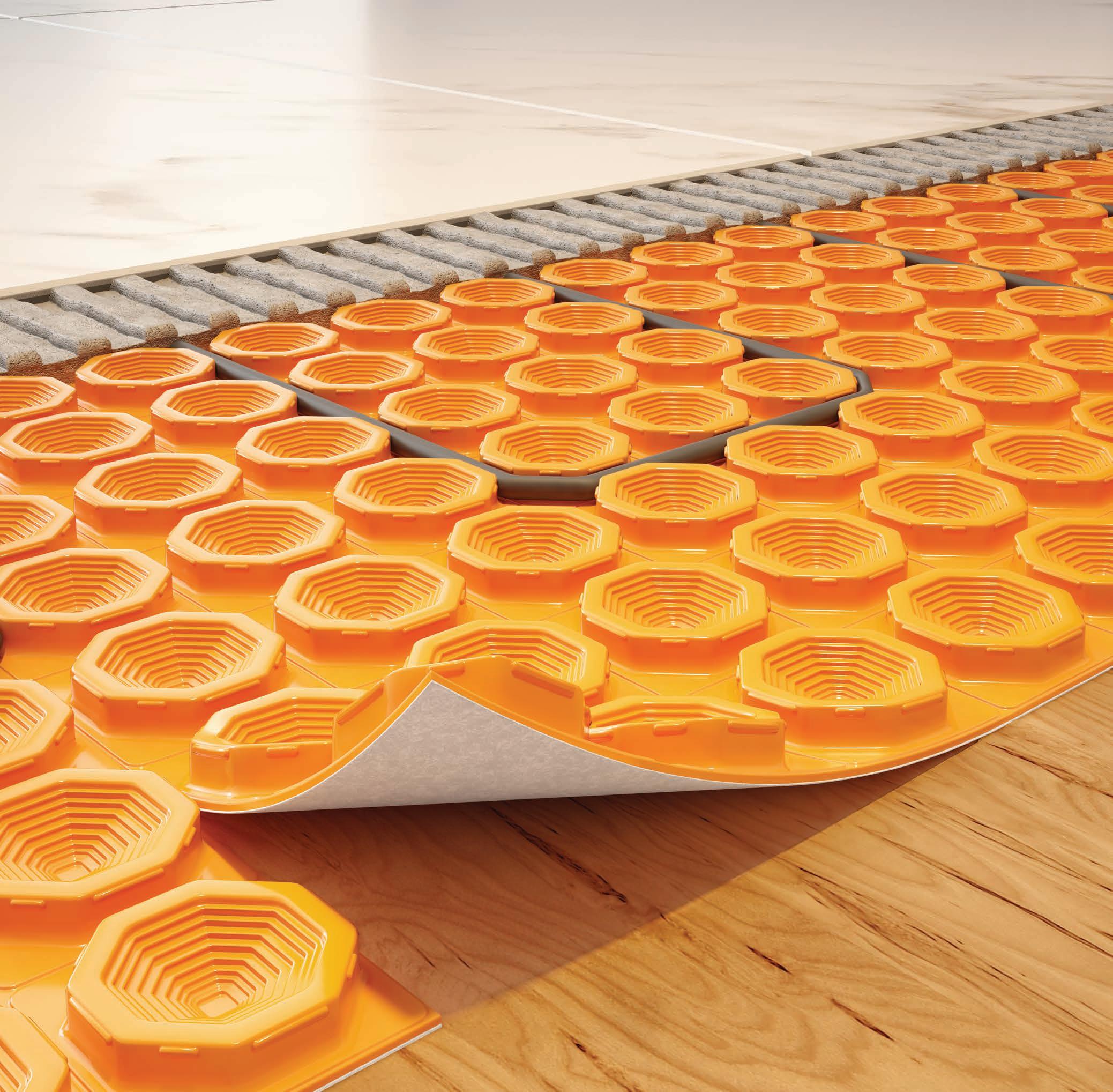
Ditra membrane from Schluter Systems.
The Herringbone pattern will show up in kitchen designs on both floors and walls but is especially dominant in backsplash designs. The backsplash designs tend to be monolithic in terms of colour with accenting grout lines where tile flooring will often incorporate multiple shades and sometimes colours to create an interesting accent. The pattern is not exclusive to kitchen design as it is also being seen on tile shower walls in a single colour.
Installing Herringbone on both floors and walls can be a time-consuming process, explains Fisher: “Each piece must be laid out and finished with precision to make sure the design stays in alignment. For tile it may be advisable to hire a professional for your project. If installed professionally, you can be sure you’ll have a floor or wall finish for the ages.”
Shnier, a Canadian-based national floor-covering distribution company, recently announced its rebrand plans for Richmond. This comes in the same year Shnier celebrates 85 years in the Canadian flooring industry.
Shnier’s proprietary Laurentian Hardwood brand was relaunched under the Richmond brand umbrella and Shnier now houses 100 percent of its hardwood offerings under the Richmond brand. Richmond Hardwood is an exquisite collection of timeless North American wood species and unique exotic woods –there is something for every taste.
The new clean Richmond look is designed to embody the heritage the brand has represented since its conception, while demonstrating its aspiration to transcend its impact in the industry.
The endeavour to reimagine and simplify Richmond involves a consolidation of brands along with changes for others. Casa Roma Ceramic Tile will become known as Richmond Tile & Stone. This move to bring Casa Roma into the Richmond family of brands will leverage the existing brand equity in the industry while increasing it.
MEMBRANES, ADHESIVES, GROUTS, & DRAINAGE
In 1987, Schluter Systems revolutionized the tile industry with the introduction of Ditra, the original uncoupling membrane designed to prevent cracked tile and grout. “Today, Ditra is even better,” says Tod Valickis, global product manager. “The same trusted and reliable uncoupling membrane now features
innovative enhancements that will help get the job done even faster. Ditra features a new look with design improvements that facilitate installation of the roll. Cutting grooves are now included to provide a guide for straight and precise cuts. Air release vents appear at the corners to allow for faster filling of the membrane with fewer trowel passes. The membrane is now more flexible to enhance workability and lay perfectly flat. Lastly, the enhanced undercut design allows for an even stronger anchoring of the tile. Valickis adds that the four essential functions of Ditra that make for a long-lasting tile installation are: uncoupling, waterproofing, load-distribution, and vapour management.
Floor warming continues to be a growing trend for new and renovated homes and businesses alike. Flooring installers are using uncoupling membranes with floor heating cables because they offer the luxury of warm tiles, combined with an ease of installation. “Schluter Systems is introducing two new peel and stick floor warming membranes – the Schluter Ditra-Heat-PS and Ditra-HeatDuo-PS,” says Valickis. “Both new products are available in rolls and sheets to accommodate various room sizes. These peel and stick membranes feature a pressure-sensitive adhesive [PSA] to bond the membrane to the substrate, replacing the need for thin-set mortar. Simply remove the transparent release film from the fleece side of the membrane to expose the layer of adhesive and embed into the substrate.”
Valickis notes the membrane can easily be repositioned until pressure is exerted. Quick and easy to install, Ditra-Heat-PS and Ditra-Heat-Duo-PS integrate customizable, comfortable electric floor warming. “Both peel and stick membranes are designed to secure the Ditra-Heat-E-HK electric floor heating cables and provide uncoupling, waterproofing, vapour management, and support to ensure a long-lasting installation. Ditra-Heat-PS features a nominal 1 ⁄4-inch thickness to minimize tile assembly thickness and reduce transitions to lower surface coverings.” Ditra-Heat-Duo-PS is 5⁄ 16-inch thick and additionally offers sound control and a thermal break.
Custom Building Products has introduced its Prism Ultimate Performance Cement Grout, designed to deliver beautiful, long-lasting ceramic and natural stone tile surfaces. “Prism is ideal for virtually any tile assembly, with reliable, proven results at some of the largest projects in North America,” says Garett
Diamond Polished Concrete. A Strong & Beautiful Concrete Flooring Solution
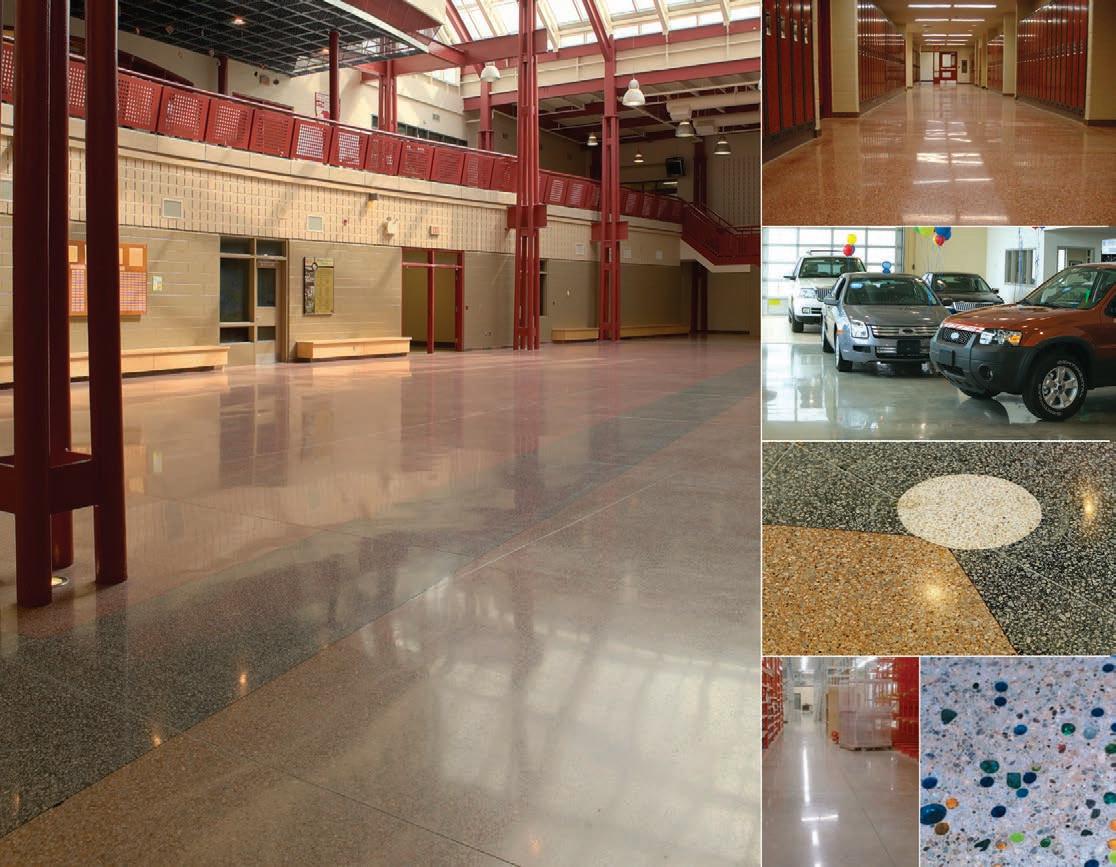
Diamond Polished Concrete is a unique, advanced flooring system that brings out the natural beauty of concrete, helps reduce maintenance costs and enhances the natural durability of concrete surfaces. The Tri-Con Diamond Polish System employs an innovative 7-step grinding and polishing process that utilizes progressively finer diamond grinding heads. This system also uses the most advanced penetrating sealer technology.
Tri-Con Concrete Finishing is an industry leader with more than 30 years experience in the concrete industry. We are a one-stop supplier capable of pouring new floors to exact specifications as well as restoring existing concrete surfaces with endless versatility. We guarantee that we deliver on time, on budget and on spec every time.
ASK ABOUT OUR I.C.I. JOINT FREE CONCRETE FLOORS
TRI-CON Concrete Finishing Co. Ltd. 835 Supertest Rd., Suite 100 North York, Toronto, ON M3J 2M9 Tel. 416.736.7700 Fax. 416.736.6686 www.triconconcrete.com 2011, 2012, 2013 & 2017 GOLDEN TROWEL AWARD WINNER
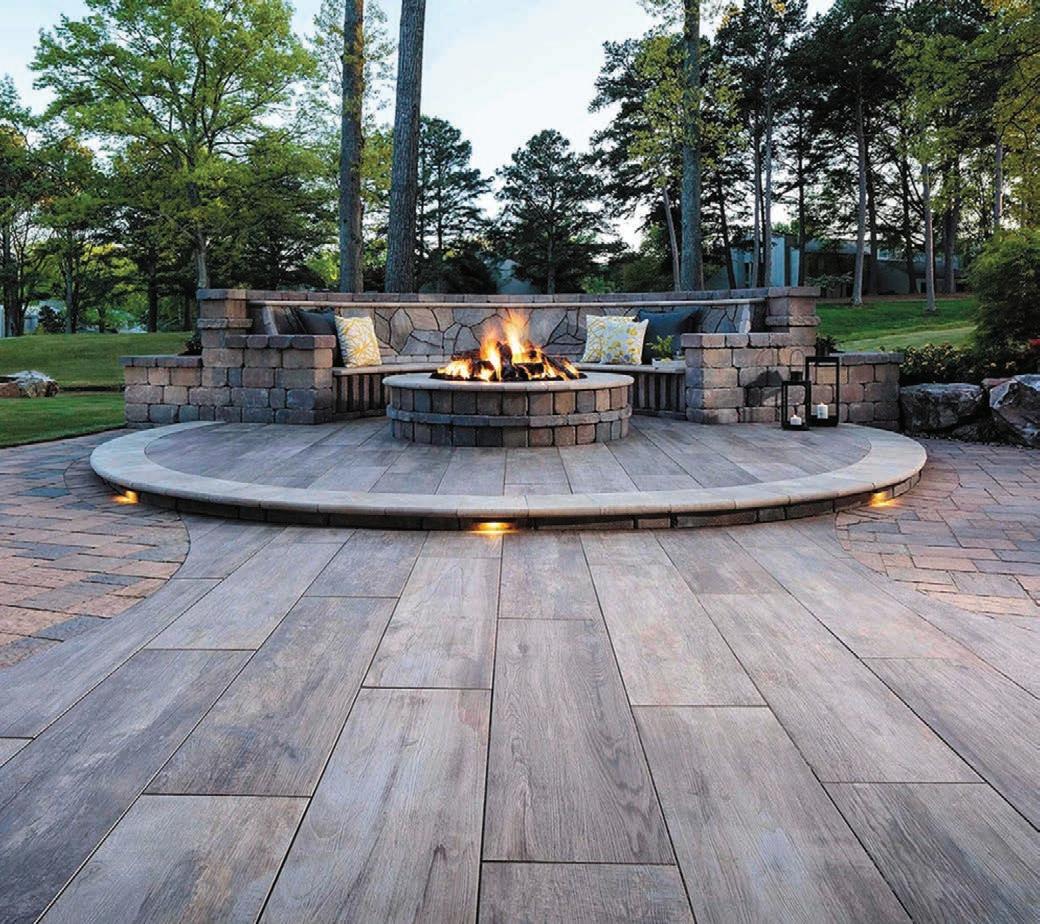
CREATING MODERN OUTDOOR LIVING SPACES WITH CUTTINGEDGE PRODUCTS
Incorporating the latest innovations in outdoor design
Outdoor living has come a long way in the past several years. With homeowners prioritizing spending time outdoors, there is a keener focus on the design of outdoor spaces. It’s not just a few simple lawn chairs and a fire pit anymore.
Homeowners today are looking for multipurpose outdoor living spaces that are fully functional for everyday life and designed to perfectly suit their unique style and tastes. Belgard has been at the forefront of product development, creating new styles, colorways, and textures in their industry-leading hardscape products.
“We’ve seen homeowners become much more design-conscious over the past three years when it comes to both the interior and exterior of their homes,” says Joe Raboine, director of residential hardscapes at Belgard. “They are looking for ways to differentiate their spaces and make them truly their own. It’s not about ‘keeping up with the Joneses’ anymore, so to speak. They are really trying to keep up with themselves and have a home that reflects their personality, style and needs.”
Designing Outdoors with Color and Texture
Visual interest is a key component in creating truly unique outdoor designs. Rather than designing a more monotone space with one material, homeowners are working with contractors and designers to incorporate more mixed material designs.
Combining hardscapes with wood, composite decking, textured pavers, and even metal and glass elevates the look of a space and perfectly complements modern design trends. This adds depth to spaces that would otherwise feel flat and linear and allows the incorporation of more personality.
Belgard has introduced new paver colors, textures and shapes that are designed to pair effortlessly together for more experimentation and the creation of intricate patterns and designs. Because of their modular design in 3-inch increments, they can be mixed and matched, allowing for endless creative freedom, one-of-a-kind designs, faster installation, and less waste.
One of Belgard’s most visually interesting textured pavers is the Basalt style paver. Basalt was created to mimic the texture of natural volcanic rock, which provides an organic look and feel to any space.
“Basalt is a product we are extremely proud of,” says Raboine. “Biophilic design, or design that intertwines man-made and natural materials, has been incredibly popular for the past few years. The texture of those natural volcanic rocks you see is so beautiful, we knew it could be used to great effect in outdoor designs.”
With two color options available – charcoal and light gray – Basalt complements any design style.
“It’s really stylish when used with more modern architectural styles that emphasize sleekness and smoothness,” adds Raboine. “But it also works
incredibly well with more traditional or rustic designs. The lighter and darker color options let you really play with light and shadow and depth.”
The formatting of the pavers allows you to use one or both colorways throughout a design. In addition to Basalt, Belgard is introducing more textured pavers this year as part of its Textiles Collection.
Industry-Leading Systems for Beauty, Efficiency
With intricate designs and textures becoming more popular, how does that affect the design and installation process? For Belgard, they are making it seamless.
“Our goal is always to create products that make design and installation more efficient instead of more complicated,” says Raboine. “This really benefits both the contractors who work with our products and their clients, the homeowners. If contractors can get the job done faster, then the homeowner can enjoy their outdoor space sooner.”
One of the most efficient – and stylish – products Belgard introduced is Artforms. This modular concrete panel system is the first of its kind in the industry. Unique and durable, it combines function and flair to create anything from planters to barbecues to benches.
Artforms is composed of large-format, high-strength concrete panels that can be configured and affixed with simple stainless-steel hardware. Because of its modularity, it allows for multiple, personalized configurations.
“Artforms is such a unique system, and we’ve seen it used in a variety of applications,” says Raboine. “We created this product with functionality at the heart of it, but also ensuring it offered a beautiful aesthetic. The clean, smooth look of concrete is enormously popular.”
This innovative system can truly take any form. Panels can be cut to the desired size and still fit together perfectly because of the modular format. It also allows for easy integration of outdoor lighting thanks to the hollow interior and dovetail inside the cap.
Cutting Edge Solutions from Belgard
Though trends come and go, Belgard products are designed to be cutting edge and stand the test of time. Products like Basalt and Artforms lend themselves to current trends but hold a timeless quality that will fit with any design or style.
Shandler, VP, sales. He adds the uniquely formulated grout delivers a full spectrum of colour-consistent, stain-resistant benefits.
A high-performance cement grout meeting ANSI A118.7, Prism is polymermodified for higher strength, more resistance to cracking, and less water absorbent to reduce the likelihood of staining. The density of Prism also provides greater stain resistance while its rapid-setting formula speeds project completion. “Prism’s exclusive, calcium aluminate formula controls hydration to ensure uniform colour consistency without shading or mottling, regardless of weather conditions,” says Shandler. “Adding to its unparalleled performance, Prism does not contribute to unsightly efflorescence.”
Prism is ideal for grout joints from 1.6-millimetre (mm) to 13-mm wide and can be used in any sanded grout application or in place of non-sanded grout in narrow joints, like plank tile assemblies. Prism also performs exceptionally well in the extra-wide and deep joints found with pebble or exotic tile. More than 30 percent lighter than standard grouts, Prism gives installers unmatched handling and workability, Shandler explains.
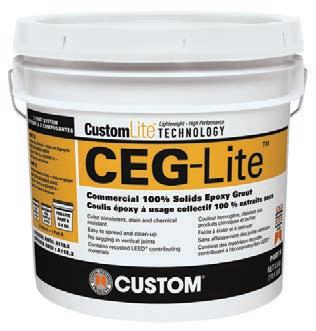
Available in a comprehensive palette of designer-inspired colours, Prism can accentuate the most ambitious projects. Plus, Custom offers colour-matching silicone sealant to create soft movement joints that enhance the durability and functionality of the tile assembly.
Maxxon Corporation has aligned with S3 Surface Solutions to bring innovative, technology-driven subfloor preparation solutions to the flooring industry. With this strategic collaboration the two companies said they are positioned to help contractors, general contractors, and owners solve substrate preparation challenges with industry-leading technologies. “S3 is excited to come together with Maxxon to offer comprehensive floor prep solutions that contractors and consumers alike can depend on,” says Jack Aspenson, CEO and founder of S3 Surface Solutions. “Our shared goal is to embrace disruptive technologies to bring new, cost-effective, and time-saving products to the industry.”
The combination of S3 Surface Solutions’ innovative products with the Maxxon Commercial products that are already widely used in the industry will provide a system solution for a range of commercial, residential, and public sector floor preparation projects. In addition, all systems featuring products in the
VERSA
Maxxon and S3 portfolios, including those that address moisture, problematic concrete slabs, surface and levelling issues, and the bonding of floor coverings, fall under a joint warranty. The joint warranty covers everything from the concrete slab to the floor covering, giving the customer confidence in the Maxxon-S3 system.
“The joint system warranty will provide specifiers, architects, and contractors with assurances that they are protected by approved products and systems, with single-point accountability,” says Phil Ciesiulka, Maxxon’s executive vice president of sales and marketing.
WOW-FACTOR INSTALLATION
In 2022 Mapei Inc. was awarded two prizes at the Terrazzo Tile & Marble Association of Canada (TTMAC) Hardsurface Awards. The first – a tile installation at the new build Université de Montréal MIL campus named Intersecting Waves – was recognized in the Unique Special Award category. Secondly, Mapei brought home the award for the Restoration category with a food court renovation at Complexe Desjardins, also located in Montreal.
Mapei’s technology-backed products were selected to bring the vision of artist Alain Paiement to life. Working with a team from Carreaux Cera Design, a 7,000-square-foot piece created an illusion of intersecting waves. “The precision-coloured tiles are all 12-inch square and, being exposed to the rain and freeze/thaw conditions, it was important to have a mortar and grout solution using the Keraflex Super and Ultracolor Plus that would stand up to the weather,” says Francois Croteau, Mapei sales representative. “The substrate for the tiles consists of dozens of 24-inch-square concrete slabs sitting on bases atop a roofing membrane. Each slab had to be tiled individually, with four correctly coloured tiles placed accordingly.”
The second winning project was for the Complexe Desjardins half-centuryold food court renovation. Located in the heart of Montreal’s festival district, owners saw an opportunity to update the space and incorporated a wide range of tiling options using high-end products from Mapei. These products were used to complete the 42,000-square-foot project in four months, using over 20 types of wall and floor tiles, from thin-set to large, heavy pieces. A
Fitting In Perfectly
Plumbing products provide solutions to sustainability while focussing on convenience and style
by LAURIE JONES
The plumbing industry has seen significant advancements in recent years, and 2023 is set to bring even more exciting developments. The manufacturers of plumbing products have been working hard to create a wide range of offerings, from classic and timeless styles to the latest in modern designs. Many of these products are focussed on environmental sustainability, ensuring that they not only meet the needs of the consumer but also help to reduce the impact on the environment.
SHOWERS & SHOWER DOORS
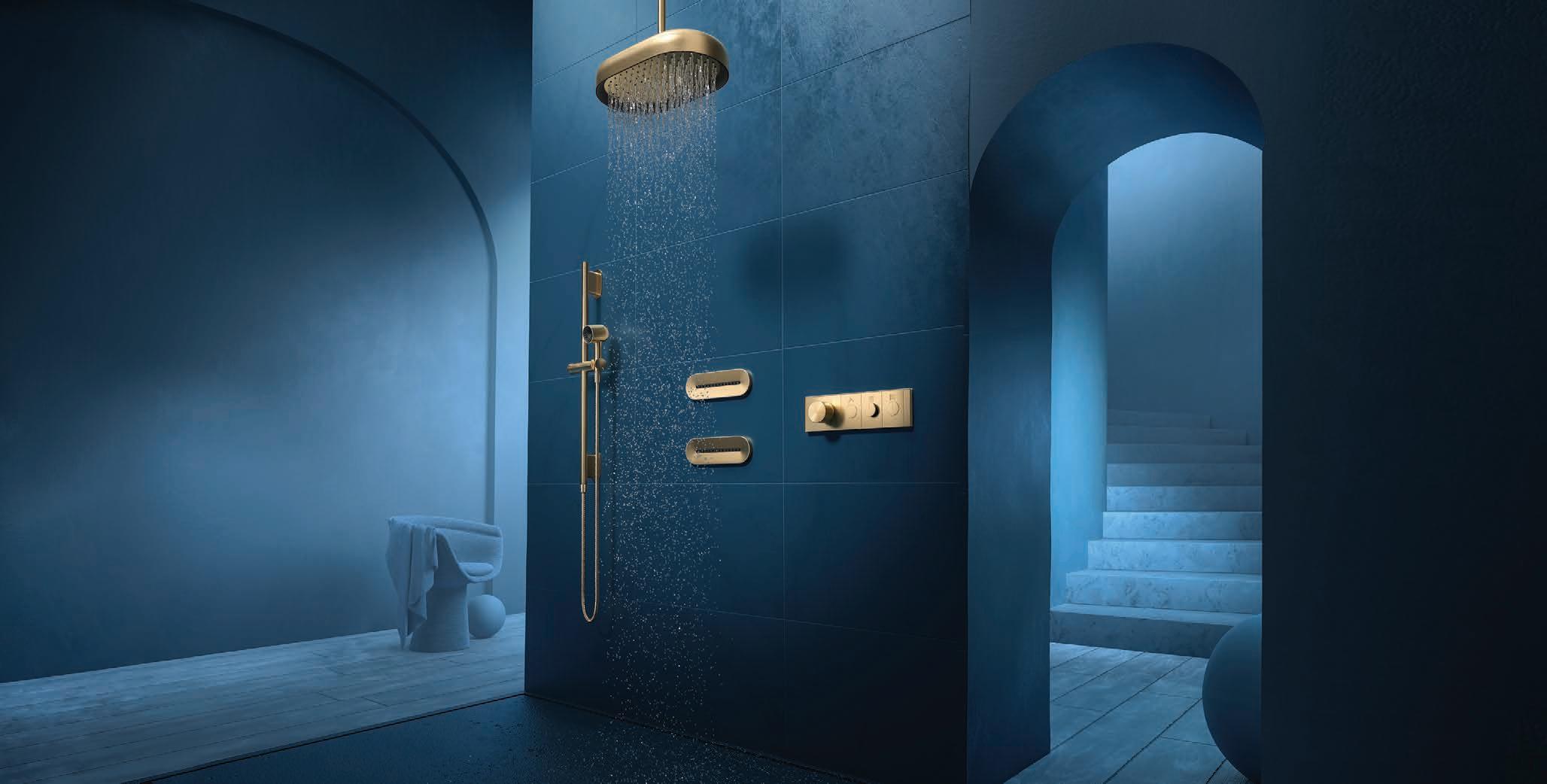
The Statement showering collection by Kohler brings a range of unique shapes and an array of sizes to the shower, breathing new life into well-loved standards and marrying the latest in technology with enduring craftsmanship. Innovative sprays elevate the showering experience, and universal compatibility means the system works wherever in the world it is installed.
“Showering is so much more than just getting clean. It is a chance to feel rejuvenated, a moment to focus on self-care,” says Lun Cheak Tan, Kohler VP of Industrial Design. “A shower should provide a rich experience – through design-forward craftsmanship, meaningful functionality, and uncompromised focus on the user.”
Inspired by iconic furniture and home goods, and defined by soft, approachable designs, the collection carries an underlying familiarity, while creating striking aesthetics within the space. This is showering re-envisioned at the most basic level, says Tan. An oblong showerhead results in more enveloping water coverage for the whole body, and six immersive spray experiences offered within the collection include a Deep Massage spray composed of twisting jets that knead sore muscles and a Cloud spray that swathes the body in a warm mist. Other spray options include a Full Coverage Rain and a dense, wide Sweep.
The Statement collection includes a showerhead, four styles of hand showers, four unique rain heads, and two body sprays, all available in a range of sizes and shapes to best suit the décor and design environment. Finishes include Polished Chrome, Vibrant Brushed Nickel, Matte Black, and Vibrant Brushed Moderne Brass – all are aesthetically arresting and created to yield a natural interplay with other accessories and design elements.
Tan notes that Statement represents an evolution in showering, one that engages all the senses and elevates the everyday. Its handsome forms are matched by exceptional function that results in an indulgent, customized showering experience.
In December 2022, Lixil Corporation acquired Basco, a U.S.-based shower door manufacturer.
This move allowed Lixil to expand on its line of kitchen and bath products in the Americas to provide full shower and bathroom solutions.
Established in 1955, Basco is one of largest manufacturers of custom shower enclosures, complete with glass tempering, glass fabrication, and installation expertise. “From ideas to installation, Basco’s capabilities will allow us to simplify the purchase journey for consumers and professionals and provide full showering solutions. The business is an excellent strategic fit for Lixil in a segment that we had been seeking to strengthen for some time. Basco also shares Lixil’s purpose to positively impact our communities and a culture of respect and collaboration. I am looking forward to welcoming the Basco team to Lixil,” says Trey Northrup, leader of Lixil Americas.
Matte black Statement rain head.
The Statement showering collection by Kohler.
BATHTUBS & MORE
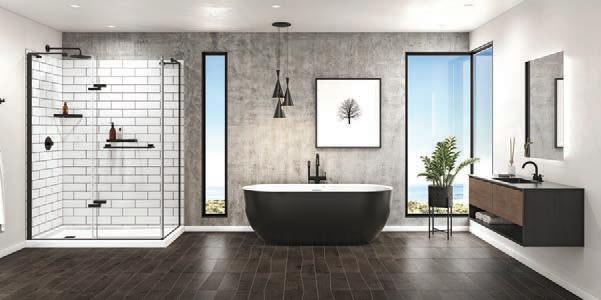
The designers at Maax have launched the new Pocono 58-inch by 32-inch by 23-inch freestanding bathtub. “The stylish white with white skirt look offers a large bathing well and backrest, but the size works well for bathrooms with a small footprint,” says Jessica Randrianavony, product manager, American Bath Group. “Faucets can be deck or floor mounted, and the incorporated Above-the-Floor Rough [AFR] design leaves a few inches of clearance between the underside and the flooring for pipes to be routed without breaking ground,” she explains. “This installation system works great for concrete slab applications, in both new construction and renovations.”
Maax has also introduced three sizes in its Tosca acrylic freestanding bathtubs family, including a 59-inch by 31.5-inch by 23.625-inch model, a 67-inch by 31.5-inch by 23.625-inch model to accommodate two people, and a 57-inch by 31.5-inch by 23.625-inch model. The seamless one-piece bathtub features a large bathing well with backrests and a centre drain. Available in a trendy matte or glossy finish, either black or white, the tub is also F2 drain compatible for ease of installation.
Another Maax product that offers benefits for multi-generation households is the Manhattan shower door. “This product is compatible with most Maax shower units, bases, and walls,” says Randrianavony. “The door can be installed for left or right openings, there is no threshold or header to eliminate height restrictions, and it offers easy access to plumbing.” With the 68-inch height and 18 sizes of width, the Manhattan covers openings from 23 inches to 59 inches. Finishes are available in chrome, brushed nickel, and matte black.
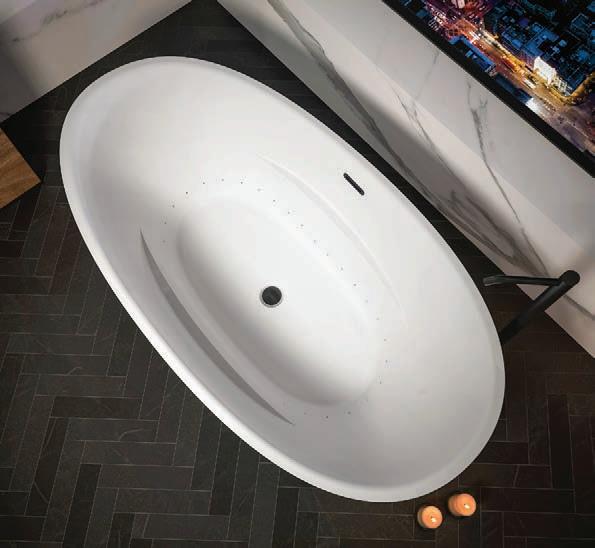
BainUltra introduced its stylish Libra Oval freestanding tub, with a generous 66-inch length, 35-inch width, and 27-inch height. Available in either white or a black and white combination, with a glossy or ultravelour finish.
The Libra Oval features classic BainUltra luxury accessories such as the MiaPlus ThermoMasseur and the BU-Touch virtual control app, which allows bathers to navigate through settings while in the tub, or while at other locations in the home. These options include activating the Hydro-thermo Massage, adjusting the heated backrest and headrest temperature, select colours for chromatherapy, and a program drying cycle.
The rectangular version of the Libra bathtub, also available in the 66-inch length with a narrower 23-inch width and 23-inch height, offers two headrests for dual bathing. As with the Libra Oval, all of the BainUltra special massage and chromatherapy features are included.
For a unique departure from the standard bathtub options, the BainUltra BeOne collection features a round, Japanese-style tub. The 46-inch by 39-inch by 30-inch vessel is the first of its kind, incorporating air jets in the circular design, creating a powerful massage that is different than other air systems. With 40 jets and a heated backrest, the BeOne bathtub also includes BainUltra favourites such as the MiaPlus Control, the BU-Touch control app, and the Geysair and Illuzio Chromatherapy.
FAUCETS & WASHBASINS
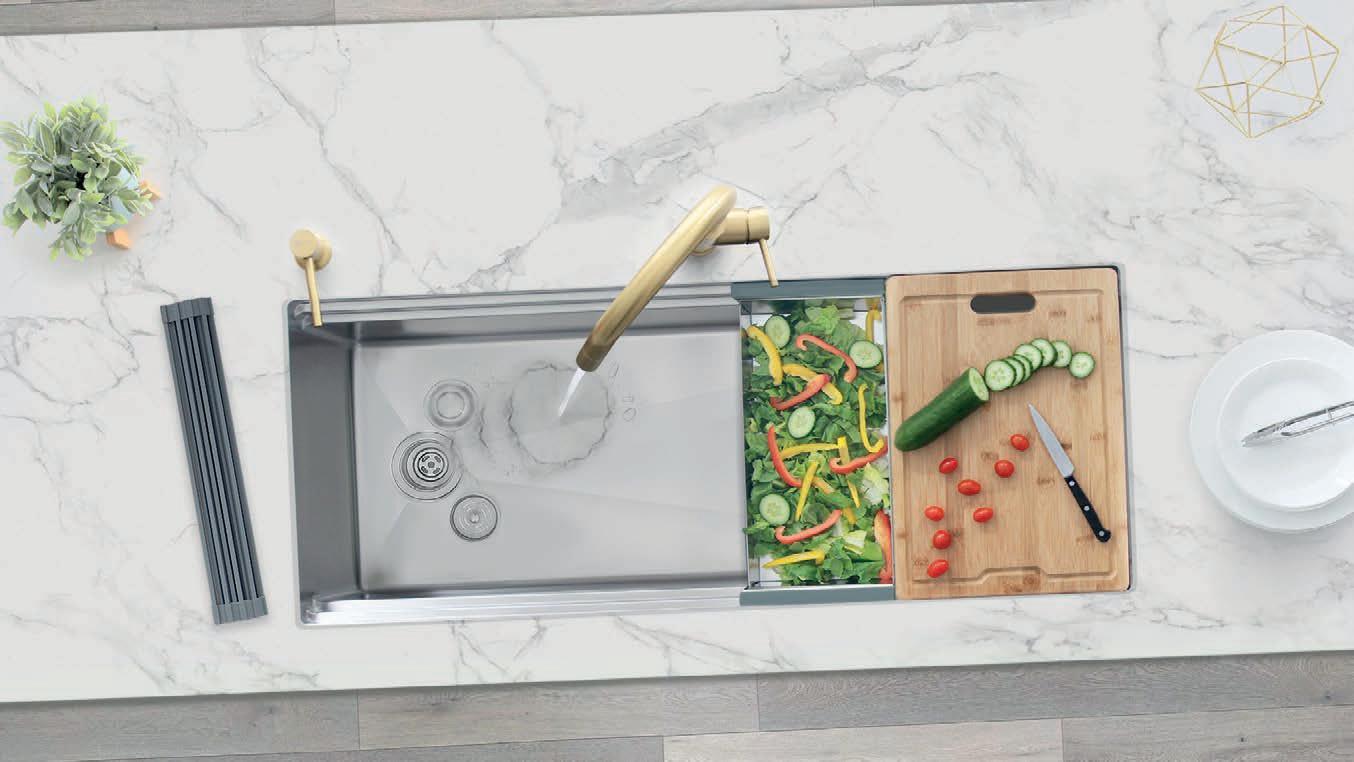
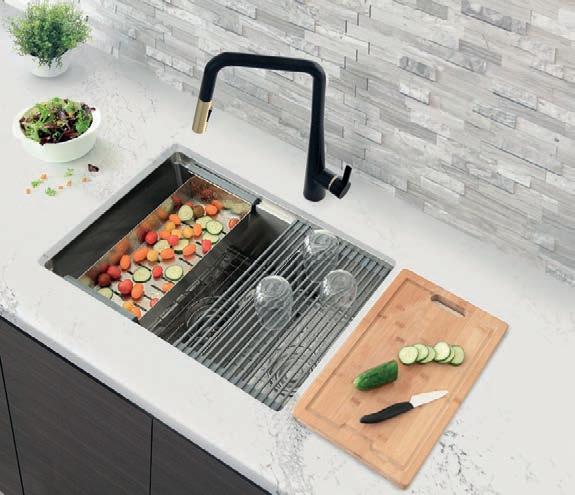
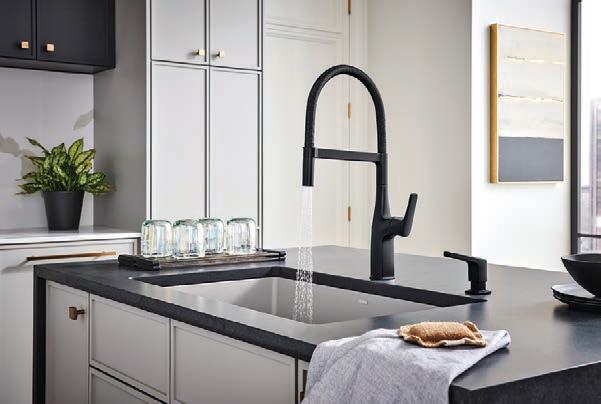
In 2022, Blanco launched the Matte Black and Satin Gold premium faucets, expanding the company’s existing line of metal and Silgranit faucet finishes, which are all designed to co-ordinate with Blanco’s portfolio of sinks.
Unlike deeper-toned brass and bronze faucets, the Satin Gold has been welcomed by the design community for its modern, soft hue. “For those interested in a farmhouse-inspired Blanco unit, the Empressa faucet collection in Satin Gold brings a touch of vintage elegance that traditional design enthusiasts will love,” says Edyta Drutis, director, brand and communications, North America. In addition to the Empressa design, the Satin Gold is also available in the Rivana, Torre, and Lato kitchen faucet collections, accompanied by the Empressa, Rivana, Torre, and Lato soap dispensers.
For those who prefer a darker tone to their kitchens, the Matte Black finished faucet creates a dramatic accent, complementing dark countertops and white cabinetry. “Opt for a Matte Black finish in the Rivana Semi-Pro faucet, inspired by professional kitchens for the full Semi-Pro Home Chef Blanco Unit experience,” says Drutis. As with the Satin Gold selection, the Matte Black is available in the Empressa and Rivana collections, as well as the Atura, Catris, and Catris Flexo faucets.
Pairing a Blanco faucet and sink not only creates a stylish Blanco Unit but integrates into one seamless solution. “The integrated system delivers style and performance, transforming everyday chores into more joyful experiences and ultimately optimizing kitchen workflow,” says Drutis.
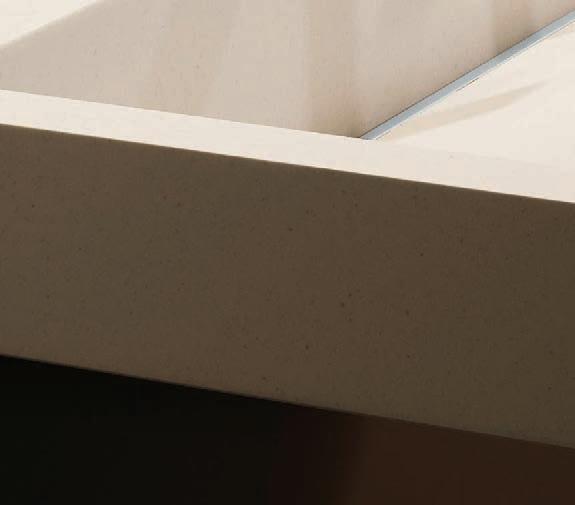
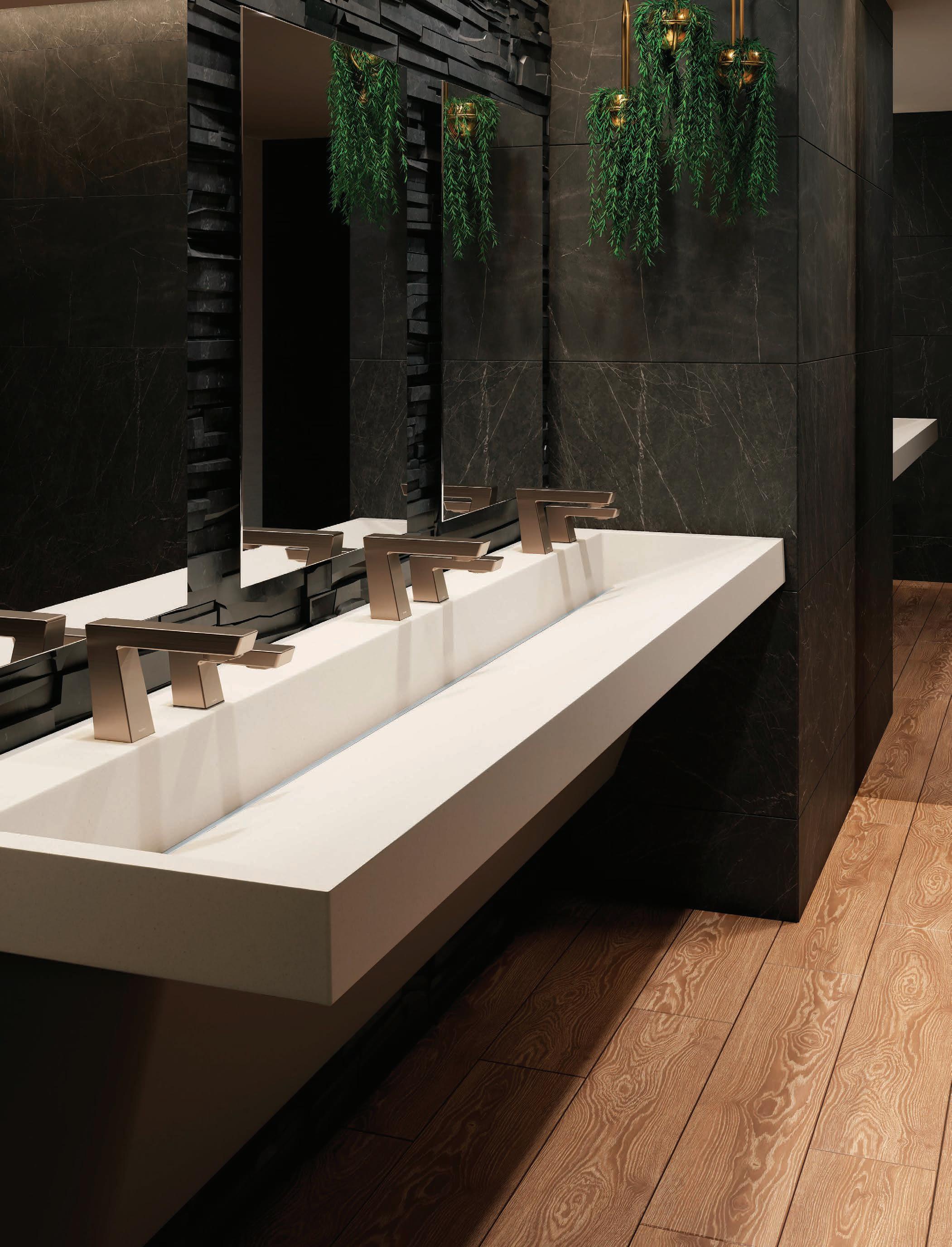
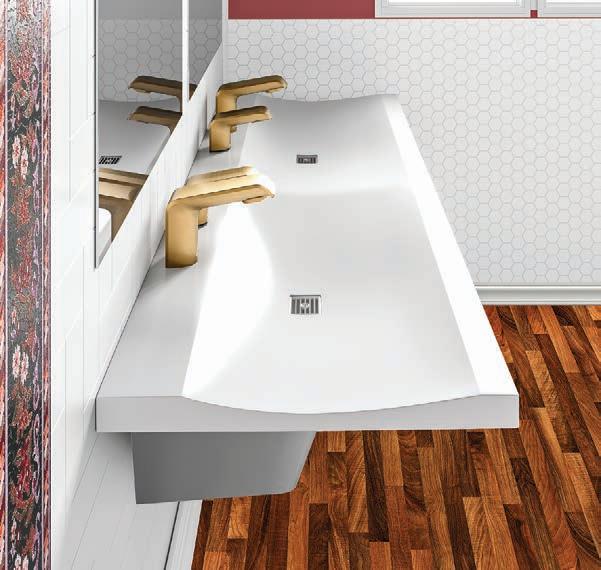
Bradley Corporation’s new Evero Matte quartz material for commercial washbasins has an arresting visual appeal with its stone-like appearance. “Evero Matte quartz has a seamless natural matte finish and velvety soft suede feel that will not show fingerprints or water spots,” says Kris Alderson, senior marketing manager. “Available in eight monochromatic colours inspired by nature, Evero Matte brings a sense of earthiness and calmness into washroom spaces.”
Highly durable and Greenguard Gold certified, Evero Matte quartz is made from a sustainable blend of bio-based resin and a unique mixture of extra fine grade quartz. This quartz material option is nonporous with no cracks, crevices, or grout lines, which prevents bacteria, mould accumulation, and growth for a more hygienic handwashing experience.
“Being cast-formed, Evero Matte quartz can be specified in many attractive seamless shapes and forms,” Alderson says. It is available in several of Bradley’s Verge basin designs, including the LVQ Series that is paired with all-in-one touchless WashBar models, and the LVA and LVS Series that feature matching Verge Soap Dispenser and Faucet Sets, which are also touch-free.
PLUMBING PIPES
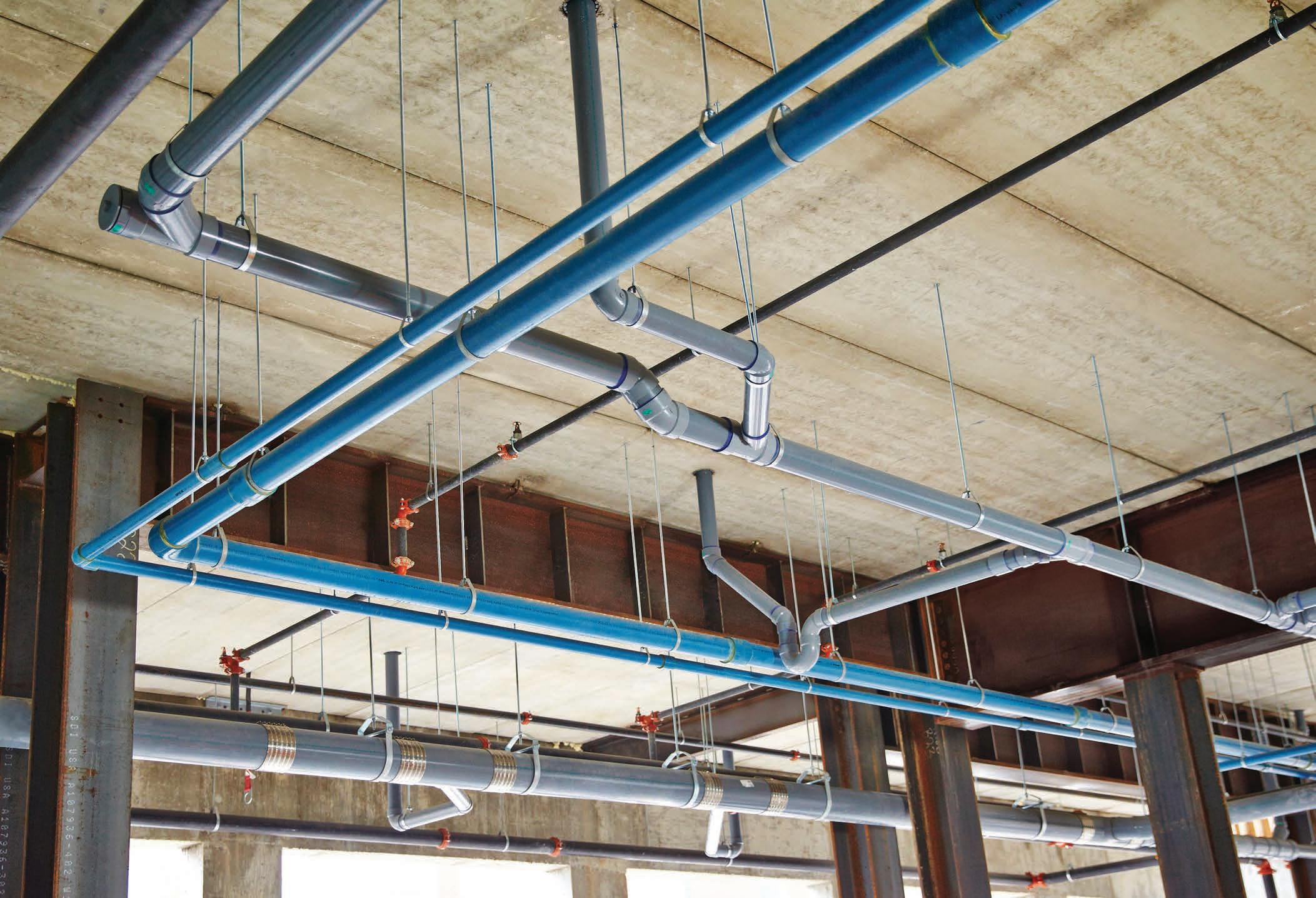
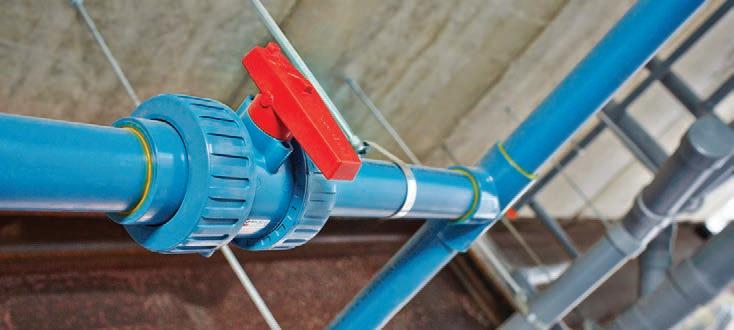
IPEX began expansion in the summer of 2022 to facilitate three of its pipe extrusion facilities. “This will allow IPEX to increase production capacity for our pipe business to ensure high fill rates and excellent service both in the U.S. and Canada, while we continue our significant growth strategy,” says Alex Mestres, IPEX’s chief executive officer. “These investments will also add enough capacity to deliver a number of ground-breaking new products we now have in the pipeline and ready to launch. Not only are we continuing to invest in the best available technology so we can better service our customers, but these expansions are also creating career opportunities for all IPEX employees.”
As with all new IPEX facilities, industry-leading health and safety best practices and technology are paramount. In addition, IPEX envisions possible next-phase expansion and further automation in the future. These expansions will also create new jobs across three communities: Asheville, North Carolina; Lawton, Oklahoma; and Fort Pierce, Florida.
All three facilities will see expansions of their distribution yards and buildings. This expansion is an important investment for IPEX that complements other strategic investments, including three new distribution centres and their new state-ofthe-art flagship molding facility in Pineville, North Carolina that is currently under construction. A
Libra Oval freestanding tub from BainUltra.
Tosca freestanding tub from MAAX.
Matte Black finished faucet from Blanco.
Evero Matte commercial washbasin from Bradley Corporation.
RISING Continually
Structural steel continues to prove it is one of the most versatile products available today
by ROBIN BRUNET
Busy, and with a good chance of withstanding the impact of inflation and high interest rates: that, in a nutshell, is how structural steel specialists describe their standing in the 2023.
However, labour shortages continue to be a major issue, and while materials prices will eventually abate, there’s no clear sign when the influx of newcomers to the industry will eventually match the volume of work currently underway or coming down the turnpike.
Sam Barrett, VP of pre-construction at Walters Group (which is known for complex steel design, fabrication, and construction of commercial and industrial projects across North America), says, “Business is good and as we speak we have a solid backlog of projects, particularly in the industrial sector. It’s quite the pivot from previous years where we are now securing more industrial projects instead of commercial office towers.”
Barrett reflected on his industry as Walters was putting the finishing touches (namely, a uniquely shaped crown) on 160 Front Street West, TD’s new office/ headquarters in Toronto. This 46-storey structural steel-framed commercial office tower is a distinct addition to the Toronto skyline and boasts curved
cladding that wraps all four exterior walls and integrates the heritage masonry of the 70-year-old, six-storey building previously located on the site.
Barrett credits Two Manhattan West in New York, the largest project in Walters’ history, for helping carry his company through the pandemic.
“The 63-floor southeast tower had a steel core instead of a concrete core,” he says. As with Walters’ work on Two Manhattan West, the company deployed a 700-foot self-climbing cocoon for the project that attached to the perimeter of the building, providing a safe enclosure for the site teams and the public below. As erection progressed, the cocoon effortlessly climbed up the perimeter, while all loads imposed were resolved through the complex network of steel.
Barrett goes on to note that, “We like to say we’re a small company doing big things, and we place strong emphasis on planning. If we haven’t already prepared for the job before we appear on site, then we haven’t done it right. This approach means we get to push the boundaries on some of the developments and prepare for any possible challenges.”
This year holds plenty of opportunities for Walters, and Barrett cites new battery plants, hospitals, plus Algoma’s new Electric Arc Furnace facility in Sault Ste. Marie on the books, but he adds that “some people in the industry are getting cold feet due to the rapid rise in interest rates and cost of borrowing. Also, steel prices are killing some projects. That said, we need to keep in mind that there is still loads of potential in this industry, despite some projects possibly being shelved or temporarily postponed.”
Andrew Sly, president at George Third & Son, says, “There’s lots of work for all of us after a tough couple of years, capped in 2022 by Amazon building so many distribution facilities that mills were booked for months on end. Nobody else could get steel because Amazon was paying premiums for even small items such as deck screws.”
Still, Sly says in 2023 the projects range from high-rises (“which is what we chase”) to unique undertakings such as The Butterfly condominium development in Vancouver from Westbank Corp., which includes one-of-a-kind steel features such as four massive arches of elliptical tubing, one of them standing 17-storeys tall, and architectural instead of standard beams. “B.C. is a good market for this kind of specialized work,” Sly says.
George Third & Son is also proving adept at tackling the labour issue that continues to plague the steel sector across Canada. “In B.C., for example, we’re losing labour to other jurisdictions because of the ridiculously high cost of living in Metro Vancouver, but a few years ago we started reaching out to trade schools and high schools to offer apprenticeships,” Sly says. “The strategy is working in that of the 10 new apprentices we brought on, eight have stayed. But we still need a new generation of fabricators and welders, and hope to include more women and other groups that have traditionally been underrepresented.”
Sly notes that by having automated some of his company’s processes (CNC machines, automated plate welders) they have a competitive advantage and can produce more output with less people. “Plus, when we recruit we’re able
Two Manhattan West, NY
Steel is a material known for its strength and versatility. However, once galvanized, it becomes even stronger and more durable. With a long-lasting, maintenance-free finish, enjoy the benefits of galvanized steel for decades, all while keeping costs and sustainability in mind. Trust Corbec for all your galvanizing needs.
QUALITY & EXPERTISE
Galvanizing since 1965
Integrated quality control at every step of the process
Expertise that works with you from conception to finish
Consistently surpass all industry standards
One award-winning project after another since 1970!
to attract people with high skill sets, not just labourers, because to work in our shop you need not only fabrication skills but computer skills as well. Young folk like to build, but they also have an aptitude for computers and technology.”
George Sze, president at Wesbridge Steelworks Limited, says his company continues to enjoy some competitive advantages, including retaining over 50 employees with more than 500 years of combined experience, and a 37,000-square-foot fabrication shop on five acres at the centre of Vancouver’s Lower Mainland. Using Tekla Structures (formerly Xsteel), StruMIS, and other software to streamline the construction process, “I would describe business in 2023 as looking reasonable, with material pricing and anticipated wage inflation stabilizing.
“We’re not really involved in many warehouse projects, which appear to be slowing; instead, we do mostly institutional and commercial work, and these sectors are still robust. We recently finished work on the Peace Arch Hospital expansion and the Willoughby Mall upgrade in Langley, and as of January we wrapped up work on The Stack, a 38-storey premium office building on Melville Street in Vancouver. But arguably the biggest project for us – one that occupied most of our time last year and continues to require our undivided efforts this year – is the Oakridge Redevelopment project.”
Sze is referring to the $5-billion Oakridge Centre redevelopment, a 5.5-million square foot masterplan undertaking that consists of residential, office, retail, civic uses, and park above a consolidated below-grade parking garage. “This is a once in a lifetime development and we are pleased with our participation and contribution to this mega project,” he says.
Considerably smaller, but no less important to the creative minds at Wesbridge, is the ongoing renovation of the 1911-era First Baptist Church building, whose floorplate is being expanded to provide
45,000-square-feet of new additional community spaces, including a 37-space childcare facility, multi-purpose rooms, gymnasium, counselling services, cafe, and church offices, which will link the church to the new Butterfly tower.
“We are also involved with the First Nations Health Authority building in North Vancouver, a steel and wood structure with many traditional First Nations elements,” Sze says.
Unsurprisingly, given its 42 years of history developing the landscape of Ontario and abroad (and winning awards for its work along the way), Benson Steel is making the most of the post-pandemic economic recovery. As was the case in 2022, it continues fabrication on a number of major projects in Ottawa, Ontario, including work on the two new Porter Airlines’ hangars for aircraft maintenance at the Ottawa airport. The 150,000-square-foot facility will house all of Porter’s E-2 aircraft maintenance, and the hangars will have indoor parking for up to eight aircraft, helping position Ottawa airport for future growth. The other two large commercial projects are West Memorial Building Rehabilitation and the Ādisōke Public Library, both landmark projects for the City of Ottawa.
Benson Steel is also busy with a number of transit projects including the Toronto Transit Commission’s Donlands Station (Line 2 Bloor-Danforth) revamp. For this project the company is fabricating and erecting customized steel pieces to form the arches of the newly designed station as part of the Toronto Transit Commission accessibility program. Benson Steel president, Steve Benson, credits the experienced team at Maystar Construction for contributing to the positive progress that has characterized this challenging build. Benson is also involved in the Metrolinx Eglinton Crosstown project constructing the Eglinton, Cedarvale, and Salvation Army stations and looking forward to their completion in early 2023.
Melville Street, Vancouver, B.C.
One point Benson made recently was, “with the current economic pressures, the rising costs, and the challenges of significant labour shortages, the industry needs to refocus on what partnering truly entails. This means paying subtrades on-time, not just saying they will. Cashflow is critically important in normal economic times, but in challenging times like these it’s even more important and owners, general contractors, developers, and construction managers needs to ensure their trades are paid in a fair and timely manner, in accordance with terms agreed, or pay the trade interest on the funds being ‘borrowed,’ as in fact that is what is happening. The trade is incurring a cost not factored into the tender or award and borrows the funds, at prime rates-plus, while waiting for the funds to be received.”
On every project Benson focuses on safety first – one such project that spotlights this is The Spiral NYC tower (in partnership with NYC Constructors) that are actually large cocoons that encompass the entire high-rise structure to give all workers a safe environment as they build a 70-plus storey tower. Other recent projects of notes are the Bermuda International Airport as well as Pickering Casino and Brock University residences – all these projects are fabricated at
the Benson structural steel facility/plant in Bolton, Ontario. Once the steel is fabricated and ready to install, at the right time in the project’s schedule it is brought to the construction site and rapidly erected, accelerating the overall project schedule.
Supermétal, a subsidiary of Canam Group Inc., supplies, designs, fabricates, and erects structural steel for all types of projects in all sectors: commercial, institutional, industrial, or civil. Bridges, office towers, research centres, and airports are among its projects. Its fabrication facilities have an annual production capacity of 40,000 tons, with its Lévis, Quebec-based fabrication plant having been expanded on several occasions and now boasting a production line 700-feet long.
One of Supermétal’s more notable recent projects was successfully installing 12 massive steel nodes at Level 3 of the 141 Bay Street Tower at CIBC Square in Toronto (a 130,065-square-metre office building designed to LEED Platinum standards). The nodes range from 18 to 40 metric tons, and the largest steel entities required an engineered lift procedure involving two cranes.
The composition of the nodes themselves are noteworthy: they are an innovative steel casting from Cast Connex and furnished with a 203 millimetre (mm) and 254 mm stacked plate system on the protruding stubs and base. The installation was such that the nodes receive diagonal columns that tie back to the concrete core at level 7, which then receive the loads from the 48 tower floors above. The tower connects to the one-acre overbuild park area, spanning over the rail system and the previously completed 81 Bay Street tower.
Finally, while the structural steel market is very much oriented towards mass production on behalf of big projects, Steeltec Industries Ltd. is an example of a specialist benefitting from a variety of construction projects. Steeltec manufacturers one-off or prototypes, as well as production line welding and on-site construction.
Using precision welding techniques, Steeltec repairs equipment and machinery to like-new conditions or modify to customer specifications. But the most obvious examples of its creativity are in facilities such as a structural playground enclosure for Burger King, massive stylized metal fish that adorn Town Centre Park in Coquitlam, and especially the exposed structural framework for Milking Parlour in White Rock that is almost arachnid in appearance. A
Donlands Station, Toronto, ON
GETTING TO THE ROOT OF IT
The green roof and green wall market continue to flourish in North America
by NATALIE BRUCKNER
While the green roofing sector is not immune to the challenges faced by the rest of the construction industry, it has still managed to see a growth of anywhere between five and 15 percent, according to Steven Peck, founder of Green Roofs for Healthy Cities.
Peck explains that one reason for this growth is increasing awareness around healthy buildings. “We’re seeing an increased demand by certain types of buildings – particularly multi-unit housing buildings such as apartments and condos – as they look to include amenity space. After the lockdowns our need to be closer to nature increased … it’s hardwired in us. For condominium and apartment dwellers, they want to have access to green space in their buildings, on their balconies, and on the roof.”
Policy and regulations have also helped drive green roof demand, but Peck says there is increasing need for policy to take a holistic approach. “There is currently a silo mentality that is creating a barrier in getting green roofs built. New York, for example, has Local Law 92 and 94 that mandate the installation of sustainable roofing zones on all rooftops undergoing major construction, both for new and existing roofs. It requires a building have either a green roof or solar panels, but they are not equivalent. Integrating both would be the best option as solar panels function more efficiently when there’s a green roof underneath. It is, however, a step in the right direction.”
To help drive a better understanding, Peck remains committed to increasing education in all areas of green roofing through podcasts, scientific journals, their own online magazine, and green roof training programs like the pilot that GRHC recently completed with the Roofing Contractors of British Columbia (RCABC) that will be rolled out this year.
Peck says 2023 is going to be a time to charge full steam ahead to tackle the crisis facing us. One way to do this has been outlined by Project Drawdown, which created a comprehensive model plan to draw CO2 out of the atmosphere. “One of the 100 measures outlined is achieving a 12 percent coverage of green roofs across the world,” says Peck. In doing so, CO2 emissions would be reduced by 0.53–0.99 gigatons. “It’s time to go for the gusto. If the roofing industry really got behind green roofs, we could definitely make that 12 percent.”
The RCABC has been busy formalizing a new strategic plan for the next three years that includes the possibility of new guarantee initiatives, including a green roofing quality assurance program.
“We are excited about this huge step. Our present quality assurance program for roofs, which operates under the brand RoofStar, is driven by five core commitments: projects must conform to objective standards; they must be constructed by trained, qualified installers; they require financial commitments from both suppliers and installers; they must be constructed with materials accepted by us; and they must be independently reviewed during the course of construction. The RoofStar QA program ranks second to none anywhere in North America, and I have not seen its equal anywhere else,” says James Klassen, RoofStar technical advisor examiner, RCABC.
“Any green roof QA program we develop will be founded on the same core commitments of our successful RoofStar QA program for roofing and leverage the green roof training program we are hoping to finalize early in 2023. Our work on green roof training has taken on new dimensions as we contemplate a future as green roofing guarantors,” says Klassen.
While Klassen believes perception by insurance companies of green roofs as well as educating owners on the importance of roof maintenance still remain challenges, he says that moving ahead, third party green roof quality assurance could become an important tool to overcome this and many other challenges. “This would be the case especially for civic governments because without third party quality assurance they often are hard-pressed to demonstrate the benefits of policy-driven mandatory green roofing.”
Last year saw a rapid increase in food prices and shortages of food supplies around the world and this is expected to continue. It is no wonder then that Soprema’s Sopranature vegetated system continues to pique the interest of many. The system offers a wide variety of social, economic, and environmental benefits to building owners and communities. In addition to replacing mineral surfaces with permeable and living surfaces within the properties, they compensate for the loss of ecosystem services caused by urban development.
One project that truly showcases the benefits of this is the award-winning IGA Organic Rooftop Farm in Saint-Laurent Borough, Montréal, Quebec.
This neighbourhood’s regulations stipulate new roofs must be either green or reflective (white), and this specific project was required to have 50 percent of the building roof area covered with a green roof system. To meet these requirements, a simple extensive sedum roof was designed and the project was awarded to La Ligne Verte who convinced IGA’s owner of the added value of investing in a large-scale urban rooftop farm. The roof was also redesigned to highlight the IGA logo, which is represented in the shape of the green roof.
The waterproofing system was initially designed and installed as an inverted single-ply assembly, with the membrane protection needed for a green roof installation. As this project evolved into a rooftop farm, it had to sustain a lot of foot traffic and farming activities, so the inverted roofing assembly became even more crucial to protect underlying waterproofing. This assembly and the Sopranature green roof system together, aside from protecting the waterproofing from any physical harm, add an extra layer of insulation, which reduces the store’s power consumption. The XPS insulation laid on top of the waterproofing system also adds a very strong physical barrier against shock from farming tools.
Kees Govers, technical sales manager at LiveRoof Ontario, says his company is full steam ahead this year and that LiveRoof Ontario has been involved in some very interesting projects of late. One of which is the McDonald Block Reconstruction project for the Ontario government that consists of a set of office buildings in Toronto. “It’s a retrofit building from the ’60s that is being renovated and modernised. The project is fairly unique in size and scope because it’s just shy of 70,000 square feet and relatively low load bearing capacity,” explains Govers.
The mid-rise building Waterworks was another rather unique green roof project. “We worked closely with the owner and developer and the landscape architect to create the plant mixes for the various green roofs on the building. The green roof on the food hall is a biodiverse green roof that is only fourinches deep, because of load bearing restrictions. There are biodiverse green roofs on levels six and 12, as well as several small green roofs on the north side of the building in full shade, with plants suitable for those locations. The only sedum green roof is on level 14, the upper roof.”
The newest addition to SickKids is another fascinating project that LiveRoof has been involved with. “It has five roof levels, one of which is accessible, and
all have six-inch modules with a biodiverse plant mix. We are seeing more of these kinds of projects due to the City of Toronto’s regulation that encourages the use of biodiverse and intensive green roofs,” explains Govers.
The year ahead is looking great as the team at LiveRoof get their teeth stuck into other projects including 141 Bay Street – which has been designed to meet the newest and most innovative standards of efficiency – and 160 Front Street in Toronto, which is a commercial tower on a street-related base and includes the retention of the façade of a heritage building.
In addition to green roofs, Govers says he is also seeing increasing demand for Hydropavers – a cutting-edge paver technology that enhances water absorption and evaporation. “The pavers absorb the first five millimetres of any rainfall,” explains Govers. “Several big developers in Toronto are using the product to deal with stormwater management requirements.”
Looking ahead, Govers says that while stormwater management will continue to be top of the radar, biodiverse and (semi) intensive green roofs will also be a major focus. “We are probably the first company that I know of to set a minimum biodiversity green standard. Our formula is that in a biodiverse green roof will have a minimum of 11 species of plants in at least five different genera in four different plant families. This helps keep pollinators happy throughout the seasons. When we make pollinators happy, we make songbirds happy.”
Catastrophic weather events are today a reality, and while green roofs remain one of the answers to help combat the effects of atmospheric rivers, for example, preconceptions surrounding green roofs are still acting as a stumbling block to the industry.
According to Rick Buist, president of Bioroof Systems Inc., the perception of green roofs has evolved significantly. While they were once seen as a novelty, they are now regarded as a crucial performance tool.
In particular, he says the area of stormwater management is becoming dependent on green roofs that can detain water during peak flow storms to prevent overflowing of insufficient storm sewer infrastructure – a problem faced by most major urban centres throughout North America. “When storm sewers overflow, they flood the sanitary sewer system and drive effluent into our natural waterways. This has all kinds of negative effects on the environment, from fish stocks to algae blooms ruining lakes and beaches,” he explains.
Buist has committed his firm to supplying the hard data required by civil engineers to be able to use green roofs as part of their rainwater solutions for building sites. “This can mean serious benefits for developers who are often forced to commit their usable site plan to holding tanks and other infrastructure. If green roofs can deal with the peak flow at source [the roof], reductions in cisterns, holding ponds, and such can turn into major savings.” He adds that the benefit does not stop at the developer, as green roofs have already been shown to cool buildings, create pollinator corridors, and beautify the exterior of the building.
“It’s essentially a win-win all around,” Buist says. “Developers save costs, governments save infrastructure, and the environment is improved over the urban landscape.”
FROM ROOFS TO WALLS
Ginkgo Sustainability, which specializes in both living roofs and living walls, announced it has recently been recognised due to its collaboration efforts with two of 2022’s winners of the Governor General’s Medals in Architecture 2022.
The first winner, The Idea Exchange Old Post Office, is located in Galt, Ontario, and involved a green roof installation. The project goal was to transform a dilapidated heritage post office into Canada’s first “bookless” library. Ginkgo
McDonald
Block Reconstruction, Toronto, ON
Ask for our latest Virtual Lunch & Learn "GREENROOFS FOR STORMWATER PERFORMANCE" (1 CEU/HSW)
Every major Urban Centre has to deal with Combined Sewer Overflows, caused by insufficient storm sewers during peak rain events, making sanitary sewers overflow, bringing effluent into our waterways and destroying our natural environment
Bioroof's vegetated systems are the civil engineer's best tool to mitigate peak flows during storms while saving on expensive infrastructure by managing water at the source... on the roof.
A few of Bioroof's greenroof projects:
Canadian War Museum
Canadian Museum for Human Rights Women's College Hospital
Toronto Transit's 1.7 hectare Bus Garage
Manitoba Hydro Head Office Etobicoke Hospital
...and millions more m2 of innovative projects throughout Canada and the USA.
Above Left - Versa Wall picture is “The College of the Rockies” in Cranbrook BC
Above Right- Versa Wall XT is “The Shops at Morgan Crossing” in Surrey BC. GSKY HAS CREATED 1,000 WALLS IN 20 COUNTRIES
Sustainability aided in repairing a lost opportunity to establish a solid human and environmental connection, and installed and maintained the green roof that wraps around the edges of the building above the glass enclosure area, providing a sustainable and biophilic aspect to the design.
The second winner, 60-80 Atlantic Avenue, are linked office buildings comprising the adaptive reuse of a historic building and a contemporary expansion. The project incorporates various green roof designs across the building, including a range of growing mediums from sedum to wildflowers for a diversified aesthetic and meeting of biodiverse needs.
Nedlaw Living Walls continues to wow the construction industry with its superior living wall biofilter technology that cleans indoor air and improves building performance. The freestanding Solus by Nedlaw is just the latest in its innovative offerings. The unique patented design maximizes root exposure to the airflow allowing the system to remove 75 percent of VOC’s on a single pass, producing highquality indoor air with minimal energy usage.
Austin Smith, living walls and living roof consultant, says that while business is great, there are still some hurdles to be overcome in 2023 and beyond:
“The biggest challenge I see is helping designers, architects, and developers understand the value of a solution like ours beyond the upfront cost. The value engineering stage of a project can often focus on the face value numbers and not the long-term cost savings benefits of a technology like indoor air biofiltration. Indoor air quality is gaining momentum as a serious factor to consider when designing and
building or renovating a commercial space. More building owners are looking closely not only at the return on investment on a solution like ours that can reduce building operating costs, but also how the indoor environment impacts the buildings occupants,” explains Smith.
One product really making waves in the green wall sector is the Mobile Versa Wall by GSky Plant Systems, Inc. The self-contained mobile living green wall is extremely sturdy and safe and includes lights, irrigation, and a timer. It simply needs to be plugged in. The option of being either two-sided, or for added functionality can be obtained with a whiteboard on one side, is also making the product extremely desirable.
Each individual four-inch plant in the Versa Wall receives its very own water and does not require constant watering. The individually potted plants also allow for the quick and easy replacement or the addition of seasonal colours.
“The popularity continues to grow as we’ve shown these walls can work. Ten or 12 years ago there were all kinds of issues like leaks, but the technology has improved and evolved, and people recognize the multiple benefits from well-being and purification of the air to sound absorption,” explains Hal Thorne, CEO at GSky.
Another great offering by GSky is the exterior Versa Wall XT that utilizes hearty, one gallon, individually potted exterior plants and can be seen at Vancouver International Airport, Simon Fraser University, and Morgan Crossing mall. The XT’s potted plants and modular tray technology greatly reduces the start-to-finish time frame, is easy to
install with fewer moving parts compared to the growth time, and more detailed irrigation that is required for pre-planted systems.
“Potted plants are a great option because you can replace the plants should something happen and even change them, so they always have living and full plants. These walls are very versatile; Morgan Crossing wanted a maple leaf design in the wall, later a big M, and then later again hearts for Valentine’s Day, and we made that possible,” says Thorne. A
Versa Wall XT, Morgan Crossing, Surrey, B.C.
BUILT TO LAST
Steel buildings are breaking limitations in design as steel shows itself to be a top-of-the-line construction solution
by ROBIN BRUNET
In a relatively short space of time, various misconceptions about steel buildings have been laid to rest, the most prominent being that they are utilitarian and have no architecturally pleasing potential. More recently, adverse weather conditions illustrated another truism about steel buildings: that their resiliency depends on the integrity of the builder.
In December, a windstorm exceeding 100 kilometres per hour ripped through parts of Eastern Canada, causing significant damage to structures in Prince Edward Island and Nova Scotia. It is estimated that more than 20 large potato storage warehouses were destroyed, and in the storm’s wake the people at Quebec-based Honco Buildings were negotiating with warehouse owners to replace some of the ruined facilities with their own structures.
Geneviève Filteau, manager, development at Honco (and who is responsible for fostering growth in New Brunswick), says, “The buildings that were destroyed were incapable of flexing enough to withstand the wind forces, whereas the panel technology we use in the construction of our buildings flex and move and are far more resilient to adverse weather conditions.”
Honco’s self-supporting steel buildings are the outcome of several years of research with the Centre de recherche industrielle du Québec (CRIQ) and Laval University (Université Laval), which helped develop a patented construction technology based on a steel structural panel. This technology presents several advantages in comparison to traditional steel buildings (for example, some of Honco’s products eliminate the need for structural elements along the walls, resulting in very large clear spans being achieved at competitive costs). Also, Honco uses only highquality materials, and all coatings comply with the standards of the Perspectra series by Baycoat, allowing Honco to offer its customers an exceptional warranty.
Honco also benefits from being part of Groupe Honco, which includes partners such as Metalec (which manufactures steel doors and frames for commercial, industrial, and institutional projects); Sturo Metal (which specializes in the manufacturing and erection of structural steelwork for a large number of sectors), and Garex (which manufactures garage doors designed for high energy efficiency).
Filteau cites a warehouse the company recently completed in Quebec as the type of structure that will likely be used to replace the fallen warehouses in PEI and Nova Scotia. “We built a moisture-controlled warehouse for Cultures H. Dolbec Inc. that is 56,000 square feet in size and has a high energy efficient envelope to reduce operation costs,” she says, adding that the building is fully automated for potato conservation.
The Honco construction system was chosen for Dolbec to achieve a structural ceiling, which would reduce the inside volume of air to be controlled. Structural components such as a pre-painted finish on the ceiling and galvanized doorframes,
as well as stainless steel bolts, were integrated for their resistance to humidity. Moreover, the building structure was designed to support the ventilation system suspended from the ceiling. It took only five months for the facility to be completed.
Sean Lepper, VP and general manager of Behlen Industries, calls 2022 “one of our best years ever with no slowdowns at all” and says his company will continue to be heavily involved serving the mining sector throughout 2023 and beyond: “Heavy industrial is on fire in Canada with no sign of slowdown.”
As for the supply chain issues that have plagued construction in Canada for the past few years, Lepper notes that “things have generally gotten a lot better, although specific fasteners and sealers are still a challenge to receive on time. Materials deliveries used to take about 20 weeks but this year they’ll be in the 12-to-14-week range, so things are definitely returning more to normal.”
Behlen creates buildings for gold, copper, lithium, and other mineral mining that are typically 100-feet high, 200-feet wide, and hundreds of feet long, many of them outfitted with 20-to-50-ton overhead cranes. “And we custom design to climatic and seismic requirements,” Lepper says, adding that 3D modelling via CNC systems are undertaken before fabrication, leading to every part of each structure being assigned an ID number. “With this process the fit and finishes of all of our buildings are far superior to what we were producing a decade ago.”
Behlen has also been working hard on market diversification through its business branch U-Build Steel Buildings. “U-Build has been helping First Nation communities like Waywayseecappo to develop ambitious projects like the Waywayseecappo Business/Convention Centre in Brandon, Manitoba. This project has been a team effort between Behlen/U-Build, Waywayseecappo First Nation, Samson Engineering [consulting engineer], and ADVA Marketing [general contractor],’’ says Lepper.
Established in 1969, Behlen serves a wide variety of industries beyond mining, and the diversity of its product line enables it to provide a cost-effective building system to the institutional, commercial, and recreational markets, in addition to industrial. One example of its ingenuity is Bridge-in-a-Box, an engineered, prefabricated modular steel bridge that is delivered to site in single or double lane configurations and spans from six metres to 24.5 metres. The customizable design is complemented by standard steel posts with W-Beam or Thrie Beam guardrails for low volume roads; and the open span ensures exceptional hydraulics with little impact on stream environments (an ideal solution for rural, forestry, and remote locations).
Barry Boyd, district sales manager, Alberta/ B.C., for Nucor, says that while resurgent demand benefitted the steel buildings industry following the abandonment of the COVID lockdowns, “In my jurisdiction at least, inflation is taking
Waywayseecappo Business/Convention Centre, Brandon, MB
INSIDEOUT
Leading the industry in technology, design flexibility, quality, and value, Nucor Buildings Group is collectively one of the largest and most experienced manufacturers of custom engineered steel building systems. Whether your building is architecturally complex or value engineered, from a 1-million square foot mega project to a small specialty building, we work together with our Authorized Builder Network to offer products and solutions that bring our customers’ dreams to life. Besides offering a full line of custom metal building products, our insulated panels by Metl-Span deliver high-quality, durable and energy-efficient solutions designed for unparalleled performance to stand the test of time.
Metl-Span is a dynamic industry innovator dedicated to manufacturing and providing the highest quality insulated building panel products. Since their origination in 1968, Metl-Span has pioneered the research, design, production and sale of state-of-the-art insulated metal panels for institutional, commercial, and industrial buildings.
its toll. Lots of projects are in the works and quoting is frequent, but orders are down and understandably there is a growing ‘lets wait and see how things evolve’ sentiment among developers.
“B.C. and Alberta used to carry the metal buildings market in Canada but the market has definitely dropped off. However, the Ontario market has grown over the past four years, so that’s a compensation – and in the U.S. where Nucor is headquartered, demand is absolutely through the roof, with 2022 being our best year ever.”
As such, Nucor has taken the opportunity to improve and expand its infrastructure. In December it announced that it will build two new state-of-the-art tower production plants as it expands its recently established Nucor Towers & Structures business unit, having identified tremendous growth potential in the need to rebuild and replace critical infrastructure using some of the cleanest, most sustainable steel in the world. Nucor will establish a nationwide footprint with these two new facilities, which will be extensively automated and include advanced hotdip galvanizing operations.
Gray interior (the 42-inch panels allowed for a speedier building enclosure). The project also included 24,000 square feet of six-inch-thick CF wall panels, 42 inches wide with a 22-gauge Tahoe Blue exterior and a 24-gauge Regal Gray interior. A single-skin PBU panel was installed in some of the masonry areas.
Metl-Span insulated metal panels were also the preferred solution (for their versatility and performance characteristics) for 2505 Bruckner in the Bronx, New York, which at over one million square feet is the largest logistics centre in the tri-state area. Facing a compressed construction timeline, project managers needed to deliver an exterior cladding solution that was attractive, energy efficient, and easy to install – and Metl-Span met all key criteria.
In January of this year Nucor announced that its new steel plate mill in Brandenburg, Kentucky, rolled its first steel plate: a commemoration of the fact that this is among only a few mills globally – and the only mill in the U.S. – capable of manufacturing at scale the heavy gauge plate used in monopile foundations for offshore wind towers. It is also the first steel mill in the world to pursue certification under LEED v4.
Finally, Metl-Span, a Nucor company, continues to be a pioneer of insulated metal panels and a leader in the advancement of insulated panel technology, and an example of what it can provide is evident in its work for the new Derry Township Community Center in Hershey, Pennsylvania. Metl-Span’s panels were specified and installed as part of the walls and roofing of this 90,000-square-foot facility: CHM Contracting installed 56,000 square feet of six-inch-thick CFR roof panel, 42-inches wide with a 22-gauge Slate Gray exterior and a 24-gauge Regal
To create a modern look for the facility, designers specified CF Architectural three-inch panels in Metallic Fusion on two corners of the warehouse and areas surrounding building entrances and office spaces.
CF Architectural panels offer a thicker-gauge facing for a high profile, monolithic appearance. The panels eliminate the need for metal flashings with trimless ends and pre-formed corners, allowing design freedom. Panels contain a foam core encapsulated by two steel facings for an all-in-one building envelope solution, eliminating the need for additional insulation.
The design team also specified CF Light Mesa in Igloo White. Well suited for exterior and interior walls and ideal for commercial and industrial applications, the insulated metal panel utilizes concealed clips. In all, more than 16,000 square feet of Metl-Span products on the building’s exterior were installed.
In the fall of 2022, Metl-Span officially named 2505 Bruckner as its building of the year, and for good reason: “It was critical for the design of this building to make a bold statement, and Metl-Span is proud that our products created a dynamic, energy-efficient building envelope for the structure,” concludes Mike Weaver, East Region sales manager, Metl-Span. A
Cultures H. Dolbec Inc. potato conservation building, Saint-Ubalde, QC
Get Your Coat On
Brushing up on the latest news in paint and coatings for 2023
by LAURIE JONES
The options for adding or altering colours in both commercial and residential settings have broadened to include earthy, subdued tones for some, with choices that reflect a renewed interest in bold hues for the adventurous designer.
The increased trend for finding serenity and stability inside the home inspired Sico paint brand by PPG to select Melt Water – a grounded, refreshing teal that combines the healing power of water and nature with balance and tranquility – as its 2023 Colour of the Year.
Melt Water is a robust and refined bluish-greenish tone that intertwines bold blue and calming green to create a captivating colour symbolic of deep water. Its adaptable, blue-jewelled hue sets a soothing, serene mood in spaces, while its emerald nuances evoke feelings of equilibrium. Paired together, these two undertones create an ultra-rich, uber-trendy colour that blends well with contemporary designs or adds a refined pop of colour to traditional decor.
“On the other side of the pandemic, people are looking for a mental reset and want to infuse their homes with invigorating colours that help give them a boost as well as refuge in today’s unpredictable
world,” says Martin Tustin-Fuchs, PPG senior marketing manager, Sico paint brand. “Melt Water accomplishes just that with its energizing yet grounding vibe. It’s symbolic of a newfound outlook and works exceptionally well in any space – both interior and exterior.”
Among the other popular 2023 colours unveiled by Sico paint brand are equally bold and soothing deep greenish-gray, forest green, muted terracotta, and coppery brown hues. The brand’s Ancient Lava, Boreal Forest, Brown Tobacco, and Faux Leather all pair beautifully with Melt Water.
Sico paint brand’s 2023 colours are one-coat and available in recently introduced Sico Prestige paint, which Tustin-Fuchs describes as one of the brand’s best paints ever. “The breakthrough, ultra-resilient interior paint-plus-primer is designed to maximize colour and quality, while minimizing the effort required to apply and maintain the paint,” TustinFuchs says. The palette is also available in one-coat protection Sico Super Premium Exterior paint.
Also available from PPG is the Dulux Paints’ 2023 Colour of the Year – Vining Ivy teal. A striking greenblue jewel-toned hue that is symbolic of deep water, Vining Ivy is both calming and invigorating, infusing home decor with a much-needed breath of fresh air after a few challenging years.
“Canadians took pause during the pandemic to reflect on what matters most, appreciating the beauty of the natural world like never before, and this is translating into uber-earthy and rich, sanctuary-like colour choices for the home,” says Mitsu Dhawan, Dulux brand manager. “As opposed to softer neutrals that have been popular in recent years, the new nature-inspired tones are bolder and more expressive, reflecting an optimistic mood as we emerge ready for the next normal. This trend reflects our desire to feel more anchored and connected to the planet and turn toward the wonders of nature as a way to move forward and counterbalance the pressures of the world.”
Dhawan suggests using Vining Ivy teal in rooms where one wishes to relax and unwind, such as a living room or bedroom, and adding an additional infusion of comfort with warm metal or wood accessories. As an exterior, this blue-green hue enhances curb appeal as a punch of colour or adds welcoming charm to a front door. Dhawan adds that Vining Ivy pairs well with the range of other colours in the Dulux Paints’ palette, which is dominated by sea, stone, mineral, and soil hues. These earth shades include brown tones with Dark Granite and Cook Clay, the terracotta orange of Georgian Leather, and Weathered Wood’s warm neutral.
The 2023 Colormix Forecast Terra collection from Sherwin-Williams embraces regeneration, creativity, and connection through rich earth tones, natural clays, sunbaked sands, restful neutrals, and powdery pastels. For commercial projects, the Terra palette offers a variety of choices, with a casual earthy vibe that conveys a relaxed, almost residential atmosphere for employees to feel comfortable and focused.
With an increased focus on self-care and personal wellness, homeowners want ways to make their homes a pleasant place. These earthy tones and natural finishes are the ideal combination to bring the outside in and feel closer to nature as well as unique elements, such as statement colours to help define spaces while adding personality.
Melt Water – Sico paint brand’s 2023 Colour of the Year.
Terra collection from Sherwin-Williams.
YOUR MASTERPIECE DESERVES THE BEST WOOD PROTECTION
Sansin’s WoodForce offers unparalleled beauty and protection in an environmentally friendly formula –allowing wood to weather gracefully. Contact us about our specification program so we can help you achieve the perfect finish and protection, every time.
Precision Coat factory finishes and treatments deliver the colour, transparency and performance that architects, engineers and builders can count on.
Private Residence Mallorca, Spain
WHAT’S YOUR Colour Narrative?
Urban or Rustic?
Neutral or Colourful?
Modern or Classic?
Find your Colour Narrative in our fullspectrum palette that captures more of the widely specified paint colours from across Canada, determined by our Customers and Colour Experts.
In 2022, Sherwin-Williams released its 2021 Sustainability Report highlighting the company’s sustainability strategies and continued progress on its sustainability journey across three pillars: Environmental Footprint; Product Blueprint; and Social Imprint. Achievements in 2021 included establishing a baseline for its sustainably advantaged products portfolio and developing a plan for expanding this product portfolio in the future.
For Benjamin Moore, the Colour of the Year is Raspberry Blush, a bold shade of coral tinged with pink. Available in eggshell and satin/pearl, Raspberry Blush can be used on walls, ceilings, and trim.
Also in the Benjamin Moore Colour Trends 2023 are seven other hues including the gentle, dusty, sepia toned Tofino Sunset; a rich brown with orange undertones selection in Cinnamon; deep chocolate Wenge with hints of brown, black, and violet; the statement-making ochre, yellow, and green combinations in Savannah Green; the soft and ethereal tones of light purple and a hint of grey in New Age; the radiant navy indigo of Starry Night Blue; and the relaxing grey-blue tones of North Sea Green. These trending, bold colours can be paired with neutral tones, including Etiquette, White Heron, Gray Owl and Onyx.
Selectone Paints offers a variety of options for all rooms in the home, including their Colleen Green, a soft neutral tone that blends well with bolder colours such the Pink Explosion option that brings an exciting energy to a room. For a more toned-down option, Selectone also offers a range of fall-inspired hues that can be incorporated year-round to warm up any room, from children’s play areas to a serious man cave.
PROTECTIVE COATINGS
With safety always top of mind, Sansin Corporation’s FireStop97 flame spread protection now conforms to ASTM E84, ASTM E2768, and Canadian Standard CAN/ULC-S102-10. Recent testing at a major accredited fire testing facility in Texas confirmed Firestop97 meets the requirements of ASTM E2768 Standard Test Method for Extended Duration
FireStop97 is available in white, pastel, or light coloured wood tones. It is designed for use as a selfpriming paint for wood substrates including SPF plywood, Oriented Strand Board, wood trusses, glue laminated/cross laminated timbers, construction studs, and many assemblies where improved fire retardant is required.
One of the most eco-friendly products available for coatings is Cork Spray, distributed in Canada by Perfect Level Construction Inc. Used in both exterior and interior applications, Cork Spray is a mixture of plant-based materials, cork granules,
Surface Burning Characteristics of Building Materials – 30-minute Tunnel Test.
The purpose of this fire-test-response standard is to evaluate the ability of a product to limit the surface spread of flame when evaluated for 30 minutes. This fire-test-response standard uses the apparatus and procedure of test method E-84 with the total test period extended to 30 minutes.
Now, FireStop97 can be used as part of an Alternate Means and Methods to omit sprinklers per the National Fire Protection Association (NFPA) 13 Standard based on the extended 30-minute test results. “We are pleased to see our FireStop97 meet the expanded requirements for wood-based construction,” says Caroline March-Long, Sansin’s director of sales and marketing. “Our non-toxic, intumescent interior coating can now help the industry meet more stringent flame spread requirements.”
resin, and admixtures. When applied to the exterior of a building, it creates a skin that helps protect the structure for years.
Carlos Villarreal, director, says Cork Spray saves energy by acting as a thermal barrier and reduces heat flow: “This product is water and salt resistant, as well as being highly resistant to fire,” he explains. “It is also helpful in reducing sound pollution and vibrations, which creates a good acoustical setting. Because it is breathable, any vapour in wall assemblies will dry out quickly, which reduces the chance of mould.” He adds because of its flexibility and elasticity, it can also span hairline cracks.
Cork Spray is available in a variety of colours, and its properties contribute to only one to three percent fade each year. “With its high bonding capacity, Cork Spray can be used on the outside of concrete buildings for a renewed look,” he explains. A
PHOTOGRAPHY
The 2023 Colormix Forecast Terra collection from Sherwin-Williams.
Exterior application of Cork Spray.
FireStop97 flame spread protection was utilised on all exposed wood at the National Veterans Resource Center, Syracuse University, NY.
THE PARAMOUNT
by NATALIE BRUCKNER
Keltic Canada Development is known for its innovative business and commercial developments, and its latest mixeduse project, The Paramount, is no exception. The complex, located in the heart of Downtown Richmond, B.C., features three 15-storey residential towers, a 12-storey office tower, and various ground-level retail units, all built on top of a two-level parkade.
From the outset, Keltic opted for early contractor involvement (ECI) with Graham Construction to ensure a smooth and successful completion of the project. This approach allowed the contractor to leverage their expertise and resolve constructionrelated issues before procurement. Constructability methodology, 3D pre-modelling, and numerous meetings helped identify and resolve any problems, and early procurement and stockpiling of materials nearby also helped keep the project on schedule.
“ECI allows the contractor to get ahead of the curve and mitigate a lot of the problems that could come up during actual construction. By getting the contractor in early, there are fewer surprises,” says Mike Wurm, director, construction, at Keltic. James Cassano, senior project manager at Graham, agrees, adding that “the project was highly collaborative among everyone involved.”
Building in a sea-level environment in Richmond posed a challenge, but Graham’s technical expertise, including extensive geotechnical work and innovative deep soil mixing, ensured a stable foundation for the four-tower community. “In Richmond there aren’t too many buildings that go two levels below grade like The Paramount, because the water level is typically only one metre below ground level. You only have to kick the dirt before you start seeing a swimming pool,” explains Cassano. “The system used drilled concrete columns, greatly reducing the amount of seepage and pumping required during construction.”
For the design of The Paramount, GBL Architects was tasked with “creating a landmark building, something really memorable, something the city could be proud of,” recalls Amela Brudar, a principal at GBL Architects. Leaning glass with a dramatic “inward cut” became the office tower’s most prominent aesthetic element, while the residential and retail sections had a number of other features. In addition, a spectacular back-painted glass art installation by Indigenous artist Thomas Cannell of the Musqueam First Nations was designed to span six storeys above the entrance to the office tower, creating a focal point in what is recognized as the City Centre of Richmond.
“The way GBL managed to give each of the project’s exterior elevations a unique look while maintaining thematic integrity, and maintaining logical constructability, was incredibly impressive,” says Wurm. “Whereas some architects excel in design, and others during the working phase, GBL ticked all the boxes at The Paramount.”
Initially thick balcony partitions clad in very high-end aluminum products were envisioned for the project, however Graham realized early on that this would simply not be achievable. Together with GBL and Keltic they came up with an alternative that was less costly and simpler to execute, while still maintaining acceptable aesthetics. A subcontractor’s proposal to use prefabricated honeycomb sandwich panels would deliver the required privacy with adequate structural rigidity, while
dispensing with a heavy wall structure of steel framing and backing, saving both labour and cost.
All four towers were originally intended to be occupied at the same time, however Wurm explains that in the fall of 2019 the decision was made to stage the occupancies. “I recall sitting with Dave Kruger, the senior superintendent, and writing down the occupancy dates for each tower; 24 to 28 months later, each tower’s occupancy inspection was no more that three business days away from those original dates,” says Wurm.
Despite the challenges posed by the global pandemic, the team at Graham was able to hit the target with the help of a third tower crane, a separate yard for rebar assembly that would ensure the concrete teams worked without interruption, a logistics software company to synchronize delivery of materials with the use of tower cranes and hoists, and real-time monitoring of concrete curing, enabling removal of shoring sooner than under the traditional set-time approach.
While there were indeed many complexities with this project, the result is incredible, from the expansive internal courtyard and the dramatic rooftop decks, to the stateof-the-art, $13-million LEED Gold, 19,000-square-foot early childhood development hub that Keltic donated to the City of Richmond. In addition, Graham constructed a District Energy Unit (DEU) as part of a future connection for heating and cooling buildings that uses less energy.
The success of The Paramount is a testament to the collaborative efforts of the developer, consultants, general contractor, and each
subcontractor. Jordan Hood, Graham’s senior operations manager, credits the project’s success to the cohesive team who were “willing to pitch in and meet all the challenges that were thrown at us.” Brudar adds that it was a “very positive experience with Graham, working as a team to achieve common goals for the project.”
This highly collaborative and cooperative approach resulted in a project that has received a fantastic response. This was highlighted by Graham Construction awarding The Paramount the “2022 Project of the Year Award” – an honour the B.C. Division had not received since the company’s inception in 1926. This recognition speaks volumes about the project’s achievements. A
LOCATION
6340 – 6390 No. 3 Road, Richmond, B.C.
OWNER/DEVELOPER
Keltic Canada Development Ltd.
ARCHITECT
GBL Architects
GENERAL CONTRACTOR
Graham Construction
STRUCTURAL CONSULTANT
Glotman Simpson
MECHANICAL/ELECTRICAL/ ENVIRONMENTAL CONSULTANT
Integral Group
LANDSCAPE ARCHITECT
PWL Partnership Landscape Architects Inc.
INTERIOR DESIGN
Cristina Oberti Interior Design Inc.
TOTAL SIZE 24,000
At Pontek we specialize in both residential and commercial flooring.
Our innovative products have been a part of many exclusive and awardwinning developments. We have an extensive product line that is sure to meet and exceed any of your flooring requirements or needs.
(retail units);
(office);
(Early Childhood Development Hub)
TOTAL
HOLYROOD GARDENS REDEVELOPMENT
by ROBIN BRUNET
In any city, the extension of mass transit into a neighbourhood offers the opportunity for redevelopment to some degree, and such was the case in Edmonton with Holyrood Gardens, which was reimagined by Regency Developments from a series of 1940s townhouses into 1,200 residences adjacent to the new Holyrood stop on the Valley Line LRT.
With Tower One known as the Beacon Tower complete and the balance of buildings keenly anticipated at this rebranded location to become known as East Junction, the revamped site will consist of eight buildings ranging from four to 26 storeys. Tours and lease-up has commenced at Beacon Tower, which contains 275 living units, and is joined by a complex series of smaller residential units and ground level retail/commercial that adds considerable animation to the site.
Holyrood is the first major project to move forward on the new LRT line heading from downtown to southeast Edmonton, but as Raj Dhunna, COO of Regency Developments, points out, it took seven years and considerable effort to bring the project to life.
He says, “We purchased the twoparcel property in 2016, and as an in-fill developer we recognized that this site was close enough to downtown but rare in terms of its sheer size: about 15 acres altogether.”
Dhunna adds, “But even though city administration was supportive of the project, we received substantial pushback from local residents and several city councillors regarding density, traffic, etc. and this led to a series
of alterations to the project, which was originally intended to have 1,800 living units.”
The City of Edmonton’s support of the project stemmed from the fact that $1.8 billion had already been spent creating the Valley Line Southeast LRT, and residential construction along the corridor would increase ridership. In downsizing the living units to 1,200, Regency set aside almost half of the property for green space and connecting sidewalks, and in 2019 the project finally received approval.
While Jim Der, owner of DER + Associates Architecture, worked hard to accommodate the downsizing, he points out that “if we hadn’t been bound by height restrictions and neighbourhood demands, we could have had more residents without any reduction of green space on the property.”
Nonetheless, Der developed an arrangement of buildings of varying heights and forms, with the tower oriented beside busy 93 Avenue and away from the single storey detached homes of the existing neighbourhood. “This is a very linear site, so we were careful to maximize visual appeal and avoid building a wall of residences,” he says. “Tiering down, terracing, and other techniques allowed us to optimize views for residents, and we added decorative features such as wings on the tower to enhance the aesthetics. Also, the suites of some of the smaller buildings have direct access either to the street or the landscaped areas of the property, thus imparting the feeling for the residents that these are detached homes.”
LOCATION
8310 & 8311 – 93 Avenue NW, Edmonton, Alberta
OWNER/DEVELOPER
Regency Developments
ARCHITECT
DER + Associates Architecture
GENERAL CONTRACTOR
Pagnotta Industries
STRUCTURAL CONSULTANT
Protostatix Engineering
MECHANICAL CONSULTANT
PMW Engineering
ELECTRICAL CONSULTANT
A.B. Electrical Engineering
CIVIL CONSULTANT
Aplin Martin
TOTAL COST
$270 million
Ironically for a development that was intended to boost mass transit ridership, the City required Holyrood to have underground parkades, and it wasn’t until construction was well underway that it rescinded the requirement. “As it stands, all of the four buildings completed under the first phase of the project have direct access to the parkades but there is no internal vehicular traffic on site,” Der says. “Instead, we created walking paths among landscape features as well as rest areas.” He adds that he is particularly encouraged by the fact that “the distances between the buildings have well exceeded code compliant minimum separations.”
Dhunna notes that his company “had a big input in the unit design and layouts, as we have a strong sense of what people want and expect with living conditions.”
With Regency engaging Pagnotta Industries as their general contractor, ground broke on the project at the beginning of 2020, just prior to the lockdowns; however, the close relationships Regency had forged with materials suppliers meant that construction continued with minimal interruptions.
As of late January 2023, Beacon Tower was anticipating its first wave of residents in March, and Dhunna took time to reflect on the development. “It was two and a half years of trips back and forth to city council and lots of motions to defer, and I almost walked away from the project – but I’m glad I didn’t,” he says. “Our redevelopment is beautiful, and we’re looking forward to continuing the future phases of this large-scale TOD redevelopment that will be a gamechanger in the City of Edmonton.” A
IRENE KELLEHER TOTÍ:ITAWTXW
by ROBIN BRUNET
When a new elementary school on Eagle Mountain in Abbotsford was finally christened Irene Kelleher Totí:ltawtxw (House of Learning) in October of 2021, locals became aware that the facility honoured regional Indigenous history both in name as well as design.
The new build project ably meets programming needs with aesthetics featuring clean, angular lines on the exterior, and large, light-filled interiors with an emphasis on curved and wavy forms.
The 4,000-square-metre, twostorey school was built to LEED Gold standards, has a capacity for 460 students and four dedicated childcare classrooms – a total of 88 places. It also features a gymnasium, outdoor teaching space, and six exterior play areas. The main building structure is structural steel with glulam beam roof supports.
Abbotsford School District had waited a decade for approvals and funding for a school that would serve a prestigious residential community on Eagle Mountain. Early requirements were that it would embrace 21st century learning concepts as well as embody the cultural elements of the region’s original inhabitants. To achieve this, it retained a trusted colleague, Station One Architects, prior to the province investing $24.7 million
(augmented by $2.5 million from the school district) in the project.
Justin Dyck, partner at Station One, says, “Our first task was to put together the definition report, which along with the diligence reports facilitated the government funding. The site upon which the school was to be located was a greenfield site, and funding was contingent on half of the land being developed as a park for the City of Abbotsford. The school kids could use the park, and in turn local residents would have access to school programs such as a daycare.”
While programming was prescribed to Station One, the main task for the architects was making the Indigenous elements an organic part of the design, and Dyck credits the school district for pairing him with local Indigenous leaders. “According to them, a great flood occurred in Abbotsford 5,000 years ago and forced everyone to flee in their canoes to Eagle Mountain, the highest point in Abbotsford,” he says. “This informed our design.”
What this translated into were elements such as spun wood columns in the entry reminiscent of an upside-down canoe; an acoustic panel treatment in corridors resembling oscillating waves; bubble prints on the floors and large circular forms hanging from the ceilings representing water; and many other subtle features (in the
commons, the bubble motif took the form of spherical spaces into which students could crawl, rest, or read). “Also, the main corridor was gently curved to impart the impression that we’re in a canoe heading down a river,” Dyck says.
As for 21st century learning elements, classrooms were arranged in pairs and divided by slider glass doors; on ground level some of the pairs open to the outside courtesy of folding NanaWall glass walls. NanaWalls also divided the commons, corridor space, and a multi-purpose room “so that when the walls are folded back there would be one massive gathering space,” Dyck explains.
One notable design feature was inspired by COVID. “We located the sinks of the washrooms on the outside of the washrooms facing the corridor, in order to encourage hand washing,” Dyck says.
Prior to Mierau Contractors Ltd. bringing Station One’s design to life, substantial blasting at the site had to be undertaken along with earthworks in order to ensure safe access to the remote location. Construction work also occurred during the Fraser Valley flood of the fall of 2022; although this caused many projects to grind to a halt, Mierau kept the work going.
Walter Schroeder, project manager at Mierau, says, “We had several challenges throughout the build, with construction starting in the midst of COVID, dealing with snowstorms on the mountain as well as flooding and delays in material supplies. But there was a great team effort from the client to the consultants, and right down to the trades. In spite of all these challenges, we were able to get the school open in time for the 2022 school year.”
In September of 2022 the Abbotsford Board of Education hosted the official grand opening of Irene Kelleher Totí:ltawtxw, and at the event Stan Petersen, chair of the Board, noted that the school was “years in the making. Our community has patiently been waiting for this space, and the end result far exceeds our expectations.” A
MECHANICAL CONSULTANT Rocky Point Engineering Ltd.
ELECTRICAL CONSULTANT Jarvis Engineering
CIVIL CONSULTANT Central Valley Engineering Ltd. TOTAL SIZE
million
to Abbotsford School District, Station One Architects and Mierau Contractors
McLEAN CENTRE FOR COLLABORATIVE DISCOVERY – MCMASTER UNIVERSITY
by JESSICA KIRBY
The McLean Centre for Collaborative Discovery is a new 10-storey, 190,000-square-foot expansion of the existing DeGroote School of Business at McMaster University in Hamilton. But it is not just a place to teach and learn about business; it is an inviting, collaborative space that gathers learners from across disciplines to connect and breathe life into innovative ideas.
“With a foundational gift from the McLean family, we will be transforming the scope and practice of business education with this new, purposebuilt space on campus,” says Debbie Martin, chief facilities officer and assistant VP at McMaster University. “The aim of this new facility is simple: it represents the future of learning, collaboration, and engaging with internal and external communities.”
“The space is about that collision and collaboration of not just students within the DeGroote School of Business, but also being able to find ways to collaborate with other faculties,” says David Copeland, associate with Sweeny&Co Architects.
“Although the building is mainly for the business school, each of the other uses in the building has been carefully selected to be consistent with the overarching philosophy.”
To begin the project, the construction team demolished an existing two-storey structure adjacent to the DeGroote School of Business and are replacing it with the new building.
Leanne Stephenson, project manager with Buttcon Ltd., says the demolition had to minimize disruption to ongoing activity and services, including heating and cooling fed underground from a central plant to the entire campus.
“Some of those services ran through our excavation, including live steam and sanitary lines,” Stephenson says. “The schedule also had to be seasonal to tie into the chilled water and steam, which has been a challenge to work around and co-ordinate.”
The new structure is constructed of concrete to level one with a concrete core to level 10, and the balance of the structure from level two to level 10 is structural steel framing with slab on deck. The exterior is predominantly curtain wall with integrated stone on three sides, and on the south side is a 3D metal panel system.
An exterior highlight is the sawtooth wall – a section of curtain wall on the east face that zigzags in an eyecatching pattern to reflect light. “The east is the primary elevation with overhangs at the sidewalk that provide
LOCATION
McMaster University, 1280 Main Street West, Hamilton, Ontario
OWNER
McMaster University
ARCHITECT/INTERIOR DESIGN
Sweeny&Co Architects
GENERAL CONTRACTOR
Buttcon Ltd.
STRUCTURAL CONSULTANT
RJC Engineers
MECHANICAL CONSULTANT
The Mitchell Partnership
ELECTRICAL CONSULTANT
Mulvey & Banani
LANDSCAPE ARCHITECT
NAK Design Group
TOTAL SIZE
190,000 square feet
CONSTRUCTION BUDGET
$107 million
Bush Bohlman.indd
shelter and catch the light and the sunrise in different ways,” Copeland says. “It provides an identifying marker for the building. On the interior, the sawtooth profile in the glazing at the stairwell provides interesting light and shadows in the central areas.”
Just steps inside the ground floor, a café and light-filled open space welcome students, and a stairwell rising to the second and third floors offers fully-connected, bleacher style seating where students can hold impromptu meetings. “In the lecture hall on floor two, seating is configured in tiers, with two rows of desks on each tier so learners can turn and face one another for collaboration,” Copeland says.
“The upper floors will have curated ‘hubs’ or learning labs where students, faculty members, and business partners can collaborate on solutions for the challenges facing the world of business in the 21st century,” Martin says. “These are not regular classrooms, but dynamic, active spaces that will promote engagement and focus.”
In active learning classrooms, students are seated six to a table and an instructor-operated screen at each table facilitates “learning by doing.” Each floor, whether occupied by another department, like student services
on level four or the business school’s expanding PhD program on level six, remains flexible with movable furniture and features that adapt to a range of learning and teaching experiences.
Wood finishes on the stairs and ceiling within the spaces invite warmth. Structural painted steel is exposed for a modern and almost industrial feel that Copeland says implies “a hardworking building for people who work hard.” The wood in the ceilings continue up the stairs and into some of the common and shared areas; then it shifts to perforated metal and exposed ceilings, depending on the space. “The changing ceiling features begin to identify the space while the floors remain durable and neutral,” Copeland says.
An important feature in the interior is the raised access floor, which houses the underfloor air distribution system, electrical components, and AV cabling. “This frees up the ceiling for the drop or perforated metal systems and beautiful three-dimensional acoustic features in the banquet hall,” Copeland says.
This will also be one of Canada’s first Smart buildings, which means automation and responsive technology has been integrated into the
building design. Digital systems and sensors will anticipate the number of people that will be in different rooms, collect data on the use of those spaces, and correctly light and heat the spaces in advance and fine-tune the building’s energy use.
Sustainability and inclusion were important factors in the building’s design, which includes single-use, gender-inclusive washrooms on every floor
and a LEED Gold certification target. Construction officially began at the end of August 2021 and is expected to complete in 2024. “DeGroote believes business education should focus on impact,” says Khaled Hassanein, dean of the DeGroote School of Business. “The McLean Centre for Collaborative Discovery will help us in delivering a unique, discovery-based approach to business education.” A
WJ Construction is a premier specialty contractor and supplier with over 20 years of experience in waterproofing for commercial, industrial and institutional projects across Ontario.
We are an in-demand partner for both new developments and the restoration of aging infrastructure.
WJ Construction is proud to be an approved applicator for many major waterproofing systems.
WJ’s original mission of delivering high-quality service in a timely and cost efficient manner, remains the primary focus of our team.
Our processes are continuously updated to incorporate new technology and diversity of materials in order to deliver cost elective solutions. As the industry evolves, WJ Construction’s reputation as a leading player continues to grow in this sector of the construction industry.
The Groundwork for Learning
ISL’s civil engineering team is proud to have delivered the complex site development required for Mathison Hall including grading, drainage, and deep utilities design and construction. This new extension of the Haskayne School of Business gives students a welcoming, modern space for learning.
HASKAYNE SCHOOL OF BUSINESS – UNIVERSITY OF CALGARY
by STACEY MCLACHLAN
When the University of Calgary (U of C) first opened its business school in Scurfield Hall in 1986, it was the ideal home base for the 1,000 students in the program. Four floors of classrooms looked out into a glass-covered central atrium – not a bad environment at all for gathering and exchanging ideas. But by 2020, the Haskayne School of Business had 4,000 scholars, and suddenly this perfect fit was feeling a little snug. “Our students were all over campus, taking classes everywhere. There were business courses in science buildings,” explains Haskayne dean Jim Dewald. “There was an impetus to catch up to the size we’d gotten to.”
And so, U of C approached Calgary’s Diamond Schmitt Architects and GGAArchitecture to collaborate on a second business school building. The new Mathison Hall would be attached to the well-loved but overflowing Scurfield Hall – and ideally hit some lofty sustainability goals in the process. “Our number one goal was that we wanted a seamless connection between Scurfield and the new Hall,” says Dewald.
Despite the potential challenges of construction during COVID, the new Mathison Hall was completed both on time and on budget, clocking in at $90 million and opening just in time for the start of the 2023 winter semester.
A four-storey atrium is the hub of the bright, airy space, but there are cozy, intimate moments here too – the fireplace, for instance, is one of the more popular study spots. The architecture team considered the spread of different users – from the first-year undergrad to the weary master’s student – and created spaces at different scales and for different learning styles.
“My biggest takeaway is seeing how well all the student spaces that we envisioned are actually being utilized in the way that we imagined,” says
GGA architect Stephanie Yeung. There are niches to tuck away in, little spots with lovely views, as well as big, grand volumes of space to gather in. Seating along the upper railings allows for great people watching in between lectures. From day one, Mathison Hall has fulfilled the University’s mission of togetherness. “The day we opened, we took the barrier down, and by 9 a.m., every one of the 40 breakout rooms was full,” says Dewald.
Flexibility was crucial in the design: most classrooms include movable tables, seats, and monitors. “We wanted to provide the flexibility and technology that could adapt to a professor at 10:00 and a professor at 11:00 who had different teaching styles,” says Yeung. Almost everything is on wheels, allowing professors and study groups alike to reconfigure each space to their preferred setup.
The project is targeting LEED Platinum certification, so building performance modelling was carefully considered during the earliest stages, allowing the design and construction to optimize energy efficiency at every decision point. “The University of Calgary had visionary aspirations with their target of net zero,” says Yeung. “We wanted to help them move that needle, and to create really special places for people in the process.”
By doubling up on the glazing on the south-facing facade, the interstitial space between the glass helps to moderate between indoors and outdoors. Over on the east and west elevations, active single facades help naturally ventilate and pre-condition the atrium and event spaces. It’s a setup so efficient that the operating costs for both Scurfield Hall and Mathison Hall are actually lower than the original Scurfield Hall.
Floor levels lined up from Scurfield Hall to Mathison Hall;
the architects took cues from the original building about organization, materiality, and colouration. Wood elements give Mathison Hall a sense of warmth and comfort. “It’s a connection to the landscape,” explains architect David Dow of Diamond Schmitt Architects. The natural material is paired with fresh white walls and sleek, double-glazed glass – taken all together, it’s a modest but welcoming palette that’s a fresh, inviting contrast from the heavier, precast concrete Scurfield Hall.
Dark metallic accents carry through from one space to the next; proportions feel familiar and comfortable as you pop back and forth between each one. And outside, the landscape of this project ties the building back to the campus as a whole.
“It’s about being cognizant of future goals,” says Yeung, who points to the way walking paths connect to adjacent parcels and curved corners invite pedestrians and bikes to come close.
By reconfiguring roads and pathways, landscape architecture firm O2 was able to incorporate meaningful contributions to the University’s commitments to sustainability and reconciliation. The O2 team and the University engaged with Indigenous advisors to develop design principles and approaches that drove programming, the definition of spaces, and plant material selection. “Changes in campus life through the course of an academic year align with seasonal change in the landscape,” says O2 principal Matt Williams. The site includes a circular lawn for ceremonies and large events, south facing slopes for lounging, and intimate social spaces around the building. Spaces are shaped by terraced retaining and seat walls, landforms, and diverse native perennials, shrubs, and trees. All stormwater
is managed through low impact development strategies including rain gardens and bioswales.
The crown jewel of the building is the Viewpoint Circle for Dialogue, a round, 80-person room that hangs above the lobby, appearing lightas-air. “We wanted the architects to show it off,” laughs Dewald.
This feature room is designed to specifically support Indigenous meetings and gatherings, but the space really has the potential to inspire anyone. “It promotes collaboration and transparency,” says Dow. “The university has lofty goals that will promote a new way of learning.” It’s quite appropriate that a project so rooted in teamwork – the University, DSA, and GGA sing each other’s praises –would put such a feature front and centre. “Maybe seeing an extension of this collaboration into the architecture just makes sense,” says Dow. A
LOCATION
215 Haskayne Pl NW, Calgary, Alberta
OWNER
The University of Calgary
PROJECT MANAGER
Duke Evans
ARCHITECTS
Diamond Schmitt Architects / GGA-Architecture
GENERAL CONTRACTOR
EllisDon Construction
STRUCTURAL CONSULTANT
Entuitive
MECHANICAL CONSULTANT
Smith + Andersen
ELECTRICAL CONSULTANT
SMP Engineering
CIVIL CONSULTANT
ISL Engineering and Land Services
LANDSCAPE ARCHITECT
O2
TOTAL SIZE
100,000 square feet
TOTAL COST
$90 million
THE DORIAN
by ROBIN BRUNET
In the hospitality industry, new hotels are often designed before they are flagged by a brand, meaning this kind of development is especially complex. But PBA Group of Companies’ efforts to develop The Dorian has paid off in spades, with the facility being a four-star Marriott Courtyard and Autograph by Marriott, and a unique addition to Calgary’s accommodations portfolio.
The 27-storey dual-brand hotel includes 306 luxury rooms (of which 137 are Autograph Collection rooms in the upper levels of the tower and 169 Courtyard Marriott rooms); a restaurant and lounge on the entire 27th floor with an exterior patio (Calgary’s first); a conference centre and fitness centre; a bistro; and a four-level underground parkade.
The $110-million facility, which was designed by GGA-Architecture, also has two separate lobbies for the two brands: an elegant two-storey volume space for Marriott Courtyard, and a one-of-a-kind Autograph lobby.
While much of the interior ambiance was inspired by the literary works of Oscar Wilde, the exterior of The Dorian is equally remarkable, consisting of non-traditional massing and canted elevations, with a unitized curtain wall and a frit pattern on the north elevation, and the east and west exterior walls made up of zinccoloured panels with scattered light boxes. Having a distinctive design and
sense of arrival was imperative to set the expectations of arriving guests, says Andrew Boblin, SVP of real estate and development for PBA.
Vince Dods, partner at GGAArchitecture, says the project originated in 2014 with all parties determining how best to maximize the yield on site: “The property was a challenge in that it had limited access and street frontage, was situated midblock, and was only 16,000 square feet – so it was imperative to create a stacked floorplate.” Also, due to the proximity of neighbouring buildings, glazing would have to be oriented on the north and south sides only.
GGA and PBA developed a variety of design iterations, and the one that was ultimately selected included active street integration and other elements. “Our goal was to invigorate the street, hence we located the bistro just off the street instead of deep in the interior, plus we incorporated extensive glazing in the two lobbies so pedestrians could see interior activity,” Dods says.
Dods adds that the street level lobby for Autograph is really an entry to elevators that whisk guests to a lobby on the 27th floor. “It was a great solution to not having enough space to properly represent the brand on the ground level,” he says. “With the 27th level lobby, guests are greeted with panoramic views of the city.”
CHIL Interior Design created design elements throughout Autograph that
are reminiscent of the Victorian era, from the rich royal blue corridors to the penny mosaic on the floors indicating floor numbers, as well as custom millwork, carpets, wall coverings, and matching fabrics drawing on the colours of a peacock. CHIL also gave the Prologue Café a heavily patterned classical mosaic floor reminiscent of a Parisian bar, and for the upscale Wilde restaurant on the 27th floor it incorporated the green millwork found in the lobby and a custom-designed tile geometric floor pattern that mimics the façade of the building.
Ground broke on the project in 2019, with EllisDon deftly surmounting the challenges associated with working on a tight site and, eventually, also adhering to the stringent safety requirements mandated by COVID.
In June of 2021, EllisDon and PBA announced the official topping off of The Dorian; Jeff Fox, senior VP at EllisDon, pointed out that the milestone was accomplished “in large part due to the efforts of our subsidiary, EllisDon Forming. The concrete structure has been topped off on schedule and been built with a high degree of quality and safety.”
Patricia Phillips, CEO of PBA, noted that not only will The Dorian create 150 jobs for the local economy but also benefit the hard-hit hospitality and tourism sector as it recovers from the pandemic restrictions. In addition, The Dorian allows PBA to take a
proactive part in the rebuilding and recovery of Calgary’s downtown core.
For his part, Dods regards The Dorian as the latest in a long line of successful collaborations between his firm and PBA. “They are fantastic clients, and we love working with them because they constantly challenge us and help evolve great design ideas.” A
LOCATION
525 5 Street SW, Calgary, Alberta
OWNER/DEVELOPER
PBA Group of Companies
ARCHITECT
GGA-Architecture
GENERAL CONTRACTOR
EllisDon Construction
STRUCTURAL CONSULTANT
Entuitive
MECHANICAL CONSULTANT
Remedy Engineering
ELECTRICAL CONSULTANT
SMP Engineering
INTERIOR DESIGN
CHIL Interior Design
TOTAL SIZE
212,000 square feet
TOTAL COST
$110 million
SHERATON CENTRE TORONTO
by ROBIN BRUNET
Hotel makeovers are common in the hospitality industry to keep up with evolving trends and tastes; but the renovation of Toronto’s iconic Sheraton Centre Hotel is the largest and most spectacular renovation to date in the facility’s 50-year history.
As part of a bigger project, Marriott International committed to extensively renovating three of its Canadian flagship hotels, one of which was the renovation of Sheraton Centre Hotel (the other two being Sheraton Gateway Hotel in Toronto International Airport and LeCentre Sheraton Montreal Hotel). Changes were made to the entrances and the lobby of the Sheraton Centre Hotel to include a new cafe and restaurant as well as soundproof booths for calls. In addition, the outdoor pool area has been upgraded, and the Sheraton Club has an elegant new look on the 43rd floor.
This project was an impressive task for all parties involved. “We dealt with innumerable site conditions and were obliged to accelerate the work to keep on schedule, despite two COVID lockdowns and a labour strike. We also had to account for as many as 3,000 people circulating daily through this busy facility,” says Allan Scoler, VP, hotels & hospitality at JLL Project and Development Services.
Plans to refresh the Sheraton Centre began more than four years ago. The intent was to bring its original brutalist design back to life.
“The Sheraton was built in conjunction with, and looks onto, our City Hall complex, but subsequent renovations didn’t align with the modernistic architecture of the facility,” says Blair Robinson, senior associate at architects-Alliance.
DesignAgency was retained to revamp the interior spaces and the project was implemented in phases, the first being the reimagining of the 43rd-floor club in October 2021 to reflect Toronto by using bespoke artwork, locally sourced trendy furniture, and accents.
Scoler points out the challenges his firm and Eastern Construction Company had to overcome in achieving DesignAgency’s vision. “The only way we could bring up materials and remove the debris of the old lounge from the 43rd floor down to ground level was by use of the service elevators, which required meticulous co-ordination as they were in constant use,” he says.
Cohen & Master Tree and Shrub Services was engaged for the technical tree removal aspect of the project, in particular the 87 trees and shrubs on the third floor terrace. What posed specific concern were the seven mature Linden trees overhanging Richmond Street. These were removed with the utmost care and most up-to-date rigging methods to ensure the safety of the public below and all crews on-site.
The second phase of the renovation included a newly designed lobby, a refined beverage and food experience program, and major upgrades to Toronto’s largest heated indoor/outdoor pool. “The hotel’s porte-cochere was the most obvious example of where earlier cladding and glazing renovations deviated from the original modernist architecture,” Robinson says. “So, the addition of an entrance canopy and tall span curtain wall and many other features rectified this shortcoming while creating a more welcoming
environment. The original large entrance canopy at the Queen Street entrance was replaced with a canopy and glazing similar to that added at the porte-cochere, in conjunction with the installation of a large steel screen, to make the hotel entrance more recognizable and inviting.”
Feature Walters, a Walters Group company, fabricated the steel mullions of the entrances’ prominent new curtain walls executed by Antamex; engineering ingenuity (the maximum dimension of the raw material available was only 3.6 metres) resulted in the mullions framing large, uninterrupted sheets of glass that disappear into the soffit. Architects-Alliance’s design introduced a lightness between the solid wall at the porte-cochere, maximizing transparency and connecting the interiors to the public realm.
“The lobby also needed to be lightened up, which was achieved by DesignAgency with a white coffered ceiling with cove lighting. We extended this into the porte-cochere. Other lobby features included the installation of ribbed wood wall panels on either side of the lobby, and creating a coffee bar in the centre of the lobby as the social heart of the hotel. We also added additional washrooms adjacent to the lobby with increased accessibility,” says Robinson.
Earlier renovation elements that obscured an interior courtyard and garden were removed, thus making this unique space an integral part of the lobby. “All of this was augmented by a comprehensive upgrade to life safety systems, and that meant removing walls and core drilling through the concrete
floor while keeping guest disturbance to a minimum,” Scoler says. Robinson credits Eastern and JLL for “being nimble and compensating throughout two COVID lockdowns,” to which Scoler replies, “Overall the two biggest challenges were staffing and material resourcing. Planning for the project in general was done years in advance, which prohibited changes, so micromanaging everything was crucial to us staying on schedule.”
As of January, finishing touches had commenced in the porte-cochere, and Sheraton Centre Toronto was already receiving glowing reviews for the revitalization of its spaces. “The owner group was extremely committed to this project, and we were all motivated to make this a success,” Scoler says. “By breaking the work down into five separate projects with separate teams, building permits, and inspection processes, we were able to achieve all of our goals.” A
LOCATION
123 Queen Street West, Toronto, Ontario
PROJECT MANAGER
JLL Canada Inc.
ARCHITECT
architects—Alliance
CONSTRUCTION MANAGER
Eastern Construction Company
STRUCTURAL CONSULTANT
Entuitive
ENERGY RETROFIT CONSULTANT
H.H. Angus & Associates Limited
Consulting Engineers
BUILDING ENVELOPE CONSULTANT
John. G. Cooke
LANDSCAPE ARCHITECT
MBTW Group
TOTAL COST
Undisclosed
D.B. WELDON LIBRARY REVITALIZATION
– WESTERN UNIVERSITY
by ROBIN BRUNET
For decades, Brutalist structures were upgraded in ways that didn’t reflect their original architectural intent. Today, the emerging trend is to restore them properly as well as make them as energy efficient as possible – and such was the case with the revitalization of the D.B. Weldon Library on the Western University campus.
Built in the 1960s, Weldon had undergone its fair share of renovation over the years, but its new transformation – which included a new two-storey learning commons on the main floor and mezzanine – began in 2017 with the adoption of the University’s Space Master Plan (which identified and addressed the challenges of each of the University’s library locations, including Weldon, and outlined how to undertake proposed solutions in a phased, strategic approach). This was followed by a pledge of $15 million from the University in 2018.
The project was launched in the fall of 2018 with Western retaining longtime collaborators Perkins&Will and Cornerstone Architecture, the former being the architect of record and design lead, and the latter presiding over construction administration, client consultation, and the permitting process. This team met with key stakeholders to discuss potential spaces, including the learning commons.
By the spring of 2019 Perkins&Will used the information gathered from stakeholders to revise original concepts from the Space Master Plan, and it also worked
through technical and engineering reviews to inform the design and keep within the allotted budget.
Andrew Frontini, design director and principal at Perkins&Will, says, “Buildings of the Brutalist style are hard to modify: there’s no freedom to move things structurally and you can’t poke holes in walls. Yet one of our goals was to make this concrete waffle slab structure bright and engaging.”
First, the architects improved interior efficiency by consolidating staff rooms on the fifth floor, leaving the mezzanine free for the development of student spaces. Then came a revamping of the lighting in what would be the learning commons. “This area had a great architectural ceiling that was obscured by ceiling lighting, so we took inspiration from outdoor fairs and hung globe lights with cable draped between them for a playful touch –and this provided terrific illumination of the entire space,” Frontini says, adding that white terrazzo flooring tile was installed to enhance the new-found vitality of the interior.
Making Weldon more inviting was also accomplished by simply staying true to the Brutalist concept. “Traditionally, Brutalist buildings contained bold and beautiful colours and pop art elements as a counterpoint, and the original Weldon library was no exception – but over time these elements were stripped away, so we reintroduced them,” Frontini explains.
Strategic millwork elements were added to the library, including a new switchback staircase that
LOCATION
Western University, London, Ontario
OWNER/DEVELOPER
Western University
ARCHITECTS
Perkins&Will / Cornerstone Architecture
GENERAL CONTRACTOR
Tonda Construction Limited
STRUCTURAL CONSULTANT
VanBoxmeer & Stranges Engineering Ltd.
MECHANICAL/ELECTRICAL CONSULTANT
Chorley + Bisset
TOTAL COST
$15 million
curves to the mezzanine, plus service desks, and workbenches. The architects also transformed a reading space into an event space with operable doors adjoining the commons. “Unfortunately, due to budget restrictions we had to forego plans for a digital scholarship centre, which would have been in the basement,” Frontini says.
Tonda Construction Limited began work on the project in January of 2021 with the redevelopment of the fifth-floor staff space, which in turn enabled the learning commons to be revitalized. By September work was underway to renovate the ground, main, and mezzanine floors as well as new library areas such as a family room and community room. Building systems were updated to include a heat recovery system, and windows and skylights were replaced with triple-pane windows.
In January of this year the renovated D.B. Weldon Library reopened for business and instantly earned praise from staff and students; viceprovost and chief librarian Catherine Steeves says, “There is an incredible
energy in Weldon now. It’s great to see the students congregating and resuming their studies on campus, especially following the disruptions of the pandemic. Being able to offer them a newly renovated space is just a joy.”
As far as Frontini is concerned, the library is an example of how beautiful Brutalist can be. He says, “We’re becoming experts in tackling these kinds of structures, and much credit should go to Western University for being so hands on and helpful throughout the consultation and development process.” A
CRESCENT COURT
by NATALIE BRUCKNER
At the highest point in the “Univercity” neighbourhood at Simon Fraser University (SFU) in Burnaby, B.C. stands the impressive Crescent Court development by Liberty Homes. This project features two stepped high-rise towers, 14- and 20-storeys high, fronted by 14 townhomes arranged in a sweeping curve along University Crescent.
With a long-standing presence in the development of Univercity, particularly in the High Street core where they have undertaken three other projects, Liberty Homes was thrilled when the opportunity arose to acquire what Jesse Nobbs-Thiessen, director at Liberty Homes, describes as this “unique and prominent site.”
At the time of the acquisition of this greenfield site, Liberty recognised its many benefits including its close proximity to campus, high vantage point, and large scale. “We were also intrigued by the curved frontage which would translate into a unique expression at grade,” says Nobbs-Thiessen.
During the original rezoning process a number of requirements were placed on the site that presented some unique challenges to Liberty, as Nobbs-Thiessen explains: “These included a public pathway easement through the middle of the site and significant building setbacks along the property lines. In particular, along the south property line we were required to maintain a full road right of way for future access by the City of Burnaby to a potential water reservoir location. We were left with a very tight space within which to fit the envisioned structure.”
It would take a highly skilled and collaborative team to be able to pull this together, and fortunately BFA Studio Architects already had a deep understanding of the location having originally been approached in 2016 by Century Group to design a mixed-use project including a seniors independent and seniors assisted building on
Univercity. So, when in March 2017 BFA was approached by their long-standing client (Liberty Homes) to design the townhomes and two tower high-rise project, they jumped at the chance.
“We were excited to embark on our second project on SFU campus given the diversity of users, our positive experience working with Liberty Homes, SFU Community Trust, and the City of Burnaby,” says Helen Besharat, principal at BFA, who worked alongside her colleagues Daniel Au and Megan Chan on the project.
For the design, Liberty Homes’ key objective was to achieve livable spaces. “Liberty’s units tend to be larger than average, and our team works towards simplified space layouts,” says Nobbs-Thiessen.
BFA took this vision and came up with a design that would truly complement the neighbourhood and maximise the views from the peak of Burnaby Mountain. “The University East Neighbourhood Plan Development Guidelines were followed with some minor variances,” explains Besharat.” The tower’s alignment reflects the established orthogonal grid of the campus, whereas the podium’s curved façade, townhome levels, and tower entry lobbies follow the curved street along University Crescent.
“The two stepping terraced towers respect the sloping site and the primary horizontal orthogonal campus grid. The rounded balconies of the towers soften the form and echo the curve of Crescent Court, as well as the townhome geometry.”
The exterior design of Crescent Court follows Liberty’s envelope strategy: to focus on painted concrete and aluminum-frame window wall for the majority of the façade. “These are reliable and cost-effective elements that can also form the basis of a thermally efficient envelope when paired with good interior insulation and a low window-to-wall ratio. We then incorporated unique materials for accent
elements such as zinc panelling at the south lobby, brick for the townhouse facades, and wood-grained aluminum siding product for privacy screens and soffits. Each accent material was also selected with constructability and durability in mind,” says Nobbs-Thiessen.
Approaching Crescent Court you are struck by how well the project blends with its mountain setting, while also making a statement, as Besharat explains: “The townhome fronts have a wonderful scale at first sight, framing the curved Crescent Court. The two tower main lobbies are obvious, acting as beacons in zinc metal and glass as you travel along University Crescent, inviting people to the elevator lobbies. The landscaped and elegantly lit pedestrian public stair leads people to an internal courtyard and becomes a journey of discovery to this green gem rooftop.”
The incorporation of large green roofs into this project creates visual interest at level three courtyard, while also demonstrating Liberty Homes’ commitment to sustainability and understanding of wellness for occupants.
Inside, there are a variety of floor plan options suitable for people in all stages of life: from one- and twobedroom apartments, two- and three-bedroom apartments, and townhomes. “We focus on a limited number of layouts that we can dedicate our time to and then reuse them in a variety of locations within the form. Both towers are effectively mirror images of each other and share common floorplates,” says Nobbs-Thiessen.
The core interior design elements include engineered flooring with a real-wood finish layer and flat panel painted cabinetry. “The flooring is always the starting point of our interior design process, and we select a value point well above typical multi-family market offerings. Good flooring with a real-wood finish
installs well, wears in an attractive manner, and contributes to the overall sense of well-being for occupants.
The flat-panel painted cabinets add a sleek, modern element that complements the natural flooring look, while still remaining true to its materiality,” explains Nobbs-Thiessen.
Back outside, a feature pathway steps up from University Crescent and travels through the site to neighbouring Richard Bolton Park, passing through richly landscaped courtyards with gathering spots, gardens, and children’s play elements.
Despite 2019’s weak market and the challenges presented by COVID, the project was completed on time. Nobbs-Thiessen credits Liberty’s team members for the success saying they “had the will to hold their course and speed.”
Besharat echoes this statement adding that the rigour, excellent management skills of Liberty Homes, dedication of Au and Chan of the BFA team, and dedication of all consultants and sub-trades contributed to a successful project that was completed on time. A
LOCATION
8725 University Crescent, Burnaby, B.C. OWNER/DEVELOPER/ GENERAL CONTRACTOR
Liberty Homes
ARCHITECT
BFA Studio Architects
STRUCTURAL CONSULTANT
RJC Engineers
MECHANICAL CONSULTANT
Innoreflection Engineering
ELECTRICAL CONSULTANT
Opal Engineering
CIVIL CONSULTANT
R.F. Binnie & Associates
LANDSCAPE ARCHITECT
PMG Landscape Architects
TOTAL SIZE
220,000 square feet
TOTAL COST
$75 million
INDIGENOUS LEARNING CENTRE – WESTERN UNIVERSITY
by ROBIN BRUNET
Seeking extensive input from stakeholders has become common among architects for virtually any project, but the people behind the development of Western University’s new Indigenous Learning Centre (ILC) took the practice to new levels in order to create a touchstone for Indigenous students’ groups and programming.
Wanda Dalla Costa, founder of the Tawaw Architecture Collective and Canada’s first Indigenous woman to practice architecture, explains, “We used our Indigenous Place Keeping Framework [IPKF] to ensure the project was citizen-led, place-based, and had a reciprocal value for the home community.”
The result is an area on campus that embodies a distinctive circular structure with three levels of indoor space, including a ground/main floor open concept for gathering, a second level mezzanine area, and a lower-level accommodating teaching/learning spaces and offices (the location also allows for a relocation of the University’s Indigenous Food and Medicine Garden and an outdoor classroom with ceremonial space).
Scott Robinson, principal at architects Tillmann Ruth Robinson, says, “I had met Wanda back in 2018 and jumped at the chance to have her on our team and collaborate with her. Due to her unique approach to seeking stakeholder input, I learned a great deal about the process of Indigenous engagement.”
Dalla Costa says her process aims to “decolonize design” and consisted of five steps that lasted from October to December of 2018 and was led by
Candace Brunette-Debassige, special advisor to the University’s provost (Indigenous Initiatives). The first step determined the aspirations of stakeholders and how they could be achieved. “Then we undertook placebased research by really digging into resources for forgotten or overlooked cultural context, in order to increase our awareness of the client.”
After that came the most crucial step: the community-led teaching phase in which stakeholders expressed their worldview and protocols. “Among many other things, we learned that Western University was all about imparting knowledge connected to the land,” Dalla Costa says. The final stages included conducting a visual preferences survey in which it was determined if a traditional or modern approach to the design was warranted (Western stakeholders preferred a contemporary structure).
LOCATION
1137 Western Road, London, Ontario OWNER/DEVELOPER
The University announced in July of 2019 that the distinctive circular library at the John. G. Althouse Faculty of Education Building would be repurposed as the keystone to the ILC. “It was an elegant concrete form built in 1966, with a robust structure but not a lot of natural light, so we added new openings and replaced the old skylight to increase transparency,” Robinson says.
S.E.M. Construction also excavated the lower level to the basement to create a terrace that steps up onto grade. Construction was aided somewhat by the fact that ground broke in August of 2021, when the campus was still mostly devoid of people due to COVID. S.E.M. also built new offices, kitchens, and bathrooms, and presided over the installation of a high-efficiency heating and cooling system as well as LED lighting.
Arguably the most remarkable design aspect of ILC is a ceremonial
arbour that is a modern interpretation of a turtle’s shell (after the Indigenous name of North America, Turtle Island). Eventscape Inc. created the elaborate steel frame in its Toronto fabrication shop, disassembled it, and shipped it to Timmerman Timberworks Inc., which created the glulam cladding. “Everything was disassembled again and shipped to the site, where it was put together again very quickly,” Robinson says.
As the project neared completion in October of 2022, Robinson said of Western University, “Our relationship with them goes back more than three decades, and with their director of capital projects, Fred Janzen, they gave this project tremendous support.”
For her part, Dalla Costa emphasizes that the steps taken to gather enough input to influence design decisions “makes the difference between creating something that is acceptable and something meaningful and authentic. The process also gives architects a better chance to avoid an undue amount of design changes, because the input from stakeholders is so extensive.” A
MOUNTAINSIDE SECONDARY SCHOOL – SEISMIC UPGRADE AND RENOVATION
by NATALIE BRUCKNER
Every student in B.C. deserves to learn in a seismically safe environment. This is why, back in 2005, the Ministry of Education announced a comprehensive seismic upgrading program to make schools safer in the event of an earthquake.
While the Seismic Mitigation Plan faced numerous hurdles, it was a huge cause for celebration when Mountainside Secondary School (the 15th and final building in the plan for the North Vancouver School District) saw the completion of its seismic upgrade and renovation.
Mountainside was included in the Ministry’s Seismic Mitigation Program as it was assessed as having high structural seismic risk. “The North Vancouver Board of Education has always worked hard with the Ministry of Education to ensure that our schools are not only seismically safe, but also structurally updated to support 21st-century learning. Mountainside is the 15th project since 2007 to be seismically upgraded or rebuilt,” says Christie Sacré, chair, North Vancouver Board of Education.
Originally built in 1959 as Balmoral Junior Secondary School and designed by notable architects Thompson, Berwick & Pratt, Mountainside Secondary School underwent a number of alterations over the years. The school – composed of four major building blocks built over a 15-year period – used different construction methodology with a different seismic reaction. Many of the existing building components also contained hazardous materials, as is expected in buildings of this age.
Renovating and seismically upgrading a building like this required a team that would understand the nuances and challenges ahead. This was one of the many reasons why Iredale
Architecture and construction managers Unitech won the RFP and were awarded the bid in 2019.
“We had recently finished a $30-million seismic upgrade and partial replacement of Georges P. Vanier High School on Vancouver Island. That project was included as part of the 2018 A4LE Conference Educational Tour and this caught the attention of School District No. 44. [North Vancouver]. When the RFP came out to seismically upgrade and renovate Mountainside Secondary School, we put together a highly experienced team of architects and engineers and led a joint submission to win the project. Our role during the project was as architect, prime consultant, and building envelope professional,” says Graham Coleman, principal and lead architect at Iredale Architecture.
Construction on the school began in early 2020, and among the many challenges of the project was giving the 15 new large exterior concrete buttresses an attractive architectural feel so that they would contribute aesthetically to the exterior design of the existing high school, rather than detract from it. “We worked closely with Unitech and Dorosh, the concrete subtrade, to develop artful curved but reusable slip-forms that create elegant exterior flying buttresses in a cost-effective fashion. Constrained to only ³⁄4-inch play within the required concrete cover, we developed a play of positive and negative planes, and chamfered vertical flutes to give the massive buttresses an interesting textured finish. We then washed both sides of the buttresses with exterior accent lighting to heighten the visual delight. The trade used Agilia concrete and the finish came out beautifully,” says Coleman.
Jeff Peters, project manager at Unitech, agrees that the buttresses
were an interesting challenge, adding “all had to have a large footing with soil anchors [DYWIDAGs] that were in the ground. Then rebar, then forming, then footings, then the buttresses, which are not only an architectural design but a structural element. It really was quite challenging to make it look good with huge buttresses.”
Thankfully, partway through the project the Province proactively increased the project scope allowing for a complete exterior envelope replacement, including all new cladding, exterior insulation, concealed-fastener metal cladding, and exterior Kawneer windows. “Our team developed a new exterior envelope look that integrated into the existing hole while the project was under construction,” says Coleman.
As part of the project, all of the exterior windows and exterior cladding was removed, as well as many of the interior finishes to introduce significant new seismic steel that connects the interior diaphragms to the new exterior flying buttresses. This demolition was done in phases with protective hoarding and designated learning hours to minimize the impact on the fully occupied school.
In terms of the exterior, because the project evolved to allow an extensive envelope remediation and upgrade, Iredale Architecture was able to apply current envelope strategies and material approaches that enhance and unify the overall architectural expression of the school.
Being located on a sloped site with a full-storey difference in grade sloping from east to the west, the primary intent of the interior renovations was to create delightful learning spaces for the two principal academic wings that are filled with natural light.
LOCATION
3365 Mahon Avenue, North Vancouver, B.C.
OWNER/DEVELOPER
North Vancouver School District
ARCHITECT/PRIME CONSULTANT/ BUILDING ENVELOPE PROFESSIONAL Iredale Architecture
CONSTRUCTION MANAGER
Unitech Construction
STRUCTURAL/MECHANICAL
CONSULTANT
WSP Canada Inc.
ELECTRICAL CONSULTANT
Integral Group
LANDSCAPE ARCHITECT
PWL Partnership
TOTAL COST
$23.7 million
“As with all such projects, we were cognizant that we were always working within budget constraints and seeking ways to amplify the impact of those budgets where possible. For example, the entry concourse of the school had undergone an interior upgrade relatively recently, and some of the material palette – natural maple panelling and glass – was sympathetic to our own approach to educational environments. This permitted us to effectively carry some of these elements through the remaining spaces under restoration and renovation, unifying the new areas and the existing in terms of materials,” says Coleman.
Openness and transparency were important to the School District and the teachers, so Iredale introduced glazing from the classrooms to the corridors, extra-large glazed double doors between adjacent classrooms, and introduced south-facing windows into the stairways to bring natural light deep into the school.
As with any large complex renovation project, Mountainside presented several surprises to the consultant team. However, close collaboration with the School District and Unitech resulted in an approach that was able to proactively respond in a creative fashion during construction.
With the project now complete, the team involved and the District can be proud of such a monumental achievement, and of being able to create dynamic welcoming educational spaces inside an aging school shell. “We are most proud of the positive collaborative input of the entire project team. We were extremely fortunate to work with an incredible School District representative, as well as great engineers and a highly competent construction manager,” says Coleman. A
TOLDO LANCER CENTRE – UNIVERSITY OF WINDSOR
by JESSICA KIRBY
The Toldo Lancer Centre is a literal and figurative light in the distance beckoning University of Windsor students to a connected, layered hub for campus health, wellness, and gathering. The 119,000-square-foot state-of-theart, accessible facility features a triple gymnasium with seating for 2,000 spectators; an eight-lane, 25-metre pool; a recreational walking/running track; a fitness centre and multi-purpose rooms, and outdoor amenities that include playing fields, running paths, and general recreational areas. But that is only the beginning.
The Toldo Lancer Centre will also be home of the University’s convocations, community celebrations, championships, and large-scale events including science fairs, job fairs, youth and student events, and conferences. The facility offers opportunities for health research and community use, exemplifying the University’s strong relationship with its neighbours and the wider region.
“The Toldo Lancer Centre is a bold and ambitious project that aims to be a beacon of campus and community pride for generations to come,” says Vincent Georgie, associate VP external at the University of Windsor.
Craig Goodman, architect and principal with CS&P Architects who worked alongside hcma, says the University of Windsor’s campus has grown from the original contemplative quadrangle core into the surrounding neighbourhoods. The Toldo Lancer Centre site is remote from the central campus and set back from the street and is connected by an interrupted walking path with railway and traffic obstacles. A key design principle was finding a way to mass the building so it could serve as the “beacon” to the community.
“We built height and transparent mass so the facility glows as an inviting main entrance,” Goodman says. “We formed the glass exterior in a
sharp, angled prow – like the prow of a ship – with feature lighting and colour that glows at night.”
The large mechanical room on the roof was strategically positioned to add significant visibility and mass, and a new pedestrian procession with improved walkways offers a clear path to the Centre.
The site challenged the team in two ways. First, was to reinforce and support clear pedestrian and vehicle routes. Analysis through history and an archeological study revealed the site is adjacent to historic Indigenous passages between long-term settlements on either side of the Detroit River. As a result of this research, the project aspires to establish a pedestrian circulation armature that re-instates this strong idea.
Secondly, the site presented difficult soils. Assisted by intense geotechnical study, the team adapted the design to suit the site, which has a two-metre rise south to north. They discovered mid-design that they couldn’t assume conventional foundations because of the geotechnical balance requirements. In reply, they replaced gravel with a lightweight infill that instructed a lot of the design decisions at the structural level.
The existing complex geometries on the site introduced several conflicting and overlapping footprints that had to be reconciled – such as the street pattern, the adjacent stadium, and the various phases of the existing building, which received an idiosyncratic addition in the 1980s. “The position of the Toldo Lancer Centre provided a logical resolution for these geometries by bringing them together to create a central interior piazza that enhances the residual leftover space between major program elements with an interesting irregular shaped social gathering space.”
The layering of complex geometries echoes a prevalent tapestry theme that inspired the design team in the early
stages and became a starting point for exploring ways to express this throughout the project. The exterior is a mix of curtain wall with a surface tapestry frit that enhances visibility for the birds, while supplying daylight into every corner, including the pool – which features ribbon glass – and the gymnasium. The building also features layered, staggered metal cladding with shadow relief, so it reads in a series of repetitive interlocked panels that show off a beautiful, corrugated pattern in the daylight.
Inside, concrete floors offer durability for hundreds of students moving throughout, and an integrated language of solid and acoustic panels offers continuity and opportunities for branding.
“We worked with the students and faculty for 18 months to develop two large murals – one focused on student life and inclusiveness and another connected to the accomplishments and history of varsity athletics,” Goodman says. “This adds to the thematic layering of finishes.”
At the entrance, a stunning threemetre-high textile wall hanging by Walpole Island First Nation artist Teresa Altiman welcomes visitors with colourful imagery depicting a connection to the planet. Protecting Mother Earth is a celebration of nature as seen through Indigenous culture, comprised of hundreds of pieces of fabric, some as slender as toothpicks. “It has things in it that are important to me and to the Anishinaabe people,” Altiman says. “The arrowheads represent our ancestors who have walked the land before us. It is important to remember our ancestors and those who came before us.”
A high-efficiency mechanical heat recovery system distributes through the facility for maximized conservation. The existing 63,000-square-foot field house was renovated to reduce carbon and greenhouse gas emissions by replacing old gas-fired units with high-efficiency models and reduced
energy use through a full LED lighting programme in new and existing spaces.
“An important characteristic of this project was how deeply involved the student and faculty members were from early design to completion,” Goodman says. “We recognized their input and contribution as they were the major funders [committing $55 million, the largest student contribution by any Canadian university] and so had a major interest and the best knowledge of student needs. We built a strong relationship with each of the representative student groups, and I think that comes through in the built result.”
Working under the essential-service-only model, the University of Windsor project team, project manager Colliers, general contractors EllisDon and Fortis Group and the architectural team were able to complete a bold and impressive project that will positively impact health and wellness for many years to come. A
LOCATION
University of Windsor, 2555 College Avenue, Windsor, Ontario
OWNER
University of Windsor
PROJECT MANAGER
Colliers Project Leaders
ARCHITECT
CS&P Architects
ASSOCIATE ARCHITECT hcma
GENERAL CONTRACTORS
EllisDon / Fortis Construction
STRUCTURAL CONSULTANT
Entuitive
MECHANICAL/ELECTRICAL CONSULTANT
Smith + Andersen
LANDSCAPE ARCHITECT
Bezaire Partners
CIVIL CONSULTANT
Haddad Morgan and Associates
TOTAL SIZE
119,000 square feet
TOTAL COST
$73 million
A-BLOCK CAMPUS BUILDING EXPANSION – CENTENNIAL COLLEGE
by ROBIN BRUNET
Craig Applegath, partner at Dialog, will never forget how Toronto-based Centennial College kicked off the design process of it’s A-Block Campus Building expansion, a six-storey mass timber structure inspired by regional Anishinaabe architecture and the province’s first zero-carbon mass timber higher education facility.
He recalls, “We were given a book of poetry by Stacey Laforme and told the building must embody his work. We were also informed that the building must embody the spirit of reconciliation. I was invigorated, and so too were our colleagues at Smoke Architecture, as well as EllisDon, as we proceeded under a design-build delivery mode.”
Eladia Smoke, principal architect and owner at Smoke Architecture, notes that early on it was decided that A-Block’s design would reflect Indigenous values and principles, based on the Mi’kmaq concept of ‘two-eyed seeing’: viewing the world through the lens of Indigenous as well as Western knowledge. “The idea was that the two forces combined are better and more powerful than just one,” she says. Accordingly, Dialog oriented A-Block’s main entry to the east to honour the Indigenous value of facing the rising sun. Inside, a grand stair formed part of Wisdom Hall, a highly transparent, four-storey diagonal atrium for faculty, staff, and students. “The mass timber grand stair
tells a wonderful story of natural carbon sequestration,” Applegath says.
An Indigenous commons was also developed, connected to the atrium on the second level and forming the heart of the building; the commons opened onto a central courtyard with native plantings. “With such elements, the project went beyond the application of Indigenous elements and became a mainstream design,” Smoke says.
Applegath adds, “Planning strategies like standardization and modularity were used to allow spaces to be reconfigured, creating flexible and adaptable learning and working environments, while maximizing daylight and natural ventilation.”
‘Two-eyed seeing’ even influenced the building envelope. “The way Anishinaabe Wigwams were designed with their skin pulled up in the summer for air circulation inspired the idea for the envelope at the corner of the building,” Applegath says.
“We designed an aluminum panel that’s shaped like fish scales. It’s detailed with contemporary parametric software, and the effect of the cladding is that of how scales shift and change over a fish’s body.”
EllisDon conducted a lifecycle assessment to evaluate the embodied carbon footprint of the project, which contributed to the project’s overarching low carbon sustainability goals. The LEED and net zero carbon features of A-Block focused on a highperformance building enclosure to reduce heating and cooling loads, as
well as an efficient mechanical system that would provide exceptional occupant comfort plus supplement energy use with clean power.
Dan Beadle, senior project manager at EllisDon, says of A-Block’s most important building material, “It was important to source the mass timber early and to use a local supplier, so we partnered with Nordic Structures of Montreal.”
In total, about 3,600 square metres of black spruce from the boreal forests of northern Quebec were used; crosslaminated timber panels with concrete topping were supported by glulam beams, which in turn were supported by glulam columns. A combination of concrete cores and glulam-braced frames were also used, and Beadle says, “In many ways the timber components were similar to structural steel in terms of installation.”
“EllisDon was smart to bring in Nordic right from the start, because the fabrication process took a lot of time and it had to synch with the budget,” adds Applegath.
Interior renovation of the existing A-Block commenced in June of 2020 along with site preparation; full construction began that fall. “The circular commons space was especially tricky in that it required wooden ribs attached to a top ring,” Beadle says. EllisDon retained Jonel Fixture & Supply Inc. of Windsor to help create the elaborate millwork.
While Applegath and Smoke are effusive in their praise for EllisDon,
Beadle notes that even the best planning didn’t make the project immune to the supply chain problems arising from the COVID-19 lockdowns. “For example, delivery of trapezoid triple-paned windows from Ireland were delayed,” he says. However, as of February, the project was 90 percent complete, and substantial completion is anticipated in April.
Most importantly, Centennial College has a stunning new facility that embodies the spirit of reconciliation. Craig Stephenson, the college’s president and CEO, is certain that the new campus showcase will be an eye-opening addition. “We wanted to raise the bar for future post-secondary projects. At Centennial, we view sustainability, inclusivity, and Indigeneity as wholly interconnected ideas, and wanted a building that demonstrates that tripartite relationship. Thanks to our partners at Dialog and Smoke Architecture we achieved just that.” A
LOCATION
3680 East 4th Avenue, Vancouver, B.C.
OWNER/DEVELOPER
NationWide Self Storage & Express Auto Wash
ARCHITECT
BFA Studio Architects
GENERAL CONTRACTOR
Maple Reinders Constructors Ltd.
STRUCTURAL CONSULTANT
Ennova Structural Engineers
MECHANICAL/HVAC CONSULTANT
Alberto Bicol Consulting
ELECTRICAL/PLUMBING CONSULTANT
BES Canada
LANDSCAPE ARCHITECT
Prospect & Refuge LA
TOTAL SIZE
5,500 square feet (car wash)
90,000 square feet (self-storage building)
TOTAL COST
$25 million
NATIONWIDE SELF STORAGE AND EXPRESS AUTO WASH
by NATALIE BRUCKNER
NationWide Self Storage and Express Auto Wash has raised the bar in so many ways. From its environmentally-friendly EDT Express Auto Wash tunnel, cuttingedge security system and unwavering commitment to sustainability, to its unparalleled architectural design – the facility is a noteworthy addition to the industrial and commercial neighbourhood located at the boundary of Vancouver and Burnaby. The five-storey carbon-neutral selfstorage building represents a new level of excellence in its field.
When Shane Doyle and Hugh Cartwright (CEO and director at NationWide and chairman and director of NationWide Self Storage, respectively) heard about a plot of land in a prime, highly visible location that was potentially up for sale, they acted swiftly. Their foresight and promptness proved to be a wise decision.
“A friend of Hugh’s, a commercial realtor, brought the idea of the site to my partner Hugh and I as a possible location. We looked at the site and considered the cost of the land and didn’t think the economics for just self-storage would work. Then we started exploring the idea of incorporating a carwash on the main floor and approached our architect [BFA Studio Architects] and some engineers with the idea, and it seemed viable,” explains Doyle.
As one of the first buildings of its kind in Canada to incorporate a self-storage and car wash under one roof, the concept proved somewhat challenging, but Helen Besharat, principal at BFA, was able to come up with a workable solution that fit with NationWide’s vision. “Once we knew it
was feasible, we approached the City with the idea, explaining that it would be carbon neutral and contain an eco-friendly carwash with rainwater capture. As soon as the City agreed, we went full speed ahead,” explains Doyle.
The success of the project would require a highly skilled team, knowledgeable in the nuances of a self-storage and car wash facility and capable of achieving such high sustainability goals – that team would consist of NationWide, BFA, and Maple Reinders Constructors Ltd.
The site itself presented a few challenges, but nothing that was insurmountable by Maple Reinders, who has worked with NationWide previously and has experience with both self-storage units and car washes.
“The location of the project required us to do a substantial amount of ground improvements, with lots of piling and soil anchor work at the front end,” says Brad Palmer, project manager a Maple Reinders. “We had no real laydown so the structural steel that came out of Vernon would do just-in-time deliveries.”
For the design of the building, Besharat (who worked alongside her colleagues David Leung, Ashique Zaman, and Jamie Richardson on the project), wanted to ensure it would be elegant while contributing to the neighbourhood. “Buildings of this nature often have a negative reputation for being big boxes, void of natural light. We wanted to introduce light wherever we could and so the building features large areas of glazing that create a visual connection from the exterior to the process of the car wash and the storage building above,” explains Besharat.
The building’s bold exterior design features clean lines with a mix of glazed curtain wall and grey and blue metal cladding, and Besharat adds that knock out panels were integrated into the building, enabling it to evolve in the future by increasing the amount of natural light that penetrates into the interior.
“Thanks to the efforts of the structural engineer, the challenging combination of uniform/regimented industrial use at the upper levels, and a bespoke designed lower level was handled well with transfer suspended concrete slab, made trickier still by the poor soils condition,” adds Besharat.
Inside, the ground floor design presented another challenge as it required car line up at the carwash tunnel entry while enabling efficient parking and loading for the covered self-storage. “We included a transparent customer lounge and elevator core to upper-level storage lockers to create interest. Both informative and decorative lighting were provided to enrich the interior space,” explains Besharat.
In the car wash area, there is exposed concrete with directional bands of LED strips inserted in concrete reveals as well as playful ceiling acoustic panels. In the customer service lounge area, there is a sculptural wooden dropped ceiling that provides a further aesthetic appeal.
The building’s striking design is only surpassed by its performance. “It’s the first carbon neutral self-storage that we’ve done, and one that has achieved carbon neutral status,” explains Doyle. To achieve this, not only was a high-performance envelope used and an energy efficient engineering systems installed that
utilizes the low carbon footprint of hydro power, but PV panels have been placed on the roof that power most of the self-storage portion. In addition, the eco-friendly carwash has a self-contained rainwater capture system. “All water used goes through a rigorous filtering system housed underneath the car wash. Every three or four weeks we take any remaining pollutants off-site to government regulated recycling facilities for proper disposal,” explains Doyle.
When it comes to technology, the building is cutting edge with a stateof-the-art keyless access throughout the building and also every storage locker. The keyless access on each locker provides motion sensor alerts and shareable access via an app on each tenant’s phone. The building also prides itself on enhanced security systems and more than 100 CCTV security cameras throughout the facility. “It’s really the most secure facility you can have,” says Doyle. Despite being faced with a number of unknowns along the way, including COVID, wildfires in the province, and flooding that impacted delivery, Palmer says collaboration and a great team helped bring the project through to fruition. Doyle concludes by saying: “The building, which is located in a AAA location in one of the fastest growing municipalities in North America, really met all our objectives. It is a flagship carbon neutral building and just beautiful.”
It’s fair to say that NationWide Self Storage and Express Auto Wash represents a new era in self-storage facilities, offering a unique and sustainable solution to the community. A
UCLUELET ELEMENTARY & UCLUELET SECONDARY SCHOOLS
by ROBIN BRUNET
With the aim of providing a seismically safe facility, the Ucluelet Elementary and Ucluelet Secondary schools upgrade consisted of a partial replacement of the old secondary school plus an upgrade of the elementary facility.
However, in collaboration with School District #70 Pacific Rim, M3 Architecture Inc., Alkins Project Management, and Unitech Construction Management delivered a secondary school that also has an elegant campus-style appearance. From the street, the school’s main feature is a single-storey circulation corridor that curves gracefully around an immense grass playing field on one side and a beautiful treefilled main entrance on the other.
As for the elementary school on the same site, it exhibits the clean horizontal lines and pleasing aesthetics of the best traditional learning facilities (the upgrade included the addition of an elevator for greater accessibility).
The need to improve the schools was driven by Ucluelet being situated on a fault line. School officials (as well as families) spent a decade advocating for improvements to the facilities, which serve five west-coast communities. The project was finally green-lit in June of 2019 when the B.C. government announced it would provide $44.8 million for the project.
While upgrades at the elementary school focused on structural safety, it was determined that the secondary
renovations would involve replacing four of the facility’s five blocks, which contain classrooms, the library, the music room, and administration (all of which were built between 1947 and 1981). The gym and trades block would also receive seismic fortification. In addition to a new neighbourhood learning centre, the existing footprint would be expanded to include a new administrative office area, learning commons, foods classroom, and library.
Patrick and Laura May, principals at M3 Architecture, describe their firm’s relationship with School District #70 as “a collaborative process with a design team of SD70 staff, teachers, and users. Several meetings in the initial design/conceptual stages were held to establish goals and review site opportunities.”
May adds that while the project “was initially a seismic upgrade, the design team was looking provide a new image for the schools. Also, maintaining the presence of several trees on a rocky outcropping was important to the committee as graduation photos have been taken in front of this landmark over the years.”
For Ucluelet Secondary, the design team created “a single storey and single loaded corridor to provide a strong connection for all the programs and spaces required,” according to May. “The curved form for the circulation corridor was agreed upon as a welcoming form. The interior corridor was broken in the middle to
preserve the rocky outcrop, and an exterior canopy was used to connect the two wings of the secondary school.” Materials selected included exposed concrete and metal panels on the exterior plus exposed wood panelling on the walls and ceiling of the interior public spaces.
Unitech Construction Management was responsible for site co-ordination, construction phasing, and daily site logistics, as well as being instrumental in the successful completion of the project despite the challenges of COVID and the Kennedy Lake Road project.
Jarret Scott, project manager at Unitech, explains, “Kennedy Lake is the only access to the site, and it was closed from 9 a.m. to 3 a.m. so crews could improve a mountain pass – which meant we had to get material deliveries either very early or very late.”
Scott acknowledges the challenges associated with COVID, but he points out that at least the lockdowns proved to be an asset in that Ucluelet’s tourism dried up during that time, enabling labour from Vancouver, Victoria, Nanaimo, and other regions to find accommodations.
Scott goes on to note, “Although geotechnical studies did not hit rock on site to any great extent, a substantial amount of rock breaking proved to be necessary.”
May adds, “There was also the logistics of moving classrooms in
the elementary school to allow for renovation and upgrade to various phases of that facility.” Unitech worked closely with school administration to ensure everyone had safe access to the facilities.
In November of 2022 the upgrades were officially complete, and Pam Craig, chair of the Pacific Rim Board of Education, told media that her organization was “pleased to now have safe, secure, and inviting learning and working environments with an abundance of natural light and calming surroundings for all students and staff.” A
LOCATION
1450 Peninsula Road, Ucluelet, B.C.
OWNER/DEVELOPER
School District #70 Pacific Rim
ARCHITECT
M3 Architecture Inc.
GENERAL CONTRACTOR
Unitech Construction Management
STRUCTURAL CONSULTANT
Sorensen Trilogy Engineering Ltd.
MECHANICAL CONSULTANT
SMcN Consulting Inc.
ELECTRICAL CONSULTANT
RB Engineering Ltd.
ENVIRONMENTAL CONSULTANT
Island EHS
TOTAL SIZE
4,600 square metres (Secondary)
2,200 square metres (Elementary School)
TOTAL COST
$45 million
endless POSSIBILITIES
G-Ext® exterior decorative panels brings compelling aesthetic and nearly limitless design possibilities to next-generation architectural claddings.
With its smooth and non-porous surface, G-Ext® decorative panels are easy to clean and it takes longer to accumulate dirt and thus they are easy to maintain. Exterior Decorative Panels