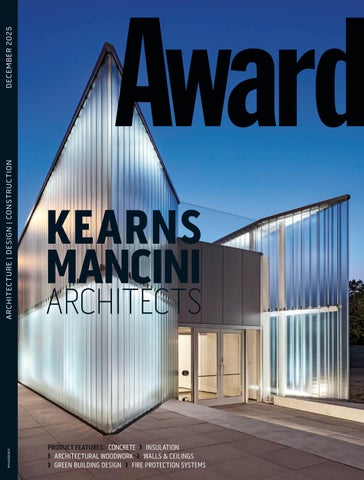
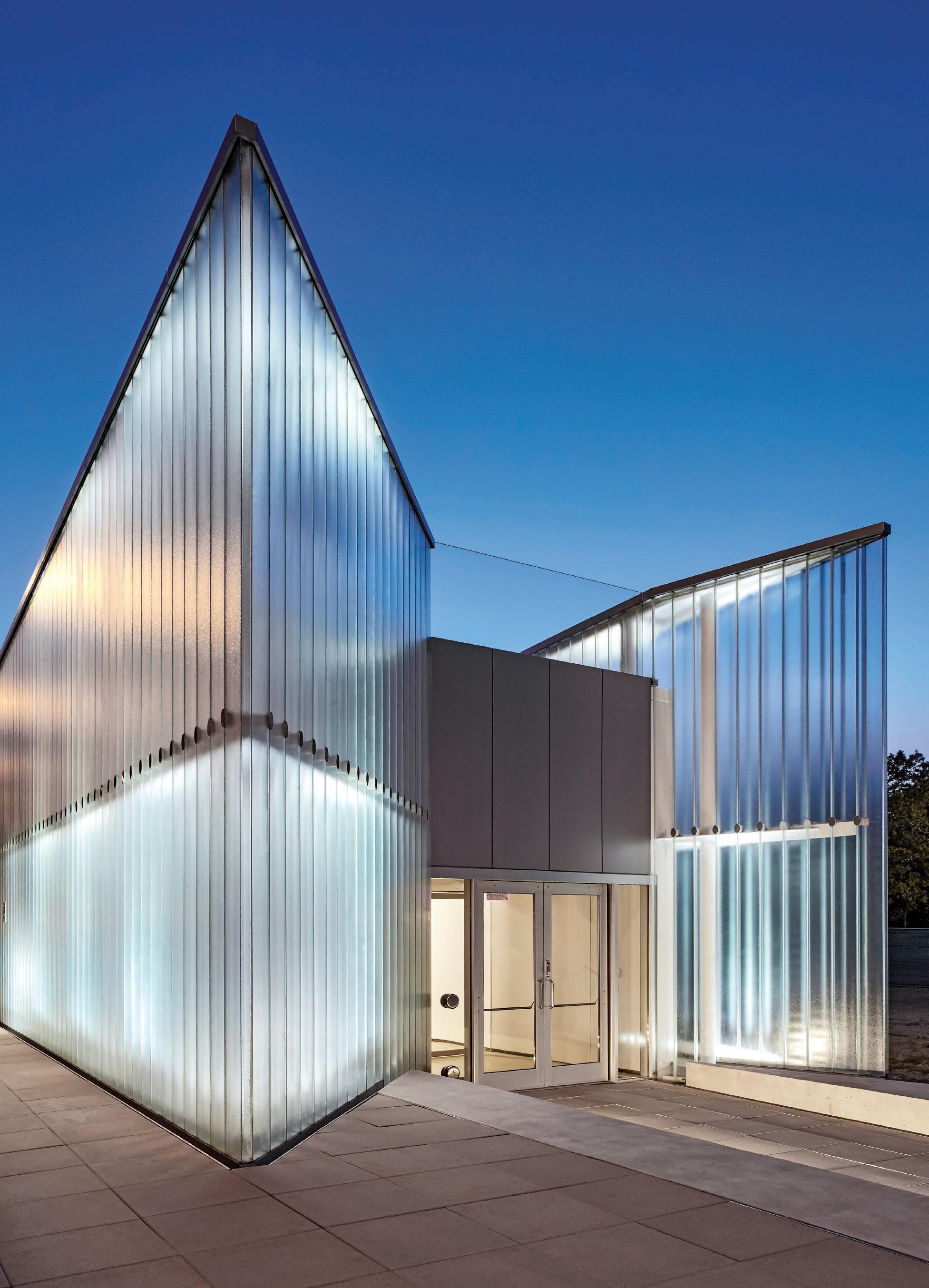
KEARNS MANCINI ARCHITECTS

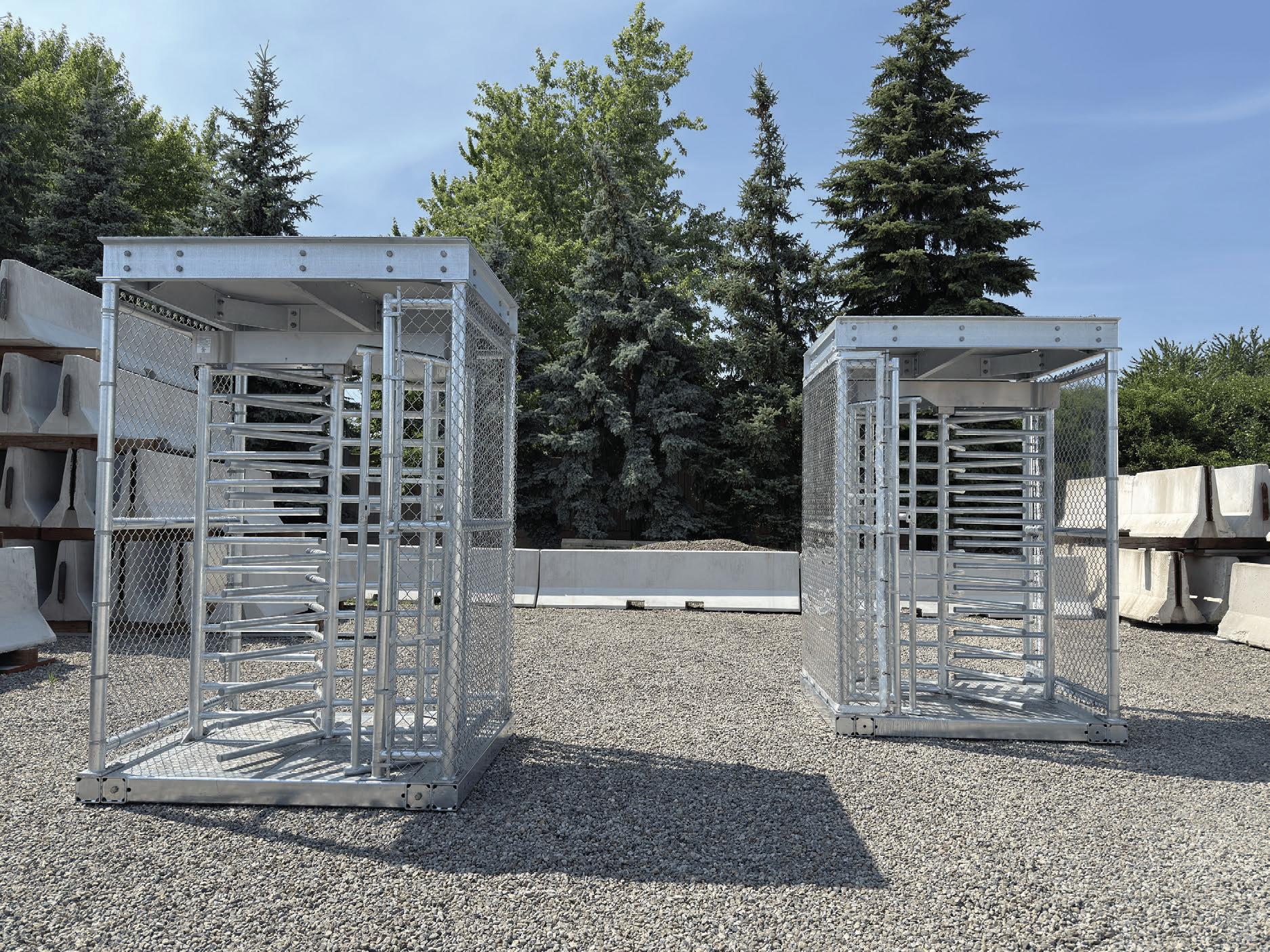
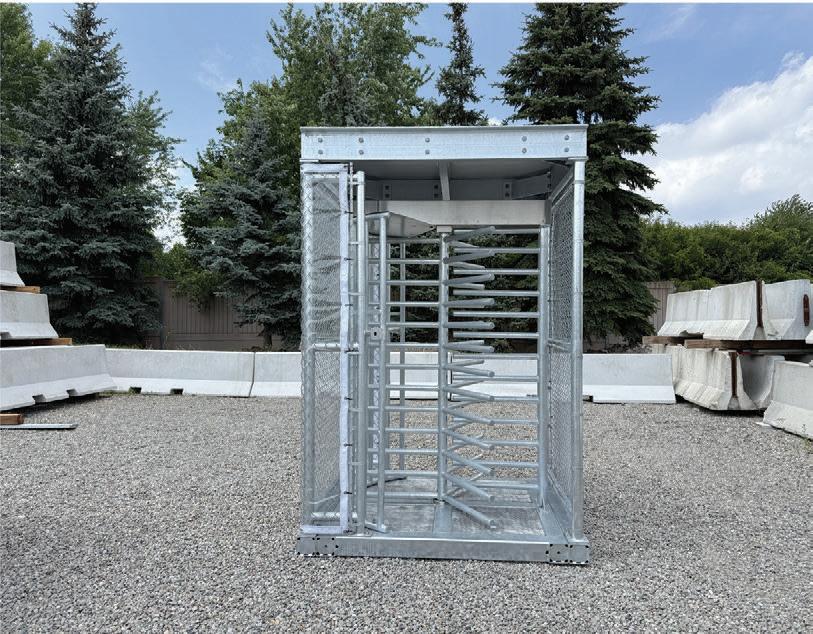
Single & Double options.
Optional roof for all-weather use.
Easy integration with any access control system.

ACCESS YOU CAN SEE / TRUST YOU CAN FEEL

45
Oak House Student Residence – University Of Toronto Toronto, Ontario 47
Bloor Collegiate Institute And ALPHA II Alternative School Toronto, Ontario 49
Centro Tower London, Ontario 53
Beaty Biodiversity Centre Addition – UBC Vancouver, B.C. 55
Verve And Symphony – UBC Vancouver, B.C. 59
Veterinary Learning Commons – University Of Calgary Calgary, Alberta 61
Canadian Food Inspection Agency (CFIA) Centre For Plant Health In B.C. North Saanich, B.C. 63
Cenovus Energy Hub Lloydminster, Saskatchewan 65
West Kelowna Fire Hall #32 West Kelowna, B.C. 67
Student Housing – University O f The Fraser Valley Abbotsford, B.C. 69
Fulmer Family Centre For Childhood Studies – Capilano University North Vancouver, B.C. 71
Queen Richmond Centre West – Phase II Toronto, Ontario
72
West Coulee Station Elementary School Lethbridge, Alberta 74
Kitchener Southwest Community Library Kitchener, Ontario
75
Abbotsford Recreation Centre (ARC) HeRO Project Abbotsford, B.C.
77
Quw’utsun Secondary School Duncan, B.C. 78
Calgary Soccer Centre Dome And Artificial Turf Upgrade Calgary, Alberta 81
Elementary School Langford, B.C.
83
Basin Glacial Waters – Fairmont Chateau Lake Louise Lake Louise, Alberta

39
4
RAIC PERSPECTIVE
Reimagining architectural procurement in Canada.
6
AGENTS OF CHANGE
Kearns Mancini Architects Inc. has been designing spaces that inspire for more than four decades.
9
SLAB OF POWER
Innovations in AI and design are creating fresh opportunities across the concrete sector.
21
CANADA’S NET ZERO PLAYBOOK
Green building design is evolving rapidly as experts shape the future of Canada.
27
HOT OR NOT?
Adaptable insulation technologies deliver savings, sound control, and performance.
33
FINDING YOUR GROOVE
Architectural woodwork continues to carve out success in some unexpected places.
39
SUPPORT IN STYLE
Walls and ceilings are shaping spaces like never before.
42
OPENING DOORS TO PROTECTION
School safety and lithium-ion battery risks are among the considerations for today’s fire protection systems experts.
Reimagining architectural procurement in Canada
At the 2025 Conference on Architecture, hosted by the Royal Architectural Institute of Canada (RAIC), a session convened by the Fees and Procurement Working Group (FPWG) tackled a critical issue in the profession: the disconnect between architectural fees, procurement processes, and the actual value architects contribute to society.
Structured around six core questions, the discussion created space for delegates from across Canada to reflect on shared concerns, systemic challenges, and practical ideas for reform. What emerged was a clear imperative, to rethink how architectural services are procured and understood, and to ensure they reflect the profession’s strategic role in advancing public interest, quality of life, and long-term economic outcomes.
A PROFESSIONAL ROLE THAT SERVES THE PUBLIC GOOD
The conversation began with a reflection on public perception. Delegates emphasized that architects remain widely misunderstood, as luxury consultants or creative artisans, rather than as trained professionals delivering essential cultural, environmental, and economic benefits. Participants stressed the need to reposition architects as strategic contributors to public health, safety, sustainability, and community well-being.
There was broad support for defining architecture as a public-interest service with societal impact. Participants called for better public communication strategies, stronger narratives, and tools that allow architects to demonstrate the long-term value of design decisions, especially those made early in a project lifecycle. The RAIC’s role in equipping architects with advocacy tools and education materials was highlighted as essential.
UNDERCUTTING AND THE EROSION OF QUALITY
The issue of fee-based competition was a focal point. Delegates spoke candidly about the professional and ethical implications of undercutting, where firms lower fees beyond sustainability to secure work. While such practices may offer short-term wins, they undermine design quality, limit innovation, and place unsustainable pressure on teams.
Regional disparities in billing practices and the influence of liability insurance were also cited as contributing to inconsistent pricing and expectations. Delegates urged professional organizations to promote ethical fee practices and develop clearer standards that prioritize quality and qualifications over cost. A national architectural policy was identified as a possible mechanism for consistency and reform.
PROCUREMENT SYSTEMS IN NEED OF REFORM
When discussing procurement, the group put forward a range of strategies to improve fairness and transparency. These included the adoption of qualification-based selection (QBS), the development of standardized RFP templates, and reduced reliance on price as a primary scoring metric.
Aligning scope, deliverables, and evaluation criteria was considered vital to reducing project risk and ensuring better project outcomes.
Delegates called for the RAIC to lead efforts in advocating for these changes with public sector clients and to provide tools and training to support architectural firms in pursuing equitable procurement opportunities.
VALUE, NOT JUST COST: A NEW NARRATIVE
Delegates consistently returned to the need for a paradigm shift, from treating architecture as a cost to seeing it as an investment. Welldesigned buildings and infrastructure reduce operating costs, manage risk, improve health outcomes, and build community resilience. Framing architectural services this way can helps foster long-term partnerships and strengthen public trust.
Delegates recommended the use of clear, phased service breakdowns to improve client understanding and to avoid the misperception of design fees as arbitrary. The session also surfaced confusion about the RAIC Fee Guide and its varied use across jurisdictions. Addressing this inconsistency through clearer communication and regional engagement was identified as a critical step.
INNOVATIVE MODELS AND GLOBAL EXAMPLES
Participants explored emerging models that could support more robust and responsive approaches to fees and service delivery. Examples included international tools like the RIBA fee calculator, outcome-based contracts such as post-occupancy evaluations, and new fee structures based on project complexity or community engagement needs.
Delegates also noted the potential for technology to support fee transparency and service differentiation. Areas such as digital design review, lifecycle analysis, and participatory planning were identified as possible avenues for expanding services and creating new value propositions.
UNIFIED ADVOCACY FOR A STRONGER FUTURE
The final theme of the session focused on advocacy. Delegates encouraged the development of multi-format campaigns, including videos, award programs, and thought leadership content, that communicate the value of architecture to diverse audiences. Employer branding, client education, and coalition-building with engineers, planners, and contractors were also seen as crucial to amplifying the message.
A strong recommendation was for the RAIC to provide member firms with advocacy and communications toolkits tailored to different audiences: clients, decision-makers, and the public. These tools would help firms articulate the link between fees, scope, and outcomes in a way that resonates beyond the profession.
ONGOING WORK AND NEXT STEPS
This session was a catalyst, not an endpoint. Delegates urged the RAIC and its working group to maintain momentum through concrete initiatives: developing a national construction cost calculator, reviewing the current RFP processes, updating the RAIC Fee Guide, and continuing this dialogue at the 2026 Conference on Architecture. By taking up these calls to action, Canada’s architecture community can ensure that architectural services are not only fairly compensated, but also properly understood as critical investments in sustainable, resilient, and inclusive communities.

Agents Of Change
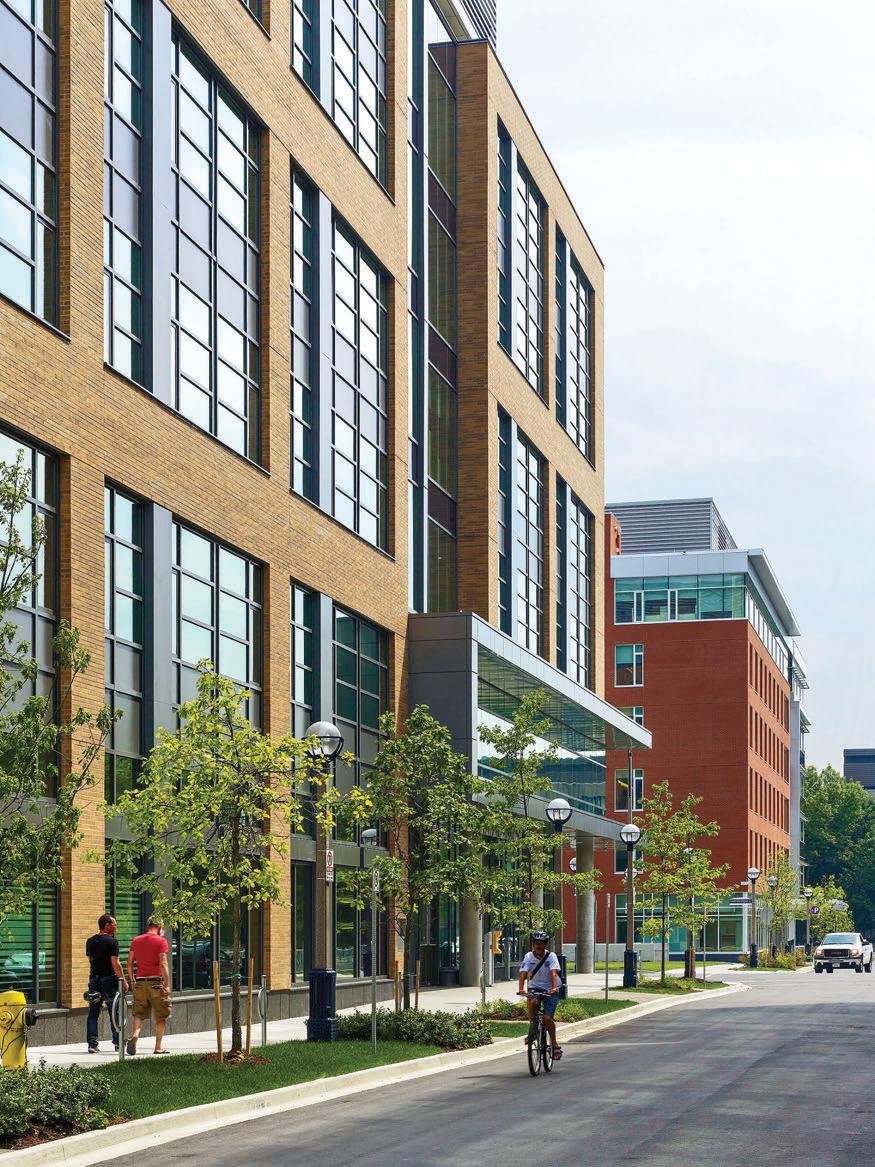
Kearns Mancini Architects Inc. has been designing spaces that inspire for more than four decades
by
NATALIE BRUCKNER
| photography + rendering courtesy KEARNS MANCINI ARCHITECTS INC.
The year was 1984. Canada’s economy was thriving, and Toronto was on the cusp of a five-year real estate boom. In a loft at the corner of Widmer and Richmond streets in Toronto, two young designers, Jonathan Kearns and Anthony Mancini, began shaping an idea. What started as sketches and late-night conversations would grow into one of the most innovative and environmentally-conscious design firms, with influence extending far beyond the province and onto the global stage. This was the birth of Kearns Mancini Architects Inc. (KMAI).
From the beginning, both founders were motivated by a desire to bring intelligent, positive change to the environments and lives of individuals and their communities through thoughtful, but not iconoclastic architecture. “We were inspired by some of the great change experiments of 20th-century modernism, such as the Bauhaus and Brasilia, but we were particularly interested in how these grand design experiments trickle down and are used to improve everyday life in homes and in cities, as they did in our favourites, Rio de Janeiro and São Paulo,” explains Mancini.
“We were always up for a challenge,” adds Kearns. “We undertook projects in architecture, urban design, heritage conservation, landscape architecture, and interior design, not only in Canada but also in Ireland, the UK, and Brazil.”
Every detail mattered. Every calculation, every material choice, every structural decision reflected their pursuit of technical perfection – a pursuit that would evolve into groundbreaking work in low-energy and low-carbon design.
Early on, a Postmodern emphasis on history and placemaking informed the collective design approach, but the founders preferred to keep their design vocabulary modernist and forward-looking, always respecting the finest lessons of their urban and architectural legacy. Over time, this focus grew into a
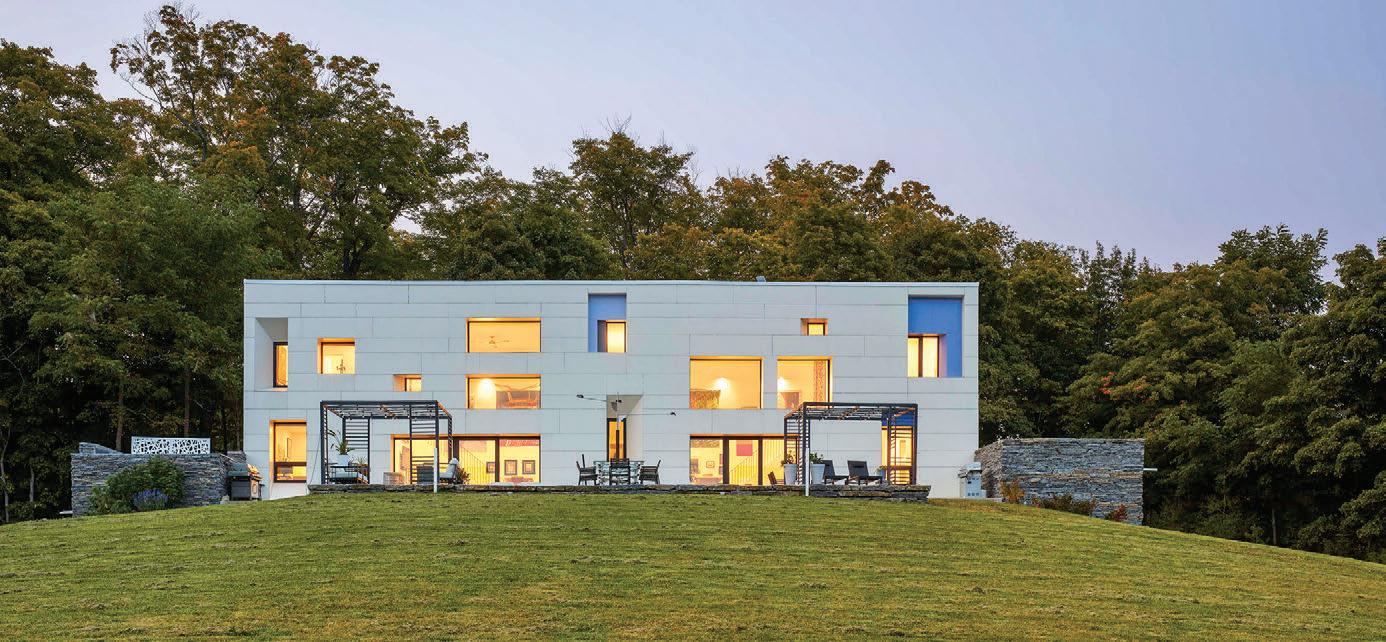
UTIAS Microsatellite Science and Technology Centre
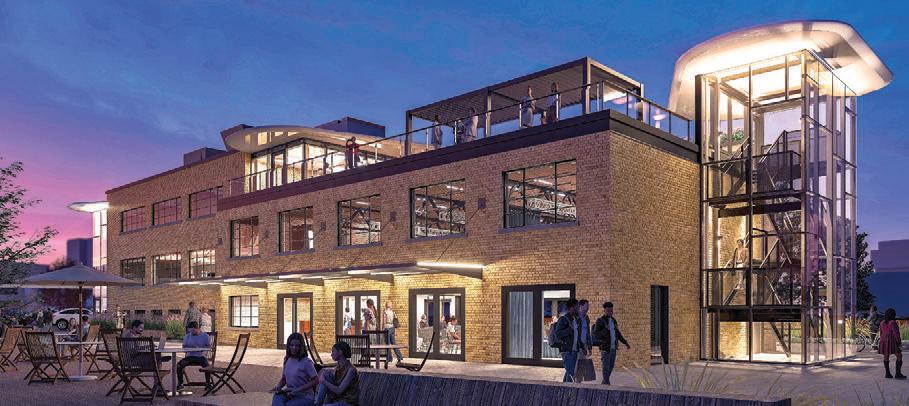
CAMH at Queen Street West Phase 1B
philosophy of architecture as a form of cultural engineering. It was an approach that activated their collective imagination and, in later years, evolved into a vision of architecture as a holistically designed engine for sustainable living within cultural ecosystems.
“Our very early embrace of the science and technology-focused Passive House Standard drove our design focus toward finding the perfect balance between sustainable performance and cultural expression,” says Kearns.
It was this fearless pursuit of challenging projects that led them to reimagine 43 acres of Belfast’s port lands, now known as the Titanic Quarter; to redesign the world’s oldest mental hospital, St. Patrick’s in Dublin; and to found the consortium that won the commission for the new CAMH at Queen Street West in Toronto.
KMAI’s portfolio is truly rich and varied. Take The Corleck adaptive renovation that is currently under construction. Building on their experience with landmark cultural projects such as the Fort York Visitor Centre and the award-winning Ireland Park, KMAI is transforming the former Canada Malting Company administrative building on Eireann Quay into The Corleck, a 9,600-square-foot, two-and-a-half-storey, six-level cultural arts and community hub celebrating Irish-Canadian connections.
Then there’s the award-winning Passive House MURB, YWCA Hamilton, that was completed in 2021. Similar to KMAI’s high-performance residential projects such as Meadowbrook Passive House development and Bay Cannon Hamilton, the YWCA Hamilton is one of Canada’s first mid-rise multi-residential Passive House developments, setting a bold new standard for sustainable, affordable housing. The project delivers a healthy, comfortable living environment while tackling climate and housing challenges head-on. “The fusion of creative architecture and science-based Passive House is our greatest challenge,” says Kearns.
Other incredibly notable projects that demonstrate the breadth and ambition of KMAI’s work include the UTIAS Microsatellite Science and Technology Centre that was completed in 2012 and combined a world-class research facility with bold, expressive architectural form, reflecting the firm’s ability to balance technical complexity with visual impact. That same year, the CAMH redevelopment, master plan phases 1A and 1B, demonstrated KMAI’s ongoing commitment to advancing mental health care through thoughtfully designed spaces.
While biophilic design may have only recently hit the headlines, back in 2020 the firm completed the nature-inspired Endymion Guesthouse in the bucolic landscape of Black Creek, Prince Edward County, Ontario, bringing a serene, environmentally sensitive vision to residential design. This year, the
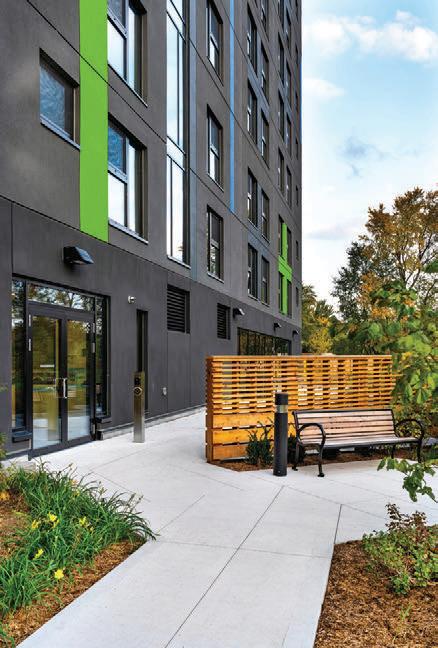
BMO Fischer Hallman sustainable branch raised the bar for sustainable design in financial institutions. Designed with CLT to Passive House Classic and Zero Carbon standards, the building operates at net zero energy.
So, who exactly are the talented minds behind such groundbreaking projects? It’s a collaboration of energetic individuals nurtured by a culture rooted in learning, mentorship, curiosity, and shared design exploration. “We balance imagination with pragmatism, approaching construction and cost thoughtfully while pursuing innovative design. We value inclusivity, encourage diverse perspectives, and celebrate milestones together, from design reviews to office traditions that keep our team connected. We are very supportive of each other and feel like a family – one that loves to throw a good party,” explains Kearns. And a “family” that is known for asking a lot of questions!
“Our approach is one where we are driven to truly understand and define the soul of each project and never rest until we have found the ideal solution,” says Mancini. “A solution that allows the end-users of the building to naturally become a part of their new space while being liberated by it.”
And with so much achieved already in four decades, what can we expect from KMAI in the future? “We are excited by the opportunity to shape a sustainable future through Net Zero, Passive House, and innovative and artistic architectural solutions. The challenges of climate change and affordability inspire us to push the boundaries of design, research, and technology in service of healthier, more resilient communities,” says Kearns. A
The Corleck
Endymion Guesthouse 3100 Meadowbrook Lane
Fort York Visitor Centre
Build Smarter. Build Faster.
Build with Prefab Precast Concrete.
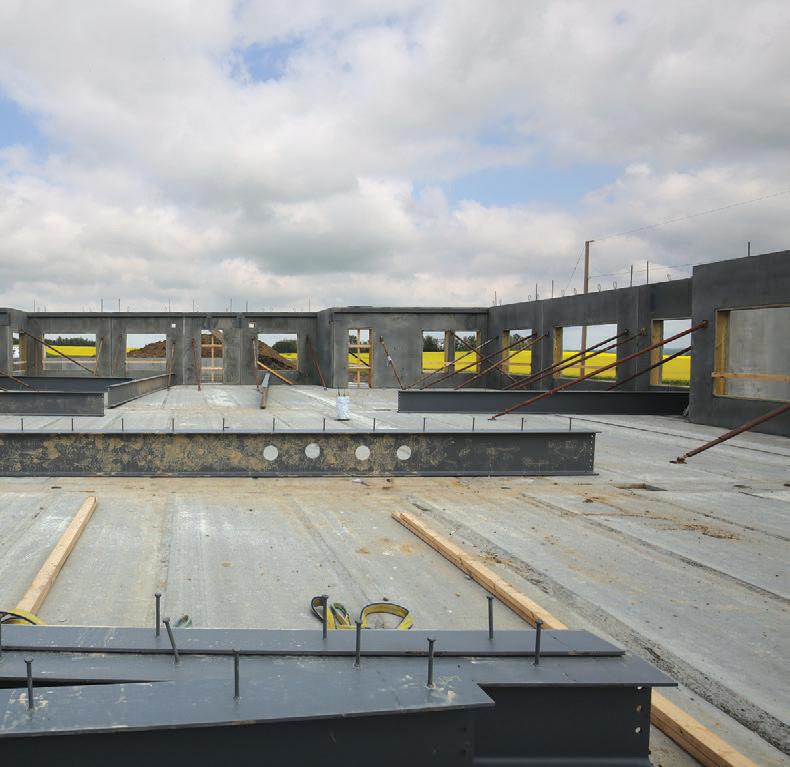
In response to Canada’s housing crisis, prefab precast concrete provides a powerful solution. It is faster, durable, and cost-effective, as each component is made in a controlled environment. Prefab precast concrete offers superior quality, making it a resilient and sustainable approach to addressing Canada's mid to high–rise housing shortage.
Find out more about the benefits of using prefab precast concrete for your next project.
Let’s build fast, affordable housing together!

For more information, visit: www.cpci.ca/publications or scan the QR Code.
Charis
Village, Lacombe, AB |
Owner: Charis Village Housing
S ociety
|
Architect:
OCA Architects
SLAB of POWER
Innovations in AI and design are creating fresh opportunities across the concrete sector
by ROBIN BRUNET

The end of 2025 finds concrete advocates and manufacturers in a familiar spot: in a market of robust demand, and striving as always to advance concrete’s reputation as a sustainable building material.
Arguably the most vigorous advocate of precast/prestressed concrete is Brian Hall, managing director of the Canadian Precast Prestressed Concrete Institute (CPCI), who is effusive in explaining precast concrete’s sustainable benefits.
“Due to the inherent high-performance qualities of precast concrete, buildings that perform better and last longer can naturally help reduce the longterm impact on climate change. While all long-term operational benefits are significant, it is also important to address the effects of climate change in the short term,” says Hall. “The goals of the precast concrete industry include reducing greenhouse gas emissions by lowering carbon emissions during production, decreasing the amount of Portland cement used in concrete mixes, and increasing strength and durability while using less material.”
Hall goes on to note that, “An ongoing innovation is the use of supplementary cementitious materials [SCMs] that can reduce the amount of Portland cement in concrete. Recycled by-products such as fly ash, slag cement, and silica fume are commonly used to decrease cement content, while also enhancing the strength and durability of the precast concrete. Since the publication of our first industry-average EPD [environmental product declaration] in 2015, the Canadian precast industry has
seen a 22 percent reduction in our embodied carbon across our main product categories, as documented through CPCI’s three rounds of EPDs.”
Hall adds that precast concrete’s durability and resiliency give it a service life of 100 years or more.
“No other building material matches precast concrete in terms of resiliency, sustainability, blast
resistance, storm resistance, inherent fire resistance, and overall durability,” he says. “The precast concrete industry continues to explore innovative new technologies to increase production efficiency and reduce embodied carbon and greenhouse gas emissions.”
Amrize Building Materials, which was announced as the name of Holcim’s North American business sector in February 2025, is one of many examples of a company whose collaborative capabilities advance concrete as a sustainable material. A major example is its recent partnership with U.S. technology company Meta.
Together, the two companies created a first-of-its kind AI-optimized concrete mix for surface use that was 43 percent faster in early strength and 35 percent less carbon-intensive – all at similar cost.
Essentially, Meta, with the University of Illinois, used concrete ingredients from Amrize to generate, mix, and test recipes in a lab, the data of which (mix meets strength and other performance parameters) was used to train an AI model developed by Meta. This project moved from theory into practice when Amrize then became the main concrete supplier for Meta’s new data centre in Rosemount, Minnesota – data centres in general require excellent finish quality of the concrete for the installation, operation, and maintenance of mission-critical servers.
Jaime Hill, president of Amrize, says, “Partnering with Meta and using AI to develop an innovative concrete mix that meets the unique needs of data centres is just the beginning. Using AI, we can optimize our specialized concrete formulations for data centre requirements, from performance needs like
Poured concrete floor at Meta’s new data centre.
Precast panels with pre-installed windows, Odea, Montréal, QC.
strength and durability to thermal regulation and energy efficiency. We look forward to continuing this exciting work with Meta to scale up the adoption of advanced tailored concrete mixes.”
Providing new housing in huge volumes across North America is a social challenge that has inspired at least two concrete companies to develop innovative solutions. The first comes from Lodestar Structures, which was launched into the Canadian construction industry by Anchor Concrete Products in 2020, immediately receiving multiple industry awards and earning international recognition. In 2021, Lodestar Structures introduced a global licensing program, expanding access to Lodestar Structures to companies around the world. Today, Lodestar is actively engaged in various stages of planning and contract negotiations with teams in more than 60 countries.
Phillip Searles, director of global sales and business development, says, “Essentially, with Lodestar, we created a solution for communities to have immediate access to high-quality, locally manufactured building components, allowing them to rapidly erect structures where they can confidently live, learn, work, and play.
“Our manufacturing program is scalable to address demand growth and can be deployed in remote communities as efficiently as in urban regions. A major advantage of Lodestar is that the components used in the manufacturing process can be sourced locally, and the skill level required to manufacture or install the modules isn’t extreme,

allowing teams to competitively deploy Lodestar Structures without the requirement for highly skilled individuals, and without the need for major equipment investment.”
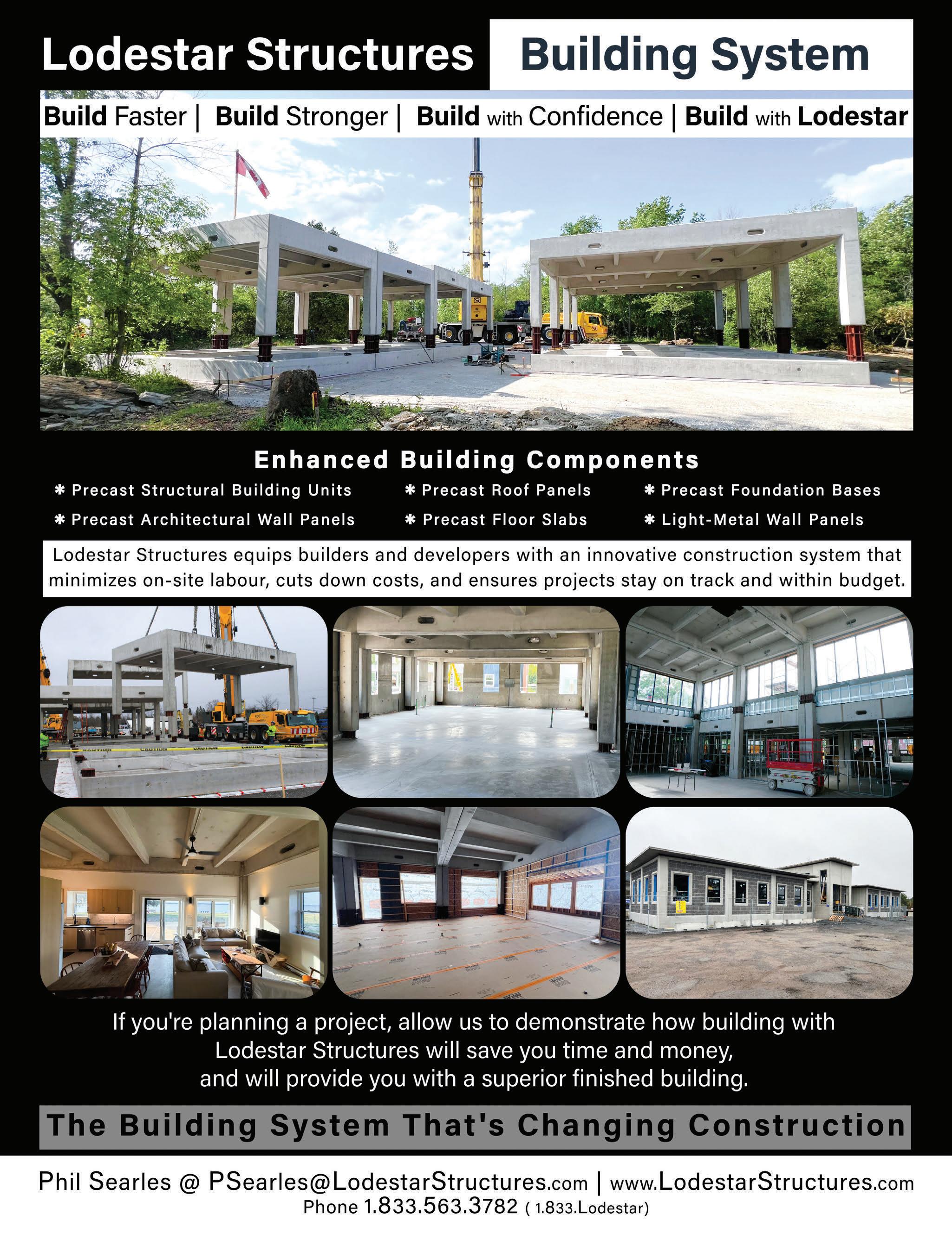
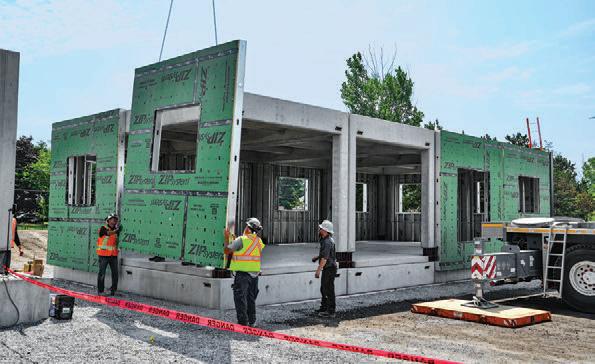
Lodestar consists of precast foundation base units, precast structural building units, and precast panels used for perimeter cladding. Components are manufactured offsite and delivered to the construction site ready for immediate installation; they are designed to provide unlimited building designs and layout options. The construction process reduces superstructure framing schedules by as much as 90
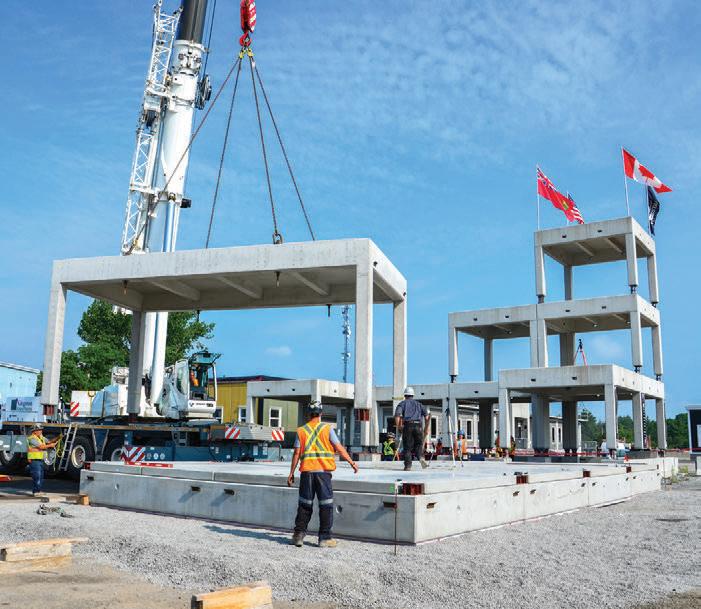
percent and overall construction time by up to 50 percent, allowing builders to concentrate on enclosing the structures and completing interior works.
Searles describes business in 2025 as “fantastic,” and while Anchor continues to ship products across Canada, he is most excited that Lodestar has established license agreements in three countries and will add another six countries in 2026. “We’re in discussions with potential licensees in over 60 countries, including Africa, South America, Mexico, and Australia,” he says. “The potential for growth is phenomenal and limitless.”

Lodestar consists of precast foundation base units, precast structural building units, and precast panels used for perimeter cladding.
THE SMARTER WAY TO MULTI-FAMILY

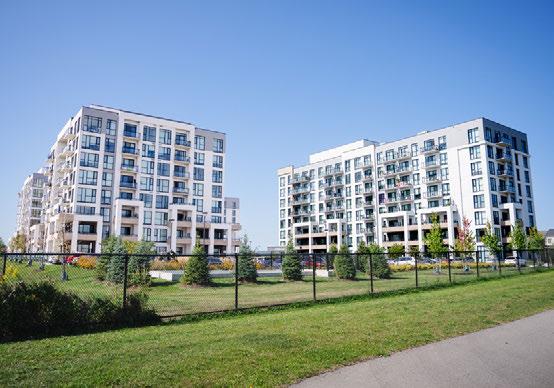
Accelerate your multi-family development with Stubbe’s Total Precast solutions; one system, one source, total efficiency.
Our Total Precast package combines structure, cladding, and hollowcore floors into a single, coordinated system for faster construction, higher quality, and fewer onsite delays.
Built in CPCI-certified facilities, Stubbe’s delivers precision, durability, and speed. Helping you build smarter and finish sooner.



MILE AND CREEK
In a similar vein, FastTrack by Stubbe’s is an ingenious modular precast system that enables developers to deliver buildings faster and at a competitive price. “We’ve driven the cost of residential projects by 20 percent, or in one case down to $225 per square foot, and we’re not done making adjustments that will lower costs even further,” says Jason Stubbe, managing director at Ontario-based Stubbe’s.
FastTrack modules, which meet the criteria required by the CMHC, are comprised of standardized precast pieces that include floors, ceiling, walls, and exterior building envelope (with windows and patio doors) all in one enclosed unit. Interior finishes are still built out traditionally, but by integrating the design, manufacturing, and installation processes off-site, construction time and on-site labour requirements are significantly reduced.
And while the parameters of the modules can’t be adjusted, they can be combined to achieve a huge variety of layouts. “And we deliver quickly,” Stubbe says. “If a customer needs a 50-unit building, we can give them a working plan within 10 days.” Indeed, a five-storey, 50-unit rental building from Livwell Development in Niagara Falls was completed less than one year after breaking ground, six months ahead of the anticipated completion schedule.
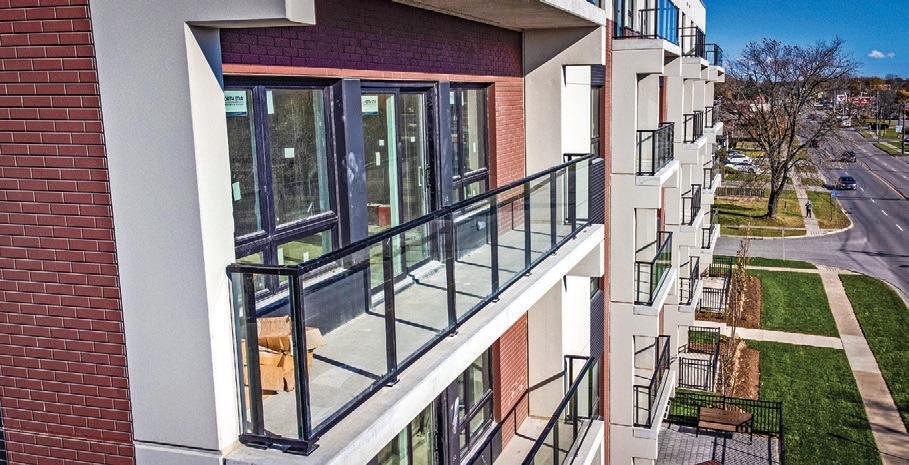
More importantly, from an end-user’s perspective, all of the projects built with the FastTrack system exhibit the quality and aesthetic appeal of high-end condos. “We’re coming off our busiest year ever, and the New Year is very promising,” Stubbe says. “We have the capacity to build 3,000

Diamond Polished Concrete.
A Strong & Beautiful Concrete Flooring Solution
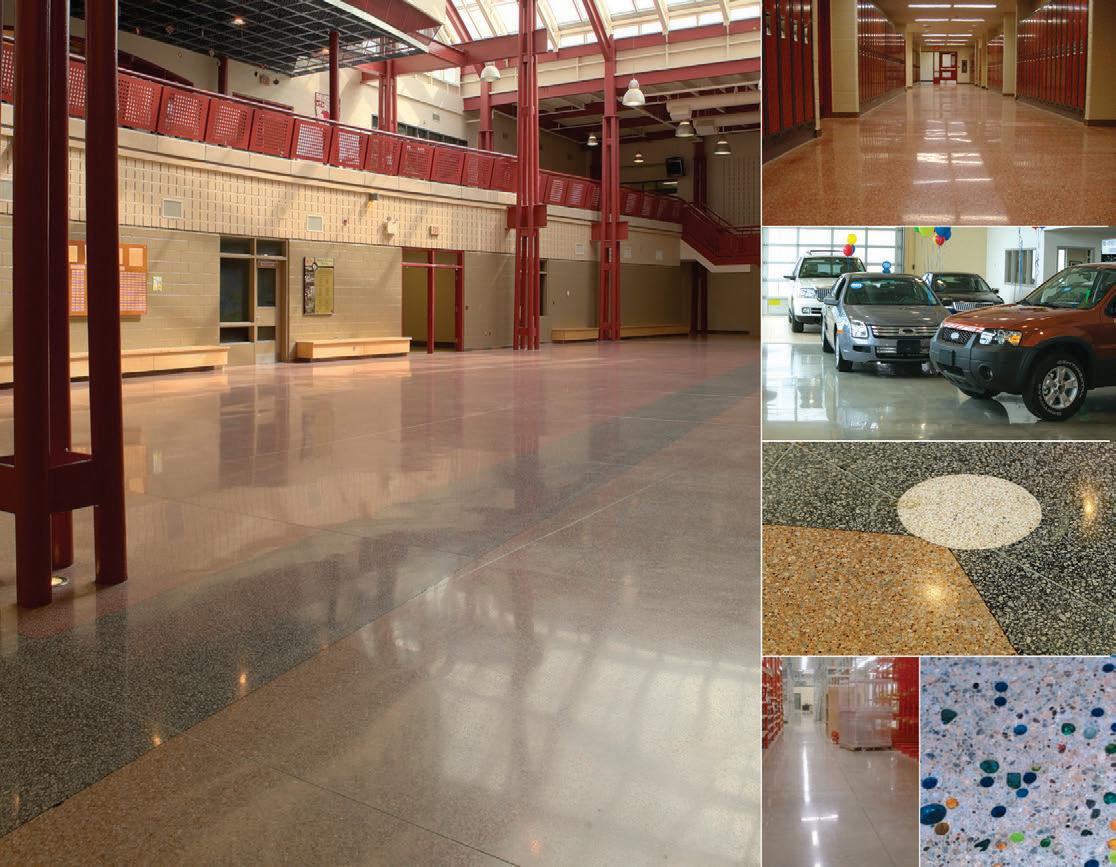
Diamond Polished Concrete is a unique, advanced flooring system that brings out the natural beauty of concrete, helps reduce maintenance costs and enhances the natural durability of concrete surfaces. The Tri-Con Diamond Polish System employs an innovative 7-step grinding and polishing process that utilizes progressively finer diamond grinding heads. This system also uses the most advanced penetrating sealer technology.
Tri-Con Concrete Finishing is an industry leader with more than 30 years experience in the concrete industry. We are a one-stop supplier capable of pouring new floors to exact specifications as well as restoring existing concrete surfaces with endless versatility. We guarantee that we deliver on time, on budget and on spec every time.
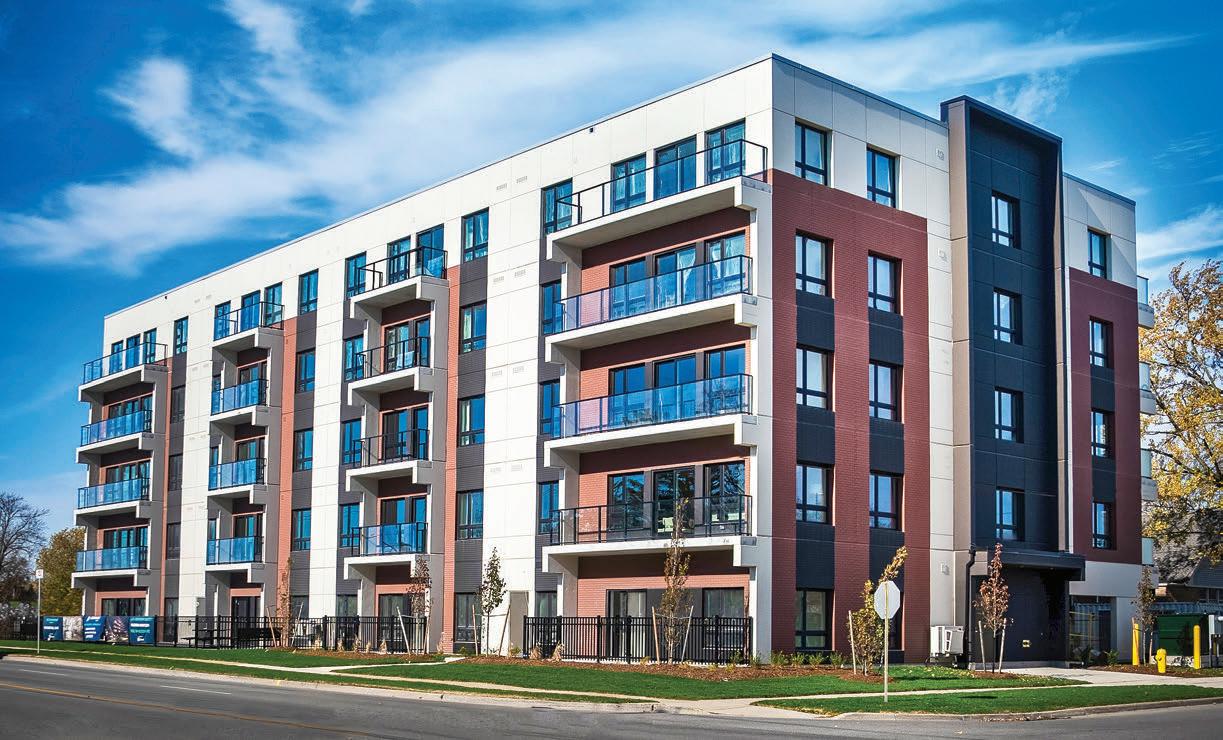
FastTrack modular precast system utilised on The Drummond, Niagara, ON.


PRODUCTS
• Black, Stainless & Epoxy Coated
Rebar • Threaded Rebar
• Welded
Wire Mesh • Reinforcing Steel
Accessories • Plain Round Bars
• Post Tensioning Systems
• Mechanical Couplers
SERVICES
• Consultation
• Budgeting
• Estimating
• Detailing
• Fabrication
• Installation







units annually, and given the need for quality residences and other infrastructure at a lower cost, we see demand booming.”
Since its founding 22 years ago, AltusGroup continues to spearhead precast concrete innovation, its main achievement being CarbonCast Enclosure Systems
that use advanced carbon fibre technology to improve precast concrete by integrating ultra-strong, noncorrosive C-Grid into the panels during fabrication.
CarbonCast High Performance Insulated Wall Panels use C-GRID as a shear connector between the inner and outer wythes of concrete, delivering


a panel with full composite action and continuous insulation; and CarbonCast Insulated Architectural Cladding is one of the only exterior architectural precast wall panels with continuous insulation to meet ASHRAE requirements (it also weighs up to 40 percent less than conventional precast wall panels).
Licensing CarbonCast has enabled this system to be used internationally, and in February, Belgian precast manufacturer C-concrete became the latest producing member of AltusGroup. “C-concrete’s experience with walls, façade panels, insulated sandwich panels, and brick veneer panels will enable it to integrate CarbonCast technology into existing enclosure platforms to produce highly sustainable, low-carbon footprint sandwich panel wall assemblies to satisfy European market needs,” says Katherine Klosowski-Blatz, AltusGroup’s executive director.
As for products that aid concrete’s performance and resiliency, Peikko Group Corporation is renowned globally for its slim floor structures and connection technology for precast and cast-in-place construction, thus aiding the ongoing goal to build faster, safer, and more sustainably.
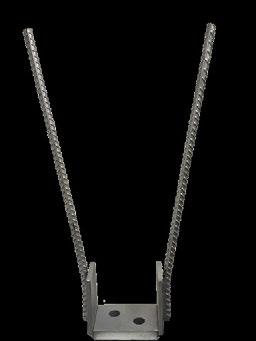
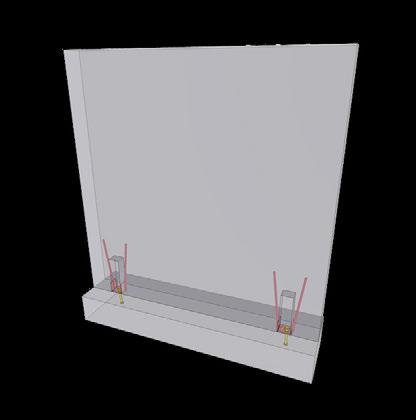
Sumo Flex is the latest product from Peikko to benefit concrete, specifically precast wall panels. Sumo Flex Bolted Wall Panel Base Connections provide a fast and efficient alternative to traditional embed and welded items for connecting precast concrete wall panels to foundations. By eliminating on-site welding, Sumo Flex significantly reduces labour time and also eliminates the need for costly fire watch supervision.


Nova Scotia Community College’s Ivany Campus student residence built with CarbonCast High Performance Insulated Wall Panels.
Strong, innovative, sustainable.

EvoBuildTM is the evolution of sustainable building materials designed to meet today’s sustainability targets.
With knowledgeable experts, science-backed data and sustainable product formulations, we’re able to work alongside you, offering unparalleled service from concept to completion.
EvoBuild™ Low Carbon Concrete is part of Heidelberg Materials’ Evolve™ Family of Products. Learn how these revolutionary products can help your project be part of a greener tomorrow.

Sumo Flex is designed for use with three-quarter-inch post-installed anchors and features two bolt holes for enhanced flexibility during installation. The components are optimized using finite element analysis and manufactured from ASTM Grade 50 plates and Grade 60 reinforcement bars.
The connection accommodates a six-degree bolt angle and achieves a tension capacity of 10 kips. Sumo Flex is ideal for applications where speed, flexibility, and code-compliant performance are required without the complications of welded field connections.
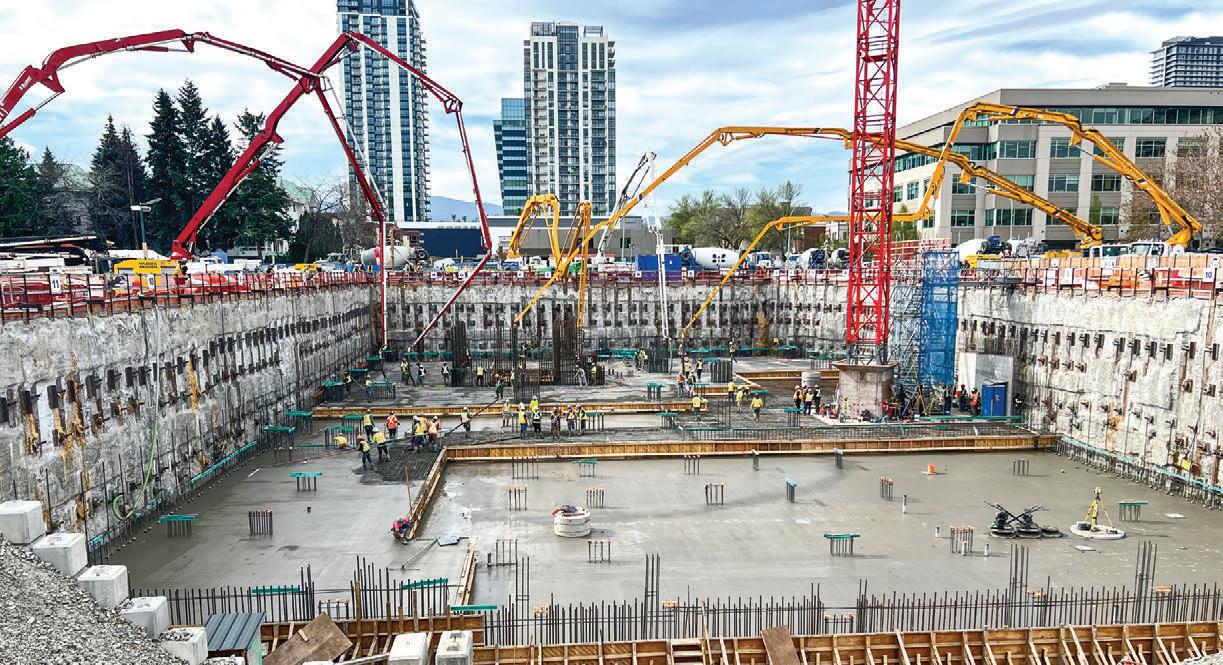
Also aiding concrete’s performance is Kryton International Inc., whose integral concrete waterproofing and durability solutions are used globally. Ironically, Kryton most recently achieved growth not by expanding, but by contracting: in July, CEO Kari Yuers explained that a decision to narrow Kryton’s product line from 150 to just 12 – focusing on integral concrete waterproofing with its awardwinning Krystol technology – sparked a new era of focused growth for the Vancouver-based company thanks to being able to streamline resources, double down on innovation, and ultimately accelerate global expansion.
As far as Yuers is concerned, this comes at an opportune time: for example, Yuers believes



outdated or untreated concrete is no longer acceptable in mission-critical infrastructure such as data centres, where even minor slab weaknesses or hairline cracks can lead to $1 million-per-hour outages.
Yuers also recently cited Krystol products as ideal solutions for America’s wastewater and stormwater systems, which in August received failing grades from the American Business Times: “Our admixtures are ideal for water infrastructure projects because they waterproof and abrasion-proof the concrete, ensuring a lifespan of around 100 years that not only secures the drinking water or sewage system of major population centres, but yields significant ROI for taxpayers and utilities who won’t have to keep paying for costly maintenance efforts.” A
BUILDING THE FUTURE

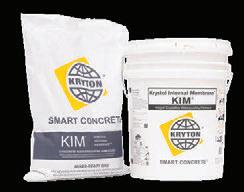


Foundation concrete pour of the 43-storey campus tower at UBC Okanagan.











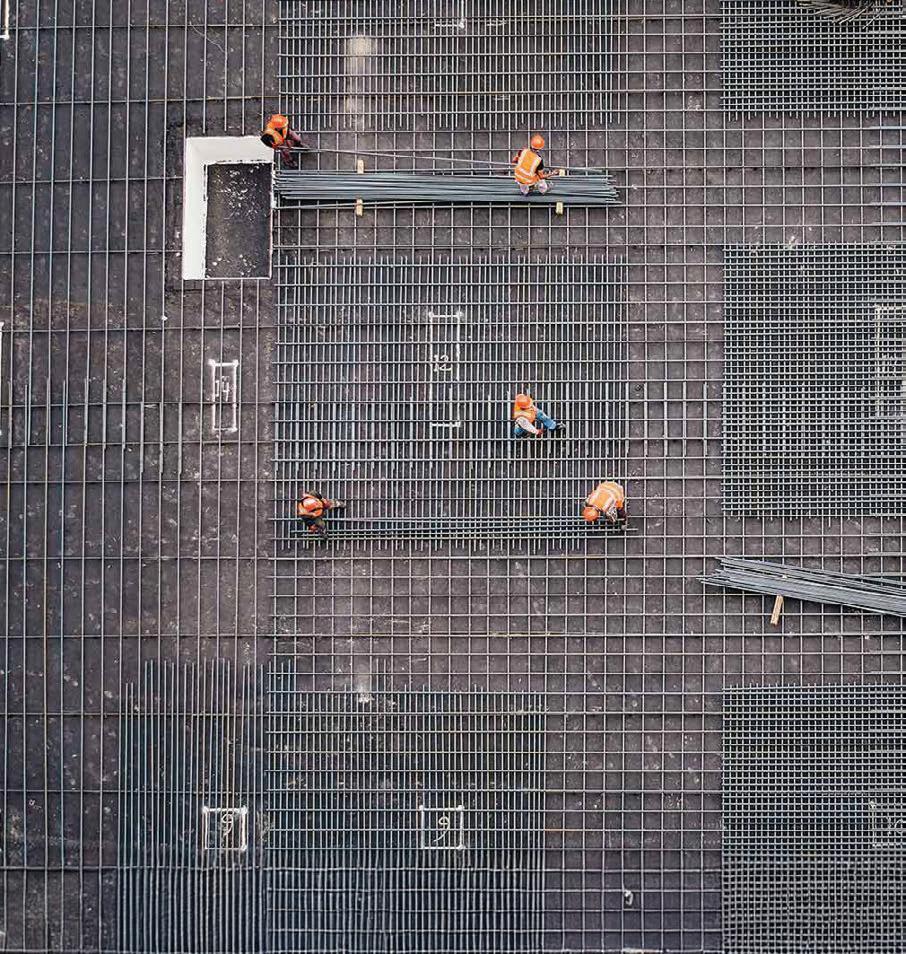

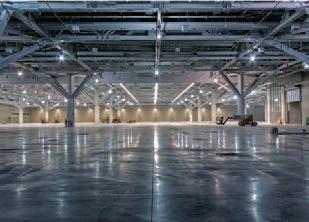

PRECAST CONCRETE QUALITY ASSURANCE!

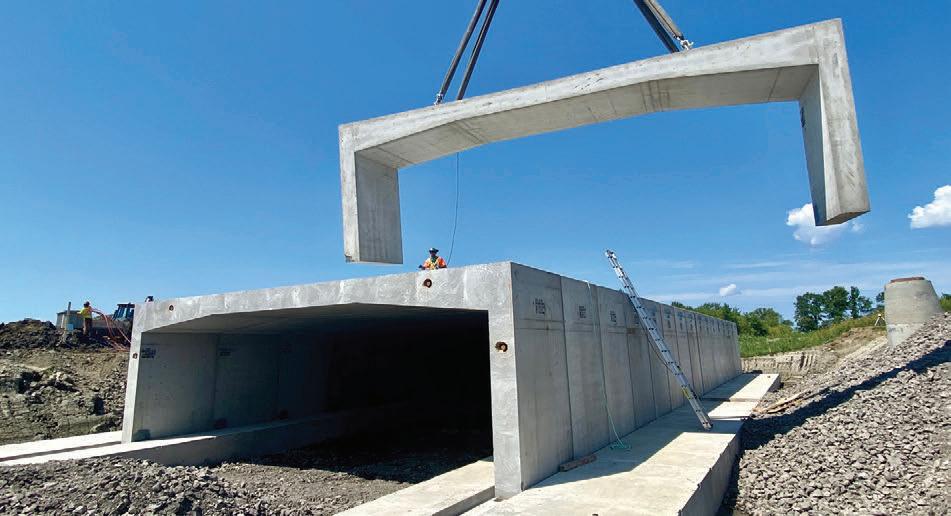

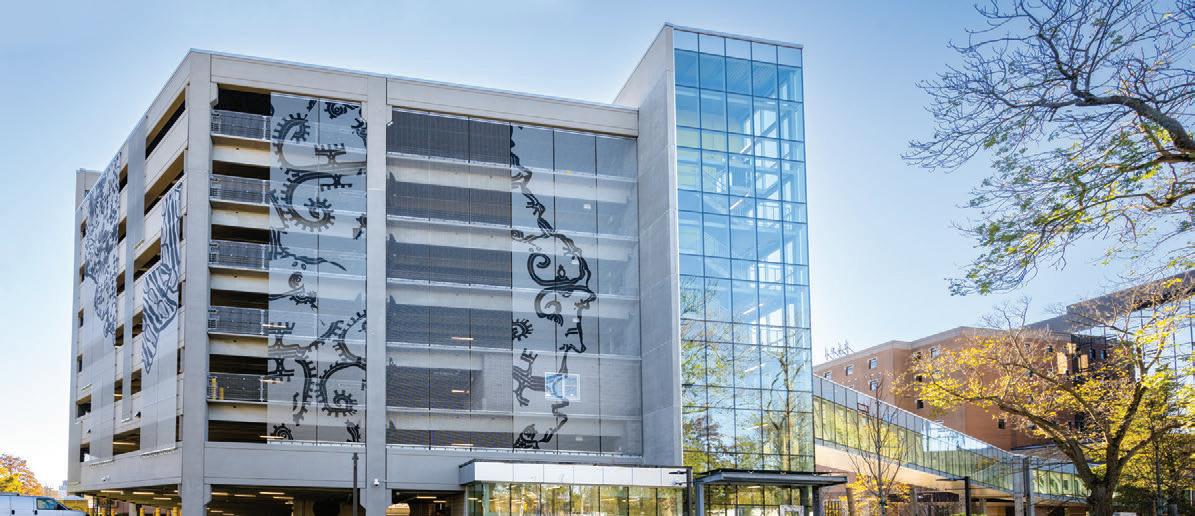
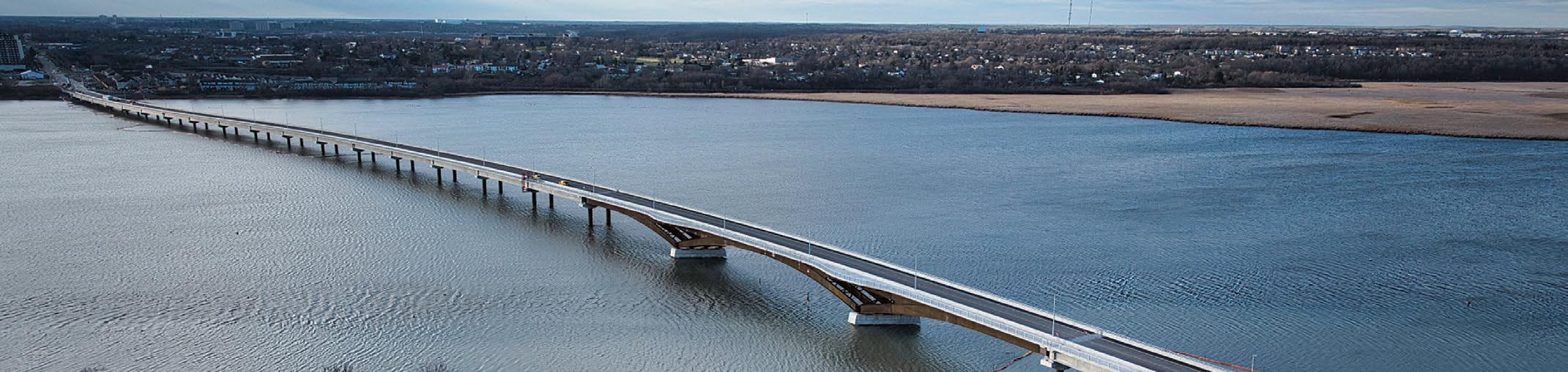
THE CPCQA CERTIFICATION PROGRAM
The Canadian Precast Concrete Quality Assurance (CPCQA) Certification Program prequalifies precast concrete manufacturers who fabricate structural, architectural and specialty precast concrete products, including concrete pipe and underground utility and drainage products.
Manufacturers adhere to the CPCQA certification program requirements, and to the applicable requirements of the CSA, PCI, ASTM, and Provincial Standards.
THE CPCQA CERTIFICATION PROGRAM OFFERS KEY BENEFITS TO ARCHITECTS, CONTRACTORS, ENGINEERS, GOVERNMENT AUTHORITIES AND OWNERS.
Endorsed by the Canadian Concrete Pipe and Precast Association (CCPPA) www.ccppa.ca and the Canadian Precast/Prestressed Concrete Institute (CPCI) www.cpci.ca

For more information, scan the QR Code or visit www.precastcertification.ca
Project: Champagne Quarry Park, Calgary, AB
Architect: Gibbs Gage Architects
CPCQA
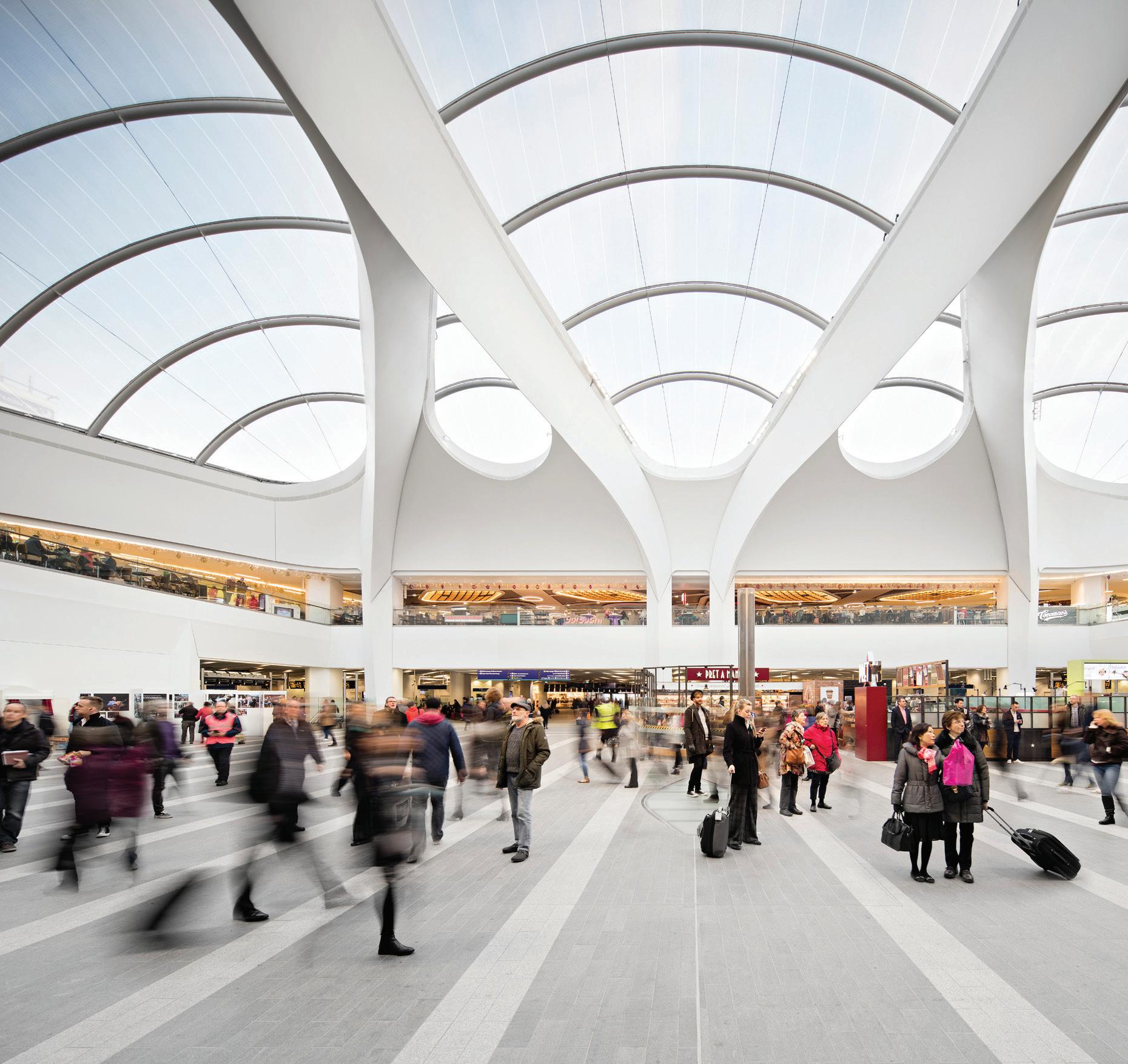
Connecting communities through purposeful architecture
Performance. Sustainability. Connectivity.
Scan the QR code to explore our vision for Canada
AtkinsRéalis Architecture & Design Canada Inc.

Green building design in Canada has continued to gain momentum this year, with advances in sustainable materials, low-carbon construction techniques, and operational efficiency reshaping the way projects are conceived and executed. Across architecture, engineering, and construction, the focus on energy performance and transparency reflects an industry increasingly committed to environmental responsibility, regardless of economic pressures or the regulatory landscape.
Among the most significant and potentially historic developments of 2025 in Canada (and one that hopes to fill a critical gap in the infrastructure and construction ecosystem) was the appointment of Hellen Christodoulou (former executive vice-president of Corbec) as president and CEO of the Canadian Galvanizing Institute. CGI-IGC is dedicated to supporting the promotion of durable, low-carbon solutions that contribute to Canada’s Net Zero goals.
“The reason I am taking this role is because during my journey at Corbec, I realized that if I want to advance greening standards, environmental product declarations, and improvements in corrosion protection – which are part of the operational side of infrastructure construction – we need alignment,” she says.
Christodoulou’s goal is to establish a Canadian framework that brings designers, galvanizers, procurement teams, government, and researchers onto the same page. “Currently, Canadian standards do not exist, and the industry has had to rely on U.S. standards that are ridiculously outdated. We will work with the Canadian Standards Association, national research bodies, and larger fabricators to gather needs and put everything together. It is a big ask, but the needle will move. This is Canada first,” she adds.
PARTNERING FOR SUCCESS
Other big news for this year is the number of partnering opportunities. Partnership has long been recognized as the most effective path to excellence in green building design. SMS Engineering, Number TEN Architectural Group, and Crosier Kilgour have embraced this approach to deliver some of Winnipeg’s most iconic sustainable projects.
Canada’s Net Zero Playbook
Green building design is evolving rapidly as experts shape the future of Canada
by NATALIE BRUCKNER

One example is the University of Winnipeg Axworthy Health and RecPlex, which officially opened in 2014. This 160,000-square-foot, three-storey facility achieved LEED Gold and Power Smart status with Manitoba Hydro, and houses a regulation-size indoor soccer field, 10,000-square-foot wellness centre, parkade, and classrooms.
Energy efficiency and user flexibility guided every decision. As the first building in Manitoba to use 100 percent LED lighting, it features advanced lighting controls across three zones and five brightness levels. Mechanical systems emphasize sustainability and adaptability, while high-efficiency condensing boilers feed a distributed fan coil system for zone-specific temperature control across offices, gyms, meeting rooms, and multipurpose areas (including those used for smudging). Ventilation includes a reverse-flow energy recovery unit and an economizer cycle that draws on outdoor air for cooling in colder months. Through collaboration, the Axworthy Health and RecPlex stands as a major recreational and wellness expansion for the downtown campus, showcasing how sustainable design can shape healthier, more connected communities.
Another great partnership is that between Architek Group of Companies and LACF and the launch of the Sustainable Urban Development Grant to be offered as a Research Grant over the course of the next five years.
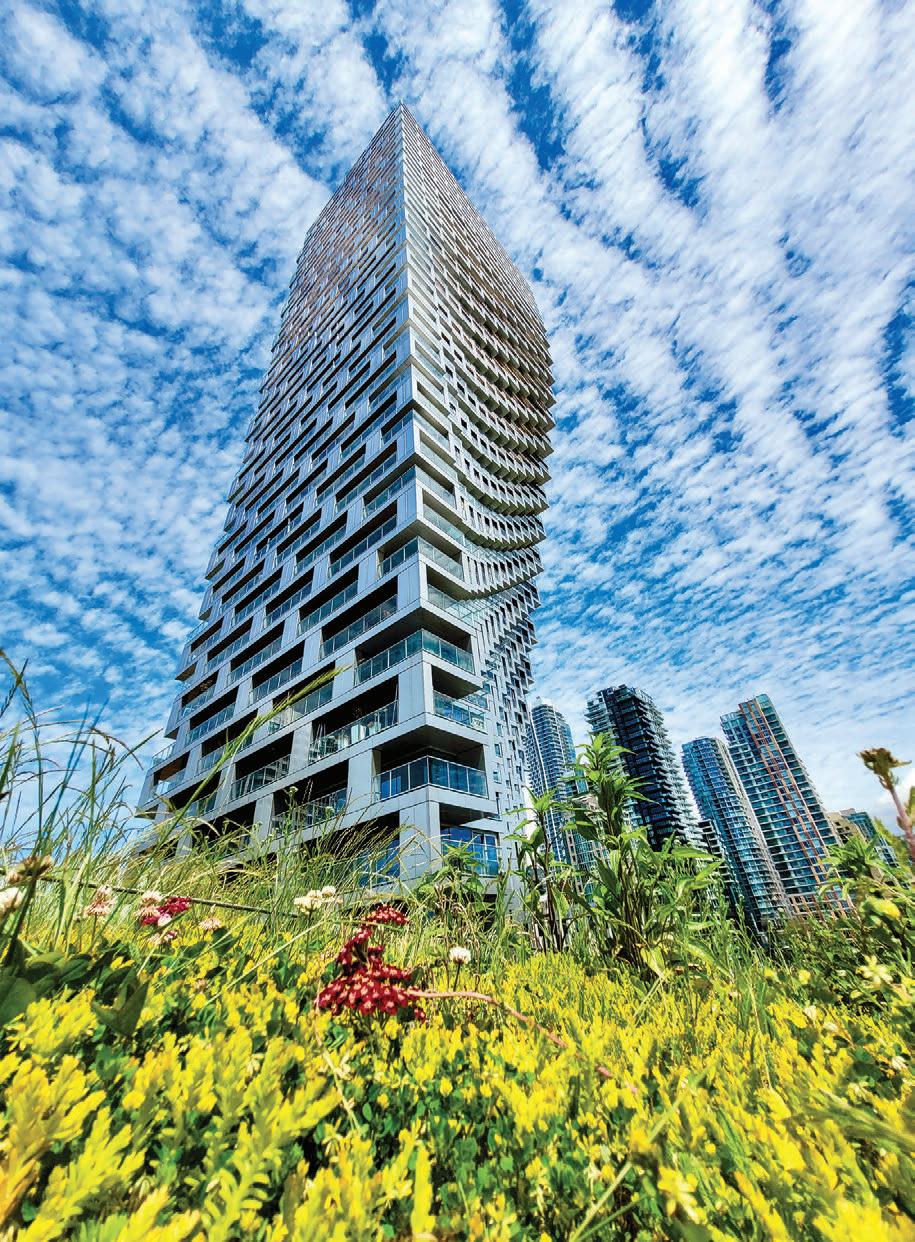
Vancouver House
University of Winnipeg Axworthy Health & RecPlex
Architek is committed to advancing sustainable practices in the built environment through innovative solutions in green roofs, living walls, green façades, and water conservation technologies. This grant supports pioneering research in sustainable landscapes for urban settings, focusing on design solutions that address challenges related to urban green roofs, green walls, and water management in Ontario.
“For over two decades, we’ve worked to make biophilic design a necessity, not a luxury,” says Letitia Silk, national director of business development and growth. “This grant will uncover bold, research-driven solutions, showing how green roofs, water management, and living architecture can shape resilient, human-focused cities.”
WHAT’S TRENDING
According to Iain MacFadyen, sustainability strategist, one of the biggest trends the Parkin team has seen this year is cost pressure, with sustainability often being viewed as a line item cut.
On the positive side, this has given Parkin the chance to guide clients toward value-driven, evidence-based strategies. “We are also seeing green building evolve beyond energy efficiency alone. The focus has expanded to holistic sustainability, including carbon neutrality, resilience to climate change, and the integration of biophilic design. In health-care architecture, this translates into healthier indoor environments, reduced operational costs, and facilities that support patient wellbeing,” says architect Kayla Murrell.

Architect Paloma Szpaizer highlights the Cowichan District Hospital replacement project as a showcase. Fully electric, it has achieved LEED Gold and the CAGBC Zero Carbon Building Design Standard. “The project included a multidisciplinary team, with the client aligned on strict energy and carbon targets. Alliance Project Delivery allowed strategies to be tracked and refined throughout the design stages and communication between parties improved. Innovations include high-performance heat recovery systems using 100 percent outdoor air, a photovoltaic panel system supplying two percent of total energy through a non-invasive roof installation, extensive daylighting analysis for patient comfort, and a concrete mix with reduced cement volume and GWP.”
At Diamond Schmitt Architects, the predominant trends in green building design this year have centred on embodied carbon reduction and net-zero energy projects, with these areas now dominating their current portfolio of projects.
“Academic, library, and federal projects are really pushing the envelope,” explains Lisa Prime, director of sustainability. “In the last couple of years, we achieved zero-carbon design certification on several projects, including Guelph Central Library, the first stand-alone library in Canada to achieve Canada Green Building Council’s Zero Carbon Building – Design Standard, Humber Cultural Hub, and Ādisōke – the new Ottawa Public Library – Library and Archives Canada joint facility.”
With respect to material innovation, Prime highlights the exploration of solar-integrated façades, as exemplified in projects such as Manitou a bi Bii daziigae at RRC Polytech, Innovation Village at Fanshawe College, and the Toronto Paramedic Services Multi-function Station 02. “There is also a growing adoption of low-embodied-carbon materials, including low-carbon concrete,” she adds. “Stronger policy frameworks and increased market availability have prompted clients to request these materials more, enabling us to integrate them more frequently – an important factor for achieving zero-carbon projects.”
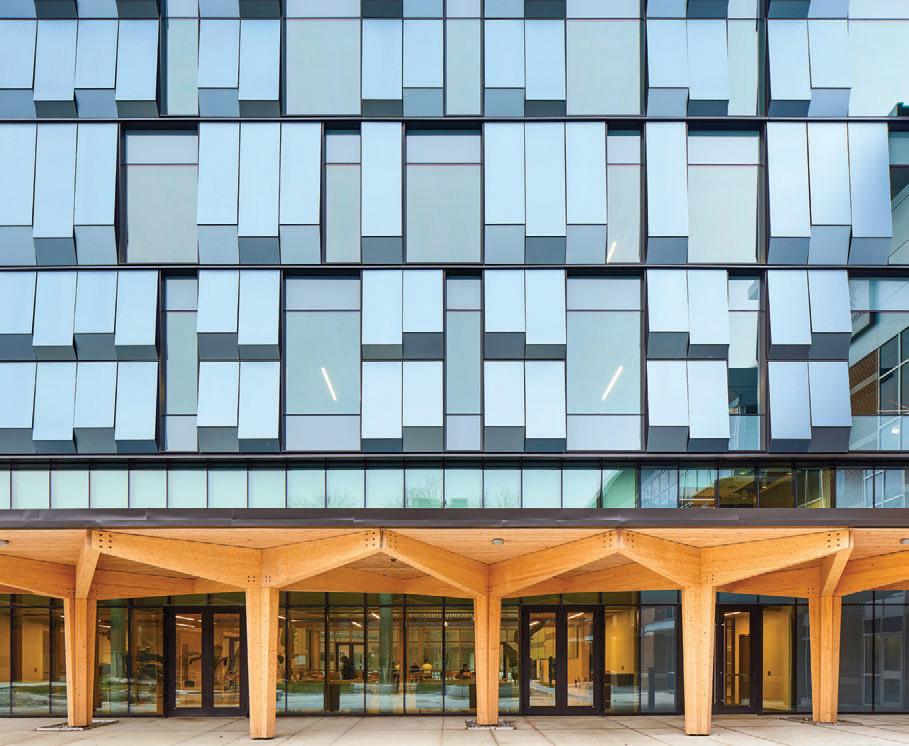
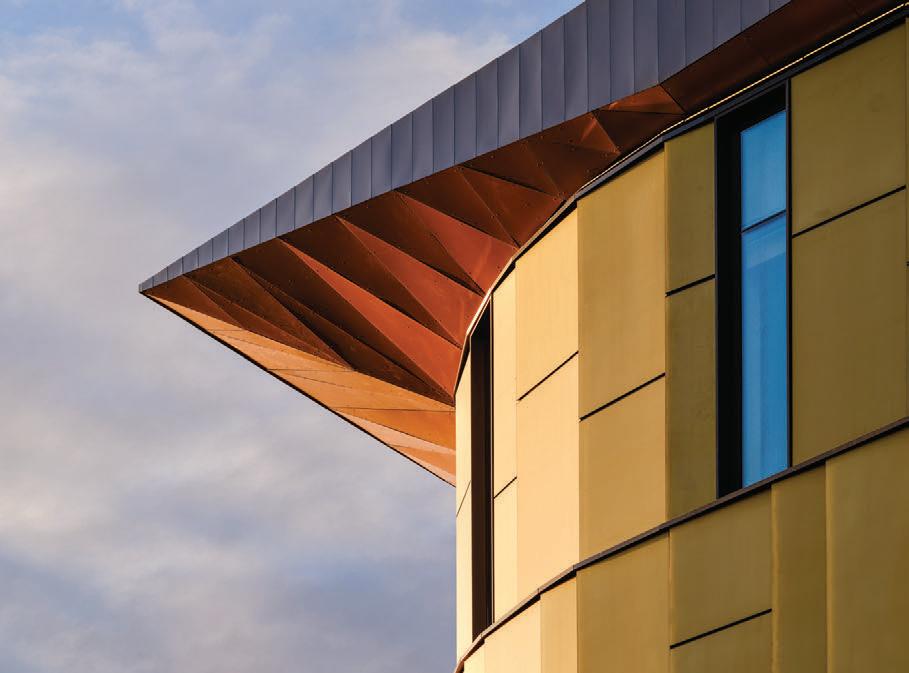
Although economic pressures and evolving regulatory contexts pose challenges, Prime says that steady progress remains essential. Diamond Schmitt has developed a comprehensive benchmarking database encompassing all its projects to systematically track embodied and operational carbon, health, social sustainability, and resilience metrics. “This enables us to measure outcomes, generate insights, and demonstrate leadership both internally and across the broader architectural and construction industry,” Prime explains.
ADAPTING TO A NEW NORMAL
In regions increasingly affected by extreme heat and wildfires, there’s an understanding that green building design must extend beyond efficiency to encompass climate resilience. Introba, one of the world’s largest building engineering and consulting firms, has been instrumental in guiding municipalities and Indigenous communities in B.C. to understand and respond to heat risk. Through detailed climate risk and vulnerability assessments, coupled with mapping of social and environmental data, Introba emphasizes the importance of connecting technical analysis with lived experience. Community stories illuminate how heat impacts daily life, shaping strategies that are both data-driven and human-centered.
Robin Hawker, associate principal for climate resilience, notes that interactive tools such as GIS-based story maps enable residents to visualize areas of vulnerability and understand the reasoning behind targeted interventions. This process strengthens trust and supports meaningful engagement. Introba is also evaluating existing public buildings for upgrades that would allow them to operate as resilient cooling shelters. Incorporating passive cooling, backup power, and flexible design ensures these spaces can provide comfort and safety year-round.
Cowichan District Hospital
Manitou a bi Bii daziigae at RRC Polytech
Innovation Village at Fanshawe College
CHANGING THE RULES
Experts at global engineering and professional services consulting firm WSP say there is good news for low-carbon grid capacity. Recent developments include streamlined permitting through new legislation such as B.C.’s Bill 14 and Ontario’s Bill 40, a growing number of large-scale wind and solar projects with significant First Nations equity ownership in Alberta, B.C., and New Brunswick, and Nova Scotia’s approval of the $60-billion Wind West Atlantic Energy project.
“We expect to see growing attention in 2026 on the scalability and cost of lowcarbon hydrogen and small modular reactors, supported by Ontario’s Hydrogen Innovation Fund,” says Veronica Owens, interim market leader, energy and sustainability, property and buildings at WSP in Canada.
In defence, Owens notes a rapid increase in spending, with a $9-billion budget for the 2025 to 2026 fiscal year (less than two percent of GDP), and a commitment of five percent of GDP by 2035. “Defence buildings, new or existing, need to meet net-zero carbon, low-embodied carbon and 100 percent clean electricity targets. We expect to see more building-integrated renewables and low-carbon district energy systems on defence campuses. What to watch: lowcarbon fuel development for submarines, aircraft, and ships,” she says.
On design co-ordination, Owens says there’s good news on the horizon with the adoption of building information modelling (BIM) level of detail 300 and beyond to 4D, 5D, and 6D to reduce rework, improve quality, and support compressed schedules. As 2026 approaches, she says the convergence of BIM, digital twins, and AI automation, along with the effects on early optioneering and alternative procurement models, are also trends to watch.
On the topic of regulations, FortisBC continues to support the development of high-efficiency homes and buildings to help lower overall emissions and support B.C.’s climate goals.

Two recent projects in the B.C. Interior highlight how building to higher levels of the BC Energy Step Code can be achieved across different building types and regions, with support from FortisBC’s rebate program for commercial new construction.
In Castlegar, the Chamber of Commerce’s new Confluence of Tourism and Economic Development building has become a model for sustainability. The Passive House-certified, all-electric facility prioritized engineered wood panel walls and roof systems with exceptional insulation, combined with airtight construction, to significantly cut heat loss and eliminate drafts.
Meanwhile, in Kelowna, Okanagan College’s new student housing project was built to Step 4 of the BC Energy Step Code. The design integrates highefficiency dual-fuel heating and cooling systems, balancing electricity and gas use to optimize performance. This hybrid approach reduces overall energy demand while lowering associated emissions, offering a practical pathway for larger institutional projects.
THIRD PARTY TESTING
Green building design is about so much more than the obvious. It’s about striving to exceed standards through third-party testing. This year, Innotech announced the successful testing and certification of its products to meet the stringent requirements of the North American Fenestration Standard (NAFS) AW Class – the highest performance class under NAFS.
This major milestone validates that select Innotech window and door systems have undergone rigorous third-party laboratory testing to meet and exceed the demanding criteria of the AW Class, also known as the Architectural Class, as defined by AAMA/WDMA/CSA 101/I.S.2/A440 (NAFS), consequently further verifying their suitability for high-performance multifamily and commercial buildings.

info@niacoat.com
Confluence of Tourism and Economic Development

















“This achievement reflects our ongoing commitment to engineering and manufacturing high-performance fenestration solutions for the most demanding applications,” says Troy Imbery, president of Innotech Windows + Doors. “Our AW Class certified products offer developers and building professionals the confidence that our systems can withstand the harshest environmental conditions while delivering superior energy efficiency and long-term durability.”
MASS TIMBER
For Glotman Simpson, it has been a milestone year in sustainability, marked by contributions to mass timber projects that continue to expand the possibilities of the material.
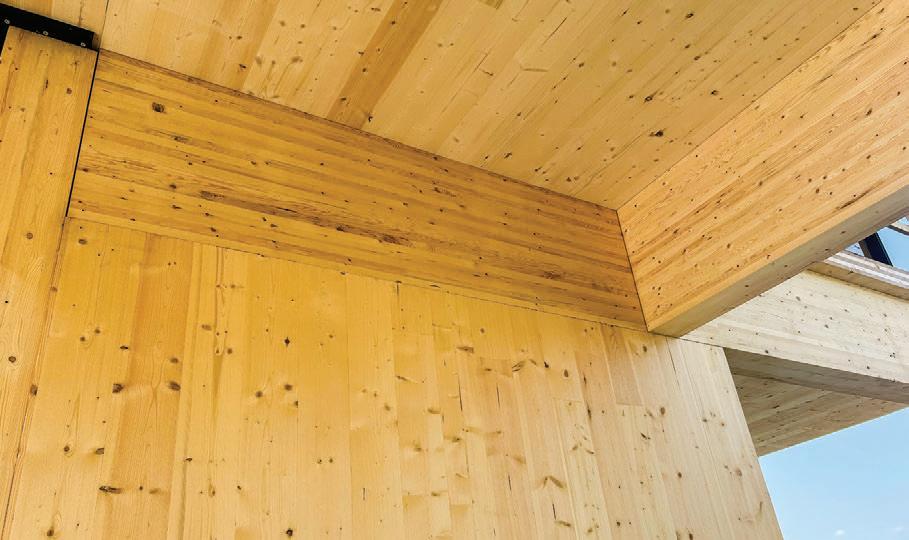
Rory Roberts, director of sustainability at Glotman Simpson, says, “At Kalesnikoff’s Head Office in Castlegar, the emphasis was on precision – concealed fire-rated connections, long-span glulam beams, and prefabricated wall systems – all detailed to showcase the material’s strength and clarity. The result is not just an office, but a living demonstration for Canada’s largest mass timber producer. At North Shore Neighbourhood House Phase 2, those lessons were applied at a larger scale, into high-rise construction. By pairing a concrete core with prefabricated CLT panels, we developed a hybrid system that meets seismic and fire requirements at 18 storeys, while supporting affordable housing and critical community services. Together, these projects illustrate the breadth of what mass timber can achieve – from finely crafted workplaces to large-scale, mixed-use housing – and underscore the role of engineering in making these possibilities real.”
Beyond mass timber, Roberts points out that sustainability gains often come from planning early, particularly when it comes to embodied carbon.
“Structural efficiency is one of the most effective ways to reduce embodied carbon. Starting in schematic design, when decisions carry the greatest influence, creates opportunities to explore innovative structural strategies, including mass timber. Increasingly, clients are engaging with us at this stage, knowing that the additional effort upfront leads to meaningful carbon savings, cost efficiencies, and stronger long-term outcomes for both projects and the environment.” A
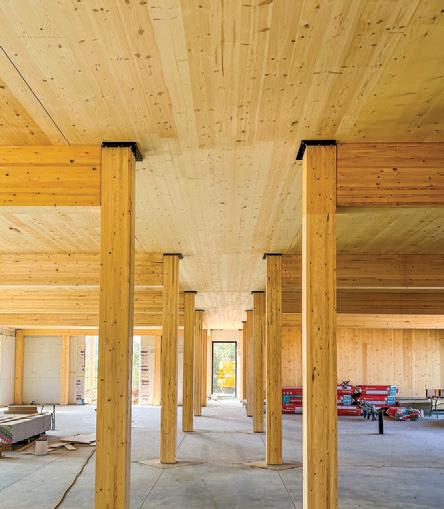
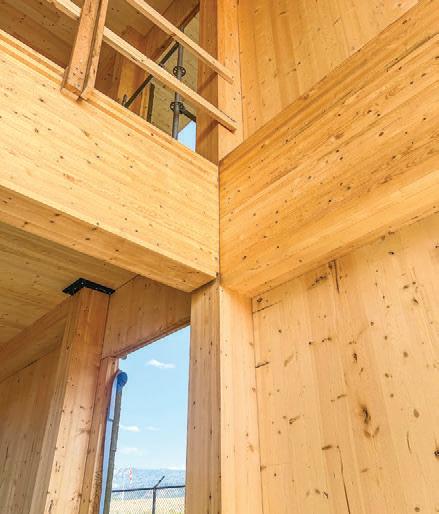
Structural details of the Kalesnikoff Head Office mass timber project.
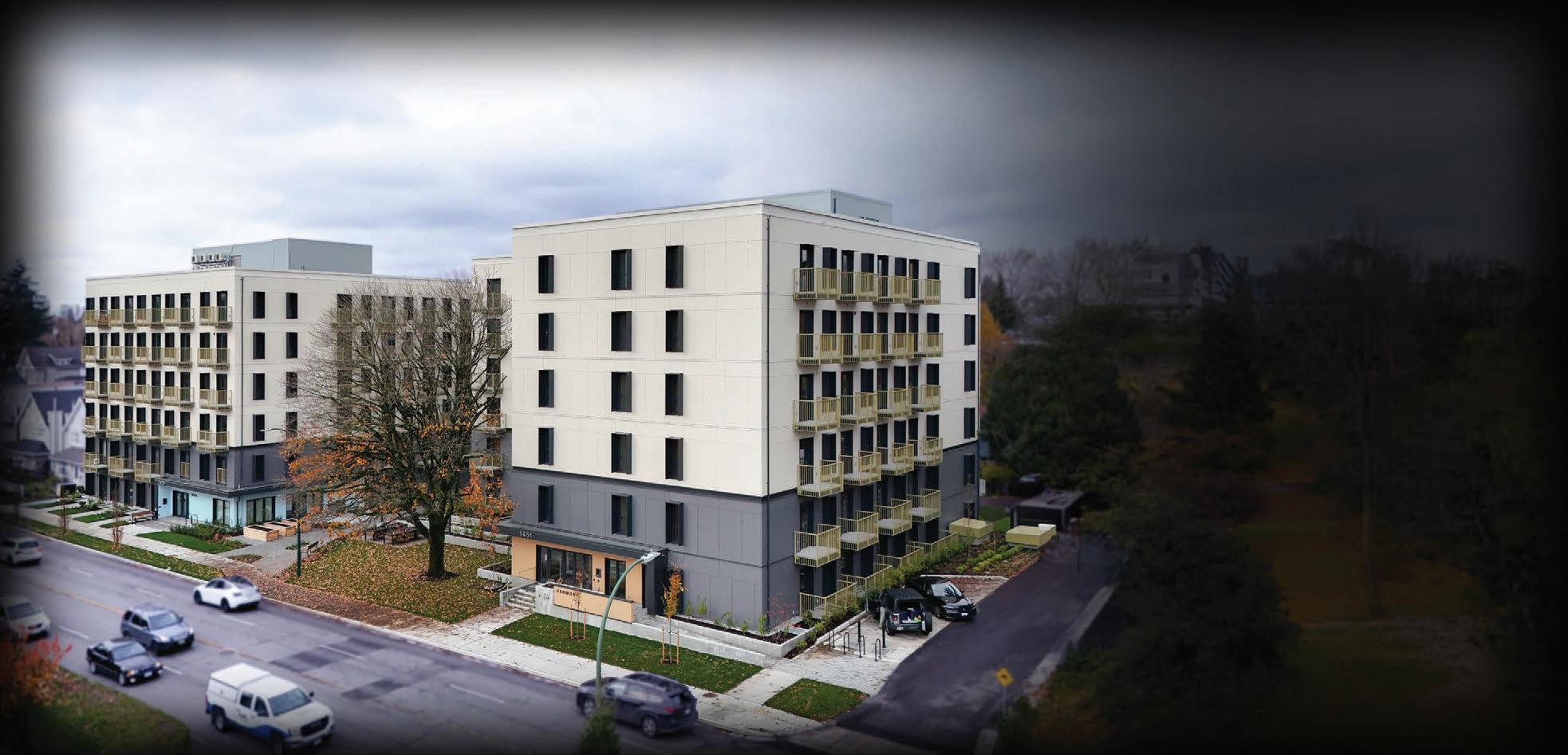
Timbre & Harmony in Vancouver, BC Passive House A ordable Housing Ryder Architecture & Etro Construction

















Hot Or Not?
Adaptable insulation technologies deliver savings, sound control, and performance
by ROBIN BRUNET
Acombination of traditional materials and new formulations continues to characterize insulation development in North America, to satisfy ever-stricter energy regulatory bodies as well as end users who more than ever need to lower their energy costs.
Concrete products remain an effective insulation solution for a variety of buildings. Brian Hall, managing director of the Canadian Precast Prestressed Concrete Institute (CPCI), explains, “Double wythe insulated precast wall panels offer all the benefits of traditional precast, such as durability, acoustic absorption, and quick installation, along with the added advantage of being a comprehensive, all-in-one building enclosure system. These panels are suitable for a variety of applications, including mid- and highrise residential buildings, office towers, data centres, schools, gymnasiums, and industrial facilities.”
Hall says the most common types of insulation used in precast concrete are rigid foam boards, “particularly Expanded Polystyrene [EPS], Extruded Polystyrene [XPS], and Polyisocyanurate [Polyiso], which are sandwiched between two concrete wythes to form an insulated panel. Other options may include Graphite Polystyrene [GPS] for enhanced thermal performance. The choice of insulation depends on factors such as cost, R-value, density, and moisture resistance requirements specific to each project.”
Hall reports that his institute is collaborating with RDH Building Science to update the CPCI Architectural Precast Concrete Walls Best Practice Guide, scheduled for publication in late 2025.
Saint-Gobain Canada, through its CertainTeed brand, introduced two new insulation products across Canada in June 2025: Lanaé Sustainable Insulation and the Lanaé Noise Reducer range.
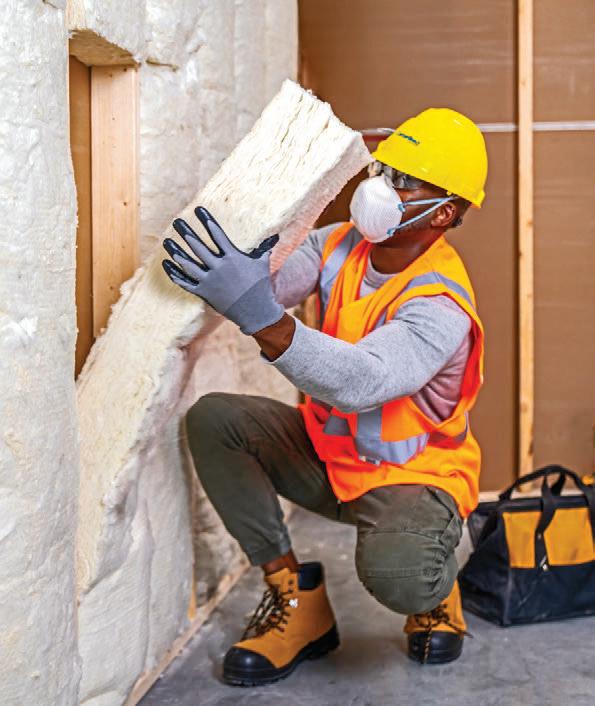
Manufactured at CertainTeed’s insulation facilities in Redcliff, Alberta, and in Ottawa, Lanaé insulation represents a leap forward in sustainable building practices. It is formulated with a bio-based binder that is formaldehyde-free and intended to reduce environmental impact while maintaining superior thermal performance and acoustic comfort.
Key benefits include up to 82 percent recycled content and a bio-sourced renewable binder; reduced dust, odourless installation, and improved handling, recovery, and rigidity. The formulation without formaldehyde demonstrates Lanaé’s commitment to the comfort and well-being of Canadian households, while enhancing energy efficiency.
CertainTeed Lanaé Sustainable Insulation is an easy-to-install, cost-effective solution to help save energy in residential and commercial new construction, as well as for renovating or retrofitting existing buildings. In addition to its thermal properties, this insulation also provides excellent acoustical performance. It is made of glass fibre that consists of rapidly renewable content, a high percentage of recycled glass, and a plant-based binder – no dyes or unnecessary fire retardants added. It is designed for use in standard wood stud and steel frame assemblies.
CertainTeed Lanaé NoiseReducer Sound Attenuation Batts are designed for use in residential and commercial wall and ceiling assemblies. These sound-absorbing batts fill the void between interior standard studs, and break the path of sound
Installation of CertainTeed Lanaé Sustainable Insulation.
Harvestview Apartments, Tillsonburg, ON, constructed with precast Double Wythe Insulated Panels.





Where SUSTAINABILITY meets SUPERIORITY.


High performance
Bio-based building materials

PERFECT COMBINATION
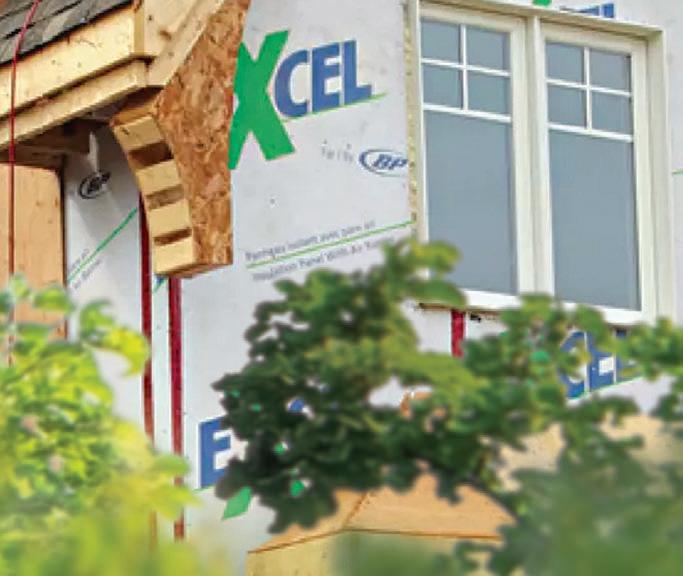
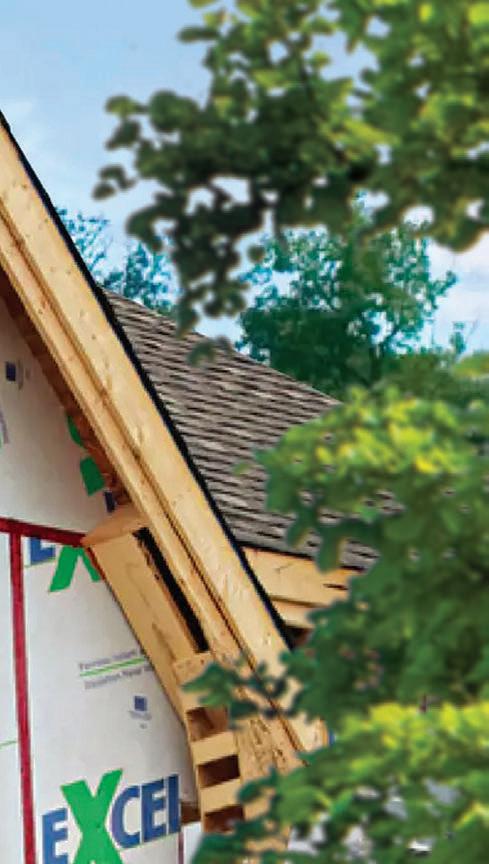
BP’s R-1.5 exterior sheathing panel provides structural strength, noise reduction, superior water vapour permeance at 37 perms, and a remarkably low carbon footprint, at a value based pricing. R-1.5 Continuous superior water vapour permeance – a perfect combination for our canadian climate.


DISCOVER BP’S WOOD FIBRE INSUL-SHEATHING PANELS
Recycled wood fibre sourced from post industrial and post consumer origin
REDUCE MATERIAL and LABOR COSTS
BP’s Excel exterior sheathing panel provides R-1.5 of continuous insulation while providing superior structural strength, weather resistive and air barrier properties ensuring that your walls remain warm and dry, mitigating moisture entrapment in the wall cavity.


PERFORMANCE and STRENGTH

BP’s R-5 XP exterior sheathing panel provides R-5 of continuous insulation using Dupont’s low GHG STYROFOAM™ Extruded Polystyrene, laminated to a ½" high performance wood fiber panel. The overall panel assembly provides a water vapour permeance rating of 2 perms, ensuring an optimal performance of your overall building envelope.
for added privacy and quiet. They provide excellent acoustical performance to reduce sound transmission between adjoining rooms; plus, they are lightweight and flexible – easy to conform to irregular surfaces – and resist mould and mildew.
Maxime Duzyk, senior global director, building science and engineering at Huntsman Building Solutions, reports that his company’s D-Max wall assembly is “always gaining in popularity, with many more projects all across Quebec province.” Those projects include the multi-residential Complexe 2L at Mirabel; multiple locations of Maison des Aînes (affordable senior housing); the luxury rental condos of Project Le Miner in Granby;
LUX rental condos in Montreal; and in Ontario, Everhome Markham condominiums.
Duzyk says the appeal of D-Max is simple: “General contractors appreciate the cost and time savings of the assembly, while architects appreciate the simplicity of details, adaptability, durability, and the quality of the building envelope.”
The D-Max wall assembly allows the installation of spray foam insulation from the interior of the building, while managing the thermal bridging of the studs and the structure. Spraying can be conducted regardless of temperature or wind, less machinery means less rental cost, and sequencing of work is simpler and easier to manage due to fewer
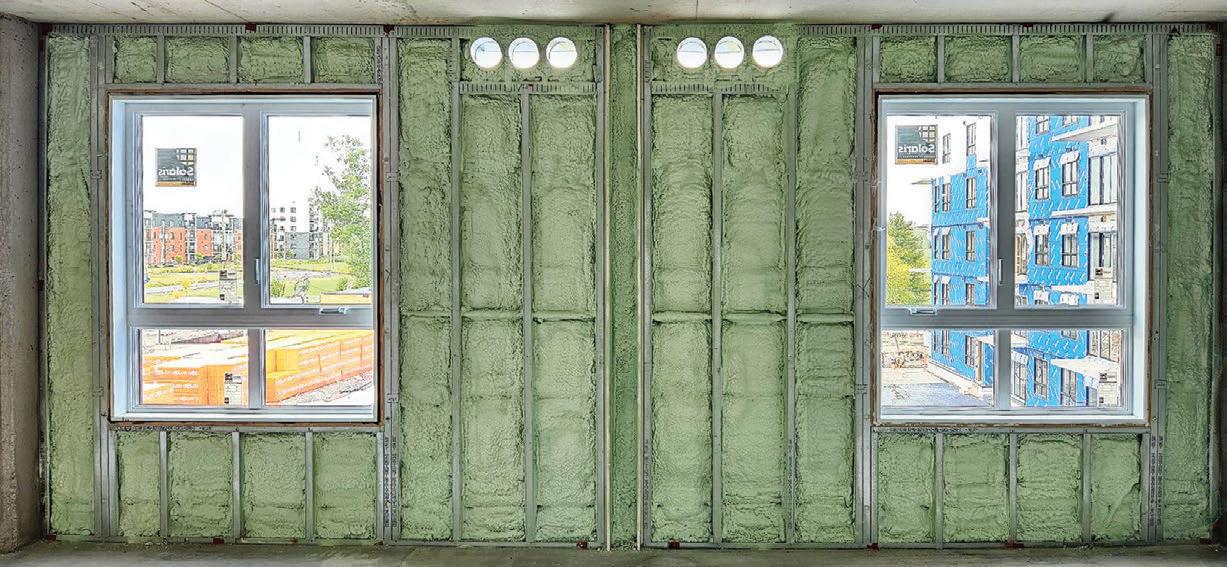
workers required. Plus, overspraying is avoided, as is the requirement to install an interior furring (in comparison with a wool-insulated cavity where the electricity cannot run through the stud cavity).
Duzyk says he fully expects D-Max to be used in an increasing number of construction projects in the New Year, “because it’s recognized as the easiest path to meeting new energy efficiency requirements. New residential and commercial energy studies demonstrate D-Max’s energy and cost savings as well as the environmental benefits of spray foam versus traditional wall assemblies.”
Other companies are equally ambitious in providing wall assemblies with superior insulating
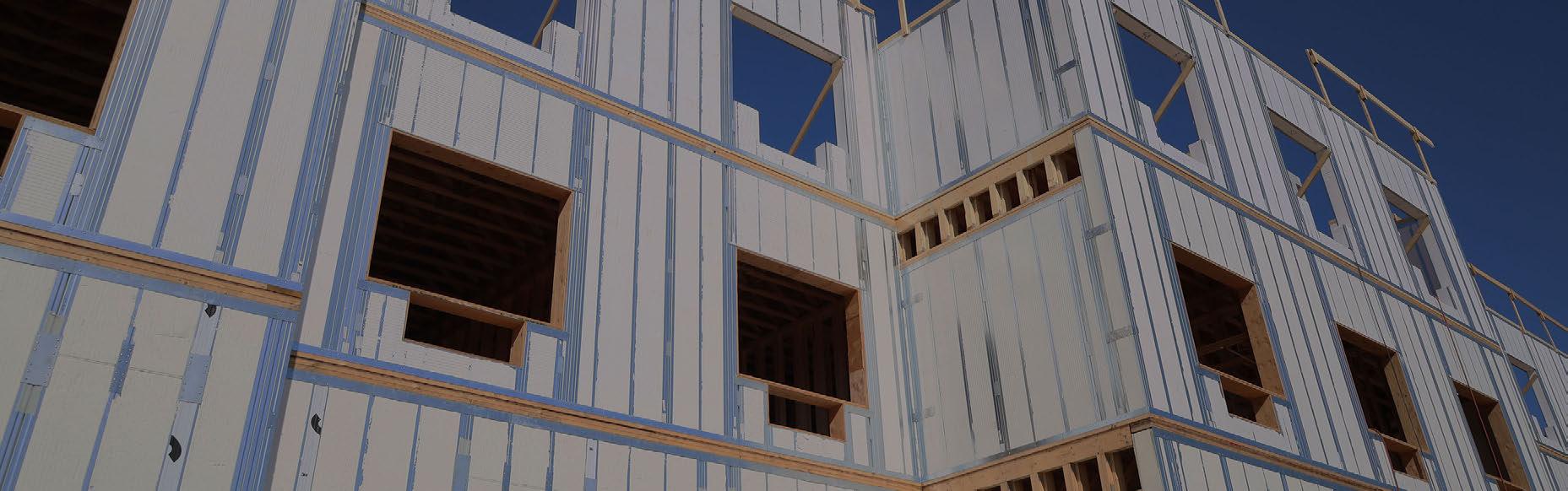


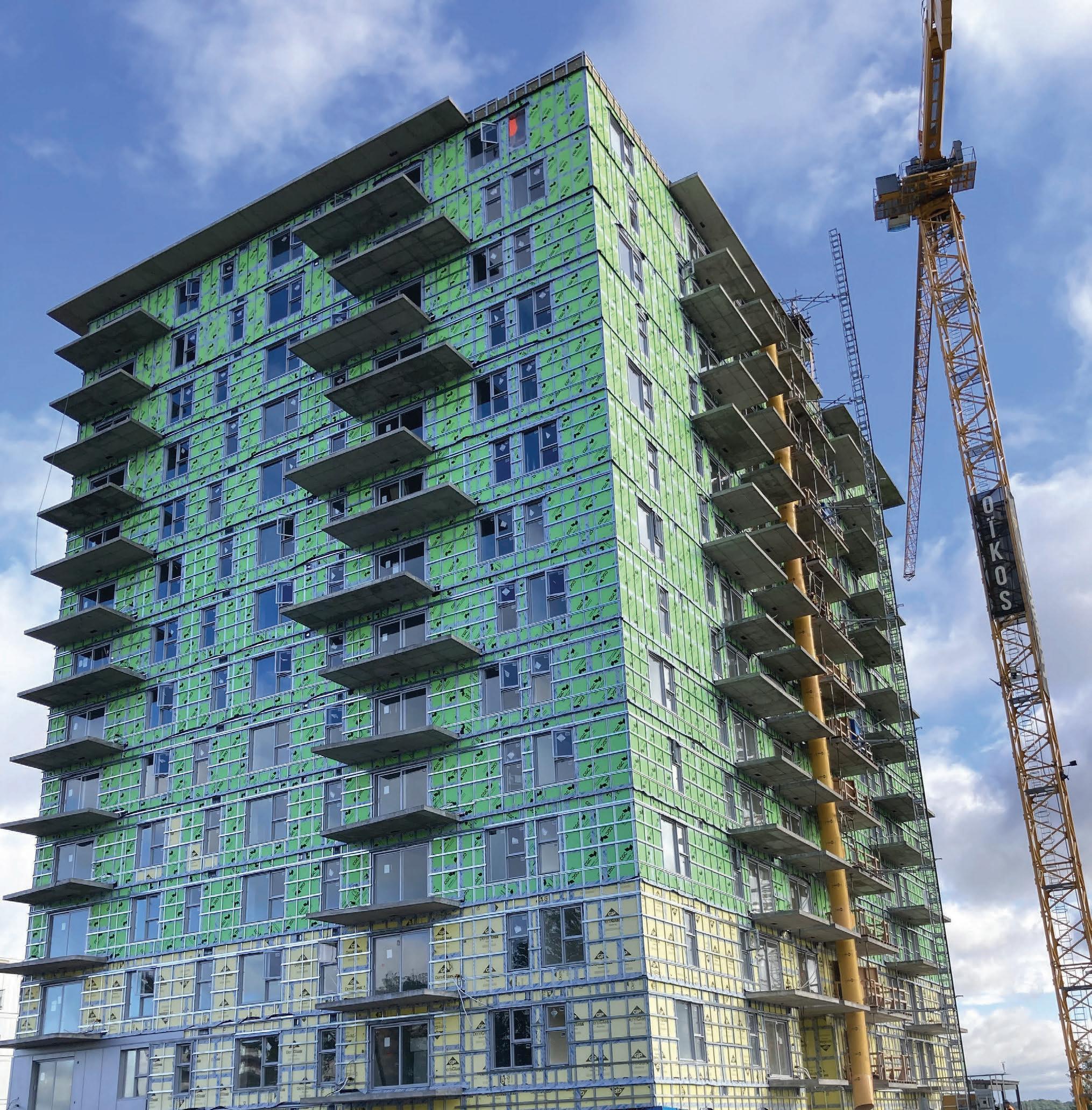

provided a level of fire protection suitable for use in non-combustible construction, and using a two-inch layer of mineral wool to encapsulate Sopra-ISO V maximized
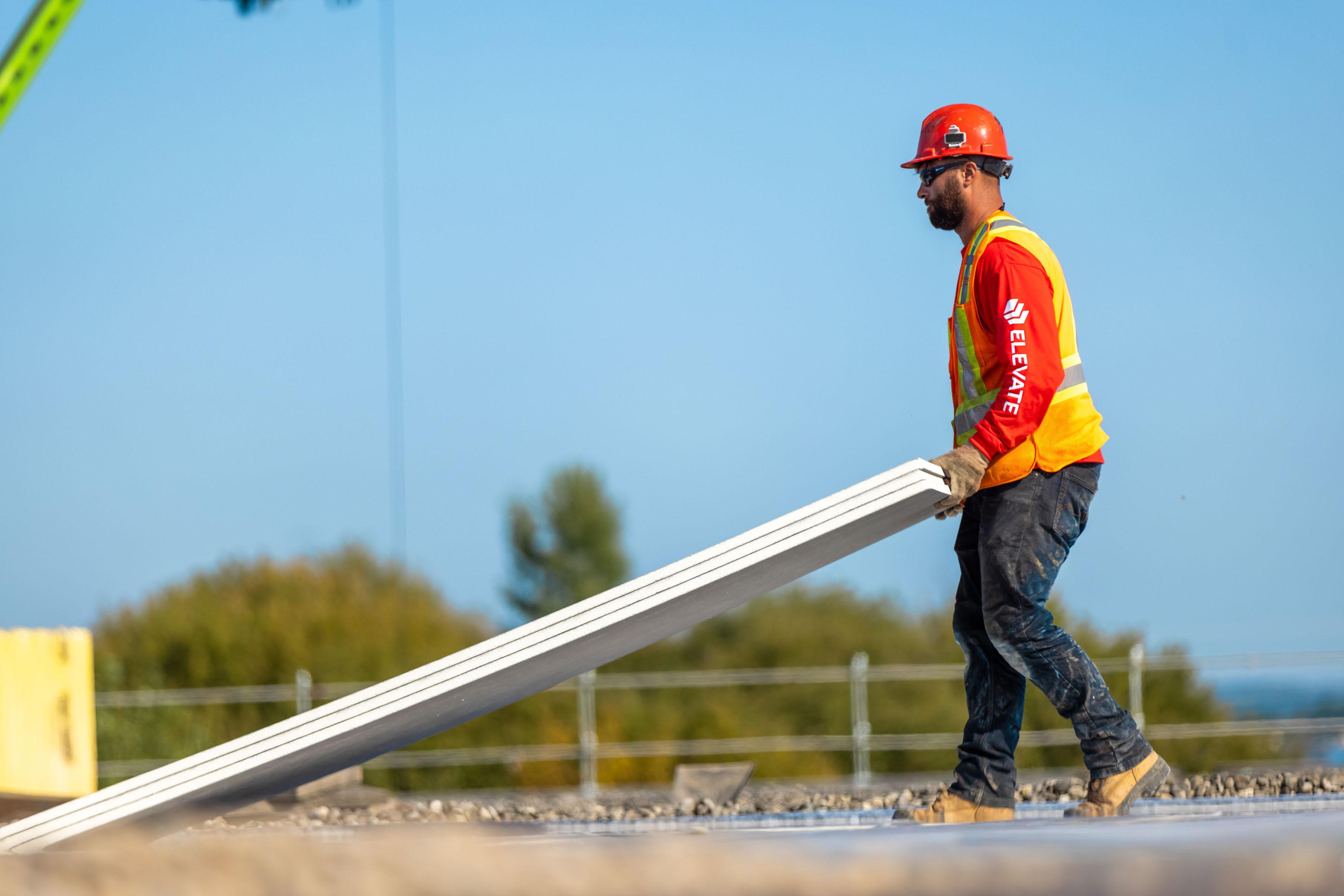
Roofing is a prime focus of attention for developers seeking energy efficiency and lower heating bills. Amrize Building Envelope manufactures roofing solutions through its Elevate brand, which provides commercial roofing products for industrial and commercial projects. The company offers a broad range of roofing solutions, including components such as membranes, insulation, and
“Elevate Isogard is unique because the thermal performance is up to 40 percent better than major competitors. The increased R-value per inch means better thermal performance from the same roofing systems using the same amount of insulation compared to leading competitive products on the market today. Building owners may realize in HVAC savings due to the added value that Isogard brings,” says Jasmeet Deol, senior manager, product marketing at
Elevate Isogard polyiso insulation is the first product on the market that meets both ASTM C1289 required and recommended thermal performance values. And its superior performance in colder mean temperatures makes it is a good solution for roofing projects across Canada.
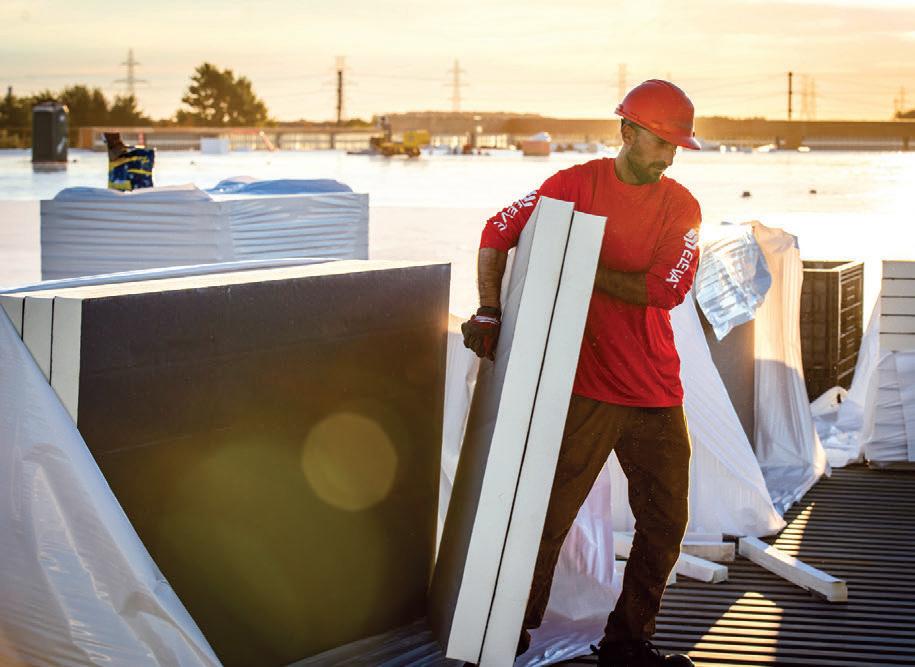
In addition to standard insulation products, such as Isogard GL and CG, the Elevate Isogard portfolio also includes specialty insulation products such as Isogard HG panels that help protect against accidental punctures, hail, and winds up to 160 kmph. Isogard HD Composite provides a factory-laminated cover board directly to Elevate standard Isogard polyisocyanurate insulation, creating a high-performing, energy-efficient insulation board, while helping to save installers time and labour due to not having to adhere another layer. Meanwhile, Isogard Tapered Insulation provides an effective and economical solution when a substrate’s slope will not permit efficient drainage.
Greenstone Building Products of Brandon, Manitoba, distinguishes itself with Insulated Composite Envelope (ICE) panels, a product engineered to combine two well-known building materials: EPS and galvanized steel. This combination creates a much lighter and stronger building envelope, and the manufacturing process, on top of connection details, eliminates thermal bridging.
ICE panels have been used in retail spaces across Canada, but arguably they are ideal for multi-unit residences in which the envelope is vital in maintaining a high efficiency value across every living unit. An additional benefit of ICE panels is their versatility: they can be used for roofing applications, below-grade, and for floor systems (in the latter case, a subfloor placed on top of 5.5-inch ICE panels results in a floor equally as warm as one with in-floor heating, but without the cost).
Finally, a new and unique insulation for unusual applications was recently released by Johns Manville: the Insul-Shield Black is a fibreglass insulation board with a black core intended for use in theatres, music studios, and dark amusement park rides, because the black core reduces the potential for the yellow fibreglass colour to show through. It’s an ideal backdrop behind theatre screens (it eliminates back scatter into the viewing area), and it also provides excellent sound control.
Insul-Shield Black is fire resistant and comes in thicknesses of one to three inches and in two-by-four feet or four-by-eight feet sized boards for easy installation. A




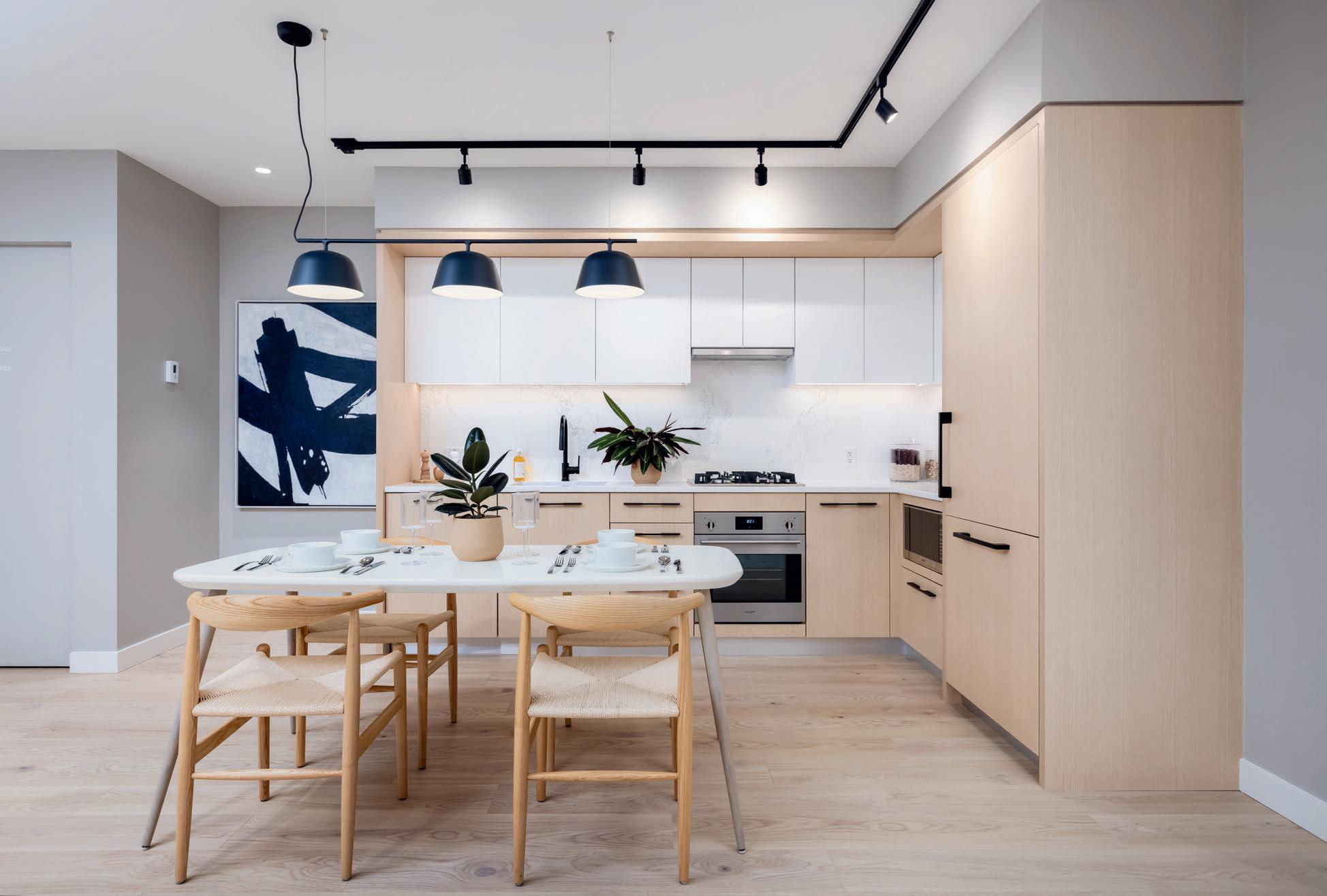

FINDING YOUR GROOVE
Architectural woodwork continues to carve out success in some unexpected places
by ROBIN BRUNET
Architectural woodwork is the sector best suited to make any building interior really shine, however, changing market conditions, high inflation, and many other factors also make it especially prone to slowdowns. Yet, in recent years, woodworking shops, manufacturers, and distributors have been especially busy on a wide range of projects – and in one notable case, a change in business model has allowed a network of established woodworkers to experience new heights of success.
Ciaran Adams, owner at Oake & Rowan Millwork Design Ltd. of Cobble Hill, B.C., presides over a small, five-year-old firm that recycles 75 percent of its waste and uses only LEED and FSC-certified domestic wood in its cabinet cores.
Usually, firms that employ a handful of people are the most prone to market fluctuations, but Adams reports that “the market is healthy for commercial work, and we’re adept at taking on specialty projects. We have just completed an architectural firm’s office renovation in Victoria on one end of the scale, and previous to that, we finished supplying and installing all of the millwork for the Nanaimo General Hospital, which was a far more substantial undertaking.”
Adams is not averse to taking on residential projects: “We’re happy to be of service to one of our regular clients, especially if the work offers a rewarding challenge for our team. But the market is always changing. For example, earlier this year we prepared for two residential projects four months apart, which would have worked out well, but then, and beyond our control, the projects became only two weeks apart, and this was extremely difficult for a fivemember team to schedule.”
Still, the overall volume of work is robust, and Adams reports that, “In some cases, we’re taking over cabinetry construction in the commercial realm from a man well known in woodworking circles and who now acts as a general contractor for such projects. Thanks to him, we’re currently engaged in a job worth at least $1 million in high-level millwork.”
Adams adds, “These kinds of opportunities happen all the time, and smaller players such as my company can greatly benefit from them. But it takes a knowledgeable general manager to make these projects a success.”
The manager Adams refers to is Tom Morin, president of Morinwood, who has worked in architectural millwork for more than 20 years. During the COVID slowdown, Morin reimagined his business model by shifting from a single manufacturing plant to a network of trusted partner shops, including Oake & Rowan.
“It’s been a huge differentiator for us,” Morin says. “In commercial construction, manufacturers struggle to keep a steady workflow. Plants have fixed
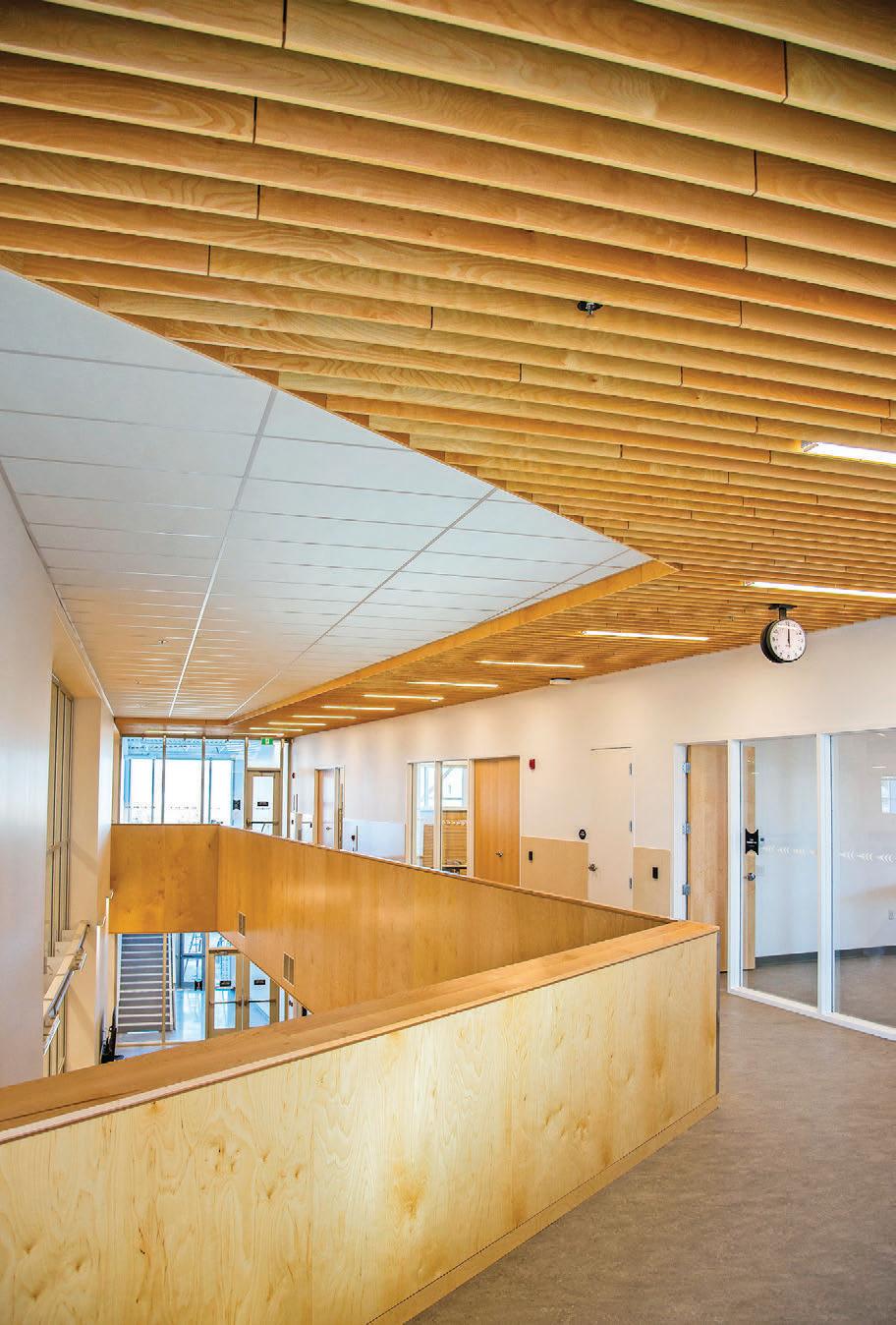
capacity, but project schedules are unpredictable, so there’s either too much or too little work. That’s no longer our problem. Now we focus on our customers instead of the shop schedule. With a network of 30 certified partners, capacity is never a limitation.”
He points to the Cowichan District Hospital replacement project in Duncan as an example. “It’s a major project that would normally exceed the bonding capacity of a single firm. By engaging multiple specialty manufacturers, we can scale as needed while maintaining tight quality control.” Morinwood’s team is supplying cabinets, counters, labs, acoustic finishes, and other millwork for the hospital, with on-site work continuing through next year. All production meets ISO 9001 standards.
Alongside this collaborative production model, Morinwood is leading the integration of AI tools into the design-assist process. The company first used artificial intelligence to analyze architectural drawings during pre-construction – automatically identifying and quantifying millwork to accelerate budgeting and co-ordination.
“Our goal was to give design teams and contractors faster, more reliable cost feedback from the earliest stages,” says Morin. “That’s where real value is created, in helping projects stay on budget before the first board is cut.”
Those early successes inspired Morin to found TakeoffBOT.ai, a constructiontech startup developing AI that converts drawings directly into data. The technology has been refined on projects such as Cowichan Secondary School and Cowichan District Hospital, helping design teams collaborate faster and prevent late-stage rework. A commercial launch is planned before year-end, bridging the gap between design intent, fabrication, and cost certainty.
Morinwood also recently began work on the Royal BC Museum Collection and Research Building, a mass-timber facility that will house the museum’s collections and archives. “It’s the most elegant warehouse ever built,” Morin says. “The B.C. fir wall panelling will make wood-lovers drool.
Morinwood provided millwork for the Cowichan Secondary School in Duncan, B.C.
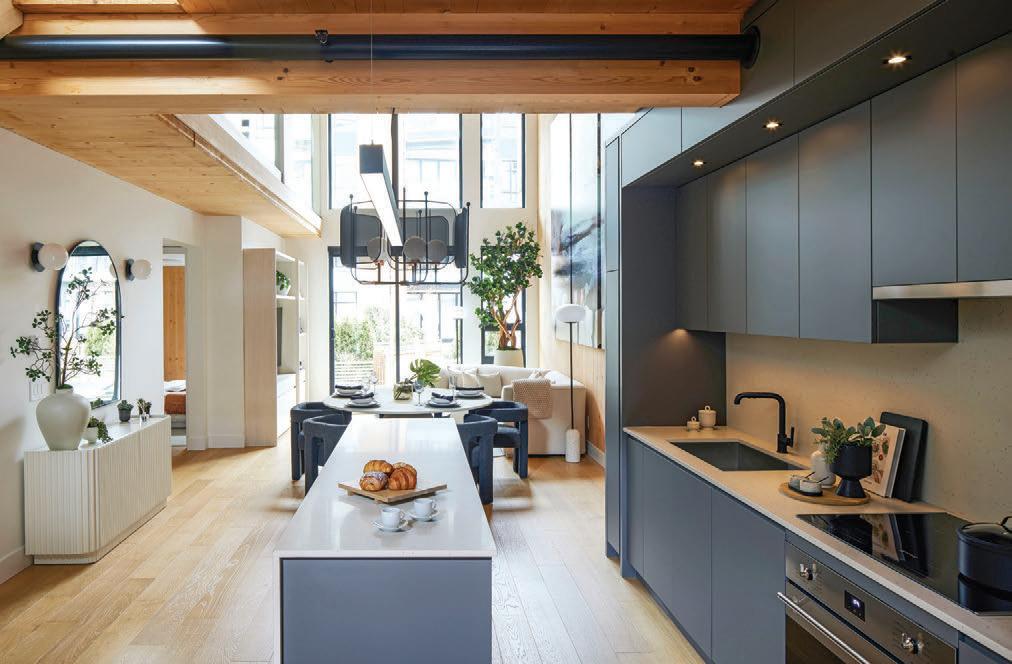
Even though the multi-residence market is considered too volatile by some, Tim Benson, president of Benson Cabinetry & Millwork Ltd., sees it as the company’s core strength. “Business is really good,” Benson says. “We’re extremely busy. We’ve expanded our shifts and now run from 6 a.m. to 11 p.m.”
Celebrating its 50th anniversary next year, Benson Cabinetry & Millwork has built its reputation on precision-crafted cabinetry and millwork for multiresidential developments. “While there’s been a considerable decline in condo sales, we’re fortunate to have strong partners in the industry and have secured a robust order book that will carry us through 2026 and into 2027 at the same operating pace,” Benson explains. With a team of more than 100, it’s common for Benson to be engaged on a single project for more than 12 months.
During slower market cycles, Benson says the company pivots strategically. “We feel it aggressively, but we’ve developed initiatives to mitigate the sting, such as shifting to hotel and institutional work. We also expand our geographic reach beyond Vancouver Island and Greater Vancouver into the Okanagan and Whistler regions.”
For now, down cycles are not a concern. Benson Cabinetry & Millwork is currently delivering cabinetry and millwork for several high-profile projects, including Band by Townline & QuadReal, Botanica by Qualex-Landmark & Marcon, PKWY T3 by Axiom & Bosa, and Cascades by Chard & Ledcor, among many others across B.C.
The wood building industry is experiencing significant growth, with companies like Sansin driving innovation with the development of environmentally-friendly wood protection. Sansin has researched and developed waterborne wood coating solutions for 40 years, offering alternatives to traditional wood coatings.
One 2025 project of note was a private home in Michigan lake country that recently won the Wood Design & Building Sansin Award. The home, designed by Wheeler Kearns Architects, features exposed glulam from Sansin partner Western Archrib and weathered grey Accoya siding inside and out that harmonizes with the surrounding forest. KP-12 UVW provided the clear natural wood tone desired for this project, and the ENS Optimum Clear topcoat enhanced durability and protection.
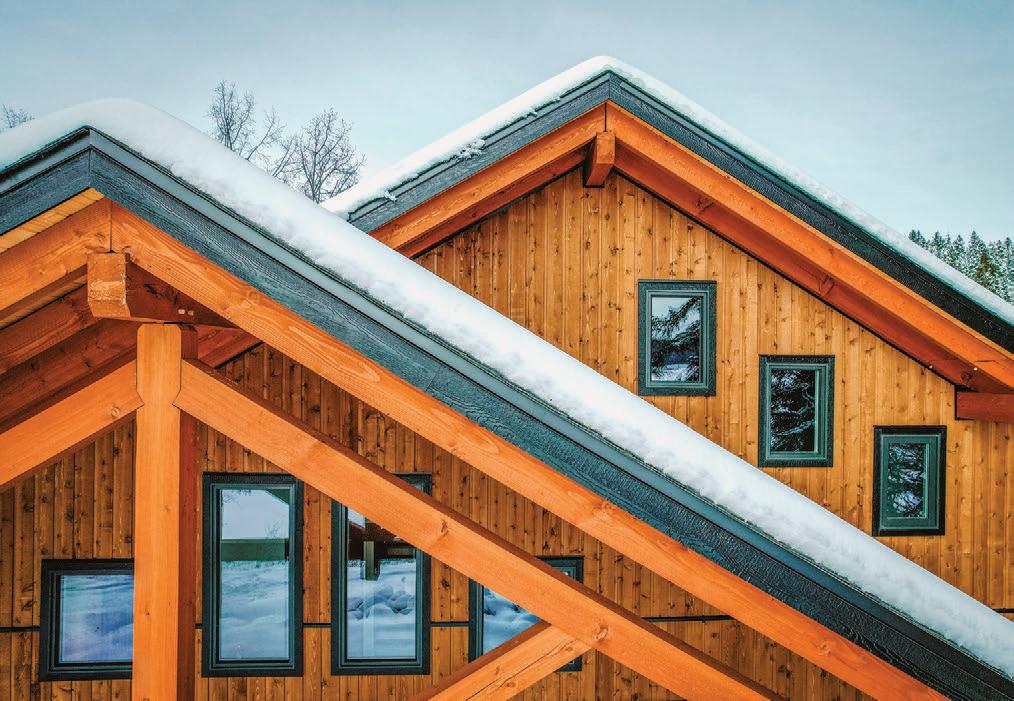
Closer to home, a vacation residence by custom home builder Smith Timber Works, located on a small lake in the Cariboo Region of B.C., used Sansin throughout the interior and exterior of the building. The siding features SDF Roasted Almond, the timbers are finished in SDF Natural Cedar, and the tongue-and-groove boards shine with ENS Optimum Clear. Even the stairs are treated with SDF in a custom colour. Smith Timber Works uses Sansin on their wood projects as they offer beauty and durability, whilst being a sustainable coating solution.
Another notable B.C. project for Sansin in 2025 was the təməsew̓txʷ Aquatic and Community centre in New Westminster, Canada’s first completed Zero Carbon Building – Design certified aquatic centre. Wood features prominently throughout the design, and all the CLT and glulam elements are protected and beautified with a comprehensive system of Sansin coatings, including KP-12 and Precision Coat KP-30 (formerly Precision Coat SDF) in Sansin’s 2025 Colour of the Year, Ivory 21. The wood creates a warm and natural environment that stands in contrast to typically sterile aquatic environments. Sansin’s KP-12 and Precision Coat KP-30 allow wood to breathe during the absorption and release of humidity from the aquatic environment.
Other product suppliers associated with the woodworking sector are focused on either augmenting wood or replicating it, and Denise Barcia, marketing director at NewTechWood Canada, reports that two new brands were launched
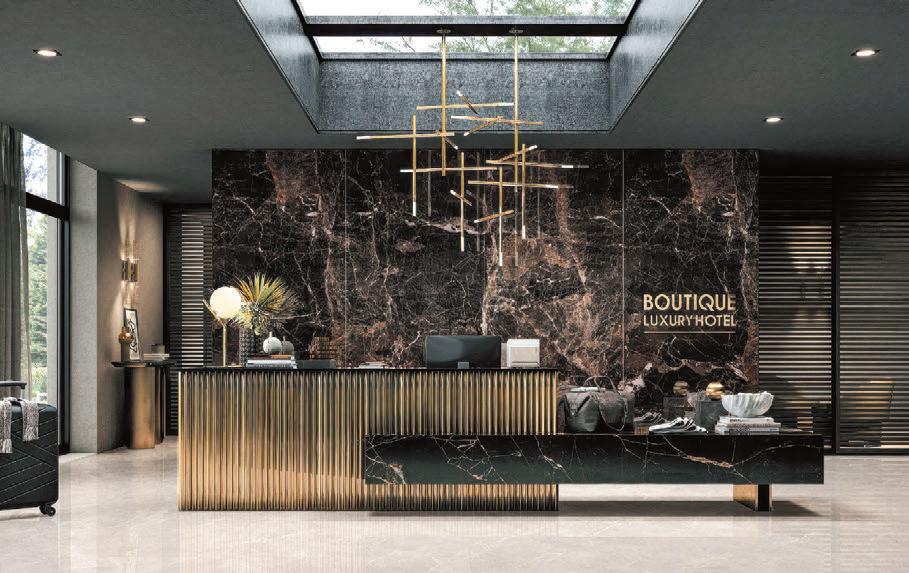
in late September at the IDS Vancouver design show. “The first is freske: designdriven surfaces for modern commercial spaces,” Barcia says. “We have five wall panel collections, including flexible stone, lightweight panels, marble replica, and textured surfaces.”
The second brand is Aluxe, which Barcia describes as “non-combustible fluted exterior siding made with thick-gauge aluminum but with an ultra-realistic wood touch finish, ideal for large-scale projects.” Aluxe’s finish captures the warmth, grain, and texture of real timber.
Benson provided precision-crafted cabinetry and millwork for Timber House by Aragon.
Freske wall panels in marble replica.
Aluxe non-combustible fluted exterior siding.
Vacation residence by custom home builder Smith Timber Works.

Sansin Precision Coat™. High performance wood protection for mass timber structures.
PC WoodForce has a 20-year history of performance. As a newly certified Euroclass D s1, d0, fire retardant coating, PC WoodForce can be used as a topcoat for ASTM E84 “Class A” treated timber. PC WoodForce will provide added value and beauty as it weathers naturally, making long term maintenance easy. Warrantied for up to 20 years, Precision Coat factory finishes deliver the color, transparency and performance that architects, engineers and builders can count on.
Contact us about our specification program so we can help you achieve the perfect finish and protection, every time.
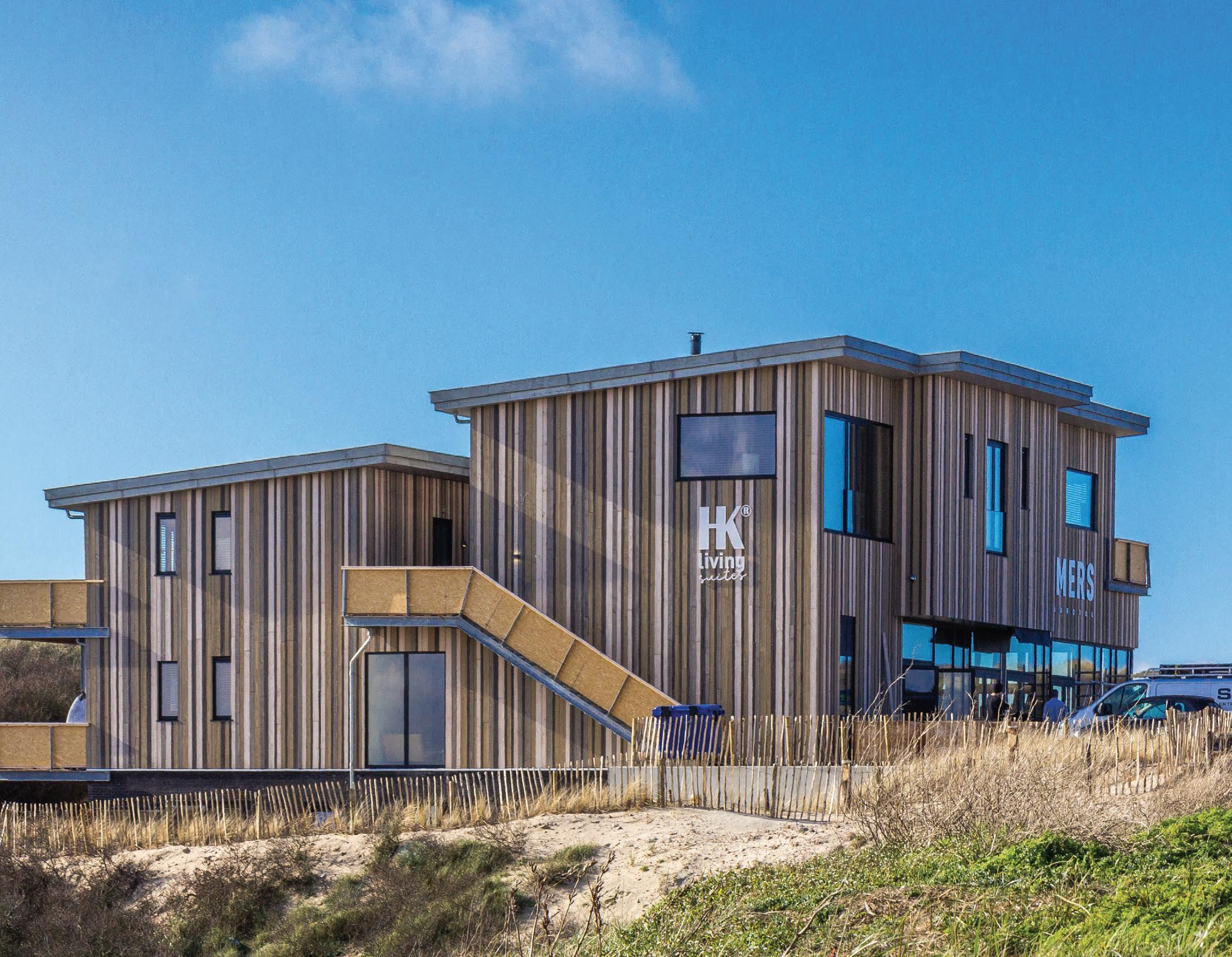
Zoomers Beach Hotel | Castricum, Netherlands Photographer: Courtesy of Leegwater
HARDWARE FOR WOOD
Richelieu Hardware is a major go-to and one-stop source for specialty wood hardware products, and new offerings have been released in categories ranging from kitchen to decorative hardware. Modern-style pull knobs continue to be in high demand and provide a pleasing contrast when matched with wood surfaces, and an example of the sublime design aesthetic Richelieu provides is the new 1743 Modern Metal Pull, an elegant cupped aluminum pull featuring a smooth finish for a striking modern look. Designed for surface-mount applications, this is the perfect product to impart contemporary refinement.
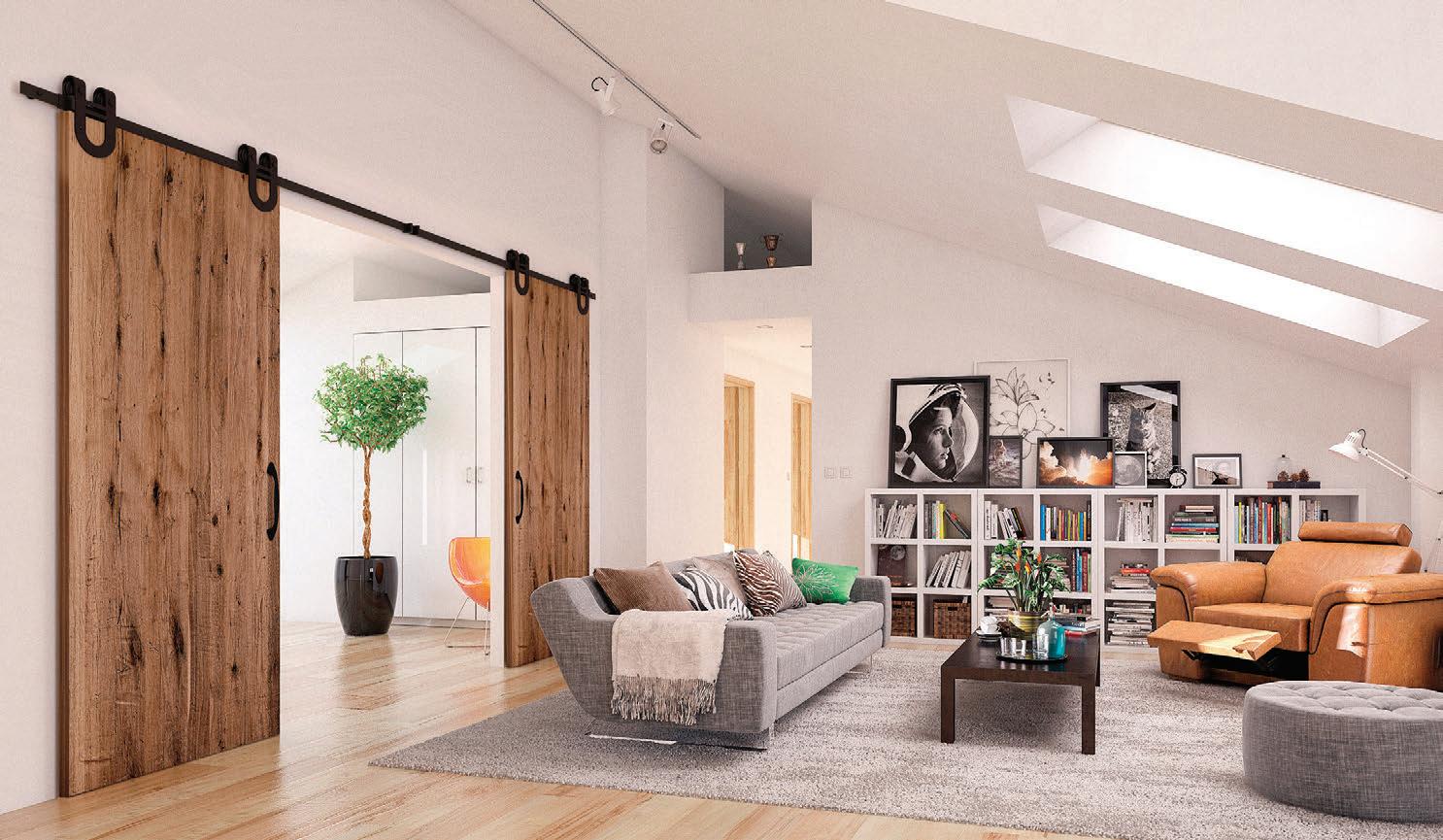
Rustic barn doors continue to be a desired feature of new residences and renovations, and Richelieu has no less than 10 such systems covering both classic and modern appearances. One example is the new Cavalier Barn Door wall mount sliding door system with visible black “U” horseshoe shape flat bar steel straps and two trolleys for doors weighing up to 100 kilograms. Three choices of standard flat bar upper track sets are available, with wall mounts and fastener lag bolts for wood wall construction.
Meanwhile, at Häfele, the new Häfele Lighting sub-brand represents the company’s commitment to developing the highest quality and easiest to install lighting options available to customers, whether it’s incorporating lighting into cabinetry, furniture, backlighting for walls and ceiling coves, textiles, and more.
Häfele has also invested in developing adaptive lighting solutions that go into cabinetry and is designed to enhance mood, support natural circadian rhythms, and provide a fully customizable, health-conscious lighting experience. As for new products, Häfele’s Universal Drawer Light Bar provides customizable, energy-efficient illumination for drawers in kitchens, bathrooms, and closets; it features a push-button switch for adjusting colour temperature and optimal lighting with both downward and front-facing output. It also features an integrated sensor that automatically turns the light on and off, and the system includes dimming functionality. A
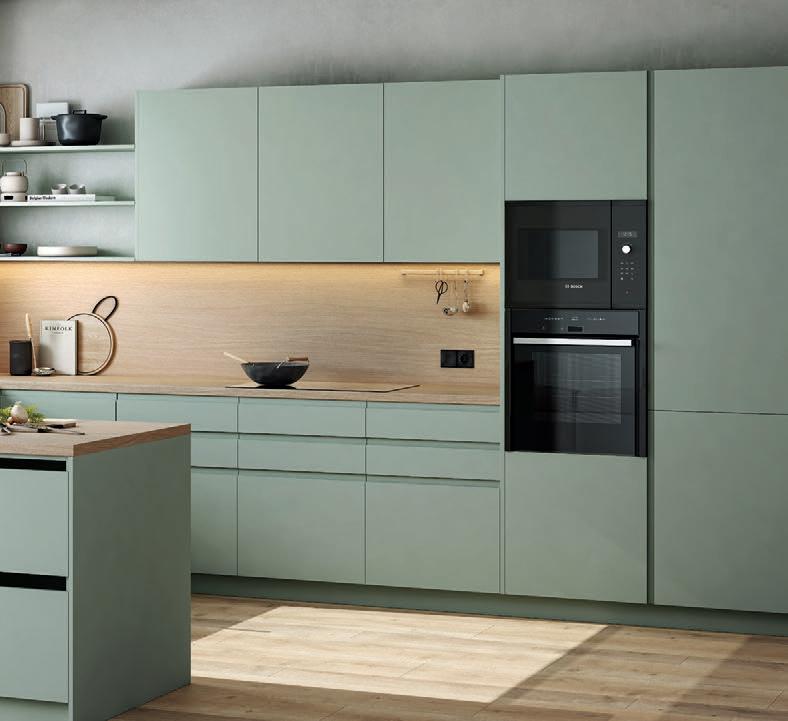
PREMIUM MODERN MATTE PANELLING
Behind its sophisticated ultra-matte surface, Zenit 3.0 delivers outstanding technical performance. Available in a palette of 15 curated colours, it’s as resilient as it is refined. Silky to the touch, it’s anti-fingerprint, antibacterial, stain-resistant, and rigorously scratch-tested. This is the panel designed to elevate projects of every scale.

TALK TO
specs@richelieu.com 1-800-619-5446

Cavalier Barn Door wall mount sliding door system.
AI IS A LEVER: HOW TOM MORIN KEEPS CRAFT IN THE DRIVER’S SEAT
From robotics to TakeoffBOT.ai, the Morinwood founder proves the smartest tech keeps the craftsman in control.
Productivity has long been construction’s toughest challenge. Too often, the push for efficiency comes at the expense of craft. Tom Morin, president of Morinwood and co-founder of TakeoffBOT.ai, has built a career at the seam between hand and machine— between judgment and automation.
Over two decades, Morinwood has delivered architectural millwork for some of British Columbia’s most complex institutional projects—from the Cowichan District Hospital to the UBC Faculty of Pharmacology and BC Women’s & Children’s Hospital. Each reinforces a simple truth: the earlier skilled tradespeople contribute their expertise, the better the outcome.

“Craft is the desire to do a job well for its own sake,” Morin says. “Tradespeople have an overwhelming instinct to build great things.”
Where Precision Meets Judgment
Morin’s curiosity about automation sharpened during the Vancouver Convention Centre Expansion, where his team built a robotic cell for a repetitive, precision task. “Everyone wanted to give it human traits—we named her Victoria—but it was a one-trick pony,” he says. “Still, it worked through the night and did a job nobody wanted to do—with amazing consistency.”


AI as a Force Multiplier
Morin sees AI not as a replacement for craftsmanship but as a force multiplier for human capability. That thinking led to TakeoffBOT.ai, an AI-powered estimating platform for the millwork trade and beyond. “It’s not a self-driving car,” he laughs. “It’s power steering for your brain. You’re still at the wheel—just with less strain. Estimating shouldn’t be about counting; it’s about knowing what counts.”
That aligns with human-centered AI pioneer Ben Shneiderman’s principle: “superhuman performance, but human control.” Machines accelerate analysis; humans retain final judgment. For Morin, progress in construction isn’t automation for its own sake—it’s augmentation that protects human agency, improves clarity, and elevates craftsmanship.
Craftsmanship in the Age of AI
“Construction will benefit most when we use AI to compensate for—not compound—our cognitive design flaws,” Morin says. “AI should amplify human insight, not automate it away.” He envisions a future where digital tools and design intelligence align earlier—budgets hold, coordination improves, and the trades’ practical wisdom shapes projects from the start.

The community hall at Cowichan Hospital takes shape. AI systems helped track data over Morinwood’s 5-year project duration.
Victoria the robot toils during the assembly of the Vancouver Convention Centre’s iconic wall panels.
Tom Morin





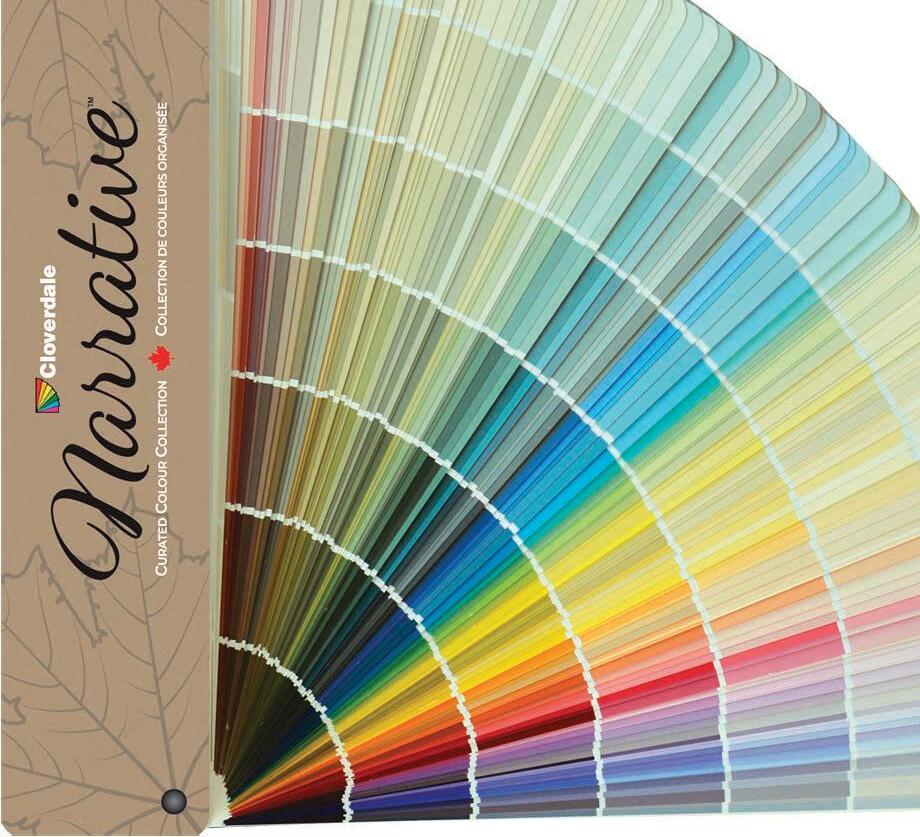
WHAT’S YOUR Colour Narrative?
Urban or Rustic?
Neutral or Colourful?
Modern or Classic?
Find your Colour Narrative in our fullspectrum palette that captures more of the widely specified paint colours from across Canada, determined by our Customers and Colour Experts.














Support In Style
Walls and ceilings are shaping spaces like never before
by LAURIE JONES
From sleek finishes to durable builds, wall and ceiling manufacturers are responding to diverse needs with products designed for every type of installation.
This industry-wide push for innovation is evident at Calgary-based Wallworks Acoustic Architectural Products, where keeping pace with shifting design trends is both exciting and challenging. Among its standout offerings are P.E.T. ceiling options. Custom moldings and designs once topped the list of specialty requests, but as they become more common, Wallworks has forged new paths in creativity that are resonating with clients and sparking unique finishes that stand out.
“We’re installing coffered look ceilings and more for a range of clients, from schools to executive bank offices,” says Lyle Fuller, general manager. “It is all about the finishes, and that can be a simple paint colour match, or a laser print image that can create the look of wood, wood beams, metal, or many other materials, allowing something that may look like a steel, brass, or gold finish ceiling to be fully acoustic. Given that the standard P.E.T. felt look is now becoming commonplace in the market, some leaders in design are utilizing the latest exceptionallooking custom fabric coverings over the P.E.T. to provide more texture, more combinations, and renewed interest, which can also blend in corporate branding, multi-faceted finishes, and more.”
Made from recycled plastic pop bottles, P.E.T. products are sourced globally and imported to cutting, finishing, and distribution facilities in Canada and the U.S. Wallworks partners with several companies that specialize in laser printing and painting to achieve exceptional finishes. “The results really are unique,” says Fuller. “The creativity of designers and architects continues to set the tone.”
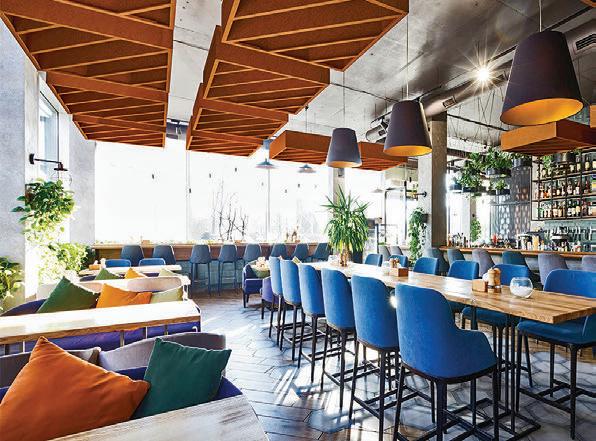
Canadian, family-owned True North Floors and Walls (a division of CDS Distribution) specializes in premium wall cladding products designed for health-care environments, including hospitals, laboratories, and kitchens. The company also serves commercial food and beverage outlets, as well as
commercial kitchens. “Some of our most recent projects include the Surrey Memorial Hospital and Cancer Centre, the South Niagara Hospital, the North York General Hospital in Toronto, and the West Lincoln Memorial Hospital in Hamilton,” says Derek Motley, owner and president.
Available in more than 50 colours, with custom options, the panels come in two standard sizes: four by 10 feet or four by eight feet. “One important feature of the product is that the seams are heat-welded to make it impervious to water and ensure no bacteria or anything else can build up underneath. The panels can also be heated and bent around corners to eliminate trim pieces that can be an area for mould buildup,” says Motley. The panels are also suitable as ceiling tiles, with the same thermoforming and heat-welded seam capabilities.
Motley adds that over the last five years, the company has invested heavily in testing to ensure all health and safety concerns are addressed for architects and builders.
DESIGN VERSATILITY
Richelieu has introduced a new collection of grooved decorative panels designed to elevate interiors with elegance, warmth, and functionality. Ideal for hospitality settings such as hotels, conference rooms, and lounges, as well as residential spaces including bedrooms, living rooms, and family areas, these panels add a refined, contemporary touch to any environment.
Grooved decorative panels in black oak from Richelieu.
P.E.T. acoustic felt cloud baffles from Wallworks.
Available in three colours with a Kalmate felt backing, the panels combine sleek design with remarkable versatility. They can cover an entire wall for a bold statement or be applied as wainscoting for subtle visual interest. Beyond their aesthetic appeal, the panels also deliver practical benefits. The polyester felt base enhances acoustic comfort by reducing noise, while the MDF core with wood veneer ensures durability and a sophisticated finish.
For those seeking modern simplicity, Richelieu also offers two-inch decorative slatted wall panels. Their clean lines and streamlined design instantly refresh interiors, creating a stylish, contemporary look. Quick to install, they allow professionals and homeowners alike to transform spaces with minimal effort and maximum impact.
The collection also features the Kalmate Acoustic Grooved Tile 6-Piece Kit, available in Light Oak and Walnut. Designed for flexibility, the tiles can be arranged to suit a variety of layouts, giving designers and end-users creative freedom. Like the full panels, the tiles combine acoustic performance with visual appeal, making them well-suited to projects that demand both form and function.
Sound Solutions, a trusted supplier among architects and designers, offers a diverse range of architectural products, including several Canadianmade materials. By sourcing locally, the design community supports Canadian businesses while also benefiting from products priced in Canadian dollars, translating into lower shipping costs and faster delivery times. “These products include solutions for both wall and ceiling applications,” says Neda Bayat, sales representative for Ontario, Interior Products. “The choices are Akustus PET/Felt panels – longboard aluminum systems with wood-look finishes, Squareline metal mesh panels by Pinta, and Avanti acoustic panels. Each product provides significant value and many positive features for any design.”
Based in B.C., Akustus recently introduced the Streamline baffle, a product that delivers excellent acoustic absorption with a vibrant, appealing design. Bayat notes that Longboard extruded aluminum panels give designers and architects confidence when using wood-look finishes, since the pattern and colour remain consistent and harmonious across interior walls, ceilings, and exterior surfaces. “Longboard has provided products for many successful projects across Canada, including the Etobicoke General Hospital and Walnut Grove Elementary School.”
Squareline by Pinta, produced in Montreal, offers stylish metal mesh ceiling solutions that integrate seamlessly with standard T-grid ceiling systems. “Gensler’s Toronto office successfully used the simplicity of the product to highlight the advantages of the mesh ceiling,” Bayat says.
Avanti fabric-wrapped panels deliver excellent acoustic performance and are available in an extensive selection of fabrics, offering both function and aesthetic flexibility. Avanti has long been one of the most popular acoustic solutions among the interior design community.
SMART PANELS
Envirowall Partition Systems Ltd. offers a unique option in prefinished panels, available in four-foot widths and lengths ranging from eight to 12 feet, with a standard half-inch core or 5⁄8-inch Type X thickness. The gypsum panels come in a wide variety of colours and patterns and are connected using a
progressive method, allowing for easy reverse disassembly if retrofits are needed. Pre-finished trims give the finished installation a clean, professional look.
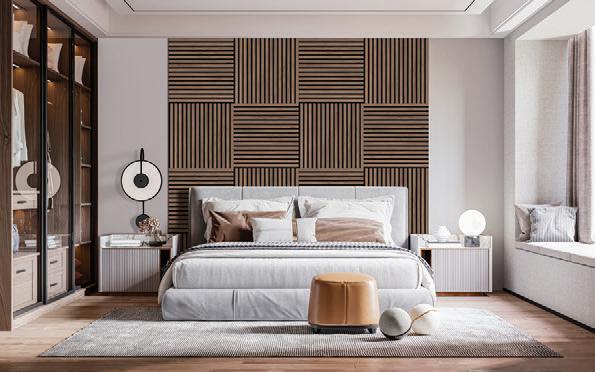


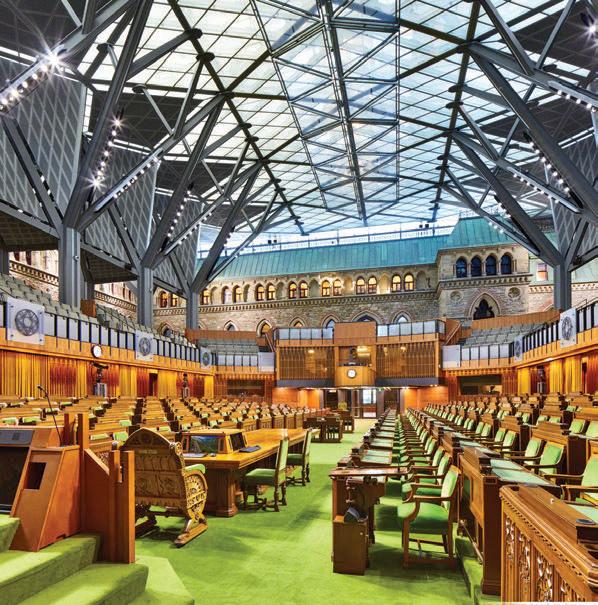
and aesthetic enhancements, and the flexibility to adjust layouts as client needs change over time.
Building on the theme of adaptable partitions, Barrisol, a division of Acoustique SM, offers the Microsorber acoustic partitions. These modular units are lightweight, transparent, and available in a variety of heights. “The Microsorber partitions provide effective separation in your workspaces without compromising the brightness of your offices,” says Patricia Rheault, co-founder and business development director.
The partitions can be custom-designed to complement any office décor or brand, with options that include transparent, printed, sandblasted, or translucent panels. Aluminum frames are available in matte black, matte white, or other finishes on request, and users can choose between casters or stands, allowing the partitions to be easily rearranged for optimum workspace use.
Beyond partitions, Microsorber foils and systems improve acoustic comfort along walls or glass façades in offices, lobbies, and swimming pools. With a thickness of just 0.1 millimetres, the perforated foils (approximately 0.2 millimetres in diameter and spaced two millimetres apart) remain visually subtle while enhancing sound control. Available in transparent, opaque, or printed finishes, the systems offer creative flexibility and technical performance, including fire rating B-S1, d0 to DIN EN 13501-1, and UV stabilization, making them an elegant and versatile solution for any space.
LIVING WALLS
Faux greenery is gaining momentum as a solution for achieving biophilic design in commercial and residential wall and ceiling installations. Initially embraced for its aesthetic appeal, designers in North America are now developing advanced greenery that delivers much more. These next-generation solutions transform vertical and overhead surfaces into immersive, nature-inspired environments.
They integrate technologies that meet stringent fire and UV ratings, repel dust, and even help remove harmful VOCs from the air. Hand-selected plant varieties create a remarkably natural look, while climate-neutral plantings support the calming effects of biophilic design.
Whether used to soften acoustics, define space, enhance biophilic design outcomes, or create visual impact, faux greenery is redefining what’s possible by combining beauty, safety, and environmental performance into a single, transformative design solution.
Building on the growing popularity of living walls, New Earth Solutions recently completed a project for the Student Counselling, Health, and Well-Being (SCHW) department at York University. Recognizing that the physical environment reflects its commitment to wellness, management commissioned New Earth Solutions to install an automated biofilter living wall system within the department’s office space.
These partitions are ideal for offices, factory-built housing, residential basements, or temporary housing and are offered in four formats: bank rail, workstation, low-rise, and full-height. Each option supports quick installation, customizable finishes, functional
The solution featured the Respiro biofilter living wall, which incorporated four two-foot-long lighting sections optimized for plant growth, along with automated watering systems to reduce maintenance. The wall measures 6.5 feet by 9.5 feet and was installed over two days. A total of 260 plants make up the collection, creating an autonomous biofilter that enhances indoor air quality. Additionally, the hydroponic system promotes the growth of beneficial microbes around the root zone, helping break down VOCs and other pollutants. A
Kalmate acoustic grooved tiles in walnut from Richelieu.
Akustus PET/Felt baffles from Sound Solutions.
Interior gypsum board partion systems from Envirowall.
Microsorber acoustic panels from Barrisol, a division of Acoustique SM.
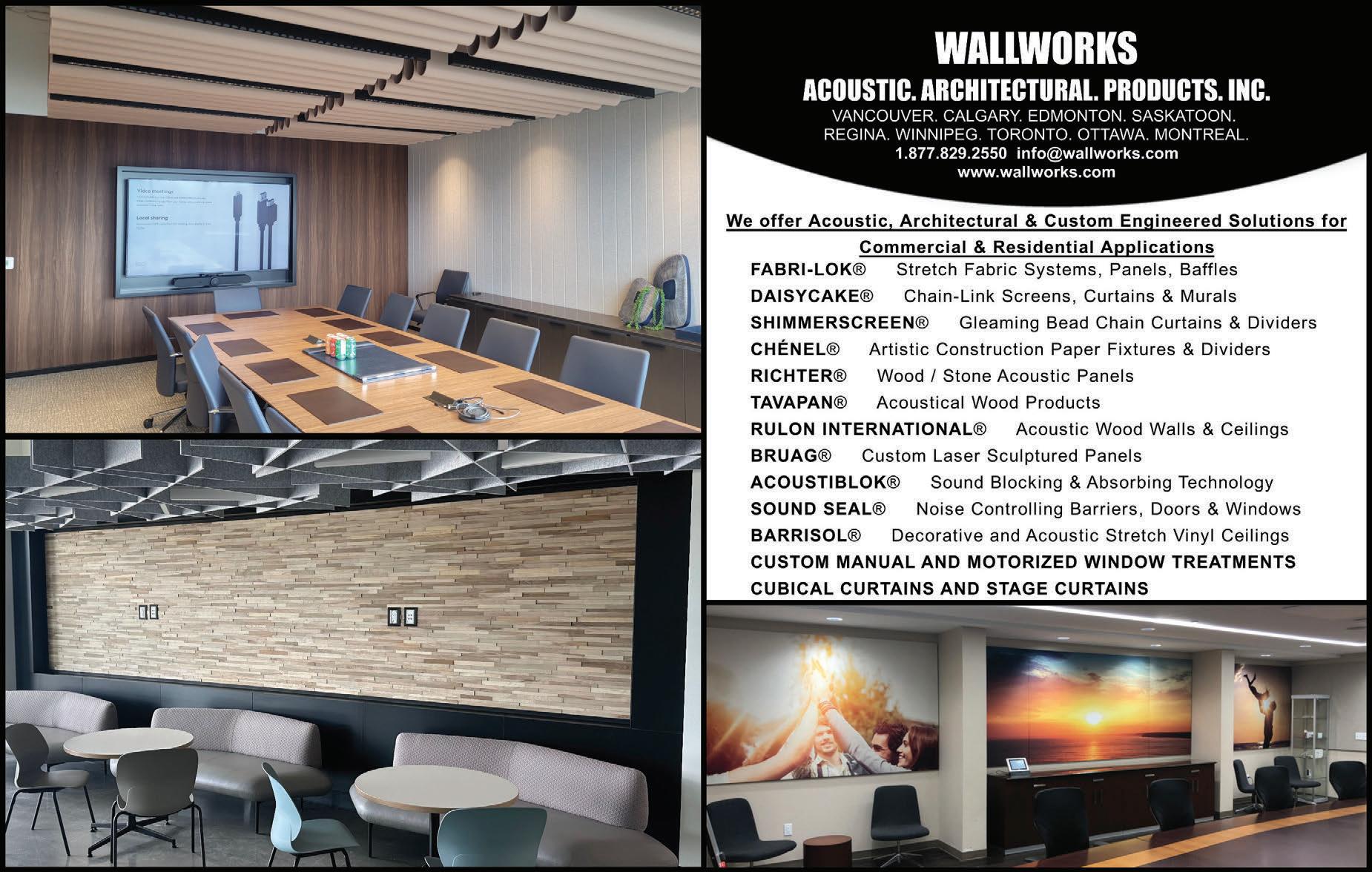



OPENING DOORS TO PROTECTION

School safety and lithium-ion battery risks are among the considerations for today’s fire protection systems experts
by ROBIN BRUNET
If any sector in the construction industry is justified in undertaking constant product improvements, it’s the realm of fire protection, detection, prevention, and fireproofing.
A good portion of those upgrades pertain to fire-rated doors and curtain walls, with one company, Technical Glass Products (TGP), experiencing brisk business in 2025. “With regard to the commercial and institutional sectors, business has been consistent thanks to a healthy backlog of projects,” says Dave Vermeulen, TGP’s North American sales director.
TGP, a division of Allegion, is respected for manufacturing a wide range of fire-rated glazing systems, from fire-protective lites to fire-resistive curtain walls, floors, and door assemblies. Vermeulen says, “We’re doing a lot more projects using bird glass on some of our exterior applications, whether it’s in New York or Toronto. Besides that, in terms of traditional fire-rated framing, we’re using TGP’s typical cold-rolled profiles in which the material has the profile of aluminum but is actually steel. Providing material that looks non-rated but is actually fire-rated is something TGP brought to the marketplace.”
Other product advancements from TGP include structurally glazed curtain walls. The Fireframes SG Curtainwall Series allows design professionals to create large, fire-rated glazed walls with the smooth, monolithic appearance of a structural silicone glazed system. The series features a patented toggle retention system that allows for rapid installation of fire-rated Pilkington Pyrostop glass, while being completely hidden once the installation is complete. The system provides fire ratings of 45, 60, and 120 minutes, and it’s compatible with full-lite doors from TGP in single-leaf or double-leaf design.
Another significant advancement is the Fireframes ClearView system, comprised of butt-glazed Pilkington Pyrostop low-iron fire-rated and impact safety-rated glass with a heat resistive perimeter frame. TGP’s butt-glazed joints feature nearly colourless transitions between adjoining pieces of the low-iron glass, eliminating the need for coloured internal glass unit spacers or vertical frame mullions. The perimeter of each butt-glazed elevation is held in place by the designer’s choice of TGP’s narrow-profile Fireframes fire-rated frames.
Vermeulen also mentions the demand for schools (especially in the U.S.) to be outfitted with glass that is both fire-rated and able to withstand assault from gunfire and/or forced entry, and he cites a renovation to Candy Lane Elementary school in Oregon as an example of how his company can deliver. For that project, the interior doors and windows of the main office needed to have a fire rating to satisfy code requirements and also be rated for forced entry resistance. Additionally, because these doors and windows would give visitors one of their first impressions of the school, they had to convey a warm and welcoming atmosphere.
To solve these challenges with a single, multifunctional product, Fireframes Heat Barrier Series doors and frames combined with Pilkington Pyrostop firerated glass laminated to School Guard Glass from LTI Smart Glass, Inc. were installed. School Guard Glass meets H.P. White 5-aa1 and ASTM F1233 Class 1.4 standards, which means, in testing, after being shot five times in a concentrated area, it could defend against violent attacks for over 12 minutes. It is also compatible with fire-rated glazing.
Also for that project, the Fireframes Heat Barrier Series doors and frames helped support large lites of multifunctional fire-rated glazing to increase visual connectivity and the amount of daylight let into the school. They also offered a close visual match to adjacent non-rated systems to provide a cohesive design aesthetic.
Jerry Cucchi, sales, Aluflam North America, reports that “We’re seeing a steady growth in orders of Contraflam One, which was developed by our glazing supplier to be more environmentally friendly and, most importantly, far lighter and with less distortion than earlier systems. We have become the main conduit of Contraflam One in Canada and the U.S.: in fact, anything we quote requiring a fire rating of 60 minutes or more is Contraflam.”
Full-lite, temperature-rise doors with narrow framing profiles.
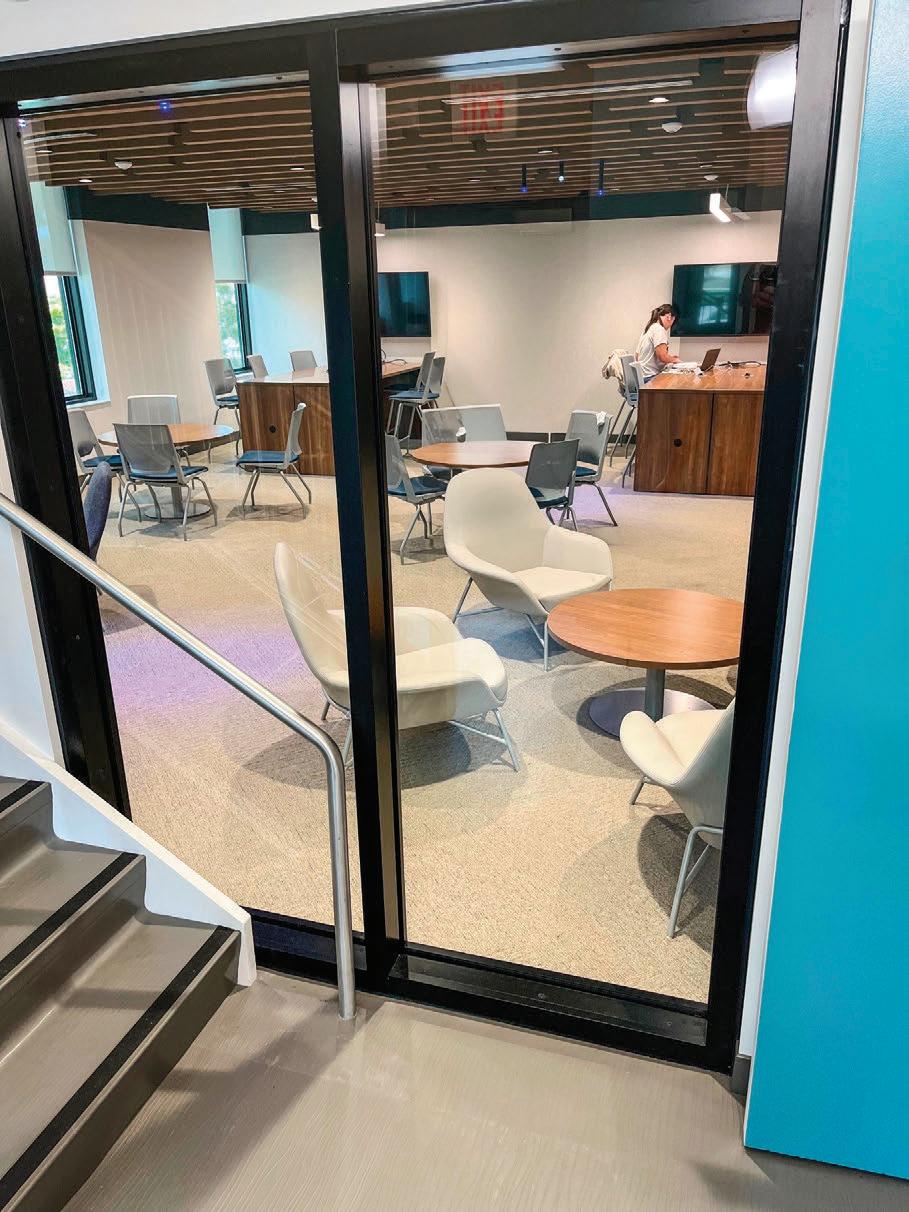
Aluflam’s glazing supplier is Vetrotech Saint-Gobain, which developed Contraflam One as its first fire-resistant glass variant with a single chamber foaming interlayer that meets classifications from 60 to 120 minutes. It’s a revolution in that for the first time, a single chamber foaming interlayer is all that is required, no matter the rating, thanks to HybridcoreTM technology, the result of Vetrotech’s 40-plus years of experience in interlayer chemistry. The result is a clearer, thinner, and lighter product offering the highest visible light transmission value with 88 percent for all classifications.
As for sustainability, Contraflam One’s carbon footprint is minimized because between 65 and 85 percent of total embodied carbon emissions occur during the product phase – encompassing raw material sourcing, delivery, transport, and manufacturing. By using less glass due to its single-chamber system, Contraflam One reduces embodied carbon by up to 45 percent compared to traditional multi-chamber and multi-layer products.
Pete Woodfine, sales manager, Ontario, for NABCO Canada Inc., says part of his company’s focus is on fire-rated door automation. “A good deal of our work consists of replacements and upgrading,” says Woodfine. “Understandably, building owners try to get as much life out of their systems as possible, so we are frequently confronted with doors at the very end of their useful lifespan.
“Given this, we stress the importance of our Preventative Automatic Door Maintenance Program, whereby our maintenance teams help clients choose the right maintenance plan based on the age and condition of equipment, the volume of pedestrian traffic, and geographic location.”
Unlike reactive maintenance, preventative maintenance is a cost-saving approach to extending the lifecycle of equipment; NABCO’s program protects investments with regularly scheduled service visits to inspect, maintain, and replace worn components before they fail, reducing unexpected equipment downtime. “Preventative maintenance also answers the vital question: Are my doors operating within current ANSI safety compliance standards?” Woodfine says.
However, there is an inherent advantage to NABCO’s extensive door line: engineered in Japan, they are especially robust. “With regular planned maintenance, they don’t break down as much compared to other doors and can last

Satisfy safety regulations and reward your creativity with Aluflam, the key system featuring true extruded aluminum vision doors, windows and glazed walls, fired-rated for up to 120 minutes.
Aluflam products are indistinguishable from non-fire-rated doors and windows and are available in a wide portfolio of most architectural finishes.
Aluflam AW60 Curtain Wall Series.


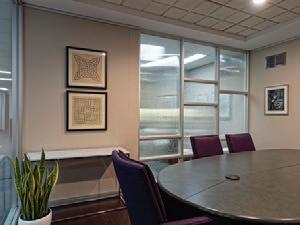
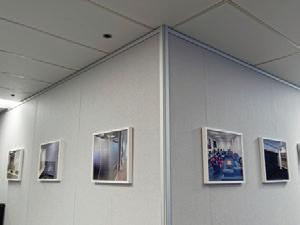


A great alternative to drywall:
Installation time is 1/3 the time of conventional drywall. Pre-finished gypsum panels eliminate the need for taping, sanding, priming, painting and/or wallcovering.
The dust and debris associated with drywall construction is virtually eliminated when using demountables.
Demountables are re-usable. Typical drywall construction cannot be reused, sending demolished partitions to landfill.
Demountables require fewer tradespeople to install and co-ordinate.
The quick, clean and “quieter” installation associated with demountables make them less disruptive during retrofits.
Demountables on raised floors are a much cleaner install than drywall.
Demountables can be installed directly over carpet.
Pre-finished gypsum walls require less maintenance than painted walls after installation. Painted walls require more frequent touch-ups thereby increasing V.O.C. emissions in the occupied space.
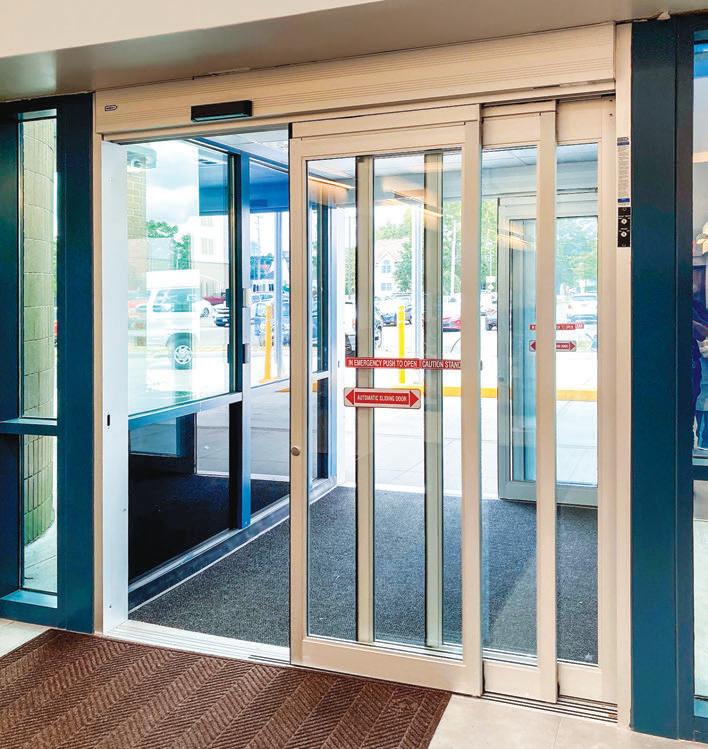
17-plus years compared to the average lifespan of 12 years,” Woodfine says. “In fact, one of our doors, the GT1175 sliding door system having our robust brushless motor, withstood four million cycles at a high volume retailer in Canada without ever receiving maintenance. If there were a hall of fame for doors, that would be a showcase exhibit.”
Allmar Inc. notes that with Canadian federal buildings responsible for maintenance and care of fire-rated assemblies based on National Fire Protection Association provisions incorporated into the National Building Code of Canada, it can provide annual inspections by a certified professional. Provincial governments are expected to adopt the Code over the next several years, which will require annual inspection of provincial buildings as well.
Allmar’s knowledge of building codes, experience with doors and hardware, and staff who are certified to inspect fire door assemblies, grant the expertise and authority to ensure that fire-rated doors are inspected regularly, functioning properly, and that owners are meeting their requirements for annual inspection. Ongoing inspection and maintenance of fire and egress doors helps prevent loss of life, while reducing property damage and insurance premiums. Allmar’s fire door inspectors are certified through the Door and Hardware Institute’s Fire and Egress Door Assembly Inspection program.
As for current and future concerns in the realm of fire prevention and suppression, Hussam Iskander, fire protection project manager at MCW Consultants Ltd., draws attention to the volatility of lithium-ion batteries that are increasingly prevalent not only in electric automobiles but also for much larger transport vehicles.
One of Iskander’s projects saw him called in to develop an effective fire suppression system for a battery-charging terminal that supplied power to a fleet of Ontario-based ferries. “Due to thermal migration being very intense when lithium batteries catch fire, it was a major concern that this small facility contained 20 racks of batteries eight feet high,” he says. “However, the solution was relatively straightforward. We installed water pipes designed to release city-supplied water onto any of the shelves of each rack in the event of combustion. In addition, lowertemperature activation bulbs were added to the in-rack nozzles. Together with a typical ceiling sprinkler system, these measures were effective in extinguishing a blaze in about 20 seconds, without activating the ceiling sprinkler system.”
Iskander’s system shows promise considering that the high temperatures generated by lithium-ion make the fire harder to control quicker. “In less than one minute, the fire from lithium-ion batteries, depending on the battery design and chemistry, will have spread to the point where professional firefighters are required, while a typical fire will take three to six minutes to get to that point,” he says. Iskander’s involvement in lithium-ion battery fire suppression may well herald a closer look at the issue – and further development of fire suppression systems –in the near future. “More reasonable solutions need to be invented that will work for places bigger than a room or two, and consideration needs to be paid to the fact that a growing number of charging stations are cropping up everywhere for electric vehicles,” he says. “Charging is when fires are most likely to occur, yet it’s not uncommon to find these vehicles being charged in multi-family residential developments in close proximity to other homes and infrastructure.” A
GT1175 Telescopic door.

OAK HOUSE STUDENT RESIDENCE – UNIVERSITY OF TORONTO
by CHRISTINA MORRISSEY
For nearly two centuries, the oak trees that proudly grace the grounds of the University of Toronto’s St. George campus have watched generations of students come and go. Now, those same oaks have inspired the name of the new sustainable student residence: Oak House. Rising 23 storeys at the corner of Spadina and Sussex, Oak House combines state-of-the-art student accommodations with a carefully preserved three-storey heritage podium. Designed by Diamond Schmitt Architects with heritage input from ERA, the building balances contemporary
LOCATION
700 Spadina Avenue, Toronto, Ontario
OWNER/DEVELOPER
University of Toronto / The Daniels Corporation
ARCHITECT
Diamond Schmitt Architects
HERITAGE ARCHITECT
ERA Architects Inc.
GENERAL CONTRACTOR
The Daniels Corporation
STRUCTURAL CONSULTANT
Entuitive
MECHANICAL/ELECTRICAL CONSULTANT
Salas O’Brien
LANDSCAPE ARCHITECT
NAK Design Strategies
TOTAL SIZE
201,000 square feet
TOTAL COST
$113.9 million

The goal of Oak House was to create a residence tower that fits with its context, looks beautiful, functions efficiently, and becomes a home for its students.
construction with traditional materials, creating a dialogue between heritage and modernity.
“This project came to us over a decade ago,” explains Aaron Costain, associate at Diamond Schmitt. “The University of Toronto hadn’t built a purpose-designed residence in almost 20 years and wanted to ensure a bed for every first-year student who wanted one. The university partnered with Daniels Corporation to assemble a parcel of land that would eventually be the home to 508 student beds, and include a three-storey townhouse building for faculty.”
“The materiality of Oak House – brick with lighter concrete accents – evokes the university’s mid-century buildings and references the two-tone brick of the heritage podium,” explains Costain. “The podium’s scale and articulation also nod to Toronto’s 19th-century industrial buildings along Spadina.”
The tower lifts students above street noise, providing privacy, light, and views. It is articulated as a single masonry element rising from the podium, with a second element starting two storeys above the heritage building. The two are separated by a glazed strip running top to bottom on front and back, containing common areas to the west and suite living rooms to the east. The podium houses student amenities and retail spaces, stepping down toward the corner of Spadina and Sussex, while a smaller three-storey
townhouse mediates scale with the surrounding residential neighbourhood.
Brick is used to its full potential: the tower’s precast panels incorporate thin-brick inlays in a vertical running bond, while the podium features hand-laid artisanal brick with a rough-hewn texture.
The heritage building, originally a grocery store built by John James Funston in 1885, required careful preservation. Jessie Grebenc, senior associate at ERA, recalls: “It was in terrible shape. It had been painted over many times, and the wooden storefront had been boarded up, altered, and over-clad. Our initial work involved removing pieces of plywood and setting up temporary access to assess what could be saved. We determined it was possible. Both Diamond Schmitt and the university were very supportive.”
The retained façades feature intricate red and yellow brickwork and elaborate chimneys, reflecting the building’s original craftsmanship.
ERA also introduced a new groundfloor window on the south elevation to bring natural light into the communal space behind the heritage frontage, activating the street while providing a subtle contemporary contrast.
Tucked between these old and new elements is the new entrance, with a slender, three-storey atrium. “An approach from the west presents the townhouse, with the same scale and materiality as the surrounding houses. Passing the lanes, you get glimpses into the residence’s administrative area before arriving at the corner retail in the heritage building. Turning the corner, you reach the front entrance on Spadina facing the university,” says Costain.
Inside, the residence offers a mix of accommodations: paired bedrooms sharing a washroom for undergraduates, and four-bedroom suites with private living rooms and kitchens for upper-year or graduate students, encouraging older students to mentor younger ones. Common areas follow a skip-stop pattern, with double-height ‘living rooms’ and kitchenettes every other floor, paired with smaller function-specific rooms designed to promote social interaction and well-being.
The podium is largely devoted to amenities, aside from street-facing retail and back-of-house areas. The mezzanine includes a lounge, games, and study rooms, fitness and music facilities, a multifaith room, laundry, and a maker space for architecture and
engineering projects. The second floor houses a full-service cafeteria, a multipurpose room, and a flexible café/study area for events and casual gatherings.
Throughout Oak House, the material palette reinforces warmth and durability. Oak, terrazzo, and stone are complemented by a subdued colour scheme, creating an interior that is both resilient and inviting.
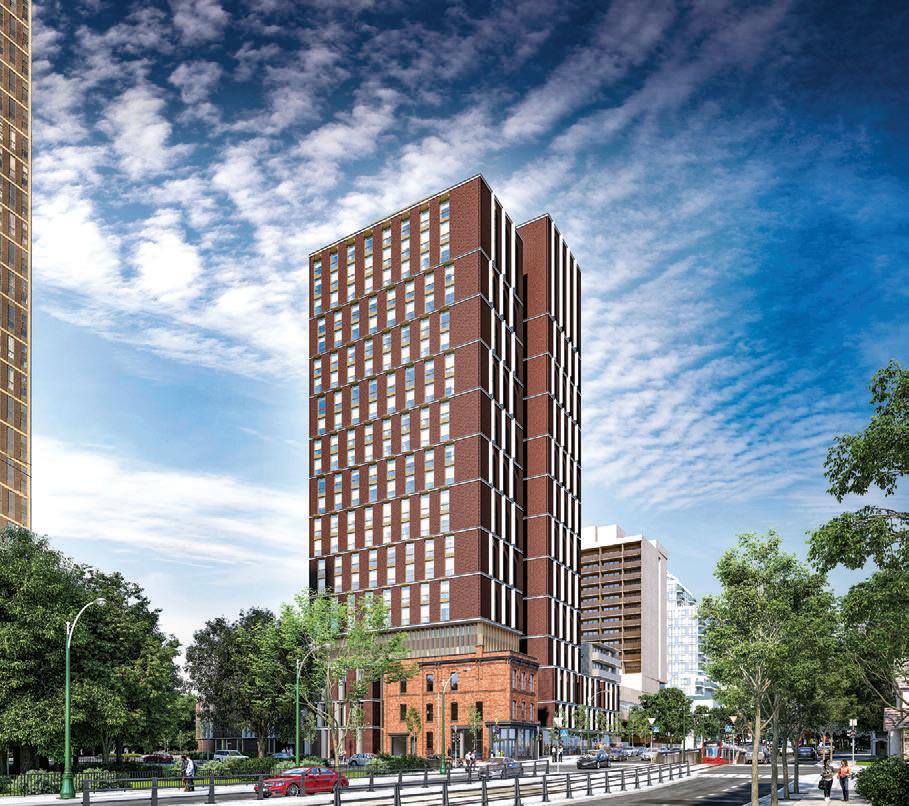
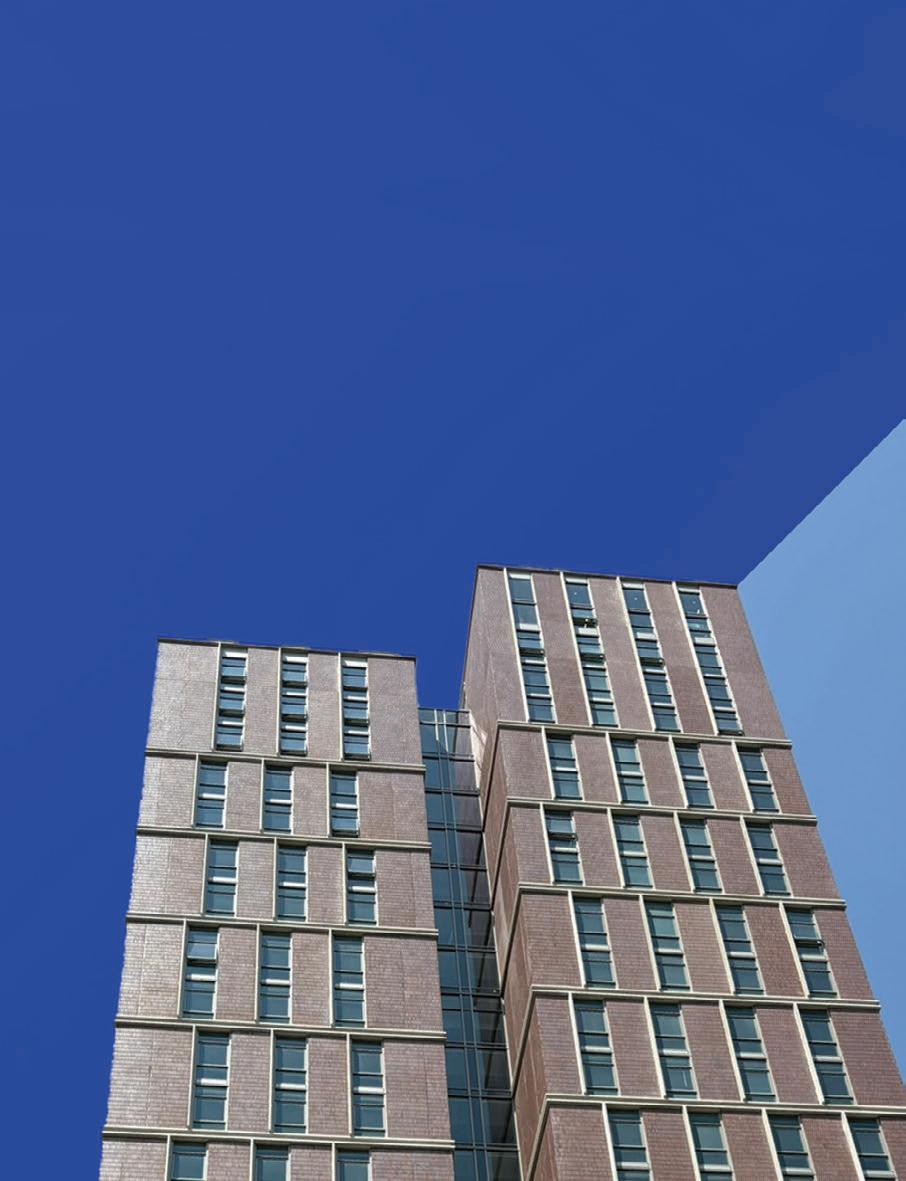
Designing spaces that shape the next generation
Inside the heritage building, unexpected structural conditions shaped the design. Grebenc notes that the original brickwork, laid at a 45-degree angle, functioned like a three-layer construction using only two layers. “We were prepared to respond to these surprises. We had a great heritage trade team, especially in masonry, who were comfortable pivoting and responding to these challenges.” Heritage masonry, fire protection, and barrier-free access were all addressed sensitively, including a lowered entrance that provides accessibility without detracting from the historic façade.
With the building now complete, the team can take pride in delivering much-needed accommodation to the University of Toronto. “For me, realizing the beauty that was hidden beneath all the paint, plywood, and overcladding in the heritage building will always stay with me,” says Grebenc. “The original builder poured a lot of care into the building, and it was rewarding to bring that back to life and give it a new purpose.” A

At University of Toronto Oak House, we designed the mechanical, electrical, and plumbing systems for comfort and sustainability for years to come.
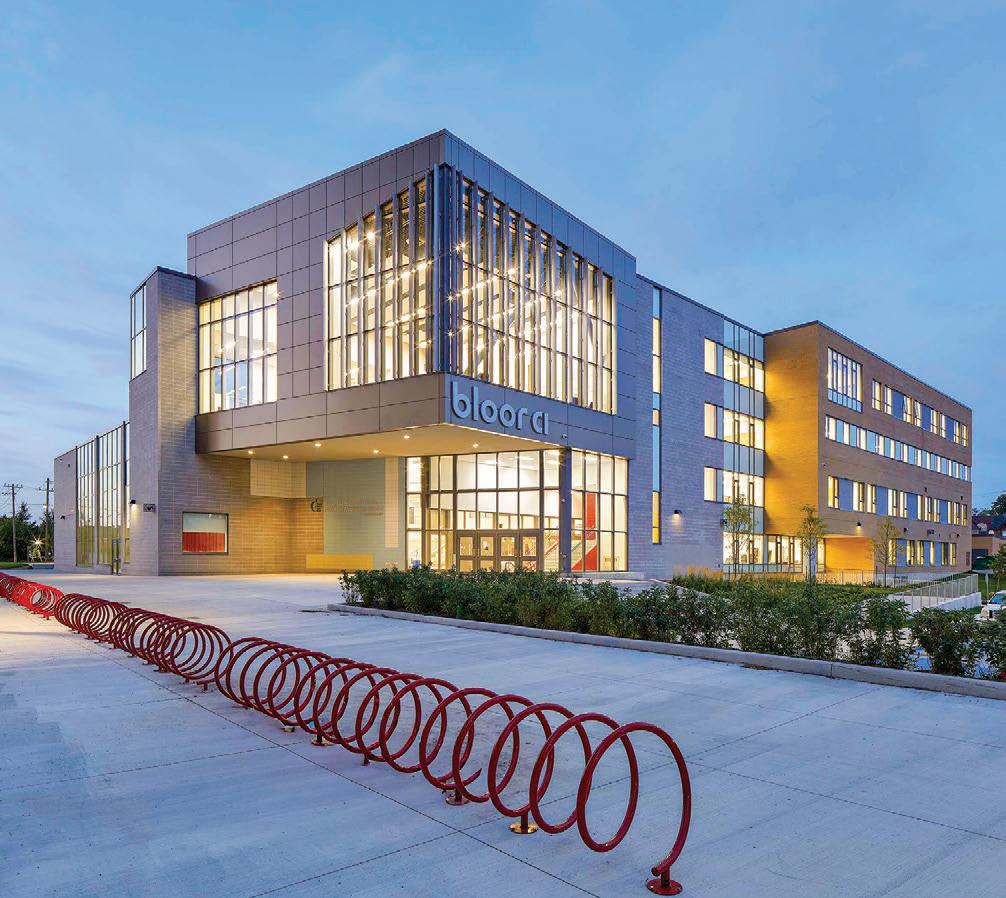
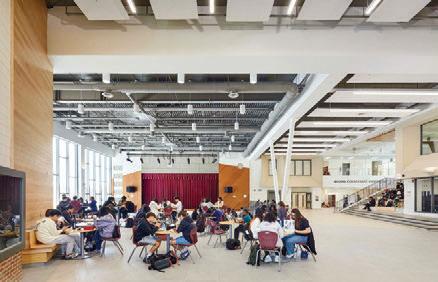

BLOOR COLLEGIATE INSTITUTE AND ALPHA II ALTERNATIVE SCHOOL
by ROBIN BRUNET
As with so many public school projects, the development of the new Bloor Collegiate Institute and ALPHA II Alternative School in Toronto was years in the making. The Toronto District School Board first submitted a business case to the Ministry of Education in 2013, calling for a new facility to replace the aging Bloor Collegiate Institute at the corner of Bloor and Dufferin streets. The facility was already in disrepair and there was no cost benefit in retrofitting the existing structure to suit the requirements of the school community.
After a protracted funding process, Snyder Architects was retained in 2017 to bring the new facility to life. The new four-storey 125,000-square-foot Bloor Collegiate Institute and ALPHA II Alternative School was to become a legacy project for this west-end downtown Toronto community, intended to provide a state-of-the-art school for a thriving community. Snyder Architects’ principal Rochelle Moncarz says, “Apart from the old facility having reached the end of its life, it did not reflect the requirements of modern-day teaching and learning environments.”
Design of the new facility commenced in 2017 with multiple levels of stakeholder consultation, which Moncarz credits for providing considerable design inspiration. “The input of TDSB manager of capital services, Salvatore Beltrano, and of the former school’s principal, Susana Arnott, in particular, set the tone for
our design,” she says. “For example, Arnott discussed the strength of the school’s TOPS [STEM] and robotics programs, its important role in the community, and the vibrancy of the student body, where students choose to spend more time in the building than in the surrounding neighbourhood. This set us on the path to making the new facility very studentfocused: a space designed for teens to thrive and achieve their best.”
The site was unique in its small 2.6-acre size, entirely surrounded by streets. This translated into the development of a four-storey building with underground parking, rooftop learning areas, and facades that acknowledge four different adjacencies: a new five-tower mixed-use development to the east, an existing athletic field to the south, and an established low-rise neighbourhood to the west. “The school’s four-level height was staggered to break down its mass visually, and we selected exterior materials – curtain wall, masonry, concrete block, aluminum panel – to reflect and connect to the surrounding neighbourhood. The student entrance at the northeast corner makes a distinctive gesture towards Bloor Street, announcing the building’s presence with a double-height learning commons on the third floor that cantilevers over the entrance,” Moncarz says.
The Snyder team created a lightfilled, easy-to-navigate L-shaped floor
LOCATION
90 Croatia Street, Toronto, Ontario
OWNER/DEVELOPER
Toronto District School Board
ARCHITECT
Snyder Architects
GENERAL CONTRACTOR
Percon Construction
STRUCTURAL CONSULTANT
Thornton Tomasetti
MECHANICAL/ELECTRICAL CONSULTANT
rybka ellard willson Incorporated
LANDSCAPE ARCHITECT
Marton Smith Landscape Architects
TOTAL SIZE
125,000 square feet
TOTAL COST
Undisclosed
plan design, with large windows and visual connectivity throughout. The building includes a variety of specialized program areas, including eight science labs, two computer engineering labs, a robotics lab, two culinary arts rooms, and visual and performing arts clusters.
Multiple areas for shared community use were created, including a student commons, as well as a ‘Cafetorium’ (a combination cafeteria and auditorium) with a double-sided stage opening to a theatre arts room beyond, and a light-filled gymnasium. “These key areas are co-located at the heart of the school, providing easy access for the community and strong connections to the exterior amenity spaces,” Moncarz says. “The student commons is double height with full-height glazing on two sides, and amphitheatre seating going up to the second floor. It’s a dynamic space for students to gather, socialize, and study.”
The TDSB and the architects also ensured that Bloor would have 21st-century learning elements throughout, including wide corridors for flexible use, with kitchenettes on every floor, integrated resource rooms shared between classrooms, and a large double-height learning commons on the third floor.
The ALPHA II Alternative School for Grades 7 to 12 students was given its own wing and developed to include plenty of flex space, arts and music programming, and kitchenettes.
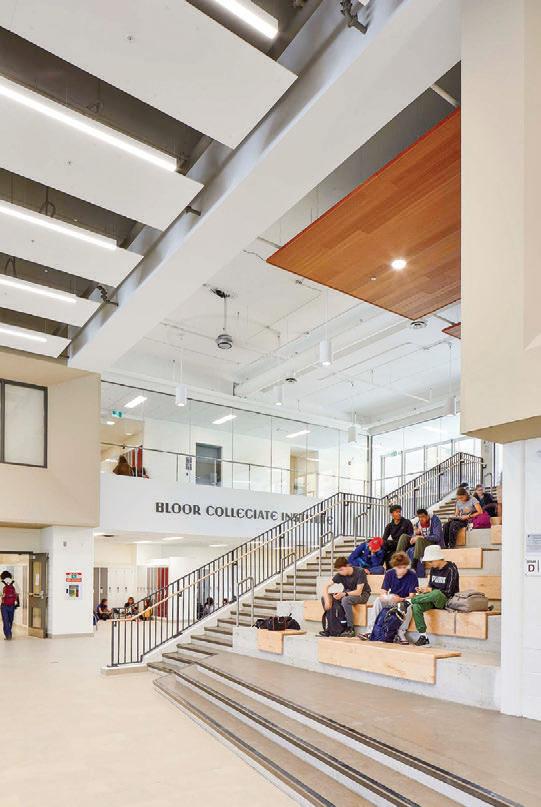
Percon Construction broke ground on the site during the COVID lockdowns but was able to navigate pandemic-imposed requirements, as well as cope with a lack of laydown space and site challenges such as constructing underground parking within a water table.
Beltrano acknowledges the team’s persistence in navigating the various challenges that came with this longplanned project, saying, “Delivering an educational facility of this scope is always complex, but what we have now is a wonderful facility that’s built to evolve with students’ needs for decades to come – and a great addition to the broader community.”
The school opened to students in September, marking the 100th anniversary of the establishment of Bloor Collegiate Institute. A

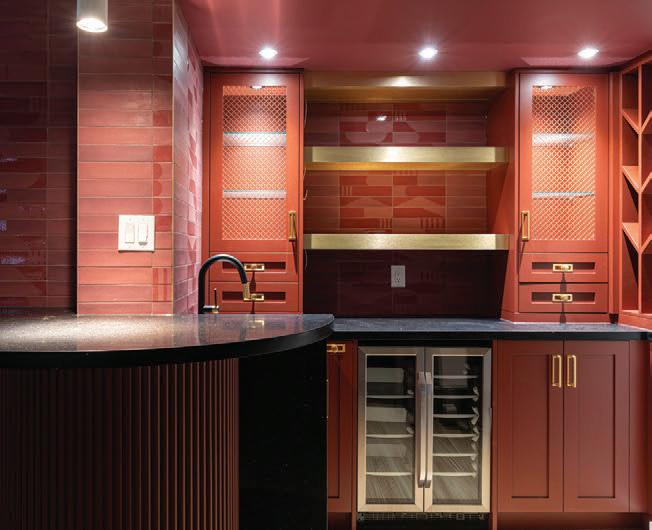
Design. Build. Install.


CENTRO TOWER
by JESSICA KIRBY
The Centro project is transforming downtown London, Ontario, with sleek, contemporary apartment and amenity space in the city’s highest tower to date. The project comprises two multi-residential towers that house 652 units and a nine-storey podium that houses luxurious amenities, as well as residential and commercial space. Each component rests on three levels of underground parking.
Michael Bierbaum, vice-president of development and construction for Old Oak Properties, says they wanted the project to be something different within the city skyline. “Another concrete box was not what we were looking to build,” he says. “We wanted something people would walk down the street and look up at, point and stare, and enjoy.”
Project occupancy has been phased over three years. Phase one included 250 units in storeys 10 and up in the south tower. Phase two followed with the bottom 10 storeys and podium and includes ground floor commercial spaces and third floor amenity spaces like a rooftop gym, an arcade and a theatre room, games room, studios for yoga and spin, and a dog run and dog wash area, all of which were completed this fall. Phase three – the entire north tower and a 20,000-square-foot rooftop terrace – will be available in late summer of 2026.

The south tower sits at 40 storeys with a two-level penthouse, while the north tower will have 29 levels, says Alfonso Balassone, director of construction for Old Oak. The project is built of cast reinforced concrete columns and slabs formed using a flyer system. On the exterior, a unitized window wall was constructed and hoisted panel by panel around the perimeter, and the balconies are clad in glass with railings and a white precast accent. The mechanical system features a conventional two-pipe fancoil system with boiler and chiller to the suites controlled by digital thermostats.
The project required a large excavation and substantial shoring, so the team used drilled concrete caisson shoring walls to get the job done. “The underground levels go 40 feet into the ground, making the dewatering component significant,” Balassone says.
Once construction of the tower began, the formwork flyer system meant formwork for an entire floor was erected and, once the team poured the concrete on one floor, they would drop the supports so the formwork could be pulled out and flown to the next floor.
Jessica Vander Heide, registered interior designer, says ensuring cohesion and consistency between the interior and exterior elements was always at the forefront of the project’s design. “There was a lot of discussion
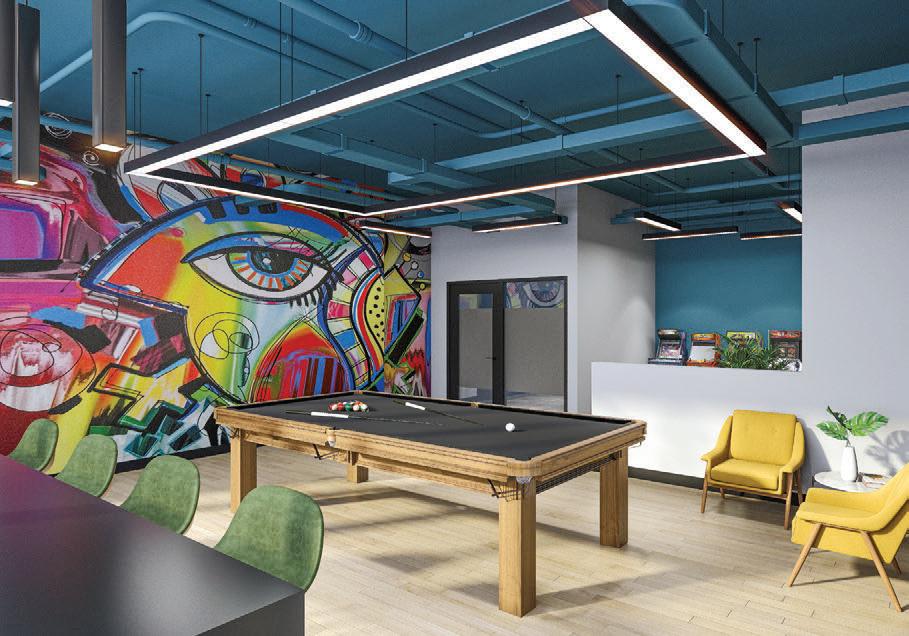
about the eyebrows and ‘spine’ of the façade, along with the relatively minimal aesthetic,” she says. “Considering this, I proposed an exposed [black] ceiling in the lobby and looked at replicating similar linear elements, such as suspended LED lighting, oversized wall sconces, and subtle fluted wood panelling within the interior.”
Given the building is located in the Forest City, hits of greenery were also implemented through oversized trees in each lobby. The design team wanted a playful and inquisitory component to each lobby from the street views, which is why oversized, colourful murals were located on various focal walls. “There was reference to the Bauhaus design style at the start of the project, but the vision continued to evolve to ensure a functional and playful experience for all residents,” Vander Heide says.
A concrete interior aesthetic with bold pops of colour, pattern, and texture were among the main material choices. The lobby floor received a large format tile that replicates
concrete, again, to provide cohesion to the exterior of the building.
Textured wall covering clads most of the walls, and there are bold accent wall coverings and murals throughout various common spaces.
“Fluted white oak wood panelling was also used in various locations to soften some of the spaces and add a bit of warmth,” Vander Heide says.
“Repetition in materials [switching up the application] avoided visual clutter and made the space feel intentional,” she adds. “I never wanted any of the spaces to feel independent from each other, just as I didn’t want the interior to feel disconnected from the exterior. In my opinion, the design was also practical and functional to ensure occupant safety and well-being.”
Keith Benjamin, sales representative for Normac Kitchens Ltd., says the kitchen is the heart of every home, and at Centro Towers, each kitchen design invites connection, whether it’s a quiet morning coffee or a lively dinner with friends.







“The design aesthetic embraces modern sophistication with a European flair,” he says. “An alternating colour palette per floor, drawn from our Elite and Designer colour collections, creates a sense of rhythm and visual variety throughout the towers.”
Each kitchen features Europeanstyle cabinet construction, paired with sleek, contemporary hardware for a clean, refined look. The result is a space that balances modern beauty with everyday functionality, skillfully suited for contemporary urban living.
The ground-floor landscape was designed to build on the combined modern and heritage architectural aesthetic and to create a comfortable pedestrian atmosphere. Benches shaded by canopy trees, raised garden planters to soften the hardscape, and a decorative paving pattern, using colour and texture to highlight entryways, are provided at street level. The rooftop terrace was designed to expand upon interior amenity spaces creating an enjoyable multi-functional outdoor space for dining, socialization, games, and relaxation.
Every large project comes with challenges, and Centro was no exception. “One of the major challenges
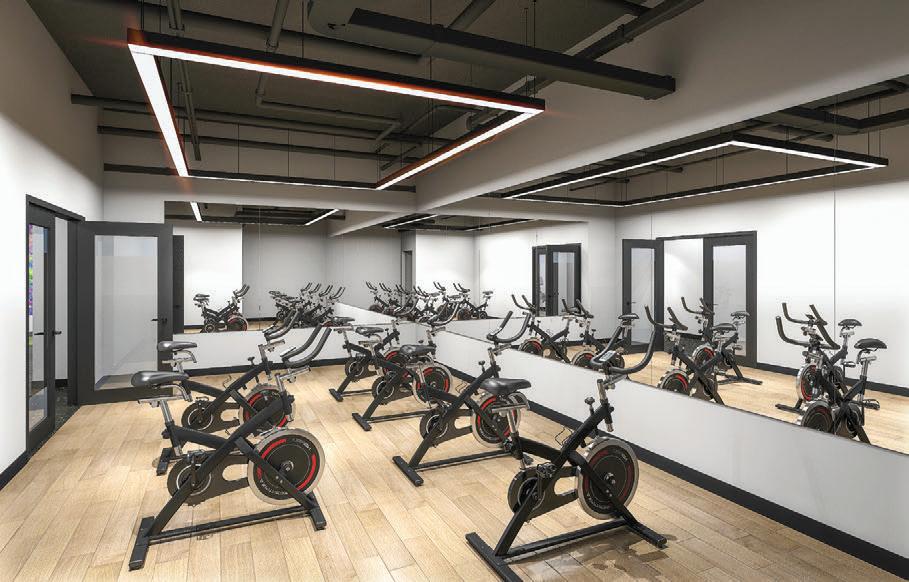
in London was that the trades here are not used to a project like this,” Bierbaum says. “The height, the structural complexity, zero-lot-line construction, and the bathtub foundation style were a few unique challenges for this project. Constructing this project through COVID had its unique challenges, as well.”
The project team also had to tackle a significant heritage component before the work could proceed as scheduled. Centro is built on a site that was home
to a 100-year-old townhouse village, well-known and cherished in the community. “We had to decide what level of preservation we would use and how to incorporate the historical component into the new design,” Balassone says. After several years of consultation, the development team and City of London decided to retain an exterior wall on the north side and pin it to the new structure, integrating the wall, which is made of a yellow clay brick traditional to London, into the new cladding.
LOCATION
100 Fullarton Street, London, Ontario
OWNER/GENERAL CONTRACTOR/ INTERIOR DESIGN
Old Oak Properties Inc.
ARCHITECTS
SRM Architects & Urban Designers / Richmond Architects
STRUCTURAL CONSULTANT
Jablonsky, Ast and Partners
MECHANICAL CONSULTANT
Entrust Engineering Inc.
ELECTRICAL CONSULTANT
E-Lumen International Inc.
LANDSCAPE ARCHITECT/ HERITAGE PLANNER/CIVIL CONSULTANT Stantec
INTERIOR DESIGN
Jessica Vander Heide –
Registered Interior Designer
TOTAL SIZE
985,000 square feet
TOTAL COST
$300 million
“We are feeling great about this project,” Bierbaum says. “I am very happy to see the project from multiple blocks away driving around town, and say to myself, ‘Wow, that really changed the skyline!’” A
We are proud to have provided the windows, doors and curtain wall for the Centro London Project
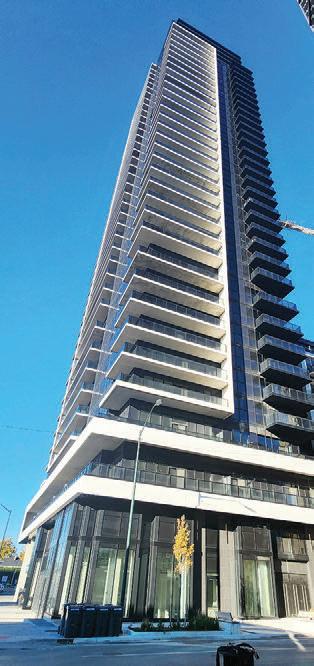


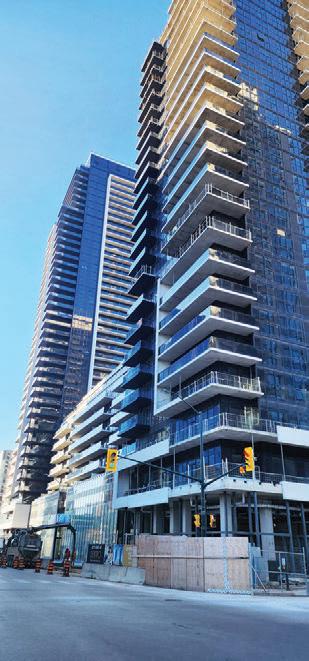

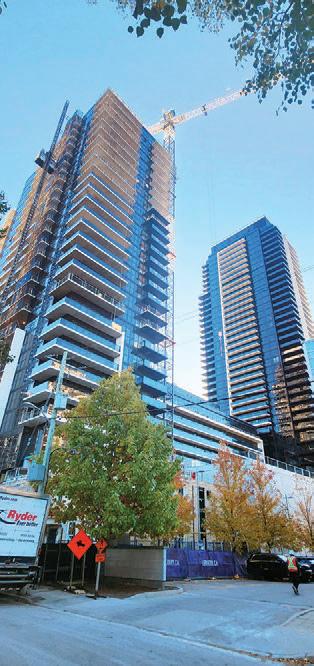

Over 30 Years in Business
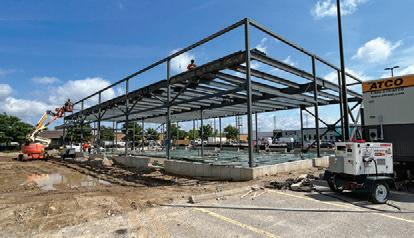

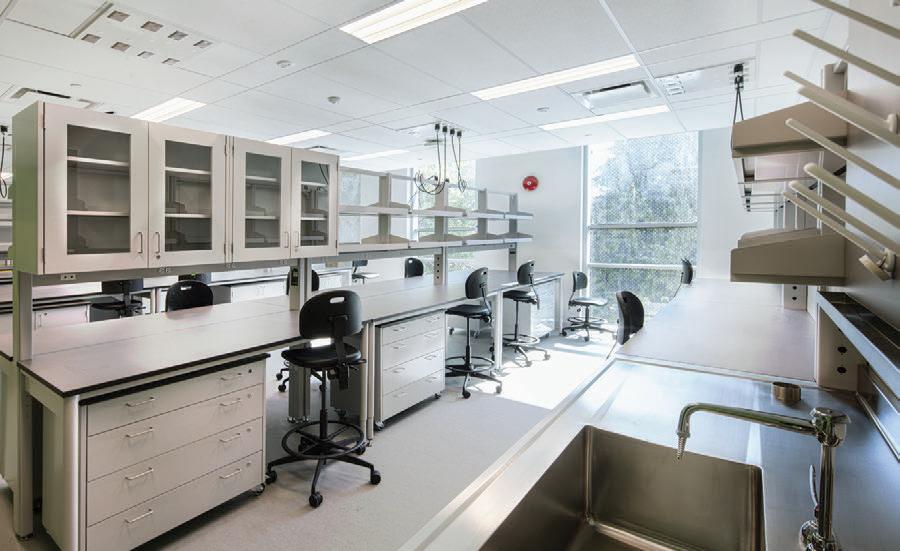






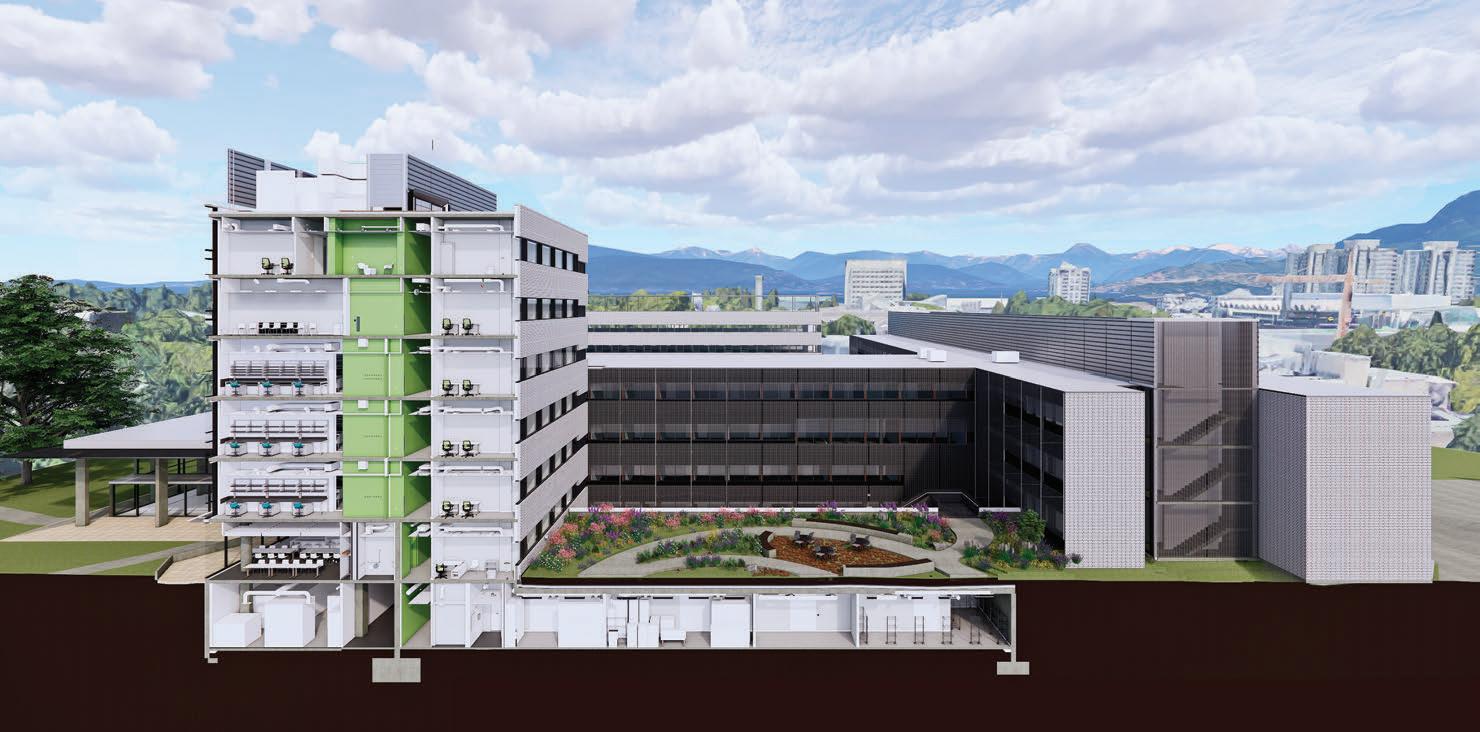
BEATY BIODIVERSITY CENTRE ADDITION – UBC
by NATALIE BRUCKNER
When it comes to biodiversity research, The University of British Columbia (UBC) is considered one of the world’s leading institutions. But, as is often the case with success, the university had outgrown its original Beaty Biodiversity Centre.
The latest addition, designed by Public Architecture + Design in close collaboration with UBC, responds directly to that need. It provides muchneeded space for expanding research and museum activities, including offices and labs for new faculty and growing teams, room to develop and strengthen partnerships, and extra capacity for the Beaty Biodiversity Museum’s growing collections, exhibits, and public programming.
The original Centre, designed by Patkau Architects and opened in 2009, is a complex building that called for a designer deeply familiar with its architectural language. That made Shane O’Neill, associate principal at Public Architecture, the ideal collaborator for the project. “I had a bit of an advantage,” explains O’Neill. “Prior to Public, I was at Patkau, where I worked on the original building. That gave me a sensitivity to the original design intent.”
The design brief was straightforward in ambition but complex in execution. “The addition had two major goals: expanding museum back-of-house facilities, including a new fossil collections storage room; and adding to the research lab and office spaces,” O’Neill says.
The fossil storage, buried underground, presented unique challenges in Vancouver’s water-prone environment, yet continuing the strategy of belowgrade spaces from the original building
made sense. To help address this, sensitive storage was placed directly under the addition with less critical spaces under the new green roof. Labs occupy one side of the six-storey addition, a service core runs through the middle, and offices line the other side, looking onto a series of courtyards.
Balancing scale was another key consideration. “The existing building is calm and restrained. We needed the addition to add almost a third more area, but not feel stuffed in. Balancing a new tower with the existing lower buildings was a real win,” he explains.
Positioning the new addition required equal parts strategy and tact. The original building wraps around a courtyard on three sides. “We ended up with a tidy diagram for the upper floors, plugging in new spaces without disrupting the ongoing work in the existing building,” O’Neill says.
Material selection further strengthened the dialogue between old and new. UBC’s campus design guidelines favour concrete, metals, stainless steel, aluminum, and white brick, which became the palette for the addition. “For example, the existing building has an aluminum screen. We didn’t replicate it because it didn’t meet performance needs, but we borrowed its horizontal linear language,” O’Neill explains. Behind a stand of trees on the Main Mall side, the height of the new building mirrors its surroundings, complementing rather than overwhelming the campus.
A quiet but significant innovation on this project came from Morinwood, the millwork subcontractor. During the bidding phase, Morinwood piloted its first use of artificial intelligence
to automatically detect, classify, and quantify millwork elements directly from PDF architectural drawings. This approach helped streamline estimating and co-ordination, improving efficiency and accuracy across the preconstruction process.
Construction brought its own set of challenges; however, ETRO Construction, undertaking its eighth project with UBC, found the soil surprisingly co-operative. “The soil was solid as concrete,” says Vinh Huynh, project manager at ETRO Construction. “We had a big sump on the east side, almost 30 feet down, and it was stable, so minimal shoring was required. That was also a pleasant surprise.”
Limited site access and the proximity to trees required careful planning. “Some trees on the southwest corner were only four to five feet from the building. We had to construct all the brick walls in front of them without being able to drive any lifts on that side,” he recalls.
The basement concrete pour was another intricate moment, requiring all plumbing flex pipes to be tied to rebar in almost record time. “My co-ordinator and I actually jumped in, along with the team, to help tie everything properly,” Huynh remembers. “I think that surprised the subcontractors on site, but we did what had to be done.”
Structural connections between the new and existing buildings had to account for seismic events while maintaining fire ratings. The solution involved expensive, intricate expansion joints, carefully designed to allow increasing movement from the basement to the top floor.
Both inside and out, thoughtful touches create an environment conducive to collaboration and visibility. For example, lab entries feature pinboards, giving each space personality and allowing researchers to share insights. Specialized storage areas for flammable materials, careful air handling, a subtle canopy, and a beautiful
stair that takes you down to the sunken courtyard that evokes a paleontologists’ dig sites, blend practical needs with storytelling.
Hi-Cube Storage Products collaborated with Public, ETRO, Division 15 Mechanical, and Spacesaver to design a high-density mobile storage system that met the client’s storage goals for their current collection, along with provisions for future growth. The solution maximized space efficiency with inlaid rail installed flush to the floor surface, mechanical-assist mobile carriages, and specialty preservation cabinets. It featured Botany- and Herbarium-specific cabinets, standard cabinets with removable trays, and cabinets that were mechanically vented through the building’s HVAC system for chemical storage.
A big feat of the addition is that the existing building has a floor space ratio (FSR) of 1:1 (for every one square foot of room, there’s one square foot of site), while the addition is almost three times more intensive than the original building was in terms of site use.
The project succeeds on multiple fronts, offering increased space, operational efficiency, and design sensitivity. Collaboration between UBC, the architect, contractors, and subcontractors truly set the project apart. “There was a true sense of teamwork,” Huynh says. “Any challenges that arose were resolved collaboratively and immediately, rather than waiting and incurring more costs later. Communication was excellent throughout the project.”
“UBC Properties Trust was there moving the project forward every step of the way,” O’Neill agrees, adding: “The project is sensitive to the original building, responsive to users, and provides much-needed space. The result is a careful addition that fits into the campus.” A
LOCATION
2212 Main Mall, Vancouver, B.C.
OWNER
UBC
PROJECT MANAGER
UBC Properties Trust
ARCHITECT/INTERIOR DESIGN
PUBLIC Architecture + Design
CONSTRUCTION MANAGER
ETRO Construction
STRUCTURAL CONSULTANT
WSP
MECHANICAL CONSULTANT
AME Consulting Group
ELECTRICAL CONSULTANT
AES Engineering
LANDSCAPE ARCHITECT
Hapa Collaborative
TOTAL SIZE
47,980 square feet
TOTAL COST
$45 million

• Post-construction & final turnover cleaning
• Commercial & multi-residential projects
• Janitorial & residential cleaning services
• Eco-friendly products, insured & WSBC-compliant crews

www.gpecoclean.ca



Bush Bohlman.indd
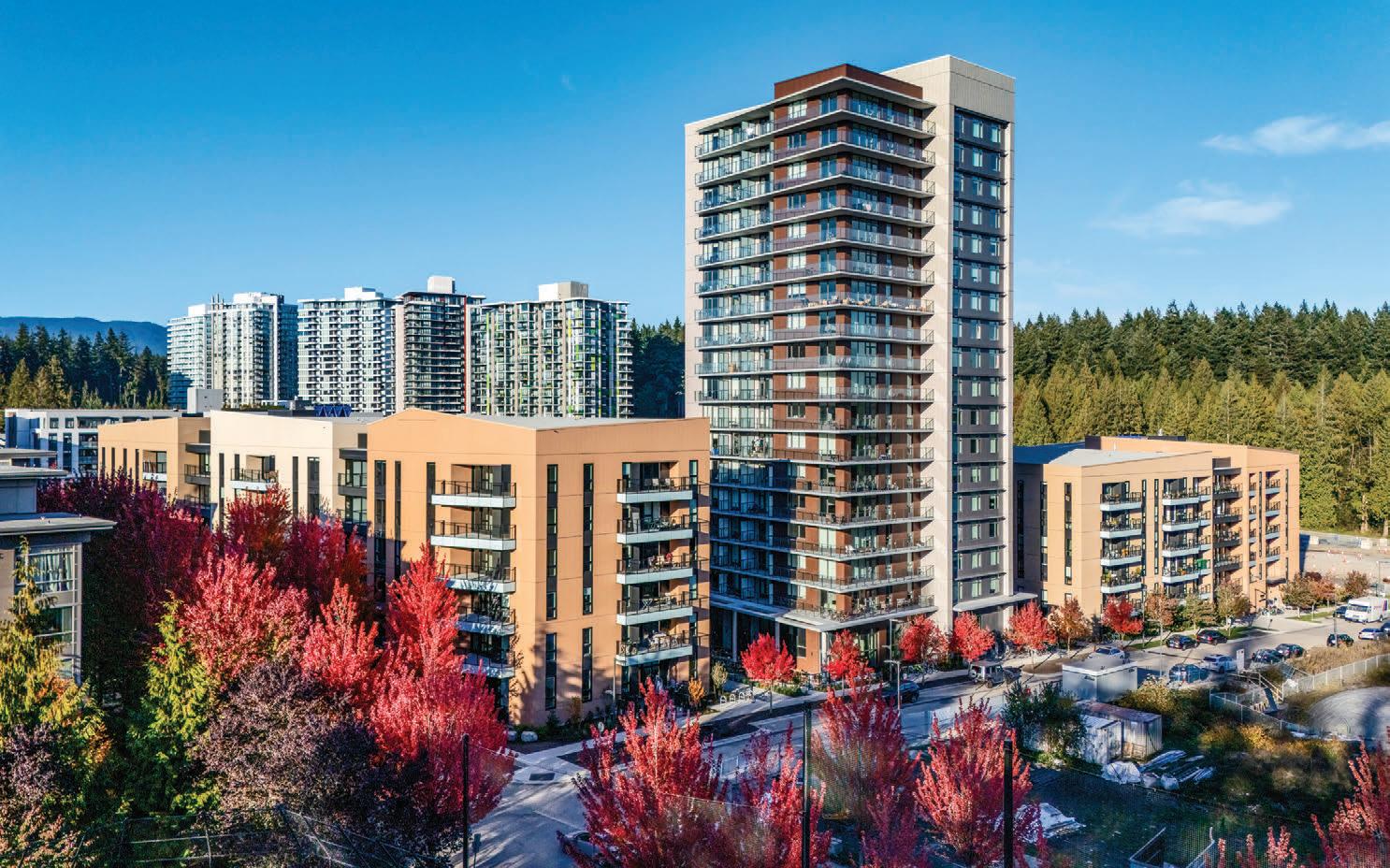
VERVE AND SYMPHONY – UBC
by CHRISTINA MORRISSEY
At the southeastern corner of The University of British Columbia (UBC) campus, Lot BCR 5/6 adds significant density and character to the Wesbrook Place neighbourhood. The site features three residential projects: the six-storey wood-frame Theory (completed in 2024), the six-storey Symphony, and the 18-storey concrete tower Verve. Together, the three buildings contain 515 homes, making BCR 5/6 the largest residential site in UBC Properties Trust’s (UBCPT) portfolio and providing rental options for faculty, staff, and the wider community.
For UBCPT, scale is only part of the story. Each new building contributes to a broader vision of a complete, walkable community. “Part of UBCPT’s role is to build vibrant neighbourhoods for UBC with homes, retail, shops and services, parks, and supporting infrastructure that provide financial support to UBC,” says Sepehr Rad, UBCPT’s director of development. Anchored by the Wesbrook Place Neighbourhood Plan, the development strikes a balance between density and livability, ensuring growth supports the rhythms of university life.
For the design team, the surrounding landscape became both context and catalyst. Jennifer Boyle, architect at dys architecture, expands on that idea: “Our architectural vision for this project draws inspiration from the distinctive coastal landscape of the UBC campus, nestled between the Pacific Spirit Regional Park and the Salish Sea. This rugged peninsula – shaped over time by natural forces eroding rock and sediment – forms the very ground on which the University stands today. By embracing the environmental context of this setting, our design seeks
to tell the story of place, a constantly evolving landform expressed through form and material.”
All three buildings are organized around a landscaped courtyard, preserving existing greenway connections and creating a shared outdoor area. From this base, the massing was carved to echo the soft, irregular geometries of eroded terrain. Boyle explains that the two mid-rises, Theory and Symphony, were shaped to evoke the undulating peaks of sediment formations. The Verve tower, by contrast, is a bolder, more monolithic form, reminiscent of resilient rock formations that resist erosion.
Textures found along the nearby shoreline informed the material palette. “We selected vertical-textured fibre-cement cladding for the six-storey buildings to capture the striations found in weathered natural surfaces. A warm, earth-toned colour palette completes the design, grounding the architecture in its coastal context,” explains Colin Shrubb, principal at dys.
Boyle notes that achieving sculptural clarity while meeting performance standards was a design challenge. “We had to surpass industry benchmarks for waterproofing and airtightness, while maintaining a clean, minimalist aesthetic, despite working with numerous obtuse angles and complex geometries.”
Preserving the purity of the architectural forms was a top priority, so the team collaborated closely with mechanical and structural consultants, and with Ventana during construction. Together, they developed solutions to route most mechanical systems discreetly, either beneath balconies or concealed within slot vents under windows.
LOCATION
3638 Wesbrook Mall (Symphony); 5855 Binning Avenue (Verve), Vancouver, B.C.
OWNER/DEVELOPER
UBC Properties Trust
ARCHITECT
dys architecture
GENERAL CONTRACTOR
Ventana Construction Corporation
STRUCTURAL CONSULTANT
Bush, Bohlman & Partners
MECHANICAL/ELECTRICAL CONSULTANT
Smith + Andersen
CIVIL CONSULTANT
InterCAD
TOTAL SIZE
403,400 square feet
TOTAL COST
Undisclosed
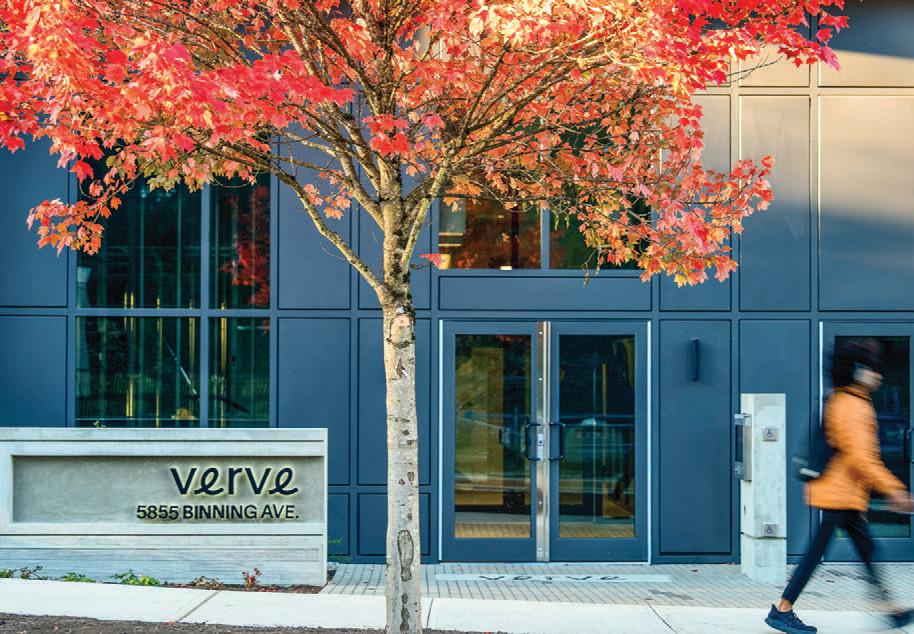
Building a neighbourhood as dense and diverse as this required careful planning. Additional considerations included balancing parking and bike storage for residents and outfitting units with high-quality finishes – stainless steel appliances, durable cabinets, and flooring.
The buildings were constructed concurrently on a shared site, presenting logistical challenges. “The development was structured as a multiphase project. Theory was slated for provisional occupancy in summer 2024, while Symphony and Verve were scheduled for completion in summer 2025.
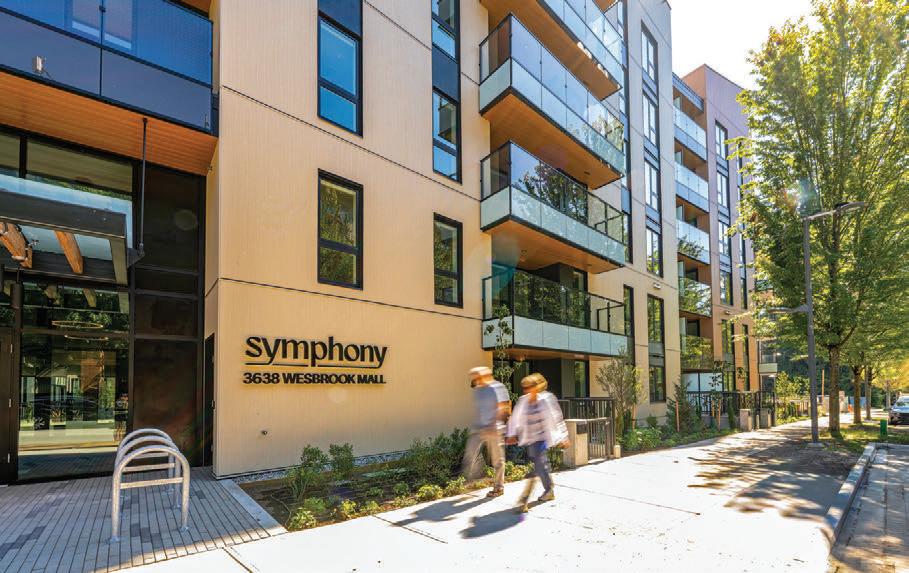

SHOTCRETE REMOVAL
We use advanced and innovative techniques, prioritizing safety at every step, to prepare your site flawlessly with minimal impact and waterproofing repairs.
SLAB ON GRADE PREP
Our skilled team excels in preparing concrete slabs for new developments, focusing on backfilling with precision around mechanical infrastructure.
ANCHOR REMOVAL AND DETENTION
Our expert team employs state-of-theart methods to efficiently extract anchors ensuring compliance with safety standards.
SNOW REMOVAL AND SALTING
Our commitment to you is to ensure your business stays safe and functional for customers and employees. Our skilled operators equipment allow us to keep the promise.
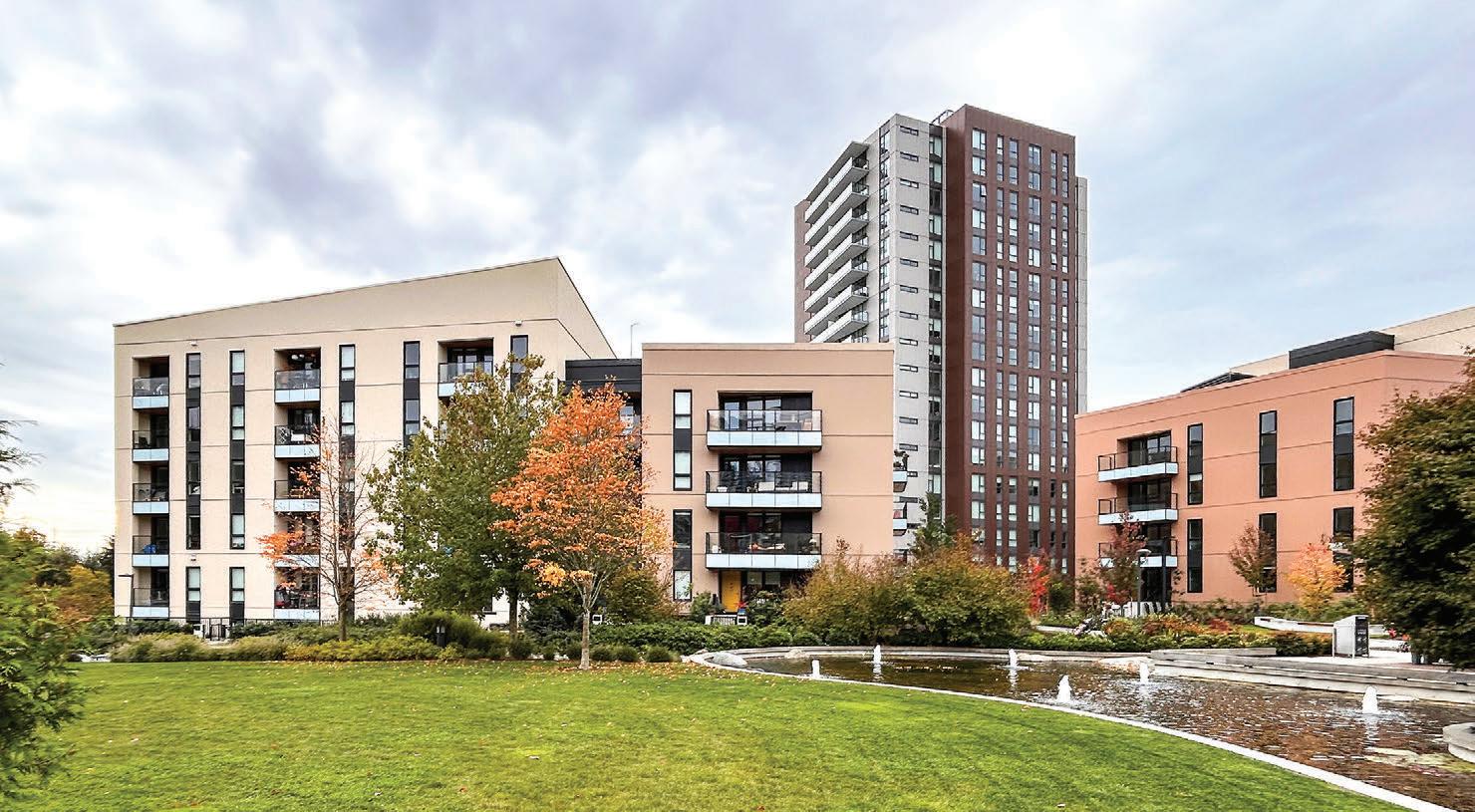
This phasing was critical to meet UBC’s housing availability timelines, especially with the fall academic term as a hard deadline for occupancy,” explains Scott Evans, senior project manager at Ventana.
Evans adds that significant early-stage planning was required, particularly around mechanical and electrical system design. “These systems needed to function independently for each phase, yet integrate cohesively
across the entire development once complete. Life safety systems, including fire alarm zones, sprinklers, and egress paths, also needed to be fully co-ordinated to satisfy building code and allow phased occupancy,” he says.
Verve, the tallest residential rental building at UBC, caters to a younger demographic with bold design and programming. Its study lounge opens onto an outdoor patio, and the lobby features a vibrant mural by WKNDRS. Shrubb highlights its cladding as a defining feature: rich Corten ACM panels, contrasted with textured boardform fibre cement, create depth and tactile interest, reinforcing the erosion-inspired design language.
Symphony balances openness and functionality, with an amenity space that includes study nooks, an outdoor patio, guest suites, and an exterior rooftop lounge. Across all three buildings, unit layouts accommodate households ranging from studios to four-bedroom cityhomes, many with in-unit storage or large closets.
With amenities, diverse unit types, and seamless integration into the surrounding landscape, Lot BCR 5/6 exemplifies UBCPT’s mission: creating communities that are functional, sustainable, engaging, welcoming, and distinctly tied to the natural and cultural context of the campus. A
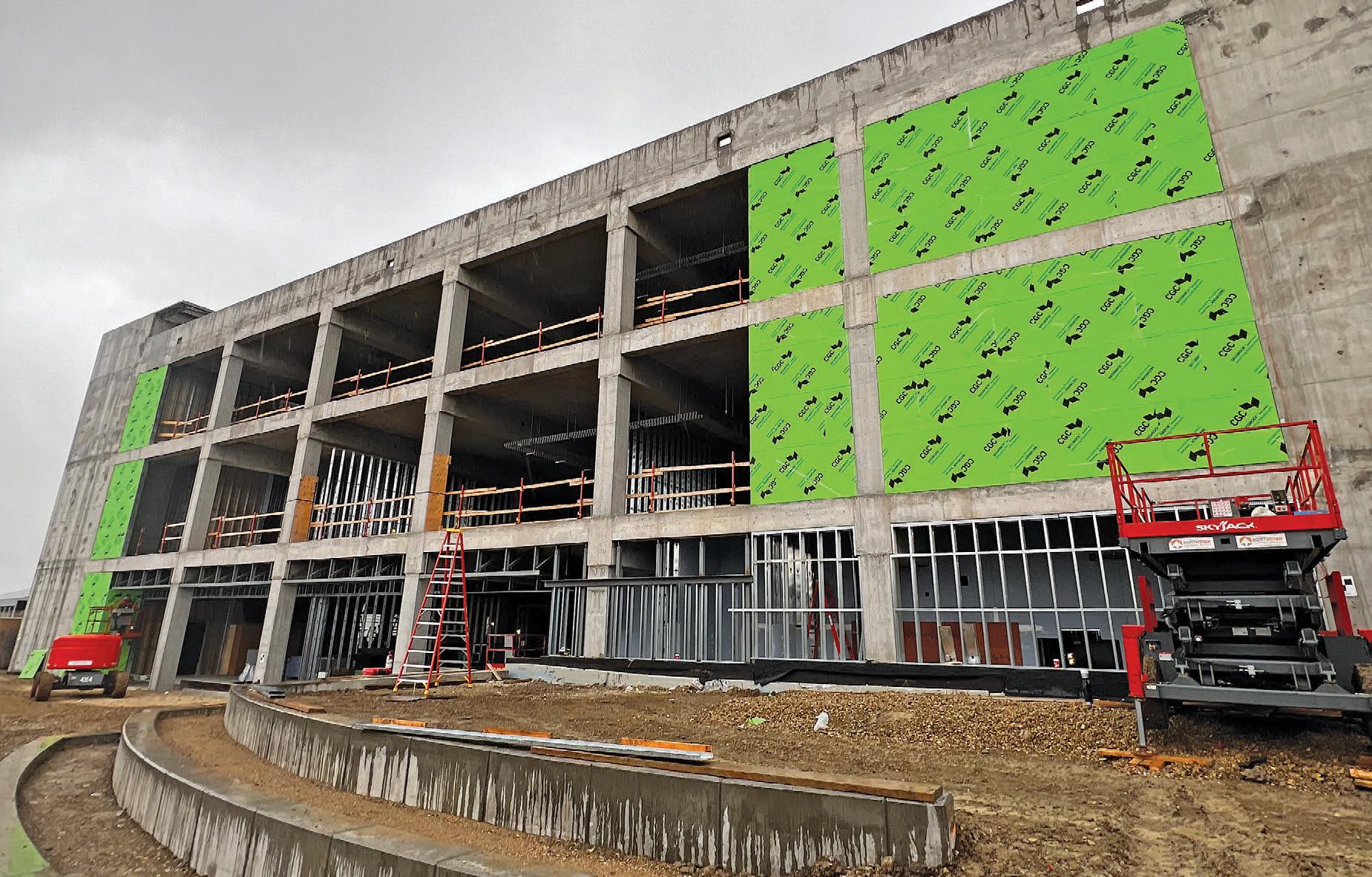

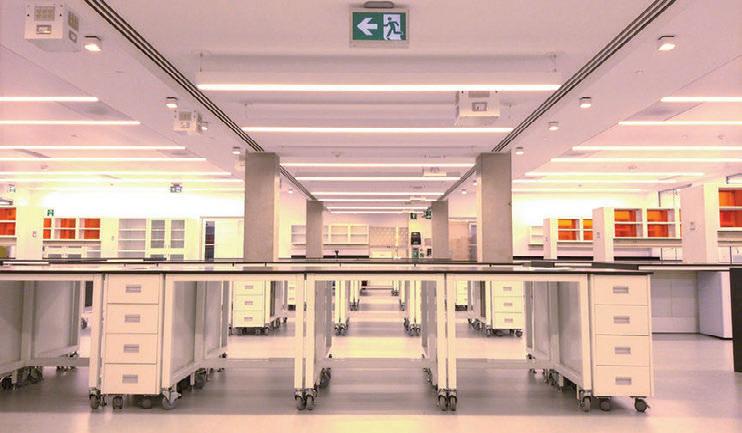


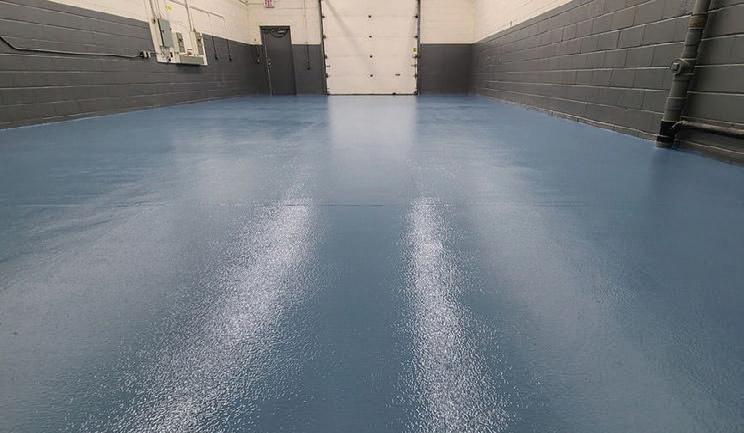
VETERINARY LEARNING COMMONS – UNIVERSITY OF CALGARY
by NATALIE BRUCKNER
The official opening of the Veterinary Learning Commons (VLC) expansion at the University of Calgary’s Spy Hill campus on September 15 marked a defining moment for veterinary education in Alberta. The additional 70,000-square-foot facility doubles the Faculty of Veterinary Medicine’s Doctor of Veterinary Medicine enrolment from 50 to 100 students each year, reimagining veterinary training in a modern academic setting.
Funded through a $68.5-million investment from the Government of Alberta, the project responds directly to the province’s urgent need for veterinarians in rural and livestock practice. The expansion offers a suite of new learning environments, including clinical facilities built to international standards, classrooms, administrative areas, an instructional wet laboratory, lecture theatres, collaboration zones, and student service spaces. Enhanced remote AV technology extends the facility’s teaching reach beyond the campus, supporting a more connected academic community.
Set within the open landscape of the Spy Hill campus, the Veterinary Learning Commons benefited from a generous site that allowed for efficient construction. “We were fortunate to have ample space, which allowed us to organize the site effectively, stage deliveries, and even take early delivery of certain materials, which was especially valuable coming out of the COVID supply chain crunch,” says Chris Royer, senior construction manager at EllisDon.
Having collaborated with the University of Calgary on previous projects, it made sense to bring onboard Dialog as not only architect but also as the structural, mechanical, and electrical consultant, allowing for deep integration across all aspects of the building.
“We learned of the expansion early on and were thrilled when the university received funding for the project,” says Yvonne Choe, partner at Dialog. “We were drawn to the idea of creating a building on a remote campus that would bring faculty, staff, and students together for teaching excellence, social learning, and innovation in a building purpose-built for veterinary students.”
The design of the expansion centres on student wellness, creating
architecture that is human-centred and care-oriented. “Veterinary students can spend 12 to 14 hours on campus, so high-performance laboratories and classrooms are paired with restorative spaces designed for calm and focus. These quieter settings support diverse learners, including neurodiverse students, while social zones act as catalysts for learning communities, helping counter isolation for new, commuter, and international students,” explains Choe.
The expansion is linked to the existing clinical skills building via a breezeway, creating a seamless connection between old and new. “In many ways it was a new build, but tying into the existing facility made it very interesting,” says Royer.
Connecting to the existing campus building also influenced the selection of materials. The expansion is a concrete structure from top to bottom, capped with a small structural steel mechanical penthouse on the roof. The exterior is clad in metal panels, while a curtain wall along the south side floods common areas with natural light.
“The result is a bright, open environment. It almost feels like you’re outside. That was really important for students who spend a lot of time in labs and classrooms. It also frames views of the surrounding pastures, which is a nice connection for veterinary students,” says Royer.
The interior is sleek, with striking design elements that reinforce both function and identity. Acoustic ceilings contribute a dynamic visual rhythm, while large murals of bovines and horses establish a direct connection to the students’ studies.
The main floor features a major teaching lab outfitted with extensive equipment for hands-on learning, while the second floor houses three classrooms, two of which can be combined via a folding wall for larger sessions. The third floor brings together administrative offices previously spread across two campuses, improving co-ordination and efficiency.
“Conceptually, the plan takes cues from the relationship of bones and ligaments: structured teaching and lab ‘bones’ are linked by more fluid connective spaces that stabilize the whole and foster community between intensive class blocks,” Choe explains.
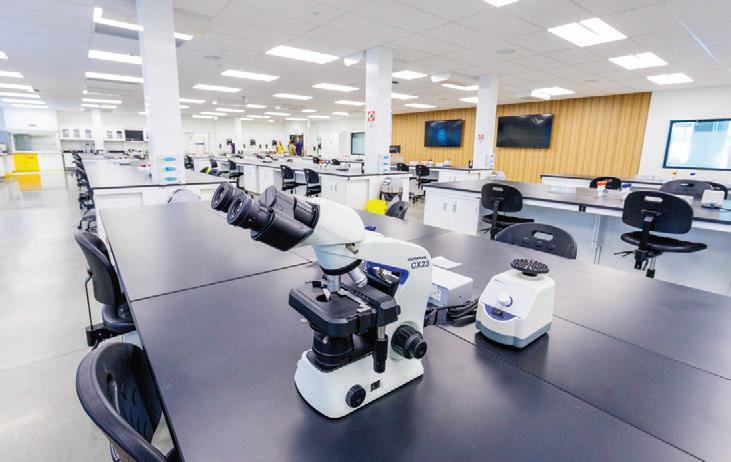

Long-span structural solutions deliver column-free labs and classrooms, while an expressed concrete frame supports flexibility and durability. For mechanical systems, Choe notes, “Oval ductwork reduces bulk, radiant panels provide comfort without clutter, and concealed return air in clerestories keep ceilings clean and calm.” For electrical and lighting, illumination is threaded through dense services, layering ambient and task lighting to highlight key areas without competing with mechanical distribution.
The University of Calgary ensured Indigenous perspectives were integrated throughout the project. “One example is the outdoor space designed for large ceremonies, including room for tipis to be erected. It added another layer of cultural connection and respect,” says Royer.
The building’s setting is equally intentional. Spy Hill occupies the highest point in Calgary, historically a place where First Nations people sent smoke signals. The University consulted Elders to select a piece of Rundle stone to commemorate the site. Large picture windows frame this landmark and the Alberta foothills beyond.
Bringing this amazing vision to life required close collaboration at every stage. “At EllisDon, collaboration is always a priority, but on this project it really shone through. We worked closely with the design team, the university, Indigenous representatives, students, and user groups. Everyone checked their egos at the door. The
LOCATION
3280 Hospital Drive NW, Calgary, Alberta
OWNER/DEVELOPER
University of Calgary
ARCHITECT/STRUCTURAL/MECHANICAL/ ELECTRICAL CONSULTANT DIALOG
CONSTRUCTION MANAGER
EllisDon Construction
TOTAL SIZE
70,000 square feet (expansion)
TOTAL COST
$68.5 million
common goal was to expand the school’s capacity, and we achieved that – on time and on budget,” says Royer.
“I also have to give credit to Dialog. They stayed engaged right through to construction, visiting the site and working with us on solutions. That collaboration made the project successful for all stakeholders,” he adds.
The project also benefited from the early and meaningful engagement with the Indigenous community. “It helped to enrich the design and storytelling as well as enhance the spaces from a student learning and wellbeing perspective,” explains Choe.
Together, these efforts underscore a project that is thoughtfully designed and deeply connected to both its users and its setting. With the University of Calgary’s leadership guiding the expansion, the Faculty of Veterinary Medicine continues to set a high standard for veterinary education, ensuring Alberta’s students are equipped to lead in animal care and research for years to come. A
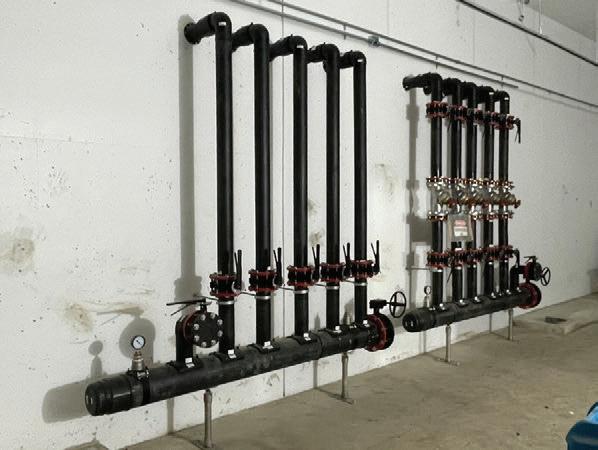

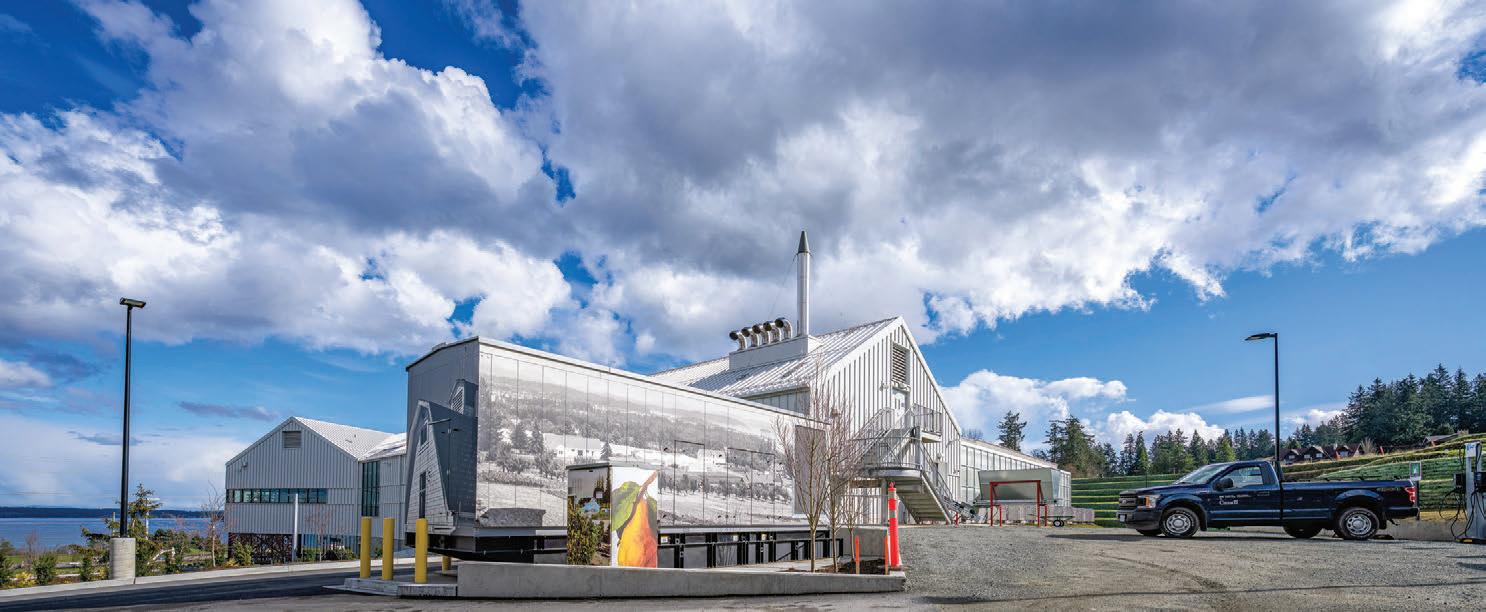
CANADIAN FOOD INSPECTION AGENCY (CFIA) CENTRE FOR PLANT HEALTH IN B.C.
by PETER STENNING
Located in North Saanich, B.C., the Canadian Food Inspection Agency’s (CFIA) new Centre for Plant Health is Canada’s only post-entry quarantine research and diagnostic facility for virus testing of all fruit-bearing trees, grapevines, and small fruit, thus supporting farmers and various food sectors across the country.
The 59,460-square-foot centre was an early pathfinder project under the Laboratories Canada Strategy, which brings together scientists to share common spaces, equipment, and science objectives. For the centre, scientists from Agriculture and AgriFood Canada (AAFC) and the CFIA that were previously scattered in over a dozen old barns and garages would come together in one facility. “We tried numerous times to move this project forward, but Architecture49 Inc., in a joint venture partnership with WSP as well as builders PCL Lab Solutions, finally made it happen,” says Robert Haugland, facilities manager at the Centre for Plant Health. CFIA project director Jacqueline Booth adds, “This is our organization’s very first purpose-built facility, with research and diagnostic laboratories, greenhouses, and administrative offices and collaboration space. It aligns with Canada’s net-zero carbon goals, plus it has a beautiful biophilic design, with First Nations influences throughout.”
Kevin Humeniuk, principal, national sector leader, at Architecture49, explains, “WSP provided most of the engineering disciplines, plus the geotechnical aspects of the project and even acoustics.”
Larry Wiens, architect and principal at Architecture49 Inc., notes that the CFIA and Public Services and Procurement Canada had initially considered a location on the west side of East Saanich Road. The decision was made to relocate to the east side of the road to minimize impacts to existing operations and allow for spectacular views of the Salish Sea.
During the design phase, the project teams worked to preserve the full scope of programming, including the laboratory planning led by Ana Coppinger from Architecture49’s science and technology team, despite needing to reduce the footprint of the planned facility by a third due to budget. A decision was made to eliminate part of the underground structure and dedicated storage areas, and include an option for future expansion.
The architects created a central office hub flanked by greenhouses on one side, with research and diagnostic labs above. The offices are seemingly on grade but are technically the basement due to the site being a steep slope. “The office is defined by floorto-ceiling glass to make the most of the views, and the labs above have ribbon windows,” Humeniuk says. “The building is a gable form, and we incorporated a field office and skylights at the apex of the gable.”
Considerable solar calculations were undertaken to ensure no shadows would be cast onto the greenhouses, which themselves are complex facilities equipped with a huge number of environmental controls and augmented by a containment lab with blackout vestibules and air curtains.
LOCATION
8801 East Saanich Road, North Saanich, B.C.
OWNER/DEVELOPER
Canadian Food Inspection Agency (CFIA) ARCHITECT/LANDSCAPE ARCHITECT/ INTERIOR DESIGN
Architecture49 Inc.
GENERAL CONTRACTOR
PCL Lab Solutions
STRUCTURAL/MECHANICAL/ ELECTRICAL CONSULTANT WSP
TOTAL SIZE
59,460 square feet
TOTAL COST
Undisclosed
The Laboratories Canada Strategy emphasizes greening as a core design element, and the Centre is one of the first Government of Canada buildings to use a geothermal exchange system (55 bore holes were drilled on site).
Wiens points out that “in this case we needed geothermal mainly for cooling due to the heat load from the growth chambers and other equipment.”
Ground broke in October 2022, and because of a high water table, PCL Lab Solutions had to install an active dewatering system – a series of weeping tiles in a grid system underneath the building that would divert water to a retention pond at the front of the Centre (the pond also acting as a landscape design feature).
Of special visual interest at the Centre is First Nations artwork such as a totem pole, a handcrafted panel, and a series of latticework steel panels by local artist Chris Paul that helps define the entryway.
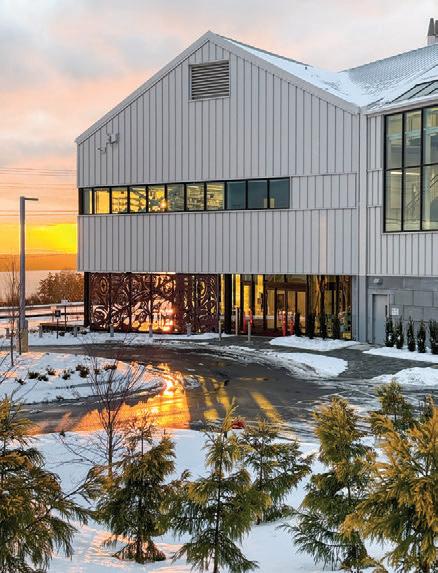
Opened in January of this year, the Centre is on track for LEED Gold certification, and its net-zero design is expected to save 200 tons of carbon dioxide equivalent annually. As for the old garages and barn workspaces, with the exception of one building with historical value, they will eventually be torn down.
Booth says of the new facility, “This is a beautiful building on an equally beautiful site overlooking the Salish Sea. It didn’t take long for our scientists, who had worked for so long in the old buildings, to appreciate the new facility; their typical comment is ‘Wow, this is amazing.’” A
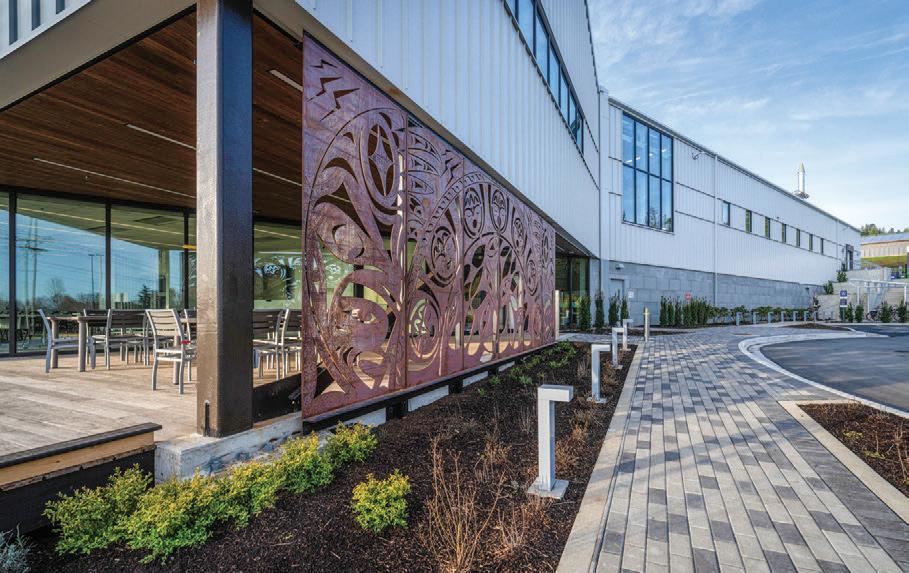
PHOTOGRAPHY BY MIKE
RATHJEN

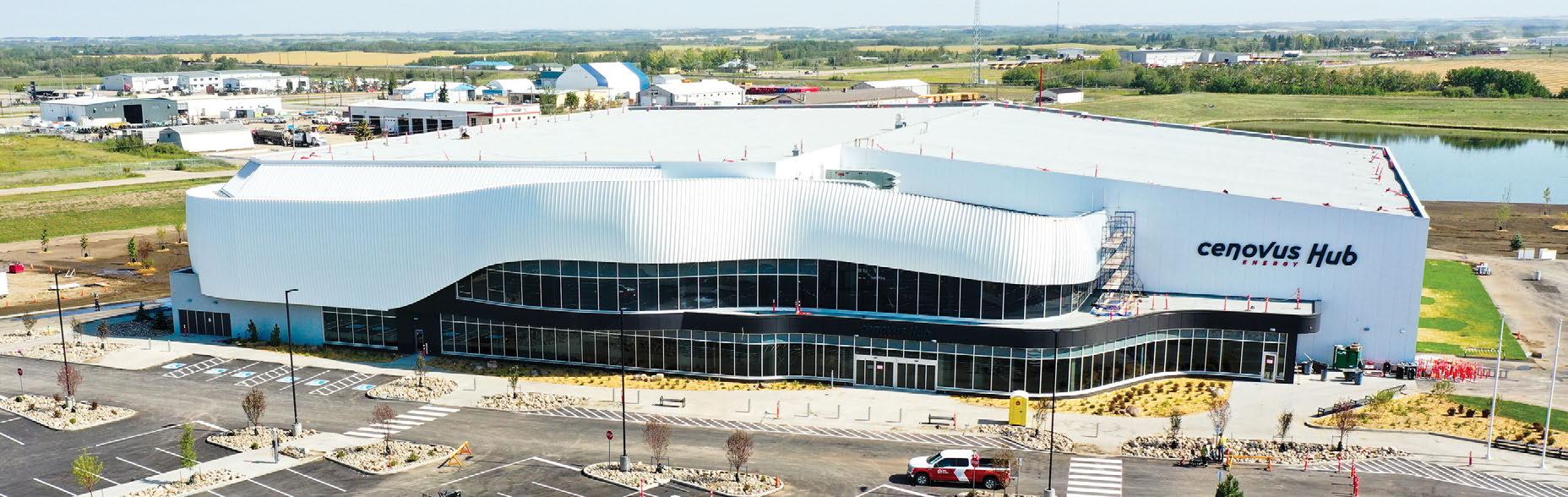
ENERGY UNITES
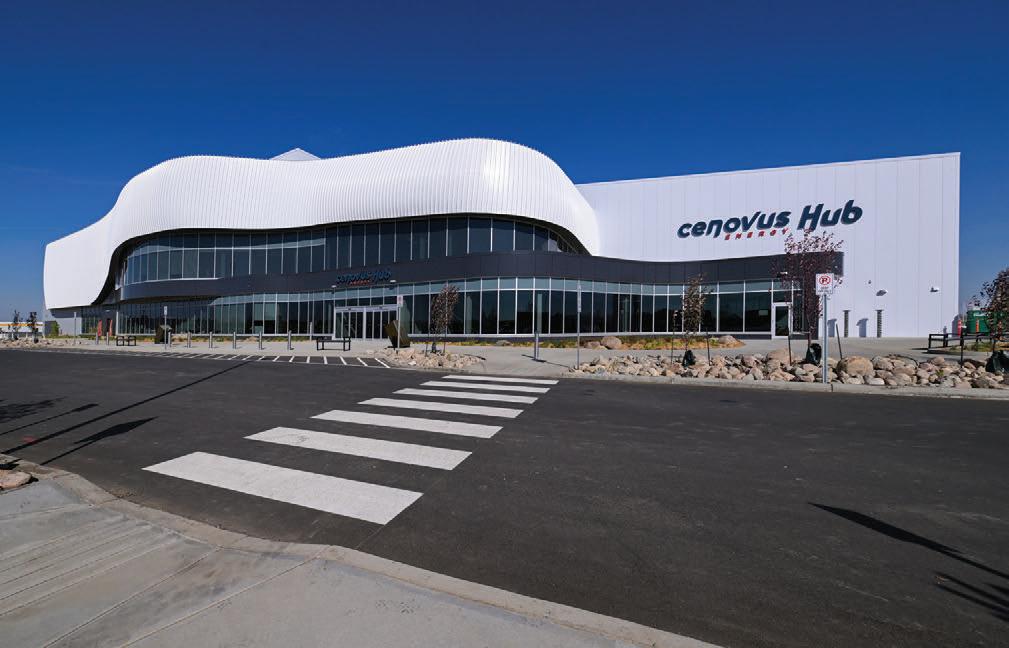
CENOVUS ENERGY HUB
by ROBIN BRUNET
For almost 60 years, the Centennial Civic Centre served as the main arena in Lloydminster, Saskatchewan. But by 2020 it was showing its age, plus design flaws occasionally led to closures, such as during heavy rainfall, when water would run into the facility.
Enter its replacement: the new Cenovus Energy Hub (CEH), the largest sport and entertainment facility in the region with a 2,500-seat primary event arena (expandable up to 4,500 with floor seats).
CEH, which greets visitors with a double-height glazed entrance sculpted in a series of waves, also includes a second full-sized indoor ice surface with a permanent 500-seat capacity, and a third outdoor ice surface next to the building. Augmenting these elements are 19 dressing rooms, 10 corporate boxes, and a large concession area serving both rinks.
The City decided to move ahead with the project after an engineering report revealed that rehabilitating the old Centennial Civic Centre would be cost prohibitive. However, at close to $100 million, CEH was still a major funding challenge, and the City passed a borrowing bylaw of $33 million to help. Provincial and federal monies, as well as donations from the business community, made up the rest of the funding.
“Cenovus Energy Hub represents far more than a new facility; it’s a statement about who we are as a community and where we’re going,” says Lloydminster Mayor Gerald Aalbers. “From the very beginning, this project was driven by local voices, local passion, and a shared belief that Lloydminster deserves an exceptional facility to gather, compete, and celebrate together. It’s a legacy built for today and for generations to come.”
TBD Architecture + Urban Planning was retained to create a facility that
would serve the city for generations, and Brian Bengert, TBD’s sports and recreation lead, says an “intense” process to identify the city’s priorities and goals demonstrated that the wishes of both council and administration were aligned. “This was hugely beneficial to the project. The City was fantastic to work with: they left the design process to us but were also extremely collaborative and open to new ideas.”
Bengert stresses that, “It was vital to meet the needs of the community, so we focused on programming.”
That said, aesthetically pleasing elements also informed CEH’s design: the wavy pattern of the entrance, which was inspired by the sight of snowdrifts covering the building location, is carried inside with a circular mezzanine accessed by a grand staircase and a wavy upper level. The main arena features U-shaped stadium seating and galleries above; the community arena features stadium seating on one side. “While the lighting is controlled in the arenas, the lobby area is filled with natural light – an important consideration to make this facility warm and inviting during gloomy days,” Bengert says.
One of Bengert’s most inspiring moments during the project came early on, when the Lloydminster U13 Female Blazers won the 2022 Chevrolet Good Deeds Cup and donated $90,000 of their $100,000 prize to make the facility more inclusive. “They studied our drawings and added numerous accessibility points, which really improved the function of CEH,” he says.
Washrooms in CEH have larger turning radii, railings are adjustable, and there is wheelchair seating on every level. The dressing rooms are also augmented by shared spaces that afford players privacy as required.
TBD also abided by the philosophy of using less materials creatively. “This was important to the budget because it would mean cost savings and less
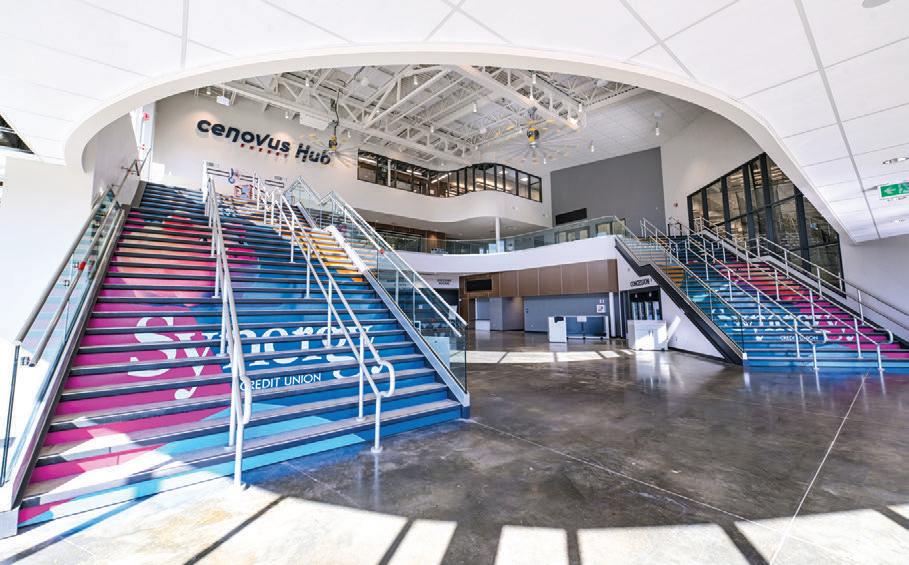
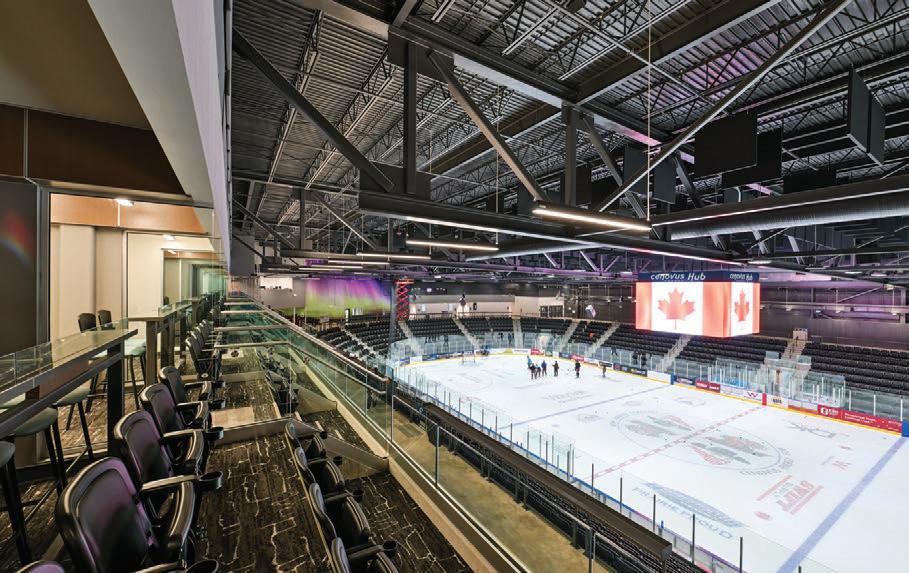
trades needed,” Bengert explains. Thus, the exterior was clad in resilient metal panel, and adding to efficiency was a mechanical system that captured waste heat from the ice plant and redistributed it to heat water, floors, and back-of-house areas.
As a premier sports and entertainment venue, the Cenovus Energy Hub required state-of-the-art technology to support its operations and events. VWMason served as the audio-visual, broadcast, and acoustics consultant and was responsible for the end-to-end design and integration of advanced systems to support the venue’s diverse operational and entertainment needs. Key components of the design included LED displays, scoreboards and scoring systems, performance and buildingwide audio systems, broadcasting and event-hosting systems, digital signage, and acoustics. Through strategic planning, technical innovation, and close collaboration with stakeholders, VWMason helped transform the Cenovus Energy Hub into a technologically advanced destination capable of hosting sporting events and other activities with precision and flair.
PCL Construction broke ground on the site in August of 2023, and by July of the following year the last major truss was hung, precast concrete work was substantially completed, and all civil utilities were finished. By the time the winter snows arrived, the building was completely enclosed, facilitating interior work.
During the grand opening in October of 2025, CEH was praised for its blend of modern aesthetics with practical features, its carefully planned sightlines and inclusive spaces. In time, the area around CEH will be developed as an entertainment hub.
“Community involvement made this project so much more impactful than it would otherwise have been,” Bengert concludes. “It was very fulfilling to help create a facility that will define sport and entertainment in Lloydminster for decades to come.” A
LOCATION
3905 39 Avenue, Lloydminster, Saskatchewan
OWNER/DEVELOPER
City of Lloydminster
ARCHITECT
TBD Architecture + Urban Planning
GENERAL CONTRACTOR
PCL Construction
STRUCTURAL CONSULTANT
RJC Engineers
MECHANICAL CONSULTANT
Englobe
ELECTRICAL CONSULTANT
AECOM
LANDSCAPE ARCHITECT
Scatliff + Miller + Murray
AUDIO-VISUAL/BROADCAST/
ACOUSTICS CONSULTANT
VWMason
TOTAL SIZE
138,940 square feet
TOTAL COST
$98.6 million
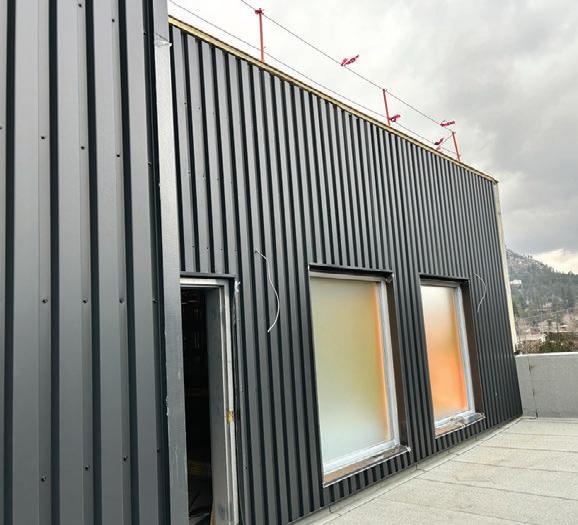
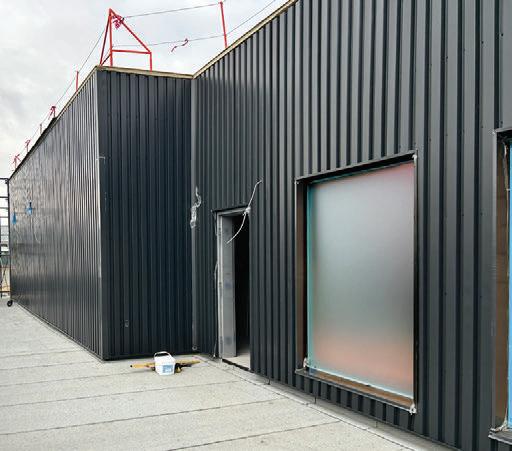
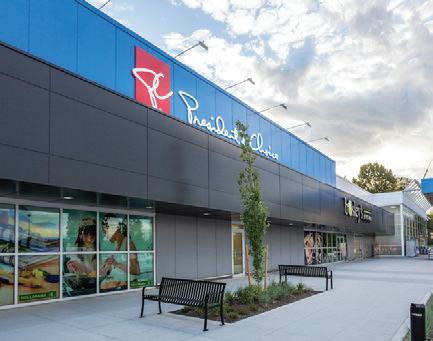

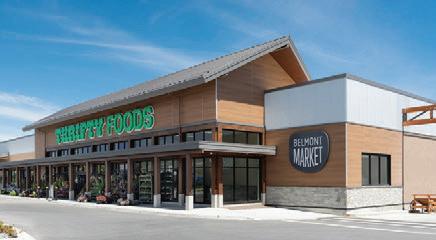
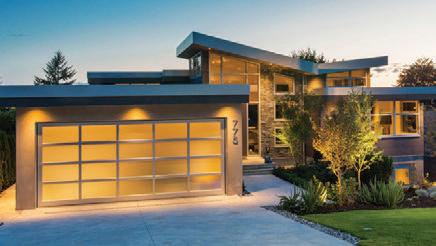
WEST KELOWNA FIRE HALL #32
by NATALIE BRUCKNER
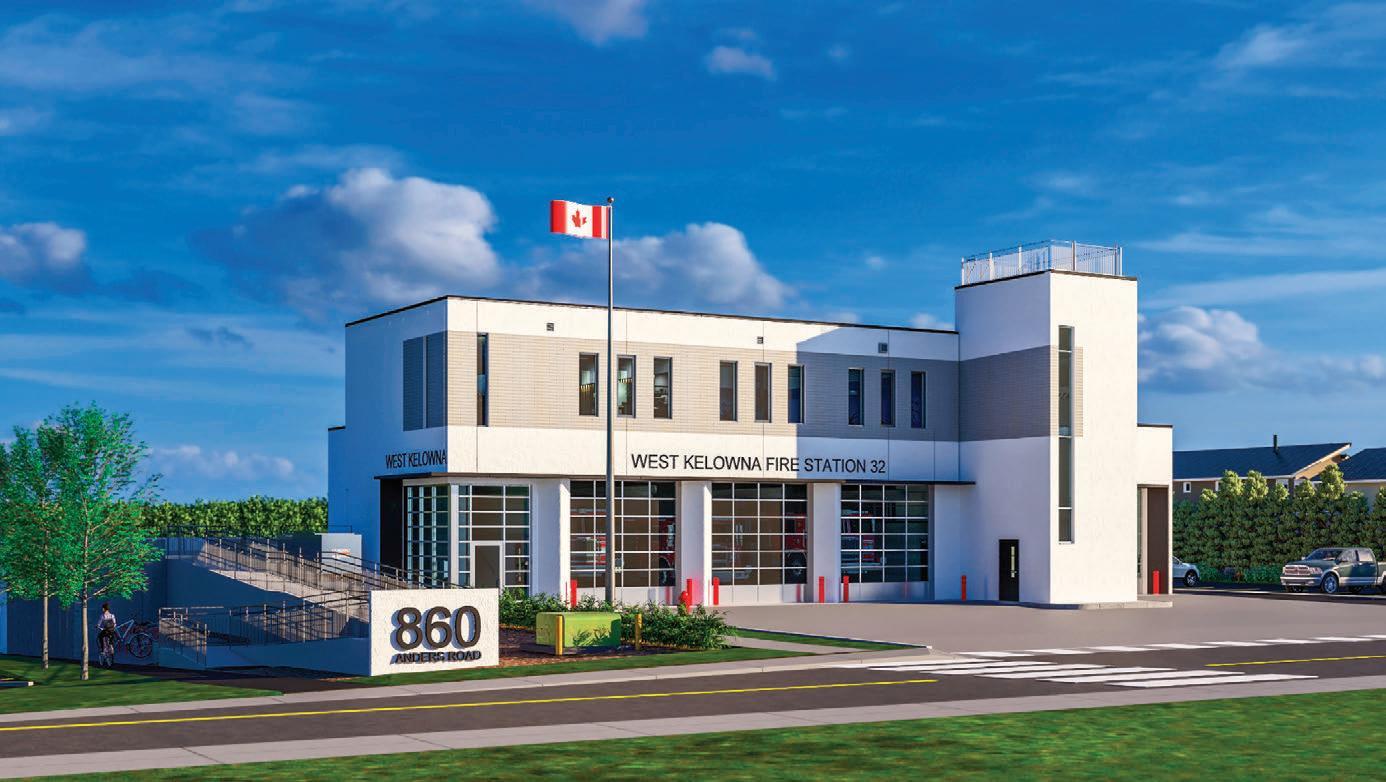
For fire chief Jason Brolund of the City of West Kelowna, the opening of the new West Kelowna Fire Hall #32 and the adjoining recreation centre marked a milestone that carries weight beyond its modern design and community function. Brolund has been part of the project from the earliest conversations through to the final stages of construction, guiding its development and investing deeply in the creation of a space that now serves as a vital hub for the city.
Yet Brolund’s connection to the old centre goes back even further. “It’s a property that holds a personal connection. I actually went to preschool in the basement of the old hall that was demolished to make room for the new one. So we go quite far back,” he explains.
For years, it was clear that the existing fire hall, built in 1971, could no longer meet the operational needs of West Kelowna Fire Rescue. “When I became chief 11 years ago, it was recognized that our facility was inadequate. We’ve gone through quite a journey – different designs, locations, and funding models. About three years ago, we finally landed on the solution that would work best for the community, with support from the mayor, council, and the public to make it happen,” Brolund explains.
Determining the location of the new fire hall was a critical step, and multiple sites were carefully evaluated. “In the fire world, response time is everything. The placement of our fire halls and the distance between them directly affect how quickly we can get to emergencies,” Brolund explains. Moving too far from the old site would have disrupted that balance and risked slowing response times.
The solution required staying within the neighbourhood, which meant demolishing a long-standing community facility and convincing residents that the new setup would provide greater value. “After the recent devastating wildfire, the public had a clear understanding of what the fire department needed, and there was overwhelming support for a safer, more functional fire hall,” Brolund says.
Removing the existing Lakeview Heights Community Centre, along with its sports court, playground, and pickleball facilities, created an opportunity to reimagine the space as a true community hub that would include the new fire hall with room for future growth.
Chandos Construction mobilized and commenced work in May of 2024. “Chandos and the City started our collaborative journey right from the start,” says Wayne Gustafson, project director at Chandos. “The facility was inventoried for reusable items prior to demolition. We also had significant co-ordination with the tennis club to ensure maintaining safe access to the site during construction.”
Bringing together a fully functioning fire hall with a recreation centre presented one set of challenges, while keeping the project on time and on budget posed another. “Mayor and Council gave us a clear mandate: deliver a building that provides longterm value,” Brolund explains.
The facility itself was constructed using precast concrete wall panels, a choice that allowed the team to enclose the building quickly and keep the overall project on schedule.
Beyond the building, the site has been designed to serve the community for years to come. The playground, modernized outdoor rink, basketball
LOCATION
860 Anders Road, West Kelowna, B.C.
OWNER/DEVELOPER
City of West Kelowna
ARCHITECT OF RECORD
MGA Architecture Inc. / DEEP Architecture
EMERGENCY SERVICES CONSULTANT
Thomas Brown Architects
DESIGN BUILD CONTRACTOR
Chandos Construction
STRUCTURAL CONSULTANT
ROV Engineering Consultants
MECHANICAL CONSULTANT
Reinbold Engineering Group
ELECTRICAL CONSULTANT
AES Engineering
LANDSCAPE ARCHITECT
CTQ Consultants
TOTAL SIZE
16,640 square feet
TOTAL COST
$14.3 million
court, and new pickleball courts create a space that residents of all ages can enjoy. “One big feature is that it’s combined with the recreation centre,” Brolund notes. “This gives us easy access to training spaces, proximity to parks, and amenities like pickleball courts, which many of our staff enjoy. The playground is another highlight – in fact, the firefighters made the largest donation in the history of our local union toward its construction, showing their investment in the community.”
Inside, the replacement fire hall was designed with both operational efficiency and firefighter safety in mind. “From the beginning, we designed the flow of the building carefully,” Brolund explains. “The design was a really collaborative effort between architects MGA Architecture Inc. [DEEP Architecture] and a committee of firefighters. They toured other halls, sketched layouts, and made key decisions, like choosing separate dormitory spaces instead of traditional communal bunks to accommodate female staff, which reflects the evolving nature of the fire service.”
Practical safety features were also a priority. “We invested in things like a full washer-extractor and gear dryer to reduce carcinogen exposure, and burying the power line in front of the building opened up additional space for training. The hall currently has four bays, with provisions for a fifth as West Kelowna grows. This is a building that will serve the community for 75-plus years,” he adds.
The apparatus bay carries symbolic touches as well.
“In the main bay, we set two challenge coins in the concrete: one from our union, one from the department. When the trucks drive over them, it’s a small but symbolic

reminder of co-operation and purpose. We also prioritized natural light, adding glass to the bay doors so the public can see inside. It also positively impacts mental health,” Brolund says. Gustafson adds that the project was completed using a progressive designbuild contract, which allowed the team to carefully manage design and construction budgets from the outset. This approach made it possible to add additional scope items as the project progressed, while ensuring the facility was delivered on time, on budget, and with the end users having had meaningful input into the final design.
From the perspective of Chandos Construction, the project was both exciting and deeply fulfilling.
“Everyone involved was local to the valley and understood the impact this facility and community centre would have in the area,” says Gustafson. “The degree of collaboration, while holding each other accountable to schedule, budget, and scope, was instrumental in the overall success of this project.”
On October 8, the flag from the old hall was moved to the new one, a small but symbolic gesture signalling that the department is officially operating in its new home. “We’re proud, excited, and ready to serve the community in a facility that’s safer, healthier, and built for the future,” Brolund says. A


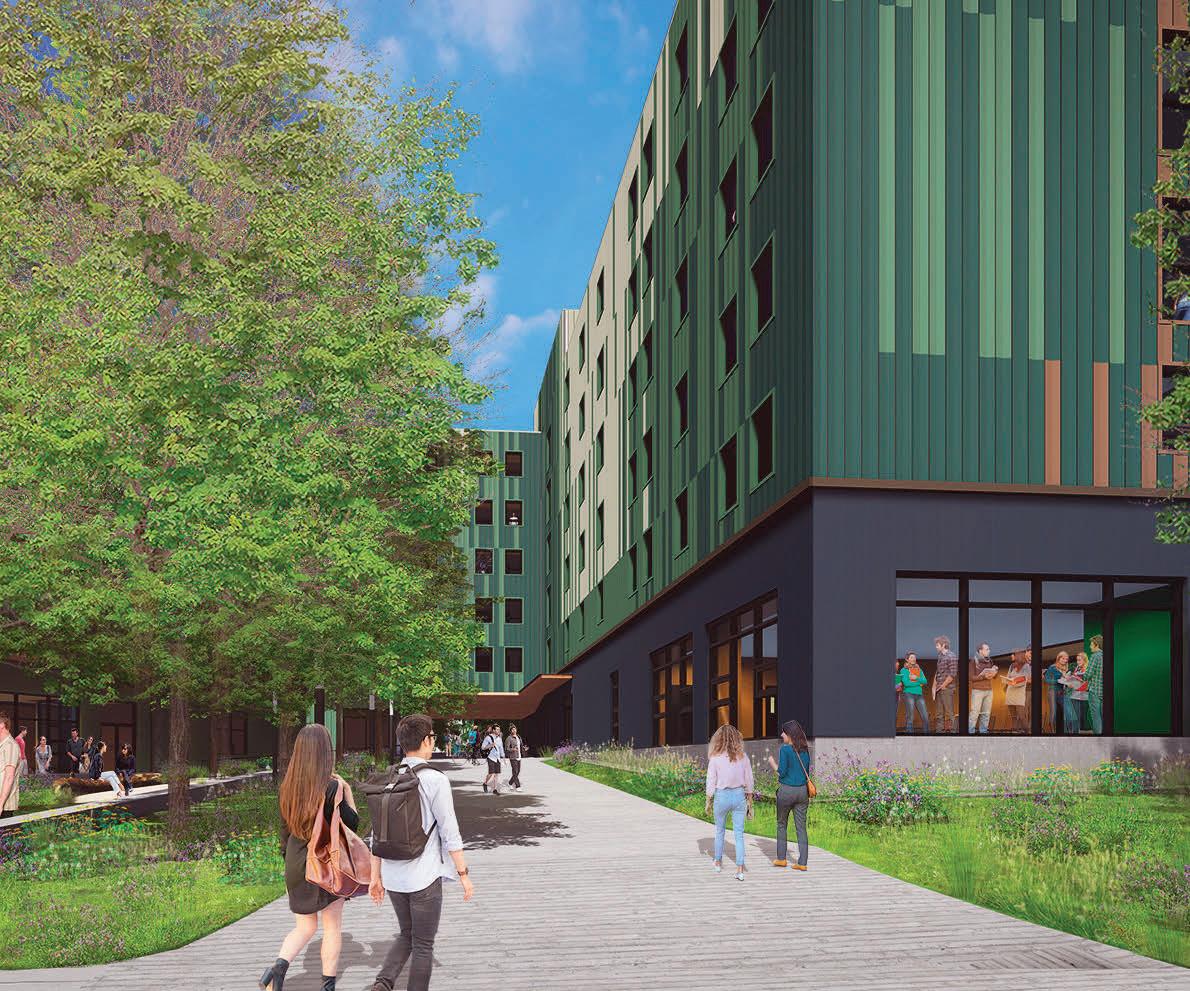

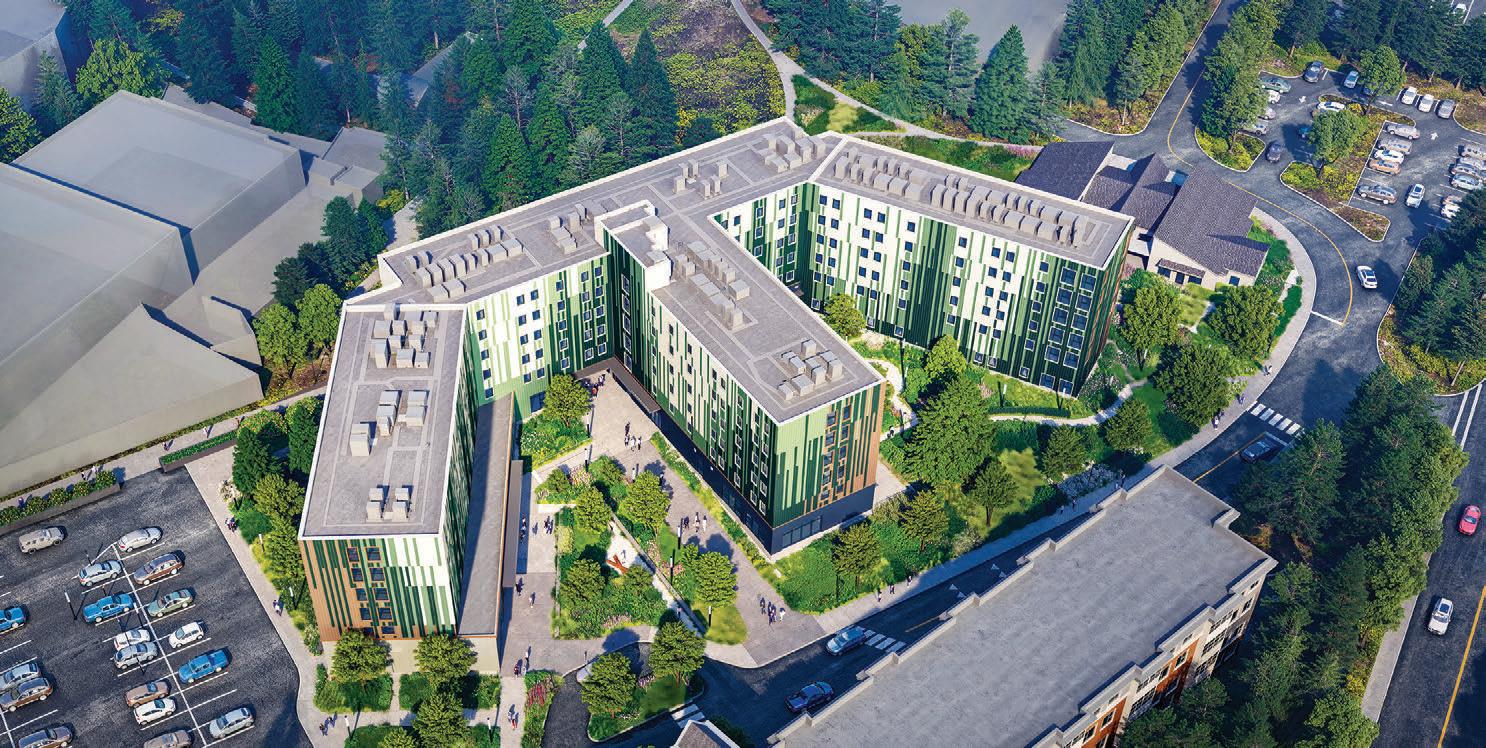
STUDENT HOUSING –UNIVERSITY OF THE FRASER VALLEY
by NATALIE BRUCKNER
When the University of the Fraser Valley (UFV) in Abbotsford, B.C., set out to build new student housing, the vision extended beyond meeting an urgent housing need. The six-storey hybrid mass timber residence was designed to create a meaningful sense of belonging for students, offering nearly 400 new beds in a setting that supports safety, affordability, and connection.
UFV’s vice president, administration, Jackie Hogan, explains that UFV has seen steady increases in enrolment alongside pressure on local rental markets. Historically a commuter campus with only 200 oncampus beds, waitlists grew, making additional housing necessary.
A market demand study completed in 2018 confirmed a significant unmet need for student housing, and the Province of British Columbia’s commitment to expanding on-campus housing through funding contributions helped make the business case feasible.
UFV selected a site between Lá:lem te Baker and Building G to create a strong housing community zone on the Abbotsford campus. The location links the two student housing communities, creating natural synergies for activities and connection, while encouraging interaction between residents and the wider campus community. “The goal was not simply to add more housing, but to create an environment that enhances community, student engagement, and well-being,” says Hogan.
The site included underground services, heritage trees, surface parking, and access to adjacent buildings. Limited space required careful placement to maintain walkability and preserve landscaping. “As an IPD team, we all contributed to the design decisions of building size, shape, and height, and found creative ways to fit it within existing constraints, which became features of the design,” says Aaron Giebelhaus, senior project manager with Clark Builders. “The sloped site required a stepped mainfloor elevation, and to avoid infringing upon existing utilities, building placement was critical within a tight space.”
This was the first time UFV delivered a project through the IPD model, which Hogan agrees changed the approach to the project. “That collaborative approach helped us navigate challenges quickly and make balanced decisions that considered cost, schedule, and design together,” Hogan says.
Anneliese Fris, principal at Group2 Architecture Interior Design Ltd., who worked alongside the team at Dialog, says early exploration in the ‘Big Room’ with all team members, including Clark Builders and key trades, resulted in the building’s E-shaped footprint. “This design supported the creation of outdoor common areas, maximized views to Mount Baker, and established a relationship to Lá:lem te Baker. It also minimized disruption to the landscape and services, and supported a lean construction flow through a single

LOCATION
1385 McKenzie Road, Abbotsford, B.C. OWNER/DEVELOPER
University of the Fraser Valley ARCHITECTS
DIALOG / Group2 Architecture Interior Design
GENERAL CONTRACTOR
Clark Builders
STRUCTURAL/MECHANICAL/ INTERIOR DESIGN/ LANDSCAPE ARCHITECT
DIALOG
ELECTRICAL/CIVIL CONSULTANT
WSP
TOTAL SIZE
149,383 square feet
TOTAL COST $105 million
crane and the provision of laydown space within the site boundaries.”
When it came to materials, Giebelhaus explains that early in the validation phase there was a desire to incorporate mass timber, reflecting UFV’s sustainability and innovation goals. “Through a robust A3 designmaking process, the team landed on a hybrid structure of cross-laminated timber [CLT] floor panels and vertical firewalls, along with load-bearing wood stud and plywood walls. Both structural components could be prefabricated offsite and craned into place, allowing for rapid structural erection on site.”
Brett Hotson, architect at Dialog, adds that Dialog’s structural engineers worked directly with the builder to test various wood structure options. “This approach provides multiple benefits, but I am most proud of our ability to leave exposed the undersides of the CLT floor in many key areas, including within each of the housing units. This lends a great sense of warmth to these student homes.”
The design also drew inspiration from the surrounding Fraser Valley landscape, with the many distinct colours of the local geography represented in the exterior materials. “Red earths, green foothills, and the silver peaks of Mount Baker were included,” says Hotson. “It was important that the building appears to be rooted in the land.”
Inside, the residence offers 398 new beds, primarily in quad-occupancy units with private bedrooms and
shared living areas and bathrooms, while single and accessible units are provided on every floor. Students can also enjoy a range of shared amenities, including lounges, kitchens, study areas, spaces for student programming, and a dedicated cultural space.
The interior design highlights the structure, with the aforementioned exposed CLT panels in the bedrooms creating a calming atmosphere.
Produced by Kalesnikoff in Castlegar, the spruce-pine-fir CLT panels and Douglas-fir glulam posts and beams are also visible in student lounges. While acoustic requirements limited CLT exposure in some areas, where visible, the five-ply vertically oriented panels serve as firewalls, blending functional performance with a natural, inviting aesthetic.
With the project now complete, the team is proud to have delivered a beautiful, modern, and sustainably designed building that transforms UFV’s Abbotsford campus and provides nearly 600 students with oncampus homes during their studies.
For Hogan, the key takeaway is that this project marks a turning point for UFV: a shift from a primarily commuter institution to one where students can live, learn, and build lifelong connections on campus. “It reflects UFV’s commitment to student success, sustainability, and community, and demonstrates what’s possible when vision, collaboration, and purpose come together,” Hogan concludes. A
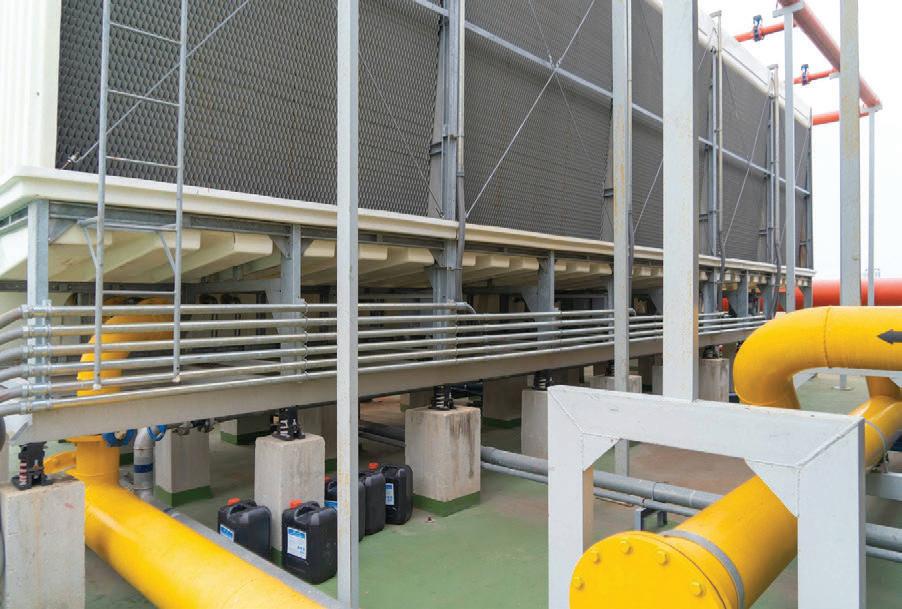
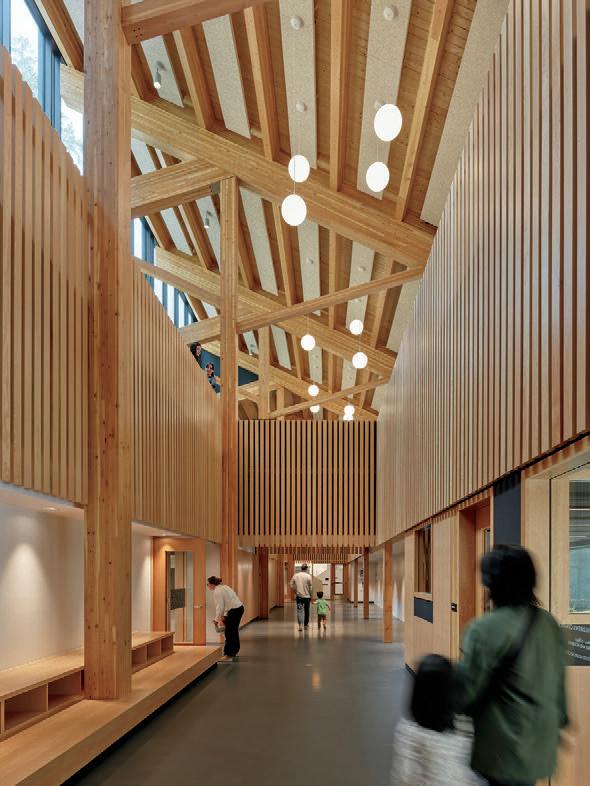



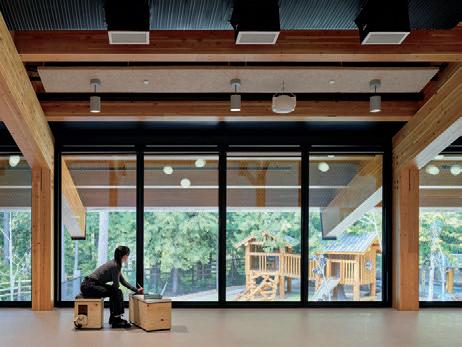

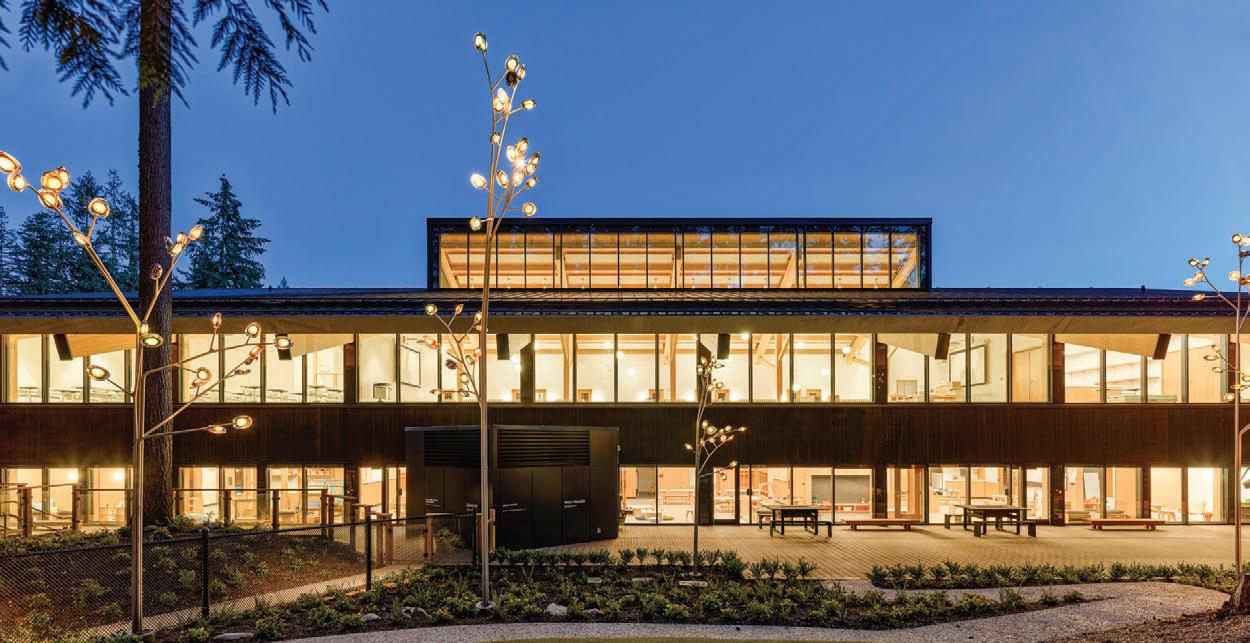
FULMER FAMILY CENTRE FOR CHILDHOOD STUDIES –CAPILANO UNIVERSITY
by ROBIN BRUNET
Aunique hub for research and teaching: that was the intent of the Fulmer Family Centre for Childhood Studies at Capilano University (CapU). The 23,000-squarefoot, two-storey building combines a 74-space children’s centre with teaching, studio, and research space for the Department of Early Childhood Care and Education (ECCE), doubling the number of childcare spaces on CapU’s main campus and providing 20 additional practicum placement spots for ECCE students.
“The vision for the project was to create a one-of-a-kind hub for research and teaching in early childhood education that reflects our deep commitment to children and families, and our values of innovation, openness, and living well together,” says Brad Martin, dean, faculty of education, health and human development at Capilano University.
Brian Wakelin, principal at Public Architecture + Design Inc., points out that his firm and CapU had established a solid working relationship on a previous project, “And that benefited us when the Fulmer project came about in 2020 and the world went dark due to the pandemic, obliging us to communicate online instead of in person,” he says.
Wakelin and his colleagues were impressed during the goal-setting sessions with CapU stakeholders being committed to a high level of finishings and fittings. “For example, they were committed to mass
timber and called for VG fir finishes throughout, which is unusual when other more affordable materials could have been used,” he says. “They had a precise material palette for the entire campus, for continuity purposes, and it lent the building a greater sense of visual cohesion.”
The $25-million project received more than $11 million from the Government of British Columbia, including nearly $3 million from the ChildCareBC New Spaces Fund. CapU contributed more than $8 million, with nearly $6 million coming from donors.
The childcare portion of the facility was located at ground level with the ECCE portion on the second level.
“Since the campus is tucked right into the Seymour watershed with forest directly north, we arranged all the childcare cohorts north and everything else followed,” Wakelin says, adding that the exterior play space was bigger than that of the interior – made possible by the demolition of an old operations building and selective clearing of second-growth trees.
On the first floor of the Fulmer Centre is the Strada, an open space where children, families, educators, and faculty members can gather and where exhibitions and other communal activities can be held. The Strada reaches up through the centre of the building and is open to the second floor, where other teaching, learning, and gathering spaces are located. “If you look at the building
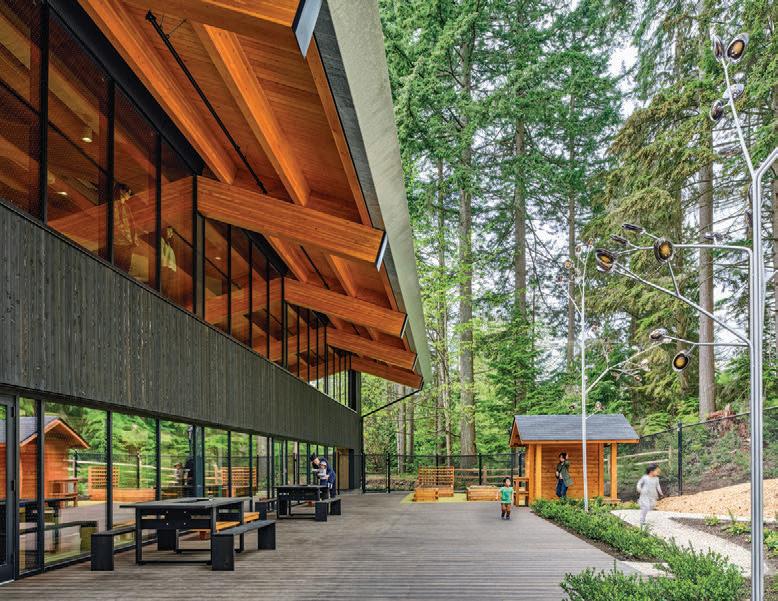
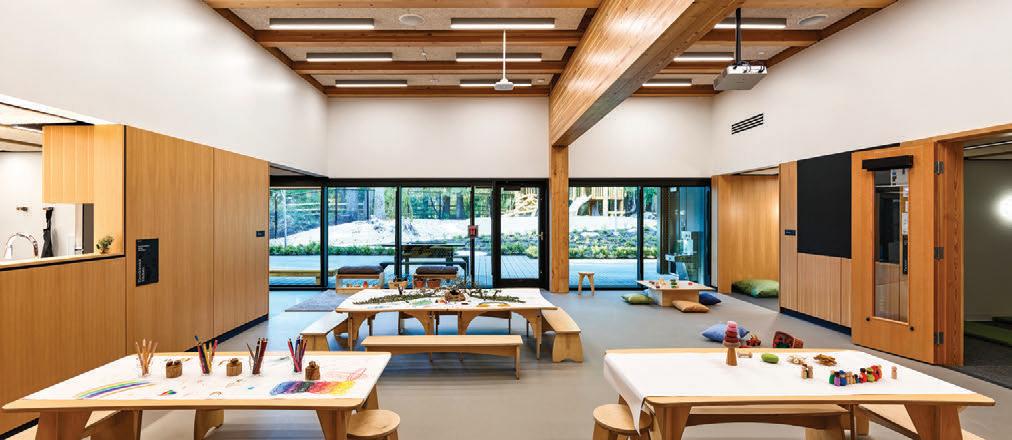
from the outside, the highest point of the roof is the open space, with clerestory windows bringing natural light inside and providing views of the treetops,” Wakelin says.
The goal of giving the Centre a ‘shed in the woods’ appearance was realized by the roof, which features large overhangs on the south and north ends, dipping down at the children’s play areas. “And because part of the play curriculum for the kids involves making charcoal, we were inspired to use black cedar cladding for the exterior,” Wakelin says.
Smith Bros. & Wilson broke ground on the project in the immediate aftermath of the pandemic, and project manager Daniel Metry says the main challenge of delivering on the construction management process was space , or lack of it: “We demolished the old operation building and then contended with the fact that the new facility would be flanked by forest on one side and a bus loop on the other –no extra room for laydown or staging.”
Fortunately, there were no issues with the soil conditions, and Metry describes his firm’s work relationship with the architects as “fantastic: they were trustworthy and collaborative, which was enormously helpful as we had to bring a very intricate design with highend architectural finishes to life.”
Wakelin adds, “The Smith Bros. & Wilson crew were phenomenal, and a testament to their skill was the bus loop: it remained operational throughout construction, which wrapped up in March of this year.”
For his part, Martin is excited by the success of this important facet of Capilano University: “Working with the architects on this project was an exceptional experience. They were highly collaborative in their approach and listened closely to the ideas of faculty members, educators, administrators, and our facilities team during the design phase.” A
LOCATION
2055 Purcell Way, North Vancouver, B.C. OWNER/DEVELOPER
Capilano University
ARCHITECT
PUBLIC Architecture + Design Inc.
GENERAL CONTRACTOR
Smith Bros. & Wilson
STRUCTURAL CONSULTANT
WHM Structural Engineers
MECHANICAL CONSULTANT
AME Group
ELECTRICAL CONSULTANT
AES Engineering
TOTAL SIZE
23,000 square feet
TOTAL COST
$25 million
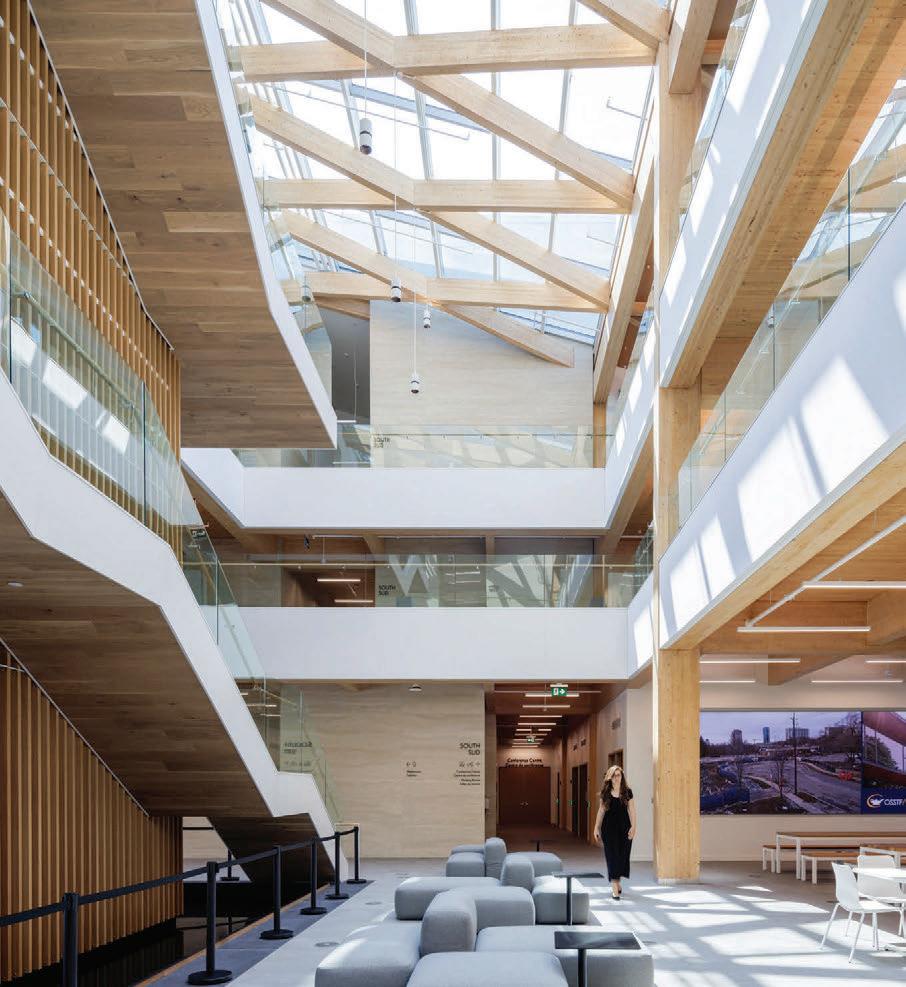

Think
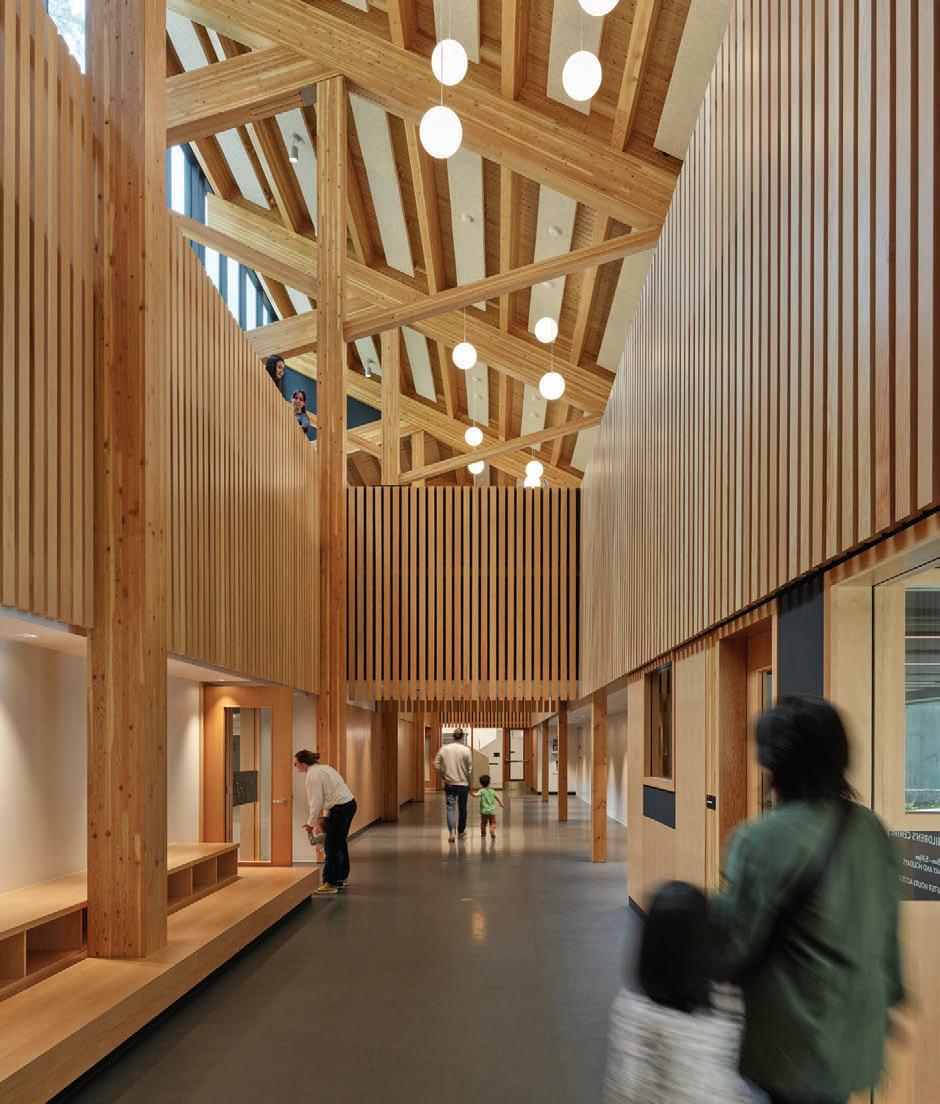





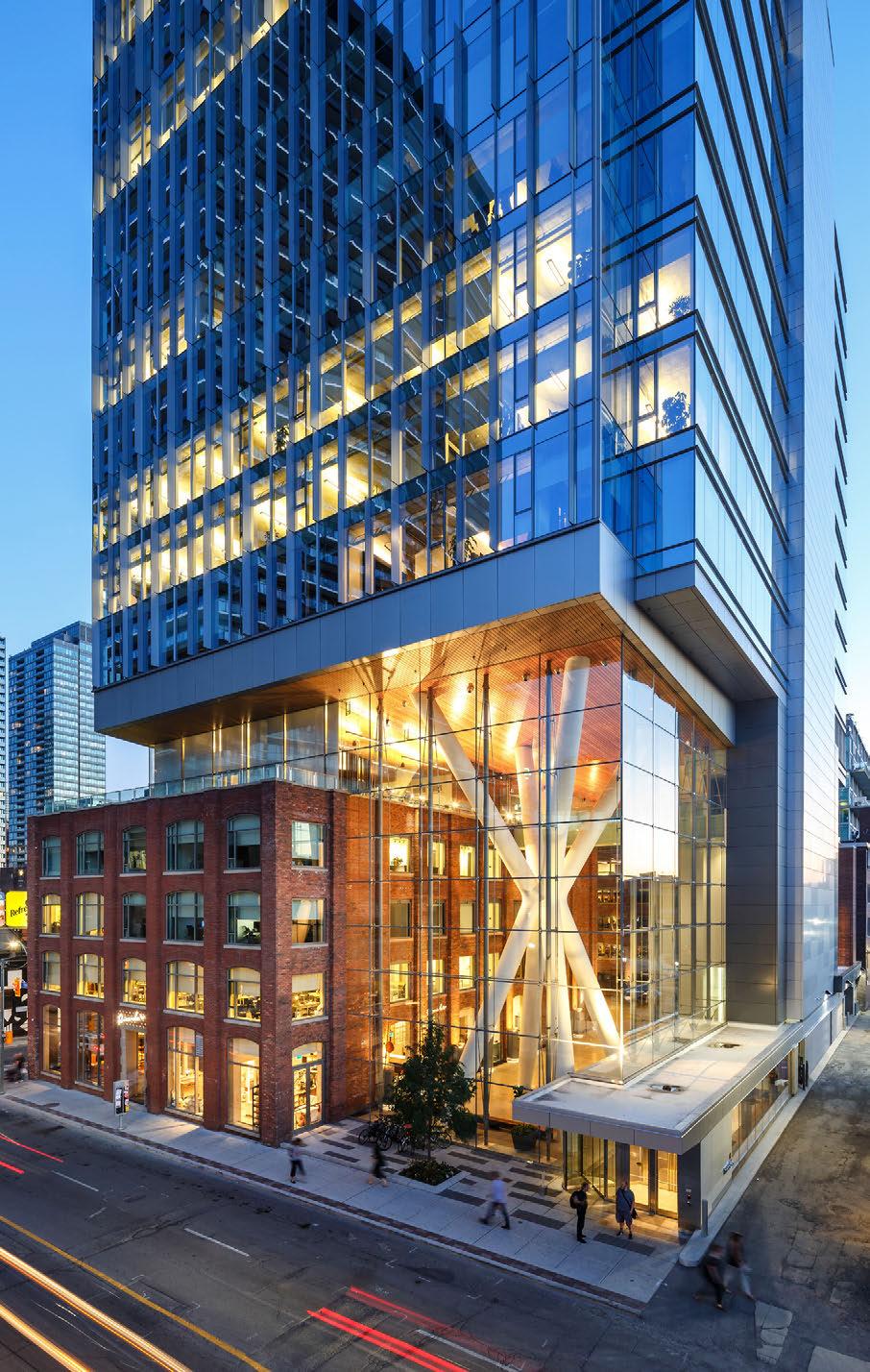
Forward. Rise Above.


QUEEN RICHMOND CENTRE WEST – PHASE II
by PETER STENNING
As a follow-up to the successful 2015 Queen Richmond Centre West project, Allied Properties REIT’s Queen Richmond Centre West Phase II (QRCW-II) fronts one of the most connected and trendy downtown retail and cultural neighbourhoods in Canada: Queen Street West.
The first phase of the project saw Sweeny&Co. Architects Inc. integrate two existing heritage buildings into the construction of a new 17-storey office tower, with the tower rising from a tabletop that spanned both buildings.
Peter Kurkjian, senior associate at Sweeny&Co., designed Phase II as an expansion, comprised of a new seven-storey building including commercial office space and retail components below grade and on the first two floors. “Both phases were always conceived as being together; they were just separated by approval processes,” he says.
The challenge of both phases was getting approval for the height of the towers, since the low-rise neighbourhood surrounding QRCW had been given heritage status by the City of Toronto. “Plus, Phase II directly faced Queen Street, so we employed a terraced design on the new building in order to step back from the street,” Kurkjian says. “This conformed to the 45-degree angular plane guidelines of the local Heritage Conservation
District and allowed sunlight to hit the street instead of being blocked.”
Above the heritage-sensitive base, which addresses the street vernacular with brick facades, curtain wall volumes reflect the design of the Phase 1 building and lead out to generous landscaped roof terraces. A steel frame tower clad in structural glazing marks the corner of Queen and Peter, and internal bridges connect both buildings on floors three through seven.
Kurkjian says, “We started Phase II by aiming to meet basic LEED requirements, but we were eventually able to target LEED Gold. The new masonry portion of the envelope consisted of a proper rainscreen and added insulation, and the rest of the new building was curtain wall of high-performance glass.”
Eastern Construction Company Limited, that built Phase I, was tasked with retaining, conserving, and integrating the heritage façade on the north side into the new tower, beside one of the busiest pedestrian areas of Toronto. “We started work in 2020, and one big advantage was no traffic due to the COVID lockdowns,” says project manager Mark Greenbank. Greenbank and other trades initially had to contend with lockdown-related longer lead times and delays, with most of the glass for the new building’s curtain wall coming
from Spain. Eastern demolished the brick buildings, shored up the façade, engaged Clifford Masonry to install new brickwork, and then proceeded to construct the new facility. “Once the lockdowns eased and people began returning to work, we had to focus on just-in-time deliveries and took over a portion of Peter Street to facilitate that, since there was zero space for laydown,” Greenbank says.
Greenbank adds that shoring was extensive: “We were literally right up against the neighbouring property,” he says. Another aspect of the project Greenbank describes as “nerve-wracking” was installing the pedestrian bridge between the two buildings: “We used the tower crane of the Phase II building to lift the steel over an active Jack Cooper Lane.”
Phase II includes all the advanced and efficient building systems of the Phase I tower, including underfloor electrical and HVAC distribution. Kurkjian notes, “The bridge carried the heating and cooling lines from Phase II to connect with the mechanical systems of Phase I, which enhanced the energy performance of the new building, saved space, and reduced cost.”
A substantial completion date of March 2024 was achieved for QRCW-II, with Allied achieving LEED v4 Gold certification.
Now that Queen Richmond Centre West is fully operational, Kurkjian reflects on the long-in-development project. “Phase II was such a great opportunity to finish what we started so long ago, and Allied truly appreciated what we brought to the table,” he says. “Between Allied, Eastern, and ourselves, Phase II was a reunion of a team that worked extremely well together, in the best collaborative spirit – and we’re very proud of the result.” A
LOCATION
375 Queen Street West, Toronto, Ontario
OWNER/DEVELOPER
Allied Properties REIT
ARCHITECT
Sweeny&Co Architects Inc.
GENERAL CONTRACTOR
Eastern Construction Company Limited
HERITAGE CONSULTANT
E.R.A. Architects
STRUCTURAL CONSULTANT
RJC Engineers
MECHANICAL CONSULTANT
The Mitchell Partnership (now BPA Toronto)
ELECTRICAL CONSULTANT
Mulvey & Banani
LANDSCAPE ARCHITECT
NAK Design Strategies
TOTAL SIZE
86,000 square feet
TOTAL COST
$43 million

WEST COULEE STATION ELEMENTARY SCHOOL
by ROBIN BRUNET
West Coulee Station Elementary School, a $28.5-million design-build project funded by the Alberta government, provides a new learning facility for the rapidly growing westside neighbourhood of Garry Station in Lethbridge.
The school has a capacity for 600 students, but was designed from the outset with future modular classroom additions, allowing the total student population to increase to 900. It is also a striking creation. The exterior is graced with three large, soaring light scoops that bring natural light into the central gathering space, so that the first thing visitors see when entering the K–5 school is a bright atrium with a theatre staircase.
“Originally, the school was planned to open at 400 students, with the option to expand to 600, but we decided to build bigger and instead designed the school to open at 600, with expansion to 900 students,” says Daniel Heaton, director of facility services at Lethbridge School Division. “The intention is to use two-storey classroom modulars down the road to reduce the footprint on the site, with easy access from those classrooms to the main building amenities. This took considerable planning, but we were successful.”
Lethbridge School Division also provided a unique spin on the usual stakeholder engagement sessions, which took place in late 2021. “We gave them blocks of different sizes representing different components of a school to scale, and they arranged the components the way they preferred,”

explains Heaton. “Some of their ideas carried through to the final design.”
The property for the new school resembled a slightly bent rectangle.
“An old gravel road running through the site was eliminated, and since City of Lethbridge policy dictates that school sites are shared with public parks, an adjacent farmer’s field was designated as a playfield, and it was constructed before we even got our foundations in,” says Heaton.
Initially, West Coulee was planned as a P3 project, but was switched to a design-build model in 2022.
“Fortunately, we had worked with Ward Bros. Construction and FWBA Architects in the past, so we shared a strong understanding of how our schools are developed,” says Heaton.
While FWBA was the architect of record, OTA Oystryk & Team Architecture was the bridging architects. “There was a great exchange of ideas between the architects and Daniel Heaton,” says OTA principal, Monika Oystryk. “The mandate was to create a layout for flexible teaching, team teaching, and project-based learning.”
The arrangement of the classrooms was a direct result of those requirements. They were located on the west wing of the school and formed learning pods that consisted of two regular classrooms and one ancillary classroom. The ancillary classroom was designed to open to each of the adjacent classrooms, as well as to the hallway (these spaces were also designed to accommodate the future modulars). Two classrooms were designated for ECS needs.

The central part of the school, with the gymnasium and learning commons/library, was designed as the primary means of connection and circulation between the learning spaces on the west side and the east wing, which contains the main entrance, music room, and administration area. The administration offices were arranged to allow a strong visual connection to the main entrance, ECS classrooms, parking, and bus loop and drop-off zones.
Oystryk describes the central zone as “the heartbeat of the school, with the theatre staircase leading to the learning commons, which can be closed off by movable glass walls.”
“In a very subtle way, the exterior of the building was influenced by the heritage railway motifs of the surrounding neighbourhood,” adds Heaton. “For example, the distinct light scoops are reminiscent of historic train engine cabs, and the brick was selected to have a coal-black appearance.”
From the east, hints of a steam engine in the outline and in the materials used on the building faces can be detected. Inside the gym and the central gathering space, the exposed steel trusses are coloured black in reference to Lethbridge’s historic High Level Bridge.
Ward Bros. Construction Ltd. began foundation work in August
of 2023 and benefited from good site conditions and laydown space. The exterior materials were a combination of concrete block, augmented by metal cladding on the upper portions, and masonry brick for the administration area.
West Coulee Station Elementary School enjoyed a grand opening in September of 2025. “This is a much-needed addition to our portfolio and a beautiful building that honours our local heritage,” says Heaton. “We couldn’t be happier.” A
LOCATION
1350 Abitibi Road, Lethbridge, Alberta
OWNER/DEVELOPER
Lethbridge School Division
ARCHITECTS
OTA Oystryk & Team Architecture (Bridging Architect); FWBA Architects (Architect of Record)
DESIGN BUILD CONTRACTOR
Ward Bros. Construction Ltd.
STRUCTURAL CONSULTANT
BCB Engineering Ltd.
MECHANICAL CONSULTANT
Remedy Engineering
ELECTRICAL CONSULTANT
SMP Engineering
CIVIL CONSULTANT
ISL Engineering
TOTAL SIZE
64,583 square feet
TOTAL COST
$28.5 million

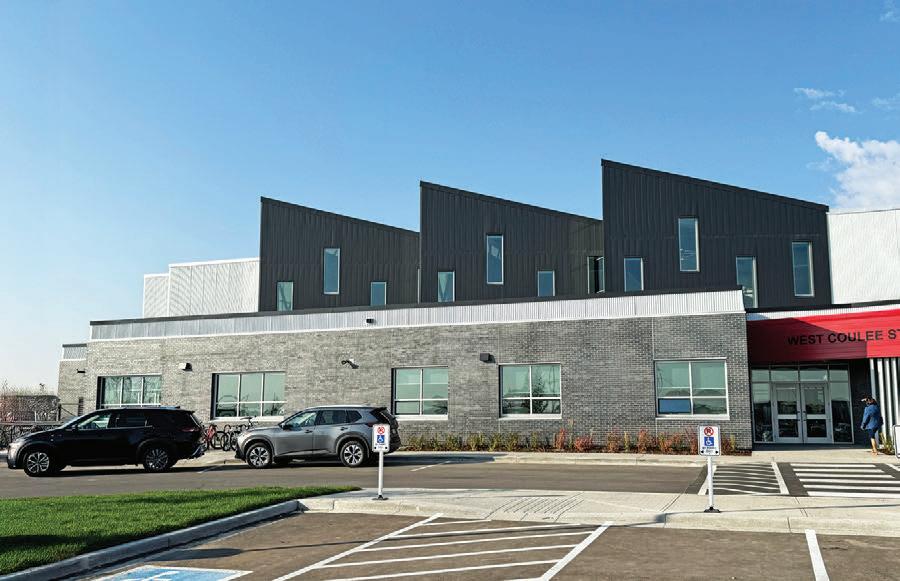

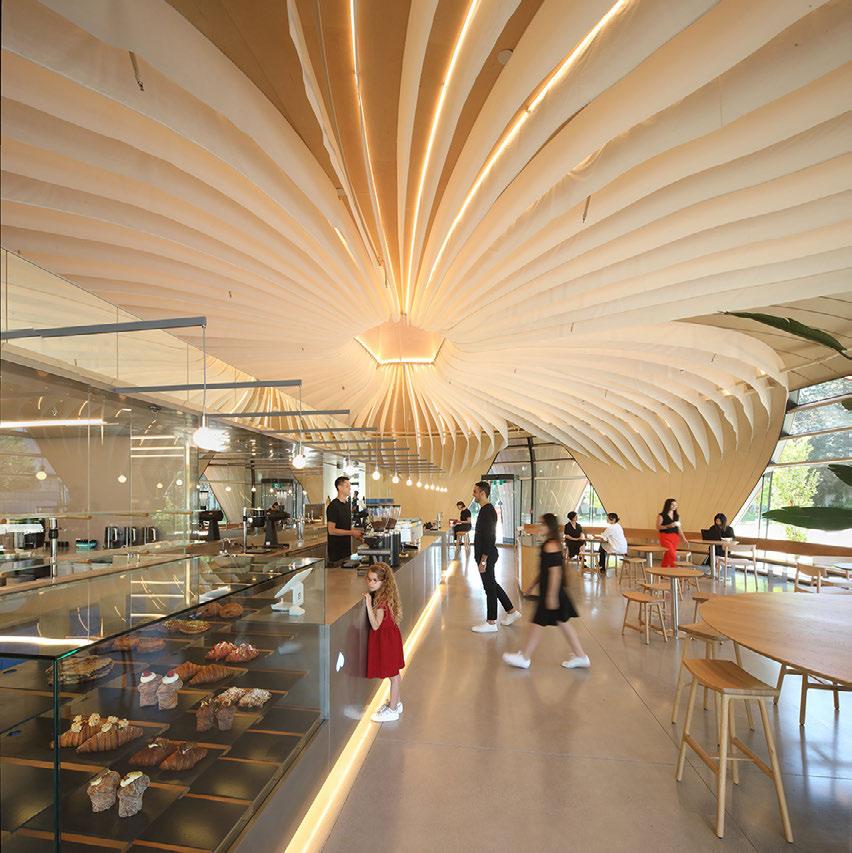

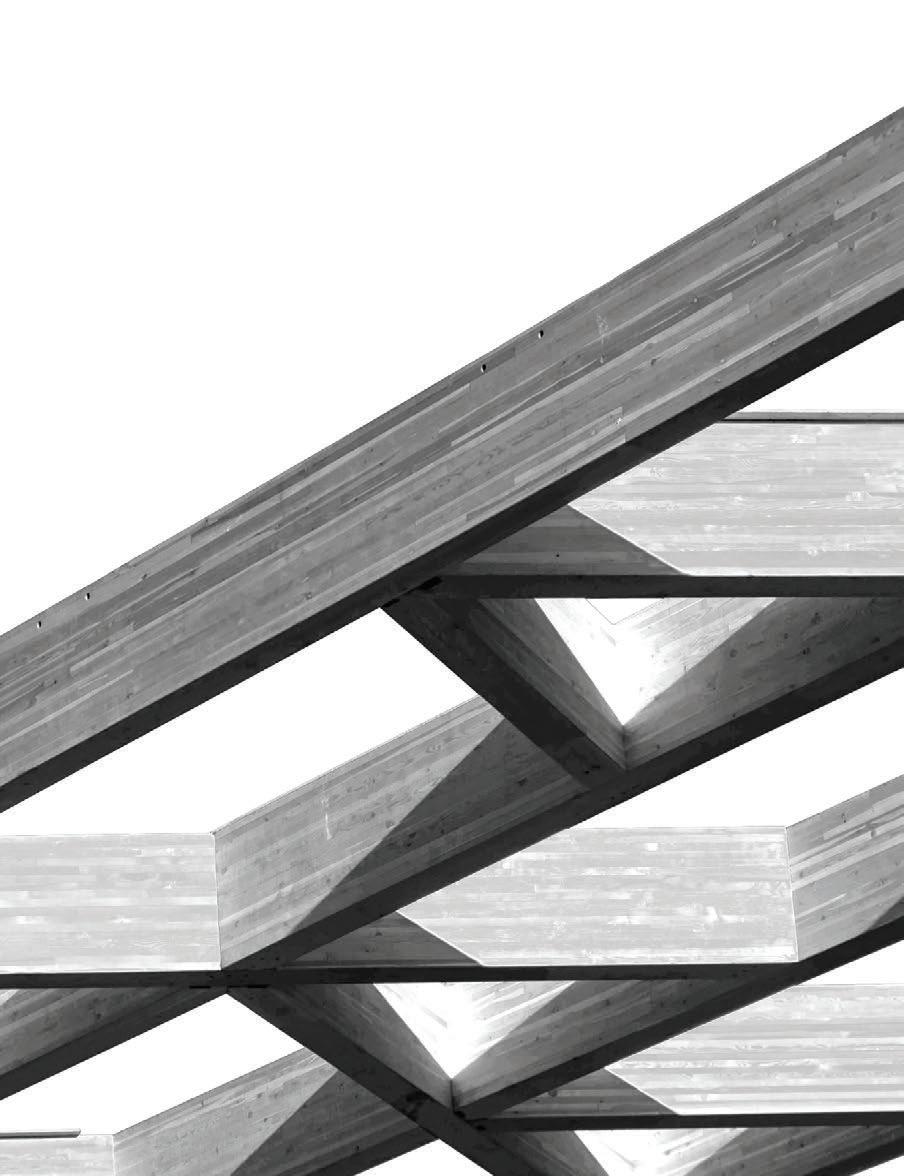

KITCHENER SOUTHWEST COMMUNITY LIBRARY
by PETER STENNING

New libraries are light years more advanced in terms of design and programming than those of past generations, and nowhere is this more evident than the Kitchener Public Library’s new Southwest Community Library, designed by mcCallumSather and built by Dakon Construction Ltd.
The facility is one of Canada’s first community libraries designed to achieve Zero Carbon Building Certification. A high-performance building envelope, geothermal system, and solar panels reduce energy demand, while advanced mechanical design ensures comfort with far less energy than a typical civic building.
Low-carbon materials, including glulam and cross-laminated timber, further minimize embodied carbon, while the library’s sustainability elements are visible in the form of bioswales, stormwater systems, and two green roofs. User features include a large sunroom, a children’s area, and a studio for podcasting, music, and video production.
Amanda Wiley, the area manager for the Southwest Community Library, says the new facility was the first civic building in Kitchener’s rapidly developing Rosenberg neighbourhood. “The immediate population is expected to more than double to 22,000 people, and we regarded the project as a unique chance to help shape the identity of the community.”
The library was developed with extensive input from the Indigenous rights-holders, Six Nations of the Grand River, and Mississaugas of the Credit First Nation. “They suggested bringing as much natural light as possible into the building and blurring the line between exterior and interior, plus using lots of exposed wood and other natural materials,” Wiley says.
The library’s stormwater system, green roof, and bioswales became
the main drivers of the landscape design. Another example of functional design was a large covered exterior patio. “This is a multipurpose space in an area of raised garden beds that is linked to an interior demonstration kitchen,” says Willems Ransom, principal at mcCallumSather.
One challenge of the design was ensuring the power draw caused by the kitchen wouldn’t compromise the project’s net zero objectives, “and this obliged us to undertake lots of small initiatives,” says Dan Austin, associate, construction contract administrator at mcCallumSather.
Another challenge was hiding the mechanical components. “They were concealed in different areas of the interior so as not to spoil the wideopen sloped ceilings you see when you walk through the main entrance,” Austin says.
Architectural flourishes were developed throughout, including a sculpted, wavy feature wall in the children’s area. “Our millwork contractor built the wall in pieces, and we installed it on-site and augmented it with special lighting,” says Mike Downey, project manager for Dakon Construction Inc. “We also installed a felt-covered ceiling to absorb noise in that area.”
Another visual flourish was the whispering gallery: a large square room with an overhead circular dome offsetting a slatted wood ceiling in the multipurpose room. “The dome was made of gypsum and has unique acoustic properties in that anyone standing under it needs only to whisper for everyone else in the room to hear clearly,” Downey says.
One of Wiley’s favourite features is Wintertime Stories, a 50-foot-long wall sculpture by Isaac Murdoch and Nyle Miigizi Johnston. “It’s rooted in Anishinabek storytelling tradition and represents an important
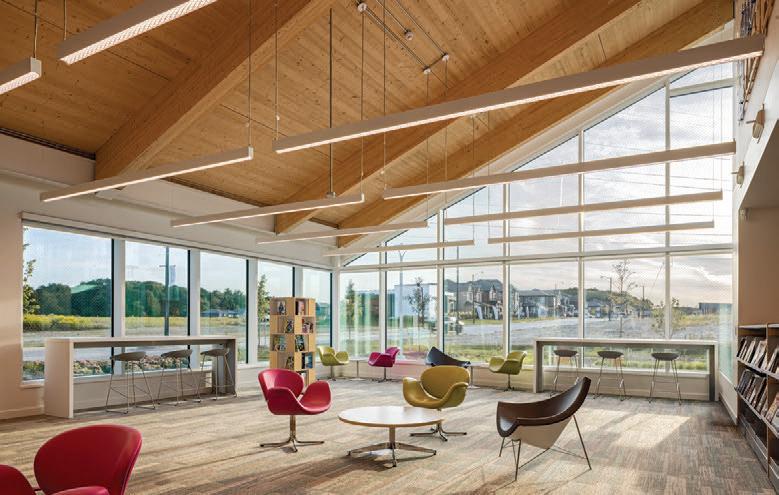
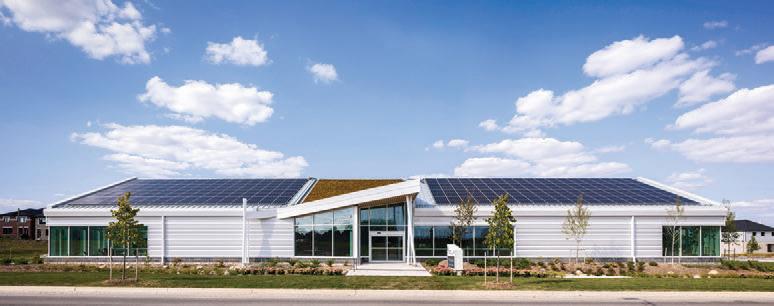
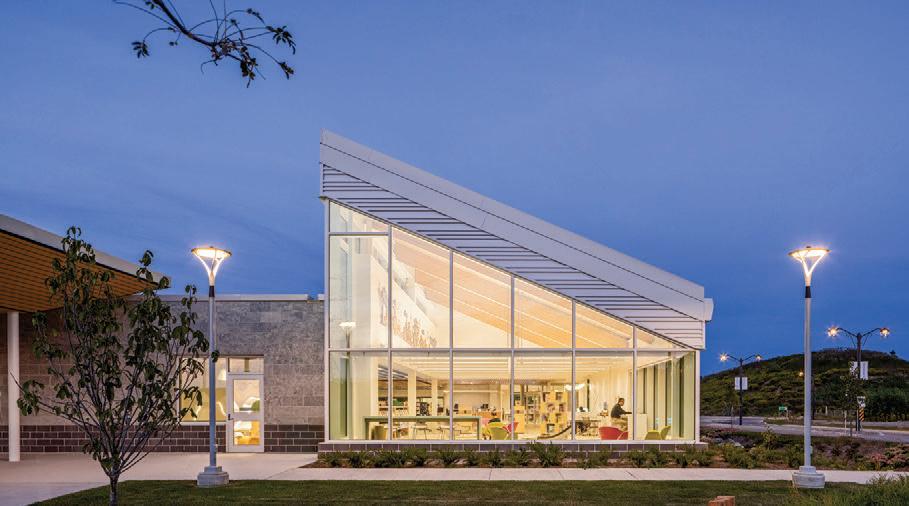
acknowledgment of First Nations’ relationships to the land on which the library sits,” she says.
Corrugated metal panels that cast deep shadows – in keeping with the shadows cast by the roof planes – along with Algonquin stone were some of the materials making up a high-performance yet cost-efficient exterior; the main double-height entrance with an upward swooping CLT deck and glulam beam canopy with crisscrossed columns augmented a structural steel gabled roof.
The on-site geothermal field that would play a vital role in the library’s energy efficiency “is a horizontal 20,000-square-foot loop of several layers that go down only about 12 feet into the ground, with sand as backfill, beneath the library’s parking lot,” Downey says.
Achieving net zero meant numerous small construction challenges, from having to modify the stormwater management system due to multiple types of soil found on site, to air pressure testing the building. “That was complex, because the building needed to have all windows installed as well as the air barrier, but not any interior drywall or exterior panels in case there were leaks,” Downey says.
The Kitchener Southwest Community Library fully opened in June of this year to great public praise. “It imparts a sense of grandeur to those who visit it for the first time, and locals love the space,” Wiley says. “We’re seeing more and more people bring their laptops to work here. This is turning out to be a real anchor for the Rosenberg neighbourhood, and we couldn’t be more pleased with the results.” A
LOCATION
100 Rosenberg Way, Kitchener, Ontario
OWNER/DEVELOPER
Kitchener Public Library
ARCHITECT
mcCallumSather
GENERAL CONTRACTOR
Dakon Construction Ltd.
STRUCTURAL/ELECTRICAL/ CIVIL CONSULTANT
Stantec
GEOTHERMAL CONSULTANT
Geo-Xergy Systems
LANDSCAPE ARCHITECT
SpruceLab
TOTAL SIZE
14,000 square feet
TOTAL COST
$14 million
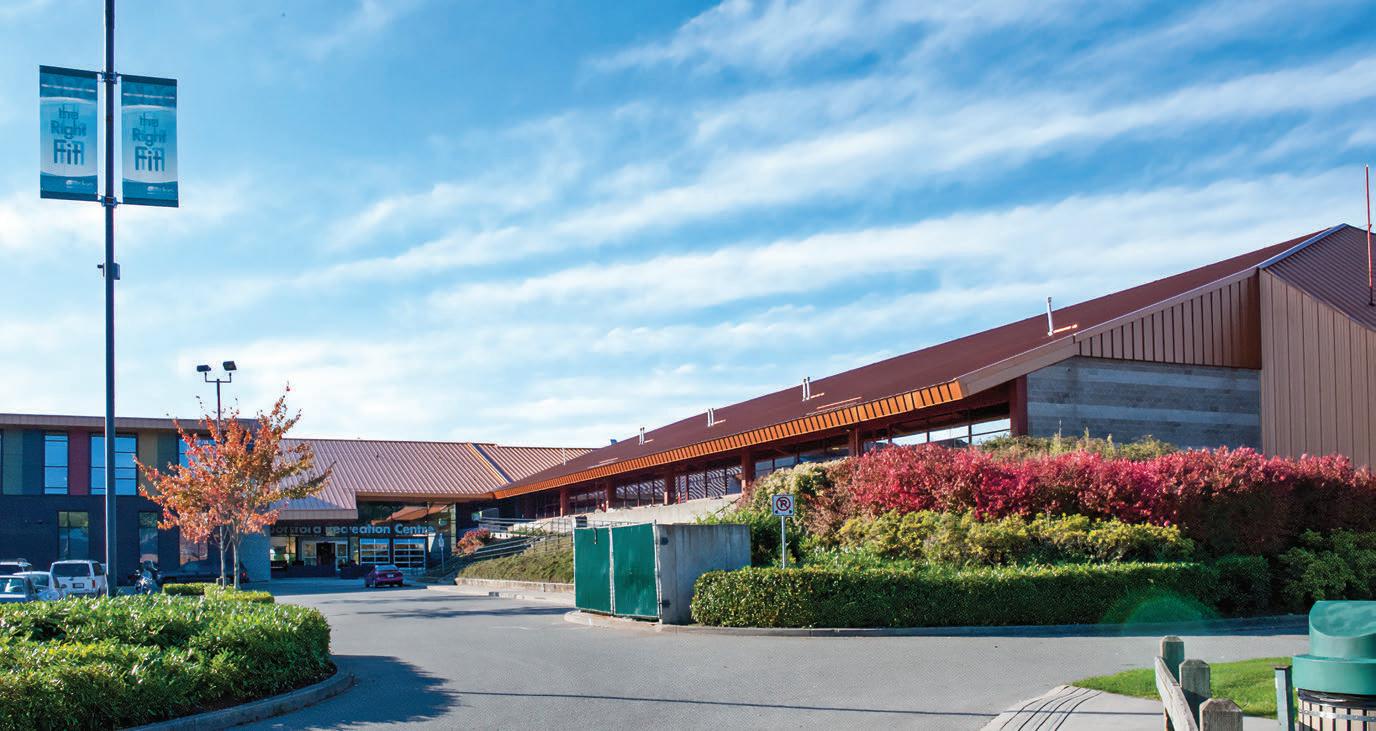
2499 McMillan Road, Abbotsford, B.C.
ABBOTSFORD RECREATION CENTRE (ARC) HeRO PROJECT
by ROBIN BRUNET
The Heat Recovery and Optimization (HeRO) project at the Abbotsford Recreation Centre (ARC) is an effective approach to making a public facility more energy efficient, with improved air quality and accessibility, and decreased greenhouse gas (GHG) emissions.
ARC is made up of three major recreation areas: the aquatic centre, the ice arena, and the community centre. These were constructed in 1972, 1995, and 2008, and as a result, systems such as heating and cooling were not integrated, and most of them needed to be updated or replaced.
“There are multiple mechanical rooms in ARC, located in the aquatic and ice arena areas, above the yoga studio, as well as a small room in the fitness centre, each of them running independently,” says Sahar Tahmasebpour, project manager for Chandos Construction, which was tasked with the retrofit after a City of Abbotsford-initiated study identified ARC as a high-energy consumer and significant contributor to the city’s GHG emissions.
The project involves reworking ARC’s HVAC system to connect all heating systems throughout the building, in order to capture waste heat from the aquatic centre and ice arena and redistribute it to other areas that require heating. When Chandos began construction in January of this year, it was estimated that the retrofits would reduce the facility’s energy consumption by 40 percent and GHG emissions by 70 percent.
Moreover, from the end user’s perspective, the project would provide better ventilation throughout the facility and enhanced accessibility alongside more consistent temperatures in the pool area.
Abbotsford Mayor Ross Siemens said at the time, “This project will help to make ARC more energy efficient as well as more accessible to all users, and it aligns with Abbotsford City Council’s values of environmental and financial sustainability.”
The City’s project team understood that to successfully deliver such a complex project, it would be crucial to utilize a collaborative delivery model. “As a construction management project, we spent a few months working together in preplanning,” Tahmasebpour says. “During this time we altered the retrofit design where required and relocated some pipework.”
Mathew Chrystian, project director at Chandos, adds, “The early and intense collaboration between our special services group, the City, and Prism Engineering enabled us to hit the ground running.”
A spokesperson for the City of Abbotsford says, “One of the key energy efficiency opportunities included being able to capture heat generated from the operation of the arena ice plant during winter months to assist the pool and community centre spaces that required heat. So the ARC HeRO project consisted of installing a heat recovery loop throughout the facility to tie together the independent mechanical systems. Waste heat, primarily from ice plant equipment and the aquatic centre ventilation, could be circulated through the new heat recovery loop and directed where needed. To accommodate offsets in energy demand versus supply, a 4,000-gallon thermal storage tank was installed to store excess heat.”
Chrystian says one of the biggest challenges of the project was conducting the retrofit while ARC was still open to the public. “Our goal was to
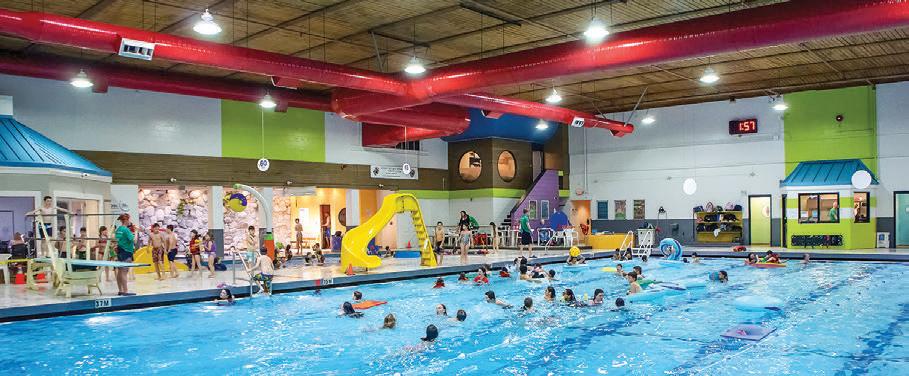
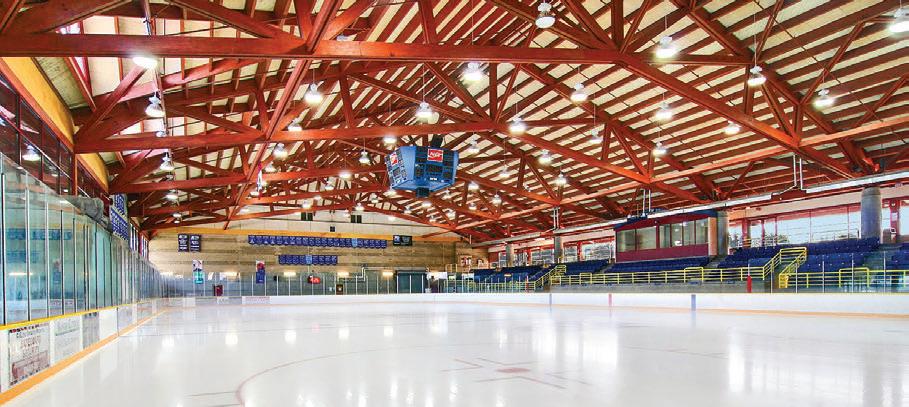
be invisible, so we determined when the maintenance shutdowns of the aquatic and ice arena areas would be and scheduled our work accordingly.”
Other areas of the facility required Chrystian’s team to work nights, clean everything up prior to opening for the public, and repeat the process until the job was complete. The approach was complementary to the public communications program that used a “superhero” theme to share construction impacts and disruptions as well as project benefits.
Replacement of some existing equipment with newer, smaller, and more efficient equipment provided ARC with additional space. A new mechanical room was also constructed to house the new heat recovery equipment.
As of mid-October, Chandos was in the midst of commissioning the
integrated system; when completed at the end of this year, it will be closely monitored for a one-year period. “The majority of the ARC’s heating and cooling systems are brand new. The system integration allows for localized heat recovery throughout the ARC to reduce energy use,” Tahmasebpour says.
Chrystian concludes, “This is an important project because many other recreation centres and public facilities in B.C. could be upgraded in a similar fashion. The construction management delivery model was a key benefit because this kind of work either lives or dies depending on how intense and collaborative the preconstruction process is. The City of Abbotsford understood this, and the result is a popular facility that will perform at the peak of energy efficiency for many years moving forward.” A
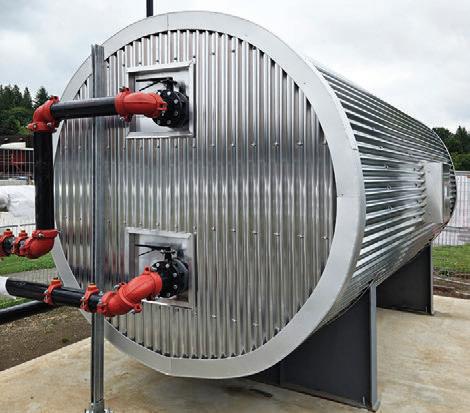
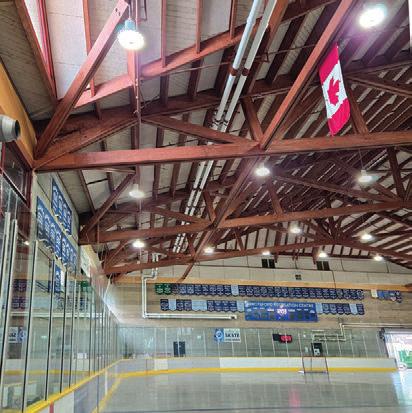
Recovering Heat. Reducing Carbon. Changing Systems.
Prism Engineering is proud to be a key contributor to the Heat Recovery System and Optimization (HeRO) project at the Abbotsford Recreation Centre — from conducting the carbon elimination study that identified the upgrades, to designing the new systems, and providing construction administration support. These upgrades will deliver major GHG reductions and help the City of Abbotsford advance its climate goals. Congratulations to the City and project partners on this transformative step toward a low-carbon future.
Ready to advance your organization’s carbon reduction goals? Talk to us! www.prismengineering.com

Where the Builders Buy Specializing in Luxury Appliances for Residential and Commercial Developments
Contact: Michael Gnat | 416-635-4835 mgnat@midnorthern.com 45 Red Maple Rd. Richmond Hill, ON Learn more at midnorthern.com
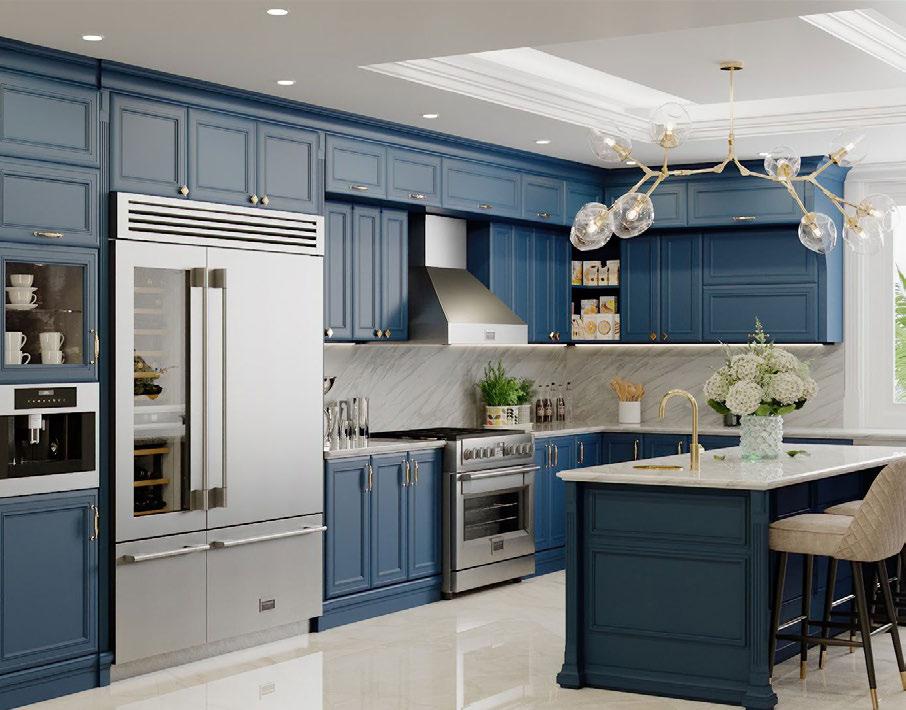
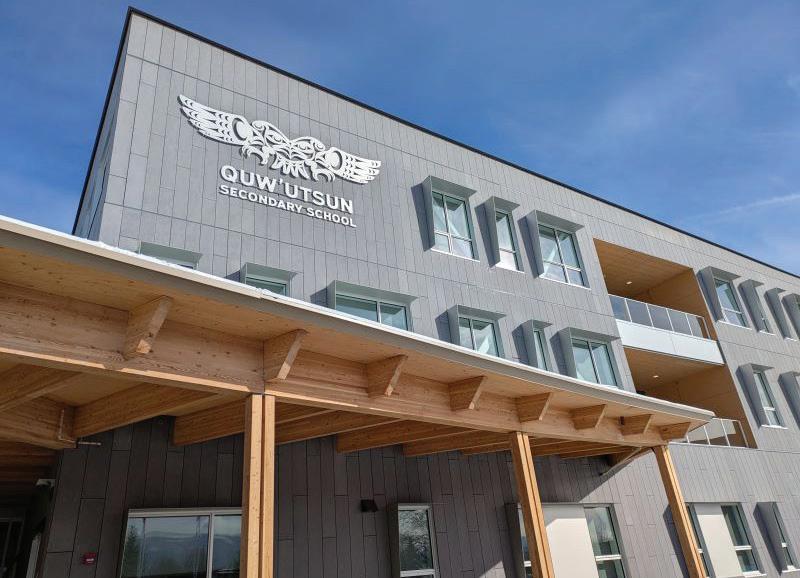
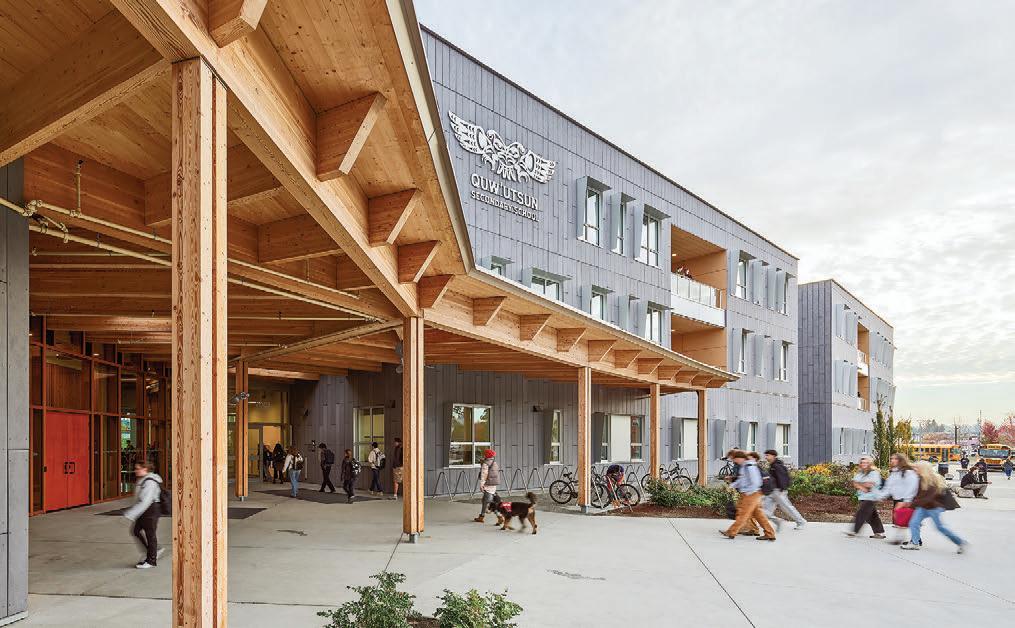
QUW’UTSUN SECONDARY SCHOOL
by LAURIE JONES
The Quw’utsun Secondary School, formerly known as the Cowichan Secondary School, is the first new school of the grade 10 to 12 level in the area to be built in almost 30 years. Located in the Cowichan Place community in Duncan, B.C. – adjacent to Vancouver Island University’s Cowichan campus, the local hockey rink, a swimming pool complex, and performing arts theatre – the three-storey school accommodates 1,100 students, with an expansion option to 1,500. The main areas include offices, a gymnasium, and learning communities.
Jason Sandquist, secretary-treasurer for Cowichan Valley School District #79, says the new project was completed in two phases, with the initial occupancy starting in the fall of 2024. “We had to get all the shop class equipment in first, then the rest of the students arrived in February.”
One of the major reasons for building the new school was seismic safety, as the previous facility was over 70 years old, Sandquist explains. “The area has soft soil, so it became a high-risk seismic priority for the province. In order to alleviate that, the new school footprint included 1,700 stone pilings.” As the school is located in a known flood zone, the design required raising the main floor to flood construction levels.
A unique aspect of the project is its partnership with the local First Nation Cowichan Tribe, and hcma was tasked with creating a design for the Quw’utsun Secondary School that would incorporate First Nation traditions into modern education, focusing on materials, colours, and symbols that honoured the Cowichan Tribe’s history. “The structure was created with

five pods or learning communities, with the option to add three more if the school population expands,” says Karen Marler, principal with hcma. “Natural light was a key component for the school in both the classrooms and the main entry. We incorporated floor-to-ceiling windows that offer great views to the surrounding area. The atrium is also bright and airy with a feature staircase clad in wood designed as a procession to the third level, with gathering spaces for study and socializing.”
Marler adds that students recently used the staircase for a presentation to the school trustees. “They explained how the school’s design was creating community for them, particularly how the classrooms were arranged, with four classrooms around a central space. Within each of these learning communities is a resource learning space, a teacher prep area, a breakout meeting room, a balcony, and kitchenette.” She adds that for such a large school, these pods were a way to provide smaller

groups of students the opportunity to know and support each other.
Marler says the interior colour palette for the school was inspired by the lifecycle of a salmon – from orange salmon eggs to a brilliant dark red of a spawning adult. “We also worked with Elders and the school’s artist-in-residence, Stuart Pagaduan, during the design phase and incorporated First Nations’ symbols throughout the school.”
The landscape design for the project, by MDI Landscape Architects, also honours salmon and local First Nations culture. The entry plaza, inspired by the Cowichan Estuary, features salmon artwork sandblasted into the paving, symbolically “swimming” toward the main entrance and passing by rain gardens that manage all stormwater on site. The design not only pays tribute to salmon but also incorporates nature-based solutions to manage rainwater, ensuring that the project provides benefits to the salmon populations living downstream. A rather unique addition to the high school is a set of bucket swings that, according to the team at MDI Landscape Architects, are almost always in use.
Other features of the school, like the gender-neutral washrooms, reflect a commitment to inclusive design. “The students say these have been successful because nobody is bullied, and it was accepted by all involved. The design includes individual stalls and a common handwashing area.”
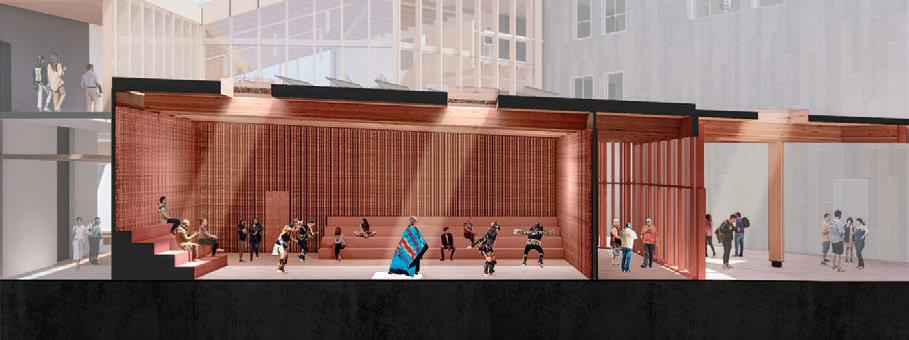
Stefan du Toit, project director for Urban One Builders, explains that the grey exterior finish on the school creates the look of a rock, with Tiva antigraffiti cladding panels. “Also, when you look at the building’s angle toward the front entrance, it resembles eagle wings. It’s really a beautiful project.”
While the school is primarily wood construction, it includes a steel structure. The Indigenous Gathering Place, or longhouse, is located next to the main entrance, with its own separate entrance. “Next to the Gathering Place is an Elder’s room, with casual seating and a small kitchen. As part of the Cowichan tribe culture, students can meet with the Elder whenever they need,” says Sandquist.
The Quw’utsun Secondary School was built to LEED Gold standards, and the team is in the process of getting official certification. The building was also designed to install a voltaic array in the future. A
LOCATION
2003 University Way, Duncan, B.C.
OWNER/DEVELOPER
Cowichan Valley School District #79
ARCHITECT
hcma
GENERAL CONTRACTOR
Urban One Builders
STRUCTURAL CONSULTANT
RJC Engineers
MECHANICAL CONSULTANT
AME Group
ELECTRICAL CONSULTANT
AES Engineering
CIVIL CONSULTANT
Gwaii Engineering
LANDSCAPE ARCHITECT
MDI Landscape Architects
TOTAL SIZE
128,898 square feet
TOTAL COST
$82.1 million
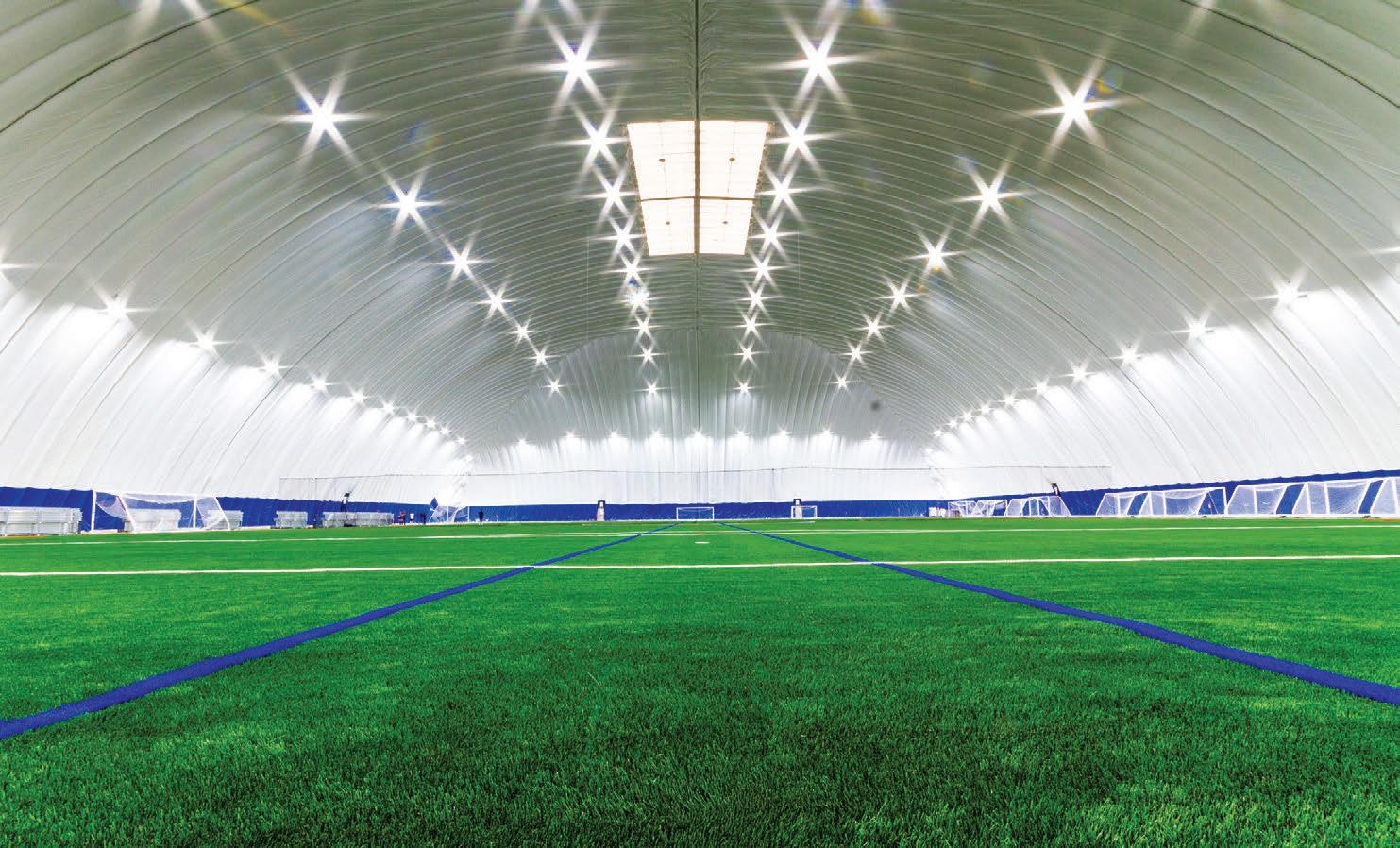
CALGARY SOCCER CENTRE DOME AND ARTIFICIAL TURF UPGRADE
by CHRISTINA MORRISSEY
Calgary has scored big time with the Soccer Centre Dome and artificial turf upgrade at the Calgary Soccer Centre, a transformation that is creating new opportunities for competitive and recreational players alike by offering a high-quality, year-round space for practice and play.
What was once a seasonal, underutilized outdoor field is now a vibrant community hub, designed to meet the city’s growing demand for indoor recreation while complementing existing infrastructure.
“Calgary is growing quickly, and with that comes increasing demand for additional competition-sized, yearround recreation spaces,” says Ryan Atkinson, manager of buildings and architecture in public spaces delivery at The City of Calgary. “The existing facility was an ideal opportunity to maximize its use of infrastructure and enhance public recreation.”
The transformation began with converting the natural turf field into a high-performance artificial surface and covering it with a permanent air-supported dome. The new amenity building houses player and referee change rooms, administration and storage space, and the site itself received major upgrades, including paving the gravel lot to accommodate more traffic and address longstanding flooding issues. “Over time, the vision has evolved from simply increasing field capacity to creating fully integrated, multi-use facilities that support inclusivity, accessibility, and community connection,” Atkinson says.
With the Calgary Soccer Centre welcoming 1.3 million visitors annually, the new dome and attached amenity building needed a design that addressed increasingly high traffic to the facility and access challenges. The
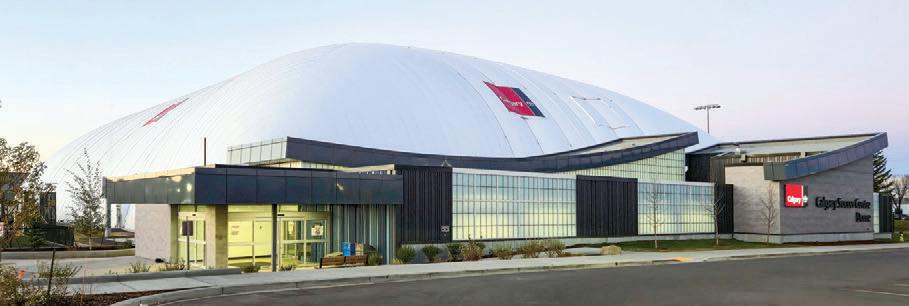
dome’s amenity building provides substantial crush space for peak usage, while the new indoor field includes additional player run-off space and an asphalt path perimeter for safe circulation. Parking was expanded by roughly 100 spaces, and long-standing flooding issues were resolved.
Graham Kaptein, senior project manager at Graham Construction, explains that the site posed some unique challenges. “We encountered fill materials from years past, especially in the parking lot area, which required removal and replacement with granular fill to strengthen the base prior to asphalt paving,” he says.
“Originally, the site had a gravel overflow lot and a large stockpile of dirt. We removed that and redeveloped the whole area, which gave the centre more parking spaces than they had before.”
The architectural concept by Start Architecture expresses the cadence of a soccer match. “The site had two existing buildings – the Main Building from the late ’80s with an arched roof, and the rectilinear Annex from 2013 – thus, a bridging element would be needed between all the buildings,” says Michael Chu, principal at Start. “The forms of all buildings reinforce the movement of a soccer ball through the course of a game by dribbling, the straight form of the Annex; chip, the arc of the main building; kick, the upward arc of the new Change Room
LOCATION
7000 – 48 Street SE, Calgary, Alberta
OWNER/DEVELOPER
The City of Calgary
ARCHITECT
START Architecture
CONSTRUCTION MANAGER
Graham Construction
STRUCTURAL & BSE
Entuitive Corporation
MECHANICAL CONSULTANT
Remedy Engineering
ELECTRICAL CONSTRUCTION
SMP Engineering
LANDSCAPE ARCHITECT
ground cubed
CIVIL CONSULTANT
Richview Engineering
TOTAL SIZE
4.5 acres (parcel area)
TOTAL BUDGET
$28 million
facility. “This alone is expected to triple the field’s usage,” says Atkinson.
facility; and the clear [a term used for kicking the ball away from your goal area], the arc of the dome,” says Chu.
Natural light was a key priority. Translucent insulated panels illuminate central spaces without glare, provide privacy in the change rooms, and improve energy efficiency by reducing heat gain in summer and heat loss in winter.
Metal siding draws on the surrounding industrial aesthetic while visually narrating the pace of a soccer game. “We chose Morin’s Matrix panels that have multiple variations in standard rib patterning. We mixed these patterns to further replicate the cadence of a soccer game that has intense bursts – smaller ribs in shorter repetition – and slowed strategic gaps –the larger spaced ribs,” explains Chu.
The project prioritized inclusivity for all ages and abilities. Eight change rooms with accessible amenities and single-occupancy washrooms were added, and the change room amenity building is connected directly to the dome. The field’s flexibility allows it to accommodate multiple sports, events, and community programming. “These enhancements create a community hub where Calgarians of all ages and abilities can participate in sport and recreation,” Atkinson says.
The standout feature of this project is undoubtedly the air-supported dome itself, which transforms a previously seasonal field into a year-round
Graham Construction treated the dome and change room facility as separate structures with distinct permitting requirements. The dome, supplied and installed by The Farley Group from Ontario, arrived in eight large sections and “the inflation process only took about an hour, which was incredible to watch,” says Kaptein. An eight-foot grade beam foundation anchors the dome as ballast, rather than providing structural support, while dual air handlers, an emergency backup generator, and air conditioning make it a true year-round facility. Kaptein adds that phased construction allowed the facility to remain operational throughout construction. With soccer participation climbing and the 2026 Men’s World Cup approaching, the City is committed to ensuring recreation infrastructure keeps pace with demand. Florent Le Berre, manager of strategy, planning, innovation and equity in recreation and social programs at The City, adds that the project also aligns with the Calgary City Council-adopted GamePLAN Making Waves service level that aims to increase bookable hours at indoor fields by 2.5 times, achieve one athletic park per 22,000 residents, and reach a standard of one indoor field facility per 150,000 residents, with a total of 13 fieldhouses by 2050.
“This project is part of a growing network of fieldhouses across Calgary, with a seventh facility already under construction in the community of Belmont. These investments are about more than just sport; they’re about building connection, supporting healthy lifestyles, and ensuring that every Calgarian has access to high-quality public spaces,” Le Berre concludes. A








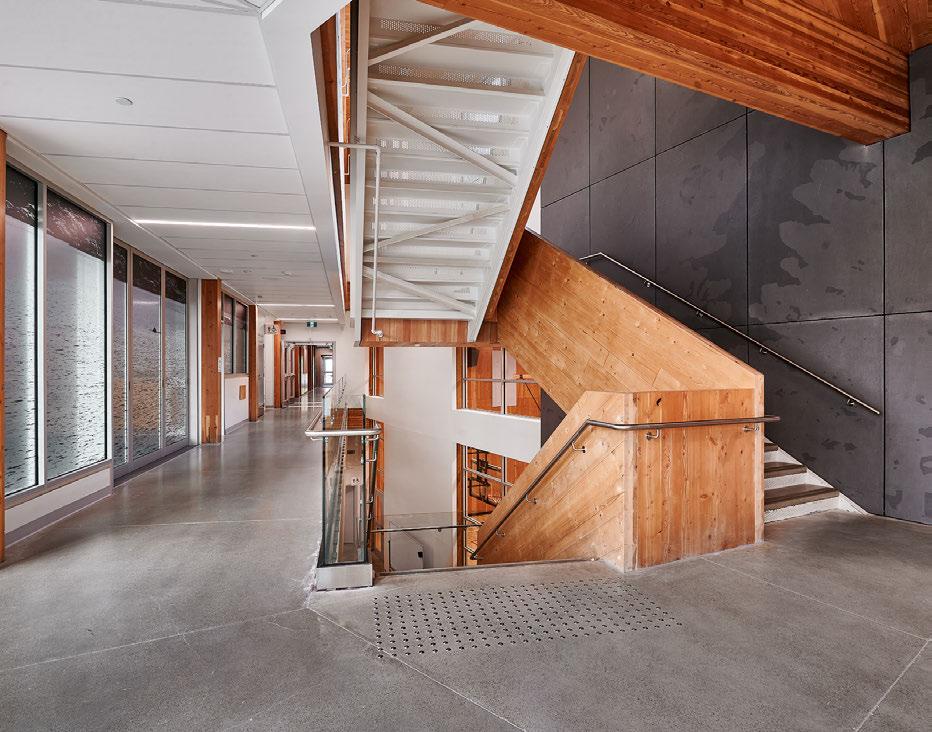

SĆIȺNE W SṮEȽIṮḴEȽ ELEMENTARY SCHOOL
by PETER STENNING
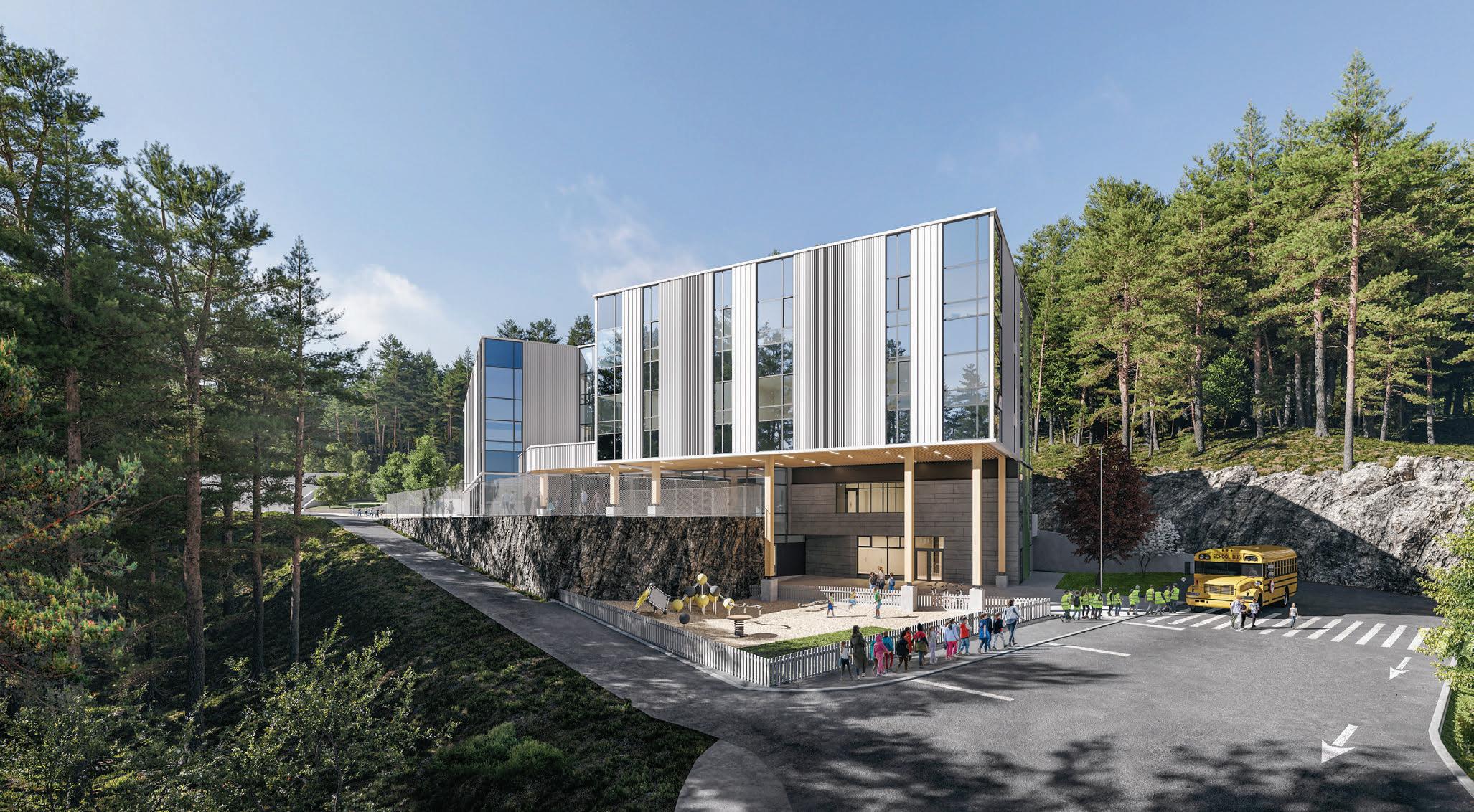
Atree house embedded into rugged terrain on one side and perched on the other with sweeping views: that’s the way Thinkspace Architecture Planning Interior Design Ltd. describes the new SĆIȺNEW SṮEȽIṮḴEȽ Elementary School in South Langford, B.C.
The school’s nature-inspired design theme is rooted in its connection to the Sc’ianew First Nation, who gifted the SENĆOŦEN name SĆIȺNEW SṮEȽIṮḴEȽ, meaning ‘Salmon Children.’ As for purpose, the school is situated in a region that is anticipated to grow by more than 300 students per year for the next 15 years.
The school provides 16 classrooms and four kindergarten spaces within a four-storey building, and includes an 18 child preschool and childcare program. Moreover, it was designed to achieve an 80 percent reduction in greenhouse gas emissions through the extensive use of mass timber, electric energy, strategic use of heat pumps and heat recovery systems, and photovoltaic cells on the roof.
The project commenced in June of 2022 with the B.C. government approving $39.6 million in funding, in addition to Sooke School District #62 committing to an additional $1 million.
The tree house concept came about due to the Thinkspace Architecture Planning Interior Design team and Sooke School District wanting to inspire students to explore their environment through natural play and discovery. The smaller and narrower than average
sloping site (the grade difference was about eight metres) spurred the development of four storeys in order to maximize usable outdoor space.
Lindsey Salter, senior architect, associate at Thinkspace, says of mass timber, “It would not only reduce embodied carbon in construction, it would also lessen the need for interior materials. Plus, studies have shown a 20 percent increase in learning
retention rate for students if they’re surrounded by natural materials.”
Salter adds, “Usually in B.C. the maximum for mass timber schools is two storeys, but our project got approved using alternative solutions, making this the first four-storey mass timber school in the province.”
The site was developed with three distinctive tiers for the new school and play areas; the school was located
on the centre tier, with parking below and play courts above. “We developed a cranked irregular floor plate to accommodate the western views, achieved areas standards set out by the BC Ministry of Education, and with the gym occupying the centre pad, the building acted as its own retaining wall,” Salter says, adding that the topography lent itself to the creation of a distinct building form.
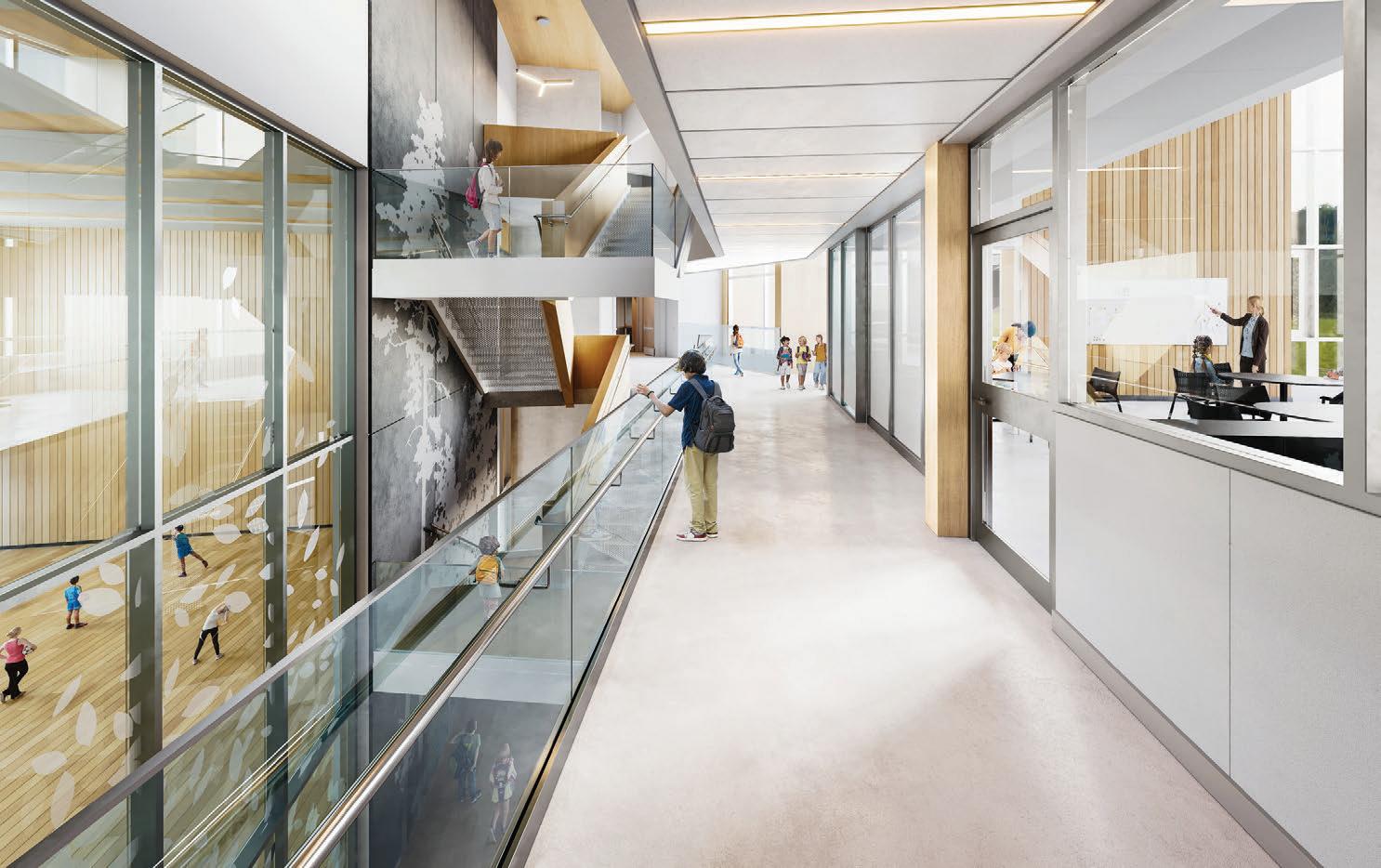
The issue of how to make a fourstorey school connective was solved by the cantilevered entrance, which features outdoor and indoor stairs leading to a four-storey atrium.
Kinetic Construction broke ground on the site in June of 2023, and project manager Ari Beckman says, “The site was dug out of a hillside and sits on blast rock.” Draycor Construction Ltd. was retained as the civil contractor.
A retaining wall had to be built along the north-south length of the property to protect against any rock falls from an existing rock face; it was designed in a wavy pattern following the Indigenous theme of the school.
The landscape design by MDI Landscape Architects encourages natural play and exploration through diverse features, including traditional equipment, a play field, sensory and kinetic elements, an outdoor classroom, a nature play area, and a sloped adventure zone with side-by-side hillside slides. Tree and shrub plantings frame these terraced play spaces while enhancing ecological integrity.
Trees are planted with generous soil volumes to support a healthy urban forest, while understory plantings emphasize native and fruit-bearing
species that promote biodiversity, regional identity, and educational opportunities. This approach also conserves water by reducing reliance on potable irrigation.
Nature-based solutions – including rain gardens and tree installations –manage stormwater from parking and building surfaces, protecting sensitive downstream habitat. The design strengthens community connectivity through trail connections to existing paths and natural areas. Near the main entrance, a sweeping salmon tail motif symbolizes the integration of natural elements throughout the site.
Laydown and staging space were minimal, meaning that on-time deliveries were required for the mass timber components. Kinetic, which had worked on several mass timber projects prior to this project, presided over preconstruction and
prefabrication meetings with the supplier and installer.
Metal cladding was installed for the upper exterior portions of the facility, and cement panels etched with renderings of local onsite fir trees were used for the lower portions, with the etching continuing into the atrium as a design motif.
Salter says, “Inside, mass timber was left exposed wherever possible, and for durability we opted for polished concrete floors and different colours of linoleum in some classrooms.” Beckman adds, “The interior and exterior walls were non-loadbearing and used deflection tracks to accommodate the expansion and contraction of the mass timber elements.”
Originally, the school was calculated to achieve a 70 percent GHG reduction, but that number has been recalculated at closer to 80 percent.
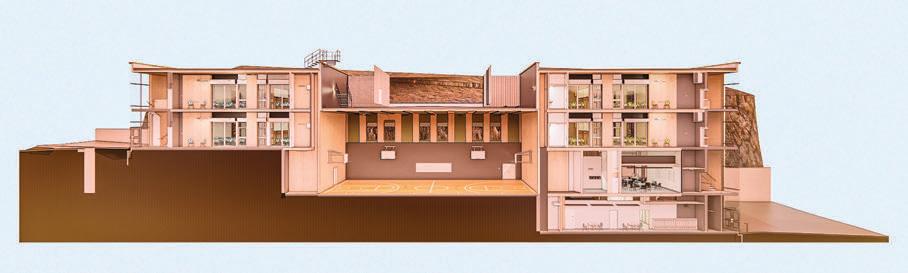

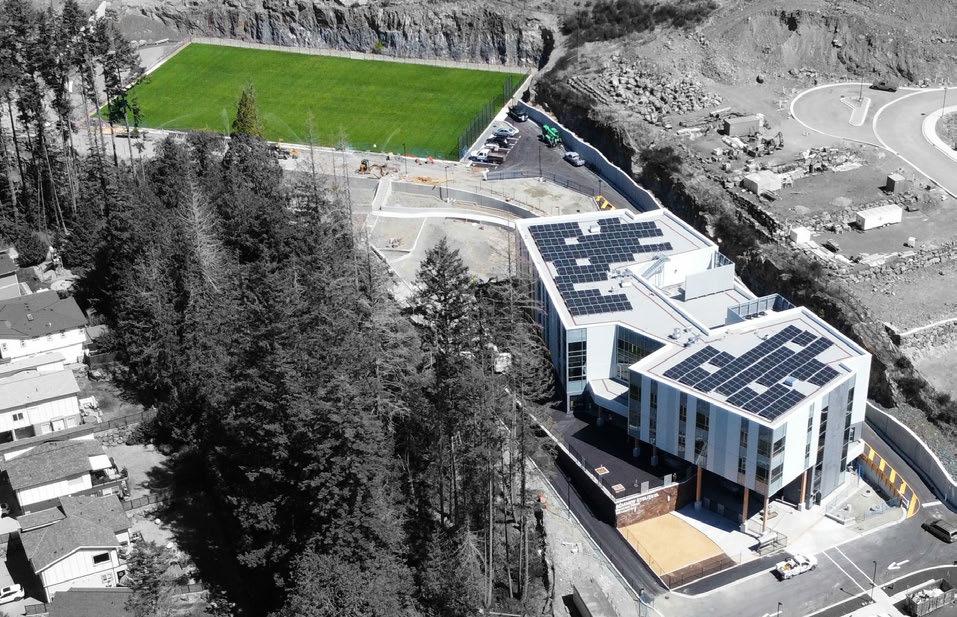
When SĆIȺNEW SṮEȽIṮḴEȽ Elementary School officially opened on August 27, Amanda Dowhy, chair of the Sooke School District Board of Education, echoed the sentiments of her colleagues by saying, “Every hallway, mural, and gathering space has been intentionally designed to foster connection, wonder, and belonging.” A
LOCATION
802 Latoria Road, Langford, B.C.
OWNER/DEVELOPER
Sooke School District #62
ARCHITECT
Thinkspace Architecture Planning Interior Design Ltd.
GENERAL CONTRACTOR
Kinetic Construction
STRUCTURAL CONSULTANT
Herold Engineering Ltd.
MECHANICAL CONSULTANT
AME Group
ELECTRICAL CONSULTANT
AES Engineering
LANDSCAPE ARCHITECT
MDI Landscape Architects
CIVIL CONSULTANT
AE Engineering
TOTAL SIZE
44,970 square feet
TOTAL COST
$40.6 million
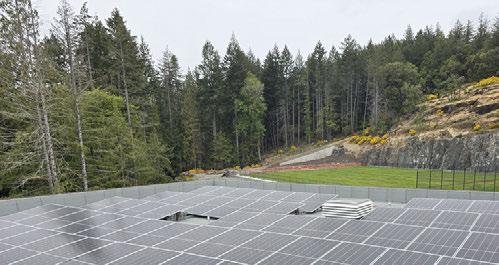
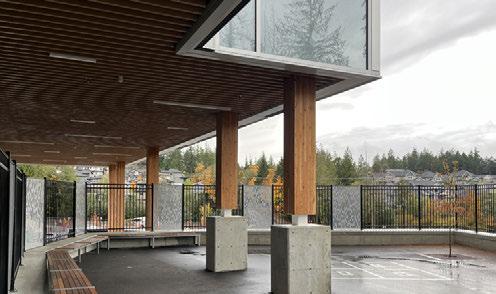

Thinkspace is very proud to have been part of the team that designed and delivered SĆIȺNEW SṮEȽIṮḴEȽ Elementary School for School District No. 62 (Sooke).
This new four-storey full mass timber facility embodies everything that makes modern elementary schools an amazing place for students, teachers, and staff to learn, play, and work. architecture


BASIN GLACIAL WATERS –FAIRMONT CHATEAU LAKE LOUISE
by NATALIE BRUCKNER
The opening of Basin Glacial Waters in September marked the completion of a $130-million transformation of the Fairmont Château Lake Louise, owned by Oxford Properties. The all-sensory thermal bathing destination represents a “Fairmont first” approach, with the wider investment also encompassing the renovation of guest rooms and suites.
Conceived over two decades and realized by Italian architect Matteo Thun in collaboration with the architect of record, Metafor, Basin Glacial Waters offers a contemporary interpretation of thermal bathing grounded in simplicity, craft, and sensory immersion. Drawing from the Nordic sauna culture and the restorative qualities of glacial waters, the design reimagines time-honoured rituals through a distinctly modern lens, rooted in the Canadian landscape.
Metafor played a crucial role from the earliest stages as architect of record, helping guide the project through complex environmental, regulatory, and heritage processes within Banff National Park. The firm had worked with Oxford Properties on several prior projects at the Château and was incredibly familiar with the site and its significance. Senior technical lead, Ilona Ciunkiewicz, recalls that from the first meeting back in 2019, the team felt aligned with the presented vision and was committed to bringing it to life.
Chris Sparrow, architect and principal at Metafor, describes the design intent as “beginning with history and a respect for place: cultural, architectural, and environmental.” Ciunkiewicz extends this idea, explaining that the project was conceived to feel as if it had always belonged to the land, continuing rather than interrupting the site’s story.
Positioned at the base of the Painter Wing and where the Château’s original swimming pool once stood, the new facility honours the site’s history while embracing the rhythms of its alpine setting. Its arched windows mirror those of the Victoria Ballroom above, reflecting the grace and geometry of the original architecture.
Construction within a national park brings a great deal of complexity, and Metafor and general contractor EllisDon Construction Services worked closely with Parks Canada from the outset to navigate any restrictions.
The rocky alpine lake location required careful management of drainage and water runoff, and the team installed shoring walls into the bedrock as part of standard construction procedures. Despite the location, two winters of unusually light snowfall helped keep the project on schedule.
Though compact in footprint, the structure is technically ambitious. A free-span glulam beam green roof creates a soaring, column-free volume that feels both open and grounded. Each beam, roughly one metre deep, was lifted into place with precise co-ordination. “The entire roof slopes in three directions,” explains Ciunkiewicz.
“The front wall is arched, and the glulam beams follow that curve, then slope back toward the Victoria Ballroom deck.” From the lakefront, the new façade reads as a seamless continuation of the existing one.
Many of the finishing materials, sourced from Europe, were chosen to complement the alpine setting and the Château’s architectural language while combining durability and resilience. Sparrow explains that locally sourced stone, timber structural
LOCATION
111 Lake Louise Drive, Lake Louise, Alberta
OWNER
Oxford Properties
ARCHITECTURAL DESIGN
Matteo Thun (Italy)
ARCHITECT OF RECORD
METAFOR
GENERAL CONTRACTOR
EllisDon Construction Services
STRUCTURAL/ BUILDING ENVELOPE CONSULTANT
RJC Engineers
MECHANICAL CONSULTANT
The Mitchell Partnership (now BPA Toronto)
ELECTRICAL CONSULTANT
Designcore Engineering
LANDSCAPE ARCHITECT
Arcadis
TOTAL SIZE
18,500 square feet
TOTAL COST
$130 million (total renovation)
elements, and carefully selected tile were used, and that metal accents around the windows reinforce the dialogue between wood and stone.
“With the glass, which was flown in from Spain, we had to account for pressure differentials because of the elevation,” says Mark Grimes, senior project manager at EllisDon. “The consultants wanted to make sure there wouldn’t be any condensation or issues due to the altitude differences.”
This attention to detail continues inside, as the design takes the visitor on a journey. A long, softly lit, slightly sloping tunnel marks the transition from the everyday into a world defined by calm, reflection, and connection. As visitors move through, anticipation heightens before the full vista unfolds in the main thermal space. It’s a moment of arrival framed by the vast arched windows.
“Throughout the space, we created quiet moments of awe – whether it’s the panoramic view from every room, the soft reflection of the mountains on the glass, or the raw, grounding textures of local Rundle stone that bring a cave-like intimacy to the sauna and tunnel,” says Ciunkiewicz.
The experience continues through a series of thermotherapy rituals that balance solitude and social connection. The Glacier Lounge offers light, nourishing dishes and restorative tonics, while the outdoor Aufguss sauna hosts a sensory steam ceremony led by trained Aufguss Meisters.
Arcadis, the project’s landscape architect, developed a design that blends seamlessly with the site’s natural surroundings. The team focused on delivering an exceptional exterior resort experience with minimal visual and environmental impact, integrating
new outdoor pools, seating areas, and decks into the landscape while responding to growing tourism pressures.
“The result is a resort that balances functionality and environmental sensitivity with a visitor experience that feels naturally connected to its setting, using materials and pathways that complement the architecture and surrounding grounds and path network,” says Brian Baker, senior landscape architect with Arcadis.
Behind the serene atmosphere, however, lies remarkable technical complexity. In fact, Grimes describes the project as one of the most complex of his career, with dense mechanical and electrical systems hidden entirely within slabs and walls to preserve the visual purity of the design, but that demanded near-perfect precision.
With the work done, the result appears effortless – precisely the measure of its success. Grimes reflects that the greatest reward is knowing how seamlessly the facility now blends into its surroundings. Ciunkiewicz agrees, saying the project revealed the power of restraint: “that true elegance lies not in excess, but in doing just enough with clarity and intention.”
For Fairmont Château Lake Louise general manager Tracy Lowe, Basin Glacial Waters represents a dedicated partnership. “Basin Glacial Waters has been a passionate collaboration between our hotel team, Fairmont Hotels & Resorts, and our owners, Oxford Properties. The vision has always been clear: to not only enhance the luxury appeal of the resort in a meaningful way, complementing how our hotel delivers diverse experiences centered on a personal approach to overall well-being, but to set an entirely new standard of luxury wellness.” A
WEST COAST CONTEMPORARY LINE
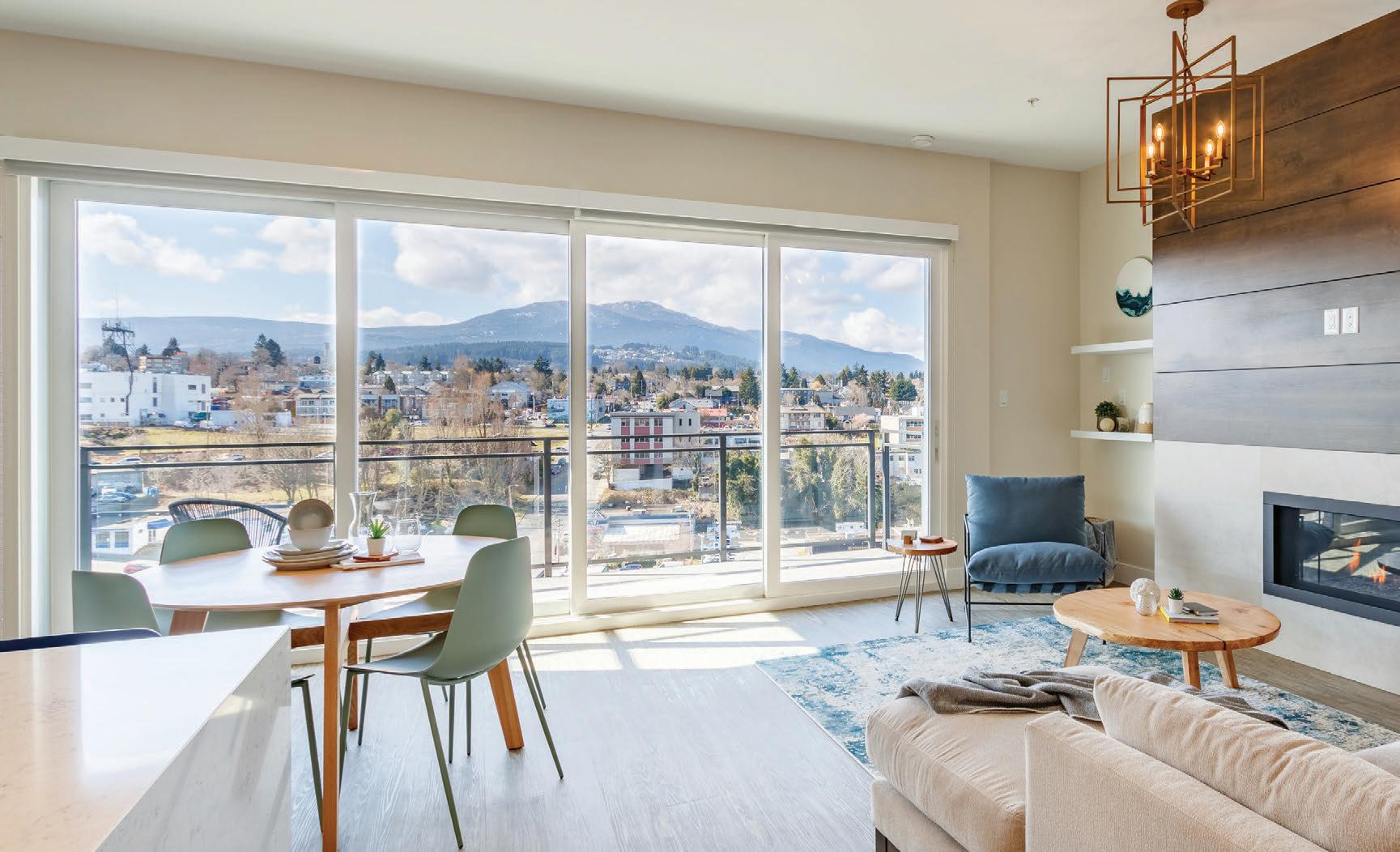
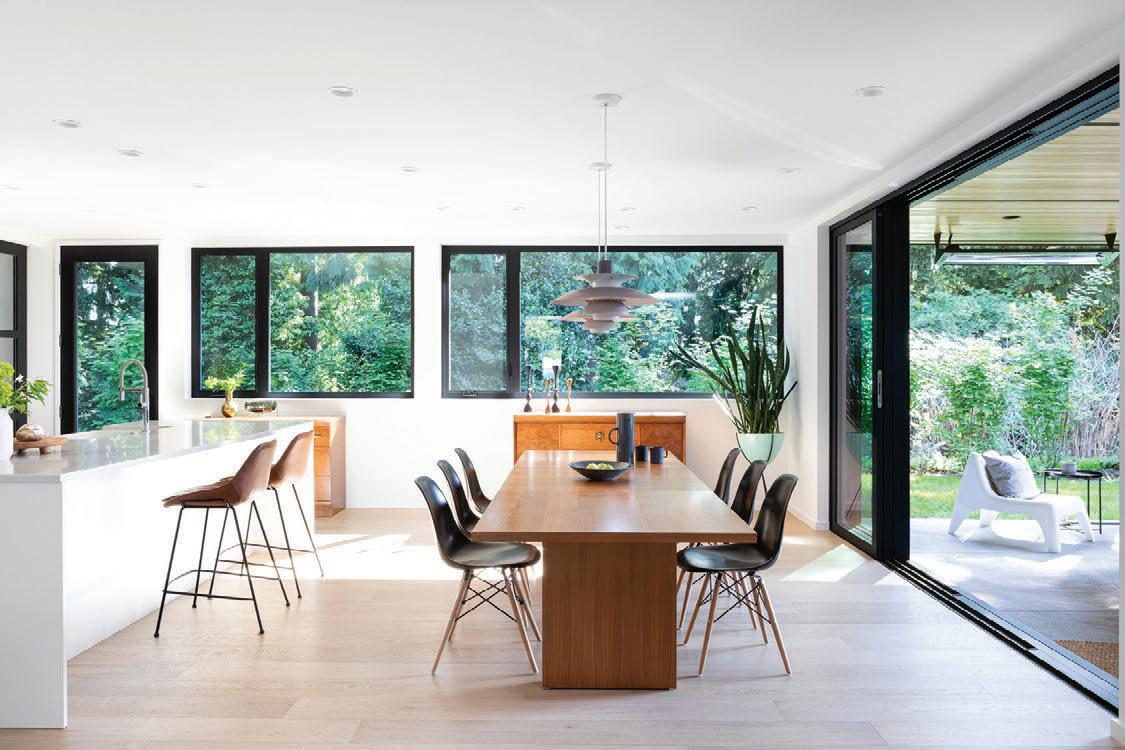

A custom home build is quite often the single largest investment in one’s life. This is a tremendous responsibility to entrust to the construction community.
Understanding this concept and exceeding customers’ expectations are what Westeck strives for and is at the core of the Westeck culture.
BIG PRODUCTS FOR ALL SIZES EMBRACE THE PATIO EXPERIENCE INDOOR/ OUTDOOR LIVING VANCOUVER 1480 Kootenay St, 1‑877‑606‑1166 CHILLIWACK 8104 Evans Rd 1‑877‑606‑1166
westeckwindows.com sales@westeckwindows.com