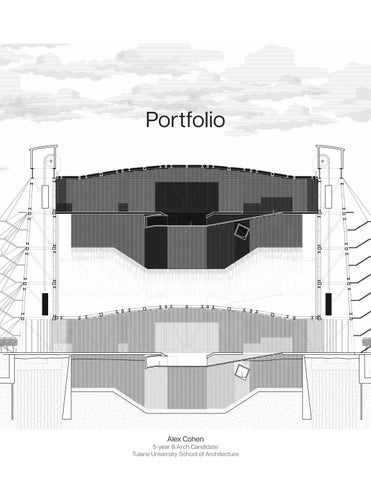
Portfolio
Alex Cohen
5-year B.Arch Candidate Tulane University School of Architecture
RESUME EDUCATION Tulane University Bachelor of Architecture | 5-year degree | Graduation May 2026 Design GPA: 4.0 Universitat Internacional de Catalunya, Barcelona ES Semester Abroad | Fall 2021 Achieving rankings of ‘Excellent’ in Spatial and Formal Analysis WORK EXPERIENCE Zach Smith Consulting and Design Full time intern | June - August 2025 | part time August 2025 - present Cabinets by Perrier Project designer | May-August 2024 Tulane University School of Architecture and Built Environment Teaching Assistant - Design Studio | Fall 2024, 2025 Teaching Assistant - Advanced Digital Media | Fall 2024, 2025 Teaching Assistant - Topics in Arch. History/Theory: Rafael Moneo |Spring 2025 Research Assistant - ‘Addis Ababa River City’ book ACHIEVEMENTS AND AWARDS Honorable Mention - ‘Returning to Water’ Premio Felix Candela, 7th Edition | August 2025 Published Work Multiple projects selected for publication in ‘The ReView: ‘Common Good’ | 2026 Drawings to be published in ‘Addis Ababa River City’ | 2026 Exhibited Work ‘A New Front’ selected for exhibition in Santiago, Chile | March 2026 Tulane Summer Design Competition 3x finalist Deans List Spring 2025 & Fall 2025
Portfolio | Alex Cohen
HILIGHTED WORKS Common Ground Fall 2025 Jefferson Island Education Center Fall 2022 Returning to Water Spring/Summer 2025 THRESHOLDS Hostel Spring 2024 Heritage Hub: A Cultural Learning Center of Los Angeles Fall 2023 The Big Shift Spring 2023 A New Front Spring 2025 Slow Movement Fall 2024
MODELS AND FABRICATION Fit Check Fall 2025 Pedestal Possibilities Fall 2025 Parametric Assemblies Fall 2023 Abstract Hand Models Fall 2021
CONTACT: Alex Cohen Tulane University acohen24@tulane.edu 774-270-0406
Common Ground
Multi-generational community in Vals, CH Professor: Wendy Redfield This project takes on existing social and economic issues in Vals, and the surrounding region. Much like many other small alpine villages, the town of Vals is experiencing an increasingly aging population, with the town not yet providing proper infrastructure for the older population, leading to lack of elder-care in the region as a whole. Additionally, years of catering to a luxury-tourist demographic with the success of the Thermal Baths have led to clear gaps in affordable infrastructure like short- and long-term housing, and dining have arisen. This proposal offers a solution to the housing and care issues in Vals by creating an intergenerational community of senior citizens and those looking for an affordable stay in Vals, connecting this micro-community and the direct needs of Vals through wellness. Two buildings and the space between create a ‘Swiss Plynth’, which houses program for the internal community and the greater Vals community. Facing the main road is a meticulously assembled, layered housing building with 108 units; 50% senior housing, and 50% medium-long term hostel units. The first two floors of the building serve both communities, with an affordable dining hall and canteen, lounge, and mediatheque. Outside, planter beds offer outdoor recreation for those interested. Across the site, by the river, emerges a monolith, dedicated to the health and wellness of community members of all ages, and citizens of Vals. The form and material of this monolith stems from the deep-rooted connection between wellness and the earth within the Swiss Alps. Between the two buildings, the landscape transitions, blurring the lines between what is built on top of the earth and what is carved within. The result is a series of courtyards within the larger landscape, each with differing programs and relationships to the earth and buildings on the site.
Portfolio | Alex Cohen
Ground floor public programming and submerged pool
Second floor mediatheque and gym
Two inhabitations of a housing unit
Assembled wall
The changing room corridor
Monolithic Wall
The mediatheque
The pool
The courtyard, looking at the Monolith
The courtyard, walking towards the Assembled building
The swiss plinth
Jefferson Island Education Center Museum for a mining disaster Professor: Wendy Redfield
Placed on the site of a 1980 mining disaster in New Iberia, LA, this project seeks to inform visitors on the uniqueness of Jefferson Island and the mining disaster through the museum experience and its design. The entry sequence of the museum is situated on the above-ground footprint of the former mining operations. Arriving on to an expansive plaza memorializing the former mine building, visitors to get a sense of the scale of the mining operations, before descending into experience, walking along a retaing wall marking the datum between built and natural environment. Visitors will circulate between a system of retaining walls that slowly disintegrate towards the water line, opening up at the end of the experience. These retaining walls dictate every aspect of the experience, from circulation to light permeation, and even interior vs. exterior space. As visitors descend, they experience three interior spaces - all of which are slotted between the retaining walls, and enclosed with glass planes on the ends. This allows the interior and exterior to blend, eliminating the presence of a threshold. After continually descending from space to space, enclosed by tight walls, the final terrace opens up, allowing for views to the lake through the disintegrating walls.
Concept Diagram NTS
Portfolio | Alex Cohen
Axonometric 1/16"=1'0"
Above: Axonometric Below: Roof Plan
Ramping down into the experience
Above: Inside the lobby Below: Section through lobby and main terrace
Blending the Inside and Outside - 1/16" = 1'-0" Alex Cohen
Above: Experiencing the main gallery Below: Section through entry ramp and reading room
The reading room and exit sequence, as seen from the social terrace
Returning to Water
Reuse of a blighted bridge as a spiritual space Advisor: Inaki Alday Responding to the brief of the 7th edition of the Premio Felix Candela, which calls for participants to design a space for spiritual enlightenment in an urban environment, the project begins by identifying New Orleans as a city shaped by the convergence of diverse human cultures, a place of layered histories, collaboration, chaos, and tension. At the heart of this dynamic fabric is the Industrial Canal. While initially envisioned as a connecting infrastructure, the canal separated communities, cutting through one of the most historically and culturally significant neighborhoods in the country. This proposal reclaims the Florida Avenue Bridge, a redundant vertical lift bridge spanning the canal. Once a means of access, the bridge now remains useless, a relic of disconnection and damage. The project repurposes and transforms the bridge into a place of unity and reflection, guided by the belief that we as humans are inherently connected through water. The goal of this project is to create a space that reclaims the water of New Orleans as a point of unity and reflection rather than isolation and destruction. Referencing sculptural works such as Eduardo Chillida’s ‘Elogio Del Agua’ (In Praise of Water), this project transforms the bridge into a beast yearning to return to the water. The permeable materiality of the project allows visitors to physically approach the water, interacting with it as it filters into the space and creates spaces for reflection. As the beast rises from the water, it weeps, yearning for the water. Meanwhile, as it lifts, visitors can reach an elevated vantage point and a completely different experience, allowing them to enjoy the magic of the place: the marshes, the water of the ground and sky, the city. The transformation of this beast allows each individual to leave their ego behind and return to the simplest of roots: water.
1'-0"
1'-0"
Portfolio | Alex Cohen
Top: Plan Bottom: Section of the bridge raised, and lowered
3 vignettes, highlighting the submerged spaces.
Plan-ometric showing the bridge in both its raised and lowered state
Left: The path to the central space Right: Approaching a side space
The weeping bridge
Thresholds Hostel
Community Culinary Hostel Professor: Irene Keil The porch is an architectural feature typical of the American South. It provides a cool, shaded outdoor space in the hot summer months and a shelter from rain in the wet season. The porch connects two spaces. A more private, mirco-community, and a more public, larger community. When placed in the right environment, a hostel also becomes a connector, in the same way a porch does, connecting the micro-community staying inside with the larger community of the city the hostel is in. Located on a unique site in New Orleans, this hostel is straddled by two completely different urban conditions. In one direction, the French Quarter creates an experiential environment, while in the other, medical and municipal buildings create an institutional envionrment. With this, the hostel serves as a threshold, a space to guide the transition between two conditions, much like a porch does. The unique conditions also allow the hostel to cultivate new community within this threshold. By utilizing the public, communal nature of the culinary arts, this hostel becomes a place to foster its own micro-community, while creating a new community in a transitional space of New Orleans.
Institutional
To respond to the duality of the site, two plazas are placed on opposite corners of the site, creating an entry experience for each urban condition. The character of the plazas juxtaposes the character of the surroundings to create a new space within the site. The void left between the plazas becomes the building. From within the building, the one-way concrete structure acts as a frame extending out onto the plazas, creating a porch zone to blend the outside community with the micro-community. From the hostel rooms, a communal living area acts as a porch, transitioning between the public space and the private room. To accentuate this, the facade becomes operable with bifold shutters, allowing each guest to assign a role, whether it be public or private, to their porch space.
Experiential
Portfolio | Alex Cohen
Top: Section B-B through the insitutional plaza Below: Section A-A through the community dining room
Top: Axonometric Below: Elevation
A A
B B
C C
D D
E E
F F F F
G G
H H
I I I
J J J
K K
L L L
M M
N N
O O
3'0"
P
2'0"
Q
1'0"
P
Q
R
R
S
S
1
2
3
Left: Ground floor plan Right: typical hostel floor plan
1
4 1' 3'
7'
13'
21'
2
3
4 1' 3'
7'
13'
21'
Top: Through the kitchen to the plaza Bottom: From S Liberty to the plaza
Section perspective through the dining room, Experiential plaza, and hostel rooms
Cleveland Street
S Liberty Street
Cleveland Street
S Liberty Street
Canal Street
La Salle (Tidewater)
Canal Street
S Liberty Street
Cleveland Street
S Liberty Street
Canal Street
La Salle (Tidewater)
Canal Street
S Liberty Street
Cleveland Street
S Liberty Street
Canal Street
La Salle (Tidewater)
Canal Street
Define Transparency
Cleveland Street
Create Voids
Cleveland Street
Apply Systems
Unfolded elevation, diagramming voids and applied systems
O
P 78’
75’
61’8’
48’4’
35’
19’
3’
1
3
7
15 1/2" = 1'0"
1. 8” reinforced post-tensioned concrete slab 2. Stud Wall Assembly 3. Facade Assemby 4. Aluminum C-channel, 3”W x 8”H, fastened to slab with bolt 5. 2-1/2” Rigid insulation 6. 1’ Concrete column beyond 7. Aluminum curtain wall mullion with wood sill interior 8. Aluminum Flashing 9. Glazing
10. Exterior Floor Assembly 11. Aluminum Shutter Assembly 12. Aluminum Shutter beyond 13. Guardrail assembly 14. Concrete facade panel beyond 15. Interior floor assembly 16. Schoek Isokorb Thermal Break 17. Aluminum push-out casement window with wood sill interior
2" 6"
1'2"
2'2"
1-1/2" = 1'0"
13 14 10 16
9
Plan and section details
15 1 17
12 11 8 4 5
10 1 7 9 6
9 7 4 5 1 6 3 2
The room and the porch
The communal dining room
The Heritage Hub
A cultural learning center of Los Angeles Professor: Catherine Sckerl
An urban catalyst strategically placed within a designed masterplan in downtown LA, this library aims to give a safe cultural learning and experience space for the people of Boyle Heights and downtown Los Angeles. Reflecting on the important history and culture of the often overlooked Boyle Heights neighborhood, the initial concept of this library was to create a funnel; to bring people in directing them through the experience of a library and exhibition space via fingers of circulation. These fingers become the main driver in lighting conditions, experience and programming within the catalyst as they present themselves as massive rammed-earth walls. These walls operate in three different ways: they frame the site and light, they create occupiable space, circulation bands, programming, and experience. Finally, they connect programs and experiences along themselves. Visitors will walk through these walls before breaking through them into large open spaces for reading, exhibition, or performance. These massive walls also use light to create and differentiate experiences within the catalyst. By diffusing light in tapered “archer” style windows, filtering direct Southern light through a brick lattice double-facade, and flooding soft Eastern light through large curtain walls, different lighting conditions are created depending on the program inside. Lastly, to encourage community engagement and interaction, the programming inside allows visitors to directly interact with the library as much as possible. The constantly visible elevated stacks make perusing information more inviting, along with large, easily accessible reading rooms that connect with community centered exhibition spaces.
12' 12'
Portfolio | Alex Cohen
36'
72'
36'
72'
Ground Floor (bottom) and Second Floor (top) house the majority of the library and cultural functions, including an auditorium, studio and exhibition space, and classrooms
The occupiable walls in sectio
Approaching the library
The Reading Room
The reading room, community exhibition space, and elevated stacks in section perspective
A New Front
Masterplan for a small town in Northern Chile Professor: Ruben Garcia Rubio Characterized by extreme drought, unforgiving terrain, and mineral richness, the Atacama Desert has become a one of the most socially, economically, climatically, and geographically complex regions in the world. With water naturally scarce, people who live in this region face extreme difficulty getting basic human necessities, an exponentially growing issue with climate change intensifying droughts. This leaves few areas for urban or communal growth, pushing most towns into river valleys. Particularly in the southern desert, these river valleys have seen rapid growth of informal settlements on fringes of towns as they try to find habitable places to live. While the towns in these valleys are more capable of providing necessities like water, they come with other life-threatening issues. Often accompanied by ravines carved by ‘silent rivers’ the geography along these river valleys is extremely inhospitable. The towns in these valleys are defined by dangerous ravines, and informal settlements are often forced into those ravines. These areas are prone to landslides, rockfalls, and flash flooding in rare rain events. This project focuses on the fringes of one small town, Freirina, located along the Huasco River. This town struggles from the same difficulties as most others in river valleys in the Atacama. Built around steep ravines, the established urban fabric desintegrates near the dangerous areas, and mobility across the slopes is extremely difficult or impossible. This leaves segregated areas, especially between official urban development and informal settlements which have formed along the steepest areas of the ravines. By creating a new corridor along the ravine, the edges of the fabric can become fortified. Added public space along this new corridor serve multiple purposes. First, the small plazas and terraces stabilize the terrain and mitigate landslides through their form and integration with the ravine. They also provide formal gathering space along the fringe developments and informal settlements, giving a sense of place for those sub-communities. The extension of the public space takes its shape in the form of ramps, which provide mobility across the ravine, while continuing to stabilize the landscape. The culmination of this corridor is a children’s center placed at the edge of the existing established urban fabric, meant to serve as a further connector for those in informal settlements, while providing much needed educational and recreational infrastructure for families living in this area. This catalyst building continues with landslide mitigation by forming itself through a series of retaining walls, and creating plazas on the top of each level, helping to continue the language of the masterplan.
Portfolio | Alex Cohen
Top: The existing urban edge Bottom: The proposed masterplan and development
Public space alongthe proposed corridor
Top: The top level of the catalyst Bottom: The open bottom level of the catalyst
Top: Section through the main spaces of the catalyst Bottom: Section through the main plazas and patios
Approaching the bottom plaza
A patio between retaining walls
The masterplan and catalyst in the contesxt of Freirina’s edge
The Big Shift
A collective housing project Professor: Omar Ali The bank of the Mississippi in New Orleans is, put simply, a controversial area. What was at one point the main connector of industry and goods has fallen into disrepair. However, with climate change threatening the entire New Orleans area, city officials have started planning a major shift in the city. Moving the port to a less central location, allowing the river bank to be revitalized as a park, simultaneously protecting the city environmentally and financially. This housing block is a space that fosters community growth, through an open, permeable ground floor with community rooms, a local restaurant, and a covered market facing the new commercial corridor of Tchoupitoulas St. The patio culture of the South is extended to these apartments, with patios punching holes into the facades of the buildings, even in the stairs. This openness allows residents to interact with eachother, and with the community on the ground, creating a sustainably minded community geared towards contributing to the changing scope of New Orleans.
Portfolio | Alex Cohen
The permeable ground floor, which focuses on the community, houses the vibrant market, a local restaurant, and spaces for the neighborhood to gather and learn.
On the housing levels, each apartment is divided into a series of rooms starting at 9’x12’, slotting between the bearing walls. The homes start to break the divisions in bigger units, acting like tetris blocks sliding into place.
Isolated units, from 1 Bed 1 Bath to 3 Bed 2 Bath
From the inside looking out
Approaching the market from Tchoupitoulas St.
The market and housing seen from the park
From the North building
Slow Movement
Implementation of a masterplan Professor: Inaki Alday, Sean Fowler Elysian Fields Avenue was New Orleans’ first continuous connection from residential neighborhoods near Lake Ponchartrain to the commercial districts on the banks of the Mississipi River. Initially built as a railroad, it brought (at the time) the newest development of the city closer to its historic center. Today, however, Elysian Fields Avenue acts as a datum. Its fast-moving, seemingly impassable 6 lanes of high speed traffic make it intimidating to cross, and the lack of services, density, and public transit along the corridor detract from development and activity. This urbanist proposal seeks to holistically and sustainably reinvigorate the Elysian Fields corridor, to serve the people that live near it, and to serve the city of New Orleans in creating a vibrant new corridor from the river to the lake. Through a kit of density-, mobility-, ecology-, water-, and community-based parts, action can be taken along the whole of the corridor. The particular intersection of Elysian Fields and Claiborne Ave serves as a case study of implementation. The intersection highlights what happens when two dying corridors meet. In order to reinvigorate the intersection interventions at 3 different scales must be made. Operating on an infrastructural scale, the integration of a streetcar line with formalized stops provides a space of refuge for public-transport users while encourging the growth of the system. The neighborhood-wide addition of cellular storage helps to mitigate the everpresence of flooding in New Orleans, and the local implementation of rain-gardens and bioswales help to revegetate the area and visualize water management. Local development in empty lots helps to densify the area and emphasize the intersection as one to be celebrated. In recognizing the dire lack of grocery services in the area, one corner of the intersection was converted into an ‘urban room’ rather than an enclosed development. Acting as an extension of the typological Neutral Ground, this ‘room’ manifests itself as a flexible covered market, allowing the community to organize weekly markets and other events to foster a strong community connection. Increased density and activity near the street, along with a redesigned street that prioritizes the pedestrian help to make the area more accessible to cross, while allowing the Neutral Ground to once again take its role as a community space, serving as a linear park with intermittent plazas and gathering spaces.
Portfolio | Alex Cohen
Top: Elysian Fields in context Bottom: The existing site
Top: Detailed proposed plan Bottom: The proposed site
Top: Section of the streetcar stop across Elysian Fields Bottom: Section of the streetcar stop parallel to Elysian Fields
Top: Section through the covered market Bottom: Transverse section
A rainy day on the Neutral Ground
Portfolio | Alex Cohen
Models & Fabrication Fall 2021 - Fall 2025
Fit Check
Translating between found and fabricated objects Professor: Nick LiCausi This prototypical model explores the concept of ‘stone stitching’ by creating custom connections between found natrual objects. Using a varietey of softwares and techniques, each natural element was 3D-scanned, digitized, and manipulated to generate bespoke connections between them. 3D printed from clay, each connector explores the formal potential created by the natural contours of a found element, and the transition between ground and rock, rock and rock, and rock and root. Material strenghts were also tested, with different bump densities pushing the tensile-strength of the clay used to create minimal, yet effective supports for heavy stones. As an exploration in assembled form, the objects were stacked three-high, with the connectors strategically placed to carry the load from above and balance on the object below, creating a totem of found and fabricated objects.
Portfolio | Alex Cohen
The Totem
Pedestal Possibilities
Representing found natrual objects through fabrication Collaborator: Brynn Matter | Professor: Nick LiCausi An evolution of lessons learned in ‘Fit Check’, this pedestal transforms the idea of posing found natural objects on fabricated elements into an exploratory question: ‘How do different fabrication techniques impact the representation of natural objects?’ Using different fabrication techniques for each step of the process allows for a clear difference in resolution on the pedestal and the object. The resolution of the CNC-milled foam mold creates a different texture on the concrete pedestal than the plastic 3D-printed mold. The contoured representation of a natural rock fits differently into the void than the real rock, and the exact 3D printed replica of the brick engages differently with the edge conditions than the real brick. A natrual element can never be truly perfectly replicated or engaged with using digital fabrication techniques, but by taking advantage of the disparity between digital and natural fabrication, we can start to better integrate built and natural spaces on a small and large scale.
Portfolio | Alex Cohen
The Pedestal
Parametric Assemblies
Beginning techniques in procedural logic Professor: Adam Marcus
Building on the techniques learned in procedural logic, this series of studies takes a parametric shape as an individual component and brings it into the tangble world as a small assembly of parts. Procedural techniques are then used to expand this one assembly into a 17”x17” panel that explores methods of variation in component size and spacing. The transition of this panel from the digital world to the tangible analog world allows the fruits of these explorations in procedural logic to be seen, as the parametric shapes, patterns, and overall 3-dimensional field begin to impact qualities in the model such as transparency, perception of overall size, and even strength. This panel starts from a single lightning-bolt shape, with parametric variation occuring in one dimension of the shape, and the vertical spacing of each lightning bolt. Assembled without glue and using Grasshopper scripts and a laser cutter, this prototype shows the possibility of real-world fabrication using a procedural logic.
Portfolio | Alex Cohen
The physical prototype
Abstract Hand Models
Early explorations in space and form
The first set of work produced with a design-mindset, these models explore nothing but material, space, and form. Conceived from a set of basic selfprescribed rules like , ‘wire must touch wood’, or ‘curves must connect along straight axis’, each model explores the boundaries of simple rule sets to create an abstracted representation of those rules. Throughout the process techniques of model making across materials and media were tested, and notions of composition, form, light, and shadow were applied and iterated, with many dry fits and tests before the final result was glued together. Each model is built off of a single repeating component that has been modified in some way, through either size, curve radius, or both, and adhered together through soldering and glue to create the final form.
Portfolio | Alex Cohen
Above: Wood and Wire Below: Wire
Alex Cohen