The proven playbook to grow a business from $10M to $50M
By Christian Muntean
24 FINANCE
It's Never Too Early to Plan to Sell
Exit strategies for aging owners
By Tracy Barbour
32 HEALTHCARE
Handy Helpers
Alaska Hand Rehabilitation celebrates four decades of positive physical therapy By Vanessa Orr
38 CONSTRUCTION
Old Harbor, New Heart
Nuniaq Community Center: a place to shelter, celebrate, and learn
By Nancy Erickson and Mariah Oxford
86 SMALL BUSINESS
Passing the Keys to Employees
Avis Alaska ends 70 years of family ownership
By Alexandra Kay
92 GOVERNMENT
Alaska 511
An economic asset for all road users By Rachael Kvapil
96 TRANSPORTATION
907 Logistics
Moving freight here, there, and everywhere By Rachael Kvapil
10 EDUCATION
Alaska Unlocked UAS attracts out-of-state students with in-state tuition By Vanessa Orr
Integrity
Key to Success
At Integrity Environmental, integrity is more than just a name — it defines the company’s commitment to helping their customers keep bulk fuel storage operations safe. It’s also one of the many reasons why Owner and Principal Consultant Shannon Oelkers chooses First National Bank Alaska.
– Shannon Oelkers
CONTENTS
SPECIAL SECTION: ALASKA NATIVE
56 A TRADITION OF BELONGING
Connecting and supporting Alaska Native corporation shareholders
Regional corporations score achievements for shareholders and communities
By Terri Marshall
46 FROM SCARCITY TO ABUNDANCE
70 OLD VALUES INFORM A STRONG FUTURE
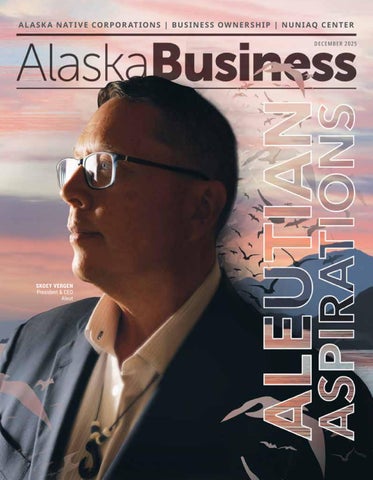
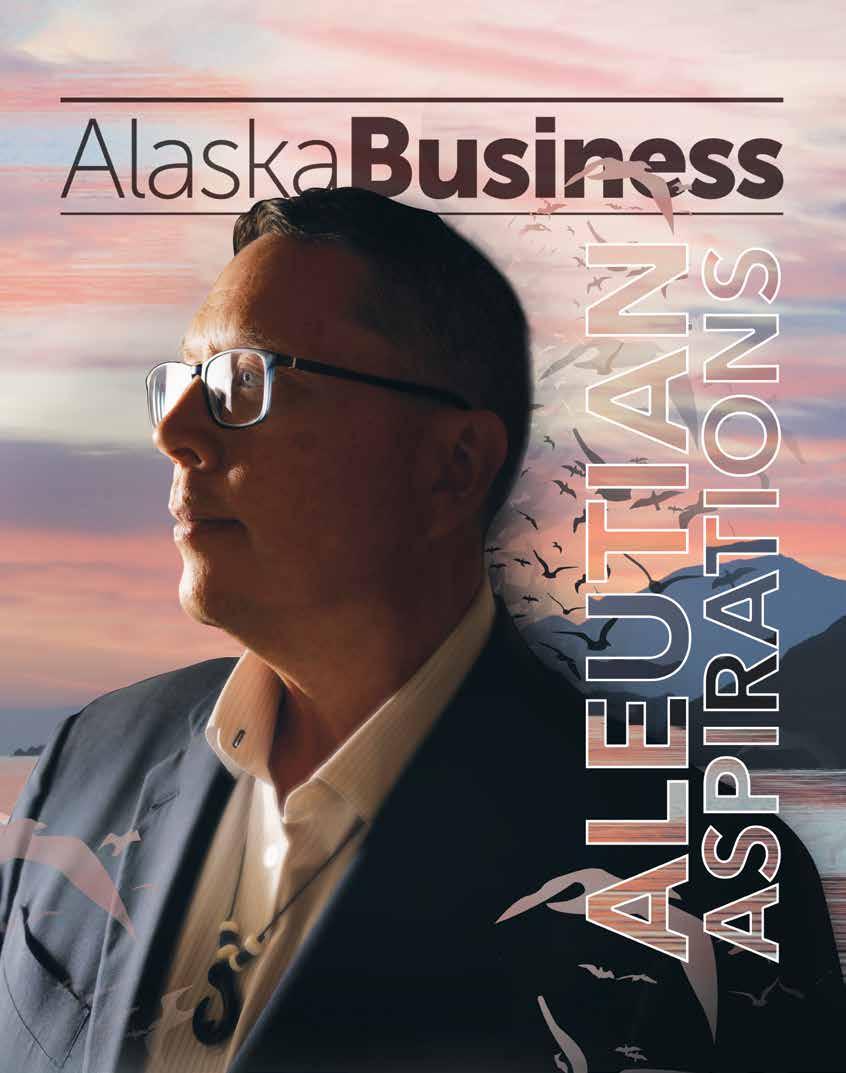
ABOUT THE COVER
Aleut regional corporation has so much cool stuff going on, it’s hard to know where to start. Well, in 1783 the Shelikhov-Golikov Company enlisted Unangax̂ hunters to procure sea otters for the Russian fur market, introducing a cash economy to the place that would become the state of Alaska. Then in 1799…
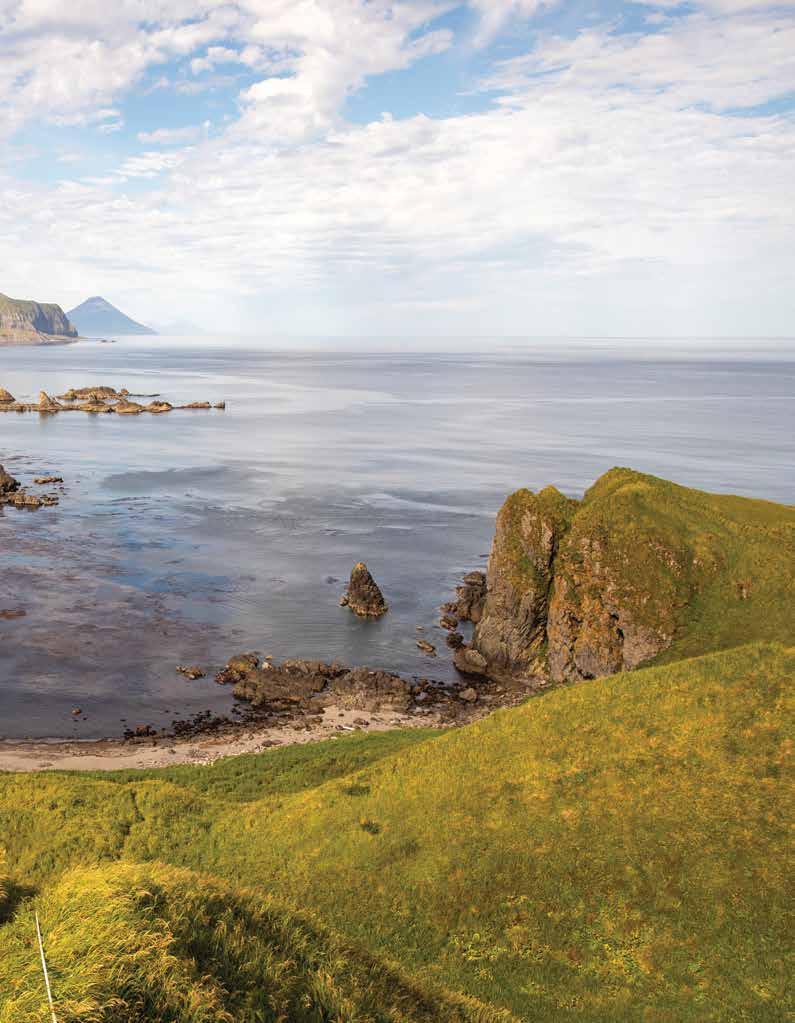
For a more condensed (and up-to-date) report, this month’s cover story “From Scarcity to Abundance” by Jamey Bradbury describes the new tack for Aleut into energy, retail, finance, tourism, and high tech. CEO Skoey Vergen, a selfdescribed “IT nerd,” is empowering his team to capitalize on assets like the disused US Navy base at Adak, pictured in silhouette with a gleam of potential illuminating the island. The Aleutian region, where the modern world first touched Alaska, is pointing the way into tomorrow.
Photography by Kerry Tasker
Cover Design by Patricia Morales
Kristina Woolston
| Old Harbor Native Corporation
Aleut
Aleut grows in the birthplace of winds
By Jamey Bradbury
The ‘forever corporations’ of the Kodiak archipelago
By Christi Foist
ONE BRISTOL BAY
When you are One Bristol Bay, you share more than a place—you share the first catch, big families, respect for your Elders, and a connection to a place you may have never been, but know.
Our shareholders share more than a corporation, they share a future.
I’m of the generation that grew up watching Bob Ross make “happy accidents,” seeing the value and beauty of overly exuberant or unintended brush strokes. This December issue feels like one of those happy accidents—including an initial momentary panic.
I originally planned several articles and features that didn’t work out, for one reason or another, making my mid-October a little frantic as I worked to pull an issue together that felt like it was falling apart.
For example, this month’s construction story about the Nuniaq Community and Tsunami Shelter, “Old Harbor Welcomes Its New Heart,” replaces an article that just had bad timing; the originally planned article remains a great idea, but December ended up being the wrong issue. “Old Harbor Welcomes Its New Heart” allows us to feature a collaboration of several Alaska Native organizations, linking it to the special section; to highlight a project that fosters community growth and provides a gathering space and shelter to residents in time of need; and to credit the incredible constructors and transporters who got the job done.
In another example, Alaska Trends, which I first envisioned would explore education data (the data we hoped for was, unfortunately, unavailable), instead covers employee stock ownership plans, colloquially known as ESOPs. This magazine—honestly more by happenstance than design—features two, including Avis Alaska, which has just recently completed its transition to a 100 percent ESOP model.
Further, the ESOP data in Alaska Trends explains that half of all privately held firms in Alaska have owners between the age of 60 and 78, signaling a potential massive shift in ownership in the state as those individuals look to retire. And it just so happens that this issue features two articles, both planned before the ESOP data was finalized, on business ownership: one on how to grow and the other on how to plan an exit.
And speaking of Avis, the “Passing the Keys to Employees” article is labeled as small business, but it just as easily could be transportation, connecting it to the “907 Logistics” profile and the “Alaska 511” article, another unplanned but welcomed addition.
When the assignments were all (finally) finalized and I set about planning the layout for the content, I was amazed at the connections I found binding this issue together, an unexpected but welcomed row of happy little trees.
Tasha Anderson, Managing Editor, Alaska Business
VOLUME 41, #12
EDITORIAL
Tasha Anderson, Managing Editor
Scott Rhode, Senior Editor
Rindi White, Associate Editor
Emily Olsen, Editorial Assistant
PRODUCTION
Monica Sterchi-Lowman, Art Director
Fulvia Caldei Lowe, Production Manager
Patricia Morales, Web Manager
BUSINESS
Billie Martin, President
Jason Martin, VP & General Manager
James Barnhill, Accounting Manager
SALES
Charles Bell, VP Sales & Marketing 907-257-2909 | cbell@akbizmag.com
Chelsea Diggs, Account Manager 907-257-2917 | chelsea@akbizmag.com
211 is more than a number. It’s Alaskans’ connection to help and hope in times of disaster or everyday challenges.
Alaska Unlocked
UAS attracts out-of-state students with in-state tuition
By Vanessa Orr
Paying for a college education is an investment. But for many students, the cost of in-state versus out-of-state tuition can determine where they enroll. This is especially true in Alaska, where cost and distance often determine whether out-of-state students can afford to matriculate to the 49th State.
UAS has met this challenge head-on by introducing the Alaska Unlocked initiative to make its campuses throughout Southeast financially accessible to students who aren’t Alaska residents. Beginning with the 2026 fall semester, out-of-state undergraduates will pay in-state tuition—a savings of approximately $14,472 per academic year.
“UAS has wanted to offer in-state tuition for all undergraduate students for some time,” says Vice Chancellor of Enrollment Management and Student Affairs Lori Klein. “It is a risk; it is a revenue loss. But we need to open up pathways to bring in students from other places.”
Discounted in-state tuition has long been an enticement for Alaskan
students to obtain a home-grown post-secondary education, yet not enough locals are filling the UAS campuses in Juneau, Sitka, and Ketchikan. “Alaska’s population growth is not going to provide us with the equivalent university growth,” Klein says. “When you think about students from out-of-state, cost and distance are the biggest barriers to enrollment, and this initiative removes that cost barrier.”
In conversations with the UA Board of Regents last year, Klein said Chancellor Aparna Dileep-Nageswaran Palmer floated the idea of opening up UAS with in-state tuition for all undergraduate students to increase enrollment. Resident undergraduate students currently pay $6,372. The cost of non-resident undergraduate tuition is $20,844.
“The Board of Regents thought that it was a very innovative concept, and while we know that it will take a few years to increase enrollment enough to offset revenue loss, we’re cautiously optimistic,” Klein says. “It will take about eighty new students to offset the loss of revenue, so we’ve set a target for next fall to bring in twenty-five more out-of-state students, in addition to the fortyfive currently enrolled. We estimate it will take two or three years to get those eighty students in.”
Klein says data collected on out-of-state students shows that they put their skills to work in the Alaska economy at a higher rate tha n in-state students.
“After completing college, 80 percent of out-of-state students
“It is a risk; it is a revenue loss. But we need to open up pathways to bring in students from other places… Alaska’s population growth is not going to provide us with the equivalent university growth.”
Lori Klein, Vice Chancellor of Enrollment Management and Student Af fairs, UAS
stay and work in Alaska,” she says.
“While our current volume of out-ofstate students is low, we know that increasing this number will result in students becoming employed in Alaska at a higher rate, which is our ultimate goal.”
The incentive of in-state tuition also brings new faces to Southeast. “UAS will have a more diverse student body as we expand enrollment to bring more students up from down south, which will allow us to provide more diverse opportunities for students,” Klein adds. “It’s really exciting to think about the next couple of years of evolution at UAS as we exp and our enrollment.”
Who Is Eligible?
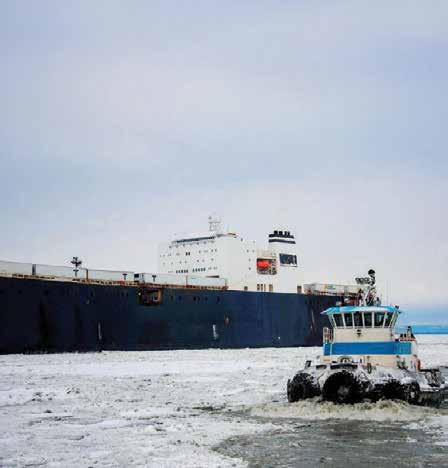
Alaska Unlocked is only applicable to undergraduate courses. All classes designated as lower-division (000–299) or upper-division courses (300–499) are eligible for in-state tuition. Courses designated as graduate level (600–699) are not eligible. Learning can take place in person, online, or in a hybrid format, and in-state tuition applies to all undergraduate courses of study, including bachelor’s and associate degrees, certificates, and technical programs.
The admissions process remains the same, and no additional paperwork is needed. Both prospective and current out-ofstate UAS students are eligible for the reduced tuition as long as they remain enrolled as undergraduates. This includes out-of-state students from states who are currently part of the Western Undergraduate Exchange and are already
UAS
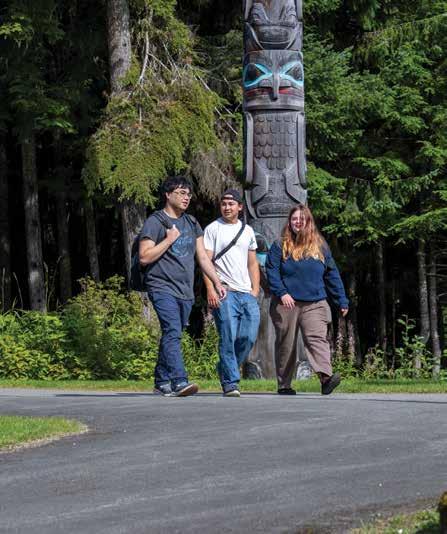
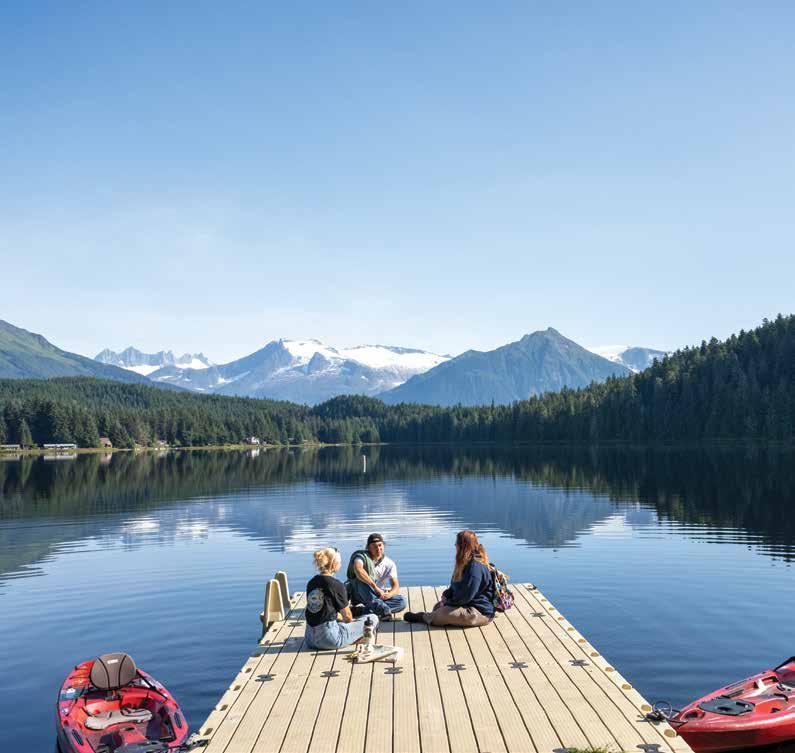
The temperate rainforest surrounding the Juneau, Sitka, and Ketchikan campuses lets UAS students engage with the natural environment.
UAS
UAS recruiters are marketing toward potential students in Idaho and Colorado looking to add coastal views to their educational experience.
UAS
receiving a discount. International undergraduate students are also eligible for in-state tuition.
On top of reduced tuition, “Students who receive this discount can still apply for financial aid, and we hope that they do,” adds Klein. In-state tuition is not a fixed number, however. The Board of Regents is considering an approximately 3 percent tuition increase across all UA schools for the next year.
“The board would be considering this regardless of the Alaska Unlocked initiative,” says Klein, noting that the tuition increase, if adopted, will not offset the revenue loss from eliminating out-of-state rates. “The board recognizes that we may need additional support over the next couple of years as our numbers reach a high enough level to offset the loss. Of course, our goal is to surpass those enrollment numbers for revenue generation.”
Key to Recruitment
Currently, UAS is the only school in the UA System that is offering instate tuition to out-of-state residents. If successful, the program could be considered at the Anchorage and Fairbanks campuses.
“I think they want to watch to see how things go for us first,” says Klein. “It’s not a transition that they can make at this time.”
While she is not familiar with other states that offer full in-state tuition
“While we know that it will take a few years to increase enrollment enough to offset revenue loss, we’re cautiously optimistic… It will take about eighty new students to offset the loss of revenue.”
Lori Klein, Vice Chancellor of Enrollment Management and Student Af fairs, UAS
CORPORATE UNIVERSITY OF ALASKA FAIRBANKS
in-person degree or certificate programs, or a fully online program with UAF eCampus. Empower them to get one step closer to their career goals — on their schedule, wherever they are.
Why Partner with UAF?
• 10% tuition discount for eCampus courses.
• Accredited education from anywhere in the world.
• Customize full or partial payment plans for employees.
“There are students in Washington and Oregon and Colorado who want to get off their rock, too, and offering in-state tuition removes the cost barrier.”
Lori Klein Vice Chancellor of E nrollment Management and Stude nt Affairs UAS
for out-of-state undergrads, Klein notes that some universities do offer in-state tuition to students who live in partnering or neighboring states.
“Because we’re not connected to other states, that doesn’t work for us,” Klein observes with a laugh. “But we believe we offer a lot of good programs that could attract students from states down south.”
Klein notes that UAS’ marine biology program, biology program, environmental studies program, environmental science program, and outdoor studies program often appeal to students in the Lower 48, especially as the university’s coastal rainforest location lends itself to all sorts of opportunities to engage with the natural environment.
“Even classes that are not naturally connected take advantage of our dramatic natural environment, like our popular Northwest [Coast] Arts program and the humanities and social science programs,” says Klein.
“Our location provides added value to students who are interested in studying in these programs.”
Furthermore, students who have spent their lives down south may also be looking for a change in scenery, just like people raised in Alaska.
“We know that we are an outmigration state; kids who are raised here are looking to get off this rock and get Outside,” she says. “There are students in Washington and Oregon and Colorado who want to get off their rock, too, and offering in-state tuition removes the cost barrier.”
The university’s outreach efforts include visiting college fairs and focusing targeted marketing to 50,000 high school students in Oregon, Idaho, Colorado, and Washington, as well as promoting brand marketing throughout the Pacific Northwest.
“Our goal is to get the Alaska Unlocked initiative on people’s radars,” says Klein. “Our recruiters are also intentionally doing relational outreach to reach specific prospective students.”
Regional Resonance
The initiative has already garnered positive responses during out-ofstate recruiting trips. “The response to Alaska Unlocked has been robust; one of our recruiters described having lines at his table during the college fair,” says Klein.
UAS is also working with local partners to get the word out. It is currently in conversation with the Juneau Economic Development Council to find ways to collaborate on promoting both the city and UAS.
“The council is doing its own campaign, Choose Juneau, and is looking at ways that they could
include UAS as part of their campaign efforts,” says Klein. “We would also promote Juneau as part of our marketing efforts.”
In addition, the university is providing information about Alaska Unlocked to its accreditation network and professional networks to let out-of-state students know more about the opportunity.
Even as these recruiting efforts reach Outside, Klein wants to ensure those who live in Alaska that the university’s commitment to residents of the state has not changed.
“A number of folks expressed concern that this transition will pull us away from our commitment to provide access to all Alaskans, and that’s not the case at all,” she says. “The board considered this when we looked at expanding recruiting efforts down south and doubled our recruiting team. This way, we can provide the same level of recruiting effort to Alaska students who want to stay in-state and take advantage of our programs.”
While response to Alaska Unlocked has been positive, UAS doesn’t yet know if the numbers will reflect this trend.
“The application for the fall 2026 semester opened in mid-September, and recruitment efforts out-of-state started in October, so we won’t know until we close out the month the difference between this October and last October,” says Klein. “But we did have to send additional supplies down to recruiters in Minnesota, Colorado, and Oregon, so that’s a good sign that Alaska Unlocked is resonating with high school students in the west and Pacific Northwest.”
Beyond Ten
The proven playbook to grow a business from $10M to $50M
By Christian Muntean
Ov er the past decade, I’ve worked with dozens of companies—mostly in Alaska—to scale from $10 million to $50 million and beyond. Several are approaching $100 million.
These aren’t tech startups. They don’t sell software. Most are in construction. Some are in healthcare. Others are in traditional markets. Many have doubled or tripled revenue in three to five years. Several grew their valuations by ten times.
None jumped on bandwagons or fads to do it. AI didn’t drive their growth. They didn’t “rise and grind” their way to financial success (and lose their health or family in the process).
Instead, they implemented leadership and structural changes their competitors avoided. I call these the Four Gates of Growth.
In this article, I’ll describe the unique challenges of scaling from $10 million to $50 million, and I
introduce the Four Gates that I guide clients through to help them move fast and grow well.
Why $10M Is a Trap (and a Triumph)
As the old saying goes, “The first million is the hardest.” And that’s true. Roughly 90 percent of all businesses in the United States will never earn it. But $10 million in revenue isn’t much easier. Fewer than 1 percent of all US companies reach that level.
Instead of being a financial milestone, $10 million becomes a ceiling that many companies are never able to surpass. To be clear, when I say $10 million, I mean companies that are around that size, staffing level, and relative complexity. This number flexes depending on your industry. But $10 million is a good rule of thumb.
A smart, driven leader with a modicum of skill in sales and management can build a $10 million company. However, it is almost always built by making slight improvements on the $1 million version.
These companies are usually still informally run. They are dependent on the owner or leader’s direct involvement. They typically do not have a written playbook or standard operating procedures (SOPs). They rarely have current or
accurate financial statements. Key staff wear too many hats.
That’s understandable. Early on, structure or specialization doesn’t make sense. But around $10 million, that changes. You need to shift into a more professional structure to scale further.
Research shows that most businesses under $10 million run in survival or startup mode, even if they’ve been operating for decades. They still use survival mindsets and strategies to make decisions and set priorities. Those tactics did help them survive, but now they hold them back.
Shift Through the Gates
Businesses between $10 million and $50 million are often considered to be in the “growth” stage. This is where companies develop habits and
systems that allow complexity to lift in the company, not weigh it down.
At $10 million, most owners or key executives are still carrying too much. If they take a vacation, work stalls. Or they spend their entire vacation checking their phones. If a key leader gets sick, things wait. If a key employee leaves, the company might lose that side of the business. Growing past this point requires a shift from master craftsperson to architect.
The shift moves through Four Gates of Growth. You have to move through them all, and the sequence I use matters. Each gate helps unlock the following one. But don’t expect to complete one before you need to enter the next. You’ll move through some simultaneously. What matters is that you pass through all four gates.
Research shows that most businesses under $10 million run in survival or startup mode, even if they’ve been operating for decades. They still use survival mindsets and strategies to make decisions and set priorities. Those tactics did help them survive, but now they hold them back.
Gate 1: Shift Identity from Operator to Leader
You can’t scale what you still operate. It just won’t happen. You must shift from being the primary doer and rainmaker to a culture builder, direction setter, and system architect.
The common traps are identity-based:
• “No one can do it like me.”
• “No one is as committed as me.”
• “My team’s not ready.”
• “What will my team think of me if I’m not doing (fill in the blank)?”
These are all objections rooted in your identity. But if your identity shifts from “I am what makes this thing work” to “I take joy and pride in building something that works without me,” then you’ve discovered your keys to growth and freedom. Just because the business can run without you doesn’t mean it must. However, you should build a company that allows you to step away for three months without momentum slowing down. Even if you never take that vacation (though you should), that’s a sign of scale-readiness and value.
Case study: A client grew from $6 million to $14 million on hustle alone, then stalled. After he built the capacity of his team to lead operations and business development, it took off again. The owner now takes vacations during the busiest time of year.
Gate 2: Create Culture from Vision and Values
I practice woodworking as a hobby. I dream of the day I can build beautiful heirloom furniture. So far my creations are mainly
in the “functional” category and live in my garage.
However, one thing I’ve learned is that measurements need consistency and accuracy to build anything well. Even being off by 1/32 of an inch can create big problems later in the project. So, in my shop apron, I carry a precise square and a ruler. I use them all the time.
Values and vision should be like your square and ruler for your business. Values tell you (and your team) how decisions are made and what acceptable behavior looks like; values are your square. Vision is a description of your direction or goals; vision is your ruler.
These statements are not for publication on the website. Customers don’t buy because of your vision statement. They buy because your product works and your team takes care of them. Your vision and values help you consistently create that experience. They create a framework for strategy and priorities. They help you set boundaries, delegate authority, train and empower your team, and redirect ineffective or inappropriate behavior.
For scaling, values and vision are essential. As you grow, you lose the luxury of knowing everyone you hire, and they won’t absorb your expectations through osmosis. They need a blueprint.
Your management team does too. Clear values and vision enable decisions to be made—whether good or good enough—when you’re unavailable and no prior direction has been given. They allow things to stay on track and move forward without you.
Case study: A $12 million client of mine hit roadblocks with staff and client issues. Because they had clarified their vision and values, decisions that would have previously turned into time- and resourceconsuming rabbit trails were resolved in under an hour. They were able to act and move past the roadblocks. They landed near $20 million within the year.
Gate 3: Build Structure to Make Trust Easy
The struggle to trust that others will take care of your customers, finances, or reputation is one of the most common obstacles for leaders trying to scale. The solution isn’t to “feel more trust.” It’s to build a structure that does two things: keeps the train on the tracks and gives insight into performance.
To elaborate upon the metaphor, train wrecks are rare because the system is designed to prevent them. Track layout, train construction, and operations are all engineered to keep things on the rails. In the ‘80s, there were more than 9,000 train-vehicle collisions. By 2025, that dropped to around 1,300—because of structural changes, not luck.
It’s the same in business. Structure prevents wrecks. Examples include effective financial systems that prevent mismanagement, clear SOPs or playbooks, reinforced health and safety practices, and strong safety culture and equipment standards.
For insight into performance, another extended metaphor: I’m not a car guy. As long as mine runs, I’m good. I’m not interested in what’s under the hood. But I’ve
driven for decades because I can read a dashboard. You don't need to be a mechanic to drive a car. You need the right signals.
As your company grows, complexity increases. A simple dashboard lets you see how things are running— so you don’t have to guess or micromanage. Here are examples of metrics on a business dashboard:
• Revenue: A clear indicator of performance (especially when compared historically).
• Gross margins: A measure of operational efficiency—aim to beat industry norms, not meet them.
• Customer retention: Are you keeping and growing your customer base?
If your identity shifts from “I am what makes this thing work” to “I take joy and pride in building something that works without me,” then you’ve discovered your keys to growth and freedom.
• Employee retention or engagement: Labor is likely your biggest cost. Low engagement turns that cost into waste.
• Operating cash flow: Tells you how well you weather dry spells or seize opportunity.
Structure isn’t red tape. It’s freedom in disguise. When your team understands what’s expected—and shares that understanding—they can operate without constant oversight.
That makes your company easier to manage. It means you don’t need genius-level managers with thirty years of experience. You can find aligned, competent people—and give them a playbook. If they veer off course, it’s easier to correct course. You don’t have to explain everything all the time—you can focus on coaching and mentoring.
Structure lets you define what success looks like. Write it down.
Document your SOPs. Clean up your financials and teach your team how to use them. Build accountability systems. Create check-ins.
Case study: A $20 million company had a strong family feel. But it had also stalled out. Its informal culture and processes often created confusion and bled energy. By following the previous gates and adding internal structure, it hit $60 million in four years—while reducing the workload on management.
Gate 4: Delegate Core Functions Strategically
Every company has a few core functional areas: administration and finance (which often split as the organization grows), operations, and sales or business development. To scale, you need strong management— and redundancy—in each.
Don’t cheap out with admin and finance. Many leaders try to cut corners here. These are viewed as “overhead,” not foundational capacities. In reality, most leaders are not naturally strong in these areas. That’s okay. Hire skilled, competent, qualified help. The college kid who did your books at $3 million won’t cut it at $30 million. Don’t hire based on cost. Hire based on competence. These functions keep you legal, solvent, and structurally ready for rapid growth. They are the skeletal structure you’ll build on.
Next, delegate your second-best skill. Most execs are strong in either operations or sales. Whichever one you’re less strong in—delegate it. Again, don’t cheap out. This is an
investment. Hire the most competent, values-aligned person you can.
Finally, delegate your strongest skill—but stay strategic. If you’re the top rainmaker, build a sales team. Focus your skills on big relationships and deals. Mentor your team, drive strategy, and build partnerships. Or, if your strength is operations, move from operating to mentoring. Let your team run the machine. You focus on refining it—and growing them.
What if you don’t enjoy orchestrating across functions? Hire a strong COO or general manager who conducts the orchestra for you. That lets you focus on vision and strategic growth.
Case study: A $40 million, wellrun company had consolidated all key functions in the owner and one key manager. Separating those jobs allowed it to expand to $90 million in three years. The owner shifted from burned out to reinvigorated.
The Toughest Truth
The team that got you to $10 million may not get you to $50 million. Most of your team won’t scale with you. That’s not a failure on their part. It’s not a betrayal on yours. It’s just the nature of a changing environment.
One common example: the faithful, self-taught bookkeeper who was perfect when you were small. As complexity grows, they may not be able—or willing—to keep pace. As business advisor Ram Charan said, “Don’t frame it as personal failure. Frame it as business fit.”
Founder-led companies often hire for loyalty or convenience, not scalereadiness. That’s understandable.
STRENGTH IN PARTNERSHIP. EXPERTISE IN PROTECTION.
IMA’s team of local professionals delivers personal service rooted in Alaska’s business landscape, with the scale and innovation of a national firm. Together, we build tailored insurance and risk management solutions that move your business forward with confi dence.
You’ve built trust. You’ve been through a lot together. But if you want to grow, your team has to grow too—in mindset, skill, and presence. When it comes time to step aside, “Exit isn't always fire-or-stay. Offer a glide path,” according to tech entrepreneur Ben Horowitz.
Sometimes you can train someone. Sometimes you can shift their role. Sometimes it’s time to help them land somewhere else—with support and respect. But don’t wait. If you can already see they won’t fit six months from now, start acting now. Venture capitalist Reid Hoffman advises, “The moment you know someone isn’t going to make it, your job is to act— compassionately, but without delay.”
You can care about someone and still know they're not the right fit anymore. Both can be true. And if you’re leading well, both must be
true. For each person who’s not a fit anymore, you’re making room for two, three, or ten others to grow.
Can Your Company Grow Without You?
Here’s the final challenge: Could you leave for thirty days and still see momentum? If yes, you’ve built something scalable. You’ve built a valuable company and one that is resilient.
Running the company has probably become fun again. You spend more time working on what you want to do and less time putting out fires. You get your time back. As organizational consultant Alan Weiss says, “You can always make another dollar, but you can't make another minute.”
You can’t just hustle your way $50 million. It’s a little like trying to keep up with a mountain bike while riding
a tricycle. Pedaling harder won’t do it. If you want growth, you’ll need to level up. This applies to your structure, your team, and how you lead. But just like getting a more complicated mountain bike, you’ll be able to go much further with far less effort.
Christian Muntean helps owners and executives of $10 million-plus companies scale, lead, and exit high-value businesses—without chaos, burnout, or breaking what already works. His clients have added more than $500 million in new revenue and tripled their valuations. Based in Anchorage, Muntean is a trusted advisor on strategy, succession, and enterprise growth across Alaska and beyond.
Christian Muntean
Katsiaryna
| Adobe Stock
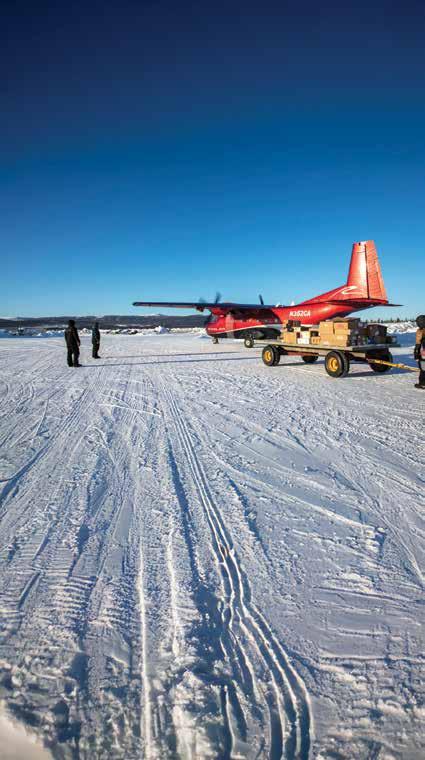
Send more cargo than ever before with our expanding fleet and network.
Thanks to our growing fleet of 350+ aircraft, and nearly 1,500 daily flights to 141 destinations, you can ship almost anything to more places. That includes 29 international markets in the Americas, Asia, Australia, the South Pacific, and to and from 20 of our beloved Alaska communities.
For more information, go to alaskacargo.com/contact-us. Or call us at 1-800-225-2752
It’s Never Too Early to Plan to Sell
Exit strategies for aging owners
By Tracy Barbour
Ab out half of all business owners are 55 or older, according to the US Census Bureau. As they approach retirement age, a significant financial transition looms on the horizon. However, a well-planned exit strategy can help owners protect, build, and harvest wealth when they transition, ensuring the efficient transfer of business value to their personal legacy.
Sadly, about 80 percent of business owners will not be prepared to make a successful exit from their company, according to Certified Exit Planning Advisor (CEPA) Wendy Claussen. But they can improve their chances by adopting a build-it-withthe-end-in-mind approach. “They should always be thinking about their exit,” says Anchorage-based Claussen, the owner of Horizon Trek. “Exit planning is present tense; it’s not something to do later. It’s a value multiplier.”
Choosing the Right Exit Strategy
When owners exit their business, Claussen says, it represents the harvest of their wealth; in most cases, 80 percent of their net worth is locked in the company. Executing a well-planned exit is perhaps even more critical for the owners of small businesses, which covers 99 percent of US companies, according to the US Small Business Administration’s 2024 Small Business Profile.
Claussen says there are eight primary “inside” and “outside” exit routes. The four inside options are intergenerational transfer (which 50 percent of owners desire but only 30
percent achieve due to limited viable successors), management buyout, sale to existing employees, and sale to existing partners.
The four outside options are a traditional sale to a third party; recapitalization, or finding a new way to fund the company’s balance by bringing in an equity investor or lender as a partner; selling stock with an initial public offering, which is a rarity for small businesses; and liquidation, which is typically only advisable if the asset value exceeds the company’s ability to produce income.
In Alaska, the most common inside exit options are management buyouts and sales to partners. For outside exits, third-party sales are most frequent. “There are plenty of buyers, including private equity and small families that want to invest here,” Claussen says. “There are plenty of investors from the Lower 48 who want to come into this market.”
Selecting the right exit option depends on what owners envision for the next chapter of their lives. According to Claussen, effective exit planning should address these three essentials: personal (what owners want to do post-transition), postfinancial (how they will fund their lifestyle), and business-financial (how they will maximize business value for the best possible return).
The intricacies of exit planning can be challenging for business owners, which is why working with a trained expert can be beneficial. CEPAs can help business owners “align personal and financial goals while maximizing transferable business value,” according to the
To test their emotional readiness, business owners should practice taking long vacations where they do not have to check in with work. This forces them to build a business that will operate without them.
Exit Planning Institute, which created the CEPA program in 2007.
In her role as a CEPA, Claussen specializes in helping business owners make complex decisions when planning for retirement. Her firm guides clients through the “transformative experience” of buying, selling, or increasing the market value of their business.
When to Begin Planning
Timing is crucial for exit planning.
It’s not. You dramatically increase the chances that you’ll have to accept a liquidation. Even if you do sell, you almost certainly will give up value or have to accept poor terms.”
Muntean says owners can begin exit planning at any time—and earlier is better. A business that runs well, generates profit, and doesn’t rely on the owner is already “exit ready.” Muntean emphasizes: “You can build that years before you want to leave. From that view, a good exit strategy is good business strategy.”
For the 20 percent of owners who actually sell their business, the process typically takes nine to eighteen months to find a buyer and close the deal, according to Christian Muntean, CEPA and president of Anchorage-based Vantage Consulting. Post sale, there is often an “earnout” period, during which the seller remains involved—usually as an employee— to ensure a smooth transition.
“This means you should expect at least one to three and a half years of continued involvement in the business from the moment you go to market,” Muntean says.
Ideally, owners should allow three to five years for exit planning to maximize their value and terms options. Under three years is risky, and under a year is “lipstick and rouge” (as in, “on a pig”), Muntean says.
He elaborates: “It’s possible to sell on a short timeline, but most owners mistakenly treat it like selling a house, relatively quick and simple.
Protecting, Building, Harvesting, and Preserving Wealth
The prime purpose of successful exit planning is to help owners protect, build, harvest, and preserve wealth. How these phases fit into the planning timeline will vary based on the business’ current state and the owner’s goals, Claussen says.
The first phase—discovery— typically takes about a month and includes a business valuation, business readiness assessment, and personal readiness assessment. Then owners can develop a prioritized action plan for protecting and building value, followed by setting achievable goals for growing the business in one to three years. “You want to maximize the value,” Claussen says. “When you build the value, income is inherently a result of that. Investors want to see that all your margins have been increasing at least for over two years. It’s got to have a trend.”
The preserving phase is a posttransaction plan that is typically established in the beginning. “You
Christian Muntean
are executing on however you are reinvesting those proceeds, whether it’s charitable giving or putting them into an investment vehicle,” she says. “The best time to start is today. If you want to maximize the value of the company, you want to start three years in advance.”
Why Transitions Fail
Unfortunately, only about 20 percent of small business owners who seek to sell will find a buyer. “These owners have worked so hard, often sacrificing personally, to build something of real value,” Muntean says. “And in a state like Alaska, these businesses often hold institutional knowledge and skills our communities rely on.”
Most businesses fail to sell because they have been built as a “custom fit” for the owner. This can make their company less appealing to potential buyers. “It's like buying a car and needing to know how to wiggle a key just right to get it to start,” Muntean says. “Buyers (and their lenders) don't want to take that risk.”
Other common deal killers are dependency on the owner, emotional unreadiness, and poor financial records or management. For example, if the owner is needed for day-today operations—even a little—it undermines value. The solution is to build a team that can operate independently, Muntean says.
On the emotional side, about 85 percent of sellers unintentionally self-sabotage their exit, Muntean says. They may drag their feet, make unrealistic demands, or suddenly pull
“Exit planning is present tense; it’s not something to do later. It’s a value multiplier.”
Your business solutions
Wend y Claussen Owner Ho rizon Trek
When owners build businesses that are not dependent on them, maintain clean books, and are emotionally ready, they create an enterprise that runs better— even if they never sell.
parts of the business out of the deal. This is usually because their sense of identity and purpose is wrapped up in the business, or they do not have a compelling “next chapter” that they are excited to pursue.
To test their emotional readiness, business owners should practice taking long vacations where they do not have to check in with work. This forces them to build a business that will operate without them. They should also ask themselves what they want to do with the rest of their life. “Your answer might be (this is often the case), ‘Maybe I don't really want to sell,’” Muntean says. “That's okay. But be honest about what that means in terms of your energy, interest, health, and drive. It’s sad to see a robust and valuable business go into decline because the owner doesn't really have the drive to make it excel but also doesn’t know what else to do.”
Poor management is another red flag and potential dealbreaker. Buyers and their banks want clean financials, which generally means at least three to five years of consistent statements. “If all the owner has are tax returns, expect to sell at a discount—if you can sell at all,” Muntean says.
Some owners also pack personal expenses into the business to avoid taxes. While this may work short term, it impacts the sale value. “Expect buyers to ‘recast’ or adjust your financials to estimate what it will take for them to run your business,” he says.
The upshot: when owners build businesses that are not dependent on them, maintain clean books, and
are emotionally ready, they create an enterprise that runs better—even if they never sell. “That usually means more freedom, better margins, and less stress,” Muntean says. “This kind of business is very easy to sell.”
Common Mistakes
One of the most frequent mistakes Claussen sees business owners make with planning their exit is waiting too long to start the process. Often, owners are focused on dayto-day tasks; when they are finally ready to retire, they’re burned out and want to exit immediately. “But it’s common that a lot of them are personally not ready for their next chapter, and their business is not ready to transfer to new ownership,” Claussen says.
Many owners do not have a clear view of what the next chapter looks like and how to fund it. Starting the planning process earlier makes it easier to afford the life they envision. Exit planning should be viewed as both a personal and business tool— not a task to postpone. “If you have an effective exit planning strategy in place, you can exit when you want to exit,” Claussen says.
As part of their exit strategy, owners should get a business valuation done and updated annually, Claussen says. This can help them see how potential buyers will view their business. They should also have a plan for the “5 Ds”—death, disability, divorce, disagreement, and distress— possibly even before the business
Wendy Claussen
CELEBRATING 35 YEARS OF INVESTMENT IN OUR NEIGHBORS
For 35 years, we have had the privilege of serving the people and businesses that power Alaska. As we mark this milestone, we want to thank the loyal customers, talented employees and growing communities for their commitment to us and our mission as Alaska’s Community Bank.
We are proud of our past and excited for the future.
n orthr i m.c o m | (907) 562 - 006 2
“You’re going to need many advisors throughout the process,” says Wendy Claussen. “If you contact an exit planning advisor first, they will be asking for your financials, so almost in tandem, you will need to let your accountant know.”
Rido | Adobe Stock
valuation. These actions de-risk the business and make it easier for the owner to exit at any time.
Unique Challenges and Opportunities in Alaska
In places like Alaska, where the market is smaller and more specialized, there are distinct challenges and opportunities for small business owners, Muntean says. Alaska’s business culture is still relatively young. Fewer owners have exited successfully—so there’s a lack of local mentors or advisors with deep experience in this space.
“Rural businesses do face smaller local buyer pools,” Muntean says. “But if the business is well-built and runs well, that hurdle is usually overcome with enough time and planning.”
Some Alaska business owners have the unique hope that an Alaska
Native corporation (ANC) will buy them out. “There was a period of time when ANCs were buying many local businesses,” Muntean explains. “But as they have grown in experience, they have (rightfully) become more careful about what they buy. And there is a trend for many to want to diversify their holdings outside of Alaska.”
He continues: “This doesn't mean an ANC won’t come and sweep you off your feet. But you will likely need to be much better prepared than what was true ten to fifteen years ago.”
The encouraging truth is that there is far more money looking for a good business to buy than there are good businesses ready to sell. “It’s actually surprising how much money is out there,” Muntean says. “Private equity firms often evaluate
100 to 200 companies before making a deal. For sophisticated buyers, the pickings appear slim. The good news is: If you prepare well, it’s easy to stand out and command a much higher valuation.”
Alaska’s unique market does not outweigh exit strategy basics, however. “A well-run, exit-ready business is almost certainly going to find a great buyer—if you give yourself the time,” Muntean says.
With a well-executed exit strategy, business owners can ensure they have a viable plan—and the wealth they have harvested will fund that plan, Claussen says. They can also have the satisfaction of knowing their legacy is continuing. “You’ve built and sold a business that is continuing to employ and grow future leadership,” she says. “That’s peace of mind to know that your work lives on.”
Handy Helpers
Alaska Hand Rehabilitation celebrates four decades of positive physical therapy
By Vanessa Orr
An y business that makes it to the forty year mark deserves a hand, and that is especially apropos as Alaska Hand Rehabilitation (AHR) celebrates its fourth decade in business this year. Established in 1985 by licensed occupational therapist and certified hand therapist Linda Glick, what started as a very small, one-person clinic in Anchorage grew to become a much-beloved employee-owned practice that recently moved into a new, larger location designed to serve more patients in the community.
Sharing Vision
“When Linda decided to retire in 2020, she had a number of options,” explains AHR President and Clinical Director Jean Keckhut. “She could sell to a big company or sell to
another practice or individual, but she didn’t want the vision for the company to change. She wanted to preserve it and believed it could be done through an ESOP [employee stock ownership plan].”
In an ESOP, a retirement fund for the company’s employees owns part or all of the business. Each employee holds shares depending on how long they’ve worked, and the better the business performs, the greater the benefit when they retire. Keckhut adds, “The management structure still maintains Linda’s vision, but when I retire, for example, the shares go to someone else. It’s a way to help the business last longer, and we’re hoping to see 100 years; we’ve already made it to 40!”
One of the reasons that the company has thrived, according
to Practice Administrator Kati Harkreader, is that the company culture embraces values that are important to its employees.
“Our goal is to work together to get people back to living well,” she explains. “Our culture includes showing compassion and kindness; giving people the benefit of the doubt; going beyond what is typically expected; communicating clearly, directly, and openly; and providing constructive feedback.”
The culture of AHR motivates staff to go the extra mile. Harkreader says, “We are open to learning and sharing with each other and helping each other without hesitation.”
AHR prioritizes continuing education for its staff by offering tuition or reimbursement to attend conferences outside the state. It
also uses Medbridge, a continuing education platform that therapists can access for in-state learning. The company also hold in-service clinics to provide therapists with insight into what specialists in different areas are doing.
Hands, Elbows, Shoulders, and Whole People
AHR treats upper extremity issues for all patients, from pediatric to geriatric. Therapists work with patients both preoperative and post-op, and they treat conditions ranging from rotator cuff repairs to impingement syndrome, tendonitis, tennis elbow, tendon injuries, lacerations, nerve injuries, and amputations.
“Our patients come from all over the place; we may see a commercial fisherman flown into Anchorage for emergency surgery or provide tele-rehab services to someone in an outlying village who doesn’t have a post-surgery specialist available,” says Keckhut.
Patients most often work with a certified hand therapist, a designation which requires three years of clinical experience in hand therapy and successfully passing the Certified Hand Therapist exam. All AHR clinical staff are either already certified or in the process of earning that designation.
While the center specializes in upper extremity issues, Keckhut says that it is AHR’s mission to treat the whole person.
“There are often other issues that affect the person more than just an arm or hand,” she explains. “They may have neck or shoulder problems
Every Journey Begins with a Single Step
North Star Behavioral Health System offers behavioral health and substance use services for children, teens and adults.
Take the first step today. Call 907-264-3506 for a confidential, no-cost assessment, available 24/7.
2530 Debarr Rd | Anchorage, AK 99508 907-258-7575
1650 South Bragaw | Anchorage, AK 99508 907-258-7575
• Inpatient Acute Care for Children and Teens (ages 4 to 18)
• Residential Care
• The Arctic Recovery Program For adults in need of detoxification or rehabilitation for substance use.
• Chris Kyle Patriots Hospital Serving first responders, military service members and veterans. We are proud to be part of the VA Community Care Network.
• Outpatient Services for Adults
or even mental health concerns as a result of the injury; everything is connected.”
She notes that when a patient first comes in with an injury, they have already experienced a level of trauma.
“Some patients are distraught and depressed and feel that they are never going to be how they were before,” she says. “You have to meet the patient where they are and give them encouragement. And when they are ready to accept it, you have to challenge them, which makes them work harder.”
They key is to listen to the patient and help them navigate the trauma. “To see someone come from a place of despair to, at discharge, going on a river-rafting trip that they never thought could happen, gives me a lot of satisfaction,” Keckhut says. “I also enjoy seeing the staff grow and learn, and they’ve watched me grow too. It’s so rewarding seeing everyone’s hard work pay off.”
AHR offers numerous treatment modalities for patients, ranging from lymphedema treatment, dry needling, and Graston Technique, or instrument-assisted soft tissue treatment, to ultrasound, laser treatments, and custom splinting.
“It’s not always technology that’s the answer but the techniques that we’ve learned,” says Keckhut.
“No matter what we do, we always have the patient’s best interests in mind.”
Exceeding Expectations
Robert Thomas has seen this commitment to patients from both sides. Not only has he referred patients to AHR as a physician assistant, he has used its services as well.
“I had wrist fusion surgery this year, and there was no doubt in my mind where to go for therapy,” he says. “They are the best in town for this. AHR hires very knowledgeable, intelligent therapists who will work outside the box to help improve patient s’ quality of life.”
Thomas also praises AHR for being accommodating. “It’s like a family there. You may work with one therapist one day and a different therapist the next day, but you’re not losing anything because they work together. They study up on you before they see you so they know what’s going on and know how t o proceed,” he says.
Today, Thomas says he can do everything he’s always done prior to surgery—except flex or extend his wrist because of the plate inside.
“Once you go through rehab, the therapists educate you on how to do the things you thought you’d never be able to do again,” he says. “They’ve always gone
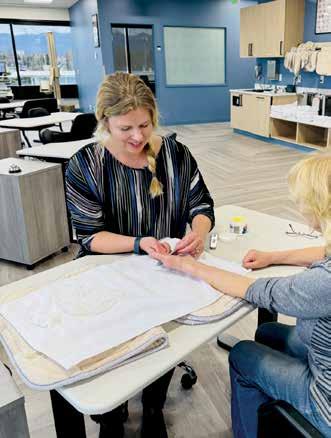
Lead Therapist Allison Horazdovsky treating a patient using Graston Technique. Alaska Hand Rehabilitation
Alaska Hand Rehabilitation
“It’s not always technology that’s the answer but the techniques that we’ve learned… No matter what we do, we always have the patient’s best interests in mind.”
Jean Keckhut, Clinical Director, Alaska Hand Reha bilitation
above what you would expect, and I would not go anywhere else or refer people anywhere else.”
Angela Weaver has been a patient at AHR for more than twenty-five years. She first went for treatment after elbow surgery and returned again (and again) when she needed care for different issues.
“I moved to Alaska from St. Louis, and every time the ice calls my name here, I answer,” she says of weather-related injuries. She has also been treated for rotator cuff tears, torn ligaments, a broken hand, and nerve damage in her hands,
which prevented her from some of her favorite pastimes.
“I could barely write at all with my hands and had to use a special pen to write,” she says. “But more important, I play congas and bongos, and at one point I had to stop playing. And that’s my happy space!”
Weaver, a child psychologist, says not being able to do those activities took a toll mentally and emotionally. “But I never gave up, and the therapists saw that in me. They worked with my insurance, got me dry needling treatments, and now I can play again. I also
went from not being able to write to being able to write better than ever before,” she says.
Weaver adds that she always feels welcome at AHR, no matter why she’s returning for treatment.
“It’s just a blessing how they treat me; it’s not like, ‘Oh, here she comes again,’” Weaver says with a laugh. “If you want to be taken care of, it’s where you need to go. At times, I was embarrassed and decided to cancel an appointment, and they said, ‘Why aren’t you coming? You’re not going to get better without us helping you.’
They help me carry on.”
Expanding Its Reach
AHR recently moved to a new office at 1400 West Benson Boulevard in Anchorage in order to serve its growing number of patients.
“It’s 6,900 square feet of pure joy. We love it,” Keckhut shares. “It’s very open and bright and has a mountain view. We also have a very open area to treat patients as well as private rooms. We have a gym area with exercise equipment for patients and a dedicated splinting area.”
“Part of the reason we moved into this space is that we outgrew our old one,” adds Harkreader. “We have almost double the space, which is great because we have a lot of goals for company growth.” The employee-owned company aims to hire more therapists, and they’ll need room to practice.
“I can honestly say that I enjoy coming to work every day; everyone here has a high level of respect for each other as individuals and as team members,” Harkreader says. “It’s very special to be part of something like this.”
Alaska Hand Rehabilitation staff celebrate forty years in business and the opening of their new clinic. From left to right: Kati Harkreader, Molly Monro, Li Sooter, Kassandra Ramirez, Maggie Dworian, Molly Dawson, Bliss Springer, Miranda Grosdidier, and Jean Keckhut.
You bring out the best in us.
Providence Alaska Medical Center (PAMC) is honored to be the only hospital in Alaska recognized as Best Regional Hospital in U.S. News & World Report’s 2025-2026 Best Hospitals Rankings. PAMC was also recognized as high performing in the treatment of two adult specialties and 10 procedures and conditions, more than any other treatment center in the state.
Our award-winning care reflects the exceptional work of our caregivers, providers and community partners, who share our commitment to ensuring Alaskans get the best care possible close to home.
Learn more at Providence.org/PAMCawards.
Old Harbor, New Heart
Nuniaq Community Center: a place to shelter, celebrate, and learn
By Nancy Erickson and Mariah Oxford
Ro ughly 850 miles separate Utqiaġvik, at the northernmost tip of the North American continent, from Old Harbor, a village south of Kodiak. In Lower 48 terms, that’s as far as Minneapolis, Minnesota, from Dallas, Texas—farther, even, because no year-round roads connect to Utqiaġvik, and Old Harbor is, of course, on an island. But that separation can’t prevent each community’s village corporations from working together.
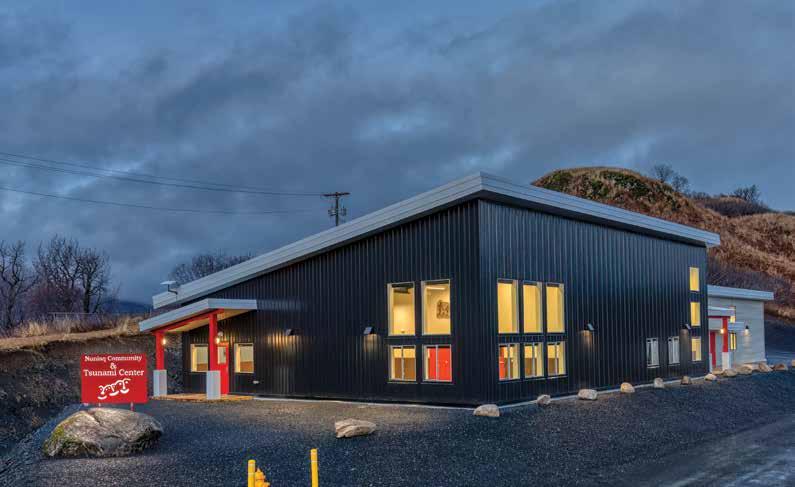
Ukpeaġvik Inupiat Corporation (UIC) subsidiary UIC Nappairit completed work in March on the Nuniaq Community Center and Tsunami Shelter, fulfilling a long-held vision in Old Harbor for a gathering place during times of celebration and times of danger.
Known as “the people who build,” UIC Nappairit specializes in remote projects involving dynamic challenges of extreme climates, complicated logistics, and minimal resources. The Nuniaq Center fit the bill perfectly.
A Place of Beauty and Danger
Old Harbor is a small, predominantly Sugpiaq community 40 air miles from Kodiak, on the southeast coast of the island, with a population of about 200 people. Accessible only by air or sea, its remoteness gives the village a close-knit and self-reliant character, according to Cynthia Berns, vice president of community and external affairs for Old Harbor Native Corporation (OHNC).
The local economy centers on commercial and subsistence fishing,
supplemented by hunting and small-scale tourism. Traditional practices of harvesting fish, deer, and marine mammals continue, as well as gathering wild plants, clams, and berries. The landscape is rich in wildlife, including the famous Kodiak brown bears, sea lions, puffins, and eagles.
“The surrounding waters and mountains provide both sustenance and a strong sense of identity,” Berns explains. “Though the community faces challenges common to remote Alaska villages, it remains grounded in cultural heritage, resilience, and stewardship of the environment.”
The village of Old Harbor was devastated by the 1964 magnitude 9.2 earthquake and following tsunami, which destroyed nearly every building and forced families to
UIC Nappairit
relocate until homes could be rebuilt. The upheaval also allowed residents time to rethink how to live safely along Alaska’s coast.
“Today, similar challenges face communities in western Alaska as storms, erosion, and flooding destroy homes and force relocation,” Berns says. “The parallels are striking— both experiences highlight the deep emotional and cultural toll of displacement and the resilience required to start anew.”
A Vision Becomes Reality
For decades, Old Harbor’s leadership envisioned building a vibrant community center that would bring people together for celebrations and cultural events. Residents also needed a safe place for shelter during tsunami warnings. For years, the custom when the tsunami warning alarm sounded was for residents to drive or walk to the highest elevation above the village, often waiting in vehicles until the all-clear was given. “These ad hoc evacuations reflected the community’s resilience but also underscored the urgent need for a safe, reliable evacuation site,” says Berns.
Planning for the facility took almost two decades due to the community’s focus on other infrastructure priorities, funding challenges, complex site selection, and the need to coordinate with multiple partners.
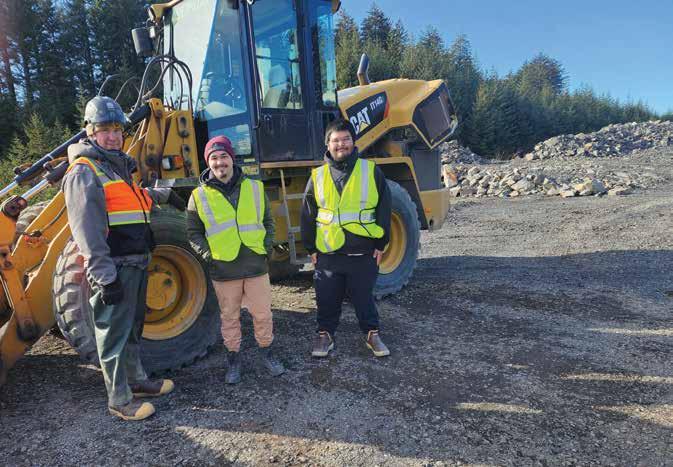
Following a competitive bid process, UIC Nappairit began mobilizing crew and equipment to the remote site in May 2023. It completed the 7,807-square-foot, $10.7 million facility in March 2025.
“Ad hoc evacuations reflected the community’s resilience but also underscored the urgent need for a safe, reliable evacuation site.”
Cyn thia Berns Vice President of Community and Extern al Affairs Old Harbor Native Corporation
The center was funded through a collaborative effort of OHNC, the City of Old Harbor, the Alutiiq Tribe of Old Harbor, and state and federal agencies.
Beachfront Deliveries and Dog Guards
Island living has its perks, but getting supplies is a big challenge, especially when it comes to large construction materials. UIC Nappairit specializes in creative problem-solving necessary for success in remote areas.
“A [Cessna] 208 is the biggest airplane available from Kodiak you can get in here because of runway length,” says Mark Thomas, UIC Nappairit project superintendent of the Nuniaq Center. Large or heavy supplies must come in by freighter,
barge, and landing craft, he notes, so construction materials flown to Kodiak were transferred to a smaller landing craft for the final leg to Old Harbor.
Initial mobilization of equipment and tools involved moving start-up tools, equipment, a job office, and supplies to Homer and using Alaska Marine Excavation to transport items on M/V Polar Bear, a 120-foot landing craft that delivered right to the Old Harbor beach, Thomas says. That same company also supplied and delivered the aggregate, concrete powder, and mixing trucks on subsequent trips.
The building package was shipped to Seward on Sampson Tug and Barge. UIC Nappairit’s sister company, UIC Bowhead Transport, transloaded the material to M/V Unalaq, a 400-ton capacity, 150-foot landing craft that
delivered directly to the Old Harbor beach laydown yard, he explains.
“We had several deliveries by Coastal Transportation from Auburn, Washington, that sailed from there to the Old Harbor ferry dock,” he adds.
Communication channels were also an issue. With limited telephone land lines available and no cellphone service in the village, UIC Nappairit purchased four Starlink kits that allowed satellite internet and WiFi calling at the jobsite and crew camps.
Another unique aspect of remote work sites is the hazard of four-legged visitors.
“We had a couple of local dogs that made up our ‘doggie day care’ here,” says Thomas. “They would hang out at the site and even alert crew to brown bears, which are famously prevalent on Kodiak Island. ‘Red’ is an
Chelsea Diggs Account Manager
Weston Giliam Account Manager
Charles Bell VP Sales
Irish Setter and one happy-go-lucky dog. One day he was barking and barking, and we looked out at the end of the pad to see a big old boar.”
UIC Nappairit crews are keenly aware of safety measures necessary for working in remote areas where wildlife is present, but the companionship of alert canines was welcomed.
Sharing Knowledge and Meals
Kodiak Island’s remoteness presented challenges, but
Old Harbor’s warm hospitality made a lasting impression on the construction team.
“Just months after UIC arrived in Old Harbor, I asked how they were doing,” recalls Jeff Peterson, mayor of Old Harbor and former chief of the Alutiiq Tribe of Old Harbor. “They said Old Harbor was one of the friendliest villages they had ever worked in. Their knowledge of working in remote villages and their understanding of our unique situations made them the go-to guys when anyone had electrical, mechanical, or building
construction questions. They not only helped us but taught us a few things as well.”
Berns recalls the people of Old Harbor did more than just watch when UIC Nappairit arrived to begin construction—they pitched in.
“Local residents were hired as laborers, helped pour concrete, and assisted with logistics like unloading barges and transporting supplies,” says Berns. “The Alutiiq Tribe of Old Harbor and Old Harbor Native Corporation staff managed grants, coordinated FFE (furniture, fixtures,
“Just months after UIC arrived in Old Harbor, I asked how they were doing… They said Old Harbor was one of the friendliest villages they had ever worked in.”
Jeff Peterson, Mayor, City of Old Harbor
From start to finish, the Nuniaq Center cost about $10.7 million to build.
and equipment) materials, and worked with UIC [Nappairit] to ensure construction stayed on track despite the village’s remote setting.”
Life with a long-term construction crew brought unusual bustle to the quiet community.
“Workers became familiar faces at the store and around town, often lending a hand beyond the job site,” Berns adds. “Local families shared meals and stories, and even village dogs made daily visits to the crew’s work area. The collaboration between builders and residents made the Nuniaq Center not just a new facility but a shared achievement born from community effort and hospitality.”
UIC Nappairit rented houses from community members, temporary homes for fifteen tradesmen during peak construction. Thomas recalls the good fortune of finding a large house complete with a large kitchen and an excellent cook who kept the crew well fed.
Gathering to Celebrate Community and Safety
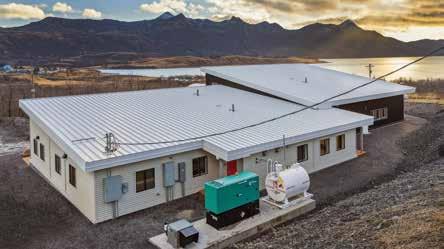
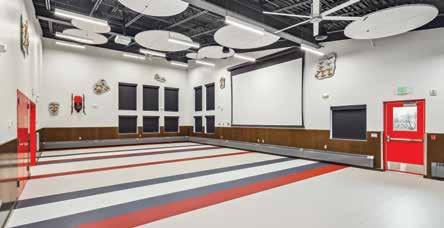
Today, the Nuniaq Center serves as the central hub for life in Old Harbor, housing an emergency shelter as well as the tribe’s key programs: preschool and youth services, housing, environmental and transportation departments, and tribal administration. A large gathering hall and kitchen support meetings, celebrations, and cultural events, while internet access and office space improve connectivity and local services.
Built at a higher elevation out of the path of tsunamis, the reinforced structure includes a back-up
Alutiiq Tribe of Old Harbor took ownership of the Nuniaq Center, designed to be useful every day of the year.
UIC Nappairit
As a tsunami shelter, the facility was put to the test on July 16, when a magnitude 7.3 quake in the Gulf of Alaska triggered evacuation alarms.
UIC Nappairit
UIC Nappairit
generator, storage for 1,000 gallons of potable water and emergency supplies, dedicated space for an emergency operations center, and “small things like having one electric stove and one propane stove in the kitchen,” says Thomas. The building also includes wide access ramps and Americans with Disabilities Act-compliant design for elders and families to access safely and comfortably.
Since completion, the Nuniaq Center has already played a role in emergency readiness. Residents were directed to the new facility during a recent tsunami warning instead of waiting in vehicles on exposed roadsides. “A powerful sign of progress for a community that has faced the ocean’s power for generations,” Berns says.
Ownership of the facility rests with the Alutiiq Tribe of Old Harbor, with strong collaboration from OHNC and City of Old Harbor—“A partnership that turned a long-held vision into a cornerstone of community resilience,” says Berns.
Contact Yukon Equipment to experience the power, intuitive controls and comfort that CASE equipment delivers. Be sure to ask about ProCare the most comprehensive, standard-from-the-factory heavymachine support program in the industry. And speaking of support, you can always count on us as your go-to resource for all your equipment needs.
“This building stands as a monumental testament to our village and all that we hold dear,” Chief Allison Pestrikoff of the Alutiiq Tribe of Old Harbor said during the facility's May ribbon cutting ceremony. “It is not just a shelter in times of emergencies; it will be the very heart of our community. Here we will continue to uplift one another, celebrate our rich culture, nurture the leaders of tomorrow, and honor our elders with the love and respect they deserve. As I reflect on our journey, my heart swells with pride over what we have achieved together.”
Visit CaseCE.com/TryOne or contact us to schedule a demo today.
Contact us for more information. Been in business since 1945.
ANCHORAGE
2020 East Third Avenue
Anchorage, AK 99501
Phone: 907-277-1541
Email: info@yukoneq.com
FAIRBANKS
3511 International Street Fairbanks, AK 99701
Phone: 907-457-1541
Email: info@yukoneq.com
WASILLA
7857 West Parks Hwy. Wasilla, AK 99623
Phone: 907-376-1541
Email: info@yukoneq.com
Al aska Native corporations are an industry unto themselves. They even have trade groups, the ANCSA Regional Association and the Alaska Native Village Corporation Association. Corporations formed under the Alaska Native Claims Settlement Act of 1971 have prospered in the last half century, finding success in federal contracting, oil and gas services, and various commercial ventures.
This section includes a visit to the Kodiak Archipelago for a snapshot of the diverse investments and returns of its regional and village corporations. To the west, Aleut has been a tempest of activity worthy of its region’s nickname, setting the pace for its counterparts. Alaska Native corporations are the industry that contains all other industries.
Aleut ALASKA NATIVE
From Scarcity to Abundance
Aleut grows in the birthplace of winds
By Jamey Bradbury
The Aleutian Islands have a rugged landscape. There are no trees, no roads, no large game animals, and not many resources.
“It’s barren, it has harsh weather,” describes Skoey Vergen, president and CEO of Aleut, the Alaska Native corporation (ANC) for the region west of Port Moller on the Alaska Peninsula, all the way to Attu Island. For thousands of years, he adds, the Unangax̂ people of the Aleutians lived out of scarcity; all energy and effort was put into survival.
“That mindset still persists. And when I got here, that mindset of scarcity included how we
invested in and supported our subsidiaries,” Vergen says.
Four years ago, when he stepped into his role as the new leader of what was then still called The Aleut Corporation, Vergen and his board of directors made a bold declaration: no more survival mode. If the company was going to grow, it had to start by operating from a place of abundance.
Since then, Vergen has relied on lessons learned from his experience in IT and as an executive to lead Aleut through tough decisions and exciting growth. Guided by the idea that a corporation must stabilize its foundation before it can grow,
Vergen has helped launch Aleut into its most successful era to date.
Foundations
Vergen “grew up an IT nerd.” After college, he found himself on the cutting edge of Anchorage’s early internet days, working for startups like Denali Sites, which was one of the first web companies in the United States to create self-editable webpages. Over the course of ten years, Vergen worked on five different IT startups.
“Some were successful; others weren’t,” he says. “As I look back on that time now, I think the most important lessons I learned were [from] the ones that failed.”
Aleut
Success taught him valuable lessons, too: while working at Arctic Slope Regional Corporation, he grew the company’s federal business from $1 billion to $3 billion. The experience equipped him with an insight that would serve him as Aleu t’s eventual leader.
“If you were just reacting to growth, you were continually behind the ball, trying to catch up,” he says. “Whereas if you were able to strategically plan and build a foundation for where you wanted to go next—I didn’t know it at the time, but that’s what we were doing.”
In October 2021, as Aleut’s new president and CEO, Vergen began building the groundwork that would launch the corporation into a new phase.
Working with a Bigger Brain
When Vergen stepped into his role, Aleut’s board of directors was looking for three things: assessment, stabilization, and growth. Vergen’s assessment showed that the corporation’s many subsidiaries were operating in silos and were often competing for resources. Meanwhile, two of those subsidiaries were underperforming.
On his recommendation, Aleut shut down Alaska Instrument Company, a small subsidiary that relied on a single contract. The corporation also divested itself of a small oil and gas subsidiary headquartered in California and North Dakota.
“ANCs traditionally don’t like to let go of subsidiaries, unless you’re selling it for a significant profit,” Vergen admits.
But making hard decisions was part of setting a new tone for the corporation. So was changing how the existing subsidiaries operated. Vergen formed an enterprise leadership team composed of Aleut’s leaders and the executives of each of the corporation’s subsidiaries. His vision: for Aleut’s companies to stop working at odds and instead communicate, collaborate, and find ways to “crosspo llinate or connect.”
The group began to think of its new way of approaching business as “a bigger-brain effect.”
“We’re completely transparent with each other on our budgets and our performance,” Vergen says. “Now we’re planning and talking about not just the budget or the capital expenditure but ‘what
Rooted
IN KODIAK ISLAND
From our Alutiiq ancestors who stewarded these lands 7,500 years ago to investing in Kodiak today, Koniag is dedicated to improving the quality of life for our Shareholders, Descendants, and the entire Kodiak Island community.
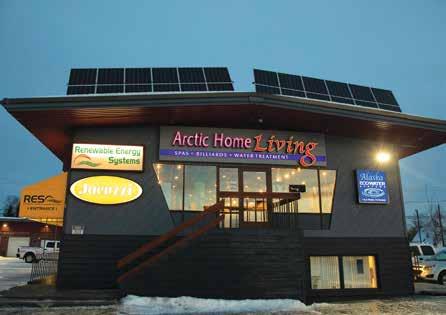
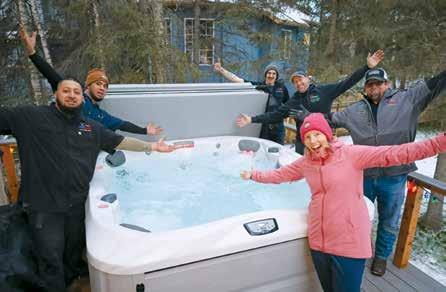
Renewable Energy Systems, Arctic Home Living, and Alaska EcoWater not only share common ownership as business lines of Aleut Energy, they share a common roof at Fairbanks, Anchorage, and Wasilla retail locations.
are you doing and where can our synergies connect?’”
Most of Aleut’s revenue and profit currently comes from its federal business subsidiaries, primarily Aleut Federal, based in Virginia, and Strata-G Solutions, in Huntsville, Alabama. Increased collaboration between subsidiaries recently opened the door for Aleut Real Estate to jointly develop a site at Huntsville’s Pryor Field Regional Airport, in partnership with Strata-G, for a state-of-the-art hangar facility. The project—Aleut Real Estate’s first
Alabama-based development—marks the beginning of a $32.7 million economic impact on the area.
It's also an example of the kind of project that can come from transparency between leadership teams.
A Larger Footprint
In addition to pursuing new opportunities through in-house collaborations, the corporation has added brokerage to its real estate subsidiary for the first time. Also, through its newest acquisition, Aleut
Energy, the company is entering the retail space with three different lines of business: Alaska EcoWater, Renewable Energy Systems of Alaska, and Arctic Home Living.
The three Fairbanks-based “mom and pop companies” are a “greenfield” for Aleut, representing an opportunity to increase the corporation’s footprint and diversify its customer base.
“We’re very excited to introduce some soft goods that complement Arctic Home Living’s current strategy,” says Aleut COO Mandy Hawes. “We’re looking to grow the brand, and we have a great base to grow from. The team there has done a really great job already, connecting with customers and delivering a high level of customer service.
“We have a big dream of serving more communities with our water practice, as well, [through Alaska EcoWater] by looking outside Fairbanks to expand across the state,” she adds.
The move toward more diversification is a move toward greater stability. This fall, as a federal government shutdown threatened to stall work on many projects across Alaska and the Lower 48, Aleut felt little impact, despite its reliance on federal projects.
“I think that’s an important component of our growth to date,” Hawes remarks. “[We’re] making sure that actions we take today actually do shape what the company will look like in three to five years. In terms of diversification, the question we’re asking every day is, ‘Is this the right fit?’”
She adds that, while finding the right fit and growing new revenue streams is important to the
Top Photo: Brian Adams Bottom Photo: Arctic Home Living
corporation, “what’s more important is that that revenue growth trickles down to our EBITDA [earnings before interest, taxes, depreciation, and amortization]. We’re focused on metrics like our EBITDA percentage and on making sure that every dollar we bring in translates to dividends to our shareholders.”
All ANCs are for-profit entities that, like nonprofits, have a mandate to invest in their people and communities.
Renewal on Adak Island
Through the corporation’s fuel and hospitality subsidiary Aleut Ventures, some of the more high profile and exciting developments are taking place—starting with the revitalization
“Fishing will always be at the heart of the Unangax̂ people and their story… Making sure we can maintain the way of life in the region is really important to us; at the same time, we want to diversify the industries to grow those communities.”
M andy Hawes COO Aleut
Aleut hopes to deliver the chemical to the Asian market and beyond.
Within three to five years, Pacific H2 expects to start construction on wind turbines that will occupy a portion of the 3,000 acres the company has leased from Adak. The turbines will generate electricity to split water into hydrogen and oxygen. The hydrogen is then blended with nitrogen from the air to create ammonia for fertilizer, industrial processes, or even fuel.
Meanwhile, Adak is entering the space economy with Californiabased SpinLaunch, a satellite launch company that uses kinetic energy to accelerate satellites into orbit. Once again, Adak’s geography and location proved to be deciding factors for this partnership. The island’s location offers access to favorable launch trajectories; its remoteness minimizes disruption to existing air and maritime traffic; and its strong winds, water, and geothermal resources provide opportunities for renewable energy integration.
During World War II, Adak was home to a US Army Air Corps airfield; by the ’90s, the facility was closed. A return of the military to Adak, in Vergen’s mind, would be a major indicator of the community’s progress.
“In the next five to ten years, we would love to see the Navy come back, whether that’s in temporary duty deployments or having a small, permanent force based in Adak,” he says. “That would definitely be a measure of success.”
East of Adak, near the tip of the Alaska Peninsula, the community of Cold Bay offers exciting
geographical and infrastructure opportunities too. Home to large runways that were originally built by the military, Cold Bay could function as a refueling hub for air cargo coming in and out of the United States, alleviating some of the traffic at Ted Stevens Anchorage International Airport, the fourth busiest air cargo hub in the world. Already, Aleut is in talks with Anchorage airport officials about using Cold Bay’s runways as a landing location fo r diverted aircraft.
The legacy air infrastructure, long used for occasional emergencies, could become a deliberate destination for transcontinental carriers, an opportunity Aleut is eager to develop.
Worth the Effort
Just because Adak is no longer a thriving military base doesn’t mean it’s a ghost town; nearly 200 people still reside there, mostly employed in seafood processing. But that may change in the future as Aleut makes efforts to draw visitors to the region. While the remoteness of the Aleutians can pose a challenge when it comes to attracting visitors, the effort to make the trip, says Hawes, is worth it.
“The Aleutians are incredibly stunning terrain, rivaling Scotland and Ireland in their beauty,” says Hawes. “We see a ton more potential for tourism along the entire chain, but specifically in Adak. We’d like to see the small, exploration-style cruise ships that have a small footprint here, enjoying the untapped potential of the region, learning about the traditional Unangax̂ culture.”
This year, Aleut Ventures launched “Venturing Beyond,” a new blog dedicated to highlighting “the stories, culture, and adventures that make Adak truly extraordinary.”
Especially as Southeast communities have begun to consider capping the number of cruise ships that can access popular destinations like Juneau, Sitka, and Haines, Aleut sees the Aleutians as a prime destination for tourists, hunters, history buffs, and those interested in Unangax̂ culture.
The Adak Island Inn, operated by Aleut Ventures, serves as a home base for visitors to access the island’s trails and beaches. Meanwhile, the island’s World War II relics and historic cultural sites offer a glimpse into the area’s past. Aleut offers a variety of land use permits for hunting, available for purchase by non-Adak residents and free to Aleut shareholders.
Trickle-down Effect
The renewal these projects bring to Adak will, Vergen hopes, be part of the solution to the outmigration that the entire region—like many small, rural Alaska communities—has seen recently. Four years ago, 25 percent of Aleut’s shareholder base lived in the region; more recently, that number is down to about 20 percent.
“Outmigration is not a simple problem to address. It’s a combination of economic opportunity and jobs. It’s the ability to have healthcare and education for kids. It’s the ability to have health, commerce, and a subsistence lifestyle. Another one of our big challenges is the cost of fuel and energy,” he says.
Preserving cultures and enhancing communities, represented by Schwabe.
Schwabe supports the missions of Alaska Native Corporations by working to maximize economic growth and protect ancestral lands.
Pair this knowledge with human, approachable legal services, and you’ll see what it means to be represented by Schwabe.
Thinking outside the rocket box, SpinLaunch is developing a centrifuge to catapult payloads into orbit. A facility on Adak Island would be a scaled-up version of the test platform in New Mexico.
SpinLaunch
“We want to absolutely declare that we are no longer the same corporation we used to be.”
Skoey Vergen, President and CEO, Aleut
Most Aleutian communities, he adds, are powered by diesel fuel, which must be shipped in; fuel can cost a local from $6 to more than $10 per gallon.
A pilot geothermal program could potentially help alleviate energy costs in the Aleutians. While a pilot project in a remote area like Adak is daunting for many companies, Vergen envisions geothermal as an affordable, scalable solution that would make use of a readily available natural resource: more than eighty volcanoes where the Pacific Plate subducts under the Aleutian Islands.
Even as Aleut pursues new development for Adak and other communities in the Aleutians, the corporation hasn’t lost sight of what’s most important to the people who live in that region.
“When we look at the Aleutian Chain and all of the possibilities there,” says Hawes, “we recognize that fishing will always be at the heart of the Unangax̂ people and their story—and we also recognize that [fishing] can be a challenging industry. Making sure we can maintain the way of life in the region is really important to us; at the same time, we want to diversify the industries to grow those communities.”
Deepening the Bench
Vergen is the first to point out that he didn’t create a more solid foundation and record-setting growth for Aleut alone. To level the corporation up, one of his first orders of business as president was to expand his leadership team.
Doing so meant once again going against the grain when it came to ANC norms: Vergen didn’t seek out experts who’d spent years working at one of Alaska’s twelve Alaska Native regional corporations.
“If [I’d gotten] folks from ANCs, I was just going to replicate what they’d done before. I didn’t want to do that,” he explains. “I went out and found people in industry that had the same mindset and approach that I did and the same cultural approach, who had success in what they did.”
Vergen established Aleut’s legal department—the corporation had been outsourcing its legal work— and its communications team, hiring Kate Gilling, with whom he’d previously worked, as vice president of communications and marketing. Without a team focused on grant writing, Aleut was missing out on access to potential federal funding. Vergen added grants, regional
affairs, and public policy teams to the company’s roster.
“Establishing that structure of fulfillment for our future and then finding the right leaders who are willing to be transparent and accountable and rigorous has been key,” he says.
A New Name and Look
A new era called for a new identity. Its old acronym, TAC, was vague and tended to bury “The Aleut Corporation” in alphabetized lists. In 2024, the corporation unveiled a new logo and brand. Taking a cue from other ANCs known by instantly recognizable, single-word names— Sealaska, Koniag, Ahtna—The Aleut Corporation be came, simply, Aleut.
“We wanted to be able to honor our culture and our history and our past but still have a way to step forward and be able to communicate to people that we are thinking differently, we’re acting differently, we’re planning differently, and we’re going to be more progressive than we have before,” Vergen explains.
Led by Gilling, Aleut’s communications team redesigned the company logo, streamlining the original image created by John Larsen in 1990 while retaining references to symbolic elements—a bentwood visor, a mountain, and an arrowhead—meaningful to the region’s Unangax̂ culture. An updated brand color palette reflects the Aleutian Islands’ coastline, storms, and seasons.
While the new brand remains rooted in history, it’s another signal, Vergen says, that Aleut has a new
vision: “We want to absolutely declare that we are no longer the same corpora tion we used to be.”
In Service of the Mission
“Being transparent, accountable, and rigorous was the catalyst,” Vergen says. “Not only did we tackle those operational issues and pursue business development opportunities, but that started to extend into, ‘How can we make an impact on the mission? How can we increase dividends? How can we work on regional issues around food security and healthc are and education?’”
Stability means more capacity to focus on the wellbeing of shareholders. One way that has happened is through Aleut’s new settlement trust, passed via resolution last year. The trust—something Aleut’s fellow ANCs already have—allows the corporation to pay a 10 percent tax up front on money it puts into the trust; distributions and benefits from the trust can then be paid taxfree to Aleut shareholders.
“Last year we paid our largest taxfree dividend for the very first time,” Vergen says. “That’s significant, real impact [on our shareholders], due to the cor poration’s success.”
Aleut has also broadened the scope of the college and vocational scholarships available to shareholders. With Aleut Marketplace, it provides a “smallbusiness bootcamp” where entrepreneurs develop and refine a business plan, with assistance. In partnership with Alaska Growth Capital, four entrepreneurs in each
bootcamp cohort are selected to receive grants to start their businesses. The boost isn’t just about launching new businesses; it helps fill needs in Aleutian communities by supporting locals to develop the services and resources t heir hometowns need.
Setting Records
Aleut has a new story to tell about how it’s growing, how it’s changed, and where it’s headed— and it tells that story regularly at shareholder meetings and visits to the region. Since Vergen stepped into his role, that story has included u nparalleled success.
Two years into his tenure as president, Aleut had achieved the unthinkable: Once the “last and smallest” of all twelve ANCs, the corporation moved into tenth place, earning gross revenues of $270 million in 2022, an increase of more than $40 million from the year previous. The same year, the corporation cracked the top 20 in Alaska Business ’ annual Top 49ers ranking by revenue.
In 2023, the corporation set a revenue record; in 2024, it set another—and 2025 is looking like another ba nner year for Aleut.
“We were told by our bankers that was the biggest turnaround they’d ever seen from an ANC, from where we were when I got here to breaking even within that next full twelve-month period,” says Vergen. “The ‘bigger brain’ effect is working, and it’s producing results that are exceptional. That, in turn, is allowing us to do more to fulfill our mission for o ur shareholders.”
CARRYING TRADITION FORWARD
A Tradition of Belonging
Connecting and supporting Alaska Native corporation shareholders
By Rindi White
When the Alaska Native Claims Settlement Act (ANCSA) established the scaffolding for regional and village corporations, it was with the intent that those corporations support the roughly 74,000 Alaska Native shareholders enrolled by 1973.
ANCSA set out guidelines about who could be shareholders: blood quantum requirements and a cutoff date for eligibility. Shareholders had to be born on or before 11:59 p.m. December 18, 1971—the day ANCSA was signed into law—to be eligible to hold shares.
The legislation left it up to corporations to figure out how to connect with shareholders, how to give them a voice in governing the new corporations, or what shareholder benefits should look like. Nearly 200 village and regional
corporations operating today have developed a range of approaches to communication, often led by shifting demographics and evolving needs of their shareholder base.
Through successful management within the corporations, many shareholders have more benefits available to them, and to descendants of original shareholders, than ever before. But Native corporations face the pressure of preserving culture and tradition at a time when a village or regional corporation’s shareholder base might be spread across the world.
From Word of Mouth to Text Messages
Communication. Connectivity. Today it’s taken for granted or even bemoaned: being over-connected, always within reach, and unable
to disconnect. But when ANCSA passed in 1971, people didn’t carry smartphones in their pocket or have a Starlink connection on their fishing boat. During a time in rural Alaska when catching up on the local news might wait until breakup allowed boat travel to the nearest village, there were important matters to be decided. How does one set up a village or regional corporation and reach out to shareholders when phone service was, in some areas, nonexistent—and even mail service was spotty?
“Word of mouth was the primary way things were communicated,” says Cameron Poindexter, president and CEO of Dillingham-based Choggiung, Limited. “Most all of our shareholders at the original issuance of shares were living within the villages that were originally established. There were a small portion that were
Koniag
enrolled with Choggiung, Limited who had moved away, but that number was pretty small.”
Many villages had tribal councils, but informing a region about this new way of operating entailed a fresh strategy for communication and training.
In Kodiak, people setting up Koniag regional corporation held community meetings in villages dotting the archipelago. Newsletters from 1973 include photos of early Koniag officials traveling from village to village for a regional training event, using a fishing vessel for transport and holding meetings in a school and community hall.
It’s not that different from today, says Stacey “Imaq”
Simmons, vice president of Koniag Region Investments.
“We go to Larsen Bay, Old Harbor, Port Lions, Ouzinkie, Akhiok, and Kodiak. We try to do those all in one week—we do two a day. Then we go to Portland [Oregon], Soldotna, Anchorage, and Seattle,” Simmons says. Annual meetings rotate between Kodiak, Seattle, and Anchorage.
Koniag takes shareholder involvement a step further, with shareholder committees. Those began in 1997, Simmons says.
“It’s a volunteer committee; people who want to be directly involved in the needs of the shareholder base volunteer their time,” she explains. “It’s a great vessel for communication, to get feedback from our shareholders.”
wise counsel
ADVISING ALASKA NATIVE CORPORATIONS FOR OVER 25 YEARS
With over two decades of history in the Anchorage community, Dorsey & Whitney provides full-service legal counsel to clients in Alaska and beyond. Backed up by the resources of an international law firm with over 650 attorneys across 22 offices, we offer global reach, local resources, and deep experience representing Indian tribes and Alaska Native corporations. Making us a wise choice for smart businesses everywhere.
NATIONALLY RANKED PRACTICE
Chugach Alaska Corporation leaders say early communication ranged from handwritten letters to newsletters and community meetings, with early gatherings fostering trust and a sense of belonging among an already closeknit community of shareholders.
Today, corporations rely on an array of methods to reach out to shareholders, from newsletters (printed, emailed, and posted online) and mailouts to text messages and posts on various social media platforms. It’s not uncommon to see a post on Instagram celebrating a Bristol Bay Native Corporation (BBNC) shareholder or one by Ahtna, Inc. highlighting the traditional uses of crowberries.
A
“Twenty years ago, we did a lot of newsletters, a lot of physical mailings. Today, primarily, BBNC promotion is social media, web based, and recently a lot more texting,” says BBNC President and CEO Jason Metrokin. The texts, he notes, often include a link to a newsletter or other notification online. For some demographics, it’s more effective than email alone, he says.
“Our ancestors stayed connected across great distances through stories and shared purpose. In many ways, we’re doing the same today, using new tools to continue that tradition of connection, transparency, and belonging,” says Chugach Board Chairman Sherri Buretta. “Our commitment hasn’t changed, only the ways we reach our people.”
Keeping Up with Change
Holding meetings outside of a corporation’s region is fairly common among both regional and village Alaska Native organizations, more so as rural migration continues.
When Metrokin started at BBNC twenty years ago, more than 50 percent of shareholders lived in the Bristol Bay region, he recalls. Today, about one-third of shareholders live there. Most have moved to Southcentral, and about 20 percent live in the Lower 48 or outside the United States.
Chugach leaders say almost half of its shareholders live outside Alaska, with the largest portion in Washington state, where Chugach regularly hosts both annual and informational meetings.
“Technology has really been a big game-changer,” notes Curtis McQueen, executive director of the Alaska Native Village Corporation Association. McQueen, a member of the Tlingit and Haida Indian Tribes of Alaska and former CEO of Eklutna, Inc., says COVID-19 kickstarted the trend of online access to annual meetings, and it has helped bring together shareholders who live outside Alaska.
Chugach leaders add that what began as a temporary adaptation has become a lasting innovation that continues to strengthen connection and access across distances.
But sometimes an annual meeting isn’t enough to handle all that needs to be discussed. In the case of a significant change, such as Choggiung’s 2022 question to shareholders about adding a separate class of stock for descendants, Poindexter says Choggiung held informational meetings in Dillingham, Anchorage, Kenai, and Wasilla to connect with as many of its 2,700 shareholders as possible. Shareholders ultimately
1977 Bristol Bay Native Corporation newsletter celebrates the purchase of the Anchorage Hilton. The corporation renovated and later sold the hotel.
Bristol Bay Native Corporation
Annual meetings provide a way for shareholders to connect with Alaska Native corporations. Above, board members stand during a 1985 Bristol Bay Native Corporation meeting. Below, Bristol Bay Native Corporation shareholders go over information.
Bristol Bay Native Corporation
approved the measure, allowing lineal descendants of original shareholders—born after the December 18, 1971 cutoff date and who are not enrolled as a descendant in another village corporation—to become Class B Life Estate Stock shareholders. Residents who were eligible to hold original Class A stock but who missed the 1973 enrollment deadline were also deemed eligible to receive Class B shares. Choggiung joins several other village corporations—and now nine of the twelve regional corporations—in offering a second tier of stock to descendants of original shareholders.
Although precise guidelines vary, one common theme of this second tier of stock is that, instead of being an inheritable asset, it stays with the shareholder during his or her lifetime and reverts to the corporation upon the shareholder’s death.
Embracing the Next Generation
In creating a new class of stock and opening enrollment to shareholder descendants, the Alaska Native regional and village corporations that have made that decision are building an avenue for continued involvement by shareholders.
“Open enrollment is about honoring the wisdom of our elders while welcoming the energy of our next generation. It’s a chance to bring more of our family into the circle, to learn from those who came before us, and to ensure our culture and values carry forward through new voices and new leaders,” says Chugach Alaska Vice President of Shareholder Services Millie Fox-Hill.
The shareholder age among many corporations is already skewing younger. Some of that shift is due to original shareholders gifting shares to their children or family members. When original shares were first set up, each shareholder was allotted 100 shares. Those shares could be gifted to close family members while the original shareholder was alive or inherited after their death.
Metrokin notes that most BBNC shareholders in the ‘80s and ‘90s held between sixty and seventy shares. Today, the average shareholder holds around forty-five shares, reflecting the redistribution through gifting or inheritance of shares over time.
“We have a very large and growing bubble of shareholders between the ages of 18 and 35,” Metrokin says.
Summer picnics, such as these held in Seattle (top) and Anchorage (middle) and Kodiak (below) provide a fun way for Koniag to connect with shareholders throughout the year.
Bristol Bay Native Corporation
FISHING FUELS OUR COMMUNITIES
Every current. Every catch. Throughout the Aleut region, fishing is passed down like language or family names. This knowledge, shared across generations, is part of what defines us as Unangax.
“Twenty years ago, we did a lot of newsletters, a lot of physical mailings. Today, primarily, BBNC promotion is social media, web based, and recently a lot more texting.”
Jason Metrokin, Preside nt and CEO Bristol Bay Native Corporation
Today, about 12,000 BBNC shareholders hold original shares.
Following the October 4 vote to create a Class D share for descendants, Metrokin says, “we anticipate roughly the same amount, 12,000, that would be eligible to apply for the new descendant stock. That would roughly double our shareholder base.”
Not all those descendant enrollees will be new to the corporation, however. He estimates about twothirds already hold inherited or gifted shares. Another one-third will be new to the organization.
“We have to work extra hard to help them understand what being part of an Alaska Native corporation means,” he says.
A Palette of Possibilities
Dividends are not the only way Native corporations serve their shareholders. A major step along the path of developing the corporations has been learning how to effectively run those businesses and how to transform corporate
landholdings into profitable enterprises.
“When we were ready to develop our lands, we didn’t have our own engineers, our own construction companies, our own lawyers,” says McQueen. “But we started putting aside money to invest in [scholarships to] colleges and trade schools. Now, you walk into these corporations, and the majority of staff are either shareholders of our corporation or other corporations.”
Scholarships were an early added benefit for shareholders and their descendants. Today, scholarships are something many Native corporations offer—both to colleges and to trade schools. For instance, BBNC partners with every school district in the Bristol Bay region to provide career and technical education and was a founding partner of the Bristol Bay Fly-Fishing and Guide Academy, which aims to provide education on salmon stewardship that fosters sustainable outdoor employment opportunities for Bristol Bay teens and young adults.
Finding ways to make BBNC relevant, both across Alaska and specifically to its shareholders, is a constant driver. Metrokin says, “We’ve been around for fifty-three years, and we intend to be around forever. We have to evolve based on our shareholders and based on the changes to our financial resources.”
Open Doors
Simmons points to Koniag’s tenyear benefit strategy, devised in 2018, which involved shareholder surveys to learn how Koniag can make the most impact, from birth to death, for its families. Now Koniag not only offers scholarships for education
and professional development but also provides shareholders and descendants between the ages of 3 and 18 with up to $1,000 to attend camps, events, and trainings. As a fun bonus, the corporation provides a $50 incentive to any Koniag middle or high school student who maintains a 3.0 grade point average or higher.
In addition to annual meetings, town halls, and informational meetings when needed, Koniag also hosts holiday parties and summer picnics in Kodiak, Anchorage, and Seattle to support the culture and community of its shareholders.
Other benefits include a shareholder burial benefit to help offset the costs that come when a loved one dies, and an elder benefit—a payout to original Koniag shareholders over the age of 62—that now distributes money each fall and spring. To boost business development, Koniag offers a business directory, open to shareholders and descendants, that businesses from construction companies to artists can take part in.
Chugach has distributed more than $13 million in scholarships to more than 2,300 recipients across Alaska and the United States, a nod to the vital role education plays in Chugach’s vision for the future.
“Chugach invested in my education and opened doors for me to grow into leadership roles with our corporation. That experience shaped my belief that opportunity can transform lives and communities,” says Chugach President Katherine Carlton. “When we invest in education, we’re cultivating the next generation of Alaska Native leaders who will carry our vision forward.”
Re presenting peoples and cultures that long predate the Alaska Native Claims Settlement Act of 1971 (ANCSA) under which they were established, the twelve regional corporations are fundamentally unique in terms of environmental challenges, corporate purposes, and structures.
The twelve regional Alaska Native corporations (ANCs) are Ahtna; Aleut; Arctic Slope Regional Corporation; Doyon, Limited; NANA; Koniag; Sealaska; Bering Straits Native Corporation; Calista Corporation; Cook Inlet Region, Inc. (CIRI); Bristol Bay Native Corporation (BBNC); and Chugach Alaska Corporation.
The passage of ANCSA ushered in a new era for Alaska Native people, sorting them into commercial enterprises quite different from
Indigenous societies. They would ascend to profitability through individual grit and cooperative aid.
Seeing the need for an official forum where leaders could gather and discuss issues, the twelve formed their own organization. Among the visionaries were Carl Marrs, then of CIRI; Oliver Leavitt of Arctic Slope Regional Corporation; Dennis Metrokin of Koniag; and Morris Thompson of Doyon.
They convened in 1997 and worked to bring together other ANC presidents and CEOs, and in 1998 the Association of ANCSA Regional Corporation Presidents and CEOs held its first official meeting. The name was changed to the ANCSA Regional Association (ARA) in 2011 to better reflect the organization’s purpose and membership.
“With ARA, we have a Native corporate industry trade association where we can collaborate, leverage, and influence as a collective—specific to the wants and needs of regional ANCs.”
Jaso n Metrokin
Preside nt and CEO
Bristol Bay Native Corporation
Native Corporation Trade Association
While each regional corporation operates independently and reflects the priorities of its shareholders, ARA acts as a convener, connector, and advocate, bringing leaders together to address statewide and federal issues, according to ARA President Nicole Borromeo.
“ARA’s role isn’t to replace or duplicate what individual corporations do but to amplify shared priorities—whether that’s in federal policy, public education, or national advocacy,” says Borromeo, who became ARA president in May upon the departure of Kim Reitmeier, who held the position for fourteen years. “Everything we do is rooted in one goal: To help our members provide more meaningful benefits to Alaska Native shareholders, descendants, and communities.”
While ARA is hardly the glue that holds the twelve regional corporations and villages together, it certainly is part of the magic sauce, says Jason Metrokin, BBNC president and CEO. “However, it’s our Native values; our collective opportunities, challenges, and threats; and our resilience as Native people that holds us together,” he adds. “Our 10,000 years of working together goes well beyond any current day organization.”
Metrokin’s father helped pioneer ARA, and now the son is part of the conclave.
“Prior to ARA, many of the regional ANCs worked on their own regional issues, regardless of shared experiences and challenges of other Alaska Native regional organizations,” says Metrokin. “The Alaska Federation
Bristol Bay Native Corporation
Class A CDL Program graduate. Bristol Bay Native Corporation
2025 summer interns.
Bristol Bay Native Corporation
“ARA has been highly influential to protect our seat at the table with industrial partners and the state and federal government.
Together, ARA members are a stronger force.”
Jaso n Metrokin Preside
nt and CEO Bristol Bay Native Corporation
of Natives was our key conduit for statewide issues. Now with ARA, we have a Native corporate industry trade association where we can collaborate, leverage, and influence as a collective—specific to the wants and needs of regional ANCs. The addition of ARA has allowed us to better understand the issues facing all ANCs and how we can address challenges together and learn from those who have endured these issues already.”
Alaska Federation of Natives was formed prior to ANCSA in response to the land claims issues brought forth by various organized Alaska Native groups, consolidating group efforts and evolving as the statewide organization advocating for Indigenous land claims. The federation’s members include ANCSA
In everything we do—from oil field services, to land management, we strive to nurture our Native way of life. Learn more at www.doyon.com
ALASKA NATIVE
“Together, ARA members have won campaigns that many considered unwinnable… We’ve helped secure equal access to federal benefits, protected our lands and resources, and advocated for our people at the highest levels of government.”
Nicol e Borromeo President ANCSA Regional A ssociation
regional and village corporations as well as 176 federally recognized tribes, giving it a broader scope than ARA. Although both organizations serve the same constituency, ARA generally concentrates on business matters.
“ARA has been highly influential to protect our seat at the table with industrial partners and the state and federal government. Together, ARA members are a stronger force,” Metrokin states.
Collective Action
ARA members don’t always agree, admits Borromeo, but the organization’s unique board of
directors, composed of ANC presidents and CEOs, requires consensus on issues that matter most.
“That alignment allows us to combine the significant resources of all twelve regional corporations and speak with the collective voice of more than 160,000 Alaska Native shareholders,” Borromeo states. “We take that responsibility seriously.”
Funded and staffed by member corporations, ARA holds regular inperson meetings with the board and, when necessary, travels to Washington, DC, to advocate directly on behalf of members, shareholders, and communities.
“Together, ARA members have won campaigns that many considered unwinnable,” Borromeo says. “We’ve helped secure equal access to federal benefits, protected our lands and resources, and advocated for our people at the highest levels of government.”
During the COVID-19 pandemic, ARA worked to provide for Alaska Native people, from remote villages to urban centers.
The Coronavirus Aid, Relief, and Economic Security (CARES) Act of 2020 included funding to Alaska Native corporations. “After a lawsuit to prevent Alaska Native people from receiving our fair share of COVID relief funding, ARA and other organizations went to the US Supreme Court to advocate on behalf of Alaska Native people—and won,” says Shauna Hegna, president of Koniag and ARA chair. “ARA helped to secure around $450 million, which became critical in helping Alaska Native communities recover from the economic crisis created by the pandemic.”
And sometimes the association is more explicitly political. “Who could forget: ‘How do you spell Mur-KOW-ski?’” recalls Borromeo. “ARA formed [the political action committee] Alaskans Standing Together, which played a pivotal role in Senator Lisa Murkowski’s historic write-in campaign in 2010—the first successful statewide write-in victory in more than fifty years.”
Evolving Priorities
ARA celebrated ANCSA’s 50th anniversary in 2021 with production of a half-hour video, ANCSA: Our People, Our Land, Our Future , that looks back at the first fifty years of ANCSA and captures a glimpse of what is to come.
“That type of advocacy is precisely what the visionary leaders of ARA’s predecessor came together to do,” adds Hegna.
ARA continues navigating important challenges facing regional and village corporations, including climate change and its effects on infrastructure and subsistence resources, managing land and natural resources responsibly, sustaining economic growth amid global market fluctuations, and meeting the needs of shareholders across generations, says Borromeo.
“Our board members lead complex corporations, and our team at ARA is constantly engaged with evolving priorities,” she adds. “But the commitment to serve our people never wavers. I’m deeply thankful for the dedication of our board, staff, and partners. It is humbling to see what we continue to accomplish together.”
Old Values Inform a Strong Future
The ‘forever corporations’ of the Kodiak archipelago
By Christi Foist
Known as Alaska’s Emerald Isle, Kodiak—the state’s largest island—brings together great beauty, diverse wildlife, and the challenges of a remote archipelago with a significant military history.
Under the Alaska Native Claims Settlement Act of 1971 (ANCSA), Congress established both a regional corporation and several village or urban corporations for the Kodiak archipelago. These latter entities include Afognak Native Corporation, Akhiok-Kaguyak, Inc., Leisnoi, Natives of Kodiak (NOK), Old Harbor Native Corporation (OHNC), and Ouzinkie Native Corporation.
“One of the things that makes the Kodiak region very unique and a joy to work in is that the Native organizations across our region work in unity,” says Shauna Hegna, president of Koniag regional corporation. “We
are constantly collaborating with the village corporations, the nonprofits, the tribal health organizations, and our tribes to improve the quality of life in our communities.”
As an example of this, most of the region’s corporations, tribes, housing authority, and other entities formalized the Kodiak Region Unity Protocols in 2023. These seventeen principles cover difference and compromise, healthy disagreement, and the groups’ shared commitment to collaboration and “mutual respect.”
Generations of Cooperation
“Our communities share deep roots and strong ties—connected through family, culture, and the enduring spirit of the Alutiiq people,” says Kristina Woolston, CEO of OHNC. “As neighbors across the Kodiak Archipelago, the people of the
island have walked similar paths, guided by the values of respect, resilience, and cooperation that our ancestors passed down to us.”
These shared values include a longterm mindset. “We think of ourselves as forever corporations,” says NOK President and CEO Monica James. “We’re here for the long range, for the next generations to hand it over to the descendants that are up and coming.”
Hegna agrees. “We are not only focused on generating earnings for today and for tomorrow, but for generating earnings for the generations of shareholders we will never meet,” she says. Part of this mindset reflects another value she cites: sharing the catch. Hegna explains, “In our communities, when we have a good day on the water, we come home and we share it” with others who stayed at
Kristina Woolston | Old Harbor Native Corporation
home, from elders to mothers who looked after children.
That future also involves the longterm impacts of the US military’s past and current presence on Kodiak Island. This includes all three Coast Guard bases—in the midst of a yearslong expansion—and ongoing cleanup from contamination at the World War II-era coastal defense site on Chiniak Bay called Fort Greely (not to be confused with the US Army post in the Interior).
But even with these and other challenges, corporation leaders say the archipelago offers unique benefits. “When you’ve been here and you’ve seen the bluebird days, there’s no other place like it,” says NOK Vice President Corey Gronn. “It’s really a rewarding place to call home.”
Hegna adds, “We have a saying: ‘When the tide is out, the table is set,’” referring to the abundant shellfish, as well as halibut, deer, elk, and migratory fowl. “The list goes on and on… The access to these resources makes it possible for people in Kodiak to thrive in what is one of the harshest climates in the world.”
Major Resources
That abundance extends to the major resources that Kodiak’s Native corporations have on their lands.
For some, timber has proved an important, if more generational, crop to fund projects and other investments. James says forests that NOK logged until 2018 will take about sixty years to regrow before they can be harvested again. “It was a significant driver
for economic activity,” James adds, “including the dividends that we paid to our shareholders.”
Jana Turvey, president and CEO of Leisnoi, says logging on the village corporation’s lands provided a vital infusion of capital after a 2009 US District Court ruling finally settled decades of litigation by rancher Omar Stratman. He had challenged ANCSA’s treatment of Woody Island.
As deciding Judge James Singleton Jr., put it, Stratman sought “to have Leisnoi, Inc., the village corporation for Woody Island, stripped of the status and benefits conferred upon it under ANCSA.”
Despite Leisnoi’s eventual victory, more than thirty years of litigation exhausted nearly all the corporation’s finances. Things were so tight, Turvey says, that for many years,
the corporation was essentially defunct, with important documents stored in a director’s garage. When Leisnoi finally turned from legal defense to the kind of “economic activity” Congress intended, “we were significantly behind,” Turvey says. Logging about 6,000 of its roughly 50,000 acres helped jumpstart new businesses and provided longawaited shareholder dividends.
Fisheries represent another significant, if volatile, Kodiak resource. “The waters provide… a bounty for the community,” says Woolston, who once ran her own commercial fishing venture. Though fishing provides less income than before, she says it remains very important for the people of Kodiak. OHNC is also active in exploring and harvesting other underwater resources, like kelp and oysters. Woolston says, “The mariculture economy on Kodiak has real potential.”
OHNC is also working to develop onshore food resources, which include a bison herd and “hoop house” orchard and garden project.
Even Kodiak’s rocks have value. Hegna says Koniag has both gravel and granite on its lands. The latter comes in uniquely large chunks known as armor rock. Mined in pieces the size of trucks or cars, Koniag’s granite has strengthened projects like ferry docks and even parts of the Homer Spit.
However, leaving land and resources untouched has just as much importance to corporations as developing them, in some cases. The reasons vary. Hegna says Koniag has set aside some lands for cultural purposes like burial or protecting important archeological
The hoop house in Old Harbor is part of Sitkalidak Sunrise Farm. Plastic-covered high tunnels extend the growing season to support the local food supply.
Kristina Woolston | Old Harbor Native Corporation
Only the Russian Orthodox church in Old Harbor survived a tsunami from the 1964 earthquake that destroyed the original village. This year, the village corporation and local tribe completed a new tsunami safety center.
Kristina Woolston | Old Harbor Native Corporation
About 70 miles southwest of Kodiak, adjacent to Sitkalidak Island, Old Harbor has tourism appeal, so the village corporation is developing hydropower to support small cruise ships.
Kristina Woolston | Old Harbor Native Corporation
sites. It also protected some areas— often near villages—where the Alutiiq people have hunted and gathered for millennia.
For NOK, contamination at old Fort Greely has limited any use that would require digging water wells. The US Army Corps of Engineers continues its decades-long project of cleaning up that site.
Several corporations also leave land undeveloped for public uses like recreation. Many of the corporations issue land-use permits. NOK, Ouzinkie Native Corporation, and Afognak also have a joint permit system.
In at least one situation, leaving land untouched ultimately required some development. Hegna recalls when Koniag constructed the mileand-a-half long Portage Trail between Larsen Bay and the Karluk River to protect the land in between. Much of the trail, completed in 2022, consists of an elevated boardwalk wide enough for four wheelers.
Before it was built, “we were seeing ‘spider webs’ as people created their own trails, trying to be able to access the river,” Hegna says. “It was damaging a lot of our lands.” The boardwalk, built by an all-shareholder team, has both protected those lands and increased use of the river area.
Key Industries
As the boardwalk shows, some of Kodiak’s resources directly connect to one key industry: tourism. How much corporations gain from that seasonal traffic depends on both the size and location of their land allotments.
As the regional corporation, Koniag has the largest allotment. Its diverse portfolio of businesses includes
the investment arm that operates a popular lodge, the Kodiak Brown Bear Center & Lodge, located on Karluk Lake, which is only accessible by float plane.
Tourism can be a struggle for village corporations like OHNC with lands only accessible by boat or air. That separation presently puts them outside the reach of many of Kodiak’s
tourists. As a remedy, Woolston says OHNC is working on a hydroelectric project that could eventually sustain smaller, “more curated” cruises.
A little way down the coast, the joint village corporation AkhiokKaguyak connects visitors with guides for hunting and fishing opportunities around the southern tip of Kodiak Island.
Many of the corporations and their subsidiaries also work in industries far from Kodiak. OHNC has leasing and telecommunications businesses that work across Alaska. Hegna says one Koniag subsidiary recently installed a series of web cameras inside the Anton Anderson Memorial Tunnel to Whittier to help improve safety within that long corridor. Koniag also has a real estate business and one focused on IT services.
A lot of work extends into the Lower 48 too. NOK has a lot of environmental projects, plus some construction work. Leisnoi’s four subsidiaries provide professional, construction, environmental, and marine services. And Koniag, NOK, OHNC, and Akhiok-Kaguyak all have numerous government contracts.
Community Projects
The more these corporations succeed, the more they can reinvest in their shareholders and communities. James says NOK has “three pillars”: land and cultural stewardship, shareholder benefits and engagement, and sustained financial growth. The last pillar drives the other two.
For some corporations, revenue funds a very practical community investment: housing. Leisnoi, for one, is working with the Woody Island Tribal Council (Tangirnaq Native Village) to re-establish the entire village. The first road in Alaska was built on Woody Island in the 1800s by Russian colonists, but by the 1940s the Indigenous inhabitants moved away. To revive the homeland of the Tangirnarmiut people, Turvey
says the project will start with a multi-use tribal center, for which construction should start soon.
As an urban corporation, NOK has a different opportunity: helping address the housing crunch in the city of Kodiak. Gronn says the corporation has developed a new subdivision with fifty-five lots that it is currently evaluating how to handle. The US Coast Guard’s expansion—which Gronn thinks could bring between 200 and 300 more people to the island—makes thoughtful housing development especially important. “If we don’t grow along with their growth, we’re really going to feel the pinch,” he says.
Related to that, NOK is also weighing how to steward a roughly 800-acre piece of land it owns, less than two miles from the city’s downtown. “We’re trying to determine the highest and best use of the property,” Gronn says. Among the possible uses, he suggests, “We’d love to have another [grocery] store in town,” since only one Safeway serves the entire community.
At Koniag, Hegna says the corporation has partnered with the city of Kodiak, RurAL CAP, and the Kodiak Island Housing Authority to develop “the first mutual selfhelp housing program off the road system.” The partners are designing a subdivision that will occupy six and half acres in the city of Kodiak. Once development starts, the families chosen to move in will learn construction skills to build their own homes in collaborative fashion. Subcontractors will handle “specialty services,” Hegna says.
Other projects focus on cultural preservation. Sabrina Ben, president and CEO of Akhiok-Kaguyak, says the corporation has a board member who teaches Sugpiaq, the language of the Alutiiq people, to younger generations. Koniag and NOK also partnered with the Kodiak Area Native Association to help the Alutiiq Museum with a $14.3 million renovation. Hegna says the three entities—Koniag, Natives of Kodiak, and Kodiak Area Native Association— bought half of the original facility and donated it to the museum. That gift helped the museum fund a 3,400-foot expansion, completed in May. “The Alutiiq Museum is now a very modern, beautiful facility that has incredible collections and exhibits,” Hegna says.
Preservation informs other projects, too. OHNC worked with the Alutiiq Tribe of Old Harbor to develop a tsunami safety center in the village, completed in March. After the 1964 earthquake, tsunamis demolished Old Harbor, Woolston says, and only the Russian Orthodox church survived.
The new, nearly 8,000 square foot tsunami safety center provides both emergency refuge and expansive community space. “This is a transformational development for our community,” Woolston says. It’s already hosting a preschool and provides space for other programs.
Whatever the future’s challenges and opportunities, Kodiak’s regional and village Native corporations are working to ensure they, their shareholders, and their descendants can meet them with the creativity and resilience the Alutiiq people have refined for millennia.
Taking Care of Business
Regional corporations score achievements for shareholders and communities
By Terri Marshall
Al aska Native corporations (ANCs) build stronger communities by creating jobs, investing in education and culture, and promoting sustainable growth. Their profits support dividends, scholarships, and local programs, helping preserve Alaska Native heritage for future generations. In this round-up,
some of the twelve regional ANCs share recent news, projects, and the ongoing benefits for their communities.
Celebrating Success
The only Alaska-based company to earn a spot on Forbes ’ list of America’s Top Private Companies is Arctic Slope Regional Corporation
(ASRC), which for thirty-one years in a row has ranked as the #1 Top 49er, which are Alaska companies ranked by gross revenue.
“Anchored by our Iñupiaq values and commitment to our people, ASRC has grown from three small businesses in Utqiaġvik into a national leader,” says President and CEO Rex A. Rock Sr.
Bristol Bay Native Corporation
This year marked ASRC’s second consecutive year exceeding $5 billion in revenue, reaching $5.7 billion and achieving the most extensive dividend distribution in the corporation’s history at $122 per share for more than 14,000 shareholders.
“In 2024, ASRC surpassed $1.8 billion in dividend distributions to our Iñupiaq shareholders since our inception in 1972,” says Rock. The corporation has also distributed its largesse among other corporations created under the Alaska Native Claims Settlement Act (ANCSA).
Rock observes, “Since 2000, ASRC has distributed over $1.8 billion to Alaska Native communities across the state through ANCSA 7(i) and 7(j) revenue sharing. These milestones underscore our continued
commitment to delivering value to our shareholders and communities.”
In June 2025, ASRC shareholders made history once again by voting to replenish Class C and D shares to ensure that future eligible descendants can continue to enroll in ASRC, which was the first ANC to open enrollment to descendants not living when ANCSA was enacted.
“Through consistent and steady leadership, ASRC continues to fulfill the vision set forth by our early leaders,” says Rock.
Bristol Bay Native Corporation also saw its strongest operating performance in history, with earnings of $202 million; its revenue for the last fiscal year (FY) was $3.2 billion with a net income of $84 million. Shareholder distributions were nearly $31 million.
“Through consistent and steady leadership, ASRC continues to fulfill the vision set forth by our early leaders.”
SOUTHCENTRAL ALASKA’S INDUSTRIAL PORT
Rex A . Rock Sr.
Preside nt and CEO
Arctic Slope Regional Corporation
“Profitability is the first word in our mission statement—not because profits are all that matter but because we understand that our profitability is critical to enabling us to provide meaningful benefits to our shareholders and lasting impact in the communities we serve.”
Jonathan Dalrymple CEO Chugach Alaska Corporation
BBNC shareholders recently voted to open enrollment to descendants, becoming the seventh regional corporation to pass this initiative.
Record breaking financial performance gave Aleut regional corporation its two biggest backto-back years. FY 2024 delivered the highest revenue and earnings in company history, with revenue reaching $380 million and earnings at $37 million. FY 2025 continued this momentum with another record revenue year at $390 million and earnings of $33 million.
Profits for Meaningful Benefits
Shareholders in the Kodiak region have seen consistently rising dividends from Koniag. In January 2026, shareholders will receive $33 per share, marking another milestone in the corporation’s commitment to long-term financial growth and sustainability.
“We did this while still contributing to our Shareholder Settlement Trust, making sure that we are investing in the Koniag our future generations will inherit,” says Koniag Chairman and CEO Ron Unger.
Koniag is strategically positioned at the forefront of two critical technology markets: cybersecurity and AI. On the AI front, Koniag Government Services (KGS) has been accelerating AI adoption across military branches as well as federal civilian agencies. “Our AI, machine learning, and intelligent automation solutions deliver measurable impact—one current solution alone saves the Army more than $37 million annually,” explains Unger.
“Building on this success, we recently launched Koniag AI Solutions, a dedicated KGS subsidiary focused on helping federal customers automate manual processes, enhance data quality and analysis for better decision-making, modernize legacy systems, and scale data-intensive governance and compliance efforts.”
Koniag Cyber also launched this year to deliver security solutions for highly regulated industries and to protect critical infrastructure. “Our proven track record implementing enterprise cybersecurity programs and architectures for the federal government and domestic energy providers gives us a strong foundation in this essential market,” says Unger.
In October, Koniag Cyber co-hosted a workshop in Anchorage with the FBI, bringing together about thirty key stakeholders in Alaska’s critical infrastructure sector. The session demonstrated how Koniag Cyber can provide immediate assistance and long-term resilience.
Chugach Alaska Corporation has seen meaningful growth across federal contracting, commercial, and investment platforms over the past two years. This progress has enabled consistent shareholder distributions and strategic reinvestments in education, workforce development, cultural preservation, and wellness.
“Profitability is the first word in our mission statement—not because profits are all that matter but because we understand that our profitability is critical to enabling us to provide meaningful benefits to our shareholders and lasting impact in the communities we serve,” says
Chugach CEO Jonathan Dalrymple.
“Our approach balances purposedriven outcomes with strategic growth, including acquisitions, partnerships, and new ventures that position Chugach for long-term success and sustained impact.”
Continued Focus on Growth
Shareholder distributions from Cook Inlet Region, Inc., (CIRI) increased significantly in 2025, marking the largest annual increase in more than ten years.
Acquisitions are growing CIRI’s portfolio. In December of 2024, CIRI closed on the purchase of OSC Edge, a leading provider of IT engineering, integration and testing, and data management services. Stemming from the acquisition—and to deliver world-
class IT and cybersecurity solutions that drive performance across industries and without borders—CIRI established OSC Global, a wholly owned CIRI subsidiary.
Through its trio of companies— OSC Edge, OSC EdgeTech, and OSC Technical Solutions—OSC Global is an IT, cybersecurity, and professional services leader uniting mission-driven expertise and cutting-edge technology to protect organizations worldwide.
ASRC continues to emphasize growth and diversification through acquisition, including newly acquired nuclear safety and security contractor Sigma Science, based in Albuquerque, New Mexico, and through strategic partnerships with companies such as Montgomery, Alabama-based general contractor Caddell Construction.
In 2025, BBNC focused on diversifying its current operations. “We’ve started to grow our presence in the financial services area,” shares Vice President of Communications Carmell Engebretson. “In January, we acquired majority ownership of Alaska Growth Capital and launched Alaska Investment Management this spring.”
Chugach Alaska has strategically expanded its portfolio through targeted acquisitions and partnerships, strengthening its Alaska presence. In October 2024, Chugach Commercial Holdings acquired HVAC, LLC and Alaska Integrated Services, two respected Fairbanks-based mechanical contracting firms.
Long-Lasting Investments
In addition to enlarging their family of wholly owned acquisitions,
Water Sample Testing & Analylis • Septic System Design & Testing
Percolation & Sample Analysis • Commercial Site Development
Subdivision Design & Platting • Right of Way/Easements
Cyber Express Car Wash opened in June on Denali Street in Midtown Anchorage.
Patricia Morales | Alaska Business
“Our AI, machine learning, and intelligent automation solutions deliver measurable impact—one current solution alone saves the Army more than $37 million annually.”
Ron Unger, Chairman and C EO, Koniag
ANCs have been busy pumping investment dollars into equity holdings. Chugach Alaska, through its Chugach Investment Holdings subsidiary, invested in CYBER Express Wash in Anchorage and in Port of Tomorrow in Seward. Chugach Regional Development, in partnership with The Tatitlek Corporation and Chenega Corporation, launched Chugach Naswik Suites, a multi-purpose short-term housing facility in downtown Valdez.
“These acquisitions and investments represent just the beginning of where we’re headed,” says Dalrymple. “Chugach is in a
chapter of deliberate growth, which means we’re expanding our portfolio, strengthening our capabilities, and pursuing new opportunities that align with our values and longterm vision. Each move we make is part of a broader strategy to build enduring prosperity for our shareholders, our employees, and the communities we serve.”
Sound equity investments boosted Aleut’s financial performance. In 2024, Aleut Real Estate purchased Huffman Commons, a commercial property in South Anchorage. Aleut’s momentum continued into 2025 with the acquisition of the Richards Distributing, Inc. group
of businesses, which enabled the launch of Aleut Energy and expanded its portfolio into retail, renewable energy, and at-home wellness services. Additionally, Aleut established Tayal Brokerage to strengthen real estate and brokerage capabilities, further diversifying business lines.
ASRC continues to make meaningful investments in Alaska infrastructure, including new product storage tanks at the Petro Star refinery in North Pole and an extensive expansion of ASRC Energy’s North Slope-based equipment fleet to support the growing needs of production partners.
Koniag Energy and Water did some critical projects for the Federal Aviation Administration, supplying and installing specialized cameras to enhance the safety of small airport landing sites, and for the State of Alaska, modernizing the safety of rail and auto passengers traversing the Anton Anderson Memorial Tunnel to Whittier.
“In Alaska, our energy and water sector has been involved in some exciting projects that are taking our mission of improving the quality of life for our people to the whole state,” shares Unger. “One is a project with Quintillion where we’ll be providing shore-based splicing stations as part of their work to lay fiber optic cables from Nome to Homer. Making sure our folks have access to the benefits of the internet in our region has been a priority for us, and we are proud to be a part of supporting that for the state.”
Community and Shareholder Benefits
Returning wealth to communities goes beyond dividend payments. For instance, Koniag made a significant donation to the Koniag Education Foundation, bringing the average scholarship amount to $10,000. Koniag Education Foundation offers scholarships for students pursuing an undergraduate degree, those at the highest levels of doctoral education, and those furthering their education in vocational or Alutiiq-language programs.
Through the Richard Frost Youth Scholarship, Koniag shareholders and descendants from age 3 through high school are eligible for up to $1,000
“Our success is measured not just in financial outcomes but also by the opportunities we create for our people.”
Katherine Carlton President Chugach Alaska Corporation
per year for a variety of athletic, scholastic, cultural, and leadership programs. Last year, this scholarship supported nearly 300 young people.
Among the cultural values of the Alutiiq people is caring for elders. Each winter, Koniag provides care packages for shareholders and descendants aged 62 and older. This past winter, nearly 800 elders received packages with canned salmon. Additionally, Koniag has expanded its Elder Benefit dividends in the past few years. Last year, original shareholders aged 62 and older received a total of $2,200 in spring and fall Elder Benefits.
This year’s community service project also aided Koniag elders. “This summer, we partnered with Kodiak Area Native Association to support dozens of elders in the Koniag
region,” says Unger. “The project included assisting those in Kodiak with household chores and delivering banya baskets to elders who live in surrounding villages. The annual service project is an initiative to strengthen the connection between employees and the people we serve.”
Koniag is also partnering with Kodiak Island Housing Authority, RurAL CAP, and other organizations to address the region’s housing crisis with the Mutual Self-Help Housing Program. Through the program, working families in Kodiak can build “sweat equity” by helping each other build their own homes, replacing a traditional down payment. “We are excited to see how this program grows to support essential workers in Kodiak and help the whole community,” says Unger.
Kodiak-area residents attended a heavy equipment training in Ouzinkie in March sponsored by several regional Native organizations.
Care, Love, and Kindness
CIRI’s community is growing to nearly 10,000 shareholders. “To support the tribes within our region, CIRI launched a tribal grant program last year,” says Lori Nelson, senior director of corporate communications. “The purpose of the program is to provide lowbarrier financial support while empowering Tribes to use the funding how they see fit.”
In 2025, CIRI also supported the Seldovia Village Tribe’s Culture Camp, the Knik Tribe’s food box program, and the Salamatof Tribe’s efforts to build a strong sense of belonging and cultural pride in their community.
“We launched a new Stellar Space Experience program for high-school age shareholders and descendants—a unique three-day
Koniag
program that prepares participants for potential future careers in science, technology, engineering, and math. The Ada Honor Program was launched earlier this year—a new program grounded in the spirit of ‘ada,’ a Dena’ina word meaning care, love, and kindness, which supports families in times of loss.”
In 2025, CIRI concluded the inaugural cohort of the Yah Program. Designed to identify potential leaders, encourage creativity and innovation, and empower those looking to play a key role in CIRI’s business operations and future success, the Yah Program prepares CIRI shareholders and descendants for executive leadership roles.
Aleut renamed its education foundation, formerly The Aleut Foundation, as the Ulakaia Center, and brought it under corporate ownership as a dedicated shareholder support department. The center is named after the tallest hill on St. George Island and, according to its website, “represents a place of gathering, resilience, and perspective.” Through the Ulakaia Center, Aleut distributed $1.4 million in FY25 directly to shareholders and their families for community support programs.
Beyond Ulakaia Center initiatives, Aleut invested heavily in shareholder benefits, including scholarships, dividends, distributions, and community grants—totaling $7.2 million in FY24 and $7.9 million in FY25.
Community projects benefiting ASRC shareholders and North Slope communities in the past year included Iñupiaq Days, free
tax preparation services, and the Midnight Sun Basketball Camps. Iñupiaq Days introduced youth to career opportunities within ASRC while celebrating Iñupiaq culture and values. The ASRC-sponsored Alaska Business Development Center sends a team of tax preparers to assist with more than 8,000 tax returns while offering year-round financial assistance to ASRC shareholders.
And Midnight Sun Basketball Camps, sponsored by ASRC, helped youth develop teamwork, leadership, and life skills both on and off the court.
Culture, Opportunity, and Belonging
BBNC continues to support its Bristol Bay Foundation, which has expanded its focus on language and cultural heritage. The corporation also hosts a youth and young adult culture camp to learn about subsistence harvesting, language, and cultural activi ties in the summer.
“A big focus of BBNC is keeping our shareholders connected to our region and culture regardless of where they live,” explains Engebretson. “We’ve increased our social media presence and are focusing on new ideas that can connect people from afar.”
In 2024, BBNC launched a mobile DMV program for residents in remote areas. “Last year we were able to help over 200 shareholders obtain a driver’s license or REAL ID, which was especially helpful with REAL ID-compliant identification now being required for travel,” says Engebretson. “Without the program, shareholders would have
to travel outside of the region or to one of the main hubs to get these services.”
BBNC also partnered with the US Fish and Wildlife Service and the National Fish and Wildlife Foundation to map millions of acres of wetlands in Bristol Bay. This program is designed to help fill data gaps while providing on-the-job training for shareholders to learn about geographic information systems.
Chugach has advanced several community-based initiatives that honor its heritage. An upcoming project is the Chugach Museum, which the corporation plans to build at the corner of 36th Avenue and Old Seward Highway in Anchorage. It is meant to serve as a cultural cornerstone and a space to preserve, celebrate, and share the rich history of the Chugach region.
Chugach’s affiliated nonprofit, Chugach Tribal Services, is leading the development of Village in the City, a hub designed to offer cultural, educational, and community programs for Chugach shareholders, descendants, and Alaska Native individuals residing in Anchorage.
“Our success is measured not just in financial outcomes but also by the opportunities we create for our people,” says Chugach Alaska President Katherine Carlton.
“Through the visionary Chugach Museum and Village in the City development projects, we are building community strength and creating spaces where culture, opportunity, and belonging come together. This is how we ensure our prosperity endures for generations to come.”
Providence's New Mobile Mammography Coach Screening Made Simple
Benefits managers can now schedule onsite mammograms, saving employees time and preserving productivity.
Providence Imaging Center is excited to announce the launch of its new Mobile Mammography Coach, designed to make life-saving breast cancer screenings more accessible than ever. For benefits managers, this innovation offers a unique opportunity: you can bring high-quality mammography directly to your employees, eliminating the need for them to take paid time off and helping your organization preserve productivity.
Breast cancer screening saves lives. Detecting cancer early means more treatment options and better outcomes. That’s why Providence Imaging Center has invested in its newest state-of-theart mobile coach equipped with the same Hologic 3D mammography system used at its hospital imaging center. Screenings performed on the coach are read by the same expert radiologists who interpret studies at Providence Imaging Center, ensuring accuracy and consistency. “When you find breast cancer early, you have more options versus when you find it in later stages,” says Caleb Terpstra, director of diagnostic imaging at Providence Imaging Center.
This new coach is the fifth in Providence Imaging’s fleet, continuing a mission that began in 1995: to reduce barriers to care for women across Southcentral Alaska. Funded by donations
to Providence Alaska Foundation and Providence Cancer Center, the service primarily serves Anchorage and surrounding areas in the fall and winter and reaches communities from Homer to Talkeetna in the summer months, traveling by ferry to Valdez and Cordova. By bringing advanced technology directly to workplaces and remote areas, Providence is improving health outcomes and increasing access to essential preventive care.
The Mobile Mammography Coach is efficient and impactful. It can accommodate up to eighteen screenings per day, and it is expected to serve more than 20,000 women and detect over 1,000 cases of breast cancer over its lifespan. These numbers underscore the importance of regular screening and the difference this program will make in saving lives and providing peace of mind.
For employers, hosting the Mobile Mammography Coach is simple and cost-
effective. There is no fee to bring the coach on site, and most insurance plans cover mammograms. Appointments take about fifteen minutes, and results are typically available within 24 hours through MyChart, Providence app, or through the patient’s medical provider. By scheduling screenings during the workday, employees avoid using their limited PTO for medical appointments, and employers maintain productivity—a true win-win.
Beyond convenience, on-site screenings foster a culture of wellness. “When employees see their peers participating, they are more likely to complete their own annual screenings and encourage family members
to do the same,” Terpstra explains. “This ripple effect can lead to broader preventive health engagement across the workforce.”
Benefits managers play a critical role in promoting employee health. By partnering with Providence Imaging Center, they can offer a valuable service that demonstrates the organization’s commitment to well-being while minimizing disruption to business operations. Together, we can make preventive care easier, faster, and more accessible –because early detection saves lives.
Providence Imaging Center
Eseta Poulivaati
Mobile Mammography Coach Information and Scheduling (907) 212-4982
Passing the Keys to Employees
Avis Alaska ends 70 years of family ownership
By Alexandra Kay
Af ter seven decades as Alaska’s oldest and largest family-owned car rental company, Avis Alaska has made a decision that speaks volumes about its commitment to the Last Frontier. The company is now 100 percent employee owned through an employee stock ownership plan (ESOP).
and provide the runway for the third generation to get their maximum value? That’s the math problem you have to solve.”
Taking the generations out of the equation puts the company to work for a different set of stakeholders.
It’s a move Andrew Halcro, the former co-owner who quarterbacked the transition alongside his two older sisters, describes as the perfect solution to a complex puzzle. “We had to meet the expectations of three different generations,” he explains. “How do you get the first and second generations their maximum value
A Journey Seven Years in the Making
The path to employee ownership began in 2017 when Halcro and his sisters became the majority shareholders. They set a five-year timeline to grow the business before revisiting their succession plan. The
company had a solid third generation ready to step up—grandchildren of Robert C. Halcro, who brought the franchise to Valdez in 1956—many of whom had grown up in the business and therefore had significant skills. By 2022, an Alaska company approached the family with an acquisition offer. The family entertained the possibility, believing the Avis Alaska brand would maintain premier status in the buyer’s portfolio. But after several months of discussions, it became clear that no deal would materialize.
While the potential buyer was professional and cordial, the process took months, during which Avis employees had no certainty about their future. “It ended up being incredibly stressful for all involved on our side of the deal,” Halcro recalls.
That’s when a senior executive introduced the ESOP concept. The timing was perfect. Avis Alaska had been 15 percent employee owned since 2000, meaning much of the necessary infrastructure was already in place.
An ESOP is a qualified retirement plan set up as a trust fund into which the employer contributes stock or cash to buy existing shares. The ESOP can also borrow money to purchase shares, with the company making taxdeductible contributions to repay the loan. For Avis Alaska, this meant the 15
www.chialaska.com info@chialaska.com
percent ESOP could essentially absorb the family ’s 85 percent stake.
Standard ESOP Procedure
The evaluation process took a year and a half and involved carefully examining quarterly balance sheets, financial scenarios, and countless evaluations. In December 2024, the board approved the transition. From January through June of 2025, the team worked through financing, audits, and creating the governance documents necessary to transform from a closely held family business into an employee-owned enterprise.
“We really were run like a true small business,” Halcro says. “Becoming the directors of the company rather than the owners, there needed to be governance documents and things like that.”
The transition satisfied the board’s three guiding principles: keeping the family legacy alive, ensuring the company remained Alaskanowned, and providing for the third generation’s future. Under ESOP rules, employees typically become vested after five years and receive benefits based on company performance, with their accumulated shares paid out over time when they leave.
Today, every Avis Alaska employee is an owner. A trustee oversees the company, monitoring its pulse without getting involved in the day-to-day operations unless something goes seriously off track. The trustee also holds veto power over board appointments.
This year is a milestone: Avis Alaska will nominate its first non-family board member in seventy years. “This is a big
deal because our banks and accounts— no one outside the family has really seen them,” Halcro notes. “Getting outside eyes and experience is a great idea. Families can be used to doing business in the same way. This will increase the potential of the company.”
For employees, the ESOP represents a significant benefit beyond their regular wages. “You’ve had employees who made $20 an hour for twenty years and then walk away with a substantial chunk of money,” Halcro says. “The ESOP will really benefit every employee.”
Fighting Giants with Local Grit
In Alaska’s car rental market, Avis Alaska faces the same challenges confronting many locally owned businesses: massive consolidation
- $1,196
- $1,335
- $1,460
under corporate umbrellas. “These major brands have accumulated other brands, so you’re really only competing against two or three brands,” Halcro explains. “They have significant a dvantages by scale.”
But Avis Alaska operates in ten cities across the state, albeit many of them seasonally, and in some locations it is the only provider because business can be spotty. It’s a commitment to the statewide network and to communities that larger corporations might not prioritize.
In addition to maintaining Alaskan ownership, the ESOP structure provides substantial tax advantages. For S corporations, the percentage of ownership held by the ESOP is not subject to federal income tax at the corporate level; rather, profits are
taxed as individual earnings when they flow to vested shareholders. These tax benefits will allow Avis Alaska to not just compete but to grow. In the spring, the board greenlit a $5.2 million building project at the Fairbanks International Airport, demonstrating the company’s newfound financial flexibility. “What’s so exciting about this deal is that we will have the resources to be confident that we can go in and compete against billion-dollar corporations,” Halcro says.
As Avis Alaska rolled out its 70th anniversary campaign, celebrating seven decades of service and the transition to employee ownership, the company’s foundational principle remained unchanged: “Try Harder.”
Halcro emphasizes, “Everyone who touches your car will have the incentive to ‘Try Harder.’”
The campaign for the 2026 anniversary happened in October at a statewide managers’ meeting, where company leaders brought employees up to date on the transition and what it means for their futures. The messaging was clear: Avis Alaska is seventy years strong, and the keys are now in the hands of the next generation of Alaskans.
Stake in the Future, Respecting the Past
The transition couldn’t have come at a more critical time for Alaska’s business landscape. As national chains increasingly dominate various sectors, the ESOP model offers a viable path for established businesses to remain locally controlled while accessing capital for growth and expansion.
Research shows that companies with employee ownership often see tangible benefits beyond the balance sheet. Employee-owned companies typically experience reduced turnover as workers become more engaged and connected to long-term goals. The sense of ownership can lead to improved job satisfaction, productivity, and loyalty—qualities that matter even more in Alaska’s tight labor market and seasonal business environment.
For Avis Alaska’s employees spread across ten Alaska cities, the transition represents more than a retirement benefit. It’s a stake in the company’s future success and a recognition of the value they’ve already contributed. In communities where Avis Alaska might be the only car rental option, employees now have a direct incentive to ensure the company thrives, serving their neighbors and visitors alike.
The family isn’t disappearing from the picture, though. Halcro and his two sisters remain a majority of the board, committed to preserving the company culture and ensuring future generations never forget the company’s history and its roots in Alaska communities.
“The great thing is we’re still preserving our roots by respecting the past,” Halcro reflects.
Succession Success
For family businesses considering their succession options, Halcro offers hard-won wisdom: Succession planning is always difficult, and many businesses don’t have a third generation ready to take the reins. Daily pressures can push long-term planning to the back burner.
“It’s not a question of the highest bidder,” he says. “It can be a question of getting that same value by selling to your employees. There are processes out there that really allow you to look
at your company and create a clear landing pad for it rather than just worrying or putting it on the market.”
Looking back on the attempted sale that fell through, Halcro sees it as a blessing in disguise. “There were so many advantages to doing this that it’s hard for me to think of any other way of selling the business. The process, the checks and balances, the support we received—I can’t imagine ever going through something like that dance we did with the other company,” he says.
As Avis Alaska enters its next chapter, it does so with the keys firmly in Alaskan hands—roughly 300 pairs of them, in fact. For a company built on the promise to “Try Harder,” that’s not just a succession plan. It’s a validation of everything the family built over seven decades, now entrusted to the employees who will carry it forward for generations to come.
The team at Avis Alaska now owns the company through their retirement plan, so its profits become their pensions.
Avis Alaska
Alaska 511
An economic asset for all road users
By Rachael Kvapil
On Alaska’s highways, drivers can go hours before finding wayside amenities. Whether commuting the Glenn Highway or trucking on the Richardson Highway, an everyday drive raises questions about road conditions, traffic, visibility, and incidents. The answers are centralized in one mighty tool in the Alaska Department of Transportation and Public Facilities (DOT&PF) kit: Alaska 511, a website and mobile app.
Those three digits have been designated for traveler information since 2000. Since then, states have implemented their own systems to be accessed by that phone number. Much as 811 (designated in 2005) forewarns excavators about buried utilities, 511 prepares travelers for the hazards over the hill and around the bend.
There’s an App for That
Christine Langley, director of DOT&PF’s Data, Modernization, and Innovation Office (DMIO), calls Alaska 511 a one-stop location for people to get information about roads and airports throughout the state and parts of Canada. By using the website or phone app, travelers can access current and accurate information about what they may encounter on the way to their destination.
“Many times, people look for information about road conditions on social media or by texting other people,” says Langley. “Our feed will have all the information people need so they can choose the best
time and route to travel based on their vehicle and personal risk tolerance.”
Whether using the website or the phone app, travelers can filter information on a full map of the state. In addition to road conditions, users can view traffic speeds, incidents, roadwork and maintenance, weather alerts and forecasts, the status of maintenance vehicles such as snowplows, and more. Users can enter a route and save regularly traveled routes, setting alerts to be sent to a phone or email during a specific time period. “Freight Mode” provides additional information, such as bridge heights and weight restrictions, that is useful to commercial drivers.
Downloading the Alaska 511 app to a mobile phone unlocks additional features. In “Drive Mode,” the app provides real-time alerts to school buses ahead (in the
Fairbanks North Star Borough), upcoming bridge heights, and other incidents that may impede or slow traffic. Langley says pi-lit Smart Sequential Road Flares, used by law enforcement and emergency crews, are the latest piece of technology set up to deliver information to the Alaska 511 app. These flares can be set with a directional strobe to help guide traffic visually, while the Alaska 511 app will deliver audible instructions in real time.
“We really want people to use the Alaska 511 app because it provides travel information specific to our state that other apps can’t provide,” says Langley.
Human Observers
DOT&PF relies on crowdsourcing to make sure the statewide map accurately reflects conditions and travel speeds. When a report is received via the app or another source, Langley says app contributors verify the report and its impact on traffic before putting it into the system. In that regard, Alaska 511 is “near-time” and not “real-time.” App contributors include the DOT&PF Maintenance and Operations staff and construction crews who report or input events, provide verification, and keep the DMIO updated on any damaged equipment that could affect service. Other statewide organizations inputting information about crashes and delays include Alaska State Troopers and MATCOM Public Safety Dispatch in the Matanuska-Susitna Borough. Most recently, Alaska 511 teamed up with the City and Borough of Juneau to relay current information about a recent glacial outburst.
• Fully equipped 10,800 sq. ft.
• Insulated industrial shop
• 8.08-acre gravel-filled pad
• 2,800 sq. ft. man camp and office with 5 private offices
The location supports fast mobilization and uninterrupted operations, placed near core infrastructure and just off the Dalton Highway.
“Every organization we collaborate with contributes the things that most affect their community,” says Isvan Gomez, DMIO statewide intelligent transportation systems coordinator. “In the case of Juneau, we set them up to report directly. Technically, Juneau roads aren’t state roads, but we still wanted to let everyone know what was going on within the city and borough limits.”
Given the size of the state, Gomez says conditions are vastly different between regions, which means that collaborations with communities and organizations are important. Likewise, user reports via the Alaska 511 app are incredibly helpful, especially in remote areas where there are fewer ways to collect data. Though each report might seem like a grain of sand in a state the size of Alaska, he says, they collectively
make a big impact on people’s safety.
“This is not some random algorithm producing information,” says Gomez. “This is people on the ground working hard to provide updates. We appreciate people submitting information, and we welcome any new collaborations.”
Prior to working at DMIO, Gomez says he worked as a commercial driver and operations supervisor. At the time, he wasn’t aware of Alaska 511. Now that he knows about it, he feels it’s a resource that could benefit all commercial drivers, which is one of the reasons DOT&PF is working so hard to promote it.
Truck or Consequences
The trucking industry plays a huge role in Alaska’s commerce. Every day, trucks deliver fuel, groceries, and
consumer items around the state, ensuring residents have what they need for survival. However, despite a connection to the Lower 48 via Canada, Alaska is still considered a remote environment when it comes to shipping. Any disruption to roads can have dire effects when most stores only have between three and ten days of food supplies on hand.
Jamie Benson, president and CEO of the Alaska Trucking Association (ATA), says Alaska 511 provides important tools that allow commercial drivers to plan their routes and get road condition updates, enabling them to better manage their drive time. For instance, if they learn ahead of time that an avalanche has resulted in a road closure, they can delay their travels down that particular highway.
Benson says DOT&PF does a great job keeping ATA and its members aware of road hazards year-round through Alaska 511 or direct communication with the organization. Cooperation became vitally important during wildfire season this year, when intermittent closures restricted travel through the Interior.
In addition to using Alaska 511 as a safety measure, ATA participates in a nationwide “Share the Road” education program to teach drivers of all ages safe driving habits around large commercial vehicles. This program includes concepts such as creating space around commercial vehicles. Benson recommends a minimum 2-second following distance when driving behind a truck in ideal conditions, and she recommends more separation time in adverse conditions such as rain, fog, or snow, or when speeds exceed 40 miles per hour. This distance allows the commercial driver to see all traffic around them while in motion.
“They relayed information so that we could travel safely through these spaces,” says Benson. “Our relationship allows us to communicate big changes to our member carriers through several channels.”
ATA promotes highway and driver safety as one way to prevent disruptions to the supply chain.
“It’s all about safety,” says Benson. “And a tool like Alaska 511 allows us to do our part to protect our drivers and the general public.”
“This is not some random algorithm producing information… This is people on the ground working hard to provide updates. We appreciate people submitting information, and we welcome any new collaborations.”
Isvan Gomez, Statewide Intelligent Transportation Systems Coordinator, DOT&PF Data, Modernization, and Innovat ion Office
907 Logistics
Moving freight here, there, and everywhere
By Rachael Kvapil
Ca sey “Maverick” Kubitz understands how difficult it is to get around area code 907. As a youth, Kubitz played hockey in Anchorage, which means a lot of road games in remote areas. Growing up, he learned about the difficulties of keeping Alaska’s supply chain secure and unimpeded.
The situation grew worse during the COVID-19 pandemic. “I saw firsthand the challenges of moving goods in and out of Alaska,” says Kubitz. “Local businesses, the people that keep our communities alive, were constantly squeezed by high costs, delays, and outside control of our supply lines.”
Kubitz decided to find a solution that would benefit Alaska. Launched in February 2020, 907 Logistics provides full truckload, less-thantruckload, refrigerated, flatbed, and
heavy-haul freight. It also manages barge and port coordination to transport items into Alaska, and it offers government and military freight management through its parent company, Maverick Logistical Consulting.
If it needs to move into or out of Alaska, Kubitz says, the two companies can move it. They regularly work with fisheries, construction firms, trailer manufacturers, food distributors, heavy equipment outfits, and other Alaska industries, making sure clients’ freight reaches its destination. Most of all, they ensure small businesses receive the same level of service and pricing usually reserved for big national players.
“From a single pallet of frozen fish to specialized military cargo, we cover the full spectrum,” says Kubitz.
907 Logistics exists to secure Alaska’s supply lines, according to Kubitz. Its mission is to connect small businesses and major shippers to reliable, transparent freight solutions so the state isn’t at the mercy of inflated rates or broken corridors.
For Kubitz, it’s not just about moving freight, it’s about protecting Alaska’s economic sovereignty.
The Long and Winding Road
Before starting 907 Logistics, Kubitz worked in freight management as a logistics broker, coordinating shipments for construction, manufacturing, and perishable goods across the country. “That experience taught me where the system breaks down and what small businesses need most: responsiveness, consistency, and honesty,” he says.
A passion for logistics goes back to Gruening Middle School in Eagle River, where Kubitz started his first company as an adolescent. “It was called Alaska Exotics. My goal back then was to ship supercars to Alaska,” he recalls.
During high school, Kubitz worked for the Alaska Railroad during the summer, cleaning trains at the Ship Creek depot. No relation, though, to long-time Alaska Railroad Corporation executive Jim Kubitz. “I’ve heard of him and the great work he’s done with the Alaska Railroad,” he says. “I have a lot of respect
for the people who keep Alaska’s supply lines running.”
Earning a business degree at UAA gave Kubitz the confidence to launch Maverick Logistical Consulting, which is registered in Idaho. “Having an Idaho base allows me to build that federal contracting foundation in the Lower 48 while maintaining our strong Alaska identity,” he explains. “It also gives us better access to products, suppliers, and freight moving in and out of the state.”
Doing business in the Gem State does entail a lot of back-and-forth travel for the company’s owner.
“While I’m young and growing this company, I need to be in the mix,” Kubitz says, “shaking hands, building trust, and forming partnerships that strengthen Alaska’s connection to the rest of the country.”
Carry That Weight
While the parent company is officially in Idaho, the operating arm of 907 Logistics is headquartered in Wasilla. From there, 907 Logistics operates across the entire state, from Anchorage to the most remote villages. However, Kubitz says its reach doesn’t stop at the state line.
“Our mindset is simple: if there’s a road, a barge, or even a trail, we’ll find a way to move it.”
Casey Kubitz, Founder, 907 Logistics
Its network also stretches across the Lower 48. If a client needs a front loader picked up in Texas and delivered to Prudhoe Bay, the company will make it happen. If the mission is to move a military tank from Idaho to Alaska, it can coordinate every step, from truck, barge, rail, or port. He says it’s that flexibility that sets 907 Logistics apart from other logistics firms.
Operating in Alaska means battling extreme weather, high fuel costs, and barge bottlenecks. Likewise, Canadian border policy means many Alaska carriers can’t run freight directly through Canada because of insurance and regulatory barriers, which lock out local drivers and increase costs.
Kubitz says 907 Logistics solves these issues with its direct carrier relationships, hands-on planning,
and technology integration. When a storm shuts down a lane or a barge gets delayed, the company has a backup plan ready. When bureaucracy blocks a small Alaska carrier, it steps in and creates workarounds that are a win-win for everyone involved.
“Our mindset is simple: if there’s a road, a barge, or even a trail, we’ll find a way to move it,” says Kubitz.
With a Little Help from My Friends
One way 907 Logistics hardly ever moves freight, however, is on a vehicle marked with its own logo. Owning trucks is not what the company is about.
“We operate using a hybrid model,” Kubitz explains. “907 Logistics and our partners work with a vetted
network of owner-operators who own their own trucks and equipment. I also consult with a larger carrier network that includes about twentyfive asset-based trucks, in addition to the owner-operators registered through 907 Logistics.”
Acting as a matchmaker, of sorts, 907 Logistics combines the reliability of a dedicated fleet with the flexibility of independent drivers. “Many of our owneroperators are exceptional at what they do but don’t always have the time or infrastructure to manage major manufacturer accounts directly,” Kubitz says. “We fill that gap: coordinating their schedules, maintaining communication with shippers, and providing consistent, reliable shipping and receiving options for our clients.”
The hybrid model offers the reach and capacity of a carrier-backed logistics company without the red tape that slows larger firms down, Kubitz believes. Unlike a traditional shipping company that moves freight from point A to point B, a logistics company is strategic.
“We manage every link in the chain: procurement, planning, carrier coordination, compliance, communication, and contingency,” he says. “We can assist with procurement itself, not just transportation. If a business is struggling to find materials or equipment, we help source it, secure transport, and manage the entire journey. We provide multiple options for routing and scheduling so clients can make informed decisions based on price, timing, and reliability.”
That strategic view offers more control, transparency, and adaptability for clients while removing the stress of managing freight.
Every Little Thing
Compared to traditional shipping options, Kubitz says there are three real benefits of hiring a logistics company. First, a strong logistics partner gives businesses access to markets and capacity they can’t reach alone. A logistics company will have a network of routes and terminals that allow businesses to reach both big cities and remote rural villages. Second, businesses receive savings through competitive, transparent pricing. In many cases, it isn’t financially possible for a business to maintain its own
“One of the most common things I hear is ‘I didn’t know my freight was routed through five different hands before it got here’… We’re reworking the system to change that.”
Ca sey Kubitz Founder 907 Logistics
shipping fleet, and researching alternatives isn’t always easy. By partnering with a logistics company, businesses can more easily determine the cost of shipping within a specific timeframe. Finally, a logistics company can provide protection against compliance risks and freight getting lost in the shuffle. Thanks to technology and industry know-how, business owners can feel more confident that their products will reach their destination.
Kubitz says his company saves businesses time so they can focus on running their company instead of chasing trucks.
One thing he says most Alaska businesses don’t realize is how many middlemen touch their freight before it reaches them. Every extra layer in the supply chain adds cost and risk, both of which every company wants to avoid. 907 Logistics works to eliminate those layers from the process and connect businesses directly with carr iers they can trust.
“One of the most common things I hear is ‘I didn’t know my freight was routed through five different hands before it got here,’” says Kubitz. “We’re reworking the sys tem to change that.”
Fixing a Hole
With five years of success under his belt, Kubitz says 907 Logistics is on track for growth. By next year, he hopes to further complete the supply chain by adding manu facturing services.
A transportation company making widgets in a factory?
Kubitz doesn’t see it as a pivot
but as vertical integration. “It’s about creating local capability to produce and deliver what Alaska needs without always depending on outsid e vendors,” he says.
Kubitz sees manufacturing capability as a logical extension of strategic logistics, filling a gap in the supply chain. As he puts it, “Our vision is to manufacture critical parts and specialized equipment locally and deliver them efficiently by truck, barge, and even emerging technologies like drones and autonomous vehicles. Every step we bring in-house strengthens Alaska’s supply -chain sovereignty.”
and conducting prototype work so the company can scale when the timing and i nvestment are right.
“Alaska cannot afford to have its economy dictated by outside interests and fragile corridors,” says Kubitz. “Every dollar we keep in the state builds resilience. Every job we create builds sovereignty. 907 Logistics is not just moving freight. We’re building the backbone of Alaska’s fu ture supply chain.”
Getting Better
“Alaska cannot afford to have its economy dictated by outside interests and fragile corridors… We’re building the backbone of Alaska’s future supply chain.”
Ca sey Kubitz Founder 907 Logistics
Currently, he and his staff are exploring opportunities across the oil field, military, shipping infrastructure, and supply chain sovereignty sectors. The team is focused on laying the foundations, building capability, partnerships,
The discipline Kubitz learned on the ice is the same discipline he uses when running a business. He says playing hockey in Alaska gave him all the fundamentals he needed as an entrepreneur, including grit, teamwork, and persistence. In many ways, he still keeps score when it comes to helping his clients.
Furthermore, Kubitz says, “I’ve always been a builder, and I come from a family of builders. That mindset is what drives everything I do today, whether it’s designing new shipping lanes for clients, developing better manufacturing systems, or building infrastructure that connects Alaska to the rest of the world.”
He also finds inspiration in other entrepreneurs and innovators who bet on themselves, funded their own research, and proved the system wrong by building something better. Kubitz says that’s the model h e brought to Alaska.
“That’s the fuel for this company,” says Kubitz. “We fight through adversity. We show up every day, and we play to win f or our clients.”
Navigating the Alaska Freight Market?
Navigating the Alaska Freight Market?
It’s Time to Talk
It’s Time to Talk
For logistics professionals, fall is a critical time. As you review your contracts and plan your shipping strategy for 2026, the question isn’t just about rates. It’s about creating custom solutions so you can serve your Alaska customers with faster, better, and more consistent service.
For logistics professionals, fall is a critical time. As you review your contracts and plan your shipping strategy for 2026, the question isn’t just about rates. It’s about creating custom solutions so you can serve your Alaska customers with faster, better, and more consistent service.
REACH AND RELIABILITY
REACH
AND RELIABILITY
Span Alaska’s owned network of terminals and equipment provides direct access to ~80% of Alaska’s population. This infrastructure ensures reliable, flexible service with tight control over quality and transit times.
Span Alaska’s owned network of terminals and equipment provides direct access to ~80% of Alaska’s population. This infrastructure ensures reliable, flexible service with tight control over quality and transit times.
SINGLE-SOURCE SOLUTIONS
DESTINATION DIRECT™
DESTINATION DIRECT™
Our direct, non-stop routing from our West Coast Service Centers to key hubs in Alaska improves transit times, minimizes handling, and reduces the risk of damage.
Our direct, non-stop routing from our West Coast Service Centers to key hubs in Alaska improves transit times, minimizes handling, and reduces the risk of damage.
FIRST MILE TO FINAL MILE
SINGLE-SOURCE SOLUTIONS
LTL, Chill and Freeze, Hazmat and oversized cargo? We handle it all, managing all modes of transportation—LTL, truckload, rail, ocean, and air—to provide a single chain of control for dispatch, shipping, tracking, and billing.
LTL, Chill and Freeze, Hazmat and oversized cargo? We handle it all, managing all modes of transportation—LTL, truckload, rail, ocean, and air—to provide a single chain of control for dispatch, shipping, tracking, and billing.
FIRST MILE TO FINAL MILE
Leverage our logistics team to schedule pick up of your shipment from anywhere in the Lower 48 and schedule day-definite delivery throughout Alaska within our standard 1–2 days of vessel arrival.
Leverage our logistics team to schedule pick up of your shipment from anywhere in the Lower 48 and schedule day-definite delivery throughout Alaska within our standard 1–2 days of vessel arrival.
THE SAFETY CORNER Safety Training
Write it, review it, follow it
By Sean Dewalt
An effective safety culture for any business has several components. Safety managers and risk professionals generally agree that safety training is a crucial aspect to reducing risk and improving production. Without specific, effective, and personalized training, employees are exposed to an environment without the tools necessary to conduct the tasks in a manner that will keep them from getting injured or worse. Training is more than just checking regulatory boxes- it is a moral obligation to protect the most valuable asset any organization has—the human worker. Safety culture in the workplace should always go beyond enforcing policies and ensuring employees follow protocols. Empowering workers to understand and recognize exposures and dangers in their daily job tasks and to be able to report, correct, and control these hazards is of the utmost importance. Quality training is the baseline for that knowledge set, and there are ways and means to ensure that this information is conveyed and received correctly. Good safety training incorporates an understanding of individual learning styles; the ability to connect and communicate with the participants; informative, current information that is relevant to the workplace; handson demonstrations; and ways to ensure that the information has been received and retained.
Sean Dewalt delivers a risk management training segment at Learn to Return in Anchorage
Patrick Nephew | Learn To Return
Have a Written Safety Plan
Every job site in every industry is unique, and the safety training needed to control hazards must be adequately evaluated for exposures that can injure workers. Safety training begins with an assessment of risks employees face on the job, followed by a written safety plan that addresses the means to reduce or eliminate the risks. This is the baseline from which the company safety management program creates the training topics for the subsequent safety training. This process should be completed by personnel most familiar with the entirety of the operations, with input from workers as needed. A proper hazard analysis should include the routine and non-routine tasks performed by workers, equipment used, potential emergency situations, types of communication, external dangers, and emerging risks that could arise. The written plan is developed to create controls for these exposures; careful consideration should be given to evaluate each hazard by considering the likelihood that an event or exposure will occur, the severity of potential outcomes, and the number of workers who might be exposed. Standard operating procedures, job hazards, and job safety analyses should be included in the plan to aid workers in completing tasks in a safe manner each day.
Re-evaluating the plans often as a team will ensure that gaps in the plans are recognized and fixed. This becomes a living document, where constant assessment and correction become the norm to refine the
plans as time progresses. This is especially true when near-misses or incidents occur. Working with safety and risk management professionals to accomplish this process can be a good idea, as outside expertise can bring a fresh set of eyes and experienced evaluation tools to the table. By assessing past injury and illness losses, workers’ compensation experience modification rates, job site assessments, and a thorough examination of the hierarchy of controls, consultants can often yield great results and help to fill in potential holes in the plans.
MSHA Requirements
Written plans and formal safety training programs are also a regulatory requirement. Both the Occupational Safety and Health Administration (OSHA) and the Mining Safety and Health Administration (MSHA) require formal training and written plans depending on the scope of work.
MSHA has arguably more stringent requirements for training and written safety plans. Each mine type, sand and gravel (deemed “Part 46”), and underground and surface mines (deemed “Part 48”), has different training requirements. For surface and underground mines, MSHA requires a pre-approved written training plan that “contains effective programs for training new miners and newly hired experienced miners, training miners for new tasks, annual refresher training, and site-specific hazard awareness training.” It further requires “a general description of the teaching methods and the course materials
that are to be used in the training program, including the subject areas to be covered and the approximate time or range of time to be spent on each subject area.” Trainers must also be pre-approved by MSHA. Surface sand and gravel mines also require training plans that are “approved upon submission” and only require a Competent Person to instruct the programs.
All MSHA courses cover miners’ rights, recognizing and reporting hazards, work duties, transportation and communication, escape and emergency evacuation plans, fire warning and firefighting, and other requirements as dictated by Federal Code. Part 46 miners are required to have an initial training of 24 hours, with eight additional hours at the mine site. Part 48 miners have a required 32 hours of initial training, with an additional eight hours at the mine site. Additionally, all miners have annually required eight-hour refresher training. These trainings and written safety plans are reviewed at the two required annual inspections that occur each year across Alaska.
OSHA Requirements
OSHA, by comparison, does not have a specified requirement to visit any workplace twice a year like MSHA, has only a limited number of required safety plans, and few requirements for who can train employees on safety. OSHA’s training requirements depend on the Subpart of the Code of Federal Regulations, but the training must be completed by a “Competent Person” or a “Qualified Person” depending
on the Subpart. A Competent Person for training purposes is defined as, “knowledgeable of applicable standards, is capable of identifying workplace hazards relating to the specific operation and has the authority to correct them.” In addition, there are some standards that add additional specific requirements which must be met by the competent person. A Qualified Person is defined as a person who, “by possession of a recognized degree, certificate, or professional standing, or who by extensive knowledge, training, and experience, has successfully demonstrated his ability to solve or resolve problems relating to the subject matter, the work, or the project.” Examples of Subparts that require training by a Qualified Person include fall protection and scaffolding.
OSHA has a number of regulations that require mandatory training of workers prior to the start of work. Some examples are exit routes and emergency planning, fire prevention plans, personal protective equipment, and personal fall arrest systems. Hazard communication, a requirement designed to ensure the safe handling of hazardous chemicals in the workplace, is also required. It continues to be the second most cited Subpart year after year in the OSHA Top 10 violations list behind fall protection. Some sections, such as hazardous waste operations and emergency response, require specific training elements, and include a requirement for an annual refresher.
OSHA 10 and 30 hour courses are training programs designed to
educate workers and supervisors on occupational safety and health hazards, available for both construction and general industry. The 10-hour course is for entry-level workers, while the 30-hour course offers more in-depth, comprehensive training for supervisors and those with safety responsibilities. Both are completed through an OSHAauthorized training provider, and successful completion leads to a US Department of Labor card. These specified curriculum programs will ensure that workers receive the needed training for safe working environments and also meet the requirements for regulatory compliance. Trainers who are authorized to instruct these programs must have met OSHA’s requirements for training and evaluation by OSHA approved facilities like universities and also require five years of field experience.
Quality Training
These courses are best delivered in person as opposed to online when practical. While online training might be more flexible and offer some cost savings, the in-person delivery is better for complex questions and discussions with realtime feedback, hands-on practical presentations with equipment, and team building. Companies in Alaska that offer 10- and 30-hour programs should have the ability to travel where the training is needed. While having an instructor come to your region might cost more, it is likely less expensive than sending workers to the city for training. The outcome is the important part,
and quality training should be the focus so employees can reduce ris ks in the workplace.
Measuring the effectiveness of training is a key aspect to a comprehensive safety management plan. While reactive lagging indicators such as a reduction in incident and accident cases, lower experience modification rates, and realized cost savings for compliance and insurance are notable, a move towards the proactive leading indicators is the goal. Leading indicators such as safety audits, near-miss reporting and investigation, and engaged employee involvement better shape the overall safety culture. The best bet is to have a safety management plan that incorporates all the metrics with a goal of protecting workers, increasing productivity and profits, and reducing the total cost of risk. Training is just one piece of a larger safety culture, an ongoing, dynamic process that balances productivity and safety, both of which are essential elements to a successful operation. The bottom line is that a safe workplace is more productive than an unsafe one, and training is an important part of the overall safety program.
Sean Dewalt is the owner of Alaska Risk Management. He has been working in safety and risk management in Alaska for twentyfive years. Please visit www.akriskmgt. com for more safety articles, training opportunities, and consultation information.
INSIDE ALASKA BUSINESS
Bushes Bunches
A new farm family is taking over Bushes Bunches. Zach and Karianne Smith are the new owners of the Palmer-area vegetable grower. Bruce and Vickie Bush, operators of the Bushes Bunches Produce Stand on Old Glenn Highway, have been stalwarts in the region; Bruce Bush is credited with developing the Bushes Peanut Potato variety. Zach Smith picked potatoes for the Bushes in his teens and early 20s, and Karianne spent a few seasons in Bushes’ fields too. The Smiths moved to Michigan to manage Karianne’s family dairy farm until last year. Now, Karianne says, “We are extremely determined to have a successful farm, uplift the industry, and to serve the community.”
bushesbunches.com
Aleut | Doyon Limited
While tribes near Nome await consultation on a mining project at Graphite Creek, Alaska Native regional corporations are taking a combined $5 million equity stake in mine developer Graphite One. This fall, Aleut and Doyon, Limited joined Bering Straits Native Corporation as shareholders of the Canadian company. Aleut President and CEO Skoey Vergen is especially interested in graphite’s role in renewable energy. “It opens up the potential for future opportunities in Alaska that could benefit our region,” he says.
Graphite One plans to use proceeds
from the investments to pay for environmental studies and other work needed to secure permits. aleutcorp.com | doyon.com
Coeur Alaska
Exploratory drilling at Kensington Mine north of Juneau revealed enough high-grade gold deposits to extend operations through 2029. The mine’s owner, Coeur Alaska, reports drilling this summer encountered multiple parallel veins returning grades as rich as 11.5 ounces per ton. Further, a new discovery at the Elmira Hanging Wall Mineralization identified another area for expansion. Kensington Mine is the second-largest private employer in Southeast, with nearly 40 0 workers.
coeur.com
Alaska Natural Gas Corporation
Exploration for natural gas is returning to the Susitna River Valley. The Alaska Department of Natural Resources issued preliminary licenses to Anchorage-based Alaska Natural Gas Corporation to explore two tracts west of Willow. Leases were initially issued in 2003, but the legislature converted them to exploration licenses in 2004 due to concerns about hydraulic fracking of coalbed methane possibly contaminating the watershed. The new license areas are scaled down to cover 567, 359 acres. alaskanatgascorp.com
Envoy Integrated Health
Results from 2024 indicate that Envoy Integrated Health is on track with its accountable care organization (ACO), the first in Alaska designed by local physicians. According to the Centers for Medicare and Medicaid Services, the Envoy ACO saved Medicare $7.6 million by improving communication between providers, enhancing care coordination, and focusing on preventative care. ACOs had been around for years before the Affordable Care Act of 2010 encouraged more focus on the model. The Lower 48 has more than 350 ACOs, and some multi-state ACOs were in Alaska prior to Envoy’s launch last year. “No one thought they could be successful here,” says CEO Dr. Gene Quinn. “We proved they could.”
envoyintegrated.com
Mat-Su Regional Medical Center
Reviving plans for a behavioral health hospital, Mat-Su Regional Medical Center and its nonprofit co-owner, Mat-Su Health Foundation, applied to state regulators for a certificate of need to allow new healthcare capacity in the area. A thirty-six-bed facility was approved in 2017, but the hospital expedited construction with a sixteen-bed adult psychiatric wing. The new plan is for a $70 million, forty-five bed facility built adjacent to the main hospital. matsuregional.com
In terms of funds deployed as a percentage of total allocation, the State Small Business Credit Initiative (SSBCI) is second to none. Managed by the Alaska Small Business Development Center (SBDC), the SSBCI has put 92.5 percent of its funds to use since launching in 2022. Of 131 programs nationwide, only Montana’s comes close at 92.3 percent deployed, and New Hampshire third at 79.8 percent. With more than $100 million invested, Alaska SBDC says it is six years ahead of schedule. Over the next decade, Alaska SSBCI expects to leverage federal dollars to drive more than $500 million in private investment. The Alaska SBDC is the only organization in the nation
managing both a statewide and a tribal SSBCI program. aksbdc.org/ssbci
Alaskan Brewing Co. What homegrown brand represents Alaska for the rest of the country? According to a survey by financial media company MarketBeat.com, the national distribution of Amber Ale puts Juneau-based Alaskan Brewing Co. at the top of most Americans’ minds. Copper River salmon and Alaska Wild Berry Products also ranked high on the survey of 3,015 respondents nationwide. Beer companies also are the most recognizable brands for Rhode Island, New Mexico, Montana, and Delaware. Beverages generally are identified with ten states, while a
dozen states are most recognized by their snack food brands. alaskanbeer.com
Peninsula Oilers Baseball will return to Coral Seymour Memorial Ball Park in Kenai next summer. The Peninsula Oilers suspended the 2025 season and spent last summer on restructuring, with an emphasis on reconnecting with the Kenai Peninsula community, sponsors, and fans. The club cited financial hardship due to a sudden drop in bingo revenue, its primary fundraising source. The club-owned bingo hall cut back from three nights per week to just one. The team’s leadership has expressed gratitude for the patience shown by supporters during the hiatus. oilersbaseball.com
THIS ALASKA BUSINESS
Refining minerals from the ocean seems like an obvious pivot for Alaska Mining & Diving Supply, yet the motorcraft dealership’s co-owner Nick Olzenak spun off Prince William Sound Salt Company by happenstance. Boating frequently out of Whittier, he and his wife noticed the potential in seawater for seasoning. With another couple, they set up a business to harvest water from 200 feet deep. Inside a room kept warmer than 100°F, the water evaporates from a dozen 200-gallon totes. Snowy white crystals are then combined with flavors, such as locally grown rhubarb, into sixteen varieties of culinary salt.
RIGHT MOVES
Northrim Bank
·A charter employee of Northrim Bank since its founding in 1990, Joe Schierhorn celebrates his retirement this month. Schierhorn has been stepping away from leadership positions since 2022, when Mike Huston succeeded him as President. Huston was named CEO last year, and now he takes over for Schierhorn as Board Chairman. Huston joined Northrim Bank in 2017 from First Interstate Bank in Billings, Montana.
Matson
Upon the promotion of Matson’s top Alaska executive Vic Angoco to Executive Vice President, Operations in Walnut Creek, California, the company elevated some new leaders.
· Matson promoted Jennifer Tungul to succeed Angoco as Senior Vice President, Alaska, overseeing all the company’s business activities in the state. Tungul joined Matson’s Alaska operations in 2002 and managed the terminal in Dutch Harbor.
·Rob Olson succeeds Tungul as Vice President, Alaska Operations, promoted from general manager, Alaska terminal operations and safety, quality, environment, and security. The US Marine Corps veteran joined Matson in 2022 to manage the Anchorage terminal and took on safety responsibilities for Kodiak and Dutch Harbor as well.
Calista Brice
·Calista Brice, a holding company of Calista Corporation, appointed Ruby Oatman as Employee Development Manager, responsible for designing career pathways, developing learning programs, and building leadership development initiatives. Born and raised in Gakona, Oatman previously served as principal and sole teacher at St.
George School in the Pribilof Islands and was most recently workforce development director for Associated General Contractors of Alaska.
UMIAQ Design
·UMIAQ Design, a division of UIC Commercial Services, named Jacques Annandale as Utilities Division Manager. Annandale previously served as capital assets and grants program manager at Anchorage Water and Wastewater Utility. Annandale has a bachelor’s degree in civil engineering from the Colorado School of Mines, and he performs jazz saxophone and flute.
Alaska SeaLife Center
·To fill the new position of Vice President of Advancement, the Alaska SeaLife Center hired an experienced fundraiser. Trina Bailey, the principal of Bailey Strategies, takes the lead for the center’s fundraising, communications, strategic partnerships, and public affairs efforts. Bailey previously served as a special assistant to US Senator Lisa Murkowski.
Alaska Public Media
Alaska Public Media (AKPM) promoted two members of its leadership team.
· Linda Wei, previously chief content officer, becomes COO and Senior Vice President of Content. Wei’s public media career began more than twenty years ago as a volunteer with Louisiana Public Broadcasting. She has been with AKPM since 2019, leading the programming, traffic, and operations teams.
·Toben Shelby’s new title is Director of Radio and Audio Services, with added responsibility for leading producers, hosts, and
RIGHT MOVES IS BROUGHT TO YOU BY NORTHERN AIR CARGO
Huston
Tungul
Olson
Annandale
Wei
Bailey
engineers. Shelby has been FM operations manager at AKPM, working there since 2021. He was hired from Alpha Media’s KFQD in 2008, a year after starting in radio at UAA’s campus station, KRUA 88.1 FM.
Bristol Bay Native Corporation
Bristol Bay Native Corporation (BBNC) promoted professionals and added new staff at its corporate office.
· Executive Vice President Ethan Schutt, previously general counsel as well, is promoted to Chief Legal Officer, overseeing BBNC’s legal operations.
Originally from Tok, Schutt also serves on the Alaska Permanent Fund Corporation board of trustees. Schutt earned a bachelor’s degree in mathematics from Washington State University and a JD from Stanford Law School.
· Andria Agli, a BBNC shareholder, joins the executive team as Senior Vice President, Shareholder and Corporate Relations, overseeing shareholder services, events, and records. Agli holds a master’s degree in rural development from UAF and has worked at BBNC for more than thirty years.
· Daniel Cheyette serves as Senior Vice President, Land and External Affairs. Cheyette has been with BBNC for nearly eight years, previously serving as a special assistant US Attorney and as an assistant attorney general, prosecuting environmental crimes.
· Carol Wren, previously a shareholder development manager, is now Senior Vice President, Shareholder Development. She holds a bachelor’s degree in social work from Pacific Lutheran University in Parkland, Washington, and a master’s degree in vocational education from UAA.
· Renee Wardlaw has been promoted to Senior Vice President and Chief Administrative Officer,
overseeing and coordinating administrative functions across BBNC to ensure consistency and efficiency in operations. Wardlaw earned an MBA and JD from American University.
· Beyond the executive team, BBNC made two additional leadership promotions. Mike Mansfield has been promoted to Senior Director of Information Technology, leading the corporate IT department, overseeing operations, security, network administration, and support.
· Emily Thompson is promoted to Senior Human Resources Business Partner. In this role, Thompson provides hands-on support to the CEOs and senior leadership of Bristol Bay Adventures Tourism, Alaska Growth Capital, and Alaska Investment Management.
Ketchikan Indian Community
· The state’s second largest federally recognized tribe named Emily Edenshaw, former president and CEO of the Alaska Native Heritage Center, as the new CEO and Tribal Administrator of Ketchikan Indian Community. Edenhaw is Yup’ik and Iñupiaq, a tribal citizen of the Native Village of Emmonak, and she was adopted into the Raven Thunderbird Clan in Old Massett, a reserve in Haida Gwaii, British Columbia. Edenshaw holds a bachelor’s degree in journalism and strategic communications and an Executive MBA degree.
Alaska Native Heritage Center
·For its next President and CEO, the Alaska Native Heritage Center promoted Kelsey Ciugun Wallace, previously vice president of strategic advancement and communications. Wallace has worked her way up from an intern with the center ten years ago. Originally from Mamterilleq (Bethel), Wallace is Yup’ik and Irish and holds a bachelor’s degree in rural development from UAF.
Schutt
Agli
Cheyette
Wren
Shelby
Wallace
Wardlaw
Mansfield
Thompson
Edenshaw
ALASKA TRENDS
Em ployee stock ownership plans (ESOPs) are on the rise. In different industries, two articles this month spotlight employee-owned businesses. Vanessa Orr reports in “Handy Helpers” that Alaska Hand Rehabilitation founder Linda Glick sold her practice to her employees in 2020. And “Passing the Keys to Employees” by Alexandra Kay describes how the ESOP that owned 15 percent of the Avis Alaska franchise upped its stake to 100 percent, while the Halcro family retains its legacy on the board of directors.
While a relatively rare form of ownership in Alaska now, ESOPs are positioned as an enticing option for the generation who established businesses during the pipeline boom of the ‘70s and are reaching retirement age. Another article this month, “It’s Never Too Early to Plan to Sell” by Tracy Barbour, shows how the considerations involved in selling a business in the first place might point to an ESOP as an elegant exit.
Alaska companies with partial or full ownership by ESOPs range in size from 5 participants at Environmental Health Sciences-Alaska in Eagle River to the 245 at Alaska Power & Telephone Company, which manages small utilities statewide. Familiar storefronts such as Sagaya Corporation and Alaska Mining & Diving Supply are employee-owned as well. This does not count out-of-state ESOPs with Alaska offices, such as Kiewit, JD Ste el, HDR, or Graybar.
The ESOP Association is a trade group that represents employee-owned businesses nationwide and advocates for this form of ownership. Greg Facchiano, vice president of government relations and public affairs, was kind enough to share some resources for this edition of Alaska Trends.
Source: Institute for the Study of Employee Ownership and Profit Sharing, Rutgers University, 2024
Number of Businesses Needing Succession Plans, by Industry Closure Crisis
HALF of all privately held firms in Alaska are owned by individuals between the ages of 60 to 78. As owners retire, the business landscape will shift, affecting 7,400 firms, 64,200 employees, and $13.3B in revenue.
Employee ownership, including ESOPs and worker cooperatives, provide viable succession plans that lead to a lengthed legacy, job retention, and improved economic impact.
Economic Impact of Small Businesses
Small businesses circulate 3x more money back into local communities than absentee-owned and corporate chains. They make up 99.1% of all firms and provide 52.4% of all jobs statewide.
ESOPs in Alaska
ESOPs by Industry
There are 24 ESOPs in Alaska in 2024.
Nationally the top industries for ESOPs are:
1. Manufacturing
2. Professional, Scientific, Technical Services
3. Construction
ESOPs by Location
It's unsurprising that Anchorage is home to the most ESOPs with 13.
The northernmost ESOP is in North Pole. The southernmost ESOP is in Ketchikan.
ESOPs in the United States
6,247
$266M
1,792
Alaska Participants
ESOPs by Employees
The average ESOP in Alaska covers 71 individuals. The ESOP with the most employees is Alaska Power & Telephone Company, with 245 employees, headquartered in Craig. $165K
What book is currently on your nightstand?
The Personal Librarian by Marie Benedict and Victoria Christopher Murray.
What’s the first thing you do when you get home after a long day at work?
Wash dishes. Hot, sudsy water. It’s relaxing.
What’s your greatest extravagance?
My family does too much DoorDash.
What charity or cause are you passionate about?
Anything to do with housing. And services for underprivileged youth; sports are such a big thing.
If you could domesticate a wild animal, what animal would it be?
They’re supposed to be wild, but… my daughter one time asked if we could raise moose.
Photos by Kerry Tasker
OFF THE CUFF
Dena SommerPedebone
Where the Yukon River plunges southward, four villages merged corporations to form Gana-A’Yoo, “friends together” in Koyukon Athabascan. Dena Sommer-Pedebone was born after shareholder enrollment, so the Gana-A’Yoo CEO carries the perspective of a tribal descendant. She studied marketing at UAF, and a career in grant administration led back to the corporation. “I’ve always fallen into leadership, management-type positions, starting as soon as I got out of college,” she says.
Now she gets to reconnect with her grandparents’ heritage in Nulato and share it with her daughters. Sommer-Pedebone says, “I’ve found that, during my time in this role, I really enjoy interacting with the younger people.”
Alaska Business: What do you do in your free time?
Dena Sommer-Pedebone: I love being outdoors and running. And exercise.
AB: What vacation spot is on your bucket list?
Sommer-Pedebone: My husband was born in Pago Pago on American Samoa, and he’s not been back since he was a baby… I’d love to see him get back to where he was born.
AB: What’s the most daring thing you’ve ever done?
Sommer-Pedebone: Jumping off China Walls [near Honolulu] into the ocean… I’m not a strong swimmer, and you have to climb back up the wall to get out. I had nightmares for days.
AB: What are you superstitious about?
Sommer-Pedebone: I have very strong spiritual and cultural beliefs. In our language, it’s called hutłaanee… Something might give you bad luck or bring the spirits, so it’s something we’re always mindful of.
AB: Is there a skill you’re currently developing or have always wanted to learn?
Sommer-Pedebone: I wish I could stick with something… [For example,] Athabascan beadwork, making slippers or gloves, I make one side and don’t finish the other.
AB: Dead or alive, who would you like to see perform live in concert?
Sommer-Pedebone: Anywhere with my dad… I’ve gone to Aerosmith with him. He’s fun.
AB: What’s your favorite local restaurant?
Sommer-Pedebone: Brunch at Seward’s Folly [on Abbott Road in Anchorage].
AB: What’s your best attribute and worst attribute?
Sommer-Pedebone: I’m a very responsible person, which is a good thing, but it’s also a bad thing because you don’t let things go when you should.