
Personnel Affairs
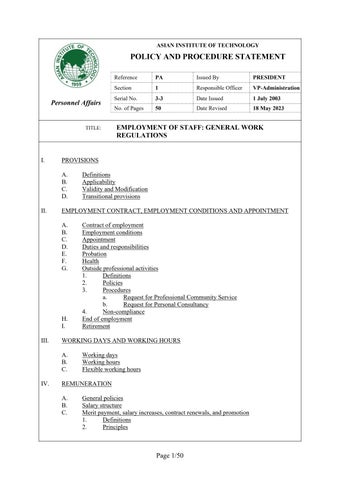
ASIAN INSTITUTE OF TECHNOLOGY POLICY AND PROCEDURE STATEMENT
Reference PA
Section 1
Serial No. 3-3
No. of Pages 50
Issued By PRESIDENT
Responsible Officer VP-Administration
Date Issued 1 July 2003
Date Revised 18 May 2023
TITLE: EMPLOYMENT OF STAFF: GENERAL WORK REGULATIONS
I. PROVISIONS
A. Definitions
B. Applicability
C. Validity and Modification
D. Transitional provisions
II. EMPLOYMENT CONTRACT, EMPLOYMENT CONDITIONS AND APPOINTMENT
A. Contract of employment
B. Employment conditions
C. Appointment
D. Duties and responsibilities
E. Probation
F. Health
G. Outside professional activities
1. Definitions
2. Policies
3. Procedures
a. Request for Professional Community Service
b. Request for Personal Consultancy
4. Non-compliance
H. End of employment
I. Retirement
III. WORKING DAYS AND WORKING HOURS
A. Working days
B. Working hours
C. Flexible working hours
IV. REMUNERATION
A. General policies
B. Salary structure
C. Merit payment, salary increases, contract renewals, and promotion
1. Definitions
2. Principles
D. Contract renewal
E. Promotion
F. Reclassification
G. Compensation for overtime
1. Principles 2. Rates
V. BENEFITS AND WELFARE
A. Start-of-contract and end-of-contract benefits
B. Travel grants
C. Settlement grant
D. Re-settlement grant
E. Child allowances
F. Education assistance
G. Scholarship grant
H. Funeral grant
I. Late-night shift allowance
J. Medical benefits
K. Provident Fund
L. Social Security Fund
M. Transportation services
N. Uniforms
O. Workmen’s compensation
P. Life insurance
VI. LEAVE
A. General principles
B. Annual leave
C. Leave for Professional Activities Outside AIT
D. Parental leave
1. Definition
2. Maternity leave
3. Partner leave
4. Adoption Leave
5. Notice of Leave
E. Religious leave
F. Leave for military service
G. Sick leave
1. General policies
2. Extended sick leave
H. Compassionate leave
I. Compensatory leave
J. Leave for sterilization
K. Leave without pay
VII. OFFICIAL PUBLIC HOLIDAYS
VIII. PERFORMANCE MANAGEMENT AND PERFORMANCE APPRAISAL
A. Performance management
B. Performance appraisal
1. Principles
2. Criteria and ratings
IX. CAREER DEVELOPMENT AND STAFF TRAINING
A. Career development
B. Staff development and training
X. DISCIPLINARY PROCESS
A. General policies
B. Minor offence
C. Serious offence
D. Process
1. Initiating disciplinary process
2. Disciplinary committee
3. Process
4. Right of appeal
E. Files
XI. TERMINATION OF EMPLOYMENT
A. General provisions
B. Voluntary resignation
C. Involuntary termination
XII. STAFF MEMBERS EMPLOYED AS FIXED-TERM CONTRACT WORK PROVIDERS
A. Terms and conditions
B. Salary and salary adjustment
C. Annual leave
D. Termination of Employment
XIII. ANNEXES
1: Salary Scale
2: Salary Increases
A. General
B. Distribution of salary increases and promotions
3: Minimum contractual medical benefits
4: Maternity benefits
5: Outside professional activities
Form A: Professional Community Service Approval Form Form B: Personal Consultancy Approval Form
I. GENERAL PROVISIONS
A. Definitions
1. In this Policy & Procedure Statement on Employment of Staff: General Work Regulations (PA-1-3-3), the following definitions are adopted:
2. A staff member of the Asian Institute of Technology (“the Institute”) is a person who is employed full-time, either on a permanent basis or on a contract renewable basis, and who does not hold the status of a faculty member.
3. Afacultymemberisapersonwhoisemployedfull-timebytheInstitute to carry out teaching, research, and community service, and holds an academic rank. Faculty members at AIT are all full-time Professors, Associate Professors, Assistant Professors and Lecturers, and full-time visiting faculty with a period of appointment of not less than one year.
4. A Unit Head is a Dean, the Executive Director or Director of a Responsibility or Service Center.
5. A unit is a School, a Responsibility Center, or a Service Center
6. A supervisor refers to an employee’s immediate supervisor.
7. The Human Resources Office is the unit responsible for overseeing implementation of HR policy and procedures, and ensuring compliance with all P&Ps of the Institute.
8. Disciplinary process is initiated by a supervisor in the event of a suspected serious offence by an employee.
B. Applicability
1. ThisPolicy&Procedure(P&P)Statementisapplicableto alldirect-hire, full-time staff members of the Institute employed on a contract renewable basis.
2. This P&P Statement is also applicable to staff members of the Institute based outside Thailand, unless specified otherwise in their contracts of employment.
3. With the exceptions noted in Section XII, this P&P Statement is also applicable to staff members of the Institute employed on fixed-term contracts.
4. This P&P Statement does not govern the employment of staff members employed on a permanent basis, whose contracts are governed by
principles and conditions specified in the P&P Statement Terms and Conditions of Employment of Permanent Employees.
C. Validity and Modification
1. This P&P Statement governs the terms and conditions of employment for new appointments of staff members after 1 July 2009, and for all contracts renewed on or after that date.
2. All benefits accumulated from periods of employment under staff members’ previous contracts of employment, including the accumulated tax-paid Institute contribution to the Insured Savings Fund (ISF) and accumulated annual leave, as of the contract renewal date, are retained.
3. The terms and conditions of employment defined in this P&P Statement are consistent with and in compliance with all relevant labor laws of Thailand
4. This P&P Statement may be changed, revised, or cancelled, partly or wholly, at the discretion of the Institute, in order to ensure that the Institute is in compliance with both local labor laws and general international practices, and to better align terms and conditions of employment with the Institute’s activities and operations.
5. Unless specified otherwise, and except as referred to specifically herein, this P&P Statement supersedes all previous P&P Statements governing the General Work Regulations of staff members of the Institute
D. Transitional provisions
1. This P&P Statement takes effect on 1 July 2009 for all staff appointed or re-appointed on that date or later.
2. This P&P Statement takes effect on 1 July 2009 for all staff appointed before 1 July 2009, unless a staff member chooses explicitly to opt out.
3. A staff member may opt out of the provisions of this revised P&P Statement until the end of his/her present contract.
4. A staff member who chooses to opt out of the provisions of this revised P&P Statement under item 3 above must contact OHRS in writing stating that they wish to opt out of the provisions of P&P Statement PA1-3-3 until the end of their present contract.
5. A staff member who opts out will continue to work on a contract governed by the P&P Statement governing the General Work Regulations applicable on the date on which the staff member’s present contract of employment was signed.
II. EMPLOYMENT CONTRACT, EMPLOYMENT CONDITIONS AND APPOINTMENT
A. Contract of employment
1. The contract of employment is between the Institute and the staff member.
2. A contract of employment is for a specified period only, with the possibility of renewal.
3. The contract of employment specifies the following:
a. The starting date of the contract;
b. The duration of employment;
c. The probationary period, if required;
d. The position and the unit to which a staff member will be assigned at the start of employment;
e. Remuneration and benefits;
f. Responsibility for payment of personal income tax to the Royal Thai Government; and
g. Any specific conditions which the Institute wishes to apply to a contract.
B. Employment conditions
1. At the start of employment, the staff member is entitled to receive a full orientation.
2. Orientation covers
a. An introduction to the Institute, its mission, vision and strategy
b. Terms and conditions of employment, as specified in this P&P Statement and related P&Ps
c. The unit in which he/she works: its function within the Institute, specific standard operating procedures and work requirements, and
d. His/her own position, line management, job expectations, standards and key performance indicators (KPIs)
3. The Institute counts the days of employment as from the first day that the staff member reports to work.
4. The Institute may assign a staff member to work in a unit different to the unit in which he/she was initially employed by the Institute, may change the responsibilities of the staff, or may change the place of work of a staff member, as the Institute deems appropriate.
5. A staff member should, within one week of any change, inform the Office of Human Resources Services (OHRS) of any change in his/her
a. Name
b. Surname
c. Address
d. Children and other dependents
e. Marital status, or
f. Next of kin
C. Appointment
1. A contract of staff employment is for a normal duration of two calendar years.
2. A staff member can be appointed and re-appointed/renewed for a period not exceeding two calendar years in each instance with the employment contract ending on 31 December
3. For initial appointment, as well as re-appointments/renewals made from 16 August 2013 onwards, employment contracts of staff members are made until 31 December of the following year.
4. Succeeding re-appointments/renewals will be for a normal duration of two calendar years, i.e. from 1 January to 31 December, unless specified otherwise.
NOTE: Terms and conditions of employment of staff members employed on fixed-term contracts, who are mainly paid from Fund 30 projects, are stipulated in Section XII. below. A fixed-term contract work provider is employed and assigned to work at the Institute for a specified and/or limited period of time only, normally less than two calendar years subject to availability of funds. Employment of a fixed-term contract work provider terminates at the end of the contract or when funds for the contract are terminated.
5. Contract renewal is subject to fund availability and satisfactory performance.
6. Unless specified otherwise in the individual letter of appointment, at least six months before the end of a staff member’s contract of employment, the Institute may offer to renew the contract of employment for a further specified period.
D. Duties and responsibilities
1. A staff member works full-time for the Institute
2. A staff member is responsible to his/her Unit Head and his/her line manager in the performance of duties.
3. A staff member may undertake work for other units at AIT, when specifically approved by his/her Unit Head.
4. Upon provision of a rationale, and provided primary duties and responsibilities are satisfactorily carried out, a staff member is allowed to be involved in revenue-generating Institute activities, such as sponsored/contracted projects and academic programs under Fund 30, up to 20% of his/her full-time employment or 2.4 man-months per year. The cost of the staff member’s time spent on a project should be recovered back to the staff member’s unit or responsibility center (payroll recovery). The staff member can earn direct incentives (‘honoraria’) from approved revenue-generating activities up to 50% of the payroll recovery.
E.
Probation
1. When appointed to his/her first position at the Institute, a staff member may be placed on probation for a period no longer than three calendar months.
2. During the probationary period, the supervisor must carefully assess the performance of the staff member on probation.
3. If the supervisor assesses the performance of the staff member on probationtobe‘meets expectations’(seeVIII.B),thesupervisorinforms the Office of Human Resources Services (OHRS), which will confirm the staff member’s contract in writing.
4. If the supervisor assesses the performance of a staff member on probation to be ‘does not meet expectations’ or ‘unsatisfactory’, the Institute reserves the right either to extend probation by a further period of up to three calendar months or to terminate the contract of employment.
5. In the case of termination at the end of probation, no end-of-contract benefits will be provided.
F. Health
1. All staff members are expected to be physically fit and in good health.
2. Renewal of contract is dependent upon a staff member having taken all reasonablestepsto ensurethathe/sheisphysicallyfitandingoodhealth.
3. A staff member may at any time be required to undergo a medical examination by a doctor nominated by the Institute
4. Sick leave entitlements are given in VI.G.
G. Outside professional activities
1. Definitions
a. Professional Community Service covers professional activities that are performed for professional societies, governments and industry committees, and review boards and panels; or for other educational institutions (where there is no written agreement between AIT and the institution), and for which compensation is normally incidental.
b. Personal Consultancy covers professional activities that are not conducted under the aegis of the Institute and that do not entail use of the Institute’s facilities, procedures and processes over which the Institute holds proprietary rights.
2. Policies
a. Conduct of outside professional activities is a privilege, not a right.
b. This privilege will not be extended to a staff member whose employment contract contains prohibitions or restrictions on outside professional activities.
c. Outside professional activities may be approved and authorized if the proposed activities are
i. within the staff member’s area of expertise ii. afford opportunities for individual professional development, learning and experience, and iii. are not in conflict with the interests of the Institute
d. A staff member may undertake outside professional activities with the specific approval of his/her Unit Head. Staff members must keep their Unit Heads informed about all outside professional activities.
e. When approving outside professional activities, the Unit Head must take all necessary steps to ensure that the outside activities will not adversely affect the staff member’s performance of duties under his/her contract of employment.
f. Staff members should not commit the Institute in any contractual manner in the conduct of their outside professional activities.
g. Out of respect for the visa privileges granted to the Institute by the host country, expatriate staff members should not engage in outside professional activities, especially Personal Consultancy and other paid services, unless sanctioned by AIT
h. A staff member engaged in Personal Consultancy shall be responsible for notifying the client that he/she is working in a purely personal capacity and not as an employee or representative of the Institute
i. A staff member engaged in Personal Consultancy shall be responsible for his/her own professional indemnity and liability insurance. The Institute will not defend a staff member in the event of a claim against him/her by the client.
j. A staff member must not use Institute premises, equipment, facilities and working time for paid or unpaid work that is not the business of the Institute.
k. Outside professional activities may be approved and authorized if the proposed activities are not in conflict with the interests of the Institute
l. The Institute requires all staff members to declare all income from work undertaken outside the Institute (see Annex 5).
m. Staff members should avoid ethical and legal conflicts of interest.
i. The Institute expects that all staff members will conduct their outside professional activities in a manner which reflects professional credit on themselves and enhance the image of the Institute.
ii. Staff members should be careful to avoid identifying the Institute with opinions or conclusions in public or private reports or in other ways.
iii. AIT’s image or brand should not be associated with commercial interests in the public eye. The AIT letterhead and logo should not be used in conjunction with Personal Consultancy.
iv. The primary loyalty of staff members should at all times be to the Institute. Direct and active management obligations in outside business entities or teaching in an educational institution other than AIT except when beneficial to AIT formalized by a written agreement between AIT and the institution, are considered
3. Procedures
incompatible with a staff member’s meeting the full range of his or her obligations to the Institute
a. Request for Professional Community Service
i. Staff members who wish to undertake Professional Community Service must complete a form (Annex 5, Form A) and submit to the Unit Head for approval.
ii. Special approval must be sought from the President in case the request requires institutional agreement, i.e. for service in other educational institutions.
b. Request for Personal Consultancy
Staff members who wish to undertake Personal Consultancy must complete a form (Annex 5, Form B) and submit to the Unit Head for approval.
c. Non-compliance
The Unit Head is authorized to initiate disciplinary action (see Section X) against a staff member who
i. is absent without leave
ii. usesInstitutepremises,equipment,facilitiesandworking time for non-Institute activities without prior authorization by the Institute, or
iii. fails to declare income from authorized or unauthorized outside professional activities.
H. End of employment
1. All contracts of employment of staff members at AIT terminate no later than 31 December of the year in which the staff member reaches sixty years of age.
2. The Institute must inform a staff member in writing at least six months in advance of the end of his/her employment with the Institute.
I. Retirement
1. The retirement age for AIT employees is 60 years old.
2. Staff members shall retire not later than December 31 in the year of their 60th birthday.
III. WORKING DAYS AND WORKING HOURS
A. Working days
1. The normal working days of the Institute are Monday to Friday.
2. Staff members on 40-hour contracts normally work from Monday to Friday. Staff members on 48-hour contracts normally work from Monday to Saturday.
B. Working hours
1. The office hours of the Institute are from 0730 to 1630 hours from Monday to Friday.
2. Excluding lunch breaks, the working day for all staff members of the Institute is eight hours long.
3. The lunch break for staff is for a period of not more than one hour, to be taken between 1100 and 1400 hours.
4. A staff member is obliged to follow the schedule of working hours assigned by the unit to which he/she is assigned, in which the hours of work and rest time are specified.
C. Flexible working hours
1. Some units operate for longer periods of time daily, during Saturday and Sunday, and during public holidays.
2. Flexible working hours for some staff members enable the Institute to absorb fluctuations in workload, to provide effective and efficient services to students, to maximize the utilization of facilities, and to accommodate individual life styles of staff members.
3. A staff member may adopt flexible working hours under the following conditions:
a. When the Institute requires a staff member to work regularly outside normal working hours, his/her supervisor must first discuss the hours to be worked with the staff member.
b. The hours to be worked must next be confirmed explicitly in a memorandum from the supervisor to the staff member, with a copy to the Office of Human Resources Services.
c. The working hours per week agreed with the staff member must be equal to the number of hours specified in the staff member’s contract of employment.
d. The nature of a unit’s work is the most important factor in determining which units apply flexible working hours for their staff.
e. The Unit Head is responsible for ensuring the quality of the unit’sperformance,basedonKeyPerformanceIndicators(KPIs) defined and agreed with his/her line manager.
IV. REMUNERATION
A. General policies
1. The Institute’s remuneration system is designed to
a. attract the best talent available in the market
b. retain high performing staff by rewarding outstanding performance and performance that exceeds expectations
c. motivate staff to excel, and
d. encourage and reward innovation.
2. The Institute’s remuneration package is benchmarked against and competitive with comparator organizations.
3. All emoluments, incentives, honoraria, benefits and other earnings of all staff members are compiled and made available by OHRS
4. All emoluments, incentives, honoraria, benefits and other earnings paid by the Institute are subject to income tax under Thai law.
5. Salary is paid monthly, normally two full working days before the end of the calendar month.
6. The Institute calculates annually a Cost of Living Adjustment (CoLA), based on the Consumer Price Index published by the Ministry of Commerce of the Royal Thai Government, and approved by the Executive Committee.
7. Thebasesalarystructureisreviewedannually.Thereviewtakesaccount of
a. the availability of funds
b. approved CoLA, and
c. the competitiveness of the Institute’s total remuneration package.
8. All merit payments and salary increases (see IV.C below), not including CoLA, are merit-based.
B. Salary structure
1. A staff member’s salary comprises a base salary and a performancerelated component.
2. The Institute may adjust the level of contractual remuneration for performance without changing the base entitlement.
3. Thesalarystructure forAIT staffmemberscomprises Levels IIto X(see Annex 1).
4. Each Level comprises 12 steps. All salaries of staff members at a given Level will be within a step of a given Level.
5. A staff member’s salary at start of employment, with no experience in the position for which she/she is recruited to, will normally be at step 1
6. For any recruited staff member with some experience in the position for which he/she is recruited to, his/her salary will be at a step comparable with AIT staff members with similar years of experience in the same position
7. A staff member cannot earn more than the maximum salary payable to staff members at his/her Level and category
C. Merit payment, salary increases, contract renewals, and promotion
1. Definitions
a. A merit payment is a one-time payment to a staff member in recognition of ‘outstanding’ performance or performance that ‘exceeds expectations’ during one calendar year. A merit payment does not accrue to the base salary.
b. Merit payments are linked directly to Institute performance, and are payable from units’ contributions to the Institute and unit’s reserve fund. Merit payments will only be made when the Institute achieves its surplus target for that year.
c. Each Responsibility Center (RC) will propose an allocation scheme rewarding [1] members of the team for achieving unit targets, and [2] individuals for outstanding performance and performance that exceeds expectations.
d. A salary increase is a percentage increase in base salary (see Annex 2), subject to the maximum salary payable to staff members at his/her Level and category. A salary increase is not automatic. A salary increase reflects performance that ‘exceeds expectations’ or ‘meets expectations’ over the appraisal year
Subject to the Institute’s financial performance, a staff member is eligible to receive a salary increase every year
e. A promotion is a change in position title, and an increase in Level. A promotion reflects a recognition of realized and potential professional development, and is based only on merit.
f. A contract renewal requires performance that ‘meets expectations’ of the appraisal periods prior to the date of renewal. A staff member whose performance is rated ‘unsatisfactory’ or ‘does not meet expectations’ for two successive appraisal periods will not be renewed.
2. Principles
a. The Executive Committee sets norms for merit payments, salary increases, and promotion of staff members; OHRS is responsible for communicating these to staff, and for publishing details of unit performance.
b. As a working principle, decisions concerning performance, compensation, incentives, rewards and sanctions are the responsibility of the unit.
c. In determining merit payments, salary increases, and promotion of staff members, the Unit Head is required to take into consideration
i. The performance of the Institute ii. The performance of the unit
iii. Individual staff members’ performance appraisal results iv. Availability of funds, and
v. The unit’s confirmed budget for the forthcoming year.
d. When a unit exceeds performance goals, the Unit Head is responsible for determination of merit payments, step increases, and promotion of staff members in his/her unit.
e. When a unit meets but does not exceed performance goals, merit payments, step increases, and promotion of staff members must conform to the Institute norms, as defined by OHRS.
f. When a unit fails to meet performance goals, merit payments cannot be considered. Salary increases, and promotion of staff members must be fully justified in writing, in a memorandum from the Unit Head, and can only be approved by the President.
3. Policies
a. Review for salary increase within a position will be made every year for all positions.
D. Contract renewal
1. Contract renewal is initiated by OHRS at least seven months before the present contract expires.
2. A decision to renew or not to renew a staff member’s contract must be taken at least six months in advance (see II.C.6.).
E. Promotion
1. When a staff member is promoted to a position at a higher Level, the previous contract of employment ends and a new contract of employment must be signed.
2. The performance of a promoted staff member will be assessed through the normal process of performance appraisal. A period of probation will not normally be applied.
F. Reclassification
1. The Institute reserves the right to reclassify a staff member’s position.
2. Reclassification may only be carried out at contract renewal.
3. When a staff member’s position is reclassified, his/her salary will be adjusted into line with his/her peers with the same position classification.
4. The staff member’s new salary must not exceed the maximum base salary for the new Level or category.
G. Compensation for overtime
1. Principles
a. Where a staff member routinely works outside the normal Institute working hours, flexible working hours (see III.C) will be applied.
b. The Institute only approves payment for overtime work for exceptional, irregular, or unusual work.
c. In exceptional circumstances, a staff member may be required by his/her supervisor to work outside his/her agreed working hours in order to ensure that operations continue.
d. A staff member hired at Level VI or higher and whose monthly salary is higher than THB-40,000 is not entitled to receive payment for overtime work.
e. Staff members are eligible for and entitled to apply for compensatory leave (VI.I) in lieu of overtime work on weekends and public holidays, and at the discretion of the unit head, for evening work.
2. Rates
a. Astaffmemberrequiredto work longer thanthenormal working hours, or during a public holiday, is entitled to overtime pay up to 20 hours per week at the following rates:
i. A staff member working in excess of the normal working hours on any regular working day – 1.5 times his/her normal pay for the number of hours worked;
ii. A staff member working on any official holiday up to the normal working hours – 1.5 times his/her normal pay for the number of hours worked;
iii. A staff member working in excess of the normal working hoursonanyofficialholiday–3timeshis/hernormalpay for the number of hours worked.
b. Thehourlyrateforstaffmembersworking onapprovedovertime is calculated by dividing the monthly salary by 192 for those on 48 hours/week appointments, and by 160 for those on 40 hours/week appointments.
c. Where there is no budget provision for payment of overtime pay, a staff member can instead be advised to take compensatory leave.
V. BENEFITS AND WELFARE
In all sections, ‘dependents’ means legal spouse and children under the age of 18.
A. Start-of-contract and end-of-contract benefits (These benefits are also applicable to fixed-term contracted work providers.)
1. ‘Start-of-contract and end-of-contract benefits’ mean travel grants, settlement allowances and resettlement allowances.
2. A staff member hired at Level VIII or higher is entitled to additional benefits to facilitate relocation to Thailand at the start of contract, and travel out of Thailand at end-of-contract.
3. Start-of-contract and end-of-contract benefits are only payable to a staff member appointed on a contract of two or more years and residing outside Thailand
4. Start-of-contractandend-of-contractbenefitsareprovidedonlytoastaff member and his/her dependents who remain at AIT for at least the first 2-year (or longer) contract period.
5. In case of non-observation of the provision in 4.above, the staff member must reimburse the grant to the Institute, unless this provision is expressly waived by the President.
B. Travel grants
1. A staff member hired at Level VIII or higher, on a contract of two or more years and residing outside Thailand, is provided with a one-way air ticket from point-of-origin to Bangkok (or one’s primary place of duty outside Thailand) at the beginning of employment, and a one-way ticket from Bangkok (or one’s primary place of duty outside Thailand) to point-of-origin at the end of employment.
2. Point-of-origin in this document means the place where the staff member comes from, i.e. either from his/her most recent residence from where he/she was recruited from or from his/her home country, whichever is nearer to/from Bangkok (or one’s primary place of duty outside Thailand).
3. The air ticket is restricted to the most direct route on economy class
4. If the newly appointed staff member prefers to buy the air ticket himself/herself, he/she is reimbursed the actual cost paid or the cost of a similar ticket as determined by the Office of Procurement, Inventory & Assets (OPIA) of AIT, whichever is less. Newly appointed staff members are advised to check with OPIA of AIT before deciding to buy an air ticket.
5. The spouse and dependent children under 18 years of age residing with the newly appointed staff member at the same point-of-origin are entitled to equivalent air tickets usable within six (6) months of the newly appointed staff member’s start of contract.
6. At the end of employment, the staff member may wish to go to a destination other than his/her point-of-origin. In such case, the staff member must pay any difference in the cost of the ticket requested and the ticket to which he/she is entitled. Where the ticket requested costs less than the ticket to which he/she is entitled, the staff member is not entitled to receive cash for the difference.
7. Travel grants are paid only once at the beginning and once at the end of a period of continuous service, regardless of the number of contract renewals involved.
8. AIT will not provide initial and final travel grants to a staff member who is eligible for such a benefit from another organization.
C. Settlement grant
1. A staff member hired at Level VIII or higher, on a contract of two or more years and residing outside Thailand, is eligible to receive a settlement grant to defray the costs of relocating to Thailand (or to one’s primary place of duty outside Thailand).
2. The costs of shipping, custom clearances and temporary lodging are to be met by the staff member from the settlement grant.
3. The newly appointed staff member will be reimbursed the actual costs of relocating to Thailand up to (not to exceed) 10% of his/her annual salary, plus 1% of his/her annual salary for each dependent authorized a travel grant.
4. Where both husband and wife are eligible for settlement grants for spouse and dependents, only one may apply for these benefits.
D. Re-settlement grant
1. A staff member hired at Level VIII or higher, who has completed a contract of two years or longer period of service, is eligible to receive a re-settlement grant to defray the costs of relocating away from Thailand
2. The costs of shipping and custom clearances are to be met by the staff member from the re-settlement grant.
3. The staff member will be reimbursed the actual costs of relocating away from Thailand up to (not to exceed) 10% of his/her annual salary, plus 1% of his/her annual salary for each dependent authorized a travel grant.
4. Where both husband and wife are eligible for re-settlement grants for spouse and dependents, only one may apply for these benefits.
E. Child allowances
1. The Institute will grant a child allowance for a staff member at a rate of THB-100 per month per child under 18 years of age.
2. When both parents are eligible, only one child allowance per child is permissible.
F. Education assistance
1. A staff member with a contract of employment of one year or more is entitled to receive assistance with fees for the education of up to two (2) dependent children during the regular academic calendar The assistance is limited up to (not beyond) high school education.
2. Where both parents are eligible, only one parent per child may apply.
3. For children studying in the AIT International School, AIT subsidizes the full tuition fee by 75%.
4. For children studying at another school at grades offered by the AIT International School, AIT provides a subsidy equal to 75% of the tuition fees of that school, or 75% of tuition fees of the AIT International School, whichever is lower.
5. When the child enters a grade not offered by the AIT International School, the education subsidy is 75% of total tuition and fees of that school or twice the maximum tuition fees of the AIT International School, whichever is lower. Fees that are directly related to the education of the student are covered excluding meals, uniforms, transport, utility, building/asset/campus development, general fees, insurance and similar asset-related fees like laptops and other electronic devices.
6. Children of current AIT regular employees, who are employed with AIT for at least five (5) years, will be provided 25% discount on tuition fees (on top of other merit fellowships) of AIT’s masters or doctoral degree programs.
G. Funeral grant
In the case of the death of a staff member, the Institute provides a funeral grant of THB-50,000 to the staff member’s next-of-kin, i.e. an employee’s closest living relative
H. Late-night shift allowance
1. Alate-night shift allowanceis paid to astaffmemberwhosenormal shift is rescheduled to fall between 2300 and 0700 hours.
2. The allowance is THB-200 per night in addition to the normal payment.
I. Medical benefits
1. Astaffmemberis eligibleto receivebenefits from themedical insurance plan from the first date of employment. The minimum entitlement is shown in Annex 3.
2. The medical insurance plan must be provided by a legal provider of insurance under Thai law.
3. This medical insurance plan also covers a staff member’s legal spouse and dependent children under 18 years of age.
4. A staff member is entitled to claim maternity benefits from the first date of employment. Maternity benefits (see Annex 4) are provided to staff members.
J. Provident Fund
1. A staff member on a contract of one year or more is required to apply to become a member of the Institute’s Provident Fund.
2. A staff member contributes each month an amount that can be more than the contribution by the Institute to the Provident Fund but not more than 15% of the staff member’s base salary.
3. The Institute is required to contribute to the Provident Fund each month a sum equal to at least 5% but not more than 10% of the staff member’s salary.
NOTE: From 1 July 2016, the Institute increased the employer’s Provident Fund contribution from 5% to 5%, 6%, and 7%, respectively, for the 2nd-4th years of service, for the 5th-10th years of service, and for the 11th year onward until retirement.
4. Whileastaffmemberisonleaveofabsencewithoutpay,nocontribution is paid to the fund by the Institute. To maintain payments to the Provident Fund, a staff member may opt to continue both the staff member’s and the Institute’s contributions. Alternatively, the normal contributions can be resumed when the staff member returns to work.
K. Social Security Fund
All staff members must join the Thai Social Security Fund, under the Social Security Law of Thailand. Current contributions are automatically deducted from the salary and are matched by the Institute.
L. Transportation services
NOTE: The Institute provides transportation service for staff with permanent contract in air-conditioned buses or vans routed to different parts of the Bangkok Metropolitan area.
1. Subject to availability of seats for each route, a staff member may apply at the Office of Human Resources Services to use this service. A monthly fee to cover the actual costs is charged for this service.
2. Subject to availability of seats, non-members can use this service and will be charged the actual cost per trip.
3. A staff member who wishes to stop using the bus service, either temporarily or permanently, must inform the Office of Human Resources Services in advance, otherwise the usual fee will be charged.
M. Uniforms
1. Staff members of certain units may be required to wear uniforms depending on the nature of the job.
2. If a staff member is required to wear a uniform, the uniform is provided by the Institute.
N. Workmen’s Compensation
1. The Institute provides Workmen’s Compensation insurance policy for staff members, in line with benefits under the Labor Protection Law of Thailand
2. The Workmen’s Compensation insurance policy covers all staff members who are injured or fall sick in the course of their work.
O. Life insurance
1. The Institute will provide life insurance for all direct-hire, full-time staff members of the Institute employed with a contract of at least one year on a renewable basis.
2. Normally, the value of life insurance is computed at 24 times the monthly salary.
VI. LEAVE
A. General principles
1. The Institute provides staff members with flexible arrangements needed to enable paid and unpaid absences that support the personal needs of staff and the operational requirements of the Institute
2. All paid absences count as service for all purposes.
3. Staff members must obtain prior approval for all absences, with the exception of sick leave.
4. All leavemust betaken at atimeagreedby thestaff memberwith his/her supervisor, and with due consideration to the operational requirements of the unit.
5. The only exceptions to the general principle in item 4. above are sick leave (VI.G), compassionate leave (VI.H), and when circumstances make it unreasonable for the Institute to prevent a staff member from being absent.
6. For all leave of absence, especially for periods of one week or longer, a staff member must give sufficient notice to permit consideration of his/her application, and if approved, to permit alternative arrangements to be made for his/her duties to be carried out.
7. Where a staff member is absent without having obtained prior approval, the Institute will cease paying the staff member’s salary for the duration of the absence. If the unapproved absence is for an extended period, the Institute is entitled to assume that the staff member has abandoned his/her employment, and to take steps to terminate his/her employment.
8. All leave of absence (except leave without pay) is granted with pay to a staff member, without loss of any status, remuneration or benefits.
9. A staff member taking any type of leave with pay retains all contractual entitlements during the leave period. When leave is taken without pay, no such entitlement accrues.
B. Annual leave
1. Annual leave is a benefit to both the Institute and to its staff and, in the interests of both parties, should be taken regularly.
2. A staff member is entitled to two (2) days of annual leave per month of service.
3. A staff member may accumulate up to 36 working days of annual leave.
C.
4. A staff member can use his/her entitled annual leave in the first year of employment only after completing any probation period.
5. Payment in lieu of annual leave on termination of employment
a. Upon termination of employment, a staff member is entitled to receive payment in lieu of accumulated annual leave.
b. Payment in lieu of accumulated annual leave cannot exceed a sum equivalent to one month’s salary.
c. For calculating payment in lieu of annual leave, one month’s salary is payable for 22 days of accumulated annual leave.
d. When a staff member has worked for two or more units at AIT, the amount paid in lieu of annual leave is allocated proportionately to the units served.
Leave for Professional Activities Outside AIT
A staff member seeking to engage in professional activities outside AIT shall obtain permission from his/her Unit Head. The Unit Head shall not grant permission for engagement in activities which are in conflict with the interests of the Institute (see II.G. above).
D. Parental leave
1. Definition
a. ‘Parental Leave’ refers to ‘maternity leave’, ‘partner leave’ and ‘adoption leave’.
b. Where the policy is specific to one or two of these categories of leave, the specific category name is used.
c. ‘Partner’ means a staff member’s partner in marriage or a person of the opposite or same sex to the staff member who lives with the staff member in a marriage-like relationship, although not legally married to the staff member.
2. Maternity leave
a. A staff member who becomes pregnant may apply to take maternity leave and will be entitled to 50 calendar days leave on full pay. The staff member may supplement maternity leave by taking annual leave, and leave without pay.
b. The total leave taken will not exceed an aggregate of 100 calendar days.
c. To be entitled to paid maternity leave, the paid leave must be commenced:
i. not earlier than the 34th week of pregnancy; and ii. not later than the birth of the child.
d. This period of paid leave includes any public holidays or Institute holidays falling during that period.
e. Paid maternity leave should be taken before unpaid maternity leave.
3. Partner leave
Where a staff member is not the primary carer, but shares parenting responsibility of the child or children, he/she is entitled to five working days of paid partner leave with respect to the birth of a child or children, provided that:
a. the leave is taken in the period one week before and four weeks after the child’s birth or adoption, and
b. the staff member produces documentation of the child’s birth to the Institute
4. Adoption Leave
a. A staff member who adopts a child and is the primary care giver of the child may apply for adoption leave and will be entitled to:
i. 50 calendar days leave on full pay where the adopted child is up to one year of age, plus leave without pay; or
ii. 25 calendar days on full pay where the child is older than one year of age, plus leave without pay.
iii. The total leave taken will not exceed an aggregate of 100 calendar days.
b. The entitlement to paid leave commences immediately after placement of the child with the adoptive parents.
c. Wherethestaffmemberisnottheprimarycaregiverofthechild, the entitlement shall be five working days’ paid leave.
d. Where more than one child is adopted, and adoption of one is within ayearofanother,theleave entitlement willbedetermined by the President.
5. Notice of Leave
a. A staff member must provide notice to the Institute six weeks in advance of the start of the commencement of the requested parental leave.
b. Notice of leave must be accompanied by a certificate from a registered medical practitioner stating that the staff member or staff member’s partner is pregnant.
E. Religious leave
1. A staff member who has worked for the Institute for a continuous period of at least two years may be granted religious leave.
2. Religious leave will be charged to accumulated annual leave. If that entitlement is insufficient, the staff member is entitled to up to 90 calendar days additional leave on half-pay.
3. To apply for religious leave, a staff member must submit a certificate or certified document from the monastery or other religious authority concerned. Prior approval from the immediate supervisor and endorsementfromtheOfficeofHumanResources Servicesarerequired.
4. Astaffmembermust providenoticeto the Institute six weeks in advance of the start of the commencement of the requested religious leave.
5. A staff member is entitled to religious leave once only during his/her service at the Institute
F. Leave for military service
1. A staff member is entitled to leave with pay for a period of up to 60 days for military service, call for inspection, military training or preparatory test.
2. A staff member is entitled to leave for military service once only during his/her service at the Institute.
3. On completion of the military training, a staff member is required to report to the immediate supervisor with an official completion military service certificate.
4. If a staff member does not return to work within five working days of completion of the military service, his/her position may be declared vacant.
G. Sick leave
1. General policies
a. A staff member is entitled to 30 days of sick leave per year from the beginning of employment. Sick leave days are counted on a calendar year basis.
b. In the first year and final year of employment, sick leave days are calculated proportionately at the rate of 2.5 days per month of service.
c. Payment in lieu of unused sick leave is not permitted.
d. If a staff member is absent for three consecutive working days or more, a medical certificate from a registered medical doctor is required.
e. Should a staff member fail to provide a valid medical certificate after an absence of three days or more, the leave will be considered as leave without pay, and the staff member may be subjected to disciplinary action.
f. A staff member who takes sick leave must notify his/her supervisoras soon as possible, and must submit theleaverequest to his/her supervisor for approval on the day he/she returns to work.
g. On the recommendation of a medical authority, a staff member with a contagious disease will be required to go on sick leave.
2. Extended sick leave
a. A staff member may take extended sick leave after all accumulated sick leave entitlement, and all accumulated annual leave entitlement has been used.
b. Ifastaffmember’s sickleaveentitlementhas been used, thestaff member’s annual leave will be used.
c. After all sick leave and annual leave entitlements have been used, and if the staff member is still incapacitated, the Institute may approve further sick leave at half pay for a period not exceeding three calendar months.
d. When sick leave approved under item c. above is finished, the staff member’s supervisor may suspend the staff member’s contract without pay for a specific period of time.
e. If at the end of the period of time specified under item d. above the staff member remains incapacitated, the Institute reserves the right to terminate the contract of employment with immediate effect.
H. Compassionate leave
1. Compassionate leave is paid leave taken by an employee:
a. for the purpose of spending time with a person who:
i. is a member of the employee’s immediate family; and
ii. hasapersonalillness,orinjury,thatposesaseriousthreat to his or her life; or
b. after the death of a member of the employee’s immediate family.
2. ‘Immediate family’ includes a spouse or partner, child (including adult child, adopted child and step child), parent, step-parent, sibling, stepsibling, grandchild, grandparent, or in-law.
3. Compassionate leave will be charged to accumulated annual leave.
4. Further leave beyond accumulated annual leave may be granted at the discretion of the employee’s immediate supervisor.
I. Compensatory leave
1. All staff members are eligible for and entitled to apply for compensatory leave in lieu of overtime work on weekends and public holidays.
2. Compensatoryleave must beapprovedin advance bythestaffmember’s supervisor, and must be taken within a week of the overtime work compensated for.
3. Compensatory leave accumulates at the following rates:
a. For a staff member working overtime on a Saturday or a Sunday – one day of compensatory leave for each full day worked (a full day is eight hours);
b. For a staff member working overtime on part of a Saturday or a Sunday – one hour of compensatory leave for each hour worked;
c. For a staff member working overtime on an official public holiday – two days compensatory leave for each full day worked (a full day is eight hours);
d. Forastaffmemberworkingovertimeon partofan officialpublic holiday – two hours of compensatory leave for each hour worked.
J. Leave for sterilization
1. A staff member is entitled to take leave with pay for sterilization.
2. The period of leave is as advised by a registered doctor.
K. Leave without pay
1. Requests for staff development leave or for annual, sick or maternity leave beyond the entitlements specified in this P&P Statement may be approved as leave without pay.
2. Leave without pay cannot be extended beyond the period of contract.
VII. OFFICIAL PUBLIC HOLIDAYS
1. Each year, the Institute designates at least 13 official public holidays.
2. Official public holidays are announced before the beginning of each year.
3. If an official public holiday falls on either Saturday or Sunday, a compensatory public holiday may be designated for employees of the Institute
VIII. PERFORMANCE MANAGEMENT AND PERFORMANCE APPRAISAL
A. Performance management
1. The Institute measures each unit’s performance against the unit’s Key Performance Indicators (KPIs).
2. The Unit Head is responsible for
a. developing the unit’s performance goals
b. developing the unit’s KPIs, in line with the Institute’s strategic development plan
c. reviewing the KPIs annually for consistency with the Institute’s strategic development plan, and if necessary revising the KPIs
d. setting annual targets for the unit, as measured against the KPIs
3. Tasks in 2. above are carried out in consultation with his/her line manager, and for approval by the President.
4. The Unit Head is accountable for
a. ensuring that staff members in the unit are familiar with and understandtheunit’sperformancegoals,applicableKPIsandthe goals to be achieved
b. enabling personal development through coaching, mentoring, delegation, feedback and formal staff training
c. agreeing goals to be achieved for each staff member in the unit
d. setting time frames, and
e. ensuring that goals are met.
5. The Unit Head may delegate responsibility for tasks under VIII.A.4 to supervisors within the unit.
6. For each unit, the Unit Head is required to set incentives and rewards for performance that significantly exceeds agreed goals, and to negotiate those incentives and rewards with the President.
7. Foreachunit,the Institutemustagreemeasuresto betaken whenaunit’s performance falls significantly below agreed goals.
B. Performance appraisal
1. Principles
a. The Institute periodically appraises the performance of all staff members.
b. Appraisal of individual staff performance is normally carried out once every 12 months.
c. Unit Heads are accountable for carrying out appraisal of individual staff performance.
d. Unit Heads may delegate responsibility for appraisal of individual staff performance to line managers in his/her unit.
e. Appraisal of individual staff performance includes setting goals for the forthcoming year.
f. When conducting performance appraisals, supervisors have a responsibility to
i. act openly and fairly at all times
ii. avoid inflatingindividualandcollective appraisal ofstaff members
iii. disclose a staff member’s appraisal results, at the request of the staff member, and
iv. clarifyand explainastaffmember’sresults,attherequest of that staff member.
2. Criteria and ratings
a. Performance appraisal involves appraisal of the following:
i. individual achievement, as measured against Key Performance Indicators of the staff member and the unit
ii. continuing need for a staff member’s competences, both at the unit and Institute level
iii. attitudes, attendance, dependability and initiative
iv. employability of a staff member
v. prospective career development
vi. assessment of training required
vii. goals to be achieved, and
viii. the time span within which agreed goals are to be achieved.
b. OHRS is responsible for developing and distributing standard forms for use in performance appraisal by units.
c. Staff performance may be rated ‘outstanding’ / ‘exceeds expectations’, ‘meets expectations’, and ‘does not meet expectations’ / ‘unsatisfactory’.
d. A rating of ‘outstanding’ / ‘exceeds expectations’ performance is exceptional, and reflects
i. a contribution to the well-being of the Institute substantially beyond the terms and conditions of employment, and
ii. excellent teamwork, attitude and all-round professionalism.
e. When a unit’s performance does not exceed agreed goals, supervisors rating the performance of a staff member as either ‘outstanding’ or ‘exceeds expectations’ must provide full justification in writing.
IX. CAREER DEVELOPMENT AND STAFF TRAINING
A. Career development
1. The Institute provides clear career paths for staff members of the Institute
2. The Institute gives opportunities for staff members to further develop their careers.
3. Employees with at least two (2) or three (3) years employment with AIT, can/may register as part-time students in AIT’s masters or doctoral degree programs, respectively, subject to the approval oftheir immediate work supervisors. The said employee must be academically qualified first and receive approval from his or her immediate work supervisor(s) and Deans / Directors with special arrangement for the working time used for study.
4. The part-time employee students will be waived from tuition, but must pay the total registration fees (normally paid by full-time students) upfront at the beginning of the program
5. Before registering as part-time students in AIT’s masters or doctoral degree programs, a staff member must agree in writing to:
a. continue working for the Institute for at least two years (one to two full contract) after completion of the degree master’s or doctoral degree program, respectively, or part thereof, b. as part of graduate education, develop a plan for utilization of the learning outcomes, and c. where appropriate, share learning outcomes with colleagues in their unit or the Institute.
6. The service requirement stipulated in IX.A.5.a. above must be complied with before registering as part-time student in another AIT degree program.
B. Staff development and training
1. The Institute provides a structured program of staff development and training.
2. Each unit is responsible for assessing its own staff development and training needs, and for allocating a reasonable budget with which those needs can be met.
3. OHRS, in coordination with AIT Extension, is responsible for the design, development, implementation and operation of the staff development and training program.
4. AIT Extension is responsible for
a. quality assurance of the staff development program, and b. training and certification of internal AIT trainers.
5. The staff development and training program will be based on
a. data collected from annual performance appraisal reports, and b. any training needs assessment exercises conducted by OHRS
6. An annual plan will be developed in January each year; the program must utilize resources available during the inter-semester (summer) break.
7. The staff development and training program is based on the principle of in-house training, and is resourced mainly by AIT faculty and staff members.
8. Faculty and staff contribute their time to the staff development and training program as community service, and receive a nominal honorarium payment.
9. Training outside the Institute is considered as an option when
a. a staff member has a clear and apparent need for training
b. that need cannot effectively and efficiently be met by mobilization of internal Institute resources, and
c. the unit for whom the staff member works has budgeted funds available for staff development and training.
10. Before attending a training course outside the Institute, a staff member, in writing, agrees to
a. continue working for the Institute for at least six months after completion of the training
b. as part of the external training, develop a plan for utilization of the learning outcomes, and
c. where appropriate, share learning outcomes with colleagues in his/her unit.
11. Staff members who are within their contractual probation period are not eligible for training outside the Institute.
12. The Unit Head is responsible for scheduling and planning for staff development and training interventions for his/her unit so that operations arenot adversely affected,and theunit’sinternal andexternal customers are not unduly and unexpectedly inconvenienced.
X. DISCIPLINARY PROCESS
A. General policies
1. A supervisor has the authority to initiate disciplinary process against an employee under his/her supervision in accordance with the procedures set out in this section.
2. Before initiating, the supervisor is required to
a. inform the employee concerned of the misconduct, and the evidence of the misconduct
b. take into consideration any explanation and justification given by the employee.
3. Disciplinary process to be initiated depends on the nature of the offence.
4. When the misconduct might, if proven, warrant termination of employment or criminal proceedings, approval to proceed with disciplinary process or a report to the police must be obtained from the President.
5. The Office of Human Resources Services shall retain copies of all warning letters and documentary evidence of the disciplinary process in the employee’s personnel file.
B. Minor offence
1. A ‘minor offence’ is a violation of any of the provisions of the terms of employment, as set out in the relevant P&P Statement, and with the exception of serious offences set out in C.1 below.
2. For a first minor offence, a verbal warning is given, in the presence of a witness.
3. For a second minor offence, a written warning is given. The written warning is given only once, and is considered as a written final warning.
4. An employee who commits a third minor offence, and who has already received both a verbal warning and a written final warning, and there is clear, indisputable evidence of this offence, the Institute may terminate the employee’s employment immediately with no advance notice and with no entitlement to receive any service termination benefit.
5. Other disciplinary actions may be taken as deemed appropriate by the Institute
C. Serious offence
1. ‘Serious offence’ is defined as
a. dishonesty in execution of contractual responsibilities, including failure to declare outside consulting activities;
b. any act that under Thai law is a criminal offence, and is punishable by a custodial sentence;
c. sexual harassment;
d. bullying;
e. maliciously, intentionally, or recklessly causing damage to the Institute, its reputation or its property;
f. desertion of duty for three consecutive working days without justification;
g. maliciously, intentionally, recklessly or negligently violating work regulations or lawful orders from supervisors, when a written final warning has already been given by the supervisor; or
h. false accusations or false evidence of harassment, abuse, or discrimination presented during the formal grievance process.
2. When there is prima facie evidence that an employee has committed one or more serious offence, the employee’s supervisor is responsible for initiating disciplinary process against the employee.
3. If the employee is found to have committed a serious offence, and there is clear,indisputableevidenceofthis offence,the Institutewillterminate the employee’s employment immediately with no advance notice and with no entitlement to receive any end-of-contract benefits.
D. Process
1. Initiating disciplinary process
a. The employee’s supervisor is responsible for initiating disciplinary process against an employee (‘the defendant’).
b. Disciplinary process is initiated by filing a written report with the President.
c. The official report must be in writing, and should state clearly all known facts for consideration.
d. A false accusation or false evidence presented in support of a report on an alleged serious offence is considered a serious offence, and will itself constitute grounds for initiating disciplinary process.
2. Disciplinary committee
a. Upon receipt of a supervisor’s formal complaint, the President will satisfy himself/herself that, based on the facts presented, there is a case to answer. Having done so, the President shall appoint a disciplinary committee within five working days of receipt of the complaint.
b. The disciplinary committee will be composed of a chairperson and no more than three additional members.
c. Insexual harassmentcases,anappropriatebalancebetweenmale and female members is essential.
d. The written notification of the hearing should give:
i. the time and place of the hearing;
ii. the name(s) of the defendant(s);
iii. a general description of the conduct complained of and the policies allegedly infringed; and
iv. the name of the Institute unit where any additional information may be obtained.
3. Process
a. The disciplinary committee will conduct its hearings so that the privacy of all concerned is respected to the fullest extent possible. Hearings shall be open only to the members of the disciplinary committee, the defendant(s), and any witnesses called.
b. The disciplinary committee must seek to ascertain, to the best of its ability, the facts of the case.
c. In ascertaining the facts of the case, the committee may call witnesses to testify.
d. Having considered all the facts, the disciplinary committee will make a report to the President, detailing evidence, findings and recommended actions, within 30 days of the date of the complaint.
e. The disciplinary committee will conduct its inquiry fairly and impartially, without making prior presumptions about the case, or about the guilt or innocence of the defendant.
f. After having received the report of the disciplinary committee, the President may take further legal advice, before acting.
g. Pending the report of the disciplinary committee, the President may take whatever actions he/she considers justified, including termination of employment.
h. Reprisal of any kind against an individual or group initiating the formal disciplinary process in good faith would itself amount to harassment, and risk disciplinary process.
i. The President may delegate responsibilities under Section X.D to a Vice President.
4. Right of appeal
a. If the employee is not satisfied with the decision of the disciplinary committee, he/she may seek leave from the President to appeal to the Institute Ombudsman.
b. The Institute Ombudsman will make written findings on the material facts and a recommendation, on which the President will make a decision.
c. The President’s decision is final, without prejudice to any individual’s right of recourse to due legal process under Thai law.
E. Files
1. A copy of the report shall be kept in the Office of the President.
2. The grievance tribunal will recommend whether a copy of the report should be placed in the defendant’s file in the OHRS.
XI. TERMINATION OF EMPLOYMENT
A. General provisions
1. In exceptional circumstances, the Institute has the right to terminate an employee’s appointment with due cause during the contract period.
2. ‘Exceptional circumstances’ here means:
a. long-term ill health, on the recommendation of the Institute’s Medical Officer
b. redundancy, and a refusal to accept alternative assignments in other units
c. non-availability of funds to pay contractual emoluments and benefits.
3. In such cases, the staff member must be given six calendar months advance notice of the termination, or compensation equivalent to sixmonth salary pay in lieu of notice, unless other terms of notice are stipulated in the staff member’s letter of appointment, or unless agreed by mutual consent of the Institute and the staff member.
4. A decision to renew or not to renew a staff member’s contract must be communicated to the staff member at least six months in advance.
B. Voluntary resignation
1. If a staff member resigns voluntarily, he/she is required to give at least two calendar months’ notice.
2. A staff member’s resignation takes effect only when accepted by the Institute
3. In consideration of the welfare of students and the well-being of the Institute, an employee’s resignation may not be accepted during the course of an academic semester.
4. An employee who prematurely terminates his/her first contract of employment is not entitled to a resettlement or end-of-contract travel grant.
5. An employee who prematurely terminates his/her second or subsequent contract of employment is entitled to receive the resettlement and endof-contract travel grant, provided due notice is given to the Institute.
C. Involuntary termination
1. When the Institute does not renew the contract of a staff member against his/her will, the Institute must notify the staff member six calendar months before the contract expiry date of the present contract of employment that the contract will not be renewed
2. If following due disciplinary process (X), a staff member is found to have committed a serious offence, as defined in X.C., the Institute may dismiss the staff member summarily, without notice.
XII. STAFF MEMBERS EMPLOYED AS FIXED-TERM CONTRACT WORK PROVIDERS
A. Terms and conditions
1. A fixed-term contract work provider is a person employed and assigned to work at the Institute for a specified period of time only.
2. The provisions of this section are applicable only to staff employed on projects for which funds are available for a limited period of time only. This section is not an alternative to regular employment under Section II of this P&P Statement.
3. Employment of a fixed-term contract work provider terminates at the end of the contract or when funds for the contract are terminated.
4. All fixed-term contracted work providers are bound by all sections and sub-sections of this P&P Statement, subject to meeting the eligibility requirements and fund availability
5. Sub-sections B. to D. below are applicable to staff members employed on a fixed-term contract.
B. Salary and salary adjustment
1. Thesalaryto bepaid to a fixed-term contract work provideris calculated according to the normal salary scale (Annex 1).
2. Any salary increase or adjustment is given on the basis of performance and availability of funds.
C. Annual leave
1. A staff member on a fixed-term contract of three months or less is not entitled to annual leave.
2. Astaffmemberonafixed-termcontractofmorethanthreemonthsearns 2 days of annual leave per month of service.
3. Payment in lieu of unused annual leave up to a sum equivalent to one month’s salary is allowed if funds are available for such purpose.
4. A staff member on a fixed-term contract of more than three months can accumulate annual leave from one contract to another contract subject to the availability of funds. In such cases, funds to cover accumulated leave will accrue from project to project, subject to approval of the Principal Investigators of the projects.
D. Termination of Employment
1. A staff member on a fixed-term contract intending to leave before the end of his/her current period of appointment must give notice to the Institute, through his/her supervisor, at least one calendar month in advance.
2. A staff member’s resignation takes effect only when accepted by the Institute
3. An employment contract of a fixed-term contract work staff member is terminated automatically on the expiry date specified in the employment contract without prior notice.
Modification History:
Related Policies
Keywords
1st Revision
Rationale for Revisions:
Reviewed By:
20 October 2010
[IV.G.2.b: corrected 196 to 192 for 48-hour staff (8hrs/day*6days/week*4weeks/month); Annex 2: added “normally” in A.6 (Ref: PAC 12 May 2010); changed OAPP to Salary Placement]
AIT Governing Team (22 Aug 2022)
AIT Management Team (29 Aug 2022; 3/17 May 2018; 18 December 2017, 16 November 2017, 9 November 2017, 9 March 2017, 17 October 2013, 19 September 2013, February 2012)
President’s Advisory Council, 12 May 2010 Executive Committee, March/May/August 2009 Institute Forum, March 2009 Review Committee, 2008
HR Task Force, from February 2006
2nd Revision 1 June 2011: approved by President’s Advisory Council
3rd – 14th Revisions 14th 18 May 2023; 13th 27 Apr 2023; 12th 29 Aug 2022; 11th 17 May 2018; 10th 18 Dec 2017; 9th 31 Aug 2017 / 29 Jun 2017; 8th 9 Mar 2017; 7th 22 Dec 2016; 6th 17 Oct 2013; 5th 16 Aug 2013; 4th 15 Feb 2012; 3rd 8 Feb 2012
18 May 2023:
• (V.A. and XII.A.4.) Extended full applicability of this P&P to staff members employed as fixed-term contract work providers, subject to meeting eligibility requirements and fund availability.
27 April 2023:
• (IX.A.3.) Employees with at least two (2) or three (3) years employment with AIT, can/may register as part-time students in AIT’s masters or doctoral degree programs, respectively, subject to the approval of their immediate work supervisors.
• (IX.A.5-6.) Service requirement / conditions for employee-students.
29 August 2022:
• V.F.5. Revised education subsidy for grades not offered by AITIS
• VII.A. Stipulation revised to: Each year, the Institute designates at least 13 official public holidays
17 May 2018:
o V.F. Education Assistance, reinstated items 4. and 5.
18 December 2017:
o VI. Benefits and Welfare; Annex 3, and Annex 4
14 September 2017:
(IV.1.) Removed alternative arrangements for installment payments of the lump sum registration fee.
Effective Date: January 2018 semester
• Guidelines approved on 29 June 2017 and Revisions approved on 31 August 2017
o Provision of 25% discount on AIT tuition fees for children of current AIT regular employees, who are employees with AIT for at least five years (V.F.6.)
o Eligibility of AIT employees, with at least five years employment with AIT, to register as part-time students in AIT’s programs with tuition waived (IX.A.3. & 4.)
• Revisions approved on 9 March 2017
o Limits on overtime payments (IV.G.1.d. and IV.G.2.a.)
• Compensatory leave condition (VI.I.2.)
• Revisions approved on 22 December 2016
o IV. Remuneration
o Annex 1: Salary Scale
o Annex 2: Salary Increases
o Academic and administrative restructuring
• With effect from 1 January 2014 (approved on 17 October 2013)
o II.B.2. A staff member is entitled to 2 days of annual leave per month of service.
o II.B.3. A staff member may accumulate up to 36 working days of annual leave.
o XII.C.2. A staff member on a fixed-term contract of more than three months earns 2 days of annual leave per month of service.
• With effect from 16 August 2013
o II.C. Employment contracts of staff members for initial appointments are made until 31 December of the following year. Succeeding renewals / re-appointments will be for a duration of two calendar years, i.e. from 1 January to 31 December, unless specified otherwise.
o II.I.2. Staff members shall retire not later than 31 December in the year of their 60th birthday.
• (15 February 2012) Reinstated the section on Scholarship Grant.
• (8 February 2012) Education assistance limited up to (not beyond) high school education.
• (1 June 2011) Settlement and Resettlement Grants made on reimbursement basis
• Definition of terms
• Extensive applicability for fixed-term contract staff
• Orientation for new employees
• Eligibility of staff to conduct outside professional activities
• Life insurance
• Leave principles; adoption, compassionate and compensatory leave
• Maternity benefits and parental leave for partners
• Performance management and appraisal
• Career development and staff training
• Disciplinary Process
Staff specific policies:
• Probation
• Defined working hours
• Merit payments in administrative offices
• Reclassification
• Compensation for overtime
• Late-night shift allowance
• Leave for military service
• Compensatory leave
• Performance management and appraisal
• Career development and staff training
• Fixed-term contract work providers
ANNEX 1: Salary Scale (THB/month)
Principles
1. AIT employees are classified into five (5) categories with career paths based on the nature of work and the required qualifications, namely: a) Faculty Members; b) Research and Professional Staff; c) Administrative Staff; d) Technical Staff; and e) General Support Staff
Other functional titles may be assigned within a unit, with no direct link with the classifications and positions in the salary structure.
2. Faculty members normally require a doctoral degree or equivalent, with salary range from Levels VIII to XI depending on the academic rank, i.e., Lecturers will be assigned at Level VIII, Assistant Professors at Level IX, Associate Professors at Level X, and Full Professors at Level XI.
3. Research and Professional Staff requires at least a Master’s degree in related research or professional discipline, with salary range from Levels V to X.
4. AdministrativeStaff requires at least aMaster’s degree, ora Bachelor’s degree with 10 years administrative experience, with salary range from Levels IV to IX.
5. Technical Staff requires a technical bachelor’s degree or equivalent in specific technical skills for laboratory work, with salary range from Levels III to VII.
6. General Support Staff requires a high school certificate, with salary range from Levels II to III.
7. This salary scale applies for all Institute employees, except the President (Level XII).
8. Newly recruited staff of any category with no work experience will normally be assigned Step 1 of the lowest Level. New staff members with some experience will be assigned at a Level and Step comparable to existing staff members with similar qualifications and years of experience.
9. Newly recruited faculty of any academic rank with no prior experience in the rank shall normally start from Step 1 of the Level for the rank. New faculty members with some experience in the rank will be assigned a Level and Step comparable to existing faculty members with similar qualifications and years of experience.
Effective 1 July 2016