DIGITAL TRANSFORMATION
When breadmaking machines started climbing up the Amazon best seller list during lockdown, Søren Skov Mogensen couldn't help wonder how it might impact the way banks made, ermmm, dough. Not so much consumers’ new-found enthusiasm for baking their own loaves, you understand, but rather the altered transaction and purchasing behaviour that it represented. “A global pandemic has really led to changed customer needs and situations, and every bank will need to be empathetic towards that,” he says. “Customers now sit at home ordering bread machines – many temporary habits will vanish, but some will stay. I think the inclination to shop online, and technologies supporting that, will become increasingly important. “We see customers asking for smooth, seamless, strong solutions that can make a stressful day feel better. That means banks will have to deliver products that are easier, more digital, and more compelling to customers. As part of that, the back end of the bank’s operating systems has to be as strong and efficient as possible, and that’s where Banking Circle comes in.” The dramatic and rapid impact of the pandemic on the way we live our lives, means the proving time for developing these solutions has never been shorter. This is putting further pressure on incumbent banks already facing
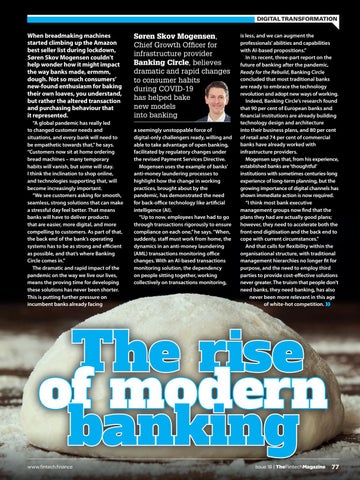
Søren Skov Mogensen, Chief Growth Officer for infrastructure provider Banking Circle, believes dramatic and rapid changes to consumer habits during COVID-19 has helped bake new models into banking a seemingly unstoppable force of digital-only challengers ready, willing and able to take advantage of open banking, facilitated by regulatory changes under the revised Payment Services Directive. Mogensen uses the example of banks’ anti-money laundering processes to highlight how the change in working practices, brought about by the pandemic, has demonstrated the need for back-office technology like artificial intelligence (AI). “Up to now, employees have had to go through transactions rigorously to ensure compliance on each one,” he says. “When, suddenly, staff must work from home, the dynamics in an anti-money laundering (AML) transactions monitoring office changes. With an AI-based transactions monitoring solution, the dependency on people sitting together, working collectively on transactions monitoring,
is less, and we can augment the professionals’ abilities and capabilities with AI-based propositions.” In its recent, three-part report on the future of banking after the pandemic, Ready for the Rebuild, Banking Circle concluded that most traditional banks are ready to embrace the technology revolution and adopt new ways of working. Indeed, Banking Circle’s research found that 90 per cent of European banks and financial institutions are already building technology design and architecture into their business plans, and 80 per cent of retail and 74 per cent of commercial banks have already worked with infrastructure providers. Mogensen says that, from his experience, established banks are ‘thoughtful’ institutions with sometimes centuries-long experience of long-term planning, but the growing importance of digital channels has shown immediate action is now required. “I think most bank executive management groups now find that the plans they had are actually good plans; however, they need to accelerate both the front-end digitisation and the back end to cope with current circumstances.” And that calls for flexibility within the organisational structure, with traditional management hierarchies no longer fit for purpose, and the need to employ third parties to provide cost-effective solutions never greater. The truism that people don’t need banks, they need banking, has also never been more relevant in this age of white-hot competition.
The rise of modern banking www.fintech.finance
Issue 18 | TheFintechMagazine
77