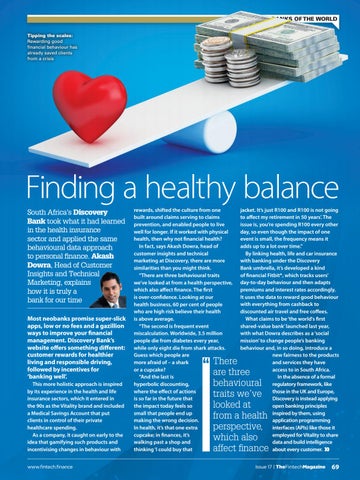
NEOBANKS OF THE WORLD Tipping the scales: Rewarding good financial behaviour has already saved clients from a crisis
Finding a healthy balance South Africa’s Discovery Bank took what it had learned in the health insurance sector and applied the same behavioural data approach to personal finance. Akash Dowra, Head of Customer Insights and Technical Marketing, explains how it is truly a bank for our time Most neobanks promise super-slick apps, low or no fees and a gazillion ways to improve your financial management. Discovery Bank’s website offers something different: customer rewards for healthier living and responsible driving, followed by incentives for ‘banking well’. This more holistic approach is inspired by its experience in the health and life insurance sectors, which it entered in the 90s as the Vitality brand and included a Medical Savings Account that put clients in control of their private healthcare spending. As a company, it caught on early to the idea that gamifying such products and incentivising changes in behaviour with www.fintech.finance
rewards, shifted the culture from one built around claims serving to claims prevention, and enabled people to live well for longer. If it worked with physical health, then why not financial health? In fact, says Akash Dowra, head of customer insights and technical marketing at Discovery, there are more similarities than you might think. “There are three behavioural traits we’ve looked at from a health perspective, which also affect finance. The first is over-confidence. Looking at our health business, 60 per cent of people who are high risk believe their health is above average. “The second is frequent event miscalculation. Worldwide, 3.5 million people die from diabetes every year, while only eight die from shark attacks. Guess which people are more afraid of – a shark or a cupcake? “And the last is hyperbolic discounting, where the effect of actions is so far in the future that the impact today feels so small that people end up making the wrong decision. In health, it’s that one extra cupcake; in finances, it’s walking past a shop and thinking ‘I could buy that
jacket. It’s just R100 and R100 is not going to affect my retirement in 50 years’. The issue is, you’re spending R100 every other day, so even though the impact of one event is small, the frequency means it adds up to a lot over time.” By linking health, life and car insurance with banking under the Discovery Bank umbrella, it’s developed a kind of financial Fitbit®, which tracks users’ day-to-day behaviour and then adapts premiums and interest rates accordingly. It uses the data to reward good behaviour with everything from cashback to discounted air travel and free coffees. What claims to be ‘the world's first shared-value bank’ launched last year, with what Dowra describes as a ‘social mission’ to change people’s banking behaviour and, in so doing, introduce a new fairness to the products and services they have access to in South Africa. In the absence of a formal regulatory framework, like those in the UK and Europe, Discovery is instead applying open banking principles inspired by them, using application programming interfaces (APIs) like those it employed for Vitality to share data and build intelligence about every customer.
There are three behavioural traits we’ve looked at from a health perspective, which also affect finance
Issue 17 | TheFintechMagazine
69