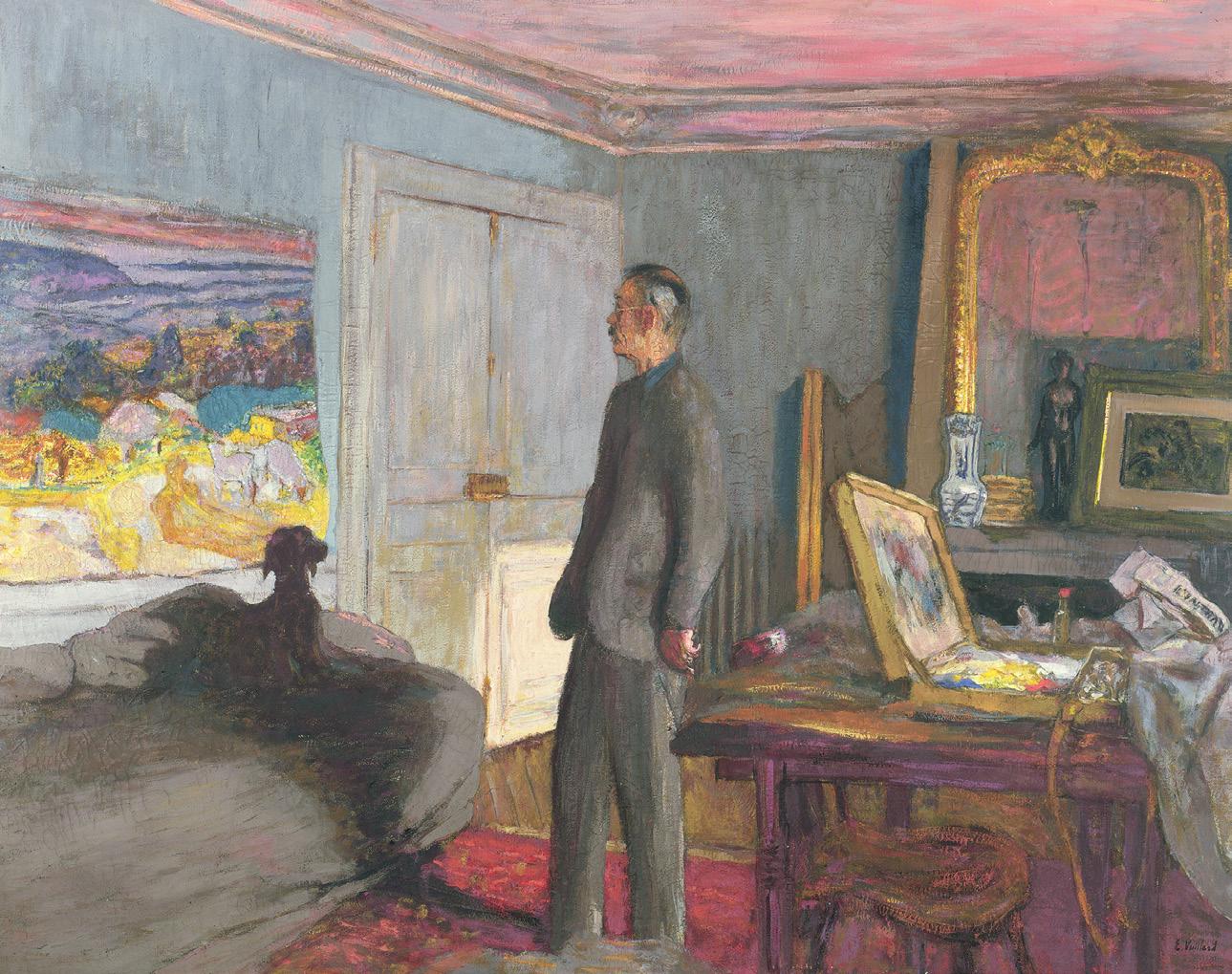
I appreciate the quiet independence of the little dog, who isn’t sitting up to beg, and I like the fact that the master didn’t ask his companion of old age to pose. This photograph, published in Thadée’s book in 1951, has since become a kind of testimonial. Could it be considered to encapsulate Bonnard’s style, full of gaps and latencies? Yes. And seen as a definitive emblem of his relationship with canines, strangers to human arrogance? Yes.
Bonnard on all fours
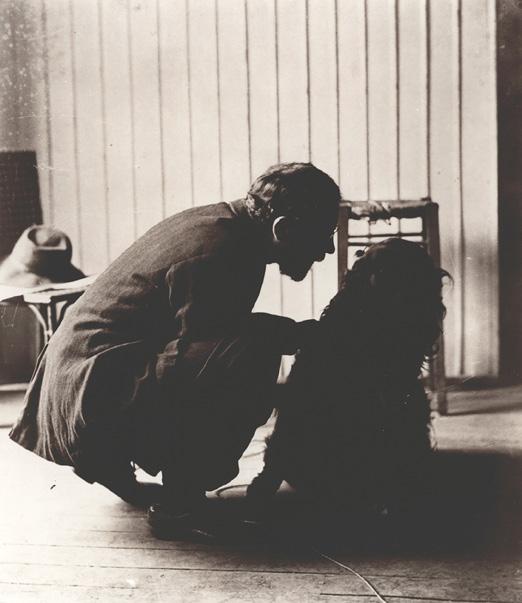
Forty years separate this photograph from another one, much better known today. The year is 1907, the address 60 Rue de Douai on the edge of the Batignolles neighborhood, a former Impressionist stronghold. Bonnard is in his place. Count Henry Kessler notes that there was an abandoned convent there, where an eccentric Bonnard decided to set up his studio. The decoration was already extremely sparse, but to deprive himself of dogs would have been too much. They had been his childhood companions, always running between his legs, putting zest into his life, reminding him that joy, loyalty and discipline formed its backbone. The photographs from 1907 say it better than words, especially as in this case the roles are inverted. One shows Bonnard crouched down, wearing a creased suit and Belle Époque ankle boots, in conversation with a splendidly lanky and hairy spaniel named Black. Like dog, like man. The viewer is immediately seized by dog’s eyes, two specks of light inside a black mask. Black was the life of a party, as confirmed in another snapshot taken during the same session but less frequently reproduced.
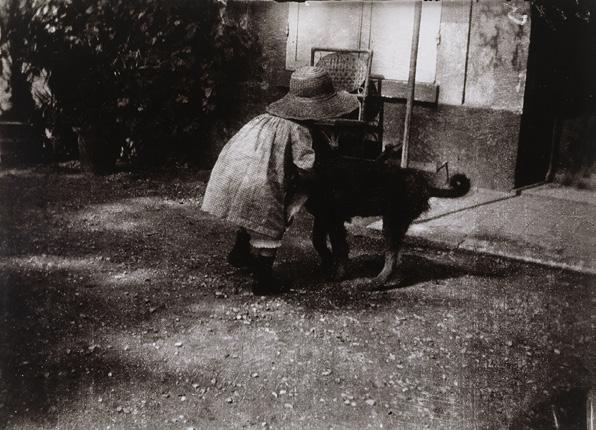
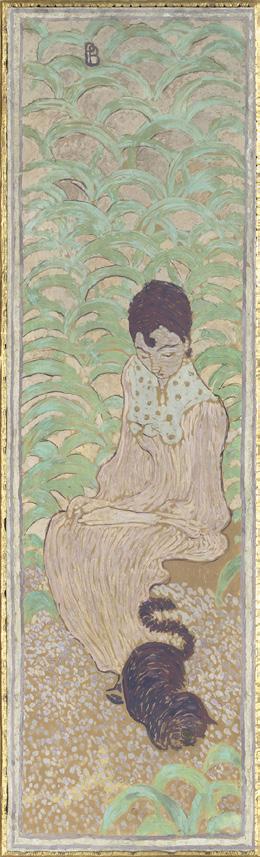
Renée de dos embrassant un chien, 1898. Paris, Musée d’Orsay
Apparition
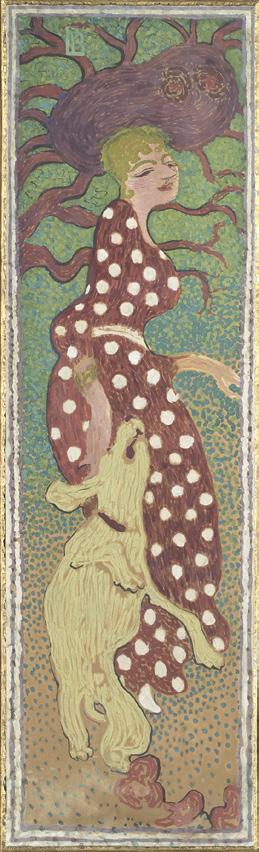
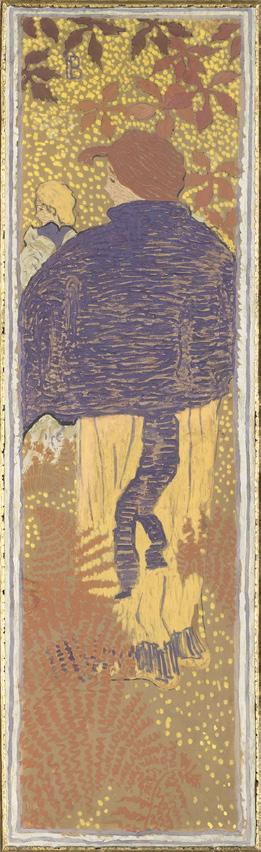
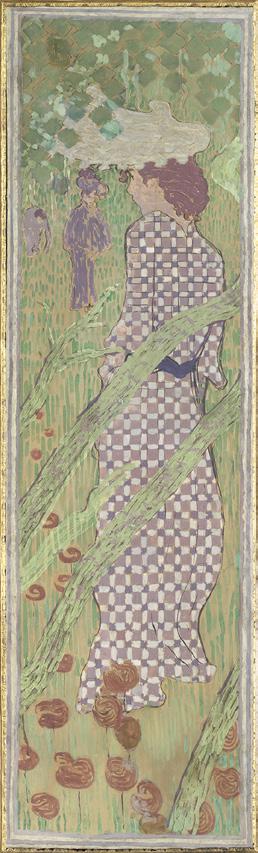
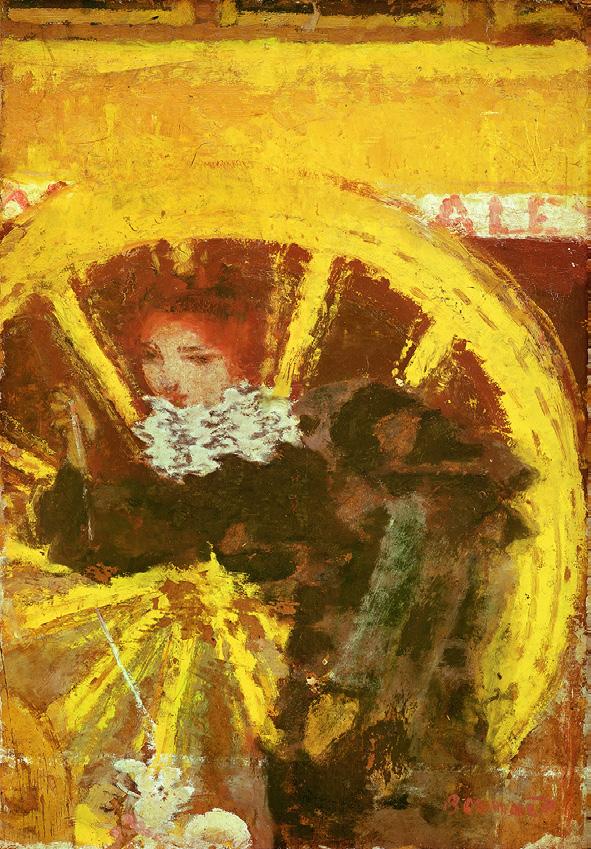
Would Bonnard have fallen for Marthe de Méligny, born Maria Boursin, with her humble Berry upbringing, delicate health and mercurial moods, if she hadn’t shared his love of dogs? Their meeting around 1893 is still shrouded in a certain mystery, as is their oddly ambiguous relationship, but she did possess an animal quality which was soon captured and exalted by his paintings. Since Bonnard didn’t follow the rules and customs of his social environment, he decided he might as well break them. He even gave in to a particular whim of his: to relive the moment he fell in love by doing a series of small paintings where Marthe plays the role of passers-by dressed to the nines, skipping about on the Paris streets, accompanied by equally nimble dogs. The eye can barely make one out in the foreground of the famous painting L’Omnibus from 1895, an absolute gem. The painting is deliberately hazy, its slight blurriness conveying the hustle and bustle of city life. Whether Bonnard had seen Japanese woodcuts depicting brothels inhabited by geishas and their canine companions or not, his liberated Parisian women and their appearance could not fail to cause a stir among contemporary viewers. The little dogs held on leashes here and there seem precisely to suggest a certain flightiness, or even a dissoluteness, which doesn’t comply with the domestication of immoral thoughts, that bedrock of values instilled in young women from polite society. With its evident kinetic quality, La Promenade des nourrices toys with the idea of contrasting collarless dogs with greyhounds confined to their apartments, respectively at the top and the bottom of the screen, just like Balzac often juxtaposed upper and lower urban classes in La Comédie humaine.
Page 29
L’Omnibus, 1895, oil on canvas, 59 × 41 cm.
Private collection
Pages 30-31
La Promenade des nourrices, 1894, distemper on canvas, 147.3 × 45.1 cm (for each panel).
New York, Museum of Modern Art
“Avoir du chien”
Histoires naturelles did not claim status as a coffee-table book. On the contrary, the format, price, and mechanical reproduction of its illustrations aimed to reach a wide readership. Judging by the number of reprints, this resulted in success. Bonnard’s altruistic view of art was satisfied, as was his literary talent. For lack of La Fontaine’s Fables, which he had read with zeal (along with Verlaine and Mallarmé) and dreamed of illustrating, Bonnard displayed the fullest measure of his illustrative talent when he worked on the books of his friend Octave Mirbeau, another great lover of dogs and a tireless advocate for animal rights. There had previously been Verlaine’s Parallèlement in 1900, with its soft pinks, ethereal prints and rare presence of a few bawdy yet elegant bassets. That a “lady” or a “girl” could have du chien (literally “something of a dog,” i.e., a somewhat provocative charm), according to Verlaine, was enough to justify the canine metaphor. Illustrating Mirbeau, the witty but bitter critic of the Belle Époque era, called for more disturbing visual choices. Both men must have often met at the headquarters of La Revue blanche during the Dreyfus affair, which rallied them to action. A strange dog from Australia was always by Mirbeau’s side during those militant times, a dingo who, provocatively and affectionately, had been given that very name. The name later became the title of a novel published in 1913, a dozen years after its hero’s death.
Page 52
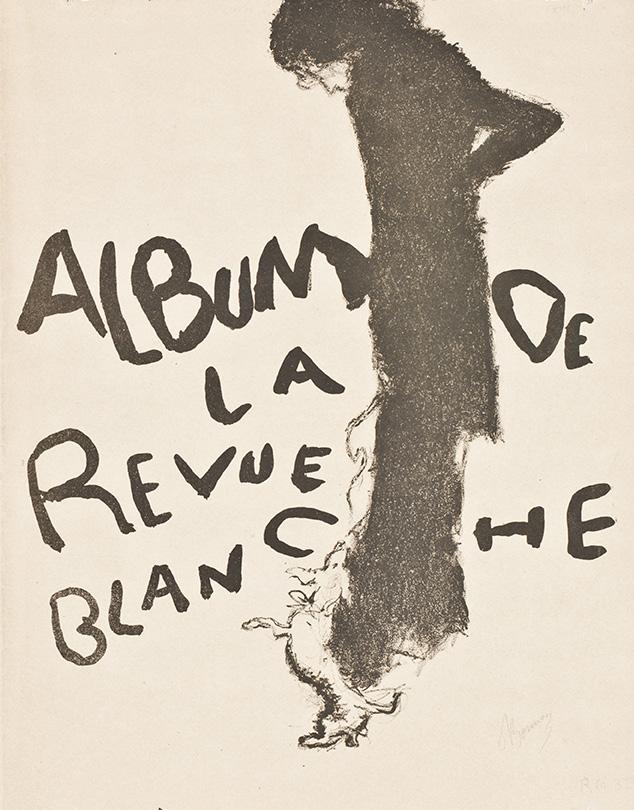
La Revue blanche, album cover, 1895
Pages 54-55
Parallèlement, 1900, print, Ambroise Vollard publisher, n. p., “À Madame***” double spread
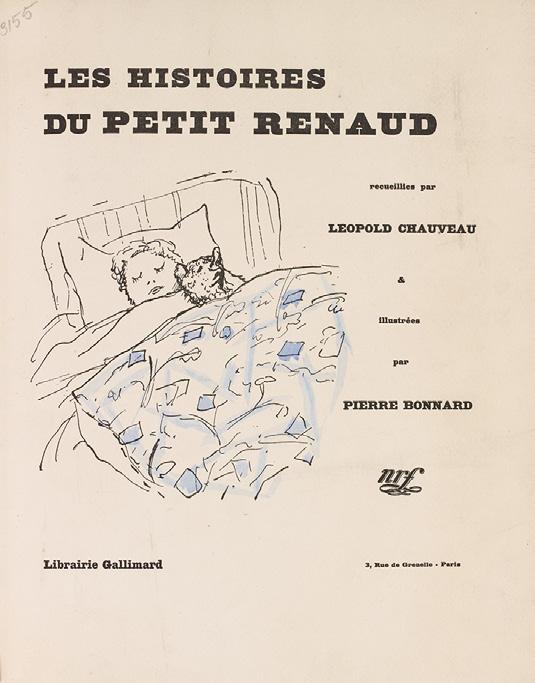
About ten more would pass before Vollard, the publisher of Parallèlement, entrusted Bonnard with the task of giving a face and soul to the wolfish yet awfully endearing slayer of hens and sheep. The novel’s genius stroke was to respect Dingo’s ambivalence, as he veered from highly docile to completely wild, without a care for good or bad. Sometimes, he showed an awareness— an intelligence even—closer to humanity than might have seemed at first. Indeed, Bonnard resisted the temptation to draw overly anthropomorphic animals, as illustrators often did, giving his etchings a fearsome bite, to borrow a word from the language of engravers. The 1924 publication, falsely nonchalant, features masterful illustrations that shift from irony to pathos. Avoiding pretty, smooth, confined shapes, the images themselves bark out, so to speak. Three years later, Les Histoires du petit Renaud was published in collaboration with Léopold Chauveau, another lover of animals. The cover showed a child and a dog, both asleep. Was one the other’s dream?
Page 59
Les Histoires du petit Renaud, Gallimard, 1927, front cover