


In his 1890 essay on design, Sedding claimed: ‘Every ingenious stitch of old humanity has been mastered, and a descriptive name given to it of our own devising.’1 Convent workrooms, including St Margaret’s, East Grinstead, run by Sedding’s younger sibling Sister Isa (1841–1906), and embroidery societies like the RSAN superintended by Anastasia Dolby (1823/4–1873), author of Church Embroidery Ancient and Modern (London, 1867), were instrumental in reviving the ‘old’ stitches found in ecclesiastical work.2 The Morrises were equally committed to this undertaking. Jane recounted in a letter addressed to her younger daughter in around 1909 that she and William had ‘studied old pieces and by unpicking &: we learnt much’.3
Ostensibly, the technical guidebooks and stitch primers listed in Table 2 furnished embroiderers with a comprehensive list of the ‘old’ stitches. Nonetheless, when viewed from a modern perspective, Sedding’s claim requires qualification. For instance, it wasn’t until after the publication of Louis de Farcy’s La broderie du Xie siècle jusqu’à nos jours in 1890 that textile scholars and practitioners first began to decode the medieval technique of underside couching, an inherent feature of opus Anglicanum. Moreover, many of the decorative stitches used by English embroiderers in the sixteenth and seventeenth centuries remain obsolete to this day.4
When it came to giving descriptive names to the ‘old’ stitches, the antiquarian and ecclesiologist Dr Daniel Rock (1799–1871) adopted the following set of medieval Latin terms for the 1870 catalogue of the South Kensington Museum’s textile collection:5
– opus plumarium, defined as flat stitches that overlap and blend together like the plumage of a bird, such as long & short, stem, split, and satin6
– opus consutum, translated as ‘cut work’. This category comprised patchwork, and inlaid and onlaid appliqué
– opus pluvinarium, classified as canvas work. Also known as ‘cushion style’ because of its use on seat cushions and hassocks
– opus pectineum, a form of embroidery akin to woven work, such as couched or laid work
– opus Anglicum or Anglicanum, embroidery after the English manner. Scholars and practitioners writing in the 1870s and 1880s mistakenly thought that opus Anglicanum was worked in chain stitch (for more on this subject, see below)
Rock’s classification was swiftly adopted by nineteenth century textile scholars, including Alan Summerly Cole (1846–1934), curator of the Special Loan Exhibition of Decorative Art Needlework, and Lady Marian Alford in her tome Needlework as Art. However, Ellen Masters (1837–1919), who was an authority on artistic embroidery, ridiculed the use of Latin terms in her stitch primer: ‘It is evident that the average woman feels no interest in knowing that when she is working an appliqué panel for a screen she is executing the classical opus consutum, or that her favourite “long and short” stitch is the same as the opus plumarium of the ancients.’7 Day likewise observed that the ‘quasilearned descriptions’ of old stitches were not much help as the authorities did not always agree on their meaning.8 Even Cole had rejected them by 1886, commenting in a lecture to the Society of Arts: ‘…closer scrutiny of the precise meaning of these Latin titles seems to me to have demonstrated their comparative uselessness in conveying definite technical information.’ He chose instead to divide embroidery stitches into two classes: the first, made for display on one side of the material, including long & short, stem, and chain stitch; the second, for work that is equally finished on both sides, like satin stitch.9 Masters disputed Cole’s system of classification, citing the examples of Holbein embroidery and certain kinds of cross stitch.10 In many of the publications listed in Table 2, the stitches are grouped according to those best suited for working in the hand or on a frame, or by their several uses in embroidery: outline (stem, split, chain), looped (chain, buttonhole, French knot), flat (laid, satin), shading (long & short), and so on.
PaulsonTownsend’s 1899 manual Embroidery: or The Craft of the Needle, written in response to repeated enquiries from students, contains instructions for 70 stitches in ‘general use or recognised as good from much experience’. Readers were advised to persist in ‘puzzling out’ some of the volume’s more intricate stitches taken from old work in the South Kensington Museum, such as the sixteenth century Portuguese linen coverlet (V&A 3261898) worked in ‘elaborate fancy stitches’ that were ‘exceedingly effective in use.’11 For the most part, professional art embroiderers used the simplest and most common stitches in the belief that ‘Excellence of workmanship does not lie in many curious and difficult varieties of stitch but in the expressive use of a few ordinary ones.’12
Fig. 1 Selwyn Image (1849–1930), Juno panel, c.1879, embroidered by the Royal School of Art Needlework, late nineteenth century. Silk on linen. Private collection, © Photograph Lyon & Turnbull.
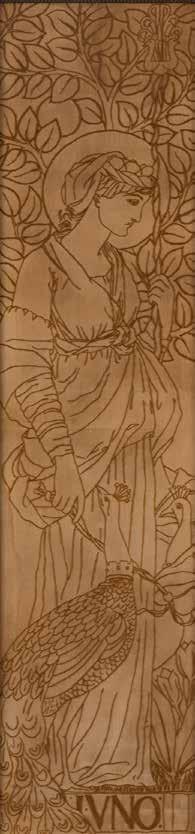
Grace Christie remarked that work carried out entirely in one stitch, like the outline version of Image’s figure of Juno, embroidered in stem stitch (fig. 1), had ‘a certain unity and character that is very pleasing.’13 Morris admired the restraint and simplicity found in medieval work and instructed embroiderers not to make ‘a forced exhibition’ of elaborate technique: ‘The stitching itself is but the laying on of colour and the marking of line, and, provided that the touch is sure, and delicate or bold, as the subject demands, the actual method by which the decoration is achieved is of minor importance.’14
The principal stitches found in art embroidery are long & short, satin, stem, split, darning, couching, laid work, and French knot. Morris used all these stitches for her designs as well as chain, fly, herringbone, buttonhole, running, back, and speckling stitch. A selection of these stitches is discussed below.
Morris & Co. ‘specially recommended’ darning stitch to its customers because it could be worked easily in the hand, though as May Morris observed, it was not a simple technique for a beginner to master without a few hours of personal instruction.15 Darning stitch had been used by the firm since at least the mid1870s. In a letter dated 20 July 1877, Catherine Holiday was asked by William Morris to embroider a large coverlet and a door hanging in ‘darned work’ using filoselle on loose Indian cotton.16 Holiday is credited as the maker of the acanthus and peony panel in fig. 2, worked mainly in darning stitch on a silk ground.
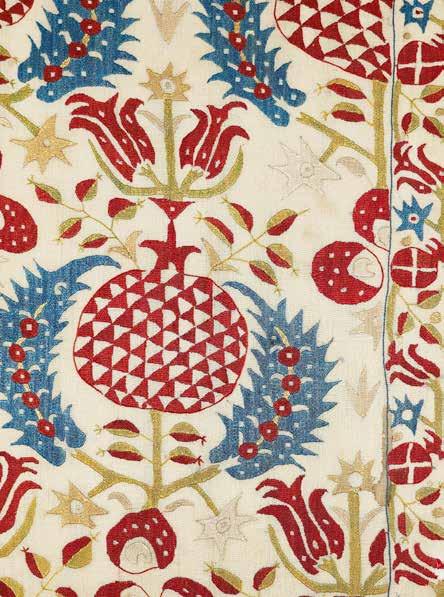
Surface darning stitches were a characteristic feature of the Islamic embroideries collected by William and May Morris. The technique was regularly used to work the repeating patterns of stylised flowers on Ottoman wall hangings or quilt facings. (fig. 3) The motifs are filled by stitching in straight rows over five warp threads and under one, with each new row starting three threads higher or lower than the previous one until the whole of the design is covered in silk.17
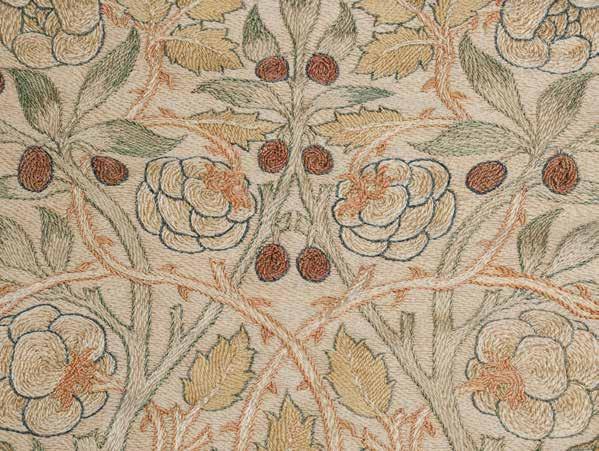
By the time May Morris took over the running of the embroidery department, darning stitch had become the Morris & Co. house style for domestic furnishings (fig. 4). The technique is explained in detail in Decorative Needlework and in Morris’s lecture notes dating from the period spent teaching at the Central School of Arts and Crafts in London (1899–1905) and the Birmingham Municipal School of Art (1899–1902)18 (fig. 5). To stitch the background, the threads are laid in horizontal lines in an irregular brick bond pattern, the needle running in and out through the warp yarns of the material. Kits stitched on Manchester cloth were generally worked in horizontal rows, though vertical darning was used from time to time, as in the scrapbook covers discussed in Part II. The background was left plain in the designs worked on silk.
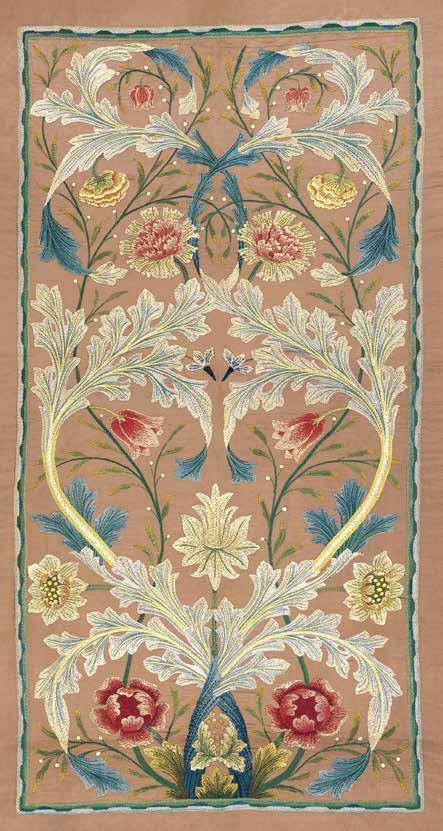
Fig. 2 William Morris (1834–1896), Acanthus and peony panel, embroidery attributed to Catherine Holiday, c.1875–80, coloured silks on silk, 198.1 × 118.7cm. Metropolitan Museum of Art, 1972.65 © Metropolitan Museum of Art.
Fig. 3 Detail from a wall hanging with tulips, pomegranates, and serrated leaves, Ottoman Turkey, seventeenth century, coloured silks on cotton, 235 × 130cm. Ashmolean Museum (EA 2007.104)
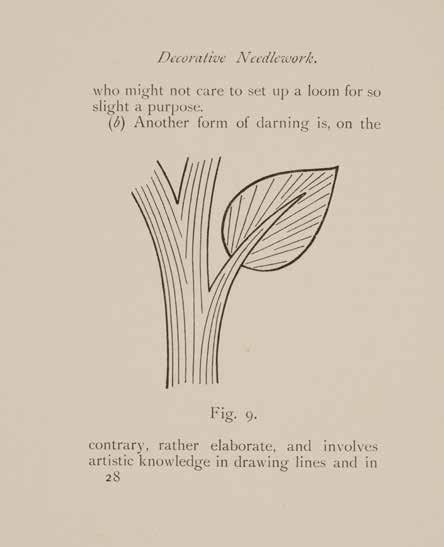
Darning stitch was a quick and economic method utilised by several embroidery outlets to cover large surfaces such as curtains, portières, and bedcovers, with the pattern worked in outline in stem stitch (fig. 6). Morris described this method in her lecture notes as ‘good for big scroll work for wall hangings’.19 At Morris & Co., a more elaborate form of darning was used. This involved ‘artistic knowledge’ in drawing lines and shading colours to create the botanical motifs in the foreground, an effect that was unachievable in Ottoman embroidery. The stitches radiate outwards from a common centre to replicate the natural growth of the flowers, stems, and leaves20 (fig. 7). The botanical motifs are ‘thrown slightly into relief’ by outlining in light or dark silk as required.21
Long & short stitch, which Morris described as ‘close & firm & laborious as darning is quick & loose & flowing’, was regularly used by art embroiderers for shading flowers and leaves.22 All of the technical guidebooks and stitch primers listed in Table 2 advise dovetailing the stitches in between those worked in the preceding row so that the transition from one shade to another is ‘quite unnoticeable’.23 Day and Townend also suggested splitting the stitches of the previous row, as today’s embroiderers generally do: ‘…you will find it will be better, and cause a much nicer effect’.24
Morris proposed a third approach for working long & short, not mentioned by any of the other writers. While researching English crewelwork of the seventeenth and early eighteenth centuries in the South Kensington Museum, she discovered that leaves were worked not from the top downwards but from the centre vein outwards: ‘The stitches are built up from the centre line or stem, in close and compact rows, different gradations of colour being used where needed.’25
Above: Fig. 4 William Morris (1834–1896), Detail from Olive and Rose cushion cover, c.1880, embroidered at Morris & Co. under May Morris’s direction, 1885–1896, coloured silks on Manchester cloth. Private collection
Opposite: Fig. 5 Detail from a wall hanging with flowers and peacocks, late nineteenth century, blue silk on linen, 160 × 100 cm. Private collection
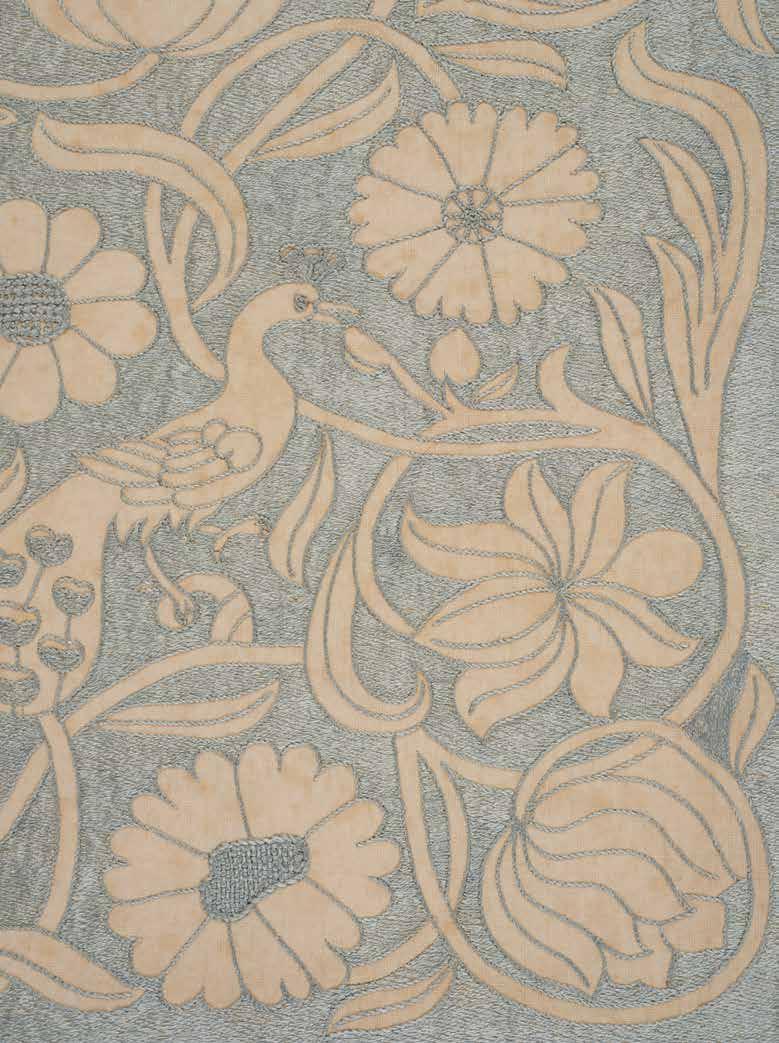
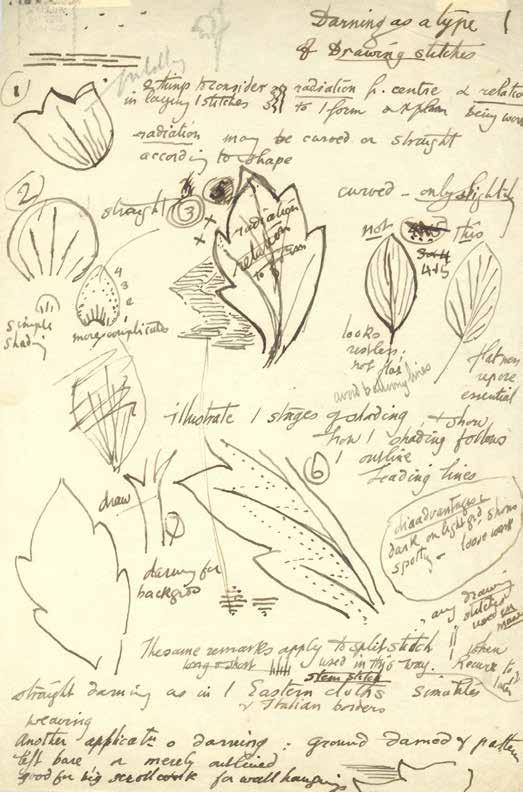
Fig. 6 May Morris (1862–1938), lecture notes, 1899–1905, ink on paper, 20 × 13 cm. William Morris Gallery, J 561i. © William Morris Gallery
10 may morris
According to Letitia Higgin, chain stitch was ‘but little used’ in art embroidery during the last quarter of the nineteenth century, possibly because sewing machines could produce it mechanically on dress materials and domestic furnishings for little cost.26 Morris’s first published work on embroidery, printed in 1888 in The Century Guild Hobby Horse, was a rallying cry for the restoration of chain stitch. The stitch had been used ‘with much skill and to great effect’ in old work, but generally not by modern workers, she observed, ‘excepting those of the east of Europe where embroidery is professional.’27 Following in the footsteps of Daniel Rock, Morris cited the example of opus Anglicanum, noting that the faces and garments were worked in chain stitch, though some of her contemporaries had already begun to challenge this assumption.28 In due course, she modified her view, commenting in her 1894 article on figure work:
It used to be the fashion to say that in this fine English work, the flesh was done in very minute chainstitch. I am not quite of the same opinion. The work is so excessively fine that without unpicking, or even handling unduly, it is not easy to pronounce upon it; but I think…[it] is in split stitch…the stitches being so short that the appearance of chainstitch is produced.29
Morris also referred to sixteenth century Goa work that she had seen in the South Kensington Museum, stitched in yellow silk on a cotton ground, and a nineteenth century panel of Persian Resht embroidery, which took pride of place in her own collection of Islamic textiles. Appliquéd with different bits of coloured cloth decorated in chain stitch, the panel was ‘a very flower garden for colour and grace, and for skill and precision in the stitchery unsurpassed.’30
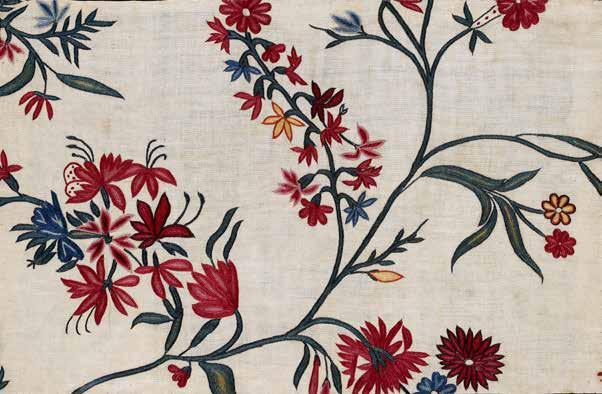
Morris encouraged modern embroiderers to use chain stitch for outline work with light veining for the leaves and flowers. For more solid work, she recommended starting with the outline and working inwards until the whole space was filled up, a device prevalent in Indian textiles31 (fig. 8).
Chain stitch remained one of Morris’s preferred techniques and features in several of her embroideries worked in silk or wool on a variety of cloths, including Flowerpot, designed by William Morris in c.1876 (V&A t.681939), and a cloak in the form of an abba, inspired by her travels in Egypt
Fig. 8 Textile fragment with flowering branches or fronds, Gujarat, eighteenth century, coloured silks on cotton, 20 × 32.5 cm. Ashmolean Museum (EA 1993.383)
Opposite: Fig. 9 May Morris (1862–1938), Detail from a cloak, embroidered by May Morris and Maude Deacon, c.1897, coloured silks on fine wool, 123 x 297cm. William Morris Gallery, F204. © William Morris Gallery
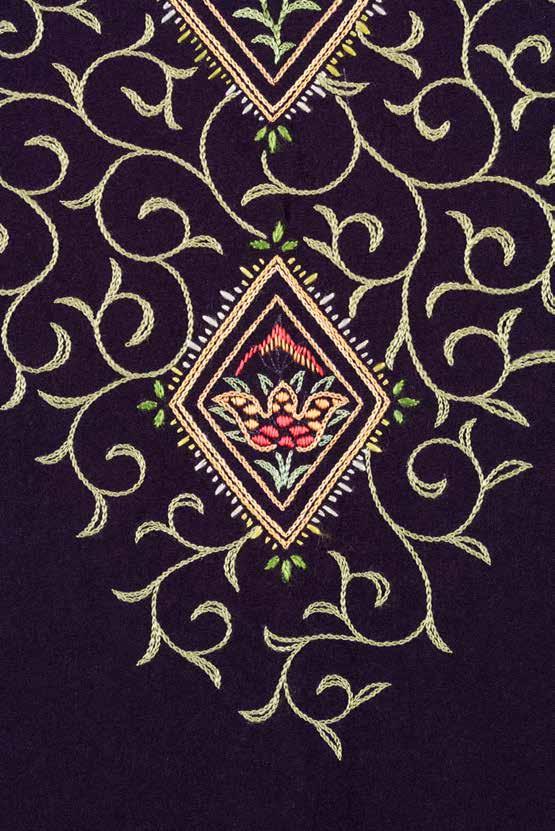
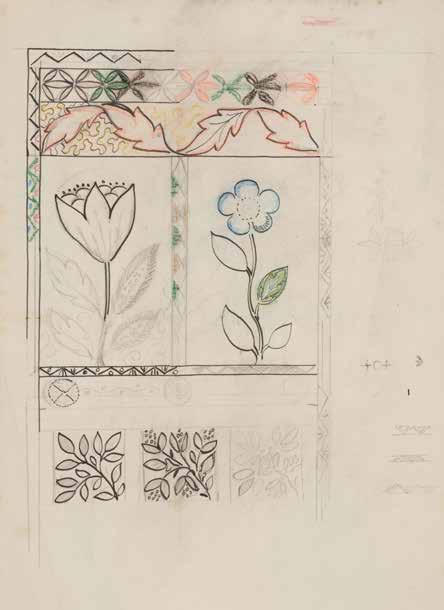
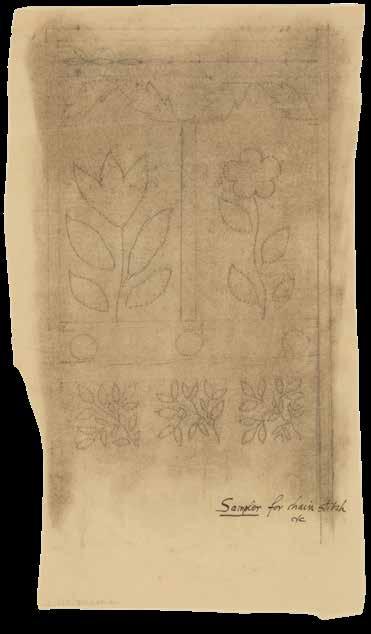
in the winter of 1896–9732 (fig. 9). Morris rarely noted stitch directions on her designs, but among the items in the Ashmolean collection is a pattern inscribed in her hand: ‘Sampler for chain stitch &c’33 (figs 10a & b).
Morris considered couching in silk and metal threads to be ‘a particularly fascinating kind of embroidery, as it allows of much play of colour and invention and variety of stitching.’34 Readers of Decorative Needlework were referred to old and modern Eastern embroidery and to Italian hangings of the seventeenth century in which the design is filled with satin stitch decorated with a
Fig. 10a May Morris 1862–1938), ‘Sampler for chain stitch &c’, late nineteenth century, drawing on heavy cream laid paper in graphite, black ink, coloured chalks or pastels, 22.8 × 14.8 cm. Ashmolean Museum (WA 1941.108.326.1)
Fig. 10b May Morris (1862–1938), ‘Sampler for chain stitch &c’, late nineteenth century, drawing on tracing paper in black ink, pricked and pounced with charcoal, 23 × 14.9 cm.
Ashmolean Museum (WA 1941.108.326.1)
diaper pattern of Bayeux stitch. The laid and couched threads are worked in the same colour to produce a surface that is ‘admirable in its shining texture’.35 Morris used this technique for working the vine and acanthus leaves in the RSAN’s embroidered replica of the Pomona tapestry, designed by William Morris and BurneJones, and stitched at the School under May’s direction in 1891. The grapes in the border are padded and covered with a fine layer of silk thread so that the ‘light catches the floss and makes them appear in good contrast to the rest’.36 On the book bag that Morris designed for her father’s medieval psalter, the pomegranate fruit is covered in a layer of brickred floss silk couched with Japanese gold thread (fig. 11).
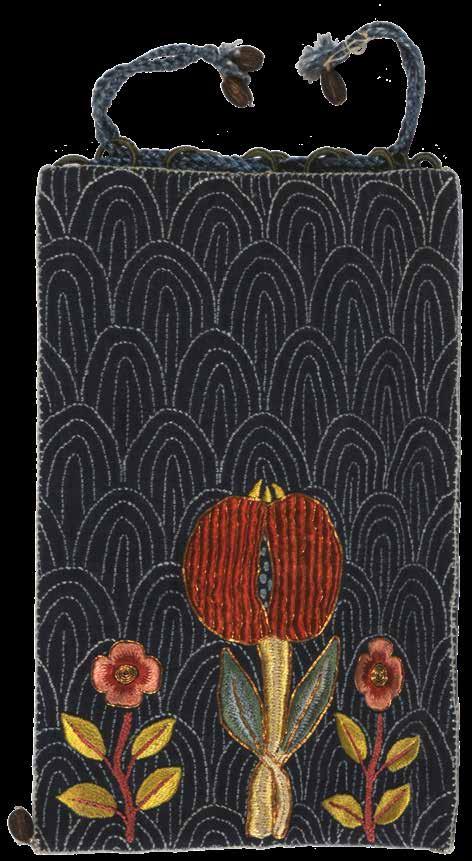
Fig. 11 May Morris (1862–1938), Book bag, embroidered by May and Jenny Morris, c.1890s, coloured silks and Japanese gold on indigo-dyed linen, 22.8 × 15.4 cm. William Morris Gallery, F337. © William Morris Gallery
Elizabeth Bessemer was responsible for introducing the French art of appliqué to Britain in the 1830s. Realising the commercial value of what was then a novelty in British decoration, one eminent London firm created a market for the technique, appointing Bessemer to instruct a large group of employees ‘selected from the poor but educated class of the community’.37 Among the pupils was Anastasia Dolby, who became one of the leading experts in appliqué. As the demand for medieval style decoration grew in the 1860s, Dolby published a series of articles in The Queen on furnishing the domestic interior using ‘AngloSaxon’ patterns to ornament cushions, chairs, fire screens, portières, and wall hangings with colourful appliquéd botanical and heraldic motifs.38 Inlaid and onlaid appliqué was taught at the RSAN under Dolby’s direction and two designs after ‘Ancient Italian Work’ are included in the Appendix to the Handbook of Embroidery. 39
Jane Morris and Elizabeth Burden utilised appliqué in the decorative scheme designed by William Morris in c.1860 for the dining room at Red House. Inspired by Chaucer’s fourteenth century poem The Legend of Good Women, the figures are worked in wools, silks and metal threads on a coarse Holland or linen ground, using a variety of stitches, including a form of brick stitch (known in the late nineteenth century as ‘tapestry’ or ‘Burden’ stitch after Elizabeth Burden), found in continental figure work dating from the late Middle Ages.40 On completion, the figures were cut out and applied to a woollen serge. May Morris devoted a section of her technical guide to appliqué, describing the different forms used in decorative needlework, but there is no evidence that she employed this method of work in her own designs for the home.41
That Morris should have intensely disliked canvaswork comes as no surprise, given the negativity expressed towards Berlin work by the champions of art embroidery. Unlike some of the other publications listed in Table 2, there are no instructions for tent or cross stitch in Decorative Needlework. Yet, Morris’s bequest to the V&A includes a cushion cover or fire screen panel embroidered in the late 1880s in cross, tent, and condensed Scotch stitch (t.691939) in the style of seventeenth century needlework, possibly to a design by Philip Webb (1831–1915).42
The historian and archivist Elfrida Manning (1901–1987), who visited Morris at Kelmscott in March 1925, reported in her diary: ‘Petit point she despises, but she works at it because of the great demand, making chair seats and table mats and designing them as she goes along.’43 Canvaswork was fashionable once again in the 1910s and 1920s. Stitched in thick wools on an openweave canvas, it was less arduous and time consuming than other types of embroidery. This may explain why Morris designed and stitched petit
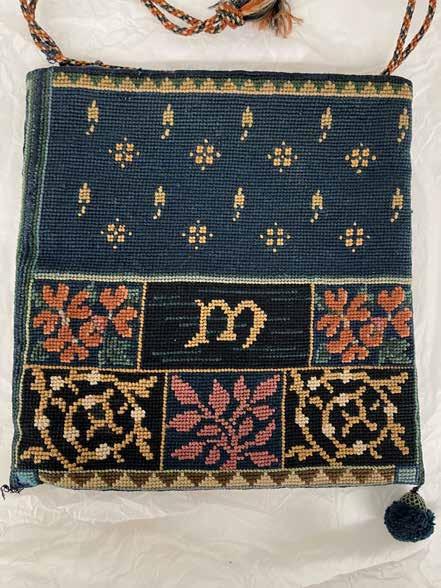
point table mats to raise funds for the building of the Morris Memorial Hall at Kelmscott. She displayed a set at the Arts and Crafts Exhibition in 1926 alongside a replica petit point chair seat.44 Morris also produced small bags in tent stitch for her own use (fig. 12) and taught her Australian cousin Una Fielding (1888–1969) how to do cross stitch. ‘[I]t was great fun making patterns and springing them on one another,’ recounted Fielding, ‘She was always very kind to my efforts and helped me to realise the design I had in mind and never demolished my attempt to replace it by a better one of her own.’45
Fig. 12 May Morris (1862–1938), Embroidered bag, c.1932, wool on canvas, 25.7 × 25.4 cm. William Morris Gallery, F 339. © William Morris Gallery
1 Sedding (1890) p.122
2 Ferry (2021) pp.130–136; Schoeser (1998) pp.112−15; Hulse (2024) ‘Dolby’
3 Marsh and Sharp (2012) p.423
4 Carey (2018) p.41
5 Rock (1870) pp.xcii–civ. For more information on the use of these terms in later nineteenth and early twentieth century scholarship, see Coatsworth (2016) pp.43–67
6 Long & short and stem stitch were also known as ‘embroidery’ or ‘feather stitch’, and ‘Kensington’ or ‘crewel stitch’ respectively. The term ‘Kensington’ was coined in the 1870s in deference to the RSAN, situated in the heart of South Kensington.
7 Masters (1899) pp.1–2
8 Day (1900) pp.8–9
9 Cole (1886) p.966; Cole (1890) pp.108–121
10 Masters (1899) p.2
11 PaulsonTownsend (1899) p.86, plates 41, 59–60
12 Glaister (1880) p.28
13 Christie (1906) p.75
14 Morris (1913) p.clxii; Morris (1902) p.117
15 Morris & Co., Embroidery work catalogue (c. 1912); Morris (1893) p.29
16 Kelvin (1984) p.387
17 Ellis and Wearden (2001) pp.135–37
18 William Morris Gallery J561i. For more information on her teaching appointments, see Brattwyton (2017) pp.130–40
19 This method is described at the foot of the page in plate 5.
20 Morris (1893) pp.28–29
21 Masters (1892) p.57
22 William Morris Gallery J561iii
23 Masters (1899) p.21
24 Day (1900) pp.100, 103; Townend (1909) p.36
25 Morris (1893) p.42
26 Higgin (1880) p.27; Masters (1899) p.7
27 Morris (1888) p.25
28 ‘Art Needlework I’ (18801881) p.79
29 Morris (5 January 1894) p.3
30 Morris (1888) pp.27–28; Cooper (2024) pp.110–13
31 Morris (1888) p.26; William Morris Gallery, J561iv
32 Mason (2017) pp.182–83
33 Morris’s design for a card case, made for Mrs Joanna Hawker, contains advice on the choice of stitch, see Ashmolean Museum WA1941.108.39.
34 Morris (1893) pp.46–47
35 Ibid. p.49
36 Illustrated in Mason (2017) p.59. A photograph of Pomona was chosen as the frontispiece to PaulsonTownsend (1899) p.41.
37 Hulse (2024), ‘Dolby’
38 Ibid.
39 Higgin (1880) plates 21–22
40 Hulse (2014) pp.28–30. The stitch is described in Morris (1893) pp.36–37
41 Morris (1893) pp.55–56
42 The panel is illustrated in Mason (2017) p.126
43 Manning (1980) p.19
44 Arts & Crafts Exhibition Society Catalogue of the Thirteenth Exhibition (1926) p.65 nos 218(n) and 218(p)
45 Fielding (1968) p.3. The William Morris Gallery owns a second bag with the initial ‘M’ set within an AngloSaxon style roundel, c.1932, F338.