FROM MASS TO MEMBRANE
When Buckminster Fuller came to Canada, he kept asking the same question: “Have you ever really considered how much your buildings actually weigh?” The Canadians took this very seriously. (Hey! We never thought of it that way!) He showed them plans for domed cities. Cities with no basements, no foundations. Cities that could be moved in a minute. Portable cities. Portable towns. He said: “Think of it as camping out.” He said: “Think of it as one big tent.” He said: “Think of it as the Big Top. Spinning. Lightweight. Portable.”
—Laurie Anderson, “Big Top,” 1984
In Western culture, from an early age, we are ingrained with the notion that weight in building construction equals strength. The classic tale The Three Little Pigs features anthropomorphic pigs that build three houses of different materials. A big bad wolf is able to blow down the houses of the first two pigs, structures made of straw and wood respectively, but is unable to destroy the third pig’s house, made of bricks. Printed versions date back to the 1840s, but the story itself is thought to be much older and even bears a superficial resemblance to a German folktale collected as the fifth tale in Grimm’s Fairy Tales of 1812.
There are several lessons embedded in the story—such as the notion that hard work is rewarded—that have become important moral pillars in our culture. But more interestingly, the story implies under wind loading, a greater strength of brick construction relative to straw or wood that are of lighter weight. This idea of the relative strength of mass pervades our culture as a fundamental truth. Heavy materials are not intrinsically stronger than lighter ones. In fact, stone is terrible in tension compared to wood, which can be seen in the concrete failures of buildings after so many earthquakes around the world.
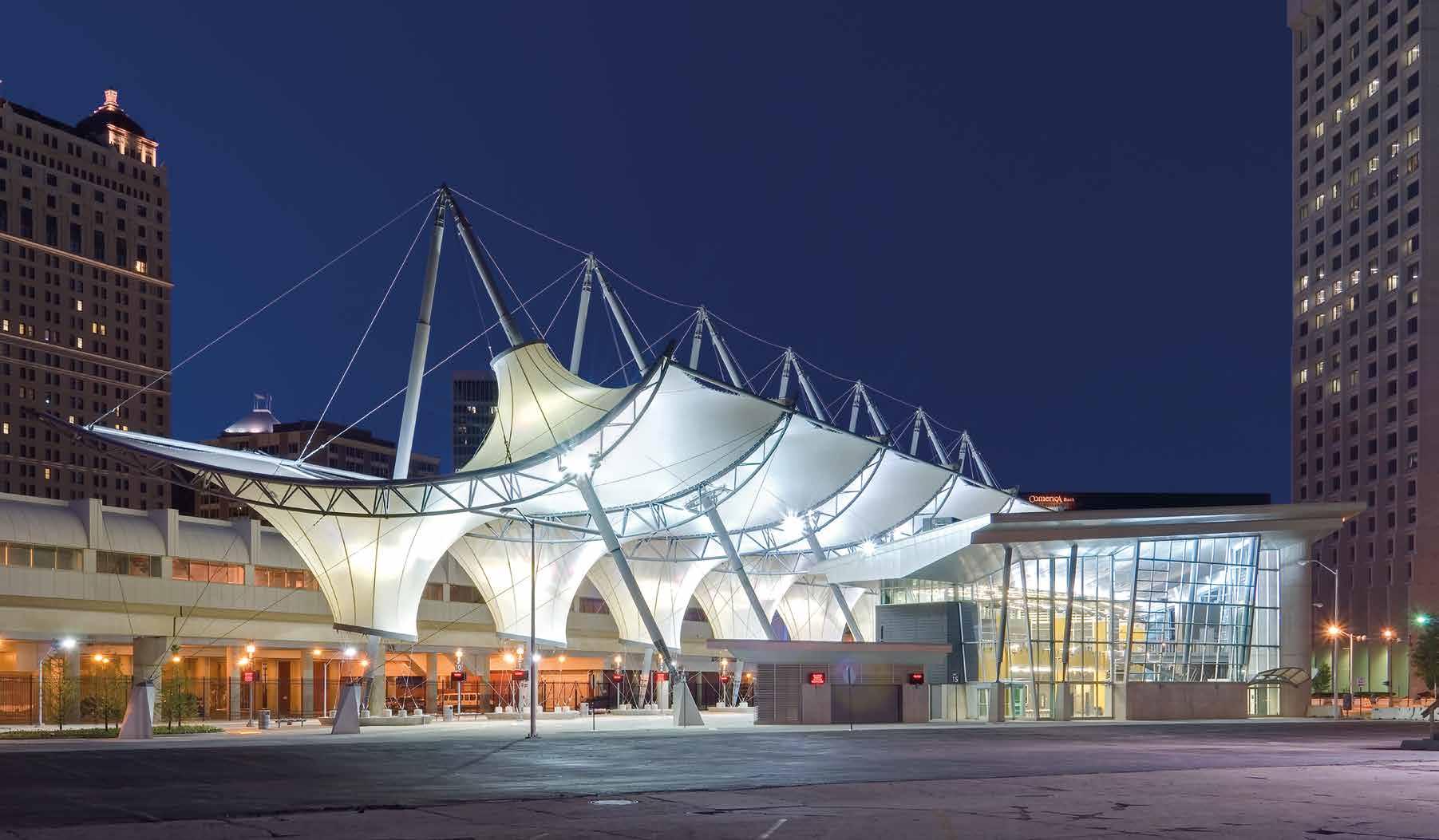
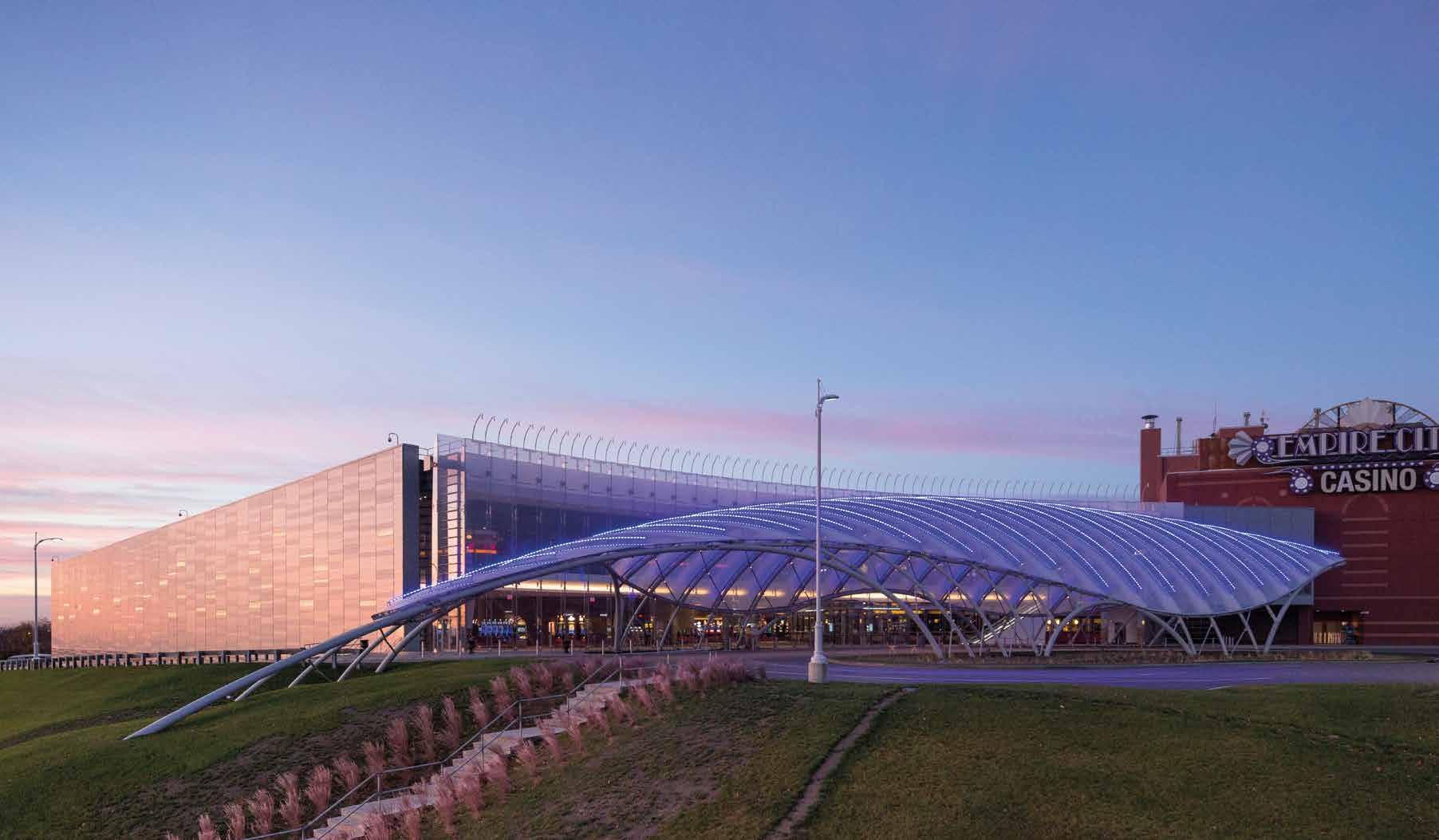
In 2009, my firm, FTL Design Engineering Studio, completed a new transit center in downtown Detroit on Cass and Michigan Avenues. Detroit is a tough city with little money for maintenance and repair. The design included a covered tensile roof for 13 buses and links to a monorail line, and an enclosed bus terminal by Parsons Brinkerhoff, a well-known transportation design firm, with whom we collaborated. The design also featured light wells with planting and brick paving created by a local artist. This year, I visited the structure after seven years in the city and it struck me that while the landscaping was worn away and the brick paving was broken and filled with garbage, the Teflon-coated glass fabric on the tensile structure looked as good as new. So much for the little pigs.
More time will be needed to alter the believed truths about material strength that we carry in our cultural DNA, but they are shifting. Especially as our conception of security morphs with the changing technologies of the digital world, materials showing strength and
In this way, Thompson’s correlations between natural systems, forms, and structures, and inherent definable rules have encouraged a form-finding approach to design, where the designer looks at processes in nature to uncover ways in which to organize his or her building project. It is a study into the capability of discovering optimum form and dynamic adaptability. The beauty of the form does not have to be designed; rather it becomes an emergent property from the developed natural forms. As Frei once told me about using the form-finding process, “The architect is acting more as a midwife than God, the
Left page:
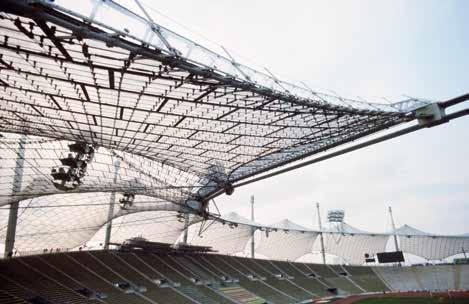
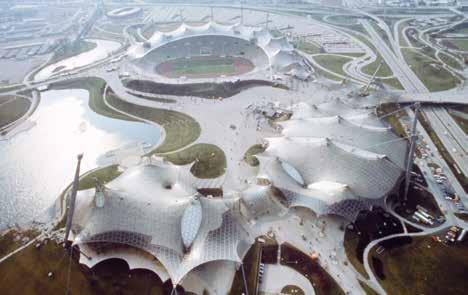
Top & Bottom ≤ The Munich Olympic Stadium designed by Frei Otto.
Right page:
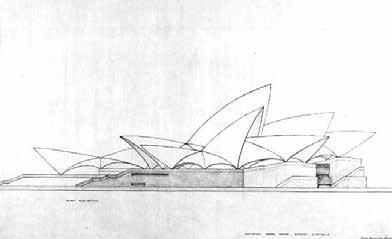
Top ≥ John Utzon original sketch for the Sydney Opera House.
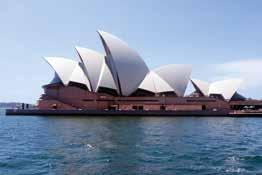
Middle ≥ Image of the completed Opera House, Sydney Australia 1973.
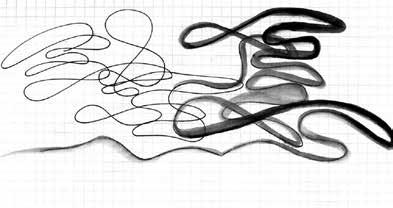
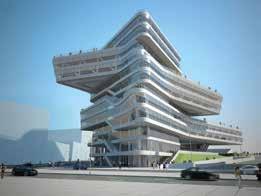
Bottom & Above ≥ Zaha Hadid
Architects sketch and rendering for the Spiraling Tower in 2006.
creator.” Charles and Ray Eames, two of the great industrial designers of twentieth century, in their uniquely American idiom described this as, “what-it-should-be-ness”. It is an approach of developing the form to follow the forces acting on the structure.
The work of Felix Candela in Mexico, Pier Luigi Nervi in Italy, Frei Otto in Germany, and Buckminster Fuller in the United States serve as historical examples of the form-finding approach to architecture. Particularly notable are Candela’s High Life Textile factory in Coyoacun, Mexico City in 1955, consisting of concrete hyperbolic parabolas; Nervi’s Palazetto dello Sport in Rome for the 1960 Olympics, which uses a curved ribbed thin shell concrete dome; Otto’s Olympic Stadium in Munich in 1972, which uses a steel cable net with acrylic panels; and Fuller’s tensegrity structure using discontinuous struts and cables.
In many ways the antithesis to a form-finding method is a shape-making design approach, based on personal visualizations. Traditionally in the architectural design process, there is an underlying belief that design is a rational linear process—which it isn’t—and that the heroic architect is somehow acting like God, the creator—which he or she actually isn’t. However, it makes for good copy and reinforces writer Ayn Rand’s romanticized image of the architect in her 1943 novel, The Fountainhead.
A clear example of the difference between shape-making and form-finding can be seen in the iconic Sydney Opera house by Danish architect Jørn Utzon. In his initial design drawing Utzon generated curved shapes by using a steel ruler in a bench vise.2 The drawing shows an organic shape that looks efficient but is actually bending and would demand massive amounts of engineering manipulations. After several years of structural gymnastics, Utzon realized that they could use sections of a sphere to translate these unique shapes into a built form. Ove Arup and his firm engineered these concrete shells and treated the project as a problem solving exercise in a traditional architect/engineer relationship. In addition, Arup developed the use of epoxy resins to bond thin joints of precast concrete units and the beautiful glazed tiling of the surface.3
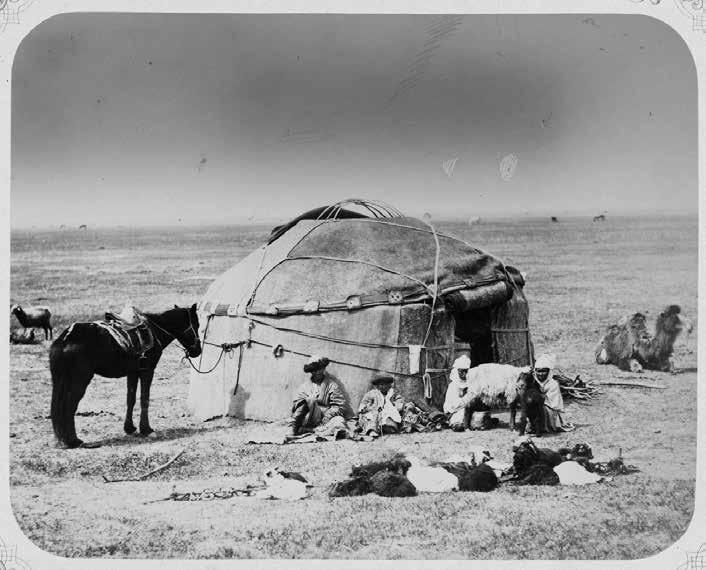
teepees of North America, and black tents of the Bedouin tribes, to the yurts still constructed in Central Asia today. They each had very special attributes that relate to their climate and the lifestyle of their occupants. Yurts are frame tents and one of the great inventions from Central Asia. They are well suited for snow as they act as compression domes with tension rings. The roof poles were made of willow, joined at the top with a crown or bent circle of wood. The walls are made of lighter willow, set in a diagonal direction to increase stability, that joins the roof with ties on a tension band or ring. In a sense it is the keystone of the yurt, which holds all the compressive downward forces in check.
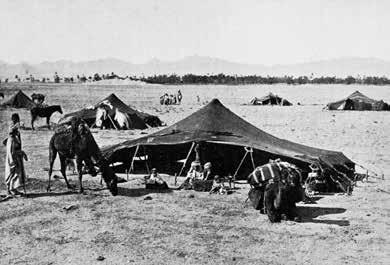
Bedouin black tents were created for desert use; they used a minimal amount of wood with a low ridge pole to flatten the roof and give the tent an aerodynamic shape. With an exterior of goat hair woven fabric the tents were primarily shade structures. The goat hairs allowed air to pass through but in the rain, the fibers expanded and became an impervious membrane. In a modern sense, this is one of the first “smart buildings,” which actively adapts to its climate. It is probably the closest structural type to our
Previous page ≤ Cross section of human skin showing three layers: epidermis, dermis, hypodermis.
Top ≤ Traditional yurt construction, made of portable framework to support felt or skin cover.
Bottom ≤ Traditional black Bedouin tent made of goat hair with minimum poles.
modern tensile structure, where the fibers remain in tension to give the structure strength.
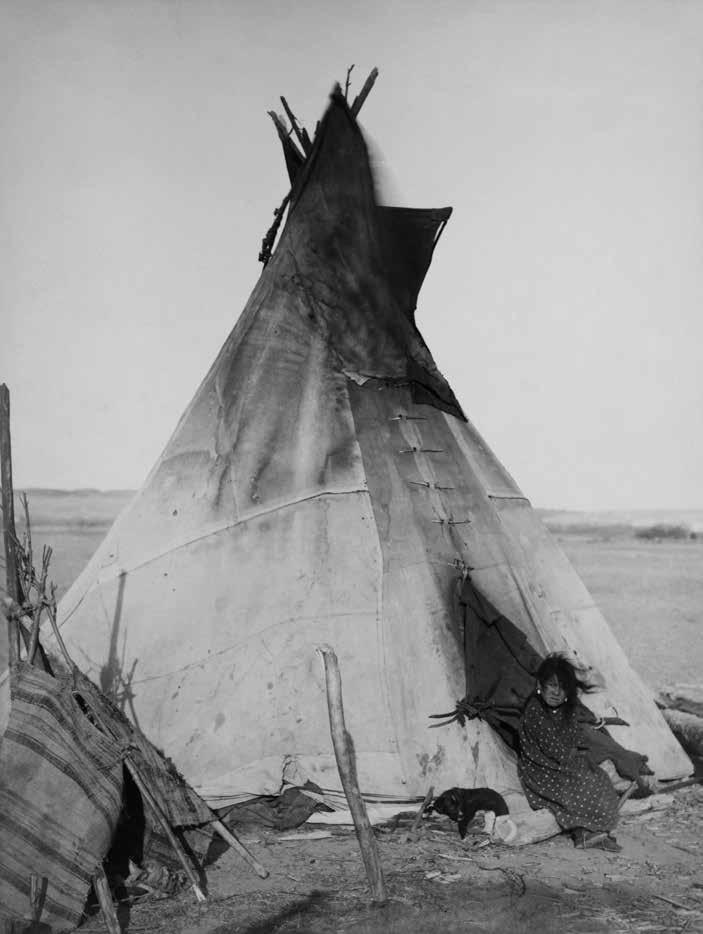
The teepees of the Native American Plains developed as a product of their nomadic existence; their conical shape shed water easily and, due to an abundance of trees, the wooden poles were often left in place and only the cover had to be moved from location to location. It is the most ingenious conical shaped tent and incorporated a unique ventilation system that allowed interior fires to exist smoke-free due
Bottom ≥ Traditional Native American teepee, using A-frame system, fabric, and adjustable flaps to free interior space and control climate.
neutral spaces, membranes need to provide quicker sound decay or less reverberation time, which is best achieved with non-coated fabrics, absorptive fabrics, and dampers.
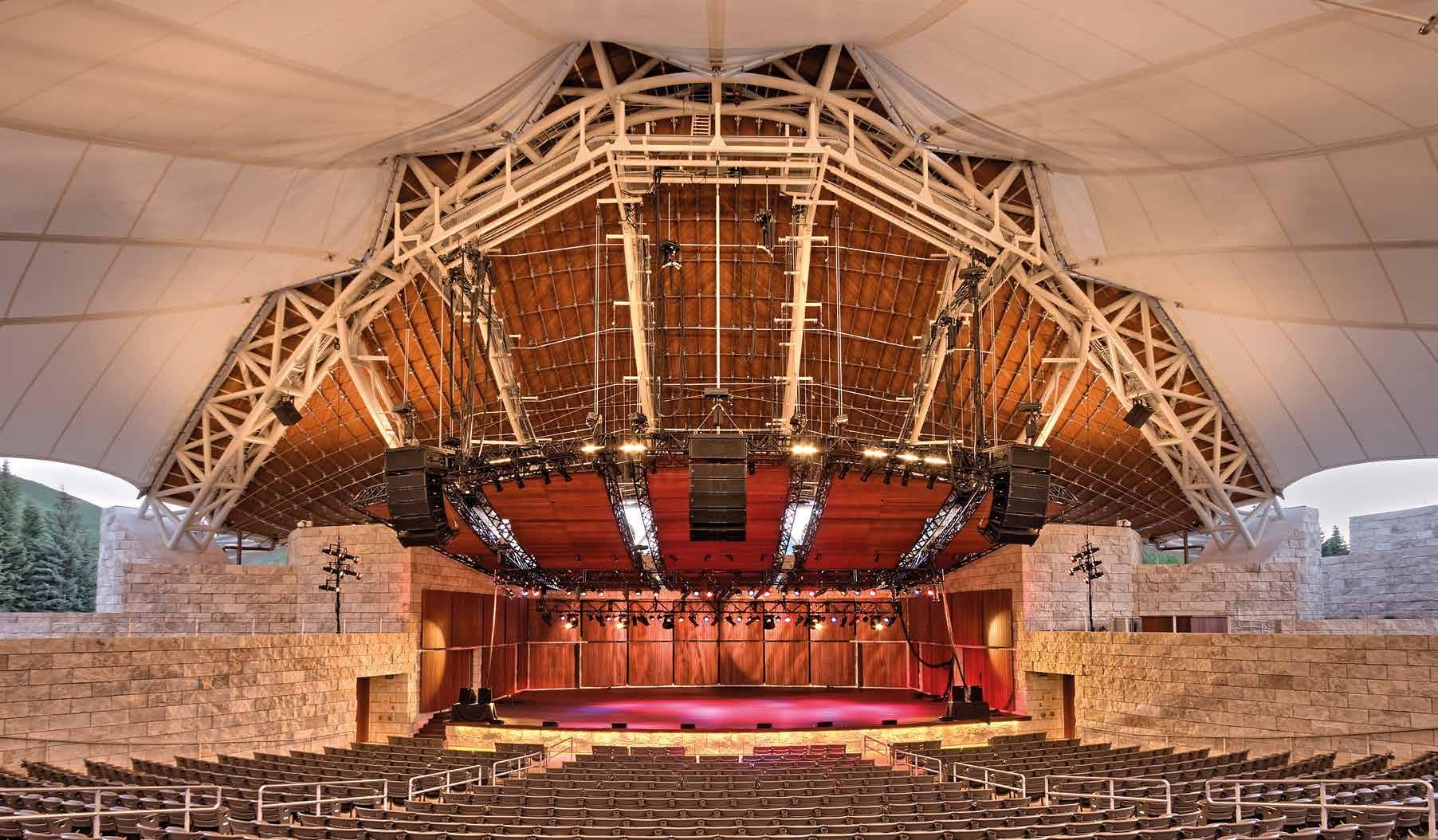
As discussed in Chapter 3, the three-dimensional curvature inherent in membrane structures—whether toroid, cone, or saddle shapes— has direct impact on acoustics. The saddle form or hypar shape happen to have an inherent shape that acts well as an acoustic reflector. They are able to diffuse sound and spread it evenly. The other two have poor acoustical qualities, the cone traps reverberation in the apex of the cones and creates a bouncing effect. With its synclastic form, the toroid focuses sound to certain discrete points in the interior space causing a few points to work, but the overall space to be arbitrarily reflective. This is why the spherical acoustic band shells from the 1950s and ’60s were seen as liabilities and well-known architectural shells of that time, such as the Hollywood Bowl, were subsequently retrofitted with better interior acoustic canopies that broke up the sound concentrations.
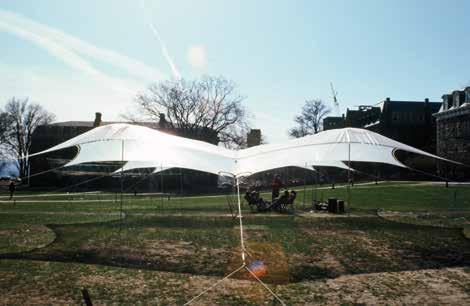
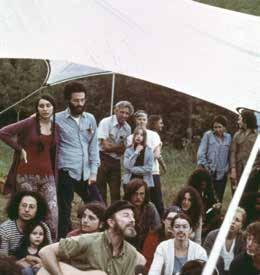
The creation of my first acoustic space occurred rather as an accident; while students at Cornell, my classmate and later partner Todd Dalland and I took one of our first self-made polyethylene structures to Woodstock Quick City in 1972 (this was three years after the Woodstock,
Left page:
Top & Bottom ≤ EZ Builder projects including Pete Seeger playing in a tent at Whiz Bang Quick City 1972.
Right page:
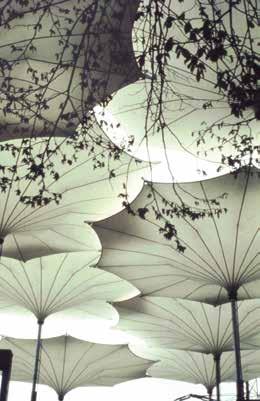
Top ≥ Ten unfolding umbrellas by Frei Otto, designed for the 1976 Pink Floyd US tour, with 4.5-meter diameter at different heights to create rain cover.
Bottom ≥ Performance structure for Deep Purple at Cornell University.
NY concert, which I attended). Pete Seeger came to sing at the festival and performed under our open-sided tent structure, which had quickly become the de facto public space. After this concert, we went on to design a stage cover for the rock groups Deep Purple and ZZ Top, concerts which ended in a riot and the suspension of the entire concert series at Cornell.
After relocating to Germany in 1976, I worked for Frei Otto on a stage cover for the American Pink Floyd tour, which consisted of a succession of umbrellas that emerged from below the stage. Through the use of chain drives, the umbrellas were opened up like a row of flowers to protect the musicians. And in this way, all these covers were simply protection against the rain and sun, and any acoustic enhancement was accidental.
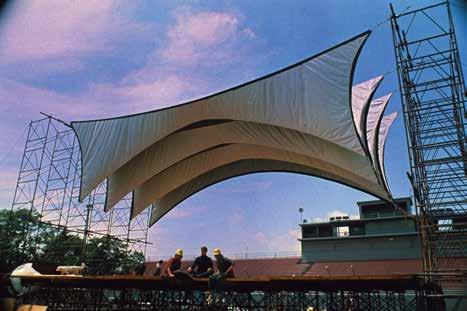
In 1980, we were asked to work on a project for the National Symphony Orchestra in Washington, D.C. Mstislav Rostropovich, or Misty as he was called, was the musical director and conductor of the symphony, and after a couple years at the NSO, he wanted an outdoor shell for public concerts on the West Lawn of the Capitol. Chris Jaffe, who was the NSO’s acoustician at the time, first introduced me to the notion of outdoor acoustics. Misty wanted to create an acoustic shell that didn’t need