In about 2500 bc a remarkable stone circle was built within the earlier henge enclosure. It was an architectural and technological masterpiece, apparently unlike anything that had been built in stone before, or that has been constructed since.
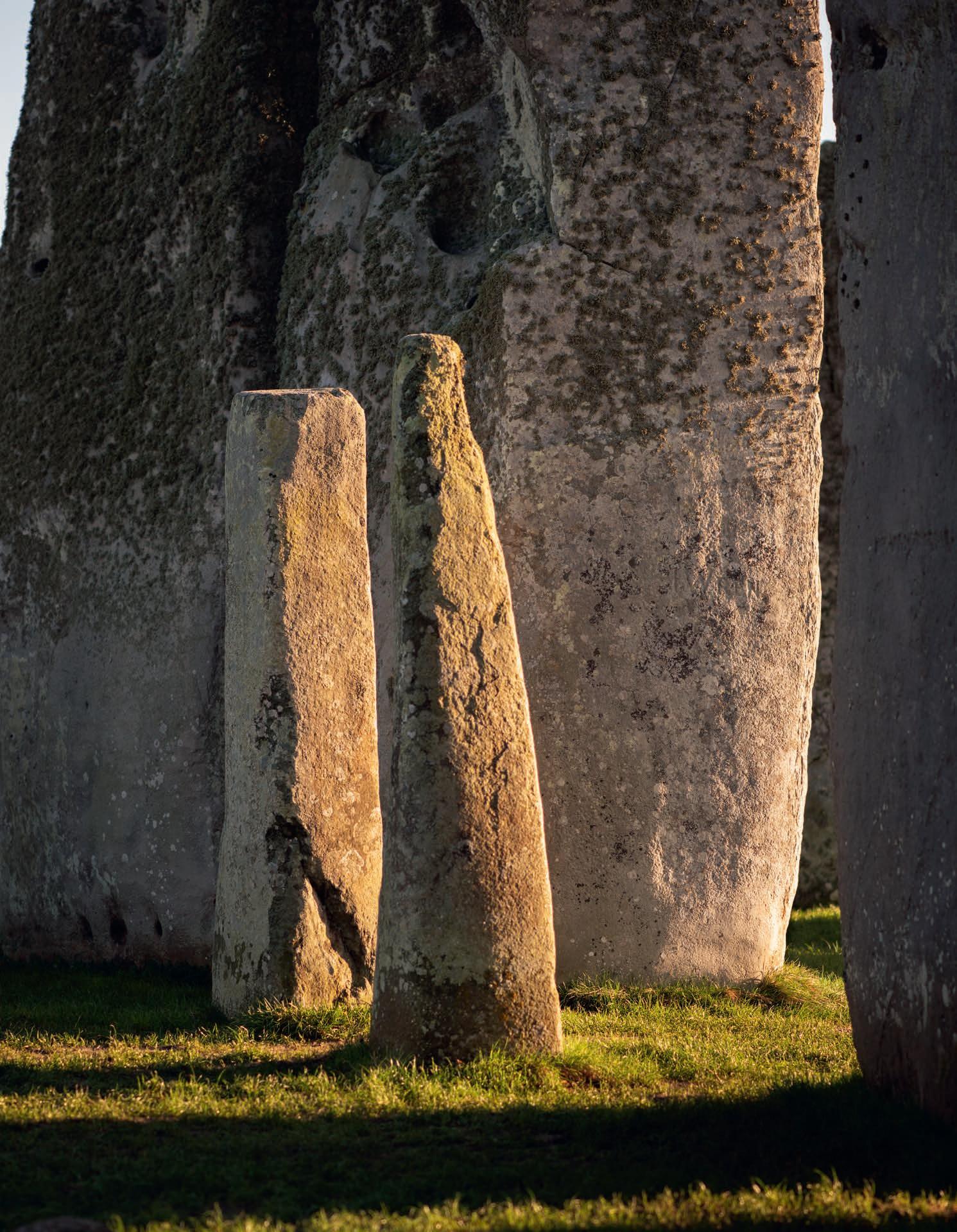
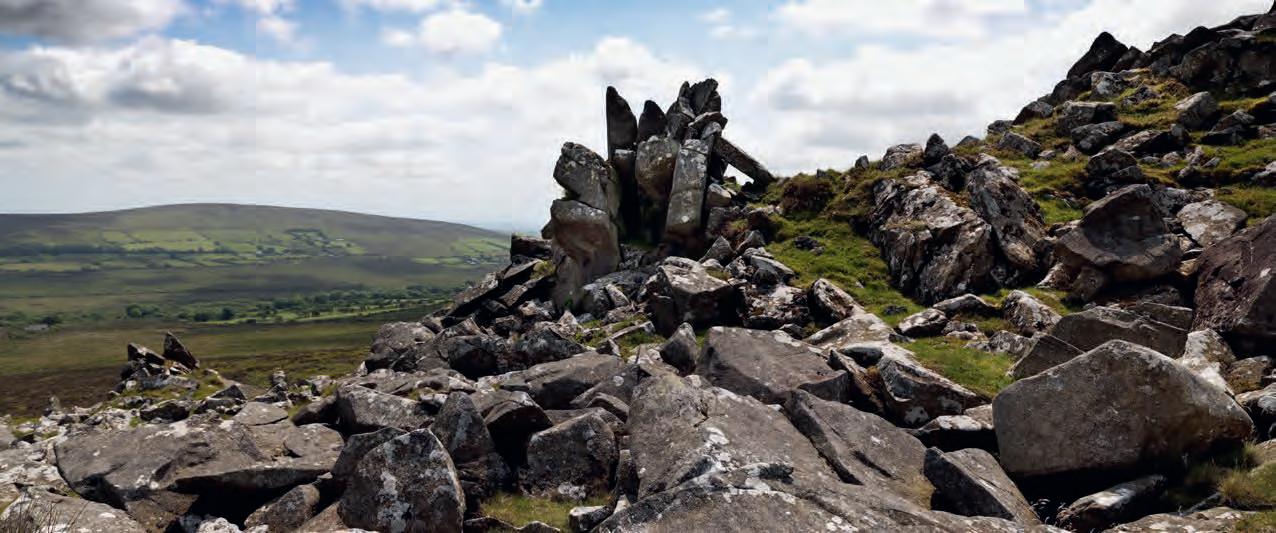
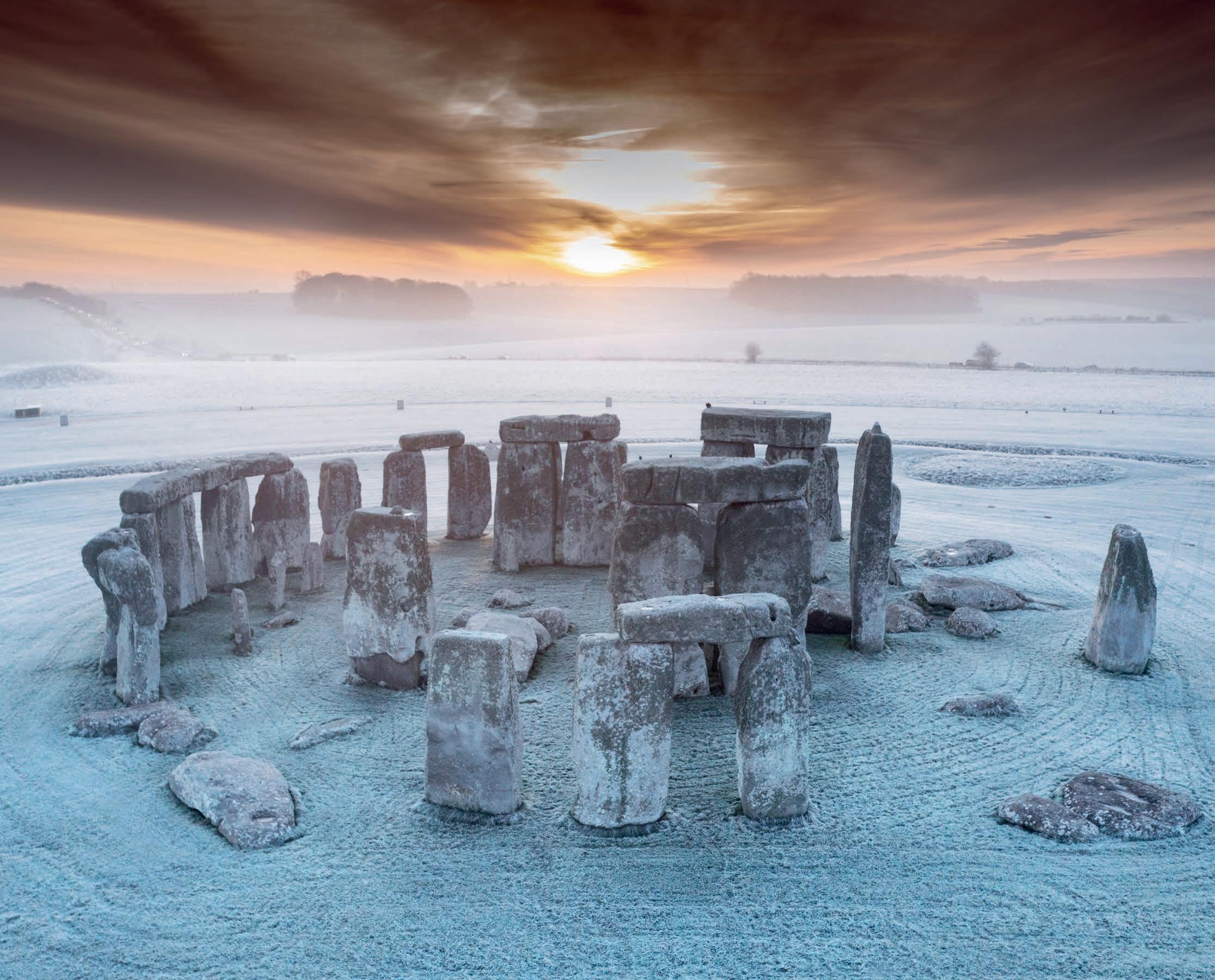
The stone circle is made of two different types of stones. The larger stones are sarsen (a type of silcrete), which were transported on sledges from the edge of the Marlborough Downs, about 15 miles (24km) to the north. The much smaller stones are known as bluestones. These are a mix of geological types, including spo ed dolerite, dolerite, rhyolites and volcanic tuffs, all quarried from outcrops on or near the Preseli Hills in south-west Wales, 143 miles (230km) away. They were probably transported overland on sledges and then by boat along the South Wales coast and up the river Avon. Although both types of stones now look similar due to millennia of weathering, when the stone circle was first built, the freshly worked dark
blue-grey bluestones would have contrasted strongly against the light grey-white sarsens. Excavations within the ditch and banks at Stonehenge have uncovered very few artefacts such as po ery or animal bones, with li le sign of feasting or fires here. It seems to have been kept deliberately clean and free of everyday debris, perhaps showing that it was a sacred space. As such, there is li le evidence beyond the stones themselves to help us understand the purpose and function of the monument.
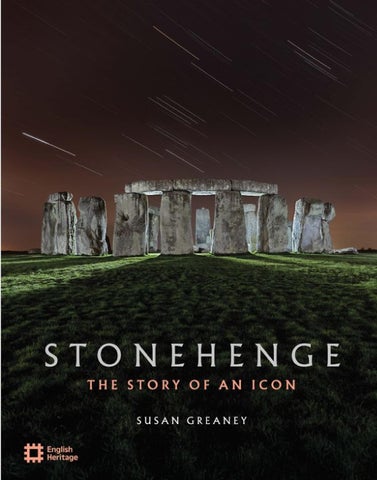
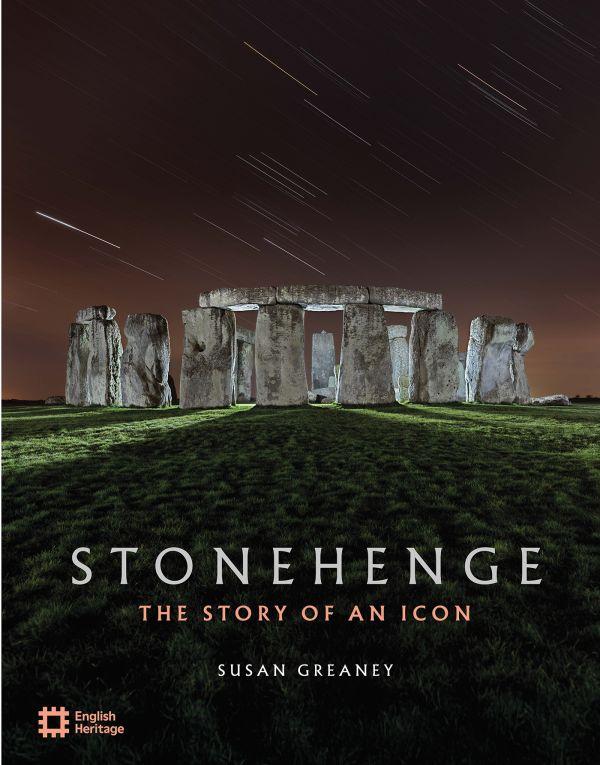
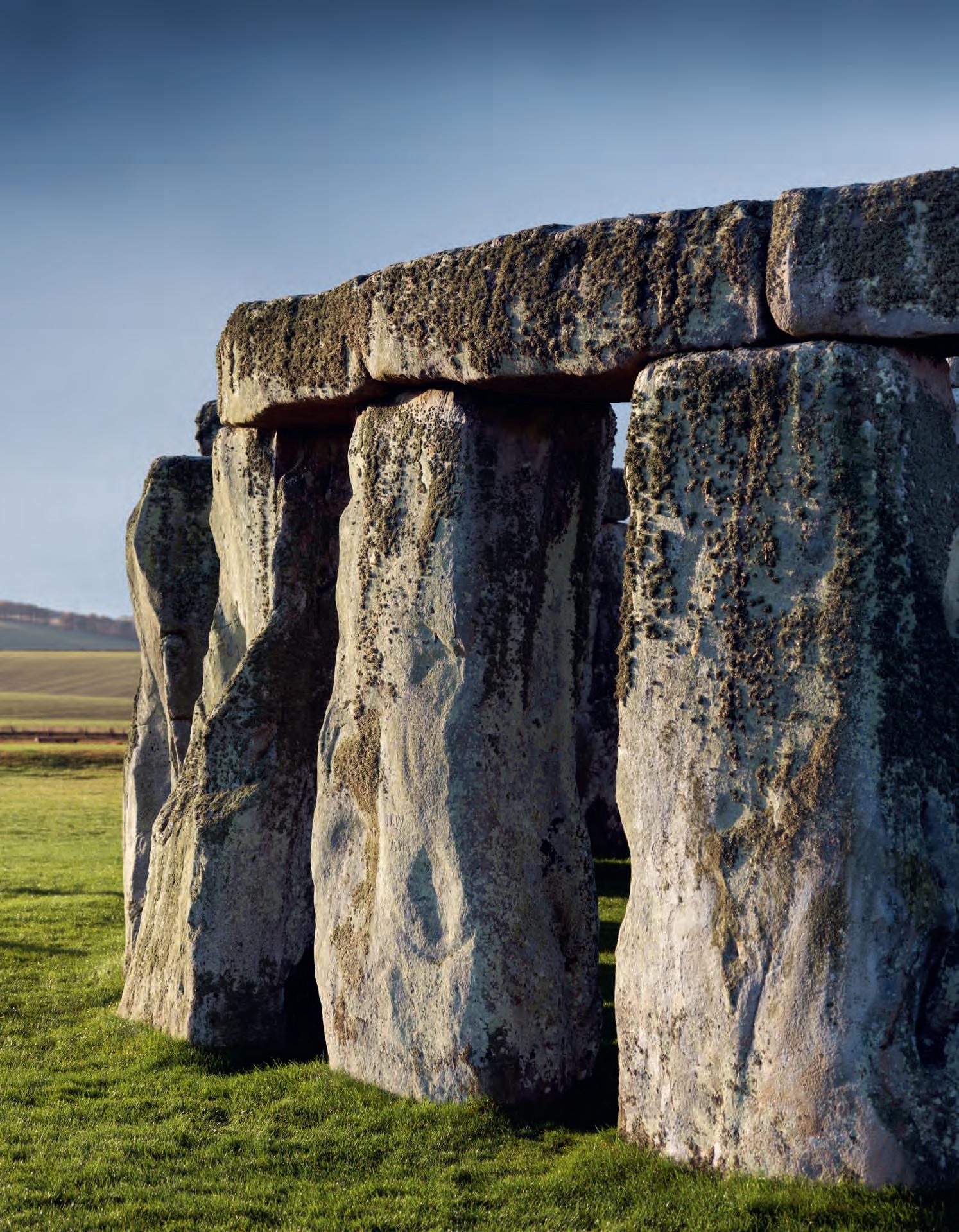
Today, Stonehenge has four concentric rings of stone. The outermost ring originally had 30 upright sarsens, capped by 30 horizontal stones, or lintels. Each upright was positioned to reach the same height, enabling the lintels to be level, despite the slight slope of the ground. The most regularly shaped stones are found on the north-east side of the circle opposite the entrance causeway, suggesting that this was seen as the ‘front’, perhaps important for creating a dramatic impression as people entered the monument.
below Carn Gyfrwy, one of the outcrops of the Preseli Hills in Pembrokeshire, from where some of the spo ed dolerite bluestones were sourced.
opposite The sarsen stones chosen for the ‘front’ face of the outer circle were the largest and most regular in shape, giving an impression of uniformity and solidity. Their trapezoidal shapes give an illusion of height.
overle,f While great care was taken to ensure the lintels of the outer sarsen circle were level, the trilithons of the inner horseshoe were graded in height. Only one of the stones of the tallest trilithon still stands at the head of the horseshoe.
The Missing Stones
Many of the stones that make up Stonehenge are now fallen or missing entirely. Some may have fallen in prehistoric times, perhaps even during the construction of the monument. The bluestones were broken and chipped from prehistoric times onwards, with some surviving only as stumps below ground. Fragments may have been broken off these stones because of their perceived magical powers, and some were made into axeheads, discs and amulets, found dispersed across the region.
Some archaeologists have argued that the southwest side of the sarsen circle was never completed, as the stones here are more irregular in shape and one is only half the height of the others. Enough remains, however, to show that a large amount of stone must have been removed from Stonehenge at some point in the past: in dry weather, parch marks in the grass show the position of long-lost holes where the missing stones would have stood.
There are no wri en records of this taking place, however, unlike at the stone circle at Avebury, where there are accounts of stones being broken up and then buried or removed in the 17th and 18th centuries. This was partly due to their ‘pagan’ associations, but also because they were a useful source of building stone, and their removal cleared the way for agriculture. These reasons don’t apply to Stonehenge, as very few buildings in the area are built of sarsen and the land cleared was not extensive. Instead, it is likely that the stones were broken up for road stone, perhaps in the 17th century. All the evidence suggests that the circle was originally complete.
right Many of the stones that formed part of the outer sarsen circle on the south-west side of the monument have fallen, and most are either partly or entirely missing.
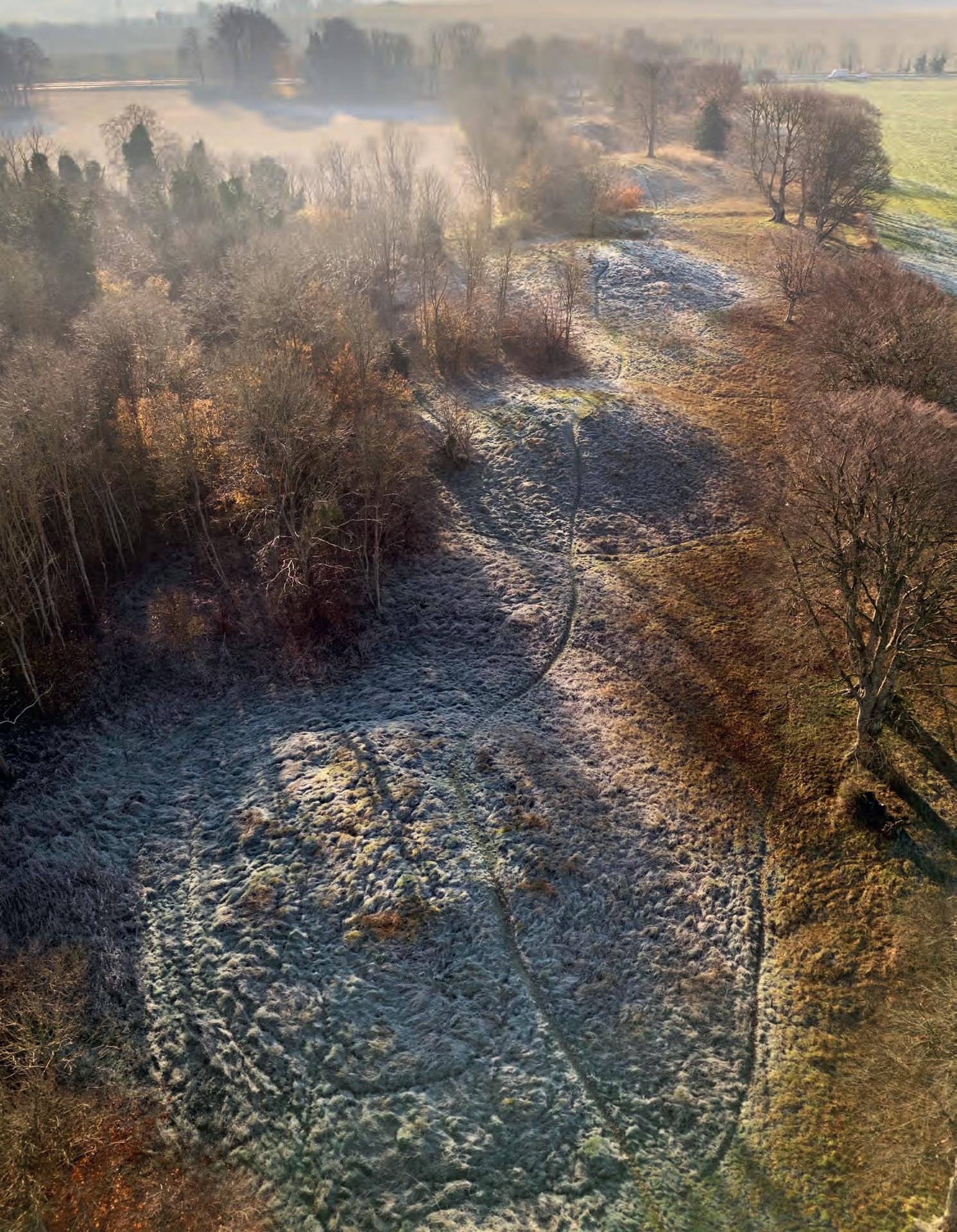
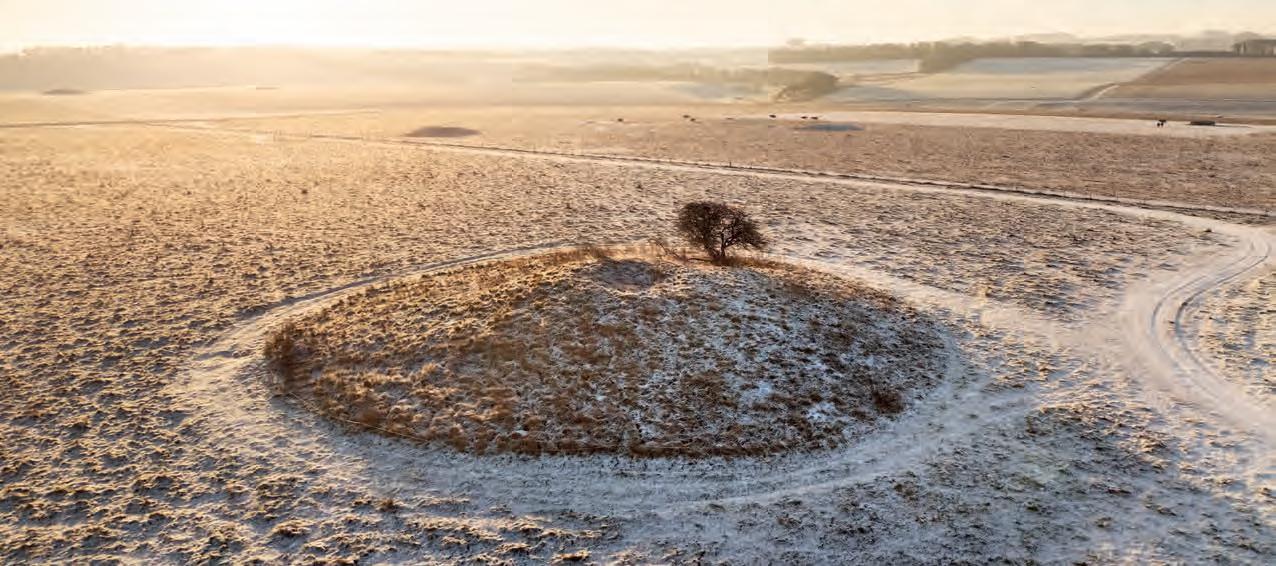
opposite The 18th-century antiquarian William Stukeley named this group of barrows the ‘King Barrows’ because of their large size and prominent location flanking the Stonehenge Avenue. Some appear to have been built using stacks of turf and soil.
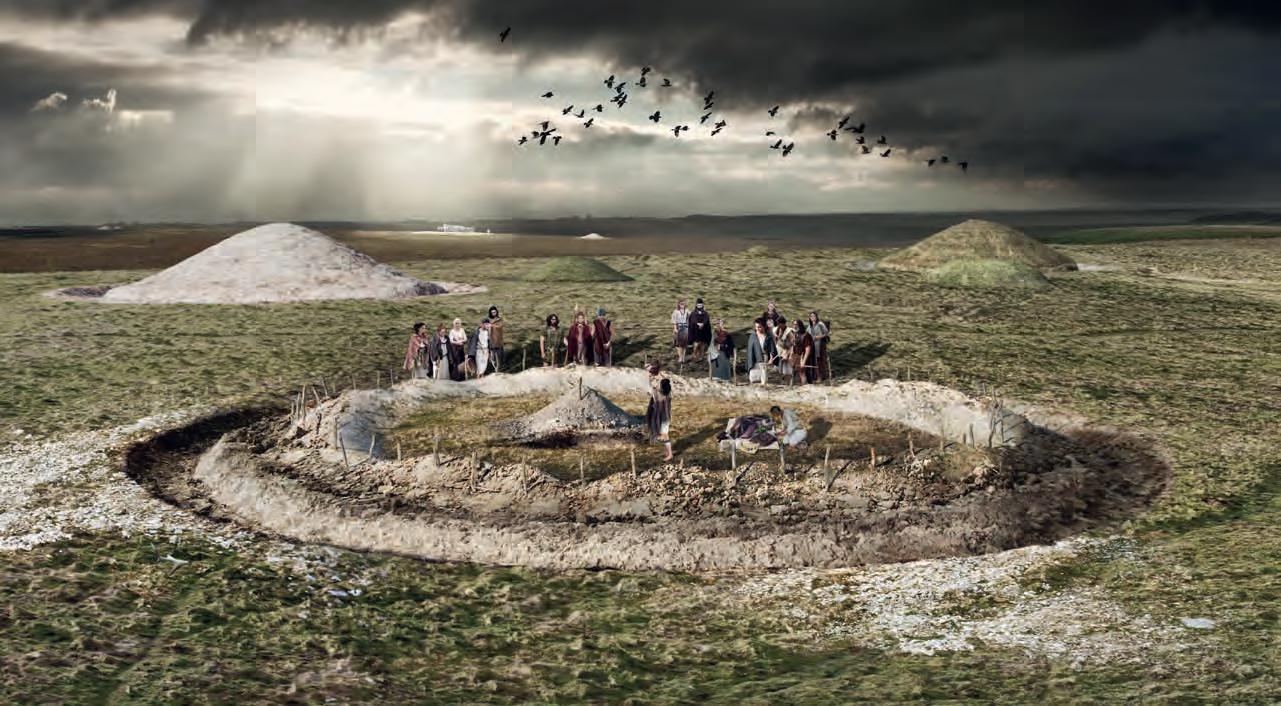
above An artist’s impression of the burial of a woman in the barrow cemetery at Normanton Down in about 1800 bc. A er interring her body in the ground, the mourners would have raised a mound over her grave.
(see page 86). The round mounds built here were of various types: simple rounded ‘bowl’ barrows; mounds surrounded by a flat area and outer ditch known as ‘bell’ barrows; and ‘disc’ barrows, where a circular bank surrounds a flat area containing a small burial mound. This barrow cemetery was built in a place with a long history, as it includes two small long barrows and a rectangular enclosure, all of which probably date from the Neolithic period. Some of the earliest burials date from the Chalcolithic, clustered near an isolated barrow (known as Wilsford G1) at the far west end of the cemetery. Here, a central grave contained a burial with a Beaker pot and antlers, as well as the fragmentary remains of three other people and two cremated burials. A further nine people, mostly children with Beakers, were placed into a surrounding ditch and in flat graves to the north. Radiocarbon dates show that some of these people were living at a similar time to the Amesbury Archer (about 2300 bc). Like him, they may also have been early immigrants.
Over the next few centuries, probably between 2200 and 1700 bc, about 30 more
round barrows were built in a long line running south-east, creating the Normanton Down cemetery. We don’t know if the people buried in these barrows lived locally, as se lements from this period of the Early Bronze Age have not been discovered. It may be that the dead were brought here from other places, to be buried within view of Stonehenge. Either way, the objects buried with them show that they were certainly well-connected and important people. At Stonehenge itself, one final episode of alteration took place probably in about 1800 bc. Two concentric rings of pits, today known as the Y and Z holes, were dug around the outside of the sarsen circle, 30 in the outer ring and 29 in the inner. These holes may have been made to relocate the bluestones or were perhaps just intended as simple pits, perhaps some sort of ‘closing’ event. Whatever their purpose, they were le gradually to fill with windblown sediments. It is quite possible that some of the sarsen stones had already fallen by this date, as there is no hole under the fallen Stone 8 – one of the sarsens of the outer circle. Stonehenge was beginning to become a ruin.
‘Wessex Culture’ Burials (1950–1500 bc )
The burials of some people in Wiltshire and Dorset in the Early Bronze Age were accompanied by ornate, rare and precious grave goods. These have been named ‘Wessex Culture’ burials and provide evidence of highly skilled cra s and long-distance connections at this time. Some of the most spectacular, including the famous ‘Bush Barrow’ burial, have been found close to Stonehenge.
From about 2200 bc metalworkers in Britain and Ireland began to combine copper with tin to make bronze, a much harder and more versatile metal. Tin from Cornwall, together with gold and copper, was exchanged between communities up and down the Atlantic coast of Europe. Specialist metalworkers in these areas made ornate and beautiful objects, such as the crescent-shaped gold ‘lunulae’, a form of ceremonial necklace. The Stonehenge area, at the gateway to south-west Britain, with overland routes to the Irish Sea, and connected by the river Avon to the south coast, was at the heart of these exchange networks.
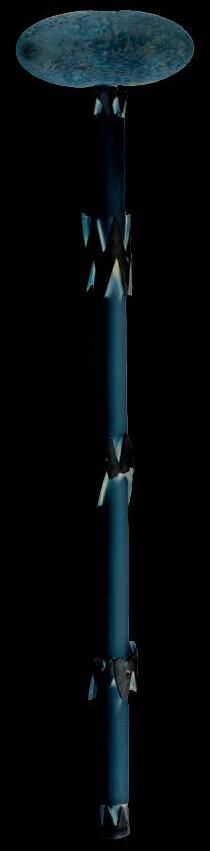
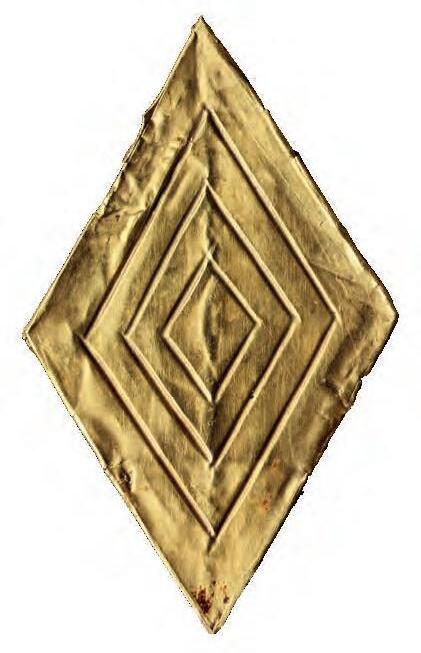
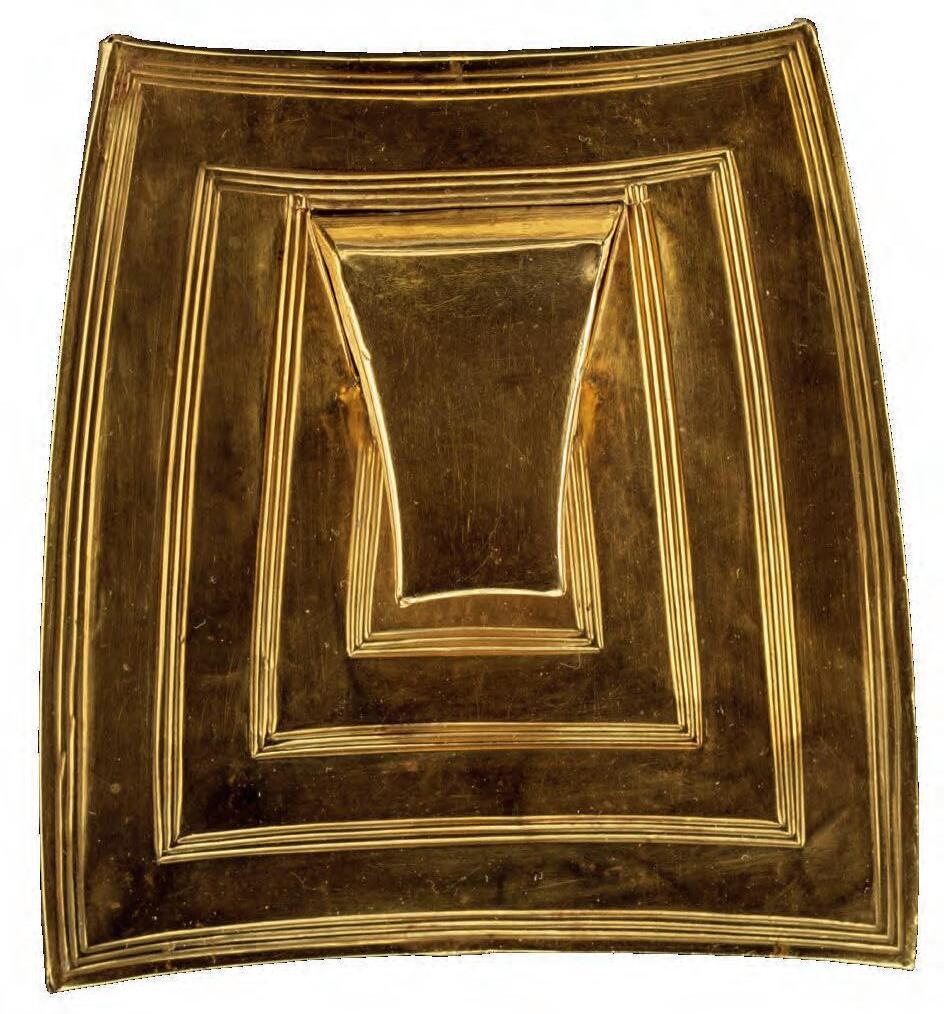
In 1808, antiquaries William Cunnington and Sir Richard Colt Hoare were excavating barrows on Normanton Down (see page 106). Under one mound they found the skeleton of an adult male in a crouched position, with three large bronze daggers, a bronze axe, a gold belt hook, two gold lozenges decorated with intricate geometric shapes and a mace-head with a decorated handle. It is the richest burial ever found from prehistoric Britain.
below This barrow on Normanton Down, known as Bush Barrow, was excavated in 1808. Inside it was a burial, probably an adult male, accompanied by spectacular gold and bronze objects.
opposite The Bush Barrow grave goods, now on display at the Wiltshire Museum, included a stone mace-head (le ), perforated for a wooden handle, which was probably decorated with bone mounts (reconstructed here). The small gold lozenge (right top) was found nearby and may also have been mounted on the handle. This eye-catching weapon may have been an important piece of regalia. The burial also included the decorated gold cover of a large belt hook (right bo om).
inhabitants of Britain, who were deemed to have been primitive savages, incapable of such an architectural feat.
While hunting with friends in 1649, the antiquary and writer John Aubrey (1626–97) was taken to the village of Avebury, in north Wiltshire, where he was astonished by the enormous stone circle. Fascinated, he went on to spend part of each year there, even taking King Charles II (r.1660–85) on a personal tour of the site. He also conducted a more thorough survey of Stonehenge, comparing it to Inigo Jones’s inaccurate reconstruction. Aubrey believed that these sites, and many other megalithic monuments across Britain, were religious temples dating to a time before wri en records. Noting that they could be found in Ireland and Scotland, areas that had never been
conquered by the Romans or the Danes, he correctly concluded that they were not built by visitors from overseas, but by the indigenous pre-Roman population of Britain.
At this time there was no concept of prehistory – the world was widely accepted as having been created in 4004 bc, based on calculations of Biblical time, with Britain estimated to have been first populated in about 2000 bc. The only pre-Roman religious leaders described by the classical authors at the time of the Roman invasion of Britain were the ancient Druids, who were Iron Age priests, judges and teachers. It was therefore logical for Aubrey to conclude that the Druids were the architects and users of Avebury and Stonehenge. Although he amassed many hundreds of pages of notes, drawings and diagrams, Aubrey
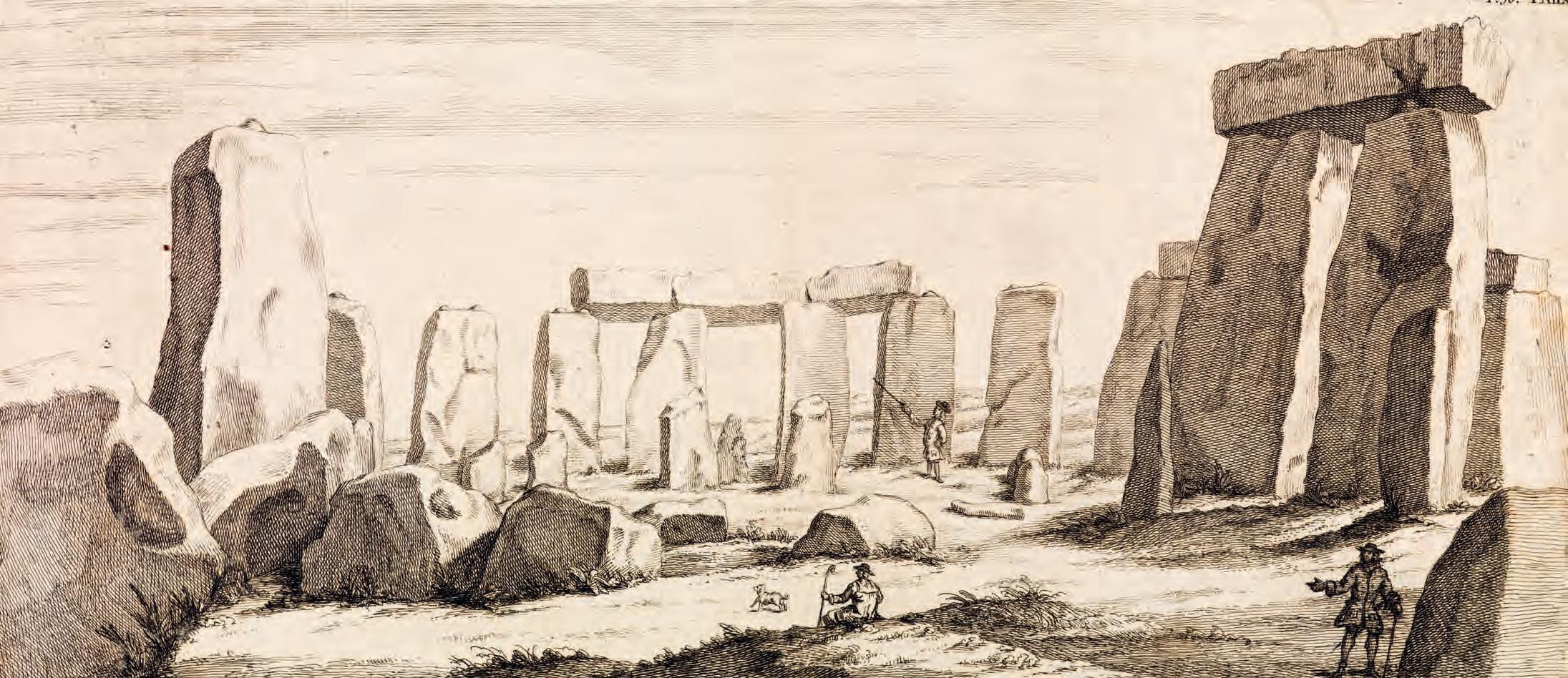
above One of the many detailed illustrations of Stonehenge from William Stukeley’s 1740 book Stonehenge, A Temple Restor’d to the British Druids. This view is entitled ‘Inward view of Stonehenge from the high altar’.
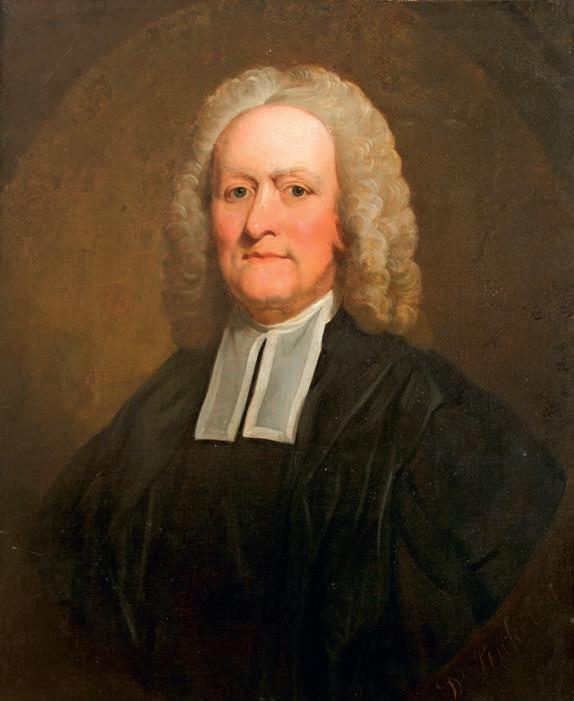
below Portrait of William Stukeley by an unknown artist, about 1740. Stukeley proposed that Stonehenge had been built by ancient Druids, an idea that would endure for the next 200 years.
unfortunately never published his work. Nevertheless, he did discuss his ideas with friends, and his manuscript notes were widely consulted a er his death.
Aubrey’s ideas influenced William Stukeley (1687–1765), a doctor, antiquary, scientist and later a clergyman, who took a particular interest in megalithic monuments. Between 1719 and 1725 he spent his summers touring Britain, surveying, drawing, and making observations about historical and ancient antiquities. He conducted surveys using a theodolite, made the first accurate plans of many sites and o en drew landscape-scale maps or views that are invaluable records today. At Stonehenge, his careful observations led him to recognise the solstice alignment of the stones, to identify the earthworks of the Avenue and discover the
nearby Greater Cursus, giving it a name that reflected his opinion that it was a Roman arena for ‘games, feats, exercises and sports’. He was also responsible for coining the term ‘trilithon’ to describe two upright stones capped by a horizontal lintel.
Stukeley’s 1740 volume Stonehenge, A Temple Restor’d to the British Druids argued that the monument had been built by the Druids, who he thought had practised an early form of Christianity. This, he believed, was not far removed from the original pure world religion originating with, and descending from, Adam and Noah. Stukeley’s theories were taken up enthusiastically and were widely accepted by scholars and the general public alike. For the next 200 years, Druids would be firmly associated with Stonehenge.
MODERN STONEHENGE (1926–TODAY)
Stonehenge today receives well over one million visitors a year, who come to see the ancient monument for themselves. Many may assume that the monument has always appeared as it does now and there is li le more to be learned about its history. The appearance of Stonehenge today, has, however, been affected by major conservation works that took place at the site in the 1950s and 1960s. Excavations both at Stonehenge and in the surrounding landscape in the last few decades have helped to piece together its story.
William Hawley completed his excavations in 1926, although a full report on his discoveries was never published. In 1950 the Society of Antiquaries of London asked a team of three experienced archaeologists – Richard Atkinson,
Stuart Piggo and JFS Stone – to rectify the situation by writing up a ‘full and definitive’ volume on the archaeology of Stonehenge. The trio decided that some limited excavations would help to resolve some questions. In the end they excavated several areas of the site between 1950 and 1956, including two more of the Aubrey Holes, parts of the Avenue, part of the bank and ditch, and a portion of the bluestone circle. The archaeologists wrote a report for the Society of Antiquaries, recommending the restoration of the trilithon that had fallen in 1797, as well as other fallen stones, and securing those in danger of collapse. The Society supported these proposals and the Ministry of Works, which held responsibility for Stonehenge at that time, eventually agreed on the basis that ‘it would enhance the value of the monument for the
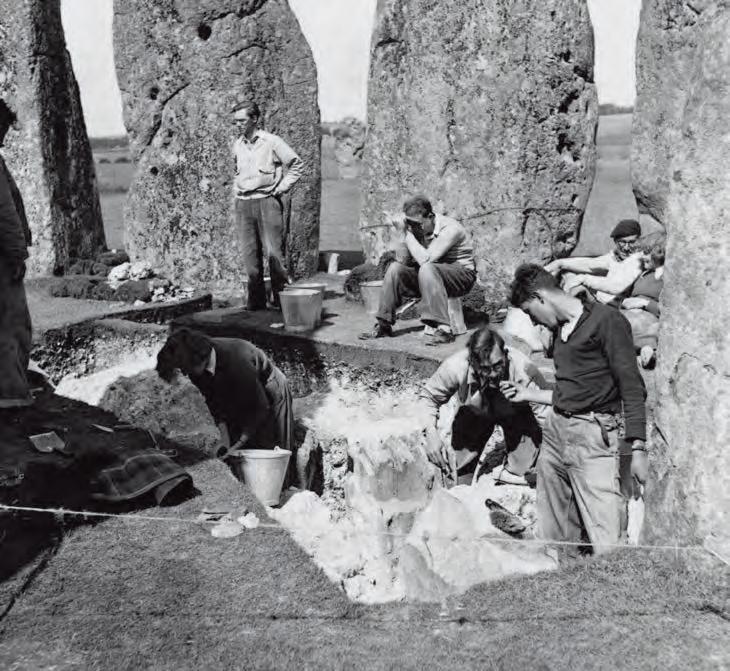
below left Excavations
The trilithon was re-erected from where it had lain for 161 years. An upright and a lintel forming part of the outer circle were also put back into position.
at Stonehenge in 1954, led by Richard Atkinson, who can be seen in the trench, smoking with his trademark cigare e holder.
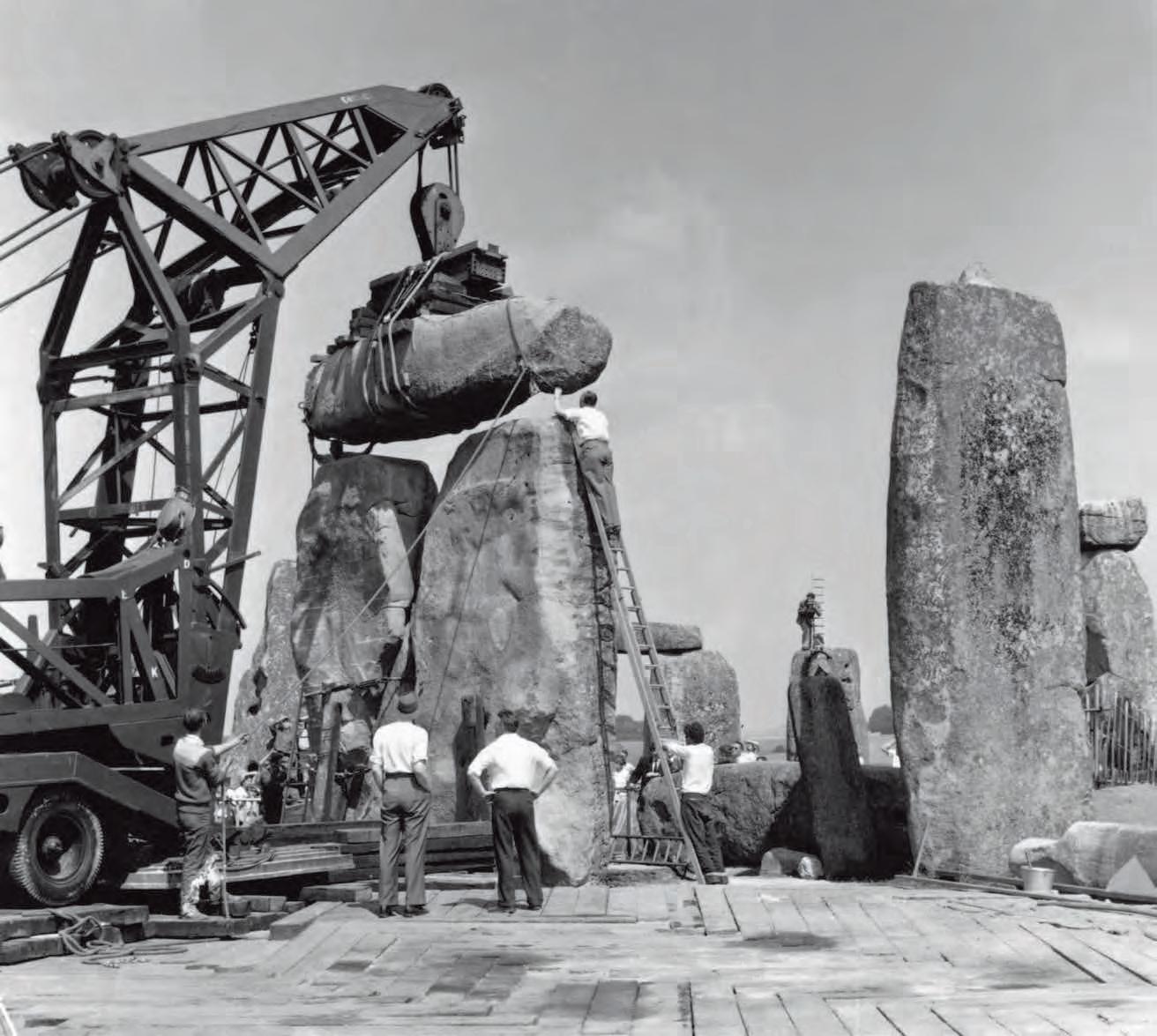
above During restoration work in 1958, the lintel is li ed into place, restoring the trilithon that had fallen in 1797. On the ladder, guiding the stone into place, is T Aubrey Bailey, the Chief Architect for the restoration project.
student and make it more intelligent to the ordinary visitor’. Accordingly a major engineering project and associated excavations began in 1958. Atkinson, Piggo and Stone together oversaw the archaeological work. The trilithon was re-erected from where it had lain for 161 years. An upright and a lintel forming part of the outer circle were also put back into position. Several further sarsen bases were set in concrete to prevent future movement, and a large hollow at the base of one of the large sarsens of the inner horseshoe was infilled. Finally, six fallen bluestones were li ed and straightened.
Two seasons of restoration had been successfully completed, but on the morning of 10 March 1963, calamity struck: one of the stones in the outer circle fell during high winds. A long period of frost in the early spring, followed by a rapid thaw and heavy rain, was said to be the cause. This stone had, however, also been given a he y knock during the works to re-erect the adjacent stone. Inspectors rapidly surveyed the whole site, amid fears that further stones would fall, perhaps onto unsuspecting visitors. Monthly readings were taken to monitor any movement.