ON RIGOR JOHNSEN SCHMALING
with an introduction by Clifford Pearson
On Delight
By Clifford Pearson
Kettle Moraine House
Oak Park Housing
Pleated House
Art Gallery and Studio
510 House
Stacked Cabin
Linear Cabin
Block 27
Topo House
Ortho Clinic
ON DELIGHT
By Clifford Pearson
Brian Johnsen and Sebastian Schmaling use words such as “rigorous” and “disciplined” to describe their work. They apply logic and order to every project and eschew big architectural gestures and bold formal moves. Their buildings, many of them located in the coldest parts of the United States, exhibit a Nordic and Germanic sense of reserve, an attitude of principled simplicity and restraint. The work of Johnsen Schmaling Architects does not scream for attention. And yet, the results of all this mental toughness are places of pure delight—country houses that maximize the pleasure of their natural settings, urban homes that entertain the eye with color, even dental clinics washed in daylight. You don’t need to be an ascetic or hermit to be drawn to the firm’s mountain retreats and cabins tucked in the woods.
Design critics often focus on the exquisite exterior surfaces of Johnsen Schmaling’s buildings—the richly patinated rusting steel of the Studio for a Composer, for example, or the multi-colored wood-veneer panels of the Camouflage House—and admire the rectilinear compositions of facade elements beautifully pieced together. Yes, these building envelopes are both pleasing to the eye and intriguing to the mind. But they are preludes to the spaces inside, where people can enjoy carefully framed views of lakes or hills and feel immersed in nature while staying warm and dry. The rigor of the architecture lets you relax and soak in the beauty of the surroundings.
Context drives all of the firm’s work, whether it is a sprawling site in the mountains, a suburban lot squeezed between uninspiring neighbors, or a former train yard in a newly emerging part of town. A standard modernist response, especially to naturally beautiful locations, is to create a dramatic contrast between architecture and site—
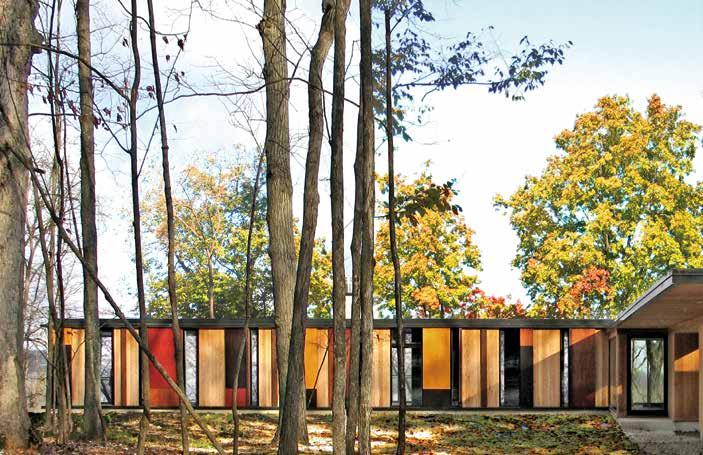
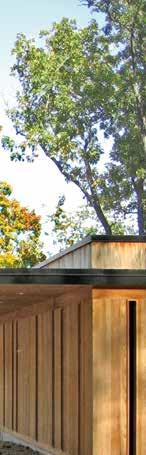
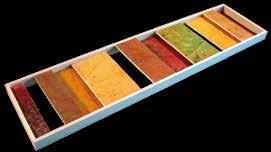
previous I Camouflage House (2006): approach below I Camouflage House: photographic record of a shadow box exploring rhythmic shifts between tree trunks and wall planes; conceptual facade model
the lovely white box overlooking a rugged seacoast, for example, or the glass-and-steel pavilion floating above the prairie. The opposite approach is to try to blend in by resting a stone structure on top of a rocky site or draping a building with plants, vines, and grasses.
Johnsen and Schmaling do something harder and more intriguing: they extract the essence of a place, its DNA, and grow a unique design from it. The Camouflage House, a seminal project that put the architects on the map in 2007 and reveals key ideas that still drive their work, doesn’t really hide in place, despite its name, but interprets critical characteristics of the woods around it and expresses them in architecture. The cedar and wood-veneer panels wrapping the house don’t copy the colors or even the textures of nearby trees, but rather convey the notion of nature. The irregular spacing of glass and wood on the facades isn’t a means of disguising the house, but a way of riffing on the syncopated rhythm of light dappling through a forest. Doing this right is akin to practicing alchemy or
below I OS House (2010): the third-floor study cantilevers over the main building volume; view from the street
other black arts and involves turning base materials—such as inexpensive veneers and engineered wood products—into architectural gold. To Johnsen and Schmaling, fitting in isn’t a matter of copying, but of translating what they find.
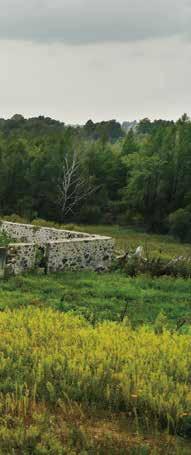
Sometimes, rooting a building to a place means going way back. As its name implies, the Kettle Moraine House (p.20) connects to a geological past. It does this figuratively, not literally—using a long, board-formed concrete wall running along one side of the driveway to allude to the time thousands of years ago when receding glaciers scraped the area’s soil. The house itself pushes into the ground to minimize its apparent mass and improve its thermal prformance. The architects also kept the ruins of an old stone barn on the property as a reminder of the vernacular architecture that once dotted the landscape and have restored the prairie that was here before farming began. This project reminds us that history is an ongoing process, not a snapshot.
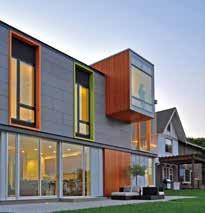
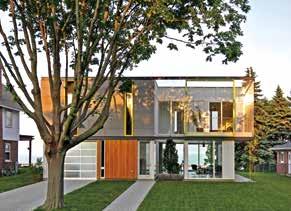
Johnsen Schmaling’s urban and suburban projects tap into a more recent past, acknowledging existing buildings from another century, even as they employ a precise contemporary architectural vocabulary. Oak Park Housing (p.42), for example, is an unapologetically modernist ensemble, but it roughly matches the height of neighboring structures, and its polychrome facades pick up colors found on cottages in the area. Meanwhile, the OS House in a historic district in Racine, Wisconsin, eliminates the pitched roofs of its neighbors, but respects their size and abstracts their forms. A projecting upper floor offers a modern interpretation of a nearby gable, simplifying it but capturing the desire to provide a visual punctuation mark. The house looks different, but it fits in.
With the Ferrous House, the architects addressed a classic challenge of the suburbs: what to do with an outdated production house in a typical subdivision. Instead of tearing it down and throwing away all of its materials, Johnsen and Schmaling saved money and embodied energy by reusing the
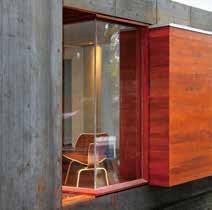
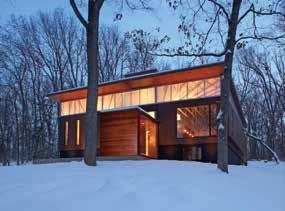
below I Ferrous House (2008): facade detail; view from the street
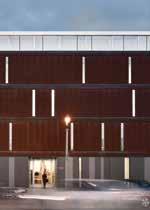
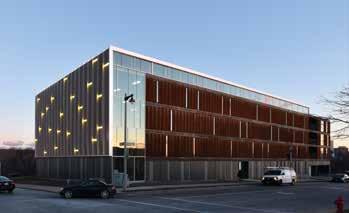
below I Belay MKE (2017): facade detail of the weathering steel skin; at one end of the building, the roof plane folds down and transforms into a decorative wall
existing foundations, perimeter walls, and plumbing stacks. They transformed the building, though, on the inside and out, creating a house with much more daylight, more storage, and an open interior that accommodates the way people live today. The result is the opposite of a McMansion: it serves as a prototype for a responsibly sized, ecologically correct house that points the suburbs in a new direction.
For Belay MKE, the architects drew from an urban site’s history as a train yard, using industrial materials like weathering steel and concrete board that give the 46-unit apartment building an appropriately rugged character. A long expanse of corrugated steel panels hides services and a fourstory-high rock-climbing space operated by a local gym. Irregularly spaced vertical slivers of glass between the rusted-steel panels create a sense of motion, as if the horizontal bands of metal were freight trains rolling along tracks that no longer exist. You can almost hear the noise of metal wheels click-click-clicking across the site, a ghost soundtrack conjured from visual cues.
KETTLE MORAINE HOUSE
Campbellsport, Wisconsin
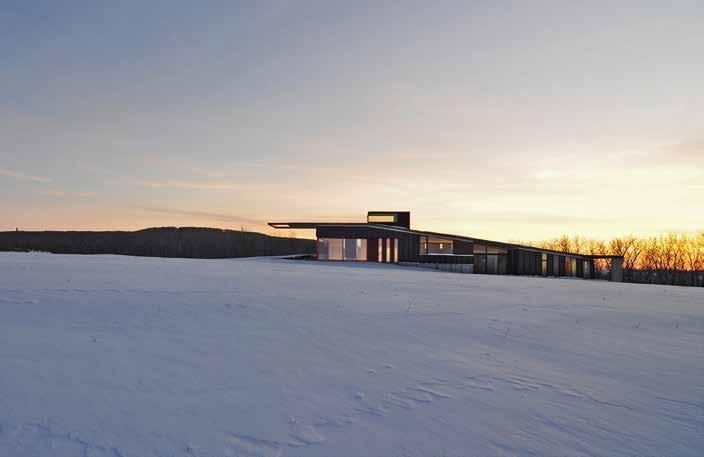
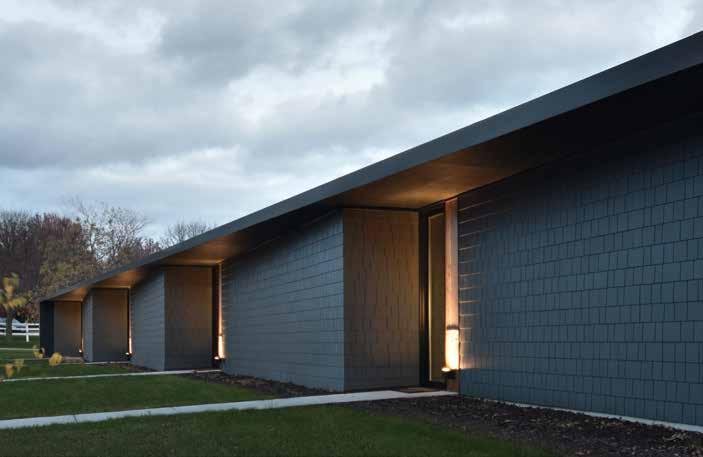
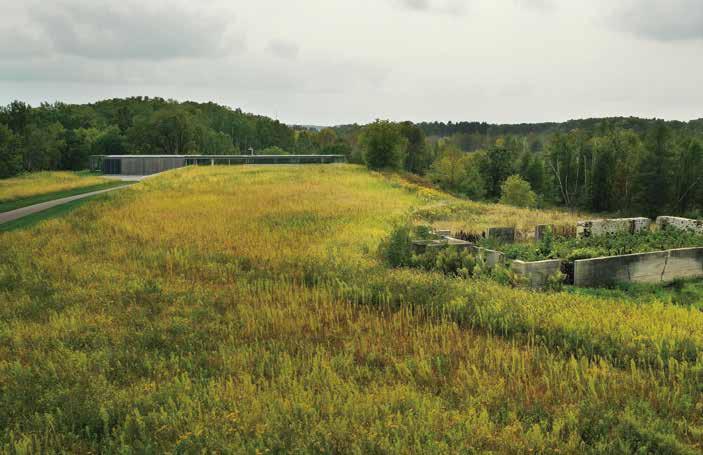
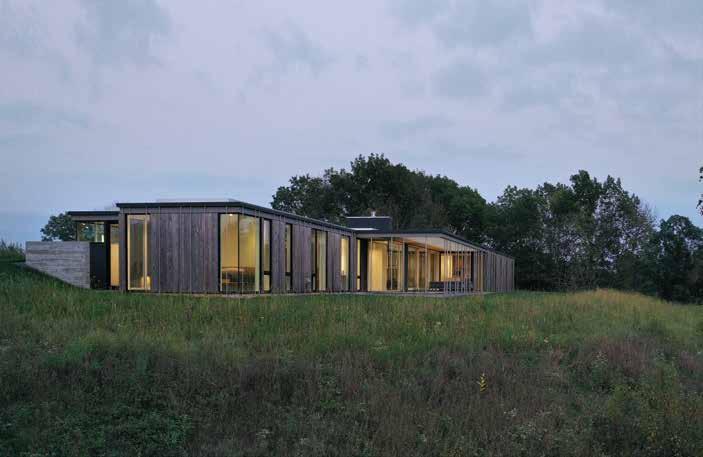
Nestled in the gently rolling landscape of Central Wisconsin, the Kettle Moraine House sits at the far end of an elevated plateau of a recently restored native prairie, its low-slung linear volume overlooking an expansive wetland and small creek beyond. From the nearby country road, the house appears as merely a faint line in the distance, seemingly floating above the grasses and quietly complementing the Kettle Moraine’s stretching horizon.
The driveway winds through the prairie and past the ruins of an old barn, a graceful memento of the land’s former agricultural use, before aligning with a long, board-formed concrete wall that extends into the site’s gentle topography and carefully choreographs the final approach toward the house. An anchor that physically ties the house to the surrounding land, the concrete wall leads visitors to the entry and retains the rising terrain along its back side, allowing the building to partially embed itself in the ground to minimize its visible profile.
The program is organized in a series of three parallel bars, each slightly shifted, split in half, and then pulled apart lengthwise, essentially bisecting the building mass to leave a generously glazed void in the center that serves as the home’s open dining and living room. Large-scale liftslide doors on both sides of the space connect to a long south-facing patio with expansive views of the wetland and the terraced, north-facing entry courtyard that mediates between grade and the elevated prairie plane. The glass entry door, on axis with the long concrete wall and positioned to frame
a small but arresting grove of birches in the distance, leads into a narrow vestibule with a wooden screen wall that separates it from the main living hall. Exposed wood beams articulate a coffered ceiling and extend to the outside as a trellis over the patio; in concert with a deep overhang, the trellis provides ample shade during the hot summer months and carefully modulates the sunlight entering the house throughout the year.
A long, continuous clerestory lines the gym and master bathroom in the sunken portion of the house. At night, the narrow window band radiates its warm light into the distance, subtly evoking the enigmatic clerestory glow of the dairy barns that once dotted the region. The concrete perimeter wall continues eight feet beyond the northwest corner of the house, where it defines the boundaries of a small walled-in garden for meditation and privacy. The restrained exterior material palette—exposed concrete, weathered wood, and glass—echoes the muted hues of the region’s vanishing barns and silos. The knotty boards of the precisely detailed rainscreen facade add a degree of rusticity to the overall rigor and formal discipline of the house; they are complemented by a series of randomly spaced vertical stainless-steel rods, their thin, silver lines a subtle nod at the small birch grove beyond. The project included the restoration of more than fifty acres of abandoned farm fields into Wisconsin prairie, rehabilitating the land’s original biodiversity and turning it into a new sanctuary for wildlife and birds.
terminates in a dramatic cantilever over the large south-facing vista terrace. The courtyards—one covered, the other two open to the sky—function as sheltered outdoor rooms that provide protection against the area’s strong and ever-changing winds. On the inside, rooms are interconnected to create a continuous spatial meander that traces the site’s topography: the program is distributed on five individual floor plates, each one of them separated from the next by several steps, creating a progression through the house that leads from the entry at the lowest elevation to a small observatory at the top.
Echoing the dramatic surface deformations that occur when wind blows over the crops and grasses of the surrounding prairie, the building skin is composed of a high-performance ventilated rainscreen system with integrally colored concrete fiber panels, organized by 190 individually shaped, black-anodized aluminum fins of interrelated contracting and expanding shapes. Depending on the time of the day and the angle from which they are viewed, the fins create a constantly changing veil whose shifting geometry subverts the volumetric purity of the house itself. The rainscreen system is complemented by textured castin-place concrete walls whose deep, randomly spaced reveals juxtapose the consistent rhythm of the vertical fins.