Sidonie-Gabrielle
Frédéric
James “Jim”
Honoré
Oscar
Edith
Amedeo
Isadora
Sidonie-Gabrielle
Frédéric
James “Jim”
Honoré
Oscar
Edith
Amedeo
Isadora
My first encounter with a funerary ritual was frightening yet beautiful. My mother told me at age eleven that my grandfather, a lieutenant colonel in the army, had died and that we were going to attend his funeral at Arlington National Cemetery. I sensed it was an important occasion because she asked me to put on my favorite dotted Swiss dress and black patent leather shoes. As members of the family, we rode in a limousine. The women wore long black veils covering their faces and leaned on the arms of the men. At the cemetery, several brawny soldiers in uniforms with gold braid and shimmering swords lifted the casket from the back of a hearse and put it onto a shiny black wagon called a caisson, a gun carriage drawn by six gray horses.
As the procession moved along the winding road, workers stopped what they were doing and stood at attention. Everything was still except the wind stirring in nearby trees, which tossed the horses’ manes and teased the edges of the flag draped over the casket. We all walked up a grassy hill to the graveside. I spotted the large hole underneath the metal cradle where the casket was placed. A short eulogy by a military chaplain was followed by three soldiers who took the large flag from atop the casket and, in amazing synchronized movements, folded it into a neat triangular bundle that one of them handed to my grandfather’s widow.
Being a precocious kid, I tried to get the stern-faced soldiers to smile by making faces at them. I’ve always been the clown in the family at serious moments, but my mischief came to an abrupt halt with the explosion of a multigun salute, and the lone bugler’s playing of “Taps.” The horn’s mournful cry echoed throughout the cemetery. Frightened, I grabbed my mother’s hand as we both wept. This was my initiation into grief.
My father’s deathbed plea was alarming in its urgency: “Carolyn, never put off your dreams.” He died of cancer at age sixty-four, having just retired after thirty-five years of work for the federal government. He never realized his own dream of being a writer.
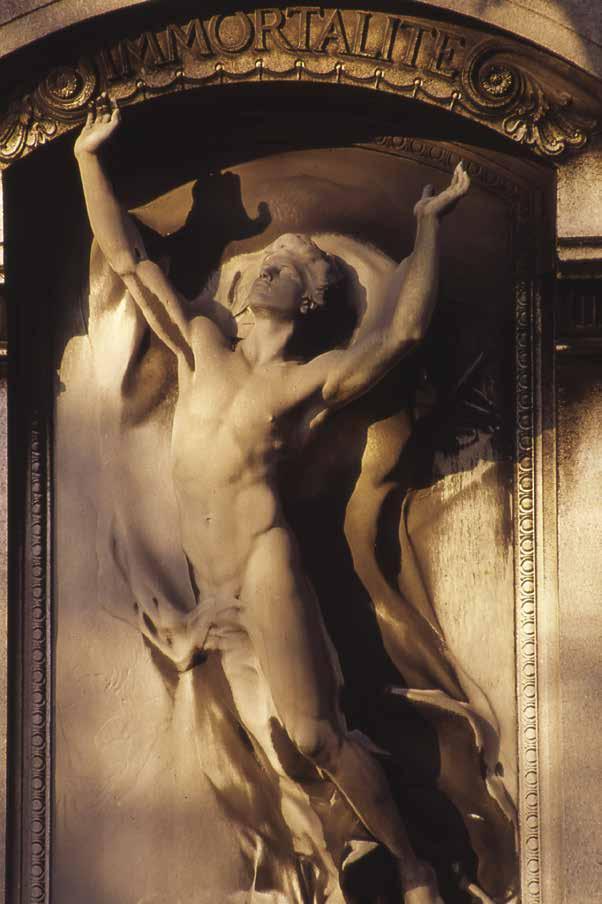
I seldom go out, but when I feel myself flagging I go out and cheer myself up in Père-Lachaise…while seeking out the dead I see nothing but the living.
—Honoré de Balzac
Imagine it’s the year 1780 in Paris, and you’re sitting down with family and friends to a modest meal. Things are bleak due to a series of poor harvests in the area, which has led to soaring bread prices and food riots. Though the times are stressful, France is a country where eating is a pleasure rather than just a means to give the body nourishment, so the group is grateful for what they have, including one another. Dinner is interrupted by a deafening roar as the neighboring cellar wall of the cimetière des innocents collapses, spilling an avalanche of 2,000 corpses into your apartment building.
Centuries of war and plague had already filled the catacombs and church graveyards—the traditional burial places operated by the church—creating a massive historical mulch in places like the cimetière des innocents. The eighteenth-century Parisian engineers had overlooked one significant question in their urban design scheme—what to do with the ever-increasing population of the dead? This is where our story begins.
In the years prior to Père-Lachaise’s founding in 1804, Paris was rocked by terror and anarchy, marked by the Revolution and the executions of Louis XVI and Marie Antoinette. Though Paris would ultimately triumph against her enemies, the city was weary. Yet mobs, also angry at how the clergy lived like aristocrats, destroyed many of the great churches and sculptures.
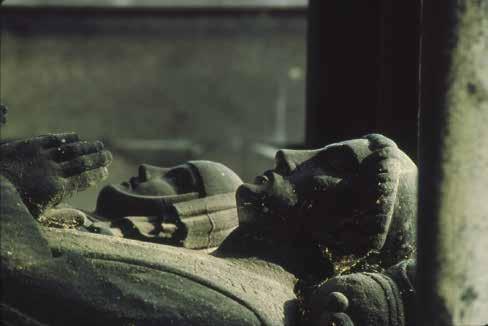
lived within the city’s limits could purchase a burial plot, a sliding scale of fees was established. Plots could be rented either for ten or twenty years or as a concession à perpétuité (in perpetuity). The rates today for a burial plot à perpétuité start at €10,911 (~$12,000 USD).1 In speaking with cemetery officials, I learned that today’s burial arrangements follow the same formula, except that now only approximately 300 spaces become available annually when abandoned concessions (leases for burial plots) are reassigned to new beneficiaries. Currently, one million people are buried in Père-Lachaise. The cemetery’s ossuary contains the bones and cremated remains transferred from overcrowded cemeteries across Paris, and counting those, the estimated total climbs to more than two million.
Further conversations with the cemetery’s administrators revealed that, unfortunately, some families were shortsighted in relying on their descendants to keep up payments on the plots. In some cases, once the rent was past due and no effort was made to resolve the debt, the body was disinterred and the plot was made available to the next customer. The contents of the crypt were usually placed in the ossuary. A similar fate befell unkempt
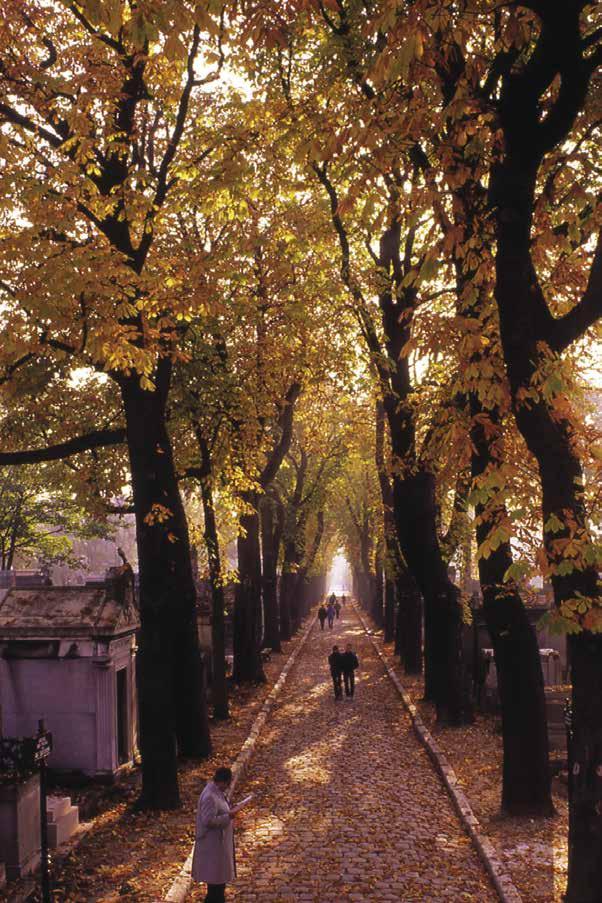
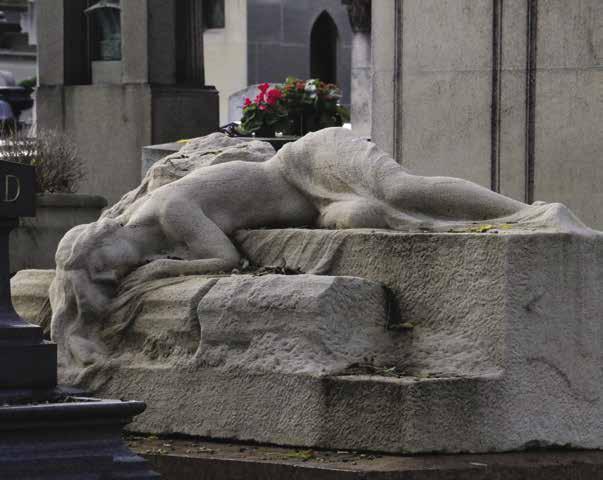
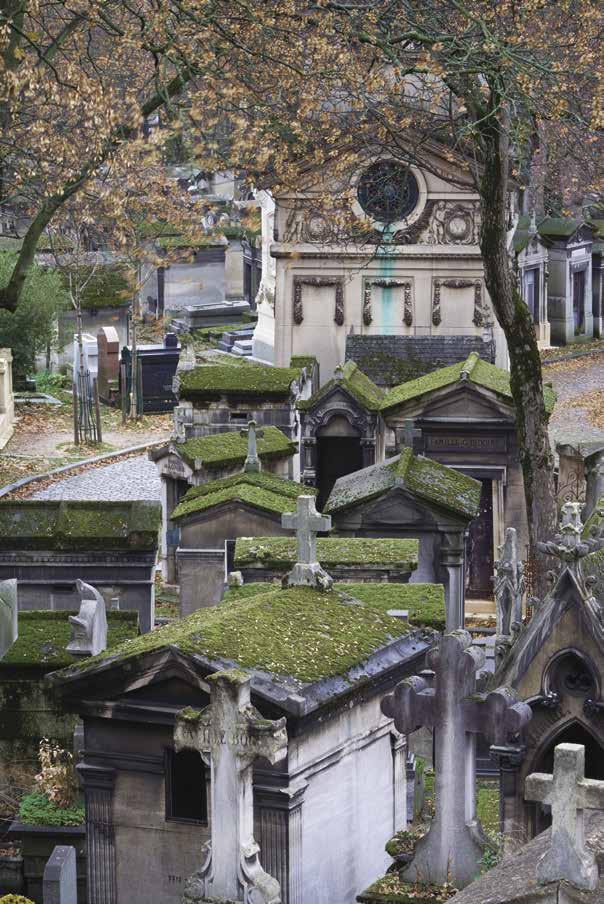
The designs in Père-Lachaise represent an encyclopedic grouping of many periods, including Gothic, Romanesque, Neoclassical, Italian Renaissance, and art nouveau crypts next to Egyptian revival pyramids and obelisks. Classical revival treatments as well as Doric and Corinthian columns on mausoleums also appear throughout the cemetery. These treatments incorporate the popular materials and architectural styles of the day, including stained glass, trellised iron, sculpted marble and granite, enameled figures, and various motifs such as veiled women symbolizing death and sorrow.
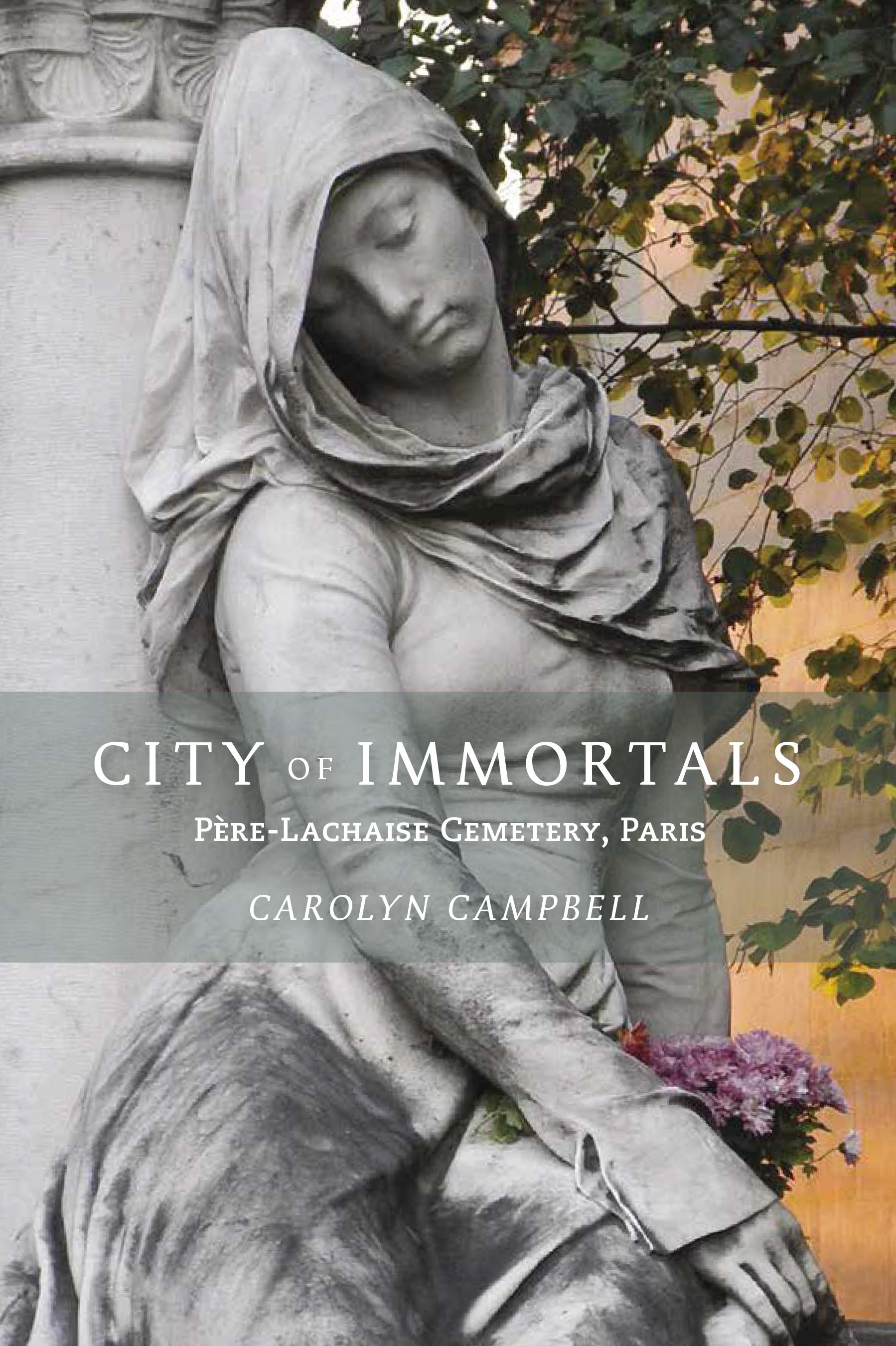
Nineteenth-century architects and sculptors utilized the grieving female figure as one of the most prominent characters in this theater of stone. The figure of the seated woman featured on the map and book cover is by sculptor LouisErnest Barrias and marks the tomb of French government architect AntoineGaëtan Guérinot and his wife Jeanne, located behind the large chapel in
Many visitors to the cemetery come bearing mementoes to leave at the gravesites—flowers, photos, a personal item, letters, small pebbles. I have even seen Paris Metro tickets (allowing for travel to the past or present?). Beside the tombs of writers, a new tradition has recently sprung up—a small jar filled with pens and pencils, both as a symbol for the scribe interred as well as, I suspect, a ready implement should one want to jot down a thought to leave behind. A yearning to speak directly with the departed is what inspired me to have these encounters.
Initially, I longed to ask Oscar Wilde why he didn’t flee England for France, thus avoiding a horrendous trial and his subsequent sentencing to hard labor in prison for his homosexuality. So, I decided to have that conversation and more.
In this chapter, I speak with several cultural icons about their triumphs and failures, as well as any wisdom they wanted to share with those above ground. They appear in the order one might encounter them on a tour: Sidonie-Gabrielle Colette, Frédéric Chopin, and James “Jim” Morrison in Tour One; Honoré de Balzac in Tour Two; and Oscar Wilde, Edith Piaf, Amedeo Modigliani, and Isadora Duncan in Tour Three.
In my career, I have collaborated with and represented many artists and performers, and I have even written their obituaries while I was the editor of an arts magazine. I identified with their struggle, survival, joy, and redemption. These are the traits that allowed us to open up to each other, and I believe it is why the immortals granted me access for the interviews.
The actor Vincent Price brought Oscar Wilde to life for me in his one-man play Diversions and Delights in 1977 at Ford’s Theater in Washington, DC. Price re-created Wilde’s 1899 two-act public talk in Paris detailing his life, his works, and his love for Lord Alfred Douglas. Wilde performed for some much-needed money a year before he died. It was eerily authentic, with Price repeatedly stepping offstage, imitating Wilde drinking absinthe to soothe a painful ear infection. Eventually Price, in the character of Wilde, brought the bottle on stage and was soused by the time he took his final bow.
My continuing admiration for Wilde was rewarded decades later in Los Angeles when I discovered UCLA’s William Andrews Clark Memorial Library and its Oscar Wilde Collection, the finest public collection in the world. At an academic symposium on Wilde and the Culture of the Fin de Siècle at the Clark, I had the great fortune of meeting Wilde’s grandson and scholar, Merlin Holland. Here in Père-Lachaise, I finally engage Wilde himself in conversation.
Carolyn Campbell: Mr. Wilde, your tomb is one of the most visited in PèreLachaise. Why do you think that is?
Oscar Wilde: Well, I am very flattered to see the throngs of handsome young men; I would like to think it’s because of my literary genius, but I understand it’s more about my being seen as a champion of gay rights. Ironically, I lived during what was called the gay nineties (1890s that is), but it had a totally different connotation.
CC: Your grandson Merlin Holland wanted people to know that you were more than a rare wit quick with a bon mot, someone who today might even be a talk show host.
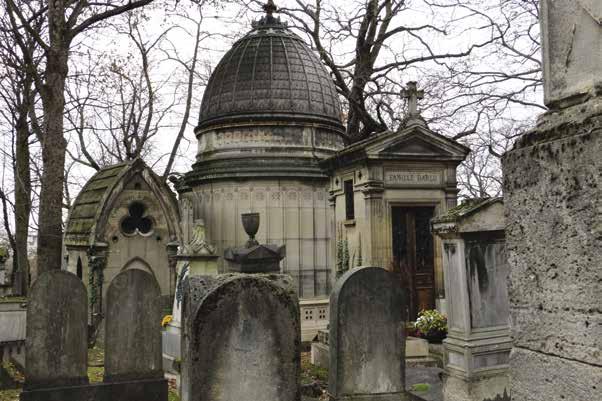
Look for a large dome a short distance to the right and walk across this division to the final resting place of writer Anna de Noailles (1876–1933).
A Romanian-French novelist and poet, she was friends with the cultural elite of Paris, including Colette, Jean Cocteau, André Gide, Max Jacob, and Marcel Proust.
“Noailles composed nine volumes of poetry, three novels (among which the delightful Le Visage émerveillé, 1904), a collection of prose poems (Exactitudes, 1930), a book combining novellas with a series of meditations on gender relations (Les Innocentes ou la sagesse des femmes, 1923), and an autobiography spanning her childhood and adolescence (Le Livre de ma vie, 1932).”7 She was the only female poet of her time in France to receive the highest public recognition. This chapel tomb houses not only Noailles but her grandfather Georges-Démètre Bibesco (1804–1873), Romanian prince of Wallachia, and his wife Marie Bibesco (1815–1859).
Among Wilde’s many notable works are The Importance of Being Earnest, The Picture of Dorian Gray, Lady Windermere’s Fan, A Woman of No Importance, and An Ideal Husband. On November 30, 1900, at two o’clock in the afternoon, Oscar Wilde died of an infection to his inner ear with the added complication of cerebral meningitis (the result of an injury sustained while serving a two-year sentence in Reading prison for his legendary homosexual affair with Lord Alfred “Bosie” Douglas). He died in a rented room that had been his home since 1898, in the Hôtel d’Alsace, 13 rue des Beaux-Arts in Paris. Wilde is interred with his longtime friend, executor of his estate, and first lover Robert Ross.
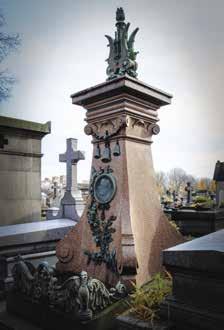
As you walk down Avenue Carette toward the intersection of Avenue Transversale No. 3, on your left you find the elaborate tomb of French composer of songs and operettas Robert Planquette (1848–1903).
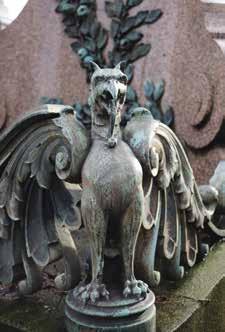
The tomb features a pair of griffins at the base. The portrait medallion in the center of the tomb was created by sculptor Julien-Prosper Legastelois. After studying at the Paris Conservatoire, Planquette played