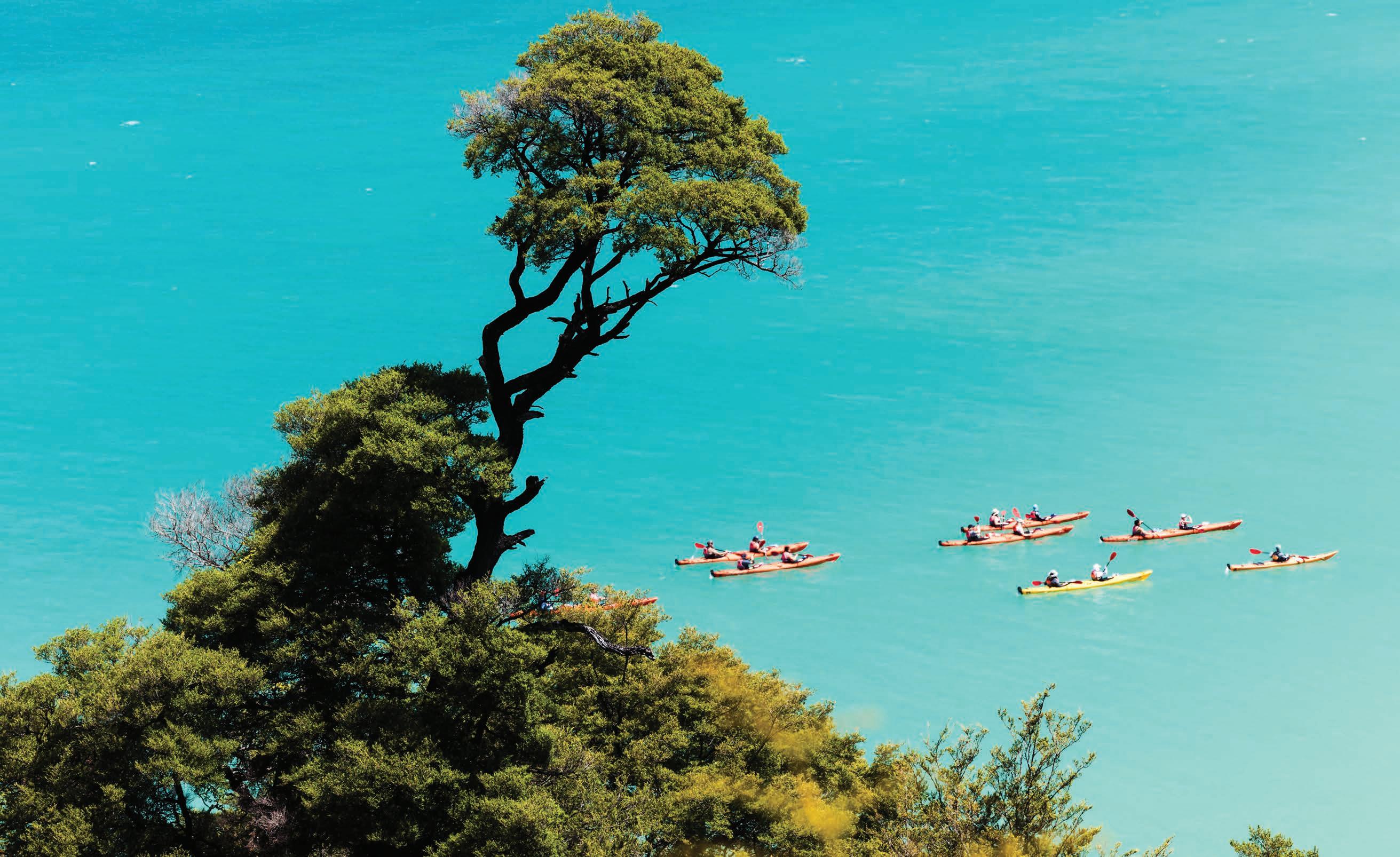
GUIDE TO KAYAKING
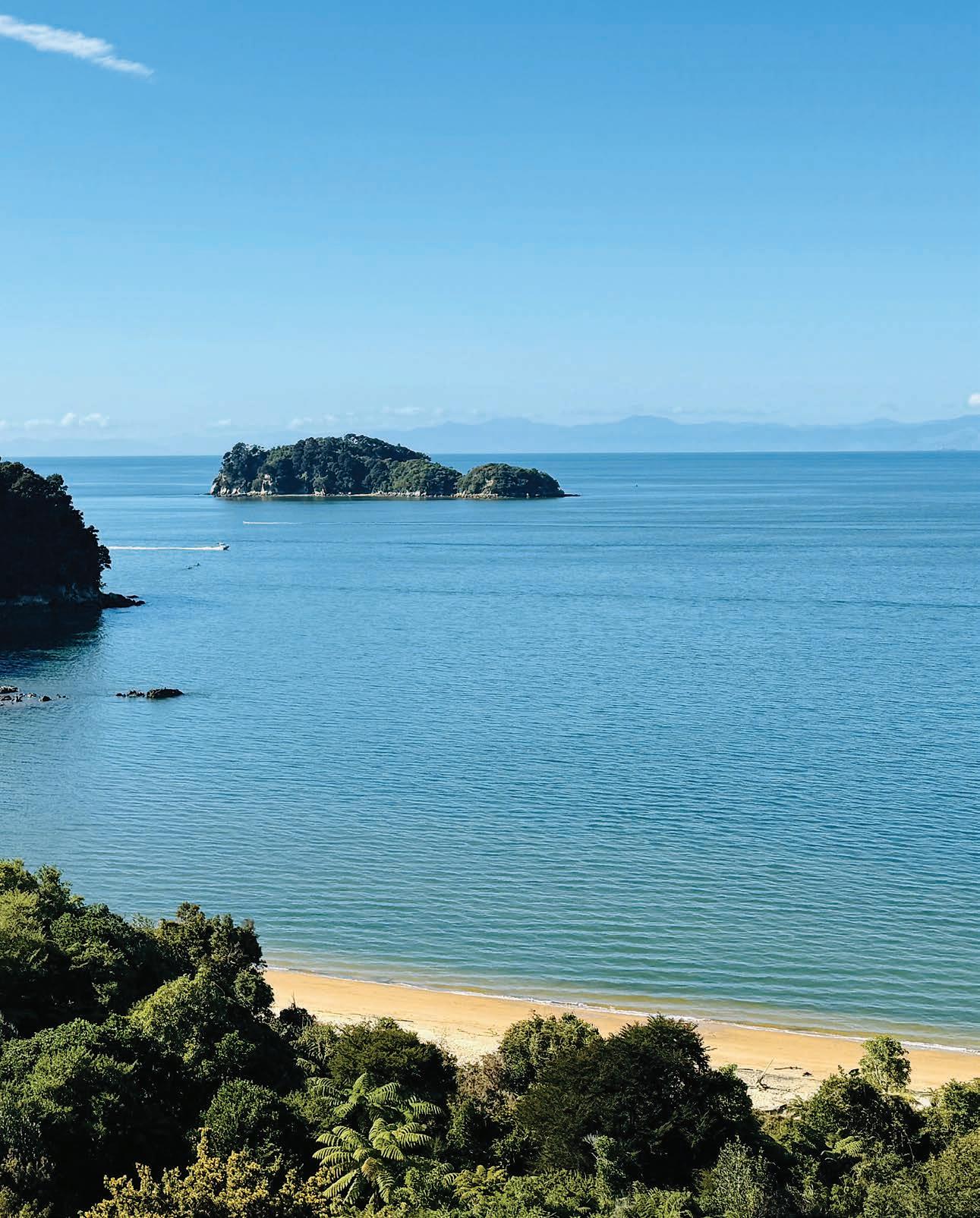
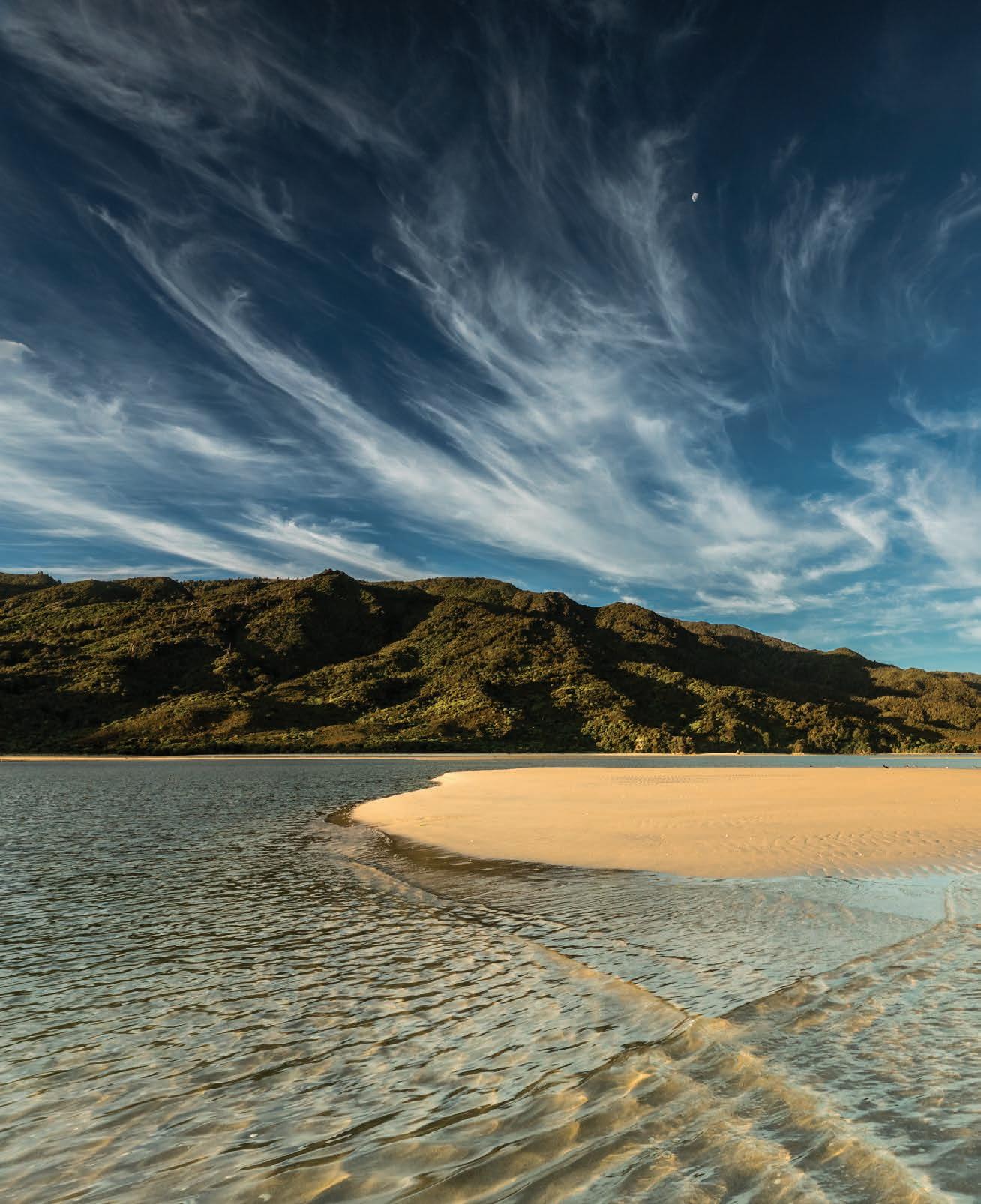
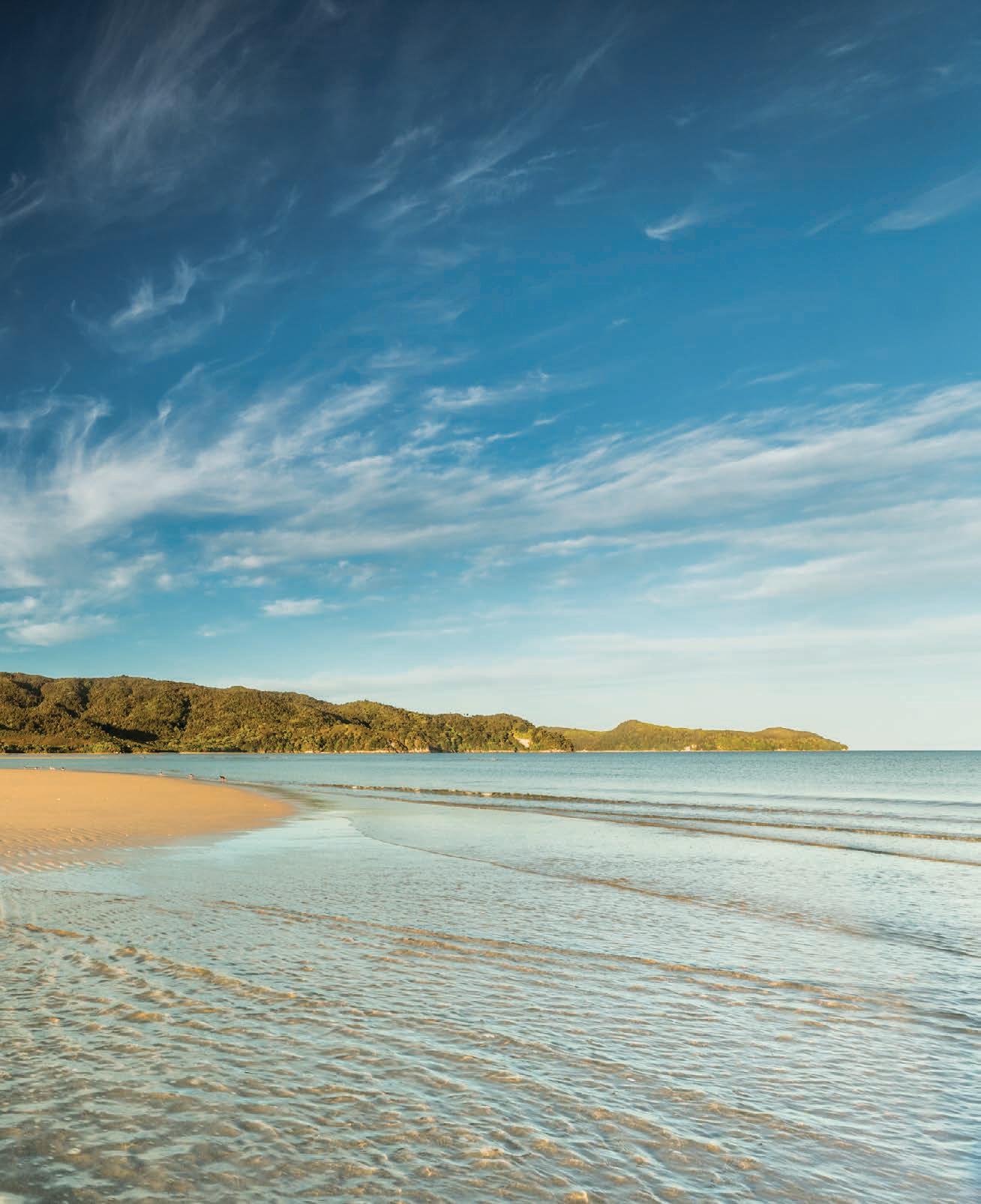
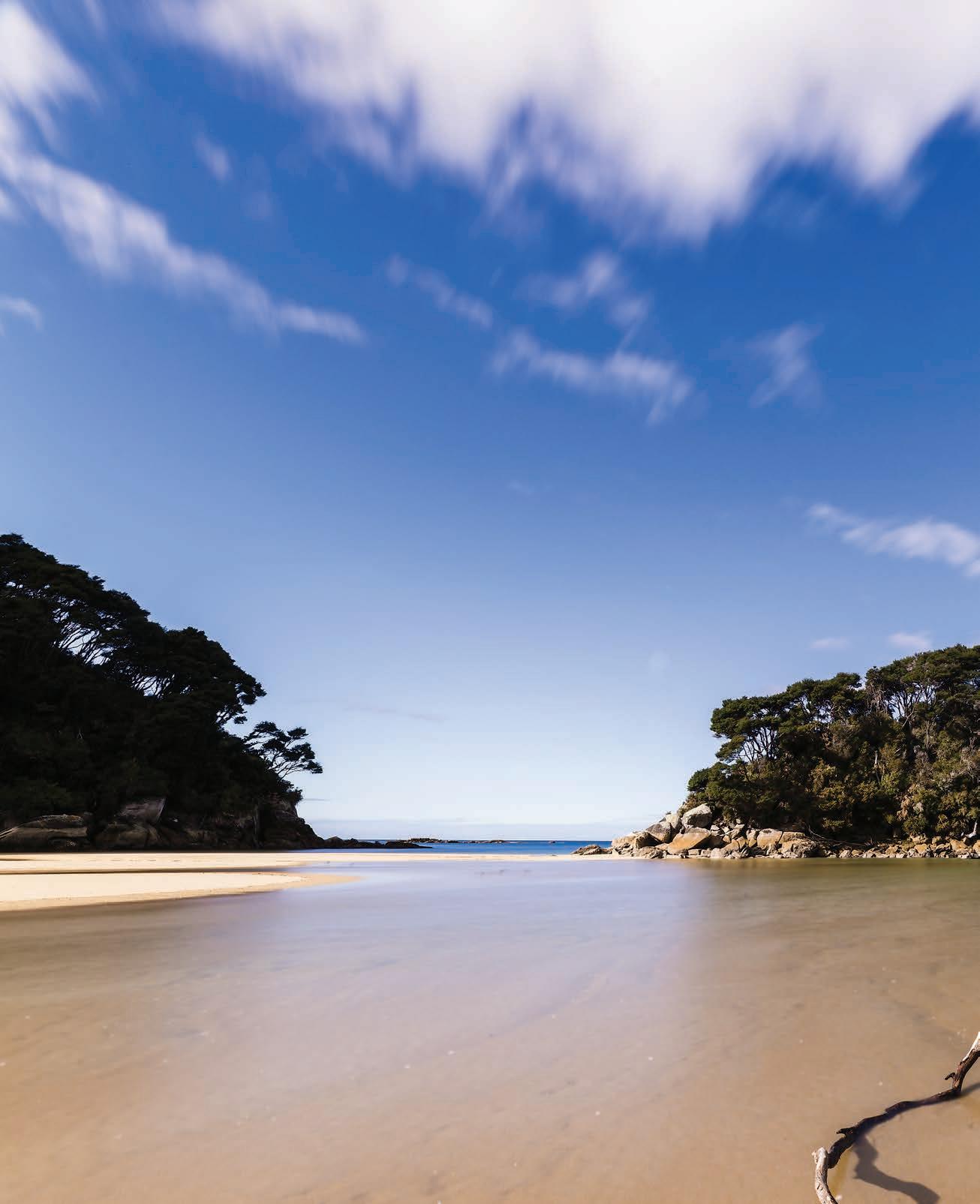
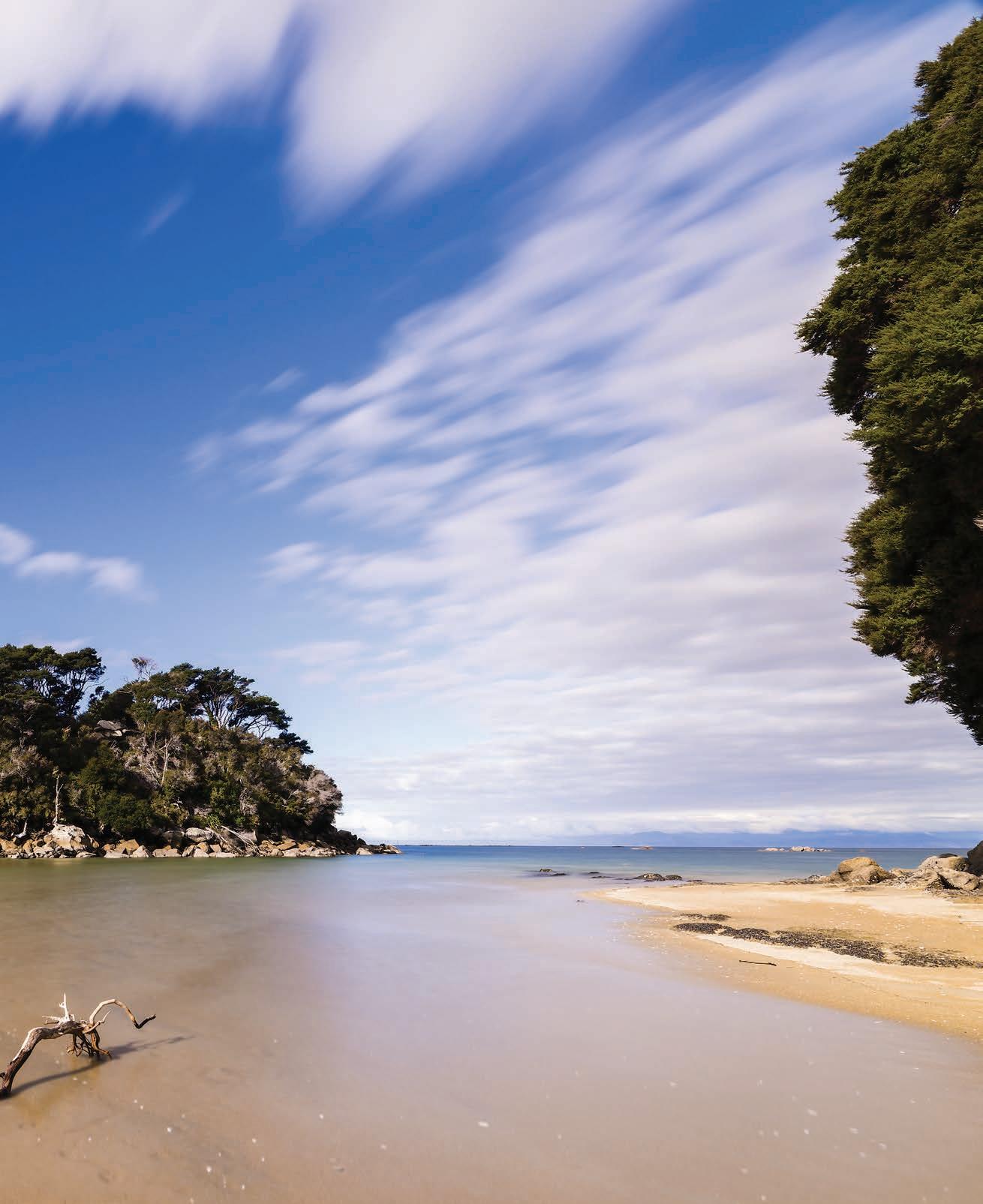
Coquille Bay and Fisherman Island.
Photography credits: Lightstyle Photography, Brodie Knox, Brendan Alborn, Johny O’Donnell, Jade Alborn, Neat Places, nelsontasman.nz Design and artwork: Mat Tait mattait@mattait.com. Contributors: Johny O’Donnell, Brendan Alborn, Glen Stringer, Jade Alborn. Produced and published by: Alborn Enterprises Ltd, 8 Franklin Street, Mārahau 7197, RD2 Motueka, New Zealand. Email: feedback@abeltasman.com Tel: 03 527 8559
the uno cial guide to the national park
EDITORS’ INTRODUCTION
Welcome to the sixth edition of the Abel Tasman Magazine. The 2024-25 summer was another strong season for our businesses, and as always I’m looking forward to the one ahead. This is not just because it means I get to transition back to my standard seasonal attire of jandals, shorts and either a t-shirt or no shirt at all.
Our mix of domestic and international visitors, which has always been close to a 50/50 split, has returned to what it was before the pandemic. It has been great to see the international visitors and the energy they bring return to Mārahau and to look out my office window to see all our kayaks in the park rather than in the storage sheds.
The other reason for my excitement is that we’ve finally managed to refurbish and expand the Abel Tasman Centre, our booking office and general store on the Mārahau waterfront. We’ve held the consents for this project for just under five years, but with the pandemic period causing delays, it’s great to finally move it off the drawing board and into the real world.
This project is not my first construction project by any stretch, and you’d think a person who worked in project management for over 20 years would not be surprised at the magnitude of the effort required to get these things from the planning phase through to the finish line. But here I am, about three-quarters of the way through the project as I write this, and I find myself shocked and amazed at just how much coordination, management and attention to detail is required to achieve the outcome that I envisaged at the beginning.
I’m usually more of a ‘planning from ten thousand feet’ kind of a person, so it comes as an unwelcome shock to be constantly grabbing a tape measure to check niggly little details - like whether the undercounter fridge selected for the coffee station will fit with only 7mm clearance to the top of the counter. I keep reminding myself that if you want anything in life to be epic, then you need to be prepared to put in an epic effort to make it so.
The new and expanded Abel Tasman Centre, open by the time you read this, features an expanded gallery/store area for local arts, crafts and souvenirs - a lot more fresh food, barista coffee - a trip planning area complete with an interactive screen, four e-vehicle charging stations and 24kW of solar power on the roof.
Since the last edition of this magazine, I’m also happy to
report that the Mārahau Pledge - a collaboration between all nine activity operators in Mārahau and local accommodation provider Ocean View Chalets to support and protect our local environment and community - has been working just as we intended. Through the Mārahau Pledge levy paid by each visitor who uses one of the member’s businesses, the Mārahau Environmental Trust has received over $400,000 since its inception three years ago. Over half of these donations have already been distributed to local community groups to support environmental and social projects. It has felt great to back some fantastic local initiatives and we’re looking forward to hearing more ideas for projects that enhance our little corner of paradise.
I hope you enjoy this edition of our magazine and the stories it contains. I really do value your feedback, so please get in touch with any comments, suggestions or story ideas via feedback@abeltasman.com
Brendan Alborn Owner Operator Alborn Enterprises Ltd.

Kia ora tātou!
Summer has a way of bringing this place to life. The air feels lighter, the sea glistens brighter, picnic tables fill with families, and that familiar hum returns - visitors from every corner of the globe discovering our corner of the world.
Each year, this magazine gathers that energy. It’s a collection of stories, people, and places that capture the magic of the Abel Tasman and the communities that surround it.
This is our sixth edition, and inside you’ll find everything from romantic odes to Mārahau to a decent dose of humour - this year aimed squarely at the whingers, which feels like energy well spent. Because frankly, if you can’t laugh at the complainers, you might just be one.
You’d be forgiven for thinking this magazine simply appears in your hands each summer, perfectly bound and ready to read. But no. It’s stitched together by a small local (and believe it or not – quite disorganised) team, leaning into local stories and the tactile charm of print in a world that spins ever faster.
At the heart of it all are Brendan Alborn and his whānau. They choose to invest in bringing these pages to life every year, and they keep doing so, because people are saying they love it. So, next time you see an Alborn, tell them you reckon this magazine is a pretty good time!
Behind the scenes, there’s another force at work: Mr Mat Tait. Mat is our designer and illustrator extraordinaire - a true creative powerhouse. His hand is on every page, shaping not just how this magazine looks, but how it feels. We are extremely lucky to have him.
Whether you’re walking the length of the park, kayaking to a hidden bay, or just soaking up the sun in your favourite spot, we hope this issue inspires you to travel a little slower, look a little deeper, and fall even more in love with this extraordinary part of the world.
Whether you’re here for a summer or a lifetime, you’re part of this story too. Every coffee, beer, water taxi fare, dinner out, and local stay keeps this place alive. Book the trip, buy the thing, and thank the people who make it all happen. This place gives plenty, so give a little back before you go.
Swim more. Laugh louder. Order that extra scoop. Have the second glass. And if someone’s whinging nearbyjust smile, nod, and pass them this magazine.
Mauri ora!
Johny O’Donnell (JOD).

FOR A SMALL
A BIG PLEDGE VILLAGE
A spotlight on the Mārahau Pledge.
Words: Johny O’Donnell
Mārahau is a special place. It’s also a popular one. Each year, thousands of visitors arrive in this small village to kayak the coastline, walk the tracks, or catch a water taxi to the park’s golden beaches. It is the literal and figurative gateway to the Abel Tasman National Park.
Thevisitor sector is the lifeblood of the local economy and fuels many of the lifestyle qualities we enjoy across hospitality, events, arts, and retail. But it also brings challenges and strains for the local community. And for a small community like Mārahau, protecting and enhancing what makes this place special is a cause close to many people’s hearts.
In 2022, ten operators came together and launched the Mārahau Pledge to help tackle some of those challenges and provide a direct and accessible way to back people in the local community wanting to do more to protect and enhance this place. The Mārahau Pledge is a first-of-its-kind, 100% locally led initiative in Aotearoa New Zealand.
At its core is the Pledge concession fee - $1.44 clipped from every kayak trip and water taxi ticket (or indeed, every guest night in the case of Abel Tasman Ocean View Chalets). This forms part of the EAF or Environmental Access Fee, which carries concessions for the likes of the Department of Conservation and The Abel Tasman Birdsong Trust as well.
While tiny on its own, this contribution adds up quickly. The money is managed by the Mārahau Environmental Trust and invested directly into projects that improve biodiversity, restore ecosystems, and support the wellbeing of the community.
For visitors, it means every trip becomes part of something bigger. For locals, it means having the resources and decision-making power to do good things for the village, without waiting for outside agencies to step in.
Since its launch, the Mārahau Pledge has moved from symbolic intent to tangible action – and it’s working exactly as intended. And the Pledge’s purpose became painfully clear this year, when torrential rain battered the region and many local families took a battering.
Within days, the Mārahau Pledge launched an emergency relief fund. Over $12,000 was distributed to 20 families and community groups, helping them clean up and rebuild. This showed the Pledge’s ability to respond to immediate needs as well as long-term goals. (cont’d)
This revealed what makes the Pledge special: flexibility to respond to local needs at pace. It’s not tied up in bureaucracy or distant decision-making. When help was needed, it was there.
The same idea is playing out in other ways, too. From celebrating local identity through public art to regenerating wetlands, the Pledge is quietly fuelling a wave of grassroots action.
Here are just two stories that show what happens when that energy is unleashed.
Mārahau community bands together to bring new sculpture to life.
A new sculpture seven years in the making is proving the perfect welcome to Mārahau.
Standing proudly overlooking the Ōtūwhero Inlet, TAIAO is
the result of a collective effort by the Mārahau community. Local sculptor Tim Wraight says the idea first gained traction after a donation from an arts patron with a longstanding connection to the Mārahau area.
“He put a significant amount of money on the table … and that allowed us to go ‘wow, we can do this, we just have to raise the rest of the money’,” Tim says.
The Mārahau Residents and Ratepayers Association commissioned the work and the tight-knit community banded together to bring it to life. From finding a space to raising funds - it has been a shared effort. Local businesses got behind the project as did the Mārahau Pledge, which made an initial donation of $5000 and then matched a final community Givealittle drive in 2024.
“The Pledge has been very generous to the association for other projects and now has been very generous to us with the sculpture,” Tim says. “We haven’t had to go to the
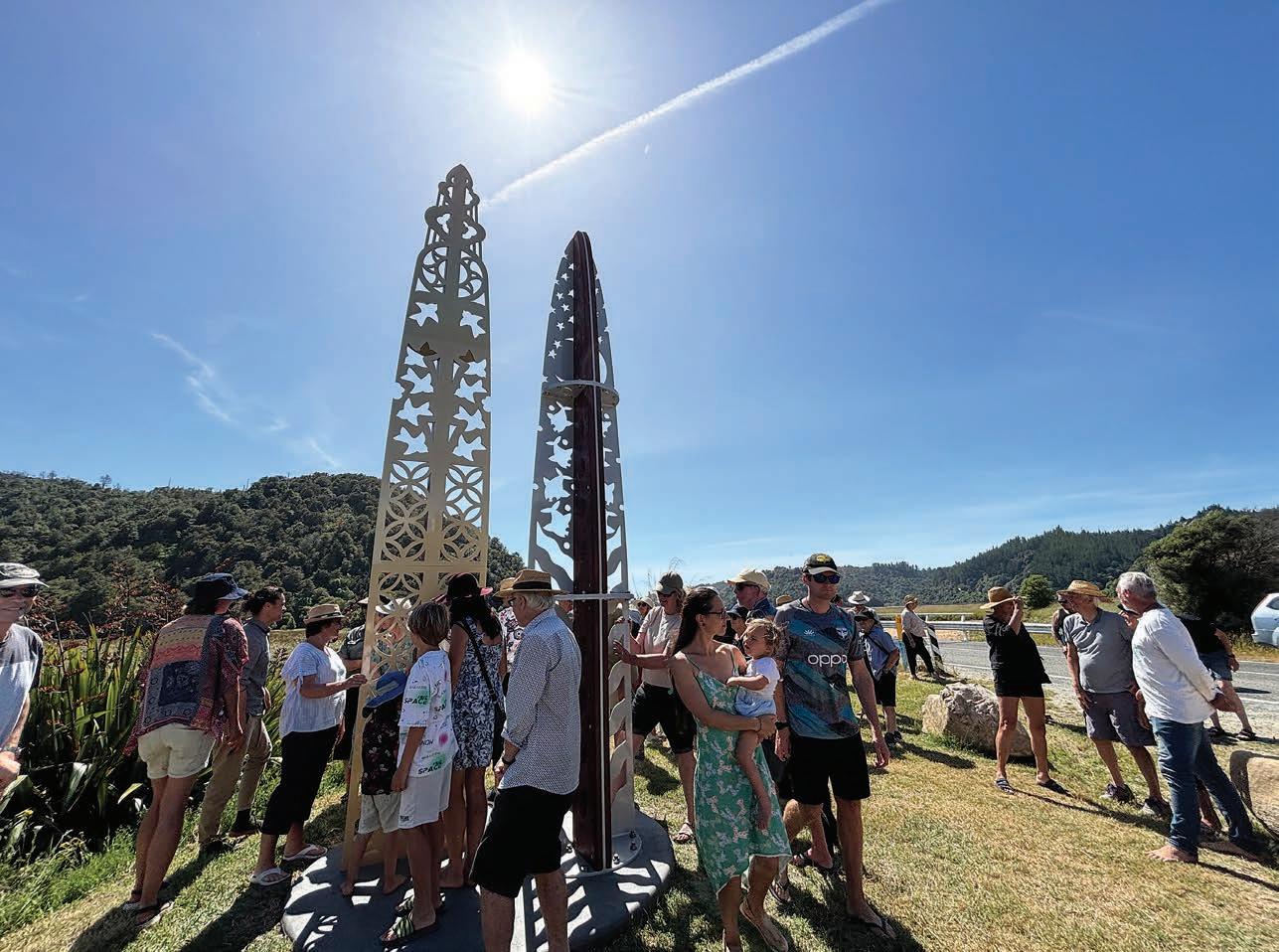
TAIAO is revealed to the community.
Council for funding for our sculpture, being a self-sustaining community, and it’s because of these operators that are coming together. Being funded by operators, it’s just great.”
The 5-and-a-half metre sculpture is positioned at the junction of Sandy Bay-Mārahau and Ōtūwhero Valley roads, overlooking the Ōtūwhero Wetland, which has also benefited from Pledge funding for restoration work.
Key materials for the waka-shaped sculpture have also been sourced locally, with specialist workmanship being undertaken by local craftsmen in Mārahau, Motueka and Whakatū Nelson. Constructed from water-cut alloy and local macrocarpa, this has included steel and concrete work, along with digital design work.
“The idea behind the sculpture is to celebrate our spectacular natural environment, make reference to how we got here, and acknowledge how the sea is integral to our existence. Another key theme is our commitment as a community to kaitiakitanga [guardianship] of our unique environment,” Tim says.
Tim, who learnt to carve at Te Āwhina Marae in Motueka and creates artwork for people all over the world, is excited to have been able to produce something for the community. “My favourite works to do are the works for everybody that can never be on-sold. I really like that collective community ownership,” he says.
A predator control project led by local Mārahau volunteers has successfully eliminated over 1,300 pests and counting.
The Mārahau Halo Trapping Project, founded by local accommodation providers Chris Palzer and Jared Bosecke in 2020, is designed to support pest trapping work being carried out by the Abel Tasman Birdsong Trust, the Department of Conservation and Project Janszoon inside neighbouring Abel Tasman National Park.
Chris says it was a no-brainer. “Our lines complement the work in the park, as well as in the Ōtūwhero Valley and the wetlands, with the aim of creating a pest-free halo around the southern entrance to the park,” Chris says. “Locals have been great, and there is a good rhythm going on now. It’s been great to be able to work closely with neighbouring conservation groups, too,” she says.
Mārahau Halo Trapping Project was one of the first recipients of Mārahau Pledge funding, receiving $12,500 to support their trapping work. Other businesses have also pitched in and Chris and Jared say it’s been a real com-
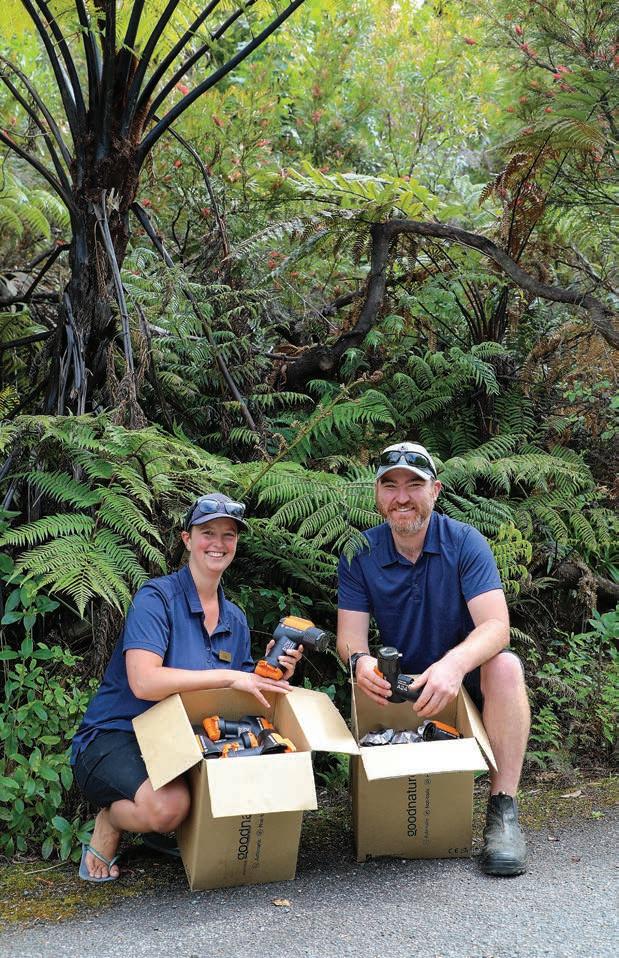
munity effort. So far, they’ve been able to purchase more than 130 traps and, with the help of a team of volunteers, establish five trap lines that run parallel to those inside the park.
The project began just before the first Covid-19 lockdown. Since then, they’ve captured over 1,300 pests - including rats, possums, hedgehogs and mustelids (ferrets, stoats and weasels) - according to trap.nz. You can track the project’s numbers live on the handy trap.nz website. More recently, the project has been a part of a broader effort led by Tasman Environmental Trust to establish a trapping network from Mārahau to Tapu Bay, to provide for a more joint-up approach to ridding the area of pests threatening biodiversity and native species.
We’re stoked to have been able to support such vital work in our community and backyard! A big thanks to Chris, Jared and their dedicated volunteers.
Above: Chris and Jared with new traps for the Halo trap lines.
Pests on the radar.

MĀRAHAU, MY LOVE
Words: Johny O’Donnell.
This isn’t a travel story. This is a love story. It starts with a bend in the road.
Just over the hill, groceries rattling in the back and the emotional residue of supermarket run-ins with people you haven’t seen for years still clinging to you, the road curls to Ōtūwhero - and everything changes. The pace, the pressure, the preoccupations. Mārahau embraces you. She breathes for you. The I.V. soul tonic that is ‘Mārahau’ begins flowing through your veins.
Mārahau is the place I’ve loved the longest, and most deeply. It’s a relationship that has morphed and matured with time. It’s aged and been understood and appreciated by me like a good wine. As a child, I tagged along behind my Dad who worked and lived out here.
Mārahau was wild and salt-rubbed and slow. As a teenager, it was a place to party – to smoke spiffs under the stars, discover eccentric dance moves I hadn’t previously encountered, meet people from all over the world who had converged on to Mārahau, drink beers I didn’t know the names of and dance the night away to the always exceptional impromptu music on offer.
As a ‘professional’, it then became part of my mahi - working alongside Brendan Alborn to build AbelTasman.com and bring online bookings and marketing to a village that needs reassurance of the things it can’t do (hint – replace the human touch that makes this place what it is). Then it evolved to telling stories through this magazine and helping shape the Mārahau Pledge. And now, with a family, I seek refuge here. I return to you like a ritual.
Mārahau is not one thing. She is many things, to many people, all at once. She holds complexity and contradiction like no other place I know. She is extremely laid-back but intentional and reliable too. She is accessible, but (cont’d)
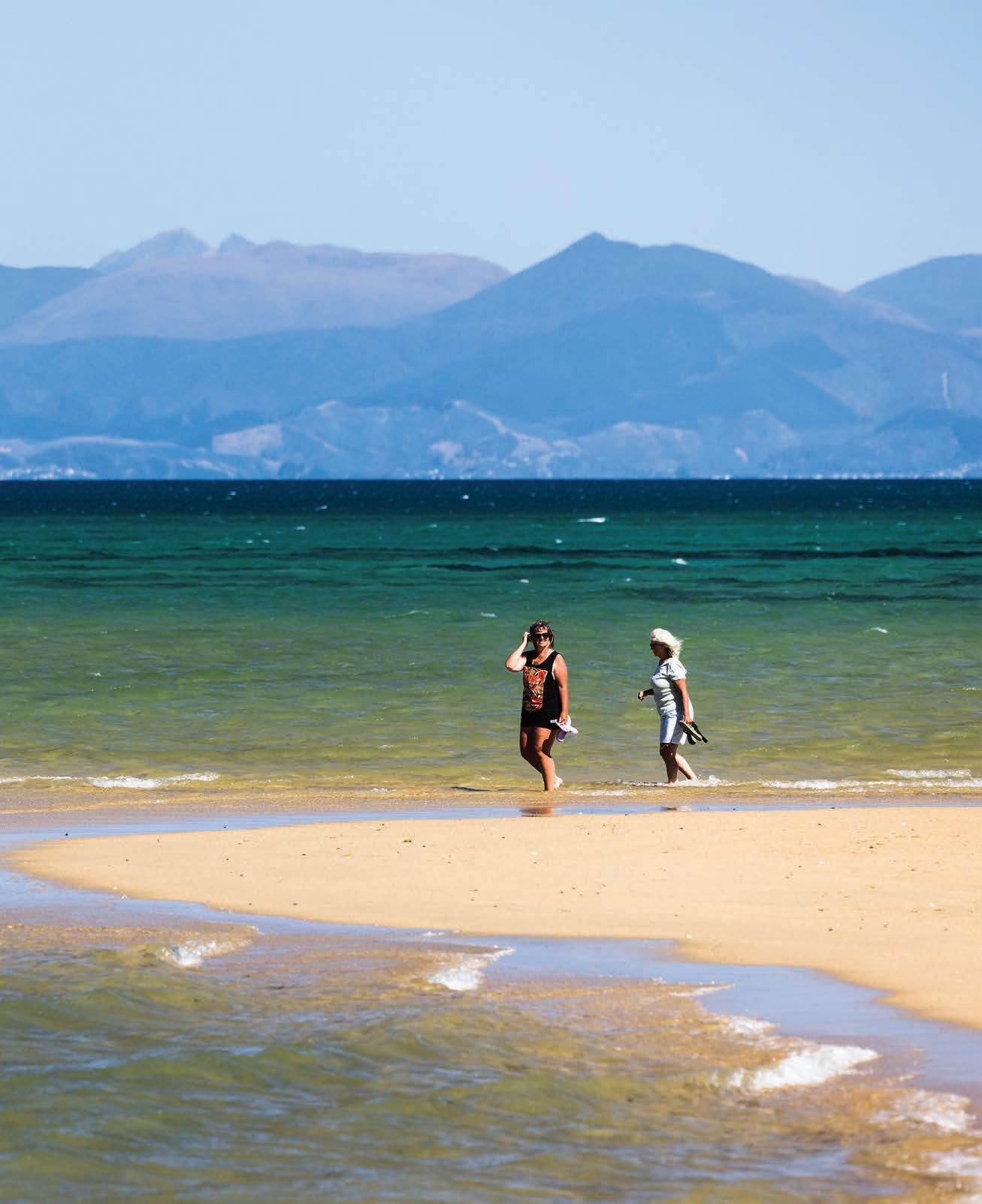
never ordinary. She is inclusive, but appears in the blind spot of every obnoxious prick’s wing mirror (helpfully there are other alternatives nearby). She is both the gateway to the Abel Tasman and a destination in her own right. This is a place where you arrive with plans to explore, and find yourself content to never leave the beach.
We try to visit a couple of times a year, and I swear, every time feels like crossing into a different country. Nelson to Mārahau is no small feat. First, there’s the crossing at Motueka - a bureaucratic border of supermarket aisles and familiar faces who have lots to catch up on. Then, you round that sacred bend to Ōtūwhero - and bang, Mārahau. Just like that, your shoulders relax. Time stops. You don’t restart until you leave - and even then, only reluctantly.
Let me introduce you to her and a few of her best features.
Park Café
The iconic. The undisturbed. The absolutely one-of-a-kind. Park Café is the soul of this place and the soundtrack to some of my best memories. You can’t force what happens there - music spills from strings and drums, not always in tune but always in time. I’ve danced, laughed, cried, eaten, and re-awakened to the world here countless times. And it’s still growing on me somehow. It is unpolished in the way that only authenticity can be. It’s where you bring yourself -
and find everyone else doing the same.
There are places in this world that defy categorisation. Park Café is one of them. Call it a cafe and you miss the point. This isn’t a café. It’s a cathedral. It’s an institution. It’s where salty sea dogs and local hippies rub shoulders with first-time visitors and seasonal workers. People walk off the track and into one of the best hospitality venues in the region, if not the country.
Park Café is woven into the DNA of Mārahau - a place that sings with stories, smells like wood-fired everything and feels like a sanctuary from the chaos of the world. You could try to replicate it, but you’d fail. There is only one Park Café. And we’re damn lucky to have it.
Hooked on Mārahau
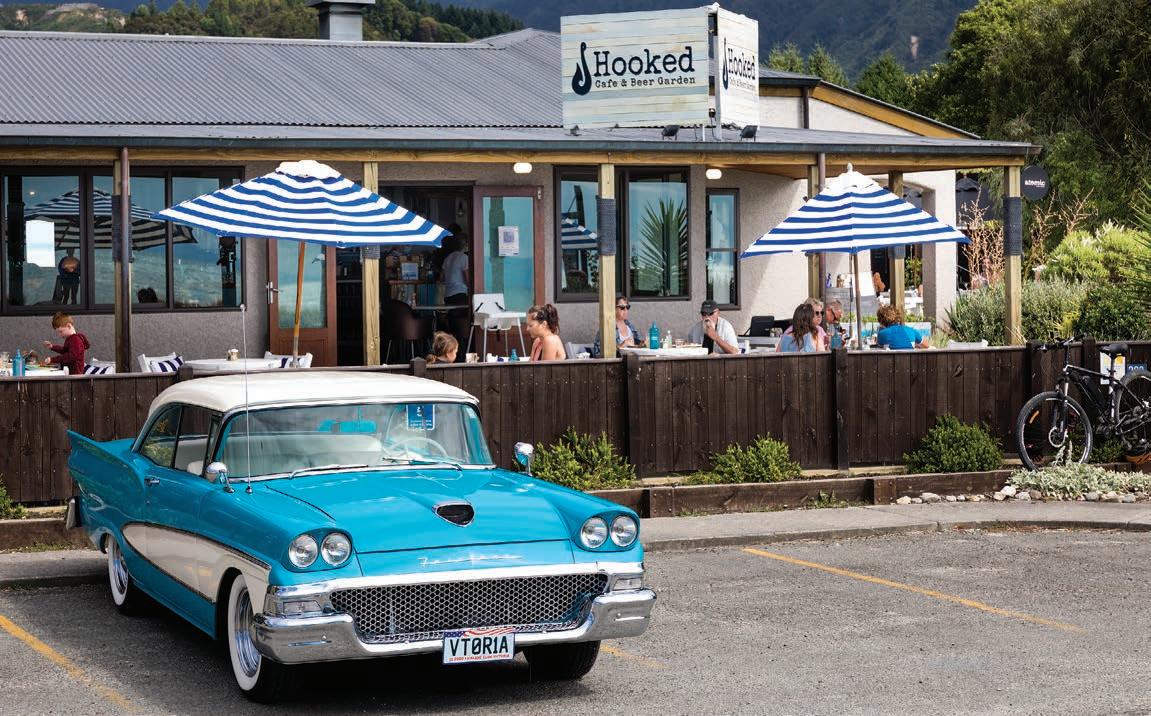
Sun-drenched happy hour humming in the courtyard. Bare feet. Salt still drying on your arms. Hooked is where you soak it all in. You come here after a walk or a paddle, order some food, and settle into a long slow nothing that tastes like summer. The breeze, the warmth, the sound of glasses clinking and kids running past. It’s never trying too hard. It never needs to. This is where time slows down even more. It’s where you end up with windblown hair and flushed cheeks after a day outside. Hooked is your sun-soaked, salt-licked local. Local wine or beer hits differently when the view of the sea lapping just beyond your table and someone hands you a hearty dish of raw fish or a decent chicken burger if you’ve done a good day’s work. There’s nothing polished about it, and that’s precisely what makes it perfect.
I remember sunny afternoons spent with friends here quietly taking in the view and sharing hot chips that taste way better than they should. I remember watching the afternoon turn to evening over the disappearing act of a bottle of nice wine. There’s no pretence. Just place. Within your view, the tractors and boats will pass you by along with the haze of the daily happenings in Mārahau. You’ll see reassuringly calm tractor drivers communicating on walkie talkies to keep the logistics of ferrying people in and out of the park safely operating. These guys are the true MVPs – and they make the place run like clockwork. You? You sit. You exhale. You drink. You eat. You lean back into the kind of ease you didn’t realise you were missing.
Abel Tasman Centre
You were once a dairy. Now you’re something more. But you still hold that same thread. Still the place for sunscreen, snacks, the odd forgotten tent peg. Still a node of community where plans form and paths cross. I like that you haven’t lost you. That despite all the change, you feel the same. Quietly reliable. Generous in your offerings. Always there. Holding it down.
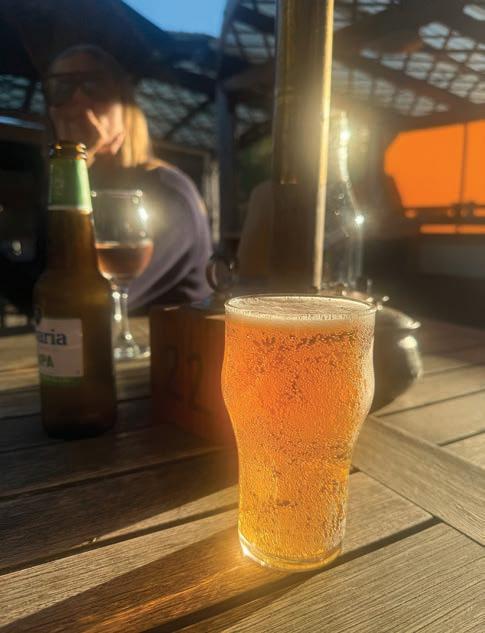
Below: A cold beer at the Park Café
This place has always felt like an anchor point. I remember it from when I was young—the spot you stopped for a Paddle Pop and the day’s weather report. Now, it’s where plans get made, bags get dropped, boats get booked. He’s growing up too fast, sure, but he’s that same old village charmer you remember. Just with less congestion and better options for people.
Bach 7
This isn’t a recommendation, it’s a confession. We’ve returned to this bach again and again and again. It’s not fancy. It’s not flash. It’s just... perfect. Perfect for us, anyway. Tucked into native bush with garden paths, a fire that warms the bones, views that stop you mid-sentence, a spa under the stars, and enough beds to house a good mix of cousins, kids, and chaos. We work here, rest here, eat too much here. It’s become part of our family rhythm. Summer it’s one of the most desirable places to lay your head in the village. But hot tip, off-season, it’s affordable and accessible for locals in particular. I don’t need to explain to anyone who knows Mārahau that the shoulder seasons of October/November and April/May are easily the best times to visit here.
Abel Tasman Ocean View Chalets
If Mārahau is the kind of place that settles into your bones, then Abel Tasman Ocean View Chalets is the gentle landing pad that helps it happen. Tucked into the hillside, with views that stretch all the way to awe, this place has been offering sanctuary since 1993, when Robert and Konstanca Palzer first opened the doors. They built with care, using sustain-
ably harvested timber, and planted with intention, choosing native and drought-resistant species that would thrive without demanding too much. That ethos hasn’t changed.
Now, their daughter Chris and her partner Jared carry the kaupapa forward - weaving in solar power, manaakitanga, and a clear sense of kaitiakitanga. Everything here feels thought-through and held with love - from the free-range eggs served at breakfast to the gentle reminder that paradise doesn’t have to cost the earth.
It doesn’t shout. But it has a presence. It understands Mārahau in the way the best locals do: not as something to own or impress upon, but as something to honour, to protect, and to share with grace. And it does exactly that.
Generations of Connection
To really understand Mārahau, you’ve got to know this: it’s not just a place you visit. It’s a place you return to. Again and again. Not just with your feet, but with your heart. It’s not just a place people love — it’s a place people live. A place that lives in them.
Beneath the summer stillness and golden calm, there’s a story that goes back generations. Mārahau is cherished ancestral land — held, cared for, fought for — by the whānau and hapū who have lived here, season after season. Their connection to this whenua isn’t historical or static, it’s present. It’s every day. It’s in the rhythm (cont’d)
Above: Hooked, on the Mārahau waterfront.
of things around here. You can feel it.
This place once provided everything: kaimoana, rich soil for growing, good vantage points, and seasonal shelter. People would move between the hills and the coast, following the natural cycles, collecting kai, storing food on nearby islands, passing down knowledge with every tide. All of it guided by deep understanding — not just of the environment, but of what it means to live with care, reciprocity, and respect.
Mārahau is a significant place for the whānau, hapū and iwi who whakapapa to the original customary owners of the area. Their tīpuna arrived here as part of epic migrations from the north in the early 1800s, and were guaranteed possession and protection of their whenua as part of the Nelson Tenths agreement entered into in the 1840s.
Beneath the summer stillness and golden calm, there’s a story that goes back generations.
With Crown control of the land, whānau couldn’t access their own whenua, couldn’t make decisions about it, couldn’t gather there. But they never let go of it. In 1997, remnants of the tenth’s reserves were secured as part of the formation of Wakatū Incorporation, rekindling whānau occupation and connection. However, the fight for making the tenths whole continues to this day.
Since then, it’s been protected. Not overdeveloped. Not exploited. Protected. Cared for in a way that reflects its wairua and mana. Reopened to the whānau — not just physically, but spiritually. A place to gather, camp, breathe, share stories. To come back into rhythm. To reconnect with each other and with the land. You see it in the summers: tents dotted across the whenua, tamariki racing around barefoot, cousins cooking kai over fires, and families out floundering or collecting shellfish.
Today, it remains a place of gathering — a sanctuary for whānau to camp, holiday, share stories, and continue customary practices like collecting kaimoana or simply being together on the land. It is a place where tamariki learn about the whenua not through books, but through being present: biking barefoot, stargazing, lighting fires, wading through tides.
A Place to Protect, A Place to Praise
You don’t have to live in Mārahau to care for it. But if you
come here — even just once — you become part of its story. And like all good stories, this one asks something of you. That’s what the Mārahau Pledge is about. It’s a simple commitment — made by locals, visitors, businesses, and community groups — to respect this place. To travel with care. To treat Mārahau not as a product to consume, but as a taonga to honour.
The pledge grew from a collective desire to protect what makes this place so special. It’s not about rules or restrictions. It’s about relationship. A way of acknowledging that Mārahau is alive - with a rhythm all her own. And that we all have a role to play in keeping that intact.
It’s a community-led commitment created by locals and businesses who wanted to actively protect the essence of Mārahau - not just for themselves, but for future generations. It’s also an invitation to visitors, to shift the way they see this place: not as a destination, but as a living community, a fragile ecosystem, a taonga. It might mean driving slowly through the village. Staying on marked tracks. Picking up litter that’s not yours. Being gentle with the wildlife, patient with the locals, and generous with your gratitude. It might just mean slowing down enough to see what’s really here.
The Pledge is not performative. It’s not box-ticking. It’s a shift in posture — from taking to giving. From passing through, to belonging for a moment. It’s not complicated or heavy-handed. The Pledge is about intention. It’s a promise to tread lightly, think deeply, and travel kindly.
When you take the Mārahau Pledge, you’re committing to giving back to Mārahau.
Respect the whenua and moana — by staying on tracks at all times, avoiding protected areas, following the signs and not disturbing precious wildlife.
Support local — by spending time and money with people who live here and love this place and backing the businesses that employ people and keep it ticking.
Travel slowly and mindfully — by walking if you can, driving slowly for others, taking the bus, sharing the space with others, and keeping noise to a minimum.
Care for people and place — by picking up litter (even if it’s not yours), being patient, and offering kindness to those around you.
Learn and listen — by engaging with the stories, the people, the history, and the culture of Mārahau – it’s a beautiful thing and worth holding gently and respectfully.
If you’ve been here, you know: Mārahau gives a lot. The least we can do is give a little back.
To You, Mārahau
Sublime. At ease. Drop dead gorgeous. Effortlessly you.
The kind of beauty that doesn’t shout, but still stops the world.
You hum. You hold.
You are the exhale.
The pink sky that stills us.
The tide that brings us home.
The first deep breath in weeks.
A place we return to — and remember how to be.
And when we leave — because we must — you stay.
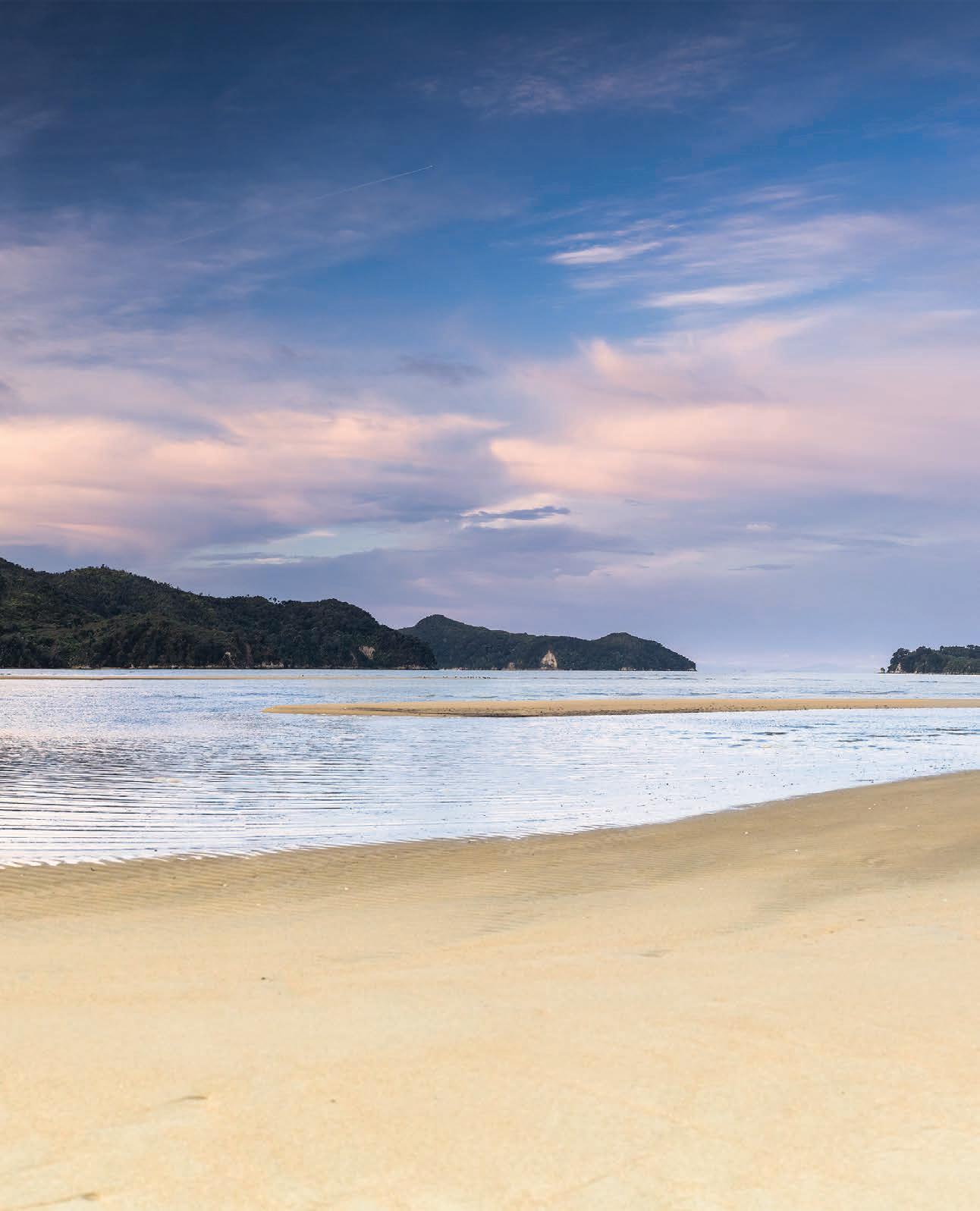
In the way we slow down. In the sand we carry home.
In the knowing that we’ll be back.
You stay.
You always do.
Thank you.
REIMAGINING THROUGH
Nelson has long been known for creativity. The region is home to celebrated events like the World of Wearable Arts (WOW) and Rockquest. Artists have been drawn here for decades, building a reputation for craftsmanship and creativity that sits proudly within our identity. But beneath that celebrated story is another - one that has often been silenced.
Since European settlement began in the 1840s, Māori voices, languages, and art forms have been systematically pushed to the margins as part of the wider colonisation and assimilation of this place and the people that have lived here for hundreds of years.
The Nelson Tenths Agreement, which promised to reserve 10 per cent of land and key cultural sites for customary owners, was never honoured. Today, shamefully, it re-
mains unresolved and subject to the country’s longest-running legal case against the Crown.
The city that grew here was imagined far away and laid out as a grid over tidal flats, rivers, and forests, with little recognition or regard for what already existed. The design and (cont’d)
STORY A CITY
Words: Johny O’Donnell.
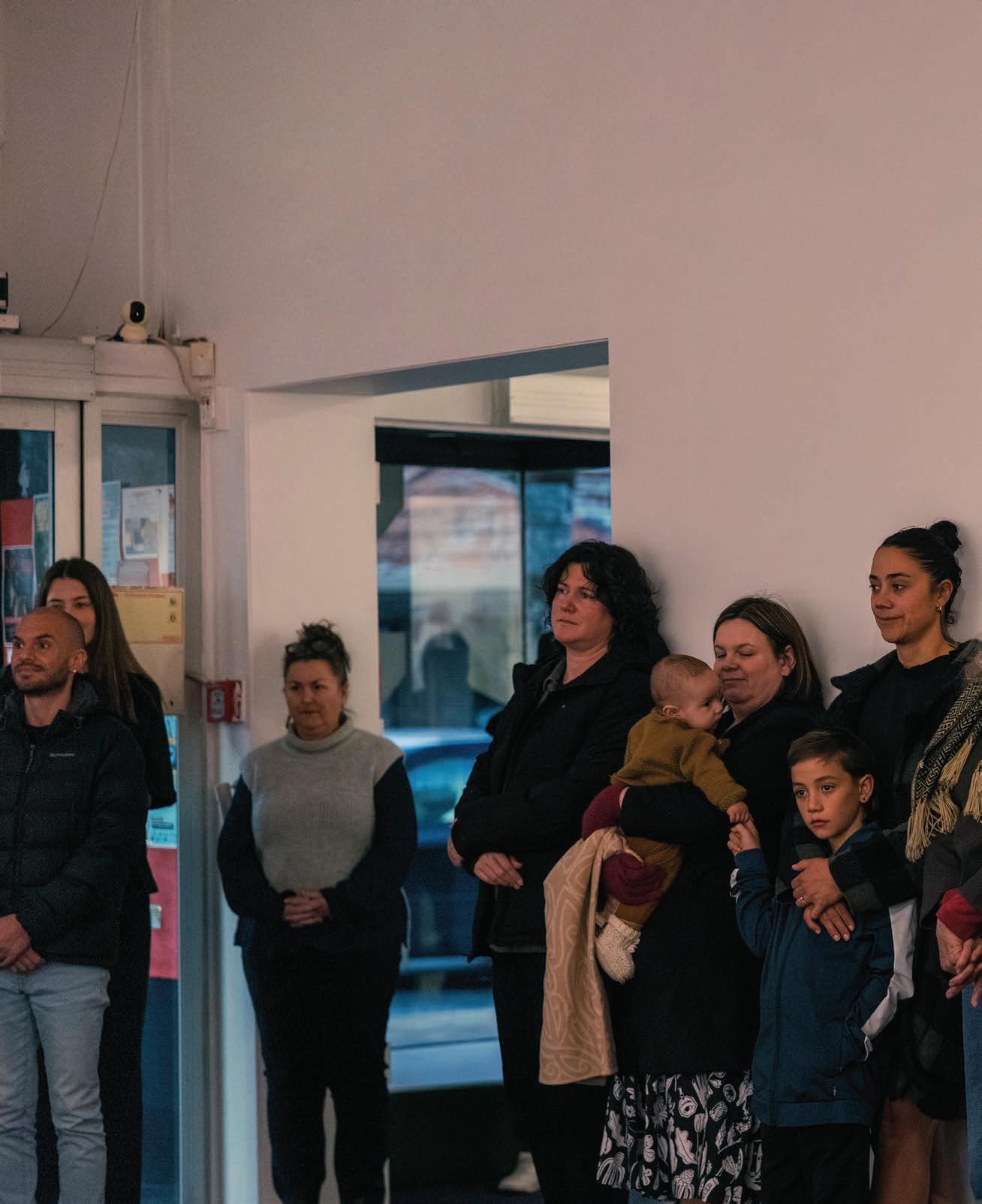
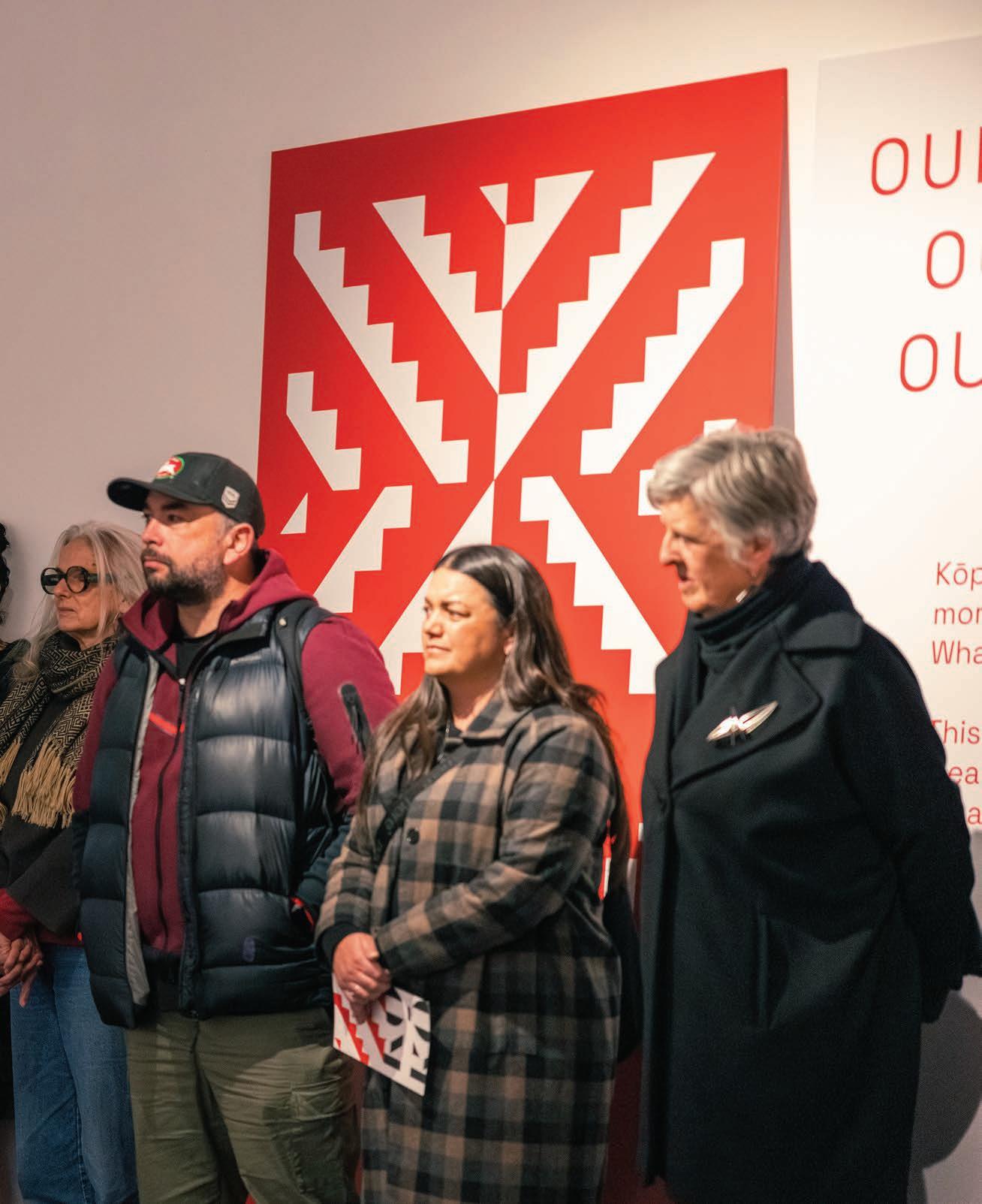
Kōpū Exhibition, The Refinery.
architecture we know today are not accidental; they reflect a design language brought from elsewhere. And in the process, tangata whenua narratives were excluded from civic life.
The result is a city where creativity may well have sustained itself through time, but is incomplete in its expression and void of much of its true potential. Indeed, it is untethered from the very place from which it emanates.
Kōpū Precedes the Dawn: A New Chapter for Whakatū Ko Kōpū te kaitō i te awatea. Kōpū precedes the dawn.
In 2022, a constellation of voices came together to create He Tātai Whetū, Whakatū Nelson City’s first bicultural arts and creativity strategy. Its name means “an adornment of stars,” symbolising individual lights forming a powerful whole, and implying deliberate placement and strategy. I was lucky enough to be involved in that work and the ongoing efforts to reimagine creativity and culture in our contemporary context.
As the star rises, so too does our collective sense of belonging...
For the first time, all eight iwi of Te Tauihu formally endorsed a vision for the city’s creative future. The strategy recognised that to strengthen our collective identity, we must bring toi Māori to the centre of civic life and our shared spaces. To strengthen our collective sense of belonging, we had to reveal the layers lost to time and bring them back to the surface. From this work, Kōpū emerged.
Kōpū – best known as Venus as the star that appears in the morning sky. The word Kōpū is also symbolic of the womb, creating and bringing new things into being. She has guided ocean voyages for centuries. She signals change. She heralds the arrival of a new day.
In Whakatū Nelson City, Kōpū has become the name of a bold, collective kaupapa; a movement to bring Māori cultural expression and storytelling back into the very fabric of the city. It is a quiet signal that something new is emerging - a shift in how we imagine our shared spaces and our collective future. A regenerative new chapter by and for Whakatū.
Kōpū is about creating a city that reflects its true identity, honours its history, and celebrates the unique stories of
this place with confidence and care. It’s a vision that is both deeply rooted and daringly forward-looking: a city reimagined through story, culture, and design.
Kōpū is not a single project or entity. It is a movement, a moment. It brings together iwi, council, art institutions, and the wider community to reimagine the city’s identity. It asks: What kind of city could we create if our shared spaces truly reflected the stories of this place?
Cities as Living Stories
Across Aotearoa and around the world, cities are rediscovering the power of place-making - using design to heal, connect, and regenerate. When done well, urban design becomes more than infrastructure; it becomes storytelling.
Whakatū has a strong foundation to build on. In recent decades, the revitalisation of kapa haka and te reo Māori has brought vibrancy and pride to the region. Local groups have risen to national prominence, culminating in the standout viral performance by Te Kuru Marutea at last year’s Te Matatini, the world’s most prestigious kapa haka festival.
The region is preparing for the day when it will host Te Matatini itself, bringing tens of thousands of visitors to the region. That future spotlight raises a vital question: What will our public spaces say about who we are when the world arrives on our doorstep?
Three anchor projects demonstrate what Kōpū looks like in action.
Bridge Street – Following the Water’s Path
Bridge Street is one of Nelson’s (and indeed New Zealand’s) oldest commercial streets, with infrastructure dating back to the city’s earliest reclamation. Through the Bridge to Better redevelopment project, it is being completely reimagined - not just repaired, but redefined.
The new design is guided by the aramoana, the pathway to the sea. It reflects ki uta, ki tai - the flow of connection from mountains and forest to the estuary and ocean.
The paving patterns draw inspiration from raranga and kōwhaiwhai, their forms representing the ebb and flow of tides: tai timu, tai pari. These designs aren’t purely aesthetic - they also help manage stormwater sustainably, blending ecological function with cultural storytelling.
Native plants and unique species to the area will return to the city centre, species that haven’t been seen here in generations. Sculptural features and carefully designed street furniture will embody narratives of renewal and belonging.
When complete, Bridge Street will feel unmistakably of this place - a street that could only exist here, in Whakatū.
Nelson Airport – A Gateway of Welcome
Airports shape first impressions. Our local terminal is already celebrated for its use of natural materials and its elegant architecture, but until now, it has lacked a visible cultural presence.
Kōpū is changing that. At the heart of the transformation is a 22-metre suspended waka, aligned with the building’s ridge poles. Inspired by historic sketches from the region’s earliest settlements, the waka will act as a tomokanga - a ceremonial threshold for arrivals and departures. A gathering place to recognise you are here, in Te Tauihu o te Waka-a-Māui.
Master carver Fayne Robinson has created stunning kōwhaiwhai patterns that will flow across the waka and extend to the terminal’s glass walls. As the sun moves, these patterns will cast shifting shadows, creating a living artwork that welcomes travellers and signals connection.
Central City Playspace – Stories Through Play
Modern, destination playgrounds are more than places for kids to play. They are spaces where different generations gather together and communities are connected through play.
At Rutherford Park, between Trafalgar Park and the Mahitahi River, a new culturally inspired destination play space is taking shape. Its design is based on the pūrākau of Te Wheke-a-Muturangi and Kupe, with sculpted landforms evoking the wheke, or octopus.
Every feature has meaning. As children play, they will also encounter stories of this place, woven into the landscape in a way that is playful, accessible, and profound. The result will be a space that brings to life the stories and character of this place, in an entirely new way.
Beyond Projects: The New Dawn
While these three projects are central to the transformation we can expect to see, Kōpū is much bigger than any single intervention. Public artworks will begin to appear throughout the city, adding bursts of colour, narrative, and vibrancy to streets in need of renewal.
The city is also exploring a bid to become a UNESCO City of Craft, further anchoring its global reputation as a place of creativity and ensuring that creativity is firmly rooted in local identity and strengths.
But the true power of Kōpū lies in how it invites everyone to engage differently with the city. It encourages locals and visitors alike to travel with awareness, to see beneath the surface, to recognise that every pathway and public space has a story to tell.
Kōpū is about transition and transformation. It’s about reimagining Whakatū not by erasing the past or freezing the present, but by dreaming forward — by asking what becomes possible when a city designs with truth and intention. It is not aiming to create the place that was – or the place that is – but the place that can be and that we should be. That we deserve to be.
The projects you see now are only the beginning. They are the first glimmers of a new era. Like the morning star herself, they signal what’s coming: a city where art, culture, and identity are not just visible but celebrated and understood; where every shared space reflects the depth and richness of this place. As the star rises, so too does our collective sense of belonging. Kōpū precedes the dawn - and the dawn is near. You’re invited to be a part of it.
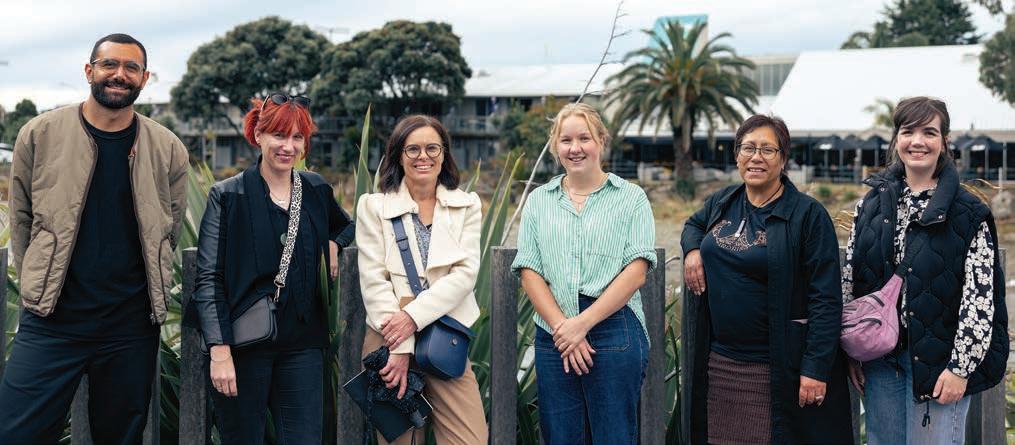
Above: The design team, from left - Tyrone Ohia (Extended Whānau), Hayley Muir (Isthmus), Helen Kerr (Isthmus), Charis Teal (Creo), Kaye Reihana (Extended Whānau) and Amy Collingbourne (Creo).
THE WHINGERS GUIDE TO THE ABEL TASMAN
Words: Brendan Alborn
In the early stages of last season I began to wonder if there may have been a mass breakout from an insane asylum. For a short stretch of time, we experienced some of the oddest customer interactions in living memory and a few online reviews that were nothing short of unhinged.
In the early days of online reviews, platforms such as TripAdvisor - mercifully less relevant over the past several years - expected every business to respond to low ratings and complaints in an appeasing and apologetic manner.
If we received a one-star rating because a customer was incensed it had rained during an outdoor tour, we were to apologise profusely on behalf of the weather gods and promise we would double our efforts to create a favourable weather generation machine.
After a few years of the old “the customer is always right, even if that customer is irrational and unreasonable” mantra, some brave businesses started a trend of reviewing the reviewer. They pushed back on comments they felt did not stand up to scrutiny. I vividly remember some of these responses being covered in our news with headlines like: “Auckland restaurateur hits back at a grumpy customer by telling them to feel absolutely free never to come back.” My theory is that after a certain point of tolerating the many keyboard warriors hammering their diatribes into review platforms, society collectively realised that some of them deserved a dose of reality.
I would like to make it clear that I have no problem with people giving our services low ratings or negative comments. After all, everyone
has their own opinions, preferences and expectations, and many won’t align with mine. If a low rating stems from our own performance, I will be the first to apologise and do whatever I can to make things right. What does rankle me, I admit, is when somebody makes stuff up to suit an alternative reality that is not based anywhere on this celestial plane.
Before I go further, I should also point out that the Google Review rating average for our activities businesses currently sits at 4.9 out of 5. The vast majority of the reviews you will find are absolutely glowing, with wonderful words about people’s experiences with us. We only manage to upset a tiny minority of our guests, and as I like to remind myself: you can’t please all of the people all of the time.
One complaint that made us laugh came from someone booking a trip from Tōtaranui, at the northern end of the park, to Mārahau. This person wanted the exact location of the water taxi departure, finding our standard description of “On the beach in front of the DOC office” not precise enough. To reassure him, we sent a screenshot of the topo map with the location marked, plus the GPS coordinates - all part of a lengthy email string in which he continued to ask for more specific details.
In the end, he left us a one-star rating with a comment that he did not use our services because we couldn’t provide the exact location on Google Maps. Yes, you read that correctly: we received a one-star rating from someone who didn’t even use our services, and unaware that in remote locations where there are few structures to reference, online map services simply don’t work.
Iclosed my response to the review with “I cannot recommend you as a customer.”
In late spring last year, two people booked a kayak trip and turned up on the morning of the trip only to demand a refund because of light drizzle. When they were informed the trip was going ahead as conditions were perfectly safe - and that no refund was due, they were incensed, or more accurately, they went thermonuclear. Threats were made, and within 20 minutes of them leaving our office, a one-star Google review appeared. The basis of the complaint was that “the weather conditions were dreadful: pouring rain, zero visibility, freezing temperatures, and rough seas.” Furthermore, they claimed “these conditions posed a significant health risk” and they were considering “filing a complaint with the Commerce Commission.” As an asthmatic, the reviewer also suggested their life would have been in mortal danger if they had braved these dangerous conditions.
As it happened, I was in Mārahau that morning and took a perverse satisfaction in responding with the actual conditions: it was 13 deg C - not freezing by any definition I know - the sea was as flat as a billiard table, and visibility was so clear that I could see Adele Island from the beach, making visibility 3km, not zero. I also took a
strange pleasure in pointing out that I had just returned from a walk with my dog along the beach and, as a fellow sufferer of asthma, I had survived the ordeal, as had the dog. Now I know that sarcasm is the lowest form of wit, and yes, it reveals me as a bit of a jerk - but I just couldn’t help myself.
It is usually those who don’t get exactly what they want who write the most aggressive, and often untruthful, reviews. We received a one-star review from a water taxi customer who “...had an incredibly disappointing experience” in which “despite perfect weather conditions, our trip was unexpectedly shortened and rerouted without prior notice.”, and concluding with: “I cannot recommend AquaTaxi based on this experience.” When I first read it, I got in touch with our Ops team to find out what had happened. It turned out that the weather at the northern end of the park that day was indeed dangerous. We rerouted their trip so they could walk another section of the Coast Track further south, where the sea was calmer. When I dug into the case I found written proof they had been notified in advance of the change and we had also provided them with a refund of the fare difference. The reason for the outrage was that they were not granted a full refund as they had demanded, rather aggressively, and then seemed to create a fictitious narrative to support the outrage. I closed my response to the review with “I cannot recommend you as a customer.” After reading that response, one of my colleagues said something along the lines of “Man, you can be savage!”
We had a couple of weeks of similarly bizarre feedback, but the three detailed above were the ones that stuck in my mind. My experience so far is that when I refute these reviews, none of the writers ever want to further debate the points. My guess is that they just want to vent and move on. For me, though, I don’t seem to have the capacity to let it slide. I’m working on being the bigger person, but so far, I can only give myself an F for Fail.
THE GREAT WEST COAST ROADIE
Words and Photography: Brendan Alborn.
As a child, I thought of myself as a West Coaster. It wasn’t until later in life that I realised Murchison, where I was born and spent the first nine years of my life, isn’t either physically or officially part of the West Coast Region, instead being located inland and within the Tasman District.
Having left Murchison in 1979 though, I never imagined that I would end up settling down, after 30+ years as something of a nomad, in a small rural village that is only 140km from where I was born and had spent the first part of my childhood. Life has a funny cyclic pattern to it, and I must have had something drawing me back to Te Tauihu (the top of the South Island) that was buried so deep in my subconscious I didn’t even know it was there. On both my paternal and maternal sides of my family, I am the fifth generation to be born in that area so my ties to the place run fairly deep.
Shortly after we moved back to New Zealand at the end of 2010 with our young family, we did a driving trip down to Reefton and the scene of what I think were Dad’s fondest memories of his youth and early adulthood. I grew up listening to his stories of deer hunting, coal mining, and the mischief he and his mates would get up to, so it was wonderful to have Dad as our tour guide as I attempted to connect the dots of what his early life was like.
On that first trip down the coast we were traveling in two vehicles with me driving one and Dad driving the other. Even back then, his mobility wasn’t terribly good so we would drive around and every now and again he would pullover beside the road. We would pull in behind in (cont’d)
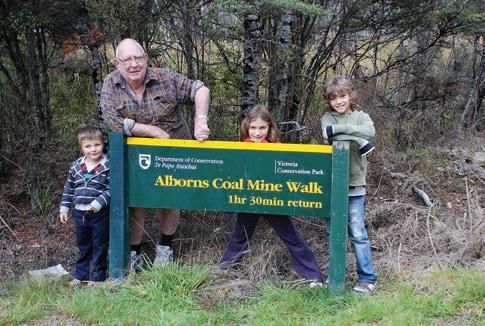
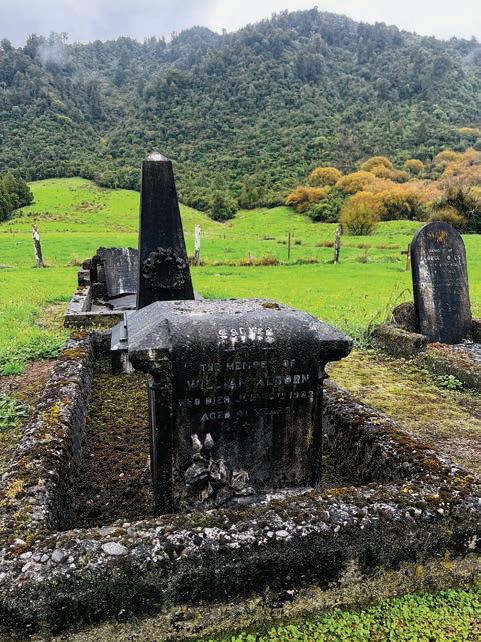
our own car and I would talk to him through his open driver’s window. Dad would point to a certain part of the road, or a landmark like the remnants of our old building and tell me a story about its significance. For example, at Inangahua junction, he showed me the site for where the Alborn Hotel stood in the late 1800s and early 1900s. We even found the gravestones of my paternal great grandparents in the cemetery at the same location.
However, the most common anecdotes Dad talked about were fatal car accidents and other disastrous events. We would pull the cars over, I would approach the driver’s side window and Dad would say something like “You see that slight bend in the road there? Well, in 1964, on a cold and foggy night me and three of my mates got a flat tire. My mate Jimmy Smith was changing the tire when a truck came out of nowhere and cleaned him up!” After we’d driven a bit further down the road we’d repeat the same process to the point at which I asked Dad if this was actually going to be a tour of the West Coast’s road deaths from 1955 to 1968 or if we could potentially expand the scope to some less grizzly stories. Of course, we did visit all of the old haunts including both of the coal mines formerly owned by our family, Alborns and Boatmans, as well as many of the places I could remember visiting as a child. Since that time, we’ve been drawn back to the area time and again, and those trips have done nothing but make me fall further in love with the place.
In January of this year we took our trusty campervan, Queenie, on a road trip down the coast. For our first night we stopped at Lyell in the Buller Gorge, arriving in the early evening to be greeted by a family of three feral goats who emerged from the bush to munch on the long grass. Nowadays a DOC campsite and the trailhead for the Old Ghost Road cycle and tramping track, but once a major gold-mining area and thriving town. The west coast has a number of sites that were once substantial settlements during the gold-mining heydays of the late 1800s and were once a community of thousands, but are now nothing more than
a few building foundations, a dilapidated cemetery and some metal objects that haven’t quite rusted into oblivion. Walking around these locations always reminds me how temporary many things that seem substantial at the time actually are. If we went back to 1880 and told any of the 2,000 residents of Lyell that within 20 years the shops, hotels, churches, the newspaper (The Lyell Argus) would all be closed and everybody would have moved away, I reckon they would have deemed us mad.
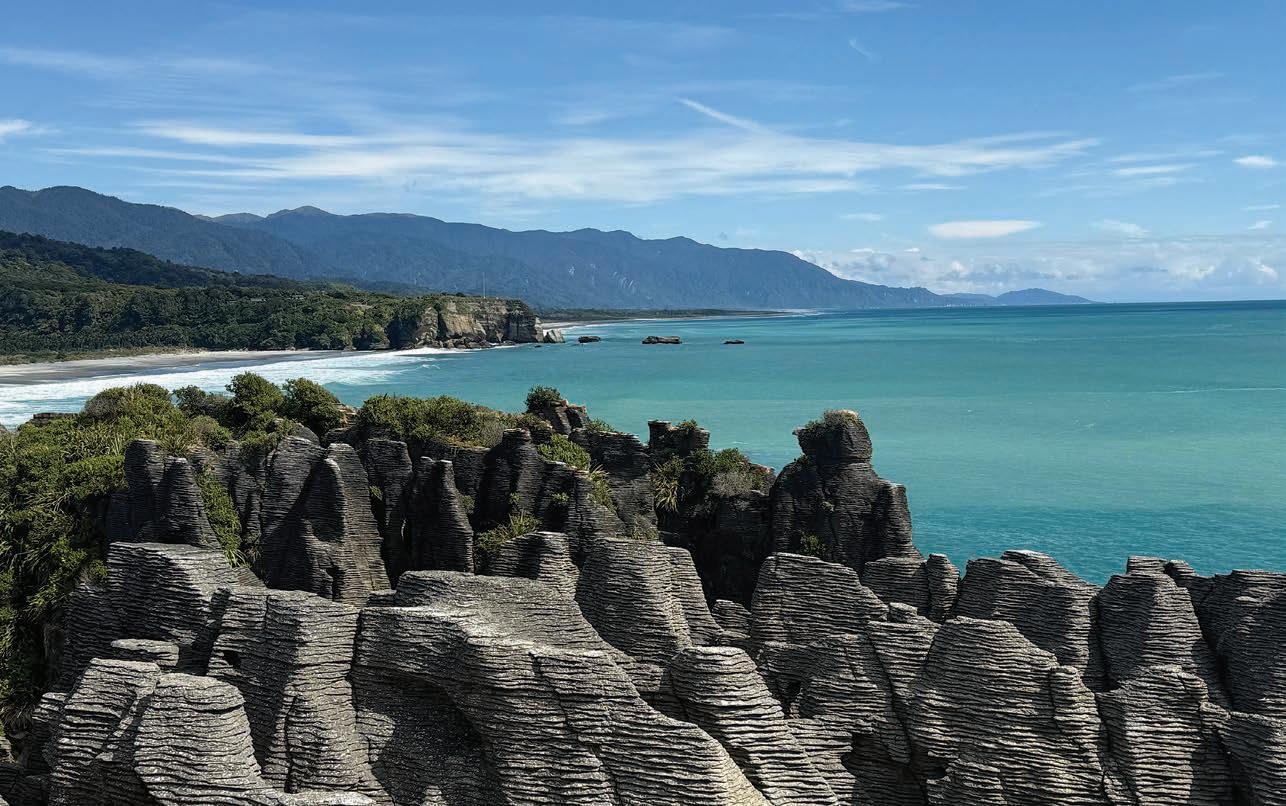
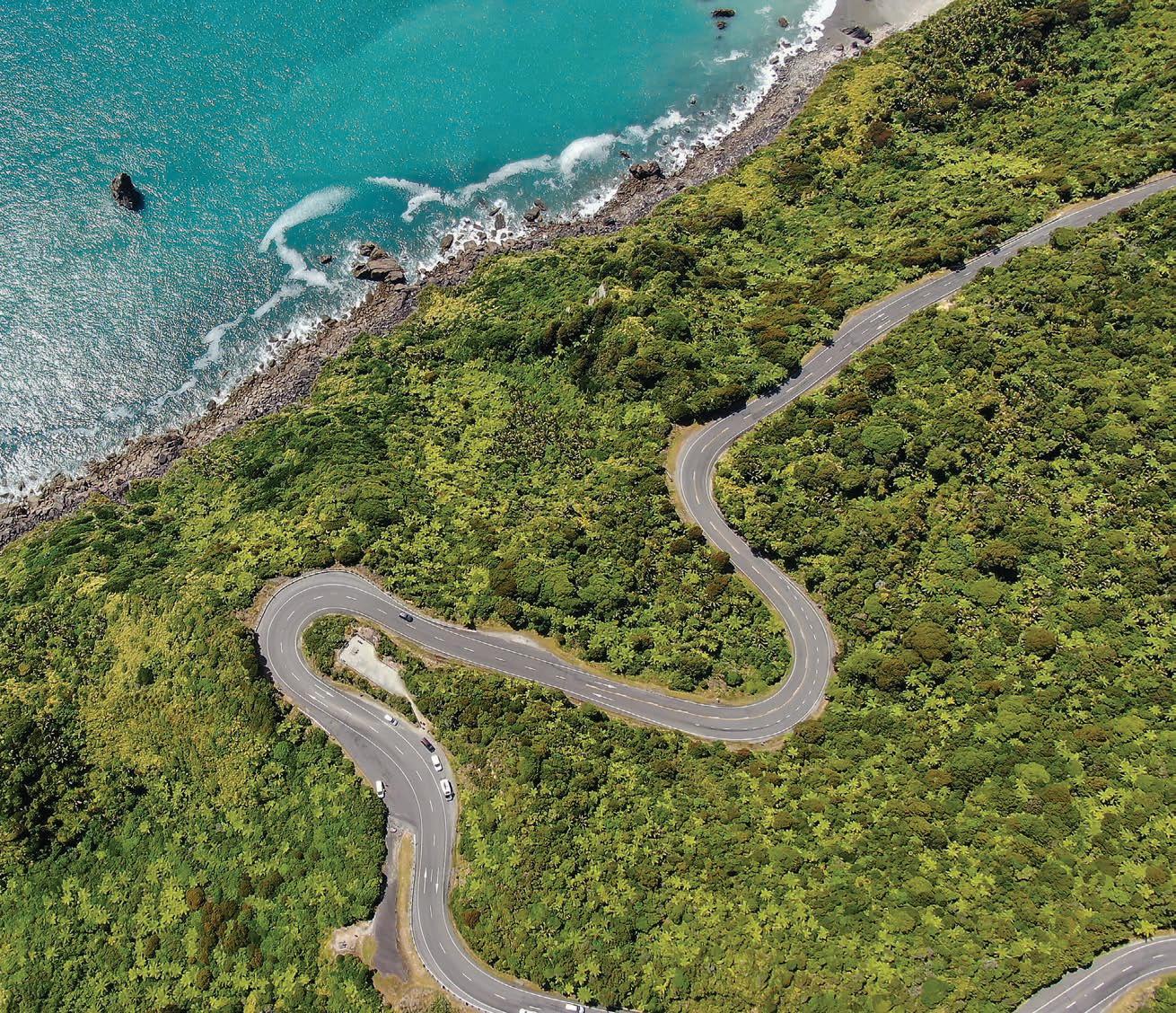
On our second day we continued on State Highway 6, through the Lower Buller Gorge and then drove down what is my favourite route in the entire country and the most spectacular coastline I have ever seen. I love how varied the terrain is once you hit the coast with thick, impenetrable native bush on the inland side of the road and then rugged coastline that seems to go forever on the other side. We drove in bright sunshine and the ocean was flat-calm, which is not the default condition for this part of Aotearoa. We stopped just short of Punakaiki to take in the view and to capture some photos. The previous year we had driven from Melbourne to Adelaide on the Great Ocean Road, and while that is another lovely road, and our version doesn’t have any official tourism name, I think it is more majestic as its Aussie cousin. A bit like Australian Stephen Larkin being a world class first five eighth but All Black Dan Carter being the best first five eighth to have ever played the
Above: Inangahua Cemetery.
Above: Pete Alborn with three of his five grandchildren in 2011.
game. Larkin was great, but Carter was the greatest.
When we did arrive in Punakaiki, we discovered a brand new Paparoa National Park Visitor Centre had opened only a few months earlier. Located directly across the road from the Pancake Rocks and Blowholes at Dolomite Point, this is now one of the best visitor centres in the country. It includes the wonderfully interactive Punangairi Visitor Experience Centre which does a great job of combining storytelling on Māori creation narratives, geology, the local biodiversity while making connections between nature and culture. The gift shop in the entrance of the building is a nice open retail space selling wonderful Ngāti Waewae crafts, jewellery, and artworks.
We spent the night at the tiny freedom camping site just to the south of Punakaiki, right on the beach from which we watched the sunset whilst drinking a tasty beverage. The next morning we drove back up the road about 1km back to the north to the roadhead of the Paparoa National Park for a ride on our mountain bikes. The weather was still perfect so we finished off with a swim in the river.
On our way south we stopped for lunch at the end of Cargills Road, an absolutely delightful little spot right on the beach in Barrytown. The rear door of our campervan opens right up so we were able to reverse the van right up to the
edge of the beach and have the best view in town. The other wonderful thing about the vanlife is that we have everything onboard to make a hot drink, prepare a hot lunch and even tuck into a cold beer if it’s a special occasion, and by special occasion, I mean; lunch time.
However, the most common anecdotes Dad talked about were fatal car accidents and other disastrous events.
We stopped in Greymouth just long enough to use the campervan dump station before driving straight through to Reefton for the night. The resurgence and revitalisation of Reefton over the past couple of decades has been a wonderful thing for the town. There is a definite buzz about the place with a number of nice cafés, galleries and quirky secondhand stores and antique shops. My personal favourite is the privately owned Reefton Sports Centre selling fishing, hunting and outdoor gear. In this new world of online shopping it is so refreshing to talk to
Punakaiki Pancake Rocks and Blowholes Walk.
somebody with authentic and valuable knowledge of their specialist field. I think it took 30 seconds of conversation for the owner and I to work out that she was once my late paternal grandmother’s neighbour. Our campsite for the night was Reefton Motor Camp, located right in the centre of town and beside the river. We swam in the river, walked along some of the trails and put the BBQ to good use again for dinner.
The resurgence and revitalisation
of Reefton over the past couple of decades has been a wonderful thing for the town.
The next day we made the obligatory pilgrimage to Alborns Mine, in Victoria Forest Park just outside of Reefton, the site of my great grandfather, Victor, and grandfather, Norman’s mine back in the day. Even without the family connection, this is a wonderful short walk with plenty to see in terms of the old mine workings and relics including a rusting Leyland truck that was part of the winch system to transport coal bins. We finished our walk with enough time to make the drive through to Murchison in time for the marvelous Tutaki Bakery to still have a pie available.
The temperature in Murchison would have been in the high twenties when we arrived which reminded me how, after we moved to Featherston in 1979, we seemed to receive
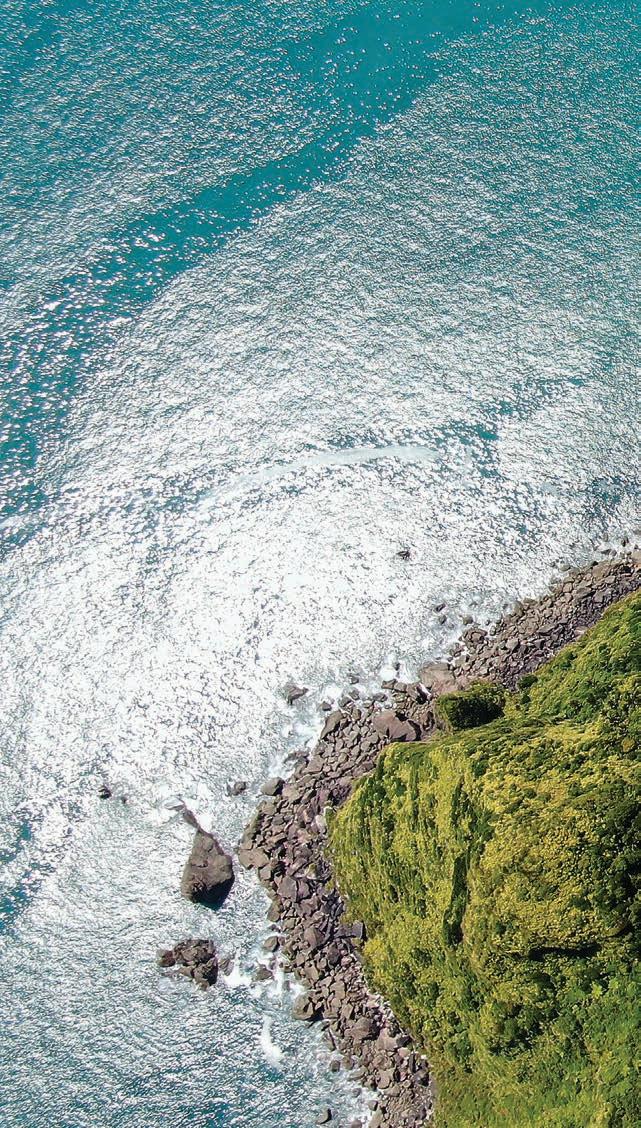
a phone call from my Great Aunt whenever Murch topped the temperature chart on any given day in the year. I believe the conversation would be along the lines of “What’s the temperature up there? Well it was 32 degrees here today with not one cloud in the sky!”
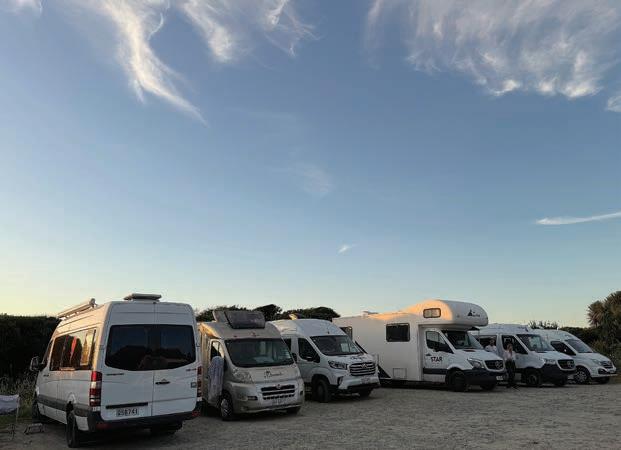
Our camping spot for the evening was the NZMCA (NZ Motor Caravan Association) park over property located just off State Highway 6 in the middle of town. We have been members of this wonderful association for years as it provides us with a network of private and NZMCA properties around the country to stay at for a minimal fee as well as other membership benefits. On occasions, as it did when we pulled into the site at Murchison, it can provide
Freedom camping.
some entertainment. We pulled our van into a spot only to be dully informed by one of the other guests, that it wasn’t an official site and could we please move our van. Because I’m basically a horrible person I simply moved our van so it sat directly across from their site in the hope they might wish they had left us where we were.
We walked the short distance to the river, down the bank to the point where the Buller and Mātakitaki Rivers merge where I attempted to catch a trout for our dinner. This futile attempt proved yet again that even with the solid local intel and purchase of the perfect lure back in Reefton, I am still rubbish at trout fishing. After I lost my third lure, I cut my losses and went for a refreshing swim before extract-
ing some protein from the fridge back in Queenie for our dinner.
On the way out of Murchison we stopped just north of the town at the point where the Buller meets the Mangles River where the trout, once again, were totally unwilling to play my game. I spent an enjoyable but ultimately unsuccessful hour or so scrambling over rocks and then blind casting through deep blue pools and sparkling rapids feeling like our trip had been much longer than only the three days we had available.
Above: The Dan Carter of Coastal Roads.
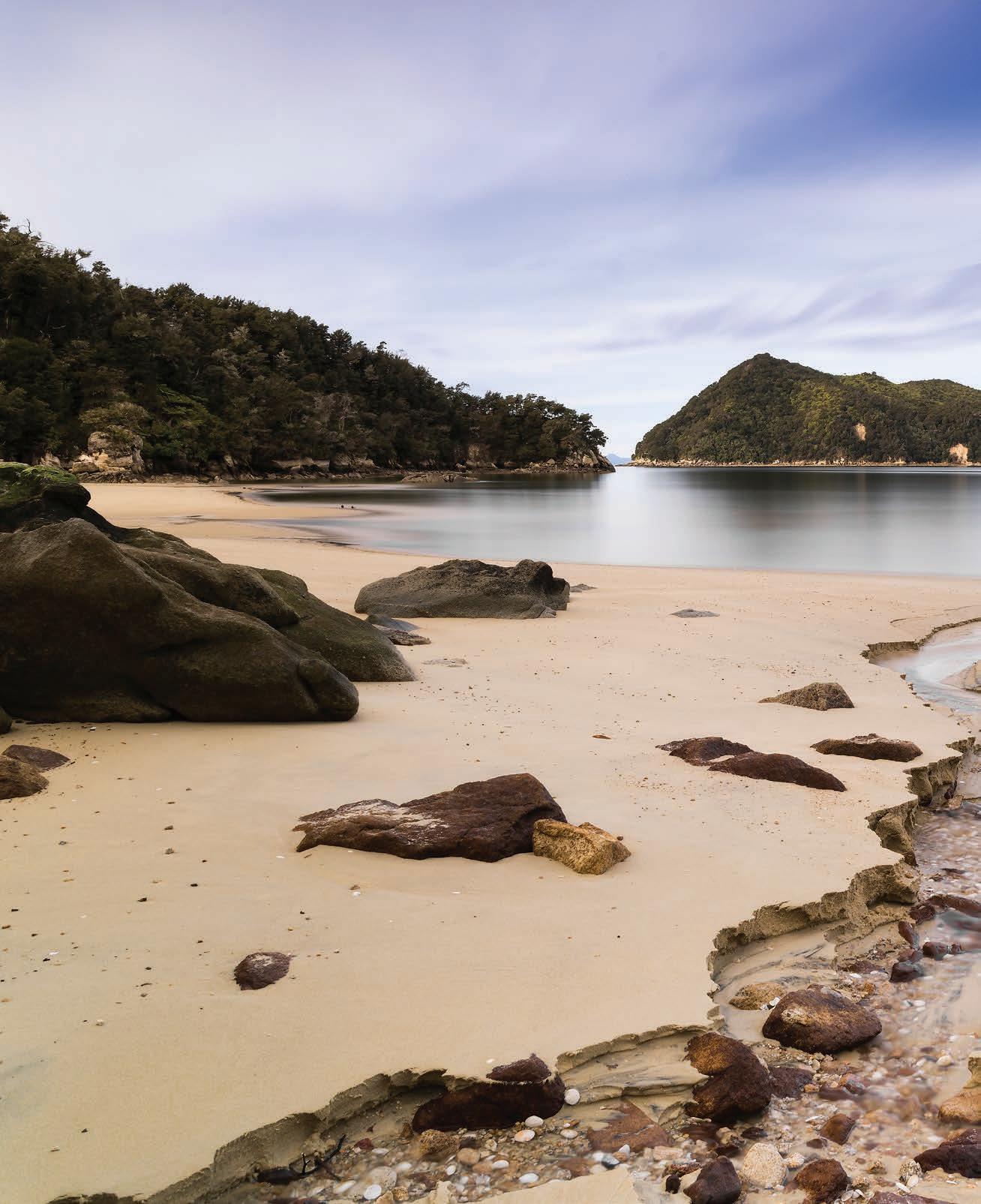
Adele Island.
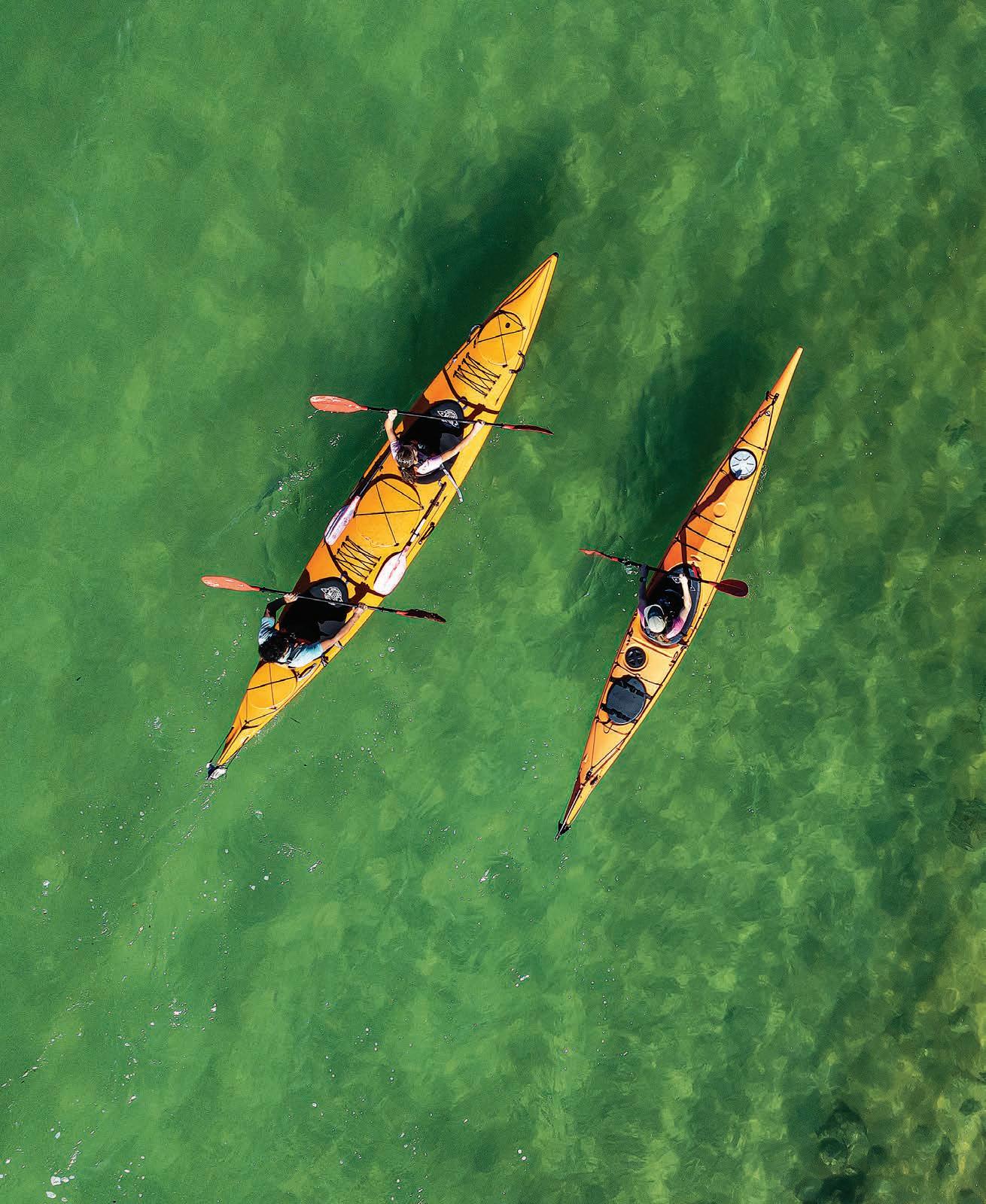
GUIDE TO KAYAKING THE GUIDE’S
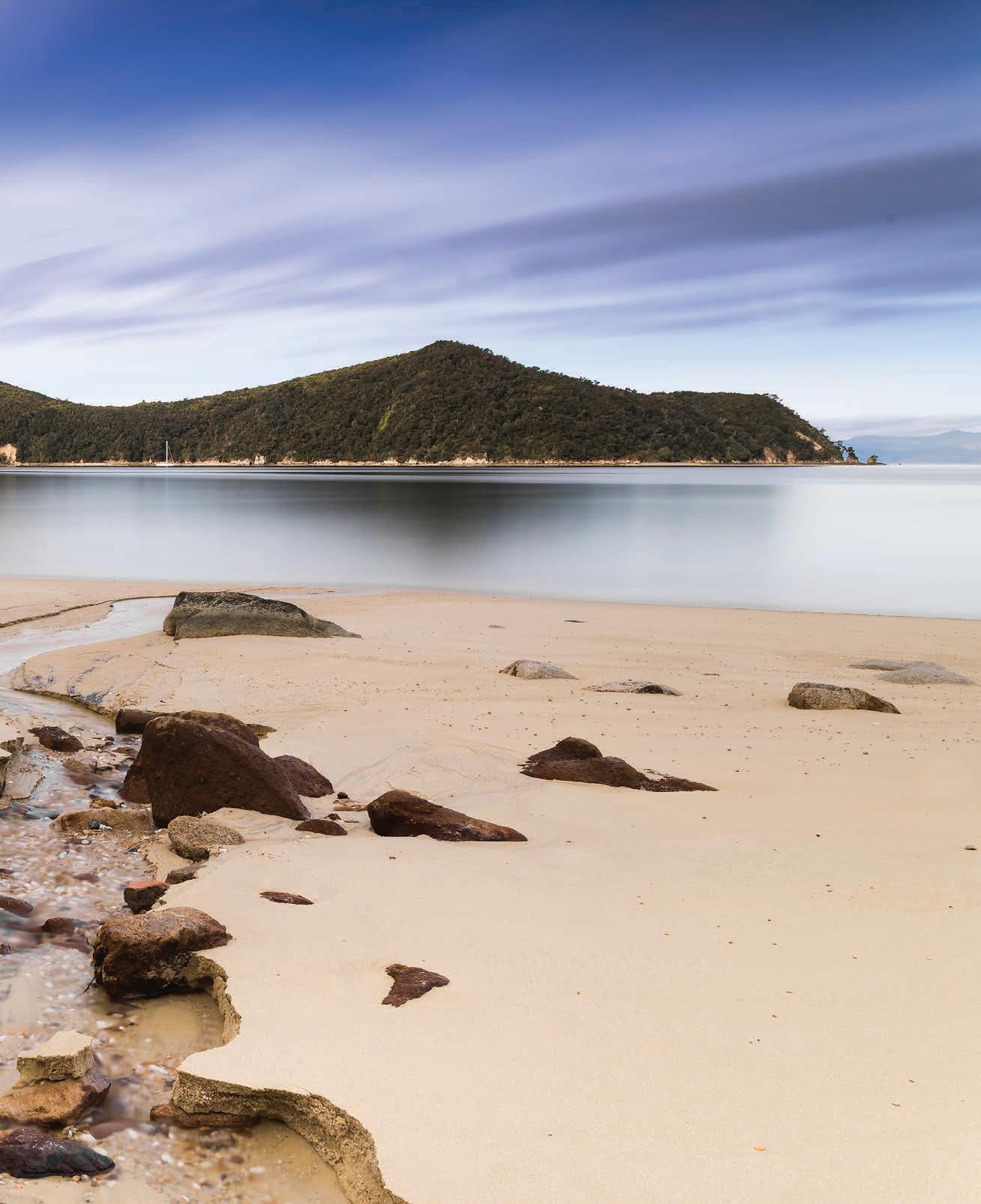
It could be argued that the Abel Tasman is Aotearoa’s premium kayaking location. The main thrust of this argument would be that the coastline here is ideally suited for sea kayaking. Firstly, Tasman Bay is often sheltered from adverse weather because of its location and the protection it receives from the Marlborough Sounds and d’Urville Island to the east. The southern end of the park, and specifically the lee side of Fisherman and Adele Islands, an area of the coastline known as the Astrolabe Roadstead, receives additional protection from the wind and ocean currents.
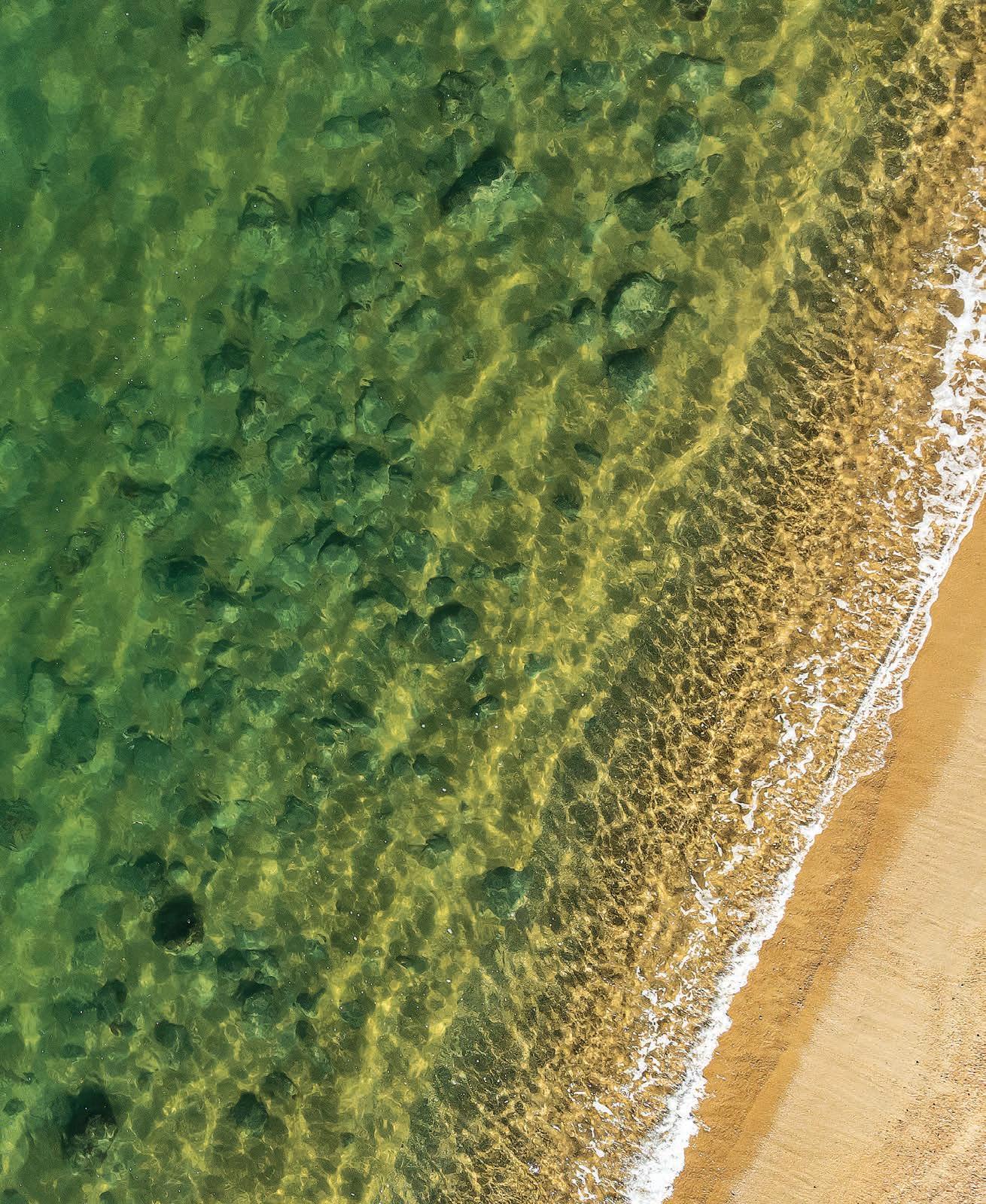
But the closing arguments on any debate about the Abel Tasman being the best place in the country for a paddle would be centred around the sheer beauty of the beaches, and the quantity of tidal inlets to explore. As if that left the judges in any doubt whatsoever, the captain of the Abel Tasman debating team would point out that the coastline consisting of Separation Point Granite is unique, interesting and even includes small coastal caves to explore.
To get some genuine intel on how best to make the most of a kayaking trip, I sat down for a chat with Penaia Robin-Seniloli, an experienced guide at Mārahau Sea Kayaks (MSK). For context, Penaia also has the unofficial role of Chief Morale Officer - a position of the utmost importance within our business. He organises both the MSK end of year staff activity/party and also a series of in-house competitions that involve challenges such as collecting random photos, ‘assassinating’ coworkers and many other, entertaining elements.
Penaia is also in charge of our annual staff awards, and
I still have my award certificate from last year, Stinkiest Morning Ablutions, proudly displayed on my fridge at home. Penaia’s younger brother, Louie, has worked in the service team for the past few years too. This has caused an ongoing debate as to who is the most handsome of the Robin-Seniloli brothers. Both brothers were devastated when a completely independent and highly qualified judge announced that Nikau, one of their other brothers, was awarded the honour. Louie was so incensed and outraged by the decision he lodged an official complaint with the International Court of Justice and Fairness.
Q: So how did you end up working outdoors?
As a family, we were into getting out and about. Mum and Dad like diving, so we’d head over to the West Coast or to Robin Hood Bay on the east. We’d muck around on the rocks and grab seafood. I’d been skiing a couple of times, too. That all sort of nudged me toward studying it, so I went to NMIT to study Adventure Tourism which is a twoyear diploma.
Q: What was the course like?
In the first year you try everything; rafting, kayaking, skiing, snowboarding, rock climbing, canyoning, and (cont’d)
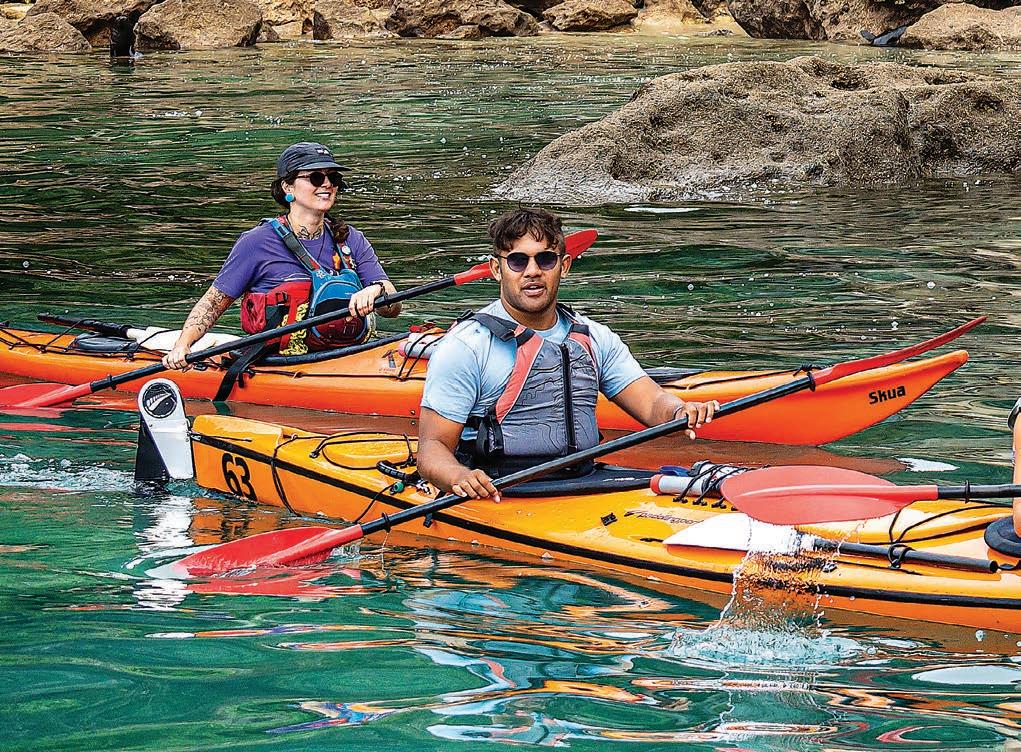
you do lots of tramps. In the second year you go deeper and come out with qualifications. I chose sea kayaking, skiing, and rafting, so I could work year-round. The course also covers VHF radio, self-rescue, first aid, all the stuff you need for guiding.
Q: How did you connect with Mārahau Sea Kayaks?
I did some voluntary hours for industry experience and came into MSK. Even before that, I sat in on a couple of briefings and did one guided trip. I’d been working for Waka Abel Tasman (waka ama) just before I started the course in 2018. At that point, I hadn’t really done much kayaking or rafting yet, just a bit of skiing, but I got into it from there.
Q: Since then you’ve worked summers at MSK and winters at the same ski field?
Yeah, winters at Cardrona in Wānaka. I went down for the snow and picked up a proper love for cold sports.
Q: What is your favourite part of guiding?
The people. You meet all sorts, fast paddlers, slow pad-
dlers, big personalities - and they make the trip. I haven’t travelled heaps overseas, but I love hearing where folks are from and swapping stories. The team here is awesome too. After five seasons I can say everyone’s super friendly and easy to get along with, which matters on long days.
Q: You do a lot for team morale. What inspired that?
Working at Cardrona there are lots of young bucks and long seasons so morale can dip. A bit of fresh energy and fun helps break the rinse-and-repeat. We’ll toss in challenges to keep things lively.
Q: What is your favourite challenge?
Taskmaster. Funniest moment? Probably the “photo of an Alborn family member” challenge which is worth triple points because they’re notoriously hard to catch in a photo. I have no comments as to why they are hard to take a photo of!
Q: What’s your favourite part of the Abel Tasman?
Above: Penaia Robin-Seniloli
Kayaking between Onetahuti and Anchorage. It’s mint on a morning high tide and afternoon low tide.
Q: What’s your ideal kayaking trip?
For me, it’s our Magical Marine Reserve, or MMR for short. In the morning we start at Onetahuti. There’s a waterfall behind the shelter that pumps on a high tide and it is only a three-minute walk behind the kitchen area. Then we paddle to the Tonga Arches and kayak throughout it if the tide is full enough to do so, or walk through at low tide when there isn’t enough water. There’s even a rock that looks like a face as you come out of the arches. From there, we head to the Tonga Island seal colony where there will be heaps of pups at the right time of year.
We then continue towards Foul Point. If conditions and the group skill level allows, I like threading through the rocks as it adds a bit of fun and teamwork as we avoid getting anyone stuck! We pop into the small cave just before Mosquito Bay, then into the Bark Bay lagoon for lunch.
In the afternoon I’ll often grab a couple of lemons from a tree near Bark Bay for later on. South of the marine reserve you can sometimes find decent green-lipped mussels for a tasting stop further down the coast.
If the group’s keen, we swing by Pinnacle Island to look for seals before we paddle up the Falls River to the swing bridge, if we have enough water to get up there. Then we
check out Frenchmans Bay, as we paddle south because there’s a stunning house there that everyone asks about. We drop into Boundary Bay, crack open the mussels, and sometimes even taste some kina (sea urchin). They’re smaller here because there’s less kelp for them to feed on, but still sweet and good for a sample.
Ilike threading through the rocks as it adds a bit of fun and teamwork as we avoid getting anyone stuck!
If the sea breeze comes up, which it is about 80% of the time, we set the kayak sail mid-bay and sail into Anchorage. Then it’s onto the AquaTaxi and home, ideally not running late so we don’t keep the water taxi skipper waiting!
Q: Why is this coastline so good for kayaking?
It’s compact but packed with variety, with arches, caves, lagoons, wildlife, and heaps of little nooks and crannies. After five seasons I’m still finding new ones.
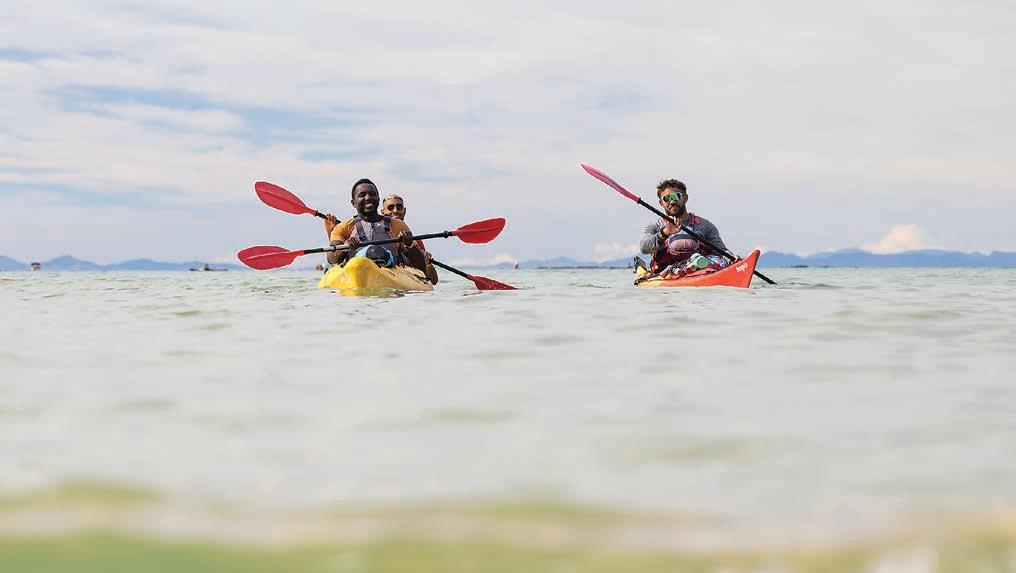
SO MANY SO LITTLE
We get an interesting mix of visitors who come into our operating bases to book an AquaTaxi trip for their day in the park. At one end of the spectrum will be people who have done their research and have decided to do a specific section of the Abel Tasman Coast Track, for example, the walk from Bark Bay to Anchorage because they want to walk across the Falls River Swingbridge.
At the other end of the scale are visitors who have heard the Abel Tasman is a must-do but don’t have any firm ideas of what they want to do. The second group might even ask, “So, the Abel Tasman. What’s good?” For this second group, we try to guide them towards doing the trip we think they will have the best experience doing. It shouldn’t come as a surprise, but we actually want every single person who visits the Abel Tasman to have a wonderful experience.
The Abel Tasman Coast Track is roughly 60 kilometres long, winding its way from Mārahau in the south up to Wainui to the north. The track can be loosely divided into sections between the different bays or the six Coastal Access Points (CAPs) where water taxis are permitted to drop-off and pick-up passengers. The idea of these CAPs is to provide visitors with options to complete a small section of the track by taking an AquaTaxi to one bay before walking through to the next bay to be collected and dropped back at your original departure point. Another option is for walkers to either get dropped at a CAP and then walk back to Mārahau, or alternatively, people can start their walk in Mārahau and then get picked up wherever they choose to end their walk, whether that’s a three-hour walk to Anchorage or a three-day walk to Tōtaranui. (cont’d)
OPTIONS TIME
Words: Brendan Alborn.
The track sections between the bays are all different distances, have a variety of terrain profiles and their own unique characteristics, views and highlights. This all makes it perfect for a great number of half-day, full-day and multi-day adventures, depending on your energy level and specific interests. However, it does mean visitors need to choose between the gazillion options available and this is enough to furrow the brow of even the hardiest of souls accustomed to making a good choice when presented with an array of options.
Adding another layer of complexity are the various sections of the Coast Track where there are both low and high tide routes with the low tide routes typically being shorter than the high tide options, so this impacts walk distances/ times. It should be noted that by necessity, the walking times below and on the DOC signs through the Abel Tasman can be indicative only, as they depend entirely on your walking speed and your propensity to stop and take in the sights.
Rather than using my own subjective judgement as to what are the “best” sections of the track to walk I am going to let the people decide. To do so, I’m going to focus on the three most popular Abel Tasman AquaTaxi trips based on the number of our passengers booking those trips.
ONE WAY AQUATAXI TO ANCHORAGE
This is by far and away the most popular option, and I would argue it is the best value full-day experience of any paid activity in the country.
Although the trip can be done in reverse, most people choose to AquaTaxi from Mārahau to Anchorage in the morning and then to take the rest of the day to walk back to where they parked their car, stopping to relax, swim or picnic on any of the beaches along the way. Seasoned campaigners will time their arrival back into Mārahau to coincide perfectly with happy hour at Hooked where they will rehydrate in the garden bar with local craft beer and wine.
Mārahau to The Anchorage Distance: 12.4km
Walk Time: 3-4 hours
Difficulty: Medium
The first major Coastal Access Point for water taxis in the park is The Anchorage, or just Anchorage to the locals, the Abel Tasman’s most popular beach for people doing day trips. As with every trip from Mārahau the AquaTaxi will first head a short way south to show you the second most photographed rock in the southern hemisphere, Split Apple Rock/Toka Ngāwha. Then it’s a short trip back to
the north, through the Astrolabe Roadstead and in the lee of Fisherman and Adele Islands, past the beaches on the mainland that you can visit on your walk back to Mārahau. There is something wonderful about being able to see the beaches from the water and then being able to visit them from the land. They are all wonderful in their own way but a smart observer will be paying attention when passing the beaches on the boat so they can work out which ones they definitely want to call into on their walk south on the Coast Track.
Watering Cove, Cyathea Cove, Akersten Bay and Stillwell Bay
After a bit of a climb out of Anchorage all of these delightful beaches are an easy walk further along the ridgeline and they all have a variation of the magnificent view across the Astrolabe Roadstead to the islands. The Adele and Fisherman islands provide some protection from the ocean currents and also a rather wonderful backdrop as you gaze out to sea.
Stilwell is named after Welby Stilwell who purchased two acres there in 1926 and had camping holidays there before building a cottage. Stilwell took visitors on excursions along the coast in his launch, Terepa around the same time that Newt Nalder was doing the same in the Kotare. Akersten Bay was presumably named after William Akersten who came to the Nelson area in 1855 where he set up a ship chandlery and built wharves which include what is, in present day, Nelson’s Main Wharf. Durmont d’Urville named Cyathea Cove because he found an abundance of the gully fern trees there. The bay is now more famous as part of the area leased by Pérrine Moncreiff, who played a crucial role in the establishment of the the Abel Tasman as a national park in 1942*. The bach built by the Moncreiffs
Adele Island from the coastal track.
is located in the Moncrieff Private Scenic Reserve. d’Urville also named Observation Beach, where an observatory was set up to view the transit of Venus across the sun, as well as Watering Cove where his crew replenished their fresh water supplies.
*Sources: Abel Tasman Area History by Dawn Smith - DOC, http://www.theprow.org.nz/places/streets-and-quays-of-portnelson/ and Down The Bay, Philip Simpson.
Apple Tree Bay
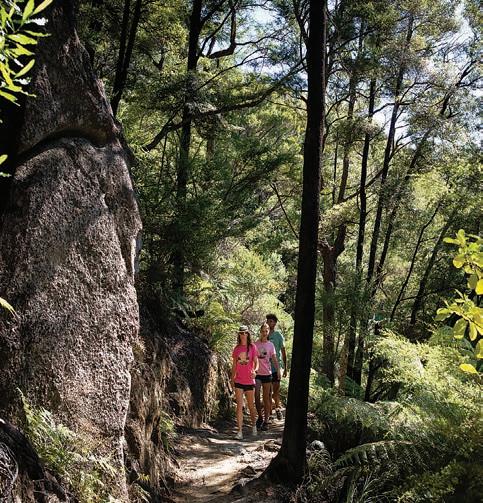
Further to the south you’ll find a newer section of track that deviates inland briefly, up a short steep rise, before rejoining the older track. This is one of a few new deviations you will encounter along the length of the Coast Track, all of which were put in when a weather event caused sections of the track to slip and become unstable. The track is still well-formed and pleasant to walk on, but these unexpected climbs, even if they are short, can be sharper than what you may have been expecting moments before you encounter them.
Apple Tree Bay is one of the longer beaches in the park with a tidal estuary behind it. It is also one of the beaches in the park that has a privately owned bach, though you will also come across single baches or small clusters of them elsewhere throughout the park. These small parcels of land were privately owned before the Abel Tasman became a national park in 1946 so were not handed over to the Crown. Originally named La Grande Plage by d’Urville, the name was changed to Apple Tree Bay presumably around 1928 when Lionel (Leo) Manoy bought four acres of land there for his family to camp for a few weeks every year
before they built a bach*.
*Reference: Abel Tasman Area History by Dawn Smith - DOC
Coquille Bay
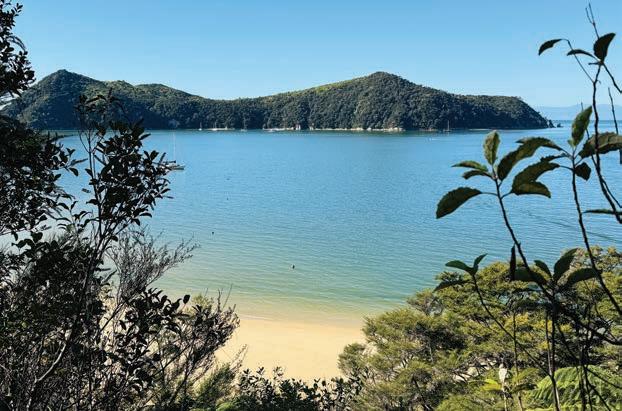
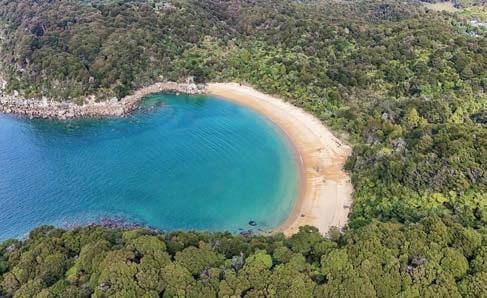
A little further on, you’ll find yourself looking down at a little beach called Coquille Bay, a classic, Abel Tasman-esque, crescent-shaped, golden-sand beach. Coquille is fringed with native bush, including punga ferns, so it looks rather magical from the lookout on the track above. It is also the first beach in the Abel Tasman, from the south, that has deep water during all tidal conditions. The bay is named after d’Urville’s vessel La Coquille, the original name for what was later renamed the Astrolabe.
Tinline
After descending a short hill you will find yourself on the grassy clearing that is the Tinline campsite. Tinline was named after John Tinline, a local man who acquired a block of land from Mārahau to the stream in 1857. Tinline, a much respected local figure who devoted his life to government service, farming and philanthropy, was commonly known as ‘Old Fizzlebilly’ because of his flowing beard. John Tinline learned to speak Te Reo Māori which led him to the position of interpreter for the Nelson magistrate in 1844. The prominent point above Tinline is the site of a former pā that was occupied when Jules Dumont d’Urville visited the area in 1827*.
After a bit over 1km, there is a sign to Stu’s Lookout, a high point located on a side track a few metres on the sea side of the track, providing perhaps the best views back towards Mārahau and also the southern end of the Astrolabe Roadstead to the north. The Astrolabe is the stretch of water between the mainland and the Fisherman and Adele Islands. A roadstead is an old nautical term for a body of water sheltered from ocean swells where ships can sail reasonably safely. The Astrolabe was named by Frenchman Jules Dumont d’Urville during his visit to the area in January 1827. D’Urville named the area after his vessel, previously called La Coquille, Adele Island after his wife, and Fisherman Island after observing Māori fishing there.
You will shortly arrive back at the southern entrance to the park, which is marked with an intricately carved waharoa (entranceway). Depending on the tidal conditions, when you walk across the raised walkway leading to the waharoa, you’ll either have water on either side of you or be surrounded by sand with the sea out to your right several hundred metres. Either way, it’s a nice way to end your walk in the Abel Tasman.
*Source: Down The Bay, Philip Simpson
PITT HEAD WALK AQUATAXI TRIP
This is AquaTaxi’s most popular packaged return trip. It includes the AquaTaxi fare from Mārahau to Anchorage and back.
The main reason for the popularity of this trip is that it caters to a wide range of options for walking, swimming, and relaxing. It is the quickest and cheapest way to spend the day in the Abel Tasman and is perfect for families with small children or groups where some may want to walk while others just want to lounge around on the beach for the day. Typically, people will travel up to Anchorage on the first sailing in the morning and then travel back to Mārahau in the late afternoon.
The most relaxing option for spending the day is simply
to lie on the beach at Anchorage. As a major campsite, it has all of the facilities you need, and with Anchorage being a long, sweeping bay, you’ll easily find your own stretch of sand.
The second most relaxing option is to walk the 20 minutes from Anchorage over a short rise to Te Pukatea, and then return via the same route in time to catch your AquaTaxi back to Mārahau. Te Pukatea is a classic Abel Tasman-esque bay; golden-sanded, crescent-shaped, with rocky headlands at either end. A short climb up the track to the north of the beach takes you to a viewing platform - the perfect place for photos.
Most people doing this trip will complete the Pitt Head Loop track as it is only 3.4km and takes 1-1.5 hours. The whole Pitt Head area has been extensively trapped for predators by the Abel Tasman Birdsong Trust, so it features some of the best birdsong in the park. The elevated views looking north across the bay to Torrent Bay and back to Anchorage are stunning.
Just across the estuary and to the north of Anchorage is Torrent Bay, the largest collection of private holiday houses in the Abel Tasman. This is only a 20 minute walk during low tide conditions, or a 1-1.5 hour, 4km walk around the estuary when the tide is high. If you are curious about what a couple of million dollars worth of spare cash will buy you, wander over to Torrent and check your next potential holiday home!
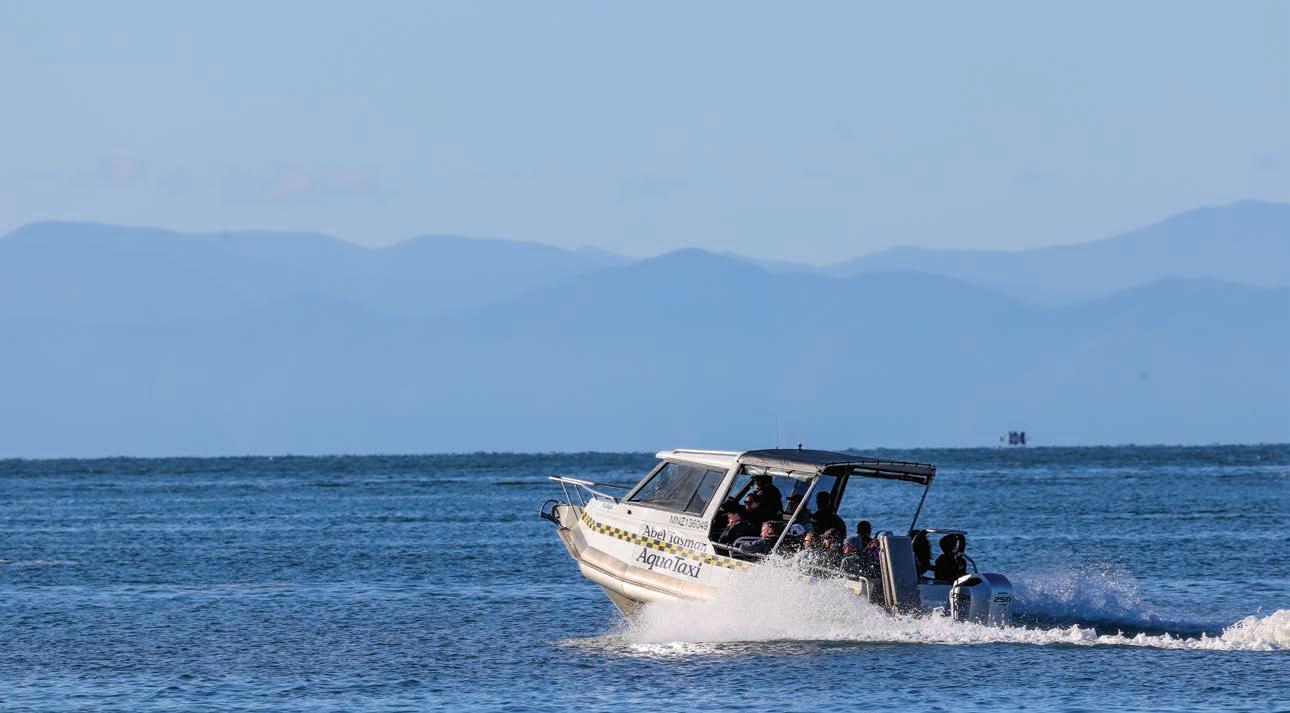
Above: An AquaTaxi en route to somewhere wonderful!
Cleopatra’s Pool is located about halfway between Anchorage and Torrent Bay as you take the high tide route around what is a wonderfully picturesque walk. A short side track leads you to this incredible fresh water swimming hole with a natural waterslide that runs between smooth rocks.
BEACHES AND BAYS AQUATAXI TRIP
This is our second most popular packaged return AquaTaxi trip. It includes the fare from Mārahau to Bark Bay and the return trip from Anchorage back to Mārahau. It’s an ideal trip for those looking for a longer walk that includes the spectacular Falls River Swingbridge.
Bark Bay is where Project Janszoon, in partnership with DOC, has reintroduced kākā into the park. If you wander out on the estuary at the right time you might spot kākā returning for a feed at the aviary where they were first housed when relocated.
The 7.8km track from Bark Bay to Torrent Bay starts gently enough, passing the tiny but lovely Medlands Beach before crossing a side track down to Sandfly Bay, a narrow beach and large tidal estuary from which the Falls River flows to the sea. The outlet of the river has a habit of switching from one end of the beach to the other, depending on where the tide and weather conditions shift the sand to. There is a little bit of rock-hopping required to get right down to Sandfly, but it’s worth it. Don’t let the name put
you off - there is no evidence that anyone has ever been eaten alive by the sandflies from which it takes its name.
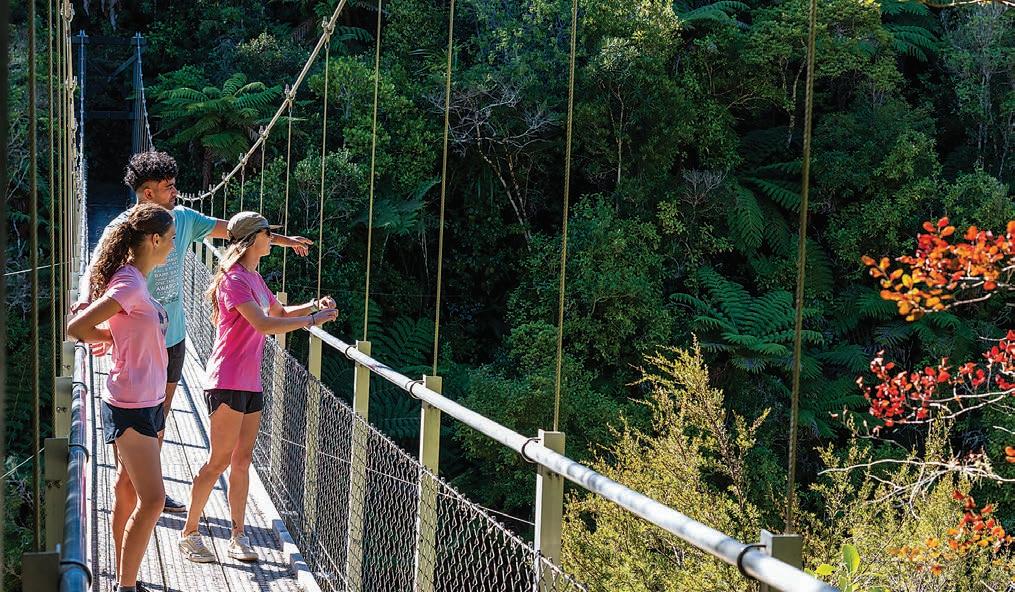
Continuing south, you’ll soon cross one of the major attractions; the newly upgraded Falls River Swingbridge, with magnificent views down the river and out to sea. After the bridge, the track climbs up to the ridgeline, and with its series of switchbacks, this will raise your heart rate even if you’re fit. It’s easy going from the top though as you’re mostly walking along a ridgeline from which there are wonderful views looking down to bays along the coast, particularly Frenchman Bay with its picturesque lagoon below.
The aptly named Halfway Pool, a small creek located halfway between Torrent and Bark Bay, is a great spot for a fresh water dunk in the small swimming hole next to the track. Just before you descend into Torrent Bay, you’ll get a wonderful view of the Torrent village and across to Anchorage.
There is a public path through the village, or you can walk along the beach to the southern end, where you either cross the estuary to Anchorage during low tide conditions (20 minutes/0.9km), or you will need to skirt around the high tide track which is 1-1.5 hour/4km. The estuary walk is one of the most underrated sections of the Coast Track, so if you’ve still got energy left in your legs, it is well worth it - even if you could have opted for the straight shot to Anchorage across the sandflats at low tide.
Above: Falls River Swingbridge.
TO THE END
JOURNEY OF THE BAY
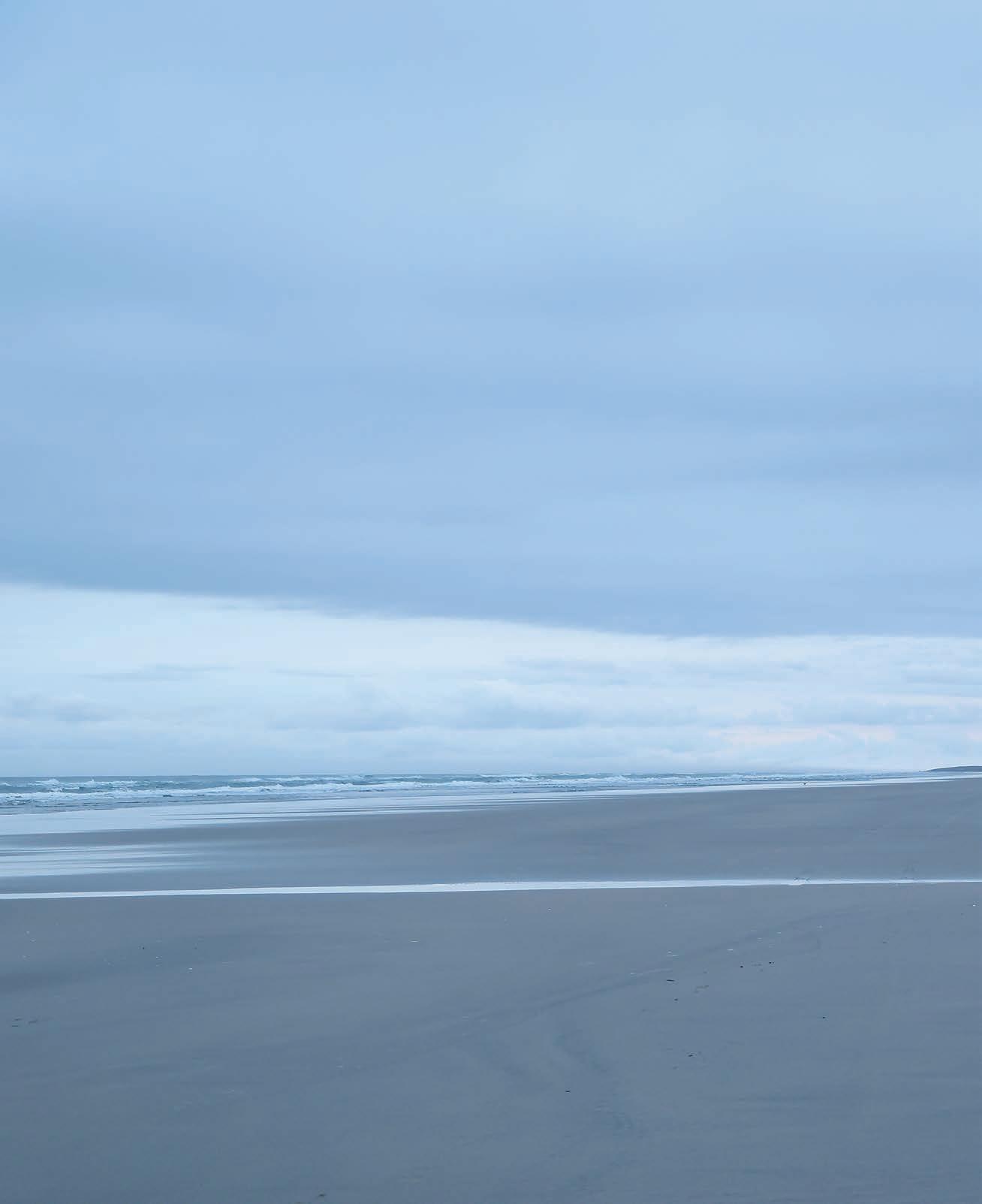
Words and Photography: Jade Alborn. Farewell Spit, the longest spit in Aotearoa, curves around Golden Bay. Beyond the first four kilometres, access is only possible with a specially guided tour. What once began as a handful of additional passengers hitching a ride on the weekly mail run to the lighthouse has transformed into a full-scale eco-tourist experience. Today, specially modified red buses take tourists and locals deep into this wild landscape, as expert guides reveal its stories, natural wonders, and birdlife. I was lucky enough to join one of these tours this winter. Here is how the journey went…
It is still dark when we set off from Collingwood, the eco-tour bus a welcome refuge from the 6AM chill. Allan, our driver and guide, welcomed us warmly.
Around me is a mix of photographers and bird enthusiasts, some returning for a second trip. As Collingwood fades into the distance, a light appears out the window. One
second, every fifteen seconds, it shines, the lighthouse that is waiting for us.
As he navigates the road, Allan begins by telling us about the early mining history of Collingwood. “People came for the gold and stayed for the coal,” he says. Golden Bay is named after this gold, not the sunny weather or (cont’d)
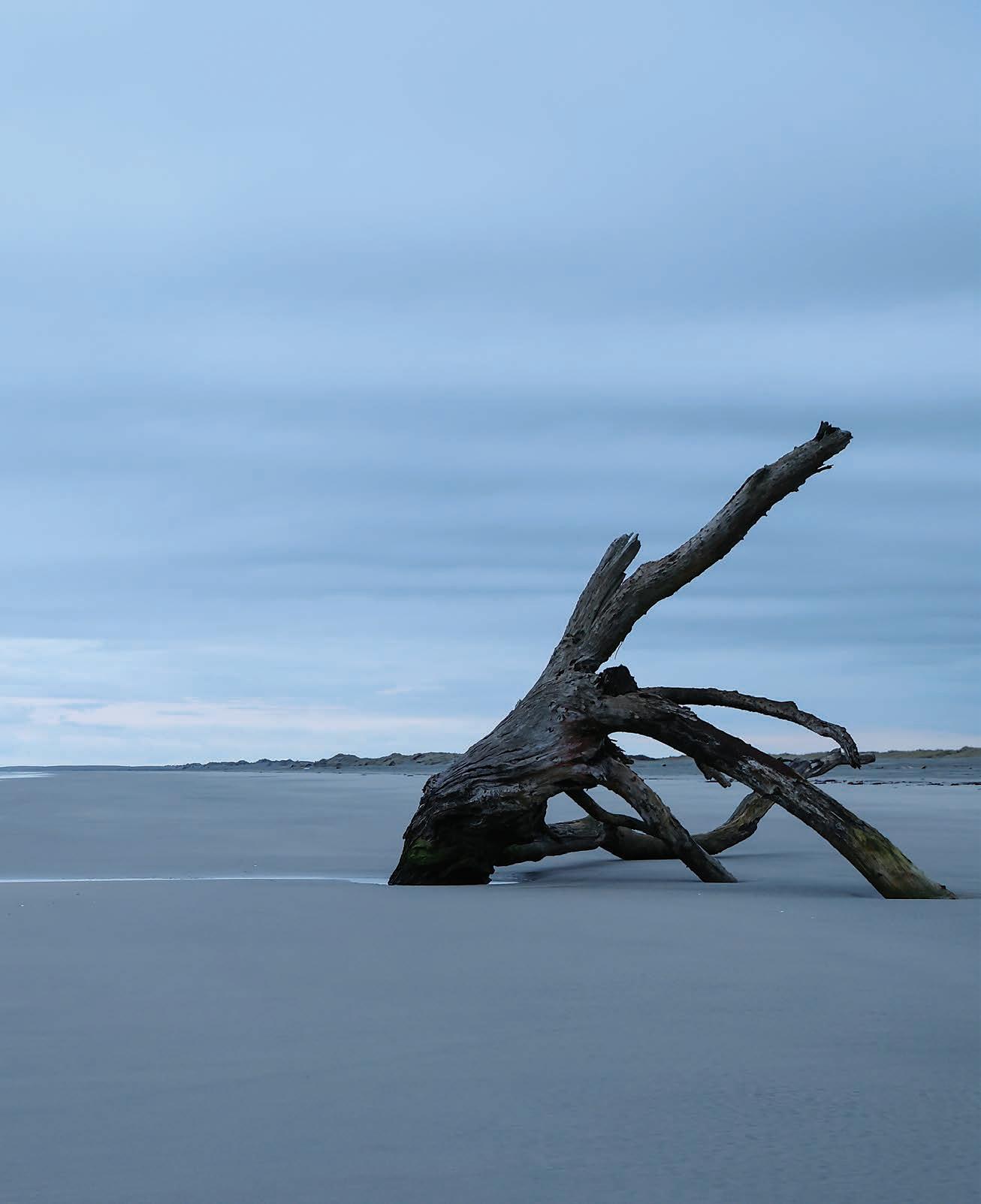
The stark beauty of Farewell Spit.
beaches, as some might think. The mineral-rich land drew people from all around. He also recounts stories of Wiremu Kingi Te Koihura (Billy King), who was once the chief of Pakawau. The landscape feels alive with history as we drive along.
Allan is clearly an expert, knowing all the English and Māori names for every bird we see.
Soon, we venture off the road onto the sandy estuary. Allan expertly drives around the softer, muddier sections of ground. The farmland suddenly falls away, and we emerge onto the expansive spit, the only spit in the world to be a protected nature reserve. The never-ending expanse is a sight to behold.
Our first stop is an overturned tree trunk, half-submerged like the sun trying to push through the cloud. It appeared on the beach in 2010 and is now a favoured spot for shags to perch and dry their oil-less wings in the wind. Cameras click as we wander around before continuing down the spit. We travel further and further beyond the four kilometres open to the public.
As we move, new shapes begin to emerge. Black smudges suddenly transform into dedicated couples: tōrea (oystercatchers), who mate for life, standing sleepily on a single leg, rotating with the wind. Allan is clearly an expert, knowing all the English and Māori names for every bird we see. He is able to distinguish between juveniles and adults with a glance.
Then the lighthouse, whose beam we spotted so far away, comes closer. An oasis of large trees is a stark contrast to the dunes. We stop for morning tea at one of the light keepers’ houses and hear tales of isolation, hardship, and dedication. Out here, everything required more effort and time: a trip to collect mail was an overnight affair, and gardens required bags of dirt carried all the way from Pūponga one at a time. As technology advanced, three keepers
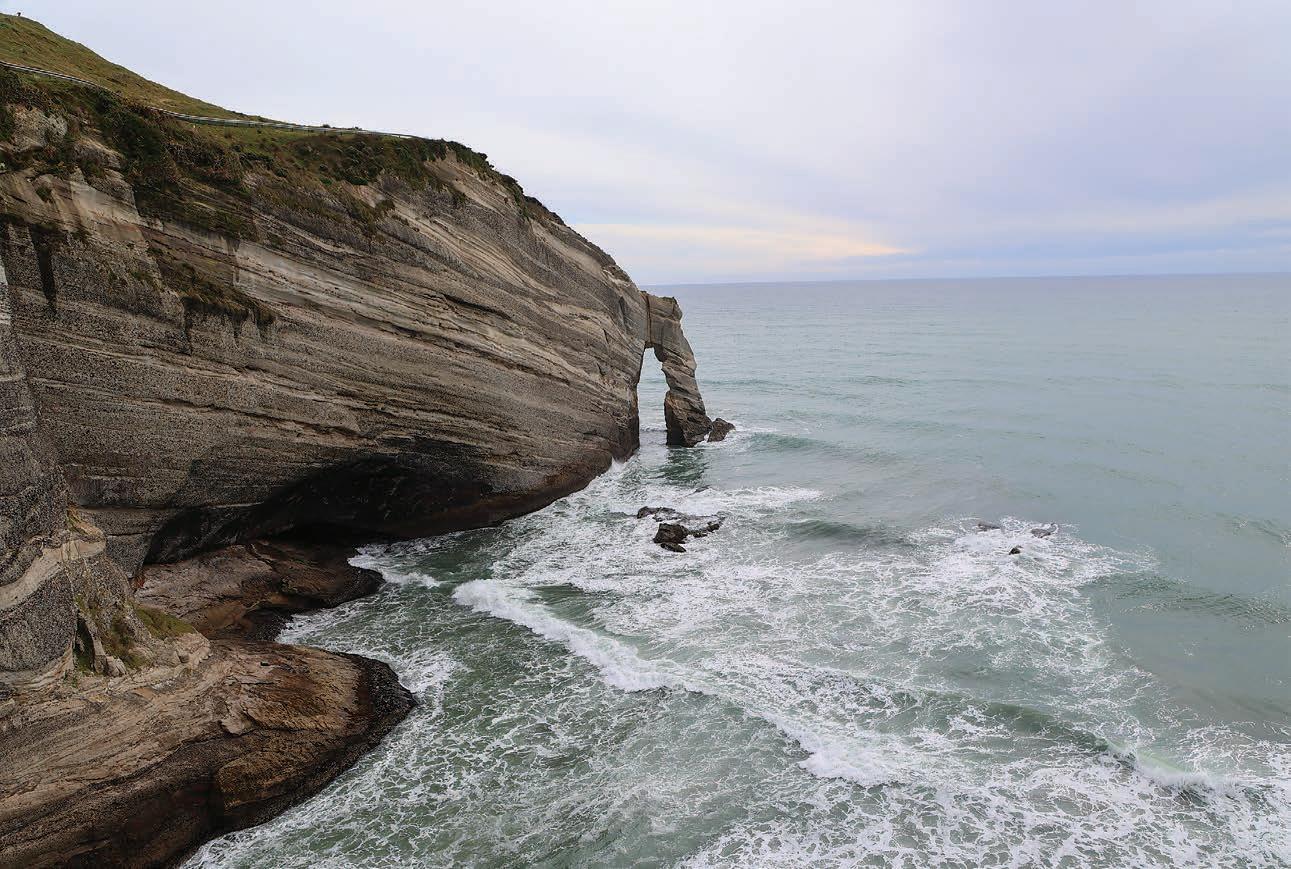
Below: The stark beauty of the northern West Coast.
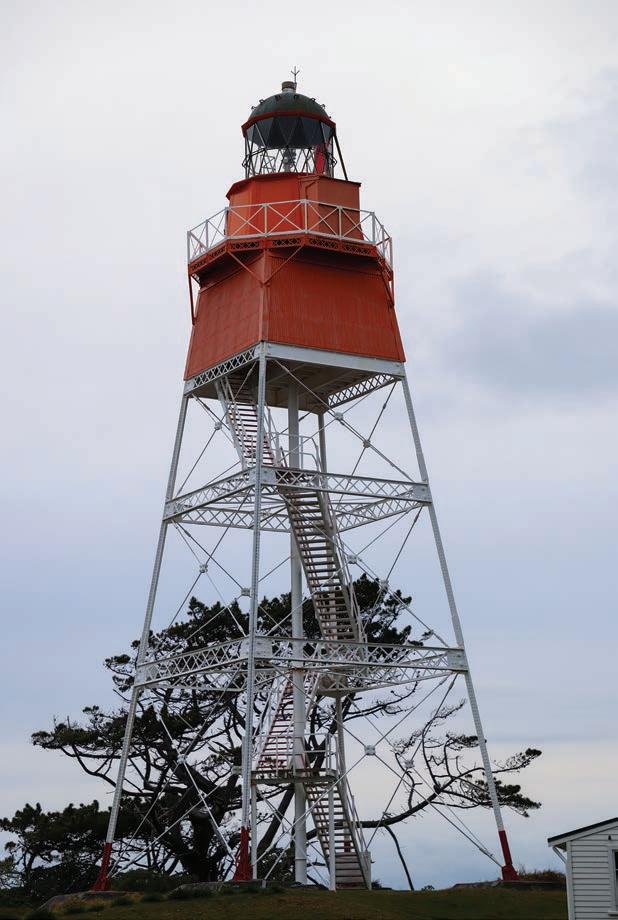
became two, then one, and eventually none. Now the light shines on without assistance.
Not far from the lighthouse, we can make out New Zealand’s newest and fastest-growing mainland gannet colony. Overhead, gannets soar and swoop toward the ocean, diving to collect their kai. As they age, they can become blind from the seawater, and they depend on the sound of the others to know where to find food.
The next stop is a sand dune. Ripples of fine sand wrap around my shoes as we climb, until I am transported to a barren prehistoric scene or even an alien planet. I relish the feeling of insignificance in the face of kilometres of land where nature is still truly king. Allan tells us tales of the sand dunes swallowing things whole: a shipwreck sunk underneath, a keg of whiskey lost, and whale bones hidden away.
Then we are off to admire the rocks at Fossil Point. They show layers and layers of time, oyster shell on top of oys-
ter shell. Allan points out the holes in the rock, the work of tiny worms. The waves hit the reef in a steady rhythm as we watch on.
Our final stop is Cape Farewell. It is a poignant end to the trip. It is the northernmost point of the South Island. Seals lie lazily on rocks, unfazed by the waves crashing beside them. The bold arch shape etched into the rugged cliffs frames the landscape.
As we journey back towards Collingwood, we discuss the day. The keen bird spotters in the group were hoping to glimpse a rare kōtuku (white heron) on our trip, but it seems luck was not on our side. Then, mid-sentence, Allan suddenly stops the bus: a lone kōtuku stands in a field surrounded by cows. The bus is full of excitement. This special moment is the perfect end to the day.
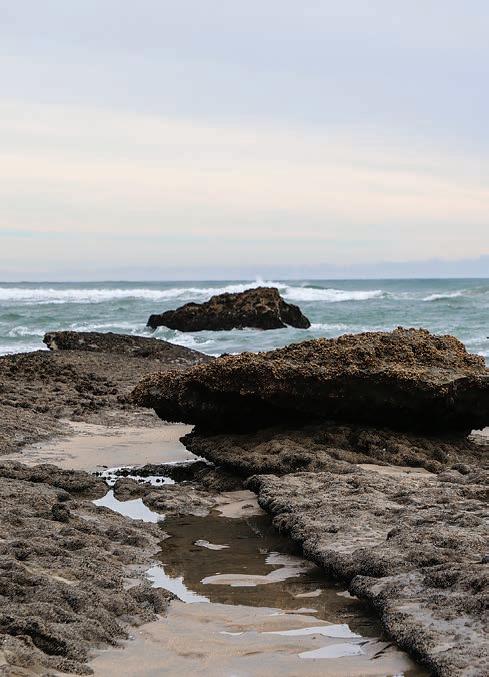
Farewell Spit Tours is a locally owned business. Tours have been operating on the spit since 1946, originally as part of the mail contract to the lighthouse. When the lighthouse was automated in 1984, the company shifted its focus entirely to tourism and has been sharing the beautiful landscapes and wildlife of Farewell Spit with visitors ever since.
You can book tours via www.farewellspit.com
Above: Lighthouse, Farewell Spit.
Cape Farewell.
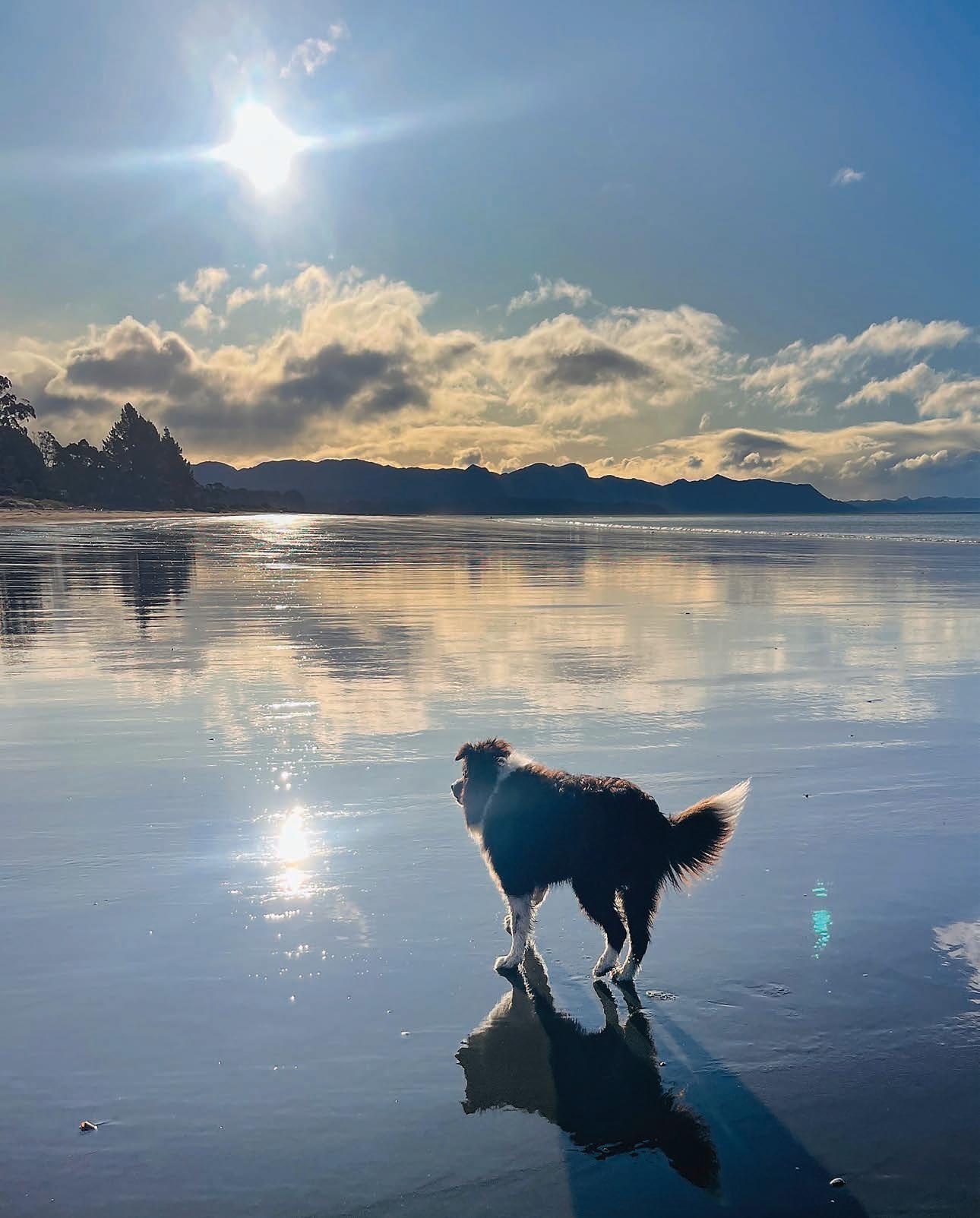
OFF THE LEASH
Words and Photography: Brendan Alborn.
This year my faithful running companion, Maggie the Border Collie, hit her mid-50s in human years. For any non-dog people out there, the theory is that dogs age at an average rate of six times faster than humans, so one calendar for a dog is relative to six years in human age. This means that now in her 9th year, Maggie has caught up to me and we’re both in our mid-50s in terms of our relative lifespans. Yep, we’re both getting on a bit.
Maggie is still keen for a daily run, but on some days she just doesn’t have the energy for the longer runs like she did when younger. Occasionally, we’ll only be a few hundred meters along the track when she will let me know she’s not really into it by yapping at me, by nipping my rear end or gently mouthing my hand. When she does this, our run becomes a short walk.
On other days I might set out intending to run the stan-
BROOKLYN DOMAIN
dard 7km but will see her beginning to wane as the run progresses, so we will cut things short by a couple of kms. She communicates this by lagging back a bit and then if I stop to check on her she’ll look back in the direction of my truck. We are still running together most days, but I’m now doing the odd longer run without her so she can rest up for a day or two each week. I’ve highlighted a few of these runs below, as well as a couple of old favourites on which I do take Maggie.
This is more of a walk than a run, unless you’re looking to do some hill work. The start of the track is in front of the small reserve a short distance up Brooklyn Valley Road.
The main track runs to the left along the base of the hill before cutting right and then up the hill, zig-zapping up to a lookout. The view is well worth the short walk, encompassing the orchards and hop fields of Riwaka and Motueka and out across Tasman Bay. Rather than going down the same route, I tend to take one of the smaller paths back to the main track so as to create a bit of a loop. At the bottom there is also a bridge back to the grassy reserve and this makes a nice variation from walking through the bush. The whole thing doesn’t take more than 20 minutes to walk, but it really is a rewarding short wander with the pooch.
Below: Brooklyn and Riwaka/Riuwaka from above.
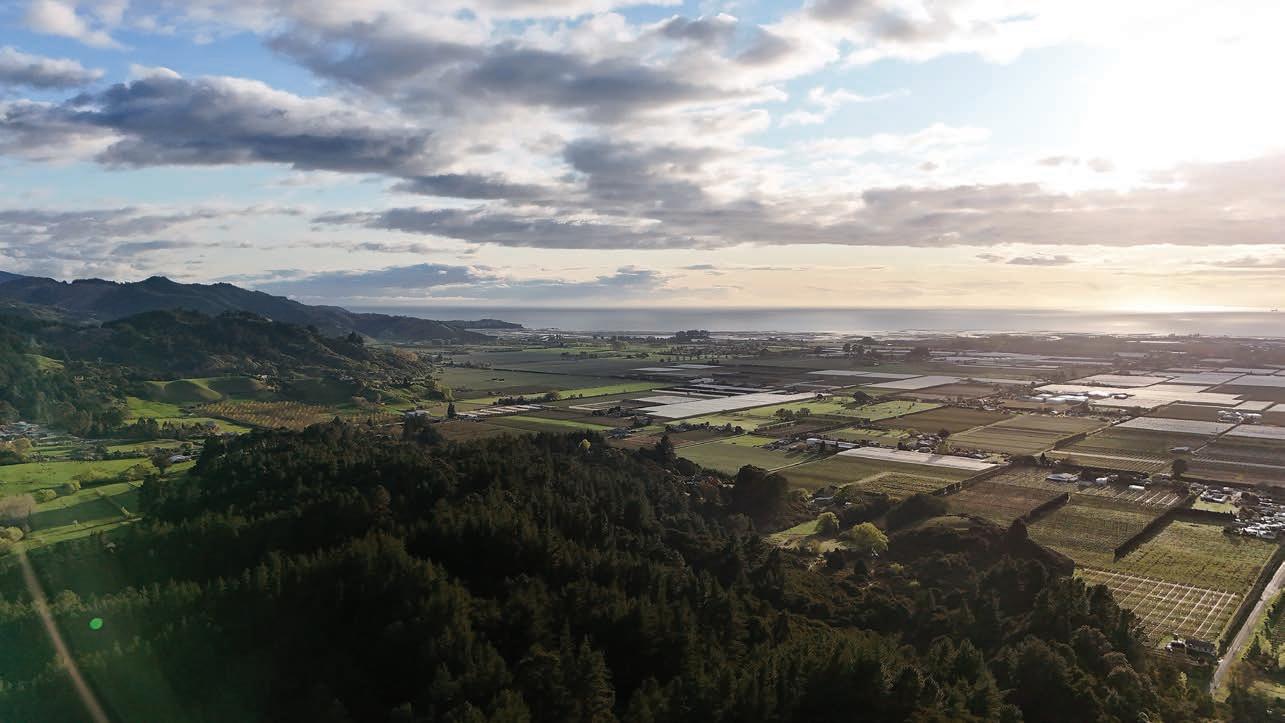
THREE PEAKS
This is one of the most scenic running routes in the entire country. I was introduced to this route recently by the elite adventure racing team, the Hysterical Rectomies, so I won’t pretend that I came up with it myself. This whole route is a shade over 20km.
From Riwaka/Riuwaka the route follows the Great Taste Trail towards the entrance to the Kaiteriteri Mountain Bike Park. After the first small rise you get an awesome view looking back to the south across to Outer Island (or Goat Island) and over the estuary area of Riwaka/Riuwaka. At the Cog (the entrance), the track climbs up into the mountain bike park before leveling out along the Easy Rider track. After a couple of kms there is a sign on the left to the Mr Stephens track which, predictably, drops down to Stephens Bay - where you run along the raised boardwalk and up the short but sharp rise to Dummy Bay. The view as you drop into Dummy Bay is wonderful, but an even grander view is a short distance further along just before you drop down into Little Kaiteriteri. As you look across the bay it will become immediately obvious why Kaiteriteri is consistently rated as one of the most beautiful beaches in the world.
After running along the track beside the beach you’ll find some steps up a short climb to the Kaiteriteri lookout. If you were feeling any cynicism about my claims as to just how beautiful this route is, you’ll feel that dissipating further when you stop at the bench seat at the top for a quick look from here.
At the bottom of the hill you run along the path beside the main Kaiteriteri beach where, a little further to the north the road leads up to Kākā Point. Once you’ve had your fill of the view from the top of this little hill, descend back to the Kaiteriteri Beach and head past the camp and shop to run up Martin Farm Road. Just before you get to Bethany Park, turn left and head up the track that leads up the small hill. This track isn’t quite as well formed as the rest of the route, but the view at the top will make a bit of scrambling well worth your while. Run back down the way you come, back along Martin Farm Road and up into the Kaiteriteri Mountain Bike Park. Just up from the skills area you’ll find the entrance to the Easy Rider route which you follow back to Riwaka/Riuwaka.
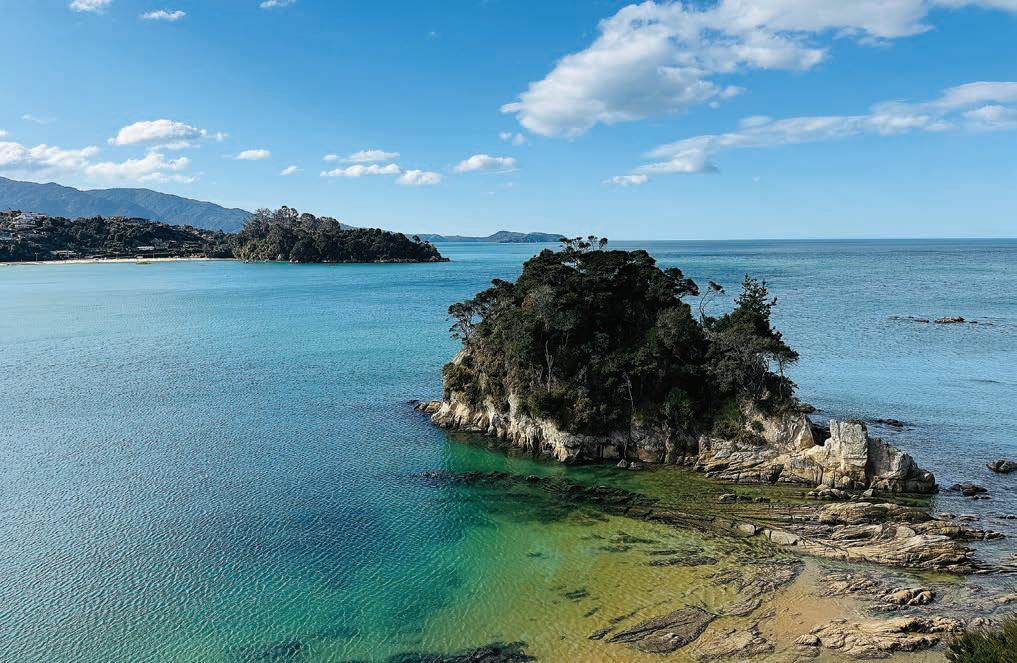
MOTUPIPI MOUNTAIN
BIKE PARK
I have both cycled and run on this wonderful hidden gem of a trail. Located between Tākaka and Pōhara, the car parking area is right on the corner of Abel Tasman Drive and Rototai Road. From the car parking area, it’s a short distance across the Motupipi River bridge and then left along Burnside Road to the entrance to the trail.
Once up into the park my approach is to run straight up the 4WD track to the clearing at the top of the hill. From that clearing I weave my way around the variety of tracks that go out and back from the headland, all of which have wonderful views of Pōhara, Tarakohe and as far as Tata Beach. Once I’ve done all of those tracks I descend back to the entrance via La Rambla, a wonderful track that weaves its way through a mix of native and pine bush with the perfect combination of undulation for either running or biking.
The fact this wonderful resource has been created and is maintained by members of the local community, and is located on private property yet accessible to anybody, is a source of wonder to me. Unfortunately, it’s a no-go zone for dogs - but you can’t have everything your own way in life!
GOLDEN BAY BEACHES
On lower tides many of the Golden Bay beaches are great for running with or without the dog. There are some seasonal restrictions for dogs on beaches but there’s also several long stretches of hard sand that I have enjoyed running over the years. I do a lot of running on beaches and while I understand others think beach runs are too monotonous or they find it frustrating running on the softer sand or the uneven surfaces typical of tidal-flats, I have become really accustomed to it over the past several years. I have also had many moments out running on remote beaches when the light and overall atmosphere is nothing short of ethereal.
From the Tarakohe end of the Pōhara Beach you can run about 4km before encountering the mouth of the Motupipi River which would involve a wet crossing to progress any further. I tend to run along the track beside the beach as far as I can on the way out, along a mix of paved pathways and raised wooden boardwalks, and then along the beach for the full return trip. It always feels incredibly wholesome and healthy to run and then jump straight into the sea for a swim afterwards.
From the rocky headland at the southern end of Patons Rock along the beach to the Pariwhakaoho River mouth is a shade under 4km too, so a perfect “out-and-back” distance for me. Like Pōhara, there are restrictions on having your dog on the beach directly in front of the main public area during the peak summer season (usually 1 Dec to 31 Mar), but the area outside of the ‘front beach’ area includes more than enough real estate for myself and the hound.
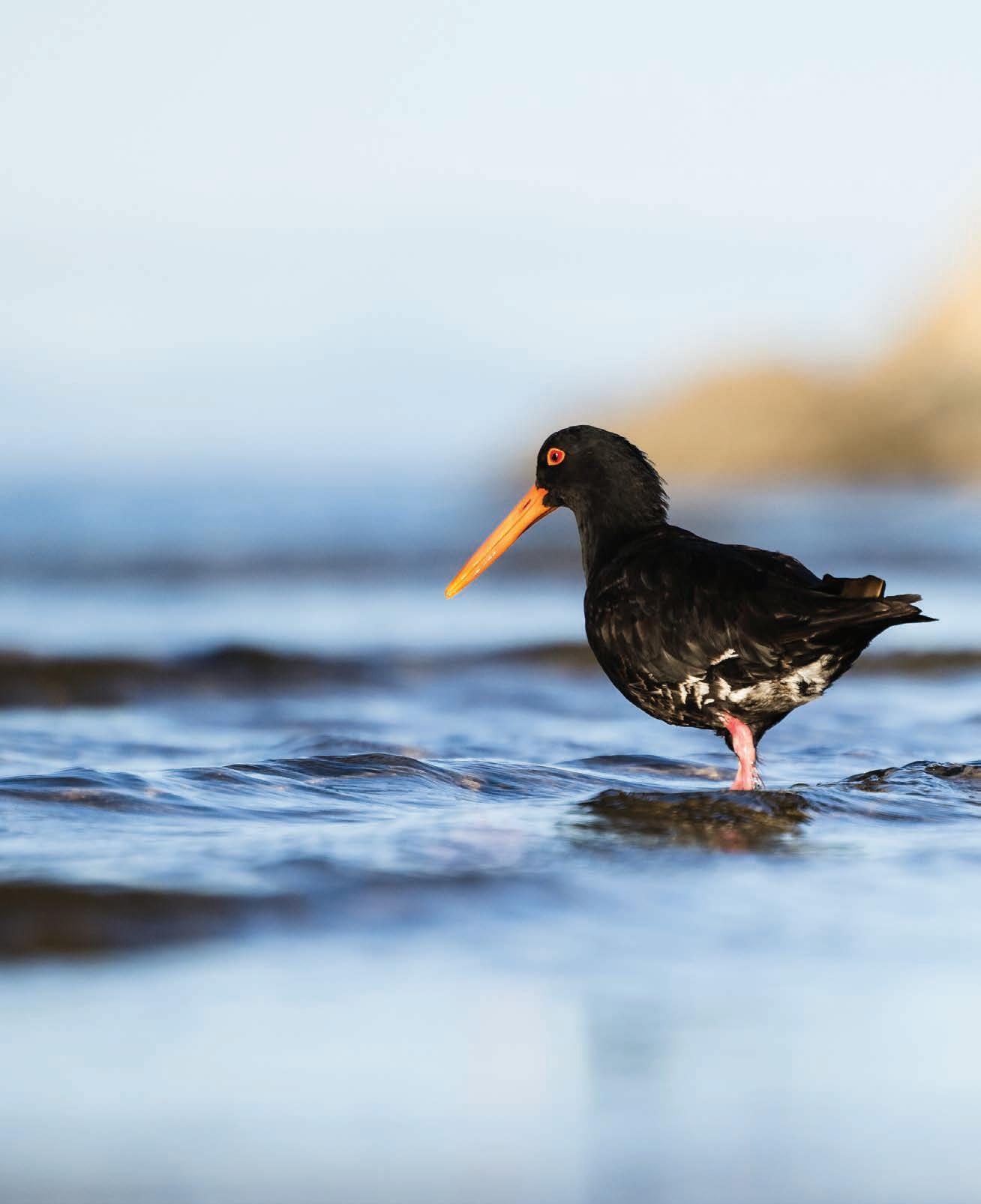
Oystercatchers/Tōrea, Mārahau Sandspit.
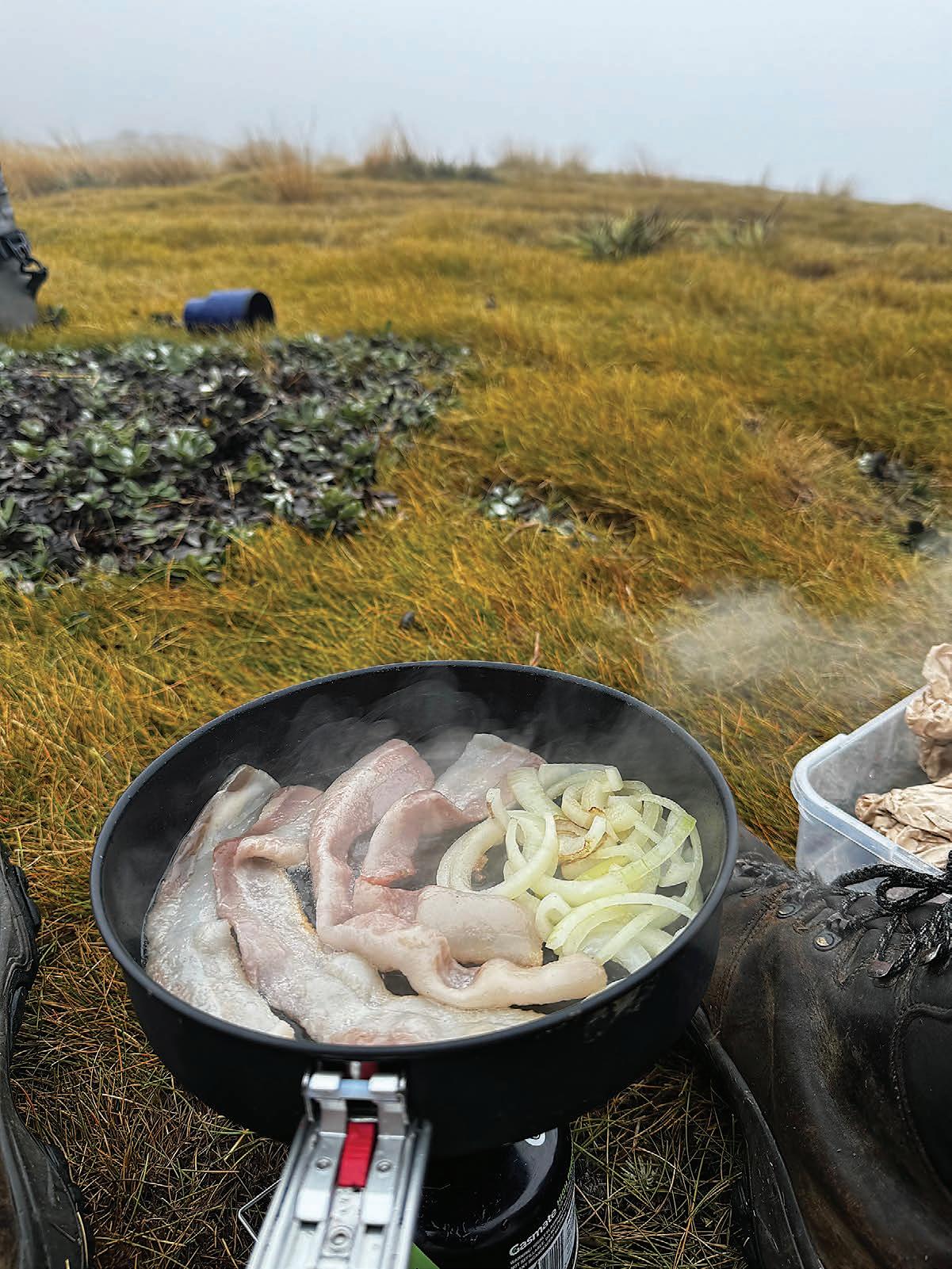
WILD FOOD VENISON GUIDE
Words and Photography: Brendan Alborn.
In the last two editions of this magazine I have written about both my adventures and my misadventures while out hunting and fishing. Over the past year I am happy to report the ‘mis’ column only has three entries. Two of these involved nothing more serious than falls, minor bruising and only the minimal loss of blood, and neither incident left me with any broken bits. The third incident involved a successful snapper fishing expedition followed by a rather spectacularly unsuccessful attempt at securing our boat in the Torrent Bay lagoon. Rather than anchoring the boat to terra firma, as was the plan, I succeeded in lodging the anchor into my left shin. I won’t write any further gory details of this misadventure, and I definitely won’t mention how I attempted to poke the bits back into the hole I’d created before the wooziness almost caused me to pass out. That would only add to what is already the worst introduction to a column about food ever written. But I will say it is the first time I’d needed to be rushed away for urgent medical treatment, and within 90 minutes I was stitched up and on the road to recovery.
Since I started being more successful with my hunting a few years back, I’ve had to improve my culinary skills to get my family and friends to help me eat our way through the volume of protein in our various freezers. This has involved developing and refining recipes and cooking techniques as I have tried to transition from a basic to a halfway decent cook.
If we manage to bag a deer early on when out on a multi-day trip we usually try to harvest the liver and take off a bit of the fillet or back steaks to eat in the field. I’ve found it is important to marinate the steak to break it down a bit or it’ll be as tough and chewy as an old boot. We use whatever we have on hand to make the marinade; chutney, red wine and diced pieces of fruit, particularly Kiwifruit or any citrus fruit. With the steak cut into 1.5cm thick slices, I get the skillet on my trusty old camp cooker hotter than Hades before I sear it for 45 seconds per
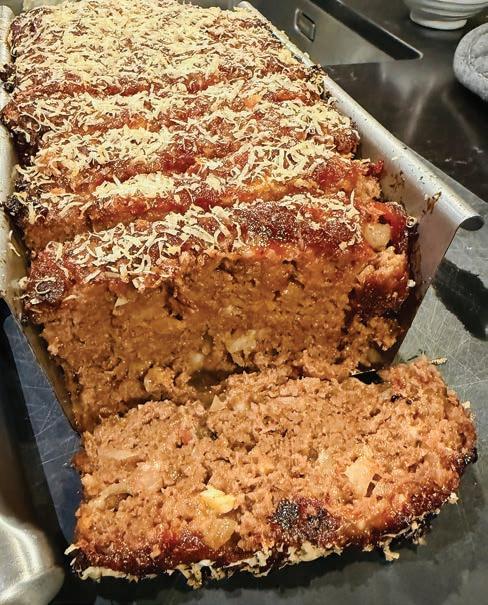
side. It is important to then let the steak rest for 10-15 minutes before eating it.
Another thing we’ll eat in the field is deer liver, cut into thin strips. I saute onions in the skillet, fry up a few rashes of bacon - also cut into bits - and then add the liver along with a decent splash of red wine. The liver has quite a strong flavour so I prefer eating it in a ciabatta roll with a good layer of butter.
Perhaps it has something to do with being in the great outdoors, eating with mates around a camp fire, or maybe it’s because we’re ravenously hungry from the physical demands of hunting, but the food we’ve gathered and cooked while still out in the wilderness always tastes amazing.
Some of the other venison-based meals I have developed for when I am among the conveniences of civilisation are below.
Venison Meat Loaf
A few years ago, I asked my mum if she had any meat loaf recipes. She gave me two recipes, hand-typed on the same page. The preparation and cooking instructions were minimal - bordering on non-existent - as I think the creator of the recipes assumed, incorrectly in my case, that the reader already knew what they were doing. Not to be put off, I made a hybrid of the two and repeated the experiment a few times until I settled on the combination that I think works best..
Ingredients:
• 300 gm venison sausage meat (I use the meat extracted from venison sausages, preferably Bratwurst)
• 500 gm venison mince (substitute beef mince if venison is not available)
• 1 brown onion finely chopped
• 1 cup of grated tasty cheese (cont’d)
• 1 cup of bread crumbs
• 1 tsp of mixed herbs
• ½ tsp of chilli powder
• 2 Tbsp of tomato sauce
• ½ cup of tomato chutney
• 1 Tbsp of beef stock
• ¼ cup of parmesan cheese
• 2 Tbsp of chilli jam
Preheat the oven to 180 deg C on fan bake.
Combine all of the loaf ingredients in a bowl, except for the parmesan and the chilli jam. Use your hands to mix everything together thoroughly. Get in there and really squish everything together so all of the ingredients are thoroughly mixed.
Put the mixture into a greased loaf tin before putting a layer of chilli jam across the top of the uncooked loaf. Grate the parmesan over the top of the chilli jam.
Bake the loaf for 1 hour at 180 deg C.
Venison Curry
I use this base curry mixture with pretty much whatever I have on hand, and it works well with beef, goat, venison or roasted eggplant. A few years back I was transitioning from using store-bought curry mixes to creating curries from scratch and a recipe I found from the Australian Women’s Weekly looked simple enough, so that’s what I used.
Ingredients:
• 300 gm of venison steak, preferably rump
• 2 Tbsp olive oil
• 1 tsp fennel seeds
• 1 onion, roughly chopped
• 1 tsp grated ginger
• 4 garlic cloves, chopped (I cheat and use 2 tsp of minced garlic)
• 1 tsp garam masala
• 1 tsp ground coriander
• ½ tsp turmeric
• ½ tsp chilli powder
• 400 gram canned chopped tomatoes
• 200 ml coconut cream
• salt and pepper
Cut the venison into bite-size pieces.
Heat 1 Tbsp of olive oil in a pan until the oil sizzles before browning the venison steak (don’t cook it through).
Set the venison aside.
Heat the remaining oil in a medium saucepan, add the fennel seeds and heat until the seeds are popping. Stir in the onion, ginger and garlic and cook for 2-3 minutes until soft, then add the spices and cook gently for 2 minutes.
Stir in the tomatoes, coconut cream and venison pieces and then season with salt and pepper to taste.
If I have used one of the premium cuts of venison, rump or fillet for example, I finish the curry off by simmering the mixture for 20 minutes or until thickened on the stove top. If the cut of venison is more suited to stewing then I put everything in the slow cooker for eight hours to break down the venison and to let the flavours come out.
Finally, top the curry with a spoonful of yoghurt and a sprinkle of coriander. Serve with rice or naan bread.
IN PURSUIT OF THE PERFECT ICE CREAM
Words and Photography: Johny & Maia O’Donnell
There’s a certain moment each year when summer feels official. It’s not the first dip in the sea, or even the smell of a BBQ drifting through the air. It’s the moment you lay eyes on the first ice cream. Actually, scrap that. It’s the moment you first conceive of the idea to get an ice cream. Like all things that aren’t great for you, the idea is often just as, if not more satisfying than the result. The journey matters as much as the destination. And the aftermath is never kind.
The late afternoon ice cream is also a shared experience. It’s family bonding at its best. Sure, there is a place for a solitary ice cream treat, but just like a fine wine or home-cooked meal, the experience is enhanced by the collective. Don’t believe me? Pop into Thomas Bros in Riwaka on a hot summer’s afternoon. You’ll see more people out socialising and having a shared experience there than the village sees in an entire winter.
Ice cream and this place are like hand and glove. They need each other, and thankfully, they make a perfect pairing. Ask anyone to visualise a summer here and the chances are a cone* will feature. But it’s true that whilst ice cream is devoured the world over, it also feels decidedly of this place, particularly when it comes to our speciality of the real fruit ice cream.
*Interpret this as you will. Including a delightful afternoon combo.
What makes a good ice cream?
The Essential Qualities According to Our Expert Judges According to Māia (age 5) and a grown-up with strong feelings, here’s what really matters: (cont’d)
Tastes Good
Obvious, but essential. It needs to taste like what it says it is — especially with fruit flavours.
2. Doesn’t Melt Too Fast
We’re not here for panic-eating. A good scoop holds up long enough to actually enjoy it.
3. Plenty of Flavours
The more to choose from, the better. Variety is the spice of life, after all.
Picks from the Freezer
Supermarket Pick: Motueka Creamery’s Mount Arthur Vanilla – you can thank us later!
Dairy Scoops: Goody Goody Gum Drops for Pāpā, Chocolate for Māia. Divine!
The Full Scoop
Must Visit Ice Cream Joints in the Nelson Tasman Region
1. Top of the Town Dairy, Motueka
It’s got the biggest range of real fruit ice creams we’ve seen, plus every rolled ice cream flavour under the sun. Classic dairy vibes. An increasingly rare charm in the modern age.
2. TOAD Hall, Motueka
An institution in its own right. Perhaps the most famous ice cream outlet in the region, if not the country. The real fruit still wins, but their smoothies and juices are a seriously good time.
Below: Māia at Yogi’s Frozen Yogurt & Dessert Bar, Nelson.
3. Penguino’s, Nelson
Māia is usually overwhelmed by the huge flavour selection here. It changes often, so it’s always a surprise — and the staff are true ice cream pros. The feijoa is an absolute winner!
4. Thomas Bros, Riwaka
There’s something about eating real fruit ice cream from the orchard where the fruit came from. Feels right. Thomas Bros is always humming in the summer. And for good reason.
5. Yogi’s Frozen Yogurt & Dessert Bar, Nelson
This one’s a choose-yourown-adventure. Yogi’s is all soft-serve frozen yogurt with a build-your-own toppings bar. Māia recommends a few lollies and hundreds and thousands topping.
6. Connings, Appleby
It’s a bit hit-or-miss, but when the container is open, it’s a great spot. Māia loves the playground and ice cream combo. And it works well if you want to do some groceries too.
7. Kaiteriteri Store
The store’s changed a lot over the years and relative to the childhood image we hold of the place, it’s a shell of its former self. But a scoop of Gelato Roma in paradise still hits the spot.
8. Hamish’s Ice Cream, Māpua
Named after a long-time local resident kōtuku, Hamish’s is a real gem. This popular destination offers over 20 flavours, including real fruit ice cream and milkshakes.
9. Gelato Roma, Tāhunanui
Gelato Roma makes gelato with zero fakery - no powders, no shortcuts. They have a regular spot at Tāhunanui Beach, but you can find them in quite a few
places around the region.
10. Mr Whippy
I used to try and avoid Mr Whippy in search of a better scoop, but I’ve given in to the tried and true classic. They’ve endured for a reason. And they’re still an absolute crowd pleaser.
Above: Māia at Penguino’s
Street Food of China, High Street, Motueka.
BRENDAN’S FOOD GUIDE
Words: Brendan Alborn.
While I fully realise it makes me sound like an intolerable snob, I have high expectations when it comes to food and in terms of what I consider a good culinary experience. My defence for this snobbery, Your Honour, is as follows.
I lived overseas for much of my adult life in big cities where the culinary culture is a big part of life and I have been fortunate enough to do a lot of international travel in my life. This has included extended periods in places that are renowned for their food; China, India, Italy, France, Japan and England. (Okay, the last one is an attempt at humour, but you get the picture).
The second key point I’m offering in my defence is that I hail from a family of fantastic cooks: my mother and mother-in-law are both talented chefs, as are my wife and two daughters. I like to cook myself too, and over the years I have worked hard to move from basic “Dad meals” (steak and veg) towards becoming a half-decent cook with a reasonably diverse repertoire.
When I eat at a restaurant I like to see items on a menu that surprise me - flavours, dishes and combinations that I’ve never considered. I am not that interested in paying for food that I could have done better myself. In fact, I’m happiest when presented with a menu containing words that I need to look up.
I’m telling you all of this so you have some context for why I like what I like - and why I’ve listed some of my preferred options below. The list below is some of the places I’ve enjoyed recently, or find myself returning to again and again.
Urban
I like fusion food and menus designed for sharing, and both of these elements are done wonderfully at Urban. I would much rather share plates of food with my dining companions than order and eat one dish. In fact, if I go to a restaurant serving dishes designed for (cont’d)
sharing, such as Chinese, Thai or Indian food for example, with somebody who wants to order and eat just their own meal, I find it bewildering.
Located on Bridge Street in Nelson, Urban ticks all of the boxes for me. The interior is an informal mix of restaurant-meets-bar with high tables, the food is creative and a wonderful mix of tastes, they have an eclectic range of craft beers on tap and the service is always topnotch.
To my surprise, I discovered a short time ago that none of my three band mates had eaten there before, so I had the pleasure of introducing them to Urban. Our shared order included a bunch of my favourites such as the Grilled Cabbage with miso butter, mojo verde and crispy onions, the Sichuan Style Crispy Eggplant & Tofu with fragrant chilli caramel and the Seared ‘Crying Tiger’ Skirt Steak with tamarind, chilli, cos lettuce and mint. I lost count of the times my bandmates said something like “this is incredible!”
Stefano’s Pizza
Pizza is possibly my favourite food. I have put more effort into improving my pizza making skills than any other style of food. I make my own dough and tomato sauce and attempt gourmet creations that are cooked in my own outdoor pizza oven. So if I’m having pizza, I’m looking for a place that forces me to realise I have much to learn in the art of the perfect pizza.
While I’m not a huge fan of the dining space itself at Stefano’s due to it being located upstairs in the Nelson State Cinema, their Italian style pizza has always been excellent. Their rotary style pizza oven is also an engineering marvel. Even if my fellow diners are rushing through their meals to make it into the cinema on time, the quality of the pizza makes up for it.
The other honourable mentions for my pizza fix (cont’d)
The view at Ruby’s Espresso, Port Nelson.
Below: The Little Dove, Nelson.
would be the Rimu Wine Bar on the Māpua wharf where I like to pair their Nonna Perano with a glass of their own Rimu Grove Pinot Noir. If there ever was to be a heavyweight challenge for the best Pinot in the Nelson/Tasman District, it would be between the Rimu and Neudorf vineyards. The pizza at Eddyline in Richmond is also decent, particularly when paired with their excellent craft beers brewed right there on site. Eddyline seems to be the place where local mountain bikers congregate for a pint and a pizza after their rides, so I like the vibe too.
Little Dove
I don’t generally eat breakfast as part of my daily routine, so when I do have my first meal around noon, if I overeat I regret it almost immediately. The lethargy and nap-inducing carb-comma is real, so I try to keep my lunch light and tasty, which is why Little Dove has been my go-to lunch spot in Whakatū Nelson for years. Their Mediterranean inspired dishes are tasty and it is immediately obvious every single ingredient is top quality. Many Kiwi cafés have brunch menus that rely too heavily on egg-based dishes, and I am perfectly capable of cooking eggs myself. Not here, though. The dishes are filling without being heavy. I also love the location beside the Maitai river where I try to nab a table outside for the dog and I. Oh, and the coffee is consistently outstanding too!
Little Engine Eatery
Located in the Nelson Classic Car Museum, Little Engine is for my go-to for a quick, no-fuss lunch. The cabinet food is simple, light, fresh and tasty. This place is incredibly popular - not only because it is good, but also because there
aren’t many decent options on the Stoke/Nelson fringe.
While I realise many cafés located in establishments like museums aren’t generally up to much, Little Engine is the exception. With glamorous vintage cars on display, and an awesome little gift shop selling a bunch of local arts and crafts, the whole setting has great natural light, a vibrant atmosphere with lots of locals and visitors enjoying themselves.
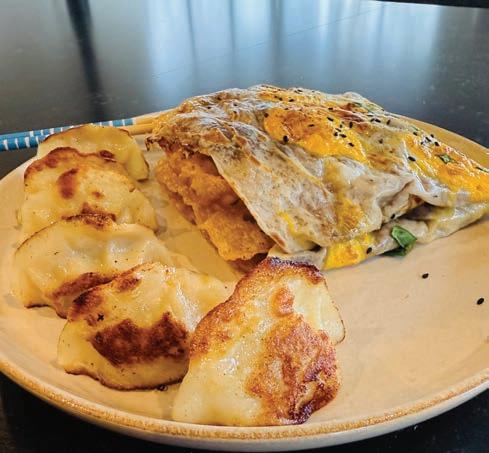
House of Li - Street Food of China
One of the things I miss about living in Asia is the abundance and diversity of cheap, tasty street food. For almost
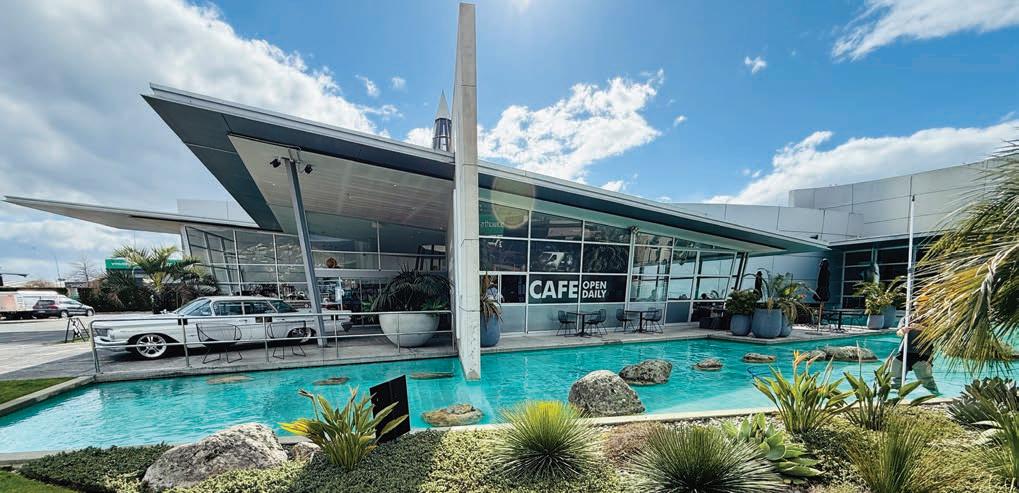
The Little Engine Eatery.
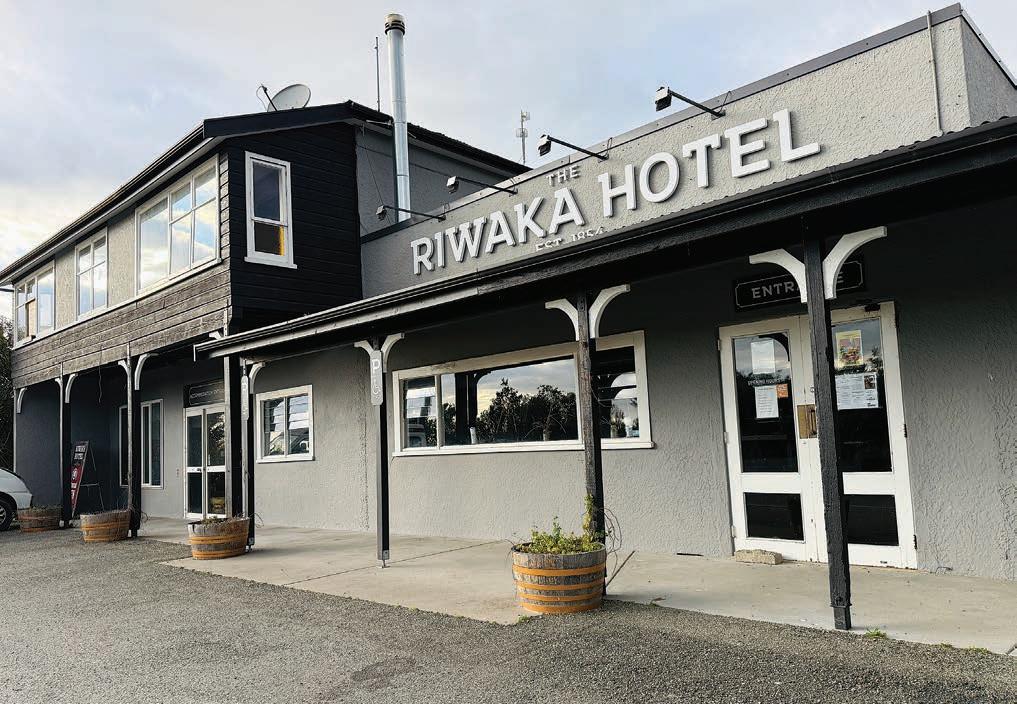
two decades, many of my weekday meals came from street vendors close to my Shanghai office.
Having a tiny place in the middle of Motueka serving Jianbing (煎饼) that tastes exactly like it should, is a thing of wonder to me. Jianbing is a savoury crepe infused with egg and spring onions and featuring various options for sauces and fillings. The dumplings (饺子) and noodles at House of Li are also authentically mainland Chinese. Regardless of whether you are served by Li, Richard, Leo or Judy, their service comes with a free smile too!
The Riwaka Hotel
Every time I bump into the owners of the Riwaka Hotel, Angela Morris and Carsten Buschkühle, I have to stop myself from thanking them again for reopening my local pub. Not only did they bring a rundown building (shuttered up for years) back to life, they made it wonderful too.
Over the last year, I feel like the food has improved considerably - and after months of ordering the smash burger, I’ve finally branched out to try other ‘new’ dishes.
These days, the Riwaka is a place where visitors and locals
mix and mingle, particularly during the summer when the beer garden at the rear of the pub is bathed in sunshine and there is a local band playing. In the winter when the fire in the front bar is roaring, the tall leaners will be where you find the locals catching up on the latest news on pig hunting, local club rugby and how the kiwifruit, apple and hop crops are getting on.
They have a wonderful selection of craft beers, traditional kiwi beers, and fantastic wines from the Riwaka River Estate just down the road. If you’ve got any questions about the wine, just tap Paul who owns the vineyard with his wife Amber, on the shoulder and ask away! The Resurgence Blush - a Pinot Gris and Riesling blend with a dash of red is perfect for any occasion. My favourite beer is the Townshend Extra Special Bitter, or ESB for short, a wonderful malty English beer - Hop Federation’s Fields of Green is another personal favourite.
I would also like to add an honourable mention for the Sprig & Fern Motueka, another wonderful place to see locals mixing and mingling with visitors to the region. This is another place serving wonderful craft beer, my all time favourite of which is the Nectron Pale Ale.
Above: The Riwaka Hotel is for locals and visitors alike.
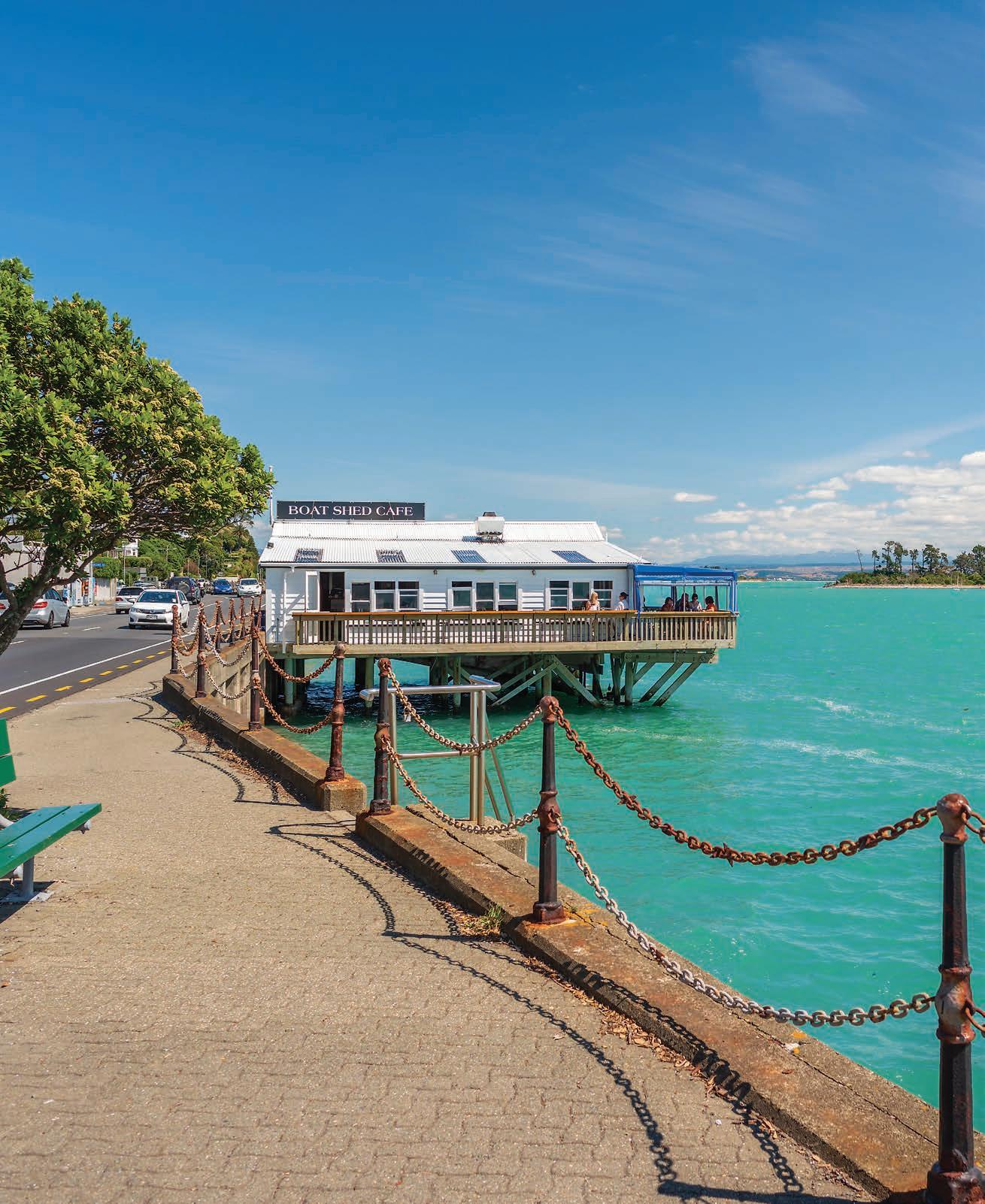
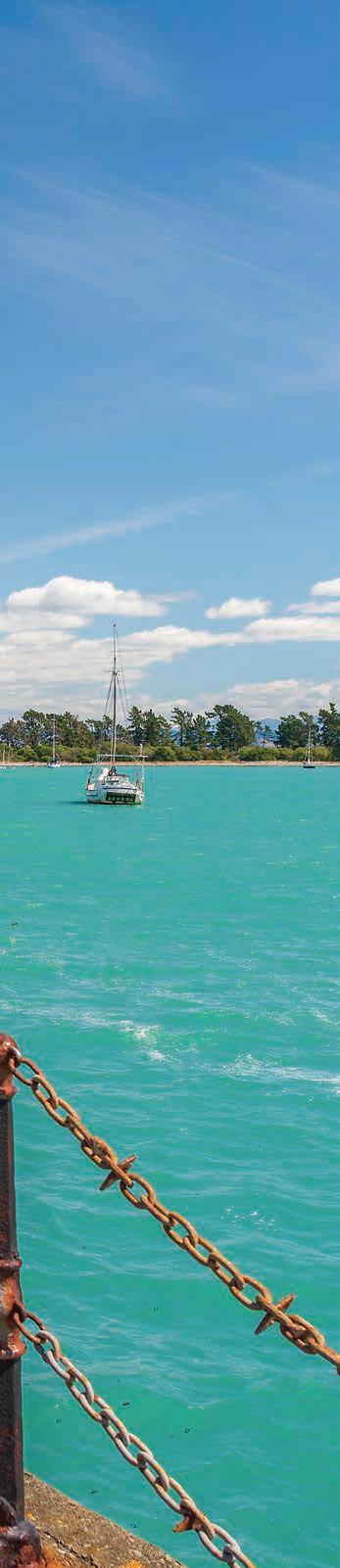
NELSON EATS: THE NEXT COURSE
Words: Johny O’Donnell.
If you think you’ve already eaten your way through Nelson, think again. The local food scene doesn’t sit still - it sizzles, ferments, and occasionally deep fries itself into something even better.
Here’s my latest line-up of old flames, new crushes, and rediscovered legends that prove this small city still eats big.
Isel Park Night Markets
Every Thursday through the warmer months, Isel Park transforms into a twilight feast. Hungry wanderers roam between food trucks serving everything from Nepalese wraps to pāua dumplings. Grab a blanket and whatever smells best at the time. It’s messy, communal, and a rare reminder that food tastes better when you eat it on the grass.
Hardy Street Eatery
If I did play favourites, this would quietly take gold. James Rutherford runs the kitchen with precision and a kind of calm intensity that shows up in every plate. The sourdough has a following of its own, the eggs Benny ruins all others, and the cabinet treats - those donuts - you’re welcome. It’s the café that every other café wishes it was.
Boat Shed Café Nelson
A Nelson institution. Perched above the tideline, it’s where you take someone you want to impress - or where you go to impress yourself. Sit outside, time it with high tide, and order seafood. The oysters, scallops, and local produce celebrate exactly what makes this place special. It’s the taste of Nelson in one long, sunlit lunch.
Styx Nelson
Part restaurant, part social club, Styx is where good views and a comfortable, casual setting meet. Perched on the wharf, it serves hearty dishes that match the backdrop. The seafood dishes are standouts, and the range of cocktails is the perfect pairing to your long lunch by the sea.
New Asia
It’s a Nelson institution that locals guard like a family recipe. When it briefly shut for renovation, half the city sulked. It’s back, better lit, still slinging those silky Beef Ho Fun noodles and fiery Sichuan Chicken that bring sweat and smiles in equal measure. Grace and her crew run the room with warmth and rhythm - you feel looked after from the first jasmine-tea pour. BYO wine, spin the lazy susan, and surrender to the feast.
Anarchy Burgers
The name fits. These guys ignore all the rules with their hybrid burger -fried chicken stacked with smashed beefshouldn’t work, yet it does. Messy, meaty, magnificent. Eat it fast; think about your cholesterol later.
Marty’s Smash Burgers
Born in a caravan, now city-bound. Marty minces his own beef daily, bakes his own buns, and makes every sauce from scratch. They still sell out some nights, which is
exactly how you know it’s legit. Expect lines, grins, and the kind of burger you plan a week around.
Dog’s Bone Bar
By now you’ve probably realised that burgers are kinda having a moment in Nelson. This place is the quiet achiever. The rough-around-the-edges local take on a dive bar that resists sophistication, yet accidentally pulls it off in the process. The kimchi mayo is worth writing home about.
Mister Karaage
At Kirby Lane, one man is quietly perfecting the karaage craft. Mister Karaage is a gem - no flash, no fuss, just focus and care. The result is chicken that’s crisp where it should be, tender where it matters, and seasoned with balance and restraint. It’s world-class, yet humble - exactly how karaage should be. And if you know, you know: the black pepper flavour is the insider’s pick.
Below: Hardy St Eatery, Nelson.
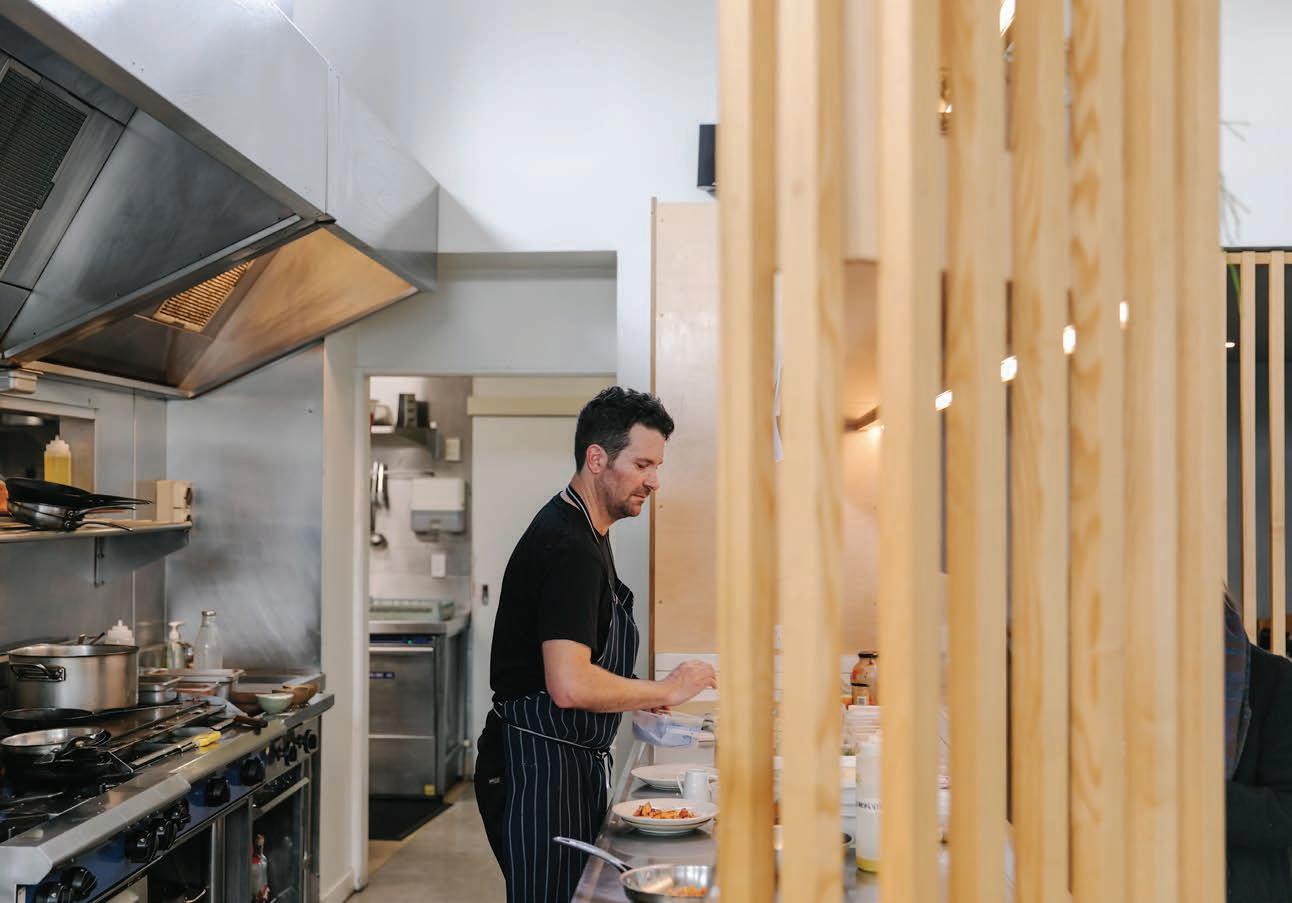
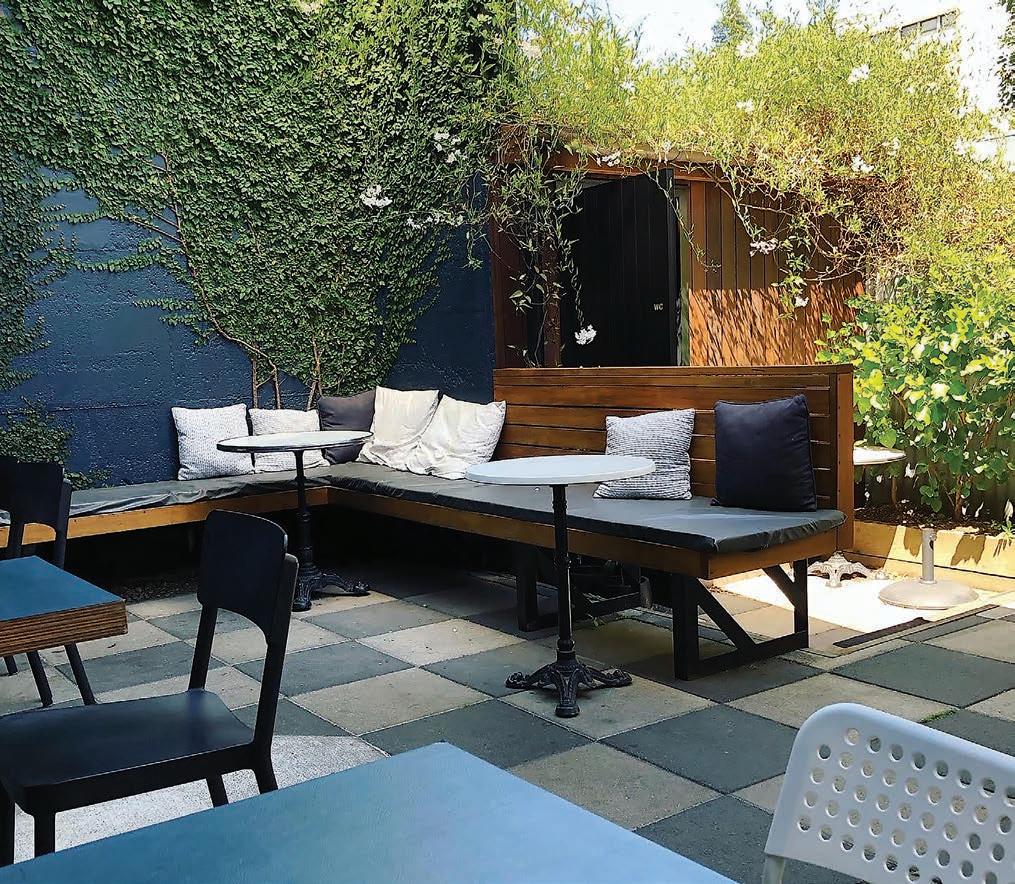
Arden
The restaurant we probably don’t deserve but are very lucky to have. Arden sits on Hardy Street like it’s always belonged there - quietly setting the standard. Everything here feels intentional: the food, the wine list, the lighting, even the way plates land on the table. Whether you’re in for oysters and a martini or the full trust-the-chef experience, you leave better for it. Nelson would do well to make the most of a place operating at this level.
Pie Time Bakery
It’s funny how long it can take to notice something that’s been right under your nose. Pie Time Bakery has been quietly perfecting the humble pie for years, and I’ve only just caught up. These are the real deal - golden, generous, and built with care. The creamed pāua is a seasonal feature and the beef palusami had me lost for words. There’s
something deeply satisfying about a place that takes something so familiar and makes it exceptional.
Homegrown Hunger
The thing about eating (rather a lot) in Nelson is you start to take it for granted. The fish is always fresh, the produce always local, and somehow the coffee never misses. Then you leave for a bit, come back, and realise - bloody hell, it’s all still this good. Maybe it’s the sea, maybe it’s the soil, maybe it’s just a region full of people who give a damn.
Either way, the food here keeps its feet on the ground and its flavour close to home. It changes with the season, never strays far from the source, and somehow still surprises you. Cheers, Nelson - you make eating well far too easy.
Above: Outside seating at Arden.
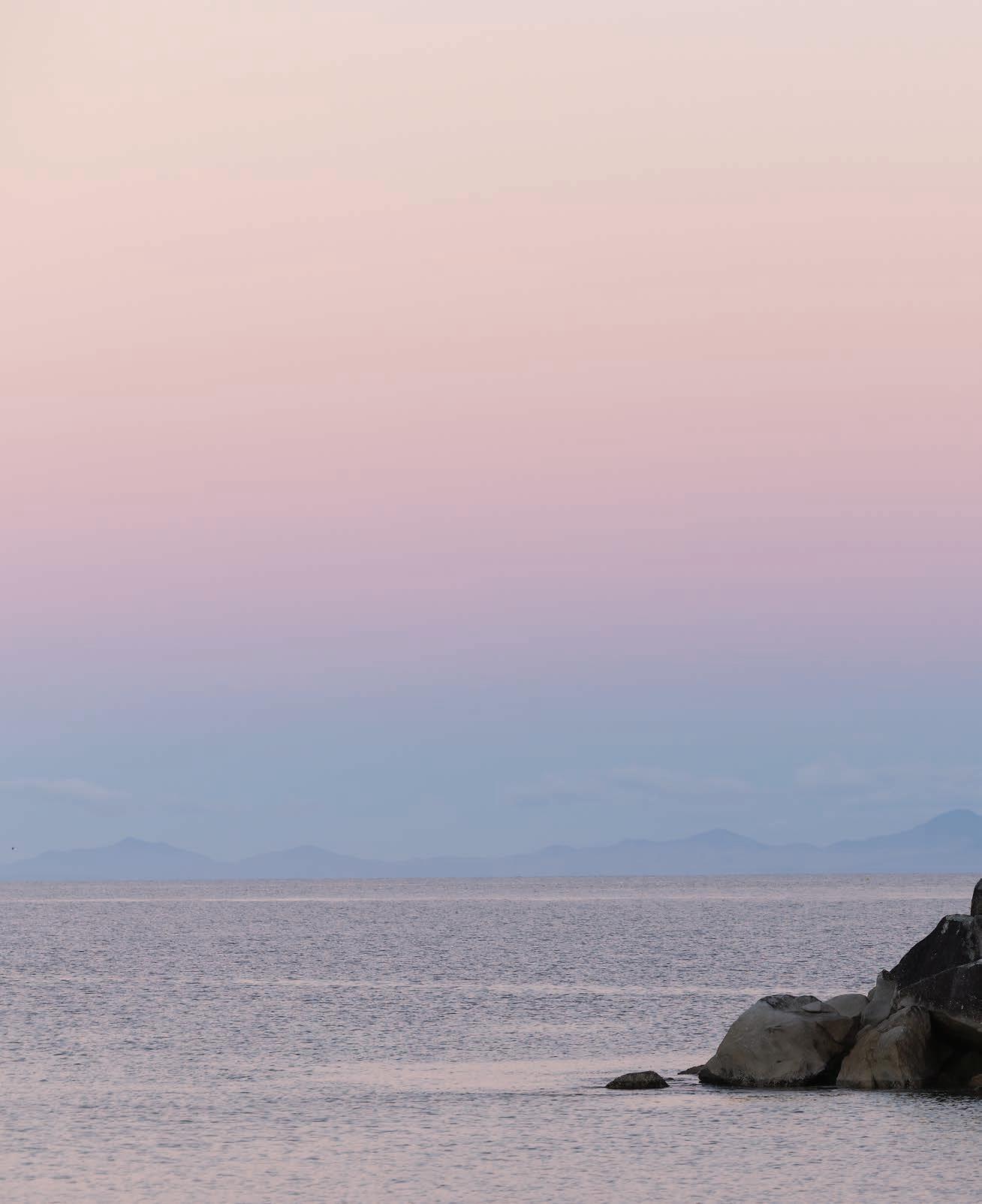
The Abel Tasman at Golden Hour
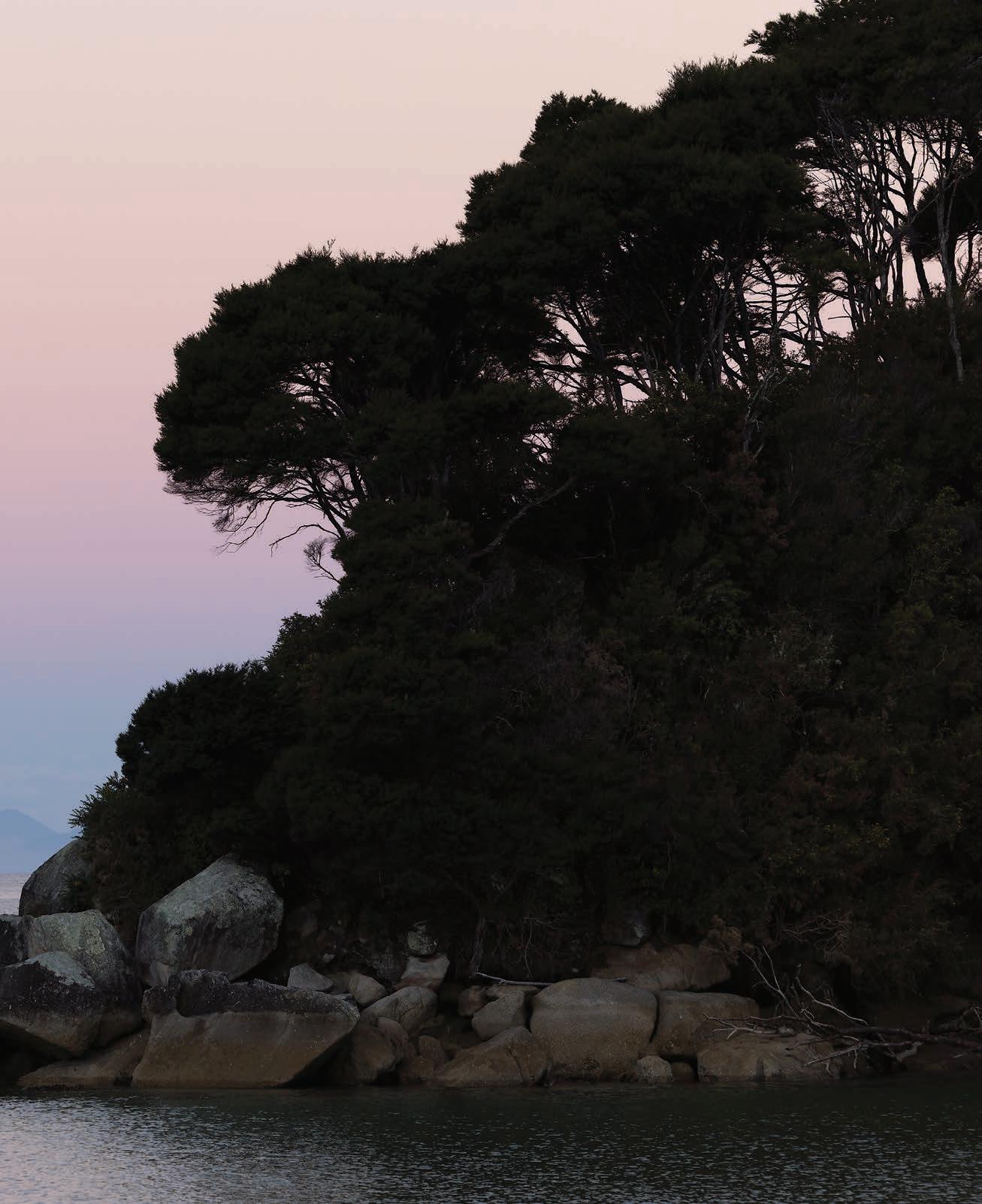
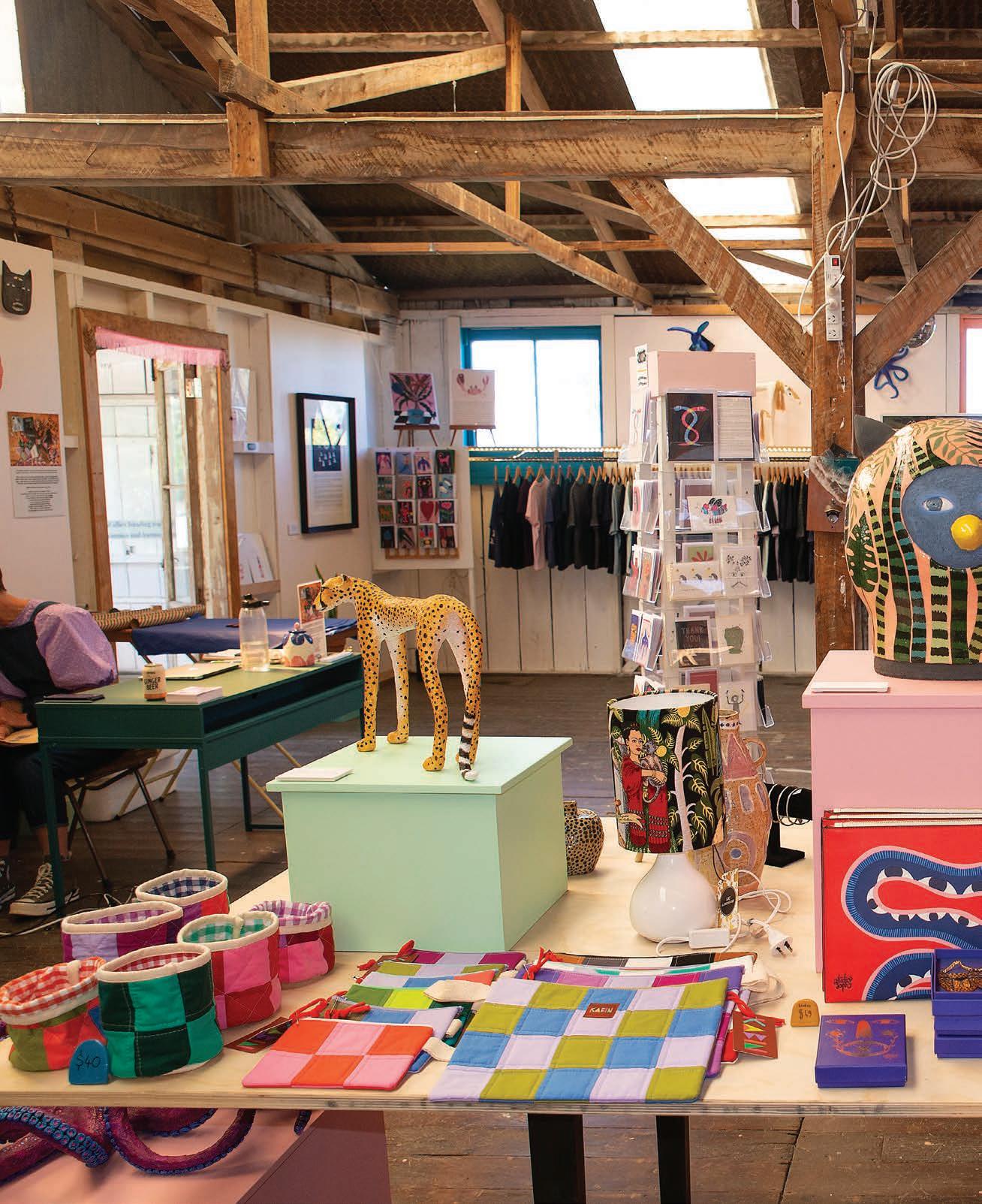
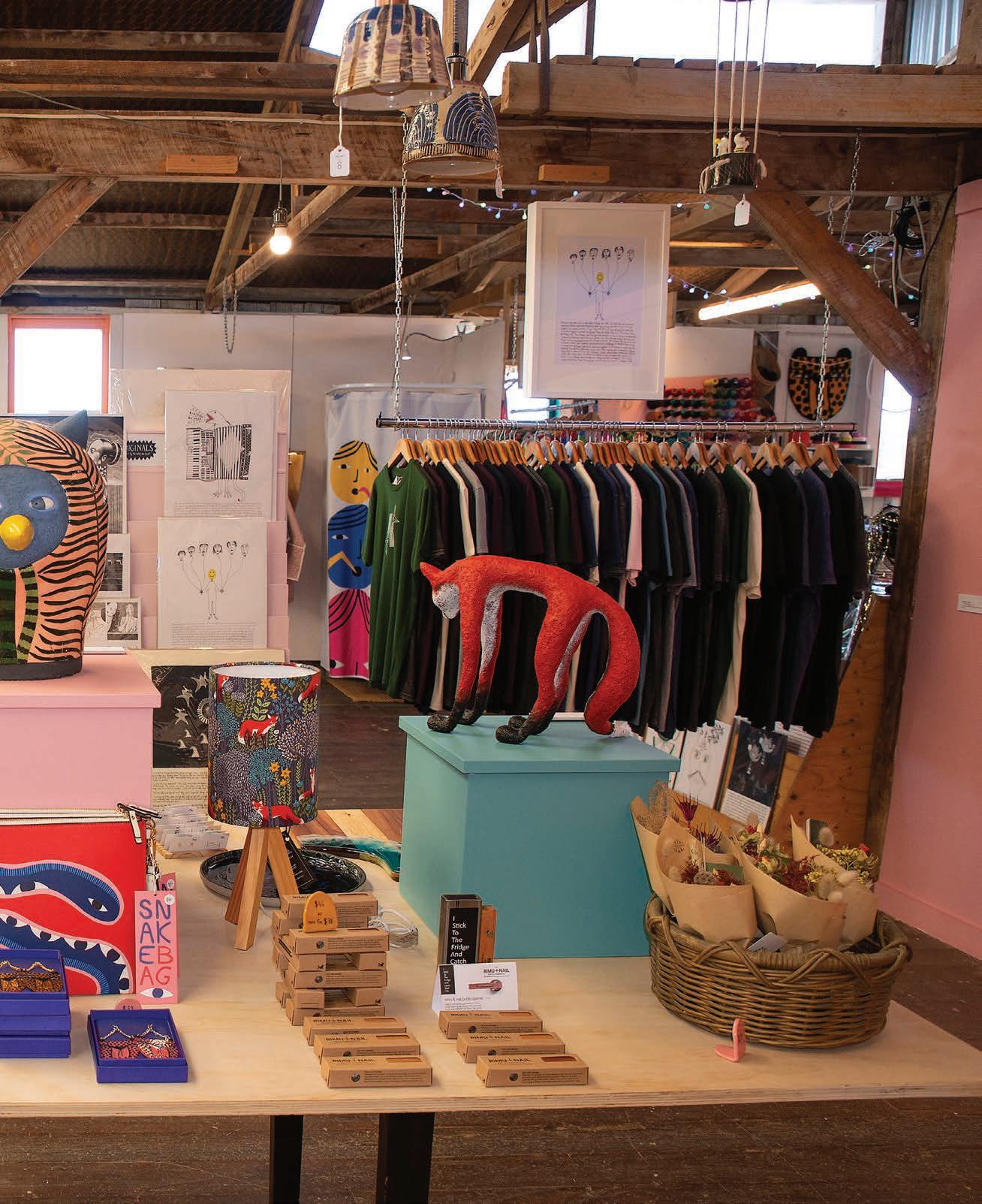
ZAPPEKIN THE ARTISTIC OASIS
Words: Jade Alborn.
Along the stretch of State Highway 60 leading into Motueka sits an artistic oasis, with colourful illustrated signs tempting you to turn off. Zappekin is the name of this hidden treasure, an old fruit shed transformed.
But what exactly is Zappekin, and why should you visit? I sat down with one of its founders, Nina, to find out more... (cont’d)
So firstly, can you please introduce yourself and your artistic practice?
My name is Nina, and my long-term project is Kingdom of Klah, which is a parallel universe I’ve been working on for fifteen years. I make images, stories and objects from the fictional world, and turn these into products like screenprinted clothing, prints and books.
I wouldn’t say we are just an art gallery. We are a community space...
What does the name Zappekin mean?
It is a collective noun for a group of artists and allies banding together and zapping things into existence. You know how animals have a collective noun? This is our own one.
So Zappekin is an art gallery? But you also do a lot of other stuff out of here too, right?
I wouldn’t say we are just an art gallery. We are a community space, and we put on different projects, one of which is a gallery. We have a yearly artist residency programme, we do an art market, workshops and also some performances. We had a guy from New York come and perform, which was incredible; he did lots of crazy puppetry. That was wild! We have had a gig as well. Recently, we have been hosting bring-your-own-project nights, which are a good way for people to meet.
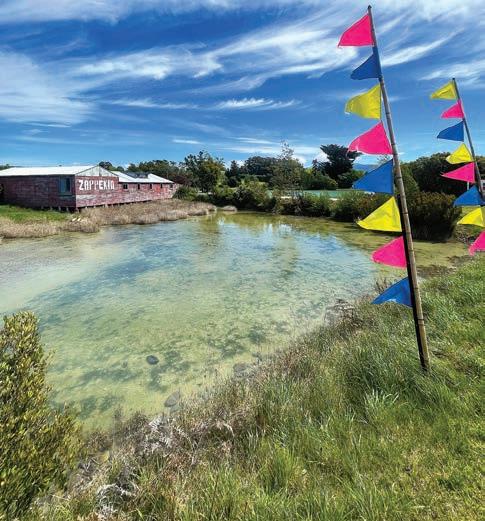
What gap or need in the artistic community were you guys looking to fill when creating Zappekin?
Zappekin did spring from the COVID lockdowns. Friends and I had always talked about having a shared space, but there was never that drive until we realised how much we needed it and it all fell in place quite quickly then. We opened the space in December 2020, and there were six of us at the time. It was primarily studio spaces, and we thought it would just be short-term. But I saw that there was more to it than just selling things and working here. It could be a whole community space, too.

I had a kid working with me, screen printing, who was really good at playing the piano and singing - but they were not confident performing in front of other people. I invited them to play in the corner at Zappekin while the other artists worked. It was so cool, and I found myself creating new work because of the music. I think that was one of the moments when I thought that this was an important space to keep going.
It’s also great for artists to have people they can talk to and share resources with. It’s so hard to meet people of your ilk in this area. When I was in Wellington, you could just go to a gallery opening, and there was a community you could see regularly. Here, there are fewer of those spaces where you can meet each other; often, artists can be a bit more insular. So it is nice to have spaces like this.
Lemur by Kaschi.
Below: Zappekin is located in a repurposed Mariri apple shed.
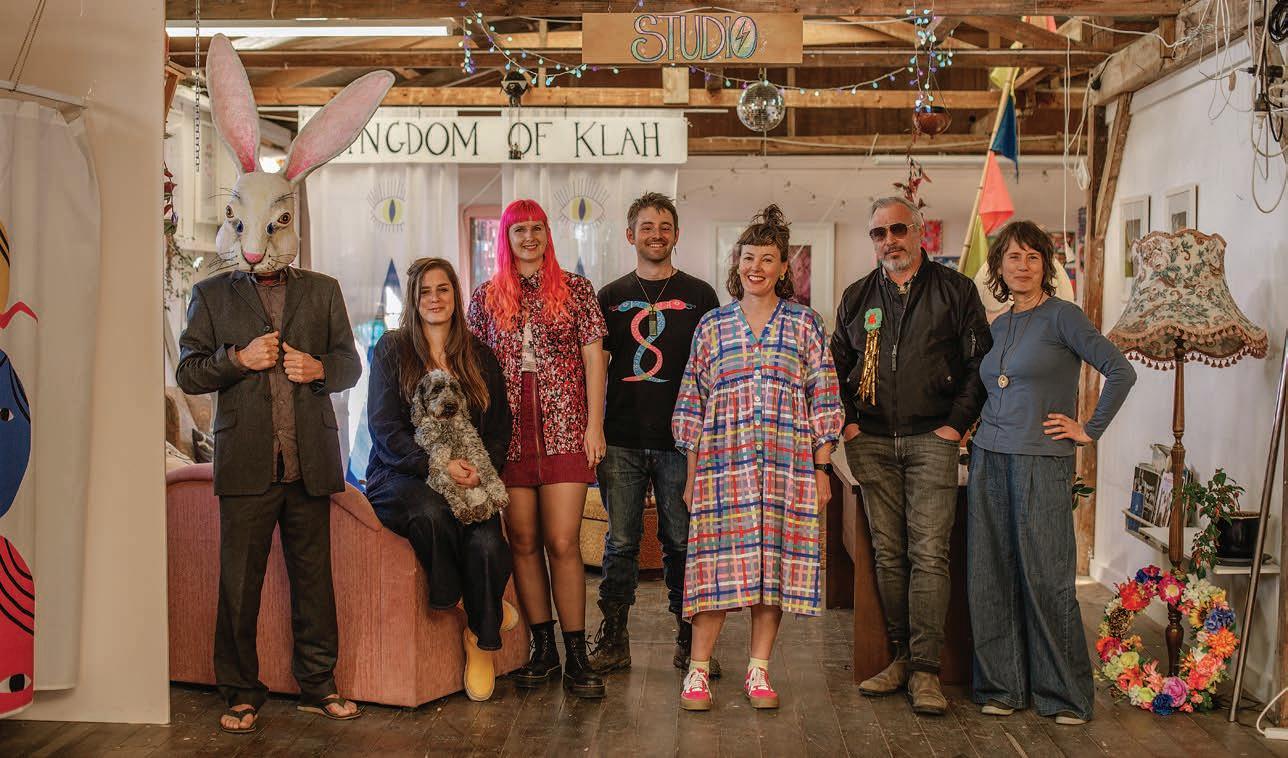
When you open up to sell things in the summer, is everything locally made then?
Yes, I think the furthest away was an artist from Collingwood. Pretty much everything else is made no more than 50 kms away from Zappekin. We are pretty strict about everything being locally made. Then we can have a relationship with all the artists who come in and display their work. We also have a rotation of our artists running the gallery, so often things are being made inside the gallery!
What range of things can people buy at Zappekin?
Could you tell us about some of these local artists and their work?
We’ve got a really diverse range of mediums being used amongst us - we’ve got people
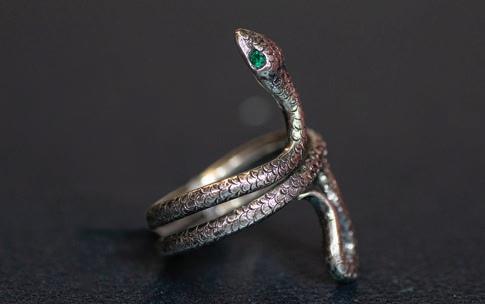
doing ceramics, illustrations, making clothes, jewellery, weaving wall pieces, making sculptures, cards and prints, working with resin, writing, print-making. We have the mysterious artist Kaschi, who makes incredible papier-mâché animals - often at the sales desk while it’s her day to run the gallery. Studio Soph’ - who was also one of our original founders - handpaints ceramics with her wild drawings, and has been making so many other new homewares I can’t keep up! KABIN makes colourful handmade quilted jackets. Mat Tait, whose work you may have seen in various museums (Auckland, Pātaka, Nelson, Hokitika) illustrates and writes books and comics, and has for sale some of his original ink drawings from the making of the comics.
There are 10 of us running the space plus other local artists on commission. The artists are always experimenting with new mediums and sometimes collaborating with each other so it’s always exciting seeing what’s been going on each season.
When are you open?
10-4pm every day except Christmas Day during summer, yes, even New Year’s Day. We just want to make the most of it when it is busy. Also it makes it less confusing for people, they know they can come in any day of the week while we’re open between the 7th of December and the 1st of March.
Above: Just a few of the Zappekin Crew. Nina van der Voorn, third from left.
Snake Ring by Dennah
BIRD OF THE MOMENT
KERERŪ WOOD PIGEON
The distinct ‘whooshing’ wingbeat of the Kererū, or New Zealand Pigeon, can be heard across the Abel Tasman, and throughout Aotearoa.
This native gentle giant has the scientific name Hemiphaga novaeseelandiae and belongs to the Columbidae (doves and pidgeons) family and Ptilinopinae subfamily. It is also known as the Wood Pigeon, and in northern regions of Aotearoa, Kūkupa and Kūkū.
With its trademark white ‘singlet’ belly and iridescent green, purple and bronze plumage, the Kererū sports bright red feet, beak and eyes and can grow to over 50cm in length.
In season native fruit and berries such as Pūriri, Nikau, Karaka, and Tawa comprise most of its diet. Out of season the Kererū eats mainly leaves, particularly Elm, Willow and Kōwhai. Sunning themselves after eating can lead to fruit fermenting in their crops causing the birds to become intoxicated. Many a Kererū has been found lying in, or under, its tree drunk!
In Māori legend the trickster hero Māui transformed himself into a Kererū to follow his mother, Taranga, to the underworld. Māui was wearing his mothers apron and colourful belt, which transformed into the white belly feathers and iridescent neck plumage of his kererū form.
In 2018, the Kererū was the winner of the New Zealand Forest & Bird Organisations annual ‘Bird of the Year’ competition.
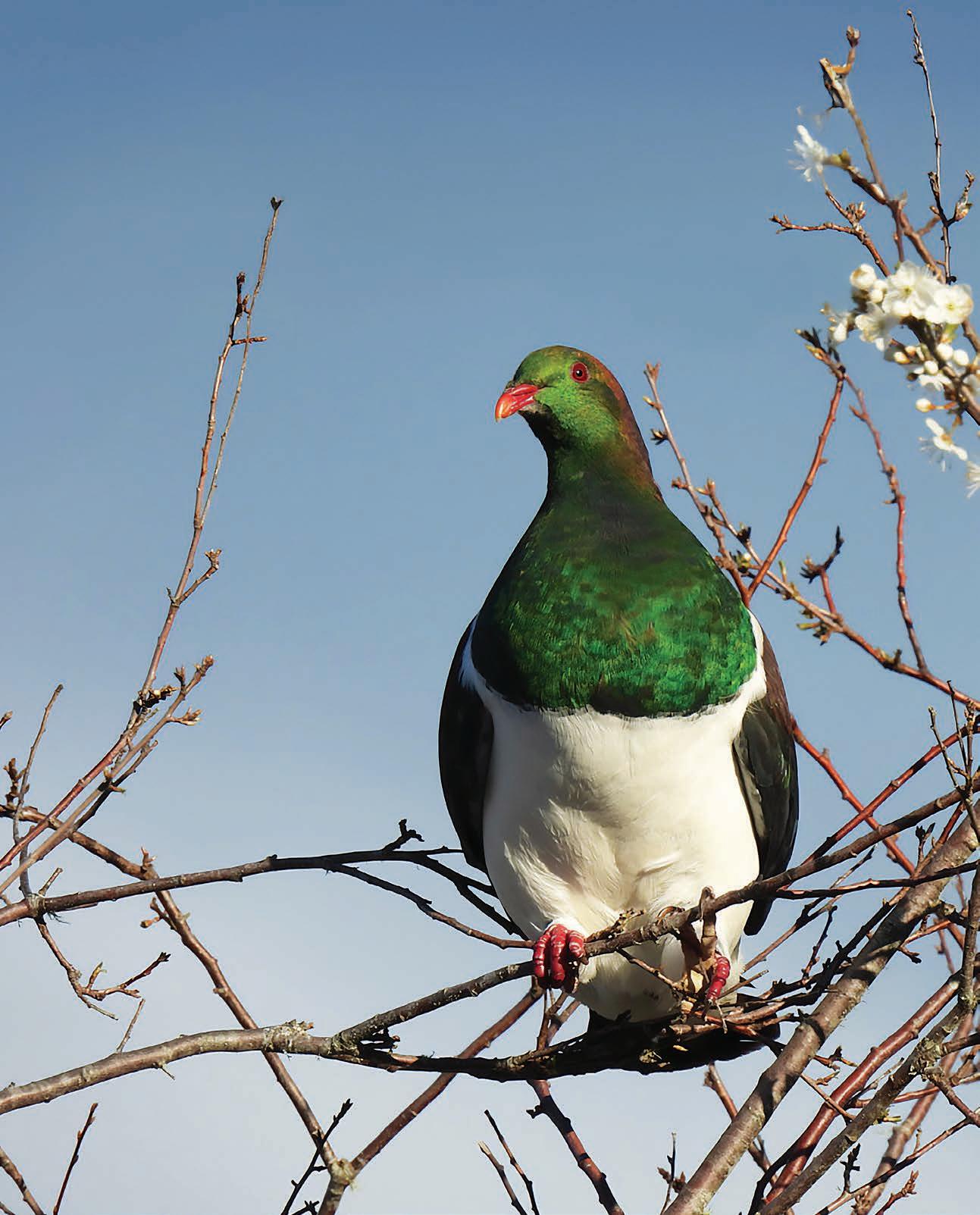
Sources: nzbirdsonline.org.nz and en.wikipedia.org
Photo by Glen Stringer
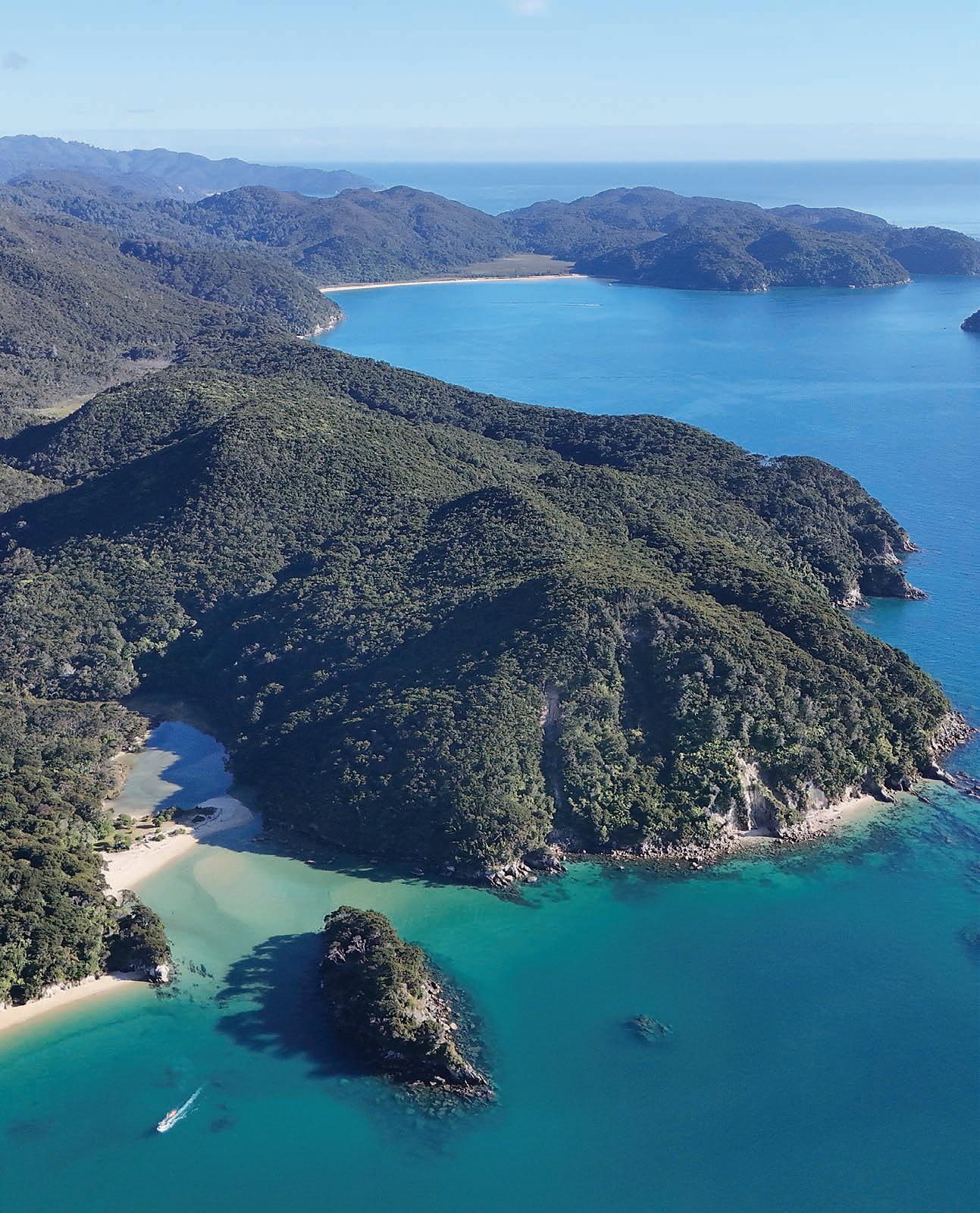
Mosquito Bay in the foreground and beyond to Onetahuti.
PACKING LIST
You don’t need a lot of gear to enjoy the Park, and what you don’t have can be rented from the Abel Tasman Centre in Mārahau.
If you’re going anywhere at all in the great New Zealand outdoors, take a warm outer layer. Our weather gods just love messing with people. There are no pharmacies in the park, so you need to take your own personal medication if required. There is only one café in the Park, at Awaroa, and that is only open during the summer, so you need to take your own food. There is fresh water available at various spots along the Coastal Track but you shouldn’t count on this being available. Much of the water available needs to be boiled before it is safe to drink so you should take your own water for the day.
DAY TRIPS
If you’re on a day trip, your gear check list is as follows...
* Shoes or open-toed shoes (we call ‘em jandals)
* Hat
* Sunscreen
* Insect repellent
* Water bottle
* A warmer outer layer and/or a raincoat
MULTI-DAY TRIPS
If you’re on a multi-day trip that includes overnight stays at camp sites, your gear should include:
* The stuff you’ll be wearing: sturdy shoes or tramping boots, shorts and a t-shirt
* Long pants
* Tramping pack (50-70lt)
* Pack liner (to stop your gear from getting wet if it rains)
Medium size dry bag for sleeping bags & things
Sleeping bag
Bowl
Spoon
Cup
Camp shoes - jandals - optional
Spare pair of socks
Polypropylene or wool base layer, short or long sleeved
Fleece or woollen pullover
Bullet-proof rain jacket
Woolly hat
Sun hat/cap
Gloves/mittens - wool or fleece
Sunglasses - optional
Torch or headlamp
Toiletries
Water bottle - at least 1lt
Cooker, fuel and something to light it with
Food
Insect repellent
Sunscreen
If you’re not staying in a hut you’ll also need:
A sleeping mat (huts have mattresses)
A tent
Carrying a 20kg pack is quite tolerable for most people, although it will tire you out eventually. But if your pack weighs more than that, start taking stuff out! If you haven’t got your own outdoor gear then you can rent gear from the Abel Tasman Centre which is located at the start of the Park, on the Mārahau waterfront. They have:
Sleeping bags * Tents
Sleeping mats * Gas cookers
COASTAL TRACK INFORMATION
TIDAL CROSSINGS
Tide times at Awaroa Inlet must be checked carefully. The inlet may only be crossed within 1hr 30mins before and 2hrs after low tide so please make careful note of these times. Outside of these times the crossing is dangerous. There are other tidal crossings in the Park (Torrent Bay, Bark Bay) but all have alternate high tide routes.
WALKING TIMES
Mārahau - Anchorage Hut
Anchorage Hut - Torrent Bay
High tide route
Low tide route
Torrent Bay - Bark Bay Hut
Bark Bay Hut - Onetahuti
Onetahuti - Awaroa Hut
Awaroa Hut - Tōtaranui
Tōtaranui - Whariwharangi Hut
Whariwharangi Hut - Wainui Car Park
SIDE TRIPS
Tinline Nature Walk (Tinline Bay)
Pitt Head
Cleopatra’s Pool
Falls River Falls
Separation Point (from Coastal Track)
Tōtaranui to Whariwharangi (Gibbs Hill Track)
3-4hrs 12.4km 1-1.5hrs 4km
7.8km 2hrs 6.1km
2.5hrs 7.1km 2.5-3hrs 7.1km 3.5hrs 9.8 km 2hrs 5.7km
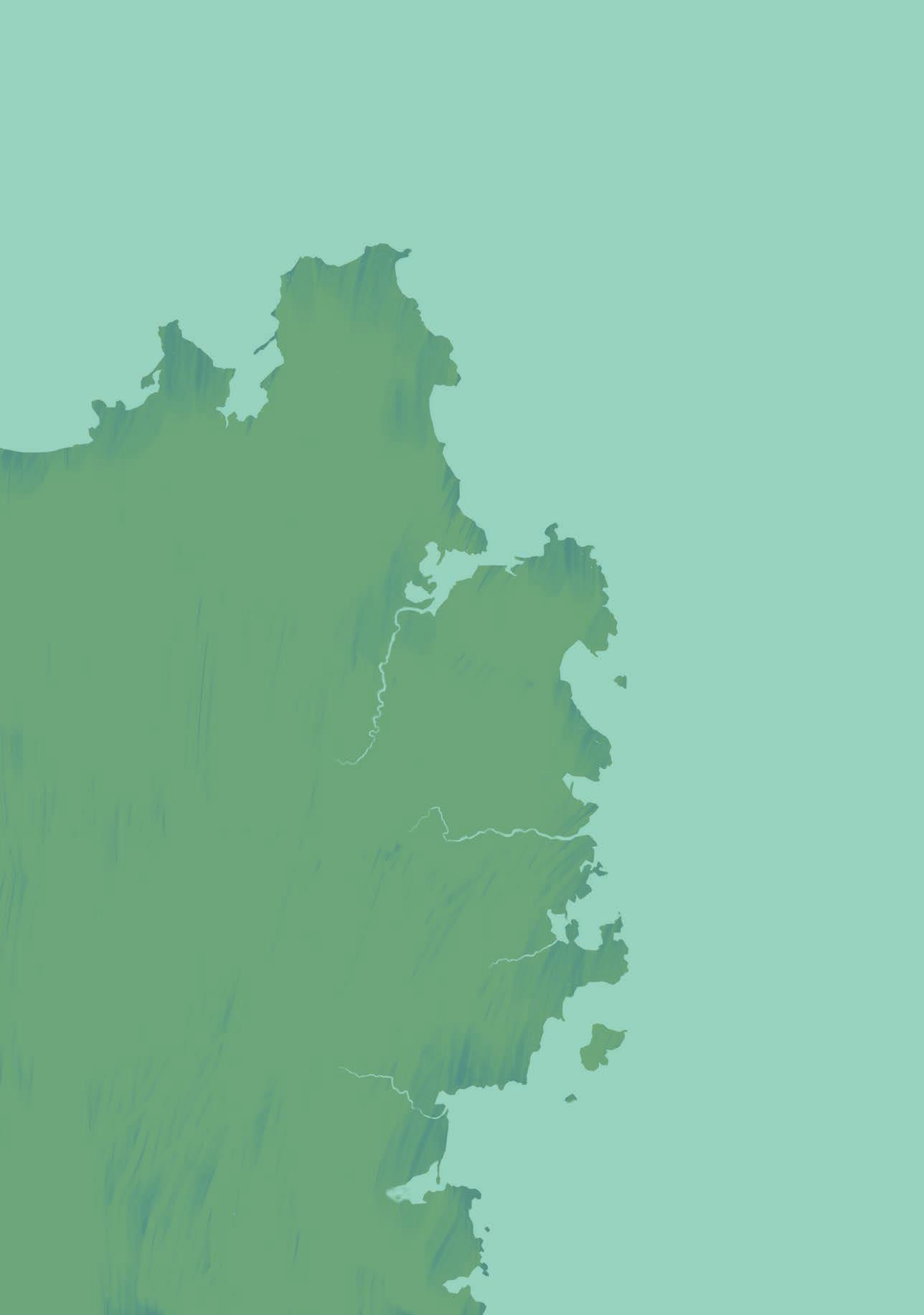
KAYAKING TIMES
Mārahau - Observation
Mārahau to Anchorage Anchorage to Bark Bay Bark Bay - Onetahuti
KEY - campsite
- hut
- water taxi pick-up/drop-off
- kayak retrieval point
- drinking water - telephone
car park
track
tidal track
sealed road
unsealed road
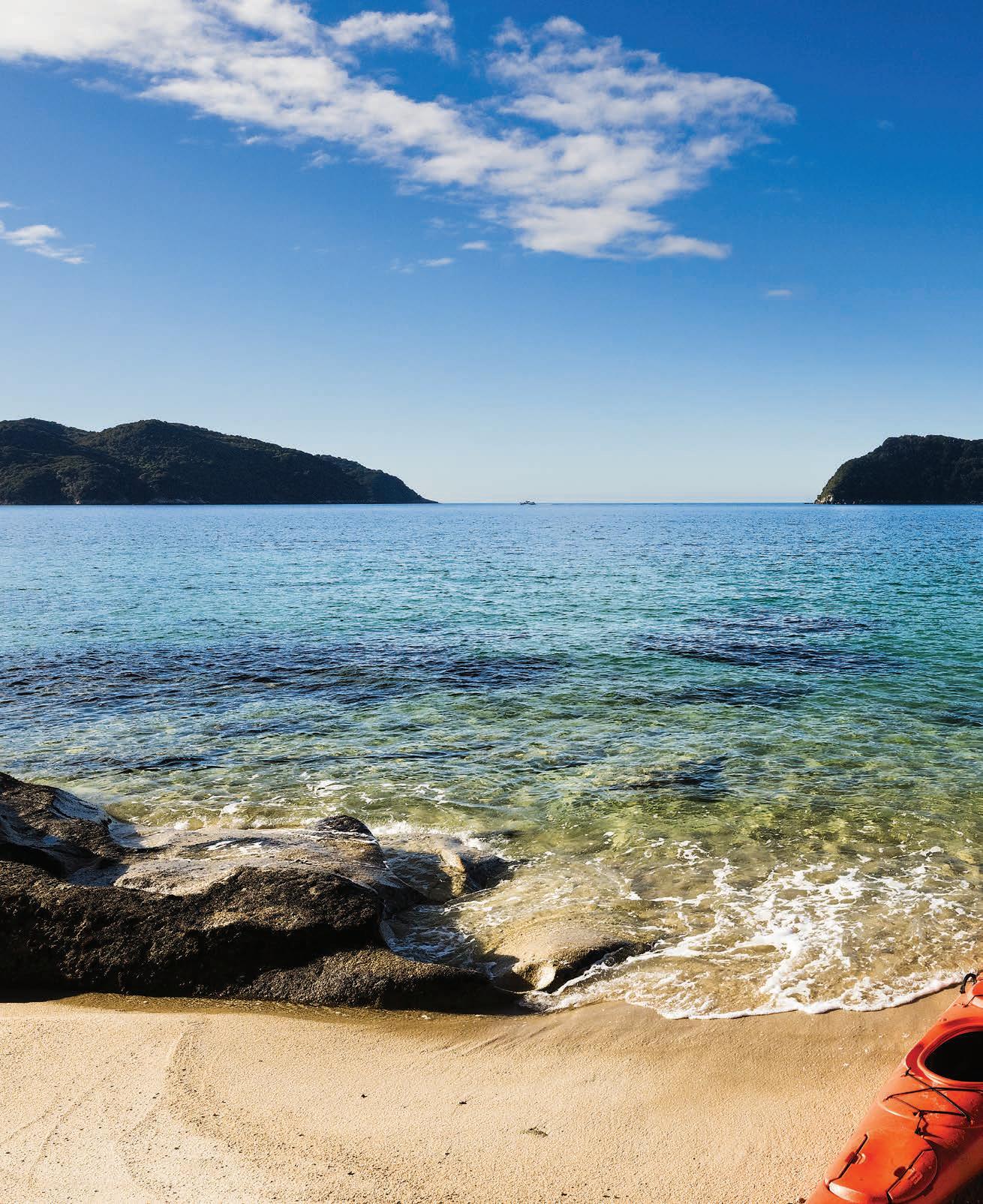
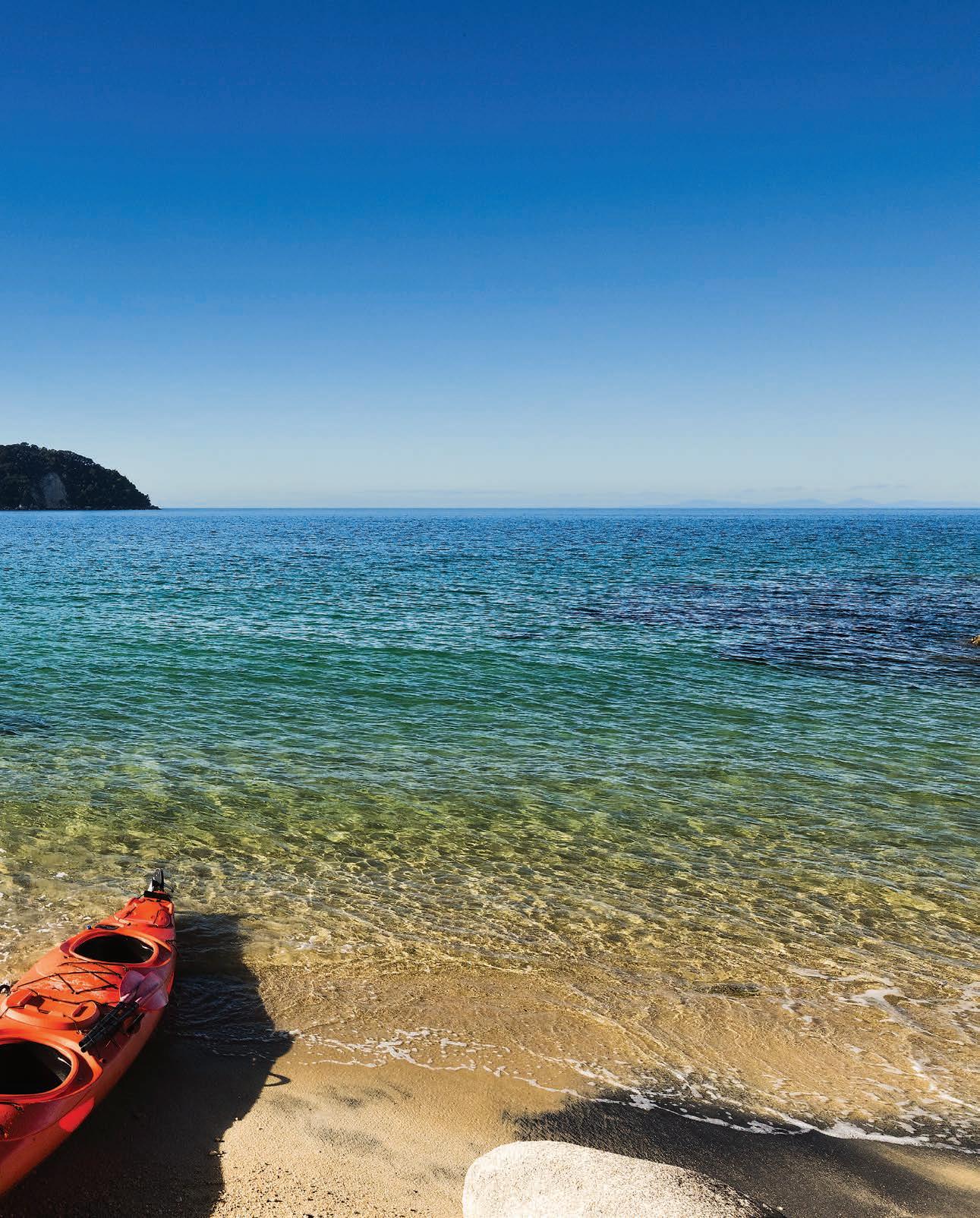
Tonga Island.