News
Naipanoi Lepapa Brings Investigative Journalism to Campus
N
STELLA MACKLER (SHE/HER) EDITOR IN CHIEF
aipanoi Lepapa’s journalism strives to lift the voices of women who have been muffled. In her Pulitzer Centersupported story, The Baby Broker Project, the Kenyabased journalist and her colleagues exposed the shadowy industry of low-cost surrogacy, highlighting the exploitation and abuse of vulnerable young women. Lepapa, who was named Kenya’s Journalist of the Year in 2022 for her work on the project, has always been driven to investigate what the mainstream news media doesn’t. While looking for smaller, underreported stories about gender in Kenya, Lepapa kept returning to surrogacy. She noticed “dozens” of brokers promoting surrogacy services in the country, all working for foreign-owned agencies targeting foreign clients. Lepapa told an audience at Davidson College that she wanted to “follow the money.” What followed was a scathing expose of one of these agencies, New Life Global Network LLP. In her lecture at Davidson, Lepapa spoke to the significance of what she and her team couldn’t find, the things that didn’t exist. This included owners of New Life, lawyers for surrogates, their contracts, and internal regulations. “We discovered it was a fake company,” Lepapa said. “They [surrogates] didn’t have a lawyer. Nobody advises them about surrogacy or the complications of surrogacy so this meant that they could be taken advantage of.” According to the Fertility Clinic of Las Vegas, surrogacy services in the United States range between $100,000$170,000. New Life promised to match parents with surrogates for as little as $40,000. The significant difference in price is due to the total lack of regulations protecting woman who serve as surrogates. “There are laws that protect people in rich countries, but in these other countries there are no laws so they [rich people] are basically bypassing their own laws and going to these places,” Lepapa said. “This has become a problem. I wish there was a way to have some international rules to protect these people in developing countries.” New Life was traced back to a shell company in the United Kingdom, the named owner being an airport driver who had recently been convicted on drug charges. The contracts they issued to surrogates were deemed worthless by legal experts. This left the women and the would-be parents legally exposed. During her lecture at Davidson, Lepapa explained numerous instances of New Life’s exploitation. “We also discovered that the agency was implanting up to three embryos in the surrogates which meant that they were risking their health,” Lepapa said. “One embryo is difficult right? But two or three means the likelihood of the surrogate having complications goes up.” Many of New Life’s surrogates were garment workers, victims of domestic abuse, and women desperate for money.
Most were uneducated. They didn’t realize when they signed with the agency that they were signing away their rights. At the same time, they were scared to talk to Lepapa.
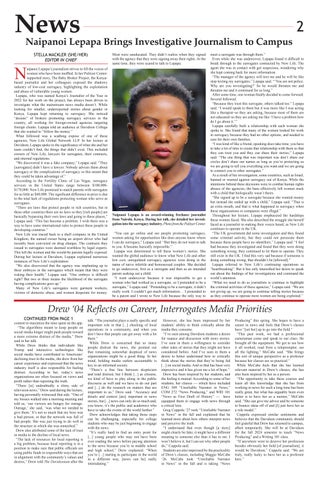
Naipanoi Lepapa is an award-winning freelance journalist from Nairobi, Kenya. During her talk, she detailed her investigation into the surrogacy industry. Photo from the Pulitzer Center. “You can go online and see people promoting surrogacy, women asking for opportunities like does anyone know where I can do surrogacy,” Lepapa said. “But they do not want to talk to you. It became basically impossible.” Lepapa was determined to tell these women’s stories. She wanted the global audience to know what New Life and other low cost, unregulated surrogacy agencies were doing in the name of naive infertile and homosexual couples. She decided to go undercover, first as a surrogate and then as an intended parent seeking out a child. “I went undercover because it was impossible to get a woman who had worked as a surrogate, so I pretended to be a surrogate,” Lepapa said. “Pretending to be a surrogate, it didn’t really work. I couldn’t get much information… I pretended to be a parent and I wrote to New Life because the only way to
2
meet a surrogate was through them.” Even while she was undercover, Lepapa found it difficult to break through to the surrogates contracted by New Life. The agent she was in contact with got suspicious, wondering why she kept coming back for more information. “The manager of the agency will text me and he will be like stop texting my surrogates,” Lepapa said. “‘You are not police. Why are you investigating?’ So he would threaten me and threaten me and it continued for so long.” After some time, one woman finally decided to come forward. Several followed. “Because they trust this surrogate, others talked too.” Lepapa said. “I would speak to them but it was more like I was acting like a therapist–so they are asking, because most of them are not educated–so they are asking me like ‘I have a problem how do I go about it.’” Lepapa carefully built a relationship with each woman she spoke to. She found that many of the women looked for work in surrogacy because they had no other options, and needed to care for their own families. “I was kind of like a friend, speaking does take time, you have to take a lot of time to create that relationship with them so that they can trust you and they can share their stories,” Lepapa said. “The one thing that was important was don’t share our circles don’t share our names as long as you’re protecting us we are going to tell you everything you want and we are going to connect you to other surrogates.” As a result of her investigation, some countries, such as Israel, banned or warned against surrogacy out of Kenya. While the intentions behind these decisions were to combat human rights abuses of the agencies, the bans effectively left women stuck with a child that biologically wasn’t theirs. “She signed up to be a surrogate because she wanted money but instead she ended up with a child,” Lepapa said. “That is an extra mouth, and that is what happened in surrogacy when these organizations or companies were illegal.” Throughout her lecture, Lepapa emphasized the hardships these women faced. She also described the struggle she herself faced as a journalist in making their voices heard, as New Life continues to operate in the UK. “The UK government did some investigation and they found some criminal activity, but they could not persecute them because these people have no identifiers,” Lepapa said. “I feel bad because they investigated and found that they were doing something wrong, they continued to let them to operate. They still exist in the UK. I find this very sad because if someone is doing something wrong, that shouldn’t be [allowed].” Lepapa referred to New Life’s continuing operations as “heartbreaking”. But it has only intensified her desire to speak out about the findings of her investigations and command the world’s attention. “What we need to do as journalists is continue to highlight the criminal activities of these agencies,” Lepapa said. “We are not giving up, we are going to continue telling stories because as they continue to operate more women are being exploited.”
Drew ‘04 Reflects on Career, Interrogates Media Priorities
CONTINUED FROM PAGE 1
content to maximize the time spent on the app. “The algorithms meant to keep people on social media longer might push people toward a more extreme distrust of the media,” Drew said in her talk. While Drew thinks that individuals like Trump and interactive technologies like social media have contributed to Americans’ declining trust in the media, she drew from her career experience and expressed that the news industry itself is also responsible for fueling distrust. According to her, today’s news organizations are often focused on views and profit rather than reporting the truth. “There [is] undoubtedly a slimy side of television news,” Drew said during the lecture, having personally witnessed that side. “One of my bosses walked into a morning meeting and told us, ‘our viewers are hungry for outrage. Outrage,’ she said, ‘was what we needed to give them.’ It’s not so much that my boss was a bad person, or that the network was full of bad people. She was just trying to do well in the structure in which she was enmeshed.” Drew also attributed some of the lack of trust in media to the decline of local news. “The lack of resources for local reporting is a big problem, because local reporting is in a position to make sure that public officials are using public funds in responsible ways that are in alignment with the community’s values and desires,” Drew told The Davidsonian after the
talk. “The journalist plays a really specific and important role in that [...] checking of local operations in a community, and when you don’t have that people can get away with a lot there.” While Drew is concerned that so many people distrust the news, she pointed out that remaining somewhat skeptical of news organizations might be a good thing. In her mind, holding media outlets accountable is key to an informed society. “There’s a fine line between skepticism and total distrust, but I think [...] as citizens, we kind of have to play along in the public discourse as well and we have to do our part and [...] do the research on matters that are important to us,” Drew said. “Accuracy and details and context [are] important in news stories, but [...] news can only do so much and, you know, it’s the public and academics who have to take the events of the world further.” Drew acknowledges that taking those steps can be challenging, especially for college students who may be just beginning to engage with the news. “It’s really hard to find an entry point for [...] young people who may not have been ever reading the news before paying attention to the news because you’re in middle school and high school,” Drew explained. “When you’re [...] starting to participate in the world in a different way, [news can be] really intimidating.”
However, she has been impressed by her students’ ability to think critically about the media they consume. “I’ve seen among Davidson students a desire for nuance and discussion with news stories. I’ve seen in them a willingness to consider other sides of stories that they might not have considered before. And I’ve seen in them a desire to better understand how to critically think about the stories that they’re being fed [...] on social media. And so that has been very impressive and it has given me a lot of hope.” Drew has been inspired by her students, and the feeling is mutual. According to some of her students, her classes — which have included ENG 309 “Unreliable Narrator in News,” COM 272 “News Producing,” and WRI 101 “News as First Draft of History” — have equipped them to engage with news through a critical lens. Greg Coppola ‘27 took “Unreliable Narrator in News” in the fall and explained that he learned more about how others interpret news and perceive the truth. “I understand that even though [a story] might clearly be fake, it might have a different meaning to someone else than it has to me. I won’t believe it, but I can see why other people do,” Coppola said. Students are also impressed by the practicality of Drew’s classes, including Maggie McCabe ‘26. McCabe took “Unreliable Narrator in News” in the fall and is taking “News
Producing” this spring. She hopes to have a career in news and feels that Drew’s classes have “[set her] up to go into the field.” “This past week, we had a professional cameraman come and speak to our class. He brought all the equipment. We got to see how it all worked, read from a teleprompter, see all the lighting,” McCabe said. “She brings this sort of unique perspective as a professor because her classes are so practical.” While McCabe feels that she has learned relevant material in Drew’s classes, she has also been inspired by her as a person. “The opportunity to take these courses and learn all this knowledge that she has from working in news for such a long time has been really great, but what has arguably been even better is to have her as a mentor,” McCabe said. “She can give me advice and be someone to bounce ideas off of and [I] just have her as a role model.” Coppola expressed similar sentiments and believes that the Davidson community should feel grateful that Drew has returned to campus, albeit temporarily. She will be at Davidson for the fall 2024 semester to teach “News Producing” and a Writing 101 class. “If anywhere were to deserve her profession besides obviously her field [of journalism], it would be Davidson,” Coppola said. “We are truly, really lucky to have her as a professor here.”