Please contact the Building Officials Institute’s National Office via marketing@boinz.org.nz
Design & Print no9.co.nz
ISSN 1175-9739 (print) ISSN 2230-2654 (online)
Building Officials Institute of New Zealand PO Box 11424
Manners Street, Wellington Level 12, Grand Annexe
84 Boulcott St, Wellington Phone (04) 473 6002
The information contained within this publication is of a general nature only. Building Officials Institute of New Zealand does not accept any responsibility or liability for any direct, indirect, incidental, consequential, special, exemplary or punitive damage or for any loss of profit, income or any intangible losses, or any claims, costs expenses, or damage, whether in contract, tort (including negligence), equity or otherwise arising directly or indirectly from, or connected with, your use of this publication or your reliance on information contained within this publication. The Building Officials Institute of New Zealand reserves the right to reject or accept any article or advertisement submitted for publication.
Message from the CEO Using Proportional Liability to Drive Building Sector Improvements
With the recent announcements from the Minister of Building and Construction on his intention to move from the joint and several liability regime to a proportional liability regime for the building sector, the big question to ask now is whether proportional liability will deliver the behavioural changes necessary to protect homeowners to similar levels as joint and several? An additional consideration is will this change bring cost advantages, or will we see increased costs accumulated across building participants in the building chain?
When moving away from traditional, long-established modes of regulation and replacing it with something new, the regulations need to ensure the replacement will deliver the expected and fair outcomes for all parties. In particular, a fair outcome for homeowners.
It would be fair to say the Building Consent Authorities (BCAs) have borne the financial burden for poor workmanship across the design and build sector for far too long, and thinking this through it is the ratepayer that ultimately underwrites shoddy performance.
Some would argue joint and several as a regime has unfairly advantaged builders and other players in the build sector doing shoddy work, as it has been too easy for them to phoenix and walk away from problems of their making.
OUR BOARD
Just setting the new direction is only the beginning. To deliver an equitable cost outcome for those who will have an increased financial exposure under proportional liability when things go wrong, particularly investors and building owners, requires a proactive change and strong leadership across the whole building sector. BOINZ is committed to working with the regulator and all other sector leaders to deliver a proportional liability regime that locks in good participant behaviour in a timely and sustainable manner to protect homeowners.
Experience tells us people are slow to react to change if the right incentives aren’t in place. We only need to look at the LBP scheme to see little has changed in the increase of performance and quality, since its introduction in 2007.
To deliver well on achieving the change environment outcomes, requires careful consideration. What the move to proportional liability involves is a transfer of risk. With that, a significant change in behaviour is needed, something that has largely been overlooked since the Minister’s announcement. The media focus on insurance and warranty cover availability overlooked the bigger picture, improved building outcomes and the expectation of responsibility and accountability by designers, builders and those in building subtrades with the removal of the backstop protection for homeowners.
So, it is imperative that when risks are transferred, those involved with new and different responsibilities and accountabilities, fully understand and deliver on expectations or risk the consequences.
There isn’t a week or two that goes by in New Zealand without horrific stories of tradespeople ripping off innocent homeowners. Even more so than other sectors, people undertaking building work need to professionalise and create a public expectation of honesty and delivery of high-quality, compliant buildings. This must be the delivered expectation, not a nice to have.
Getting the settings right at both political and regulatory levels is the vital first step. Consequences for individual and organisational actions are an integral part of the new accountability and responsibility settings, and the new regulation should unashamedly set and enforce appropriate penalties to send appropriate penalty indications to ensure a swift change in behaviour. The alternative to strongly enforcing the new regime penalties, will be a meandering builder environment that is slow to change and an environment that continues to burden others with their incompetence, likely at the expense of the homeowner.
In 2006, Building Consent Authorities had regulations imposed upon them that saw them deliver on prescribed outcomes to improve
Karel Boakes President
Jeff Fahrensohn Board Member
Whelan
Hill
how they operate. BCAs and BCOs (Building Consent Officials) are now the most professional and scrutinised group within the building sector, so it is reasonable to expect tight requirements from the regulator on the groups that most contribute to poor build outcomes. There is an old saying “what’s good for the goose is good for the gander”. These expectations should include: -
Investing in capability
Setting clear expectations
• Delivering on accountability
• Setting consequences for actions. Regulation written without ambiguity to deliver clear expectations and accountabilities that are aligned with consequences, must happen. This is important, as when increases in litigation appear, it is imperative the costs, legal or otherwise, do not blow out and exceed what was available under proportional liability. With councils no longer being the backstop or last man standing, policies and regulations need to deliver on risk outcomes to protect homeowners.
Future investment in skills and knowledge within specialist skill areas will be vital for successful construction businesses in the future, but importantly management skills uptake in running a company successfully will also be essential in the new proportional liability environment.
An important aspect will also include ethics and code of conduct responsibilities, to deliver appropriate relationship outcomes.
Following this significant change, there will be a future point in time when there is an improvement in accountability and behaviours. We will then see stakeholders move more proactively to support the sector, with the knowledge that risks are reducing and emerging professionalism is making an impact. Insurers and banks in particular will see this value and further engage as they see their exposures and costs decrease.
With new fit-for-purpose legislation and customer service expectations delivered, along with companies no longer phoenixing, the credibility of building in New Zealand will be restored. It may take five years or slightly longer, but it must be a better outcome, and it must be monitored to demonstrate improvements are being delivered.
So back to where I started, I see sector behavioural change is the key outcome of the move to proportional liability, with all actors protecting themselves. Let’s start with good regulation and solid expectations. The build sector groups need to lift their leadership game, create appropriate support and address learning needs, setting member expectations that ongoing individual and organisation failure is not an option. Without these
needed changes stakeholders and the public will continue to suspect the integrity of the sector. Sector investment will be limited and reluctant if there continues to be a downward construction productivity spiral, and it will set the building sector back even further.
Let’s face it, uncertified builders are very close to being seen as akin to the real estate agents of the sector. When the building sector finally lifts its game, the efficiencies and support from staff, public and stakeholders will flow through. Efficiencies will emerge, waste will disappear. A return to affordability will be a good outcome. This legislative change, if done well, will strip out costs and unnecessarily high contingencies from within the sector, delivering efficiencies that will see investment back into building, because current practices make investment cost prohibitive. Importantly, it should also deliver a wide ranging increase in quality, levelling the playing field at the designer, builder and sub-trade levels.
In conclusion, BOINZ wants to see this change done well, behaviours change and homeowners protected. Everyone in the process must be accountable for their actions.
Nick Hill CEO
We would like to thank our Premier Partners for their support and commitment to the Institute.
Making building product compliance easier: What you need to know
The Ministry of Business, Innovation and Employment (MBIE) has introduced three new pathways to make it easier to use overseas products in Aotearoa New Zealand. These changes aim to reduce barriers, improve clarity, and support faster, more confident decisionmaking across the building sector.
Building Product Specifications (BPS)
The newly published Building Product Specifications document is a centralised resource that contains specifications and references to over 130 standards for building products, ranging from plasterboard and insulation to cladding and windows. It provides more compliance options by citing international standards that have been assessed to meet or exceed the performance levels required by current New Zealand Building Code requirements. It is designed to be updated regularly, ensuring it remains current and relevant.
The BPS cannot be used in isolation to demonstrate compliance with the Building Code, it needs to be referenced by an acceptable solution or verification method (AS/VM) to be part of a deemed-to-comply pathway. Many AS and VMs have been reissued as new editions which now reference the BPS: they give the scope and limitations within which the product specifications must be used to be deemed-to-comply with the Building Code. As well as providing more options for building products, the format of the new editions of AS/VMs are easier to read and understand. While the documents may look different, the revisions do not require anything new to be undertaken to comply with the Building Code.
Approved Products Certified Overseas
MBIE has launched a new pathway to formally recognise building products certified overseas. Products that meet
the criteria set out in regulations will be deemed to comply with the Building Code and must be accepted by building consent authorities when used as intended.
The first group of products to be evaluated under this pathway are WaterMark-certified plumbing and drainage products, many of which are tested to joint Australian and New Zealand standards. This initiative will provide designers, specifiers, and consumers with a wider selection of verified products and methods, making it easier to comply with the Building Code.
Recognition notices will be published on MBIE’s Building Performance website and will detail applicable Building Code clauses, conditions and limitations.
Endorsed Standards
The third pathway allows the Minister for Building and Construction to endorse groups of overseas standards or certification schemes. These endorsements make it easier for any building product that has met an appropriate standard from a recognised overseas jurisdiction (such as ISO, ASTM, or BSI) to be specified in a building design.
This change is particularly beneficial for designers and builders, who can now specify products with confidence. It also supports greater
competition and innovation by opening the market to a wider range of products. BCAs will still need to assess proposed building work to ensure products are being used for their stated purpose and that the building work will comply with the Building Code.
What This Means for You
Together, these three pathways offer more compliance options, reduce duplication, and improve transparency. Whether you're a designer, builder, supplier, or consent authority, these changes mean less red tape and more certainty when selecting and approving building products.
MBIE will update the BPS over time and expand the list of recognised products and standards. Industry professionals are encouraged to stay informed and participate in consultations to help shape future updates.
For more information on all three new pathways for overseas products, visit www.building.govt/nz/ overseasproducts
By Ministry of Business, Innovation and Employment
Proportionate liability- who will be the last man standing now?
On 18 August, the Minister for Building and Construction, Chris Penk, mooted changes to the liability of councils. He promised to scrap the law which imposes joint and several liability and replace it with proportionate liability. What does this all mean, and who now will be the ‘last man standing’?
The current law - joint and several
Where more than one party damages a property, then all the parties at fault are liable for the full amount of the damage.
This is known as joint and several liability.
A plaintiff can sue whoever appears to be a liable party and recover all their losses from that party. This is possible even where the party sued is only partially at fault. A party sued, who blames others for the loss, can turn around and recover any overpayment from any other liable party.
Plaintiffs are incentivised to sue the most solvent party. From the perspective of a plaintiff, joint and several liability maximises their chance of full recovery and mitigates risk of partial compensation. If the building parties cannot pay their share, the council makes up the difference, hence the expression, ‘last man standing’.
Proportionate liability
Chris Penk says that it is fairer if each party pays that part of the loss that they have caused, and no more.
This involves assessing how at fault each party is, and the extent that their fault caused the loss.
This is known as proportionate liability.
A council for instance is commonly
held to have caused 20% of the loss, so its liability would be capped at 20%.
With proportionate liability, a plaintiff can ‘miss out’ if one of the parties who caused damage cannot be found, or a liable party cannot pay its share.
Who will pay the missing share?
There are two ways to plug the gap. One is for homeowners to protect themselves by dealing with builders who provide a guarantee against building defects. Both Master Builders and Certified Builders offer such protection, and insurers also offer latent defects insurance. The other option is for building parties to have mandatory insurance to ensure that they can pay their share.
There are many difficulties with relying only on building parties getting insurance. For a start, insurers are reluctant to insure builders against their own poor workmanship. The unavailability of insurance lead to the demise of Building Certifiers under the Building Act 1991.
Looking to Australia, New South Wales had compulsory insurance for a while which depended on private insurers, but that arrangement ended when the insurers either collapsed (HIH Insurance) or left the market. This led to the state having to underwrite the insurance. Will the New Zealand government agree to underwrite the liability of all builders in New Zealand?
Fishhooks and unintended consequences Council’s being too careful?
Mr Penk says that council’s reluctance to approve building work is linked to their fear of being
sued, and that councils will be less reticent if their liability is reduced and this will reduce building costs. This logic is flawed because negligence by councils will still lead to claims being made. More obviously, the decisions in question are made by council inspectors trying to ensure that building work meets the requirements of the Building Act. That focus will not change if the liability of the council is reduced.
Litigation will get messier and more expensive
Under the joint and several regime, the burden of proving who caused the loss is something that the defending parties sort out, the plaintiff can rely on a judgment against any one solvent party.
With proportionate liability, each party is only liable for the portion of the loss that their actions have caused, so a plaintiff needs to sue everyone potentially liable and prove that they have caused loss, or face not recovering all their losses. This will increase the legal costs for homeowners trying to recover enough to repair a defectively built house.
What will happen?
It is unlikely that insurers or the government will want to take on the role of the ‘last man standing’. If the government is determined to make this change, then one option is to reduce the liability of councils and building parties, but encourage homeowners to get a warranty, either from a reputable builder, or by purchasing latent defects insurance. As with all the recent proposed changes in the construction space, the devil will be in the detail.
By Paul Robertson, Partner, Heaney & Partners
FutureReady - Smarter Seismic Ceilings through Collaboration
GRIDLOK® w/Zip Clip directly supports the goals of BOINZ members by:
Introducing GRIDLOK® w/ Zip Clip: Raising the Bar for Seismic Ceiling Restraint
As New Zealand continues to advance in its seismic resilience journey, the introduction of the GRIDLOK® w/Zip Clip system represents a key milestone in improving nonstructural compliance in ceiling systems—particularly in high plenum and congested service zones. For members of BOINZ, this development is particularly relevant, delivering tangible improvements in buildability, inspection ability, and code-aligned performance.
Born From the Field, Designed for Compliance
GRIDLOK® w/Zip Clip is the result of a three-way collaboration between TRACKLOK® Ltd, Steel & Tube, and Zip-Clip, combining local compliance expertise with global suspension innovation. Together, the teams identified a widespread challenge: how to deliver seismic restraint in complex ceilings without creating service clashes or compromising layout flexibility.
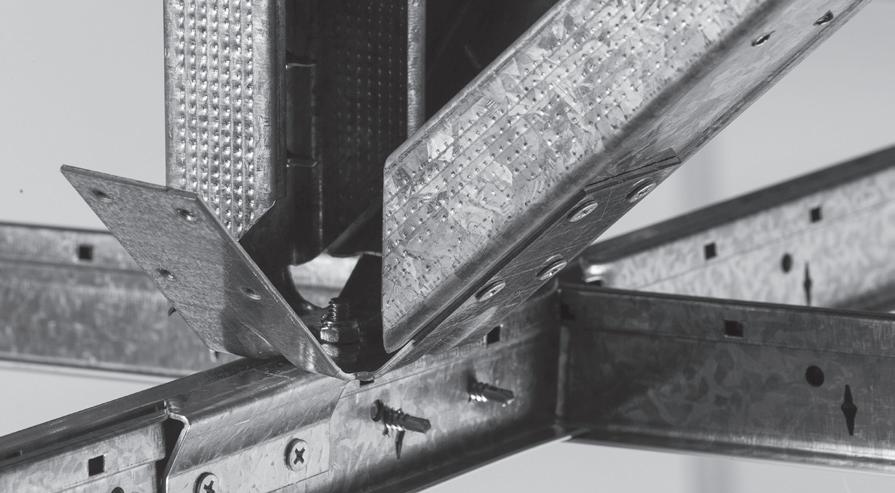
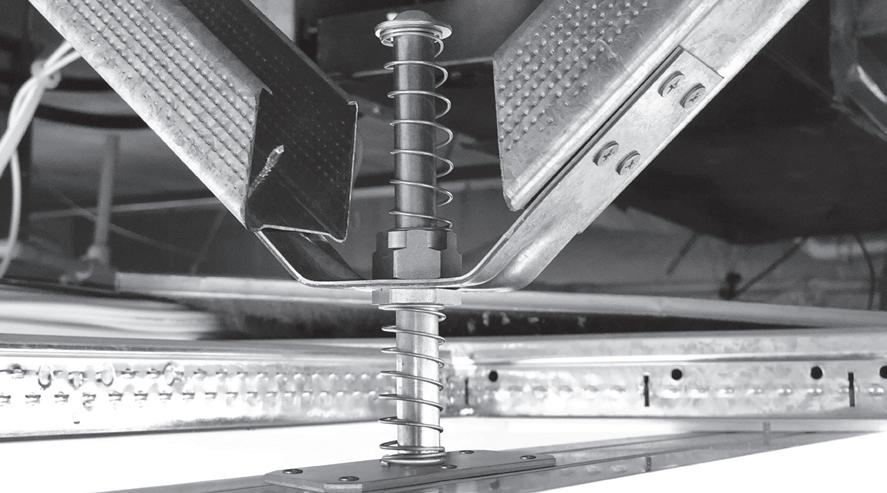
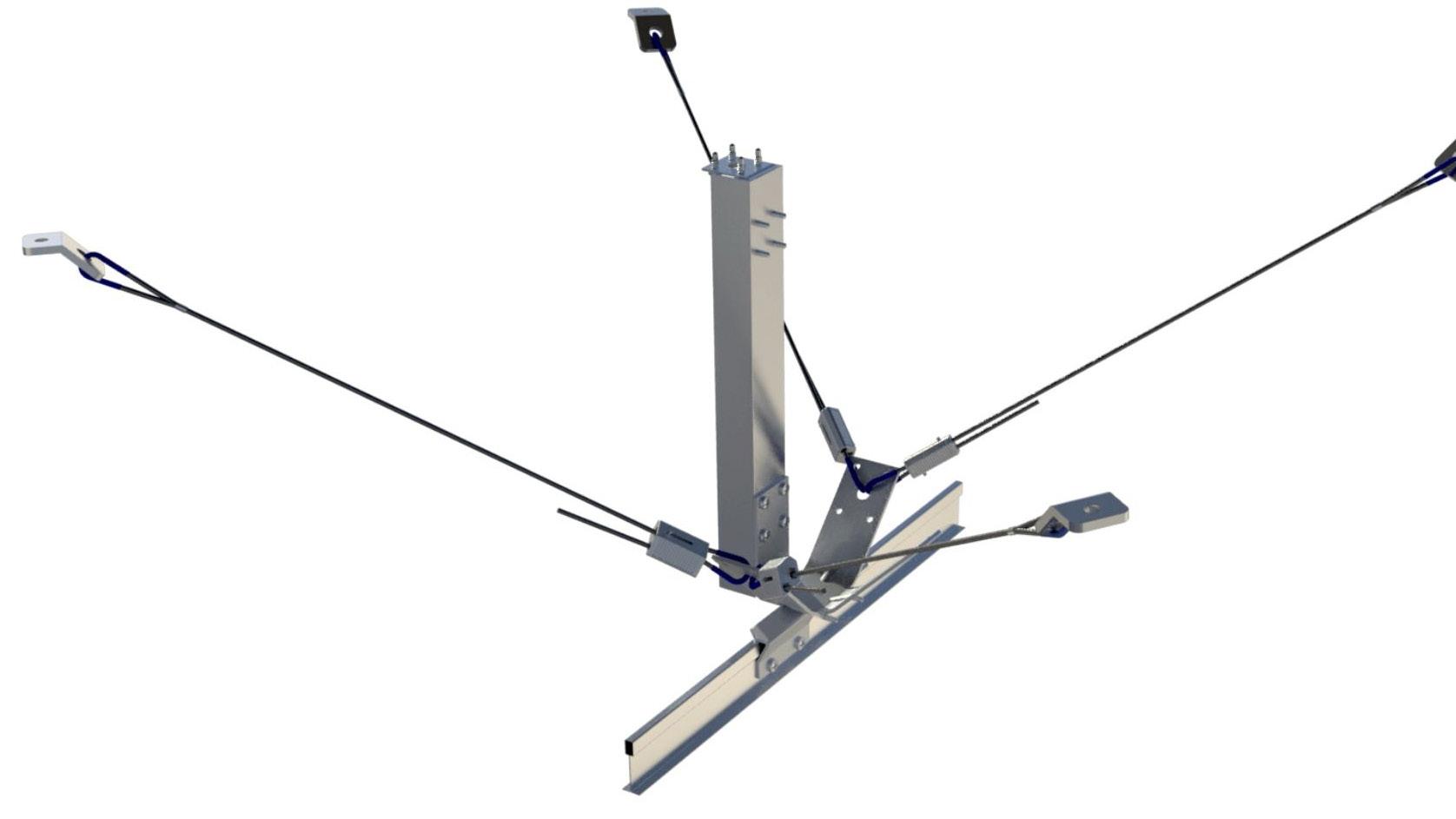
The result? A pre-engineered, codecompliant bracing solution that integrates seamlessly with existing ceiling systems and modern wirebased suspension technology. At the core of the update is a new 11.11mm hole in each GRIDLOK® brace’s 45° flange, designed to accept the ZipClip wire system—enabling fast, safe, and compliant installation in even the most congested ceiling spaces.
Supporting the BOINZ Mission: Safer Buildings, Better Outcomes
Simplifying the consent and inspection process through preengineered, tested components
Enabling consistent application of B1/ AS1 and AS/NZS 2785 in commercial ceiling installations
Reducing risk of service clashes, which are a known issue in code review and inspections
Improving documentation and traceability, critical for PS1 and PS3 verification
The system is already being adopted across major commercial builds in New Zealand, with BOINZ members playing a vital role in ensuring its correct specification and enforcement.
A Shared History of Innovation
The credibility behind GRIDLOK® w/ Zip Clip is underpinned by the depth of experience from the partners involved:
Steel & Tube – Supplying New Zealand’s structural systems since 1953, with a national footprint supporting builders and specifiers alike.
TRACKLOK® Ltd – The local leader in seismic restraint for non-structural building elements, with over 12 years of performance-based product development and code advocacy.
Zip-Clip – A globally recognised innovator in cable suspension systems, bringing international performance standards and modern installation practices to New Zealand ceilings.
Bracing for the Future
TRACKLOK® and its partners showcased the GRIDLOK® w/ Zip Clip system at the last BOINZ Conference—a fitting stage for a product born from industry need and aligned to compliance evolution. The solution will now roll out into the build environment and we are here to support BOINZ members with any queries.
In a regulatory environment where seismic performance is nonnegotiable, GRIDLOK® w/Zip Clip stands out not just for what it delivers during an earthquake—but for how it simplifies compliance and improves certainty before one ever strikes.
By Tracklok
Notice to Fix: Common mistakes to easy wins
Picture this – you and your team have been working tirelessly over the course of months on gathering evidence and documenting compliance issues. You have submitted your Notice to Fix. The document is beautiful and the evidence is clearly laid out. However, your document is challenged because it refers to 123 Example Avenue, instead of 124 Example Avenue.
Scenarios like this happen more than you’d think. Even the most experienced building officials can miss surprisingly simple opportunities to strengthen their Notice to Fix documents. These aren't complex legal interpretations or obscure procedural requirements – they're straightforward improvements that can be implemented in busy buildings across the country. Drawing from recent professional discussions and MBIE determinations, it's clear that many enforcement actions can be significantly strengthened by focusing on basic elements that deliver disproportionately positive results.
Three easy wins
Stick to the Form 13 template: One of the highest-impact improvements is ensuring strict adherence to the Form 13 template. Many councils develop their own templates with good intentions – improving clarity, incorporating corporate branding, or reorganising sections for better flow.
Section 165 of the Building Act specifically requires NTFs to be on the prescribed form. Staying with this template provides bulletproof legal foundation for your enforcement action, regardless of how wellintentioned modifications might seem.
Implement consistent reference systems: Establishing proper reference numbering delivers immediate dividends across your entire enforcement program. In busy buildings dealing with multiple properties or urgent safety concerns, a robust reference system becomes
your administrative backbone.
With proper reference systems, tracking compliance becomes effortless, follow-up correspondence flows smoothly, and your professional presentation strengthens dramatically during any subsequent legal proceedings. This simple systematic approach transforms administrative chaos into streamlined enforcement.
Perfect your property identification: Getting property identification exactly right creates an unshakeable foundation for your notice. This means doublechecking street names, confirming unit numbers, and verifying current property descriptions – particularly when copying information between database systems or dealing with recently subdivided properties.
Precise property identification eliminates a common avenue for challenges and demonstrates the thoroughness that strengthens your entire enforcement position, regardless of how serious the underlying building compliance issues might be.
Additional opportunities for stronger enforcement
Transform your enforcement position by providing precise, detailed descriptions of non-compliance. Instead of generic phrases like "building work doesn't comply with the Building Code" or "unauthorised alterations have been undertaken," invest time in crafting specific allegations that clearly inform recipients about exactly what needs attention. The Building Act rewards this precision, and detailed descriptions virtually eliminate disputes about what needs to be rectified.
Strategic timeframe management represents one of the most powerful tools in your enforcement arsenal. While there's often pressure to demand rapid compliance, particularly when safety concerns are involved, determinations consistently
With proper reference systems, tracking compliance becomes effortless, follow-up correspondence flows smoothly, and your professional presentation strengthens dramatically during any subsequent legal proceedings
We speak
BUILDING CONTROL
Speaking building control is about more than words – it’s about results.
Nathan Speir and Simon Rickit lead Meredith Connell’s local government team, translating regulatory challenges into practical solutions for compliance processes and infrastructure projects.
demonstrate that councils achieve better outcomes with generous rather than aggressive timeframes. What might appear as being "soft" on non-compliance – providing six months rather than two weeks for rectification – actually produces more successful enforcement outcomes with fewer challenges. Two-week deadlines for complex building work, or compliance periods that span over the holidays, frequently become reasons for successful appeals that delay rather than accelerate resolution.
Selecting the most appropriate Building Act sections requires strategic thinking that pays significant dividends. Section 40 typically provides a cleaner enforcement pathway than Section 17, addressing clear procedural requirements where either someone applied for/got consent conditions or they didn't. Section 17 can lead to extensive debates about interpretation and compliance standards that complicate what should be straightforward enforcement actions. Similarly, focus on the most relevant sections rather than including multiple provisions that essentially address the same issue.
Understanding proper recipients ensures your notice reaches the right parties from the outset. The Building Act defines "specified persons" quite precisely, so directing notices to appropriate parties like property owners rather than banks or insurance companies eliminates unnecessary complications. This clarity often prevents the confusion
that arises from mixing up requirements for different types of notices.
Maintaining rigorous procedural standards through proper signatures, dating, and authorisation creates an unassailable administrative foundation. Keep the statutory warning language in notices exactly as it appears in the template –this language exists for specific legal purposes and provides the notice with its full legal authority. When including photographic evidence, ensure images are properly attached to the notice and obtained in compliance with privacy requirements and legal standards for evidence gathering.
The consistent pattern from recent determinations shows that technically excellent notices with reasonable timeframes consistently outperform aggressive enforcement approaches that cut procedural corners. A simple quality control checklist covering property details, reference numbers, appropriate timeframes, correct recipients, and proper documentation prevents the vast majority of challenges while creating a professional standard that builds respect with both property owners and legal representatives.
The key lesson
Recent determinations reveal that councils often achieve better results through technically excellent notices with reasonable timeframes rather than aggressive enforcement approaches that cut procedural corners. The pattern consistently
shows that what might appear as being "soft" on non-compliance – providing six months rather than two weeks for rectification –actually produces more successful enforcement outcomes with fewer appeals and challenges.
The lesson emerging from professional practice is that attention to these seemingly minor details makes the difference between effective enforcement and administrative frustration. Most Notice to Fix challenges succeed not because of sophisticated legal arguments about building standards or procedural fairness, but because of simple mistakes that could have been avoided with basic quality control processes.
A simple checklist covering property details, reference numbers, appropriate timeframes, correct recipients, and proper documentation can prevent the vast majority of these problems. The investment of time in getting these fundamentals right consistently pays dividends in more effective enforcement, reduced administrative burden, and improved professional relationships with both property owners and legal representatives.
By Meredith Connell
Expert Support -
Anytime, Anywhere
Our industry experts – builders, engineers, chemists, specifiers ensure you have the right resources at the right time. Contact the GIB Technical Helpline at 0800 100 442
GIB Weatherline®: Wrapping Its Way Around Kiwi Building Sites
“If you want to make a statement, wear purple.”
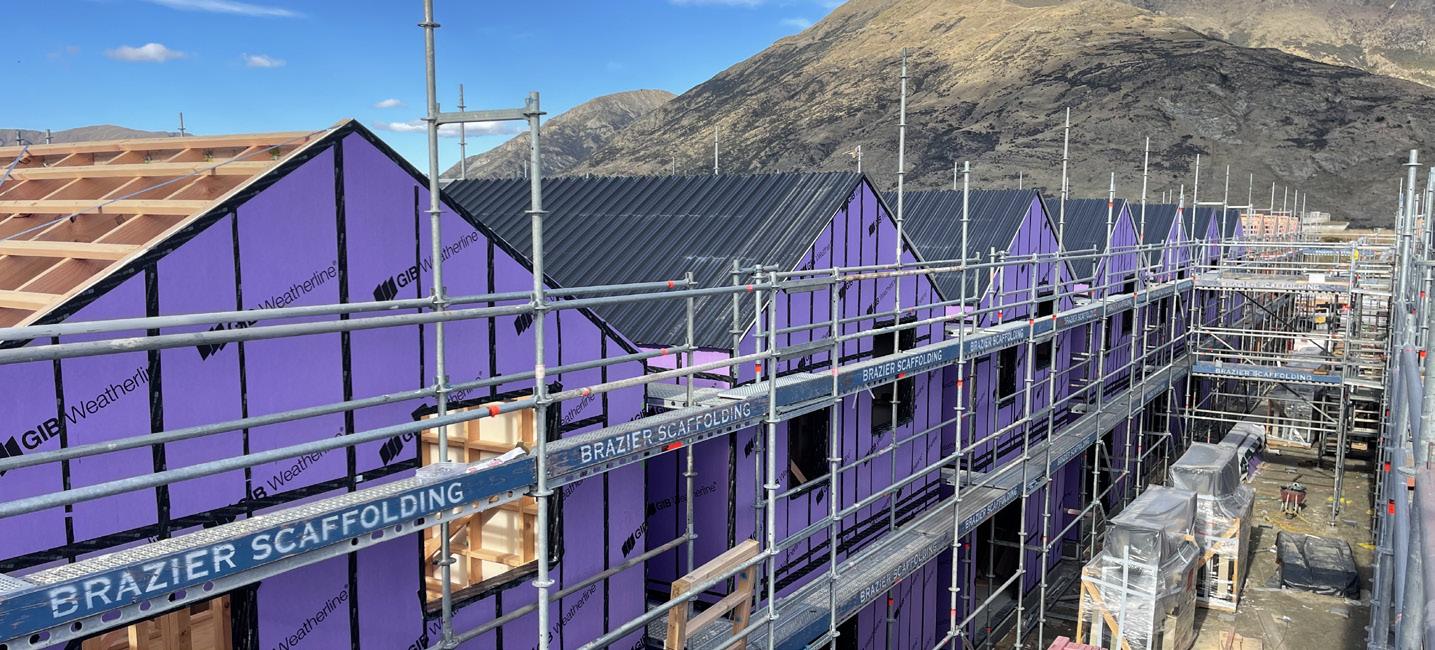
It’s a famous line attributed to former NBA basketball player Baron Davis, and a particularly apt way to describe GIB Weatherline®, the distinctive purple coloured fibreglass-faced plasterboard, which is making a bold splash across an increasing number of Kiwi building sites as well as providing an essential layer of weathertightness underneath exterior cladding.
GIB Weatherline® was launched in 2019 and is intended for use exclusively with drained and vented cavity cladding systems. Used as part of the wider GIB Weatherline® Rigid Air Barrier system, GIB Weatherline® functions as an air barrier and a secondary line of defence against water penetration into a building’s interior.
It has an advanced secondgeneration fibreglass liner on both front and back, with a highly modified gypsum core, containing water and mould inhibitors. This not only provides an excellent substrate for fire resistance applications, but it is also safe and easy to use for those handling and installing it, requiring no power tools to cut, saving time and money during the installation process.
Another key feature is being able to install it in unpredictable weather conditions. The temporary weather protection allows for up to 180 days of exposure to the elements so building work can commence inside. It also offers enhanced thermal efficiency of the building by reducing air leakage.
So not only is this highly innovative plasterboard making a powerful purple statement across New Zealand building sites, but it’s also providing some pretty good benefits too.
GIB Weatherline® Rigid Air Barrier Systems
GIB Weatherline® Rigid Air Barrier Systems are suitable for use in both residential and commercial buildings and have been tested for wind speeds up to and including Extra High wind zones. It has Building Research Association of New Zealand (BRANZ) appraisal and meets the NZ Building Code requirements for rigid underlays (rigid air barriers).
GIB Weatherline® Rigid Air Barrier Systems can also be used to provide passive fire protection to meet fire protection requirements including options to limit vertical fire spread.
To find out more, visit GIB Weatherline® and GIB Weatherline® Rigid Air Barrier Systems, where you’ll find detailed information as well as technical literature and manuals.
By GIB
Understanding product certification for compliance
Many in the building industry choose to use independent, third-party certification for compliance – moving the work and the onus of checking products from individual designers, builders, and building officials to an expert, impartial body with market credibility and qualified auditors. But unfortunately, not all schemes are equal. There are five main characteristics that you should look for in a certification scheme.
1. Independence is crucial. The scheme should be run separately from any industry suppliers, builders, bodies or any other group commercially invested in the industry, in order to avoid conflicts of interest and ensure integrity.
2. Expertise – auditors should have in-depth experience, expertise and qualifications. The independent certifier should provide users with confidence that contractual obligations are being met, that project risks are being identified, and that effective verification and monitoring systems are implemented.
3. Clear, robust processes should provide a clear and thorough audit plan, for example specifying if it includes site inspection and physical monitoring of the work; or whether the auditors witness product testing. Audits and testing should be regular and rigorous, with ongoing checking of the manufacturer.
4. Accreditation – the independent certifier themselves should be credible and accredited by certification bodies. In New Zealand, certification bodies should be recognised by JASANZ (which accredits the bodies that then certify or inspect organisations, products, management systems, or people).
5. Security
Finally, the certification itself should be verifiable in a secure way, at an immutable source. If the certification itself can be fraudulent or falsified, then the process is worthless. It
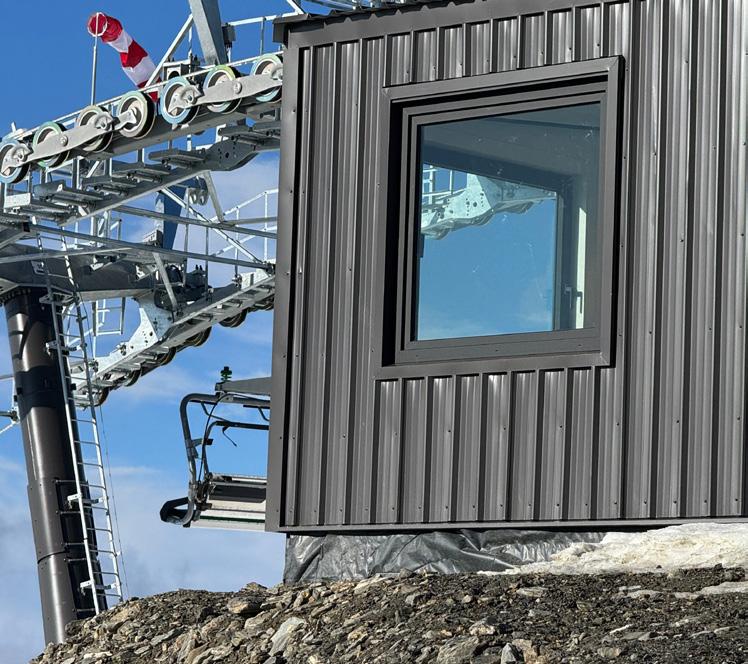
While fibre-reinforced polymers (FRPs) may involve higher upfront material costs, they can offer long-term economic advantages under the right conditions.
should also include traceability of product, to ensure unbroken visibility of the same product.
Steel
certification
In the instance of construction steel, the Australasian Certification Authority for Reinforcing and Structural Steels (ACRS), is the leading independent third-party certifier for the region. It provides traceability from mill to processor, through the importer, trader or distributor, all the way to the construction site. It operates independently of steel producers, suppliers, associations and the steel industry, which is crucial to its role as a trusted and impartial certifier. To further provide confidence to the market, the ACRS Product and Quality Management schemes are also accredited by third-party accreditation body JASANZ. ACRS’ Cloud app means steel certification can be verified in a secure environment, simply by scanning product tags or paperwork.
By ACRS
The Next Frontier: Structural Engineered Bamboo
Across three days in June, the Bamboo Society of Australia, with the support of ICC-ES, ran a novel program of events in three Australian cities to showcase, discuss and learn about the attributes of bamboo as a building material.
The focus was on establishing structural engineered bamboo as a mainstream product in the Australian market, in much the same way that compressed laminated timber was over a decade ago. Structural engineered bamboo has the potential to complement sustainably sourced timber where supply struggles to meet demand and, therefore, represents an opportunity for the timber industry to diversify and mitigate risk.
Next Frontier Summit
The Bamboo Society of Australia (BSA) hosted the Next Frontier Summit with ICC-ES as the primary supporter, uniting global expertise and local opportunity across the full lifecycle of bamboo, from propagation and engineered products to policy and climate solutions.
The event brought together landowners, growers, researchers, producers, architects, engineers, designers, builders, policymakers, investors, developers and sustainability leaders to lay the foundations for the future of bamboo in Australia by shaping the supply chain from the ground up. As the President of the BSA noted in her address, bamboo has a place in our future economy, our buildings and our land use strategy. The Forum also included a presentation from Professor Yan Xiao, engineer and designer of the world’s first 7-storey mass bamboo tall building in China.
With increasing pressure on Australia’s timber industry, attendees heard from local
and international leaders revolutionizing the use of structural engineered bamboo from carbonnegative cladding to large-span construction. Bamboo is one of the world’s fastest-growing, carbonnegative and regenerative crops that can also restore degraded land, purify contaminated water, improve biodiversity and create regional industry.
Managing Director of ICC-ES, Neil Savery, presented at the event, highlighting ICC-ES’s pedigree in testing and certifying innovative building products, with established experience in structural engineered bamboo. ICC-ES has issued both Acceptance Criteria and Evaluation Service Reports for this material, the attributes of which compare favourably to other building materials, but has much more to contribute as a crop.
With input from event participants, a 10-year roadmap is to be released on 18 September 2025
(World Bamboo Day), to plot a path for the establishment of a commercial crop and the domestic manufacture of structural engineered bamboo in Australia for the domestic construction industry, where timber supply cannot keep up with demand.
The Benefits of Bamboo as a Building Material
There is increasing demand for renewable, high-performance building materials, and engineered bamboo is emerging globally as a viable solution.
Bamboo has the potential to sequester significantly more carbon than timber (it absorbs ten times more carbon dioxide from the atmosphere than an equivalent acreage of trees), whilst both helping regenerate degraded land and avoiding leaving land barren when harvested.
Maturing in just five to seven
Why Building Officials Worldwide Trust ICC-ES Reports
The ICC Evaluation Service (ICC-ES), a subsidiary of the International Code Council (ICC), was created by building officials to serve the needs of building officials.
With 90 years of experience in product evaluation and building code publications, ICC-ES:
Provides a comprehensive evaluation process with a rigorous peer review, raising standards for the entire building products industry.
Employs a complete staff of licensed engineers and architects in a variety of disciplines to conduct the evaluation process.
Through an Evaluation Service Appraisal Report (ESA), ICC-ES can assess and verify new and innovative building products are fit for purpose in compliance with the requirements of the New Zealand Building Code.
Is the expert in developing Acceptance Criteria, which are developed when an application is received for an ESA on a product where there is no existing acceptable solution. Acceptance criteria are developed for use solely by ICC-ES, which is the only organization that can provide expert interpretation of the published ACs.
ICC-ES ESAs are tailored to meet the needs of the building officials enforcing the New Zealand Building Code.
The reports contain factual, relevant information needed by building officials in order to support their decision to allow subject building products in their jurisdiction.
ICC-ES evaluates products to help code officials approve them for installation.
years compared to timber’s 26 to 50 years, bamboo regenerates without replanting, allowing annual harvests. Although planted as grass, when cut, bamboo is comparable to timber.
• Bamboo has relatively low water needs, is drought-resilient and its natural properties facilitate the removal of toxins from soil, effectively restoring the underlying water table to its pure state.
The land area in Australia suitable for bamboo cultivation rivals, if not exceeds, the total agricultural area of Europe.
It is also an optimal source of sustainable alternatives to traditional fertilizers, which increase soil water retention and reduce nutrient leaching.
Recent research has shown that combining bamboo with cross-laminated timber (CLT) can enhance the structural performance of CLT. Moreover, bamboo can be processed using the same manufacturing facilities as CLT, underscoring its compatibility with current production systems.
In addition to its use in construction, bamboo is used in cabinetry and furniture.
Bamboo has a very different molecular structure to wood, which helps make it more stable in moisture and temperature changes. When made into structural engineered bamboo, this makes it around 40 percent denser than engineered wood. As such, its
it’s clear this material can work in other parts of the world, including New Zealand. It is used extensively in parts of Asia, where there are established manufacturing facilities. Already bamboo is used for a variety of building material finishes and there are increasing international examples of structural engineered bamboo being used, including the first 7-storey building in China.
Learn more about ICC-ES, here.
By ICC
Datascape Building Consents
Overseas Standards, Windows, and the Risks of Change
The government is currently moving on several fronts to reduce the cost of building in New Zealand. At face value, that sounds like exactly what the industry –and the country – needs.
One of the key strategies is to make it easier to use overseas products. This doesn’t just apply to windows – it covers plumbing fittings, hardware, cladding, and a range of building materials.
Change Brings Both Risk and Opportunity
With all change, even positive change, there is risk. Councils, contractors, installers, and designers all need to adjust, re-train, and work with unfamiliar systems. Mistakes are possible – and in our industry, mistakes can be costly.
It’s tempting to view these initiatives in binary terms: either as the floodgates opening to cheap, non-compliant imports, or as a breakthrough that finally gives us access to world-class technology. The truth lies somewhere in between.
Yes, there is a risk of low-performing or even fraudulent product making its way into the market. But there is also the very real benefit of higherperforming products – particularly from Europe and North America –reaching our shores more easily, often
at a lower price than what’s available locally.
Why Windows Matter So Much
Among all building products, windows and joinery sit in a uniquely complex category. A window isn’t a single component but a system: aluminium or uPVC profiles, glass units, seals, rubbers, and hardware all working together. They must perform across multiple clauses of the Building Code – structural integrity, durability, and weathertightness chief among them.
Low-performing windows risk condensation, mould, and heat loss. High-performing windows, by contrast, can transform a home’s comfort, health, and energy efficiency. The stakes are higher than with simpler products like door handles or plumbing fittings.
And here’s the uncomfortable truth: New Zealand’s window technology lags decades behind much of the developed world. Thermal breaks that only recently entered our market were commonplace in Europe in the 1980s. While local manufacturers warn of cheap imports, some of the poorest-performing products are arguably those produced here by default.
The narrative that “the government is lowering standards” is misleading. What’s really happening is a streamlining of how equivalence is proven. The performance bar remains the same.
A Streamlined Pathway
It’s worth remembering that overseas systems have always been allowed in New Zealand. The issue has been proving compliance. Until now, that meant hiring engineers, comparing overseas tests to New Zealand standards, and hoping councils accepted the evidence. The result? Repetition, cost, and delay – with every project team reinventing the wheel.
MBIE’s reforms aim to do that work once, centrally, and publish the equivalencies. If an Australian or European test is shown to match a New Zealand test, then that product pathway becomes available to all. Done well, this reduces cost and time without lowering the standard.
The narrative that “the government is lowering standards” is misleading. What’s really happening is a streamlining of how equivalence is proven. The performance bar remains the same.
Managing Risk
Of course, risk remains. Overseas test reports can be falsified, and fraud has already been seen in larger markets such as Australia. If New Zealand
starts relying on Australian standards as equivalents, we must be vigilant. The quality of the testing authority matters as much as the test itself.
Good advice from within the compliance sector is simple: when reviewing any test report, ask who authored it, and do we trust them?
That principle applies whether the test was conducted in Beijing, Sydney, or Auckland.
Sometimes, additional local testing will still be necessary. Particularly for complex systems like façades and high-performance windows, projectspecific requirements may demand further verification.
Opportunity for Better
From my perspective – as someone who works to bring advanced overseas window systems into New Zealand – these changes are an opportunity. They make it easier for us to supply high-performing, energy-
efficient systems at a lower cost, lifting the standard of homes and buildings across the country.
It’s worth reflecting on some other industries that we have witnessed in some other industry sectors when a technology has advanced far beyond our domestic capability, we may be better served by importing excellence than clinging to outdated local systems.
Conclusion
Change is never without risk. With these reforms, there are real dangers – from fraudulent reports to cheap underperforming products.
But the upside is enormous: betterperforming, healthier, more efficient buildings at lower cost.
The challenge for our industry is to manage the risk without losing sight of the opportunity. If we get it right, New Zealanders stand to benefit
from global best practice – not just in windows, but across the spectrum of building products.
By Benjy Simmons, STARKE Group Limited
ON-SITE TRUST I S A MU ST!
CMNZ70024
Tested & Certified Mains Fittings
EASY FIT. TRUSTED
› NZ’s only certified Mains Fittings
› Independently tested and certified to AS/NZS 4129 standards
› Use existing SecuraOne® crimp tools
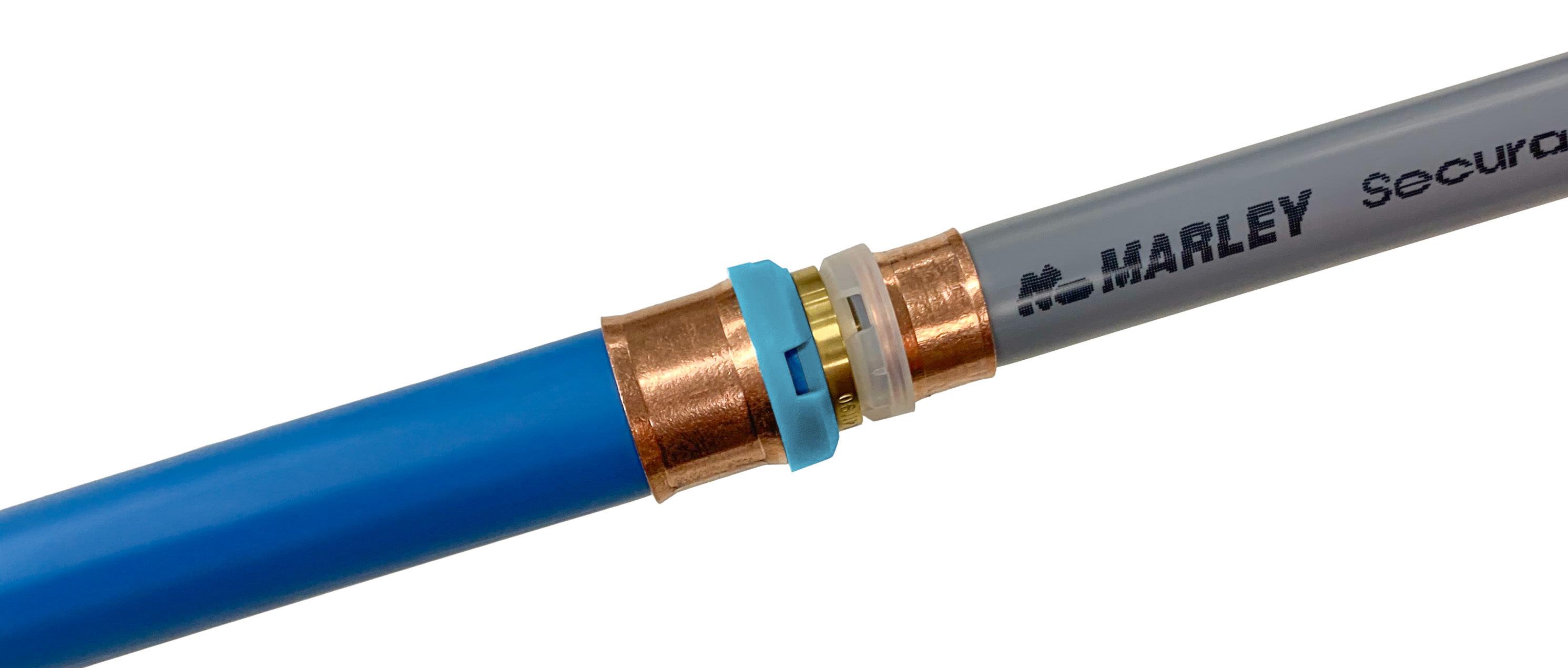
› Connect from meter to tap with Marley 1200 series MDPE and SecuraOne® Mains Fittings, PB or PEX
› Light blue end caps and rings to identify the MDPE joint
Certified Confidence: Marley’s New SecuraOne® Mains Fittings
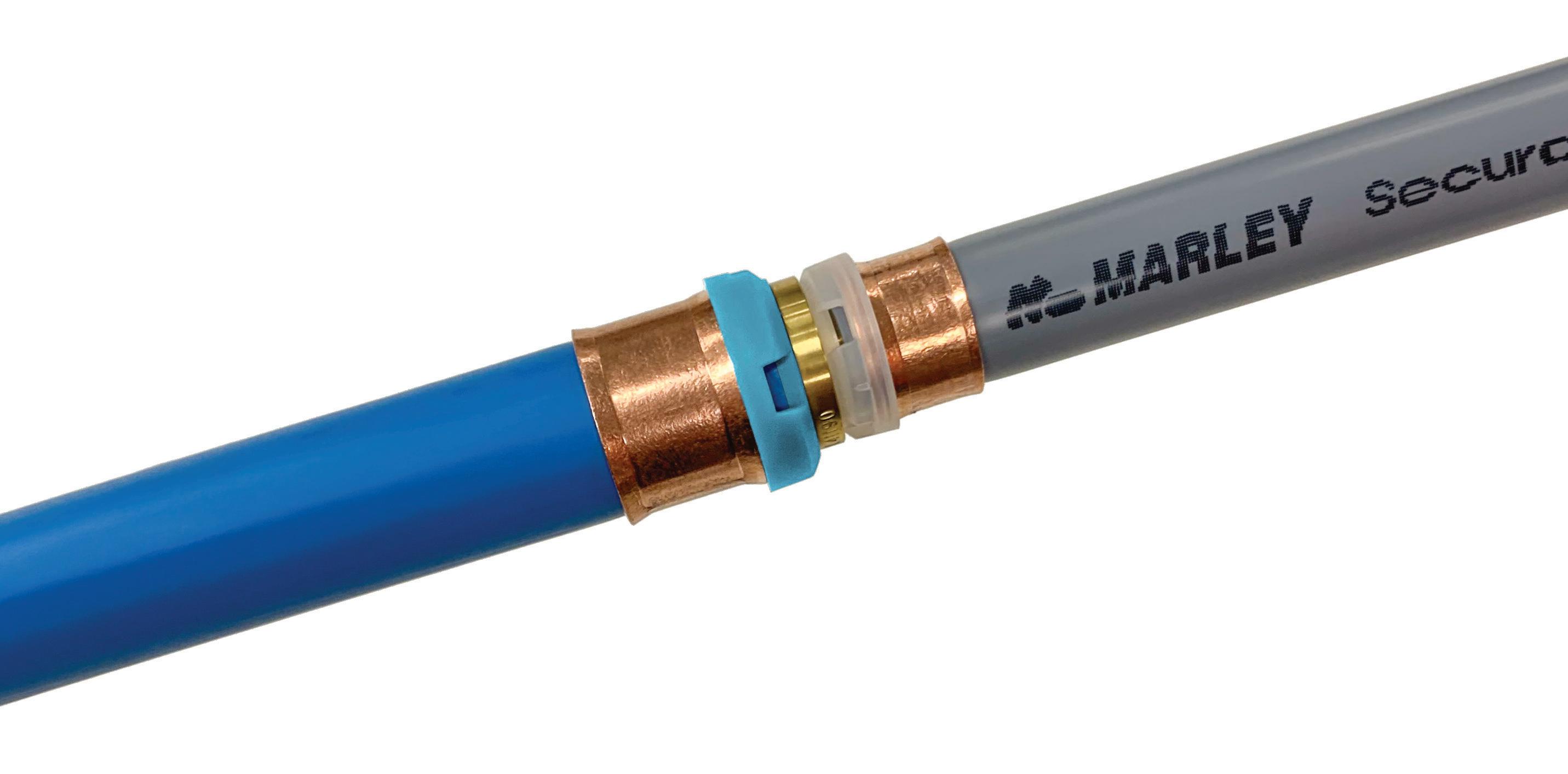
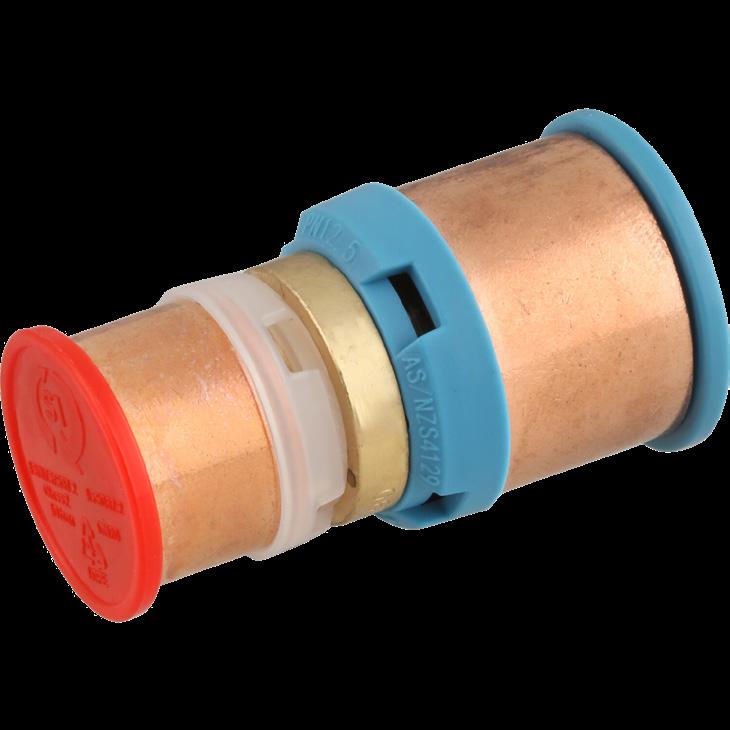
Marley has introduced a new range of mains fittings to complement its SecuraOne® hot and cold plumbing system, now the first mains fittings in New Zealand to be tested and certified to AS/NZS 4129 standards*. This development marks a significant step forward in plumbing system integrity, offering councils and inspectors a reliable, compliant solution for connecting the mains water with the house’s water supply pipe system.
The SecuraOne system launched in 2024, built on the legacy of Dux SecuraGold® which had long been trusted for its performance and durability. The impending transition to lead-free brass fittings enabled Marley’s Product Development team to both engineer fitting enhancements that improve joint security and introduce a new range of
metric PB and PEX pipe.
As part of the SecuraOne launch, plumbers identified the need for a high-quality crimped connection between SecuraOne PB or PEX pipe and Marley’s 1200 series MDPE pipe. The new range of SecuraOne mains fittings provide a simple yet secure connection, with SAI Global independently certifying that they meet the requirements of AS/NZS 4129.
Marley is now the only NZ-based manufacturer offering a fully independently certified connection from water meter to tap, a critical assurance for regulatory bodies.
Technical features include:
Solid lead-free brass and copper construction
• Retainer rings with four inspection windows for visual confirmation of pipe insertion prior to crimping
• Light blue caps and rings for clear MDPE joint identification
3rd party certification to AS/NZS 4129 by SAI Global
AS/NZS 4129 ensures that the fittings meet
stringent performance and durability benchmarks, supporting long-term infrastructure reliability.
Marley’s commitment to quality and compliance is backed by over 60 years of experience supplying the NZ plumbing industry. With this new offering, professionals can trust that every connection, from water meter to tap, meets the highest standards. For technical specifications or to arrange a consultation, contact your local Marley Territory Manager or to review certification visit www.marley. co.nz/4129
* AS/NZS 4129: 2020 - Fittings for polyethylene (PE) pipes for pressure applications
By Marley
Compliance to AS/ NZS 4129 ensures that the fittings meet stringent performance and durability benchmarks, supporting longterm infrastructure reliability.
• Compatibility with existing SecuraOne crimp tools
In-slab water detention solutions – going beyond the Code
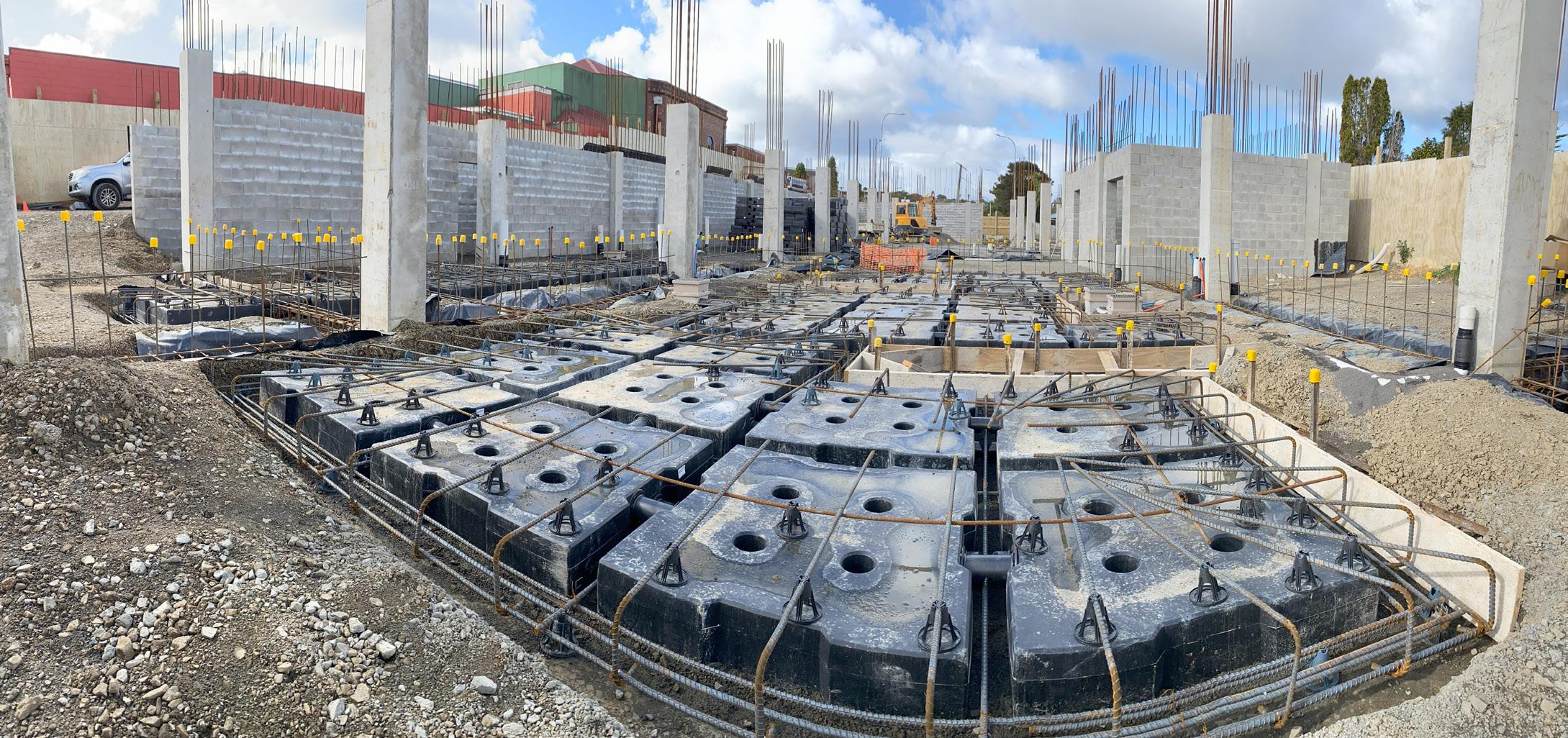
In-slab stormwater detention systems are being used more frequently, not just because of their ability to detain stormwater, but also as a tool for developers to solve issues around constrained development.
It is no secret that, with our growing population and increased housing, our aging water infrastructure is struggling to cope.
In-slab solutions (or pods as they are sometimes called), temporarily store the water and then gradually release it into the public stormwater system. With more frequent extreme weather events, especially heavy rainfall, this helps to prevent rapid runoff and therefore reduce flash flooding.
Giving quality assurance to all parties involved in a build
With the increasing demand for these products, new players are entering the market all the time. Property owners, developers,
and building professionals need assurance that any products used are not only structurally sound but well tested.
At Watersmart, we believe it is important to go beyond ‘just meeting the Code’ to ensure that all clients receive a quality building product.
Here are some examples of the initiatives we are undertaking to give building inspectors and clients confidence when installing and inspecting in-slab solutions –
• All in-slab products are of course tested at manufacture. Whilst rare, there is however the chance that damage, such as steel penetrating a tank, may occur onsite. To mitigate the impact of any such damage we perform an additional pressure test prior to the concrete being poured.
A qualified plumber can install an in-slab solution. We ensure that our installers go through formal training and a proper certification process. Due to our experience of over 7,000 installs, we know that this helps to ensure a trouble-free
outcome for all involved.
Involving structural engineers to ensure slab designs factor in the tank is essential. The benefit of our Aquacomb product is that it is designed to fit in a standard rib-raft slab, so generally few implications.
By going the extra mile, we hope to instil confidence and trust with all parties in a build, as well as delivering long-lasting and sustainable building solutions.
Watersmart is happy to answer any questions that BOINZ members have about in-slab stormwater detention systems, as well as provide any required information about products.
By Watersmart
Remote Inspections: Transforming Building Consent Processes in New Zealand
Building inspections are among the most resource-intensive elements of the consent process. With over 780,000 consents lodged annually in New Zealand and an average of 5.5 inspections required per consent, the workload is immense. Around half of all inspections fail, requiring re-inspection and creating significant demand on already stretched inspection teams.
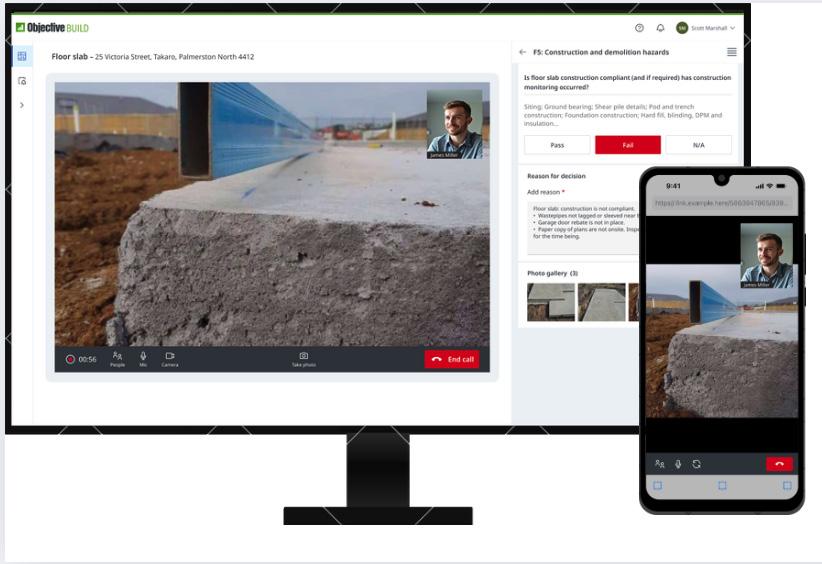
Objective Build’s Remote Inspections capability addresses this challenge directly. Fully integrated into the existing Build inspections workflow, the solution enables inspectors to complete site checks through high-quality
video calls and hi-resolution image capture—directly within the Build platform. This provides a single source of truth for consent records, eliminating the need for disconnected third-party applications.
Enhancing the Role of Inspectors
Remote Inspections are not about replacing inspector expertise; they are about extending its reach. Instead of spending hours travelling between sites, inspectors can dedicate more time to applying technical judgement
and compliance knowledge where it matters most. Routine checks and follow-ups can be handled remotely, freeing capacity for more complex on-site inspections.
For Building Consent Authorities (BCAs), this means increased inspection throughput without additional staff. Re-inspections can be scheduled within hours rather than days, reducing project delays and improving the applicant experience. Inspectors also gain confidence in meeting International Accreditation New Zealand (IANZ) requirements, with every inspection—remote or onsite—fully documented and linked
Why Workflow Matters
Many solutions rely on thirdparty video apps or bolt-on tools. Objective Build is different: Remote Inspections are embedded in the same workflows inspectors already use, including checklists, dashboards, and reporting. On-site contacts need nothing more than a mobile phone, while inspectors manage the process entirely from within Build. This integrated workflow ensures consistency and reliability, reducing risk and avoiding the inefficiencies of juggling multiple systems.
Aligning with Government Reform
The New Zealand Government is actively exploring reforms to accelerate housing delivery, including greater use of digital technology. Remote Inspections demonstrate how modern technology is already supporting this policy direction—delivering faster outcomes without compromising compliance.
A Smarter Future for Inspections
With growing housing demand and limited inspector availability, Remote Inspections represent a scalable way forward. By combining trusted compliance workflows with modern digital capability, Objective Build enables BCAs to deliver faster, more predictable outcomes while
preserving the integrity of New Zealand’s building consent system.
Learn more at https://nz.objective. com/products/objective-build
By Objective
Choosing the right underlay for application
Over the past year, Kingspan Thermakraft has investigated examples where synthetic absorbent underlays across various brands in the New Zealand market have shown premature degradation. In some cases, the premature degradation took place prior to the end of their warranty periods. Degradation was found in unlined buildings such as sheds, canopies, lean-tos and soffits, often where popular dark-coloured claddings have been used.
From October 2024, Kingspan Thermakraft advised the market that applications such as canopies, leantos and soffits and open-bay sheds are not warranted for an underlay. This followed guidance from the NZ Metal Roof and Wall Cladding Code of Practice, Section 10.11.2, that states that: "Underlays are not required in unlined structures…".
Identifying the Cause of Degradation
In collaboration with key industry partners, Kingspan Thermakraft initiated a comprehensive investigation into the underlying causes of the degradation. The investigation involved both internal and independent testing through our in-house laboratory team in Auckland and BRANZ, examining our own products as well as underlays from other suppliers.
Initial observations suggested that heat and light exposure were contributing to degradation. Failures typically presented as underlays becoming brittle, flaky, or fragile— symptoms consistent with plastic degradation rather than chemical damage.
What the Testing Revealed
To validate these observations, we undertook thermal ageing tests that simulate long-term performance.
BRANZ simulated 15 years of in-service life (104 days of heat ageing) across a variety of products available in the New Zealand market including Kingspan Thermakraft's Covertek 215,
403, and 405. It was noted that heat under darker colour roofs can be as high as 90°C. The results showed only minor decreases in mechanical strength. Importantly, they remained waterproof and vapour permeable within acceptable limits.
Kingspan Thermakraft’s in-house laboratory team extended their testing to 210 days, representing 15–20 years of ageing. Results mirrored BRANZ findings across a range of supplier products.
However, these tests did not replicate the degradation observed on sites— prompting further investigation into the role of UV exposure.
The Role of UV: Direct and Reflected
Research shows that UV light degrades plastic over time. In industrial or farm buildings— especially those with open roller doors, translucent roofing, or concrete floors that reflect UV—the risk is amplified.
Underlay suppliers in New Zealand must provide datasheets that state the maximum UV exposure time for their roofing and wall underlays prior to cladding being installed. However, it has become clear that in certain applications, underlays are being exposed to direct and indirect UV for extended periods in unlined buildings.
This prolonged exposure results in a significant drop in mechanical strength, contributing to early degradation.
Conclusion
BRANZ and Kingspan Thermakraft’s testing showed that thermal oxidation (heat stress) can affect the mechanical strength of an underlay, however longterm exposure to direct and indirect UV causes significant damage to synthetic absorbent underlays.
By Kingspan Thermakraft
The BOINZ Accredited Building Surveyor (ABS) Programme: An Underutilised Industry Asset
The BOINZ Accredited Building Surveyor (ABS) programme is one of the Institute’s most valuableyet arguably most underutilised resource. It provides BOINZ members, councils, developers, and the wider industry with access to industry-assessed and qualified inspectors. An ABS is accredited to undertake inspections to the New Zealand standard for property inspections, ensuring quality, consistency, and accountability. However, the skills and services within the ABS pool extend well beyond Standard inspections.
To achieve accreditation, surveyors must demonstrate strong technical skills and knowledge, complete a three-day training course, and pass examination. Their reporting is then audited by an independent panel, with annual reassessments required to maintain accreditation. They must also provide current indemnity cover and police clearance. This rigorous process followed up with annual reaccreditation and auditing, ensures that ABS members deliver a reliable and professional service.
The scope of work carried out by Accredited Building Surveyors is however, wider ranging. From pre-purchase inspections and construction monitoring to dilapidation surveys on major infrastructure projects, ABS members bring specialist expertise that benefits both clients and communities.
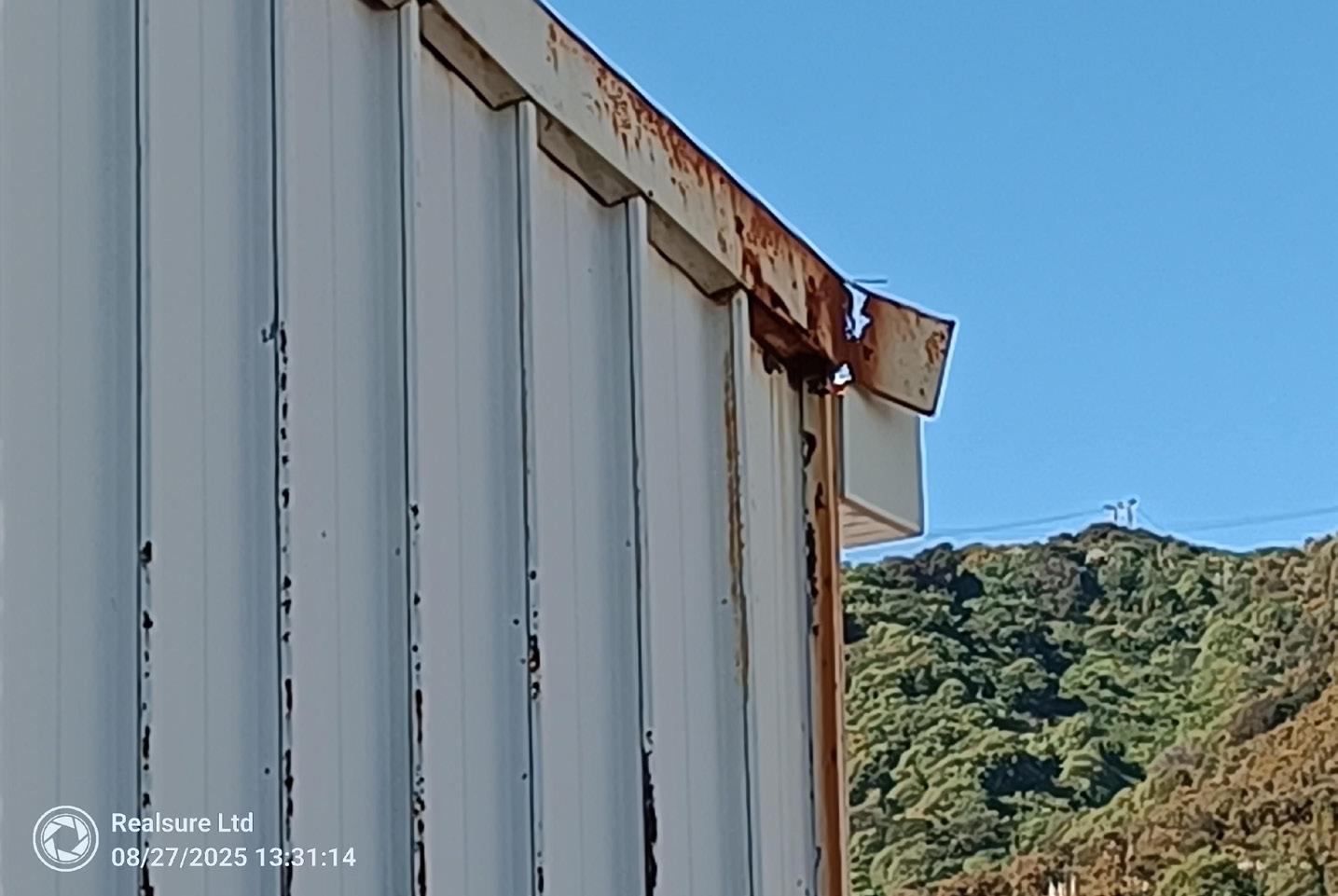
For example, in the Waikato Peacocke development, Realsure - exclusively using ABS - was recognised as a valued partner for its role in conducting thorough pre - and post - construction property assessments. These inspections, complete with detailed reports, photos, and video, provided a transparent record of property conditions before and after worksprotecting both homeowners and councils.
This level of documentation has proven invaluable in resolving claims. In some cases, it has helped demonstrate that damage claims were unrelated to infrastructure works, instead showing normal structural movement. In others, ABS inspections have uncovered previously undocumented foundation issues by other operators, giving homeowners the evidence they needed to seek proper redress.
The Accredited Building Surveyor network is therefore an extraordinary resource for councils and developers undertaking major works. But it doesn’t stop there. Think: Dilapidation surveys, Condition surveys, Construction Monitoring, Construction Defects surveys, and - through Level 3 ABS members - COA and CCC oversight and assistance.
By engaging ABS professionals, clients can be confident that properties are assessed against recognised standards or specifically designed processes and reporting, protecting projects from unfounded future claims while providing reassurance to affected communities.
Importantly, accreditation sets these surveyors apart in an industry where unqualified operators - the “cowboys” - remain a real risk. Unlike untrained inspectors, ABS members adhere to established processes, consistent reporting templates, and professional standards, all backed by BOINZ. There are also ABS members who hold accreditation, along with diplomas, degrees, and council backgrounds, equipping them to assist on complex matters such as Code of Acceptance (COA) and Code of Compliance (CCC) issues.
For anyone involved in propertywhether purchasing, developing, property managing, or managing infrastructure projectsAccredited Building Surveyors can provide sound information and services through their expertise, professionalism, and the credibility of a recognised accreditation programme.
By Sarah Symon Realsure – BOINZ Multi-Excellence Award Winners.
Carving a Career with Purpose: Sally Grey at the BOINZ Women’s Forum
At the recent BOINZ Women’s Forum, Sally Grey, Manager Premium Building Consents at Auckland Council, shared a candid and inspiring reflection on her professional journey, offering guidance for women navigating New Zealand’s building sector.
Sally’s career spans law, corporate roles, and local government, and her insights underscored resilience, courage, and the power of meaningful connections.
Sally began her career as a lawyer in Wellington after completing her law degree at Otago University. She recalled her first District Court plea—an experience that taught her the importance of thorough preparation and asking the right questions. She then undertook a four-year OE in London, working in banks and gaining local government experience with Southwark Council, before returning to New Zealand to pursue in-house roles at Repco and Vodafone.
A pivotal chapter came at Auckland Council, where Sally managed weathertight claims for eight years. Handling over 300 claims annually, with mediations often running late into the night, required resilience and strong communication skills. She also highlighted the need for team support, including counselling for secondary trauma fatigue. These experiences shaped her understanding of the real-life impact of defective housing and the importance of systemic reform.
Transitioning to building consents, Sally now leads a diverse team at Auckland Council. She emphasized the critical role of curiosity, technical literacy, and critical thinking in navigating complex challenges—skills she believes are vital in an era of rapid technological change.
Sally shared key lessons from her journey. She encouraged attendees to say yes to opportunities, even when daunting, citing her work on the financial assistance package
under the weathertight homes reform, mentoring students, and serving on the Building Advisory Panel as examples of transformative experiences. She also stressed the importance of speaking up, maintaining integrity, and cultivating strong professional networks. This is where she is a strong advocate of getting involved with BOINZ and attending events such the Symposium and BCA Leaders Forum.
Balancing career with personal life, Sally reflected on the pressures women often face to “do everything.” She advocates for strategic choices aligned with personal priorities, emphasizing the value of family, friendships, and work-life harmony.
Her guiding principle, she shared, is simple yet powerful: “He tangata, he tangata, he tangata”—“It’s the people, it’s the people, it’s the people.”
Relationships, mentorship, and collaboration remain at the heart of professional and personal fulfilment. Sally’s talk offered both a roadmap and an inspiration: with courage, curiosity, and strong connections, women can carve purposeful careers, make meaningful contributions, and thrive in the building industry.
By BOINZ
Managing Complaints Against Independent Qualified Persons
The South Island Independent Qualified Persons (IQP)
Registration Panel plays a vital role in maintaining the integrity and reliability of building compliance across the region. A key part of this responsibility is managing complaints against IQPs registered on the South Island IQP Register.
Maintaining the integrity and professionalism of IQPs is essential to ensuring public safety and trust. The South Island IQP Registration Panel now has a new robust complaints process in place to address concerns about the conduct or performance of registered IQPs.
The process hadn’t been reviewed or updated since the creation of the South Island IQP panel, and the Panel as part of its review of all its processes decided to update the complaints procedure for the following reasons.
Protects Public Safety - In fields like building compliance, poor performance or misconduct by an IQP can pose serious risks. A strong complaints process ensures that concerns are addressed swiftly and appropriately to prevent harm.
Ensures Fairness and Transparency
A clearly defined procedure:
• Treats all parties equally
• Provides a structured opportunity to present evidence
Avoids bias or arbitrary decisions
These builds trust in the system and its outcomes.
Maintains Professional Standards
- By investigating and addressing misconduct, the Panel reinforces expectations for ethical and competent behaviour. This helps maintain the credibility and reputation of the IQP profession.
Encourages AccountabilityIQPs know they are held to a
high standard and that there are consequences for breaches. This promotes diligence and integrity in their work.
Builds Public Confidence - When stakeholders—building owners, councils, and the public—see that complaints are taken seriously and handled professionally, it strengthens confidence in the regulatory framework.
Provides a Path for Improvement
- Outcomes like training requirements or warnings can help IQPs learn from mistakes and improve, rather than simply being punished.
What is a complaint - Complaints may arise from concerns about an IQP’s conduct or performance in relation to their duties under the Building Act 2004. Grounds for complaint include but not limited to:
Breaches of professional standards
Misrepresentation or negligence
Failure to comply with regulatory requirements
• Been convicted of an imprisonable offence
Breached the Panel’s Code of Conduct
Performed work they weren’t approved to carry out
Provided false or misleading information (including BWOFs and Form 12As)
Violated provisions of the Building Act 2004
Engaged in behaviour that renders them unfit to be an IQP
Any person or organisation, including members from Territorial Authorities (TAs), may lodge a complaint
What happens now - There is now clear guidance for all parties that will be involved in the complaint’s
procedure, these parties are People making a complaint
IQP who has a complaint made about them
• Territorial Authorities Panel members who will undertake the hearing
Navigating the Complaints Process: A Transparent Path to Accountability
Step 1: Lodging the Complaint
The journey begins with the complainant submitting their concern via the SI IQP Panel’s website, following the detailed guidance provided. This ensures that all necessary information is captured from the outset, streamlining the process for everyone involved.
Step 2: Initial Review and Information Gathering
Once received, the Panel’s Secretary conducts a preliminary review to check for completeness. If any details are missing, the complainant will be contacted for further information. When the complaint is deemed complete, the Secretary requests a formal response from the IQP (Independent Qualified Person) involved. All relevant documentation, responses, and summaries are then compiled into a comprehensive report.
Step 3: Preliminary Assessment
This report is reviewed by the Secretary, Chairperson, and Deputy Chairperson to determine whether the complaint warrants further action. At this stage, some complaints may be dismissed for reasons such as:
Lack of concrete evidence (e.g., hearsay without substantiation)
Non-governable disputes (e.g., payment disagreements outside the Panel’s scope)
Step 4: Organising a Hearing
If the complaint proceeds, the Secretary coordinates a hearing. This includes notifying all parties, selecting quorum members to hear the case, and distributing the case brief. The hearing provides a formal platform for both sides to present their arguments, submit evidence, and call witnesses.
Step 5: Decision and Penalty
After hearing the case, the quorum members deliberate and reach a decision. If the complaint is upheld, both parties may be invited to suggest appropriate penalties. The Panel then reconvenes to finalize the penalty and communicates the outcome to the respondent.
Step 6: Appeals and Publication
In certain cases, the respondent may appeal the decision. Once the appeal window closes, the final outcome is published in the Panel’s newsletter and recorded in the IQP’s file, ensuring transparency and accountability.
A Commitment to Fairness
The SI IQP Panel’s complaints process reflects a commitment to fairness, professionalism, and continuous improvement. By providing a clear and structured pathway for addressing concerns, the Panel reinforces its role as a guardian of industry standards and public trust.
By Adam Grice - SI IQP Panel Deputy Chairperson
Leaders of Learning in Changing and Challenging environments
Contemplating the moving landscape in building controls and surveying, it struck me that our leaders of learning matter more than ever as we work through regulatory, organisational and practice changes.
Leaders of Learning
In every industry, progress depends on people who not only master their craft but also share their expertise in ways that elevate others. In the world of building controls and surveying, these people are the leaders of learning. They are the individuals who inspire colleagues and learners, shape professional practice, and ensure that knowledge is translated into safer, more compliant, and more sustainable environments. Their work influences not only organisations, but also communities that rely on buildings to be safe, efficient, and fit for purpose.
A leader of learning is not defined by their job title. They may be a building control officer in local government, a compliance manager, a mentor or capability supporter within your team, or one of our experienced BOINZ trainers. What sets them apart is their ability to connect deep technical knowledge with a sense of purpose. In the context of building controls, this often means making complex regulatory requirements understandable, supporting others to implement them consistently, and ensuring that safety remains at the heart of decision-making. Leaders of learning bridge the space between legislation and daily practice, helping their colleagues or learners see that compliance is not just a tick-box exercise, but a vital safeguard for communities.
Inspiration and Guidance
Inspiration is central to this role. Leaders of learning show others that building controls
and surveying work is not only about enforcing rules but about protecting people’s wellbeing. Every inspection, every standard, and every decision contributes to creating safe and healthy environments where people live, work, and learn.
Guidance is another hallmark of leadership in learning. Regulations are complex, and ensuring they are consistently understood and applied requires more than technical skill—it requires empathy, clarity of communication, and patience. Leaders of learning support others to navigate this complexity, whether through offering formal training like BOINZ courses, structured team mentoring, or by fostering cultures of open dialogue. Experienced officers and our BOINZ trainers alike play a crucial role here— providing clarity, reinforcing consistent practice, and building the confidence of others to apply regulations in real-world contexts.
The Qualities That Matter
True leaders of learning are distinguished not just by what they
know, but by how they lead. Some of the qualities that define them include:
• Empathy – understanding the perspectives of colleagues, trainees, and the public, and guiding with respect.
Leaders of learning bridge the space between legislation and daily practice, helping their colleagues or learners see that compliance is not just a tickbox exercise, but a vital safeguard for communities.
• Adaptability – staying flexible and responsive in a fast-changing regulatory and technical environment.
• Humility – recognising that no one has all the answers, they are always learners themselves and willing to listen and learn from others.
• Collaboration – building trust and strong working relationships to achieve shared goals.
• Clarity of communication –making complex ideas simple, practical, and usable in day-to-day decision-making.
• Patience – supporting others to grow their confidence and competence, even when challenges take time to resolve.
By modelling these qualities, leaders of learning make their influence authentic, practical, and lasting.
Innovation and Shared Responsibility
Innovation is also a defining feature of leaders in building controls. As the industry evolves, new technologies such as digital monitoring systems, smart compliance tools, and energy-
efficient solutions are transforming how buildings are managed and assessed. Leaders of learning embrace these advancements, helping colleagues or learners see them not as hurdles but as opportunities to improve both safety and sustainability. Trainers, in particular, are often the first to introduce these innovations, ensuring officers are confident and capable in applying them to practice.
Most importantly, leaders of learning foster a culture of shared responsibility. They understand that ensuring compliance and safety is not the job of one individual but of an entire system working together. They create spaces where knowledge flows freely, where colleagues feel confident to ask questions, and where continuous professional development is valued. This culture ensures that standards are upheld consistently, and that innovation is pursued without compromising people’s wellbeing.
Building the Future Together
Ultimately, leaders of learning in building controls - whether trainers
or building control officers -shape far more than regulations and systems; they shape experiences. They safeguard communities by ensuring buildings are safe, healthy, and compliant, while also paving the way for smarter, more sustainable solutions. Their legacy is not only in the standards they uphold but in the people they inspire to carry those standards forward.
For those working in building controls, becoming a leader of learning is both a responsibility and a privilege. It means sharing knowledge generously, championing compliance as a pathway to safety, and inspiring others to innovate with integrity. Above all, it means recognising that every regulation, every inspection, every training session, and every improvement serves a greater purpose: protecting lives and building a safer, more beneficial future for our communities.
By Kirsty Wallace Professional Development Manager BOINZ
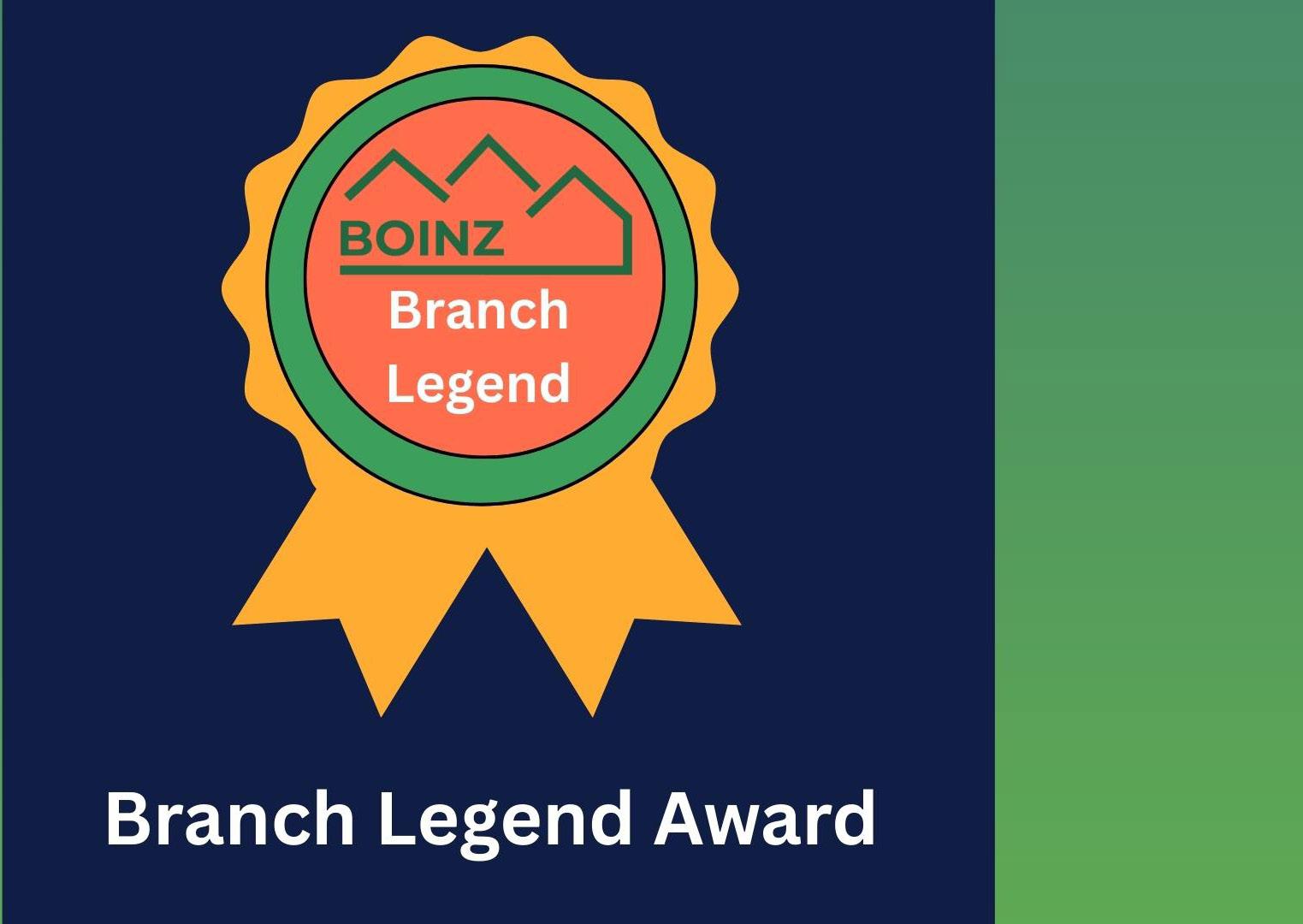
Branch Legend Award
The Building Officials Institute of New Zealand is proud to announce an exciting new initiative to recognise and celebrate the exceptional contributions of our members – the Branch Legend Award
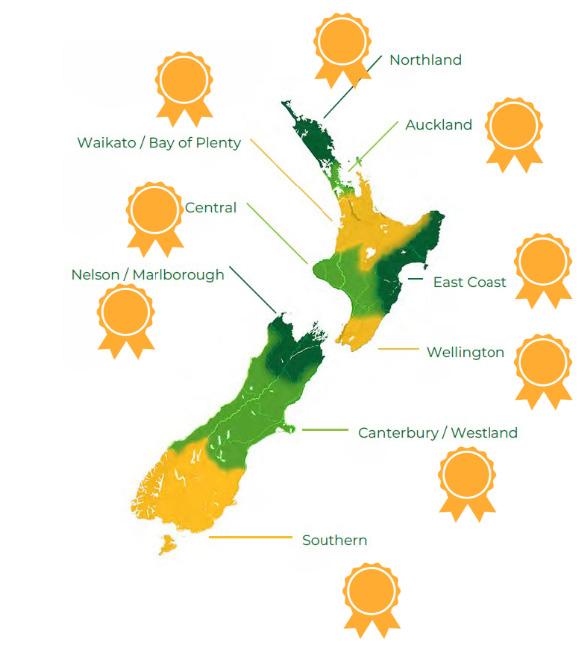
Every year, branches across the country come together at the year’s end to reflect on achievements, connect with colleagues, and enjoy some well-earned downtime before the Christmas break. These gatherings often include fun activities, and a chance to celebrate the people who make our sector stronger. This year, we are thrilled to add a new highlight to these events: the opportunity to honour a local legend within each branch.
The Branch Legend Award has been created to celebrate members who go above and beyond in supporting their peers, driving innovation, or making a meaningful impact in their community or branch. The criteria are intentionally broad, allowing each branch to recognise someone who has truly made a difference - whether through technical excellence, innovative thinking, community involvement, or simply being a reliable and supportive colleague.
Nominations will be submitted by
Nominate a member of your branch - recognise those who have made a difference.
branch members, with the Branch Chair and Secretary tasked with selecting the winner. Once chosen, the recipient will be notified and invited to attend the end-of-year function.
Thanks to the support of our sponsors Simpson Strong Tie and ACRS, each award will be presented at the final branch meeting of the year, and Award winners will be presented with a special Branch Legend Pin and a framed certificate to mark their achievement. Beyond this, they will enjoy the acknowledgement of their peers and the wider Institute, with coverage of winners included on our website and communications.
Nomination forms will be circulated through Code Talk later in the year, and final decisions will be supported by the National Office.
This initiative is more than just
an award - it’s about celebrating the people who make a difference every day. We can’t wait to see the first group of Branch Legends recognised at the end of this year.
By BOINZ
Decades of Proven Performance – Now CodeMark Certified
We are proud to announce that Volclay is now CodeMark certified, further strengthening its position as one of New Zealand’s most trusted waterproofing systems, giving specifiers, contractors, and building owners even greater confidence that Volclay not only performs in the field but also meets the industry’s most rigorous standards.
For over 50 years, Allco has been trusted across New Zealand as a supplier of high-performing waterproofing membranes. Our Volclay range for below-ground waterproofing is recognised as bestin-class and has become the go-to solution for vertical foundation walls, horizontal decks, and slab applications. Used in thousands of projects across New Zealand and more than 30 countries, Volclay consistently delivers durability, reliability, and long-term protection.
This reputation has been built on the unique self-sealing properties
of sodium bentonite forming and its capacity to form a barrier against water ingress. Easy to install, resistant to harsh weather and with an outstating performance track record, Volclay is trusted by architects, engineers, façade specialists, and contractors alike.
A Complete Roofing Range –Also CodeMark Certified
Alongside Volclay, Allco offers a full range of roofing membranes and systems designed to perform in New Zealand’s demanding conditions. Our portfolio includes our Casali Bitumen membranes our JM TPO membranes and Hydrotech hot melt system. Each of these solutions is also CodeMark certified, reinforcing our commitment to durability, moisture protection, and safety at the highest level of compliance.
Unique to Allco’s range, the Hydrotech hot melt membrane is
zero-degree fall certified, allowing for greater design flexibility, enabling architects and engineers to explore innovative roofing solutions without compromising compliance or performance.
Whether you’re looking for durability, energy efficiency, or design flexibility, Allco provides a system to suit every roof type and project scale.
Support at Every Step
We also know a membrane is only as effective as the system and expertise behind it. That’s why we provide comprehensive technical support, design assistance, and a nationwide network of approved applicators. From concept to completion, our team ensures every project is delivered with confidence and excellence.
By Allco
New CPEng Field: Asset Management Engineering
The Registration Authority has formally introduced a new Chartered Professional Engineer (CPEng) practice field: Asset Management Engineering.
Why a new field?
Asset management is not new in New Zealand. It has long been a core part of infrastructure stewardship, guiding investment, maintenance, and renewal decisions. But until now, there has been no distinct way to recognise those engineers who practise asset management at the most complex technical level.
The new CPEng field addresses this gap. Asset Management Engineering is defined by deep technical expertise – from understanding material behaviour, structural performance, and system interdependencies, to applying digital asset systems and lifecycle risk analysis. It is engineeringled and evidence-based, with an emphasis on long-term sustainability and resilience.
Standards and assurance
Registrants in Asset Management Engineering must meet the same
rigorous assessment and continued registration requirements as all CPEngs. This includes holding a Washington Accord qualification (or equivalent) and demonstrating ongoing professional competence through regular reassessment and continuing professional development.
The field is guided by internationally recognised and locally relevant standards such as ISO 55000, the International Infrastructure Management Manual, and the Āpōpō Guide, ensuring that practice in New Zealand remains aligned with global best practice.
How it differs from other credentials
This is not a general asset management certification. It has been designed specifically to recognise engineers with advanced technical competence in asset management decisionmaking. Broader credentials, such as Āpōpō’s Asset Management Chartered Professional (AMCP), remain valuable for non-engineers and those in asset management roles without an engineering focus. The two are complementary rather
than overlapping.
What it means for BCAs
For BCAs, the practical benefit is confidence. When an engineer provides input on long-term asset strategies or signs off on renewal decisions, you can be assured their competence has been independently assessed and benchmarked to a recognised professional standard. This strengthens the credibility of producer statements, reduces uncertainty around engineering judgement, and supports more robust consent decision-making.
Learn more at www. registrationauthority.org.nz/ engineering-practice-fields or contact Registrar@engineeringnz. org.
By Engineering New Zealand
Steel framing under the NZ Building
Code: clear pathways for resilience and
sustainability
Why this matters now
Local authorities are seeing more designs that put resilience and low-carbon performance front and centre. Light-gauge steel framing (LGSF) gives designers and builders a familiar stud-and-lintel system with factory precision, consistent quality, and straightforward documentation for consent and inspection. Benefits include high strength-to-weight, dimensional stability, fast installation, and moisture-robust construction.
Compliance pathways in practice
Design documentation that sets out loads, bracing, durability, fixings; plus, shop drawings when frames are manufactured off-site.
Producer Statements (PS1/PS2 where used) and quality records from certified fabrication.
On-site verification that fixings, corrosion protection and linings match the consented details.
• As-built / PS4 to confirm the work has been executed per the consented design.
NASH provides standards and technical guidance for light-gauge steel framing that align with NZBC performance requirements and help streamline consent, inspection and Code compliance sign-off.
Resilience: seismic, fire, durability
Seismic: Steel frames deliver predictable, ductile behaviour with excellent strength-to-weight, reducing mass while maintaining stiffness.
Fire: Steel framing is non-combustible and does not contribute fuel to a fire. Strength loss begins at elevated temperatures, which—combined with appropriate linings and details— supports robust passive-fire strategies in higher-occupancy buildings.
Durability: Steel will not warp, shrink or support mould growth; appropriate corrosion protection and environmental classification complete
the durability story for B2.
Sustainability and embodied carbon
Recyclability and material efficiency: Steel is highly recyclable; factory-made frames minimise waste and rework.
EPD-backed transparency: Using Environmental Product Declarations (EPDs) enables designers and clients to quantify upfront (embodied) carbon and document choices in specifications and submittals.
Local decarbonisation pathway: New Zealand Steel’s transition to an Electric Arc Furnace (EAF) improves the emissions profile of locally produced steel, strengthening the case for low-carbon, locally supplied framing and components over time.
Thermal detailing: With appropriate thermal-break details and junction design, LGSF can help meet H1 energy-efficiency outcomes while preserving buildability.
Data & documentation (Build 206 alignment)
For embodied-carbon evidence, reference New Zealand’s upcoming National Embodied Carbon Data Repository as your first port of call. It will provide open, NZ-relevant EPD/ LCA data with regular updates and a transparent quality-scoring approach. When citing product data, prefer EPDs that: are publicly available and NZ-relevant, with manufacturing scope to A4. have a certified independent third-party review compliant with ISO 14025 and relevant PCRs/GPI. exclude offsetting in reported emissions.
Using repository-aligned data makes consenting, client reporting and Green Star documentation more consistent and verifiable.
Buildability and site outcomes
Speed and predictability:
Off-site fabrication and accurate, straight-to-site framing reduce programme risk and site labour. No waiting for timber moisture conditioning; frames arrive dry and dimensionally stable.
Safer handling: Components are lightweight for lifting and placement, which helps on constrained or multi-storey sites.
What inspectors typically look for (quick checklist)
E2/Weathertightness: penetrations, flashings, sills, and cladding fixings to steel.
On-site install frame plumb/ straight, fixing patterns, bracing panels and hold-downs per drawings.
Close-out: PS4 (where applicable) and any required as-built notes.
Bottom line
For councils and BCAs, LGSF offers clear documentation, consistent quality, and credible sustainability evidence through EPDs. For builders and clients, it brings programme certainty, resilience, and durable performance. If helpful, NASH can provide a short reference pack (checklists, example details, and EPD sign-posting) to support your communications and technical guidance.
By NASH (National Association of Steel Housing)
NZ Standards announces free guidelines for residential solar Installation
EECA has supported the development and release of a new Publicly Available Specification (PAS) that gives Kiwi homeowners a clear, practical guide to choosing and using solar energy and battery storage at home.
SNZ PAS 6014:2025 Residential solar photovoltaic (PV) and battery storage systems provides useful advice for:
Homeowners, on different solar and/or battery system types, choosing one appropriate to your needs, how they interact and how they sell surplus electricity back into the system.
• For suppliers and Installers, to clarify the compliance landscape for different solar PV systems and outline their legal responsibilities.
• And for wider Industry to highlight how solar technology supports a more resilient and balanced electricity network, unlocking new business opportunities and enhancing energy security.
Sponsored for free access by the Energy Efficiency and Conservation Authority (EECA), the new PAS helps people make smart, safe decisions about solar power, whether they are just starting to explore options or ready to install a system.
Developed by a committee of industry experts and drawing upon international good practice, the guidance is all about making solar simple and empowering households to feel confident about investing in solar, through trusted information about what works best for their home, how to stay safe, and how to get real value for money.
Standards New Zealand’s Principal Project Manager who oversaw production of the PAS, Chris Forsman says, ‘EECA have provided a range of publicly available specifications, free guidance for consumers and industry professionals, that help end users save not just energy but importantly money. PAS are a type of non-mandatory guidance that, like standards, still uses industry experts to develop content, still uses a consensus approach to make sure it works for a broad user base and represents all the right needs, but are much quicker to produce\. They allow good practice
to get out there quickly to help shape rapidly developing markets and can help bring about positive change and adoption of new technologies.’
What's covered?
The PAS covers everything from how solar panels and batteries work, to choosing the right installer, understanding your home’s energy use, and getting the approvals needed to connect to the grid.
Installation
The PAS also stresses the importance of professional installation. Solar systems must meet New Zealand’s strict safety standards, and installations must be approved by local electricity distribution companies. Unsafe systems including DIY setups and illegal plug-in panels can cause electric shocks, fire risks, or even result in being disconnected from the grid.
Another key factor is understanding how your home is wired. Many homes in New Zealand are connected via a single phase, but some have multiple phases. The type of inverter you install needs to match your setup and if it doesn’t, you could lose out on savings. The PAS explains why getting this right from the start is essential.
Storing vs selling power
It also explains why using your own solar energy on-site is usually more valuable than selling it back to your power company, because what you’re paid to export power is often much lower than what you pay to buy it.
While adding a battery may be costly, they allow you to store power for use later in the day or during power cuts, increasing both energy resilience and independence. Pairing a well-sized solar system to generate energy and a battery to store that energy, can keep essential appliances like lighting, refrigeration and medical devices running even when the grid is down.
New Zealanders can access a singleuser PDF available exclusively from Standards New Zealand: https://www.standards.govt.nz/shop/ snz-pas-60142025
Helping New Zealanders shift towards energy resilience
Minister for Energy and Climate Change Simon Watts, welcomed the new PAS in an address recorded for the SEANZ/Sustainable Energy Association of New Zealand Conference 2025. He acknowledged the role the guidance can play in reducing barriers for many homeowners and how distributed generation is a key part of New Zealand’s future energy mix, to support local resilience and emission reductions:
‘Historically, the uptake of solar technology in New Zealand has faced several challenges — including high upfront costs, complex financing options, and a lack of clear, independent technical guidance that’s easy for everyday homeowners to understand
This PAS directly addresses some of those barriers by providing clear technical guidance for homeowners and industry, and identifying options for affordable solar solutions where possible. Developed collaboratively by Standards New Zealand in partnership with industry experts, academic institutions, and government regulators – the guideline offers robust, impartial advice.’
Part of a suite of technology and energy-saving guidance
The guidance complements EECA’s other range of tools and research to help assess the benefits of solar for your home, including EECA’s Solar Power Calculator, which helps estimate potential payback periods and savings based on your location and energy use.
You can find the PAS, along with a range of other energy-reduction and technology incorporation related guidelines sponsored by EECA, here: https://www.standards.govt.nz/getstandards/sponsored-standards
By NZ Standards
Timeless Finish Enduring Quality
Driven to create surfaces that make a living environment durable, feel and look good to live in, we believe the tactile nature of plaster cladding is unrivaled.
The construction process contains many facets which when combined, and applied accurately make for a shining, and durable example of the construction process - from the clients needs, the Architecture, through to the selection of products, and the professional trades people that apply their skills.
At Resene Construction Systems we only promote tested & trusted products, all applied by LBP registered Plastering Professionals for each and every project.
Visit our website to discover more about our exciting range of facade systems, bespoke interior finishes, and construction products
Plastering Professional: Christian Jordan Plastering
INTEGRA lightweight concrete plaster cladding
TRIBOARD
BRACING PANEL VALUES // Framing as per NZS 3604
Triboard stands out as a premium wood solution with proven wall bracing values.
Triboard is composed of engineered strands orientated in such a way as to maximise strength and durability with an additional MDF fibre surface giving a smooth paint ready finish.
Certified uniform strength throughout its core gives Triboard Panels excellent wall bracing capabilities.
Triboard bracing information has been developed from tests carried out in the Timber Laboratory of SCION. For Triboard bracing details go to www.jnl.co.nz/product/triboard/ Brochures and Specs or scan the QR code.