STRAIGHT UP THE MAGAZINE OF THE BUILDING OFFICIALS INSTITUTE OF NEW ZEALAND
Summer 2019/20
THE STRUCTURE ISSUE
NEW X-FRAME
Waste-free building with an innovative clip-together modular design Quality, compliance and certification What to do when a truss is damaged Updates from MBIE Avoid back to work engine failure
CAREER GROWTH. ONLINE. www.boinz.org.nz
The new BOINZ Online Training Academy is now live and features brand new, accessible courses making your career development easy. New for 2020: Restricting Access to Residential Pools Complying with the Building Code Among the courses for development will be a refresher course series, along with CPD courses developed with our partnered organisations. Topical webinars and live Q&A sessions will also be available through our Online Training Academy For more info, visit our website www.boinz.org.nz or email Jason at training@boinz.org.nz 2
straight up | SPRING 2019
STRAIGHT UP THE MAGAZINE OF THE BUILDING OFFICIALS INSTITUTE OF NEW ZEALAND
our contributors Board President: Kerry Walsh
IN THIS ISSUE
Vice Pesident Peter Laurenson
From the Chief Executive
04
What's On at BOINZ
06
Administration: Chief Executive Nick Hill
Membership need a BOOST?
07
Finance Manager Deloitte Private
Spotlight on a Member - Liz Ashwin
10
Marketing and Events Manager Samantha Bryant
Making the most of your recruitment advertising
13
Education Advisor Jason Goei
Avoid back to work engine failure
16
National Accreditation Division Nicola Hakes
Solving skill shortages in Construction
19
Membership Relations Coodinator Henry Cassin
X-Frame waste free building
20
Design capacities - NZS3604
22
Advertising/Editorial Contractors Advertising/Editorial Please contact the Building Offcials Institute's National Office via office@boinz.org.nz
New houses emitting 5 times too muich carbon
24
ACRS steel certification
28
Design & Print no9.co.nz
MBIE Updates
34
ISSN 1175-9739 (print) ISSN 2230-2654 (online)
What to do when a truss is damaged
40
Legal + Straight Up Answers Q & A
38
Board Members Wayne Goodfellow Cory Lang Craig White
HR Division Manager Michelle Te Ohaere
Building Officials Institute of New Zealand PO Box 11424 Manners Street, Wellington Level 12, Grand Annexe 84 Boulcott St, Wellington Phone (04) 473 6002 Fax (04) 473 6004 Email office@boinz.org.nz
Your Board:
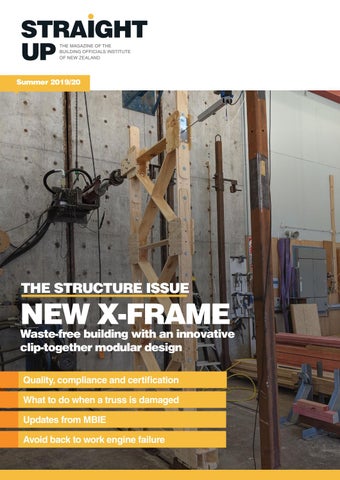
Front Cover: X-Frame earthquake load structural testing at BRANZ Supplied Kerry Walsh President
Peter Laurenson Vice President
Wayne Goodfellow
Cory Lang
Craig White
Nick Hill Chief executive
The information contained within this publication is of a general nature only. Building Officials Institute of New Zealand does not accept any responsibility or liability for any direct, indirect, incidental, consequential, special, exemplary or punitive damage or for any loss of profit, income or any intagible losses, or any claims, costs expenses, or damage, whether in contract, tort (including negligence), equity or otherwise arising directly or indirectly from, or connected with, your use of this publication or your reliance on information contained within this publication. The Building Officials Institute of New Zealand reserves the right to reject or accept any article or advertisement submitted for publication.
straight up | SPRING 2019
3
MESSAGE FROM OUR CHIEF EXECUTIVE
A warm welcome to 2020 and the start of a new decade.
Nick Hill - BOINZ Chief Executive
If you are like me, you came back to work having fasted (not), trying to remember passwords that only a few weeks ago were top of mind, and are still dreaming of sitting on the beach with a glass of your favourite tipple. Some of you will have made new year wishes (and broken them within days!), while others of you will be working on ideas to change some old and tardy work practices and systems. Whatever state of mind you have returned to work in, I trust you have had a chance to recuperate, charge the batteries, found some sun and slip slop slapped, and importantly enjoyed the break in respect of finding time to mingle with family and friends. As a community, Building Surveyors are driven by a sense of shared mission to pursue knowledge and translate it into meaningful solutions that deliver compliant and quality build outcomes to improve the lives of people that own and
4
live in our building stock. That’s why you are happy to be back at work and into the 9 to 5 groove. You are happily wishing all your colleagues’ welcome back messages, telling holiday yarns and erasing the lethargy of the last month’s leave. You are also committed to ending nonproductive long meetings and encouraging everyone to come prepared to contribute clearly and concisely. No more waffle. You know there is a first time for everything but are prepared to stand up and argue not to re-invent the wheel unless its broken. You recognise the next few years are going to be as busy as the last few. You are aware of the construction forecast figures which has total construction value at $4.3billion in 2021, and you know if you are in Auckland, residential activity won’t be plateauing like the rest of the country, it is likely to go gangbusters. You wish politicians would stop sending mixed metaphors and try and take on board the difference between resource and building consenting. That they understand the value of the building consent process,
that the blunt instrument argument of shorter consenting timeframes is not the solution to design, product and construction and build quality problems. Rather they value the process and resource it appropriately. You understand and see the need to a return of a dedicated and unique ministry or department that focuses on New Zealand’s Construction Industry, rather than the fragmented noncommunicative multiple silos that now exist within MBIE. You are desperate to see a building policy section that goes back to engaging with the sector rather than “communicating at” and importantly there needs to be a strong level of Tier 1 and Tier 2 support for re-employing technical competence, ensuring policy settings are well founded, and their implications understood. You are desperate to see long term vision rather than temporary reactive solutions to our design and construction woes. You comprehend that the skill set of a Building Surveyor in local government is highly valued and in short supply and that it’s about time local government jurisdictions recognised a drift of
straight up | SPRING 2019
skill to the private sector is in no one’s interest; given the private sector largely continues to take no responsibility for developing skills or careers. You know there is a fraught demand for training among your colleagues, and delivery of this will only increase efficiency and effectiveness while mitigating risk. So What Are Your Ideas? Over the years, it has been my privilege to serve the Institute through quiet, tragic and busy
times for the wider construction sector. Organisationally we are acutely aware of the pressures exerted upon us in these busy times. The strength of the Institute is in its membership, its ability to share ideas and knowledge. Collectively we should be part of a programme to lift the public awareness of our knowledge and skills. Members and the public often ask me: “What are you going to do? - What are your goals?” My response is, we have strategic goals and business plans which I share at branch meetings across the country, however
more importantly, I want to hear your ideas. What can we do – together – in the next year and beyond to develop powerful ideas and translate them into policies for a healthier built world? If you have done something, experienced something or have thoughts that will assist your fellow members I would be delighted to hear from you. We are so glad you are back, We missed you and look forward to the contributions of your noble character and hardworking spirit!
Building Officials Institute of NZ Annual General Meeting Notice The Institute’s 2020 Annual General Meeting will be held at the Grand Millennium Auckland, 71 Mayoral Drive, Cnr Vincent Street, Auckland, on Monday 18 May 2020 commencing at 3:45pm. Access to the 2020 AGM will be undertaken by the presentation of your current 2020 Membership Card, proving your current membership status.
AGM Timelines Notices of Motion to the Chief Executive to be received by 30 March 2020 (At least 48 days prior to the AGM) Notices of Meeting, agenda and any notices of motion to members by 20 April 2020 (At least 28 days prior to AGM)
Our Premier Partners
straight up | SPRING 2019
5
WHAT'S ON @ BOINZ
Training Academy Calendar January - March 2020
UPCOMING BRANCH MEETINGS *Subject to change; Branch meeting notices will be sent out closer to the time of the event with further details
January 23-24 Jan
E2 Weathertightness
Hamilton
30 Jan
NZHHA Solid Fuel Heating
Hamilton
31 Jan
As Near as Reasonable Practicable (ANARP)
Auckland
February
Auckland Branch 19 Februrary Central Branch 4th March
3 Feb
Communcation/Ethics
Christchurch
4-5 Feb
Services and Facilities
Queenstown
17-21 Feb
Plumbing and Drainage Compliance
Auckland
17 Feb
Earthquake Engineering
Queenstown
20-21 Feb
Fire Documents
Hamilton
21 Feb
D1 Access Routes/F1 Safety of Users
Dunedin
26 Feb
Communication/Ethics
Hamilton
28 Feb
NZHHA Solid Fuel Heating
Queenstown
Northland Branch 20th March Auckland Branch 15th April
March 2-3 Mar
Services and Facilities
Hamilton
5-6 Mar
Fire Documents
Queenstown
16 Mar
Light Steel Framing
Auckland
19 Mar
Difficult to Consent
Christchurch
20 Mar
Earthquake Engineering
Wellington
30 Mar - 2 Apr
NZS 3604 Timer Framed Buildings
Hamilton
31 Mar
NZHHA Solid Fuel Heating
Wellington
Southern Branch 13th March Auckland Branch 18th March
Check with your Branch Chair if your branch is not featured above.
Online
6
Any time
ONL01 Restricting Access to Residential Pools
Online
Any time
ONL02 Complying with the Building Code
Online
straight up | SPRING 2019
Need a BOOST? The world is changing, and we need to change with it. 1925 brought the first early television transmission, 1961 saw the first man in space, 1965 marked the birth of the internet. In 2000 we on barely survived Y2k, Facebook launched in 2004 and in 2007 the world was introduced to the iPhone. As we mourn the end of another decade, I am proud to bring you the next step in human evolution: the BOINZ BOOST+ App. Since August 2019, you will have heard all about the new and improved BOINZ Boost free app. This app has compiled everything ‘BOINZ’ into one handy place just for you. Daily, we have been making the most of supporting BOINZ membership with the app features such as accessing member discounts, staying up to date on upcoming Branch Training and Networking Events, Annual Conference, SBCO and Training Courses. We have had added instant links to the latest newsletters, copies of Straight Up, meeting minutes, general discussions, BOINZ Facebook page and timely industry related news. We have even had push notifications letting you know of the great changes coming to BOINZ without cluttering up your email inbox. All of this is done via the base version of the app which all members need to have. The app is completely free to download and is a resource available only to BOINZ members. Questions: So, what is BOOST+? Why is it better? Is it really as important as the birth of the internet? Answer: Yes to all three. BOINZ BOOST+ is our way of taking your membership discounts to the next level. This is not just another coupon book for you be cart around and forget about. This is a carefully curated list of discounts created for you and your lifestyle. Importantly, it saves you money. We’re all forgetful, much like I forget my reusable bag every single time I go to the supermarket and now own at least 60 of them. So too, do we safety tuck away our prized coupons just for them to be forgotten and have them expire without seeing it’s purpose fulfilled. The BOINZ BOOST+ App aims to eliminate this heartache from your life. Not only do our discounts not expire, but they can be used as many times as you could possibly want. We don’t want to limit you, or the ceiling of discount greatness you can achieve. Be a “savings phoenix” rising out of the ashes of your burned away coupon book.
straight up | SPRING 2019
7
All our discounts cover a wide area range of interests too. From fine dining, movies and entertainment, shopping, local services, car hires, to building supplies. Not only that, but you have these discounts specifically geolocated to where you are right now. This means that at anytime you can look at your phone and our app will point you to your closest saving. But don’t ask me, let’s see what these people think: “For me, the best part of this whole bargain is the simplicity. It’s so easy to search on my phone, find the closest place to eat, then when it’s time to pay I can show my phone to be scanned which gets me a nice saving to put towards meeting people and getting real quotes” - Me “It’s great!” Jason Goei “Easy to use, for a person over fifty! (Followed by the room laughing)” – Lynn Dick Have you ever been at a restaurant enjoying a fantastic meal, when only to find when you go to pay that you brought the wrong coupon? Or even worse, you forgot any coupon? What about when you go to pay but don’t want to be “that person” who hands over the slip of paper with a discount attached. The BOINZ BOOST+ App does away with all of those pesky nuisances. Load the app on your phone, show your phone to your server, they will scan it and done! So easy and simple, we truly have peaked as humans. The BOINZ BOOST+ App is available only to BOINZ members for $49 annually. Download the app, create a new account and register for BOOST+ anytime. If you have any questions, please don’t hesitate to contact me at 04 473 6002 or membership@boinz.org.nz
8
straight up | SPRING 2019
THE BEST WAY TO BOOST YOUR BOINZ MEMBERSHIP
BOOST YOUR BOINZ MEMBERSHIP WITH BOOST & BOOST+ Get more out of your membership with the new BOINZ mobile app. Stay up to date with easy access to our newsletters, Straight up, Jobs Board and BOINZ events calendar and access your favourite member discounts through the BOOST button on the homepage. It's free as part of your BOINZ membership.
Unlock even more discounts with BOOST+ With the new BOOST+ optional add on, we’ll put New Zealand’s favourite products and services in your pocket and make you feel like a VIP every time you need a BOOST. Sign up to BOOST+ for just $49 (*yearly subscription price) and you'll get access to over 450 extra discounts for dining, entertainment, travel, experiences and retail. Just click the BOOST+ button on the app and sign up to access these extra discounts for a whole year.
DOWNLOAD THE NEW BOINZ MEMBER APP NOW
straight up | SPRING 2019
9
SPOTLIGHT ON A MEMBER
Liz is a Building Control Officer in the Residential Processing Team and Christchurch City Council. We spoke to her about what she loves most about the industry, what got her to where she is, and her best advice for BOINZ members How long have you been working in Building Control? 6 and a half years. I have a Quantity Surveying background from the UK so I wanted to find a role where I could transfer my skills, and one that would be interesting. Kerry [Walsh] really sold the role to me and once I started, I knew I’d love it because of the opportunities for growth within the industry.
What brought you to New Zealand? My husband and I did our OE in our early 20s and we knew we had to come back. We got to the age where we knew it had to be
10
now – kids were young enough to move without too much disruption. We’ve been here 13 years and we love it!
What was your first job? The Quantity Surveying role in the UK. I started out with a cadetship at 18 as a Junior Site Quantity Surveyor in Bristol. Being one of the few women in the industry, I was often placed on refurbishment jobs so no new ladies toilets had to be built as existing facilities were already in place (laughs). But it meant that I got to work on a lot of old English heritage jobs in some stunning old buildings. I got to see what was behind some really old traditional and artisanal work.
What do you enjoy most about your current role? I have a real interest in the built environment. I get the chance to help people get the best out of their buildings. I actually love dealing with people – designers, the public. We work FOR the people so there’s always opportunities to create a positive experience for them. We have a good base to help them get exactly what they want out of a build.
"
Liz Ashwin
Being one of the few women in the industry, I was often placed on refurbishment jobs so no new ladies toilets had to be built as existing facilities were already in place.
"
straight up | SPRING 2019
What has been the highlight of your career so far? I was given the opportunity, throught BOINZ, to work with Standards NZ on a standards review. I learned a lot about natural building methods but also a lot about Standards NZ and the testing and processes in the background. I’m very proud of that.
What do you do outside of work? We have 3 kids and a dog - we’ve recently moved to an old villa in Christchurch. We’re nearly empty nesters so it’s our new project. We love living in the city now and learning about how the house was built and how to repair it.
How long have you been involved with BOINZ? Since I started – so 6.5 years. You
can’t be a colleague of Kerry’s and not be involved with BOINZ! (laughs). I enjoy the contact with other people in the industry outside of my immediate colleagues. The social
contact allows you to share knowledge. The networking is great!
What advice would you give to someone just starting their career in Building Control? Ask as many questions as possible; there’s no such thing as a stupid question. I was lucky to have a great mentor – Kevin Roberts – who had huge passion for the industry and was a life-long learner. He taught me that every day is a learning day. So, the advice I’d give is never stop learning. Ask questions and try to learn something new every day. There’s so much to learn, it’s an exciting industry!
KNOW SOMEONE WHO DESERVES THE SPOTLIGHT? If you’re interested in talking to us for future issues or you know of someone who is doing great work within the industry and deserves to have the spotlight on them, please email marketing@boinz.org.nz
Building Officials Institute of NZ
ACCREDITED BUILDING SURVEYORS 2020 COURSES 26-28 March 22-24 May 17-19 July 18-20 Sept 13-15 Nov
Christchurch Auckland Wellington Christchurch Auckland
Email accreditation@boinz.org.nz for info
NEW OPTIONS ON THE BOINZ JOBS BOARD NOW LIVE!
LISTING ONLY
SOCIAL + LISTING
30-day job advert posting, with your own business profile to upload and edit jobs easily and efficiently.
Everything from "Listing only" PLUS
• Most viewed webpage on our website • Only dedicates Building Surveying jobs board in the market
12
• Job shared on our Facebook and LinkedIn pages Effective way to reach a broader audience
$250 + gst
$275 + gst
DIGITAL + LISTING
CONNECTION + LISTING
Everything from "Social" PLUS • Job shared to our Monthly Update distributed to our 1250+ members • 300-word feature with links to your application page
Everything from "Digital" PLUS • "Stand Out" feature at the top of our jobs board Job posted at the top of our website’s homepage. • We will work with you to discuss your ideal candidates and directly contact anyone we know who fits the criteria
$325 + gst
$350 + gst
Email recruitment@boinz.org.nz for more info
straight up | SPRING 2019
HR DIVISION
Making the most out of your recruitment advertising We’re pleased to now offer our members, and their employers, a range of online recruitment advertising options, that provide you with the exposure you’re looking for, to make sure your listing is seen by the right people. Our four tiers of Job Board options provide you with a range of different advertising options, allowing for various social, digital and connection opportunities. Being creative in how you advertise your role will help it stick out from the crowd, and ensure you are doing everything you can to get your advert seen. Using our HR Division as your recruitment partner is the most obvious step in ensuring your recruitment campaign gains as much exposure as possible. Investing in quality staff means investing in your recruitment efforts to ensure you are in a position to attract the right kind of people for your team. We’re professionals and have the perfect communication channels to market your role for you. Email recruitment@boinz.org.nz for more information.
Behind the BOINZ HR Division In 2017 we established HR Division – a recruitment arm designed to specifically support the recruitment of building surveyors in New Zealand. We realised there was no better placed organisation to actively recruit on behalf of NZ’s councils. We know our people, we know our industry and we know the skills and knowledge required to do the job. We have invested time and money into HR Division to support and grow New Zealand’s building surveying
straight up | SPRING 2019
work force and provide recruitment advice and assistance to councils struggling to fill roles. We’re constantly in touch with skilled and qualified building surveying professionals, and assisting them to find roles in New Zealand.
Has it worked? So far, we have had a 100% success rate filling building surveying roles for councils where we have been contracted to recruit on their behalf. Several of these successful placements have been international candidates, who have brought with them into New Zealand invaluable skillsets and experience. These international recruits have now been working in New Zealand’s councils for over a year, contributing to our skill pool and essentially strengthening the quality of our industry. We’re proud of the role we’ve played in this.
Contact us today for more info We think we can be a real asset to your 2020 recruitment strategy. Get in touch to request an information pack. Let us know about any upcoming roles you’ll be looking to recruit for in the next 2 – 4 months, and we’ll get in touch with our recruitment plan. January is a busy month in recruitment so don’t miss the opportunity to work with a building surveying recruitment specialist, dedicated to working with you to support the skills and quality of your building control team. Michelle Te Ohaere – HR Division Manager Henry Cassin – HR Division Coordinator recruitment@boinz.org.nz 04 473 6002
13
CAREER
More Gain Qualifications Locally The Hurunui District Council is joining other local businesses in growing the number of career qualifications available in the Hurunui. The council is running two successful apprenticeships and launching a third in the form of a Building Officer Cadet role. The new Building Officer Cadet will be placed within the council’s building department. The role will include unit standards and on the job experience over four years – earning while learning. The successful cadet will finish with a National Diploma in Building Surveying and a solid start to any career in the industry. Kerry Walsh, the council’s Team Leader in Building Controls, explained the new role is the council doing its part to give a leg up to those starting a career journey and also support the industry. “Building officers are in very short supply New Zealand wide. It’s really important that we look at the bigger picture and do our part to put more qualified individuals out into the local industry,” he said. “It’s a great career and the cadet role offers job competency as well as the official qualification. In many instances we have taken people on from other related professions and trained them, now we are offering a qualification from the very beginning as well”. 14
This latest apprenticeship has followed on from two apprenticeships successfully running in the Three Waters Team (council’s water department). Riki Pugh from Cheviot and Ethan Dellaway from Waipara have been Utilities Officer Apprentices in the Three Waters Team since 2018. Their apprenticeships take 3 years to complete and involve remote learning and plenty of on the job experience. The result for these apprentices will be an industry recognised NZQA Level 3 Utilities Freshwater and Wastewater Qualification. When asked about his Hurunui based Utilities Officer Apprenticeship, Ethan Dellaway said he enjoyed working in remote locations around the district and meeting so many local people. He also explained it was great to find a qualification available within the Hurunui. “The first year and a half is about learning how the water schemes work and getting to know the district. The bookwork side of things came next and helps understand the theory as well” he said. “When I first saw the job I thought it was a great opportunity to be close to home and learn a useful trade”. Riki Pugh, also a Utilities Officer Apprentice, explained why he chose to do an apprenticeship. “For me, I felt it was important to learn by doing instead of sitting in a classroom full time,” he said. “I’ve really valued making a living while learning. It just seems like a big bonus to avoid a student loan and have found an employer that will support my study”.
straight up | SPRING 2019
NEW ONLINE COURSE: COMPLYING WITH THE BUILDING CODE Register now to secure the discounted launch rate of $99+gst
Email training@boinz.org.nz to register The Complying with the Building Code course is designed to increase; the understanding of the Building Code, the pathways to comply with the Building Code and to increase the efficiency of the building consent process, so that buildings are constructed that are safe to use. Check out the Online Training Academy page on our website for more info.
NZ Certificate in Building Regulatory Environment Level 4 (In-Employment Option) Future Skills Academy in conjunction with Otago Polytechnic, BOINZ and the Skills Organisation will be offering from mid-2020 an In-Employment programme for the NZ Certificate in Building Regulatory Environment Level 4. This 60 credit programme has been specifically designed to upskill administrative staff working within a Building Consent Authority (BCA) or a Territorial Authority’s building regulatory environment. It is also suitable for school leavers who have been offered a cadetship with a BCA. We anticipate the In-Employment version of the programme will be ready to go by mid-2020 and be offered in 4 locations around the country this year. There are 10 days of face-to-face classroom teaching planned and these will be arranged in 2-4 block courses. On-line learning and work place learning supplement the classroom block courses. ANTICIPATED PRICING FOR BCA & TA: $1500 plus gst for each BCA /TA staff member enrolled. Expressions of interest have already been received from some BCA keen to host the block courses. For further inquiries please contact Gill Franklin by email gill@futureskills.co.nz
straight up | SPRING 2019
15
BLOG
3 Keys Tips to Avoid Back to Work Engine Failure It’s easy to feel under powered when returning to work after a break, no matter whether it’s 3 days or 3 weeks. For some reason, it’s difficult to get the momentum up and the engine revving again! Often there’s resentment and frustration, your heart just doesn’t seem in it…and maybe random, out of control thoughts are starting to take hold in your mind; thoughts of taking it easy, getting out of the industry, or going back to just doing what you really like doing… and you find yourself questioning what you’re actually doing. This is quite normal after a break, after your system has had a chance to wind down a bit. And sure, it felt good to chill out with family and friends, with little care or worry other than what would you fire up on the BBQ for dinner or planning the day’s fishing, golf or family excursion. Here are 3 key ways to building up the pace required at work: 1. Accept you’re not going to get back up to full speed immediately Do you really want to be racing at that high
16
powered, high revving pitch straight off the starting line? Remember what it was like prior to your break…that top speed was probably creating over-corrections, burnouts, and blowouts! So, acknowledge and accept that it’s much healthier and better in the long run to get back into your desired pole position gradually…with plenty of practice runs in the first week or two to build up endurance and performance. 2. Plan your race with attention to the critical things Often your checklist of things to do is at this stage of the year is way too long for the start of racing. Cull out the items that aren’t going to make a difference on the track and focus on doing the activities/tasks that actually get you over the line. Too much to do and no real chance of completion is going to mess with your mind! And will only add to those feelings of “I’d rather be somewhere else”. Focus on the activities that will generate business quickly, to get you off to a good start. Make sure you focus on the people you need to meet with early in the year before everyone gets swamped with business, those who have a great impact on your bottom line, those who are in your
straight up | SPRING 2019
‘sphere of influence’, those people who make a massive difference to your work. Connect with them, arrange a catch-up date and build back those relationships as quickly as possible. 3. Remind yourself of your track record! Sometimes at the beginning of one year it’s easy to find last year has become a distant memory…the success you achieved, the way the team bonded and enjoyed the seasonal festivities together, the great compliments you received from satisfied clients and customers. Every time your mind starts to focus on what you’ve got to do or how much you’re responsible for, stop for a moment and take a couple of deep breaths and bring to mind one situation, one moment from last year, that gave you a lot of personal satisfaction. And notice how more relaxed you feel. Business can feel like an out-of-control race at any stage of the year. Remember that preparation is the key and being race-fit takes some planning as you get back in the driver’s seat. By preparing well and taking care of yourself particularly in these early stages, you can manoeuvre with more ease, more skill, as the pace picks up. This is paramount to avoiding any potential high-speed crashes throughout the year. “The time to repair the roof is when the sun is shining.” - John F. Kennedy
Linda Wells Author
STANDARDS NZ SHORTS Insulation standard now available for free download on Standards NZ website The healthy homes standards became law on 1 July this year. According to the Tenancy Services branch within the Ministry of Business, Innovation and Employment (MBIE), they introduce specific and minimum standards for heating, insulation, ventilation, moisture ingress and drainage, and draught stopping in rental properties. The insulation standard, in particular, received a lot of attention as the 1 July deadline drew nearer. This is because it sets the guidelines for ceiling and underfloor insulation, which became compulsory for all rental homes where it was practicable to install. Any insulation must comply with the regulations set out in New Zealand Standard NZS 4246:2016 Energy efficiency - Installing bulk thermal insulation in residential buildings and be safely installed. This standard explains the correct way to install insulation in an effective and safe way. It also includes guidance on what safety clearances are required from downlights, chimney flues, roofing and other objects. To make it easier for landlords to comply with these insulation regulations, Tenancy Services have sponsored this standard for free download since 2016. This lets anybody view and print a single downloadable pdf at no charge, with printed copies available to order from Standards New Zealand. The standard was previously located on the Tenancy Services website. However, the decision has been made to relocate it the Standards New Zealand website, where all other building and housing standards are situated. This includes the over 120 building standards sponsored for free download in early July 2019, together with all other building and housing standards. You can find NZS 4246:2016 Energy efficiency Installing bulk thermal insulation in residential buildings at www.standards.govt.nz
GOT SOMETHING YOU WANT TO SHARE? Send your blog articles or opinion pieces to marketing@boinz.org.nz to be featured. straight up | SPRING 2019
17
18
straight up | SPRING 2019
SKILL SHORTAGES IN CONSTRUCTION
Ongoing issue for Kiwi employers, it’s a challenge felt all over the country. The new Construction Sector Accord seeks to raise capability through partnership between industry and government and this can only increase the need for skilled workers. Looking overseas can be a useful source of labour but sponsoring migrant workers requires navigating the everchanging immigration process. As guardians of construction quality the Building Control Industry is no stranger to these challenges. New Zealand Visa Connections are a bespoke firm of Licensed Immigration Advisers who work to support employers and skilled job candidates; making the process easy and stress free. We are experienced at managing the entire process in a way which is efficient, thorough and supportive. Our specialist knowledge saves all sides from making costly mistakes and our expert forward planning benefits all parties when looking at the long term retention of skilled staff. Any work visa application is a two-sided project. Confirming the applicant has everything required is just half of the picture. It is vital that employers’paperwork is watertight too – it’s a common area where visa applications fail. New Zealand Visa Connections provide detailed support to employers, supporting them through the recruitment and immigration process, ensuring they can secure the best applicant for their vacancy.
straight up | SPRING 2019
Change is Coming for all The Immigration Minister recently announced sweeping changes to the work visa scheme. The impact of these changes will be keenly felt by employers. Shortly anyone wanting to hire migrant workers must first be registered, or accredited, with Immigration NZ. This accreditation application requires supporting documentation showing, for example, compliance with all relevant legislation, a commitment to upskilling and employing New Zealanders and other specific criteria yet to be announced. The next 12 months will be an important time for employers, who should begin preparing their business for successful accreditation applications.
How We Work Migrants We have extensive experience with work and residency visas and have supported many people in the construction industry to make NZ home. It’s a privilege to bring people to NZ who have the skills and experience needed to support our growing infrastructure. Our free assessment process checks your eligibility for a visa even before you have found the perfect job, allowing you to interview safe in the knowledge that the visa application will be a successful process. We work closely with you, your family and your employer to ensure your immigration applications are processed smoothly and quickly. We have great relationships with Immigration NZ and are skilled advocates. Link to free assessment page
Employers
Our free assessment process can work for you – we’ll work with BOINZ by checking your job applicants to make sure they can
get a visa; helping you shortlist and identify those candidates that can really fill the gaps in your workforce. We’ve successfully helped people come to New Zealand for years and are passionate about supporting employers to build their business with the staff they need. We really understand how critical it can be to your company. What can we do for Employers now? • • • •
• • •
List your details with us and we’ll keep you updated on new developments as they are announced Our free assessment process will let you know whether your candidate is eligible for a visa Use our urgent service if you need staff for a specific project or busy period Contact us if existing visa applications are experiencing problems with INZ, we can probably help. We can make requests for prioritisation too Got a general immigration question? We are always happy to chat – just call or email us Prepare you and your business for the accreditation process Set up policies and procedures now to ensure you meet criteria
Contact us for a free, no obligation chat or to ask a question about how immigration rules and changes will impact your business or migration plans - 021 026 32134 or admin@nzvisaconnections.co.nz
Helen Strange Licenced Immigration Adviser NZ Visa Connections 19
ECO-DESIGN
X-Frame for waste free buildings gets commercialisation boost
minimum of tools, akin to flat-pack furniture. Adding doors or windows at a later stage is simple, and when kids leave home: “they could literally take their rooms with them, as our modular design also clips onto standard framing.”
Clip-together modular building design can be rapidly assembled, disassembled and reused, eliminating waste during a building’s lifecycle
Dr James Hutchinson, CEO of KiwiNet, says: “Ged’s vision is to transition the building sector from a linear (take, make, dispose) economy to a circular economy— where materials are reused in endless cycles. His approach could set a new benchmark for sustainable design, and it makes great commercial sense. KiwiNet’s Investment Committee saw an opportunity to support Ged with expertise, networks and funding
Victoria University of Wellington PhD candidate Ged Finch is fast tracking the commercialisation of his X-Frame structural frame solution for waste free buildings with support from the KiwiNet Emerging Innovator Programme. The game-changing framing system can be disassembled and re-used at the end of a building’s useful life. Finch’s design, a self-braced interlocking wood design which clips together eliminating the need for single-use fixings, has the potential to eliminate waste and reduce the amount of raw materials being used by the building industry. Approximately half of all New Zealand's waste—about 1.6 million tonnes every year—is generated by
20
the construction sector. “The current widespread use of adhesive-based fixings and singlelife materials means that building a single new home will create about four tonnes of waste during construction, and even more when it’s eventually demolished and taken to the landfill,” says Finch. Finch, who has been working with Viclink, Victoria University of Wellington’s commercialisation office, also secured a place on KiwiNet’s Emerging Innovator programme to help commercialise the green architectural solution. Every single component of Finch’s X-Frame design, cut by a computer-controlled router, can be disassembled and reused, so no waste is produced at any stage of a building’s lifecycle. The clip-together design allows any type of structure—floors, walls, ceilings—to be rapidly assembled and disassembled many times over, using unskilled labour and a bare
straight up | SPRING 2019
to do specialised work required to demonstrate his ideas at scale, and to assist with the commercialisation pathway from concept to new architectural solution.” Finch came up with his idea during his Masters year and, under the guidance of Guy Marriage— Senior Lecturer in the School of Architecture—has taken it into his PhD (with additional supervision from Dr Antony Pelosi and Dr Morten Gjerde). Viclink has been an amazing support,” says Finch. “During my Masters, Liam Sutton—one of Viclink’s Commercialisation Managers—brought in an IP specialist to talk to me about how to protect my intellectual property and also connected me to a circular economy start-up funder.” Finch says Viclink introducing him to KiwiNet has had one of the biggest impacts to date as it has given him access to a great network of expertise and experience, his own business mentor and funding to further develop his product. “I’m using the funding to carry out specialised work required to finalise engineering designs for the earthquake resistant hold down fixings for the walls and interior,” says Finch. “KiwiNet’s support is also helping me to test the structural integrity and weather-
tightness of the X-frame product, both critical features for any future commercialised product. They’ve also arranged for me to meet with scientists from Scion who are developing natural adhesives from forest waste products and Auckland based company Fastmount which manufactures reusable clips that connect interior wall linings with the structure. These materials perfectly complement the X-Frame technology—the networking is the magic!” He says that even though X-Frame is innately earthquake stable because of its design geometry, independent structural testing is crucial in getting his product to market. His PhD scholarship funded by the Building Research Levy (BRANZ) is also assisting with the project, with additional funding also provided for structural testing of the prototype product. Finch is currently building a small (10m2) prefabricated prototype dwelling in Auckland to demonstrate his ideas at scale and to inform market viability. He believes the completed prototype will be New Zealand’s most sophisticated ‘circular’ building. Finch says, “This prototype build is a major step as it is the first time we will have built the entire wall system with cladding, cavity battens, insulation and an internal lining. Unitec Institute of Technology’s School of Architecture have helped out by providing robotic fabrication facilities to create the frame – which means we’ll be able to have the entire building water-tight in less than one week on-site. We’re cladding the assembled X-Frame in an entirely reusable, chemical free external cladding system centered around a naturally preserved timber product being developed by Abodo Wood Ltd.”
Advanced Building Skins (ABS) conference in Bern, Switzerland. He says this was recognition from the international building industry that major changes are needed to curb waste production. Finch says X-Frame could totally transform the way we think about buildings. “My ‘blue-sky’ objective is to build a housing development with a complete circular economy design—where all building materials can be quickly recovered at the end of a structure’s life and either efficiently recycled or directly reused without any negative environmental impacts.” The KiwiNet Emerging Innovator Programme is open to early career researchers based at universities, Crown Research Institutes and other publicly funded research organisations across New Zealand. Programme recipients receive expert legal advice from KiwiNet corporate partner MinterEllisonRuddWatts and IP advice from Baldwins, as well as funding from the Norman Barry Foundation, owner of the Quality Hotel Parnell Limited, K1W1 and PreSeed Accelerator Funding, from MBIE.
BOINZ ANNUAL CONFERENCE 2020 Ged will be presenting at the BOINZ Annual Conference on Sunday 17th May 2020 in Auckland. Registrations are now open! For more information on the technical programme and to register to attend, check out our website www.boinz.org.nz
Finch was recently invited to present his concept at the
straight up | SPRING 2019
21
DESIGN CAPACITIES
Fastener and Connector Structural Design Capacities – NZS3604 Previous editions of Straight Up explored the development of timber being used in Mid-Rise and Medium Density Housing (MDH) construction; essentially ‘expanding’ our NZS3604 based construction beyond the height limits of NZS3604. The article on pages 10 and 11 in the Winter (July) 2019 Straight Up provided some insight into the differences between NZS3604 and Mid-Rise/MDH buildings, and the complexities that are introduced when timber is used in taller structures. This included informative commentary on Anchor Tie-down Systems (ATS) and the need for heavier duty fasteners (screws) and connectors (brackets). While ATS components are inherently unique to timber structures beyond the scope of NZS3604, many fasteners and connectors that have been used for many years in NZS3604 buildings are now also finding their
22
way into taller timber buildings. Careful consideration must be given to the performance of fasteners and connectors that have been developed for and used in NZS3604 structures where these are now to be used in Mid-Rise buildings. Joint slip and fastener or connector deformation, often ignored in NZS3604 residential designs, can have a significant impact on the overall stability and performance of Mid-Rise buildings. As can incorrect comparison or application of Characteristic versus Ultimate design capacities or loads, and manufacturers and suppliers using appropriate test methods to determine structural component design capacities applicable to NZ.
Characteristic Capacities The NZ Timber Structures Standard (NZS3603) which is used by engineers to design timber buildings, includes methodology that manufacturers and suppliers of fasteners and connectors can use to determine Characteristic strength capacities. This methodology uses the Australian standard AS1649 as reference and provides an
estimate of the 5th percentile strength value; that is, 95% of the time a particular fastener or connector will exceed the published Characteristic capacity. But this does not give any consideration to joint slip or fastener/connector deformation at that load carrying capacity. Manufacturers often draw awareness to this with statements in product literature highlighting that considerable slip or deformation can be expected on some products at their Characteristic capacity. While this might be acceptable for NZS3604 buildings, slip or joint deformation must be considered in taller timber structures and hence characteristic capacity must have slip limits applied which the NZS3603 method does not.
Characteristic vs Design Strength Once a fastener’s or connector’s Characteristic capacity/strength has been established, this must then be factored by relevant modification factors including but not limited to the material strength reduction factor (ɸ) to account for the variability of performance in timber, being a natural and hence variable material, and the load duration factor (k1). The ɸ factor is 0.7 or 0.8 depending on fastener or connector type and load orientation, and the load duration factor (k1) can be 0.6 for long term
straight up | SPRING 2019
or permanent loads, 0.8 for medium duration imposed loads, or 1.0 for short duration loads such as wind. The ɸ and k1 (plus possible other modification factors) factored load then represents the Design Strength that the fastener or connector will resist in that specific application. So in simplified terms the Characteristic Capacity/Strength is a ‘generic’ capacity whereas the Design Capacity/Strength is factored for a given unique product application. For specific engineering design therefore the ‘generic’ Characteristic Capacities are more useful as designers can apply appropriate factors to suit the specific use the connections are being designed for.
NZS3604 Capacities However with timber traditionally being used primarily in residential construction, NZS3604 was created as an acceptable solution publishing common timber applications and associated connections. This design information is on the basis of the NZ Timber Structures Standard NZS3603 and applied loads as per AS/NZS1170, creating tables and design information for specific uses/ applications. Hence the connection capacities referred to in NZS3604 already reflect the factored Design Capacities as the intended use is known; that is the NZS3604 capacities already include the ɸ and k1 factors applied to characteristic loads. Manufacturers’ and suppliers’ Characteristic fastener and connector capacities therefore cannot be compared directly to connection Design Capacities published in NZS3604; • appropriate ɸ and k1 factors would need to be applied to Characteristic capacities before comparing adequacy against the capacities published in NZS3604, or • manufacturer or supplier capacities that have already been modified from Characteristic to Design
straight up | SPRING 2019
Capacities must be referred to. With the ɸ factor being 0.7 to 0.8 for fasteners and connectors in timber, and the k1 factor being between 0.6 to 1.0, if these factors are not applied before Characteristic capacities are compared with Design capacities the difference can be substantial; incorrectly comparing Characteristic with Design capacities could lead to connections being less than half of their required capacity in worst case scenario, and still only ~ 2/3 of the required capacity in most other cases.
are designed properly by accurately comparing and appreciating the difference between Characteristic and Design Capacities/Strengths. Particularly so as timber is pushed beyond the bounds of its traditional low rise residential NZS3604 based construction into taller timber Mid-Rise buildings. For further information or to arrange for a technical training session for your BCA staff please contact the author.
Dan Scheibmair Simpson Strongtie
Taller Timber Structures It is absolutely vital then to understand the importance of how Characteristic capacities for fasteners and connectors are determined including consideration of slip or connector deformation limits, and ensuring connections
ANNUAL CONFERENCE & EXPO 2020 16 - 19 MAY 2020
REGISTER NOW! VISIT WWW.BOINZ.ORG.NZ FOR MORE INFO
GRAND MILLENNIUM AUCKLAND
23
CARBON EMISSIONS
Study finds new houses emitting five times too much carbon
This story first appeared on newsroom.co.nz and has been republished with permission Researchers have calculated how much carbon dioxide a typical new three-bedroom home can afford to emit in its lifetime and still keep the world within 2C warming. The bad news is, New Zealand houses are five times over-budget. The good news is, we can fix it (probably). A typical new Kiwi home emits five times as much carbon dioxide as it can afford to, if the world is to stay inside 2C warming. A first-of-its-kind New Zealand study says housing must shrink its carbon footprint by 80 percent to do its bit to meet the Paris climate accord. The researchers say their findings are a relief. “I was actually surprised it wasn’t worse,” says Sarah McLaren, a carbon-budgeting researcher and
24
professor in life cycle management at Massey University, who helped lead the study. “Reducing to 20 percent of what we’ve got now, I feel it’s doable. If the target was a thousandth of what it is now, it would make you want to give up. This feels like a challenge that can be taken up,” she says. The study was supported by the Building Research Association of New Zealand, whose principal scientist, David Dowdell, also helped do the research. The study’s lead author was Chanjief Chandrakumar and BRANZ’s Roman Jaques also helped. Like McLaren, Dowdell found the results reassuring. “I totally agree. What it has shown us is that this is possible.” The researchers wanted to know how the carbon footprint of a typical, new Kiwi home compared to what an ideal footprint would be, one that’s compatible with the Paris 2C warming limit. The 2C cap was agreed by virtually all countries as a (theoretically)
realistic target that would avoid the worst impacts of severe ice melt, wildfires, drought, sea level rise, storm damage and food insecurity from climate change. Buildings are a big part of meeting countries’ emissions goals, since, globally, constructing and using buildings accounts for almost a third of greenhouse gases. Demand for new housing is expected to grow between now and 2050. But while most people know about the Paris goal, it can be hard to translate the broad 2C number into anyone’s daily life. A slew of studies are now working back from the target, to show people how it might apply to different aspects of their lives. McLaren and Dowdell say they wanted to show what doing our bit to stay within 2C could mean for New Zealand housing. Their study focuses on detached houses, since they make up 80 percent of our stock. New Zealanders tend to build unusually big and spaced-apart houses, which drives up their emissions. The typical Kiwi home
straight up | SPRING 2019
is a detached, one-storey, threebedroom dwelling with a 166 square metre floor area, the study says, and the size of a typical newlybuilt house is expected to grow further, to 198 sq m. To work out an ideal carbon budget for a new, New Zealand home, the researchers first took the total carbon dioxide that everyone in the world could emit by 2050 and still stay inside 2C warming. They divvied up the allowance by head of global population. They then took New Zealand’s national allocation, and divided this between different sectors. Although New Zealand’s overall emissions must shrink by 2050, the researchers assumed housing would maintain its current share of a shrinking emissions pie. They also assumed new housing and existing housing would maintain their respective shares of overall housing emissions. (Currently, about 34 percent of housing’s emissions are from newly-constructed buildings, versus 66 percent from existing houses, which greatly outnumber new homes). The researchers used projections of how many new homes would be built by 2050, the year by when New Zealand aims to be carbon neutral. They assumed new homes would be built to the building code, without climate-friendly add-ons such as added insulation or natural cooling. As well as counting construction emissions, they factored in the climate impact of the energy used inside houses for heating, lighting, cooking and plugging in appliances. After all this, they had a target: A typical newly-built detached house of 198 m2 in size could afford to emit 55,280 kg of carbon dioxide over its estimated 90-year lifetime. Since there aren’t 90 years left between now and 2050, each home was apportioned a share of
straight up | SPRING 2019
its lifetime budget to represent its emissions over next 30 years. How badly are today’s new homes blowing the ideal carbon budget? Using life cycle analyses of three typical new houses, the researchers calculated the footprint of a new detached house was about five times the limit. But the news was not all bad, McLaren and Dowdell told Newsroom. It’s true that the sheer size of an average new Kiwi house makes it more carbon-intensive than it could be – both to build, and to keep warm and comfortable. “It means more materials, it means more space that needs to be heated or cooled, and more to maintain,” says Dowdell. Yet the study showed New Zealand homes were at the low end internationally for their lifetime carbon emissions, thanks to a combination of a benign climate, at least in Auckland, and the fact New Zealanders have traditionally favoured using more wood and fewer bricks and concrete in their houses. Timber creates lower emissions than bricks and concrete during manufacturing and construction, with the added bonus that trees grown to make timber also suck carbon from the air. Compared with other countries, New Zealand homes also have the advantage of a largely lowemissions electricity grid, which cuts the climate impact of household power use and any locallymanufactured building materials. Energy use inside the home was the biggest portion of the footprint, closely followed by construction. Over the 30 years to 2050, construction emissions were almost evenly balanced with household energy, while, over the longer-term, household energy use dominated
the footprint, says Dowdell. “If you look over the 90-year life of a house, by far the largest contributor is the energy use in the house,” he says. “The two things contributing the most are plugloads, so the TV, dishwasher, fridge, washing machine, all those devices, and the other big item is heating of water. The next big one, depending where you are in New Zealand, is heating, and that’s more of an issue in Christchurch and Wellington than it is in Auckland,” Dowdell says. “After energy use, is construction. The materials have a large and immediate effect, because if you’re going to build a new house all the materials that go into that house are being manufactured within a short period of time and being transported to the construction site. So, if we look at emissions over the 30 years -- between now and 2050 -- for a house that’s being built this year, almost half of the emission will be the materials.” The study also looked at the carbon footprint of all housing, including existing homes. By coincidence, the housing sector as a whole was also about five times over the 2C budget. The researchers say that highlighted the importance of making existing homes more energy-efficient, as well as building better new ones. “There are things we can do quickly to get the carbon down,” says Dowdell. “The big one is the house size. There is a close relationship between house size and carbon footprint.” “Then, making houses more energy efficient, especially in places like Wellington and further south. Orienting our houses so they get good winter sun and making sure there is shading in summer, using good high-spec double-glazed windows that are well installed. Simple things like that don’t add much to the cost. They cut the
25
carbon, but typically we are not doing them in a routine way.” Dowdell acknowledged it would take more than those few simple things, to shrink New Zealand housing’s carbon footprint to 20 percent of its current size. But broader social changes would also help – bringing the electricity grid closer to being all-renewable, using an electric fleet of vehicles to move building materials, using better materials, and more energy-efficient appliances. Then there’s high density living -- a relatively new concept for many New Zealanders. “The trend is to higher density housing. There are some trade-offs there, in that as we start to build higher, we use material with higher embodied carbon such as concrete or steel. We need to do more work on that. But getting the size down and having higher density living also provides other carbon benefits in terms of allowing people to live in proximity to jobs and transport hubs. Can we start to plan (cities) in ways that are lower-carbon and higher density but give people the amenities they want? It’s a challenge,” says Dowdell. “Nobody is saying we all have to be in apartments, we can still have detached housing, but we need to find ways to do that that allows us to stay in our carbon budget.” The researchers plan to carry out similar calculations for New Zealand apartments, and terraced housing. McLaren says similar carbon budgeting methods can also be applied to other sectors, such as food production and transport, to help people grasp what committing to 2C might look like. For now, says Dowdell, having a housing carbon budget gives people working in building, design and construction a starting point to discuss. “Suddenly, there is a number there that people can relate to.” This story first appeared on newsroom.co.nz and has been republished with permission.
26
straight up | SPRING 2019
THE ACRS DIFFERENCE
üIndependent
ACRS is a steel certification scheme for steel users, and independent of product suppliers. So you know ACRS is working for you;
üExpert
All ACRS auditors and technical staff are qualified and experienced in the manufacture of the materials ACRS certifies. So with ACRS you know certified materials have been audited and approved by people who understand them;
üComprehensive
ACRS certifies all steel products, from all manufacturing locations to all scheme standards. So with ACRS you know all listed products are covered, not just some;
üRigorous
ACRS audits every major site at least once every year. So with ACRS you know certificates are up to date;
üVerified
During every audit, ACRS takes samples at random from standard production and checks production data every three-months. So with ACRS you know supplied materials are assessed regularly;
üContinuous
ACRS uses only selected laboratories to ensure accurate results independent of the supplier, and matches these with the supplier’s production data to monitor the supplier’s consistency.
www.steelcertification.com
Ph: (02) 9965 7216 | E: info@steelcertification.com ABN: 40 096 692 545 straight up | SPRING 2019
ACRS - Independent, Expert Third Party Certification & Verification of Reinforcing, Prestressing 27 and Structural Steels for Compliance with Australian and New Zealand Standards
COMPLIANCE: ACRS STEEL CERTIFICATION
Why and How to Use the ACRS Steel Certification Scheme for Conformity Assurance for NZ Construction Projects ACRS specialist certification gives the highest available level of steel certification. Following recent ACRS articles on the different types of certification available and the differences between certificates issued by different schemes, ACRS fielded questions from NZ Building Officials on how to recognise the differences, what the limitations are, and the risks of unverified acceptance of certificates offered from different sources. In this article Philp Sanders, CEO of ACRS answers some of those questions for Building Officials and certificate users.
Is ACRS the only JAS-ANZ accredited product certification body for steel to NZ Standards? Absolutely not. JAS-ANZ accredits many product certification bodies, and several of these are accredited to provide product certification to AS/NZS steel Standards.
So, can I accept any other JAS-ANZ accredited product certification body to NZ Standards? Yes, of course, but, as I said in my last article, “The extent to which … surveillance activities are conducted may be varied for a given situation as defined in the
28
[individual] scheme.”
OK, what’s the catch? JAS-ANZ accreditation of product certification schemes and certifiers does not mean JAS-ANZ is saying all schemes do the same thing, and provide similar outcomes, even if JAS-ANZ accredits them to certify the same products, to the same standards. The potential catch therefore is that whilst you can choose to accept any scheme you wish, you cannot say that any JAS-ANZ accredited product certification scheme, by definition, provides the same level of assurance as any other. That is, different schemes assessing the same product and process may: • do different things • to different technical levels, • using different levels of expertise • with different levels of rigour. So, on the face of it, different schemes and certificates might look very similar, but they may offer very different levels of assurance. Therefore, any specifier, or user of steel product certification must be confident that the certificate offered by the certifier, and scheme behind it, is giving you what you expect, and you should always check what
straight up | SPRING 2019
schemes and certificates are acceptable to the client – especially in government work.
I’ve checked ACRS scheme and it stresses two stages of certification are necessary, not just one. Why should I require both stages? A lot can happen before steel arrives on your project. So, you should look for both stages of ACRS certification so you have certification covering more than simply steel manufacture at the mill. One of the potential drawbacks of reliance on a single stage scheme, particularly if it is only for the mill of manufacture, is that such schemes usually cannot take into account what happens to the steel between leaving the mill and being dispatched to site. ACRS is designed to do more. ACRS has operated to the UK version of the EU certification system since 2001, and ACRS is unlike any other system in NZ and Australia. As such, the ACRS scheme assesses several important aspects of supply of steel to NZ construction projects:
and materials to update your preferred supplier lists.
Can I use welded section fabricator or rebar processor certification by another scheme if the supplier assures me they will only use ACRS “Stage 1” manufactured steel? As above, you can choose a scheme other than ACRS. However, ACRS does not cover material transformed by other “Stage 2” certifiers, as ACRS has not assessed and validated the fabricated product. ACRS has had to disappoint several enquirers who have discovered that steel was not ACRS Stage 1 certified and unable to be verified. Others found that the welded section fabricator, or mesh manufacturer could not demonstrate that ACRS Stage 1 certified materials were still compliant after fabrication, raising problems with sign-off. Be sure you check whether the steel supplied has both ACRS manufacturer (mill) certification (Stage 1) and then either ACRS rebar processing certification or ACRS structural steel welded section certification (Stage 2) to properly manage your risks of receiving nonconforming steel.
1. Steel manufactured to a specific standard (ACRS “Stage 1”), e.g. • • • •
Steel reinforcing bar Steel reinforcing wire Prestressing bar, wire, and strand Structural steels
Philip Sanders CEO ACRS
2. The subsequent working of ACRS Stage 1 steel into its final form (ACRS “Stage 2”), e.g. • • • •
Processed (fabricated) steel rebar, rebar threading and application of the coupler welded steel mesh manufacture structural steel welded sections from steel plate
3. The traceability of the steel between Stage 1 and Stage 2 to ensure integrity of supply, e.g. • ACRS Stage 1 and ACRS Stage 2 certificate holders must hold ACRS certificates for all their sites and for all their AS/NZS materials to demonstrate they can manage full traceability of conforming materials; • ACRS Stage 2 certificate holders must only use ACRS Stage 1 materials • ACRS Stage 2 certificate holders must demonstrate that their process does not render Stage 1 steel nonconforming Visit ACRS’ website at www.steelcertification.com for full details of all Stage 1 and Stage 2 certificate holders
straight up | SPRING 2019
ACRS is an independent, expert, not for profit steel conformity scheme set up for consumer benefit. Please contact ACRS, free of charge, if there is any aspect of steel specification, procurement, and supply that your team would like to discuss. All enquiries are confidential. Email info@steelcertification. com, or call +61 2 9965 7216.
29
Boss Gully Trap
The shortest boss around › uPVC – seamless integration into Marley OPTIM DWV System ®
› Just 199mm high – 20% shorter than standard uPVC option › Get the right fit and fall within shorter joist heights › AS/NZS 1260 compliant New Zealand patent application no. 753983, New Zealand design application no. 426078
INNOVATIVE
230mm 230mm
230mm 230mm
TRADITIONAL
BAD FIT
EASY FIT & FALL
LESS WORKAROUNDS | LESS TIME | LESS STRESS
30
straight up | SPRING 2019
COMPLIANCE
Local structural steel industry front foots compliance New Zealand’s structural steel industry has a strong track record of taking a constructive approach to the challenges it faces – the industry, led by Steel Construction New Zealand (SCNZ), actively works to find solutions to problems. Quality and compliance are particularly crucial to the health of our local construction industry, which is experiencing an unprecedented peak of activity, and SCNZ maintains a strong focus in this space. Local government engagement Compliance remains a key driver for SCNZ, which was behind our drive to develop a collaborative relationship with Auckland Council, whereby we regularly engage with the Council and its compliance team. From this, SCNZ drew up a five-page checklist for importing structural steel for councils to reference, detailing 38 questions to ask about the steel itself – from its fabrication and welding to the weld inspection and coatings. It led to a joint SCNZ and Auckland Council roadshow to present to metro councils nationwide – Hamilton, Tauranga, Wellington, Christchurch and Dunedin (plus other lower South Island councils) – on smart
straight up | SPRING 2019
procurement practices, the compliance of structural steel and our jointly developed matrix to achieve this. It became clear that there was a general lack of knowledge amongst council consenting and engineering teams – some councils are limited in terms of their resource so they can’t be experts in everything. Encouragingly, councils around the country have embraced the opportunity to better understand compliance. We’ve now equipped participating councils with the tools to procure structural steel knowledgably and with confidence, which also means there is no longer any excuse for them to accept non-compliant materials. The risk of not following robust and recognised compliance pathways under New Zealand standards will likely cause significant project delays, as has already been reported on some projects by the media, over the past couple of years. SCNZ has received excellent feedback from the councils and it appears they want to adapt the matrix to their own processes. It is our intention to roll out the presentation to smaller councils where appropriate. It’s in the public interest for SCNZ to share its knowledge with all councils to help them to lift their game. Our standards are unique to New Zealand – proving that the steel complies with local standards, both in terms of the materials and the workmanship, isn’t easy.
31
Steel Fabrication Certification Our industry-led quality scheme, Steel Fabrication Certification (SFC), remains a cornerstone of our quality and compliance activities. Launched in 2014, the scheme ensures that participating structural steel contractors have appropriate personnel and quality management systems in place representing international best practice. As with other construction materials, the current compliance regime for structural steelwork relies, for the most part, on self-inspection and self-certification. SFC raises the bar by providing independent, expert certification of New Zealand fabrication companies. Importantly, SFC creates a point of difference for locally fabricated steel compared with imported product, and it provides procurers and specifiers – such as engineers, architects and contractors – with certainty of product quality and significantly reduced compliance risk. Five years on from its launch, the scheme has been a great success: 33 structural steel contractors, representing an estimated 88 percent of the sector’s annual output, are now certified to manufacture structural steelwork to international best practice; there is a steadily growing recognition of the scheme amongst specifiers, especially structural engineers; and SFC continues to evolve, such as its extension to include site erection and, in future, coatings.
Distributor Charter The Structural Steel Distributor Charter is the latest quality assurance initiative led by the structural steel industry, and all six distributors have completed successful audits. The Charter, which complements SFC, ensures that structural steels supplied to the local steel construction sector are sourced using best-practice procurement; it represents a mark of excellence for structural steel distributors in New Zealand. The Charter covers the sourcing of steels for structural and general engineering applications. Evidence of compliance with the Structural Steel Distributor Charter comprises a valid QMS certificate as well as written confirmation from the distributor’s assessor that the scope of certification meets the requirements of the initiative.
About Steel Construction New Zealand Steel Construction New Zealand Inc. (SCNZ) aims to advance the interests of New Zealand’s diverse steel construction industry by promoting the benefits of steel solutions in building and infrastructure projects. Members include manufacturers of structural steel and steel products, distributors, fabricators, designers, detailers, galvanisers, and paint and building supply companies. SCNZ provides its members with technical advice on the latest in steel design trends and standards, networking opportunities and a representative voice with key industry and government decision-makers. For more information please visit www. scnz.org.
Darren O’Riley General Manager - Steel Construction NZ
32
straight up | SPRING 2019
Multi-role Robotic Platform. Ideal for subfloor inspections, undervehicle inspections, other health and safety situations. • • • • •
Fully designed and manufactured locally with quality components All software, electronics and manufacturing by Techmatics NZ High grage powder-coated metal body. Dust and splash proof. Supported by Callaghan Innovation (MBIE) 2 year warranty
•
• • • • • • • • •
TECHMATICS NZ Phone: 0211062245 Email: info@techmatics.co.nz Website: www.techmatics.co.nz
Protect health and safety of you and your staff. Avoid breathing fungus and dusts while inspecting sub-floor cavaties or vehicle underside inspections Ideal solution for safely inspecting confined spaces 1080p HD camera system with built-in floodlights for high quality images Tough, rugged, reliable and maneuverable Compatable with iOS and Android devices Battery usually good for 1hr Smart battery charging with voltage display Save time on inspections Produce high quality reports Comes in a rugged case
MBIE UPDATES
Liquefaction-prone ground needs to be mapped On the 28th November 2019, The Ministry of Business, Innovation and Employment (MBIE) changed B1/ AS1 to require robust foundations for liquefaction-prone ground. This change is already in place in the Canterbury region and will now be extended to all of New Zealand. This update provides clarity to both councils and engineers, ensuring new buildings are being built safely and strong enough to withstand liquefaction risks.
Why we needed the change Following the Canterbury earthquakes, the Royal Commission of Inquiry recommended a focus on liquefaction and lateral spreading to improve building safety in the event of an earthquake throughout New Zealand. In response, MBIE has updated the definition of ‘good ground’ within the B1 Acceptable Solutions and Verification Methods document.
What this means The
current solutions to ‘good ground’ in B1/AS1 will continue to comply until 28 November 2021. The two year transition period has been provided based on consultation feedback and allows time for the industry to adapt to and prepare for the change. The largest impact of this change is to territorial authorities (TAs) who are required to map liquefaction-prone areas in their jurisdiction within two years. 34
From 28 November 2021, foundation solutions on land prone to liquefaction and/or lateral spreading would need to be consented as a Verification Method or an Alternative Solution. TAs and building consent authorities (BCAs) will have flexibility to develop, implement and enforce policies on how they address land instability risks in their areas. Stakeholders across the system will need to adapt to these changes including: developers, home owners, geotechnical contractors, engineering consultants (geotechnical, civil, structural), TAs/BCAs, suppliers and manufacturers. However, feedback from industry suggests this change is necessary and supported. The sector believes that although changes will increase the cost of construction on land prone to liquefaction in the short term, this will be offset by a gradual increase in seismic resilience and a reduction in houses damaged by earthquakes. Education will start in 2020 and will be offered to regional councils, territorial authorities, building consent authorities and engineers helping to make the transition as smooth as possible. Key outcomes of this change include: 1. Better understanding of communities’ seismic risk 2. Achieve greater resilience by appropriate initial geotechnical investigations 3. Increase sector efficiency through communication, collaboration and education.
straight up | SPRING 2019
NOTE:
The biannual Building Code update programme
MBIE/MfE liquefaction planning guidance serves as the basis for completing future maps. MBIE along with different stakeholders (MfE, EQC) consider it is in everybody’s interest to have a consistency of mapping approach across New Zealand. The New Zealand Geotechnical Database has been developed for the use of professional geotechnical and structural engineers to access geotechnical data shared by other engineers and their clients, and to share their own data in return. The database is available to professional engineering companies including those involved with Canterbury Recovery, local and central Government officials, scientific and academic institutions, the Earthquake Commission, and insurers.
Twice a year, MBIE consults with industry to ensure continuous improvement to NZ’s Building Code clauses. The next consultation for biannual Building Code updates will open in February 2020. Find out more about the Building Code update programme AT https://www.building.govt.nz/building-codecompliance/biannual-building-code-updates/
Immigration help for Employers and Individuals
Free assessments Excellent success rates Rebecca 021 535 105 Helen 021 026 32135 LICENSED IMMIGRATION ADVISERS admin@nzvisaconnections.com
nzvisaconnections.com
Building Levy is reducing A change has been approved to reduce the building levy rate. From 1 July 2020, the levy rate will be reduced from $2.01 to $1.75 (including GST), for every $1,000 (or part thereof) above the levy threshold of $20,444 (including GST).
Here are some tips: • Think about who may need to be aware of this change internally, and let them know • Your website may need to be updated e.g. forms, calculators and content • Update any printed material e.g. brochures and forms • Prepare your finance systems
The building levy threshold will be standardised at $20,444 (including GST), to help create consistency amongst Building Consent Authorities (BCAs).
Further building law reform updates
The levy reduction is the first change that will come into force as part of the wider building law reforms currently underway. The programme aims to make the building system more efficient, lift the quality of building work, and provide fairer outcomes if things go wrong.
Prepare now BCAs will need to make sure they update their systems in time for this change, to ensure the correct levy amount is charged. Dependent on your system, you will either need to input an amount including or excluding GST, as follows: Levy rate from 1 July 2020: • $1.52 excluding GST • $1.75 including GST Levy threshold: • $17,777.39 excluding GST • $20,444 including GST
The team behind the law reforms has been busy meeting with industry, including product manufacturers, suppliers, and building consent authorities, to get their thoughts and feedback on the law changes, and to make sure we’re getting things right. We’ll continue this engagement into 2020, when the Minister has committed to introduce a Bill to Parliament. At that time, there will be an opportunity for you to take part in the Select Committee process. We also understand that the Minister will make further announcements about occupational regulation of Engineers, Licensed Building Practitioners (LBPs) and Plumbers, Gasfitters and Drain layers (PGD) in 2020, as well as decisions about risk and liability. We will continue to keep you updated as things progress. Further information More information about the Building Levy and other proposed changes is available on the Building Performance website. If you have questions, please email the team at building@mbie.govt.nz
Whether it’s a quick easy change, or a bit more complicated, we’d recommend that you start preparing for this change now or in the New Year. It’s important that you’re ready before 1 July 2020.
36
straight up | SPRING 2019
straight up | SPRING 2019
37
CASE STUDY: GIB WEATHERLINE®
Weatherline Project Case Study: Fabric Apartments, Onehunga ®
One of the first large scale commercial installations to use GIB Weatherline® Rigid Air Barrier Systems is well underway at Fabric Apartments, a high-profile apartment project in Onehunga, Auckland. Situated on a 1.29ha site, the Onehunga development when completed will comprise approximately 240 new apartments spread across five four storey buildings. Stage one is currently under construction by Kalmar Construction which consists of three four-storey apartment buildings due for completion in mid 2020. Gordon White, Residential Market Manager at Winstone Wallboards, says that while gypsum based rigid air barrier systems may still be relatively new in New Zealand, their use has been commonplace in medium and high-rise commercial projects across North America and Europe for well over a decade. “With over 7500 hours of research and development already committed, and with the sheets being manufactured at our local Christchurch plant, we’ve invested heavily to bring GIB
38
Weatherline® systems to market. We have been really pleased with the level of market interest to date and will continue to work closely with our commercial customers to further evolve the offer to meet the changing needs of our rigid air barrier customers.” Branden Venter, Façade Site Supervisor at Kalmar, said while the new system has been a learning experience for his team, they are really impressed with the product from an installation perspective.
penetrations are sealed using a range of GIB Weatherline® flashing and sill tape products. “The taping took a little while to get used to as it was the first time our installers had installed a rigid air barrier system but with time on the job we developed easier ways to speed this process up. We had lots of support from the GIB® team, they have been on site working with the installers, have run Q&A sessions and have used this project as a learning tool for ways they can improve it – they even bought tape guns on site to try and make things easier,” Branden says’. By the time the installation crew had moved on to the third building, the time it took to line the walls on level one had reduced from five days to two and a half days.
“The fixing has been easy – it’s a hell of a lot lighter and the score and snap ability means putting the board on the wall has been way faster than anything the team have used before.” GIB Weatherline® sheets are fast to install compared to other commercial rigid air barrier products as they can be easily scored, snapped and screwed with no need for power tools to cut the sheets. The score and snap process also makes it easier to get a consistent, straight cut edge making positioning and installing sheets onto the frame simple and uniform. To reduce any potential for moisture to penetrate beyond the building envelope, board edges and
straight up | SPRING 2019
Why GIB Weatherline® • Acts as both an air barrier and secondary line of defence against water penetration into the building structure. • 5 timber and 2 steel frame fire rated options. • 4 structural bracing options. • A range of environmental noise options. • BRANZ Appraised for buildings within the scope of NZS 3604. • Specific Engineering Design (SED) information available. • Ease of handling – no harmful dust created.
For more information call the GIB® Helpline 0800 100 442 or visit www.gib.co.nz/weatherline
straight up | SPRING 2019
39
CONNECTIONS
What to do when a truss is damaged Timber connections are an essential part of any timber structure, they are often the most critical part of a design and are engineered specifically for the job on hand. Therefore the design of connections is the most important aspect of any timber design standard and any modification of timber connectors needs to be carefully understood or better yet avoided. This can never be truer when it comes to MiTek GANG-NAIL plates. So the phrase, ‘cut a truss’ should throw all builders into a cold sweat. Wood trusses are among the most efficient structural devises there are. This is due to their shape and construction. Importantly truss design is safe design and everything is built to code and includes a factor of safety of approximately 2.5 (i.e. is 2.5 times stronger than necessary to avoid failure). So why then would cutting just one
Lintel Fixing made easy ASK YOUR FRAME AND TRUSS FABRICATOR TO INSTALL STUDLOK™ Alternative to Table 8.14 and Figure 8.12 NZS 3604:2011, using BOWMAC® StudLok™ SL125 eliminates the need for builders to hammer straps on-site saving time and effort.
www.miteknz.co.nz
piece of one truss cause a problem? That safety factor only applies to complete, whole trusses. It covers things like an extra-large knot in a member, or a GANG-NAIL plate not placed exactly in the right spot, or perhaps even a small hole drilled through a member for a piece of wiring. Unfortunately not all builders and tradesmen share this opinion. I’ve seen many trusses cut, cored, and heavily notched. When this occurs, there are usually ripple effects such as cracking drywall, overstressed adjacent members, caved-in ceilings, and other collateral damage. Add to this an outrageous engineer’s bill to design the fix and you have a very expensive repair indeed. Not to mention the outright danger associated with a violated truss. So every truss is made specifically for the loads as defined by the house design. Damaged, altered or improper installations of trusses will therefore reduce the strength of a truss. Follow these steps if a truss is damaged, altered or improperly installed 1. Report damage, any alterations or installation errors to the Truss Manufacturer immediately. 2. Do not attempt to repair the truss without a
detailed report from the Truss Manufacturer. 3. Follow any repair details exactly to the letter as prescribed by the Truss Manufacturer 4. Once repaired keep the repair details as the building inspector may ask to have this information documented. The MiTek GANG-NAIL plates, LUMBERLOK Timber Connectors and BOWMAC Structural Brackets are specifically engineered to achieve engineered timber solutions for residential buildings and should not be altered, cut or modified in any way. MiTek have a vast range of products available all designed to achieve compliance to the New Zealand Building Code and compliance to NZS 3604:2011. MiTek is committed in developing new timber connector plates as modern build and design technologies advance to provide safe, secure and robust buildings for New Zealanders. Ensure you down load the MiTek apps from the app store or grab a copy of the MiTek On-site guide.
Tested passive solutions for fire walls. 0800 773 777 www.korok.com
straight up | SPRING 2019
41
LEGAL
The power to turn back time? A leaky building, a limitation period and the case that stopped the clocks. A recent Auckland High Court decision could expose defendants to defective building claims that were previously limitation time-barred. Auckland Council applied unsuccessfully to strike out part of a multi-million dollar claim by owners of a defective apartment building in Auckland.
report stopped time for limitation purposes only for leaky building defects.
The council claimed the part of the owners’ claim that relates to non-leaky building defects (here, structural and fire defects) is limitation time-barred under the 10year limitation period in the Building Act
If they have done this, they can then carry out investigations and/or repairs, consider their options, and take their time filing a formal claim in either the Weathertight Homes Tribunal or the High Court with no limitation consequences.
The owners had applied for an application for an assessor’s report under the Weathertight Homes Resolution Services Act 2006 (the WHRS Act) within the 10-year limitation period. That process stops the clock on limitation for leaky building (water ingress) issues. In declining to strike out part of the owners’ claim, the Court found it arguable that the “stop the clock” effect of an application for an assessor’s report covers all defects, not just leaky building defects. This is a significant change to the previous legal position where applying within time for an assessor’s
42
Background The WHRS Act applies only to leaky building defects (s 3). To start a claim under the WHRS Act (which stops the clock on the 10-year limitation period), owners simply need to apply for an assessor’s report.
This can mean that defendants in these claims may not find out for many months or years after the expiry of the 10-year limitation period that there is a claim being brought against them. Because the WHRS Act applies only to leaky building claims, parties have only been able to stop time for limitation purposes by applying for an assessor’s report for leaky building defects. Defects unrelated to water ingress, such as structural and fire defects, still needed to have been brought
straight up | SPRING 2019
within the 10-year limitation longstop period.
A fundamental change The High Court in Body Corporate 202692 v Auckland Council refused to strike out parts of a claim brought by the owners of a multi-unit defective building that related to structural and fire defects even though the relevant building work was carried out more than 17 years earlier. The owners had applied for an assessor’s report under the WHRS Act within 10 years of the building work. Because the owners alleged that the building suffered from both fire and structural defects and weathertightness defects, the High Court held that time had stopped for all defects, weathertightnessrelated or not. This is because, the Court held: • It was important for plaintiffs to be able to maintain a coordinated approach to building defect claims, allowing the Court to deal with all alleged defects in a single proceeding. • Potential defendants already knew they had potential ongoing exposure to weathertightness claims , which imposed an extra burden in terms of insurance maintenance and record keeping on those defendants. The Court held that no extra burden is added by interpreting the section to also apply to non-weathertightness defects. • Courts previously had “shown sympathy to plaintiffs confronted with limitation defences”. Therefore a decision favouring the plaintiffs would not be entirely novel. Ultimately, the High Court considered refusing the strikeout application was “more sensible, just and practical than rigidly applying the longstop under s 393”.
ACCREDITED BUILDING SURVEYORS TRAINING EVENT 28-29 March 2020
Commodore Airport Hotel, Christchurch Saturday 28 March 6.00 - 7.30pm - Networking event Sunday 29 March 9.30am - Registration 10.00am-5.00pm - Training Accredited Members - $399+gst (Includes training and networking function)
Non-Accredited Members - $429+gst (includes training and networking function)
Networking Function only - $99+gst (Members, non-members & partners)
REGISTRATIONS OPEN Email accreditation@boinz.org.nz to register
While the scope of this decision only extends to claims where owners have applied for assessor’s report under the WHRS Act (which stopped accepting applications in 1 January 2012), the removal of a limitation defence for non-weathertightness defects will come at a significant cost to councils (and other defendants). The strikeout decision is under appeal.
Helen Rice Partner - Rice Speir
straight up | SPRING 2019
43
LEGAL
Straight Up Answers
Simon Waalkens from Rice Speir answers the tough legal questions facing our industry
Q
Are pool fences that have been previously inspected and passed by councils automatically compliant with the new legislation?
Technically, no. Under the new legislation, which came into force on 1 January 2017, councils have an ongoing duty to inspect residential pools every three years to check whether the pool has barriers that comply with the legislative requirements. The key considerations for council inspectors when considering whether a pool fence will comply with the Building Act requirements are first, whether the fence will prevent children under five from entering the pool area without supervision and second, whether the means of restricting access (i.e. the fence) complies with the requirements of the building code that are in force or that were in force when the pool was installed and under which the relevant building consent and CCC or CoA was issued. Recent MBIE Determinations have indicated that the fact a council may have previously approved an element, including during the construction process and by issue of a CCC, does not prevent the council on later inspection finding that element non-compliant and requiring rectification. Councils must still carry out their regulatory function and enforce compliance (bearing in mind that the objective is to keep children under 5 safe from drowning) however this has created some tricky issues for councils who are now operating in a slightly different pool regulatory space. Councils do still have a number of options in responding to these issues although those options are usually fact specific. We are working with a number of councils in this area – please contact us if you would like more information.
Simon Waalkens Partner, Rice Speir
44
straight up | SPRING 2019
straight up | SPRING 2019
45
BE THE EXPERT SHARE YOUR INSIGHT
Contribute to Straight Up
Send your opinion piece, technical article or ideas for content to marketing@boinz.org.nz 46
straight up | SPRING 2019