


Rare Architecture
With the densest concentration of natural red-rock arches on Earth, Utah’s 95-year-old Arches National Park is a must-see for anyone who covets uncommon sights—but it’s a particularly easy summertime trip for Coloradans.
BY LINDSEY B. KING & GEOFF VAN DYKE
50
A Bugless Life
Coloradans often extol their home’s lack of pests, but the Centennial State depends on native insects to support its ecosystems. Lately, though, resident creepycrawlies have been dropping like flies, leaving scientists scrambling to save them.
BY BARBARA O’NEIL
Indeterminate
John Red Cloud served nearly 12 years in prison and thought he’d been a model parolee—that is, until the state of Colorado said he wasn’t. How did a renewable energy entrepreneur from the Lakota Sioux tribe become stuck in a sex offender system that could keep him incarcerated for the rest of his life?
BY ROBERT SANCHEZ
2 5280 / JUNE 2024 Whit Richardson Contents JUNE 2024
58
36
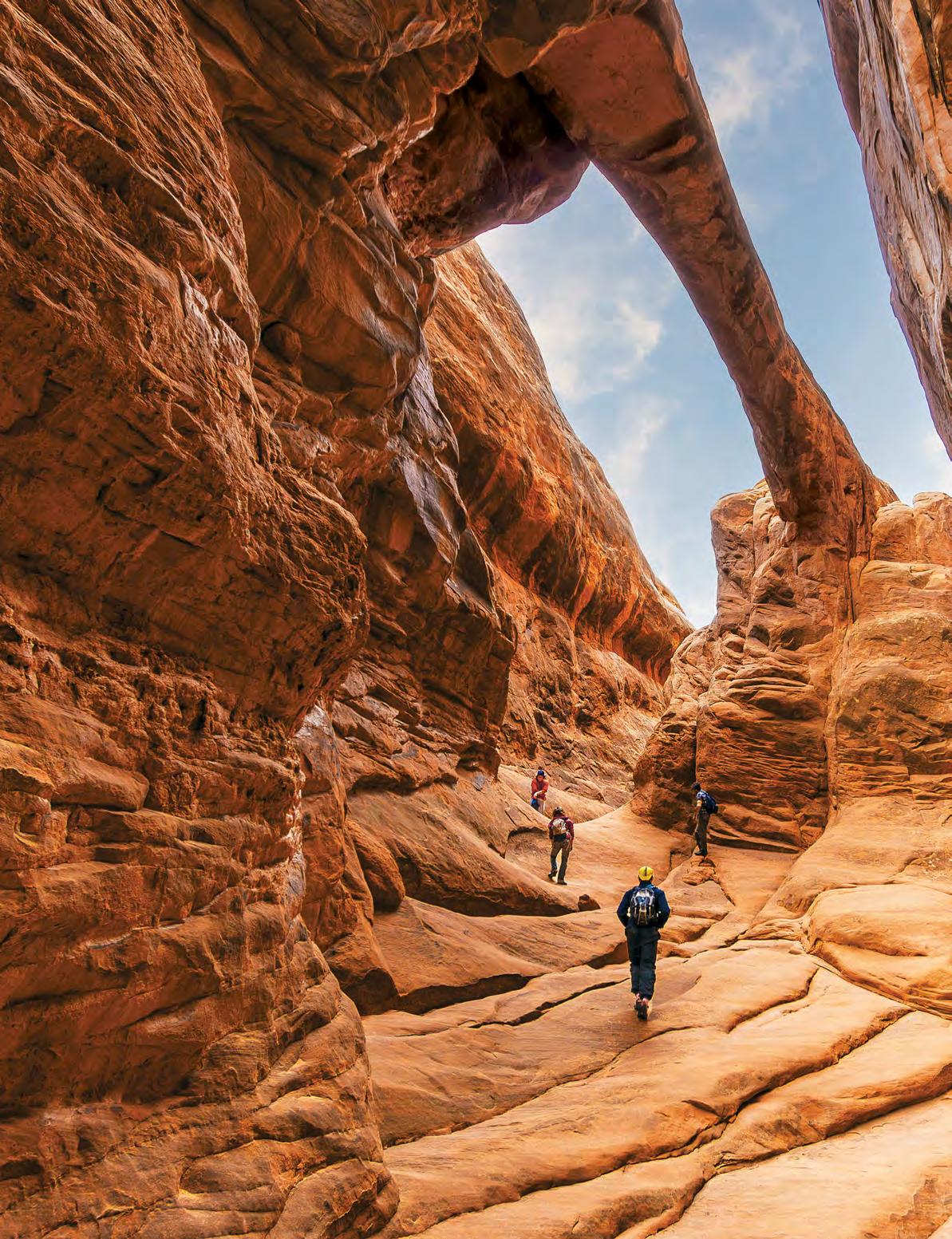
Surprise Arch, located in the Fiery Furnace area of Arches National Park









At least the peanuts are still free. Earn up to 6.00% APY with a Smart Money Checking account and save while you spend. Sign up for an account at WesterraCU.com/smartmoney *Annual Percentage Yield (APY) is accurate as of 5/1/2024. The interest rate and APY may change without notice after the account is opened. Fees may reduce earnings on the account. $5 prime share deposit required for membership. A $25 opening deposit is required for a Smart Money Checking account. 6.00% APY applies to average daily balances up to and including $2,000. For average daily balances greater than $2,000, the APY may range from 0. 05% to 3.00%. If requirements** are not met, all balances will earn .01% APY. In order to get the higher rates, you must meet certain requirements each month. If you don’t meet the requirements, an APY of 0.01% applies to all balances. Limit one Smart Money Checking Share per account. Membership eligibility required. Federally Insured by NCUA. **The requirements needed to receive the dividend rate are (i) minimum average daily balance that corresponds to the desired rate, (ii) 16 combined debit/credit card purchase transactions that post and clear in the statement months as (i), on the same membership account, (iii) a minimum of one (1) dir ect-deposit or Automatic Clearing House (ACH) of at least $500 per month, (iv) enrollment in online statements. ATM and cash advance transactions do not count toward the debit card transaction requirement. Requirements are waived the first statement cycle the new share is opened and will earn the dividend rate that cor responds to each minimum balance tier. IRA, Roth IRA, and Business accounts are not eligible for this product. See Membership and Account Agreement for Nature of Dividends under our resource tab. Because “economy” seating is far from economical. Smart Money Checking WITH Earn 6.00 UP TO APY % *


FROM THE EDITOR
12 The official start of summer means it’s (finally) time to luxuriate in all that the season offers.
COMPASS
15 CULTURE
Chris Carlson’s three-dimensional artistry takes to the pavement at the Denver Chalk Art Festival.
16 AVIATION
A women-only air race lands in Loveland this year.
18 EVENTS
The inaugural Gayborhood Market aims to bring small businesses back to PrideFest.
20 VETERINARY CARE
Will expanding the veterinary services that technicians can provide cure Colorado’s vet shortage?
22 STYLE
A Denver designer is sending supplies to Ukraine’s orphans, one stitch at a time.


COLUMN
25 WHAT’S HOT Traveling Mercies, Caroline Glover’s new Aurora eatery, feels like a mini-vacation. 26 REVIEW
Diners are lusting after the contemporary Mexican plates coming out of the kitchen at LoHi’s Alma Fonda Fina.
30 AGRICULTURE
Farms across Colorado are sprouting a local agricultural revolution by producing heirloom seeds adapted to the state’s growing conditions.
BY PATRICIA KAOWTHUMRONG
88 THE OVERSIMPLIFIED GUIDE TO: POOPING OUTDOORS
Five tips for making sure you leave no trace.
5280 (ISSN 10826815) is published monthly by 5280 Publishing, Inc., 1675 Larimer St., Suite 675, Denver, CO 80202. Subscriptions are $19.95 for one year (12 issues). Back issues are available for $6.99 plus tax and shipping by visiting shop.5280.com. Periodical postage paid at Denver, CO, and additional mailing offices. POSTMASTER: Send all UAA to CFS (see DMM 707.4.12.5). NONPOSTAL AND MILITARY FACILITIES: Send address corrections to 5280 Publishing, Inc., P.O. Box 3000, Denville, NJ 07834. Canadian Post Publications Mail Agreement No. #40065056 Canadian Return Address: DP Global Mail, 4960-2 Walker Road, Windsor, ON N9A 6J3. 5280® is a federally registered trademark owned by 5280 Publishing, Inc. 5280 also owns trademark registrations for TOP OF THE TOWN, DENVER’S TOP DOCTORS, DENVER MAGAZINE, and COUTURE COLORADO. © 2024 5280 Publishing, Inc. All rights reserved.
42 EAT & DRINK
Clockwise from top left: Sarah Banks (2); Jake Holschuh; AJ Watt/Getty Images
66
GUIDE
DINING
ACT
LOCAL
LIKE A
ON
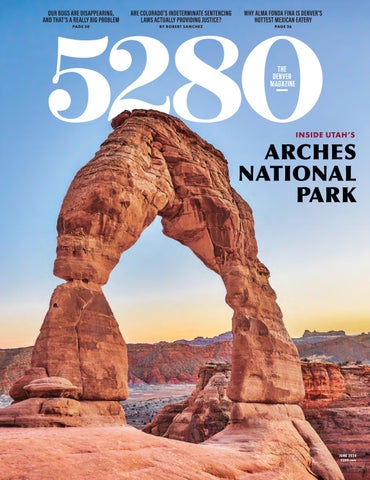
THE COVER
Photograph by Peter Unger/Getty Images
Delicate Arch in Arches National Park
26 30 20
Contents
JUNE 2024 16
















Adventures Start Here
Discover Wyoming’s spirited offbeat college town. Join us this summer for wild experiences in the outdoors, live music, eclectic dining, and shopping with a western flair. Start your journey off right and experience the wonders of the Medicine Bow National Forest.



VISITLARAMIE.ORG · 307-745-4195
is Limitless Outdoor Recreation Western Gear & Local Shopping Sightseeing & Wildlife Viewing
Wyoming


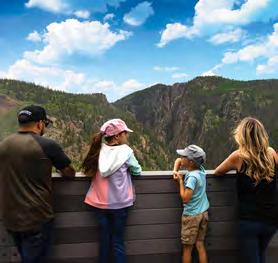

Climb aboard the historic Cumbres & Toltec Scenic Railroad which operates in the scenic landscapes of southern Colorado and northern New Mexico. Journey back in time experiencing the Old West as it was in 1880, as you venture over the highest mountain pass reached by rail, cross gorges and trestles, blast through tunnels, and chug across alpine meadows and high deserts. Depart from Antonito, Colorado or Chama, New Mexico for a ride of a lifetime!


Lindsey B. King
David McKenna
DIGITAL
Maren Horjus
LaRusso
Sanchez
Campbell
Johnson
Kaowthumrong
Jessica Giles
ASSOCIATE
Chris Walker
ASSOCIATE
Ethan Pan
ASSISTANT
Barbara O’Neil
COPY EDITORS
Shannon Carroll, Dougald MacDonald
RESEARCHERS
Henry Carnell, Kim Habicht, Gia Yetikyel
CONTRIBUTING WRITERS
Kelly Bastone, Laura Beausire, Jay Bouchard, Christine DeOrio, Courtney Holden, Sarah Kuta, Elisabeth Kwak-Hefferan, Jenny McCoy, Allyson Reedy, Meredith Sell, Daliah Singer, Martin J. Smith, Andy Stein
EDITORIAL INTERN
Julia Ruble
DESIGN & PHOTOGRAPHY
PHOTO EDITOR
Charli Ornett
DEPUTY ART DIRECTOR
Sean Parsons
DEPUTY PHOTO EDITOR
Sarah Banks
CONTRIBUTING ARTISTS
Sofie Birkin, Mike Ellis, Jake Holschuh, Seth K. Hughes, Simone Massoni, Tim McDonagh, Whit Richardson, Angel White Eyes, The Workmans
Brogan
6 5280 / JUNE 2024 5280 PUBLISHING, INC. CEO & EDITOR-IN-CHIEF
DIRECTOR Geoff Van Dyke 1675 Larimer St., Suite 675, Denver, CO 80202 Tel 303-832-5280 Fax 303-832-0470 5280.com For subscription questions, please call 1-866-271-5280.
ART DIRECTOR
Daniel
EDITORIAL
EDITOR
DIRECTOR
EDITORIAL
EDITOR
SENIOR STAFF WRITER Robert
FEATURES EDITOR Spencer
HOME EDITOR Michelle
SENIOR EDITOR Nicholas Hunt FOOD EDITOR Patricia
SENIOR ASSOCIATE EDITOR
DEPUTY
Jessica
EDITOR
FOOD EDITOR
EDITOR
303.818.8668 akerr@kentwood.com annkerr.com ann kerr All information deemed reliable but not guaranteed and should be independently verified. All properties are subject to prior sale, change or withdrawal. Neither listing broker(s) nor Kentwood Real Estate shall be responsible for any typographical errors, misinformation, misprints and shall be held totally harmless. UNLOCK YOUR SUMMER SANCTUARY book now at cumbrestoltec.com 1-888-286-2737 America’s most historic scenic railroad
Life.
The Ride Of Your
5280MAG_GorgeRIDEs_4.75x4.875.indd 1 4/9/24 8:55 AM
Summer Dreams & mountain streams
Just 75 miles from Denver
Tackle your entire summer bucket list right here at the Ranch. Adventure and relax across 6,500 pristine mountain acres with s’mores and stargazing, pool days and live music, horseback rides and fly fishing. Our lovely landscape is your playground. Private cabins and cozy lodge rooms set the stage for your perfect mountain getaway. Refill your cup with refined on-site dining, including our own Ranch-raised Wagyu, and find ultimate relaxation at our full-service spa. Book your summer stay now.
Located 15 Minutes from Winter Park, CO | (970) 726-3773 | devilsthumbranch.com



WINDOWS, DOORS & SIDING FOR YOUR NEXT HOME PROJECT
Exciting news, Denver! We offer top-quality window, door, and siding replacement services and are now serving your area. Call for a free inhome consultation today. 970-481-5907 • allguardwindows.com

Transform your home with AllGuard Windows and Doors - the go-to choice for top-notch replacement windows, doors, and siding. With our five-star customer service and satisfaction guarantee, you can trust us to enhance your home’s beauty and functionality. Finance options are available, and we accept all major credit cards. Upgrade your home today!
ADVERTISING & MARKETING
CHIEF REVENUE OFFICER
Camille Hammond
ADVERTISING DIRECTOR
Ari Ben
MARKETING DIRECTOR
Piniel Simegn
SENIOR ADVERTISING EXECUTIVES
Angie Lund, Molly Swanson
ADVERTISING EXECUTIVES
Craig Hitchcock, Heather Lowe, Kara Noone
ADVERTISING & MARKETING COORDINATOR
Tamara Curry
MARKETING COORDINATOR
Grace Thomas
BRAND SERVICES
CHIEF BRAND OFFICER
Carly Lambert
PRINT OPERATIONS DIRECTOR
Megan Skolak
CREATIVE SERVICES MANAGER
Chelsea Conrad
DIGITAL OPERATIONS MANAGER
Shundra Jackson
SENIOR GRAPHIC & UI DESIGNER
Caitlin Brooks
AUDIENCE GROWTH COORDINATOR
Greta Kotova
P RODUCTION COORDINATOR
Alyssa Chutka
NEWS STAND CONSULTANT
Alan Centofante
CIRCULATION CONSULTANTS
Meg Clark, Greg Wolfe
ADMINISTRATION
HUMAN RESOURCES DIRECTOR
Derek Noyes
OFFICE MANAGER
Todd A. Black
BILLING & COLLECTIONS MANAGER
Jessica McHeard
8 5280 / JUNE 2024 A member of the American Society of Magazine Editors A member of the City and Regional Magazine Association








Like other small towns in Nebraska, Taylor is filled with friendly, welcoming people. What sets Taylor apart are the 100 or so residents made of plywood. They’re the brainchildren of a local artist who wants to double the community’s population, and they’re practically impossible to resist. Yes, we know some people will still resist. But not you. So go to VisitNebraska.com for a free Travel Guide. And make some new friends. Or we can make them for you.



IN A PREVIOUS LIFE, SOME OF THE PEOPLE HERE WERE TREES.







SUBSCRIPTIONS
5280 costs $19.95 for 12 issues. A two-year subscription costs $34.95. Special corporate and group rates are available; call 303-832-5280 for details. To start a new subscription, to renew an existing subscription, or to change your address, visit 5280.com/subscribe; call 1-866-2715280 from 9 a.m. to 5 p.m. EST Monday through Friday; or send an email to circulation@5280.com.
LETTERS TO THE EDITOR & DINING GUIDE
Letters to the editor must include your name, address, and a daytime phone number (all of which can be withheld from publication upon request). Letters may be submitted via regular mail or email (letters@5280.com). To have a restaurant considered for our Dining Guide, contact us by phone or email (dining@5280.com) to receive a submission form. We also encourage you to contact us if your experience at a restaurant differs significantly from our listing. Information mitted at least six weeks before the issue’s cover date.
WRITER’S GUIDELINES
Writer’s guidelines can be found online at 5280.com/writers-guidelines. To suggest a story idea, email us at news@5280.com.
ADVERTISING
offers businesses the most costeffective way to reach Denver’s upscale consumers. Information about advertising is available on the web at 5280.com/ advertising. Call 303-832-5280 to request a printed media kit.
SPONSORSHIPS
actively supports organizations that make our city a better place to live and work. Submit sponsorship proposals to Piniel Simegn, marketing director, at sponsorship@5280.com.


10 5280 / JUNE 2024
5280 Publishing, Inc. adheres to high standards to ensure forestry is practiced in an environmentally responsible, socially beneficial, and economically viable manner. Printed in Denver, Colorado, by Publication Printers Corp. Our printer is certified by the Forest Stewardship Council (FSC). 41st Anniversary Sale Westminster 720.566.0300 Greenwood Village 303.721.9666 Aspen Grove 303.706.9900 Cherry Creek North 303.321.3000 Eye Exams Available At All Stores • www.europtics.net The Art Of Optics *with purchase of prescription lenses 40% OFF 20% OFF non-prescription sunglasses The Largest Selection Of The World’s Finest Eyewear From Colorado’s Family Owned And Operated Eyewear Galleries NOW OPEN IN WESTMINSTER! *Sale prices valid on in-stock frames with purchase of prescription lenses only. Some exclusions apply including Oakley, Maui Jim, Jacque Marie Mage, Cartier, and Chanel. Sale prices may not be combined with any other coupons, discount o ers, insurance discounts, or previous purchases. Sale ends 7/13/24.


Stories Of Summer
I have a confession to make: Winter is not my favorite season. It’s an unpopular position to take among snow-obsessed Coloradans, who began buying their 2024-’25 ski passes months ago and who, come August, are itching to pull their Mellys out of the closet. Me, I want the Centennial State summer to arrive early and stay late, giving me time to both adventure on its blue-sky days and relish the heat as my pint glass begins to sweat on a Denver patio.
June, of course, marks the beginning of summer—and many of the stories in this issue lean into the happenings, the possibilities, and the glories of the warmer months. There’s the Denver Chalk Art Festival, held early this month in the Golden Triangle (“Chalk It Up,” page 15), and Denver PrideFest, celebrating its 50th anniversary in June (“A Seller’s Market,” page 18). A new eatery called Traveling Mercies (“Making A Getaway,” page 25) recently opened at Aurora’s Stanley Marketplace and, well, it feels like a beach vacation. In “Seedy Business” (page 30), food editor Patricia Kaowthumrong gives home gardeners a reason (hint: tastier tomatoes!) to check out local seed farmers. And in “A Bugless Life” (page 50), assistant editor Barbara O’Neil explains why Coloradans should be happy to host the butterflies, bees, and other bugs we often feel the need to shoo away when the mercury rises.
Editorial director Geoff Van Dyke and I were able to get in on the celebration of summer, too, with “Rare Architecture” (page 36), a piece about Arches National Park, just a 5.5-hour drive from Denver. While temps can soar into the triple digits there in the summer, it’s still peak season for viewing the densest concentration of red-rock arches in the world, and we give you all the tips you’ll need for making the most of your visit whenever you go.
Of course, we also know that camping is essentially the official pastime of summer in this state. Coloradans love to hike into the backcountry, set up their tents, and commune with the trees, lakes, and wildflowers. And for when nature inevitably calls, senior editor Nicholas Hunt made sure we covered one other important rite of summer: pooping outdoors. You’ll find those nuggets of wisdom on page 88, but I hope you won’t just flip to the last page of the magazine. Instead, I suggest you slow down for an hour, pour yourself a cold beverage, pull up a lounge chair, and read every summery story we have in store for you.
LINDSEY B. KING Editor
lindsey@5280.com
CORRECTIONS: Top Dentists 2024
At 5280, we do our best to avoid factual errors. There are times, though, when we make mistakes, and when that happens—as it did in May’s “Denver’s Top Dentists 2024” list—we correct them. We made two sorting errors and missed some updates, which affected thirtysome dentists’ listings. We regret the errors and present the corrected information below. The corrected listings are also available at directory.5280.com/dentists.
ENDODONTICS
CENTENNIAL
Sonia Gallego-Cubillos 6650 S. Vine St., Suite 200 303-797-3636
PARKER
Shane R. Christensen
ENDODONTICS OF COLORADO 19700 E. Parker Square Drive, Suite 8 303-805-4141 endoofco.com
GENERAL DENTISTRY
CENTENNIAL
Phillip S. Johnson
ARAPAHOE FAMILY DENTISTRY 6979 S. Holly Circle, Suite 225 303-779-1305 arapahoefamilydentistry.com
COLORADO SPRINGS
Jessica L. Duru
SPRINGS DENTISTRY 6665 Delmonico Drive, Suite C 719-599-5700 springsdentistry.com
Michael A. Lovato
HOLLOW BROOK DENTAL 2160 Hollow Brook Drive 719-633-0049 hollowbrookfamilydentistry.com
Michael D. Terveen
SPRINGS FAMILY DENTAL 1935 N. Union Blvd. 719-634-4805 springsfamilydental.com
DENVER
David S. Bennett
SIGNATURE DENTISTRY OF DENVER 2700 E. Louisiana Ave., Suite 101 720-246-0496 signaturedentistryofdenver.com
Chad Fruithandler
COLORADO TONGUE TIE 4704 N. Harlan St., Suite 350 720-507-0077 coloradotonguetie.com
Andreea Torok
BLACK MOUNTAIN
FAMILY DENTISTRY 1540 S. Holly St., Suite 2 303-757-5885 blackmountaindentistry.com
FORT COLLINS
Jeffrey S. Kramer
DENTAL CENTER OF THE ROCKIES 1424 E. Horsetooth Road, Suite 4 970-223-2886 dentalcenteroftherockies.com
GREENWOOD
VILLAGE
Chad Brown
DEER RUN DENTISTRY 8000 E. Prentice Ave., Suite A5 303-756-0723
LAFAYETTE
Thomas E. Kammer
SAGE DENTAL CARE LAFAYETTE 2695 Northpark Drive, Suite 104 303-604-6355 sagedentalcare.com
LAKEWOOD
Emily Saunders
WHITE ROCK FAMILY DENTAL 12600 W. Colfax Ave., Suite B-160 303-237-0307 whiterockfamilydental.com
LITTLETON
Walt Vogl
ROCKY VIEW FAMILY DENTAL & IMPLANT CENTER
1 West Dry Creek Circle 303-797-6129 rockyviewdentalcare.com
LONE TREE
Paul W. Bell
ALMEIDA & BELL AESTHETIC
DENTAL CENTER
8683 E. Lincoln Ave., Suite 200 303-858-9000 almeidadental.com
WESTMINSTER
Scott Bennett
BENNETT DENTAL GROUP 5130 W. 80th Ave., Suite 202 303-429-3549 bennettdentalgroup.com
Kirsten L. West-Bennett
BENNETT DENTAL GROUP 5130 W. 80th Ave., Suite 202 303-429-3549 bennettdentalgroup.com
ORAL & MAXILLOFACIAL SURGERY
AURORA
Ryan N. Dobbs
SADDLE ROCK INSTITUTE
7380 S. Gartrell Road 720-826-8900 saddlerockinstitute.com
BRIGHTON
Jeffrey W. Stearns
PLATTE VALLEY ORAL SURGERY
27 S. 18th Ave. 303-997-0223 drjstearns.com
CENTENNIAL
Steven D. Barney
5280 ORAL SURGERY & DENTAL IMPLANTS
6979 S. Holly Circle, Suite 105 720-638-3888 5280-os.com
DENVER
Aaron T. Liddell
COLORADO ORAL SURGERY
400 S. Colorado Blvd., Suite 450 303-744-1369 coloradooralsurgery.com
Gregg L. Lurcott
COLORADO ORAL SURGERY
400 S. Colorado Blvd., Suite 450 303-744-1369 coloradooralsurgery.com
LONE TREE
Michael K. Rollert
ROCKY MOUNTAIN ORAL & MAXILLOFACIAL SURGERY 8683 E. Lincoln Ave., Suite 120 720-452-2144 rockymountainoms.com
ORTHODONTICS
BOULDER
Jeffrey Wong
WONG ORTHODONTICS 3400 Penrose Place, Suite 203 303-444-6680 drwongortho.com
CASTLE PINES
Andrew J. Dunbar
CASTLE PINES ORTHODONTICS 250 Max Drive, Suite 201 303-688-3837 castlepinesortho.com
DENVER
Ginny Baker
5280 ORTHODONTICS 4326 E. Eighth Ave. 303-377-5280 5280orthodontics.com
Gabriel A. Luttrell
UNION ORTHODONTICS & PEDIATRIC DENTISTRY 3690 S. Yosemite St., Suite 200 303-558-1458 smilewithunion.com
Amanda Vanderstelt
ALIGNED ORTHODONTICS 1215 S. Pearl St. 303-521-3333 alignedonpearl.com
LAKEWOOD
Krystal Hoversten ALL ABOUT BRACES 2020 Wadsworth Blvd., Suite 18-A 303-462-1462 aabraces.com
PARKER
Theodore W. Struhs 20 MILE ORTHODONTICS 11355 S. Parker Road, Suite 109 303-841-2262 20mileortho.com
THORNTON
Shane Hoelz
COLORADO ORTHODONTICS 901 E. 120th Ave., Unit E 303-452-0077 coortho.com
WESTMINSTER
Colin S. Gibson
1ST IMPRESSIONS ORTHODONTICS 2761 W. 120th Ave., Suite 110 303-452-2277 1stimpressionsortho.com
PEDIATRIC DENTISTRY
DENVER
Jeffrey A. Kahl
DENVER HEALTH PEDIATRIC DENTISTRY 301 W. Sixth Ave. 303-602-6875 denverhealth.org
Jesse R. Witkoff
COLORADO TONGUE TIE 4704 N. Harlan St., Suite 350 720-507-0077 coloradotonguetie.com
FORT COLLINS
Gregory D. Evans
BIG GRINS
3221 Eastbrook Drive, Building A, Suite 101 970-407-1020 gobiggrins.com
PARKER
Julie N. LeBlanc
LITTLE ROCKIES KIDS DENTAL 19750 E. Parker Square Drive, Suite 103 720-638-6114 littlerockieskidsdental.com
PROSTHODONTICS
DENVER
Dennis Waguespack
BRIDGECREEK
PROSTHETIC DENTISTRY 8751 E. Hampden Ave., Suite C-6 303-755-4003 bridgecreekdentistry.com
12 5280 / JUNE 2024 FROM THE EDITOR Studio1One/Getty Images


Here’s to a beautiful you!
Étoile Salon: Advanced Nail Care & Beauty Boutique is your ultimate beauty destination, where clients can indulge from head to toe. We set the industry standard high, ensuring every visit is a luxurious experience.
With summer festivities on the horizon—including weddings, beach getaways, and open-toed shoes—there's no better time to pamper yourselves with spa days at Étoile Salon. Join us and embrace the season with confidence and style!
SAY GOODBYE TO DAMAGED NAILS and hello to healthy nails. Whether you’re seeking nail treatments for restoration or hypoallergenic enhancements, our services and products are tailored to preserve and enhance your natural beauty.

ELEVATE YOUR PEDICURE EXPERIENCE with our array of non-medical pedicure services. Our Certified Master Pedicurists cater to individuals seeking more than just a standard pedicure. With offerings like cosmetic toenail reconstruction, BS Brace ingrown nail treatment and more, we’re dedicated to restoring confidence, allowing you to bare your feet with pride.

REVITALIZE YOUR SKIN and achieve a radiant glow all under one roof. Our comprehensive skincare services are designed to rejuvenate your complexion and leave you feeling refreshed and radiant.

Étoile SALON ADVANCED NAIL CARE Beauty Boutique WWW.ETOILESALONSPA.COM 6460 E. Yale Ave., Unit E-50 Denver CO 80222 303.639.5167
Nara Gregorio founder, LE, MNT, CMP 18 years of experience

Chalk It Up
As a kid, Chris Carlson didn’t want to join the circus. He wanted to be a stockbroker. By the time the Denverite graduated with a business degree in 2008, however, he was no longer so bullish on the markets. In search of direction, Carlson came across a photo of three-dimensional chalk art, a technique that uses precise geometry to allow flat images to leap off the pavement when viewed from a specific position. “I was fascinated by the illusion,” Carlson says, “so I just started practicing anywhere I could find a hard surface.” Despite having no formal art training, he took to the form, and after a video of Carlson went viral on YouTube in 2012, he soon quit his job managing an assisted living facility to make chalk art full time. Catch him crafting a custom piece in his signature style, which pairs often fantastical creatures and landscapes with lifelike lighting and drawing techniques, during this month’s Denver Chalk Art Festival (June 1 and 2; 12th and Bannock streets). “I was in a rush to grow up,” Carlson says. “Now, I just want to stay a kid as long as I can.”
—NICHOLAS HUNT
JUNE 2024 / 5280 15
PHOTOGRAPH BY THE WORKMANS

Sky Is The Limit
Alaina Bravo brought the plane in low while her bombardier, Amanda Willson, readied the payload—a pumpkin. As they approached the drop zone, Willson aimed and sent the squash somersaulting through the air until it exploded right next to the target. The women cheered. Not only did their run win them first prize at Wray’s 2023 Brew n’ Que Fly In, but it also sent a message to their all-male competition: Women belong in aviation.
Coloradans have tried hard over the years to spread the word. The state boasts the world’s largest chapter of the Ninety-Nines, a global organization of women pilots that was co-founded by Amelia Earhart, while Metropolitan State University of Denver’s Women in Aviation International strives to boost representation throughout the aerospace industry. Still, women across the country are largely grounded.
According to the Federal Aviation Administration, they make up only 9.6 percent of licensed pilots in the country. This, of course, is not a new issue. Having previously been excluded from men’s events, in 1929, revered aviators such as Earhart and Louise Thaden competed in the first Women’s Air Derby, with a prize purse of $8,000 (about $145,000 today). Fourteen of the 20 solo pilots managed to touch down in Cleveland nine days after leaving Santa Monica, California. Nearly a century later, the competition lives on as the nonprofit, women-only Air Race Classic. This year’s event (June 18 to 21) will feature roughly 60 two-pilot teams winging it from Carbondale, Illinois, to the checkered flag in Loveland. When Bravo, who’s training to be certified to fly other aircraft, and Willson, a maintenance planner for a private jet charter company,
learned the legendary contest would culminate in their backyard, they saw an opportunity to follow their idols. “How could we not do it?” says Bravo, who met Willson in 2021 at a NinetyNines networking event. Fortunately, the competition isn’t cutthroat. “The race is really focused on cultivating skill,” Bravo says. “Nobody’s sabotaging airplanes. Everyone’s there to encourage one another.” To that end, organizers paired the duo with a Denver pilot and former Air Race winner who coached the two rookies on what to expect. Chief among their challenges will be the sheer size of the course. The 2,400-mile, ninestage route will test the pilots’ navigational prowess as they balance wind speed, fuel consumption, and weather. “We’ve had to make Plan A, Plan B, and Plan C for where we will go for fuel and where we will overnight,” Bravo says, “since racers can only fly during daylight hours.” Even then, there’s always a chance an unexpected storm could force their single-engine Cessna 172 off course, not that it would be the first time pilots like Willson and Bravo have had to chart their own flight path. —CHRIS WALKER
16 5280 / JUNE 2024
A pair of local pilots will follow in the jet stream of legends like Amelia Earhart at a renowned air race touching down in Colorado this month.
AVIATION PHOTOGRAPH BY JAKE HOLSCHUH
Alaina Bravo (left) and Amanda Willson in front of their Cessna 172


Main Street Of The Rockies By a lake. With a charming Main Street. And its own marina with rentals, tours, lessons and waterside dining.
TownofFrisco.com

A Seller’s Market
In honor of Denver PrideFest’s 50th anniversary, the inaugural Gayborhood Market aims to bring small businesses back to Pride.
In June 1974, around 50 people armed with posters and balloons met in Cheesman Park for a “gay-in.” A half-century later, that humble gathering has transformed into Denver PrideFest (June 22 and 23), and it’s kind of a big deal. More than 550,000 people attended last year. With numbers like that, it’s no surprise that the Center on Colfax, the LGBTQ+ nonprofit that runs the festivities, has experienced a trend that belies the event’s DIY origins: a rise in corporate sponsorships. “You know the saying that goes ‘Keep Boulder weird?’ ” asks the nonprofit’s CEO, Rex Fuller. “Recently, we’ve been talking about
keeping Pride queer.” To that end, while companies such as Nissan and Molson Coors Beverage Company will still pay PrideFest’s bills, Fuller and his team turned to three local creatives to help preserve Pride’s independent spirit. In 2021, friends Sophie Gilbert and Elle Billman launched a small monthly event where LGBTQ+ creators could share their art, including Gilbert’s embroidery and Billman’s line drawings. Within a few months, the gathering became so popular it could no longer fit in the breweries and parks that had hosted it. So Gilbert and Billman partnered with Jessica Rose to launch a massive
annual queer bazaar, the Rainbow Market, at the Wolf Den, the Colfax tattoo shop Rose co-owns. “It was abundantly clear right away that this was needed in Denver,” Rose says. Its success caught the eye of the Center on Colfax, which asked the trio for help planning a similar event at this year’s Denver PrideFest in honor of its 50th anniversary.
Their first task? Narrow the applicant pool down to around 45 vendors to fill out the inaugural Gayborhood Market being held at Lincoln Veterans Memorial Park. To ensure only small, queer-owned local businesses landed stalls, they selected merchants who had annual budgets of less than $250,000 and put a special emphasis on underrepresented communities. And while Rose, Gilbert, and Billman didn’t award themselves spots (in order to make room for others), shoppers can buy their wares when the Rainbow Market returns for its third year on June 9. Just don’t head to the Wolf Den. Having already outgrown the tattoo shop, the event is relocating to Highland’s 8,000-plus-squarefoot BRDG Project Gallery. “At their core, these markets are about giving a platform to small creators,” Billman says, “especially during a month when there’s a lot of rainbow capitalism.”
Three proud vendors at PrideFest’s first Gayborhood Market
YOLIA CREATIONS
Need a boost? Miranda Encina’s handmade leather earrings and metal wrist cuffs are emblazoned with powerful affirmations such as “resist” and “I am my ancestors wildest dreams.”
BIG BEE ENERGY
Pick up some wildflower honey from this Littleton apiary and you might get the chance to meet the local drag queens who act as its queen bee ambassadors.
CELESTIAL CANDLE COMPANY
This family-owned Denver chandler has created a line just for Pride Month called Love Wins, which features different Pride flag designs, including the classic rainbow, of course.
18 5280 / JUNE 2024
ILLUSTRATION BY SOFIE BIRKIN EVENTS
—BARBARA O’NEIL




The Tech Will See You Now
Will expanding services that technicians provide cure Colorado’s vet shortage?
The most surprising thing about the Dumb Friends League’s (DFL) animal clinic at Colorado State University’s SPUR Campus is not that it permits the public to watch dogs and cats undergo surgery. It’s that people flock to the north Denver facility to see the operations—everything from routine spays on orange tabbies to the removal of teeth from a German shepherd. There is, thankfully, a purpose behind the spectacle: Colorado is experiencing a dire veterinarian shortage, and DFL believes the clinic might motivate future generations to pick up the trade.
Last year, CSU completed a survey of more than 700 veterinary care professionals in Colorado; 67 percent of them reported having to turn away patients every week because they’re too busy. More veterinarians could help, but vets are scarce in Colorado, in part because the schooling is pricey. The American Association of Veterinary Medical Colleges estimates in-state tuition and other educational expenses in Colorado average $274,000. To lower the financial burden while increasing the number of providers, DFL helped introduce a state ballot measure that would create a master’s level veterinary professional associate (VPA) certification in Colorado modeled after the physician assistant position in human health care. Under the supervision of a licensed vet, a VPA could diagnose, prescribe, and even operate.
The measure, however, got the Colorado Veterinary Medical Association’s
OTHER WAYS COLORADO IS BOOSTING CARE FOR FIDO
(CVMA) hair up. The organization argues that there’s already a midlevel designation for registered veterinarian technicians. Plus, there’s little evidence that VPAs would earn enough to cover the cost of the master’s degree, which the CVMA estimates could run as much as $80,000. So this past session, state Representative Karen McCormick, a vet and member of the CVMA, introduced a bill that increases the services that vet techs—whose associate degrees train them to handle tasks such as administering vaccines—could perform, such as extracting teeth, but doesn’t go as far as the VPA measure.
Governor Jared Polis signed McCormick’s legislation into law this past March. Nevertheless, DFL’s coalition is forging ahead with its VPA measure, which, as of press time, was still searching for enough signatures to make the November ballot. CSU is also developing a curriculum that would train future VPAs. Both sides, however, agree that their respective plans are not cure-alls; it will take years to fill the care gap. Even if the DFL surgery theater happens to inspire a 10-year-old in the audience today, she would likely be 26 before she could wield the scalpel herself. But at least it’s a start.
—RAY MARK RINALDI

$6.8 million
Funding the National Western Scholarship Trust has awarded to more than 1,800 students who have entered animal care programs since its inception in 1983
20 percent
Increase in incoming veterinary students that will be accommodated by the 2026 completion of the CSU Veterinary Health and Education Complex
$90,000
Maximum student debt the USDA’s Veterinary Medicine Loan Repayment Program will forgive veterinarians who practice in underserved regions in Colorado
20 5280 / JUNE 2024 Source photos: Ron Levine/Getty Images (female vet and machine); Yevgen Romanenko/Getty Images (money); Getty Images (male vet, hand)
PHOTO ILLUSTRATION BY SEAN PARSONS VETERINARY CARE




high-profile
high
ORQUESTA SINFÓNICA DE MINERÍA JUNE 20 - 23 DALLAS SYMPHONY ORCHESTRA JUNE 26 - JULY 1 THE PHILADELPHIA ORCHESTRA JULY 4 - 12 NEW YORK PHILHARMONIC JULY 17 - 24 BRAVOVAIL.O RG ■ 877.812.5700 SUPPO RTED BY @BRAVOVAIL GET TICKETS NOW! STARTING AT: $34 JUNE 20 — AUGUST 1
“… the most
— and
altitude — mountain music festival in America.” - THE TIMES
Fashioning Change
A Denver designer is sending supplies to Ukraine’s orphans, one stitch at a time.
Yulia Boozer learned how to sew as a child in Ukraine, making small dresses for her dolls under her mother’s tutelage. Crafting those garments led to a love of fashion and design, but Boozer pushed those things aside after she moved to the United States in 2001 to study computer science. She
wouldn’t craft another dress until April 2022, right after Russia invaded her home country.
With the government’s attention turned toward the war, many children in Ukraine’s orphanages—especially those with disabilities—went without food, water, and medical supplies. Boozer

immediately began participating in local volunteering efforts, through which she met Olga Funk, a fellow Ukrainian who had moved from Kyiv to Colorado in 2004 and was searching for local organizations sending aid to Ukraine. The duo started a nonprofit dubbed the Nova Spark Foundation to collect money for Ukraine’s orphans. While the majority of the $36,000 they’ve raised so far has come from grants and individual donations, both Boozer and Funk have performed a variety of gigs to boost the nonprofit’s funds, including teaching donation-based fitness classes and hosting benefit concerts.
Boozer also spotted an opportunity to raise money by returning to her childhood passion. The same month she launched Nova Spark, she also founded Yulia Fashion House, a clothing brand specializing in formal wear and intricate handbags whose profits go entirely to the foundation. So far, the label has raised more than $3,000, although Boozer hopes that number will increase since the brand saw a boost in social media attention following her appearance at Denver Fashion Week’s Emerging Designer Challenge in February. The brand could see another uptick when Boozer debuts Yulia’s new line in front of the fashionistas and local boutiques at this month’s Colorado Springs Fashion Week (June 24 through 29), which is expanding to six shows after selling out last year’s inaugural event. “Venturing into the fashion industry is a completely new experience for me,” Boozer says. “It’s been incredibly fulfilling to use it as a platform for social impact.”
Each Yulia garment for Colorado Springs Fashion Week will feature flowers important to Ukrainian culture and embody themes of rebirth. Boozer will also collaborate on some of the designs with her mother, who now lives in Texas. Working together brings Boozer right back to those days of playing with dolls. “Despite the long hours and hard work, we fill our time with laughter, jokes, and conversations,” she says, but the visits are more than good times. The stories they share of their homeland find their way into Yulia’s ornate skirts and satin dresses so that they can be shared with others. —BO
PHOTOGRAPH BY SARAH BANKS
Local designer Yulia Boozer
22 5280 / JUNE 2024 STYLE
In Bloom SUMMER EVENT SERIES
JUNE 1 - AUGUST 11 2024 Summer Concert Series
SATURDAYS
JUNE 1, 15, & 29 Sidewalk Sale
JULY 18 - 21

Smash Fine Arts Festival: Spring Show
JUNE 8 - 9
Cherry Creek Arts Festival
JULY 5 - 7
Bastille Day: A French Fest
JULY 12 - 14
5280 Top of the Town
JULY 18
Smash Fine Arts Festival: Summer Show
AUG 10 - 11

CHERRYCREEKNORTH.COM Or scan for more details



ELEVATE YOURevent
impact SCAN FOR MORE INFORMATION 303.789.1867 SERVING OUR COMMUNITY for over fifty years ASK ABOUT OUR NONPROFIT DISCOUNT!
and AMPLIFY YOUR
Eat & Drink

Making A Getaway
Caroline Glover wants to take you on a journey. Inspired by the eateries Glover and her husband, co-owner Nelson Harvey, seek out when they explore other cities, six-month-old Traveling Mercies feels like a minivacation. “They are usually seafoodand cocktail-centric, with a concise wine list, and are smaller and off the beaten path,” Glover says. “We really wanted to create that type of spot.”
To nail the ambience, Glover tapped Denver-based FAM Design, which transformed the petite space on the third floor of Aurora’s Stanley Marketplace formerly occupied by aviation-themed Sky Bar. Ochre, terra cotta, and ocean blue tones and a dazzling curvy ceiling accent the light-bathed room, making it a beautiful place to slurp oysters and sip martinis. Pop in for the herbaceous Kill Your Darlings spritz while you wait for a table at Annette, Glover’s first restaurant, located downstairs. Or build a dinner-worthy spread out of a slab salad studded with sun-dried tomatoes, blue cheese, and pancetta; a plate of plump shrimp with mustardpowder-zinged cocktail sauce; anchovies on a butter-slathered baguette; and whipped-cream-topped rice pudding. —PATRICIA KAOWTHUMRONG
JUNE 2024 / 5280 25
WHAT’S HOT
PHOTOGRAPH BY SARAH BANKS
James Beard Award–winning chef Caroline Glover’s latest venture specializes in oysters and cocktails.

My Culinary Romance
Diners are lusting after the contemporary Mexican plates coming out of the kitchen at LoHi’s Alma Fonda Fina. —ALLYSON REEDY
The first time I dined at Alma Fonda Fina, I fell in love. I was smitten with the sweet potatoes: wedges roasted into perfectly caramelized bites with whipped ricotta and a crunchy salsa of seasoned nuts and seeds. I excitedly texted my friends about the carnitas—you get a whole pork shank!—that had certainly ruined me for all other carnitas. I dreamed of the future meals I’d have at Alma, in which I’d giddily rip off chunks of sourdough flour tortilla
and swoosh them into rich, flavor-layered moles. That first visit changed my definition of the ideal modern Mexican meal in Denver.
The second and third times I dined at the LoHi eatery, those intense initial feelings settled into a deep liking. The usual Mexican menu staples, such as the guacamole and the brisket tacos, that I tried during those subsequent visits didn’t give me the same butterflies—they just didn’t leave me wanting more like the really inventive
items did. Still, the menu changes monthly, and new specialties such as queso fundido—a skillet of molten hot cheese—with huitlacoche (corn fungus, a delicacy reminiscent of black truffle) enthralled me anew.
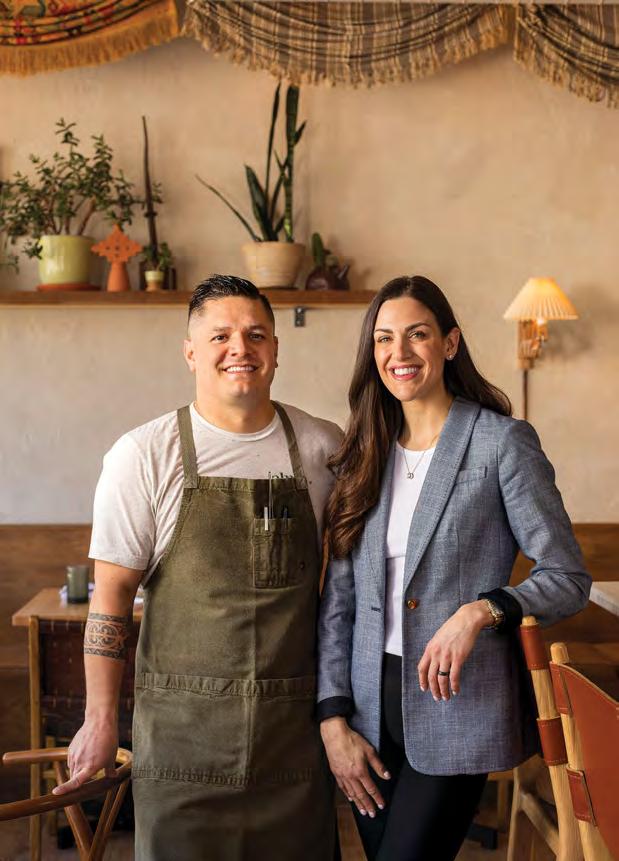
Alma Fonda Fina is the first solo restaurant from Johnny Curiel, a native of Guadalajara, Mexico, who has helmed kitchens at Guard and Grace and now-closed Lola Coastal Mexican. Curiel and his wife, Kasie, took over the former Truffle Table space this past December, transforming the intimate room into a terra-cottaand-succulent-dotted oasis. There, diners can expect many rare-in-Denver
26 5280 / JUNE 2024 REVIEW
PHOTOGRAPHY BY SARAH BANKS
^ From left: Pork belly carnitas on a bed of white beans; Johnny and Kasie Curiel

WHERE FUN MEETS LIFE-CHANGING FUNCTIONALITY.
WITH 100% KIDPROOF AND WATERPROOF CORETEC.
Want a stunning floor that can stand up to whatever your kids throw at it? COREtec is uber-waterproof, features a protective wear layer, and even has a comfy cork underlay.
To see this amazing luxury vinyl, just stop by Carpet Exchange. Then color yourself happy.
17 FRONT RANGE LOCATIONS TO SERVE YOU | CARPETEXCHANGE.COM CARPET | HARDWOOD | TILE | AREA RUGS | COUNTERTOPS | CORETEC
dishes, inspired by both Curiel’s culinary training and the food he grew up eating, instead of the green-chiledrenched burritos they’re used to seeing around town.
Most tables start with the chimichurri-topped guacamole, but I thought the chunky dip was a waste of stomach space when there were far more interesting offerings on the menu. The very best is the camote asado, agave-roasted sweet potatoes served on a coil of fennel-tinged whipped requesón (Mexico’s version of ricotta) and generously covered with aromatic salsa macha: finely minced garlic, chiles, seeds, and nuts fried in oil. In my pre-Alma days, I never once craved sweet potatoes; now, I wake up in the middle of the night thinking about them.
The queso fundido de huitlacoche on the March menu was also fantastic, with stretchy, melty Chihuahua cheese bubbling with both sweet corn and that funky huitlacoche. Scooped up with accompanying tangy tomatillo and serrano salsa, it was the most complex bite I’ve had in a long time. Bite was the operative word, though: For $18, there wasn’t enough cheese to coat even two small corn tortillas, a portion size that left me wanting.
Curiel’s crudos—diver scallops, hamachi, and bigeye tuna—brim with bright, citrusy flavors, but I’d rather dig into his mole of the month. My favorite iteration was a mole negro that requires a whopping 33 ingredients to be slow-simmered for 36 hours. There were sweet notes—courtesy of plantains and golden raisins—but it was the charred Oaxacan peppers, avocado leaf, and hoja santa (an herb with aromas of star anise and eucalyptus) that made it a delicious mosaic of flavors. The mole negro isn’t always available, but I’m guessing your taste buds will be charmed by whatever version Curiel has whipped up when you visit.
At $8 apiece, the tacos are fairly forgettable; skip them for one of the large-format proteins, all of which are worth ordering. The carnitas negras and the birria de borrego, dishes that invite diners to tear pork or lamb right off the bone-in shank, are juicy and tender. Plus, the accompaniments—the puréed beans with spicy

elote presented with the birria and the fiery charred habanero salsa that comes with the carnitas—are meticulously prepared and wildly flavorful. My only quibble with the proteins is that they’re served with only one hand-pressed tortilla per person to start, meaning every diner will inevitably have to flag someone down to request another round.
With a new, exciting love, it’s difficult to gripe about the little things. But I do have one grievance: Where’s dessert? When a restaurant is this compelling, I want to keep eating. So please, Alma, give me some sugar. I do believe Alma Fonda Fina and I have a future together. I know I’d gladly grow gray and weathered while ripping off chunks of Colorado lamb and dipping them into chilelaced broths. It takes two to keep the flame alive, though. I will vow to resist the urge to order the familiar dishes a Mexican eatery must deliver to the restaurant-going masses if Curiel will continue to surprise me with plates that seep into my dreams. If that happens, Alma and I might just live happily ever after.
SPECIAL SAUCE
There’s so much more to mole—a traditional sauce and marinade infused with chiles, spices, and seeds—than the super-sweet, chocolatey versions served at many Americanized Mexican restaurants. To bring awareness to the diversity of renditions made in his home country, Curiel offers a different iteration every month. Look for these three on upcoming menus at Alma Fonda Fina. —AR
BLANCO
To preserve this mole’s milky white hue, the walnuts, coriander, golden raisins, and chiles güeros that go into it are left uncharred. The sauce adds botanical notes to Curiel’s tetela, a griddled masa triangle that’s stuffed with baby zucchini and roasted corn.
AMARILLO
^ Alma Fonda Fina’s roasted sweet potatoes are a menu staple.
FONDA FINA
2556 15th St., almalohidenver.com
The Draw: Creative, soulful Mexican food you won’t find anywhere else
The Drawback: Some of the more familiar Mexican dishes aren’t memorable
Noise Level: Medium
Don’t Miss: Camote asado, birria de borrego, carnitas negras, moles
Thickened with masa, mole amarillo uses smoky Oaxacan chiles and meaty poultry stock to create a comforting, umami-forward complement to roasted chicken flautas that are dressed with queso fresco and crema Mexicana.
VERDE
Nutty and acidic mole verde gains a vibrant green hue from a combination of tomatillos and pepitas. The tangy sauce is the base for a porkfilled tetela, which is sprinkled with rich queso fresco and potent raw onion to balance out the acidity.

28 5280 / JUNE 2024 REVIEW
ALMA





Bring the Sunshine
MODERN MARKET EATERY’S SUMMER MENU
ADDS CHILLED HERB SHRIMP
Colorado-born in 2009, Modern Market Eatery has been a beloved destination for wellness-minded, busy foodies. With 18 restaurants across the Front Range, they’ve been spreading the joy of wholesome, chef-crafted fare one made-fromscratch dish at a time.
The menu of salads, grain bowls, sandwiches and pizzas changes twice a year to reflect seasonality and incorporate produce at the peak of flavor. The brand just announced the addition of a brand new protein option to its summer menu, Chilled Herb Shrimp! This certified sustainable protein takes center stage in dishes like the Shrimp BLT Salad, Green Goddess Shrimp Bowl, and the Chilled Herb Shrimp Protein Bowl.
“I went to culinary school for farm-totable cuisine, so I always start with what’s in season,”
CHEF NATE WEIR
Modern Market Eatery also added a


from the sweet corn puree on the bottom to the roasted corn salsa on top. Plus, they gave a few crowd favorites, the Urban Farmer Salad and the Summer Seared Ahi Salad, a sunkissed seasonal glow-up.
VP of Culinary Chef Nate Weir has always had a soft spot for seasonal cooking.
“I went to culinary school for farmto-table cuisine, so I always start with what’s in season,” said Chef Nate. “That’s what I love about changing our menu twice a year. Endless opportunities for exploration and creativity.”
From indulgent staples to healthy, seasonal dishes, Modern Market Eatery has a menu the whole family can agree on. So soak up the sun with the limited-time summer menu today!


WHERE TO FIND
Visit modernmarket. com for locations and to order.
ADVERTISEMENT
Sweet Corn Chicken Pizza, packed with tons of delicious corn flavor
CLOCKWISE FROM LEFT Modern Market Eatery's Shrimp BLT Salad; Sweet Corn Chicken Pizza; Chef Nate Weir.
BELOW Certified sustainable Chilled Herb Shrimp.

Seedy B usiness
It’s a windy March day, and Richard Pecoraro is loading clear plastic tubs crammed with bags of pea seeds onto his dirt-caked red tractor at Boulder County’s MASA Seed Foundation. He’s scrambling to get them in the ground at the 24-acre farm and nonprofit, where he serves as agricultural director, before a spring storm cloaks the Front Range in snow. Inside a barnlike structure nearby, assistant director Laura Allard packs jars with dried kernels of corn. To the untrained eye, this could look like any other family-run ag business operating along the Front Range. But there’s more than meets the eye here, and one need only peer inside the farm’s white clapboard house to see why. There, hundreds of clear, lidded jars full of seeds line shelves on nearly every wall. The vessels are grouped by plant variety, from marigolds to grains to tomatoes and everything in between. These aren’t your run-of-the-mill garden starters, though. The seed collection is the
Farms
across Colorado are sprouting a local agricultural revolution by producing seeds
BY PATRICIA KAOWTHUMRONG
acclimated to the state’s growing conditions.
heart of MASA (Mutual Admiration Seed Association), a nonprofit Pecoraro and Allard founded five years ago with a mission to build a bank of heirloom and native seeds adapted to the Centennial State’s unique soils and wild climate.
Pecoraro, 66, and Allard, 58, who are partners in life and in the field, grow roughly 1,000 types of vegetables, herbs, fruits, grains, legumes, and flowers every year. Like most agricultural operations, they sell their products to individual consumers and restaurants, but they also toil a little harder than most to harvest the seeds of the plants that perform best in the Front Range’s dry, windy, high-elevation conditions. The mightiest plant offspring are stowed in the clapboard seed house, but they don’t all remain there. Unlike facilities such as Fort Collins’ National Laboratory for Genetic Resources, which keeps more than 850,000 plant seeds and materials within secure concrete walls for posterity, MASA isn’t just a storage facility. It is also a seed retailer and farm. “Our seeds go back into the field every year,” Allard says, explaining that returning them to the soil gives them the opportunity to continue acclimating to the area’s mercurial weather.
MASA Seed Foundation sells tried-andtested seeds (above) to local gardeners.
Much of what Pecoraro and Allard do might appear to be playing in the dirt. For instance, along with staffers and volunteers, the couple once planted more than 50 types of sunflowers from around the world to discover the breeds that might thrive best here in Colorado. But they aren’t just experimenting for fun. Twelve of the 50—including the red-orange-hued Tithonia and eight-foot-tall Purple Mammoth—prospered particularly well and exhibited a wealth of positive traits,
PHOTOGRAPH BY SARAH BANKS
AGRICULTURE 30 5280 / JUNE 2024


specialty
stores, carrying a variety of brand names, all available at one convenient
focus
providing a shopping experience that is tailored to your needs. Our specialized buying teams are constantly combing the globe in search of the hottest trends
best values available. In addition, incentives like our no interest financing and our highly knowledgeable, specialized sales staff, make
one of the most enjoyable furniture buying experiences you’ll find in the country today. VISIT US ONLINE AT FURNITUREROW.COM FOR STORE LOCATION NEAREST YOU.
Furniture Row Companies® is a group of
home furnishings and mattress
location. We
on
and
Furniture Row
from tasty kernels to pretty petals, that could not only make MASA’s produce more compelling to prospective customers, but ideally also persuade Centennial State home gardeners to ditch the mass-produced seed packets sold at big-box stores in favor of the nonprofit’s bredespecially-for-Colorado seeds.
SEED COLLECTING and breeding are not new endeavors. Centuries of immigration to the United States have brought non-native seeds to its soil. But for much longer, Indigenous peoples of the Americas have stewarded crops, such as peppers and tomatoes, many of which have formed lineages of heirloom seeds, often defined as seed varieties that are at least 50 years old and that have been grown and preserved for generations. Many are organic, which means they are produced without pesticides.
In the 1930s, however, hybrid seed, the result of deliberately cross-pollinating plants to generate greater yield and uniformity, rose in popularity over their heirloom counterparts. Industrial agriculture quickly capitalized on the high productivity of hybrid seed, but the widespread planting of it has diminished crop genetic diversity and contributed to the homogenization of global food systems.
In the 1970s, a movement that championed the saving and sharing of heirloom seeds— which, unlike hybrids, retain the genetic traits of their parent plants—blossomed among backyard gardeners and organic farmers. Despite their efforts to save certain seed types from extinction, hybrid seed has remained king. Here in Colorado, however, a handful of operations, including MASA, have recently taken on the challenge of regionally adapting seeds, including those from heirloom crops.
It takes a special level of attention to detail to collect seeds from crops that have favorable characteristics and grow them annually without the use of chemicals. But farmers like Dan Hobbs, who owns 24-year-old Pueblo Seed & Food Co. in Cortez with his wife, Nanna Meyer, believe the benefits are worth the extra effort.
Hobbs and Meyer opened a small storefront this past September in Cortez, where they stock bread, pantry items, and seeds, all derived from organic crops they’ve cultivated on their 30-acre farm. Over the years, Hobbs has sowed successions of one of Colorado’s most beloved ingredients, the Pueblo chile. When the 55-year-old started growing the pepper in 2009, he wasn’t picky about the plants from which he took seeds. Then, in 2017, he began
to store seeds from shrubs that exhibited characteristics he wanted to replicate during future seasons: meaty flesh, a leafy canopy for summer heat protection, and bountiful fruit production.
Since then, his diligence has been rewarded at September’s Pueblo Chile Festival, where the peppers Pueblo Seed & Food Co. sells at its booth have been receiving increasing acclaim. “We’ve developed this little following of people that say, ‘This is the best chile we’ve ever had in our lives,’ ” he says. “So we’ve got all these dedicated customers that keep coming back.”
Flavor will always boost appeal, but Hobbs believes there are other upsides to carefully cultivated crops. A few years ago, Pueblo Seed & Food Co. started farming heirloom ancient and heritage grains, including maize, wheat, rye, barley, and millet. Hobbs sent samples of his maize to CIMMYT, an international wheat and maize foundation that works to strengthen the world’s food systems, and learned that his crop had impressive nutritional value, such as high levels of iron, that newer genetically modified or hybrid varieties sometimes don’t. “In the pursuit of a good-looking plant or a high-yielding plant, certain traits get sacrificed,” Hobbs says. “One great example is that a lot of these modern wheats are extremely low in fiber.”
READY, SET... golf

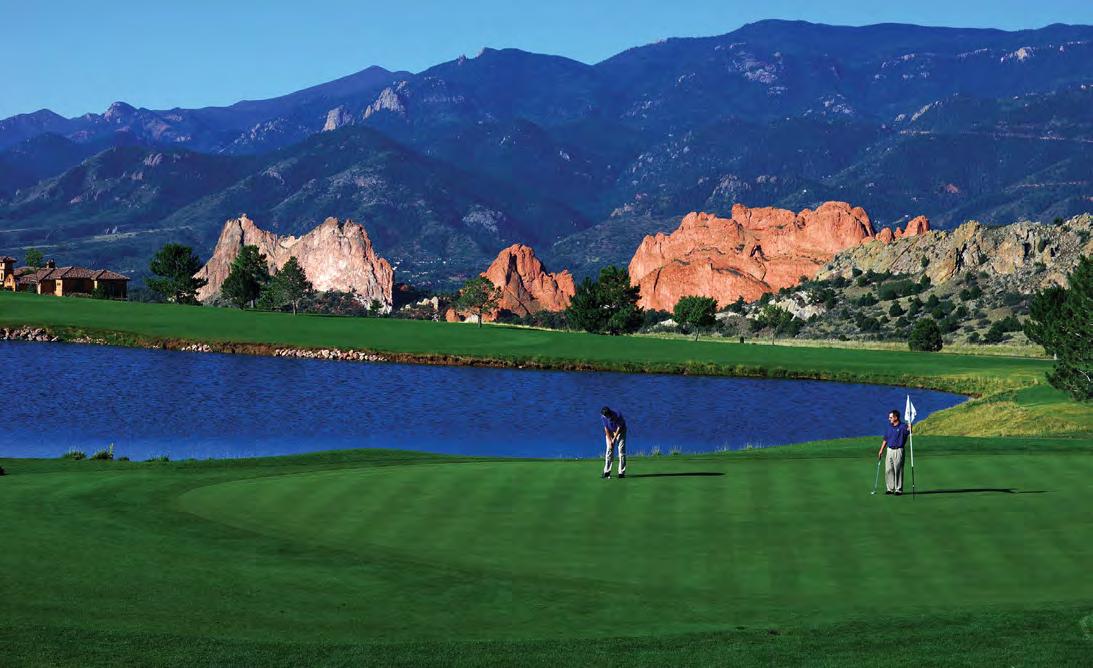
It’s golf season, Colorado. The breeze is warm, the beer is cold, and every hole offers majestic mountain views. This is your sign to book a golf staycation at Garden of the Gods Resort and Club. Only one hour south of Denver, our award-winning, 27-hole Kissing Camels Golf Course offers both serenity and challenge. An unforgettable golf getaway awaits you. Are you ready? gardenofthegodsresort.com
32 5280 / JUNE 2024 AGRICULTURE


Laura Parker, 38, a self-proclaimed seed freak who worked on Hobbs’ farm in the early 2000s before starting High Desert Seed & Gardens in 2015 in Montrose, agrees that there are myriad benefits to selecting seeds for regional resiliency. “It’s like being a plant Jedi, really,” Parker says. “You’re observing the nuances and drawing potential genetic traits out and looking for that potential over time.” In 2022, she relocated her plot to Paonia, where she now grows roughly 1,000 varieties
of plants each season on up to eight acres and sells 200 to 250 options that are well-adapted to the region’s hot summers and cold winters. Seeds for her Italian mountain basil and Pomodoro Pizzutello Di Paceco tomatoes are crowd-pleasers that customers seek out for their productivity and flavor.
By purchasing products from local seed farmers instead of mass-manufactured packets sold by the Home Depots of the world, Colorado gardeners can be more certain that their harvests


will thrive in Colorado’s climate and exhibit the qualities they want, according to 38-year-old Casey Piscura, owner of Wild Mountain Seeds in Carbondale. Whether customers are seeking carrots that will survive winter storage or sweeter tomatoes for summer salads, local seed breeders offer wider arrays of options. In fact, 12-year-old Wild Mountain sells more than 500 types of seeds to home gardeners, chefs, and small farms. Piscura has had success with characteristics as specific as squash that’s been raised to yield lots of large blossoms ideal for stuffing and a sweet onion that matures earlier than its peers. “We want to develop things that help small farmers differentiate themselves in the marketplace,” he says. “We select for flavor. We select for storage abilities. [We think about] what makes an onion the best onion it can be.”
HELPING COLORADANS RAISE hardier and tastier tomatoes isn’t the only goal for farmers such as Piscura, Hobbs, Parker, and MASA’s Allard and Pecoraro. Ultimately, they hope to bring the biodiversity that’s been lost due to modern agricultural methods back to the food system to ensure it can nourish future generations. That, however, is a lofty—and long-term—ambition that would require selling many more seeds to larger and larger farming operations. For Allard and Pecoraro specifically, that would require substantially expanding their small staff. “We need a bigger crew up here,” she says. “We just aren’t funded for that [right now].”
In the meantime, these seed whisperers believe the first step toward a more diverse food future is to educate everyday gardeners about the value of regionally adapted seeds and persuade locals to plant them. “A lot more people are growing seeds now than when we started, which is the best thing that could ever happen,” Pecoraro says. “Seeds belong in the hands of the people.”

In MASA’s clapboard seed house, the wood floor creaks under Allard’s feet as she assists her customers. A woman who lives nearby peruses the tomato seeds while Allard gives another customer recommendations for the best crops to sow before a spring snowstorm. Next door, trays of germinated seedlings blanket the greenhouse floor. About one-third of the healthy babies will be sold as starter plants to green-thumbed Front Rangers while the rest will be transplanted into MASA’s fields, where they will weather the elements. As the growing season progresses, the fittest will evolve, making the following year’s seeds even more prepared to thrive in Colorado fields and gardens. m
Patricia Kaowthumrong is 5280 ’s food editor. Send feedback to letters@5280.com.
AGRICULTURE
34 5280 / JUNE 2024
Find your hoppy place.



With the densest concentration of natural red-rock arches on Earth, Utah’s 95-year-old Arches National Park is a must-see for anyone who covets uncommon sights but it’s a particularly easy summertime trip for Coloradans who’ve already checked off their local national parks.
BY LINDSEY B. KING & GEOFF VAN DYKE
BY WHIT RICHARDSON

RarE ArcHitE
PHOTOGRAPH
c tuRe
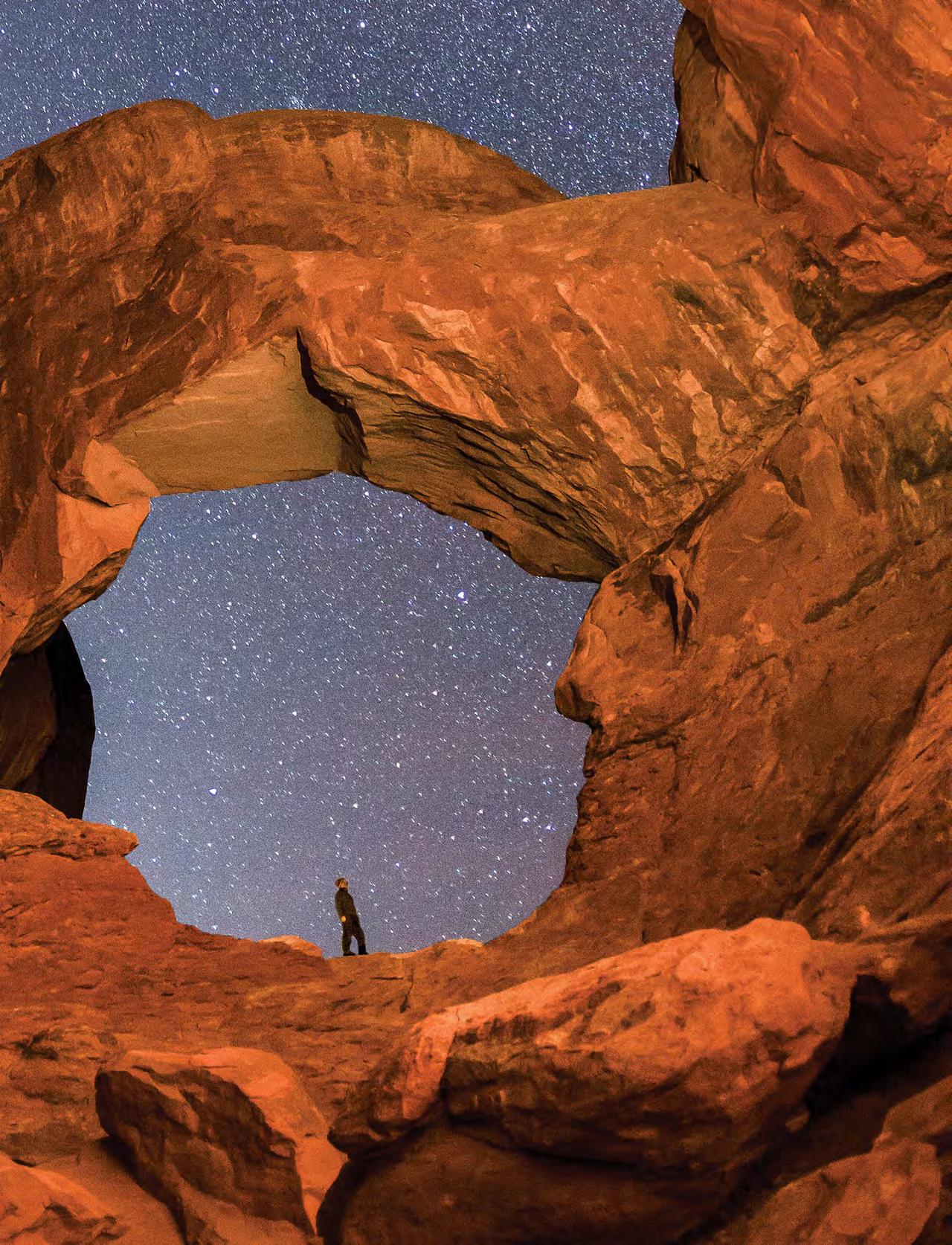
Double Arch
LOngS PeAk to A
30-square-mile dune field to a 2,000-foot-deep canyon to ancient cliff dwellings, Colorado’s four national parks deliver both natural and human-made spectacles that beg to be seen. But if you’ve already experienced the grandeur of those locales and are in search of your next national park adventure, let us show you the way. Just 80 highway miles from our state’s western border lies a landscape unlike any other: Utah’s Arches National Park.
Proximity isn’t the primary reason to visit Arches, of course. Mother Nature outdid herself here by outfitting the 76,519-acre playground with red-rock monuments that defy both gravity and reason. Whether you’re raising your eyebrow at a 3,600-ton boulder perched precariously atop a rocky spindle or cocking your head at the impossibility of a 306-foot-long stone arch, the resulting emotion is the same: awe.
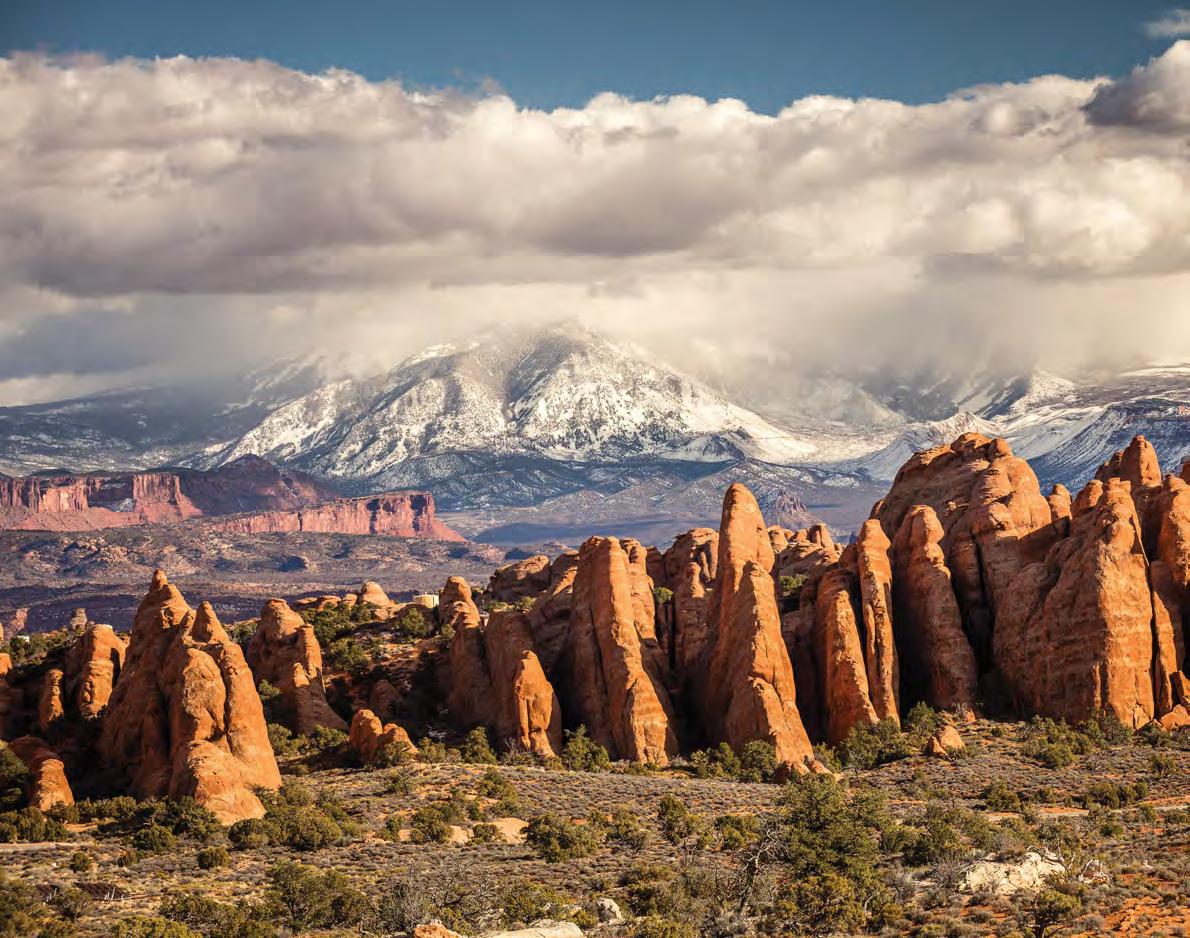
As with many national parks, Arches delivers much of that wonderment in highly accessible ways. The 18-mile road that slithers through the landscape leads visitors to ample parking lots, from which many bucket-list sights are visible. In other cases, hiking trails—some paved, some hard-packed dirt, some sand—depart from the lots, encouraging parkgoers to take (mostly) easy strolls to view what cannot be so readily seen.
While anyone can appreciate the drive-right-up ingresses, characteristically adventurous Coloradans will likely be more interested in getting off the well-trodden paths—a possibility most visitors forego. “We don’t have a lot of trails, and the ones we have get use; however, there are more wilderness-y parts of the park,” says Karen Garthwait, acting public affairs specialist for Arches National Park. “Folks from Denver just have to ask.”
Or simply turn the page, because we’ve rounded up the best of the can’tmiss highlights, the lesser-known experiences, and all of the did-you-know details that make a trip to Arches even more awe-inspiring.
In The eaRly tiMes
Natural stone arches within the park’s boundaries FroM 14,259-fOoT
The turbulent origins of the Salt Valley provide answers to visitors’ most common question: How did this happen?
Human beings represent but a blip on the planet’s geologic time scale, so it’s no surprise that our modern brains can’t easily comprehend events that began roughly 300 million years ago. At Arches National Park, Earth’s long history of tectonic chaos—where landmasses continually slam into one another, shaping and reshaping both land and sea—is readily apparent, yet it’s the more recent forces that created this landscape that parkgoers are often curious about. “I’m not a scientist, but I understand the basics,” says Karen Garthwait, the park’s public affairs specialist. “I have to, because people always ask.”
If you like to geek out on ancient cataclysms and ponder rock layers from the Jurassic Period, the Arches Visitor Center’s detailed displays are nerdvana. Those who want a (much) more abridged version of history can peruse this CliffsNotes-style summary Garthwait helped us craft.
2,000+
(
Jordan Siemans/Getty Images
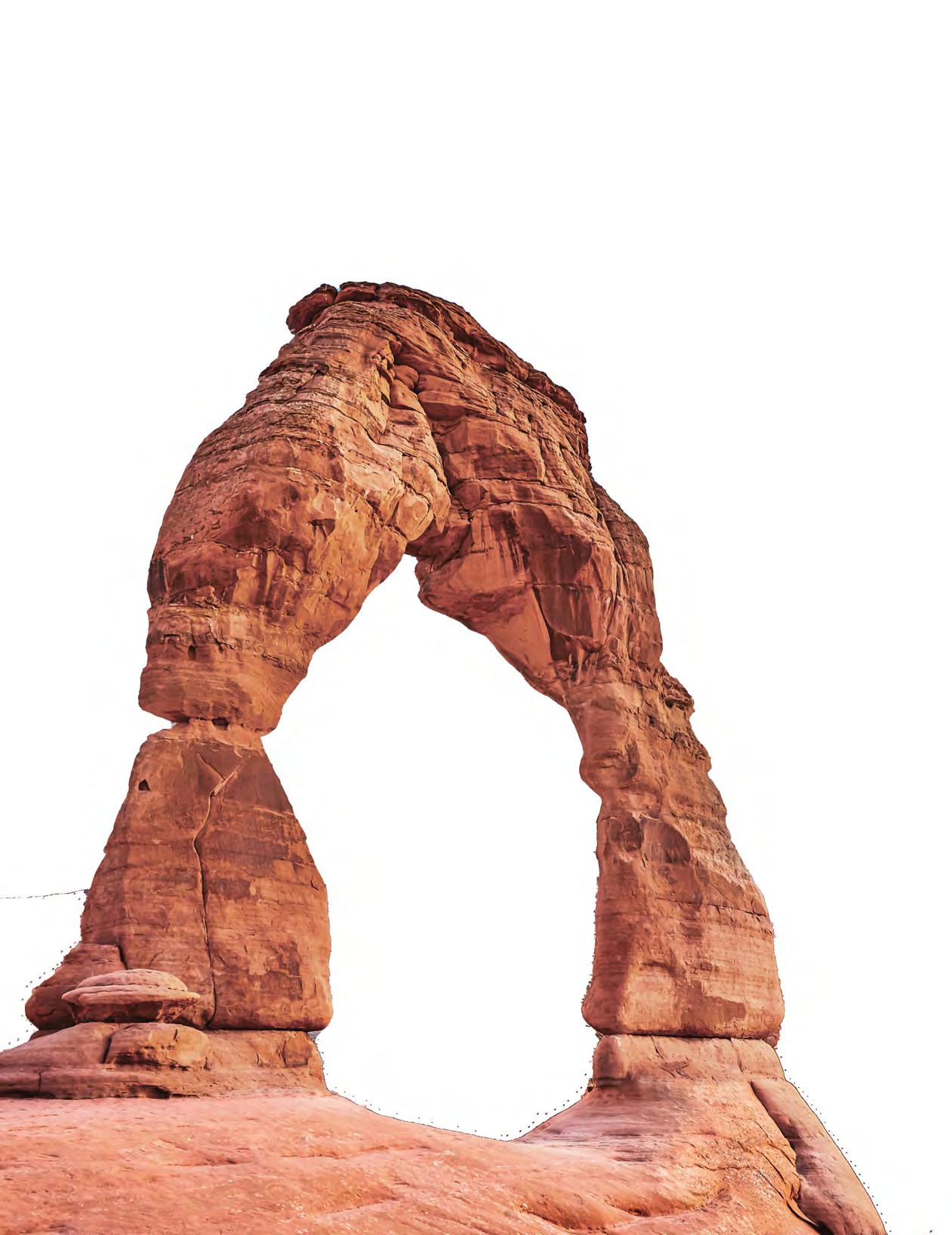
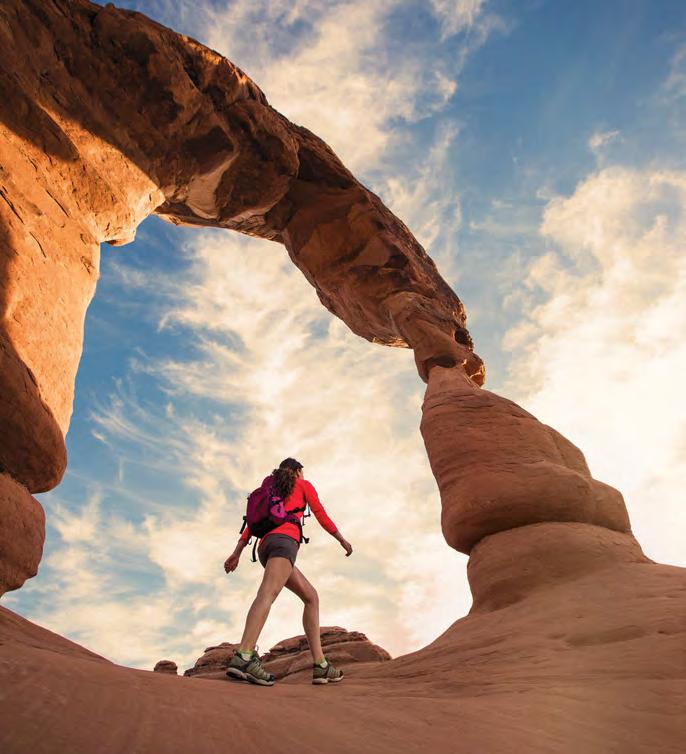
Arches National Park’s most famous formation, Delicate Arch
Tectonic forces pushed the Earth’s landmasses together. As those collisions occurred, the Rocky Mountains surged skyward and a basin emerged to their west. Over millions of years, fluctuating sea levels filled and drained the basin dozens of times, ultimately leaving a salt bed 5,000 feet deep. As the Rockies eroded, sand, rock, and other debris accumulated on top of the salt, creating a thick layer of compressed rock.
300 MILLION YEARS AGO
70 MILLION TO 35 MILLION YEARS AGO
10,000
Estimated age, in years, of most of the arches in the park, although some could be younger or older
Squeezed by the weight of the rock and at the mercy of tectonic pressures that were warping the geologic column of the region, the salt layer became unstable, shifted, and created a dome. The rock layer, which had eroded and become thinner, began to crack in roughly parallel fissures above the dome. Water infiltrated the cracks and dissolved the salt. Without the supportive salt layer, the rock above fractured and collapsed over time, creating large depressions in the regional landscape, including what is today called the Salt Valley, located within Arches National Park.

As the entire region began to rise in elevation and erosive force intensified, some of the remaining fractured rocks—all sedimentary stone—along the valley’s perimeter eroded to form thin, closely spaced sandstone walls called fins. Sand became trapped between these fins over time, and slightly acidic rainwater seeped into the trapped sand. Eventually, the acid dissolved the calcium carbonate that
held the sandstone fins together. It wore away at the rock until the fins collapsed or, in some cases, until holes were formed. In other fins, an exposed layer of weaker rock lay beneath a stronger one; the weaker stone weathered first, creating an opening. Without support from below, the stronger rock above succumbed to gravity. Chunks of rock fell from the top layer, creating the area’s distinctive arches.
BY
MIKE ELLIS
15 MILLION YEARS AGO
The forces of weathering and erosion—i.e., water and wind—continue to mold and remold Arches National Park. In fact, most of the arches and other seemingly delicate formations you see in 2024 are likely only 10,000 years old. The sandstone they’re made from was formed tens of millions of years ago, but structures have come and gone over time, continually creating “new” sights to see.
JUNE 2024 / 5280 39
TODAY
ILLUSTRATIONS
When the well-defined dirt path you were following leads you onto slickrock, it can feel like the trail has disappeared. Fear not: When that feeling arises, stop, look down, and find the smoothest rock. The footfalls that have come before you will have worn the sandstone down. That is your path.
tRaiL BeSt TrAVeLEd
You haven’t really experienced Arches National Park until you’ve hiked Devils
Garden Trail.
The path had simply vanished. Or, at least, it seemed that way. Standing on top of a large sandstone fin in Devils Garden, it was difficult to tell which direction to go. Should we continue straight, descend the fin, slide between the rock wall and junipers, and hope to connect with the sandy trail we’d been following? Should we backtrack? We paused, looked around, and finally saw a crudely devised, humanmade minibridge, constructed of thick branches, that crossed a thin crevasse. After negotiating that, we worked our way down the ancient sandstone on our backsides, hit the ground, and found the path once more. This is the story of trekking along parts of the lollipop loop that is the Devils Garden Trail, a 7.8-mile path that starts as a maintained route and, if one journeys far enough, turns into a loosely defined primitive track.
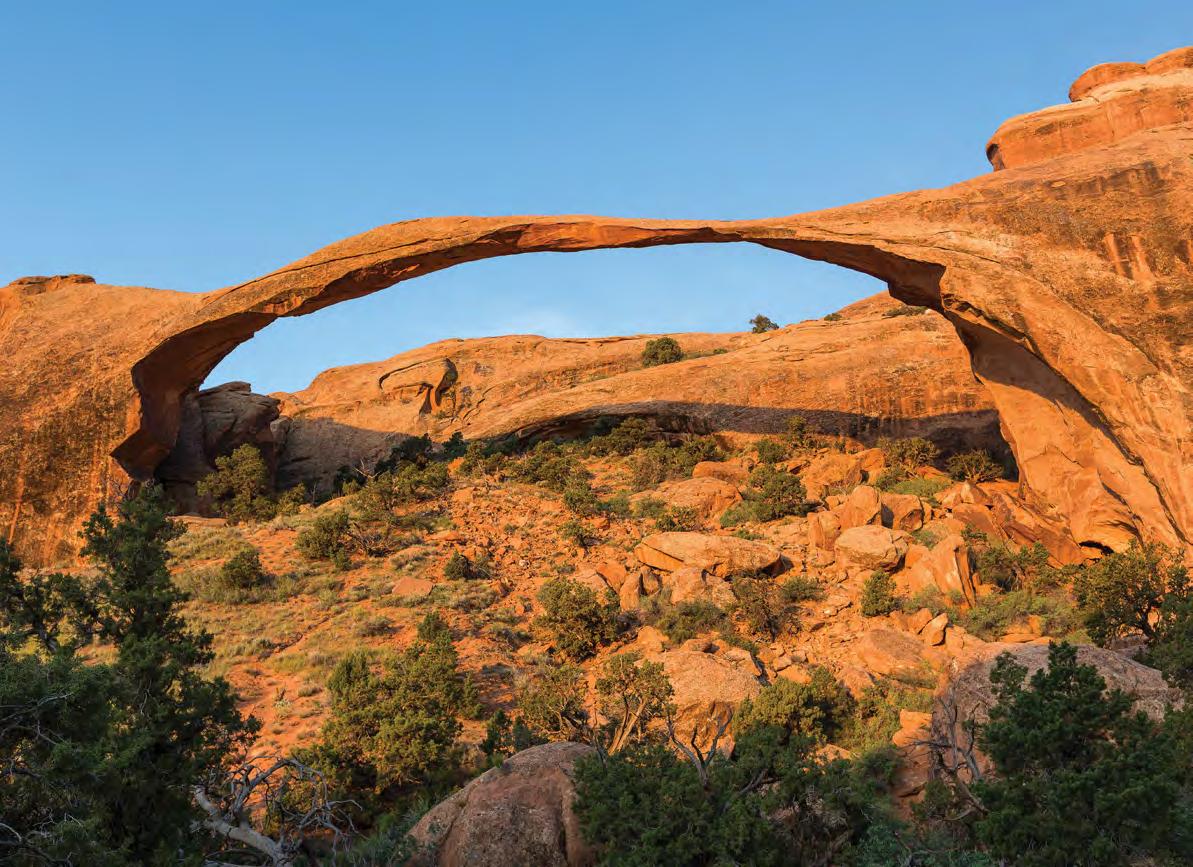
The trail contains multitudes. We had already seen 306-foot-long Landscape Arch, which lives about a mile from the trailhead via the
hard-packed section of the route. We’d then checked off Partition, Navajo, and Double O arches, all of which also sit adjacent to the main thoroughfare. For Coloradans who regularly climb 14,000-foot peaks, these formations can be seen without a whole lot of effort.
But it’s along the primitive trail—the beginning of which, if you’re hiking the loop clockwise, starts just after Double O—where the rugged beauty of Arches shows out. Steep rock walls, towers and
1
Percent of the park’s arches that are visible from pavement
spires, long fins stacked together, unnamed arches, sandy washes: They’re all here, without the crowds. In fact, we saw just two other sets of hikers during our two hours in the backcountry.
That’s what makes Devils Garden’s primitive trail so different from many of the other trails in Arches: the sense of adventure it imparts. We scrambled up massive boulders, balanced on slender mantels, and leaped from rock to rock, high-fiving each other as we stuck perfect landings. And as we plodded along the sandy final section of the primitive trail, before it reconnected with the maintained path that leads back to the trailhead and parking lot, we took a moment to acknowledge that losing the trail, even for those short few moments, was easily our favorite adventure of the day. —GVD
40 5280 / JUNE 2024
TRAIL TIP
Whit Richardson

DesErt SOlitUde
Car camping has its upsides—namely, access to water and toilets—and if that’s your thing, the Devils Garden Campground has 51 sites. But if you covet a more rugged camping experience, Arches’ backcountry locales are one of a kind. Well, four of a kind, actually. Unlike, say, Rocky Mountain National Park, which has more than 250 wilderness sites, Arches has but a tetrad: one in Devils Garden and three in Courthouse Wash, all of which you’ll have to reserve and get a permit to use. The Devils Garden site, where you will pitch your tent right on the slickrock (hello, sleeping pad!), offers amazing views but no access to water, so you’ll have to pack in your H₂O. Getting to the Courthouse Wash sites requires more route-finding—there’s no maintained trail at Lower Courthouse Wash—and you’ll likely cross water (pack water shoes), but the remoteness of these overnight spots means you likely won’t see another soul.
ArCh WayS
There are 16 official hiking trails in the park, but these five round-trippers should be high on your to-tread list.
HIKE IF YOU YOU SHOULD ALSO KNOW
Have active kids who are itching to get out of the car and want to scramble around—and under—multiple arches after a short, easy hike.
Like Tatooine-esque landscapes (or have little ones who might peter out on a longer hike).
Are interested in seeing the effects of time and erosion on an arch that’s easy to reach via a mostly flat trail that winds through desert grasslands.
Want to see one of the park’s most dramatic formations, a 112-foot-high double arch that’s the tallest arc in the park. At 144 feet long, it’s also the second longest, behind Landscape Arch.
Like red-rock structures that aren’t arches. This hike sends you down to the floor of a canyon lined on either side by towering walls replete with formations your brain will try to categorize: That’s a human head! That looks like a castle! (Fun fact: Park Avenue makes a cameo in Indiana Jones and the Last Crusade.)
There’s 0.3 miles of primitive trail behind North and South Window arches that few people take advantage of. Don’t miss it. You’ll be all alone and get different perspectives on these formations.
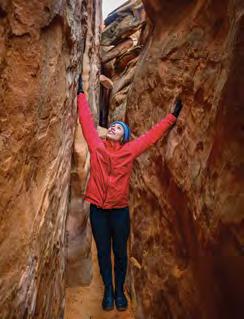
While the trail to Sand Dune Arch is short, it’s made of deep sand, which makes it more tiring than its length suggests. The trail also has one very narrow spot you’ll need to shimmy through.
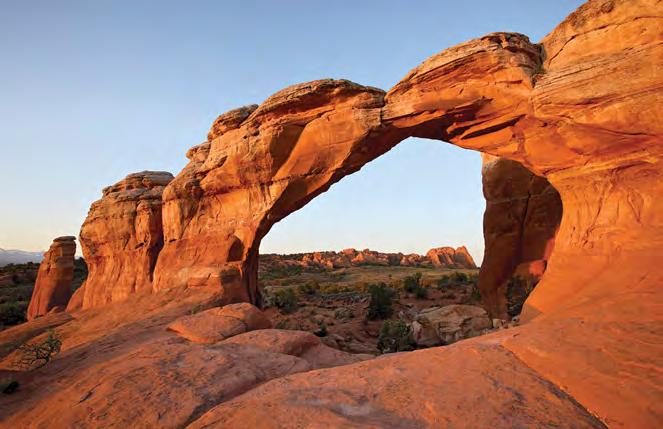
Broken Arch isn’t actually broken—but it’s well on its way, as evidenced by a large crack in its middle. If you’re brave, you can hike under the arch and connect to another trail that loops you back to the trailhead.
This is one of the better photo ops in Arches because you can scamper up the sandstone beneath Double Arch and find great angles with your iPhone.
It gets hot down in the valley, so bring plenty of water. Also, the trail is easy to follow for the first half-mile but then becomes harder to discern. Look for small cairns or footprints in the sand to stay on track.
JUNE 2024 / 5280 41
1-mile Windows Trail 0.4-mile Sand Dune Arch Trail 1.2-mile Broken Arch Trail 0.6-mile Double Arch Trail 1.8-mile Park Avenue Trail
From top: Valentin Wolf/imageBROKER/Getty Images; James Hager/robert harding/Getty Images
This spread, clockwise from left: The view from Devils Garden Trail; the path to Sand Dune Arch; Broken Arch
UntRaMmeLEd
The park sees 1.5 million annual guests, but only a sliver of them visit these lonelier locales.
WEST VALLEY JEEP ROAD
Those who like their adventures to be both off the beaten path and off paved roads gravitate toward this bumpy 10.7-miler. You’ll need a high-clearance, four-wheel-drive vehicle with low-range gearing (that you actually know how to use) because you’ll encounter tricky slickrock slopes, tire-eating streambeds, and even sand dunes. From Salt Valley Road, you can access this rough ride in the Klondike Bluffs area. Steer your truck 1.7 miles down West Valley Jeep Road, at which point you can go straight onto Tower Arch Road, a 1.4-mile-long four-wheel path that allows you to park close to Tower Arch, cutting the hike to 0.5 miles round trip. That box checked, turn your rig around—stopping to find Anniversary Arch North and South, just south of the 90-degree turn in Tower Arch Road—and then take a right to rejoin West Valley Jeep Road. As you drive south, take mental snapshots of the valley before stopping to see 37-foot Eye of the Whale Arch. From there, steer your oversize tires over uneven terrain until you hit a T-intersection. You’ll go left to find smooth pavement on Arches Scenic Drive, the park’s main road. Don’t Miss: To extend your rocky road escapades, hang a right at the T to take Willow Springs Road back to U.S. 191.
SALT VALLEY ROAD
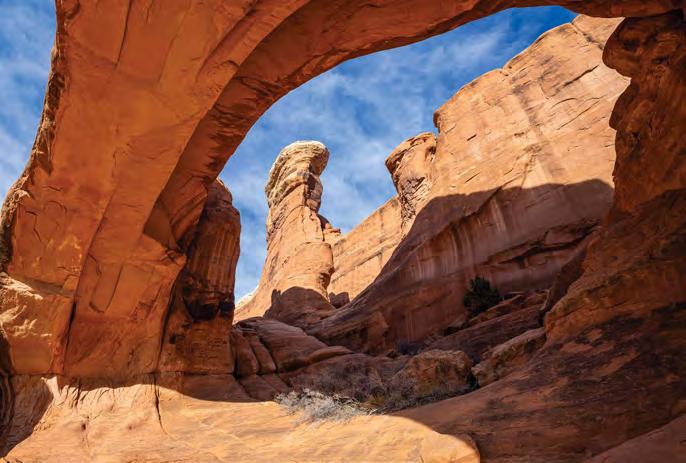
As its name suggests, this unpaved path winds through the Salt Valley, a kaleidoscopic basin surrounded by high bluffs and red-rock formations. Although you can access Salt Valley Road from outside the park (Google Maps can get you there from U.S. 191), we like going through the main entrance, sightseeing along 18-mile Arches Scenic Drive first, and then using this 15-mile-long washboard route as our way back out to 191. Why? After having experienced the easy-access parts of the park, visiting the more rugged Klondike Bluffs area feels wildly adventurous. From Salt Valley Road, you’ll turn left at Tower Arch Trailhead Road (it’s the second left that leads into the Klondike Bluffs area) and find a spot in the lot for Tower Arch Trail. The 2.6-mile (round-trip) trail to 92-foot-long Tower Arch isn’t easy— sandy terrain and elevation gain make for some huffing and puffing—but the scenery will keep your mind off the burn. You’ll come to Marching Men, three hoodoos in a line, and see the bulbous tower the span is named
Feet, at least, that the so-called light opening of an arch must be in one direction to be considered an official arch
after before you see the arch itself. Don’t Miss: Two other arches—Parallel Arch Outer and Parallel Arch Inner—appear just a few hundred feet before you reach Tower Arch.
COURTHOUSE WASH
Located in the southern part of the park, Courthouse Wash offers a wilderness experience you won’t find in much of the rest of Arches. But this is an IYKYK situation, as the unmaintained trail isn’t widely advertised by the park. The 11.2-mile-long drainage—which does, at times, host a creek you’ll have (and want!) to walk through—has two distinct sections and three access points. Hikers can enter the Upper Courthouse Wash, replete with a meandering canyon,

riparian areas, cool pools of water, and a smattering of arches, from its high point at Willow Springs Road outside the park or from the Courthouse Wash bridge pullout along Arches Scenic Drive. Lower Courthouse Wash’s 5.5 miles run between the same bridge and U.S. 191. The lower section is less dramatic, but the four side canyons that lead into the Petrified Dunes area of the park are worth exploring. Don’t Miss: Hikers can trek 1.5 miles through Upper Courthouse Wash from the bridge to find the trail to Ring Arch, a narrow span that’s 64 feet long. Near Lower Courthouse Wash’s access point off U.S. 191, there is a pictograph panel showcasing the ancient rock images of ancestral Indigenous peoples.
42 5280 / JUNE 2024
3
From left: Tower Arch is located in the less-frequented Klondike Bluffs area; the Courthouse Wash pictograph panel
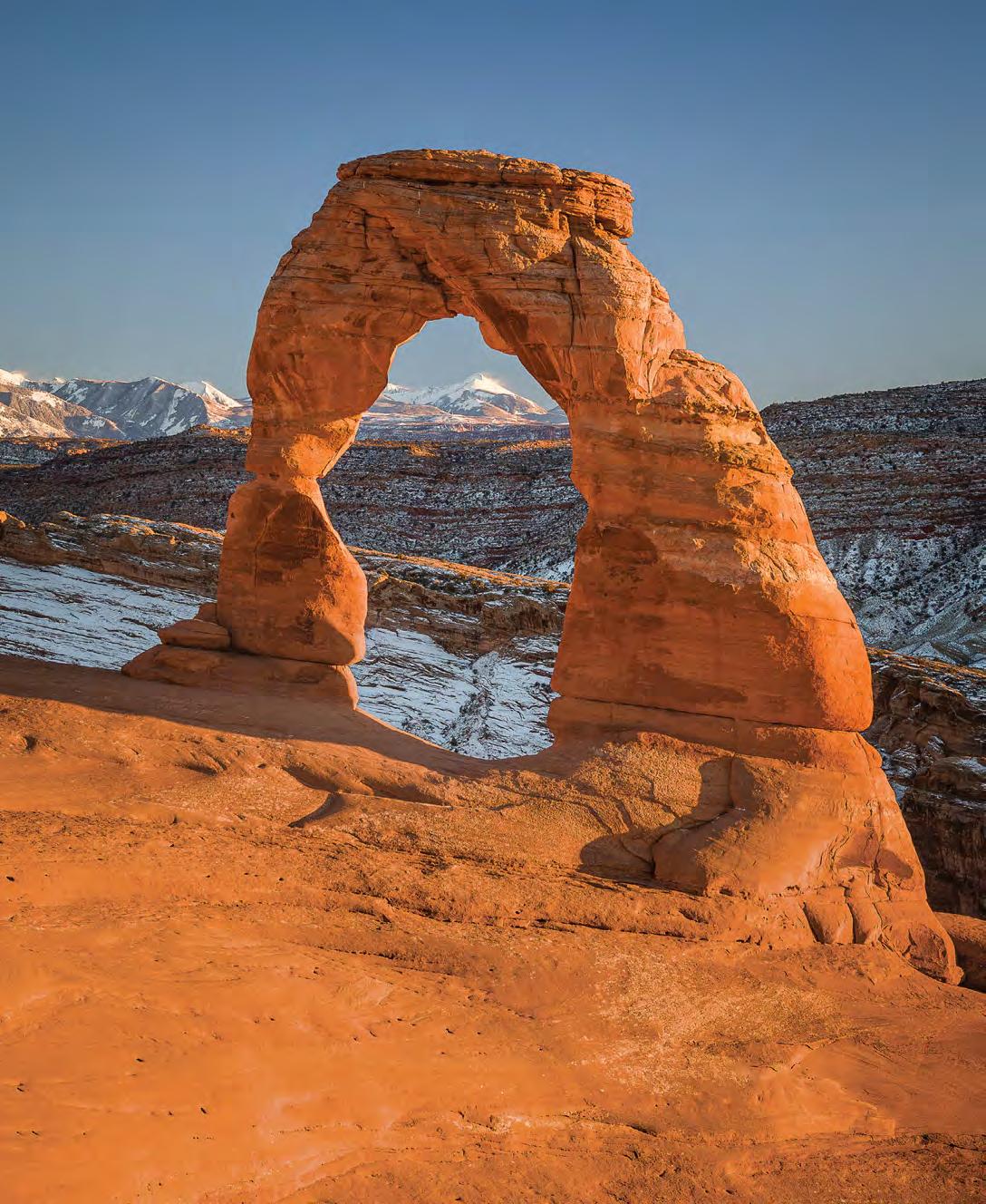
DELICATE ARCH
60 feet tall and 45 feet wide
There is no shade on the trail to Delicate, making midday jaunts in the summer a potentially dangerous, 100-plusdegree sweat fest.
Sunset is prime-time viewing for Delicate, but you’ll likely share the vista with 250 iPhonewielding friends. Quick tip: Bring a headlamp for the hike back.
The light opening beneath the arch is 46 feet high and 32 feet wide.
A short spur trail off the Delicate Arch Trail leads to a petroglyph panel thought to have been crafted by Ute peoples as long ago as the mid-1600s.
rOcK StAR
Delicate is backlit at sunrise, meaning if you’re doing it for the ’gram, you’re doing it for nothing in the morning. However, sunrise is the least crowded time of day to visit.
Rock arches are constantly vibrating—something the park has monitored to determine the structural health of the formations—but scientists have been unable to measure Delicate’s vibrations and they don’t know why.
The allure of Delicate Arch, a freestanding sandstone sculpture that’s possibly the most recognizable natural stone arc in the world, is undeniable. So dramatic is its visage—red-rock striations encircling chiseled stanchions that rise inexplicably from a slickrock slope—that its likeness graces Utah’s license plate and an estimated 250,000 hikers make the three-mile round-trip trek to revel in its beauty each year. Popular though it may be, Delicate Arch isn’t nearly as accessible as many of the park’s other luminaries, making it harder to get to know this celebrity. We rounded up a few facts you might not have heard about this prehistoric knockout.
JUNE 2024 / 5280 43
This spread: Whit Richardson (3)
The DeAtH Of aN ArCh
Every stone span in the national park will ultimately reach collapse.
Jeff Moore doesn’t look at natural rock arches like most people do. He recognizes their beauty, but as an associate professor of geology and geophysics at the University of Utah, he squints in the desert sun to find their weak points. He wonders about each crack, considers each sagging layer, ruminates on how thin stone can wear before its weight becomes its downfall. “When I go to Arches,” he says, “I sit quietly with an arch. I slow down with it. I think of its time frame and how lucky I am to be here to see this geologic blink of an eye.”
Since 2013, Moore and his colleagues in the university’s geohazards research group have been studying the lifespans of arches using seismometers to measure their unique vibrations. “These formations are constantly vibrating,” Moore says. “You can picture them moving like a string on a guitar or piano might when it’s plucked. We can measure the motion in fractions of a millimeter, and if we measure over time, we can notice mechanical changes.” In other words, Moore can ostensibly hear the death knell of an arch long before it actually crumbles.
This information is useful in a couple of ways. First, it helps the National Park Service (NPS)—or other land management agencies stewarding
fragile formations—make decisions about public safety. Many of the trails in Arches National Park lead parkgoers directly underneath arches, but accessibility can be altered if a hazard presents itself.
“Landscape Arch used to have a trail that went right under it,” says Moore, who has monitored that arch over the past nine years.
“After a partial collapse in 1991, the park closed the trail, which was smart because there were subsequent partial collapses in 1995.”
But Moore’s research also helps protect the arches from people. His readings give the
(
Feet, in length, of Landscape Arch, the longest such formation in North America
NPS some understanding of how human activity can shorten the lifespans of these gravitydefying structures. “We used to let people walk on arches,” he says with an incredulous laugh. “Not anymore. We also didn’t used to think about how repeated vibrations from helicopter tours might weaken the arches. We’re studying that now. We also have studied the idea that vibrations from highway traffic and passing trains can shake arches and have a detrimental effect over time.”
Still, Moore says, it’s the forces of erosion—the wind and the rain—that usually have the final say. So could a world-famous redrock formation such as Delicate Arch fall tomorrow? “The answer is maybe,” Moore says. “Delicate is indeed delicate. It is not long for this world. Landscape can’t get much thinner. Their lifespans are far shorter than we think. Go enjoy them now.”
44 5280 / JUNE 2024
306
This spread: Whit Richardson (2)
THE HARDER THEY FALL
These four arches have either partially or completely collapsed in the not-so-distant past.
1. Skyline Arch lost a large chunk of rock in 1940, expanding its light opening and creating its now distinctive look.
2. After two partial collapses in the ’90s, Landscape Arch is, in places, only six feet in diameter.
3. Wall Arch, which had a light opening 71 feet wide by 33.5 feet high, was the 12th largest span in the park—until it fell in 2008.
4. Rainbow Arch, a small span Jeff Moore had been studying to see if vibrations from nearby highway traffic could be detrimental, collapsed in 2018.

SoNiCallY BeAuTiFuL
In March, an exhibit featuring Jeff Moore’s vibration recordings taken at various formations throughout the Colorado Plateau, including at Arches National Park, opened at the Denver Art Museum. Moore explains that he “sonified” the vibration data with other goals in mind, but the “cool set of tones and the weird low rumbles” it created ended up fascinating him. The 12-minute audio piece plays through hidden speakers in benches in the gallery where Fazal Sheikh: Thirst | Exposure | In Place is showing. “The sounds help create a more immersive experience and partner well with Fazal Sheikh’s photos of Bears Ears National Monument,” Moore says. Through October 20
HOt TAkE
The Fiery Furnace is the ideal place to get lost (in thought).
The first time I stepped inside the Fiery Furnace, I was on a guided tour. I learned about desert varnish, ephemeral pools full of tadpoles, and 1,000-year-old juniper trees. Ranger Thomas Buskuskie also provided a few tips for navigating the Fiery Furnace’s maze of tight passages that wind through sandstone fins, hoodoos, and cliffs. But the best lesson I learned from the tour was that I wished I weren’t on it.
Ranger Buskuskie was a geeky delight, and my fellow guidees were a pleasant bunch, but I wanted to be alone in that primordial place. It felt like a setting where a person could go to just…think. So the next day, I got a permit to do just that.
PERMIT PARTICULARS
spread, from
I thought I’d be nervous as I slipped into the dizzying network of sandstone— but with plenty of water, a compass, and an early start to avoid the Easy-Bake Oven temps of midday, I felt comfortable that I could complete a short hike without having to alert search-and-rescue. As I descended into the Fiery Furnace, the first thing I noticed was the cool air. Even at 8 a.m., the shade provided by the soaring sandstone walls was a welcome relief from the July desert heat. I was relieved, too, to see the tiny brown signs with white arrows that showed the way most park rangers take their tour groups. I didn’t always follow them, but they provided a sense of security that allowed me to wander this way or that way, knowing I could always retrace my steps.
There are two ways to experience the Fiery Furnace. The first is a reservation for a 2.5-hour guided tåour ($16). The second is a reservation for a self-guided tour ($10). Both are available through recreation.gov and are released seven days in advance at 8 a.m. Mountain Time. For more tips on getting Fiery Furnace permits, visit 5280.com.
Really, though, I wanted to get lost. Well, at least a little. Enough that I could not see or hear another person. Enough that my iPhone could not possibly find a signal. Enough that my problems could seem far, far away. Enough that I could sit cross-legged on a weathered mound of 220-million-year-old slickrock, eyeball the gnarled trunk of a 1,000-year-old juniper tree, and think about the meaning (meaninglessness?) of the relative brevity of a human life.
On that day, my 97-year-old grandmother had only four weeks of breath left in her. On that day, I was heartsick about an argument I’d had with someone I love. On that day, I wondered how many more special trips I’d be making without a person to share them with. And on that day, sitting on that rock, I thought maybe none of it really mattered, in a cosmic sense. My 44 years were less than trivial compared with the history I could actually reach out and touch. The juniper tree was, I think, laughing at my insignificance.
Humbled by my surroundings and aware of how high the sun had risen while I was lost in thought, I left my alcove. I shimmied across ledges, squeezed through crevasses, and scampered my way out of the Fiery Furnace. This time, I learned a different lesson: Sometimes perspective is right there in front of you. —LBK
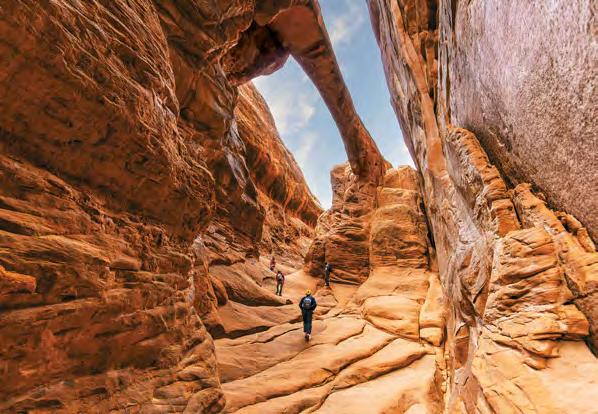
JUNE 2024 / 5280 45
This
left: Landscape Arch; Surprise Arch inside the Fiery Furnace
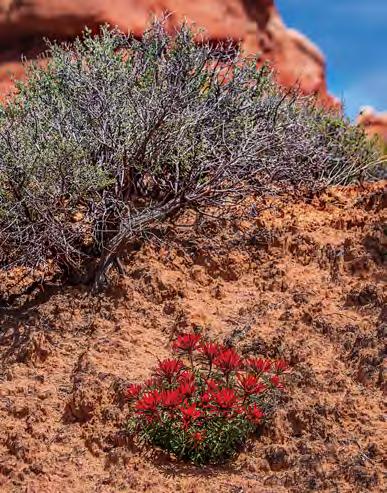
LiviNg tHinGs
Tread lightly: The soil at Arches is alive.
Most of the 1.5 million annual visitors to Arches National Park will spend much of their time looking up, or out, at the remarkable landscapes. But those who consider themselves eco-curious should also look in another direction: down. The top few centimeters of earth in and around Arches is known as biocrust, a rich, dynamic soil environment that is, quite literally, alive.
Composed of multiple living organisms— the most important of which is cyanobacteria—biocrust’s tiny inhabitants are activated by water. After a rare sip of H₂O, this blue-green bacteria “squiggles” around and leaves a lacy superstructure in the soil, according to Karen Garthwait, acting public affairs specialist at Arches National Park. “We often say it holds the place in place,” she explains. “It’s kind of gluing together the top two to four centimeters of what might otherwise be just a loose sand surface.”
Other organisms, such as lichens and moss, move into that superstructure and, by retaining water and pumping nitrogen into the soil, allow plants to sprout up in what would otherwise be a difficult place for anything to grow. This, of course, means that biocrust and its resident flora, much like the alpine tundra living in thin soil at high elevations in Colorado, is extremely fragile.
Overeager tourists who stray off established trails run the risk of damaging this critical and sensitive part of the ecosystem, which can take years to regenerate. That’s why the National Park Service has put such an emphasis on educating people who come to the park. “We’re inviting the visitors into these landscapes,” Garthwait says. “We are offering educational opportunities, and we are hopeful that the inspiring surroundings they can find themselves in will lead to feelings and behaviors of stewardship.” And, in Arches, that means sometimes looking down when you want to be looking up.
Watch Your Step

Cairns and/or deliberate rock arrangements
These stone configurations can be quite subtle, but if you look closely, you will sometimes see rocks organized in ways that are clearly not natural. They are pointing the way; follow them.
Keep an eye out for these three markers to help you stay on the trail.

Little arrow signs
When you’re in the backcountry, by all means, enjoy the scenery, but also be on alert for these small arrow markers, which are easy to wander past if you’re ogling that magnificent arch in the distance.

Footprints in the sand
If you’re on a sandy path and feel like you’ve taken a wrong turn, you can often find tread marks in the sand that will tell you other people have been where you are. No footprints? Turn around and scan until you find some.
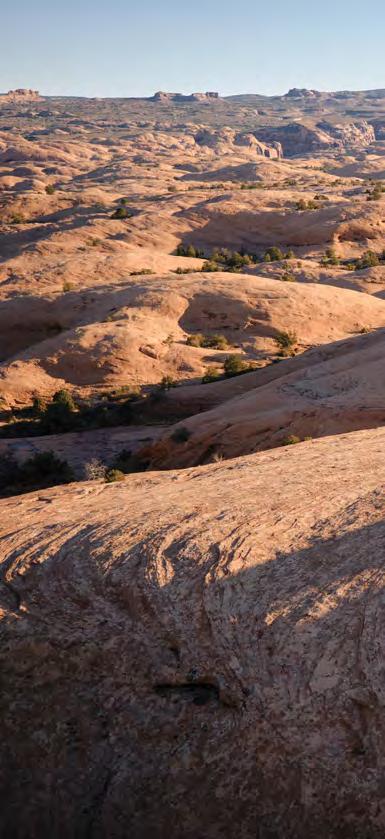
10
Inches of rain—an erosive force—the park receives annually
This spread, clockwise from left: Biocrust allows plants to thrive in Arches; slickrock terrain along the Hell’s Revenge four-wheel-drive trail; Jesse Rainbow
( 46 5280 / JUNE 2024
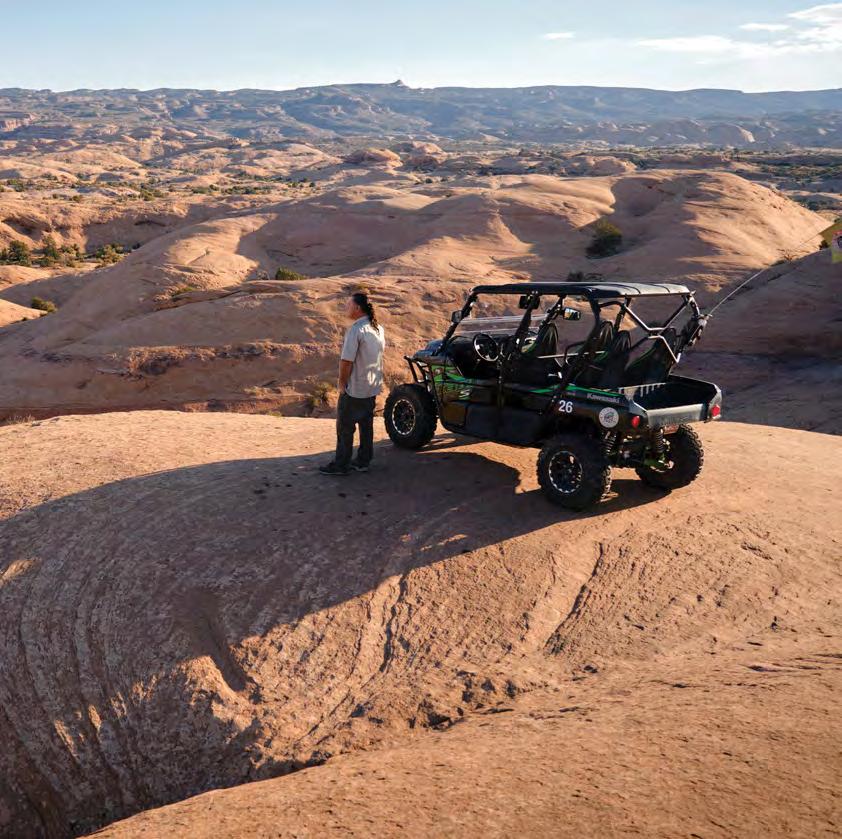
OfF The ROad AGaiN
The fun doesn’t stop outside the park, especially if thrill-seeking is your jam.
Fiery Furnace. Devils Garden. Dead Horse Point. I guess I hadn’t realized eastern Utah was so foreboding until I decided to arrange a four-wheeling trip through the Moab Tourism Center and became intrigued by a 2.5-hour, $139 tour of…wait for it…Hell’s Revenge.
Although I’ve piloted ATVs through rugged landscapes near Grand Lake and Vail, the center’s marketing copy touting an “unforgettable ride up and down steep inclines across sandstone domes and slickrock ledges” gave me a jolt of anticipatory excitement. I booked it.
A few weeks later, on a sunny September day, my travel partner and I listened as our guide, a guy by the name of Jesse Rainbow, gave his pre-drive safety talk. With his hair pulled back into a tight ponytail and a smile permanently spread across his face, Rainbow tried to inspire confidence among the five drivers in the group when he said the UTVs (which are larger than ATVs) we’d be driving could handle anything Hell’s Revenge spat out at them—which was a nice thing to have in the back of my head 30 minutes later when I was looking up the spine of an approximately 70 percent grade, 15-foot-wide sandstone fin with precipitous drops on either side.
My body flashed hot with adrenaline—and a little fear—but my white knuckles gripped the wheel, my knobby tires gripped the sandstone, and we crawled up that steep slickrock incline with no problem. It was just like Rainbow had said. With that initial obstacle out of the way, I was able to enjoy, and lean into, the ridiculous fun that is UTVing along the sandy trails and sandstone rock formations of the Sand Flats Recreation Area, located south of the park and just east of Moab.
We peeled around sandy berms and crept up and down seemingly vertical rocks. We motored along narrow ledges and let out whoops as we zoomed downhill, rollercoaster-style. We blasted through puddles and stopped several times to admire the views of hidden canyons, Arches National Park, and the muddy Colorado River with its sheer canyon walls. And, just as Rainbow had also promised, we returned to the Moab Tourism Center in one piece (the UTV was similarly intact), where I couldn’t help but purchase an “I Survived Hell’s Revenge” can cooler to commemorate the adventure. —GVD
Jesse Rainbow has led tours with the Moab Tourism Center for four years. We asked him what he loves about his gig, what visitors should know about the landscape, and how to be a good driver.
5280: You seem to take joy in your job—is that true?
Jesse Rainbow: I love all of it. I get to meet cool people from all over the world and show them things they’ve never seen before. We get to drive these crazy machines together. I talk to them about desert conservation, geology, and the history of the area. I try to tailor every tour to what lights up people’s eyes.
Does your Apache and Yaqui heritage inform your tours?
Totally. Some of this land used to be part of Native American turquoise trade routes. There’s also a lot of ancient history—old petroglyphs from the Fremont and Ancestral Puebloan peoples. We actually do a petroglyph tour that’s awesome. Plus, I like to talk about how Indigenous people used piñon, juniper, yucca, desert sage, desert rhubarb, and the sego lily for food and medicine.
OK, let’s chat about these “crazy machines” you drive. Oh, man. These Teryx side-bysides will go up and over things that people can’t believe. You can go up a 60 percent grade, no problem. They’re a ton of fun.
What’s your best driving advice?
Be humble. Listen to the guide. Put your tires in the tracks of the vehicle in front of you. When in doubt, ask. And don’t be afraid.
ExPert GuiDaNcE
This spread from top left: Dan Leeth/Alamy Stock Photo; Seth K. Hughes (2)
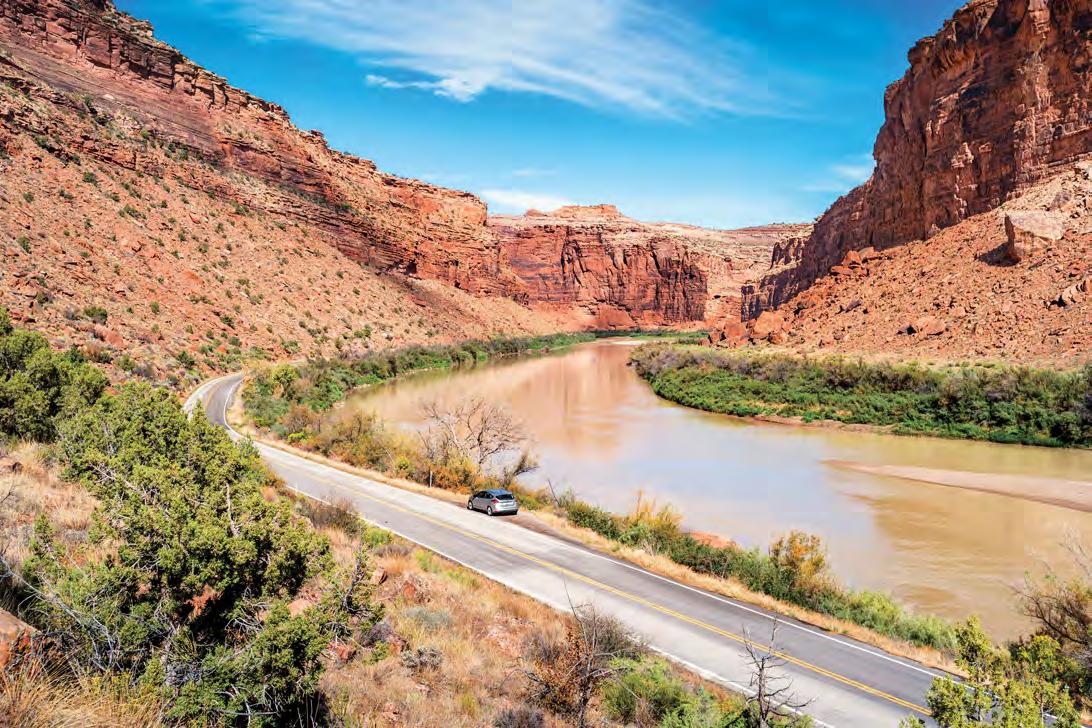
tHe bAck Way
Skip U.S. 191 for this dazzling drive along the Colorado River.
In southeastern Utah, there’s no shortage of stunning scenery. The Upper Colorado River Scenic Byway, however, is often overlooked by visitors to the Moab area. Locals, who’ve long called the route River Road, know better. “Have you seen our little scenic byway?” asked the man working the register in Arches National Park’s visitor center. When we shook our heads, he swiftly pulled out a map to help us correct our mistake.
Completed in the early 1930s, this stretch of pavement, which starts just north of Moab, adds a few minutes (maybe 10, depending on traffic) to your return trip to Denver—as opposed to taking U.S. 191—but you won’t regret the delay. Towering red-rock walls will have you craning your neck. Must-see natural attractions, such as 243-foot-long Morning Glory Natural Bridge and the 400- to 900-foot-tall Fisher Towers, will plead with you to leave your car for a hike. Folks floating down the river in rafts will have you wishing you could extend your vacation. And riverside campgrounds, run by the Bureau of Land Management, will have you wondering why you paid $250 a night in Moab. (If camping just isn’t your thing, see “All The Amenities,” at right, for hotel recs in town.)
Whether you choose to make pit stops along the byway or promise yourself you’ll explore its treasures on your next trip, we promise you’ll never overlook River Road again.
AlL The AmEniTies
Moab has tons of places to stay, but these two newish lodges get bonus points for their included niceties.
Field Station Moab
With two locations—one tucked near Joshua Tree National Park and the other in Moab near Arches National Park—Field Station clearly understands how to create an outdoor-adventure-forward accommodation. Staying at the 14-month-old, 139-room lodge, located just four miles from the Arches entrance, feels like putting

on your favorite Patagonia jacket: It doesn’t look fancy, but it’s comfortable, functional, and fits just right. Little Luxuries: Score on-site rentals for things like mountain bikes, sleeping bags, and tents; join Mappy Mornings, during which staff will steer you toward can’tmiss hikes and bike rides; and enjoy the outdoor fire pit, where guests can sip on beers from the lobby bar.
The Moab Resort, WorldMark Associate
This two-year-old oasis offers studios as well as one-, two-, three-, and four-bedroom options that are all remarkably spacious, with kitchens that are nicer than what you’ll find in most people’s homes. Plus, the red-rock-resplendent views from many of the balconies are so lovely you might reconsider your plans to go to the park. Little Luxuries: Grill stations make it easy to avoid the crowds at Moab’s restaurants; mountain bike wash stations will keep your trusty steed clean; and the snack bar lets you remain poolside when you get peckish.
48 5280 / JUNE 2024
From top: benedek/Getty Images; Matt Kisiday/Courtesy of Field Station Moab
ReStaUrAnt CriTic
Moab’s dining-out options leave a lot to be desired—but the nosh at these spots will more than satisfy your cravings.
Moab isn’t the only tourist town to suffer from a lackluster lineup of restaurants (see: Estes Park), but that doesn’t make it any less disappointing when you’re ready to replace those hard-spent calories with something tasty. After nearly a week’s worth of eating (and plenty of input from locals), we concluded that the ostensibly upscale places weren’t worth the outlay and that the more casual the eatery was, the better the food we had. When it’s time to refuel—pre-hike, post-ride, or before bedding down—consider these munchtime options.
AT THE GO-TO IS BUT DON’T MISS THE
The New Mexico breakfast burrito packed with eggs, potatoes, chorizo, cheddar, and salsa
More traditional doughnuts, such as the cinnamon sugar or chocolate old fashioned
A turkey Gouda sammie with cranberry relish, greens, mayo, and pickled onion on sourdough
The build-yourown panini
A panino at Paninis Plus (the Hawaiian sandwich is chef’s kiss)
A caprese salad with homemade mozzarella
Patatas bravas, a Spanish potato dish reimagined with eggs and a caramelized sauce of onion, garlic, tomato, spinach, and feta
Over-the-top iterations such as vanilla sprinkle cake or salted caramel crodough
BLT, a staff fave that has fresh mixed greens, thick-cut bacon, and a to-die-for homemade tomato jam
Ooey-gooey cinnamon rolls and other homemade pastries
Dirtbag Quesadilla with refried beans and cheese at Quesadilla Mobilla, a truck located adjacent to the park
Prosciutto pizza with tomato sauce, prosciutto di Parma, mozzarella, Pecorino Romano, basil, and extra-virgin olive oil
IT’s AlL IN tHe DETaiLs
The basic info you need for planning the trip you want.
This spread, clockwise from left: The Upper Colorado River Scenic Byway; Moab Garage Co. in downtown Moab; Field Station Moab
Hours: The park is open 24 hours a day, 365 days a year.
Reservations and entrance fees: For the past two years, Arches has been using a timed-entry reservation system. You must purchase a reservation ($2) online at recreation.gov in advance of your arrival. The park releases timed-entry tickets on a first-come, first-served basis three months in advance. The tickets are released at 8 a.m. Mountain Time. A limited number of timed-entry tickets are also released each evening at 7 p.m. Mountain Time for the next day. In addition to the reservation, you also need to purchase a park entrance pass (private vehicle $30, motorcycle $25, bicycle/hiker $15). To enter the park, you will need your reservation, your entrance pass, and your driver’s license, which must match the name on the reservation.
Permits: You will need to secure permits in advance for backcountry camping and Fiery Furnace tours at the park’s permit office and recreation.gov, respectively. Day-of permits—which are issued at a self-service kiosk or at recreation.gov—are required for canyoneering and encouraged for rock climbing.
Campground: The Devils Garden Campground has 51 sites that can be reserved on recreation.gov for dates between March 1 and October 31. The sites can be booked up to six months in advance. (Between November 1 and February 28, the sites are first-come, first-served.)
Lodging and services: There are no hotels or restaurants inside the park.
Visitor center: Through September 23, visitor center hours are daily from 7:30 a.m. until 6 p.m. Rangers are on hand for questions; the park store has all the souvenirs you could want; explanatory exhibits teach visitors about the park; and restrooms and drinking water are available. m
112
Feet, in height, of Double Arch, making it the tallest in the park
Love Muffin Cafe
Doughbird Moab Garage Co.
Sweet Cravings Bakery & Bistro
Moab Food Truck Park
Antica Forma
Courtesy of Lindsey B. King
A

50 5280 / JUNE 2024

Coloradans have long extolled their home’s relative lack of pests, but the Centennial State depends on native insects to support its various and diverse ecosystems. Lately, though, resident creepy-crawlies have been dropping like flies, leaving scientists scrambling to save them.
BY BARBARA O’NEIL ILLUSTRATIONS BY TIM MCDONAGH



800


Species researched in a CU Denver–led study, which found that flying insects are migrating to higher elevations due to climate change, contributing to their declines as they struggle to adapt to new environments
20
Percent of bumblebee species in Colorado that are considered threatened, according to a state-commissioned pollinators report released in January, leading experts to call for federal protections for the bees
A recent trip to Florida solidified my love for Colorado. After waking up to a horrifyingly large millipede on the wall of a Palm Beach Airbnb, running through clouds of blood-sucking mosquitoes, and dodging cockroaches skittering down sidewalks, I fell head over heels all over again for a place I’d long appreciated for its dearth of vermin. That is, until I learned a buggy environment is an ecologically sound environment.
Insects are the most varied and plentiful animals on Earth. Their existence allows for not only healthy ecosystems, but also for the very existence of many other species, including humankind. According to Rich Reading, vice president of science and conservation at Westminster’s Butterfly Pavilion, insects serve as meals for the rest of the food chain, pollinate plants that humans eat for dinner, and control invasive pests that attack native plants and animals. In short, bugs are far more critical than their relatively diminutive size might suggest, which is why Coloradans—and human beings in every corner of the planet—ought to be concerned about their rapidly declining numbers. “Colorado is drier than a lot of states, so we naturally tend to have fewer bugs than places like Florida, but there used to be more,” Reading says. “We’re dealing with what some are calling a ‘bug apocalypse.’ ”
~233,000
Monarch butterflies counted in 2023 by the Western Monarch Count, a volunteer-led initiative affiliated with the international nonprofit Xerces Society for Invertebrate Conservation, showing that the butterflies have seen a 95 percent decline in the western United States since the 1980s
202,000
Acres in Colorado affected by the Western spruce budworm, the most widely spread forest pest in the state, which kills spruce and Douglas fir trees through defoliation, according to the 2023 Forest Health Report from the Colorado State Forest Service
Germany showing that flying insects in the coun try’s nature reserves decreased by more than 75 percent over 27 years. But it was a 2019 review that confirmed the problem is more widespread. According to the percent of all insects worldwide are threatened with extinction. While scientists have yet to figure out a definitive cause, there are a few main suspects—namely climate change, pesticides, the global spread of invasive insect species, and
Colorado isn’t sidestepping the bugtastrophe. In fact, research by the Rocky Mountain Biological Laboratory published in 2023 showed a 62 percent decline in flying insects near Crested Butte since 1986. And earlier this year, a report commissioned by the Colorado Department of Natural Resources concluded that the status of Colorado’s native pollinating insects is “tenuous.” Plus, three butterflies native to Colorado are currently listed under the Endangered Species Act. “I don’t know if anyone really knows what’s going on,” says Marek Borowiec, an assistant professor of agricultural biology at Colorado State University. “But it’s vitally important we understand.”
That’s why the Butterfly Pavilion and CSU announced a partnership in February that will lead to shared resources and funding to research invertebrate decline. Researchers from institutions such as the University of Colorado Boulder and University of Colorado Denver are stepping in, too, all of which caught the eye of local lawmakers. In April, the state Legislature passed a bipartisan bill that, if signed into law, would give Colorado Parks and Wildlife (CPW) the authority to study invertebrates and rare plants and develop plans to protect species in danger. Colorado is one of just nine states that does not already give its wildlife officials such authority. According to Reading, the designation would vastly improve research in the state. “It’s really going to take all of us working together, because this is a lot of work,” he says. “We can be a lot more effective and synergistic in our impacts by partnering with one another.”
While it’s not exactly the end of the world as we know it (yet), we spoke with scientists, state researchers, and local organizations who are fervently working to prevent a bugtastrophe here at home.
52 5280 / JUNE 2024
ALL ABUZZ
Pollinators can fertilize in peace at these local sanctuaries.
Thanks mostly to human development, Colorado’s pollinators are dying. That’s not just unfortunate news for the insects; it’s a beeline toward disaster for native flora that depend on the insects for genetic diversity. With that in mind, in 2019 the Butterfly Pavilion launched Pollinator Districts, a designation that turns human-made sites—like roads, neighborhoods, and even entire cities around the globe—into insect refuges. Through the program, Butterfly Pavilion scientists either inspect existing communities or study the land of future developments before providing town officials or developers with recommendations on how to create buzzworthy locales that counteract the destruction of native plants often brought by development. “When you create a diverse landscape with native plants that are drought-resistant, you create an environment that attracts all sorts of wildlife,” says Patrick Tennyson, president and CEO of the Butterfly Pavilion—which in 2022 turned a beachfront neighborhood in Turks and Caicos into a pollinator haven. Here in Colorado, the bees are busy at these three Pollinator Districts.

I-76
This 184-mile-long highway, which runs from Denver to the Nebraska state line, became a Pollinator District in 2018 after the state proclaimed it the Colorado Pollinator Highway in an effort to protect insect habitat. Since then, road crews have avoided mowing grassy areas during peak pollination season (April through September), and the state has employed a roadside manager to promote the growth of native plants and weeds along the highway.
MANITOU SPRINGS
Last summer, Manitou Springs became the world’s first municipality to receive a Pollinator District designation by installing green roofs and creating public gardens. This year, residents were invited to take part in Pollinator Palooza, a three-monthlong event. Participants uploaded photos of pollinators they encountered to an app that tracks the various species. Those who submitted the most photos earned prizes, while the information gathered will help the city maintain its designation.

BASELINE
While this Broomfield neighborhood dotted with new builds might look like any other suburban development, its carefully designed parks and gardens are filled with native plants that attract insects. Research conducted by Butterfly Pavilion scientists has shown a 60 percent increase in pollinators in the area since Baseline became a Pollinator District in 2019. And the work doesn’t stop there: In an effort to further prop up pollinator populations, the Butterfly Pavilion plans to open an 80,000-square-foot campus—complete with green roofs and native gardens—adjacent to the neighborhood by 2028.

FLOWER POWER
In January, Governor Jared Polis revealed results from the 306-page Colorado Native Pollinating Insects Health Study, a research project prompted by Senate Bill 22-199. Based on more than a century of already completed studies, the report confirmed a drastic decline in pollinators in the state. Adrian Carper, entomology curator adjoint at the CU Museum of Natural History and one of the study’s co-authors, spent months analyzing existing scientific literature to help pen the report. While the authors found that more than 1,000 species of bees exist in Colorado, one of the largest factors contributing to their demise has been the conversion of natural habitat to agricultural land, which destroys endemic flora. Carper suggests that instead of renting bee colonies from commercial beekeepers, savvy farmers can use strategically placed native plants to attract pollinators to naturally fertilize their crops while simultaneously offsetting the damage that agriculture can wreak. “Crops depend on native pollinating insects to make the most fruit,” Carper says, “and by managing the surrounding habitat, farmers can pollinate those crops for free without paying honeybees to do it.”
JUNE 2024 / 5280 53
From top: RJ Sangosti/ the Denver Post /Getty Images; Courtesy of City of Manitou Springs; Adventure Photo/Getty Images

planet. The Colorado potato beetle, a tiny, round insect with an orange body and black stripes, is indigenous to the Centennial State but began traveling the world by hitching rides on transported produce in the 1860s. Now, it can be found grubbing on potato plants throughout the United States, Europe, and Asia, where it has the potential to defoliate entire fields of crops in just a year or two. According to Marissa Schuh, an extension educator with the University of Minnesota who helps farmers there manage the pests on their crops, the beetles are nearly impossible to eradicate from farmland once they’re found, but there are ways to control their populations. Farmers can employ crop rotation (planting different crops each season on the same piece of land) to keep beetle numbers low. Home gardeners should consider buying ladybugs: They eat beetle eggs for breakfast.
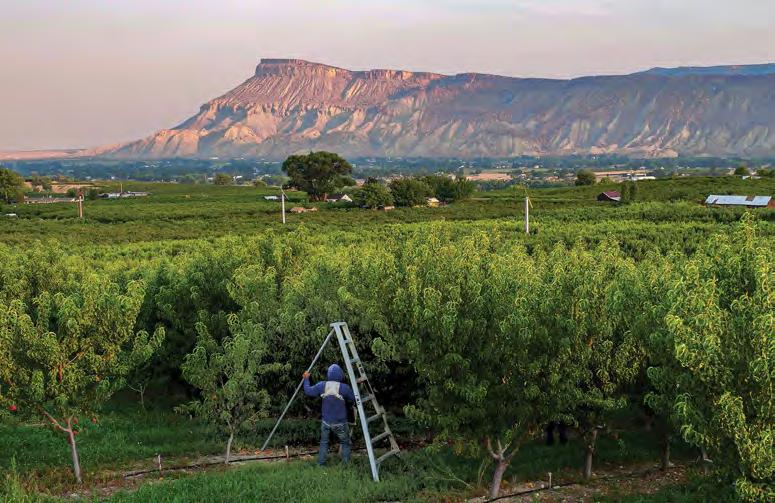
THE INVADERS
Inside the state-run Palisade Insectary, scientists rear killer bugs to help local farmers save their renowned peaches.
The breezes here are different. They blow down through De Beque Canyon and unfurl across the Grand Valley town of Palisade. Known as katabatic winds, the warm air they deliver reduces chances of frost. Those breezes create a unique weather pattern that, among other things, makes for some of the world’s finest peach-growing conditions. The temperate microclimate attracts fuzzy-fruit lovers from around the globe, but tourists aren’t the only ones who love the sweet taste of a Palisade peach. In the early 1900s, a 10-millimeter-long, graycolored moth hitched a ride on a vessel from Southeast Asia that was carrying cherry trees. The Grapholita molesta, or peach moth, spread throughout the country by 1945. Today, the moth is found wherever stone fruits are grown, including in Colorado’s peach capital.
Each spring, females lay their eggs on the surfaces of peaches, a brilliant example of survival of the fittest evolution that not only provides freshly hatched larvae with an easy snack when they dig inside the fruit, but also makes topical pesticides useless. So, in 1946, the Palisade Insectary, a state-run lab that raises insects that attack invasive bugs and plants, started building an army of millions of moth-killing wasps (pictured) each year. The Macrocentrus ancylivorus (dubbed the Mac, for short) uses a sharp appendage called an ovipositor to saw into the peaches, where it lays its eggs inside the moth larvae it finds. When the baby wasps hatch, they eat the larvae from the inside out. It’s brutal, but Kristi Gladem, biological control specialist with the Palisade Insectary, says it’s proven to be effective. “The wasps keep the numbers low,” she says.
Peach growers can apply to the insectary to receive free wasp pupae (roughly 1,000 per acre of orchard), which they hang in trees to hatch. It only takes a few days for the adult wasps to break free and immediately search the orchards for moth larvae.
And while the Palisade Insectary remains focused on controlling Palisade’s moth population, the lab is also available to assist other agencies with invasive species. For instance, a decade ago, Boulder Parks and Recreation detected emerald ash borers on public land; the beetle is native to Asia and feasts on ash trees. Lab workers released four species of wasps, all of which are related to the Mac but are bred to attack the beetles instead of moths. The city of Boulder is currently participating in research to determine the effectiveness of those wasps, but Gladem notes that early results have been promising.
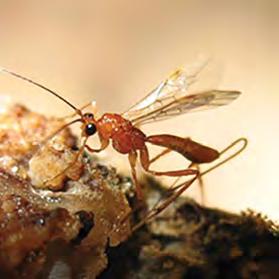
Although Boulder still hosts a population of emerald ash borers today, the numbers are manageable.
The Palisade Insectary stands ready to provide other Colorado cities with biological controls if there are future outbreaks. However, Gladem and her team are also working on something else: rearing insects for control of invasive plant species. The northern tamarisk beetle, for example, eats the invasive tamarisk shrub and should be able to get the population of weeds on the Western Slope under control within the next few years. Still, the Palisade Insectary’s golden child is the Mac wasp, which it continues to breed annually by the millions—a job that allows all of us to, without hesitation, bite into the sweetest peaches around.

54 5280 / JUNE 2024
From top: Ken Redding/Getty Images; Courtesy of Palisade Insectary, Colorado Department of Agriculture
WANTED DEAD OR ALIVE

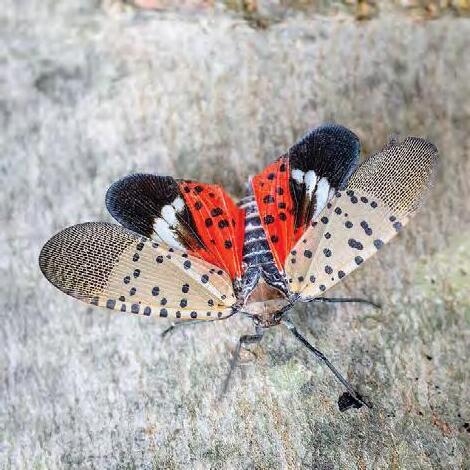
leaf) is native to China and first arrived in the United States through an international shipment of stone in 2012.
Chomping on grapes and apples and sucking fluid from under the bark of hardwood trees. Adult lanternflies and immature nymphs also love to grub on the tree of heaven, an invasive plant that has only minor distribution in Colorado.
POSSIBLE SIGHTINGS: The spotted lanternfly hasn’t made its way to the Centennial State, with the exception of one dead specimen found in a shipment a few years back. Still, the pest is destructive enough that Wolfe considers it an “insect of most concern” and expects it will come to Colorado within a decade.
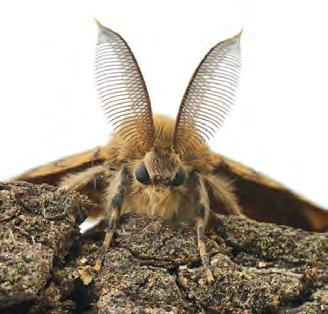
to Europe and Asia but has been caught terrorizing the United States since 1869.
CHARGED WITH: Producing really hungry offspring. Its caterpillars aren’t picky eaters and will chow down on more than 300 species of trees and plants, with a preference for aspen, birch, and willow trees.
POSSIBLE SIGHTINGS: Mainly found on the East Coast, the moth has gnawed on trees across 20 states so far. While it doesn’t yet have a presence in Colorado, the USDA has placed thousands of traps across the state to try to immediately spot it when it arrives.
JUNE 2024 / 5280 55
From left: Getty Images; Wirestock/Getty Images


LIGHTING THE WAY
Not just the stuff of legends, fireflies once lit up Colorado’s nights. That’s no longer the case.
Fireflies are native to Colorado, but you wouldn’t know it. These little glowing beetles typically thrive in wetlands, like in marshes at the edges of lakes and streams. They were once plentiful across the state, but today they’re only found in a few small pockets, including at Littleton’s Chatfield State Park and Fort Collins’ Riverbend Ponds Natural Area.
Magical as they are to witness, the twinklers are more than meets the eye: Lightning bugs are a so-called indicator species, which means their population numbers are directly correlated to the health of the surrounding ecosystems. The fact that they’re hard to spot in Colorado today is alarming: It serves as proof that their native wetlands are being destroyed by development and water pollution. That’s why, in 2019, the Butterfly Pavilion started an initiative called the Firefly Life Cycle Project, an effort to understand the
insect’s life cycle and potentially learn how to rear it in captivity.
In 2021, the project’s scientists captured wild fireflies, bred them, and attempted to raise the larvae. Their first major success came in June 2023, when three lab-born fireflies matured into adults. That’s a tiny number, sure, but according to Jennifer Quermann, senior director of communications and marketing at the Butterfly Pavilion, this is the first known successful rearing of captive fireflies to adulthood on Earth. Butterfly Pavilion researchers hope that, eventually, they’ll have enough fireflies to populate a sanctuary and create an exhibit for the beetles—and maybe even introduce them back into the wild someday. “Ultimately, the goal is to create a sustainable population of lab-reared fireflies,” Quermann says, meaning Colorado’s night skies might one day be lit up with luminescent flickers once more.
western Colorado, you’ll increase your chances of seeing a Speyeria nokomis nokomis, a subspecies of a larger family of butterflies known as the Silverspot, recognizable by its large, three-inch wingspan and black-with-cream-colored-spots pattern on its underside. As lovely as it is, this winged dazzler is also a relatively rare sight: Only 10 populations exist throughout Colorado and surrounding states. This past February, the U.S. Fish and Wildlife Service (FWS) announced that the insect would receive protections under the Endangered Species Act and categorized it as threatened. “The butterfly requires wet meadow areas to survive, and climate projections are predicting a warmer and drier future,” says Terry Ireland, fish and wildlife biologist with FWS’ Colorado field office. “Climate change was a big driver for our threatened determination.” That designation means that while the butterfly is likely to become endangered, it will get protections, such as federal funds, that aim to prevent that possibility.
56 5280 / JUNE 2024
Creed Clayton/Courtesy of U.S. Fish and Wildlife Service
HIVE OF ACTIVITY
While Colorado experts are furiously formulating ways to save local insects, they also use their expertise to oversee exhibits and museums throughout the state that are open to the public. Here, four ways insect-curious Coloradans can get involved.

Inside the family-run May Museum in Colorado Springs, Diana Fruh curates one of the world’s largest collections of tropical insects in a space her greatgrandfather, James May, founded.
At the C.P. Gillette Museum of Arthropod Diversity at CSU, director Marek Borowiec and his team care for nearly five million insect specimens housed on campus.
Westminster’s Butterfly Pavilion (pictured) is the world’s first invertebrate zoo accredited by the Association of Zoos and Aquariums and provides visitors with five immersive exhibits focused on insects in Colorado and beyond.
Located on CU Boulder’s campus, the CU Museum of Natural History houses more than 1.4 million insects and 60,000 arachnids in its entomology collection, including many species only found in Colorado.
ARACHNID AVENUE

Before you catch a glimpse of the 7,000-plus insects on display at the museum, you’ll be greeted by Herkimer, a giant replica of the Hercules beetle, who overlooks CO 115. You’ll find the real thing, a beetle that can grow up to seven inches long, in the museum’s exhibits.
Examples of more than 90 percent of all North American butterfly species are kept in the museum, where they take up nearly 3,000 drawers. The butterflies are used by scientists working on reports, studies, or field guides and represent nearly all of Colorado’s butterfly species.
Step into the Wings of the Tropics exhibit, where butterflies freely flutter around a 7,200-squarefoot tropical sanctuary space (wear bright colors if you want them to land on you), or visit the Survival exhibit, where the brave can hold Rosie the tarantula.

While the full collection—which has an especially large array of bees, butterflies, and leafhoppers—is not on display, visitors can schedule a visit by appointment to learn and see more.
James May spent 80 years, nearly his whole life, traveling the world and collecting insects— whether by hand or through trading with collectors—along the way, making this private collection an in-depth look at some of the world’s rarest bugs.
Graduate students at CSU and scientists from other institutions are eligible to apply to borrow museum specimens for their research, something Borowiec and his staff are eager to accommodate to spread insect knowledge and help preserve their natural environments.
Butterfly Pavilion researchers work to conserve insects both in Colorado (by rearing captive fireflies and dragonflies for reintroduction, for example) and abroad (like by constructing a butterfly farm in Sumatra).
The specimens in the collection are often loaned out to scientists and students who use them for research. For example, a project studying 24,000 grasshoppers collected along Colorado’s Front Range since the 1950s is allowing scientists to learn how climate change has affected the insects since then.
Every September, people flock to rural Baca County in southeast Colorado to catch a glimpse of spiders scurrying across CO 109. While the long-leggers might seem like they're moving to a new home base, the phenomenon isn't technically a migration for the male Oklahoma brown tarantulas. Instead, the Butterfly Pavilion has dubbed the spectacle a mate-gration. When a male finds a female’s burrow, he’ll knock on her door (by drumming his appendages) and try to quickly mate before the female has a chance to eat him. The species isn’t endangered, but the location of its breeding grounds means the spider is often turned into roadkill by highway traffic. According to the Butterfly Pavilion’s Rich Read ing, these eight-legged wonders are a critical part of the food chain, which is why local scientists are exploring ways to protect them, potentially by building tunnels that go under the highway to let the tarantulas cross safely. m

WHERE TO GO WHAT TO SEE WHY YOU SHOULD CARE
From top: Courtesy of Butterfly Pavilion; Courtesy of May Natural History Museum; Courtesy of John Eisele/Colorado State University Photography

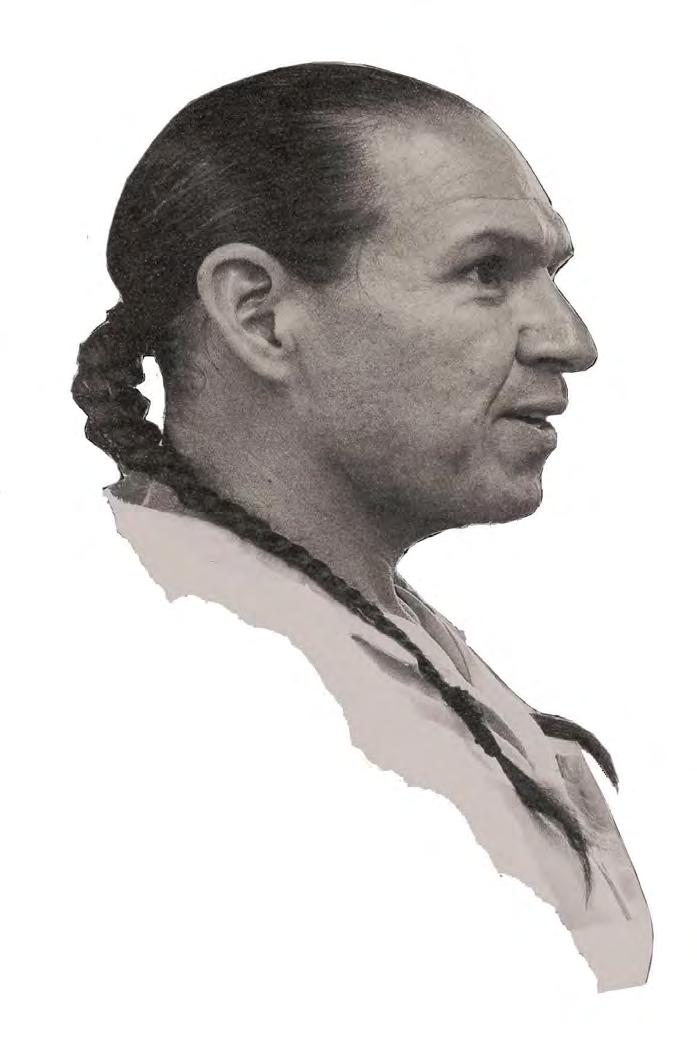







John Red Cloud served nearly 12 years in prison and thought he’d been a model parolee—that is, until the state of Colorado said he wasn’t. How did a renewable energy entrepreneur from the Lakota Sioux tribe become stuck in a sex offender system that could keep him incarcerated for the rest of his life?
BY
DAVE
KENNA JUNE 2024 / 5280 59
ROBERT SANCHEZ PHOTO ILLUSTRATIONS BY
M c
Most mornings last year, John Red Cloud would rise before daybreak in his home on the Pine Ridge Indian Reservation, in southwest South Dakota. He’d walk to the porch of his house and peer out at the shadows of undulating, grassy hills in the distance.
Eventually, dawn would spread across the reservation, illuminating the ancestral land where Red Cloud had been born and raised and now was rebuilding his life. On those mornings, Red Cloud stretched his arms skyward and gave thanks to his creator.




After spending nearly 12 years of his life locked up in Colorado prisons and another six months on parole in the Centennial State, he’d finally been allowed to return home. There had been times when he’d questioned whether that would actually be possible. In 2010, at the age of 31, he’d drunkenly sexually assaulted his then common-law wife at a home they’d shared in Boulder County. Months later, Red Cloud was convicted of Class 4 assault and Class 3 sexual assault in the context of domestic violence and was sentenced under a little-known, decades-old Colorado law that imposes potential life sentences on certain sexual offenders. Six parole hearings later, in July 2022, he was released. Six months after that, he was back in Pine Ridge.
He’d returned home a different man. Sober since his arrest, he’d now slipped into a pleasingly mundane, clear-headed version of domesticity on the reservation. He’d begun the difficult process of rebuilding relationships with his four kids, all of whom had lived with him before he’d been sent to prison. He’d apologized to his former wife, who later wrote a letter supportive of Red Cloud to a Colorado parole board. Red Cloud reconnected with three of his brothers and his father. He started dating a woman from his childhood—a Lakota Sioux, like him.
The then 44-year-old also became the managing director of Red Cloud Renewable, a nonprofit energy and workforce development company his father had founded nearly a quarter-century earlier. In roughly a year, Red Cloud had secured more than $3 million in combined U.S. Department of Energy (DOE) and Environmental Protection Agency funding. “People see what we’re doing in Indian Country and they’re really able to believe and see…a reflection of themselves,” Red Cloud told the DOE in a Q&A piece that appears on the agency’s website under the headline “Indian Energy Champions.”
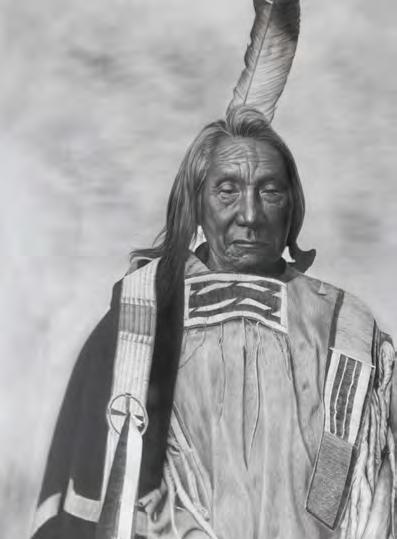
The largest DOE grant the nonprofit received helped fund a program named Bridging Renewable Industry Divides In Gender Equality, or BRIDGE. Touted by Red Cloud Renewable as a “pioneering workforce development initiative,” the program was a fiveweek, in-person training session for Native American women to learn the intricacies of solar energy system installation, followed by eight months of mentoring as the trainees entered the renewables labor force. Priority—and free daycare—was given to Indigenous
Previous spread source photos: Courtesy of Red Cloud Renewable (John Red Cloud); Universal Images Group/Getty Images (hand); Getty Images (Lakota flag, feather, jail, solar panels, background)
women with children. BRIDGE, Red Cloud says, is among his greatest achievements—and a bit of repentance for his past. “I know it can’t erase what I’ve done,” he says. “But maybe I could do something to help a woman who needs it. Maybe this could change some women’s lives forever.”
Red Cloud is, as his father, Henry, often says, blessed with the ability to “walk in both worlds.” On nights and weekends following his release, he attended powwows and played in a traveling drum circle that included two of his brothers. On weekdays, he wrote grant applications, mingled with mostly white, wealthy philanthropists, and sought advice from solar experts across the country. One day, he’d visit the DOE’s National Renewable Energy Laboratory in Colorado; the next, he’d be driving the reservation’s dirt roads in his SUV with his girlfriend, Betty Watters, as they worked to explain the things Red Cloud Renewable could do—winterize houses and transition homes to solar energy, for example—to help residents.
After he’d returned to the reservation, Red Cloud had registered as a sex offender and met regularly with his parole officer in Rapid City, an hour’s drive north of his home on Pine Ridge. On the afternoon of October 2, 2023, as part of the conditions of his “lifetime supervision” from Colorado, Red Cloud and Watters went to Rapid City so he could meet with a polygraph examiner. Polygraphs were a mandated part of the interstate compact transfer when Red Cloud moved from Colorado to South Dakota during his parole.
Watters had been waiting in the passenger’s seat of Red Cloud’s SUV for about an hour when she spotted her boyfriend being led out a side door in handcuffs. Watters jumped out of the vehicle. “What’s going on?” she yelled and ran toward Red Cloud.
“I don’t know,” he said. “We’ll figure this out.”
I MET RED CLOUD in late January of this year, on the night before he was to be transferred from the Boulder County Jail to one of Colorado’s prisons. Red Cloud didn’t yet know where he’d be moved, nor did he know if he’d ever be able to return to Pine Ridge again.
Gail Johnson, a nationally recognized defense attorney from Boulder who specializes in what she believes to be wrongful convictions, represents Red Cloud. She’d been working on his case since November 2023. In her retelling of his story, Red Cloud is a victim of a sexual offender system that is not only outdated but also doesn’t seem particularly interested in actual justice or rehabilitation.
Red Cloud was sitting in jail based on the polygraph he’d failed in South Dakota. After the exam, his attorney says, the interviewer asked Red Cloud whether he’d spent time in the company of children. Red Cloud allegedly answered that
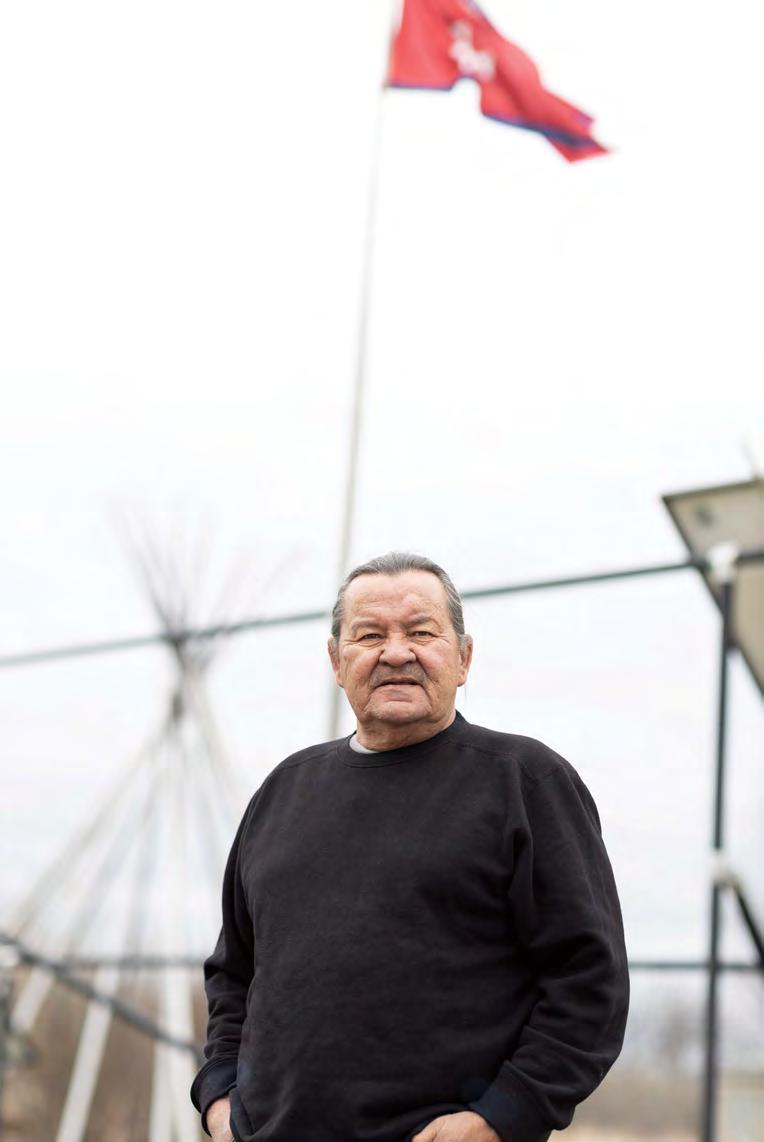
he’d attended ceremonial sweat lodges with his brothers and other family members, some of whom allowed their minor children to attend. Under the terms of his parole in Colorado, Red Cloud was allowed to spend time with family, regardless of age; however, South Dakota officials had said he could not be around minors. Law enforcement officers placed him in handcuffs after the disclosure.
He spent nearly two months in a South Dakota jail cell before officials transferred Red Cloud to Boulder County in December 2023. In early February, he had a parole revocation hearing. During the meeting, the administrative hearing officer proudly declared himself 27 percent Native American before ruling Red Cloud had technically violated the terms of his parole and would be returned to prison, perhaps forever, as a result of Colorado’s indeterminate sentencing law.
Mandated by state statute in 1998, the law imposes a minimum-to-indeterminate sentence for many felony sex offenders in the state. (Whether a person gets an indeterminate versus a fixed sentence is often affected by the severity of the offense, provisions of specific laws, and prosecutors’ willingness to consider plea bargains.) The
JUNE 2024 / 5280 61
This spread, clockwise from top right: Angel White Eyes (2); Getty Images (sun, engraving)
This spread, from left: Chief Red Cloud around 1900; Henry Red Cloud, John’s father, this past spring on the Pine Ridge Indian Reservation
1998 law was Colorado’s response to a series of headline-grabbing child murder cases across the country, perhaps the most famous of which involved a New Jersey sevenyear-old named Megan Kanka, who was raped and murdered by a neighbor with two previous sex assault convictions against young girls. Megan’s Law, which requires law enforcement to make information about registered sex offenders publicly available, was subsequently passed at the federal level in 1996. “You hear the words ‘sex offender’ and your mind automatically goes to the worst places,” says David S. Prescott, a past president of the Association for the Treatment & Prevention of Sexual Abuse who has written 17 books on understanding, assessing, and treating people who have sexually abused as well as preventing recidivism. “In fact, like anything, there’s a varying degree to the offense and the offender. But society has decided to lump them all together and then throw those people away.”
Indeterminate sentencing—which is employed in Colorado and a handful of other states—contrasts with the law in a number of states, which imposes what’s called a “civil commitment” for convicted sex offenders. Under civil commitment, offenders receive defined sentences but can be kept in prison if there is “clear and convincing” evidence that the inmate is still a danger to the community. Civil commitments were unsuccessfully challenged at the U.S. Supreme Court in 2010.
Indeterminate sentencing has received considerably less attention. Challenges to the constitutionality of the practice have never reached the Supreme Court; however, in 2021, a Colorado appeals court rejected claims from a man convicted of a sexual offense who argued that his constitutional rights were violated when he received an indeterminate sentence.
After Red Cloud’s conviction, he arrived in 2010 to begin an eight-years-to-life indeterminate sentence at Colorado’s Sterling Correctional Facility, which did not offer sex offender therapy, a mandated part of Colorado’s Sex Offender Treatment and Monitoring Program (SOTMP). The program’s guidelines require that inmates admit to details of their crimes, undergo years of in-prison therapy sessions, and submit to polygraphs as a way to determine their sexual histories. If sexual offenders meet the program’s criteria, they will, in theory, ultimately be paroled and transferred to lifetime supervision in a community.
Although nearly 1,700 sex offenders in Colorado fall under the indeterminate sentencing umbrella, SOTMP can only complete treatment of 160 people per year. That discrepancy has created a backlog that forces inmates who need therapy to languish past their minimum sentences before receiving treatment. State officials say low wages and remote prison locations make it difficult to recruit and retain certified therapists; critics say the program misunderstands sexual offenders and uses a one-size-fits-all treatment method that oftentimes does more harm than good.
sex offenders, despite the fact that he was never classified as a sexually violent predator. “I was placed in treatment with men who had done unspeakable things to children,” he says. “They talked so casually about what they’d done; it was disgusting. That is not who I am, and that isn’t something I would ever do to someone.”
Red Cloud spoke softly as he sat at a table in one of the Boulder County Jail’s interview rooms. He thought back to a few weeks earlier, when Boulder County deputies picked him up from the jail in South Dakota. As he passed through a corner of the Pine Ridge reservation in the back of a patrol car, Red Cloud couldn’t take his eyes off the Black Hills. “I watched until they disappeared,” he says. “I knew I would probably never see them again.”
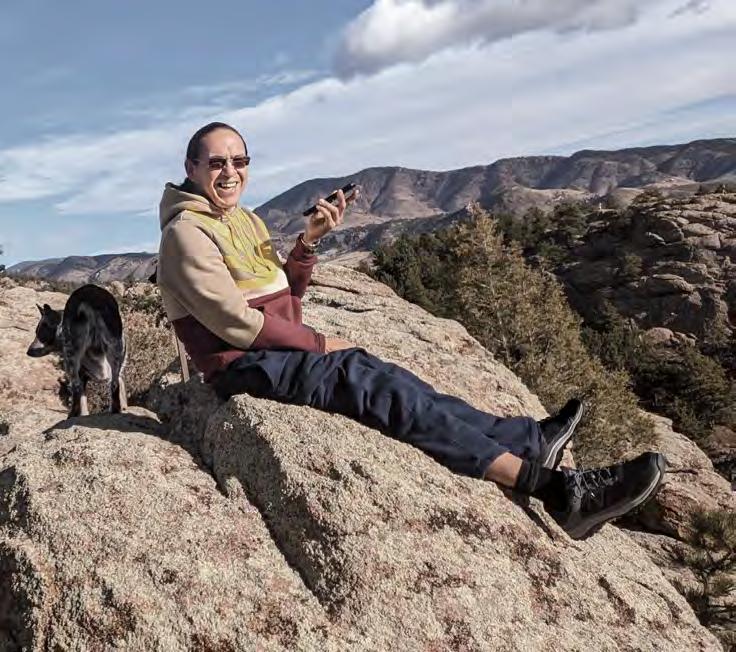
Laurie Kepros, the director of sexual litigation for the Colorado Office of the State Public Defender, explains that in Colorado’s system, many of the most violent sexual predators receive fixed sentences. “The whole scheme fails to match the most intense interventions to the highest risk individuals. You can have someone who stalks women, who attacks them, who never admits to the crimes, who hasn’t gotten a day’s worth of treatment, but then that person reaches the end of their sentence and has to be let out,” Kepros says. “Then you get someone who has a two-years-to-indeterminate, but the backlog is so great that you’re never serving the minimum, and now it feels like you’re in a de facto life sentence.”
It took years before Red Cloud began his SOTMP-mandated treatment. When he did, he was made to sit through therapy sessions alongside the most dangerous

RED CLOUD HAD grown up poor on the Pine Ridge Indian Reservation, which is to say he grew up like almost every person there. Pine Ridge is among the largest reservations in the United States and has a per capita income of less than $9,000 annually. School buses filled with children still drive past the killing fields of Wounded Knee, where more than 150 Lakota Sioux were murdered by the U.S. Army in 1890.
62 5280 / JUNE 2024
of Corrections DOC Number:
John Red Cloud hiking near Lyons in 2022 artment

When Red Cloud was born, his grandmother washed his tiny body and gave him a sip of water from nearby White Clay Creek, forever linking him to the land. Red Cloud’s mother left the family when he was six and returned only intermittently. The young boy, a descendant of the revered Oglala Lakota warrior Chief Red Cloud, learned the Lakota language from his grandmother. Chief Red Cloud led post–Civil War battles against the American military and orchestrated the U.S. Army’s first defeat at the hands of an allNative force. While children in other parts of the country talked about George Washington and his felled cherry tree, Red Cloud learned about the Dawes Act, which gave the federal government the right to break up tribal lands.
Growing up, Red Cloud was close with his grandmother, who made rabbit stew and performed traditional ceremonies at her cabin next to the creek. “All my friends thought she
“Like anything, there’s a varying degree to the offense and the offender. But society has decided to lump them all together and then throw these people away.”
was hardcore,” Red Cloud says. He was brought up “in the old ways,” his father says. “My son knew from the beginning of his life what it meant to be from this place. That never left him.”
When Red Cloud killed his first elk as a boy, his father smeared the animal’s blood on his son’s face. He attended tribal events, learned to play the drum, and sang the songs his ancestors had sung for centuries. He attended the Red Cloud Indian School, a Jesuit school on the reservation that educated tribal children from kindergarten through high school. He graduated near the top of his class and secured a scholarship to attend the University of San Diego, a rarity among Pine Ridge adolescents.
After earning a bachelor’s degree in history, Red Cloud returned to the reservation to teach the subject, then worked for the Indian Health Services in Pine Ridge and later raised money for the American Indian College Fund, a Denver-based nonprofit.
Red Cloud, his wife, and their four children had moved into a home in Lafayette. They wanted a place adjacent to wide-open spaces that also had good schools nearby for the kids. Throughout their time in Colorado, though, the couple’s relationship was strained. Early on the morning of January 15, 2010, Red Cloud and his wife got into an argument. An intoxicated Red Cloud forced oral and vaginal sex on her, while at least one of the couple’s crying children was in the same room. During the assault, according to the police report, Red Cloud repeatedly choked the woman. His wife said that at one point, Red Cloud told her, “Bitch, you’re gonna die.”
“I will always remember my arrest, and I’m thankful for what I got in therapy,” Red Cloud says. “To understand triggers in my life and what I did and how I can prevent that from happening. I’m sober, and I’ve worked hard at that. It’s important to who I am. At the same time, how do I atone for what I did? How do I make it better?”
Part of that atonement, he thought, could come from returning to the reservation, where he was determined to be a model parolee. He attended regular sex offender therapy sessions and paid out of pocket for the state-mandated polygraph testing.
For decades, polygraph tests were considered critical pieces of evidence in courtrooms, but that began to change as more research on the practice emerged. Critics argue there’s no evidence that the physiological measurements taken during polygraphs—from heart rate to breathing rate—are useful in determining anything. Detractors also contend that there’s no way to know if the readings suggest a subject is being truthful or deceptive and that they could just as easily indicate that a person is anxious.
A 1983 report by the U.S. Congress Office of Technology Assessment led to a nationwide ban on private employers using polygraphs on employees; 15 years later, in 1998, the U.S. Supreme Court ruled against using polygraphs in some federal courts because there was “simply no consensus” on their reliability. In 2003, the National Research Council, the operating arm of the National Academies of Sciences, Engineering, and Medicine, published a report that, in part, said “almost a century of research” provided “little basis for the expectation that a polygraph test could have extremely high accuracy.”
Yet polygraphs continue to be used as part of the terms of sexual offenders’ paroles. In Colorado, polygraphs have been mandated as part of the state’s Sex Offender Management Board (SOMB) protocol since the 1990s. “The use of the polygraph in sex offender management is essentially a U.S.-only phenomenon, and Colorado has certainly been the jurisdiction to lead the charge,” says Robin J. Wilson, a psychologist and an international expert on support and accountability for sex offenders. “The problem is that there has been no clear evidence that it actually assists that risk management process. More recent research has actually suggested that use of the polygraph might lead to poorer outcomes. Perhaps the best rationale I’ve heard for its use is, It works because they think it does. That’s not exactly science.”
The truth was that because of Red Cloud’s indeterminate sentencing, he felt less and less free each day after being released from prison in 2022. “It’s like they were just waiting for him to mess up,” says Stephen Kane, a solar energy consultant who worked with Red Cloud’s father and let Red Cloud live in a house on his property in Larimer County after he’d been paroled. Though he’d never been accused of an offense against a child, Red Cloud had to map out his daily drives to ensure he wouldn’t pass a school. If he wanted a McDonald’s burger, he had to check if there was an indoor playground where kids might congregate.
After about three months on parole in Colorado, he applied for an interstate compact transfer that would allow him to return to South Dakota. When the transfer came through a few weeks later, Red Cloud packed and left the next morning. Once he arrived in Pine Ridge, his father set him up with an office in the Red Cloud Renewable compound. He began drumming again, and he delighted in speaking Lakota with people who were fluent in the language. He rekindled a relationship with Watters, whom he’d met decades earlier, when they were kids, and had had regular phone contact with while he was in prison. “I don’t see him like that; nobody does at all,” Watters says. “There’s no harm in him. I know his heart.”
WHILE RED CLOUD was waiting in Boulder County Jail for his parole revocation hearing this past March, state Senator Julie Gonzales was working
JUNE 2024 / 5280 63
CONTINUED ON PAGE 80 This spread, from left: Courtesy of Stephen Kane; Charles O’Rear/Getty Images


Rocky MTN Lager
Denver Beer Company’s newest beer, Rocky MTN Lager, is brewed for the everyday adventure.
Whether you’re chillin’, grillin’, floating, camping, crushing après, watching the game, mowing the lawn, or hangin’ with the pup—our crisp, classic American lager is your go-to drinkin’ buddy. This perfect summer-time refresher is now available at all Denver Beer Co. locations, and across the Rocky Mountain region in 6 packs and draft. So anytime you need a cold one, reach for a Rocky MTN Lager and celebrate the adventure!

TRES GENERACIONES
Tres Hibiscus Marg
Tres Hibiscus Marg is a vibrant cocktail with an enticing ruby red color. On the nose, it offers floral and fruity notes with a hint of citrus. To the palate, it balances sweetness and acidity with the distinctive flavor of hibiscus.
INGREDIENTS
2 parts Tres Generaciones Reposado
1/2 part Triple Sec
1/2 part Hibiscus Syrup
1 part Fresh Lime Juice
INSTRUCTIONS
Combine hibiscus syrup and other ingredients in a cocktail shaker with ice. Shake and strain into a coupe glass with Tajín salt rim. Garnish with a hibiscus flower.

Classic Evan
Sour
A classic Evan Williams Sour makes a perfectly satisfying summer sipper.
INGREDIENTS
2 oz Evan Williams 1783 Small Batch Bourbon
3/4 oz Lemon Juice
3/4 oz Simple Syrup
INSTRUCTIONS
Combine all ingredients in a mixing tin over ice and shake. Pour over fresh ice in a rocks glass and garnish with a slice of orange and a maraschino cherry.

LUNAZUL TEQUILA
Lunazul Cantarito
Discover the most authentic cocktail of Tequila, Mexico: the Cantarito!
INGREDIENTS
2 oz Lunazul Blanco Tequila
3/4 oz Grapefruit Juice
1/2 oz Orange Juice
1/2 oz Fresh Lime Juice
1 pinch of salt
1 teaspoon Agave Syrup
3 oz Grapefruit Soda
Tajín Seasoning Rim
Garnish: Lime or Grapefruit Wheel
INSTRUCTIONS
Rim the lip of a glass or mug with Tajín seasoning. Add Lunazul Tequila, fruit juices, agave syrup, and salt into a shaker with ice and shake until well chilled.
Section • June 2024
Special Advertising
DENVER BEER CO.
EVAN WILLIAMS BOURBON
64 | JUNE 2024 | SUMMER S I PS

Beat the heat of summer with one of these refreshing local cocktails. Make them at home or visit the locations below and ask for their Summer Sip.

IRONTON DISTILLERY
Zen Garden
A refreshing cocktail to enjoy on Ironton’s RiNo patio. Or grab a bottle of Ironton’s Shochu at your local liquor store.
INGREDIENTS
1 oz Ironton’s Sai Shochu
1 oz Colorado Sake Co’s Blueberry Hibiscus Sake
1/2 oz Yuzu Orgeat
1/2 oz Lemon Mint Garnish
INSTRUCTIONS
Add all ingredients into shaker, shake and pour into glass over ice, garnish with mint and lemon.



DEEP EDDY VODKA
The Summer Mule
Real Vodka. Real Fruit. Real Fun! The Summer Mule takes a refreshing twist on a classic cocktail that’s sure to get the party started!
INGREDIENTS
2 oz Deep Eddy Vodka (Original, Lemon, Ruby Red, or Lime)
1/2 oz Fresh Lime Juice
Top with Ginger Beer
Fresh Mint Leaves
Lime Wheel
INSTRUCTIONS
Combine Deep Eddy Original Vodka and lime juice in a copper mug. Add ice and top with ginger beer. Garnish with lime wheel and fresh mint.
801 FISH
Vertigo
An elevated gin and tonic with fresh botanicals and floral element.
INGREDIENTS
2 oz Roku Gin
1/4 oz Sakura Yuzu (see recipe below)
200 ml Fever Tree Elderflower Tonic
INSTRUCTIONS
Ice down your glass, combine Gin and Sakura-Yuzu, add tonic to taste, garnish with fresh elderflowers, lemon grass and sansho peppercorns.
*Sakura Yuzu
3 oz Yuzu Juice, 2 oz Lime Juice
1 oz Sakura Powder
1oz Water
Mix until smooth
801 CHOPHOUSE
Spa Day
Refresh & revive with our garden to glass “Spa Day” cocktail.
INGREDIENTS
1 1/2 oz Coconut Oil Washed Hendrick’s Gin
1 oz Cucumber Lime Sorbet
1/4 oz Pineapple Juice
1/4 oz Simple Syrup
INSTRUCTIONS
Shake in tin with ice then pour over fresh ice in rocks glass. Garnish with honey dipped wooden honey dipper.

SUMMER S I PS | JUNE 2024 | 65 SCAN QR for more information!
Dining Gu ide
Indicates a restaurant featured in 5280 for the first time (though not necessarily a restaurant that has just opened).
Indicates inclusion in 5280’s 2023 list of Denver’s best restaurants. These selections are at the discretion of 5280 editors and are subject to change SYMBOL
A5 STEAKHOUSE
$$$$
LoDo / Steak House This unfussy chophouse by the team behind Forget Me Not and Tap and Burger features perfectly seared steaks, hearty sides, and draft cocktails. Never pass up the beef tartare katsu sando and the chickpea fries to start your meal. Reservations accepted. 1600 15th St., 303-623-0534. Dinner
AFRICAN GRILL & BAR
$$
Lakewood / African Explore a bevy of dishes from across Africa at this warm and inviting restaurant run by the Osei-Fordwuo family. Peanut soups, fried fish, samosas, and jollof rice are just some of the crave-worthy options you’ll order again and again. Reservations accepted. 955 S. Kipling Parkway, Lakewood, 303-985-4497. Lunch, Dinner
ALMA FONDA FINA
LoHi / Mexican This contemporary Mexican restaurant wows with its creative, shareable plates, which often feature homemade masa and flavor-packed salsas. The camote asado (roasted sweet potato) is an excellent way to start off your meal. Reservations accepted. 2556 15th St., 303-455-9463. Dinner
ANGELO’S TAVERNA
$$$$
Universal Appeal
With 2,400 square feet of cozy indoor and outdoor space, Room for Friends has room for everyone. So take all your besties to the one-year-old Lincoln Park wine bar, from owners Heather David and Michael Vela, to enjoy reasonably priced, globally sourced vinos and a nostalgic menu of casual bites. Pair the Coloradomade Ordinary Fellow Riesling with crudités and homemade ranch. Or get the art flight—three wines selected to complement the works of art currently hanging on the bar’s walls—and an order of David’s great-grandmother’s crowd-pleasing chicken salad sliders, a combo that’ll satisfy customers of any ilk.
BLACKBELLY
$$
Speer / Italian This neighborhood nook dishes up tasty grilled oysters as well as pastas and pizzas. Try the lobster gnocchi. Also try the Littleton location. Reservations not accepted. 620 E. Sixth Ave., 303-744-3366. Lunch, Dinner
ANNETTE
$$$
Aurora / American James Beard Award–winning chef Caroline Glover’s Annette delivers a lineup of seasonal salads, pastas, wood-fired proteins, and other comforting bites in a modern, inviting space. Don’t skip dessert, particularly if pecan pie is on the menu. Reservations accepted. 2501 Dallas St., Suite 108, Aurora, 720-710-9975. Dinner
BANH & BUTTER BAKERY CAFE
Aurora / French Thoa Nguyen crafts French pastries inspired by her Vietnamese heritage at this East Colfax cafe. Go for the dazzling crêpe cakes, each made with 25 to 30 layers. Reservations not accepted. 9935 E. Colfax Ave., Aurora, 720-513-9313. Breakfast, Lunch
$

$$$
Boulder / American Chef Hosea Rosenberg’s carnivore-friendly menu focuses on charcuterie, small plates, and daily butcher specials. Try the koji-cured heritage pork chop. Also check out the adjacent butcher shop and market. Reservations accepted. 1606 Conestoga St., Boulder, 303-247-1000. Dinner
BLUE PAN PIZZA
$$
West Highland / Pizza Masterfully crafted Detroit-style pizza is the draw at this tiny spot. Try the Brooklyn Bridge, topped with pepperoni, Italian sausage, and ricotta and Romano cheeses. Also try the Congress Park location. Reservations not accepted. 3930 W. 32nd Ave., 720-456-7666. Lunch, Dinner
BRUTØ
$$$$
LoDo / International At the Wolf’s Tailor’s sister restaurant, executive chef Byron Gomez highlights house ferments in an omakase-style tasting menu. Tack on the cocktail pairing to make the experience even more special. Reservations accepted. 1801 Blake St., 720-325-2195. Dinner
COMAL HERITAGE FOOD INCUBATOR
RiNo / International Immigrant and refugee women develop the skills to operate their own food businesses by serving up renditions of their family recipes at this indoor-outdoor restaurant. Try the pupusas or the plato caribe: fried fish with tostones and coleslaw. Reservations not accepted. 1950 35th St., 303-2920770. Breakfast, Lunch
CORNER OFFICE
Downtown / International Find global comfort food from Jamaican jerk chicken to tuna poke at this trendy spot. Reservations accepted. 1401 Curtis St., 303-825-6500. Breakfast, Lunch, Dinner, Brunch
CRACOVIA
$
$$$
$$$
Westminster / Polish Traditional Polish dishes are on the menu at this family-owned restaurant in Westminster. Try the zupa ogórkowa (creamy pickle soup) or the placki (pan-fried potato and onion pancakes). Reservations accepted. 8121 W. 94th Ave., Westminster, 303-484-9388. Lunch, Dinner Sarah Banks
66 5280 / JUNE 2024
PRICE KEY Average Entrée under $15 $16 to $20 $21 to $30 $31 and higher
KEY
WANT MORE DINING OPTIONS? Visit our online listings at 5280.com/restaurants. $ $$ $$$ $$$$


St. Anthony Hospital • St. Anthony North Hospital • St. Anthony Summit Hospital
St. Elizabeth Hospital • Longmont United Hospital • OrthoColorado Hospital
Hospitals, clinics, and caregivers all connected to advance health care in Colorado, Kansas, and Utah.
CommonSpirit Health Mountain Region does not discriminate against any person on the basis of race, color, national origin, disability, age, sex, religion, creed, ancestry, sexual orientation, and marital status in admission, treatment, or participation in its programs, services and activities, or in employment. For further information about this policy contact CommonSpirit Health Mountain Region Office of the General Counsel at 1-303-673-8166 (TTY: 711). Copyright © CommonSpirit Health Mountain Region, 2024. ATENCIÓN: Si habla español, tiene a su disposición servicios gratuitos de asistencia lingüística. Llame al 1-303-673-8166 (TTY: 711). CHÚ Ý: N
(TTY: 711).
ếu bạn nói Tiếng Việt, có các dịch vụ hỗ trợ ngôn ngữ miễn phí dành cho bạn. Gọi số 1-303-673-8166
CURTIS PARK DELICATESSEN
Curtis Park / Deli This neighborhood deli serves a menu of fine classic sandwiches (like the Curtis, made with corned beef, sauerkraut, Swiss cheese, and house-made Thousand Island). Also try the Cherry Creek location. Reservations not accepted. 2532 Champa St., 303-308-5973. Lunch
DAUGHTER THAI KITCHEN & BAR
$
DOUGH COUNTER
$$
University Hills / Pizza This fast-casual pizzeria specializes in Sicilian- and New York–style pies. For the former, we especially like the Triple Threat striped with marinara, pesto, and vodka sauce. Reservations not accepted. 2466 S. Colorado Blvd., 303-997-8977. Lunch, Dinner
EARLY BIRD RESTAURANT
$$$
LoHi / Thai This date-night-ready Thai restaurant from Ounjit Hardacre serves beautifully plated dishes and inventive cocktails with an elegant ambience to match. The menu features tried-andtrue favorites such as pad thai and massaman curry alongside a rotating lineup of rare-inDenver specialties. Reservations accepted. 1700 Platte St., Suite 140, 720-667-4652. Lunch, Dinner
DEW DROP INN
$
Westminster / American This attractive breakfast and lunch spot offers a well-balanced menu and local ingredients. The all-day breakfast menu includes open-faced omelets and French toasts. Also try the Greenwood Village location. Reservations not accepted. 11940 Bradburn Blvd., Westminster, 303-469-9641. Breakfast, Lunch
EDGEWATER PUBLIC MARKET
$$
Uptown / Contemporary Uptown’s chic neighborhood watering hole serves not only fine cocktails but also thoughtful small bites such as the Big Bowl of Mussels. Try the Bangkok-style variety, steamed in a red curry broth. Reservations not accepted. 1033 E. 17th Ave., 720-612-4160. Dinner
DIO MIO
$$
RiNo / Italian One thing you can count on at Alex Figura and Spencer White’s fast-casual Italian eatery: perfect pasta. Pair the cacio e pepe or the pistachio pesto radiatori with an Italian gin and tonic. Reservations not accepted. 3264 Larimer St., 303-562-1965. Dinner
$$$$
Downtown / Steak House This sleek restaurant named after the Broncos great serves classic steak house fare in upscale environs. Multiple locations. Reservations accepted. 1881 Curtis St., 303-312-3107. Breakfast, Lunch, Dinner, Brunch
FARM & MARKET
RiNo / Health This 3,000-square-foot hydroponic farm sells its grown-in-water greens and also transforms them into grab-and-go salads and soups. Try the Jumper salad with crispy salmon. Reservations not accepted. 2401 Larimer St., 303-927-6652. Lunch, Dinner
FOX AND THE HEN
$$
Edgewater / International Satisfy your cravings for everything from wild game sandwiches to Ethiopian fare at this eclectic collective of nearly two dozen food stalls and boutiques. Tenants include Konjo Ethiopian, Lucky Bird, Lazo Empanadas, and more. 5505 W. 20th Ave., Edgewater, 720-749-2239. Breakfast, Lunch, Dinner
EL JEFE
Sunnyside / Mexican Farm-to-table Mexican fare will lure you to this welcoming Sunnyside haunt. Pair a house margarita with the fourcheese queso dip, and don’t miss the mushroom tacos or the grilled Spanish octopus. Reservations accepted. 2450 W. 44th Ave., 720-3897615. Dinner, Brunch
$$
$
$$
LoHi / American This sunny brunch eatery brightens up any morning. The animal-style hash brown smothered in American cheese and special sauce (an homage to In-N-Out) is a must-order, but any of the elevated toasts or egg dishes are a smart way to start your day. Reservations accepted. 2257 W. 32nd Ave., 303-862-6795. Breakfast, Lunch, Brunch
FRASCA FOOD AND WINE
$$$$
Boulder / Italian The food always wows at Frasca, an ode to the cuisine of Friuli-Venezia Giulia in northeastern Italy from master sommelier Bobby Stuckey and chef Lachlan Mackinnon-Patterson. Splurge on executive chef Ian Palazzola’s nine-course Friulano menu. Reservations accepted. 1738 Pearl St., Boulder, 303-442-6966. Dinner
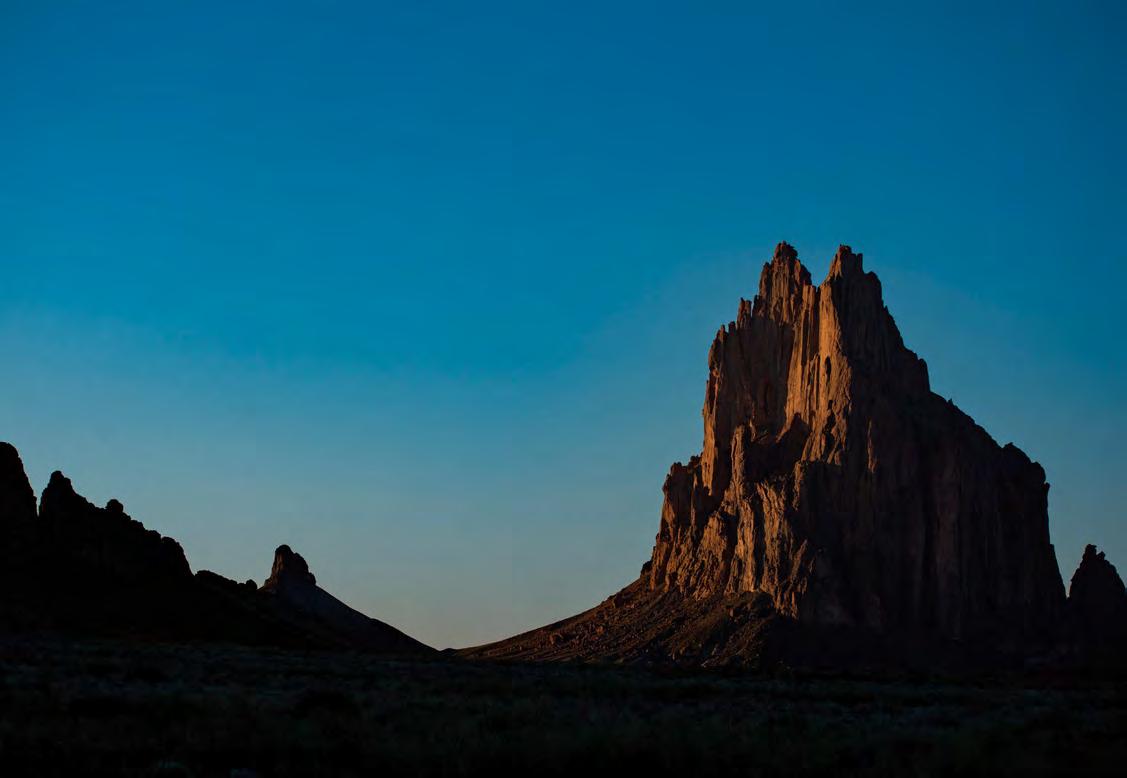
DiscoverNavajo.com Cultural history revered. INSTRUCTIONS: > Double-click > Double-click an - Click - Click Your Your This DINING GUIDE
ELWAY’S
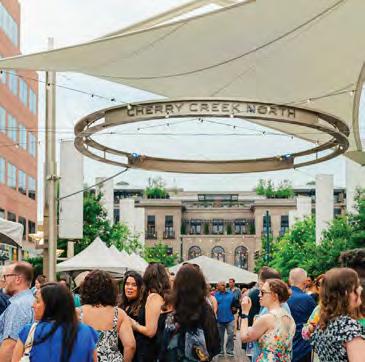




Top Town of T he
hosted by JULY 18 6PM — 9PM

BE OUR GUEST to an enchanting evening of bites from Top of the Town winners, sips , giveaways, live music, 360 video booth, and so much more under the lights at Fillmore Plaza .

SCAN HERE TO SIGN UP TO BE THE FIRST TO KNOW WHEN TICKETS GO ON SALE.












T i c k
s o n s a l e m i d - J u n e ! Special thanks to our Sponsors Restaurant Benefactor:
e T


FRUITION RESTAURANT
$$$$
Country Club / American This farm-to-table restaurant led by executive chef Jarred Russell focuses on seasonal dishes that are big on flavor. Go for any produce-driven small plates. Reservations accepted. 1313 E. Sixth Ave., 303-831-1962. Dinner
GOLD POINT
RiNo / American This hip hangout serves craft cocktails and a variety of small and large bites from Caddywampus Comfort Foods. Reservations not accepted. 3126 Larimer St., 720-445-9691. Dinner
G-QUE BBQ
$
$$
Westminster / Barbecue This fast-casual joint serves award-winning hickory-smoked pork, brisket, chicken wings, ribs, and more. Also try the Lone Tree location. Reservations not accepted. 5160 W. 120th Ave., Suite K, Westminster, 303-379-9205. Lunch, Dinner
GUARD AND GRACE
Downtown / Steak House Chef Troy Guard’s modern steak house offers a chic setting for its elevated fare. Try the flight of filet mignon. Reservations accepted. 1801 California St., 303-293-8500. Lunch, Dinner
HEY KIDDO
$$$$
$$$$
Berkeley / Contemporary From the team behind the Wolf’s Tailor and Brutø, this eclectic, globally inspired restaurant presents fine-dining fare in relaxed environs. Try the wagyu beef galbi. Reservations accepted. 4337 Tennyson St., Suite 300, 720-778-2977. Dinner
HIGHLAND’S INDIAN CUISINE
$$$ Highlands Ranch / Indian Enjoy upscale curries, biryani, and tandoori selections at the first Indian restaurant in Highlands Ranch. Reservations not accepted. 9344 Dorchester St., Suite 101, Highlands Ranch, 720-420-9374. Lunch, Dinner
HOPS & PIE
$$ Berkeley / Pizza Craft pizza and local brews are this spot’s forte. Load up your pie with toppings such as Texas barbecue sauce and jalapeño, and wash it all down with a choice of more than 20 beers. Reservations not accepted. 3920 Tennyson St., 303-477-7000. Lunch, Dinner
INDIA’S RESTAURANT
$$ Hampden / Indian This spot serves traditional fare, including flavorful dishes like tandoori chicken. Take advantage of the lunch buffet. Reservations accepted. 8921 E. Hampden Ave., 303-755-4284. Lunch, Dinner
ISTANBUL CAFE & BAKERY
$ Washington Virginia Vale / Middle Eastern Inside the shopping center at the intersection of South Monaco Parkway and Leetsdale Drive, friendly owner Ismet Yilmaz prepares authentic Turkish pastries. Multiple locations. Reservations not accepted. 850 S. Monaco Parkway, Suite 9, 720-787-7751. Breakfast, Lunch, Dinner
IZAKAYA DEN
$$$ Platt Park / Japanese Ultra-fresh sushi, sashimi, and creative small plates are on the menu at this local favorite. Reservations accepted. 1487-A S. Pearl St., 303-777-0691. Dinner
70 5280 / JUNE 2024
DINING GUIDE


Enjoy hands-on artmaking, explore interactive creative spaces, and discover art for all ages.


Free general admission for kids 18 and under every day.
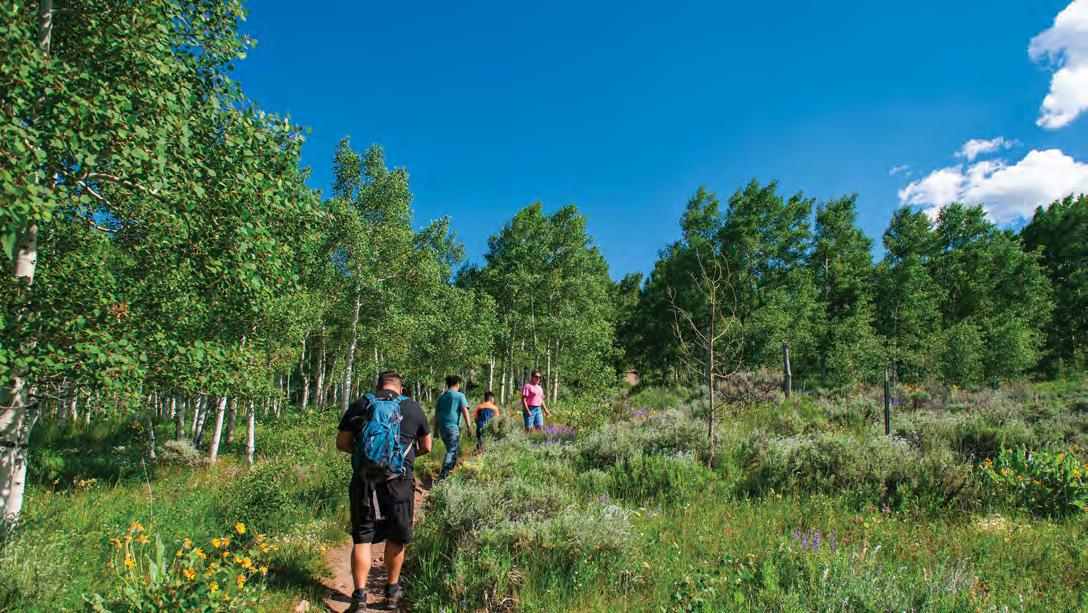
WHERE ART meets adventure
IMAGES, LEFT TO RIGHT:
Enjoy wide open spaces, thousands of acres of wilderness and hundreds of miles of hiking and biking trails alongside a thriving arts and culture scene. Explore the heart of Summit County in Silverthorne, Colorado and find where art meets adventure! SILVERTHORNE.ORG
Photo by Iris Miceli Photography; photo by DAM staff; photo by Raine Chism.
J’S NOODLES STAR THAI 2
Westwood / Thai This traditional Thai spot has developed a cult following over the years. The tom yum soup, drunken noodles, and pad thai are regulars’ picks. Reservations not accepted. 945 S. Federal Blvd., 303-922-5495. Lunch, Dinner
JAMAICAN GRILLE
$
LA DIABLA POZOLE Y MEZCAL $
Ballpark / Mexican This lively eatery from James Beard Award finalist Jose Avila serves up comforting pozole and other traditional Mexican fare at affordable prices. Reservations not accepted. 2233 Larimer St., 720-519-1060. Breakfast, Lunch, Dinner, Brunch
$$
Lincoln Park / Jamaican This family-owned Jamaican restaurant serves classic Caribbean-centric dishes like jerk chicken, fried plantains, and rice and peas. Reservations accepted. 709 W. Eighth Ave., 303-623-0013. Lunch, Dinner
JOVANINA’S BROKEN ITALIAN
LE FRENCH
MANGO HOUSE
Aurora / International This immigrant- and refugee-led food hall is home to six outstanding culinary concepts, including Urban Burma, Jasmine Syrian Food, and Nepali Spice. 10180 E. Colfax Ave., Aurora, 303-900-8639. Breakfast, Lunch, Dinner
$$
$$$$
LoDo / Italian This gorgeous LoDo eatery expands on traditional Italian fare by incorporating unexpected, seasonal ingredients. Reservations accepted. 1520 Blake St., 720-541-7721. Dinner
KAOS PIZZERIA
$$
Hampden / French This chic Belleview Station bistro, owned by French-Senegalese sisters, transports diners through Parisian cuisine with African influences. Also try the Hale location. Reservations accepted. 4901 S. Newport St., 720-710-8963. Lunch, Dinner, Brunch
LEEZAKAYA
$$
Platt Park / Pizza A wood-fired oven, gourmet ingredients, and wine to-go make this a perfect pizzeria for dine-in or delivery. Reservations accepted. 1439 S. Pearl St, 303-733-5267. Lunch, Dinner
KAWA NI
$$$$
Aurora / Japanese From the team behind Tofu Story and Mono Mono Korean Fried Chicken, this swanky eatery boasts an expansive menu of Japanese bites and sake. The mentaiko creamy pasta is a must-order. Reservations accepted. 2710 S. Havana St., Aurora, 720-769-6595. Lunch, Dinner
LUCINA EATERY & BAR
$$$$
LoHi / Asian Connecticut transplant Bill Taibe helms this upscale izakaya concept in LoHi. Peruse the eclectic menu of noodles, sushi, and small plates, and don’t miss the shaved broccoli miso goma. Reservations accepted. 1900 W. 32nd Ave., 303-455-9208. Dinner
$$$
South Park Hill / Latin American Bold flavors from Latin America, the Caribbean, and coastal Spain tantalize at this lively restaurant. Try the mofongo, a plantain mash with pork belly chicharrón, or the two-person paella with rotating toppings only served on Fridays and Saturdays. Reservations accepted. 2245 Kearney St., Suite 101, 720-814-1053. Dinner
MARIGOLD
$$$ Lyons / European This small, light-filled restaurant serves seasonally driven French- and Italian-influenced fare. The pink-peppercornlaced farinata (chickpea pancake) is a delicious mainstay of the frequently changing menu; the amaro-centric cocktail program is also delightful. Reservations accepted. 405 Main St., Suite B, Lyons, 303-823-2333. Dinner
MASON’S DUMPLING SHOP
Aurora / Chinese A menu of house-made steamed, boiled, and pan-fried dumplings complements a selection of noodle and rice bowls and vegetable-forward sides at this Los Angeles–born spot. Multiple locations. Reservations not accepted. 9655 E. Montview Blvd., Aurora, 303-600-8998. Lunch, Dinner
MONO MONO KOREAN FRIED CHICKEN
$$
$$
LoDo / Korean Savor crispy Korean fried chicken wings along with sides like kimchi and pickled daikon and starters like gochujangslathered rice cakes at this industrial eatery. Multiple locations. Reservations not accepted. 1550 Blake St., 720-379-6567. Lunch, Dinner





72 5280 / JUNE 2024 EIGHT MAGICAL WEEKENDS! www.coloradorenaissance.com Return to the Magic & Mystique of the Renaissance! June 15th - August 4th 2024 SATURDAYS AND SUNDAYS ONLY • 10:00 AM - 6:30 PM rColorAdoenAissAnCe FestivAl & Artisan’s Marketplace DINING GUIDE


Modern. Luxury. Adventure.
LUXURY ADVENTURE VAN
Ready to see the Grech RV difference? Check out the stunning Grech RV luxury Mercedes-Benz Sprinter camper van at Mountain Luxe RV’s indoor showroom.



3600 S. JASON STREET
ENGLEWOOD, CO 80110 MLUXERV.COM
(877) 658-9378


NANA’S DIM SUM & DUMPLINGS
$$ LoHi / Chinese Enjoy a spread of house-made dumplings and shareable Asian plates at this swanky restaurant in LoHi. Xiaolongbao lovers should go for the bite-size “thumblings.” Reservations accepted. 3316 Tejon St., Suite 102, 720-769-4051. Lunch, Dinner
NOISETTE RESTAURANT & BAKERY
$$$ LoHi / French Chefs Tim and Lillian Lu serve elegant renditions of bourgeoisie-style specialties (French home-cooked comforts) in a romantic, light-drenched space. Tear into the perfectly crisp baguette. Reservations accepted. 3254 Navajo St., Suite 100, 720-769-8103. Dinner, Brunch
NOLA VOODOO TAVERN AND PERKS
Clayton / Southern New Orleans native and owner Henry Batiste serves his grandmother’s recipes for gumbo, po’ boys, and much more at this Louisiana-inspired spot. Reservations accepted. 3321 Bruce Randolph Ave., 720-3899544. Lunch, Dinner
OLIVE & FINCH
$$
Summit Valley Horse Center is a Colorado non-profit that makes the joy of humanhorse connection possible for people of all ages and backgrounds, while giving rescued horses a second chance at life.
EXPLORE OUR SUMMER PROGRAMS & EVENTS! COME UP TO THE MOUNTAINS. BEAT THE HEAT. EXPERIENCE THE JOY OF HORSES.


$$ City Park West / American Discover wholesome meals at this restaurant and bakery, where you’ll find a full coffee bar, sandwiches, soups, salads, and house-made pastries. Also try the Cherry Creek location. Reservations not accepted. 1552 E. 17th Ave., 303-832-8663. Breakfast, Lunch
OPHELIA’S ELECTRIC SOAPBOX
$$ Ballpark / Contemporary This Edible Beats restaurant features quirky design details and a stage for live music. The “gastro-brothel” menu features globally inspired pub fare like flatbreads, small plates, and burgers. Reservations accepted. 1215 20th St., 303-993-8023. Dinner, Brunch
OSAKA RAMEN
$$ RiNo / Japanese Jeff Osaka’s modern ramen shop features original noodle soups, bento boxes, and creative small plates. Try the mochi doughnuts. Reservations not accepted. 2611 Walnut St., 303-955-7938. Lunch, Dinner
PALENQUE COCINA Y AGAVERIA
$$ Littleton / Mexican Sip on a wide variety of mezcals and snack on ceviche and flautitas at this neighborhood favorite bar and restaurant. Reservations accepted. 2609 W. Main St., Littleton, 720-928-3318. Lunch, Dinner
PARK BURGER
$ Platt Park / American This neighborhood eatery serves up top-notch burgers, such as the Royale with caramelized onions, blue cheese, and bacon. Add a milkshake. Multiple locations. Reservations not accepted. 1890 S. Pearl St., 720-242-9951. Lunch, Dinner
POINT EASY
$$$$ Whittier / Contemporary This casual, inviting farm-to-table eatery produces feasts made with thoughtfully sourced ingredients, many of which are local. Reservations accepted. 2000 E. 28th Ave., 303-233-5656. Dinner
THE PORKLET
$ Aurora / Asian This fast-casual spot in a shopping center excels at producing renditions of katsu (fried cutlets encrusted in panko breadcrumbs).
74 5280 / JUNE 2024
THE ULTIMATE
DINING GUIDE
SILVERTHORNE, CO WWW.SUMMITVALLEYHORSECENTER.ORG







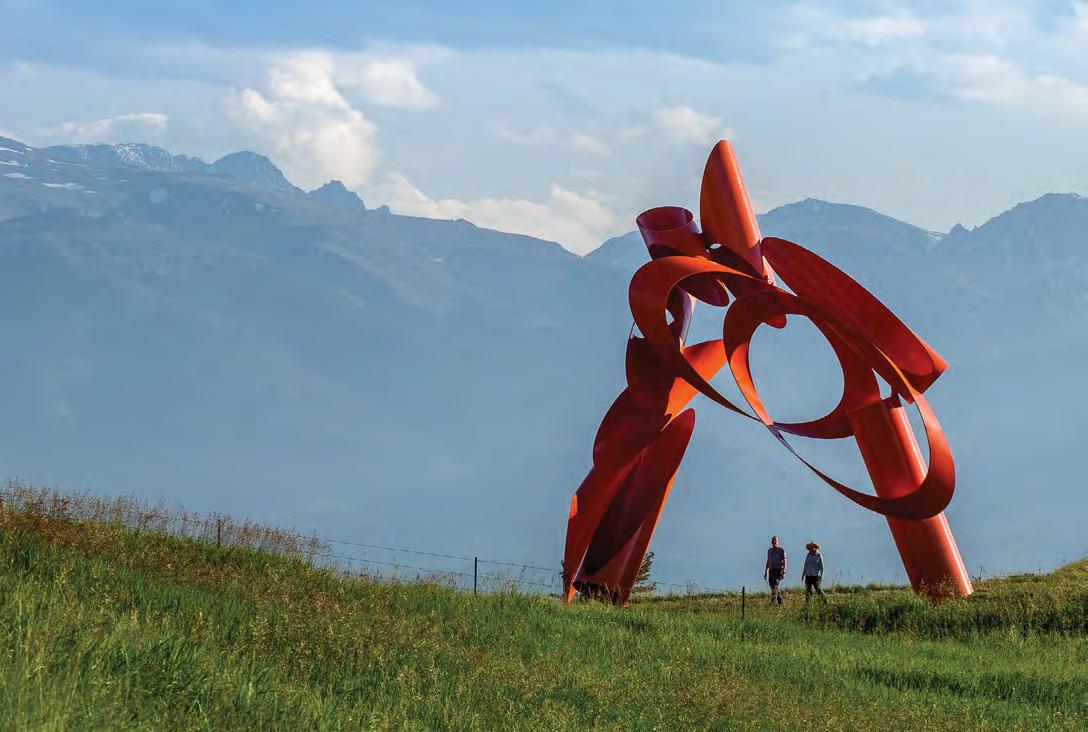

Where art, music, architecture, and nature merge at the edge of Montana’s Beartooth Mountains.
Learn more about the 2024 summer season at tippetrise.org
Archway II by Alexander Liberman © 1984
The Volcano Fried Rice is a must. Reservations not accepted. 12201 E. Mississippi Ave., Suite 123B, Aurora, 303-364-1287. Lunch, Dinner
Q HOUSE
City Park / Chinese Enjoy a modern take on Chinese cuisine at this City Park eatery operated by chef Christopher Lin, an alum of Momofuku in New York City. Try the braised pork rice. Reservations accepted. 3421 E. Colfax Ave., 720-729-8887. Dinner
QUE BUENO SUERTE!
ROSETTA HALL
$$
$$$
Platt Park / Mexican The menu at this vibrant restaurant offers familiar items like tacos and fajitas as well as upscale, regionally inspired Mexican fare. Try the molcajete on Friday and Saturday. Reservations accepted. 1518 S. Pearl St., 720-6427322. Dinner, Brunch
RESTAURANT OLIVIA
$$
Boulder / International T he tenants of Boulder’s first food hall include Amira, Shanghai Moon, Cruz, Petite Fleur, Amalfi, and more. Grab a seat on the cozy rooftop deck. 1109 Walnut St., Boulder, 720-306-1044. Breakfast, Lunch, Dinner
SAFTA
$$$$
RiNo / Mediterranean At Safta, acclaimed chef Alon Shaya and his team serve modern Israeli fare. Crave-worthy specialties include hummus, labneh, and other dips accompanied by wood-oven pita and crispy Persian rice with cherries and sunflower seeds. Also check out the weekend brunch buffet. Reservations accepted. 3330 Brighton Blvd., Suite 201, 720-408-2444. Dinner, Brunch
SAP SUA
$$$$
Washington Park / Italian This cozy yet modern neighborhood spot from the team behind Bistro Georgette specializes in fresh pastas and Italian classics like porchetta. The stuffed pastas are must-orders. Reservations accepted. 290 S. Downing St., 303-999-0395. Dinner
ROOM FOR FRIENDS
Lincoln Park / American Head to this casual wine bar for affordable flights and snackable bites, such as crudités with homemade ranch or kielbasa and mashed potatoes. Reservations not accepted. 846 Santa Fe Drive, 303-955-4093. Dinner
$
$$$
Congress Park / Vietnamese This smart eatery from husband-and-wife duo Ni and Anna Nguyen finds its culinary footing in Vietnamese flavors. Herbaceous offerings like chrysanthemum green salad and culantro-capped tomato toast are favorites of the menu, as are seafood plates. Reservations accepted. 2550 E. Colfax Ave., 303-736-2303. Dinner
SHIN YUU IZAKAYA
$$
Louisville / Japanese Sushi, ramen, and yakitori (charcoal-grilled meat skewers) pair nicely with Japanese whisky and shochu at this casual restaurant in Louisville. Reservations not accepted. 917 Front St., Suite 100, Louisville, 303-661-3009. Lunch, Dinner
SPUNTINO
$$$$
Highland / Italian Enjoy the eclectic and locally sourced menu at this Italian-inspired, husbandand-wife-owned spot. Go for any of the dishes with Southern Indian influences—a product of chef Cindhura Reddy’s heritage—like malai kofta gnocchi. Don’t miss the house-made gelatos for dessert. Reservations accepted. 2639 W. 32nd Ave., 303-433-0949. Dinner
STONE CELLAR BISTRO
$$$
Arvada / Contemporary Visit this farm-to-table spot in Olde Town Arvada for beautifully presented dishes made with local produce by chefs Jordan Alley and Brandon Kerr. Don’t miss the foie gras parfait or the hot honey fried chicken. Reservations accepted. 7605 Grandview Ave., Arvada, 720-630-7908. Dinner
SUNDAY VINYL
$$$
LoDo / European This Union Station restaurant offers warm hospitality, exquisite cuisine, and an extensive wine list, all to the soundtrack of a vinyl-only playlist. Order the duck-liverstuffed gougè res (French cheese puffs) and something from the indulgent selection of sweet treats. Reservations accepted. 1803 16th St., 720-738-1803. Dinner
TOCABE, AN AMERICAN INDIAN EATERY
$ Berkeley / American Feast on Indigenous fare such as fry bread tacos made with ingredients sourced from Native producers at this fast-casual spot. The company also has an online marketplace
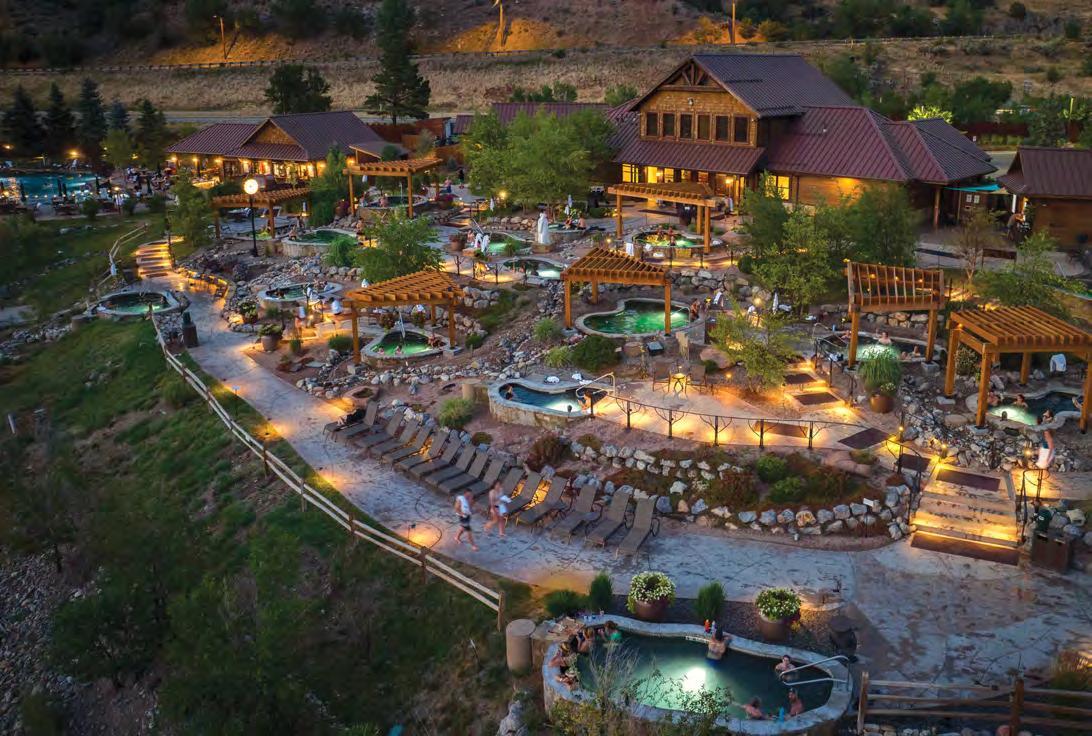
TRUE HOTSPOT CONNECTIVITY
76 5280 / JUNE 2024
Unwind in our 32 mineral springs on the Colorado River including our 21+ only area, WorldSprings, mineral pools inspired by famous hot springs from around the world. Sit back, enjoy snacks and drinks, and soak it all in. Reserve online at IronMountainHotSprings.com DINING GUIDE



NEVER MISS A EVENT! Scan for early ticket access at a special discount. @5280SCENE ∙ 5280SCENE.COM


for Native-produced bison and pantry goods and donates prepared meals to tribal communities in need . Reservations not accepted. 3536 W. 44th Ave., 720-524-8282. Lunch, Dinner
TOFU STORY
$$
Aurora / Korean House-made tofu is the main draw at this airy Korean eatery from chef-restaurateur J.W. Lee. Order the spicy seafood soondubu stew featuring silken tofu with the pressurecooked rice. Reservations not accepted. 2060 S. Havana St., Aurora, 303-954-9372. Lunch, Dinner
TRAVELING MERCIES
$$$
Aurora / Seafood Annette's Caroline Glover expands her offerings in Aurora's Stanley Marketplace with this petite yet airy oyster and cocktail bar. Any meal here deserves an order of the anchovy and baguette with French churned butter. Reservations accepted. 2501 Dallas St., Suite 301, Aurora. Dinner
UCHI DENVER
$$$$
Curtis Park / Japanese This bustling eatery from James Beard Award–winning chef Tyson Cole delivers artful and inventive Japanese small plates and sushi made with some of the freshest fish in town. Reservations accepted. 2500 Lawrence St., 303-444-1922. Dinner
UNCLE
Speer / Asian This reliable Pan Asian noodle house from chef-owner Tommy Lee has a revolving menu of steamed buns, small plates, rice and curry bowls, and ramen. Order the spicy dan dan noodles. Also try the Highland location. Reservations not accepted. 95 S. Pennsylvania St., 720-638-1859. Dinner
URBAN VILLAGE GRILL
$$
$$$
Lone Tree / Indian This eatery inside Park Meadows Mall serves classic and contemporary dishes from regions across India. Order the chef’s tasting menu, a multicourse feast featuring Urban cauliflower, butter chicken, and other popular dishes. Reservations accepted. 8505 Park Meadows Center Drive, Suite 2184A, Lone Tree, 720-536-8565. Lunch, Dinner
US THAI CAFE
Edgewater / Thai Classic, fresh ingredients, spicy dishes, and a chef straight from Thailand make for an authentic, if mouth-tingling, dining experience. Try the green curry. Reservations accepted. 5228 W. 25th Ave., Edgewater, 303-233-3345. Lunch, Dinner
VIET’S RESTAURANT
$
$ Westwood / Vietnamese Enjoy sophisticated Vietnamese cuisine at this modern eatery. It boasts everything from fresh spring rolls and pho favorites to gourmet seafood plates. Reservations accepted. 333 S. Federal Blvd., Suite 125, 303-9225774. Lunch, Dinner
VIEWHOUSE
$$ Ballpark / American This is your place to catch the game and enjoy a variety of bar bites, from burgers and tacos to steak. Watch your favorite team while enjoying a draft beer and a plate of nachos. Multiple locations. Reservations accepted. 2015 Market St., 720-878-2015. Lunch, Dinner, Brunch
78 5280 / JUNE 2024 Let Loose Your Goose. Denver’s favorite rooftop destination features lofty views of The Rocky Mountains, the downtown skyline, and everything the Mile High City has to offer. Open for the season starting May 1st. 245 COLUMBINE ST. DENVER, CO 80206 | RAREBIRDROOFTOP.COM
GUIDE
DINING
VITAL ROOT
$$
Berkeley / American Justin Cucci’s fourth eatery focuses on quick, healthy food. Grab a seat in the airy space and nosh on creative, wholesome fare such as cashew “queso” dip or a sunflower risotto. Reservations not accepted. 3915 Tennyson St., 303-474-4131. Lunch, Dinner, Brunch
WHITE PIE
$$$
City Park West / Pizza This neighborhood joint has an excellent selection of New Haven–style pizzas and house-made pastas. Pair the Porky Porkorino, topped with soppressata, mozzarella, pickled chiles, and hot honey, with frosé. Reservations not accepted. 1702 Humboldt St., 303-862-5323. Lunch, Dinner, Brunch
WHITTIER CAFE
Whittier / Cafe This espresso bar, which supports social-justice-related causes, serves coffee, beer, and wine sourced from various African nations and a small menu of pastries, breakfast burritos, panini, and more. Reservations not accepted. 1710 E. 25th Ave., 720-550-7440. Breakfast, Lunch
WINDFALL BREWING CO.
$
WORK & CLASS
$$$
RiNo / American This elevated meat-and-three concept from chef Dana Rodriguez offers a delicious hybrid of American and Latin cuisine in raucous, repurposed-shipping-container digs. Our picks: the rotisserie chicken, chickpea croquettes, and the roasted Colorado lamb. Reservations not accepted. 2500 Larimer St., 303-292-0700. Dinner
XICAMITI LA TAQUERÍA
YUMCHA
$$
LoDo / Asian From restaurateur Lon Symensma of ChoLon and Bistro LeRoux comes a dim sum house and noodle bar serving creative Asianinspired bites. Reservations accepted. 1520 16th Street Mall, 720-638-8179. Lunch, Dinner
ZEPPELIN STATION
$$
Golden / Mexican This long-standing joint serves cooked-to-order burritos, tacos, quesadillas, and alambres (skillet dishes) made with recipes drawing from Walter Meza’s childhood in Mexico. Reservations not accepted. 715 Washington Ave., Golden, 303-215-3436. Breakfast, Lunch, Dinner
YAHYA’S MEDITERRANEAN GRILL & PASTRIES
City Park West / Mediterranean This family-run restaurant serves silky hummus, a variety of excellent grilled kebabs, and from-scratch sweets. Try the beef koobideh. Reservations accepted. 2207 E. Colfax Ave., 720-532-8746. Lunch, Dinner
$$
$$
Westminster / American This spot serves comforting pub grub with a stellar lineup of craft suds in Orchard Town Center. Try one of the burgers first, then head straight for the pinball machines. Reservations not accepted. 14694 Orchard Parkway, Westminster, 720-5315822. Lunch, Dinner
YAZOO BARBEQUE COMPANY
Five Points / Barbecue This unpretentious counter-service barbecue joint offers a Deep South menu, featuring slow-smoked pork ribs and brisket. Dig in at the outdoor picnic tables. Reservations not accepted. 2150 Broadway, 303-296-3334. Lunch, Dinner
$
$$
RiNo / International This industrial-chic food hall in RiNo is home to seven globally inspired food and drink vendors, including Procession Coffee, Purisma, and Gyros King. 3501 Wazee St., 720-862-0008. Breakfast, Lunch, Dinner, Brunch
ZOCALITO LATIN BISTRO
$$$ Downtown / Mexican Formerly located in Aspen, chef/owner Michael Beary’s upscale Oaxacan eatery found a home in the heart of Denver. Reservations accepted. 999 18th St., Suite 107, 720-923-5965. Dinner
ZORBA’S
$$
Congress Park / Greek Zorba’s has served American and Greek fare—burgers, salads, sandwiches, and classic breakfast dishes—in Congress Park since 1979. Don't miss the banana pudding. Reservations not accepted. 2626 E. 12th Ave., 303-321-0091. Breakfast, Dinner, Lunch
These listings are in no way related to advertising in 5280. If you find that a restaurant differs significantly from the information in its listing or your favorite restaurant is missing from the Dining Guide, please let us know. Write us at 5280 Publishing, Inc., 1675 Larimer St., Suite 675, Denver, CO 80202 or dining@5280.com.

JUNE 2024 / 5280 79 DINING GUIDE



on a bill to change the way in which Colorado handles sex offenders. Gonzales, who was born on Arizona’s San Carlos Apache Indian Reservation and earned a bachelor’s degree in history from Yale University, won her seat five years earlier after running on a progressive platform that focused heavily on social justice and judicial reforms. As the state Senate Judiciary Committee chair, she drafted Senate Bill 24-118, which would put an end to indeterminate sentencing in many cases and replace it with fixed sentencing guidelines. The bill also included what she called “more robust” therapies for inmates and parolees.
In late winter, Gonzales met with a liaison for the state’s Department of Public Safety who told her the department was opposing the bill. It was hardly a surprise. A similar bill Gonzales crafted the previous year failed to make it out of the state’s Senate Judiciary Committee. After battling Colorado’s powerful SOMB—which controls treatment standards for people already convicted of sex crimes and has regularly fought against ending indeterminate sentencing— Gonzales knew even the smallest changes to sex offender legislation would get pushback from both sides of the political aisle. “But no one is coming with a solution,” she says. “Nowhere else in our statutes do we have indeterminate sentencing available. We have people in this state who have been convicted of murder who do not receive indeterminate sentences.” To Gonzales, who represents west Denver, the proposed bill wasn’t just a civil rights issue. It was also a broadside against SOMB’s credibility.
Gonzales says she has attended SOMB hearings over the years in which she thought the board failed to offer suggestions on how sentencing, prison therapies, and parole supports could be offered in ways that “acknowledged the harm these people had done while also figuring out a path forward to rehabilitation.” Instead, she adds, “We have meetings where people throw up their hands, say it is a tough issue, and then nothing changes.”
To underscore the point, Gonzales pulled out a binder from behind her desk that included printed slides from previous SOMB hearings. She read one of the pages: “And summary in conclusion, problem for some indeterminately sentenced inmates to access
80 5280 / JUNE 2024 INDETERMINATE
CONTINUED FROM PAGE 63 TRANSFORMING THE WAY WOMEN CONNECT BUSINESS LIFE & COMMUNITY. 9+CO CAMPUS OPEN NOW -FLEX OFFICE -MEMBERSHIP WORKSPACE -LEADERSHIP WORKSHOPS -BUSINESS EDUCATION TARRA.CO | @_TARRACO We know you love . SCAN HERE TO SUBSCRIBE or VISIT 5280.COM/THELOCAL Join the thousands of Coloradans who start each day with The Local— 5280 's free, daily newsletter. Every day you'll receive our editors' picks of the top stories in mile-high food, culture, travel, and more! Don’t miss our exclusive, bonus content: Ì Favorite dishes in Denver Ì Regular updates on Mile High City news and events Ì Weekly insider tips Ì Weekly quizzes, polls, giveaways, and more!

Untitled 237473, acrylic, 27” x 40.5” © Karen Roehl abstract passions ROEHL Represented By: TIERRA MAR GALLERY 225 CANYON RD, SANTA FE, NM 87501 WWW.TIERRAMARGALLERY.COM KARENROEHL.COM
treatment prior to parole eligibility date…. Hope to show measurable progress on this issue. SOMB and DOC [Department of Corrections] committed to continuing to work on this issue.” Gonzales laughed and shook her head. “That’s the summary and the conclusion to an issue that’s very serious,” she says, “and all they say is, ‘We’re doing some stuff.’ ”
In mid-April, Gonzales’ bill failed on a 3-2 vote in committee. “This is an issue that needs to be solved or changed in Colorado and negotiated,” state Senator Dylan Roberts, a Democrat and the Judiciary Committee’s vice chair, said. “That is very clear…. This [current system] is not exactly the system that Colorado needs or deserves.”
THE ISSUES WITH sex offender treatment and rehabilitation in Colorado go back at least a decade. In 2013, a report by Central Coast Clinical and Forensic Psychology Services for Colorado’s Division of Clinical Services criticized the way Colorado’s SOTMP handled sex offenders. Not only did the report question “the fairness and appropriateness of the indeterminate sentence/lifetime supervision plan,” but it also
noted that the system often worked in secrecy, was vague about its goals for rehabilitation, and served as a sentencing black hole that hurt the chances for meaningful therapies among offenders. “The lack of clarity about release expectations,” the report reads, “and the ‘moving yardstick’ undermine motivation and engender bias and misuse of power by release decision maker.”
Wilson, the sex offender psychologist, says state boards, such as SOMB, sometimes rely on outdated data and junk science to impose heavy restrictions on offenders like Red Cloud without realizing the damage it’s doing to the person’s recovery. (A spokesperson for Colorado’s Division of Criminal Justice declined to make Chris Lobanov-Rostovsky, SOMB’s program manager, available for an interview.) Indeterminate sentences, and the lifetime supervision that often follows, “just isn’t effective,” Wilson says. “Generally, the whole idea of trying to hold people accountable for the worst thing they ever did on the worst day of their life and the worst moment that they’ve ever experienced isn’t the best way toward treatment. There’s no evidence to suggest these sentences actually accomplish anything.”

In the case of an offense such as Red Cloud’s, proponents of the current system argue there’s a high level of “crossover”—that is, an adult who offends against an adult is equally likely to then offend against a child. But Kepros, of the state public defender’s office, says, “There’s absolutely no evidence on any of this, because no one in this country is studying the issue.”
As part of the post-conviction process in the Centennial State, every convicted sex offender must undergo evaluations that are intended to determine sexual interests, which Kepros says should act as a road map for future treatments. Instead, she says, “We’re spending all this money on testing for these kinds of things, and then we ignore it and then say everyone has the same rules. We’re giving a one-size-fits-all form of treatment to people who need to be evaluated and treated as individuals. Ultimately, the system is failing everyone.”
One day while on parole, Red Cloud went to a Department of Motor Vehicles office in Larimer County to renew his driver’s license. A young girl was running outside the building while her mother talked to someone. While the mother was distracted,


82 5280 / JUNE 2024 Come experience legendary farm-to-table flavors—that unforgettable taste of the West. Stroll through the historic Cheyenne Depot Plaza as graffiti artists create bright new murals all around you. You might just find timeless bison leathers around that next undiscovered street corner. Cheyenne.org Our scene is this escape to thrilling vibrant cheyenne INDETERMINATE
SCENE CALENDAR

JUN 1 & 22
Pay-What-You-Wish Days
Clyfford Still Museum | 10:00 a.m. to 5:00 p.m.
Explore the Clyfford Still Museum for as little as one penny during one of the June Pay-What-You-Wish Days. Enjoy the new exhibition “Dialogue and Defiance,” vibrant sound and garden terrace installations, a handson art creation studio, and more.
Information and tickets at clyffordstillmuseum.org/plan-your-visit.


High Line Canal Summer Scamper, 5k for All
Bible Park | 5:00 p.m.
Join us at the second annual High Line Canal Summer Scamper, 5k for All at Bible Park on the evening of June 26th. Funds raised benefit the High Line Canal Conservancy and the future of the Canal.
Information and tickets at summerscamper5k.com. JUN 26

5280 Top of the Town
Cherry Creek North, Fillmore Plaza | 6:00 p.m. to 9:00 p.m.
Our annual, all-inclusive, bash celebrating the best stuff in and around Denver is back at Cherry Creek North! Mark your calendar and make sure you’re signed up for The Scene List so you can be the first to know when tickets go on sale.
Information and tickets at 5280scene.com/the-scene-list.

Follow @5280scene for a behind-thescenes look at 5280 marketing. SCAN HERE TO VIEW ONLINE | 5280SCENE 5280 MAGAZINE PROMOTION PROMOTIONS | EVENTS | SPONSORSHIPS
JUL 18
Red Cloud remembers, the girl fell to the ground in front of him and started crying. He wanted to reach out and comfort her, but he was concerned about violating the conditions of his parole. “Imagine seeing a young child in pain and doing nothing to help,” he says. “Think about what that does to a person.” After the incident, Red Cloud says he raised a hypothetical scenario with a treatment provider: If he saw a child alone and drowning, what should he do? According to Red Cloud, the provider told him he should let the child drown.
Red Cloud participated in extensive group therapy sessions in Fort Collins after his 2022 release. He cleared the required polygraphs, and his treatment also included an evaluation of the 2010 assault on his wife. He submitted to sex history exams and discussed the neuroscience of emotions, among other things. “He attends his scheduled sessions, pays attention to the content of the discussion, and provides good feedback to those in his group,” his therapist, Cheri Fisher, wrote in a review of his treatment.
So when Red Cloud failed a series of polygraphs in South Dakota in 2023, his parole officer was confounded. Red Cloud
“has not shown any high-risk behaviors, is on time, attends groups, and seems to have everything in line,” Jason Kaufman, Red Cloud’s parole officer in Rapid City, wrote to a parole agent. By late July 2023, Red Cloud had been ordered to wear a GPS ankle bracelet and was given more strict limitations on where he could travel. (Red Cloud previously had received approval to travel to DOE events.)
By the fall of 2023, Red Cloud had failed three exams—all on questions about whether he was sexually attracted to minors. During one of his polygraphs, Red Cloud told the polygrapher that he was tired of the questions about his potential interest in minor children. “Whenever I get asked these questions, I really get offended,” Red Cloud told the polygrapher in July 2023, according to a transcript of the examination. “Like permanent indignation. Are you serious? By what stretch of the imagination are you going to ask me if I’m, like, going around sexualizing children? Give me a break.”
Kaufman wrote to South Dakota’s Sex Offender Management Program and said he was skeptical of the polygraph’s accuracy. Not only had Red Cloud never admitted

to sexual contact with minors, Kaufman wrote, but he also “has passed a sexual history [polygraph] and has no hands on offending with minors, and he was allowed to have contact with his children while parolled [sic] in CO…. I briefly spoke with [the polygrapher] on the phone, and the consensus was that he clearly failed, but there is not a credible concern, and John is clearly aggravated about being asked about sexual contact with minors, which may be causing a false positive in terms of the reaction.”
Kaufman advised against retesting Red Cloud and added that an additional polygraph wasn’t likely to resolve the matter. “Normally, I push harder for a disclosure and assume the client is lying…. However, John has been extremely compliant and careful and this does not fit his risk profile or offending history.”
The polygrapher agreed with Kaufman’s assessment. “While I can’t say that [Red Cloud’s] exam results are a false positive, these are still screening exams that are not infallible,” the polygrapher, Phil Toft, wrote. Red Cloud, he added, “shouldn’t be terminated from any programs based solely on the polygraph results.”
84 5280 / JUNE 2024 ILLUSTRATION BY TINA ZELLMER JUNE 29 - AUGUST 4 GILBERT AND SULLIVAN THE PIRATES OF PENZANCE PUCCINI THE GIRL OF THE GOLDEN WEST WEILL STREET SCENE centralcityopera.org TICKETS START AT JUST $31! INDETERMINATE





The Race Against Kids’ Cancer is an exhilarating weekend of vintage car racing to benefit life-saving kids’ cancer research funded by The Morgan Adams Foundation. This is the 14th Anniversary of this incredible event! Spectators will have a chance to buy a “ticket to ride” in a race, sports, or exotic car at speed on the track and much, much more! This event is FREE to the public.
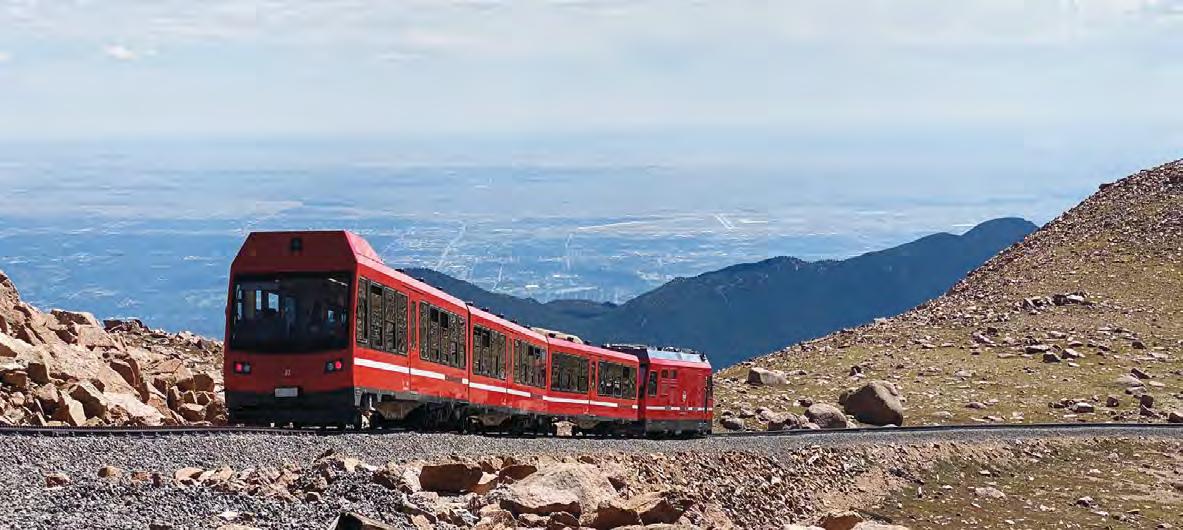




PEAK
All aboard the most state-of-the-art cog railway in the world. While the entire experience of riding the railway has been enhanced, the journey itself and the iconic, breathtaking views as you ride to the summit of America’s Mountain remain the same. Visit cograilway.com to purchase your e-ticket today.
YOUR INTEREST?
P hoto Credit: Pikes PeakAmerica’s Mountain
Despite the correspondence, South Dakota mandated another polygraph, this time with a different polygrapher. Rather than tailoring that polygraph to the client—as mandated by Colorado’s SOMB standards—Red Cloud again was asked about his interest in sex with minors. Again, the examiner determined that Red Cloud was deceptive with his answers. At that point, Kaufman wrote South Dakota parole agent Taylor Santana, warning her on inferring too much from another failed polygraph. “It would be highly unlikely that a guy would have no history of child-offending, go through all the treatment and accountability he has, and then develop a new deviant interest,” Kaufman wrote.
Red Cloud underwent his fourth polygraph. During the post-test interview, he said he’d seen his minor relatives at a sweat lodge and was immediately arrested after the disclosure.
Kaufman learned of the arrest a day later. “It is unfortunate that this resulted in [Red Cloud] being taken into custody, as I do not think his conduct merited a revocation,” the parole officer later wrote to Red Cloud’s attorney in Colorado. “I do have some reservations on the polygraph use, etc., but that is
simply not my decision, as I am not a DOC employee or a policy maker.”
Wilson argues that South Dakota—and, by association, Colorado—failed to acknowledge the role that culture played in Red Cloud’s recovery and reintroduction into society. A sweat lodge “was probably one of the only places he could feel like he’s a Native American,” says Wilson, who has also served on the board of the Association for the Prevention and Treatment of Sexual Abusers. “He was not allowed to be who he is in a program that’s supposed to be helping him be a better person.”
The regulations Red Cloud faced are “a complete paradox,” Wilson adds. “He is guilty of one crime, but he’s being treated for a different set of offenses than what he’s actually done. He wants to take responsibility for his behavior, but the criminal processing he was going through—the questions he’s being asked—are completely different than who he is and what he did. How is that effective treatment?”
ONE OF THE LAST THINGS Red Cloud told me before he was transferred to prison was that he missed his girlfriend. He’d last

seen Watters as he was being led away in handcuffs from the parole office in Rapid City. Watters is raven-haired, soft-spoken, and the divorced mother of several adult children. Red Cloud thought Watters had an uncommon ability to empathize, to listen and analyze, and to support. Watters saw Red Cloud as a superhero among his peers; he was the one, she says, “who was going to make something of himself.”
Roughly five years ago, Watters began to wonder where her childhood friend had gone; she hadn’t seen him around Pine Ridge for years. After learning he was in prison, she wrote Red Cloud a letter. He wrote back. Two letters became four, and four became eight. They began talking on the phone. She asked about the crime that had sent Red Cloud away. He said he was a changed man, that he wanted to prove that to everyone. “What happened, happened,” she says. “But that is not the John I know. It’s not the John anyone around here knows.”
She wrote a letter to the administrative hearing officer who oversaw Red Cloud’s parole hearing this past winter. She said that he was a good man, that years in prison had made him rethink his life, that he was doing

86 5280 / JUNE 2024 We’ve got you covered! Search through our extensive directories for the top medical, law and real estate professionals in Colorado. LOOKING FOR A EXPLORE NOW AT DIRECTORY.5280.COM INDETERMINATE
well in the community, and that he should be allowed to return home. It didn’t matter. In early March, one month after Red Cloud’s parole revocation, his lawyer submitted an appeal of the revocation decision.
On March 28, Red Cloud’s appeal was denied. He would remain in prison awaiting another parole application interview in August.
ONE DAY IN EARLY
March, Henry Red Cloud stood on a patio on the Red Cloud Renewable campus with a phone to his ear. A mural of a large, crouching warrior in a business suit—with a billowing red tie and two eagle feathers in his hair—graced a nearby trailer. Next to the image were the words “Hau Kola,” which translate to “Welcome, my friends.”
Henry paced as he talked on the phone. A work crew was putting together a series of domelike tiny homes on a piece of reservation land 30 miles away, and Henry wanted to make sure everything was running on time.
His schedule was packed, as usual. Henry needed updates on his son’s BRIDGE grant and on the next crop of Red Cloud Renewable workforce trainees, who now numbered in
the hundreds and included Native American men and women from reservations as far away as Arizona. He was also putting together thoughts for a talk in Washington, D.C., and figuring out how to get one of the company’s myriad solar projects to move faster. By all accounts, it should have been an exciting time. Instead, Henry was in a melancholy mood. John’s 46th birthday was the next day.
Red Cloud had been his father’s security blanket after returning home from Colorado. If Henry was the soul of Red Cloud Renewable—the one who’d founded the nonprofit based on the tribe’s spiritual connection to the life-giving sun—John had become its voice. It was his research and writing that led to the grants, and he was the one who could take Red Cloud Renewable’s big ideas and sell that promise to government types and donors who existed outside the reservation’s invisible walls.
Henry hung up his phone and exhaled. He desperately needed his son’s help. “I feel like I’m running a marathon with one leg,” he says. “But how can I say that to my boy?”
He gathered some logs and fed the fire inside a potbelly stove in one of Red Cloud

Renewable’s buildings. Three of the company’s domed homes rose in the distance. Near the domes was a circular, covered workstation. Across from that stood a large stanchion, where trainees learned to install solar panels. “You should see their eyes light up when they put it together from scratch and finally get it working,” Henry says. “John was so proud with how far we were coming.”
Inside the building, framed artwork and family photographs covered the walls. There was a young, smiling Red Cloud, with an eagle feather rising off his jet-black hair, standing next to his crouching, smiling grandfather, who was in full war bonnet. There was also a colorized photograph of Chief Red Cloud hanging near a five-foot-tall charcoal drawing of the chief holding a peace pipe.
Henry excused himself to make more phone calls. He paced around the patio. He looked out at the domes in the yard. He accepted a bag of oranges from a tribal elder who stopped by to say hello. Then he went back inside to check on the fire. Snow was coming soon. m
Robert Sanchez is 5280 ’s senior staff writer. Email feedback to letters@5280.com.






87 UNIVERSITY Unlock a community of like-minded entrepreneurs www.bbiprofessional.com LEARN MORE On-Demand Learning Monthly Masterclasses Essential Business Tools Thriving Business Community INDETERMINATE
Pooping Outdoors

The first step is overcoming the mental block. “Think of pooping outdoors as something to be proud of,” says JD Tanner, director of education and training at the Boulder-based environmental nonprofit Leave No Trace. “It’s not this uncomfortable, shameful thing. It’s natural.” Once you accept that, here’s what to do next.
—NICHOLAS HUNT
Survey your surroundings. You should move at least 200 feet—about 70 big steps for adults or 90 for kids—away from the trail and any water to prevent contamination. You’ll also need a trowel and earth that’s soft enough to excavate. Privacy is optional…but recommended.
To reach the soil microbes that will break down your waste, your cathole needs to be four to six inches wide and six to eight inches deep— unless you’re in the desert, where four to six inches down is ideal.
Squat over your hole. Holding onto a tree or hanging your backside over a log will help your balance, allowing you to relax and enjoy the view.
Use as little single-ply toilet paper as you can, and if you can't pack it out, place it deep in the hole to aid decomposition. Should your aim be less than true, grab a stick (not your trowel) to herd any wayward deposits into their new home before you fill in your burrow.
If there’s no diggable dirt (such as when you’re above treeline) or you can’t get far enough away from water, use a waste alleviating gel (WAG) bag, which is filled with crystals that deodorize, bind, and break down waste. Leakage can happen, though, so stow used bags upright on the outside of your pack.
88 5280 / JUNE 2024 ACT LIKE A LOCAL THE OVERSIMPLIFIED GUIDE TO: ILLUSTRATION BY SIMONE MASSONI 1
2
4 5
3






Same History. New Vibe.
The Hotel Denver is now the Hotel Maxwell Anderson. To walk the halls will give you a crash course in history – not just of our downtown Glenwood Springs boutique hotel, but of the community. If the walls could talk, they would tell stories of pioneer settlers, gangsters and outlaws, railways and miners, prohibition, and of the good times as well.
402 7th St. Glenwood Springs, CO • MaxwellAndersonHotel.com • 970-945-6565