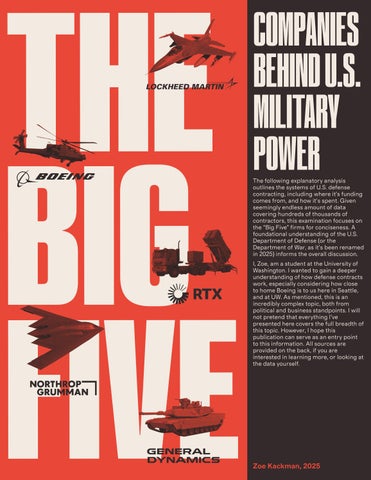
The following explanatory analysis outlines the systems of U.S. defense contracting, including where it’s funding comes from, and how it’s spent. Given seemingly endless amount of data covering hundreds of thousands of contractors, this examination focuses on the “Big Five” firms for conciseness. A foundational understanding of the U.S. Department of Defense (or the Department of War, as it’s been renamed in 2025) informs the overall discussion. I, Zoe, am a student at the University of Washington. I wanted to gain a deeper understanding of how defense contracts work, especially considering how close to home Boeing is to us here in Seattle, and at UW. As mentioned, this is an incredibly complex topic, both from political and business standpoints. I will not pretend that everything I’ve presented here covers the full breadth of this topic. However, I hope this publication can serve as an entry point to this information. All sources are provided on the back, if you are interested in learning more, or looking at the data yourself.
A defense contract, as defined by the Code of Federal Regulations, is
Small and large businesses receive contracts for anything from janitorial services, marketing, construction, etc. Recently there’s been a huge increase in contracting tech companies for military operations. In defense policy, a contractor can be either a private company or a civilian. Military service members, DOD career employees, and civilian political appointees are not considered defense contractors.
“Defense contractors often play a major role overseas, where they provide deployed troops with services such as language interpretation, perimeter security, weapon systems maintenance, and supervision of other contractors. During past US military operations in Iraq and Afghanistan, they have often made up 50% or more of the entire DOD presence, including military personnel.” – USAFacts an agreement for a contractor to provide supplies or services to a sub-agency of the DOD.
The Big Five are the main companies who actually produce weapons and other military equipment, the reason for this is explained in the below timeline. Additionally, there are many “child companies” that fall under the Big Five, but are not explicitly labeled as such. For example, a $23B contract was given to “Electric Boat Corp” but upon further research, General Dynamics is listed as the parent company. Due to data extraction limitations, some of these contracts may have been missed in the overall budget calculations, meaning that the numbers are likely higher than seen here. It may seem like only a small portion of the federal budget goes to contractors, and an even smaller portion go to the Big Five. However, when we look at the many ways the budget is spent, defense contracts are actually one of the larger singular categories.
“About two dozen leaders from the defense industry joined the secretary of defense for dinner in fall 1993. After the meal, later known as ‘the Last Supper,’ came a halfhour briefing. The topic was consolidation. The Cold War was over, which meant America would spend less on defense. That also meant less money for the companies in the room... Companies would likely need to merge if they wanted to survive.” – Defense News, 2024
(Congressional Research Service)
This graph breaks down the different kinds of awards that the contractors receive. I gathered this data by sorting the descriptions of each contract, and searching for keywords related to these categories. This does not include all active 2025 contracts, only ones with base transaction dates in 2025, meaning they started this year.
The two largest contractors; Lockheed Corp and Martin Marietta Corp merge after each acquiring various companies
Boeing merges with their leading competitor–McDonnell Raytheon (RTX) acquires four large contracting companies
LOCKHEED MARTIN BOEING
NORTHROP GRUMMAN GENERAL DYNAMICS
RTX
Maintenance is also such a large category because it includes the continuing production of vehicles and systems that already exist.
5 (main) defense companies exist: Lockheed Martin, Boeing, Northrop Grumman, RTX (Raytheon), and General Dynamics
Federal funding is broken up into three categories,
mandatory spending, discretionary spending, and interest on debt.
The majority of the budget goes to mandatory spending, and a very small amount goes to debt. Most departments receive a mix of funding types. The Defense budget is mostly discretionary, while Social Security is almost entirely mandatory. Something like Health and Human Services receives both, because it administers a large range of programs. It’s important to note that there is a difference between actual and allocated funds for each department. For example there is technically $2.3T available to the DOD from the 2025 budget.
However, the actual amount that has been paid out by the Treasury Department is $850B. This is made even more complex due to many contracts and obligations that span years, meaning that the money will not be paid out all at once. For the sake of this dataset, I focused primarily on new contracts made in the fiscal year 2025, to simplify the amount of content we are looking at.
9.4T TOTAL FEDERAL BUDGET
Congress sends the approved funding bills to the president to sign or veto. $2,730
Federal agencies create budget requests and submit them to the White House Office of Management and Budget (OMB).
OMB refers to the agencies’ requests as it develops the budget proposal for the president.
President submits the budget proposal to Congress early the next year.
Proposed funding is divided among 12 subcommittees. Each is responsible for funding for different government functions.
The House and Senate create their own budget resolutions. They must be negotiated and merged, to pass a single version of each funding bill.
Profit margins are built into each contract value, and the amount is negotiated up front. This is applied to both local and foreign military sales. Contracts use two different financial strategies; cost-plus and fixed price.
This means the government pays for all costs that accumulate during the project, plus a fixed percentage that goes towards profit.
PROS
Incentivizes higher quality materials and detail oriented work
CONS Companies may increase production costs to increase profit, delaying the final product, or adding unnecessary elements
This means there’s an agreed upon set price. If the company creates the product for less, they get to keep the extra profit.
PROS
Timely, efficient work and predictable budgeting on both sides of the contract
CONS
Can encourage cutting corners, rushing, or using cheaper materials in the interest of profit
The US is the world’s biggest weapons exporter, controlling about 43% of the global arms trade.
–
Business insider, 2025
FIRST STEPS IF FINANCIAL
AID IS GIVEN BY U.S. GOV
“U.S. aid to ___” means a portion of our federal budget is set aside in a fund for that country. These funds are used to pay private contractors to make weapons or other products.
FMS is a government-togovernment program managed by the Defense Security Cooperation Agency (DSCA).
Here’s how it works:
U.S. determines military aid money (ie. $3.8B to israel)
Deposits these funds (from the federal budget) into an FMS trust fund
Foreign government identifies a defense need
They submit a formal request to the U.S. government
The Pentagon negotiates with the contractor on behalf of the allied nation
It then signs a contract with the contractor and a separate "Letter of Offer and Acceptance (LOA) with the ally
The ally pays the U.S. government, OR pays via their trust fund, given by the U.S. gov, who then pays the contractor
Operating profit margins shows how efficiently a company turns defense contracts into profit. If it's 10%, they make a $10 profit on every $100 of sales, after paying for materials, workers, and overhead, but before taxes and interest.
It can be difficult to correlate profit to increased times of war, as the U.S. has been involved in various conflicts over the past 25 years (ie. Afghanistan from 2001–2021)
Data collected from U.S. SEC's EDGAR database
Iraq War
Not all wars are equal: Conventional wars (ie. Iraq) boost profits more than aid/ replenishment conflicts (ie. US aid to Ukraine + israel)
While I was unable to access data from 2025, according to ABC News “The world's biggest weapons-producing companies saw a 5.9% increase in revenue from sales of arms and military services last year [2025]”
This huge drop in Boeing s defense profits is due to fixed contract failures
Hopefully if you’ve made it through this whole publication you already have some understanding of why you should care about the Big Five, and the greater military industrial complex within the United States. To outline the cost of war beyond purely financial I’ve pulled some quotes from Brown University’s The Cost of War:
“An estimated over 940,000 people were killed by direct post-9/11 war violence in Iraq, Afghanistan, Syria, Yemen, and Pakistan between 2001-2023. Of these, more than 432,000 were civilians. The number of people wounded or ill as a result of the conflicts is far higher, as is the number of civilians who died “indirectly,” as a result of wars’ destruction of economies, healthcare systems, infrastructure and the environment.
An estimated 3.6-3.8 million people died indirectly in post-9/11 war zones, bringing the total death toll to at least 4.5-4.7 million and counting.”
“It will be a great day when our schools get all the money they need, and the Air Force has to hold a bake sale to buy a bomber”
To sum it up in one sentence, our tax dollars go towards death and destruction across the world instead of funding public services and addressing humanitarian problems within our own country.
“As of October 3, 2025, according to the Gaza Ministry of Health, 67,075 people have been killed and 169,430 people have been injured, totaling 236,505 casualties... In the two years since the October 7, 2023 Hamas attack on Israel, the U.S. government has spent $21.7 billion on military aid to Israel.” Sources