Chapter 20 - SIGNS[1]
Footnotes: (1)
Editor's note Ord. No. 2021-10-17, Att. A, adopted Oct. 11, 2021, repealed the former Ch. 20, §§ 201 20-3, 20-23 20-30, 20-49 20-70, and enacted a new Ch. 20 as set out herein. The former Ch. 20 pertained to similar subject matter and derived from Ord. No. 2010-10-39, § 1, adopted Oct. 25, 2010; Ord. No. 2011-07-22, adopted July 11, 2011; Ord. No. 2014-09-14, adopted Sept. 22, 2014; Ord. No. 2017-07-18, adopted July 24, 2017; Ord. No. 2018-05-10, adopted May 21, 2018; Ord. No. 2019-01-02, adopted Jan. 28, 2019; and Ord. No. 2020-02-02, adopted Feb. 24, 2020.
State Law reference Control of signs and signals, O.C.G.A. § 32-6-50 et seq.; placement of posters, signs and advertisements on public or private property; permission and limitations, O.C.G.A. § 16-7-58; limitations on signs identifying or advertising sale of distilled spirits, O.C.G.A. § 3-4-3; restrictions on certain signs providing information in the interest of the traveling public and multiple message signs, O.C.G.A. § 32-6-75.
ARTICLE I. - INTRODUCTION AND HOW TO USE THIS SIGN CODE
Sec. 20-1. - Purpose and intent.
The city council finds that signs provide an important medium through which persons may convey a variety of noncommercial and commercial messages. However, left completely unregulated, the number, size, design characteristics, and locations of signs in the city can become a threat to public safety as a traffic hazard, a detriment to property values and to the city's general public welfare, and create an aesthetic nuisance. The city further finds that signs have become excessive, and that many signs are distracting and dangerous to motorists and pedestrians, and substantially detract from the beauty and appearance of the city. The city finds that there is a substantial need directly related to the public health, safety, and welfare to comprehensively address these concerns through the adoption of the following regulations.
The city further finds that there is a substantial difference between signs erected by public authority and signs erected by private citizens or businesses. Signs erected by public authority are virtually all erected for the purpose of maintaining the public safety either through direct control of traffic or through provision of such type signage as street signs which enable the traveling public to know where they are located and to find where they are going. As such, with the exception of signs identifying government buildings, virtually all government signs are erected purely for public safety purposes. Moreover, their use in the public right-of-way is necessary to ensure their visibility to the motoring public. The mayor and council finds that public utility signs are frequently of the same nature as those signs erected by governmental entities in that they provide necessary information to safeguard the public from downed power lines and from street excavations. Even where signs serve a propriety purpose, such as identifying markings on utility poles, public utility signs are marked primarily for the purpose of benefiting the public generally through identification of locations where there may be temporary losses of power.
The city finds that some signage has a single targeted function and that identification of such signs by description is impossible without referring to its function. For instance, address numerals are used for the sole purpose of locating addresses, which is of benefit to those persons looking for those addresses and is essential to public safety personnel responding to emergencies. Signs at the entrances to common developments favor a similar purpose in enabling both the traveling public and emergency personnel to quickly locate entrances for the purpose of either visitation or responding to emergency calls or where the state authorizes the department of agriculture to regulate the display of retail fuel station pricing and for the best interest of the public to advertise said prices. While such signage is referenced based upon the function it serves within the context of this chapter, the provisions of this chapter are unrelated to the content of speech provided and allow maximum expressive potential to sign owners.
The purpose and intent of the governing authority of the city in enacting this chapter are as follows:
(1) To protect the health, safety and general welfare of the citizens of Dunwoody, and to implement the policies and objectives of the comprehensive plan of the city through the enactment of a comprehensive set of regulations governing signs in the city;
(2) To regulate the erection and placement of signs in order to provide safe operating conditions for pedestrian and vehicular traffic without unnecessary and unsafe distractions to drivers or pedestrians;
(3) To preserve the value of property on which signs are located and from which signs may be viewed;
(4) To maintain an aesthetically attractive city in which signs are compatible with the use patterns of established zoning districts;
(5) To maintain for the city's residents, workers and visitors a safe and aesthetically attractive environment and to advance the aesthetic interest of the city;
(6) To establish comprehensive sign regulations that effectively balance legitimate business and development needs with a safe and aesthetically attractive environment for residents, workers, and visitors;
(7) To provide fair and reasonable opportunities for businesses which are located within the city, and to provide for the identification of the availability of products, goods or services so as to promote the economic vitality of businesses;
(8) To ensure the protection of free speech rights under the State of Georgia and United States Constitutions;
(9) To establish a permit system to allow specific types of signs in zoning districts consistent with the uses, intent and aesthetic characteristics of those districts;
(10) To allow certain signs that are small, safe, unobtrusive on lots, subject to the substantive requirements of this chapter but without a requirement for permits;
(11) To provide for temporary signs in limited circumstances;
(12) To place reasonable controls on nonconformingsigns that are by definitioncontrary to the public health, safety and welfare while protecting the constitutional rights of the owners of said nonconforming signs; and
(13) To provide for the maintenance of signs, and to provide for the enforcement of the provisions of this chapter.
(Ord. No. 2021-10-17, Att. A, 10-11-2021)
Sec. 20-2. - Applicability.
The provisions of this article shall apply to all signs erected within the corporate limits of the city that are directed to be viewed from the outdoors. All erection, construction, reconstruction, enlargement, moving, altering, or converting of signs in the city shall be performed in compliance with the requirements of this chapter.
(Ord. No. 2021-10-17, Att. A, 10-11-2021)
Sec. 20-3. - How to measure sign dimensions.
(a) Sign height measurement.

(1) The height of a sign shall be measured from the finished grade (as defined in Dunwoody Code section 27-621 Terms defined), which shall not be raised so as to create additional sign height, orthe height of the roadway crown of the adjacent street which the sign faces, whicheveris higher, to the highest point of the sign structure, including the bracket, supports, and any sign face surrounds. The above diagram illustrates sign height measurement.
(2) All sign height standards herein shall be considered as measured above grade.
(b) Sign area measurement.
(1) For signs on a background, the entire area of the framework or background of the sign is calculated as the sign area, including any material or color forming the sign face or background used to differentiate the sign from the sign structure against which it is placed. (See diagram "A" below).
(2) For signs consisting of freestanding letters or features attached to a wall, the sign area is calculated as the total area of the smallest hypothetical square, rectangle, triangle, or circle surrounding all letters or features. (See diagram "B" below). Sign area does not include any supporting framework or bracing unless such framework or bracing is part of the message orsign face. (See diagram "A" below).
(3) Diagrams A and B.

(4) For window signs, including neon window signs, the total sign area is measured by multiplying the full width of the overall sign copy, including the lettering, logo, and graphics, by the overall height of the sign copy in a rectangular manner, regardless of the arrangement of the copy.
(5) When two sign faces are placed back-to-back, so that both faces cannot be viewed from any one point at the same time and are part of the same sign structure and are not more than 24 inches at its furthest distance apart, the sign area shall be computed by the measurement of the face with the largest sign area.
(Ord. No. 2021-10-17, Att. A, 10-11-2021)
Sec. 20-4. - Sign location.
(a) Signs shall not be situated so that they interfere with the movement or visibility for pedestrians, cyclists, motorists, or in any way obstructs views of traffic signals and other traffic devices.
Signs and their supporting structures shall not interfere with public utility equipment or communication lines/equipment that are either above or below the grade.
(b) At a minimum, signs shall not be located within the vision clearance triangle. The vision clearance triangle means the triangular area adjacent to the intersection of any street established by measuring a distance of 15 feet from the point of intersection of two streets along the right-of-way of each of the intersecting streets, or a distance of five feet from the point of intersection of a street and a driveway and connecting the ends of each measured distance to assure adequate visibility sight lines for vehiculartraffic approaching the intersection. Exception: Wall signs and any othersigns that are placed flat against a building wall are not subject to this requirement.

(Ord. No. 2021-10-17, Att. A, 10-11-2021)
Sec. 20-5. - Landscaping requirement.
An area around the base of each ground-mounted sign equal to the sign face area must be landscaped to improve the overall appearance of the sign and to reduce the risk of vehicles colliding with the sign or its supports. Landscaping must include natural vegetation and may include other materials and components such as brick or concrete bases or planter boxes. Within the vision clearance triangle, landscaping shall include only grass and/or a mulched landscape bed of annual plantings that do not grow higher than 24 inches.
(Ord. No. 2021-10-17, Att. A, 10-11-2021)
Sec. 20-6. - Owner's consent required.
No sign may be permitted or posted on property without the consent of the property's owner or authorized agent. Should it be determined that a sign was erected on a lot pursuant to an alleged agent's incorrect representation that the record owner of the lot in fact gave permission for the erection of a sign, or otherwise in violation of the requirement in this section, the permit for such sign shall be revoked as set forth in section 20-132 of this sign code.
(Ord. No. 2021-10-17, Att. A, 10-11-2021)
Sec. 20-7. - Sign maintenance.
All signs shall be maintained in safe and good structural condition, in compliance with all applicable building and electrical codes, and in conformance with this chapter at all times. Such maintenance includes replacement of all defective bulbs, parts, materials, painting, repainting, cleaning, and other acts required for maintenance of erected signs. If any sign does not comply with the above maintenance and repair standards, the city shall require its removal as set forth in section 20-9 of this sign code.
(Ord. No. 2021-10-17, Att. A, 10-11-2021)
Sec. 20-8. - Building code compliance.
To the extent that it is not inconsistent with this chapter, and except for administrative and permitting provisions of this sign ordinance, the present edition of the Standard Building Code, National Electric Code and other building and construction codes as adopted and modified by the city and the Georgia Department of Community Affairs are incorporated as a part of this chapter as if fully restated herein for the same purposes stated in section 20-1 hereof and for the same purposes for which the International Building Code was promulgated and enacted, which purposes are expressly incorporated herein.
(Ord. No. 2021-10-17, Att. A, 10-11-2021)
Sec. 20-9. - Removal of unsafe, unlawful, or abandoned signs.
(a) Within 30 days of the date of written notice by the city, the owner, person, or firm maintaining a sign shall correct violations when a sign becomes unsafe, is in danger of falling, or it is determined by the city to be a nuisance in accordance with Dunwoody Code chapter 22 Nuisances, or it is deemed unsafe by the city or it is unlawfully erected in violation of any of the provisions of this chapter. Necessary actions to correct violations may include, but are not limited, to making repairs or removing the sign.
(b) The city may remove or cause to be removed the sign at the expense of the property owner or authorized agent in the event that the ownerorthe person orfirm maintaining the sign has notcomplied with the terms of the notice within 30 days of the date of the notice. In the event of immediate danger, the city may remove the sign immediately.
(c) Sign faces must be covered or removed once a property is vacated for 30 days.
(Ord. No. 2021-10-17, Att. A, 10-11-2021)
Sec. 20-10. - Permits.
Except for those signs set forth herein which may be erected without obtaining a permit, every person desiring to erect a sign shall first obtain a sign permit and all other permits required for the desired structure in accordance with city ordinances.
(Ord. No. 2021-10-17, Att. A, 10-11-2021)
Sec. 20-11. - Sign contractor's license and insurance.
To erect a sign, a contractor must provide documentation in the form of an occupational tax certificate and a certificate of insurance. It shall be unlawful for any person to engage in the business of erecting or maintaining signs within the city unless and until such entity shall have obtained an occupation tax certificate in the state and a certificate of insurance from an insurance company authorized to do business in the state evidencing that the entity has in effect public liability and property damage insurance in the sum of $25,000.00 for property damage for any one claim, and public liability insurance in an amount not less than $100,000.00 for injuries, including accidental death to one person. The certificate of insurance shall state that the insurance carrier shall notify the city not less than 30 days in advance of any termination and/or restriction of the coverage, including nonrenewal, cancellation, and nonpayment of any premium. If the business has comparable insurance from another city or county in Georgia, the installer's insurance provider shall provide a current certificate of insurance to the city, prior to the installation of signage. Exception: Limited duration signs are not subject to the provisions of this section.
(Ord. No. 2021-10-17, Att. A, 10-11-2021)
Sec. 20-12. - Non-commercial messages.
Any sign provided for in any zoning district may contain non-commercial messages, unless expressly restricted in other sections of the code.
(Ord. No. 2021-10-17, Att. A, 10-11-2021)
Sec. 20-13. - Signage in planned development (PD) districts.
For signage proposed as part of a planned development (PD) district, an applicant may either:
(1) Submit a signage plan showing all proposed signs in the planned development for approval as part of the PD approval process set forth in section 27-87; or
(2) Submit any proposed signs for review and approval by the community development director, and the community development director shall review the signs in accordance with the standards set forth herein for the zoning classification that would most closely align with that of the uses associated with the sign(s) proposed in the PD.
(Ord. No. 2021-10-17, Att. A, 10-11-2021)
Secs. 20-14 20-33. - Reserved.
ARTICLE II. - PROHIBITED AND EXEMPT SIGNS
Sec. 20-34. - Prohibited signs.
Except as otherwise provided by this chapter, the following signs are prohibited within the city:
(1) Dilapidated signs, including sign structures.
(2) Animated signs, including balloons, streamers, air or gas filled figures, signs that move mechanically as a result of human activity, wherever located.
(3) Beacon signs/search lights.
(4) Electronic message signs, changeable copy signs, and electronic signs. Exception: As expressly permitted in sections 20-58, 20-87, and 20-90 herein below.
(5) Multi-faced signs (more than two sides) and tri-vision signs.
(6) Neon (or LED tube or rope lighting resembling neon) window signs larger than three square feet in total area.
(7) Pole signs and pylon signs. Exception: Wayfinding signs, drive-through signs, freestanding hanging signs, temporary banner signs, and yard signs may be permitted as set forth herein below.
(8) Portable signs. Exception: Signs mounted, wrapped or painted on a moving vehicle are permitted so long as the vehicle is currently being utilized for a properly licensed business and, whenever parked and not utilized for said business, is parked at a designated service/loading and unloading area or at the furthest-available parking space from a right-of-way. Alternatively, such a vehicle may be parked behind the business to which it relates if to do so minimizes the viewof the portable sign by the public.
(9) Signs on public rights-of-way other than publicly owned or maintained signs and signs pertaining to railroad crossings.
(10) Signs that contain words, pictures, or statements which are obscene as defined by O.C.G.A § 16-12-80.
(11) Signs that visually simulate an official traffic control device, warning sign, or regulatory sign or which hide from view any traffic control device, signal, or public service sign.
(12) Signs that emit or utilize in any manner any sound capable of being detected on any traveled road or highway by a person with normal hearing abilities.
(13) Signs that interfere with road or highway visibility or obstruct or otherwise interfere with the safe and orderly movement of traffic or which otherwise pose a hazard to traffic due to structural deficiencies in the structure of such signs.
(14) Signs erected by nailing, fastening, or affixing the sign in any manner to any tree, curb, utility pole, natural feature, fence, street sign, or other structure other than wall signs as permitted herein. Exception: Does not apply to temporary banner signs.
(15) Signs attached to a fire escape or that obstruct any fire escape, any means of egress or ventilation or shall prevent free passage from one part of a roof to any other part thereof.
(16) Signs that do not conform to city or state building and electrical codes.
(17) Any sign that is structurally unsound or is a hazard to traffic or pedestrians, including any sign that blocks or inhibits ADA access on sidewalks.
(18) Any sign that changes color(s), flashes, blinks, oscillates, or intimates movement through lighting effect(s) or the use of video display of any kind, and in any way visible from the right-ofway.
(19) A roof sign on a building under 40 feet in total height. (Ord. No. 2021-10-17, Att. A, 1011-2021)
Sec. 20-35. - Signs exempt from permit requirements.
While the following signs do not require a permit, they are not exempt from any applicable standards of this chapter and shall be subject to all applicable regulations hereunder:
(1) Painted signs, decals, or other signs located directly inside or on the window and/or door of the ground floor of a commercial use, if less than 30 percent of the area of a windowpane.
(2) Door signs if less than three square feet in total area and not more than one sign per door.
(3) Yard Signs Small. See applicable regulations herein below.
(4) Address placards with a maximum character height of three inches in residential districts and 12 inches in non-residential districts and that are erected for the sole purpose of displaying street numbers as may be required by other ordinances, and other signs required by law.
(5) Flags of any fabric or bunting containing colors, patterns, or symbols; attached to a flagpole as a freestanding structure, or a structure attached to a building or to the roof of a building, on a parcel of record and used for the sole purpose of displaying flags, the height of which shall be measured from the average grade. See applicable regulations herein below.
(6) Non-governmental traffic control and directional devices located entirely on private property and consistent in size and shape with those found in the manual of uniform traffic control devices in or adjacent to parking areas, and driveways and warning signs located at railroad crossings.
(7) Government mandated signs in compliance with the manual of uniform traffic control devices that comply with the requirements of state law for such signs placed or required to be placed by a government entity.
(8) Drive-through signs placed adjacent to a commercial drive through, with a maximum of four such signs per property, so long as any ground-mounted drive-through sign does not exceed 18 square feet and any wall-mounted drive-through sign does not exceed nine square feet, as well as associated panel exchanges.
(9) Sandwich boards. See applicable regulations herein below.
(10) Temporary banner sign for a new business for 60 days prior to the installation of a permanent sign. See applicable regulations herein below.
(11) One neon (or LED tube or rope lighting resembling neon) window sign not larger than three square feet in total area per individual tenant suite. No blinking shall be allowed.
(12) Any public art approved by the Art Commission. Where the provisions in Chapter 20 conflict with any provisions in the Dunwoody Public Art Ordinance, the regulations in the Dunwoody Public Art Ordinance shall govern and control. Exception: public art located directly inside or on a window and/or door must adhere to Chapter 20’s window signage regulations.
(Ord. No. 2021-10-17, Att. A, 10-11-2021)
Secs. 20-36 20-55. - Reserved.
ARTICLE III. - SIGN TERMS AND TYPES
Sec. 20-56. - Defined sign terms.
In addition to the sign types defined below in this chapter, the following defined terms are used in this chapter:
Abandoned or dilapidated sign means any sign that contains or exhibits broken panels, visible rust, visible rot, damaged support structures, holes on or in the sign structure, broken, missing, loose, or bent parts, faded, or flaking paint, non-operative or partially non-operative illumination or mechanical devices or which is otherwise dilapidated, unsightly, unkempt, or which is located on a property or business without an occupational tax certificate.
Animated sign means any sign that includes action or motion.
Channel Letter means three-dimensional individually cut letters or figures affixed to a structure.
Common development means a parcel or combination of parcels which share a common development plan, or that are dependent upon one another for access, parking, or utilities
Door sign means an impermanent sign no greater than three square feet erected on a door.
Drive-through sign means any sign located next to a drive-through window or in a drive-through aisle.
Electronic message center (EMC) means an electrically activated changeable copy sign having variable message and/or graphic presentation capability that can be electronically programmed by computer or handheld device from a remote location.
Façade means a distinct exterior side of a building which faces a unique, specific direction. For a single-tenant building, the façade shall include the building wall, including wall face, parapets, fascia, windows, doors, and canopies of one complete elevation. For a multi-tenant building, each tenant suite façade shall include the building wall, including wall face, parapets, fascia, windows, doors, and canopies of one complete tenant suite elevation. For the purpose for measuring sign area for irregular shaped
buildings, the Community Development Director is authorized to consider multiple facades as one façade based on the orientation of the building walls to the street and the number of building walls
Flag means a piece of cloth with distinctive colors or patterns that constitutes the official representation of a governmental or private entity.
Gasoline station pump-island sign means a sign located under a canopy and on top of the pump islands of a service station or convenience store with gas pumps.
Main entrance means the entrance of a building that is intended to be the primary public pedestrian access into and out of the building.
Parapet means a low wall or protective barrier that extends vertically above the roof or uppermost floor of a building or other structure.
Pole sign means a permanent sign that is mounted on a freestanding pole or other support that is placed on, or anchored in, the ground and that is independent from any building or other structure.
Portable sign means any sign not permanently attached to the ground or other permanent structure; or a sign designed to be transported, including, but not limited to, signs designed to be transported by means of wheels; balloons used as signs; and signs attached to or painted on vehicles while visible from the public right-of-way, except as provided herein. For the purposes of this chapter, sandwich board signs, banners and pole banners as prescribed herein are not considered portable signs.
Primary vehicle entrance means the entrance that provides vehicular access to a property from a street that is intended to be the main vehicular entrance serving the building or common development.
Public art: a work created by an artist as defined in the Public Art Ordinance, as approved by the Art Commission created in the Public Art Ordinance, for display in public space or visible from a public space.
Side façade means the elevations of a building that are located between the front elevation and the rear elevation.
Sign means a device, fixture, placard, structure, or representation that uses any color, form, graphic, illumination, symbol or writing for visual communication, which is used for the purpose of bringing the subject thereof to the attention of others and is directed to be viewed from any outdoor space. For purposes of this chapter, the term "sign" shall include the structure upon which a sign face is located. Flags and banners shall be included within this definition only as provided elsewhere herein.
Temporary sign means any sign, banner, pennant, or advertising display intended to be displayed for a limited time period.
Vacant means a building without a legal resident or occupant that is not actively used for any purpose besides construction of the space.
(Ord. No. 2021-10-17, Att. A, 10-11-2021)
Sec. 20-57. - Defined sign types.
The following general sign types are allowed on private property within the city according to the standards and subject to all requirements set forth herein: (a) building mounted signs; (b) ground mounted signs; (c) window signs; and (d) limited duration signs. Signs related to events in public places are governed by Dunwoody Code section 26-279 Pole banners. Sign subtypes are defined and illustrated within each general sign type below. Sign lighting types are also defined and illustrated below in the sign type tables.
For the purposes of sign count only, the community development director may count an existing nonconforming sign as the sign type from this Sec. 20-57 that it is most closely related to, based on the sign’s location and sign height, which cannot be improved in any way other than the ways described in Sec. 20-110. For example, an existing nonconforming pole sign may be counted as a monument sign.
(1) Building mounted signs.
Sign Type Definition
Projecting Signs
Wall Signs
Any sign which projects outward from a building or other structure and extends more than 24 inches horizontally from the plane of the building wall. The signage area must not be parallel to the building.
Any sign attached parallel/flat to a wall, painted on the wall surface, or erected and confined within the limits of an outside wall of any building or structure, which is supported by such wall or building, and which displays only one sign surface.


Awning Signs
Any sign painted on, or applied to, an awning. Lettering, logos, or symbols are permitted on the valance and sloping portion.

Canopy Signs
Any sign that is part of or attached to a canopy.

Painted Wall Mural Signs
A large picture/image (including but not limited to painted art) which is painted, constructed, or affixed directly onto a vertical building wall, which may or may not contain text, logos, and/or symbols.

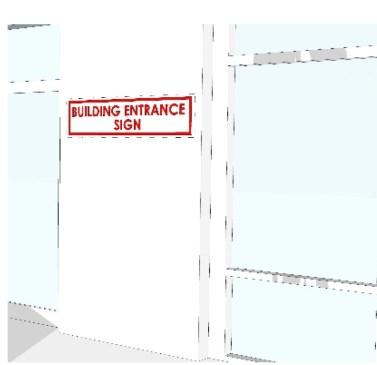
Building Entrance Wall Signs
A sign that is located on a wall immediately adjacent to the entrance of a building.
Roof Signs
A sign attached to or supported by the roof of a multi-story building, or a sign that extends into and/or above the immediately adjacent roof line of the building irrespective of attachment point, or a sign that wholly or partially encroaches upon any roof line of a building, or a sign attached to, encroaching into or extending above the sloping phase of a mansard roof or faux mansard roof, or any combination thereof.
(2) Ground mounted signs.

Sign Type Definition Example Graphic
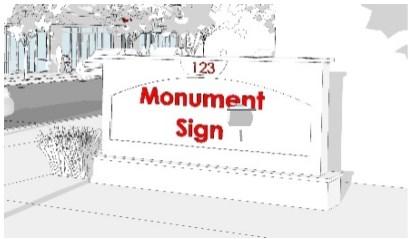
Monument Sign
A two-sided sign attached to a permanent foundation or fastened to a base and not attached or dependent upon any structure, pole, post or similar support.
Residential Monument Sign
A monument sign, containing only one sign face, erected at the entrance to a residential common development from public right-of-way not included within that development.
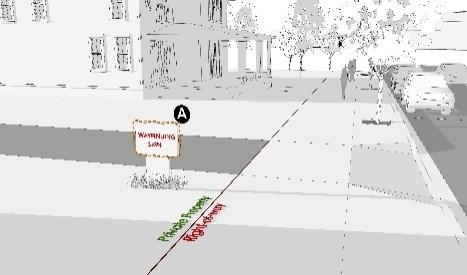
Wayfinding Signs Signs that facilitate the movement of traffic throughout the development.

Freestanding Hanging Signs
A sign which is not attached to a building and which hangs from a support structure attached to a supporting structure attached to the ground.
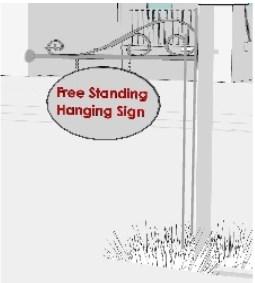
Window and Door
Sign
Any sign that is placed on or in the panes of glass of a window opening or door that is either inside or outside a building containing a non-residential use and is oriented to be viewed from the exterior of the structure.
Customary displays of merchandise behind a store window are not considered window signs.
Any sign within 60 inches of the inside surface of a window and facing the outside will count toward the allotment of total permitted window signage.
(4) Limited duration signs.
Sign Type Definition
Banner Sign

A sign with or without characters, letters, illustrations, or ornamentations applied to flexible material.
Example Graphic

Any lettering or symbol that is printed, painted, or affixed to a table or patio umbrella.

Sandwich Board Sign
A single or double-faced, hinged or unhinged, temporary sign designed to be used on a sidewalk or pedestrian way.
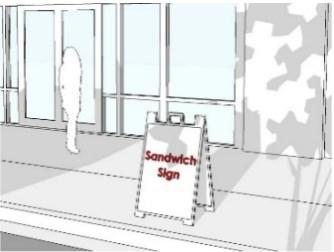
Yard Signs
Entrance Wall Banner
A type of non-permanent, sign that is located on private property that can be displayed for a limited duration of time.

An impermanent sign erected at the entrance to a residential common development which may be affixed to a common development wall sign, to a wall, to a fence, or may be freestanding. These signs may not be erected at the entrances to individual residences.

(Ord. No. 2021-10-17, Att. A, 10-11-2021)
Sec. 20-58. - Gasoline/EV charging station pump-island signs.
In addition to the sign types otherwise allowed in this chapter, gasoline and/or electric vehicle charging stations with pump/charging station islands may have signage located under a canopy and on top of the pump/charging station islands of a service station or convenience store with gas pumps, subject to the following limitations:
(1) Within the limits of the canopy covering the pump islands, direct lighting, shadow/halo lighting, and indirect lighting are allowed illumination types for signage located on canopy faces facing a street frontage or on pump islands.
(2) Within the limits of the canopy covering the pump islands, one sign of a maximum area of six square feet each per canopy face facing a street frontage.
(2) Within the limits of the canopy covering the pump islands, pump-island signs shall be limited to no more than two signs per island, not to exceed 4 square feet per sign; provided, however, total square footage of all pump island signs shall not exceed 24 square feet.
(3) If a separate accessory drive-through car wash building is located on site, one additional wall sign, not to exceed five square feet per sign, is permitted. In addition, one additional drive-through sign is permitted adjacent to each customer drive-through lane (if applicable). That drive-through sign may not exceed 18 square feet if ground-mounted or nine square feet if wall-mounted.
(4) Notwithstanding the foregoing, in accordance with state law, changeable copy signs are allowable when accessory to a service station as follows: fuel pricing information shall be a fixed; nonintermittent, static message with no wipes, fades, flashes or similar effects; LED, LCD, and/or electronic lighting is permissible for fuel pricing only.
(5) Notwithstanding the foregoing, LCD panel or LED backlit video screens embedded in pumps/charging stations are permitted so long as they are no larger than 21 inches measured diagonally.
(Ord. No. 2021-10-17, Att. A, 10-11-2021)
Sec. 20-59. - Address placards.
When address numerals in residential districts are located on a placard, the placard shall be no larger than 3 square feet. Address placards may be indirectly illuminated for purposes of more easily identifying the address for safety and convenience purposes.
(Ord. No. 2021-10-17, Att. A, 10-11-2021)
Sec. 20-60. - Flags and flag poles.
(a) A property shall not have more than four flag poles. Exception: Flag poles located on properties used for a quasi-public/institutional use may have more than four flag poles.
(b) All flagsshall be displayed on a flagpole oraccording to recognized flag etiquette and may be indirectly illuminated. In non-residential districts, flagpoles shall not exceed the maximum building height applicable for the zoning district, or 60 feet, whichever is less. Flagpoles in residential districts shall not exceed the lesser of 25 feet in height or the height of the primary structure on the lot.
The maximum dimensions of any flag shall be proportional to the flagpole height as set forth in the following table. The hoist side of the flag shall not exceed 20 percent of the vertical height of the flagpole when ground mounted.
(Ord. No. 2021-10-17, Att. A, 10-11-2021)
Sec. 20-61. - Electronic message center (EMC) and manual changeable copy.
(a) Electronic message centers shall be permitted as a component of gasoline station signage, quasipublic/institutional uses, and in the perimeter center overlay districts in accordance with the following standards:
(1) No sign containing an electronic message center shall be located within 125 feet of any signalized intersection as measured from the point where the existing right-of-way lines of the intersecting streets meet. In a case where a rounded or cut property corner exists, this measurement shall be taken from the point of the intersection of the existing rights-of-way lines, as extended. The distance shall be measured along the right-of-way line from the point of intersection. (See graphic illustration to the right.)

(2) Any electronic message center that is located within 300 feet of any residential use must automatically turn off between the hours of 11:00 p.m. and 6:00 a.m. daily.
(3) An electronic message sequence must remain static for a minimum of ten seconds before the next message appears.
(4) An electronic message sequence must be accomplished by means of fading or dissolving but shall not scroll, travel or flash. A transition sequence must be completed in no less than eight seconds.
(5) No portion of any sign may change its message or background in a manner or by a method of display characterized by motion, other than fading or dissolving, or pictorial imagery or depicts action or a special effect to imitate movement, or the presentation of pictorials or graphics displayed in a progression of frames that give the illusion of motion or the illusion of moving objects, moving patterns or bands of light or expanding or contracting shapes.
(6) Electronic message centers shall be designed to either freeze the display in one static position, display a full black screen, or turn off in the event of a malfunction.
(7) Lighting of electronic message signs is limited to 0.3 footcandles above ambient conditions as measured at the following distances:
(8) Portable electronic message signs are prohibited. No electronic message center shall be permitted to be included as part of any limited duration sign.
(b) Manual changeable copy signs are permitted only when integrated into signage for a quasipublic/institutional use or as permitted for a gasoline station.
(Ord. No. 2021-10-17, Att. A, 10-11-2021)
Sec. 20-62. - Construction fence wrap.
(a) Wraps are allowed on fences securing construction sites for the duration of the construction activity.
(b) The wrap must be removed prior to issuance of a certificate of occupancy.
(c) The fence wrap must be maintained in good condition and be properly attached to the fence.
(d) Messages, logos, renderings, or similar information may not exceed 40 percent of the total area of the fence wrap.
(Ord. No. 2021-10-17, Att. A, 10-11-2021)
Secs. 20-63 20-70. - Reserved.
ARTICLE IV. - SIGN LIGHTING TYPES
Sec. 20-71. - Table of various sign lighting types.
Certain sign types may be illuminated as indicated herein. The type of lighting depends on the sign type and district in which it is located as set forth herein. The following defines and provides example depictions of the various sign lighting types used in this chapter.
Direct Lighting
A specific style of illumination where the source of light is internal and integral to the sign structure and where the resultant illumination radiates out in the direction of the viewer. This designation includes neon lighting, face-lighted channel letters and sign panels with routed and push-through graphics (backlit).
Internal Box Lighting
Signs that use a lightbox configuration where a light fixture is inside a box with the front surface consisting of a translucent panel that becomes illuminated on which information is displayed.


Shadow/Halo Lighting
A specific style of illumination where the sign face and returns are mounted on standoffs away from the wall which project illumination to the wall surface giving the sign a halo effect. In some instances, lighting that creates a shadow/halo effect may be located on the interior of the lettering this is permissible if the light radiation is not visible on the front surface of lettering, logos, or symbols, and the front is entirely opaque.

Indirect Lighting
A specific style of illumination where the source of light is external to, and independent of, the sign structure, and the illumination radiates toward the message area away from the viewer. This includes goose neck, linear sign lights, and ground mounted spotlights.
(Ord. No. 2021-10-17, Att. A, 10-11-2021)
Secs. 20-72 20-80. - Reserved.
ARTICLE V. - SIGN STANDARDS
Sec. 20-82. - General.

The appropriate sign type, dimension, location, and lighting type are determined by applicable district. For purposes of this chapter, zoning districts are categorized as residential districts (all R, RA, RM, DV-3 districts), office districts (O-I, O-I-T, O-D, OCR), commercial and industrial districts (NS, C-1, CR-1, C-2, M, DV-1, DV-2, DV-4), and the perimeter center overlay district. Additionally, due to their unique situation in the city, this chapter includes specific standards for quasi-public/institutional uses.
(Ord. No. 2021-10-17, Att. A, 10-11-2021)
Sec. 20-83. - Sign standards: residential districts (R, RA, RM, DV-3 districts).
(a) Residential Development Monument Sign

STANDARDS
(all measurements in accordance with Sec. 20-3 above)
Sign Count
Two per common development entrance each situated on either side of primary vehicular entrance.
Two per common development entrance each situated on either side of primary vehicular entrance.
Two per common development entrance situated on either side of primary vehicular entrance; one sign per secondary vehicular entrance not greater than 40% of the allowable dimensions of a primary entrance sign.

Sign Area 32 sq. ft. Max.

Sign Height 8 ft. Max.
Sign Face Materials
Wood carved and painted; carved stone, metal with raised or applied vinyl letters; glass; or synthetic materials that are crafted specifically to look like one of these materials are permitted.
Sign Base Materials Brick or natural stone
Illumination Types Indirect; shadow/halo
Setback from R.O.W. 5 ft. Min.

(b) Building Entrance Wall Sign

STANDARDS (all measurements in accordance with Sec. 20-3 above)
SignCount
Sign Area
Sign Height
Materials
sq. ft. Max.
None Permitted None Permitted 1 per building entrance
6 ft. Max. (as measured from the door threshold to the top of the sign)
Wood carved and painted; carved stone, metal with raised or applied vinyl letters; glass; or synthetic materials that are crafted specifically to look like one of these materials are permitted.
Illumination Types Indirect; shadow/halo
(c) LIMITED DURATION SIGNS
STANDARDS (all measurements in accordance with Sec. 20-3 above)
ENTRANCE WALL BANNER
Location
Sign Area
Sign Height
Main common development entrance only (not on individual residences)
30 sq. ft. Max.
Not higher than entrance wall, wall, or fence; 6 ft. Max if freestanding
Materials (sign and supports) Cloth or vinyl
Illumination Types Not Permitted
Setback from R.O.W.
Duration
Same as entrance wall, wall, or fence if affixed on entrance wall, wall, or fence; 5 ft. Min. if freestanding
Permitted for a duration no longer than 2 months total each calendar year
(Ord. No. 2021-10-17, Att. A, 10-11-2021)
Sec. 20-84. - Sign standards: Office, Commercial and Industrial districts (O-I, O-I-T, O-D, OCR, DV-2, NS, C-1, CR-1, C-2, M, DV-1, DV-4) – Primary Sign Types.
Within the Office, Commercial, and Industrial Districts, the sign types below are categorized as primary sign types. Where a single-tenant building is located on a property, a property owner or authorized agent may choose from any two different primary sign types listed below. Where a multi-tenant building is located on a property, a property owner or authorized agent may choose either:
a. One building mounted sign type per building or per tenant suite with an exterior pedestrian entrance, if applicable, and one ground mounted sign type per property; or
b. Two building mounted sign types per building or per tenant suite with an exterior pedestrian entrance, if applicable.
Amongst each sign type, properties may install a number of signs as per the listed “sign count” within each table. Properties may also install secondary sign types and limited duration sign types as per Sec. 20-85 and Sec. 20-86.
The sign regulations applicable to the C-1 district shall apply to all signage within Dunwoody Village (DV-1 and DV-4 districts); provided, however, that no monument sign shall be located in any street yard of any property within any of the DV-1 and DV-4 districts where the building is located closer than 20 feet to the lot line.
(a) Monument Sign

STANDARDS (all measurements in accordance with Sec. 20-3 above)
Sign Count
1 Max., or 1 Max. per frontage if located on a corner lot up to a maximum of 2.
None Permitted Sign Area
Sign Face Materials
Sign Base Materials
Wood carved and painted; carved stone; metal with raised letters or applied vinyl letters; or synthetic materials that are crafted specifically to look like one of these materials are permitted.
Brick or natural stone base; or synthetic materials that are crafted specifically to look like
one of these materials are permitted.
EMC Not Permitted
Lighting Indirect; shadow/halo
Setback from R.O.W. 5 ft. Min.

STANDARDS (all measurements in accordance with Sec. 20-3 above)
O-I-T, O-D, OCR C-2/M NS
Sign Count
Single tenant building: Max. of number of building façades facing a street plus one. Limit of one sign per façade. E.g., a corner building could have one wall sign on each streetfacing façade and one wall sign on the rear façade facing the parking lot.
Multi-tenant building: Max. of number of tenant suite façades facing a street plus one. Limit of one sign per tenant suite façade. E.g., a tenant suite at the corner of a building could have one wall sign on each street-facing tenant suite
Sign Area
Materials
Illumination Types
Location on Building
Location and Setbacks
façade and one wall sign on the rear tenant suite façade facing the parking lot.
Single tenant building up to 30,000 square feet: Max. of 10% of façade area of the façade the sign is placed onto or up to 120 square feet, whichever is less.
Single tenant building greater than 30,000 square feet: Max. of 10% of façade area of the façade the sign is placed onto or up to 180 square feet, whichever is less.
Multi-tenant building up to 30,000 square feet: Max. of 10% of façade area of the tenant suite façade area the sign is placed onto or up to 120 square feet, whichever is less.
Multi-tenant building greater than 30,000 square feet: Max. of 10% of façade area of the tenant suite façade area the sign is placed onto or up to 180 square feet, whichever is less.
Mounted on a raceway; painted directly on wall; supports and wiring components concealed from public view.
Indirect, shadow/halo
24 ft. Max. height (measured from the bottom of the sign); except where there are upper floor tenant suites with exterior main pedestrian entrances in which case the lowest point of the sign shall not be higher than one foot above the highest point of the pedestrian entrance.
Flush with wall not protruding more than 24 inches from wall on which it is affixed.
(c) Projecting Sign

STANDARDS (all measurements in accordance with Sec. 20-3 above)
Sign Count
Materials
Illumination Types
One per building, or one building mounted sign per tenant suite with an exterior pedestrian entrance, if applicable.
Wood or metal sign face, metal fastening to structure
Indirect; direct; shadow/halo
CANOPY SIGN AWNING SIGN

CANOPY SIGNS
STANDARDS (all measurements in accordance with Sec. 20-3 above)
Sign Count
Location

Sign Area
Illumination Types
AWNING SIGNS
STANDARDS (all measurements in accordance with Sec. 20-3 above)
One per building at main pedestrian entrance, or one per tenant suite with an exterior pedestrian entrance, if applicable.
Affixed above canopy or on front face of canopy.
If one per building: 1 sq. ft. per linear foot of width of ground floor glazing over which the awning is located.
If one building mounted sign per tenant suite with exterior pedestrian entrance: 1 sq. ft. per linear foot of width of tenant suite pedestrian entrance doors.
Indirect
One per building, or one building mounted sign per tenant suite with an exterior pedestrian entrance, if applicable.
Sign Area (% of awning)
Materials
Illumination Types
Lettering
75% of valance area Max.; 25% sloping portion area Max.
Metal supports; vinyl or fabric face
Indirect
Lettering may not extend beyond the awning and a single row of lettering may not cover both the valance and sloping portion.
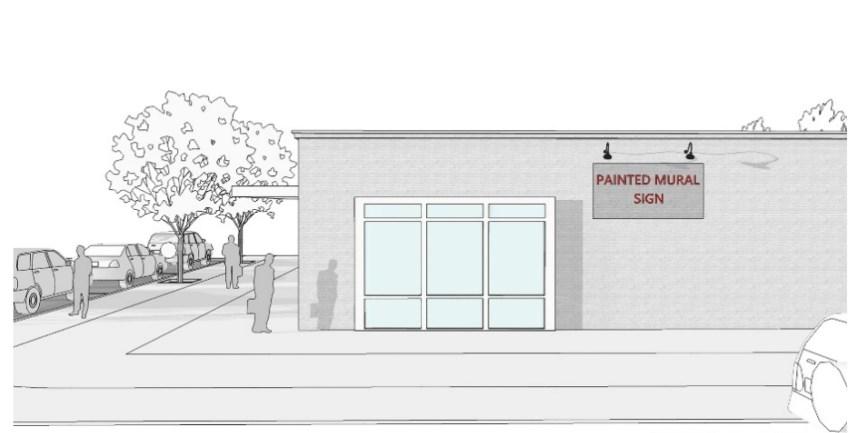
STANDARDS (all measurements in accordance with Sec. 20-3 above)
Location and Size
Illumination Type
On side façade only not larger than ⅛ of the total façade wall area
Indirect
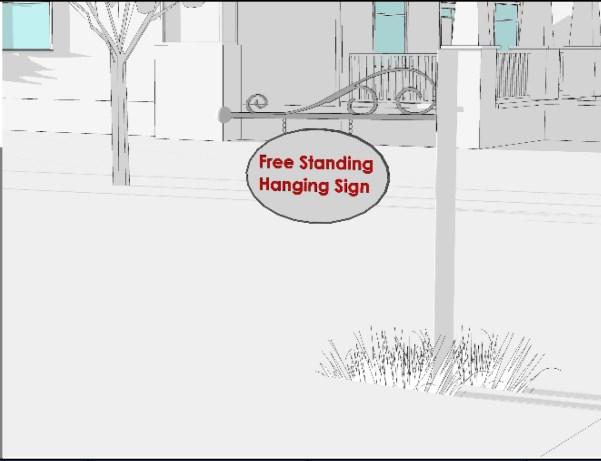
STANDARDS (all measurements in accordance with Sec. 20-3 above)
Sign Count
O-I, O-I-T, O-D, OCR C2/M NS C-1, DV-1, DV-4 CR-1
1 Max. per curb cut
Sign Height Max. 5 feet;
Materials Wood or metal
Sign Area
Location
Illumination
8 sq. ft. Max.
No less than 20 feet from the building pedestrian entrance; not less than 5 feet from the R.O.W.
Indirect
Sec. 20-85 – Office, Commercial and Industrial Districts (O-I, O-I-T, O-D, OCR, DV-2, NS, C-1, DV-1, DV-4, CR-1, and C-2/M) – Secondary Sign Types
Within the Office, Commercial, and Industrial Districts, the sign types below are categorized as secondary sign types. Each property shall be permitted to install signs from the secondary sign types below. Amongst each sign type, properties may install a number of signs as per the listed “sign count” within each table. Properties may also install primary sign types and limited duration sign types as per Sec. 20-83 and Sec. 2085.
(a) Wayfinding Sign

STANDARDS (all measurements in accordance with Sec. 20-3 above)
Sign Count
Sign Area
Sign Height
Supports
Illumination Types
Properties less than 6 acres: Max. 2.
Properties with 6 or more acres: Max. 1 per two full acres.
6 sq. ft. Max.
3 ft. Max. above grade
Shall be mounted on base of same material as sign.
Direct; indirect; shadow/halo


STANDARDS (all measurements in accordance with Sec. 20-3 above)
O-I-T, O-D, OCR C2/M NS
Size
Less than 30 percent of the area of a windowpane
Sec. 20-86 – Office, Commercial and Industrial Districts (O-I, O-I-T, O-D, OCR, DV-2, NS, C-1, CR-1, C-2, M, DV-1, DV-4) – Limited Duration Sign Types
Within the Office, Commercial, and Industrial Districts, the sign types below are categorized as limited duration sign types. Each property or tenant suite shall be permitted to choose from two limited duration sign types at any given time. Amongst each sign type, properties may install a number of signs as per the listed “sign count” within each table. Properties may also install primary sign types and secondary sign types as per Sec. 20-84 and Sec. 20-85.
(a) LIMITED DURATION SIGNS
STANDARDS (all measurements in accordance with Sec. 20-3 above)
Location Outdoor dining area and patio area only
Sign Area
Materials
Max. 20% of total umbrella area; every other panel left blank
Embroidered or imprinted on canvas or umbrella
Illumination Types Not Permitted
Duration
During business hours only; umbrellas shall be closed after business hours YARD
Sign Count
If attached to the building, then 1 per tenant suite with exterior pedestrian entrance; if attached to a fence, freestanding or retaining wall or ground mounted, then one per property or up to two per common development
Materials Cloth or vinyl
Area Per Sign
36 sq. ft. Max.
Duration 14-day permit up to 6 times per year
Illumination Types Not Permitted
STANDARDS (all measurements in accordance with Sec. 20-3 above)
SANDWICH BOARD SIGN
Location
Sign Count Not permitted
1 per tenant suite with exterior pedestrian entrance
Sign Area (each of two sides) 6 sq. ft. Max.
Permitted where buildings are located on sidewalks only; must be located within 3 ft. of the main entrance
Sign Width 24 inches. Max.
Sign Height 36 inches. Max.
Materials Plastic not permitted
Illumination Types Not permitted
Duration During business hours only
(Ord. No. 2021-10-17, Att. A, 10-11-2021)
(Ord. No. 2021-10-17, Att. A, 10-11-2021)
Sec. 20-87. - Perimeter center Primary sign types.
Within the perimeter center overlay district, the sign types below are categorized as primary sign types or secondary sign types. Where a single-tenant building is located on a property, a property owner or authorized agent may choose from any three different primary sign types listed below. Where a multitenant building is located on a property, a property owner or authorized agent may choose either:
a. Two building mounted sign types per building or per tenant suite with an exterior pedestrian entrance, if applicable, and one ground mounted sign type per property; or
b. Three building mounted sign types per building or per tenant suite with an exterior pedestrian entrance, if applicable.
Amongst each sign type, properties may install a number of signs as per the listed “sign count” within each table. Properties may also install secondary sign types and limited sign types as per Sec. 20-88 and Sec. 20-89

Face Materials Wood carved and painted; carved stone; metal; glass with raised or applied vinyl letters; or synthetic materials that are crafted specifically to look like one of these materials are permitted.
Sign Base Materials
Sign Base Height
Illumination Types
Setback from R.O.W.
EMC
Brick; natural stone; stucco; or synthetic materials that are crafted specifically to look like one of these materials are permitted.
1 ft. Min./3 ft. Max.
Indirect; direct; shadow/halo
10 ft. Min.
Maximum of 40% of total sign face area may be EMC on up to four total monument signs; EMC prohibited on all others
(b) Wall Sign

STANDARDS (all measurements in accordance with Sec. 20-3 above)
Perimeter Center
Sign Count
Single tenant building: Max. of number of building façades facing a street plus one. Limit of one sign per façade. E.g., a corner building could have one wall sign on each street-facing façade and one wall sign on the rear façade facing the parking lot.
Multi-tenant building: Max. of number of tenant suite façades facing a
Area Per Sign
Materials
Illumination Types
Location on Building
street plus one. Limit of one sign per tenant suite façade. E.g., a tenant suite at the corner of a building could have one wall sign on each street-facing tenant suite façade and one wall sign on the rear tenant suite façade facing the parking lot.
Single tenant building up to 30,000 square feet: Max. of 10% of façade area of the façade the sign is placed onto or up to 120 square feet, whichever is less.
Single tenant building greater than 30,000 square feet: Max. of 10% of façade area of the façade the sign is placed onto or up to 180 square feet, whichever is less.
Multi-tenant building up to 30,000 square feet: Max. of 10% of façade area of the tenant suite façade area the sign is placed onto or up to 120 square feet, whichever is less.
Multi-tenant building greater than 30,000 square feet: Max. of 10% of façade area of the tenant suite façade area the sign is placed onto or up to 180 square feet, whichever is less.
High rise construction, buildings over 75 feet: For every 1 foot of building height, 1.5 square feet Max. of sign area per sign is permitted on the parapet to be located on the upper portion of the building, which will be considered the top 25% of the building's height. Two signs Max. shall be permitted on the two most prominent building elevations.
Mounted on a raceway; raised letters affixed directly on wall; supports and wiring components concealed from public view routed pushthrough displays are permitted.
Indirect; direct; shadow/halo
30 ft. Max. height above grade (measured from the bottom of the sign); except where there are upper floor tenant suites with exterior main pedestrian entrances in which case the lowest point of the sign shall not be higher than one foot above the highest point of the pedestrian entrance.
Location and Setbacks
Flush with wall not protruding more than 24 inches from wall on which it is affixed
(c) Projecting Sign

STANDARDS (all measurements in accordance with Sec. 20-3 above)
Sign Count
Perimeter Center
One per building, or one building mounted sign per tenant suite with an exterior pedestrian entrance, if applicable.
Materials Wood or metal sign face, metal fastening to structure
EMC
Illumination Types
Indirect; direct; shadow/halo
(d) Canopy Sign and Awning Sign
CANOPY SIGN
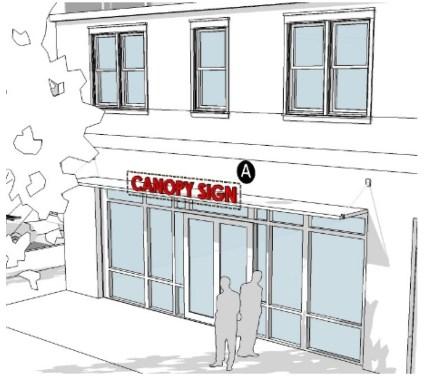
Canopy Signs
STANDARDS (all measurements in accordance with Sec. 20-3 above)
Sign Count
AWNING SIGN

Perimeter Center
One per building at main pedestrian entrance, or one per tenant suite with an exterior pedestrian entrance, if applicable.
Location Affixed above canopy or on front face of canopy
If one per building: 1 sq. ft. per linear foot of width of ground floor glazing over which the awning is located.
Sign Area
Illumination Types
Awning Signs
STANDARDS (all measurements in accordance with Sec. 20-3 above)
If one building mounted sign per tenant suite with exterior pedestrian entrance: 1 sq. ft. per linear foot of width tenant suite pedestrian entrance doors.
Indirect; direct
Perimeter Center
Sign Count (per building)
Sign Face Area (% of awning)
Materials
One per building, or one building mounted sign per tenant suite with an exterior pedestrian entrance, if applicable.
75% valance area Max.; 25% sloping portion area Max.
Metal supports; vinyl or fabric face
Illumination Types Indirect, direct
(Ord. No. 2021-10-17, Att. A, 10-11-2021)
Sec. 20-88. - Perimeter center Secondary sign types.
Within the perimeter center overlay district, the sign types below are categorized as secondary sign types. Each property shall be permitted to choose from two secondary sign types. Amongst each sign type, properties may install a number of signs as per the listed “sign count” within each table. Additionally, each property or tenant suite may also have the number of permitted window signs as per the listed “sign count” within each table irrespective of any other secondary sign types they may already have. Properties may also install primary sign types and limited sign types as per Sec. 20-87 and Sec. 20-89
(a) Painted Mural Sign

STANDARDS (all measurements in accordance with Sec. 20-3 above) Perimeter Center
Location and Size
On side façade only, and shall not be larger than ⅛ of the wall area
Illumination Types Indirect
(b) Building Entrance Wall Sign

STANDARDS (all measurements in accordance with Sec. 20-3 above)
Sign Count
Sign Area
Sign Height
Materials
2 Max. per residential multi-unit building
4 sq. ft. Max.
6 ft. Max. (as measured from the door threshold to the top of the sign)
Wood carved and painted; carved stone, metal with raised or applied vinyl letters; glass; or synthetic materials that are crafted specifically to look like one of these materials are permitted.
EMC Not Permitted
Illumination Type
Indirect; shadow/halo

STANDARDS (all measurements in accordance with Sec. 20-3 above)
Sign Count
Materials
Area Per Sign
Supports
Perimeter Center
2 Max. per common development
Wood carved and painted; carved stone, metal with raised or applied vinyl letters; glass; or synthetic materials that are crafted specifically to look like one of these materials are permitted.
80 sq. ft. Max.
Any so long as not visible from ground view.
EMC Not Permitted
Illumination Types
Indirect; Direct; Shadow/Halo
Setback (from edge of roof) 5 ft. Max.
Sign Height (above roof) 10 ft. Max. (highest point of sign)
Roof Types
Building Height
Roof signs are not permitted on pitched roofs, hip roofs, or gambrel roofs.
40 ft. Min.
(d) Wayfinding Sign
STANDARDS (all measurements in accordance with Sec. 20-3 above)
Sign Count
Perimeter Center
2 Max. per common development plus 2 Max. per full acre
Area Per Sign 6 sq. ft. Max.
Sign Height
Supports
3 ft. Max. above grade
Shall be mounted on base of same material as sign
Illumination Types direct; indirect; shadow/halo
EMC
50% of total sign face area may be EMC Max.

STANDARDS (all measurements in accordance with Sec. 20-3 above) Perimeter Center
Sign Count 1 Max. per curb cut
Sign Height and Material 5 ft. Max.
Materials Wood or metal
Area Per Sign 8 sq. ft. Max.
Illumination Types Indirect
Location
No less than 20 feet from the building entrance; 5 ft. Min. from R.O.W.

STANDARDS (all measurements in accordance with Sec. 20-3 above)
Perimeter Center
Size
Less than 30 percent of the area of a windowpane
Sec. 20-89 Perimeter Center – Limited Duration Signs
Within the Perimeter Center Overlay District, the sign types below are categorized as limited duration sign types. Each property or tenant suite shall be permitted to choose from two limited duration sign types at any given time. Amongst each sign type, properties may install a number of signs as per the listed “sign count” within each table. Properties may also install primary sign types and secondary sign types as per Sec. 20-87 and Sec. 20-88
(a) Limited Duration Signs
STANDARDS (all measurements in accordance with Sec. 20-3 above)
Patio Umbrella Signs
PERIMETER CENTER
Location Outdoor dining area of patio area only
SignArea
Materials
Max. 20% of total umbrella area; every other panel blank
Embroidered or imprinted on canvas or umbrella
Illumination Types Not Permitted
Duration
During business hours only
Sandwich Board Sign (1 permitted per tenant suite)
Location Within 10 feet of primary entrance not blocking any clear path
Sign Face Area (each of two sign faces) 6 sq. ft. Max.
Sign Width
Sign Height
inches Max.
Materials Plastic not permitted
Illumination Types Not Permitted
Duration (hours per day) During business hours only
(Ord. No. 2021-10-17, Att. A, 10-11-2021)
Sec. 20-90 - Quasi-public/institutional uses.
The following sign types below shall be permitted for properties containing a quasi-public/institutional use (as defined in section 27-113) irrespective of whether the sign type is permitted in the applicable district. Where the provisions in this section conflict with any provisions in any district regulations elsewhere in the Code, the regulations in this section shall govern and control. Each property shall be entitled to the following signs subject to the following standards:
(a) Signs Specific to Quasi-Public/Institutional Uses
STANDARDS (all measurements in accordance with Sec. 20-3 above) Any Quasi-Public/Institutional Use in any District
Building Entrance Wall Sign
Sign Height
Sign Face Materials
6 ft. Max. (as measured from the door threshold to the top of the sign)
Wood carved and painted; carved stone, metal with raised or applied vinyl letters; glass; or synthetic materials that are crafted specifically to look like one of these materials are permitted.
EMC Not permitted
Illumination Types
Monument Sign
Sign Count
Indirect; shadow/halo
1 per vehicular entrance up to 2 Max.
Area Per Sign 36 sq. ft. Max.
Total Sign Height 6 ft. Max.
Sign Face Materials
Sign Base Materials
Wood carved and painted; carved stone, metal with raised or applied vinyl letters; glass; or synthetic materials that are crafted specifically to look like one of these materials are permitted.
Brick; natural stone; stucco; synthetic materials that are crafted specifically to look like one of these materials are permitted.
Sign Base Height 1 ft. min./3 ft. Max.
Illumination Types
Indirect; direct; shadow/halo
Setback from R.O.W. 5 feet Min.
EMC
Manual Changeable Copy
Wayfinding Sign
Sign Count
; Maximum of 40% of total sign face area may be EMC; no manual changeable copy allowed if sign includes an EMC.
Maximum of 40% of total sign face area may be manual changeable copy. No EMC allowed if sign includes manual changeable copy.
2 per common development plus 2. Max. per full acre
Area
Sign Height 3 ft. Max. above grade
Supports Shall be mounted on base of same material as sign
Illumination Types Direct; indirect; shadow/halo
EMC Not Permitted
(b) Limited Duration Signs
STANDARDS (all measurements in accordance with Sec. 20-3 above) Any Quasi-Public/Institutional Use in any District
Materials (sign and supports) Metal or wood supports; vinyl, plastic, metal,
Illumination Types
Materials
Duration 14-day permit up to 6 times per year
Illumination Types Not Permitted
(Ord. No. 2021-10-17, Att. A, 10-11-2021)
Secs. 20-91 20-108. - Reserved.
ARTICLE VI. - NONCONFORMITIES
Sec. 20-109. - Use and maintenance of nonconforming signs.
Subject to the restrictions of this chapter, a nonconforming sign may be used, but not expanded or improved unless the sign is made conforming. All nonconforming signs shall be maintained in good condition and repair and may be subject to removal for violations of maintenance standards.
(Ord. No. 2021-10-17, Att. A, 10-11-2021)
Sec. 20-110. - Repair and replacement of nonconforming signs; exceptions.
Minor repairs and maintenance of nonconforming signs shall be permitted. Structural repairs or changes in the size or shape of a nonconforming sign shall be permitted if the changes do not expand the nonconforming nature of the sign. A nonconforming sign shall not be replaced by another nonconforming sign. Under no circumstances shall this section be construed as to allow the addition or material change of changeable copy to a nonconforming sign (except for message substitution on an existing changeable copy sign). Exceptions: (i) the substitution or interchange of sign panels, painted boards, or dismountable material on nonconforming signs shall be permitted; (ii) the substitution or interchange of sign lighting types on nonconforming signs shall be permitted; (ii) the substitution, interchange, or replacement of sign base and/or surround materials on nonconforming signs shall be permitted; (iv) a nonconforming sign damaged or destroyed by act of God or by other circumstances beyond the control of the owner of the sign may be repaired or replaced; (v) the substitution, interchange, or replacement of a nonconforming wall sign shall be permitted as long as the replacement wall sign does not exceed the existing sign area and is conforming in terms of illumination and materials. Sec. 20-110 does not apply to window signs.
(Ord. No. 2021-10-17, Att. A, 10-11-2021)
Sec. 20-111. - Relocation of nonconforming signs.
A nonconforming sign may be relocated for the purposes of road or sidewalk construction, purchases of right-of-way, or other public works or transportation project initiated by the city or other public agency.
(Ord. No. 2021-10-17, Att. A, 10-11-2021)
Secs. 20-112 20-131. - Reserved.
ARTICLE VII. - ADMINISTRATIVE PROCEDURES SPECIFIC TO SIGNS
Sec. 20-132. - Permitting.
(a) For any sign requiring issuance of a sign permit under the provisions of this chapter, sign review shall be required prior to installation, relocation, renovation, expansion, construction, panel exchange or reconstruction of the sign. The sign application shall be submitted to the community development director.
(b) Applications for sign permits required by this chapter shall be filed by the sign owner or the owner's agent with the director or his/her designee. The application shall describe and set forth the following:
(1) The street address of the property upon which the sign is to be located and a plat map of the property which bears an indication of the proposed location of the sign;
(2) The name(s) and address(es) of the owner(s) of the real property upon which the subject sign is to be located;
(3) Consent of the owner, or the owner's agent, granting permission for the placement or maintenance of the sign;
(4) Name, address, phone number and occupational tax certificate number of the sign contractor;
(5) The type of sign (as defined in this chapter) to be erected, the area of the sign, the height of the sign, the shape of the sign, how the sign is to be illuminated (if at all), all existing signs on the property and an explanation of how the sign is to be mounted or erected on a scaled drawing;
(6) The dimensions of the wall on which the sign is to be placed with appropriate drawings and photographs;
(7) The payment in full of the applicable application fee; and
(8) Application for ground signs shall include a site plan drawn to scale, including a closed boundary survey of the property, gross acreage, the proposed location of subject sign, location of all existing ground signs on the property, entrance driveways from public streets, street rights-of-way, public or private easements, building locations, sidewalks, utilities, gross area of buildings and floorarea occupied by subject owner or tenants.
(9) The director may require other such information required to determine the sign complies with the requirements of this chapter.
(c) The director shall develop such forms as may be necessary to facilitate the permit application process.
(d) The applicant shall apply for all other permits or licenses required by city ordinances and state laws and regulations. No sign permit shall be valid unless other required permits or licenses have been issued by the authority responsible thereof.
(e) Each application shall contain an agreement to indemnify and save and hold the city harmless from all damages, demands or expenses of every character which may in any manner be caused by the sign or sign structure. Each applicant shall present to the department, upon request, a certificate of liability insurance prior to the issuance of a sign permit.
(f) The city shall process all sign permit applications within 30 days of the city's actual receipt of a complete application for a sign permit.
(1) The community development director shall reject any application as incomplete that does not include all items required for a sign permit application as set forth under section 20-132.
(2) The community development director shall reject any application containing any false material statements oromissions. Any rejected application laterresubmitted shall be deemed to have been resubmitted on the date of resubmission instead of the original date of submission.
(g) Within 30 days of receipt of a complete application, the community development director shall:
(1) Issue the permit; or
(2) Inform the applicant, in writing, of denial of the permit, stating the reasons why the permit cannot be issued.
(h) Upon determination that the application fully complies with the provisions of this chapter, the sign permit shall be issued.
(i) If the city does not process an application for a sign permit within 30 days, then the application shall be considered approved.
(j) Should it be determined that a sign permit was issued pursuant to an application containing a false material statement, that the sign was erected in violation of standards of this permit, or that the sign no longer meets maintenance and/or safety standards of this chapter, the community development director shall revoke the sign permit and the sign shall be removed. Notice of revocation shall be provided by the director in the same manner as the decision to issue or deny a permit. Any decision of the director denying or revoking a permit shall be subject to appeal as provided by section 20-137.
(k) No sign permit shall be issued until the appropriate application has been filed with the community development director and fees have been paid per the fee schedule adopted by city council.
(Ord. No. 2021-10-17, Att. A, 10-11-2021)
Sec. 20-133. - Master sign plan required.
i. Master sign plans shall provide for visual consistency for signage within the development based on at least three of the following factors: color scheme, lettering style, materials, and location of signs to be posted on buildings. A master sign plan shall be reviewed for compliance with these factors for all new common developments and in any existing development over 7 acres where total sign area is increasing, or any sign location is changing. Sign face changes shall not require the submission of a master sign plan. Where the provisions in a master sign plan conflict with any provisions in any district regulations elsewhere in Chapter 20, the regulations in a master sign plan shall govern and control. All master sign plans shall contain the following:
1. A site plan showing the location of buildings, parking lots, driveways and landscaped areas, and the location, size, area and height of all proposed signs.
2. Computation of the maximum total sign area allowed, the maximum area allowed and requested for each individual sign, the conceptual approach proposed for window signage.
3. A description of how the applicant will achieve visual consistency among all signs, which may be in narrative or graphic depiction, regarding color scheme, lettering or graphic style; materials and support structures; and location of each sign on the site and on buildings.
If you want to do any of the following beyond what is allowed in the district regulations elsewhere in Article V…
• Exceed the maximum area and/or height for individual signs and/or;
• Change the location of signs and/or;
• Change the design of signs and/or;
• Use different materials for signs
Apply for an administrative master sign plan, which will be reviewed by the Community Development Director within 30 days
If you want to do any of the following beyond what is allowed in the district regulations elsewhere in Article V…
• Exceed the maximum number of sign types and/or;
• Exceed the maximum count for each sign type and/or;
• Exceed the maximum total sign area allowed and/or;
• Any of the four changes allowed as part of the administrative master sign plan, if included with any of the three preceding changes allowed as part of the major master sign plan
Apply for a major master sign plan, which will be reviewed by the Planning Commission and Mayor and City Council (who will make the final decision) in a period of several months
ii. Administrative master sign plans shall not allow for requests to exceed the maximum number of sign types, to exceed the maximum count for each sign type, to exceed the maximum total sign area allowed, to install EMC or illumination types that are not permitted for the sign type or district, or to install sign types that are not permitted for the district. Administrative master sign plans shall allow changes to the maximum area and height for individual signs, the location of signs, the design, and the materials beyond what is allowed in the district regulations elsewhere in Article V. Administrative master sign plans shall be reviewed by the Community Development Director in accordance with the procedure below:
4. Authority to file
a. Applications for approval of administrative master sign plans may be filed by the owner of the subject property or the property owner’s authorized agent.
5. Application filing
a. All administrative master sign plan applications must be filed with the Community Development Director.
6. Community Development Director’s decision
a. The Community Development Director must review each application for a administrative master sign plan and act to approve the application, deny the application, or refer the application to the Mayor and City Council for consideration as a major master sign plan.
b. The city shall process all administrative master sign plan applications within 30 days of the city’s actual receipt of a complete application for a sign permit.
i. The Community Development Director shall reject any application as incomplete that does not include all items required for a sign permit application as set forth under Sec. 20-132.
ii. The Community Development Director shall reject any application containing any false material statements or omissions. Any rejected application later resubmitted shall be deemed to have been resubmitted on the date of resubmission instead of the original date of submission.
c. Within 30 days of receipt of a complete application, the Community Development Director shall:
i. Approve the administrative master sign plan; or
ii. Inform the applicant, in writing, of denial of the administrative master sign plan, stating the reasons why the administrative master sign plan cannot be issued; or
iii. Refer the application to the Mayor and City Council for consideration as a major master sign plan.
d. The Community Development Director's decision to approve or deny must be based on the approval criteria below:
i. The grant of the administrative master sign plan will not be detrimental to the public health, safety or welfare of the public or injurious to the subject property, adjacent properties, or improvements;
ii. The requested administrative master sign plan is consistent with all relevant purpose and intent statements of Chapter 20;
iii. The requested administrative master sign plan maintains an aesthetically attractive city in which signs are compatible with the use patterns of established zoning districts;
iv. The administrative master sign plan would not result in unnecessary and unsafe distractions to drivers or pedestrians;
v. The requested administrative master sign plan provides for visual consistency for signage within the common development; and
vi. The granting of the administrative master sign plan would not result in the violation of Sec. 20-34; an increase in the maximum number of sign types, the maximum count for each sign type, or the maximum total sign area allowed for the sign type for district; or the installation of EMC or illumination types that are not permitted for the sign type or district.
e. Upon determination that the administrative master sign plan application fully complies with the provisions of Sec. 20-133, the applicant may apply for sign permits in accordance with Sec. 20-132.
7. Appeals.
a. Decisions by the Community Development Director made pursuant to this division may be appealed in accordance with Sec. 20-137.
iii. Major master sign plans shall not allow for requests to install EMC or illumination types that are not permitted for the sign type or district and shall not allow for requests to install sign types that are not permitted for the district. Major master sign plans shall allow for requests to exceed the maximum number of sign types, to exceed the maximum count for each sign type, to exceed the maximum total sign area allowed, to allow for changes to the maximum area and height for individual signs, to allow for changes to the location of signs, and to allow for changes to the design and the materials beyond what is allowed in the district regulations elsewhere in Article V. Major master sign plans shall be reviewed by the Planning Commission and the Mayor and City Council. Major master sign plans shall be reviewed by the Mayor and City Council in accordance with the procedure below:
1. Authority to file
a. Applications for approval of major master sign plans may be filed by the owner of the subject property or the property owner’s authorized agent.
2. Pre-application conference
a. Pre-application conferences with staff are required for all major master sign plan application
3. Application filing
a. All major master sign plan applications must be filed with the Community Development Director.
4. Public hearing notices
a. Published notice. At least 15 days before but not more than 45 days before the date of the public hearing to be held by the Mayor and City council, notice of the public hearing must be published in a newspaper of general circulation in the city. This required notice must indicate the date, time, place and purpose of the public hearing.
b. Written (mailed) notice. Written notice is required for all major master sign applications. The Community Development Director is responsible for sending written notice via first class mail to all property owners within 500 feet of the boundaries of the subject property, as those property owners are listed on the tax records of the city. The notices must be mailed at least 15 days before the date of the Planning Commission public hearing and not more than 45 days before the date of the City Council public hearing. Written notices must indicate the nature of the proposed major master sign plan and the date, time, place and purpose of the public hearing.
c. Posted notice. For all major master sign plan applications, a public hearing notice sign must be placed in a conspicuous location on the subject property at least 15 days before the date of the public hearing to be held by the Mayor and City Council. This notice sign must indicate the date, time, place and purpose of the public hearing.
5. Planning Commission public hearing and recommendation
a. The Planning Commission must hold a public hearing on all major master sign plan applications. Following the close of the hearing, the Planning Commission must act by simple majority vote to recommend that the proposed major master sign plan be approved, approved with conditions or denied based on the applicable review and approval criteria of Sec. 20-133. Per section 27-311 the Planning Commission may vote to defer action or continue a hearing in order to receive additional information or deliberate further. The Planning Commission’s recommendation must be transmitted to the Mayor and City Council.
6. City Council public hearing and decision
a. Upon receipt of recommendations from the Planning Commission, the Mayor and City Council must hold a public hearing on the proposed major master sign plan. Following the close of the public hearing, the Mayor and City Council must act by simple majority vote to approve the proposed major master sign plan, approve the proposed major master sign plan with conditions or deny the proposed major master sign plan based on the applicable review and approval criteria of Sec. 20-133. The Mayor and City council are also authorized to defer action on the proposed major master sign plan or allow the applicant to withdraw the major master sign plan without prejudice.
7. Review and approval criteria
a. The following review and approval criteria must be used in reviewing and taking action on all major master sign plan applications:
i. Whether the proposed sign(s) are visually consistent within the development based on at least three of the following factors: color scheme, lettering style, materials, and location of signs to be posted on buildings;
ii. Whether the proposed sign(s) are of a consistent size and scale to existing signs in the immediate area;
iii. Whether the proposed sign(s) are reasonably scaled to the size of the subject structure and/or premises; and
iv. Whether unusual circumstances exist that warrant the granting of this major master sign plan.
8. Successive applications.
a. An application for a major master sign plan may not be submitted more than once every 24 months measured from the date of final action by the Mayor and City Council. The Mayor and City Council are authorized to waive or reduce this 24-month time interval by resolution, except that the time interval between the date of action to deny or the date that the application is withdrawn with prejudice and the date of filing of any subsequent major master sign plan affecting the same property may not be less than six months.
(Ord. No. 2021-10-17, Att. A, 10-11-2021)
Sec. 20-134. - Master sign plan modifications.
i. Any changes to a master sign plan must go through a modification process.
ii. Proposed changes that are consistent with the size limitations in the approved administrative or major master sign plan shall go through the sign permitting process in Sec. 20-132.
iii. Proposed changes to an approved administrative master sign plan that result in the addition of any new sign to the existing number of signs or the increase of any individual or total sign area shall be submitted in writing for review and decision by the Community Development Director when any new sign is being added or any sign area is increasing. This modification process shall follow the guidelines of Sec. 20133(ii).
9. The decision of the Community Development Director in approving or denying an administrative master sign plan modification may be appealed in accordance with Sec. 20-137.
iv. Proposed changes to an approved major master sign plan that result in the addition of any new sign to the existing number of signs, the increase of any individual or total sign area, or the increase of the number of sign types or the maximum count for each sign type shall be submitted in writing for review and decision by the Mayor and City Council. This modification process shall follow the master sign plan application guidelines of Sec. 20-133(iii).
(Ord. No. 2021-10-17, Att. A, 10-11-2021)
Sec. 20-135. - Variances.
Variances from this sign code shall not be allowed.
(Ord. No. 2021-10-17, Att. A, 10-11-2021)
Sec. 20-136. - Emergency sign provisions for temporary signage.
In the instance that the federal, state, or city government declares a state of emergency, the mayor and city council may pass a temporary decree (for the duration of the state of emergency) which explicitly specifies relaxed regulations for temporary signage to permit better communication for the duration of the emergency.
(Ord. No. 2021-10-17, Att. A, 10-11-2021)
Sec. 20-137. - Appeals.
(a) The procedures of this division apply to appeals of permit denials, revocations, and all other administrative orders and decisions.
(b) Any person or entity (i.e., an owner, applicant, adjoining neighbor, or a neighbor whose property is within 1,500 feet of the nearest property line aggrieved by an administrative decision) may appeal the decision.
(c) Decisions by the community development director made pursuant to this division may be appealed to the zoning board of appeals by filing a request with the community development director within 30 days of the community development director's decision. Appeal shall be in accordance with procedures and conditions of this sign code. If no appeal is made within the 30-day period, the decision of the community development director is final. If an appeal is made to the zoning board of appeals, within 30 days of the appeal being requested, the zoning board of appeals shall set a hearing date for the appeal and the decision of the ZBA is final. The appellant shall be given ten days' notice of the hearing date. The 30-day appeal deadline may be waived by the zoning board of appeals if the appellant can show evidence that the appeal was filed within 30 days of their actual or constructive notice of the decision.
(d) The filing of a complete notice of appeal stays all proceedings in furtherance of the action appealed, unless the official whose decision is being appealed certifies to the zoning board of appeals, after the appeal is filed that, because of facts stated in the certification, a stay would cause imminent peril to life or property. In such a case, proceedings may be stayed only by a restraining order granted by the superior court on notice to the official whose decision is being appealed and on due cause shown.
(e) Upon receipt of a complete application of appeal, the community development director or other administrative official whose decision is being appealed shall transmit to the zoning board of appeals all papers constituting the record upon which the action appealed is taken.
(f) Mailed notice of the zoning board of appeals hearing shall be provided to the appellant at least ten days before the date of the zoning board of appeals hearing.
(g) Hearing and decision.
(1) The zoning board of appeals shall hold a hearing to consider all appeals of administrative decisions.
(2) Following the close of the hearing and consideration of all testimony, documentary evidence and matters of record, the zoning board of appeals shall make a decision. The decision shall be made within a reasonable period of time but in no event more than 60 days from the date of the close of the hearing. Final action on an appeal requires a simple majority vote of the zoning board of appeals members present and voting.
(3) In exercising its powers, the zoning board of appeals may reserve or affirm, wholly or partly, or may modify the order, requirement, decision or determination appealed from. To that end the zoning board of appeals has all the powers of the administrative official from whom the appeal was taken and may issue or direct the issuance of a permit provided all requirements imposed by all other applicable laws are met.
(h) An appeal shall besustained only upon a finding by the zoning board of appeals that the administrative official's action was based on an erroneous finding of a material fact or that the administrative official acted in an arbitrary manner.
(i) Appeals.
(1) Any person or entity authorized by section 20-137(b) may seek review of such decision by petitioning the superior court for a writ of certiorari, setting forth the alleged errors. The petition shall be filed within 30 days of the date that the zoning board of appeals renders its final decision.
(2) When a petition is for a writ of certiorari is filed, the zoning board of appeals shall be designated the respondent in certiorari and the city the defendant in certiorari. The secretary of the zoning board of appeals is authorized to acknowledge service of a copy of the petition and writ on behalf of the zoning board of appeals, as respondent. Service upon the city as defendant shall be as provided by law.
(Ord. No. 2021-10-17, Att. A, 10-11-2021)
Sec. 20-138. - Violations and penalties.
The community development director or his/her designee may issue a citation for violation of this chapter by any person, including if applicable, the owner, manager or tenant of the space upon which a sign is located, for a sign erected, altered, maintained, converted, or used in violation of this chapter or in violation of any other applicable ordinance, including, but not limited to, the building and electrical codes.
(1) The community development director and/or his/her designee shall have the same duties, authority, and obligations regarding access to private property and inspections, including the procurement of inspection warrants provided in article VI of the City Zoning Ordinance with regard to the enforcement of this chapter.
(2) Any person violating any provision of this chapter shall be guilty of an offense and upon conviction, shall be subject to the general penalty provided in this Code. Each sign installed, created, erected ormaintained in violation of this chaptershall be considered a separate violation, and each day of a continued violation for each sign shall be considered a separate violation when applying the penalties authorized in Zoning Code article VI, division 3 Enforcement and penalties.
(3) The city may seek affirmative equitable relief in a court of competent jurisdiction to cause the removal or repair of any sign in violation of this chapter or other city ordinances.
(4) The community development director or designee may remove any sign or structure illegally placed upon a public right-of-way without any notice and may dispose of said sign or structure. Such removal and disposal of illegally placed signs shall not preclude the prosecution of any person for illegally placing such signs in the public right-of-way.
(Ord. No. 2021-10-17, Att. A, 10-11-2021)