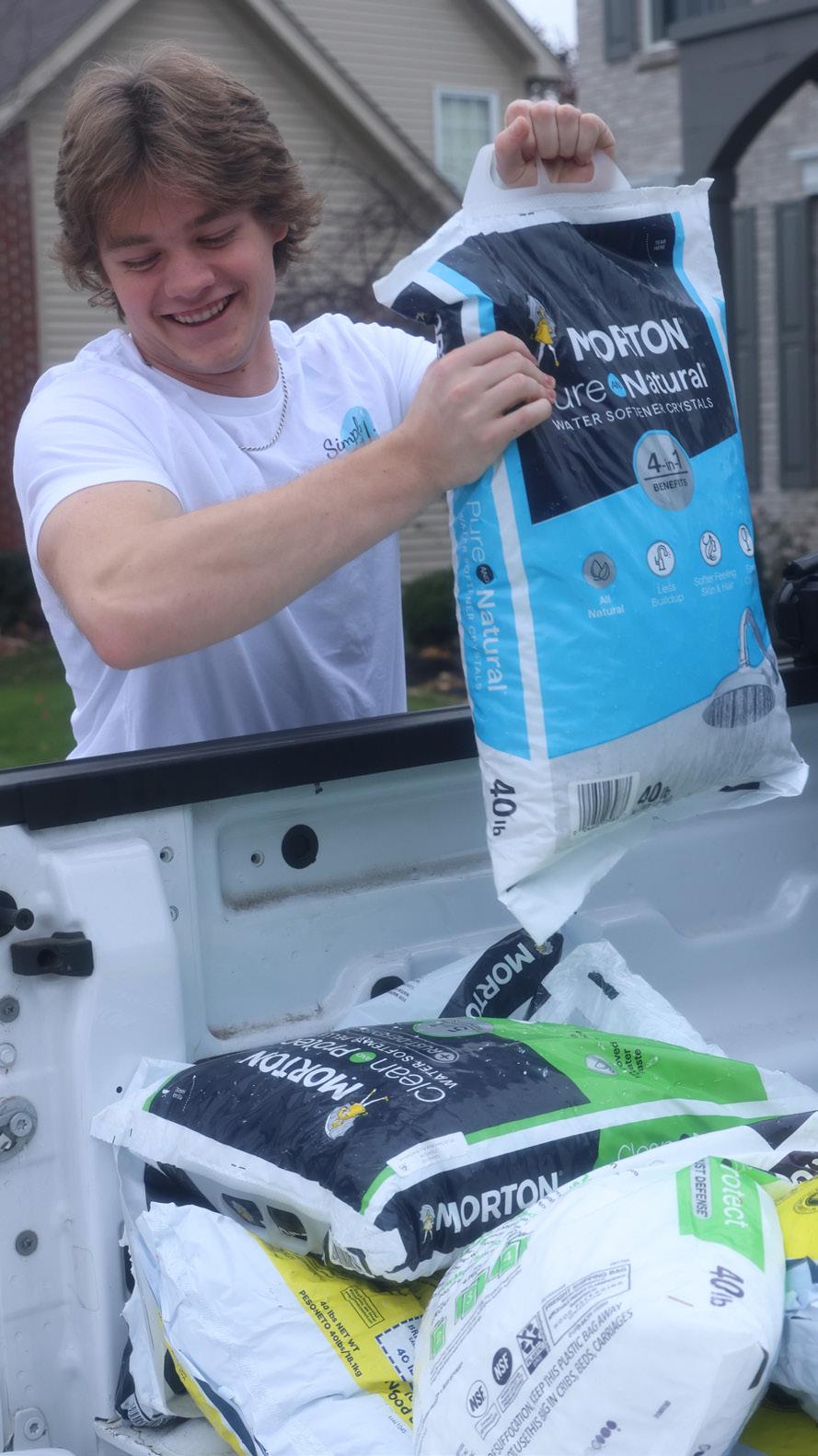
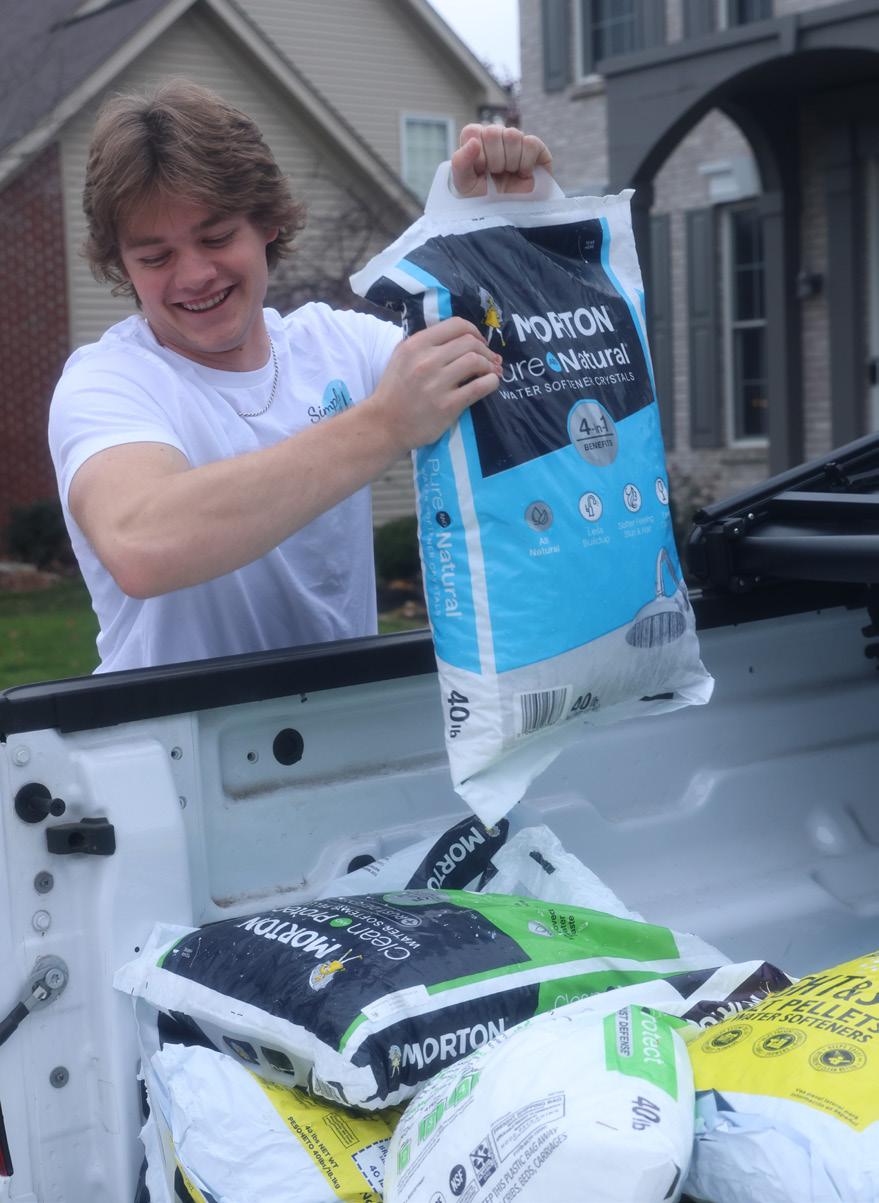
Unloading bags of salt from his truck, senior Evan Walker delivers salt to a client on Nov. 20. His business is tailored toward those who don’t have the time or physical capabilities to pick up the heavy salt bags.
Opinion: Reviews of the top three Christmas movies as voted on in a recent student survey, ranked by percentage of total votes for
Opinion: A look at the rise of daily games, which ones stand out
Looking ahead to events coming up, looking back on past student events
Photo by Addi Smith
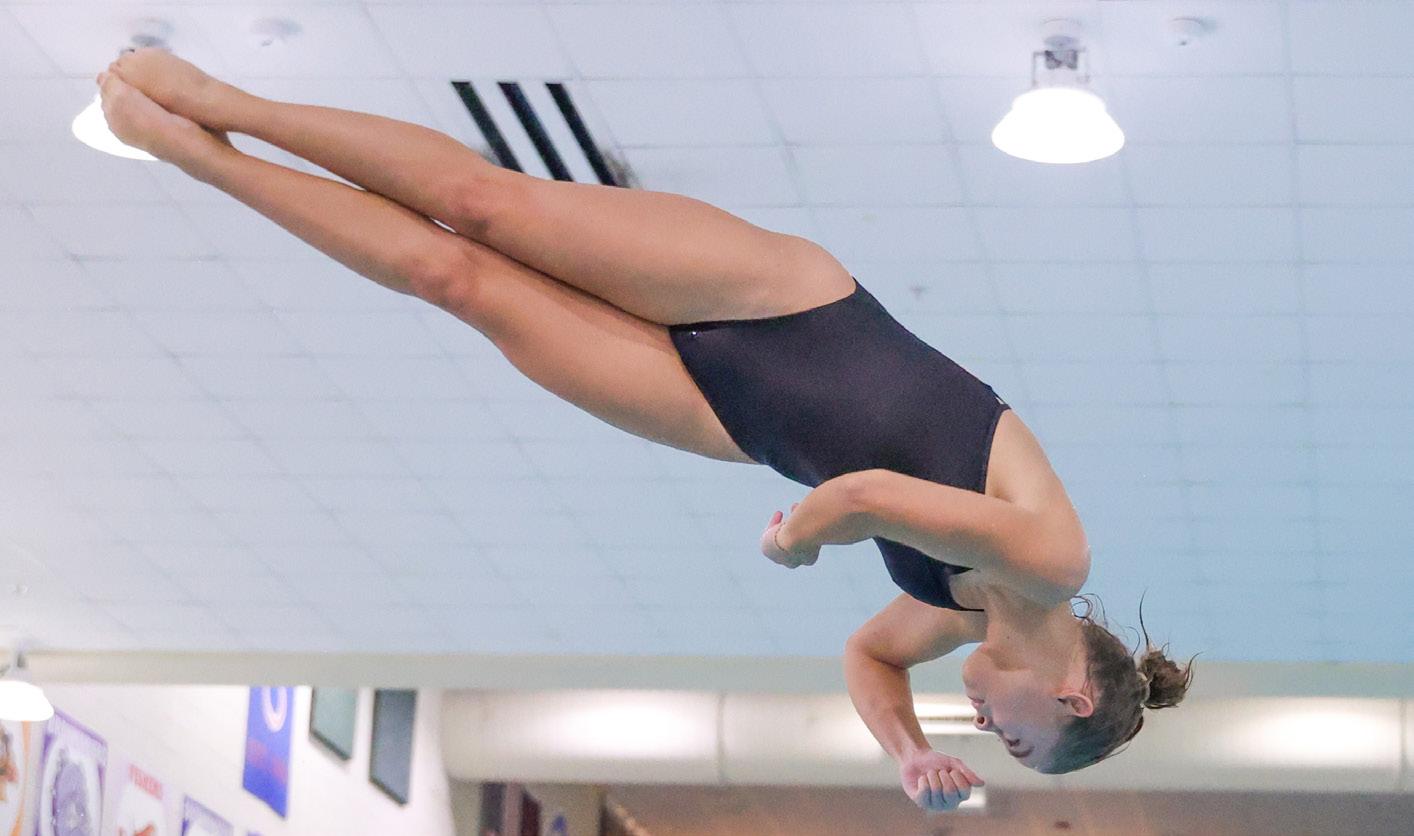
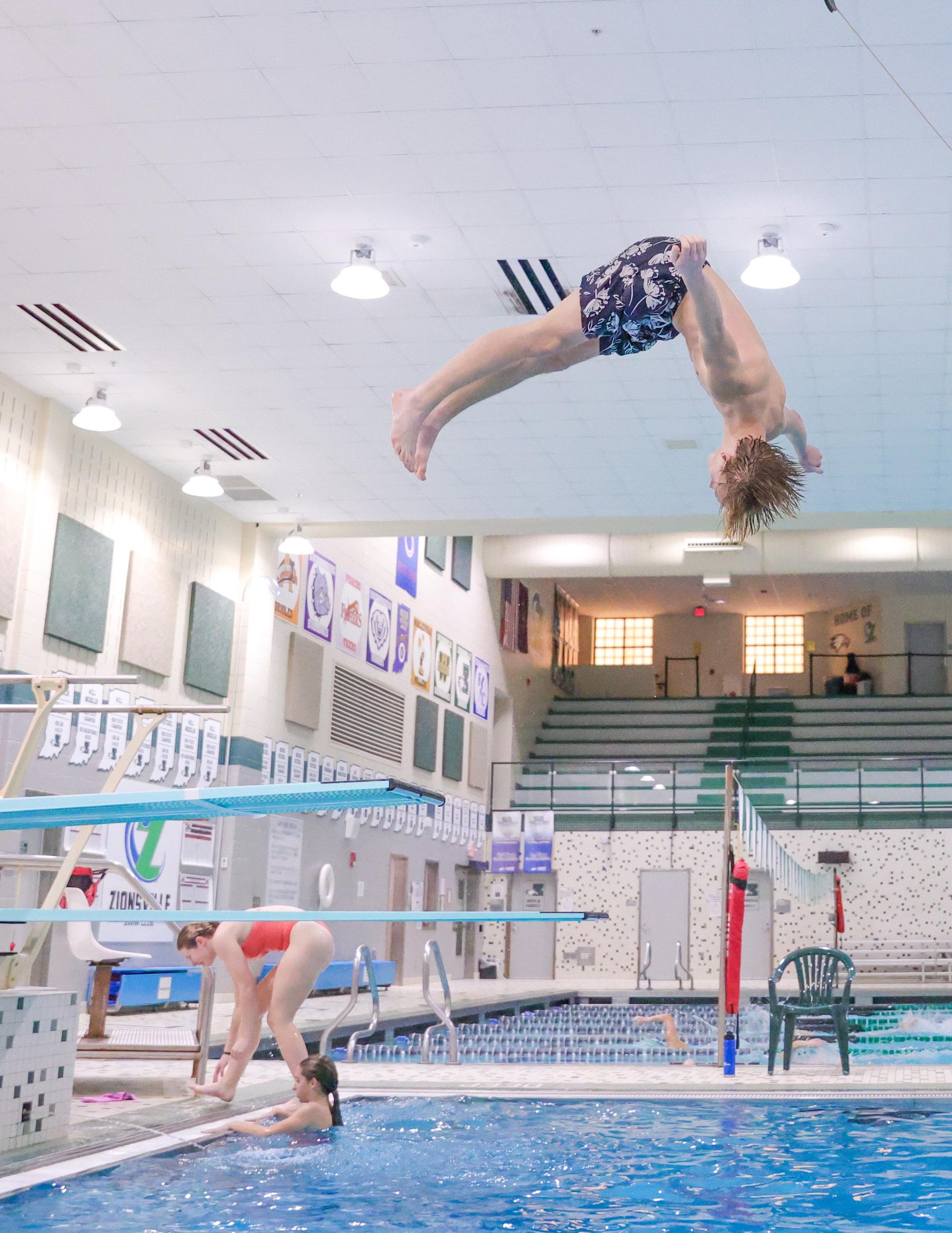
Cora Nichols practices twisting in the air during the diving team practice on Dec. 4 in the Zionsville Aquatic Center. Photo by Luke Kouns
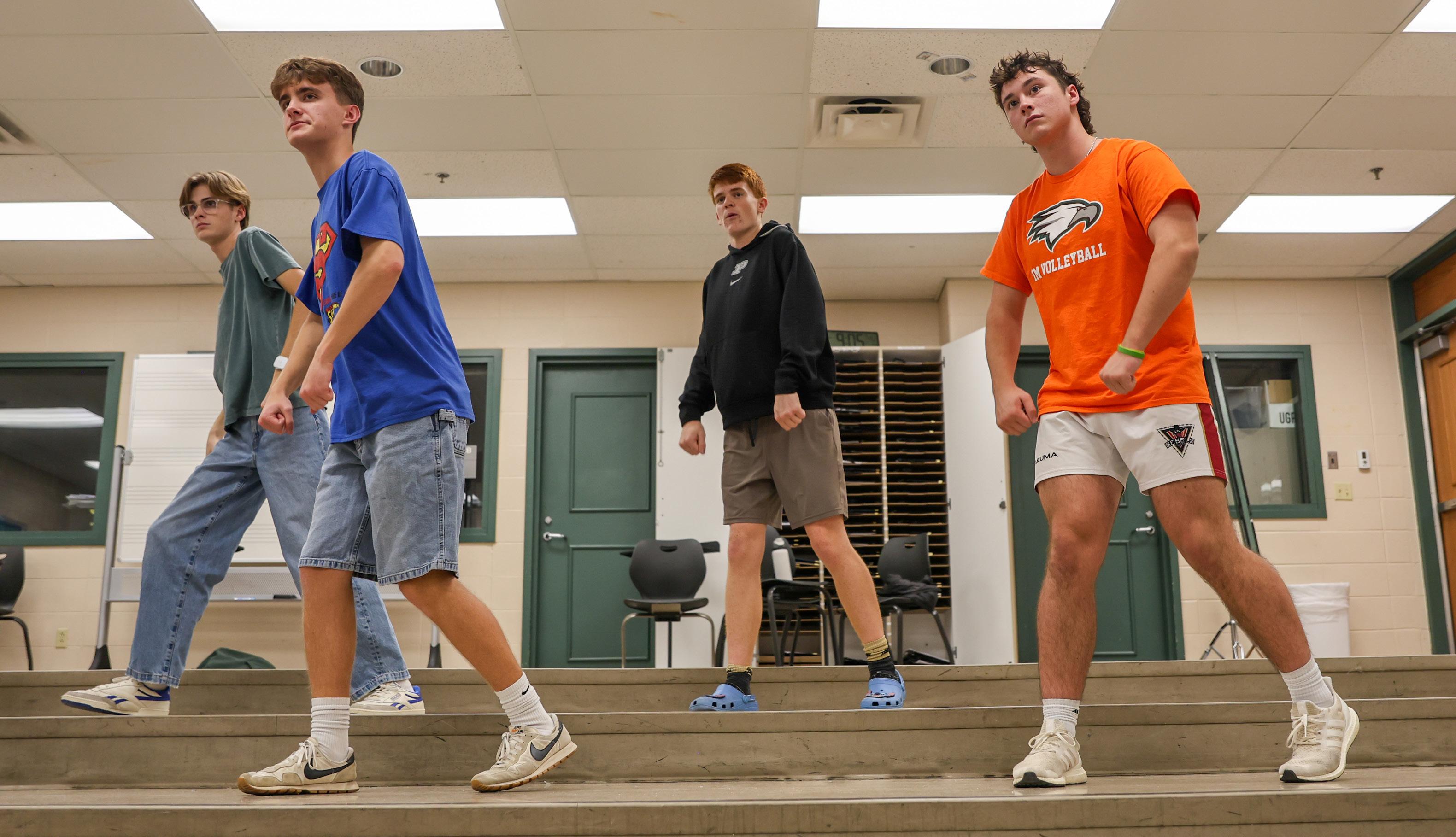
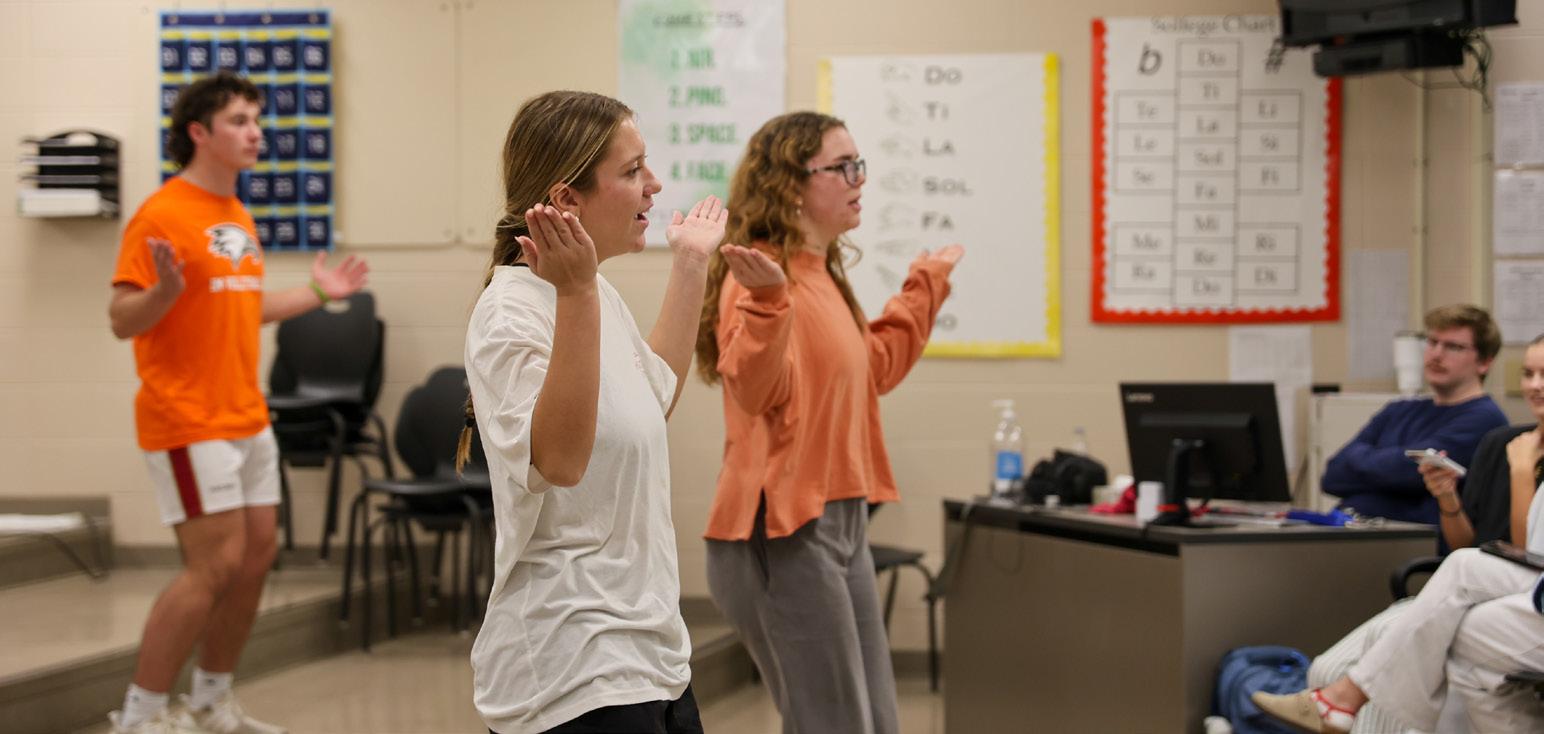
To prepare for the upcoming show, senior directors teach senior contestants the opening dance on Nov. 20. Tickets will go on sale in early January.
Photo by Lilly Steele.
With First Ammendment freedoms under threat, ZCHS students hold the tools to push back
Editorial Harbinger Staff
The ability to ask questions, to seek the truth for ourselves and speak openly about what we see around us has always been part of what makes America unique. But across the country and state, those freedoms are being chipped away and the freedoms of the First Amendment threatened. However, ZCHS students have the ability to use skills they are learning now to prevent this snowball effect from worsening.
This has been seen with The Pentagon’s new press policy calling for review of information before journalists can publish it, as well as restricting areas the press has access to, similar to changes the White House has made. The Indiana Daily Student also faced limitations on the ways they can spread information with their print magazine being swiftly cut this fall by Indiana University administration, before being reinstated.
authority, and weigh evidence that comes from reliable reporting.
These necessary skills are being fostered in ZCHS students right now through our English, social studies, and journalism classes. We are taught how to research, how to express our opinions, participate in controversial discussions, and how to advocate for ourselves and what we believe in.
Being silent is not neutrality but surrender. If we allow attempts to limit curiosity, restrict information or quiet student voices to go unchallenged, we risk losing the freedoms that are woven into the fabric of our country’s history.
We must take these lessons and build off of them to notice our rights in action and, more importantly, when they are being threatened. We must not only write, analyze or listen but question, participate, and speak out.
Exercising our rights in this way is not theoretical. It happens every time a student questions a school policy, signs a petition, joins a club that reflects their beliefs or writes a story for the Harbinger that sheds light on an issue or event that students may not know about.
These events point to a growing effort to shape what people can read, learn and question, and from which lens the public is able to see important events from. Yet, a democratic society depends on the exact opposite. Understanding all sides of a story, hearing the human experiences behind events and seeing issues through more than one perspective are essential for developing a balanced and critical worldview.
If journalists are kept away from directly getting the facts, then citizens cannot be informed and democracy cannot function. A stable government depends on a population that can think for itself, challenge
Being silent is not neutrality but surrender. If we allow attempts to limit curiosity, restrict information or quiet voices to go unchallenged, we risk losing the freedoms that are woven into the fabric of our country’s history.
The only way to keep this power is to use it. Speak out when something feels unjust. Support classmates whose voices are not being heard. Care about issues that may not directly affect you but matter to those in our community and our world. Do not let threats to our voices go unaddressed. Our voices are powerful, and we must use them.
Lilly Steele Ellie Vanderbur Print
Basireddy
Smith
Spence
Farrar Perspectives
Luke Kouns Reporters Colin Adam Addy Cieciek
Dhani Miller
Izzie Paino
Gia Villarrubia
The mission of the Harbinger is to provide timely, relevant and interesting content, while handling topics with respect, objectivity and accuracy. Harbinger aims to reflect the diverse nature of the student body of ZCHS by including those of all walks of life in the publication. The Harbinger is student-run and opinions in the magazine do not necessarily represent those of ZCHS or Zionsville Community Schools.
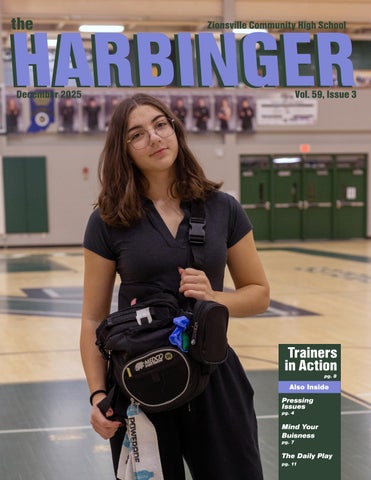
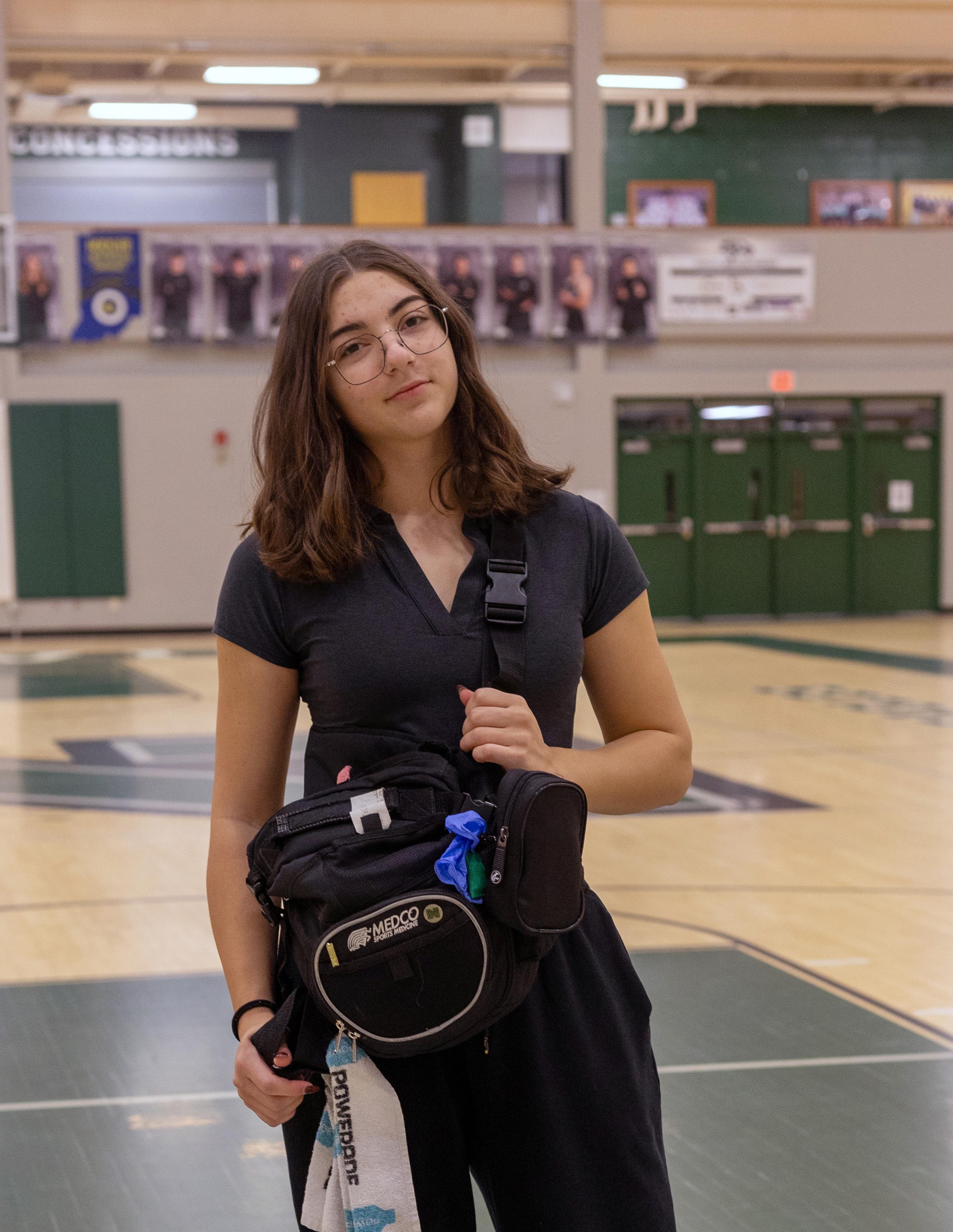
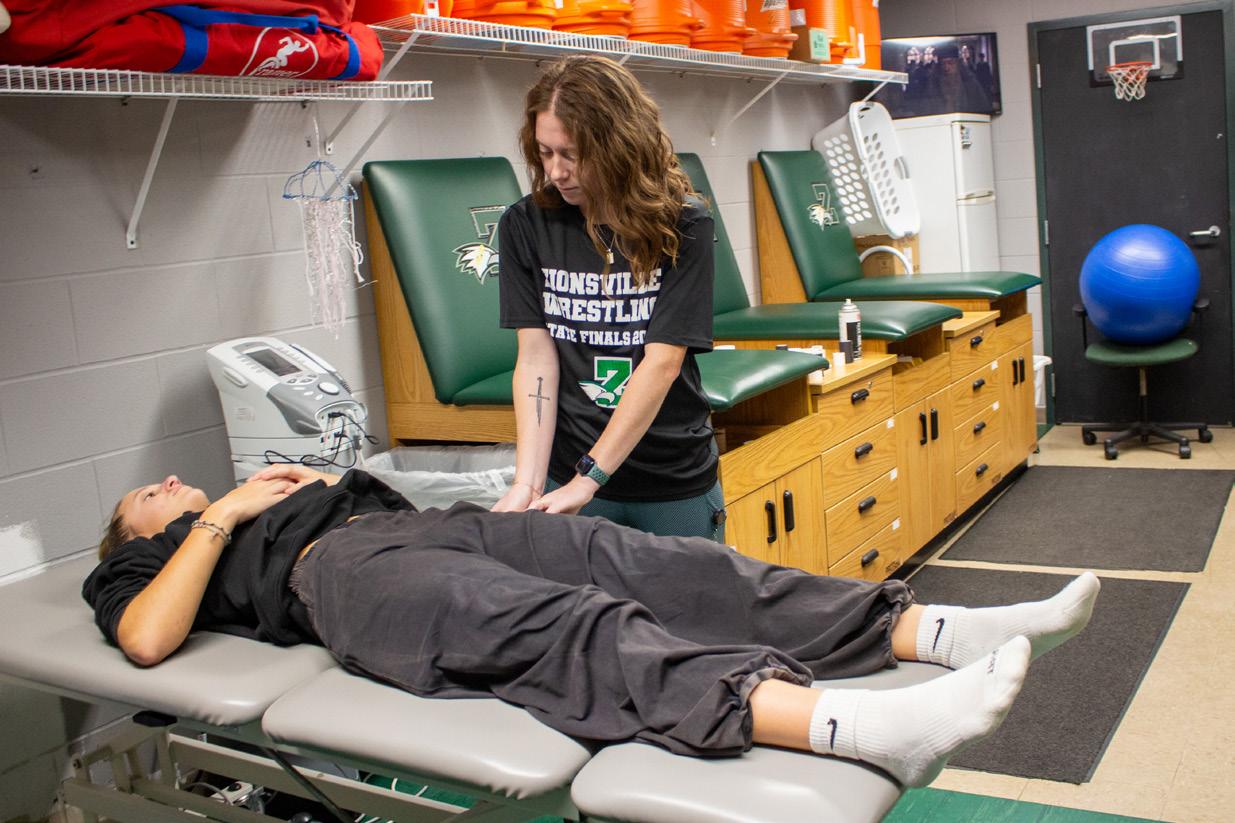
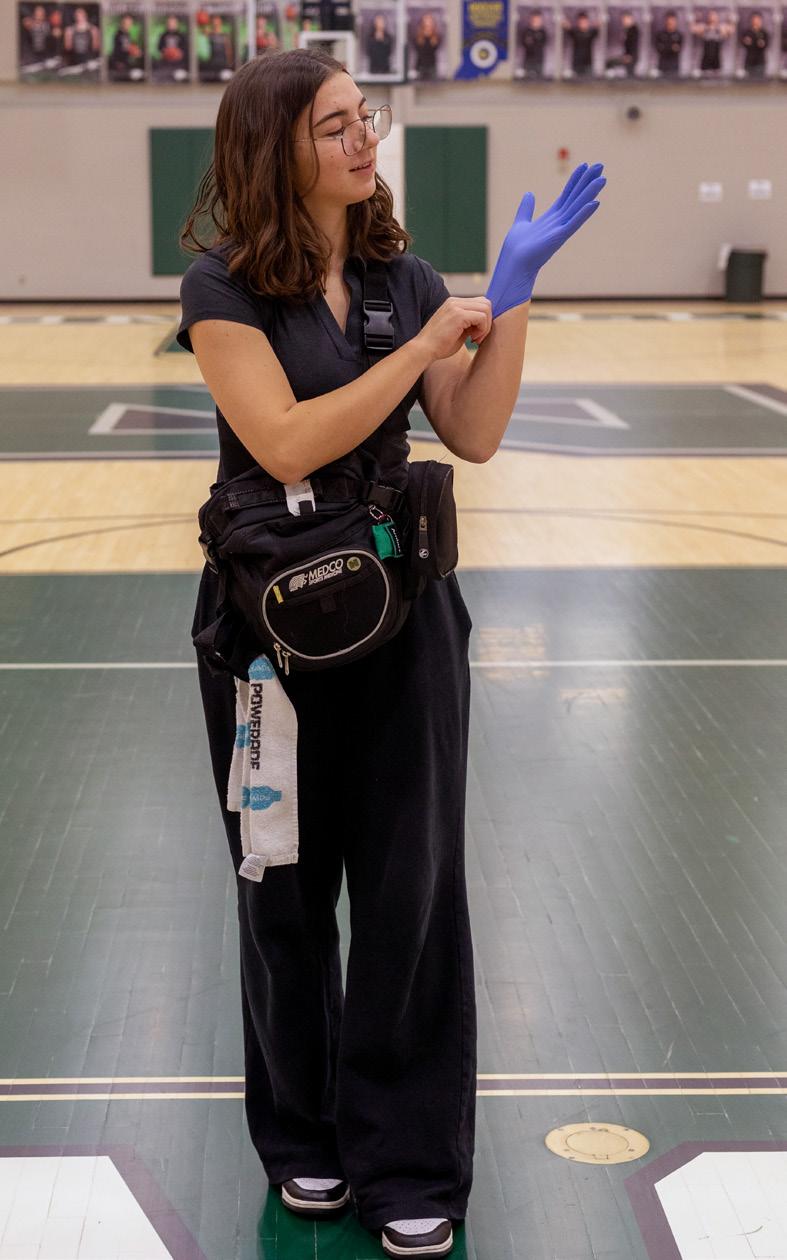
Cover: Showing off her athletic training equipment, Laurel Powell demonstrates the tools she uses to help student athletes recover from minor sport-related injuries on Dec. 4. Powell learns hands-on from observing and assisting the ZCHS athletic trainers in the training room after school. Photo by Addi Smith.
Pressing Issues
Recent government action taken against media, growing censorship
By Brody Brown, Feature Editor
The United States government and other public institutions have been at odds with journalits.
President Donald Trump placed restrictions on the Associated Press and the Wall Street Journal from reporting in the Oval Office and aboard Air Force One. After AP’s refusal to acknowledge the change from the Gulf of Mexico to Gulf of America in their stylebook and the Wall Street Journal’s reporting on Trump’s connection to convicted sex offender Jeffrey Epstein, the Trump administration has been working to shrink the press pool.
“We’re going to keep [the Associated Press] out until such time as they agree that it’s the Gulf of America,” Trump said.
Freedom of press, a right outlined in the First Amendment of the Constitution, has been under fire from those that are reported on.
Indiana University’s student-run newspaper the Indiana Daily Student’s academic adviser Jim Rodenbush was fired after seven years overseeing the publication. Following his termination, the print newspaper was canceled by the school, an act of censorship. IU administrators cited budgetary constraints as the reason for the cut and the print copy of the IDS has since been reinstated.
“A lot of students hate the idea of our newspaper getting censored,” ZCHS graduate and IU media school student Grace Adlong said.
IU’s newspaper was highly decorated for its journalism. IU graduate and Executive Director of the Indiana High School Press Association Ryan Gunterman previously worked for the IDS.
“The IDS is one of, if not the best college student publications to ever exist,” Gunterman said. “But if [censorship] can happen at the IDS, it can happen anywhere.”
According to Gunterman, the IDS’ battle with censorship is indicative of a bigger problem facing the press.
“The reason you’re seeing [censorship] become more commonplace is because people know they can get away with it and keep
their jobs,” Gunterman said. “The arrogance of journalists to simply scoff at the public questioning them, that built up a natural resentment and I completely understand. I’m a journalist and I resent it.”
According to a Gallup poll taken from Sept. 2-16, American’s trust in the media reached a historic low of 28%.
“We have to show [the public] that this attack can really affect [the news] that we take for granted,” Gunterman said.
The Trump administration has also solidified their stance on the media through new policy. Secretary of War Pete Hegseth’s restrictions in the Pentagon led to the withdrawal of all major news outlets that reported directly from the Pentagon.
According to NBC, journalists covering the Department of War, formerly known as the Department of Defense, can no longer gather or report information, even if it’s unclassified, unless it’s been authorized for release by the government.
“The ‘press’ does not run the Pentagon — the people do,” Hegseth said in a post on X. “The press is no longer allowed to roam the halls of a secure facility. Wear a badge and follow the rules — or go home.”
Major broadcast networks including ABC, CBS, CNN, NBC, Fox News Media and others refused to sign onto the new policies of the Pentagon.
“Today, we join virtually every other news organization in declining to agree to the Pentagon’s new requirements, which would restrict journalists’ ability to keep the nation and the world informed of important national security issues,” a joint statement from the networks said.
Along with the restrictions, President Trump began lawsuits against the New York Times and the Wall Street Journal for defamation.
“A free press has always been important to checking government information and
making sure that the public knows what is going on and asking the hard questions,” social studies teacher Bob Brennan said.
The disputes between journalists and the government have implications beyond just losing access to the Pentagon.
“I think that with the way a lot of things are going, [diminishing freedom of speech] is definitely a worry,” Adlong said.
However, hope remains for the press to regain the trust of the public.
“It’s very easy for people to attack journalists and kill the credibility of journalism, and to sacrifice the First Amendment for something they feel is wrong,” Gunterman said. “You have to spotlight the areas that work the way they’re supposed to work when it comes to reporting.”
The press has served as a watchdog for the government, facilitating information on behalf of the people.
“At some point, everyone’s going to need information,” Gunterman said. “We’ve never communicated more as a species than we do right now, and we need people who can communicate responsibly and find the information people need.”
Photo by Ellie Vanderbur
By Ari Spence, Feature Editor
Behind the Z
Inside the months of planning, practice, purpose behind ZCHS’s annual Mr. Z tradition
By Addy Ciciek, Reporter
Before stepping out they straighten out their matching costumes, adjust their performing numbers and fix their hair waiting to get their cue to step out on the stage in front of a full audience waiting for them to perform.
These aren’t professional dancers but ZCHS senior boys who will be shining in the spotlight for one night showing off their unique talents and mediocre dancing skills.
The performance includes choreographed group dances and comedic routines performed by each contestant, with the senior and junior girl directors organizing the show.
Mr. Z has been a tradition at Zionsville High School since the late 80s.
“It’s such a fun tradition we have because its entertaining and for a good cause,” contestant Luke Steele said.
“We collect money during the show for the American Foundation of Suicide Prevention,” senior director Meredith Herbon said.
ZCHS takes this opportunity for donating to the foundation to give the performance a meaningful purpose.
“[Suicide is] a very big reality and its a good opportunity to go to the show and donate,” Steele said.
From planning and rehearsing, students and staff practice for over six months for this one big night. Practices start once a week
in the fall before becoming almost daily in January to prepare for the show.
“We have a lot of deadlines to meet to get our costumes and to do our acts in front of directors and contestants,” Steele said.
Auditioning is a short process but its just the start of the six months of practicing.
“The seniors that want to be in the show have to sign up and come in for five minutes to sit and talk with our director panel and staff to pitch their talent,” teacher and director of Mr. Z Chelsea Whitaker said.
The senior and junior directors of Mr. Z are the ones who organize and run the show.
“There are three senior directors including me and we choreographed the opening dance
and piece together the show as a whole,” Herbon said.
The student directors put all their work towards organizing the show and dance and meeting deadlines but Whitaker is also there to help.
“I try to take things off the director’s plate, I work with the judges and I make sure the deadlines are met by the students,” Whitaker said.
In the final days before the show, the directors check that costumes and props are ready. Staff and directors work together to make sure everything runs smoothly on the night of the show.
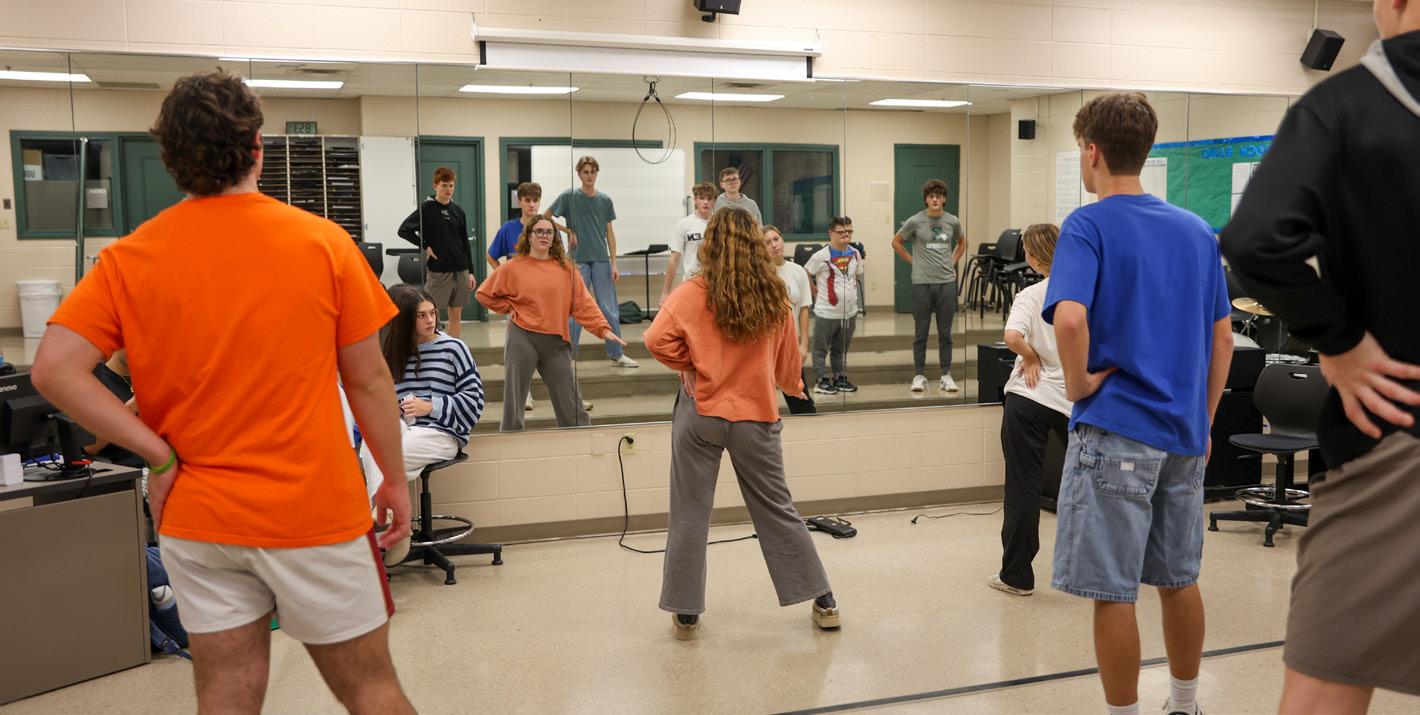
Dancing, senior Mr. Z contestants Graham Wilson, Jacob Jackson, Joey Seitz and Chris Jalaie rehearse the opening dance for the upcoming 2026 show on Nov. 20 in a music classroom. The contestants have been practicing since September. and will perform the show in late January. Photo by Lilly Steele
Teaching a new dacne, senior directors Meredith Herbon and Naomi Davis help Mr. Zionsville contestants learn part of the opening dance on Nov. 20.
Mind Your Business
By Cruz Weidner, Guest Reporter
Would you rather make $10 an hour or $100? This trade-off has become a reality for multiple ZCHS students who have left their entry-level job to start their own businesses.
This year, over 100 students signed up for the Entrepreneurship Club where students are finding ways to get involved in business.
According to a survey by Junior Achievement USA, three in five American teens say they would rather start their own business than work a traditional job.
How can teens turn their ideas into income? Well, the first step is focusing on the idea itself.
Senior Liam Salapka runs a car detailing business, Shake n’ Bake, alongside his friend, senior Trevor Blaisdell.
“Originally, when I was thinking about the overall business, it came to me during a math class,” Salapka said.
A lot of factors go into choosing a busi-
Guide to starting a business like other ZCHS students
ness idea to execute. One good question to ask is: does Zionsville have a market for this?
A batch of students in the town are starting home service businesses like lawn care, pressure washing and window washing because they have a high demand in the area. But ideas aren’t limited to that.
Senior Evan Walker runs his own salt delivery business, Simply Salt, and is the president of the Entrepreneurship Club. He chose salt delivery because it was an easy start up, with his dad being in a similar industry.
“My dad owns a plumbing company, so they were talking about possibly recruiting him for some plumbing work for their salt delivery business,” Walker said. “I happened to be in the meeting, and I took their idea, because it was a darn good one.”
But there are other important factors outside of the market including passion and enjoyment. For example, photography and nail businesses are often started by teens that already have a hobby in those areas.
Once a business idea is chosen, it is time to take action.
Action includes promoting and
actually selling what the business offers. Oftentimes it is good to test launch the idea and find out if there is consumer interest.
“I went to connections first and offered my service,” Walker said. “Also, [I talked to] advisors and people who have been helping me throughout my business journey.”
By testing sales with close connections, Walker said he gained a better idea if he was going to be able to sell enough of his service to make money.
Once he had enough interest and sales gathered for his service idea, he was ready for full scale selling. Social media, flyers, door knocking and door hangers are a few of the ways that students can sell to consumers across town.
A crucial part of a business start-up is growth. Students that are running businesses will have pressures and challenges in their entrepreneurship journey.
One person at the school who sees growth first-hand is entrepreneurship teacher and club sponsor Kent London.
London hears from his students who either run businesses or would like to start one. He says that good entrepreneurs are “people that don’t need to be told what to do.”
“They’ve got good work ethics; they’ve got their brain on straight,” London said. “They’re actually driving their own success.”
Walker embraces these traits, as a student who balances work and school. He has come up with his own strategy in order to stay in the right mind throughout the week.
Walker said he uses 30% of his day learning new things, “then 70% of my work time implementing the things I learned.”
“I work on my business all day throughout class,” Walker said. “I’m watching videos, learning about Facebook ad preferences, learning about target audiences and learning about new campaigns for advertising. A lot of learning.”
Unloading bags of salt from his truck, senior Evan Walker delivers salt to a client on Nov. 20. His business is tailored toward those who don’t have the time or physical capabilities to pick up the heavy salt bags.
Placing door hangers on houses, senior Evan Walker advertises his business, Simply Salt, on Nov. 20. His business delivers bags of salt to homeowners and local businesses. Photos by Addi Smith.
Trainers in Action
A look at the unseen work of athletic trainers who keep teams running long before their first game, after the final whistle
By Addison Prieshoff, Guest Reporter
With the cheers of the students ringing in her ears, the referee whistles blowing and the demanding voice of the football coach booming down the sideline, there is only one thing that junior Laurel Powell is focused on: her athlete.
Whereas most students on a Friday night would be up in the stands cheering on their team, Powell is down on the sidelines, ready for an injury at any moment. As one of the two student athletic trainers at ZCHS, she shares nearly the exact same responsibilities as the two certified athletic trainers (CAT).
With seventy percent of all public secondary schools having access to athletic trainers and their services according to the National Library of Medicine, athletic trainers play a crucial role in high school athletics. With their main responsibility being the treatment and prevention of sports-related injuries, their work is important for the running of a successful sports team. From taping wrists to on-field injury evaluations, an athletic trainers’ day is packed with a lot of behind-the-scenes work.
“I think that a lot of people think we give out water and tape ankles and that’s pretty much all we do,” CAT Tiffany McKinley said. “There’s a whole lot that goes on in the background.”
A typical day for a ZCHS athletic trainer begins as soon as the bell rings to end the school day. Depending on whether it is a game day or just a regular day of practice, the trainers will have their attention split between the different sports that they service.
“The biggest difference [between the variety of sports] is the demand put on us by each sport,” McKinley said.
When treating larger teams such as football and cross-country, there is a high demand placed on the small athletic training team. They frequently split their time be-
tween different training facilities or games. When they are on the field, however, the job requires deep concentration on their athletes.
“I personally think that we’re more important than first responders,” Powell said. “[We are] the first responders before the first responders.”
From the initial setup of a game and the pre-treatment of athletes to on-field injury services to the documentation and cleanup that occurs after the game, the CATs have a packed schedule. Powell said that she spends around 15–20 hours a week working and assisting the professional trainers. With such a physically demanding schedule, it can often be draining for the trainers, however they each find their motivation through different ways.
“Honestly, it’s when you have a kid that has an injury, and you’re working with them to get them back,” McKinley said. “Those are the rewards for me. It’s those small, little victories of seeing an athlete progress through their injury.”
For Powell, being a student trainer has positively shaped her perspective on sports and the teamwork that goes into them. She stated that though she had previously thought of the football players as scary, once she started assisting the team she was able
to form connections and build bonds with many of the players.
“It’s actually opened my mind to not judge a book by its cover,” Powell said.
Though it is commonly referred to as a cliché phrase, it is something that rang true in Powell’s case. Being open to making new friends, and being willing to learn, is something that is crucial for a student trainer. She has also built connections with other student trainers at schools like Franklin Central.
“It was really nice to meet some people that were interested in the same things,” Powell said.
Becoming a student trainer has been an extremely rewarding experience for Powell thus far.
“I’d just say have an open mind,” Powell said. “Be ready to learn—it’s a lot.”
Putting on gloves in the varsity gym, junior Laurel Powell demonstrates the tools she uses to help student athletes recover from minor sport-related injuries on Dec. 4. Powell learns hands-on from observing and assisting the ZCHS athletic trainers in the training room after school. Photo by Addi Smith
Athletic trainer Michelle Witt’s role is to assist students in the trainer’s office and during practices and games. Witt and other trainers move between students athletes constantly throughout the day. Photo by Brody Brown
Making a little Splash
The pressure, practice, team diving into a new season
By Gia Villarubia, Reporter
Cold water, early mornings and hours of practicing are all a part of the diving team.
According to diving team coach Amy Plocharczyk, this season the athletes are focused on progress, teamwork and representing their school pride.
With a smaller group of eight people this year, the team’s close connection has become one of its biggest strengths. Fewer athletes means more one-on-one feedback from coaches, more shared inside jokes and a deeper sense of accountability to each other.
“I am confident in saying that we have a lot of natural talent and people who are willing to work hard,” Plocharczyk said.
Among the divers, contributing to that environment is senior Grace Whitfield, who brings experience and leadership.
Whitfield became interested in diving after the 2016 Olympic Trials in Indianapolis, which revealed the sport’s competitive side and sparked her pursuit. But it wasn’t only the Trials; family influenced her too.
“I decided to join the team because my brother had already been on it as a swimmer and we thought it would be awesome to do it together,” Whitfield said.
For Whitfield, diving has become a place to reset. Between the demands of school and daily practice, the pool offers her a sense of balance and connection.
“To me, diving means an escape from my day or whatever I have going on at school,” Whitfield said.
Beyond the routines and the practices, Whitefield said she enjoys the chance to help others understand the sport.
As one of the more experienced divers on the team, she finds herself answering questions about the skills, techniques and details that go into each dive
“My favorite part about being a diver is getting to explain a lot of interesting things to people that might not be super familiar with the sport,” Whitfield said.
That sense of balance and belonging is shared by sophomore Reagan Masters, who joined the small but tight-knit team this
season. Like Whitefield, she was drawn to the supportive environment as much as the sport itself.
“Diving has pushed me out of my comfort zone,” Masters said. “Its exciting when you finally get a new skill, and the friendships you make it better”.
For both divers, the smaller team makes those friendships stronger, and each practice is filled with encouragement. Whitfield says much of the sport’s difficulty comes from the mental side of training, where athletes work through hesitation, build confidence and commit to each moment.
“I focus on mental training and confidence while providing positive feedback and team connection,” Plocharzyk said. This season, the divers are pushing them selves to grow both physically and mentally. The team’s main goal is to build a positive and supportive environment where everyone feels confident to improve and take risks.
“Getting over mental blocks is a huge challenge and learning how to trust yourself and your own body,” Whitfield said.
During practices, Plocharczyk said she emphasizes helping divers build confidence and consistency throughout the season. Along with the physical training, she works to create an atmosphere where athletes feel supported, get constructive feedback and stay connected as a team.
“The team goes through a lot during the high school season, and it’s important that they feel safe to be resilient with each other,” Plocharzyk said.
Plocharzyk’s connection to the sport goes beyond coaching, as she spent over a decade diving competitively before moving into a leadership role. After her college career, she chose to stay involved by guiding younger athletes.
“I was a diver for 13 years and wasn’t ready to leave the sport after I graduated college so I transitioned to coaching,” Plocharzyk said.
That long history in the sport shapes how she works with the team each day. Plocharzyk said her practices emphasize mental preparation and a supportive environment.
“Having a smaller team makes it special because we have a strong team identity,” Plocharzyk said. “We spend a lot of time with one another and get to know each other’s personalities, strengths, fears and goals. This helps us build trust and creates a sense of family and accountability.”
As the season continues, Plocharczyk said she hopes more students consider trying the sport, noting that success in diving comes from patience, confidence, and a willingness to learn.
“I would say if it interests you, then try it,” Plocharczyk said. “It’s not an easy sport, but you can succeed if you’re open-minded and willing to learn. Everyone starts somewhere, and with patience and the right attitude, you’ll be amazed at what you can do.”
Charlie Donahue flips through the air during the diving team practice on Dec. 4, 2025 in the Zionsville Aquatic Center.
Photo by Luke Kouns.
20%
Winter Watch Party
Reviews of the top three Christmas movies as voted on in a recent student survey, ranked
by percentage of total votes for favorite
By Luke Kouns, Perspectives Editor
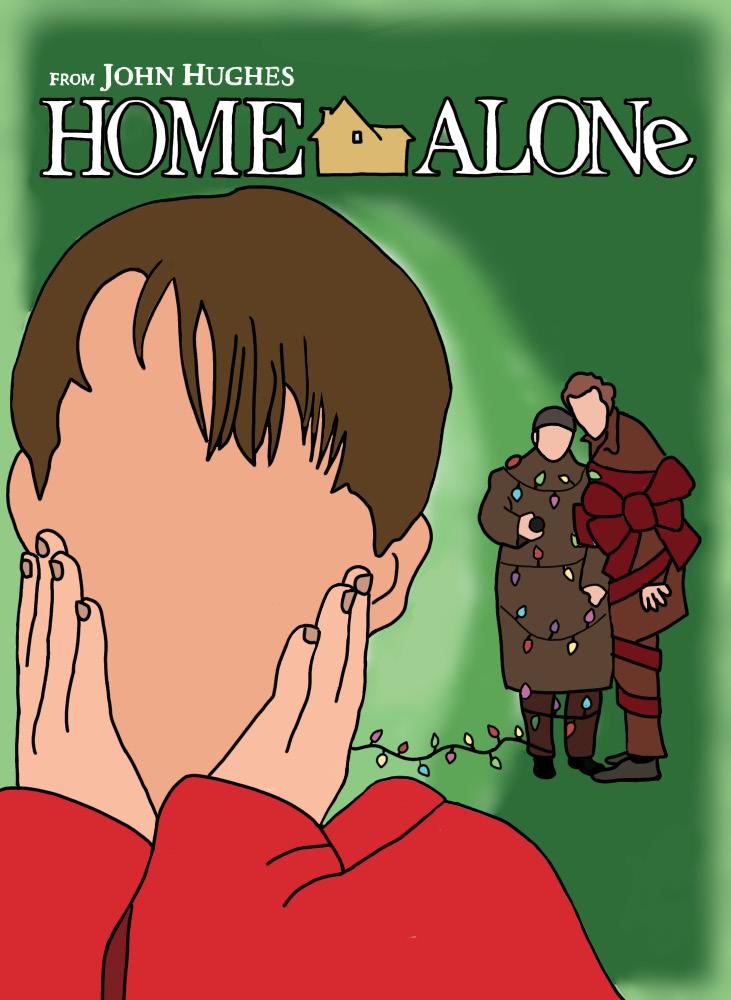
Let’s be honest, this isn’t a surprise. The race for first place wasn’t even close. There is a good reason for why this is the case too; beyond being a classic, which was most people’s justification, “Home Alone” is just a solid movie, even when watched not during the holiday season. “Home Alone” is more than just action packed and exciting (an element missing from many Christmas movies), but knows how to slow down and reflect on Kevin’s frightening situation. Unlike some “Die-Hard”’s I can think of, “Home Alone”’s touch of reality helps the movie to actually incorporate its Christmas theme, bringing in common holiday topics of family and gratitude. “Home Alone”, while not necessarily a comedy focused movie, also manages to incorporate a good amount of quality jokes, which definitely helps to balance out an otherwise action packed movie. But let’s be honest, the real reason Home Alone will be forever remembered is because of nostalgia. No amount of movie quality could ever live up to the amount of nostalgia that surrounds the name “Home Alone.” But this isn’t an insult, it’s a testament to the movie’s ability to connect to an audience and become almost synonymous with the Christmas season.
Out of all the winter movies I thought might win, “Elf” never even crossed my mind. For the life of me, I could never understand why people like this movie so much. According to the survey, this is one of the funniest holiday movies there is and gets people in the Christmas spirit. But after re-watch, I still just don’t get it. The awkward comedy still isn’t funny. Now, don’t get me wrong, “Elf” is not entirely meritless. I liked the park ranger bit and I liked the north pole’s references to older Christmas movies, but those were only minute parts of an otherwise bland comedy. There are a few quality laughs, sure, but when the vast majority of the comedy derives from a grown man prancing around New York in a low budget elf costume, those few good jokes get canceled out. It’s not exactly a good sign when one of the best jokes in the movie is the main character getting hit by a car. The movie has almost no story until the very end, and even that little bit of story can be summarized as “believe in the Christmas spirit”. Overall: “Elf” is bland, uninspired and left me disappointed, even with the low expectations I already had.
14%
The competition for third place was a close match up between “National Lampoon’s Christmas Vacation”, “A Christmas Story” and The Grinch’s wide range of movies. But the movie that ultimately stole the third place spot was 2000’s “How the Grinch Stole Christmas” starring Jim Carrey. I’ll be honest, I hated this movie as a kid. I was scared of the Whos, I hated the Grinch and the jokes never landed. Looking back on that viewpoint from where I am now, I don’t think anything has ever changed more in my life. I might still hate the Whos, but I love this movie. I love the comedy that just keeps coming, and I love Jim Carrey. No other Grinch movie, or any other movie at all, will ever capture the feeling of mischief, malice and wackiness as well as this one does. “How the Grinch Stole Christmas (2000)” is a ludicrous joy from start to finish, with an actually believable resolution thanks to the added interactions between the Grinch and the Whos. Sure, at the end of the day it’s nothing life changing or overly unique, it’s The Grinch after all. But that doesn’t matter, it’s just pure goofy fun. I will never get tired of this movie.
The Daily Play
A look at the rise of daily games, which ones stand out
By Colin Adam, Reporter
The year is 2021; you open your computer ready for another day of online school. While you wait for the teacher to open the Zoom link for first period, you open a new tab and type Wordle, one of your daily routines.
Daily games, especially those published by The New York Times have increased in popularity at an absurd rate within recent years. This growth can be seen as a result of the quarantine during the COVID-19 pandemic, with people inside on their screens.
One of the pioneers of daily games is no doubt Wordle, but in my opinion it’s overrated, compared to other New York Times games like Connections or the new Pips.
In Pips you match the dominoes into their correct spots by using basic math with their small dots (pips). But in Wordle you make an educated guess from the letters available after your first guesses. This makes the games like Wordle less enjoyable because you guess and check compared to games like Connections where there’s more thought behind the game.
I don’t enjoy games where you just guess, even if it is an educated one. Games like Pips or the underrated Spelling Bee get my brain functioning more than just plugging in letters.
In Pips, before you submit your answer you know if you’re right or wrong, allowing you to think more analytically about where you place the dominoes.
Even though I don’t enjoy games like the Wordle, The New York Times games have good things about them. The community aspect of playing with friends and family, keeping your streak alive and beating high scores make the games what they are.
There are many daily games like the Wordle that aren’t locked behind The New York Times subscription program. If you enjoy the games they offer there are many other options out there that are free and better. For example I enjoy Travle and Waffle, one highlighting geography knowledge and the other a more interesting Wordle. There is a game for everyone out there in any topic from sports to themed crosswords, this shows how popular they are.
Daily games are popular and will always be because of their accessibility. I recommend everybody to find one to two daily games on The New York Times website to see what they like and play them daily as well. The games allow everybody of all ages to think differently and have fun at the same time, something worth two minutes.
“Personally, my favorite game is Connections. I love all types of puzzles and connecting the dots to figure out what words go with each other is a great challenge. On Fridays, I try to use these games as a warm up for my students. It warms up their thinking without making them do a math related task.”
- Math teacher Matthew Byrum
“My favorite game on the New York Times is Wordle, it’s simple and fast and something to look forward too. It’s a new word every day making it engaging and never boring. It helps expand my vocabulary and make me think out of the box. Me and my friends sometimes see who can get it first making it a friendly competition.”
- Freshman Kennedy Hayes
Designed by Luke Kouns
by Srinithya Basireddy
Kouns
“I think we have a good group of hard working wrestlers, and it’ll also be our first home meet so I’m excited to see the turnout and what the environment will be like at home.”
“It’s a really fun group of guys to be around and to work with every day. I’m excited for that game. It’s always a fun one because it goes into winter break.”
Maddie Callahan (11), Katie Tedja (9), Meredith Herbon (12), and Avery Benner (9) practice in the Star Bank Performing Arts Center on Nov. 10 for the Zionsville High School fall musical: Grease. In this scene, Marty Maraschino (played by Maradith Herbon) sings “Freddy, My Love”, a song about her long distance relationship with a marine.
Photo by Luke
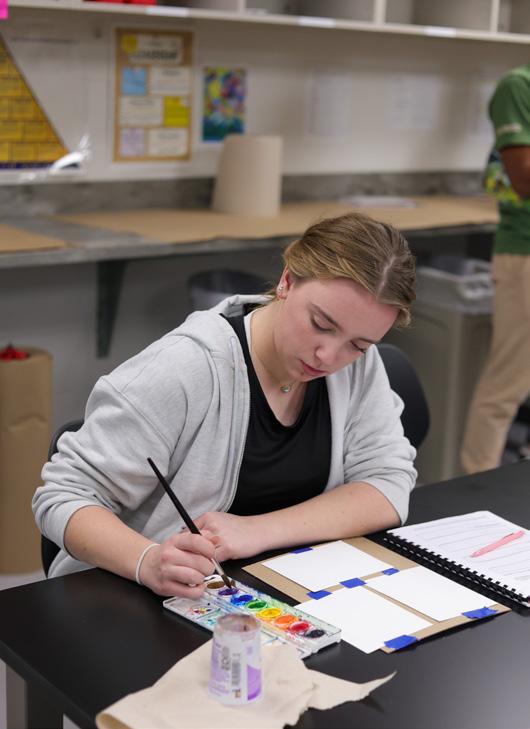
Junior Logan Ferris works on a collage project in 2D Art on Dec. 6 to practice composition and design skills. Photo by Izzie Paino.
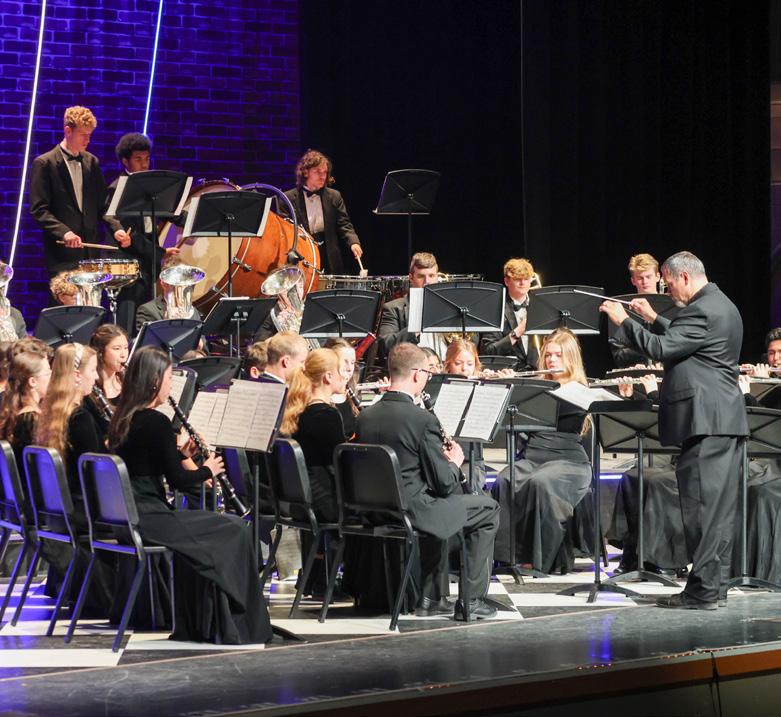
Music teacher Tom Landrum leads the Zionsville Wind Ensemble during the Zionsville Veterans Day convocation on Nov. 12 in the Performing Arts Center. The group played “Armed Forces Solute” to honor the different branches of the American military. Photo by Luke Kouns