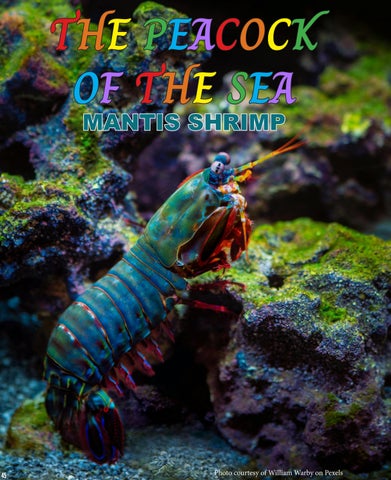
THE PEACOCK OF THE SEA MANTIS SHRIMP
Photo courtesy of William Warby on Pexels
The Coolest Crustacean
All text by Wikipedia
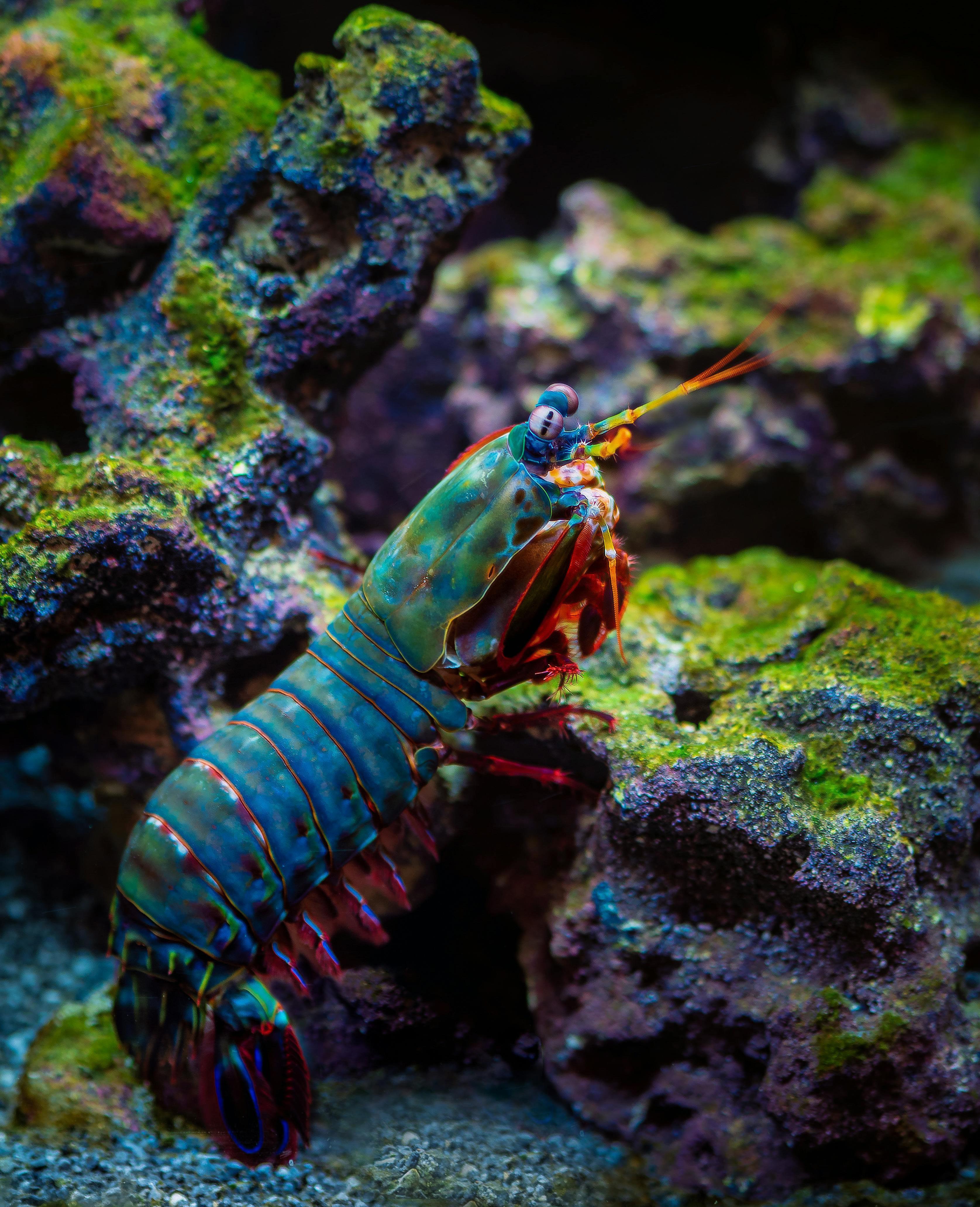
Mantis shrimp are carnivorous marine crustaceans of the order Stomatopoda. Stomatopods branched off from other members of the class Malacostraca around 400 million years ago. Mantis shrimp typically grow to around 10 cm in length, while a few can reach up to 38 cm. A mantis shrimp’s carapace covers only the rear part of the head and the first four segments of the thorax. Varieties range in color from shades of brown to vivid colors, with more than 520 species of mantis shrimp known. They are among the most important predators in many shallow, tropical, and subtropical marine habitats. However, despite being common, they are poorly understood, as many species spend
most of their lives sheltering in burrows and holes.
Called “sea locusts” by ancient Assyrians, “prawn killers” in Australia, and now sometimes referred to as “thumb splitters” due to their ability to inflict painful wounds if handled incautiously, mantis shrimp have powerful raptorial appendages that are used to attack and kill prey either by spearing, stunning, or dismembering. Some mantis shrimp species have specialized calcified ‘clubs’ that can strike with great power, while others have sharp forelimbs used to seize the prey (hence the term “mantis” in their common name).
Ecology
About 520 species of mantis shrimp have been discovered worldwide; all living species are in the suborder Unipeltata, which arose around 250 million years ago. These aggressive and typically solitary sea creatures spend most of their time hiding in rock formations or burrowing intricate passageways in the seabed. They rarely exit their homes except to feed and relocate and can be diurnal, nocturnal, or
crepuscular (active at twilight), depending on the species. Unlike most crustaceans, they sometimes hunt, chase, and kill prey. Although some live in temperate seas, most species live in tropical and subtropical waters in the Indian and Pacific Oceans between eastern Africa and Hawaii.
Photo courtesy of William Warby on Pexels
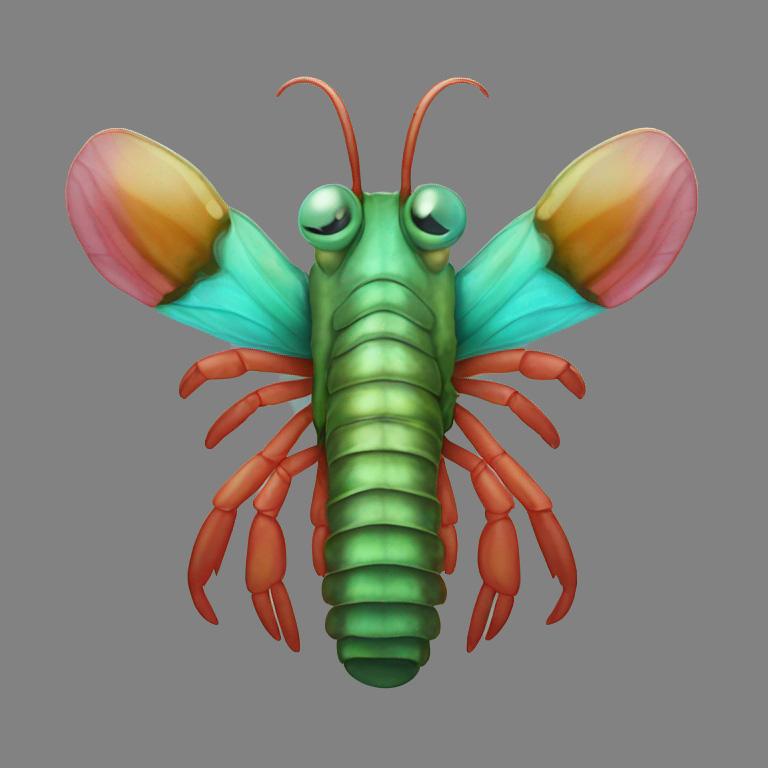
Graphic courtesy of AImojis
It’s All in the Eyes
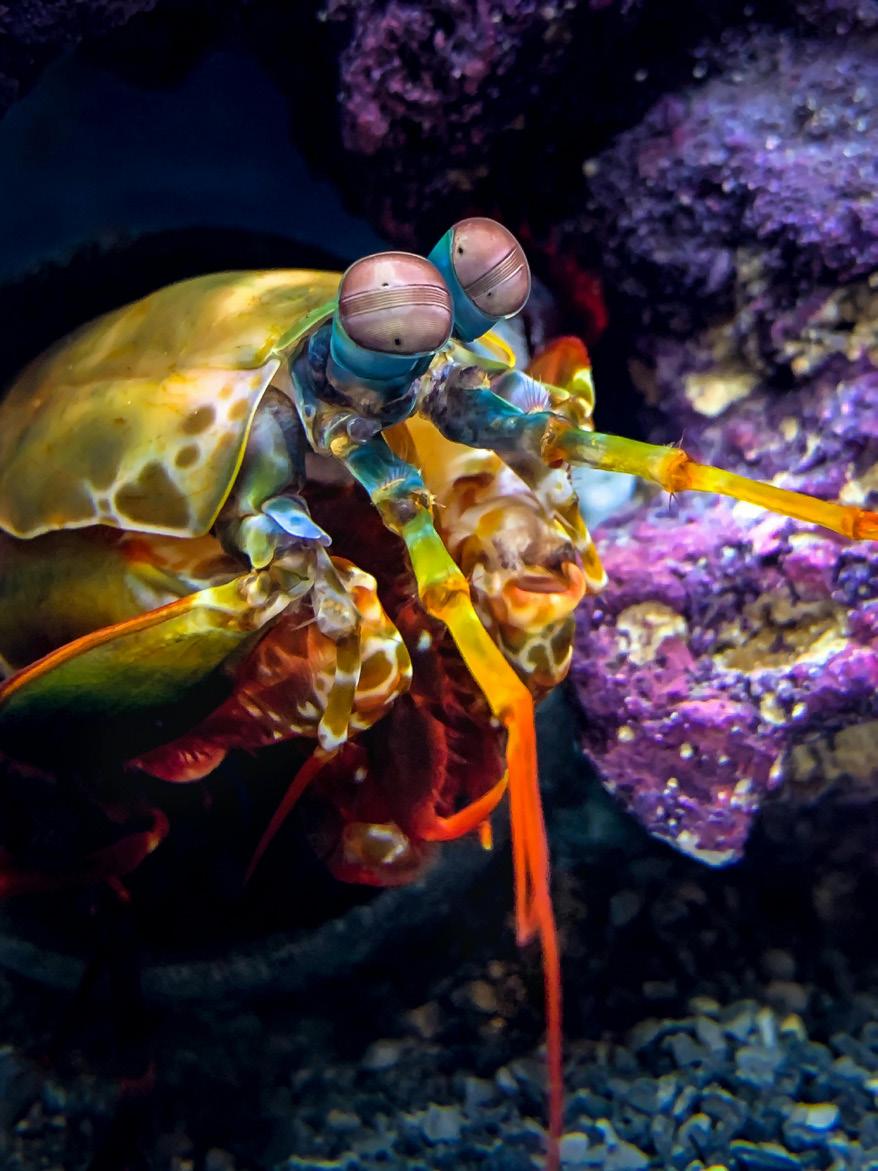
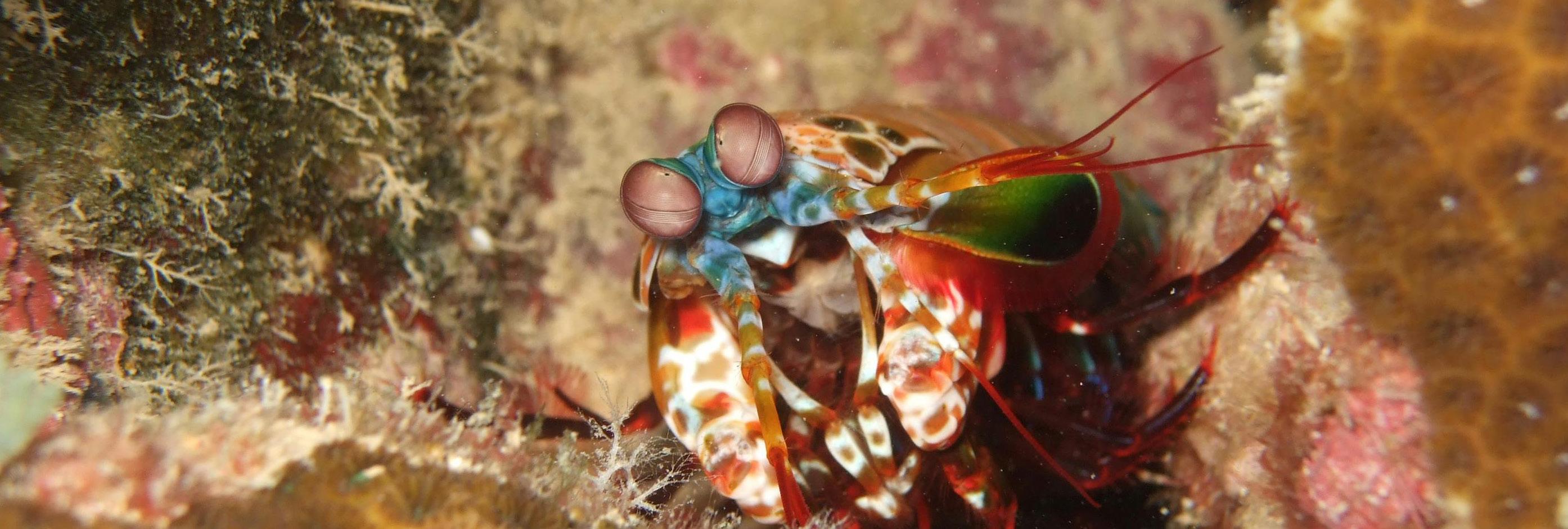
The eyes of the mantis shrimp are mounted on mobile stalks and can move independently of each other. The extreme mobility allows them to be rotated in all three dimensions, yet the position of their eyes has shown to have no effect on the perception of their surroundings. They are thought to have the most complex eyes in the animal kingdom and have the most complex front-end for any visual system
ever discovered.
Compared with the three types of photoreceptor cells that humans possess in their eyes, the eyes of a mantis shrimp have between 12 and 16 types of photoreceptor cells. Furthermore, some of these stomatopods can tune the sensitivity of their long-wavelength color vision to adapt to their environment. This phenomenon, called “spectral tuning”, is species-specific. Cheroske et al. did not observe spectral tuning
in Neogonodactylus oerstedii, the species with the most monotonous natural photic environment. In N. bredini, a species with a variety of habitats ranging from a depth of 5 to 10 m, spectral tuning was observed, but the ability to alter wavelengths of maximum absorbance was not as pronounced as in N. wennerae, a species with much higher ecological/photic habitat diversity.
Despite the impressive range of wavelengths that mantis shrimp have the ability to see, they do not have the ability to dis criminate wavelengths less than 25 nm apart. It is suggested that not discriminating between closely positioned wavelengths allows these or ganisms to make determi nations of their surroundings with little processing delay. Hav ing little delay in evaluating sur

roundings is important for mantis shrimp, since they are territorial and frequently in combat. The huge diversity seen in mantis shrimp photoreceptors likely comes from ancient gene duplication events. One consequence of this duplication is the lack of correlation between opsin transcript number and physiologically expressed photoreceptors. One species may have six different opsin genes, but only express one spectrally distinct photoreceptor.
Photo courtesy of Jun Ho Lee on Pexels
This Shrimp is No Wimp
The mantis shrimp’s second pair of thoracic appendages has been highly adapted for powerful close-range combat. These claws can accelerate at a rate comparable to that of a 0.22 caliber bullet when fired, having around 1500 newtons of force with each swing/attack.
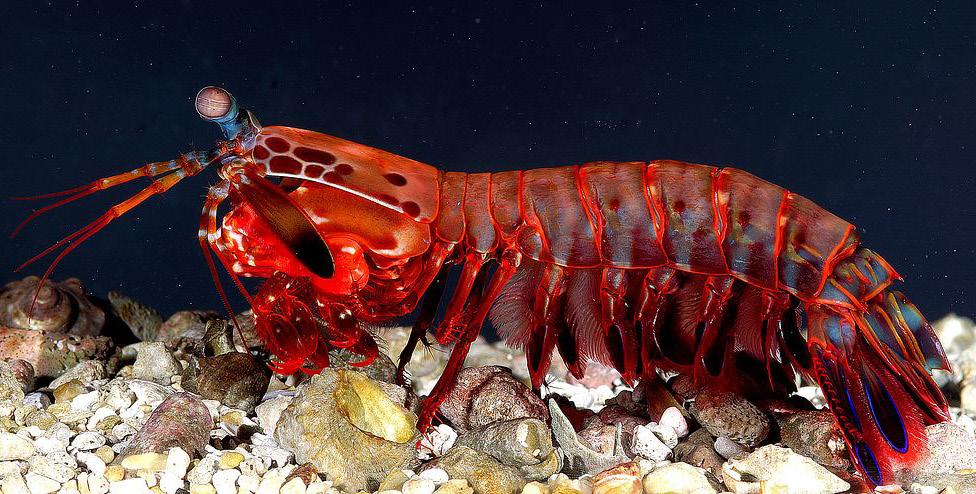
The appendage differences divide mantis shrimp into two main types: those that hunt by impaling their prey with spear-like structures and those that smash prey with a powerful blow from a heavily mineralized club-like appendage. A considerable amount of damage can be inflicted after impact with
these robust, hammer-like claws. This club is further divided into three subregions: the impact region, the periodic region, and the striated region. Mantis shrimp are commonly separated into distinct groups as determined by the type of claws they possess: Smashers, Spearers, and Spike Smashers.
All types strike by rapidly unfolding and swinging their raptorial claws at the prey, and can inflict serious damage on victims significantly greater in size than themselves. In smashers, these two weapons are employed with blinding quickness, with an acceleration of 10,400 g (102,000 m/ s2 or 335,000 ft/s2) and speeds of 23 m/s (83 km/h; 51 mph) from a standing start. Because they strike so rapidly, they generate vapor-filled
bubbles in the water between the appendage and the striking surface—known as cavitation bubbles. The collapse of these cavitation bubbles produces measurable forces on their prey in addition to the instantaneous forces of 1,500 newtons that are caused by the impact of the appendage against the striking surface, which means that the prey is hit twice by a single strike; first by the claw and then by the collapsing
cavitation bubbles that immediately follow. Even if the initial strike misses the prey, the resulting shock wave can be enough to stun or kill. Smashers use this ability to attack crabs, snails, rock oysters, and other mollusks, their blunt clubs enabling them to crack the shells of their prey into pieces. Spearers, however, prefer the meat of softer animals, such as fish and cephalopods, which their barbed claws can more easily slice.
Photo courtesy of James Heck on Pexels
Smashers possess a much more developed club and a more rudimentary spear (which is nevertheless quite sharp and still used in fights between their own kind); the club is used to bludgeon and smash their meals apart. The inner aspect of the terminal portion of the appendage can also possess a sharp edge, used to cut prey while the mantis shrimp swims.
Spearers are armed with spiny appendages - the spines having barbed tips - used to stab and snag prey. These raptorial appendages resemble those of praying mantids, hence the common name of these crustaceans.
SpikeSmashers (hammers or primitive smashers): possibly the “missing link” to relate the two most common (spear and smasher) to each other. Very uncommon and even less studied than the hatchet type.
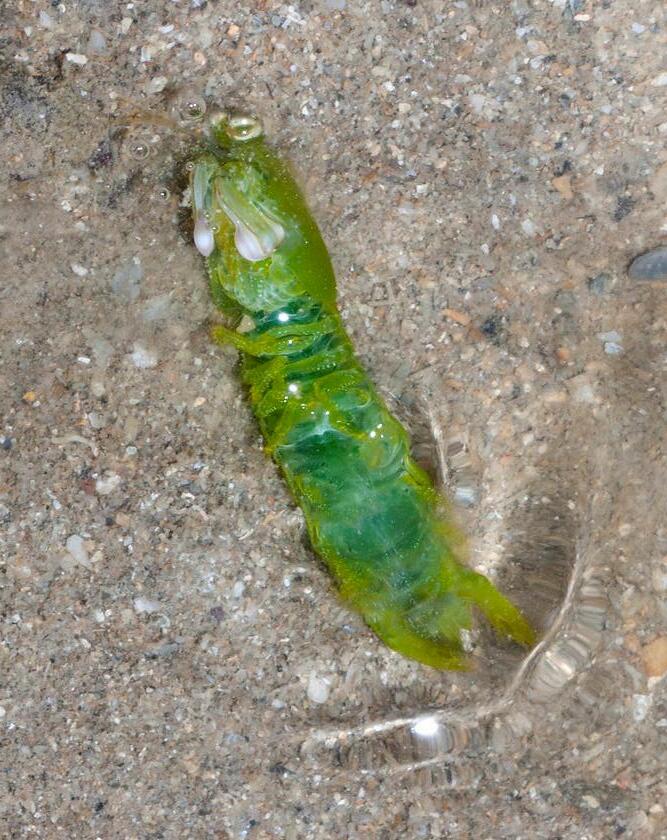
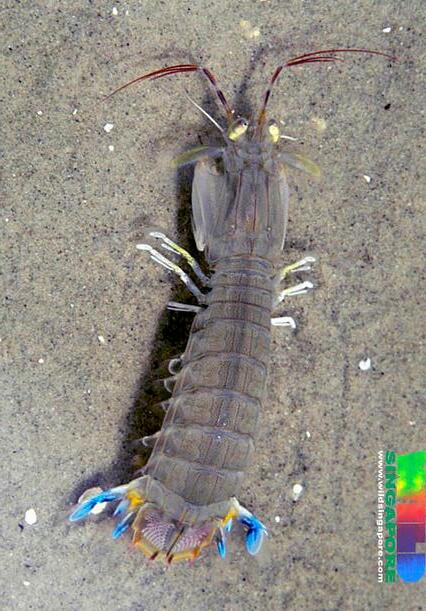

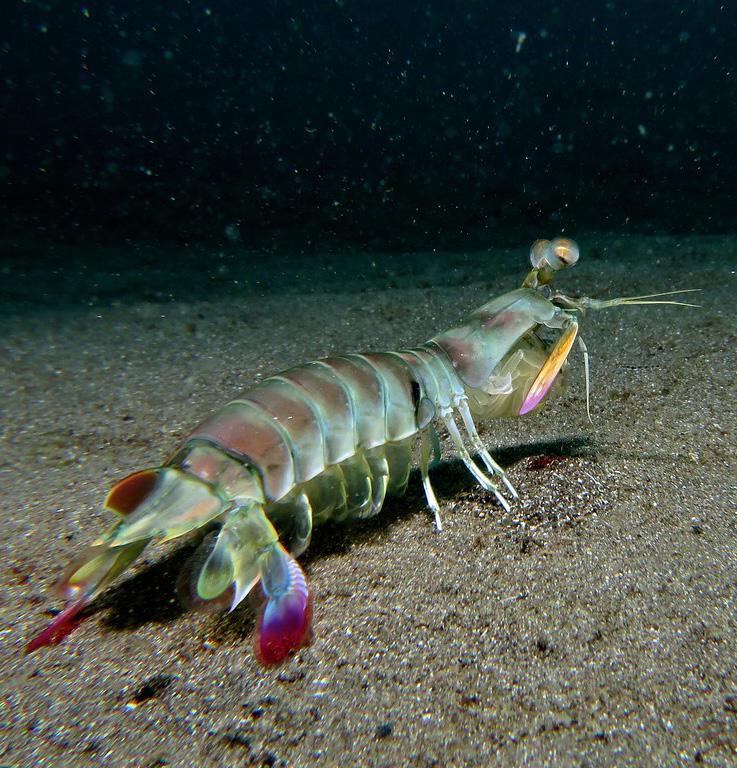
Photo courtesy of Ria Tan on Flickr
Photo courtesy of Ria Tan on Flickr
Photo courtesy of Daniel Kwok on Flickr