IMPROVING ENGLISH 3
Рецензенти
Лектор
Уредник
Главни уредник
За
CIP - Каталогизација у публикацији
Народна библиотека Србије, Београд
37.016:811.111(075.3)
КОВАЧЕВИЋ, Катарина, 1942Improving English 3 : енглески језик за трећи разред гимназије и средњих стручних школа : једанаеста година учења : уџбеник са рaдном свеском / Катарина Ковачевић, Гордана Марковић. - 5. изд. - Београд : Завод за уџбенике, 2025 (Београд : Планета принт). - 191 стр. : илустр. ; 27 cm Тираж 2.200. - List of irregular verbs: str. 186-187. - World list: str. 188-190.
ISBN 978-86-17-21243-6
1. Марковић, Гордана, 1951- [аутор] COBISS.SR-ID 166712073
ISBN 978-86-17-21243-6 ©
Cover page: Opera House in Sidney Harbour (Depositphotos) Министар просвете,
Student's book
Unit 1
6–19
PLAN OF THE BOOK
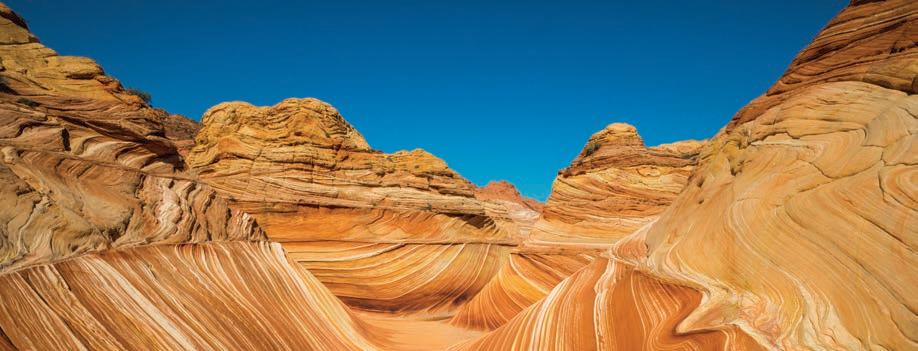
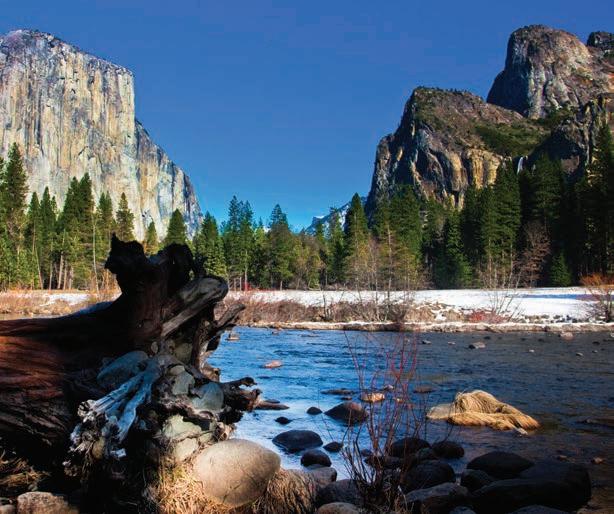
NATIONAL PARKS
Reading: A Rock art
B Yosemite National Park
Vocabulary Making adjectives from nouns and nouns from verbs
Grammar Present tenses; the plural of nouns
Speaking The Australian quiz; about the Aborigines
Listening Della Peterson talks about her visits to Yosemite Park
Writing A composition about Tara National Park
Communication Expressing preference and pleasure
Unit 2
20–33
Vocabulary
FASHION
Reading: A The mini revolution
B Is fashion important?
Words related to fashion and clothes; building words with the prefixes: dis, mis, re, over and under; linking words and phrases
Grammar Past tenses; past participle; correlative conjunctions; comparative constructions
Speaking Importance of fashion
Listening On the catwalk
Writing A fashion show
Communication Complimenting people on clothes
Unit 3
34–47
Vocabulary
ART and ARTISTS
Reading: A The painter of light
B A pop art icon
Words related to arts; phrasal verbs with set; words made with negative prefixes
Grammar Past perfect tense; revision and extension of the passive; passive forms of the infinitive and gerund; present and perfect participles
Speaking Talking about art
Listening Salvador Dali
Writing Describing a picture
Communication Saying ‘no’ nicely
Unit 4
48–59
MAKING DESISIONS
Reading: A The Lady or the Tiger? Extract 1
B The Lady or the Tiger? Extract 2
Vocabulary Phrasal verbs with turn; prepositions with verbs; idioms with eye
Grammar Conditional sentences
Speaking Making decisions
Listening Bad decisions throughout history
Writing Solving problems
Communication Approving and disapproving
Unit 5
60–75
MYTHS and LEGENDS
Reading: A The gift of eloquence
B The green children of Woolpit
Vocabulary Phrasal verbs with put; expressions with take
Grammar Relative clauses; passive reporting verbs; modal verbs with the perfect infinitive; the definite article
Speaking A short presentation on urban legends or myths
Listening Rtanj Mountain
Writing Mysterious sites
Communication Expressing your point and doubt
Unit 6 76–89
CELEBRITIES
Reading: A Celebrities as role models
B A woman of many talents
Vocabulary Words related to film; adjectives describing personalities
Grammar Wishes and regrets; impersonal pronouns: one, they, you; passive constructions
Speaking Celebrities as role models; facts about Meryl Streep
Listening Fame has its disadvantages
Writing A film review
Communication Making, accepting and declining an invitation
Unit 7 90–105
CRIME and FICTION
Reading: A Fictional detectives
B The power of deduction
Vocabulary Words related to crime; phrasal verbs with make; compounds
Grammar Present perfect simple and continuous tenses; verbs and expressions followed by the gerund; reporting verbs
Speaking Discussing crime writers and their characters
Listening An exhibition about Sherlock Holmes
Writing Writing a story
Communication Changing your mind Unit 8
106–119
PREDICTING THE FUTURE
Reading: A The impact of climate change
B Is there life out there?
Vocabulary Words related to weather; uses of due; phrasal verbs with run
Grammar Expressing the future; pronouns
Speaking Effects of climate change Is there life on other planets in our universe?
Listening How to give a presentation
Writing A report
Communication Talking about the weather Unit 9 120–135
TRANSPORT and TRAVEL
Reading: A Daring undertakings
B Trains that fly
Vocabulary Words related to travelling; phrasal verbs – revision
Grammar Numerals; the past perfect continuous tense; adverbs; the with geographical names
Speaking About travelling
Listening The first woman to cycle the globe
Writing An informal letter
Communication Communicating with people in a foreign place
NATIONAL PARKS Unit 1
In this unit, you will
• read, listen and talk about
a. the Aborigines and rock art
b. Yosemite and giant sequoias
• practise the plural of nouns the present simple and continuous tenses the present perfect tense expressing preference and pleasure
Lead-in
1
How good are you at Geography?
a. There are thousands of national parks in the world. In your opinion, which continent is home to the greatest number of them?
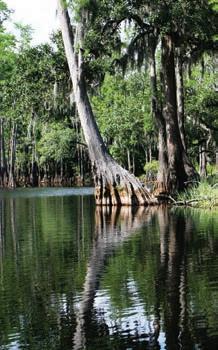
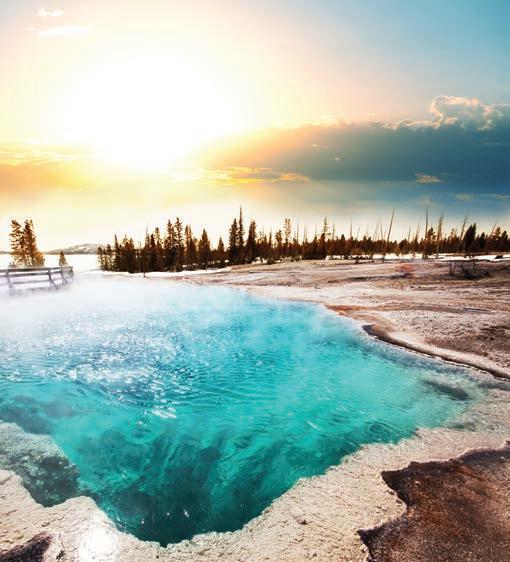
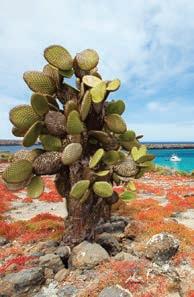
b. Look at the list below. Which continents do they belong to?
the Great Barrier Reef, Victoria Falls, the Great Canyon, Tara, Kilimanjaro, Olympus, Yosemite, Yellowstone the Everglades, Galapagos, the Lake District
2
Europe
North America
South America
Australia
Africa
Choose one of the parks and then go to the Internet to find out why it is famous. Describe the most attractive features of the park to the class.


ROCK ART
An expression of CULTURAL IDENTITY
Reading
Australia is home to some of the world’s most incredible national parks which offer a remarkable diversity of scenery, as well as some unique flora and fauna.
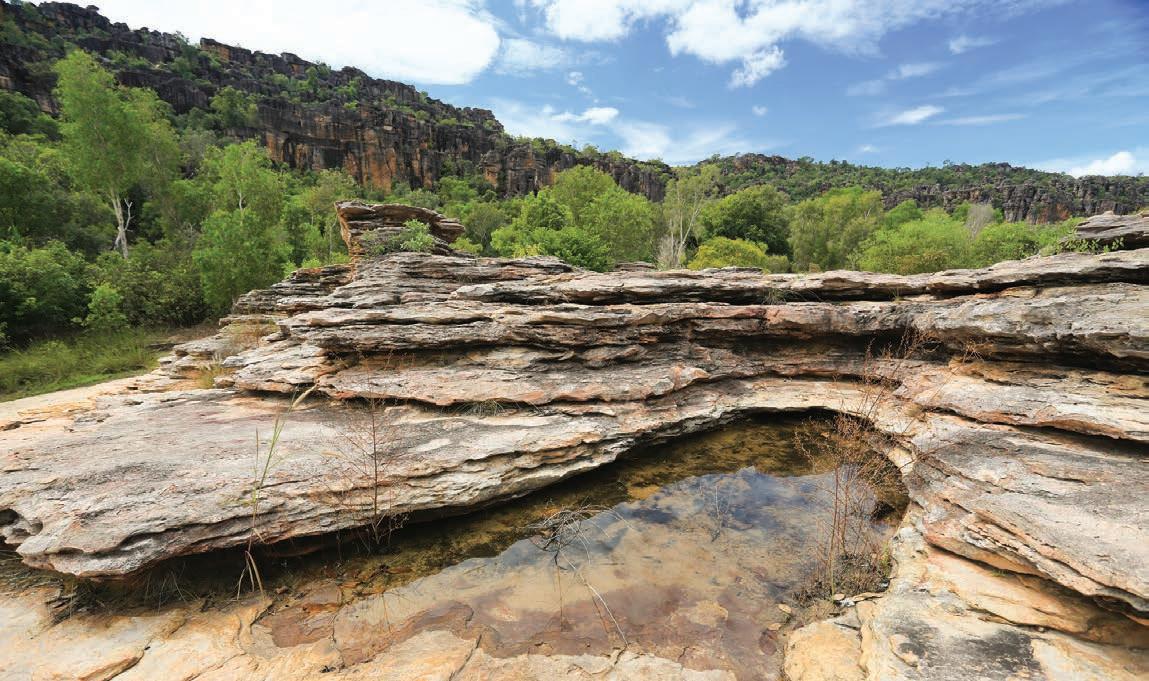
Kakadu National Park is the largest national park in Australia and it has exceptional cultural value. Among other things, the park boasts stone tools dating back more than 40,000 years, and numerous rock art sites.
The paintings found on rock walls represent a unique artistic achievement because of the wide range of styles used and detailed depiction of human figures and animal species. They provide a fascinating record of the life and ritual ceremonies of the Aboriginal population, the oldest people on the continent. The Aborigines painted the animals they hunted (some of them are now extinct), the tools they used and the events they saw. Generally, the act of painting was more important than the painting itself because the artists wanted to paint in order to tell a story. Red, orange and yellow pigments were produced from iron and mixed with water. The brushes they used were made of human hair.
The paintings cover a long chronological span since the oldest date back nearly 20,000 years and the most recent ones from contemporary times. Rock paintings are generally found in sheltered areas away from the direct effects of the elements, but even the most protected sites can be damaged by the actions of water, animals and insects. The thousands of people who visit the art sites each year are also a great threat to the rock art, but various measures have been taken to prevent damaging processes.
Today the Aboriginal people in Kakadu rarely paint on rocks. Painting is now mostly done on tree bark, paper or canvas.
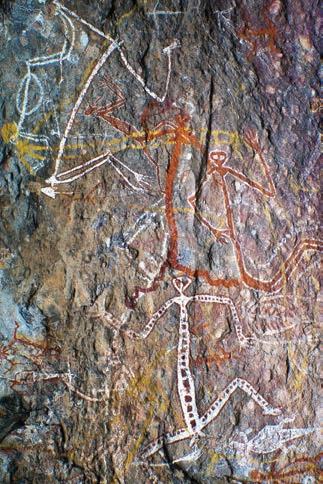
species – a group of plants or animals that are able to produce young plants or animals together extinct – no longer existing span – the period of time between two events boast (v) – to possess something that is a source of pride depiction – description, picture elements – (always plural) atmospheric forces, like wind and storm
1
In your opinion, are these statements true (T) or false (F)?
1. The National Park Kakadu is famous only for its scenery.
2. The Aborigines are natives of Australia.
3. The ancient Aborigines painted on the rocks pictures from everyday life.
4. They didn’t use colours for their paintings.
5. New generations of Aborigines don’t practise painting on rocks.
2
Complete the sentences in your own words using the information from the text.
1. Stone tools which were discovered dated ____________________________________.
2. The ancient inhabitants of Australia painted _________________________________.
3. Art sites provide _______________________________________________________.
4. The paintings were protected from _________________________________________.
5. Today the Aborigines paint on ____________________________________________.
Vocabulary
Match the highlighted adjectives from the text with the explanations. 1
1. amazing, hard to believe ___________
2. the only one of its kind ____________
3. in large numbers ________________
3
Complete the sentences with the word in the box.
1. It was raining heavily and we were trying to find a ____________ place.
2. Among the first drawings were _____________ of the hunt and fruit-gathering.
3. The time ___________ between two wars was very short.
4. At first, the heavy rain didn’t look like a __________ until it turned into a flood.
5. Did you know that gorillas are an endangered _________________?
4
4. unusual, extraordinary ____________
5. a short time ago _________________
6. belonging to the present ____________
Which nouns do these adjectives go with? Find them in the text. 2 species sheltered depictions threat span record boast depiction remarkable diversity
Replace the underlined words/phrases with the word from the box in the correct form.
1. The museum is the proud owner of a breathtaking collection of Aboriginal art.
2. Because of the variety of wildlife a lot of people travel to national parks.
3. I couldn’t find any evidence in the museum that Captain Cook landed in this area.
4. John’s description of his life on the farm was very vivid.
5. What is the most significant technological advancement in this century?
Word formation
5
Find the words in the text which form their adjectives or nouns in the following way and put them into the right box. Add more words which fit into one of the boxes.

noun +al/cal = adjective




verb + ion /tion = noun




1
2




3
Changing the stress record (n) /'rekQd/; to record (v) /rI'kO:d/






Focus on







Some words have the stress on a different syllable depending on whether they are a noun or a verb. For example: object /'QbdZIkt/ (n), /@b'dZ&kt/ (v); subject /'sVbdZIkt/ (n), /s@b'dZ&kt/ (v).
Find out how the following words are stressed when they are a) nouns, b) verbs: present, produce, protest, transport. Look them up in a dictionary.
A record/to record – different meanings
1. keep/maintain a record (a medical, historical, archeological record of something ) –information kept in writing about something that has happened
2. with the verbs set/hold/break/beat a record – the best achievement (especially in sport)
3. a re cord – a large round black piece of plastic containing music
4. t o record (music/an event) – to put it on a record/tape
5. off the re cord – not official
Explain the meaning of the word record in the following sentences.
1. In 1993 he held the world 400 metres record.
2. Will you try to keep a record of everything you eat the next three days?
3. He broke the record that Owens had kept until then.
4. Have you heard any music recorded by Miley Cyrus?
5. I’ve got all the records by the Beatles.
6. He decided to tell the judge all he knew, but off the record.

quiz AUSTRALIAN The
How much do you know about Australia? Underline the correct answer a. or b.



Discuss the following questions.
The capital city of Australia is a. Melbourne
b. Canberra
The first immigrants to Australia came from a. Holland
b. Britain
3. Australia is a a. constitutional monarchy*
b. republic
4. Australian animals that jump are a. koalas
b. kangaroos
5. The slang word for an Australian is a. Aussie
b. Austrie
6. The famous op era house is in a. Brisbane
b. Sydney
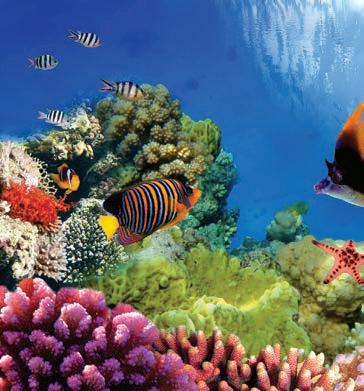
7. Which of the world’s greatest natural wonders is in Australia?
a. The Great Canyon
b. The Great Barrier Reef
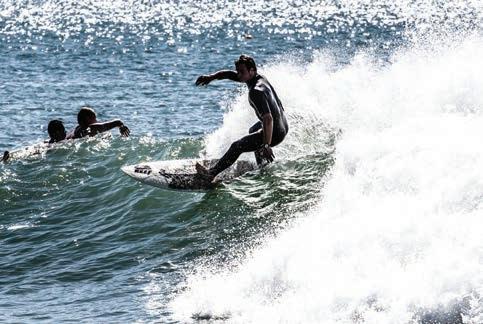
8. The Australians are very good at a. surfing
b. skiing
*A country ruled by a king or a queen whose powers are limited by a set of laws
1. Is this the first time that you have read something about the Aborigines and rock art?
2. What have you learned about Australia through this quiz?
3. Do you know anybody from Serbia who lives in Australia?
4. If you know more about one of the quiz items, share your knowledge with your fellow students.
Grammar
1
Review of tenses (1)
Present tenses
Put the verbs in brackets into the correct tense (the present simple, present continuous and present perfect tenses).
1. Kate always __________________ (invite) us to her country house.
2. I ______________________ (watch) a very exciting film. Can I phone you back later?
3. I __________________________ (pass) four exams recently.
4. It __________________________ (get) colder. I’ll fetch my sweater.
5. Lisa _____________________ (work) at a bookshop now, but she’s looking for something else, too.
6. We __________________________ (wash) the glasses. Look how clean they are.
7. Water __________________________ (freeze) at 00 C.
8. Susan ____________________ (live) in a very nice house in a quiet suburb.
9. Tim ________________ (leave) for Africa next week. He ________________ (already/buy) a ticket.
10. I _______________________ (know) Jack since our childhood.
2
Match the explanations with the sentences in Exercise 1 to show that you understand the use of tenses. The first one has been done for you.
a. activities in progress at the moment of speaking – sentence 2/PCT (the present continuous tense)
b. general facts
c. actions which began in the past and continued up to the present moment
d. repeated actions or habits
e. a finished action with a result in the present (focus on the result)
f. situations that we see as permanent g. something that someone has arranged to do in the near future
h. situations that we see as temporary i. situations which are slowly changing j. for describing recent events
State and activity verbs
Complete the sentences using the correct form of the verb. 3
1. look
a. ‘I’ve lost my purse.’ ‘What _______ it _______ like?’
b. ‘I __________________ for a new flat.’ ‘Do you like this neighbourhood?’
2. consider
a. The b oard ___________________ my plan for the new building area.
b. Most p eople _______________ Elton John to be the best singer in England.
3. think
a. I _________________ of going to Scotland.
b. What _________ you ___________ of our new history teacher?
4. see
a. I ___________ that Mary has a new dress.
b. ___ you __________ Tom tonight?
5. have
a. We _______________ a lovely time in Yellowstone Park at the moment.
b. I’ll talk to you when I ___________ more time.
YOSEMITE National Park
HOME OF GIANT SEQUOIAS
What do you expect to see or do in a national park? A I can see
B I can do
There are at least two things you shouldn’t do in a national park. Cross those words out.
camping, sailing, lighting fires, hunting, fishing, feeding animals, canoeing, bird watching
3
Reading
Yosemite National Park lies in the Sierra Nevada Mountains in California, and has been protected as a national treasure since 1890. It is named after the Yosemite Indians, early inhabitants of the region.
The park is an escape from urban life, especially for people of San Francisco and Los Angeles. Visitors can use regular roads to reach the points from where hundreds of miles of hiking trails start, leading them into the vast wilderness. There they can enjoy unspoiled nature far from the busy cities.
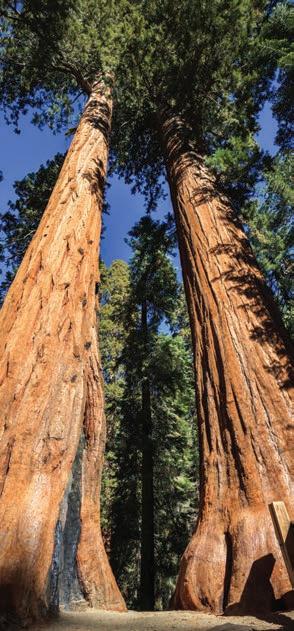
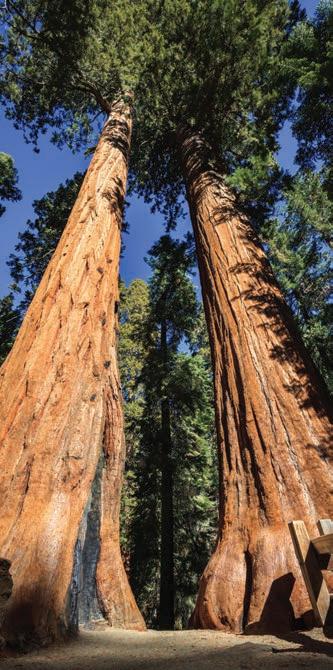
Yosemite is renowned for its granite cliffs, waterfalls, clear streams, valleys, biological diversity and most of all, for ancient giant sequoia
groves. The Mariposa Grove contains about 500 mature giant sequoias. They are perhaps the largest living things on Earth. The oldest ones may be more than 3,000 years of age.
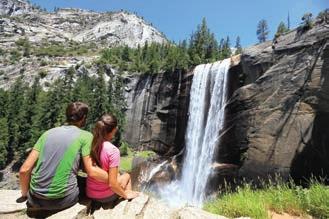
The park’s many waterfalls are especially spectacular in spring when an abundance of water from the melting snow rushes to the valleys. Among many waterfalls, 2,425-foot high Yosemite Falls is breathtaking and ranks as the tallest in North America.
The expansive park is home to hundreds of wildlife species and thousands of Yosemite plants. It supports more than 400 species including fish, reptiles, birds, and mammals. As hikers climb higher up, they find a greater diversity of vegetation and wildlife.
Since it is a wonderful destination for an outdoor experience, millions of visitors make a trip to Yosemite in order to explore the stunning scenery and enjoy a variety of recreational activities.
Glossary
trail – a path through the countryside treasure – something of great value grove – a small wood or other group of trees renowned – famous, celebrated mature – grown to full size expansive – covering a large area stunning – strikingly impressive, spectacular abundance – a large amount of something
Vocabulary
3 4
Answer the following questions about Yosemite Park.
1. What are the ways of travelling through the park?
2. Why do people from big cities come to the park?
3. Which part of the park contains a great number of sequoias?
4. What age can a sequoia reach?
5. When are the waterfalls abundant with water?
6. Besides sequoias, what species is the park home to?
7. Where do visitors have to climb to find a greater diversity of species?
What do these numbers in the text tell us?
400 500 3,000 1890 2,425
Match the adjectives with the nouns to get the correct collocations. 1
1. national 2. urban
3. hiking
4. vast 5. unspoiled
6. granite
7. melting
8. giant
2
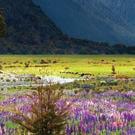

a. snow
b. nature
c. cliff
d. sequoia
e. wilderness
f. trail
g. life
h. treasure


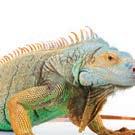

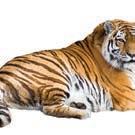
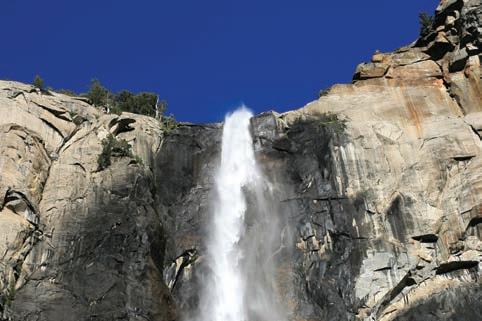
Match the words first with the definitions and then with the pictures.
1. A steep rock face, especially at the edge of the sea. __________
2. A part of a stream or river where running water falls down from a greater height. __________
3. A low area of land between hills or mountains, usually with a river or stream flowing through it. __________
4. A cold-blooded animal (snakes, lizards, crocodiles, turtles, etc.).
5. A type of warm-blooded animal that breastfeeds its babies and usually has fur. __________
waterfall reptile cliff mammal valley

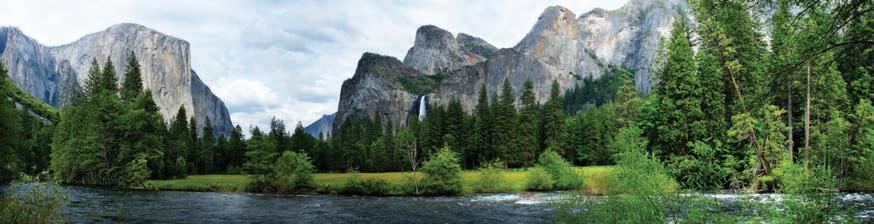

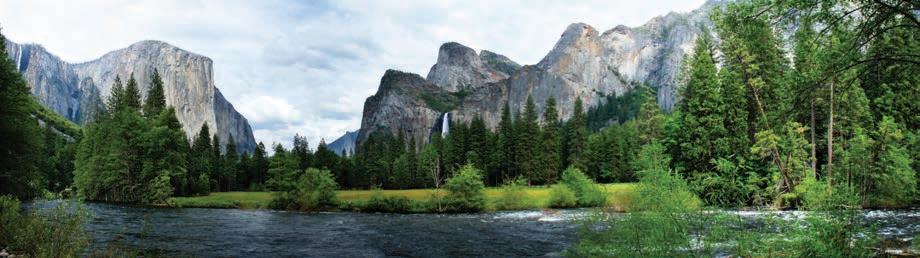
Della Peterson talks about her visits to Yosemite Park
You’re going to listen to the text about Della’s first close encounter with a bear.
• Have you ever met an animal which is considered to be dangerous?
• If you have, tell the class what happened. Was it a frightening experience?
Listen to the text and choose the alternative.
1. Della started visiting Yosemite Park as a child / as an adult.
2. People who camped in the park came from different countries / from Della’s home town.
3. Everybody should be careless / careful with a campfire.
4. Della usually takes photos of bears from the car / on the road.
5. She met a bear while she was going to / returning from the dance.
6. Della was more scared than the bear. / Both Della and the bear were scared.
7. Della / The bear ran away at once.
Grammar
1
Nouns with the same form in the singular and plural
Plural of nouns
Plural nouns
Some countable nouns have the same form in both singular and plural.
Example: species, series, means, crossroads, spacecraft
Many of these nouns refer to animals or fish: bison, deer, elk, reindeer; fish, trout, goldfish, salmon, etc. E.g. one sheep / ten sheep
Note: If you don’t know these words, look them up in the Word List at the end of the book.
Note: Some plural nouns do not end in ‘s’: police, people, cattle. 2
a) The following nouns have only the plural form: goods, clothes, teens, surroundings, belongings, etc.
b) Clothes and tools
These two special groups of nouns are usually plural because some clothes and tools are made of two parts: trousers, bermudas, shorts, pyjamas, tights, pants, scissors, glasses, braces, scales, etc.
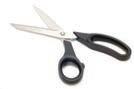

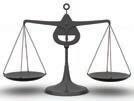

3
Singular nouns ending in –s news, measles (and many other diseases), mathematics, physics (used as subjects) These nouns are used with a verb in the singular and can’t take the indefinite article.
4
Collective nouns
a) money, luggage, furniture, jewellery, etc. are used as uncountable nouns and take a verb in the singular.
1
Underline the correct verb form.
3
2. Measles is/are a children’s disease.
3. Cattle is/are in the field.


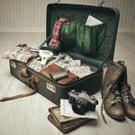
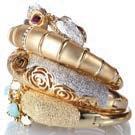


b) family, team, crew, etc. can take either a singular or plural verb. If we consider the word to mean a single group, we use a singular verb, and if we think it means a number of individuals, we use a plural verb. Our team is winning. (The group as a whole.) The team are having a shower. (We think of individuals.)
Practice
1. The police has/have arrested three burglars in the museum.
4. His belongings was/were given to the family.
5. A lot of bird species is/are known on this mountain.
6. A lot of money is/are saved for homeless children.
7. Can you bring me the glasses which is/are on the table?
8. There is/are a lot of fish in the river near my house.
2
Read the text Yosemite National Park again and underline all the uncountable nouns.
1. Do they have plural forms?
2. Can you use the indefinite article with uncountable nouns?
3. Underline the verb forms which you use with these nouns: is, are, has, have.
4. Underline the words which can be used with uncountable nouns: some, little, a little, few, a few, any.
Which of the nouns in italics are countable and which are uncountable? Complete the sentences with a (an) or some.
1. Can I give you a.________ advice? b. _______ suggestion?
2. I’ve just heard a. ________interesting news. b. _______ interesting announcement.
3. Do you need a. _______ room? b. _______accommodation?
4. He’s carrying a. _______ heavy luggage. b. _______ heavy suitcase.
Reading and vocabulary
THE LAKE DISTRICT
Choose A, B or C to complete the text.
The Lake District, located in north-west England, (1) _____England’s highest mountain, Scafell Pike, and its longest lake, Windermere. This is (2) ______ the country’s most beautiful outdoor playground which (3)______nearly 16 million visitors every year. The countryside of the Lake District was the inspiration for many great artists, including the poet William Wordsworth and the painter Turner.
As its name suggests, this national park is (4) ______for spectacular landscapes and an ____ (5) of lakes. The lakes, rivers and coastline of the Lake District National Park offer exciting opportunities for water recreation, from swimming to sailing, canoeing, kayaking and windsurfing.
The landscape is not only (6) _____ beautiful, but it also has a rich cultural legacy, which (7) ______stone walls dating from the medieval period. William Wordsworth loved this part of England and his poems speak of the joy he felt when surrounded by this beautiful countryside.
1. A has B c onsists
2. A doubtless B sure
C b oasts
C without doubt
3. A visits B receive C welc omes
4. A established B renowned C c elebrated
5. A many B abundance C lot
6. A incredibly B unbelievable C incredible
7. A contain B includes C involve

track 5
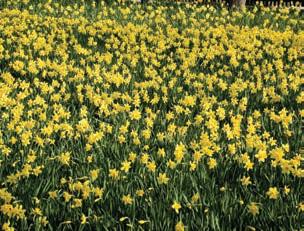
Now you are going to read two stanzas of Wordsworth’s poem The Daffodils. Choose the words that rhyme to complete the poem. Then listen to the poem to check.
hills • line
I wandered lonely as a cloud That floats on high o’er valleys and __________, When all at once I saw a ___________,
A host of golden daffodils; Beside the lake, beneath the trees, Fluttering and dancing with the ___________.
Continuous as the stars that shine And twinkle on the Milky Way, They stretched in never-ending ________ Along the margin of the __________; Ten thousand saw I at a glance Tossing their heads in sprightly __________.
Glossary
Find the words in the poem which have the same meaning as the following: 3
1. under –______________
2. a quick look –__________
3. a light wind – ____________
4. a large number of –________
5. endless – ________________
6. to give off light – _________
Find the best explanation for the following words. 4
1. _____________ – move about without a definite destination or purpose
2. _____________ – move through the air making small, fast movements
3. _____________ – move to music
4. _____________ – extend over a distance
5. _____________ – move slowly or rest in the water or in the air
o’er – over the Milky Way – a pale path of light consisting of many stars sprightly – lively toss stretch wander dance flutter float
6. _____________ – move from side to side or up and down
• What do all these verbs have in common?
Writing
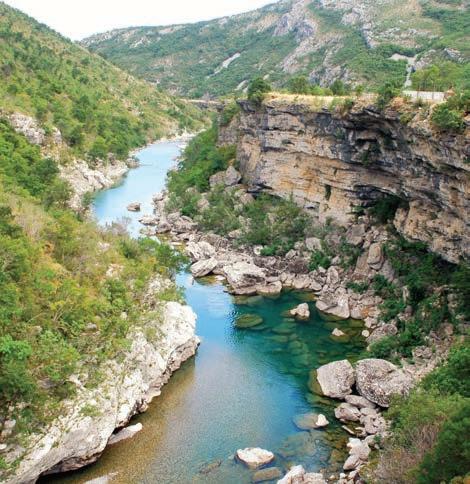
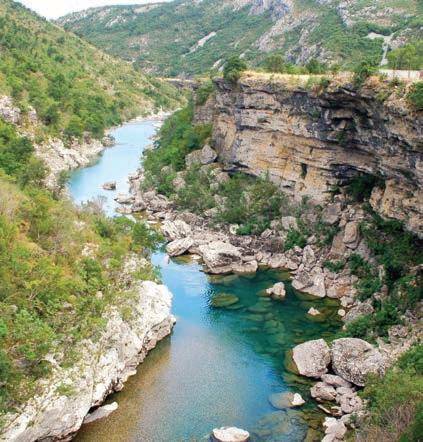
TARA
NATIONAL PARK
1. What do you know about the national parks in Serbia?
2. Have you visited any of them?
3. Choose one national park to write about. We suggest writing about Tara National Park and using some of the given phrases. You can find more information on the Internet.
Useful phrases
… established in / …is located / …above sea level / well-preserved forests… / meadows, cliffs… / the highest peak … / boast rare species / the Serbian Spruce / home to bears, deer, wolves… / tourist resort
1
Key word transformations
Rewrite the sentences beginning with the word given so that the meanings remain the same.
1. It has b een years since she left her home./ago She ____________________________________________.
2. Richard can’t wait to hear Helen’s story./forward Richard is _____________________________________Helen’s story.
3. Our maths teacher explains everything clearly and precisely./are Our maths teacher’s ______________________ clear and precise.
4. I’m sure you’ll be amused by the latest Bond film./find I’m sure _____________________________ the latest Bond film amusing.
5. Yos emite Falls ranks as the tallest in North America./than Yosemite Falls ______________________ many other waterfalls.
Communication
EXPRESSING PREFERENCE AND PLEASURE
Read the following phrases/sentences we use to express preference and do the exercise below.
AExpressing preference
I prefer tea to coffee, actually.
I prefer to go for an outing rather than to stay in.
I like a …
Perhaps, it’d be better if we...
I think I’d prefer... (to go out/ watch a film/play games)
B
Asking about preference
Which do/would you prefer?
Would you prefer to…?
Which of these do you like best/ more?
Would you rather...?
Is there anything you particularly like?
2
Complete this conversation between John and Mary, using the sentences/questions or phrases from A, B and C.
Add other words if necessary.
John: What are we going to do next?
Mary: We can go out or stay here. Which ______________________?
John: Perhaps _______________________ go out.
Mary: What do you suggest?
C
Having no preference
It’s up to you.
As you like.
Whatever/Whichever you like.
Either of them will do.
I don’t mind – I’ll have either. It’s all the same to me.
Either will do – I have no preference.
It really doesn’t matter to me.
John: Let me see… How about going for a walk? Or ________________go to the Amusement Park?
Mary: What shall we do in the park? Play or just walk around?
John: It’s ______________. Either ________________.
Mary: When I come to think about it, I________________ to go to the cinema.
Self-assessment TEST 1
3. The luggage has /have been put into the train compartment. 1 3 4 2
Complete the sentences using words from the List in the correct form. (5 pts.)
1. On the way home, we saw an ____________ of flowers in the meadows.
2. We tried to______________ from the rain in a nearby cottage.
3. A small hut in the mountains is our ____________________ from everyday busy life.
4. How many rock art ___________ have they visited?
5. We went to the forest to study the diversity of _____________.
Complete the sentences with the correct forms of the verbs in brackets. (6 pts.)
1. At the moment, she ______________ (do) the washing-up.
2. I ______________ (not/be) to a disco for a long time.
3. I can’t talk on the phone now. I _______________ (drive) home.
4. How long __________ you ___________ (live) on your own in this flat?
5. I can’t stand it! He __________________ (always/slam) the door.
6. This painting __________________ (be) in the family for centuries.
Word formation
Make adjectives from nouns and nouns from verbs. (6 pts.)
Noun − Adjective Verb − Noun exception − ________________ recreate − ________________ biology − ________________ depict − _________________ culture − _________________ o ccupy − _________________
Plural of nouns
Choose the correct alternative. (3 pts.)
1. The police was /were not able to find anything.
2. The news is /are very good these days.
KEY WORD LIST
Verbs boast shelter depict Nouns depiction record species escape abundance span site treasure trail Adjectives renowned expansive giant breathtaking spectacular stunning contemporary
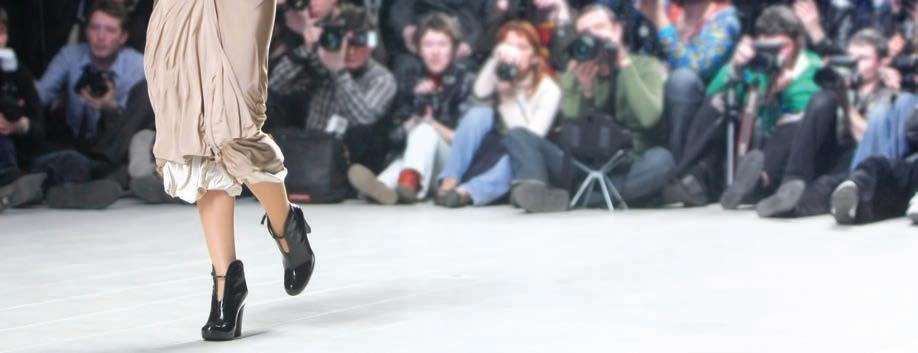
FASHION Unit 2
In this unit, you will

• read, listen and talk about
a. people’s opinion on fashion b. the history of some fashion trends
• practise the past participle the past simple and continuous tenses correlative conjunctions linking words and phrases comparative constructions complimenting people on clothes
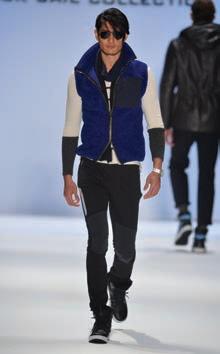
Lead-in
FASHION WORDS
Match the words (1-8) with their definitions (a-h).
1. a catwalk
2. a c ollection
3. fashion
4. a fashion show
5. a label
6. a mo del
7. modelling
8. a sup ermodel
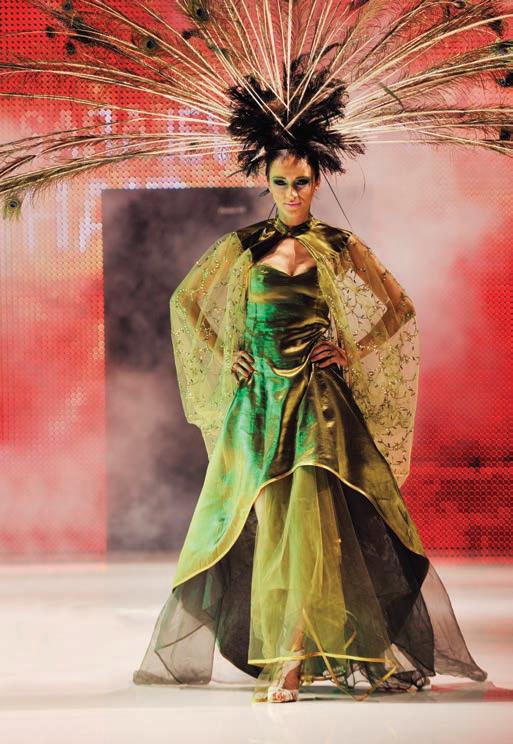
a. the job of working as a model
b. the raised area at a fashion show that the models walk along
c. a pie ce of clothing made by a very famous designer
d. a very famous fashion model who earns a lot of money
e. clothes or other products that become available at a particular time of year
f. a style of dress that is popular at a particular time
g. an event at which models show new styles of clothes
h. s omeone whose job is to show clothes, make-up, etc. by wearing them at fashion shows
Reading and speaking THE mini REVOLUTION
Discuss these questions in class.
1. How important is fashion to you?
2. How much do you follow trends?
3. Do you like experimenting with different styles?
4. Do you read fashion magazines? Why? Why not?
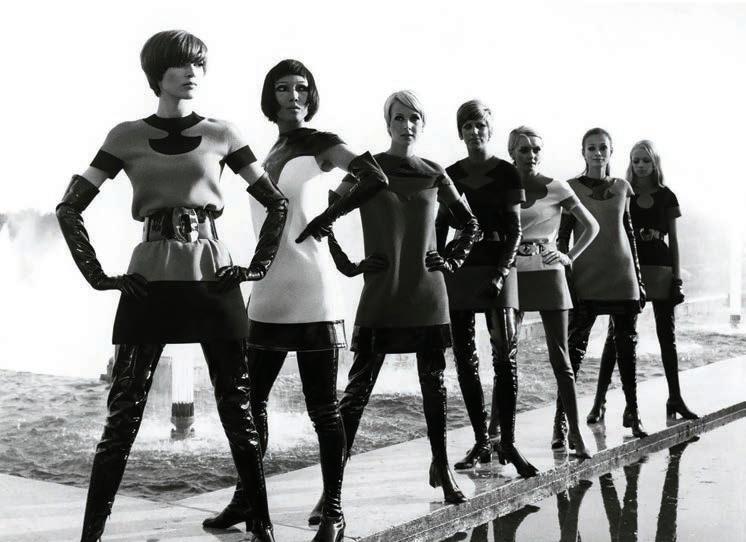
When most people think of ‘fashion’, they think of women’s clothes in particular. On the one hand, it is true that the ‘world of fashion’ implies the latest models from Paris, New York or London. On the other, it is also a big business which affects not only clothing, but also almost every aspect of daily life.
The 1960s was a fast-moving decade in fashion, lifestyles and innovations. It was then that the mini-skirt arrived on the fashion scene as a way of rebelling. For the first time the young became the leaders of fashion. In a popular TV Saturday night programme a model appeared wearing a short mini dress. It could hardly be considered appropriate. The audience laughed and gasped, but within less than a year the shorter length was firmly established. The mini-skirt revolution swept the UK and soon the rest of the globe.
Mary Quant took credit for making this style popular and gave it its name, although she took the idea from other designs. Quant made the mini-skirt considerably shorter than other designers did, and it became instantly popular with young London women. In the early Sixties London girls were seeking new things and were willing to wear mini-skirts. The fashion trend took off because the outfit was so different and youthful. By promoting these and other fashions she encouraged young people to dress to please themselves and to treat fashion as a game. Her skirts, designed to be simple and practical, soon became copied and popular everywhere.
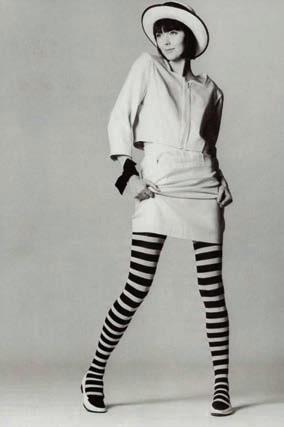
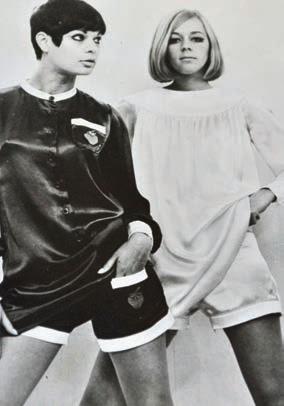
In addition to the mini-skirt, Quant is often credited with inventing the coloured tights patterned to match the mini. The innovation of tights which replaced stockings made the mini more acceptable. In the late 1960s, Quant’s last major fashion development was the introduction of hot pants. A trend born in the youth culture of Britain immediately found its way onto the catwalks of Paris. With the beginning of the hippy era, minis fell out of fashion because longer skirts or bell-bottomed trousers became popular. However, it has never entirely disappeared from closets and in combination with thick tights or leggings, it keeps coming back into fashion though it isn’t a way of liberation anymore.
Glossary
imply – to suggest something without saying, include gasp – to breathe in suddenly because you are surprised take credit for – to receive praise for something done take off – to sell well; suddenly becomes successful outfit – a set of clothes tights – close-fitting stockings usually worn by women and children fall out of fashion – to stop being fashionable
2 3
Complete the sentences in your own words by using the information from the text.
1. The mini-skirt style was accepted ________________________________________.
2. Mary Quant was considered ____________________________________________.
3. She also invented _____________________________________________________.
4. Longer skirts replaced _________________________________________________.
5. Mini-skirts are worn in combinations _____________________________________.
6. At first, the mini was a way of rebelling, but today __________________________.
Find the sentences in the text which say that
1. Mary Quant was not the first one who designed the mini-skirt.
2. other famous fashion centres accepted the mini.
3. young London girls of the Sixties were eager to accept something new.
4. mini-skirts have still remained part of women’s wardrobe.
Vocabulary
1 2
VOCABULAR Y
Complete the sentences with words from the box in the correct form.
1. Some people think that it is ______________ to wear jeans in the office.
2. The new style really among teenagers.
3. Flu _ suddenly throughout the country.
4. It was a act to jump into the pool with freezing water.
5. Teenagers often _ against their parents.
6. I’d like to buy those trousers with a striped .
7. Some young people move to other countries to a better life.
Which adverb in sentences a-e means the following?
1. strongly
2. barely
3. greatly, significantly
4. immediately, at once
5. completely
a. I feel entirely responsible for his absence.
seek sweep daring take off appropriate pattern rebel
b. I firmly believe that Mark has told the truth.
c. I was deeply offended and instantly left the room.
d. He considerably changed his way of life.
e. I could hardly believe you said that.
Speaking
Discuss these questions in class.
1. What is the first thing you notice about a person?
2. Do you look closely at people’s clothes?
3. Do you think that the clothes someone wears say something about that person?
4. Were there any fashion trends in the past that you followed, but they look silly to you now?
5. How long does it take you to get ready in the morning? Does it take you long to choose what to wear?
Grammar
The
past participle
The past participle of regular verbs is formed by adding -ed or -d to the infinitive. For example: wanted, moved, expressed, etc.
For the past participle of irregular verbs, see The list of irregular verbs.
The past participle is used
1. to form the present and past perfect, perfect infinitive and all the passive forms. Hot pants have come back into fashion this summer. Mary might have taken the idea from other designs. His new collection will be soon shown on the catwalks of Milan.
2. to replace a relative pronoun and the verb be, to shorten a passive sentence. She invented the coloured tights which were patterned to match the mini. She invented the coloured tights patterned to match the mini.
3. as an adje ctive, with a passive meaning. painted glass, a broken vase
Practice
Rewrite the sentences using the past participle. 1
1. I saw some lovely flowers. The flowers were arranged in a vase.
2. This is the last photo that was taken of my grandfather.
3. The new club, which is located on the beach, attracts young tourists.
4. My grandfather came in. He was disguised as Santa Claus.
5. My company imports tea which was produced in India.
6. The event was organized by my club and it was a great success.
2
Complete the sentences using your own ideas.
1. Tired of waiting for his friend, ______________________________________.
2. Pleased with her son’s school report, __________________________________.
3. Hurt by my best friend’s remark, _____________________________________.
4. Delighted with the dress, ____________________________________________.
5. Frightened by the dog’s bark, ________________________________________.
6. Encouraged by her sudden success, Mary Quant _________________________.
Review of tenses (2)
The past simple and continuous tenses
e. questions beginning with when? 1 2
Study the tenses in these sentences and then do Exercise 2.
1. When did you arrive last week?
2. I was having dinner when I heard someone screaming outside.
3. I was sleeping at ten o’clock last night because I was tired.
4. She found a purse full of money yesterday.
5. I used to attend fashion shows.
Which of the above tenses is used to describe
a. what happened at a specific time in the past (a past reference is given or understood)?
b. an event which was in progress at a certain time in the past?
c. past habits?
d. a temporary event in the past which was in progress when another event took place?
3
Name the verb tense in the following pairs of sentences. What is the difference in meaning between the sentences in each pair?
1. a. I was crossing the street when a car crashed into a post.
b. I crossed the street when a car crashed into a post.
2. a. He worked in that firm for ten years when he lived in Belgrade.
b. He’s worked in that firm for ten years.
3. a. I was reading a book last night.
b. I read a book last night.
4
Put the verbs in brackets into the correct tense.
1. While I ____________ (phone) my mother, I ____________ (get) a message from her.
2. In the 1960s, the mini-skirt trend _________ (sweep) the whole world.
3. When she was young, she never ____________ (eat) meat.
4. Do you know the girl who _______________________ (just/leave) the restaurant?
5. I suddenly realized that Mary _______________ (drive) in the wrong direction.
6. She is sad because she ______________ (lose) her new mobile phone.
7. How often ________________ (he/go) on a business trip this month?
8. When ______________ (you/finish) the project?
Listening
1
2
The past simple contrasted to the past continuous or present perfect track 8
3 On the catwalk
Before listening to the text, discuss the following questions.
1. What qualities do you think a fashion model should have?
2. Do you think that modelling is an easy profession?
3. Do all fashion models earn a lot of money?
4. Are the same qualities required of male and female models?
Before you start listening, check the meanings of the following words and expressions. shoot (n), casting, to make ends meet, retirement package, short-lived
Some parts in the text On the catwalk have been changed. Listen once carefully. Then read the text and try to find the mistakes which considerably changed the meaning. Listen again and check to see how successful you were.
On the catwalk
Adele, a former top model, is talking about the real world of fashion models and her own experience.
What is the life of a fashion model like?
Becoming a model is the dream of many young girls or boys who long for designer clothes. I did all the big shows in Europe and America and I know what the life of a model is like. It is often far less glamorous than it appears. Top models may earn millions of dollars a month, but there are also those who attend never-ending castings and struggle to make ends meet. Sometimes we are a star and sometimes a failure. This is life.
What is required to become a top model?
Making it to the top requires just a pretty face and an incredible body. There isn’t a single recipe about how to rise above the rest. Modelling might look easy, but you might be surprised to see how little work is necessary to make it to the top and stay there.
Are there any bad sides of a modelling career?
While being a model has no rewards, keep in mind that the professional cycle of a model is extremely short-lived. It’s unpredictable work, insecure, and you don’t get benefits like health care or a retirement package. That’s why many of us decided to study between shoots and prepare for a life after a modelling career.
Thank you very much for taking part in our show.
Answer these questions and then add more information that you get from the text.
1. Was Adele a successful model?
2. Do all the models have to attend castings?
3. Is it enough to have a pretty face to become a top model?
4. Do many girls study while working as a model?
5. Is modelling an insecure job?
IS FASHION IMPORTANT?
Reading and speaking
1Discuss these questions with a partner.
1. What is your attitude to the fashions currently popular in your country?
2. How do clothes affect the way you react to other people?
3. Do students have to be properly dressed when they go to school?
4. How would you describe the way you dress for school?
5. How do you understand the saying ‘Don’t judge a book by its cover and people by their clothes’. Do you agree with it?
track 9
Catherine Fashion is important for self-esteem. Girls feel good when they are well-dressed and when people compliment them on how they look. However, you don’t have to get expensive clothes to be fashionable; you can buy cheaper items and make them into something more striking.


When we look back to the past, we can see that long and short skirts took turns on the fashion scene. It is also amazing how Converse shoes reappeared in a range of beautiful colours.


Clara
David
Five students are talking about their views on fashion for a fashion magazine. The interviewer suggested the following questions:
A Is fashion important to you?
B Which p eriods in fashion history do you like best or least?
Men’s fashions haven’t changed much, at least not so much as women’s. That’s why I can’t choose a fashion from any period in the past. I wear certain classic combinations which are never outdated. I think that men should also pay attention to the way they dress. The first impression is very important, especially if you go for a job interview. However, in my spare time I enjoy wearing T-shirts, sweatshirts, running jackets and other sports clothes.


Fashion is not important to me. I believe that I can be as happy in a dress with a popular brand name as in a cheap and comfortable one that just looks nice on me. I don’t waste a lot of money on an item of clothing because fashion changes too often. Sometimes the dresses from my grandmother’s wardrobe can come in handy because I enjoy making odd combinations. As for other periods, I’d like to wear loose flowery dresses, as they were worn in the hippy era. I hope they will become fashionable again while I am still young.
Paul
Fashion is a bit overrated today. Advertisements and fashion shows imply that fashion is an essential factor in our lives, which is not true. Personally, I wear what I like rather than simply follow trends. Trends come and go and when we look back on them we sometimes realize how ridiculous they were. I don’t like the 70s when men wore bell-bottoms, colourful shirts, big chains and platform shoes.
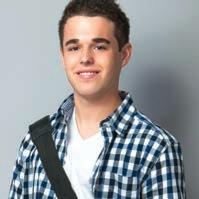
Diana
Despite other people’s opinions, I do think that people should follow fashion, but choose only those trends that suit them and at the same time, express their individuality and their taste in clothes. I believe the way someone follows fashion trends says a lot about them, whether good or bad. I like some brand names which appeared at the end of the 20th century, especially those made for young people or those launched by celebrities.


Glossary
self-esteem – confidence in one’s own abilities
casual (clothes) – suitable for everyday wear rather than formal occasions
wardrobe – the total collection of clothes belonging to one person; a closet or cupboard launch – to put a new product on sale
bell-bottoms – trousers that become wider from the knees downward, forming a bell shape ridiculous – silly, unreasonable loose – not fitting closely
2
Match the students and their opinions. Which student
1. thinks that some of the fashion trends in the past were sometimes silly? __________
2. likes to be dressed in the clothes hippies used to wear?
3. believes that men should be well-dressed? __________
4. likes famous brands? __________
5. mentions that some trends keep coming back?
6. says that it is more important to wear comfortable and suitable clothes? __________
7. believes that the way people dress says a lot about their personality? __________
8. thinks that fashion isn’t very important? __________
9. believes that with some changes cheap clothes can become fashionable? __________
10. says that men in classic combinations are always trendy?
What about you?
Which of the students share your views on the subject? Why?
Vocabulary
1
Complete the sentences using the words from the box.
1. What are the new _____________ in everyday clothes?
2. Oh! You’re dressed up. What’s the _____________?
3. She likes to borrow clothes from her mother’s _______________.
4. What is the other word for sneakers? _____________
5. I bought a nice, new _____________to wear on the first day of the school year.
6. You can’t put on a _____________dress if you’re going to a party.
7. This store sells only the _____________ handbags.
8. We’ve decided to go skiing and now we have to buy new winter _____________.
9. People who design clothing professionally are _____________.
2
People’s appearance
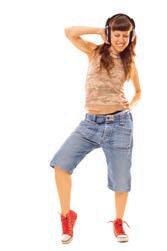
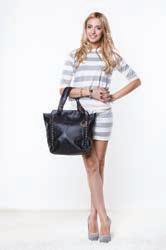
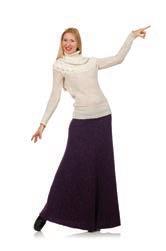
What do these people look like? Complete the sentences with the words from the box. Add more information that you get from the pictures.
1. She’s wearing __________ with a mini-skirt. She’s carrying a __________ in her hand.
2. She’s dressed in a __________ skirt and a __________ pullover.
3. He’s wearing a shirt with the __________ rolled-up and a pair of trousers held up by a __________ with a large buckle.
4. She’s put on a pair of __________ trousers, and she has a pair of __________ on her feet.
• long
• handbag • tights
• cropped • belt
• trainers • sleeves
• polo-neck

Word formation
PREFIXES
over- = too much, excessively (overconfident) under- = not enough (undercook) re- = again (rebuild) dis- = the opposite (disconnect) mis- = wrong, incorrect (misbehave) trends casual designers sportswear latest fashion occasion outfit trainers wardrobe
3
Complete the second sentence by using the underlined word in the correct form and a prefix.
1. I didn’t pronounce the word ‘ridiculous’ properly. I __________________ it.
2. My parents don’t approve of my going out late at night. They _______________.
3. Why did you cook this meat for two hours? You _________________ it.
4. This page hasn’t been printed well. It has to be _________________.
5. We can’t book tickets for the flight to Boston. The flight is ___________.
6. Jack wasn’t paid enough for his job. He’s ________________.


ERROR CORRECTION
Read the text, find eight spelling mistakes in it and correct them.
Blue jeans
Jeans have been widely in use for many decades. Do you know the story of the origine of this useful peace of clothing? The first jeans were made of a special cloth called denim. An imigrant from Bavaria, Levi Strauss, brought this cloth to San Francisco in 1850 intending to make tents and covers for gold miners. But instead, the miners needed strong pants which wouldn’t wear out and Levi took denim to a tailor and had a few pairs of pants made for the miners. Levi also put metal corners in the pokets to keep gold in them.
At first only gold miners and cowboys wore denim pants. A handred years later people of other profesions were wearing jeans of various leibels, but Levi’s blue jeans were the first to brake through.
1.
Discuss the following questions.
1. Do you like wearing jeans?
2. In your opinion, why are jeans so popular? Mention the good and bad sides.
3. Are Levi’s jeans still popular? Which other brands do you know?
Grammar
Correlative conjunctions
Correlative conjunctions are used in pairs to connect words, phrases, and clauses of equal rank. both...and • as...as • either...or • neither...nor • not only but also
Here are a few example sentences:
• Neither you nor Andrew has got the promotion.
• I’ll have both the cheesecake and coffee.
• Mary was not only a fashion model, but also a good actress.
Watch out! A verb which follows two subjects joined by a correlative conjunction neither must agree with the second subject, NOT the first:
• Neither the manager nor his assistant is present.
• Neither the manager nor his assistants are here today.
Comparative constructions
To make a comparison between two people or things we can use the construction as…as with adjectives and adverbs. In negative sentences so can be used instead of the first as.
She’s as talented as her sister. / The trains don’t travel as fast as planes. Fashion models are not so popular as actresses. Men’s fashions haven’t changed much, at least not so much as women’s.
Practice
Use the conjunctions from the box to complete the sentences.
1. There are many books there are students. We don’t need any more.
2. It’s my final offer –you can take it leave it.
3. The joke was clever funny. I didn’t like it.
4. French German are spoken in Switzerland.
5. He’s ______ a successful businessman a good father.
Key word transformations
Rewrite the sentences beginning with the word/words given so that the meanings remain the same.
1. She was shocked by his appearance and started trembling. Shocked _________________________________________________.
2. The film is based on real events and tells the story of an actress. Based ___________________________________________________.
3. Jane was born in Hollywood and knows all the famous movie stars. Born ____________________________________________________.
4. Susan was admired by everyone and became conceited. Admired _________________________________________________.
5. Jack didn’t play cricket on Sunday. His brother didn’t play cricket either. Neither ___________________________________________________.
6. My son, Simon, likes sweets. My other son, John, also likes sweets. Not only __________________________________________________.
Focus on
LINKING WORDS AND PHRASES
5. You didn’t call. We left without you. (since) 1 2
Study the use of linking words and phrases in the box.
To add a point To contrast two points Result/Consequences To summarize or conclude
• Also
• In addition
• Similarly
• Moreover
• Furthermore
• However
• Although
• On the other hand
• Yet
• Nevertheless
• Otherwise
• Whereas
• So
• Therefore
• As a result
• Consequently
• Despite/In spite of
• Since
• Provided that
• Finally
• In conclusion
• To conclude
• To summarize
• In brief
• Therefore
Make one sentence from the two sentences below, using the word/s in brackets. Example: It was raining. We played tennis. (even though) Even though it was raining, we played tennis.
1. You can go out tonight. You must tell us where you are going. (provided)
2. The weather was bad. They enjoyed the trip. (despite)
3. Television can be educational. I think it’s better to read a book. (even though)
4. George is a successful businessman. His son is a complete failure. (whereas)

Writing
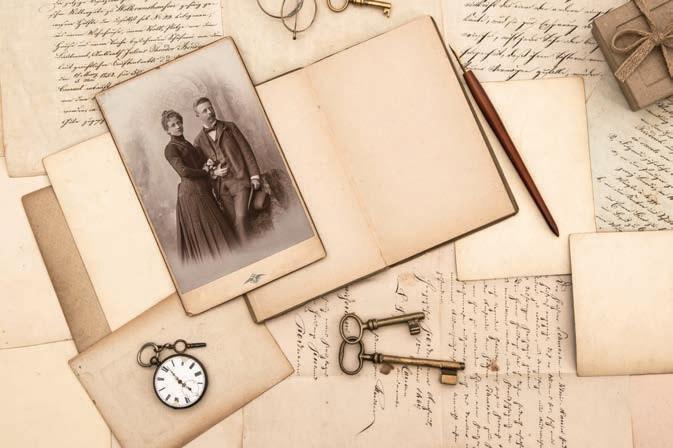
Choose one of the two topics to write a short composition of 120 – 150 words.
1. A fashion show (you have been to or watched on television)
Mention: the theme of the show, the name of the designer, what the clothes looked like, what the models looked like, what you liked / you didn’t like about the show and the fashions that were presented. Use a range of linking words from the table.
2. Find an old photo in your family scrapbook and describe how the people in the photo were dressed.
Communication
COMPLIMENTING PEOPLE ON CLOTHES
Complete the dialogue using the part of student B.
Student A
A: That’s a very nice jacket you’re wearing.
B:
A: Yes, and it goes well with your new blouse, too.
B:__________________________________________________________
A: Of course it does.
B: _________________________________________________________
A: Yes, it looks fabulous. How much did you pay for it?
B: _________________________________________________________
Student B
• Do you think this blouse really suits me?
• Do you really like it?
• You’ll never believe it, but it only costs 4 pounds.
• What about this scarf? Does it match my blouse?
Work in pairs. Compliment your partner on the clothes he/she is wearing. Take turns to play role A or B.
Self-assessment TEST 2
4. The workers are on strike because they are ________ paid. 1 2 3 4
Complete the sentences by using one of the words from the List in the correct form. (6 pts.)
1. They made a film to __________ their plan for healthy eating among schoolchildren.
2. I hop e this book will help young people build their ____________.
3. I don’t think he is a good singer. His abilities are _____________.
4. A new spring c ollection has been __________ on the catwalks of Paris.
5. I didn’t mean to ___________ that she was lying.
6. Young p eople often _________ against the way they are brought up.
Transform two sentences into one using the past participle. (4 pts.)
1. The plane was delayed by bad weather. It took off four hours later.
2. The man was injured. He was taken to hospital.
3. The money was stolen. It was found by the river.
4. The window was locked. Jack tried to open it.
Put the verbs in brackets into the correct tense. (6 pts.)
1. I made a lot of mistakes while I ________________ (write) my homework.
2. Just as I ______________ (come) to an interesting part of the story, the doorbell ___________ (ring).
3. Where _______________ (you/buy) such an amazing hat?
4. I _______________(work) on my computer, so I _____________ (not/hear) the phone ring.
Fill in the gaps with one of the prefixes: over or under. (4 pts.)
1. I didn’t hear the alarm clock and I ________slept.
2. It is so hot in this room. You have ________ heated it.
3. We ________estimated the cost of the holiday and ran out of money.
KEY WORD LIST
Verbs rebel sweep gasp imply promote encourage launch Nouns pattern catwalk outfit brand self-esteem
Adjectives loose ridiculous overrated Expressions take credit for take off fall out of
20 points KEY – page 184

ART AND ARTISTS Unit 3
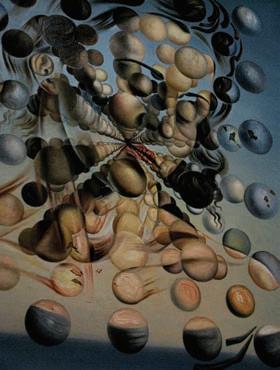
In this unit, you will
• read, listen and talk about
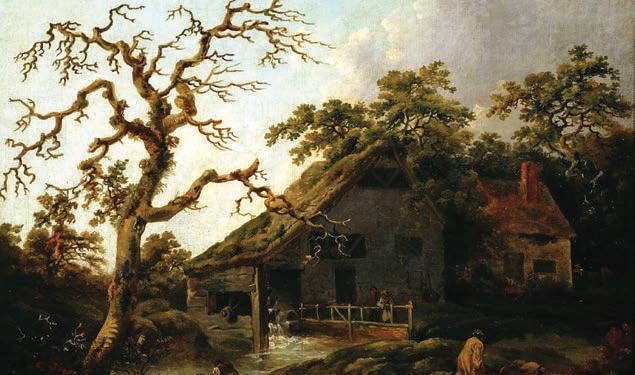
Lead-in
1
a. famous painters W. Turner and S. Dali
b. commercial art and Andy Warhol
• practise the present and perfect participles phrasal verbs with set passive forms of the infinitive and gerund saying ‘no’ nicely
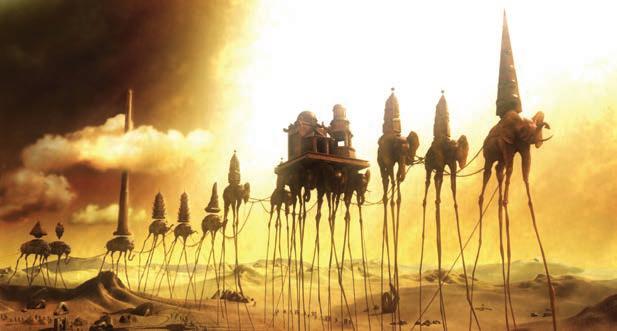
What do you think these people are talking about?
1. I prefer landscapes to still lifes.
2. I was feeling ill, so I left after the second act.
3. It doesn’t have to rhyme to be good.
4. This artist prefers to shape figures in stone or wood.
5. The first chapter was exciting, but it got boring later.
6. Anna was dancing gracefully, dressed as a swan.
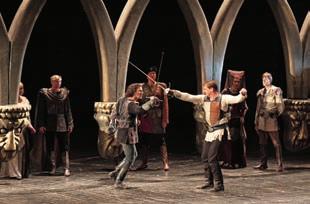

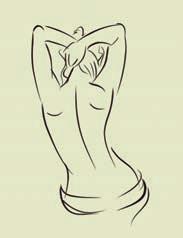
2
Match the works of art (1-5) with their definitions (a-e).
1. a landscape
2. a still life
3. a sculpture
4. a portrait
5. a sketch
a. a picture of a person
b. a solid work of art made by shaping stone, metal or wood
c. a picture of everyday objects, such as flowers or fruit
d. a rough or unfinished drawing or painting
e. a depiction of natural scenery, such as mountains or forests
Reading THE PAINTER of light OF CULTURAL IDENTITY
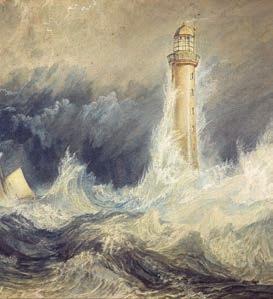
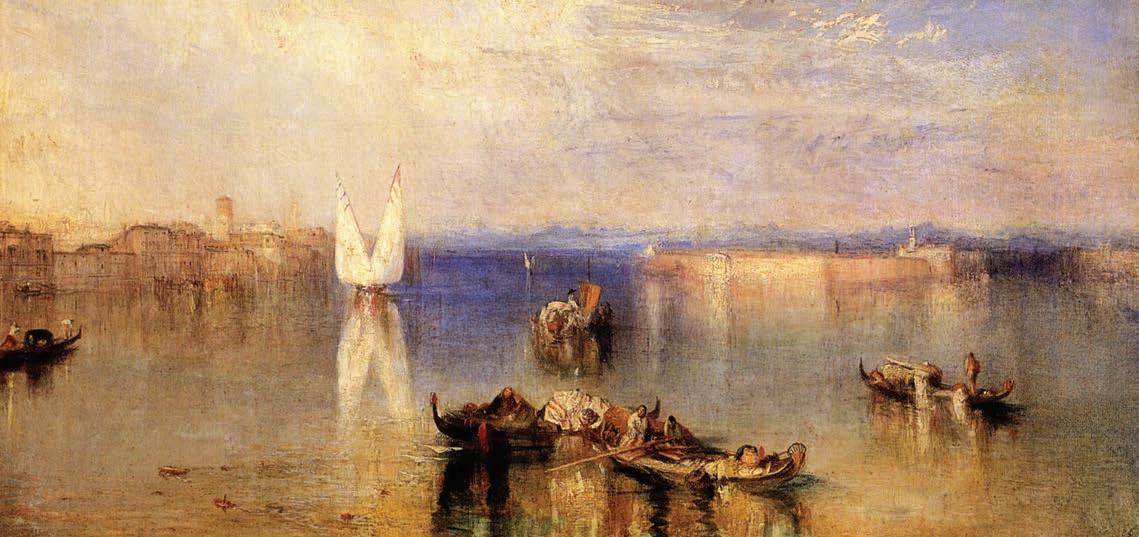
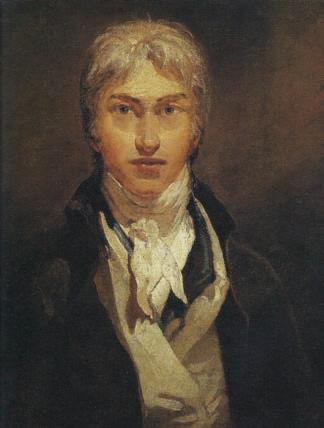
Joseph Turner (1775-1851) is often described as one of the most original 19th-century landscape painters whose style is regarded as the foundation for Impressionism. He invented new techniques to make skies and clouds look expressive. His works include water colours, oils and engravings. Unlike many artists of his era, he was successful throughout his career. His talent was recognized early in his life, bringing him financial independence which allowed him to innovate freely.
From 1792 onwards, Turner spent more than a decade touring England, Scotland and then Europe in search of inspiration, filling his sketchbooks with drawings. He made hundreds of drawings which were the settings for his later works and he continued for many years to paint pictures of the scenes which had impressed him during his tours.
He found subjects for his paintings in natural phenomena such as sunlight, storms, fog and rain, as well as in natural catastrophes, in shipwrecks and fires. He was fascinated by the destructive power of nature, especially by the violent power of the sea. He himself was often a witness to such events which he transcribed in a series of watercolour sketches.
In 1819, he set out on his first journey to Italy. This time he made about 1,500 drawings, and in the next few years he painted a series of pictures inspired by what he had seen. They show a great advance in his style and an original approach to landscape. He became increasingly interested in vivid colours, the play of light on water and the radiance of skies and fires.
In the later years of his life, Turner was famous, rich, and more secretive than ever. He had few close friends except for his father, who lived with him for thirty years, eventually working as his studio assistant. He never married, although he had two daughters. He still held exhibitions, but he usually refused to sell his paintings. In the 20th century, Turner was appreciated as one of the most innovative and gifted painters of his century.
engrave – to cut or carve (a text or design) on the surface of a hard object
engraving – something that is engraved setting – scene; the time and place of the action of a literary work
transcribe – to transfer (data) from one recording form to another
radiance – a warm, soft light; happiness that can be seen Glossary
1
According to the text, which sentences are true and which are false? Justify your opinion.
1. Turner was renowned only for his oils.
2. His early work consisted mainly of drawings.
3. He rarely travelled abroad.
4. As he grew older, Turner became more eccentric.
5. He chose to portray mostly people.
6. He sold more paintings when he grew older.
Vocabulary
1
2
Find sentences in the text that tell you that…
1. Turner didn’t imitate other painters.
2. he never had financial problems.
3. he liked to paint what he saw.
4. he wasn’t a very sociable person.
Match the highlighted words in the text with their explanations.
1. – an accident in which a ship is destroyed or sunk at sea
2. – progress or a development in a particular activity
3. ______________ – intensely clear, realistic and bright (of a colour)
4. – to begin a journey
5. – the most basic part from which the rest is developed
2
Use the words from Exercise 1 and the Glossary in their correct form to complete these sentences.
1. I have a ______________ memory of the time we spent together.
2. The c ourse will provide you with a solid ________________ in computing.
3. I knew whos e the ring was because her name was on it.
4. There was a serious danger of ______________ due to heavy fog.
5. The ______________ of the suns et made the place look beautiful.
6. We live in an age of rapid technological ______________.
Word formation
Adjective
3
Complete the table with the correct forms of the given words. The first one has been done as an example. Then use the words from the table to complete the sentences below.
Noun Verb vivid vividness recognition inspiration destroy innovation advance /advancement
1. He wasn’t an _______________ painter because he belonged to the traditional school.
2. My sister has high hopes for her _______________ in the firm.
3. It was one of the most _______________ storms in her recent memory.
4. The book was _______________ by his travels in the USA.
Negative prefixes
A What do the following prefixes in bold have in common? unusual, unlike, disappear, disbelief, independence, impossible, irregular, illegal
UN DIS IN IM IL IR
B Add these prefixes to the words below to give them the opposite meaning and write the words in the correct column. responsible, perfect, honest, successful, appropriate, loyal, sensitive, rational, practical, suitable, tolerant, logical
C Complete the sentences with the correct form of the words in bold using negative prefixes.
1. His arrival was completely ______________. /expected
2. Could I call you back later? It’s rather ______________ at the moment. /convenient
3. The teacher was very ______________ with our homework. / satisfied
4. Your result is ______________. Try again. /accurate
5. I think it’s ______________ that Liam will come on time. /likely
6. Kate is always losing her temper. She is the most ______________ woman I know. /patient 4
5
Study the meanings of the phrasal verbs and use them in the correct form to complete the sentences below.
1. set something aside keep something (money/time) for a special purpose
2. set off start to go somewhere
3. set something off cause an explosion; make an alarm start ringing
4. set out (on) begin a journey/drive/voyage
5. set up start a company, organization; establish
6. set something up arrange, organize
1. We must ______________ early in order to avoid a traffic jam.
2. I’ll ______________ an appointment for you tomorrow, if you want.
3. He forgot that smoke from a cigarette would ______________ a smoke alarm.
4. Try to ______________ an hour each day for exercising.
5. His band is ______________ on a European tour next week.
6. He earned enough money to ______________ his own import-export business.
Speaking
1 2
Art is present in cultures across the world. Which three of the following statements would you choose as the most appropriate explanations about why people appreciate and need art? Because…
• it allows us to express ourselves.
• it helps us to keep connected.
• it makes our life more colourful.
• people need to be creative.
• it is a means of keeping our history alive.
• it bridges the gap between cultures.
• it improves our daily lives.
Explain your choices and express your opinion on the importance of art.
Salvador Dali - an eccentric in life and art
Listening
1
The following words/phrases will appear in the text you are going to listen to. Check if you understand their meanings. Use a dictionary if necessary.
holography • enrolled • curly mustache • dealt with • daydream • overshadowed
2
Listen to an art critic talking about the painter Salvador Dali and complete the sentences using the words from the box.
1. He was not a serious student, preferring to in class.
2. Dali at the Academia in Madrid.
3. He had an exaggeratedly long, and long hair.
4. Unfortunately, his personality _ his art.
5. He used and geometry in his paintings.
6. Gala also the practical side of his life.
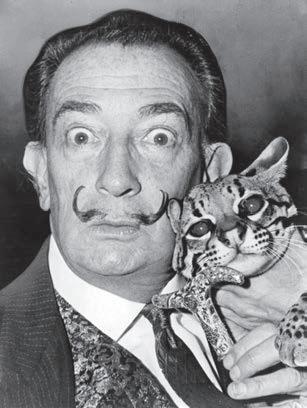
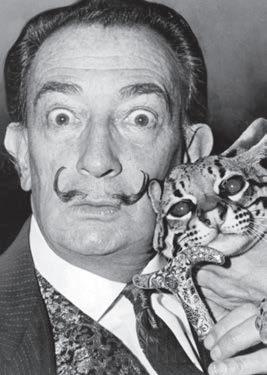
3 track 11
Listen again and answer these questions.
1. How did Dali differ from other students while he was at an art school?
2. What did Dali look like throughout his life?
3. What was his most recognizable feature?
4. Dali was influenced by different artistic styles. Which forms of art did he explore?
5. What did he include in his paintings?
6. What was said about Dali’s parents?
7. Who was his inspiration and support?
Grammar Review of tenses 3
The past simple and past perfect tenses
5. By the time we ____________ (arrive) at the museum, the rain _____________ (stop). 1 2
Name the tense in the following pair of sentences. What is the difference in meaning between the sentences?
• When my brother arrived home last night, we had dinner.
• When my brother arrived home last night, we had had dinner. Which tense is used for an action which happened before another past action?
Put the verbs in brackets into the past simple or past perfect tense.
1. They __________ (spend) their honeymoon in Brighton where they ____________ (meet) three years before.
2. She suddenly _________ __ (remember) during the meeting that she _______________ (not/ switch) off the cooker.
3. He __________ (tear up) her letter after he_____________ (read) it.
4. Somebody ___________ (steal) Mark’s motorcycle just after he ____________ (buy) it.
The passive
1
Revision and extension
Read the sentences (1-5) and match them with the explanations (a-e) to show that you understand the use of the passive.
1. Passengers are requested not to smoke.
2. The thief was arrested
3. My car has been stolen
4. English is spoken all over the world.
5. The brochure will be posted to your address by our secretary.
2
The following verbs are usually used in the passive:
impress, bear, fine, horrify, indicate, fascinate, wound
He was fascinated by his paintings. / He was born in 1987.
Active Passive infinitive to do to be done ing-form doing being done 4
a. It is obvious who the agent is.
b. People in general are the agents.
c. For formal notices.
d. We don’t know who did the action.
e. The action itself is more important than who does /did it.
3
Reporting verbs in the passive
If you are not sure whether what you are reporting is true, you can use one of the following verbs in a passive form: say, believe, consider, think, assume, suppose, expect, etc.
It is believed that his paintings are worth a fortune.
Passive forms with the infinitive and the gerund Study the table.
The students want someone to teach them. > The students want to be taught. I hate people sending me shopping. > I hate being sent shopping.
Note: Prepositions in passive sentences come directly after the verb. Where did they take him to? – Where was he taken to? Who wrote King Lear? – Who was King Lear written by?
Underline all the examples of the passive voice in the text.
Use the words impress, fine, horrify, indicate and wound in the passive to make sentences. 1 2 3 4 5
Put the verbs in brackets into the correct passive form.
1. Susan looked delighted. She _______________ (choose) for the first team.
2. When the parents came home, the room _____________ (already/clean) by their children.
3. Five paintings _______________ (steal) from the museum last night.
4. Nothing _______________ (do) about that problem so far.
5. The winner of the competition ________________ (announce) next week.
6. My bedroom _______________ (not/paint) for several years.
Put the verbs in brackets into the passive infinitive or gerund. The first one has been done for you as an example.
1. Players dislike being shouted at during a match.
2. He didn’t want to risk _____________ (rob), so he left the money at home.
3. I want _____________ (inform) about the outcome.
4. The workers are tired of ______________ (use) as cheap labour.
5. My daughter is looking forward to _____________ (teach) how to play the guitar.
6. I would like _____________ (transfer) to another department.
7. People generally hate _____________ (criticize) by their colleagues.
8. This picture must (take) away immediately.
Active or passive?
Complete the sentences with the correct passive or active form of the verbs in brackets.
1. It _____________ (expect) that the conference _____________ (hold) on Friday evening.
2. Michael _________________ (not receive) any text messages and is sad.
3. The bank _________________ (rob) when the alarm ________________ (go) off.
4. He ________________ (impress) by a new student at his lecture.
5. The envelope with the money _________________ (steal) during the power cut.
6. Passengers ______________ (remind) not to leave their luggage unattended.
1
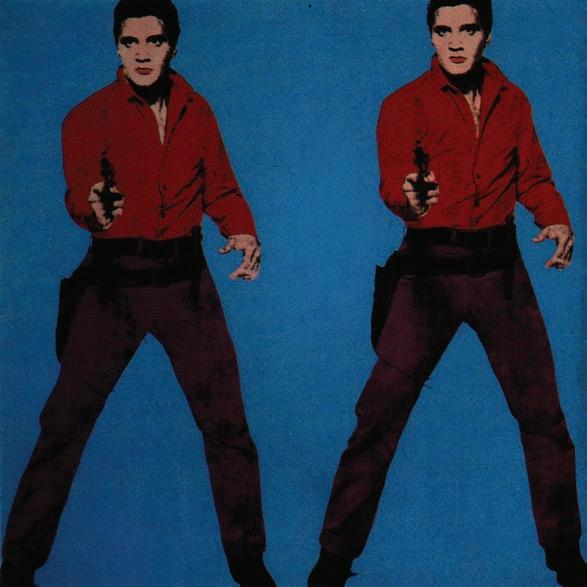
Reading and speaking A POP ART ICON
Before you start reading, do this exercise. Finish the beginning of a sentence in column A by using an ending in column B.
Commercial art is work that is experimental or innovative, particularly with respect to art and culture.
Avant-garde art is art in which common objects (such as road signs, comic strips or soup cans) are used.

Pop art is graphic art for commercial uses such as advertising, packaging, etc.
track 13
A successful magazine and advertisement illustrator, pop artist, film-maker and writer, Andy Warhol (1928-1987) was one of the most popular artists of his time. Using both an avant-garde and highly commercial way of expressing his art, he became a leading artist of the 1960s Pop Art movement.
Upon graduating from college, Warhol went to New York to pursue an artistic career. Working as an illustrator, he became one of the most successful commercial artists of the 1950s, winning frequent awards for his unique style. Having established himself as a graphic artist, Warhol devoted more attention to painting and drawing.
Around 1960, Warhol decided to make a name for himself in pop art, a new style of art that consisted of realistic interpretations of popular, everyday items. These small consumer products created a major movement in the art world, bringing both Warhol and pop art into the national spotlight for the first time. The turbulent 1960s saw the production of many of Warhol’s most iconic works. In 1962, he exhibited the paintings of soup cans. His other famous pop paintings depicted CocaCola bottles, vacuum cleaners and hamburgers.
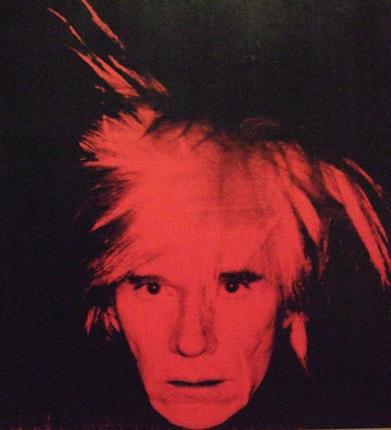
He also painted celebrity portraits in vivid colours; his most famous subjects include Marilyn Monroe, Elizabeth Taylor, Mick Jagger and Mao Zedong. As these portraits gained fame, Warhol began to receive hundreds of commissions for portraits from celebrities. His portrait Eight Elvises was eventually resold for $100 million in 2008.
In 1964, Warhol opened his own art studio, known as The Factory. It quickly became one of New York City’s cultural hotspots, a scene of lavish parties attended by the city’s wealthiest celebrities, although he himself was generally regarded as a quiet and shy observer.

Warhol ventured into a wide variety of art forms, including performance art, photography, sculpture, filmmaking and writing. He also experimented extensively with video art, producing more than 60 films during his career.
According to his will, his enormous wealth would go to a foundation dedicated to ‘advancement of the visual arts’. In 1987, the Andy Warhol Foundation for the Visual Arts was founded.
Glossary
pursue – to follow or chase (someone or something); to be involved in (an activity)
depict – to describe (someone or something) using words, a story, picture, etc.
hotspot – a lively nightclub or other place of entertainment (informal) lavish – generous; extravagant; abundant venture – to take the risk of; to expose to hazard; to start to do something new or different extensively – greatly exceeding the common size, amount, etc.
commission – a piece of work that someone is asked to do and is paid for
Complete the sentences according to the information in the text.
5. He liked to experiment with ________________________________________________. 2
1. Warhol became a commercial artist after _______________________________________.
2. He received commissions for portraits because _________________________________.
3. He wasn’t interested only in graphic art but ____________________________________.
4. Warhol and pop art came into the national spotlight _____________________________.
Discuss these questions in class.
3. Do you prefer modern or classic artists? Why? 3
1. Do you think that art should be commercialized?
2. Do you believe that there can be more innovations in artistic expression?
1 Vocabulary
Read the sentences with the highlighted words again and try to guess the meaning of these words from the context. Then match the words with their explanations below and write them down.
1. ___________ – the focus of public attention; a strong, focused light directed upon a spot
2. ___________ – great in amount, number, or degree
3. ___________ – being in a state of agitation; unstable
4. ___________ – to devote wholly and earnestly, as to a person or purpose
5. ___________ – insecure, nervous or timid in the company of other people
2
Use the words from Exercise 1 and the Glossary in their correct form to complete these sentences.
1. Celebrities like to be in the ______________.
2. The people hit by the storm suffered ______________.
3. It’s important to decide which goal you want to ____________.
4. There aren’t many people who would ____________ a voyage into space.
5. I like the way she ______________ the characters in her novels.
Collocations
3
Match the words (1-7) with the nouns (a-g) to make collocations. The first one has been done for you. 1-g (unique style)
1. unique
2. pursue
3. leading
a. fame / weight / profit
b. wealth / knowledge / disappointment
c. years / period / history
4. turbulent d. colours / recollection / description
5. vivid
6. enormous
7. gain
e. artist / scientist / member
f. career / goal / happiness
g. style / experience
Complete the sentences with the collocations from Exercise 3. 4
1. He admitted that it was ___ a unique experience.
2. The Nineties were a _________________ in our history.
3. I have a ___________________ of my early childhood.
Grammar The participles
The present participle can be used:
1. to form continuous tenses.:
I am writing, we have been talking
2. as an adjective to describe nouns.
a leading artist, a boring man
3. in participle clauses
a) to replace a relative pronoun + verb. The girl standing (who was standing) in the corner waved her hand.
b) to express an action that happens at the same time as the action in the main clause.
Working as an illustrator, he became one of the most successful commercial artists.
4. Some people ________________ after they stop smoking.
5. It was an _________________ when we heard the news.
6. His teacher encouraged him to in art.
7. Einstein was a _________________ of his time.
c) to express an action that happens just before another action.
Opening the envelope, I found two concert tickets. (I opened the envelope and I found two concert tickets.)
d) to express the reason for the action in the main clause.
Not wanting to be alone, she went to the cinema (Since she didn’t want to be alone…) Being a good student, she had no difficulty in passing the exam. (As/Because she was a good student...)
1
Note: In all participle clauses, the subject of the clause and the subject of the main verb is the same. Participle clauses can be used after various conjunctions and prepositions, such as: when, while, before, after or on/upon Note the following examples: Upon graduating from college, Warhol moved to New York City. On hearing the news, I decided to leave immediately.
The perfect participle
If it is important to show that the first action has finished before the second begins, the perfect participle (having + past participle of the main verb) is used. Having established himself as a graphic artist, Warhol devoted more attention to painting and drawing. Not having seen the show before, I decided to go with my friends
Practice
3
Rewrite these sentences using participle clauses instead of the underlined parts.
Example:
The man who was driving the car was not injured.
The man driving the car was not injured.
1. As I knew a little Russian, I could translate the letter.
2. While Tina was walking through the park, she lost her keys.
3. She was smiling at Tony and she raised her glass.
4. The train which is now arriving at platform 2 is from Oxford.
5. Because I didn’t know what to do, I waited patiently.
6. I didn’t wish to be impolite and decided to remain silent.
Join the following pairs of sentences, starting each new sentence with a participle clause. Think about the timing in the two sentences you are joining. Examples:
1. She didn’t find anyone at home. She left a note.
Not finding anyone at home, she left a note.
2. We finished lunch. We set off.
Having finished lunch, we set off.
2
Complete the sentences using the verbs from the box in the present or perfect participle. There is one word extra. The first one has been done for you.
deliver • make • stand • carry • believe • pack • be
1. Having delivered the message, the boy went home.
2. Claudia entered the room, ___________ a tray of soft drinks.
3. ___________our suitcas es, we took a taxi to the airport.
4. ___________unable to concentrate, I fell asleep.
5. The p eople ___________at the back couldn’t see a thing.
6. ___________that everything David said was true, Tom agreed to help him.
1. Mary was a sensible girl. Mary didn’t panic.
2. Paul heard cries for help. Paul ran out of the room.
3. I had already seen the exhibition. I didn’t want to go with them.
4. I’ve never been to London. I can hardly recommend a hotel there.
5. I knew she didn’t like fish. I cooked some chicken.
6. Dora was faced with a difficult situation. Dora decided to ask for help.
Key word transformations
Complete the second sentence so that it has a similar meaning to the first sentence using the word given.
1. The manager didn’t take any notice of my recommendations. /attention The manager _____________________________ my recommendations.
2. Did we send that letter to Mr Thomson? /was Do you know if ____________________________ to Mr Thomson?
3. We haven’t arranged a date for the wedding yet. /been A date for the wedding ___________________________ yet.
4. Experts say that most people now have access to the Internet. /is It ____________________________most people now have access to the Internet.
5. I didn’t want to quarrel with her, so I apologized immediately. /wanting _________________________, I apologized immediately.
6. I’m sorry but you must not smoke here. /forbidden I’m afraid ________________________here.
7. My brother bought a car with a sun-roof. /which The car _____________________________ a sun-roof.
Writing
DESCRIBING A PICTURE
Here are a few tips to help you describe a picture or a photograph. Read the instructions carefully, then have a close look at the pictures, choose one, and decide on how to write your picture description.
1. Focus on the main part of the picture. Give a general overview of what the picture is about. (The photo/picture shows ... The central focus of this picture is…)
2. Give a short description of the scene (e. g. place, event), and details who / what you can see. (In the foreground / middle ground / background the picture shows … On the left / right of the picture… In the top left corner / bottom right corner of the picture, a man…)
3. Say something about the weather and the time of the day. What is the atmosphere like? Is it peaceful/happy/exciting?
4. Say what you think about the picture. (I have an impression that the people in the picture are alive... The painting is vivid / expressive... The picture makes me feel … (sad/happy)... The picture inspires the viewer to think about …)

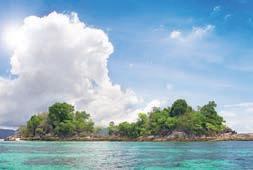
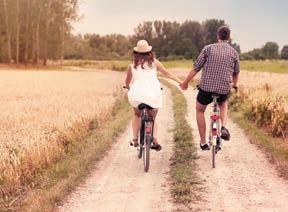
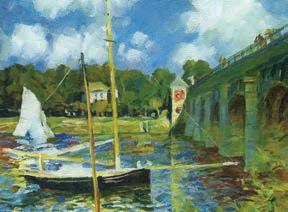
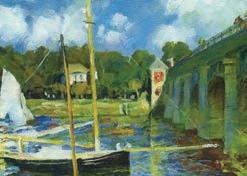
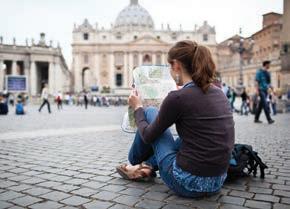
Communication SAYING ‘NO’ NICELY
Sometimes you need to say ‘no’ when someone makes a suggestion or asks you to do something for them. Instead of saying just ‘no’, which can sound rather rude, you can use some common ways to say ‘no’ nicely.
1
Complete the sentences by using the expressions from the box.
I’m afraid I can’t go, I’m not really fond of, It’s not my idea of, I’d really rather not
A: Would you like to go to the cinema with us tonight?
B: ___________________ out tonight. I’ve got a test tomorrow.
A: How about taking a nice walk?
B: ___________________ take a walk this afternoon. I’m tired.
A: Would you like to go to the Zoo with me?
B: Thank you, but a fun afternoon out.
A: Let’s play free games online.
B: Sorry, playing games.
Listening
You are going to listen to a part of Don McLean’s song Vincent which was written as a tribute to Vincent Van Gogh. The song is also known for its opening line Starry, Starry Night referring to Van Gogh’s painting A Starry Night.
Famous quotes
2
Use the expressions in the box to respond to the questions below.
1. Would you like another drink?
2. Are you interested in playing tennis with us on Sunday?
3. We are going to eat out. Do you want to join us?
4. Can I borrow your sweater tonight?

(Vincent van Gogh) 1 2 3 track 14
(Pablo Picasso)
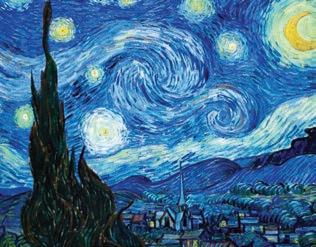

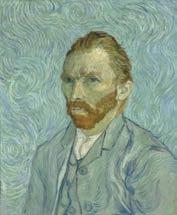
Discuss the following quotes. DON’T
Self-assessment TEST 3
KEY WORD LIST
5. She ought be reminded to finish the project. 1 2 3 4
Complete the sentences by using the word/phrasal verb from the List in the correct form. (6 pts.)
1. His latest film ____________the life of early settlers in America.
2. She was old and rarely ____________ outside for fear of slipping.
3. We all know that she is completely ____________to her work.
4. The critics were ____________in their praise for the paintings.
5. He was the first to show his ____________ for my work.
6. We had to be careful because any movement could ____________ the bomb.
Put the verbs into the correct passive form. (5 pts.)
1. I went to the exhibition yesterday but I _______________ (inform) that all the paintings _________________(sell).
2. I hate _________________ (criticize) for no reason.
3. No decision ________________ (make) about his future appointment until all candidates ____________________ (interview).
Rewrite the following sentences by using a participle clause. (4 pts.)
E.g. As I had lost my sunglasses, I bought another pair. Having lost my sunglasses, I bought another pair.
1. I heard a loud noise and rushed out of the room.
2. As we had no one to guide us, we wandered around by ourselves.
3. His friend took him by the arm and led him away.
4. While the boy was climbing up the ladder, he fell down.
Correct the mistakes in these sentences. (5 pts.)
1. Is this computer used at the moment?
2. Losing his wallet the day before, he was delighted to find it again.
3. He set off his own firm last year.
4. Being not there before, he knew nothing about it.
KEY – page 184
20 points
Verbs advance depict engrave pursue transcribe venture Nouns appreciation radiance engraving consumer commission recognition spotlight Adjectives enormous extensive dedicated lavish turbulent vivid Phrases set out set aside set off set out (on) set up
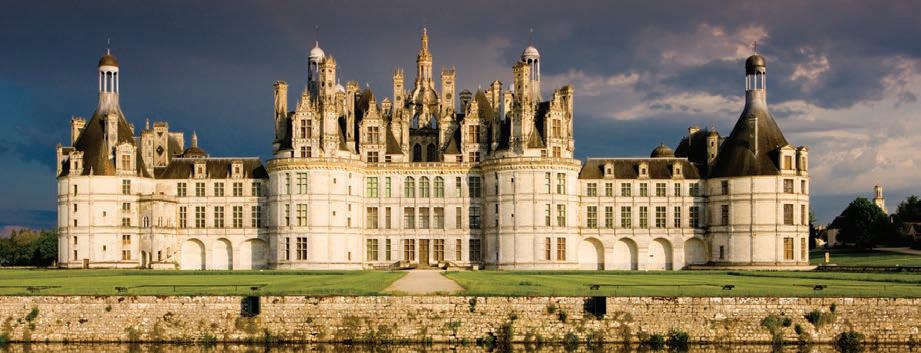
MAKING DECISIONS Unit 4
In this unit, you will
• read, listen and talk about
a. a story The Lady or the Tiger?
b. hard de cisions some people had to make in their lives
• practise conditional sentences the sequence of tenses the omission of articles phrasal verbs with turn idioms with eye approving and disapproving
Lead-in
Discuss the following questions.
1. In your opinion, what decisions are hard to make?
2. Have you ever had to make such a decision?
3. Who do you turn to for help, friends or parents?
4. What can you expect to read about in the story with the title The Lady or the Tiger?
THE LADY or THE TIGER?
Reading
EXTRACT 1
In olden times there lived a semi-barbaric king, who turned his varied fancies into facts. He built a vast amphitheatre, in which crime was punished or virtue rewarded, by chance.
When a subject was accused of a crime of importance to the king, a public notice was given that on an appointed day the fate of the accused person would be decided in the king’s arena.
When all the people had assembled in the galleries, the king sat high up on his throne surrounded by his court. He gave a signal, a door beneath him opened and the accused person stepped out into the amphitheatre. Directly opposite him, on the other side, were two doors, exactly the same and side by side. It was the duty and the privilege of the person on trial to walk directly to these doors. He could open either door he pleased. If he opened one, a hungry tiger would come out of it. If he opened the other, a lady would come out. To this lady, suitable to his years and position, he was immediately married as a reward for his innocence. It did not matter whether he might already possess a wife and family.
This king had a daughter who was the apple of his eye. Among his courtiers was a young man, noble, handsome and brave. Although he was poor, the princess loved him passionately. This love affair moved on happily for many months until one day the king discovered its existence. He did not hesitate. The youth was immediately sent to prison and a day was appointed for his trial in the king’s arena. The tiger was selected and the best judges decided carefully on the rank and beauty of the lady.
When the appointed day arrived, people gathered in the amphitheatre. The king and his court sat in their places, opposite the twin doors.
All was ready. The signal was given. The door beneath the royal party opened, and the lover of the princess walked into the arena. Tall, handsome, fair, his appearance was greeted with admiration. No wonder the princess loved him! What a terrible thing for him to be there!
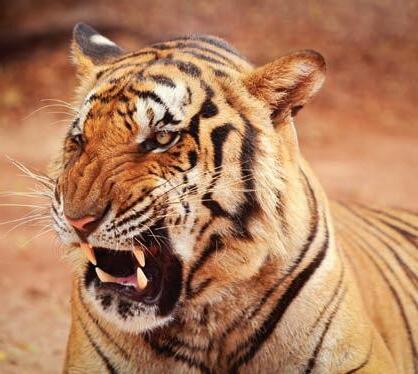
olden – from a long time ago virtue – a good and moral quality assemble – to gather people into one place appoint – to decide (the time or place) at which something will happen duty – obligation (love) affair – a secret relationship of affection between two people
1
Find answers to these questions.
1. Why did the king build the amphitheatre?
2. What choice did the accused have?
3. Could it happen that an innocent man was punished?
4. Who did the princ ess love?
5. What did the young man look like?
• Compare your answers with another student.
Vocabulary
1
2
Find the sentences in the text which tell you that
1. it didn’t matter if somebody was really guilty or not.
2. the accused person had to get married to the lady even if he had already been married.
3. the king loved his daughter very much.
4. it to ok the king a lot of time before he learned that his daughter was in love.
5. the audienc e admired the young man.
Match the words from the text with their meanings. Paragraph numbers are given in brackets.
1. fancy (1)
2. reward (v) (1)
3. inno cence (3)
4. de ed (4)
5. hesitate (v) (4)
6. noble (4)
Prepositions
Verbs + prepositions
2
a. having an excellent character
b. fantasy, dream
c. b e unwilling (to do something), be indecisive
d. the state of being not guilty
e. to give somebody something in return
f. action, act
Complete the sentences using the correct preposition.
1. Jim was ac cused
2. She was c omplimented
3. She deals
4. She introduced me
5. We blame d John
6. The guards prevented a burglar
7. She has recently recovered
8. He was greeted from of on to with for
a. s econd-hand clothes.
b. a variety of offences.
c. her app earance.
d. the bad results of the match.
e. che ering and applause.
f. leaving the building.
g. the attractive girl sitting next to her.
h. her illness.
Phrasal verbs with TURN
Replace the underlined phrases with the given words in the correct form. change (into) • appear • reject • reduce • result in • go to for help
1. David proposed to Rebecca, but she turned him down.
2. She has nobody to turn to when she is in trouble.
3. He promised to come on time, but so far he hasn’t turned up.
4. The day turned out to be a fine one.
5. It was freezing outside. The water turned into ice.
6. If it gets too hot, turn down the heating.
Idioms with EYE
Match the expressions (1-6) with their explanations (a-f).
1. The child was so beautiful that I couldn’t take my eyes off her.
2. Greg and Jess only have eyes for each other.
3. Don’t shut your eyes to the fact that you didn’t study enough.
4. The sunflower in the picture caught my eye.
5. I am up to my eyes in projects this month.
6. She was the apple of her mother’s eye.
Grammar
Note: The word unless basically means the same thing as if ...not. For example, ‘Unless you study, you will fail.’ 4 3
a. b e very busy, deep in b. ignore, refuse to see
c. attract, notice d. s omebody’s favourite person
e. unable to stop looking at f. b e in love or interested in
Conditional sentences – revision
Look at the table and discuss the use of tenses in conditional sentences.
• What tense is used in the if-clause?
• What tense is used in the main clause?
If I eat too much, I get fat.
If it rains, the grass gets wet.
If you work hard, you’ll pass the exam.
If you see him, give him my regards.
If I were you, I would give up smoking.
If I knew the solution, I would tell you what to do.
Type 0 is used to talk about facts that are generally true.
Type 1 is used to talk about things that are likely to happen in the future.
Type 2 is used to talk about unreal present or future situations that are unlikely to happen.
Practice
Complete the sentences using the verbs given to get type 2 conditional sentences.
1. If he _______________ (know) which do or to open, he ________________ (be) saved.
2. He ___________________ (not/help) you if he__________________ (not/like) you.
3. I __________________(wait) for Robert if I __________________ (know) he was coming.
4. If there ___________ (be) special bicycle lanes in the city, more people __________ (use) bicycles.
5. If John __________________ (smoke) less, he __________________( feel) better.
6. My father _______________ (climb) this mountain if he _______ (be) younger.
Complete the following sentences using your own ideas.
1. He won’t buy a new car unless he ____________________________________.
2. The water freezes if________________________________________________.
3. If they asked you to sing in public, ___________________________________?
4. Would you forgive me if I __________________________________________?
5. If he trie d harder, he _______________________________________________.
6. If Jim had more money, ____________________________________________?
7. She will put on weight if she _________________________________________.
8. If they offered me a good job, I _______________________________________.


Focus on
ARTICLES
Omission of the definite article
We sometimes leave out the before: school, prison, hospital, college, university, class, church, work, town, home, bed, sea, etc.
My brother is a sailor. He is at sea now.
We leave out the when we are talking about school, prison, etc. as an institution. The young man was sent to prison. We use the when we are talking about a school, hospital etc. as a building. The church cost a lot of money to build.
Add an article where necessary.
Practice
1. Jess has b een in _____hospital for a week.
2. When my brother was promoted at _____work, he moved to _____ bigger office.
3. There’s ______strike at ______hospital.
4. I left my book at ____home.
5. My children are still at _____ school.
6. Where will the wedding take place? In ____ church.
7. Jamie is taking photos of ____ church.
8. It’s time for the children to go to ___ bed.
9. Peter was sent to ______prison for hitting ____policeman.
10. I’ll go to _____pris on to visit him.
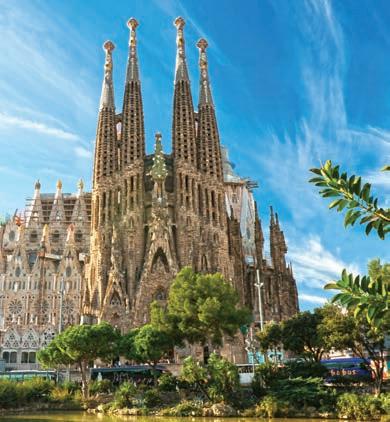
Bad decisions throughout history track 16
Listening
1
You are going to listen to three short passages about some bad decisions made in the past. Look at the words in the box to see if you know their meanings. Match them with their explanations below.
• pretend • troop • invade • beyond • confident • march
____________a unit of soldiers ____________to give a false appearance of ____________certain, sure
2 3
___________to enter a country by force ___________to walk in a military style
___________ further than
Listen to the text and explain in your own words what bad decisions these people made. a. the Trojans b. Napoleon c. the Donner party
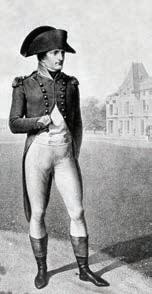
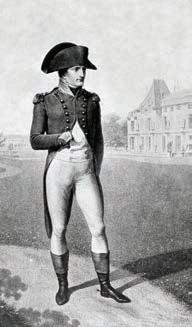
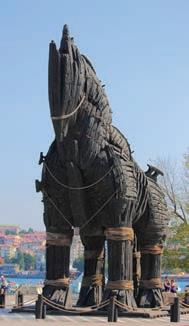
Decide which decision(s)
1. brought about the greatest disaster.
2. was/were made during the war.
3. was made due to a lack of information.
4. turne d to be a disaster because of the bad weather conditions.
5. was made quickly without seeing the trick.
1
THE LADY or THE TIGER?
Reading and speaking
Work in groups.
Before you read the next text, see how many of your classmates think that 1. the princ ess would find a way to help the young man.
2. he would op en the door behind which the tiger waited.
• What is your opinion? Do you agree with most of the students?
17
EXTRACT 2

As the youth advanced into the arena he turned, as the custom was, to bow to the king, but his eyes were fixed upon the princess. As she sat there, pale and white, he saw that she knew behind which door the tiger waited and behind which the lady stood. He expected her to know it. She was his only hope.

From the moment the decision about her lover’s fate was made, the princess was thinking day and night about this event. She possessed more power, influence, gold and force of character than anyone else and she found out the secret of the doors, but also who the chosen lady was. She knew the woman who blushed and trembled behind that silent door. It was one of the loveliest of the ladies of the court. She had often seen this fair creature throwing glances of admiration at her lover and sometimes she thought these glances were even returned. However, often in her sleepless hours, she thought in horror of her lover opening the door behind which the tiger was. She had also seen him at the other door! Her soul would burn in agony imagining him rushing to meet that woman. Her decision had been made after days and nights of agony. If she hadn’t loved him so much, it would have been much easier.
His quick glance asked the question: ‘Which?’ She raised her hand, and made a slight, quick movement toward the right. No one but her lover saw it. He turned and, with a firm and rapid step, walked across the empty space. Every heart stopped beating, every breath was held. Without the slightest hesitation, he went to the door on the right and opened it.
Now, the point of the story is this: Who came out of that door? The more we reflect upon this question, the harder it is to answer. Think of it, dear readers: she had lost him, but who should have him? And so I leave it to you: Did the tiger come out of that door or did the lady?
Frank R. Stockton (1834 – 1902) was an American humorist and a short story writer. However, he is remembered today for this short story whose title has become a national phrase: The lady or the tiger?
Glossary
custom – tradition, habit bow – to bend over blush – to go red in the face, be embarrassed tremble – to shake slightly
2
Answer the following questions.
1. What did the young man expect from the princess?
2. D id she meet his expectations?
3. What abilities did she have which helped her to find out the secret?
4. What did the young lady look like?
5. Why did the princess spend days and nights in agony?
6. D id the young man trust the princess?
Speaking
Making a decision
Did the tiger come out of that door, or did the lady?
2 2 3 1 1
Discuss this question from the princess’s point of view. Give reasons for your answers. What did the princess do?
a. She de cided that he should get married to the lady.
b. She showe d him the door where the tiger waited.
If you had been the princess, what would you have done? In your opinion, what would have been the best possible solution for the couple?
Vocabulary
Complete the sentences using the words from the text in their correct form. The first letter is given.
1. It is the c______________ in some countries for people to marry young.
2. She agreed to marry him without the slightest h_____________.
3. His hands t ___________ while he was opening the telegram.
4. The f_________ of the group of men who went to the top of the mountain is unknown.
5. The actor b ___________ to the assembled crowd.
Match the words from Exercise 1 with their synonyms below. destiny • tradition • to shake • to bend • uncertainty
Find the nouns for these verbs. Verb Noun
Noun decide imagine breathe admire hesitate move expect succeed
4
Collocations
Match the adjectives (1-6) with the nouns (a-f) to form collocations.
1. quick
2. sleepless
3. slight
4. empty
5. secret
6. fair
a. space
b. doors
c. lady
d. hours
e. glance
f. hesitation
Complete the sentences with the correct forms of the verbs rise and raise.
1. Julia got angry, _______to her feet and left the party.
2. Help me to ________the stage curtain.
3. The sun _______early in summer.
4. I’m trying to________ money for homeless children.
5. The sky got darker and the wind ________.
6. I can’t ________my left arm.
Grammar
Look at this example:
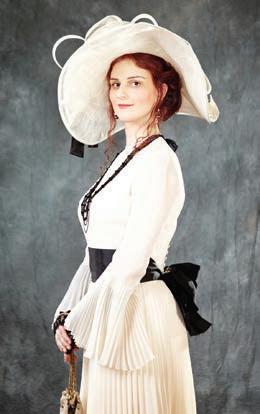
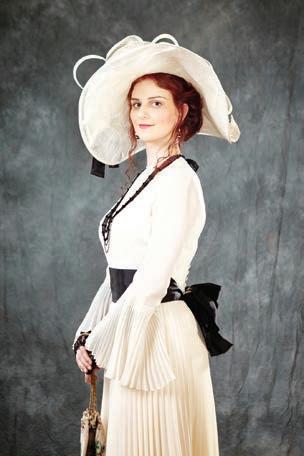
The sequence of tenses - revision
He saw that she knew behind which door the tiger waited, and behind which the lady stood. Remember! If the verb in the principal clause is in the past tense, the verb in the subordinate clause will be in the corresponding past tense.
Complete the sentences with the correct tense of the verbs in brackets.
1. She knew the woman who _______________ (stand) b ehind that door.
2. When Jas on was young, his family decided that he _______________ (become) an engineer.
3. He realized how sensible it _____________ (be) that he _____________ (tell) the truth.
4. He promised that he _______________ (do) everything he could.
5. Nob ody knew that she _______________ (graduate) from Harvard.
6. I remembered that I _______________ (not lock) the door.
7. I hop ed that she _______________ (recover) from her injury by next week.
8. My brother was sorry that he _______________ (not apply) for that job.
Conditional sentences type 3
Conditional sentences type 3 are used to talk about situations in the past that didn’t happen. If clause Main clause
If + past perfect would/could/might + have + past participle
If I hadn’t waited so long for John, I wouldn’t have been late for the cinema. If you had explained your problem to me, I might have been able to help you.
1 2 3 4
Rewrite the two sentences to make one ‘unreal’ conditional sentence, showing both cause and result.
Example: I found a nice flat. I left my parents’ home. If I hadn’t found a nice flat, I wouldn’t have left my parents’ home.
1. We saved some money. We were able to buy a house in the country.
2. They won the lottery. Their problems disappeared.
3. My husband lost his job. We came back to our country.
4. We b ought a large house. We found it difficult to make ends meet.
Tell the class about something you regret using conditional sentences type 3. E.g. I’m sorry I didn’t go to his party last night. If I had gone, I’d have had a great time.
First, second and third conditionals
Complete the sentences using the correct tense of the verbs in brackets.
1. They c ould have prevented the disaster if they _____________ (call) the fire brigade at once.
2. If he _____________ (give) his children more freedom, they would have been happier.
3. Unless he _____________ (b e) late, we’ll meet at six o’clock.
4. I would have raised my hand if I ______________ (know) the answer.
5. If we surf the Internet, we_____________ (find) a lot of information about famous writers.
6. Your room would look much tidier if you _____________ (keep) your clothes in the wardrobe.
Answer the following questions with a conditional sentence.
1. What will you do tonight if there is nothing interesting on TV?
2. What would you do if you were late for your birthday party?
3. What would you do if a child hit you with a ball in the street?
4. What would you do if a fire broke out in the classroom?
5. What would you do if you saw a tiger coming out of a cage in the Zoo?
Key word transformations
Complete the second sentence using the given word and making other necessary changes.
1. I didn’t answer the phone because I didn’t know it was you. /If _________________________, I would have answered the phone.
2. He’s tired because he stays up very late every night. /went He wouldn’t be tired _________________________ earlier every night.
3. My life is never dull because I often make up things. /would My life _________________________ if I didn’t make up things.
4. Nobody told me you were back from your holiday, so I didn’t phone you. /known I would have _______________ if I ____________ you were back from your holiday.
5. I didn’t buy you a present because I forgot when your birthday was. /had I would ________________ a present if I ____________ when your birthday was.
Writing
SOLVING PROBLEMS
I had to make an important decision
Everybody has to make up their minds about some problems in their everyday life. The process of decision-making is not always easy. Some problems are less important and sometimes the decision can change their lives.
1. First state the problem that has to be solved.
2. Think of the alternatives for that particular situation.
3. Analyze each alternative you have come up with. Find the advantages and disadvantages for each option.
4. D ecide which option is the best for you. State reasons for your decision.
APPROVING and DISAPPROVING
If you approve or disapprove of what somebody else says or does, you can use some of these words and expressions:
Approving
I’m glad/I’m pleased/I’m happy…
It’s right to do it.
It’s a good idea.
They’re doing the right thing.
I don’t see anything wrong in …
I’m very much in favour of…
I’m all for it. (informal)
I approve of ….
Disapproving
You shouldn’t/oughtn’t to...
I’m not very happy about…
It’s wrong/not right to…
I think it’s bad of him …
I don’t approve/disapprove of…
I’m not in favour of …
I’m against (it) …
I really think you shouldn’t …
Examples: I’m in favour of a new law which punishes people who drink and drive.
I don’t approve of bullying at school.
Practice Communication
Write five sentences in which you disapprove/approve of the way that the king in the story The Lady or the Tiger makes his decision.
Self-assessment TEST 4
Complete the sentences using the words from the List in the correct form. (5 pts.)
1. It was his ___________ and priv ilege to open the ceremony.
2. The children ___________ around the fire and listened to the stories.
3. We enjoyed taking part in the local ___________.
4. We were all sure of his ___________ though the judge decided differently.
5. The p erformance took place in a ___________ hall in the south wing.
Complete the sentences with the correct form of the verbs in brackets. (6 pts.)
1. You _____________ (have) a good time if you had spent the evening with us.
2. You ____________ (never/be) happy if you don’t stop thinking about Lisa.
3. If she _____________ (s ee) you crying, she would be very upset.
4. If the taxi _____________ (not/hold) up in the traffic, we wouldn’t have missed the plane.
5. Unless he _____________ (leave) the key, we won’t be able to enter the house.
6. If he proposed to Jane today, she ______________ (turn) him down.
Add an article where necessary. (4 pts.)
1. We to ok some photos outside ____church.
2. Jim’s been in____ b ed for hours.
3. My children are still in ____class.
4. We are planning to drive to ____ sea.
Match the two halves of the dialogue. (5 pts.)
1. Why did you borrow money from Mary?
2. The music is too loud.
3. D id the children like the film?
4. D id you go for a swim?
5. Why didn’t you go to the cinema?
a. Be cause David turned up late.
b. I didn’t have anybody else to turn to.
c. Yes, the day turned out to be warm.
d. OK. I’ll turn it down.
e. Oh, no, b ecause the prince was turned into a frog.
KEY WORD LIST
Verbs accuse appoint assemble greet hesitate blush tremble Nouns custom glance innocence duty reward virtue
Adjectives noble rapid vast Phrasal verbs turn up turn to turn down turn out turn into 1 2 3 4
points
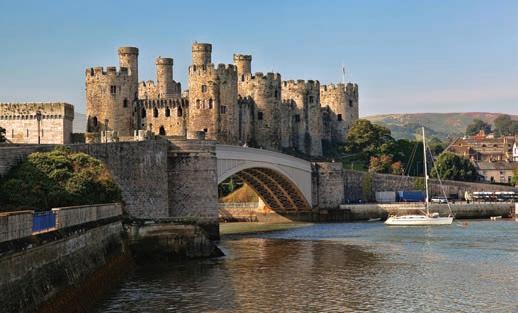
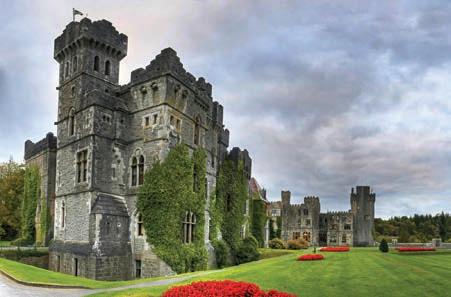
MYTHS AND LEGENDS Unit 5

In this unit, you will
• read, listen and talk about a. a well-known Irish castle and stories related to it b. an old legend of Green children
• practise relative clauses the causative use of have and get passive reporting verbs modal verbs with the perfect infinitive the definite article phrasal verbs with put expressions with take expressing your point and doubt
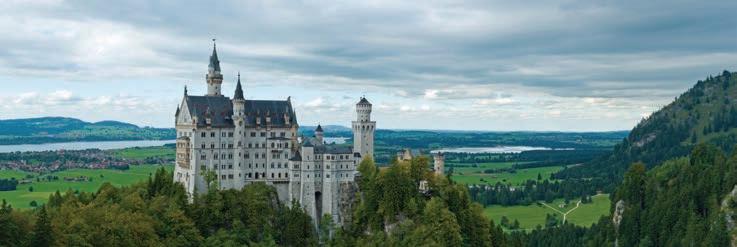
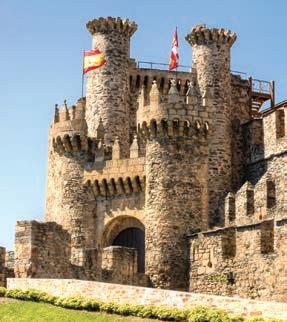
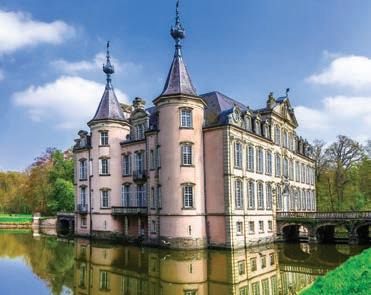
Lead-in
Read the paragraph below, look at the pictures and discuss the following questions.
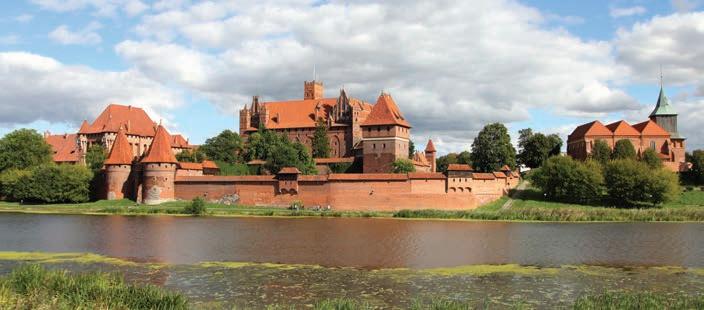
European countries are famous for their rich history, culture and impressive architecture. Europe’s castles tell stories about their past and powerful kings and nobles who used to live in them.
1. Why do tourists usually like visiting castles?
2. What are their most obvious characteristics? 3. Would you like to live in a castle?
4. Do castles have any historical importance?
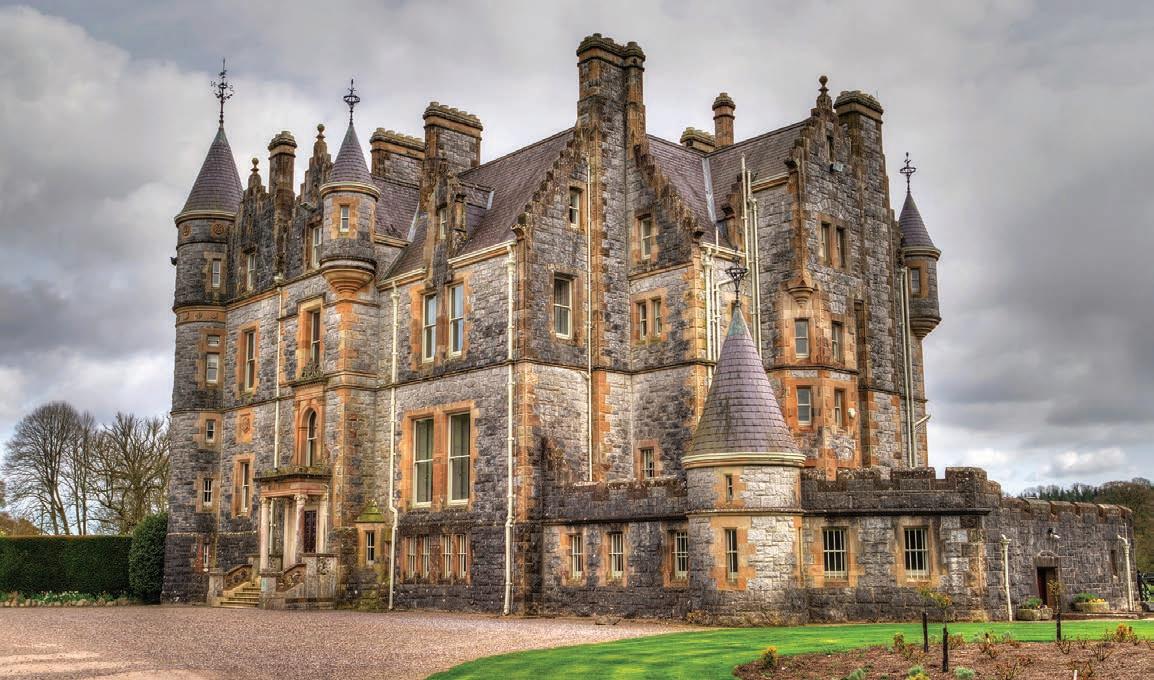
THE GIFT of eloquence
Reading
Blarney Castle is one of Ireland’s most popular attractions and a genuine part of Irish history and tradition. It was built nearly six hundred years ago by one of Ireland’s greatest lords, Cormac McCarthy. The castle is well-known for its gardens and the Blarney Stone, which is believed to have magic powers. Legend has it that those who kiss the Blarney Stone will gain great eloquence and will never be at a loss for words. This is the reason why millions of people go to Blarney in pursuit of the gift of eloquent speech.
There are a few versions of the legend about the Blarney Stone. According to one of them, Queen Elizabeth I wanted to extend her influence to Ireland. She sent her deputy to Blarney Castle, whose master was McCarthy at the time. She demanded that he should renounce his right to his land and possession of the castle.
At first McCarthy pleaded for his traditional rights to his land, but it seemed he wasn’t a persuasive speaker. One day he met an old woman who told him that anyone who kissed a particular stone set in a tower of Blarney Castle would be given the gift of eloquent speech. Cormac took her advice, succeeded in kissing the Blarney Stone and with his sweet and smooth talking managed to persuade the queen to change her mind. Thus the castle remained in his possession.
Nowadays, people who want to kiss the stone have to climb 10 flights of stairs to reach the stone, which is set in the wall at the top of the tower. The act itself requires certain courage, since one can do it only by leaning backwards while being held by a castle worker. Of course, everybody wants to have a picture taken of their adventure, too. The best part of this climb is the view from the castle over the parkland, which includes gardens with avenues and waterways.
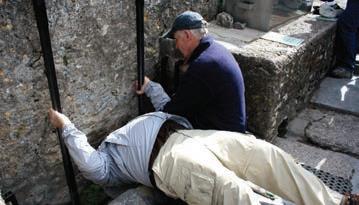
eloquence – fluent or persuasive speaking or writing at a loss – puzzled or uncertain what to think, say, or do plead – to ask for something in a serious and emotional way renounce – to formally give up (a claim or right) flight – a set of steps or stairs between one landing or floor and the next lean – to shift or move one’s body in a particular direction
Glossary
1
Answer the following questions.
1. What makes Blarney Castle a popular tourist attraction?
2. Why is it difficult to kiss the stone?
3. Do you believe in the legend about the stone?
2
Find evidence in the text for the following statements.
1. People believe that the Blarney Stone has magic powers.
2. Queen Elizabeth I wanted to take away the castle from McCarthy’s possession.
3. McCarthy’s first attempt to persuade the Queen to let him keep his properties failed.
4. McCarthy was advised how to solve his problem.
5. The Blarney Stone is not easily reached.
Vocabulary
1
Match the highlighted words in the text with their explanations.
1. ______________ – without problems; even, not rough
2. ______________ – having the power or ability to persuade; convincing
3. – authentic or original; not pretending; sincere
4. ______________ – to increase in size/range; add to or enlarge
5. ______________ – chase; the process of trying to achieve something
2
Use the words from Exercise 1 and the Glossary in their correct form to complete these sentences.
1. She couldn’t marry him because she didn’t want to ___________ her British citizenship.
2. They are planning to _____________ the range of goods that they sell.
3. They want to engage an_____________ girl with a well-developed vocabulary.
4. Her brother is my _____________ friend and I really trust him.
5. We _____________with him to stay, but he wouldn’t listen.
6. He presented a _____________argument for increasing salaries.
7. Ann remained silent, because she was _____________ what to say.
Collocations
Match the words in column A with the nouns in column B to make collocations.
E.g. smooth tongue; deep concern
1. persuasive a. concern
2. extend b. surface
3. genuine c. speaker
4. eloquent d. influence
5. smooth e. speech
Think of other possible collocations with the words in columns A and B. 4
Grammar Relative clauses
A relative clause is used to give further information about someone or something we have mentioned in a sentence.
He met an old woman who told him to kiss a particular stone in the castle. She works in a company that makes computers.
There are two kinds of relative clauses: defining and non-defining relative clauses.
1 2 3
Defining relative clauses are essential for the understanding of the noun. They identify exactly which person or thing we are talking about, or can define the time, place or reason. People who want to kiss the Blarney Stone have to climb 10 flights of stairs. The reason why millions of people want to see the castle is obvious.
Note:
The relative pronouns can be left out when a noun or a pronoun comes immediately after.
The woman (who) I saw in the supermarket is Paul’s sister. I bought a copy of the book (that) John wrote.
Non-defining relative clauses give extra information about the person, thing, place or time, which can be left out. Commas are used before and after a non-defining relative clause.
The castle is known for the Blarney Stone, which is believed to have magic powers. Her brother, whose wife you met yesterday, can speak several languages.
Note:
In non-defining clauses you have to use who/whom/whose for people and which for things, where for places and when for times. You cannot use that and you cannot leave out the relative pronoun.
Prepositional relative clauses
• When the relative pronoun is the object of a preposition in a defining relative clause, the preposition is often placed at the end of the clause. Is this the book (that/which) you asked for?
• In a non-defining relative clause, it is almost a general rule for the preposition to come before the relative pronoun:
The new theatre, in which I have taken a personal interest, will be opened soon.
1
Underline all the examples of relative clauses in the text and say whether they are defining or non-defining.
Practice
2
Can you say what the difference in meaning is here?
a. The students who had missed the bus started the test late.
b. The students, who had missed the bus, started the test late.
3
Join the sentences by changing the second sentence of each pair into a relative clause. Underline the sentences where the relative pronoun can be omitted.
Example: I bought a copy of the book. John wrote it. I bought a copy of the book that John wrote.
1. I like the painting. It is in his room.
2. This is the man. We spoke to him last week.
3. Basketball is a game. A lot of people play it.
4. The people are very kind. I am staying with them.
5. He received the letter. He was waiting for it.
6. The woman is very happy. Her daughter is getting married.
7. Sheila went into the room. Bob was sitting.
8. I really liked the teacher. I used to attend his classes.
9. Here’s the address. You should write to this address.
10. The teacher spoke to the students. Their work was below standard.
4
Add relative clauses defining the words in italics.
1. I always feel confidence in someone __________________________________.
2. I love apples ____________________________________________________.
3. Students generally like a teacher _____________________________________.
4. She is the only friend ______________________________________________.
5. The young man __________________________happens to be a cousin of mine.
6. The excuse _________________________________________was unacceptable.
Grammarreview
Causative ‘have’ - have (get) something done
When we talk about actions which we don’t do ourselves but someone else does them for us, we use the construction: have (get) + object + the past participle.
I have the oil in my car changed every year. (the present simple) We’ve just had our carpets cleaned. (the present perfect) I’m having my computer fixed now. (the present continuous)
Note: Get is more frequent than have in the imperative form: Get your hair cut!
1
Rewrite these sentences using have or get.
Practice
1. They will wash the blankets for you at the cleaner’s. You can ______________________________ at the cleaner’s.
2. Your air conditioner should have an annual service. You _______________________________ annually.
3. A decorator has repainted our house. We________________________________________.
4. A friend of mine, who’s an electrician, is going to repair my DVD player next week. I __________________________________________ next week.
5. The doctor tested my eyes yesterday. I need glasses. I ____________________________yesterday. I need glasses.
2
Think of an answer to each question using the causative have construction.
1. Why did you engage a decorator?
2. How do you clean your clothes?
3. What will you do with your computer when it is out of order?
4. What do you do when your skirt/shirt is too long?
THE definite article
We use the when
a. the reader or listener clearly understands which person or thing we mean. Let’s open the bottle that Ann gave us for our anniversary. 1

b. the noun has been already mentioned. I found a ten-pound note on the street. I decided to keep the note.
c. something is only one of its kind. The Bible is a sacred book.
Proper nouns with THE We normally use “the” with: 2
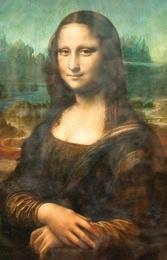
names containing ‘of’ the Statue of Liberty, the Tower of London unique things the Bible, the Eiffel Tower, the Vatican, the Mona Lisa titles the Prince of Wales / the Queen the names of organizations, parties, associations the United Nations, the Democratic Party, the Senate, the National Basketball Association (the NBA)
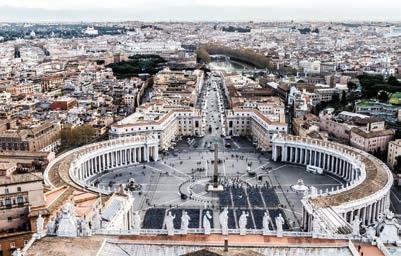
We do not normally use “the”
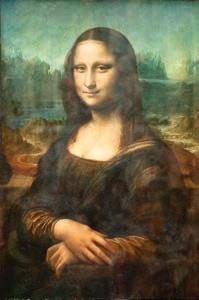
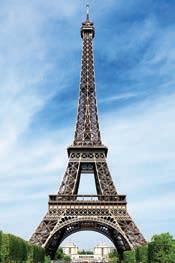
• for shops, banks, hotels, etc. named after a founder or other persons (with -’s or -s).
• for roads, streets, squares, parks and names of buildings.
shops, banks, hotels, restaurants Harrods, Barclays Bank, McDonalds, Steve’s Hotel churches, cathedrals St John’s Church, St Peter’s Cathedral, Edinburgh Castle streets, squares, parks, highways Trafalgar Square, St James’s Park, Highway 64 airports, companies Heathrow Airport, Microsoft colleges, universities Boston College, Cambridge University (BUT the University of Cambridge)
Practice
Complete the sentences with the where necessary.
(1)______Windsor Castle, a residence for (2) ______English royalty throughout its history, is one of the most perfectly maintained castles in (3)______world. Originally constructed in (4) ______ time of William the Conqueror, shortly after (5) ______Norman conquest of England in 1066, (6)______ castle has seen a huge number of improvements over (7)______centuries.
It became a royal residence during (8)______reign of Henry I, who built accommodation suitable for this role. Many of his descendants expanded and improved (9) _______building, until it grew into (10) ______ complex it is today, full of (11) _______rich history and wonderful stories. Despite the fact that it is still used by (12) _______King as a royal residence, it is open to visitors.
Reading and speaking THE GREEN CHILDREN of Woolpit
Before you read the text discuss the following.
1. Do you think that there is always an explanation for everything that happens?
2. Have you heard of any mystery that has no scientific explanation? If so, tell the class about it.
3. Why do people like to retell legends?

track 19
Facts and fantasy are often found together in folk myths and legends. An extraordinary story of the green children contains elements of both. It is believed that the event in the village of Woolpit took place during the reign of King Henry II (1154-1189 AD), and was first recorded by two monks during the early 1200s.
The village was named after some ancient deep pits that were traditionally used for trapping wolves. One day, the villagers working in the nearby field heard frightened cries coming from the pits. The puzzled workers went to investigate and came across two terrified children, a boy and his slightly older sister.
There were a few striking features about the children. They were dressed in strange clothes of an unknown material, talked in a strange language that no one could understand, but by far the most intriguing characteristic was their skin – it was completely green! After recovering from the strange sight, the villagers took pity on the children and brought them to the home of a local landowner. They were treated there with great care and kindness. However, although hungry, the children refused to eat whatever dish they were offered. It was only when a maid brought some fresh green beans that the children began eating with pleasure. From their evident delight it was clear that it was the food they were accustomed to eating. Eventually, the girl began to consume other foods too, but the boy refused to do so. Inevitably, he became weaker, and in less than a year he died. The girl, however, adjusted to her new life and as the years passed her skin gradually lost its original green colour and she became a healthy young woman.
All the villagers eagerly waited for the day when she would learn enough English to explain her origin. However, what she told them only deepened the mystery. She claimed that they had come from a magical place called St Martin’s Land, where it was perpetual twilight, and that all the inhabitants were green in colour. She was unable to explain how she and her brother found themselves in an underground cave.
Glossary
pit – a large hole in the ground inevitably – unavoidably eager – very excited and interested intriguing – arousing great interest or curiosity consume – to eat or drink, especially a lot of something perpetual – continual; permanent twilight – half-light; dusk
2
According to the text, which sentences are true and which are false? Justify your opinion.
1. The villagers found the children in the crops of nearby fields.
2. The children could explain where they had come from.
3. The children didn’t eat food they were offered because they weren’t hungry.
4. When she had learnt how to speak English, the villagers finally learned the truth.
5. The girl gradually lost her green colour when she started eating other food.
Discuss the following.
1. Do you think there is any truth in this extraordinary story?
2. What is the most striking feature of the story?
3. Why does it seem unlikely that they belonged to some alien species? 3
4
There are many reasons why stories are told and passed down from one generation to the next. Here are just a few of them. Which of them reflect your opinion? Compare your answers.
1. Their aim is to provide moral guidance.
2. They are told for entertainment purposes.
3. Stories often reflect the beliefs of the people who tell them.
4. They pass on the history of battles and tales of courage.
5. They show people how they should behave.
5
Find a story, myth or an urban legend and prepare a five-minute talk on it.
Vocabulary
Match the highlighted words in the text The Green Children of Woolpit with their explanations. 1
1. extreme pleasure or satisfaction; joy
2. attracting attention; impressive
3. slowly and in small stages or amounts
4. very frightened; horrified
5. confused because you do not understand something
2
Use the words from Exercise 1 and the Glossary in their correct form to complete these sentences.
1. Any diet changes our meal and snack habits.
2. The story wasn’t only well-written but was also extremely _____________.
3. To the family’s _____________ she announced that she was getting married.
4. Roger was _____________ when he heard her explanation.
5. It was a place of _____________ beauty.
6. Everyone was ____________ to hear the information he had found out.
7. She _____________ built up a reputation as a successful lawyer.
8. The children were so_____________ that they refused to say anything.
3
Expressions with take
Study these expressions and use them in the sentences of your own.
1. to take pity on = to feel sympathy and sadness for someone
2. to take something for granted = to regard it as certain
3. to take something into account = to consider
4. to take something to heart = to be affected emotionally
5. to take a/the hint = to understand what is meant and act on it
6. to take the rough with the smooth = to accept the bad along with the good
Example: They took pity on the children and brought them home.
Word formation
Verbs made from adjectives and nouns by adding –en
E.g. dark + en = darken strength + en = strengthen
4
Make verbs from the following adjectives and use them in the sentences of your own: deep, wide, length, short, hard, less and broad.
If we don’t do anything urgently, our financial crisis will deepen.
Collocations
Match the verb on the left with a noun on the right to make a collocation. 5
1. shorten 2. strengthen
3. broaden
4. soften
5. sharpen
6. sweeten
a. a pencil
b. the taste
c. one’s mind
d. one’s trousers
e. the blow
f. a relationship
ReadingGrammar and
Read the text about possible explanations of the case of the children of Woolpit and study the sentences where modal verbs are used to express deductions.
Various explanations have been put forward for the enigma of the Green Children of Woolpit. The most widely accepted explanation at present is that they could have been children whose parents had been killed in a period of local fighting. In Eastern England there were a lot of Belgium people coming in during the 12th century, but after Henry II became king, these immigrants were persecuted. It is supposed that the homeless children could have come from the nearby village, which was separated from Woolpit by the river Lark.
If the children had fled into the forest, it might have seemed like twilight to the young, scared children. They may have wandered into one
of the many underground mine passages that finally led them to Woolpit. Confused, frightened and dressed in strange clothes, they must have seemed a very odd sight to the Woolpit villagers. The colour of the children could be explained by ‘green sickness’, the name once given to anaemia, caused by a poor diet. Once they had been given proper food, their colour returned to normal.
Glossary
persecute – to treat people cruelly
Modal verbs with the perfect infinitive
Speculations about past actions
We can use modal verbs with the perfect infinitive (have+past participle) to talk about how sure or unsure we are about something in the past.
1. We use ‘must have + past participle’ when we are quite sure about something. It is the commonest form to express deduction.
• His secretary must have taken the letter. It’s not here. (There is strong evidence)
2. We use ‘might/may/could have + past participle’ when we are not sure about something but we think it was possible.
• He may/might have mentioned it, but I can’t really remember. I wasn’t listening.
3. We use ‘can’t/couldn’t have + past participle’ for things that we are sure did not happen in the past.
• She can’t have stolen Ann’s bag because she was with me. (It’s impossible)
Note: ‘Should +have+ past participle’ is used to talk about past events which did not happen, to express obligation or criticism.
• I should have sent the report myself. – He should have helped her. (A criticism)
‘Should not have + past participle’ is used to talk about unwanted things that happened.
• You shouldn’t have said things like that to her – it really upset her.
‘Needn’t + have + past participle’ is used for actions which were performed but were unnecessary.
• We needn’t have hurried. Now we are too early.
Practice
Example: I told a colleague he was incompetent. I shouldn’t have said that. 1 2 3 4 5 6
Read the article again and underline the examples of modal verbs of deduction.
Use must, can’t may/might to rewrite these sentences.
1. I’m almost certain that it happened. – It _________________________________.
2. I’m almost certain that it didn’t happen. – It ______________________________.
3. I’m not sure whether it happened or not. – It ______________________________.
Use an appropriate modal verb to complete the sentence.
Example: Why is he late? He must have been stuck in a traffic jam.
1. It was a mistake to lie. You _________ have told him the truth. (but you didn’t)
2. Who knows why he didn’t come. He __________ have forgotten that it was her birthday.
3. He ___________have been at that club last night. It was closed.
4. He ___________have entered the house here; the window is broken.
5. You _________have watered the flowers. It’s raining.
Complete the sentences. Use may/might/could/can’t + have+ the past participle of the verbs in brackets.
1. He had the necessary qualifications and__________________ (apply) for that job, too.
2. Nobody knows why she left. She ________________ (fall) in love with someone else.
3. They ___________________ (be) at the café but I didn’t see them.
4. You ____________________ (see) him this morning. He was with me all the time.
5. Where’s your sister? - I’m not sure. She _________________ (go) home.
Complete the sentences. Use must/should/shouldn’t/needn’t + have + the past participle of the verbs in brackets.
1. She __________________ (refuse) that job offer. It was a good opportunity.
2. I _______________ (go) to meet her because her brother came to the airport, too.
3. His mother _________________ (be) furious when she found out.
4. It’s no wonder you failed the test. You ______________ (learn) more.
5. I ________________ (leave) my keys in the car. I can’t find them.
Think of a situation when you did something you later regretted. Write a few sentences suggesting other possibilities, using some of the structures in the box.
could have might have should have shouldn’t have must have
Phrasal verbs with PUT
Match the phrasal verbs (1-7) with their definitions (a-g) and use them in the correct form to complete the sentences below. Use a dictionary if necessary.
1. put forward
2. put off
3. put out
4. put on
5. put through
6. put up
7. put up with
a. to cause (something) to stop burning
b. a) give hospitality to someone overnight; b) increase prices or taxes
c. propose for consideration; put forward a new plan
d. tolerate
e. connect someone by phone
f. a) postpone b) no longer like something or somebody etc.
g. a) gain weight b) wear
1. He __________ going there because he didn’t want to see her.
2. I ____________ weight over the holidays.
3. I ____________ my old jeans to go for a coffee with my friends.
4. He__________ his cigar before entering the room.
5. The secretary told me she would ______ me _____ as soon as the manager got off the other line.
6. They _________ the price of electricity again. Will it ever come down?
Listening
Rtanj Mountain
1
track 20
You are going to listen to a short text about Rtanj Mountain and legends related to it. While listening, take notes of the things that can be regarded as strange or mysterious.
2
Before you start listening, check the meanings of the following words.
chapel, to guard, heap, resident, flying saucer, sighting
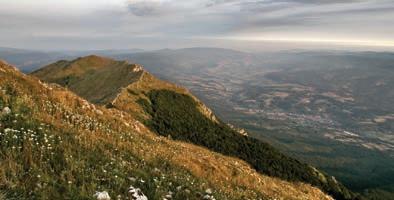
3
Work with your partner. Match the words from column A with the words from column B to make collocations according to the text you listened to. The first one has been done for you. 1/f
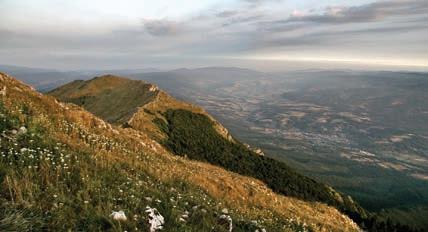
a. diggers
b. civilization
c. mysteries
d. lights
e. treasure f. shape
4
Listen again, check the collocations, and say if these statements are true or false. Correct the false statements.
1. The mountain is associated with various unexplained mysteries.
2. A wizard hid a heap of gold in the castle.
3. Robbers ruined the castle in search of treasure.
4. People think that the place has been visited by aliens.
5. It has been proved that Rtanj is not a natural mountain.
Writing
MYSTERIOUS SITES
Choose one of the pictures to write a short composition of about 120 words.
• Look at the picture and describe what you see.
• Use the past modals and speculate on possible theories what they represent and how they were built. Example: The Nazca Lines could not have been made by a single person. /The symbols may have been used for religious ceremonies.
Key word transformations
5
Use your notes to write a summary of the text Rtanj Mountain.

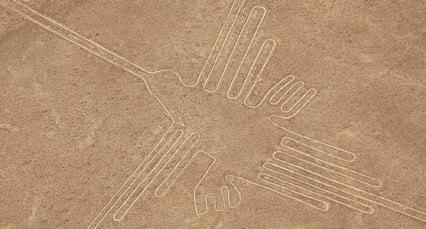
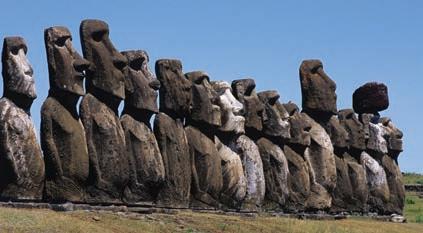
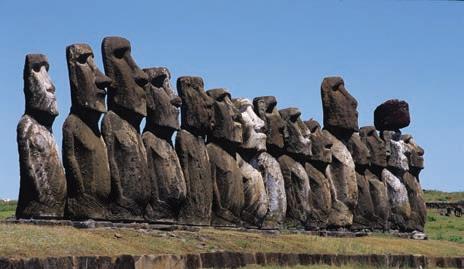
Complete the second sentence so that it has a similar meaning to the first sentence using the word given.
1. I decided not to visit her before Sunday. /put I decided __________________________until Sunday.
2. I bet your father was furious when you told him. /must Your father ____________________________ when you told him.
3. David’s car had broken down. He had to take a bus and was late. /whose David______________________________________ and was late.
4. It wasn’t necessary for me to make dinner after all. They bought a pizza. /have _________________________________after all. They bought a pizza.
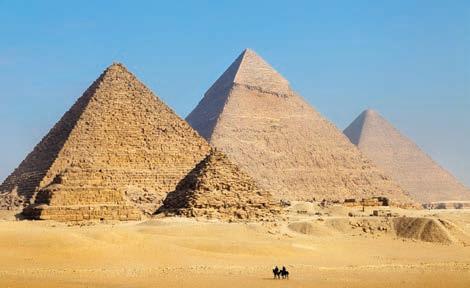
5. I’m sure Tina’s parents haven’t bought a new house. It’s not possible! /can’t Tina’s parents _______________________________ a new house.
6. His latest book was published last year. It became a best seller. /which His latest book_________________________________ a best seller.
The Nazca Lines of Peru
The Moai rock statues, the largest weighing 86 tons
The Pyramids
Communication
EXPRESSING YOUR POINT AND DOUBT
1
Study the ways of expressing doubt or emphasizing a point we want to make. Some of the expressions are used in the dialogue below.
Expressing doubt and reservation
• I’m not s o sure about that.
• You may be right, but...
• I don’t think I’d say that.
• I can s ee your point, but...
• I think that’s debatable.
• Perhaps, but don’t you think that...
• I s ee what you mean, but...
• I agree to some extent, but ...
Emphasizing a point
• I want to stress/highlight ...
• I’d like to emphasize ...
• It’s imp ortant to remember that ...
• We should b ear in mind that ...
• Don’t forget that ...
• The crucial/essential point is ...
• Furthermore/What’s more...
• What I am saying is ...
2 point • missed • make • extent • rather • wouldn’t • agree • more • serious
Sally and Dave are talking about the film they watched the previous night, but they don’t share the same opinion about it. Complete the conversation with one word from the box for each gap.
Sally: Did you see An Afternoon to Kill on TV last night?
Dave: Yes, although I ________ (1) the beginning. What did you ________ (2) of it?
Sally: It was absolutely terrific.
Dave: I certainly ___________ (3) describe it so.
Sally: Why? It was exciting. Don’t you ___________ (4) with me?
Dave: To some __________ (5) only, but it was also __________ (6) disappointing.
Sally: You can’t be __________ (7).
Dave: Why not? It wasn’t a surprising ending, was it? What’s __________ (8), I knew who killed Lancelot after 15 minutes.
Sally: I see your __________ (9). I must admit that I never guessed who the murderer was.
3
Pair work. Make dialogues based on the following situations and then practise with your partner.
A You ask your friend to meet you after class, but your friend is doubtful. You respond to his / her doubt.
B Your friend asks you to teach her / him English, but you are not certain that you can. Your friend responds to your doubt.
C Your friend asks you to come early tomorrow morning, but you are not sure you can make it. Your friend responds to your doubt.
Self-assessment TEST 5
Find synonyms in the List for these words/phrases. (6 pts.)
5. This is the bank. We borrowed the money from it. /which This is _________________________________ 2 3 4 1
1. modification_________ 2. pleasure__________ 3. confused__________
4. remarkable__________ 5. give up___________6. connect someone by phone___________
Complete the sentences by using the word/phrasal verb from the List in the correct form. (4 pts.)
1. He’s _____________ (that) his wife might find out his secret.
2. I will not _____________ such behaviour. Do you hear me?
3. The judge agreed that his arguments are very ______________.
4. This cream will help you to keep your skin _______________.
Circle the correct answer. (5 pts.)
1. He ________bought a new car. He doesn’t have any money. A may have B can’t have C should have D ne edn’t have
2. She ________studied really hard. She passed with excellent grades. A must have B can’t have C should have D ne edn’t have
3. You ________ hit him. He’ll never forgive you.
A may have B couldn’t have C must have D shouldn’t have
4. Unfortunately, he is ________ as a rather silly man.
A supposed B regarded C b elieved D thought
5. The concert was fantastic. You really ________ come.
A needn’t have B can’t have C must have D should have
Rewrite the following sentences using the word in bold. (5 pts.)
1. The painters painted my house last week. /had I__________________________________ last week.
2. I’m sure he was happy when he was told about his promotion. /must He ______________________ very happy when he was told about his promotion.
3. It’s possible that she misunderstood my directions. /may She ___________________________ my directions.
4. We’ll have to postpone the match until next week. /put We’ll __________________________________ next week.
KEY WORD LIST
Verbs consume deepen extend plead persecute renounce Nouns adjustment eloquence delight extension pit flight pursuit
Adjectives eager inevitably genuine perpetual puzzled persuasive striking smooth terrified Phrases at a loss put forward put off put out put on put through put up with
CELEBRITIES Unit 6
In this unit, you will
• read, listen and talk about a. c elebrities and their role in people’s lives b. Meryl Streep - her life, acting and achievements
• practise expressing wishes and regrets impersonal pronouns: one, they, you passive constructions making, accepting, and declining an invitation
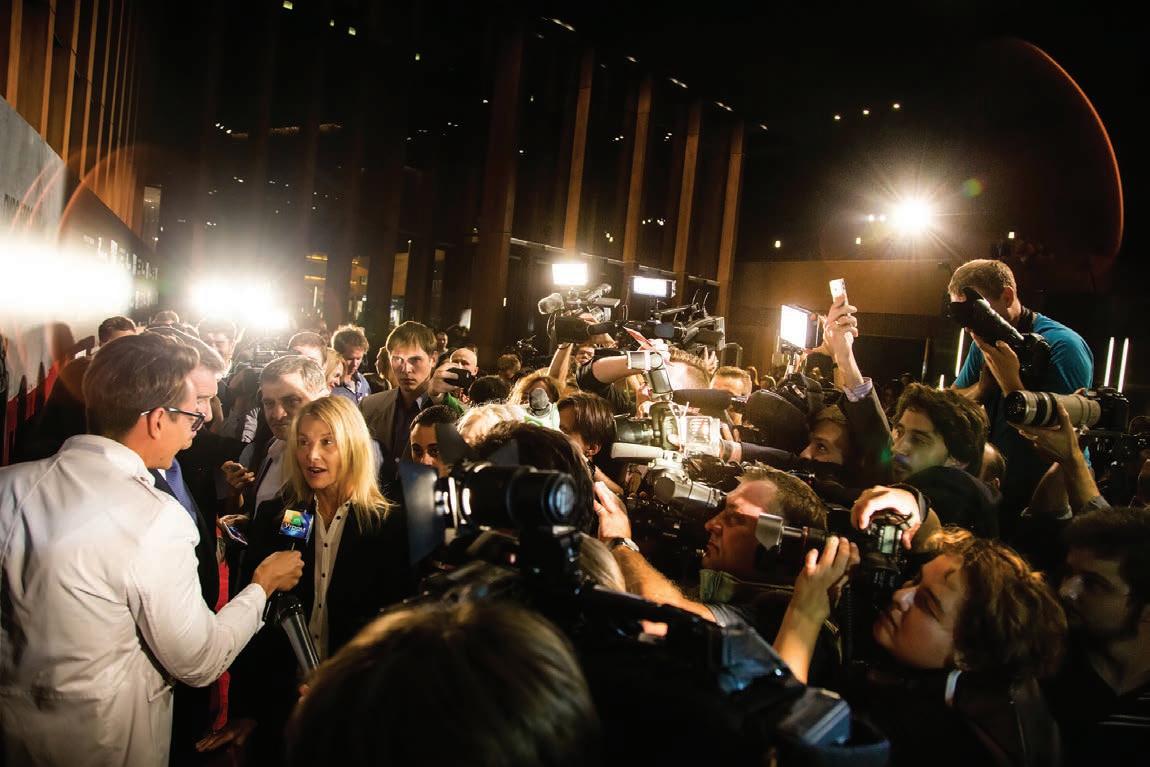
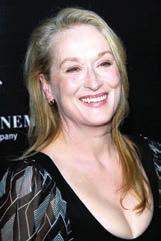

1
a tennis player a director an actor a pilot a singer an actress Lead-in
2
Look at these photos of 6 people who are famous or were so at one time.
Meryl Streep
Michael Jackson
Amelia Earhart
Steven Spielberg
Leonardo di Caprio
Novak Đoković
Match the name, picture and profession of each of them. What else do you know about them? Choose one of them and prepare a three-minute talk to deliver in class.
1 2 track 21
CELEBRITIES as ROLE MODELS
Reading and speaking
Discuss the following questions in class. Compare your answers.
1. How do you explain the phenomenon that so many people are obsessed with other people’s lives?
2. What details of celebrities’ lives do people usually want to know?
3. Are celebrities good role models?
4. We see just one side of celebrities’ lives. Is there another side that we may not see?
Three students had an assignment to write a short composition on the subject of role models and their influence. Read the parts of their compositions and...
a. match the headings (1-4) to the extracts. There is one extra heading.
b. che ck to what extent your answers from Exercise 1 correspond to the views expressed in the texts. Discuss the differences.
c. say if there are any other issues related to the subject which are not mentioned in the texts.
1. Who do role models affect most?
2. Role models are necessary.
3. Who are the best role models?
4. Are celebrities always good role models?
Laura ____
Celebrities such as singers, movie stars or athletes are people who we generally see as role models. They are admired for their looks, success or achievements. We eagerly watch shows which give us an opportunity to take a look into their lives or read everything we can about them. As they are constantly in the media, they often become role models. Teenagers are more prone to be affected by all the glamour, money and fame and more likely to wish they were them. However, it is important that the young understand that in order to reach fame one has to work hard and above all, be very good at what they do.
People should aspire to do something rather than be someone.
George
It must be said that not all celebrities are entertainers. People like Albert Einstein, Martin Luther King and Bill Gates, to mention but a few, are famous people who have changed the world in a positive way.
I believe that the young should look up to men and women of true character, to those who show passion for their work and can motivate us to pursue our dreams. The best role models are people who possess qualities that we would like to have, like talent or determination Role models can be our friends, a family member or a sportsperson, anyone who can help the young develop good habits and set the objectives they want to achieve.
Take Beckham as an example; the boy from East London who had obsessively practised kicking a ball to the right spot years before he achieved fame and fortune. He shows young people how hard work leads to success.
Glossary
prone to – having a tendency to something; likely to have/get impose – to force something on someone
abuse (n) – excessive and habitual use of (alcohol or drugs)
abuse (v) – to treat with cruelty or violence; maltreat
Harry
The truth is that we are obsessed with celebrities! I wish we weren’t because many are bad role models and have a negative impact on their fans. They often impose high standards of beauty and life-style and make young adults feel ‘less confident and more dissatisfied’ with their own looks and life in general. Besides, we frequently hear in the media about their inappropriate public behaviour or drug and alcohol abuse. Celebrities need to remember that they are being watched all the time, and they need to set a positive example since young people usually try to imitate them.
3
Match the persons and their opinions. Which person
1. thinks that young adults may feel dissatisfied when they see how celebrities live?_________
2. says that anybody can be a role model if they serve as an example? ________
3. b elieves that celebrities become role models because they are constantly in the media? ______
4. thinks that role models should motivate the young to follow their dreams?________
5. says that celebrities often behave inappropriately?
6. says that teenagers are easily affected by celebrities’ glamorous life-style? _________
Vocabulary
1 2 3 4 5
Read the sentences with the highlighted words again and try to guess the meaning of these words from the context. Then use the words to complete these sentences.
1. I know that many boys ___________ to become famous basketball players.
2. She was __________ for her efficiency and competence.
3. Her informal dress seemed absolutely ______________ for the occasion.
4. _____________ is the quality that you show when you have decided to do something.
5. Students should s et learning ______________ and plan their activities in order to succeed.
Match the highlighted words in the text with their synonyms. willpower – ___________ unsuitable – ____________ goals – __________ to aim – _________ to stimulate – _____________
Choose the correct collocation in these sentences.
1. Celebrities’ b ehaviour can have a negative impact/impression on people’s attitude to life.
2. We were looking for the right spot/site to set up a camp because it was getting dark.
3. Laughing at a funeral or talking during a movie is considered to be inappropriate/unfortunate behaviour.
4. Young p eople should be warned of drug misuse/abuse.
5. Mary has set/made an example to her generation and her fans.
Complete the sentences with the correct prepositions.
1. They are admired _________ their looks and success.
2. New measures have had a negative impact ________ unemployment.
3. Their research will focus ________ areas in the south.
4. He was obs essed ________ the idea of revenge.
5. He’s known to b e prone _______ accidents.
Word formation
Complete the sentences by using the correct form of the word in bold.
1. Teenagers have the greatest ___________ for all those who are rich and famous. /admire
2. He was fas cinated by the actress and tracking her every move became an _______. /obsess
3. I’ve never had any ___________ to become famous. /aspire
4. People who lack courage or ___________ can’t expect to realize their dreams. /determine
5. Some p eople learn a foreign language using ___________. / imitate
6. He shows great ___________ for his grandchildren. /affect
1 2
Grammar Expressing wishes and regrets
We use wish /if only to express an impossible wish about a present situation or regret about the past.
wish + past tense expresses wishes for things to be different from what they are.
I wish/If only I knew the truth. / I wish I were younger. wish + past perfect is used to express regrets for something we did or didn’t do in the past.
I wish I hadn’t gone to her party.
wish + would is used to refer to general wishes for the future or to talk about other people’s irritating habits.
I wish it would rain. / I wish they would stop gossiping. wish + could expresses the idea that we would like to be able to do something.
I wish/If only I could come to your birthday party.
Note: We can also express regrets and criticism by using should/shouldn’t have + past participle. You shouldn’t have borrowed the money for your journey from Jane.
Practice
Complete the gaps with the correct form of the verbs in brackets.
1. I wish I ____________ (study) harder. The exam is tomorrow and I’ve only revised half the course.
2. I wish I____________ (can/drive) a car.
3. I wish I ____________ (not/lend) him that book. It was a present from my grandfather.
4. If only I____________ (not/do) that. I’ll regret it for the rest of my life.
5. If only I____________ (have) a smart phone. I’d be so happy.
6. I wish we ___________ (go) to see my parents for Christmas. The rest of the family was there.
7. I don’t like being so short. I wish I ___________ (be) taller.
8. I wish you ____________ (stop) doing that. It drives me crazy!
Write sentences which could follow these statements, using I wish… or I should have or shouldn’t have... The first one has been done for you.
1. I’ve got no money left. – I shouldn’t have bought three dresses. / I wish I hadn’t gone shopping.
2. I’m s orry I lied to her.
3. I ate too much at the party. I felt terrible.
4. I miss ed the bus and came late to the show.
5. I’ve got an enormous phone bill to pay.
Focus on Speaking
IMPERSONAL PRONOUNS: ONE, THEY, YOU
We can use impersonal pronouns to talk about people in general. To reach fame one has to work hard. /They should aspire to do something. You can find a lot of interesting places there.
Note: We can use he, she or they instead of ‘one’ in the main clause. If one wants to succeed, he/she/they should study hard.
Listening
2. If you were famous, what aspects of your life would you dislike most? 2 1 3 Fame has its disadvantages, too track 22
Three famous people were asked to talk about the advantages and disadvantages of being a celebrity. Before you listen to the text, read the sentences below carefully and decide what kind of information is missing. Listen once and then fill in the gaps with the missing words.
The main (1) __________ of being famous is that celebrities are usually very rich. Lack of privacy is one of the biggest (2) ____________ of being a celebrity.
Whenever they leave their (3) ____________, they have to face a huge rush of crazy fans. Fans expect celebrities to be absolutely (4) ___________ every day. Celebrities are only human beings and they cannot (5) ____________ all the expectations of their (6) __________ or the media.
Listen again and check your answers.
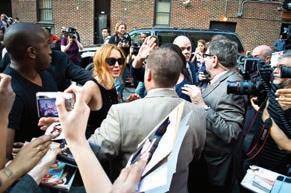
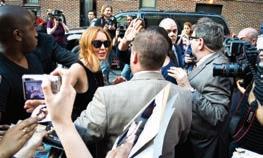
Discuss the following questions in pairs or groups.
1. Which advantages did the celebrities mention?
2. Which disadvantages did they talk about?
3. Who s eems to complain most?
4. Are there any other disadvantages that were not mentioned in the text?
5. What is the role of the mass media in celebrities’ lives?
1. How do es the fascination with celebrities affect our lives?
Discuss the photographs and the questions.
1. What is happening in these pictures?
2. What makes people want to touch celebrities?
3. Do you have an idol among celebrities?
4. Are you interested in reading stories about celebrities?
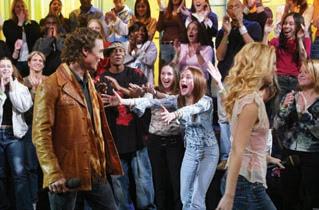
Choose a famous person you admire and prepare a three-minute presentation about him/her. 1 2

How much do you know about Meryl Streep?
Discuss the following questions.
1. Is she an actress or a singer?
2. How many Oscars does she have in her collection?
3. Has she ever acted on the stage?
4. Do you know any of her musicals?
5. Is she still acting?
Read the text and find out how good you were at guessing.
A WOMAN OF MANY TALENTS Reading
1 The venue is the Kodak Theatre in Los Angeles. The voice from the stage is heard announcing …. ‘and the Oscar goes to … Meryl Streep.’ ‘When they called my name, I had this feeling that I could hear half of America saying, ‘Oh no, why her again?’ said the actress when she addressed the audience after receiving the third Academy
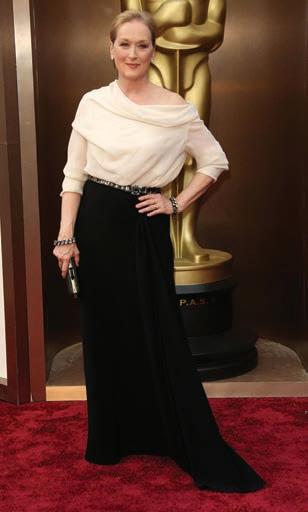
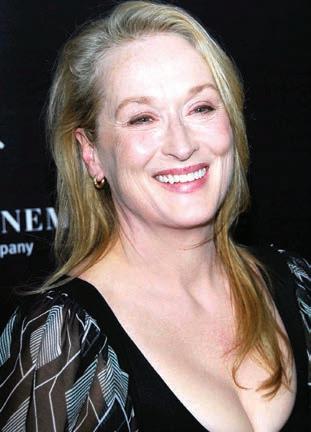
Award in her career. It was the 2011 Best Actress Oscar for her role of the former British Prime Minister, Margaret Thatcher in the film The Iron Lady. In a career full of great performances, this is surely one of her greatest. She went through a considerable transformation as she changed from a young politician into an elderly woman.
2 Meryl Streep is considered by many critics to be the greatest actress of her time. Her acting career began on the New York stage in the late 1960s and continued on the big screen during the 1970s.
3 She is said to b e a chameleon on the screen because of the variety of roles in dramas, comedies and musicals that she so successfully played and which brought her both nominations and awards. She has been nominated for the Academy Award 18 times, and has won it three times. She has also earned an enormous number of other rewards, including a Golden Globe.
4 Her abilities to master almost any accent and to be different in every film are some of her remarkable characteristics. She is also known for being a perfectionist when preparing for her roles. She learned to play the violin by practising 6 hours a day for 8 weeks, for her role in Music of the Heart. She is said to have had a photographic memory when she was younger, which allowed her to memorize her lines after one reading.
6 With age Meryl Streep has become a powerful, self-confident and witty woman, with talent working in her favour. Making more films than ever before, she enchants viewers worldwide. track 23
5 She thinks of hers elf as a very curious person. ‘I want to know everything about my characters and that’s the essence of my acting,’ she said once. Although she works hard, she also keeps strong ties with her family: she is a mother of 4 children. Her friends think that her personal life and her career are of the same importance to her.
Glossary
venue – the place where an event takes place Prime Minister – the head of the government in some countries award – a prize of recognition given in an honour of achievement master /v/ – to learn (something) completely essence – the most important part of something; the basic nature of a thing enchant – to attract and hold the attention of (someone); to put a magic spell on (someone) tie – bond, the thing that unites or links people
2
Find evidence in the text which proves that Meryl Streep
1. didn’t expect to win the Oscar that year because she had already had two.
2. acte d on the stage before she had a career in films.
3. can easily transform into another character.
4. thoroughly prepares for her roles.
5. had a go od memory when younger.
6. has received a great number of awards.
Explain the meaning of the following words and phrases as used in the text. Paragraph numbers are given in brackets.
1. announc e (1)
2. c onsiderable transformation (1)
3. big s creen (2)
4. a chamele on (3)
Speaking
Pair work
3 1
• Tell your partner which facts about Meryl Streep you have learnt from the text that you didn’t know before. Write down the facts that both you and your partner mentioned.
• Each pair should report the facts that were new to them.
• Which fact(s) nob ody in class was familiar with?
5. photographic memory (4)
6. a curious p erson (5)
7. strong ties (5)
8. s elf-confident (6)
Vocabulary
Complete the sentences using the words from the box.
performance viewers role awards ability ties
1. Do you think that his film will win any __________ at the festival?
2. It is imp ortant that we keep family ___________ strong.
3. Robert is a man with a great ____________ to transform his voice into a child’s.
4. TV __________ were enchanted with Rachael’s character in the new serial.
5. Have you seen the new Shakespeare ___________ in the National Theatre?
6. D id she win the Best Actress Oscar for her __________ in Out of Africa?


2 3 4
quiz FILM



Match the title with the most appropriate kind of film from the box below.
Titanic Mamma Mia Avatar
Police Academy The Lady and the Tramp Die Hard
Sleepless in Seattle Pearl Harbour
Home Alone
a musical, a disaster film, a comedy, a cartoon, a horror film, a science fiction, a western, a war film, a thriller, a romance
Who are the people who make films? How many of them can you name? director, _______________________________________________________
Some of the categories of Academy Awards: FOR THE BEST
Actor –_____________________________
Actress –
Supporting Actor –
Supporting Actress –
Film –
Sound –
Original Song –
Original Screenplay –
Adapted Screenplay –
Animated Feature –
Visual Effects –
Foreign Language Film –
• How many winners of these awards do you know? Write their names next to their awards.
5 Adjectives describing personalities
When describing someone we usually talk about their personality and behaviour. Which of these characteristics do you consider more attractive and less attractive? Which characteristics do you find in your friends or relatives?
self-confident
witty easy-going powerful curious reserved outgoing sensitive shy
• C an you add more adjectives describing personality?
6
Match the adjectives on the left with their opposites on the right.
1. narrow-minded
2. generous
3. curious
4. relaxed
5. shy
Speaking
Work in groups.
a. nervous
b. self-confident
c. mean/stingy
d. uninterested
e. open-minded
7 Write 3 sentences describing yourself or people you know.
Find out from your partners which of all the films they have seen were the most: entertaining, frightening, enjoyable, exciting, violent, fantastic, disappointing, tragic, incredible, realistic, memorable, overrated, moving.
• Each of you should explain why the film impressed you in that way.
Grammar The passive constructions
Study the sentence: She is said to be a chameleon on the screen.
When we want to pass on information about what some people think but we do not know whether it is true or not, we can use two passive constructions and the verbs say, think, believe, report, consider, expect, etc.
1. It + passive + that-clause It is considered that she is a great actress.
2. Subject + passive + to-infinitive She is considered to be a great actress.
Note: We can also use other forms of the infinitive in this passive construction.
• The continuous infinitive refers to the same time as that of the preceding verb and expresses an action in progress or happening over a period of time. Robert is said to be staying with his friends. /His brother was believed to be lying.
• The perfect infinitive refers to a time before that of the preceding verb. Mary is believed to have earned a lot of money.
Read each sentence. Then make two new sentences in the passive, beginning with the given words.
1. People say that these rocks are thousands of years old. It_________________________________________________________________________________. These rocks ________________________________________________________________________.
2. They c onsider that she is the greatest living singer of country music. It ________________________________________________________________________________. She ______________________________________________________________________________.
3. People expect celebrities to behave properly in every situation. Celebrities_________________________________________________________________________.
4. Someb ody reported that a volcano erupted in Japan. It ________________________________________________________________________________.
5. Everyone believes that the missing children are hiding in the forest. It _________________________________________________________________________________. The missing children_________________________________________________________________.
Key word transformations Practice
Finish the second sentence without changing the meaning.
1. People were watching the world championship in football on TV in many cafés. The world championship _________________________________________________________.
2. People are using computers in all kinds of work nowadays. Computers _____________________________________________________________________.
3. Exp erts estimate that a lot of people now have access to the Internet. It is ____________________________________________________________________________.
4. People say that the committee will announce the names of the winners tomorrow. It is ____________________________________________________________________________.
5. They must send the letter at once. The letter ______________________________________________________________________.
BRewrite these sentences to express wishes and regrets using I wish and the words in brackets. Change the form of the verbs in bold if necessary.
1. I didn’t pass my exam. /study more I wish ____________________________________________________________________________.
2. My brother will be back in a month. /sooner I wish ____________________________________________________________________________.
3. My neighbour’s child is making a lot of noise. /stop I wish ____________________________________________________________________________.
4. We are going to the seaside next week. /tomorrow We wish __________________________________________________________________________.
5. I lie d to my parents about my test results. /tell the truth I wish ____________________________________________________________________________.
Writing
A FILM REVIEW
Write a review of a film you have recently seen. We recommend you to see one of Meryl Streep’s films: Out of Africa, Mamma Mia, The Devil Wears Prada, Kramer vs Kramer or Sophie’s Choice.
Organize your review like this:
a. Introduction (include information such as: the title, type, screenplay writer, actors, director...)
b. The plot, s etting, characters of the film
c. Nominations and awards if there are any
d. Your opinion about the film. (How you would describe it – as exciting, boring; what you especially like/dislike). Comment on various features of the film – the acting, directing, photography, special effects, message, etc.
e. Conclusion (recommendation) – if you would recommend it to your friends and why/why not
• Use a range of adjectives from the exercise SPEAKING.
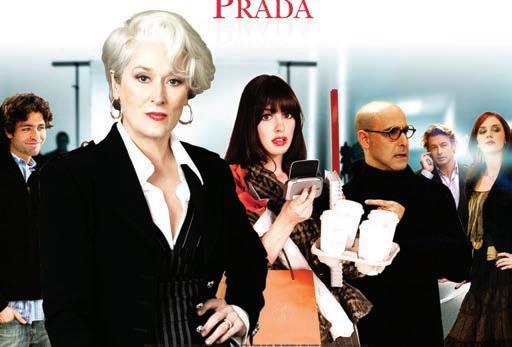

Communication MAKING, ACCEPTING, AND DECLINING AN INVITATION
If you want to invite someone to go somewhere with you or to have dinner with you, you can say:
How about coming over for dinner tonight?
Would you care to join us for…?
Why don’t you …?
Would you like to/Would you care to…?
Do you feel like coming/going…?
I was just wondering if you would like to…
We’d be delighted to have you over…
If you can accept an invitation, you may say:
Yes, that would be lovely/nice.
Thank you! I’d love to. Would you like me to bring anything?
Thank you very much! I’d be delighted to. What time should I be there?
Oh, certainly! Thank you.
If you can’t accept an invitation, you may say:
No, I’m afraid, I can’t, but thank you all the same.
I’d love to, but I’m afraid I’m busy tonight.
I’d love to, but I already have plans for tonight.
Thank you for asking me, but…
Well, that’s very kind of you, but…
Work in pairs. A invites B to do something (go to a basketball match, see a film, go to a party). B refuses or accepts the invitation. Try to ask and answer in as many different ways as possible. Remember to give reasons for accepting or refusing the invitation.
Self-assessment TEST 6
Complete the sentences using one of the words from the List in the correct form. (6 pts.)
Verbs address admire aspire abuse enchant impose Nouns award celebrity determination essence fame glamour impact objective tie venue Adjectives considerable inappropriate prone self-confident witty 1 2 3
KEY WORD LIST
1. A clear was set to improve students’ knowledge of English.
2. At that time, all serious artists _________ to go to Paris.
3. David received an ___________ in mathematics.
4. Tim was ___________to ac cidents when he was a child.
5. They understand the imp ortance of strong family ___________.
6. She went on holiday with a suitcase full of ___________ clothes.
Rewrite the sentences about present, past and future events using the introductions. (6 pts.)
1. I can’t drive a car. I wish _________________________ ________.
2. I didn’t work hard enough. I wish __________________________.
3. Jane won’t come today. I wish _____________________________.
4. All her friends have boyfriends. She wishes___________________.
5. It will rain tomorrow. I wish _______________________________.
6. He wastes time on his c omputer. I wish ______________________.
Write two new sentences in the passive, beginning with the given words. (8 pts.)
1. They say that Jason has made a new film.
a. It __________________________________________________.
b. Jas on _______________________________________________.
2. They exp ect that everybody will do their duty.
a. It __________________________________________________.
b. Everybody __________________________________________.
3. People believed that the Earth was flat.
a. It __________________________________________________.
b. The Earth ___________________________________________.
4. Everybody believed that Nick had forged the boss’s signature. a. It _______________________________________________________.
b. Nick ________________________________________________.
points
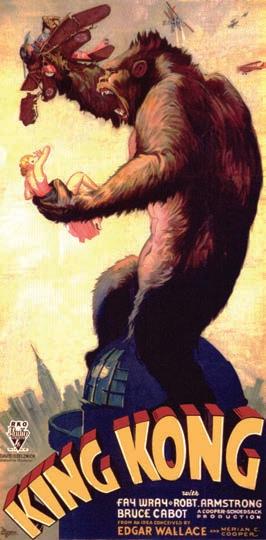

Lead-in
CRIME and FICTION Unit 7
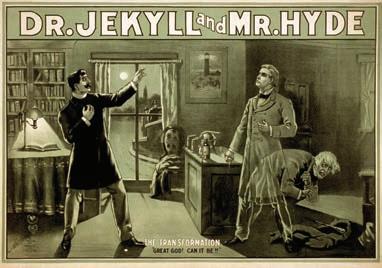
In this unit, you will
• read, listen and talk about
a. the most famous literary detectives
b. Sherlo ck’s methods of deduction
• practise the present perfect simple and continuous tenses verbs and expressions followed by the gerund phrasal verbs with make words related to crime and punishment compounds reporting verbs saying that you have changed your mind
1
Look at the titles of books and match them with the literary genres you think they belong to (a-d).
Death on the Nile Pride and Prejudice Othello 2061: Odyssey Three
2
a. Romantic novels
b. Crime stories
c. Science fiction
d. Tragedies
Work in pairs. Discuss the following questions.
1. What is the best book you’ve read recently?
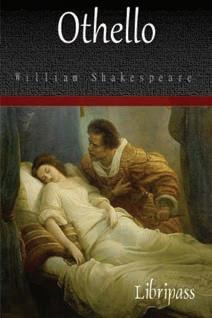
a) Who was it by? b) What was it about? c) Why did you particularly like it?
2. Why do people like reading detective stories? List as many reasons as you can.
3. Can you name some of the most famous detectives in world literature? Can you say anything about them?
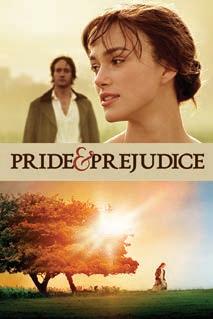

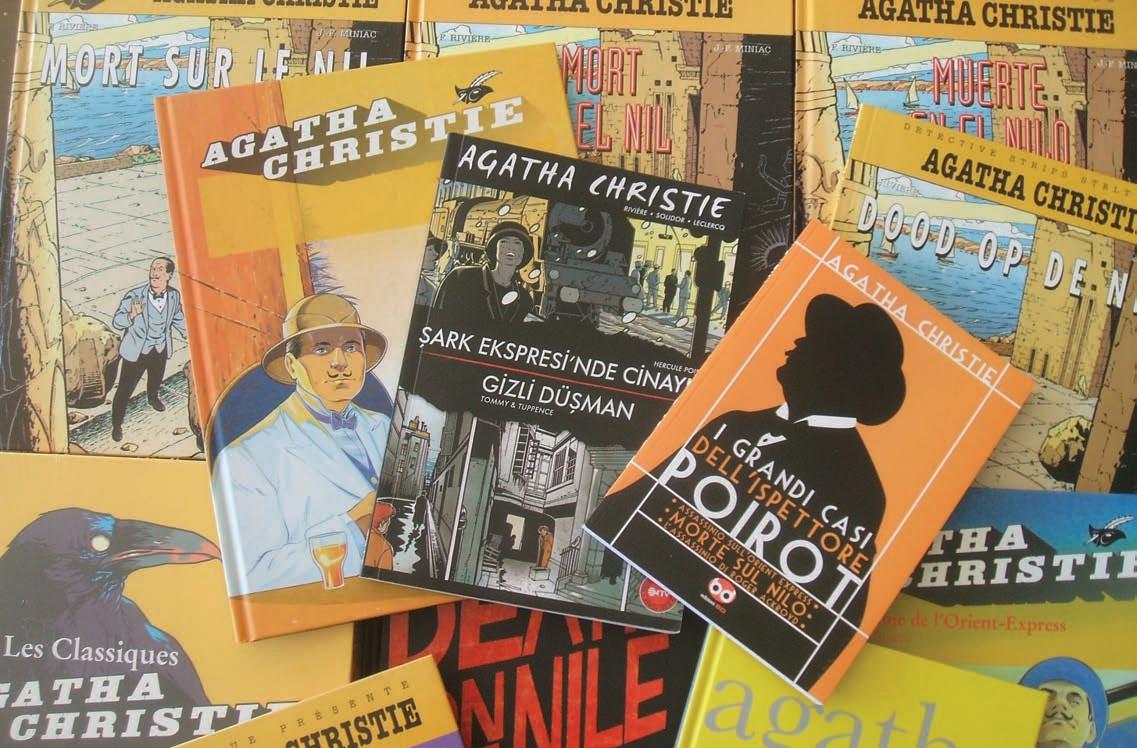
FICTIONAL
DETECTIVES
Reading and speaking
track 24
Crime novels have fascinated readers for a long time. They are full of action, suspense and surprising revelations and their plots are generally interesting. They appeal to so many people partly because they entertain and partly because we marvel at the genius of the detectives who successfully solve the crime. They all have something in common: they possess great powers of observation and reach their conclusions through an analysis of clues they gather.
Hercule Poirot
Created by Agatha Christie, alongside Miss Marple, Hercule Poirot is surely one of the greatest fictional detectives. Poirot enjoyed a long career, a remarkable period of 55 years, and appeared in 33 unforgettable crime novels, including Murder on the Orient Express’ and Death on the Nile, and over 50 short stories and a number of film adaptations.
Poirot, with his fabulous moustache and obsession with cleanliness and symmetry, is a dignified Belgian detective who solves crimes with his ‘little grey cells’, the use of logical reasoning, or as he puts it ‘order and method’.
Sherlock Holmes
No list about the best fictional detectives would be complete without this brilliant and enduringly popular detective. He became one of the most inspiring and influential characters of all time. There have been many film and television interpretations since his birth in the late 1800s.
In the persons of Sherlock Holmes and his helper, Dr John Watson, Arthur Conan Doyle captured the imagination of millions of readers and viewers. The secret of his success can be attributed to Sherlock’s extraordinary complex and enigmatic character, his wit and wisdom. Sherlock is known for his logical reasoning and the early use of forensic science. His famous quote: ‘Elementary, my dear Watson’ shows how easy it is for him to come to correct conclusions. Holmes believes in the science of deduction: the principle that any problem can be solved if the necessary information is given. He is surrounded by people who are generally less bright than he is. Dr Watson is a good observer, but his deductions are often incorrect.
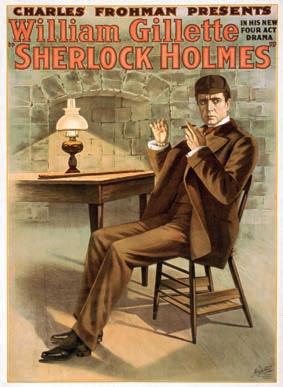
suspense – a feeling or state of nervousness or excitement about what may happen appeal to – to be attractive or interesting flaw – a fault or weakness in a person’s character marvel – to show great admiration clue – a piece of evidence or information used in the detection of a crime fabulous – marvellous; wonderful dignified – deserving respect; noble
1
Complete the sentences according to the information in the text.
2
Discuss these questions.
1. Crime fiction app eals to many because _________________________.
2. The qualities of good detectives are ____________________________.
3. Poirot solved mysteries by ___________________________________.
4. Poirot can be described as a __________________________________.
1. Do you know what Holmes means when he says: ‘Elementary, my dear Watson’?
2. What can be seen as a proof of Holmes’ popularity?
3. Have you read any of Agatha Christie’s crime novels? If so, which? Did you like it?
4. Have you seen any film or TV series about Sherlock Holmes? If so, what impression did you get regarding his character?
Vocabulary
1. flaw 2. enduring 3. bright
4. admirable 5. clue
2
Use the words from the box to complete the sentences.
Match the words on the left with the pairs of synonyms on the right. 1
a. clever/smart
b. marvellous/highly regarded
c. lasting/durable
d. indication/hint
e. imperfection/fault
flaws • dignified • appeal • suspense • fabulous • enduring
1. The kind of films you have here will certainly _____________ to teenagers.
2. He had his ______________, but we must admit that he was still a great teacher.
3. An example of a _______________ person is someone who always acts politely and minds his manners in a difficult situation.
4. Both the scenery and weather were ________________. We really enjoyed our stay there.
5. Alfred Hitchcock was a master of ________________.
6. We all agree that his work has proved to have ________________value.
3
Vocabulary on crime
A Find the words in the box which match these definitions. If necessary, use a dictionary or look them up in the Word list. The first one has been done for you.
testimony fine arsonist the accused/defendant burglar defence suspect find innocent/guilty forger trial verdict capital punishment mugger hijacker prosecution shoplifter
1. A formal statement, especially one given in court of law. testimony
2. A person who falsifies _____________
3. An official judgement made in court. _____________
4. A person who steals from houses. ______________
5. A person who attacks and robs another in a public place. ______________
6. A person who takes control of a plane or boat using violence or threats. ______________
7. Someone who might have committed a crime. _____________
B Put the words from the box into the correct category. There is an example.
Criminals Words associated with court Sentences & Punishments arsonist testimony fine
Listening
Sherlock Holmes comes to the Museum of London
1
Pre-listening activity
This is an extract of the text you are going to listen to. Complete the sentences by using the correct form of the words in brackets.

A new exhibition of this (1)___________ (mortal) character opened at the Museum of London in September, 2014. ‘The man who never lived and will never die’ is the perfect title for this (2) ___________ (enjoy) exhibition. Here are photographs, typewriters, forensic (3) ___________ (equip), maps, costumes and (4) ___________ (medicine) tools Holmes is (5) ___________(time) since his character has been (6)__________(end) adapted for every generation. He will never die because he never lived.
Listen to the text and check your answers. Listen again and say whether the following statements are true. Correct the false statements.
1. It is the first exhibition dedicated to Sherlock Holmes.
2. Visitors can see only manuscripts, publications and period artefacts.
3. There are also pictures of late 20th-century London.
4. Holmes is immortal because he is imaginary.
5. Holmes sees details that others fail to notice. track 25
3
Match the words in bold with their explanations (a-e).
1. This is the first big UK museum tribute to the great detective.
2. The exhibition features fascinating artefacts from Victorian London.
3. There is a glorious Turner watercolour of the Reichenbach Falls – from where Sherlock miraculously returned.
4. The world is full of obvious things which nobody observes.
5. His character has been endlessly adapted for every generation.
Grammar
1
a. plain to see and easily understandable
b. a sign of admiration or respect
c. have or display
d. impressive; having great beauty and splendour
e. changed in order to improve or made more fit
Review of tenses 4
The present perfect simple and continuous tenses – differences
The choice of form sometimes depends on whether we see the action as continuing over a period or as complete. Discuss the difference in meaning between the following pairs of sentences.
a. Susan has been writing her homework all evening; she’s over halfway through. Susan has written her homework. She’s very relieved.
b. I’ve just phoned her, but I think she isn’t at home. I’ve been phoning her, but I think she isn’t at home.
2
Which of the above sentences is used…
1. to express a series of repeated actions?
2. to emphasize the duration of an action?
3. to focus on the results of an activity?
3
Write sentences in the present perfect simple or the present perfect continuous by using the prompts. Add as many words as necessary.
1. they / study / chemistry / four years now ________________________________________
2. how long / you / smoke? ______________________________________________________
3. how many / cigarettes / you smoke / today? _____________________________________
4. she / work / eight o’clock _____________________________________________________
5. what / achieve / your life? ___________________________________________________
6. she / not do / room / yet ____________________________________________________
7. they / look for / missing dog / a week __________________________________________
4
Put the verbs into the correct tense, the present perfect simple or the present perfect continuous.
1. The children want a break. They _________________ (study) all morning.
2. Our team is in fine form. They __________________ (win) every match so far this season.
3. Rodger_________________ (not finish) painting my father’s portrait yet. He _________________ (work) on it for two weeks.
4. Look! Somebody _________________ (spill) wine on my new carpet.
5. Who _________________ (drink) my cola? The glass is half empty!
6. We _________________ (have) the same car for twelve years.
2 Verbs and expressions FOLLOWED BY THE GERUND
7. I must say I’m bad _______________ names. 1 2 3
a) These are some verbs and expressions which are followed by the gerund: avoid • enjoy • involve • miss • risk • mind • succeed in • give up • feel like
b) Add other verbs you can think of and compare your list with that of other students.
Complete the following sentences using a verb in the gerund.
1. I’m looking forward to ______________________________________________.
2. We really didn’t enjoy ______________________________________________.
3. She didn’t like him and avoided_______________________________________.
4. There’s no point in _________________________________________________.
5. He refused to go and suggested _______________________________________.
6. She won’t agree, but I can’t help______________________________________.
Complete the following sentences by adding the correct preposition from the list below and the gerund of a suitable verb.
at • from • in • of • with • without • on
1. I had some difficulty _______________a taxi at the airport.
2. My friends congratulated me _______________ the race.
3. He decided to look for another job because he was fed up ______________ such long hours.
4. He knew he wasn’t capable _______________ the task himself.
5. I would never dare take the car _______________ my father’s permission first.
6. We couldn’t prevent our students _______________ in the protest.
Reading and speaking THE POWER OF DEDUCTION
EXTRACT 1
I picked up the stick which our visitor had left behind him by mistake the night before. It was a fine, thick piece of wood. ‘To James Mortimer, from his friends of the C.C.H.’, was engraved upon its head. It was just such a stick as old-fashioned family doctors used to carry.
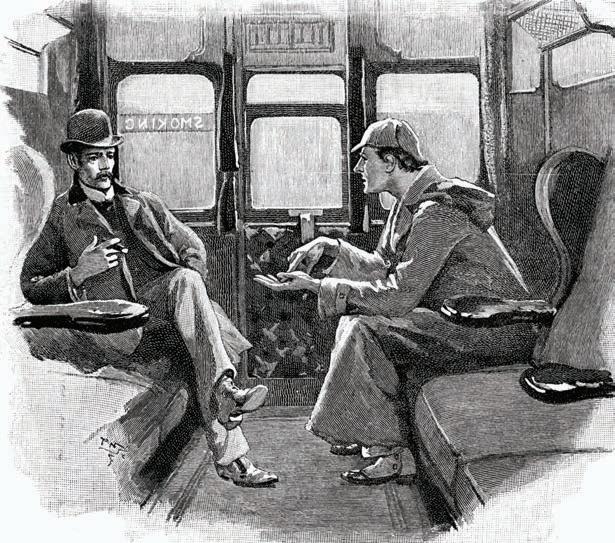
‘Well, Watson, what do you make of it? Since we have been so unfortunate as to miss him, this accidental souvenir becomes of importance. Let me hear you reconstruct the man by examining the stick.’
‘I think,’ said I, following as far as I could the methods of my companion, ‘that Dr Mortimer is a successful, elderly medical man, well-esteemed since those who know him gave him this mark of their appreciation.’
‘Good!’ said Holmes. ‘Excellent!’
‘I think also that he does a great deal of his visiting on foot.’
‘Why so?’
‘Because this stick has been so knocked about that I can hardly imagine a town practitioner carrying it.’
‘Perfectly sound!’, said Holmes.
‘The words ‘friends of the C.C.H.’ may refer to the members of a local hunt to whom he has possibly given some surgical assistance. I should guess that to be their present.’
‘Really, Watson, you excel yourself,’ said Holmes. ‘Some people without possessing genius have a remarkable power of stimulating it. I confess, my dear fellow, that I am very much in your debt.’
His words gave me great pleasure. He now took the stick from my hands and examined it for a few minutes.
‘Interesting, though elementary,’ said Holmes.
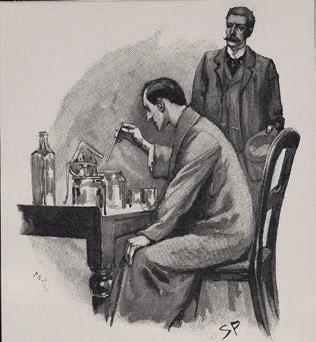
well-esteemed – respected knock about – to treat roughly (here) practitioner – someone who practises a profession, especially medicine excel – to surpass, exceed accidental – happening by chance or unexpectedly
5. Holmes praised Watson. 1
Practice
Find sentences in the text that tell you that
1. Holmes and Watson didn’t meet Dr Mortimer.
2. Watson thought their visitor was a middleaged, respectable man.
3. the man must have lived and worked in the country.
4. Watson believed his guesses were correct.
2
Discuss these questions.
1. Do you think Watson’s deductions were correct?
2. How do you understand the sentence: ‘Some people without possessing genius have a remarkable power of stimulating it.’?
3. Why is Holmes in Watson’s debt?
4. Do you think that Holmes would have drawn different conclusions?
Phrasal verbs with MAKE
Study the sentences and try to figure out the meaning of the phrasal verbs. 3
1. What do you make of it?
2. He said goodbye and made for the door.
3. The cashier made off with the firm’s money.
4. Make out this cheque, please.
5. I can’t make out what was written.
4
6. Why don’t you make up with her?
7. Believe me, I didn’t make it up. It really happened.
8. Hard work can often make up for a lack of intelligence.
Match the phrasal verbs with make with their explanations (a-h).
a. move in the direction of
e. steal and go away b. understand, interpret f. compensate c. complete or fill in g. end a quarrel d. manage to see h. invent
5
Complete the second sentences using the phrasal verbs with make.
E.g. ‘Have you invented this story or not?’
We wonder whether he has made up the story or not.
1. ‘Go towards the tall building on the left’, the old man directed him.
The old man told me to ____________ the tall building on the left.
2. ‘Please write a cheque’, said the cashier. The cashier asked me to ____________.
3. ‘You’d better forget about that quarrel and shake hands,’ said the boss. The boss told them to ____________ and shake hands.
4. It was impossible for us to see what the children were doing at the bottom of the garden. We couldn’t________________ what the children were doing at the bottom of our garden.
Word formation
6
Complete the table.
What are the verbs related to these nouns?
1. indication__________________
2. prosecution_________________
3. appreciation ________________
4. conclusion__________________
5. deduction___________________
7
What are the adjectives related to these verbs?
1. marvel________________
2. admire _______________
3. remark________________
4. adapt_________________
5. respect _______________
Complete the sentences by using the correct form of the words in brackets.
At his trial, there were those who believed in the old man’s (1) _____________ (innocent). He had been accused of the theft of an expensive watch. There were some serious (2) _____________ (indicate) that he had stolen it. In his (3)_____________ ( defend) the man said that he had found it (4) ______________ (accident). He was given a light sentence because it was his first (5) _____________ ( offend).
Reading and speaking
track 27
EXTRACT 2
‘There are certainly one or two indications upon the stick. It gives us the basis for several deductions.’
‘Has anything escaped me?’ I asked with some self-importance.
‘I am afraid, my dear Watson, that most of your conclusions were wrong. In noting your mistakes I was occasionally guided towards the truth. Not that you are entirely wrong in this case. The man is certainly a country practitioner. And he walks a good deal.’
‘Then I was right.’
‘To that extent.’
‘But that was all.’
‘No, no, my dear Watson, not all – by no means all. I would suggest that a present to a doctor is more likely to come from a hospital than from a hunt.’
‘You may be right. What further conclusions may we draw?’
‘Look at it in this light. On what occasion would it be most probable that such a present was made? Obviously at the moment when Dr Mortimer withdrew from the service of the hospital, in order to start his own practice.’
‘It certainly seems probable.’
‘So your grave, middle-aged family practitioner vanishes into thin air, my dear Watson, and there emerges a young fellow under thirty, amiable, unambitious and absent-minded. Why so? It is my experience that it is only an amiable man in this world who receives testimonials, only an unambitious one who abandons a London career for the country, and only an absentminded one who leaves his stick and not his visiting-card after waiting an hour in your room.’
The Adventures of Sherlock Holmes by
A.C. Doyle
(Adapted)
Glossary
withdraw – to leave the place, retreat, remove grave – serious amiable – kind vanish – to disappear suddenly and completely testimonial – something given as an expression of esteem abandon – to leave, give up completely
Practice
Say whether the following statements are true or false. Correct the false statements.
1. Dr Mortimer left the stick on purpose.
2. Dr Mortimer left his visiting-card at Mr Holmes’.
3. Holmes came to the correct conclusions by finding fault with Watson’s observations.
4. Dr Mortimer was an ambitious man.
5. Holmes and Watson disagreed about their assessment of Dr Mortimer.
Complete the sentences according to the information in the text.
1. They reconstructed the man by _______________________.
2. One or two indications upon the stick gave them the basis for ______________________.
3. It was evident that the visitor was_______________________.
4. Watson had overlooked _______________________.
5. Holmes was occasionally guided towards the truth _______________________.
6. Dr Mortimer is absent-minded because he _______________________.
What is meant by the following?
1. ‘Really, Watson, you excel yourself.’
2. ‘To that extent.’
3. ‘Has anything escaped me?’
4. ‘So your grave, middle-aged family practitioner vanishes into thin air.’ 1 2 3
Vocabulary
1
Use the words from the glossaries of extracts 1 and 2 in their correct form to complete these sentences.
1. Diana _____________ without trace and nobody could find her.
2. She is not the best student in our class, but she _____________ everyone in sports.
3. George decided to ____________ his native town and move to London.
4. He was such an _____________, modest fellow who never complained.
5. The general decided to _____________ the troops from the north of the country.
6. It is true that he’s careless, but this mistake was _____________.
Collocations
2
Find the words in extracts 1 and 2 which collocate with these words. Think of at least one more collocating word you can use with the given words and write them down.
1. ______________conclusion
2. ______________power
3. ______________pleasure
4. ______________wrong
3
Words with multiple meanings
5. ____ man
6. ______________crimes
7. ______________reasoning
8. ______________assistance
Use ONE word from the box to complete a pair of sentences below. Use a dictionary to help you understand the meanings of the words if necessary.
means • grave • sound • mark
1. No, I won’t tell this secret to anyone. It will go with me to the _________.
2. Unfortunately, the situation is very __________, and we must act quickly.
1. The child didn’t make a _________ when we entered the room.
2. The whole family agreed that it was a _________ decision.
1. My son got another low ________in Spanish.
2. He put a _________ by the names of candidates he didn’t like.
1. These people don’t have the _________ to set up their own business.
2. Such information can’t be obtained by any other _________.
Fill in the gaps with ONE word only.
From: The Society of Red-headed Men by Conan Doyle 4
I called upon ______ friend Mr Sherlock Holmes, the famous detective, one day last autumn and found him ______ conversation with_____ fat, middle-aged gentleman.
‘Come in, Watson,’ said Holmes, pulling up a chair ______ me.
‘Do you ______ starting your story again from the very beginning, Mr Wilson,’ Holmes said. ‘I want Dr Watson ______ hear all of the details, because it seems to me quite a singular case, unlike any _______ case in my experience. At present, I cannot say ______ there is any clear evidence of a crime ______ not.’
Focus on
COMPOUND ADJECTIVES AND NOUNS
Two words often combine to form a new word. Sometimes they are written as one word and sometimes as two words. Compound adjectives are often joined by a hyphen. Examples: weekend, bookshop, health centre, baby-sitter, old-fashioned, absent-minded
Find examples of compounds in extracts 1 and 2.
A tooth post house chair sea dish earth book eye B keeping man witness food shelf quake washer ache man 1 2 3 4
Look at the examples in column A and make new compounds in column B using the words from column C.
first-cousin middle-aged second-class self-control wellfirstmiddlesecondselfbest discipline known sized off course respect service floor name
Combine the words in these two lists (A and B) to make compounds of two words.
Example: story telling
A exercise salad food savings intelligence story swimming B book telling test account pool dressing processor
Combine the words in these two lists to make compounds of one word.
Grammar
1 2 3
Reporting verbs
There are some reporting verbs which can accurately describe what someone has said. The following list gives you reporting verbs which can take a variety of structures. Notice that some verbs can take more than one form.
verb + infinitive
verb + object + infinitive
verb + (object) + (preposition) + gerund agree arrange decide fail offer promise refuse advise encourage invite remind warn offer order admit suggest deny recommend mention announce insist warn suggest deny recommend accuse (of) blame (for) congratulate (on) apologize (for) insist (on)
Examples:
verb + (that)
1. ‘Tom, you stole my book.’ – He accused Tom of stealing his book.
2. ‘Ok, it’s true. I have lied’. – She admitted that she’d lied.
3. ‘Let’s go to the concert.’ – David suggested going to the concert.
4. ‘We missed the train because of you.’ – She blamed him for missing the train.
Use the verbs in brackets to report the dialogue.
E.g. ‘A doctor is more likely to come from a hospital.’ (suggest) He suggested that a doctor was more likely to come from a hospital.
Ann: If I were you, I’d go to see the doctor. (advise)
Bill: You’re right. I’m not feeling well. (admit)
Ann: If you don’t go, you will feel even worse tomorrow. (warn)
Bill: O.K. I’ll do it the first thing in the morning. (promise)
Ann: Why don’t you go today? I can give you a lift if you want. (suggest, offer)
Choose an appropriate verb from Exercise 1 to report these sentences from the text.
1. ‘Let me hear you reconstruct the man by examining the stick.’
2. ‘There are certainly one or two indications.’
3. ‘I am afraid, my dear Watson, that most of your conclusions were wrong.’
4. ‘It certainly seems probable.’
5. ‘You are entirely wrong.’
Key word transformations
Complete the second sentence so that it has a similar meaning to the first sentence using the word given.
1. She started to train in this club over six months ago. /training She ______________________________ over six months.
2. ‘You must do your homework tonight,’ the teacher said. /told The teacher _______________________________ homework tonight.
3. I think it would be a good idea if you joined our team. /suggest I ___________________________________ our team.
4. ‘I don’t share your views on capital punishment’ Martin said. / agree Martin told me _______________________________ on capital punishment.
5. ‘ Well done, Sarah! You have passed the test,’ the teacher said. /on The teacher ___________________________________ the test.
Writing
1
Writing a story
When you are writing a story, you should pay attention to the following.
a. Introduction
The first sentences of a short story or novel should catch the readers’ attention and encourage them to read on. The first sentences may
• introduce a character.
• describe something mysterious.
• describe the background or setting.
• start the plot by describing the action.
2
b. Development of the narrative. You should
• describe events in clear sequence.
• use a new paragraph for each main stage of the story.
• make your story interesting by including dialogues.
• use a range of reporting verbs, adjectives and adverbs to describe characters and actions.
• include a few linking words and expressions: at first…just then….in the meantime…despite…in spite of this … however… as soon as… eventually…in order to… in the end, etc.
c. Conclusion
Write a suitable ending to your story. If possible, surprise or amuse the reader.
Choose one of these well-known first sentences. Continue and finish the story in your own way. Write about 150 words.
• All happy families resemble one another, but each unhappy family is unhappy in its own way. (Ana Karenina by Tolstoy)
• It was terribly cold. It was snowing and was already almost dark. (The Little Match Girl by H.C. Andersen)
• For a moment or two I sat breathless, hardly able to believe my eyes. (Death on the Moor by A.C. Doyle).
Communication
CHANGING YOUR MIND
1
Here are things we can say when we make a decision and a short time later realize that we have changed our mind (A) or when we want to say something in another way (B).
A1. (Actually,) I’ve changed my mind.
2. On second thoughts...
3. Come to think of it...
4. Hang on a minute/a second.
5. I’ve had a bit of a rethink.
6. Did I really say that?
7. After further consideration...
2 3
Complete the dialogue by using the phrases from A.
B• What I’m trying to say is...
• In other words...
• To put it another way...
• What I mean is...
• Perhaps I should make that clearer by saying...
• Basically what I am/was saying is…
A: Are you going to take part in the competition? Diana said you would.
B: ___________________________. I don’t think I will.
A: Why? Don’t you find it challenging enough?
B: That’s not the reason. I’d planned to but, ____________________ I decided I wasn’t prepared for it.
A: But you said you wanted to win the cup.
B: ______________________? Well, I was joking.
Complete the dialogue by using the phrases from B.
A: Why do people like crime stories?
B: Because a criminal is punished.________________ that good will overcome evil.
A: Are all crime novels similar? ________________, do all writers use the basic formula of crime stories?
B: There is usually a detective with extraordinary reasoning powers. ______________ the concept is similar but plots differ.
Self-assessment TEST 7
Choose the correct answer. (10 pts.)
1. Nick’s brother was the most famous art ____.
A mugger B burglar C forger
2. Tina is _____, friendly and pleasant to work with.
A kindly B amiable C pleasurable
3. Tom’s fiancé ____ her hand from his.
A withdrew B returned C took back
4. The only ____ in her character seems to be her quick temper.
A error B flaw C imperfect
5. There were several ____ that could be drawn from his letter.
A supposition B testimonials C conclusions
6. There were some serious contradictions in her____ at the trial.
A testimony B declarations C announcement
7. I refused to join them because the idea to go there didn’t ____ to me.
A interest B attract C appeal
8. When a ____ attacked me in the street yesterday, I was terrified.
A hijacker B aggressor C mugger
9. His fans show a(n) ____ fascination for his works.
A enduring B amiable C long-term
10. The fog was so thick that we couldn’t ____a street sign.
A make of B make out C make up
Rewrite the following sentences using the word in bold. (10 pts.)
1. ‘I know you stole the documents, George.’ Becky said. /accused Becky _____________________________________________.
2. ‘I didn’t question him at that time.’ The inspector said. /denied The inspector _______________________________________.
3. ‘It was me who set fire to the house,’ said Robert. /admitted Robert ____________________________________________.
10. Diana started learning the violin a month ago. /learning Diana ____________________________the violin for a month. 1 2
4. ‘Why don’t we ask her and find out,’ my brother said. /suggested My brother _________________________________________.
5. ‘I’m sorry I forgot to send her email last night.’ /apologized He ________________________________________________.
6. Although Tom believed her story, I knew Sue was lying. /up I knew _________________ the story although Tom believed her.
7. The boss told me he wanted to pay for dinner. /insisted The boss ____________________________________ dinner.
8. I wish I hadn’t told him what we were planning to do. /regret I _______________________________ we were planning to do.
9. It’s useless to call the bank now as it’s 7 o’clock. /point There ________________________ the bank now as it is 7 o’clock.
KEY WORD LIST
Verbs appeal to vanish excel knock about withdraw Nouns flaw forger practitioner testimonial testimony suspense mugger hijacker Adjectives amiable enduring grave fabulous dignified well-esteemed Phrases make of make for make out make off with make up with make up for to that extent by no means
20 points
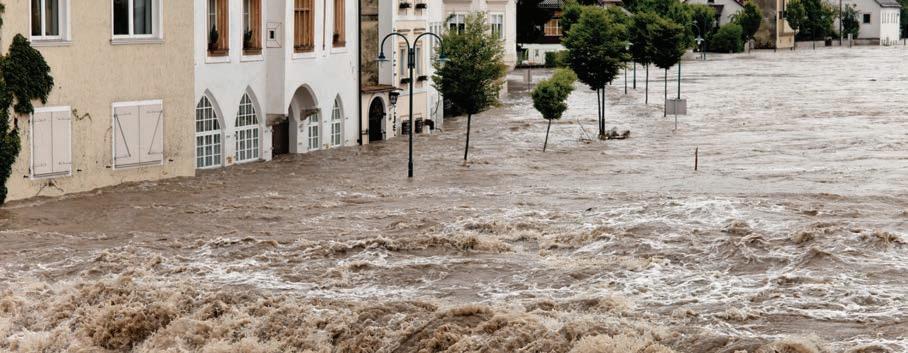

Lead-in
1
PREDICTING THE FUTURE Unit 8
In this unit, you will
• read, listen and talk about a. climate change – cause and results b. the probability that there is life on other planets
• practise expressing the future phrasal verbs with run indefinite pronouns talking about the weather
Answer the following questions.
1. What’s your favourite type of weather?
2. Do you think the climate is changing? If your answer is yes, explain how it is changing.
3. Has your country suffered extreme weather conditions recently?
4. What is the probability that we will have technology which can control weather?
2
Look at the photos and discuss the following questions.
1. What problems do you think the world is facing today?
Here are some words which may help you: global warming, drought, flood, pollution, greenhouse effect, acid rain, hunger, etc.
2. Which problem do you most worry about? Why?
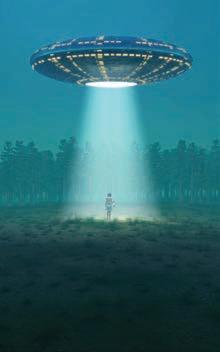
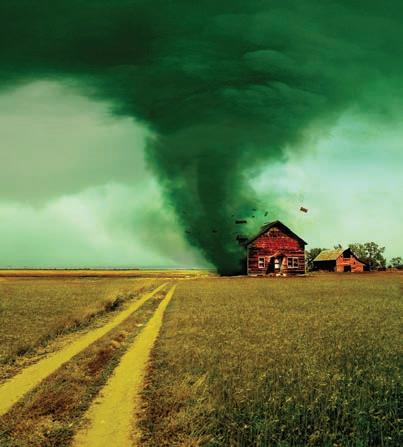
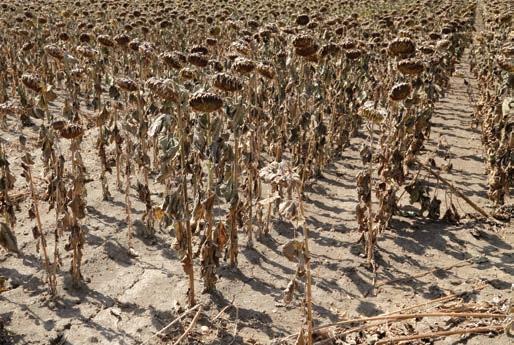
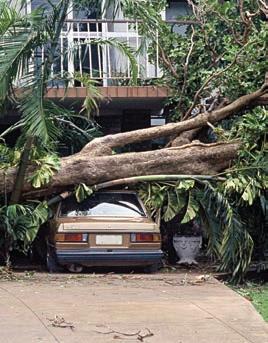
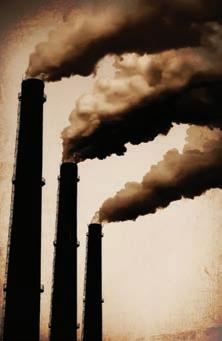
THE IMPACT OF CLIMATE CHANGE Reading and speaking
Work in pairs. Decide if these statements are true.
Then read the text and check if your answers were correct.
1. Global warming is part of a natural weather cycle.
2. The ‘greenhouse effect’ is caused by human activities.
3. Only European countries suffer from damage caused by extreme weather.
4. Climate changes can have positive effects on people’s health.
5. Some areas of low land will be lost because of sea-level rise.
track 28
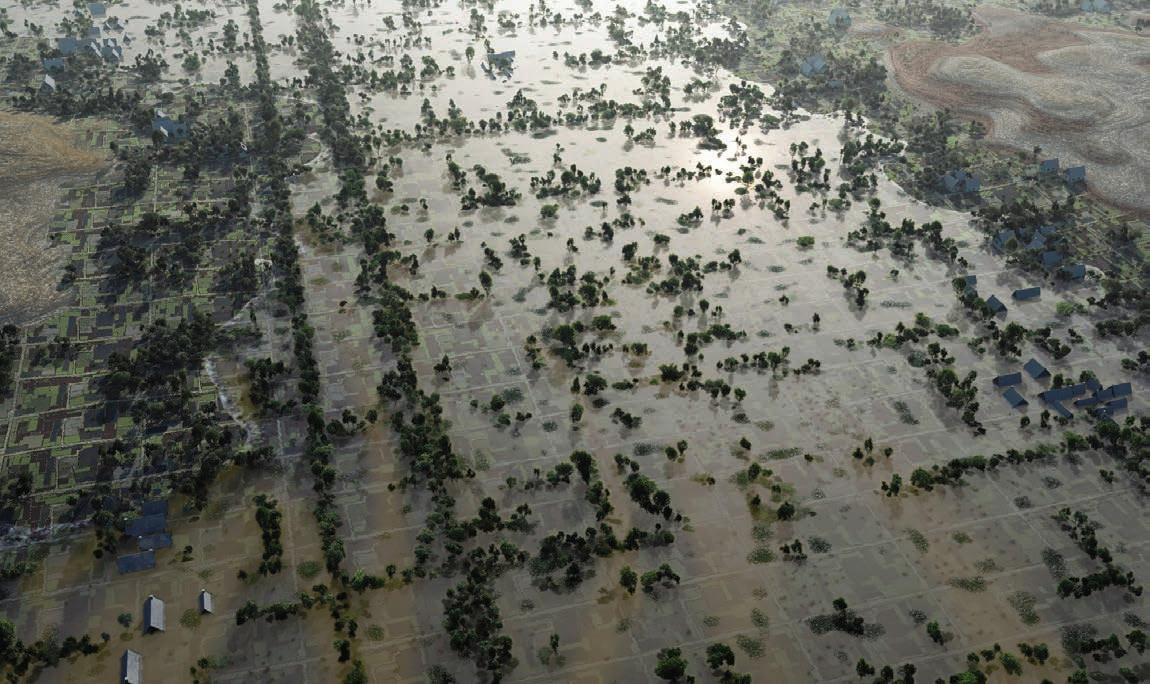
1 In the last few de cades, weather extremes, such as heatwaves, floods, cyclones and wildfires, have affected people’s lives in different ways: directly through destruction of homes or crops and indirectly, for example, through increased food prices or lack of food and fresh water. Some parts of the world are hit by droughts, others by flooding or tornadoes. Glaciers and polar ice are melting rapidly and experts say there will be more flooding in low-lying areas as sea levels rise. By 2050, mega-catastrophes, which used to appear every 100 years, are predicted to occur every 25. In the United States alone, the number of weather disasters has increased five-fold over the last three decades.
2 Exp erts say that the amount of rainfall cannot be explained by natural processes alone, such as changes in the sun’s energy, shifts in ocean currents and others. Most of the warming of the past half century has been caused by human emissions of greenhouse gases, which are the result of a variety of human activities. It is predicted that by the end of the 21st century, the world population will rise approximately to 9-10 billion people (the estimates vary), with a corresponding increase in demand for energy.
3 If global emissions of carb on dioxide continue to rise at the rate of the past decades there will be disastrous effects on the climate. The rapid change of climate will cause a serious impact on our health, environment, and economy.
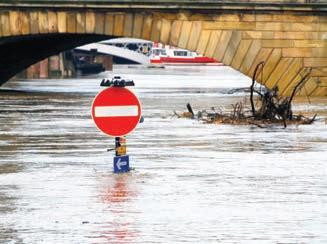
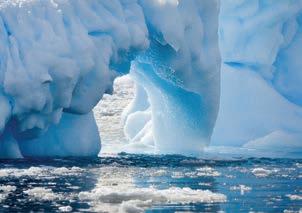

2
Natural resources, such as national parks, with all the wildlife and plants in them, may completely disappear. It is therefore believed that climate change is one of the biggest challenges the global community is going to face.
4 However, we can still halt climate change if we take urgent action to cut down on carbon pollution by using renewable energy, such as sunlight, wind, tides, waves and geothermal heat.
Find sentences in the text that tell you that
• climate change can lead to numerous environmental, health and economic problems.
• the world is warming faster than ever before.
• disasters happen more often than before.
• natural causes can be only partly responsible for recent changes.
• it is possible to reduce carbon emissions.
Vocabulary
1
3
Glossary
approximately – close to (the correct number, amount, etc.) but not exactly; more or less shift – a change; moving from one place to another halt – to cause to stop cut down on – to reduce
What about you?
1. Do you think you are responsible for the pollution of the environment?
2. What can you do to protect the environment?
Read the article again and underline words or phrases that you don’t know. Then answer the questions:
1. Is the word or phrase you underlined a verb, a noun, an adjective, etc.?
2. Can the context help you guess the meaning of the word?
2
Read the explanations below and check if they match the meanings of words you underlined. If not, find the words that match these definitions. There is an example at the beginning. Paragraph numbers are given.
estimate (noun) – a judgement made on one’s opinion or calculation (parag. 2)
______________ – a prolonged period of extremely hot weather (parag. 1)
______________ – plants grown for food, usually on a farm (parag. 1)
______________ – need (noun here); (parag. 2); (as a verb – to require)
______________ – a quantity of something (parag. 2)
______________ – (usually plural) things such as coal and oil that exist in nature and can be us ed by people (parag. 3)
How many of the words or phrases you underlined in the text are included in Exercise 2? Use a dictionary and write definitions for any other words you don’t know.
Use the words from Exercise 2 and the Glossary in their correct form to complete these sentences.
1. Their work was _______________ by heavy rain and strong wind in the area.
2. I was wrong in my _____________ of the boy’s capabilities.
3. Families affected by recent flooding_____________ some kind of compensation.
4. He was nervous and _____________ from foot to foot.
5. It is a journey of _____________ two hours, not more.
Uses of DUE
Study the sentences (1-5) and try to work out the meanings of the word due or the phrase due to from the context. Then match the word/s with their explanations (a-e).
1. Many bills, such as cable and phone, are due once a month.
2. The delay was due to heavy traffic.
3. We should all give this matter due attention.
4. The bus is due in 20 minutes.
5. The baby is due next month.
Phrasal verbs with RUN
3 4 5 6
a. adequate
b. an obligatory payment
c. exp ected to be born
d. b ecause of, owing to
e. exp ected to come
Read the sentences (1-6) and try to guess the meanings of the phrases with RUN from the context. Use a dictionary if necessary. Then match them with the definitions (a-f).
1. He ran after the girl, calling her name.
2. My wife was really run down when she finished that project.
3. ‘ Why are you so upset?’ – ‘My kitten was run over by a car.’
4. I’ll have to go to the baker’s as we’ve run out of bread.
5. I ran into my old friend at the cinema last night.
6. We ran up against a few problems when we came to the hotel.
1. run after
2. run down
3. run down/over
4. run out of
5. run into
a. me et with difficulties
b. not have any more
c. me et by chance
d. fe el weak due to overwork
e. hit with a car
6. run up against f. chase
Grammar Review of tenses 5
Ways of talking about the future
Match the tenses in italics in the sentences (1-5) to the meanings they express (a-e).
1. I’m l eaving tomorrow for London.
2. The plane departs at six.
3. It’s c old. I’ll shut the window.
4. I’m going t o become a pilot.
5. We’ll be watching the match this time tomorrow.
a. an intention
b. an action in progress at a definite time in the future
c. a definite arrangement
d. an event on a timetable
e. a de cision which has just been made
What would you say in these situations? Use the correct tense to express future time.
Example: You expect to be engaged in playing tennis at this time tomorrow.
I’ll be playing tennis this time tomorrow.
1. The weather has become very cold and the sky has turned black.
2. After your exams have finished, your plan is to go on holiday.
3. Your plane is s cheduled to land at 10.30 in the morning.
4. You have already arranged to meet your colleague this evening.
5. You want to hear your friend’s plans for Christmas.
Focus on
THE FUTURE PERFECT TENSE
When predicting the future, if we want to emphasize that the action will be completed before a certain time in the future, we use the future perfect tense.
The future perfect tense (will have + a past participle)
We will have run out of food and water by the end of this century. It is estimated that the world population will have risen to ten billion by the end of 2060. I will have retired by the time you finish this project.
This tense is often used with expressions of time such as by (tomorrow, next year 2038), not…till/until (evening), before then, by the time...
Practice
Use the verbs from the box in the future perfect tense to complete these sentences. not/finish find read build go
1. We believe the scientists _____________________ the vaccine for this virus before the end of the year.
2. I hope ___________________ this book by tomorrow. I want to take it back to the library.
3. ‘I’ll phone you at 7.’ ‘No, I _________________out by then. Can you phone me earlier?’
4. They ____________________the bridge by the time my daughter starts going to school.
5. The sales ___________________ until the end of January.
Think about things you will have done by the time given. Write sentences using the prompts.
E.g. get/home/lunch time − I will have got home by lunch time.
1. past/driving test/the end of December 3. graduate/I’m 24
2. clean/house/before mother returns 4. do/the homework/seven
Listening and speaking
Giving a speech on global warming
track 29 1 1
Pre-listening activity
Use the words and phrases from the box to complete the sentences from the text you are going to listen to.
• research • piece • along the way
• keep an eye • back you up
1. I have done a lot of ____________ on the subject.
2. It will b e a ____________ of cake.
3. Do you have any facts to ____________?
4. It would b e even better if you show some pictures ____________.
5. _____________on the time.
Listen to the text and check your answers. 2 2
Martha is going to give a speech on Global Warming, and she is very nervous about the whole thing. Greg, her friend, is trying to help her by giving her some useful tips on how to give a good presentation.

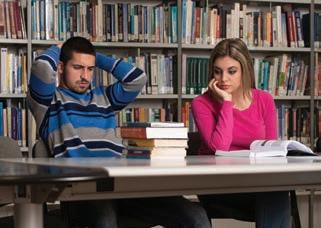
• What advantages and disadvantages might space explorations bring? 3 4 5
Listen again and answer the following questions.
1. Why is Martha nervous?
2. How does Martha plan to present her subject?
3. What did she forget to include in the presentation?
4. Which tips do es her friend give her in order to be successful?
Use the phrases from the sentences (2-5) in Exercise 1 to make new sentences.
Choose one of the questions below and prepare a short presentation to give to the class.
• Which discovery may have the most important consequence in the future?
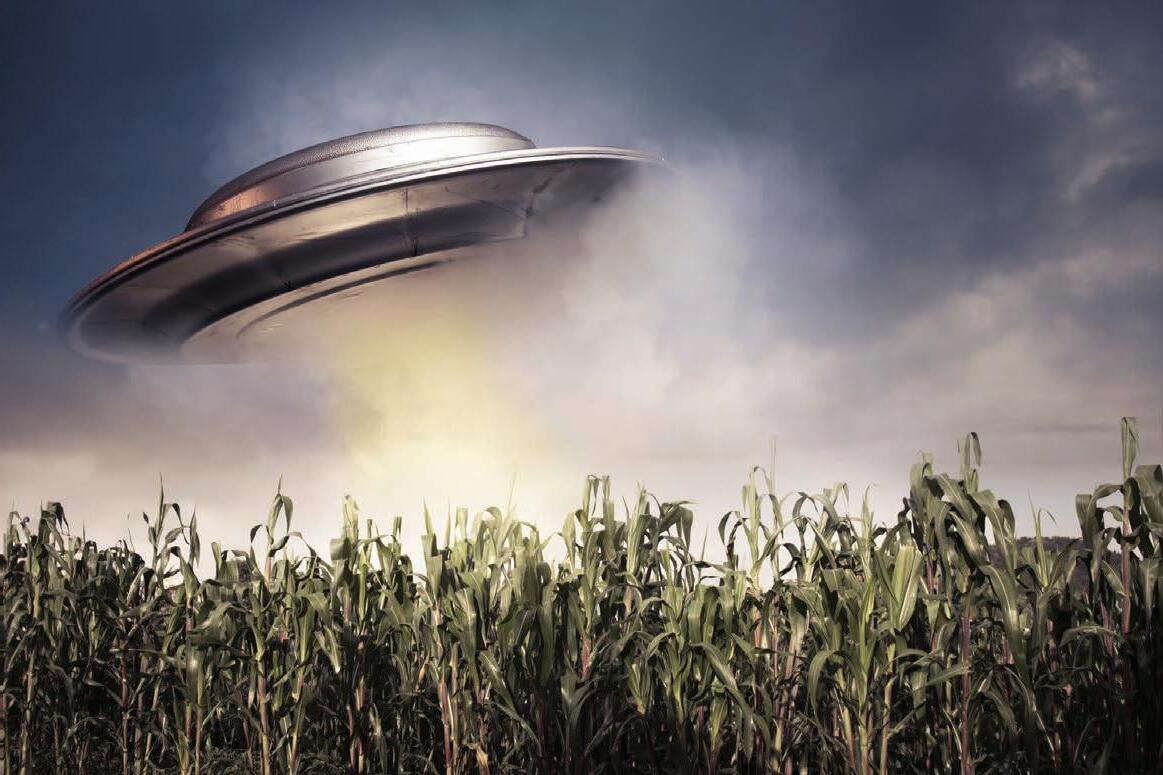

IS THERE LIFE OUT THERE?
1
Discuss the following questions.
1. Why do we explore space? What advantages might space exploration bring to humans?
2. Do you think that there is intelligent life on other planets in our universe? If so, what do you think it is like?
3. Will planets similar to Earth b e found eventually?
4. Do you believe that people have actually seen UFOs?
Reading and speaking
Does extraterrestrial life exist – if so, where? – and what may it be like?
Answers to these questions have always intrigued people. While some believe that we are alone in the universe, others are convinced that we are not.
Two scientists, Robert Farrell and Diana Jones, are being interviewed on the subject of Life beyond Earth. Here are some of their answers.
Q: The past few years have seen the discovery of dozens of planets outside the solar system. Could any of them have the kind of life that we have here on Earth?
D.J.: It’s hard to say, as astronomers cannot see the planets directly. We have no conclusive evidence that there is life on these planets. Nevertheless, there are some reasons why we believe that eventually we will discover something which will convince us of the existence of extraterrestrial life.
R.F.: I know that most people think that it is virtually impossible that there is no life elsewhere in the universe. However, how likely are we to encounter and then interact with alien form, if we take into account what we know about space and space distance? This is a much harder question to answer. But maybe we don’t have to go anywhere. Instead, we might be able to sit here and wait for somebody to message us.
Q: Does it mean you think we will never encounter extraterrestrial life forms?
R.F.: The universe is around 14 billion years old, plenty of time for life to develop and expand, evolve into all sorts of weird and exotic forms, gain intellect and use technology. If there is life out there, where is
it? An intelligent race would’ve visited us by now, or we’d at least know of their existence. That’s why I think there isn’t anybody out there. The vastness of space isn’t assurance of life beyond Earth.
D.J.: I don’t agree. I believe it is extremely likely to discover new forms of life, if only we keep searching. The question, of course, is how long it will take. I estimate that we will detect something, a kind of signal from another civilization before the end of this century.
2 2 1 3
Decide if these sentences are true or false.
1. There are planets which can support life.
Glossary
extraterrestrial – coming from somewhere beyond our planet conclusive – proving that something is true interact – to communicate
2. There is no life elsewhere because we have no conclusive evidence.
3. Neither of the s cientists believes that we’re likely to find life elsewhere.
4. R.F. thinks that if there was life in the universe we would already know it.
What about you?
1. How do you imagine life on another planet?
2. Would you travel to another planet as a tourist?
3. Do you believe that aliens have already visited us?
Vocabulary
Try to explain the meanings of the highlighted words in the text. Then do Exercise 2 to check if your answers are correct.
Cross out a word (A, B or C) which is not a synonym for the word in bold in the following sentences.
1. The city was virtually paralyzed by the strike. A nearly B almost C exactly
2. D id you encounter anyone who doesn’t live in this building? A counter B me et C c ome across
3. There were some weird goings-on in the house. A strange B familiar C o dd
4. He didn’t explain how a human could evolve from an ape-like ancestor. A develop B involve C transform
5. The vastness of the desert really impressed him. A immensity B go odness C hugeness
Word formation
3 4 5 6 7
Complete the table with the correct forms of the given words. The first one has been done as an example. Then use the words from the table to complete the sentences below.
Noun Adjective Verb conclusion conclusive conclude assure estimation/estimate interaction conviction
1. Do you mean that you have _____________ evidence that this is a live planet?
2. The e ditor didn’t want to give us _____________ that the story would be published.
3. I want to hear your _____________of the situation.
4. There isn’t enough social_____________ among these groups of students.
Use these conjunctions to complete the sentences below.
1. ____________you lost your job, what would you do?
2. Where is he going to stay? – At his aunt’s, ____________I know.
3. Don’t spend that money ____________it is absolutely necessary.
4. You can keep it ____________ you like it; I don’t need it any more.
5. You can take books out of the library ____________you bring them back.
6. ____________how much he earns, I’m surprised he dresses so badly.
Collocations
Choose the correct word to complete the common adverb-adjective collocation.
1. Tom’s behaviour at the ceremony was fully/completely unacceptable.
as far as, as long as, considering, supposing, unless, providing, (or provided)
2. It’s virtually/effectively impossible that there are no planets which support some kind of life.
3. The jury c ouldn’t find proper/conclusive proof against the accused.
4. I think it’s extremely/enormously likely that we will encounter aliens eventually.
Cross out two nouns that don’t collocate with the verb gain. independence / intellect / certainty / weight / confidence / accommodation / popularity
Complete the sentences using the correct preposition.
1. There has been a sharp increase ________ productivity recently.
2. The world’s tropical forests are disappearing ________ a faster rate than experts predicted.
3. I hop e this will convince you ________ my innocence.
4. We want to hear assurances _______ your support for the project.
5. ________ least you can let me go on holiday.
1 2
Which of these things in A do you believe in? Mark your opinions in B. A
1. Dreams can warn you about events before they happen.
2. The star sign you were born under affects your character.
3. Some p eople can communicate telepathically with others.
4. Some p eople have supernatural powers that can help or harm others.
5. Doing particular things can bring you bad luck.
6. Some p eople claim that they were taken on board of an alien spaceship for scientific experiments and then released. B
Compare your opinions. If you disagree about any of the topics, explain why you think the way you do.
Grammar Pronouns
Indefinite/Compound pronouns
a. I’m not sure.
b. It’s likely.
c. It’s not very likely.
d. It’s definitely true.
e. It’s not true.
1 2
Indefinite pronouns refer to people or things without saying who or what they are. Somebody saw the driver leave the bus. (somebody – not a specific person)
• We always use a singular verb with indefinite pronouns. We can use they, them and their when referring back to an indefinite pronoun although a singular verb is used. Everyone is having their breakfast.
We can use he/him/his or she/her when we know the person’s sex. Somebody left her cardigan in the locker room.
• We can add ’s to an indefinite pronoun to make a possessive. She was staying in somebody’s house at the beach.
Note: Compounds with where and every, some, any and no are indefinite adverbs and they refer to places.
Complete the table.
3 Complete the sentences with some, any, no and every to revise the rules.
1. The indefinite pronouns beginning with and are most often used in positive sentences.
2. Those beginning with can be used in questions and negative sentences.
3. The compounds with are always used with the positive form of a verb, and they make the sentence negative.
Note:
1 2
Some other words which are general determiners can be used as pronouns: both, all, each, few, little, either, neither, another, some, many, etc. They are used only when it is clear what is being talked about. Both were offered jobs in the musical. / I’d borrow some eggs, if you have any.
These determiners and quantifiers can also be used as adjectives. Both brothers were offered the same job. / Come at any time you like.
Practice
Complete the text with the words in the box. You may use some words more than once. anywhere everywhere somewhere nothing anyone/anybody someone/somebody everyone/everybody anything no-one/nobody
‘Is ___________(1) here?’ asked the head teacher pupils on the bus. ‘Is ___________ (2) missing?’ ‘I think Sarah is missing,’ replied one of the pupils. ‘Does ___________ (3) know where she is?’ asked the teacher. ___________ (4) answered. The teacher asked Mia to go back into the museum to look for Sarah. Ten minutes later Mia returned alone. ‘I can’t find her___________ (5),’ she said, ‘although I looked ___________ (6).’ ‘Did Sarah say ___________ (7) to ___________ (8)?’ asked the teacher.
Key word transformations
Complete the second sentence so that it has a similar meaning to the first sentence using the word given.
1. I’ve got to reduce the amount of sweets I eat. /down I must _____________________________ the amount of sweets I eat.
2. The plane should arrive at 8.30 p.m. according to the schedule. /due The plane _________________________8.30 p.m.
3. They had no p etrol left and couldn’t go on. /ran They ______________________petrol and couldn’t go on.
4. You can take the books, under the condition to return them by tomorrow. /providing You can ____________________________________ by tomorrow.
Writing
A REPORT
Which environmental issue is of greatest concern to you?
Write a short composition of 120–150 words expressing your opinion.
Layout
Heading To:
From:
Date: Subject:
Remember to:
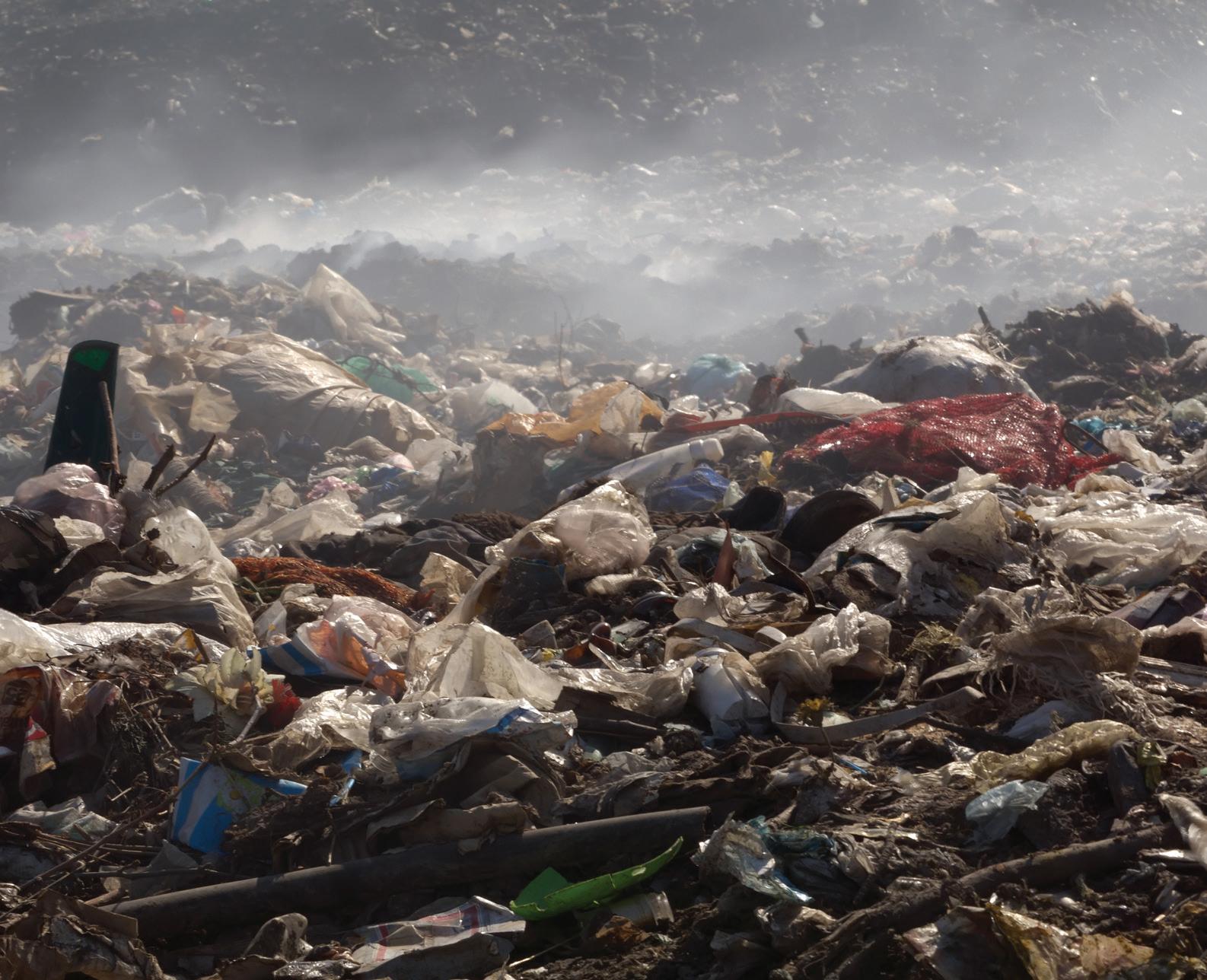
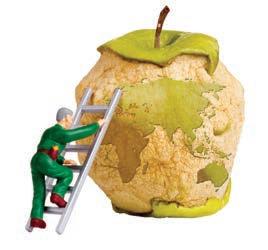
a. introduce the report with your aim and a general description of a problem. (The aim of this report is…)
b. give a list of your criticism.
c. b egin a new paragraph for each main idea. Write one part of the problem in one paragraph and another part of the problem in the other.
d. include examples and reasons to support your opinion. Use appropriate linking words. (In addition to… On the other hand… Although… However…)
e. write a c onclusion. Finish the report by making suggestions for action. (The government/council should… I think that people need to…)
• When you have finished, check grammar, spelling and punctuation.
Communication
TALKING ABOUT THE WEATHER
Read the sentences and try to work out from the context what the words in bold mean. Then match the words with their meanings (a-f).
1. There is always a breeze near the ocean. It’s never too hot.
2. I think we can go out now. It’s only drizzling
3. It fe els a lot hotter than it actually is because of the humidity
4. There was so much hail that some of the trailer homes were destroyed.
5. The snow turne d to slush as soon as it started to rain.
6. Look! I’ve stepped in a puddle and got my shoes wet.
a. a small p ool of water, especially rainwater
b. water moisture in the air
c. small pie ces of ice
d. raining slightly
e. light wind
f. partially melte d snow or ice
2
Work in pairs. Study the expressions we use when we talk about weather.
Weather forecast
What is the weather forecast?
What’s the weather like today?
The weather report says it’ll be cloudy, hot and humid, but without rain.
It will get quite warm later in the afternoon.
Talking about nice weather
Nice morning today, isn’t it?
It’s a beautiful day, isn’t it?
It’s getting warmer.
It’s not too hot.
We haven’t had a drop of rain for weeks.
Talking about bad weather
Terrible weather, isn’t it?
It looks as if it is going to rain.
I wish it would stop raining.
It’s freezing cold.
I got caught in the rain/got wet to the skin yesterday. It’s pouring outside. (raining heavily)
It’s expected to rain for the next several days.


Complete the dialogue by using the words or phrases from the box.
Shopkeeper: Good morning. How are you today?
Mr Miles: Not so bad, thanks. ____________ weather, isn’t it?
Shopkeeper: It’s going to rain again, ________________ of it .
Mr Miles: Yes, it’s awful, isn’t it? And it is very cold!
Shopkeeper: At least it’s not ____________. That’s something. The weather ___________ says it will ____________ after lunch.
Mr Miles: Have you heard what the weather is ____________ like tomorrow?
Shopkeeper: I was watching the news a little earlier. They say it will probably snow tomorrow. I really don’t like the winter. I wish it ____________ summer.
Work in pairs. Make similar dialogues, using the ideas from the box and adding some of your own. by the look, forecast, too windy, brighten up, terrible, were, going to be
Self-assessment TEST 8
Complete the sentences by using the word/phrasal verb from the List in the correct form. (5 pts.)
1. They had _____________ev idence of her guilt.
2. The workers _____________ higher wages.
3. The strike _____________ subways and buses and many people were late for work.
4. I was surpris ed when I realized that she didn’t remember our ____________at the club.
5. We were afraid of him because he used to do all kinds of _______ things.
Fill in the gaps in the following sentences with the correct form of the words from the box. (6 pts.)
emit assure estimate reduce demand vast
1. Their _______________ of the situation were correct this time.
2. The government is worried because of the ______________in foreign investments.
3. The b oss wants an _______________ that you will order the goods.
4. We were fascinated by the _______________ of the desert.
5. The __________from the cars causes air pollution.
6. We have ___________and choosy customers, but we meet their needs.
Replace the underlined words or phrases in the sentences with the phrases from the List so that the meaning remains the same. Make necessary changes to the sentences if needed. (5 pts.)
1. If you encounter problems, you should try to solve them.
2. Don’t forget to watch the children carefully all the time.
3. Ann felt c ompletely relaxed with the whole group and made friends with most of them.
4. The results are expected at the end of the week.
5. The do ctor advised me to drink less coffee and eat a balanced diet.
Complete the second sentence so that it has a similar meaning to the first sentence. Use the word given. (4 pts.)
1. Be cause of the heavy rain, our mother didn’t let us go out. /due We were not ________________________________ the heavy rain.
2. His friends won’t support him, because they are against the plan. /up His friends won’t ___________________________ because they are against the plan.
3. Scientists say that the world climate will change for the worse. /expected The world climate __________________________________.
Phrases due to at ease back someone up cut down on run after run down run over run out of run into run up against keep an eye on 1 2 3 4
4. He has bought her nothing for their anniversary. /hasn’t He __________________________ for their anniversary.
KEY WORD LIST
Verbs estimate demand shift interact halt Nouns assurance encounter estimation crops demand reduction shift vastness emission
Adjectives conclusive weird

TRAVEL AND TRANSPORT Unit 9
In this unit, you will
• read, listen and talk about a. various means of transport b. unusual journeys

Lead-in
Discuss the following
• practise, revise and extend numerals adverbs articles with geographical names communication with people in a foreign place

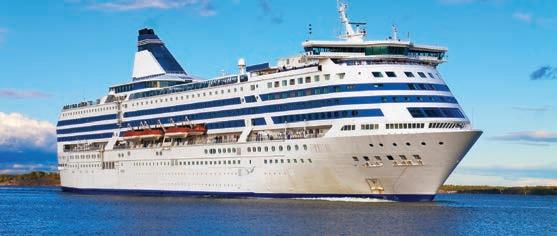
1. There are many amazing global challenges people have undertaken. Which of the following would you consider dangerous? 1
• going on an expedition through a jungle
• swimming across the English Channel
• going on safari to Africa
• climbing Mt. Everest
• flying in a hot-air balloon
2
Pair work
What means of transport do you see in these photos? Put them into the correct column.
Here are some words which can help you: liner, ferry, yacht, spaceship, van, truck, etc.
• sailing around the world solo Land Water Air
2. Can you mention some other challenges that people have done?
3. What kind of challenge would you like to try?
Add more words you know to each column. Compare your list with another pair of students.
DARING UNDERTAKINGS
Reading and speaking
It is a dream of many people to see the entire world, and experience something that can be called a ‘global adventure’. There are those who were able to realize their dreams and gain fame by being the first to travel around the globe by boat, by balloon or on a bike.
Around the world on a bicycle
Graham Hughes, the first person to travel the world without flying, undertook his trip around the world on New Year’s Day, 2009. He set off from his hometown and travelled by buses, trains, taxis, rode his bike and went on foot. The rules say that a rider must travel the same distance as the circumference of the Earth – 40,073 km – in one direction, starting and finishing in the same place. A continuous journey around the globe can be completed by bicycle and other means, but at least 18,000 miles of the route must be cycled.
It took him nearly four years to cover 201 countries. He knew it was a real adventure and that he should be prepared for different challenges and dangers. He was jailed for a week in the Congo for being a ‘spy’, was arrested trying to ‘sneak into’ Russia and had to be rescued from terrorists. Hughes filmed his travels and his adventures were later turned into a National Geographic documentary.
The first solo round the world balloon flight
Many people have taken various ballooning challenges over time, but perhaps the most challenging is the hot-air balloon flight around the world.
Steve Fossett was an American businessman who became the first balloonist to travel round the world by himself in a hot-air balloon. He is generally known for being a great adventurer, with numerous achievements and records to his name. The flight was a brave undertaking, since he spent days in an extremely confined space; the gondola wasn’t bigger than a normal-sized closet. He slept about 4 hours a day, the temperature outside the balloon was well below zero and he had to regularly climb outside the gondola to change fuel.
The balloon was launched from Western Australia in 2002 and the projected flight was to cross the Pacific first and then the Atlantic Ocean. From there he flew towards South Africa, over the Indian Ocean and finally ended up back in Australia, farther east than where the journey had begun. He travelled fast and covered more than 19,000 miles in thirteen days. It was a remarkable achievement, and ‘wonderful experience’, as he described it after the flight.
Glossary
circumference – the linear distance around the edge of a circular object undertake – to start doing a job and accept responsibility for that undertaking (n) – a task that is taken on sneak – to move or go in a secretive way confine – to restrict or limit; to forbid someone to leave (a place)
a confined space – a small area; a space which has limited access launch – to send into the air/space/water; to start an important activity
Vocabulary
Discuss these questions.
1. Why do you think people undertake such ‘global adventures’?
2. Which rule is mentioned in text A?
3. Who kept a record of his travelling and how did he do it?
4. What kinds of dangers did Graham Hughes experience?
5. What kind of discomfort did Steve Fossett have to endure?
Complete the sentences by using these words in the correct form. 1 undertake • confine • distance • launch • rescue • sneak
1. My grandmother was ___________ to bed for days because of her illness.
2. They are going to ______________ the space shuttle tomorrow.
3. A few men volunteered to _____________ three trapped coal miners.
4. He ___________ into the house through the back door.
5. What is the ___________ between Oxford and London?
6. The professor ____________ the difficult task of monitoring the work of these students.
2
Complete the sentences by using ONE word.
1. What time will we have to ______ off for the airport this evening?
2. I know she couldn’t come, but she could’ve _____least telephoned.
3. In the fairy tale, a prince _______ into a frog.
4. They’re travelling across England by train and are planning to end _____ in Hastings.
5. He has_______ a lot of confidence over the past few years.
6. Do you know how long it will ______ him to arrive there?
Speaking
Pair work
Ask and answer these questions.
1. How often do you travel?
2. Where are you planning to go for your next holiday?
3. What was your best/worst trip? Describe it.
4. Do you plan your holidays yourself?
5. What is your favourite means of transport?
6. Do you feel seasick when you are on board a ship?
7. Have you ever hitchhiked?
8. What are the possible dangers of travelling?
9. Do you try to get to know local people while on a journey?
Listening
1
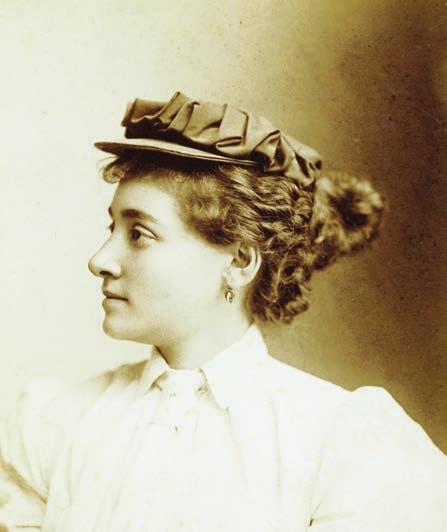
The first woman who cycled the globe
You are going to listen about Annie Kopchovsky, the first woman who attempted to cycle the globe.
Before listening, fill in the gaps with the words from the box. Then listen again, check your answers.
bet • sensation • lectures • experiences • penniless • set
Annie Kopchovsky (1) __________ out from Boston on June 25, 1894, in her attempt to travel around the world. Her adventure began with a (2) __________. Under the terms of the bet, Annie was supposed to begin her journey (3) ______________. She earned money from her (4) __________, in which she told stories about near-death (5) ___________. Annie became a global (6) ____________in the mid-1890s.
2
Say whether the following sentences are true or not. Correct the false ones.
1. Annie Kopchovsky was already famous for her previous adventures.
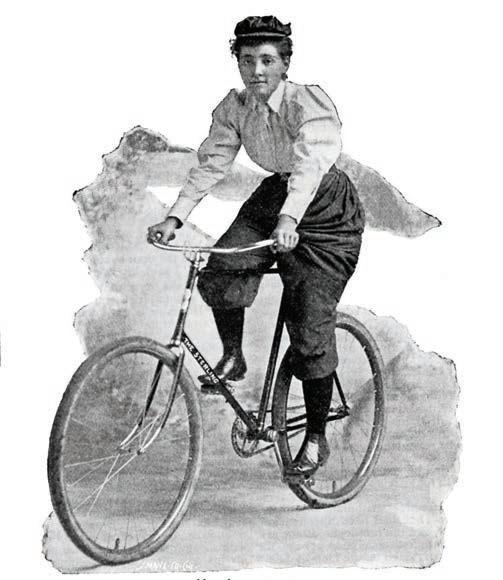
2. Annie was given a lot of money to start a journey. Annie wasn’t an experienced cyclist. She found different ways to earn the money. She experienced various dangers. Few people heard of her achievement.
Study the sentences (1-4) and try to figure out the meanings of the underlined words. Then match the words with their explanations (a-d).
This is my first attempt to drive a car. She rejoined her family in Boston, after her journey across America. He is a very resourceful manager; skilled at solving problems.
It was awful to be penniless in a foreign country.
Retell the story of Annie’s adventure. 4
a. having the ability to find quick and clever ways to overcome difficulties
b. having no money
c. to return to someone
d. an act of trying to do something
GRAMMAR
Grammar The review of numerals
Whole numbers are formed by the digits 0, 1, 2, 3, 4, 5, 6, 7, 8 and 9 and many combinations of them.
Cardinal numbers
A cardinal number denotes quantity (one, two, three, etc.).
Ordinal numbers
Ordinal numbers are formed from cardinal numbers. They tell the position of something in the list. E.g. sixth, tenth, etc.
a. Which suffix do you add to a cardinal number to get an ordinal number?
b. Are there exceptions to the general rule? Give some examples.
c. Is an article used before ordinal numbers?
d. Dates are expressed by ordinal numbers. Say the following date: 14 February 2009.
Notice the irregular spelling of fifth, eighth, ninth, and twelfth.
Even and odd numbers
Even numbers (such as 2, 6,108, etc.) are divided by two without a remainder.
Odd numbers (such as 1, 3, 33, etc.) cannot be divided exactly by two.
Note:
Fractions and decimals
Parts of numbers smaller than 1 are expressed either as fractions or decimals.
E.g. Fractions: 1/5 (one fifth) Decimals: 3.45 (three point four five).
In fractions when the cardinal number is more than one, the ordinal number has a plural form.
E.g. 3/6 (three sixths)
Read these fractions: 1/7, 2/8, 2/4, 8/9, 4/5. Which figure is a cardinal/ordinal number?
Read these decimals: 2.7; 5.23; 12.56.
Mathematical operations
The main mathematical operations are: addition, subtraction, multiplication and division.
We should also know how to take a square, cube or other roots.
• With hundred, thousand, million and dozen it is more usual to use a than one when they stand alone, but never without a determiner. Some people live for a hundred years.
• When other numbers are added, one is more usual: 1,200 – one thousand and two hundred.
• When hundred, thousand, million, etc. are used after a number, they do not have an -s. This coat is very expensive. It costs four hundred pounds.
• In other cas es, the plural form is dozens (of), millions (of), etc. There are hundreds of stray dogs in this town.
• You probably know that 0 is pronounced in different ways: /@U/ in telephone numbers, /nIl/ in football, /lVv/ in tennis, /zI@r@U/ in mathematics and for temperature.
ReadingGrammar and
Read the text and pay attention to the parts in bold.
Some journeys have unforeseen endings. Their journey had taken them into the heart of the Welsh valleys and away from any swift means of escape. In order to accomplish the assigned tasks, they decided to go undercover as religious men, because the enemy could easily recognize soldiers.
They had been travelling since the beginning of the week, so the first part of the journey had taken just over 2 days. They had been walking by night and resting wherever they could find a shelter by day. On the night of the third day, however, as it was raining heavily, they had been forced to take cover. The following morning, a mile further down the valley, they found what they had been looking for
The past perfect continuous is formed by using had been + present participle.
1. It is used to express an action that started in the past and continued up to another action or time in the past.
How long had you been trying to contact them before you gave up?
We had been waiting there for three hours when the children finally arrived.
Note: Adverbs of time used with the past perfect continuous: when, before, by the time, for, since…
2. The past perfect continuous can be used to express the cause of something that happened in the past. Jason was tired because he had been working for more than ten hours.
I c ould smell cigarettes. Somebody had been smoking
Note: The past perfect emphasizes completion (or the result of a completed action) while the past perfect continuous emphasizes the duration or activity of an action in the past. By the time we arrived, the children had left the house. By the time we arrived, the children had been playing games with their friends for 2 hours.
The past perfect continuous tense Practice
Complete the sentences by using either the past perfect or the past perfect continuous tense of the verbs in brackets.
1. He ________________________ (work) at that school for five years before he left.
2. Jack ___________________ (drive) for over six hours when he finally pulled over to have lunch.
3. He ____________________ (already/eat) 3 burgers by the time they arrived.
4. I _______________________ (drink) coffee all morning. By lunchtime, I _______________ (feel) really strange!
5. Roger wanted to go to bed because he ___________________ (stand) all day at work.
6. The pass engers were cross because the airline________________ (lose) everyone's bags.
7. I had to have a break. I ________________ (clean) since the guests _____________. (leave)
8. Tom ______________________ (be/interview) five times before he got his first job.
THE with geographical nouns
Geographical names are confusing because some require the and some do not. There are some specific rules for using the with geographical nouns.
Do not use the before:
• names of continents: Asia, South America
• names of countries/territories and towns: Mexico, Miami (BUT the Netherlands, the Hague)
• names of streets: 1st Avenue, Main St. (BUT the High Street, the Mall)
• names of lakes: Lake Bled (BUT the lake of Bled)
• names of individual mountains: Mount Everest, Mount Fuji (BUT ranges of mountains take the article: the Andes or the Rockies)
• names of individual islands: Easter Island (BUT island chains take the article: the Canary Islands)
Do use the before:
• countries whose names describe their political organization: the United Kingdom, the Czech Republic, the United States
• names of rivers, oceans and seas: the Nile, the Danube, the Pacific, the North Sea
• points on the globe: the Equator, the North Pole
• geographical areas: the Middle East, the West, the Balkans
• deserts, forests, gulfs, and peninsulas: the Sahara, the Persian Gulf, the Black Forest
Practice
Add an article where it is necessary.
1. There’s a splendid view of ____Lake Geneva from this hotel.
2. I like to cycle through ____Central Park.
3. They have a flat on ____Fifth Avenue.
4. ____Bahamas are ____ group of islands in ____Atlantic Ocean.
5. They want to see both _____ Mediterranean and _____ Corsica.
6. I’m staying at ____ hotel on ____ Hudson River.
7. He prefers _______ west of Australia, because _______ climate is better.
8. ______Gobi Desert covers about 1.3 million km2 of ______Asian continent.
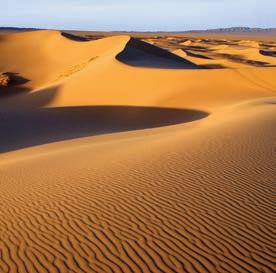
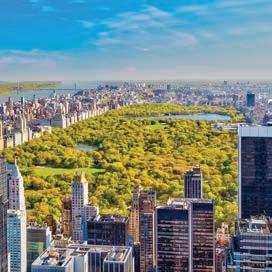
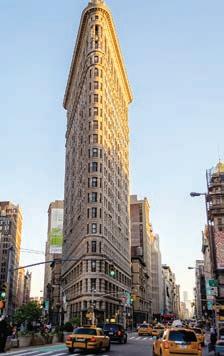
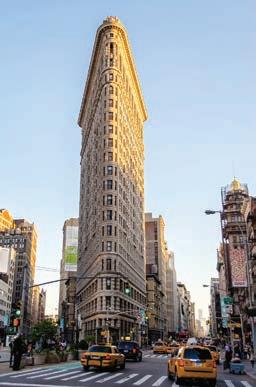

TRAINS that FLY
Reading and speaking
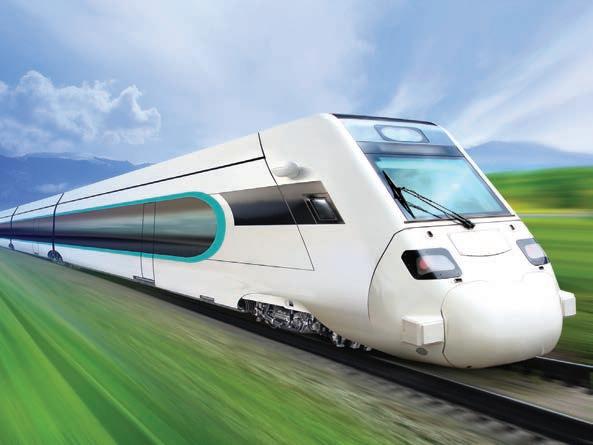
High-speed trains are slowly changing the way we travel. It all started in Japan in 1964 with the first commercial journey of the ‘bullet train’. The train quickly reached a top speed of 210 kph on a specially constructed line from Tokyo to Osaka. In that way, the time required to travel between Japan’s two largest cities was reduced from 6 hours and 30 minutes to 4 hours. With the introduction of a new class of trains in 2007 the travel time was brought down to 2 hours and 25 minutes. Their reliability and punctuality are just fantastic.
The bullet train is no longer the fastest high-speed passenger train in the world. There is a new generation of mass-transit vehicles known as Maglev, or magnetically levitated trains. The trains rely on magnetic power to float above the ground. Maglev nearly doubles the speed of the fastest bullet trains.
High-speed rail links have already been put into operation in Spain, Germany and France. China has the biggest network, but other countries are also rapidly increasing their high-speed rail networks. The train on the route between the capitals of Belgium and France has cut journey between the two cities to 90 minutes. The USA is building ‘Super-Maglev’ trains which will reduce travel time between Baltimore and Washington DC to just 15 minutes.

Although a flight by air between cities a few hundred miles apart takes only an hour, trains have their advantages over planes. Getting to or from the airport often takes longer than the flight itself and trains take their passengers direct to the centre of cities. Besides, planes use a lot of their fuel just to get into the air. The energy that drives the train comes from the electric current in the track along which the train moves. That’s why the Maglev system, although not yet widely used because tracks are costly to construct, is believed to be the transport system of the future. Glossary
levitate – to rise or make (something) rise into the air bullet – a small piece of metal that is shot out of a gun with great speed; a bullet train – a high-speed passenger train especially of Japan rely – to be dependent on someone or something; to trust or have confidence
reliable – consistently good at quality or performance, and able to be trusted
reliability – the quality of being reliable
Decide if the statements are true, false or you can’t find the information in the text. 1 True False Doesn’t say
1. The Maglev train has to carry a lot of fuel.
2. Japan has a system of rapid transportation by train.
3. Magnetic power lifts the train above the tracks.
4. Bullet trains enormously reduce the time of transportation.
5. Airports are usually close to the centres of cities.
6. Magnetic trains will be in use all over the world very soon.
7. Maglev trains have already been tested in many parts of the USA.
8. There are Maglev trains in Australia.
9. High speed trains are very punctual and safe.
10. Maglev trains are faster than bullet trains.
2
Travelling by plane or by train?
What do you think about travelling by train and travelling by plane? Which way is more a. comfortable b. convenient/inconvenient
c. amusing d. expensive?
Explain why you would or wouldn’t choose to travel by train/plane.
Speaking
Making questions
You’re at a London railway station going to Hastings. You want to buy a train ticket and get some information.
You want to know
• about the departure and arrival times of trains from London to Hastings.
• the price of a single/return ticket/first class.
• how to pay – in cash/by credit card.
• the platform number.
• if the train is direct.
• from which platform the train leaves.
Ask the ticket officer as many questions as you need to be fully informed.
Vocabulary
1
Find the words in the text which collocate with the words in A and the words with opposite meanings in B.
Word formation
3
4
__________ speed __________ journey __________ networks __________ system
inexpensive __________ slowly __________ decrease __________ advantage __________
2
Complete the sentences by using the correct preposition.
1. The time was reduced from 6 hours _____ 4 hours.
2. Trains have their advantages _______ planes.
3. He gained fame _______ being the first to climb the Himalayas.
4. He tried to sneak _______ the hall.
5. He ran away and ended ________ a friend’s cellar.
What are the nouns of these words?
high – _________; wide – __________; long – _________; deep – _________; strong –_________

Complete the sentences with the correct form of the words in bold.
1. The police inspector insisted on ______________ at meetings. /punctual
2. It is very useful to read first an ______________ to the book. /introduce
3. Another building near my house is under ______________. / construct
4. The weather is rather here. /change
5. We spent a very evening with them. /enjoy
6. I like my dishwasher because of its ______________. /reliable
7. The bank has a copy of your______________. /sign
8. ____________doesn’t come easily. /succeed
9. The patient made a speedy _____________, but his stay in hospital was ____________. /recover/cost
Travel words
The following words and expressions are all connected with travel.
harbour boarding pass platform speed limit emergency exit check-in voyage baggage claim compartment cockpit runway single/return ticket flight to board
Divide the words from the box under the following headings. Some words can go under more than one heading. ROAD RAIL
6
Complete the sentences using the words from the box above.
1. There were many ships docked in the _____________.
2. The eight o’clock train from Glasgow is arriving on ____________ 5.
3. Do you want a single or ____________ ticket?
4. They decided to go on a long sea ______________ from Britain to India.
5. Don’t drive so fast. There is a _______________ on this road.
6. The plane started to taxi on the _______________.
7. Do we have seats in the same train _____________?
Phrasal verbs
Complete the sentences using these phrasal verbs in the correct form: get on/off, take off, set off, check in, break down, get out of and put off.
1. Our flight was __________ due to fog.
2. When we arrived at the airport, we went to ________ at once because we were late.
3. I was very angry when my car __________ on the road, miles away from a town.
4. Our luggage is packed in the car, so we are ready to _________ on our journey.
5. We _________ the train in Paris and ________ in Brussels 90 minutes later.
6. Two policemen stopped Tim and asked him to ___________ the car.
7. The airplane was on the runway ready to _____________.
Abbreviations
Mat ch the following abbreviations with the words they stand for.
1. Kph
2. asap
3. etc.
4. AD
5. BC
6. a.m.
7. p.m.
8. BBC
9. Washington DC
10. UFO
a. the British Broadcasting Corporation
b. Before Christ
c. Unidentified Flying Object
d. kilometre per hour
e. District of Columbia
f. and other things of the same type
g. as soon as possible
h. Anno Domini (in the year of our Lord)
i. ante meridiem (before noon)
j. post meridiem (after noon)
Grammar
Look at these sentences:
Adverbs
1. Maglev trains nearly double the speed of the fastest bullet trains.
2. Trains take their passengers direct to the centre of cities. What part of speech are the words nearly and direct?
1. Adverbs are normally formed by adding -ly to the corresponding adjective. E.g. a casual dress – worn casually; bright colours – brightly coloured
Note: Not all words ending in -ly are adverbs. Some adjectives also end in -ly: lonely, lovely, friendly, ugly. These adjectives have no adverb form; instead we can use different structures. E.g. in a friendly way
2. Some adverbs have the same form as the corresponding adjectives: fast, hard, near, deep, high, direct, wide, etc.
3. The forms hardly, nearly, deeply, highly, widely, etc. exist, but have a slightly different meaning than their corresponding adverbs.
hardly – almost not, with difficulty lately – in the last few days/weeks nearly – almost deeply – profoundly
shortly – in a short time, soon; briefly highly – very directly – soon, straightaway, immediately widely – over a large area; by many people or in many places
Practice
Look at these pairs of sentences and complete them with the corresponding adverbs.
1. a. The plane flew ________ above the clouds.
b. Don’t touch it. It’s ________ dangerous.
2. a. She was ____________ hit by a car.
b. This school is very convenient for the children who live quite ________ .
3. a. Though Michael tried ___________ he didn’t pass the test.
b. He ___________ noticed my presence.
4. a. The river runs ________ into the cave.
b. We were _________ sorry for his loss.
Speaking
What must a departing passenger do before he boards the plane if he travels abroad?
a. Sort out the directions given below and organize them in a logical sequence.
b. Then start speaking in full sentences in this way: When people travel by air, they have to get…
HINTS
• go to the departure gate
• take hand luggage (a light bag) into the plane
• check on the screen the departure time of the plane
• get to the airport two hours before the flight
• wait for the final announcement of the flight
• board the plane
• go through the passport control
• have the ticket checked at the check-in desk
• have the luggage weighed and labelled
• get the boarding card and luggage ticket
• wait in the departure lounge for further information
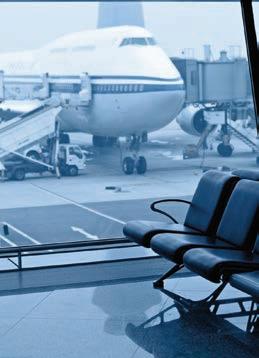

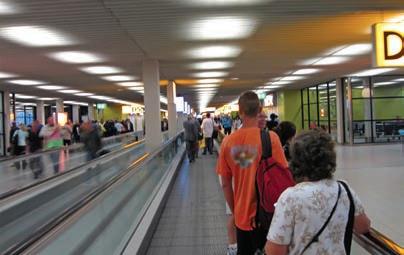
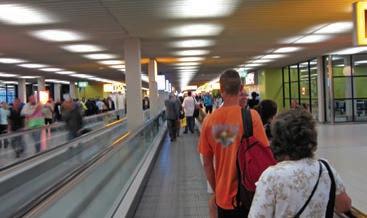
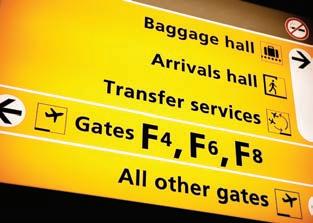
Writing
AN INFORMAL LETTER
Imagine you are on an adventure holiday. Write a letter to a friend.
LAYOUT

Greeting
Hi…, / Dear…
Your address
Date
1. Introduction
Ask your friend some introductory questions. (How are you? Say where you are.)
2. Paragraph 1
Describe the place/the people you are with/the weather.
3. Paragraph 2

Say what you are doing/if anything interesting has happened.
4. Ending
Mention other things you find relevant or ask about your friend’s plans. (Have you decided where to go on holiday?)
5. Signing off
Say goodbye and sign your name. (All the best/Lots of love)
Remember! Begin sentences with informal linkers: (Anyway, Actually, Luckily…)


Communication
If you happen to be abroad, here are some questions you might hear and answers you may give.
1. Where do you come from?
2. Are you on holiday here?
3. Have you been here before?
4. How are you enjoying your holiday?
5. Are you having a good time?
6. Are you here with your family?
7. How do I get... from here?
8. How long are you staying here?
a. I come from…
b. I’m having a great time. There are many things to see and I’m taking a lot of pictures.
c. This is a great place. I’m having a lot of fun.
d. This is my first time here. I always wanted to come and I’m having a great time.
e. It’s not far from here. You can’t miss it.
f. It was nice talking to/meeting you.
Role play
Complete the dialogue by using the questions and answers from the box. You may add other words when/if necessary.
A: Do you live around here or are you visiting?
B: _________________________________.
A: Have you been to Belgrade before?
B: No, __________________________________________.
A: That’s nice. Are you having a good time?
B: Yes, __________________________. Do you live in this city?
A: No, but I often come here. I like strolling around Kalemegdan.
B: _________________________________________________?
A: Follow this street for about 200 m. and_______________________.
B: Thanks. I’ll certainly go there.
A: _____________________________. Have a good time.
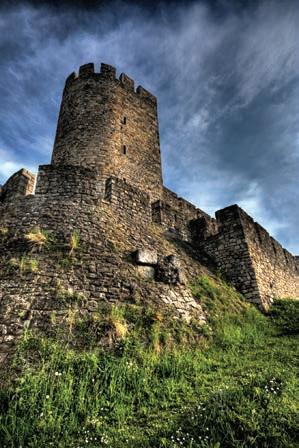
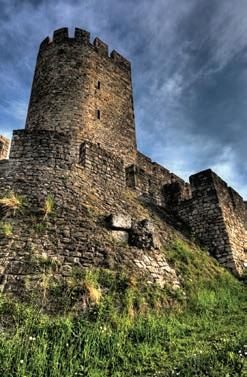
Self-assessment TEST 9
6. Sue lives __________ the airport. 1 2 3 4
Find the words for these definitions. (5 pts.)
1. A number that tells the position of something in a list. ___________
2. Airplanes take off and land on it. ___________
3. A long journey especially by sea or in space. ___________
4. To send something on its course. ___________
5. To be dependent on somebody or something. ___________
Word formation
Complete the sentences with the correct form of the words in bold. (5 pts.)
1. Our product has become a great ___________ success. /commerce
2. I like Mary because of her _______________. /punctual
3. She looked at me with her eyes _______ open. /width
4. I appreciate my friends because of their ___________. /reliable
5. My family showed great _________ when I was ill. /strong
Write the following sums in words. (4 pts.)
1. 15 + 23 = 38 ____________________________________________
2. 30 – 12 = 18_____________________________________________
3. 9 x 5 = 45 _____________________________________________
4. 10 : 2 = 5 ______________________________________________
Fill in the gaps choosing the correct word. (6 pts.) direct/directly deep/deeply near/nearly
1. Susan was __________hurt when Jim left her.
2. Still waters run _____________.
3. Cameron can’t go __________to London; he has to change trains.
4. Will she come____________ to the meeting after the airport?
5. He___________ lost his leg in an accident.
KEY – page 185
KEY WORD LIST
Verbs rescue sneak reduce launch levitate rely (on) board
Nouns undertaking means digit bullet punctuality reliability rail runway compartment voyage
Adjectives confined cardinal ordinal
Adverbs highly nearly deeply freely widely directly
points
PUNCTUATION MARKS
and other SYMBOLS
These marks can be useful when writing compositions, dictations, essays, etc.
Full stop
A full stop or a period (US) is used at the end of a sentence that is not a question or an exclamation:
Della started visiting Yosemite Park as a child.
Comma
Commas make slight pauses in sentences. They are used to s eparate words in a list: Will you bring plates, glasses, cups and napkins. − to s eparate phrases or clauses: If you are ready, we can start the test.
Semicolon
A semicolon links two sentences or parts of them:
The sky is full of clouds; it will rain soon.
Colon
A colon is used to introduce a list of items: I b ought: oranges, pears, plums and cherries. to introduce a quotation: She told me: ‘Go out quickly.’
Question mark
A question mark is used at the end of a direct question: What is the other word for sneakers?
Exclamation mark
An exclamation mark is used at the end of a sentence expressing strong emotion: Watch out!
Apostrophe
An apostrophe is used with s to indicate possession: Tom’s trousers in short forms: It’s unpredictable work.
Quotation marks
Quotation marks are also called inverted commas. They are used for direct quotations: ‘ Where did they take him to?’ asked Mary. to indicate the titles of articles, books, poems, etc: I’ve see the film ‘Out of Africa’ three times.
Hyphen
A hyphen is often used in compound words: This model was extremely short-lived.
Dash
A dash is used to separate a comment from the rest of the sentence: Where would you like to go – to the river or to the lake?
Brackets
Brackets are used to separate extra information from the rest of the sentence: Odd numbers (such as 1, 3, 33, etc.) cannot be divided exactly by two.
Dots
Three dots are used to indicate that words have been omitted: I come from…
Slash (/)
A slash is used to separate words or phrases: He can swim further/farther than me.
Dot
A dot is used in e-mail addresses: geof.harris@gmail.com
At
A symbol @ used in e-mail addresses: michele@hotmail.com
WORKBOOK
NATIONAL PARKS Unit 1
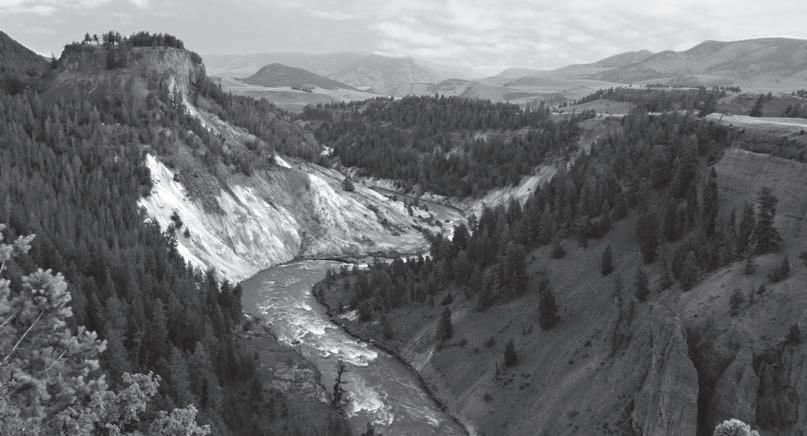
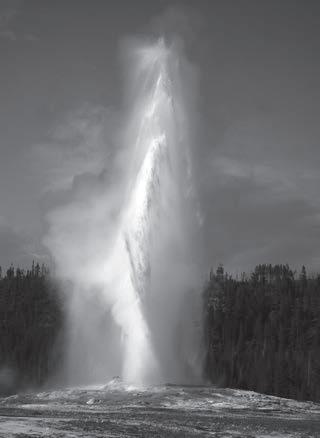
Vocabulary
2
3
Yellowstone National Park is the oldest and most famous national park in the United States. It is a major (1) __________of millions of visitors each year. The park is named after the Yellowstone River, which (2) _________ through it.
Yellowstone is in the (3) _________of the Rockies and there are few places on Earth which offer such (4) _________ of countryside: mountains, (5)__________natural forests, grassy valleys, lakes and waterfalls of exquisite beauty, geysers and many hot springs. Diverse (6) ________includes grizzly bears, wolves, elks, bison, swans, eagles and others.
Complete the sentences by using the words from the box.
1. We de cided to follow the ________ which runs deep into the forest.
2. Many of plants and animals are endangered due to climate change.
3. It’s starte d to rain. Let’s look for a ___________.
4. The b ook we found in the attic is a vivid __________ of life in the 18th century.
5. Do you think that David behaves as a __________ man?
6. The event was described by a ____________ writer.
NAME PARTS OF A TREE
Match the picture with the words:
a trunk a branch a leaf a bark a twig roots
1. ____________ 2.______________ 3. ____________
4. ____________ 5.______________ 6. ____________
Complete the sentences by using the words from the box. 1 1
However, no visit to Yellowstone is complete without seeing the world’s most famous geyser Old Faithful and witnessing one or more of its eruptions. It erupts about every 60 - 110 minutes, (7) _________water up to 42 metres into the air on average. Yellowstone also (8) _______a lot of recreation opportunities, such as fishing, camping, hiking, horseback-riding and boating.
heart destination runs vast shooting offers diversity wildlife shelter mature species contemporary trail depiction

Complete the sentences by using the correct preposition. 4
1. Yos emite Park is home________ hundreds of wildlife species.
2. The park is an es cape ________ urban life.
3. This path leads ________ the forest where you can find a variety of birds.
Word formation
4. The park is renowned _______ an abundance of waterfalls.
5. Michael is name d ________his grandfather.
6. A few window panes were damaged ________ the heavy storm.
1. The Ab origines know the____________ properties of many plants. /medicine
2. The ___________ of a new entertainment programme was Michael’s job. /create
3. We are trying to maintain the ____________ balance in the river. /ecology
4. I recognized the house from Tom’s _____________ in his book. /depict
5. His ______________ wasn’t approved by the local authorities. /act
Listening
Word stress
Read the following sentences and underline the syllable which is stressed in the words in italics. Pay attention to whether the word is a noun or a verb. Then listen to check. 6
1. The protest was fairly peaceful.
Grammar
Complete the sentences with the correct form of the words in bold. 5
2. I want to protest because of your behaviour.
3. How much does it cost to transport all the furniture?
4. The transport of goods to Africa will cost you a lot.
7. Smoking is a great threat________ her health. track 2
5. We’ll present the information using a chart.
6. This will b e a perfect present for my mother.
Tense revision – the present tenses
Put the verbs in brackets into the correct tense.
1. Why ______________________ (you/carry) an umbrella on such a beautiful day?
2. Thos e brothers ________________________ (not resemble) each other at all.
3. ______________________ (you/go) to Mark’s exhibition tonight?
4. Pleas e, don’t make such a noise. The children ___________________ (sleep) upstairs.
5. This is the first time I __________________ (open) a bank account.
6. ______________________ (you/look) for Mary? She’s in the office down the corridor.
7. I ______________________ (pass) four exams since you went to Sydney.
8. Why ______________________ (you/not ask) John to stop making a mess?
9. I’m s orry, ______________________ (you/talk) to me?
10. Her brother ______________________ (be) in hospital since last Thursday.
11. What’s wrong with Tony? He_________________ (be) very stressed and nervous lately.
9. The furniture was/were bought at the store on the corner. 8 9 10 11
Complete the sentences by putting the verbs in brackets into the correct present tense and adding the adverb in italics.
1. always
a. I _____________________ (believe) that he will become successful.
b. I _____________________ (get) up early in the morning.
c. She _____________________ (put) too much make-up. It’s ugly.
2. never
a. I _____________________ (play) loud music when my parents are at home.
b. Mary _____________________ (eat) sea food before.
3. still
a. You promised to write this report but you_________________ it (not/finish).
b. _________________________ (you/work) in the garage?
Plural of nouns
Form the plural of these nouns.
deer – knife – hero – watch –woman – family – sheep – half –brush – tomato – roof – photo –series – goose – reply – belief –
Answer the questions giving examples from Exercise 9. Add more examples for each category that you know.
1. Which nouns change -y into -i b efore -es? _____________________________________
2. Which nouns change the final -f/fe in the plural? ________________________________
3. Which nouns have the same form for both singular and plural? _____________________
4. Which nouns ending in -o add -es in the plural? _________________________________
5. Which nouns have an irregular plural? _________________________________________
Choose the correct verb form.
1. The news about his death was/were on television.
2. Cattle has/have been sold for good prices this year.
3. There is/are some refreshments in the other room.
4. The team is/are trying on the new shirts and shorts.
5. The p olice has/have a hard job to do.
6. There was/were a lot of deer in the forest last winter.
7. My jeans is/are torn to pieces and I can’t mend them.
8. The information is/are usually received and processed immediately.
12
Mediation and translation
Your mother wants you to write an e-mail to her English friend Lisa to invite her for a ten-day holiday on Kopaonik. You have to translate what your mother said.
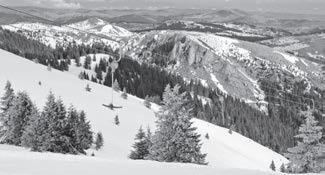
Hi Aunt Lisa,
14
Expand your Vocabulary
IDIOMS WITH GOLD
13 make (x2) • (not) change • run • knock • strike
Match the sentences on the left with the correct definitions on the right.
1. All that glitters is not gold.
2. Mary’s new job is a golden opp ortunity for her.
3. My pupils are as good as gold.
4. Jim has a heart of gold.
5. Kate’s parents celebrated their golden wedding.
PROVERBS AND SAYINGS
Complete the following sayings using the verbs from the box in the correct tense. There is one verb extra.
1. Lightning never __________twice in the same place.
2. A le opard _______________ its spots.
3. Many hands ___________ light work.
4. Abs ence _________ the heart grow fonder.
5. Opp ortunity ___________ but once.
a. a wonderful chanc e
b. to b e very kind
c. 50th wedding anniversary
d. don’t be deceived by appearances
e. b ehave perfectly

Unit 2
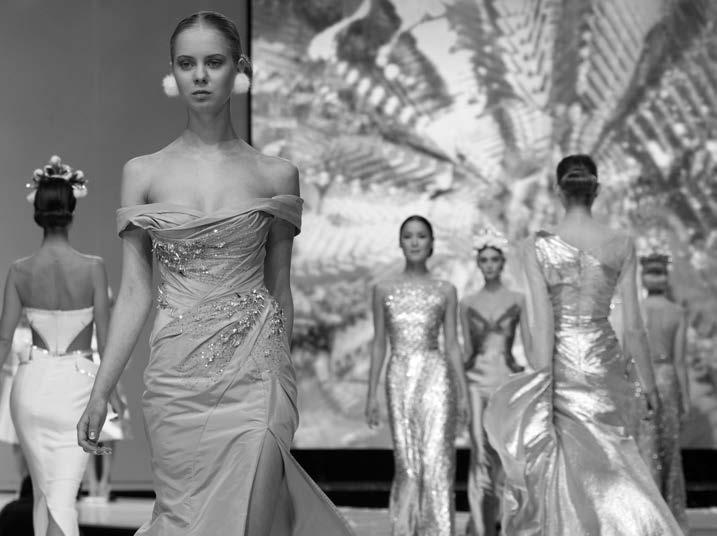
FASHION
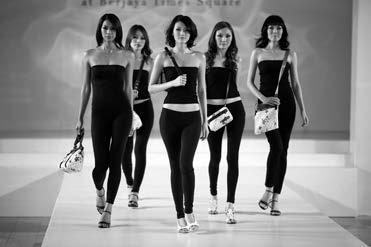
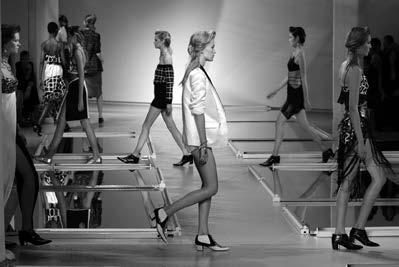
Reading and
Vocabulary
1
YOUNG GIRLS ON THE CATWALK
Complete the sentences by using the words in the box.
competition regret employed support copy finals shoot combine
Lisa started modelling at the age of 13 and was the youngest girl Star Agency had ever (1) __________. ‘One day my mum came home from work with a (2) __________ of the newspapers which had a Look of the Year (3) ____________. I entered it for laughs and got through to the (4) __________, which won me a contract with Star Agency. I’d never thought about modelling, but I loved it right from the beginning. It is essential that your parents (5) __________ you. My mum went on every single (6) ___________with me. I had to work hard to (7) __________ school and modelling, but the discipline was doing me good. I don’t (8) __________ going for it.’
2
Circle the correct answer.
1. It’s rather cold outside. I think you should______ your coat.
A wear on B put on C dress in
2. Why did you _____ your jacket? It’s not so hot here.
A put off B get off C take off
3. This skirt is your size. You should ______ to see if it suits you.
A try it on B dress it C probe it
4. How often do you buy ____?
A clothes B clothing C clothe
5. Most p eople who work in an office wear _____ clothes to work.
A smart B sp orts C untidy
6. Is it imp ortant to keep ______ with fashion?
A in B up C on
Word formation
Complete the sentences using the words in bold in the correct form and one of the prefixes from the box. 3
mis-, under-, re-, over-, dis- (2x)
1. When you finish printing, will you ______________ the power supply? /connect
2. You will b e punished if you ________________. /behave
3. There is no water in the kettle. Will you _______________it, please? /fill
4. It’s to o hot in this room. You have _______________ it. /heat
5. John didn’t support his family when they needed him. He was _______________ to them. / loyal
6. They ____________ the p ower of water and a lot of houses were flooded. /estimate
4. Food that has been cooked for too long. __________________ 4
Use the prefixes over and under to form the words which correspond to the following explanations.
1. Heavier than you should be. __________________
2. Not c ooked enough. __________________
3. To sell more tickets than you have available.__________________
Prepositions
Complete the sentences by using the prepositions from the box. 5
1. Mary had gone by the time I arrived _____ the scene.
2. Bell took credit _______inventing the telephone.
3. He complimented me_______ how I look.
4. Platform shoes came ______ fashion again.
5. I think you should apply _____ this job.
6. Diana complained that her friends took no notice ______ her.
7. If nothing else, you must apologize ______ not coming to her show.
8. We knew he was suffering _______ a serious illness.
Phrasal verbs with OFF
Read the sentences carefully and explain the meanings of the phrasal verbs with off.
1. Sales of her latest collection took off unexpectedly.
2. This dress is on a special offer, so we’ll take ten percent off.
3. My grandmother dozed off because she had had a very tiring day.
8. We de cided to call off the concert because two members of the band were ill. 6
4. Something in the refrigerator is giving off a terrible smell.
5. Will you switch off the lights before you go out?
6. We de cided to see Joan off to the airport.
7. Mary buys very expensive dresses to show off
7 on of from into for
CONFUSING WORDS
Choose the correct word.
1. The pattern of the blouse matches to the skirt/matches the skirt.
2. I kept a diary/dairy when I was in secondary school.
3. We have fresh diary/dairy products every morning.
4. The advise/advice of friends can be valuable at the moment.
5. He works as/like a model.
6. He lo oks as/like a pop singer.
7. Pleas e, keep quite/quiet.
LINKING WORDS
Here are a few common linking words. Complete the sentences using the words/phrases from the box. 8
with reference to • although • nevertheless • whereas • on the other hand • despite
1. She found him physically unattractive. _____________, she agreed to go out with him.
2. John is very hardworking, _____________his brother is lazy.
3. Advertising cigarettes is forbidden in the West. In many other countries, _________, it is quite common.
4. _____________ your invitation to visit you, we are pleased to inform you that we can come next week.
5. ______________ she wasn’t very rich, she gave money to charity.
6. ______________ the fact he was fe eling weak, he went to work.
Grammar
Participle clauses
Join the sentences making the past participle clause. 9
Example: Andrea was angered by his hurtful remarks. She left the room. Angered by his hurtful remarks Andrea left the room.
1. I was s oaked to the skin. I reached school.
2. I was impressed by his exhibition. I decided to buy two pictures.
3. The painting was stolen from the Art Gallery yesterday. It was found in the park. _______________________________________________________________________
4. A tree had been blown down by the wind. It was removed by the rangers.
5. She was tired from her housework. She threw herself into an armchair.
6. This dress was worn by a famous actress. It was given to a museum.
7. Alic e sang at the concert. She was accompanied by her brother.
Listening and
Grammar
track 7
Eventually, we __________ the place which was the end of our journey. I was pleased to be back on dry land, but sorry to leave this wonderful river, one of the world’s last great wildernesses. reach • drink • spend • sleep • drag • make • wash • eat • see Complete the sentences by putting the verbs into the past simple tense. Listen to the text and check.
We _________ four nights on different islands in the middle of the river. We __________ our canoes up onto the sand, __________ our camp, and ___________ our supper listening to the noises of the night. In four days we ____________ no lights and no roads; we __________ in the river, ___________ from the river and __________ in the open.
11
Past simple, past continuous and present perfect
Put the verbs in brackets into the correct tense.
1. When we first ____________ (move) to this area, it _________ (be) very quiet. Since then, it ____________ (become) very busy and noisy.
2. Onc e I nearly fell asleep while I ________________ (drive).
3. When it (start) ______________to rain, our dog (hide) ______________under a tree.
4. When I (do) _____________a language course in Ireland, I (visit) ______________ Blarney Castle.
5. What time __________________(you/arrive) at the main train station last night?
6. I ______________ (not /understand) what they ______________(talk) about at the meeting yesterday.
7. We _______________ (v isit) Oxford before so we don’t want to go again.
8. Ann’s friend ______________(run) while Ann __________(ride) her bicycle.
Expand your Vocabulary
SOUNDS
12 gasp scream murmur laugh chime cheer
Complete each sentence with the correct form of the words from the following list. There is one extra word.
1. Rihanna’s arrival was met with ___________ from the crowd.
2. We heard the __________ of a frightene d woman.
3. Ann gave a ___________ of surprise when she saw her fiancé in the room.
4. We have tiny bells on the balcony which _________ in the wind.
5. The b oy __________ an excuse and went out quickly.
CLOTHES IDIOMS
Explain the meaning of these idiomatic expressions in italics.
1. I wouldn’t like to be in Harry’s shoes.
2. ‘How do you feel in your new dress?’ – ‘It fits like a glove.’
3. I’ve got something up my sleeve.
4. Jack is very generous. He’d give you the shirt off his back.
5. Henry redecorated the house by himself. I take my hat off to him.
For fun
COMPARISON
If we want to say that a person is – busy, blind, hungry, innocent, quiet, stubborn, wise, strong or proud, we use expressions in which he/she is compared to animals with these characteristics
Complete the sentences below using one of the adjectives in italics above. as _________ as a bee as _________ as a mouse as _________ as an ox as ________ as a lamb as_________ as a peacock as ________ as a bear as________ as an owl as________ as a mule as________ as a bat
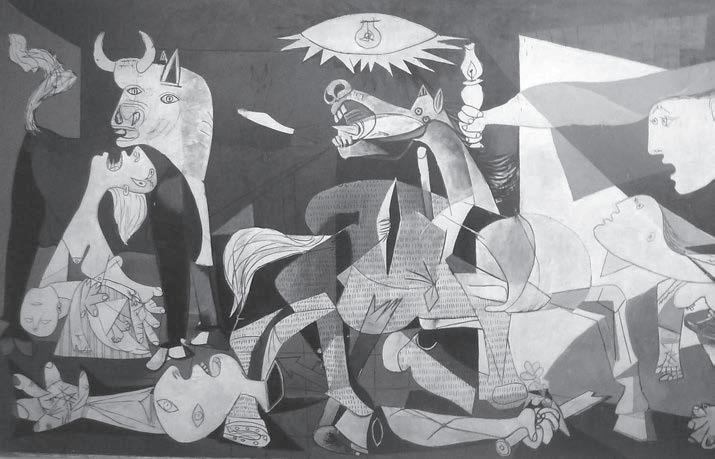
ART AND ARTISTS Unit 3
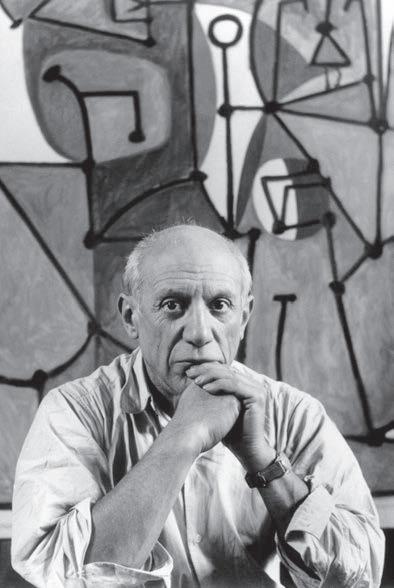
Reading and
1
Vocabulary
Complete the sentences using the words from the box.
GUERNICA
masterpiece • attention • inspired • innocent • exhibition • freedom • art
Famous works of art are often accompanied by stories of situations which (1) ___________ the artists. This is the story of Guernica, perhaps the best work of (2) ___________by Pablo Picasso. In 1937, German and Italian warplanes bombed the Spanish town of Guernica killing (3) ___________ civilians. Picasso, who was in Paris at that time, painted Guernica as a reminder of the sufferings during the war. This tragedy brought out the best in Picasso and he created a (4) ___________. The painting was displayed around the world on a brief tour, becoming widely famous. This tour helped bring the Spanish War to the world’s (5) ___________. It was Picasso’s wish that the painting shouldn’t be exhibited in Spain until (6) ____________and democracy had been established in that country. The (7) ___________ was opened in 1981 and almost a million people visited it in the first year.
2
Replace the underlined words in the text with the words from the box to get the correct sentence and the right meaning.
In 1819, Turner started on his journey to Europe. He made hundreds of drawings, and later painted a series of pictures inspired by what he had seen. These paintings show great progress in his style and an original access to landscape. He became increasingly interested in colourful colours, the play of light on water and the splendour of skies and fires. He sacrificed precision to general results of colour and experimented greatly with light and contrast.
extensively • advancement • effects • set out • vivid • radiance • approach
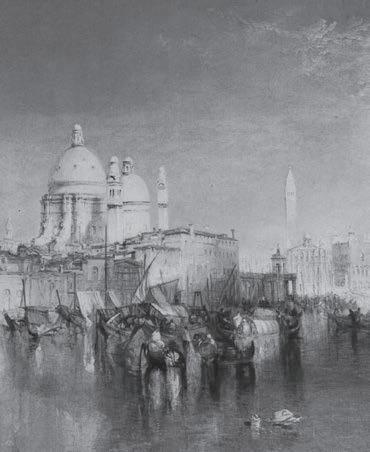
3
Choose the correct word to fill in the gap in each sentence. Use a dictionary if you are not sure of the meanings of some words.
1. The s culptor ____________ the stone until he got the shape he wanted.
2. The frescoes have been badly damaged in a fire and haven’t yet been ____________.
3. A____________ is a p erson whose job is to look after the objects in a museum.
4. All the museum’s ____________ were kept in glass cases.
5. All visitors to the exhibition are required to pay an _________________.
6. A few of his paintings are on ____________ at this exhibition.
Word formation
display curator exhibits admission fee carved restored
Complete the following sentences using an appropriate form of the word in bold. 4
1. The problem may be a lack of __________________. / inspire
2. He should get the Nob el Peace Prize in _____________ of his services to humanity. /recognize
3. Their p erformance was _______________ great. /remarkable
4. We all agree that it was a ________________victory. /glory
5. It’s b elieved that women have higher levels of ______________ than men. / endure
Complete the sentences with the correct form of the words in bold using negative prefixes.
1. It is a nice dress, but quite ______________ for travelling. /practical
2. He always phones at the most _____________ times when I’m busy doing something. /convenient
3. It’s very ______________ to make rude gestures at people! /polite
4. My children can’t stop eating chocolate – they find it _______________. /resistible
5. I knew you wouldn’t _________________ of my going there. /approve
6. Don’t you think it’s an ________________ act? /legal
Grammar
Revision of tenses
track 12
Past simple, past continuous and past perfect
Put the verbs in brackets into the correct tense. Then listen to check.
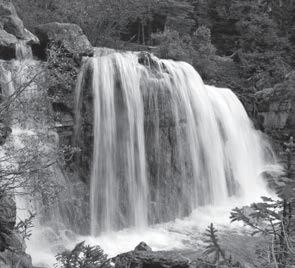

I _____________ (visit) Great Falls for the first time when I _____________ (be) thirty though I _____________ (become) a backpacker ten years before. We _____________ (hike) along the trail to the Falls. My backpack was heavier than usual and a friend of mine ____________ (lead) the way. He ____________ (visit) the Falls before and _____________ (know) the path well. That was the highest and hardest climb I ______________ (ever/experience). We ___________ (walk) slowly. Suddenly, we ____________ (break) out of the trees and before us the Falls _________________ (cascade) down creating the breathtaking scenery which only a poet would dare to describe. I __________ (never/think) it I could make it so close to the Falls. I ____________ (reach) the same point many times again, but the thrill of that first moment is really unforgettable.
7
Complete the sentences with the correct tense of the verbs in brackets.
1. He ____________ (deny) that he ___________ (steal) the money.
2. The wind _________ (destroy) the sandcastle that our children_____________ (build).
3. By the time I___________ (me et) Diana, she _____________ (already finish) her studies.
4. Nina ______________ (ad mit) that she _______________ (make) a mistake.
5. The singer __________(sing) s ongs I _________________(never/hear) before.
Passive
8
Complete the sentences with the correct passive form of the verbs in brackets.
1. The brochure ________________ (post) to your address tomorrow.
2. He ___________(bite) by a dog and must ___________(take) to hospital immediately.
3. All the pictures_________________ (recently/paint) by young artists.
4. They starte d to leave before they _________________ (give) directions.
5. My car____________________ (repair) at the garage at the moment.
6. It _____________________ (repair) twice this month.
7. My great-grandfather ____________ (give) a beautiful watch when he retired.
9
Rewrite these sentences using the passive.
1. People say swimming is good exercise for your back.
2. Teachers have to make lessons more interesting.
3. D id anyone show David how to fill in that form?
4. Nob ody explained to him what to do.
5. Do you know who painted this picture?
10
11
The passive infinitive and gerund
Put the following sentences into the passive.
1. We don’t want you to invite George to your party._____________________________
2. I’d like you to send me a copy of the contract. ________________________________
3. I don’t mind people sending me flowers. _____________________________________
4. I can’t stand people criticizing me. __________________________________________
5. I’d prefer them not to involve me in the case. __________________________________
Participle clauses
Join the following pairs of sentences using the present or perfect participles. Add a conjunction if necessary.
Example: David checked in on time. He went to the duty-free shop. Having checked in on time, David went to the duty-free shop.
1. I didn’t know what present to buy her. I decided to let her choose herself.
2. He had learne d his lesson. He went out to play with his friends.
3. He was dissatisfied. He resigned from his job.
4. We met a b oy. He was carrying a puppy in his arms.
5. He trie d not to smile. He listened to her story.
7. While ____________ (p eel) the onions, she started to cry. 12
Change the verbs in brackets into either the present or past participle.
1. The candidate __________ (choose) for the committee was someone nobody expected.
2. Not ___________ (want) to hurt his fe elings, she remained silent.
3. The man __________ (s end) to fix my computer was useless.
4. We suddenly heard the s ound of glass ___________ (break).
5. The p eople ___________ (injure) in the accident were taken to hospital.
6. ____________ (freeze) food centres can be found in most supermarkets.
Complete the second sentence so that it has a similar meaning to the first sentence using the word given.
1. The students were copying the tests when I arrived. /by The tests ____________________________________ when I arrived.
2. After he had de cided to retire, Clark began to feel better. /decision Having ________________________________ Clark began to feel better.
3. They b elieve the candidate was educated in Canada. /believed It ____________ _________________________educated in Canada.
4. I’m not the s ort of person who enjoys parties, so I declined the invitation. /being ______________________________________, I declined the invitation.
5. G eorge definitely didn’t write that report. /written That report_______________________________ by George.
Mediation and translation
Work in groups of three.
14
Your friend Mila asks you to help her translate her conversation with a tourist information centre worker. You should translate her questions into English and the worker’s answers into Serbian.
M: Питај је
W: Yes, we do. And we also have a free information booklet. M: Одлично.
W: Sure, here you are.
M:
Expand your Vocabulary
W: She can walk down this street. It has some beautiful historical architecture and good museums.
M:
W: I think the museums close at 7 o’clock. The admission fee is $8.
M:
Study the meanings of the phrases in the box and use them to complete the sentences below.
fair and square: justly, within the rules give and take: compromise ups and downs: a person’s good and bad fortune pick and choose: select with great care
1. They b oth knew it would require some _____________ if they wanted to find a solution.
2. I have had my share of ________________, like everyone else.
3. You can’t always ______________. Sometimes you have got to take what you are given.
4. They div ided the money ____________.
Choose the correct answer.
GENERAL REVISION 1
Units 1-3
1. The tunnel _____ while the police _____ the area.
A has been discovered/searched B had been discovered/was searching C was discovered/were searching 2. We must be aware of how many things _____this month.
A would change B have changed C changed
3. He poetically remarked that he _____ eyes on that woman.
A has never laid B had never lain C had never laid
4. Fortunately, the snow _______ by the time we _____the top.
A has stopped/reached B had stopped/reached
C stopped/had reached 5. She _____ as soon as she _____in Belgrade.
A will phone/arrives B will phone/will arrive C phones/arrives 6. I dislike _____to buy things for other people.
A being send B be sent
7. As far _____, there is only one solution to this problem.
A I saw B I think
C being sent
C as I’m concerned
8. How_____news _____ arrived since you talked to her this morning?
A many/has
B many/have
C much/has 9. Each passenger was allowed to take two_____.
A luggages
B pieces of luggage C pieces of luggages
10. You shouldn’t give them any _____ about the company.
A pieces of informations B information C informations
11. She was wearing an _____ she’d bought the previous day.
A outfit
B clothes C outskirts 12 . She left the room _____ to herself.
A having smiled
B smiling
C smiled 13. _____an expensive holiday the year before, she decided to stay at home.
A Having had B Having C Going 14. I’ve tried those tablets and they haven’t done me any _____.
A benefit
B good
15. It would be wrong to _____ something we didn’t do.
C better
A take credit for B take benefit for C take credit of 16. Criminals often use computers for _____ activities.
A unlegal B illegal C nonlegal
17. Some parents think that their children are rather _____.
A irresponsible
B disresponsible C unresponsible
18. We are going to ______ a new magazine for teenagers.
A give up
B set up
C put up
7. Remind me to invite Ronald to our party. /forget Don’t let___________________________________ to our party. 2 3 4
Put each verb in brackets into the correct tense, active or passive form.
1. The police ____________ (find) a boy who____________ (disappear) from his home a week ago.
2. She____________ (buy) a hous e in the village several years ago and since then she _________ (make) a lot of friends.
3. Sinc e her autobiography ______________ (publish) last month, she_____________ (appear) on TV twice.
4. This c oat can’t ____________ (wash), it must ____________ (dry-clean).
5. I hate ____________ (shout) at, even if I did something wrong.
Rewrite the following sentences by using the present or perfect participle.
1. As I heard a boy shouting, I opened the door.
2. Be cause the children didn’t want to lie, they decided to tell the truth.
3. When my sister heard the good news, she wanted to cry.
4. Be cause I was afraid I would lose my passport, I gave it to my father.
5. As I had b een to England before, I knew where to find a good hotel.
Complete the second sentence so that it has a similar meaning to the first sentence using the word given.
1. We starte d on the journey early next morning. /set out We_________________________________ next morning.
2. Nob ody has watered the flowers for days! /haven’t The flowers______________________ for days.
3. Nob ody knows anything about the missing document. /nothing _______________ the missing document.
4. I’ve never seen an exhibition of famous artists before. /time This is the first_________________________________________.
5. She wants s omeone to teach her daughter at home. /taught She wants __________________________________ at home.
6. We didn’t listen carefully to the news broadcast. /attention We__________________________to the news broadcast.
MAKING DECISIONS Unit 4
Reading and
Vocabulary
1
Read the text below and decide which word or phrase A, B, or C best fits each space. Charles Darwin made a decision
When faced with a (1) ______ in life, big or small, we try to make the best choice. We take into (2) ________ different options before we make up our mind.
This is what Charles Darwin did when deciding whether to (3) ______ to his cousin Emma. He made a list of pros and cons (for and against). The pros included (4) ________, while the cons included the fact that he would have less money for books and less freedom. The list of pros was longer than the list of cons, so Darwin proposed. We know that Charles and Emma spent 43 years together and had ten children.
The original list he made is still (5) _______ for visitors to see, at his home in the village of Down.
1. A decision B fate C failure
2. A possibility B consideration C choice
3. A ask to marry B propose C propose to marry
4. A companionship B leadership C championship
5. A on trial B on display C on exhibition
Collocations
2
What is missing? Find the words in the story The Lady or the Tiger? which best collocate with the given words.
Word formation
3
Complete the table with the correct adjective or noun.
Adjective Noun
Adjective Noun innocence obedient absent convenience patience confident
4
Complete the sentences by using the words from the table.
1. She didn’t show ____________ and respect for her parents.
2. I can c ome to visit you whenever it is ____________ for you.
3. The architect seems ___________ that he will finish the project on time.
4. Everybody in the office noticed Peter’s ____________ from work.
5. My doctor is very ____________with his patients.
6. He desp erately wanted to prove his client’s ____________ at the trial.
Prepositions
5
Add the correct preposition.
1. He is blind _____ the fact that she doesn’t love him.
2. He was ac cused _____betraying his country.
3. The crowd greeted the band _____ cheers.
4. The actors b owed _____ the audience.
5. My ideas about justice differ _____ yours.
6. I have difficulties _____ learning this poem by heart.
7. She trie d to find a solution _____ her problem.
8. He de cided to apologize _____Ann _____ his behaviour.
Phrasal verbs with OUT
6
Complete the sentences by using one verb from the box in the correct form and the particle out. come • put • tire • work • find • wear
1. Playing with children really __________ me _____.
2. When the rain stopped, we all ________ ____ of the shelter.
3. Have you __________ ____ which one is the secret door?
4. They calle d the fire brigade to _______ ____ the fire.
5. To keep fit, we have to _______ ____ in the gym.
6. Look, these shoes are _________ _____.
Grammar Revision of articles
Add a/an or the. Put x where no article is necessary.
1. I hope to go to _____ university next year.
2. He used to study at ____Belgrade University.
3. I was waiting for Helen outside _____ hospital.
4. What time do you usually go to ____ work?
5. He put the slippers under ______ bed.
6. We were looking for ____ place to spend ____ night.


7. What are ____ Irish like?
8. ____ old people do not understand ____ young.
9. ____ tea in the pot is too hot.
10. She travelled with ____ African.
11. ____ clouds over _____ sea are lovely today.
12. She wanted to be _____ actress all her life.
The sequence of tenses
Put the verbs in brackets into the correct tense. 8
1. The moment I heard that voice I __________ (know) who it__________ (be).
2. Elizabeth was sorry that she ________________ (not apply) for that job.
3. He realized how sensible it _________ (be) that he __________ (tell) the police the truth.
4. She remembered that she _______________ (not lock) the door.
Conditional
Put the verbs in brackets into the correct form. 9
1. If you _______________ (not wear) a tie, they won’t let you into the restaurant.
2. If he _______________ (ap ologize) for his behaviour, they will forgive him.
3. I _______________ (forbid) smoking if I were President.
4. If you _______________ (smoke) less, you would feel better.
5. Unless you _______________ (want) to stop to eat, can we keep driving?
5. He promised that he _______________ (do) everything he could.
6. Nob ody knew that she _______________ (graduate) from university.
7. I hop ed that she _______________ (recover) quickly.
8. Somehow I felt that I _______________ (meet) her before.
sentences
6. If you had used the computer, you __________________ (save) time.
7. If he _______________ (not eat) so much, he would be healthier.
8. If I _______________ (b e) younger, I would climb this mountain.
9. If I_______________ (earn) enough money, I’d have gone to India.
10. I would break a promise if I_______________ (tell) you about his problems.
Join two sentences to make one ‘unreal’ conditional sentence (type 3).
E.g. I passed all the exams. I graduated from college. If I hadn’t passed all the exams, I wouldn’t have graduated from college.
1. My father lost his job. We came back to Scotland.________________________________
2. We saved some money. We were able to buy a house in the country. _____________________
3. The plane arrived late. We missed our connecting flight. ________________________
4. Rose didn’t come to Ann’s party. She didn’t have time to buy her a present. _____________
11
Expand your Vocabulary
Prepositional phrases with ON and BY
Study the phrases with prepositions on and by in the boxes and use some of them in the sentences below.
ON on foot, on business, on holiday, on purpose, on time, on sale, on duty BY by chance, by all means, by mistake, by means of, by sight, by heart, by accident
1. It wasn’t clear if the fire started _____________ or someone set his house on fire.
2. I’m going to Japan __________ with two other p eople from my company.
3. Liam wasn’t ____________ that day when his bank was robbed.
4. It is said that Japanese trains always come _________.
5. I know my neighbours only __________; we have never stopped to talk.
6. There is cheap stuff ___________ if you know where to go.
7. An actor has to learn all his lines ____________.
12
Complete the sentences with the correct forms of see, look, gaze, stare, peep, watch and glance .
1. She taught her child to__________ left and right before crossing the street.
2. I can‘t ___________ very well. I need a new pair of glasses.
3. What are you ___________? Is it a new film?
4. Jane was sitting on a rock, ___________ out to sea.
5. ‘Jamie, it's rude to ___________ at people.’
6. Little Tom tried to ___________ through a hole in the door to see inside.
7. He _________ at his watch to see if his date is late.
Note: glance – look briefly peep – look secretly and quietly gaze – look steadily for a long time
Can you guess the meanings of the following phrases which are missing in the sentences below?
hair-raising • tongue-tied • all fingers and thumbs • cheeky • heartless
Complete the sentences using the phrases from the box.
1. If you are __________, it means you are cruel.
2. A p erson who is ______________ is a clumsy person.
3. If s omething is _________, then it is frightening.
4. A __________ p erson is someone who is rude and impolite.
5. If s omeone is __________, he is too shy or nervous to speak.
PROVERBS AND SAYINGS
Read the following proverbs and try to translate them into your language. Explain the meaning of each proverb in your own words.
• As one door closes another opens.
• Everything comes to those who wait. 14
• It’s easier said than done.

• Honesty is the best policy.
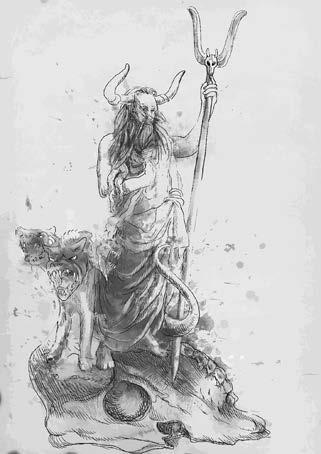
Reading and
MYTHS AND LEGENDS Unit 5
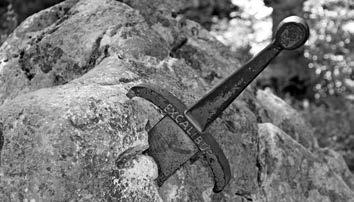
1 Vocabulary
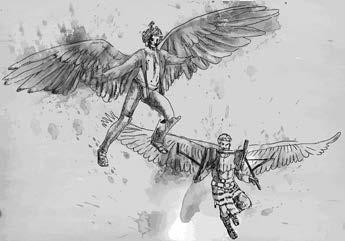
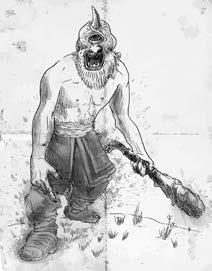
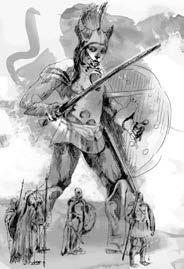
Replace the underlined words in the text with the words from the box.
eager • raised • entertainment • extremely • puzzled • terrified • renowned • striking
Long ago, in a place called Camelot, the great King Arthur was celebrating a twelve-day period of feasting. The Knights of the Round Table, the most honourable men famous for their courage, were sitting at the table with the King.
All were enthusiastic for the feast to begin. The king lifted his cup and, thinking of the amusement to come, wished aloud that they might have some wonderful mystery or adventure to spice up* the feast.
Before he had time to put his cup back on the table, the strangest man they had ever seen rode into the hall. The knights were genuinely confused when they had a better look at that extraordinary man.
The visitor was exceptionally tall and strong. His coat and horse were green. He held a green axe, whose handle was richly decorated in gold.
The king invited the stranger to join them at the table, but he replied that he had not come to feast but to challenge one of the famous men before him. The Knights were shocked * spice up – to make something more interesting or exciting
2
Complete the sentences by using the words in the box. Change the form of the words when necessary.
setting • consume • inevitably • renounce • adjustment
1. He will have to make major ___________ to his plan.
2. The end of the holiday ____________came.
3. This romantic place was a wonderful for the film.
4. Two brothers ____________ their rights in favour of the youngest John.
5. A number of patients were advised to reduce the amount of red meat they __________.
3
Phrasal verbs
Use the correct particle to complete the sentence.
1. Will the last one to leave put ______the candles, please?
2. She put _____ ________ his rude behaviour for too long. I’m glad she dumped him.
3. He asks if we c ould put him ______ for a few days when he comes to town.
4. He phone d the company and asked a secretary to put him ______ to the manager.
5. She do esn’t exercise anymore and so she has put ______ weight.
Word formation
Example: adjust
In each pair of sentences use the correct form of the words given in bold. 4
a. The height of the bicycle seat is adjustable.
b. He decided to make a few adjustments to the design.
1. inconvenient
a. The hotel is _______________ situated near the sea front.
b. We apologize for any _______________ during your stay at our hotel.
2. extend
a. We admired the students’ ______________ knowledge of the subject.
b. When you call me, you can get me on ____________306.
3. persuasive
a. We couldn’t __ ____ him to run for president again.
b. Mary needed plenty of ___________ before she actually agreed to help us.
Grammar
5 6
Relative clauses
Complete the sentences with which, who or whose.
1. D iana introduced me to her brother, ______ is a painter.
2. Items _______are bought in the sales cannot be returned.
3. People _______spray paint on walls spoil the environment.
4. I went to s ee the artist _______ paintings were exhibited at the studio.
5. Street artists, ______ are not much respected here, can be very talented.
6. My sister lives in London, _______ she likes.
Defining relative clauses
Write sentences by using the prompts.
1. work/people/are/here/the/very/who/friendly _________________________________________
2. is/b ought/the/dress/lovely/which/she/yesterday _______________________________________
3. next/like/I/lives/who/the/door/woman _______________________________________________
4. over/£100/the/costs/is/camera/which/there ___________________________________________
7
Rewrite the following sentences so that the meaning remains unchanged.
Example: The town I lived in as a child is called Alton. The town in which I lived as a child is called Alton.
Articles
1. The road we drove along was narrow and dangerous. The road along __________________________________.
2. The man whos e book I borrowed has asked for it back. The man I borrowed ______________________________.
3. This is the man for whom I have great respect. This is the man I _________________________________.
4. The b oy with whom you saw her is my brother. The boy you ____________________________________.
Add a/an or the. Put x where no article is necessary. 8
1. ____ Tower of London is ____ popular tourist attraction.
2. ____ Newcastle is ____ town in ____ north of ____ England.
3. ____ princ ess lives in ____ palace in ____ London.
4. ____Buckingham Palace is where ____ Queen of England officially lives.
5. They went for ____ stroll around ____ St James’s Park.
6. That supermarket is in ____ side street opposite ____ National Bank.
7. ____ G atwick Airport is in ____ southern England.
8. ____ Duchess of York op ened ____ new hospital in ____ centre of London.
9. He went on ____ exp ensive holiday to____ Bahamas.
10. ____ National Park was opened last week by ____ mayor.
11. ____ exp edition to ____ South Pole needs a lot of careful planning.
Causative use of have
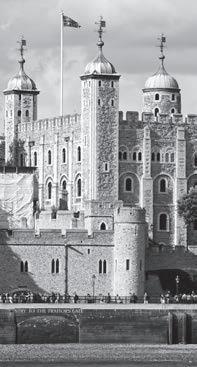
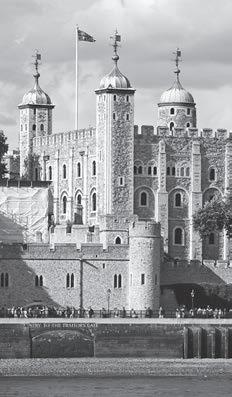
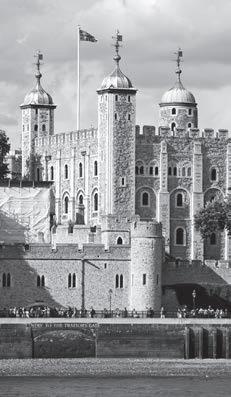
Complete the following sentences by using the correct form of the verb to have or to get and the past participle of the verbs in brackets. 9
1. I__________my flat ___________last week. (clean)
2. She is going to an optician to __________her eyes _________. (test)
3. Sandy often _________her hair _________ at the hairdresser’s near her house. (do)
4. He to ok my car to his mechanic to __________it __________. (repair)
5. Have you made this dress yourself? No, I ___________it __________. (make)
6. I went to the dentist to __________my tooth __________. (fill)
7. She __________her roof__________ recently. (fix)
8. He always__________his suits _____________. (dry-clean)
Modal verbs with the perfect infinitive
Complete the sentences by using should/shouldn’t or needn’t.
1. You __________ have let the children play on the road. It’s too dangerous.
2. You __________ have brought wine for dinner. I bought several bottles.
3. She had no right to take the car! She _________ have asked me first.
4. We ___________have taken a taxi to the station. We arrived there half an hour early.
Complete these sentences. Use a modal verb (must, should/shouldn’t, can’t) and the perfect infinitive of the verb in brackets. Example:
Clara is still upset. You ________ (apologize) for insulting her when you saw her. Clara is still upset. You should have apologized for insulting her when you saw her.
1. O f course she is angry. I __________________ (shout) at her like that.
2. The answers in Robert’s test are the same as in John’s. Robert ___________________ (copy) from John.
Underline the correct alternative.
1. I had my bag stolen. I should have kept/need have kept it on the desk, but I didn’t.
2. He is claimed to be/he is the richest man in Serbia.
Mediation and translation
3. He ___________________ (pass) this way! We would have seen him.
4. He ___________________ (give) us that information. We would have agreed if we had known the facts.
3. Whoever stole your file, it can’t have been/must have been Jim. He was with me that evening.
4. I don´t know how to repair cars, so I´m having mine repaired/have repaired mine at the garage.
Your friend Jason, who is learning Serbian, came across the stories of Kraljević Marko, but he didn’t understand all the parts well. He asked you to translate the following sentences into English.
Expand your Vocabulary
1. at best – under the most favourable circumstances
2. on the go – rushing here and there
3. get a kick out of (something) –find something amusing, exciting
4. off the record – unofficially
USEFUL PHRASES
Study the meanings of the phrases in the box and use them to complete the sentences below.
1. I haven’t seen him. He has been _________________ all day.
2. The p olitician told him _________________ that he would not be a candidate.
3. I s ometimes really __________________ listening to my children talk. They say funny things.
4. The do ctors said that the man had ten months _________________ to live.
CELEBRITIES Unit 6
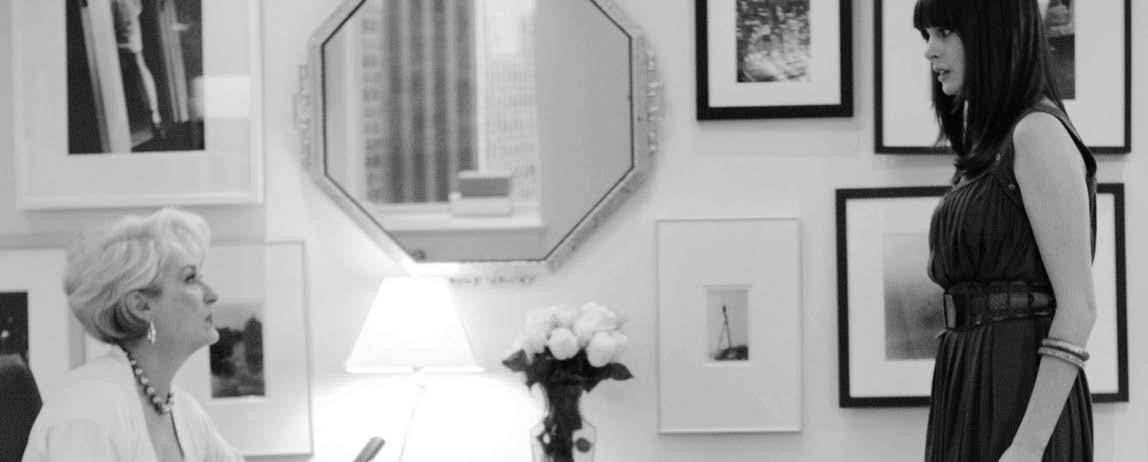
Reading and
Vocabulary
1
THE FILM: THE DEVIL WEARS PRADA THE PLOT
Complete the text by using the words in brackets in the correct form. The story is about the professional adventure of simple and naive Andrea, whose greatest ____________ (aspire) is to become a journalist. She is hired to work as an assistant to the powerful, posh and cynical Miranda Priestly, the chief executive of Runway, a top-selling fashion magazine. She is a terror to everyone around her, as it is ____________ (depict) in the opening scenes of the movie. Andrea knows nothing of the fashion industry, has never read the magazine and is not ________________ ( obsession) with fashion like her colleagues. She sees the job only as a temporary professional challenge. Andrea works really hard to deal with Miranda’s endless demands. ____________ ( determine) to gain the ____________ (accept) of her boss and colleagues, she decides to change. She becomes trendy and classy. However, Miranda’s tough work rhythm and nearly impossible tasks leave Andrea without a private life. Her long working hours ____________ ( affection) the relationship with her boyfriend Nate, her family and friends. She realizes that she is losing what really matters to her. In the end, Andrea learns that life is made of choices.
DIFFERENT MEANINGS OF WORDS
2
Some words have more than one meaning. Use a word from the Key word list 6 which can be used in both sentences. Change the form if necessary.
1. Her main_________________was to prove she was better than the others. We had no _________________ evidence of his guilt.
2. My business and social life are closely _________________. She_________________ a knot in her scarf.
3. We need details of her name and _______________. The president is due to _________________ a conference at noon.
4. We are talking here about the _________________ of power.
She was a victim of verbal and physical
3 4 5
Phrasal verbs with LOOK
Circle the correct answer.
1. Mary has to _______ her younger sister.
A look for B lo ok at C lo ok after D lo ok up
2. He _______ on poor boys and refuses to play with them.
A looks up
B lo oks down C lo oks after D lo oks into
3. The teacher asked the student to _______ the word in the dictionary.
A look up B lo ok for C lo ok at D lo ok out
4. There is a mystery about his death and the police are _______ it.
A looking into B lo oking for C lo oking at D lo oking after
5. We all _______ to him. He’s our idol.
A look for B lo ok after C lo ok down D lo ok up
6. The whole family is _______to his visit.
A looking after B lo oking forward C lo oking for D lo oking into
7. _______! We are going to crash!
A look for B lo ok out C lo ok after D lo ok at
Underline the word which can replace the word in bold in the sentence.
1. A significant number of actors refused to take part in the show.
A comparable B c onsiderable C small D famous
2. A colleague like him may cause you a headache in countless ways.
A crucial B number C innumerable D invaluable
3. The survey indicates that most employees are satisfied with their working conditions.
A finds out B lo oks out C p oints out D puts out
4. It’s not a big country, but it has abundant natural resources.
A constant B plentiful C rare D wealthy
5. She knew she would lose all her money, but she didn’t want to lose her dignity.
A ambition B s elf-respect C fame D strength
6. Young people today often go abroad in pursuit of work.
A anticipation B exp ectation C s earch D target
PREPOSITIONAL PHRASES
Work with a partner. Study the use of prepositions from the boxes and use some phrases to make sentences.
AT at all costs, at a speed/rate of, at random, at the latest, at the expense of, at one’s disposal, at any rate, at short notice
FOR for the good of, for the sake of, for want of, for/in fear of
Example: The teacher picked out the names at random.
Grammar
6
Wishes and regrets
What would you say in each of the following situations? Complete the sentences. The first one has been done for you.
1. Your exams are in two weeks’ time and you haven’t done any revision yet. If only I had started revising for my exams earlier.
2. Some one stole your video camera on holiday. It wasn’t insured. If only _______________________________________.
3. You arrived 30 minutes late for the show because you didn’t take a taxi. I wish _______________________________________.
4. You’re trying to tell your friend something, but he keeps interrupting. I wish you ______________________________________________________.
7
For each situation write two sentences. One in the third conditional and one expressing regret.
1. I b ought a big ball to my son. He played with the ball in the living room and broke an expensive vase. If my son hadn’t __________________________________________________. I wish ___________________________________________________________.
2. I received a visit from someone claiming to be from the telephone company. The following night my house was burgled and electrical goods were taken. If I _____________________________________________________________. I wish ___________________________________________________________.
Passive constructions
8
Put these sentences into the passive using both constructions, as in the example. Example: People report that the party leaders have reached an agreement. It is reported that the party leaders have reached an agreement. The party leaders are reported to have reached an agreement.
1. They claime d he had stolen her purse.
2. People think she is a good actress.
3. They say that the director isn’t seriously injured.
4. People consider that he was a corrupt politician.
5. Everybody expects that they will give Meryl the award.
6. People believe that hooligans were responsible for the damage.
Key word transformations
Complete the second sentence so that it has a similar meaning to the first sentence using the word given.
1. It’s a pity the dress is so expensive. /wish I _________________________________ so expensive.
9 produced directed cast adaptation feature film title animated effects soundtrack extra
2. It’s p ossible that the attack happened after midnight. /may The attack _______________________ after midnight.
3. Exp erts estimate that most people now have access to the Internet. /is It __________________________ most people now have access to the Internet.
4. People think that the minister will resign shortly. /thought It _____________________________________________.
5. He exp ects people to treat him as a celebrity. /be He expects _______________________ as a celebrity.
Expand your Vocabulary
Fill in the gaps with the words from the list. They all refer to film. The first one has been done as an example.
1. The Lady and the Tramp was produced by Walt Disney.
2. Horror films depend on spectacular special
3. Great Expectations is a very good ____________ of Dickens’ novel of the same ____________.
4. The c omplete ____________ of characters and actors who play in a film are given at the end.
PUNS
For fun
5. An ____________ is a p erson who is engaged in a crowd scene in a film.
6. A _____________ is a full-length film that has a story and is acted by professional actors.
7. The ______________ is the music for a film.
8. Films that use drawings and models are cartoons and ____________films.
9. Jurassic Park was ____________ by the famous film director, Stephen Spielberg.
A pun is a humorous use of a word or phrase which has two meanings. E.g. When you decide to give her a ring, give us a ring. (Advertisement for a jeweller’s shop)
Explanation: ‘To give someone a ring’ means literally ‘to give a wedding or engagement ring’ or, figuratively, ‘to telephone’.
1. Christmas is a time to think of family ties. Buy ours. (Advertisement for men’s ties)
2. We offer you a good deal. (Bank advertisement to attract new customers)
3. We’ll give you red-carpet treatment (or blue, or green, or yellow...) (Carpet shop advertisement)
4. What to give your family for lunch? Say ‘cheese’! (Advertisement for cheese)
5. Go up in the world. (Advertisement to recruit flight attendants)
6. For a few pounds you can lose a few. (Advertisement for a slimming course)
7. We’ll give you sound advice. (Hi-fi shop advertisement)
• Do you have such words in your language?
GENERAL REVISION 2
Units 4-6
Choose the correct answer.
1. Do you know anyone_____ birthday is on February 29?
A of which
B whose C of whom 2. All is well _____ ends well.
A who
B whose C that
3. If you had come on time, we _____ a chance to win.
A will have
B had had C might have had 4. If I had gone abroad then, I _____ my wife.
A wouldn’t meet
B might not have met C couldn’t meet 5. I feel weak. If I hadn’t gone out without a coat, I ______ a cold.
A shouldn’t have caught B wouldn’t have caught C wouldn’t catch
6. You _____ my sister at the club at 10. We were together until 10 o’clock.
A can’t have seen
B haven’t seen C couldn’t be seeing
7. Her mobile isn’t working. It ______ damaged when she fell off her bicycle.
A must have been
B must be C has been
8. Mark _______ the documents I left on his table. I don’t know why he didn’t.
A can’t have taken
B should’ve taken C must have taken 9. I couldn’t repair the car myself, so I _____ at a garage.
A had repaired
B had it repair C had it repaired
10. They _____all the furniture ______ to another house.
A had/moved
B has/moved C have/to move
11. The fire in the neighbourhood ______ before the firemen arrived.
A had been put out
B was put out C had put out
12. We had to _____ our holiday until next month.
A put out
B put off C put up
13. He was sent to _____ prison for stealing _____ car.
A a/the
B the/the C --/a
14. She’s thinking about attending _____ English course during _____ summer.
A an/the
15. I wish I______ a car.
A would buy
B the/the C --/--
B can buy C could buy
16. If only I _____ how to use the computer! I wish I ______ it when I was younger.
A knew/had learnt
B know/had learnt C knew/learnt
17. My parents bought an old house. I wish they _____ a new modern apartment.
A have bought
B had bought C bought
18. My grandmother is young at heart________ her age.
A in spite
B however C despite
2 3
Rewrite the following sentences using a participle clause instead of a relative clause.
Example: The girl who is walking down the street is my girlfriend. The girl walking down the street is my girlfriend.
1. The report which contains wrong information was not published.
2. The man who is sitting over there is your witness.
3. The proposal which suggests reducing salaries won’t be considered.
4. People who are waiting in the queue are from my neighbourhood.
Add an article where it is necessary.
1. The Harris ons live in _____ Chestnut Street.
2. Sonia us ed to study at _____ London University.
3. Whenever Michael goes to San Francisco, he has dinner at _____ Gadsby’s.
4. I’d like to go to ______ Paris to see _____ Mona Lisa.
5. We sp ent a pleasant afternoon in _____ St James’s Park.
Key word transformations
4
Complete the second sentence so that it has a similar meaning to the first sentence using the word given.
1. People think her family is living abroad. /thought Her family _____________________________ abroad.
2. Her friends believe that she is travelling around the world at the moment. /believed She _____________________________ around the world at the moment.
3. What a pity we didn’t see the match. /wish I______________________________________ the match.
4. I’m really sorry Tom isn’t coming to your party tomorrow. /wish I really ___________________________your party tomorrow.
5. I’m sure it was Mary who telephoned. I recognized her voice. /must It ______________________________. I recognized her voice.
6. I’ll pick you up since the mechanic repaired my car yesterday. /fixed I’ll pick you up since I ______________________ yesterday.
7. Their neighbour eventually extinguished the fire. /out The fire ________________________their neighbour.
8. Could you connect me to the Information office, please? /put Could you ____________________ the Information office, please?
Reading and
1
Unit 7
CRIME and FICTION
Vocabulary
WHY IS CRIME FICTION SO POPULAR?
Complete the text by using the words in the box. enduring hold broadened stated appeals commit entertain suspense
Generally speaking, books that belong to the crime fiction genre have elements of mystery or (1) __________ in them. When they’re written well, they (2) _________ our attention right through to the end and make us want to keep reading. They have interesting characters and a story which (3) __________ to the reader’s sense of curiosity. This is perhaps the reason for their wide and (4) ___________ popularity. Crime novels are designed to (5) _________, but they also offer readers a chance to use their brains, whether by trying to work out a character’s motive to (6) __________ a crime or reading between the lines to pick up meanings that haven’t been explicitly (7) ___________. Modern crime fiction has (8) ___________its appeal even more, by including elements of other genres such as history, romance or travel.
2
Match the words on the left with the pairs of synonyms on the right.
1. susp ense
2. fabulous
3. appeal
4. appreciation
5. remarkable
3
a. thanks/gratitude
b. extraordinary/exceptional
c. tension/anxiety
d. b e attractive to/interest
e. fantastic/spectacular
Match the words on the left with their antonyms on the right.
1. accidental
2. grave
3. amiable
4. abandon
5. glorious
a. unimpressive
b. deliberate
c. keep
d. cheerful
e. disagreeable
Confusing words Choose the correct word in italics.
1. Ian lives in a beautiful house besides/beside the sea.
2. Two other children besides/beside Tim left for the camp.
3. We exp ect the price of fuel to rise/raise next month.
4. To rise/raise his spirits, Holmes praised his friend.
5. He never does the right thing. He is not a sensible/sensitive person.
6. Don’t criticize Watson. He is very sensible/sensitive
7. The newspap er headline/title said ‘Five killed in a car crash.’
8. The headline/title of Tom’s latest book was unusually long.
CRIME & THE LAW
What do these people do during a trial? Match the people in box A with the actions in box B.
f. makes a statement in a court about what he knows or has seen. 5
6
1. The judge
2. The jury
3. The prosecutor
4. The accused
5. The defending lawyer
6. The witness
a. tries to prove the accused is guilty.
b. tries to prove the accused is innocent.
c. decides the verdict: guilty or not guilty.
d. decides on the punishment.
e. is a person charged with a crime.
Complete the sentences with the words in the box.
1. The robber received a ____________ of five years’ imprisonment.
6. Two arrests were made, but the men were later released without ___________. witnesses victims sentence charges guilty suspects
2. None of the ____________ wants to testify because the suspect has threatened them.
3. The jury found him innocent, but I think he is ____________.
4. Many old people are afraid of becoming ___________ of crime.
5. The p olice have no _____________ in this murder case.
Rob Steal 7
Decide which words are possible collocates and which aren’t, by simply ticking the correct combination. a person a bank money a car a shop a wallet
Respond to the following statements using a suitable verb ending in ‘-en’.
Example: This street is too narrow. – It should be widened.
1. My new trousers are too long. ____________________________________.
2. This knife is blunt. _____________________________________________.
3. This skirt is rather short. _________________________________________.
4. The liv ing room is somehow dark. _________________________________.
5. The tea isn’t sweet enough. I need some sugar to ______________________.
Explain the difference in meanings in the following pairs of sentences. 9
1. a. I’ve been writing a review of his latest book.
b. I’ve written a review of his latest book.
2. a. The national team has been playing well this season.
b. The national team has played well this season.
3. a. Rodger has been spending all his money on his girlfriend again.
b. Rodger has spent all his money on his girlfriend again.
4. a. What have you been doing?
b. What have you done?
Verb patterns
Complete the sentences with the correct form of the words in the box. Add a preposition if necessary. There is one extra word.
talk • live • reach • mention • do • read
11
Complete the following sentences any way you like using the gerund.
1. Tina manage d ______________ her homework without anybody’s help.
2. It’s not worth ______________ him. He won’t listen to you.
3. We suc ceeded ______________the top before sunset.
4. The teacher enc ouraged his students ______________ more.
5. My son insisted ______________ on his own when he was sixteen.
1. C an you imagine _________________________________________________?
2. I don’t object to ___________________________________________________.
3. Don’t worry about the children. I’m used to ___________________________.
4. I don’t mind the work, but I can’t stand _______________________________.
5. If you are in two minds, I suggest ____________________________________.
6. He will never admit _______________________________________________.
Prepositional phrases followed by a noun or a gerund
Write a sample sentence for each phrase in the box to practise its use in a context. 12
according to except for in addition to instead of by means of on account of apart from as far as in spite of Example: In spite of being tired, she decided to go on.
Reported speech
Use the following verbs to convey the meaning of the sentences below. Some verbs are followed by a gerund, others by an infinitive and others by a clause. Sometimes a preposition is required. The first one has been done for you.
suggest • insist • refuse • claim • declare • decide
1. ‘ What about going to the Alps this year for our winter holiday?’ Tina said.
Tina suggested going to the Alps this year for their winter holiday.
2. ‘I will always love you, Diana!’ Alec said passionately.
3. ‘I’ve made up my mind — I’m going to turn down the manager’s offer!’ Colin said.
4. ‘That’s my book you’ve got in your school bag!’ Rose said confidently.
5. ‘I’ll pay. It’s my turn!’ Stephen said.
6. ‘I have no intention of going there by bus!’ Lucy said categorically.
Report the following dialogue:
‘Please forgive me Mr Holmes,’ she said. ‘I know you are a busy man. But a strange thing has happened and I would like your advice.’
‘Please sit down, Miss Hunter,’ said Holmes. ‘I will be happy to help you. What can I do for you?’
‘I have been a teacher for five years,’ she said. ‘I worked for Colonel Munro, teaching his children. But he went abroad two months ago and took the children with him. So I had no job.’
(The Copper Beeches by Sir Conan Doyle)
Miss Hunter asked Mr Holmes _____________________________________
Holmes asked Miss Hunter ________________________________________
She explained_
Mediation and translation
A man in a book store wants to buy a book as a present and asks you to help him. He wants you to translate the text on the book cover. He would like to know who the writer is and what the book is about. 15

1. He has only a current account
2. You mustn’t disturb the boss on any account.
3. He kept accounts of all the money he spent.
4. The witness gave a detailed account of what had happened that night.
5. He didn’t give a lecture on account of a sore throat.
6. You must take into account all the circumstances before you make a decision.
at the following phrases with the word account and match them with their meanings.
a. a record
b. a sp oken or written report
c. to introduce the reason or explanation
d. s omething shouldn’t be done under any circumstances
e. consider f. a p ersonal bank account
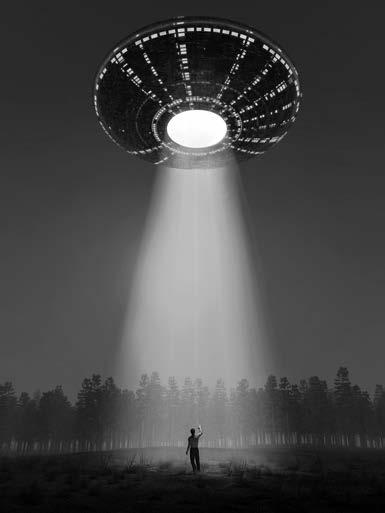
Unit 8
PREDICTING THE FUTURE


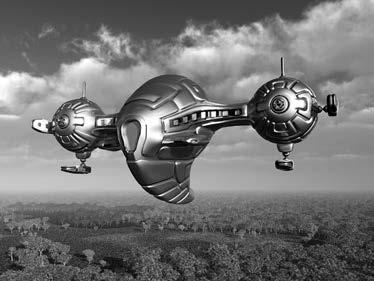
Vocabulary
1
track 31
Fill in the gaps with ONE word only. It can be an article, adverb, preposition or verb. Listen to check.
ARE UFOS REAL?
Several people reported seeing (1) __________ ring of blinking lights in (2) __________ sky during a recent lightning storm in South California. They claimed that it was a UFO. It didn’t look (3) __________ any other aircraft they were familiar (4) _________. Lots of pictures and videos were taken and shown on social networking sites over the past few days. In one (5) __________ the videos, a circle of brightly coloured lights could (6) __________ distinctly seen in the sky and it really looked fascinating. It changed colour and shape, from a sphere (7) __________ a triangle and then to a straight line. It seemed to hover in the same place for ten minutes and (8) __________ it disappeared from view. The craft made no noise at all.
Phrasal verbs
2
Use the phrasal verbs with run in the correct form to complete the sentences.
1. I the bus, but it didn’t stop for me.
2. The girl claime d she had seen the driver who _______the dog _______.
3. I _______________Tom’s brother a few minutes later and told him the news.
4. I’m afraid, we have _______________ apple juice. Will orange juice do?
5. The recent crises in the family have really _______ her _______.
Phrasal verbs with DOWN
Phrasal verbs formed with down usually show a decrease in the value of something. Complete the sentences by using the phrasal verbs from the box in the correct form.
turn down • get down to • cool down • cut down • knock down
1. I suggest we stop talking and ________________ business.
2. We must ______________our spending or we’ll get into serious trouble.
3. She was _______________ by a motorist.
4. ________________ that music, please! I can’t concentrate.
5. ________________! We’ve got nothing to worry about.
4
Correct the mistakes by crossing out the incorrect preposition and writing the correct one above it. Be careful: not all sentences have a mistake!
1. She apologized about the mistake.
2. She always complains on the bad service when she returns from her holiday.
3. If your success depends on my help, I’ll do what I can.
4. We spend a lot of money for food every day.
5. Gloria said Diana’s dress was similar to the one she had.
6. I applied on a job last week, but I’m afraid they won’t accept me.
7. My brother just got married with his girlfriend.
8. This suitcase belongs of my sister.
5 6
Study the adjectives which are often followed by a that clause and answer the questions below.
afraid aware surprised anxious certain upset sure worried sorry glad frightened
Example: I’m glad that you’ve found a job.
a) What do these adjectives have in common?
b) Apart from a that clause, what prepositions can follow these adjectives?
Choose some of the adjectives from the box and make sentences.
Grammar
Expressing the future
Put each verb in brackets into the most appropriate tense.
1. What _________________ (you/do) this time tomorrow?
2. Do you think you ________________ (finish) that report next week?
5. I can’t see you on Monday. I ________________ (fly) to Paris on a business trip. 7
3. In a we ek’s time, I _________________ (work) for a different company.
4. Ac cording to this timetable, the bus _____________ (arrive) at 6.00, which means we ______________ (have) about half an hour to get to the conference centre.
9
8
Circle the correct compound.
1. The p oliceman asked who had witnessed the accident, but _____ answered.
A somebody B anybody C nob ody
2. Do you know _____about Jack’s business?
A something B anything C nothing
3. G eorge rarely spoke to _____.
A someone B anyone C no one
4. I’ve been looking for my gloves, but I can’t find them _____.
A everywhere B anywhere C nowhere
5. _____ has b een smoking in this room.
A somebody B anybody C nob ody
6. I’ve hardly had _____ to eat since yesterday.
A something B anything C nothing
Everyday language
TALKING ABOUT THE WEATHER
Complete the dialogue with the words from the box. catch heavily shower pouring forecast
Helen: Wow, you are soaked! Didn’t you know the weather (1) ____________ for today?
Sheila: I heard there would be a (2) ___________, but I didn’t realize it would rain (3) ____________ today.
Helen: Yes, it’s really (4) _____________ outside. Change the clothes quickly or you’ll (5) ____________ a cold.
Sheila: You’re right. I’m freezing.
10
Complete the dialogue with missing parts. Choose the options A or B that complete each sentence correctly.
David: This weather is (1) ______. I can’t breathe.
Billy: I thought you liked hot weather.
David: Yes. I do, but (2) _______today. The temperature is above (3) _______.
Billy: You’re right. Shall we go inside?
David: Yes, we might. The weather (4) _____ to change till evening.





1. A killing me B destroying me
2. A most hot B it’s b oiling
3. A average B normally
4. A is not likely B is supp osed not
Explain the meaning of the words and phrases in italics. If you don’t know any, look them up in the Word list.
1. What does a weatherman do on TV or radio?
2. Do p eople put a weathercock on the roof or a terrace?
3. What does a weather-beaten face look like?
4. What kind of garment is a weatherproof jacket?
5. How do you feel if you are under the weather?
Expand your Vocabulary
IDIOMS AND PHRASES
Match the phrases with their explanations. Then complete the sentences (1-4) using these phrases in the correct form.
1. over the moon
2. b e behind the times
3. b e beside oneself
4. out of the question
a. b e very upset; nervous; worried
b. not to b e considered; impossible
c. b e old-fashioned; outdated
d. b eing very happy
1. Some of the managers here are _______________; their methods are not modern.
2. Don’t even think of borrowing more money. It’s________________!
3. She was ________________ with worry b ecause he didn’t call her for two days.
4. You can’t expect her to be reasonable now. She’s been___________ since he proposed to her.
COLLOQUIAL LANGUAGE
Complete the sentences with words from the box.
hand • up • dark • bell
1. He kept us completely in the ____________ about his plans to compromise the manager.
2. The name rings a __________, but I can’t remember where I heard it.
3. I’m afraid that the situation is getting out of __________. We should do something quickly.
4. I suggest we have a meeting and see if anyone can come ___________with a new idea.
PROVERBS AND SAYINGS
Match the proverbs and their explanations.
1. It never rains but it pours.
2. Make hay while the sun shines.
3. Every cloud has a silver lining.
4. Save some money for a rainy day.
d. If you don’t take your chance when it comes, you may never have an opportunity again. 12 13 14


a. There is something good for you in every trouble.
b. Troubles never come one at a time.
c. To save money for a time it might be needed.
Unit 9
TRANSPORT and TRAVEL

Reading and
Vocabulary
Most of us see travelling as a (1)______ from our daily life and an opportunity to have fun, to (2)______ first-hand knowledge about our own or a foreign country, to learn about other cultures and enjoy new experiences. It has long been said that ‘travel (3) ______ the mind’. While travelling, a person (4) ______ across different people and their culture and customs. Consider the act of leaving food on the plate: in China this is often seen as a compliment, a signal that the host has (5) ______ enough to eat. But in America the same act is a subtle insult, a/an (6) ______ that the food wasn’t good enough to finish.
It is said, ‘The world is a (7) ______, those who do not travel read only one page’.
Open Cloze
AT THE TRAVEL AGENCY
2
3
Circle the word that is most appropriate. Why do we travel? 1
1. A s eparation B break C run
2. A receive B discover C acquire
3. A e ducates B enlarges C broadens
4. A gets B c omes C goes
5. A provided B supplied C enabled
6. A symptom B indication C hint
7. A stage B show C book
Which words are missing? Complete the text filling in the gaps with ONE word only.
A client phoned asking (1) _________ a package to Hawaii. (2)_________ going over all the cost information, she said: ‘I want an aisle seat so (3)_________ my hair wouldn’t get messed up (4)_________ being near the window. Besides, would it be cheaper to (5) _________ to California by plane and then (6) _________ a train to Hawaii?’
Decide which sentence (a-d) belongs to which paragraph (1-4) of the following story. A tragedy or a blessing?
a. The family’s dreams were ruined.
b. When Mr Clark heard the news, he hugge d his son.
c. The entire family was filled with excitement about their new life.
d. It had taken years to realize it.
Paragraph 1
Years ago in Scotland, Clark and his wife had a dream to travel to the United States with their children. _____________ They had finally saved enough money for the journey. They got passports and reservations for the whole family on a new liner to the United States.
Paragraph 2
__________________ However, several days before their departure, the youngest son was bitten by a dog. Because of the possibility of rabies*, they were quarantined for fourteen days.
Paragraph 3
________________ This meant that they would not be able to make the trip to America as they had planned. The father was filled with disappointment and anger. He blamed his son for their misfortune.
Paragraph 4
Five days later, the tragic news spread throughout Scotland – the mighty Titanic had sunk. The Clark family was not on that ship because the son had been bitten by a dog. __________________He thanked him for saving the family and turning what he had felt was a tragedy into a blessing. rabies*= a deadly virus spread to people from infected animals
4
5
Read the whole story and retell it.
Use a prefix to make these adjectives opposite.
1. ____ reliable 2. ____ complete 3. ____ directly 4. ____ bearable 5. ____ predictable 6. ____ forgettable 7. ____ regular 8. ____ legal
6
Complete the sentences using the words in Exercise 5.
1. She suffered from_____________ pains so the doctor gave her an injection.
2. He was impris oned for _____________ possession of firearms.
3. I have forgotten to bring my list of_____________ verbs.
4. My holiday in Greece was an _____________ experience.
5. No one knows how he will react. He is so _____________.
6. He gave us an _____________account of his work. Some parts are missing.
Reading and Grammar
7
Complete the sentences by using the verbs from the box in the correct form. There is one verb extra.
know • look • call • search • not/mean • check • be • have • get
A woman (1)_____________ to make reservations, ‘I (2)______________ to go from Chicago to Hippopotamus, New York’. The agent (3) ______________ at a loss for words. Finally, the agent asked: ‘Are you sure that’s the name of the town?’ ‘Yes, what flights do you have?’ replied the customer. After some (4) _____________, the agent came back with, ‘I’m sorry, ma’am, I (5) ______________ up every airport code in the country and can’t find a Hippopotamus anywhere.’ The customer replied, ‘Oh, don’t be silly. Everyone (6) ________ where it is. (7) __________ your map!’ (8)______________ checked again the map of the state of New York, the agent finally asked, ‘You (9) ______________Buffalo, do you?’ ‘That’s it! I knew it was a big animal!’
ADVERBS
b. Don’t come ___________ me. Your clothes are dusty. 8
Here are some pairs of adverbs. Decide which form should go in which sentence.
1. free/freely
a. In our town old people travel __________ on the buses. (free of charge)
b. We can talk ___________ here, because nobody is at home.
2. wide/widely
a. Her books are ____________ read.
b. His eyes were ____________open in disbelief.
3. direct/directly
a. The Minister spoke to the press ___________ after the meeting.
b. They will fly ____________ from London.
4. high/highly
a. We think ___________ of his new ideas.
b. The boy flew the kite __________in the sky.
5. near/nearly
a. She was ___________ killed in a car crash.
Vocabulary on travelling
Word/phrases
Meaning
9


TRAVELLING BY PLANE
Study the words/phrases (1-8) and their meanings.
1. aisle a corridor between the rows of seats on a plane
2. baggage claim a place where passengers go to get their luggage at the end of a flight
3. board get on or enter a plane
4. departure lounge a place where passengers wait before boarding a plane
5. domestic flight within the country, not international
6. airfare the price of a journey by plane
7. excess baggage baggage that weighs more than the amount allowed
8. overhead locker storage space above the seats on a plane for hand luggage
Complete the sentences below with the words/expressions from the box.
accommodation • in advance • airfare • book • baggage claim • declare • vacant
1. The organizers will c over all the costs, including ____________ and hotels.
2. This is the end of our flight. I hop e we won’t wait long at the ______________.
3. Before you go on vacation, you need to make hotel reservations ____________.
4. I often lo ok for affordable hotel _____________.
5. Sometimes, I ____________ a nic e hotel with facilities such as a swimming pool or gym.
6. I have phoned four hotels and there is not one ___________room.
7. ‘Do you have anything to ___________ ?’, the customs officer asked me.
TRAVELLING BY TRAIN
Here are some English words that will be helpful when travelling by bus or train.
timetable • single/return ticket • platform • ticket office/ticket machine • ticket collector fare • transfer train • left luggage locker • luggage rack • first/second class ticket
Complete the dialogues with the words from the box. AT THE INFORMATION DESK
A: How much is a ________ to Belgrade?
B: It’s 1,500 dinars.
A: Is the 4 o’clock a direct or __________ train?
B: It is a direct train.
A: Is there a reduced _______ for children?
B: Yes, it’s half price.
A: Where can we buy tickets?
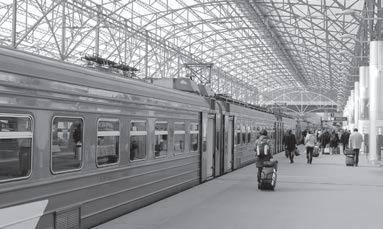
B: At a __________ or at a ticket office. If you buy a ________ ticket, you will have more comfort and services, but it will be more expensive.
A: I have three hours before I get on. Where can I leave my luggage?
B: You can leave your luggage in a ______________________.
Mediation and translation
A passenger sitting next to you on a plane wants to talk to an air hostess and asks you to translate his requests.
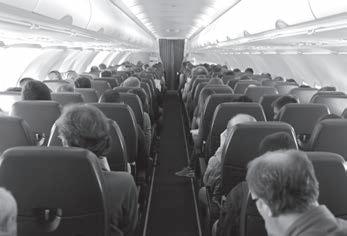
Expand your Vocabulary
Complete the sentences with the words from the box.
expedition tour crossing package tour cruise Flight trip travel
1. S pace ___________ will become cheaper and cheaper.
2. When we get to London, we will go on a sightseeing ___________.
3. The _____________over the English Channel can sometimes be very rough.
4. They are preparing an _______________to the Zambezi River.
5. Air Serbia announc es the departure of ___________611 to Athens.
6. My parents prefer going on a ____________ because one price covers everything.
7. Will your boss go on a business ________ next week?
8. Henry sp ent one month on a _________ in the Mediterranean.
GENERAL REVISION 3
Units 7-9
Circle the correct answer.
1. Mark wants to ____ advantage of the situation and go abroad.
A make B take C get
2. If you decide to criticize the boss, you risk ____ your job.
A of losing B to lose C losing
3. I’m so happy! This time tomorrow I ____dinner with George.
A will be having B will have C have
4. If you haven’t figured it out so far, ____ any longer.
A there’s no use to try B there’s no point to try C it’s no use trying
5. I never thought that her proposal was worth _____.
A considering B to consider C to be considered
6. One of the colleagues _____ having the meeting in a nearby café.
A advised B proposed of C suggested
7. He will p ostpone ____ in his resignation until he ____a new job.
A handing/has found B to hand/finds C handing/will find
8. She dislikes ____, but she can’t afford ____ out.
A to cook/eating B cooking/eating C cooking/to eat.
9. Do you like ____weather here? It’s too hot during ____day but very cold at ____ night.
A the/the/-- B the/the/the C --/a/--
10. You ____ it to me by post. Why didn’t you?
A may have sent B needn’t have sent C could have sent 11. The boss intends _____ Robert a pay rise, but he expects him ____ more.
A to offer/working B to offer/to work C offering/to work
12. He ______ anything until he _____ from you.
A won’t do/hear B does/will hear C won’t/hears
13. He found it difficult to _____ what criteria were used, but I understood.
A make out B discover C come across
14. People who take goods out of the country are called____.
A smugglers B muggers C burglars
15. Diana’s certainly ____ a lot of weight since I last saw her.
A taken on B put on C got on
16. He went to the supermarket to buy ____ for you to eat.
A anything B everything C something
17. Jane will be with you _____.
A shortly B highly C widely
18. She’s been working really hard and it’s no wonder she feels so ____.
A run down B worked up C run over
Put the verbs in brackets into the correct form.
4. You should really try to smoke fewer cigarettes. /cut You should really try__________________________ smoking. 2 3 4 5 6
1. You know that I (wait) _____________for you for the past hour! What (you do) _____________all this time?
2. Our train _________________ (not/arrive) yet.
3. Wake him up. He _____________________ (sleep) too long.
4. How many cups of tea ____________________ (you/drink)?
5. He __________________ (play) football for many years, but he must give it up now.
Put these sentences into reported speech. Choose the reporting verbs from the list: apologized, admitted, suggested, warned, reminded
1. Be careful. The road is slippery. ____________________________________________
2. Tom’s birthday is next Sunday. ____________________________________________
3. I am late because my car broke down. ________________________________________
4. I’m afraid I caused the accident. ____________________________________________
5. Why don’t you move to another flat? _________________________________________
Add an article where it is necessary.
1. _____ river Tyne runs through_____ Newcastle.
2. _____ Pennines are the biggest mountains in _____Great Britain
3. _____English Channel lies b etween _____ England and _____France.
4. I left _____ British Museum and went to ______Oxford Street when I saw _____ accident just outside the department store, _____Harrods.
5. Joan us ed to work in _____United Nations building.
Complete the sentences by using the correct form of the words in bold.
1. She is a very __________________woman. / determination
2. A number of leading opposition ____________ were accused of being involved in the case. /policy
3. The island offers a wide _____________ of scenery and wildlife. /vary
4. He trie d to ___________ all the necessary information. /memory
5. Do you approve of the tabloid press making up ____________stories about famous people? /sensation
Complete the second sentence so that it has a similar meaning to the first sentence using the word given.
1. I have a high opinion of your sister. /think I ________________________ of your sister.
2. C an I accompany you to the party? /mind Do you ____________________________to the party?
3. Why don’t you join Sonia at the club this evening? /suggested She _______________________________that evening.
UNIT 1
TEXTS FOR Listening COMPREHENSION
track 4
Della Peterson talks about her visits to Yosemite Park
All my visits to Yosemite were special and memorable. I kept coming to the park since my early age with my parents and later with my own children. We camped with other people of various nationalities, some from very distant countries. At night we would gather around big bonfires singing in different languages, dancing and listening to stories about the park’s first inhabitants, the Indians. We often heard mountain lions roar across the canyons at night. We learned how to keep our food safe from the animals and how to be careful with a camp fire, because it can be the worst enemy to the forest and all the plants and wildlife in it. We would often take pictures of bears that came near the road, but we never left the car. However, one night, when I was returning to the tent from the dance, I suddenly saw a bear. I didn’t know which of us was more scared. I was unable to move, but it ran off. Everybody laughed at me the next day saying that it was probably a very young one, a hungry cub looking for garbage.
UNIT 2
track 8
On the catwalk
Adele, a former top model, is talking about the real world of fashion models and her own experience. What is the life of a fashion model like?
Becoming a model is the dream of many young girls or boys who long for glamour and fame. I did all the big shows in Europe and America and I know what the life of a model is like. It is often far less glamorous than it appears. You see these girls in magazines, and you think they’re millionaires. Top models may earn millions of dollars a year, but there are also those who attend never-ending castings and struggle to make ends meet. Sometimes we are a star and sometimes a failure. This is life.
What is required to become a top model?
Making it to the top requires more than just a pretty face and an incredible body. There isn’t a single recipe about how to rise above the rest. Modelling might look easy but you might be surprised to see how much hard work is necessary to make it to the top and stay there.
Are there any bad sides of a modelling career?
While being a model has its rewards, keep in mind that the professional cycle of a model is extremely short-lived. It’s unpredictable work, insecure, and you don’t get benefits like health care or a retirement package. That’s why many of us decided to study between shoots and prepare for a life after a modelling career.
Thank you very much for taking part in our show.
UNIT 3
Salvador Dali - an eccentric in life and art
At an early age, Salvador Dali started producing excellent drawings, and his parents strongly supported his artistic talent and sent him to a drawing school. He was not a serious student, preferring to daydream in class and stand out as the class eccentric, wearing odd clothing and long hair. But soon he discovered modern painting and three years later he had his first exhibition. Dalí enrolled at the Academia in Madrid and soon he brought his eccentricity to a new level. He became as famous for his colourful personality as his artwork. He had a very long, curly moustache, long hair, a cape and a walking stick. Unfortunately, for some art critics, his personality overshadowed his art. Throughout his life Dali was influenced by several different artistic styles, including Cubism and Surrealism. He made several trips to Paris, where he met Pablo Picasso, under whose influence he painted a number of works.
In the later period which he called “Nuclear Mysticism”, his artwork gained a technical brilliance combined with fantastic and limitless imagination. He used holography and geometry in his paintings. His wife Gala was his muse and inspiration for many years. She also dealt with the practical side of his life.
UNIT 4
track 11 track 16
Bad decisions throughout history
The history of mankind has seen many examples of bad decisions.
The Trojan horse
Legend has it that the Trojan War had been going on for a decade when the Greeks, unable to break into the city of Troy, decided to trick the Trojans. They built a horse, big enough to fit a few dozen soldiers inside. They wheeled it to the city gates and pretended to have returned home. The Trojans, convinced they'd just won the war, brought the wooden horse inside their city walls. At night, the Greek soldiers got out of the horse and opened the gates from the inside to the Greek troops. That was the beginning of the end of the Trojan War and Troy.
Napoleon’s invasion
Invading Russia was Napoleon’s worst decision. In June 1812, Napoleon, confident in his victory, marched toward Russia with more than 600,000 men. Due to typhus infections, food shortages and freezing temperatures he never made it beyond Moscow and left Russia by early September with 100,000 soldiers.
The Donner Party
In April 1846, a group of 87 pioneers in about 20 wagons followed the Donner brothers westward to California. They began their journey on the California Trail, a well-known wagon-train route west, but decided to try a shorter, alternate route without proper information. Because of freezing temperatures and rough, mountainous terrain, the shortcut they'd hoped for turned out to be long and deadly. It took them a year instead of four months. It took 3 months and four relief parties to rescue 46 survivors trapped in the snowy Sierra Nevada Mountains. It became one of the greatest tragedies in the history of westward emigration.
UNIT 5
track 20
Rtanj Mountain
Rtanj, a mountain in East Serbia, is associated with many myths and legends. Due to its unusual shape, untypical for the region, Rtanj has always been regarded as an ‘out of this world’ place, mysterious and attractive.
According to a legend, a wizard lived in a great castle at the mountain’s top, guarding a heap of gold. The castle disappeared and the gold and jewels with it. A small chapel was built at the spot in 1936. Today it is in ruins because gold diggers demolished it in their attempt to find the hidden treasure.
The place is full of various unexplained mysteries. There was talk of strange sightings, the disappearance of planes and mystical lights that could be seen near the top. A lot of residents claimed they had seen flying saucers and flying balls.
Science did not prove these things, but it is interesting to mention that the place is unique because there are plants which grow only here.
UNIT 6
track 22
Fame has its disadvantages, too
E.J., a famous British pop singer
Lack of privacy is one of the biggest disadvantages of being a celebrity. I’ve tried going out in disguise, with dark glasses, a hat, this sort of thing, you know, but it doesn’t work. Whenever I leave home, I have to face a huge rush of crazy fans, wanting autographs and to take pictures of me. But to be honest, I enjoy my popularity. It’s nice to be appreciated and well-off.
M.J., a great sports star
The worst thing is that I am famous 24 hours a day. Everyone wants to be familiar with you, to touch you and write about you. I cannot hide anything from the media because the reporters are always keeping an eye on all my activities. I’m only free if I’m locked in my room where no one can take pictures of me. On the other hand, it’s true that success and fame contribute to the feelings of self-confidence and happiness.
S.J., a famous actress
The main advantage of being famous is that celebrities are usually very rich so they have an easier life than other people: luxurious homes and cars, fancy gifts, expensive clothes and other pleasures of life. However, fans expect celebrities to be absolutely perfect in every aspect of their lives, every single day. Such an expectation is impossible for any human being to fulfil. Sometimes you don’t feel well, or you got out of bed on the wrong side, and people approach you asking for an autograph and they haven’t even got a pen or a piece of paper.
UNIT 7
track 25
Sherlock Holmes comes to the Museum of London
Although there is a Sherlock Holmes Museum on Baker Street, a new exhibition of this immortal character opened at the Museum of London in September, 2014. This is the first big UK museum tribute to the great detective since 1951. ‘The man who never lived and will never die’ is the perfect title for this enjoyable exhibition, which features fascinating artefacts from the Victorian world in which Holmes and his creator lived.
Using a combination of sound and visual image, the exhibition brings a new perspective to the ‘world’s first consulting detective’. There are early editions, illustrations, photos, typewriters, forensic equipment, maps, costumes and Dr Watson’s medical tools. Visitors can also see a glorious Turner watercolour of the Reichenbach Falls – from where Sherlock miraculously returned when fans refused to accept his death. The exhibition also provides a clear picture of the London of Holmes’ day through original photographs and it features the only known filmed interview with Conan Doyle, recorded in 1927. All in all, as the great man himself said, this is a show which proves: ‘The world is full of obvious things which nobody by any chance ever observes.’
Holmes, an eccentric genius, is timeless since his character has been endlessly adapted for every generation. He will never die because he never lived.
UNIT 8
track 29
Giving a speech on global warming
Martha is going to give a speech on Global Warming, and she is very nervous about the whole thing. Greg, her friend, is trying to help her by giving her some useful tips on how to give a good presentation.
Martha: I am so nervous because I have to give this presentation on global warming tomorrow. I have done a lot of research on the subject, but I don’t know how to effectively present it.
Greg: If you are really prepared, it’ll be a piece of cake. Think about the sequence of your presentation, what you should present first, second, third…
Martha: I already have an outline. I’ll begin by explaining what global warming is, what causes it, and what people should do to decrease the effects of global warming.
Greg: Good! By the way, do you have any facts to back you up? For example, change of climate, yearly disasters… Martha: No, I haven’t thought about that. I’d better get some statistics from the Internet.
Greg: It would be even better if you show some pictures along the way. Do you have any?
Martha: No. I guess I will need at least two or three pictures. What else do you suggest?
Greg: Go through your presentation just before you give it. Don’t speak too quickly and keep an eye on the time. Good luck, Martha!
Martha: Thanks, Greg!
UNIT 9
track 33
The first woman who attempted to cycle the globe
Annie Kopchovsky set out from Boston on June 25, 1894, in her attempt to travel around the world by bicycle. Her adventure began with a bet. A gentleman in Boston bet another gentleman, $20,000 against $10,000, that no woman could travel around the world by bicycle. It is not clear why Annie was chosen, since she was married and a mother of three children under age six. Under the terms of the bet Kopchovsky, who had ridden a bicycle for the first time only days before her departure from Boston, was supposed to begin her journey penniless, earn $5,000 above her expenses along the way, and finish her trip in 15 months. She was a very resourceful woman; she earned money by carrying advertising on her clothing and her bicycle as she rode through different cities. Later in her trip, she also earned money from her lectures, in which she told stories about exotic places, with sensational details of accidents and near-death experiences. When she returned, she collected her $10,000 prize and then rejoined her family. Annie became a global sensation in the mid-1890s and her adventure was described as ‘the most extraordinary journey ever undertaken by a woman.’
KEY TO THE Self-assessment TESTS
Key to the self-assessment test 1
1 1. abundance 2. shelter 3. escape 4. sites 5. species
2 1. is doing 2. haven’t been 3. I’m driving 4. Have you lived 5. is always slamming 6. has been
3 Noun - Adjective; exceptional/biological/cultural; Verb – Noun: recreation/depiction/occupation
4 1. were 2. is 3. has
Key to the self-assessment test 2
1 1. promote 2. self-esteem 3. overrated 4. launched 5. imply 6. rebel
2 1. Delayed by bad weather the plane took off four hours later. 2. The injured man was taken to hospital. 3. The stolen money was found by the river. 4. Jack tried to open the locked window.
3 1. was writing 2. was coming/rang 3. did you buy 4. was working/didn’t hear
4 1. overslept 2. overheated 3. underestimated 4. underpaid
Key to the self-assessment test 3
1 1. depicts 2. ventured 3. dedicated 4. lavish 5. appreciation 6. set off
2 1. was informed/had been sold 2. to be criticized 3. will be made/have been interviewed
3 1. Having heard a loud noise, I rushed out of the room. 2. Having no one to guide us, we wandered around. 3. Taking him by the arm, his friend led him away. 4. While climbing up the ladder, the boy fell down.
4 1. Is this computer being used at the moment? 2. Having lost his wallet the day before, he was delighted to find it again. 3. He set up his own firm last year. 4. Not having been there before, he knew nothing about it. 5. She ought to be reminded to finish the project.
Key to the self-assessment test 4
1 1. duty 2. assembled 3. custom 4. innocence 5. vast 2 1. would have had 2. will never be 3. saw 4. hadn’t been held 5. leaves 6. would turn
3 1. the 2. – 3. – 4. the 4 1. B 2. D 3. E 4. C 5. A
Key to the self-assessment test 5
1 1. adjustment 2. delight 3. puzzled 4. striking 5. renounce 6. put through
2 1. terrified 2. put up with 3. persuasive 4. smooth
3 1/B 2/A 3/D 4/B 5/D
4 1. I had my house painted last week. 2. He must have been very happy... 3. She may have misunderstood... 4. We’ll have to put off... 5. This is the bank from which we borrowed the money.
Key to the self-assessment test 6
1 1. objective 2. aspired 3. award 4. prone 5. ties 6. inappropriate
2 1. I wish I could drive a car. 2. I wish I had worked… 3. I wish she would 4. She wishes she had a boyfriend 5. I wish it wouldn’t rain 6. I wish he didn’t waste…
3 1. It is said that Jason has made a new film. / Jason is said to have made a new film. 2. It is expected that everybody will… / Everybody is expected to do their duty. 3. It was believed that the Earth was flat. / The Earth was believed to be… 4. It was believed that Nick had forged… / Nick was believed to have forged the boss’s signature.
Key to the self-assessment test 7
1 1/C 2/B 3/A 4/B 5/C 6/A 7/C 8/C 9/A 10/B
2 1. Becky accused George of stealing the documents. 2. The inspector denied questioning him at that time. 3. Robert admitted setting fire to the house. 4. My brother suggested asking her and finding out. 5. He apologized for forgetting to send her email last night. 6. I knew Sue made up the story although Tom believed her. 7. The boss insisted on paying for dinner. 8. I regret telling him what we were planning to do. 9. There is no point in calling the bank now as it is 7 o’clock. 10. Diana has been learning the violin for a month.
Key to the self-assessment test 8
1 1. conclusive 2. demanded 3. halted 4. encounter 5. weird
2 1. estimates/estimations 2. reduction 3. assurance 4. vastness 5. emission 6. demanding
3 1. run into 2. keep an eye on the children 3. at ease 4. due to 5. cut down on
4 1. We were not allowed to go out due to the heavy rain. 2. His friends won’t back him up… 3. The world climate is expected to change for the worse. 4. He hasn’t bought her anything for their anniversary.
Key to the self-assessment test 9
1 1. ordinal 2. runway 3. voyage 4. launch 5. rely
2 1. commercial 2. punctuality 3. wide 4 reliability 5. strength
3 1. 15 + 23 = 38 fifte en plus twenty-three is (equals) thirty-eight
2. 30 – 12 = 18 thirty minus twelve is eighteen
3. 9 x 5 = 45 nine times five is forty-five
4. 10 : 2 = 5 ten div ided by two is five
4 1. deeply 2. deep 3. direct 4. directly 5. nearly 6. near
List of irregular verbs
Infinitive
be /bi:/ beat /bi:t/ become /bI'kVm/ begin /bi'gin/ bend /bend/ bind /baInd/ bite /baIt/ blow /bl@U/ break /breik/ bring /brIN/ build /bild / burn* /b3:n/ burst /b3:st/ buy /baI/ cast /kA:st/ catch /k&tS/ choose /tSu:z/ come /kVm/ cost /kQst/ cut /kVt/ deal /di:l/ do /du:/ draw /drO:/ dream /dri:m/ drink /driNk/ drive /draIv/ eat /i:t/ fall /fO:l/ feed /fi:d/ feel /fi:l/ fight /faIt/ find /faind/ fly /flai/ forbid /f@'bId/ forget /f@'get/ forgive /f@'gIv/ freeze /fri:z/ get /get/ give /giv/ go /g@u/ grow /gr@u/ hang /h&N/ have /h&v/ hear /hi@/ hide /haId/ hit /hit/ hold /h@Uld/ hurt /h3:t/ keep /ki:p/ know /n@U/ lay /leI/ lead /li:d/ learn* /l3:n/
was, were /wQz, w3:/ beat /bi:t/ became /bI'keIm/ began /bi'g&n/ bent /bent/ bound /baUnd/ bit /bIt/ blew /blu:/ broke /br@Uk/ brought /brO:t/ built /bilt/ burnt /b3:nt/ burst /b3:st/ bought /bO:t/ cast /kA:st/ caught /kO:t/ chose /tS@uz/ came /keim/ cost /kQst/ cut /kVt/ dealt /delt/ did /dId/ drew /dru:/ dreamt /dremt/ drank /dr&Nk/ drove/dr@Uv/ ate /et/ or /eIt/ fell /fel/ fed /fed/ felt /felt/ fought /fO:t/ found /faund/ flew /flu:/ forbade/f@'beId/ forgot /f@'gQt/ forgave /f@'geIv/ froze /fr@uz/ got /gQt/ gave /geiv/ went /went/ grew /gru:/ hung /hVN/ had /h&d/ heard /h3:d/ hid /hId/ hit /hit / held /held/ hurt /h3:t / kept /kept/ knew /nju:/ laid /leId/ led /led/ learnt /l3:nt/
been /bi:n/ beaten /bi:tn/ become /bI'kVm/ begun /bi'gVn/ bent /bent/ bound /baUnd/ bitten /bItn/ blown /bl@Un/ broken /br@Ukn/ brought /brO:t/ built /bilt/ burnt /b3:nt/ burst /b3:st/ bought /bO:t/ cast /kA:st/ caught /kO:t/ chosen /tS@uzn/ come /kVm/ cost /kQst/ cut /kVt/ dealt/delt/ done /dVn/ drawn /drO:n/ dreamt /dremt/ drunk /drVNk/ driven /drIvn/ eaten /i:tn/ fallen /fO:ln/ fed /fed/ felt /felt/ fought /fO:t/ found / faund/ flown /fl@un/ forbidden/f@'bIdn/ forgotten /f@'gQtn/ forgiven /f@'gIvn/ frozen /fr@uzn/ got /gQt/ given /givn/ gone /gQn/ grown /gr@un/ hung /hVN/ had /h&d/ heard /h3:d/ hidden /hidn/ hit /hit/ held /held/ hurt /h3:t/ kept /kept/ known /n@Un/ laid /leId/ led /led/ learnt /l3:nt/
бити
ударити
постати
почети
савијати се
везати, повезати
загристи
дувати
поломити
донети
градити
горети
прснути
купити
бацити
ухватити
изабрати
доћи
коштати
сећи
поделити
чинити, радити
цртати, вући
сањати
пити
возити
јести
пасти
хранити
осећати
борити се
наћи
летети
забранити
заборавити
опростити
замрзнути
добити
дати
ићи
расти
окачити
имати
чути
сакрити
ударити
држати
повредити
чувати
знати
положити
водити
учити
Infinitive Past Tense Past Participle
leave /li:v/ lend /lend/ let /let/ lie /laI/ light /laIt/ lose /lu:z/ make /meik/ mean /mi:n/ meet /mi:t/ pay /pei/ put /put/ read /ri:d/ ride /raid/ ring /rIN/ rise /raiz/ run /rVn/ say /sei/ see /si:/ seek /si:k/ sell /sel/ send /send/ set /set/ shake /SeIk/ shine /SaIn/ shoot /Su:t/ show /S@U/ shut /SVt/ sing /siN/ sink/siNk/ sit /sit/ sleep /sli:p/ smell*/smel/ speak /spi:k/ spell*/spel/ spend /spend/ spoil*/spOIl/ spread /spred/ spring /sprIN/ stand /st&nd/ steal /sti:l/ sweep /swi:p/ swim /swim/ take /teik/ teach /ti:tS/ tear /te@/ tell /tel/ think /TiNk/ throw /Tr@u/ understand /Vnd@'st&nd/ wake /weIk/ wear /we@/ win /win/ write /rait/
left /left/ lent /lent/ let /let/ lay /leI/ lit /lIt/ lost /lQst/ made /meid/ meant /ment/ met /met/ paid /peid/ put /put// read /red/ rode /r@ud/ rang /r&N/ rose /r@uz/ ran /r&n/ said /sed/ saw /sO:/ sought /sO:t/ sold /s@uld/ sent /sent/ set /set/ shook /SUk/ shone/SQn/ shot /SQt/ showed /S@Ud/ shut /SVt / sang /s&N/ sank/s&Nk/ sat /s&t/ slept /slept/ smelt /smelt/ spoke /sp@uk/ spelt /spelt/ spent /spent/ spoilt /spOIlt/ spread /spred / sprang /spr&N/ stood /stud/ stole /st@Ul/ swept /swept/ swam /sw&m/ took /tuk/ taught /tO:t/ tore /tO:/ told /t@uld/ thought /TO:t/ threw /Tru:/ understood /Vnd@'stud/ woke/w@Uk/ wore /wO:/ won /wVn/ wrote /r@ut/
*The verb also has a regular form.
left/left/ lent /lent / let /let / lain /leIn/ lit /lIt/ lost /lQst/ made /meid / meant /ment/ met /met/ paid /peid/ put /put/ read /red/ ridden /ridn/ rung /rVN/ risen /rizn/ run /rVn/ said /sed/ seen /si:n/ sought /sO:t/ sold /s@uld/ sent /sent/ set /set/ shaken /SeIkn/ shone/SQn/ shot /SQt/ shown /S@Un/ shut /SVt/ sung /sVN/ sunk/sVNk/ sat /s&t/ slept /slept/ smelt /smelt/ spoken /sp@ukn/ spelt /spelt/ spent /spent/ spoilt /spOIlt/ spread /spred/ sprung /sprVN/ stood /stud/ stolen /st@Ul@n/ swept /swept / swum /swVm/ taken /teikn/ taught /tO:t / torn /tO:rn/ told /t@uld/ thought /TO:t/ thrown /Tr@un/ understood /Vnd@'stud/ woken/w@Ukn/ worn /wO:n/ won /wVn/ written /ritn/
оставити, отићи
позајмити некоме
дозволити
лежати
упалити
изгубити
направити
значити
срести
платити
ставити
читати
јахати
позвонити
подићи се
трчати
рећи
видети
тражити
продати
послати
ставити
трести сијати
бацити, пуцати
показати
затворити
певати
потонути
седети
спавати
мирисати
говорити
срицати
потрошити
упропастити
раширити
искочити
стајати
украсти
почистити
пливати
узети
учити некога
поцепати рећи
мислити
бацити разумети
пробудити
носити
победити
писати
WORD LIST
abandon /@'b&nd@n/ v – напустити abundance /@'bVnd@ns/ n – изобиље
abuse /@'bju:z/ v – злостављати
accuse /@'kju:z/ v – оптужити
adjustment /@'dZVstm@nt/ n – прилагођавање aisle /aIl/ n – пролаз (између редова)
amiable /'eImi@bl/ adj – пријатан, љубазан
appeal /@'pi:l/ v – привлачити, допадати се
appreciation /@'pri:Si'eIS@n/ n – разумевање, захвалност
arsonist /'A:s@nIst/ n – паликућа
artefact /'A:tIf&kt/ n – ствар aspire /@'spaI@/ v – тежити
assemble /@'sembl/ v – oкупити се
assurance /@'SU@r@ns/ n – уверење attribute /'&trIbju:t/ v – приписати at a loss /lQs/ – у недоумици
backpack /'b&kp&k/ n – ранац
bark /bA:k/ n – кора дрвета
bat /b&t/ n – слепи миш bell-bottoms /'bel bQt@mz/ n – звонцаре
bison /'baIsn/ n – бизон
blush /blVS/ v – заруменити се
boast /b@ust/ v – хвалити се bonfire /'bQnfaI@/ n – логорска ватра
bow /baU/ v – поклонити се
bullet /'bUlIt/ n – метак
canvas /'k&nv@s/ n – платно capital punishment /'k&pItl 'pVnISm@nt/ n – смртна казна
cast /kA:st/ v – распоредити улоге
casting /'kA:stIN/ n – подела улога, кастинг
casual /'k&Zju@l/ adj – свакодневни
catwalk /'k&twO:k/ n – модна писта
cave /keIv/ n – пећина
chapel /tS&pl/ n – капела
charge /tSA:dZ/ v – оптужити
chime /tSaIm/ v – звонити
circumference /s@'kVmf@r@ns/ n – обим (круга)
cliff /klIf/ n – литица
clue /klu:/ n – индиција, траг commission /k@'mISn/ n – поруџбина compartment /k@m'pA:tm@nt/ n – купе у возу conclusion /k@n'klu:Zn/ n – закључак conclusive /k@n'klu:sIv/ adj – убедљив
confine /kQn'fain/ v – ограничити considerable /k@n'sId@r@bl/ adj – значајан consumer /k@n'sju:m@/ n – потрошач contemporary /k@n'temp@r@ri/ adj – савремен convince /k@n'vIns/ v – убедити creature /'kri:tS@/ n – створење crop /krQp/ n – усев crop /krQp/ v – подрезати
cropped (trousers) – три четврт панталоне cub /kVb/ n – младунче curly /'k3:li/ adj – коврџав current /'kVr@nt/ adj – текући custom /'kVst@m/ n – обичај daring /'de@rIN/ adj – смео daydream /'deIdri:m/ n – сањарити dedicate /'dedIkeIt/ v – посветити deed /di:d/ n – дело
deepen /'di:p@n/ v – продубити
destructive /dI'strVktIv/ adj – разоран determination /'dIt3:mIneIS@n/ n – одлучност
dignified /'dIgnIfaId/ adj – достојанствен display /dI'spleI/ v – изложити diversity /daI'v3:s@ti/ n – разноврсност drug abuse /drVg @'bju:s/ n – дрогирање dump /dVmp/ n – ђубриште duty /'dju:ti/ n – дужност eager /'i:g@/ adj – жељан eagle /i:gl/ n – орао elk /elk/ n – лос eloquence /'el@kw@ns/ n – речитост emerge /I'm3:dZ/ v – искрснути enchant /In'tSA:nt/ v – очарати encounter /In'kaUnt@/ n – сусрет enduringly /In'djU@rINli/ adv – трајно
engrave /In'greIv/ v – урезати engraving /In'greIvIN / n – гравира essence /'es@ns/ n – суштина estimate /'estIm@t/ n – процена estimation /estI'meIS@n/ n – процена evoke /I'v@Uk/ v – изазвати excel /Ik'sel/ v – надмашити expansive /Ik'sp&nsIv/ adj – простран extend /Ik'stend/ v – проширити extension /Ik'stenS@n/ n – продужетак extinct /Ik'stINkt/ adj – изумро extraterrestrial /ekstr@t@'restri@l/ adj – ванземаљски fabulous /'f&bj@l@s/ adj – невероватан fate /feIt/ n – судбина feature /'fi:tS@/ n – карактеристика feature film – уметнички филм flaw /flO:/ n – грешка flutter /'flVt@/ v – лепршати force /fO:s/ n – сила forger /'fO:dZ@/ n – фалсификатор foundation /'faUndeIS@n/ n – основа fuel /'fju:@l/ n – гориво gasp /gA:sp/ v – удахнути, тешко дисати gaze /geIz/ v – зурити glamour /'gl&m@/ n – раскош glance /glA:ns/ v – бацити поглед gradually /'gr&dZu@li/ adv – постепено grave /greIv/ adj – озбиљан grove /gr@Uv/ n – гај halt /hQlt/ v – зауставити (се) heap /hi:p/ n – гомила hesitate /'hezIteIt/ v – оклевати hijacker /'haIdZ&k@/ n – отмичар hotspot /'hQtspQt/ n – опасно место impact /'Imp&kt/ n – утицај imply /Im'plaI/ v – подразумевати, циљати на impose /Im'p@Uz/ v – наметнути inappropriate /In@'pr@Upri@t/ adj – неодговарајући, неприкладан incredible /In'kredIbl/ adj – невероватан indicate /'IndIkeIt/ v – указати inevitably /In'evIt@bli/ adv – неизоставно innocence /'In@s@ns/ n – невиност
innovate /'In@UveIt/ v – уводити новине interact /Int@r'&kt/ v – међусобно деловати, комуницирати intriguing /In'tri:gIN/ adj – који побуђује интересовање, интригантан knock about /'nQk@baUt/ v – изударати label /'leIbl/ n – етикета lamb /l&m/ n – јагње launch /lO:ntS/ v – лансирати lavish /'l&viS/ adj – раскошан legacy /'leg@si/ n – завештање levitate /'levIteIt/ v – подићи се lining /'laInIN/ n – постава loose /lu:s/ adj – широк lounge /laUndZ/ n – сала, салон mammal /'m&ml/ n – сисар marvel /'mA:vl/ v – дивити се master /mA:st@/ v – савладати mature /m@'tjU@/ adj – зрео melt /melt/ v – топити се miraculous /mI'r&kj@l@s/ adj – чудесан moustache /m@'stAS/ n – бркови mugger /'mVg@/ n – пљачкаш mule /mju:l/ n – мазга murmur /'m3:m@/ v – промрмљати noble /'n@Ubl/ adj – племенит objective /@b'dZektIv/ n – циљ observer /@b'z3:v@/ n – посматрач outdated /aUt'deItId/ adj – застарео outfit /'autfit/ n – одећа outline /'aUtlaIn/ n – скица, нацрт, концепт overrate /@Uv@r'eIt/ v – преценити overshadow /@Uv@'S&d@U/ v – засенити owl /aUl/ n – сова ox /Qks/ n – во pattern /'p&tn/ n – шара peacock /'pi:kQk/ n – паун peep /pi:p/ v – вирити perpetual /p@'petSu@l/ adj – вечит, непрестан persecute /'p3:sIkju:t/ v – прогањати persuasive /p@'sweIsiv/ adj – убедљив pit /pit/ n – јама plead /pli:d/ v – усрдно
суду
practitioner /pr&k'tISn@/ n – лекар promote /pr@'m@Ut/ v – промовисати prone (to) /pr@Un/ adj – склон prosecution /prQsI'kju:Sn/ n – гоњење punctuality /pVnktSu’&l@ti/ n – тачност pursue /p@'sju:/ v – гонити pursuit /p@'sju:t/ n – тражење, потрага puzzled /'pVzld/ adj – збуњен radiance /'reIdi@ns/ n – блиставост rapid /'r&pId/ adj – брз rebel /rI'bel/ v – побунити се recognition /rek@g'nISn/ n – признање, захвалност, препознавање recollection /rekl'ekSn/ n – сећање reduce /rI'dju:s/ v – смањити reduction /rI'dVkSn/ n – смањење reliability /rIlaI@'bIl@ti/ n – поузданост rely /rI'laI/ v – ослонити се, поуздати се renewable /rI'nju:@bl/ adj – обновљив renounce /rI'naUns/ v – одрећи се renowned /rI'naUnd/ adj – славан, чувен reptile /'reptaIl/ n – рептил, гмизавац resource /rI'zO:s/ n – извор, богатство resourceful /rI'zO:sfl/ adj – сналажљив
retirement /rI'taI@m@nt/ n – одлазак у пензију revelation /'revleISn/ n – откровење, откриће reward /rI'wO:d/ n – награда ridiculous /rI'dIkj@l@s/ adj – смешан roar /rO:/ n – урлик rush /rVS/ v – журити salmon /'s&m@n/ n – лосос seek /si:k/ v – тражити self-confident /self'kQnfId@nt/ adj – самопоуздан self-esteem /self'Isti:m/ n – самопоштовање
setting /'setIN/ n – сцена, околина shift /SIft/ n – промена, померање shipwreck /'SIprek/ n – бродолом shoot /Su:t/ n – снимање shortage /'SO:tIdZ/ n – мањак smooth /smu:T/ adj – гладак sneak /sni:k/ v – искрасти се, ушуњати се soundtrack /'saUndtr&k/ n – звучна трака
species /'spi:Si:z/ n – врста spotlight /'spQtlaIt/ n – у центру пажње stick /stIk/ n – штап stocking /'stQkIN/ n – дугачка чарапа stretch /stretS/ v – пружати се strip /strIp/ n – трака succeed /s@k'si:d/ v – успети suspense /s@'spens/ n – неизвесност swan /swQn/ n – лабуд sweep /swi:p/ v – чистити terrified /'terIfaId/ adj – преплашен testimonial /testI'm@Uni@l/ n – похвалница, признање testimony /'testIm@ni/ n – сведочење, сведочанство thrill /TrIl/ n – узбуђење tie /taI/ n – веза, кравата tights /taIts/ n – хулакопке, спортски трико tool /tu:l/ n – алатка track /tr&k/ n – шина, пруга trail /treIl/ n – стаза treasure /'treZ@/ n – благо tremble /trembl/ v – дрхтати trial /traI@l/ n – суђење trout /traUt/ n – пастрмка turbulent /'t3:bj@l@nt/ adj – буран twilight /'twaIlaIt/ n – сумрак undertake /Vnd@'teIk/ v – предузети valley /'v&li/ n – долина value /'v&lju:/ n – вредност vanish /'v&nIS/ v – ишчезнути vastness /'vA:stn@s/ n – пространство venture /'ventS@/ v – усудити се verdict /'v3:dIkt/ n – пресуда virtue /'v3:tju:/ n – врлина vivid /'vIvId/ adj – живописан weathercock /'weD@kQk/ n – ветроказ weatherman /'weD@m&n/ n – прогностичар
weird /wI@d/ adj – чудан well-esteemed /welI'sti:md/ adj – уважен, поштован wildlife /'waIldlaIf/ n – дивље животиње
withdraw /wID'drO:/ v – повући (се)
witty /'wIti/ adj – духовит wizard /'wIz@d/ n – чаробњак
LIST OF PROPER NOUNS
Aborigine − /&b@'rIdZ@ni/
Agatha Christie − /'&g@T@ 'krIsti/
Blarney − /'blA:ni/
Cormac − /kO:m&k/
Earhart − /'e@hA:t/
Graham Hughes − /'greI@m hju:z/
Hercule Poirot − /'e@kju:l 'pwA:r@U/
Levi − /'li:vaI/
McCarthy − /m@'kA:Ti/
Napoleon − /n@'p@Uli@n/
Quant − /kwQnt/
Savador Dali − /'s&lv@dO: 'dA:li/ Scaffel Pike /skO:fel'paik/ Thatcher − /'T&tS@/
Trojan − /'tr@UdZ@n/
Turner − /'t3:n@/
Warhol − /'wO:h@Ul/ (US 'wO:rhO:l)
Windermere − /'wInd@mI@/
Wordsworth − /'w3:dzw@T/ Yosemite − /j@U'semIti/
Катарина Ковачевић
Гордана Марковић
IMPROVING ENGLISH 3
Енглески језик за 3. разред гимназије и средњих стручних школа
ЈЕДАНАЕСТА ГОДИНА УЧЕЊА УЏБЕНИК СА РАДНОМ СВЕСКОМ
Пето издање, 2025. година
Издавач Завод за уџбенике Београд, Обилићев венац 5 www.zavod.co.rs
Ликовни уредник мр Бранислав Николић
Корице Аида Спасић
Фотографије Depositphotos
Графички уредник Борис Поповић
Дизајн и прелом Tатјана Вукмировић Горана Раичевић
Обим: 24 штампарска табака
Формат: 20,5 × 26,5 cm
Тираж: 2.200 примерака
Рукопис предат у штампу априла 2025. године Штампање завршено априла 2025. године Штампа „Планета принт“, Београд