ZACK HEFFERNAN
PORTFOLIO + SELECTED WORKS
_b.CoDe @ UNSW
_b.Arch @ UTS 2021 2022 - present
2020 - 2024
A primary school in Green Square / Gadigal, with a focus on challenging the entrenched design dogmas for education.

_b.CoDe @ UNSW
_b.Arch @ UTS 2021 2022 - present
2020 - 2024
A primary school in Green Square / Gadigal, with a focus on challenging the entrenched design dogmas for education.
A community hub and testbed for the remediation of wetland ecologies in Waterloo / Gadigal
An off-grid tiny home in northern Sydney where detail and accuracy were key.
An adaptive re-use project aimed to reconnect student housing with the social tenets that make it possible.
A public library in Potts Point / Gadigal that breaks the boundaries of both site and program.
2021 B.CoDe Undergraduate Thesis
“Casing the Joint: Predicting Embodied Carbon in Novel Geometries using Case-Based Reasoning”
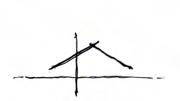
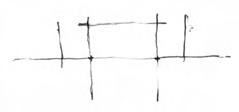
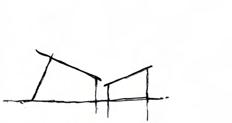
I’m Zack.
I’m a final-year undergraduate student at UTS, currently pursuing a Bachelor of Design in Architecture.
In 2021, I graduated with a Bachelor of Computational Design at UNSW, where I specialized in parametric design, advanced digital fabrication, and architectural theory.
Professionally, work as a computational designer in geotechnical engineering. I enjoy immersing myself in site work, where the nuances of design are manifested through cross-disciplinary exchange and adaptive problem-solving. I’ve been fortunate enough to work at all scales in this role, from city-spanning infrastructure projects to micro-scale mechanical detailing, and have gained an appreciation for the positive dialogues between architecture, engineering, and construction.
Outside of architecture, enjoy making new things and restoring old things.
zack.d.heffernan@student.uts.edu.au zackheff12@gmail.com
Cremorne Point, Sydney
The brief for this studio was to design a new-build primary school for a site in Green Square / Gadigal, supporting the City of Sydney’s pivot towards a high-density neighbourhood for young families.
Like many inner-city suburbs, Green Square is still recovering from decades of environmental neglect and industrial mismanagement, with a specific example being the ‘concretisation’ of neighbouring Alexandria Canal. The paving over of a key natural waterway virtually eliminated the ability for stormwater in the precinct to drain into deep soil and as a result groundwater recharge - a vital step required for water cycle remediationwas found to be non-existent on this site.
The proposed design would aim to re-wild the ground plane, with primary school ‘spine’ acting as a catchment zone for bioswales located under the classrooms. Aside from the central water catchment ‘spine’, the classrooms pierce the ground plane only where structurally necessary, allowing stormwater to complete its intended path unobstructed.
Each classroom would be a simple structural framework of primarily Australian mild-steel, CLT, and sandstone construction, with fitout completed by each class independently, and as a cohort progressed through the school years it would move along the classroom spine linearly - in parallel with the flow of the bioswales.
SCHOOL HALL EXPLODED
In the later stages of the project, the studio was tasked with the concept design of the school hall.
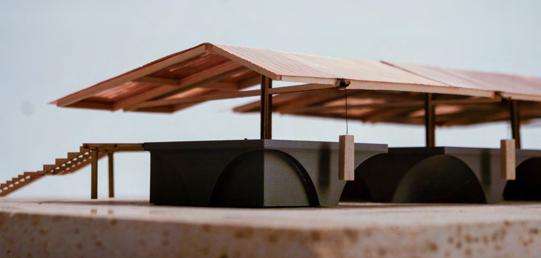
In alignment with the classroom spine, the school hall would provide an additional community programmeoffering studio space to ‘artists in residence’. Housed in the vaulted sandstone annexes of the hall’s ground floor, the artists would work in conjunction with the school to teach their craft to the students and in return could use the space as their personal studios.
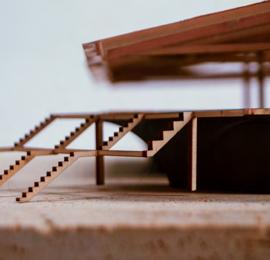
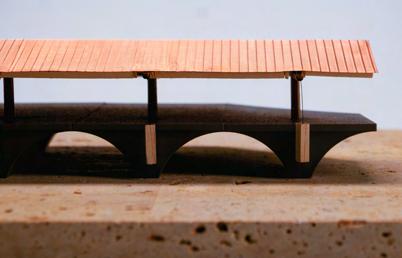
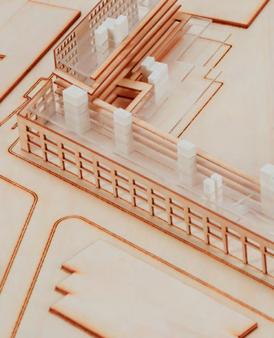
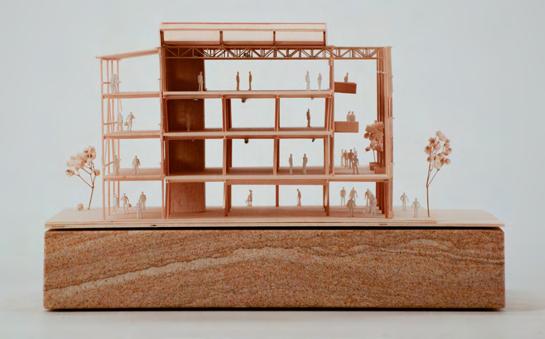
The copper-clad roof structure was of a novel design - 1500kg sandstone counterweights would hang over the public frontage, vestiges of Green Square’s pre-colonial landscape, and would balance the canopy over the hall assembly area.
Below are images of the structural and display model, and diagrams to the right show how the counterweight structure would be theoretically resolved.
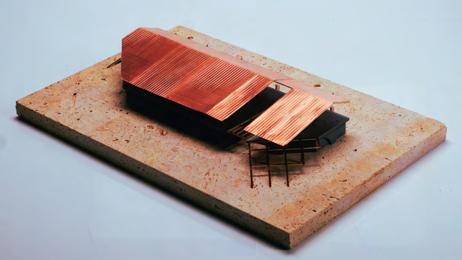
Base: Travertine Slab Structure: Lasercut Basswood Podium: SLA Resin Roof: Oxidised Copper Sheet
For the final capstone studio, the brief involved the holistic restoration and adaptive re-use of a storage facility in Waterloo / site analysis at both the ecological and social scales identified a broad ecological and social divide impacting the site.
The ‘social condenser’ would act as a figurative and literal bridge to connect the remnant swampland ecologies with the site, while also collating vital community services into a collective space. From the outset, it was decided to retain as much of the existing 1950’s-era factory and machine halls used in the former glassworks on site. For this reason, the heritage-significant facades on all of the three main buildings would be restored to their contemporaneous look, while a circulation framework would encircle the re-wilded interior courtyard.
As shown in the drawings below, the western glassblowing hall was the main focus for my allocation of the project - the program required a multiple floors of open-plan co-working space for small businesses and sponsored university research, while the ground and first floors served as the public frontage for the entire site. A double-height, always-open outdoor exhibition space acted as the gateway to the interior and served as a hub for circulation between the three main buildings. The entire length of the 150 meter Bourke St facade was recessed as a public arcade and promenade, providing shelter for pedestrians and inviting the public to walk alongside a dynamic display of ongoing artworks.
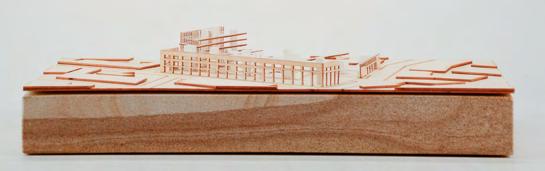
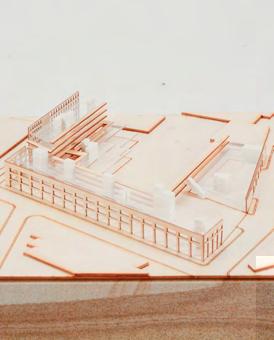
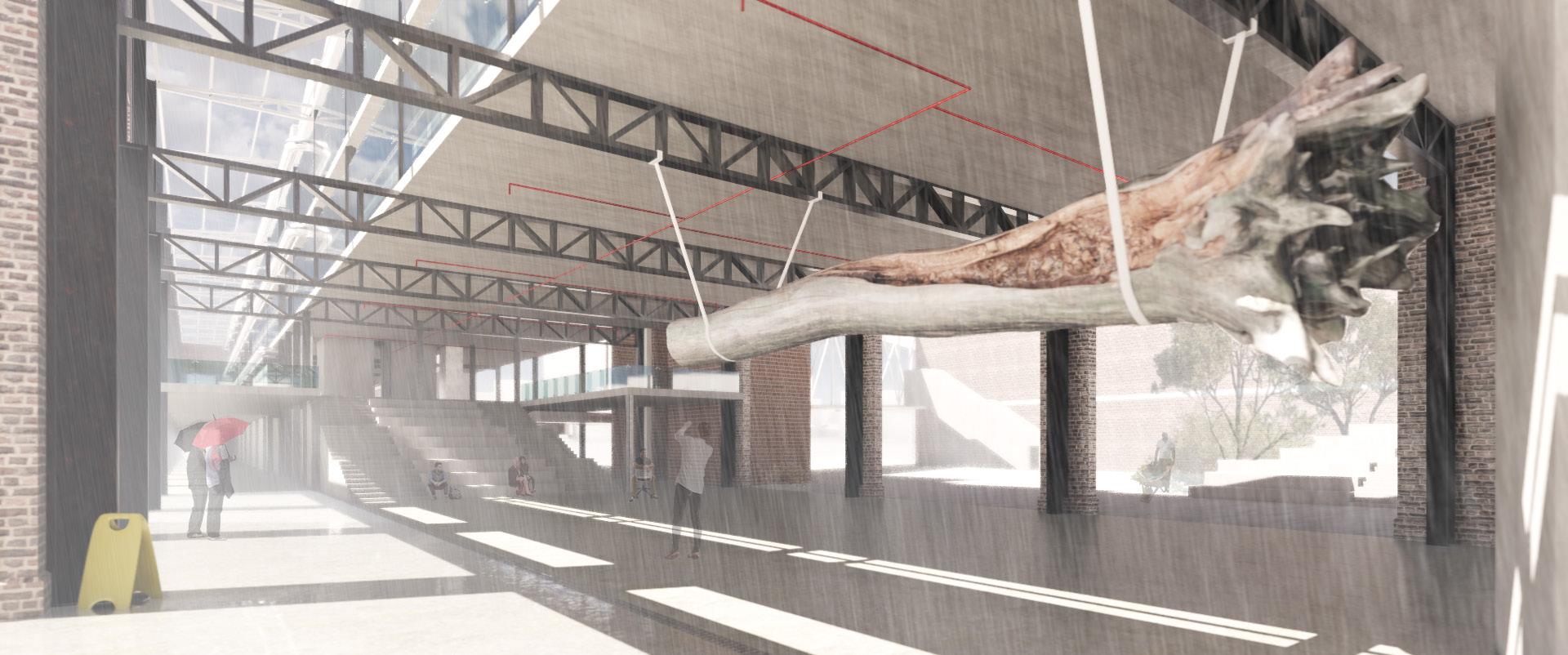
The primary entrance to the site had previously been constrained by narrow footpaths adjacent to a multi-lane arterial road, which was not only dangerous for pedestrians but deterred public inquiry into the site. The proposed solution was to open up this corner of the site into a double-height public exhibition space, protecting foot traffic and allowing for a natural progression of movement deeper into the site.
The visualisation of the space highlights the 5 metre setback of the western (left) facade from the bulk of the building so that light, airflow, and weather can permeate into the hybrid indoor-outdoor space.
This large area would ideally be used for public showcases, lectures and talks, and markets and events for the local council, and remains a bare framework for additional programme. In keeping with the brief of adaptive reuse, the material palette remains austere and functional, encouraging transient decorations by the community.
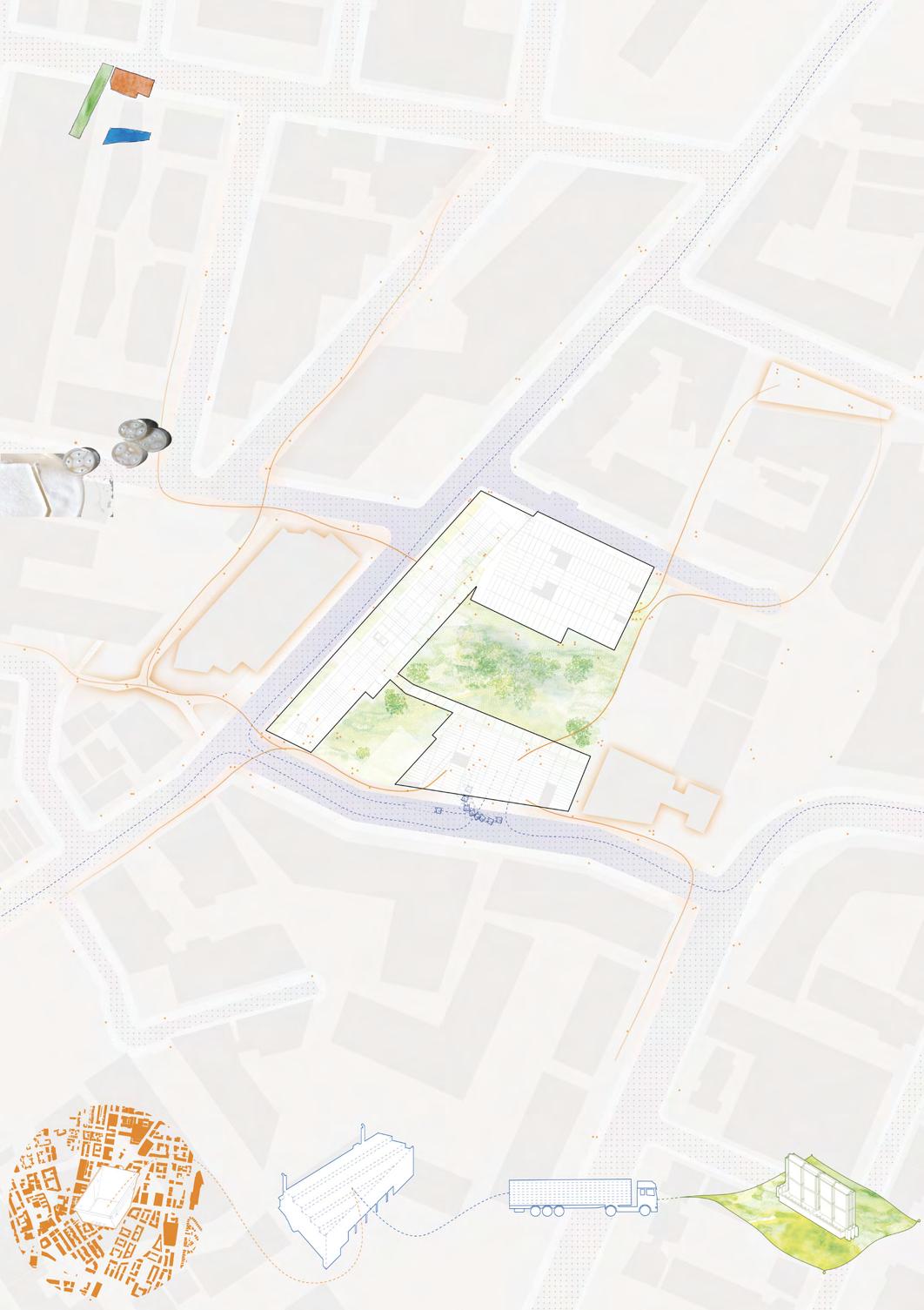
Below is a diagrammatic representation of the proposed treatment of water throughout the site. A building must not take more from its site than it gives back - particularly on a site with remnant wetland ecologies in need of remediation, as was the case for the Social Condenser.
Supported by a rooftop photovoltaic array, the bulk of the irrigation and cooling needs for the site would be met using a novel algal greywater renewal system and a closed-loop geothermal system, respectively. Stormwater would filter through nutrient-enriching and contaminant-filtering bioswales back into the groundwater, while rainwater and algal-treated greywater would charge on-site tanks and irrigate the landscaping.
A closed-loop geothermal system comprised of 80 deep boreholes regulates the HVAC heat-exchanger and condenser, increasing mechanical ventilation efficiency and reducing the demand for both water usage and energy from the municipal supply. The precedent for this system was Surry Hills Library by Steensen Varming.
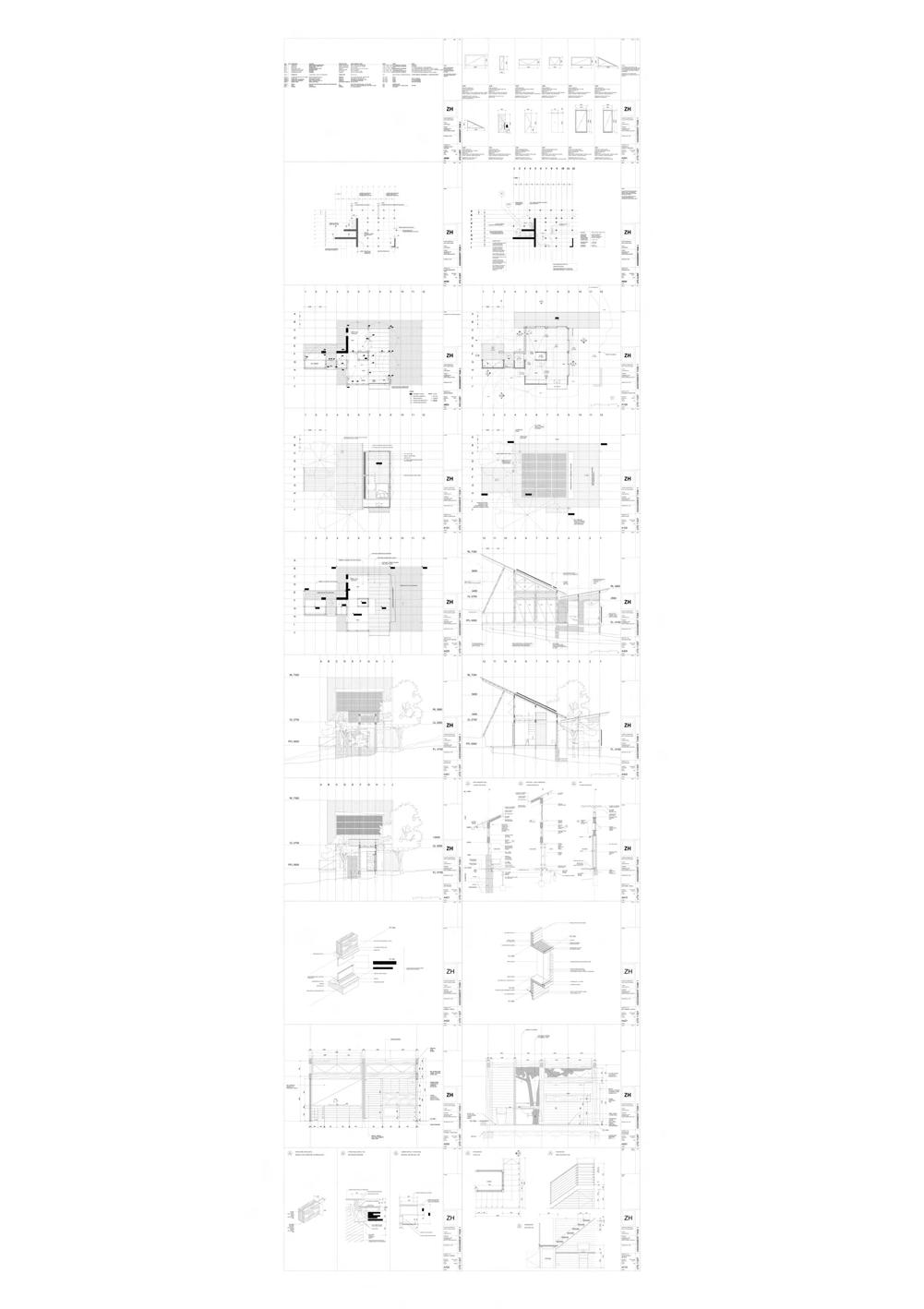
The Fig Tree Cove/Cooroowal House was presented as a challenge to complete a full construction set.
Intended to be a self-sufficient off-grid home for a couple, the drawing set details not just the orthographic projections, but also the PV distribution system, grey-and-blackwater recovery system, and rainwater filtration system - all of which support the key tenet of preserving the ecology of the site.
The generous outdoor area was designed with the intention of channeling the views of the neighbouring eucalypts and tranquil Fig Tree Cove/Cooroowal into the interior of the home, immersing the dwellers in the landscape. In a similar way, the bathroom blends outdoor and indoor space to break typical conventions of privacy and elevate the ritual of bathing, inspired by Tanizaki’s In Praise of Shadows.
Accompanying the orthographic drawings are a set of typical connection and structural details, where the primary materials of the home - being local red gum - were intended to be hand-crafted onsite by a dedicated carpenter. Materials were to be sized appropriately, given the lack of road access to the site.
The challenge of completing a full construction set at all scales of the design was one greatly enjoyed and hope to tackle again.
The ‘co³’ student housing project transforms an existing university-held lot into a multi-programme community kitchen and student housing hub.
The 1952 building housed the National Cash Register Co. and in surveying archival plans it was revealed that the northern facade was originally adorned with a passive solar shading system consisting of operable aluminium triple-height shades. Keeping with this core tenet of allowing natural daylight deep into the building, the student housing hub was envisioned as a peripheral programme, and the centre of the building was given completely to a void allowing daylight to penetrate the full height and depth. The unique ‘mushroom’-headed concrete pillars were also retained, as they were oversized at the time of construction to allow for predicted future vertical expansion.
The physical and social ‘heart’ of the hub would be a communal kitchen, where students would be encouraged to harvest from the adjoining endemic floral garden and cook together, with the scents carried upwards through the void core via natural convection.
The dormitories were designed to oppose the standardised allotment given to each student, where everything they would need during their studies would be contained within a 12m^2 template. Instead, the front wall of each unit would be expandable, sliding on tracks, to accommodate as much or as little space each student needed. Negotiations and dialogues between neighbouring students would be encouraged, and each ‘block’ of students would eventually settle on a layout that works for both the individual and the community.
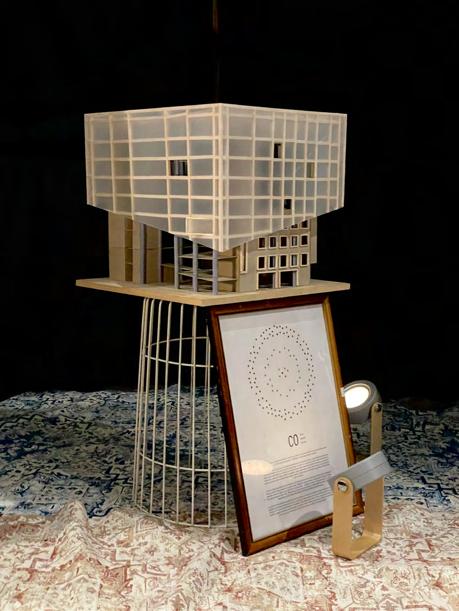
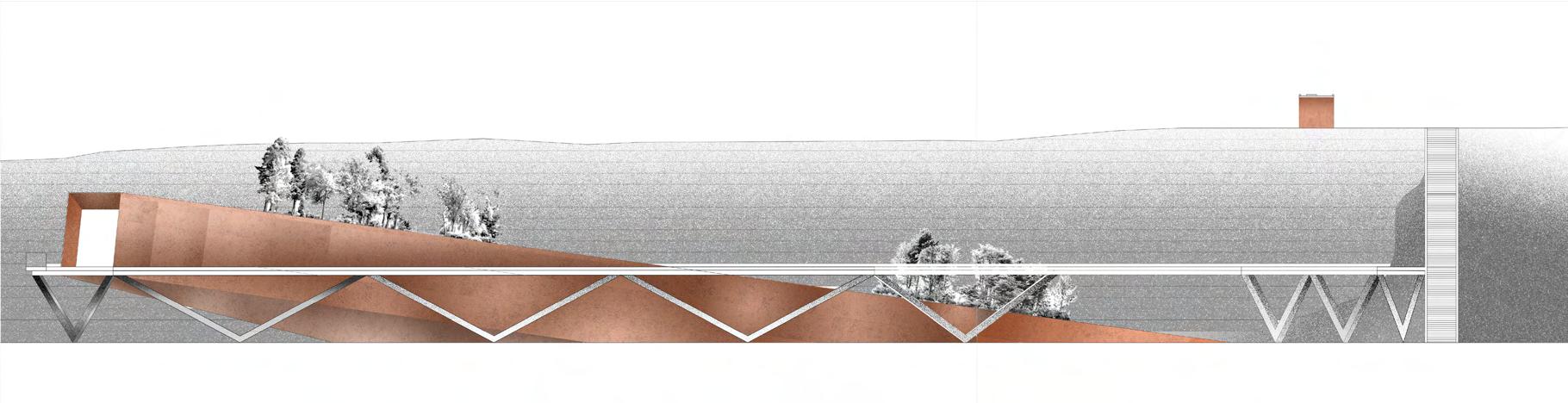
Occupying a unique brownfield site cut out of the face of Potts Point sandstone, the Almost Lost Library aims to be a repository and ongoing archive for locally acquired materials.
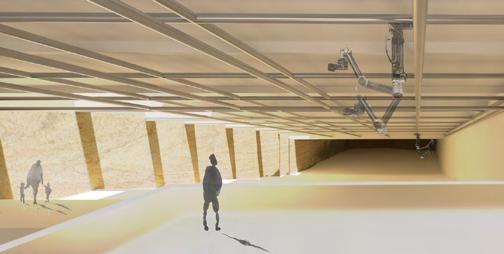
The always expanding nature of the programme called for a different way of thinking of spatial boundaries - and the solution for this project was to eternally bore underground, expanding the collection indefinitely.
The elevated walkway connects directly to Butler Stairs, channeling users to encounter the library along a designated promenade. From a focal point at the northern entrance, the full depth of the library is revealed, continuing into the earth along a prescribed sightline, intentionally darker and colder as it descends. The upper layers are intended for artifacts in heavy circulation, while the “almost lost” are relegated to the deeper archives.
A hypothetical automated retrieval system would catalogue the artefacts according to arbitrary popularity values and as such, over time, the esoteric or mundane would occupy the deeper archive - waiting to be unearthed by the determined user.
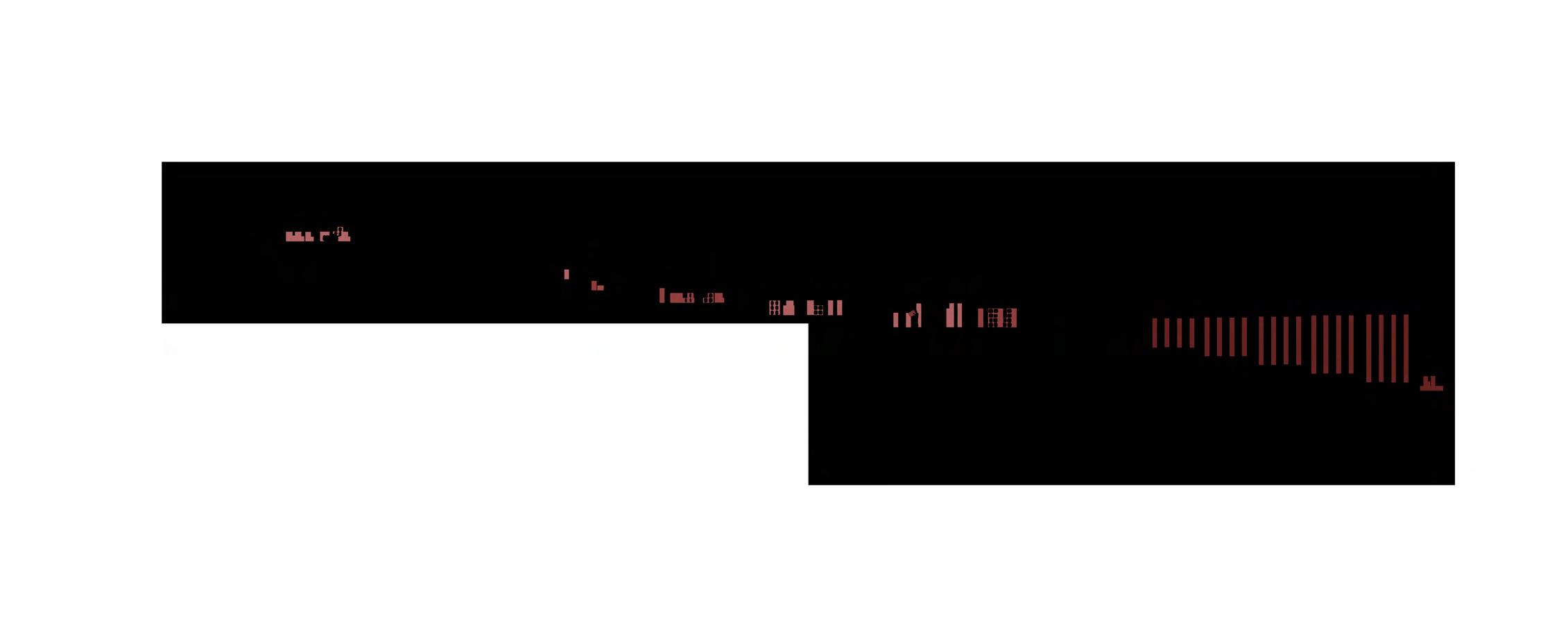
Predicting Embodied Carbon in Novel Geometries using Case-Based Reasoning
UNDERGRADUATE THESIS 2021
As part of the final year of my Bachelor of Computational Design at UNSW, I had the opportunity to develop a research project in conjunction with industry partner Bates Smart
The topic we chose to explore was one that exists at the core of climate-sensitive designs globally - embodied carbon. Embodied Carbon (EC) is typically calculated in the latter stages of the project, but at the time no tool existed for the rough estimation of EC at the concept or pre-documentation stages of design.
Over the course of the semester, I developed a Grasshopper tool for the early-stage estimation of EC - using a database of geometries provided by Bates Smart - which would use a machinelearning framework called Case-Based Reasoning to estimate the EC content of any novel massing geometry inputted by the user.
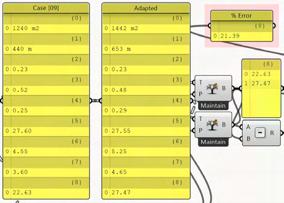
With this method we achieved a ~20% error rate, which encouraged further development, and the research showed that an early-stage EC estimation tool was a viable research topic for future studies.
The full thesis presentation can be found at: https://unswcode.org/conference/code-conference-2020/
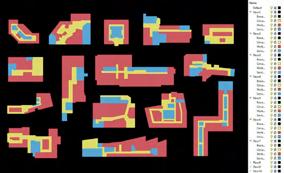
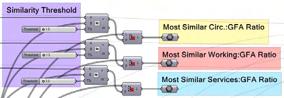
Selected pages from the thesis submission.
[TOP] Title Page and Abstract
[CENTRE] Generation of programme typologies using Bates Smart’s massing database
[BOTTOM] The final output of the GH script, showing the 20% error rate and the predicted EC for a novel massing geometry.