A+E INSIDE: <ALL DRAMA: Leader of kids’ theater program celebrates retirement after two decades. 3
BLACK
TIE INSIDE:
PLAN B: As omicron surges, organizations seek alternative options for planned events. 6>
ARTS + ENTERTAINMENT JANUARY 20, 2022
YOUROBSERVER.COM
Courtesy photos
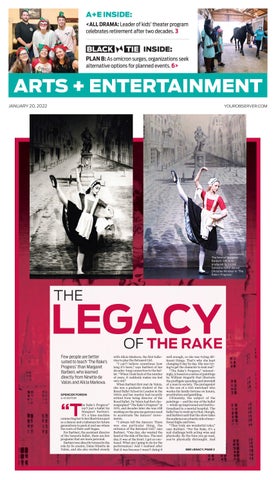
The form of Margaret Barbieri, left, is reproduced by former Sarasota Ballet dancer Christine Windsor in “The Rake’s Progress.”
THE
LEGACY
OF THE RAKE
Few people are better suited to teach ‘The Rake’s Progress’ than Margaret Barbieri, who learned directly from Ninette de Valois and Alicia Markova. SPENCER FORDIN A+E EDITOR
“T
he Rake’s Progress” isn’t just a ballet for Margaret Barbieri. It’s a time machine connecting her to her illustrious past as a dancer and a talisman for future generations to peek at and see where the roots of their craft began. For Barbieri, the assistant director of the Sarasota Ballet, there are few programs that are more personal. Barbieri was directly tutored in the role by its creator, Dame Ninette de Valois, and she also worked closely
with Alicia Markova, the first ballerina to play the Betrayed Girl. “I can’t believe sometimes how long it’s been,” says Barbieri of her decades-long connection to the ballet. “When I look back at the number of years, it suddenly makes me feel very old.” When Barbieri first met de Valois, she was a graduate student at the Royal Ballet School in London in the 1960s and her mentor had recently retired from being director of the Royal Ballet. De Valois had first choreographed “The Rake’s Progress” in 1935, and decades later she was still working on the precise gestures used to accentuate the dancers’ movements. “I always tell the dancers: There was one particular thing, the entrance of the Betrayed Girl,” says Barbieri. “One day, she wanted the hand at the side of the face. The next day, it was at the front. I got so confused. What am I going to do for the performance? And I realized after that it was because I wasn’t doing it
well enough, so she was trying different things. That’s why she kept changing it day by day. She was trying to get the character to look real.” “The Rake’s Progress,” interestingly, is based on a series of paintings by William Hogarth that illustrate the profligate spending and downfall of a man in society. The protagonist is the son of a rich merchant who wastes his family fortune on luxury, prostitution and gambling. Ultimately, the subject of the paintings — and the star of the ballet — winds up imprisoned and institutionalized in a mental hospital. The ballet has to work up to that, though, and Barbieri said that the show takes the audience on a frantic ride of emotional highs and lows. “They truly are wonderful roles,” says Barbieri. “For the Rake, it’s a real challenge both acting wise and physically. By the time you go mad, you’re physically distraught. And SEE LEGACY, PAGE 2