Connection
The Thearchitecture architectureand anddesign designjournal journalof ofthe theYoung YoungArchitects ArchitectsForum Forum
This issue: Redefining value Enter description copy: Andis milibus, sit et ant ut quatestempor sum aute in enectinctem. Ga. Ut lam conse reicil mil magnatem destet quiandest, voloreprovid que cusandignis explaut acero dem aligend itatecaes elitiur
This issue: Equity, diversity and inclusion
Amidst a global pandemic and nationwide protests against racial injustice, emerging professionals are filling leadership voids to demand change. This two part series offers takeaways from successful EDI programs and committees, along with young architect perspectives on the year’s events, challenges and opportunities.
2020 2019
Q4 Q2 Vol.1718 Vol. Issue02 04 Issue
Connection
2020 Connection editorial committee Editor-in-chief, graphic editor Senior editor Senior editor Senior editor Journalist Journalist Journalist Journalist Journalist Journalist Journalist
John J. Clark, AIA Amaya Labrador, AIA Beresford Pratt, AIA Clarice Sollog, AIA Arash Alborzi Gabriela Baierle, AIA Robyn Engel, AIA Jennifer Hardy, AIA Katie Kangas, AIA Miranda Moen Katelyn Rossier, AIA
2020 Q3/Q4 Contributors Contributing journalist Contributing journalist Contributing journalist Contributing journalist Contributing journalist Contributing journalist Contributing journalist Contributing journalist Contributing journalist Contributing journalist Contributing journalist Contributing journalist
Mike Bell, ASLA Monica Blasko, AIA Katelyn Chapin, AIA Jonathon Jackson, AIA Kelsey Jordan, Assoc. AIA Karen Lu, AIA Michelle Montgomery, AIA Hirbod Norouzianpour, Assoc. AIA Jessica O’Donnell, AIA Tay Othman, AIA Smitha Vasan, Assoc. AIA Aki Yoshida, AIA
2020 YAF advisory committee Chair Vice chair Past chair Advocacy director Communications director Community director Knowledge director Strategic vision director AIA National Strategic Council representative College of Fellows representative AIA staff liaison
Ryan McEnroe, AIA Abi Brown, AIA Lora Teagarden, AIA Jennie West, AIA John J. Clark, AIA Katelyn Chapin, AIA Jessica O’Donnell, AIA Matt Toddy, AIA Laura Lesniewski, AIA Frances Halsband, FAIA Jessica Rogers, Assoc. AIA
Young Architects Forum an AIA member group
Connection is the official quarterly publication of the Young Architects Forum of AIA. This publication is created through the volunteer efforts of dedicated Young Architect Forum members. Copyright 2020 by The American Insititute of Architects. All rights reserved Views expressed in this publication are solely those of the authors and not those of The American Institute of Architects. Copyright © of individual articles belongs to the author. All images permissions are obtained by or copyright of the author.
2
Vol. 18, Issue 04 2020
Contents 05 Editor’s note John J. Clark, AIA
26 AIA Minnesota: Reflecting on equity and moving forward Karen Lu, AIA, NOMA
06 YAF vice chair’s message Abigail Brown, AIA
28 AIA Continental Europe brings opportunities to young architects Michelle Montgomery, AIA
07 A brighter future: NOMA Detroit’s Project Pipeline Jonathon Jackson, AIA 10 I-NOMA president’s perspective Smitha Vasan, Assoc. AIA, NOMA 12 Pipelines are relationships: A case for committed relationship building Beresford Pratt, AIA, NOMA 16 Designing space — for growth Monica Blasko, AIA 20 AIA Honolulu’s commitment to racial justice Aki Yoshida, AIA
32 Equality isn’t enough: designing for equity in our parks Mike Bell, ASLA 34 Architecture of inclusion: a case study of the Rijeka mosque Hirbod Norouzianpour, Assoc. AIA 36 The emerging professional friendly firm program Katelyn Chapin, AIA 38 Young architect spotlight: Samantha McCloud, AIA Jessica O’Donnell, AIA 42 Innovation spotlight: Ayman Tawfeeq Tay Othman, AIA
23 Architecture: the missing link between equitable communities and diverse professions Kelsey Jordan, Assoc. AIA
Cover image: Baltimore Design School students exploring materials and finish libraries. (Page 12)
3
Connection
Editorial team John J. Clark, AIA, NCARB Editor in chief Clark is an architect with RMKM Architecture in Albuquerque, N.Mex. Clark is a graduate of the University of New Mexico and is the 2019-20 Communications Director for the AIA National’s Young Architects Forum.
Amaya Labrador, AIA Senior editor Labrador is a healthcare architect in the Houston studio of Perkins and Will. She currently serves on the AIA Houston Board of Directors, and is the Young Architects Regional Director for the region of Texas.
Beresford Pratt, AIA, NOMA Senior Editor Pratt is an Architect and BIM Manager at Ayers Saint Gross with a passion for education spaces, community engagement, and JEDI . He is the Young Architect Regional Director for the MidAtlantic region.
Clarice Sollog, AIA, NCARB, LEED AP Senior Editor Sollog is a Project Architect at CDM Smith in Orlando, FL. She was awarded the AIA Orlando Fred H. Pryor Young Architects Forum Achievement Award in 2014 and is the Young Architect Regional Director for the Florida Caribbean Region.
Arash Alborzi Journalist Alborzi is a doctoral candidate at the University of Florida, School of Architecture in Gainesville, Florida. Alborzi’s dissertation focuses on feasibility of urban agriculture in existing cities.
Gabriela Baierle, AIA LEED AP BD+C Journalist Baierle is an associate architect at Arrowstreet in Boston. She is also cochair of the Boston Society of Architects EPNet and an adjunct faculty member at the Boston Architectural College.
Robyn Engel, AIA Journalist Engel is a project architect at IKM Architecture in Pittsburgh, Penn. An ardent reader, Ms. Engel most recently served as jury chair for the 2019 Lynd Ward Graphic Novel Prize.
Jennifer Hardy, AIA Journalist Hardy is an architect at Payette in Boston, Mass. Hardy is an active member at the Boston Society of Architects and serves on the membership committee and is the founding chair of the women in design emerging leaders group.
Katie Kangas, AIA, NCARB Journalist Katie is a principal architect at Pasque Architecture in Minneapolis, Minn. As the North Central States Young Architect Regional Director, Kangas connects emerging professionals with resources to position them for success.
Miranda Moen Journalist Moen is an architectural designer based in Austin, Minn. Moen is passionate about rural and cultural heritage research, collaborating with clients in Minnesota and Iowa.
Katelyn Rossier, AIA Journalist Katelyn is an architect at SmithGroup in Pittsburgh, Pennsylvania. She is a graduate of Kent State University, and manages the blog, mentorarchitect.com.
4
Vol. 18, Issue 02 2020
Editors note:
Own your story Over the past year, I made a focused effort to rediscover my original passion for architecture, design, and problem solving. The stress put on our country and communities demonstrated the need for action, and the pandemic lockdowns early in the year provided the time and opportunity. In this journey, the best piece of advice I received was to channel my story. Instead of continuing to make excuses for my inaction or continuing to ask “how can I help,” reflecting on my background brought the clarity needed to set new goals for my career and impact through design. I had considered a career for social impact, yet I had been studying real estate development for over two years. I recognized my passion for a holistic, multidisciplinary process driven by a strong vision. I knew the importance of engaging communities that do not always have a seat at the design table and being a trusted advocate for a project’s end users. Ultimately I also acknowledged where I came from — raised by a single mother in low-income housing — and how that background drove me into a design career. By owning my story, it allows me to share a unique perspective to help effect change, and it has also brought a career path in affordable housing into focus.
Each article and perspective in these two EDI issues is driven by a young architect who has also channeled their story, found their passion, and acted for change. This includes Smitha Vasan, I-NOMA president, who focused on elevating the stories of the past generation to help inspire the work of future generations (Page 10). Reflecting on his path into architecture, Beresford Pratt’s passion for influencing the next generation of minority architects led him to participate in Ayers Saint Gross ‘Careers in Design Seminar’ for K-12 students in Baltimore (Page 12). Additionally, GastingerWalker’s Samantha McCloud reflects on her multicultural family and passion for thoughtful and optimistic design. This has led to opportunities as a speaker, community builder, and a role as her firm’s director of community involvement, diversity, and inclusion (Page 40). Our team encourages you to take time to reflect on your story and passion. Why did you become an architect? Does your career, firm, or volunteer role support this answer? The pandemic provides a great opportunity to ask these questions. Our profession and our communities will be better off if you can.
Editorial committee call 2021 Editorial Committee: Call for volunteers, contributing writers, interviewers and design critics. Connection’s editorial comittee is currently seeking architects interested in building their writing portfolio by working with our editorial team to pursue targeted article topics and interviews that will be shared amongst Connection’s largely circulated e-magazine format. Responsibilities include contributing one or more articles per publication cycles (3–4 per year). If you are interested in building your resume and contributing to Connection please contact 2021-22 the editor in chief at: aia.beresford.pratt@gmail.com
5
Connection
Vice-chair’s message:
Disrupt for enduring change Disruption. The very founding of the Young Architects Forum was based around change and interruption of our profession. It’s most often in the context of practice models, project delivery, emerging technologies to name but a few. Occasionally, a disruption comes along that demands the attention of all of us. Rarely does disruption occur as the sum of the factors we are witnessing today. A global pandemic, the reckoning with inequality, and catastrophic events brought about by climate change, have coalesced to make this year a call to action into every corner of our society. As I am sure it has for those of you reading this issue, 2020 has thrown the YAF’s plans for the year into disarray. It has also brought our most important “The very founding of the priorities into focus.
Young Architects Forum was based around change and interruption of our profession. Rarely does disruption occur as the sum of the factors we are witnessing today.”
Within the span of just a few weeks earlier this spring, the entire profession of architecture was forced to pivot to a fully remote model. Anxiety levels rose in all of us as we navigated technological change, remote firm and project leadership, a crashing economy, childcare and/or homeschooling, and social isolation. There is fear that the gains that women have made in the workplace over the last fifty years will be set back by the pandemic, as many working moms are cutting back on hours or leaving the workforce altogether. The protests and outrage sparked by the police killings of George Floyd, Breonna Taylor, and others this summer put into sharp focus the inequity and racism that had been there all along — both in society and within our profession. And just last month, our country lost an icon and lifelong advocate of women’s rights, Supreme Court Justice Ruth Bader Ginsburg, which has put the future of LGBTQ rights, women’s rights, affirmative action, environmental regulations, and access to healthcare at risk for millions of Americans.
6
We have had a lot of difficult conversations this year, both within the AIA and within our firms, and it’s humbling to see emerging professionals leading the response to the challenges we are facing. Members of the Young Architects Forum and National Associates Committee have had several earnest conversations with AIA National leadership about our experiences and reactions to the pandemic and systemic racism. We have led webinars and speed mentorship sessions for students and recent graduates to share our experiences of starting careers during the Great Recession. The YAF Strategic Vision Director, Matt Toddy, is serving on the Equity and the Future of Architecture board committee this year. 2017 YAF Chair, Evelyn Lee, compiled a COVID-19 resource document for firm leaders, then went on to host many engaging conversations about equity, diversity, and inclusion with young architects on her Practice Disrupted podcast with Je’Nen Chastain, Assoc. AIA. National Associates Committee AtLarge Director Jessica Parmenter, Assoc. AIA, led a group reading of “Me and White Supremacy” through her Architects Book Club. And there are so many women in architecture and equity, diversity, and inclusion conversations happening at local AIA chapters around the country that former New York YARD, Graciela Carrillo, AIA, started a website with a consolidated calendar so the list is available to everyone. Of course, our work is not yet finished, and the YAF remains committed to continuing the work to make architecture a more equitable and inclusive profession. We invite you to roll up your sleeves and help us make an impact. As Ruth Bader Ginsburg once said: “Real change, enduring change, happens one step at a time.”
Abigail Brown, AIA
Brown is an Associate at Hickok Cole in Washington, DC, where she works on multifamily and mixed use projects. She serves as the 2020 Vice Chair for AIA National’s Young Architects Forum.
Vol. 18, Issue 04 2020
A brighter future
NOMA Detroit leads by example through Project Pipeline
DETROIT. AKA Motown, Detroit Rock City, Hockey Town, The Motor City. Whatever you call it, Detroit has a rich history and a bright future. It’s where Motown was born, where the first Model T was produced, where Martin Luther King Jr. marched for equality, and where the National Organization of Minority Architects began nearly 50 years ago. NOMA has come a long way since its inception in 1971. But as in many other cities, the mistreatment of underserved communities has led to a severe wealth gap and a lack of diversity in the world of business, including our own profession. African Americans make up 13 percent of our nation’s population and only 2 percent of our profession. In Detroit, African Americans make up 80 percent of the population, and still the lack of diversity in our profession is glaring. Why, you ask?
In a recent lecture, NOMA President and Detroit native Kim Dowdell explained how this can be traced all the way back to the ’30s, when redlining was taking place. Banks denied loans to borrowers in areas where there were high densities of people of color. As this took place over several decades, land values in these areas began to drop rapidly, and some families left the city altogether. What was left is the blight that is spread throughout metro Detroit. This is why Dowdell has made it her mission to reverse the damage that was done by investing in these properties and giving underprivileged residents more access to capital, better education, and higher-paying jobs. But she says that to reverse decades of damage, we must have a cohesive effort to rebuild what is essentially an ecosystem plagued with poverty and crime. Dowdell is involved in a joint
7
Connection
venture called Fitz Forward, which focuses on rehabilitating 104 homes and 269 vacant lots in Detroit. Her goal is to strengthen these communities and help increase property values. However, she points out that it is important to avoid the unintentional consequence of driving underprivileged families out simply because of the rising cost of living that would result. If the goal is to improve the living conditions of those in the community, then we need to reduce the poverty and the wealth gap by investing in education and “Dowdell has made it her businesses run by mission to reverse the those who live in damage that was done the communities. Simply put, she by investing in these says, equity is the properties and giving opportunity to underprivileged residents “make it right.”
more access to capital, better education, and higher-paying jobs.”
I recently had the pleasure of sitting down virtually with past NOMA Detroit president and current NOMA Midwest vice president Saundra Little, as well as the NOMA Detroit treasurer, Farhana Islam. They told me about the steps being taken to help young minorities get involved in architecture and how this will help with the efforts mentioned above. Little and Islam
8
explained that NOMA Detroit focuses on giving minorities the opportunity to get involved in an industry that will help improve and shape their communities. Some of their members are urban planners and sit on several boards in the city. Connecting these professionals with minorities who are trying to find their career paths provides a mentorship program that guides students from K-12 all the way through licensure if they choose this profession. One of these programs is called Project Pipeline. Many cities across the United States have held their own Project Pipeline camps over the years, and Detroit is no exception. This year marked the sixth annual Summer Camp for ages 12 to 18. Project Pipeline is the start of a process that takes the students through high school and into college with the National Organization of Minority Architects Students and then finally into licensure. However, the camp looked a little different this year, with COVID-19 causing everything to go virtual much like many other events. The experience wasn’t the same as the in-person camps, but one benefit was the increased attendance of foreign students, who would normally not be able to attend. About 35 students attended, along with over 30 volunteers, spread over the seven-day camp. Over the years, the length of the camp has extended from two days to seven, and the main criticism from students is that they wish it was longer. That’s a testament to what a great camp they hold at NOMA Detroit.
Vol. 18, Issue 04 2020
Little and Islam also explained why urban planning is so critical to reviving underprivileged communities. With Detroit containing 105 neighborhoods, the city is a network of anchor institutions that create the nodes within the larger context of the city. Because of the heavy immigration to Detroit that started in the early 20th century, the city is a melting pot of cultures, and the typology of the built environment can change in the blink of an eye from one neighborhood to the next. Detroit is not a city that can be designed from one point of view. It takes the residents who live in these districts, who can address the needs of each community, to truly serve, design, and build their future. Whether it’s rezoning areas to promote local business growth or rebuilding lives one home at a time, it is important to have a voice at the table where decisions are made that affect all “Detroit is not a city that of metro Detroit. can be designed from one NOMA Detroit and its members are point of view. It takes that voice.
the residents who live in these districts, who can address the needs of each community, to truly serve, design, and build their future.”
Next year will mark the 50th anniversary of NOMA, and the homecoming is slated to be held in downtown Detroit. This anniversary will be a celebration of longevity, a reflection of integrity, and a look toward the prosperity that can be achieved for our up-andcoming professionals in this industry. By providing mentorship, scholarships, internships, and of course friendships, NOMA Detroit is paving the way to a brighter future for local young architects. NOMA and the AIA’s Large Firm Roundtable are setting the stage with an initiative focused on doubling the population of African American architects by 2030. We can all learn from, and more importantly get involved with, NOMA’s efforts to achieve this goal. As architects, we are supposed to “protect the health, safety, and welfare of the public.” This statement means our designs should serve people of all colors. It’s not just the health of a building’s occupants that is at stake. It’s also the residents of the broader community who live in this built environment who are affected. In the words of Kim Dowdell, “As leaders of cities and the built environment, this work is our responsibility.”
Previous: Fitz Forward focuses on rehabilitating homes and vacant lots in Detroit. Far Left: Detroit NOMA Project Pipleline Summer Camp neighborhood tour and discussion. Near left: Reviewing urban planning models. Top right: Building urban planning models at Project Pipeline Summer Camp. Middle right: Attendees of a virtual Project Pipeline Summer Camp conference call. Lower right: Recognizing participants at Project Pipeline Summer Camp.
Jonathon Jackson
Jonathon Jackson is a Project Architect for Ghafari Associates LLC in Dearborn, Mich. He serves as Michigan’s Young Architect Regional Director and lives in Carleton, Mich., with his wife, Grace, daughter, Ava, son, Jonah, and is expecting number three early 2021.
9
Connection
I-NOMA president’s perspective I am about to come to the close of my term as President of the Illinois chapter of the National Organization of Minority Architects (I-NOMA), and it’s been incredible. The past 18 months have felt more like 10 years of meeting people, sharing experiences, and expanding my horizons. The most memorable experiences I’ve had are rooted in the stories I have been told and in the one-on-one interactions I’ve had. In creating a mission statement focused on community and legacy, the intention was to highlight and elevate the incredible depth we have with so many long-standing members local to Chicago who were integral in creating NOMA. In elevating their stories, we can inspire the community to continue to actively participate in our work. This mission also provided an active and pointed way for me to learn more about our organization’s history and purpose. Two great outcomes of this mission are the creation of the I-NOMA Legacy Map, documenting the incredible contributions of minority architects in Illinois, as well as the I-NOMA Scholarship, to support young people from marginalized communities matriculating through design education. With these initiatives, we create longstanding documentation of and support for our members. In recent times, this mission has shifted, along with my own understanding of NOMA. We recognize the acute need for accountability in today’s world and in today’s profession. This point is fundamental to NOMA’s purpose and to so much of the knowledge I’ve gained as I-NOMA president. NOMA creates space for marginalized individuals and groups, specifically racial minorities, to come together and feel recognized and safe to discuss these experiences without questioning, judgment, or a need for
10
explanation. True allies must support the creation of this space, and subsequent necessary actions derived from it, within their organizations and outside them in order to have any semblance of impact or necessary compassion toward change. I-NOMA has recently released our Professional Equity Checklist, which reflects the thoughts of our members on what changes they would like to see in the design and construction professions. There is a clear need for understanding the appearance of inequity and structural violence in a professional setting. Our checklist outlines first steps for candid self-
Vol. 18, Issue 04 2020
evaluation in firms and organizations before they come to other organizations, such as I-NOMA, and ask, “What should we do?” We live in a country that is systematically structured to marginalize racial minorities, specifically Black and Native people, for the benefit of the white majority, and that must change. In the professional context, this list outlines basic steps that can and must be taken before any statement or intention can be genuinely supportive. When we think of diversity, we must consider that this term was initially trending in the United States as a more palatable way to address racism. Instead of calling out people and organizations for their racist practices, we instead ask that more diversity is created. So as we launch our committees and initiatives “It is also important toward diversity, we must keep this that key decisioncritical piece at the makers, not just overall forefront.
leadership, reflect Black and Brown people, so that multiple perspectives are considered as culture is formed and reformed.”
In truly understanding diversity, representation is critical. Yes, it is important that we have co-workers who look like us and who look different from us so that we can feel comfortable speaking up and learning. But it is also important that key decision-makers, not just overall leadership, reflect Black and Brown people, so that multiple perspectives are considered as culture is formed and reformed. Finally, we cannot overlook the importance of communication in creating justice and equity. One thing I’ve learned in a big way throughout my term is that people avoid making trouble. Even if what’s being said hurts us, even if it annoys us, even if it is disrespectful and shortsighted, no one wants to be the one
to create opposition. And it is perfectly understandable. For centuries, this type of unrest has been unheard and set aside. This type of treatment in the AIA is actually why NOMA was created. So while it is certainly important that we, as minorities, begin to speak up more, it is far more important that we, as professionals in leadership, create a culture that actively seeks to identify wrongs where they are happening, that asks questions to start the uncomfortable conversations, and that appropriately makes decisions to incite change based on these conversations. In reflecting on my own leadership, I am particularly impressed with the importance of creating awareness and normalcy around acknowledgment. There are numerous forms of marginalization within the professional sphere. Depending on background and experience, we may not identify with the gripes of another, but that does not make them any less important. We must place importance and validity in that which we cannot understand. As the work continues, as it always must and will with NOMA, I look forward to seeing space made and acceptance spread toward a more equitable profession.
Far left: I-NOMA Legacy Map logo Top left: I-NOMA Eboard on the Willis Tower Skydeck Smitha Vasan at the 2019 I-NOMA Holiday Party. Bottom left: I-NOMA Legacy Event panelists (from left) Charles Smith, Susan Carlotta Ellis, Walter Street III. Above: Project Pipeline Architectural Summer Camp 2019 Students on their Willis Tower Field Trip Smitha C. Vasan, Assoc. AIA, NOMA Vasan is an architectural designer at SmithGroup in Chicago. Vasan is also the 2019-2020 president of I-NOMA as part of her dedication to making design accessible.
11
Connection
Pipelines are relationships: A case for committed relationship building “You can’t be an architect if you don’t know architects exist.” These were the frank words of former first lady Michelle Obama as she spoke to the need for diversity at the 2017 AIA Conference on Architecture. Obama called on architects to mentor children so we as an industry can raise a more diverse next generation of architects/designers in a profession where young students who are Black, Indigenous and people of color (BIPOC) lack role models they can identify with. According to the National Council of Architectural Registration Boards’ latest NCARB by the Numbers report, only 2 percent of all licensed architects across the nation identify as Black. And just 2 percent identify as Hispanic. With these numbers in mind, I often reflect on Obama’s words, questioning how I stumbled into architecture. My friends and family thought I would become an engineer. I did, too. Engineering professions received more publicity during my early years. But through curious “Not every student is exploration, fortunate enough to exposure, and a discover a path that aligns great high school teacher, I was with their interests. Even introduced to the more so, many schools do world of design — not have the resources and I loved it.
to expose their students to a wide array of career options.”
While in school, I took courses in woodworking, model building, graphic design, and CAD. I even created an elective to fulfill my growing interest in architecture. I seized every opportunity to learn more. Since then, I’ve learned that not every student is fortunate enough to discover a path that aligns with their interests. Even
12
more so, many schools do not have the resources to expose their students to a wide array of career options. In a profession where young, BIPOC students often don’t see BIPOC representation, I believe we — the industry — must commit and be intentional about mentoring underrepresented K-12 students. When I joined Ayers Saint Gross as a brighteyed, budding architectural designer, it didn’t take long for me to become involved in the firm’s pipeline program. Alongside some of my dedicated colleagues, I wanted to do my part to influence the next generation of architects and designers in Baltimore. Some of my colleagues, Estefania Vasquez, Tiffany McAllister, Evan Todtz, and Amber Wendland shared some of their experiences with our pipeline initiatives with Beechfield Elementary School and the Baltimore Design School.
Below: Beechfield students exploring planning and graphic design.
Vol. 18, Issue 04 2020
Beechfield Elementary School Located in West Baltimore, Beechfield Elementary School is a vibrant community, packed to the brim with energetic firstthrough fifth-graders. When you walk through the hallways, especially between periods, you can feel their excitement — it’s electric. However, Beechfield has historically struggled to obtain resources for its mostly Black students, resources many of us take for granted, like air conditioning and school supplies. For many schools in Baltimore, this hardship has exacerbated the challenges of equity. For more than 20 years, Ayers Saint Gross has partnered with Beechfield through the Adopt-aSchool program to introduce students to design professions. We are proud to support students through three main initiatives that give, educate, and connect the dots. Giving: Ayers Saint Gross hosts a back-to-school drive to collect backpacks stuffed with supplies to distribute during the first week of school. During the holidays, we donate food, clothing, and books to the families of students in need. We’ve also been sponsors for community events and smaller facility upgrades. These opportunities give everyone at Ayers Saint Gross, and the firm itself, the chance to support Beechfield in some way — even if their time to volunteer is limited. This commitment aligns with our firm’s mission to enrich the world, by giving back to the communities where we work and live. Educating: Each year, we host a five-day series on careers in design that introduces students to architecture, interiors, graphic design, planning, and landscape architecture. Volunteers from disciplines across our firm dub a class of fifth-grade students as honorary design professionals. We guide them through basic concepts with a work booklet that includes fun activities, a completion certificate, and a resource library for students who want to pursue design opportunities in junior high and/or high school. These sessions are rewarding for the students and for us.
Top: Beechfield students participating in a design structure design charrette as an epilogue to design seminars. Above: Ayers Saint Gross ‘Careers in Design Seminar’ booklet provided to each student.
13
Connection
Vasquez began reflecting on the impact that educating students had on her: “Coming from a small-town community, I have seen the effects of limited education opportunities, and I now see the genuine excitement when new ideas and material are presented by real-world practitioners. The students are always engaged and full of questions. I love seeing the students’ creativity shine, and it is a constant reminder that we are accomplishing something worthwhile for the next generation.” McAllister says, “At the end of the day, these efforts boil down to a group of people of all ages and backgrounds in one space, sharing a passion for making the world a better and more interesting place. It’s the children’s passion and open-mindedness that is both a constant inspiration and can be routinely humbling. They are our future, and I feel honored to help them discover a passion for design to help shape the world around them.” Connecting: After our five-day series, we follow up with a final opportunity for students to visit our headquarters in Baltimore. This day gives students the chance to share their work in front of a larger group of design professionals. Students who aren’t shy are often quick to present, and with a little encouragement, many follow their lead. When it’s possible, we bring students from Morgan State University (MSU), a local historically Black college with an accredited architecture program, to share their academic journey, experience, and work. As the intermediary between Beechfield and MSU, it’s our hope that facilitating a connection as well as working with middle- and high-schoolers, will further reinforce the idea that a career in design is possible and strengthen the pipeline.
14
Baltimore Design School Baltimore Design School (BDS) is a public middle school and high school that goes beyond the traditional state curriculum. Teaching art, design, communication, and critical thinking skills, BDS offers students three pathways: architecture, graphic design, or fashion design. This summer, Ayers Saint Gross hosted virtual sessions for a group of middle-schoolers to pique their interest. This interactive, two-day session included live polling, chat discussion, presentations, and sketching. Parents joined their children, and we were thrilled to receive feedback from a parent who noticed a growing confidence in their child following these sessions. Todtz has found that “engaging with students from BDS has not only reinvigorated my own design interests and curiosities but has also filled me with hope for the new generation. As future leaders who will lead the charge against some of the world’s most complex challenges, our shared discussions and design exercises have not only encouraged students to pursue architecture and affiliated disciplines, but perhaps more importantly, provided a critical space for students to build and discover their own voice and identity through design.” On Shadow Day, we welcomed BDS high school students in the architecture pathway to our office. The students explored our firm’s body of work and participated in design charrettes with our team. A BDS director later shared that on their ride back home, the students were so excited to drive by a park they reimagined during one of their mock design charrettes. These moments remind me why it’s important to make design relatable, approachable, and tangible. What is equally important is the connection and impact you can have with a student at a personal level.
Vol. 18, Issue 04 2020
Looking to build authentic connections, Wendland shared her experience on mentorship: “I’ve been so inspired by the programs at BDS and the creative talent of the students that I signed up for the inaugural iMentor program last year. This program matches each 11th-grade student with a working professional to help them navigate their career paths and transition to life “These moments remind after high school. The relationship I me why it’s important to have grown with make design relatable, my mentee has approachable, and been one of the most rewarding tangible.” experiences of my career, and I hope that the guidance and support I have been able to provide her is as valuable as the lessons, perspectives, and joy she has provided me.”
Far Left: Baltimore Design School students exploring materials and finish libraries. Above Left: Baltimore Design School students participating in a design charrette of a local Baltimore City park. Above Right: A Baltimore Design School student exploring virtual reality design tools.
The Pipeline Dream I believe the pipeline process is highly relational at an institutional and individual level. Real impact occurs through connections that can form organically. Like all great relationships, it takes time and commitment to nurture. A few years ago, we were introduced to a young man pursuing the architecture pathway at Baltimore Design School. He also happened to be a Beechfield alumnus who was introduced to design during elementary school because of Ayers Saint Gross. My dream is to see a student we’ve worked with join us as a full-time employee one day. This dream may not be something that happens overnight, but it’s what I believe true equity looks like — a steady effort to support and elevate underrepresented voices across our industry through relationships.
Beresford Pratt, AIA, NOMA Beresford Pratt is an Architect at Ayers Saint Gross in Baltimore. He is the 2019-2020 Young Architect Regional Director for the AIA MidAtlantic region and founding member of Bmore NOMA.
15
Connection
Designing space — for growth Advocating for change by first understanding where we stand today
A global pandemic. Work-from-home challenges. Self-isolation. Financial uncertainty. Mental health struggles. A looming presidential election. And now another (filmed) instance of police violence against a Black American. As one of our Women+ in Design Pittsburgh community members came to realize, “My response of ‘I don’t have time for this’ comes from a place of privilege.” Grappling In the wake of George Floyd’s killing by police and the resounding demands for racial justice, the women of W+iD PGH were rattled like so many others and reckoned with how to appropriately respond as people, allies, designers, and leaders of a community dedicated to equity. As an organization, W+iD PGH has been clearly committed to fighting for equity when it comes to gender in our profession, and although our name does not as explicitly state it, we are also committed to advocating for racial equity and social justice. Our community is composed of female architects, interior designers, landscape designers, graphic designers, and (even) engineers; although we are not affiliated, AIA Pittsburgh supports our work. Architects tend to stay in our comfortable, architectural bubbles, yet these issues of social inequity are deeply ingrained in many design industries, so it is important to have a cross-disciplinary approach to work toward more impactful change within the larger community. We understand that the protests throughout our country are not in reaction to a single event, but to the decades of intentional and systemic racism that pervades our society. We
16
also recognize that as a community of “design professionals committed to making our allied industries more diverse, more inclusive, and more equitable,” as it stands today, W+iD PGH is a group of primarily white, privileged women. We must use our privilege, our talents, our resources, and our platform to align with and support historically marginalized people of color, and we are determined to be more intentional in our next steps as an organization. The informal nature of our organization — with a decentralized leadership, no board, no dues — positions us to respond quickly, yet purposefully, to support our community. Thus far, our lack of official structure has worked well for us, allowing us to swiftly convene, make decisions, and act. There is a balance of honesty, trust, and empathy in this group of women that is categorically unique and unlike any organization I have ever been a part of. Reckoning We knew our community was eager to act, but most of us did not know where to start. As a first step in an effort to offer support to our community and as an opportunity for growth, we pivoted a regularly scheduled Breakfast Club into a series of small-group conversations to build upon our lacking skills, better understand the historical inequities within our society, encourage those within our organization to scrutinize ourselves, uncover our shortcomings as allies, explore tools for important and often uncomfortable conversations, and learn how to confront racism directly. The event involved about 70 women in seven virtual small-group discussions over the
Vol. 18, Issue 04 2020
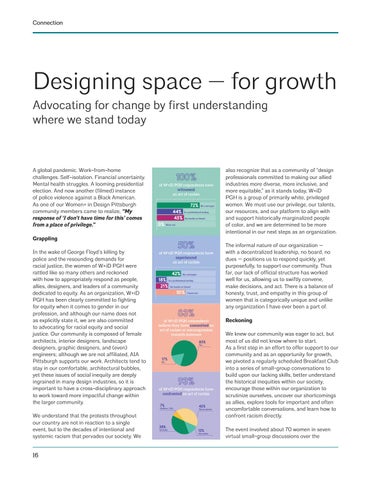
course of a week, each led by a pair of wonderful W+iD PGH volunteer facilitators, grounded in questions posed by Ibram X. Kendi, author of “How to be an Antiracist.” We encouraged all to participate in the discussion even if they had not read the book and to give it a read eventually. (It has proved immensely helpful for me as I continue to learn and unlearn.) The moderators were not experts; we were all engaging in this work together. To acknowledge that each of us was entering the conversations with a differing perspective and set of experiences, we created space for honesty and trust and encouraged thoughtful participation. We used the interactive polling software Poll Everywhere to pose questions that the participants responded to anonymously, “We must use our and the polling results fueled privilege, our talents, deep, meaningful our resources, and our conversations that platform to align with far exceeded our expectations for our and support historically one-hour, virtual marginalized people learning session.1
of color, and we are determined to be more intentional in our next steps as an organization.”
Our individual awakenings were the strongest theme in these discussions. To support the W+iD PGH community’s expanding education on these topics, we developed a set of regularly updated Social Justice Resources.2 We are all on our own personal journeys, and coming together
to talk about them was important and valuable to many. While our conversations barely scratched the surface of what it means to be an antiracist, it did become clear that our desire for authentic allyship and action was strong. Many participants contemplated how to expand our antiracism discussions beyond ourselves and be advocates in our workplaces, through our work, and in our communities. Our community members are building their knowledge base to bring these conversations into their firms and improve communication with clients and end users. We are curious about how antiracism work may reshape the business vision and culture of a workplace — more intentional recruitment and hiring practices, establishing annual auditing of employee pay, designing mentorship programs, setting goals for representation in leadership, pursuing project types that create spaces for healing and thriving rather than oppressing, and committing time to social justice work inside and outside the office walls. How do we create space and meaningful opportunities to invite others in or step outside of our group? How do we better collaborate with our larger community — bringing our talents and passions with us? There has been a strong collective desire to continue the momentum of the social justice movement, but uncertainty about what to do next. After realizing the large gaps in our education up to this point, we determined that our community should next explore how we got here — to this moment in this movement.
1 https://www.womenindesignpgh.com/post/antiracismconversations-recap 2 https://www.womenindesignpgh.com/post/social-justice-resources
17
Connection
Relearning With the support of our interior designer colleague Jo Berchielli, Katie Walsh (fellow architect and W+iD PGH leader) and I developed a three-part “Breakfast Club” series dedicated to “The Color of Law” by Richard Rothstein. (Dive deeper into this eye-opening book with W+iD PGH leader Emily PiersonBrown’s review in this issue of Connection.) As we made our way through the book in the monthly sessions from July to September, we dissected systemic racism and learned how we might begin to dismantle and rectify decades of intentionally racist policies at the local, state, and federal levels. 3 4 For these virtual discussions, we touched base in the large group, then broke out into small-group discussions in Zoom rooms to dive deeper and encourage participation in the often uncomfortable “We do know we need to conversations about racial injustice. continue the process of We found that learning and unlearning, addressing and educating ourselves, and overcoming that striving for improvement. discomfort is key to holding productive We must embrace the conversations.
unfortunate truths and uncomfortable conversations in the name of progress.”
We are at a moment in our country’s history in which we are starting to dispel myths that have persisted for decades, if not centuries. This book helped us to understand where many of these myths originated — notably the false narrative of the American Dream. It was inevitable that our discussions would directly connect to what is going on 3 4
18
https://www.womenindesignpgh.com/post/the-color-of-law-part-1 https://www.womenindesignpgh.com/post/the-color-of-law-part-2
in our communities today, from the protests led by Black Lives Matter activists to the gentrification and destruction in the name of development of certain Pittsburgh neighborhoods. Also inevitable were personal and professional connections to the book. One member of color remembered her family needing to weigh the consequences of homeownership in a white neighborhood: Is the social and emotional threat worth the wealth? One designer relayed how the book influenced the way she approached a recent Planning Commission hearing. Some of us discussed the parallels with the book “That’s What She Said” by Joanne Lipman, which outlines sexism in the professional world. Being a woman poses many challenges and struggles, but women of color, especially Black women, encounter many more barriers in the workplace and beyond. Navigating “So where do we go from here?” The question lingers at the end of each W+iD PGH session we hold. We do not exactly know the answer, but we do know that we must keep moving forward.5 W+iD PGH is developing programming on racism rebuttals and racism interrupters inspired by the staggering data and feedback we collected in our first antiracism discussions. We do know that we must keep an open line of communication with our community, respond to its needs, and continue to create space for growth — personally and professionally. We do know we need to continue the process of learning and unlearning, educating ourselves, and striving for improvement. We must embrace the unfortunate truths and uncomfortable conversations in the name of progress. We do know that it is imperative that we create a more inclusive and diverse space in which all feel welcome to participate. Our 5
https://www.womenindesignpgh.com/post/the-color-of-law-part-3
Vol. 18, Issue 04 2020
community is enriched by those from varied races, cultures, perspectives, and experiences. We support these differences and believe they are an asset in our mission of achieving a more equitable design community in Pittsburgh.
and engage with our communities meaningfully. We must each ask ourselves, am I contributing to the status quo, or am I acting intentionally to dismantle it and help design a more equitable future?
We do know we must hold each other and our organizations accountable to their stated commitments for true change. It is vitally important that our efforts are genuine and not performative.
You do not have to be an expert to take steps forward. From what I have learned thus far, you simply must be wellintentioned, ready to listen, prepared to misstep along the way, to own your missteps, and be willing to learn from them. I challenge each of you to consider how you are designing space for growth within your community or how you might take that first step.
Sustaining To achieve long-term success, we must start by scrutinizing ourselves (individually as architects and collectively as the AIA) and our role (implicit and explicit) in upholding the oppressive systems in our industry and society. We will undoubtedly make mistakes along the way, but we should not let that hold us back any longer in this movement toward true equity. The makeup of our organization and our industry are not reflective of the general population or of young architects entering the profession. While the U.S. population makeup is 13% Black, Black Architects represent only 2% of all licensed Architects. We have a duty to consider how we might create an inclusive space for BIPOC architects — especially Black female architects — to thrive. Just like the Blueprint for Better initiative is a call to action to consider sustainability with each move we make, we should be doing the same regarding racial equity. We cannot truly achieve a sustainable future in a world where systemic racism persists. It is critically important that our design communities face the deeply ingrained issues of systemic racism head on. We must speak about them specifically, learn how to respond effectively,
“We do know we must hold each other and our organizations accountable to their stated commitments for true change. It is vitally important that our efforts are genuine and not performative.”
Monica Blasko, AIA Blasko is a Project Architect at qkArchitecture and serves as the Young Architect Regional Director for Pennsylvania. With Women+ in Design Pittsburgh, she co-organizes the monthly “Breakfast Club” series.
19
Connection
Vol. 17, Issue 04 2019
AIA Honolulu’s commitment to racial justice Kapua Pimentel, Assoc. AIA, NOMA Pimentel is an architectural designer at Ferraro Choi and Associates, Ltd. in Honolulu, Hawaii. Pimentel is also a Native Hawaiian hula practitioner, a member of Delta Sigma Theta Sorority, Inc. (a public service and social justice organization working with a primary focus on the Black community), and a young designer working toward a decolonial understanding of architecture.
Throughout Hawaii’s stay-at-home order in March and April, our inboxes were flooded with actions taken by companies and organizations during this global pandemic. Shortly after the police killing of George Floyd, the emails focused on the national response to the Black Lives Matter movement, including AIA National’s message making its role and responsibility clear in dismantling systemic racism. I noticed that not many local Hawaii businesses or organizations had taken the time to publish a message on their stance or address the conversation at all. Hawaii is typically considered a “racial haven,” with many of our residents having diverse ethnic and cultural backgrounds. While there are inherent cultural differences from Hawaii to the U.S. continent, the problems of racial inequity still exist here, though they may come in different, not as obviously discussed ways. This became apparent to me during the AIA Honolulu Equity Diversity Inclusion Committee’s process for writing and issuing the Statement of Solidarity and Commitment to Racial Justice. I have interviewed the co-chairs of the EDI Committee, Kapua (Megan) Pimentel and Kim Claucherty, who spearheaded the process of writing the statement and the approval within the committee and the AIA Honolulu Board.
Aki Yoshida (AY): How did the idea of publishing the statement come about? Kim Claucherty (KC): Shortly after George Floyd’s death, the AIA Honolulu president, who is also an EDI Committee
20
Kim Suman Claucherty, AIA, LEED AP Claucherty is Senior Project Manager at Ferraro Choi and Associates, Ltd. in Honolulu, Hawaii. She worked in the oil industry in California and Honolulu for 18 years, leaving ConocoPhillips in 2005 to study architecture at the University of Hawaii at Manoa. She manages and contributes to the design of technically challenging projects in remote locations. Most recently, she managed a design team for a new $20 million data center facility at McMurdo Station in Antarctica.
member, approached our committee with the idea of putting out a statement. Several of us saw the need, as well as the opportunity, to engage with our chapter on the very critical issue of BLM, and we started having discussions about a statement. Kapua Pimentel (KP): George Floyd’s killing came up in the media right after I heard about Ahmaud Arbery’s murder and Amy Cooper weaponizing her whiteness in Central Park. For weeks, I felt consumed by constant discussions on social media about the lack of accountability of the officers involved in George Floyd’s killing the subsequent protests, and overall systemic racism in America rearing its head yet again in an unavoidable scale in the media. This feeling was not unfamiliar to me as someone who had gone to school in Miami just a few months after Trayvon Martin was murdered and could very clearly see the connection of racial and social injustices in America and how they related to Hawaii and our history with American colonialism. Like many of my peers, topics of social justice and systemic injustices in America were commonplace throughout my education in Miami and then Los Angeles. In an effort to fill the deafening silence from my office and larger design community in Hawaii, I emailed statements of solidarity with the Black Lives Matter movement from AIA National and NOMA to my co-workers to begin discussions within our (virtual) office. A couple of days later, at one of our EDI Committee meetings, the AIA Honolulu president expressed an interest in getting help from the EDI Committee
Vol. 18, Issue 04 2020
to write and release a statement on behalf of AIA. I was pleasantly surprised at the invitation because I saw releasing a statement as a very baseline minimum of what we needed to do as a committee of AIA Honolulu to make the distance from systemic racism not feel as large to our communities in Hawaii. AY: What were some of your positive experiences in writing the statement of solidarity? KC: Ultimately, the process of writing this statement was fruitful. We received strong support and positive feedback from a number of other AIA Honolulu members, both board members and nonboard members. KP: There were a few moments that were great in the process, mainly in the willingness of a couple of AIA Honolulu Board members to support and in one case lend their expertise to help elevate our statement, in their case through graphic design of a very moving poster. I think the process of writing served as a great educational tool for many in our own committee, on the AIA Executive Board, and ultimately for our design community. AY: Were there any challenging experiences? KC: Writing the statement involved many hours of discussion on a number of conference calls, on evenings, and over weekends. It went through a number of drafts, all over a couple weeks, before reaching its published version. It was a labor of love for sure! KP: The entire process was challenging, far beyond the commitment of my time to meet with the committee and my time writing our outlines, drafts, and final statement. For me, the emotional labor of educating a committee with different experience levels in social justice work and different personal experiences with privilege and comfort was the most challenging obstacle. It was important for me to openly and
honestly discuss the issues at hand in the Black Lives Matter movement and draw clear parallels to our realities in Hawaii and our responsibility as creators of the built environment. I have a very different lived experience from many in our committee and broader design community as a young Native Hawaiian woman, and sometimes it is disheartening to feel that there is no room to discuss from my perspective in many spaces. Though my light skin affords me many privileges in these spaces, there are many times when my full identity and perspective in advocating for my relatives who do not have the same light skin or economic privilege that I do becomes a problem for my colleagues. I am constantly asked to prioritize the comfort of the majority before my own expression of my and my community’s experiences. It was challenging for me to learn to accept that there will be people who are simply not ready or willing to engage in the level of discussion that I would like to. It became clear that my willingness to call things out explicitly is not mutual for many folks who may just be beginning the process of learning and unlearning. There were some committee members involved in writing who felt uncomfortable using words and phrases like “white,” “white supremacy,” and “police brutality.” The discomfort from these members came from an expressed worry that these terms would feel like an attack to some in our community and would be divisive. Every single word in the statement was debated and picked at, and I found myself exhausted simply trying to defend using words to clearly describe the issues we as a committee said we would be working to resolve. It is frustrating to feel on one hand that we could and need to do more, and on the other know that I cannot force people to be where they are not ready to go. Most people are not doing this maliciously or consciously to leave out narratives
21
Connection
that typically lie in the margins, but instead are unwilling to push past the discomfort to actively center those most marginalized to achieve true equity and inclusion. It was challenging for me to write this statement with integrity and commitment to honestly engaging with and naming injustices, while simultaneously being pulled by our own committee to tiptoe around feelings and fear of offending folks with facts. Eventually, I had to realize that even as co-chair of the EDI Committee, I do not have the say in the messaging that AIA releases, and as much as I tried to advocate for clearer, more precise language, it was ultimately not my decision to make.
naming historical facts. For me, if the future of this committee cannot shift away from catering to the comfort of our privileged and powerful audience (and thereby being complicit in upholding systems that reinforce said privilege and power), I will not be able to stand behind the work we do. I know that we will need to do some collective reflection on the true goals of the committee and understand the restraints that come with being a committee under an executive board and broader AIA organization that ultimately gets the say in the work we do.
AY: What would you have done differently?
KP: Though I feel like the final version of our statement was shying away from words that I’d like to normalize to be able to name problems as a first step in solving them, I am happy that our statement was published and received well. I think it has still challenged some people’s thinking, as made obvious by the board’s own approval process, where initially there were a handful of board members “Most of us were just who expressed their starting to discuss these opinion to only issues, most of us were release a statement very willing to learn as we that said “all lives matter.” In that go and come to mutual context, I am happy understandings, some that this statement facilitated that of us felt the discomfort learning opportunity to be too much to push and dialogue for the through, some of us had board to ultimately been doing this work for a fully understand and support our while and felt the burden solidarity with more than others. ” the Black Lives Matter movement. The writing process itself felt very much like a microcosm of Hawaii’s communities in many ways. Most of us were just starting to discuss these issues, most of us were very willing to learn as we go and come to mutual understandings, some of us felt the discomfort to be too much to push through, some of us had been doing this work for a while and felt the burden more than others. I know this process was eye-opening for all of us involved, and I know that translated outwardly as well.
KC: I would not have done anything differently. Writing this statement was difficult, emotionally wrenching at times, but ultimately fruitful. Even within a group of somewhat likeminded EDI Committee members, I learned there are very different perspectives, painful histories, feelings, and goals. That said, I think the process brought us closer together as a committee and made me realize more fully the pain borne by all due to inequity. KP: I would have managed my expectations a little better before jumping in with the assumption that our committee would be ready to fully engage with topics of white supremacy, systemic racism, colonialism, etc. I feel like I could have avoided the immense pain and disappointment I felt when the final version of our statement came down to our own committee members’ comfort levels rather than the messaging I felt was necessary to include for the statement to be powerful, direct, and challenging. AY: With this experience, what is the EDI Committee’s future like? KC: The group awareness we developed through the process of writing our statement will better prepare me, and I think us, for future equity discussions and learning about BLM. Empathy is needed for compassionate, meaningful dialogue to make progress toward equity for all. KP: I’m doing the difficult work of coming to terms with the possibility that this committee, and ultimately the AIA and larger design community in Hawaii, is not at a point where we are even able to discuss these topics without being deterred by
AY: Any other thoughts?
Previous: AIA Honolulu Statement of Solidarity poster.
Read the AIA Honolulu Statement of Solidarity and Commitment to Racial Justice 22
Aki Yoshida, AIA, LEED AP Yoshida is a Project Architect at de Reus Architects in Waimea, Hawaii. She is a founding member of the AIA Honolulu EDI Committee.
Vol. 18, Issue 04 2020
Architecture: the missing link between equitable communities and diverse professions The demographic makeup of the architectural profession is traditionally dominated by graying, white men. For years, diverse project teams have been sought, but if the architectural recruitment pool is inundated with white men, then how is the profession to have a truly holistic outlook when creating culturally inclusive built environments? Better yet, why is the built profession and other traditionally white-male-dominated fields still saturated with one aesthetic? The lack of diversity is more historically systematic in politics and the built environment than it would seem to the naked eye. Therefore, for design professionals to provide unbiased guidance on equitable, sustainable communities, architects must understand why their profession is not diverse and what has caused an invisible hurdle for minorities interested in the field. Eighty-nine years after the signing of the Declaration of Independence, in which “all men are created equal,� in 1865, the 13th Amendment was passed to abolish slavery and gave Congress the authority to create appropriate legislation to enforce it. The amendment solidified the need for equality, but 155 years later, the fight for equality hasn’t ceased. Segregation remained for years to come and, in some cases, has remained a clear obstacle. For instance, to this day, data shows that a majority of people prefer to live in communities with members of the same complexion. Some could argue the cultural factors behind this data, but there are historical political policies at play.
23
Connection
“Redlining” — a hateful, discriminatory process of denying services, typically loans or insurance, to areas with a high percentage of minorities — and “white flight” — the systemic fear of losing socioeconomic status because of the integration of races where one lives — were factors in maintaining the historical norms of segregated neighborhoods. The poor quality of housing in these designated areas was accompanied by overcrowding and maintenance nightmares. This would have been a point in history where architects could have stepped in to stop widespread racial inequalities in the built environment. Instead, the government institutionalized policies, like the 1949 Housing Act, to further segregate affluent neighbors from their less fortunate neighbors. Places like the infamous Pruitt-Igoe towers in St. Louis were erected as racially driven segregation complexes. Some towers were reserved for whites only, whereas others in the development were for African Americans. It was not until poor white families could no longer fill vacancies that additional African American families in need could be considered for a vacant spot in the whites-only towers. Eighteen years after first being occupied, in 1972, the Pruitt-Igoe towers were set to be demolished because of unsafe, crime-ridden, slum-like conditions. Just as they were when the city cleared space for the project to be built, families who lived on the site of Pruitt-Igoe were displaced throughout St. Louis to other low-income areas. Today, part of the PruittIgoe site has a school on it, and the other unused area is overgrown nature, set to become an emergency hospital. Around the same time that Pruitt-Igoe was being torn down, 19 years after the Housing Act, the Fair Housing Act went
24
into effect, intending to prevent discrimination and reverse housing segregation. But generational attitudes about racial inferiority were already too strong for the acts to be supported psychologically and effectively. For years, policies had defined where people should live based upon racial exploitation, and this had a trickle-down effect on the quality of education children were allowed to obtain based upon the geographic location of their guardians. The desegregation of schools happened with the Supreme Court’s Brown v. Board of Education ruling, yet one could argue that America’s precollegiate educational system is still segregated and inequitable. The fact is that certain schools are better off than others, and children in less affluent districts are more likely to face multifaceted educational obstacles like poverty, inadequate access to food, homelessness, and/ or substance abuse in the home. Problems like these happen in most every school on a case-by-case basis, but some districts are more susceptible, and many have large minority populations, causing inequitable educational settings based on long-standing racial lines that were drawn by Jim Crow laws. According to Richard Rothstein’s “The Color of Law,” “In segregated schools, neither [whites nor African Americans] can gain experience navigating the diverse environments in which, as adults, they will have to make their way. … High average achievement is almost impossible to realize in a low-income, segregated school, embedded in a segregated neighborhood. Many children in it could do much better in an integrated school, leading to their stronger and more likely positive contributions to society later, as adults.”
Vol. 18, Issue 04 2020
Would the world be different if “desegregation” of communities was more equitable? One could say life in general would be more positive if equity were embraced wholeheartedly the moment acts were signed, but historical hate and inferiority complexes mean that momentous moments like laws being signed are never the end of the fight for equality. The solution to the architectural profession’s diversity gap is tied to the equitable-community crisis. As architects, we have the aptitude for visualizing better built environments, thus we are also in the position to intimately “We need equitable listen and learn communities to become from community the standard so that members about diverse professional teams what they need culturally to achieve are also abundant.” an improved standard of living. If architects are not successful at listening and implementing what unique communities require, we ourselves will not be diverse. We need equitable communities to become the standard so that diverse professional teams are also abundant. Now is the time to use our architectural skill set to empower minorities by committing to designing equitable communities. It will take time, but no one loses when everyone is allowed a fair opportunity to thrive.
Prior: Inequitable policies such as redlining have had devastating effects on neighborhoods, even decades later. These homes in North St. Louis aren’t far from the Pruitt-Igoe site. In this neighborhood, it is not unusual to find whole blocks with homes in unlivable conditions, yet people still call areas like these home. Above: The Ghost of Pruitt-Igoe’s Past: The ghost of Pruitt-Igoe looms in the distance in North St. Louis. The site is now full of trees. To the right, the area directly north of the Pruitt-Igoe site is being redeveloped for the National Geospatial-Intelligence Agency. Right: Just north of the Pruitt-Igoe site, homes are sporadically in disrepair, and few developers will take the risk to revitalize them in this formerly redlined area, even though large government agencies in need of housing for their employees are developing the land next door.
Kelsey Jordan, Assoc AIA, WELL AP Jordan is an architectural design professional at Ittner Architects in St. Louis. As chair of the AIA STL WiA Community Outreach Committee she empowers young women through design.
25
Connection
Reflecting on equity and moving forward It has been three months since the police killing of George Floyd in Minneapolis and almost six months since the pandemic has affected our lives nationwide. More than 1,500 properties in Minneapolis and St. Paul were heavily damaged during the civil unrest. Many of these businesses and organizations — particularly those owned by Black, Indigenous and other people of color (BIPOC) — were already suffering disproportionately as a result of the pandemic. How is AIA Minnesota responding, and what does this mean to our future work as an organization? Groundwork AIA Minnesota has been focused on increasing equity in the profession since 2014: creating a Women in Architecture Committee, a Diversity Task Force, and a Committee on Equity, Diversity, and Inclusion; supporting the founding of our local NOMA chapter and providing ongoing support; creating the 21st Century Development framework identifying ever stronger actions to develop an equitable built environment; establishing three intercultural development programs to grow our members’ ability to work effectively across differences; and, in October, two years of work on our Culture Change Initiative will culminate in clear, actionable recommendations for our members to create the equitable and inclusive culture that we want to see in our profession. It is from this foundation and the deep relationships that have resulted from this work that we were able to take action with both humility and purpose following Floyd’s killing.
26
Immediate Response In the days following the tragedy that received worldwide attention, we mourned, and we protested. We volunteered to clean up, deliver supplies, and donate funds. We recognized — and, in many cases, educated ourselves about — the hundreds of years of Black oppression and trauma in the United States that led to this moment. In the weeks after Floyd was killed, the written and spoken responses of members of our local AIA community were published nationally and internationally, highlighting the pain, frustration, questions, challenges, and calls to action of our BIPOC colleagues: “Podcast: James Garrett Jr. Hopes George Floyd Is the Final Wake-Up Call Architects Need.” James Garrett Jr., AIA, NOMA “Letter to the Editor: Minneapolis’s Sam Olbekson on building a just community.” Sam Olbekson, ACAE, AIA, NCARB “Letters to the editor: Thoughts from the ground.” Lyssa Washington, Associate AIA, NOMA At AIA Minnesota, we are holding ourselves accountable for our complicity in racial injustice and the severe inequities that so many in our state face. As we make plans and take action, we are continually measuring our intentions against the outcomes that we want to see in our profession, in our communities, and in ourselves — outcomes that are shaped through conversations with local BIPOC firm leaders, members of NOMA’s Minneapolis-St. Paul chapter, and neighborhood organizations.
Vol. 18, Issue 04 2020
Long-Term Goals As we work toward a more just and equitable profession, we are focused on change. We have begun to work on the following goals with an open mind to additional insights and suggestions to come: •
• • •
Near-Term Work As our members have noted, “Architects need to accept that we don’t necessarily have all the answers” and that “there’s an element of humility that is needed” in our approach to serving communities: “It’s Time to Listen.” James Garrett Jr., AIA, NOMA, and Nathan Johnson, AIA AIA Minnesota is collaborating with MSP NOMA on a program to match owners of damaged properties with BIPOC-led design teams who are paid for their work and, if necessary, supported by volunteers from our broader architecture community. Our goal is to ensure that BIPOC-owned firms are leading these efforts and that they have greater opportunities to pursue both the work and long-term relationships. Several projects are underway, ranging from straightforward, as-built drawings to the design and documentation of new ground-up construction. Our members are eager to assist, but as much as we can, we would like to ensure that pro bono services do not take the place of fees when there may be insurance funds or grants to support the work of BIPOC architects and designers.
Changing mindsets and assumptions about partnering with BIPOC-owned firms and recognizing the value of BIPOC professionals on a team. Growing skills within our profession such as listening, collaborating, and following. Developing skills in intercultural awareness and deep community engagement. Challenging structures and processes that undercut the success of BIPOC-owned firms (e.g. lack of generational wealth, high cost of capitalization, discriminatory lending and risk assessment practices, overly burdensome procurement processes, heavy reporting requirements, inequitable supply chains, etc.).
We will continue to build and foster relationships with BIPOC firm leaders and professionals, our growing MSP NOMA community, and neighborhood organizations. And we will look to partner with our local schools of architecture and likeminded industry colleagues to increase the depth and breadth of our impact. The AIA has the agency and the community to effect change, and we have an ethical responsibility to do as much as we can. History has its eyes on us; we must meet the moment.
“As we make plans and take action, we are continually measuring our intentions against the outcomes that we want to see in our profession, in our communities, and in ourselves...” Karen Lu, AIA, NOMA Lu is an architect at Snow Kreilich Architects in Minneapolis. She received the AIA Young Architect Award in 2016. Lu is the 2020 AIA Minnesota president and a board adviser for MSP NOMA.
27
Connection
We see you, emerging professionals AIA Continental Europe brings opportunities to young architects One of the AIA Continental Europe chapter’s goals is to share knowledge and promote an open exchange between international architects and students, crossing generational and cultural boundaries. As one of seven chapters making up the AIA International Region, it provides emerging professionals truly diverse networking opportunities through a wide range of committees and programs. Attending up close and personal events that investigate a city,its planning, and its architecture provides the ability to connect with more seasoned members, establish mentoring relationships and learn about internships — with the added benefit of being exposed to new cultures with a local architect as your guide. With 30 nationalities represented, the group includes international members, those working abroad and stateside, U.S. members, American students studying in Europe, and international students. These significantly diverse backgrounds add to the richness the chapter experience brings.
is a Spanish architect working on his PhD while teaching and organizing conferences, workshops, film sessions, and exhibitions for his university. Pla Liñan is a Spanish architect and professor, who is also studying for his PhD. He is secretary of the Association of Young Architects of Catalonia and coordinator of the 48H Open House Barcelona Festival, where he emphasizes the importance of architecture and highlights Barcelona’s heritage.
The Emerging Professionals Committee (EPC) focuses on showcasing young members’ work. The EPC curates a collection of its peers’ work with the goal of publishing it to generate conversation and networking. The sustained energy for this effort has raised questions about how we can create a steady stream of opportunities to keep young, talented architects actively engaged as they build their careers.
“AIACE is probably one of the most diverse AIA chapters in the world,” said AIA Continental Europe President, Bard Rama, International Associate AIA. “Its unique position within continental Europe with membership stretching over 30 countries within Europe, as well as many other countries outside the continent as far away as Hawaii, has given all of us the opportunity and the pleasure to meet and socialize with people from different countries, with cultures and backgrounds. I always enjoy the high-quality educational and professional events, cities, venues, and most importantly meeting people and experiencing cultures wherever we go!”
Behind the EPC is a dynamic pair of Barcelona-based cochairs, Adrià Sanchez-Llorens and Jaume Pla Liñan, who were introduced to the chapter as students. Sanchez Llorens
28
AIA Continental Europe’s conference series provides an indepth look at the most important projects developing across Europe today. Focusing on a European city, the twice-yearly events explore the leading ways architects work collaboratively to build better urban environments. Through a combination of site visits, lectures and tours, local architects, planners, and government officials come together to present their city’s latest projects and goals.
Vol. 18, Issue 04 2020
It is through a collaborative spirit, built on a history of partnerships with universities and architectural organizations throughout Europe, that seasoned professionals and students alike can experience cross-cultural exchanges, including at the recent conferences in Girne, Cyprus, and Pristina, Kosovo. “The Girne, Cyprus, conference was one that Laufen Bathrooms was most privileged to support as a corporate partner,” said Ilker Hussein, Roca Group’s Global Projects Corporate Director. Access was a challenge, given that Cyprus is the last divided country in the European Union, so the chapter worked with members to allow international students to attend the event. “We organized the students into groups, equal parts local and international students, each led by a local architecture professor and an AIA member. By the end of the conference, what really struck me was how the event inspired the students, professors, and attendees. We did not have the most sophisticated setup, but that wasn’t important. The result was an incredible sense of pride for the connections made with the students in the charrette.” Top Copenhagen conference session held at BLOX project, home of the Danish Architecture Center. Photo by: Cort Widlowski, Assoc. AIA Middle: AIA Continental Europe Brussels Conference attendees pose during a site visit to the Mons Train Station, designed by Santiago Calatrava. Photo by: Sergio Accatino, AIA Right: Ryan Wakat, Assoc. AIA, leads a discussion on chapter resources for EPs at the Copenhagen conference.
29
Connection
The charrette’s focus was to reimagine and modernize a rundown municipal building, and the winning team presented to the mayor of Girne/Kyrenia and community members. The project was eventually realized, with the building composed of different aspects of each team’s design — a fitting response to a unifying event. “The spirit of the students working together was incredible,” Hussein said. Since this YAF article was written in 2017, AIA Continental Europe has continued inviting more young professionals to be active “It is through a collaborative members, help with conferences, work spirit, built on a history on committees, and of partnerships with join the board of universities and architectural directors.
organizations throughout Europe, that seasoned professionals and students alike can experience crosscultural exchanges...”
“It was very exciting to be the youngest member of the AIACE Board of Directors, at the time, and to have the opportunity to represent emerging professionals in a way that would influence the direction of AIACE. My involvement in AIACE gave me the chance to actively share my ideas about the profession and
30
experience them being heard, which has since translated well to working in the field,” said Ryan Wakat, Associate AIA. Bringing an EP perspective to conference planning, board member Wakat was a key planner of the recent Copenhagen conference. “Planning wise, it was important for me as an EP and on behalf of the board to help lead engagement with the EPs in attendance and create opportunities for them to express the things they need,” Wakat said. “I enjoyed finding ways to engage with the EPs in creative ways that allowed them to see more of and really experience the city. A morning bike ride to see a part of the city that we weren’t touring and our EP discussion at Copenhagen Street Food on the harborfront around a crackling fire made some great memories. I also think that our Women in Architecture panel was a huge hit, especially for the EPs to see and hear the stories of women in positions of leadership and how they got there.” Former AIA president, chapter founder, and the first president of AIA Continental Europe Tomas Vonier said, “All of the people who became active in the chapter — it grew fast, from a few people to many — learned about the power of association: Together, we can do more than we can alone.” It is with this initiative and support that the AIA International Region has successfully established its first ever Emerging Professionals Committee, led by Elaine Wong, Associate AIA, and Michelle Montgomery, AIA. This committee offers a
Vol. 18, Issue 04 2020
platform for exchange and a means for members abroad to collaborate with their stateside counterparts by connecting with AIA National. One of the cornerstones of the program is a mentorship program that all seven international chapters of the AIA International Region can lean on to support young AIA professionals around the world. Adviser Sam Oboh, FAIA, said, “Having had the opportunity of working with several emerging professionals that are energetic, eager, and passionate about their work, the aspect I thoroughly enjoy is the healthy exchange of information and experience. Fellows of the institute are role models and are consistently excited about the future of the profession. I look forward to working with the IR EPs in achieving a functional mentorship program.” AIA Continental Europe is an open door to emerging professionals around the world. Follow us on Facebook, sign up for the chapter’s monthly newsletters, or review the news feed to see the latest information. Michelle Montgomery, AIA, NCARB Opposite: Emerging professionals participate in a discussion at the COBE offices in Copenhagen’s Nordhavn District. Photo by: Cort Widlowski, Assoc. AIA Above and right: A student charrette team gathered during the Girne conference. Photo by Ilker Hussein.
Montgomery is a project architect at ZGF Architects with experience in health care, sports, and commercial projects. She serves as co-chair of the AIA International Region Emerging Professionals Committee
31
Connection
Equality isn’t enough: designing for equity in our parks How a data-informed approach can improve access to parks and trails and enhance economic, environmental, physical, and social well-being. We instinctively know our neighborhoods and communities are better when people have ready access to areas where they can walk, run, play, gather, and interact with the natural environment. Parks and trails play a special role in the health of our society, and those of us who design and plan these spaces have a responsibility to ensure every person has access to amenities, facilities, and programming. By its very nature, the term “public park” implies open availability to everyone. But are these spaces truly accessible to all? To answer this question, we must consider prohibitive barriers certain populations face — transportation challenges, racial discrimination, mobility limitations — and establish a clear distinction between designing for equality and designing for equity. The term “equality” implies the same levels of access, support, or opportunity for everyone; “equity,” on the other hand, recognizes the unique circumstances that inform people’s lives, understanding that everyone does not start at the same place with the same needs, and seeks to level the playing field for all. What does it look like to plan for equity in our parks and trails? RDG’s collaboration with the Des Moines Parks and Recreation Department provides helpful insight. As an entity that oversees more than 4,000 acres of parkland, open space, and trails, the city of Des Moines recognized its role in creating equity in park and trail facilities and programming across the community. LiveDSM, the city’s comprehensive plan, was developed with the primary goal of providing equally accessible and available programs and facilities to all people regardless of income level, ethnicity, gender, ability, or age. Using Data to Inform the Plan A growing body of evidence suggests that where we live can determine how well we live and is a significant factor of life expectancy. (A person’s Zip code, it turns out, may be a better predictor of health than their genetic code.) The unfortunate reality, however, is that access to parks and recreation
32
Above: “Equality” means having the same (“equal”) opportunity
for everybody: Everybody gets the same bike — but unique aspects of individuals and circumstances are ignored. Equity means addressing those unique aspects so that everybody gets the opportunity to participate: Different bikes are available for the variety of different needs people have. Image courtesy of the Robert Wood Johnson Foundation. resources is unequal, especially for minority and low-income populations, meaning there are large segments of the U.S. population that aren’t benefiting from these spaces. As part of the development of LiveDSM, RDG planners gathered data specific to Des Moines Zip codes and concluded that the percentage of people living below the poverty line varies widely. Using this and other critical data, we developed maps to determine priority areas of various types of need in the community. The Equity Lens Map looks at understanding the makeup of Des Moines with respect to poverty, race, crime, density, well-being, and shifting populations over time. Weighting these factors, this map identifies priority areas for exploring barriers and inequities and the means to address them.
Vol. 18, Issue 04 2020 Top: Equity Lens Map, LiveDSM Comprehensive Plan. Image by RDG. Middle: Health Shed Map, LiveDSM Comprehensive Plan. Image by RDG. Bottom: High Priority Gap Map, LiveDSM Comprehensive Plan. Image by RDG.
In addition to the physical health benefits outdoor areas provide, parks and recreation opportunities are also valuable to the mental health of the communities they serve. Investing in public spaces that are inclusive, equitable, and accessible helps build a community where people feel connected to one another rather than isolated. The Health Shed Map reflects areas where we see potentially great health needs, based on distance to existing trail access points overlaid with incidence of citizens with high blood pressure, high cholesterol, and diabetes. Data gleaned from the Equity Lens and Health Shed maps, combined with additional information, informed the development of the High Priority Gap Map, helping the city of Des Moines pinpoint the highest-priority gaps in system deficiencies. By looking at these gap areas, the park system identified places with the highest need for parks and recreation services and began developing comprehensive policies to address these high-need areas as well as funding sources, promotion of interjurisdictional cooperation, and community support. As the population of Des Moines continues to grow, Des Moines Parks and Recreation must consider how it will address inequalities in resources to create more healthy, safe communities. But Des Moines is just one of countless cities across the country that can benefit from a data-driven approach to designing for equity in parks and recreation. Through a data-informed planning process, critical information can be incorporated into discussions with neighborhood and community groups, and it empowers municipalities to make informed decisions that ensure equitable access to parks and trails for all citizens. Portions of this article were originally published in the LiveDSM Comprehensive Plan. Click here to read the full document.
Mike Bell, ASLA
Bell is a partner at RDG Planning & Design in Des Moines, Iowa. He is co-chair of the Iowabased organization, Healthy People, Healthy Places, and has a keen interest in how built and natural environments affect public health.
33
Connection
Architecture of inclusion How the built environment can facilitate inclusion: a case study of the Rijeka mosque Art and architecture are powerful media for creating a welcome space for those who might be considered “others.” Architecture particularly has this potential to provide context for interaction, engagement, dialogue, exchange of values, and mutual understanding. This interaction between diverse people can lead to the discovery of solutions to problems shared by the majority and minorities in a society. In addition, architecture and art can contribute significantly to creating a sense of belonging among minorities. The International Federation of Arts Councils and Culture Agencies, based in Australia, published an extensive report in 2019 called Artists, Displacement, and Belonging.1 It recommends that governments or social organizations invest in public cultural projects such as museums, religious sites, or monuments to foster bonds between minority groups (typically defined by ethnicity or religious affiliation) and their contexts, encourage their assimilation, and/or help them overcome identity challenges. Croatia, like many other countries in the European Union, is moving toward inclusivity, especially after experiencing periods of communism and fascism. A successful example of this can be found in the city of Rijeka. The mosque that was built there shows how architecture and public spaces can be used as practical tools to fight segregation and othering. The Rijeka mosque is celebrating the identity of Muslims while helping them to integrate better with the community. The mosque, completed in 2013, was built to facilitate harmonious interaction with the larger community. Bosnian and Croatian Muslims acknowledged the power of design and art in their integration process, which could enhance the image of this minority group in the larger society. To do that, they built a monument, with a strong visual aspect, that represents both Mediterranean and Islamic architecture. The Croatian government supported this project by donating the land, and an Arab country donated a significant portion of the money necessary for its construction. Dušan Džamonja, the famous Croatian and Serbian sculptor, designed this building as a sculpture. I believe he is influenced by Ottoman architecture, 1 IFACCA, “Artists, Displacement, and Belonging | IFACCA — International Federation of Arts Councils and Culture Agencies.”
34
which is rooted in Byzantine designs. The traditional Ottoman mosques consist of a central dome surrounded by smaller halfdomes; Džamonja deconstructed those domes and half-domes to create a dynamic form. Moreover, instead of using multiple slender Ottoman minarets, he used a stand-alone minaret that evokes the lighthouses on Mediterranean coasts. In addition to the architectural metaphors, the project represents vernacular architecture and landscape traditions such as dry-stone walls and local vegetation. The design emphasizes its public aspect by providing a large plaza that creates a dynamic urban space accessible to everyone. This space successfully brings together Muslims and non-Muslims for public events. Also, the project features a library, a conference hall, and a halal restaurant that attracts the general public, creating a learning opportunity while promoting social interaction and inclusion. The tall minaret reshaped the skyline of Rijeka and celebrates the marginalized group of citizens. Moreover, the presence of such a monument helps minorities by enforcing their sense of belonging to the place.
Hirbod Norouzianpour, Assoc. AIA
Hirbod graduated from the University of New Mexico with concurrent degrees in public health and architecture. He focuses on the systemic wellbeing and cultural landscapes of communities.
Vol. 18, Issue 04 2020
“ The mosque shows how architecture and public spaces can be used as practical tools to fight segregation and othering. The Rijeka mosque is celebrating the identity of Muslims while helping them to integrate better with the community.�
Photos by Hirbod Norouzianpour
35
Connection
The emerging professional friendly firm program What makes a firm a great place to work for emerging professionals? Is it access to professional development opportunities, clear policies for advancement, support through the Architecture Registration Exam, or diversity among staff? For emerging professionals, who are defined by the AIA as “a student, recent graduate, candidate on the path to licensure, and architect licensed 10 years or less,” preferences vary, depending on career stage and professional goals. A balance between how a firm communicates with its staff, how leaders lead, how employees are supported, and how a firm cultivates an equitable, diverse, and inclusive environment positions some firms to stand out. So how does an emerging professional identify firms within his or her region that are “friendly”? The “Emerging Professional Friendly Firm” program is an awards-based program aimed at celebrating firms that create nurturing environments and professional development opportunities for emerging professionals. To date, the program has successfully launched in the following AIA regions or states: Central States, New England, New York, Pennsylvania, South Carolina, and Tennessee. More recently, it expanded into the North Central States region and will be launching in Illinois later this year. When the survey collection period is open, interested firms submit an application, completed by a member from firm leadership and an emerging professional employee. The survey questions are intended to facilitate a discussion and provide a catalyst for conversations between emerging professionals and firm leaders about the firm’s working environment. While the categories vary by region, AIA New England divided the
36
2019 survey into the following categories: equity, diversity, and inclusion; NCARB and the Architectural Experience Program (AXP); ARE and licensing process; leadership; professional development; culture; support and compensation; and communication. Each region or state develops a scoring system to analyze submissions and identifies the firms to receive the “Emerging Professional Friendly Firm” status. This program has the potential to increase employee retention rates, firm exposure, and future recruitment. But, most importantly, it encourages firms to analyze their policies and cultures, create an environment for employees to thrive, and identify opportunities for emerging professionals to “Most importantly, it advance their encourages firms to analyze careers.
their policies and cultures, create an environment for employees to thrive, and identify opportunities for emerging professionals to advance their careers.”
The AIA Young Architects Forum has created a toolkit to encourage other AIA components, states, and regions to implement this program in their annual awards offerings. The toolkit, How to Facilitate the Emerging Professional Friendly Firm Program, contains information on successful practices, including case-study states and regions and suggestions to tailor the program to fit your needs.
Vol. 18, Issue 04 2020
The “Emerging Professional Friendly Firm” program is an awards-based program aimed at celebrating firms that create nurturing environments and professional development opportunities for emerging professionals. The information is broken down into a step-by-step guide: Step 1: Establish Your Team Step 2: Name Your Program Step 3: Pull the Survey Together Step 4: Establish a Timeline Step 5: Establish a Scoring Convention Step 6: Create Promotional Material to Advertise the Program Step 7: Collect the Data and Identify Recipient Firms Step 8: Notify Firms Step 9: Throw a Celebration or Align with an Existing Celebration Step 10: Publish the Results Step 11: Continuing the Award The toolkit also includes an appendix of reference information generously shared by the case-study states and regions, including program logos, promotional materials, example survey questionnaires, award certificates, and sample email correspondence. For more information on how to facilitate the program, check out the toolkit on Issuu. Let’s continue to celebrate and expand the list of firms that are advancing the next generation of leaders and the future of the profession!
How to Facilitate the Emerging Professional Friendly Firm Program
Guidelines
1
Contents How to Facilitate the Emerging Professional Friendly Firm Program
a. Guidelines Introduction ..........................................................................................................................4 Step 1: Establish Your Team ..............................................................................................6 Step 2: Name Your Program .............................................................................................. 7 Step 3: Pull the Survey Together ......................................................................................8 Step 4: Establish a Timeline ............................................................................................. 13 Step 5: Establish a Scoring Convention ........................................................................ 14 Step 6: Create Promotional Material to Advertise the Program .............................. 15 Step 7: Collect the Data and Identify Recipient Firms ............................................... 16 Step 8: Notify Firms ............................................................................................................17 Step 9: Throw a Celebration or Align with an Existing Celebration ........................ 18 Step 10: Publish the Results ............................................................................................. 19 Step 11: Continuing the Award ....................................................................................... 20 b. Appendix 2017 YAF Connection Article............................................................................................22 List of Conversation Points for Emerging Professionals and Firm Leaders .........28 Program Logos ................................................................................................................... 30 Promotional Material ......................................................................................................... 31 Survey .................................................................................................................................... 41 Certificates ...........................................................................................................................78 Sample Email Correspondence .......................................................................................82
Young Architects Forum an AIA member group
Katelyn Chapin, AIA,
Chapin is a Project Architect at Svigals + Partners in New Haven, Conn. She is the 2020-2021 Community Director of AIA National’s Young Architects Forum.
37
Connection
Young architect spotlight Empowering others through inclusion and design
Samantha McCloud, AIA, NCARB McCloud is an architect and Director of Community Involvement, Diversity and Inclusion at GastingerWalker in Chicago. Presenting to audiences across the nation, Samantha serves to develop advocacy leadership in others to advance the relevancy of architecture. Sharing architecture’s role in fostering belonging, well-being and safety elevates the relevancy of design and champions appreciation for design value. Samantha has taught principles of inclusion in architecture at national events for the American Institute of Architects (AIA), American Institute of Graphic Arts (AIGA), American Society of Interior Designers (ASID), PSMJ Resources, and guest interviewed on the Architect Magazine Podcast to offer insight to listeners on how to start the conversations that lead towards improved inclusion practice.
Born and raised in Kansas City, Mo., McCloud started her path to architecture during a gap year spent attending the University of San Carlos in Cebu, Philippines. After her return to the United States, McCloud graduated from Kansas State University with a master’s in architecture in 2013 and accepted a full-time position at GastingerWalker, where she has been for the past seven years. McCloud relocated to Chicago in 2020 to lead the new growth efforts of GastingerWalker’s Chicago location. McCloud stands out as a driven young architect and leader championing efforts to make the profession a more inclusive place for everyone. The following questions and answers give greater insight into Samantha’s expertise, passions, and future aspirations.
Jessica O’Donnell (JO): Did you take a non-traditional path to become an architect or since you became a licensed architect? If so, please describe that journey. Samantha McCloud (SM): After deciding to pursue architecture, I would describe my path to becoming an architect as pretty traditional. However, experiences leading up
38
to choosing a career in architecture are non-traditional. My family is multicultural, with Filipino nationality on my mom’s side and U.S. nationality on my dad’s side. Both of my parents grew up in difficult circumstances. As young parents, through pursuing education, finding support, and using personal grit, together they were able to overcome these obstacles and provide opportunities for me and my two younger brothers. They have been incredible role models, mentors, and advocates for each of us to chart our own path and believe in the impossible. While I was always an artistic and creative person, I did not discover an interest in architecture until after I graduated high school and took a “gap year” to openly study abroad in the Philippines, living near my mother’s childhood neighborhood. During this time, I stayed with extended family in a hillside squatter colony of Cebu City, a community which survives without basic services such as trash collection or sanitary plumbing but emanates a spirit of resilience, kindness, and gratitude. Instead of houses with large surrounding yards, homes are built on top of one another, creating a labyrinth of alleyways between, above, and below structures. Simple to say, this was a drastically different environment than my hometown of Kansas City, and I gained immense perspective. As an open-option student, I attended the University of San
Vol. 18, Issue 04 2020
Carlos in Cebu. Well known for its architecture program, many of my friends were architecture students and showed me their design process — watercolor, drawing, sculpture, and writing. Learning about the process and the potential of architecture to provide a positive impact in society, I decided it was something worth looking into. I observed how the Filipino architecture represented and influenced the local culture, responded to the local climate, and provided for social engagement. I admired how the design of spaces fostered community, connection, and an appreciation for experiences. I saw how architecture could be dramatic, emotional, and very meaningful. JO: What inspired you to become an architect? SM: I am passionate about the service of architecture in society. Buildings are shelter and also function for many other meaningful purposes. Thoughtful buildings attract people to gather, to celebrate, and to learn from one another. Thoughtful buildings represent identity, prosperity, and well-being. Thoughtful buildings are resources that support people in their business and community missions. I love working in a field that focuses on the future and is intrinsically optimistic in its mission. Architects help people define and realize their dreams and goals. Architecture is the art of applying building technology to responsibly elevate the experiences of life. The work is important, fulfilling, challenging, and fun. JO: Why did you decide to get licensed, and what year did you receive your initial license? What has your architectural license helped you achieve? SM: I cannot express enough how important it is to get licensed. As a young person, having a license helps me achieve team trust in my skill set, expertise, and work ethic early in a project. Beyond the qualification on paper, I also gained a lot of knowledge about the practice by going through the licensure process. This knowledge improved my ability to offer value to my company and my community, which then increased my opportunities for professional growth and development. Through my contributions as a licensed architect, I was honored as a “30 Under 30” by the Kansas City Star, a “NextGen Leader” by the Business Journal, and recognized with the “President’s Award” of AIA Kansas City. With these accolades and proven competence, within five years into the profession, I became the Director of Community Involvement, Diversity, and Inclusion at GastingerWalker. It pleases me greatly that several organizations have reached out to me about the position intentionally serving diversity and inclusion as an architect because they would like to create the role within their teams as well. I would not have been able to achieve or perform in this position without the skill-building opportunities generated by getting my architectural license. JO: What unique perspective do you bring to your job or the architecture profession as a young architect?
Top: Samantha served on the programming and awards planning team for the National Association of Asian American Professionals (NAAAP) 2019 National Leadership Convention. Samantha and the NAAAP team presents an honorary gift commemorating the event to the Kansas City Chamber of Commerce President and CEO Joe Reardon. Above: As a national speaker and community builder, McCloud enjoys empowering others. SM: Demographically, I am a female person of color born and raised in the Midwest in a multicultural family. I represent a piece of what makes America diverse and thriving. Recognizing the lack of awareness on industry issues around equity, diversity, and inclusion, I want to help our community think more intentionally, try more fearlessly, and believe in their own value and power to make a difference — for both the relevancy of our profession and the ability to attract and retain our workforce. As a young architect and a millennial, I recognize I am also a voice of the current largest generational demographic in the talent market. I share in the lived experiences of my peers and concerns about the culture of the architectural profession. With this awareness and participation, I hope to contribute to solutions for improvement and advancement for generations of the future.
39
Connection
40
Connection
JO: Describe something memorable about your experience as a young architect so far. SM: I still remember the first time I toured a completed project as a young architect. It is always heart-warming to see how people engage with your design decisions and humbling to experience the real scale of our projects. The first time I did a final walk-through of a project, it felt amazing. It is a unique combined sensation of wonder, satisfaction, joy, relief, and gratitude. Curating and publishing the RISE Journal and initiating Equity in Architecture as an AIA Kansas City Board member will also always be very memorable experiences of my time as a young architect. In 2015, I organized a team of young women to create an industry publication celebrating female success in architecture. RISE: The Contest of Meaning, features women from all over the world at various stages in their career and was internationally distributed at the time of release. All of the profits from sales contributed towards scholarships for female architecture students, managed and awarded through the Kansas City Architecture Foundation. Today, the publication is still available for free access online. In 2016, I co-founded Equity in Architecture of AIA Kansas City to promote diversity, inclusion, and advocacy for underrepresented voices in architecture. I saw a great need for bringing inclusion of all characteristics of diverse identity to the forefront of discussion for the design community. Through destigmatizing conversations about inequity, structuring pathways for designers to contribute and opening the door for questions and learning, the group’s mission is driven by engaged education and connection. I am proud that providing the platform to engage and discuss industry and anthropological issues has proven very impactful for the architecture community.
Vol. 18, Issue 04 2020
While I am proud of my efforts in helping others to be successful, spreading knowledge, and bringing people together in an impactful way, I am much more grateful to my network of friends and supporters that join me in these efforts to make a difference. I am thankful to have incredible mentors and sponsors at all career stages and across industries. JO: Is there any advice you have for other YAs or other words of wisdom you’d like to share? SM: When you pursue an opportunity, ask for what you want to give. I have learned that opportunity is created by asking for it — through making yourself and your value known to decisionmakers, opportunitymakers, and your “I have found the most peers. When you ask effective way to success is for an opportunity, through describing the value whether that’s a new team role or title you can give if granted the promotion or project opportunity to do so.” procurement, I have found the most effective way to success is through describing the value you can give if granted the opportunity to do so. It’s easier said than done, but I do have an acronym phrase to help guide you on how to do this: “L.I.V.E. your life” L = Learn: about the context of an opportunity, what is the need, and who would benefit. Who are the decision-makers, and how can you gain a meaningful audience with them? What competition/obstacles may exist or complication history around what is needed? I = Intention: know why you want the opportunity, why something is important to you. What are you hoping to change, learn, or contribute? V = Vulnerability. Share your intentions and values with others to gain their support and insight into who you are. People are more likely to support what they know. People also recognize and appreciate authenticity in others.
Upper left: Located on the civic landmark site Navy Pier in Chicago, the IMAX at AMC Navy Pier renovation of the existing auditorium, projection booth, and lobby incorporates cutting-edge cinematic technology upgrades, new dynamic digital displays, new lobby bar and expanded hot food concession menu. Samantha delivered the project as the lead designer and project manager. Lower left: As Kansas City’s premier event destination, the Kansas City Convention Center is an architectural celebration of the civic prosperity, artistic expression and identity of the community. Samantha procured the 80,000 SF Grand Ballroom Renovation project, formed the design team with MBE/WBE participation, and delivered the project as lead designer, project architect and project manager.
E = Expertise. Offer your expertise to a problem. Once you recognize a need, understand your desire to respond, and grow relationship support to step up. Then it is appropriate and often welcome for you to contribute or make known your value to the identified need. “L.I.V.E. your life” to create your opportunity. Jessica O’Donnell, AIA, NCARB
O’Donnell is a project architect at Kitchen & Associates in Collingswood, NJ. She received her B.Arch from Oklahoma State University in 2011 and serves the Young Architects Forum Advisory Committee as Knowledge Director.
41
Connection
Innovation spotlight Utilizing real-time gaming engines in architecture Ayman Tawfeeq Ayman Tawfeeq is an architectural designer at Kohn Pederson Fox Associates focused on developing complex master plans in Southeast Asia and China. Tawfeeq designs with a sensible, contextual, and socially driven approach. He communicates ideas and architectural strategies through animation, illustration, and virtual reality experiences. Outside of his practice, he is collaborating with the Digital Museum of Digital Art to create a VR museum that invests in the social issues involved in immigration and dislocation while reflecting his own displacement story as an immigrant from Iraq who came to the United States during the war. Tawfeeq is the first-place winner of the Piranesi Prix de Rome International Design Competition. He received a Design Excellence Award from Pennsylvania State University and graduated with a bachelor’s in architecture.
In recent years, many design firms started integrating readymade gaming engines that provide designers novel experiences to make their workflow more iterative and enjoyable. KPF is an award-winning international design firm focused on buildings of all types and scales in all geographic regions. With an eye toward learning about innovation, I’m interviewing one of the young designers spearheading the adoption of new technologies to bring more of an experiential process to the design of buildings and spaces.
Tay Othman (TO): What first attracted you to architecture and specifically the technology side of the industry? Ayman Tawfeeq (AT): The idea of imagination is what led me to architecture. Technology for me is the means to achieve this imagination and make us imagine way better and turn any idea to reality. TO: What inspires you? And impresses you? And what activities outside architecture keep your curiosity running? AT: I get inspired and impressed by the pattern of nature, context, and people. I was architecturally raised in Pennsylvania, studying and learning while being surrounded by farmlands. Whenever I hold a pencil, I immediately think of the earth, cities, and people inhabiting them.
42
In my childhood, I played games on the streets every day. I usually develop an idea outside the studio to be refined inside the design studio. I continuously travel to learn from other cultures. And engage with fictitious projects that cultivate curiosity and keep myself challenged. TO: You are very involved with the gaming industry. How do you anticipate the impact of XR on the design process. AT: I define gaming as an “experience.” Gaming can help architects engage their senses within the design process so they can explore deeper ideas with real-time trial and error, where design meets evolution. The latest gaming engines are democratizing idea visualization without the need for expensive tools or advanced skills, while VR/AR give an occupant lens to the designer. TO: Can you elaborate more on the tools and workflows? And why did you choose them? AT: The process of working in architecture today is always centered on the client, thus I use lean, efficient and flexible tools that allow for quick changes and a high level of iteration. I currently use realtime rendering tools such Twinmotion, Enscape, and Unreal Engine as well as 3D printing.
Vol. 18, Issue 04 2020
TO: Do you believe in an integrated design process? What is your typical workflow, especially when it comes to master planning? AT: When it comes to the process, I mix workflows. I bounce between different media and tasks, and I live the moment of design whether it is a paper or a VR gear. I take initiative and try to push around fluidly, trying to keep my creative juices running. TO: What do architects across the nation need to know about the importance of designing an experience rather than a building? AT: The idea of designing an experience is to design for the five senses. Every building and structure has its own DNA that makes the building living and natively born within its environment and surroundings. TO: What are some final words you can provide for young architects who are passionate about new methodologies of design?
Top and above: Ayman Tawfeeq’s workflow utilizes mixedmedia and real time gaming engines to design experiences that inspire the five senses.
AT: Keep telling yourself: Be yourself. You are not alone. You are a part of a larger community. Dare to try new things. Creativity is a collective phenomenon.
Tay Othman, AIA Othman is an architect at DES Architects + Engineers in the San Francisco Bay Area. Tay is currently serving as a Young Architect Regional Director for Northern California.
43
Young Architects Forum an AIA member group