FRAMEWORK

ALYA STABER, SILVIA COLPANI, ELONA HABIPI
It Takes a Village was the recipient of the 2024 AIA Future Forward Grant, a project of the Large Firm Roundtable (LFRT), and the AIA Young Architects Forum (YAF).
HOW TO USE THIS DOC
PRACTICAL NOTES
This framework is designed to help employers, HR teams, and employees manage caregiving leave transitions with consistency and care. It covers four phases: Pre-Leave, During Leave, Post-Leave Reintegration, and Beyond, each with clear tasks and actionable steps.
MODULAR BY DESIGN: Select and adapt the parts that best fit your team or personal needs. Use this as a flexible guide, not a strict protocol. This can be used as it is to help guide yourself or your firm with implementing the concepts and conducting recommended conversations.
STAGE BY STAGE APPROACH: Each phase outlines strategies and recommendations informed by experiences from parents and caregivers, ensuring diverse perspectives are recognized.
SCOPE: These guidelines focus on caregiving leave. Other forms of leave (e.g., medical, mental health, or personal transitions such as divorce) may require additional considerations. Firms should review existing benefits and confirm compliance with state and federal leave requirements.
ROLES & RESPONSIBILITIES: Icons throughout the document indicate ownership, whether tasks fall to firm leadership, HR, managers, employees, or a combination. This ensures accountability and shared understanding.
EMPLOYER TASKS
These items are the responsibility of the Owner, HR professionals, and/or leadership, and may extend to managers overseeing the leave process.
EMPLOYEE TASKS
These items are the responsibility of the employee, focusing on preparing, communicating, and coordinating their leave and return.
SHARED TASKS
These items require collaboration between the employer and the employee, ensuring alignment on expectations, responsibilities, and timelines.
Shared tasks include coordinating handovers, maintaining communication during leave, and planning reintegration.
They may also involve managers or project leads when team or workflow continuity is affected.
Each chapter is designed to be practical and easy to navigate. The structure repeats so you know what to expect. You do not need to read straight through. Chapters are modular, so you can start with the section most relevant to you and return to others as needed.
EXAMPLE OF COVER PAGE
SECTION TITLE - LEAVE TYPE
LEAVE TYPE DEFINITION
EXAMPLE OF CHAPTER STRUCTURE
RESPONSIBILITY TAGS & ACTIONABLE STEPS
OPEN DIALOGUE EXAMPLES
KEY TERMS
DEFINITION OF ROLES
Throughout this document there are many terms which have obvious definitions, but when applied in the context of Caregiving may require further clarification to reduce the ambiguity that can be confusing at a time when clarity is needed.
EMPLOYER: Owners, HR Professionals, Senior Leadership, Architectural Practice decision makers, etc. Any person at a firm that has the ability to influence or change benefits and policies.
EMPLOYEE: Any person who works for an architectural practice and is eligible for benefits. Individuals who may not be employed per the preceding definition but are still in need of caregiving accommodations.
LEAVE: A formal or informal arrangement in which an employee or employer temporarily steps away from their regular work responsibilities for a defined period, often for personal, medical, family, or professional reasons.
FULL-TIME EMPLOYEE: A person hired by an organization or individual (the Employer) to perform work or provide services under defined terms, typically within a structured work environment and with the employer having the right to direct and control the work performed under a work week of 32-40 hours.
PART-TIME EMPLOYEE: A person who has reduced work hours as agreed upon.
PARENT/CAREGIVER*: An architecture professional responsible for the care of a child, family member, or other, such as a parent, guardian, or support provider balancing personal caregiving demands with professional workplace responsibilities. These terms are used synonymously throughout this document.
TEAM: While mainly describing project teams, this term can be used to address groups working on non-billable projects.
KEY TERMS
DEFINITION OF PRINCIPLES
These are the foundational elements that shape how a firm operates, makes decisions, and supports its people, specifically in the context of caregiving, leave policies, and inclusive practices.
FLEXIBILITY: The quality of being able to adapt easily to new situations or conditions. In this context, it is the capacity to adjust working hours, schedule, location, roles, or approaches to meet changing demands.
Why it Matters: Flexibility isn’t a perk; it’s a strategic necessity for any organization that values its people, and its future. In architecture, where deadlines, client demands, and design complexity coexist with project timelines. Flexibility is essential for sustaining creative energy without compromising personal capacity to engage meaningfully in both work and life without depleting yourself. It allows firms to retain talent, foster diverse leadership, and future-proof their practices.
MINDSET: Refers to the underlying attitudes, values, and assumptions that shape how leadership and staff approach work-life balance, flexibility, and inclusion.
Why it Matters: A mindset that supports caregiving and flexible accommodations reflects a mature, resilient, and inclusive practice; one that recognizes that the future of work in architecture demands humane, sustainable, and equitable structures to thrive.
COMMUNICATION: The process of sharing and coordinating information about a leave request in a way that fosters transparency, trust, and mutual understanding, while maintaining professional boundaries and respecting privacy.
Why it Matters: Effective communication when taking leave helps preserve team continuity, reduce stress, and foster a culture where taking time away from work is normalized, supported, and not penalized. It demonstrates both personal professionalism and a mature organizational culture.
TRANSPARENCY: The practice of making relevant information, decision-making processes, and expectations visible, accessible, and understandable to those affected, without hidden agendas or unnecessary secrecy.
Why it Matters: In environments where issues like leave, caregiving, equity, and growth intersect, transparency creates the foundation for trust, accountability, and an inclusive culture. It reduces fear, prevents miscommunication, and empowers employees to engage honestly and constructively.
STATS & DATA
% OF LARGE FIRMS THAT PROVIDE
Flexible working hours, flexible working day arrangements
REMOTE WORK PAID LEAVE BEYOND
Remote work option to qualifying full-time employees
MATERNITY VS. PATERNITY
Firm paid leave for new parents
Paid family leave beyond parental leave, excluding federal/state mandated leave
Combining sick leave, vacation, and holidays.
Combining sick leave and vacation (not holidays)
For separate schedules for holidays, sick leave, and vacation
*This statistics excluded furms of 100+ employees due to lack of data.
1 AIA Compensation & Benefits Report
American Institute of Architects. (2025). Washington, DC: The American Institute of Architects. https://www.aia.org/resource-center/aia-compensation-benefits-report
STATS & DATA
% OF SMALL FIRMS THAT PROVIDE
Flexible working hours, flexible working day arrangements
REMOTE WORK PAID LEAVE BEYOND
Remote work option to qualifying full-time employees
MATERNITY VS. PATERNITY
Firm paid leave for new parents Paid family leave beyond parental leave, excluding federal/state mandated leave
AVERAGE TOTAL PTO DAYS OFFERED
24 1/2
Combining sick leave, vacation, and holidays
27
Combining sick leave and vacation (not holidays)
29 1/2
For separate schedules for holidays, sick leave, and vacation
1 AIA Compensation & Benefits Report American Institute of Architects. (2025). Washington, DC: The American Institute of Architects. https://www.aia.org/resource-center/aia-compensation-benefits-report
PRE-LEAVE
PLANNING & TRANSITION.
THE PREPARATORY PHASE IN WHICH THE EMPLOYEE, IN COORDINATION WITH THE EMPLOYER, TRANSITIONS RESPONSIBILITIES, ADJUSTS SCHEDULES, AND ESTABLISHES A PLAN TO MAINTAIN WORKFLOW CONTINUITY PRIOR TO THE START OF LEAVE.
PRE-LEAVE
SECTION STRUCTURE
1. BENEFITS & POLICIES: ACCESSIBILITY AND CLARITY
• Detailed Leave Policies
• State & Federal Programs and Policies
• Additional Benefits for Parents & Caregivers
• Adoption And Foster Parenting
• Bereavement
• Caregiver Burnout Leave
• Caregiver-Specific Leave Policies
• Family Planning
• Flex Time for Caregiving Needs
• Paid Time Off (PTO)
• Employee Feedback
• Cultural Shifts
2. TRANSITION PLAN: BUILDING A CLEAR ROADMAP
• Workload Hand-off
• Technology Hand-off
• Personnel Transition Plan
• Business Travel
3. COMMUNICATION PREFERENCES: SETTING CLEAR BOUNDARIES
• Clarify Legal Boundaries
• Establish Communication Preferences
• Examples of Open Dialogue
PREPARATION
SETTING THE STAGE FOR A SMOOTH TRANSITION
The pre-leave phase is focused on preparation, clarity, and building trust. Thoughtful planning sets everyone up for success and ensures the employee feels confident stepping away while the team feels prepared to keep moving forward.
Parents (birthing and non-birthing), caregivers, and employers greatly benefit from practical tools and templates to guide conversations about workload coverage, communication of expectations, and hand-off of technology. This framework provides questions and suggested structures for the employer to build their own toolkit. Below are key steps for creating an effective pre-leave transition plan.
1. BENEFITS & POLICIES: ACCESSIBILITY AND CLARITY
Easy access to leave-related information is important to ensure that all employees can find it without needing to request it. Employees may want to plan for the implications of taking a leave before discussing with their employer.
To address this need, it is recommended that firms provide a separate Benefits Handbook in addition to the Employee Handbook. This document should be easily accessible.
The Benefits Handbook can include the following:
• Detailed Leave Policies:
□ Clearly outline firm-specific policies. Include guidance on handling school closures, after-school activities, and other unexpected occurrences.
□ Clarify through FAQs the following:
■ How does the firm handle unexpected school closures?
■ What options are available if an employee is out of PTO and needs to care for someone unexpectedly?
■ What situations are considered acceptable for taking a leave of absence?
• State & Federal Programs and Policies: Include information about resources like Paid Family and Medical Leave (PFML) and Family Medical Leave Act (FMLA) compliance.
□ Ensure employees know all available resources, including details about state-supported initiatives, such as Paid Family and Medical Leave (PFML) Leaders and firms can refer to the U.S. Department of Labor website to learn about the Family and Medical Leave Act (FMLA) and ensure compliance with federal requirements.
• Additional Benefits for Parents & Caregivers: Besides benefits like PFML, 429 Plans, or Dependent Care FSAs, consider offering innovative and inclusive benefits tailored to the diverse needs of parents and caregivers. For example:
□ Additional sick time specific to caring for a family member.
□ Ability to work from home to care for a family member with adjusted work hours.
• Adoption and Foster Parenting: Recognize the unique demands of adoption by accommodating time for required meetings, therapy sessions, and other related commitments.
• Bereavement: Include comprehensive and inclusive benefits to support families experiencing miscarriage, stillbirth, or unsuccessful fertility attempts.
□ Clarify policies regarding paid or unpaid leave for physical and emotional recovery.
□ Provide guidelines on whether grieving time is available and for how long, alongside counseling and mental health resources.
• Caregiver Burnout Leave: Consider offering additional days for caregivers to rest and recover during long-term intermittent caregiving, such as the extended longterm care of an ill family member. Here are steps to consider if firms choose to implement such a policy:
□ Define Eligibility: Clearly define who qualifies for Caregiving Burnout Leave to ensure it supports long-term caregivers and employees managing intensive caregiving responsibilities.
□ Determine Duration: Determine and recommend a standard duration for the leave.
□ Establish Procedures: Outline a clear process for requesting and approving this leave to ensure equity and consistency.
• Caregiver-Specific Leave Policies: Include extended or intermittent leave options for employees managing long-term caregiving responsibilities, such as caring for a partner, spouse, or parent.
□ Can employees leave immediately, or do they need to inform someone first?
□ Who should be contacted if prior communication is required (e.g., manager or HR)?
□ What should employees do next if the primary contact is unavailable (e.g., email, text, or phone call)?
□ Should an employee notify their team?
• Family Planning: It is helpful when employers confirm the healthcare benefits for family planning, including coverage for fertility treatments such as IVF, IUI, and other related procedures. Communicating and addressing this coverage gap can significantly reduce stress and confusion for employees navigating these processes. In addition to healthcare benefits, provide specific accommodations such as:
□ Flexible Scheduling: Allow employees to adjust their work hours or schedules to attend medical appointments related to fertility treatments.
□ Designated Time Off: Offer dedicated leave or paid time off specifically for fertility-related medical appointments or procedures.
□ Emotional Support Resources: Provide access to counseling services, support groups, or wellness programs to help employees manage the emotional challenges of fertility treatments.
• Flex Time for Caregiving Needs: Offer flexible scheduling options for parents and caregivers to accommodate doctor’s appointments, medical needs, or other caregiving responsibilities, especially during their pre-leave period. Flex time allows employees to adjust their work schedules and makeup hours outside standard work hours without compromising work commitments. Reduce stress and confusion for employees navigating these processes. In addition to healthcare benefits, provide specific accommodations.
• Paid Time Off (PTO): Explore flexible PTO policies that empower employees to manage their time.
□ Structured Flex PTO (e.g., a bank of additional leave days based on tenure).
□ Set minimum and maximum PTO Usage:
■ A minimum PTO usage policy to prevent employee’s from avoiding necessary rest and recovery, minimizing burnout.
■ A maximum cap or structured guidelines to ensure business continuity.
It is also recommended that firms review and reassess the Benefits Handbook and related policies every year. This ensures that the information remains responsive to the following:
• Employee Feedback: Gather insights from employees to understand their needs and identify areas for improvement.
• State and Federal Policies: Stay current with evolving legal requirements, such as updates to the Family and Medical Leave Act (FMLA) or applicable statesupported programs like Paid Family and Medical Leave (PFML).
• Cultural Shifts: Adapt policies to reflect changing societal norms and workplace expectations, ensuring they support an inclusive and equitable environment.
This periodic review helps maintain the relevance and effectiveness of benefits, fostering trust and loyalty among employees while aligning with best practices for organizational sustainability.
2. TRANSITION PLAN: BUILDING A CLEAR ROADMAP
A transition plan serves as a roadmap for leave preparation, ensuring clarity for everyone involved. The following outline highlights key tasks and priorities for both employer and employee to complete in 6-8 weeks in a Pre-Leave Meeting before leave begins. Flexibility and openness are crucial to ensuring equity for all employees when leave starts earlier than planned due to health challenges or an emergency. It is recommended that the pre-leave checklists and documents be accessible via a website or shared folder, adequately documented, and shared with all parties involved.
• Workload Hand-off Plan: Document the following:
□ What key tasks need to be reassigned?
□ Who will be responsible for each task?
□ Are there deadlines or milestones to address before leaving?
• Technology Handover: Consider your clarity on:
□ Which tools, accounts, or software access need to be transferred?
□ Will the employee have access to their work mail while on leave?
□ When and how will this handover occur?
• Personnel Transition Plan:
□ Employer or Project Manager to communicate staffing changes to clients and consultants. If the employee in question would prefer to speak for themselves this will be dictated in the Pre-Leave Transition Plan.
■ Introduce the new point of contact to all relevant stakeholders.
□ Employer or Project Manager to organize an up-to-date project directory with names, roles, and contact information then distribute to all team members on associated projects.
■ Specify if or when staff will return before project completion.
• Business Travel:
□ Before the employee returns, discuss potential business travel opportunities, clarifying whether travel would be optional or required for certain projects. Be sure to introduce their new point of contact to all relevant stakeholders.
• Schedule a Return-to-Work Meeting One Month In Advance: Schedule a check-in one month before the anticipated return date to confirm the caregiver’s return-to-work plans, address any questions, and share the Onboarding Plan. It is recommended that the meeting be held remotely to accommodate both the employer and employee. This will be revisited in Post-Leave.
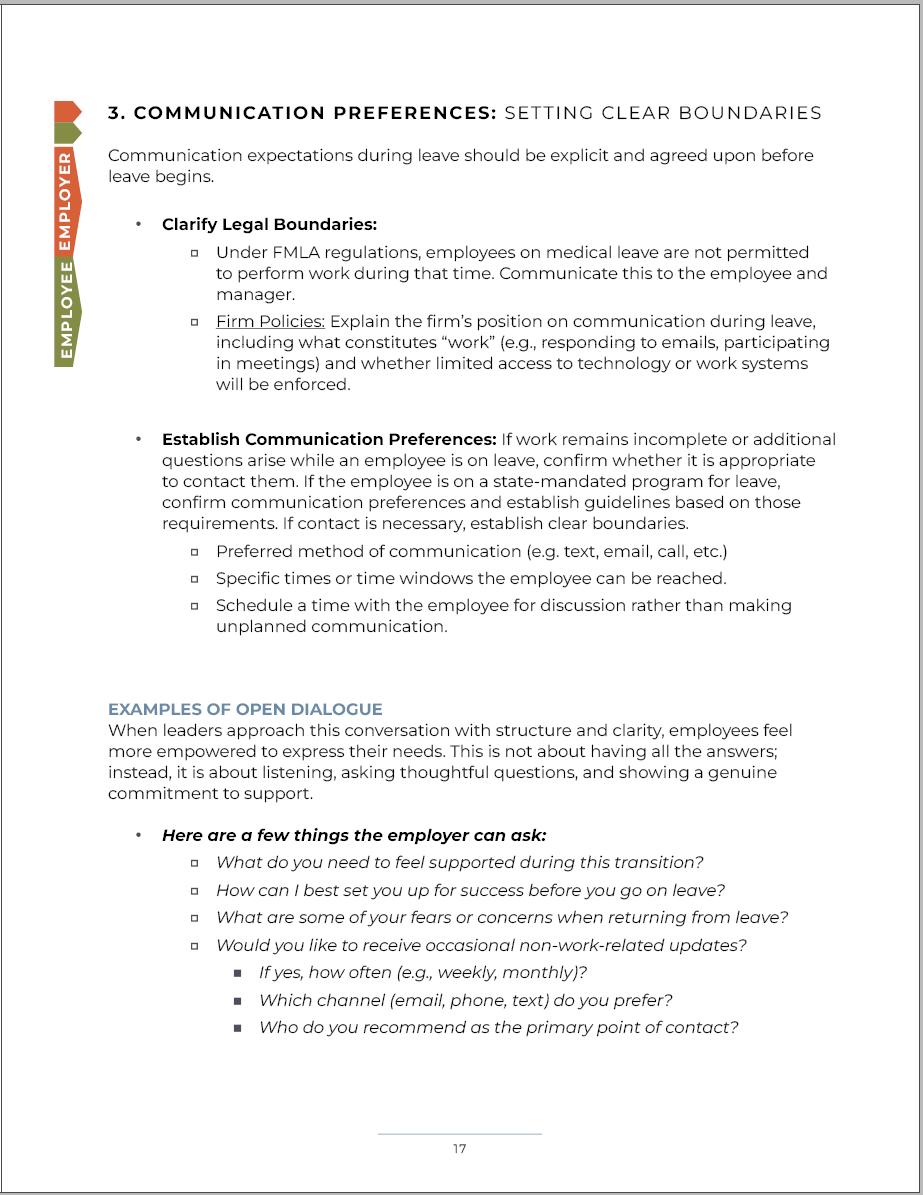
3. COMMUNICATION PREFERENCES: SETTING CLEAR BOUNDARIES
Communication expectations during leave should be explicit and agreed upon before leave begins.
• Clarify Legal Boundaries:
□ Under FMLA regulations, employees on medical leave are not permitted to perform work during that time. Communicate this to the employee and manager.
□ Firm Policies: Explain the firm’s position on communication during leave, including what constitutes “work” (e.g., responding to emails, participating in meetings) and whether limited access to technology or work systems will be enforced.
• Establish Communication Preferences: If work remains incomplete or additional questions arise while an employee is on leave, confirm whether it is appropriate to contact them. If the employee is on a state-mandated program for leave, confirm communication preferences and establish guidelines based on those requirements. If contact is necessary, establish clear boundaries.
□ Preferred method of communication (e.g. text, email, call, etc.)
□ Specific times or time windows the employee can be reached.
□ Schedule a time with the employee for discussion rather than making unplanned communication.
EXAMPLES OF OPEN DIALOGUE
When leaders approach this conversation with structure and clarity, employees feel more empowered to express their needs. This is not about having all the answers; instead, it is about listening, asking thoughtful questions, and showing a genuine commitment to support.
• Here are a few things the employer can ask:
□ What do you need to feel supported during this transition?
□ How can I best set you up for success before you go on leave?
□ What are some of your fears or concerns when returning from leave?
□ Would you like to receive occasional non-work-related updates?
■ If yes, how often (e.g., weekly, monthly)?
■ Which channel (email, phone, text) do you prefer?
■ Who do you recommend as the primary point of contact?
DURING LEAVE
ACTIVE CARE PERIOD.
THE PERIOD IN WHICH THE EMPLOYEE IS FORMALLY RELIEVED OF SOME OR ALL PROFESSIONAL DUTIES ON A FULL-TIME OR PART-TIME BASIS, WHILE THE EMPLOYER MAINTAINS RESPONSIBILITY FOR WORKLOAD REDISTRIBUTION, PROJECT CONTINUITY, AND COMPLIANCE WITH APPLICABLE POLICIES.
DURING LEAVE
SECTION STRUCTURE
1. TYPES OF LEAVE DURING THIS PHASE
2. ONBOARDING PLAN
• Align On Priorities
• Accommodations For Caregivers
• Document & Share Plan
3. RETURN TO WORK MEETING PREP
• Prepare Updates
• Restore Access
• Create An Agenda
• Examples Of Open Dialogue
4. PLAN SUPPORTIVE CONVERSATIONS WITH THE TEAM
• Communicate The Onboarding Plan
• Support Gradual Reintegration
• Normalize The Transition
• Monitor And Adjust
DURING LEAVE
MAINTAINING TRUST AND CONTINUITY
The during-leave phase bridges pre-leave planning and post-leave reintegration. This period is often life-changing for the employee. For leaders, it allows them to model trust and consistency by honoring agreements, maintaining clarity, and creating confidence for everyone involved.
Successful reintegration starts while the employee is still on leave. Laying the groundwork early ensures a smoother transition back to work, reduces miscommunication, maximizes efficiency and productivity, and shows employees they are valued and prioritized.
1. TYPES OF LEAVE DURING THIS PHASE:
A
FULL-TIME LEAVE
• Responsibilities: Employees are fully relieved of work duties. Leadership should formally transition tasks to colleagues or arrange temporary coverage to prevent gaps.
• Communication: Limit updates to essential information only. Optional check-ins can be scheduled to keep employees aware of major developments without creating work obligations.
• Actionable Tips:
□ Assign a point of contact for essential updates.
□ Document delegated assignments clearly for both the team and returning employee.
□ Establish and respect boundaries
B PART-TIME LEAVE
• Responsibilities: Employees maintain reduced hours or flexible schedules while balancing caregiving duties.
• Communication: Collaboratively define what work is expected and when employees should be available.
• Actionable Tips:
□ Document agreed-upon schedule, responsibilities, and check-in points.
□ Adjust deadlines and, if needed, be prepared to reassign tasks as needed to match reduced hours.
□ Ensure clarity with both the employee and the team to prevent misunderstandings.
2. ONBOARDING PLAN:
A structured onboarding plan supports both the returning employee and the organization by providing clarity, reducing overwhelm, and setting expectations for a successful transition.
Leadership and HR should prepare this plan independently and share it 1–2 weeks prior to the return-to-work meeting.
• Align on Priorities:
□ Identify the key projects and tasks requiring immediate attention.
□ Highlight which tasks can be phased in over time for part-time, gradually, or case-by-case basis for returning employees.
□ Consider temporary coverage adjustments for tasks that may be delegated. Identify the projects or jobs that require immediate attention upon the employee’s return.
• Accommodations for Caregivers: Ensure the returning employee has the resources needed to balance work and caregiving simultaneously.
• General Caregivers Support:
□ Flexible Scheduling: Adjust start and end times of the workday, allow breaks, or implement staggered hours to accommodate caregiving responsibilities.
□ Gradual Return To Work: A slow reintegration helps reduce fatigue and emotional stress, especially for employees who have been away for an extended period or are returning from parental leave. Examples:
■ Half-days of meetings and reintegration during the first few days to handle logistics and reconnect with colleagues.
■ Reduced workweek at full pay, if feasible, to ease the transition.
□ Remote/Hybrid Options: Allow remote work when possible to balance caregiving demands.
□ Time-Off Adjustments: Provide flexibility for appointments or caregiving emergencies.
□ Physical or Environmental Supports: Ensure ergonomic setups, private spaces, or equipment necessary to perform work comfortably while caregiving.
□ Site Visits & In-Person Meetings: Coordinate support for site visits with caregiving needs (e.g. medical appointments, child pick-up, etc.) Avoid holding key team meetings on off days for part-time employees.
• Nursing Parent Specific Support:
□ Pumping Accommodations: To support nursing parents returning to work, provide accommodations that comply with the Fair Labor Standards Act (FLSA) and the Providing Urgent Maternal Protection (PUMP) for Nursing Mothers Act. These are laws that offer employees:
■ Reasonable break time to pump breastmilk for up to one year after childbirth.
■ Private space that is not a bathroom, shielded from view, and free from interruption.
■ Optional Enhancements: Refrigeration, sink access, and electrical outlets for pumps.
□ Flexible Scheduling: Clarify expectations, availability, and preferred types of support through conversation that fosters alignment and minimize misunderstandings. Individuals differ in what they feel comfortable handling independently versus where they may want support and encourage open dialog. Coordinate breaks for pumping or other nursing needs. It is recommended that the employee block these times on their work calendar to help prevent meeting conflicts.
□ Site Visits & In-Person Meetings: Coordinate support in coordinating pumping accommodations during on-site meetings, if desired.
•
Document & Share Plan:
□ Email the onboarding plan in advance and schedule Return-to-Work Meeting.
□ Allow time for feedback, questions, and clarifications.
□ Confirm accommodations and expectations are clear for both employee and employer.
3. RETURN-TO-WORK MEETING PREP:
The Return-To-Work Meeting, is a structured opportunity to align expectations, review updates, and address questions or concerns.
• Prepare updates: Summarize team or company updates during the employee’s leave.
□ Key organizational items:
■ Team structure updates
■ Policy or process changes
■ Project milestones
■ Any highlights or stories that impacted the culture
□ Providing updates can increase feelings of inclusion, closing the gap in time where the employee missed being a part of the firm.
• Restore Access: Confirm all technology, systems, and accounts are fully operational.
• Create an Agenda:
□ Welcome Back & Role Clarity: Share updates about responsibilities and projects.
□ Review Onboarding Plan: Walk through phased reintegration and accommodations.
□ Open Dialogue: Ask about questions, concerns, and preferences for pacing and support.
EXAMPLES OF OPEN DIALOGUE
• Questions to ask the Employee:
□ Does the onboarding plan align with your expectations?
□ Are there specific priorities you would like us to address on your first day back?
□ Do you have any questions or concerns regarding your transition?
□ How can we best support you during your reintegration process?
• Questions to ask the Employer:
□ Could you clarify what my responsibilities will be while on part-time or phased return leave?
□ What accommodations or flexible scheduling options are available to support my caregiving responsibilities?
□ What does the onboarding plan for my return include, and how will priorities be phased in?
• Questions to ask the Team:
□ How can the team support a smooth transition for our returning colleague?
□ What information does the team need to hand responsibilities back effectively?
□ Are there steps we can take to make the reintegration process both efficient and welcoming?
4. PLAN SUPPORTIVE CONVERSATIONS WITH THE TEAM
Team alignment is essential to normalize reintegration, reduce stress, and maintain productivity. This is an opportunity to strengthen the organization’s culture by emphasizing that successful reintegration is a shared responsibility and collective commitment. Each team member plays a part in making the transition efficient and well-organized. This meeting should take place before the employee returns.
• Communicate the Onboarding Plan: Communicate the returning employee’s priorities, phased responsibilities, and agreed-upon accommodations with the team ahead of time. This ensures clarity on expectations and prevents confusion.
□ To the extent it has been agreed upon with the employee, share the onboarding plan and any accommodations that were agreed upon.
• Support Gradual Reintegration: Encourage team members to respect phased schedules or part-time arrangements upon the colleague’s return. Avoid assigning high-pressure tasks immediately and focus on prioritizing responsibilities during the early stages of the transition.
• Normalize the Transition: Remind team members that reintegration is a shared responsibility and that open communication is essential. Supporting team members during their reintegration period ultimately contributes to their overall success.
• Monitor and Adjust: Brief the team on the intended initial schedule, including periodic brief check-ins, and set clear expectations of flexibility to make sure the transition remains manageable and effective.
POST-LEAVE
RE-ENTRY & REINTEGRATION.
THE PHASE IN WHICH THE EMPLOYEE RESUMES PROFESSIONAL DUTIES, EITHER GRADUALLY OR FULLY, AND THE EMPLOYER PROVIDES THE STRUCTURE, RESOURCES, AND ADJUSTMENTS NECESSARY TO SUPPORT EFFECTIVE REINTEGRATION INTO THE WORKPLACE.
POST-LEAVE
SECTION STRUCTURE
1. CONDUCT A REINTEGRATION MEETING
• Reintegration Schedule
• Additional Support Measures
2. FLEXIBILITY AND CAREGIVING NEEDS
• Core Hours and Flexible Schedules
• PTO and Sick Days
• Remote Work and Hybrid Policies
• Business Travel
• Part-time Employment
3. LONG-TERM SUCCESS
• Schedule Regular Check-Ins
• Include Growth Opportunities
• Provide Continuous Feedback and Coaching
POST-LEAVE SUPPORT
REINTEGRATION AND LONG-TERM SUCCESS
The post-leave phase focuses on actively reintegrating employees into their roles, clarifying the flexibility offered, and supporting them in long-term success. This phase centers on re-establishing routines, addressing challenges as they arise, and creating a supportive environment for the returning employees and the organization. Below are ideas and suggestions to guide this phase.
1. CONDUCT A REINTEGRATION MEETING
A reintegration meeting provides an opportunity to gather feedback and refine the re-entry process after the employee returns to work. It is recommended that the reintegration meeting occur within the first week of the employee’s return.
• Reintegration Schedule: Collaboratively discuss a phased reintegration plan. Document the plan and share it with the team after the meeting. The length of each phase is to be determined by the respective firm.
□ Phase 1: Initial Transition (+/- 2 month duration)
■ Focus on critical tasks for the first month.
■ Identify responsibilities that will ease the employee back into their role.
■ Determine necessary accommodations and decide if specific responsibilities should be deferred.
■ Schedule check-ins every two weeks to monitor progress and address challenges.
□ Phase 2: Gradual Increase (+/- 2 to 4 month duration)
■ Gradually increase responsibilities.
■ Identify key meetings or tasks to prioritize.
■ Reduce check-in frequency (as needed).
□ Phase 3: Full Integration (4+ months)
■ Set goals for full workload and clarify expectations.
■ Discuss strategies to support the employee’s long-term success.
■ Consider making/ requesting quarterly check-ins as standard practice.
• Additional Support Measures:
□ Provide Support for Projects: Employers and employees should proactively communicate if additional project support is needed. This can help minimize burnout and maximize productivity.
□ Set Boundaries: If applicable, the employer should offer the employee the chance to set personalized boundaries for office work hours. Consider allowing employees to:
■ Adjust their schedules (e.g., ending the workday earlier and complete tasks later) to prioritize family.
■ Communicate their boundaries clearly to their teams and managers to ensure alignment and mutual understanding.
EXAMPLES OF OPEN DIALOGUE
• Key Questions to Ask the Employee:
□ What has worked well during your transition so far?
□ In what areas do you feel you need more support at this moment?
□ How are you managing your workload and caregiving responsibilities?
□ Are there any adjustments to your schedule or tasks that could improve your experience?
□ How can we improve the reintegration process for others in the future?
2. FLEXIBILITY AND CAREGIVING NEEDS
This section outlines options for firms to support employees returning to work while aligning with operational needs.
• Core Hours and Flexible Schedules:
□ Establish core working hours, to allow employees to adjust their start and end times to correspond to daycare drop-off and pick-up times.
□ Firm events can be adjusted to accommodate school and/or caregiving schedules.
□ Consider policies for reduced hours or part-time options with clear expectations for salary and benefits.
□ Clarify options such as a 10-hour workday, four days a week, to accommodate the caregiving schedule.
□ Clarify if dropping to 32 hours at 80% pay is a possible flexible schedule option.
□ Schedule meeting times to minimize conflicts with caregiving needs.
•
PTO and Sick Days:
□ Clearly define how PTO and sick leave policies apply to caregiving needs. Specify whether additional caregiving time is available once PTO and sick days are used. Outline any restrictions or conditions.
□ Provide flexibility for medical appointments and emergencies.
•
Remote Work and Hybrid Policies:
□ Clearly state expectations for in-office days, if any.
□ Document options for remote work for unexpected emergencies, sickness, and appointments.
•
Business Travel:
□ Discuss the employee’s ability and willingness to travel for work and whether overnight trips can be accommodated.
□ When and if possible, provide ample notice of travel requirements to allow parents and caregivers time to arrange for alternate care.
□ When planning work travel, account for scheduling and logistical needs. Identify time and private space for parents who need to express breastmilk. Verify in advance that job sites and client offices provide appropriate private accommodations.
•
Part-time Employment:
□ Discuss the possibility to return to work on a part-time schedule.
□ Identify what benefits the employee may lose access to if working on a reduced schedule, including a reduced salary.
□ Clarify the timeline and expectations for a return to a full-time schedule, if applicable.
It is important to note that implementing flexible work arrangements is optional and generally considered a benefit. Firms are encouraged to evaluate their operational capabilities and tailor any schedule requests to the company's specific needs.
3. LONG-TERM SUCCESS
After a return from leave, it is important that both employer and employee contribute to an office culture that support the long-term success of this transition. The following are steps to foster continued and sustained engagement:
• Schedule Long-Term Regular Check-Ins: Plan periodic check-ins to discuss progress, address challenges, and identify opportunities for additional support. These meetings should asses how employees balance work and personal responsibilities. Make adjustments as necessary, and offer moments of open conversation with the employer.
• Include Growth Opportunities: Proactively invite returning employees to participate in meaningful projects, leadership opportunities, and professional development initiatives. Discuss their career goals and map potential growth paths aligned with organizational priorities.
• Provide Continuous Feedback and Coaching: Ensure managers regularly offer constructive feedback and discuss strategies for building skills and achieving long-term success. The employee should also be able to provide feedback to determine if any changes are needed.
BEYOND
SUSTAINED NORMALCY. THIS PHASE IS CHARACTERIZED BY STABILITY, RENEWED PRODUCTIVITY, AND THE EMPLOYEE'S FULL RE-ENGAGEMENT WITH THEIR WORK, TEAM, AND THE ORGANIZATION. THIS STAGE MARKS A RETURN TO A "NEW NORMAL" WHERE THE ADJUSTMENTS MADE DURING THE TRANSITION HAVE BECOME ROUTINE.
BEYOND
• Support Groups
• Peer-Led Sessions
2. FEEDBACK AND TRANSPARENCY
• Conduct Regular Surveys
• Increase Policy Clarity 3. EMPLOYER-SUPPORTED CARE INITIATIVE
• Childcare Co-Ops and Daycare Partnerships
• Benefits for Caregivers
MENTORSHIP AND PROFESSIONAL GROWTH
• In-Office Ally
• In-Office Entrepreneurship
• Career Development
BEYOND
BUILDING A SUSTAINABLE CULTURE OF CARE
The “Beyond” phase focuses on long-term strategies that support parents, caregivers, and the broader workforce. This section underscores the organization’s commitment to sustainable practices that strengthen employee performance and contribute to the firm’s continued success.
1. SUPPORT NETWORKS
• Support Groups: Encourage regular support groups or events led by experienced caregivers to share advice, challenges, and approaches to problem solving based on their experiences.
• Peer-Led Sessions: Facilitate opportunities for employees to discuss best practices, caregiving strategies, and tips in a collaborative setting.
2. FEEDBACK AND TRANSPARENCY
• Conduct Regular Surveys: Gather feedback on caregiving policies, practices, and workplace culture to identify areas for improvement.
• Increase Policy Clarity: Use survey results and feedback to refine transparency around leave options, flexibility, and caregiving support.
• Work calendar updates: The employee should update their work calendar to reflect their availability during the workday, allowing the team to coordinate accordingly.
3. EMPLOYER-SUPPORTED CARE INITIATIVE
This section is expanded to include employer-supported options and steps for implementation.
• Childcare Co-Ops and Daycare Partnerships: Consider employer-supported childcare cooperatives or partner with local daycare providers to meet caregiving needs.
• Resources and Facilities
□ Supportive Facilities: To promote employees’ well-being, provide amenities such as: a privacy room equipped with table, comfortable chair, and nearby outlet, sink, mirror, as well as refrigerator.
□ Outside Resources: Consider benefits such as parenting courses, sleep consultants, mental health support resources, etc.
4. MENTORSHIP AND PROFESSIONAL GROWTH
• In-Office Ally: Pair returning parents with experienced colleagues who have navigated similar transitions to provide practical advice and career guidance.
• In-Office Entrepreneurship: Ensure employees returning from leave are included in growth opportunities, leadership development, and meaningful projects.
• Career Development: Maintain an ongoing list of professional certification opportunities for CEU’s as it may be harder for employees with atypical work schedules to attend standard events. Inform the employee of the option to apply for waiver for continuing education though the AIA.
APPENDIX
CHECKLISTS.
SELECT YOUR TYPE OF LEAVE:
EXPECTED LEAVE DURATION:
CHECKLIST
RESOURCES
STATE & FEDERAL RESOURCES ACTION PLAN
EMPLOYER THIS FORM IS BEING FILLED OUT BY: EMPLOYEE
FAMILY LEAVE
EXPECTED START DATE
CAREGIVING LEAVE
OTHER TYPE LEAVE
EXPECTED END DATE
NEEDS + RESOURCES
(CLEAR BOUNDARIES, GOALS, TIMELINES, EXPECTATIONS, ETC. - BE SPECIFIC!)
OFFICE RESOURCES
WEEK 1 WEEK 2 WEEK 3 WEEK 4
LEAVE STARTS
DURING-LEAVE
ACTION PLAN
SELECT YOUR TYPE OF LEAVE:
EXPECTED LEAVE DURATION:
FAMILY LEAVE
EXPECTED START DATE
CAREGIVING LEAVE
RESOURCES
NEEDS + RESOURCES
(CLEAR BOUNDARIES, GOALS, TIMELINES, EXPECTATIONS, ETC. - BE SPECIFIC!)
CHECKLIST MY PLAN
WEEK 1 WEEK 2
OFFICE RESOURCES
THIS FORM IS BEING FILLED OUT BY: EMPLOYEE
OTHER TYPE LEAVE
EXPECTED END DATE
STATE & FEDERAL RESOURCES
WEEK 3 WEEK 4
EMPLOYER
LEAVE ENDS
POST-LEAVE
SELECT YOUR TYPE OF LEAVE:
EXPECTED LEAVE DURATION:
CHECKLIST
RESOURCES
STATE & FEDERAL RESOURCES ACTION PLAN
EMPLOYER THIS FORM IS BEING FILLED OUT BY: EMPLOYEE
FAMILY LEAVE
EXPECTED START DATE
CAREGIVING LEAVE
OTHER TYPE LEAVE
EXPECTED END DATE
NEEDS + RESOURCES
(CLEAR BOUNDARIES, GOALS, TIMELINES, EXPECTATIONS, ETC. - BE SPECIFIC!)
OFFICE RESOURCES
WEEK 1 WEEK 2 WEEK 3 WEEK 4
BEYOND LEAVE