Dynamic Model (3)
page(7)
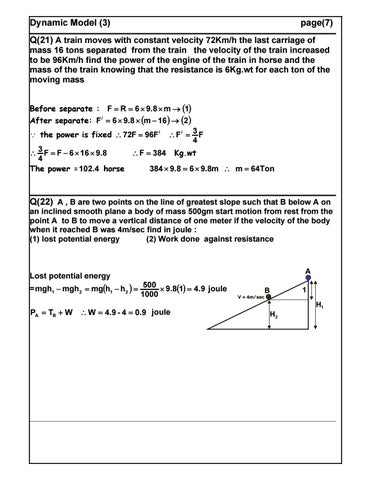
Q(21) A train moves with constant velocity 72Km/h the last carriage of mass 16 tons separated from the train the velocity of the train increased to be 96Km/h find the power of the engine of the train in horse and the mass of the train knowing that the resistance is 6Kg.wt for each ton of the moving mass Before separate : F = R = 6 × 9.8 × m → (1) After separate: F / = 6 × 9.8 × (m − 16 ) → (2 ) ∵ the power is fixed ∴ 72F = 96F /
∴ F/ = 3 F 4
∴ 3 F = F − 6 × 16 × 9.8 ∴ F = 384 Kg.wt 4 The power = 102.4 horse 384 × 9.8 = 6 × 9.8m ∴ m = 64Ton
Q(22) A , B are two points on the line of greatest slope such that B below A on an inclined smooth plane a body of mass 500gm start motion from rest from the point A to B to move a vertical distance of one meter if the velocity of the body when it reached B was 4m/sec find in joule : (1) lost potential energy (2) Work done against resistance
A
Lost potential energy = mgh1 − mgh2 = mg(h1 − h2 ) = 500 × 9.8(1) = 4.9 joule 1000
PA = TB + W ∴ W = 4.9 - 4 = 0.9 joule
V = 4m / sec
1
B
H1 H2
Dynamic Model (4)
page(1)
Q(1) particle moves in a straight line such that its acceleration (a) is given in terms of the algebraic measure of its position X by the relation a = 2 X + 5, given that the initial velocity of the particle is 2m/sec then x when V = 4 m/sec
c -6 ∵ a = V dV dX
d6
or 1
∴ V dV = 2X + 5 ∴ dX
2
V − 2 = X2 + 5X 2
2
e6
or 1 V
∫ VdV = ∫ 2
X
0
f-3
or 5
or 2
V
2 (2X + 5 )dX ∴ ⎡⎢ V ⎤⎥ = X 2 + 5 X ⎣ 2 ⎦2
∴ V = X + 5 X + 2 when V = 4 ∴ X + 5 X + 2 = 8 ∴ X + 5 X − 6 = 0 2 2
2
2
Q(2) If V (t) = 9.8t + 5 where X (0) = 10 , then X (10)
c0
d 530
e540
[
f550
dX = 9.8t + 5 ∴ XdX = t (9.8t + 5 )dt ∴ [X ]X = 4.9t 2 + 5 t 10 ∫10 ∫0 dt X − 10 = 4.9t 2 + 5 t ∴ X = 4.9t 2 + 5 t + 10 ∴ X (10 ) = 550
]
t
0
Q(3) The momentum of a car whose mass is 2 tons moving in a straight line at velocity 54km/ h is:………..……
c108ton.m/sec d3000Kg.m/sec e30000Kg.m/sec f10800Kg.m/sec H = MV = 2000 × ⎛⎜ 54 × 5 ⎞⎟ = 30000 18 ⎠ ⎝
Q(4) If a body of mass 20 Kg.wt lands with a uniform velocity on an inclined plane to the horizontal with angle of measure 30º, then the resistance of the plane in Kg.Wt equals:
c0
d10
e10 3
f20
r = mg sin θ = 20 sin 30 o = 10
Q(5) If a body of mass 30 gm is let to fall from a height of 10 meters above
the ground surface, then the kinetic energy of this body = when it is about to collide with the ground.
c3
d2.94
mgh = 0.03 × 9.8 × 10 = 2.94 joule
e2940
................
f300
Joules
Dynamic Model (4)
page(2)
Q(6) body is suspended by a string in a spring scale fixed at the top of a lift moving upwards. If the magnitude of tension in the string during ascending with an increasing acceleration of magnitude 2.45 m/sec2 is equal to 50 Kg.Wt, then the mass of the body equal ……..…?
c70
d40
e60
f50
50 × 9.8 = m(9.8 + 2.45 ) ∴ m = 40Kg
Q(7) In the opposite figure : smooth pully and the plane is smooth : The acceleration of the system when moving equlas
c2g 3
d3g 2
f2g
e 1g 2
2Kg − T = 2Ka → (1) , T = Ka → (2 ) ∴ 2Kg = 3ka ∴ a =
K
2g 3
2K
Q(8) A body is paced on a horizontal plane it attached by two horizontal ropes
the angle between them60o if the tension forces are 3 Newton and 5 Newton. The body moves in a straight with uniform motion. Then the magnitude the resistance.
c7Newtons d8Newtons e9Newtons f10Newtons F = r = 3 2 + 5 2 + 2 × 5 × 3 × cos 60 o = 7Newtons
Q(9) Two spheres of masses 2Kg and 3Kg moving in a straight line in the same direction with velocities 3m/sec , 2m/sec they collide and form one body , the velocity of this body equals …………….…..m/sec
c5m/sec 2 × 3 + 3 × 2 = (2 + 3 )V /
d4m/sec ∴ V / = 2.4m / sec
e2.4m/sec
f2m/sec
Dynamic Model (4)
page(3)
Q(10) The opposite figure illustrates the action of a variable force on a body, then the total work done by this force From S = 8 to S = 14
c-6joule e12joule W=
14
∫8
F(Newton)
d15joule f16joule
S(meter )
FdS = area under the curve
1 × 2 × 6 − 1 × 4 × 6 = −6 2 2 Q(11)A 10gm bullet moving with velocity 1000m/sec strikes and passes through a 2 Kg block the bullet emerges from the block with a speed 400m/sec then the maximum height will the block rise above its initial position ……..m 45 d 43 e 23 98 98 90 0.01 × 1000 + 2 × 0 = 2 × V + 0.01 × 400 ∴ V = 3m/sec 2 2 2 V = V02 − 2gS ∴ 0 = 3 − 2 × 9.8 × S ∴ S = 45 m 98
c
f
49 98
Q(12) A body is placed on the top of a smooth inclined plane of height 90 cm , then its velocity as it reaches the bottom of the plane =............................ m/sec
c 4.5m/sec d 4m/sec mgh = 1 mV 2 ∴ 9.8 × 0.9 = 1 V 2 2 2
e 4.2m/sec f 4.1m/sec
∴ V = 4.2m/sec
Q(13) If the power of an engine at any time measured in seconds is equal to (9t 2 + 4t), , then the work done during the fourth second.=……..joules
c 120 W=
∫3 (9t 4
2
d124
e 125
f 130
)
+ 4 t dt = 125
Q(14) A cannon of mass 250Kg shots a bullet of mass 10Kg with a velocity 100m/sec then the reaction velocity of the cannon equals
c 0.4m/sec d 4m/sec 250 × V = 10 × 100 ∴ V = 4m/sec
e 100m/sec f 10m/sec
Dynamic Model (4)
page(4)
Q(15) A horizontal force of magnitude 42Kg.wt acts on a body at rest placed on a rough horizontal ground .the body move a distance 22.05meters in 3 seconds .then the force is removed and the body came to rest after covering another 44.1meter find First : the mass of the body Second : the magnitude of the resistance in Kg.wt , t = 3 sec ∴ S = Vo t + 1 at 2 ∴ 22.05 = 0 × 3 + 1 a × 32 2 2 2 ∴ a = 4.9m/sec , V = Vo + at ∴ V = 0 + 4.9 × 3 = 14.7m / sec
Vo = 0 , S = 22.05
∴ 22.05 = 9 a 2 F − r = ma ∴ 42 × 9.8 - r = m × 4.9 → (1) / / After removing the force ∴ - r = ma and to get a
Vo = 14.7 , V = 0 , S = 44.1 ∴ V = Vo2 + 2aS ∴ 0 = 14.7 + 2 × a × 44.1∴ a = −2.45m / sec ∴ r = 2.45m substitut in (1) ∴ 7.35m = 411.6 ∴ m = 56Kg ∴ r = 2.45 × 56 = 137.2N = 14Kgwt 411.6 − 2.45m = 4.9m 2
2
2
Q(16) A body is placed on the top of a rough inclined plane of length 250cm. and height 150cm. The body starts sliding down the plane, if the coefficient of friction is 1 , find the acceleration of the body ,its speed after it has moved 200 cm on the 2
plane , and if the body be projected from the lowest point, find the minimum speed of projection so that the body reaches the highest point.
R = mg cos θ ∴ mg sin θ − μR = ma 3 1 4 mg × − × mg × = ma ÷ m 5 2 5 3 4 g− g=a ∴ a = 1.96m/sec 2 5 10
R μR
− μR − mg sin θ = ma 1 4 3 − × mg × − mg × = ma / ∴ a / = −9.8m / sec 2 2 5 5 U=? , V = 0 , S = 2.5m , a = −9.8m / sec 2
θ
sθ
If the body projected to reach heights point :
θ
150cm
∴ V = 2.8m/sec
θ
co
V 2 = 2 × 1.96 × 2
s mg
mg
in
Its speed after 250cm /
V 2 = U2 + 2aS
∴
0 2 = U2 − 2 × 9 . 8 × 2 . 5 ∴ U =
mg 49 = 7m/sec 2
Q(17) A ball of mass 1500 gm falls down from a height of 2.5 meters on a viscous liquid surface to embed in it with a uniform velocity and travels for a distance of 70 cm in 0.2 of a second. Calculate the magnitude of the impulse of the liquid on the ball. 2
2
V = Vo + 2gS
2
∴ V = 0 + 2 × 9.8 × 2.5 = 49 ∴ V = 49 = 7m/sec
inside the liquid : V = 0.7 = 3.5m / sec 0 .2
∴ I = 1.5(3.5 − 7 ) = −5.25Kg.m / sec
Dynamic Model (4)
page(5)
Q(18) A body of mass 60gm is tied to a string and placed on a smooth plane
which makes an angle of measure 30o with the horizontal. The string passes over a small smooth pulley at the top of the plane, and holds a body of mass 40gm vertically below the pulley, find (a) The tension in the string. (b) Find the acceleration of the system, (c)Find also the pressure on the pulley. (d)If the system starts its motion from rest when the body on the plane is at a distance 196cm from the pulley, when does the body reach the pulley? With respect to40gm With respect to 60gm
40 × 980 − T = 40a → 1
T − 60g sin 30o = 60a → 2 ∴ 40 × 980 − 60 × 980 × 1 = 40a + 60a 2
By adding 1,2
T o
0
θ
3 os
Part (d) With respect to the body 60gm
g 60
o
0
3 sin
gc
∴ a = 98cm/sec ∴ T = 35280 dyne
T 60
9800 = 100a
2
R
40g
θ The mass will now move with acceleration 98cm/sec2 To cover the distance 196cm ∵ the motion start from rest 2 2 2 S = Ut + 1 at ∴ 196 = 0 + 1 × 98 t ∴ 49 t = 196 2 2 2 ∴ t = 4 ∴ t = 4 = 2 sec P = 2T cos 60 = 35280 3dyne 2
60g
Q(19) A rough inclined plane of length 250 cm and height 150 cm, body at rest is placed on it to slide downwards the plane and the acceleration of motion is equal to 196 cm/sec2. Find the coefficient of the kinetic friction, then find the velocity of the body after it travels (cuts) 200 cm on the plane. 2
2
2
A
2
150cm
velocity at B V = Vo + 2aS ∴ V = 0 + 2 × 1.96 × 2.5 = 9.8
PA = TB + W
2 θ ∴ mg × 1.5 = 1 mV + μK (mg cos θ ) × 2.5 2 B 200cm 200 1 × 2 .5 ∴ 9.8 × 1.5 = × 9.8 + μK × 9.8 × 2 250 1.5 = 0.5 + 2μK ∴ μK = 1 2 2 V = 0 + 2 × 1.96 × 200 ∴ V = 28m / sec Q(20) an inclined smooth plane a body of mass 400gm is projected from the
lowest point with a velocity 14m/sec up the plane find its potential energy when its velocity become 3.5m/sec then find its height from ground it this moment TB = PA + TA 1 × 0.4 × 14 2 = P + 1 × 0.4 × 3.5 2 A 2 2 ∴ PA = 36.75 joule 0.4 × 9.8 × h = 36.75 j ∴ h = 9.375m
3.5m / sec A
S 14m / sec B
θ
h
Dynamic Model (4)
page(6)
Q(21) A body of mass 300 gm is placed at the top of an inclined plane whose height is 1m. Find the velocity with which the body reaches the bottom of the plane knowing that the work done by the resistance force of the plane to the motion is equal to 1.59 Joules.
PA = TB + W ∴ 0.3 × 9.8 × 1 = 1 × 0.3 × V 2 + 1.59 2 2 ∴ V = 9 ∴ V = 3m / sec
Q(22) Vertical target formed of two layers the thickness of the first 7cm and the thickness of the second 14cm Two bullets of equals mass are fired on the target with the same velocity in two opposite directions the first penetrate the first layer and penetrate 5cm from the second the second bullet penetrate the second and cover 1cm in the first find the ratio between the resistance of the two layers 1 mV 2 = 7r + 5r 1 2 2
, 1 mV 2 = 14r2 + r1 2
∴ 7r1 + 5r2 = 14r2 + r1 ∴ 6r1 = 9r2
∴
7cm
r1 9 3 = = r2 6 2
1cm
5cm
14cm
Q(23) A car of mass 5 tons moves with uniform velocity of magnitude 36 km/h
1 to the horizontal against the 40 resistance equivalent to2.5% of the car’s weight. Find the power of the engine in horse. If the power of engine suddenly increases to 50 horses, find the magnitude of the car’s acceleration directly after this increase
ascending aslope inclined at tangle of sine
F = mg sin θ + 2.5 mg sin θ 100 ∴ F = 5000 × 9.8 × 1 + 5000 × 2.5 × 9.8 = 1225 + 1225 = 2450 40 100 P = F × V = 2450 × 36 × 5 = 24500 = 100 horse 18 9.8 × 75 3 / / 50 × 75 = F × 10 ∴ F = 375Kg.wt / F − R − mg sin θ = ma 2 375 × 9.8 − 125 × 9.8 − 5000 × 1 × 9.8 = 5000a ∴ a = 0.245m/sec 40
Dynamic Model (5)
page(1)
Q(1) A particle moves in a straight line its velocity vector is given by
(
)
The relation V = 1 400 − X 2 where x expresses the algebraic 20 measure of the position, the algebraic measure of the acceleration of motion when X=10
c20
d15
(
)
e-25
f-15
2 a = dV = dV × dX = V dV = 1 400 − X × − 1 X at X = 10 dt dX dt dX 10 20 ∴ a = −15
Q(2) The force F = 2 î + 7 ĵ acts on a body of mass 5 kg for 10 seconds when its velocity vector V = î − 2 ĵ . then its velocity after the action of the force is …….. c10m/sec d11m/sec e12m/sec f13m/sec
) [ (
(
)]
(
F • t = m(V − Vo ) ∴ 10 2 î + 7 ĵ = 5 V − î − 2 ĵ ∴ 20 î + 70 ĵ = 5 V − 5 î − 20 ĵ ∴ 5 V = 25i + 60 j
2
)
2
∴ V = 5 + 12 = 13
∴ V = 5 î + 12 ĵ
Q(3) A body of a mass 500 gm is let to fall from a height of 4.9 meters on the ground surface, then its momentum as it comes the ground is:
c2.45Kg.m/sec d4.9Kg.m/sec e2450Kg.m/sec f4900Kg.m/sec 2
2
Vo = 0 ∵ V = 0 + 2 × 9.8 × 4.9 ∴ V = 9.8m/sec H = mV = 0.5 × 9.8 = 4.9Kg.m/sec
Q(4) A car of mass 8 tons moves with a uniform velocity under the action of a constant resistance of a magnitude 6 Kg.Wt per each ton of its mass. Then the force of the car's engine equal …………Kg.wt
c45
d 48
e98
f109
6 × 8 = 48
Q(5) A variable force F (measured in Newton) acts up on a body where F = 3S 2 - 4 , find the work done by this force in the interval from S = 2 m to S = 5 m.
c107 joule 5
W = ∫2 FdS =
∫ (3S 5
2
2
d 105 joule e106 joule
)
[
3
]
5
− 4 dS = S − 4S 2 = 105 joule
f100 joule
Dynamic Model (5)
page(2)
Q(6) A man of mass 70 kg is inside an electrical lift of mass 420 kg. If the lift moves vertically upwards with an acceleration of magnitude 70 cm/sec2, then in Kg.Wt the tension in the rope carrying the lift equals ….Kg.Wt
c455 d450 e525 f400 T = m(g + a ) = (70 + 420 )(9.8 + 0.7 ) = 5145 ÷ 9.8 = 525Kg.wt Q(7) A body of mass 2Kg is projected with velocity 1.4m/sec upwards along the line of greatest slope of a smooth inclined plane whose inclination to the horizontal is
θ where sin θ = 1 then the distance covered by the body 98
until it stop
c13m
d12m
e9.8m
n
tio
ec
ir nd
tio
mo
in
θ
θ
os
gc
s mg
m
θ
θ
2 − mgsinθ = ma ∴ a = − gsinθ ∴ a = −9.8 × 1 = −0.1 m/sec 98 2 2 2 V = Vo 2 + 2aS ∴ 0 = 1.4 − 2 × 0.1× S ∴ S = 9.8m
f10m
mg
Q(8) In the opposite figure, 3 m and 3m are two masses connected by two ends of a string passing over a smooth small pulley. An additional mass m is attached to one of the two masses. If the system is let to move from rest, then the velocity of the system after 2 seconds = ..................cm/sec.
c140 a=
d280
e980
f490
m1 − m2 g ∴ a = 4m - 3m g = 1 g = 1.4m / sec 2 ∴ V = 0 + 1.4 × 2 = 280cm/sec m1 + m2 4m + 3m 7
Q(9) body of mass 4 kg placed at rest on a smooth horizontal plane and is acted upon by a horizontal force of magnitude 5 new tons for 8 seconds. Then the impulse magnitude on the body and the velocity magnitude of the body after 8 seconds. Equals …….m/sec
c9.8 5 × 8 = 4(V − Vo )
d4.9 ∴ 40 = 4(V − 0 )
e19.6
f10
∴ V = 10m/sec
Q(10) The time taken by a car of mass 1200 kg to reach the velocity 126 km/h from rest. If the power of the engine is constant and equal to 125 horses.
c5sec
d6sec
e7sec
f8sec
W = ∫0 Pdt = ∫0 (125 × 75 × 9.8)dt = 91875 t t
t
∵work = change in kinetic energy
(
)
2
1 m V 2 − V 2 = 91875 t ∴ 1 × 1200⎛⎜ 126 × 5 ⎞⎟ = 91875 t o 2 2 18 ⎠ ⎝
∴ t = 8 sec
Dynamic Model (5)
page(3)
Q(11) A force of magnitude 5Kg.wt acts on a body at rest of mass 5Kg for 3 seconds the velocity of the body after this period equals…..
c28.4m/sec d27.4m/sec e30m/sec
f29.4m/sec
5 × 9.8 = 5a ∴ a = 9.8 V = Vo + at → V = 0 + 9.8 × 3 = 29.4m / sec
Q(12) A ball of mass 100 gm moves horizontally with velocity 9 m/sec to collide with a vertical wall and rebound back with velocity of magnitude 7.2 km/ h If the contact time of the ball with the wall is 1 of second, then the pressure of the 10 ball on the wall……..……….N
c11
d11.98
e11
f11.1
I = F × t = m(V − Vo ) ∴ F × 1 = 0.1⎛⎜ 9 + 7.2 × 5 ⎞⎟ 18 ⎠ 10 ⎝ ∴ F = 11N ∴ P = F = 11
Q(13) A sphere of mass 5Kg move in a straight line with velocity 6m/sec collide with another sphere at rest of mass 8Kg it move it with velocity 5m/sec then the velocity of the first sphere after collide equals
c5m/sec
d-2
5 × 6 + 8 × 0 = 8 × 5 + 5 × V1
/
m/sec
e3
m/sec
f-4
m/sec
/
∴ V1 = −2m / sec
Q(14) A force F = 3t + 1acts upon a body at rest of mass, 4 kg starting its motion at the origin point "O" on the straight line. The velocity of the body after 2secons equals
c 2m/sec
∫
d 4m/sec
m dV = 3t + 1 ∴ mdV = dt after 2seconds
∫
(3t + 1)dt
e 6m/sec 2 ∴4V = 3 t + t 2
2 ∴ 4 V = 3 × 2 + 2 = 8 ∴ V = 2m/sec 2
f 8m/sec