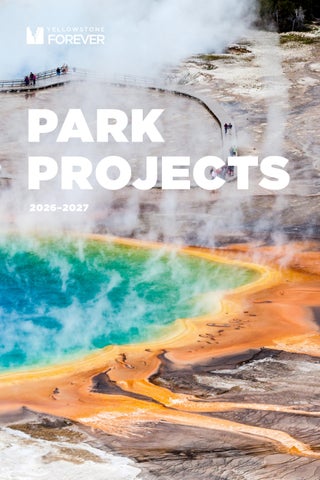
PARK PROJECTS

PARK PROJECTS
2026–2027

INTRODUCTION
Yellowstone Forever is the official nonprofit partner of Yellowstone National Park. Our mission is to protect, preserve, and enhance Yellowstone through education and philanthropy.
We raise money to fund priority projects that protect Yellowstone’s ecosystem and wildlife, preserve the park’s heritage, history & trails, and enhance visitor education and experiences. We offer educational programs for visitors of all ages through the Yellowstone Forever Institute, and operate 10 educational Park Stores in and around Yellowstone.
Yellowstone’s natural beauty—from its vibrant geothermal features to its sweeping valleys and wild landscapes—inspires millions of visitors each year. As we commemorate America’s 250th anniversary, this extraordinary place serves as a powerful reminder of the essential role our national parks play—and of our shared responsibility to preserve these American treasures for future generations.
As the park’s official nonprofit partner, Yellowstone Forever plays a vital role in advancing critical work throughout the park—from wildlife conservation and scientific research to visitor education, youth engagement, and the preservation of irreplaceable cultural resources.
We are pleased to share a portfolio of priority projects that Yellowstone Forever is supporting this year. Each initiative addresses a pressing need and represents meaningful progress toward protecting, preserving, and enhancing Yellowstone National Park for generations to come.
Thank you for your continued commitment to this exceptional place and for helping ensure that Yellowstone National Park remains resilient—now and into the future.

Lisa Diekmann President & CEO

Cam Sholly Superintendent
Yellowstone Forever
Yellowstone National Park
PROTECT
Yellowstone National Park has one of the most incredible ecosystems in the world. It is home to more than 10,000 thermal features, the largest concentration of mammals in the lower 48 states, and endless rivers, lakes, and trails. But this ecosystem needs constant protection from increased visitation, changing climate, invasive species, and more. Yellowstone Forever funds projects that conserve native wildlife, biodiversity, and contribute to a healthy and resilient environment for the future.


FUNDRAISING GOAL:
$1,000,000


YELLOWSTONE WOLF PROJECT
The return of wolves to Yellowstone in the mid1990s ignited a conservation legacy that continues to shape the park today. The reintroduction of 31 gray wolves to Yellowstone National Park began the restoration of this keystone species, absent from the landscape for nearly 70 years. Since then, the Yellowstone Wolf Project has grown into one of the most comprehensive and enduring studies of any large carnivore on Earth—now spanning three decades of continuous research and offering unparalleled insight into wolf ecology and ecosystem dynamics.
This ongoing project is world-renowned and crucial to understanding the role of wolf packs in Yellowstone’s ecosystem. Year-round field research allows biologists to collect data on wolf population dynamics, predator-prey interactions, social behavior, genetics, disease, multi-carnivore competition, ecosystem impacts, and humanwolf relationships. New advances in noninvasive monitoring techniques, including bioacoustics and advanced remote cameras, continue to expand opportunities to study the complex lives of the park’s wolf packs. Over time, this work has culminated in a leading wildlife program at the forefront of carnivore science and conservation.
The dedicated Wolf Project team plays a vital role in educating and engaging visitors, powered by the expertise of skilled technicians, research associates, and graduate students. Together, they advance the park’s mission to understand and preserve native species and ecological processes—work that also shapes wolf conservation strategies around the world. This effort is only possible because of Yellowstone Forever. Without private support, the Yellowstone Wolf Project simply could not operate. Continued philanthropic investment is essential to sustaining this iconic, influential program and the science that guides it.
BISON CONSERVATION TRANSFER PROGRAM
Few sights inspire Yellowstone visitors more than a newborn, red-hued bison calf pressed against the monumental frame of its mother. Minutes after being born, this young calf can stand, walk, and before long, is frolicking in green valleys. Their survival is dependent on the protection of the herd, who work together to fend off predators, ford rivers, forage, and thrive on Yellowstone’s immense landscapes.
Yellowstone’s bison descended from the final surviving wild bison herd in North America and represent the last truly wild and free-ranging population of plains bison in existence today. The sight of a massive herd of North America’s largest land mammal is like taking a step back in time when an estimated 30 to 60 million bison roamed the grasslands and plains of North America. In the early 1900s, there were only about two dozen Yellowstone bison remaining before these icons of the American West were brought back from the brink of extinction—one of the greatest success stories in the history of wildlife conservation.
Decades in the making, the Bison Conservation Transfer Program is a collaborative effort to support the continued natural and cultural conservation of this iconic species. Through this program, Yellowstone bison that are identified as brucellosisfree through a quarantine process are transferred to establish new Tribal and conservation herds across North America, as an alternative to being
sent to slaughter. Since its inception, the program has successfully transferred 625 bison to more than 29 Tribes across 13 states and one Canadian province. With expanded capacity to move 100–300 bison annually and a new park management plan prioritizing this work, the program strengthens Yellowstone’s leadership in wildlife conservation while fostering Tribal partnerships and honoring cultural connections to bison.
Yellowstone Forever also supports the Bison Conservation Tribal Internship Program. Coordinating with Yellowstone National Park and the InterTribal Buffalo Council, Tribal interns work alongside National Park Service staff for six months to experience hands-on training and learn all aspects of caring for and testing bison within the park’s quarantine facility. These apprentices are then able to take that knowledge back to their Tribes to help reestablish and support Yellowstone bison herds on Tribal lands throughout North America.
Continued financial support ensures the Bison Conservation Transfer Program can operate at full capacity, maintain the quarantine facility, and meet growing demand from Tribes. Without Yellowstone Forever funding, the park would be unable to uphold its commitment to returning bison to Tribal lands, limiting progress on one of Yellowstone’s most impactful conservation and cultural initiatives. FUNDRAISING GOAL: $350,000

BEAR CONSERVATION & MANAGEMENT PROJECT

2025 BEAR JAM STATS
1,527 TOTAL
1,278 (84%) managed by park staff
249 (16%) not managed by park staff
When sunrise softens the edges of Yellowstone’s vast terrain, the landscapes slowly reveal the powerful creatures that call it home. A grizzly’s silvered hump emerges, glistening as it lumbers along through the valley in search of fresh food. Yellowstone’s great wilderness supports an incredible diversity of wildlife, and sightings of grizzly and black bears remain among the most unforgettable moments for visitors. Each species plays a vital role in holding this ecosystem in balance.
The park began documenting bear activity in 1931, and in the 95 years since, our understanding of these remarkable animals has transformed. Gone are the days when bears rummaged through open dumps or were fed by eager tourists leaning out of car windows. Today, Yellowstone’s Bear Conservation and Management Program stands as a cornerstone of wildlife stewardship, dedicated to sustaining healthy populations of grizzly and black bears while minimizing human influence.
SPECIES OF BEARS MANAGED

455 (36%) grizzly bears
821 (64%) black bears
The Bear Management team collects essential data — tracking population trends, food sources, movement patterns, and causes of mortality. Funding for this program drives conservation work, scientific research, and proactive strategies that help ensure safe and responsible interaction between bears and people. The program also carefully manages roadside bear-viewing opportunities, balancing visitor excitement with the protection these animals deserve.
In 2025, there were 1,527 bear-jams, a new record high for Yellowstone. Park staff managed people, traffic, and bears at 1,278 (84%) of the 1,527 bear-jams reported providing park visitors with a safe and enjoyable bear viewing experience.
“The Bear Conservation Project has significantly reduced visitorbear conflicts and human-caused bear mortalities in the park despite significant increases in park visitation,” says Yellowstone’s bear management
biologist Kerry Gunther. “Reducing human-bear conflicts makes visitors experience safer and more enjoyable while also reducing the number of bears that are killed in management actions to protect visitors and their property. The high cub production in the park combined with the park’s very low number of humancaused mortalities has contributed significantly toward the conservation and recovery of grizzly bears in the Greater Yellowstone Ecosystem.”
The foundation of bear management is the implementation of proactive measures that lessen the underlying causes of bear-related conflicts and decrease management problems on a long-term basis. Because of this ongoing commitment, Yellowstone remains one of the greatest places in the lower 48 states to witness grizzly and black bears living wild, free, and truly at home on the landscape.
FUNDRAISING GOAL: $425,000

BEAR-PROOF FOOD STORAGE BOXES
Keeping Yellowstone’s bear populations safe includes preventing bears from obtaining and becoming conditioned to human food. This is a top priority of Yellowstone’s wildlife managers, and the park emphasizes the importance of bear-proof food storage to ensure the safety of both visitors and bears. Installing sturdy steel bear-proof food storage boxes featuring bear-resistant locking mechanisms prevents bears from accessing human food or other attractants such as toiletries and scented items.
This project aims to purchase and install bear-proof food storage boxes at every campsite in Yellowstone’s public campgrounds and employee trailer courts. These boxes make compliance with food storage regulations easy and convenient. Bear boxes improve visitor safety and ensure a safe camping experience for all. This ongoing project depends exclusively on funding from donors. By preventing human-bear conflicts, the project protects bears from being relocated or euthanized, enhances visitor safety, and improves the overall camping experience.
To date, 1,678 bear boxes have been installed, but there is still work to be done. The park’s overall goal is to install 2,147 bear boxes to complete all public campsites and employee trailer courts. Financial support for this project is crucial to install the remaining 469 bear boxes. Support for this project will protect bears and safeguard people.


FUNDRAISING GOAL: $297,890
NATIVE FISH CONSERVATION PROGRAM
For years, the story of Yellowstone has included a quiet, determined effort to bring the native cutthroat trout back to the waters where it once thrived. Restoring the world-class native Yellowstone cutthroat trout has been a long priority for the park, essential to preserving the balance of the ecosystem.
When invasive, predatory lake trout were first detected in Yellowstone Lake in 1994, they quickly devastated the native trout population—reducing it by an estimated 90% within just ten years. As Yellowstone cutthroat trout declined, so did a key food source for grizzly bears, bald eagles, ospreys, otters, and many other native species, triggering widespread ecological impacts.
Thanks to sustained conservation actions, biologists are now seeing strong rebounds of Yellowstone cutthroat trout in the lake’s tributary streams and along the Yellowstone River. They have also documented grizzly bears once again feeding on this protein-rich species each spring. Through annual gillnetting operations, the Yellowstone Native Fish Conservation Program remains committed to drastically reducing invasive lake trout numbers and restoring native Yellowstone cutthroat trout to historically robust levels.
Park biologists are also expanding the ranges of native Westslope cutthroat trout and Arctic grayling to help these species adapt to warming waters, climate change, and competition from nonnative fish. Over the past 20 years, they have successfully reestablished Westslope cutthroat trout, Arctic grayling, or both, across 67.2 miles of streams and 281 acres of lake habitat in the Gallatin and Madison watersheds.
For over two decades, Yellowstone Forever has been a vital partner in this work of the Native Fish Conservation Program, providing crucial funding to support the efforts to remove millions of invasive lake trout from key habitats. This work remains critical to protecting the integrity of the Yellowstone ecosystem, and continued financial support from Yellowstone Forever is essential to sustaining the program’s long-term success.
FUNDRAISING GOAL:
$1,300,000

COUGAR RESEARCH PROJECT
The elusive cougar is Yellowstone’s apex feline predator and one of North America’s largest cats. After naturally returning to the region more than 35 years ago, cougars have once again become an integral part of the park’s ecosystem. The Cougar Project team closely studies these remarkable animals through year-round fieldwork paired with advanced research methods. Using GPS-enabled accelerometer collars, remote cameras, and noninvasive genetic sampling, researchers investigate population trends, predation behavior, habitat use, and daily movement patterns. These insights help illuminate how cougars fit into Yellowstone’s complex predator-prey relationships, how they interact and compete with wolves and bears, how they raise their kits, and how the park’s rich predator diversity shapes overall ecological health.
Yellowstone Forever, in partnership with the f-Stop Foundation, created a powerful new documentary that offers a rare look into the lives of the park’s cougars and the science guiding the conservation. Across the county, screenings of Yellowstone Guardians are being held, creating opportunities for the public to connect more deeply with the science, the stories, and the people working to better understand and protect Yellowstone’s wildlife.
Supporting the Yellowstone Cougar Project is essential, as few places remain where scientists can truly observe how large carnivores coexist, compete, and influence the landscapes they inhabit. This work relies on continued financial support from our donors.
FUNDRAISING GOAL: $262,160


BIRD PROGRAM: RAPTORS & SONGBIRDS


Records of bird sightings have been kept in Yellowstone since at least its inception as a national park in 1872. Catching a glimpse of the white head of a soaring bald eagle, the dive of an osprey hunting for fish, or a peregrine falcon, the world’s fastest bird, in flight are special. Smaller, but no less important, is the park’s songbird population. Spring air is filled with their welcoming tweets and calls.
Yellowstone National Park’s longterm Bird Program has provided over 40 years of data regarding the park’s bird populations.
Birds are key indicators of ecosystem health. The goal of the project is to maintain ongoing monitoring and advance research of raptor species, including bald eagles, golden eagles, owls, red-tailed hawks and Swainson’s hawks, osprey, and peregrine falcons. Biologists also work with volunteers to band songbirds as part of the nationwide program MAPS–Monitoring Avian Productivity and Survivorship. This is particularly important in the face of climate change impacts.
Funding this year will also cover golden eagle GPS transmitters, remote cameras, and acoustic monitoring units. Yellowstone Forever donor support is needed to continue this important work.
FUNDRAISING GOAL: $110,500
WHITEBARK PINE RESEARCH & RECOVERY
When hiking through the high elevations of the park, you may hear the distinct raspy calls of the Clark’s nutcracker. For the hardy whitebark pine, this bird is more than a noisy member of the forest. It is a key component to the pine’s survival. whitebark pine (Pinus albicaulis) is a slow-growing, rugged tree that thrives in high-elevation mountain regions of North America. Renowned for its resilience, this keystone species plays a vital role in the park’s ecosystem by stabilizing soil, regulating water flow, and providing food for over 19 wildlife species including grizzly bears, and is habitat for numerous wildlife species.


One of its most notable mutualistic relationships is with the Clark’s nutcracker, a bird that relies on whitebark pine seeds for sustenance. In turn, the bird helps disperse these seeds, ensuring the tree’s propagation. However, whitebark pines are currently facing severe threats from a changing climate, pine beetle infestations, and white pine blister rust. Conservation efforts, including assessing tree health and nutcracker occupancy, identifying rustresistant trees, collecting cones, and planting seeds and seedlings, are crucial to protect and restore these trees, which are integral to the health and biodiversity of the park.
Inside Yellowstone, surveys show that roughly one third of trees are infected with blister rust, while nearly 80% have suffered beetle-caused mortality in some regions. Recognizing the accelerating losses, the U.S. Fish and Wildlife Service listed whitebark pine as threatened under the Endangered Species Act in January 2023.
This project relies on Yellowstone Forever funding to gain park-level data and knowledge of whitebark pine health so park managers can strategically identify areas of highest risk and probability of successful recovery of this keystone species.
FUNDRAISING GOAL: $109,341
YELLOWSTONE ASPEN REGENERATION
Aspen stands in northern Yellowstone are critical in providing habitat and forage for wildlife, biodiversity, and soil stabilization. Their regeneration has long been influenced by ungulates. Historically, elk were the primary species impacting Aspen groves, but recent evidence suggests bison may now exert greater pressure, potentially limiting aspen recovery. This project seeks to understand which species are currently impacting aspen stands by expanding an existing camera-trap study from 30 to 60 plots across long-term monitoring sites. Funding for this five-year study is needed to expand efforts and collect robust data on species-specific browsing patterns and activity, informing future management and restoration strategies. Without financial support, the study’s coverage and statistical power would be reduced, slowing the ability to identify and address factors limiting aspen regeneration.

YELLOWSTONE BAT STUDY
Though you may have never seen them, or even known of their existence in Yellowstone, bats play a vital role in the health of the park’s ecosystem (in addition to the health of humans). Thirteen bat species can be found in Yellowstone, and each are voracious predators of insects—including those pesky mosquitoes. From the Big Brown to the Spotted, Western smallfooted and Hoary, each bat species is an insect-eating machine. Bats are the only flying mammal in the world and live anywhere from 10-30 years.
There is no greater threat to the survival of bats in North America than White-nose Syndrome (WNS). This fungal disease has devastated bat populations in the eastern United States and Canada, leading to regional extinctions of several species. Because bats reproduce slowly, recovery from WNS is extremely difficult, making early detection and monitoring essential. WNS has resulted in the listing of bat species under the Endangered Species Act in the United States and the federal Species at Risk Act in Canada. The disease has not yet been observed in Yellowstone, but it is spreading across Wyoming and Montana.

Support is needed for park biologists to fully implement a comprehensive and effective monitoring program, without which the impacts and threat of WNS would largely be unknown. The monitoring program integrates three critical elements: 1) early detection; 2) monitoring impact; and 3) recovery—how are bat populations responding to population declines. Extensive resources, diagnostic testing, and data analysis are required to complete this important study.
FUNDRAISING GOAL:
$24,000


FUNDRAISING GOAL:
$150,000


ELK CALF SURVIVAL STUDY
Elk are a keystone species in Yellowstone, shaping ecosystem dynamics and sustaining large carnivores and scavengers. Understanding what drives elk population trends is critical for wildlife management, particularly in today’s changing ecological landscape with restored carnivore communities, shifting habitat conditions, and increased bison abundance. This multi-year project will study survival rates of newborn elk calves and identify causes of mortality—such as predation, disease, and nutritional stress—over their first year of life. This important data will fill a major knowledge gap and inform management decisions about predator-prey dynamics, elk herd resiliency, and the broader health of Yellowstone’s northern range ecosystem.
Elk are abundant in Yellowstone with approximately 20,000 calling the park home in the summer months. These herds are especially active during the rut (mating season) when the bulls (males) bugle to attract cows (females) and fight off other males in intense battles. Each spring, cow elk may birth a single calf. Calves are born with brown fur and white spots that provide good camouflage. Calves can walk within one hour of being born, but they spend much of their first week of life bedded down, as cow elk hide their newborns to protect them from predators.
Elk that inhabit Yellowstone represent a crucial species that influence ecosystem structure and function, sustain other wildlife, and are of importance to human communities throughout the greater Yellowstone area.

GEOTHERMAL SYSTEMS PROTECTION
As visitors explore Yellowstone, they may not realize they are traveling on one of the world’s largest active volcanoes—an astonishing 30 by 45 miles in size. Heat from this supervolcano forms the most dynamic geothermal system on Earth with more than 10,000 hydrothermal features. Hot springs, gushing geysers (more than 500), bubbling mud pots, steam vents, and other geological wonders found within Yellowstone’s boundaries played a key role in the creation of the world’s first national park.
The park’s Geology Program will study these vast geothermal systems using infrared (IR) image data which is recognized as the most effective way to capture and monitor changes in hydrothermal areas. IR imagery is captured by flying fixedwinged aircraft over hydrothermal areas twice a year, with visitorsensitive sites being flown at greater frequencies. The IR images reveal any notable changes for further study by park geologists. This program
will utilize modern thermal imaging technology and flights will occur more frequently allowing geologists to quickly analyze and compare data captured at different times (from 10 plus years ago and current data that will be captured every six months or more). The collection, processing, analysis, and dissemination of this data is a combined effort through the Yellowstone Volcano Observatory, a consortium of nine state and federal agencies including Yellowstone National Park, USGS, and Montana State University.
Fascinating and dynamic, Yellowstone’s geothermal activity also poses a threat to visitor safety and the park’s infrastructure. Monitoring the park’s geothermal areas, and how they evolve with time, is fundamental to understanding and preserving them and protecting visitors from their hazards. This important project needs your financial support to kick-off the use and application of this cuttingedge technology.
FUNDRAISING GOAL: $200,000

PRESERVE
Yellowstone National Park was visited by more than 4.7 million people in 2025, and, if trends continue, the number of visitors will continue to rise. With the park’s over 1,000 miles of trails and boardwalks, there is a constant need to rehabilitate and restore trails and protect Yellowstone’s wildlife for the benefit of this and future generations. Yellowstone Forever funds projects that preserve, rehabilitate, and restore Yellowstone’s resources and recreational amenities in order to ensure visitors are able to enjoy the park’s great treasures.


FUNDRAISING GOAL: $700,000
SUSTAINABLE HOUSING IN YELLOWSTONE
Employee housing in Yellowstone is high priority for the park. The average age of park homes is 70 years old, and they are in need of upgrades. The rate of deterioration of homes, combined with harsh weather conditions, have left houses throughout the park in a state of disrepair, no longer meeting modern standards for safety, comfort, and efficiency. These living conditions must be improved for the park to attract and retain its skilled workforce.
Yellowstone has made housing improvements over past decades, but these efforts have not kept pace with the speed of decline in housing or the loss of external affordable housing availability. This multiyear housing project will renovate the interior and exterior of all the remaining National Park Service housing units. This will include replacing roof surfaces, siding/insulation, double pane windows, interior flooring, kitchens, bathrooms, and adding attic insulation. Where appropriate, solar panels will be added. Updates have been made to 232 interiors; this leaves 167 interiors that are out of date and past their components’ life cycle, and exteriors need to be updated on almost all housing units. The park anticipates a five-year timeline to sequence the remaining housing improvements.
This project, funded through a mix of philanthropy and government funds, showcases an excellent public-private partnership and serves as a model for other parks facing similar challenges.

TRAILS & BOARDWALKS RESTORATION
Yellowstone National Park is one of America’s premier wilderness areas. The park encompasses more than 2.2 million acres and has over 1,000 miles of hiking trails, and more than 15 miles of boardwalks. Trails and boardwalks not only connect Yellowstone’s visitors with its wild places and natural wonders, but they’re also the park’s primary tool for protecting visitors from harm.
With extensive visitor-use and environmental deterioration, many of the park’s boardwalks are worn and damaged, creating safety hazards, a poor visitor experience, and a threat to these fascinating and scientifically significant features. There are over 40,000 linear feet of boardwalk in critical need of repair and replacement. This project will fund the improvement and accessibility of trails, directly ensuring that future visitors will be inspired by and safely experience the park’s otherworldly thermal features and spectacular scenic vistas.


FUNDRAISING GOAL:
$300,000

YELLOWSTONE TRIBAL STUDENT INTERNSHIP PROGRAM
This internship program provides Native American students with paid, hands-on experience in Yellowstone’s natural and cultural resource management fields, fostering stewardship and career development. Interns will work alongside park staff in disciplines such as vegetation, archeology, and fisheries, performing field research, data collection, and analysis. Each placement is tailored to the student’s academic background and career goals, ensuring meaningful engagement and skill-building.
FUNDRAISING GOAL: $121,266
Funding for this project will support ten, 12-week summer internships over five years, including training, equipment, and mentorship. Without this funding, the park would be unable to offer these opportunities, limiting progress in cultural resource understanding and reducing pathways for Tribal students to enter conservation careers.

RANGER HORSES, MULES & CORRALS
The use of horses and mules for transportation of people, equipment, and supplies in the backcountry is critical for Yellowstone’s operations, from ranger patrols and trail work to research studies. These stock animals are vital during the summer and fall seasons to support ranger travel and operations throughout the park
The goal is to purchase replacement stock for Yellowstone’s backcountry rangers and trails packing program, which requires approximately 12 replacement head of horses and mules each year. This ensures that the park keeps the herd the appropriate age, class, and quality that is needed to accomplish Yellowstone’s mission. Some of the horses are also used to support the Bison Conservation Transfer Program. Yellowstone Forever is the primary funding source for ranger stock purchase and replacement, as well as corral and backcountry cabin rehabilitation.
FUNDRAISING GOAL:
$289,000


HERITAGE AND RESEARCH CENTER
Inside the walls of Yellowstone’s Heritage and Research Center (HRC) are historical documents and items from pre-history through the present, with objects and written records that document the history and science of the park. With several million items, the HRC has one of the largest collections in the National Park Service, housed within an archive, a library, and numerous museum collections. Only a handful of parks have their own facility, and Yellowstone is the only national park that is an affiliate of the National Archives.
The Research Library’s collection of rare materials includes books, pamphlets, audio/visual, and other materials that are fragile and irreplaceable. Yellowstone protects over 22,000 volumes of books as well as over 1,500 rare and unique books. Many of these first-edition and signed books cover topics about the founding and early development


of Yellowstone National Park. They are valuable to researchers and are also a draw to attendees on public and private tours. The library’s collections are of great value to both Yellowstone employees and researchers as they learn, study, publish, and create educational programs about Yellowstone. All these collections require active and professional curatorial management to ensure that they are protected and accessible to researchers and the public.
Without this funding, the library would be unable to provide catalog access or circulation services, significantly limiting research capabilities and public engagement. This investment sustains core library operations, ensuring continued access to Yellowstone’s cultural resources and supporting the park’s commitment to preservation and education.
FUNDRAISING GOAL: $196,039

ENHANCE
Yellowstone National Park is a living classroom, with endless opportunities to learn about everything from Native American culture to hydrothermal chemistry! Ensuring park visitors get the most out of their Yellowstone experience takes immense work and dedication on the part of Yellowstone’s rangers and staff. Yellowstone Forever funds projects that enhance Yellowstone’s visitor experience, with a focus on education, safety, and accessibility. This support helps ensure that Yellowstone continues to lead the way in offering opportunities for visitors to connect with wild places, as well as inspiring the next generation of park stewards.


YELLOWSTONE TRIBAL ENGAGEMENT:
CELEBRATING CULTURAL HERITAGE AND COLLABORATION
Yellowstone Forever’s Tribal engagement work continues to grow because of steady partnership, trust, and a commitment to showing up in ways that matter. We work directly with Tribal governments, Native communities, educators, artists, youth, and Native-led organizations to support programs and projects that reflect the long and ongoing connections the 27 associated Tribes have to Yellowstone. These relationships shape how we operate and how we help visitors understand this place through the voices of the people who know it best.
This work occurs in many forms throughout the year. Tribal presenters share hands on learning at the Tribal Heritage Center, offering visitors a chance to meet Indigenous educators face to face. Youth programs bring students and elders from Tribal communities into the park to learn, explore, and connect with culture and landscape. The Tribal Education and Engagement Working Group guides priorities and helps make sure decisions are grounded in community needs. Voices of Yellowstone brings artists, knowledge keepers, and families together across the park for a full week of Indigenous programming. The ethnography and oral histories project continues to gather stories and knowledge that will guide future interpretation.
Taken together, these efforts help visitors see Indigenous presence as something


TRIBAL HERITAGE CENTER
The Yellowstone Tribal Heritage Center at Old Faithful is a place where visitors meet Indigenous presenters face to face and learn directly from them. Families can watch art take shape, listen to stories, hear about language, and participate in hands-on cultural teaching from members of the 27 associated Tribes connected to Yellowstone. These day-to-day interactions help visitors understand that Yellowstone is not only a natural landscape, but also a cultural one shaped by generations of knowledge, experience, and relationships.
The Tribal Heritage Center also gives presenters space to share their work in a way that reflects who they are and what they choose to teach. Educators, artists, and knowledge keepers speak from their own lived experience, which creates conversations that feel honest and grounded. Through these exchanges, visitors come to see that Tribal connections to Yellowstone continue today and remain an active part of the park’s story, carried forward by many different communities and traditions.
ETHNOGRAPHIES AND ORAL HISTORIES
Yellowstone Forever supports a long-term ethnography and oral histories project in partnership with the National Park Service and the 27 associated Tribes. The purpose of this work is straightforward: to listen closely to elders, language keepers, and cultural leaders as they share their stories, teachings, and relationships to the Yellowstone region.
These oral histories document knowledge that is essential to the cultural integrity of the park. They guide future interpretation, including exhibits, digital content, and visitor center materials, ensuring that the information shared with millions of visitors reflects Tribal perspectives accurately and respectfully. The project is carried out with Tribal consultation, cultural protocols, and Native-owned firms, grounding the work in community leadership. It reinforces that Yellowstone’s story cannot be told fully without the voices of the people who have known and cared for this land the longest.

VOICES OF YELLOWSTONE: FIRST PEOPLES CELEBRATION
Each August, the Voices of Yellowstone celebration brings together Tribal communities and cultural leaders for a week of shared learning and community presence across the park. The focus of the celebration is to honor culture, identity, and the long relationships Tribal Nations have with the Yellowstone region.
In partnership with the Rocky Mountain Tribal Leaders Council and the Pretty Shield Foundation, illuminated teepees are lit each evening, creating a gathering place where songs, stories, and personal histories are shared.
An all-Indigenous art market highlights tradition, creativity, and contemporary expression from Tribal communities. Cultural tours, hands-on activities, and informal conversations give visitors a chance to learn directly and respectfully.
The celebration strengthens visibility for Indigenous communities and supports the continuation of cultural practices that remain central to this landscape. It has become one of the clearest examples of how collaboration, respect, and Tribal leadership shape public understanding of Yellowstone and the people connected to it.

YELLOWSTONE RESILIENCY PROGRAM
Yellowstone National Park is committed to fostering a healthy, supportive work-life environment for employees throughout the park. Over the last few years, thanks to funding from Yellowstone Forever, the park has been able to proactively connect employees with mental health professionals. Counseling sessions are well attended, and feedback from employees recommended an increase in these mental health services. Last year, this program served 193 employees through counselor-led wellness workshops or debriefs, and 211 employees participated in other Resiliency Program activities such as trainings, meetings, and workshops. There are several factors that make in-park counseling worthwhile, including the ability for employees to speak to counselors face to face without needing to travel more than three hours to a nearby community. The professionals brought into the park are trained trauma counselors who are wellsuited for engaging with our first responders after significant medical or law enforcement incidents. Counselors are also familiar with the values and mission-driven mindset of National Park Service employees.
Since the program was launched in 2022, over 1,000 employees have used the individual or group counseling services in Yellowstone. This program is dependent on Yellowstone Forever funding and cannot continue without your support.


“I am so grateful for the Yellowstone Resiliency Program and how it has made therapy so accessible. The counselors came to Yellowstone at a time when I desperately needed mental health support services but felt too daunted by the task of finding a counselor on my own.”
— Yellowstone National Park employee
FUNDRAISING GOAL: $125,000
MOBILE BEAR & WILDLIFE EDUCATION STATION
This project will create and deploy a mobile visitor education station to provide high-impact wildlife safety and resource education in Yellowstone’s most congested and wildlife-rich areas. The mobile unit will allow park rangers to deliver critical information about bears, wolves, bison, elk, and other wildlife directly to visitors, reducing unsafe behaviors such as approaching wildlife too closely or feeding animals. The station will also serve as a flexible resource for special events, gateway community outreach, and emergency response situations, offering a cost-effective alternative to permanent facilities.
Support is needed to purchase and customize a van that will include foldout tables for ranger-led education, storage for maps and wildlife checklists, flat-screen monitors for interpretive content, and satellite uplink connectivity to overcome limited cell service in remote areas. This new mobile education station will enhance visitor education and safety and improve wildlife protection.

FUNDRAISING GOAL: $70,000


Millions of people visit Yellowstone National Park each year—more than 4.7 million in 2025. As park visitation continues to increase each year, it is more important than ever to manage the coexistence of people and wildlife in Yellowstone. Wildlife viewing is one of the top reasons people visit Yellowstone, yet most visitors have little experience around truly wild animals, creating safety risks for both people and wildlife. Natural seasonal events such as elk and bison calving in spring, the bison rut in summer, and the elk rut in autumn are drawing large crowds as word spreads via social media about these spectacular seasonal displays.
Yellowstone Forever funding provides support for seasonal park rangers and volunteers who educate visitors about wildlife and safety at roadside wildlife jams, at overlooks, along self-guiding trails, and in developed areas. These seasonal park rangers are imperative to help reduce injuries, prevent fatalities, and maintain wildlife in their natural habitat as well as add to visitors’ positive experience through engagement with people exploring the park.
FUNDRAISING GOAL: $260,000
DIGITAL MEDIA INNOVATION
As visitors to Yellowstone National Park become increasingly more reliant on technology, the importance of reaching audiences with digital media continues to grow. To provide a first-class visitor experience, it’s imperative to utilize stateof-the-art digital media to communicate important safety information, establish connections, and continue the relationship with visitors long after they go home. With 11.3 million individual user visits to the Yellowstone website, 6.4 million visits to the Yellowstone mobile app, 2.7 million visitors interacting with digital media in the park, and 254,843 trips to visitor center theaters, it’s easy to see how big an impact digital media can have on the park visitor. A focus on digital media updates and innovation will ensure that we maximize the potential for connections with every one of the more than 20 million visits. This funding will provide support to the Old Faithful livestream webcam, which is consistently one of the mostvisited webpages in the entire National Park Service, as well as other equipment and upgrades to visitor centers and amphitheaters throughout the park keeping people connected to Yellowstone wherever they are. This investment will strengthen Yellowstone’s ability to deliver a world-class experience to visitors from across the globe in an increasingly digital age.

FUNDRAISING GOAL: $107,275

EXPEDITION YELLOWSTONE
For nearly 40 years, Expedition Yellowstone (EY) has provided lifechanging experiences for students to learn in one of the world’s premiere outdoor classrooms— Yellowstone National Park. Guided by Yellowstone’s educational rangers, EY fosters connections to the park and the natural world while encouraging teamwork and individual growth as students challenge themselves to engage with learning outdoors. A curriculum-based, multi-day education program for grades 4-8, EY offers students the opportunity
School groups are hosted at the historic Lamar Buffalo Ranch and the Youth Conservation Corps facility in Mammoth Hot Springs. Scholarship requests have been increasing, and this funding is imperative to support regional schools’ participation. During the 2024-2025 school year, 40 school groups participated in Expedition Yellowstone. Of those 40 school groups, 21 groups received scholarships provided by Yellowstone Forever. Now more than ever, students need time and space outdoors to foster their physical, mental, and emotional health.

FUNDRAISING GOAL: $100,000


YOUTH CONSERVATION CORPS
Yellowstone’s Youth Conservation Corps (YCC) is focused on training and inspiring the next generation of conservation leaders. The program allows youth, ages 15-18 from all walks of life, a once-in-a-lifetime opportunity to engage in work-based learning projects and leadership education programs in the park. While living, learning, and working in Yellowstone for a month, teens gain multiple perspectives on resource stewardship and leadership skills.
Additionally, YCC participants work on needed conservation and deferred maintenance projects in the park that might not otherwise be completed, such as installing bear boxes in campgrounds and replacing boardwalks in thermal areas. Teens selected to attend this program not only complete valuable work in the park, but they also come away with new skills, self-confidence, and an appreciation for the complexities of caring for a national park.
FUNDRAISING GOAL: $150,000
FUNDRAISING GOAL:
$130,000


JUNIOR RANGER & YOUNG SCIENTIST PROGRAMS
Each year, approximately 100,000 children and families participate in Yellowstone’s worldrenowned Junior Ranger Program. To earn the coveted Junior Ranger badge, participants learn about Yellowstone’s wildlife, geology, ecosystem, history, and contemporary challenges through a workbook with engaging and interactive educational content. For over 30 years, this selfpaced learning program has educated visitors of all ages, deepening their connection to parks and natural places. This year, the park also plans to expand the Young Scientist Program and add two exciting new extensions—Junior Ranger Anglers and Junior Ranger Night Sky Explorers. Funding is needed to print activity books, purchase badges and accessories, and maintain supplies for each of these programs, making them free and accessible.

DISTANCE LEARNING & OUTREACH
The Yellowstone to You distance learning program provides in-person education and outreach programs to gateway and regional communities and distance learning opportunities for schools across the country and around the world. The primary goal of Yellowstone to You is to help foster and grow the next generation of park stewards by meeting people where they are, reaching new audiences who may not be able to visit the park in person. This program provides outreach programs at schools, community, and Tribal events.
In addition to taking Yellowstone education to community events and schools in the region, education staff also conduct distance learning programs using video conference technology to share Yellowstone, science and civics education, careers,
and stewardship messages with thousands of students and teachers around the world. Distance learning is one of the least expensive ways for the park to expand their reach and foster the next generation of respectful park visitors and stewards through curriculum-based virtual lessons.
During the 2024-2025 school year, the parked reached over 8,379 people in their communities, many of them adolescent and teen learners, and built and fostered positive relationships with several communities surrounding the park. This project relies on Yellowstone Forever funding to deliver educational programs to schools and for educational tools needed for outreach including studio equipment.
FUNDRAISING GOAL:
$75,000

YELLOWSTONE EXHIBITS
Yellowstone’s visitor centers and outdoor exhibits are among the most impactful tools for education and engagement, helping millions of visitors each year understand the park’s geology, wildlife, and cultural history. The park maintains over 20,000 square feet of indoor exhibits across nine visitor centers and museums, plus more than 370 outdoor wayside panels. Many of these exhibits are outdated or deteriorating due to harsh environmental conditions and evolving technology. This project seeks to maintain, renovate, and update these critical interpretive resources to ensure accurate information and a world-class visitor experience.
This project will fund three priorities: updating temporary exhibits at Grant Visitor Center, last revised in 1989, replacing outdated technology in the Old Faithful Visitor Education Center “Brain Room” that controls multiple electronic exhibits, and replacing eight deteriorated wayside panels installed more than 35 years ago. These improvements will modernize interpretive infrastructure, reduce staff workload, and enhance visitor engagement. With over 4.7 million visitors passing through Yellowstone’s visitor centers in 2025, this investment offers high visibility and donor recognition opportunities while ensuring Yellowstone continues to meet its goal of delivering a world-class visitor experience.

FUNDRAISING GOAL: $100,000


VISITOR PUBLICATIONS
Funding is needed to update and reprint two high-priority publications: Yellowstone Quest and the Ski Trail Guide series. Yellowstone Quest is a popular educational resource for K–4 classrooms and families, designed to engage young learners with Yellowstone’s natural and cultural resources while supporting curriculum standards and programs like Junior Ranger and Young Scientist. Over 100,000 students, parents, and teachers have used this publication, and demand continues to grow. Only a few copies remain, making reprinting and minor content updates essential to maintain this valuable educational tool.
The Ski Trail Guide series serves winter recreationists and complements the park’s summer hiking guides. Cross-country skiing has grown significantly in Yellowstone, especially in the northern region, yet the existing guides are outdated—some have not been updated for 20 years. This project will restore the full series of seven guides with accurate trail information, updated safety messaging, and resource preservation content. Printed publications remain critical in Yellowstone, where connectivity is limited, and they provide visitors with reliable information and a tangible connection to the park. These publications will ensure visitors and educators have access to accurate, engaging, and essential resources.

FUNDRAISING GOAL:
$30,000
YELLOWSTONE TRAINING ACADEMY: PARTNERSHIP IN ACTION
Yellowstone National Park continues to experience increased visitation and changing use patterns. A high priority for the park is ensuring that all who serve visitors within the Yellowstone community—those who provide information, education, and recreational experiences—do so in a way that supports park regulations and visitor use initiatives.
The Yellowstone Training Academy provides in-depth training for partners and covers crucial topics such as visitor safety and enjoyment, protection of resources, and ongoing stewardship. This training will also promote the awareness of cultural
and natural resources, and enhance the knowledge and scientific understanding of Yellowstone’s resources and wildlife. This is achieved through collaboration with professors from various universities, master naturalists, cultural speakers, and experts from partner agencies.
Yellowstone’s success is predicated on strong partnerships, and the Yellowstone Training Academy is instrumental in disseminating the most current and critical information for all who share in the commitment of the National Park Service mission.
FUNDRAISING GOAL: $27,000

WAYS TO GIVE
YOUR GIFT MATTERS
A gift to Yellowstone Forever is a powerful way to support every aspect of Yellowstone National Park. Unrestricted gifts are the cornerstone of Yellowstone Forever’s mission to protect and preserve Yellowstone National Park for future generations. These flexible contributions make it possible to respond to the park’s most urgent
YELLOWSTONE SOCIETY
Become a member of the Yellowstone Society, a distinguished group of stewards with a deep connection to Yellowstone. As a member, you are one of Yellowstone Forever’s most valued members. Your generous annual gift of $1,000 or more (or $84 a month) directly supports protecting, preserving, and enhancing Yellowstone National Park through education and philanthropy.
For more information visit: Yellowstone.org/society
GIFTS OF SECURITIES OR STOCK
Gifts of stock and other appreciated securities are an easy way to help Yellowstone while receiving a number of tax benefits.
For more information call: 406-848-2400
needs, seize new opportunities, and support ongoing initiatives that enhance conservation, education, and visitor experiences. Your unrestricted gift ensures that resources can be allocated where they are needed most, allowing us to remain adaptive and effective in our stewardship of this cherished landscape. Together, we can safeguard Yellowstone’s future.
OLD FAITHFUL SOCIETY
Become a member of the Old Faithful Society by including Yellowstone Forever in your estate plans. This is a simple way to create a lasting investment that will help preserve Yellowstone National Park forever. Planned gift opportunities can range from bequests to donor advised funds and can offer substantial tax advantages.
For more information, or to notify us of your planned gift, please visit: Yellowstone.org/planned-giving
CORPORATE PARTNERSHIPS
Become a corporate partner and help us meet the park’s needs while solving pivotal issues that impact Yellowstone on a daily basis.
For more information visit: Yellowstone.org/corporate-partnerships
YELLOWSTONE GUARDIANS
Provide steady monthly support to the park in the most sustainable way by becoming a Yellowstone Guardian. Setting up automatic payments through your digital wallet, credit card, or bank account is a breeze and helps reduce printing and mailing costs, which ensures more of your gift goes directly to Yellowstone.
For more information visit: Yellowstone.org/monthly-giving
DONATE BY PHONE, MAIL, OR ONLINE
Phone: Make a one-time or monthly donation by calling 406-848-2400 (Ext. 1)
Mail: A mail-in donation form is available for download on our website to include with your gift.
Yellowstone Forever P.O. Box 1857 Bozeman, MT 59771
Online: Make a one-time or monthly donation by visiting Yellowstone.org/donate or scanning the QR code.

MEMORIAL AND HONOR GIFTS
Express your care and condolences or honor someone special with a tribute gift to Yellowstone.
To make a gift please call 406-848-2400 or give online at Yellowstone.org and select the option to “dedicate my donation in memory or honor of someone.”
MATCHING GIFTS
Make your gift go twice as far (or more!). Many employers sponsor matching gift programs and will match any charitable contributions or volunteer hours made by their employees.
Find out if your employer will match your gift at: Yellowstone.org/matching-gifts