
Future acts, mining tenements, and compulsory acquisition
A ‘future act’ is any act done after 1 January 1994 which extinguishes or affects native title rights and interests 1 .
An act affects native title if it is at least partly inconsistent with the enjoyment, existence or exercise of native title.
Examples of future acts include the grant of a mining tenement, the compulsory acquisition of land, or the construction of a road.
The Native Title Act 1993 (Cth) (NTA) sets out the procedures that must be followed before proceeding with a future act.
Future act procedure
The NTA sets different procedures to be followed for each type of future act. Most future act procedures require the issuing of a notice to the Native Title Holders. (In most instances, this will be a Prescribed Body Corporate (PBC)2, but it can also be a native title claimant through their legal representative.) Some types of future acts require the government or proponent to follow other procedures such as consulting, or negotiating with the Native Title Holders.
1 s233 of the NTA
2 Note, for simplicity, YMAC uses the term “PBC” in most publications to refer to both Prescribed Bodies Corporate (PBCs) and Registered Native Title Bodies Corporate (RNTBCs). This is in line with terminology that is regularly used in the native title sector.
Extinguishment and compulsory acquisition
Most grants of land interests that affect native title suppress native title. In effect, while the other interest is active Native Title Holders may only exercise their native title rights in the area if it is consistent with the other land interest. When the other interest ends, Native Title Holders can again use their native title rights to the full extent possible. This is called the “non-extinguishment principle” and it applies to all grants of mining tenements.
Some future acts will extinguish native title instead of suppressing it. If native title is extinguished, it is permanently destroyed. There are only a few ways that the NTA permits future acts to extinguish native title. The two most common are when the Native Title Holders “surrender” their native title by agreement, or by the government “compulsorily acquiring” their native title.
Compulsory acquisition is when the government takes away someone’s property without the property owner’s agreement. The government may only compulsorily acquire native title if they follow the rules set out in the NTA. The government must follow practices and procedures that treat Native Title Holders at least as well as if they were acquiring “freehold” land.
Also, in many cases, particularly outside of towns, Native Title Holders have the “right to negotiate” in relation to compulsory acquisitions.
Finally, if the government decides to compulsorily acquire native title, the Native Title Holders are entitled to compensation on just terms for their loss of native title.
Future act procedures for mining tenements
In Western Australia, many mining companies want to mine on native title land, which requires the grant of one or more mining tenements.
There are several different procedures that can be followed in relation to the grant of mining tenements, depending on what the tenement allows.
• For a mining lease, which allows a company to conduct full scale mining, Native Title Holders have a “right to negotiate” with the government and the mining proponent.
• For an exploration or prospecting licence, which allows a company to explore for minerals, the government normally tries to get them granted through the “expedited procedure”. The expedited procedure is a “fast track” process where the licence will be granted unless the Native Title Holders successfully object to the grant of the licence, due to its likely impact on the activities, sites of significance, or Country of the Native Title Holders.
• For a miscellaneous licence, or general purpose lease, which allows the company to build infrastructure to support a mine (such as roads, accommodation facilities, etc.), the Native Title Holders have a “right to be consulted” about the effect of the grant on Native Title Parties.
What is the “right to negotiate”?
When the Western Australian Department of Mines, Industry Regulation and Safety (DMIRS, or the Government Party) has decided to grant a mining lease to a mining company (Grantee Party), it must send a notice in accordance with section 29 of the NTA (s29 notice) to all registered Native Title Parties for the area. Once DMIRS has issued the s29 notice, the Grantee Party, the Government Party and the Native Title Parties must negotiate in good faith about the grant of the lease.
If an agreement is reached, it will generally result in two agreements, a “s31 deed” signed by all the parties, and an “ancillary agreement” signed by the Native Title Party and the Grantee Party. The s31 deed contains the formal approval allowing the State Government to grant the mining lease. The ancillary agreement contains the terms agreed between the Native Title Party and the Grantee Party to allow the grant of the mining lease. These terms often include things such as:
• how Aboriginal heritage will be protected on the mining lease,
• monetary payments and other benefits to the Native Title Party for agreeing to the grant,
• contracting and employment guarantees, and
• how the parties will cooperate to ensure the mining operations will comply with the agreement.
If they cannot agree about the grant of the lease, then a party can apply to the National Native Title Tribunal (NNTT) for arbitration. The NNTT may only make a decision if the Grantee Party and the Government Party have been negotiating in good faith. The NNTT may determine if the mining lease should be granted, granted subject to conditions, or refused.
What is the “expedited procedure”?
Where there is a mining tenement that DMIRS considers will have a ‘minimal impact on native title’, it will try to have it granted through the expedited procedure, by saying the expedited procedure applies in the s29 notice. If a Native Title Party objects to a mining tenement being granted through the expedited procedure, the NNTT will need to decide if the grant of the tenement is not likely to:
• Interfere directly with the carrying on of the community and social activities of the native title group;
• Interfere with areas or sites of particular significance; and/or
• Involve major disturbance (or create rights whose exercise is likely to involve major disturbance) to any land or waters concerned.
Until recently, DMIRS’ policy has been to say that every exploration, prospecting, and retention licence in Western Australia should be granted through the expedited procedure. In June 2022, DMIRS changed its policy so that where it is aware of particularly important sites in an area, it can say that the right to negotiate applies to the licence.
While some new exploration and prospecting licenses are advertised under the right to negotiate, the majority are still advertised under the expedited procedure.
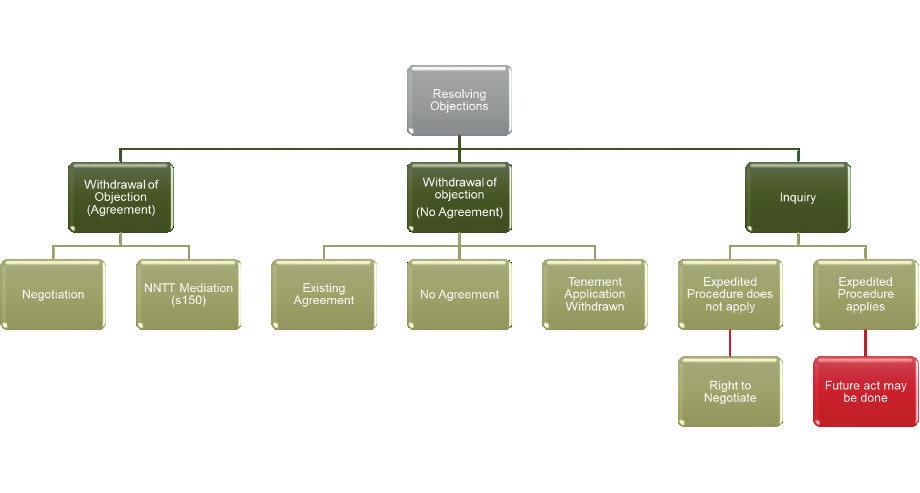
If DMIRS advertises a licence under the expedited procedure, the Native Title Party has four (4) months to lodge an objection to the expedited procedure. Generally, once the Native Title Party lodges an objection, they will start negotiating a heritage agreement with the Grantee Party. If the Native Title Party and the Grantee Party agree on a heritage agreement, the Native Title Party will generally withdraw their objection to the expedited procedure.
If they cannot reach an agreement, then the matter will go to an “inquiry”. In an inquiry, the Government Party, the Native Title Party, and the Grantee Party put in evidence about what the likely effect of the grant of the licence will be on the three criteria above. If the Native Title Party is successful in showing that the grant of the licence will likely have an effect on one or more of the criteria, then the Native Title Holders will have the right to negotiate in relation to the licence.

What is the “right to be consulted”?
The “right to be consulted” applies to mining tenements that allow Grantee Parties to build infrastructure facilities (such as roads and mineral storage facilities) but not to extract minerals.
This generally applies to miscellaneous licences and general purpose leases.
Under the right to be consulted, Native Title Parties have two (2) months to object to the grant of these licences.
If a Native Title Party objects, the Grantee Party must consult with the Native Title Party on ways to minimise the effect of the grant on the native title rights.
Eight (8) months after the mining tenement is notified, unless the Native Title Party has withdrawn its objection, the Government Party must refer the objection to be heard by an “independent person”, who decides whether to uphold the objection, to allow the tenement to be granted, or to allow the tenement to be granted subject to conditions.
Call and ask to speak with someone from YMAC’s Legal Team in our Perth office to find out more.