

This article presents a detailed guide on how to carry out a research activity in the educational field, focusing on the correct reference of selected articles and the development of a research problem. The difference between qualitative research, which focuses on understanding experiences and perceptions, and quantitative research, which focuses on measuring variables and establishing causal relationships, is highlighted. The study analyzed in the article focuses on the use of the web tool 'Formative' on mobile devices to improve the active learning of English as a foreign language (EFL) students. Data were collected through observations, diagnostic questionnaires and perception questionnaires, using a qualitative approach to understand students' perceptions and attitudes towards active learning with mobile technology. The strengths and threats of the methodology used are presented in a table or graph, and additional resources on qualitative and quantitative research methods are offered for deeper learning.
Currently, research in the educational field is essential to understand and improve teaching and learning processes. In this context, qualitative and quantitative research plays a crucial role in generating knowledge and making informed decisions. This article presents a step-by-step guide to carrying out research in education, highlighting the importance of correct referencing of selected articles and the development of a research problem. The difference between qualitative and quantitative research is addressed, and a specific study on the use of mobile technology to improve the active learning of EFL students is analyzed. Through this work, we seek to provide readers with the necessary tools to carry out quality research in the educational field.
Task 3 – Qual – Quan research!
Integrants:
Yimy Gabriel Narvaez
Tutor:
Luz Adriana Perdomo Reyes
Universidad Nacional Abierta y a Distancia (UNAD)
Yacuanquer - Nariño
May 2024
INVESTIGATION PORPUSE METHODS DATA COLECTION POPULATION
CUALITATIVE
• The main purpose of qualitative research is to deeply understand social, cultural or psychological phenomena.
• Focuses on understanding the meaning of people's experiences and interpreting their perspectives.
• Exploratory and comprehensive
• Delve into the experiences and perceptions of
• Uses methods such as indepth interviews, participant observation, and content analysis to collect data of a nonnumerical nature.
• It focuses on the exploration, interpretation and understanding of phenomena.
• Interviews, participant observation, focus groups and content analysis
• Data collection in qualitative research is carried out in a flexible and open manner, allowing participants to express their opinions and experiences in a detailed and enriching way.
• Narrative and descriptive data.
• Data is collected subjectively and can be generalized.
• Qualitative research focuses on small, select samples of participants who can provide a deep and rich understanding of the phenomena studied.
• Generalization of the results is limited.
• Small, nonrepresentative samples.
• Seeks to understand and deepen the experiences of a specific group to individual cases.
the participants.
CUANTITATIVE
• The purpose of quantitative research is to measure and quantify variables, establish causal relationships, and identify patterns and trends in the data.
• Focuses on objectivity and generalization of results.
• Explanatory and predictive
• Measure specific variables and
• Uses techniques such as semistructured interviews thematic analysis and case studies
• Uses methods such as surveys, experiments, and statistical analysis to collect quantifiable and numerical data
Focuses on accurate measurement of variables and verification of hypotheses.
• Surveys, controlled experiments, statistical analysis
• Data collection in quantitative research is carried out in a structured and standardized manner, using questionnaires, measurement scales and statistical techniques to obtain numerical and objective results.
• Numerical and quantifiable data.
• The data is objective and can be
• Quantitative research focuses on large, representative samples of a population to ensure the validity and reliability of the results.
• Data are used to make inferences about the general population.
• Large representative samples
• Seeks to establish
establish casual relationships.
• It is based on the collection of numerical data through surveys, questionnaires or standard population.. generalized to a broader population patterns and trends in a broader population through representatives.
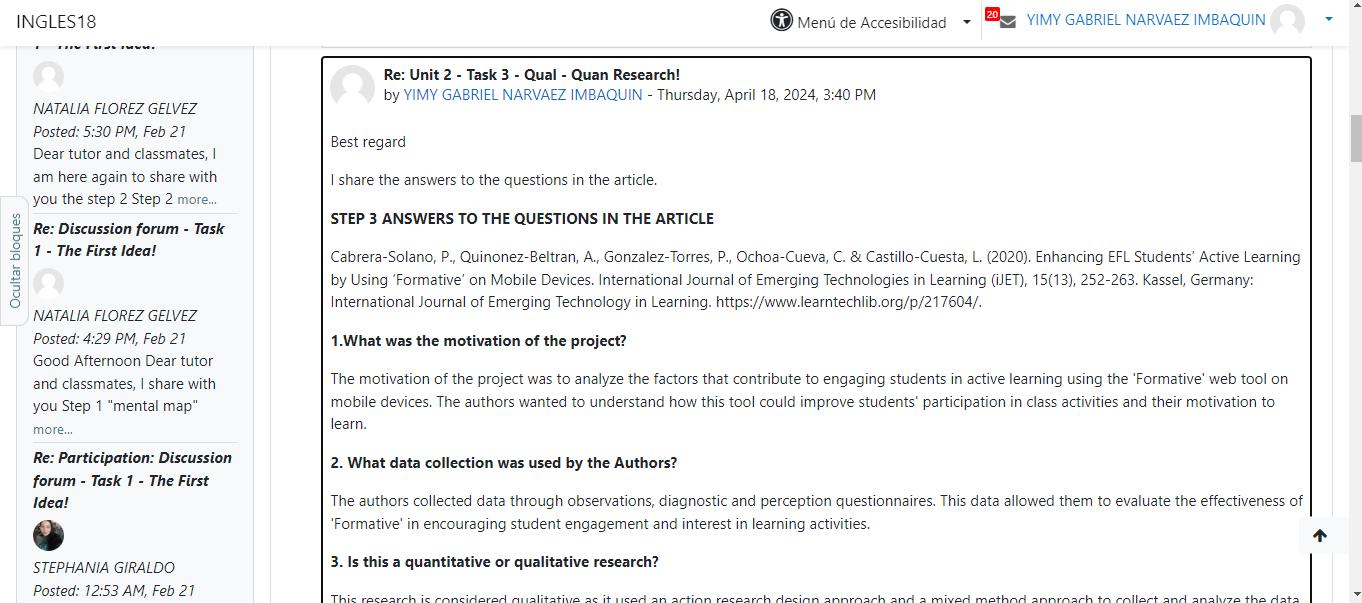
Cabrera-Solano, P., Quinonez-Beltran, A., Gonzalez-Torres, P., Ochoa-Cueva, C. & Castillo-Cuesta, L. (2020). Enhancing EFL Students’ Active Learning by Using ‘Formative’ on Mobile Devices. International Journal of Emerging Technologies in Learning (iJET), 15(13), 252-263. Kassel, Germany: International Journal of Emerging Technology in Learning. https://www.learntechlib.org/p/217604/.
1. What was the motivation of the project?
The motivation of the project was to analyze the factors that contribute to engaging students in active learning using the 'Formative' web tool on mobile devices. The authors wanted to understand how this tool could improve students' participation in class activities and their motivation to learn.
2. What data collection was used by the Authors?
The authors collected data through observations, diagnostic and perception questionnaires. This data allowed them to evaluate the effectiveness of 'Formative' in encouraging student engagement and interest in learning activities.
3. Is this a quantitative or qualitative research?
This research is considered qualitative as it used an action research design approach and a mixed method approach to collect and analyze the data. Qualitative methods were used to understand students' perceptions and attitudes toward active learning with mobile technology.
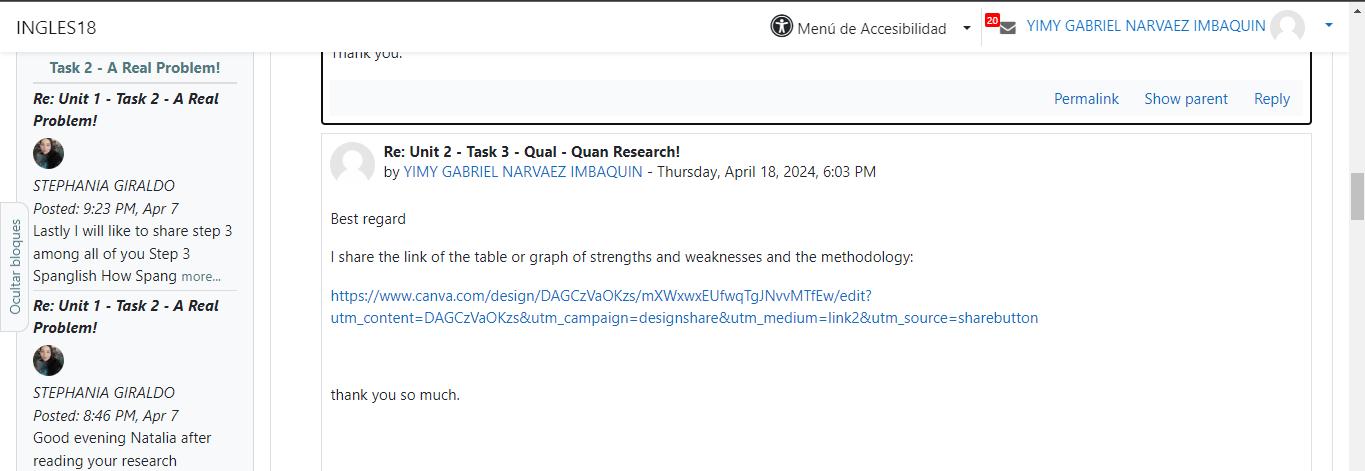
STEP 4 TABLE OR GRAPH OF STRENGTHS AND THREATS AND METHODOLOGY:
https://www.canva.com/design/DAGCzVaOKzs/mXWxwxEUfwqTgJNvvMTfEw/edit?u
tm_content=DAGCzVaOKzs&utm_campaign=designshare&utm_medium=link2&ut
m_source=sharebutton

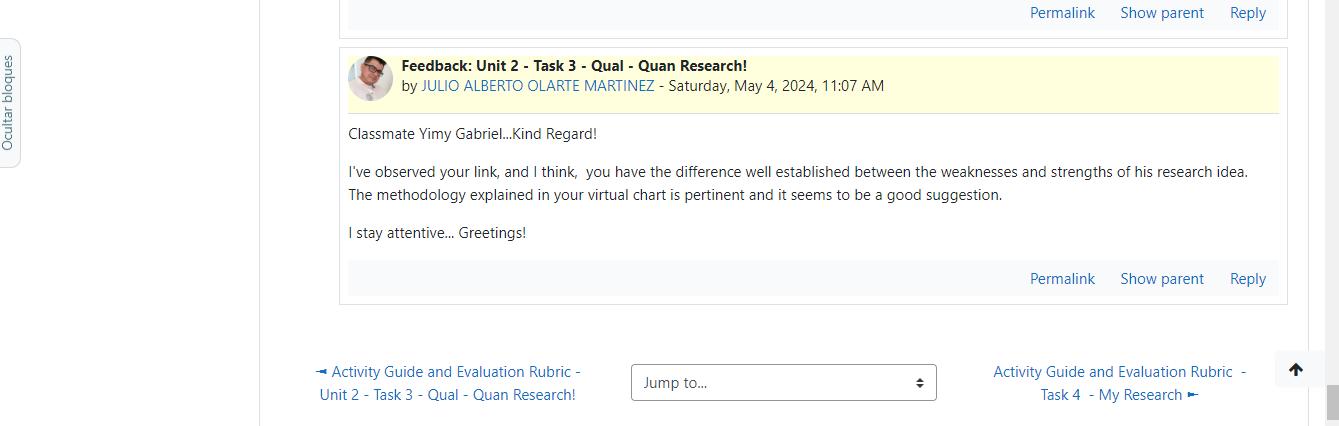
COMMENTS WRITTEN AND GIVEN IN THE FORUM:

[Global Health with Greg Martin]. (2022, June 12) Qualitative research methods. [Video].
https://www.youtube.com/watch?v=_uapR0qiN6s
[PHILO-notes]. (2020, November 30) What is Quantitative Research? (See links below for video lectures on Practical Research 1 and 2) [Video].
https://www.youtube.com/watch?v=RMmerEEeIc8
[Uso libraries]. (2018, January 10) Empirical studies:Qualitative vs Quantitative. [Video].
https://www.youtube.com/watch?v=RZcfmA1l6cE
[Scribbir]. (2019, November 15) Quantitative vs. Qualitative Research: The Differences Explained [Video]. https://www.youtube.com/watch?v=aXtVF7Bofg
[PHILO-notes]. (2020, December 4). Quantitative Research vs Qualitative Research (Practical Research 2) [Video]. https://www.youtube.com/watch?v=6UIjmBGpCEc
Lauren McCall, (updated 2023) Qualitative Research: Characteristics, Design, Methods & Examples| Simply Psychology https://www.simplypsychology.org/qualitativeresearch-characteristicsdesign-methods-examples.html