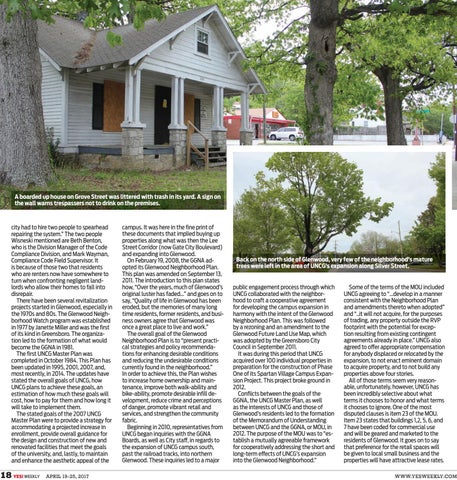
A boarded up house on Grove Street was littered with trash in its yard. A sign on the wall warns trespassers not to drink on the premises.
city had to hire two people to spearhead repairing the system.” The two people Wisneski mentioned are Beth Benton, who is the Division Manager of the Code Compliance Division, and Mark Wayman, Compliance Code Field Supervisor. It is because of those two that residents who are renters now have somewhere to turn when confronting negligent landlords who allow their homes to fall into disrepair. There have been several revitalization projects started in Glenwood, especially in the 1970s and 80s. The Glenwood Neighborhood Watch program was established in 1977 by Janette Miller and was the first of its kind in Greensboro. The organization led to the formation of what would become the GGNA in 1981. The first UNCG Master Plan was completed in October 1984. This Plan has been updated in 1995, 2001, 2007, and, most recently, in 2014. The updates have stated the overall goals of UNCG, how UNCG plans to achieve these goals, an estimation of how much these goals will cost, how to pay for them and how long it will take to implement them. The stated goals of the 2007 UNCG Master Plan were to provide a strategy for accommodating a projected increase in enrollment, provide overall guidance for the design and construction of new and renovated facilities that meet the goals of the university, and, lastly, to maintain and enhance the aesthetic appeal of the
18 YES! WEEKLY
APRIL 19-25, 2017
campus. It was here in the fine print of these documents that implied buying up properties along what was then the Lee Street Corridor (now Gate City Boulevard) and expanding into Glenwood. On February 19, 2008, the GGNA adopted its Glenwood Neighborhood Plan. This plan was amended on September 13, 2011. The introduction to this plan states how, “Over the years, much of Glenwood’s original luster has faded...” and goes on to say, “Quality of life in Glenwood has been eroded, but the memories of many long time residents, former residents, and business owners agree that Glenwood was once a great place to live and work.” The overall goal of the Glenwood Neighborhood Plan is to “present practical strategies and policy recommendations for enhancing desirable conditions and reducing the undesirable conditions currently found in the neighborhood.” In order to achieve this, the Plan wishes to increase home ownership and maintenance, improve both walk-ability and bike-ability, promote desirable infill development, reduce crime and perceptions of danger, promote vibrant retail and services, and strengthen the community fabric. Beginning in 2010, representatives from UNCG began inquiries with the GGNA Boards, as well as City staff, in regards to the expansion of UNCG campus south, past the railroad tracks, into northern Glenwood. These inquiries led to a major
Back on the north side of Glenwood, very few of the neighborhood’s mature trees were left in the area of UNCG’s expansion along Silver Street. public engagement process through which UNCG collaborated with the neighborhood to craft a cooperative agreement for developing the campus expansion in harmony with the intent of the Glenwood Neighborhood Plan. This was followed by a rezoning and an amendment to the Glenwood Future Land Use Map, which was adopted by the Greensboro City Council in September 2011. It was during this period that UNCG acquired over 100 individual properties in preparation for the construction of Phase One of its Spartan Village Campus Expansion Project. This project broke ground in 2012. Conflicts between the goals of the GGNA, the UNCG Master Plan, as well as the interests of UNCG and those of Glenwood’s residents led to the formation of the Memorandum of Understanding between UNCG and the GGNA, or MOU, in 2012. The purpose of the MOU was to “establish a mutually agreeable framework for cooperatively addressing the short and long-term effects of UNCG’s expansion into the Glenwood Neighborhood.”
Some of the terms of the MOU included UNCG agreeing to “...develop in a manner consistent with the Neighborhood Plan and amendments thereto when adopted” and “..it will not acquire, for the purposes of trading, any property outside the RVP footprint with the potential for exception resulting from existing contingent agreements already in place.” UNCG also agreed to offer appropriate compensation for anybody displaced or relocated by the expansion, to not enact eminent domain to acquire property, and to not build any properties above four stories. All of those terms seem very reasonable, unfortunately, however, UNCG has been incredibly selective about what terms it chooses to honor and what terms it chooses to ignore. One of the most disputed clauses is item 23 of the MOU. Item 23 states that buildings 1,2, 5, 6, and 7 have been coded for commercial use and will be geared and marketed to the residents of Glenwood. It goes on to say that preference for the retail spaces will be given to local small business and the properties will have attractive lease rates.
WWW.YESWEEKLY.COMW