Adventure

YassineElZein’s
Exploration is the act of going into places, ideas, or experiences that are not fully known.
When someone explores, they usually have a purpose. They want to learn something new, understand how something works, or discover something that was hidden or forgotten.
Exploration can happen in many forms. A person can explore a new country, a deep forest, the ocean, or even space. But exploration can also be mental: studying a new subject, learning a new skill, or trying to understand a difficult question. What makes exploration special is curiosity. Explorers are driven by the desire to know more. They take careful steps, make observations, ask questions, and try to make sense of what they find. Exploration is often slow, steady, and full of patience. It is a journey of knowledge.
Even though exploration and adventure often look similar, they are not the same.
Exploration is mainly about learning. The goal is to understand something new. It is planned, careful, and focused on discovering facts or ideas. Explorers ask questions and look for answers. Adventure is about feeling The goal is to have an intense experience. It does not need a plan, and it can happen suddenly or by choice. Adventurers accept risk and uncertainty because that is what makes the moment exciting.
In simple terms: Exploration tries to understand the world, while adventure tries to experience it.
Adventure is an experience that feels exciting, surprising, or dangerous.
It is less about collecting information and more about feeling alive. When someone goes on an adventure, they may not know what will happen next. Adventures often include risk, challenge, and moments where a person has to be brave. It could be climbing a mountain, traveling alone, trying something new, or facing unexpected events.
Adventure is filled with emotion joy, fear, excitement, and even confusion. It pushes people out of their comfort zone and forces them to grow. Every adventure becomes a story to tell later, because the experience itself is what makes it meaningful.
Exploration fills the mind. Adventure fills the heart.
Alot of documents can show exploration and adventure in a very strong way, like something from the Uncharted series, which is famous for mixing history, travel, danger, and discovery. Nathan Drake, the main character, is known as a modern explorer who spends his life searching for lost cities, ancient clues, and forgotten treasures, and the cover of Uncharted 3 clearly reflects this spirit On the front, we see Drake standing in a huge desert, surrounded by sand and heat, looking toward ruins far away on the horizon. This simple image already shows the idea of exploration, because the desert looks endless, empty, and full of mystery, and it makes us feel that he is entering a place where almost nobody goes.
The ruins in the back remind us of past civilizations and lost worlds, which also fits the idea of exploring history and trying to understand what happened there Drake’s posture, with his hand above his eyes to look far, suggests that he is searching for something important and that he must move through difficult land to find it. The back cover continues this theme with more images of the desert, scenes of walking, running, and moving through dangerous areas. These pictures show that exploration is not only about looking around but also about crossing places that are hard to survive. At the same time, the cover shows adventure in many ways. The warm, intense colors and the strong light create a feeling of heat, risk, and tension

Drake looks serious and ready, which tells us the story includes danger and action The title “Drake’s Deception” suggests secrets, lies, and big challenges that the hero will face. On the back, the words “AN EPIC ADVENTURE” make it clear that the game is full of exciting moments, battles, escapes, and surprises. The small screenshots also show scenes of movement and danger, which make the adventure feel even stronger. In Uncharted, adventure is always linked to taking risks, solving problems quickly, escaping threats, and fighting to stay alive, and the document reflects all of this through its images and style Because Uncharted always mixes the search for old places with action and danger, this document is a perfect example of exploration and adventure happening together. It shows that exploration is not peaceful or easy: the hero must face fear, heat, enemies, traps, and nature itself. It also shows that adventure is not random but connected to traveling through unknown environments and discovering secrets that change everything. All these elements together make the document rich in meaning, and they explain why Uncharted fits so well in a chapter about exploration and adventure
CHAPTER 4
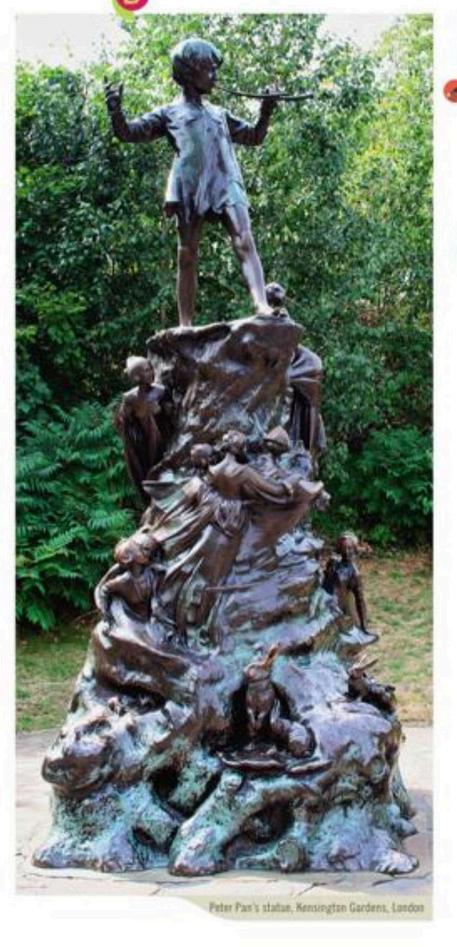
The statue of Peter Pan expresses exploration and adventure through both its design and the story it represents. Peter Pan stands at the top of a rocky base, playing his flute, which gives the sense that he is calling others to join him on a new journey. His pose is confident and open, showing a character who is always ready to move forward and discover new places Around the base, the small figures of fairies, children, and animals create a lively scene that reflects the magical world of Neverland, a place built on imagination, freedom, and constant discovery. The rising shape of the sculpture, with characters climbing and interacting with the environment, suggests movement and the excitement of entering unknown spaces.
The natural background of trees adds to the idea of exploration, as Peter Pan is strongly linked to forests, hidden paths, and wild landscapes. The statue also conveys adventure through the joyful and fearless attitude of Peter Pan, who represents the desire to escape limits, explore without fear, and live experiences full of wonder. Because Peter Pan is a character who never grows up, the sculpture also reminds us that curiosity and adventure come from keeping a young and open mind. All these elements make the statue a strong example of exploration and adventure, and a fitting piece for a digital book that highlights these themes. All these examples reveal the history of exploration and adventure
Peter Pan’s statue