
Phantom of D'Popera Program

Page 1


Dear Friends and Family,

Welcome to the Davenport Pops Orchestra’s biggest concert of the 2025-2026 school year! As Co-Presidents, we thank you for coming and hope you enjoy the concert.

Founded in 2005, DPops brings together Yale students from different majors, backgrounds, and residential colleges who are passionate about the performance of quality orchestral music. As Yale’s premier pops orchestra, our repertoire includes pop songs, ïŹlm scores, Broadway hits, popular classical works, hip-hop, and more. We hope to bring a nontraditional interpretation of orchestral music into the community with our performances so enthusiastic music lovers and casual music enjoyers alike will be entertained!

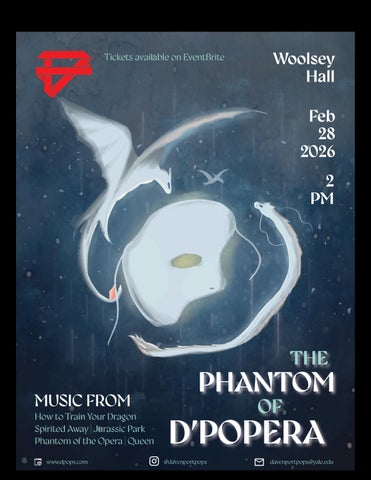
We hope you are swept away by the magniïŹcent theatrical landscape of Phantom of the Opera, get transported to lands of dinosaurs and dragons with selections from Jurassic Park and How to Train Your Dragon, enjoy a wistful Studio Ghibli classic of Spirited Away, and sing and dance along to some rock hits from Queen!

For more information about the orchestra, please visit www.dpops.com, and follow us on Facebook and Instagram @davenportpops. Videos of the concert will be available on our YouTube channel shortly after the performance.

We’re so grateful that you can join us. On behalf of the Davenport Pops Orchestra, we welcome you to our concert! We hope you enjoy the music!

With D’Love, Iris Liebman BR ’27, iris liebman@yale edu

Amy Metrick SM ’27, amy.metrick@yale.edu

The Davenport Pops Orchestra Co-Presidents

THE DAVENPORT POPS ORCHESTRA

For updates and information, follow us on YouTube, Instagram and Facebook (@davenportpops) and visit our website at wwwdpops com

Special Thanks To Kito Covington

Davenport College

Timothy Dwight College

Head Anjelica Gonzalez

Dean Adam Ployd

Bryanna Kim

Shaffrona Phillip-Christie

Head Beth Dinkler

Dean Sarah Mahurin

Samantha Gambardella

Rashaun Durden

Brendan McGovern

Dean Kate Krier

Daisy Abreu

Aubrey Ellis

Kerry Cripe

Yale U.O.F.C.

Yale Undergraduate Production

Yale College Dean’s OFïŹce

Martin Jean

Brian Robinson

Yale School of Music

Clifton Massey

Stace Zhao

Arrow Zhang

David Michael

Concert Ringers

Benny Gruenbaum, Cello

Yuvin Kang, Bass

Sharif Hassen, Bassoon

Jack Landau, Bassoon

Eric Zhang, Contrabassoon

Jasmine Chen, French Horn

Tadao Tomokiyo, French Horn

Julian Kolthammer, French Horn

Lucas Haas, Trombone

Alumni Donors

Yeeee Chair

Kate Feinerman for 2nd to Last Viola

The Catto Chair

Georgia Smitts for First Piano

Queen of the Brass Section Chair

Anusha Manglik for the Person who likes Corgis the Most

It’s Never Too Late Chair

Sayda Martinez-Alvarado for the person who ïŹrst joined at the latest point in their college career

Soloist by Default Chair

Danny Lee for the ïŹrst bassoonist

Backseat Driver Chair

Jeffery Yu for the last violin II

Brass Section Ah-OOH Chair

Bettina Cheung for a brass section leader

CS 323 Chair

Jim Zhou for the longest serving CS 323 ULA

The DPops Savior’s Chair

Ryan Lim for the Head Video Editor

The Best Stand Partner Chair

Helen Zhou for the unexpected friend

DPops Board of Directors:

Presidents: Iris Liebman BR ‘27 & Amy Metrick SM ‘27

Conductor: Jeremy Ng TC ‘26

Assistant Conductors: Samson Wong MC ’27 & David Wang GH ‘28

Head Arranger: John Owen Weber ES ‘26

Assistant Arrangers: Kira Tang TC ‘27 & Ro Malik MY ‘27

Director of Development: Lilia Potter-Schwartz MY ‘26

Treasurer: Lily Hyde TC ‘27

Publicity Chairs: Chris Shia SY ‘27 & Sophie HeitïŹeld BR ‘28

Orchestra Manager: Abril Linares Mendoza JE ‘28

Librarians: AngĂ©lique Wheeler PC ‘26 & Sophia Zhang DC ‘28

Social Committee Chairs: Mason Abrell DC ‘26 & John Owen Weber ES ‘26

Website Manager: Ro Malik MY ‘27

Davenport Liaison: Eric Xiong DC ‘28

AV Team Director: Julia Landres JE ‘28

AV Team: Jam Lian BK ‘28, Dylan Pu GH ‘29, Mina Chang DC ‘28

New Member Liaisons: Katie Hu ES ‘29, Eric Lee GH ‘29, Matthew Li ES ‘29, Ally Hu MC ‘29, Eleanor Kandoll PC ‘29, Dylan Pu GH ‘29, Neslo Atilla MC ‘29

Help support DPops! Donate online by visiting dpops.com and clicking “Support Us”

The Phantom of D’Popera

NOTES ON THE PROGRAM

The Phantom of the Opera

The Phantom of the Opera (1986 musical), the longest-running show in Broadway history, ïŹrst premiered on London’s West End in 1986, and was brought to New York in 1988, and was introduced to the big screen with the 2004 ïŹlm featuring Gerard Butler (How to Train Your Dragon), and Emmy Rossum (Shameless). DPops has previously performed a 2017 arrangement (arr. Michael Wang, ‘17) in 2017 and in 2021, but now will bring Phantom to Woolsey Hall for the ïŹrst time, with this 2026 version of the arrangement. Based on a 1910 novel of the same name by Gaston Leroux, Phantom tells the story of the soprano singer Christine, her lover Raoul, and the tortured and masked musical genius dwelling beneath the Paris Opera House–the Phantom of the Opera The Phantom is known to Christine only as the Angel of Music, a man secretly training her voice so that her fame can deliver his music to the world outside the Opera House. His training is successful, and Christine quickly rises to fame within the Opera House.

The Phantom, in love and obsessed with Christine, is mad with jealousy over her relationship with Raoul, and announces that he has written an opera entitled Don Juan Triumphant, demanding that Christine be cast as the lead actress While Raoul intends to take advantage of the show’s premiĂšre to trap the Phantom, the disïŹgured musical genius has other plans; on opening night, Christine notices that her Angel of Music has replaced the lead actor as they sing their duet, and removes his mask At the same time, the true lead actor is found strangulated backstage.

The Phantom, left with his disïŹgured face exposed to the audience, drags Christine to his subterranean quarters, where Raoul follows him, resulting in his capture by the Phantom. He then presents Christine with an ultimatum: either she marry him and he lets Raoul go free, or the Phantom will kill her lover In the end, she shows compassion which had been previously unknown to the Phantom, and he lets the pair go together.

This arrangement commences with the iconic grand organ solo which introduces the main theme from Phantom of the Opera, which is later joined by the full orchestra in all its grandeur (Overture). We turn to the softer Think of Me, the aria performed by Christine as she ïŹlls in for the lead actress She owes her success in her career to the Angel of Music, who has guided her singing and who has been secretly tutoring her–she takes the Angel to be the spirit of her father, explaining the reverence with which she describes him in this tender number. The Phantom reveals his plans to Christine in Music

of the Night, a piece haunted by sinking strings and soaring winds; listen for key changes and dissonance to indicate the Phantom’s sinister side We lighten the mood with the bouncy Masquerade, which is suddenly interrupted by the main theme The Phantom of the Opera, symbolic of his omnipresence in the Opera House and in the broader musical. The iconic four-note chromatically descending chord continues to interrupt the arrangement as the Phantom loses control over those around him. Moving from the high brass to the full orchestra, trombones, tuba, french horn, and euphonium capture the insidious theme with chilling force. All I Ask of You and The Point of No Return are the ïŹnal pieces of the arrangement before the DPops original ïŹnale; the former represents a ïŹnal declaration of love and tenderness between Raoul and Christine, and the latter serves as the Phantom’s perceived victory lap, believing he has already won over Christine

We hope you enjoy the 2026 version of this arrangement–note the haunting main theme which is repeated throughout, the brass taking the charge on creating a bright and powerful color, while the winds and strings work in tandem to bring out the more tender moments of this musical theater staple. DPops is thrilled to bring the energy and spirit of this magniïŹcent score to Woolsey Hall!

Weber

Jurassic Park

Music by John Williams

Jurassic Park (1993), directed by Steven Spielberg and written by Michael Crichton and David Knopp, has spawned into one of the most popular ïŹlm franchises of all time. It is originally based off of the 1990 novel also written by Michael Crichton and tells the story of a theme park featuring de-extinct dinosaurs opened by industrialist John Hammond on the tropical island of Isla Nublar A group consisting of Hammond, paleontologist Alan Grant, paleobotanist Ellie Sattler, and chaoticist Ian Malcolm is sent to certify the park’s safety after an (obvious) safety accident with a velociraptor. After an act of industrial sabotage by Hammond’s competitor deactivates the park’s security measures and safety protocols, the group must struggle to survive against the dinosaurs that could now kill them with a single stomp

John Williams’ score for Jurassic Park has become one of his most critically acclaimed and iconic soundtracks The iconic chorale/park theme, introduced by the violas and clarinets, is introduced when the visitors ïŹrst see the Brachiosaurus, and is simply titled “Theme from Jurassic Park ” Another theme, "Journey to the Island,” is introduced by the trumpets with texture from the arpeggiating woodwinds. These two themes were arranged

Program notes by John O.

by Williams himself into the score you will now hear, which was then adapted to ïŹt DPops’ orchestration

With our rendition, I hope you can sense the majesty of the park, feel the ‘ awe ’ and ‘fascination’ of looking at creatures brought back to life, and hear the stomping of the Tyrannosaurus and the soaring of the Velociraptor And with that, I say to you:

“Welcome to Jurassic Park ”

Program notes by Jeremy Ng

Spirited Away

Music by Joe Hisaishi

Spirited Away (2001), a Japanese animated ïŹlm written and directed by Hayao Miyazaki, has never failed to instill wonder in the eyes of many who grew up with it It became the ïŹrst hand-drawn, non-English-language animated ïŹlm to win the Academy Award for Best Animated Feature and at one point was the highest grossing ïŹlm in Japanese history. It tells the story of a young girl named Chihiro "Sen" Ogino, who moves to a new neighborhood and accidentally stumbles into a world of kami. After her parents are turned into pigs, Chihiro resolves to free her parents and return to the physical world by working in the bathhouse of the sorceress that turned them, Yubaba Along the way, she meets Haku, the “dragon boy” who helps her to try to leave the spirit world, and No-Face, a silent creature whose mask has become iconic for Studio Ghibli fans across the world.

Joe Hisaishi’s work on this score equally brings this fantastical world’s magic to life The original ïŹlm score was written in collaboration with Miyazaki in a partnership that continues to this day. In 2018, he rearranged this score into the Spirited Away Suite, performed and debuted by the World Dream Orchestra in 2018.

This arrangement is an abridged, reordered, and reorchestrated version of the Suite, lightly inspired by another arrangement by the Hamamatsu Wind Symphony. It starts with “One Summer’s Day,” a wistful piece that is one of Hisaishi’s most famous works in his oeuvre Join Chihiro as she becomes a part of Yubaba’s onsen as “Sen” and bathes spirits in “The Gods” and “View of the Morning” Observe No-Face going on a gold-ïŹlled rampage in “The Bottomless Pit” and “No-Face.” Picture Haku’s graceful presence in “The Dragon Boy,” hushing Chihiro to return to the riverbed before sunset. Finally, listen as Chihiro rescues her

parents and returns home in “Chihiro’s Waltz/Reprise,” one of the most famous waltzes in any Studio Ghibli piece, and “The Return”

This is now the fourth consecutive year that we ’ ve brought Joe Hisaishi’s music into Woolsey Hall The orchestra has consistently requested his music to be played, and I hope that this enthusiasm shines through in our rendition of the piece Per Hisaishi’s own words in the original Suite: “I would be very grateful if orchestras around the world would take the opportunity to perform this work and that the music will be heard by as many people as possible."

Don’t Stop Me Now: A Queen Medley

Music by Freddie Mercury

Program notes by Jeremy Ng

Queen is perhaps one of the best-known pop-rock bands of all time, and this arrangement blends together two of their hits, Don’t Stop Me Now (1978) and Killer Queen (1974), into a short-and-sweet medley Both of these tracks highlight Queen’s signature feel and trademark musical style: grand contrasts between delicate and high-energy passages, tightly harmonized choruses, and a constant driving momentum that never failed to draw audiences in. The arrangement begins with the slow ballad-esque intro of Don’t Stop Me Now, accelerating into its verse and chorus with the jubilance that characterizes the song ’ s lyrics: “Don’t stop me now / I’m having such a good time / I’m having a ball” Then, a rhythmic bridge gives way to the laid-back swing of Killer Queen, building to a brass-dominated chorus before accelerating back into the iconic guitar solo of Don’t Stop Me Now. The arrangement concludes just as it started, with a warm and pensive restatement of the opening melody that slowly but surely accelerates to an energetic ïŹnal note, capping off the medley with the energy that made Queen’s music so infectious for so many people We hope you too can be swept up in that joy during these few minutes, and feel the spirit that Freddie Mercury so simply states:

Don’t stop me / ‘ cause I’m having a good time / don’t want to stop at all!

Program notes by Ro Malik

How to Train Your Dragon

How to Train Your Dragon (2010, 2025 live-action), is perhaps one of the most well-known animated ïŹlms of our generation, with one of the most iconic soundtracks. Combining fantasy, coming-of-age, adventure, and reverence for the natural world, there are few people with whom this story does not resonate The movie tells the story of Hiccup, who is from the mythical Viking town of Berk Hiccup at ïŹrst wishes to help his father Stoick, the leader of Berk, in killing the dragons which are ubiquitous in Berk, and which have tormented their people for as long as anyone can remember However, after he successfully shoots a Night Fury, the most dangerous species of dragon any viking has known, Hiccup begins to question the only thing he has ever been certain about.

Hiccup secretly begins to train with the Night Fury, which he later names Toothless, and slowly discovers the softer side of dragons. Determined to learn more about these mysterious creatures, Hiccup mistakenly discovers something much more sinister: a hive which contains a dragon of mythical proportions (the Red Death) to whom the rest of the dragons bring food in order to be kept alive While Hiccup’s fondness for dragons leads him to see them as nuanced, misunderstood beasts alongside which his people could live, his father does not see his vision, and kidnaps Toothless so that he can ïŹnd the hive and eradicate the dragons once and for all. However, the ïŹght rather results in his understanding of the dragons’ behavior, and leads to the defeat of the Red Death as well as the acceptance of dragons into Viking society

Our 2026 arrangement of How to Train Your Dragon is loosely based on a 2014 (edited 2018) version and a 2022 version of the same name (arr Haohang Xu ‘17; Gancz ‘22 et al , respectively) How to Train Your Dragon is a staple in pops orchestra repertoire, and is often a favorite among DPops members; it is our joy to bring this version to you in Woolsey Hall at our largest concert of the year, commemorating the ïŹlm’s revival in live-action form.

This version includes classic tracks such as This is Berk, See You Tomorrow, Test Drive, and Romantic Flight. At its core, this arrangement features frantic wind runs, dissonant brass drones, and agitated strings piercing through the rest of the orchestra, accentuating the conïŹ‚ict in the story However, it also puts DPops’ melodic prowess in clear view, displaying tender violin solos (Romantic Flight), high winds which emulate the sound of bagpipes (Test Drive), and powerful horn and trombone lines which bring a certain majesty to the arrangement ïŹtting for a world as large as Berk. As musically fascinating as it is emotionally gripping, it is a pleasure to tell this story through yet another DPops arrangement

The encore of the arrangement, You Are My Homeward, was a new addition to the soundtrack added by John Powell for the live-action ïŹlm, and features a collaboration between DPops and one of Yale’s A Capella groups for the ïŹrst time since 2017 We sincerely hope that audiences will enjoy the sounds of Berk, as played by DPops!

Program notes by John O Weber

Jeremy NgÂș Conductor

Samson WongÂș Assistant Conductor

David WangÂș Assistant Conductor

Violin I

Timothy Lee, co-concertmaster

Charlie Wong, co-concertmaster

Felix Fein

Joy Ni

Tony Gao*

David WangÂș

Samson WongÂș

Andrew Yang

Raymond Hou, The Best Stand Partner Chair

Marco Opeña

Neo Chen

Tess Nelson*

Sophie HeitïŹeldÂș

Ally HuÂș

Yolanda Wang

Melanie King

Rit Gangopadhyay

Violin II

Ephraim Cho, principal

Michelle So

Tai O’Malley

Eden Hu

Lilia Potter-SchwartzÂș*

Ashyah Hewage

Sophia Zhou

Sebastien Lowy

Ian Klimov*

Ian Fernandes

Alison Tae

Abril Linares MendozaÂș

Christina Zhu*

Tiki Kazeem

Jeniffer Kim

Arohi Nair

Jam LianÂș

OUR ORCHESTRA

Susan Zheng

AngĂ©lique Wheeler*Âș

Eleanor Tong*

Jonathan Zhu

Arun FerrĂĄn-Sapatnekar

Jennifer Chen, Backseat Driver Chair

Viola

Katherine Song

Jewon Im

Kashi Tuteja

Tanav Prabhu*

Jeth Fogg*

Roxanne Shaviro

Ro MalikÂș, Yeeee Chair

Xander Faria

Cello

Chris ShiaÂș, principal

Maria Gregory

Seoyoon Kim

Alex Lam

Jeremy NgÂș

Grace Gibson-Snyder

Jenny Jiang

Lauren Kim

Christine Kivi*

Dylan PuÂș

Emily Tian*

Kira TangÂș

Jeb Cui, It’s Never Too Late Chair

Marie McKinney

Ellie Tillman-Schwartz

Isabela Snow

Sam Friedman

Victoria CantĂș

Hannah Dirsa

Andy Lam

Bass

Dylan Lee*

Kachi Ezuma-Ngwu*

Morgan Go*

Flute

Iris LiebmanÂș, principal

Emily Khym

Katie HuÂș, piccolo

Elizabeth Ovelil

Sophia ZhangÂș

Kamala Gururaja

Nicole Nguyen

Mason AbrellÂș

Echo Simons*

Oboe

Eric LeeÂș, principal

Estelle Balsirow

Darya Dayanim

Justin Bernstein

Clarinet

Kenny Wang, principal

Diana Yang

Eleanor KandollÂș

Meiling Laurence

Simba Shi*

Aaron Xiong

Amy MetrickÂș

John Jay Wang

Brandon Zhang

Daniel Lu

Bass Clarinet

Jonah De Shong

Alto Saxophone

Justin Fan, principal

Eddy Wang

Felix Gong

Alex Shadman*

Patrick Cannon

Tenor Saxophone

John Owen WeberÂș

Baritone Saxophone

Neslo AtillaÂș

Bassoon

Ben Janiszewski*, Soloist by Default Chair

French Horn

Julia LandresÂș, principal

Zakariya Bouzid*

Mina Chang

Andres Luengo

Trumpet

Genevieve Kim, principal

Jared Wyetzner*

Madelyn McElroy

Sander Cohen-Janes

Graydon Nolen

Anjali Lodh

Sivan Almogy

Nina Bodow Trombone

Daniel Fried, principal, Queen of the Brass

Section Chair

Patrick Qiu*

John Cho

Shawn Nordstrom

Richard Chen

Euphonium

Lily HydeÂș, Brass Section Ah-OOH Chair

Tuba

Karim Najjar

Keyboard

Alan Xie, principal, The Catto Chair, CS 323

Chair

Bryant Li

Daniel Guo

Percussion

Caden Castro-Kudler, principal

Eric Gan

Annie Hammer

Eleanor Law

Matthew LiÂș

Guitar

Eric XiongÂș

Âș Board Member

* On leave this concert cycle

Turn static files into dynamic content formats.
Create a flipbook