lillian goldman law library in memory of Sol Goldman
Annual Report 2025
Contributors
Rachel
Photography
Design
Gregg Chase, Yale Printing and Publishing Services
Printing
Yale Printing and Publishing Services
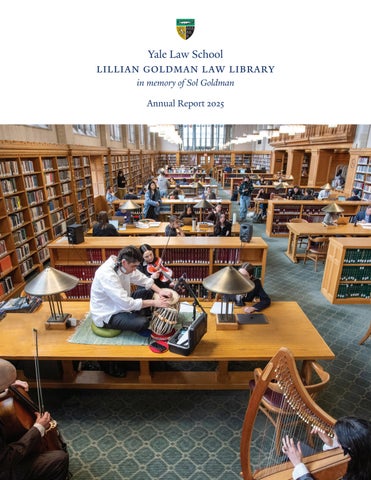
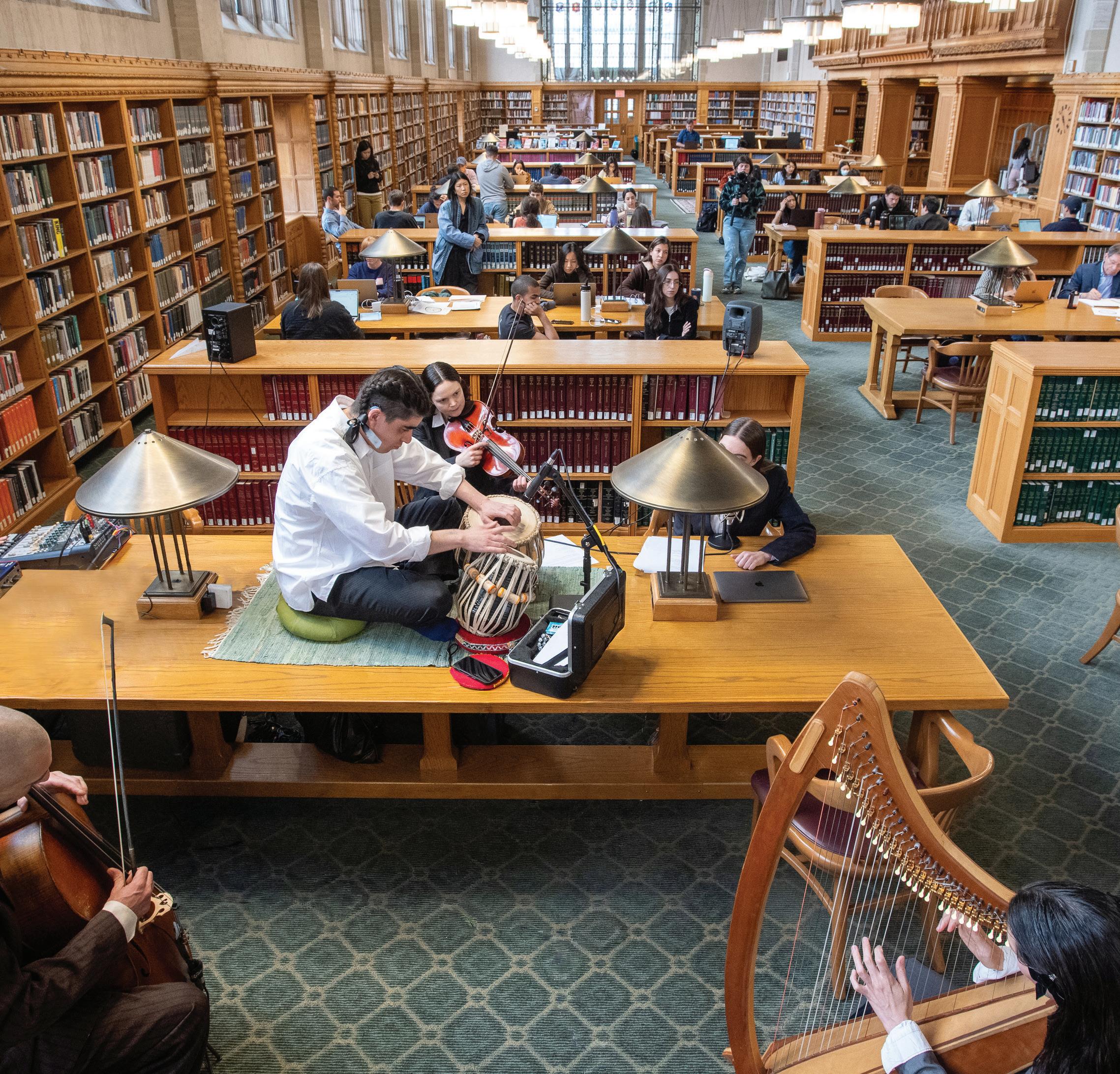
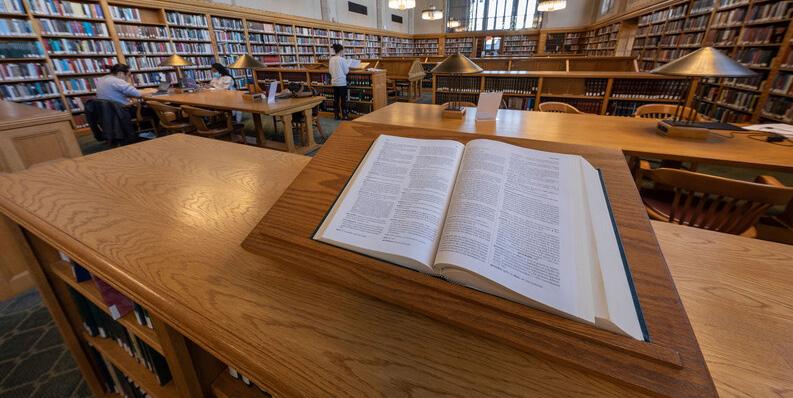
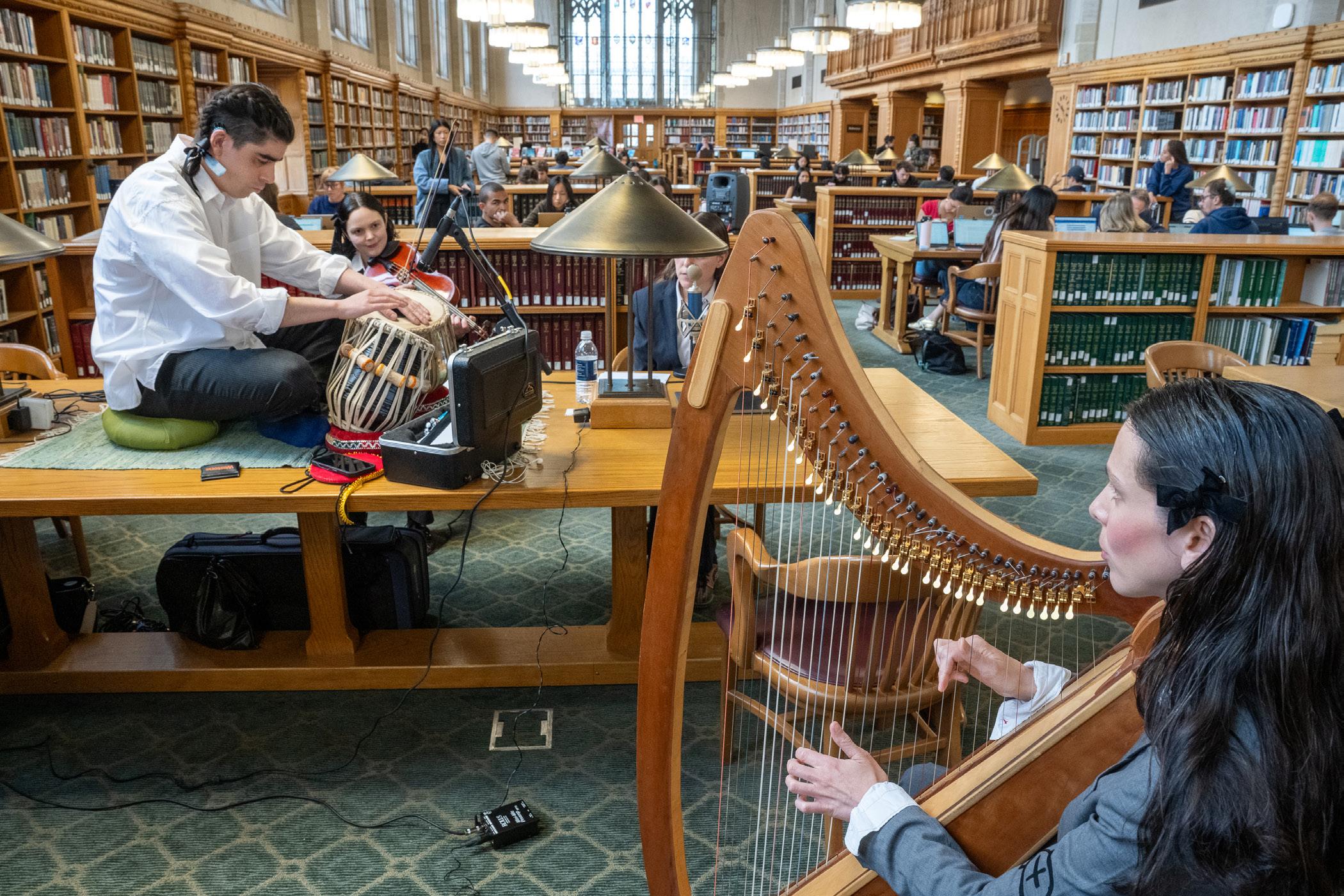
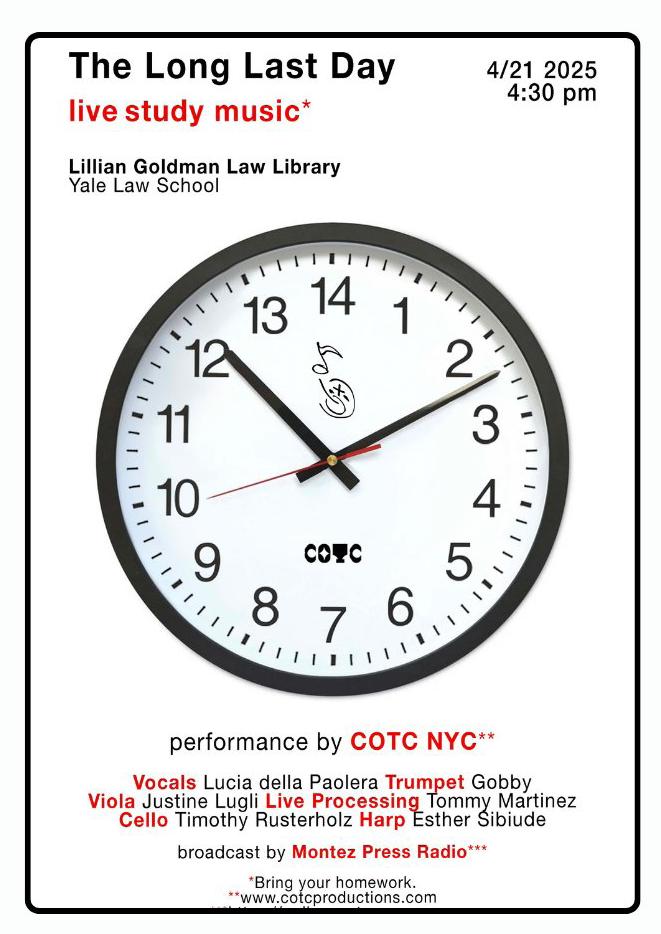
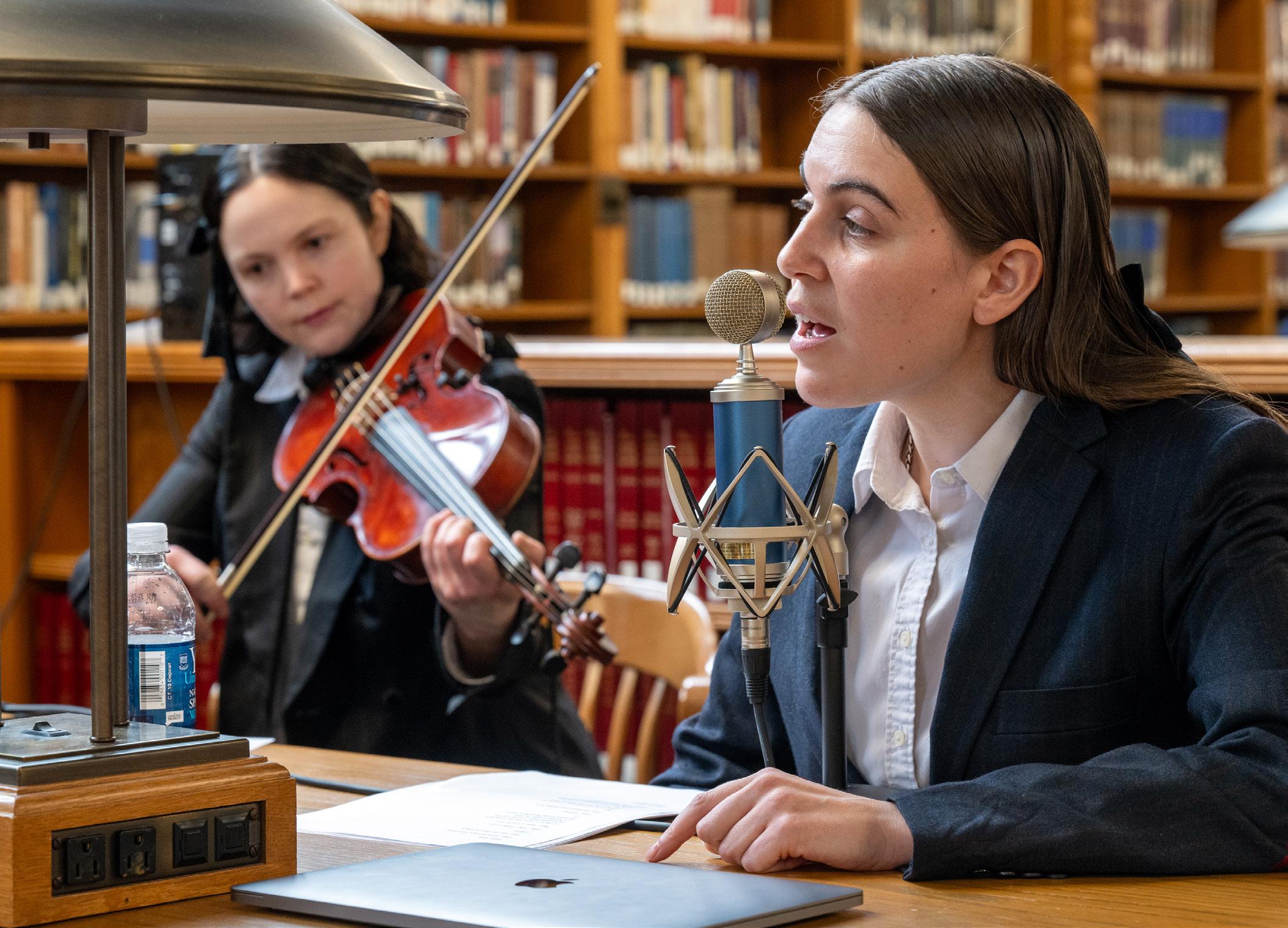
Cover: Musicians perform at the Lillian Goldman Law Library “The Long Last Day,” a work of ambient music to study by. Instruments included trumpet, harp, viola, cello, and hand drums known as tablas.
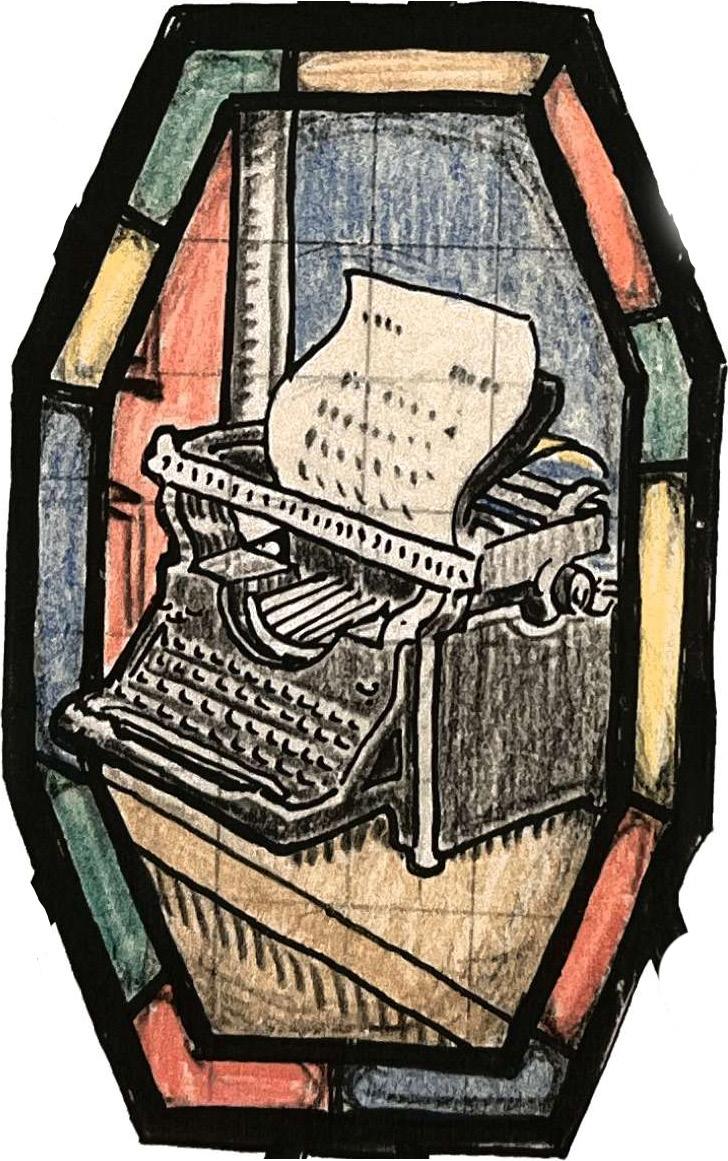
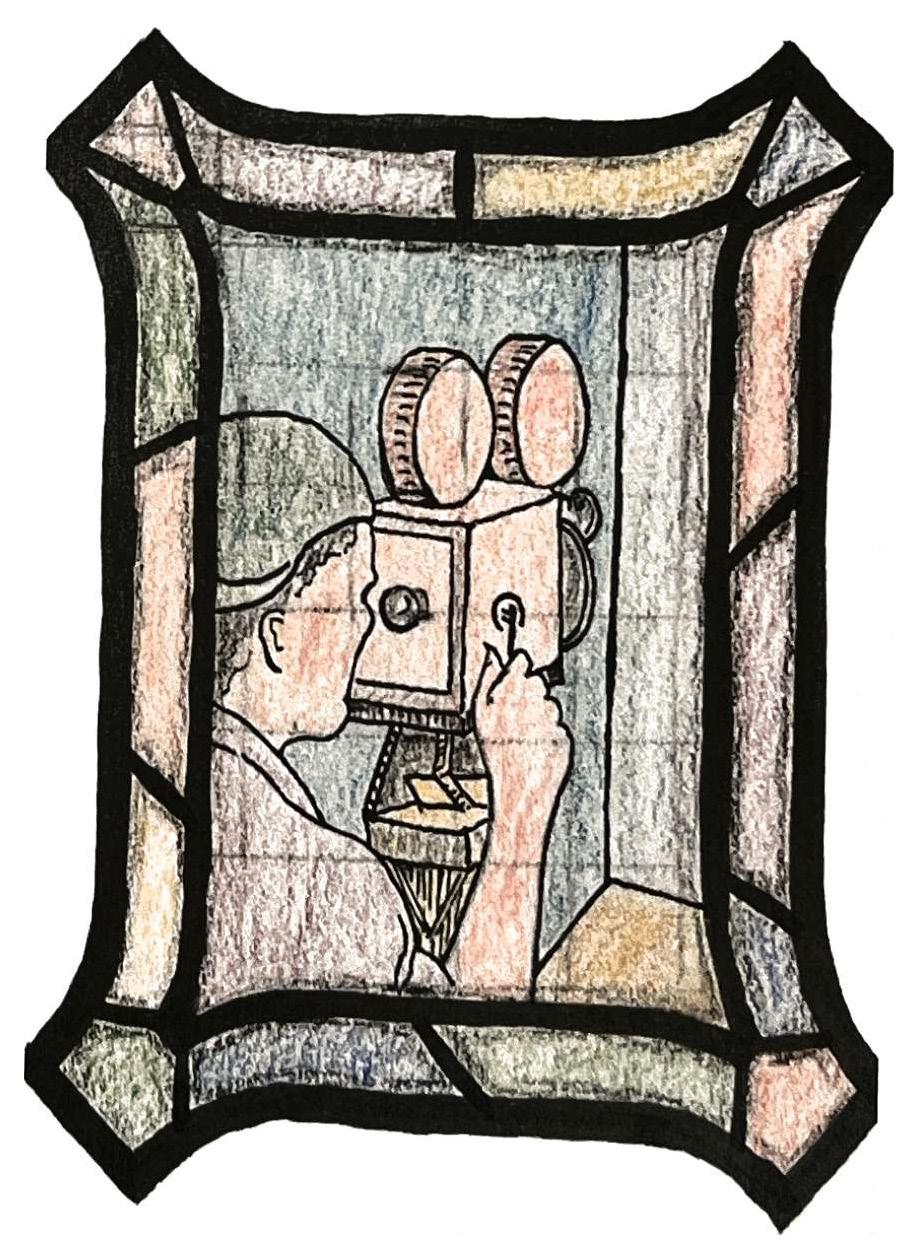
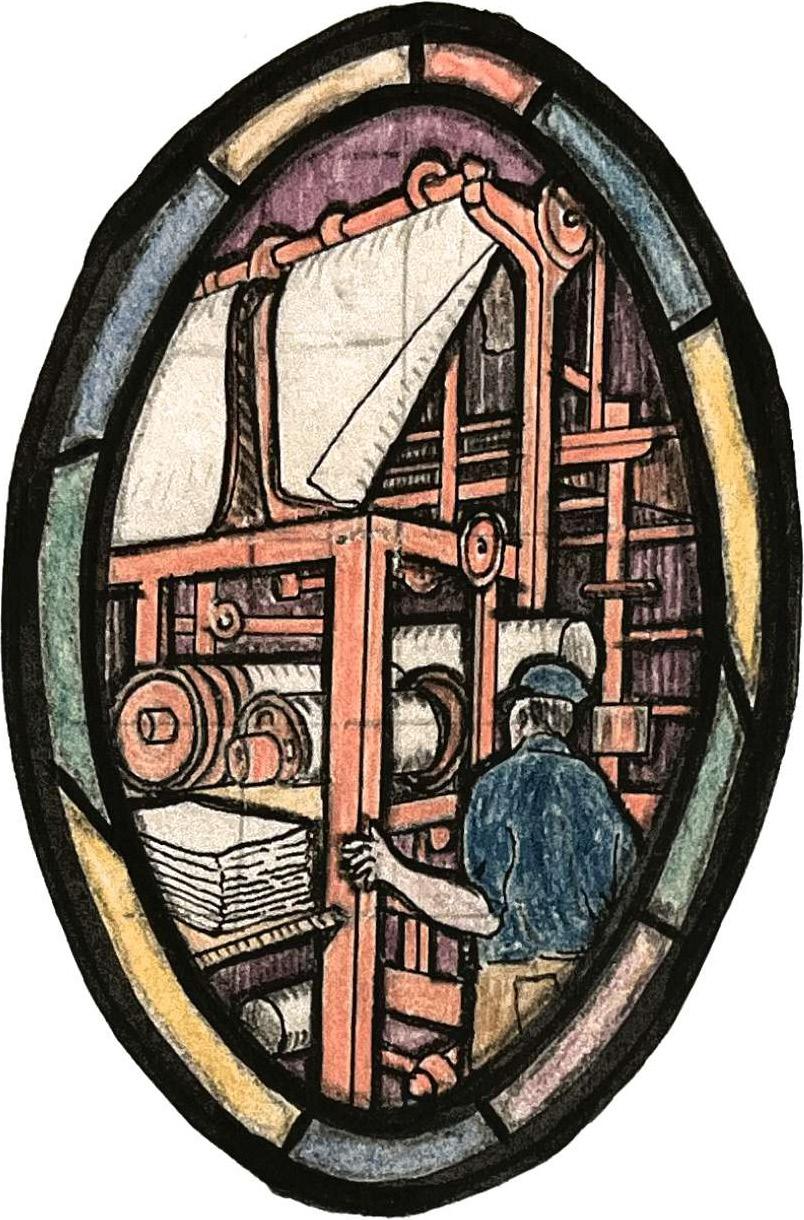
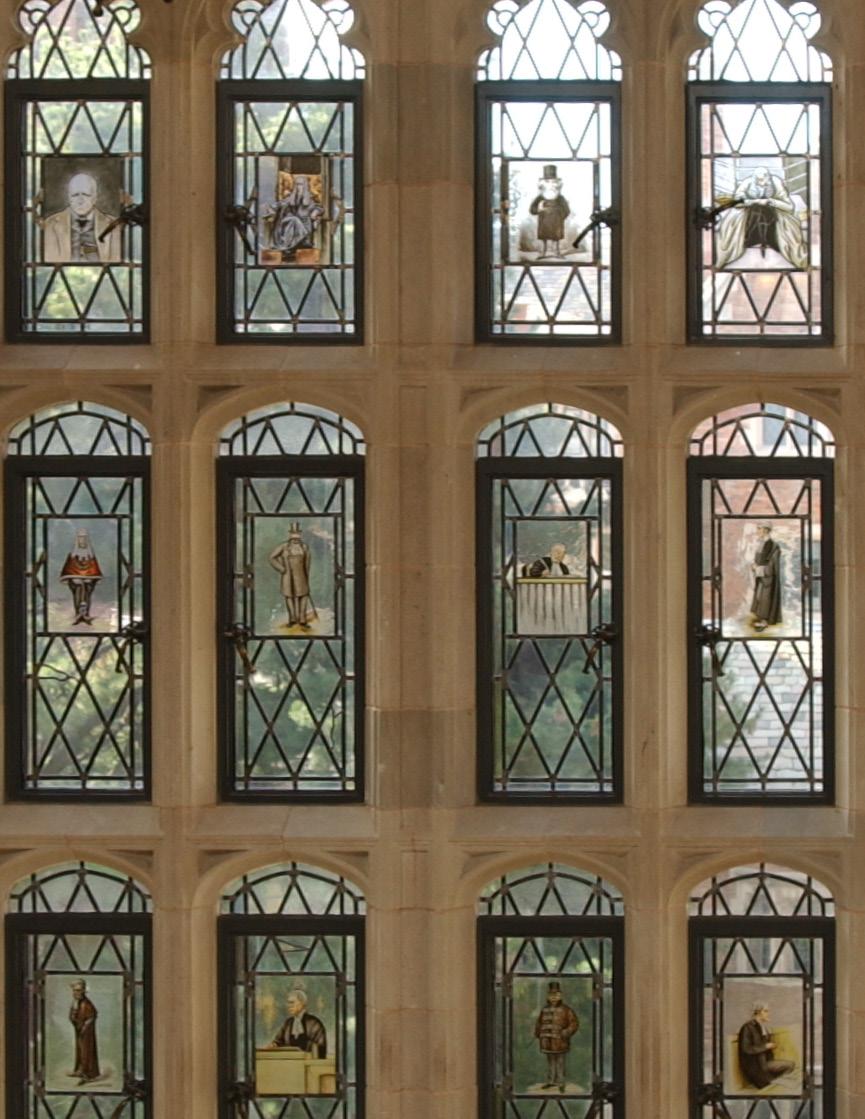
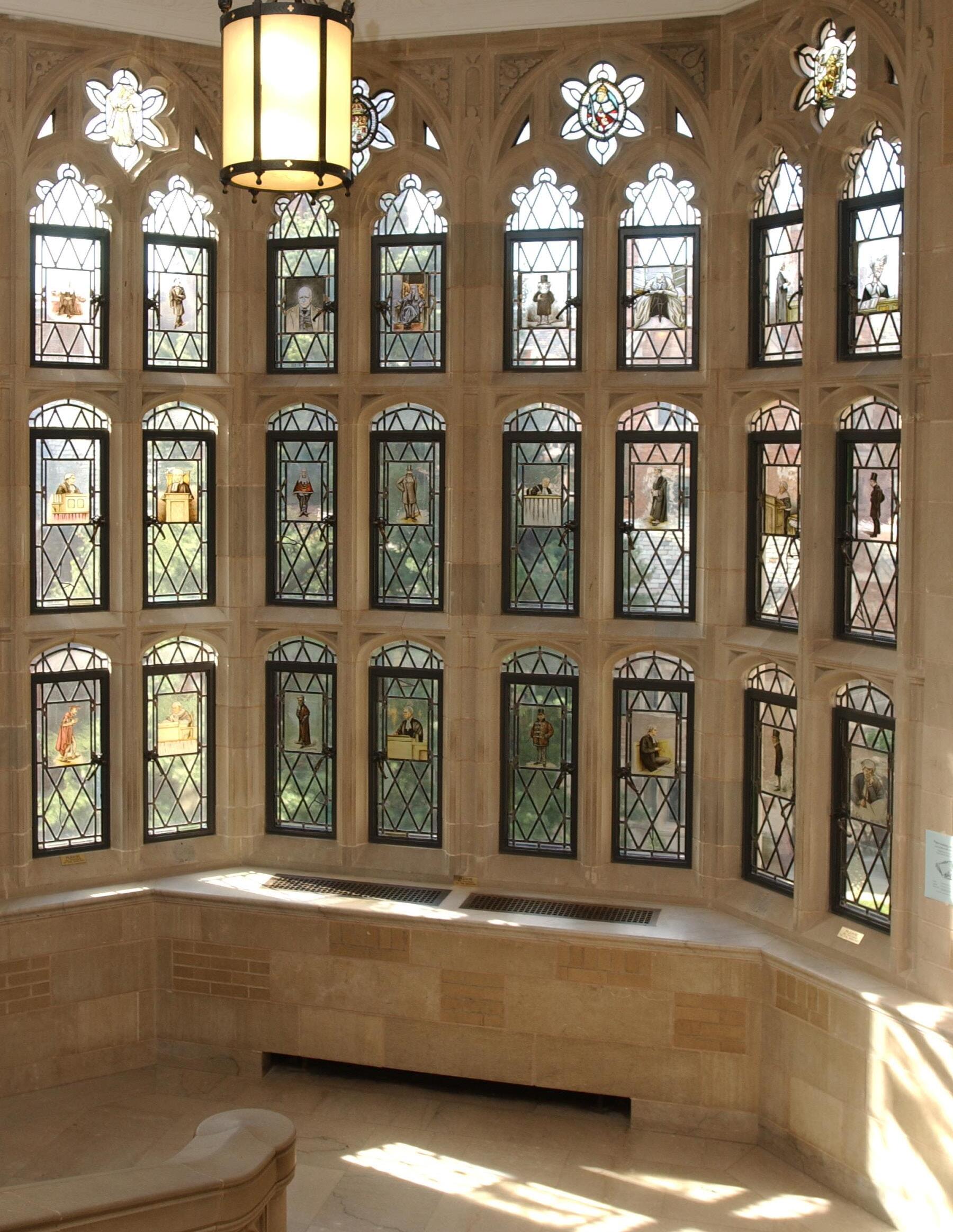
Inside cover image: A set of the original drawings of the library’s stained glass windows designed by New York City’s Henderson Brothers and entitled “Tools of Industry.”
This report covers activities from July 2024 to June 2025
It is once again my pleasure to share the activities of our library and the incredible contributions of our staff over the past year. After a thorough and inclusive process that began in 2023, we proudly completed our strategic planning exercise in fall 2024. Our staff collectively expressed a desire for greater clarity and specificity in our strategic vision, resulting in a more focused vision statement: “We build outstanding collections and promote exemplary services.” Additionally, we refined our mission to better align with our evolving needs and priorities. Please see page 22 for our complete 2025-2030 Strategic Plan.
Our front cover image speaks to one of our many activities integrating the law library in the scholarly and wellness mission of the law school. For the first time ever, we opened up the library for a grand musical performance organized by Lucia della Paolera (3L), a student in Professor Gewirtz’s class Arts & The Lawyer, and a classically trained singer and director. “The Long Last Day” performance in honor of the last day of classes was very well received by students and other library users. More details of the event in this report.
In a rapidly evolving technological environment with artificial intelligence integration becoming increasingly pervasive, the Law Library continued to advance AI initiatives through training and instruction throughout the law school and beyond. These activities included the fully enrolled Practical Artificial Intelligence (AI) course co-taught by Jason Eiseman, Steven Mitchell, and Nor Ortiz. Our technology team also hosted our first technology intern, Elaine Kong, an American Association of Law Libraries (AALL) George Strait Fellow in the summer. Read about the exciting projects she completed during her visit including designing a practical AI workshop series to help patrons build critical awareness and practical skills for engaging with generative AI tools in research and writing and exploring OCR tools to enhance the automation and accuracy of digitized legal texts in our Open Scholarship Repository.
Continuing with our technology training outreach, I was a co-panelist at the National Conference of the Council of State Governments in New Orleans, speaking to state law makers about “What Every State Official Needs to Know About Regulating Artificial Intelligence”. This report covers other outreach activities, including book talks, our speaker series, exhibits, and global initiatives such as the Global Online Access to Legal Information (GOALI), our collaboration with the International Labor Office (ILO) and Brill Publishing. In addition, the Lillian Goldman Law Library hosted a highly anticipated and well attended inaugural summer Leadership Institute for Academic Law Library Directors in New Haven.
In the archives and preservation realm, we were thrilled to be gifted the papers of Sterling Professor Emeritus of Law, Guido Calabresi, Law ’58, along with his pledge of a significant gift to support the work of our Archivist for Law Collections, Linda Hocking in the preservation of faculty and special papers.
Finally, the Law Library bade farewell to several long-serving staff members, including Fred Shapiro, Director for Collections and Special Projects, Michael VanderHeidjen, Associate Director for Scholarly Services, and Joanne McCarthy, Acquisitions Assistant. We also welcomed new staff members in Collections, Access Services, and Resource Management Services. For more details, please see the Transitions section.
Best Regards,
Femi Cadmus Law Librarian and Professor of Law
Research Instruction
The Research Instruction Team of the Lillian Goldman Law Library of Yale Law School, led by Associate Law Librarian for Research Instruction and Lecturer Julie Graves Krishnaswami, has remained committed to a culture of teaching excellence –whether in the classroom, at the reference desk, in first term small groups, or a research workshop. As part of this commitment, our focus continues to be on equipping Yale Law students with the practical skills and the substantive and conceptual knowledge to conduct legal research as law students, lawyers, and legal scholars. Over the past year, the research instruction team has supported law students’ academic success through a robust curriculum of newly introduced and longstanding courses and presentations. The team had a rewarding year as the demand for legal research instruction grew alongside the evolving needs of our students.
This year, team members continued to teach the foundational courses that form the backbone of our legal research curriculum and introduced several new classes tailored to incorporate emerging legal research and technology concepts.
Fall 2024 courses included:
Research Methods and Sources in Critical Legal Theory (Nicholas Mignanelli); Rare Books and Manuscripts for Legal Historical Research (Katheryn James);
Practical Artificial Intelligence (Jason Eiseman, Steven Mitchell, and Nor Ortiz); and History and Language Research in Legal Practice (Steven Mitchell).
Spring 2025 courses included:
Advanced Legal Research (Led by Julie Graves Krishnaswami in collaboration with Femi Cadmus, Jason Eiseman, Rachel Gordon, Steven Mitchell, Lucie Olenjnikova, and Evelyn Ma).
Introduction to Legal Research Methods & Sources (Nicholas Mignanelli and Steven Mitchell)
Specialized Legal Research in Corporate Law (Jason Eiseman and Rachel Gordon); Research Methods in Statutory and Regulatory Research (Julie Graves Krishnaswami); Research Methods in Foreign and International Law (Lucie Olenjnikova and Evelyn Ma); and Research Methods in Environmental Law (Michael VanderHeijden and Joy Hovastadt).
These courses remain essential to equipping students with the core research skills necessary to succeed in all professional legal environments. The team’s ability to maintain excellence in these foundational courses while incorporating new content and skills reflects their adaptability and commitment to ensuring that students receive a comprehensive, up-to-date education. In addition to regular classroom instruction, the Team hosted numerous workshops, one-on-one consultations, and drop-in research sessions to support students outside the classroom. We continued to teach introductory orientation sessions, including the How to Brief A Case class with the Legal Writing Department and Small Group Legal Research classes. These efforts have contributed to a noticeable increase in student engagement and overall satisfaction with research instruction services.
As we look ahead, the Research Instruction Team will continue to collaborate, innovate, and refine our curriculum to meet the growing demands of law students. For example, we will continue incorporating AI instruction into all our classes. Our ongoing commitment to excellence in teaching and supporting the next generation of legal professionals remains at the heart of the Lillian Goldman Law Library’s instructional mission.
Research and Scholarly Services
During the 2024/25 academic year, Research and Scholarly Services continued to refine and adapt its services to meet the needs of law students and faculty. The department increased availability for in-person research assistance at the reference desk by 10 hours per week, adjusting our times from 10 a.m.–4 p.m. to 9 a.m.–5 p.m. Posters advertising this change were distributed throughout the law school, and included a QR code for students to email questions directly from their phones. We continued to meet students in the Ruttenberg Dining Hall as part of our popular Lattes with Librarians program. The program has evolved from an experimental outreach effort to a regular, albeit more casual, service point under the oversight of Joy Hovestadt, Faculty Research Librarian. The law library’s support for student research, whether at the reference desk, in one-onone meetings, or via email, continues to rank among the mostvalued aspects of the law library. Students consistently credit the “amazing”, “kind”, “helpful”, “knowledgeable” service from librarians as among the best-liked aspects of the law library.
The law library also serves as an essential resource for law faculty and scholars. Contributing to this effort, each librarian liaises with about 9 law faculty and consults with them (and their research assistants) on their research projects. Nicholas Mignanelli, Assistant Director for Reference revived, planned, and participated in a well-attended panel discussion, on how to successfully navigate the article submission and publication process. Mike VanderHeijden, Associate Director for Scholarly and Research Services, created a guide for faculty on how to create author profiles to increase scholarly impact https://library. law.yale.edu/author-profiles-scholarly-impact. In addition, the department hired student workers to provide supervised research assistance on appropriate faculty research projects. Joy Hovestadt, Faculty Research Librarian, responded to over 650 faculty requests for materials and ready reference support. This was in addition to approximately 250 responses by liaison librarians to faculty requests for research assistance.
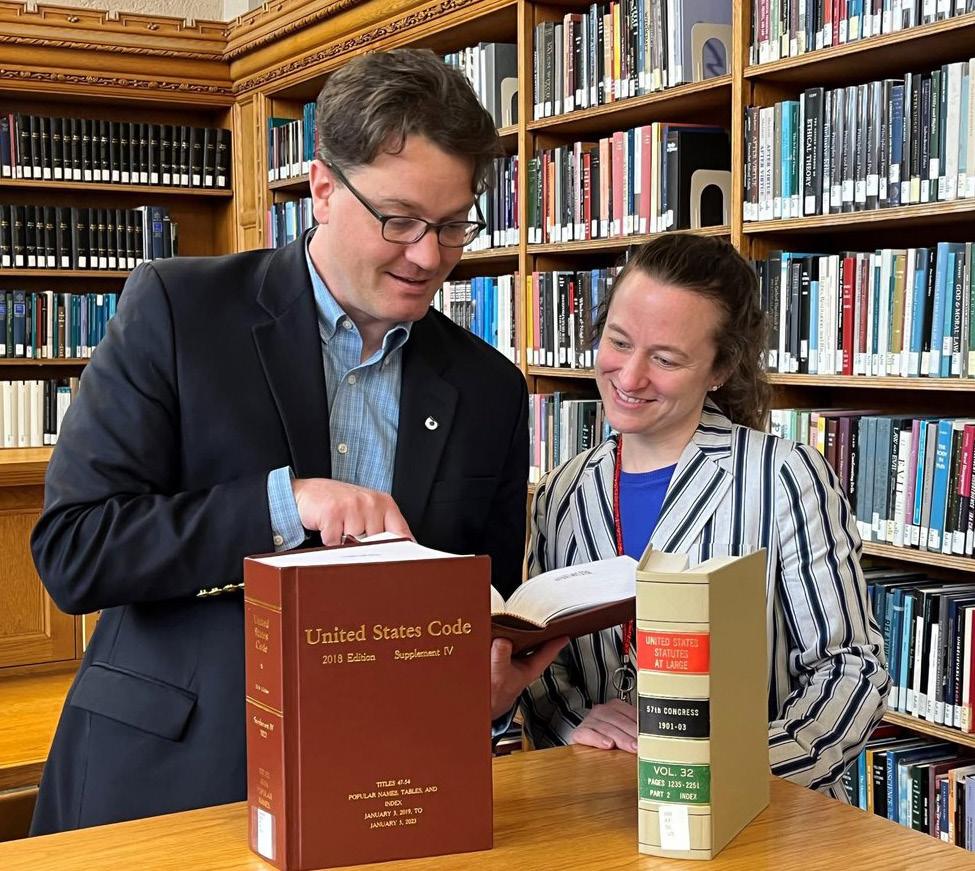
Associate Director, Research and Scholarly Services, Michael VanderHeijden with 1L students during orientation
Technology in the Age of AI
The Law library made strides in establishing itself as a leader in the law school on the deployment of artificial intelligence, particularly in hands-on exploration of AI and its use. One significant law school initiative was the introduction of a new 1-credit course for law students, Practical Artificial Intelligence (Practical AI), co-taught by Jason Eiseman, Steven Mitchell, and Nor Ortiz. Practical AI focuses on practical applications of AI in use cases in a legal context—from enhancing general productivity to assisting in producing legal scholarship. Industry guest speakers provided insight to students on AI’s everyday use in legal practice and considerations in developing AI for the legal space. The course saw high registration and the plan is to offer it in the next academic year.
In addition, the technology department hosted Elaine Kong, visiting American Association of Law Libraries (AALL) George A. Strait Fellow, librarian and PhD student in Library and Information Science (LIS) at the University of Pittsburgh’s School of Computing and Information. Elaine’s projects included designing a practical AI workshop series to help patrons build critical awareness and practical skills for engaging with generative AI tools in research and writing. She also worked on exploring OCR tools to enhance the automation and accuracy of digitized legal texts in the Open Scholarship Repository. By improving OCR performance, we aim to make collections more searchable and accessible.
We also hosted the Honorable Kevin Newsom, 11th Circuit Court of Appeals, and his career clerk Alana Frederick, for A Conversation About AI in the Judiciary. Judge Newsom discussed how he used AI in two concurrences to help understand the ordinary meaning of words at issue in the cases in before him. He suggested that large language models (LLMs) could be a useful tool for legal interpretation. In this well-attended event, Judge Newsom and Alana Frederick shared their thoughts on incorporating AI into their work and their perspectives on the judiciary’s reaction to AI.
The Technology Department continued to assist the Law Library’s Alma Migration Task Force by coordinating web presence and messaging for the go-live date, facilitating the integration of end point technologies, and developing a PrimoVE view for patron access to past exams and course reserves. Other technology improvements included a new BookEye scanner replacement and streamlined self-checkout options for patrons with MeeScan stations.
Meet Elaine Kong—Visiting AALL George A. Strait Fellow
The Lillian Goldman Law Library recently hosted Elaine Kong, American Association of Law Libraries, George A. Strait Fellow. We were curious as to Elaine’s path in law libraries and technology and she was gracious to answer our many questions.
Tell us a little bit about yourself.
My name is Elaine Kong, and I’m a second-year PhD student in Library and Information Science (LIS) at the University of Pittsburgh’s School of Computing and Information. My academic and professional background is in library technology, information systems, and AI-driven solutions, with a strong focus on how emerging technologies can enhance research, information discovery, and accessibility.
Prior to Pitt, I worked as the Systems Librarian at Georgetown Law Library, where I managed integrated library systems (Alma), optimized discovery services (Primo VE), and collaborated with teams to improve user access to digital resources. My experience in library technology strategy, data analytics, and system customization has shaped my research interests, particularly in AI-human collaboration, decisionmaking, and information quality.
My current research explores how individuals interact with AI-driven information systems in high-stakes environments, including how cancer survivors in underserved communities seek trustworthy health information. Beyond that, I’m also interested in misinformation and information quality on social media platforms, studying their role in shaping decisionmaking and user trust. My work aims to design AI-enhanced information systems that are inclusive, transparent, and trustworthy. Being embedded in a law library setting through the George Strait Fellowship has allowed me to apply this lens to the legal context.
How did you develop an interest in libraries and technology?
My interest in libraries and technology began with a curiosity about how systems work behind the scenes to make information discoverable. In my early roles, I was drawn to the challenge of making complex systems more efficient and accessible for users. I enjoyed solving problems, optimizing workflows, and ensuring equitable access to information through the thoughtful use of technology.
As I moved into research, my focus expanded to understanding how people engage with information systems, particularly how trust, bias, and misinformation shape their experiences. Using natural language processing (NLP) techniques like Latent Dirichlet Allocation (LDA) for topic modeling, I’ve worked on identifying patterns of misinformation on social media and examining the cognitive and behavioral dimensions of how users assess credibility in digital environments. This has strengthened my commitment to building systems that support informed, evidence-based decision-making.
Please describe your activities as a George Strait Fellow at the Lillian Goldman Law Library.
As a George Strait Fellow, I’ve had the opportunity to contribute to several exciting technology initiatives at the Lillian Goldman Law Library. My main projects include:
Designing a practical AI workshop series to help patrons build critical awareness and practical skills for engaging with generative AI tools in research and writing.
Exploring OCR tools to enhance the automation and accuracy of digitized legal texts in Open Scholarship Repository. By improving OCR performance, we aim to make collections more searchable and accessible.
Participating in the preparatory phase of the integrated library system (ILS) implementation by attending training sessions, weekly update meetings, and familiarizing myself with the system transition timeline. I’m especially interested in contributing to the data analytics reporting efforts and look forward to becoming more actively involved as the process unfolds.
This fellowship has allowed me to apply AI research in a law library setting, where I can bring together my expertise in technology, systems design, and user education within the context of legal information services.
What has been the most interesting or rewarding part of your experience so far?
One of the most rewarding aspects of my experience has been seeing how technical innovation and user engagement intersect in the legal information environment. Law libraries play a critical role in supporting research and access to justice, and it’s
One of the most rewarding aspects of my experience has been seeing how technical innovation and user engagement intersect in the legal information environment. Law libraries play a critical role in supporting research and access to justice, and it’s been meaningful to contribute to initiatives that improve efficiency, transparency, and user understanding.
been meaningful to contribute to initiatives that improve efficiency, transparency, and user understanding.
I’ve especially enjoyed developing a practical AI workshop series, which has opened thoughtful discussions about how AI can be responsibly used in legal research and writing. It’s also been rewarding to explore OCR automation, which is a project that directly connects technology with improving long-term access to publications and scholarships.
Other than these projects, I’ve really valued working with the library technology team during our weekly meetings. We regularly brainstorm ideas and experiment with generative AI tools to improve workflows, whether that’s addressing cybersecurity concerns, detecting misinformation, creating service desk schedules, or evaluating platforms like Microsoft Azure to explore solutions for indexing bulletins. The dynamic within the team is incredibly supportive and collaborative, and I’ve found the mix of structured projects and creative problem-solving to be both energizing and deeply rewarding.
How about your future aspirations?
Looking ahead, I hope to continue researching and developing AI-enhanced information systems that support trustworthy and inclusive access to information. My interests lie in designing technologies that help users navigate misinformation, assess information credibility, and make well-informed decisions, particularly in high-stakes contexts.
While my current research is more aligned with health information and social media environments, I see strong parallels in the legal field, where clarity, accuracy, and trust are equally essential. I’m excited to continue working at the intersection of AI, information behavior, and system design, and to support libraries in shaping technology strategies that reflect both technical innovation and human-centered values.
Overall Reflections
My time as a Fellow has been a transformative experience that deepened my understanding of law librarianship, library technology, and the evolving role of AI in legal information services. With a background in library systems and LIS research, this fellowship allowed me to connect theory with practice in a meaningful and collaborative environment.
Something I found especially fulfilling was designing a Pop-Up AI workshop, which sparked thoughtful conversations about the responsible use of AI in daily library operations.
An equally enriching experience was the opportunity to collaborate with the library technology team. Brainstorming ideas and experimenting with generative AI tools to improve workflows gave me a firsthand look at how emerging technologies can be thoughtfully integrated into practice.
Although I joined the Alma Task Force, ILS transition during its preparatory phase and did not have direct system access, attending weekly meetings and training sessions gave me valuable insight into how a law library plans and coordinates major technical changes.
I leave this experience with new skills, greater confidence, and a deeper commitment to supporting innovation in academic libraries. Meeting with professional librarians across departments gave me insight into how collaboration, dedication, and cross-unit coordination drive successful projects and user-centered services.
Words can’t fully express how grateful I am. Special thanks to my mentor, Jason Eiseman, Director, for Library Technology & Planning for his generous guidance and support— and for introducing me to great places, from upscale restaurants to down-to-earth local gems. Great food, great people, great library!
Collection Development and Special Projects
Collection development remains a critical foundation of our services to faculty, students, and other researchers, and we remain committed to our stated vision to “build outstanding collections and promote exemplary services.”
As the availability of and user preference for information in a digital format continues to grow, our digital collections remain an essential part of our mission, and we continue to provide access to an increasing number of electronic titles.
Digital acquisitions in the past year included the expansion of our existing subscription to the Lexis Digital Library to include the ABA Law Library Collection which provides access to more than 800 titles, written by experts in their fields and covering a vast range of practice areas.
The Law Library also entered into a cost sharing arrangement with Yale University Library for a subscription to Lex Machina, a legal analytics platform that uses AI to convert raw legal documents into comprehensive data sets and presents legal data in a way that makes it easy to access insights and trends relevant to legal issues.
Special Projects
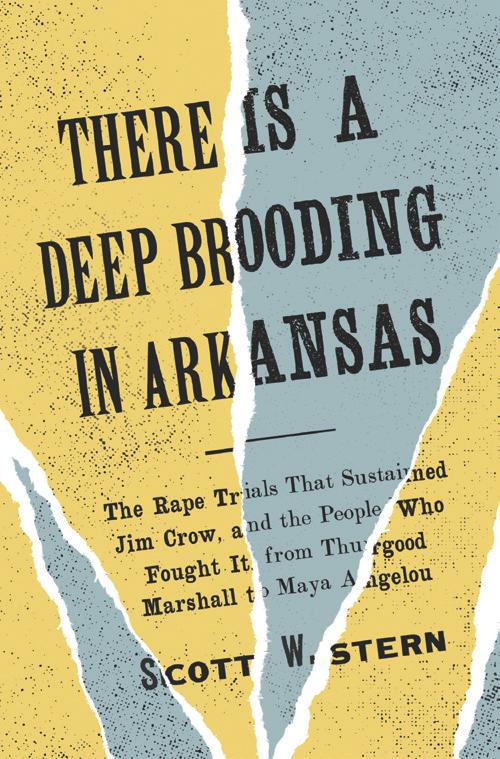
The Yale Law Library Series in Legal History and Reference is a book series published by Yale University Press, presenting outstanding scholarship by our own faculty and other authors. It has been described by the Press as one of the “crown jewels” in their prestigious publishing program. The 19th book in the series, Against Constitutional Originalism: A Historical Critique by Jonathan Gienapp, was published in September 2024; the 20th book, There Is a Deep Brooding in Arkansas by Scott W. Stern, was published in January 2025 and celebrated in a book talk in January 2025.
In February 2025, Sterling Professor Emeritus of Law Guido Calabresi ’58 donated his papers to the Lillian Goldman Law Library. This significant collection chronicles Justice Calabresi’s many years as a student, professor, and Dean at the Yale Law School. The papers also document his time serving as a federal judge on the United States Second Circuit Court of Appeals. Justice Calabresi has requested that his papers be opened for research posthumously. Linda Hocking, Archivist for Law Collections has begun processing the extensive collection (See full article on page 30) and will be described in a finding aids that will be published and searchable in the Archives at Yale database and Quicksearch, the Yale University combined library catalog.
Yale Law School
Yale Law School Library
Rare Books
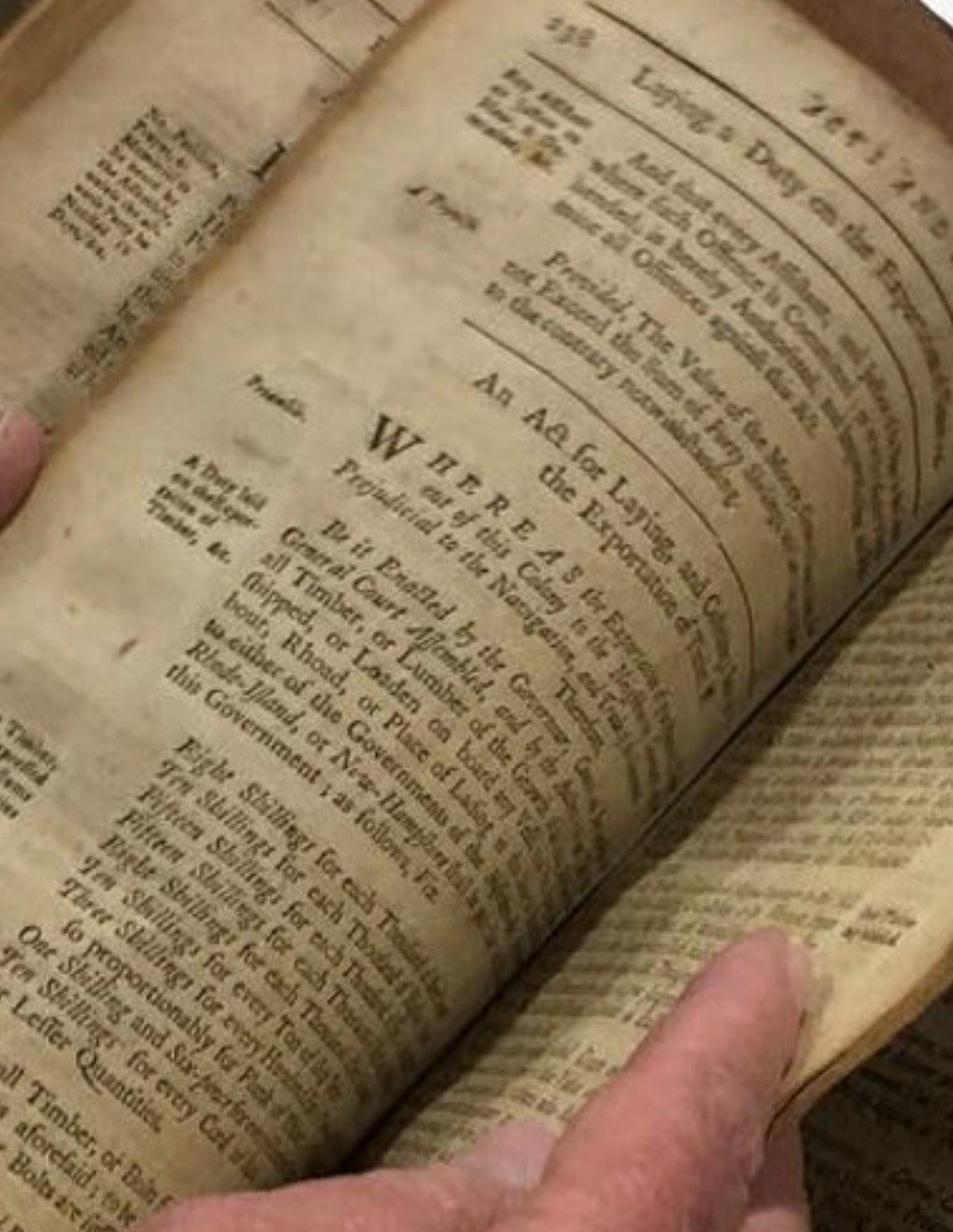
During the academic year, there were several significant additions to the Rare Books collections, the highlight of which was a set of notes kept by an American student attending William Blackstone’s lectures at All Soul’s College, Oxford, in 1758. The Rare Book Collection also acquired a manuscript poem by Blackstone, written as a young student at the Charterhouse School in 1735.
Other acquisitions of note include:
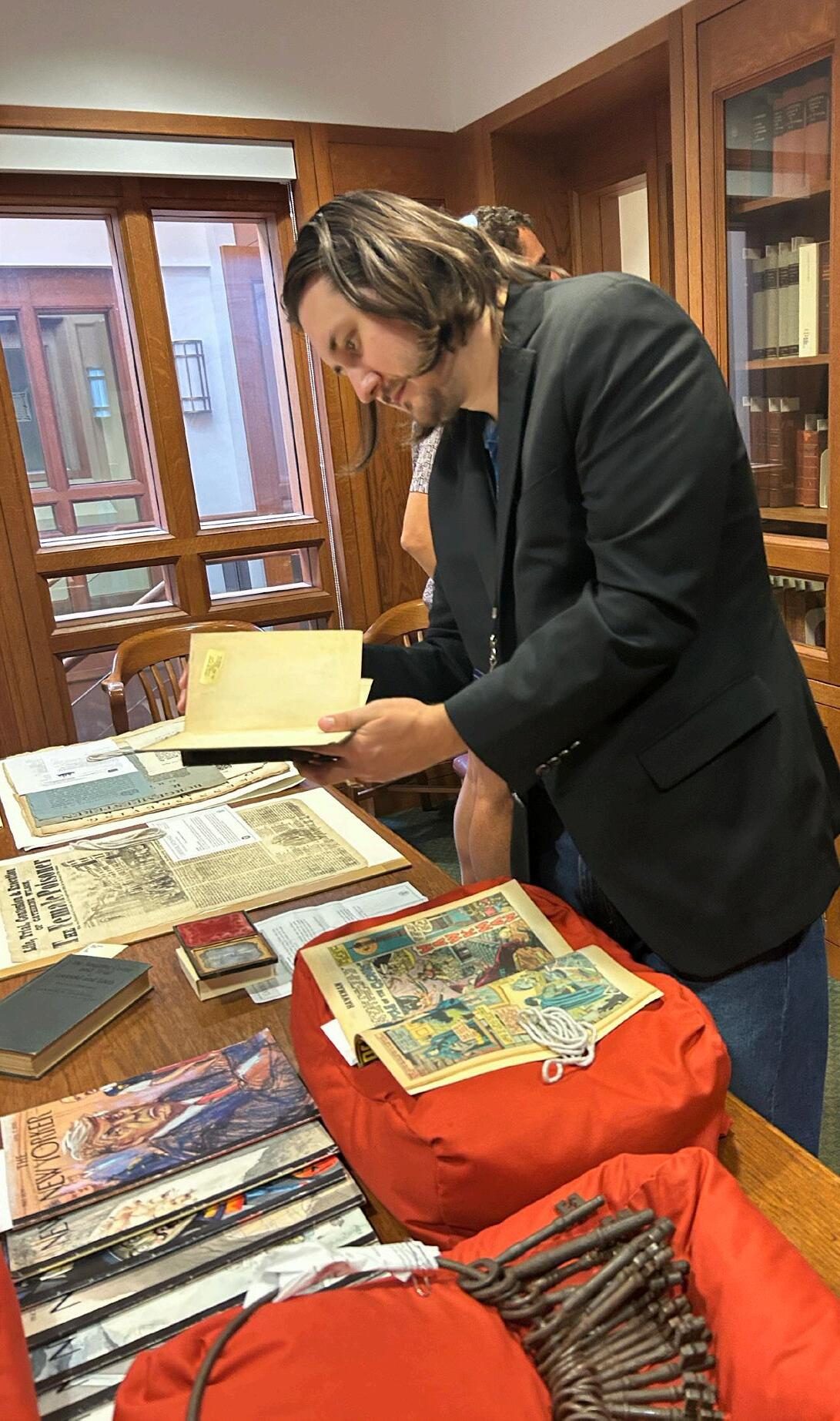
Hannah Arendt’s original essays on the Eichmann trials, published in five issues of The New Yorker in 1963, purchased through the generosity of Bob Bookman ’72. in New York City, 1949, as he oversaw the Foley Square trial of leaders of the U.S. Communist Party, in the United States District Court for the Southern District of New York.
A manuscript volume documenting the legal case of Bridget Hyde, later Duchess of Leeds, in London, 1677. A wealthy heiress, Bridget Hyde was forced by relatives into a clandestine marriage at age 12, during her mother’s illness. Her stepfather, Robert Vyner (goldsmith, banker, Lord Mayor London), brought a case of annulment in the London Court of Delegates. This manuscript volume documents the spectacle of the resulting six-year trial, which served as the basis of Aphra Behn’s satire, The City-Heiress (1682).
These and other recent Rare Book Collection acquisitions will be on display in a summer exhibition.
Rare Books curated a fall exhibition celebrating the Yale Law School bicentennial anniversary. Over the Spring, the collection hosted two exhibits: on the lower level, Max & Trix: Max and Beatrix Farrand: Memory and Landscape at Yale, exploring the work of Max Farrand, editor of The Records of the Federal Convention (1911), and Beatrix Farrand, whose landscape design still shapes the Yale campus, and other campus and institutional landscapes across the U.S. On the upper level, Flowers at Lambach followed the history of a single manuscript volume: a collection of texts relating to canon law, produced by the scriptorium at the Benedictine Abbey of Lambach in Austria in the late fifteenth century, and entering into the collections of the Yale Law Library in 1950.
The Rare Book Collection supported two courses. “Rare Books and Manuscripts for Legal Historical Research,” a collections-intensive course that met each week in the Rare Book Room, was taught by Kathryn James in the Fall. In the Spring, Kathryn was a co-instructor for Professor John Witt’s American Legal History course, incorporating collections materials into the class meetings. The students were asked to organize their final projects around a work from the Yale special collections, which formed the basis of a Fall 2025 exhibition.
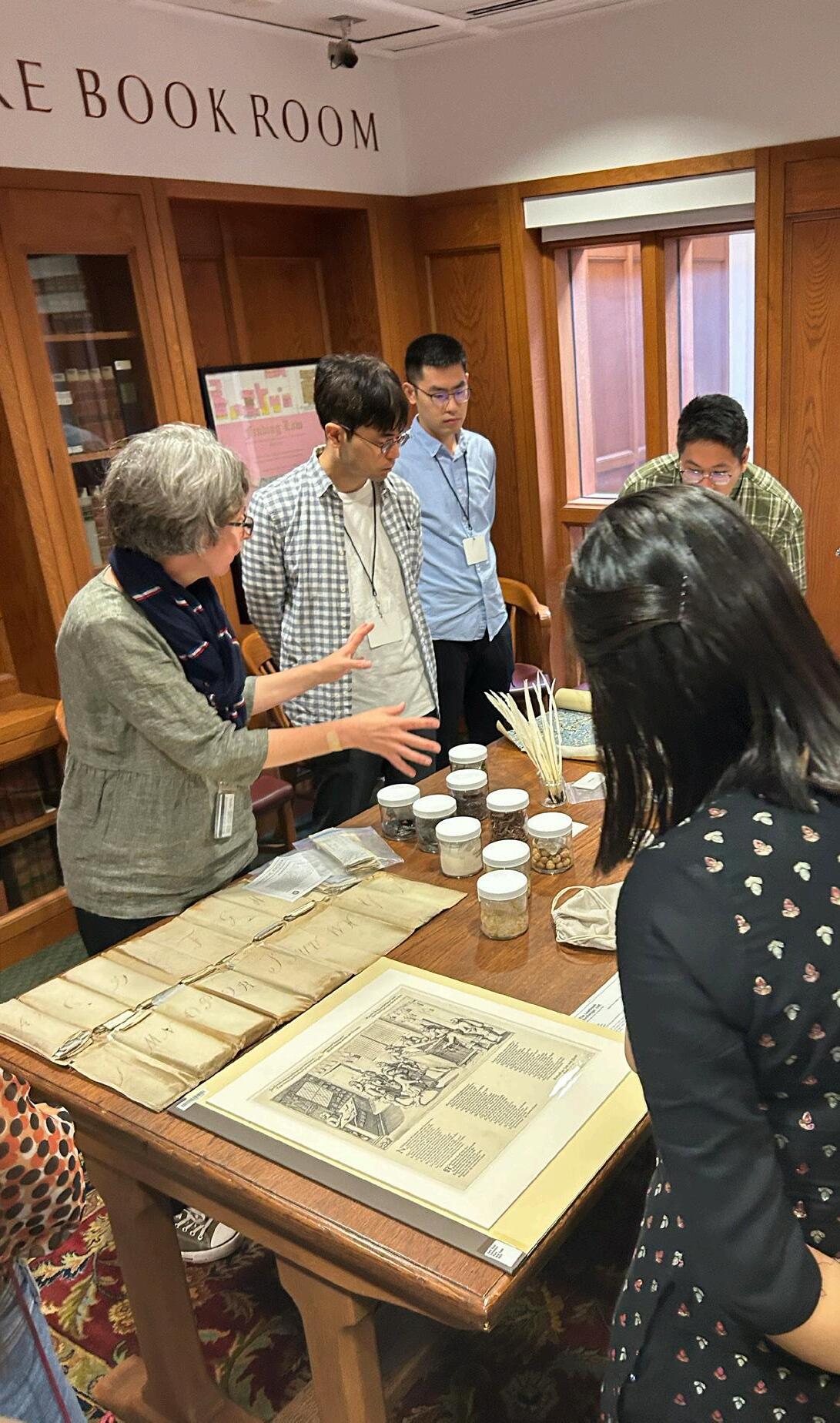
Rare Book Librarian, Kathryn James hosts Rare Book Open House for LLM students
GOALI (Global Online Access to Legal Information): Research for Global Justice
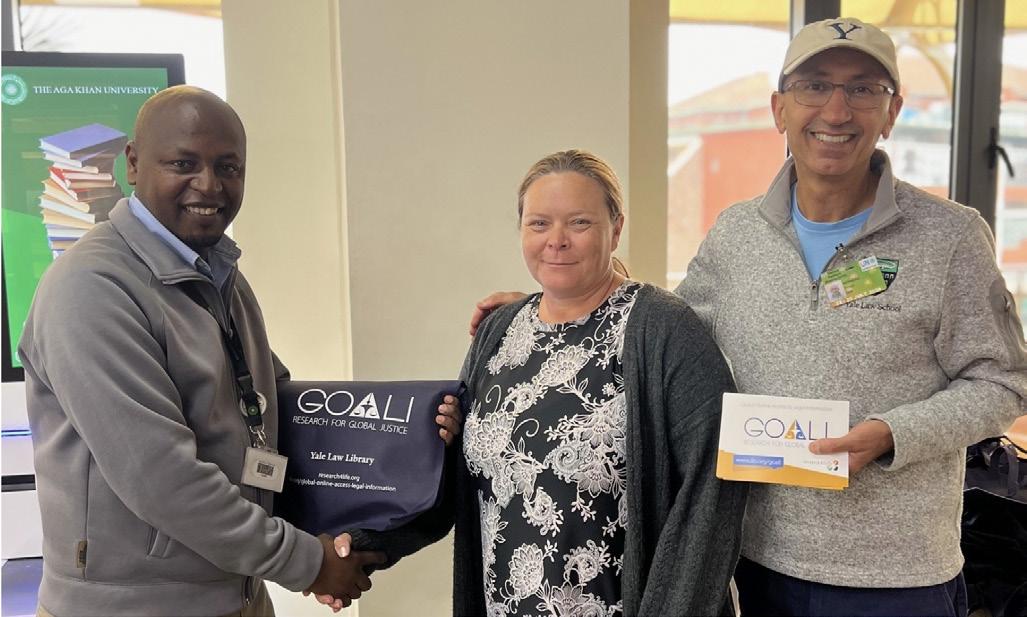
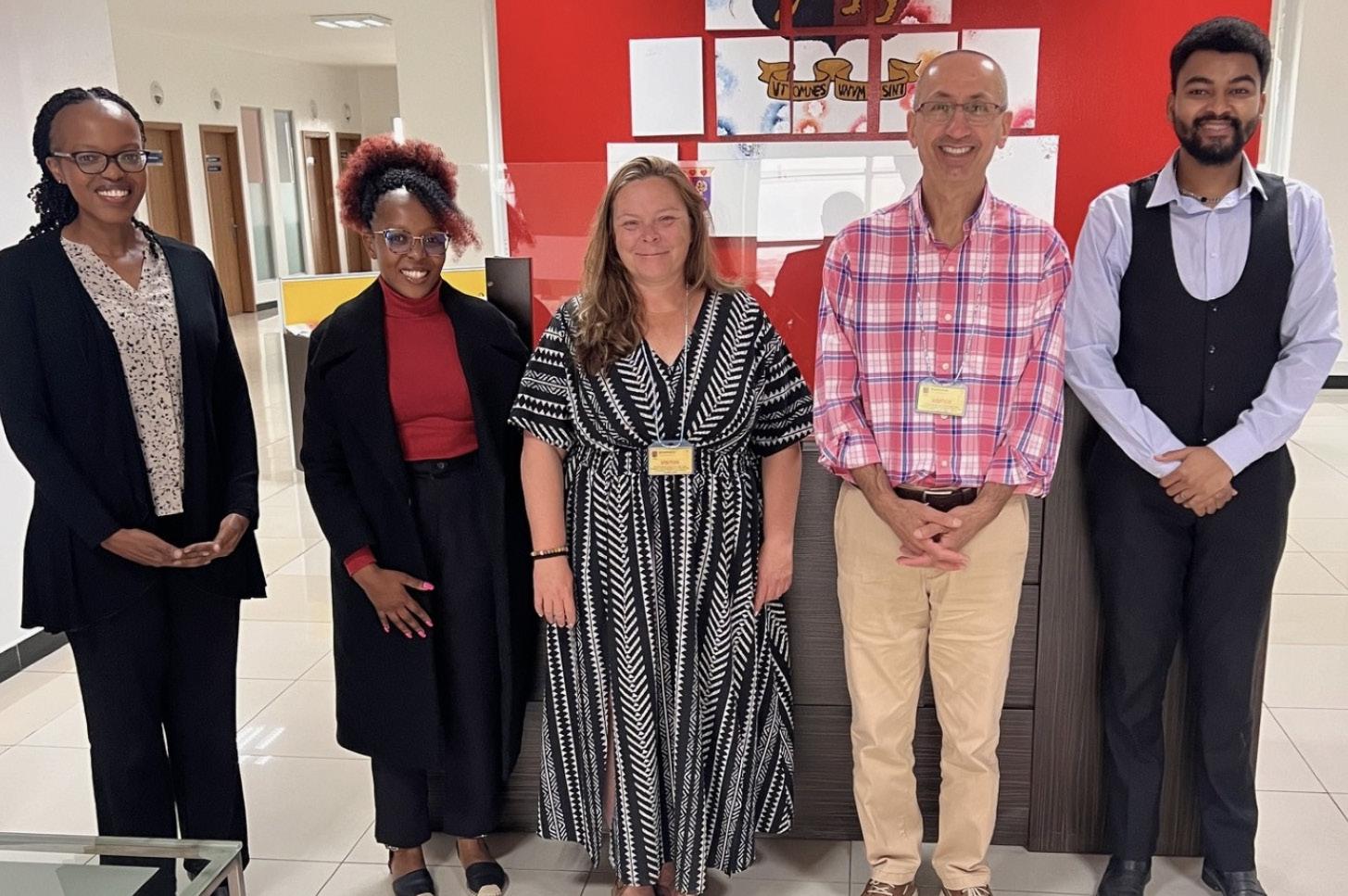
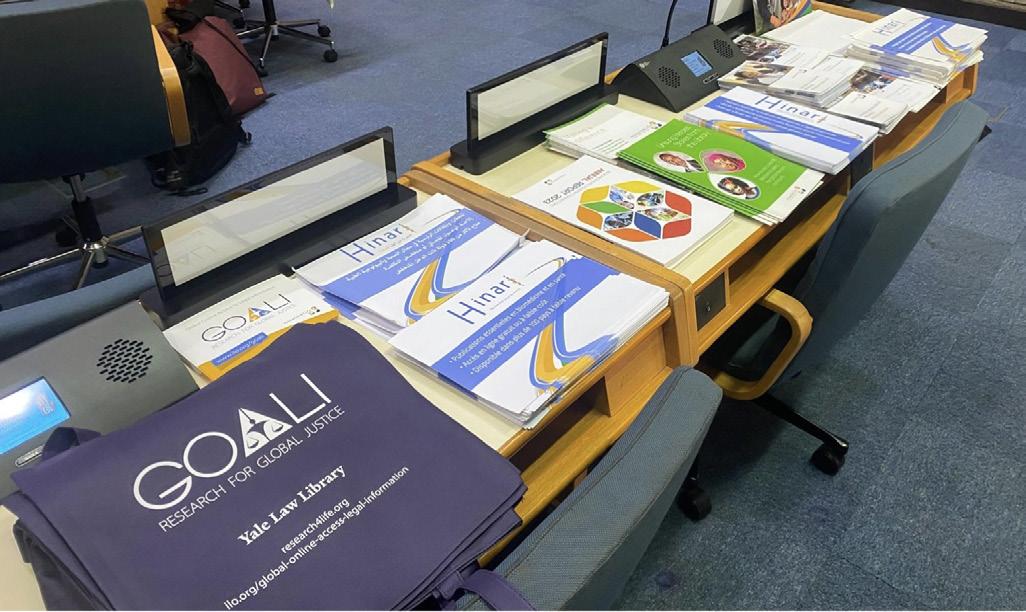
Members of the Yale Law Library team, Diana Quinones and Yuksel Serindag, participated in the just concluded Research4Life (R4L) General Partners’ Meeting (GPM) in Nairobi, Kenya. Research4Life, a partnership that includes academic partners, Cornell, Yale, and UN agencies, provides institutions in low-and middle-income countries with free or low cost online access to academic and professional peer-reviewed content. The Nairobi meeting presented our two staff members with the unique opportunity to promote Global Online Access to Legal Information (GOALI), one of R4L’s content collections and our collaboration with the International Labour Organization and Brill Nijhoff.
Diana and Yuksel narrate what they describe as an incredible experience below:
This was the first time R4L held the annual GPM in a user country, allowing us to interact in-person with users of the R4L platform. Despite the current state of political unrest in Kenya, we were able to visit Aga Khan University with other GPM attendees, where we heard from faculty, librarians, and researchers who have relied heavily on R4L for their work. Two other planned site visits were canceled because of the unrest. While disappointing, we were able to arrange with local law schools to present information about GOALI. We spent a morning at Strathmore University Law School where researchers we met there knew the main library had access to HINARI, R4L’s oldest program focused on medical resources. However, they were unaware that R4L had expanded over the years and that they also had access to legal information through GOALI. The excitement was palpable, and they promised to share the information about GOALI with their students and peers in other institutions.
One of the biggest challenges for R4L is a lack of awareness of the available resources, as we saw at Strathmore. This amazing platform provides access to over 200,000 resources, which thousands of institutions have access to. Still, it is useless unless eligible institutions know about the resources, how to access and use the collections. In response to this challenge, R4L started a program in 2022 called Country Connectors, assigning individuals to several user countries to increase awareness about R4L resources and provide training. There are currently 11 country connectors, most of whom were able to attend the GPM in person. We had the opportunity to speak with them, learn more about their work, what they are hearing from users, and what is needed from R4L partners.
We left with the knowledge needed for effective outreach and to ensure that law schools within user institutions are properly informed about access to legal information resources on the GOAL platform. Attending the GPM in a user country was an inspiring experience that renewed our commitment to GOALI. If you would like to know more, hakuna matata, we’ll happily talk about GOALI with anyone willing to listen.
Bruce Ackerman ’67, Sterling Professor of Law & Political Science., The Post-Modern Predicament: Existential Challenges of the 21st Century Yale University Press. September 11, 2024
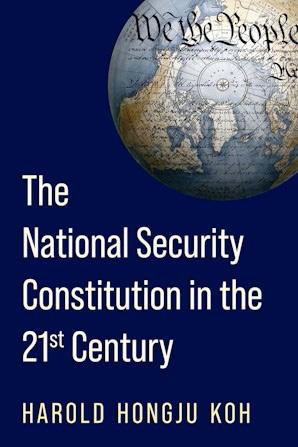
Harold Hogju Koh, Sterling Professor of International Law with commentary by Cristina Rodríguez ’00, Leighton Homer Surbeck Professor of Law. The National Security Constitution in the 21st Century. Yale University Press. September 18, 2025.
EXHIBITS & BOOK DISPLAYS
The Legacy of Alexander M. Bickel: Fifty Years On This month marks the 50th anniversary of the death of Professor Alexander Mordecai Bickel, who served on the Yale Law faculty from 1956 until his untimely death in 1974. One of the most influential constitutional theorists of the last century, Bickel’s work championing judicial restraint has shaped the thinking of Supreme Court justices and leading legal scholars alike. Earlier in his career, as a clerk to Justice Felix Frankfurter, he prepared a historic memo urging that Brown v. Board of Education, 347 U.S. 483 (1954), be reargued, giving the Court time to reach consensus around outlawing segregation. In the final years of his life, he successfully
W. Stern ’20 with commentary by Professor John Fabian Witt ’99, Duffy Class of 1960 Professor of Law. There is a Deep Brooding in Arkansas. Yale University Press, Yale Law Library Series in Legal History & Reference. January 28, 2024
SPEAKER SERIES
argued for the petitioner in New York Times Co. v. United States, 403 U.S. 713 (1971) (the “Pentagon Papers Case”), which held that the First Amendment protects the right of the press to publish classified information without prior restraint.
This exhibit, created by Ashley Mehra, a second-year law student, and Nicholas Mignanelli, Assistant Director for Reference at the Lillian Goldman Law Library, contains first editions of Bickel’s scholarly monographs, original copies of his most-cited law review articles, and selected ephemera and photos from the files of the Office of Public Affairs. This exhibit serves as a companion to “The Legacy of Alexander M. Bickel,” an event featuring Professors Anthony T. Kronman and Owen M. Fiss scheduled for Thursday, November 7,.
Max & Trix
Max and Beatrix Farrand: Memory and Landscape at Yale An Exhibit at the
Lillian Goldman Law Library, Lower Level 2, January–May 2025
Flowers at Lambach
An exhibition on view in the Lillian Goldman Law Library Rare Book Exhibition Space, Library Level 3, January–May 2025
Summer Exhibit of New Additions to the Lillian Goldman Law Library’s Rare Book Collection, including:
• a set of lecture notes by an American student attending William Blackstone’s lectures at All Soul’s, Oxford, in 1758;
• a manuscript poem composed by Blackstone as a student;
• Hannah Arendt’s “Eichmann in Jerusalem,” in its original publication in five issues of The New Yorker (1963);
• a pirated edition of Catherine the Great’s Instructions to the Legislative Commission (1769)
• a courtroom drawing of Harold Medina, as he oversaw a trial of the leaders of the U.S. Communist Party in 1949.
Hon. Kevin C. Newsom U.S. Circuit Judge, United States Court of Appeals Eleventh Circuit and Alana Frederick, Career Law Clerk and Chief of Staff. A Conversation About AI in the Judiciary, moderated by Jason Eiseman, Director for Library Technology & Planning, Lillian Goldman Law Library. February 13, 2025
Ron Wheeler, Associate Dean of the Law Libraries and Professor at Boston University School of Law. Exposing the false promises of democratization made by those who would abandon the dual degree standard. September 18, 2024
Cliff Anderson, Director, Yale Divinity Library, Deep Fakes, and the Persistence of Digital Memory. December 4, 2025
Kirsten Winek, Accreditation Counsel at the ABA Section of Legal Education and Admission to the Bar, ABA Law School Accreditation Standards Overview. June 12, 2025
At Strathmore University Law School, with Dr. Lynette Osiemo, Research Director; Wendy Nyakweba, Graduate Assistant, Research; Diana, Yuksel (Yale Law Library), and Malcolm Melita Kibati, Graduate Assistant, Partnerships
United Nations at Nairobi Office—R4L information table
At Aga Khan University, with George Mwangi, Assistant Librarian, far left with Diana Quinones and Yuksel Serindag, Yale Law Library
Scott
Foreign and International Law
Enhancing the Foreign and International Law Collection
The Foreign and International Law Team continues to curate the foreign and international law collection at YLS thoughtfully. Our multi-year project to review and update the F/I Reference Room Collection is nearly complete. We reviewed all 768 titles in the F/I Reference Room Collection and updated, replaced, removed, and added items to create a useful and user-friendly collection. Members of Access Services and Resource Management Services provided support for this project. In an ongoing project, the team continues to review the overall F&I collection to accommodate onsite and offsite storage challenges.
The team continues to build a balanced collection of print and electronic resources. During the last academic year, we made several additions to our electronic holdings, including the Jus Mundi database, the Elgar Encyclopedia of International Economic Law, the Elgar Encyclopedia of Intellectual Property Law, and the Elgar Encyclopedia of Crime and Criminal Justice We also added the Case Genie AI tool, built to analyze text for legal concepts, to our already existing ICLR database subscription. We additionally reviewed the Lexis Middle East, Westlaw Japan, Dalloz, and El Commercio Archive databases.
Supporting Faculty and Students
Engaging the Community
The Foreign and International Law Department curated exhibits highlighting the foreign and international law collection and instruction at YLS.
Over the summer, the librarians created a digital exhibit titled “Walking Down Memory Lane on the 50th Anniversary of YJIL,” which archived the Spring 2024 library exhibit and was included in the first issue of Volume 50 of the Yale Journal of International Law.1 Through this experience, the librarians explored available digitization technologies to contribute to the collection of Yale University Library Online Exhibitions. It also reflected how our substantial library collections have supported the scholarship and policy advocacy work of members of the Yale community and beyond. Special thanks go to Caitlyn Lam, Managing Director of Digital Collections Service at the Lillian Goldman Law Library, and Trip Kirkpatrick, Technical Lead for Special Collections, Library IT, for their guidance and technical expertise.
1
We kicked off the fall semester with a library exhibit titled “International Law Casebooks and Textbooks,” curated by Evelyn Ma, showcasing international law textbooks used in legal curricula at home and abroad, which served as a prequel to the next exhibit.
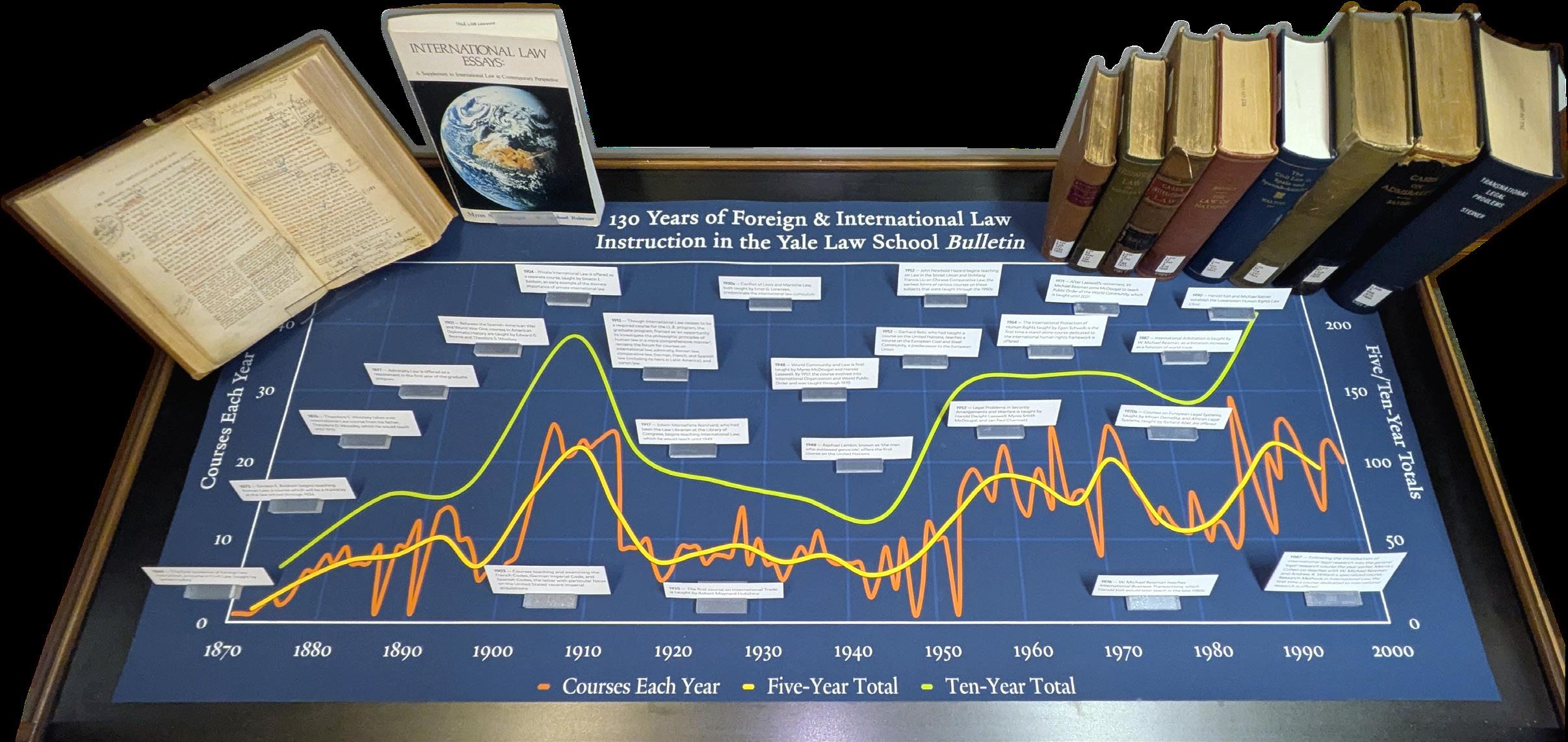
A collaborative exhibit, titled “130 Years of Foreign & International Law Instruction in the Yale Law School Bulletin,” curated by Steven A Mitchell, Lucie Olejnikova, Evelyn Ma, and John B. Nann, was mounted on L1 in late November 2024 through the Spring 2025 semester. The graphical timeline traced the milestones of international and foreign law teaching at the law school, a testament to its timely evolution and multifaceted curriculum. The research of the Yale Law School Bulletin between the years 1869 and 2000 uncovered over 1550 courses offered, each of which was meticulously documented for this and potential future exhibits.
We closed the academic year with a summer book display, curated by Evelyn Ma, titled “The Common Heritage of Mankind”. The display highlights multilingual scholarly works in the library collections, illustrating the notion that some resources and elements are best explored and developed, and their uses coordinated, by collaborative efforts of the global community.
The F/I team oriented incoming students to the library’s services. During the 2024 academic year, in partnership with the Graduate Programs, we offered the Fundamentals of Legal Research Series, Case-Briefing Basics, and LLM Orientation. Throughout the year, we also offered library orientation sessions for in- and out-of-residence JSD students. In a collaborative effort, Kathryn James, Rare Book Librarian introduced the visiting Linkage Program students to the YLS Rare Book Room while Evelyn Ma led a session introducing legal e-resources at Yale, and Brad Hayes took the students on a library tour.
During the Orientation week of incoming first-year students, the F/I team participated in the classroom portion of 1L Orientation and taught Case Briefing Basics. During the fall semester, librarians also offered 1L Small Group Legal Research, including an expanded role within the ILAW program. In Spring 2025, the members of the F/I team also participated in teaching the Advanced Legal Research course offered for graduate students.
Steven A Mitchell adapted an advanced legal research course entitled History & Language Research in Legal Practice for the Fall 2024 semester, in which he shares his unique historical- and linguistics-focused approach to legal research training. First taught at Notre Dame, the course was revised for Yale Law School’s existing legal research curriculum and the
topical interests of the student body. The class also drew on the expertise of the library generally, with guest presentations from Kathryn James and Fred Shapiro.
In Spring 2025, Lucie Olejnikova and Evelyn Ma offered a ten-week, two-credit Research Methods in Foreign and International Law course in tandem with Prof. Oona Hathaway’s International Law course. We welcomed two guest speakers, Susan Goard, research librarian at the United Nations Dag Hammarskjöld Library, who delivered a lecture on researching UN documents, and Kathryn James, a Rare Book Librarian at Yale Law School, who spoke about the socio-economic aspects of rare law books, and how preservation decisions shape the corpus of future collective knowledge.
John B Nann offered the Advanced Legal Research course during the Fall 2024 term. John also conducted research at the New Haven Historical Society archives and Yale archives for a faculty member, and he arranged for the acquisition of publishable quality images and other archival material for Professor Witt’s soon to be published book, “The Radical Fund: How a Band of Visionaries and a Million Dollars Upended America.” In preparation for the Global Constitutionalism Seminar in fall 2025, Evelyn Ma and Lucie Olejnikova provided research training for the seminar’s student research assistants in spring 2025.
Steven A Mitchell offered a Prepare for Exams Workshop in fall 2024. He also co-taught the Introduction to Legal Research Methods and Sources with Nicholas Mignanelli, lectured in a winter-break workshop on constitutional history research, co-taught Practical Artificial Intelligence with Jason Eiseman and Nor Ortiz, and co-taught in the inaugural Essentials of Research and Writing course in Spring 2025.
Lucie Olejnikova delivered specialized legal research workshops to students enrolled in the Lowenstein International Human Rights Clinic, to members of the Philip C. Jessup International Law Moot Court team competing in the United States, and to the members of the Vis Moot Court Team competing in Vienna, Austria. Lucie was also invited to give two lectures as part of the International Adjudication and Advanced Topics in International Law doctrinal course.
Working with YLS Clinics
Also in the fall of 2024, John B. Nann became the Librarian for Clinical Services and Collection Development when Clinical and Experiential Learning became part of the Foreign and International Law Department. In this role, John and Lucie worked closely with the YLS clinics to strengthen collaboration, delivering information presentation to clinical faculty, establishing regular communication, and working to underscore the library’s clinical liaison program.
See Lucie Olejnikova, Steven A Mitchell, Evelyn Ma, Walking Down the Memory Lane on the 50th Anniversary of YJIL: An Exhibit in Honor of Professor W. Michael Reisman, Teacher, Jurist, Enduring Patron, and Inspiration, 50 Yale J. Int’l L. 137 (2025).
‘130 Years of Foreign & International Law Instruction in the Yale Law School Bulletin’, the exhibit presents a view of the classroom presence of foreign and international law at Yale Law School through the lens of the course listings published in the annual Bulletin and its predecessors.
Digital Collections Services
In FY24-25, Digital Collections Services reached new milestones in our unit’s decade-long history. Our mission began in 2015 with an aspiration towards sustainable stewardship of the library’s digital assets and the goal to open special law collections to the world through the digital environment. While our mission remains steadfast, our initiatives have since evolved from outsourcing mass digitization projects to the operation of an in-house preservation imaging studio. Developing a sustainable program for digital access and preservation involves dedicated staff, responsiveness to an ever-changing digital landscape, and resourceful collaboration with Yale University Library to adopt policies and best practices guiding the development of digital collections.
To support a robust digital program, our collections are built upon strategic integration with the University Library’s
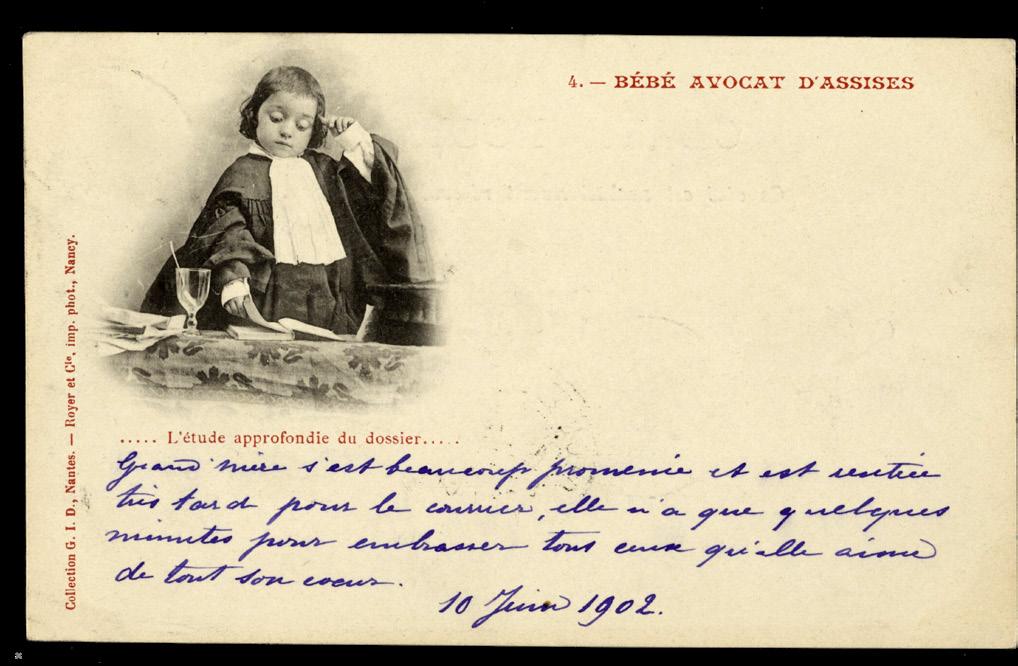
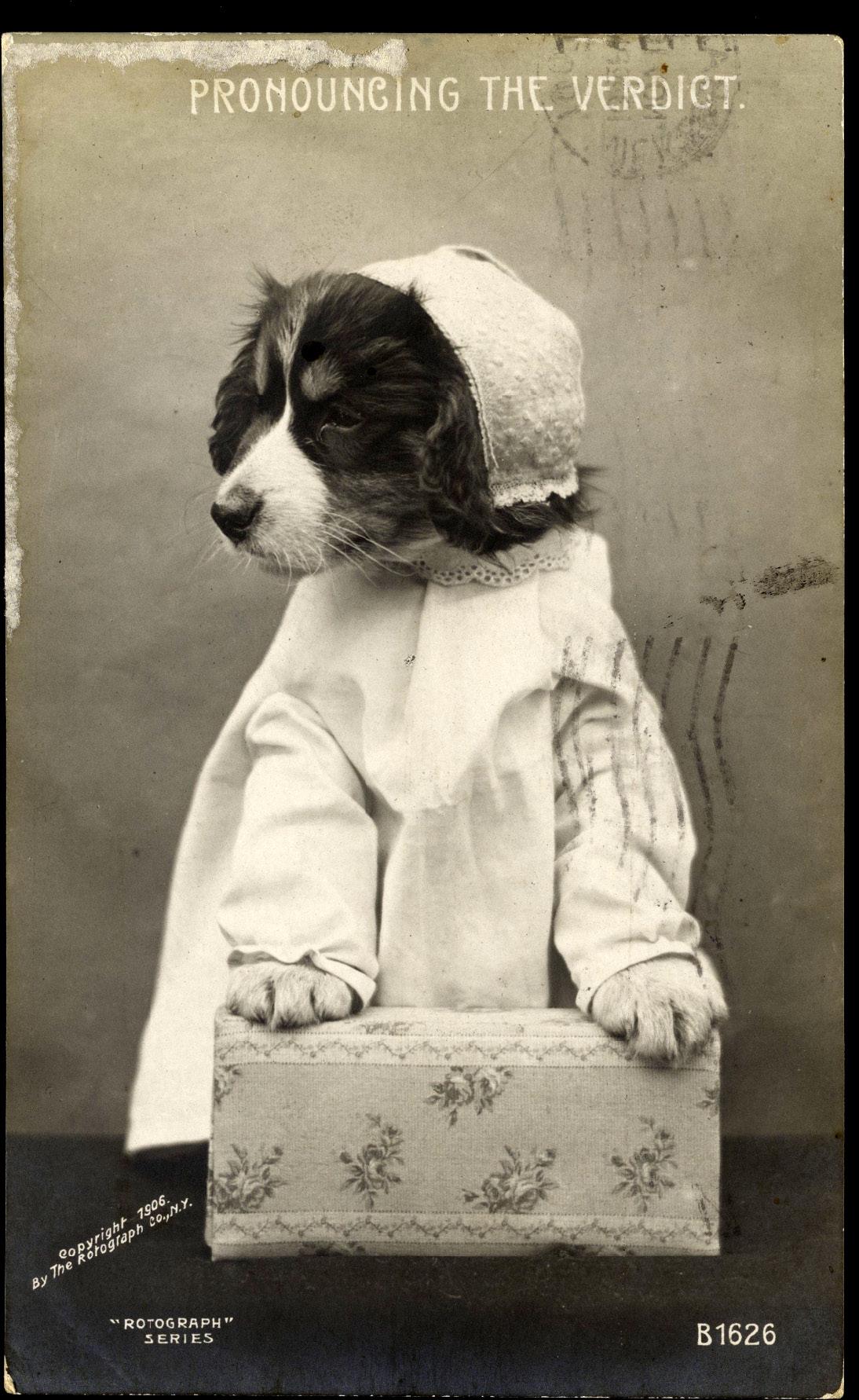
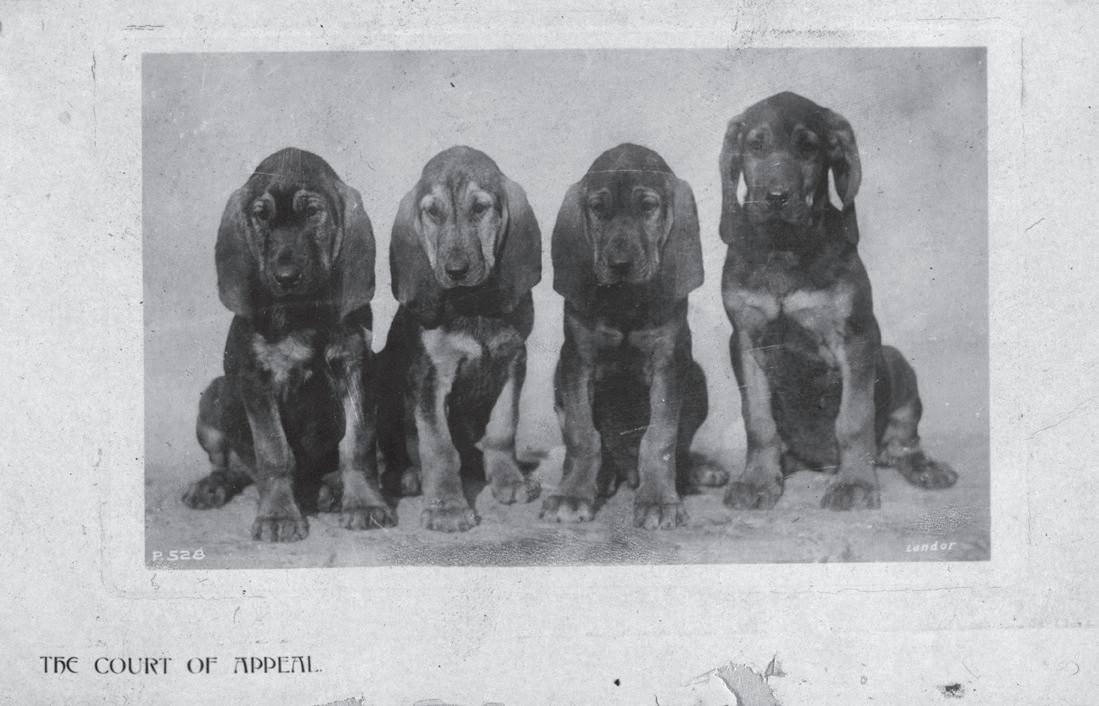
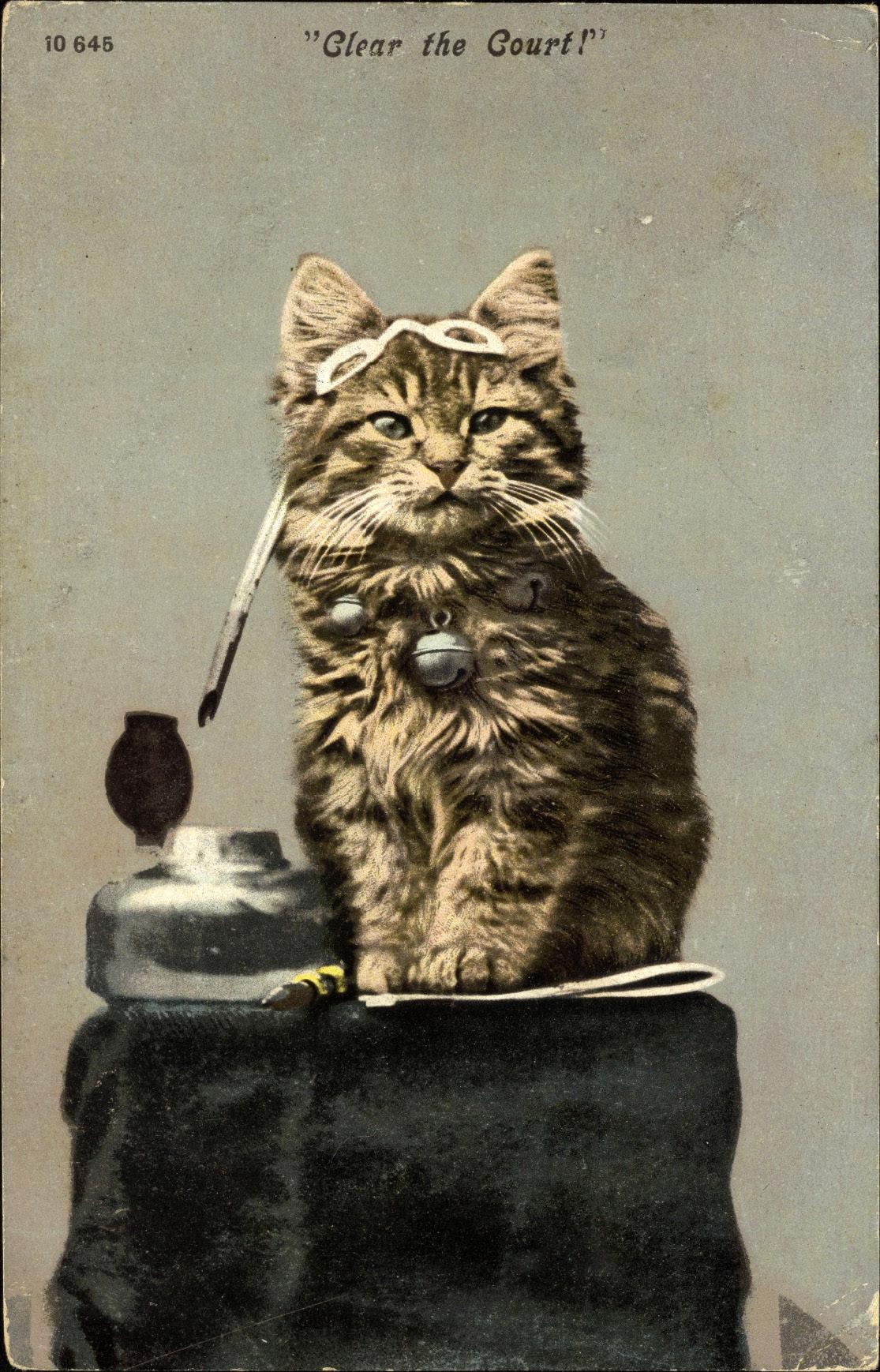
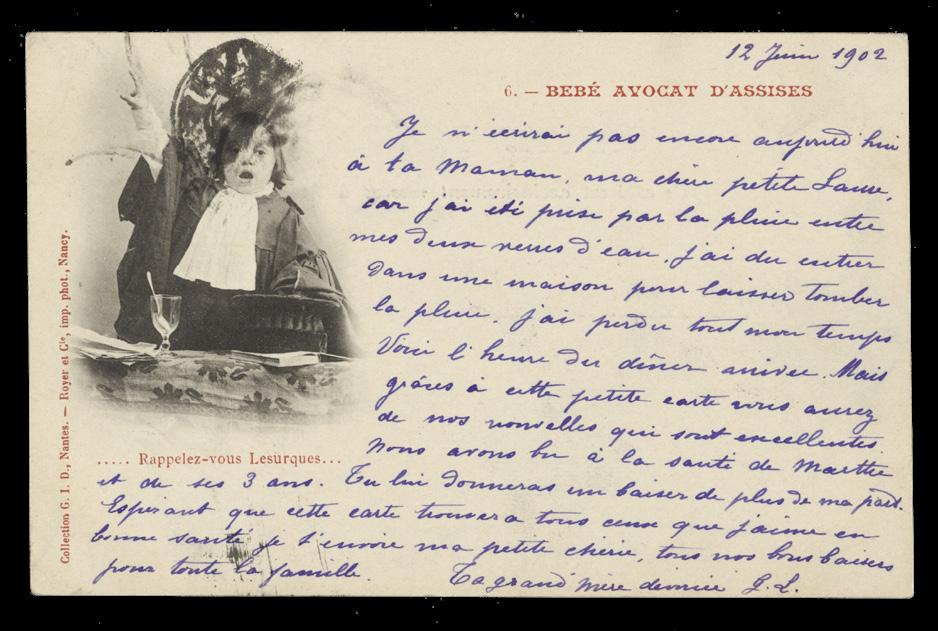
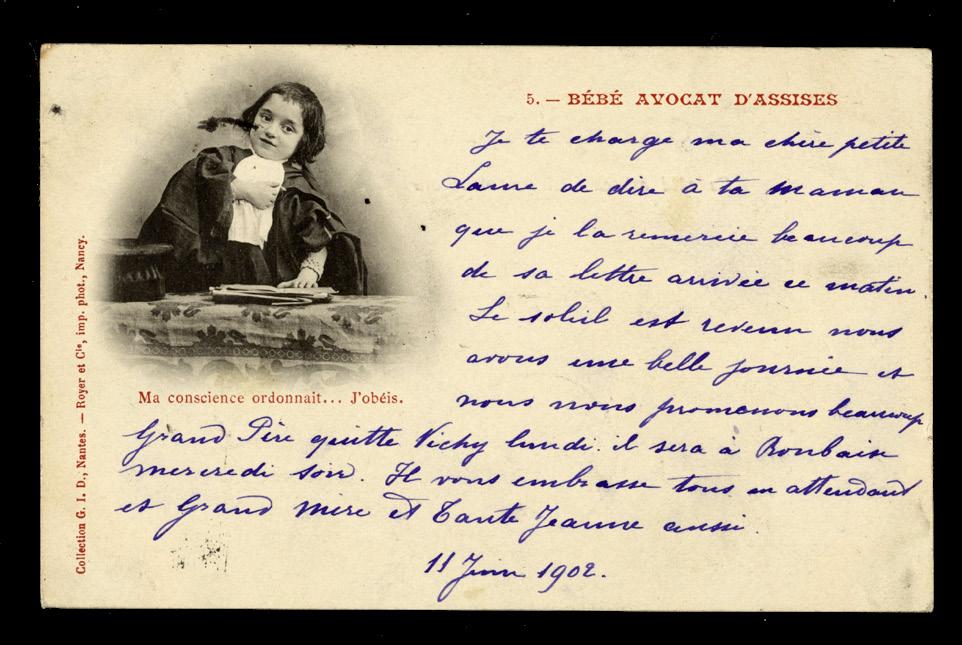
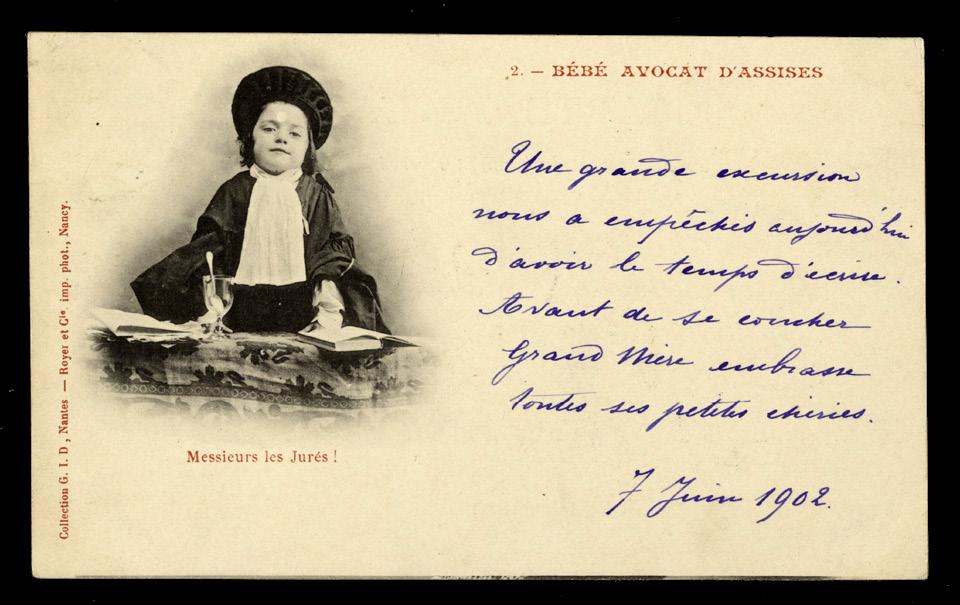
The Legal Postcards collection was developed from a core collection of French legal postcards donated by Lois S. Montbertrand, Law ’85. This collection currently contains over 400 legal-themed postcards printed in France, the United Kingdom, Germany, and the United States, in the late 19th to mid-20th century. Postcard images depict lawyers, judges, court cases, and legal matters, at times portrayed by women, children, and animals in various legal settings. Postcard themes typically fall into three groups: (1) the controversy over separation of church and state (2) the entry of women into the legal profession, and (3) satirical portrayal of the legal profession, often using children and animals in the roles of lawyers, judges, and litigants.
digital environment, digital special collections policy, and sustainable stewardship principles for special collections. The Lillian Goldman Law Library and University Library’s joint migration to Alma, will enable us to more uniformly apply descriptive metadata and manage digital objects within Yale’s complex digital collections network for discovery, access, and preservation across our libraries and museums.
Upon completion of a 5-year digitization plan ending with the Law School Bicentennial, we paused large-scale digitization efforts to respond to the Alma migration and its downstream impact on digital collection systems and workflow. In addition, the establishment of a law archives program and the arrival of our Archivist for Law Collections, Linda Hocking, introduce new challenges and opportunities with archival description for digital objects and accessioning born-digital content. We are working towards the integration of ArchiveSpace into the digital workflow and the adoption of Aeon for special collections and photoduplication requests.
We have continued to develop new strategies and an overhaul of existing practices that support digitized and born-digital collections of still images and audio-visual material, web archives, and online exhibits. In addition, we have
formulated strategies for supporting online exhibits and options to expand services for fulfilling patron requests for highresolution scans of collections material.
This year, we completed digitization of a small selection of printed books and manuscripts. Among recently digitized works is a cataloger’s annotated copy of Hick’s Yale Law Library classification; with directions for its use, notes on cataloguing practice, and indexes. In addition, Digital Collections worked with Foreign & International Law Librarians to explore online exhibit applications and create the Walking Down Memory Lane on the 50th Anniversary of YJIL online exhibit.
In October 2024, we welcomed Grace Parenti, Digital Initiative & Archives Assistant. In this newly established role, Grace provides invaluable support for both digital collections development and legal archives. Since joining the library, Grace has made significant contributions imaging special collections material for access, preservation, exhibits, and other requests.
Resource Management Services
Resource Management Services (RMS), formerly known as the Technical Services Department, has experienced significant changes over the past year. While some may question, “What is in a name?” the renaming reflects a strategic alignment with the broader Yale Library community and the academic library profession at large. This change provides clarity around our core responsibilities—managing the acquisition, cataloging, metadata, and discovery cycles for both physical and electronic resources within the law library.
During the 2024-2025 academic year, RMS dedicated considerable effort to preparing for a major transition: the migration from our legacy integrated library system, Sierra/ Morris, to the more advanced library services platform,
Materials Added to the Collection
Type fy22 fy23 fy24 fy25
Monograph Titles Added 8237 7479 8666 10609
Serials Added 7209 23539 23540 17466
Alma, scheduled to go live in July 2025. This process involved extensive months of data cleanup, particularly within the acquisitions and cataloging units, ensuring a smooth and accurate migration. The department invested heavily in training sessions and workshops to facilitate familiarity with Alma, develop optimized workflows, and create comprehensive documentation for leveraging new tools and third-party integrations. These initiatives have positioned RMS to enhance service delivery and operational efficiency, with a focus on supporting the evolving needs of the law school community.
Collaboration across the Yale Library system has been instrumental in this transition. RMS has worked closely with colleagues across the university to align workflows and foster a community of practice. These efforts are expected to lay the groundwork for future technological enhancements and improved patron services.
In addition to system migration preparations, RMS maintained its commitment to daily operational excellence. We welcomed two new acquisitions assistants—Princess Zuri McCann and Emily Boyer. We also celebrated the retirement of Joanne McCarthy, who completed nearly 14 years of service to Yale libraries. Details in the Transitions Section on page 21.
Professional Activities
RACHEL GORDON
Publication: How to create a strategic plan and prove the ROI of the library, in Law Librarianship Practice (Ellyssa Valenti, ed., 2025) (with Marci Wicker).
Member, AALL Leadership Development Committee
Vice Chair, ALL-SIS Membership Committee
Fellow at Pauli Murray College
Member, Research4Life Executive Council
Member, Law Archive Steering Committee
LINDA HOCKING
Member, Connecticut State Historical Records Advisory Board
Member, ArchivesSpace Governance Board
Member, Society of American Archivists Archives Management Section Steering Committee
Member, Yale Special Collections Search and Discovery Task Force
Member, Yale Aeon Maintenance and Development Working Group
KATHRYN JAMES
Presenter: ‘The Use of Bracton, Coke, Hale, and Blackstone in the U.S. Supreme Court Dobbs v. Jackson Decision”, Renaissance Society of American (RSA) Annual Meeting, March 2025.
Panelist: “The Afterlives of Books: A Discussion of Rare Books, Collection Histories, and International Cultural Heritage Law.” New York City Bar Association, May 2025
CATE KELLETT
AALL liaison to the Subject Analysis Committee (SAC) and the Library of Congress Genre/Form Terms (LCGFT) Advisory Board
YUL ILS Metadata Advisory Group (MAGILS)
YUL Authorities and Identities Advisory Group
Personal Librarian, Fellow at Morse College
Member, Yale Law Library Alma Project Migration Team
NICHOLAS MIGNANELLI
Publication: Kirby’s on My Mind: A Material Culture Approach to Critical Legal Information Literacy, 72 J. Legal Educ. 274 (2024).
Admitted to the United States Supreme Court Bar
Selected Participant, Inaugural Disability Pedagogy and Accessibility Seminar Cohort, Yale Poorvu Center for Teaching and Learning
Presenter, “Beyond the Facts: Teaching Law in the Age of Information Chaos,” and Reader, Section on Law Libraries & Legal Information Works-in-Progress Session: “Considering the ABA Standards for Law Libraries,” 2025 Association of American Law Schools (AALS) Annual Meeting, San Francisco, California, January 2025
NOR ORTIZ
Presenter: Law Archive, A Free Open Access Legal Scholarship Repository Webinar, Association of African Law Library and Legal Information Professionals (AfLLIP), October 2024
Presenter: Law Archive, A Free Legal Scholarship Repository, American Association of Law Libraries American Association of Law Libraries (AALL) Webinar, May 2025
Co-Administrator and Steering Committee Member, Law Archive
Member, Yale Law Library Alma Migration Project Team
EVELYN MA
Member, American Association of Law Libraries (AALL) FCIL-SIS Schaffer Grant Fundraising Committee
STEVEN A. MITCHELL
Chair, American Association of Law Libraries (AALL) Legal History and Rare Books Special Interest Section
Member, American Association of Law Libraries (AALL) GenNext Caucus LIS Education Committee
JOHN B. NANN
Member, Unified Discovery Layer Working Group at Yale University Library
Member, Service Committee for the Law Librarians of New England
LUCIE OLEJNIKOVA
Presenter, Incorporating Legal Research Skills in Substantive Law Classes, 17th Global Legal Skills Conference, Masaryk University, Faculty of Law, Brno, Czechia, May 29, 2025.
Co-Chair, American Association of Law Libraries (AALL) FCIL-SIS Website Committee
Professional Activities
Co-Chair, American Association of Law Libraries (AALL) FCIL-SIS Foreign Law Selectors Committee
Secretary, ASIL International Legal Research Interest Group (ILRIG)
Editor-in-Chief, GlobaLex
DIANA QUINONES
Member, Law Library Alma Migration Project Team
Member, Alma E-Resources Task Force
Member, Research4Life Global Online Access to Legal Information (GOALI)
Attendee, Research4Life General Partners’ Meeting in Nairobi, Kenya
Completed Master of Library and Information Science, University of North Texas
YUKSEL SERINDAG
Attendee, Research4Life General Partners’ Meeting, Nairobi, Kenya.
Member of the OCLC Connexion Migration Task Force
Member, Research4Life Global Online Access to Legal Information (GOALI)
Attendee, Serials Cataloging workshop, Midwest Collaborative for Library Services.
DAWN SMITH
Member, AALL Continuing Professional Education Committee
Chair of the Law Library Alma Migration Project Team
Member, Alma Acquisitions Task Force
Member, YUL Library Services Platform Working Group
Chair LLNE Scholarship Committee
Co-Chair YUL Advisory Committee for Library Staff Diversity, Equity, and Inclusion
MICHAEL VANDERHEIJDEN
Member, LLNE Executive Board and Chair, Membership & Engagement Committee
Co-Administrator and Steering Committee Member, Law Archive
Chair, Research4Life Global Online Access to Legal Information Committee (GOALI)
Presenter, Law Archive: A Free Legal Scholarship Repository, American Association of Law Libraries American Association of Law Libraries (AALL) Webinar (May 2025)
Presenter, Climate Change & the Environment: Legal Research Instruction, Pedagogy, and Praxis, Southeast Association of American Law Libraries 2025 (March 2025).
Presenter, From Research to Publication: Maximizing Scholarly Legal Resources via Research4Life, Research4Life (March 2025).
Presenter, Law Archive: A Free Open Access Legal Scholarship Repository Webinar, Association of African Law Library and Legal Information Professionals (AfLLIP), October 2024
Presenter, Research4Life Master Trainer Course for Country Connectors and Ambassadors, Research4Life (Oct. 2024)
Transitions July 2024 to June 2025
ARRIVALS
EMILY BOYER joined the Law Library in April as an Acquisitions Assistant. Prior to this, she worked for over a decade in both academic and public libraries. She has an M.L.I.S. from Southern Connecticut State University, an M.A. in Ethnomusicology from Wesleyan University, and a B.S. in Music from Hofstra University.
MEL GOOCH joined the Law library as the Collection Services and Patron Experience Librarian in February. Mel was previously the Head of Circulation & Access at the Maloney Law Library at Fordham University School of Law, and Librarian III at the San Francisco Public Library. She holds an M.L.I.S. from Rutgers University and a B.A. from New York University.
DOUG LIND joined the Lillian Goldman Law Library in January in the role of Director for Collections & Scholarly Services. He succeeds Fred Shapiro in leading and directing the work of our collections, with an added mission critical role in faculty research and scholarly services. Doug was most recently Law Library Director and Professor of Law at Southern Illinois University (SIU) where he taught advanced research courses and a legal history seminar.
PRINCESS ZURI MCCANN joined the Law Library as an Acquisitions Assistant in April. Princess previously worked at New Haven Free Public Library, Gateway Community College Library, SCSU’s Buley Library, Woodbridge Town Library and Pequot Library. She also interned for Yale University Library’s DEIA department and the Law Library of Congress. She holds an M.L.I.S., an M.F.A in Creative Writing, and a B.A. in English, all from Southern Connecticut State University.
KONSTANTIN STARIKOV became the Head of Access Services in August 2024. Konstantin was previously the Head of User/Access Services at Boston University’s Alumni Medical Library and a UX researcher and designer at Cornerstone Whole Health Organization, where he utilized ethnographic research methods to understand the user experience in a real-life context. Konstantin holds a Ph.D. in Slavic Languages and Literatures from Brown University, an M.L.I.S. from Simmons University, an M.Phil. in Slavic Languages and Literatures from Yale University, an M.A. in Social Sciences from the University of Chicago, and a B.A. in History and International Relations from Boston University.
DEPARTURES
JOANNE MCCARTHY retired from her position as Acquisitions Assistant in January after 14 years of service at Yale University. Before becoming an Acquisitions Assistant, Joanne worked in the Digital Initiatives department of the Law Library and Beinecke Library Manuscripts Unit.
FRED SHAPIRO retired from the position of Associate Director for Collections at the Law Library on January 1, 2025, after 37 years at Yale Law School. For more about his career and retirement, please see page 24.
MICHAEL VANDERHEIJDEN left Yale Law School in June 2025 to assume the role of Director of the Law Library and Professor of Law at the University of Dayton School of Law. Mike was the Associate Director for Research and Scholarly Services and worked in various roles at the Lillian Goldman Law Library for 14 years.
VISION:
Lillian Goldman Law Library Strategic Plan 2025–2030
We build outstanding collections and promote exemplary services.
MISSION:
• The Lillian Goldman Law Library supports the educational and scholarly pursuits of Yale Law School and Yale University.
• We embrace innovation and prudently incorporate relevant technologies in global legal research, scholarship, collections, and education.
• We foster community through relevant, impactful outreach, and position the library as a centerpiece of the Yale Law School experience.
CORE VALUES:
• Curiosity:
We foster a culture of exploration and innovation, seeking and sharing knowledge creatively across the global community.
• Stewardship:
We are responsible stewards of our environment and resources for ourselves and future generations.
• Service & Professionalism:
Our professional expertise supports high-level library services to anticipate, meet, and exceed the needs of our patrons.
• Appreciation & Respect:
We value and respect each member of our community, endeavoring to foster diversity, inclusion, and belonging in our library and beyond.
STRATEGIC OBJECTIVES:
1. Sustainability
• Implement and maintain the best systems and processes to provide the highest level of service to Yale Law School faculty, students, and staff.
• Explore viable and innovative approaches to research support and education in the library context.
• Build and maintain world-class digital and print collections that serve the Yale Law School and the larger legal and scholarly communities.
• Preserve our collection for posterity in relevant, contemporary, and accessible formats.
• Ensure access to law library resources through robust, accurate, description, and organization that facilitate, discovery, access, and use of information in open access environments when feasible.
• Integrate environmental awareness and green practices into library operations.
2. Innovation
• Foster an environment that fosters forwardthinking and responsible risk-taking, not imposing unnecessary obstacles to innovation.
• Explore digital tools and strategies to enhance legal research and scholarship.
• Lead the development of emerging technical and professional standards and initiatives.
• Develop models for assessing new and existing responsibilities to optimize talent and use of resources.
3. Investment in the Public Good
• Expand the library’s engagement in the legal and library professions through advocacy in the areas of information policy and access to legal information.
• Promote accuracy in and open access to legal information.
• Acquire resources for an inclusive present and future ensuring that underrepresented and marginalized groups and views are meaningfully represented in the library’s collection.
• Cultivate relationships and useful partnerships across the global research community.
4. Communication
• Enhance communication with patrons to increase awareness of the value and utility of information literacy.
• Explore innovative methods to actively engage and promote our services and resources.
• Make imaginative and deliberate use of presentation space and media to inform patrons and enhance the library experience.
• Ensure staff understanding of policies and processes through clear communication of job duties, workflows, and operations.
• Enhance internal communication by providing opportunities for open dialogue and feedback when appropriate during decision making.
5. Our People
• Foster a culture of engagement, collegiality, respect, teamwork, and accountability that values creative ideas and contributions of staff.
• Develop staff welfare and professional growth.
• Address potential safety and emergency issues within the library, developing protocols as necessary to address patron and staff concerns.
• Cultivate a welcoming and supportive environment for staff and patrons.
Goals
• Promote and implement sustainable practices in the management of library resources, collections, budgets, and space with an emphasis on preservation, long-term accessibility, and environmental responsibility.
• Cultivate a welcoming environment that embraces diversity, inclusion, and belonging, incorporating accessibility, and creative use of space that meets the needs of our patrons.
• Develop an archival program to preserve the papers of Yale Law School faculty and make them openly accessible for researchers and scholars.
• Explore collaboration and partnerships with select peer law libraries and non-profit organizations in collection development, preservation, and specialized library services.
• Invest in staff development and learning to develop a professional, collaborative, highly trained, patron focused, and service-oriented staff.
• Leverage technology appropriately to enhance access to legal information, improve user experiences, and increase digital literacy.
Yale Law School
Law Librarian Who Chases Words Shares Some in Parting
Fred Shapiro is known to readers and word-lovers far beyond Yale Law School for uncovering the source of quotations and the origins of words and phrases. But for nearly four decades, has helped to build the collections and promote research at the Lillian Goldman Law Library. He recently retired as the Associate Director for Collections and Special Projects. He has also been a lecturer in legal research.
Some of Shapiro’s own scholarship concerns legal scholarship itself. He has analyzed law articles and book citations to compile a list of the most cited legal scholars of all time. Other papers of his have similarly looked at the most-cited articles and books.
Shapiro’s reputation as a quotations expert comes largely from the books he’s edited — most recently, “The New Yale Book of Quotations” in 2021 — and from his annual list of notable quotes for The Associated Press. What sets his books apart is his research. Through his pioneering use of online databases of historical books and newspapers, Shapiro has been able to find the rightful source of quotes that had long been misattributed.
Those same research methods have earned Shapiro esteem from the Oxford English Dictionary, considered the foremost authority on the English language. That wasn’t always the case. Shapiro told an audience at a 2008 panel how, back when he was a law student, the publication responded to one of his many unsolicited corrections with a polite request to stop. The OED now welcomes his offerings and gives him a special mention on its contributors page.
In this Q&A, Shapiro shares some highlights from his career, explains his complicated relationship with technology, and tells what’s next.
You’ve published papers on legal and nonlegal topics, uncovered the true source of quotes, helped to correct the historical record, and contributed to the definitive record of the English language. What work from your time at Yale Law School makes you most proud?
With regard to my library work, I am most proud of enhancing the Yale Law Library and Yale Law School traditions of promoting scholarship, and of enhancing the Yale Law Library tradition of ambitious collection-building that serves the needs of the school and of the larger academic and legal communities. With regard to my own scholarship and research, I am most proud of being the foremost contributor to the Oxford English Dictionary and the pioneer of online research into the origins of words and quotations.
When you started here in 1987, the internet as we know it didn’t exist and many of the research tools were have now were not yet available. What has it been like to experience so many big changes in legal research?
I have a contradictory relationship with technology. On the one hand, I am something of a Luddite and am critical of the rapidly growing replacement of intellectual research with mechanical and unreliable methods such as “artificial intelligence.” On the other hand, I am an MIT graduate and have employed full-text online searching perhaps more than anyone else on the planet. I was the first person to use online historical databases for linguistic research, starting before I even came to Yale, and have continued to do this as a contributor to the “Oxford English Dictionary” and the forthcoming “Oxford Dictionary of African
American English.” My books “The Yale Book of Quotations” and “The New Yale Book of Quotations” also involved a great deal of online research to trace quotations to their origins. An example of this kind of scholarship is my discovery that the term “African American” was used in a 1782 sermon, 53 years before any other known use. The New York Times wrote this up in a prominent article.
Some of your best-known work — your books on quotations, your annual list of notable quotes, and your contributions to the OED—is not strictly related to legal research. How have these pursuits fit in with your other work as a law librarian?
One of the pleasures of my being at Yale Law School has been the fact that faculty and students often come to me with historical questions about words and quotations, both legal and nonlegal, so that my extralegal interests and talents are not really so extralegal. One instance of a faculty request was [Dean] Heather Gerken asking me about whether an Oscar Wilde quote she discussed in a Yale Law Journal article was authentic. (It was not.) This sticks in my memory because she referred to “the legendary Fred Shapiro” as her source.
The Law School has been a pretty humanistic place. And there are strong connections between the infrastructure of the law and the infrastructures of lexicography and reference publishing.
As is well known, the faculty and students of Yale Law School have wide-ranging extralegal interests. These encompass, not only public policy and the social sciences, but also history, philosophy, literature, etc., so that my forays into such fields have not been regarded as irrelevant. And, of course, legal history is a humanistic field that is unquestionably relevant. My work furthering legal-historical scholarship is exemplified by the Making of Modern Law digital resources, which I played the lead role in planning and implementing.
What’s the future of your projects and what’s next for you?
I continue to enjoy contributing to the Oxford English Dictionary and also have become probably the leading contributor to the forthcoming “Oxford Dictionary of African American English.” In addition, I am planning on compiling a book to be called “American Falsehoods: Finding the True Words of American History.” The book would demonstrate that, time and time again, the iconic texts of American politics and culture have been misquoted or misattributed.
Can you give us a preview of the new book?
Perhaps the most striking discovery in the book will be the fact (researched by me together with another scholar) that the person who is universally credited with writing the Pledge of Allegiance could not possibly have written it and appears to have blatantly lied about its origination.
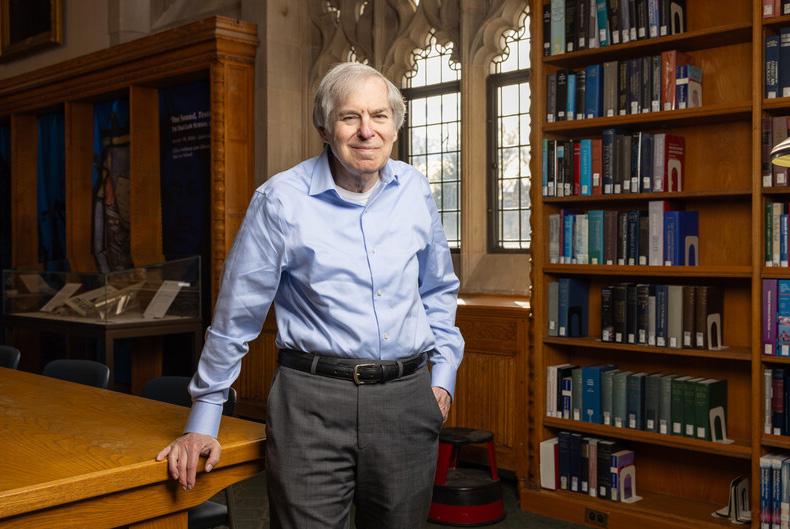
Fred Shapiro, now retired, at the Lillian Goldman Law Library. Photo: Robert DeSanto
Library Exhibits Highlight Yale and Literary History
The Lillian Goldman Law Library presents two new rare book exhibits for the first half of 2025. “Max and Trix” and “Flowers at Lambach” will both be on display from Jan. 13 to May 25 of this year.
“Max and Beatrix Farrand: Memory and Landscape at Yale” commemorates the life and work of Max Farrand, professor in the Yale history department, and Beatrix Cadwalader Jones Farrand, a prominent landscape architect and influence on the American campus. The Farrands married in 1913 and moved to a house on Prospect Street in New Haven, where their story would weave together with those of other Yale affiliates: Standard Oil titans, philanthropists, and architects working at this nexus between industrial fortunes and the institution of the American university.
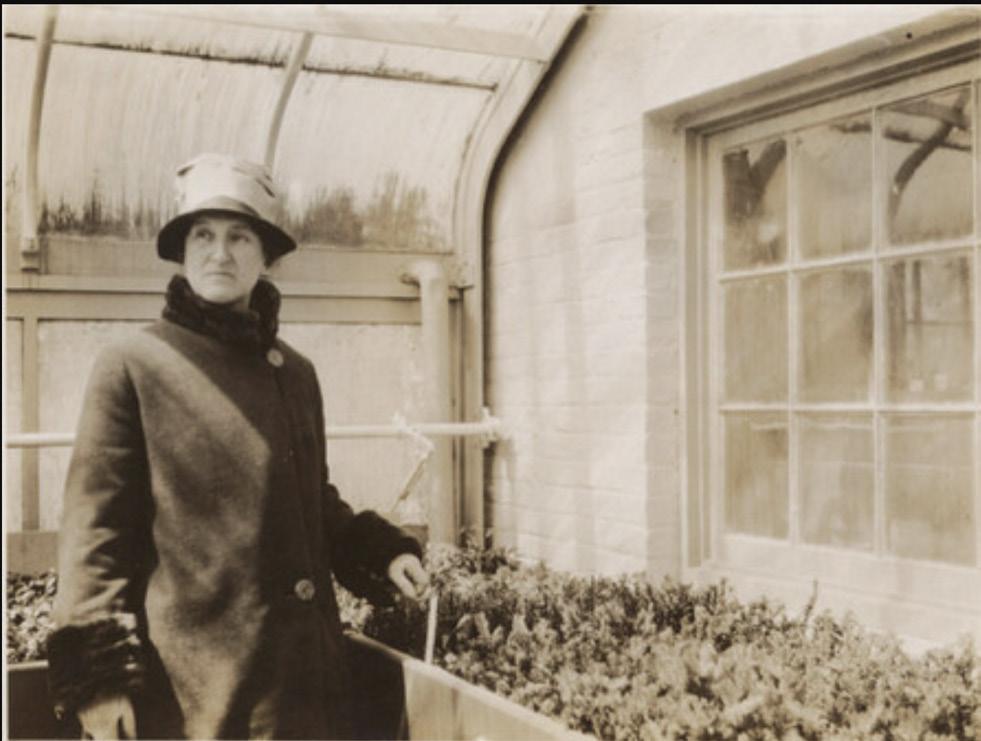
In the greenhouse, Marsh Botanic Garden, 1927. Beatrix Jones Farrand Collection, College of Environmental Design, University of Berkeley
As Yale’s first consultant gardener, Beatrix Farrand implemented an “anglo-American naturalism” alongside colleague James Gamble Rogers’ emerging “Collegiate Gothic” style—as evidenced in spaces such as Yale’s Marsh Botanical Garden. She collaborated with Rogers (Yale College Class of 1889) at a time when many of Yale’s iconic landmarks were beginning to be developed from their significant bequests, including Sterling Memorial Library, Sterling Law Building, and the Harkness Memorial Quadrangle. Her “distinctive vision still defines Yale’s campus landscape, in its flagstone paths, evergreens, native plantings, and the cladding of stone walls
produced by the scriptorium of the Benedictine abbey of Lambach. Austria, ca. 1470. MssJ H358 no. 1 tall, f. 1r
with climbing vines. Through her work with Princeton, Yale, and other institutions, Farrand also shaped the visual identity of the American college campus,” according to the exhibit essay by Rare Book Librarian Kathryn James of the Lillian Goldman Law Library.
Max was also drawn into the Harkness family’s initiatives when he served as the inaugural Director of the Commonwealth Fund, established by Anna M. Harkness to “do something for the welfare of mankind.” Max’s “The Records of the Federal Convention” (1911) had been one of the first works to be published by Yale University Press, founded in 1908, when Max also joined the Yale faculty as a professor of history. He would go on to publish his popular “The Framing of the Constitution” in 1913 and then “The Development of the United States from Colonies to a World Power” in 1918, after which he began his role at the Commonwealth Fund. He also helped philanthropist Henry Huntington establish the Huntington Library in San Marino, California, and served as its first director after Huntington’s death.
Pieces in the exhibit include the founder of Yale University Press’s copy of “The Records of the Federal Convention,” photographs and portraits of the Farrands, blueprints of Beatrix’s designs, and news coverage of their work. “Max & Trix” is on view on Lower Level 2 of the Law Library.
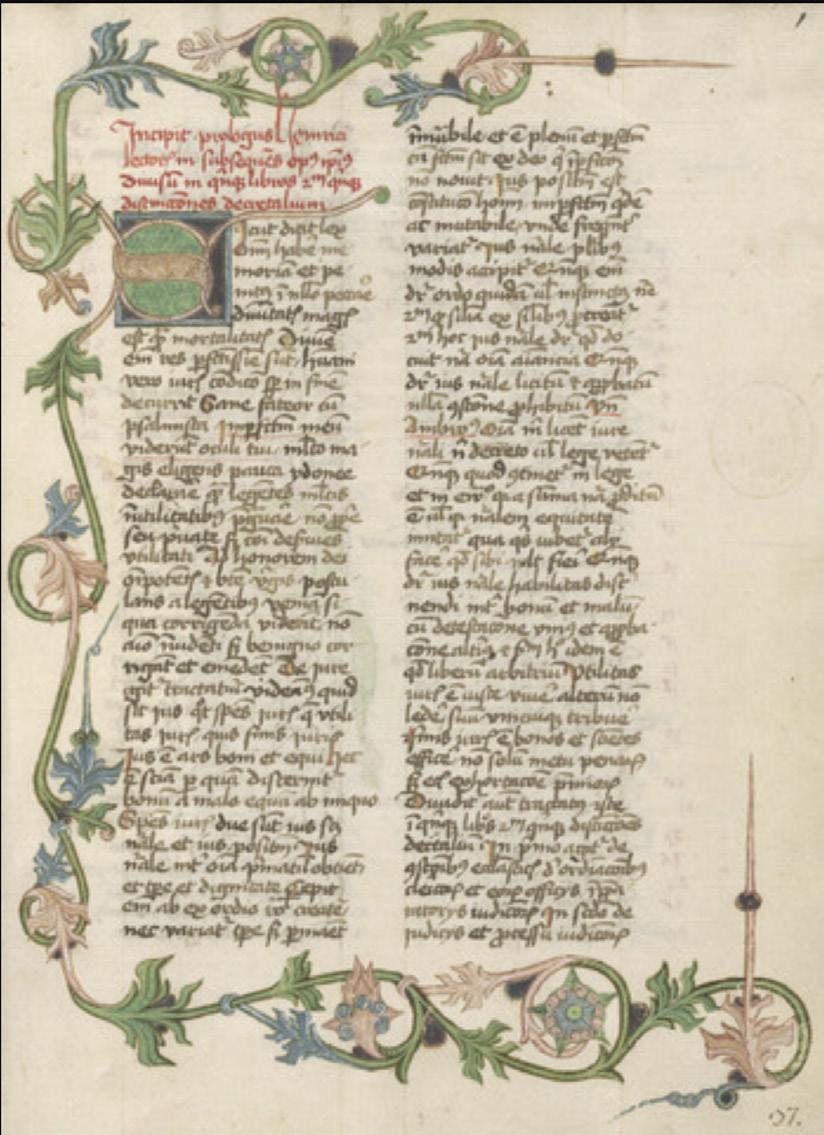
A volume of manuscript texts, including works by Heinrich von Merseburg, Giovanni d’Andrea, Paul Wann, and others, produced by the scriptorium of the Benedictine abbey of Lambach. Austria, ca. 1470. MssJ H358 no. 1 tall, f. 1r
“Flowers at Lambach” follows the history of a manuscript volume on canon law, from its origins in the scriptorium of an Austrian monastery to its current home at Yale University. The account “tells a story of scribes, artists, librarians, and of the institutions and influences that have shaped the history of rare book collecting, in the present as in the 15th century,” according to Rare Book Librarian Kathryn James.
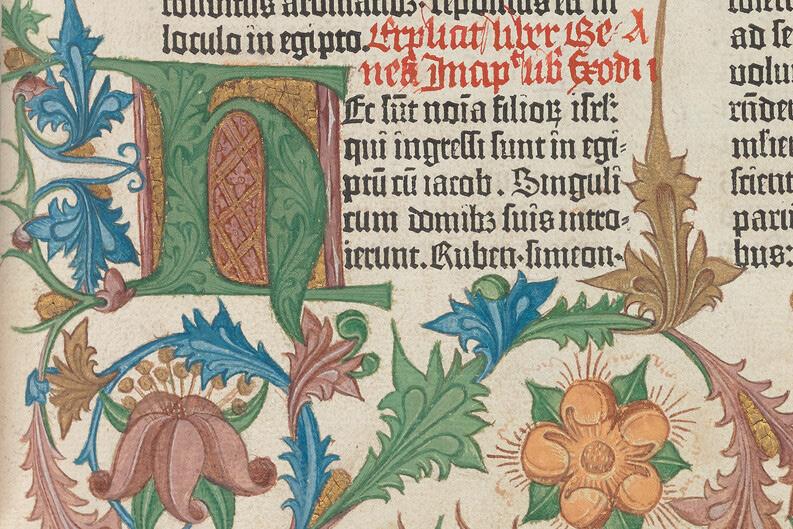
The texts were originally produced by late 15th-century scribes in the Benedictine Abbey of Lambach, Austria. Its elaborate marginal decorations featuring the acanthus, a Mediterranean flower and Renaissance design motif, “marks a connection between the Renaissance text as a visual space and the cultural tropes of Renaissance architecture.” The Lambach Abbey’s manuscript echoes the decoration in the Yale copy of the Gutenberg Bible, and the exhibit explores the possibilities of artistic connections between the Lambach Abbey scriptorium and that of Melk Abbey, in Austria, where the Gutenberg Bible was held.
The Lambach mansucript was accessioned by Yale University in 1950, when it was logged into the Yale Law Library’s “Vault Books Added” register. Like the manuscript, the Gutenberg Bible traced a similar trajectory, which was donated to Yale by the Harkness family in 1926, having been acquired at auction in New York. The exhibit follows the histories of these two volumes, tracing the connections between American institutional collecting and the political and economic forces shaping the rare book market in the first half of the 20th century.
“Flowers at Lambach” can be viewed in the Rare Book Exhibition Area on Library Level 3 of the Lillian Goldman Law Library.
Biblia Latina (Mainz: Johann Gutenberg, ca. 1455), ii, f. 325r. Beinecke Rare Book & Manuscript Library, Yale University Library
In the greenhouse, Marsh Botanic Garden, 1927. Beatrix Jones Farrand Collection, College of Environmental Design, University of Berkeley
A volume of manuscript texts, including works by Heinrich von Merseburg, Giovanni d’Andrea, Paul Wann, and others,
Media Highlights 2024–2025
Law Library Gifted Professor Guido Calabresi’s Papers
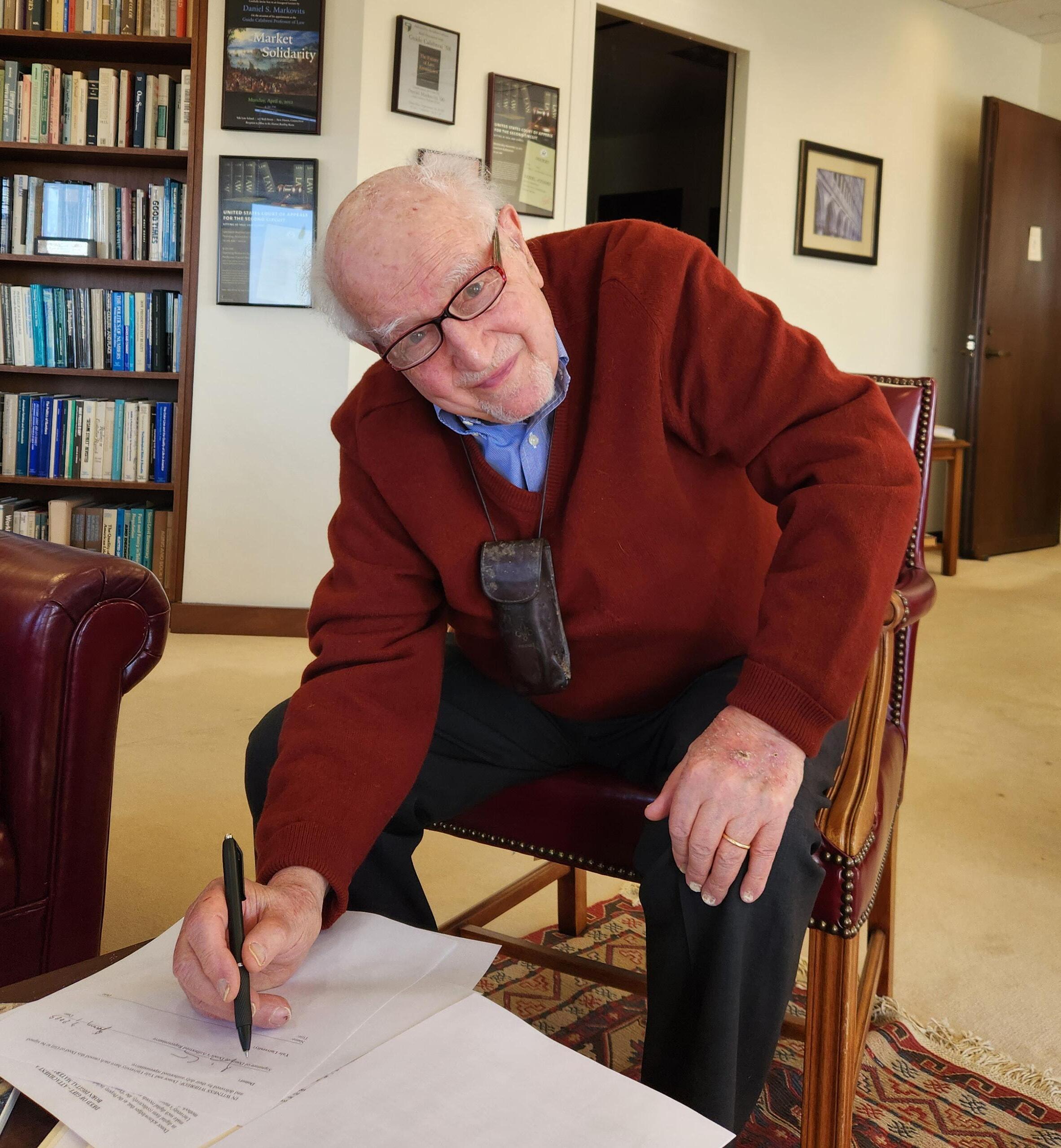
Sterling Professor Emeritus of Law Guido Calabresi ’58 has donated his extensive collection of papers to the Lillian Goldman Law Library, enabling future generations of scholars to draw from his decades of scholarship and judicial experience.
The collection given by Guido—as he is known to all—is a culmination of a remarkable career spanning more than 70 years of active scholarship and consisting of records from his time as a Law School faculty member, former dean, and federal appeals court judge, including writings, lectures, and judicial and personal papers.
Guido Calabresi’s donation will preserve his scholarly legacy and enhance the Law Library’s archival collection.
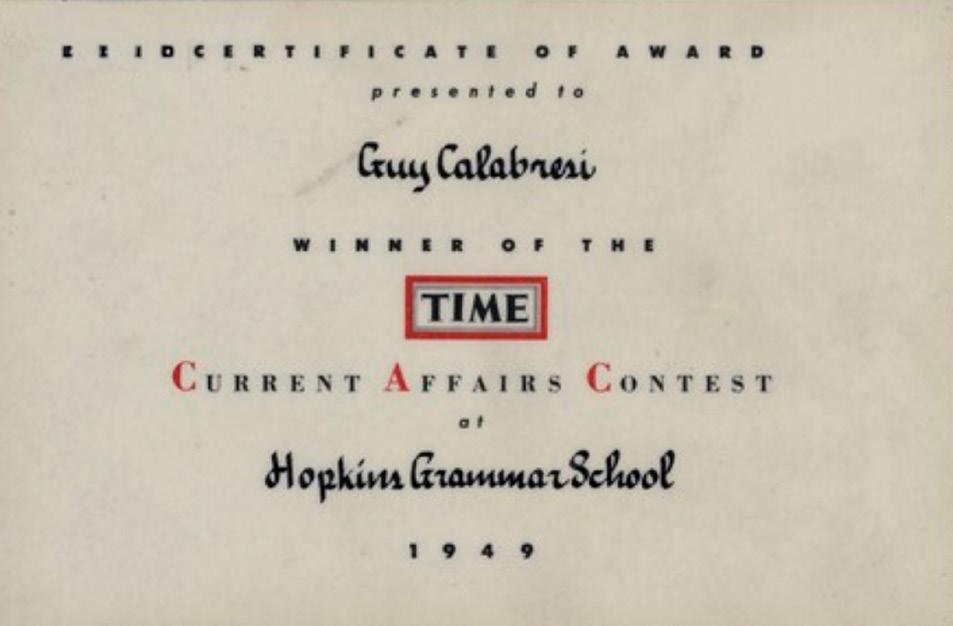
In addition to paying homage to Guido’s scholarly legacy, the papers shed light on his earlier—and perhaps lesser known —years as a child in New Haven and student at Yale. Carefully preserved in stationary boxes, Guido saved a “Life Scout” certification he received from the Boy Scouts of America in 1946, a certificate he won in the Time Current Affairs Contest at Hopkins Grammar School in 1949, and his acceptance letter from Yale College. He also documented his admission to the Law School as well as his grades, his election to a Rhodes Scholarship, and his admission to the Connecticut Bar.
The acquisition comes a few years after Guido expressed interest in donating his papers to Yale University, which at the time was unable to house such a gift. Thanks to the appointment of Linda Hocking—Archivist for Law Collections at the Lillian Goldman Law Library—in 2024, the Law Library was able to accept his papers. With the addition of an archivist, the Law Library’s special collections is able to expand beyond existing rare book and small manuscript collections and add larger collections of faculty papers. The Law Library has a repository in the Archives at Yale database where Hocking will create finding aids for these collections. Once complete, they will be searchable there and in Quicksearch. Law Library staff are also working to establish collection development guidelines for future acquisitions within existing space and staff constraints.
Hocking’s archival work is, in part, generously supported by additional philanthropic gifts made by Guido and his wife, Anne Gordon Audubon Tyler.
The Law Library is thrilled to add Guido’s papers to its special collections, especially considering his multifaceted
experience with Yale University as a student in Yale College and as a Law School student, faculty member, and former dean, said Hocking.
Certificate of Award presented to Guido Calabresi
A Certificate of Award presented by the Time Current Affairs Contest during Guido’s childhood is just one of many treasures included in the collection.
“Guido Calabresi is a preeminent legal scholar of our times, and his scholarly contributions are widely known in legal circles in the United States and beyond,” said Femi Cadmus, Law Librarian and Professor of Law at Yale Law School. “His papers will be sought after at the Law Library by legal scholars and researchers and draw attention to our rich and extensive historical legal collections.”
Guido’s extensive collection will be available for research at the Law Library posthumously following several years of processing.
“I hope that the collection and keeping of my papers will be only one of many from our fantastic faculty,” said Guido.
Select items will be included in a broader exhibit featuring new acquisitions in 2026.
A Certificate of Award presented by the Time Current Affairs Contest during Guido’s childhood is just one of many treasures included in the collection.
Guido Calabresi’s donation will preserve his scholarly legacy and enhance the Law Library’s archival collection.
The Long Last Day: Student Musical Performance in the Law Library
“The law library, a beautiful space, loaded with tension and usually dramatically, almost scarily, silent, was a perfect venue,” she said. “The last day of classes, when people are both celebrating the end of the semester and steeling themselves for the beginning of intense study, was the right occasion.”
And students did study. For some, it was like any day at the library—they leaned into their laptops as the tones washed over the room. Others paused from their work and openly took in the spectacle and soundtrack, recording it on their phones.
For della Paolera, who continued her artistic practice throughout law school, a course that included the arts felt fitting for her last semester.
“Things coming full circle in a way,” she said.
Students entering the Lillian Goldman Law Library on the last day of classes were met with unusual sights and sounds. Seated around one of tables lining the Class of 1964 Reading Room were musicians on trumpet, harp, viola, and cello. Atop the table, a drummer provided gentle beats on tablas. Near the bookshelves, a sound engineer stood over a mixing board, live sampling the performance and weaving in recordings of typical library sounds: the clack of keyboard, the scratch of a pencil. Meanwhile, a singer contributed mostly wordless vocals, except for the occasional legal phrase.
The singer was Lucia della Paolera ’25, who had been imagining such a performance since starting at Yale Law School. Finally, she had an opening: a course taught by Professor Paul Gewirtz, “Arts and the Lawyer.” Its premise: that the arts “can contribute to fulfillment of the self while also enhancing one’s capacity as a lawyer.” The final assignment: a significant project related to the arts. Before law school, della Paolera co-founded a music company in New York, COTC NYC, that makes site-specific music performances. For her class assignment, della Paolera conceived a “structured improvisation:” ambient music to study by.
Musicians perform at the Lillian Goldman Law Library “The Long Last Day,” a work of ambient music to study by. Instruments included trumpet, harp, viola, cello, and hand drums known as tablas.
Lucia della Paolera ’25 sings at the Lillian Goldman Law Library in a performance of music to study by. She designed the performance for the last day of classes as a final project for the course “Arts and the Lawyer.”
GPO Partners with Yale University Law Library to Preserve Government Information
To help libraries meet the needs of efficient Government document stewardship in the digital era, GPO has established Preservation Stewards to support continued public access to U.S. Government documents in print format. These libraries contribute significantly to the effort to preserve printed documents. Through the agreement, many libraries also serve as digital access partners providing digital access to Government information. There are currently more than 60 libraries serving as Preservation Stewards across the United States.
Yale University, Lillian Goldman Law Library
•Preserving current and historic publications of Statutes at Large
•Preserving current and historic United States Tax Court Reports
“As a former Associate Law Librarian at Yale Law Library, I am of course thrilled to have this special library on board to help GPO deliver on its vision of an America Informed,” said GPO Superintendent of Documents Scott Matheson. “The preservation of and easy access to Government information remains critical to America’s democracy.”
GPO is the Federal Government’s resource for publishing trusted information for the Federal Government to the American people. The GPO is responsible for the production and distribution of information products and services for all three branches of the Federal Government, including U.S.
passports for the Department of State as well as the official publications of Congress, the White House, and other Federal agencies in digital and print formats. GPO provides for permanent public access to Federal Government information at no charge through www.GovInfo.gov and partnerships with approximately 1,100 libraries nationwide participating in the Federal Depository Library Program. For more information, please visit www.gpo.gov
Yale University’s Lillian Goldman Law Library signed a Memorandum of Agreement with the U.S. Government Publishing Office (GPO) to become a Preservation Steward.
Inaugural Leadership Institute for Academic Law Library Directors
Twenty academic law library directors from schools across the country gathered at Yale Law School from June 11 to 13 for the Lillian Goldman Law Library’s inaugural Leadership Effectiveness Institute. The conference focused on navigating institutional challenges in rapidly shifting contexts. Femi Cadmus, Law Librarian & Professor of Law designed the Institute in collaboration with Michelle Cosby, Assistant Dean Legal Information Services and Professor of the Practice at Washington University Law School. The Institute was
facilitated by Tomi Rogers, Human Resources Manager at University of Tennessee—Institute for Public Service. Speakers included Susan Gibbons, vice provost for collections and scholarly communication at Yale University and Kirsten Winek, Accreditation Counsel for the American Bar Association’s Section of Legal Education and Admissions to the Bar. Feedback from attendees was uniformly positive with praise for the timeliness and effectiveness of the institute
Scott Matheson, Superintendent of Documents, U.S. Government Publishing Office (GPO) and Cate Kellett, Head of Cataloging & Metadata Services, Lillian Goldman Law Library.
washington
Navigating Institutional Challenges session with Susan Gibbons, Vice Provost for Collections & Scholarly Communication and Chief of Staff to the President in discussion with Femi Cadmus, Law Librarian and Professor of Law and Leadership Institute Fellows.
Leadership Effectiveness Institute for Academic Law Library Directors Participating Institutions
yale law school | june 11 to 13, 2025
Academic law library directors with Institute facilitator, Tomi Rogers, University Of Tennessee. Filippa Anzalone, BC Law, Femi Cadmus, Yale Law, Michelle Cosby, Washington & Lee Law, Shamika Dalton, University of Colorado Law, Christine Dulac, Maine Law, Amy Emerson, Villanova Law, Raquel Gabriel, CUNY Law, Hunter Whaley, Hofstra Law, Alicia Jones, Howard Law, Kelly Leong, Cardozo Law, Todd Melnick, Fordham Law, Kim Nayyer, Cornell Law, Caroline Osborne, UNC Law, Brittany Persson, Brooklyn Law, Phebe Poydras, Southern Law, Richelle Reid, North Carolina Central Law, Roger Skalbeck, Richmond Law, Austin Williams, Georgetown Law, Jessica de Perio Wittman, UConn Law, AnnMarie Zell, NYU Law
academic law library directors list of leadership institute fellows
“This institute reminded me of why I became a director.
The institute was one of the best chances for a newer director to connect with other directors in a meaningful way and have real discussions about the state of the profession and issues with law libraries. The small, casual atmosphere combined with the structured learning was great.
This was a stupendous idea. Hope you continue it!
I liked interacting with librarians who have varying years of experience as library directors and from different types of academic law libraries (private, public, unionized, HBCU, large and small).