D3D_AUGUSTSEPT25

Page 1


FROM OUR DEVELOPMENT TO YOUR DESIGN

Creo 12 CAD system is now infused with more industry-leading composite capabilities, expanded Model-Based Definition (MBD), real-time simulation and streamlined workflows to make it even easier for you to deliver your best designs in less time.

EDITORIAL

Editor

Stephen Holmes

stephen@x3dmedia.com

+44 (0)20 3384 5297

Managing Editor

Greg Corke

greg@x3dmedia.com

+44 (0)20 3355 7312

Consulting Editor Jessica Twentyman jtwentyman@gmail.com

Consulting Editor Martyn Day martyn@x3dmedia.com

+44 (0)7525 701 542

DESIGN/PRODUCTION

Design/Production

Greg Corke

greg@x3dmedia.com

+44 (0)20 3355 7312

ADVERTISING

Group Media Director Tony Baksh tony@x3dmedia.com

+44 (0)20 3355 7313

Deputy Advertising Manager

Steve King steve@x3dmedia.com

+44 (0)20 3355 7314

US Sales Director Denise Greaves denise@x3dmedia.com

+1 857 400 7713

SUBSCRIPTIONS

Circulation Manager Alan Cleveland alan@x3dmedia.com

+44 (0)20 3355 7311 `

ACCOUNTS

Accounts Manager Charlotte Taibi charlotte@x3dmedia.com

Financial Controller

Samantha Todescato-Rutland sam@chalfen.com

ABOUT

DEVELOP3D is published by

X3DMedia 19 Leyden Street

London E1 7LE, UK

T. +44 (0)20 3355 7310

F. +44 (0)20 3355 7319

© 2025 X3DMedia Ltd All rights reserved. Reproduction in whole or part without prior permission from the publisher is prohibited. All trademarks acknowledged Opinions expressed in articles are those of the author and not of X3DMedia. X3DMedia cannot accept responsibility for errors in articles or advertisements within the magazine

Ican’t remember a previous issue of DEVELOP3D in which I used the word ‘hack’ as much as I have done in this one. I’ve never ‘hacked’ a sack, a pony or a computer, but I’ve definitely hacked a physical product to create something that better fits a need or purpose. This type of hacking is a key skillset of product designers and engineers. Increasingly, the fast iteration of physical prototypes – whether through card, foam, 3D-printed parts or simply clay overlaid on a surface – plays an intrinsic part in getting better products to market faster, as we see in this issue.

Our cover story looks at BOA Technology, where physical prototyping is key not only to creating its ratcheting technology for shoes, clothes and accessories, but also to readying its product to survive the very manual world of footwear manufacturing.

Equally, the team at Reekon Tools, creator of tech-packed digital tape measures, tells us about the use of hacking together quick prototypes to get them into the hands of testers. This was a key part of its workflow to downsize a product and create a newer, smaller version that comes with no compromise.

Elsewhere, I recall how I recently headed to a hackathon for product development software people. At this event, my lack of ability to do anything with code put me at a distinct disadvantage, but it did gave me a good idea of the passion of those behind the software, and an urge to get more customers involved.

Something that can’t necessarily be hacked is nuclear fusion. In this issue, we learn how General Fusion is taking steps closer to making fusion-generated domestic energy supply a commercial reality, with multiphysics simulation helping unlock fast and safe iterations of its Magnetized Target Fusion technology.

A busy summer has seen the DEVELOP3D team travel to multiple events, from which we bring you all the key headlines. SJ got a glimpse of what an AI-enhanced design renaissance might look like at the nTop Computational Design Summit; while Martyn hopped over to Siemens’ user event in Amsterdam, where the constituent parts of the company’s vast and growing portfolio are finally starting to speak the same language.

So get ready to turn the page and hack on through.

Automate SOLIDWORKS

manufacturing processes & sell digitally using DriveWorks

DriveWorks is flexible and scalable. Start for free, upgrade anytime. DriveWorksXpress is included free inside SOLIDWORKS or start your free 30 day trial of DriveWorks Solo.

DriveWorks Pro

30DAY FREETRIAL

DriveWorksXpress

Entry level design automation software included free inside SOLIDWORKS®

Entry level SOLIDWORKS part and assembly automation

Create a drawing for each part and assembly

Find under the SOLIDWORKS tools menu

Modular SOLIDWORKS® automation & online product configurator software

One time setup

DriveWorks Solo

SOLIDWORKS® part, assembly and drawing automation add-in

Automate SOLIDWORKS parts, assemblies and drawings

Generate production ready drawings, BOMs & quote documents automatically Enter product specifications and preview designs inside SOLIDWORKS

Free online technical learning resources, sample projects and help file

Sold and supported by your local SOLIDWORKS reseller

Try examples online

Set up once and run again and again. No need for complex SOLIDWORKS macros, design tables or configurations.

Save time & innovate more

Automate repetitive SOLIDWORKS tasks and free up engineers to focus on product innovation and development.

Eliminate errors

DriveWorks rules based SOLIDWORKS automation eliminates errors and expensive, time-consuming design changes.

Complete SOLIDWORKS part, assembly and drawing automation

Automatically generate manufacturing and sales documents

Configure order specific designs in a browser on desktop, mobile or tablet

Show configurable design details with interactive 3D previews

Integrate with SOLIDWORKS PDM, CRM, ERP, CAM and other company systems

Scalable and flexible licensing options

Sold and supported by your local SOLIDWORKS reseller

Connect sales & manufacturing

Validation ensures you only offer products that can be manufactured, eliminating errors and boosting quality.

Integrate with other systems

DriveWorks Pro can integrate with other company systems, helping you work more efficiently and effectively.

Intelligent guided selling

Ensure your sales teams / dealers configure the ideal solution every time with intelligent rules-based guided selling.

NEWS

Power boost for HP ZBook Fury G1i Pro laptop, Blackwell GPUs launch for compact workstations, Autodesk invests in Toolpath and more

FEATURES

Comment: David Heiny of Simscale on the AI race

Comment: Liucheng Guo of TG0 on systems thinking

Visual Design Guide: Nuance Audio’s ‘hearing glasses’

COVER STORY BOA Technology’s superior snug fit

Awards: DEVELOP3D Top 5 New Designers

Event report: Siemens Realize Live 2025 in Amsterdam

Interview: PTC’s Brian Thompson on Creo 12

Laurence Marks on smoothed-particle hydrodynamics

Event report: nTop Computational Design Summit

General Fusion’s bold vision for power generation

Made to measure: Reekon Tools unveils T1M device

Bumper harvest: Vertical farming at IGS

THE LAST WORD

Getting smart people in a room is a proven way to tackle software challenges, but let’s include more customers in the problem-solving process, writes Stephen Holmes

POWER BOOST FOR HP ZBOOK FURY G1i PRO LAPTOP

HP has revealed more details about the HP ZBook Fury G1i, the latest generation of its high-end mobile workstation, now available in a new 18-inch form factor alongside the familiar 16-inch model.

According to HP, the ZBook Fury G1i delivers a significant performance boost over its predecessor, the ZBook Fury G11, thanks not only to its choice of next-gen Intel Core Ultra 200HX Series 2 processor and Nvidia RTX Pro Blackwell GPU, but also its higher power envelope.

The 16-inch model now supports up to 170W Thermal Design Power (TDP), while the 18-inch pushes that even further to 200W, compared to just 145W in the G11. To manage this additional thermal load — and to maintain optimal acoustics — HP has introduced a new ‘hybrid turbo-

bladed’ triple-fan cooling system. Naturally, power delivery also gets a boost: the 16-inch model peaks with a 280W PSU, and the 18-inch with a 330W unit, both up from 230W in the G11.

The ‘Arrow Lake’ Intel Core Ultra 200HX Series 2 processor is considered ‘desktop class’, and the top-end Core Ultra 9 285HX features 8 Performance cores, 16 Efficient cores, and a Max Turbo Frequency of 5.5 GHz on the P-cores. Its integrated Neural Processing Unit (NPU) delivers 13 TOPS — typical for Arrow Lake chips — but this falls short of the 40 TOPS requirement for Microsoft’s Copilot+ AI PCs.

However, in high-end mobile workstations like this, the bulk of AI workloads are expected to be handled by the discrete GPU, such as the top-tier Nvidia RTX Pro 5000 Blackwell (24 GB). www.hp.com

HP’s new triplefan cooling system will be key to maintaining the equilibrium between thermals, acoustics, reliability and portability

Lenovo updates Core workstations

Lenovo has refreshed its ThinkStation P2 and P3 desktop workstation line-up with four new ‘Gen 2’ models featuring Intel Core Ultra 9 (Series 2) processors and, later this year, Nvidia RTX Pro Blackwell GPUs.

The mainstream workstations span a variety of form factors, including compact towers, small form factor, and micro.

The ThinkStation P3 Tower Gen 2 is the most expandable and is ‘AI-ready’. It features an Intel Core Ultra 9 with integrated NPU and, by Q3 2025, will offer up to an Nvidia RTX Pro 6000 Blackwell Max-Q Workstation Edition GPU (96 GB). www.lenovo.com

AMD releases Zen 5 Threadripper

AMD has launched the Ryzen Threadripper Pro 9000 WX-Series and Threadripper 9000 Series processors, based on AMD's Zen 5 architecture. Both chips boast high core counts, high memory bandwidth, and are built for multi-threaded workloads such as simulation and rendering.

The Threadripper Pro 9000 WX-Series is built for workstations, offering up to 96 cores and support for eight channels of memory. The Threadripper 9000 Series targets high-end desktop users, with up to 64 cores and quad-channel memory. www.amd.com

Lenovo Access to simplify remote workstations

Lenovo has introduced Lenovo Access, a new high-performance remote workstation solution that it claims delivers superior performance and a more seamless user experience than traditional public cloud or VDI services.

According to Lenovo, Lenovo Access delivers flexibility, performance, and security for remote workers, without compromising user experience. In short, users get a desktop workstation-like experience wherever they work, even when using demanding 3D applications.

Lenovo’s solution includes a series of ‘easily deployable’ reference architectures, or ‘Blueprints’, which pair Lenovo workstations with software and services.

The first Blueprint is powered by seven rack-mounted Lenovo ThinkStation P3

Ultra SFF workstations in a 5U shelf, running the Mechdyne TGX remote graphics protocol.

According to Lenovo, the set-up offers a real-time responsive screen, as well as control sharing, where multiple users can collaborate for design review and training. www.lenovo.com

Lenovo Access Blueprint powered by seven rackmounted Lenovo ThinkStation P3 Ultra SFF workstations

AMD launches 32 GB Ai GPU

AMD has introduced the Radeon AI Pro R9700, a new workstation-class GPU with 32 GB of memory, built on AMD’s RDNA 4 architecture. The card has a big focus on AI and with double the memory of its consumer counterpart can be used for local inference, finetuning and other data-heavy workflows. It features 2nd Gen AMD AI accelerators which are said to deliver up to 2x the throughput of the previous generation. Naturally, the card can also be used other GPU-accelerated workflows, such as visualisation and simulation.

The Radeon AI Pro R9700 is available from multiple manufacturers including ASRock, Asus and Gigabyte. www.amd.com

AUTODESK BECOMES LATEST INVESTOR IN TOOLPATH

Autodesk has become the latest company to invest in Toolpath and its software that integrates AI and CAM with the goal of optimising tool selection and toolpath strategies.

The value of this strategic investment hasn’t been revealed, but Autodesk joins other investors including Kennametal, ModuleWorks and Leaders Fund in its support for Toolpath’s AI-powered manufacturing platform.

This platform analyses machining processes and the parts a process will make, providing manufacturers with the insights they need to make better decisions around which jobs to quote, how to estimate costs and how to optimise machining operations.

Toolpath covers workflow steps from initial job evaluation to machining plans, thanks to its applied AI and proprietary Part Comprehension Engine.

The company was founded in 2021. Its CEO is Al Whatmough, who led Fusion at Autodesk for a decade prior to leading Toolpath. “I know first-hand the craftsmanship, innovation and sheer engineering excellence that exists within Fusion,” said Whatmough, “and I’m thrilled to be working again with friends at Autodesk to create the next generation of outstanding tools for machining.”

According to Stephen Hooper, VP of design and manufacturing cloud solutions at Autodesk, the funding will support the growth of Toolpath’s engineering team and market presence. Autodesk customers will benefit from the addition of closed-loop, fully automated workflows in Autodesk Fusion.

“Looking ahead, combining Toolpath’s technology with Autodesk’s Manufacturing Data Model would enable Fusion users to automatically analyse manufacturability, plan machine strategies and send complete programmes to Fusion,” he said.

“The goal here is to streamline and elevate the user experience, harnessing AI to automate and augment critical aspects of the production process.”

In 2022, Autodesk invested in UK-based start-up CloudNC, also an AI-enabled CAM company.

According to Hooper, CloudNC offers “differentiated support” to that offered by Toolpath, but both companies address “specific persona requirements, creating a separate but comprehensive suite of solutions that supports manufacturers across the board.”

www.autodesk.com

Toolpath embeds AI in the CAM process, optimising operations, tool selection and toolpath strategies

ROUND UP

CoLab has released AutoReview, a new AI system that automatically reviews 2D drawings and 3D models to ensure that quality standards are met and errors are reduced, without requiring design engineering teams to spend valuable time on repetitive manual checks www.colabsoftware.com

Vizcom has added a new feature, Modify, an AIpowered way to iterate on concepts without needing to redraw sketches. Instead of producing a new drawing from scratch, users can adjust existing designs using intuitive controls that include sliders, toggles and real-world inputs www.vizcom.ai

Chaos is expanding its Cosmos library of highquality 3D assets by around 400%, adding almost 30,000 assets including vegetation, vehicles and furniture and offering a new AI material generator, in order to give projects a more realistic, polished and designforward look www.chaos.com

Xencelabs adds colour calibration to new model

Xencelabs has announced its latest Pen Display 24+, which adds Calman Ready colour calibration technology to an already stacked product.

Billed as an industry-first for pen displays, this capability introduces full colour accuracy and hardware-level calibration, underlining Xencelabs’ ambition to attract professionals reliant on colour-critical workflows.

The colour calibration process is streamlined by automatic features. Users connect a Portrait Display C6 HDR5000 or compatible colorimeter to Calman Professional software, which can bypass complex OS-level adjustments and software interferences, ensuring true-tolife colours meeting standards such as Adobe RGB, DCI-P3, Rec. 709, Rec. 2020 and sRGB.

As well as colour space support, the Pen Display 24+ supports Pantonevalidated palettes and SkinTone-certified realism. The Super AG Etching glass surface provides optimal tooth, and the pen pressure curve was developed with feedback from professional artists. www.xencelabs.com

Pen Display 24+ is said to be the first drawing display with built-in Calman Ready capability

Materialise and Synera have announced a partnership that will enable Synera users with access to Magics SDK to deploy additive manufacturing agents that handle design-to-print tasks autonomously, helping to scale throughput while simultaneously reducing manual effort and costs www.materialise.com

Spatial has released Analogue 2, a nextgeneration collaborative design platform built natively for the Apple Vision Pro, enabling creative teams to work together in full 3D context – reviewing, iterating and finalising high-fidelity projects in real time, with no code required www.spatialinc.com

BLACKWELL GPUS TO LAUNCH FOR COMPACT WORKSTATIONS

Nvidia has announced two new low-profile workstation GPUs, the Nvidia RTX Pro 4000 Blackwell SFF Edition and the Nvidia RTX Pro 2000 Blackwell, designed to accelerate a range of professional workloads, including CAD, visualisation, simulation and AI.

Both are expected to appear in small form factor and micro workstations later this year, including the HP Z2 Mini G1i and Lenovo ThinkStation P3 Ultra SFF.

The RTX Pro 4000 SFF and RTX Pro 2000 feature fourth-generation RT Cores and fifth-generation Tensor Cores with lower power in half the size of a traditional GPU.

Compared to its predecessor, the RTX

SFF Ada, Nvidia claims the RTX Pro 4000 Blackwell SFF delivers up to 2.5 times faster AI performance, 1.7 times higher ray tracing performance, and 1.5 times more bandwidth, while maintaining the same 70-watt maximum power draw. It also gets a memory boost, increasing from 20 GB of GDDR6 to 24 GB of GDDR7.

Compared to the RTX 2000 Ada, the RTX Pro 2000 Blackwell is said to deliver up to 1.6 times faster 3D modelling, 1.4 times faster CAD performance, and 1.6 times faster rendering. It also promises a 1.4 times improvement in AI image generation and a 2.3 times boost in AI text generation. Memory has also been increased, rising from 16 GB of GDDR6 to 20 GB of GDDR7. www.nvidia.com

Dell launches new high-performance laptops

Dell has launched its longawaited Dell Pro Max family of high-performance laptops, comprising eight models across 14-inch, 16-inch, and 18-inch form factors. In line with Dell’s recent re-branding, the range is organised into three tiers: Dell Pro Max 14/16, Dell Pro Max 16/18 Plus, and Dell Pro Max 14/16 Premium.

Most models feature a choice of Intel Core processors paired with Nvidia RTX Pro Blackwell Generation GPUs. The entrylevel Dell Pro Max 14/16, however, is also available with AMD Ryzen AI processors, combining integrated Radeon graphics with an NPU capable of delivering over 50 TOPS — making it the first Copilot+ PC in the Dell Pro Max family.

The performance crown goes to the Dell Pro Max 16/18 Plus, equipped with a choice of silicon up to the Nvidia RTX Pro 5000 Blackwell GPU and 55W Intel Core Ultra 9 285HX processor.

Meanwhile, the Dell Pro Max 14/16 Premium blends mobility with design with a choice of GPUs up to the 45W Intel Core Ultra 9 285H vPro Enterprise processor and Nvidia RTX Pro 3000 Blackwell GPU. www.dell.com

Samsung launches

8GB Pro SSDs

Samsung has added two new high-capacity models to its high-performance workstation-class range of SSDs: the 9100 Pro 8TB and the 9100 Pro 8TB with Heatsink.

The new models are designed to deliver improved thermal efficiency and sustained peak performance and follow the 1TB, 2TB, and 4TB versions launched earlier this year.

Sequential read/write speeds reach up to 14,800 MB/s and 13,400 MB/s respectively, while random read/write speeds go up to 2,200K IOPS and 2,600K IOPS, making them well-suited to intensive workloads such as simulation and 3D scanning. www.samsung.com/ssd

Blackwell powers RTX Pro servers

The Nvidia RTX Pro 6000 Blackwell Server Edition GPU is coming to enterprise servers from Cisco, Dell, HPE, Lenovo and Supermicro. According to Nvidia, this will help speed the transition from traditional CPU systems to accelerated computing platforms. The 2U servers will accelerate enterprise workloads spanning content creation, data analytics, graphics, simulation, agentic AI, industrial AI and physical AI. www.nvidia.com

Computle secures £500k investment

UK-based subscription workstation platform

Computle has secured a £500k pre-seed investment from technology veteran Mark Boost, who takes a minority stake in the company. The funding will support Computle’s development of its remote workstation service for creative, architecture and engineering teams. Founded in 2020 by technology architect Jake Elsley, Computle claims to deliver 30% to 50% cost savings compared to alternative solutions. Unlike virtualised remote workstation solutions, Computle provides each user with a dedicated workstation over a 1:1 connection. Every custom-built blade workstation includes its own CPU, GPU, NVMe storage, and RAM, and can be configured using an online tool. www.computle.com

4000
Nvidia RTX Pro 4000 Blackwell SFF Edition packs a punch for compact workstations
The Dell Pro Max 18 Plus features top-end Intel Core and Nvidia RTX processors

Design Without Limits. Disruptions. Delay.

See What’s Possible with Cloud-Native CAD

Legacy CAD and PDM tools were built for another era—one of files, crashes, installs, and endless IT overhead. But today’s engineering teams move faster, scale globally, and expect more from their tools.

THAT’S WHERE ONSHAPE, POWERED BY AWS, CHANGES THE GAME.

Supplier BERLIN, DE

How cloud-native CAD removes infrastructure drag

Why real-time collaboration leads to faster decisions

How global teams stay in sync—without VPNs or file checkouts

What it really means to design at the speed of innovation

Manager LONDON, UK

60% of product teams miss deadlines due to breakdowns in design and communication

This eBook shows how to break the cycle

Designer PARIS, FR

Creo & Windchill: Engineering Confidence. Unlocking Growth.

Concurrent Engineering helps innovative companies streamline processes, accelerate change and scale with confidence.

Companies like IGS are reshaping their industries by combining advanced engineering with sustainable growth. These organisations rely on Creo and Windchill to overcome complexity and deliver results faster.

Discover how your business can benefit from smarter data management.

Read the IGS case study here bit.ly/igs-case-study or scan the QR code to learn more.

A

small minority of engineering firms are starting to make serious headway with

AI, but the race is far from over and there are still plenty of opportunities for other firms to catch up,

writes

David Heiny of SimScale

In engineering circles, there are growing rumours of a handful of companies quietly pulling ahead in competitive terms, thanks to their use of AI – but is the fear of missing out (FOMO) justified among those still on the starting blocks?

In SimScale’s State of Engineering AI 2025 survey of 300 senior leaders, 93% of respondents said they expect big productivity gains from AI and 30% are betting on AI having a “very high” impact on their engineering workflows.

However, it’s a far smaller proportion –around 3% – that report actually seeing those gains today.

After countless conversations with teams from organisations ranging from start-ups to global manufacturers, I can confidently say the success stories are real and that their wins come down to practical steps that any firm can take.

OVERCOMING HURDLES

The first hurdle is fractured data. Finding the right simulation file can feel for some like a treasure hunt where the map is missing. When results live on separate desktops, shared drives or old CAE platforms, building reliable AI models is almost impossible.

Then there’s the enthusiasm gap: 42% of CTOs assume deep resistance to AI within their teams, yet only 29% of engineers recognise this in their peers. In my experience, engineers are supereager to experiment with AI, but what is holding them back is the thought of needing senior management’s blessing.

RACE TO THE FINISH

Culture makes a huge difference. AI frontrunners have leaders who celebrate small wins and treat setbacks as lessons

More than half of those surveyed point to siloed data as their biggest blocker. I’ve seen teams spend weeks just pulling together a single data pipeline before they attempt a proof of concept.

Another pain point are legacy tools. I spoke with a major automaker where engineers still use five different applications to get a full system simulation. They know AI could cut their set-up time significantly, but outdated software won’t cooperate.

Focusing only on the barriers leaves out the other half of the story. I’ve sat down with the teams already in that small but growing first wave of AI adopters, and here are the lessons they’ve shared. They treat data as critical infrastructure. One aerospace group I met stores every simulation it runs in a cloud repository where it is tracked, tagged and accessed through simple calls. This organisation’s data scientists can launch training runs in minutes, rather than days. Successful companies weave AI into the heart of their workflows. A medtech firm showed me how its system suggests optimal boundary conditions the moment that an engineer starts a new model. Tweaks happen on the fly and set-up times shrink dramatically. Speed is a common theme. These teams start with small, focused experiments and prove value in a matter of weeks. Once an AI model pays off, they push it straight into day-to-day work without waiting for endless approvals. Version control matters just as much for models as it does for code. A heavyequipment manufacturer explained how it logs every result, every AI model update and every metric in open formats. Engineers can see exactly where a recommendation

came from and roll back if needed. Culture makes a huge difference. The frontrunners have leaders who celebrate small wins and treat setbacks as lessons. Frontrunners also focus on the use cases that matter most. Instead of chasing every AI trend, they pick one or two routines where shaving off days transforms outcomes, whether automating batch simulations or speeding up thermal analysis. Clear goals keep stakeholders engaged and prove ROI fast.

MOVE FAST, LEARN FAST

If you’re feeling the FOMO too, here’s my challenge: gather your core group, pick one painful bottleneck, and sketch a lean prototype with clear measures of success. Treat your data as the foundation, weave agentic AI and automation into the workflow, and don’t wait for everything to be perfect. Move fast, learn fast. Keep communication open, celebrate every win, and you’ll find yourself joining The 3% Club before long.

ABOUT THE AUTHOR: David Heiny is CEO of SimScale. He holds a Bachelors of Science in Mathematics and a Diploma in Mechanical Engineering from the Technical University of Munich, as well as a Master’s degree in Computational Science and Engineering from the Georgia Institute of Technology www.simscale.com

The hurdles to successful use of AI in engineering may seem daunting, but they can be overcome

The way hardware is developed often finds itself in conflict with sustainability goals. Electronic consumer goods are frequently built to optimise functionality, cost and aesthetics – but the longer term is not necessarily taken into account. Reuse, repairability and safe disposal in the form of recycling have been secondary concerns for too long.

Now, growing pressure from consumers, boardroom members and lawmakers is prompting a rethink. Minds are focused on sustainability, not just as a ‘nice to have’, but also as a valuable source of competitive advantage and an imperative for the wellbeing of the planet.

That leaves product designers asking, ‘How can we ensure that our products work better for longer, and without damaging the environment, across the entire ‘cradle to grave’ lifecycle?’

But more than that, they’re asking this question right at the start of the design process. That’s important because, according to the EU Science Hub, over 80% of a product’s overall environmental impact is determined during its design phase.

SOFTWARE-ENABLED SURFACES

Systems thinking is an approach that aims to future-proof product design by considering the sustainability of a product’s entire lifecycle from its conception and through its manufacturing, active use and eventual disposal.

It has not just led to incremental gains, but also to the creation of new types of electronic interfaces, ones that use lighter and better materials, fewer components, and are far less complex to update, recycle and dispose of safely.

Take, for example, TG0’s own smart surfaces: these integrate electronics with surfaces in a new, simplified fashion. As a company, we’ve long recognised that e-waste is one of the fastest-growing waste streams. An estimated 62 million tonnes

of e-waste were produced globally in 2022, and only 22% was documented as having been formally collected and recycled.

Incorporating new smart surfaces into their products, designers can reduce energy waste and e-waste at every stage of the lifecycle, by:

• Developing surfaces with fewer parts and reconfigurable interfaces, so that a single physical platform can support multiple product variants, resulting in shorter production runs, reduced bills of materials and less tooling waste.

• Decoupling functionality from physical form, so smart interfaces can support the evolution of physical products over time. User interface updates and feature rollouts refresh the user experience without altering the hardware itself. In turn, that creates added digital value without added costs in materials.

• Creating products that can learn user behaviour. Using embedded AI models that operate locally on-device can help reduce power consumption, via support for smart standby modes, adaptive lighting or load balancing, for example.

• Reducing parts and materials through the integration of sensors. This cuts manufacturing waste and energy consumption during production and assembly, as well as reducing material usage and lightweighting the end result.

At TG0, we’ve also considered incorporating more post-consumer resin (PCR) materials, replacing plastics with biological components, such as those derived from sugar cane.

MAXIMISE SYSTEMS THINKING

In order to get the best results from new ways of thinking, businesses must fully

As sustainability becomes a competitive differentiator for all kinds of products, designers need to apply systems thinking to the task of reducing their lifetime environmental impact from design to disposal, writes Dr Liucheng Guo of TG0 of
Systems thinking is leading to the creation of new types of electronic interfaces, ones that use lighter and better materials, fewer components and are far less complex to update, recycle and dispose of safely

embrace cross-disciplinary and crosscompany collaboration. They should involve UX designers early, integrate software teams into hardware sprints, and measure success, not just by unit sales or launch velocity, but by lifecycle impact, too. Collaborating with academic partners or external designers may also accelerate sustainable innovation.

Integrating sustainable practices into product development is often seen as cost-prohibitive, yet many experts argue that initial expenses are outweighed by the long-term advantages.

As new technologies and materials become more accessible and scalable, sustainable development can drive significant cost efficiencies over time.

At TG0, we believe sustainable hardware starts with smarter thinking, using fewer materials, embedded intelligence and digital flexibility to future-proof design. As sustainability becomes a competitive differentiator, the opportunity is clear. The tools are here. Demand is growing. What’s needed now is a market-wide shift in mindset.

ABOUT THE AUTHOR: Dr Liucheng Guo is co-founder and CTO at London/Hong Kong-based AI hardware company, TG0. His research has led to seven groups of patents and over 20 publications. At TG0, he works on the creation of touch and pressure-sensing technology that offers design flexibility while reducing environmental impact. www.tg0.co.uk

From Three Weeks to Same Day: Prototyping Reimagined

• Validation in hours, not weeks – from three weeks to same-day.

• Real-world testing ready – durable enough to be sewn directly onto shoes.

• Better predictability – prototypes that closely match production performance.

3D Systems delivers proven, productionready additive solutions – backed by unmatched expertise and a trusted portfolio – so teams can qualify parts faster and with confidence that lasts.

Accelerate your design validation – from concept to test, faster than ever.

VISUAL DESIGN GUIDE HEARING GLASSES

» Nuance Audio is aiming to remove the stigma associated with hearing aids, with sharp designs for ‘hearing glasses’ targeted at customers with mild to moderate hearing loss

CLEAR VIEW

Microphones strategically placed around the lenses enhance sound clarity, so that wearers can follow conversations with ease, even in noisy environments

STYLISH FIT

Nuance Audio’s hearing glasses are available in two designs and two colours. There’s the Wayfarer-style Square frame and a rounder Pathos design, both available in black and burgundy. Nuance’s audio technology benefits from piggybacking on the styling skills of parent company, eyewear giant EssilorLuxottica

OPEN-EAR COMFORT

Lightweight, open-ear ‘air conduction’ speakers avoid irritation and offer all-day wearability, amplifying sounds from up to three metres away

POWERING UP

The battery supports a full day of normal use, while the convenient wireless charging pad fully charges the hearing glasses when not being worn in just three hours

EASY ADOPTION

No audiologist visit is required. Users go through a set-up process via the Nuance Audio App, which also controls the level of background noise and can focus sounds for face-to-face conversations

OFFLINE CONTROL

An optional remote control has been developed for users who require a discreet way to adjust their hearing glasses without needing a smartphone

LIGHTWEIGHT DESIGN

Despite the frames having somewhat thicker arms than is typical, in order to house batteries, microphones and electronics, they remain similar in weight to regular eyeglasses, ensuring maximum comfort for extended use

PRECISION

The BOA Fit System can be found on footwear designed for all kinds of sports and leisure pursuits

PRECISION FIT

» BOA Technology’s innovative ratcheting mechanism gives footwear a precise, secure and comfortable fit, and this tough technology relies on a design process that is as agile and demanding as its end customers, as Stephen Holmes discovers

From its origins on the ski slopes of Colorado, the popularity of BOA Technology’s microadjustable fastener system has flourished over the past two-plus decades. Today, it frees athletes of many kinds from the struggles associated with shoelaces. They include track stars and trail runners, road bike racers and mountain climbers, fishing fans and golf enthusiasts.

When speed is of the essence, or gloves get in the way of manual dexterity, the BOA Fit System replaces traditional shoelaces with a system of dials and cables that give footwear a more precise, secure and easily adjustable fit. The innovative system been used in work boots, too, as well as in medical bracing.

The system’s core design, meanwhile, has gone through several phases since its debut as a fastener for snowboard boots back in 2001. It has been pared back for lower power applications, such as low-cut athletic footwear, and beefed up for use in more extreme environments. It has also been reconfigured for use in different apparel categories, including bike helmets and fishing gloves.

For the BOA Technology design team, there’s huge value in understanding different end uses and in bringing specific needs into the iteration loop, according to director of engineering Clay Corbett.

“It’s not just making a little ratcheting mechanism,” he explains. “It’s also [figuring out] how you make it perform when it’s packed with dirt and sand, or when it’s working at really high tensions, like in an alpine ski boot.”

The team is now in a phase in which it’s primarily focused on introducing further innovation in categories where the BOA Fit System is already well-established, he continues.

“We’re doing that by asking, ‘How do we make things more integrated? How do we improve the user experience with the product? How do we make it more sustainable and use less plastic along the way?’”

This requires intensive design and engineering activity. Take, for example, BOA Technology’s most recent design for an alpine ski boot fastener; its development forced the team to consider punishing levels of forces and tensions, while simultaneously maintaining the familiarity and simplicity of its user interface. In response, the company developed a compact new planetary gear system within the ruggedised device housing and designed new wire guides to better fasten the boot.

Much of this work, says Corbett, depends on members of the team taking their current experience with the system and applying it in entirely new ways, leaning on the latest technologies to help them build and test their ideas as quickly as possible.

GET DIALLED IN

BOA Technology designs and engineers the whole Fit System in-house: the iconic dial and its internal gearing; the textile or stainless-steel cables that provide the lacing; and

the low-friction guides that replace traditional shoe eyelets.

But developing each individual product is far more than simply attaching a standardised system to a shoe, Corbett emphasises. When you see a BOA product on a piece of footwear, he points out, it’s been designed to work specifically with that piece of footwear.

As a supplier to some of the world’s largest sports and outdoors brands – including Adidas, Fizik, Timberland, Salomon and Fox Racing – the choice and placement of BOA Fit System components is critical to performance and often leads to entirely new designs.

At present, BOA has developed ratchet and lacing systems for four power levels: low, mid, high, and a more extreme level such as is seen in alpine ski boots. These levels enable the company not only to deliver the necessary degree of lace tension but also vary the size of components and how the system looks when fitted to a particular product.

A lot of work goes into creating a configuration that is super-low friction and creates an even pressure that comfortably closes the fastening, Corbett explains, pointing out that running a cable system through the tight bends of existing shoe eyelets simply wouldn’t achieve this goal.

Much of the guidance on where best to position the system comes from BOA’s in-house biomechanics lab,

1 The BOA Fit System replaces shoelaces with a dial, cables and low-friction guides
2 The team at BOA Technology uses PTC Onshape to develop its CAD models
‘‘ It’s

not just making a little ratcheting mechanism. It’s also how you make it perform when it’s packed with dirt and sand or operating at really high tensions

Clay Corbett, director of engineering, BOA Technology ’’

where designers and engineers validate configurations and different fits. This brings a great deal of practical insight to the process as well as highlighting potential benefits of different approaches.

At the same time, the company works closely with its partner brands from the outset. In fact, while the product development team focuses on developing new products, an application team works directly with these footwear companies and their designers and factories in order to ensure that everything is installed correctly.

the branching and merging stuff within the data management, just so that our team could really experiment a bit more along the way,” says Corbett.

“It made it a lot easier for people to just try out ideas, get things down, merge things back in if they made sense, or just leave them if they didn’t. I think the overhead in the traditional PDM system of doing that kind of stuff prevented a lot of it from ever really happening.”

MAKING A SWITCH

partner brands from the outset. In fact, while the product and 3

For much of its history, employees at BOA Technology have relied on 3D CAD as the place where design work starts. In the past, they used Dassault Systèmes’ Solidworks to model and test CAD models. More recently, they have switched to PTC Onshape.

The shift didn’t happen before some thorough evaluations were carried out to determine whether the Onshape feature set was a good fit for BOA’s demanding design process. Having seen that it was, the team began to explore some of the benefits they might experience from a cloud-native CAD system like Onshape.

“One thing that was really great was just some of

reseller, Corbett knew that system and start working, and we don’t have to

Having previously worked as an applications engineer at a Solidworks reseller, Corbett knew that system inside-out, but says he was impressed by what Onshape was able to offer.

“I think the big benefits we saw when looking at Onshape were, first of all, just the stability. Everyone can fire it up and start working, and we don’t have to worry about so many of the hardware issues or software crashing,” he says.

“Working with Solidworks all those years, I had to learn a lot about how Windows works under the hood and stuff like that. That’s not really doing CAD work! That was a really big issue for us, and we were at a spot where it was getting difficult.”

The ability to more easily collaborate on CAD models and across PDM is another benefit. Previously, BOA stored everything in a PDM vault that all the design and engineering team needed to access. But accessing this via a VPN proved troublesome for off-site staff and there were further challenges around checking files in and out. “If someone goes on vacation and forgets to check something back in, that kind of thing [can be problematic],” says Corbett, grimacing at the recollection. For the most part, the product development team is based in the same office. “They can just yell back and forth with each other and walk across the room,” laughs Corbett. But with a growing group, and members of the brand-facing applications team scattered around the globe, BOA Technology is starting to see more collaboration using the CAD software’s features, like sending Onshape links back and forth.

Including the knowledge of the applications team - many of them experts in pattern cutting and shoe construction - increases the potential for the product team to design better products. Already, a set of rules has been developed to help designers understand the shoe manufacturing process: what processes a shoe will need to go through, the dimensions it will need to fit, the type of sewing used to apply the BOA Fit System to a shoe. While BOA products are designed to be tough in the great outdoors, says Corbett, the manufacturing process “is another demanding environment that our products need to be able to survive.”

● 3 BOA’s fasteners for alpine ski boots must withstand high tensions

● 4 Prototypes must be able to survive footwear manufacturing processes

● 5 BOA’s in-house testing lab puts the Fit System through its paces

● 6 BOA Technology uses a 3D Systems Figure 4 printer for prototyping

TESTING TIMES

Heavy testing of BOA’s products has been critical from the very early days of the company. In fact, methods have evolved only slightly from the early ‘make it to break it’ trips performed on the ski slopes of the Rocky Mountains.

While the team runs CAD models through a handful of FEA simulations, these typically act as a ‘gut check’ to make sure a design makes sense before heading to physical prototyping. All results from physical testing are looped back into the FEA model to check it correlates as a design progresses.

But it’s physical testing that plays a more critical role, with BOA’s well-stocked workshop offering a range of 3D printers and CNC machines to build prototypes.

As Corbett explains: “We use the right prototyping process for the stage of the prototype that we’re in. We’ve got some 3D printers that are fast and easy to use, that’ll just give us a good gut feel on size, whether something looks about right integration-wise, and on basic function.”

From there, the process becomes more specific, edging closer to identifying what the ideal production material and product performance should look like, and narrowing these down with each iteration.

The goal, Corbett explains, is to establish a test loop that is as specific as possible for a particular product. To do this, BOA builds tests to mimic the environments where the product will have to perform under the toughest conditions.

supports wider material options, including Figure 4 PRO-BLK 10 – a tough, rigid plastic. This makes the technology perfect for more functional prototypes that give an accurate idea of how a part will sit on a garment. This aspect of testing requires dials to be sewn directly into fabric without moulded holes. Finding conventional plastics that can be stitched is hard enough, let alone finding a UV-cured 3D-printed material that will perform without cracking.

Getting prototypes onto the shoe for early testing and interaction is a big plus point for BOA’s design team, even for concepts that don’t make it to production. Putting iterations through real-world use and abuse helps designers gather more design and performance data that provides firm indications of what works and what doesn’t. For final test models, BOA uses CNC-machined prototypes to get as close as possible to the materials used in the end part, giving team members a chance to send products out to the test lab where they’re subjected to load and tensile tests, and into the hands of almost 350 field testers out in the real world.

“We have a pretty robust field-testing program with the real diehards who are out every day on this gear – people who are putting in over 100 days a year on skis or similar,” says Corbett.

“And then, honestly, for the catch-all, sometimes we just take things out to the parking lot and kick it against the brick, really hard,” he laughs.

Many prototypes are built using 3D printers from 3D Systems, including its Figure Four and MultiJet Printing (MJP) technologies, which use resins to create high-resolution, plastic parts.

The MJP technology is used heavily for fast iteration, says Corbett. While parts produced in this way are not quite as durable for testing, this technology is fast and easy to use when members of the design team want to move fast and print a few rounds of prototypes within a day.

The Figure 4 technology, meanwhile,

“That helps us fi nd really unexpected stuff !”

used to fasten critical gear, with significant implications for sporting results or even the health and safety of the wearer. Conquering

Always firmly in mind is the fact that BOA Technology’s products are used to fasten critical gear, with significant implications for sporting results or even the health and safety of the wearer. Conquering the unexpected is part and parcel of what the product development team does. By combining cutting edge technology with good old-fashioned brute force, BOA Technology ensures that its products remain dialled-in, regardless of punishing usage and harsh external conditions. www.boafit.com

good old-fashioned brute force, BOA Technology ensures that its products remain dialled-in, regardless

versatility
BOA’s fastenings have led them to be adopted in products as diverse as ski gloves from Leki and full-face bike helmets from Fox

ALUTECTA Cuts Prep and Machine Setup Time in Half with Autodesk

When Managing Director Michael Oswald’s father founded ALUTECTA in 1970, he was a mechanical engineer from a modest background setting out to build something of his own in rural Germany. Five decades later, ALUTECTA— with a motto of “aluminium in form, colour, and function”—has grown into a modern, family-run company with more than 130 employees.

As an expert in both processing and machining aluminium sheets and profiles in addition to surface treatments, the company delivers high precision, customised aluminium products for many industries, from construction to automotive, healthcare, and more. “If you name it and it’s aluminium, we can do it,” Oswald says.

Over the years, ALUTECTA expanded to more services and types of projects. But they also collected many different pieces of software along the way. Up until November 2023, there were up to 5 programs, including two different CAD systems, plus three CAM solutions for the different machines. Then ALUTECTA was introduced to Autodesk Fusion, and many inefficiencies were revealed. By adopting Fusion, the company replaced all the software with one platform and gained incredible new capabilities for optimisation and time savings.

“Since we handle multiple projects every day

from a single piece to the creation of complete sheet metal facades, Fusion constantly helps us solve our challenges,” says Tom Stasek, production manager, ALUTECTA. “This is especially true for the combination of multiple functions and controlling the entire machining fleet within a single software package.”

“The support from the Autodesk team is incredible and a major contributor to our successful use of Fusion today,” Oswald adds.

New workflows and time savings

Since ALUTECTA serves many different markets, their customers also run the gamut of digitalisation and varying file types. Previously, they had to run customer files through a complex chain of different software programs, each tailored to specific machines, making the process time-consuming and rigid. Now, with Fusion, they can handle all tasks— from file import to milling setup—in one workflow.

“Now, we’re quite free with Fusion,” Oswald says. “We put in the file from the customer and do all the tasks right inside Fusion. Then at the end we can decide which machine to use. The work preparation and machine setup time has been cut nearly in half.”

Milling operations is easier—and faster—than ever before with an estimated 30% in time savings.

“Flexibility in machine utilisation and time savings is huge,” Stasek says. “Previously, a separate

milling program for the same component had to be created for each machine. With Fusion, we can define the milling operations on a component once and then easily create an NC program for all machines with a simple mouse click, without having to repeat the same task multiple times.

“Another major advantage of Fusion is the ability to animate, simulate, and manufacture these components,” he adds. “Especially in the manufacturing area, I see the advantage of having many manufacturing methods available: milling, turning, laser cutting, and even slicing for 3D-printed components.”

Better results with Fusion

By using Fusion for their entire workflow, ALUTECTA can respond to customer needs faster, whether it’s tweaking a component design or scaling to a full production run. With CAM in Fusion, the company is taking advantage of more of their own machines and capabilities. For example, the company’s use of a 5-axis milling machine with 10 independently moving clamping blocks is now fully utilised, thanks to Fusion. Nesting is also used to place multiple components as efficiently as possible on the sheet metal, reducing waste. ALUTECTA takes full advantage of the Manufacturing Extension for measuring and probing on the 5-axis milling machine as well as performing 5-axis simultaneous machining if required.

“You don’t even need statistics or numbers to relay the improvements we have with Fusion and the Manufacturing Extension,” Oswald says. “You just see it and experience it.”

OneofmyfavouriteFusionfeatures istheabilitytomodelandintegrate componentsthree-dimensionally anddefinethemachiningoperations. Combinedwiththeabilityto simulateprogrammedmachining operationsandevendesigningsheet metaledgeelementsdirectlyand creatingaflatpatternandassociated millingprogram,wecanworkmore efficientlyandprecisely TomStasek,ProductionManager, ALUTECTA

NEW DESIGNERS 2025

» New Designers is an annual London showcase of some of the UK’s most innovative emerging design talent. DEVELOP3D scoured the exhibition floor of Islington’s Business Design Centre in order to bring you our pick of the five most promising up-and-coming names and their visionary ideas

1

In the global haircare market, the managing of curly hair is often an afterthought. CurlFlow is a hairdryer attachment designed to streamline at-home or in-salon styling processes and evenly distribute styling products through 3a-4c hair types, to achieve voluminous, natural looks.

Following a survey of nearly 100 people with those hair types, Sierra Kebbie began to visualise via sketches her idea to combine heat fl ow from the hairdryer with styling product distribution. Cardboard prototypes assessed size, ergonomics and attachment of the product to existing hairdryer models, so that CurlFlow remains usable when hairdryers are replaced or upgraded.

Once in Solidworks, a flexible yet heatresistant 3D-printed Nylon 66 prototype further developed the tool. Renders in Adobe Dimension allowed different hairdryers to be imported into scenes, demonstrating how the attachment fits a wide range of hairdryers.

imported into scenes, demonstrating how the

“The highlight of this project was speaking to people to help solve a problem within their lives that had been overlooked,” says Kebbie. “Their input was crucial in ensuring the product worked efficiently and effectively.” www.linkedin.com/in/sierra-kebbie-610897219

(Below) CurlFlow attaches to hairdryers to distribute heat and styling products evenly

DEVELOP3D’S TOP 5

The New Designers show represents the pinnacle of UK graduate work in product design, and in recognition of its importance, DEVELOP3D was the proud sponsor of the DEVELOP3D Top 5 award at this year’s event.

Focusing on projects that address real-world needs in verticals covered by the magazine, our judges were on the lookout for designs that demonstrate both real ingenuity and a strong foothold in commercial reality.

The finalists on this year’s list were able to clearly articulate the passion behind their projects, provide us with a deep-dive into the processes that brought them to life and field our questions about the manufacturability of their designs.

With so much exciting work on display, selecting our finalists was no easy task, but here are the five who most impressed us.

Aloft is an independent anchoring option for sailors working at height on yachts, securing to the existing main sail track and standing rigging, removing reliance on others and minimising human error.

An experienced sailor, Harris conducted interviews to understand user behaviours and safety concerns, before sketching potential solutions. Extensive physical ideation was used early on and AI was deployed to explore aesthetic forms.

(Below)

Precise mechanical design and integration of functional components was carried out in Solidworks, while KeyShot was used for rendering. Early models used MDF for quick validation, moving on to more accurate lasercut timber and acrylic to validate geometry. Eight weeks of high-fidelity prototype manufacturing saw Harris machine and anodise aluminium components to provide an exact model of the design.

“One of the most rewarding aspects of this project was how closely it balanced technical problem-solving with user-led empathy,” says Harris. “The product wasn’t just about performance. It needed to feel intuitive, trustworthy and effortless in unpredictable, high-stress environments.”

www.linkedin.com/in/scarlett-harris-294a33252 2

(Left) Aloft is designed to keep sailors safe when working at height
Solidworks was used for mechanical design and integration of functional components

LUKE FONE LOUGHBOROUGH UNIVERSITY

Auri is designed to act as an early warning system for hearing loss among workers exposed to dangerous noise levels, in environments where up to 50% of hearing loss cases might be prevented with earlier detection.

The handheld device identifies issues before they become permanent using two standard industry tests: pure tone audiometry and bone conduction.

Having first consulted professional audiologists, Luke Fone identified a routine pain point in existing processes – taking time away from the workplace for testing – and set to work on initial concepts for a device that could be used quickly and safely on job sites.

Modelling the project in Solidworks allowed him to build a working prototype with a 3D-printed casing, electronics, software and flip-over ear cups that enable Auri to test both ears comfortably. KeyShot renders helped him explore form and aesthetics, culminating in a final physical CMF model and a cutaway display demonstrating the internal layout and DFM considerations.

“Seeing a product come to life and actually work is an incredibly rewarding experience,” said Fone. “Receiving positive feedback from professionals and the target user group made the experience even more rewarding, and it reinforced how meaningful and impactful a career in product design can be.” www.linkedin.com/in/luke-fone

‘‘ Seeing a physical product come to life and actually work is an incredibly rewarding experience ’’
A cutaway model reveals Auri’s internal layout

4

Ibex is a response to both the growing popularity of grip-intensive sports such as bouldering and jujitsu and the boom in recovery products. One-quarter of all sports injuries affect the hands and forearms, but existing tools designed to aid in their recovery are often unsatisfactory.

After wading through science papers, Pilkington settled on a tool that incorporating temperature change with rotating steel balls to safely massage tissues. From early on in the project, Pilkington dived into 3D-printed and CNC-machined physical prototypes that could test ball positioning and sizes, fitted in a matrix calculated using measurements of muscle sizes, distance between tendons and the depth of reach required for effective muscle stimulation.

Thermal expansion made material choices important. Aluminium 6082 was chosen, which can also be anodised like climbing hardware, while the handle is cast in the same polyurethane as most climbing holds, adding a sense of continuity to the CMF.

bag, its portability and effectiveness making

A round of funding from the University of Sussex helped the prototype to be destructively tested, with the results leading to an overhaul of certain components. The resulting product fits easily into a climbers’ bag, its portability and effectiveness making it a pleasure to use.

www.linkedin.com/in/louis-pilkington-a10882348

Ibex is designed to aid tissue repair after sports injuries

Blood loss in road traffic collisions is a leading cause of preventable death.

Scotseal aims to give the general public a tool to tackle ‘bleeding out’, which can claim a life in as little as three minutes, after Rutherford’s research with paramedics and fire service personnel showed that existing methods can be effective, but only in the hands of people with both training and experience.

Multiple concept models and sketches formed the early stages of the process, developing a fast eff ective way to ‘pack’ wounds that can vary greatly in size and depth. Having narrowed his ideas down to three concept mechanisms, Rutherford used Autodesk Fusion to create the housing and then 3D-printed the forms. Blender was then used to help visualise the fi nal outcomes in chosen materials.

The end product attaches a ‘pod’ over a wound that expands with equal pressure in every direction, mimicking the exact shape of the wound to compress ruptured vessels and stop blood escaping.

“I am most proud of how simple the final outcome of operation is for the user,” says Rutherford. “Once the device is in your hand, it can be applied in four simple steps, in only two to four seconds.” www.linkedin.com/in/scottmakesdesigns 5

‘‘ What I am most proud of is how simple the final outcome of operation is for the user ’’
(Above) Rutherford hard at work on Scotseal
(Top) Rutherford conducted research with paramedics and fire fighters to arrive at his final design

Celebrating two years

Bringing transparent pricing to the SOLIDWORKS market

Achieving Platinum support status and delivering exceptional customer experience

Flexible training at a fair price

Get in touch to learn why 300 customers have chosen to partner with us so far

SIEMENS REALIZE LIVE

» At Siemens Realize Live in Amsterdam, attendees got to hear how the company is focusing on integration and innovation to deliver a single digital thread for manufacturing and product development, as Martyn Day reports

You know you’re at a Siemens event when the speaker roster includes some of the global manufacturing sector’s biggest names.

At the company’s recent Realize Live event, which ran for three days in Amsterdam between 30 June and 2 July, over 1,800 attendees had the opportunity to watch presentations by representatives of Airbus, Unilever, GE Aerospace, Rolls-Royce and Scania, among others.

These are challenging times for such companies. Global trade turbulence triggered by the Trump administration’s sweeping programme of tariffs is focusing manufacturing-sector minds on where raw materials are sourced, how products are made, and where they are sold. Software from Siemens, in areas such as CAD, PLM and smart factory automation, plays an increasingly important role in how companies make such decisions – but the times are challenging for Siemens, too, as the volatile trading environment leads to extended sales cycles and delayed technology investment decisions among customers.

Still, Siemens Digital Industries Software has a strategy for weathering the storm, based on three pillars, and these were outlined at the event by chief revenue officer Robert Jones.

The first pillar, said Jones, focuses on providing “the world’s most comprehensive digital twin”, which delivers a complete virtual representation of products and processes.

The second pillar is one that Jones referred to as ‘Adaptive Operations’, and which aims to integrate the physical and digital in manufacturing, using softwaredefined automation and, in Jones’s words, “bringing the industrial edge into the software world.”

Finally, the third pillar is ‘Lifecycle Intelligence’, which involves leveraging data and AI within Teamcenter to create an “adaptable AI backbone” that delivers deeper insights throughout a product’s lifecycle. According to Jones, this vision is driving the company’s investment strategy, and ultimately, Siemens’ portfolio must deliver this breadth of functionality, with best-in-class applications delivered as an integrated solution on a ‘digital thread’ backbone. The company’s commitment here is evidenced by its acquisitions of Altair (simulation), Dotmatics (life sciences), Downstream Technologies (PCB verification) and Wevolver (supply chain resilience).

PAYOFF TIME

At Siemens Realize Live in Amsterdam, I got the distinct impression that the company’s decades-long programme of internal development, acquisitions and planning is starting to pay off for the company, giving it several advantages over competitors. In terms of digital thread technology, for example, Siemens now has a product suite in which constituent parts all speak the same design language. NX, which is managed through Teamcenter PLM from initial concept to analysis and fabrication, not only covers mechanical components but also software, electrical and even chip design. In other words, it spans the desktop and the cloud, individual work and team collaboration, and all areas up and down the supply chain.

That stands in contrast to Dassault Systèmes, which still has a disconnect between Solidworks Parasolid and Catia CGM. At Autodesk, it’s between Fusion and Inventor. At PTC, it’s between Onshape and Creo.

By contrast, Siemens executives were heavily selling the company’s new product engineering suite –Designcenter – which was launched earlier this year (www.tinyurl.com/designcenter-D3D) . This acts as a strategic umbrella for all the company’s product engineering solutions. NX, It has already consolidated NX and NX X under Designcenter, and will continue to add solutions under that brand, including a new cloudbased tool called NX X Essentials.

Siemens executives explained that Solid Edge is a key product within Designcenter, a lot of work has been dedicated to enabling the combination of NX and Solid Edge in design teams to work together as one.

The Solid Edge and NX product names will continue to be used, and the products won’t be rebranded or replaced. Instead, they will be integrated under the new Designcenter umbrella. As part of this there will be 4 NX X tiers: Essentials, Standard, Advanced, and Premium versions.

Solid Edge and NX previously functioned as technically different product stacks, but they both use the same Siemens tool components, including Parasolid, DQ and JT. It looks like Solid Edge in Designcenter will see changes over time to increase the interoperability and alignment with NX, in terms of data, user personas and the digital thread flow across the entire product stack. Minor changes have already been made to the Solid Edge UI, to align colours, look and feel. Parts and

‘‘ Long term, Solid Edge and NX will move to become a single tech stack that makes movement of data between the two toolsets seamless ’’

assemblies can be exchanged between NX and Solid Edge with no issues and, for Solid Edge customers, drawings can be moved from Solid Edge to NX using an interoperability manager.

The AI-enabled co-pilot technology, available in NX, is released as the same co-pilot in Solid Edge, sharing code and leveraging capabilities between the historical teams. In many ways, this is the same amazing engineering feat that Siemens pulled off developing both SDRC Ideas and Unigraphics to eventually become NX over many years. Unifying NX and Solid Edge is an easier prospect, as the products already share so many core software components.

Siemens’ Zel X product, a cloud-based 3D model viewing tool that supports 2D drawings, sketching, history-part based modelling and project sharing, has been rebranded NX X Essentials.

DESKTOP AND CLOUD

When it comes to the interplay between desktop and cloud environments, product updates are now applied to both NX and NX X. Siemens positions NX and NX X, which features cloud-based integrated product lifecycle management, as part of its broader Siemens Xcelerator portfolio. This indicates that while the core functionalities reside within the NX software, the strategic direction embraces and supports integrated cloud workflows through NX X. The 2025 release of Solid Edge last year also included the launch of Solid Edge X, which also provides cloud-workflows for that product.

Recent updates to NX and NX X, which encompass advancements such as the AI-driven Design Copilot NX, immersive engineering capabilities including NX Immersive Designer and NX Immersive Collaborator, and enhanced Design for Manufacturing (DFM) tools like NX Inspector and DFM Advisor, are all delivered as part of this broader Designcenter suite.

Additionally, integrated designer-focused simulation tools, such as NX CFD Designer software, are also aligned with this consolidation. This framework signifies Siemens’ ongoing commitment to integrating and evolving its product engineering toolset.

For design for manufacturing (DFM), Siemens has introduced several enhancements such as NX Inspector, which is a new capability that extends model-based design (MBD) by adding model-based characteristics to a digital twin. This aims to streamline downstream quality and manufacturing processes based on industry standards.

The DFM Advisor automates early manufacturability assessments by analysing part geometry and identifying potential challenges across various manufacturing processes like drilling and milling, and providing actionable feedback. Furthermore, the NX Mold wizard has been enhanced with intelligent standard parts and improved cooling channel simulation tools.

Integrated designer-focused simulation tools are now available directly within the CAD workspace. NX CFD Designer software, powered by Simcenter FLOEFD technology, provides fluid flow and thermal simulation

In his keynote speech, Bob Jones discussed the transformative power of AI and cloud and how Siemens aims to deliver it via digital threads
‘‘ In uncertain times, investments in flexible engineering management tools have the potential to pay for themselves many times over ’’

capabilities. It is designed for ease of use, automating complex tasks like fluid volume detection.

The capabilities of Performance Predictor have also been extended to enable mechanical stress analyses across entire assemblies.

UNCERTAIN TIMES

In uncertain times, investments in flexible engineering management tools have the potential to pay for themselves many times over. At Siemens Realize Live, there was lots of great tech on display.

NX goes from strength to strength. Siemens is succeeding in both acquiring and integrating a vast portfolio of products, getting them to work together and introducing to the mix advanced technologies such as AI, XR and simulation. So far, we are only just scratching the surface when it comes to understanding where all this is going.

Another product that caught my eye at Realize Live was Mendix, a low-code environment for developing new applications, acquired by Siemens in 2018. This enables users to quickly develop and deploy enterprisescale solutions via drag-and-drop components and the guidance of an AI co-pilot, meaning users don’t need

BAC JUMPS TO SIEMENS

extensive software development skills and experience to build apps that solve internal workflow issues.

The digital thread strategy, meanwhile, is resulting in Siemens winning some big deals, according to company executives, as well as enabling it to become more deeply entrenched within existing customers. Bob Jones highlighted as examples recent successes at BYD, Volvo and Bombardier. For a company that has never really focused on marketing, Siemens is exceptionally confident of its products and its vision.

If I have one complaint, it’s that branding and naming conventions are too complicated. It’s just hard to keep up. But my overall impression is of a company that is evolving and reorganising itself – and doing so publicly and in front of a global audience. Clarity is still a little lacking. I’ve been told that there is significant consolidation still to come when it comes to groups and branding. We shall see.

View on-demand content from Siemens Realize Live here: https://events.sw.siemens.com/realizelive/europe/

Next year’s European event will run from 29 June to 1 July 2026. The US event will run earlier, between 1 and 4 June 2026.

Siemens Designcenter delivers CAD, CAE, and CAM capabilities to users looking to design, simulate and manufacture products via a single platform

Wandering around the Siemens Realize Live exhibition, I bumped into Ian Briggs of BAC (Briggs Automotive Company). He told me that a significant shift at BAC has seen the company move from Autodesk Fusion/ Inventor digital design tools set to software from Siemens Digital Industries Software, which it will use to develop its nextgeneration, single-seater, roadlegal supercar. More specifically, it has selected NX X CAD from Siemens’ Designcenter suite.

“The reason we chose Siemens’ Designcenter software to develop the next generation

of Mono is because it’s the best – and it gives us the tools we need to take our vision to the next level,” Briggs told me. Adopting Designcenter, he continued, will ensure compliance with global regulatory and safety standards: “Understanding the specific positional requirements for everything from headlights to driver sight lines is a complex minefield. Designcenter’s advantage lies in its ability to build that entire regulatory framework directly into our 3D CAD model, giving us new levels of confidence and a greater

speed of development.” Briggs added that BAC is also exploring how Siemens’ immersive XR engineering technology might be used to enhance the customer buying and customisation experience. This technology enables them to visualise and interact with bespoke vehicles, utilising real-world 3D CAD data in high-fidelity realism. In this way, customers can sit in a seat fitting jig and see all of the customisations they want around them, as if they were already implemented in their custom car. www.bac-mono.com

Breaking Free from Bottlenecks: How AI-Powered Workstations Redefine Everyday Productivity for Power Users

In the fast-moving world of modern work, time is precious, and every second lost is an opportunity missed. Whether it’s waiting for large project files to load, struggling with multiple applications slowing your system down, or dealing with clunky collaboration tools, these bottlenecks add up quickly. They disrupt the flow of ideas, delay important decisions, and make everyday tasks feel like a constant battle with technology.

But this doesn’t have to be the case. Lenovo mobile workstations are designed to break free from the constraints of traditional laptops. These latest devices, such as Lenovo’s newly launched ThinkPad P14s / P16s powered by AMD Ryzen™ processors, are built for professionals who need more than just a basic device. They’re tailored to handle the complex workflows that define modern work, where data, collaboration, and creative tasks often collide.

When Performance Meets Productivity: Solving Multitasking and Speed Issues

Let’s consider a common scenario: project managers juggling multiple applications— everything from Primavera P6 and SAP to Teams, emails, and spreadsheets. Each application demands memory, processing power, and attention. But what happens when your laptop can’t handle the load? It starts freezing, stalling, and you’re left waiting. ThinkPad P series are built to eliminate this problem. Equipped with high-speed memory, these workstations allow you to run multiple heavy applications at once, without the system crashing

or slowing down. Whether it’s tracking a project or responding to urgent emails, you’ll experience smooth multitasking with no interruptions. With Unified Memory Architecture, your machine intuitively allocates system resources to handle demanding tasks, so you don’t have to worry about your computer holding you back.

The Unified Memory Architecture also benefits professionals in with 3D rendering and visualization needs, where slow model edits or long render times can halt creativity. You need great graphics memory to tackle the demanding graphical tasks. The latest Lenovo mobile workstations ensure there is no more waiting for renders to finish or materials to load— just a continuous, uninterrupted workflow that lets you focus on the creative process.

AI Collaboration:

Seamless Teamwork Across Borders

In today’s remote-first world, collaboration is at the heart of almost every workflow. Yet, the challenges of managing team members across different locations, software tools, and time zones are significant. Whether you’re handling data analysis, designing 3D models, or simply working on a multimedia project, it’s easy to feel overwhelmed when your system struggles to keep up with multiple apps running simultaneously. The latest AI-powered mobile workstations from Lenovo, like ThinkPad P14s and P16s powered by AMD Ryzen™ processors, solve this by ensuring smooth multitasking and collaboration. Equipped with 50+ TOPS NPU for AI-driven performance, these workstations accelerate real-time

on-device AI tasks, from data processing to virtual meetings. This ensures smooth collaboration even when working with large, complex files. Whether it’s editing 4K video, reviewing models, or sharing your screen during a client presentation, these machines can handle the load without delays. You’ll experience better, faster teamwork, all while benefiting from real-time security and adaptive power management, keeping you productive on the go.

These workstations don’t just eliminate lag and delays; they transform your workflow into something fluid, something that feels natural. Collaboration tools are more intuitive, creative processes are less interrupted, and even data analysis is faster. It’s like having a team that anticipates your next move—empowering you to do more, faster, and with less frustration.

Why AI-Powered Workstations Are the Future

In the past, workstations were specialized tools used only by engineers, designers, or 3D professionals. But as the demands of work have shifted, the definition of what a power user needs have expanded. Today, professionals in data analysis, project management, and even content creation are faced with AI assisted workflows that require more than a typical laptop can provide. AI-powered workstations offer solutions to these challenges, delivering productivity and realtime processing that can handle even the most complex tasks.

Whether you’re tracking resources, analyzing data, or rendering designs, these workstations provide the power and flexibility you need to stay productive and efficient. No longer is it about whether you can get by with a laptop—it’s about whether your device can keep up with your growing workflow demands. As AI continues to reshape industries, those who are equipped with the right tools will stay ahead of the curve.

Curious About Your Device’s Performance?

Is your current machine holding you back? Evaluate your device with the self-assessment tool to see if it meets today’s demands, or if an upgrade is needed for future workflows.

Q&A: PTC CREO 12

» We spoke with Brian Thompson, Division Vice President and General Manager for the CAD segment at PTC, about the company’s new Creo 12 release, its highlights, why its composites tools could lead the segment, and where AI fits into the equation

Q: Productivity is at the heart of this Creo 12 release, with greater integration between design, simulation and manufacturing. Are you seeing user roles expanding to cover more bases – designers doing more simulation, for example – or is it more a case of enabling entire teams to work in the same environment?

A: It’s an intersection of both points. What’s happening in industry right now is customers are looking at the flow of digital information from the very beginning of their development programmes, all the way out into manufacturing. And what they’re realising is that there are places along the way where manual steps or thirdparty technologies are not particularly well integrated with their digital thread.

What’s happening is those things are coming back into Creo. That’s the key trend. It’s different users: it’s manufacturing engineers; it’s people who do just the design work; it’s people who do design work and simulation; it’s people who do mould design. It’s different personas, but they’re all coming back into Creo for tasks related to product development.

I’ve had three customer visits just this week where we were talking about this. We’re seeing customers re-entrench into the product because they love how the product development dynamic changes when all of that is deeply integrated in Creo, and everything just stays up to date.

Q: Updates and new features for composites design and production are key aspects of the new release. Is this trend being driven by wider use of these materials across your users, or is it to fi t with PTC targeting specifi c sector growth?

We have some truly excellent relationships with some customers that do composite design, who have let us peek behind the curtain competitively to see what’s out there in the market. We felt like there were some serious gaps and when we got started with Creo 10, we weren’t 100% sure exactly how to solve those gaps, but we have kept at it to the point that we believe Creo 12 is now the most capable composite system in the world.

Users are now able to build structures in Creo with full fidelity composite layups – all the detail of how all the plies drop off – to that level of detail. You might be able to build it in other systems, but it would take you three, four, five times longer. It is that good and the underlying technology is unique to PTC.

We built unique geometric processing algorithms specific for composite parts that we have not seen anywhere. It creates a tremendous amount of leverage for us, from an associativity point of view and the way we connect the whole design from the lay up all the way out into the manufacturing domain. It’s a remarkable technological achievement!

● 3

● 4

Q: The partnership between PTC and Ansys for simulation continues in this release. Can you tell us more about how this collaboration benefits Creo 12 users?

Our initial foray into you

A: Our initial foray into composites in Creo 10 was about the fact that composites are now used more broadly across major industries. Our presence in the federal aerospace and defence vertical would have probably justifi ed that investment anyway, but the trends that we’re seeing in industrial markets and automotive markets made it crystal-clear.

A: simulations in one go, which is very important, because capability has been but simple to set up and execute

The common strategy between PTC and Ansys is to get more simulation done earlier in the development process, so we remain diligent in getting the advanced Ansys technology into the hands of engineers in a way that allows them to adopt it without having to become simulation experts.

Creo 12 offers the addition of very easily being able to couple thermal and mechanical simulations in one go, which is very important, because it helps users readily understand associated mechanical stresses. The conjugate heat transfer capability has been around in simulation for a long time, but now, it’s dead simple to set up and execute inside Creo 12. You don’t have to be an expert in simulation

● 1 Brian Thompson, VP and general manager of the CAD segment at PTC
In Creo 12, AI drives conformal cooling channel design for additively manufactured mould tools
Simulation capabilities (including thermal analysis) continue to benefit from Ansys’ technology
Thompson claims PTC Creo 12 is now the most capable composite system in the world

to get results. The key is to make simulation less daunting and easier to adopt for a design engineer who has never used it. And it makes it easy for the simulation experts at the company to allow it to happen, because they know the Ansys technology behind it.

Another good example is that we now have automatic contact detection and set-up at the assembly level in Creo, with Ansys technology doing that for the entire assembly. What we’re doing with it is automatically detecting the simulation at the bolt joint locations and it’s super cool. The engineer doesn’t have to worry about setting up special contact features in the simulation domain.

They just know that they’ve got a bolted assembly built correctly from a modelling point of view. Boom! They’re getting load results at the assembly level.

Q: There’s been no big hype around AI for this launch. Can you tell us what’s happening behind the scenes?

thermal, and modal in our generative extension. Creo 12 also includes some intelligent additively manufactured tooling capabilities that look a lot like they are AI-driven. These associative, conformal cooling channels for additively developed mould tools are fantastic. They get the design going, and as the design evolves, the conformal channels update to follow the geometry.

Q: Finally, what’s a particular highlight for you in this release that you think users will love?

A: Our customers tell us they don’t want AI for the sake of AI. They are looking for productivity gains, whether through AI or through just really innovative CAD. So, at PTC, our initial strategy is to use AI when it can improve the user experience and create customer value across engineering, manufacturing and service. Creo 12 contains what I would call AI in infrastructure; although there’s no technology visible to customers yet, it’s a very active area of development for our teams.

In Creo 12, we’ve also specifically added thermal optimisation to our generative design capabilities, which have AI elements to them, but it’s not the mainstream AI that people have been getting excited about. It’s not large language model AI, it’s more like generative algorithms for creating geometry, but now you can do structural,

A: The thing I like the most about Creo 12 is the Feature Presets project. It creates a dynamic where engineers can share best practices for configuring features for certain types of workflows and so forth. It’s easy to reuse. It’s a great way to accelerate common design workflows that users are doing all the time, and they know their peers are using, so it has very broad applicability.

This is a pure user experience thing, not a technology thing. We made the decision to work hard at improving the user’s experience in Creo 12. We’re just getting started with this and users are going to love it.

www.ptc.com

SMOOTH OPERATOR

» The time has come for smoothed-particle hydrodynamics (SPH) in simulation, an approach that offers quick and simple options for fluids analysis in ways that could boost product development cycles, writes Laurence Marks

At the turn of the last century, the direction that simulation was taking was obvious. In the future, in addition to wearing silver suits and travelling by personal hovercraft (developments that felt well overdue to me at that point), every simulation would consider more than one physical domain.

No strength assessment of a bracket would be complete without a planet-heating consideration of how the surrounding airfl ow had been altered and how this in turn changed how we viewed the strength of the bracket.

In short, the train labelled ‘multiphysics’ was about to leave the station and all the cool analysis kids were on board already.

In fairness to the simulation industry, lots of the things we were exploring and promoting became technically realistic for even the humblest analyst.

It took me a while to fi nd out why they were there, but it turned out that the principal motivation was modelling how a heron is transformed from a bird to bird soup in an aviation impact event.

Actually, the focus isn’t on the bird side of the energy balance. The motivation was to model how aerostructures handle the impact of birds. SPH off ered a great way to model the impact that a phase-changing avian has on an aero engine – but SPH is about so much more than bird strike.

CALCULATION POINTS

Before looking at how the future seems to be unfolding for SPH, it’s probably worth a quick detour into how it works. It has been remarked by some industry fi gures that SPH isn’t particles, isn’t smooth and isn’t hydrodynamics.

In many scenarios, multiphysics simulations have unlocked huge engineering benefi ts for lots of operations. But it’s just not the way in which all models are made these days.

It was at around this time that I first encountered smoothedparticle hydrodynamics (SPH) technology. While today, multiphysics might be seen as a a solution looking for a problem, SPH may well be an idea whose time has come.

SPH was fi rst used in the late 1970s to model the way in which galaxies interacted with each other. It remained pretty niche for a while, almost certainly because, at that point, what we’d now think of as ‘traditional’ simulation techniques were hardly anything in technology readiness terms. But by the 1990s, SPH codes were appearing inside mainstream impact codes, such as Abaqus Explicit and LS/Dyna.

While this is amusing, it’s also a useful insight into what’s going on. They really aren’t particles, because modelling particles is something else, it’s discrete element modelling, or DEM. In SPH, the particles are calculation points. Rather than using a mesh like an FEA or CFD code, something called an ‘infl uence function’ handles the physics representing how the material behaves at and between the calculation points.

lots of operations. But it’s just not element modelling, or DEM.

calculation points. Rather than to

wide range of simulation projects, some of which are focused on his two main areas of interest: life sciences and motorsports

Being meshfree unshackles the solution to handle the sort of deformations we see in waves crashing onto a beach in a storm.

As a bonus, it couples well with other simulation approaches and physics. And the way in which this solution works happens to perform really well on the current generation of GPUs, meaning you don’t need a supercomputer these days in order to run a model.

SPH provides a useful way to simulate collisions, such as a bird hitting an airplane engine

Laurence Marks built his first FEA model in the mid-1980s and his first CFD model in the early 1990s. Since then, he’s worked in the simulation industry, in technical, support and management roles. He is currently a visiting research fellow at Oxford Brookes University, involved in a
‘‘

It has been remarked by some industry figures that SPH isn’t particles, isn’t smooth and isn’t hydrodynamics

To add some balance, SPH is still a niche technology and won’t be eroding the turnover of traditional CFD companies in plenty of application areas, especially those in which the issue of turbulence rears its ugly and baffl ing head.

If you are lucky enough to join the current generation of cool analysis kids at a conference, what you’ll see are lots of new operations off ering SPH-based fl ow products.

Because SPH provides an easy-to-set-up, rapid solution to complex problems involving fl uid and moving surfaces – like gearboxes – these products have gained commercial traction and are changing the look of the CFD market. In turn, they’re moving the focus away from the CAE megacorps who currently dominate the simulation landscape.

One organisation doing some super-interesting things in the SPH space is DiveCAE, a company that is headquartered in Berlin, Germany. As its CTO Johannes Gutekunst explained to me, Dive is pioneering a cloud-native engineering platform powered by its SPH engine, which can enable engineers to simulate complex material behaviour without meshing.

“We’re now expanding into structural simulation with our in-house FEM technology, creating a true multiphysics solution that combines CFD, structures and phenomena like conjugate heat transfer or porous media, all seamlessly in the browser.”

For those not ready to dive into a full SPH-powered package, DualSPHysics is an SPH code available for free download. It even has a decent(ish) FreeCAD GUI that sets it apart from lots of academic codes, in that you can actually use it. It’s what I’ve been testing recently. It runs very reliably on an Nvidia A4000 GPU and is worth considering if you’re looking to get into the game.

So maybe new simulation products based on SPH signal a new world order, one in which the ability to simulate and gain insights into a physical response can subsequently be used to drive product development, and where this is seen as more important than CAD integration. We can but hope. www.laurencemarks.co.uk

Newer generations of simulation software, such as this from DiveCAE, help users to simulate complex material behaviour without meshing

10 YEARS OF FORMNEXT Where progress in AM transforms your production

At Formnext, international market leaders present their latest developments all along the process chain in Additive Manufacturing: from high-performance materials and precision system technology to automated post-processing and integrated software and quality assurance solutions.

Experience all around the show floor and on the stages how AM can make your production operations more efficient, flexible, and sustainable. Discover solutions that suit and improve your applications – and don’t miss the chance to engage with the experts and industry pioneers in Frankfurt.

Early bird discount until 21 October 2025

Get your ticket now! formnext.com/tickets

18 – 21.11.2025

Honorary sponsor

nTOP COMPUTATIONAL DESIGN SUMMIT 2025

» At nTop’s

user event in

Los Angeles in June, SJ caught a glimpse of how AI-driven design might be the catalyst for a bolder, more innovative future

For decades, design has been focused around making products fast and cheap. We’ve been afraid, for the most part, of straying into new areas or new territories because of costly supply chain adjustments or the significant costs of capital investment.

So, what we’ve been following is a File -> Save As methodology. For example, that might involve taking an airplane frame structure, changing a few things on the inside, and then calling the end result ‘novel’. Or, we might take a car, change the body ever so slightly, and add a few bells and whistles to make the user feel more comfortable.

There’s nothing wrong with this approach. It’s tried, tested and true. But it’s not about creating something new.

In fact, we haven’t been able to ‘make new’ for a long time – but at the nTop Computational Design Summit 2025, I caught a glimpse of how the future of design might support a more ambitious and truly innovative approach to design.

Hosted in a high-rise loft building in downtown LA on a warm afternoon in June, the venue was almost a replica of the nTop New York headquarters: high ceilings; large windows letting in lots of natural light; an open-floor concept for meetings; and modern chairs, screens, and IT equipment seamlessly blended into a historic building.

On the agenda for the day were customer stories, AI/ML workflows, hands-on labs and partner demos. The overall theme? Ambitious engineering.

High-level presentations were delivered by respected industry heavyweights Lockheed Martin and Siemens Energy.

Lockheed’s story centred around inverse design capabilities for an inverse heat exchanger using surrogate modelling and optimisation. The workflow described by Carlos Mendez, an optomechanical engineer at Lockheed Martin, centred around the impact of time saved. The ML-based design optimisation took what was previously a months-long effort and shortened it to just a few days, drastically reducing costs along the way.

Siemens Energy, meanwhile, displayed multiple heat exchanger designs, including one that utilises the current generative infill favourite Spherene, to show that meshing time using implicit files reduced from 64 hours down to just two hours. That’s a reduction of around 95%.

The message from the Siemens Energy computational design for additive manufacturing team, represented on stage by Markus Lempke and Andy Kappers, reiterated the benefits around time saved, but leaned more heavily into the quality and robustness of the mesh. They also highlighted how they’re able to push and pull implicit files into their other partner software, including Simcenter STAR-CCM+ and SimScale.

POWERING THE DETAILS

Speaking with other attendees, I heard repeatedly that the issue with AI modelling is that many of the models aren’t physics-based, resulting in lower fidelity models.

At the event, these concerns were addressed by Nvidia, which pulled back the curtain on its open-source framework for AI Physics. PhysicsNeMo, introduced on stage by project senior technical engineer Rishi Ranade, was affectionately described as “a playground for engineers and researchers in the CFD community.”

The demo that followed contained model architectures for CAE/EDA, GPU-accelerated engineering data pipelines, partial differential equations, boundary conditions and geometry constraints utilised for physics modelling. Ranade left the crowd speechless, although I couldn’t tell if that was with pure wonder or if our brains were simply fried by all the physics.

The conference program took a short break from engineering to dive into the more entertaining side of modelling as Blake Courter, former CTO of nTop, gave a riveting history lesson on how implicits – critical to nTop’s modelling process – have always been here, from the early ages of the space race to guest starring in movies like Pixar’s ‘Monsters Inc.’

His message seemed to be that we shouldn’t fear implicits, because they’ve always been with us. Powerful and more robust than we give them credit for, he believes implicits are the way of the future.

TIME TO CIRCLE BACK

Late in the afternoon, a panel session chaired by charismatic nTop CEO Bradley Rothenberg fielded questions from the audience, including one that had been top of my mind for the entire day: “Is the fidelity

● 1 Reliable iteration is key to the nTop approach to bolder, more innovative designs
2 nTop CEO Bradley Rothenberg (far left) moderates a panel discussion at the event

of the process you’re using good enough to believe your answers?”

As an audience member, I was relieved to see this discussion play itself out on stage across multiple conversations.

Some of the morning presentations had felt like carefully crafted sales pitches hidden in slide decks, yet the panel discussions – featuring experts from hardware, software and executive leadership – saw ideas and methodologies actively volleyed around the stage in real time.

Michael Emory, product manager at Luminary Cloud, echoed similar thoughts to those from the Siemens Energy team (now sat in the crowd), as he emphasised the need for more physics-based AI tools.

The discussion heated up, but ended in agreement: to ensure what is simulated is mirroring reality as accurately as possible, the fidelity of the model needs to be based on the quality of the training data, the quality of simulations and the test data needed to complete the verification loop.

Speaking of reality, what does the future of qualification look like for these AI frameworks and their resulting designs? Steve Blaymaier, CTO of Aerospace & Defence at Synopsys, described a time in the early stages of digital CAD when engineers once doubted the reliability of simulation models compared to traditional hand calculations. Now, these simulation models that once had low fidelity have become commonplace. That suggests that AI and ML might follow a similar route.

Another audience member asked about the ‘unexplored design space’ – the frontier beyond building on previous iterations and being able to create clean-sheet designs every time. They asked if AI could one day allow that, and questioned why it has been left unexplored for so long. Is it because of a lack of the right type of material? Or was it simply that we’ve not had the capability to manufacture these designs because of cost or supply chain constraints?

Multiple members of the panel highlighted the new capabilities in design that are finally accessible with

additive manufacturing, which has always heavily emphasised geometric freedom but has lacked designers (or design tools) needed to unlock its potential.

I felt the lightbulbs switching on in my mind as all the dots began to connect.

New designs could bring about the end of an era where we copy and paste the same design over and over. This new design space could take us into an era of shapes and geometries we’ve never seen before and that can be built from scratch.

CONNECTING THE DOTS

All this reminded me of a presentation I saw several years ago, back when nTop was just gaining its industry wings. At that time, Rothenberg took to the stage and described his vision of how we’d soon have the design capability to recreate the complex, hollow cavities of a bird’s bone structure in a CAD model. Back then, it was just a vision, a seemingly unachievable thing to which we could only aspire – the ability to model one of Mother Nature’s most intricate designs.

But attending nTop’s Computational Design Summit 2025, I began to see that vision stepping into reality, as the summer temperatures continued to rise and late afternoon cups of coffee began to pour.

Today when Rothenberg tackles something ‘simple’, it could actually be something as complex as a fully optimised aero design workflow with co-intelligent engineering, complete with blocks for the engines, the sensor bays, weapons bays, inlets, outlets and wing type. In other words, with more advanced manufacturing technologies beginning to reach maturity, we can finally bring far-reaching designs to fruition.

I used to think of Rothenberg as a visionary or even perhaps a dreamer, as many founders often are. But with recent advances in manufacturing, paired with the advancements in software and nTop’s partners’ standing in AI and ML, I’m starting to see that bold ambitions are now close to being achievable.

www.ntop.com

2
‘‘ With more advanced technologies beginning to reach maturity, we can finally bring farreaching designs to fruition ’’

POWERING THE FUTURE

» General Fusion

is aiming to deliver

commercial fusion energy

generation within the next decade and multiphysics simulation is proving key in the race to unlock fast and safe iterations of its reactor design

On its journey to deliver a fusion reactor capable of powering commercial energy grids, General Fusion’s Lawson Machine 26 (LM26) represents an important milestone. LM26 has been developed to de-risk the company’s planned introduction of a machine based on its Magnetized Target Fusion (MTF) technology. This works by compressing a magnetised plasma with a liquid metal liner to achieve the high temperatures and pressures needed for fusion. General Fusion, founded in 2002 by physicist Dr. Michel Laberge, plans to commercialise this technology by the early- to mid-2030s.

The promise is certainly intriguing. MTF power plants have the potential to produce significant amounts of energy using comparatively inexpensive technology and without creating carbon emissions.

In a General Fusion MTF machine, hydrogen plasma is injected into a liquid metal vessel formed inside the fusion machine. From there, an array of pistons compress and reshape the liquid metal vessel around the plasma, increasing the density and temperature of the plasma, leading to fusion.

It is a pulsed approach that repeats once per second in a commercial plant, with the liquid metal wall of the vessel capturing the energy of the neutrons, converting it to heat, which when passed to a heat exchanger creates steam and ultimately produces electricity.

● 1 ● 2 General Fusion’s Lawson Machine 26 aims to use Magnetized Target Fusion technology to achieve the high temperatures and pressures needed for fusion

● 3 The company is using Comsol Multiphysics to simulate the hydrostratic pressure and magnetic flux of LM26

The use of pistons is unique to General Fusion’s approach, as other fusion methods rely on superconducting coils, lasers or other expensive equipment.

“For MTF, the larger the initial plasma volume, the more time it can stay hot, which gives us more time to compress the plasma to fusion conditions,” says JeanSebastien Dick, an engineering analysis manager at General Fusion.

“At General Fusion, we have been iterating on the process and developing a power plant operating point that is not only commercially viable but also very competitive against other types of energies on the market.”

LM26 is targeting the key temperature thresholds of 1 keV, 10 keV, and the equivalent of scientific breakeven by compression of a solid lithium liner.

PERFORMANCE PREDICTIONS

When it comes to modelling and measuring internal effects in order to predict the performance of the LM26 design, General Fusion turned to Veryst Engineering, an consultancy firm that specialises in highly non-linear simulation and material modelling.

One of these experimental tensile tests included measuring the material response of solid lithium. Using a high-speed camera and impact load cells, Veryst and General Fusion heated lithium with a pair of ceramic heaters and pulled the sample to failure in order to measure the stress-versus-strain response. The results were then used to calibrate a Johnson-Cook model.

“The full model is quite complex,” says Veryst principal engineer, Sean Teller. “It utilises a moving mesh for the lithium and the compressed plasma, as well as nonlinear solid mechanics and the Johnson-Cook material model, and EM forces from modelled circuits drive the compression of the lithium. The lithium liner impacts the hourglass device, so capturing the non-linear contact is crucial to perform accurate predictions.”

To add to the complexity of this task, heat transfer occurs between all of these model components.

As Teller explains, Veryst used Comsol Multiphysics simulation to enable the team at General Fusion to quickly iterate on its designs for LM26. Various different LM26 designs could be weighed simultaneously and in the same space in the Comsol software. Veryst and General Fusion used a time-dependent, fully coupled solver and automatic remeshing to capture the large deformation and pressures inside LM26.

“All of this required tight integration between the physical tests and the finite element models to gain fundamental insights into this compressor design,” says Teller.

During the validation campaign of models in the development of LM26, General Fusion compressed 40 lithium liners using electromagnetic compression to

validate the Comsol model. The team conducted physical experiments using a small-scale prototype of the compression system.

To measure the deformation of the liners, General Fusion developed a structured light reconstruction (SLR) technique. This involves the use of sheets of laser light to extract the velocity at multiple points in the liner.

General Fusion also used photon Doppler velocimetry to measure the velocity of the centre point of the lithium liner. This combination enabled the team to recreate the deformation observed in physical experiments and compare it to simulation results for validation. They then used that rate- and temperature-dependent material model in subsequent simulations of the plasma compressor and found good agreement between the test data and the data acquired through previous tests.

“The performance of the compressor would not have been possible without the insights gained from the early simulations and the multiphysics model, in particular, that helped drive this design,” admits Teller. “These validations increase confi dence in future modelling eff orts to further drive the devices to achieve the Lawson criterion and clean power.”

RAPID COMPRESSION

One of the key components of LM26 is its electromagnetic compressor, which is responsible for the rapid compression of the magnetised plasma. The design for this element must be able to match its impedance with the compression time of the machine to best convert a signifi cant fraction of the initial stored electrical energy into kinetic energy.

Modelling and simulation enabled General Fusion to adjust the impedance of the power supply, see how design alterations impacted performance, and maximise compression effi ciency.

To tune the impedance, Dick used the Comsol software to make adjustments to the number of turns in the compressor’s coils, altered the initial distance between the liner and the coils (known as the ‘air gap’), and altered how the liner was compressed over its trajectory.

Additionally, the liner shape along the compression needs to be controlled to ensure that the plasma stays

stable, requiring iteration to the liner thickness and the axial spacing between the coils. Dick solved the model after making diff erent design adjustments and compared the results to see if the machine could achieve a stable plasma compression.

“We have done multiple material characterisation campaigns to make sure that this liner behaves as expected under the high strain rates and the high plastic strains we are experiencing in these compressors,” says Dick.

Comsol’s framework allowed the engineers to incrementally build in complexity and gain confi dence in design intentions without having to reiterate the design phases, explains Dick. “We have not had to change any major parts of these experiments. They were always behaving as intended,” he says.

Using the Cluster Sweep node in Comsol Multiphysics, General Fusion was able to run its simulations in a much shorter time frame than expected, with the tool allowing it to create one large cluster job that spans several nodes. The more nodes that have been added directly relates to the amount of parameter values that are computed in parallel. General Fusion used this to tackle multiple parameters in a quicker fashion.

“In the past, running these simulations would have taken multiple weeks or even months, but now we are doing this in less than 24 hours,” says Dick. “We are able to get hundreds of simulations done in that time span on our cluster.”

Multiphysics simulation and fusion research will continue to be inextricably linked as General Fusion pushes this new source of power to greater levels.

LM26 achieved ‘first plasma’ in February 2025, successfully compressing a large-scale magnetised plasma with lithium soon after in April, before financial constraints hit and the company was forced to go in search of funding. But its leadership remains positive and committed to the company’s distinct pathway, founded on entrepreneurship and a keen commercial focus, which it believes will lead to a clean-energy breakthrough.

The sooner that comes, the better – and multiphysics simulation is vital to quickly testing iterative designs built to light up the grid in just a few years’ time.

MADE TO MEASURE

» Having already transformed the humble measuring tape into a digital device engineered for modern needs, Reekon Tools set about designing a version that would help put it on more toolbelts on constructions sites around the world

In a world where almost every new product boasts a digital element for extra smartness, the humble measuring tape was slow to evolve until the arrival of Reekon Tools’ T1 Tomahawk.

The product’s design speeds up workflows and reduces the errors associated with miscalculations, misreadings and flawed mental arithmetic.

The Kickstarter launch of the T1 Tomahawk in October 2024 was a resounding success, but the sheer number of features that the product off ers means that its form factor can be off -putting to workers more accustomed to using more compact, traditional tape measures.

Enter the company’s newest model, the T1M, which directly addresses this issue. “We learned that in order to get people on board with digital, we needed to compactify, simplify and lower the barrier to entry,” says Reekon CEO Bart Saminski.

While the goals set for the T1M were clear, the industrial design team at Reekon’s headquarters in Boston, Massachusetts knew that it would still need to replicate its big brother’s rugged character.

“We wanted to make a tool that someone could pick up and feel like it belongs in the fi eld and can get beat up without any consequences,” says Saminski.

The design team resolved to get into the mindset of a construction worker who has never used a digital tape measure. How might they feel seeing the product and how would they react to certain features existing or missing?

Deciding on which features to keep not only had engineering and architectural implications, but also repercussions for form factor and interaction, making it a critical early hurdle in the design process for the T1M.

RICH IN FEATURES

The team resolved to repeat key features from the original model in the T1M, such as the digital read-out off ering 0.5mm accuracy, the digital screen and the Bluetooth connectivity that means that measurements can be saved to a mobile phone app, so workers aren’t having to write anything down.

Equally, the team also wanted to keep valuable functions such as centre-fi nding, as well as the ability to measure from the back of the device and to take relative/zero measurements without having to do any mental arithmetic.

● 1 The design for the T1M began with simple sketching

● 2 Reekon Tools uses Fusion and Solidworks to develop designs in CAD

● 3 Early prototypes were 3D printed as fast FDM iterations

● 4 Later prototypes were produced on a Formlabs Form 4 printer for higher fidelity

● 5 The T1M comes in 16- and 25-foot configurations with a battery life of 100+ hours

2 3 4 1

Some sacrifices would need to be made. However, members of the design team were adamant that even with reductions from the T1 Tomahawk’s features, the T1M workflow still had to be faster and more accurate than what could be achieved with any traditional tape measure.

To soften the impact of losses, they developed some clever new solutions. To replace the T1 Tomahawk’s laser alignment function, for example, a marking square was developed that attaches to the mouthpiece of the device, letting users make precise and square markings.

Once the feature set was locked in place, the team started to develop the exterior design language for the T1M.

In early sketches and prototypes, the team explored various form factors and ergonomics, taking great pains to understand how the device would be held, how its buttons would be reached, and the visual impact of the device. They then shifted focus to developing the necessary electronics.

The team worked with two 3D CAD software packages to develop their design: Autodesk Fusion and Dassault Systèmes Solidworks. This was to accommodate the personal preferences of individual designers in the team and, in the case of Fusion, the ability to run on Apple Macs. In their experience, working with Fusion was quicker for fast iteration modelling compared with loading the full product assembly in Solidworks.

HAND TOOLS

Unsurprisingly for such a tactile product, it was physical prototyping that proved the driving force for the T1M’s design. Early foam models were carved and existing products hacked by shaping clay over the top to find the best fit.

“As the design evolved, we began physically prototyping all the features we wanted to include. From the marking square to the auto lock button, everything went to hundreds of iterations before arriving to its fi nal form and most, if not all of it, was done with physical prototyping and hands-on testing,” explains Saminski. “You can’t truly understand how something will function and feel until you have a physical model in your hands to test.”

As forms took more detail in CAD, the prototyping process shifted to 3D printing. Initially, this involved producing fast FDM iterations using the team’s Bambu Labs X1 before the team moved to using the higher fi delity Formlabs Form 4 to test small tolerances, build moulds for urethane casts and to make fi nal models used to appraise material fi nishes and edge treatments.

Throughout the physical prototyping stages, Reekon conducted hands-on user tests to see how users would react to certain changes in layout, grip and product features. Without physical prototyping, the company would never have arrived at the product it offers today, says Saminski.

The fi nal 20% of the process saw the team refi ning edges, choosing colours and ensuring brand consistency, in a process of fi ne-tuning that Saminski says took almost as long as the fi rst 80%.

“Every detail was designed to ensure the T1M not only works fl awlessly but also feels and looks like it belongs on the tool belt,” he says.

With the requisite looks and precision all compactly packaged for demanding professionals, the design of the T1M has been, by any measure, a resounding success. www.reekon.tools

BUMPER HARVEST

» Intelligent Growth Solutions (IGS) is an agritech business focused on building vertical farms that optimise growing conditions and can quickly switch to meet demand. Stephen Holmes hears how its ideas blossomed

Blending industrial automation and agriculture, Intelligent Growth Solutions (IGS) is building commercial scale farms that target higher levels of sustainability.

The IGS Growth Tower is modular and scalable, delivered in 6-metre, 9-metre and 12-metre configurations. It provides an optimised environment for growing high-value crops like leafy salad greens, herbs or pharmaceutical crops, giving growers the ability to change up production to meet market demand. At existing farms, the system can also act as a dependable nursery in which to produce a diverse range of highquality, healthy plants.

It was developed from an initial proof-of-concept machine to a proven set-up that today operates on customer sites globally and features high-efficiency lighting, precise HVAC technology and automation that encourages productivity.

The scalable approach enables growers to start small and expand capacity seamlessly – but while expanding the system is simple for customers, it presented significant design and engineering challenges for the IGS team based in Scotland.

“Initially, much of the way we worked leaned on the years of hands-on experience that IGS’s two cofounders had in industrial automation and agriculture, respectively,” says Cameron Williamson, mechanical team leader at IGS. “That team started off small, so keeping track of product development and managing changes was relatively straightforward.”

Cost-effective software solutions, suited to the small scale of operations, proved adequate at first, he continues, but as the systems reached maturity for market and the team expanded, IGS quickly outgrew its initial software outlay.

To accommodate work on large, complex models with robust version and access control, IGS teamed up with Concurrent Engineering to transition to PTC Creo for its design and development processes, and onboarded PTC Windchill to tackle its quickly scaling development process and lifecycle management.

Balancing cost with impact is always important, says Williamson, explaining how IGS introduced SimScale to enable FEA and CFD simulations that demonstrated how

the Growth Tower equipment would react under stress and how air, water and heat would move through the system.

“We have subsequently used this system to optimise our designs and have been able to validate complex heat transfer simulations against our real-world data, giving us a high level of confidence in our further simulations,” he says.

Giving farmers confidence in their systems is key.

Establishing a Total Controlled Environment Agriculture system demands a consistent growing environment, despite challenging fluctuations brought about by introducing new plants.

In order to make a profit, it is crucial that IGS customers can rely on its technology to consistently produce highquality, high-yielding plants. “We’ve got to be confident our machines can deliver this year round, meaning that operational reliability and ease of maintenance have to be front and centre,” says Williamson.

However good the software is, he continues, computer aided simulations still struggle to consider the unpredictable fluctuations that adding plants into the environment can create. “Humidity, for example, brings an added complication and is very difficult to accurately model.”

This is why the IGS crop science and engineering research sites in Dundee and Fife are so important to product development. “They allow us to rigorously test engineering changes prior to deploying to customer sites, ensuring we’ve considered all the variables,” explains Williamson.

IGS’s engineering team uses a wide range of prototyping methods, depending on the progression of the design. Typically, this starts with simple FDM 3D printing, lasercut plastics or bolted-together aluminium extrusion frame, allowing the team to visualise and test designs rapidly.

But in order to get the most meaningful test data, IGS must rely on more industrial-grade prototypes, working with various local manufacturing partners, which allow it to validate designs in working Growth Towers at its research centres.

Once proven, the designs target consistent year-round production and guaranteed yields for customers, regardless of the external weather, enabling sustainable crops anywhere in the world.

www.intelligentgrowthsolutions.com

The IGS Growth Tower provides an optimised environment for growing high-value crops

Putting smart people in a room to work together on solving problems is a proven formula for building better products. Add potential customers to the mix and you might create real magic, writes Stephen Holmes

According to an old saying, “If you think you’re the smartest person in the room, you’re in the wrong room.”

As much as I don’t want to mess with this pearl of wisdom from the great Confucius, I can’t help but notice that the Chinese philosopher doesn’t seem to offer any advice on what to do when you find yourself at the opposite end of the intellectual scale.

A big part of my job involves being in rooms with incredibly clever people –those at the top of their game, operating at the pinnacle of human ingenuity and innovation. In some cases, they’re literally rocket scientists. Some of them build wondrous physical products from nothing. Others create the tools that support the work of product designers and engineers. Either way, it’s a far cry from my previous job, in which I used to interview sports people. Believe me, I was far less scared of provoking the fury of an 18-stone rugby player than I am of stepping into a room full of intellectuals.

As a result, it was with some trepidation that, earlier this summer, I signed up for a weekend hackathon focused on mechanical engineering software that was being promoted on LinkedIn. The event – MechHack – was organised by the team at Vanellus, a Cambridge-based start-up developing simulation tools for thermal analysis, and hosted by Halkin, a flexible workspace company based in London.

MY DAY AT MECHHACK

I found the initial presentations gripping, as attendees talked about their current projects and what they hoped to get from the weekend.

Many of them represented software start-ups and were looking to solve issues with their product. Others were there to find work-arounds that might help them overcome the challenges of existing software.

Everyone was friendly. These software engineers, from a range of different backgrounds and organisations, had all given up their free time to attend and work together on solving issues.

During the first coffee break, I got up the courage to shuffle around and introduce myself, by now palpably aware that I was not in the same intellectual league. I barely speak the language of coding. I’m not a programmer and I’m not sure how to discuss the topic with someone who is.

After teams were assembled and laptops were produced from bags, the groups set to work on a number of very diverse projects: an OpenFOAM language server to make editing config files less painful; VTU visualisation on the web using the Bevy game engine; and using AI and computer vision to tag CAD part assemblies for automated compliance checking.

What did I have to offer in this environment? Well, some perspective, I guess. I had ideas about what those customers using an end product might think of it, where it might fit in the wider industry, where it might be most useful, and how it might be future-proofed. It might not have been much, but at least I had contributed some food for thought.

LISTENING TO CUSTOMERS

As the earlier conversation dwindled away, replaced by the tapping of keyboards, it struck me that if you’re the dumbest person in the room, then once the serious work begins, the smartest thing to do may be to say your goodbyes and make for the exit.

As I walked back to the train station, I began to think of the people who might one day use some of the software created in response to that MechHack event.

While most designers and engineers are aware of the skill and talent that goes into creating the world-class CAD packages on which their work depends, there will be few that haven’t at one time or another cursed the people and companies that created them.

While most designers and engineers are aware of the skill and talent that goes into building world-class CAD packages, there are few that haven’t cursed the people or companies behind them

Customers are often baffled as to why an issue wasn’t fixed with the latest update. They’ll spend hours on the phone berating a reseller about lack of support. They’ll curse and moan when software crashes, losing hours of their work.

All this is perfectly understandable. Software is always going to disappoint or even mess up. None of this detracts from the passion or skill of the people who created that software.

Still, there’s hope yet. The adoption of cloud software means developers can collect more real-time data about customer use of the product and use this to spot defects (and identify easy improvements) far faster.

And then there are events like MechHack, which provide great environments for moving new design and engineering software further along the maturity curve.

What I’d love to see would be more end users attending such events to share their frustrations and needs – and maybe even acting as the focus for such meetings.

After all, feedback loops of surveys and beta testing don’t seem to solve all the problems.

By bringing software developers and end users closer together, maybe we might also bring brighter ideas to light.

GET IN TOUCH: Summer used to be a gentle period, but this year, Stephen has found that there is no longer any let-off. This year, he survived an earthquake and, more terrifyingly, driving in Istanbul. On Twitter, he’s @swearstoomuch

DEVELOP3DSERVICES

NVIDIA RTX PRO Blackwell

1. Choose your GPU

Browse

2. Rapid Provisioning

We’ll

3. Enjoy SCAN Cloud

You’re

Turn static files into dynamic content formats.
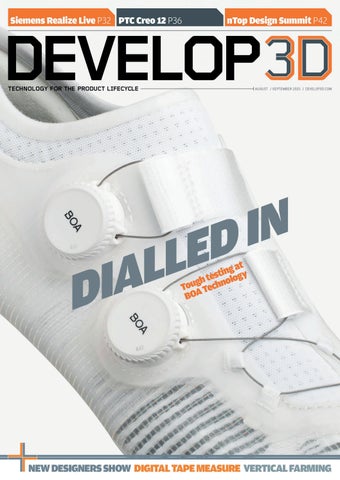
Create a flipbook
Issuu converts static files into: digital portfolios, online yearbooks, online catalogs, digital photo albums and more. Sign up and create your flipbook.