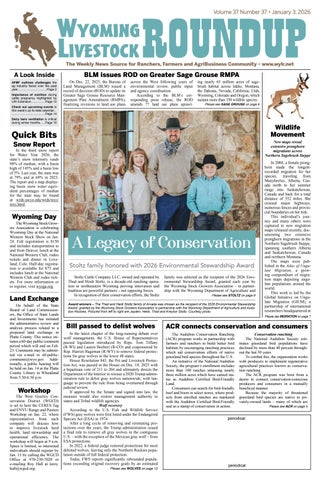
Volume 37 Number 37 • January 3, 2026
®
The Weekly News Source for Ranchers, Farmers and AgriBusiness Community • www.wylr.net
A Look Inside AFBF outlines challenges the ag industry faced over the past year.................................. Page 2 Importance of nutrition during cattle pregnancy highlighted by UW Extension................. Page 12 Check out upcoming events in this week’s up-to-date calendar... .......................................Page 14
BLM issues ROD on Greater Sage Grouse RMPA On Dec. 22, 2025, the Bureau of Land Management (BLM) issued a record of decision (ROD) to update its Greater Sage Grouse Resource Management Plan Amendment (RMPA), finalizing revisions to land use plans
across the West following years of environmental review, public input and agency coordination. According to the BLM’s corresponding press release, the ROD amends 77 land use plans sprawl-
ing nearly 65 million acres of sagebrush habitat across Idaho, Montana, the Dakotas, Nevada, California, Utah, Wyoming, Colorado and Oregon, which sustain more than 350 wildlife species. Please see SAGE GROUSE on page 6
Dairy barn ventilation is critical during winter months...... Page 19
Wildlife Movement
Quick Bits
New maps reveal extensive pronghorn migrations across Northern Sagebrush Steppe
Snow Report
In the third snow report for Water Year 2026, the state’s snow telemetry reads 98% of median, with a basin high of 145% and a basin low of 5%. Last year, the state was at 79% and at 69% in 2023. The report and a map displaying basin snow water equivalent percentages of median for the state may be found at wrds.uwyo.edu/wrds/nrcs/ nrcs.html.
Wyoming Day The Wyoming Stock Growers Association is celebrating Wyoming Day at the National Western Stock Show on Jan. 24. Full registration is $150 and includes transportation to and from Denver, lunch at the National Western Club, rodeo tickets and dinner in Loveland, Colo. Half-day registration is available for $75 and includes lunch at the National Western Club and rodeo tickets. For more information or to register, visit wysga.org.
Land Exchange On behalf of the State Board of Land Commissioners, the Office of State Lands and Investments has initiated the administrative review and analysis process related to a proposed land exchange in Platte County. This notice initiates a 60-day public comment period which will end on Feb. 23. Comments may be submitted via e-mail to slf-publiccomments@wyo.gov. Additionally, a public hearing will be held on Jan. 14 at the Platte County Library in Wheatland from 5:30-6:30 p.m.
Workshop
The West Greeley Conservation District (WGCD) is set to host the CERES Tag and ENVU Range and Pasture Workshop on Jan. 22, where representatives from each company will discuss how to improve livestock herd health, land stewardship and operational efficiency. The workshop will begin at 9 a.m. Space is limited, so interested individuals should register by Jan. 15 by calling the WGCD Office at 970-230-7020 or e-mailing Roy Hall at leroy. hall@wgcd.org.
A Legacy of Conservation
Stoltz family honored with 2026 Environmental Stewardship Award Stoltz Cattle Company LLC, owned and operated by Thad and Heidi Stoltz, is a decade-old ranching operation in northeastern Wyoming proving innovation and tradition are powerful partners – not opposing forces. In recognition of their conservation efforts, the Stoltz
family was selected as the recipient of the 2026 Environmental Stewardship Award, granted each year by the Wyoming Stock Growers Association – in partnership with the Wyoming Department of Agriculture and Please see STOLTZ on page 8
Award winners – The Thad and Heidi Stoltz family of Arvada was chosen as the recipient of the 2026 Environmental Stewardship Award, granted by the Wyoming Stock Growers Association in partnership with the Wyoming Department of Agriculture and Audubon Rockies. Pictured from left to right are Jayden, Heidi, Thad and Kreyton Stoltz. Courtesy photo
In 2004, a female pronghorn made the longestrecorded migration for her species, traveling from Manyberries, Alberta, Canada north to her summer range into Saskatchewan, Canada and back for a total distance of 552 miles. She crossed major highways, numerous fences and provincial boundaries on her trek. This individual’s journey and many others were captured in new migration maps released recently, documenting two extensive pronghorn migrations in the Northern Sagebrush Steppe, spanning southern Alberta and Saskatchewan, Canada and northern Montana. The maps were published in the Atlas of Ungulate Migration, a growing compendium of migration maps depicting ungulate populations around the world. This work is led by the Global Initiative on Ungulate Migration (GIUM), a partnership of international researchers headquartered at Please see MIGRATION on page 7
Bill passed to delist wolves
ACR connects conservation and consumers
In the latest chapter of the long-running debate over wolf management, the U.S. House of Representatives passed legislation introduced by Reps. Tom Tiffany (R-WI) and Lauren Boebert (R-CO) and cosponsored by Rep. Harriet Hageman (R-WY) to remove federal protections for gray wolves in the lower 48 states. House Resolution 845, the Pet and Livestock Protection Act, was passed in the House on Dec. 18, 2025 with a bipartisan vote of 211 to 204 and ultimately directs the Department of the Interior to reissue a 2020 Trump administration rule to delist gray wolves nationwide, with language to prevent the rule from being overturned through judicial review. If approved by the Senate and signed into law, the measure would also restore management authority to states and Tribal wildlife agencies. Wolf recovery According to the U.S. Fish and Wildlife Service (FWS) gray wolves were first listed under the Endangered Species Act (ESA) in 1974. After a long cycle of removing and reinstating protections over the years, the Trump administration issued a final rule to remove all gray wolves in the contiguous U.S. – with the exception of the Mexican gray wolf – from ESA protections. In 2022, a federal judge restored protections for most delisted wolves, leaving only the Northern Rockies population outside of full federal protection. Today, FWS reports significantly rebounded populations exceeding original recovery goals by an estimated
The Audubon Conservation Ranching (ACR) program works in partnership with farmers and ranchers to build better bird habitats by encouraging ranching practices which aid conservation efforts of native grassland bird species throughout the U.S. An initiative of the National Audubon Society, the program’s enrollment includes more than 100 ranches amassing nearly three million acres which have earned status as Audubon Certified Bird-Friendly Land. Consumers can search for bird-friendly beef and bison in select stores, where products from enrolled ranches are marketed with the Audubon Certified Bird-Friendly seal as a stamp of conservation in action.
Please see WOLVES on page 13
Conservation ranching The National Audubon Society estimates grassland bird populations have declined by more than 40 percent throughout the last 50 years. To combat this, the organization works with producers to implement regenerative agricultural practices known as conservation ranching. The ACR program was born from a desire to connect conservation-conscious producers and consumers in a mutually beneficial manner. Because the majority of threatened grassland bird species are native to privately-owned lands – many of which are
periodical
periodical
Please see ACR on page 5