Volume 38 Number 4 • May 16, 2026
®
The Weekly News Source for Ranchers, Farmers and AgriBusiness Community • www.wylr.net
A Look Inside Prickly pear control discussed by UW Extension.............. Page 5 March red meat exports outlined by USMEF........................ Page 6 WAIC Bookmark and Beyond winners highlighted........... Page 8 Check your answers for this month’s crossword puzzle............ ......................................... Page 8 Native violets are beneficial for pollinators and the ecosystem...... ......................................... Page 8 Postcard from the Past recalls how trout came to be in the Upper North Platte River........... Page 10
EPA issues updated diesel exhaust fluid sensor guidance On March 27, the Environmental Protection Agency (EPA) issued new guidance regarding diesel emission systems, removing a longstanding requirement for urea quality sensors in diesel exhaust fluid (DEF) sys-
tems and allowing manufacturers to rely upon nitrogen oxide (NOx) sensor technology instead. A March 27 EPA press release states the updated guidance is part of the association’s efforts to address
nationwide concerns from farmers, truckers and other diesel equipment operators regarding sudden speed losses and shutdowns caused by DEF sensor failures. Please see EPA on page 9
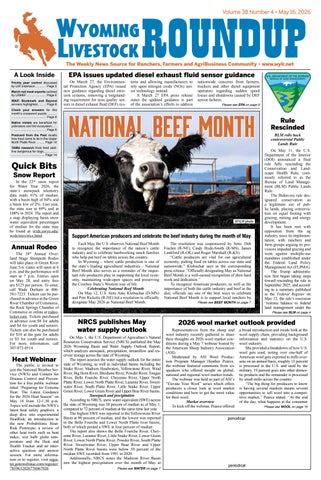
NATIONAL BEEF MONTH
TAMU research finds feed additive dangerous for dogs................ ....................................... Page 14
Quick Bits Snow Report In the 22nd snow report for Water Year 2026, the state’s snowpack telemetry data reads 41% of median, with a basin high of 84% and a basin low of 2%. Last year, the state was at 69% and at 108% in 2024. The report and a map displaying basin snow water equivalent percentages of median for the state may be found at wrds.uwyo.edu/ wrds/nrcs/nrcs.html.
Annual Rodeo The 38th Annual Overland Stage Stampede Rodeo will take place in Green River June 5-6. Gates will open at 6 p.m. and the performance will start at 7 p.m. Entries open on May 28, and entry fees are $125 per person. To enter, call Wade Durham at 406581-7223. Tickets can be purchased in advance at the Green River Chamber of Commerce, the Rock Springs Chamber of Commerce or online at rodeoticket.com. Tickets purchased in advance cost $8 for adults and $4 for youth and seniors. Tickets can also be purchased for $10 at the gate for adults or $5 for youth and seniors. For more information, call 307-872-0514.
Heat Webinar
The public is invited to join the National Weather Service (NWS) and Centers for Disease Control and Prevention for a free public webinar titled “Preparing for Extreme Heat: The Latest Guidance for the 2026 Heat Season” on May 18 from 12-1:30 p.m. Topics will include the NWS’s latest heat safety graphics; a deep dive into experimental HeatRisk; an introduction to the new Probabilistic HeatRisk Prototype; a review of other heat tools such as heat index, wet bulb globe temperature and the Heat and Health Tracker and an interactive question and answer session. For more information or to register, visit register.gotowebinar.com/register/ 7859632826776067926.
WYLR photo
Support American producers and celebrate the beef industry during the month of May Each May, the U.S. observes National Beef Month to recognize the importance of the nation’s cattle industry and to celebrate hardworking ranch families who help put beef on tables across the country. In Wyoming – where cattle production is one of the state’s leading agricultural industries – National Beef Month also serves as a reminder of the important role producers play in supporting the local economy, maintaining wide-open spaces and preserving the Cowboy State’s Western way of life. Celebrating National Beef Month On May 12, U.S. Sens Amy Klobuchar (D-MN) and Pete Ricketts (R-NE) led a resolution to officially designate May 2026 as National Beef Month.
The resolution was cosponsored by Sens. Deb Fischer (R-NE), Cindy Hyde-Smith (R-MS), James Lankford (R-OK) and Roger Marshall (R-KS). “Cattle producers are vital for our agricultural economy, putting food on tables across our state and nationwide,” Klobuchar says in the corresponding press release. “Officially designating May as National Beef Month is a well-earned recognition of their hard work and dedication.” To recognize American producers, as well as the importance of both the cattle industry and beef in the diet, officials say one of the best ways to celebrate National Beef Month is to support local ranchers by Please see BEEF MONTH on page 7
Rule Rescinded BLM rolls back controversial Public Lands Rule On May 11, the U.S. Department of the Interior (DOI) announced a final rule fully rescinding the Conservation and Landscape Health Rule, commonly referred to as the Bureau of Land Management (BLM) Public Lands Rule. The Biden-era rule designated conservation as a legitimate use of public lands, placing conservation on equal footing with grazing, mining and energy development. It has been met with opposition from the ag industry since its implementation, with ranchers and farm groups arguing its provisions impeded grazing and went against multiple-use mandates established under the Federal Land Policy Management Act (FLPMA). The Trump administration first began taking steps toward rescinding the rule in September 2025, and according to a summary published in the Federal Register on May 12, the rule’s rescission “restores balance to federal land management under the Please see BLM on page 4
NRCS publishes May water supply outlook On May 1, the U.S. Department of Agriculture’s Natural Resources Conservation Service (NRCS) published the May 2026 Wyoming Basin and Water Supply Outlook Report, which analyzes snowpack, precipitation, streamflow and reservoir storage across the state of Wyoming. The report assesses the water supply outlook for the entire state of Wyoming, as well as individual basins including the Snake River, Madison Headwaters, Yellowstone River, Wind River, Big Horn River, Shoshone River, Powder River, Tongue River, Belle Fourche River, Cheyenne River, Upper North Platte River, Lower North Platte River, Laramie River, Sweetwater River, South Platte River, Little Snake River, Upper Green River, Lower Green River and Upper Bear River basins. Snowpack and precipitation According to NRCS, snow water equivalent (SWE) across the state of Wyoming was 38 percent of median as of May 1, compared to 72 percent of median at the same time last year. The highest SWE was reported in the Yellowstone River Basin at 90 percent of median, and the lowest was reported in the Belle Fourche and Lower North Platte river basins, both of which posted a SWE at four percent of median. The report also shows the Belle Fourche River, Cheyenne River, Laramie River, Little Snake River, Lower Green River, Lower North Platte River, Powder River, South Platte River, Sweetwater River, Upper Bear River and Upper North Platte River basins were below 50 percent of the median SWE recorded from 1991 to 2020. Additionally, NRCS notes the Madison River Basin saw the highest precipitation over the month of May at Please see WATER on page 7
2026 wool market outlook provided Representatives from the sheep and wool industry recently gathered to share their thoughts on 2026 wool market conditions during a May 7 webinar hosted by the American Sheep Industry Association (ASI). Moderated by ASI Wool Production Program Manager Heather Pearce, the webinar featured comments from six speakers who offered insight on global, national and regional wool market trends. The webinar was held as part of ASI’s “Elevate Your Wool” series which offers producers a closer look at wool market conditions and how to get the most value for their wool. Market overview To kick off the webinar, Pearce offered
a broad introduction and inside look at the wool supply chain, providing background information and statistics on the U.S. wool industry. She provided a breakdown of how U.S. wool gets used, noting over one-half of American wool gets exported to mills overseas on an annual basis, roughly 15 percent is processed in the U.S. and used by the military, 19 percent goes into other domestic products and the remainder is processed by small mills across the country. “The big thing for producers to know is having several markets means several opportunities to sell wool into a competitive market,” Pearce stated. “At the end of the day, what happens at the consumer
periodical
periodical
Please see WOOL on page 15