Report shows meat at center of shifting consumer trends
On March 2, 210 Analytics Principal Anne-Marie Roerink presented findings from the 21st iteration of the Power of Meat report during the 2026 Annual Meat Conference, hosted by the Meat Institute and Food Industry
Quick Bits
Office Closed
The Wyoming Livestock Roundup will be closed on April 3 in observance of Good Friday. We wish all of our friends, families and dear readers a happy and blessed Easter holiday.
Snow Report
In the 15th snow report for Water Year 2026, the state’s snowpack telemetry data reads 71% of median, with a basin high of 102% and a basin low of 0%. Last year, the state was at 105% and at 94% in 2024. The report and a map displaying basin snow water equivalent percentages of median for the state may be found at wrds. uwyo.edu/wrds/nrcs/nrcs.html
WSGLT Award
The Wyoming Stock Growers Land Trust (WSGLT) is now accepting nominations for the 2026 Kurt Bucholz Conservation Award, which recognizes an individual or family dedicated to conserving Wyoming’s working lands and natural resources. The recipient will be recognized at the 2026 Legacy of the Land event – previously known as the Annual Roundup Fundraiser and Barbecue – in Saratoga on Aug. 22 and will receive a custom bronze statue designed by the late Jerry Palen and his wife Ann. Nominations are due on May 1. To learn more, visit bitly/2026_Bucholz . Completed nomination forms can be e-mailed to kendra@wsglt. org or mailed to PO Box 268, Cheyenne, WY 82003.
Public Hearing
State Engineer Brandon Gebhart will conduct a public hearing regarding the 2017 Amended Order of the State Engineer-Horse Creek Basin on April 7 from 2-4 p.m. in the LaGrange Community Center in LaGrange. Information on the effects of the last three years of operation under the amended order will be presented at the hearing. Comments from area water users relative to the order’s corrective controls will be accepted at the hearing and until May 7. For more information, contact the State Engineer’s Office at 307-532-2248.
Association in National Harbor, Md.
Overall, the report emphasizes the growing popularity and significant role of meat in the American diet, citing record-breaking sales throughout 2025.
“There was no other department
that was bigger or grew more than the meat department,” Roerink says. “Animal protein was absolutely popular across the board.”
The report goes on to note retail
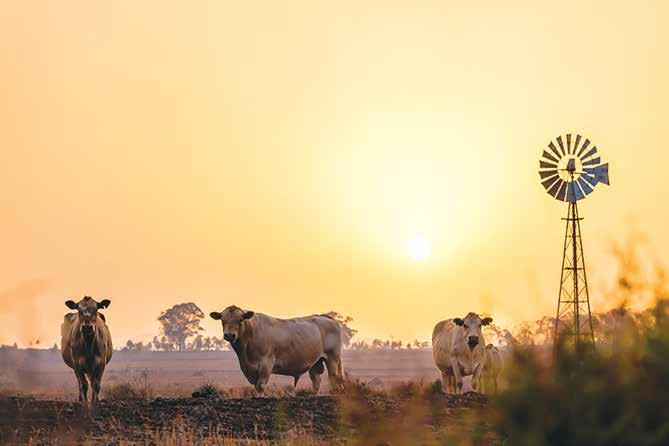
Experts offer advice on caring for livestock following wildfires
Following devastating wildfires in Nebraska and Kansas in recent weeks, post-fire livestock care is becoming increasingly pertinent as producers turn their attention to recovery.
Additionally, in the face of heightened fire conditions and unseasonably warm, dry conditions throughout the West, understanding strategies for caring for livestock following wildfires can help producers prepare for and recover from fire-related devastation.
To help mitigate the impacts of fire on livestock health, industry experts offer key considerations for assessing injuries, aiding nutrition and supporting
recovery in the wake of wildfires.
Cattle health
In the aftermath of a wildfire, assessing animals for signs of physical injury and stress is of utmost importance.
Throughout the weeks following a wildfire, cattle should be assessed frequently and kept away from recently-burned areas until all hot spots are totally extinguished to avoid further risk of injury.
“Ashes, smoldering fencelines, hay piles and hot spots can cause significant injury to hooves and soft
Please see WILDFIRES on page 5
Commission meeting held
Discussion surrounding balancing fiscal challenges with increasing agency projects and expenses was highlighted during the Fiscal Year (FY) 2027 budget approval process at the March 18-19 Wyoming Game and Fish Commission meeting in Torrington.
New leadership appointed
The appointment of new leadership takes place annually, and two commissioners stepped into the roles previously held by President Ashley Lundvall and Vice President Mark Jolovich.
Jolovich was unanimously selected as the new president, while Rusty Bell was selected as vice president.
Preliminary budget receives approval
Meredith Wood, Wyoming Game and Fish Department (WGFD) chief financial officer, provided a detailed presentation for the 2027 budget proposal.
Wood provided projected expenses and costs of operation for the department, as well as some ongoing challenges in creating a budget to balance infrastructure needs and wildlife management objectives.
The proposed budget for FY27 is $110,640,013 for all divisions in the agency. This includes $108,564,988 in standard budgets and $2,075,025 in one-time projects. The budget is an $8.3 million increase from last year.
Key drivers for the increase include inflation, pay increases and capital construction or deferred maintenance projects for infrastructure.
The current projected revenue for FY27 is $112,452,574. Primary funding sources include license sales, federal aid, grants and interest.
Wood noted, while the annual budget is built to account
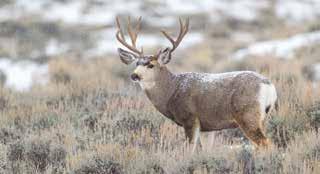
According to a March 18 Wyoming Game and Fish Department (WGFD) update, mule deer populations across western Wyoming are reporting encouraging signs of recovery as they rebound from significant losses caused by the severe winter of 2022-23.
The department notes both the Wyoming Range and Sublette mule deer herds have demonstrated strong population growth, high survival rates and improved reproductive success over the last several years.
“Both herds have demonstrated incredible resilience over time, rapidly recovering from periodic high winter mortality, as we saw in the mid-2000s and, more recently, from 2011-16 when
Ranching in the West
Stewart, Hostetler discuss Wyoming wool industry during UW seminar series
On Feb. 26, the second installation of the University of Wyoming (UW) Ranch Management and Agricultural Leadership (RMAL) Ranching in the West seminar series was held on the UW campus in Laramie and over Zoom.
The seminar featured conversations on Wyoming’s sheep and wool industry led by UW Extension Sheep Specialist Dr. Whit Stewart and Ben Hostetler, operations manager of Mountain Meadow Wool Mill in Buffalo.
Stewart’s presentation focused on opportunities and challenges facing Wyoming sheep and wool producers, while Hostetler discussed his personal experiences working in the wool industry and gave attendees some entrepreneurial advice.
Wyoming wool Expressing a belief in the “tremendous potential” of the sheep and wool industries, Stewart outlined a few key facts he believes are instrumental to understanding sheep and wool production in the Cowboy State.
“My goal for this evening
consecutive mild, open winters resulted in high survival and rapid population recovery,” states Brandon Scurlock, WGFD wildlife management coordinator for the Pinedale Region, in the corresponding press release.
Research and monitoring
According to WGFD, data has been compiled through a collaborative longterm study with the University of Wyoming’s (UW) Monteith Shop and an ongoing focal herd study conducted by the department.
The UW study is working to understand factors regulating survival and reproduction of the Wyoming Range Herd, while the five-year WGFD study, now in
Mule deer herds continue to recover
High food prices and demand for beef in a midterm election year may spell more trouble. Election years always come with a number of promises which last until Election Day but then are quickly forgotten.
Such may happen with a bill that came out after the first of March when U.S. Senate Democratic Leader Chuck Schumer (D-NY) and a number of Senate Democratic sponsors released a bill they say will lower food prices.
Schumer and other bill sponsors of the Family Grocery and Farmer Relief Act said in a March 5 press release, “The act is a competition-driven, pro-farmer, pro-rancher, pro-worker, proconsumer, cost of living bill which breaks up dominant meatpackers, reins in foreign controlled corporate giants and uses all available tools to stop unfair pricing which drives up grocery bills for American families. It is designed to turn big structural reform into concrete benefits including more competition and greater fairness for farmers and ranchers, more resilient supply chains, lower prices and better choices at the meat counter.”
The bill’s sponsors, which include Sen. Cory Booker (D-NJ), Elizabeth Warren (D-MA), Bernie Sanders (D-VT) and Dick Durbin (D-IL), continue saying, “The act will make it unlawful for major meatpacking conglomerates to control more than one type of meat, forcing the biggest players to choose a line of business. It poses hard caps on the concentration of beef markets at both the regional and national levels. If these thresholds are exceeded, the Federal Trade Commission (FTC) must order targeted divestitures such as selling off plants, facilities or business units or spinning off new independent firms until markets are competitive again.”
The press release also notes the act will “direct the FTC to design and enforce divestiture plans, so the law delivers real structural change, not just fines companies treat as a cost of doing business, while maintaining or improving employment, honoring collective bargaining agreements and promoting safer and more stable workplaces for workers across the supply chain. It will prohibit foreign leverage over the domestic market, empowering FTC to protect competition and national security.”
The Senate Democrats say, “The act links structural reforms to kitchen table prices by focusing on unfair and unjust discriminatory pricing practices in retail and wholesale meat markets which hit independent and neighborhood gro cers hardest.”
They continue, “It will authorize the Small Business Administration to provide assistance, loan guarantees, tech nical assistance and other support to farmer cooperatives and small business concerns which seek to acquire, operate or expand meatpacking plants of facilities divested under the act. The law will make failure to divest enforceable under the FTC, backed by significant civil penalties.”
There are some ag experts such as Derrell Peel, profes sor of agriculture at Oklahoma State University, who says, “Consolidation has occurred because it’s cost effective. If the meatpackers were broken up, we will lose this cost efficiency, which will raise costs in the middle of the industry, above pro ducers and below consumers.”
Julie Anna Potts, president and chief executive officer of the Meat Institute said, “The bill amounts to reckless electionyear pandering which puts the industry at risk.”
I agree with the last sentence.
GUEST OPINIONS
Together we grow. We grow food. We grow economies. We grow leaders. We grow communities. Agriculture –together we grow.
It takes all kinds of farmers and ranchers to grow different commodities needed to keep our nation fed and secure.
In Wyoming, a state where there are more cattle than people, cattle and calves are ranked as the largest livestock commodity raised. Wyoming is a leading state in sheep, lamb and wool production. Hay is the top crop raised, and farmers also grow corn, sugarbeets, wheat, barley and dry edible beans. The state ranks among the top producers of barley and pinto beans nationally.
Agriculture plays a vital role in Wyoming’s economy.
In agriculture, we have the grand responsibility of not only making it work while we are here on Earth, but making it work for future generations.
To be a good steward means implementing the kind of management which
By Kerin Clark
works for generations to come. Making careful and responsible choices for the land we have been entrusted to care for is important and necessary.
Another important component of farming and ranching is growing together as leaders in agriculture advocacy. Involvement in agriculture policy issues is a crucial element of the farm or ranch business.
At Wyoming Farm Bureau Federation (WyFB), we are proud of the agricultural leaders in Wyoming. It takes all kinds of individuals collaborating to make good decisions.
Working together, our members add their perspectives for the good of agriculture and the communities they call home. Whether one consumes food or raises cows, sheep, barley, corn or anything else, agriculture is strongest together.
Along with volunteering for WyFB, we are proud of additional contributions our members make in their communities. Whether they serve on school boards, are volunteer firefight-
ers, serve at their community church or any number of other volunteer activities, farm bureau members value giving back to their communities.
This dedication reflects our mission of strengthening Wyoming agriculture and enhancing Wyoming’s communities, rooted in the strong sense of community and patriotism which defines our state.
National Agriculture Day was held on March 24. The theme of “Agriculture – Together We Grow” is a vivid reminder of the strength of working together to grow food and keep agriculture strong for generations to come.
Keeping agriculture strong in Wyoming and America is important for those who grow food, it’s important for those who consume food and it’s important for the security of our nation.
WyFB invites all Wyomingites to celebrate agriculture and learn more about its role in daily lives.
We proudly celebrate Wyoming
HANNAH BUGAS,
DENISE OLSON, Classified Sales Manager • 307-685-8213 • denise@wylr.net ANDREA ZINK, General Manager • andrea@wylr.net
Hatchery expansion approved
During its March 18-19 meeting, the Wyoming Game and Fish Commission voted to approve a recommendation from the Wyoming Game and Fish Department (WGFD) to fund the Dan Speas Warm and Cool Water Facility Expansion Project in the Casper Region.
WGFD Fisheries Division Chief Alan Osterland said the main objective of the project is to establish a dedicated facility in Wyoming for producing warm and cool water fish species and reduce reliance on out-of-state sources like Arkansas, Nebraska and North Dakota.
However, construction would also serve an important secondary purpose in helping mitigate the introduction of aquatic invasive species (AIS) from other states.
Annually, nearly 1.5 million fish and up to 11 species of warm and cool water fish are brought from out-of-state facilities in Arkansas, including black crappie and channel catfish; Nebraska, including sauger and tiger muskie; North Dakota, including northern pike and walleye and Oklahoma, including bluegill.
Osterland said while each shipment of imported game fish is carefully inspected and culled for any invasive species, a local hatchery would further mitigate this risk. He noted, as AIS are being discovered in a growing number of states importing fish to Wyoming, the risk of importing game fish into the state increases.
Additionally, the facility would provide waterways with game fish which would continue to establish Wyoming as a premiere location for anglers.
The state-of-the-art facility will include dark and light production rooms, isolation rooms and advanced water conditioning systems. These facilities would include annual production of 1.28 million walleye, 100,000 crappie, 60,000 bluegill, 36,000 largemouth bass and 10,000 tiger muskie per year.
Sletten Construction of Wyoming will be awarded the project after submitting the lowest bid, in line with the engineer estimate.
Following approval from the commission, construction is expected to begin in September, with completion slated for October 2027. First walleye production is expected to begin in April 2028.
Youth event announced
The Casper branch of Tractor Supply Company is inviting all young artists to explore their creative side during the Photo Frame Craft event.
On April 4 from 10 a.m. until 2 p.m., the store will host a craft event where young customers can make farmthemed picture frames and decorate their frames with stickers and other colorful extras, while supplies last.
The interactive craft provides a fun way to celebrate “Life Out Here” as they add chickens, cows, pigs, tractors and more to their personalized frames.
Once complete, each participant can take their free craft home and use it to house their favorite picture.
In addition to the craft activity, attendees will also have the opportunity to enjoy a coloring contest.
“We enjoy offering activities for the children in our community, particularly events that are fun, creative and educational at the same time,” said Casper Store Manager Rob Harmon. “There are so many ways for youth to use their imagination on this frame, and we know they will be incredibly proud of the unique piece of artwork they create.”
Campaign launched
On March 24, U.S. Secretary of Agriculture Brooke Rollins announced the launch of a national public awareness campaign to inform meat, poultry and egg producers of the “Product of USA” voluntary labeling standard which went into effect on Jan. 1 and increase consumer understanding of what the label means.
“Our great patriot ranchers and producers grow, raise and harvest the world’s safest, most affordable and abundant food supply. American consumers want to support America by buying American, and this label will strengthen our food supply chain through transparency, fairness and trust,” said Rollins.
Under this standard, the “Product of USA” label is reserved exclusively for meat, poultry and egg products from animals born, raised, harvested and processed in the U.S. The claim is voluntary, but companies using it must meet this transparent and verifiable requirement.
USDA announces “no action”
On March 25, the U.S. Department of Agricultureʼs (USDA) Commodity Credit Corporation (CCC) announced it does not expect to purchase and sell sugar under the Feedstock Flexibility Program for Crop Year 2025, which runs from Oct. 1 to Sept. 30, 2026.
The CCC is required by law to quarterly announce estimates of sugar to be purchased and sold under the Feedstock Flexibility Program based on crop and consumption forecasts.
Federal law allows sugar processors to obtain loans from USDA with maturities of up to nine months when the sugarcane or sugarbeet harvests begin. On loan maturity, the sugar processor may repay the loan in full or forfeit the collateral to USDA to satisfy the loan.
The Feedstock Flexibility Program, initially authorized in the 2008 Farm Bill, was reauthorized by Congress in the Continuing Appropriations, Agriculture, Legislative Branch, Military Construction and Veterans Affairs and Extensions Act of 2025 as an option to avoid sugar forfeitures.
Under the Feedstock Flexibility Program, if USDA is faced with the likelihood of loan forfeitures, it is required to purchase surplus sugar and sell it to bioenergy producers to reduce the surplus in the food use market and support sugar prices.
NEWS BRIEFS
Grant opportunity available
U.S. sheep and lamb producers now have an opportunity to enhance the profitability and sustainability of their operations.
The American Lamb Board (ALB) has received a grant through the U.S. Department of Agriculture (USDA) Advancing Markets for Producers (AMP) program.
This initiative is designed to help producers improve efficiency and increase productivity by integrating technology and sustainable management strategies. The program also aims to expand market opportunities and support the next generation of sheep producers.
A total of 150 producers will be selected to participate. Each will work with a technical service provider (TSP) to develop operational plans, implement recommended improvements and organize farm data to identify best management practices to mitigate emissions and enhance productivity.
Producers accepted into the program may receive up to $23,000 to develop and implement improved sheep and land stewardship management plans.
Additional benefits of enrollment include access to a TSP, an electronic livestock identification system, soil sampling services and National Sheep Improvement Program ultrasound and genetic consulting services
Applications are open now through May 1. Selected applicants will be notified by June 1. Once eligibility documentation is completed, individual producer programs will run through Sept. 30, 2028.
For more information or to fill out the application, visit lambboard.com
Legislation introduced
Senate Agriculture Committee Members Chuck Grassley (R-IA) and Tina Smith (D-MN) introduced the Livestock Consolidation Research Act, bipartisan legislation to support research into the economic impact of livestock market consolidation on farmers, ranchers and consumers.
“Consolidation in the meat and poultry industry impacts producers and consumers alike, and right now, they’re feeling the squeeze. The current patchwork of available data isn’t enough to tackle this problem. Our bipartisan legislation will work to address ag concentration by providing farmers, ranchers and shoppers a full picture of how the market is working,” Grassley said.
The Livestock Consolidation Research Act moves beyond existing research to discover the impact of consolidation on farmers and ranchers, as well as the downstream impacts on consumers. The legislation directs the Department of Agriculture’s Economic Research Service to conduct this research.
Grassley and Smith plan to push for the bill’s inclusion in the research title of the farm bill, which could form a base of data to inform future decisions. The bill has been endorsed by the National Farmers Union.
Deadline approaching
Time is running out to submit nominations for the 2026 Wyoming Outdoor Hall of Fame.
This honor, offered by the Wyoming Game and Fish Department every 18 months, recognizes individuals who have made significant, lasting and lifetime contributions to the conservation of the state’s outdoor heritage. Nominations will be accepted until March 31.
Nominees must have influenced conservation in Wyoming through sustained and outstanding contributions during the course of their employment or through volunteer efforts. This can be in several areas, including environmental law enforcement; applied resource management; conservation education; conservation policy formation, legislation and public leadership; conservation-oriented research; conservation literature, art or journalism or contributions to outdoor heritage
The Wyoming Outdoor Hall of Fame also recognizes a Youth Conservationist of the Year, a category implemented in 2023 to honor a Wyoming resident 18 years or younger who has shown leadership and achievement in conservation.
The nomination committee will review submissions to make selections in March. The committee will consider whether the nominee’s contribution was of statewide, interstate or national significance and whether it affected a wide range of natural resources and their use.
To submit a nomination, send a completed application and a summary of accomplishments to the department.
Submissions can be sent via e-mail to amanda.fry@ wyo.gov or by mail to Wyoming Game and Fish Department, Wyoming Outdoor Hall of Fame, 5400 Bishop Blvd., Cheyenne, WY 82006.
tissues,” writes Livestock Systems Extension Educator T.L. Meyer in a March 17 news release from the University of NebraskaLincolnʼs (UNL) Institute of Agriculture and Natural Resources.
Meyer adds burnrelated damage – especially in hooves – can take time to show up in full.
For this reason, producers should keep cattle out of recently-burned areas and continue to keep a close eye on them, monitoring animal health multiple times per week.
Sensitive areas like hooves, udders, sheaths and testicles should be evaluated for burns or signs of swelling, while eyes and muzzles should be assessed for trapped soot, abrasions and ulcers.
Also, respiratory issues such as coughing or rapid breathing can signal health complications from smoke.
When these signs have been observed, and on days when smoke continues to hang heavy in the air, Meyer recommends avoiding unnecessarily moving or working cattle since respiratory irritation from smoke can worsen with handling.
Overall, consulting with a veterinarian can help producers prepare for a variety of outcomes and even aid insurance efforts.
“Consult a veterinarian early for burn treatment, pain management and antibiotics if needed and for guidance about which animals are likely to recover,” Meyer says. “In some cases, humane euthanasia may be the best choice.”
Meyer also recommends keeping all veterinary statements and sale receipts for fire-affected livestock, noting if these animals decline or die in weeks following
the fire, they may qualify for insurance compensation.
Calf care
Additionally, cow/calf pairs are particularly vulnerable to wildfire-related health issues. Increased stress and complications with nursing may lead to a weakened immune system, especially in young or newborn calves.
“Cows in late gestation and pairs may need extra monitoring,” Meyer writes. “Post-fire stress can weaken maternal behavior or reduce milk production, and burned or singed udders may prevent calves from nursing.”
In a separate March 17 news release, UNL Extension Educator Brock Ortner outlines the D.A.R.T. method of monitoring calf health, which involves assessing calves for signs of depression, appetite reduction, respiration changes and temperature increases.
Ortner notes signs of depression such as isolation, droopy ears and lethargy – along with reduced appetite and increased respiratory rate – can be the first signs of fire-related health complications in young calves.
“Increased respiratory rate, shallow breathing or abnormal sounds such as coughing or raspy breathing may indicate respiratory disease,” he writes. “Nasal discharge or excessive eye secretions may also accompany illness.”
Increased rectal temperatures ranging from approximately 103.5 to 104 degrees Fahrenheit are also causes for concern, according to Ortner.
“Early detection and treatment of sick calves improves the likelihood of recovery and helps reduce performance losses associ-
agriculture and its people every day of the year and specifically on National Agriculture Day.
Kerin Clark is the executive vice president of WyFB, which is the state’s largest general agriculture organization with nearly 12,000 member families across all 23 Wyoming counties. Their mission is to strengthen Wyoming agriculture and enhance Wyoming’s communities. For more information, visit wyfb.org
Officials assess damage
On March 23, U.S. Sen. Deb Fischer (R-NE) welcomed U.S. Secretary of Agriculture Brooke Rollins to Nebraska to survey damage caused by the Morrill Fire and meet with first responders and locals impacted by the wildfire.
“Today, Rollins saw firsthand the scale of these wildfires and the devastation they brought to farmers and ranchers across Nebraska,” said Fischer. “Most importantly, she witnessed how our first responders and volunteers stepped up, working around the clock to keep our communities safe.
I am thankful for Rollins’ leadership in meeting our challenges head on, and I will be working closely with the U.S. Department of Agriculture and Nebraska Gov. Jim Pillen to make sure those impacted get the assistance they need.”
At approximately 10 a.m., the group departed Ogallala Municipal Airport via CH-47 helicopters for an aerial view of the Morrill Fire.
Upon returning to the airport, the group traveled to the Keith County Fairgrounds for a briefing from the Nebraska National Guard, line firefighters, first responders and local producers on the status of the wildfires and damages.
Fischer spoke directly to those impacted and got insight from local officials about assistance needed for recovery.
ated with respiratory disease,” Ortner writes. “Extra vigilance and responsiveness may help mitigate adverse health outcomes in the weeks and months following exposure to wildfire smoke.”
Water, nutrition and grazing
In addition to assessing and addressing physical health concerns, providing access to clean water and adequate nutrition is critical.
Meyer emphasizes stressed cattle often require more water intake. However, animals which have gone without water for an extended period of time may overdrink when it becomes available again.
To mitigate complications, Meyer recommends reintroducing herds to water at a controlled rate and providing access to water from several areas.
“When possible, cattle that have been without water for more than a day should be slowly adapted back to water by providing them with access to small amounts of water every half hour – three to five gallons
for cows and bulls and one to two gallons for growing cattle – until the cattle are no longer thirsty,” Meyer writes. “Offering clean water from several access points helps avoid crowding and reduces digestive issues linked to sudden intake.”
Nutrition is another critical aspect of post-fire livestock care. Short-term nutrition strategies can help herds regain strength and maintain health immediately following the fire while producers explore longer-term options in the face of forage losses.
“If no forage is available, a low-protein, lowstarch commercial feed product can be used for four to five days to minimize weight loss until hay and/ or grazing can be secured,” Meyer writes, recommending a product with 12 to 14 percent crude protein content and eight to 12 percent starch content.
When low hay supplies must be stretched, Meyer says a combination of feeding a 28 to 32 percent range cube and limit feeding longstemmed hay can help herds maintain body condition.
Consulting a nutritionist
or local Extension educator can help producers weigh their options and make the best decision for their herds as individual circumstances and needs allow.
As burned pastures recuperate, livestock should be kept away from affected land.
Temporary fencing can help keep herds away from sensitive areas, and infrastructure like fences, tanks and pipelines should be thoroughly evaluated and repaired before turnout.
Documentation and disaster assistance
Recovering from wildfires is a stressful ordeal for humans and livestock alike.
In cases of animal mortality and grazing losses, thorough and prompt documentation can help producers navigate federal disaster assistance programs provided by the U.S. Department of Agriculture (USDA) and other organizations.
“Producers may qualify for several USDA programs, but it’s important to contact a local Farm Service Agency (FSA) office promptly,” Meyer emphasizes. “These programs can help with livestock mortal-
FEEDERS
ity, water and feed transport and grazing losses.”
Before moving carcasses or beginning repairs, Meyer says producers should take clear, date-stamped photos of carcasses or injured animals and document damaged infrastructure such as fences and tanks, as well as burned hay or feed. Additionally, recording tag numbers, brands and locations where possible is vital.
Meyer also recommends consulting with local FSA agents on a case-by-case basis, as well as coordinating any fencing or grazing changes with the FSA and the Natural Resources Conservation Service, to ensure documentation and eligibility requirements are met.
Maintaining detailed, up-to-date records yearround is a good practice to uphold in order to have a good understanding of operations and inventory, which can aid recovery efforts should a wildfire or other natural disaster strike.
Grace Skavdahl is the editor of the Wyoming Livestock Roundup. Send comments on this article to roundup@wylr.net.
David & Katelyn Garrelts 130 Blk/Bwf Strs & Hfrs, 650-800#, Weaned 150 days, Hay Fed, Branding Shots: Pyramid 5 +Presponse, Vision 7 w/ Spur, Weaning Shots: Pyramid 5+Presponse, Vision 7 w/Spur, Heifers Ran Open, Home Raised
Smith Sheep Co. 70 80% Red Angus/20% Blk Angus Hfrs, 650-775#, Weaned a long time, Been on Ground Hay, Creep Feed with some Silage, 2 Rounds of Shots: Vista Once, Vision 7, No Implants, Producer All Natural, Replacement Quality Alec Burg 27 Mx Strs & Hfrs, 700-800#, Weaned since End of October, Bunk Broke, Been on a Light Grower Ration, 2 Rounds of Shots: Pyramid 5+Presponse, 7-way w/Somnus, Poured, No Implants, Heifers are Bangs Vac., Steers are Knife Cut WEANED CALVES
Jack Pfister Ranch 140 Blk Hfrs, 425-450#, Weaned a long time, Running out on grass supplemented with Hay, Been on a Complete Mineral Program provided by a Nutritionist. Branding Shots (June 1), Pre-cond. Shots (July 26): Inforce 3, Ultrabac 7 w/Somubac, Weaning Shots (Oct. 14): Inforce 3, Poured w/Dectomax, On Jan. 6, 2026 gave the Valcor Injectable, Home Raised, NOTE: Selling only due to drought conditions Stan Swanson 85 Blk Strs, 500-575#, Weaned a long time, Hay Fed, @ Rounds of Shots: Convexin 8, One Round of Bovi-Shield Gold 5, No Implants Carr Ranch/Matt Carr 60 Blk Angus Hfrs, 550-600#, Guaranteed Open, Weaned a long time, Been on Long Stem Grass/Alfalfa Hay Mix, Vitalix Tubs, Branding Shots: Ultrabac 7, Bovi-Shield Gold, Pre-cond. Shots: Ultrabac 7 w/Somnus, Bovi-Shield Gold One Shot, Weaning Shots: BoviShield Gold, On March 20: Dectamax Injectable, Safe Guard Lankister Livestock 60 Blk/Bwf Hfrs, 550-750#, Weaned a long time, Been on a Grower Ration, Complete Vac. Program, Over Half are Home Raised balance purchased from Wyoming Area Ranchers, High Elevation
CATTLE COUNTRY VIDEO PRODUCTION SALE SCHEDULE
High Plains Showcase - Laramie, WY June 30th, 2026
Oregon Trail Classic - Gering, NE August 4th & 5th, 2026
Frontier Fall Round Up - Cheyenne, WY September 10th, 2026
Green River Valley Cattlemen’s Association’s annual event offers
The Green River Valley Cattlemen’s Association (GRVCA) hosted a wide range of topics at its public informational meetings on March 6-7 at Marbleton Town Hall, closing with the annual banquet on the last night.
On both afternoons, attendees discussed new virtual fencing systems, genetic brisket testing, GPS tags, market outlooks, livestock predator fees, public lands grazing and new legislation.
Water update
With uncertainties about the near future of water in the Colorado River Basin, one timely update came from Travis McInnis of the Wyoming State Engineer’s Office. He discussed the possibility of irrigation curtailment, which the Wyoming Constitution says can only be voluntary, not mandatory.
A settlement among seven western states is pending for the Colorado River Compact, according to McInnis and others. None of the states want to sue, but some are preparing to go to court.
“We could be in curtailment,” Mike Vickrey said. “It could happen at the end of this water year – in October. If it happens, the whole basin could go into curtailment.”
Voluntary water conservation of 25,000 to 30,000 acre-feet could include payments to ranchers for using less irrigation water than permitted, which the Wyoming Department of Agriculture supported several years ago in western Wyoming.
“It’s not a huge hit for
Wyoming to do it,” he said. “Wyoming still doesn’t use all of its water.”
Sublette County Conservation District Manager Mike Henn, who has participated in water compact talks, said the environmental impact statement has numerous alternatives, and he expects a record of decision before Oct. 1.
The State Engineer’s Office has more information about and applications for the voluntary water conservation program, under the “Telemetry” section on its website.
Water rights will be filled from oldest to newest, and a landowner might need to relocate a ditch. New or improved headgates with accurate flow measuring devices will be required and enforced, McInnis said.
“If the headgate is on another person’s private land, do you need permission to put in a new ditch?” one man asked.
“You always have access to your ditch bank for maintenance,” McInnis said. “Get your water rights in order. Permit maps could be 100 years old.”
Albert Sommers said the Upper Green River Basin’s water rights have not been “trued up.”
“Yes, few are trued up,” McInnis said. “Compare satellite images to meadows. You have the ability to move water rights. You can move senior water rights to junior land so your water rights are going in order.”
Predator fees
Outgoing GRVCA Presi-
dent Kristy Wardell invited a panel representing different agencies to discuss whether the Sublette County Predator Board should raise their predator fees to one dollar in change-of-ownership brand inspections.
Sublette County Commissioners have given the board up to $50,000 credit each year.
For countless years, the fee has remained 60 cents a head for cattle and 20 cents for sheep – the only county to do so – making it ineligible to participate with the U.S. Department of Agriculture’s (USDA) Animal Damage Management Board (ADMB).
Sublette County’s biggest livestock predators are grizzly bears and gray wolves.
Gray wolves are managed by the Wyoming Game and Fish Department (WGFD) and USDA’s Wildlife Services (WS) in the county’s northwest Trophy Game Management Area (TGMA)
and in the state’s predator zone in the south portions of the county.
Wardell is also the predator board’s new secretarytreasurer and a rancher in the predator zone.
“If we don’t raise the predator fee we’re going to be out of business,” she said.
The fees coming back to the county predator board are about $20,000, which could rise to $60,000, Wardell said.
ADMB Director Jerry Johnson appeared via Zoom, with Sublette County Predator Board President Pete Arambel, WGFD’s Clint Atkinson, WS Manager Brady Smith and GRVCA Rancher France Clark.
Arambel said he favors raising predator fees to one dollar and joining the ADMB.
Conversation centered on how to join with the ADMB, how it funds projects and if a full-time trapper is needed.
Smith said a good employee needs stability and full-time pay.
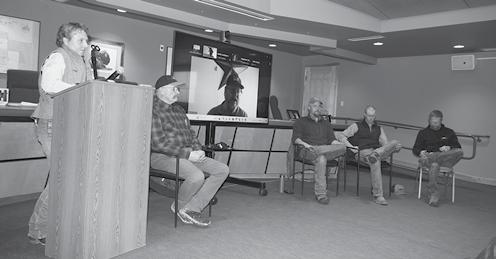
Panel discussion – Outgoing Green River Valley Cattlemen’s Association (GRVCA) President Kristy Wardell invited a panel to discuss the possibility of raising Sublette County’s predator fee to one dollar and working with the U.S. Department of Agriculture’s (USDA) Animal Damage Management Board (ADMB). From left to right are Sublette County Predator Board President Pete Arambel, ADMB Director Jerry Johnson on Zoom, Clint Atkinson of the Wyoming Game and Fish Department, Brady Smith of USDA Wildlife Services and GRVCA Member France Clark. Joy Ufford photo
“Why do you need a trapper for wolves in the predator area,” asked Longtime Predator Board Member and Bondurant Rancher Kevin Campbell. He referred to a retired pilot who, with an aerial gunner, killed hundreds of coyotes.
Smith said a trapper is still needed on the ground to work with a pilot.
Joel Bousman, whose family ranches against the Wind River Mountains, said their landscape and situation are “totally different.”
“The majority is wilderness,” he said, noting it’s nearly to impossible to find killed livestock.
“Our only option is to have a trapper full time. We don’t get paid for the wolf kills like the guys on the Upper Green River. I’m totally willing to pay one dollar a head. What we need to stay in business is to keep the wolves down,” Bousman added.
Clark reported talking to about 30 livestock owners and the need for a full-time trapper “was very area specific.” The farther north he went in the county, he said, the less a need was seen for a trapper.
Several people voiced favor for a GRVCA resolution to support one-dollar fees, but Vickrey cautioned against the association “taking a position” on a Sublette County Predator Board action which takes place every December at sparsely attended meetings.
“So if you want to go vote, be there,” Clark said.
Special guests
U.S. Sen. John Barrasso (R-WY), a long-time attendee at the annual event, provided a Congressional update.
Although he said he had a 10-page speech, Barrasso spoke about the “endurance, resilience and determination”
of Wyomingites he met at the Wrangler National Finals Rodeo, Wyoming Wednesdays in Congress and two weeks ago on a ship with soldiers who battled against Iran.
He switched to fellow U.S. Sen. Cynthia Lummis’s (R-WY) handout which described the benefits of President Donald Trump’s One Big Beautiful Bill Act and Wyoming’s incredible resources of oil and natural gas.
“Gas was five dollars a gallon when Joe Biden was president,” he said. “We are number one in energy in the world. There will be a blip due to the Iran move, but I’ll never forget when Biden said climate was more important than energy.”
With U.S. Fish and Wildlife Service Director Brian Nesvik at the helm, Barrasso hopes for legislation to delist grizzlies.
“Nesvik is on it,” Barrasso said. “That’s why he’s there.”
Next, Jim Magagna, executive vice president of the Wyoming Stock Growers Association (WSGA), went over a list of state bills – both supported and opposed by WSGA – and explained their fates.
After another GRVCA business meeting, new President Walden Campbell of Bondurant welcomed several hundred diners to the annual banquet at the Sublette County Fairgrounds. Riverbend Ranch donated New York strips, raffle tickets flew, The Sundowners played for dancers of all ages and the crowd stood for GRVCA’s and the Green River Valley Cowbelles/Cattlewomen’s achievement awards. Joy Ufford is a corresponding writer for the Wyoming Livestock Roundup. Send
on
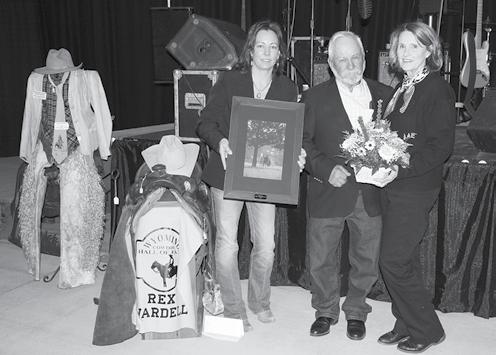
Award winner – Cotton Guio, pictured center, is honored with the Green River Valley Cattlemen’s Association Lifetime Agriculture Award, with his wife, Cynde, pictured right, and his daughter Lands, pictured left. Beside them is the late Rex Wardell’s cowboy gear loaned by the Green River Valley Museum. Joy Ufford photo
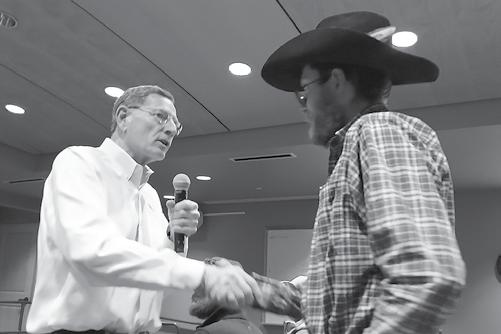
Friendly handshake – Sen. John Barrasso (R-WY) and Rex Wardell shake hands as the senator passes him a commemorative coin. Joy Ufford photo
is to stomp out misconceptions and give some context about sheep production and wool,” Stewart began.
He shared some statistics reflecting the strength of Wyoming’s sheep industry, noting Wyoming is the fourth largest sheep producing state in the U.S. behind Texas, California and Colorado and emphasizing the Intermountain West produces nearly one-half of all American-raised lamb consumed in the country.
Regarding wool production, Stewart referred to Wyoming as “the wine country of wool” and noted the state stands second to none in terms of wool quality and cleanliness.
“Wyoming is number one in the value of wool produced,” Stewart said. “We raise sheep in environments where wool is clean, and cool temperatures and forages that sustain sheep populations produce an outstanding fine wool that is second to none and sought after worldwide.”
Stewart also explained Wyoming ranks third nationally in terms of breeding sheep herd numbers, with the majority of sheep being fine-wool producing breeds like Rambouillets, Targhees, Merino crosses and Western whitefaces.
“We’re probably the largest remaining uniform breeding sheep inventory in the U.S.,” Stewart said. “We have a lot of large flocks, we produce at scale and we run
from page 1
in an environment which allows us to produce an excellent wool clip.”
Challenges and opportunities
Stewart also discussed some challenges and opportunities facing sheep producers, acknowledging concerns about change while also highlighting some areas for optimism.
First, Stewart shared a graph showing decreased domestic lamb production in recent years in combination with climbing consumer demand.
He explained this combination has led to increased imports from countries like Australia, New Zealand and Uruguay as demand exceeds American producers’ abilities to keep up.
Stewart stressed, even though current domestic production levels are down, sustained consumer demand represents a positive opportunity for American producers. He also added demand for lamb continues to move in a positive direction in the face of heightened beef prices.
“Our inability to meet all of the demand is a really good thing, because this means people are eating lamb like they never have before,” Stewart explained. “It would be an entirely different picture if we were producing a product we had to beg people to want or price it in a way to drive consumption.”
Stewart also broke down some of the challenges asso-
TEX TRAILERS 1918 FORD MODEL T PICKUP
EXCELLENT CONDITION - $19,500 $16,500 2013 MACK 600, 306,406 MILES EXTENSIVE ENGINE WORK DONE - $39,500
2008 LANDOLL 53’ HYDRAULIC TILT TRAILER. AG PULL OUTS. LOW MILEAGE USED ON RANCH TO MOVE BALER+SWATHER. NEW PAINT AND DECK. $75,000 OBO.
2023 SA CARGO TRAILER 6X10 NEW PULLED 1500 MILES - $7,000.00
2024 BIG TEX 25GN-40DG1-MRBK - $24,500 2013 JLG G6-42A EXTENDED BOOM SKYJACKSJ7135 SCISSOR LIFT THE BEST PRICES YOU CAN FIND!!!!
ciated with wool production, including trade volatility and high input costs, along with fluctuations in inventories, demand and profit.
He noted, although numbers are not as high as they were at the industry’s peak in the mid-20th century, sheep inventories in the U.S. have stabilized at roughly five million head, and the industry still matters tremendously to the roughly 100,000 producers who derive their income from sheep nationwide.
With this, Stewart stressed the importance of prioritizing support for domestic producers and explained the detrimental impact the rise of cheap, fastfashion clothing products has had on textiles like wool.
“The real driver of why we’ve struggled historically in the wool industry is synthetic fibers,” Stewart said, noting despite the many benefits of natural fibers, consumers often choose synthetics for ease and affordability.
Despite these challenges, Stewart expressed his belief in the future of the sheep and wool industry, highlighting ongoing efforts of the UW-led Wyoming Wool Initiative which works to increase wool’s marketing capacity and champion Wyoming wool.
Entrepreneurial advice
Following Stewart’s presentation, Hostetler discussed his experiences operating Mountain Meadow Wool Mill and shared some entrepreneurial advice with attendees.
Mountain Meadow Wool Mill specializes in Wyominggrown wool products, sourcing wool materials exclusively from local ranchers with a commitment to ensuring fair pricing and quality.
It is the largest full-service wool mill in the Western U.S., and Hostetler used anecdotes from the mill’s history to underscore the importance of constantly learning and taking an active role in shaping one’s future.
“Your challenge isn’t to
For more information on the Ranching in the West Seminar Series, visit uwyo. edu/uwag/rmal/ranching-in-thewest-seminar-series.html.
learn for your future, it’s to engage with your future right now,” he said. “You’re not learning so you can do something later, you need to start doing something right now.”
Hostetler also discussed the rising impact of artificial intelligence (AI) technology, noting AI is creating a rapid paradigm shift in knowledge which provides both opportunities and challenges.
On a positive note, Hostetler said AI has proven useful to expanding mill operations by aiding business analyses and even providing insight on machine maintenance.
He stressed AI is a useful tool but does not replace fact-checking and realworld experience, and he encouraged the audience to find ways to pair these tools with practical experiences
in order to effectively utilize the combination.
In closing, Hostetler emphasized forward motion is a crucial aspect of success.
“I can’t control the whole industry,” he said. “I do what I can do, and I hope we grow. I hope we can help out more ranchers, but the point is to always do something.”
The RMAL Ranching in the West Seminar Series is set to conclude on April 15 with the Rocky Mountain Land and Resource Management Conference in Laramie – an in-person, all-day event featuring conversations on ethics, land use, reclamation, negotiations and comments from Gov. Mark Gordon. Grace Skavdahl is the editor of the Wyoming Livestock Roundup. Send comments on this article to roundup@wylr.net.
Reported By: Curt Cox, WYLR Field Editor March 20, 2026
Midland Bull Test Sale Facility, Columbus, Mont. Auctioneer: Joe Goggins and Greg Goggins 268 Yearling Angus Bulls Avg. $11,749 16 Fall Angus Bulls Avg. $12,156
Top Sellers
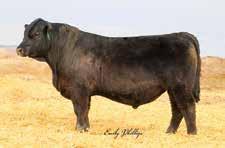
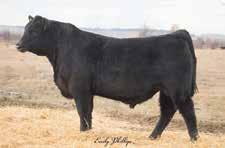
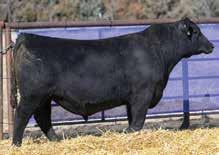
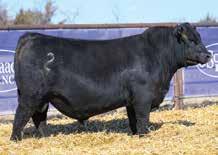
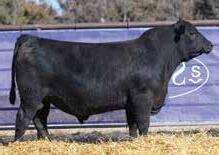
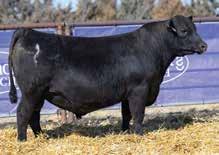
Lot 2 – Basin Mccallan 5017 – Price: $100,000 DOB:
Richard “Lee” Shoop passed peacefully into the arms of his Savior on March 15 in Cheyenne after spending the day surrounded by loved ones. He was 91 years old.
A man of deep Christian faith, Lee will be remembered for being steadfast, honest, forthright, hardworking, loyal, generous, forgiving and devoted. Love of family was always first, but he would also want to be remembered for his love of horses.
Lee was born to Jeanette (Lamboley) and Henry Shoop on Sept. 15, 1934 in Joliet, Mont. He grew up on Pine Ridge Reservation in South Dakota and the Wind River Reservation near Pavillion, where his father worked for the federal government.
It was during this time Lee was given his first horse – named Cheyenne – the first in a long line of favorite ranch Quarter Horses.
He attended school in Shoshoni and graduated from Shoshoni High School, where Janet Williams was a schoolmate.
During the 1950s, Lee worked for several large cattle operations, including the Arapahoe Ranch in Fremont County and the VR Ranch near Glenrock.
In 1954, Lee and Janet married and they began their nearly 72-year journey together.
In 1961, they moved to Wheatland with their three children to farm and ranch with Lee’s parents. Janet was a faithful and supportive partner in their agricultural, familial and spiritual pursuits.
In the 1960s, Lee quickly became a valuable part of the Wheatland agricultural and ranching communities. In addition to a cow/calf operation, he raised crops for his feedlot operations.
He was a man of many talents, always on the go, seeking agricultural opportunities with land leases and shared farming and cattle work with friends and neighbors.
Over the years, he was the president of the Lakeside Lateral Ditch Company and part of the Wheatland Irrigation District, where he led the way to obtain funding and spearhead work to cement the main supply ditch and crop ditches of the local owners.
Lee was an integral part of the formation and operation of the Platte County Grazing Association, where he regularly served as the president of the organization until its sale in 1980.
Through the 1970s and early 1980s, with local ranch
leases of the Loomis and Mullen ranches on the Laramie River, Lee grew his herd to over 500 cows, while still running the feedlots – truly a 365-day-a-year operation, and always with his father, Henry, working alongside.
All the while, Lee maintained his love of horses, and by the early 1980s, with the help of his friend Jim Lay, he began memberships with the American Quarter Horse Association (AQHA) which continued for decades, then later in collaboration with Ryker Hyche.
During this time, they registered countless AQHA horses.
During the early 1980s, the horse operation expanded with dozens of broodmares and their offspring, sometimes growing in numbers only Lee could know.
Always a worker and an entrepreneur, Lee continued his connection to cattle and horses, then set his sights on real estate by becoming a real estate broker. Throughout the 1990s and well into his mid-80s, Lee was a successful broker, first with Remax Realty, then with Renown Realty, Fuller Western Real Estate and finally back to Renown Realty.
Thinking toward the future, he continued to develop farmland on Preuit Road in Wheatland into highyield acreages with welldeveloped wells and center pivots.
In the late 1980s, he became a member of – and a short time later – an elder at First Christian Church in Wheatland. During his over 30-year term as elder, he led the church through difficult periods, mentored many, taught Sunday School classes, helped with Vacation Bible School, served on the mission committee, attended innumerable meetings and prayer breakfasts and was an unwavering advocate for the church and its members.
Lee and Janet were always a team, and whether it was square dancing, Job’s Daughters’ meetings, athletic events, family reunions or national and international travel, they were always sideby-side.
Lee was a voracious reader, a lover of words with crossword puzzles, dictionary study and a poet.
Through the 1980s, as a licensed airplane pilot, he loved flying in his Cessa 172, piloting flights with family and friends and, importantly, Lee was a loving father who encouraged his children’s and grandchildren’s endeavors. He was a “father” and “grandfather” to even more in the community.
Recently, Lee and Janet continued making friends after they moved to the Primrose Retirement Community in Cheyenne, with Lee still dressed in his Paul Bond boots, Stetson and Pendleton attire.
As it had been their entire lives, it is astounding the number of people who valued them both in their final community.
Lee is preceded in death by his wife Janet Shoop, father Henry Shoop, mother
Mary Shoop and Joy Lavin and nephew Hyde Shoop. Lee leaves behind his children April Addison, Mar-
celle (Kurt) Repanshek and Flint (Kellie) Shoop; brother Gary Shoop; sister-in-law
Nancy Shoop; grandchildren Justin Addison, Clinton (Brannon) Addison; Jess (Rae) Repanshek and Sean (Tiara) Repanshek, as well
Austin Snook • 307-290-2161
Taylor Snook • 307-290-2273
Craig Deveraux • 307-746-5690
Dan Catlin • 406-671-7715
Clint Snook • 307-290-4000
Cheyenne Seymour • 605-641-0638
Casey Sellers • 307-217-2614
Jim Forbes • 307-351-5932
a close-knit extended family and countless “adoptees” and friends. A celebration of life was held on March 21 at First Christian Church in Wheatland, with Pastor Casey Schroder officiating.
Daniel Escoz • 307-217-1440
March 25, 2026 - No Sale
Thank you for your business!
by Lee Pitts
Ghost Towns of Tomorrow
As a kid, my grandparents took my brother and I fishing every summer, and the days we didn’t fish were reserved for going to ghost towns.
Even though it was considered bad luck to steal anything from a ghost town, my grandparents had a five-gallon bucket full of square nails filched from ghost towns all over the West. They had a rotten beam of termite-infested wood liberated from a county courthouse built in the wrong county and a wide assortment of bottles which were usually found in the ground below an outhouse. They even had a red light taken from what had once been a whorehouse.
I inherited these treasures and attribute all of the bad luck I’ve had in my life to them being in my possession.
Ghost towns can be found all over the West. They were usually created when mining towns went bust and the population moved on to the next boomtown. They were also created when a town sprang up in anticipation of the railroad coming through town, but when another town won the rails because they paid off the railroad, the tracks were rerouted.
This explains why the path our railroad tracks take are often crooked – in more ways than one.
I’ve always been mystified by the creativity of the early western settlers who gave their towns monikers like Turkey Buzzard, Bummerville, Timbuctoo, Hangtown, Jackass Flat, Rough and Ready, Dutch Flat, Liar’s Flat, Virgin Flat and Sucker Flat.
Wouldn’t you like to know the story behind places like Punch Me Tight, You Be Damed, Shirtail, Sore Finger, Four Ministers, Chicken Thief Flat, One Horse Town, Cut Throat, Dogtown, Milk Punch Bar and Henpeck City?
Some ghost towns have been reborn as tourist traps like Tombstone, Ariz., where I have actually stood unarmed in the OK Corral.
This silver mining town that went bust had a rebirth as a tourist trap through “commercialized restoration.”
Calico, Calif. is another ghost town that rose from the ashes, but my favorite is Virginia City, Nev., where Mark Twain got his start as a writer on the Territorial Enterprise where he lasted two years before he was run out of town.
Today in Virginia City, Nev., one can still get a drink at the Bucket of Blood Saloon, visit the Opera House which featured some of the world’s greatest entertainers and stare in amazement at the restored mansions of the silver barons who got filthy rich on the Comstock Lode.
Some of these 19th century millionaires ended up buried amongst their fellow paupers on Boot Hill when the mining stock certificates they traded in ended up only being good for toilet paper.
I wonder what the ghost towns of our generation will be as I watch agricultural-based small towns dry up and small farmers edged out by huge corporations and multi-billionaires like Bill Gates, the largest owner of farmland in the country.
In some Midwestern towns, one can see empty homes of farmers who have gone broke through no fault of their own. They worked so hard to build up an international market for their soybeans and other foodstuffs, only to have it pulled out from under them.
And the ghost towns of the future will surely include the timber towns in the great Northwest which are slowly dying all because of an owl.
I notice nuclear power is now being praised as “clean and environmentally-friendly energy” and I wonder how many ghost towns will be created when the meltdowns come.
Will they be giving tours of these ghost towns 50 years from now like they are now doing at Chernobyl?
I think the greatest number of future ghost towns will be created because of water or lack thereof.
One day, will tourists be digging for old poker chips and dice in Las Vegas when they turn on the golden tap at the Mirage and nothing comes out of the faucet?
When California finishes the job of driving out its computer barons with their “billionaire taxes,” will tourists be paying to visit their empty mansions some day?
Will farmers who are drilling over 1,000 feet deep to reach water in receding aquifers move on to the next boomtown just like the miners who left when the gold and silver dried up?
Reported By: Curt Cox, WYLR Field Editor March 19, 2026
Carter Cattle Company Sale Barn, Pingree, Idaho
Auctioneer: Roger Jacobs 61 Fall Angus Bulls Avg. $10,836 112 Yearling Angus
Lot 4 – Carter Logo 425 – Price: $17,500 DOB: 8/19/24
Sire: Sitz Logo 8148 Dam’s Sire: Sitz Stellar 726D EPDs: BW: +3, WW: +96, YW: +168 and Milk: +27 Buyer: Shamon Munns, Rexburg, Idaho
Lot 35 – Carter Extraordinary 437 – Price: $17,000 DOB: 8/14/24 Sire: Carter Extraordinary 100H Dam’s Sire: LD Capitalist 316 EPDs: BW: +1.2, WW: +71, YW: +129 and Milk: +26
Buyer: Clay Lloyd, Dingle, Idaho
Lot 11 – Carter Abundance 435 – Price: $15,500 DOB: 8/23/24 Sire: Carter Abundance 74I Dam’s Sire: Raven Powerball 53 EPDs: BW: +1.6, WW: +76, YW: +129 and Milk: +26
Buyer: Lance Moss, Hamer, Idaho
Lot 37 – Carter Stellar 456 – Price: $15,000 DOB: 9/5/24
Sire: Sitz Stellar 726D Dam’s Sire: Sitz Lightning 659Z EPDs: BW: +0.8, WW: +80, YW: +141 and Milk: +21 Buyer: Matt Clark, Afton
Lot 34 – Carter Extraordinary 406 – Price: $15,000 DOB: 8/10/24 Sire: Carter Extraordinary 100H Dam’s Sire: Carter Power Surge EPDs: BW: +2.8, WW: +83, YW: +143 and Milk: +24 Buyer: Shamon Munns, Rexburg, Idaho
Lot 25 – Carter Legacy 421 – Price: $15,000 DOB: 8/16/24
Sire: Sitz Legacy 11508 Dam’s Sire: Sitz Response 405C EPDs: BW: -0.7, WW: +66, YW: +119 and Milk: +29 Buyer: Matt Clark, Afton
Yearling bull
Lot 93 – Carter Logo 15M – Price: $16,000 DOB: 1/15/25
Sire: Sitz Logo 8148 Dam’s Sire: S A V Rainfall 6846 EPDs: BW: -2.4, WW: +77, YW: +139 and Milk: +22 Buyer: Mori Ranches, Tuscarora, Nev.
CROSSWORD
Wyoming Livestock Roundup Crosswords, created by Myles Mellor.
Solution for the March 21, 2026 crossword
Lot 10 – OLIM Navistar 512N – Price: $14,500 DOB: 1/30/25 Sire: Wulfs
High Card C125H Dam’s Sire: Wulfs Gameboy C911G ET EPDs: BW: +1.3, WW: +89, YW: +143 and M: +29
Buyer: Roger Odem, Nashville, Ga. Lot 17 – OLIM Nemo 581N – Price: $13,500 DOB: 3/4/25 Sire: Wulfs Jersey City 9497J Dam’s Sire: Wulfs Gallagher 7056G
EPDs: BW: -1.4, WW: +69, YW: +106 and M: +27
Buyer: Frank Daley, New Castle, Colo.
Female Lot 41 – OLIM Natural Beauty 651N ET – Price: $14,500 DOB: 3/2/25 Sire: MAGS Federal Reserve ET Dam’s Sire: CELL
for inflation and cost increases, the current projected revenue is static.
“Revenue has been relatively flat for a long time, which has obviously resulted in funding sacrifices to department programs as fixed costs increase,” Wood said. “We continue to prioritize our wildlife objectives, however, costs will continue to increase across the board and it will become increasingly difficult to keep up with inflation.”
Across-the-board license increases have not been
approved by the Wyoming Legislature since 2008. Since then, there have been a few adjustments to select nonresident fees and preference points.
Wildlife conservation and infrastructure needs
The balance between managing wildlife objectives and agency infrastructure maintenance was highlighted by WGFD Chief Sean Bibbey, who provided a comprehensive Infrastructure Management Plan, which is slated to begin in FY28.
For FY28-37, WGFD has identified $62 million in major infrastructure projects across the state. Projects range from new building construction and major renovations to ongoing preventative maintenance needs on WGFD property.
Much of the deferred maintenance is the result of other objectives, including wildlife and habitat projects, taking precedence over infrastructure needs.
“Getting these deferred maintenance needs down on paper and trying to prioritize them has been a long-term goal for our division,” Bibbey said. “There
has been a lot of work that has gone into this. We are trying to get a good handle on taking care of what the commission owns and making sure we have the correct priorities.”
Commissioner Fonzy Haskell commended Wood and the WGFD fiscal team for their work on the FY27 budget.
“I think you are doing a very good job being fiscally responsible, and I think it is important to tell the general public how responsible the department is on these things,” he said. “I want to commend you for the work you are doing and finding
Annual Production Sale
ways to make those dollars stretch. I think this means we need to put the dollars we have back into WGFD personnel and infrastructure. If we arenʼt putting it into our buildings it could catch up with us, so I appreciate you doing the work now.”
WGFD Deputy Director Eric Wiltanger echoed this sentiment, thanking all agency divisions for successfully building an effective budget.
“Wood and our entire team play an invaluable role in making sure our agency is set up for success to fund our projects throughout the year,” Wiltanger said. “Their hard work is the reason we can confidently fund our projects year-round.”
The commission gave unanimous approval to the preliminary budget, which will be given final approval during the July 2026 meeting in Sheridan.
Summary of mule deer research
In the final presentation for the meeting, Embere Hall, WGFD Science, Research and Analytical Support Unit supervisor, provided an annual review of the five-year Mule Deer Monitoring Programʼs research and data collection.
This program monitors mule deer throughout the state. The research team uses a variety of methods from GPS collaring and hunter surveys to exploring new technology to age animals through DNA.
Hall said the extensive collection has helped scientists gain a better understanding of mule deer, and funding this research has set the department ahead in gathering the amount of information it takes to learn more about the species.
“Funding this study has allowed us to complete an
abundance surveys for 25 of 37 herds,” Hall said. “In four years, we have been able to accomplish what it would have taken us four decades to do at our prior funding level.”
Harvest surveys conducted this year sampled information from nearly 45,000 hunters, developing a clearer understanding of how successful harvests were and where hunters were able to see the most success.
Wyoming’s mule deer herds are found in a variety of ecosystems throughout the state.
Each herd has unique behavior patterns, survival rates and specific needs. By assessing what herds need – from habitat improvements to migration assistance – Hall said the research team is able to better understand what projects can provide the best help for the species.
“One of the pieces of this project I’m particularly proud of is, as we’ve been getting data from all of these big efforts and all of this work field personnel are putting into it, we’ve been able to turn it around and use it for management decisions,” Hall said.
The next Wyoming Game and Fish Commission meeting is scheduled for April 21-22 in Riverton. During the April meeting, 2026 hunting season setting will be submitted to the commission for approval.
A full list of season setting meetings being held statewide can be found at wgfd.wyo.gov
WGFD is dedicated to conserving, enhancing and protecting Wyoming’s exceptional fish and wildlife resources and the habitats that support them. For more information, visit wgfd.wyo.gov
its fourth year, is narrowing in on five herds across Wyoming to gather information on the causes of population declines and possible solutions.
“From these studies, researchers from the UW Monteith Shop and WGFD biologists are learning more about how the landscape influences population dynamics,” the brief reads.
In addition, WGFD biologists have been using a combination of GPS collaring, biological sampling and habitat analysis to better understand how landscape conditions affect herd dynamics, which helps the department shape
mule deer management decisions.
Feedback collected from post-season hunter surveys is another key tool in population monitoring. The department notes these surveys provide insight into harvest totals, hunter success rates and public perception of herd health, which helps set future quotas and establish season dates.
“For the 2025 season, hunter success in the Wyoming Range Herd was 27 percent and 29 percent in the Sublette Herd,” WGFD states. “Although some hunter comments still indicate low deer numbers, post-season classification data shows signs of pop-
SALE REPORTS
Top Sellers:
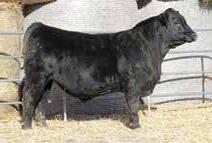
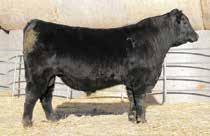
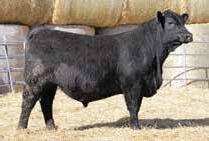
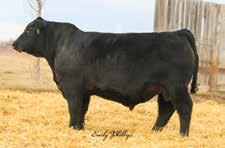
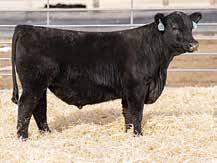
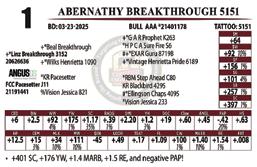
Lot 19 – Obsidian DNAMite 907 – Price: $31,000
DOB: 2/4/2025 Sire: MW
DNAMite Dam’s Sire: Deer Valley Growth Fund EPDs: CED: +15, BW: -3.4, WW: +65, YR: +116, Milk: +26 and PAP: 41 Consignor: Obsidian Angus Buyer:
Overall, WGFD says recent data collected through research efforts and department monitoring suggests recovery of mule deer in western Wyoming herds is being driven by survival –which biologists contribute to a stretch of relatively mild winters and reduced snowpack allowing deer better access to forage on winter ranges – as well as strong reproduction.
In fact, surveys conducted this past winter showed “incredibly high” fawn and buck ratios in both herds.
In the Wyoming Range
Obsidian Angus Buyer: Graves Land and Livestock, Thermopolis
Dam’s Sire: Hoover Dam EPDs: CED: +11, BW: -1.1, WW: +63, YR: +112, Milk +31 and PAP 41 Consignor: Obsidian Angus Buyer: Jason and Chawna Weichmann, Ten Sleep Lot 48 – W Spur 475 – Price: $9,500 DOB: 6/9/2024 Sire: JVC Spur 2151 Dam’s Sire: Tehama Tahoe B767 EPDs: CED:
Herd, biologists observed 81 fawns per 100 does in 2025, following 83 fawns per 100 does the previous year.
Buck ratios climbed to 38 bucks per 100 does, bringing the buck ratio to objective.
“This productivity is reflected in an increased population estimate of 15,500 for the 2025 post-hunting season, up from 13,200 in 2024,” WGFD says.
In the neighboring Sublette Herd, the population is also trending upward. WGFD recorded 77 fawns and 43 bucks per 100 does, with the population estimate rising 18 percent to 22,437 animals.
Researchers attribute part of this success to improved body condition among deer.
+10, BW: 1.9, WW: +63, YR: +108, Milk +31 and PAP 35 Consignor: WYO
Angus Buyer: E Spear LLC, Meeteetse Lot 27 – Obsidian FF DNAMite 927 – Price:
$9,500 DOB 3/2/2025 Sire: Obsidian DNAMite 835
“Heading into this winter and during fall capture efforts, researchers recorded above-average body fat levels and the highest number of females successfully recruiting twins ever recorded since data collection began in 2016,” WGFD adds.
While challenges such as harsh winters and habitat conditions remain ongoing concerns, the
current trajectory of both herds is encouraging. WGFD notes continued favorable weather, strong reproductive performance and data-driven management are expected to support further recovery.
Hannah Bugas is the managing editor of the Wyoming Livestock Roundup. Send comments on this article to roundup@ wylr.net.
Dam’s Sire: JR Fast Forward EPDs: CED: +10, BW: -0.7, WW: +72, YR: +125, Milk: +27 and PAP 38 Consignor:
CLAY CREEK ANGUS
Obsidian Angus Buyer: Brewster Ranch, Ten Sleep
Adobe Stock photo
CALENDAR
EVENTS SALES
March 30 University of Wyoming Extension Pesticide Safety Education Program, 1-5 p.m., Sundance Courthouse Basement, Sundance. For more information or to RSVP, contact the Crook County Extension Office at crookcty@uwyo.edu or 307-283-1192.
March 30 Wyoming Game and Fish Department Hunting Regulations Public Meeting, 6 p.m., Laramie Regional Office, Laramie. For more information, visit wgfd.wyo.gov
March 30 Wyoming Game and Fish Department Hunting Regulations Public Meeting, 6 p.m., Niobrara County Fairgrounds, Lusk. For more information, visit wgfd.wyo.gov
March 30 Wyoming Game and Fish Department Hunting Regulations Public Meeting, 6 p.m., Green River Game and Fish Regional Office, Green River. For more information, visit wgfd.wyo.gov
March 31 University of Wyoming Extension Interactive Online 4-H Volunteer Training, 6 p.m., Zoom. For more information or to sign up, contact Tiera Bevilacqua at tarndorf@uwyo.edu or 307-367-4380.
March 31 Wyoming Game and Fish Department Hunting Regulations Public Meeting, 6 p.m., Lander Game and Fish Regional Office, Lander. For more information, visit wgfd.wyo.gov
March 31 Wyoming Game and Fish Department Hunting Regulations Public Meeting, 6 p.m., Meeteetse Conservation District, Meeteetse. For more information, visit wgfd.wyo.gov
April 3 Wyoming Livestock Roundup Office closed. Wishing our readers a Happy Easter! For more information, call 307-234-2700.
April 3 Wyoming Game and Fish Department Aquatic Invasive Species Inspector Training, 9 a.m.-4 p.m., Cody Regional Office, Cody. For more information or to register, visit wgfd.wyo.gov
April 6 Uinta Veterinary Hospital Free 4-H Hog Class, 6-7 p.m., Uinta Veterinary Hospital, Fort Bridger. For more information, call 307-783-0570 or e-mail uinta@uwyo.edu.
April 7 2017 Amended Order of the State Engineer-Horse Creek Basin Public Hearing, 2-4 p.m., LaGrange Community Center, LaGrange. For more information, contact the State Engineer’s Office at 307-532-2248.
April 8 Wyoming Sage Grouse Implementation Team Meeting, 10 a.m., Wyoming Oil and Gas Conservation Commission Office, Casper. For more information, visit wgfd.wyo.gov/wyoming-wildlife/sage-grouse-management/sage-grouseexecutive-order#SGIT
April 8-9 Precision Education in Spray Technologies Academy Session Six, Precision Application Technology Lab, West Central Research, Extension and Education Center, North Platte, Neb. For more information or to register, visit go.unl.edu/pestacademy
April 11 Wyoming Game and Fish Department “Carrying Capacity: The Hunt for Resilience” Film Screening, 12:30 p.m., Dennison Lodge, Dubois. For more information, visit wgfd.wyo.gov
April 15 University of Wyoming Ranching in the West Day-Long Seminar, 7:30 a.m., University of Wyoming Gateway Center, Laramie, in person and online. For more information or to register, visit uwyo.edu/uwag/rmal/ranching-in-thewest-seminar-series.html
April 16 Grants Management Office Post-Award Grants Management Training, 8:30 a.m.-5 p.m., Health and Science Building, Central Wyoming College, Riverton. For more information or to register, visit docs.google.com/forms/d/ e/1FAIpQLScBOJNTuBqQloWV6yRIPKicw9vxniqxiD2eEypVtainKrRW9Q/ viewform
April 17-19 Moffat County Sheep Shearing School, Craig, Colo. For more information or to register, e-mail megan.stetson@colostate.edu or call 970-826-3402.
POSTCARD from the Past
rrichardperue@gmail.com
What Holy Week Means to Me
By Pastor Charles E. Bream, Grace English Lutheran
If Jesus Christ had not been the long-anticipated “Lamb of God that taketh away the sins of the world,” if He had not carried to Calvary the sins of the whole world, if He had not broken forever the power of Satan by His atonement, if these essential facts of His work were controvertible or even demonstrably untrue, yet we would be more than justified in setting aside a week called “Holy Week” for the concentration of attention upon this last week in the human life of “the Rose of Sharon,” the one of whom even Pilate must admit, “I find no fault in Him.”
Holy Week, the period in the ecclesiastical year
between Palm Sunday and Easter comes down through the centuries bountifully laden with memories and traditions which bespeak fruitful religious observance.
Palm Sunday is the day when humanity acclaimed her Lord in unstinted measure.
When jealous critics rebuked Christ for allowing mere children to join in the general applause he said, “If these should hold their peace, the very stones would cry out.”
The week following this unprecedented approbation was one of incomparable tragedy. When once Jesus had reached the time when He was ready to carry out the “I lay down My life” culmination of His mission, the events moved swiftly to their climax.
March 25-April 7 April Farm and Construction Online Auction, 208-431-9300, 208-5958561, bigmountainauctions.com
March 29 Bird and Animal Auction, Dawson County Fairgrounds, Lexington, Neb., 308-233-1799, Facebook @JGraceAuctions
March 30 Gray’s Angus Ranch Second Century Performance Bull Sale, Windy Acres Sale Barn, Harrison, Neb., 308-668-2525, 308-668-2520, graysangusranch.com
March 30
March 31
March 31
April 2
April 2-3
April 4
April 4
April 4
April 4
April 7
April 7
April 7
April 8
April 9
April 10
April 10
April 10
April 11
April 11
April 11
April 13
April 13
April 14
April 14
April 14
April 15
April 15
April 17
Bitter disputing in the temple, gracious retirement in the humble home of Mary and Martha and Lazarus at Bethany, the observance of the Passover and the institution of the Lord’s Supper, the incomprehensible agony of Gethsemane, the stupendous triumph of that prayer in Gethsemane, the peerless majesty of our Lord in the judgment halls of Annas and Caiaphas and Pilate and Herod and the Via Dolorosa and Calvary – the mere mention of each of these arouses a flood of memories so sacred, so awe-inspiring the name Holy Week instinctively comes to one’s lips as they think of that pregnant week into which all these events were crowded.
But the crowning event of Holy Week is Easter. To me, Holy Week means a period of almost breathless suspense as I watch with my Lord while He voluntarily endured such suffering as no man ever endured and such shameless indignities as degenerate men have never before nor since had the chance to visit upon a superior.
Axtell Cattle Company Annual Production Sale, Sterling Livestock Commission, Sterling, Colo., 970-554-1132, 970-554-1680, axtellcattlecompany.com
Gunsight Angus Annual Bull Sale, Red Mountain Ranch, Laramie, 307-4601649, 307-399-4665, gunsightangus.com
Salmon Select 27th Annual Mule Sale, Lemhi County Fairgrounds, Salmon, Idaho, 208-756-2125, salmonselectsale.com
Salmon Select 53rd Annual Horse Sale, Lemhi County Fairgrounds, Salmon, Idaho, 208-756-2125, salmonselectsale.com
Best of the Big Horns Horse Sale, Buffalo Livestock Marketing, Buffalo, 307751-8969, 406-697-5882
Bar X Ranch Annual Bull Sale, at the ranch, LaGrange, 307-534-6704, 307575-7116, barxranch.com
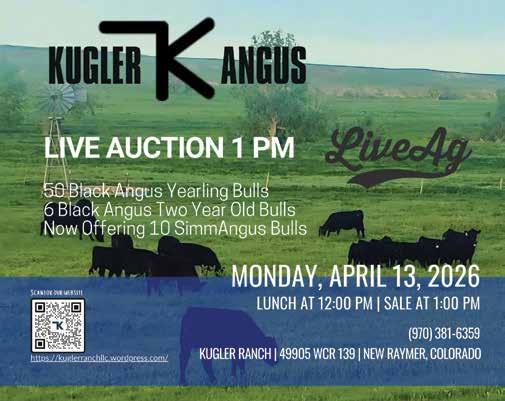
Kugler Ranch Angus Bull Sale, at the ranch, New Raymer, Colo., 970381-6359
C Spear Angus Sixth Annual Production Sale, Billings Livestock Commission, Billings, Mont., 406-670-0689, 406-670-6311
Tri Brothers Equipment Consignment Auction, Tri Brothers Equipment, Torrington, 307-575-2427, 307-338-8363, kerrauction.com
Beckton’s 81st Anniversary Bull and Heifer Sale, at the ranch, Sheridan, 307-674-6095, 307-674-8162, becktonredangus.com
Hilltop Angus Ranch Annual Production Sale, at the ranch, Denton, Mont., 406-366-3461, hilltopangus.com
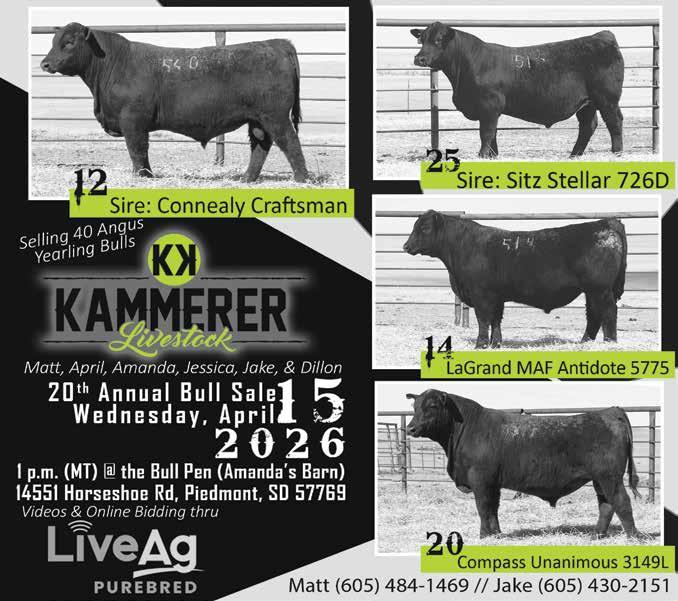
Kammerer Livestock 20th Annual Bull Sale, the Bull Pen, Piedmont, S.D., 605-484-1469, 605-430-2151
Schaack Ranch Annual Production Bull Sale, at the ranch, Wall, S.D., 605685-3311, schaackangusranch.com
Grill’s 22nd Annual Red Western Red Angus Bull Sale, Crawford Livestock Auction, Crawford, Neb., 605-673-5518, 605-891-3041, 605-890-1477, grillcattlecompany.com, blazytranchredangus.com
And this suspense, while I watch with Him in the upper chamber in Gethsemane, in the judgment hall on Via Dolorosa and in Calvary, would be unendurable were it not for the sustaining power of the subconscious realization after of all this comes the empty tomb.
Oh, what joy we find in the gentle rebuke which Jesus administered to those early visitors to His tomb. They came with hands laden with spices to anoint an emaciated, decaying body, and He met them with the reproving question, “Why seek ye the living among the dead?”
This is the triumphant climax of Holy Week.
Holy sorrow while we watch our Savior pay the price of our redemption and holy joy when we behold the empty tomb, the useless grave clothes and the Risen Lord.
According to a feature story and cutline below this drawing in The Wyoming Press, dated March 7, 1917, “In commemoration of Christ’s act of humanity in washing the feet of his disciples on the occasion of the Last Supper, one of the most important ceremonies of the day since the early middle ages, has been the washing of the feet of 12 or more poor persons by some one of higher worldly standing than themselves. On this occasion, history recites, the feet of the honored beggars were first washed by the yeoman of the laundry. Afterward, the sub almoner washed them and then the queen herself, kneeling, after washing each foot, made the sign of the cross upon it and blessed it. Historical Reproductions by Perue
Who can begin to number the myriads who, standing at the sepulcher of their departed loved ones, have felt immeasurable calm come into their hearts as they heard the words, “I am the resurrection and the life?”
Man’s endeavoring for the ultimate has its eternal inspiration in the message of the empty tomb. Hear me, men. Hear me, women. You pay yourself the highest compliment possible when you admit sufficient spiritual perception to be moved to bow your head in humble recognition of the sacred meaning of Holy Week.
– Guest column from the April 12, 1927 issue of the Casper Daily Tribune
Compared to last week slaughter lambs traded steady and slaughter ewes steady. All sheep sold per hundred weight (CWT) unless otherwise specified. Slaughter Lambs: Choice and Prime 1-3: San Angelo: 70-80 lbs 406.00; 80-90 lbs 385.00-396.00.
Replacement Ewes: Medium and Large 1-2: San Angelo: No test.
Billings: No test.
Ft. Collins: No test.
South Dakota: No test.
Sioux Falls: 4-6 SPR 150-190 lbs 310.00-350.00 per unit. Sheep and lamb slaughter under federal inspection for the week to date
totaled 38,000 compared to 39,000 last week and 41,881 last year.
Source: USDA AMS LPG Market News, San Angelo, Texas
National Wool Review
As of March 20, 2026
Domestic wool trading had
Merino Clippings 3.51
Source: USDA- CO Dept of Ag Market News Service, Greeley, CO
Nebraska Hay Summary
As of March 26, 2026
Compared to two weeks ago bales of grass and alfalfa hay in the central and eastern area sold fully steady to 10.00 a ton higher, instances 20.00 higher on a new crop contract on alfalfa in the eastern area of the state. Ground and delivered alfalfa sold steady with ground and delivered cornstalks 10.00 higher. Dehy and sun-cured alfalfa pellets sold steady. Demand was moderate to good. Dry, windy weather continues to prevail across the state along with devastating range fires. There still appears to be some stock piles of hay around the central and eastern area with some producers selling old crop hay back to 2023. Good thing there is ample hay stocks around as several very generous people continue to donate loads of hay to the ranchers that have lost most or all of their grass from range fires for their livestock to graze.
Central Nebraska
Alfalfa Ground (Delivered) 125-130
Source: USDA AMS Livestock, Poultry & Grain
Kearny, NE
Colorado Hay Summary
As of March 26, 2026
Compared to last report: Trade activity Light on Moderate to Good demand. Prices mostly steady on horse hay trades. According to the U.S. Drought Monitor’s High Plains Summary for March 24, 2026, intense, unseasonable warmth gripped the High Plains, with temperatures soaring up to 25 degrees F above normal, peaking in parts of Wyoming and Colorado. Precipitation was nearly nonexistent, particularly across the southern half of the region. This severe, persistent dryness, coupled with rapidly deteriorating drought indicators, forced widespread expansion and intensification of drought categories. Exceptional drought (D4) expanded in northwest Colorado, while extreme drought (D3) grew across Colorado, southern Wyoming, and southern Nebraska. Severe drought (D2) pushed further into central and northern Wyoming, western and southern Colorado, and advanced from Nebraska into South Dakota. Moderate drought (D1) and abnormal dryness (D0) also expanded broadly across Wyoming, Colorado, Nebraska, and Kansas. No drought improvements were made in the High Plains this week. The next available report will be Thursday, April 09, 2026.
Jones Act suspended
According to a March 18 Farm Progress article by Policy Editor Joshua Baethge, President Donald Trump is temporarily waiving a 100-year-old federal law to increase fuel and fertilizer shipments in the U.S. Per a 1920 statute known as the Jones Act, cargo moved between U.S. ports must be transported by vessels built, owned and registered in the U.S. Those ships must also be crewed by Americans. Trump’s executive order suspends those requirements for 60 days.
“President Trump’s decision to issue a 60-day Jones Act waiver is just another step to mitigate the short-term disruptions to the oil market, as the U.S. military continues meeting the objectives of Operation Epic Fury,” White House Press Secretary Karoline Leavitt said in a social media post.
Fuel prices in the U.S. have surged 25 percent since U.S. and Israeli forces began bombing Iran on Feb. 28. Shipments of key fertilizer components have also stalled because the conflict effectively closed the Strait of Hormuz to maritime traffic.
NOTICE: Publication in this newspaper does not guarantee the legitimacy of any offer or solicitation. Take reasonable steps to evaluate an offer before you send money or provide personal/financial information to an advertiser. If you have questions or believe you have been the victim of fraud, contact the Wyoming Attorney General’s Office, Consumer Protection Unit, 109 Capitol Building, Cheyenne, WY 82002, 307-777-6397 TFN
Events
37TH ANNUAL WWCA MEMORIAL WEEKEND GUN SHOW MAY 2324 IN RIVERTON, WY AT THE FREMONT COUNTY FAIRGROUNDS: Join the Wyoming Weapons Collectors for 250+ tables of heritage and history. Enjoy the NWTF youth range and Sunday Cowboy Church. Fri. May 22, vendor setup. Sat. May 23 and Sun. May 24, open to public. Entry $7/daily, $10/weekend, kids 12 and under FREE. Reserve tables at www.wyomingweaponscollectors.com or call 307-349-4914 4/4
Help Wanted
SUPERIOR CONTRACTING LLC LOCATED IN WHEATLAND, WY, A FAST GROWING IRRIGATION COMPANY SERVICING PLATTE COUNTY, SOUTHEAST WYOMING AND SURROUNDING AREAS, IS IN SEARCH OF AN IRRIGATION TECHNICIAN SPECIALIZING IN THE INSTALLATION, maintenance and repair of precision agricultural irrigation equipment, primarily center pivots. One year minimum irrigation industry experience with certification. Proficient in technical knowledge of irrigation systems and troubleshooting along with system installation, assembly, diagnostic, repair, preventative maintenance and technology management. Able to work outdoors and operate heavy equipment. Must be able to perform labor-intensive tasks. Must be willing to work independently, possess excellent recordkeeping and have exceptional customer service skills. Must be able to be on call 24 hours during peak season. Training and continuing education provided. Valid driver’s license required and must pass a drug screen. Call 307331-0257 or e-mail accounting@scllc19.com 4/25
Help Wanted
LOOKING FOR RANCH ASSISTANT PROPERTY MAN -
AGER: Full-time position for large ranch located in Park County, WY. Responsibilities include: Lawn care, irrigation, agricultural equipment maintenance and general residential, building and property maintenance. Salary range of $45-$60K depending on experience. Living on property is required for employment. House and vehicle will be provided. Property is located 10 minutes from downtown Cody, WY. Position is available for immediate hire. Please send resumes to mgiliati@acpg. com 4/18
RANCH HAND/GROUNDS
Single iron. Also have an additional calf branding iron. $1,250 OBO. Call 307-461-0356 3/28
Services
Come Join the Gottsch Livestock Feeders Family! Gottsch Livestock Feeders is looking for Cowboys/Pen Riders for their feedyard in Red Cloud, NE. The main focus of the Cowboy/Pen Riders are spotting, pulling, diagnosing and taking cattle to the hospital and shipping fat cattle. This person will need to be a team player who is seeking a long-term position. You will have the opportunity to work with and learn from some of the best in the industry. We offer a benefits package that includes health insurance, dental, vision, 401(k), health savings, life insurance and paid vacation. Retention bonus offered to full-time employees. Incentives paid out at 6 months and 1 year of employment. If you are interested stop by and fill out an application or visit our website at
GOTTSCH LIVESTOCK FEEDERS LLC Red Cloud, NE www.gottschcattlecompany.com
Call Mike Faimon at 406-469-1585 or Davin Arnold 970-301-3098 for more information.
FEED TRUCK DRIVER AND COWBOY WANTED: Western Nebraska calf grow yard is looking for a self-starter capable of supporting and working with a feedyard team to ensure general maintenance and caretaking of livestock, equipment and facilities. Ability to take work direction and change priorities as needed. Valid driver’s license required, CDL would be a plus. Knowledge and prior experience in feedlot and farm work preferred. Pay negotiable based on experience, housing available. Duties may include but are not limited to: Feed truck driving and mechanical skills for basic feed truck/tractor maintenance; farming to include all aspects of haying and irrigation; facility maintenance, build electric fence, repair pens, welding, stock tank and water line work, clean pens, hauling manure, spraying weeds; assist with the care and processing of cattle/pen riding. Send resume to P.O. Box 1248, Torrington, WY 82214, fax to 307-532-7899 or e-mail info@ flagranchllc.com. Potential applicants with questions call 307-532-7885 or 307534-6259 4/18
SUPERIOR CONTRACTING LLC IS SEARCHING FOR AN EXPERIENCED HEAVY EQUIPMENT OPERATOR TO WORK REMOTE: Duties will include operating, maintaining and inspecting heavy construction equipment (e.g., excavators, bulldozers, loaders, backhoes, graders, cranes) to perform earthmoving, material handling, site preparation and related tasks safely, efficiently and according to project plans and regulatory requirements. Operator must read and follow work orders, site plans, grade stakes and instructions from supervisors or engineers. Report mechanical issues promptly and coordinate repairs with maintenance staff or vendors. Position equipment accurately using survey references, GPS or laser grade systems to meet project tolerances. Load/unload materials, secure loads and assist with rigging and signaling when required. Follow site safety plans and OSHA regulations; use PPE and operate equipment in accordance with manufacturer and company safety procedures. Communicate effectively with site crews, foremen and traffic control personnel; assist with site setup and cleanup. Maintain daily logs of hours, material moved and work performed. Participate in safety meetings and trainings. Strong situational awareness and commitment to safety. Good communication and teamwork skills. Comfortable working outdoors in varied weather and at construction sites. Possible overtime, early starts, or weekend work depending on project schedules. Valid driver’s license required and must pass a drug screen. Call 307-331-0257 or e-mail accounting@scllc19. com 4/25
WYOMING STATE PARKS IS HIRING ENERGETIC EMPLOYEES FOR THIS SUMMER!! The employment period will run from May until September. Apply here: www.governmentjobs.com/careers/ wyoming by searching “State Parks.” Join our team this summer! Maintenance and fee employees will be paid $10-$16/ hour and law enforcement staff will be paid $18-$22/hour. Housing may be available. EEO/ADA employer 4/11
CALVING AND BRANDING HELP WANTED AT CROSS FOUR RANCH, MILES CITY, MT: We provide housing and groceries along with beef. Competitive wages offered. Experience needed. Contact Julie at 406-232-4527 (office) or 406-852-0070, e-mail resume to jnowicki420@gmail. com 4/4
KEEPER: Full-time position at a family-owned ranch near Cody, WY and located in the Shoshone National Forest. Position entails lawn care, irrigation, heavy equipment operation, carpentry, equipment maintenance, building maintenance and overall residential and agricultural property maintenance. Experience is welcome but will train the right candidate. The ideal candidate will be reliable; have a strong work ethic; be able to perform individually and with a team; be a self-starter and enjoy working outdoors. Benefits include health, with optional dental and vision; paid-time off and 401(k) with employer matching contribution. For the right candidate housing on property is also available. Salary based upon previous experience. Send resumes to emilyb@colliergroupoffice. com and cg1@colliergroupoffice.com 5/2
IMMEDIATELY SEEKING FULL-TIME FARM/RANCH INDIVIDUAL FOR A REMOTE NORTHEAST WYOMING RANCH: The role supports the current foreman and works alongside to ensure smooth and efficient operation of livestock, haying, equipment and facility management. Applicant must have a strong agricultural background and a hands-on approach to problem solving and daily ranch work. This is a long-term position and offers a clear path to increased responsibilities, pay and leadership. Housing is provided. Will not consider drug addicts or alcoholics. Must have a clean driving record. Please send resume with references and telephone number by mail or e-mail to: PeeGee Ranch, 1251 Lower Powder River Road, Arvada, WY 82831, pgranch@rangeweb.net. NO telephone calls 4/4
Services
AGRI-ONE FINANCIAL: Farm/ ranch and all commercial loans. RATES AS LOW AS 5%. We have been helping with all aspects of agricultural, commercial financing and management for years. LET US HELP YOU on a consulting level with management to increase profitability, deal with and fix credit problems and for all your financing needs. WE CARE AND HAVE WORKING PROGRAMS designed for the farmer/rancher and not the banker. Please call Steve, 303-773-3545 or check out our website, www.agrionefinancial.com. I will come to you and get the job done!! 4/18 ALL TYPES OF EQUIPMENT AND VEHICLE FINANCING. Great service!! Great rates!! Call Chuck Brown at C.H. Brown Co. LLC, 307-322-3232 (office), 307331-0010 (cell) or e-mail chuckbrown@wyoming.com 3/28
REGISTERED WYOMING BRAND FOR SALE: LRC, LTH, renewed to March 1, 2033. $7,500. Call 307358-3078 4/11
REGISTERED WYOMING BRAND FOR SALE: LRC, LSS, LSH. Comes with 2 fire irons and 3 electric irons. Two of the electric irons are brand new. Can be used on horses, cattle and sheep. $3,750. Call or text for more information, 307-5757065 4/4
WYOMING BRAND FOR SALE: RHC. One iron brand and electric iron available. $2,500 OBO. Call 307-635-7252 4/4
ENGLISH SPRINGER SPANIEL PUPPIES: Four female puppies available the end of March. Born Jan. 30. Both mom and dad are AKC registered. Price includes deworming and first shots, $1,200. Call 307-871-6875. To view photos, go to www.wylr.net in the classifieds 4/4
ANGUS HIGH-ELEVATION YEARLING BULLS FOR SALE IN NORTHEASTERN UTAH: Out of AI and bull-bred sires. Will be trich, semen tested and fed for free until April 15. $3,500/head. Bar Lazy TL Ranch, David, 435-828-1320, barlazytlranch@gmail.com 6/13
SimAngus
SIMANGUS YEARLING BULLS FOR SALE BY PRIVATE TREATY: Bulls priced for every budget. Bulls have GE EPDS, are homozygous polled, most are homozygous black. Bulls can be inspected at Dilka Cattle, pictures available by request. Bulls sired by BAS Money Maker, Gibbs Essential, Gonsior Batman and CCR Pounder. All bulls guaranteed for first breeding season. Information on the bulls may be requested by e-mail at thedilkas@aol.com or calling 970-396-8791 4/4
Shorthorn
SHORTHORN BULLS FOR SALE PRIVATE TREATY: Yearlings up to mature bulls available. Developed conservatively so they hold up. Remember a red Shorthorn bull on your homozygous black cows will give you black calves. Shorthorns are excellent maternal cattle that produce quality beef. Francis-Millvale Shorthorns, Gene and Roberta Francis Family, 701-331-2403, e-mail francis. millvale@gmail.com. To view photos, go to www.wylr.net in the classifieds 3/14
REGISTERED YEARLING POLLED HEREFORD BULLS
Great dispositions. Suited for making themost efficient cow, the baldy. Heifer and cow
available. Call Lee, 402-984-0132 or Aaron, 308-249-3306 4/18 TWO-YEAR-OLD HEREFORD BULLS: Canadian registered. Fertility checked. View photos at www.workingherefords. com. Estermann Herefords, 308-340-4159 or 308-963-4473 4/4
CERTIFIED WEED-FREE PURE ALFALFA HAY: 2025 third and first cutting available in small squares, averaging 7080 lbs. Will load trucks and any open trailer. MONIDA OATS: $16/cwt. Combine run, great for seed or feed. Will auger into truck, trailer or large totes/ag bags. Located between Powell and Cody, WY. Certified scales on site. Call or text Knopp Farms for details, 307-2540554 3/28
HAY FOR SALE: 2025 grass/ alfalfa, first and second cutting alfalfa, millet, haybet barley and CRP hay. ALSO, 2025 GRINDING HAY also available. All in net-wrapped round bales. Semi load delivery available. Call for pricing, ask for Klint, 701-2904418, if no answer, send a text or keep trying 3/28
LOOKING FOR PASTURE FOR THE SUMMER GRAZING SEASON FOR 100 PAIRS OF EXCELLENT BLACK COWS in central or northeastern Wyoming. Call Richard Leavitt, 307214-2200 3/28
TO LEASE A RANCH FOR APPROXIMATELY 150-200 HEAD OF COWS. Prefer area in Johnson and Sheridan counties. Call 307-290-1643 3/28 WEANER PIGS FOR SALE. ALSO, butcher hogs. Located in Powell, WY. For more information, call 307-271-1014 1/16 OPEN POLLINATED SEED CORN out produces hybrid for silage and grazing quality grain, $69/bushel +S/H. Call 217857-3377 or text cell 217-3434962, visit website www.borriesopenpollinatedseedcorn. com 4/18
REGISTERED BLACK YEARLING LIMOUSIN BULLS FOR SALE: Performance tested. Contact Nolz Limousin, Mitchell, S.D. Call 605-999-7035 or visit www.nolzlimousin.com 4/4
SUMMER PASTURE WANTED FOR YEARLINGS: Seeking summer grass for 2026. For 500-1,500 head. Wyoming, Colorado, Nebraska, South Dakota. Prefer long-term potential, competitive rates offered. Call Jon, 831-240-5795 TFN Pasture Wanted
LAMAR COMMUNITY COLLEGE LEGACY HORSE SALE!! Join the Legacy. Lamar Community College has been training high-quality performance and ranch horses since the 1970s. JOIN US ON SAT., MAY 2 IN LAMAR, CO TO SHOP HIGH QUALITY HORSES. Mark your calendars and follow our social media pages to stay up-to-date on the Lamar Community College Legacy Horse Sale. Previews at 9 a.m., sale at 12 p.m. 2401 S. Main Street, Lamar, CO 81052. Online as well with DV Auction. Call Savanna Mauch, 719-3361624 or Jaci Brown, 719-3366663 3/28 FOR SALE, PERCHERON CROSS HORSES. Call 605-2101785. To view photos, go to www. wylr.net in the classifieds 4/4 BEST OF THE BIG HORNS HORSE SALE APRIL 11, Buffalo Livestock Marketing, 44 TW Rd., Buffalo, WY. Online bidding through www.cattleusa.com, register 3 days prior to sale. Contact Ellen Allemand, 307751-8969 or Kay Lynn Allen, 406-697-5882. Visit us on Facebook for updates 4/4
CUSTOM LEATHER: New tack, belts and cell phone cases. ALSO, SADDLE AND TACK REPAIR. Custom orders welcomed. Contact Lester, 307-631-1053, leave a message. Riverton, WY 3/28
FOR SALE: 2022 Kenworth T680 day cab semi, PACCAR engine, automatic transmission, air ride, aluminum wheels, 486,242 miles, very nice. 24’ portable ground hay/bale feeder. Vermeer BP 7000 bale processor with hydraulic deflector. Miller Pro 18’ chuckwagon with tandem running gear. John Deere 714A and 716A chuckwagons with John Deere tandem running gear. H&S 7+4 16’, 20’ and 22’ chuckwagons with bunk feeding extensions and tandem 14 ton running gear. J&M 385 gravity box with 12 ton gear, truck tires. Sunflower 30’ cushion gang disc with 3 bar mulcher. Gehl 1410 manure spreader, 410 bushel with slop gate, double floor chains, tandem axle. Meridian 240 seed tender, all hydraulic and roll tarp. Burns portable loading chute. 12’ and 14’ HD box scrapers with tilt. Farm King 8’ snowblower with hydraulic spout. All in very nice condition!! Call 605-999-5482 4/4 Livestock Equipment
RAIL TIES: #1-9 ft., #1 and #2-8 ft. SWITCH TIES: 12 ft. and 14 ft. USED CULVERTS: Three ft., 2 ft., 18” and various lengths. ALSO, 14 pieces of heavy duty schedule 80 PVC, 3.5” ID, 20’ long with stainless steel couplers. Call EMC2, 307-630-2345 or 307-5345253 3/28
LODGEPOLE PRODUCTS, 307-742-6992, SERVING AGRI-BUSINESSES SINCE 1975!! Treated posts, corral poles, buck-and-rail, western rail, fence stays, rough-sawn lumber, bedding. SEE US at www.lodgepoleproducts. com and click our “Picking A Fence Post” tab to see why folks choose our posts!! TFN
for registration information and questions 3/28
HAY FOR SALE: Sudex round bales and wheat hay in 3x4 square bales. Delivery available!! Call 307-630-3046 3/28
BARLEY STRAW: Certified weed-free small squares, $4/ bale. ALSO, 5x6 round bales, $125/ton. GRAIN OATS, wheat and barley, $20/cwt. Greybull, WY area. Call 307762-3878 or 307-899-4714, leave message 4/18
2025 HAY FOR SALE: 2,000+ bales, first, second and third cutting alfalfa/orchardgrass mix, roughly 50/50, round bales. If tests wanted, they can be obtained. Thirty miles east of Valentine, NE, trucking available if needed. Call or text for more information, 402759-2033 3/28
ALFALFA/GRASS MIX: Large round bales. FIRST AND SECOND CUTTING ALFALFA, large rounds and small square bales. OAT STRAW, large round bales. ALSO, HIGH QUALITY feed value SHELL CORN. For more information, call 307-7545864 3/28
FEED/GRAIN FOR SALE: Alfalfa, cane and millet hay. Large squares and rounds. Semi loads only. Will deliver. Call 970-2272760 4/11
CERTIFIED BARLEY STRAW FOR SALE, 3x4 bales. Cody, WY. Call 307-899-1952 TFN
VALLEY VIDEO HAY MARKETS, LLC: Representing 40 of the best growers in eastern Wyoming and western Nebraska. Call now for your spring needs, Barry McRea, 308-2355386, www.valleyvideohay. com 4/4
FOR SALE LIVESTOCK EQUIPMENT: Custom made steel round bale feeders, WW 12.6 Chaparral corral panels, WW Longhorn chute, calf table and Yamaha 5500 portable generator, electric and pull start. Call 970-391-0731 or 970-213-0454 for more information 4/4
Equipment
COOP-E3 TRACTOR: Completely restored. New paint, radiator, starter, carburetor, battery, seat, muffler. Wide front, fenders, belt pulley, no dents. Original tires. High low trans mission. 1952 JOHN DEERE
B TRACTOR: A1 shape, rub ber and tractor like new. 2013 FORD F150 PICKUP: White, like new, low mileage, new rub ber, very nice. Call 605-5050470 3/28
RETIREMENT SALE!! Brand new medium weight corral panels, 12 ft. long x 5 ft. high, if buy minimum of 100, $90/ panel. Brand new Cattle Mas ter squeeze chutes, $2,850. Calls only, no texts, 208-6518698
LODGEPOLE OUTDOOR FURNACES, 307-223-2046. Your authorized Central Boiler Dealer. Get your outdoor wood furnace today!! Efficient wood heat. Heat multiple buildings. Invest in your heating, don’t just pay for it!! See us at www.cb.lodgepoleproducts. com !! 3/28
PRIME PASTURE RETREAT: Beautifully situated in the shadow of 66 Mountain near Hawk Springs Reservoir. Features a classic older 1 1/2 story home framed by a beautiful shelter belt. Private yet convenient setting 6 miles north of LaGrange, WY, 73 + total acres. Build your dream home and barns. $300,000. PREMIER PIVOT AND GRASS PASTURE IN GOSHEN COUNTY, WY: This well designed 368+ acres hay and pasture property features an 86+ acre Reinke center pivot contiguous to native grass pasture with a stock well. The entire property is fully enclosed with perimeter fencing, with the center pivot separately fenced. Pivot is planted to alfalfa. Property can be split. $759,000. HIGHWAY 92 HIGH PRODUCTION FARM: Prime 200+ acre farm featuring 2 Zimmatic center pivots, excellent soils, 2 older, livable homes and 191 acres of reliable water rights from the Goshen Irrigation District. Unbeatable location along Highway 92, 6 miles south of Torrington, WY, for convenient access. A strong producer and solid investment at $1,250,000. Pictures at www. buyaranch.com. Call Casey Essert, Land Broker, 307532-1750 TFN
PIPE FOR SALE!! 2 7/8”, 3 1/2” tubing, 4” drill pipe, 4 1/2” casing, 5” casing, 7” casing. Rods 3/4”, 7/8” and 1” located in Montana, can ship anywhere. Call Mike, 602-758-4447. To view photos, go to www.wylr.net in the classifieds 5/30
HOME RAISED, SIX-YEAROLD JERSEY MILK COW. Has mostly been hand milked but works well as a nurse cow. Started lactation March 18, and is producing 5 gallons per day, super gentle. $5,200, Hulett, WY. Call Jerry, 307-467-5343, leave a message 4/18 Jersey
LARS, RARE COINS, GOLD JEWELRY, ANY GOLD-SILVER ITEMS, COLLECTOR COINS, CURRENCY: Forty-four years in business. I have a $1,500,000 line of credit and own 1,475 acres of land near Ormsby, MN. Call Kuehl’s Coins, 507-2353886 or 507-399-9982, Fairmont, MN 3/28
continued from page 1
meat sales climbed to $112 billion in 2025, marking a 6.8 percent increase in dollar sales alongside a two percent rise in volume.
These gains solidified meat’s position as both the largest and fastest-growing department in the grocery store’s outer perimeter, and industry analysts contribute this growth to increased demand for specific products and/or brands, more frequent shopping trips and higher spending per visit.
Beef remained the dominant force in the category, accounting for 70 percent of dollar gains and 56 percent of volume growth, and fresh beef sales alone rose more than 12 percent to exceed $45 billion, according to the report.
Consumers continue prioritizing meat
Although inflation and
grocery costs have been on the rise, the Power of Meat report indicates shoppers still prioritize meat when making purchase decisions.
In fact, while more than 90 percent of consumers reported concerns about grocery prices in 201 Analytics’ survey, 68 percent said they consider meat a non-negotiable in their food budgets.
Analysts describe this behavior as “recalibration,” in which shoppers seek value through promotions, bulk buying and store selection while still allowing for premium purchases during special occasions.
“More than anything, we are not seeing people walk away from the meat department, but we are seeing recalibration of spending through money-saving efforts,” Roerink says.
The report reiterates, “Although consumers navigate financial pressure, meat and poultry are prioritized in household budgets, though many consumers constantly recalibrate spending through where, what and how much they buy.”
“Shoppers balance valueseeking behaviors with selective splurges tied to holidays, entertaining and special occasions, creating a ‘bifurcated marketplace’ which rewards both sharp value execution and well-timed premium offers,” the report adds.
Beyond affordability, 210 Analytics found consumers prioritize convenience and personal values when making purchase decisions, with meat quality ranking as a driving factor, even more so than price.
Roerink says this proves shoppers are willing to pay more for higher-quality products or those they believe are better aligned with their val-
ues and preferences.
Younger generations reshape demand
A major theme in the 2026 report is the growing influence of younger consumers.
The survey found Millennials and Gen Z accounted for 67 percent of unit growth in 2025, signaling a significant demographic shift in meat purchasing behavior.
“We are seeing a demographic tidal wave coming at us with a changing of the guard,” Roerink says. “In two years, for the first time in three decades, Baby Boomers are not going to be our majority spender –Millennials will – and with this, everything changes. They buy different species and types of meat, and they create completely different meals with the items they buy.”
The report notes younger consumers tend to prioritize convenience, health benefits and sustainability, while also drawing meal inspiration from digital platforms.
Social media, search engines and even artificial intelligence (AI) are playing an increasingly important role in meal planning, with 15 percent of consumers reporting the use of AI tools for this specific purpose.
This shift presents both opportunities and challenges for retailers and producers who must adapt product offerings and marketing strategies to meet evolving expectations.
Convenience and versatility drive growth
With more meals being prepared at home, demand
has also grown for products that simplify cooking but don’t sacrifice quality.
Fully-cooked, ready-toheat and value-added meat products like marinated or pre-seasoned cuts continued to gain traction.
“Currently, about nine percent of fresh meat sales fall into the value-added category, with expectations for continued growth,” the report reads.
Roerink notes ground meats emerged as a standout category at the meat counter, with ground beef leading all grocery subcategories in dollar growth at $17.4 billion, up 14.7 percent year-over-year.
Ground chicken, pork and lamb also gained popularity, and processed meats like sausage saw modest sales growth of 1.4 percent.
“We’re seeing tremendous growth in ground chicken, pork and lamb and, of course, all of this has to do with – yes, the economy – but also our demographic tidal wave,” Roerink states.
She also mentions protein-rich snack options such as jerky and meat sticks saw double-digit growth, with sales up 11.3 percent to $6.4 billion.
Health and transparency remain central
According to the report, health considerations are playing an increasingly important role in meat consumption, and 210 Analytics found 77 percent of consumers view meat and poultry as part of a healthy diet, up significantly from 64 percent in 2020.
“Health used to not be a
great driver of sales for us, but boy has this changed,” Roerink says. “More than 90 percent of consumers say protein is very or somewhat important to them, and more than 40 percent say they are eating more protein than they were five years ago.”
Today, meat is widely associated with strength, energy and overall wellness, which Roerink believes reinforces its position as a key component of a balanced diet.
She also says emerging trends such as the use of GLP-1 medications for weight management are influencing consumption patterns, as consumers using these medications tend to prioritize protein intake and are more likely to incorporate meat into their breakfast and snack options.
Lastly, the report highlights interest in how meat is produced is also on the rise. Products with organic or grass-fed labels experienced double-digit growth in 2025.
“Organic and/or grassfed meat and poultry grew dollars, units and pounds by double digits in 2025, underscoring the importance of clear, credible and ongoing communications around production practices,” the report reads. “Beyond valuing sourcing and production transparency, more than one-half of consumers want to make food and packaging choices to help the planet.”
Hannah Bugas is the managing editor of the Wyoming Livestock Roundup. Send
By Chance Marshall, UW Extension Educator
By now, most springcalving operations in Wyoming have calves on the ground.
Up to this point, many producers have been focused on calving preparation, feeding cows and starting to think about bulls ahead of the upcoming breeding season. Now, the focus must shift somewhat to the newest additions on the operation.
The first 100 days of a calf’s life are critical for long-term health and productivity. Having a solid management protocol in place can help maximize the calf crop, while also improving productivity later in life.
This article highlights important considerations during the first 100 days of a calf’s life.
Pre-partum care phase
Before calves even hit the ground, it is important to keep soon-to-be mommas in good shape. Supplying adequate protein and energy during the final trimester is critical not only
for cow and heifer body condition, but also for proper calf development.
Approximately 70 percent of fetal growth occurs during the last 94 days of pregnancy.
Producers should understand their baseline forage quality and environmental conditions during this period to determine when supplementation of protein, energy, minerals and vitamins may be needed to meet the cow’s increasing nutrient requirements.
Research has also shown females entering calving in good body condition experience fewer calving difficulties compared to thinner females.
Neonatal care phase
When a calf is born, its immune system is not fully functional yet and it must rely on passive transfer of antibodies from colostrum to support immune function. Adequate colostrum intake within the first 12 hours of life is critical and can have lifelong effects on
calf health.
Between 12 and 24 hours after birth, colostrum intake is still beneficial, but the window for effective antibody absorption is rapidly declining.
At a minimum, calves should consume two to four quarts of colostrum as soon as possible and within the first 12 hours of life. Ideally, calves should consume about five percent of their body weight in colostrum during the first six hours after birth.
During the neonatal period, it is also important to ensure the calf is bonding well with its mother and has a strong suckling response. The cow should clean the calf thoroughly after birth, and the navel should be inspected for abnormalities and treated with iodine to help prevent infection.
Crowded calving grounds can increase pathogen exposure. Moving cow/calf pairs and spreading out calving locations has been shown to decrease death loss and veterinary expenses without negatively impacting calf performance.
If spreading calving locations is not possible, calving areas should be cleaned regularly to reduce disease pressure.
Early growth phase
Monitoring herd health daily should be a priority during this phase. Watch for signs of calf
illness such as scours, rapid breathing, coughing, nasal discharge, drooping ears or head, dry muzzle, a hunched posture, poor appetite, fever or lack of curiosity.
Calf scours is one of the most serious and potentially lethal diseases during the first 30 days of life. Preventative management and prompt treatment of affected calves are essential for maintaining good survival rates.
The early growth phase is often a good time to perform management procedures such as tagging, castration and dehorning, as these can be less stressful when performed at a younger age.
When possible, calves should be monitored afterward to ensure proper healing.
During the first 30 days, it is important to follow a veterinarian-approved vaccination protocol that works for individual operations and environments.
Many operations choose to vaccinate calves later at branding, but there may be benefits to vaccinating as early as three to four weeks of age for operations which require more immediate protection. These vaccinations can help protect against respiratory illnesses, scours and clostridial diseases.
Mid-growth phase
During this phase, calves are typically turned out with their mothers and begin to
explore grazing behavior. While milk remains their primary source of nutrition, calves gradually begin adapting to different environments and learning from herd mates.
Rotational grazing strategies may help minimize parasite buildup compared to continuous grazing in a single pasture. Monitoring calf growth and overall vigor is also important during this stage.
In Wyoming, many operations conduct brandings during this window. Every ranch has its own branding style, but regardless of the approach, minimizing stress and reducing the time required per calf are important considerations for calf health.
Ensuring calves are dry and healthy ahead of branding day is important.
Producers should consider ways to shorten separation time between the calf and its mother.
Being prepared with
proper equipment ahead of time and having an efficient crew where everyone understands their role can greatly improve the process. Minimizing loud noises and crowding can also help reduce stress.
Keeping accurate records during branding is valuable for herd management. After processing, calves should return to a quiet, familiar environment with their mothers as soon as possible to encourage recovery and healing.
Final thoughts
Calving season is a critical time for cow/calf producers. How calves are managed during the first 100 days of life can make a significant difference in how many healthy calves make it to weaning and ultimately impact the bottom line.
Chance Marshall is a University of Wyoming Extension educator based in Fremont County. He can be reached at 307-332-2363 or cmarsha1@uwyo.edu.