State agriculture officials kick off International Year of the Woman Farmer
The nation’s commissioners, directors and secretaries of agriculture gathered in Washington, D.C. from Feb. 2-4 for the National Association of State Departments of Agriculture’s (NASDA) 2026 Winter Policy Conference, where members honored 2026 as the International Year of the Woman Farmer through several engagements.
“We were proud to be able to give International Year of the Woman Farmer the stage at NASDA’s Winter Policy Conference, and we look forward to elevating the voices of women farmers throughout 2026,” NASDA Chief Executive Officer (CEO) Ted McKinney said. “Women are vital to agriculture worldwide, from production to innovation to leadership. NASDA is committed to amplifying women farmers’ voices and ensuring policies reflect needs and opportunities for all farmers.”
Featured panel
NASDA opened the conference with a plenary session panel titled “International Year of the Woman Farmer: What It Is and Why It Matters,” which examined the pivotal role women play in advancing global agriculture and highlighted how empowering women in agriculture helps strengthen and advance the entire industry.
Moderated by NASDA President and Maine Agriculture Commissioner Amanda Beal, the session featured remarks from U.S. Sen. Cindy Hyde-Smith (R-MS), Global Farmer Network CEO Mary Boote and U.S. Dairy Export Council President and CEO Krysta Harden.
One topic covered by the panel was the next generation, in which they discussed how to ensure women are not only inspired to work in agriculture but are also a respected and valued voice in the field.
“Seeing is believing, and I think when you raise up other women in leadership positions as farmers the next generation gets to see it as an opportunity not only to be a farmer involved in agriculture, but also to show them their voice and perspective matters,” Boote said.
Additionally, panelists discussed how International Year of the Woman Farmer can spur meaningful change through policy and beyond.
For more information about International Year of the Woman Farmer or to share a related story, visit nasda.org.
“Don’t be afraid to introduce new legislation. Whether it’s in the State House or on Capitol Hill, it will make a difference,” Hyde-Smith said. “It may not seem easy, but as long as it’s logical and there are people who agree with us, we can get it done.”
“To honor and make real change – lasting change – is not done in one year. It’s not a snapshot,” Harden said. “It’s forever changing our policies, our attitudes, our commitment, the way we spend money, how we spend, where we spend, who we recognize and who we honor. This is just the beginning. This is the launch of what I hope is going to be a change so more women will not have to have these conversations – they will just be recognized for what they contribute.”
Overall, panelists emphasized the importance of bringing all people together to advance the agriculture industry, epitomizing NASDA’s Winter Policy Conference theme of “United We Thrive.”
“There are a lot of good things we can do alone, but even more we can do together,” Boote said. “And this is where I think the agriculture story is – men and women, the next generation, the institutional knowledge of those who went before us and the intuitiveness with innovation the next generation is bringing. Understanding we need all of them and all of us to be able to do it together is important.”
Other highlights
Following the panel, NASDA was honored to host U.S. Sen. Deb Fischer (R-NE) to share about the U.S. Senate resolution celebrating the designation of 2026 as International Year of the Woman Farmer.
The resolution was cosponsored by Fischer and U.S. Sen. Amy Klobuchar (D-MN), ranking member of the Senate Agriculture Committee.
NASDA also hosted a reception at Nationals Park honoring International Year of the Woman Farmer by welcoming members of U.S. Congress, embassy officials from 14 countries and agri-
culture industry representatives. Four hundred fifty people attended.
Members of the International Year of the Woman Farmer Working Group and NASDA displayed stories of women farmers from across the U.S. for government and industry leaders to learn and be inspired from.
Throughout the conference, NASDA promoted the International Year of the Woman Farmer information hub hosted on NASDA’s website and its farmer survey to collect the stories of women farmers. These stories will be shared across NASDA’s newsletter and social
media platforms all year long. NASDA is a nonpartisan, nonprofit association representing the elected and appointed commissioners,
secretaries and directors of the departments of agriculture in all 50 states and four U.S. territories. NASDA enhances American food and agricultural communities through policy, partnerships and public engagement. For more information, visit nasda.org
MADDUX Cattle Company
MARCH 7, 2026
Ogallala Livestock Auction n Ogallala, Nebraska
THIS IS A GENERATIONAL OPPORTUNITY!
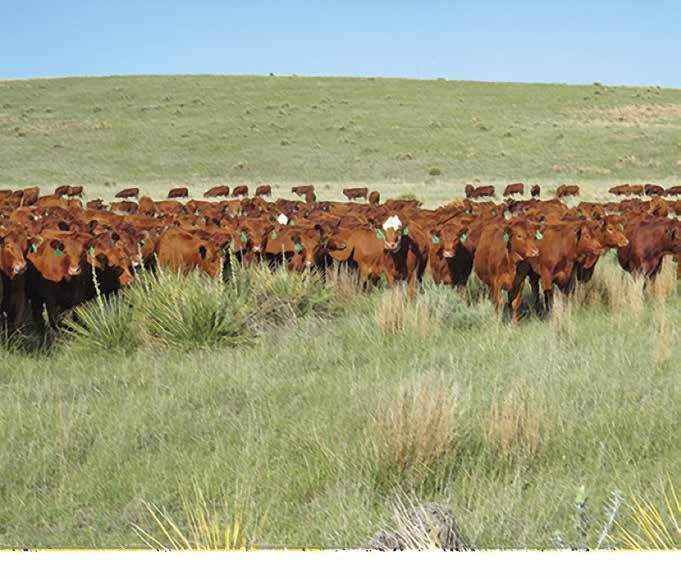
This sale represents Phase II of a three-year, nearly 6,000 head process to disperse our mature cow herd. These females represent generations of selection, retaining only the heifers that can graze our native Sand Hills, and raise a calf on their own year after year.
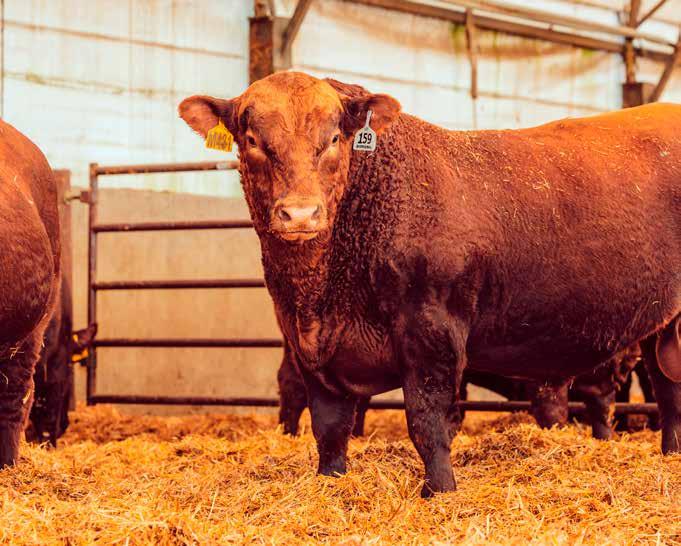
The cow herd has been built over decades with the goal of designing moderate, highly maternal, British based, low-input females. The herd is designed to thrive in a year-round grazing program. As a result, fitness and convenience traits have been a constant emphasis. The result is one of the largest, home-raised cow herds in America with generations of selection for udder quality, calving ease, and fleshing ability that deliver high fertility with maximum hybrid vigor.
SELLING APPROX. 3,000 HEAD OF HOME-RAISED, “MATERNALIZER” BRED FEMALES, INCLUDING:
500 2-year-old heifers
(including 300 AI bred to high use
850 3-year-old cows
1,175 4- & 5-year-old cows
500 6- & 7-year-old cows
Sim-Angus sire)
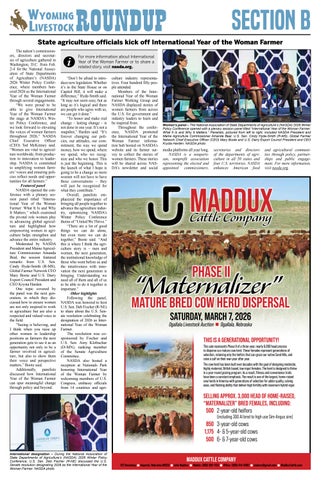
Women’s panel – The National Association of State Departments of Agriculture’s (NASDA) 2026 Winter Policy Conference opened with a plenary session panel titled “International Year of the Woman Farmer: What It Is and Why It Matters.” Panelists, pictured from left to right, included NASDA President and Maine Agriculture Commissioner Amanda Beal, U.S. Sen. Cindy Hyde-Smith (R-MS), Global Farmer Network Chief Executive Officer (CEO) Mary Boote and U.S. Dairy Export Council President and CEO Krysta Harden. NASDA photo
International designation – During the National Association of State Departments of Agriculture’s (NASDA) 2026 Winter Policy Conference, U.S. Sen. Deb Fischer (R-NE) discussed the U.S. Senate resolution designating 2026 as the International Year of the Woman Farmer. NASDA photo
On Feb. 13, the National Association of Wheat Growers (NAWG) awarded U.S. Sens. Jerry Moran (R-KS), Amy Klobuchar (D-MN) and John Boozman (R-AR), as well as Congressman Glenn “GT” Thompson (R-PA), with its 2025 Wheat Advocate Award.
The Wheat Advocate Award honors members of Congress who demonstrate outstanding leadership and commitment to policies strengthening the U.S. wheat industry and supporting America’s wheat farmers.
“These leaders have
consistently shown up for wheat growers by advancing practical, bipartisan policies to help farmers manage risk, remain competitive and continue producing a safe and reliable food supply,” said NAWG President Pat Clements.
“NAWG is proud to recognize their leadership and thank them for their dedication to wheat farmers and rural communities.”
Strong supporter Moran has been a strong supporter of efforts to move the Food for Peace program from the U.S. Agency for
Internal Development to the U.S. Department of Agriculture (USDA) and has demonstrated longstanding engagement on agricultural issues throughout his career.
As a senior member of the Senate Appropriations Subcommittee on Agriculture, he has played a key role in supporting agricultural research, rural development programs and farm policy critical to wheat producers.
“Wheat growers are the backbone of Kansas’ agricultural economy. These men and women play a critical role in supporting rural
communities and growing crops that feed Americans and the hungry around the world,” Moran said. “Kansas has a long history in the fight against global hunger through Food for Peace, and I will continue my work to support this critical program, which strengthens global food stability and provides important markets for our farmers.”
“As a member of the Senate Agriculture Committee, I’m committed to making certain Kansas and U.S. wheat producers have the support and access to mar-
BieberFever
kets they need to sell their crops,” he added. “Thank you to NAWG for their leadership and advocacy on behalf of America’s wheat growers.”
Steadfast advocate
Klobuchar serves as the ranking member of the Senate Agriculture, Nutrition and Forestry Committee and has been a champion for farm safety net programs and a steadfast advocate for America’s wheat growers.
She brings bipartisan leadership to agricultural policy, consistently working across the aisle to advance durable, effective legislation.
Klobuchar played a key role in securing important updates to the Beginning Farmer and Veteran Farmer Program, helping ensure the next generation can enter and succeed in agriculture.
She is also a strong proponent of crop insurance and recognizes its critical role in managing risk for wheat producers.
Additionally, she has long supported foreign market development and trade policies to expand opportunities for U.S. wheat exports, as well as global food security initiatives.
“I’m honored to receive this award from NAWG and the Minnesota Association of Wheat Growers who do great work advocating for wheat farmers across the country. My focus in the Senate has been on finding bipartisan policy solutions to help farmers succeed, like making crop insurance more affordable for beginning and Veteran farmers and expanding risk management options for all producers,” said Klobuchar.
Key architect
As chairman of the Senate Agriculture Committee, Boozman played a central role in securing farm safety net improvements for wheat growers through the reconciliation process in 2025.
He was a key architect and advocate for including agricultural provisions in the One Big Beautiful Bill Act (OBBBA), helping ensure producers received meaningful support during a period of ongoing market volatility and high input costs.
Boozman has consis-
tently prioritized policies to strengthen risk management tools and provide certainty for farm families, while advancing legislation aligned with NAWG priorities to bolster the long-term viability of U.S. wheat production.
“America’s wheat farmers play a vital role in feeding the world. I’m honored to receive the Wheat Advocate Award and to champion policies that equip these hardworking men and women with the tools and resources they need. I look forward to continuing efforts to strengthen our wheat industry and support the next generation of farmers,” said Boozman.
Tireless leadership
As chairman of the House Agriculture Committee, Thompson demonstrated tireless leadership for wheat growers by advancing meaningful farm safety net improvements through reconciliation in 2025.
Working closely with House leadership and committee members, he ensured key agricultural provisions were included in the OBBBA, delivering timely and targeted relief to producers facing sustained economic pressure.
“American wheat farmers are a critical component of our nation’s food supply,” Thompson said. “NAWG works tirelessly to ensure our wheat farmers receive the resources they need to succeed, and I thank them for their leadership. I am honored to be named a Wheat Advocate, and I look forward to continuing to support our wheat farmers through meaningful policies.”
NAWG congratulates and thanks the 2025 Wheat Advocate Award recipients for their continued leadership and support of wheat growers across the U.S. NAWG is the primary policy representative in Washington, D.C. for wheat growers, working to ensure a better future for America’s growers, the industry and the general public. NAWG works with a team of 20 state wheat grower organizations to benefit the wheat industry at the national level. For more information, visit wheatworld.org
CoBank analysis indicates U.S. farmers will increase soybean acreage this spring
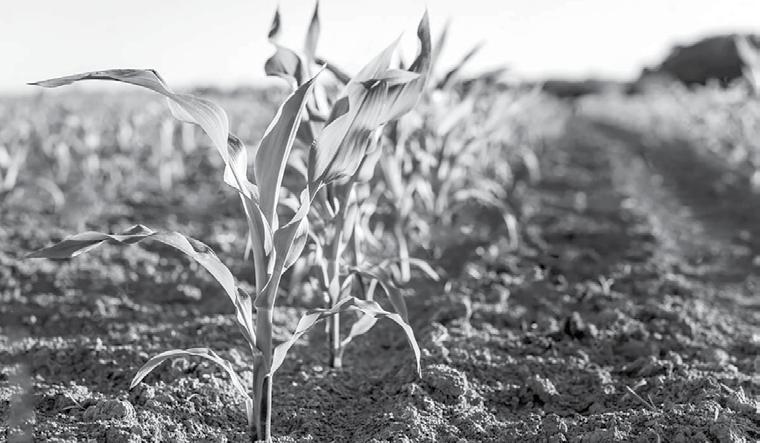
Low crop prices and high production costs are weighing heavily on U.S. farmers as spring planting season draws near and farmers make critical decisions about which crops will offer the most favorable economic return.
While late-winter price movements and regional basis signals could influence farmers over the next few weeks, soybeans are currently expected to increase their share of American farmland in 2026, while planted acreage of corn, wheat, grain sorghum, cotton and rice is expected to decline compared to last year.
According to a new report from CoBank’s Knowledge Exchange, U.S. soybean acreage is projected to increase nearly six percent this year, with soybeans pulling acres from multiple crops.
The expansion of U.S. soy crush capacity and expectations of continued Chinese demand have lifted soybean prices to more attractive levels than competing crops.
“Following recent price rallies, soybeans offer greater profit potential than corn, wheat, sorghum, cotton and rice,” said Tanner Ehmke, CoBank’s lead grains and oilseeds economist. “Beyond price signals, crop rotation needs will also play a role.”
“Following a big year for corn in 2025 in which acres climbed to the highest level in decades, more corn acres will be available to rotate to soybeans, and with record supplies of corn in storage, farmers will look to rotate into other crops to diversify their marketing risk. Soybeans currently offer the best marketing opportunities,” he added.
The report provides U.S. planted acreage projections for corn, soybeans, wheat, durum, grain sorghum, cotton and rice, along with regional factors which will influence farmers’ spring planting decisions for 2026.
Soybeans and corn
CoBank’s analysis indicates U.S. soybean acreage will increase 5.9 percent over last year to reach 86 million acres as soybeans pull acres from a variety of crops.
Soybean prices have performed better than most crops based on expectations the Environmental Protection Agency will announce a higher renewable volume obligation and China will continue purchasing soybeans.
In the South, soybeans will pull acres from cotton, rice and corn, while wheat and corn in the Midwest and Central Plains will lose acres to soybeans.
The outlier will be the Northern Plains where soybean basis remains under pressure from the loss of exports to China, causing farmers to favor more corn acres over soybeans. Soybean yield performance in the region has also been underwhelming relative to corn.
Total U.S. corn acreages are projected at 94 million, down 4.8 percent from last year. While overall acreage will dip, corn will gain acreage in western states at the
To read CoBank Knowledge Exchange’s report titled “2026 Acreage Outlook: Soybean Acreage Set to Rebound” in its entirety, visit cobank.com.
expense of wheat, grain sorghum and soybeans.
Corn has benefited from steadier demand compared to crops like soybeans and sorghum which have been affected by trade disruptions.
In the Northern Plains, depressed soybean basis levels will encourage farmers to switch soybean acres to corn. Successive years of high corn yields have convinced farmers corn genetics perform well in the Northern Plains.
In other regions, heavy corn acres last year indicate more acres will be switching to another crop for rotational purposes, with soybeans typically the favored crop.
Farmers in the Midwest are carrying record levels of corn stocks and will be reluctant to follow with more corn acres this spring.
Spring wheat, durum and grain sorghum
Spring wheat acres are expected to fall one percent to 9.89 million acres due to weaker yield performance and profit potential compared to corn.
The continual westward movement of corn acres often comes at the expense of wheat. However, if the U.S. Department of Agriculture predicts a substantial decrease in wheat acres in its March Prospective Plantings Report and triggers a rally in wheat prices, farmers may change acreage plans and increase wheat production in response to higher prices.
U.S. durum acres are projected to fall three percent to 2.12 million acres.
Following last year’s jump in durum production which brought U.S. acreage to the highest level in eight years, ample stocks in the U.S. and Canada have caused a substantial setback in durum prices versus other crops.
Durum, which is grown predominately in North Dakota, will lose acres to pulse crops and spring wheat.
Grain sorghum acres are expected to fall five percent to 6.31 million acres as farmers in the Central Plains opt for more corn or soybeans in their rotations as wide sorghum basis discourages production.
Sorghum stocks in the U.S. have climbed to the highest in four years following a bigger harvest last year.
Wide premiums of corn over sorghum, corn’s impressive yield performance last year and improved soil moisture across the Central Plains will entice farmers to expand acres to corn in place of sorghum.
Steadier local demand for corn with feedlots and favorable crop insurance premiums also favor corn over sorghum.
Sorghum acres could rebound if export demand to China continues to build.
Cotton and rice
CoBank’s analysis indicates U.S. cotton planted
acreage will fall to 9.19 million acres, dropping one percent year-over-year to reach the lowest level in 11 years.
Cotton acres in the South will migrate to soybeans, while irrigated cotton acres on the Plains will shift to corn.
The slower pace of U.S. cotton exports to China, combined with rising export competition from Brazil and Australia and increasing use of manmade fiber have prevented cotton prices from rebounding. However, base acreage payments will stabilize cotton acres and prevent further erosion.
Total rice planted acreage in the U.S. is projected at 2.83 million acres – the lowest in 30 years. This is also a yearover-year decline of 20 percent, with long-grain rice in
the South falling 25 percent to 1.59 million acres.
Medium- and short-grain rice acres are expected to fall to 665,000 acres, down 4.6 percent from last year.
Of the major commodities, rice is the highest-cost crop to plant and has suffered disproportionately on price.
Subsidized Indian rice is flooding the world market,
while more South American rice is flowing into key export markets like Mexico, displacing U.S. exports. Farmers in the South will be eyeing soybeans as the alternative to long-grain rice.
CoBank is a cooperative bank serving vital industries across rural America. The bank provides loans, leases, export financing and other
financial services to agribusinesses and rural power, water and communications providers in all 50 states. Headquartered outside of Denver, CoBank serves customers from regional banking centers across the U.S. and also maintains an international representative office in Singapore. For more information, visit cobank.com
Adobe Stock photo
Industry experts discuss how genetics, management,
At the 2026 National Western Stock Show, industry leaders and cattle producers gathered to discuss how breeding, management and market decisions can create value buyers recognize and reward.
Sponsored by the Colorado Angus Association, the session focused on connecting production fundamentals to market success.
Presentations by Troy Marshall, director of commercial industry relations for the American Angus Association; Dr. Clay Burson, associate beef technical specialist at Zinpro and Dr. Ryan Rathmann of Texas Tech University set the stage for a panel moderated by Kevin Ochsner, host of “Cattlemen to Cattlemen” on RFD-TV, with panelists Jason Hoffman of Hoffman Ranch; Western Video Market Auctioneer Rick Machado; Steve Gabel, owner of Magnum Feedyard and Marshall.
Proving genetic merit
Even in strong markets, high demand doesn’t ensure higher premiums.
Marshall explained how producing high-quality cattle is only part of the equation.
“If the market can’t see it, they can’t pay for it,” he said, citing verification tools such as AngusLink to quantify genetic merit.
He emphasized how
market value increases when production decisions are aligned with downstream demand.
“We’ve done a really great job of producing pounds and being efficient, low-cost producers in this industry,” Marshall said.
“Now we’ve got to continue to connect to our marketplace and consumer demand to make sure our management decisions are connected to real-world economic decisions.”
Nutrition as a value multiplier
Nutrition remains one of the most influential factors of profitability. Burson highlighted how every sector of the industry feels the effects of a good nutrition program.
“Virtually every biological process at some point is going to require a mineral or vitamin,” Burson said. “We’re asking cows to breed early, we’re trying to keep the calf healthy and we’re trying to keep feedlot steers performing efficiently – minerals play a critical role in all of those functions.”
Rathmann linked nutrition to efficiency and feed costs, noting matching cow
size and milk production to resources prevents unnecessary expenses.
“The most efficient cows are those which produce the most with the least,” Rathmann said.
He noted how variations in feed intake presents selection opportunity.
“If we can identify cows that are genetic outliers for eating less and still being able to sustain their maintenance needs, there’s a lot of opportunity,” Rathmann said.
Beyond the scale
While pounds remain important to commercial value, panelists stressed relationships, reputation and consistent performance also affect profitability.
“Now you have the tools available where you can accurately and objectively describe the genetic merit of feeder cattle,” Marshall said. “This is the people business and it always will be, but if we can document this information to give buyers confidence, I think it’s the key to driving value.”
Gabel noted efficiency of growth and carcass quality matter, but reliability and trust influence market outcomes.
Machado described it by
saying, “What you have to sell is your name if you’re not retaining ownership all the way through.”
Hoffman echoed this, adding balancing risk versus reward as another key factor to a successful operation.
“You’ve got to stick your neck out where you can be a leader,” he said about taking chances. “But you’ve got to be grounded enough to stick to the basics too and produce good cattle they know they can count on.”
Down the road
Finding a competitive edge requires foresight.
As Ochsner noted, “Your genetic decisions today have big ramifications years down the road.”
Producers who thoughtfully combine genetics, management and marketing
can turn these decisions into a win for their bottom line.
“Genetics, management and marketing are really risk management tools along the way,” Marshall said. “If you’re doing those things right, you’re going to reduce your risk in this marketplace.”
Briley Richard is the director of communications for the American Angus Association. This article was originally published by the association on Feb. 16.
Discussing genetics – Troy Marshall, director of commercial industry relations for the American Angus Association, presents “Tools to Differentiate Your Calf Crop,” discussing the important role of genetics in the marketplace. American Angus Association photo
Driving profitability – Panelists discuss strategies showing how genetics, management and marketing, combined with key relationships, help drive profitability for commercial cattlemen. American Angus Association photo
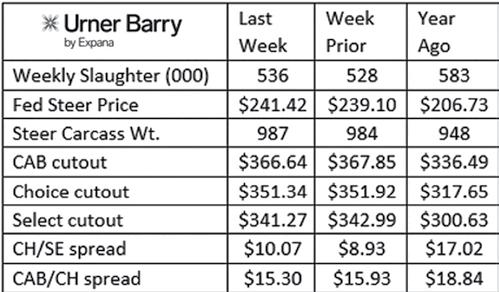
The fed cattle market has been steadily stronger since the first of the year, gaining $10 per hundredweight (cwt) from the opening week’s $231 cwt value through the first week of February’s $241 per cwt average.
This closely matches the early 2025 trend but has extended the pattern a week longer than that of a year ago with the first week of February’s continuation higher.
Cattle harvest drastically smaller
The drastically smaller year-on-year cattle harvest is a significant factor differentiating 2025 and 2026.
Since the beginning of the year, fed cattle harvest head counts have run roughly 10 percent smaller than a year ago. Tightened cattle supply and packer losses deeply in the red both continue to ration the harvest pace.
Logic suggests no changes to throughput as long as both cattle and cutout prices work antagonistically against packer profitability.
A counterbalance to lighter harvest runs continues to rear its head in the form of heavy carcass weights.
Latest data for the week of Jan. 19 featured a three-pound uptick in steer weights to average 987 pounds each, just two pounds below the record marked in December.
January weights will average near 30 pounds heavier than a year ago.
Weekly average cutout prices turned modestly lower in early February after the comprehensive cutout value increased 3.6 percent since the beginning of January.
As demand turned to the ends of the carcass, significant discounting on middle meats was a theme in January.
History suggests the most preferred steak items have already posted seasonal low prices, with
By Paul Dykstra
unseasonably warm weather in some regions coupled with expected early spring buying stimulating prices. Utilization key to prime success
Fed steer and heifer carcass quality is charting new territory in the first five weeks of the quarter.
Record-heavy carcass weights, the longest feeding periods on record and generations of improved genetics continue to press carcass quality grades to new heights.
This has generated an average 14.2 percent Prime carcasses in the fed cattle mix, while Select carcasses average an unprecedented low at 9.7 percent of the total since Jan. 1. This stands in stark contrast to the 10.7 percent Prime and 13.6 percent Select grade mix recorded for the same period a year ago.
As the carcass mix continues to press higher with richer quality grades, the expected impact to cutout prices has also come to fruition.
The Prime cutout premium to Choice narrowed to $19 per cwt in January versus $59 per cwt a year ago and $37 per cwt in January 2024.
This contrast indicates a wide range and directional change in the premium across three years.
However, the number of Prime carcasses in the past five weeks has been 21 percent greater than a year ago, while carcass weights have also been 30 pounds heavier for the period.
Recent Prime demand models show 20 percent and greater year-over-year consumer demand increases for multiple months for the recent two years.
Growing Prime supply has been met with growing demand, generally across the last decade. The recent added upswing in the Prime carcass supply suggests expanded utilization of Prime-specific sales across the entire carcass is warranted.
In the past couple of years, packers have added a growing list of cuts to their sales sheets specific to their Prime-graded product. This is evident in Certified Angus Beef (CAB) brand sales as seen in the most recent year’s sales growth in the CAB Prime category.
Further opportunity exists to capture consumer demand across the Prime carcass, as evidenced by the most recent U.S. Department of Agriculture (USDA) carcass cutout value report.
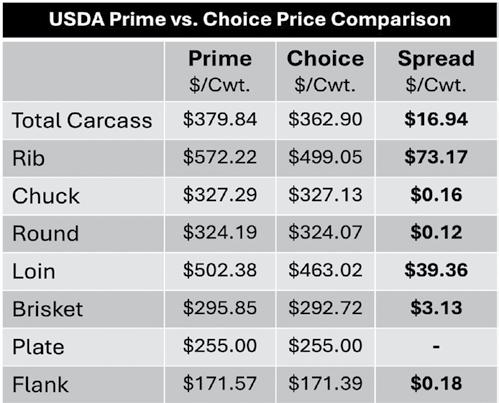
For the first week in February, USDA lists the Prime cutout premium to Choice at $16.94 per cwt for the entire carcass.
Yet, practically all of the premium is found in the rib primal which features a $73.17 per cwt premium and loin at $39.36 per cwt.
Briskets have often carried a larger premium than at present, but very adequate supplies have narrowed that premium to $3.13 per cwt.
While Prime premiums are increasingly being cap-
tured on some cuts on both ends of the carcass, chuck and round summary values show relatively small premium contributions, as do the flank and plate.
It’s important to note more demand for individual Prime grade cuts is being discovered on the part of packers and wholesalers as they educate downstream users about the opportunities to capitalize on growing Prime demand.
Emphasis on greater utilization of Prime and CAB Prime carcasses is key to recapturing larger Prime cutout premiums which get allocated throughout the supply chain.
After all, the economic drivers fueling current carcass weights and extended feedlot stays may shift over time, such that carcass quality takes a step back. Even if not, building demand through exceptional quality is the factor that has allowed beef to vastly outpace other protein options in the market.
Paul Dykstra is the director of supply management and analysis at CAB. He can be reached at pdykstra@certifiedangusbeef.com.
Montana Performance Bull Co-op™
On Feb. 12, the U.S. and Taiwan signed a sweeping trade agreement, marking a significant milestone in economic relations between the two countries and delivering expanded market access for U.S. exports.
Announced by the Office of the U.S. Trade Representative, the U.S.-Taiwan Agreement on Reciprocal Trade (ART) eliminates or reduces 99 percent of Taiwan’s tariff barriers and addresses longstanding nontariff obstacles.
Ambassador Jamieson Greer attended the signing ceremony in Washington, D.C., under the auspices of the American Institute in Taiwan and the Taipei Economic and Cultural Representative Office in the U.S.
Taiwan Vice Premier Li-chiun Cheng and Minister Without Portfolio Jen-ni Yang were also in attendance.
“President Donald Trump’s leadership in the
Asia-Pacific Region continues to generate prosperous trade ties for the U.S. with important partners across Asia, while further advancing the economic and national security interests of the American people,” Greer states in a Feb. 12 press release.
“The ART with Taiwan will eliminate tariff and nontariff barriers facing U.S. exports to Taiwan, furthering opportunities for American farmers, ranchers, fishermen, workers, small businesses and manufacturers,” Greer adds.
“This agreement also builds on our longstanding economic and trade relationship with Taiwan and will significantly enhance the resilience of our supply chains, particularly in hightechnology sectors. I want to thank my counterparts from Taiwan for their strong commitment to achieving fair and balanced trade with the U.S,” he continues.
Major gains for agriculture
The agreement was met with a positive response across the U.S. cattle industry, as it is set to eliminate tariffs on U.S. beef and reinforce science-based standards consistent with international benchmarks, including the World Organization for Animal Health and Codex Alimentarius.
The National Cattlemen’s Beef Association (NCBA) praised the deal for granting duty-free access for U.S. beef exports to Taiwan, which is currently the sixth largest export market for U.S. beef, valued at $709 million in 2024.
According to NCBA’s Feb. 12 press release, beef exports accounted for more than $415 per fed animal processed in 2024, underscoring the importance of international markets to producer profitability.
“Strong, science-based trade agreements are essential
to adding value for U.S. cattle producers, and Taiwan has emerged as one of the strongest international markets for U.S. beef,” says NCBA President Gene Copenhaver. “Duty-free access improves competitiveness and provides long-term certainty for producers who depend on export markets to maximize the value of every animal.”
The U.S. Meat Export Federation (USMEF) also welcomed the agreement, emphasizing Taiwan’s role as a top-tier beef market, and noting although the U.S. is already Taiwan’s largest beef supplier, USMEF officials believe there is room for further growth.
In a statement released the same day as the USTR’s announcement, USMEF President and Chief Executive Officer Dan Halstrom says expanded access for all U.S. beef products – including cuts popular in yakiniku barbecue and emerging burger concepts – will
enhance competitiveness and unlock new demand.
In addition to beef, the agreement also delivers important gains for other red meat.
According to USMEF, U.S. pork exports have long faced disadvantages in Taiwan, where competitors such as the European Union and Canada dominate the import market. However, the agency expressed optimism reducing both tariffs and non-tariff barriers will help U.S. pork regain footing in the Taiwanese market, particularly as the organization continues efforts to rebuild consumer trust.
“The agreement also includes important language clarifying access for U.S. bison and eliminates tariffs on U.S. lamb,” Halstrom states.
In addition, the official ART Fact Sheet notes Taiwan agreed to resolve and prevent non-tariff barriers affecting U.S. agricultural exports including beef, pork, poultry and processing potatoes and provide preferential market access for horticultural products, wheat, beef and beef productions, dairy products, pork and pork products, lamb and sheep, tree nuts, dog and cat food, ketchup and peanuts.
Broader industrial and regulatory reform
While the ag industry is certainly set to benefit from the agreement, provisions in the ART extend far beyond.
According to the fact sheet, Taiwan will provide preferential access for a wide range of U.S. industrial exports as well, including autos and auto parts, chemicals, machinery, health products, electrical products, minerals, metals and seafood.
The agreement resolves longstanding barriers affecting U.S. motor vehicles, medical devices and pharmaceuticals by accepting U.S. Federal Motor Vehicle Safety Standards and U.S. Food and Drug Administration marketing authorizations without additional requirements.
The deal also includes groundbreaking provisions regarding geographical indications, with Taiwan committing to transparency and fairness standards, which ensures U.S. cheese and meat producers can continue using common product names without facing unfair market restrictions.
Intellectual property protections are strengthened through the deal, with Taiwan committing to enhanced enforcement aligned with key international treaties.
The agreement further addresses labor standards, prohibiting the importation of goods produced with forced labor and improving protections for workers in certain sectors.
Environmental commitments include enforcement of environmental laws and measures targeting illegal logging, fisheries subsidies and wildlife trade.
Another notable section of the agreement focuses on supply chain resilience and high-tech collaboration.
Both countries highlight cooperation in semiconductors, electronics manufacturing services, energy and other critical sectors.
A memorandum of understanding signed in January outlines plans for Taiwan companies to increase investment in U.S. semiconductor supply chains and related industries and, in turn, the U.S. will consider preferential treatment for Taiwan in certain tariff and trade remedy contexts.
Taiwan also plans to substantially increase purchases of U.S. goods between 2025-29, including $44.4 billion in liquefied natural gas and crude oil, $15.2 billion in civil aircraft and engines and $25.2 billion in power equipment and related infrastructure.
A path forward
From here, the agreement will undergo domestic formalities, including legislative review in Taiwan, while the U.S. has committed to adjusting tariffs on Taiwanese goods in recognition of Taiwan’s reciprocal steps.
“On April 2, 2025, President Donald Trump declared a national emergency in response to the unprecedented threat caused to the U.S. by the large and persistent trade deficit due to a lack of reciprocity in bilateral trade relationships, disparate tariff rates and nontariff barriers and U.S. trading partners’ economic policies which suppress domestic wages and consumption,” reads the fact sheet.
“Trump continues to help U.S. farmers, ranchers, fishermen, small businesses and manufacturers to increase U.S. exports to and expand business opportunities with trading partners,” it continues. “This announcement provides a tangible path forward with Taiwan underscoring the president’s dedication to bringing balanced, reciprocal trade with an important trading partner.”
Hannah Bugas is the managing editor of the Wyoming Livestock Roundup. Send comments on this article to roundup@wylr.net.
UW Extension highlights lamb quality and grazing at fall convention
During the West Central States Wool Growers Convention, held Nov. 7-8, 2025 in Cody, a trio of University of Wyoming (UW) Extension specialists provided a series of fast-paced, TED-Talk style presentations to share their insights into sheep production across the West.
The session featured discussions on lamb eating quality by UW Associate Professor of Meat Science Dr. Cody Gifford, targeted grazing strategies by UW Extension Educator Barton Stam and sheep grazing behavior by UW PhD Student Aaron Kirsch.
Analyzing flavor differences
Gifford kicked off the discussion by addressing a longstanding question among sheep producers and industry experts alike – whether there is a measurable difference in eating quality between lamb produced by wool breeds versus hair breeds.
While opinions vary widely, Gifford noted scientific data comparing flavor profiles between the two is limited and research conducted at UW suggests any detectable flavor differences are subtle.
“The reality is any of the general differences we have recently found in flavor performance are very subtle,” he admitted. “We don’t have a lot of robust data specifically focused on major flavor differences between these two flavor profiles.”
Instead, Gifford said maturity and diet are two primary factors driving lamb flavor, more so than breed type. He noted, over the last couple of decades, meat science research has found these two variables consistently influence flavor intensity and palatability more than genetics alone.
To drive this point home, Gifford explained researchers often don’t know the precise genetic background of the carcasses they are sampling for flavor analysis since many lambs these days are composite breeds.
“Even within the same lot of lambs, trained sensory panels sometimes detect variation in flavor intensity from animal to animal, raising additional questions about what drives those differences,” he said.
Further, Gifford underscored the importance of consumer preferences, which is just as diverse.
He shared an example from his doctoral research, in which samples of lamb were evaluated by chefs, industry professionals and producers, and the feedback varied dramatically.
“We couldn’t really make sense of the information,” Gifford confessed.
“The chefs told us all of the lamb we served them was way too mild. They wanted something more intense for a unique experience. The allied industry members described it as a stronger, more mature flavor, and
producer preference was mixed across the board.”
He continued, “We walked away wondering how we actually come up with a singular method to producing lamb that’s consistently going to meet those preferences every single time from a flavor standpoint.”
“We also can’t ignore individual preference is very important,” Gifford concluded. “This is why we can’t go ahead and recommend a singular breed or production system when raising lamb for flavor.”
Rethinking targeted grazing
Stam was next to the stage to offer some range management advice.
To start, he encouraged producers to think beyond simply converting forage into pounds of lamb or beef. Instead, targeted grazing systems may also aim to reduce toxic and invasive species, manage annual weeds, control brush and reduce wildlife fuel loads.
“I know I’m preaching to the choir here, but sheep may be the perfect animal for all of this,” he stated.
One practical example Stam shares is using sheep to manage larkspur, which is toxic to cattle. Although it poses a serious threat to their bovine counterparts, sheep can often graze larkspur with far less risk, offering biological control in certain situations.
Stam also highlighted a collaborative project near Sunlight, where yearling steers are being used to improve winter elk habitat, demonstrating how the practice of targeted grazing can be applied across multiple livestock species.
Stam further noted he believes public education must accompany targeted grazing projects, especially for those on public lands.
“The public needs to know and understand how livestock grazing is improving their public lands and habitat for wildlife,” he stated.
“We all need to improve our skills at communicating with the public and with each other, especially those who may hold opposing views on natural resource issues,” he added. “Poor communication might be even worse than no communication at all.”
Switching gears, Stam then challenged two longstanding range management rules of thumb – range readiness and the “take half, leave half” rule.
“My hang-up with range readiness and the ‘take half, leave half’ rule is one assumes the range can only be grazed at one time of the year, and the other ignores the time of the year, other users and rest periods,” he stated.
Instead, Stam urged producers to focus on planning, remaining adaptable, monitoring conditions and adjusting grazing based on weather, plant growth and environmental variability.
He also noted short-term monitoring methods should inform long-term understanding of livestock distribution and stocking rates, rather than serving as an automatic trigger for management decisions.
“Short-term range monitoring methods should not become the management objective or be used as automatic triggers to move livestock or to gauge the condition of an allotment,” he reiterated. “Short-term range monitoring techniques should teach us about livestock distribution and stocking rates over multiple years.”
“All too often, the standard becomes the objective to meet with little to no thought of actual onthe-ground conditions, such as perennial plants versus annuals, soil cover, invasive species or woody plant encroachment,” he continued. “Short-term and residual monitoring methods are prone to procedural errors. They are vulnerable to season of measurement, and they’re quite subjective.”
“We should be talking more about managing for current conditions, avoiding cookie-cutter approaches and
improving – not just sustaining – our range resources,” he concluded.
Evaluating grazing behavior
To round out the presentations, Kirsch provided insight into his research which explores grazing behavior and diet selection in sheep.
He explained the study initially focused on sheep grazing larkspur, but eventually expanded to broader questions regarding breedspecific diet preferences, posing the “deceptively simple” question of why grazing animals eat what they eat.
“A pasture is a lot like a buffet,” he stated. “There’s a mixture of grasses, forbs and shrubs, and they each have different components – some of them are very nutritious, some might be bitter and others might even be toxic.”
He added, “I wanted to understand grazing behavior as a whole. I was asking the questions of why animals eat what they eat and how they make decisions about what to eat, because these decisions can really shape the success of our grazing systems in ways we’re only beginning to understand.”
“We should be talking more about managing for current conditions, avoiding cookie-cutter approaches and improving – not just sustaining – our range resources.” – Barton Stam, University of Wyoming Extension
To attempt this, Kirsch’s research used fecal DNA barcoding to identify plant species consumed by individual sheep and measure species richness within their diets. The study also compared diet preferences among breeds, including Rambouillets, Hampshires and Dorpers, in which he found subtle but meaningful differences.
“There were subtle differences between these breeds under more constrained forage conditions, but as the season progressed, the landscape greened up and more plants became available, the diets started to even out and the breeds became more similar,” he explained.
Kirsch noted, Dorpers, which are often described as non-selective grazers that will eat anything, lived up to this reputation.
In contrast, Kirsch observed Rambouillets demonstrated a strong preference for scarlet globemallow, selecting it at significantly higher rates than other breeds.
“Small details like this can really tell us a lot about grazing,” he concluded. “It reminds us grazing is not a random act. It’s intentional, and it’s guided by each animal’s own preferences and needs. Understanding these preferences can help us design better grazing systems that are productive, sustainable and more in tune with natural processes.”
Hannah Bugas is the managing editor of the Wyoming Livestock Roundup. Send comments on this article to roundup@wylr.net.
“Early on in the season, when forage was more scarce, the Dorpers were able to select from a broader range of plant species –close to 12, compared to the other breeds’ seven,” he shared.
7L Diamond’s Hi Altitude Bulls
Leah, 719-850-2720; Peter, 849-8223
Bulls & heifers sell Friday, March 27, 2026 at Monte Vista Livestock Auction
Altenburg Super Baldy-Triangle J Selling 150 bulls – Fort Collins, CO Saturday, March 21, 2026
Willie Altenburg, 970-481-2570
Baty Livestock Spring and Fall Heifer Sales batylivestock@gmail.com facebook/batylivestock
Black Summit Cattle
The Quin LaFollette family
Bulls sell Friday, March 20, 2026 at Powell, WY • 307-899-3553
Bridle Bit Simmentals
All-Terrain Bull & Female Sale
Monday, March 23, 2026 at Walsh, CO Chad Cook, 719-529-0564
Campbell Simmental Part of High-Altitude Bull Sale on Saturday, March 28, 2026 at LaGarita, CO Robert, 970-749-9708
Carlson & Halde Cattle
Bulls sell Fri., March 20, 2026 at Stoneham Patrick, 970-768-5345 Glenn, 970-580-2059
Dilka Cattle
Yearling & 18-mo-old bulls PT Briggsdale, CO • 970-396-8791 thedilkas@aol.com
Far Out Cattle Ranch
Jerrid Brisendine, 719-353-1747
All-Terrain Bull & Female Sale Monday, March 23, 2026 at Walsh, CO
Hill Brothers Livestock Bulls & females available Paul, 417-849-6851 facebook.com/hillbrotherslivestock
High-Altitude Bull Sale March 28, 2026 719-850-3082 or 850-3083 shane@t-heartranch.com
www.ColoradoSimmental.com, colosimmental@gmail.com or follow us on Facebook
CLASSIFIEDS
6397 TFN
6-7 at the
Town
10700
in Marbleton, WY. Join us
7 at 5:30 PM at the fairgrounds for our steak dinner. For more information, visit us on Facebook @ Green River Valley Cattlemen or call 307-760-5737 2/21
GUN SHOW MARCH 21-22: Weston County Senior Citizens Center, Newcastle, WY, Sat., March 21, 9 a.m.-5 p.m.; Sun., March 22, 9 a.m.-3 p.m. Admission $5, kids 12 and under free when accompanied by a parent or guardian. Vendor setup Fri., March 20, 3-8 p.m. For more information, call Mike Novotny, 253-678-4825 3/14
UP IN ARMS, LLC FLEA MAR-
KET AND GUN SHOW March 20-22, Casper, WY at the Central Wyoming Fairgrounds. Open to the public. Fri., March 20, 3-7
p.m. Sat., March 21, 9 a.m.-5 p.m. Sun., March 22, 9 a.m.3 p.m. Giving away a .22 pistol Sunday at 2 p.m., must be present to win, 21 years of age and able to pass background check. Buy, sell, trade. Adults $6, children 12 and under free (when accompanied by an adult). For more information, contact Lisa, 208-420-2295 3/14
BLACK HILLS GUN SHOW MARCH 13-15: The Lodge at Deadwood, in Deadwood, S.D. Call 605-641-0870 or 307-751-1877. Visit us on Facebook 3/7
visit our website at
Call Mike Faimon at 406-469-1585 or Davin Arnold 970-301-3098 for more information.
Help Wanted
WYOMING STATE PARKS IS HIRING ENERGETIC EMPLOYEES FOR THIS SUMMER!! The employment period will run from May until September. Apply here: www.governmentjobs.com/careers/ wyoming by searching “State Parks.” Join our team this summer! Maintenance and fee employees will be paid $10-$16/ hour and law enforcement staff will be paid $18-$22/hour. Housing may be available. EEO/ADA employer 3/14
IMMEDIATELY SEEKING FULLTIME FARM/RANCH INDIVIDUAL FOR A REMOTE NORTHEAST WYOMING RANCH: The role supports the current foreman and works alongside to ensure smooth and efficient operation of livestock, haying, equipment and facility management. Applicant must have a strong agricultural background and a hands-on approach to problem solving and daily ranch work. This is a longterm position and offers a clear path to increased responsibilities, pay and leadership. Housing is provided. Will not consider drug addicts or alcoholics. Must have a clean driving record. Please send resume with references and telephone number by mail or e-mail to: PeeGee Ranch, 1251 Lower Powder River Road, Arvada, WY 82831, pgranch@ rangeweb.net. NO telephone calls 3/7
DEVILS TOWER FOREST
PRODUCTS, INC., A LUMBER MANUFACTURER IN HULETT, WY, IS ACCEPTING APPLICATIONS FOR PARTS PROCUREMENT, PLANER OPERATOR (DAY SHIFT), MILLWRIGHT, BOILER AND KILN OPERATORS ARE DAY/ NIGHT SHIFT POSITIONS: Benefit package includes company paid medical and dental insurance (including dependents), life insurance, company-matching 401(k), safety incentives, holiday pay, paid vacation. Mandatory employment and random drug testing is conducted. EOE. Starting wage D.O.E. Online applications are available at www.neiman.com. E-mail applications to joe.ortner@devilstowerfp.com or fax to 307467-5418, contact Joe Ortner at 307-467-5252 with additional questions 2/21
LOOKING FOR RANCH ASSISTANT PROPERTY MANAGER: Full-time position for large ranch located in Park County, WY. Responsibilities include: Lawn care, irrigation, agricultural equipment maintenance and general residential, building and property maintenance. Salary range of $45$60K depending on experience. Living on property is required for employment. House and vehicle will be provided. Property is located 10 minutes from downtown Cody, WY. Position is available for immediate hire. Please send resumes to hbeirne@acpg.com and mgiliati@acpg.com 2/21
WYOMING SUGAR COMPANY IS LOOKING FOR A CONTROLLER, responsible for overseeing the accounting department and ensuring the accuracy and integrity of financial reporting. Requirements: Bachelor’s degree in accounting, finance or related field, minimum of 5 years’ experience, salary $60,000$80,000 DOE. Please apply online at wyomingsugar.com/ job-openings/ 2/21
Adverise your Brand Here!
WYOMING REGISTERED BRAND: RHC, RHH, renewed to Jan. 1, 2031. Hot and cold irons. $10,500. Call 307-850-5087 3/14
REGISTERED WYOMIING BRAND FOR SALE, lazy RM. RRC, RHH, renews in January 2027, 2 sets of hot irons and 2 sets of electric irons. $3,000. Calls only, 307899-3737 2/21
Services
WHETHER YOU’RE NEEDING SAND FOR YOUR ARENA OR GRAVEL FOR YOUR DRIVEWAY, WE HAVE YOU COVERED. BIG HORN REDI MIX IN Powell, WY 307-7542923, Cody, WY 307-587469a1, Greybull, WY 307765-4610 and Worland, WY 307-347-2458 or Canyon Concrete in Thermopolis, WY 307-864-3500. Sand, gravel, 57 Rock, concrete and precast. Family owned and operated in the Big Horn Basin for 40 years 3/7
Bred by best Vermilion Ranch bulls!! Will start calving March 6 for 52 days.
Financial Services
AGRI-ONE FINANCIAL: Farm/ ranch and all commercial loans. RATES AS LOW AS 5%. We have been helping with all aspects of agricultural, commercial financing and management for years. LET US HELP YOU on a consulting level with management to increase profitability, deal with and fix credit problems and for all your financing needs. WE CARE AND HAVE WORKING PROGRAMS designed for the farmer/rancher and not the banker. Please call Steve, 303-773-3545 or check out our website, www.agrionefinancial.com. I will come to you and get the job done!! 2/21
WANTED RECIP COWS: Must be open!! Two to 6 years old, Red Angus or Angus-based cows. For more information, call Corie Mydland, 406-8555598 (cell), Trans Ova Genetics, Joliet, MT 2/21
RICHARD’S HOOF AND NAILS LLC NOW OFFERING BOVINE TRIMMING!! Ronnie Richards owner of Richard’s Hoof and Nails LLC is based out of Broadus, MT. After years of only doing farrier work, he is now offering cattle trimming. He attended a cattle trimming school in London, Canada and is ready to come to you with his custom mobile chute. Call 406554-3064 (home) or 406-8533491 (cell) 3/7
GONSIOR Batman, TJ Stability, TJ Stone Cold, BRIDLE BIT Eclipse. All bulls GE EPDS, DNA for hair color and all bulls homozygous polled. All bulls guaranteed for first breeding season. For information contact James Dilka at thedilkas@ aol.com or by phone, 970396-8791. Gentleman’s action will be held on March 1 at 1 p.m. 2/28
STRAND SIMANGUS PRIVATE TREATY BULL SALE: Selling yearling Black Simmental and SimAngus bulls. Our bulls have thickness that has been bred on, not fed on. Leave the trailer at home, we will feed your bull, semen test and deliver free of charge up to 300 miles after April 1. Bulls can be viewed at the ranch, Platte, S.D.. For performance records, pictures or more information, call 605-6807628, e-mail strandsimangus@gmail.com. Visit www. strandsimangus.com To view photos, go to www.wylr. net in the classifieds 2/28
YEARLING
TWO-YEAR-OLD HEREFORD BULLS: Canadian registered. Fertility checked. View photos at www.workingherefords. com. Estermann Herefords, 308-340-4159 or 308-9634473 3/7
1,200 lb. fancy Hereford heifers, pasture bred to a son of NJW Historic, to calve March 27 for 35 days. ALSO, 25 Hereford heifers, bull bred to light birthweight Angus bulls, to calve March 23 for 45 days. Selling at Valentine Livestock Company March 5. For more information, call Lawrence Turner, 402-376-5248 2/28
TWO-YEAR-OLD POLLED
HEREFORD BULLS: Top bloodlines Historic and Gold Rush. Call Donald, 208-2016213 3/14
SEVEN-YEAR-OLD RED ROAN QUARTER HORSE MARE, grade, nice stocky mare, $4,500 OBO. For more information, call 719-490-8871 2/28
AQHA VERY GENTLE, WELL BROKE, NO BUCK, 10-YEAROLD BAY MARE. She has been used on the ranch for sorting, pairing and used in the mountains. AQHA FILLY AND STUD BORN MAY 2025. The filly is out of Ifwhizswereguns. The stud is out of HF Mobster. They are very gentle and halter broke. ELEVEN-YEAR-OLD GRAY, BROKE MUSTANG MARE. She was used as a broodmare and could be used as a recipient mare. For more information, please call 307679-3126 2/21
FOR SALE: 2025 MILLET HAY IN LARGE ROUNDS, approximately 1,100 lbs., 75 tons available at $155/ton. Gooseneck delivery possible. Call and leave message at, 307-2595485 3/14
FEED/GRAIN FOR SALE: Alfalfa, cane and millet hay. Large squares and rounds. Semi loads only. Will deliver. Call 970-2272760 3/14
HAY FOR SALE: 3x3 and round bales of grass or alfalfa/grass mix. Delivered only. Call 605-8400015 2/21
REGISTERED BLACK YEARLING LIMOUSIN BULLS FOR SALE: Performance tested. Contact Nolz Limousin, Mitchell, S.D. Call 605-9997035 or visit www.nolzlimousin.com 2/28
TETON HORSE EXPERIENCE MARCH 13-15 ● Wind River Arena in Rigby, ID ● Main Headliner Craig Cameron ● Colt Starting Competition ● Youth Freestyle Competition ● Demos ● Speakers ● Interactive classes ● shopping ● food ● For more information, visit www.tetonhorseexperience. com 3/7
FOR SALE THREE 2-YEAROLD GELDINGS, grade horses, all half brothers. These young geldings have had lots of groundwork, including saddling and 3 rides each in the round pen. Gentle, willing and ready to continue their training. $2,700 each OBO. Call for more details, 605-350-0495 2/28
CHECK OUT SKB STABLES CONSIGNMENTS at www.lollibros.com SELLING MARCH 6, yearling AQHA LL Bowman Cookie, sired by Bowman Metallic Cat filly with One Time Pepto and Shake Shiver and Shine on the dam side. Riata Buckle eligible. ALSO, yearling blue roan AQHA Percheron cross filly. Call 641-664-1949 2/28
Saddles & Tack
RIDE, WORK, ROPE AND PLAY!! Great selection of: Quality GLOVES, mohair CINCHES, wool saddle PADS and blankets. Over 300 BITS in stock!! $AVE on BOOTS: HONDO, BOULET, JUSTIN WORK BOOTS, TWISTED X (boots and shoes) and more!! WE CAN ship!! Shop Moss Saddles, Boots and Tack, 4648 West Yellowstone Highway, Casper, WY 307-472-1872. Our family serving yours for 50 years!! Check us out on Facebook or our website 2/21
MOFFAT COUNTY SHEEP SHEARING SCHOOL, CRAIG, CO APRIL 17-19: This 3-day shearing school provides handson, instructed experience in shearing sheep and an introduction to equipment maintenance. No previous experience needed. E-mail megan.stetson@colostate.edu or call 970-826-3402 for registration information and questions 2/28
ARE YOU IN NEED OF A NEW HERDER CAMP OR A PERSONAL RANGE CAMP FOR YOUR FAMILY? Contact us at Western Range Camps and see what we can build for you. We specialize in quality, handcrafted camps built to your specifications. Contact us today to design the camp just right for you. Western Range Camps, 435-462-5300, heidi@wrcamps. com, 1145 S. Blackhawk Blvd, Mt. Pleasant, UT 84647 2/21
PRAIRIE HAY AND SOME TAME GRASS HAY FOR SALE: Netwrapped round bales. Located 1/4 mile from Presho Livestock Auction, Presho, S.D. Call 605-7302899 3/7
VALLEY VIDEO HAY MARKETS, LLC: Representing 40 of the best growers in eastern Wyoming and western Nebraska. Call now for your spring needs, Barry McRea, 308-235-5386, www. valleyvideohay.com 3/7
CERTIFIED BARLEY STRAW FOR SALE, 3x4 bales. Cody, WY. Call 307-899-1952 TFN
ROUND-BALED GRASS: 2025 crop 1,000 lb. net-wrapped bales, $50/bale. Cody, WY area. Call, don’t text, Anthony at 307-2542645 3/7
DAIRY QUALITY ALFALFA FOR SALE: Call for pricing, 605-4309809 3/7
HAY FOR SALE: Triticale, barley, pea blend with alfalfa, nice hay. ALSO, ALFALFA WITH SOME RAIN, 3x3 bales, shed stored, $170/ton. ALSO, CERTIFIED TRITICALE STRAW, long stem round bales, $130/bale. ALSO, TRITICALE GRAIN $0.35/lb. bulk or totes. Farson, WY. Call 307350-0350 3/7
CERTIFIED WEED-FREE PURE ALFALFA HAY: 2025 third and first cutting available in small squares, averaging 70-80 lbs. Will load trucks and any open trailer. MONIDA OATS: $16/cwt. Combine run, great for seed or feed. Will auger into truck, trailer or large totes/ag bags. Located between Powell and Cody, WY. Certified scales on site. Call or text Knopp Farms for details, 307-254-0554 3/28
HAY FOR SALE: Grass and alfalfa hay. ALSO, grass/alfalfa mix, millet, forage wheat and straw. Round bales and 3x4 square bales. Delivery available!! Call 307-630-3046 2/28
HAY FOR SALE: 2025 grass/ alfalfa, first and second cutting alfalfa, millet, haybet barley and CRP hay. ALSO, 2025 GRINDING HAY also available. All in netwrapped round bales. Semi load delivery available. Call for pricing, ask for Klint, 701-290-4418, if no answer, send a text or keep trying 2/28
BARLEY STRAW: Certified weed-free small squares, $4/bale. ALSO, 5x6 round bales, $125/ton. GRAIN OATS, wheat and barley, $20/cwt. Greybull, WY area. Call 307-762-3878 or 307-899-4714, leave message 2/21
Services/ Repairs
WESTERN B-TRAINS ALUMINUM FLATBED TRAILERS: Lead trailer is 32 ft. long, rear trailer is 28 ft. long. Really good tires, brakes and drums. $20,000 for whole set. Calls only, no texts, 208-651-8698 2/28
JOHN DEERE 71 12-ROW BEET
PLANTER: Twelve row 22 inch or 24 inch on double decker stacking bar. ARTSWAY 786A BEET
DEFOLIATOR: Six row 22 inch, 1 steel, 2 rubber drums. Scalpers, rear steerable wheels, extra parts. Very good working condition. Call 406-591-0797 2/21
RETIREMENT SALE!! Brand new medium weight corral panels, 12 ft. long x 5 ft. high, if buy minimum of 100, $90/panel. Brand new Cattle Master squeeze chutes, $2,850. Calls only, no texts, 208-651-8698 3/7
LODGEPOLE OUTDOOR FURNACES, 307-223-2046. Your authorized Central Boiler Dealer. Get your outdoor wood furnace today!! Efficient wood heat. Heat multiple buildings. Invest in your heating, don’t just pay for it!! See us at www.cb.lodgepoleproducts. com!! 2/28
2013 JOHN DEERE 8285R: 4,600 hours, before DEF, great condition. 630 F HYDRAFLEX BEAN HEAD WITH TRAILER, very low acres, been shedded, excellent condition. Call for details, 308-550-0673 2/21
FOR SALE: 2017 Freightliner
Cascadia 125 day cab semi, Detroit DD13 engine, DT12 automatic transmission, air ride, aluminum wheels, 574,392 miles, very nice. Vermeer BP 7000 bale processor with hydraulic deflector. Miller Pro 18’ chuckwagon with tandem running gear. John Deere 714A and 716A chuckwagons with John Deere tandem running gear. H&S 7+4 16’, 20’ and 22’ chuckwagons with bunk feeding extensions and tandem 14 ton running gear. J&M 385 gravity box with 12 ton gear, truck tires. Landoll 36’ cushion gang disc with 3 bar mulcher. Gehl 1410 manure spreader, 410 bushel with slop gate, double floor chains, tandem axle. Meridian 240 seed tender, all hydraulic and roll tarp. Burns portable loading chute. 12’ and 14’ HD box scrapers with tilt. Farm King 8’ snowblower with hydraulic spout. All in very nice condition!! Call 605-999-5482 3/7
DEERE 200 STACKER FOR SALE: Field ready,
3/7
PASTURE RETREAT: Beautifully situated in the shadow of 66 Mountain near Hawk Springs reservoir. Features a classic older 1 1/2 story home framed by a beautiful shelter belt. Private yet convenient setting 6 miles north of LaGrange, WY 73+/total acres. Build your
Livestock Equipment
Equipment Equipment
FEB. 28 & MARCH 1-2: PETSKA FUR WILL BE BUYING ALL RAW/DRY FUR DEER/ ELK HIDES AND ANTLER, IN THE FOLLOWING TOWNS AND LOCATIONS: FEB. 28: Ft. Bridger 3:40-4 p.m., Cash Store; Evanston 4:405:10 p.m., Jody’s Diner. MARCH 1: Kemmerer 7-7:20 a.m., Ham’s Fork Station/ Sinclair; Cokeville 8:10-8:30 a.m., Flying J Truck Stop; Afton 9:30-9:50 a.m., Tractor Supply; Thayne 10:05-10:20 a.m., Farmer’s Feed (drive thru); Etna 10:20-10:30 a.m., Etna Trading Post (drive thru); Alpine 11-11:30 a.m., Grey’s River Saloon; Hoback Jct. 1212:20 p.m., Hoback Market/ Exxon; Bondurant 12;50-1 p.m., Elkhorn Bar (drive thru); Bondurant 12:55-1:05 p.m., Post Office (drive thru, call/text Greg); Daniel 1:30-1:45 p.m., The Den (drive thru, call/text Greg); Pinedale 2-2:30 p.m., Gannett Sports; Big Piney 3:15-3:30 p.m., Public RR Visitor Info. lot; La Barge 4-4:15 p.m., All American Fuel (drive thru call/text Greg); Fontenelle 4:30-4:45 p.m., (drive thru, call/text Greg); Green River 5:50-6:10 p.m., (drive thru call/ text Greg). MARCH 2: Rock Springs 7:15-8 a.m., WY Wool Warehouse; Wamsutter 9-9:10 a.m., Wamsutter Conoco (drive thru, call/text Greg); Rawlins 10-10:20 a.m., Tractor Supply; Saratoga 11:15-11:45 a.m., Saratoga Feed & Grain; Elk Mountain 12-12:45 p.m., Conoco on I-80 (drive thru); Hanna 12:45-1 p.m., Hometown Market (drive thru call/ text Greg); Medicine Bow 1:051:15 p.m., JB’s (drive thru, call/ text Greg); Rock River 2-2:15 p.m., Rancher’s Supply (drive thru); Laramie 3-3:45 p.m., West Laramie Fly Shop. For more information, call Greg, 308-750-0700 or visit www. petskafur.net 2/21
Hunting & Fishing
MARCH 11-14: PETSKA FUR WILL BE BUYING ALL RAW/ DRY FUR DEER/ELK HIDES AND ANTLER IN THE FOLLOWING TOWNS AND LOCATIONS: MARCH 11: Bill 6:156:30 p.m., Bill’s Store (drive thru, call/text Greg). MARCH 12: Wright 6:50-7:20 a.m., Rest Area; Newcastle 8:30-9 a.m., Voelker’s Body Shop; Upton 10:15-10:30 a.m., Joe’s Food Center (drive thru, call/text Greg); Moorcroft 11 a.m.-11:30 a.m., The Coffee Cup; Gillette 11:50 a.m.-12:10 p.m., T&T Guns and Ammo; Gillette 12:30-1 p.m., Rocky Mountain Sports. MARCH 13: Sheridan 7-7:40 a.m., Sportsman’s Warehouse; Buffalo 8:50-9:20 a.m., Good 2 Go; Ten Sleep 10:50-11:20 a.m., Pony Express; Worland 11:50 a.m.-12:20 p.m., Bighorn One Stop; Manderson 12:50-1:10 p.m., Hiway Bar (drive thru, call/text Greg); Basin 1:301:45 p.m., Overland Express Mart (drive thru, call/text Greg); Greybull 2-2:15 p.m., Overland Express Mart (drive thru, call/ text Greg); Lovell 2:40-3 p.m., Good 2 Go; Powell 3:30-3:50 p.m., Murdoch’s; Cody 4:15-4:45 p.m., Nature’s Design Taxidermy; Meeteetse 5:30-5:45 p.m., Elk Horn Bar (under lights in front of fire hall, drive thru, call/text Greg).
MARCH 14: Thermopolis 7-7:30 a.m., Renegade Guns; Shoshoni 8:15-8:30 a.m., Fast Lane (NW corner, drive thru, call/text Greg); Riverton 9:15-10 a.m., Vic’s Body Shop (behind the Dollar Tree); Lander 10:30-11 a.m., Bailey’s Pit Stop; Jeffrey City 12-12:20 p.m., Split Rock Café (drive thru, call/ text Greg); Muddy Gap 12:3012:40 p.m., truck stop (drive thru, call/text Greg); Casper 1:45-2:15 p.m., Wagner Outdoor Sports; Glenrock 3:30-3:50 p.m., east exit on interstate (drive thru, call/text Greg); Douglas 4:15-4:30 p.m., Douglas Feed (drive thru, call/text Greg). For more information, call Greg, 308-750-0700 or visit www.petskafur.net 2/28
Hunting & Fishing
MARCH 15: PETSKA FUR WILL BE BUYING ALL RAW/DRY FUR DEER/ELK HIDES AND ANTLER IN THE FOLLOWING TOWNS AND LOCATIONS: Orin Junction 6:45-7 a.m., truck stop (drive thru, call/text Greg); Lost Springs 7:15-7:30 a.m., Main St. (drive thru, call/text Greg); Lusk 8-8:30 a.m., Decker’s Grocery; Alliance, NE 11:30-11:50 a.m., JJ Simmons Shop (1838 Kansas St.) (drive thru, call/text Greg). For more information, call Greg, 308-750-0700 or visit www.petskafur.net 2/28
Industry partnership drives TAMU study on tylosin use and liver abscess control
As consumer demand for beef continues to reach historic highs, feedlot operators are paying close attention to anything affecting cattle health, performance and carcass value including liver abscesses, a longstanding and costly challenge in feedlot cattle.
To help address the issue, researchers from Texas A&M University’s (TAMU) Veterinary, Education, Research and Outreach (VERO) initiative in Canyon, Texas partnered with the cattle feeding industry to study how tylosin, a common feed antibiotic, can be managed to reduce liver abscess risk while also supporting responsible antibiotic use, including whether shorter feeding durations could still provide meaningful protection.
The Texas Cattle Feeders Association (TCFA)-
supported study found reduced-duration feeding strategies can lower liver abscess risk compared to not using tylosin at all, though continuous feeding throughout the finishing period remains the most effective option for control.
Dr. Paul Morley, director of research for TAMU’s VERO initiative within the College of Veterinary Medicine and Biomedical Sciences (VMBS), said the study was designed to help producers better understand tradeoffs associated with different tylosin feeding strategies.
“Rather than prescribing a single solution, these findings provide producers, veterinarians and nutritionists with clearer information to help weigh management decisions affecting animal health, operational efficiency and long-
term sustainability,” said Morley, the study’s principal investigator.
A longstanding challenge
Liver abscesses have challenged the cattle feeding industry for decades, with industry estimates suggesting these infections cost the U.S. beef industry approximately $257 million each year, which highlights the scale of the issue and its economic impact on feedlot operations.
“Liver abscesses represent a major loss to the cattle industry on an ongoing basis, and we’re really no better at preventing them than we were decades ago,” Morley said. “The only method which has consistently shown efficacy is feeding antimicrobials –primarily tylosin – and, of course, we want to use less if we can.”
Beyond packer dis-
counts, cattle affected by liver abscesses often gain weight less efficiently, making prevention both an animal health and economic concern for producers.
“There’s evidence cattle with abscesses don’t perform as well,” Morley said. “So, this is both a health and welfare issue.”
Evidence-based insights
The study showed cattle fed tylosin throughout the finishing period had the lowest overall risk of liver abscesses. Cattle fed tylosin for shorter periods still experienced reduced risk compared to cattle receiving no tylosin, though not to the same degree as continuous feeding.
In practical terms, reduced-duration feeding refers to stopping tylosin earlier in the finishing period rather than feeding it continuously until harvest. Because cattle consume more feed as they grow, changes late in the feeding period have a larger impact on total antibiotic use.
“If producers stop use in the last 10 to 15 percent of the feeding period, it represents a significant portion of the total antibiotic use,” Morley said.
This timing, he said, helps producers better understand how adjustments in feeding strategies affect both antibiotic use and liver abscess risk.
The role of industry collaboration
Morley emphasized the project was built through extensive collaboration
across the cattle feeding sector – a model he said reflects how complex industry challenges are addressed.
“This was truly an industry partnership which produced an industry-driven answer,” Morley said. “It exemplifies how research at public universities is supposed to work. The scientists involved were not limited to academic – this was a multidisciplinary collaboration across the cattle industry, bringing together researchers from five universities, production scientists and veterinarians from private companies and partners from the pharmaceutical sector.”
The research was funded by the U.S. Food and Drug Administration, conducted with invaluable support from a commercial feedlot where the research took place. Additional industry partners contributed data to ensure the findings had the greatest relevance for realworld production systems.
This level of collaboration is especially important as consumer demand for beef remains strong and the industry seeks sciencebased solutions to support sustainable production.
“Consumer beef demand is at a 40-year high, which shows producers are taking many of the correct steps to produce a beef product consumers desire,” said Ben Weinheimer, TCFA president and chief executive officer. “At the same time, the cattle feeding industry is always looking for ways
to improve feeding efficiencies and cattle health.”
Weinheimer said partnerships between member feedlots, allied industry, TCFA and TAMU’s VERO program are critical to maintaining progress.
“Having science-backed information helps cattle feeders make decisions to move the industry forward,” he said. “It also allows them to continue producing the highest-quality, safest beef for consumers – not just here in the U.S. but across the globe.”
While the study provides clearer insight into how tylosin feeding duration influences liver abscess risk, Morley said important questions remain – particularly around why liver abscesses develop and how antibiotics reduce risk.
He said answering those questions will be key to identifying future prevention strategies which reduce reliance on antimicrobials while still protecting cattle health and performance.
For now, the research highlights the value of science-based, industry-driven collaboration in addressing complex challenges facing the cattle feeding industry – providing producers with data they can use to make informed decisions in a rapidly evolving production landscape.
Camryn Haines is a PhD student and graduate assistant teacher in the
A significant gift from the estate of the late John Hines, a former state legislator from Gillette, will boost support to University of Wyoming (UW) students and programs.
Hines’ generous gift will support the Hines Family Scholarship, contribute to the Wildlife Livestock Health Center Endowment and support the Cowboy Joe Club. Hines Family Scholarship
Hines established the Hines Family Scholarship in 2005 to honor his family’s longstanding legacy in Wyoming agriculture. The scholarship supports UW students in financial need who are enrolled in the College of Agriculture, Life Sciences and Natural Resources (CALSNR) and gives first preference to students from Wyoming.
Funding from Hines’ estate will further strengthen and sustain this scholarship for future generations.
“Hines devoted his life to serving Wyoming’s agriculture, education and rural communities,” says Kelly Crane, Farm Credit Services of America dean of CALSNR. “This gift continues his legacy of community and industry service in an extraordinary way.”
“This estate gift reflects the enduring commitment of the Hines family to UW and their continued support of UW research, education and Extension programs that serve Wyoming’s sheep industry. This support honors Hines’ legacy while empowering our students and programs to advance the agricultural industry, which Hines dearly loved,” he adds.
Wildlife Health Center Endowment
The Wildlife Livestock Health Center Endowment provides significant benefits to the state’s livestock and wildlife industries.
The program offers hands-on research opportunities for both undergraduate and graduate students, along with specialized training focused on diseases impacting wildlife and livestock using emerging technologies.
Funding in the wildlife and livestock health fields is scarce, yet essential. The program’s research supports both sportsmen and stock growers, recognizing the health of wildlife and livestock deeply affect the other.
Hines’ gift will further expand opportunities, advance research and promote deeper understanding of animal health issues across the state.
Cowboy Joe Club Hines’ estate will also provide continued support to the fundraising arm of UW Athletics through the Cowboy Joe Club. His gift will create a lasting investment in the lives of Wyoming student athletes and the future of UW Athletics.
This meaningful commitment will directly enhance scholarship support, strengthen competitive resources and fuel pro-
University of Wyoming receives state legislator’s estate gift
gram improvements across the department.
More importantly, Hines’ legacy will help ensure generations of Cowboys and Cowgirls have the opportunity to pursue their dreams, compete at the highest level and proudly represent the brown and gold.
Through this enduring gift, Hines’ impact will be felt far beyond today, shaping the future of UW athletics for years to come.
“Hines was an amazing supporter of the Cowboys and Cowgirls,” says UW Director of Athletics Tom Burman.
“He loved to travel the country to watch Wyoming football. He was always proud to represent UW when traveling. He was a supportive fan who was always asking what he could do to help the cow-
boys. Hines was a rare breed of fan who cared immensely about the students, staff and coaches.”
A lasting legacy
“Hines’ extraordinary generosity reflects a lifetime of dedication to Wyoming, its people and UW,” says John Stark, president and chief executive officer of the UW Foundation. “We are deeply grateful to the Hines family for honoring John’s legacy in a way that will benefit agriculture, student success, research and Cowboy pride.”
The Hines family has lived on and operated a ranch in Campbell County since 1900. Originally a cattle and horse operation, the ranch shifted to running sheep in the 1930s, then transitioned back to cattle ranching in 2009.
“Hines’ extraordinary generosity reflects a lifetime of dedication to Wyoming, its people and UW. We are deeply grateful to the Hines family for honoring John’s legacy in a way that will benefit agriculture, student success, research and Cowboy pride.” – John Stark, University of Wyoming Foundation
Hines graduated from Campbell County High School and attended UW, studying in the CALSNR. After graduating from UW, he served in the U.S. Army.
In 1960, Hines purchased his family’s ranching operation from his mother and committed to improving the state’s agriculture industry.
He served as president of the Wyoming Wool Growers Association and was a charter member of the Cowboy
Joe Club.
The Cowboy Joe Club was near and dear to Hines’ heart, and he contributed donations in support of Wyoming student athletes for over 50 years. His dedication expanded far beyond his financial contributions, as he was also a longtime football season ticket holder and regularly attended events in Laramie.
Hines served 29 years in the Wyoming Legislature.
From 1985 to 2002, he represented District 31 in the House of Representatives. From 2003 until his retirement in 2015, he represented District 23 in the Senate.
Hines passed away in 2024 at the age of 87.
This story was originally published by UW News on Jan. 30.
John Hines
Courtesy photo
USDA issues final Emergency Livestock Relief Program payments for 2023-24 losses
On Feb. 13, U.S. Secretary of Agriculture Brooke Rollins announced U.S. Department of Agriculture’s (USDA) Farm Service Agency (FSA) has issued final Emergency Livestock Relief Program (ELRP) payments totaling more than $1.89 billion.
Eligible applicants who applied for ELRP 2023-24 Flood and Wildfire (ELRP 2023-24 FW) assistance will receive 100 percent of their eligible calculated payment in a single lump sum.
USDA is also making a second payment to producers who previously received their initial factored payment for ELRP 2023-24 assistance for losses due to eligible drought and wildfires.
“Livestock operations across the country were disrupted in 2023-24 by catastrophic floods, drought, wildfires and poor forage conditions. President Donald Trump has ensured our farmers, ranchers and producers have the tools and assistance necessary to continue their operations after they were impacted at no fault of their own,” Rollins said. “If the men and women who feed America cannot continue their operations, then our national security is at risk. We are working every day to ensure America’s food supply remains safe, stable and secure.”
“Due to the program demand for drought and wildfire assistance, initial payments were factored to ensure total program payments did not exceed available funding. Additional funds remain so we are delivering on our ‘Farmers First’ commitment to livestock producers and issuing a second payment in addition to making a full payment, with no factor, to eligible producers who applied for flood and wildfire recovery assistance,” she added.
At the direction of Congress, the American Relief Act of 2025 provides $2 billion in emergency relief payments to livestock producers suffering losses due to drought, wildfires or flooding in Calendar Years 2023 and 2024.
ELRP Drought and Wildfire
Livestock producers previously received an initial payment for drought and wildfire assistance which was factored by 35 percent to ensure payments did not exceed available funding.
Now, FSA has issued an automatic second payment to eligible producers who received an initial payment for drought and wildfire losses.
The second payment is equal to 8.2 percent of the eligible producer’s 202324 Livestock Forage Disas-
ter Program gross calculated payment, making the final payment factor 43.2 percent and total assistance provided more than $1.28 billion.
ELRP Flood and Wildfire
After assessing ELRP 2023-24 FW applications, FSA determined a payment factor is not needed.
Producers with approved ELRP 2023-24 FW applications are receiving 100 percent of their calculated pay-
ment in a single lump sum, totaling $604 million in recovery assistance.
Payment limit
ELRP 2023-24 and ELRP 2023-24 FW have a combined payment limit of $125,000 for each program year.
Producers who already received the maximum payment amount from ELRP 2023-24 for drought and wildfire losses will not be eligible to receive an
additional payment.
Eligible producers may submit Form FSA-510 Request for an Exception to the $125,000 Payment Limitation for Certain Programs by Nov. 2 to be considered for an increased payment limit of $250,000.
USDA is made up of 29 agencies and offices with nearly 100,000 employees who serve the American people at more than 4,500 locations across the
country and abroad, with a vision to provide economic opportunity through innovation, to promote agriculture production which better nourishes Americans while also helping feed others throughout the world and to preserve the nation’s natural resources through conservation, restored forests, improved watersheds and healthy private working lands. For more information, visit usda.gov