ŻYCIE Kolorado | www.zycie-kolorado.com | Grudzień | December 2019
31
Filmowe recenzje Piotra
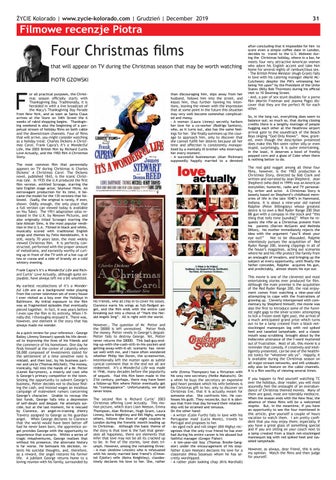
Four Christmas films that will appear on TV during the Christmas season that may be worth watching PIOTR GZOWSKI or all practical purposes, the Christmas season officially starts with Thanksgiving Day. Traditionally, it is heralded in with a live broadcast of the Macy’s Thanksgiving Day Parade from New York, and as soon as Santa Claus arrives at the Store on 34th Street the 6 weeks of rabid shopping begins. Thanksgiving weekend is also the beginning of a perpetual stream of holiday films on both cable and the downstream channels. Four of films that will arrive, you might consider watching as a holiday treat: Charles Dickens A Christmas Carol, Frank Capra’s It’s a Wonderful Life, the 2003 British film by Richard Curtis Love Actually, and the 1983 film A Christmas Story.
than discouraging him, slips away from her husband, follows him into the street, and kisses him, thus further fanning his intentions, leaving the viewer with the impression that at some point in the future this situation may very well become somewhat complicated and messy. - A woman (Laura Linney) secretly harbors her love for a co-worker (Rodrigo Santoro), who, as it turns out, also has the same feelings for her. She finally summons up the courage to approach him, only to discover that she cannot fulfill her desires because all her time and affection is consistently monopolized by a mentally ill brother who interrupts her every moment. - A successful businessman (Alan Rickman) supposedly happily married to a devoted
The most common film that perennially appears on TV during Christmas is Charles Dickens’ A Christmas Carol. The Dickens novel, published 1843, is the iconic Christmas tale. In 1935 the U.K produced the first film version, entitled Scrooge, starring the late English stage actor, Seymour Hicks. An extravagant production for its time, it became the model for the 135 versions that followed. (Sadly, the original is rarely, if ever, shown. Oddly enough, the only place that a full version can viewed today is available on You Tube). The 1951 adaptation (also released in the U.K. by Renown Pictures, and also originally titled Scrooge) starring the late Alistair Sims, is the most popular rendition in the U.S.A. Filmed in black and white, musically scored with traditional English songs and themes by Felix Mendelsohn, it is still, nearly 70 years later, the most widely viewed Christmas film. It is perfectly constructed, performed with the proper amount of melodrama, and earnestly worthy of curling up in front of the TV with of a hot cup of tea or cocoa and a side of brandy on a cold wintery evening.
As a quick review for your reference - George Bailey (Jimmy Stewart) spends his life devoted to improving the lives of his friends and the commerce of his hometown. One day he finds himself at the center of calamity when $8,000 composed of investments slated for the settlement of a time sensitive note is mislaid, and then lost, by his business partner and uncle (Thomas Mitchell). The money, ironically, fall into the hands of a Mr. Potter (Lionel Barrymore), a miserly old coot who is George’s primary competitor in the town. Seizing the opportunity to subvert George’s business, Potter decides not to disclose finding the cash, and instead wages an insidious campaign of malevolent rumors concerning George’s character. Unable to recoup the lost funds, George falls into a depression of self-doubt and despair. He attempts suicide, but at the last moment, he is rescued by Clarence, an angel-in-training (Henry Travers) assigned to George as his guardian angel. When George declares to Clarence that the world would have been better off had he never been born, the apprentice angel provides George with the opportunity to experience that scenario. Within a series of tragic misadventures, George realizes that without his presence, the alternate history is far worse. He bemoans his decision, relents his suicidal thoughts, and, therefore, as a reward, the angel restores his former life. A jubilant George returns home to a loving reunion with his family, surrounded by
So, in the long run, everything does seem to balance out; so much so, that during closing credits there is a lengthy montage of people hugging each other at the Heathrow airport arrival gate to the soundtrack of the Beach Boys singing “God Only Knows”. Now, granted, even though the description presented does make this film seem rather silly or even stupid, surprisingly, it is quite entertaining. In the least, it deserves a bowl of freshly popped corn and a glass of Coke when there is nothing better to do. The real gold nugget among all these four films, however, is the 1983 production A Christmas Story, directed by Bob Clark and written and narrated by Jean Shepherd. Jean Shepherd (who died in 1999) was an American storyteller, humorist, radio and TV personality, writer and actor. A Christmas Story is loosely based on Shepherd’s childhood memories of life in the late 1040’s in Hammond, Indiana. It is about a nine-year old named Ralphie (Peter Billingsley) whose greatest desire is to own a Red Ryder Range 200 Shot BB gun with a compass in the stock and “this thing that tells time [sundial]” When he requests the rifle as a Christmas present from his parents (Darren McGavin and Melinda Dillon), his mother immediately rejects the idea with the argument “you’ll shoot your eye out!” Not to be dissuaded, Ralphie relentlessly pursues the acquisition of Red Ryder Range 200, leaving clippings in all of the house’s magazines, acting out scenarios where he and his rifle protect the family from an onslaught of invaders, and bringing up the subject at every opportunity, until finally the father concedes, Ralphie acquires his gun, and predictably, almost shoots his eye out.
Frank Capra’s It’s a Wonderful Life and Richard Curtis’ Love Actually, although quite enjoyable, have always left me a bit unsettled. My earliest recollections of It’s a Wonderful Life are as a background noise playing from the corner television set of every house I ever visited as a boy over the Holidays in Baltimore. My initial exposure to the film was as fragmented episodes that eventually pieced together. In fact, it was years before I even saw the film in its entirety. When I finally did, I thoroughly enjoyed it. There was, however, one element in the story that has always made me wonder.
after concluding that it impossible for him to score even a simple coffee date in London, decides to travel to the U.S. Midwest during the Christmas holiday, where in a bar, he meets four very attractive American women who adore his English accent and take him home for several nights of rambunctious sex. - The British Prime Minister (Hugh Grant) falls in love with his catering manager (Marie McCutcheon) despite the PM’s witnessing her being ‘hit upon” by the President of the Unite States (Billy Bob Thornton) during his official visit to 10 Downing Street. - And, a pair of sex stunt doubles for a porno film (Martin Freeman and Joanna Page) discover that they are the perfect fit for each other.
his friends, who all chip in to cover his losses. Clarence earns his wings as full-fledged angel, and the film ends with the entire cast breaking out into a chorus of “Hark the Herald Angels Sing”. All is right with the world. However… The question of Mr. Potter and the $8000 is left unresolved. Potter finds the money. Potter revels in George’s despair. Potter fails to destroy George. Yet, Potter never returns the $8000. This bad-guy-ending-up-with-the-cash-still-in-his-pocket-and getting-away-with-it-all scenario has never sat well with me, and I have often wondered whether Philip Van Doren, the screenwriter, intentionally left the matter open as subtle cynical comment that in the end not all are redeemed. It’s a Wonderful Life was made in 1946, many decades before the popularity of sequels. Had this film been made in the 21st century, perhaps, there may have been a follow-up film where Potter eventually got his “comeuppance”. Unfortunately, we shall never know. The second film is Richard Curtis’ 2003 Christmas offering Love Actually. This motion picture, which stars Liam Neeson, Emma Thompson, Alan Rickman, Hugh Grant, Laura Linney, Keira Knightley and Bill Nighy, among others, follows the lives of eight couples in London during the frenetic month leading up to Christmas. Although the basic theme of the story is that love is the fuel that generates all happiness, there are elements that infer that love may not be all its cracked up to be. In five of the stories, love does triumph. However, among the remaining three: - A man (Andrew Lincoln) who is infatuated with his newly married best friend’s (Chiwetel Ejiofor) wife (Keira Knightley), clandestinely declares his love to her. She, rather
wife (Emma Thompson) has a flirtation with his sexy new secretary (Heike Makatsch). On a whim he buys the secretary an expensive gold heart pendant which his wife believes is his Christmas gift to her, only to discover on Christmas Eve, that it is actually meant for someone else. She confronts him. He confesses his guilt. They reconcile, but it is obvious that from that day forward their relationship will be strained and tenuous. On the other hand: - A writer (Colin Furth) falls in love with his Portuguese maid (Lucia Moniz), travels to Portugal and proposes to her. - An aged rock and roll singer (Bill Nighy) recognizes that the only true friend he has ever had during his entire career is his abused but faithful manager (Gregor Fisher) - A ten-year-old boy (Thomas Brodie-Sangster) under the encouragement of his stepfather (Liam Neeson) declares his love for a classmate (Nina Sosanya) whom he has secretly worshipped. - A rather plain looking chap (Kris Marshall)
This movie is one of the cleverest and most entertaining stories ever produced for film. Although the main premise is the acquisition of the Red Ryder Range 200, the real enjoyment comes from watching a nine-year-old attempting to cope with the frustrations of growing up. Cleverly interspersed with commentary by Shepherd himself, the movie was also the first to introduce some of the funniest sight gags to the silver screen– attempting to lick a frozen steel light post, the arrival of a much anticipated grand prize which turns out to be a lamp created from a black netstockinged mannequin leg with red spiked heel and tasseled lampshade, and a classic mouth soap scrubbing brought about by the indiscrete utterance of the f-word muttered out of frustration. Most of all, this movie is a reminder that comedy, if creatively and intelligently presented, can be one of the healthiest tonics for “whatever ails ya”. Happily, it is available during the Christmas season on all major stream networks, and will undoubtedly also be feature on the cable channels. It is a film worthy of viewing several times. If you happen to find yourself watching TC over the holidays, dear reader, you will most assuredly feel the onslaught of an overabundance of Christmas themed movies. Many of them are good, most are tolerably mediocre. When the season ends with the New Year, the absence of these films will be a welcomed respite. But, in the meantime, if you have an opportunity to see the four mentioned in this article, give yourself a couple of hours vacation to watch them. I am pretty confident that you may enjoy them; especially, if you have a great glass of something special and if you are sitting on your couch next to a lamp created from a black net-stockinged mannequin leg with red spiked heel and tasseled lampshade. However, as always, dear friend, this is only my opinion. Watch the films and then judge for yourself.