After crunching the numbers from the Fall 2014 semester, Washburn University oficials announced a drop in the number of students who found themselves on academic probation.
In previous years, the number of students on probation averaged over 400 per semester, but the most recent count saw those igures drop to under 300. Alan Bearman, Dean of University Libraries, feels the decline is a result of several factors, including the WU 101 course, posting mid-term grades for freshman and the various tutoring programs available on campus. He also points to the more upfront approach that faculty has been taking to academic advising.
“We’re starting to get much better at advising and being more direct with students about inding a schedule for success,” Bearman said. “It doesn’t make much sense to stick someone in class just because there’s an open seat.”
Of the students placed on academic probation, the majority tends to come from irst-year students who ind the path to higher education a little rockier than expected. Whether coming straight from high school or taking the non-traditional route, the adjustment to college life can be dificult. This is a situation the university is well aware of and taking steps to improve upon.
“We still have the second and third year students that wind up on probation and we’re building toward them. But historically, it’s that transition from high school to college is dificult.” Bearman said. “That’s why we’ve started heavily em-
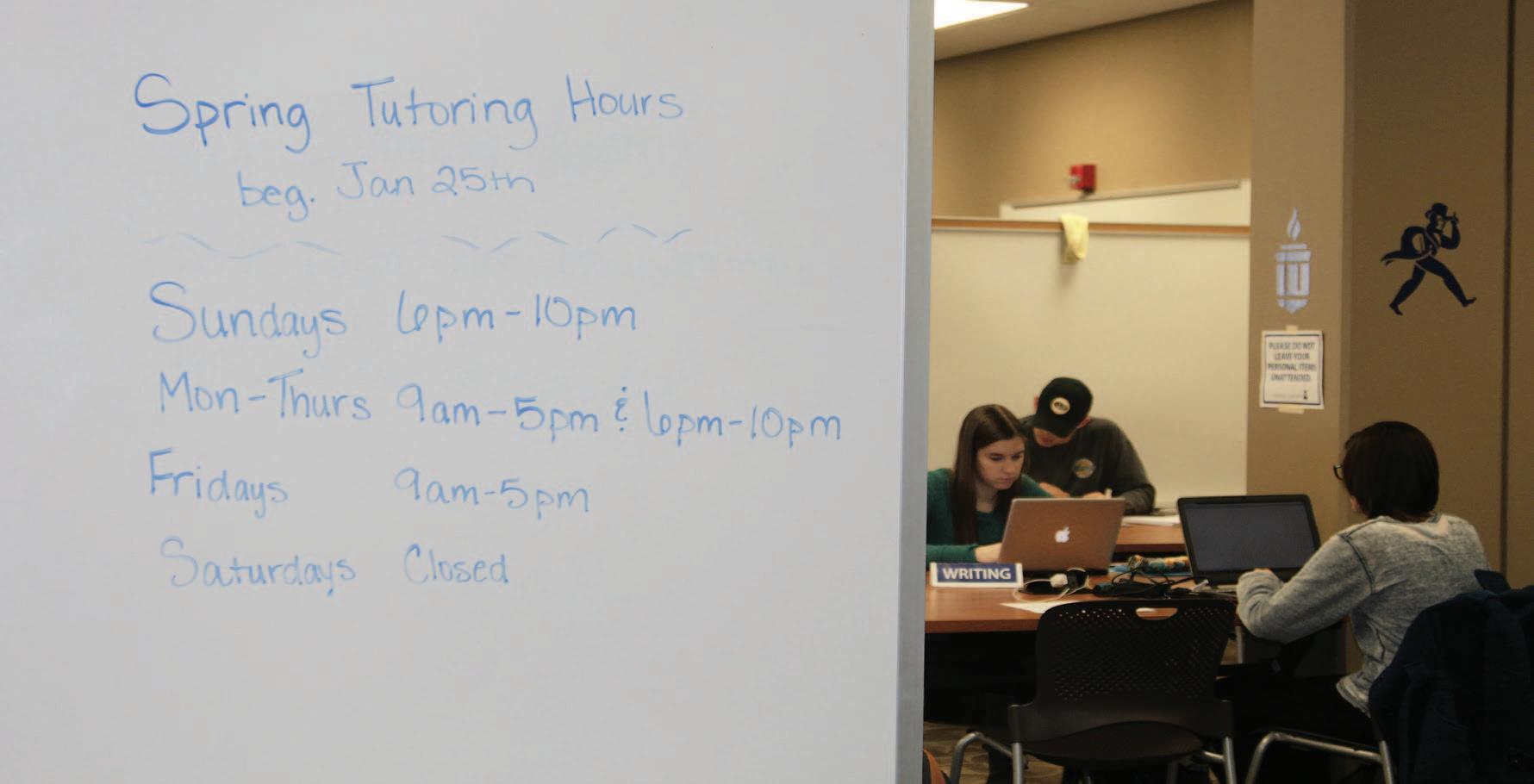
Hitting the Books: Mali Farwell spends her afternoon in the Mabee Library’s
among the many initatives put into place by administration to help promote academic success.
phasizing that outreach to irst year students. They’re the ones who often get overwhelmed and struggle.”
While the administration’s increasedemphasisonscheduling, studying and paving a smoother road for freshman has made a noticeable difference, Bearman credits the university as a whole for the academic improvements.
“Culturally, there’s a commitment at Washburn to help students succeed,” Bearman said. “I think that culture has always been here, but it’s really starting to lourish.”
The push for maximizing student potential starts at the top of the mountain with university president Jerry Farley and trickles down to the rest of campus.
“Farley leads from the front,” Bearman said when describing Farley’s hands-on involvement.
“He wants us to talk about student success constantly. You cannot give Farley enough cred-
it. He sets the tone for this culture and because he’s so committed to it, so are we.”
Of course, the silver lining of declining probation numbers is not without clouds, as a number of students who were in academic dire straits last fall opted to not return this semester. This is somewhat alarming for a university already suffering from a substantial drop in enrollment.
“That’s always a concern and we’re doing research right now to ind out why that is the case. Some of those reasons are obviously beyond the university’s control. Some parents will tell the student to come home and others will go to a community college,” Bearman said. “There is such a thing as positive attrition and that’s that we have to distinguish. Somebody may decide that they had a bad semester and take some time off. Anytime a student drops out, it’s a concern, but here’s a case
where we can identify who they are and we can igure out why.”
As the saying goes, the best offense is a good defense. Relating this to the world of academia, Bearman urges struggling students to take the initiative and utilize the resources available to them.
“We all need help at times and the number one thing a student can do is ask for help. Put your hand up and we’ll come running, like the Seventh Calvary,” Bearman said. “There are more students than there are faculty, so if you don’t put your hand up, you might get missed. If you hit a bump in the road, no matter how large or small, don’t hesitate to ask for help.”
Ryan Ogle, ryan.ogle@ washburn.edu, is a senior mass media major
Campus prepared if measles spreads to Kansas
Derek Richardson
WASHBURN REVIEW
Although a measles outbreak on campus is unlikely, Washburn’s Student Health Services has a plan to prevent the spread of any infectious disease. Kansas has yet to have a case of measles related to the southern California outbreak, which started late in 2014 and infected 125 people in seven states. All of 2014 saw the most number
of measles cases recorded in the United States since the 1990s totaling 644 cases in 17 states.
“I think anytime we have an infectious disease epidemic, we should all take notice,” said Shirley Dinkel, director of Student Health Services at Washburn.
However, she said she doesn’t think this is a situation that should induce panic in the area yet because of the age of the population that is on campus.
According the U.S. Centers for Disease Control and Prevention, measles can be serious in all age groups, but children younger than 5 years of age and adults older than 20 are more likely to suffer from complications. These complications can range from ear infections and diarrheatolunginfections,brain swelling and sometimes death. Symptoms of measles begin to appear about seven to 14 days after infection. Symptoms usu-
ally begin with a fever potentially higher than 104 degrees Fahrenheit, cough, runny nose and red, watery eyes. Between two and three days later, tiny white spots may appear inside the mouth. Three to ive days after symptoms begin, a rash breaks out, beginning as lat red spots that appear around the face and spread downward to the rest of the body.
Continued on page 4
Page 3: NO H8 organization to do photo shoot inTopeka to support LGBTQ.
Page 12: Washburn student’s senior exhibition ‘Gingerly Genuine’ entertains with various graphic designs and illustrations.
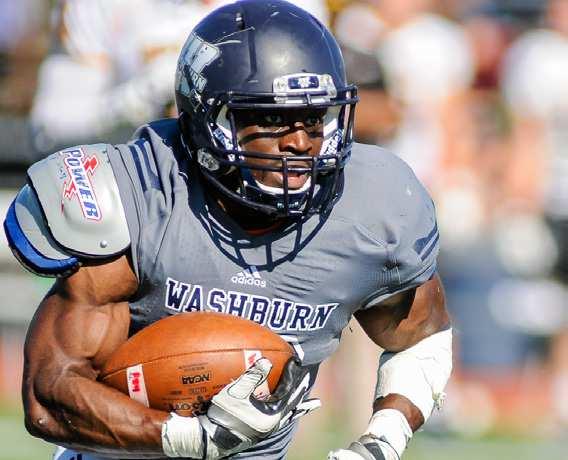
Page 10: Washburn running backVershon Moore heads to the NFL Regional Combine.
Campus Life
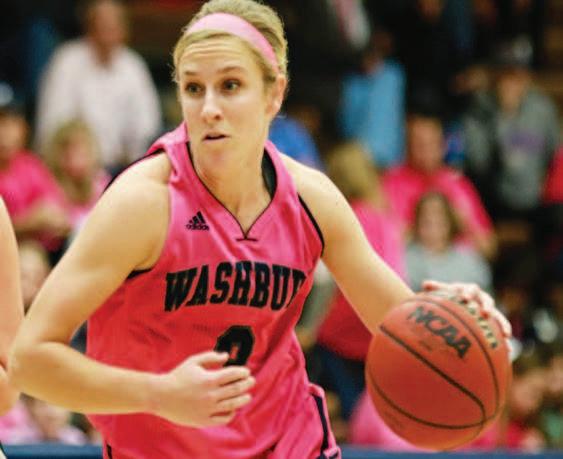
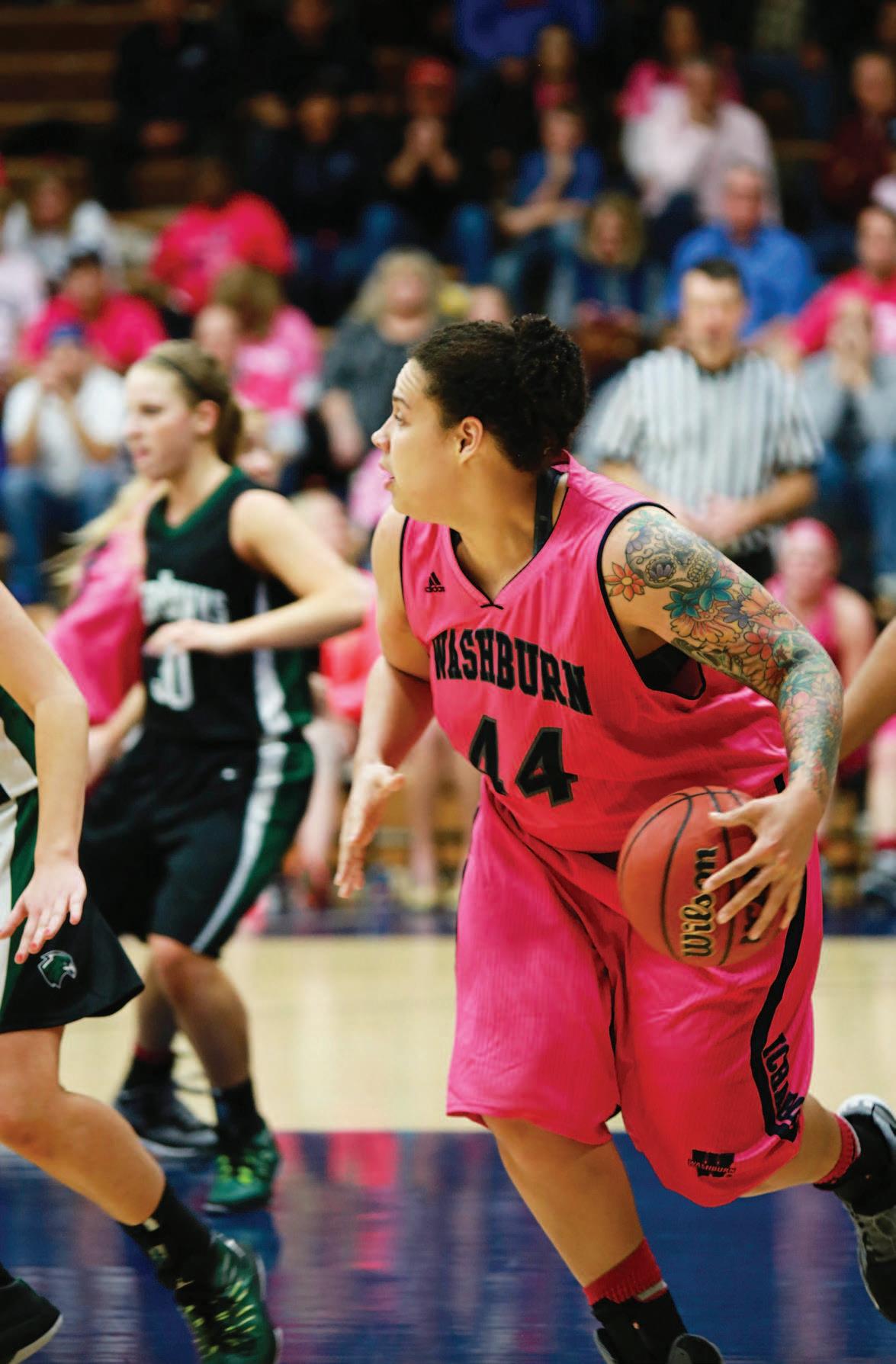
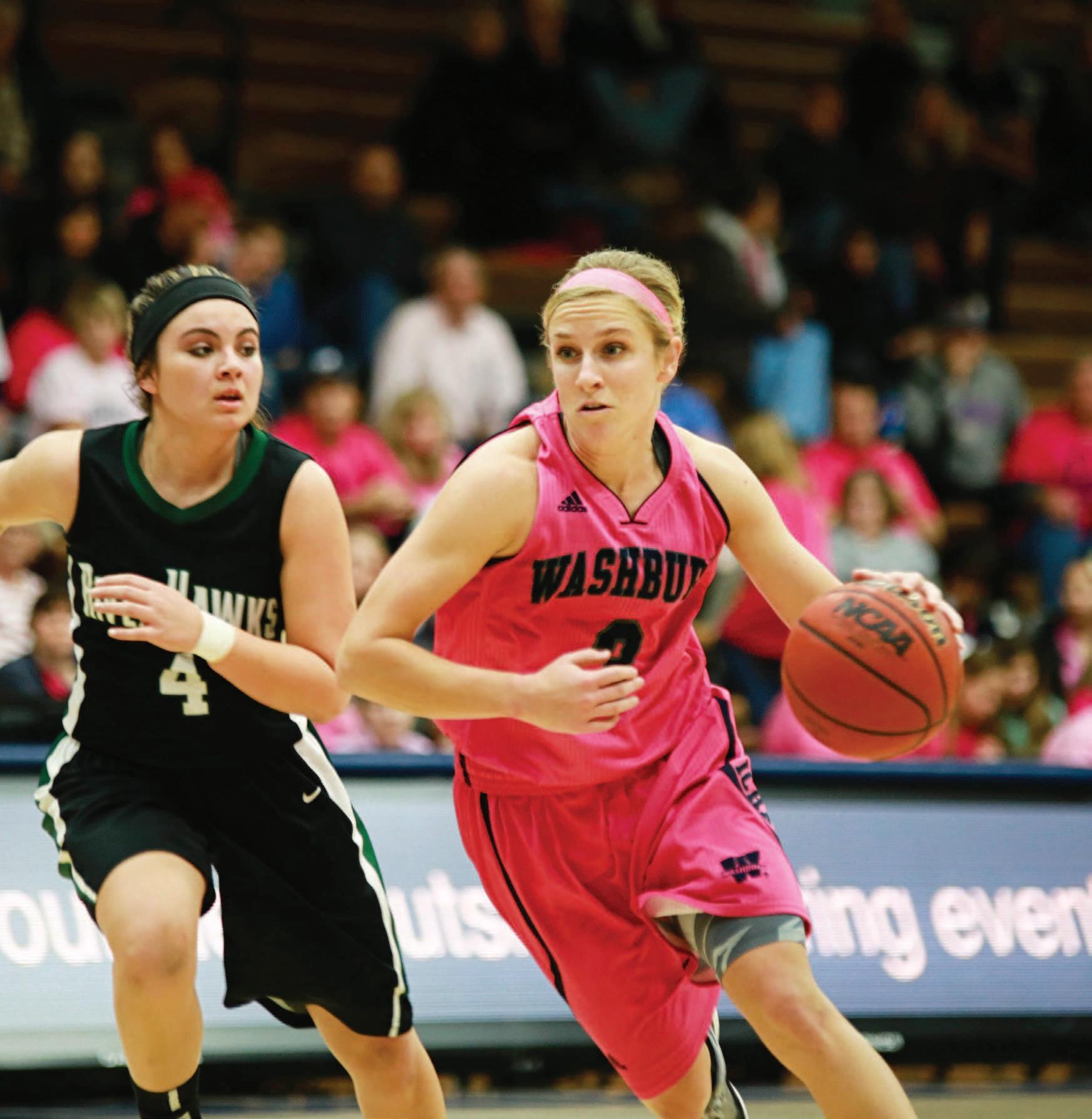
Page 6 & 7: Women’s basketball plays to support and raise money for breast cancer.
Ryan Ogle WASHBURN REVIEW
Photo by Stephanie Cannon
tutoring center. The tutoring center is
Calendar
Wednesday, February 18
Spring Career Fair
10:00 AM - 2:00 PM
Leadership Institute Advisory Board Meeting
11:30 AM - 1:30 PM
Ash Wednesday Mass
12:00 PM - 1:00 PM Free Creativity Lunch Group
12:00 PM - 1:00 PM
Women’s Basketball at Fort Hays State University
5:30 PM
Men’s Basketball at Fort Hays State University
7:30 PM
Thursday, February 19
Alumni Association: Wake up with Washburn
7:30 AM Neck up check up
8:00 AM - 5:00 PM
Chinese New Year Buffet
11:00 AM - 1:30 PM
Safe Zone ALLY Training
2:30 PM - 5:00 PM
Grocery Bingo!
7:00 PM
Friday, February 20
Daniel Coburn, New Works Neck up check up
8:00 AM - 5:00 PM
Men’s Tennis at Newman University
10:00 AM
Symposium on Kansas water issues
10:00 AM - 4:00 PM
Women’s Tennis at Newman University
10:00 AM
Saturday, February 21
Drift & Drag: Relections on Water
Masters at the Mulvane: Ninety Years of Collecting Neck up check up
8:00 AM - 5:00 PM
Alumni Association: Phoenix Area Luncheon
12:00 PM
Baseball vs. Southwest Baptist University
1:00 PM
Baseball vs. Southwest Baptist University
3:00 PM
Women’s Basketball vs. Emporia State University
5:00 PM
Men’s Basketball vs. Emporia State University
7:00 PM
Briefs
Medicare discussion
On Thursday, March 5 the Topeka-Shawnee County League ofWomenVotersTuesdayTopic meeting will welcome medicare expert Larry Weigel. He will be discussing the “Health Care Compact”. There will also be a few words given by Mayor Larry Wolgast about the upcoming election.
The meeting will take place at the public library, 1515 S.W. 10th St, and start at noon. The meeting is free and welcome to all. There is also an optional lunch for $8.25 that will begin at 11:30 a.m. before the meeting.
For more information on this event and about the League visit their website at http://
Dine-in fundraiser
On Thursday, March 5 the Washburn Kansas Correctional Association Student Chapter (KCA) will be having a fundraser atApplebee’s, 5928 S.W. 17th St. When you dine-in, 10 percent of your bill will be donated to the KCA Student chapter if you bring in the event lyer. You can ind the event lyer on the KCA Student Chapter facebook page or in the Criminal Justice Department located in Benton Hall. The fundraser will be from 11 a.m. until close at 1 a.m.
For more information visit the KCA Student chapter Facebook page by searching “KCA Student Chapter-Washburn Univer-
Blood drive
March is Red Cross Month so Red Cross is asking for further support from the public by asking them to donate blood.
There is always a need for blood donations, especially those with types O negative, A negative and B negative.
The next upcoming blood drive in Topeka will be held Monday, March 9 at the American Red Cross Kansas Capital Area Chapter, 1221 S.W. 17th St, from 1 p.m. until 4:15 p.m.
To donate blood or ind out more information download the Red Cross Blood Donor App, visit redcrossblood.org or call (800)RED-CROSS (800)7332767).
Mascot tryouts
Washburn is looking for an Ichabod mascot performer for the 2015-2016 school year. Tryouts will be on Tuesday, Feb. 24, but applicants must pre-register by Friday, Feb. 20.
Tryouts will include an interview session, followed by a performance audition. Performers must be current Washburn students and are selected by their appropriateness as well as entertainment value.
Ifselected,performersreceive $650 per semester. The job of the oficial mascot of Washburn University is to enhance audience spirit through exaggeration, and entertainment. Applications are available at www. washburn.edu/mascot.
For more information contact university relations at (785) 670-1154.
WFebruary 9
21:28 -Theft Play Station Games,West Hall. Report Taken: No suspect(s) at this time: investigation continues.
February 10
13:03 - Burglary/Theft From AVehicle: Nurses Bag and Cont., Parking lot 4. ReportTaken: No suspect(s) at this time: investigation continues.
iAlert emergency system
Stephanie Cannon WASHBURN REVIEW
The iAlert program, ran by a company called Rave Mobile Safety, works to keep Washburn and Washburn Tech students and faculty safe during times of extreme emergency. When activated, the iAlert system works to alert all active participants to life-threatening events, as decided by the Washburn Police Department.
Chris Enos, captain of the Washburn Police Department, explained what the system does, why the system is important and why it works.
“The iAlert system is used to notify participants if there are situations threatening the safety and security of the campus or closings due to severe weather,” Enos said. “If it’s a closing due to bad weather we usually just send a text message and the email, but not the phone call.”
“If you get a message from iAlert it is something you need to pay attention to,” Enos added. “This is only for pertinent, ongoing situations because we don’t ever want it to become so blasé that people ignore it.”
The WUPD will still send out emails if they believe that there
issomething that campusshould be aware of, but these will only be safety bulletins, not sent out to phones or by texts.
The ialert system sends approximately 682 text messages per second, allowing 85% of those it contacts to receive their message within 32 seconds. The success rate moves up to 90% after 1 minute and 15 seconds. Email notiied 85% of those contacted were informed within approximately 6 minutes.
In total, 9243 people were registered and contacted during Monday’s iAlert drill, with about 800 of them being from Washburn Technical College.
36%oftherecipients,or4,092 people, choose to be contacted by phone call, 3,407 of students and faculty chose to be alerted by text and all 9,243 were also issued an email alert, by default. Ifstudentswishtoenrollinthe iAlert program, or change their settings, they can visit www. washburn.edu/ialert. To change the settings they can click on the link to the left and then use their mywashburn ID and password to access their account.
Stephanie Cannon, stephanie. cannon@washburn.edu is a junior mass media major
February 14 16:13 -AttemptedVehicle Burglary Criminal Damage, Parking Lot 9. Report taken: Possible suspect found on video; not able to identify.
February 15
16:02 - Information Report/Possible Electronic Harassment, Morgan Hall. ReportTaken: Possible harassing text messages: investigation continues.
February 15
01:45 - Information Report, Disturbance, Living Learning Center. Report taken: Individual causing the disturbance was gone on Washburn University Police Arrival.
February 16
13:22 - Information Report, SuspiciousActivity,Washburn University Foundation. Report Taken: Suspicous letter picked up: investigation continues.
Jon Stewart to leave ‘The Daily Show’
Katie Wade WASHBURN REVIEW
Last Tuesday, Feb. 10, Jon Stewart announced that he would be taking his leave from “The Daily Show” later this year. In his announcement he noted that while he is still working out the details of his departure,hehasalotofideasofwhat to do with his future free-time.
“I’m going to have dinner on a school night with my family who I have heard, from multiple sources, are lovely people,” Stewart said.
Stewarthasbeenhosting“The Daily Show” since 1998.
Satire has always played a pivotal role in news media throughout history, yet in recent years, it has strongly taken form in alternative news programs hosted by comedians like Stewart.
There is a current perception that younger generations are turning away from traditional news sources and more towards programs like “The Daily Show.” But according to a survey conducted by the Pew Research Center in 2012, just 39 percent of the show’s nightly viewers are between the ages of 18 and 29, which is about 780,000 millennials, or 1.5 percent of the total millennial population.
Yet, on that 1.5 percent, Stewart has had a wide range of impact, mainly on how millennials perceive the news media and process news information.
Dr. Maria Stover of WU’s massmediadepartmentsaidthat while impact is hard to measure, Stewart’s inluence can be observed in how millennials have started reaching for more sources of information instead of just one traditional source.
“I think that there is indication that people who actually watch the show might be a little more informed,” said Stover, “because they choose to get their information from different sources. And this, to me, is a lot more important than any other impact…the reality is you don’t get your information from one source anymore. Nobody does.
show
Especially for this age demographic.”
Stover also noted that it is important to keep in mind that “The Daily Show” was always intended to be satirical and that Stewart never tried to be a real anchor. This can be where the deinition of “fake news” gets a little confusing for viewers. The news itself is not faked, but the way in which the show portrays the news, its platform, is. Stewart acted more as a court jester of sorts, mocking actual news anchors, and this is where his true value lies.
“What do court jesters do? They entertain the court,” Stover said. “But they are usually the ones who can get away with pointing out uncomfortable truth because they’ll put them in the guise of humor, satire, and then everybody would laugh at those things. But if you were to say those same things in a serious manner in, say, the place of the king, you’d probably end up dead.”
In a recent interview with CNN, comedian John Fugelsang discussed the power of political satire.
“We’re in an age where we trade information for access,” said Fugelsang. “And all too often in some media outlets, they don’t want to ask the tough questions because they’re afraid of losing the booking. By being a comedy show irst, you can take those on because you care about the truth and getting the laugh more than getting the return booking. And that’s why the show had so much power.
That’s why they were fearless.”
It is a combination of that fearlessness and strength in comedy that won the hearts of so many viewers.
Jack Vandeleuv, sophomore English major with a writing emphasis, said he has been watching the show longer than he’s known or cared about politics.
“Actually, I think it’s what made me politically aware in the irst place,” Vandeleuv said. “I’m sure many people watch ‘The Daily Show’ because it’s funny, and for no other reason. But for me it’s more than that. Cleverly written satire gets at important issues and keeps your attention in a way that straight news can’t. It’s a rhetorical guitar solo, the political equivalent of a inishing move.”
Vandeleuv said he’s seen every episode since 2010.
Since its irst airing, “The Daily Show” has featured many faces as correspondents and members of the production team who also went on to become big names in satire and comedy including Stephen Colbert, Kristen Schaal, John Oliver and Steve Carrell. During the announcement of his departure, Stewart said that he doesn’t think he will miss being on television, but rather he will miss coming in to work with the people of “The Daily Show.”
In his announcement, Stewart decided to forgo the farewell speech until its appropriate time, and opted, instead, to simply say this:
“It’s been an absolute privilege. It’s been the honor of my professional life. And I thank you for watching it, for hateing watching it, whatever reason you were tuning in for. You get inthisbusinesswiththeideathat maybe you have a point of view and something to express. And to receive feedback from that is the greatest feeling I could ask for.And I thank you.”
Katie Wade, katie.wade@ washburn.edu, is a sophomore mass media major.
Topekarankedamongmost affordable cities in country
Grace Foiles WASHBURN REVIEW
Topeka, Kansas, was ranked oneofLivability’s“BestAffordable Places to Live” in 2015.
Livability is a website that investigates what makes small to mid-sized cities great places to live, work and visit. The website looks at categories relating to livability such as walkability, amenities, transportation and sustainability through exclusive research and discussion.
“Wecelebratetheaccomplishments of these cities through our monthly top 10 lists, our annual rankingoflivablecities,ourrich photography and conversations with readers in social media,” said Matt Carmichael, editor of Livability, in a recent press release.
DataiscollectedfromtheU.S. Department of Housing and Urban Development and from the Council for Community and Economic Research along with examining the tax climate in each state to determine cost of living. Topeka ranked ninth on the list while Round Rock, Texas, ranked irst.
Accordingtothepressrelease, Topeka residents’ cost of living was more than 7 percent below the national average.Area home costs were approximately 18 percent below most U.S. cities and the unemployment rate is at
4.3 percent.
The median home value in Topeka was found to be $95,600 with most residents spending less than 27 percent of their income for housing costs.
“I think it’s probably because not a lot of people live or want to live inTopeka, so there isn’t a high demand for housing here,” said Adrianna Hendricks, a freshman anthropology major, who hails from Westminster, Colorado.
One of the draws to Topeka, for Hendricks, was Washburn University. She said that tuition is lower and she felt that has to do with big versus small towns. Hendricks also said that while the food at Washburn lacks variety, it is well paid for.
“I think it’s pretty nice that people can live their lives without having to worry as much about money,” said Corey Perkins, a sophomore theatre and English writing major and Topeka native.
Livability further supports theirdecisionbyacknowledging that Topeka contains affordable independent restaurants and coffee shops, as well as popular parks, such as Gage Park and the Topeka Zoo.
Grace Foiles, grace.foiles@ washburn.edu, is an undeclared sophomore
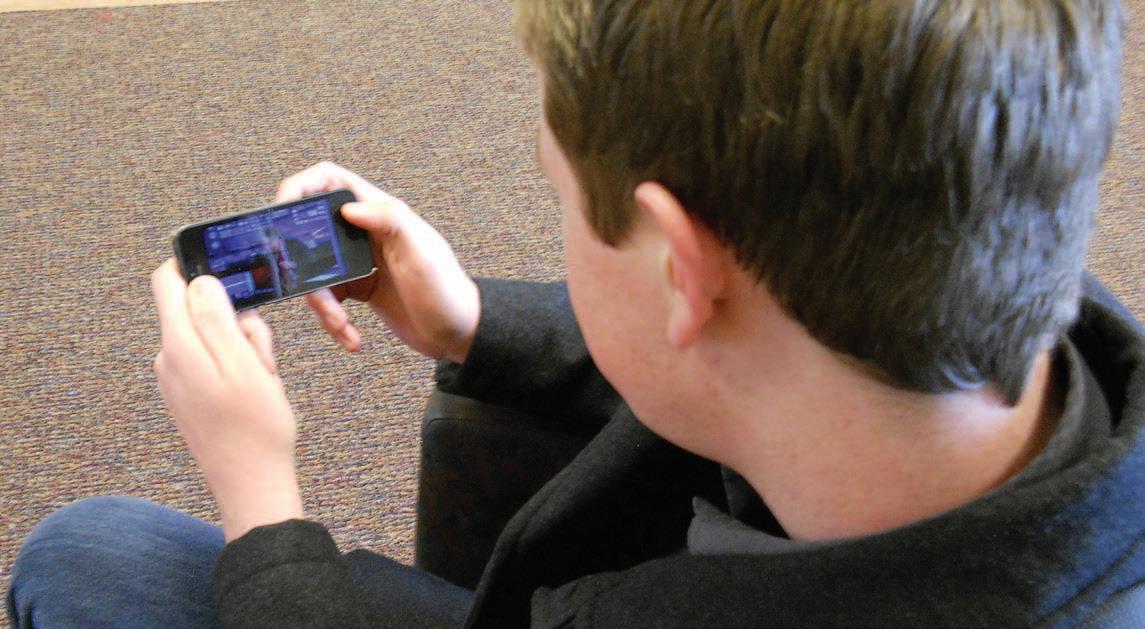
Photo courtesy of Jack Vandeleuv
THE DAILY SHOW: Washburn student Jack Vandeleuv watches “The Daily Show” on his cell phone.
Photo by Ryan Ogle
AFFORDABILITY: Livability ranked Topeka as one of the most affordable places to live in 2015.
Washburn prepared for measles
Continued from page 1..
The CDC recommends all children get two doses of the measles, mumps and rubella vaccine, the irst at about 1 year old and a second between 4 and 6 years of age. Adults who are not vaccinated should get at least one dose of the MMR vaccine.
“Most people who come here are up to date with all their childhood vaccinations,” Dinkel said, concerning students attending Washburn.
Dinkel said Student Health Services’ irst job if someone with an infectious disease is identiied is to isolate that person in order to prevent the spread of the disease while simultaneously contacting the Kansas Department of Health and Environment.
According to KDHE guidelines, each infected person is to be isolated for four days after the onset of the rash, and any susceptible person in a school or daycare is to be vaccinated within 24 hours after being notiied or stay home for 21 days after the last reported illness.
“The challenge with measles is that it spreads really easy,” Dinkel said. “With tuberculosis, you have to have some pretty close contact, but with measles, it is very contagious.”
Measles was declared nearly eradicated in the U.S. in 2000 due to a situation called community immunity (occasionally called herd immunity) which occurs when a large enough percentage of a population is vaccinated. Even people not vaccinated, such as infants, are offered some protection because there is little opportunity for the virus to spread. For measles, about 92 to 94 percent of people need to be immunized for herd immunity to protect the whole population.
The MMR vaccine was developed in the 1950s and over the decades, the number of infections in the United States fell from 3 to 4 million a year to only 37 in 2004. But recently immunization rates have begun to decline in certain areas partially due to growing misconceptions that have linked vaccines to autism.
“There is no evidence to support that vaccines cause autism,” Dinkel said.
The speculation of a link between vaccines and autism began in 1998 when a study published in the Lancet, a United Kingdom medical journal, followed 12 children and their developmental regression in gastrointestinal symptoms. Nine of those children had autism. Eight of those nine parents thought the symptoms of autism developed after receiving the MMR vaccine. It was only a correlation, and was neither a randomized control nor a scientiic study.
The study spurred lots of questions about whether vaccines can cause autism, but study after study over the last 15 years, with bigger population samples and randomized controls, showed no link.
GRACE RETAIL LIQUOR
Dinkel said vaccines are very safe, and most of the vaccines children receive are very effective, but nothing is without risk.
“As long as we are informed about what those risks are, then we as grown-ups in the United States can make our own decisions about what we are going to do with that,” Dinkel said.
If students have questions or concerns, Dinkel said Student Health Services would be happy to answer them. She said students should remember the good things that their grandmas taught them about being sick.
“Wash your hands, cover your mouth, cough into your elbow, don’t cough into your hand and stay home,” Dinkel said.
Derek Richardson, derek. richardson@washburn.edu, is a junior mass media major
NOH8 to host shoot
The NOH8 Campaign for Equal Human Rights is hosting an open photo shoot at the Equality House on Tuesday March 10, from 4 p.m. to 7 p.m.
The photo shoot is a fundraiser event to help raise money for the organization, which seeks to promote marriage, gender and human equality through a varietyofmediums,includingphoto shoots like this one.
At last count, over one thousand people have signed up via Facebook to attend the event. The event seems amply timed in light of Gov. Sam Brownback’s recent bill that rescinded a state protection policy for LGBT workers against discrimination.
The NOH8 Campaign is a national campaign that was started in 2008 by photographer Adam Bouska and Jeff Parshley. The campaign was originally started in protest of the passage of Proposition 8, a California state constitutional amendment that provided that marriage would only be recognized between a man and a woman. Proposition 8 was ruled unconstitutional in 2013, but the NOH8 campaign is continuing to be a spearhead for equal human rights.
The location of the photo shoot will be the Equality House, located across the street from Westboro Baptist Church.
The Equality House is a product of the Planting Peace nonproit organization, and will be catering to the NOH8 Campaign during their Topeka visit.
Options for the photo shoot will include solo shots, which cost forty dollars, and more affordablegroupandcoupleshots, which cost twenty-ive dollars per person. The event will be run by Bouska, who will take ive to ten shots of each person, then pick one to edit before releasing it to the public.
Topekans choosing to be models for the shoot are advised to wear a white T-shirt. Included in the photo shoot are staples of the NOH8 campaign, such as duct tape being placed over the mouth of the person being photographed and a NOH8 temporary tattoo being placed on the person’s face.
Themoneyraisedbytheevent will go towards efforts to raise awareness for marriage, gender and human equality, along with promoting anti-discrimination. The money will also go towards bringing the campaign to other cities following its stay in Topeka.
Those interested in volunteering at the event should contact info@noh8campaign.com.
Mark Feuerborn, mark. feuerborn@washburn.edu, is a freshman radiology major
Graphic by Chelsea Howe
What an Ichabod can and cannot be
This university is named after a man who, through his generosity, saved it from inancial ruin when he donated $25,000 in 1868. $25,000 in 1868 would equate to about $438,000 in 2014.
A month after Lincoln College received this large endowment, the school was renamed after the donor, Ichabod Washburn.
Thisisthestorythatistoldoften atWashburn, especially with the celebration of the sesquicentenial.
What most people don’t know is that there was another donor to the college, and that person was also a Washburn.
Ann Brown Washburn, the wife of Ichabod, also donated money to the school after her
husband’s death. But seemingly nothing is done to remember her or honor her.
The Washburn Ichabod mascot has always been depicted as aman-themanwiththetophat. But we are not Ichabod University; we are Washburn University, andAnn was a Washburn.
There is no need for a complete overhaul of the mascot, but it doesn’t seem too much to ask that the school’s mascot be allowed to be represented by more than strictly a male.
There are many possibilities to incorporate women into Washburn’s display of pride and school spirit, but one in speciic would make a big statement.Albeit, the opportunity is months off, but it’s something to start thinking about now.
In honor of the release of its fantastic lop-of-a-ilm adaptation, today we recognize British “author“ E. L. James and her terrible novel, Fifty Shades of Grey (and its subsequent sequels). Congratulations E. L. James, who knew it was possible to make such a mockery of BDSM, healthy relationships and the english language, all at the same time?
The titular character, Christian Grey, is an abusive, emotionally manipulative piece of trash that James attempts to pass off as “Mr. Right.” Doing this normalizes and romantasiz-
es abusive relationships. When young women read about Christian stalking Annastasia (the main character), by tracking her cellphoneorliterallybuyingthe company she goes to work for, they are told these are romantic, protective gestures instead of the actions of an insane, obsessive monster.
When a basic google search will leave a person more well-informed about BDSM and the surrounding community than your entire book series does, you may want to rethink your writing skills. In fact, the mantra of the BDSM commu-
The mascot of the Ichabod has been depicted as an astornaut, a cage ighter, a superhero, a fellow student, and on and on, all of which Ichabod Washburn was none.
Soitisevidentthatthemascot can be something that Ichabod Washburn was not.
So for homecoming 2015, why can’t the mascot be a woman?
In 2014, lyers showed a strong, very muscular Ichabod punching through a wall.
Is that the only idea or way to express strength? Does the mascothavetobeabig,machoman, or superhero, or whatever?
There are so many different angles from which the design and portrayal of Washburn’s mascot as a woman would offer.
Each
For one, it would make a critical statement that heroes and strength are not concepts exclusive to men.
As equal counterparts to men, women, and a “woman Ichabod,” would still represent the same values that Washburn believes in, but would offer a plethora of diversity which has not been explored.
Centering the homecoming theme around a woman Ichabod would open so many doors to students’ creativity and call for brand new minds with brand new ideas to be utilized.
At this point in time, in the year 2015, it seems like an appropriate time to allow women to equally represent Washburn, and a female Ichabod homecoming would be a great start.
nity is Safe, Sane, and Consensual. Christian Grey’s portrayal of a “Dominate” is absolutely none of those things. He wants the still virginal (and completely sexually inexperienced) Annastasia to sign a contract to become his “Submissive”. The contract also dictated what she was allowed to wear and when she had to work out. He often ignores her refusals for sex and uses sex as a weapon to manipulateAnnastasia. James also uses the trope of a “dark and tragic past“ as an excuse for Grey’s awful behavior.
This former Twilight fanf-
ic is an insult to every healthy consenting relationship and to all other written words. A better novel could be written by throwing darts at a dictionary and randomly placing the words hit into sentences.
So thank you E. L. James, for giving us the opportunity to view such a painfully inaccurate and harmful portrayal of sexual exploration which was actually sexual exploitation and outright abuse. And to all fans of the novel, here’s hoping that you never “ind your own Christian Grey” because you deserve so much better.
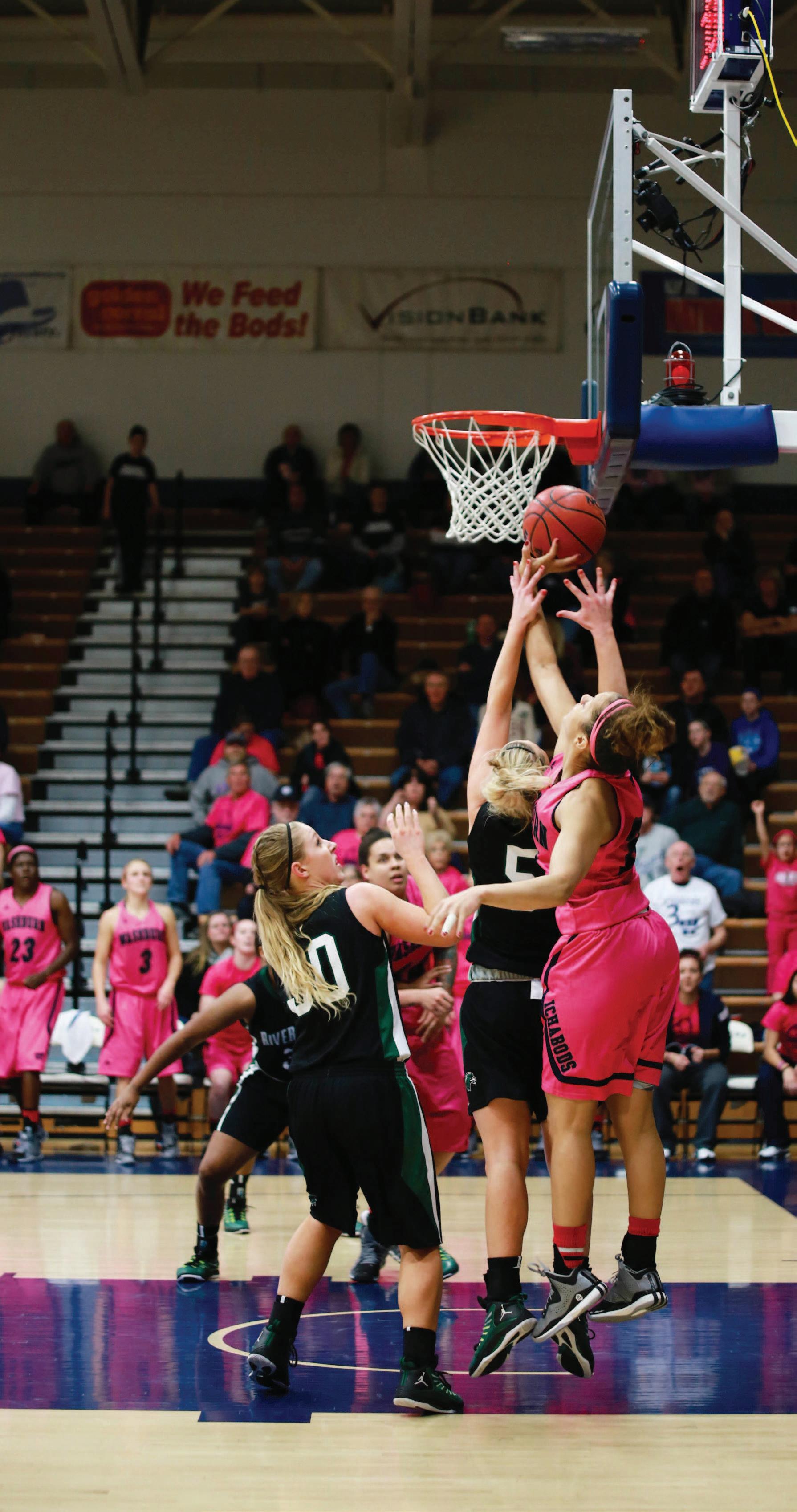
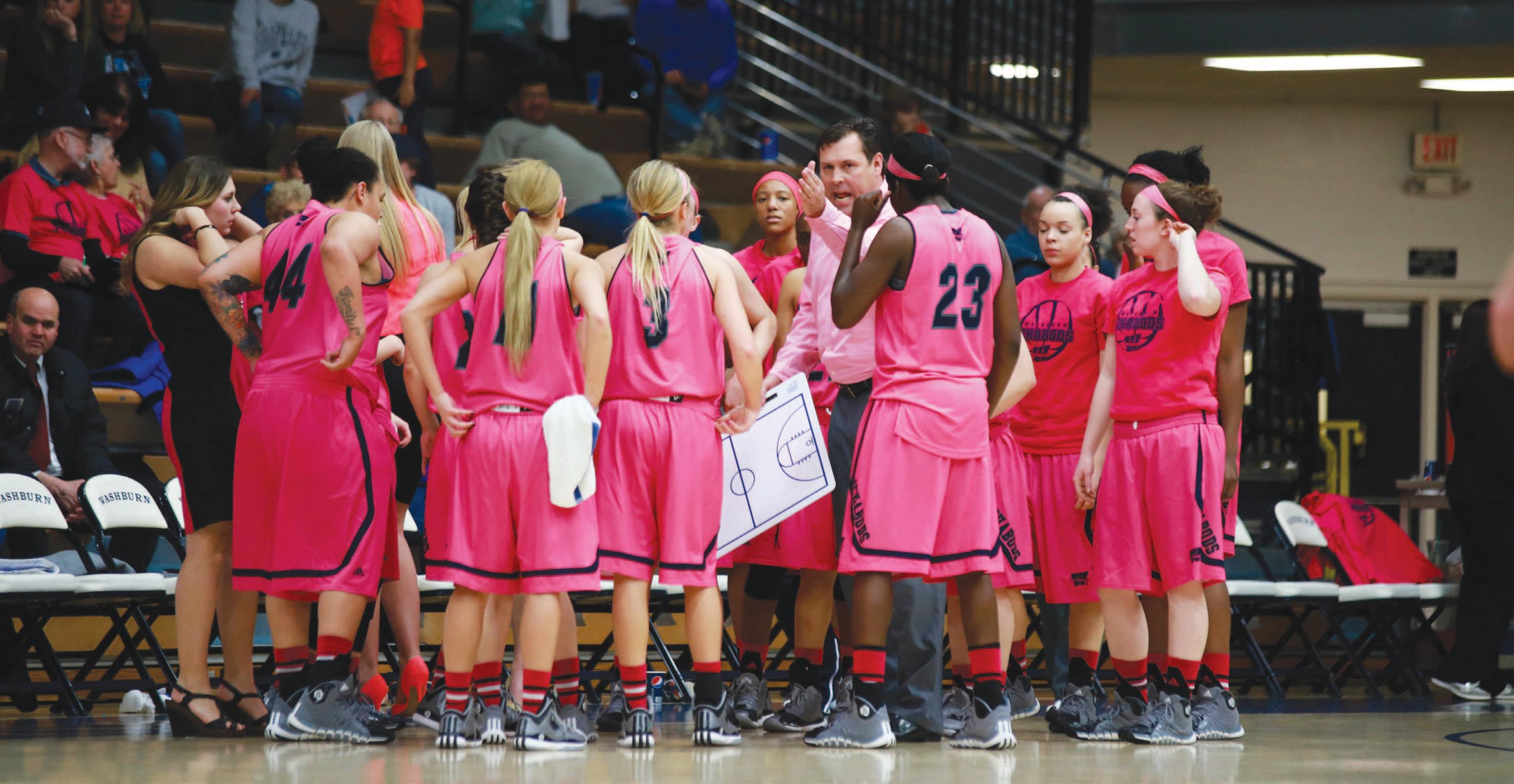
Washburn women’s basketball players Play 4Kay and breast cancer awareness
Above: The Ichabods and the Riverhawks engage in a vertical battle as members of both teams leap for the rebound.
Above: Head coach Ron McHenry calls the women to gather round for instruction during a timeout in the Play 4Kay game Saturday, Feb. 15. Play 4Kay, a movement and organization named after former North Carolina State University women’s basketball coach Kay Yow, raises money for breast cancer research and those battling the disease.
Below: Senior center Honor Duvall looks for an open teammate as she moves through the paint.
Below: Senior guard Casyn Buchman drives the court with a deffender struggling to keep up.
Photos by Ashish Rijal
Local roller derby squad crushes fast-track competition
Ryan Ogle WASHBURN REVIEW
Hardly a new phenomenon, roller derby is experiencing a surge in popularity around Topeka thanks to a group of local women collectively known as The Capital City Crushers.
Formed in the summer of 2007, the Crushers are Topeka’s lone women’s lat track roller derby team and, to put it bluntly, they kick butt and take names.
Far removed from the ixed, glamor-laden bouts that were featured on late-night TV in the ‘70s and ‘80s, roller derby has become an organized and high-
ly competitive sport in recent years.
Olivia Marshall, a senior mass media major at Washburn, joined the team a little over a year ago after being invited to practice by a friend.
“I didn’t know anything about derby at all. I really didn’t even know how to skate,” Marshall said. “But I showed up to every practice and trained with the team.”
While she only participated in two bouts last season, Marshall is ready to go all-in with the Crushers when the 2015 kicks off next month. To get ready to rumble, Marshall spent the off-season getting physically and mentally prepping herself.
“I haven’t ever really been an athlete, but you kind of have to be,” Marshall said. “Even though the jams are only two minutes long, it’s a really intense two minutes. I started lifting weights at the gym, which helped me get enough strength and endurance to compete.”
Junior environmental biology major Caitlin Haggard has been with the Crushers since 2009 and recently put the skates back on after serving as coach for the
last two seasons. Like Marshall, Haggard knew little about roller derby before being invited to a practice and hasn’t looked back since.
Skating under the on-track alias of Seam Rip-Her, a nod to her job as a seamstress, Haggard has discovered a world of growth and accomplishment through roller derby. And it’s a world she encourages everyone to experience.
“A lot of women who come into derby join because they’re missing something in their life,” Haggard said. “They need a hobby, a workout or something fun to do. They may have had a loss in their life or a divorce, so derby helps ill that void and empowers them. We put a lot of focus on being all-inclusive, regardless of age, body type or athletic ability. We train players from the ground up and put a lot of emphasis on what your body can do and what it’s capable of doing, instead of what it looks like and how much you weigh.”
Physical beneits aside, Haggard sees roller derby as a cathartic experience that she, along with many other women, have used to unlock previously
unseen personal potential.
“People may be timid off the track, but can come into derby and be accepted no matter what. You can really open up and be yourself. It’s a very supportive place where you can let your true personality out,” Haggard said. “We have business professionals, nurses, teachers; we have a lot of teachers on the team coming in with all this pent-up anger they can let out on the track. You don’t have to hide anything or hold back on
the track.”
The Crushers season opener will take place on Sunday, March 8 at Sk8Away, located at 815 SW Fairlawn Rd.
For details and ticket information, visit www.capitalcitycrushers.net.
Ryan Ogle, ryan.ogle@washburn.edu, is a senior mass media major
Women’s basketball falls to Central Oklahoma Bronchos Ichabods’ Salach, Wiggins leadteamtovictoryoverUCO
Tyler Feist
WASHBURN REVIEW
On Thursday, Feb. 12, the Washburn women’s basketball team hosted the Central Oklahoma Bronchos.
The two teams came into the game tied for sixth place in the MIAA with records of 7-7. The Ichabods beat UCO 55-50 earlier this year and the Bronchos were looking for revenge.
Washburn started the game hot from behind the 3-point line which led them to a 12-7 lead.
The rest of the half Washburn struggled to take care of the ball and turned it over nine times. UCO took advantage of those mistakes and inished the irst half with 13 points off turnovers. UCO also dominated in thepaint,wheretheyhada 22-4 advantage over WU.
Hot shooting and a run late in the irst half led to UCO leading 40-28 at halftime.
WU shot 63 percent from three point range, but shot only 39 percent from the ield in the irst
half. UCO was shooting 52 percent from the ield and relied on their defense to create points on the offensive end.
UCO got off to an even better start in the second half.After an 11-3 run and Washburn struggling to score, UCO gained a 5736 lead. For the rest of the game, Washburn’s Casyn Buchman and Taylor Ignoto caught ire and kept cutting into the big UCO lead.
Unfortunately, the closest WU got was within 10 after Ignoto made a lay-up late in the game to make the score 70-60. Eventually UCO would seal the deal and win the game 7564.
Even though the IchabodsoutreboundedUCO 43-26, WU continued to struggle shooting the ball and inished shooting 36 percent from the ield. They could not connect from three in the second half and inished shooting just 31 percent from behind the arc. And unlike all season long,WU struggled from the free throw
line and hit only 12 out of their 20 free throws.
UCOrodetheirirsthalf momentum and inished shooting 53 percent from the ield and 91 percent from the free throw line.
The Bronchos picked up a huge road win.
Offensively, WU relied heavily on two of their seniors - Casyn Buchman and Taylor Ignoto - for most of the game. The two guards played aggressively and combined inished with 41 of WU’s 64 total points. Ignoto shot 8-16 from the ield, made 4 3-pointers and led the Ichabods in scoring with 21 points. Buchman shot 6-14 from the ield, made 3 3-pointers, went 5-6 from the free throw line and inished with 20 points.
Tyler Feist, tyler.feist@ washburn.edu, is a freshman business major.
The Washburn men’s basketball team faced off against Central Oklahoma at home Thursday night.
Central Oklahoma (158, 8-6) was on a 2-game winning streak heading into the match up against the Ichabods. Washburn (11-14, 6-8) had lost 4 of their past 5 games and were looking to get back on track.
Washburn got off to a slow start and did not have a ield goal until Alex North hit a 3-pointer after ive and half minutes into the irst half.
The Ichabods eventually got it going offensively and Kyle Wiggins hit three consecutive 3-pointers to giveWashburn a 2521 lead with ive minutes remaining in the half.
Then with about a minute remaining in the irst half, David Salach had two consecutive alley-oop dunks and got everyone in Lee Arena on their feet and ired up.
WU went into the locker room at halftime up 3531.
WU shot 38 percent from the ield and 39 percent from 3-point range. Their offensive eficiency was not impressive but they were getting offensive rebounds and had 9 second chance points in the irst half. Kyle Wiggins had 11 points at halftime.
OCU was down at half, but shooting the ball well. They shot 50 percent from the ield and 42 percent from behind the 3-point line.
It was an exciting and competitive second half for both teams. With under twelve minutes to go, David Salach had a one-and-one put back tip in that gave WU a 51-45 lead. Salach also had a monster dunk over a UCO player with two minutes left and once again got everyone in LeeArena going crazy.
After that play, Salach had a block that led to a Kyle Wiggins steal and transition layup to put the Ichabods up 65-59 with 1:45 left.
Late free throws made by WU would seal the
game and give the home team a 71-65 victory. WU inished shooting 39 percent from the ield and from 3-point range. The Ichabods got it done at the free throw line, where they shot 71 percent. WU scored 38 points off the bench.
OCU cooled off and inished shooting 41 percent from the ield and 29 percent from the three point line.
Freshman forward David Salach had a tremendous game for Washburn. He had three dunks, made two key defensive plays late in the game, brought great energy off the bench and got all the fans pumped up.
Salach inished with 13 points and 9 rebounds. Kyle Wiggins inished with 19 points and 5 rebounds.Andy Wilson shot the ball well and scored 11 points and Kevin House also inished with 11 points.
Tyler Feist, tyler.feist@ washburn.edu, is a freshman business major.
Photos by Ryan Ogle
Tyler Feist Washburn Review
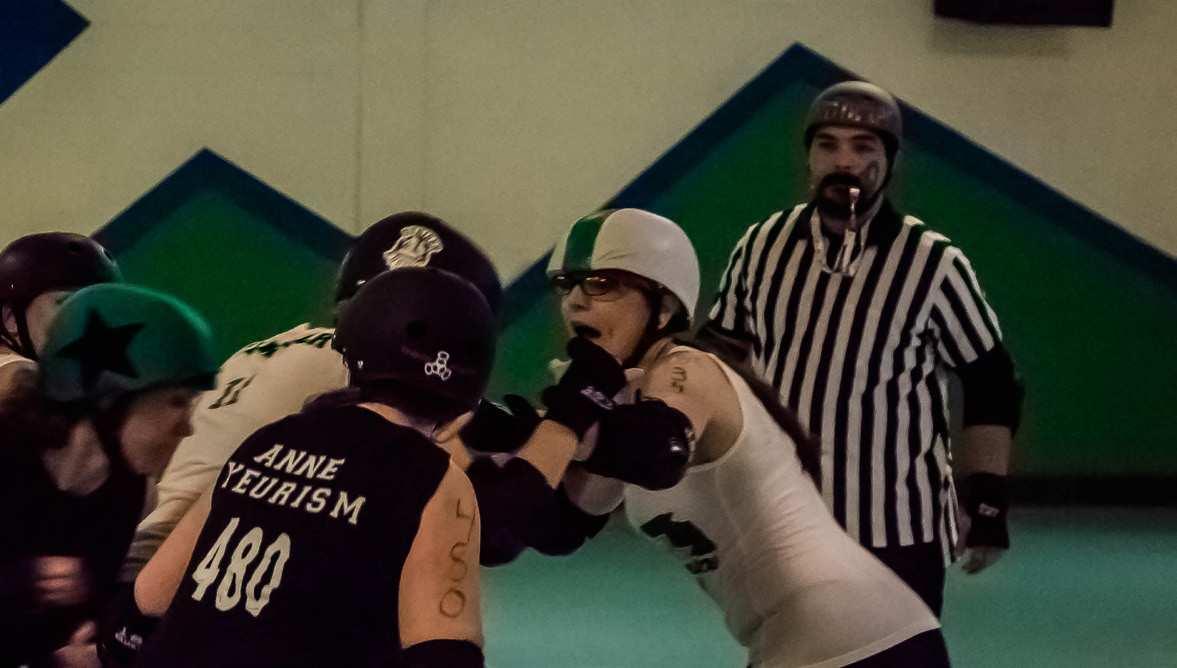
Rolling Over the Competition: Washburn’s Caitlin Haggard, wearing the green-striped white helmet, shows off her lat track skills during a pre-season scrimmage bout at Topeka’s Sk8Away roller rink. Haggard has been involved with roller derby since 2009.
Time to Jam: Olivia Marshall, AKA Olive Guardin’, bolts past a group of blockers.
Douglas baseball era beginswithdominance
Tyler Feist WASHBURN REVIEW
Washburn’s baseball team started its season Friday, Feb. 13, at home against Bemidji State. It was the start of a new era as this was Harley Douglas’ irst gameastheheadcoach-theirsttimethe Washburn baseball had a new head coach in more than 30 years.
For Washburn, the irst inning was about as good of a start to a season as any coach could ask for. During the bottom of the irst, Parker Gibson led off the inning by getting hit by a pitch and then used his speed to steal second base.
Riley Krane then bunted for a base hit and advanced Gibson to third base. Kyle Carnahan then followed that up with another bunt and an error by the BSU pitcher gave Washburn their irst run of the season with two runners still on base.
The next batter was David Gauntt, and in his irst at bat of the season he cranked a three-run home run to deep left center ield.
It was now 4-0 and the Ichabods were just getting started. Later in the inning Tanner Triggs had an RBI double that scored Connor Crimmins. In each of their second at bats of the irst inning, Gibson, Krane and Kyle Carnahan hit a combined 4 RBIs.
After several hits by Washburn, three errors and a pitching change by BSU, the
Ichabods were off to a quick 10-0 start in the irst inning.
Sophomore pitcher Maustin Otterstatter got the start on the mound for Washburn. He threw ive solid innings and only gave up 3 hits, 1 run, and struck out 5 batters. Otterstatter received help from his defense including a 6-4-3 double play to end the fourth inning. He did not give BSU many opportunities to score, but he gave up a solo home run in the ifth inning.
Dan Gabler came in relief and pitched the sixth and seventh innings. In two innings he gave up three runs, but only two of them were earned. He recorded one strike out and did not allow a walk.
Spencer Schwandt threw in the eighth inning and looked comfortable and conident. He struck out all three batters he faced.
To close out the game, Reed Morton threw the ninth inning and got three consecutive outs including one strikeout.
Washburn ended up winning their irst game 20-4. With 20 runs scored and 18 hits, the Ichabods showed off their offensive power and got off to a solid start to their season.
Washburn baseball team will face Southwest Baptist in their irst conference game Friday, Feb. 20.
Tyler Feist, tyler.feist@washburn.edu, is a freshman business major.
Trevin Edelman writes about sports skits from the SNL 40th anniversary in this week’s
Ichabods eye NFL possibilities
Adam Vlach WASHBURN REVIEW
Washburn’s second all-time leading rusher is looking to extend his football career as he travels to Denver for the NFL Regional Combine on Saturday, Feb. 21.
Senior Vershon Moore said he and Washburn defensive back Dwayne Joseph began preparing for the combine four or ive weeks ago.
“I’m excited about it. It’s a chance to get your name out there,” Moore said.
At the combine, NFL scouts evaluate players on their abilities and athleticism.
“We’ve just been doing some training and stuff, working on explosion, working on starts, side-toside movement just to get ready for the basic stuff they have there,” Moore said.
While he said going to the NFL is the dream of every kid that plays football, he wasn’t entirely sure he wanted to take that path now that the time had
come.
“I was a little iffy about it at irst because I didn’t feel like I’d be ready, but as we started going along training, my body started getting used to all the training , so I feel like I’m ready to go,”Moore said.
The regional combine is for skilled positions only, meaning no linemen, kickers or punters. Participants register for the
regional combine and pay their own way, which includes a $150 registration fee, but if they do well enough they are invited by the NFL to the Super Regional Combine, which takes place March 21 at the Arizona Cardinals training facility.
AdamVlach,adam.vlach@ washburn.edu, is a senior English and mass media major.
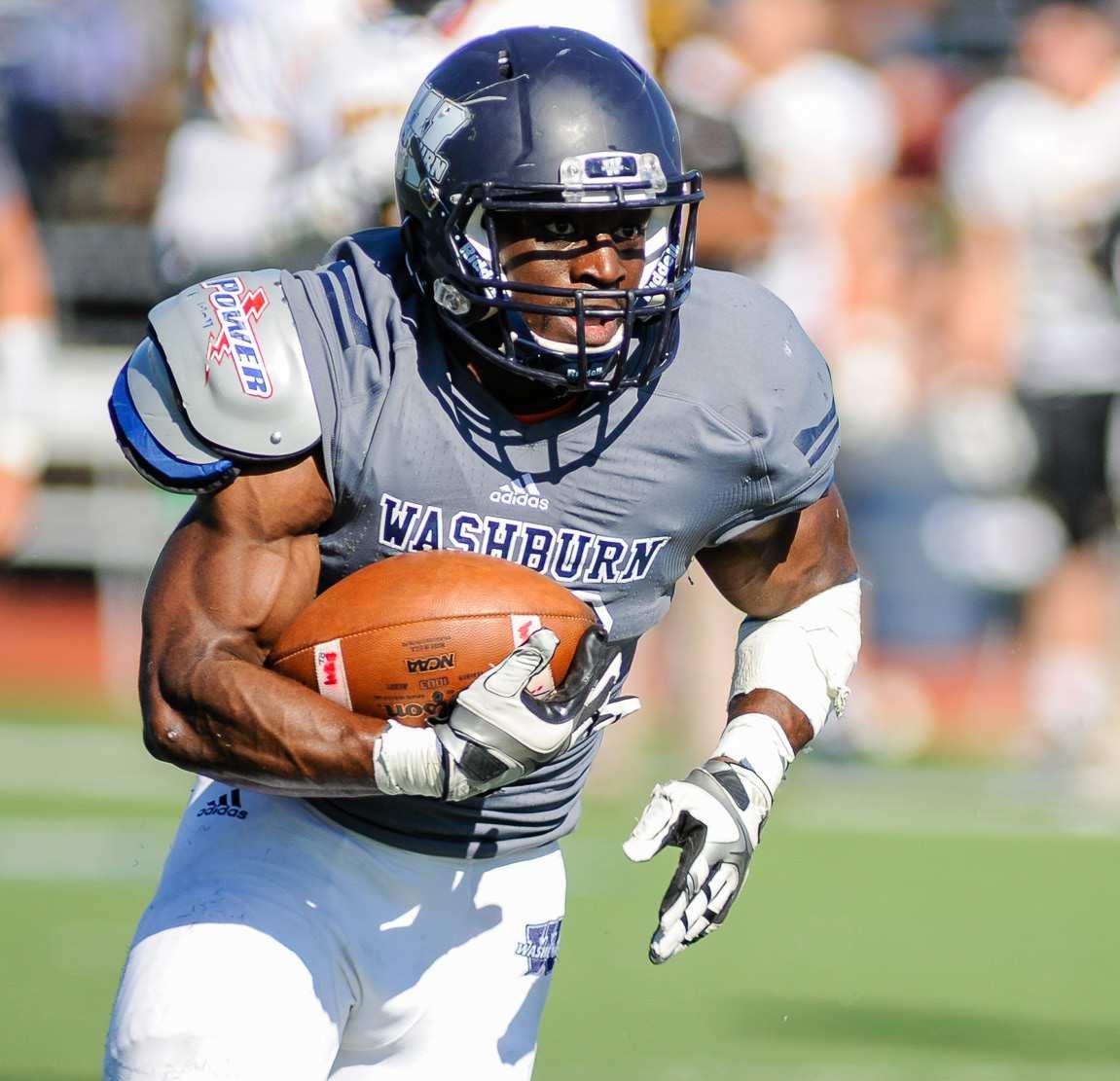
THE NEXT LEVEL: Running back Vershon Moore, above, hopes to take his talent and hard work to the NFL.
Photo by Scott Stormann
Alt-folk artist Max Fred releases debut EP
Ryan Ogle
WASHBURN REVIEW
Topeka native and 2009 Washburn graduate Max Fred has emerged onto the local music scene with his soulful and rootsy debut EP, "MaxwelLP."
Blending elements of folk, bluegrass, country, pop and rock, the singer-songwriter deines his sound as alt-folk, but insists there is much more behind his music than the description suggests.
"It’s hard to identify yourself as a solo musician. And when people think of a folk musician, they think of Joan Baez or someone like that," Fred said. "I think my music is an alternative to that. I don’t think there isanything on the radio right now that its with what I’m doing."
While at Washburn, Fred cut his teeth in local jam-bands Shunganunga andWakamojo. In 2011, Fred relocated to Kansas City to further his professional career, but never abandoned his passion for performing. It wasn't long after the move that he launched his career as a solo artist.
"It wasn’t something I really planned, but when I moved to Kansas City, it was harder to get
people to come out and jam," Fred said of his transition from playing in bands to taking matters into his own hands. "I had a bluegrass band going. When that broke up, I was frustrated because I had really made progress with that band. I wanted to start something that I could keep building. Going solo was the easiest way to do that."
A lifelong musician and performer, stepping away from the comforts of backing musicians and into his own spotlight came easy to Fred. Open mic nights and coffee shop sessions soon culminated into the irst oficial Max Fred gig, which took place in 2011 at Topeka's popular live music venue The Boobie Trap.
While gigs were few and far between at irst, within a year, Fred started playing regularly around the area, even making the occasional trip to the Lake of the Ozarks to perform out of his local comfort zone.
As his sound progressed and name began to spread, Fred took the next logical step and started work on his debut recording. Staying true to the organic natureofhismusic,Fredwantedto release an album that remained faithful to what his growing fanbase had become accustomed to
Singing is Believing: Singer-songwriter Max Fred self-released his debut EP, "MaxwelLP" in January of this year and has made it available for purchase at www.MaxFredMusic.com. Catch Max live in Topeka on Feb. 21 at The Boobie Trap and March 6 at J&J's Gallery Bar in NOTO.
hearing.
"The album I have out right now is just me and my guitar. I recorded it all in one take. I didn’t do individual tracks, studio tricks or overdubs," Fred said. "It suffers in certain spots, regarding the balance of guitar and vocals, but that’s what my music sounds like if you saw me in a bar."
Recorded in his living room
with the help of Stonecraft Audio's Chris Stone, "MaxwelLP" features ive songs of strippeddown and tuneful personal expression that delivers an undeniable sense of honesty.
"I want my music to be accessible and that comes from writing about a real experience I’vehadorthewayIfeelabouta situation in my life. I think a lot of people probably feel the same
way. In our society, a lot of people feel marginalized. Look at fast food, which is some of the fakest food there is, but they all want to tell you it’s the ‘realest food’out there. I don’t think my music is the realest out there, but it’s deinitely not fake."
Ryan Ogle, ryan.ogle@washburn.edu, is a senior mass media major
Hannah Kent captivates, horriies with debut novel
Colleen Kelly WASHBURN REVIEW
This story was a sobering experience.
The debut novel of Australian author Hannah Kent, “Burial Rites” is a historical retelling of one of Iceland’s most famous murder trials. The story was set in rural 1830s Iceland, where a woman named Agnes and two others stand trial for two gruesome murders, going down in history as the last cases of capital punishment in the country’s history.
Before sentencing, however, Agnes is sent to live with a district commissioner and his family on their farm where tensions run sky high for her six month stay.
Let me say right off the bat
that this novel was bleak. 19th century Iceland had a desolate, icy landscape, and Kent wrote it so vividly that the frozen farmland became its own character.
Kent did such a great job of creating an engrossing, haunting atmosphere by switching
between Agnes’s irst person present tense narrative and various other characters’ third person past tense.
Not only that, but the inclusion of translated historical documents added an interesting contradiction to Agnes’s account of what happened, which lead you to wonder how much you can truly trust her.
The reader knows from page one that Agnes will not survive the story, but as more and more of Agnes’s past was revealed, you couldn’t help but sympathize with her truly awful situation and hold out some hope that she ind a happy ending.
Agnes’motivations throughout the story were somewhat obvious, though, and her character could have done with more moral ambiguity, but I
defy anyone to say she wasn’t extremely interesting main character.
I would have liked to see better leshing out for some of the secondary characters as well, but what we were given created a robust supporting cast.
Fair warning to the faint of heart: skip this book if mature language and moderately explicit situations bother you. It’s not rife with them, but they aren’t something you just skim through either.
End of the day, while I wish Kent had taken more creative liberties with her characters and thought about condensing her number of narrators, this novel was quietly intense and intelligent, an overall polished novel.
Colleen Kelly, colleen.kelly@ washburn.edu, is a sophomore English major
Graphic by Spencer Perry
Photo courtesy of Max Fred
Washburn BFA major to showcase ‘Gingerly Genuine’ senior exhibition
Adam Vlach
WASHBURN REVIEW
The Washburn bachelor of ine arts program has produced another artist, and she will be showing off her work that she says expresses her genuine self, though she offers this work to the public “gingerly.”
In an exhibit titled “Gingerly Genuine,” Chelsea Howe, a bachelor of ine arts major with an emphasis in graphic design and electronic arts, will be showcasing her work which expresses both what is currently important to her and what relects her journey to becoming a college graduate, which will come to realization this May.
Howe’s path to her BFA destination started long ago and took detours along the way.
“I’ve always drawn plenty of things when I was little,” Howe said. “I remember watching LooneyTunesataveryearlyage and just copying the characters, and while the cartoons were very interesting, I was more interested in the characteristics of what made characters characters – what made Bugs Bunny Bugs Bunny; what made Daffy Duck Daffy Duck.”
After elementary school, Howe cut back on drawing pre-
existing cartoons and began designing her own characters.
In middle school, she created over 20 original characters. But these characters were not meaningless drawings; they meant something.
“Throughout middle school I created a whole bunch of characters, and it turns out a lot of it just ended up representing parts of my personality,” Howe said.
But as she grew older, her love for art and expression was doused by the pressures to make a lot money.
For the irst year and a half at Washburn, Howe majored in biology, planning to be a physician assistant. She said she was under a lot of pressure by those around her to pick a career that would give her a big paycheck. Half way through her sophomore year, however, something changed.
“But I wasn’t happy,” Howe said. “And I thought, well everybody I know has always said ‘you should become an art major.”
Howe said she had always laughed at people who told her that in the past, but then she begantotakethatideaseriously.
Howe let the focus on money go and inally pursued what she
ONE JOURNEY TO THE NEXT: Chelsea Howe will be graduating in May with a bachelor of ine arts. She will be showcasing the work she has produced over the years at her senior art exhibit, ‘Gingerly Genuine.’ The exhibit will feature comics, graphic designs, drawings, prints and more.
loved.
“I just decided to jump in,” Howe said. “I decided I should go into the BFA program, but being a bachelor in ine arts major isn’t exactly what I wanted to do. I wanted to do graphic design. It wasn’t until Emmy Rice, a graphic design professor who used to teach here, actually helped create the graphic design and electronic arts program when I decided to immediately jump on board. That was the deining point of ‘this is awesome.’”
Howe’s exhibit will show off her comics, graphic designs, ine art pieces and even her mistakes, which “will be on the loor.”
The “Gingerly Genuine” exhibition will be downstairs in the John R. Adams art building for two weeks, starting Feb. 23. The building is open on weekdays from 8 a.m. to 8 p.m. After graduation, Howe hopes to work for a graphic design irm or department, naming Hallmark and Disney as two companies she would like to work for.
Adam Vlach, adam.vlach@washburn.edu, is a senior English and mass media major.