COBOTS GETTING SMARTER
ARE
AND WORKING CLOSER WITH PEOPLE IN WAREHOUSES
The collaborative robot industry has seen its ups and downs in recent years. The COVID-19 pandemic brought a surge in orders, but in the years following, that surge hasn’t continued. In 2024, orders for robot arms in North America dropped, according to research from the Association for Advancing Automation, or A3.
However, A3’s latest reports show that the industry began to bounce back in 2025, and many indicators point toward a strong 2026. Through these ups and downs, Universal Robots (UR), an Odense, Denmark-based developer and subsidiary of Teradyne, has remained a leader in the industry.
The Robot Report caught up with Keith Fox, the chief product officer at UR, to learn more about how cobots are becoming smarter, safer, and working more closely with humans.
Cobots can do more now, and customers are starting to realize that
Over the past 25 years, robots have grown a lot smarter and more capable, but a lot of end users are still hung up on the difficult-to-use robots they remember from their early days in engineering, Fox said.
“As humans, we have long memories, and we remember how hard it was,” he noted. “Most of the people who
are making those financial decisions today were young engineers or young operations managers at the time when it was really hard. So, I think we have to continually educate them.”
“The good news is that people who are of the younger generation don’t have the stigma of how hard it used to be,” added Fox. “I think they’re a lot more hands-on today, and they’re willing to actually accept mistakes and failures and keep going and iterate the process.”
At the same time, cobots are easier to deploy than they ever have been. Twenty years ago, someone deploying a robot might have to shut down operations for up to two weeks, Fox said.
BRIANNA WESSLING • THE ROBOT REPORT
“From the time you take it off a truck, move it into the plant, wire it all in, and get the plant saying it’s working, we would plan a crew for two weeks,” he asserted. “That’s a lot of time and a lot of labor on our side to execute.”
“On the customer side, that’s a lot of product downtime that they have in their plan, where they can’t run their product, or they have to do workarounds,” said Fox. “Today, most of our partners that are doing palleting can deploy a robot in one to two days.”
UR has done a lot of work to get to this point, but this still isn’t fast enough for it. The company’s team would eventually like to push its deployment time down to one day, according to Fox.
UR is getting cobots ready for AI
In recent years, artificial intelligence has been a dominating force in the robotics industry. Everyone is rushing to find the best ways to create robust physical AI models, and get those working on robots.
OUR ROLE IS TO CONTINUE TO BUILD THE BEST ROBOT PLATFORM THAT WILL WORK WITH ALL THOSE DIFFERENT AI MODELS.
Yet Universal Robots isn’t concerned about building AI models completely from scratch.
“[AI] is an area we are very interested in, and it’s an area we are very active in,” said Fox. “Our role is t o continue to build the best robot platform that will work with all those different AI models. In doing so, we’re building new hardware and software capacity into our platform, right in the control box.”
UR is interested in building specific applications on top of existing AI models such as those built by Intrinsic, OpenAI, or Microsoft. With its direct connection
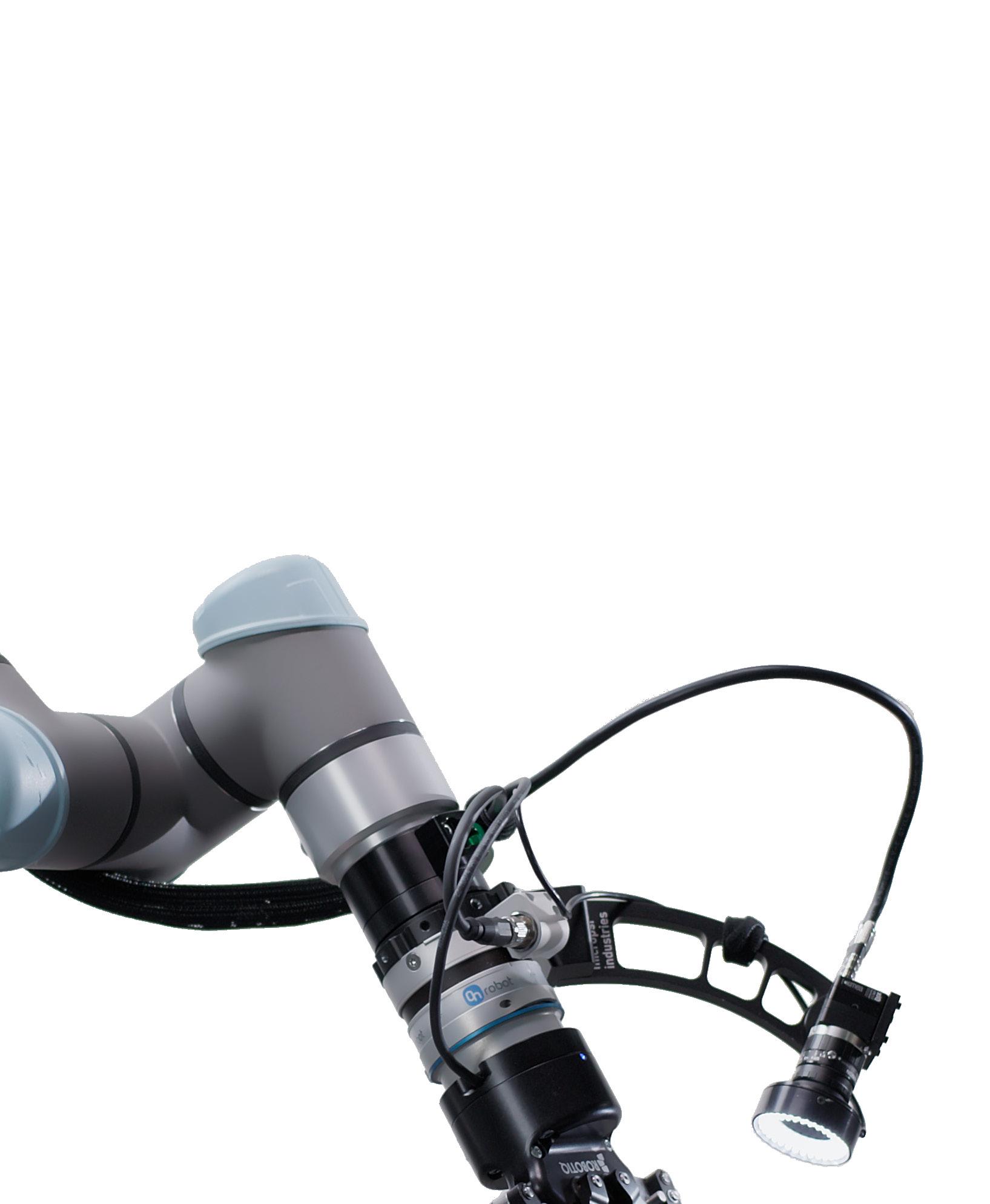
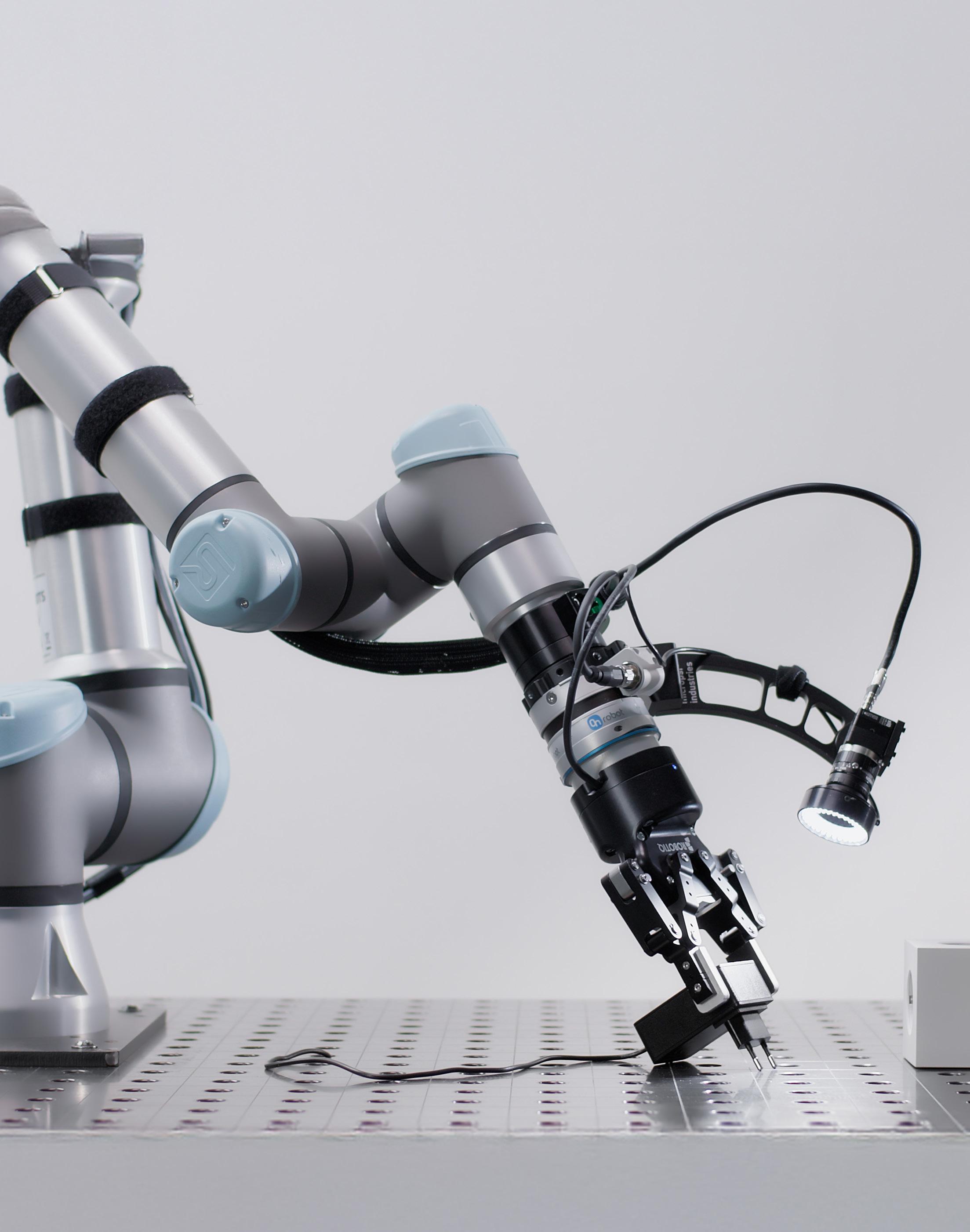
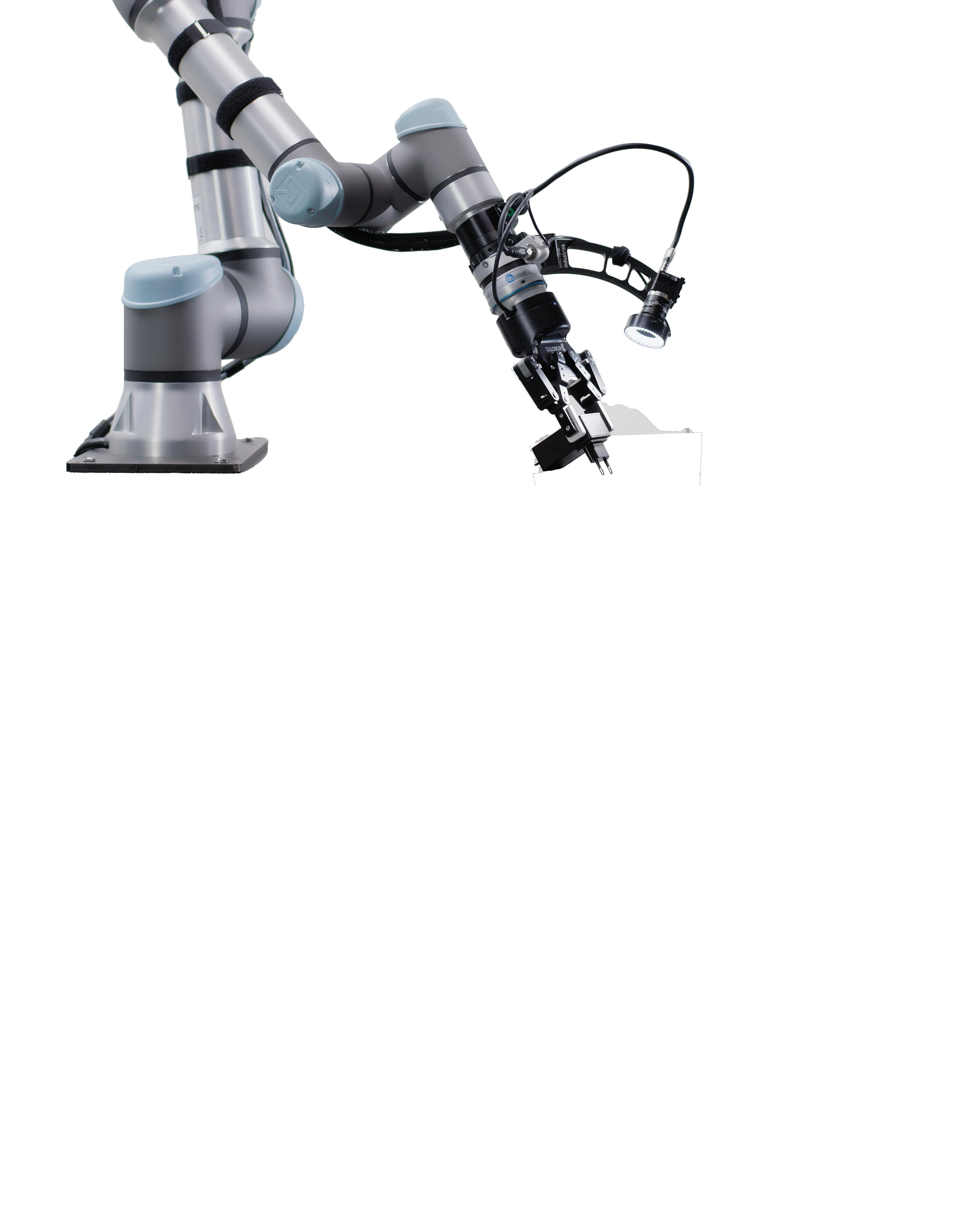
Camera-based AI from robominds enables cobots to do more complex tasks. Universal Robots
to end users, the company is wellpositioned to develop these specific use cases.
“It’s kind of a three-way relationship that we have with our platform, these learning model companies, and then the end customers, who are the ones that need to see the benefit. Otherwise, all the work we do and all the work they do is for nothing. So we try to bring in that manufacturing aspect and the real-world aspect back to our platform and back to the developers of these learning models,” Fox said.
At the same time, UR is also working closely with its partner ecosystem, including companies that make vision cameras or grippers.
“We’re working really hard with them to make sure that their tech is more embedded into the robot, so that it can better take advantage of the language models,” Fox said.
Cobots work alongside humans Force- and power-limited robots, commonly known as cobots, are designed to be safe around humans, Fox noted. They don’t require safety fences or a safety cage.
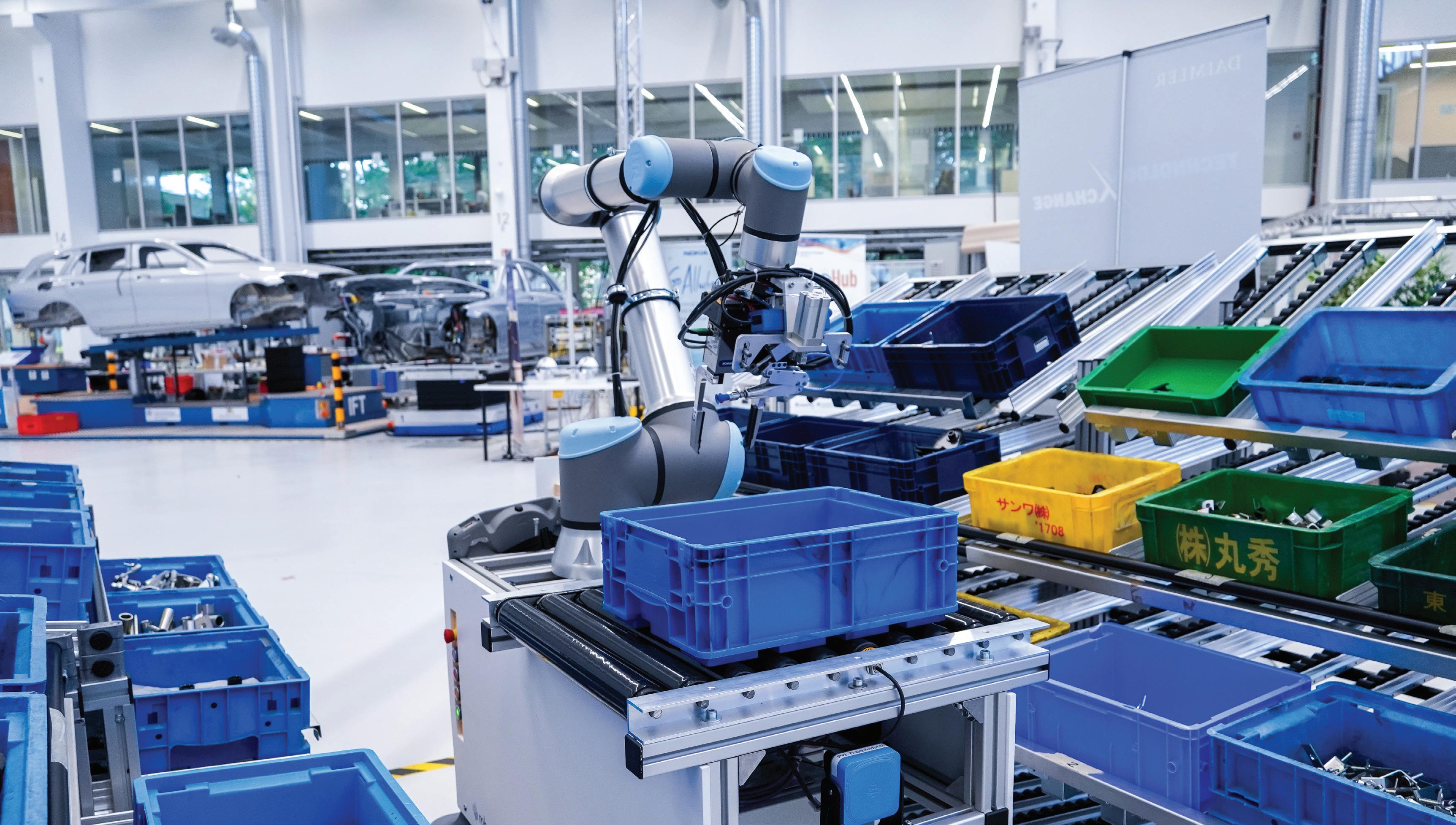
“If I look at where we’re actively talking with customers right now around how they can use automation in coordination with their human capital, it’s really around autonomous mobile robots [AMRs] and cobots loading and unloading AMRs, which our sister company MiR [Mobile Industrial Robots] has,” he said.
Fox said he sees a lot of customers use a forklift to pull material from warehouses and deliver it to the material line side. From there, an operator comes to pick up boxes. This requires multiple people constantly moving back and forth across warehouses, or even between multiple buildings, just to get material where they need to be for production.
“In today’s world, you can have an AMR deliver that material to a cobot station,
where it can open the box, take out pieces of material or smaller boxes, and put them on a gravity feed conveyor that takes it right to the operator line side,” Fox explained.
“If you talk to these end users, a lot of their waste in the manufacturing process is the time the operator was walking from where they’re actually doing value-added work over to the box to get the part,” he said. “So, we’re trying to minimize the non-value time an operator spends in a factory by using automation, and we let the operator do the value-added work, which they’re really good at.”
Giving these tasks to robots means the human workers are freed up to do things that are too difficult for robots to handle.
“There’s a lot of use cases we’re working on right now, like in the electronics industry and the automotive industry, to make sure these parts get to the operator lineside in the most efficient way possible,” Fox said. RR
A UR20 cobot works with a human associate for palletizing.
Universal Robots
Standard Bots designed its cobots to be easy to set up and use even without an engineering degree.
Standard Bots
SHOULD BE AT THE CENTER OF AUTOMATION DECISIONS WHY WAREHOUSE WORKERS
BRIANNA WESSLING THE ROBOT REPORT
Oftentimes, decisions to automate are driven by high-level people within an organization. They use analytics and other company information to decide what to automate first, how many robots to bring on, and what kind of robots they need.
Zach Tomkinson, the chief commercial officer at Standard Bots, thinks end users should take a different approach. Standard Bots is a rapidly growing developer of collaborative robots. In 2025, the company grew its 2024 revenue by over six times, and its headcount is now over 120 people. Tomkinson said he hopes it will reach 200 by the end of the year.
“I always tell this to factory managers when they ask me, ‘What do you think we should automate? What tasks should we go after first?’ I usually say, ‘Talk to your workers,’” Tomkinson told The Robot Report. “The people who know what tasks should be automated are actually the ones doing the tasks. They’re the smartest ones around it. They might not have the best educational degree, but they know that process better than anyone else. They know when it works well and when it works wrong.”
Beyond making initial decisions on what to automate, the people working on warehouse or factory floors with the robots might be the biggest factor contributing to the success or failure of any deployment.
AI is making robots easier to use, which makes people’s jobs easier In commercial facilities, every second of downtime is revenue lost. Robots can work around the clock, but deploying them can be a tedious process that takes days or weeks.
“I remember sitting with a customer who had bought 100 systems from me in the past,” Tomkinson said. “This was probably in 2022, and I remember joking and saying, ‘I know you think this is copy and paste because you have 100 of the exact same machine, but this is still a bit bespoke, and every single one of these needs some custom love to be deployed.’”
“At the time, you could copy over a lot of the code from robot to robot, but you still needed to make adjustments with each robot to take into account any tiny differences they might experience,” he recalled.
After 100 robots were deployed, Tomkinson said it certainly felt like his team had deployed 100 robots.
“AI would have made it so you would have copied the code over, and then that final tweaking that was specific to each cell,” said Tomkinson. “Maybe the part is a little bit different, or the location was off by an inch or two. Those really specific moves are going to be able to be solved and handled with perception giving data for AI to use for decision making.”
This technology also makes the robots easier to work with, which means even someone without an engineering background can reprogram the system.
Prioritize upskilling workers
When robots enter the picture, most people have a knee-jerk fear of being pushed out of their jobs by automation. But that’s not the goal for Standard Bots, Tomkinson said. Instead, the company wants robots to take on dull, repetitive tasks that can wear down people’s bodies and then move people to tasks that are better suited to humans.
“I think it’s on us to upskill all of these workers into being more capable,” he said. “Standard Bots really does believe in educating the next workforce, and we have a lot of strategic plans around how to upskill these types of workers across America.”
Standard Bots’ stated goal is to give people a tool to master the work they're doing, with cobot doing much of the execution.
“They can know exactly where [an item] needs to go and what [the robot] needs to do, but they don’t have to be the ones doing this all day, every day, for their whole lives,” Tomkinson said. “The robot can be doing it, but the operator knows when there’s an error, and they know how to tweak it.”
How to balance safety with performance
With force- and power-limited robots working alongside employees, safety is crucial.
“First and foremost, absolutely, human safety is critical,” Tomkinson acknowledged. “I think we need to be very cognizant of how to make this a safe tool for people to use. But also, I do think in some cases, the safety standards can go a little far without taking into consideration how this can become a tool.”
For cobots, especially, there’s a constant tradeoff between making a robot strong and capable enough to do difficult tasks, but still safe enough to fit standards that allow the robots to work around people without a cage or safety fence.
“We allow people to use drill bits all day, every day. If you did something wrong with a drill, you could hurt yourself, right? You need to be educated on the
safety precautions and torquing limits and things like that, but we also allow them to use that drill every day as a tool,” Tomkinson said. “Sometimes, I do think the safety standards focus on safety being overarching and not nuanced.”
He also pointed out that in the early 1900s, when cars were first made, if someone wanted to drive into a city, they would have to have a person on a horse ride ahead of the car waving a red flag, called “red flag traffic laws.” Obviously, these laws seem counterintuitive today, but at the time, they were put in place to keep streets safe.
“I think there are some examples of that today, where we need to create guardrails, ways of making sure that we use the technology as needed without creating really long-standing difficulties for longterm adoption,” Tomkinson said. “One thing for us is to make the product as safe as possible through its design, and making really sophisticated interface models and touch sensing, so that the product can react with a very high frequency rate and to humans in the space.”
He also pointed out that putting cameras in the space around the robot can be a good way to add an extra layer of safety. “You have safety on the robot, you have safety on the cell, you have safety scanning around. You have a multi-pronged approach to have multiple redundancies and potential ways to stop,” Tomkinson said. RR
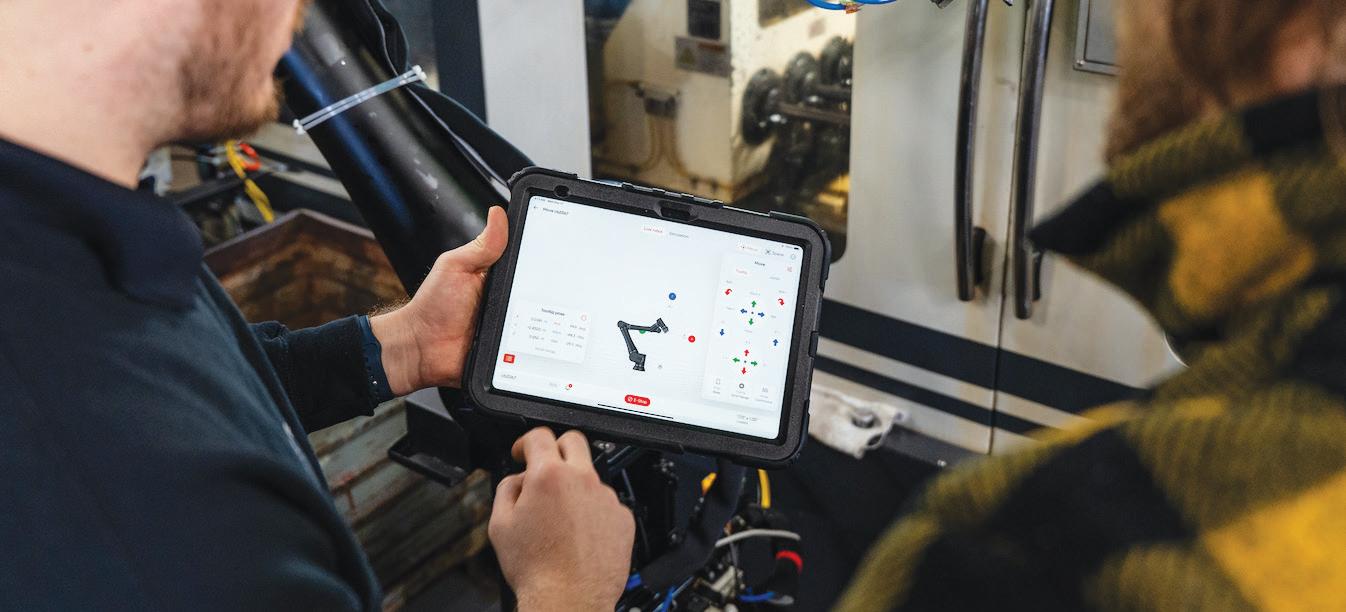
An easy-to-use interface is essential to democratizing use of robotics. Standard Bots