


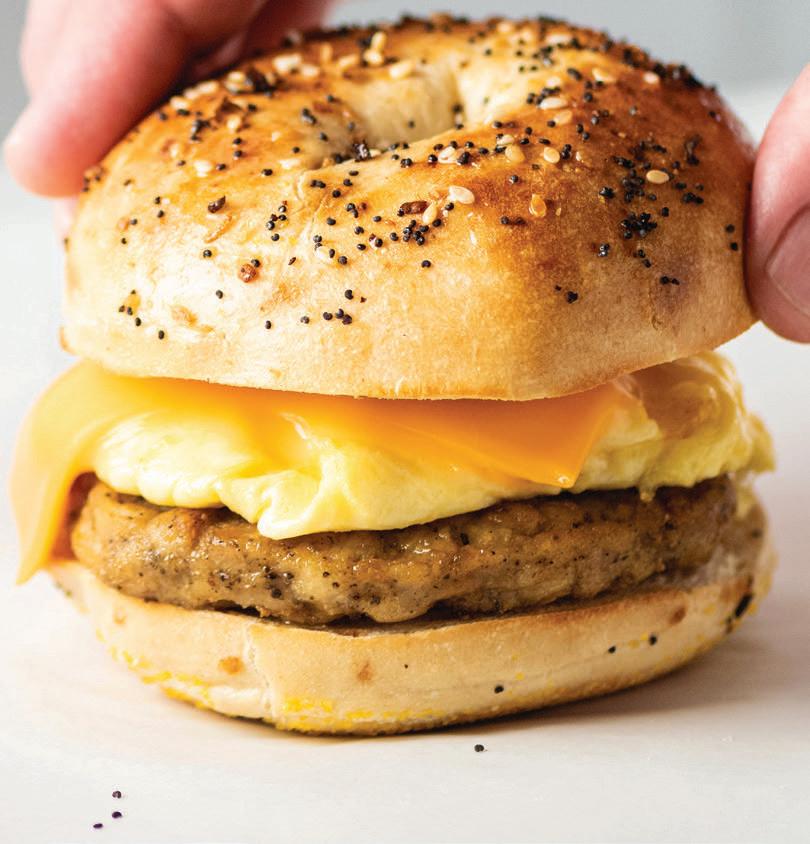
RoastWorks® Roasted Herb and Garlic Russet Potatoes RoastWorks® RTE Flame-Roasted Peppers & Onions Blend ©2022 J.R. Simplot Company Make breakfast shine. MORNINGS JUST GOT A LOT EASIER WITH SIMPLOT. Get the potatoes, avocados, fruits, vegetables and grains you need to match today’s trends and reduce expensive labor. potatoes | avocados | fruits | vegetables | grains To request FREE samples and learn more, visit simplotfoods.com


out
®
More details inside!
On-the-go flavor. Find
how you can Sauce Like You Mean It
with
On-the-go flavor.


Texas Pete ® is taking its flavor on the road with convenient, easyto-enjoy portion control packets! Whether it’s a Texas Pete ® dip cup or sauce packet, your customers will be able to enjoy bold flavor for a better on-the-go dining experience—anywhere, at any time.
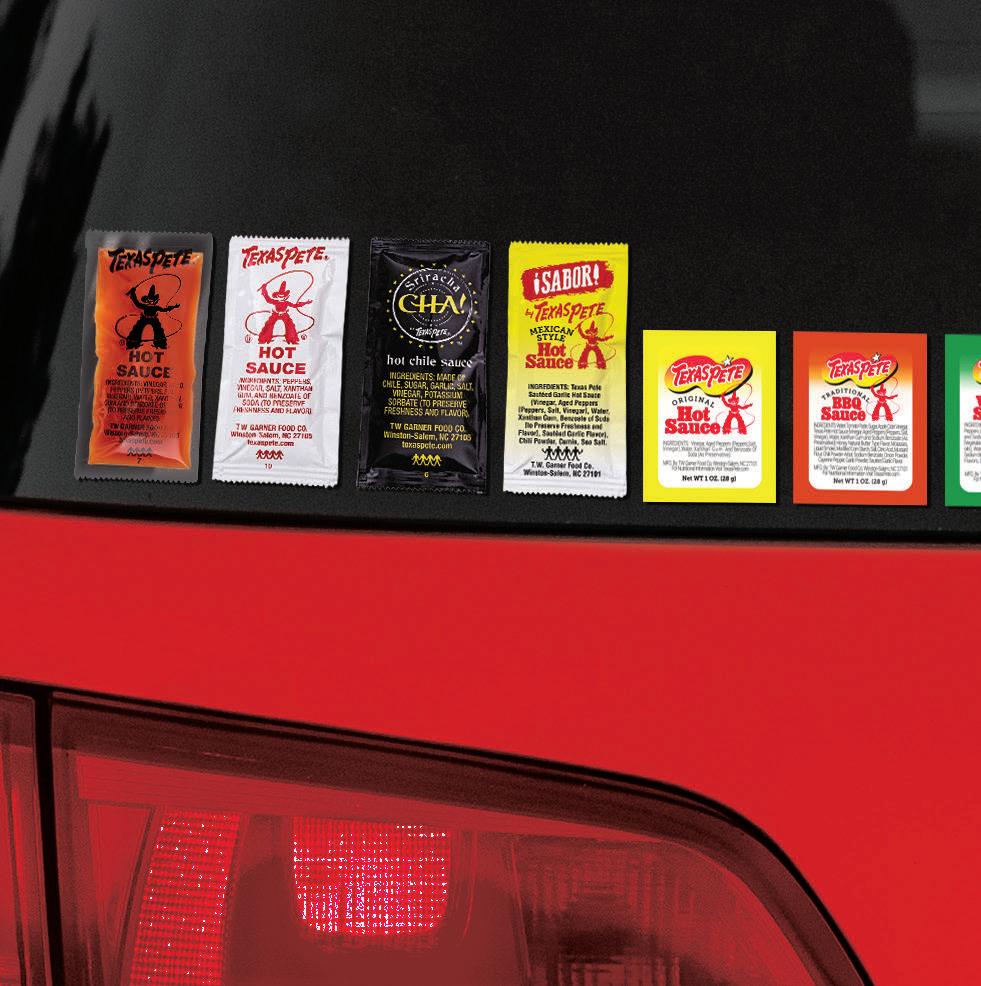


Ask your broker for the #1 portion control hot sauce and request a free sample today!



TO REQUEST A SAMPLE SCAN HERE ©2023 Texas Pete® and Sauce Like You Mean It® are registered trademarks of TW Garner Food Company. 1006-020123
THE HAPPIEST OF HAPPY HOURS INCLUDE CHEESE
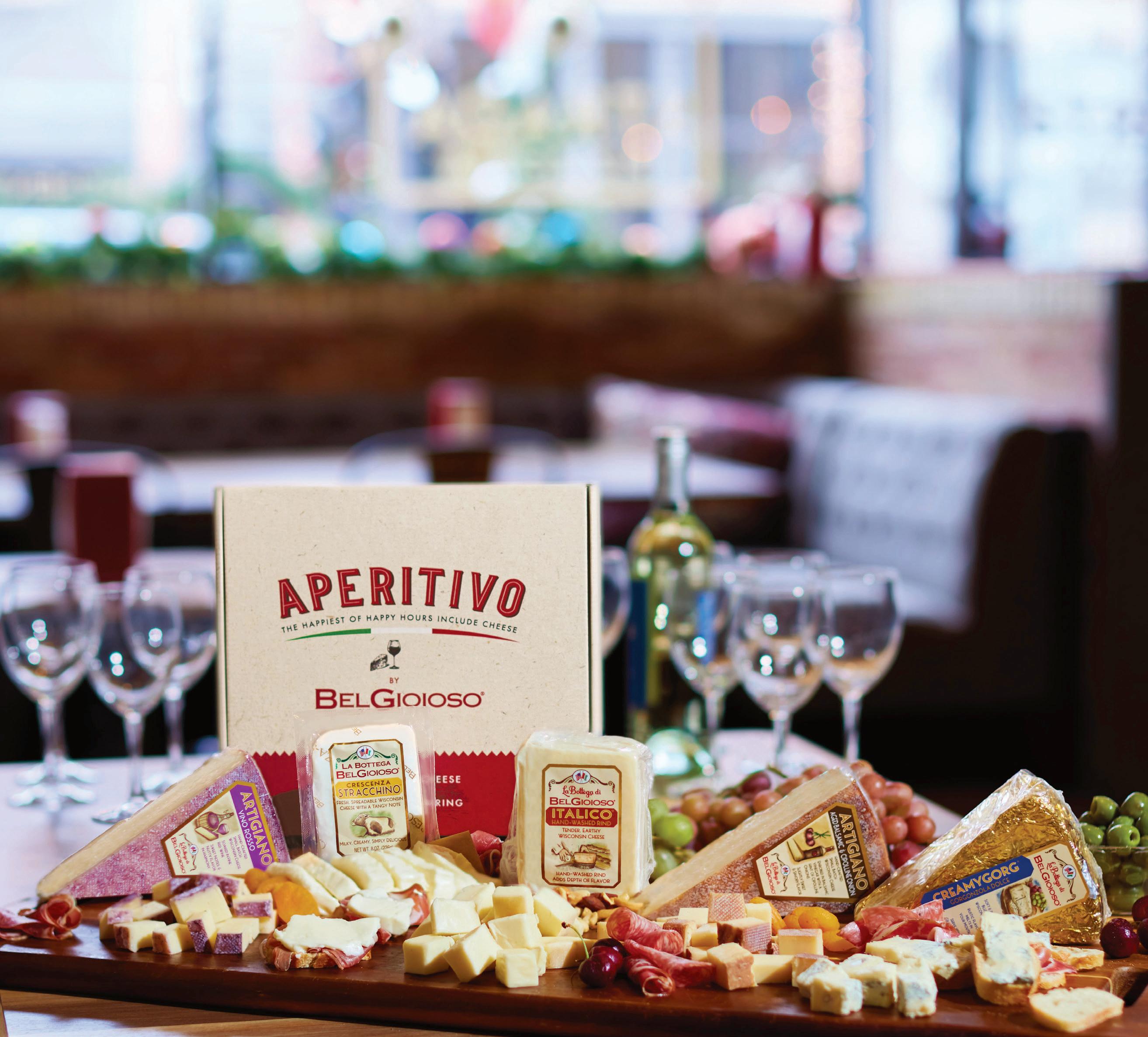
ARTIGIANO®
VINO ROSSO
nutty, crumbly texture
ASK US ABOUT

FEATURED CHEESES
CRESCENZA


STRACCHINO
milky, tart flavor and soft, creamy texture




ITALICO™


WASHED RIND CHEESE
earthy, full flavor and soft texture
ARTIGIANO®








AGED BALSAMIC & CIPOLLINE ONION
nutty, full and sharp flavor
CREAMYGORG®
GORGONZOLA DOLCE
earthy flavor and creamy texture
CONTACT US FOR SAMPLES
belgioioso.com/foodservice



A Collection of Minds (Literally)
Come join us in September for two conferences we hope will take the entire industry forward.
EDITORIAL
EDITORIAL DIRECTOR
Danny Klein dklein@wtwhmedia.com
QSR EDITOR

Ben Coley bcoley@wtwhmedia.com
FSR EDITOR Callie Evergreen cevergreen@wtwhmedia.com
ASSOCIATE EDITOR Sam Danley sdanley@wtwhmedia.com

Learn more:
This is our third year of publishing a “crossover” issue between QSR and FSR We always approach the concept from a base—what trends and realities separate the full- and quick-service worlds? And which bind them? Or, spun differently, has the pandemic brought these arenas closer together or further apart? Like many points in foodservice, you can’t broad-stroke the answer. There is truth in both (thanks mostly to technology) and yet, COVID did accomplish something the customer was already pushing pre-2020: it all but evaporated the middle ground. This long-ago idea of embracing millennials by trying to appease everyone—“all things to all people”—has vanished. Category wise, it brings us to a place where experiential brands and experiencedriven ones thrive as murky ones struggle. However, what innovation taught operators amid the crisis is you don’t have to sacrifice one for the sake of the other. You can bring hospitality to the drive-thru window just as you can the table. And maybe that’s the cost to entry now.
Yet with all of this in mind, I want to take you back a few months to a pivotal moment for us here at QSR and FSR We transitioned to the WTWH Media family of brands officially in September. One of the first things we set course on was to host a conference dedicated to the future of restaurants. So naturally, this progressed into a vision where everything comes together in an effort to foster collective evolution; a place where one operator can learn from another, and one category from a completely different one. Starting this month, we opened registration for two conferences: QSR Evolution
and The NextGen Restaurant Summit (full-service emerging chains). They will both take place September 6–7 in the Buckhead district of Georgia (head to our websites to learn more). We’ve put together an agenda of more than 100 speakers addressing topics from is the POS dead, to ghost kitchens to what makes a best franchise, employer, eatertainment concept, and far more. We’ll also present a collection of fireside chats to illuminate stories behind the curtain—from CAVA to Dickey’s to Firehouse to Chipotle to Subway to First Watch, and, as before, a lot more. Chick-fil-A CEO Andrew Cathy will kick off the opening keynote and we’ll get the show started.
Personally, this was the first time I’ve had a hand in planning an event of this scale. That’s probably a comical understatement. But many of those nerves dropped over a steak dinner with an industry friend, Jack in the Box VP of franchise recruitment Van Ingram. He was the first outside person I let in on our plans. His response was something along the lines of, “our industry is looking for this kind of deal.” He thought people would gravitate toward it, three-plus years removed from COVID, ready to share ideas again. And he was right. There are so many threads of challenges and opportunities to address today, across both sides of segment lines. To me, 2023 is a year where we all need to catch our breath from breathless innovation and find real solutions to meet demand in every channel, through all avenues.
So let’s do that together. I hope you’ll join us in September.
CUSTOM MEDIA STUDIO DIRECTOR OF CUSTOM CONTENT Peggy Carouthers pcarouthers@wtwhmedia.com
CUSTOM CONTENT ASSOCIATE EDITOR

Charlie Pogacar cpogacar@wtwhmedia.com
CUSTOM CONTENT ASSOCIATE EDITOR Kara Phelps kphelps@wtwhmedia.com
DESIGN & PRODUCTION
ART DIRECTOR Tory Bartelt tbartelt@wtwhmedia.com
ART DIRECTOR Erica Naftolowitz enaftolowitz@wtwhmedia.com
PRODUCTION MANAGER Mitch Avery mavery@wtwhmedia.com

SALES & BUSINESS DEVELOPMENT
GROUP PUBLISHER Greg Sanders gsanders@wtwhmedia.com
NATIONAL SALES DIRECTOR Eugene Drezner edrezner@wtwhmedia.com 919-945-0705
NATIONAL SALES MANAGER Edward Richards erichards@wtwhmedia.com 919-945-0714



NATIONAL SALES MANAGER Amber Dobsovic adobsovic@wtwhmedia.com 919-945-0712
NATIONAL SALES MANAGER John Krueger jkrueger@wtwhmedia.com 919-945-0728
SALES SUPPORT AND DIRECTORY SALES Tracy Doubts tdoubts@wtwhmedia.com 919-945-0704
FOUNDER Webb C. Howell
ADMINISTRATION
919-945-0704 fsrmagazine.com/subscribe qsrmagazine.com/subscribe
FSR and QSR are provided without charge upon request to individuals residing in the U.S. meeting subscription criteria as set fo rth by the publisher.
REPRINTS
The YGS Group (800) 290-5460 FAX (717) 825-2150 fsrmagazine@theygsgroup.com qsrmagazine@theygsgroup.com
Sponsored content in this magazine is provided to the represented company for a fee. Such content is written to be informational and non-promotional. Comments welcomed at sponsoredcontent@fsrmagazine.com or sponsoredcontent@qsrmagazine.com.
where
Since we’re reporting on both service formats, check out our gauge to see
a story falls on the QSR/FSR scale.
QSR MAGAZINE LOOK FOR EDITOR’S LETTER
DKLEIN@WTWHMEDIA.COM
ROSIE ROSENBROCK
QSR FSR QSR Evolution Conference / NextGen Restaurant Summit / Danny Klein, EDITORIAL DIRECTOR GAUGE ICON: ADOBE STOCK EMIL’ 2 INDUSTRY-WIDE ISSUE QSR is a registered trademark of WTWH Media, LLC. QSR is copyright © 2023 WTWH Media, LLC. All rights reserved. The opinions of columnists are their own. Publication of their writing does not imply endorsement by WTWH Media, LLC. Subscriptions (919) 945-0704. www.qsrmagazine.com/subscribe. QSR is provided without charge upon request to individuals residing in the U.S. meeting subscription criteria as set forth by the publisher. AAM member. All rights reserved. No part of this magazine may be reproduced in any fashion without the express written consent of WTWH Media, LLC. QSR (ISSN 1093-7994) is published monthly by WTWH Media, LLC, 1111 Superior Avenue Suite 2600, Cleveland, OH 44114. Periodicals postage paid at Cleveland, OH and at additional mailing offices. POSTMASTER: Send address changes to QSR, 101 Europa Drive, Suite 150, Chapel Hill, NC 27517-2380. ®

©2022 Johnsonville, LLC *IRI 1/2/22 Give your customers America’s #1 Sausage Brand. * From sausages to Johnsonville Sausage StripsTM , Johnsonville offers fully-cooked and ready-to-cook breakfast products with exceptional taste and high-quality ingredients that are easy to add to any menu. For more information, please visit Foodservice.Johnsonville.com Family owned since 1945 • Proudly made in the USA
CONTENTS
The Fabio of Foodservice
BY NICOLE DUNCAN
Fabio Viviani won viewer hearts on ‘Top Chef’ and has since built a restaurant empire. Now he’s plotting his biggest business endeavor to date.
60
The Fast-Food Dining
Lives
Room
On
BY DANNY KLEIN
Reports of its demise appear greatly exaggerated. But that doesn’t mean it hasn’t evolved.
76
NextGen
Casual
Blurs Lines and Breaks Rules
BY CALLIE EVERGREEN
From
MARCH 2023 / QSR-FSR CROSSOVER
CHEFS & INGREDIENTS
16 THE GREAT CHICKEN SANDWICH ERA IS HERE TO STAY How fried chicken sandwiches evolved beyond fl ash-in-the-pan trend to a menu mainstay at both full- and quickservice brands. BY CALLIE EVERGREEN
17 HAS HAPPY HOUR SOURED? Even in an age of telecommuting, restaurants are betting on the post-work daypart.
BY NICOLE DUNCAN
24 THE STYLIST’S SECRET
SAUCE How Gocha Hawkins went from styling celebrities’ hair to building a restaurant portfolio.
BY NICOLE DUNCAN
DEPARTMENTS
32 ONES TO WATCH:

BRIX HOLDINGS
A multi-platform operator is injecting life—and growth—back into a category icon. BY BEN COLEY
36 PROFIT AND EXPERIENCE, HAND IN HAND
Can server handhelds unlock faster service and happier guests?
BY GARY STERN
45 EQUITABLE PATHWAYS TO OWNERSHIP
How can the franchise industry break barriers and unlock opportunities for marginalized entrepreneurs to become owners? BY CALLIE EVERGREEN
107 GAMING THE SYSTEM
Dog Haus is making the onboarding experience more tech-forward and interactive. BY ISABELLA SHERK
110 INNOVATION ON DISPLAY
The KDS, while hardly new to the industry, has reemerged into the operational spotlight. BY KEVIN HARDY
113 DELIVERY, AND THE BATTLE FOR CONTROL
The need is not going away, so there must be a better solution.
BY CHRIS BAGGOTT
120 START TO FINISH: CLIFTON RUTLEDGE
The CEO of Shipley Do-Nuts is leading a turnaround at the legacy snack brand.
ON THE COVER
Fabio Viviani’s restaurant group covers all segments and approaches.
PHOTOGRAPHY: OCTAVIO JONES / TAMPA BAY TIMES / FABIO VIVIANI HOSPITALITY
 drive-thrus and QR codes to virtual food halls, the lines dividing full-service restaurants from quickservice concepts continue to blur.
2 EDITOR’S LETTER 6 BRANDED CONTENT 9 ON THE GO 118 ADVERTISER INDEX FE ATURES
®
FABIO VIVIANI HOSPITALITY
®
46 4 INDUSTRY-WIDE ISSUE MARCH 2023
BRANDED CONTENT IN THIS ISSUE
P. 14
P. 28
What Insights Are Hiding Behind Your Numbers?
What fast-casual and fine dining restaurants can teach each other.
SPONSORED BY PAPERCHASE
P. 22

Simplifying the Fry Selection Process This vendor recently refocused its portfolio with operators in mind. SPONSORED BY LAMB WESTON
P. 27
An Innovation Expert Discusses the challenges. SPONSORED BY AUSSIE BEEF & LAMB
ONLINE
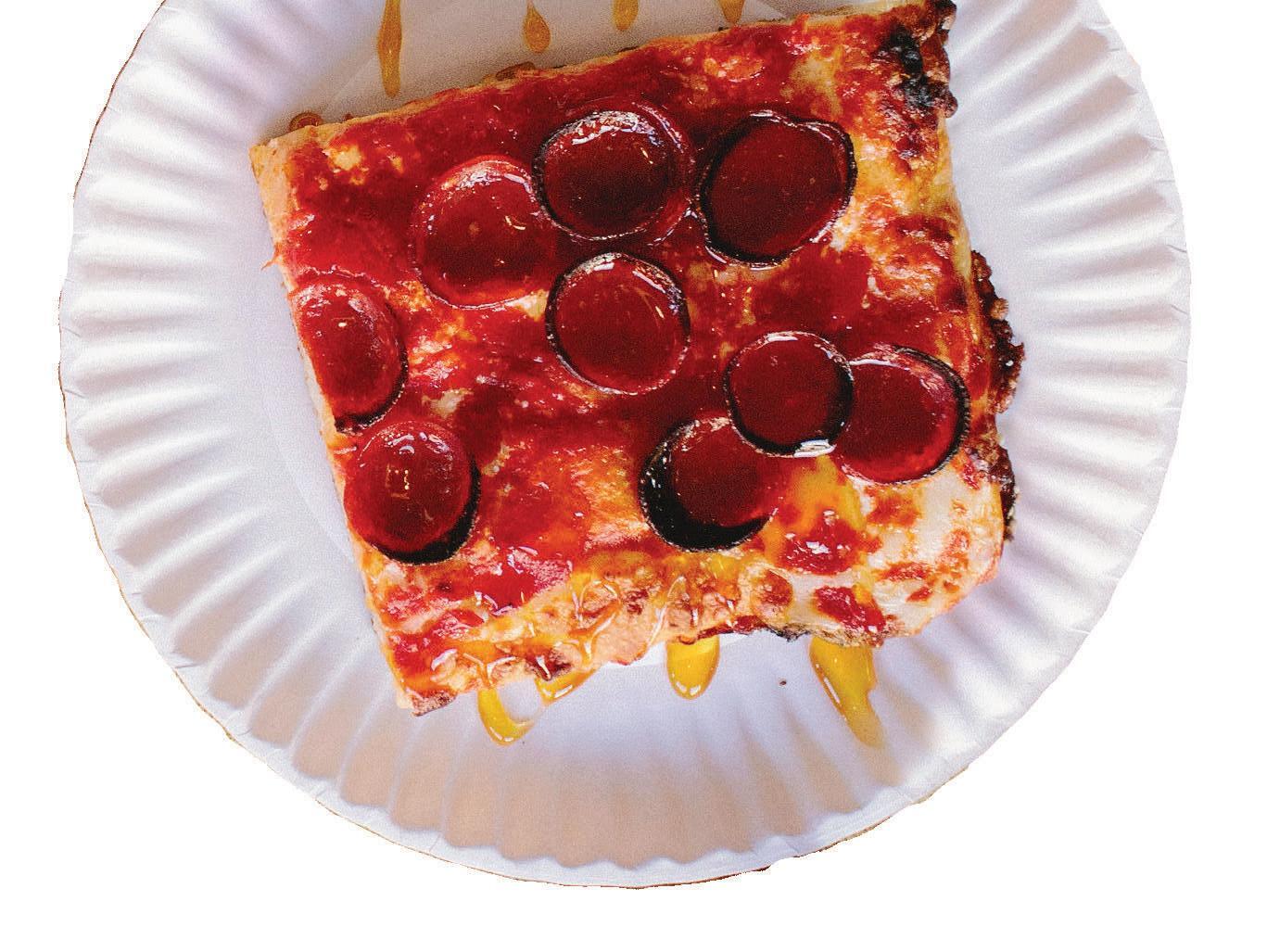
How Round Table Pizza Took an LTO to the Next Level A fan favorite in 2022 has a “sweet heat” twist in 2023.

SPONSORED BY MIKE’S HOT HONEY
P. 32
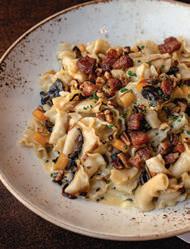
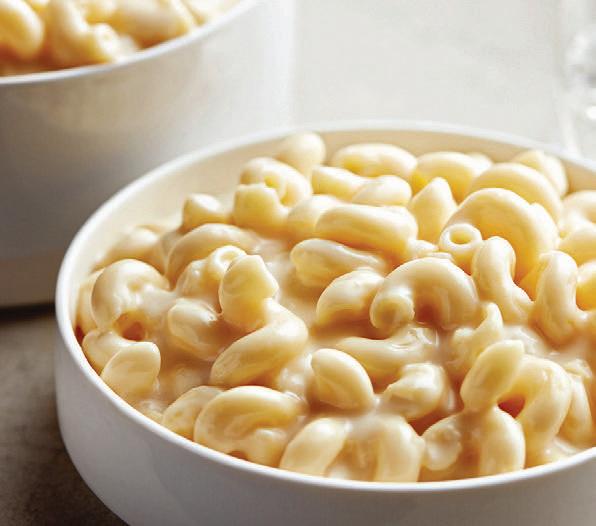
Pasta: The NoLimit Culinary Canvas Menu innovation is as challenging as ever. Thankfully, there’s pasta.
SPONSORED BY BARILLA
P. 49
Are Kitchens Becoming More


Female-Friendly?
Why some women believe there is growing momentum toward a more equitable industry.
SPONSORED BY SMITHFIELD CULINARY
P. 53
‘Made with Ghirardelli’ Program Helped Freddy’s Nearly Double LTO Sales Widely recognized for its premium quality, Ghirardelli offers a halo effect to restaurants.
SPONSORED BY GHIRARDELLI
FEATURED SUPPLEMENTS:
TRENDING ON THE MENU
P. 37
SMARTCHAIN /
P. 85
Signing On Today, effective digital signage is more important than ever.
P. 86
Signs of Change
The usage and capabilities of digital signage are transforming.

P. 92
Winning Over Customers
What do customers expect from digital signage?

/
Premium Versatility
Soft cheeses are rich yet mild, and supremely flexible.
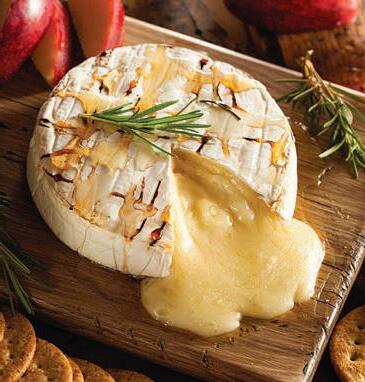
SPONSORED BY BEL BRANDS USA
A Secret Weapon Helped Shape Golden Corral’s Massive Comeback
A Secret Weapon Helped Shape Golden Corral’s Massive Comeback
SPONSORED BY MEAZUREUP
P. 98
Digital Success
A great digital signage program starts with a solid foundation.

P. 104
Key Players
The biggest names in the world of digital signage.
Comfort Food for the Win
This Southern staple helped a breakfast restaurant introduce a new daypart.
SPONSORED BY STOUFFER’S
QSR MAGAZINE ONLINE SEE THIS STORY AND MORE AT QSRMAGAZINE.COM/SPONSORED FSR MAGAZINE ONLINE SEE THIS STORY AND MORE AT FSRMAGAZINE.COM/SPONSORED ADOBE STOCK BARILLA 85 Chain Tech Evolution P86 Customer Experience Successful Programs P98 Key Players MARCH 2023 SIGNING ON Today, effective digital signage is more important than ever. BY KARA PHELPS Smart Trending on the Menu // Cheese SOFT CHEESES Premium Versatility Soft cheeses are rich, mild, and supremely flexible. The Dairy MVP DATA // 42 By 37 FSR QSR
GOLDEN CORRAL STOUFFER’S 6 INDUSTRY-WIDE ISSUE MARCH 2023


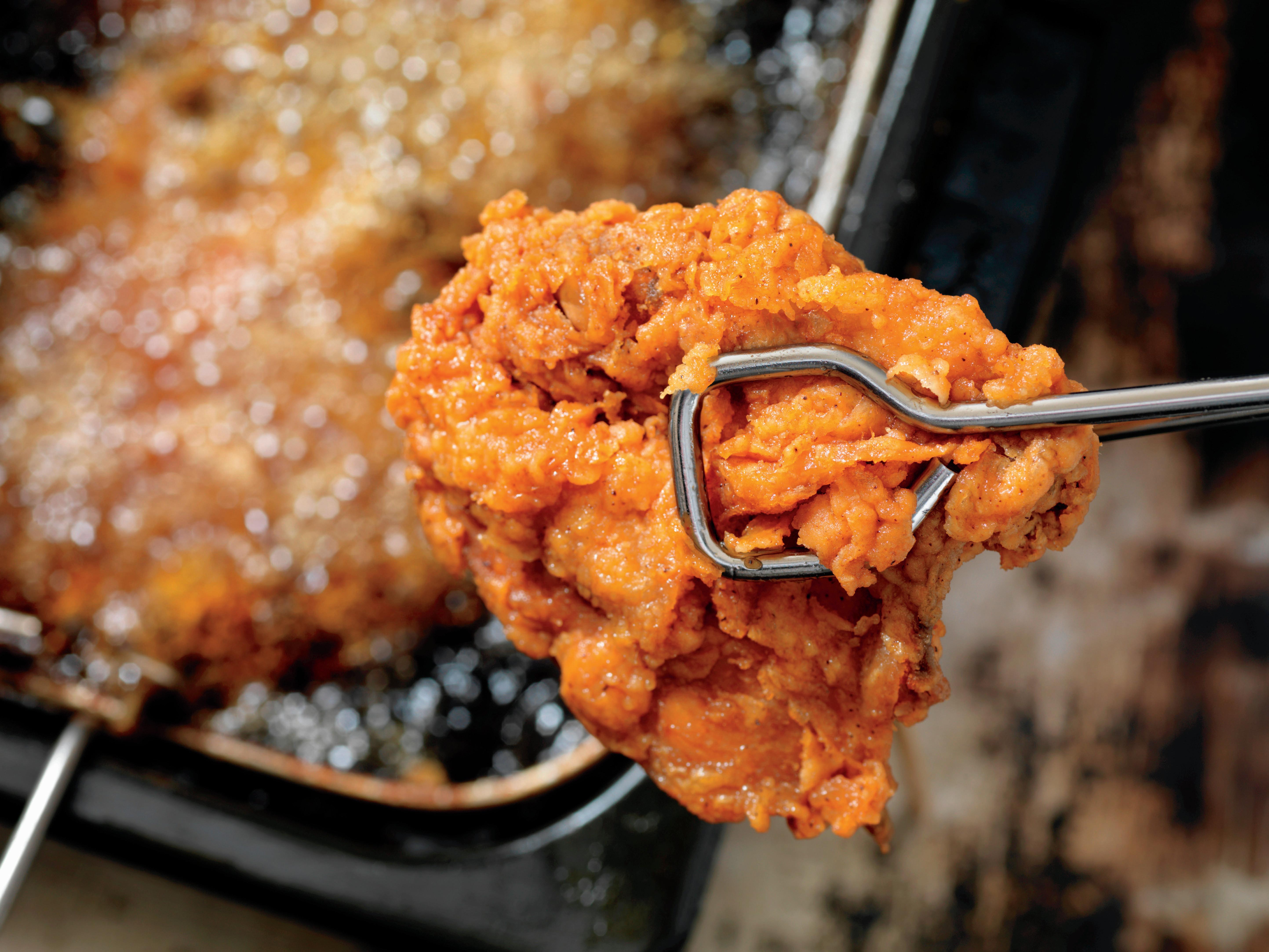


BAKING • GRILLING • SAUTÉING • DRESSING • DIPPING WE'VE GOT FRYING COVERED FRYMAX® AND MAZOLA® HAVE BEEN THE DEEP FRYING GOLD STANDARDS FOR OVER 65 YEARS. SCAN NOW WWW.STRATASFOODS.COM NATIONAL LEADING BRANDS Making Food Better, Everyday
Steve Chu Ekiben Fells Point, MD

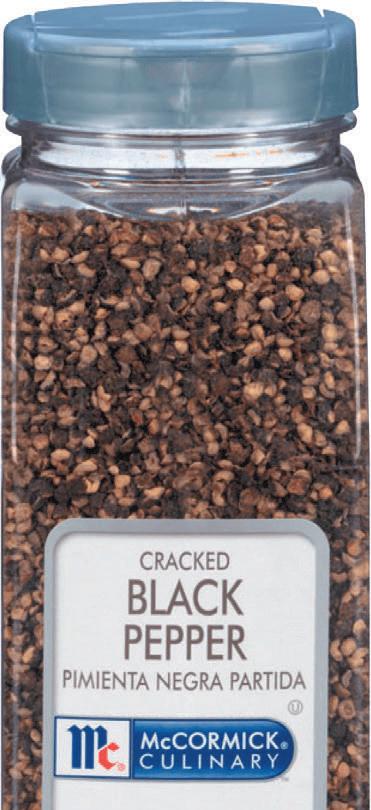
YOUR PEP. OUR PEPPER.






The dish that got chef Steve Chu from hot dog cart to full- edged restaurant: Thai Chicken Meatballs. It’s got a little bit of everything – crisp mango slaw, tender, juicy chicken meatballs and of course, that phenomenal bite and texture of Cracked Black Pepper.

TOGETHER, WE FLAVOR

Our Spices. Now that’s a potent combination.



Your Skills.
Learn more at: McCormickForChefs.com/McCormick-Culinary
The Chef and the Fridge
BY NICOLE DUNCAN
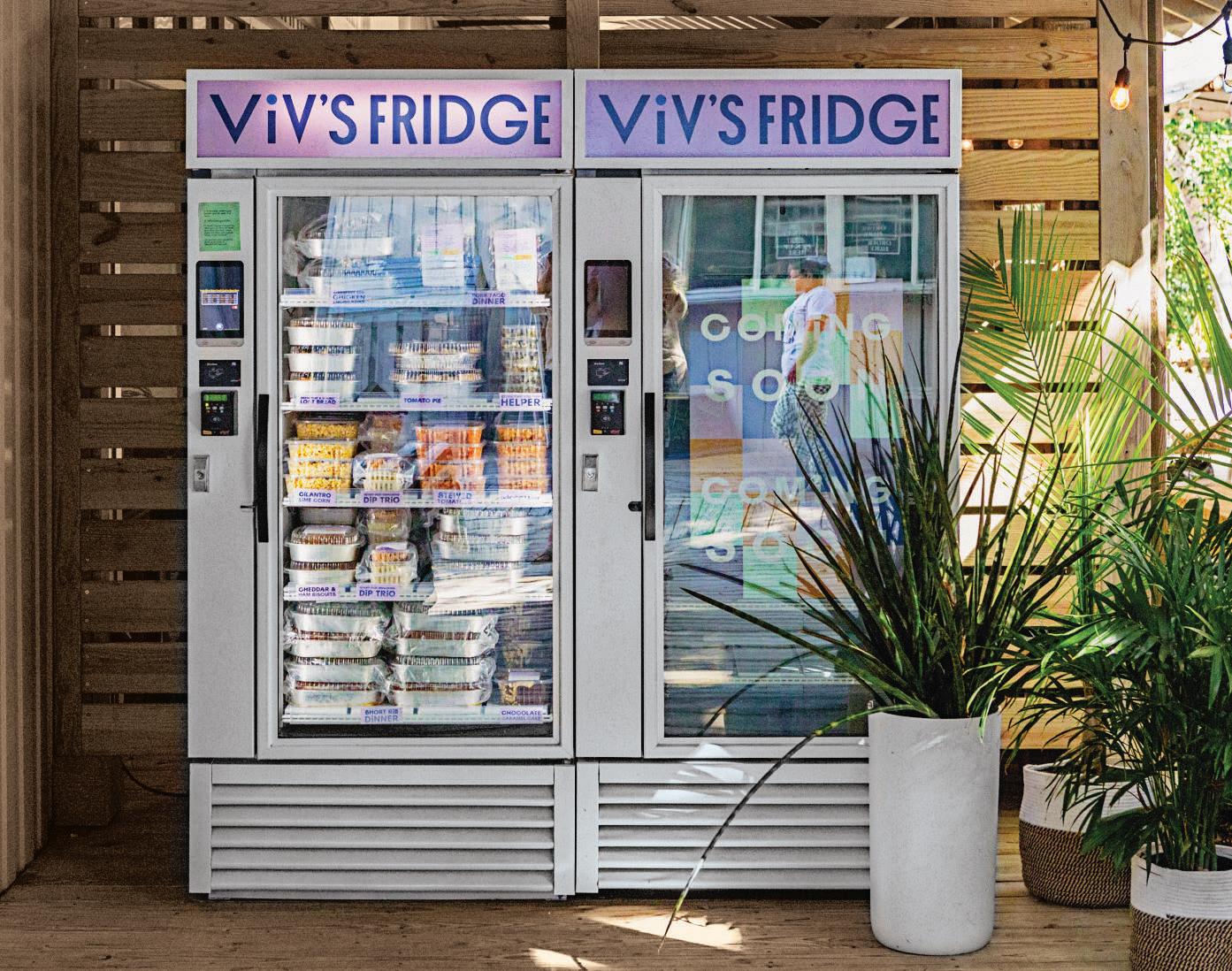
Vivian Howard is ready to cool it—literally. Last summer, the award-winning chef, restaurateur, cookbook author, and television star launched Viv’s Fridge, essentially a refrigerator vending machine, and in less than a year, it’s grown to seven locations across North Carolina, with two more debuting soon.




ON THE GO
as “smart refrigerator her flagship concept, Farmer, the offerings are a coffee and tuna sandautomats of yore. The selection rotates based on the season and available ingredients. Over the holidays, options ranged from appetizers to desserts, breakfast to dinner, with dishes like Party Magnet Cheeseball, Does Not Disappoint Breakfast Casserole, Sweet Potato and Turkey Shepherd’s Pie, and Chocolate Candy Cake Cake.
“Part of what is so appealing about the model is its scalability. It made sense to expand to larger cities within driving distance of Chef & the Farmer,





where we produce the food for the fridges,” Howard says. “After expanding across Eastern North Carolina, the [Raleigh-Durham] Triangle was the obvious next step. People have been so enthusiastic and supportive. It’s not uncommon for the fridges to sell out several times a day.”
Before the Great Recession, most chefs didn’t venture beyond a restaurant’s four walls. But the economic fallout triggered a much-needed shift


GAUGE ICON: ADOBE STOCK / EMIL’. BAXTER MILLER (2)
Vivian
QSR FSR
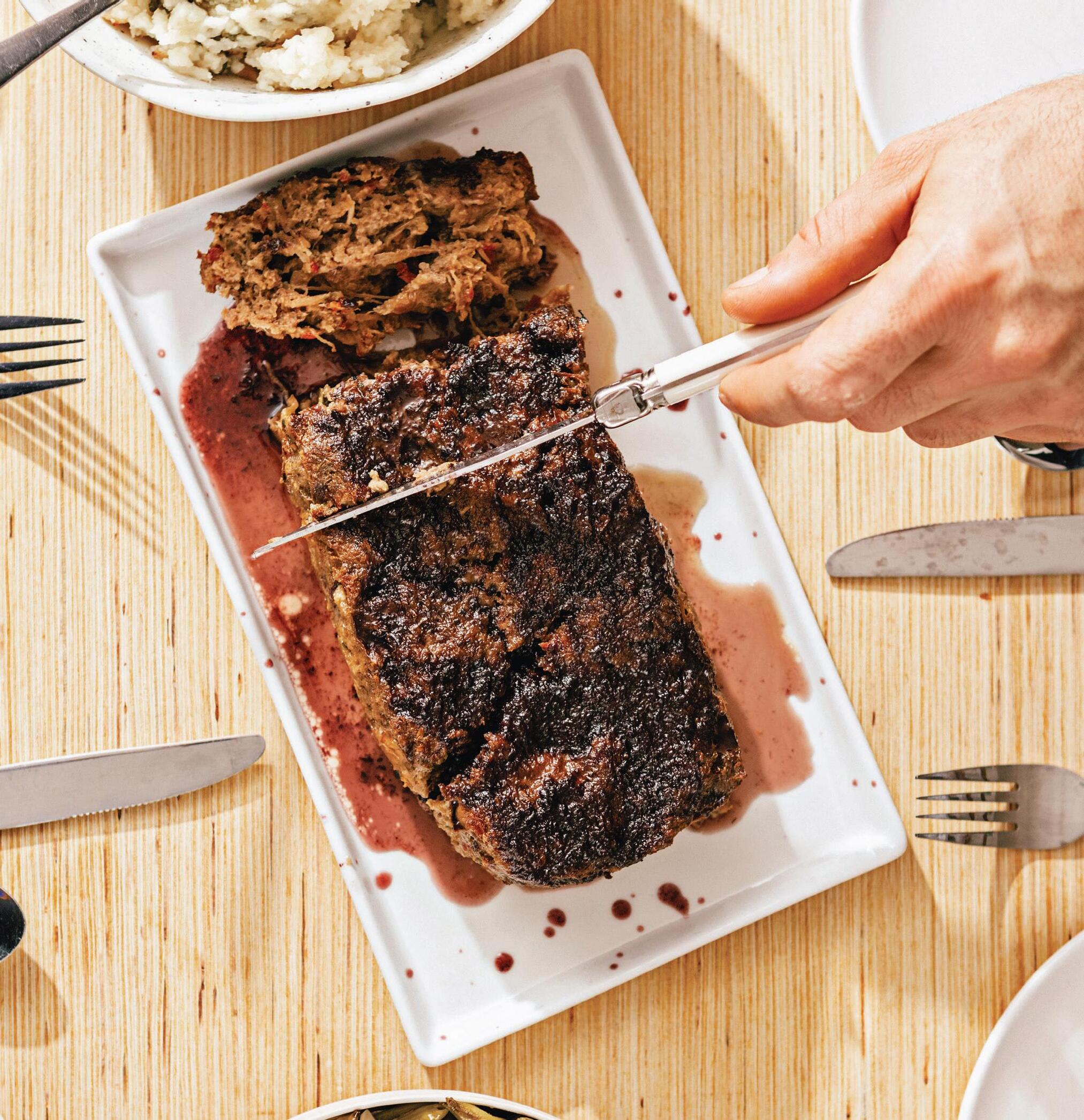
VIVIAN HOWARD RECENTLY LAUNCHED “SMART REFRIGERATOR EXTENSIONS” OF HER FLAGSHIP CONCEPT.
MARCH 2023 INDUSTRY-WIDE ISSUE 9
VIVIAN HOWARD
in mindset for foodservice leaders and innovators. Chefs began experimenting in smaller spaces and on tighter budgets, leading to the rise of chefdriven food trucks and fast casuals.
Years later, the pandemic precipitated another shift of sorts, as operators hunkered down on off-premises programs. For elevated, sit-down concepts, like Chef & the Farmer, the process was more involved and the outcome less certain.
“When the pandemic hit and we had to close for two weeks, I wondered if we’d be able to reopen because we didn’t have enough savings to sustain us,” Howard says. “I realized that a smart refrigerator or freezer serving restaurant-quality food could be a way forward.”
Even before COVID pounded the hospitalnoticed an unsettling trend: leaving the resdaytime shifts and











more time with their families.
“I started thinking about how the restaurant model is broken. It is such a hard business. It is difficult to make money,” she says.
While not a panacea, Viv’s Fridge does offer a solution in terms of work-life balance. Cooks who want consistent, daytime shifts can focus on preparing the fresh-made meals featured in the fridges. As the concept’s footprint grows, job opportunities will scale in tandem. Chef & the Farmer has been under renovations since last summer and when it reopens, staff will have more flexibility than ever.
“My hope when I reopen this summer is to only be open Thursday to Sunday so that the kitchen staff work fewer nights and have set days off. For those who don’t want to work at night, they can get more day-time hours by cooking for Viv’s Fridge,” she says.


Howard first came into the spotlight a decade ago through the PBS documentary-style series, “A Chef’s Life,” which she co-created and starred in alongside husband and business partner Ben Knight. The show, which ran for five seasons, earned a Peabody Award for what the board of jurors called “its refreshingly unsensational depiction of life and work in a modern restaurant.”
Since, Howard has written two cookbooks and opened three more brick-and-mortar restaurants in Wilmington, North Carolina, and Charleston, South Carolina.



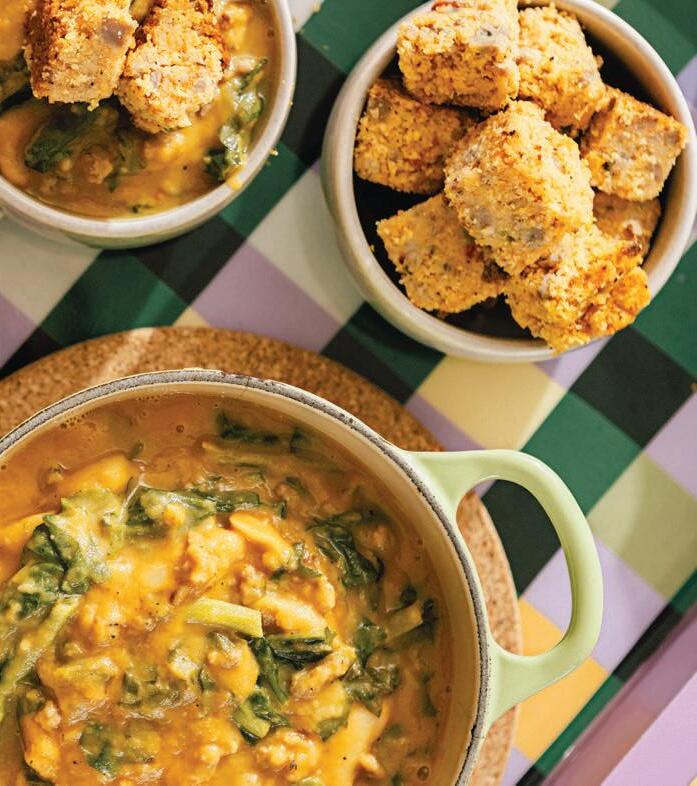
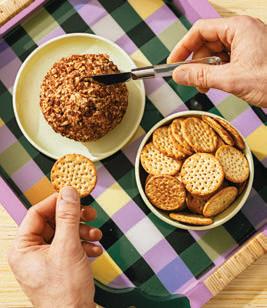
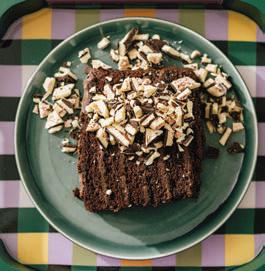
Like many proprietors, she didn’t go through 2020 unscathed. According to reporting from The New Bern Sun Journal, Chef & the Farmer had to lay off about 50 employees when COVID struck, while Howard’s other Kinston concept, Boiler Room, closed permanently.
Despite these setbacks, she remains committed to full-service, dine-in experiences, as evidenced by the fact Lenoir, her second restaurant in Charleston, opened just months after the Boiler Room shuttered. Now, Viv’s Fridge represents an opportunity to not only expand her market reach but also ensure a more shored-up business model as her empire continues to expand.
“It’s a low-cost way to make better use of the investments we already made in our kitchen and our staff. It allows you to earn revenue without expanding your footprint and without really taking on much overhead,” she says. “By diversifying the income streams, the restaurant is better able to weather the next pandemic or another emergency.”
ON THE GO BAXTER MILLER (4)
HOWARD’S CULINARY TOUCH CARRIES THROUGH FORMATS.
10 INDUSTRY-WIDE ISSUE MARCH 2023
“When the pandemic hit and we had to close for two weeks, I wondered if we’d be able to reopen because we didn’t have enough savings to sustain us. I realized that a smart refrigerator or freezer serving restaurant-quality food could be a way forward.”



Progressive Casualty Ins. Co. & affi liates. Coverages and discounts not available in all states or situations, for all vehicles or coverage selections. Protect your small business from reality with over 30+ customizable coverage options and personalized discounts. Get a quote in as little as 6 minutes at ProgressiveCommercial.com
Over the summer, Texas Roadhouse CEO Jerry Morgan informed investors the brand’s “historical seasonal sales trends” were back in the mix. It marked really the first time since COVID’s arrival the steakhouse chain could say so. Essentially, it began to prepare for back-to-school and typical routines—things that vanished from March 2020 forward. Has this maintained? Insights platform Wisevoter released its Dining Recovery Index to illustrate how the dining industry fared during the holiday season. It examined the change in percentage of visits for restaurants compared to 2022 on its educational platform.
A focus on casual dining







(States ranked in order of increase in visits by percentage during holidays compared to December 2020)
1. Colorado: 91%

2. New Mexico: 90%
3. Vermont: 88%
4. Minnesota: 85 %
5. Illinois: 83%

6. Alaska: 77 % 7.
The Dine-In Balance

This return of in-store casual visits has recalibrated the field. According to Q4 data from Revenue Management Solutions, dine-in traffic (plus 31.1 percent) saw the most considerable increase compared to last year. Drive-thru was down 12.2 percent, year-over-year, yet has remained stable throughout 2022.
Some other stats (per RMS):
• Takeout traffic was up 22.1 percent.






• Delivery traffic was also positive year-over-year at 15.9 percent, but performance slightly declined compared to Q3 2022 (20.1 percent).

• Quick service was the top segment choice. When asked about the category they were using “more or much more,” over 40 percent of respondents said quick service as compared to coffee shops, breakfast restaurants, and full service.
The biggest takeaway?
Breaking out Colorado returned an interesting juxtaposition:
“Operators should concentrate on loyal, frequent customers as they fight for market share. In the deep dive survey, respondents reporting 10-plus restaurant visits per week were twice as likely to increase their future usage across all channels,” RMS said.
ADOBE STOCK: GRUOP AT TABLE / RAWPIXEL.COM, USA MAP HURCA!, DINING ICONS MACROONE ON THE GO
Michigan:
8. New Hampshire:
9. Oregon: 66% 10. Kentucky: 64 % 11. Rhode Island: 61% 12. California: 60% 13. Washington: 59% 14. Maine: 58% 15. Massachusetts: 55% Change in visits to restaurants: 91% Change in visits to grocery stores: 0%
75%
66%
Dine-in Traffic 31 % Loyal Frequent Customers 10 + restaurant visits per week 12 INDUSTRY-WIDE ISSUE MARCH 2023


What Insights Are Hiding Behind Your Numbers?
What fast-casual and fine-dining restaurants can teach each other.
tor of U.S. business development at Paperchase.
Paperchase specializes in working with restaurant brands ranging from quick-service restaurants to fine dining, tailoring reports to specific aspects of business operations for each client. The consultancy is known for its mastery of day-to-day financial operations, as well as the breadth and frequency of reporting, which allows clients like Le Pain Quotidien and Zuma to make agile business decisions. Its decades of industry specialization allows for much more detailed reports that are focused toward restaurant operations.
In addition to the standard monthly balance sheet and P&L statements, Paperchase technology reconciles data from dining-specific sources such as vendors, POS systems, and third-party delivery to provide reporting by the week, day, or hour. Its weekly reporting provides comparative data analyzing a restaurant’s top performing areas, KPIs such as cost of goods sold, and critical labor analysis.
BY DAVINA VAN BUREN
For decades, many fine dining operators viewed restaurants as a creative space rather than a profit center. But the tumultuous past few years have brought dramatic changes in the labor pool, supply chain, off-premise dining, and inflation, resulting in an increased need for high-end restaurants to monitor their bottom line. Fast-casual and quick-serve restaurants, on the other hand, have always kept profits top of mind.
Luxury concepts want to know which days and shifts the restaurant operates at peak efficiency, and know they must pay higher wages to retain skilled staff. From their fine dining counterparts, fast casuals can learn to streamline business on days or areas that may not be as profitable, and the impact of loyal staff and stellar service on customer retention. Both types of restaurants—especially those in strong growth mode—must be hyper-attuned to what is happening inside the restaurant.
“While most restaurants can pull reports from point-of-sale, third-party delivery platforms, and other payment avenues, that information doesn’t convey the full financial picture due to the nature of siloed or antiquated technology. Nor does it address the cost side of the ledger,” says Chris Moxhay, direc-
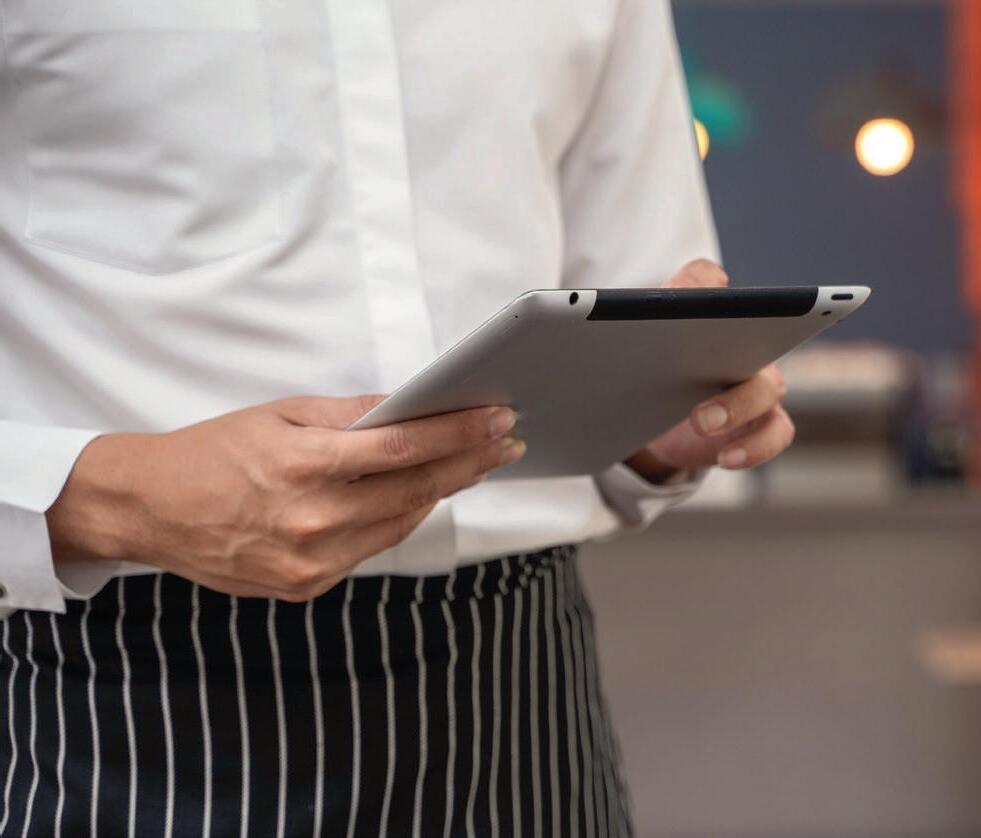
“The weekly reporting of our key metrics has been instrumental for our teams making the necessary adjustments that are needed at a restaurant day to day,” says Patrice Leys, CEO of Five Guys NY. “Their attention to detail and familiarity with the foodservice industry continue to be an advantage for our growth as an organization.”
One area that Paperchase’s specialized team of experts highlight in analysis meetings with clients are comped and voided items. Paperchase accountants encourage clients with high percentages in these areas to investigate the underlying reasons for comps and voids. This typically reveals valuable insights about the business, like the need for greater training for servers—or something more nefarious, such as theft.
“What is most interesting are the stories that lie behind the numbers,” Moxhay says. “We don’t just rely on technology to give the reporting, we have a team that analyzes the data and can highlight areas in the restaurant that need improvement or present overlooked opportunities. This level of insight helps restaurant brands grow and expand.” •
14 INDUSTRY-WIDE ISSUE SPONSORED CONTENT / MARCH 2023 SPONSORED BY PAPERCHASE
» To learn more, visit pchase.com.
“What is most interesting are the stories that lie behind the numbers.”
ADOBE STOCK




































ACCOUNTING CONSULTING ANALYTICS
is the key ingredient for succeeding in hospitality We provide all-in-one specialized accounting services including AP & AR, bank reconciliation, detailed weekly reporting, budgeting, projections, and cash flow forecasts. Our experts will handle the daily work so you can focus on what you do bestdelivering exceptional guest experiences. Hospitality is our specialty. Accounting for hospitality for over 30 years Contact us today to see how Paperchase can grow your business www.pchase.com hello@paperchase.ac THE RECIPE FOR SUCCESS OFFICES IN: NY • LA • MIAMI • LONDON • DUBAI • INDIA SUPPORTING RESTAURANTS EVERYWHERE
Paperchase






Chefs & Ingredients
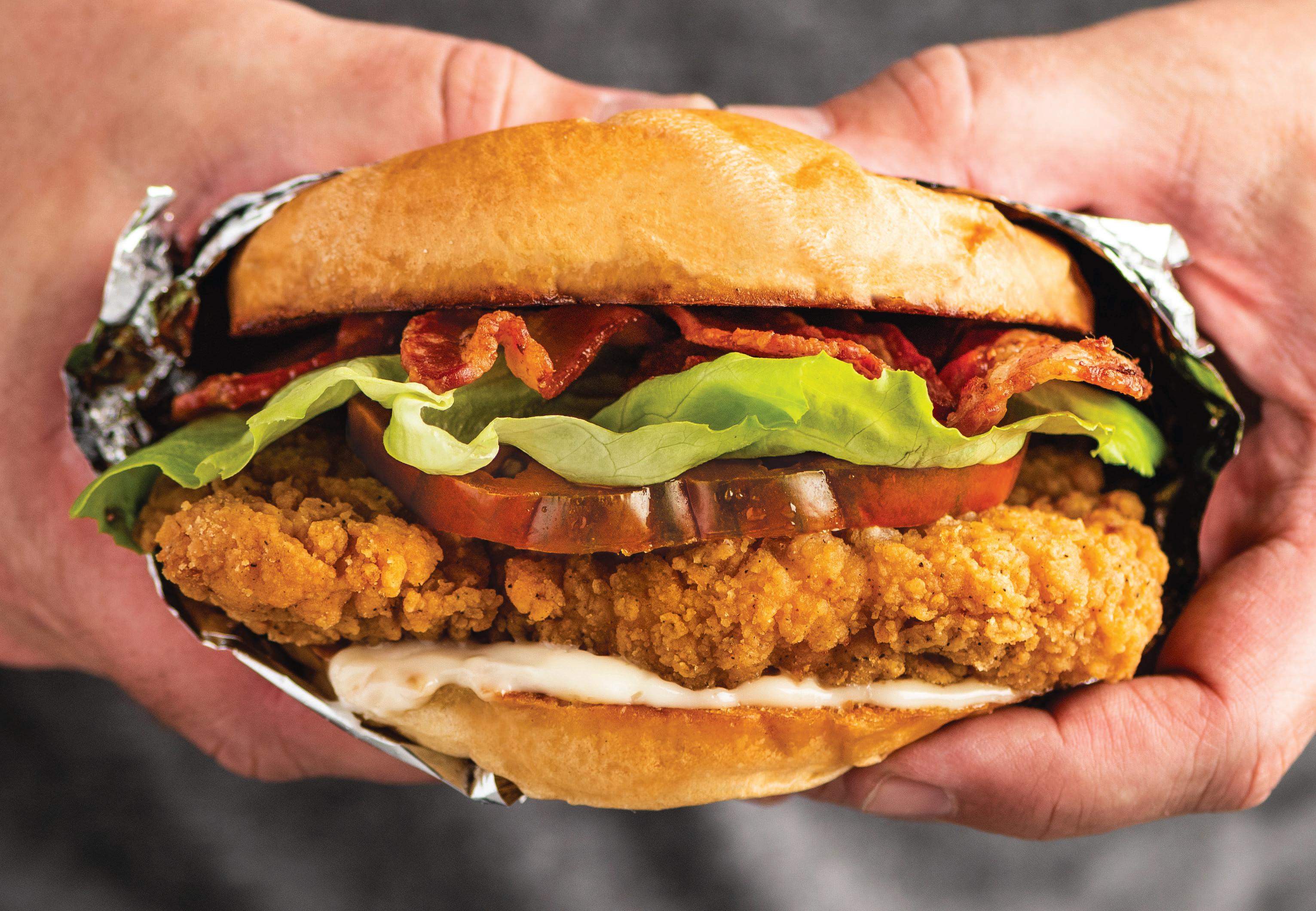
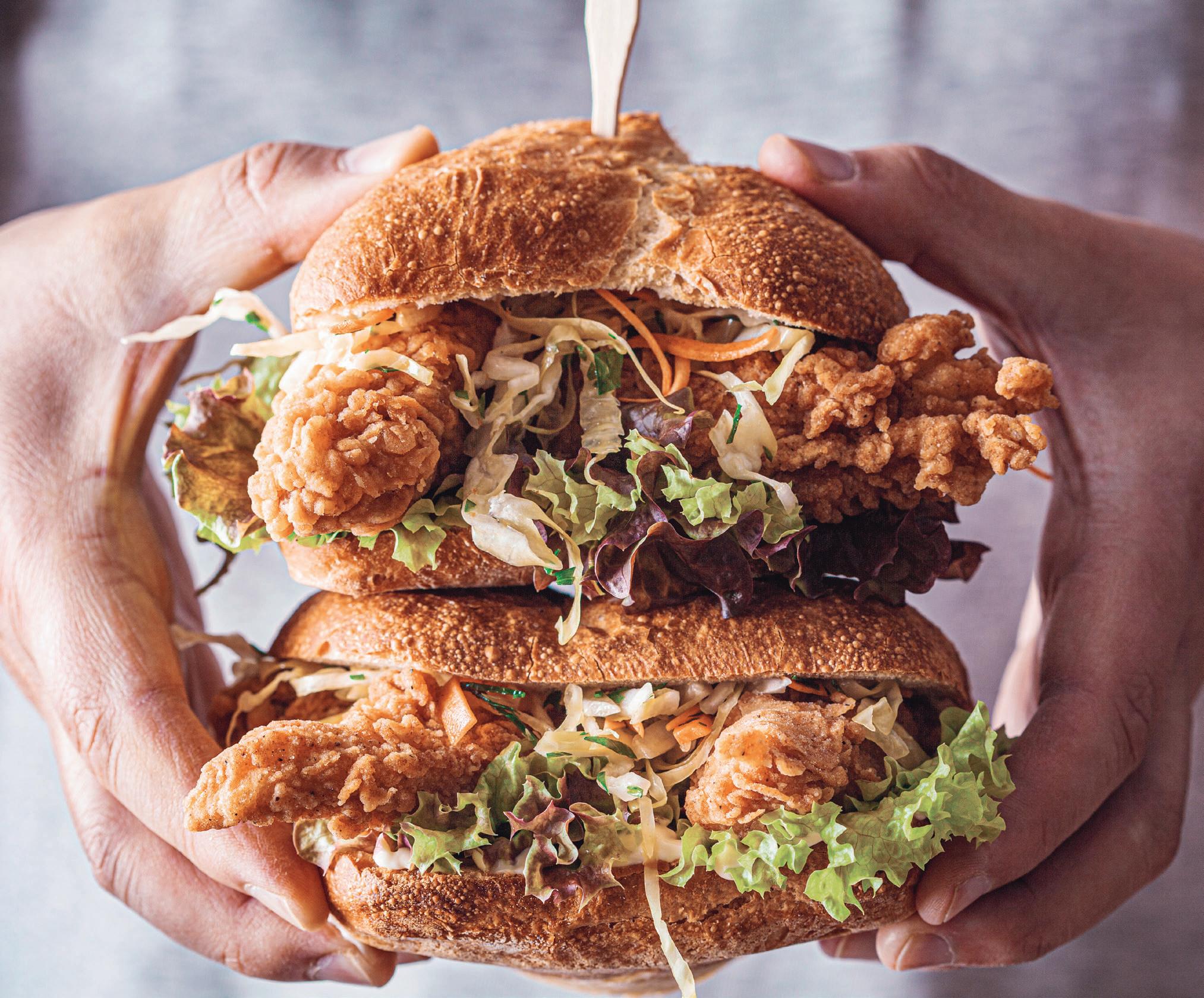
The Great Chicken Sandwich Era is Here to Stay
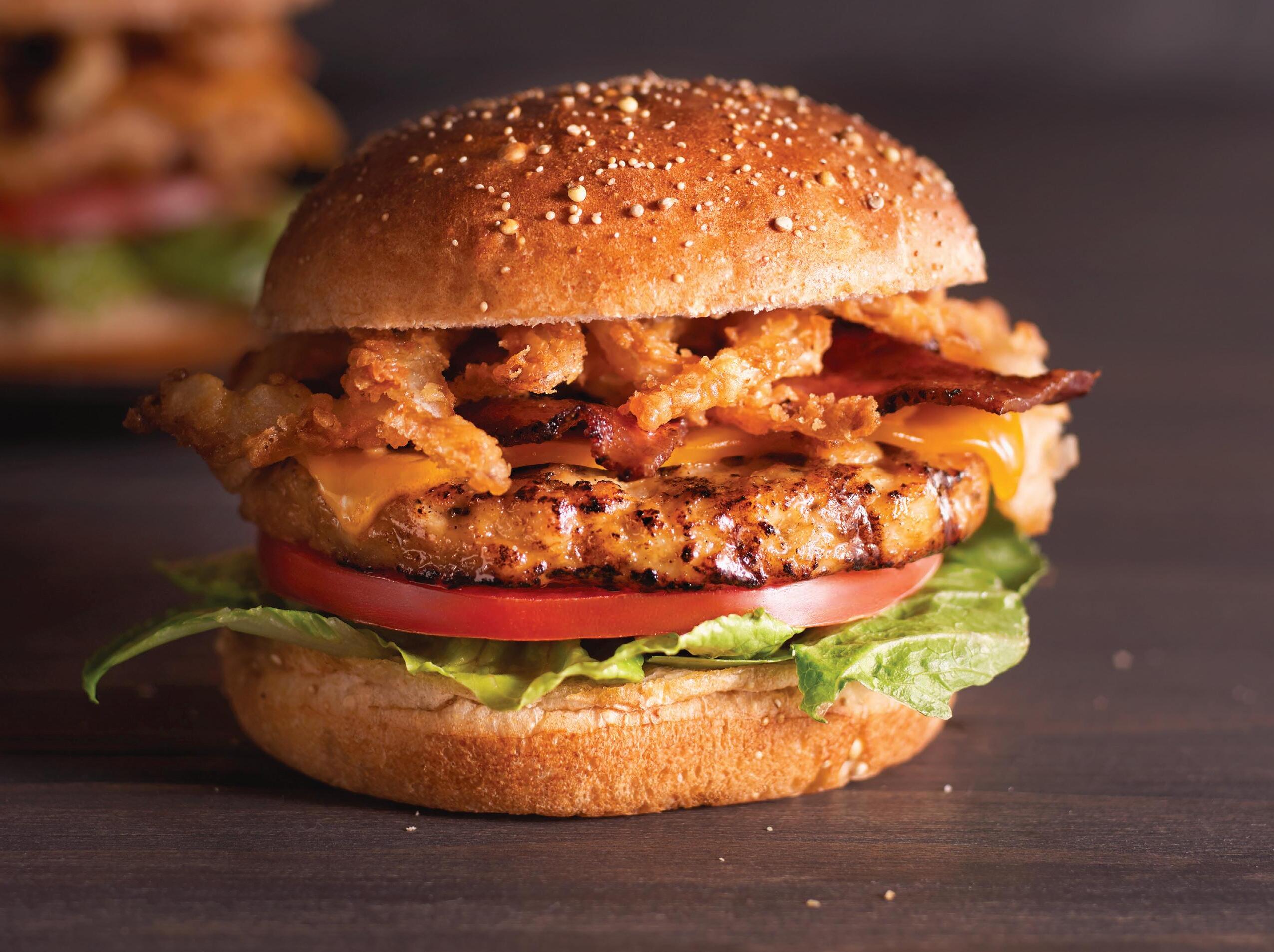

How fried chicken sandwiches evolved beyond flash-in-the-pan trend to a menu mainstay at both full- and quick-service restaurants.
 BY CALLIE EVERGREEN


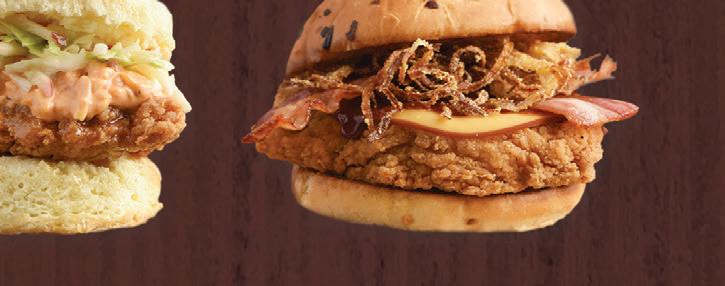
The restaurant world became a different place in 2019 when fried chicken sandwiches rose to a never-before-seen level of prominence. The craze was ignited by an epic battle among quick-service chains, each trying to prove their respective sandwich was superior in a marketing trend known as “The Chicken Sandwich Wars.” Four years and one industry-shaking pandemic later, consumer interest in battered and fried chicken between two buns has continued unabated; full-service restaurants are even cashing in on the trend with elevated adaptations of the product.

QSR FSR ➺ OPEN THE FOLD TO READ MORE ON WHERE THE CHICKEN SANDWICH WARS GO FROM HERE. GAUGE ICON: ADOBE STOCK EMIL’. ADOBE STOCK Y VAASEENAA IN THE END, THE
SO-CALLED “CHICKEN SANDWICH WARS” ELEVATED THE CATEGORY INDUSTRY-WIDE.
when promiquick-service supeWars.”
7.75 in wide
BRAKEBUSH
CENTER LEFT FOLD-OUT PAGE

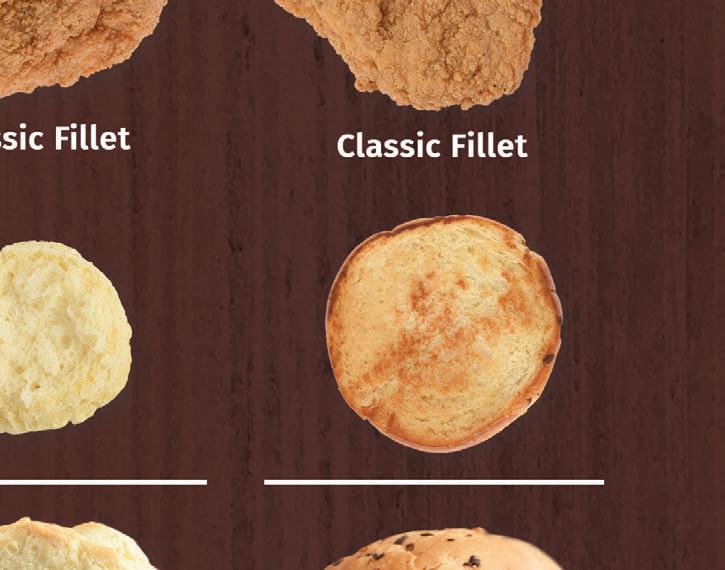
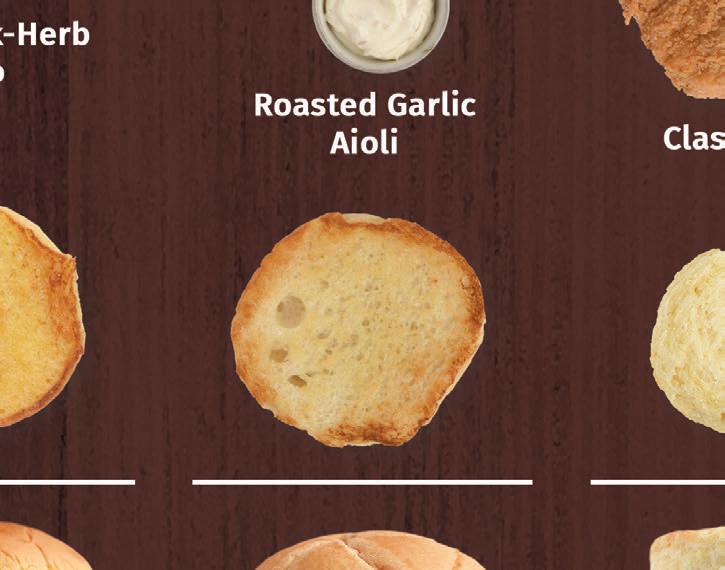
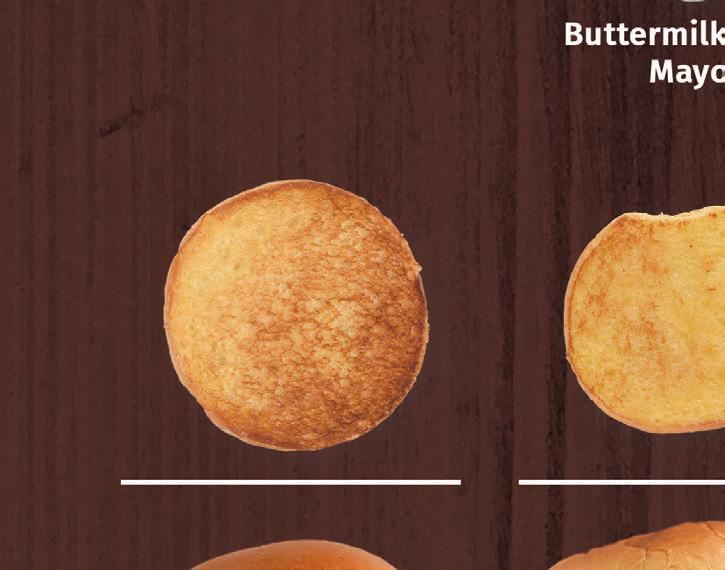
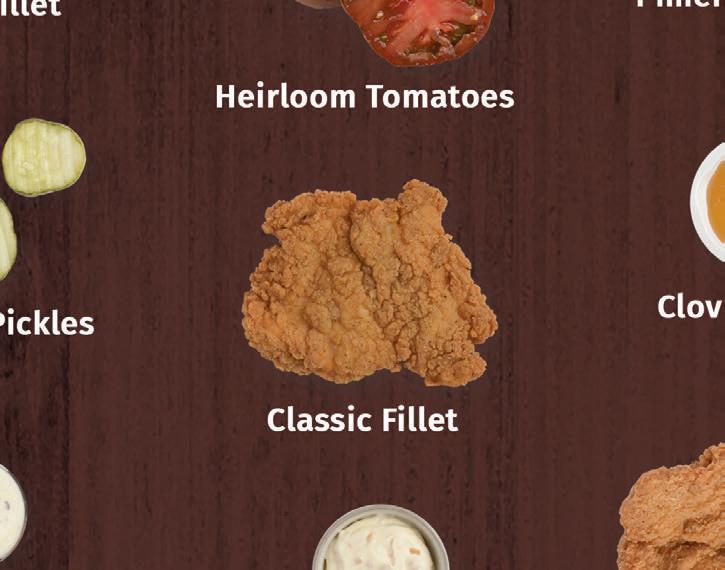
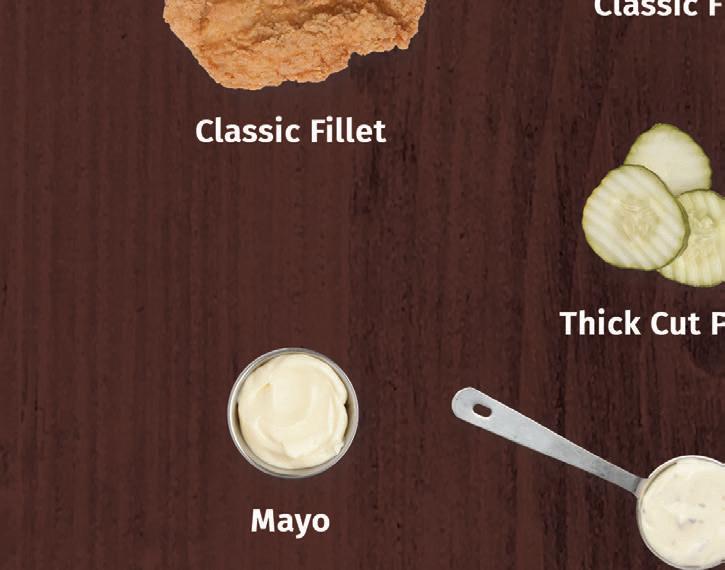
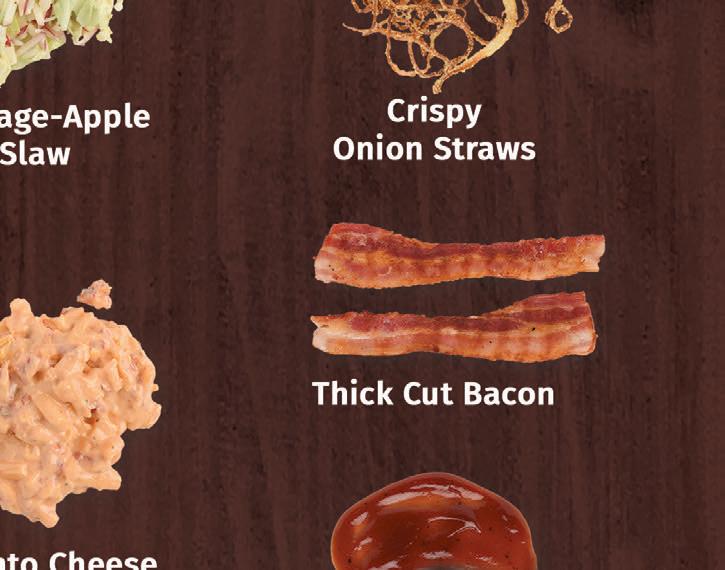
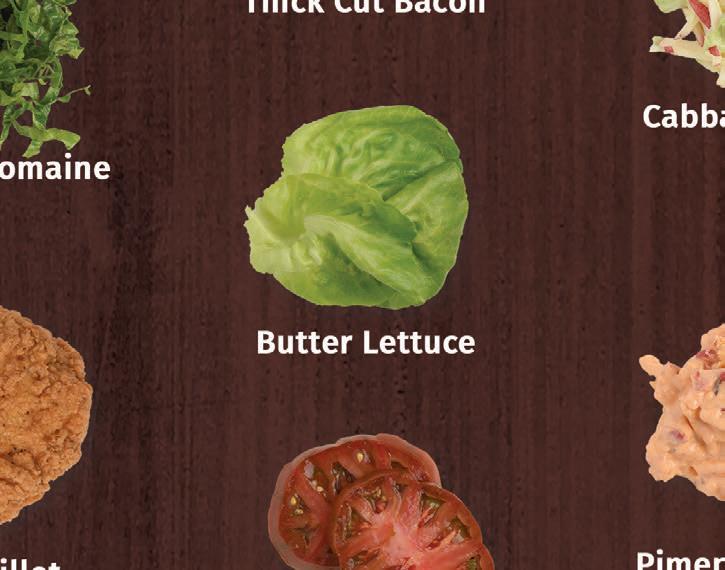
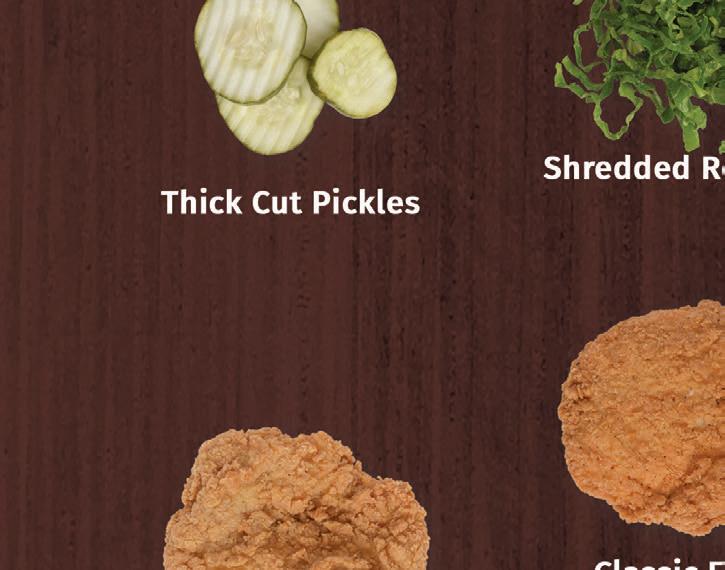


Era
consumer conin on Ingredients ➺



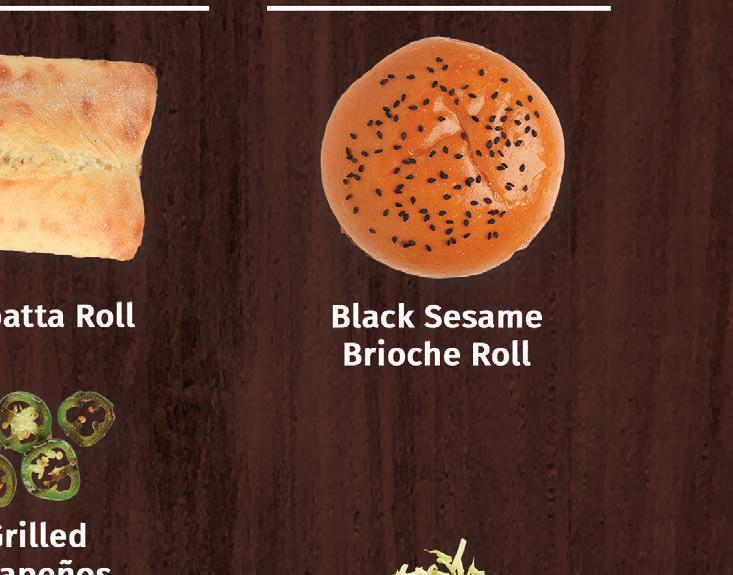
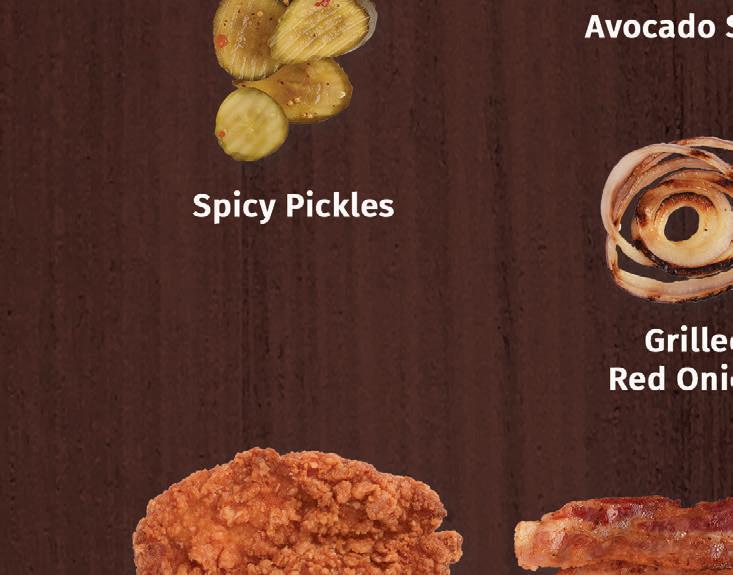
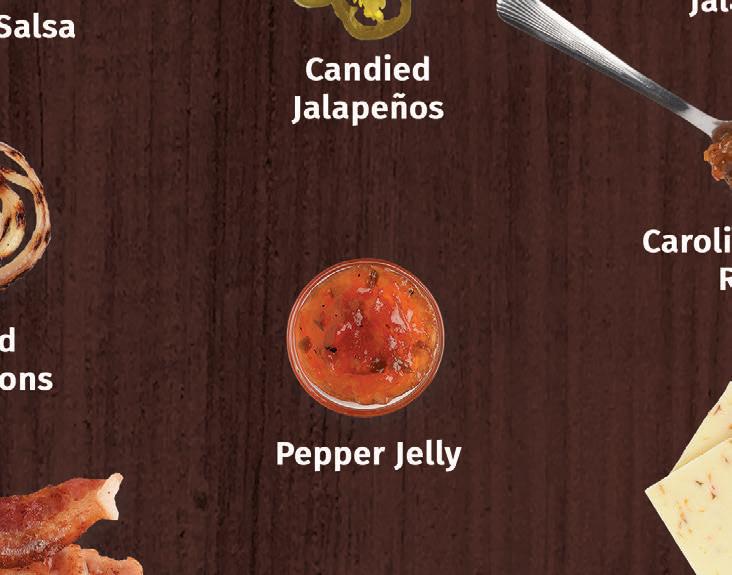
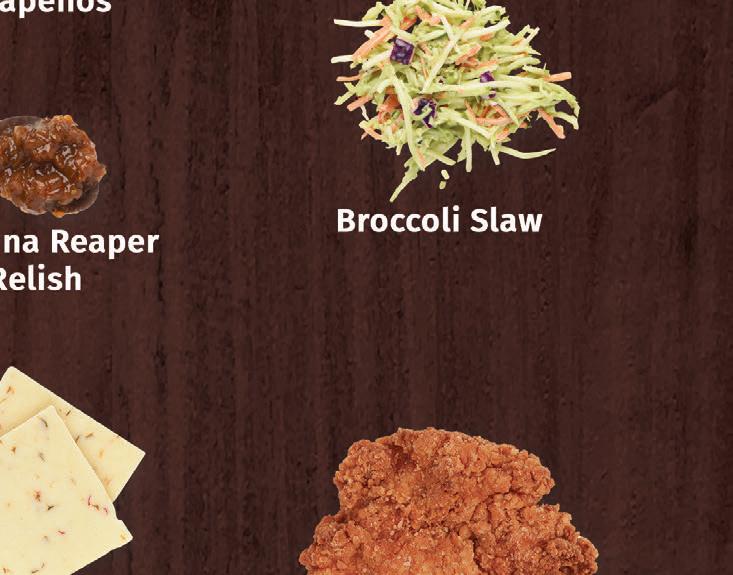
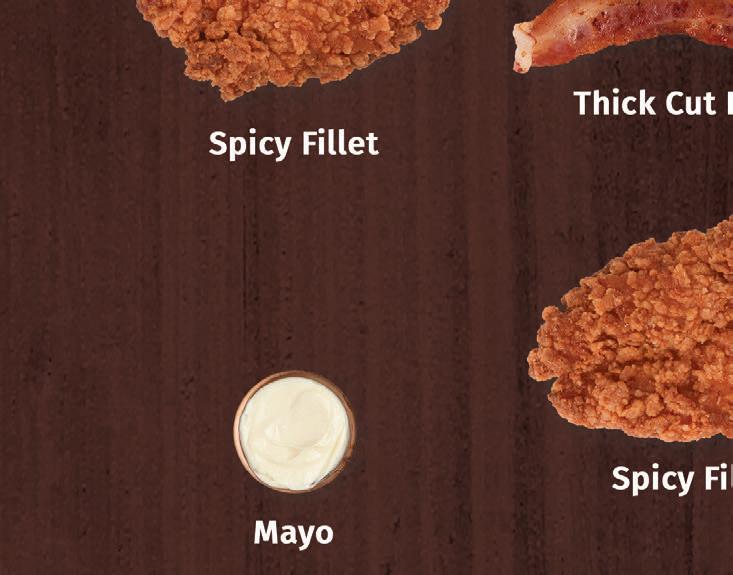
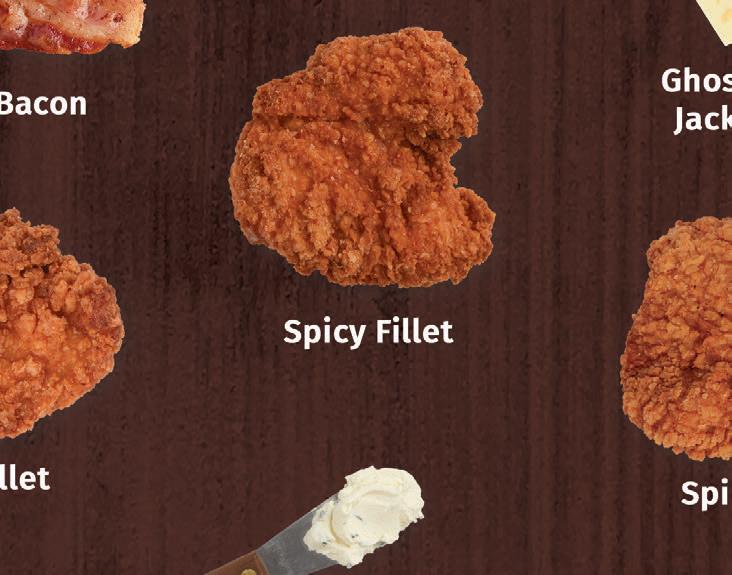
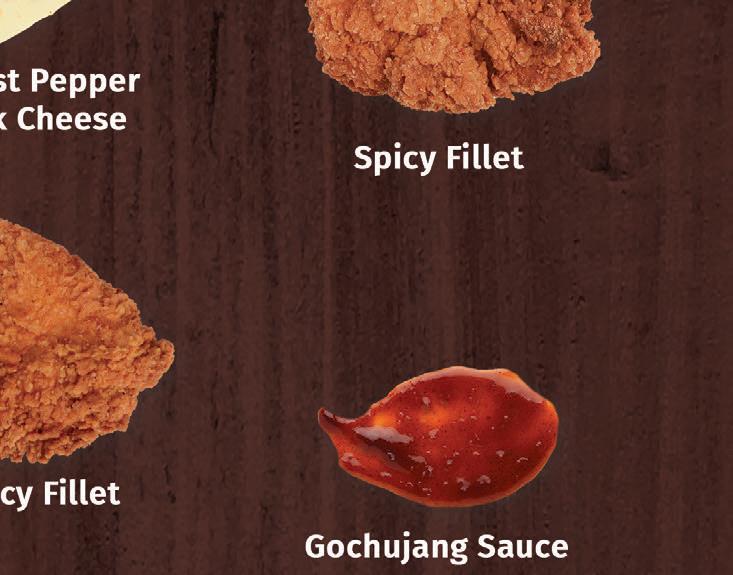
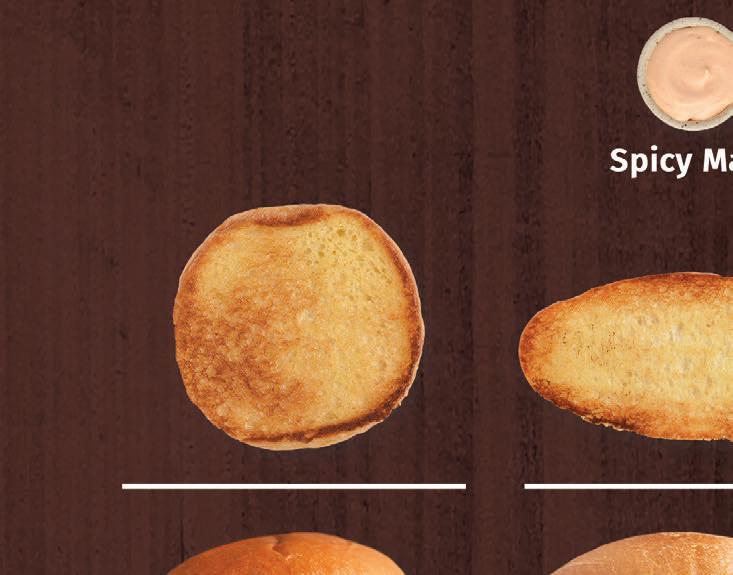
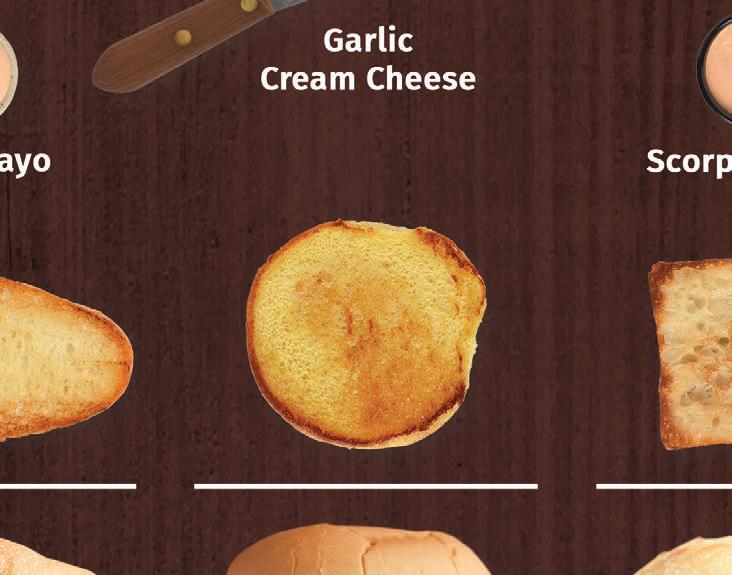
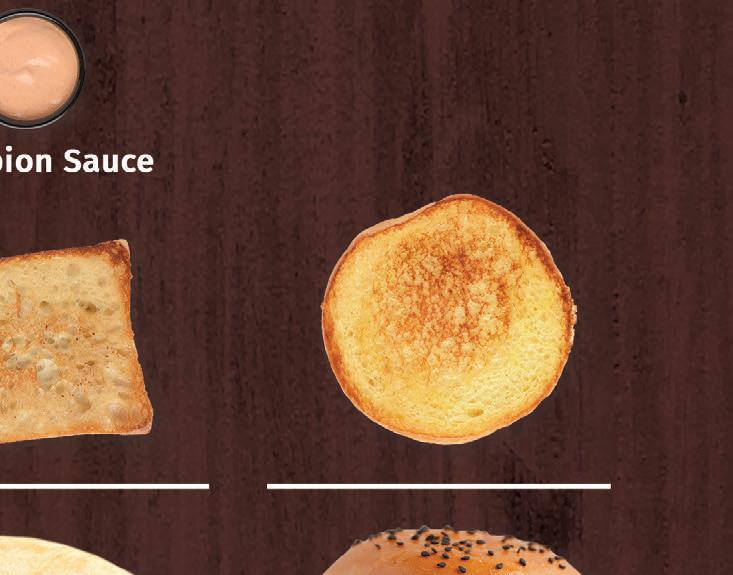

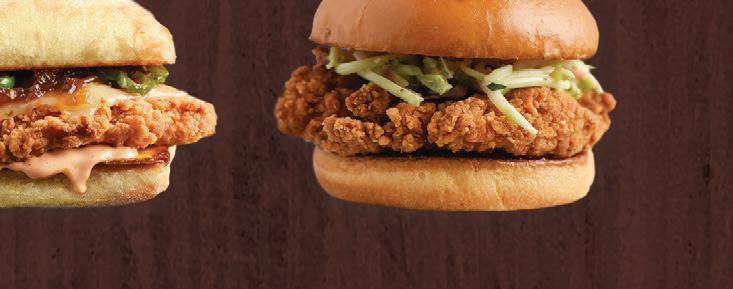






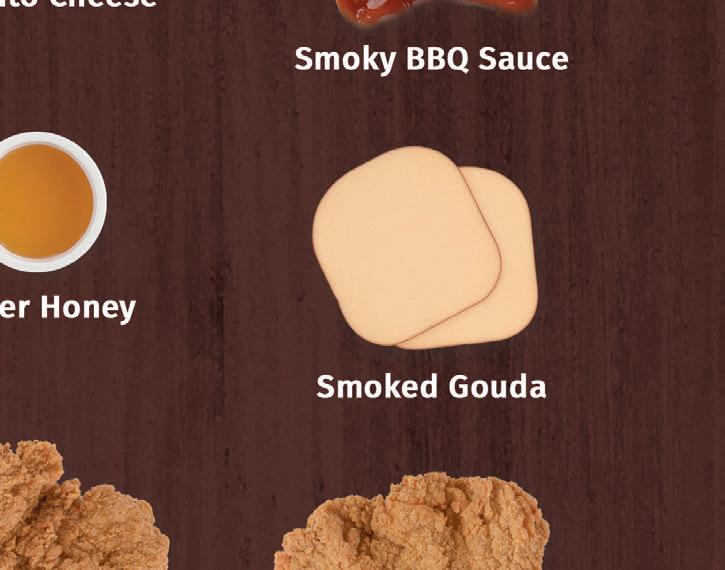
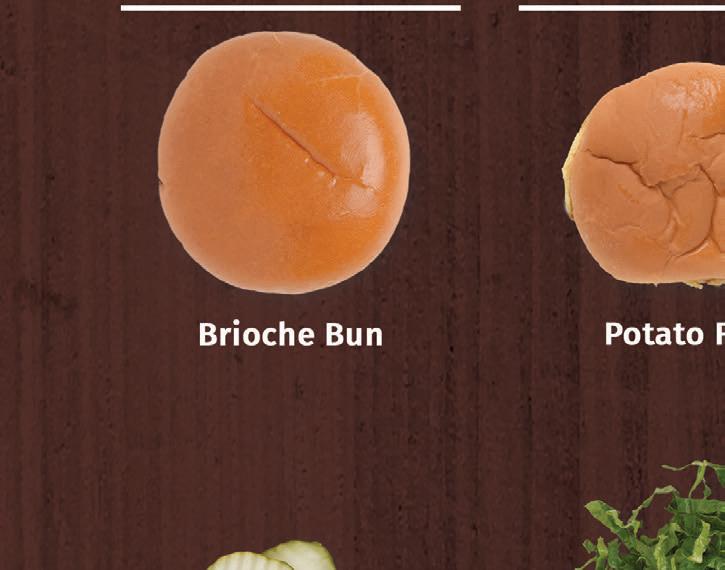
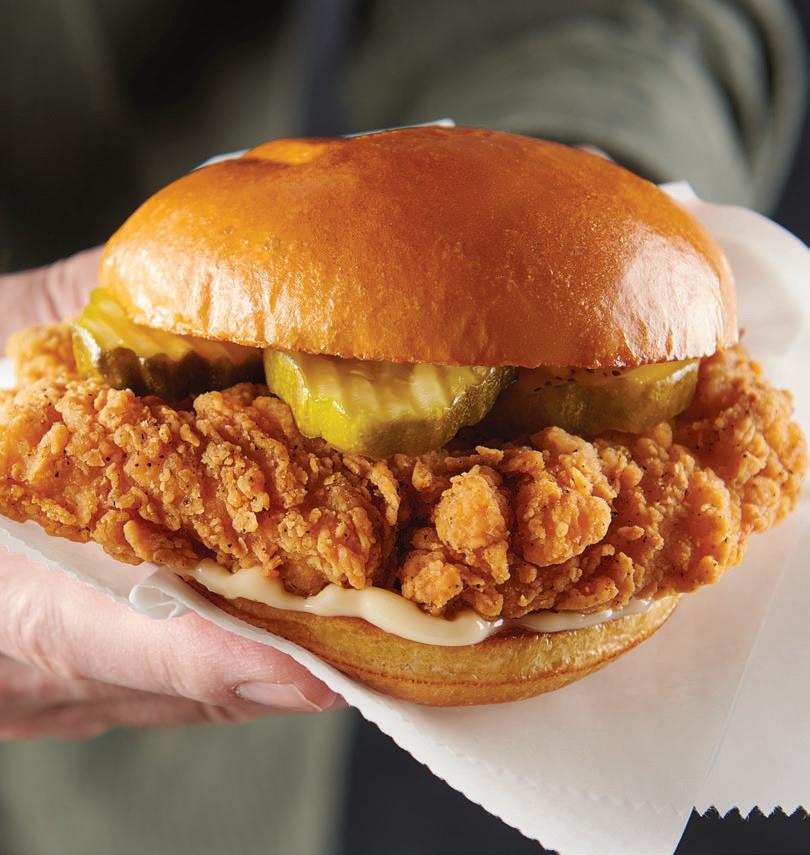
As a primarily bone-in chicken and tenders purveyor, Popeyes wasn’t sure what to expect when it introduced a fried chicken sandwich in August 2019—especially after spending three years developing the product and conducting market tests. With a buttery brioche bun, tangy mayo, crisp pickles, and seasoned chicken breast, the brand thought it had a winner on its hands. The response was a game-changer for the chain, which sold out of the new menu item in a matter of days.
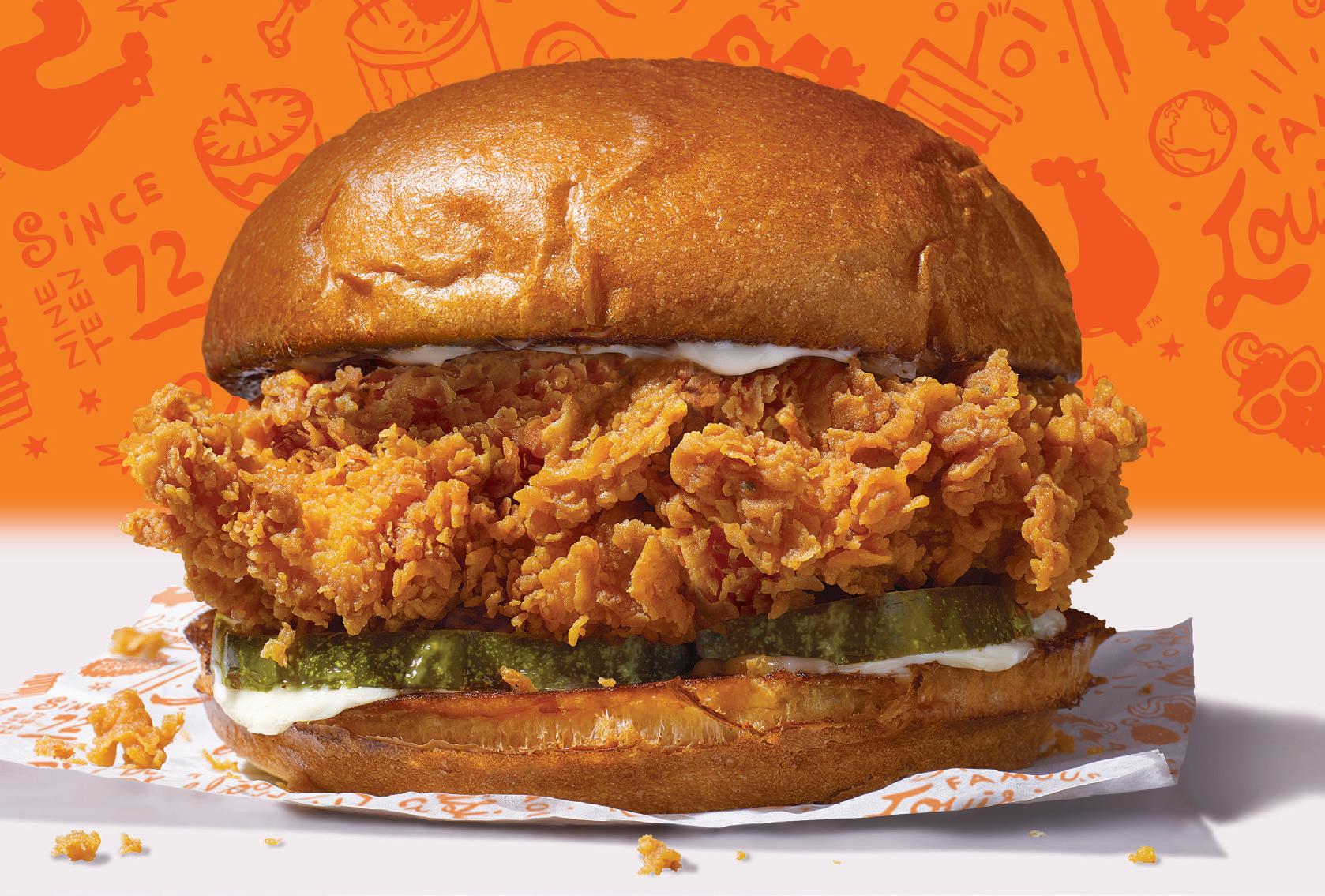
“It was not a stunt nor was it fake,” says Sami Siddiqui, president at Popeyes. “We could have never predicted selling out as fast as we did due to such unprecedented demand.”
In the first few days of the launch, Popeyes sold more than 10 times the number of sandwiches it had predicted based on rigorous market testing. After relaunching the product permanently that November, the brand had one of the best quarters in nearly two decades.
One crucial aspect when considering launching the new menu item was in-restaurant execution. Working closely with franchisees, Popeyes was able to introduce new sandwich line equipment and batter tables in all of its restaurants, as well as train thousands of team members in a matter of weeks.
“Ultimately, this type of on-the-ground execution from our franchisees and team members
drove the incredible response from guests,” says Siddiqui, who joined the brand in September 2020 after previously serving as president of parent company Restaurant Brand International’s Asia-Pacific region.
Though Popeyes certainly helped light the spark, the Chicken Sandwich Wars drew several other opponents. Chick-fil-A took to Twitter to claim its version predated the Popeyes’ sandwich, and a social media storm ensued that captivated the internet for more than a week. A comedy sketch on “Saturday Night Live” even parodied the popularity of Popeyes’ chicken sandwich, with Harry Styles playing an expat who’s oblivious to the chain’s cultural touchstones.
Popeyes ended up selling 203 million chicken sandwiches in the first year, which equated to a 38 percent increase in overall sales in 2019. By February 2021, the company shared a staggering statistic, revealing the scale of impact: After introducing the chicken sandwich, Popeyes’ average-unit volumes rose by $400,000, amounting to $1.8 million. Popeyes also opened 200 restaurants in 2021, propelling it past the 3,000-unit benchmark in the U.S. and Canada. The company even signed more development agreements than at any other time in the brand’s history.
“The Chicken Wars were lightning in a bottle for Popeyes. Having a great product was foundational, but we capitalized on a unique
CHEFS & INGREDIENTS
“The Chicken Wars were lightning in a bottle for Popeyes. Having a great product was foundational, but we capitalized on a unique social media moment that became ownable for our brand.”
NOBODY CAN ARGUE POPEYES GOT THE REAL DEBATE STARTED ON SOCIAL MEDIA.
ADOBE STOCK Y JOSHUA RESNICK
social media moment that became ownable for our brand,” Siddiqui says. “We posted the tweet heard around the world, ‘Y’all good?’, a playful nod at one of our friends in the chicken industry that embodied our Southern heritage while engaging early in the social conversation. We like to think we ignited the Chicken Wars, and we’re proud of everything that has happened since.”
Consumers’ hunger for the comforting, portable meal only grew throughout the pandemic. Soon, more than 20 fast-food brands had introduced chicken sandwiches to their menus, including Wendy’s, McDonald’s, Golden Chick, KFC, Fatburger, Church’s Chicken, BurgerFi, Zaxby’s, Fuku, Jack in the Box, Sonic, Carl’s Jr., Shake Shack, Pollo Campero, Bojangles, and more. Even concepts that weren’t necessarily known for chicken, like Taco Bell and Panda Express, tried to cash in on the trend.
“I also think the chicken craze was because of the cost; a lot of people don’t say that, but chicken is obviously cheaper than burgers or other meats,” says Troy Guard, chef and owner of Denver-based TAG Restaurant Group (TRG).
TRG comprises a dozen restaurants including breakfast joint Hashtag, bowl-centric fast casual Bubu, modern steakhouse Guard & Grace, and a Denver-area food hall—where multi-unit chicken sandwich concept Crack Shack has planted a foothold. Since opening, it’s ranked as the No. 1 stall
in the venue.
A few years ago, Guard himself won a chicken sandwich battle in Denver called Chicken Fight Festival. He marinated a chicken breast for 24 hours, letting it sit half a day to get crispier in the deep-frying process, and added sweet-and-spicy aioli and pickles, lettuce, tomato, and slaw.
“It’s a huge crowd-pleaser, but it takes a little bit of time, I think, to make a good chicken sandwich,” he says.
And the appeal of the chicken sandwich reaches far beyond quick-service and nontraditional restaurants. The menu item has been a mainstay for more than a decade at Rock & Brews, a casual dining, rock music–inspired restaurant and eatertainment concept founded by none other than Gene Simmons and Paul Stanley of famed band KISS.
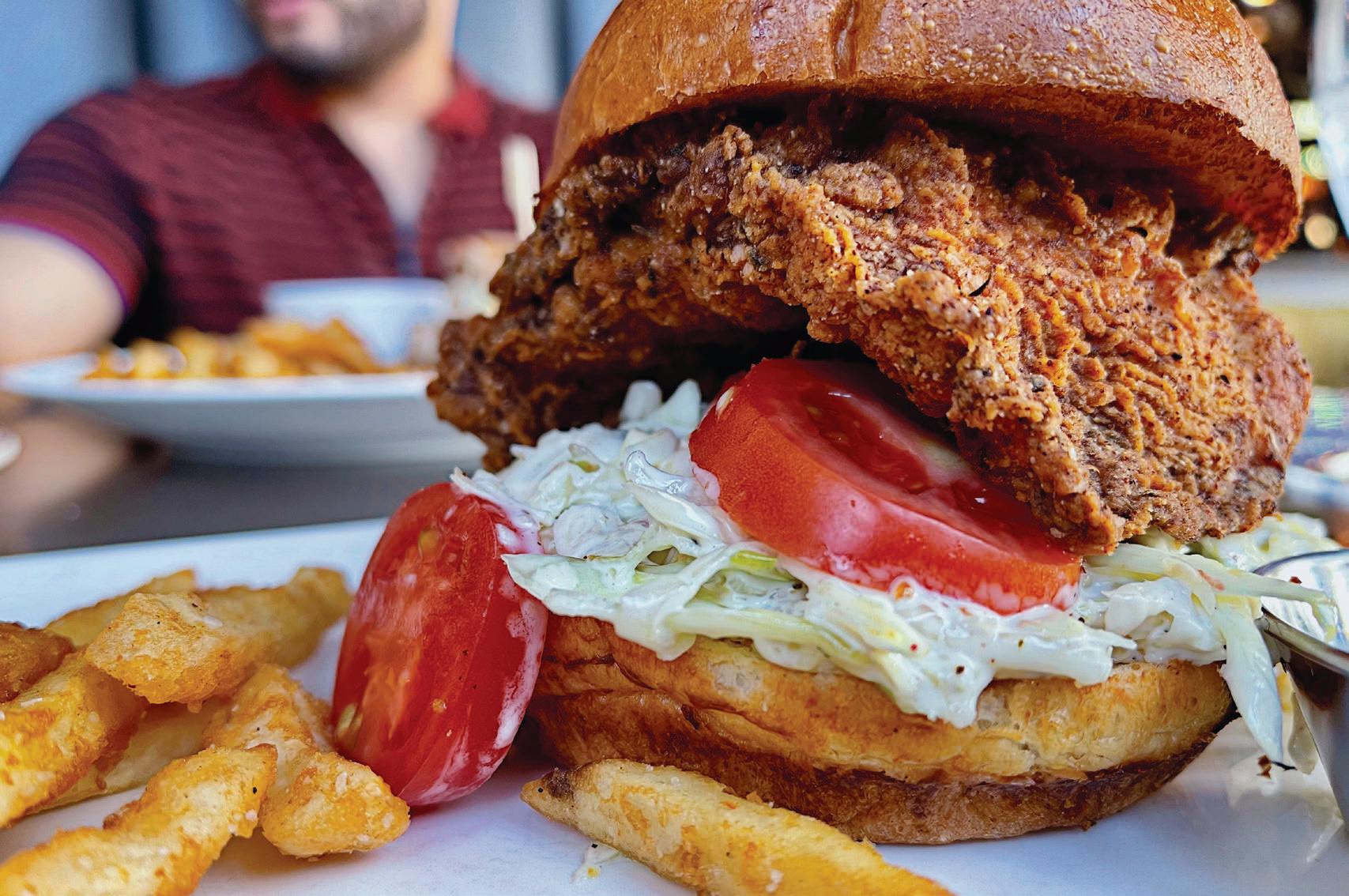
The California-based brand—which has grown to 18 locations, including airport and casino units— introduced its Southern Fried Chicken Sandwich right around the brand’s inception in 2010. The fan-favorite dish features a sesame brioche bun, iceberg lettuce, pickles, mayo, a tomato, and, of course, fried chicken.
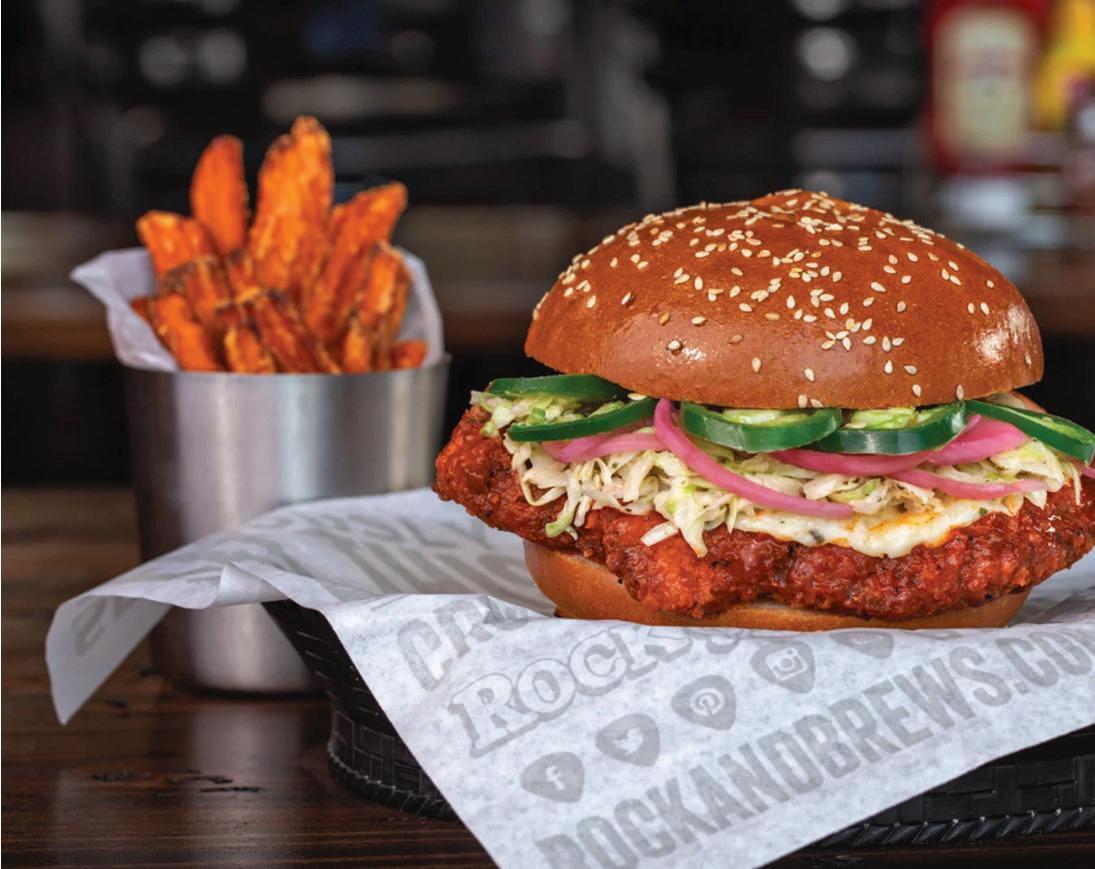
Then came the Demon Chicken Sandwich, named after Simmons’ stage persona.
“Gene likes to peek his head into the kitchen every blue moon and collaborate with culinary and put his creative input inside,” says Ben Magana, executive chef at Rock & Brews.
“He wanted a spicy sandwich that kind of represented his demon persona, so try to envision how he looks—the makeup, bright red lips, contrast of colors. And the mission was to create a sandwich that reflected the color, the heat, that feeling of being a little bit bigger than life,” Magana says.
ROCK & BREWS UNVEILED A CHICKEN SANDWICH SHORTLY AFTER ITS INCEPTION.
TAG RESTAURANT GROUP FEATURES CHICKEN ACROSS ITS MULTI-BRAND LINEUP.
POPEYES, TAG RESTAURANT GROUP, ROCK & BREWS
“GENE LIKES TO PEEK HIS HEAD INTO THE KITCHEN EVERY BLUE MOON AND COLLABORATE WITH CULINARY AND PUT HIS CREATIVE INPUT INSIDE,”SAYS BEN MAGANA, EXECUTIVE CHEF AT ROCK & BREWS.
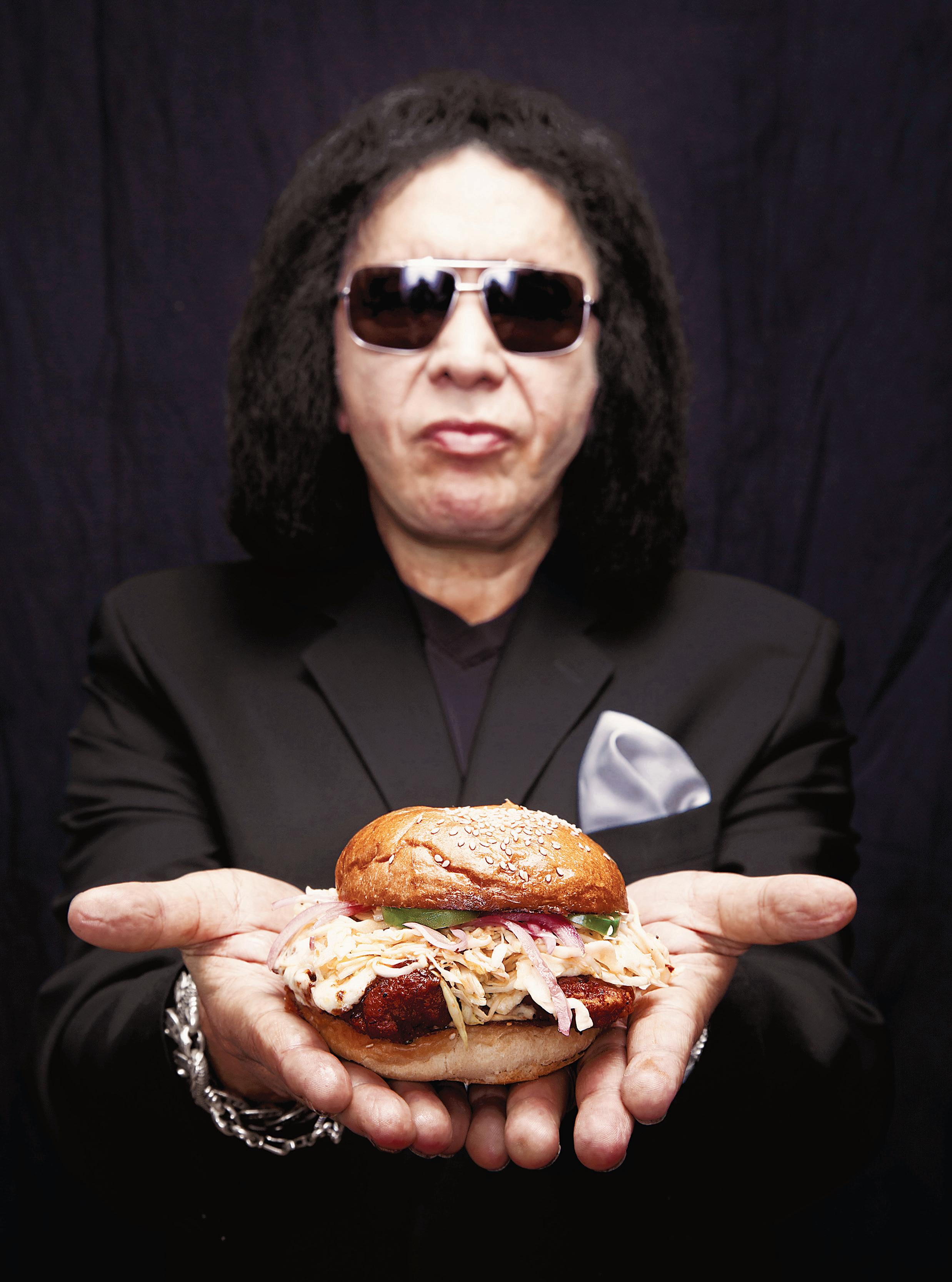
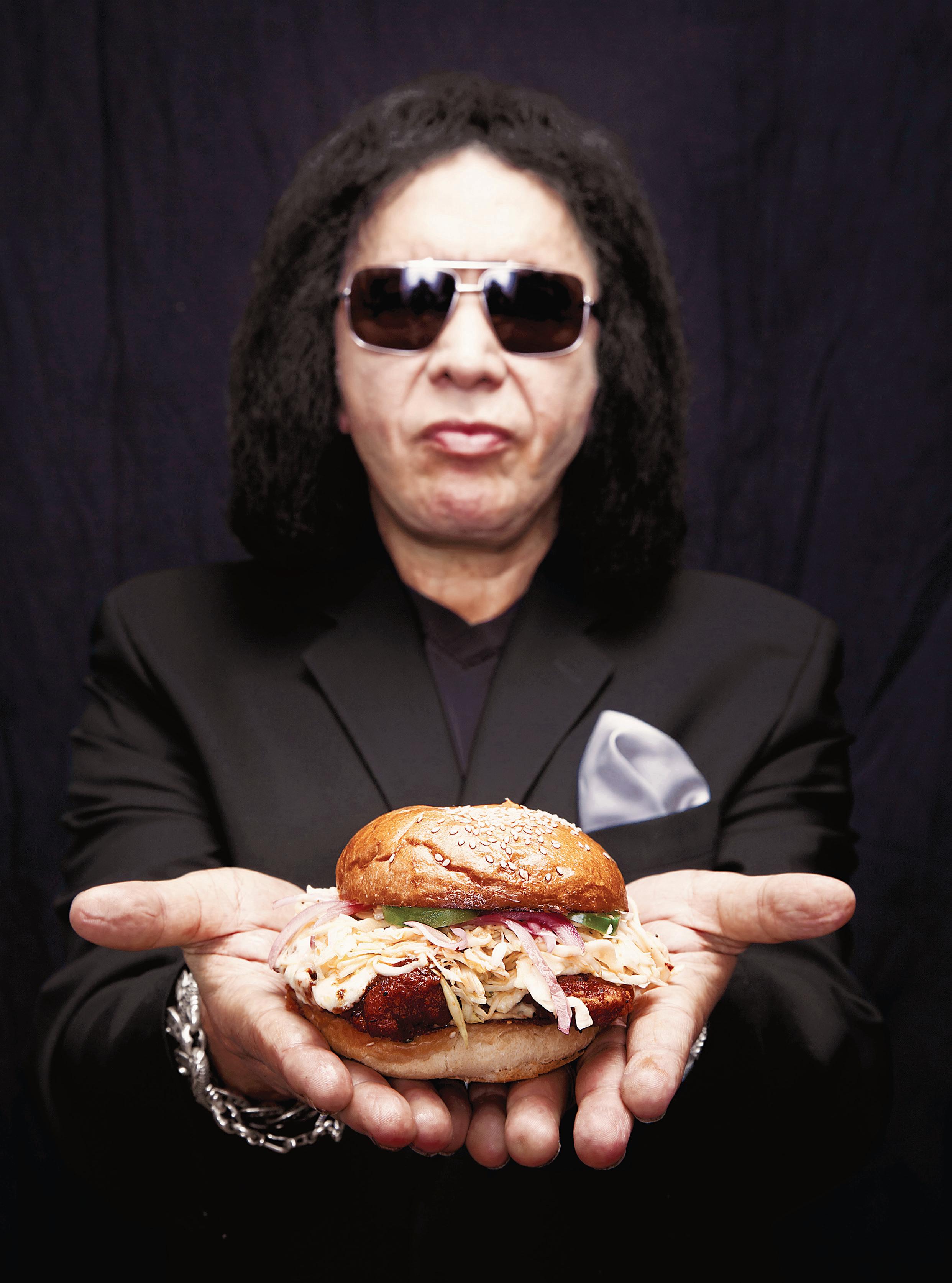
The sandwich’s large size, which requires two hands to pick up, also represents Simmons’s tall stature at 6 feet 2 inches, Magana adds.
The fried chicken breast is tossed in Rockin’ Hot Sauce and has a house-made pepperjack cheese spread, chipotle slaw, marinated red onions, fresh jalapeños, and chipotle ranch, and ranges from $13.50 to $17.95, depending on the location.
“It’s one of our best-selling items. It’s a staple,” Magana says. “People come in and want to take a picture with it and post it, since its name in our menu is the Demon Chicken, and everyone immediately knows what it’s about.”
Though the product is steeper in price than Popeyes’ chicken sandwich, which averages around $4–$5, guests at Rock & Brews seem to have no aversion to paying a little extra for the themed sandwich and experience. If anything, the Chicken Sandwich Wars have helped boost business for the full-service restaurant; such orders now account for roughly 13–14 percent of sales at Rock & Brews.
“Restaurants have learned to evolve what used to be [ quick-service] food into something a little more elevated and make it their own,” Magana says. “So whether you go to Popeyes and get a sandwich or come to Rock & Brews and get the Demon Chicken, you know in your mind what you’re going to get. The base is the same for both, but sometimes you crave one and sometimes you crave the other.”
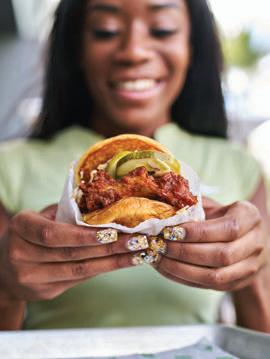
Keeping with the tradition of friendly competition among restaurant players, Wingstop believes its chicken sandwich stands out from the pack. Launched in August 2022, the brand had an experience similar to Popeyes when it completely sold out in six days, burning through four weeks of inventory.
After restocking, Wingstop relaunched the product in October through a phased rollout to restaurants, making sure staff levels were high enough for demand.
“It really showed us the opportunity we have as a brand with chicken sandwiches as a new, different, interesting way to bring consumers in,” says Michael Skipworth, CEO of Texasbased Wingstop.
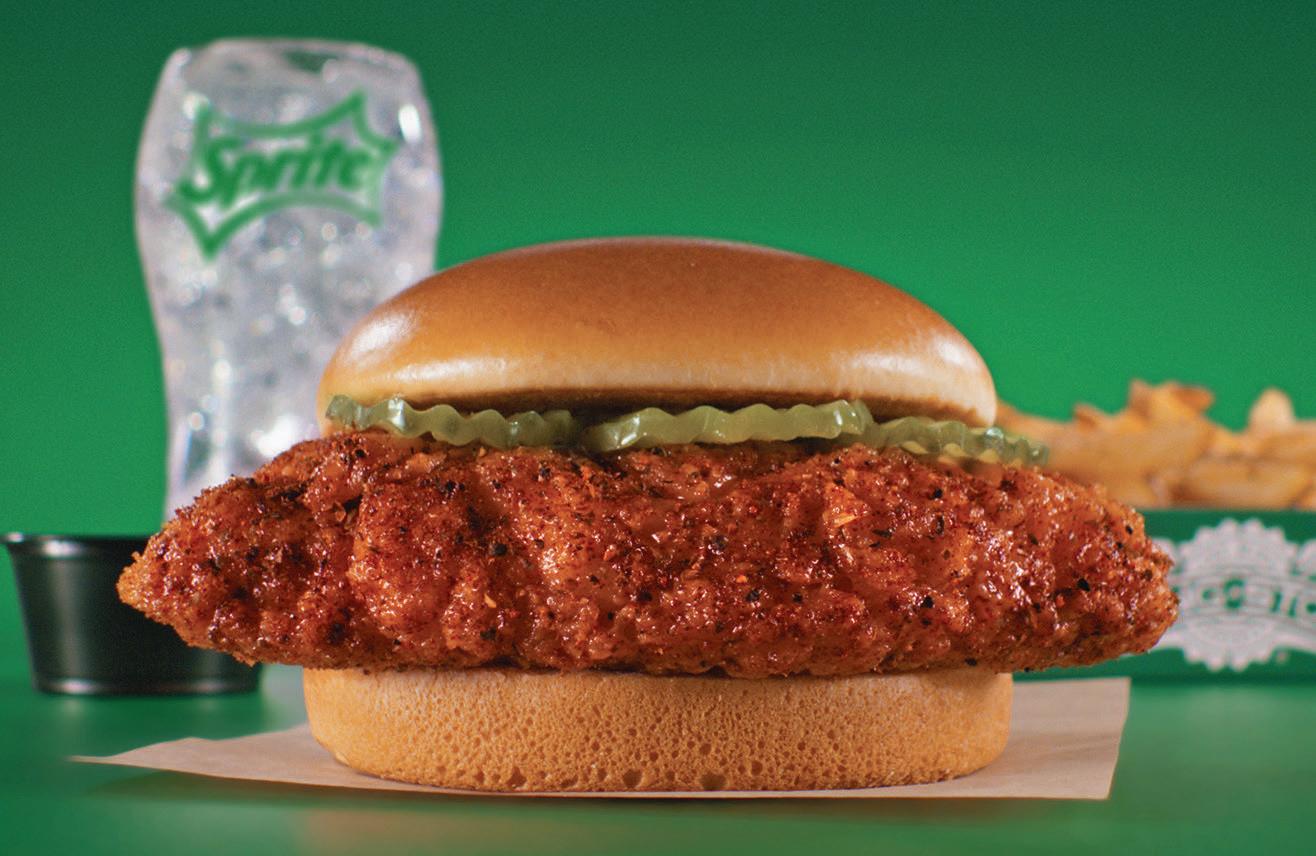
Sauced chicken wings have a tendency to make a mess, which not everyone appreciates, Skipworth notes. A chicken sandwich presents a better alternative during the lunch daypart for people on the go—though customers should expect to
wait an average of 18–20 minutes, since food is cooked to order.
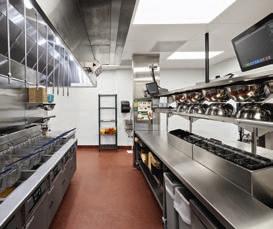
While chains such as Popeyes typically offer chicken sandwiches either classic or spicy, Wingstop’s biggest differentiator is the ability to get its chicken sandwich tossed in one of 12 unique flavors, from the popular Lemon Pepper or Garlic Parmesan dry rubs to Cajun or Mango Habanero sauces.
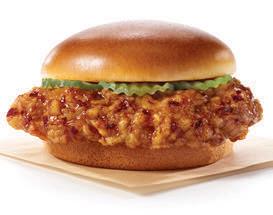
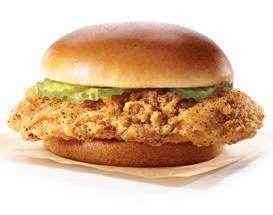
To that end, wings have long been the ideal blank canvas for flavor innovation at Wingstop. For example, in December, the brand launched Carolina Gold BBQ as a limitedtime option with a sweet mustard base, vinegar, brown sugar, and overall tangy flavor profile.
Despite early inventory shortages, the pay-
off was worth it for Wingstop. Swipworth says it’s one of the few brands that’s able to drive sales through positive transaction growth at this point in time rather than through price hikes that inflate sales figures.
And with average unit volumes sitting at roughly $1.6 million, product innovation will be the ticket to driving that number north of $2 million, he says.
With positive feedback from guests and chicken sandwiches mixing in the high single digits, Skipworth expects to see the product mix continue its upward climb as the brand builds on the success of the launch.
“You’re seeing chicken consumption continue to grow, particularly in the U.S. but even outside the U.S., and I don’t think that dynamic is going to change,” he adds.
ROCK & BREWS, WINGSTOP (4)
CALLIE EVERGREEN IS THE EDITOR OF FSR. CONTACT HER AT CEVERGREEN@WTWHMEDIA.COM.
WINGSTOP’S CHICKEN SANDWICH SUPER POWER IS ITS VARIETY.
ROCK &
“Restaurants have learned to evolve what used to be [quick-service] food into something a little more elevated and make it their own.”
BREWS, WINGSTOP (4)











Q U A L I T Y C H I C K E N • E S T . 1 9 2 5
8.5
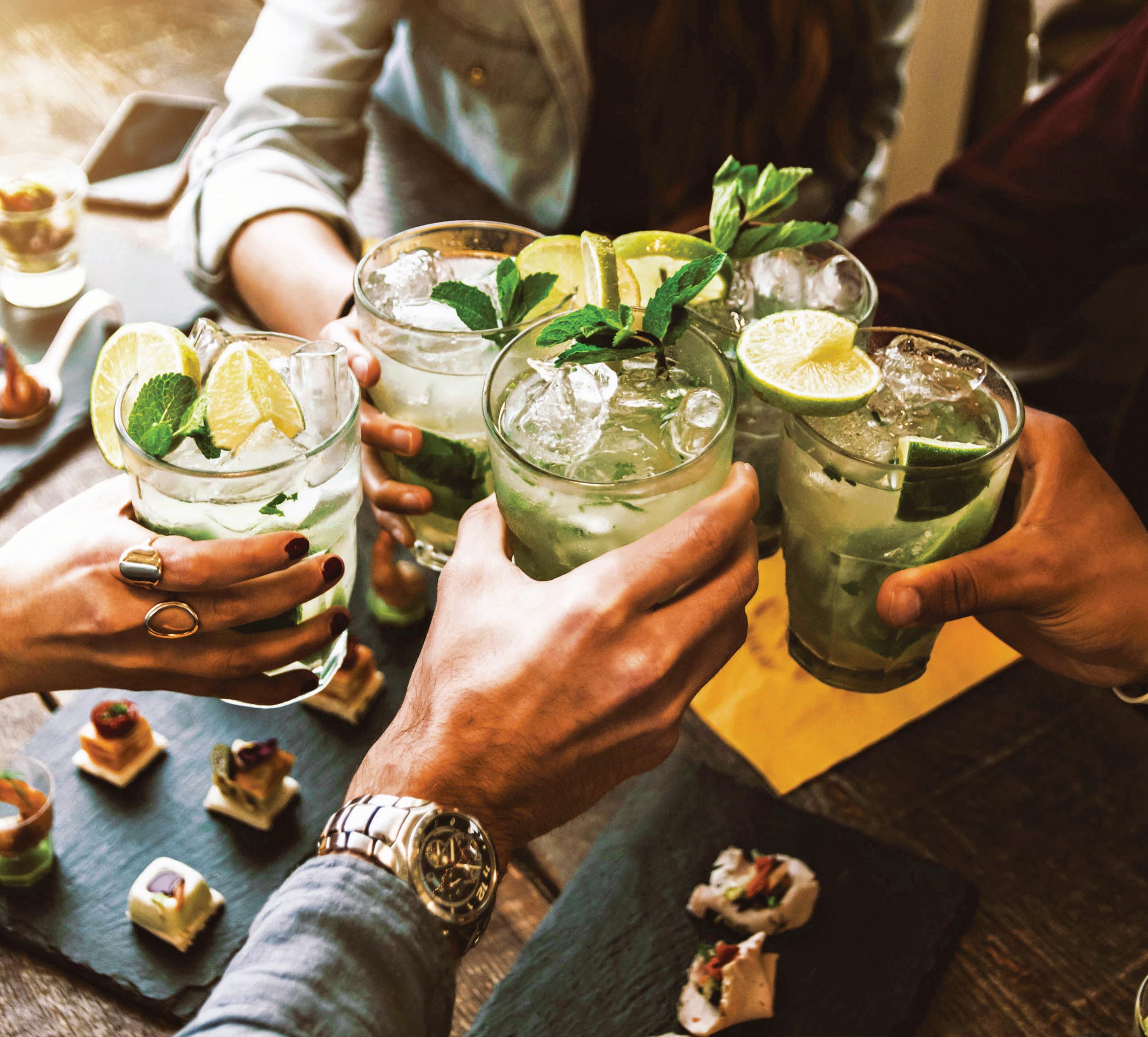
DINERS ARE STILL CONGREGATING OVER DRINKS, EVEN IF IT’S NOT ALWAYS AT THE SAME TIMES AS PRE-COVID DAYS.
Has Happy Hour Soured?
Even in an age of telecommuting, restaurants are betting on the post-work daypart.
BY NICOLE DUNCAN
While not part of the traditional, three-square-meals paradigm, happy hour has proved itself a viable revenue generator in the restaurant sector. A 2018 study from Nielsen even credited happy hour with generating 60.5 percent of weekly sales at restaurants and bars and increasing the average check by $8. ( It should be noted the study defined happy hour as taking place between 5 and 8 p m., which runs much later than most programs.)
But a lot has changed since 2018. Consumers are returning to restaurants for dine- and drink-in—but they’re not necessarily going back to the office. This sea change has myriad implications for restaurants, with
ADOBE STOCK DAVIDE ANGELINI LIQUID INTELLIGENCE
®
Chefs & Ingredients
QSR FSR MARCH 2023 INDUSTRY-WIDE ISSUE 17
many lunch-centric establishments either curtailing their hours or shuttering their doors altogether.
But happy hour isn’t lunch. While the latter can be a social gathering, happy hour is almost exclusively one. Some studies suggest consumers are seeking out these occasions even more than they did before COVID.
“The happy hours themselves have not changed because of the pandemic. They are still a way for our restaurants to attract guests and start the energy earlier in the day. They are just as busy as they were before,” says Jennifer Krapp, director of restaurant operations for Charleston, South Carolina–based Indigo Road Hospitality. “I believe that with so many people working remotely now, people are craving that social interaction that they are not getting throughout the day.”
Happy hour is a common offering across Indigo Road’s 30-odd restaurants, though the approach varies by concept. For example, seven-unit O-Ku Sushi positions its happy hour around deep discounts, such as half-off rolls. “Guests’ behaviors indicate everyone loves a good deal, whether it is food or drink,” Krapp adds.
On the other hand, sister restaurant Maya uses the stretch between 5 and 6:30 P M to showcase playful dishes and drinks not found on the regular menu. This includes elote popcorn, Frito Pie (made with corn chips), and Ranch Water—made with Lunazul Tequila, lime, and sparkling water.
At fine casual Hopdoddy, the pre-COVID happy hour served multiple purposes from a business standpoint. Vice president of revenue Matt Schweitzer breaks down the menu as follows: 50 percent showcased (and in some cases, tested ) unique items that could be quickly executed; 25 percent comprised what Schweitzer describes as “brand-defining” items; and 25 percent were discounted offerings.
In the three years leading up to 2020, happy hour was the single largest growing daypart at Hopdoddy. Schweitzer credits its burgeoning popularity to several high-volume stores in densely populated areas—right in the path of professional foot traffic. Brand positioning and smooth execution then ensured its staying power.
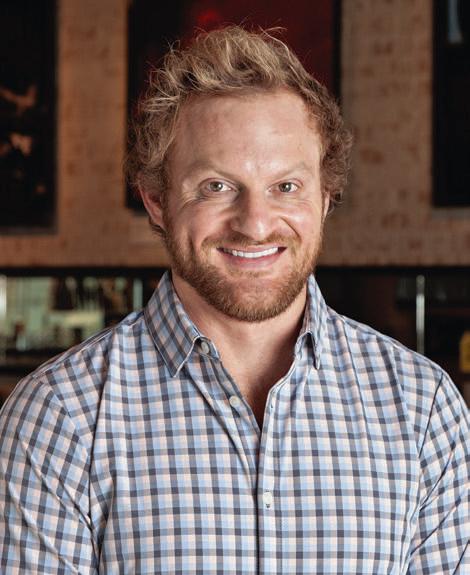
“At the time, we were really trying to use happy hour not as a discount, because we’re not a discount brand, but as an outlet where we could get people [to try] things that were a little bit different … and really highlighted what we do and what we do really well,” Schweitzer says.
The very existence of happy hour at Hop-
“Happy hour is one of those things that we wanted to grab from other sectors of the restaurant scene, and we thought that it could be a differentiator for us, given our full bar, given our service model, given our offerings.
doddy already highlights a difference between the concept and its limited-service peers. While not unheard of, happy hours conventionally fall under the purview of full-service operations and bars. Hopdoddy, however, bucks the norm.
“Our CEO [ Jeff Chandler], who’s done an



CHEFS & INGREDIENTS / LIQUID INTELLIGENCE HOPDODDY (3)
HOPDODDY BUCKS THE NORM WITH HAPPY HOUR IN A FAST-CASUAL SETTING.
18 INDUSTRY-WIDE ISSUE MARCH 2023
MATT SCHWEITZER
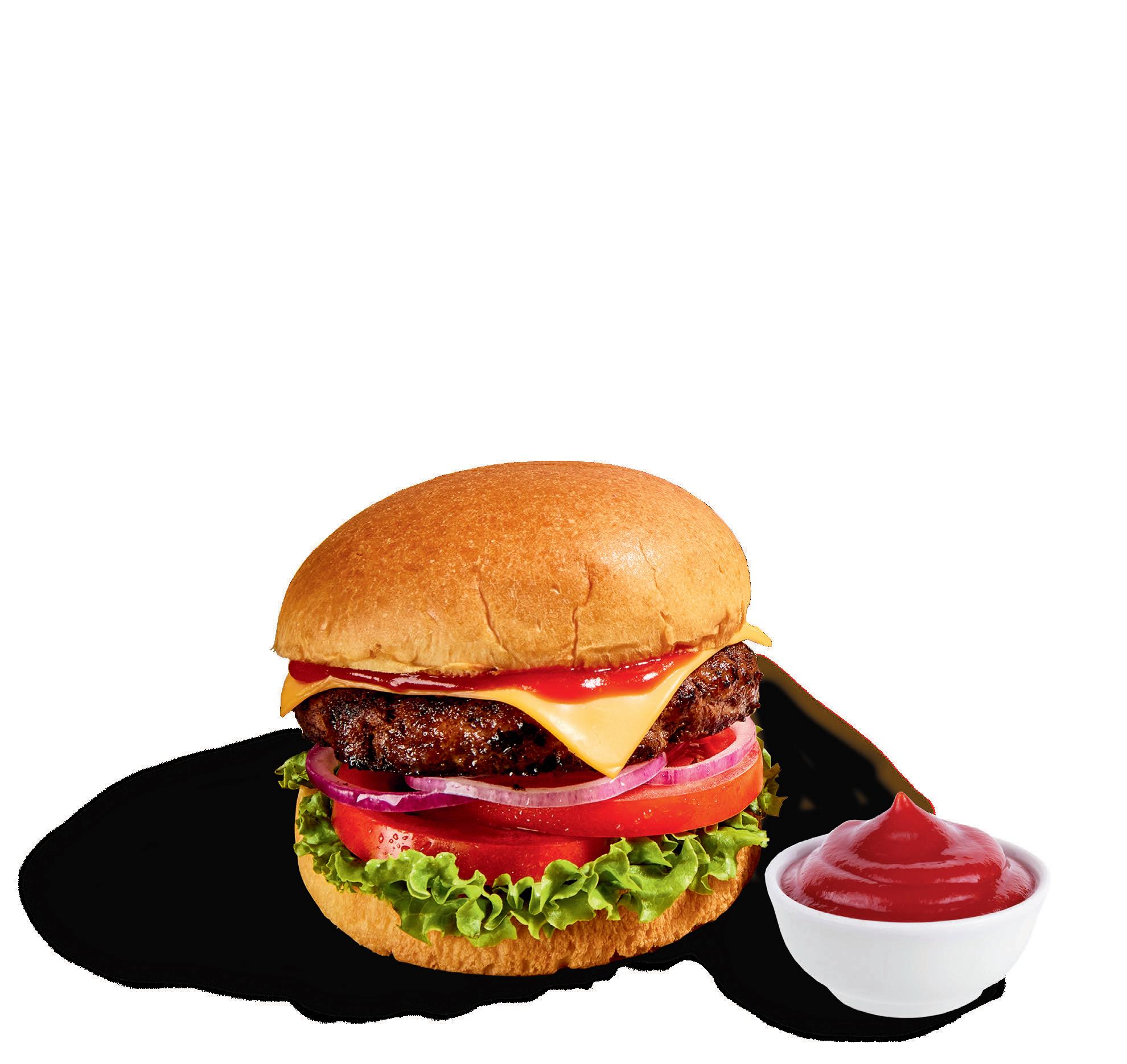
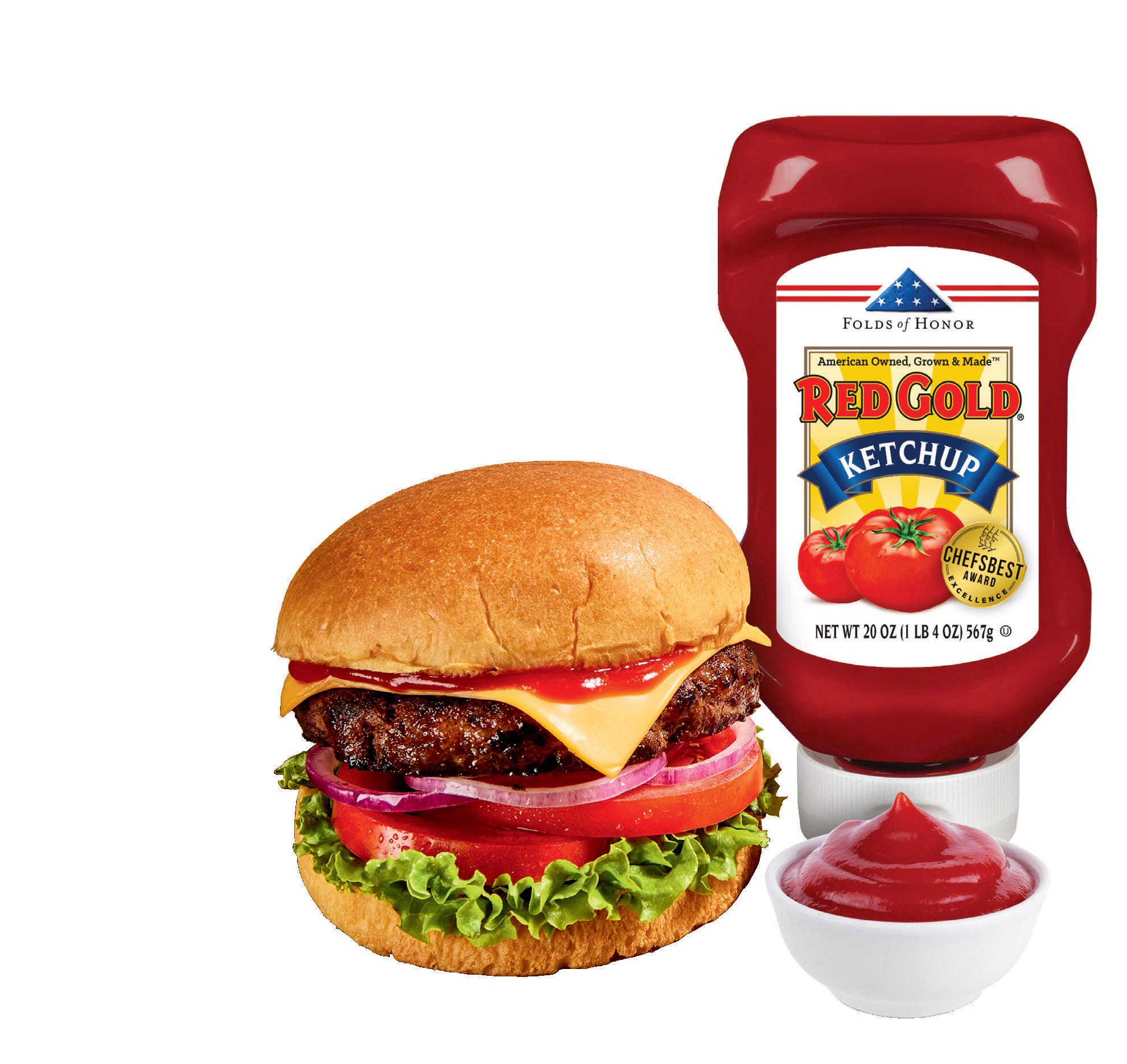



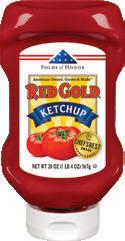
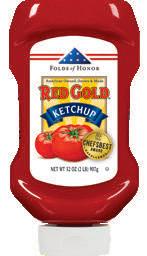
Red Gold is a registered trademark of Red Gold, LLC. Elwood, IN RG-1352-0822 Red Gold® 20 oz. Ketchup brings rich flavor to every table, with thick, tangy tomatoes and the perfect balance of sweet and sour notes inside every bottle—it’s delicious flavor you can feel good about serving. As proud supporters of the Folds of Honor Foundation, Red Gold donates a portion of the proceeds to provide educational support to the spouses and children of deceased or disabled U.S. service members. That means, when you serve Red Gold, you’re serving the families of our fallen troops, too. Ketchup with a Cause. Request a sample today of the 20 oz. Red Gold Ketchup that brings so much more to your table at Redgoldfoodservice.com/sample-requests RedGoldTomatoes.com/FoldsOfHonor Serving ketchup and our country. Products must earn the ChefsBest® Excellence Award by surpassing quality standards established by professional chefs.
amazing job describing our concept over the years, coined the term ‘unicorn casual,’ and what that means is we try to capture the best things of quick service and the best things of of fast casual and casual dining,” Schweitzer says. “Happy hour is one of those things that we wanted to grab from other sectors of the restaurant scene,
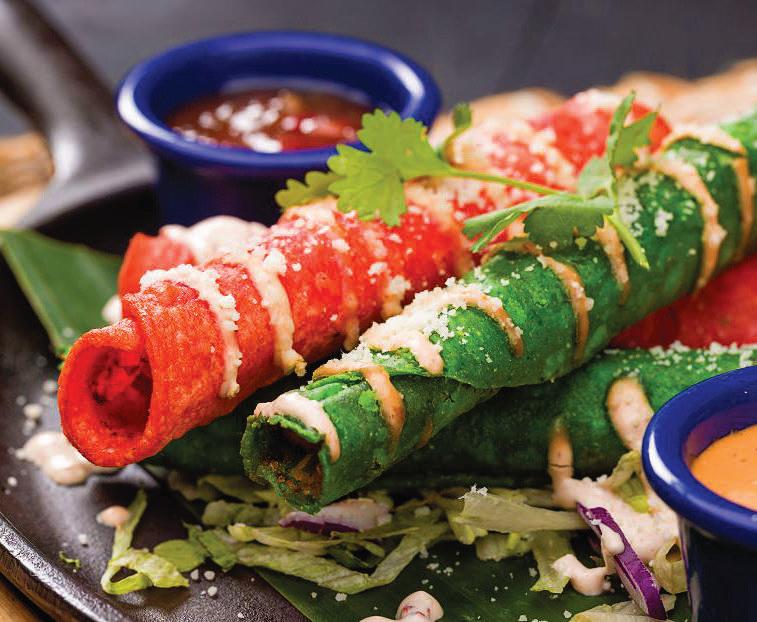
diners alike. It has also remained a key revenue driver, even in a post-COVID landscape. Late last year, XRG debuted new happy hour menus at its two flagship concepts, Chevys Fresh Mex and El Torito.
“This specific iteration of both happy hours is notable because we rarely make such extensive updates to the menu at once. These are completely new and innovative items,” Sharpe says.
New offerings now account for about a third of the two dozen–plus options on the happy hour menu. These value-driven additions include $6 Potato Chorizo Taquitos, $8 Beef Birria Tacos, and $10 Shrimp Tacos Gobernador on the food side, as well as drink specials like $4 house wine and $8 Watermelon Candy Shots.
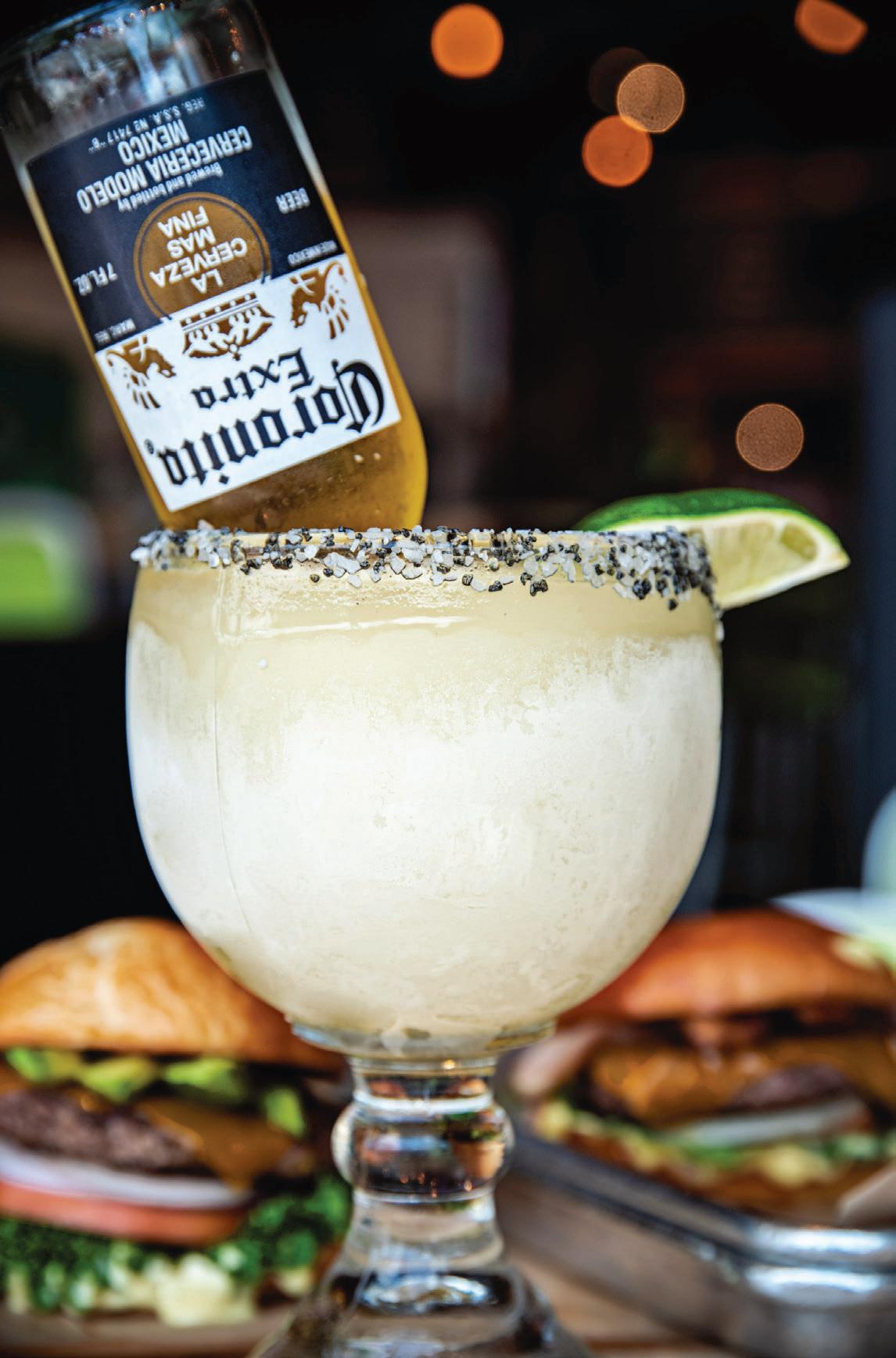
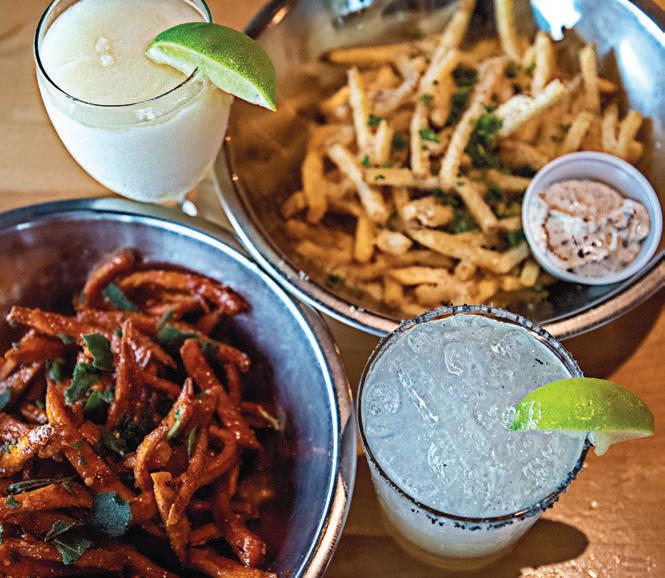
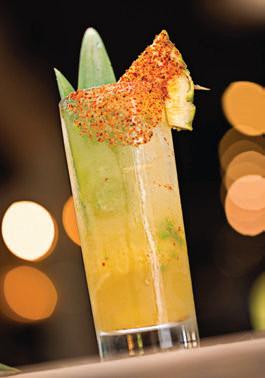
Two of the most popular new items are the Mexican Pizza and the Margarita Flight, both clocking in at $10. Sharpe says classics like the Frozen Margarita at Chevys and Signature Margaritas in fruit flavors at El Torito “continue to be a main draw for our guests due to their consistent affordability and quality.”
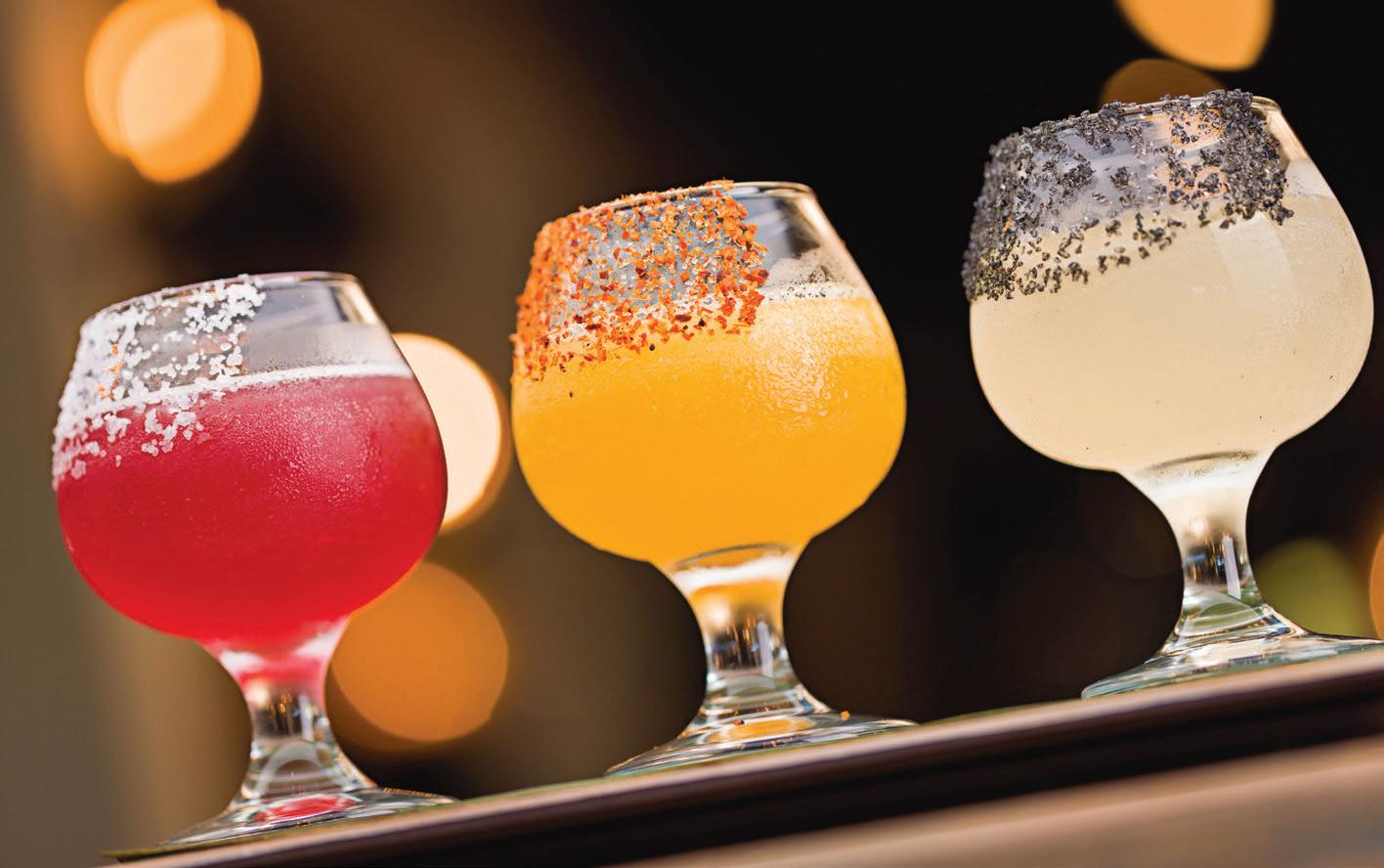
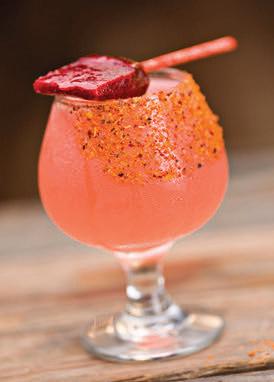
and we thought that it could be a differentiator for us, given our full bar, given our service model, given our offerings.”
During the pandemic, Hopdoddy, like many other establishments, stopped its happy hour. Now, plans are in the works to bring it back but with a fresh, new look. Schweitzer won’t go into much detail but explains that the brand is stepping outside its comfort zone. Guests should expect culinary innovation and speed of service to be at the forefront of the new program.
“We’re going to do everything and anything we possibly can to ensure our bars are packed to the rafters. We want our bars to be so busy that we have to increase staffing. We want there to be lines, and we want people handing drinks back to their friends behind them because people are fighting for seats at the bar,” Schweitzer says. “Our goal is to be big and bold, to make a statement and put our stake in the ground. We’re going to have the best happy hour in the market and we want to be the local happy hour dining establishment of choice.”
Back on the full-service side, Xperience Restaurant Group (xrg) is also reimagining happy hour. CEO Randy Sharpe says it’s one of the most popular dayparts, attracting both regulars and new
For Sharpe and Krapp, happy hour’s victorious return seems imminent. But from the fast-casual point of view, Schweitzer has a more measured opinion. Since the pandemic, he’s seen fewer professionals and large groups at happy hour, but more young guests. Furthermore, he’s observed an increase in the downtime stretch between the lunch and happy hour, with the former ending earlier and the latter beginning later.
To address this, Hopdoddy is going to embrace overlap, so happy hour bleeds into dinner. The brand is also doubling down on service, which, Schweitzer predicts, has the potential to make or break the daypart.
“People don’t want to look around for service; people just want it there right now, which is kind of why we want to pack our bars,” he says. “This younger generation is definitely a crowd of immediacy. And it’s our notion that if people are having to think about wanting the next drink, we might have lost. So we’re going to try to cater our service periods, our staffing levels, and our offerings to really combat that.”
XPERIENCE RESTAURANT GROUP
CHEFS & INGREDIENTS / LIQUID INTELLIGENCE 20 INDUSTRY-WIDE ISSUE MARCH 2023
XRG DEBUTED NEW HAPPY HOUR MENUS AT TWO OF ITS FLAGSHIP CONCEPTS LAST YEAR.

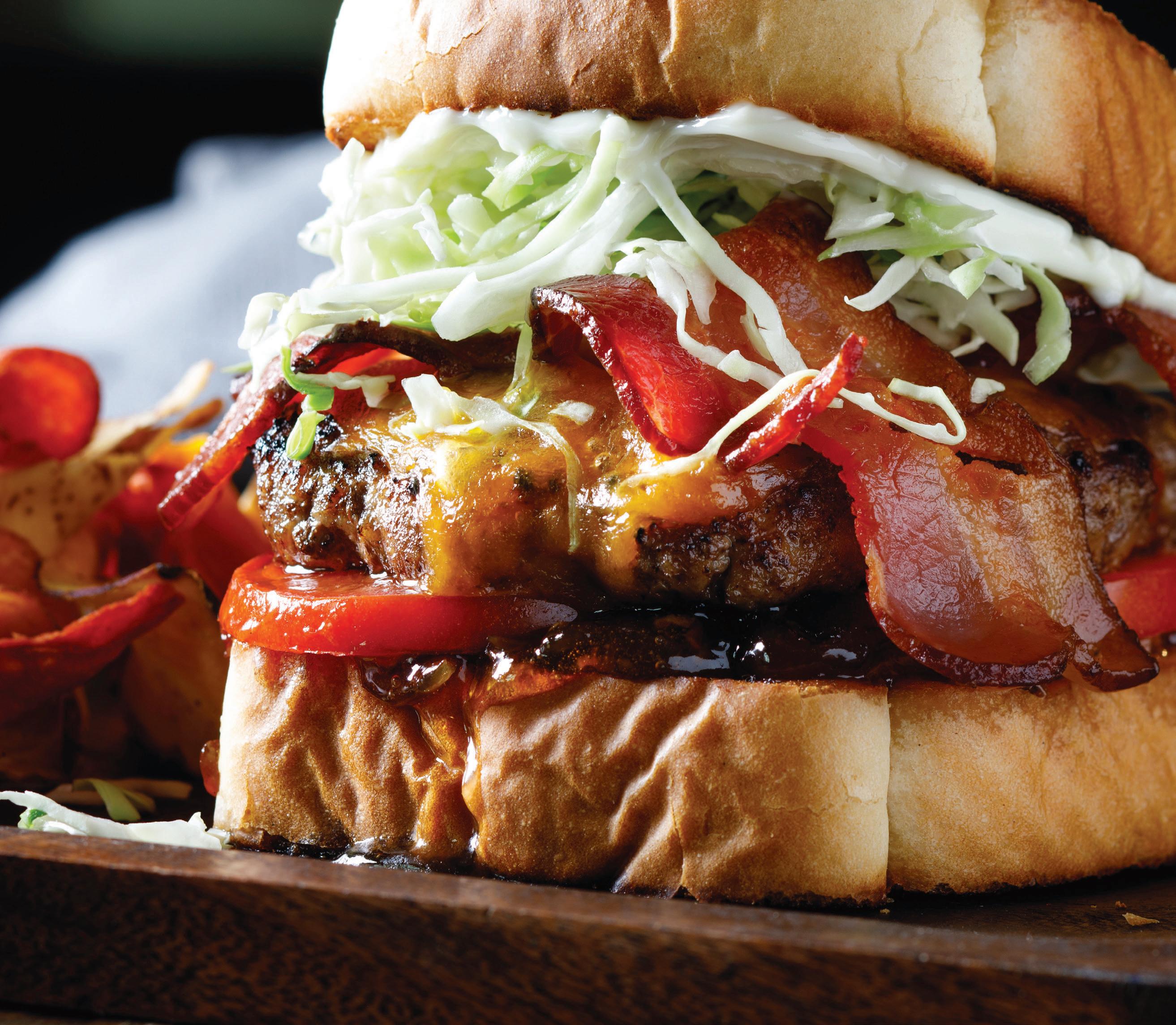








Burgers come seasoned, cook from frozen and feature a 3+ hour hold time.
they deliver the taste, tenderness and juiciness that keep customers coming back. REQUEST A CUTTING AT TNTBURGERS.COM ©2023 Cargill Meat Solutions Corporation
TNT™
Plus,
THE ULTIMATE FOR CRAVE AND CONVENIENCE.
SIMPLIFYING the Fry Selection Process
“When COVID hit, we all started to realize that we had to work harder to simplify an operator’s life,” says Kim Hoffman, product marketing director, portfolio management at Lamb Weston. “We wanted to flip it from us being a technical commodity, to a value-based proposition. We started more carefully considering, ‘What does the operator really care about?’”
These brainstorming sessions led to Lamb Weston’s “Simplifry” campaign. This required careful review, auditing, and revisions of Lamb Weston’s portfolio of products, using an operator-first lens to make Lamb Weston’s french fry offerings as intuitive as possible. Even some of the product names were modified to match the language operators use—if they care about how crispy a fry is, why not use verbiage to call that out?
Each SKU is now sorted into one of four categories: classic fries, extra crispy fries, sweet potatoes, or “other” potato products. Within each category, there are fries designed for specific operational needs.
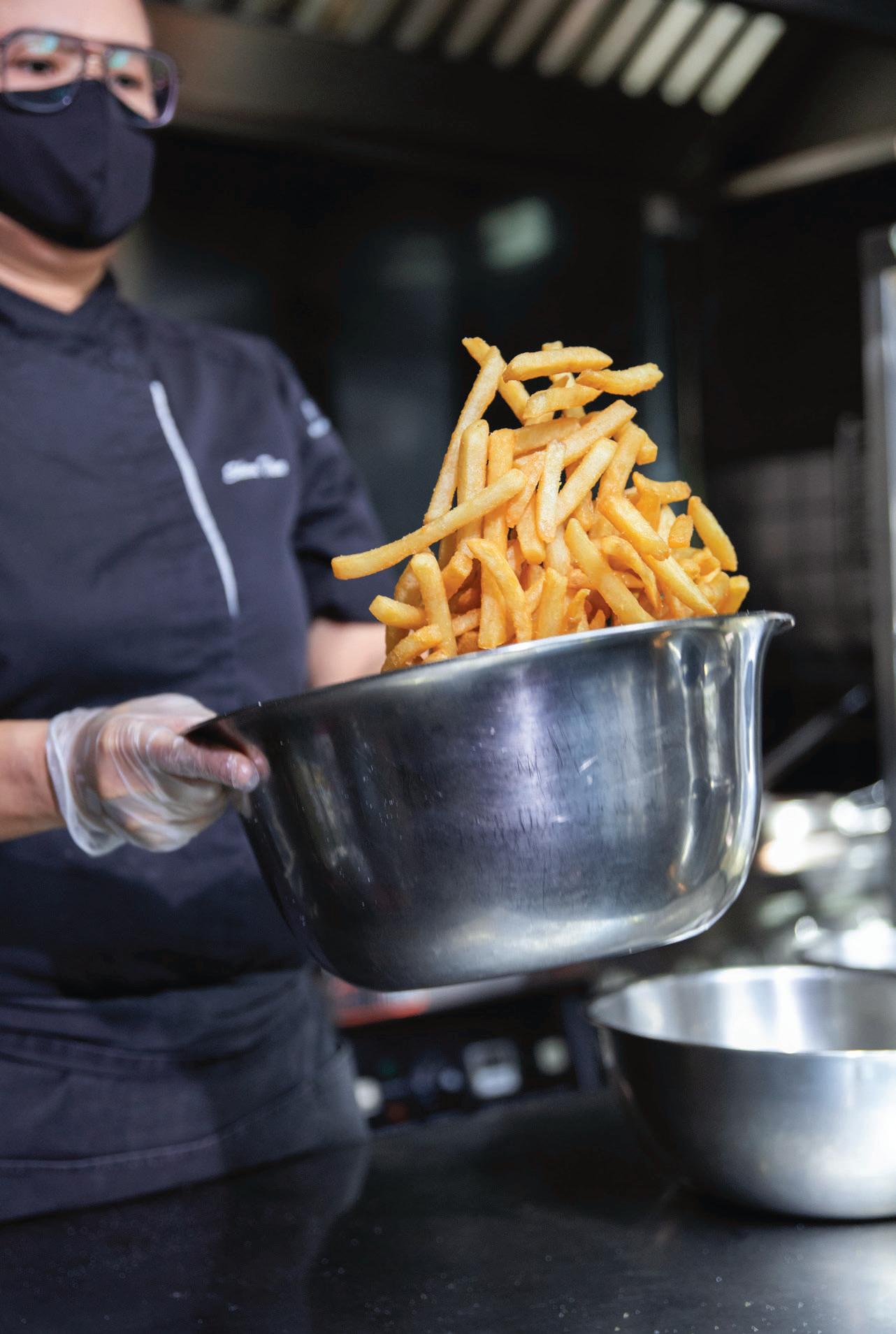
Additionally, operators can take a brief online “Find My Fry” quiz to see which product would be the best fit for their operation. The quiz is meant to be fun and playful, but it also generates real results that are rooted in Lamb Weston’s extensive knowledge of the industry, based on market research and decades of experience.
THE PANDEMIC
brought with it a whirlwind of change for operators. In many ways, the industry is still dealing with the fallout—inflation, labor, and supply-chain issues persist. Each challenge takes time out of an operator’s day and cuts into already-thin margins. Consider the process of choosing the right french fry. Often, product portfolios are dense, bloated, and confusing. Operators hardly have time to navigate through hundreds of SKUs, let alone sample them all.
Taking note of these challenges were the people at Lamb Weston—founded in 1950, the company is one of the country’s largest potato and french fry producers. In the early days of the pandemic, Lamb Weston began to wonder how it could help make the industry a bit more sane.
“We really feel like we’re here to be advisors,” Hoffman says. “The quiz was us saying, ‘How can we make this as quick and efficient as possible?’ Because each operator has their own set of problems they have to solve for, but they don’t always have time to do it.”
Simplifying the fry-selection process is meant to get operators back to what they do best: building an enticing, innovative menu, and facilitating a top-notch customer experience. Turning something that was once a hindrance into something potentially powerful—having the perfect french fry offerings—is helping do just that.
“We say it over and over: ‘operator first,’” Hoffman says. “Operators are at the core of everything we do. We’ve been around for over 70 years. Now we’re trying to be innovative in how we think and sell and position ourselves with operators. That’s where all of this stems from: we want to simplify an operator’s life, and stay true to that message in everything we do.”
22 INDUSTRY-WIDE ISSUE SPONSORED CONTENT / MARCH 2023
BY CHARLIE POGACAR
“When COVID hit, we all started to realize that we had to work harder to simplify an operator’s life.”
This vendor recently reorganized its portfolio with the operator in mind.
SPONSORED BY L AMB WESTON TO FIND YOUR FRY, VISIT LAMBWESTON.COM.
Your world is complicated. Weˇre helpingsimplifry it.

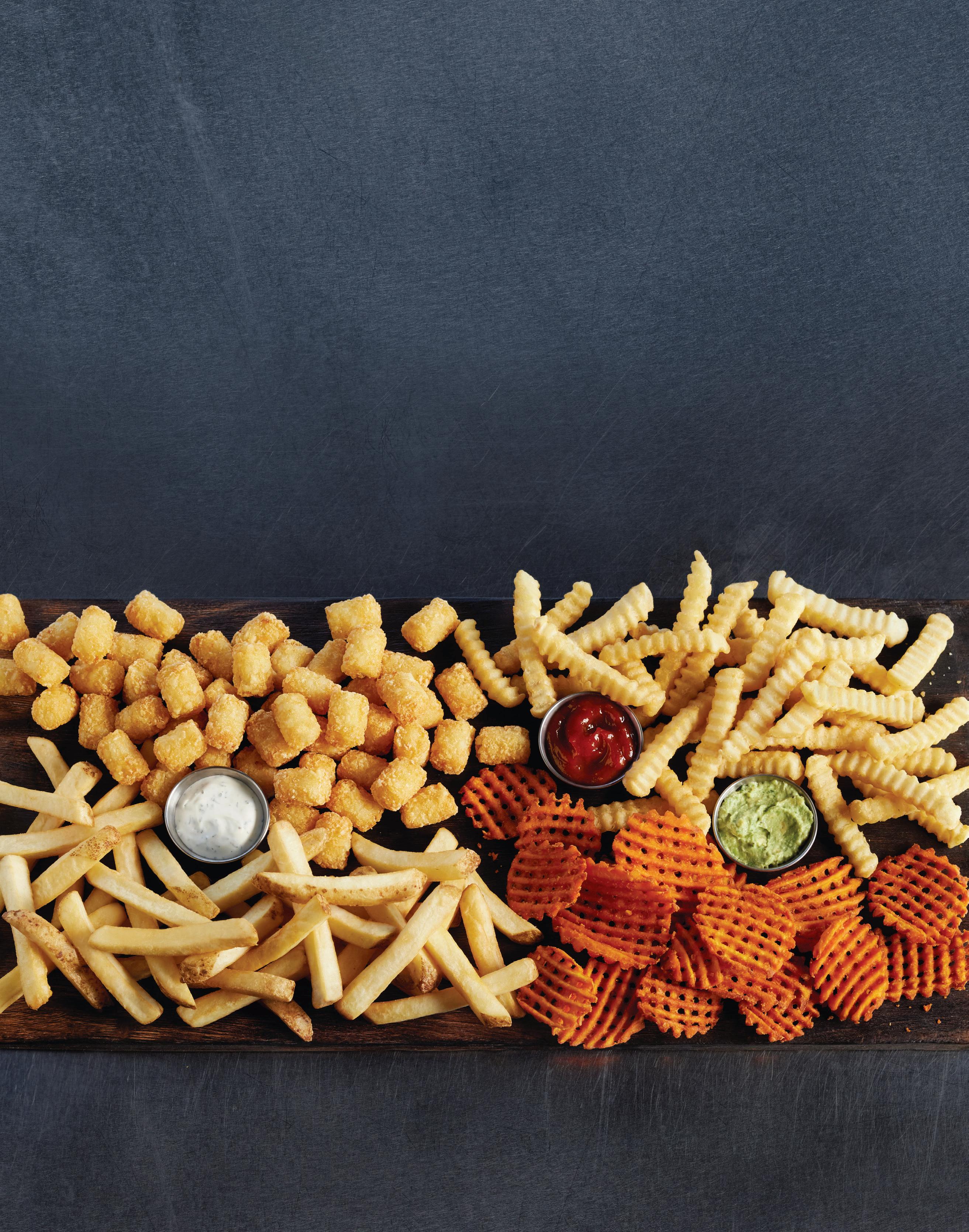
In the restaurant world there’s never a dull moment, which means you rarely get a free moment. So when it comes to finding the perfect fry for your guests, we’ve helped make it a little easier. In fact, we’ve reorganized our entire portfolio with you in mind and simplified it, so you can quickly and intuitively navigate by category or style. And whether you have a specific guest need or operational need, you can easily find the perfect potatoes.
Your world is complicated—weˇre here to help simplifry it.
© 2023 Lamb Weston, Inc. All rights reserved. See for yourself at go.lambweston.com/simplifry
The Stylist’s Secret Sauce
BY NICOLE DUNCAN
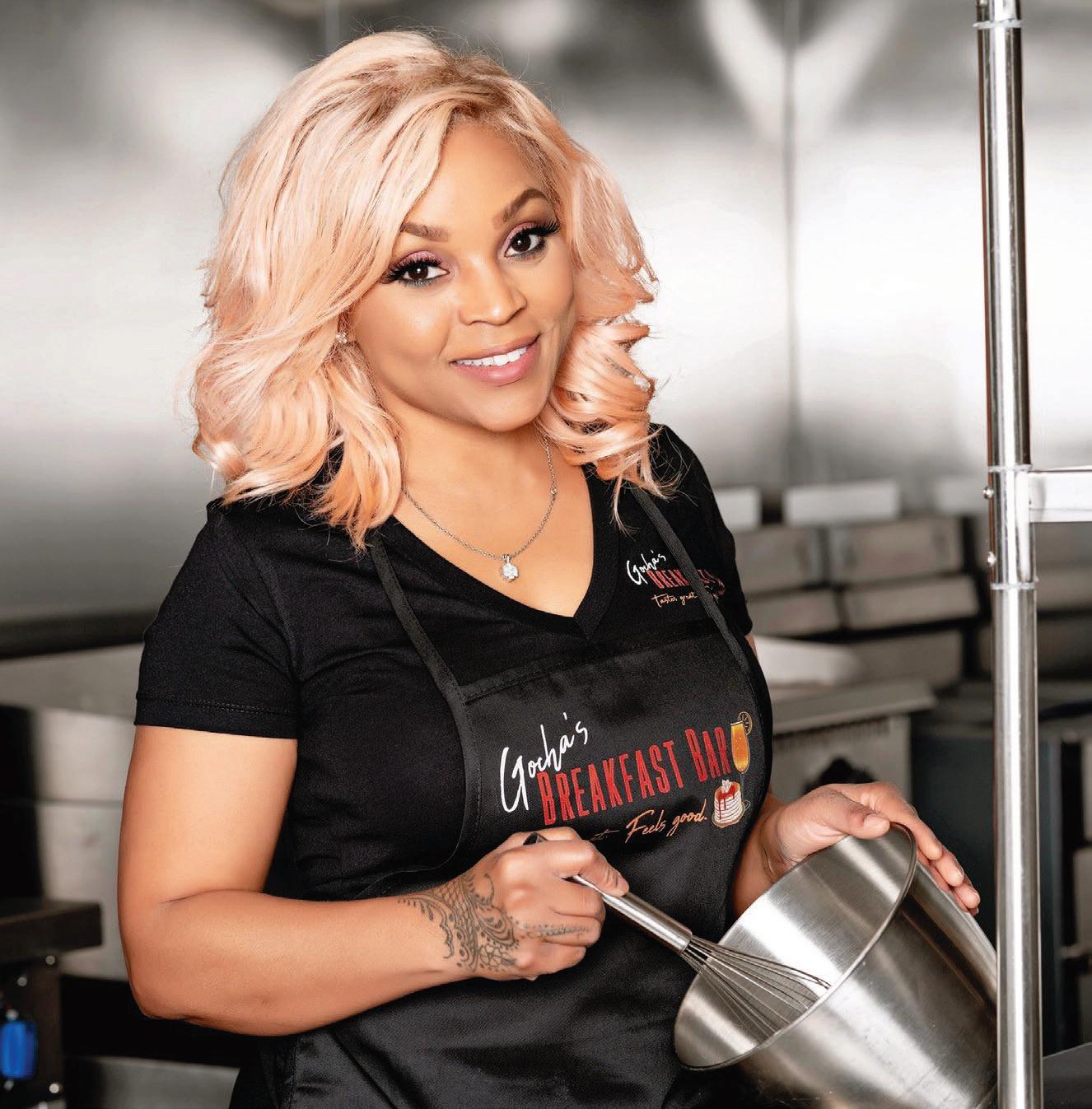
For Gocha Hawkins, the secret to success is in the sauce—quite literally. And for the time being, the owner and chef of Gocha’s Breakfast Bar is keeping that sauce recipe under lock and key.
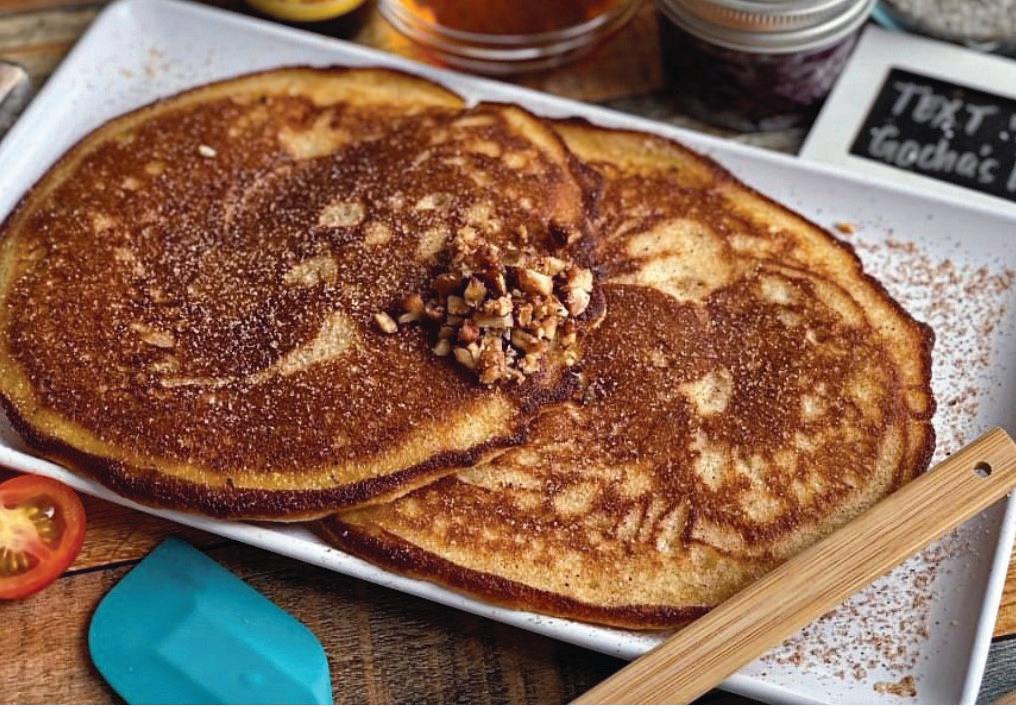
“I make all my sauces from scratch and the problem is, the more that I grow, the harder it’s becoming for me to make all the sauces for the restaurants,” Hawkins says. “The only part I struggle with is trying to find the balance of not having to be in the restaurant all the time.”
It’s a common sentiment among ambitious restaurateurs who, while eager to grow their concept, also want to protect what makes it special. But given Hawkins’ entrepreneurial track record, there’s little doubt she’ll find a solution as her Atlanta-area portfolio, currently comprising two breakfast bar locations and a forthcoming tapas restaurant, continues to expand.
Prior to entering foodservice, Hawkins spent three decades in the beauty world. She established and grew her own salon business to the point her client list included such A-list celebrities as Nicki Minaj, Beyonce, Drake, Serena Williams, and “The Real Housewives” star and fellow Atlanta restaurateur, Kandi Burruss.

Although her career as a hair styl-
ist was thriving, Hawkins had long nursed another professional dream: to open her own restaurant. In fact, she’d even intended to move forward with a soul food restaurant in South Florida 15 years ago. Because of the economic crash, those plans were put on hold—though hardly forgotten. In late December 2018, Gocha’s Breakfast Bar made its debut just outside Atlanta’s Interstate 285 Perimeter. The reasoning behind the shift from soul food to breakfast, as well as the restaurant’s location, exemplifies Hawkins’ business acumen.
“There were no restaurants over here. And it’s an affluent area where
I live; the mayor lives here, a lot of celebrities live over here, and I’m like, we have to drive at least 30 minutes back into the city to get good food,” she says. “I love breakfast, and the fact there wasn’t a breakfast restaurant over here, I just thought it would be perfect.”
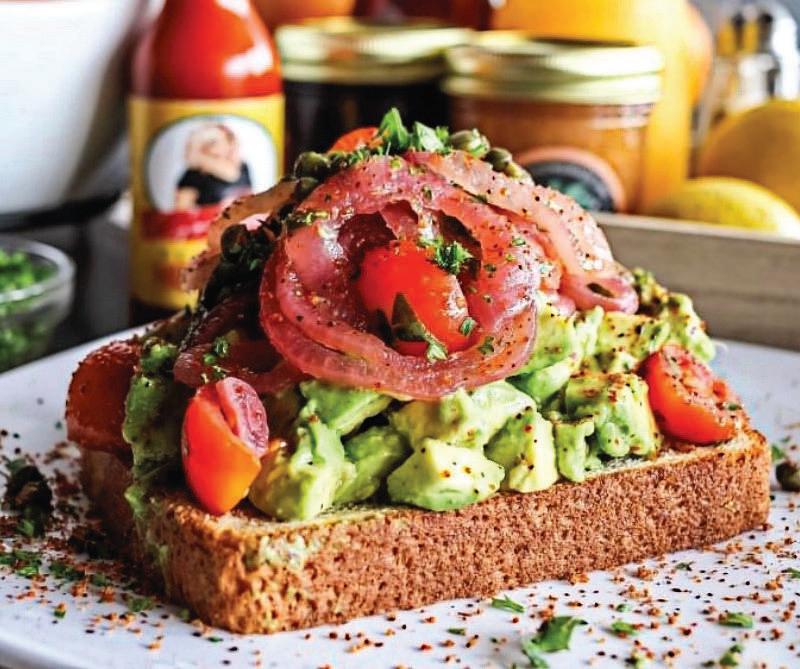
Gocha’s Breakfast Bar’s signature take on elevated Southern breakfast was an instant hit. The menu includes hearty options like the Salmon Grit Cake, Shrimp and Grits, and Grilled Steak Skillet, as well as sweeter items like Gocha’s Krunch-tastic French Toast and the Georgia Peach Stack. The restaurant, which stays open until 3 P M., also serves more lunch-leaning
CHEFS & INGREDIENTS / CHEF PROFILE
How Gocha Hawkins went from styling celebrities’ hair to building a restaurant portfolio.
GOCHA’S BREAKFAST BAR (3)
GOCHA HAWKINS SPENT THREE DECADES IN THE BEAUTY WORLD BEFORE GETTING INTO RESTAURANTS.
24 INDUSTRY-WIDE ISSUE MARCH 2023
QSR FSR
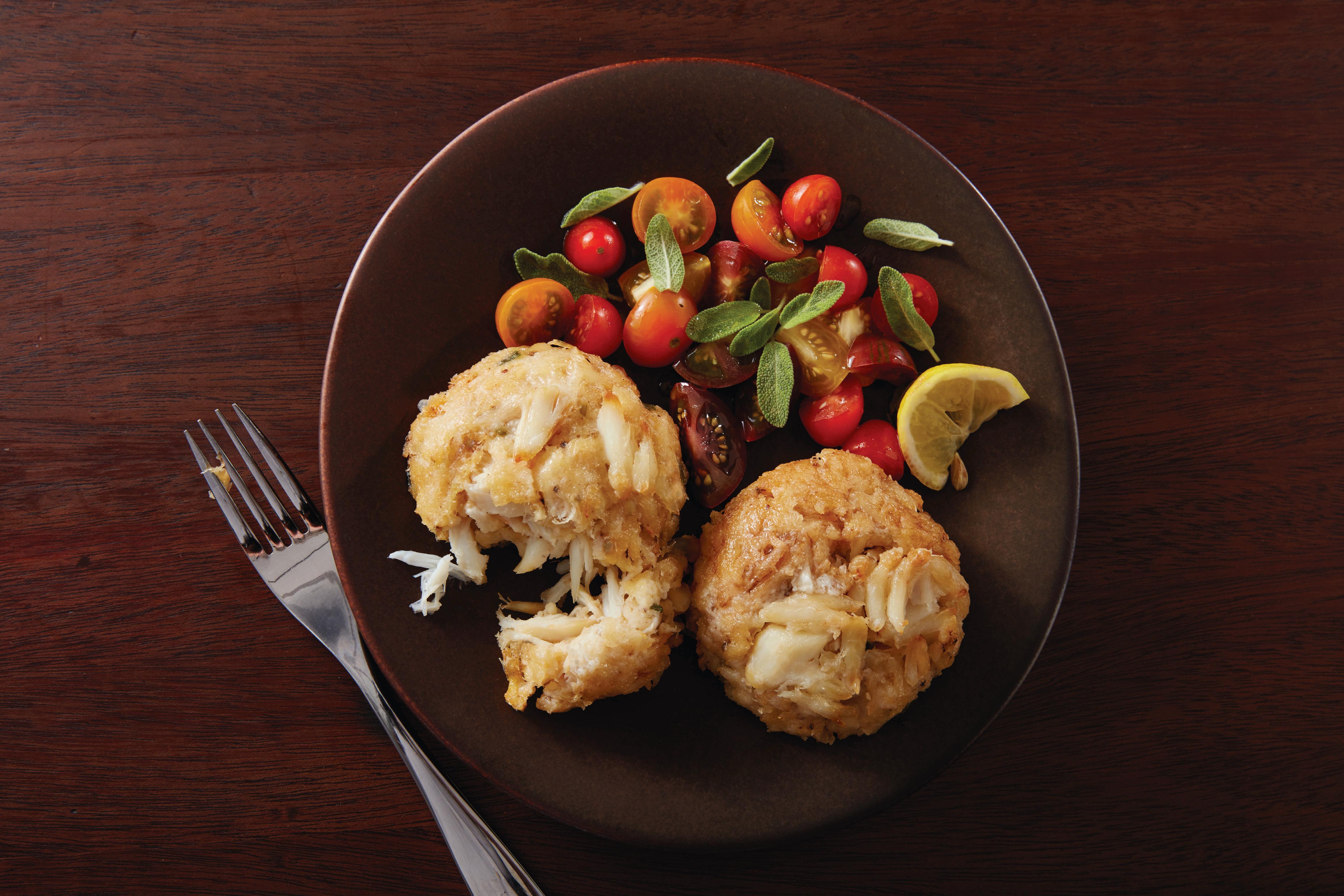

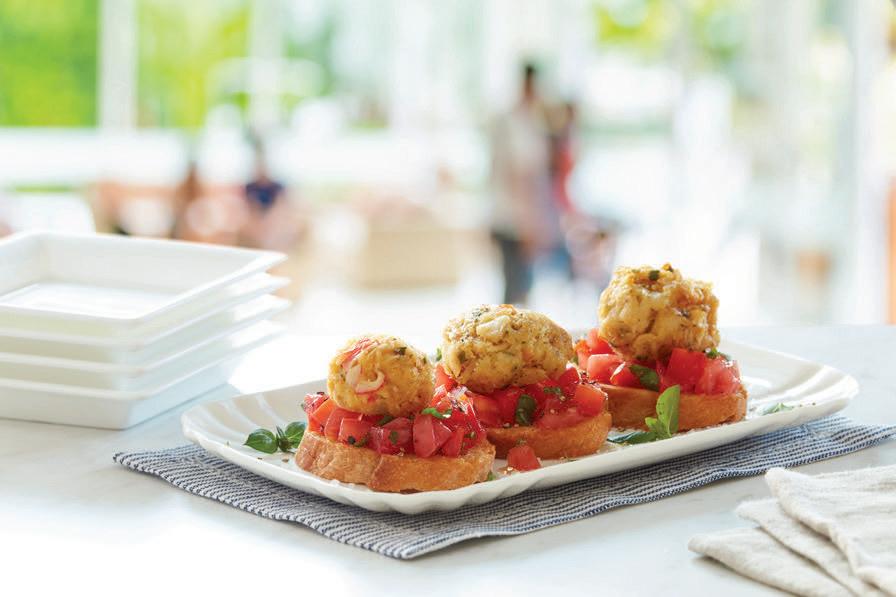
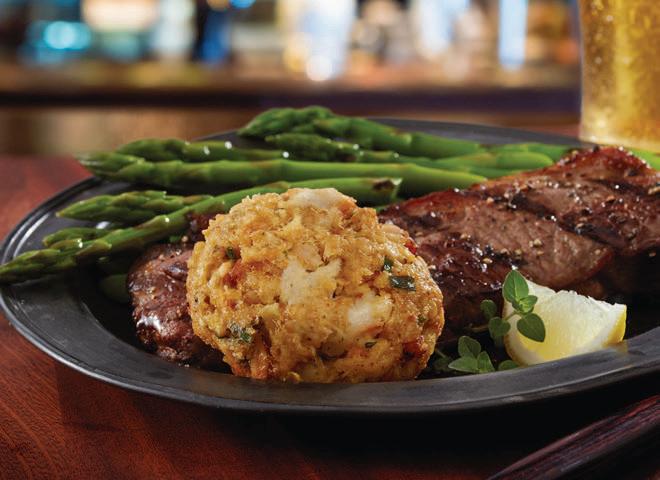
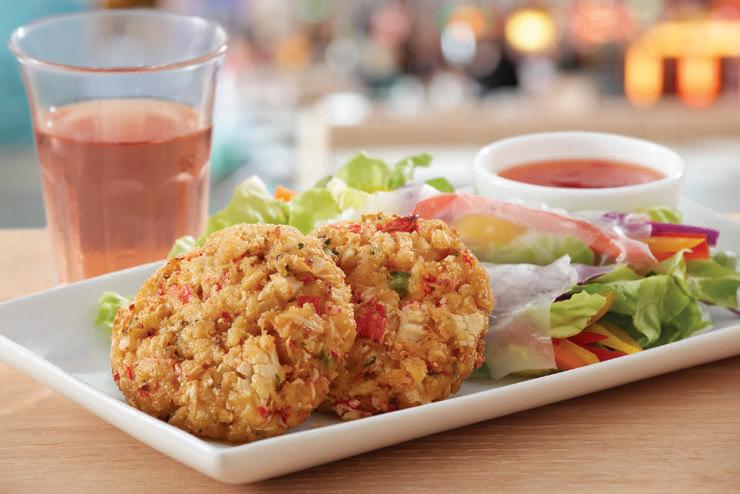
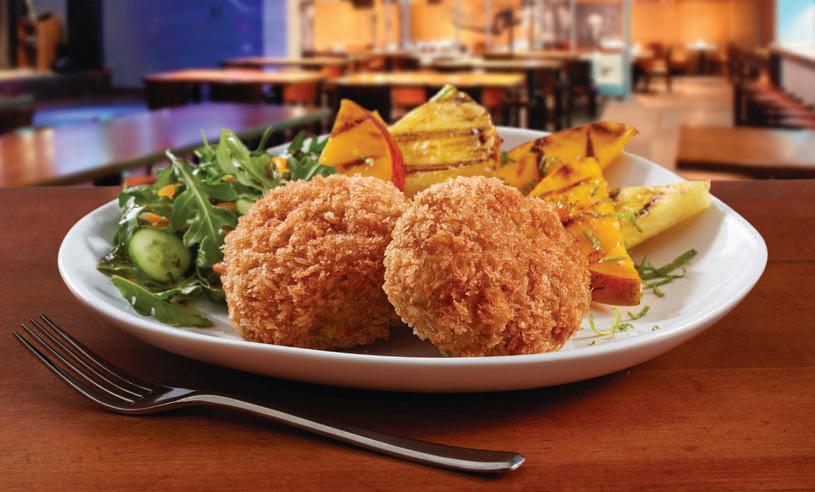
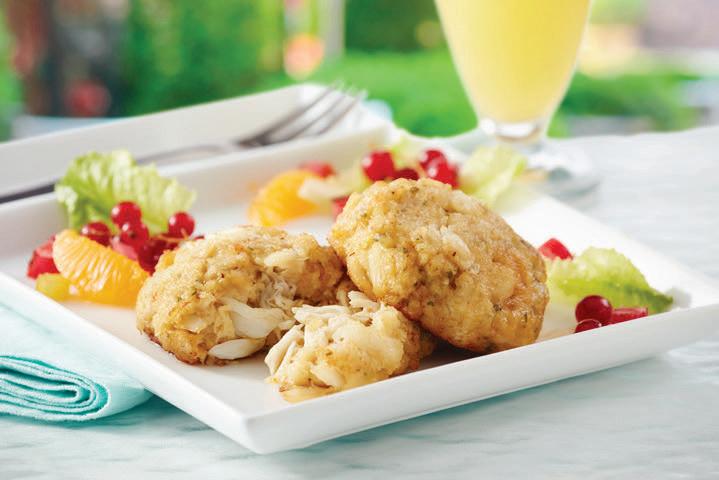


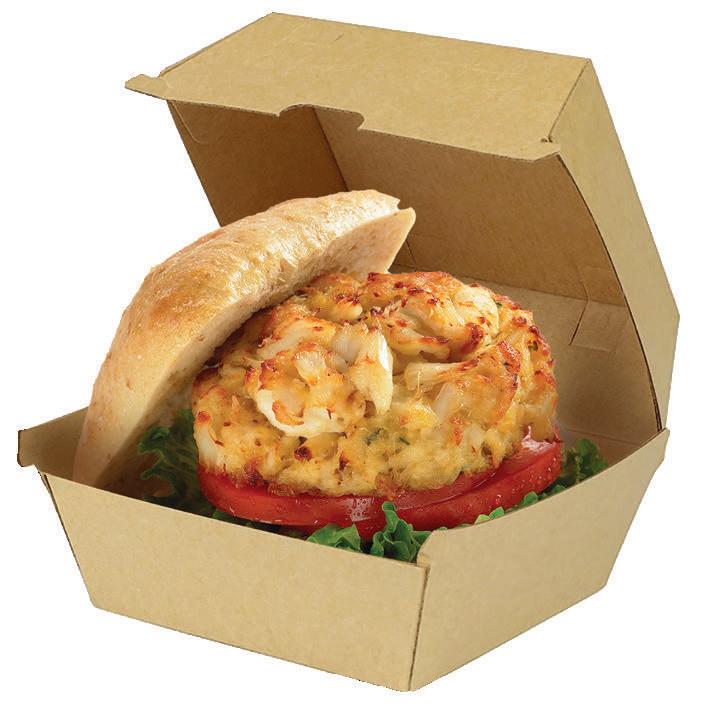


fare, like Impossible Sweet Potato Nachos, Chicken BLT Sandwich, Black Bean Energy Bowl, and Crabcake Sliders.
For Hawkins, developing these dishes is an organic, free-flowing process that can be traced back to her childhood.
“My grandmothers on both sides cooked, so that’s just inside of me,” she says. “I think that creativity comes naturally because I love cooking. I have always cooked for my family. Anytime I had people come over, this is what I did; I cooked for everybody.”
On the more analytical side, Hawkins’ experience as a business owner served her well in starting and operating another company. When it comes to core values, running a restaurant isn’t so different from running a salon.
“Business is business. You still have to treat people with respect. And if you say you’re going to do something, do it,” she says. “You’ve still got bills, you still have to be responsible, you still have people to be reliable for.”
The biggest difference is the number of people whom she is responsible for, she says, adding that it requires more structure and discipline. When juggling both the salon and fledgling restaurant became unsustainable, Hawkins sold the salon, freeing up time to grow her footprint—even in the midst of a global pandemic. In January 2021, a second, much larger breakfast bar opened in Fayetteville, Georgia, a small city about half an hour from the first location.
But even before that debut, Hawkins developed a new arm to the business, one she’d been reluctant to embrace before COVID. Like many operators, she didn’t like the idea of ceding the quality control and visual presentation that comes with a dine-in experience, but at the time, to-go represented a much-needed liferaft.
Off-premises demand was strong from the getgo and has remained so even after guests returned to the dining room (Hawkins estimates those orders account for 20 percent of sales ) Nevertheless, the increased volumes began to overwhelm the front and back of the house at the original restaurant.
“We couldn’t give a great, five-star experience with the dining room because we had just way too many to-go [orders],” she says. Expanding the restaurant wasn’t an option because it was bookended by an AT&T on one side and a beauty supply store on the other. So instead, Hawkins decided to incorporate another quick-service element into her operation.
Favorite kitchen tool: I love my fish scale. It’s the best thing ever when you’re serving seafood. Ingredient of the moment: Lemons and lemon zest Dream collaborator: Rachael Ray

Favorite hair trend: Lace front braids
Atlanta dining scene in a few words: Trendy, social, experience
“The only option at that point was to get a food truck, and that food truck relieves a lot of stress off of our dining room,” she says. “It was actually the best thing that could’ve happened to Gocha’s Breakfast Bar because it’s [all about] the dining experience; we’ve been able to give them a five-star experience again.”
The food truck is parked outside the restaurant and operates Friday, Saturday, and Sunday when demand is at the highest. While some to-go programs offer a pared-down menu, the food truck is equipped to serve the full menu, save for desserts like Gocha’s Fried Pie and the Strawberry Shortcake, which require a freezer.
Although the food truck has become a vital extension of the Atlanta location, Hawkins says it won’t be a standard add-on for her restaurants. The Fayetteville unit is large enough to balance on-site and off-premises orders, and future stores will be, too.
Hawkins isn’t in a huge hurry to expand Gocha’s Breakfast Bar, but she recently bought a downtown building, which will one day house a new location. In the meantime, the entrepreneur is laser-focused on another project, Gocha’s Tapas Bar, which has been mired in delays.
“It normally takes me about 4–6 months to open up, and I’ve been working on this for over a year now,” she says. “Once I get it open, everything will be great.”
Just a 15-minute drive from the original breakfast bar, the new concept was supposed to open last August, but supply chain delays have continued to push back the schedule. At press time, she was expecting the AC unit to be delivered by the end of January—seven months after the targeted date.
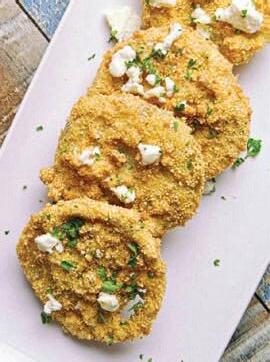
These headaches aside, Hawkins is excited to introduce her neighborhood to a fresh concept. The menu won’t stick to Spanish cuisine, but rather celebrate the small plate format, with headliner dishes fried green tomatoes with crab salad, cauliflower tacos, lobster rolls, ceviche, and Mexican corn.
On top of all this, Hawkins is also starting to franchise Gocha’s Breakfast Bar, which, she admits, will compound her secret sauce conundrum. It’s going to be a busy and demanding road ahead, but for the hair stylist–turned–chef/restaurateur, the effort is always worth the end result.
“You’ve got to have passion for this industry. I tell people, this is hard work—no lie,” she says, “but the gratification is seeing your guests happy and seeing great reviews and things like that.”
LEMON: ADOBE STOCK PIXEL-SHOT, GOCHA’S BREAKFAST BAR (3)
HAWKINS HAS BEGUN LOOKING INTO FRANCHISING HER BREAKFAST BAR CONCEPT.
CHEFS & INGREDIENTS / LIQUID INTELLIGENCE 26 INDUSTRY-WIDE ISSUE MARCH 2023
How Round Table Pizza Took an LTO to the Next Level


The item was a fan favorite in 2022. But the 2023 version has a “sweet heat” twist.





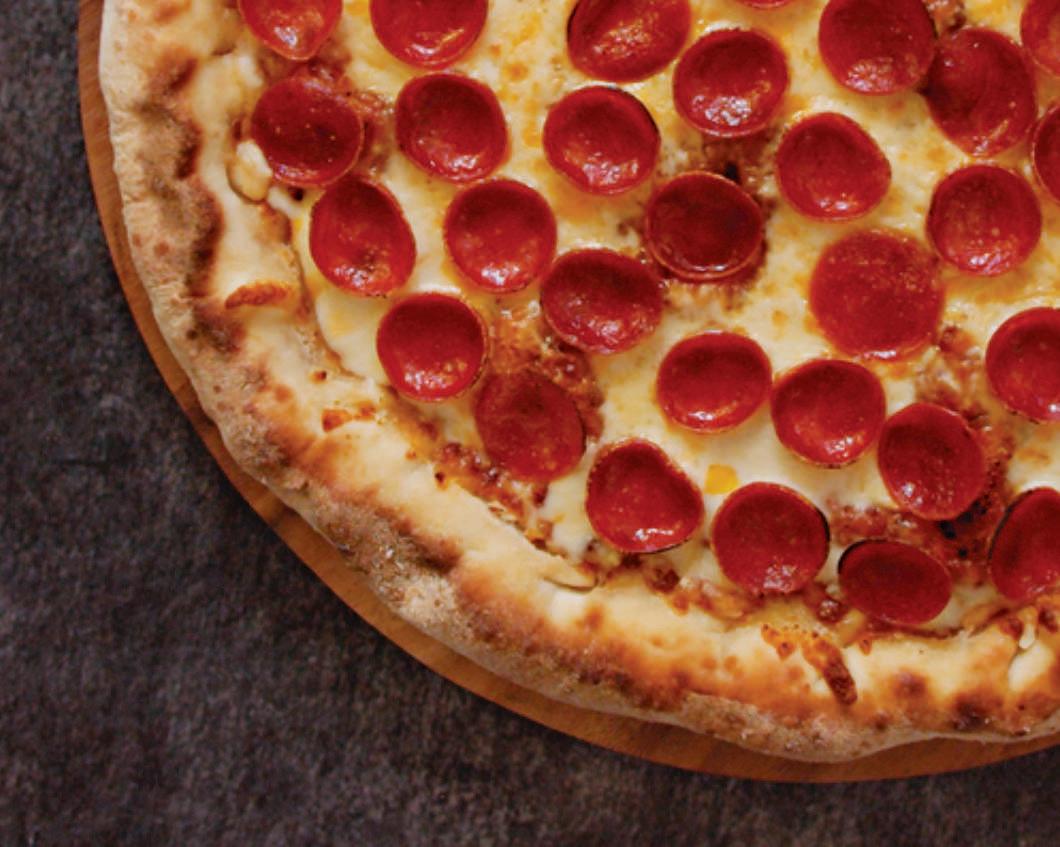
ROUND TABLE PIZZA launched a fan-favorite LTO in January 2022: the Large Stuffed Crust Mini Pepperoni Pizza. As its loyal following clamored for the menu item to be brought back, the 400-plus unit, full-service chain could’ve done just that and called it a day.


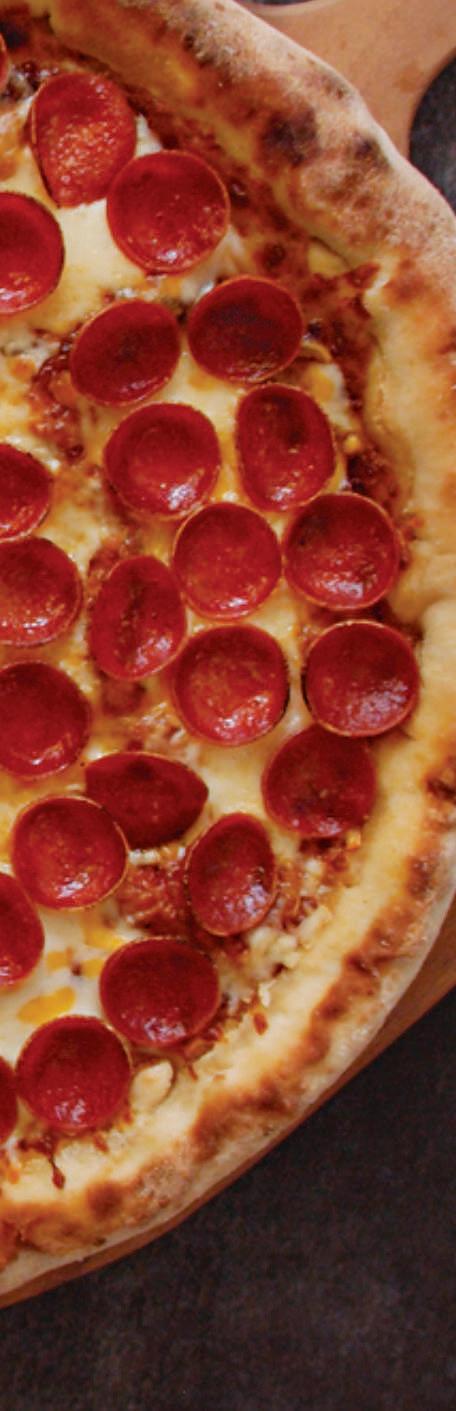
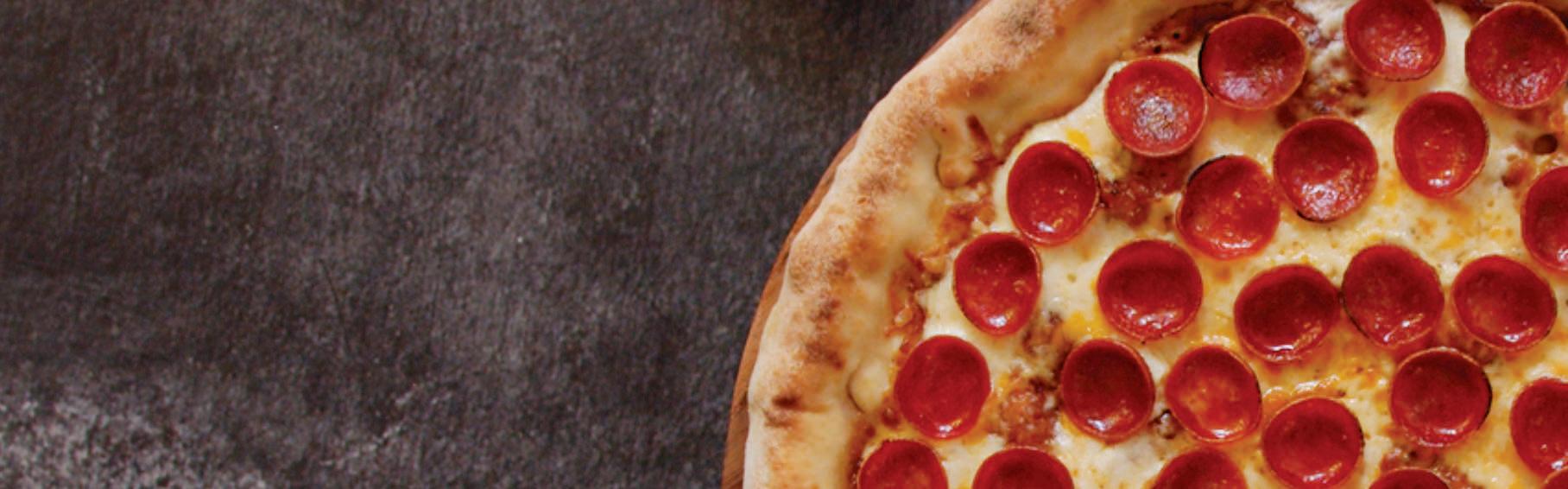
But that’s not the way Round Table Pizza rolls. “When we’re bringing back a popular LTO for another round, we always want to find something that provides a new twist to it,” says Lisa Davidson, senior director of culinary innovation at Round Table Pizza, which was acquired by FAT Brands, Inc. in 2021.

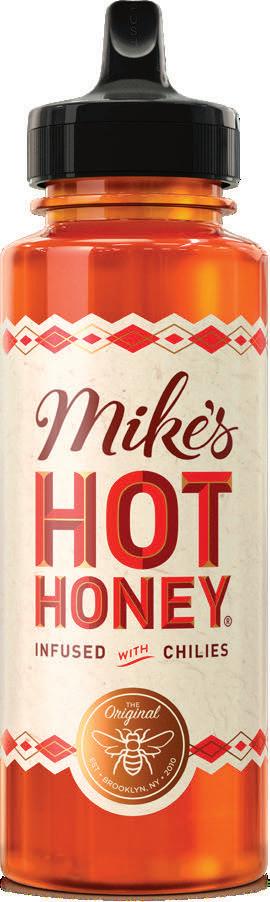
Davidson and her team ultimately fell in love with the idea of adding into the mix one of the fastest-growing and most beloved condiments in the pizza world: Mike’s Hot Honey. The condiment has been featured on LTOs by other brands under the FAT Brands Inc. umbrella and felt like a natural fit for Round Table Pizza.

“One of the main things that separates us from competitors is that our product is high quality,” Davidson says. “Whenever we source key ingredients, we always want to make sure the product is high quality. Mike’s Hot Honey fits right into that—it’s real honey, it’s not a blend of corn syrup like some imitators out there.”

Specifically, Round Table Pizza is offering Mike’s Hot Honey portion cups on the side of each Large Stuffed Crust Mini Pepperoni Pizza. There were a few different reasons Davidson and her team


decided to go with the portion cups, which are now commercially available to other restaurants looking to add the condiment to the menu.
For one, the portion cups offered operational ease. Team members in the kitchen can simply grab a portion cup and place it on the side—no application necessary. Secondly, the portion-cup route granted guests an opportunity to customize their own slices with Mike’s Hot Honey. “We figured, with portion cups, Mom and Dad can still drizzle it on their slices,” Davidson says. “But maybe their kids want to dip it, or find other ways to experiment with it.”
Round Table Pizza also offers sides of Mike’s Hot Honey portion cups for an upcharge, so guests can dive into the versatility of the condiment by pairing it with the restaurant brand’s extensive wing offerings, or its signature Garlic Parmesan Twists. As of mid-January 2023, guests were already loving all of the options afforded by the Mike’s Hot Honey portion cups.
“The fanbases for both Mike’s Hot Honey and Round Table Pizza are so strong,” says Erin Mandzik, director of corporate communications with FAT Brands, Inc. “Mike’s Hot Honey is a New York-based company that’s starting to really gain momentum on the west coast and other areas, where Round Table Pizza is a strong West Coast name. The goal is to merge these two fanbases together by having them enjoy this new offering on the menu.”

28 INDUSTRY-WIDE ISSUE SPONSORED CONTENT / MARCH 2023 SPONSORED BY MIKE’S HOT HONE Y
FOR MORE INFORMATION ON MIKE’S HOT HONEY, VISIT MIKESHOTHONEY.COM
BY CHARLIE POGACAR
ROUND TABLE PIZZA / MIKE’S HOT HONEY
“Whenever we source key ingredients, we always want to make sure the product is high quality.”
Mike’s Hot Honey® started out of a pizzeria in Brooklyn 11 years ago when its signature sweet-heat combo launched a best-selling menu item. With menu growth for hot honey +216% in the last 4 years, its popularity is hotter than ever in 2023. Request a sample today to see what all the buzz is about:


mikeshothoney.com/sample

YOU’RE HIRED
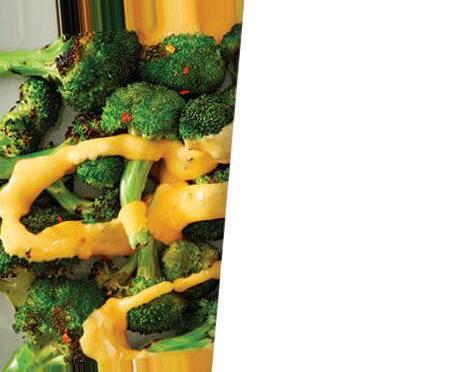
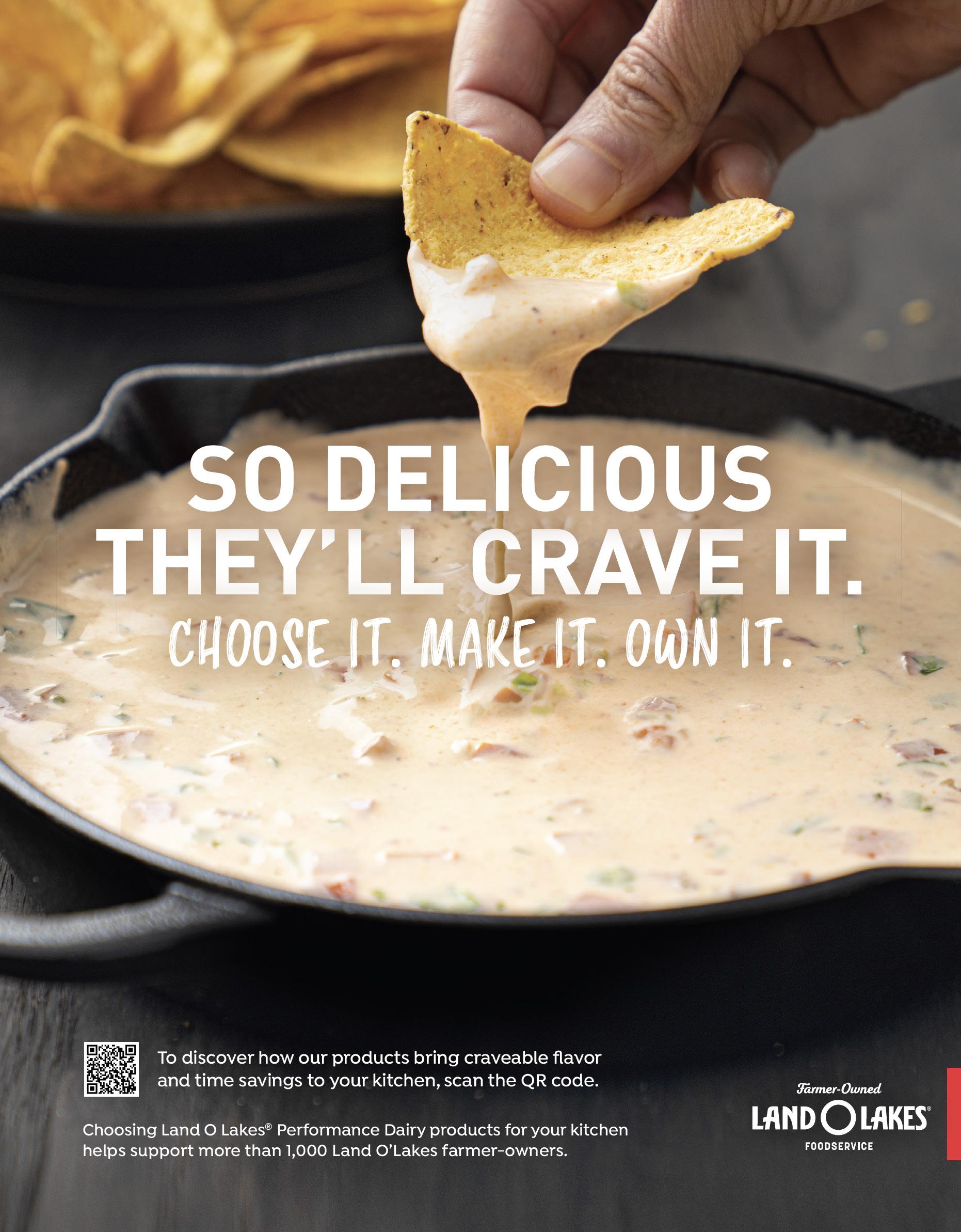
Ongoing labor challenges in commercial kitchens have restaurant operators asking, “How can I help my staff save time?” ANSWER : HIRE THE RIGHT PRODUCTS. Are you ready to put Performance Dairy to work?
WORK EXPERIENCE:
landolakesfoodservice.com/contact-us


@LandOLakesFoodservice
@LandOLakesFoodservice

SKILLS: Amazing Versatility & Dairy Flavor



PROFESSIONAL SUMMARY:










Land O Lakes® Performance Dairy cheese portfolio boasts premium products that have been formulated to outperform the competition.


















EDUCATION: LAND O’LAKES FOODSERVICE TEST KITCHEN











Trusted Performance


Passed rigorous testing with a team of culinary experts to meet the qualifications your restaurant needs, so you can stress less and focus on creating menu items customers love.
Flavor Evaluation
Extreme Temperature Testing
Recipe & Ingredient Performance


A True Labor Saver
Perfect for Takeout or Delivery
Pre-portioning Tips & Process Optimization










Troubleshooting
FORM:





Loaves, shreds, sauces & heat-and-serve queso


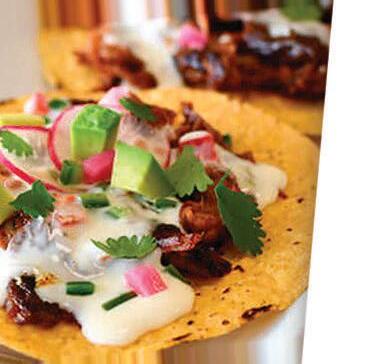
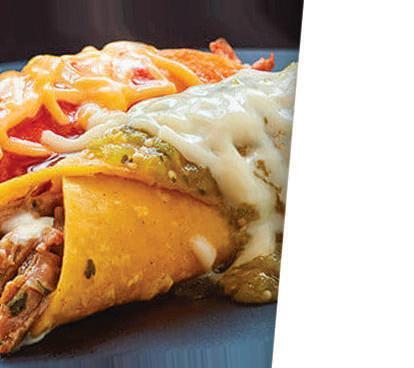
REFERENCES:

“From curdling to scorching,a scratch-made cheese sauce can be temperamental.This lineup oftrustworthydairy products givesyour cooks one less thing toworry about.”
CHEF BILLY KALIL | Commercial Foodservice Product Specialist










PASTA: The No-Limit Culinary Canvas
Menu innovation is as challenging as ever. Thankfully, there’s pasta.
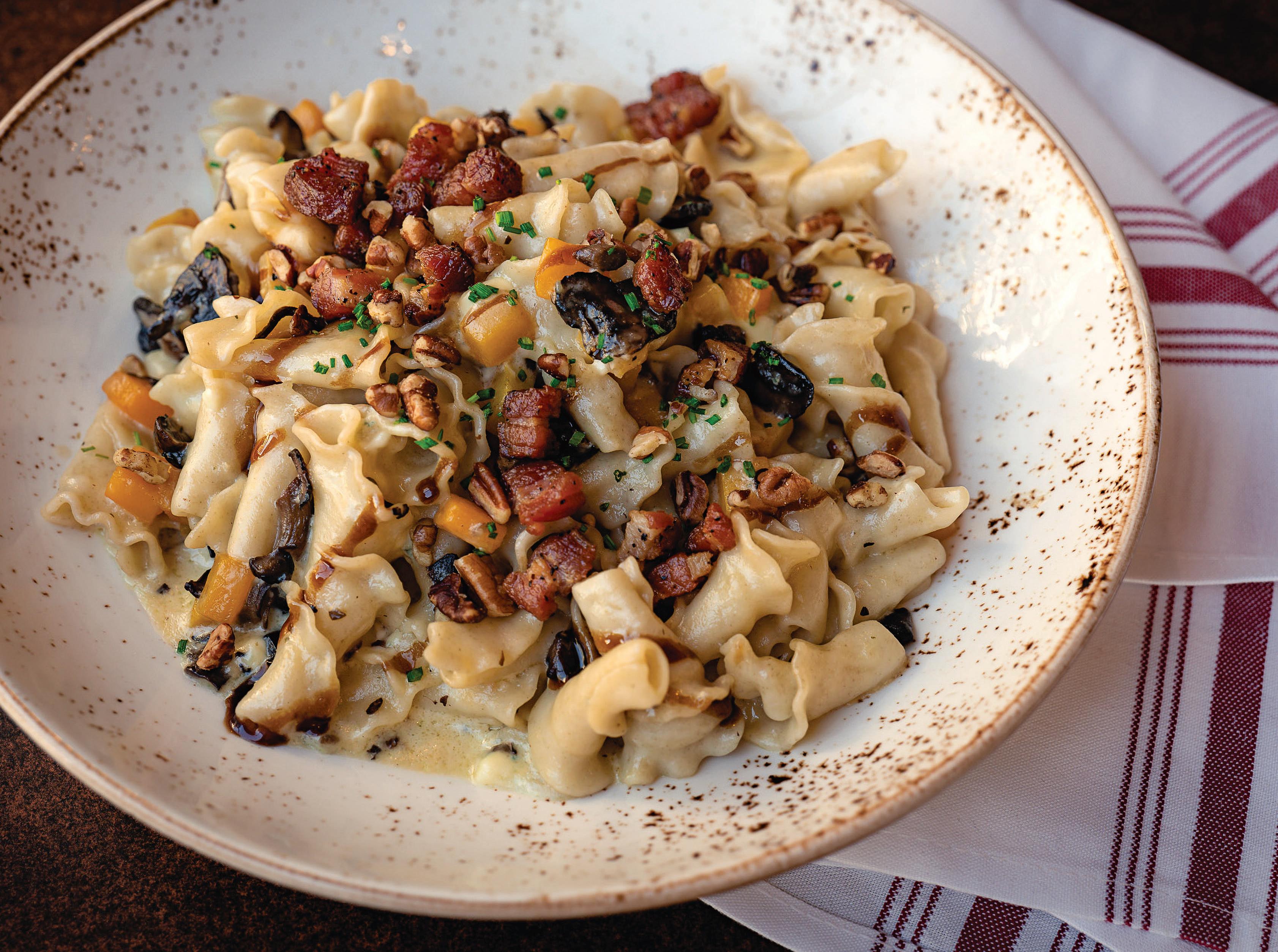
FOR THE PAST THREE YEARS, supply chain hiccups have left chefs grasping at straws. Even ingredients like eggs, once very reliable, have become scarce and begun to inflate in price. Unfortunately, supply-related issues seem likely to continue for the foreseeable future.

“Everyone has endured major challenges when it comes to the supply chain,” says Michael Slavin, vice president of culinary and menu innovation at Hou-
lihan’s, a casual-dining restaurant brand under the Landry umbrella. “Product availability, product quality, and record high costs have affected all of us across the board. It’s a daily battle.”

For these reasons, menu innovation is difficult, but it’s still a necessary part of running a restaurant. Earlier in the pandemic, guests may have had more patience for shrinking menus, higher prices, and less-than-stel-

32 INDUSTRY-WIDE ISSUE SPONSORED CONTENT / MARCH 2023 SPONSORED BY BARILL A
BARILLA (4)
lar service. After all, these issues were widely publicized and consumers were thought to be in forgiving moods. That patience may be running out, Slavin says.
“Guests are craving unique and interesting menu items,” Slavin says. “That stands in direct contrast to the previous two years of menu reductions and more of the same old stuff. Your custom-
for comfort and that satisfaction to help ground them in their days. For a lot of people, pasta does just that. And that’s great news for chefs, because pasta truly is the ultimate canvas.”
A Menu Must-Have
When Harding’s restaurant group conceived of Piada, a fast-casual concept based on serving the

at Piada see pasta as the ultimate culinary canvas.
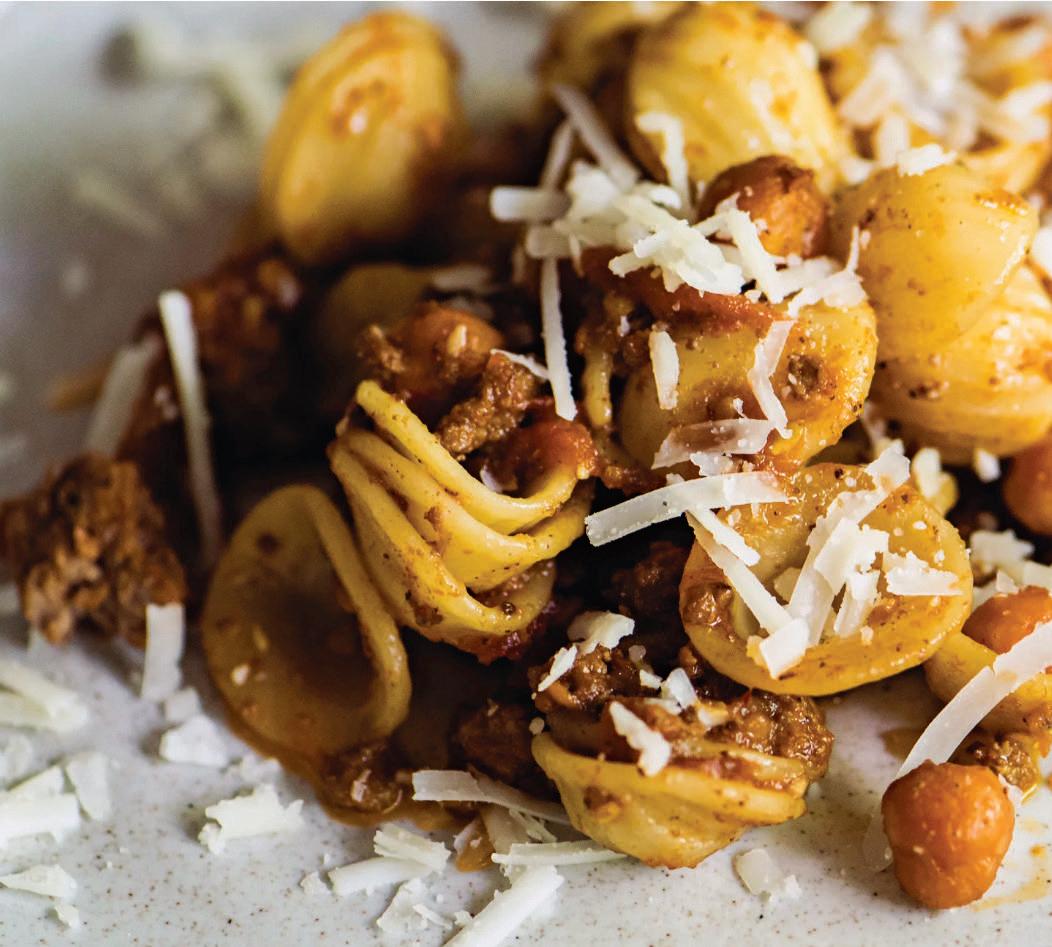
Conveyer of flavor
So why is pasta such a great base for innovation? One of the reasons is its versatility. Each cut lends itself to being paired with different sauces, opening up a world of possibilities, says chef Michael Boyer, food and bever-
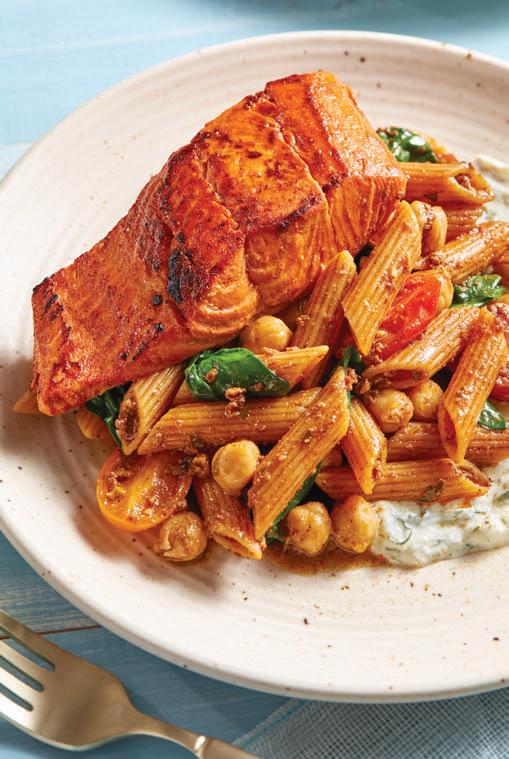
North African Flavors
Chef Michael Boyer, food and beverage product development with Nordstrom Restaurant Group, says he anticipates seeing North African flavors continue to trend in the pasta space. “Look for greater incorporation of flavors like harissa, chermoula, preserved lemon, dukkah, and saffron,” Boyer says.
ers are likely getting tired of that by now. When they dine out, they want something new.”

Matt Harding, executive chef of The Piada Group, owner of 49 fast-casual Italian restaurants and one full-service restaurant, agrees with Slavin. Harding contends that what diners are looking for goes beyond great food. For this reason, versatile, reliable ingredients that can guarantee interesting menu options are essential. Harding suggests that pasta, then, is the perfect way for chefs to meet the moment.
“One thing I know will never go out of style, like a good classic suit, is hospitality,” Harding says. “I’m a huge advocate for getting back to what hospitality used to mean. And when diners go to a restaurant, they’re looking
authentic Italian street food that inspires its name, pasta wasn’t on the menu. It quickly became clear that an Italian concept in the U.S. could not afford to leave pasta off the menu—guests were craving it when they came to Piada. After all, Datassential points out that 84 percent of American consumers say they “love” or “like” pasta.
“I think pasta is so popular because it invokes a tremendous amount of nostalgia,” Harding says. “You’ve got a story and a feeling you get when you order pasta at a restaurant. It’s just that emotion and comfort we could all use more of.”
Pasta dishes now make up the majority of what Piada sells. In fact, the concept’s top-selling item has become a “build-yourown” pasta bowl—even guests
age product development chef at Nordstrom Restaurant Group.
“For example, I’m obsessed with the mouthfeel of Barilla’s new Al Bronzo product line,” Boyer says. “It has such a clear differentiation from other pastas with its custom blend of the highestquality semolina, produced with bronze die, forming an extrarough texture which collects and captures sauce and flavor so well.”
Boyer notes that this is the very reason why pasta is often at the heart of a burgeoning trend— or, rather, is the perfect place to begin when seeking to showcase a new trend. A chef can always find a cut of pasta that perfectly soaks up the trend’s distinct flavors or ingredients.
For the most recent National Pasta Month—celebrated glob-
SPONSORED BY BARILL A
ally each October—Boyer leaned into the idea that different types of pasta can soak up a diverse range of flavors and ingredients. Nordstrom featured on its menu a suite of successful dishes using the Al Bronzo line, including a Butternut Squash and Pancetta Penne, Spaghetti & Meatballs, and an Asian inspired Sweet & Spicy Steak Noodle dish.
Labor Saver
The supply chain isn’t the only ongoing challenge in the industry. Slavin notes labor is an issue that never really went away—it may be discussed a bit less now, he says, as restaurants are making do with fewer team members. Part of the reason that is even possible in the first place is owed to vendor innovation: Slavin points to Barilla’s “No Boil” Lasagne Chef sheets as something that has made pasta dishes that much easier on restaurant kitchens with fewer cooks.
“It’s such a positive, useful upgrade on what was previously a notoriously temperamental process,” Slavin says.




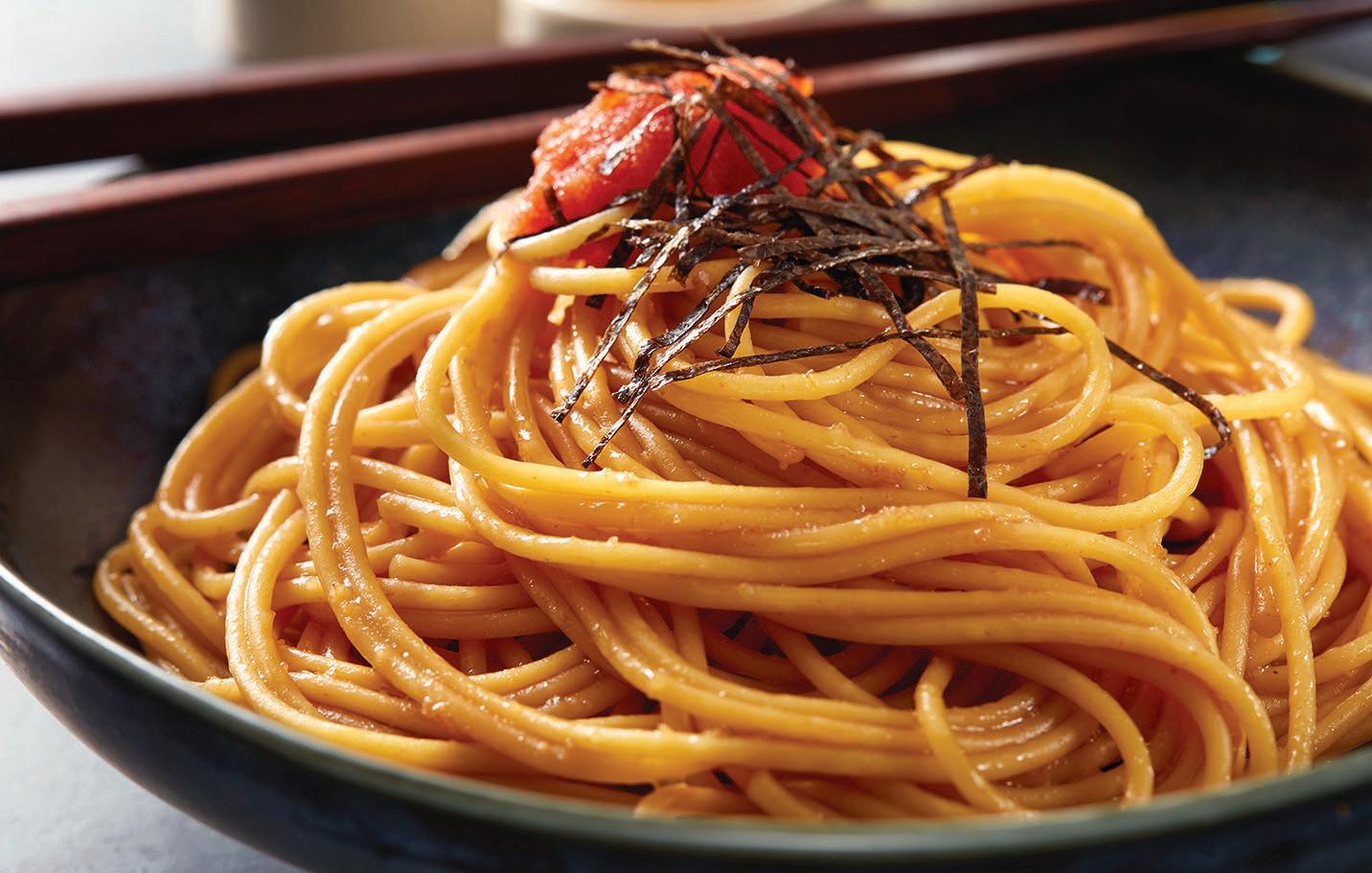
Itameshi
One of the hottest current pasta trends is Itameshi, which translates to “Italian food” in Japanese. Itameshi combines the famous umami flavors of Japanese with Italian cuts of pasta. An example of a popular Itameshi dish is Mentaiko Spaghetti, a simple umami-laden dish of Italian-style spaghetti with the eponymous spicy cod roe topping.
Chef Latisha Rodgers, culinary instructor and program operating manager with Levy Restaurants at MercedesBenz Stadium, has found success with Barilla Frozen ® , a pre-cooked solution from the pasta company. “Using
Broader Asian Influence
Japanese cuisine isn’t the only Asian influence in the pasta world: Filipino flavors are beginning to trend in the U.S., too. Filipino staples like adobo and pancit play well in pasta-friendly comfort foods, but the cuisine brings no shortage of ingredients and flavors that work well on a pasta-driven canvas.
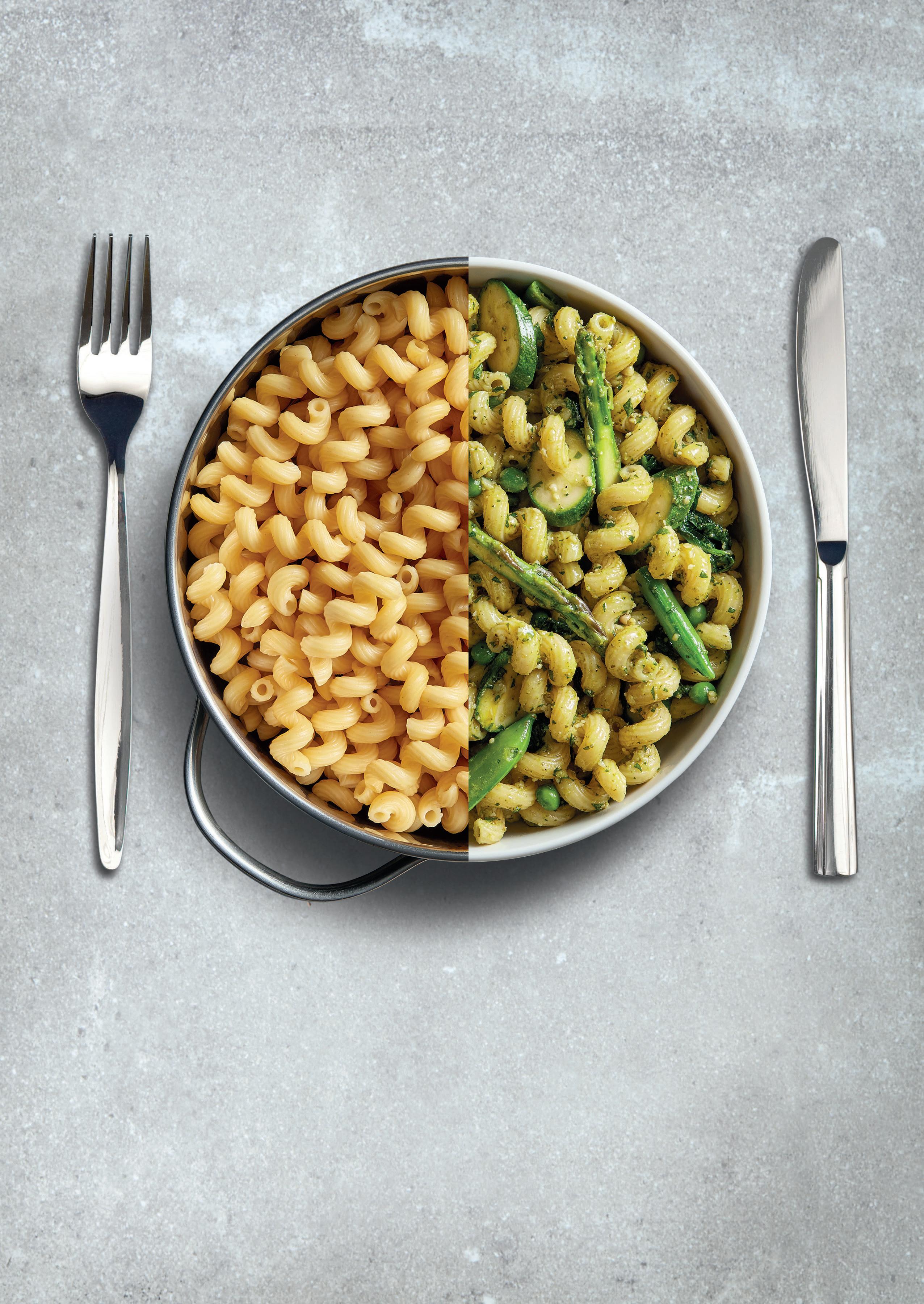
Barilla Frozen for our mac-andcheese concepts makes us so much more efficient,” says Rodgers. “Then we spend the valuable prep hours we save on the scratch items, where it really counts.”
Slavin, Harding, Rodgers and Boyer all use Barilla’s pastas because of innovations like these. That, and the brand’s reputation for carrying quality, widely available products with long shelf lives and hold times. Barilla all but guarantees no matter what a chef is going through, they’ll always have an old faithful standby.
“I’ve brought Barilla with me at every stage of my career,” Harding adds. “I know I can count on it to deliver a high quality experience to the guest, every time.” BY
CHARLIE POGACAR
SPONSORED BY BARILL A
FOR MORE ON BARILLA’S PASTAS, VISIT BARILLAFS.COM.
Brix Holdings
A multi-platform operator is injecting life— and growth—back into a category icon.
BY BEN COLEY
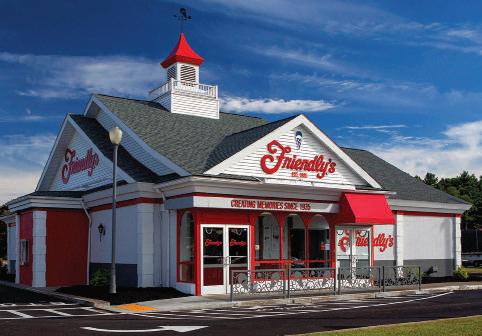
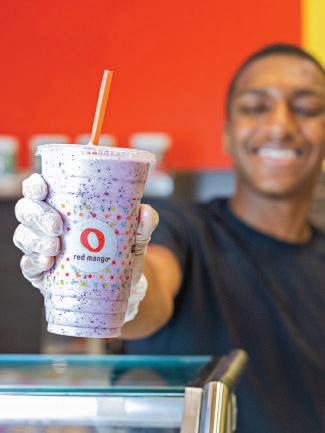
Brix Holdings, which includes 84-yearold Friendly’s and a host of fast-casual concepts, has a straightforward focus for 2023. CEO Sherif Mityas boils it down to one word—growth.
The chief executive feels there are meaningful opportunities to extend dayparts and the number of occasions guests use the brands for.
“We’re going to be putting the accelerator down on generating new development, generating both traditional development in the full-service restaurant space and also in fast casual and potentially nontraditional locations like airports,” says Mityas, who was promoted from president to CEO late last year.
Friendly’s latest chapter began in January 2021 when Brix Holdings acquired it out of bankruptcy for $2 million. Under new leadership, samestore sales increased by double digits year-over-year. In 2022—which saw the introduction of a new marketing campaign and menu innovation—saw single-digit lifts over 2021.
Throughout this transformation process, Brix learned that if it injects relevancy into Friendly’s, customers will give credit for it, especially if there’s consistency. Mityas continuously hears anecdotes from guests about a favorite
HEADQUARTERS: Dallas
YEAR STARTED: 2010
ANNUAL SALES: $200 million-plus
TOTAL UNITS: 300-plus
childhood memory. As adults, these customers are eager to return with their children, and by refreshing the look, service model, and team mem-
bers, consumers are giving Friendly’s a chance again. Not only is the chain seeing expanding sales, but also positive frequency.
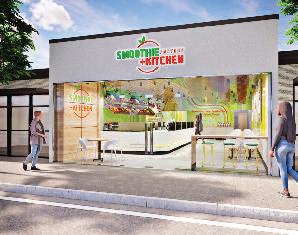
There’s no better example of this than the chain’s first fast-casual restaurant, which opened in February 2022 in Westfield, Massachusetts. Mityas says the format was an experiment in every sense of the word.
{CONTINUED ON PAGE 116}
ONES TO WATCH
® BRIX HOLDINGS (4)
BRIX HOLDINGS’ LINEUP CROSSES CATEGORIES AND OCCASIONS.
QSR FSR
Foodservice operators rely on North Country Smokehouse’s vertically integrated farm-to-fork network to counter today’s supply chain and inflationary challenges.


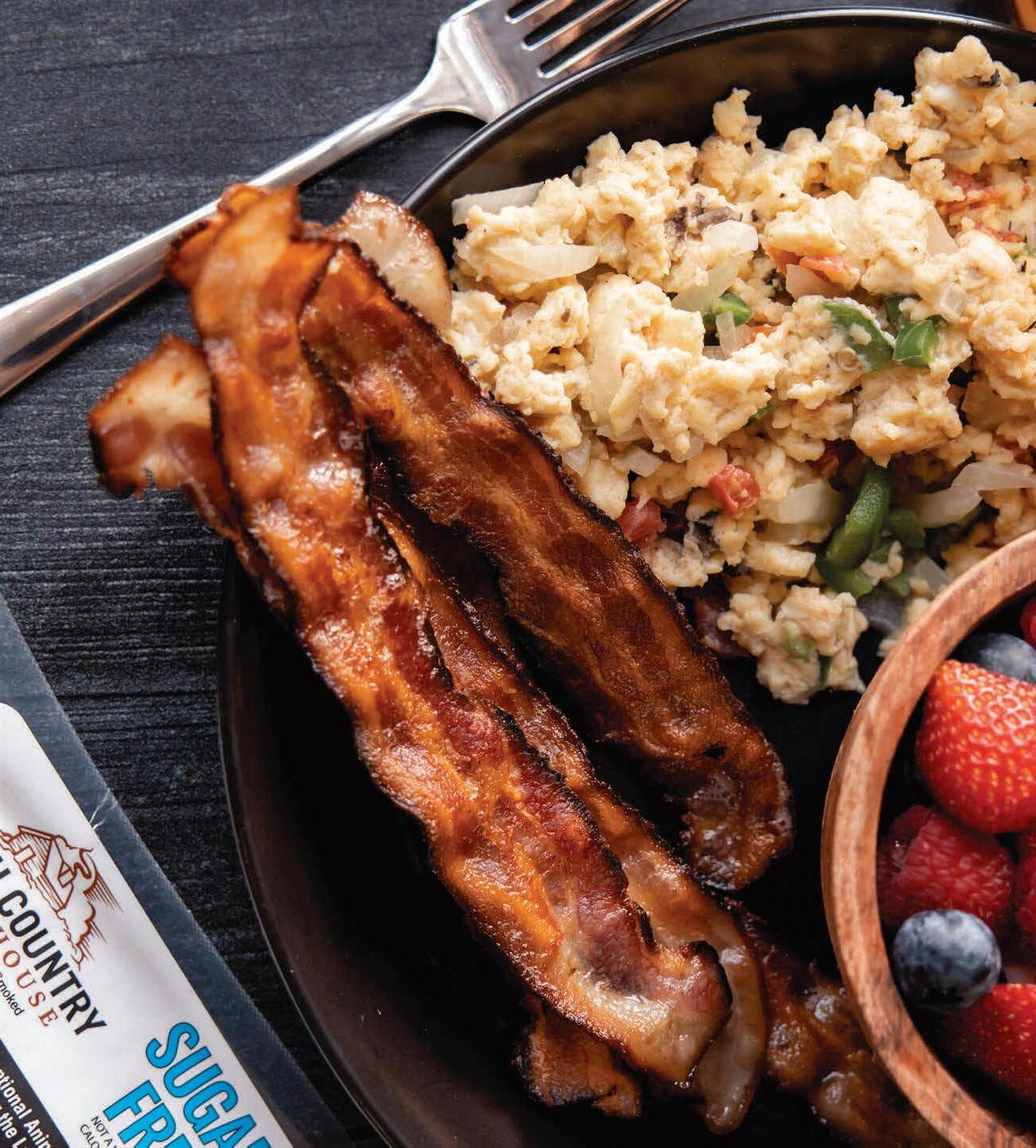
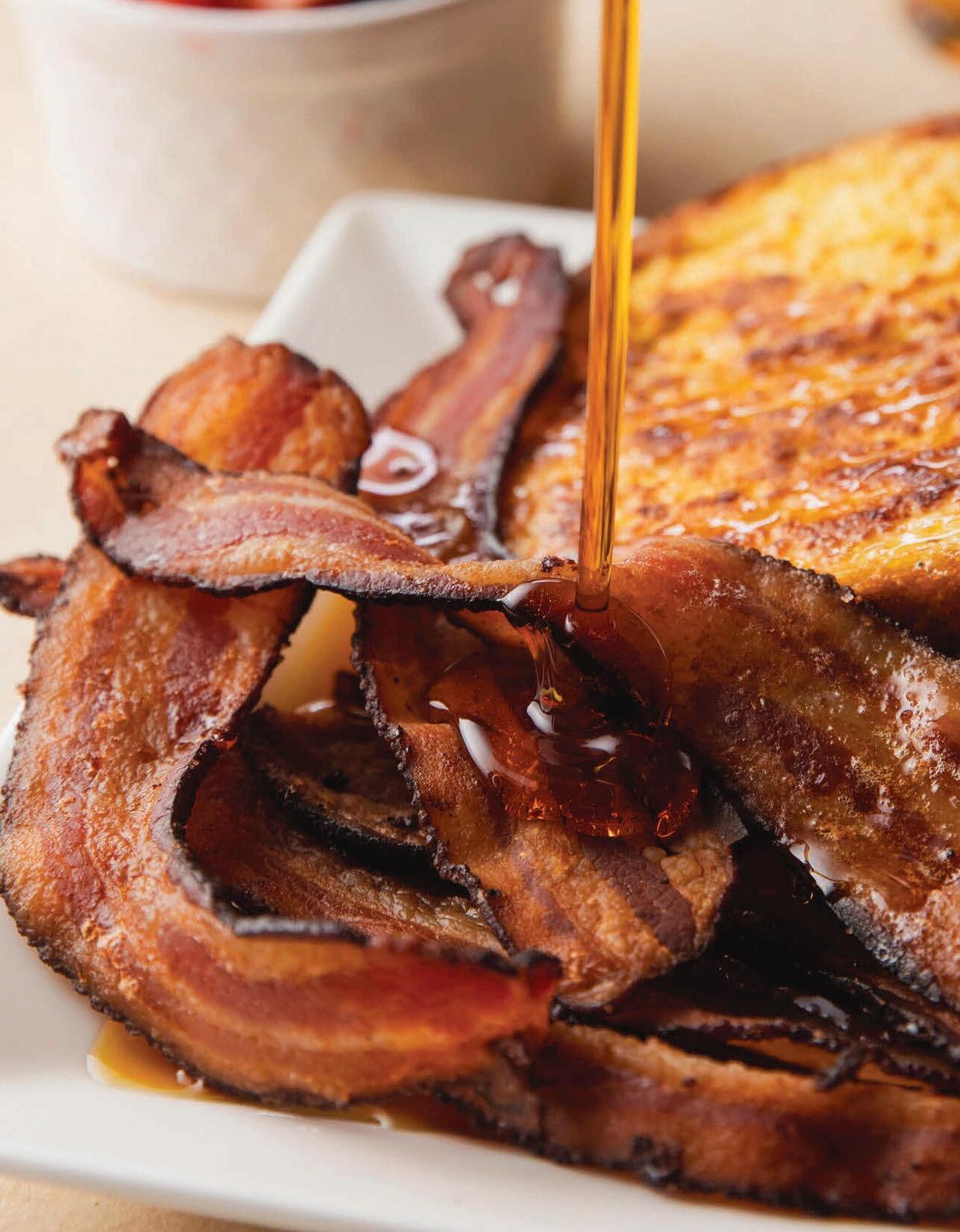
From feed to farms, and further processing we depend on our own agricultural network and never operate off market. That means higher quality, true consistency, and stable costs for our customers (and yours).


If you’re in search of low & slow smoked meats with exceptional flavor – request a cutting today.

NCSmokehouse.com
TED IN
SCAN
TOVIEWPRODUCTCAT
ART I SANALSMOKEDMEATSHANDCRAF
SMALL BATCHES
HERE
ALOG
Cook, chill and serve.


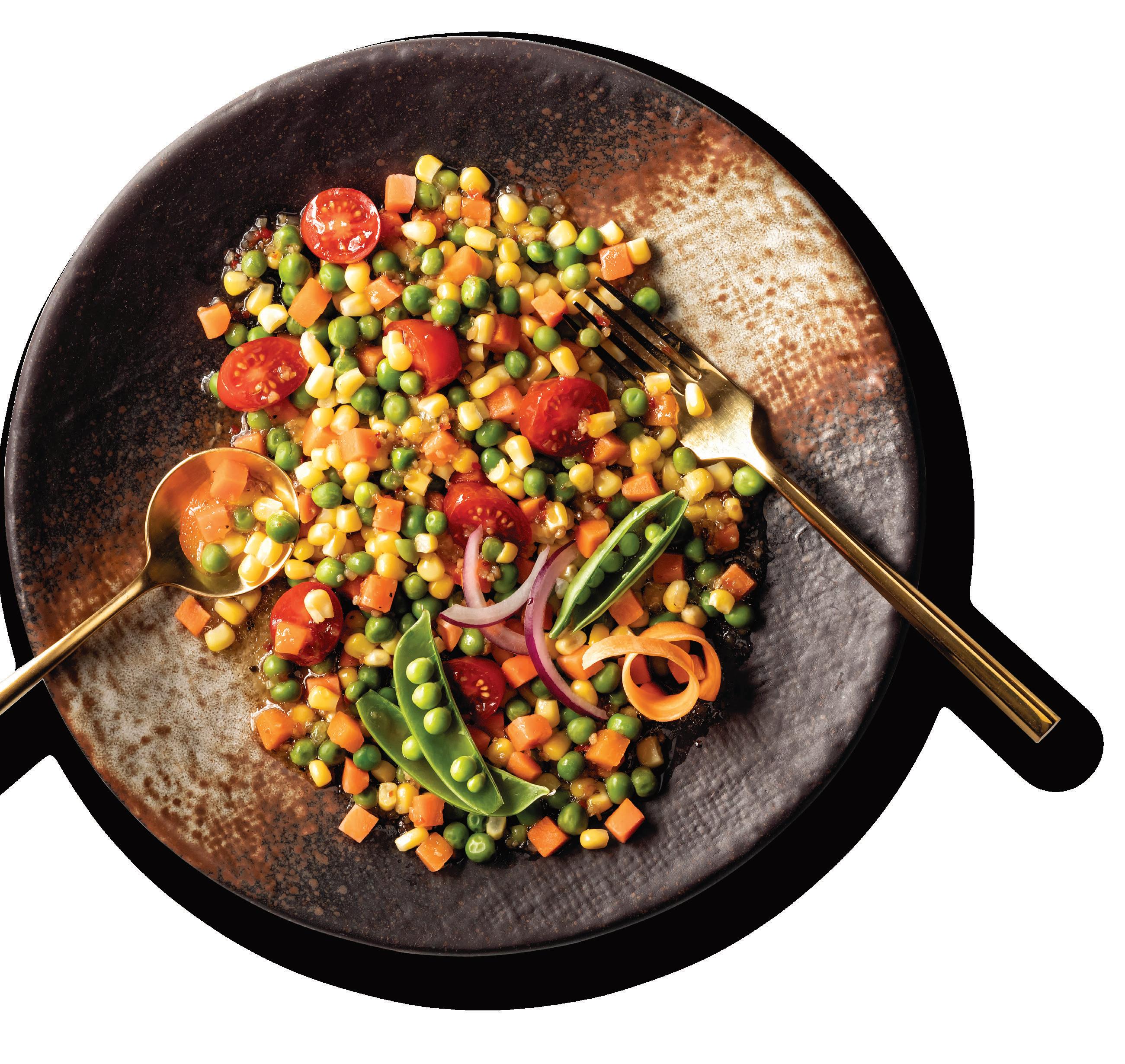
READY-TO-EAT FROZEN VEGETABLES
Simplot Ready-to-Eat (RTE) Frozen Vegetables make prepping salads, grab-n-go items and meal kits a breeze— just thaw and serve. And with up to six days of refrigerated shelf life, you’ll waste less food and freezer space, too.
potatoes | avocados | fruits | vegetables | grains


www.simplotfoods.com View RTE products and recipes
Profit and Experience, Hand in Hand
Can server handhelds unlock faster service and happier guests?

 BY GARY STERN
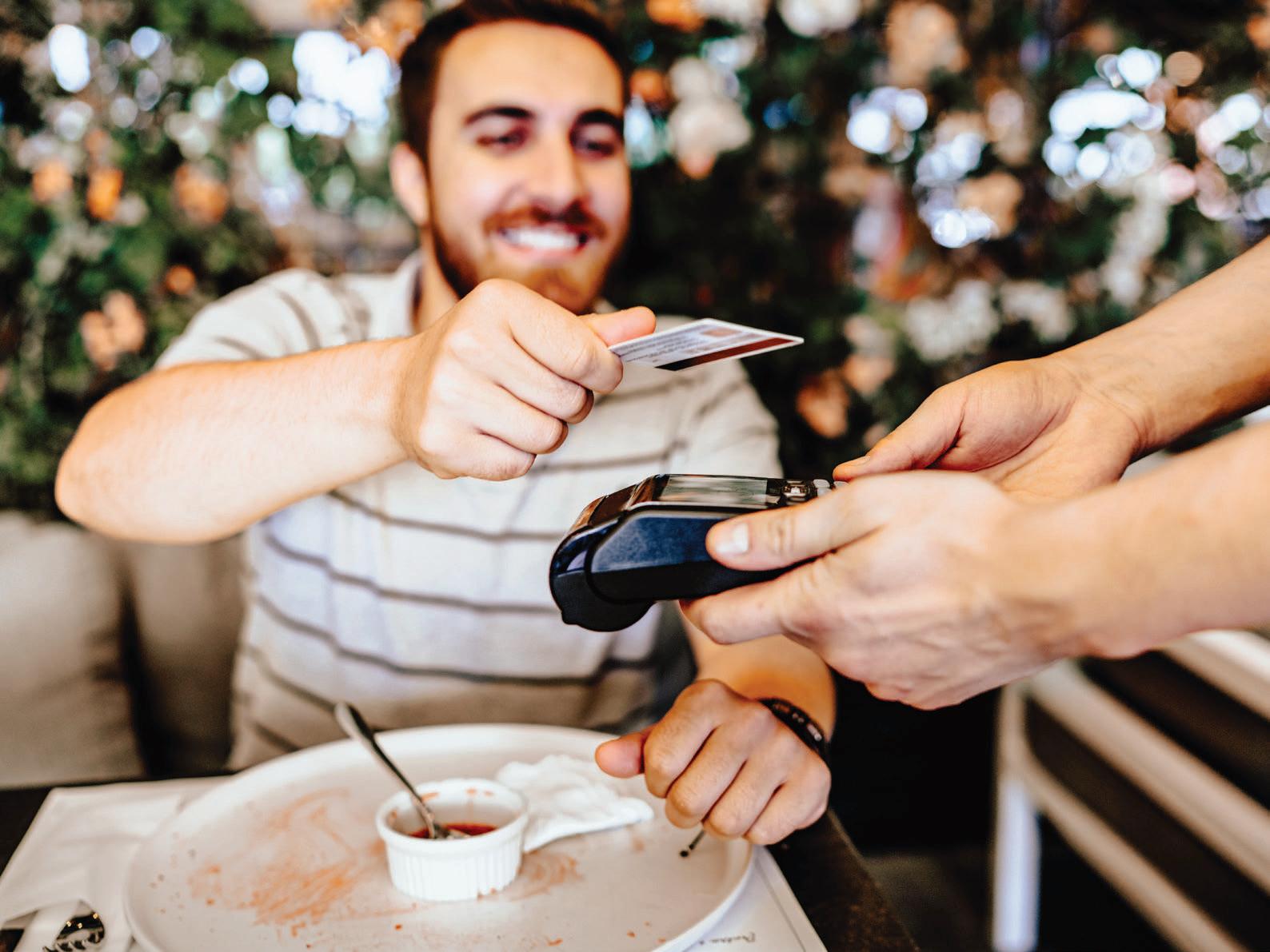
Handheld devices crossed category lines as COVID cracked wide a world of digital adoption, bringing a tech-centric spin on service into an experiential-driven segment. But are they improving customer experience at sit-down restaurants? The companies behind them contend handhelds enable servers to turn over tables 20 percent faster and, in turn, boost revenue by
15–20 percent. Moreover, food gets to the guest three to five minutes faster,

ensuring freshness and satisfaction.
Since some devices are left at the table, guests can check out on their own clock. When servers carry handhelds, they can be pinged on demand, from guests and the kitchen.
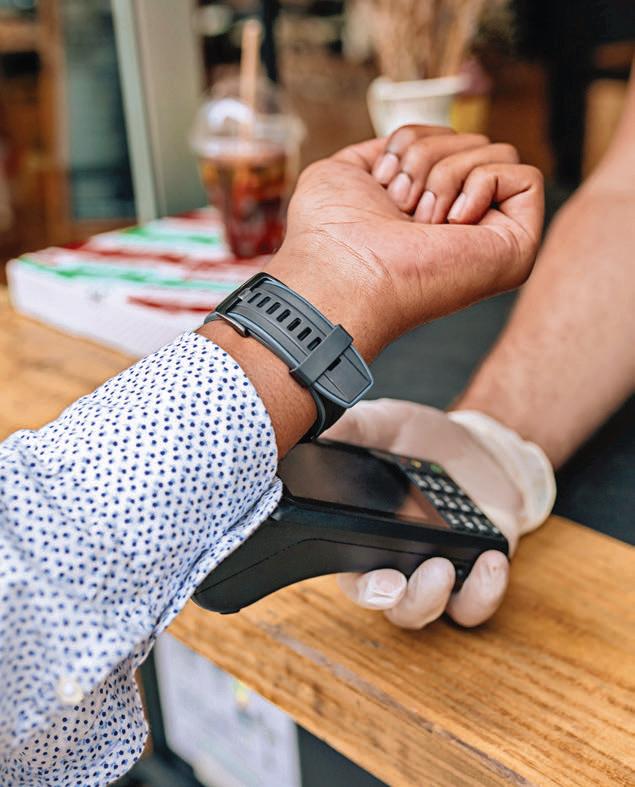
Broadly, it eases the burden on servers who no longer have to race back and forth between terminals to place orders, return to the table, and later wait for guests to take out their credit cards or cash. Some studies suggest servers end up visiting tables twice, instead of five times.

Rom Krupp, CEO of solutions provider OneDine, says handhelds optimize labor and table throughput.
At many restaurants, prime-time lunch or brunch lasts about 60 to 90 minutes and includes time for guests to be seated, eat, and return to work, while the servers go table-to-table and then stop at a point-of-sale terminal to type in their orders. “From the moment the guest says he wants to eat, it’s dead time,” Krupp says. “It slows down your throughput so you can’t serve as many customers.”
When restaurants employ handhelds, the guests pay the check on their own, using Apple or Google Pay or credit cards, join loyalty programs, and enable multiple guests to pay their separate checks at once. Their usage obliterates what Krupp describes as “line busting,” where guests see seven people waiting and walk away because it takes too long, particularly at lunch when they are pressed for time.
In quick service, brands can cut down on cashier staff. With drive-thrus, staff enter the lane,

{CONTINUED ON PAGE 118} OPERATIONS ADOBE STOCK: PAYING WITH SMARTWATCH / DAVID PEREIRAS, CONTACTLESS TECHNOLOGY HODA BOGDAN ®
QSR FSR
36 INDUSTRY-WIDE ISSUE MARCH 2023
PAYING AT THE TABLE CAN EXPEDITE SERVICE AND MAKE CUSTOMERS FEEL MORE SECURE.
Trending on the Menu
Soft
BY KARA PHELPS
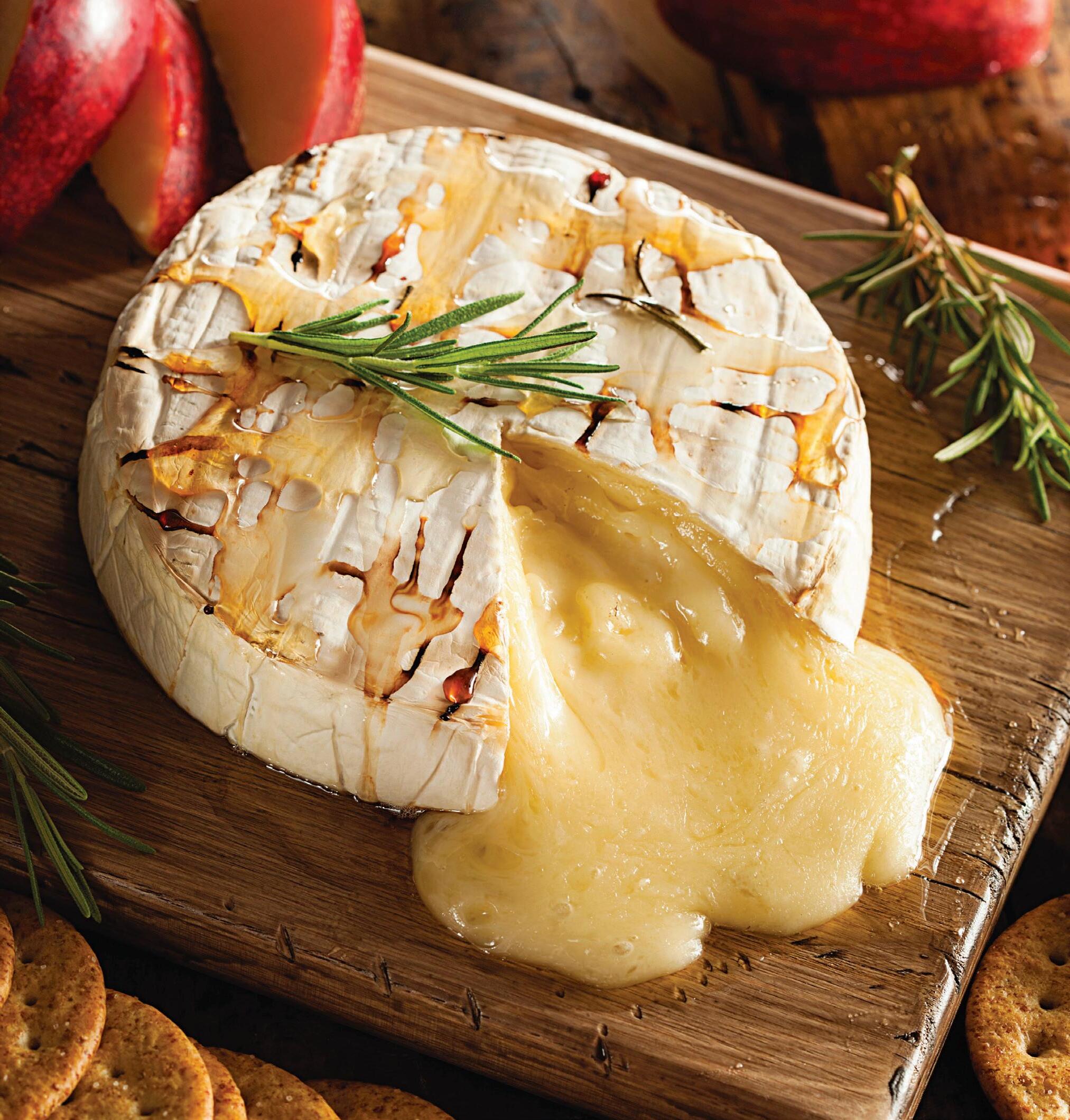
MARCH 2023 // Cheese ADOBE STOCK MILD YET RICH, SOFT CHEESES ADD AN ELEVATED CREAMINESS TO DISHES ACROSS ALL DAYPARTS. Premium Versatility
cheeses
are rich, mild, and supremely flexible.
STORY // 38 The Dairy MVP DATA // 42 By the Numbers MARCH 2023 / SPONSORED CONTENT INDUSTRY-WIDE ISSUE 37
The MVP of Soft Cheeses
Restaurants are finding Boursin to be a powerhouse ingredient.
The full-service restaurant industry has stayed resilient over the last few years in the face of enormous pressures—supply chain issues, inflation, and labor shortages continue to persist. Traffic has mostly returned to prepandemic levels (and for many brands, it’s higher than ever), but margins are shrinking for many operators. According to Datassential, profit margins for the restaurant industry overall averaged 21
percent prior to COVID-19, but in 2022, that figure remained at 13 percent.
So, in all areas of the business, operators are searching for solutions to help them do more with less. Certain forms of automation technology, for example, are becoming more viable as labor grows more expensive and difficult to retain. In terms of menu planning, it’s more important than ever to find versatile, crowd-pleasing ingredients that
also help minimize labor and food waste.
“Cost is front and center of the conversation today,” says Katie Driscoll, director of marketing for foodservice and convenience at Bel Brands USA
“Inflation has driven up prices everywhere, and operators are trying to find ingredients that offer value—whether it’s through lower prices, versatility across many applications, or the potential for labor savings.”
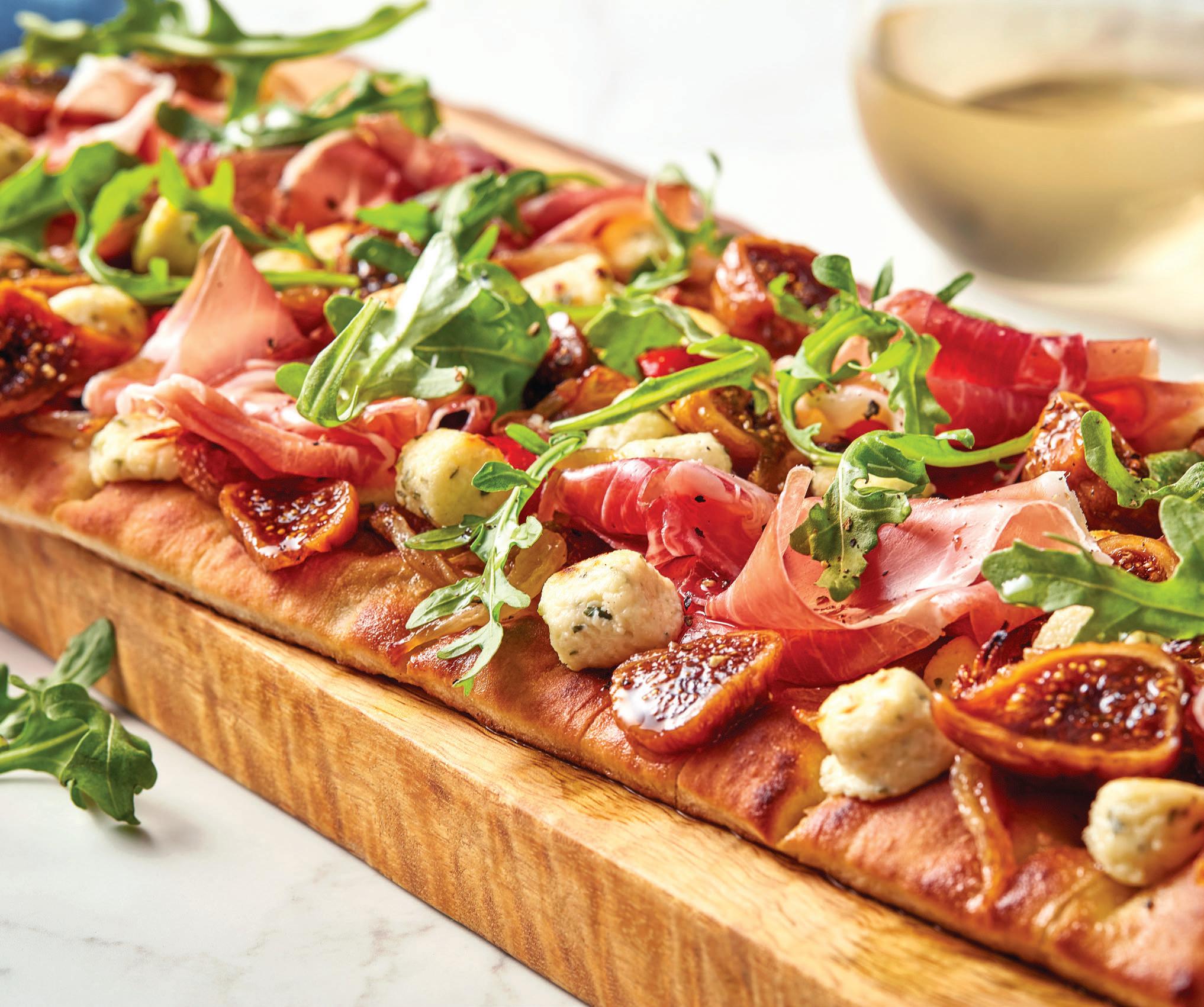
TRENDING ON THE MENU // Cheese
BEL BRANDS
38 INDUSTRY-WIDE ISSUE SPONSORED CONTENT / MARCH 2023
RESTAURANT OPERATORS ARE LOOKING FOR VERSATILE AND DELICIOUS INGREDIENTS TO HELP THEM DO MORE WITH LESS.
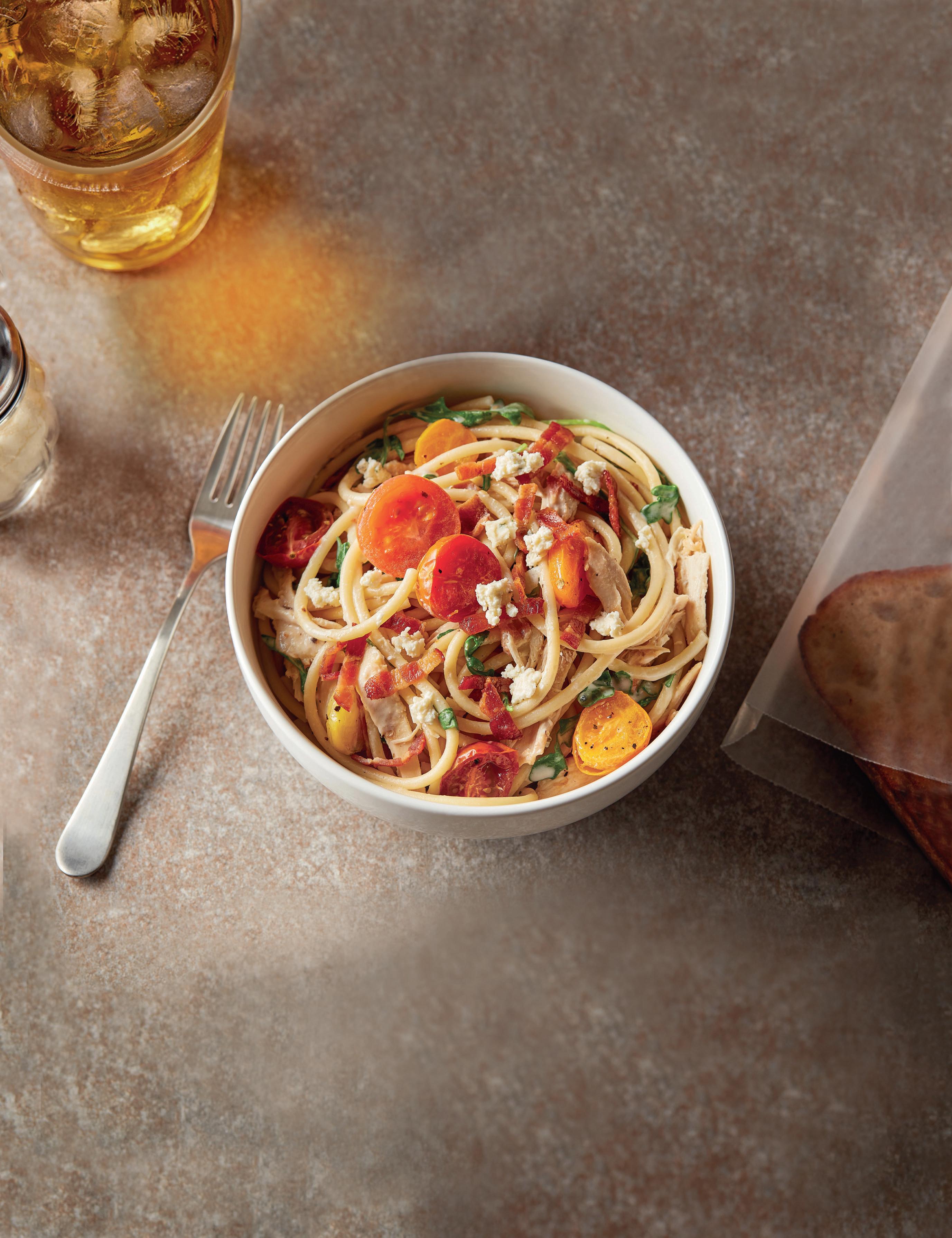







Soft cheeses, for example, can be used in a wide range of menu applications, and many restaurants are rediscovering them as they search for more flexible ingredients. With a mild yet rich flavor, soft cheeses like Brie, ricotta, and chevre add an elevated, creamy element to dishes across all dayparts.
When it comes to soft cheeses, the Boursin® brand from Bel Brands offers a unique combination of familiarity, ver-
“Boursin has been the number-one top-selling gourmet cheese item in retail for at least the last five years,” Driscoll says. “Consumers have a certain familiarity with it, which is especially appealing in this day and age.” In fact, brand recognition can be crucial—according to the Cleveland Research Center, 52 percent of consumers are much more or somewhat more likely to order a menu item featuring a brand name.
size for easy handling that can also reduce food waste. And all varieties carry a built-in flavor impact that kitchen staff can build upon.
“It’s really easy to create elevated dishes using minimal labor and costeffective ingredients when Boursin is involved,” Driscoll says. “You don’t really need much else to make a recipe delicious. Boursin can really be the star of dishes or play an important supporting role across the menu.”
From a brunch burger to a steak topping to a pasta accompaniment—or even as a creamy base for a house-made salad dressing—the Boursin brand offers a widely known consumer entry point for creative chef experimentation.
A summer appetizer menu from the high-end seafood and steak chain Chart House, for example, included Watermelon Carpaccio-Shrimp Ceviche as a trend-conscious limited-time offering. It was served with a jalapeno vinaigrette, yellow pepper crema, and breaded and fried Boursin cubes described as “Boursin croutons.” Duckfat, a small sandwich shop in Portland, Maine, created a Roasted Delicata Squash Panini with Boursin, fermented turnip, leek and cauliflower kraut, and brown butter-sage mayo.
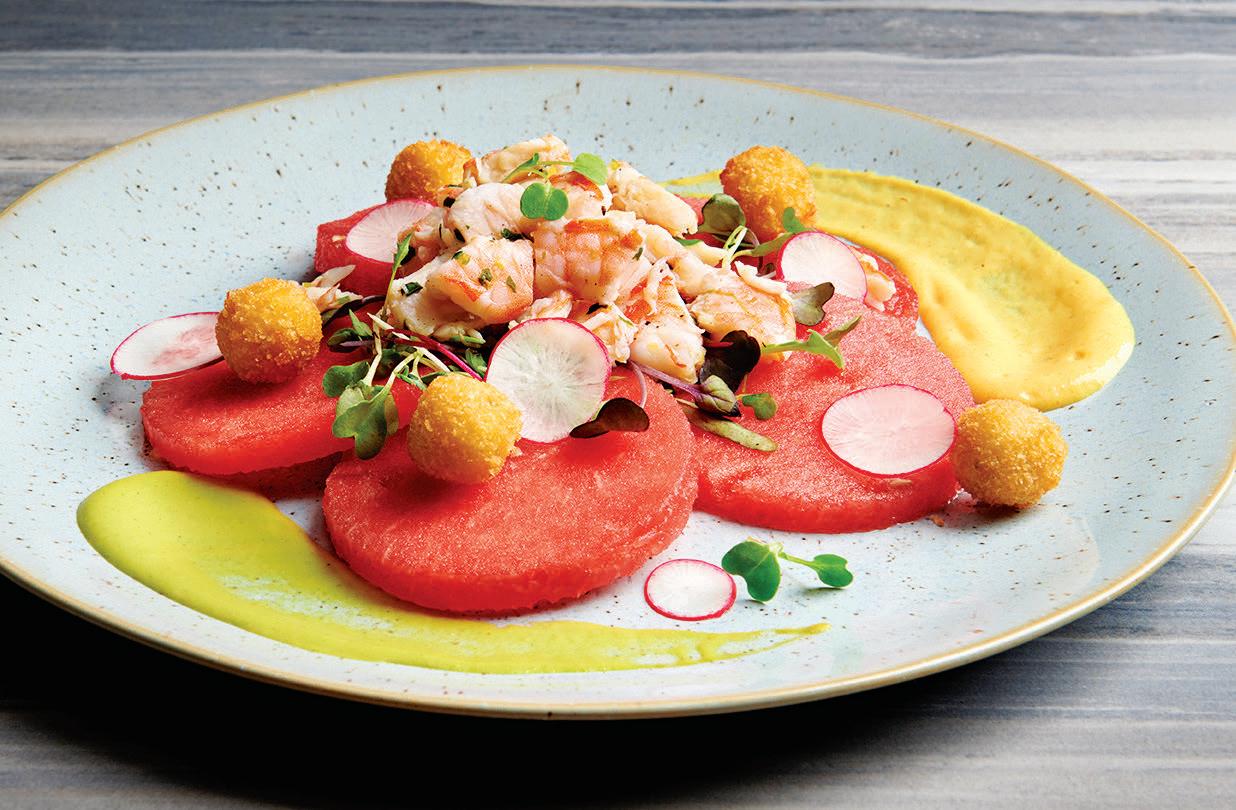
satility, and labor savings. Ubiquitous in retail settings, chefs can also incorporate the well-known Boursin cheeses into their menus with foodservice-friendly bulk, dairy-free, and frozen cube formats. Each of the formats delivers consistent, delicious Boursin flavor to consumers.
“I’ve always said that Boursin is my secret weapon in the kitchen,” says Chef Ian Ramirez, director of culinary innovation and operations at Creative Dining Services. “It’s always been one of those things that I would just slip in wherever and whenever I could for that extra level of richness and flavor.”
And the Boursin name holds meaning for consumers. Ipsos found that 41 percent of consumers believe Boursin is “worth paying more for” when compared to other brands. Mentioning the brand on menus can build expectations for a premium dining experience while increasing upsell opportunities.
As an ingredient, Boursin also helps cut down on back-of-house preparation time. It requires minimal manipulation.
Boursin Frozen Gournay Cheese Cubes are pre-portioned and three grams in
Chef Ramirez says Boursin introduces boldness and airiness when whipped into a smoked whitefish or salmon pate. He also enjoys finishing his romesco sauce with Boursin to add a creamy richness and body.
“Boursin is a super diverse cheese with so many applications—everything from enhancing a spread on a charcuterie board or crostini to folding into sauces and whipping into dressings,” says Chef Ramirez. “You can instantly enhance a dish by using Boursin without the complexity of adding a multitude of other ingredients. Like I said, it’s a secret weapon.”
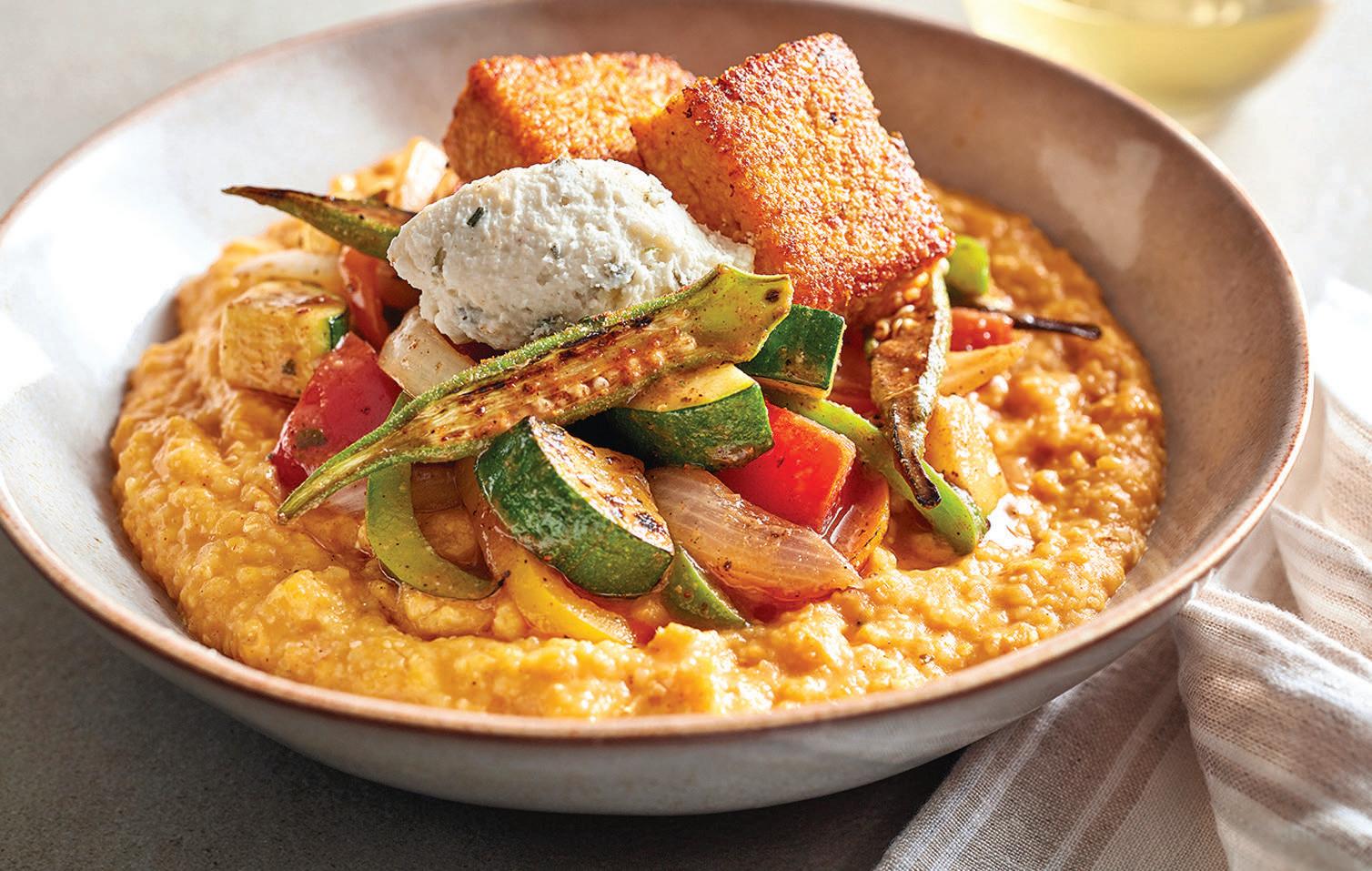
TRENDING ON THE MENU // Cheese
“I’ve always said that Boursin is my secret weapon in the kitchen.”
40 INDUSTRY-WIDE ISSUE SPONSORED CONTENT / MARCH 2023
CONSUMERS ENJOY BOURSIN IN A WIDE VARIETY OF APPLICATIONS, INCLUDING IN SEASONAL LTOS.
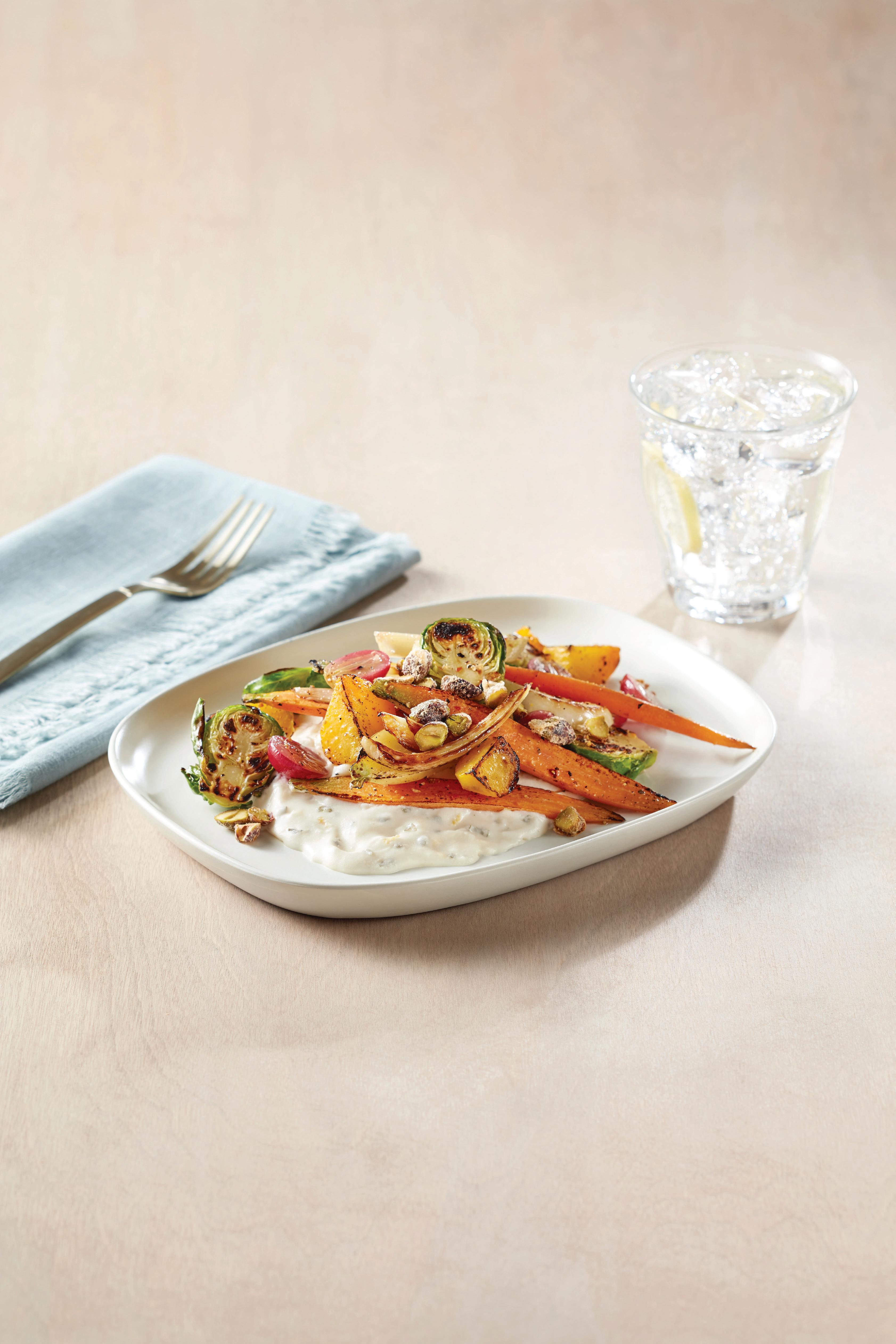
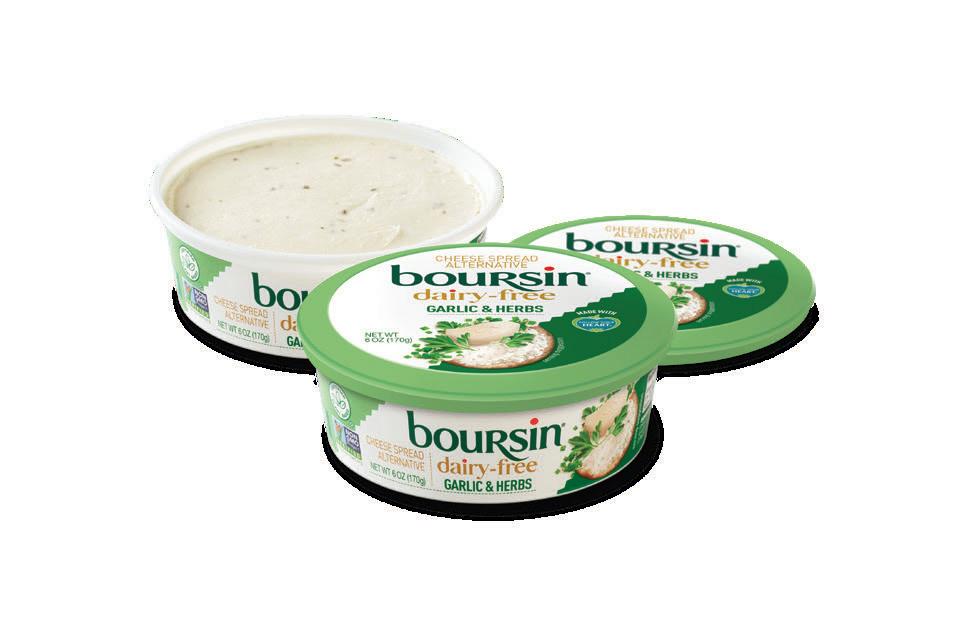


Cheese Trends
A FEW KEY INSIGHTS FROM DATASSENTIAL ON CHEESE


• The menu share of cheese as a broad category increased in 2022.
• Parmesan is the most commonly menued cheese in the U.S., appearing on 54.4 percent of menus.
• Soft cheeses are also widely menued. For example, feta appears on 31.5 percent of U.S. menus, and cream cheese appears on 29.1 percent.
• Plant-based cheese continues to gain traction. In fact, it has more than doubled its menu penetration over the last four years.
• Trending cheese varieties like cotija and queso blanco reflect sustained interest in Mexican and Latin cuisine.
CHEESES GROWING ON U.S. MENUS
CHEESE TRENDS TO WATCH & UNDERSTAND // COURTESY OF DATASSENTIAL
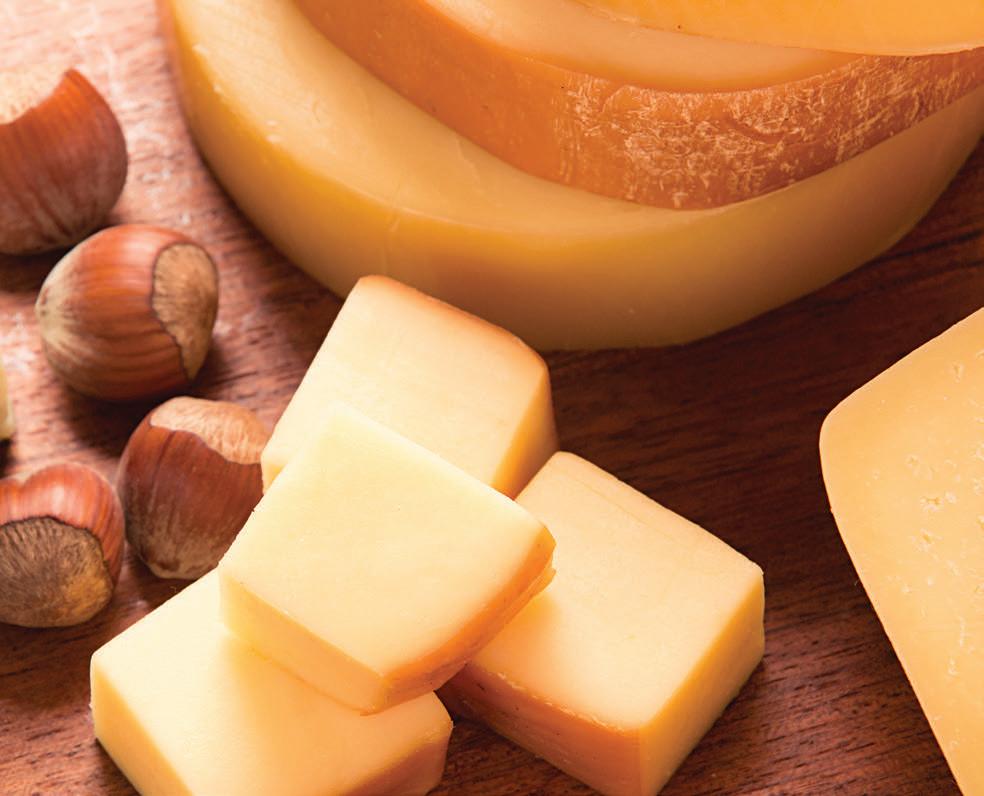
BLUE CHEESE This semi-soft cheese has a strong, sharp taste and is made with cultures of edible mold that give the cheese its spots of blue or green.
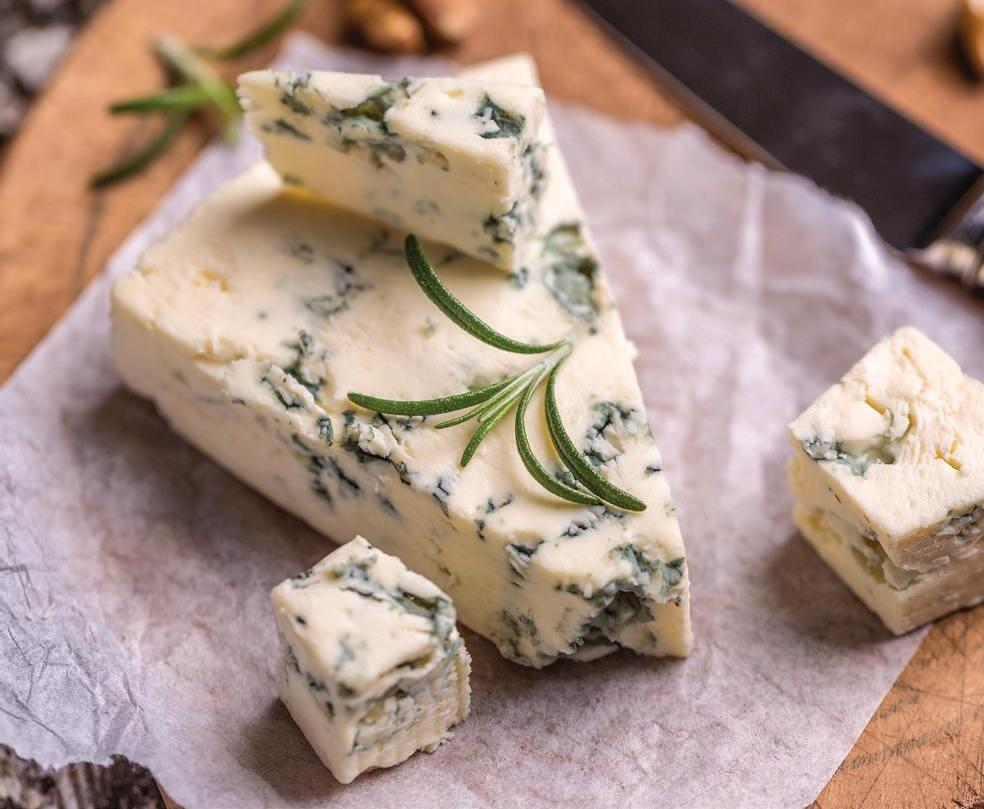
MENU EXAMPLE:
Arugula Salad: Baby arugula, prosciutto, caramel apple vinaigrette, sliced apples, candied pecans, and blue cheese brûlée.
Churrascos // MULTIPLE LOCATIONS, TEXAS
PROVOLONE Provolone is an aged stretched-curd cheese from Italy. It’s generally soft with a more mild flavor. CONSUMERS
MENU EXAMPLE:
Salmon Florentine: Pan-seared wild-caught Atlantic salmon topped with a creamy mushroom, spinach, and provolone sauce.
Ynot Italian // MULTIPLE LOCATIONS
TRENDING ON THE MENU // Cheese
Table Copy Menu Penetration 4-Year Growth American Cheese 25.4% +7% Burrata 7.0% +18% Cotija 6.3% +25% Plant-Based Cheese 5.4% +126% Beer Cheese 2.8% +45%% Queso Blanco 1.7% +32% Cheese Curd 3.1% +31%
ADOBE STOCK (2)
42 INDUSTRY-WIDE ISSUE MARCH 2023
CONSUMERS Know It Have Tried It 87% 59%
Know It Have Tried
90% 82%
It
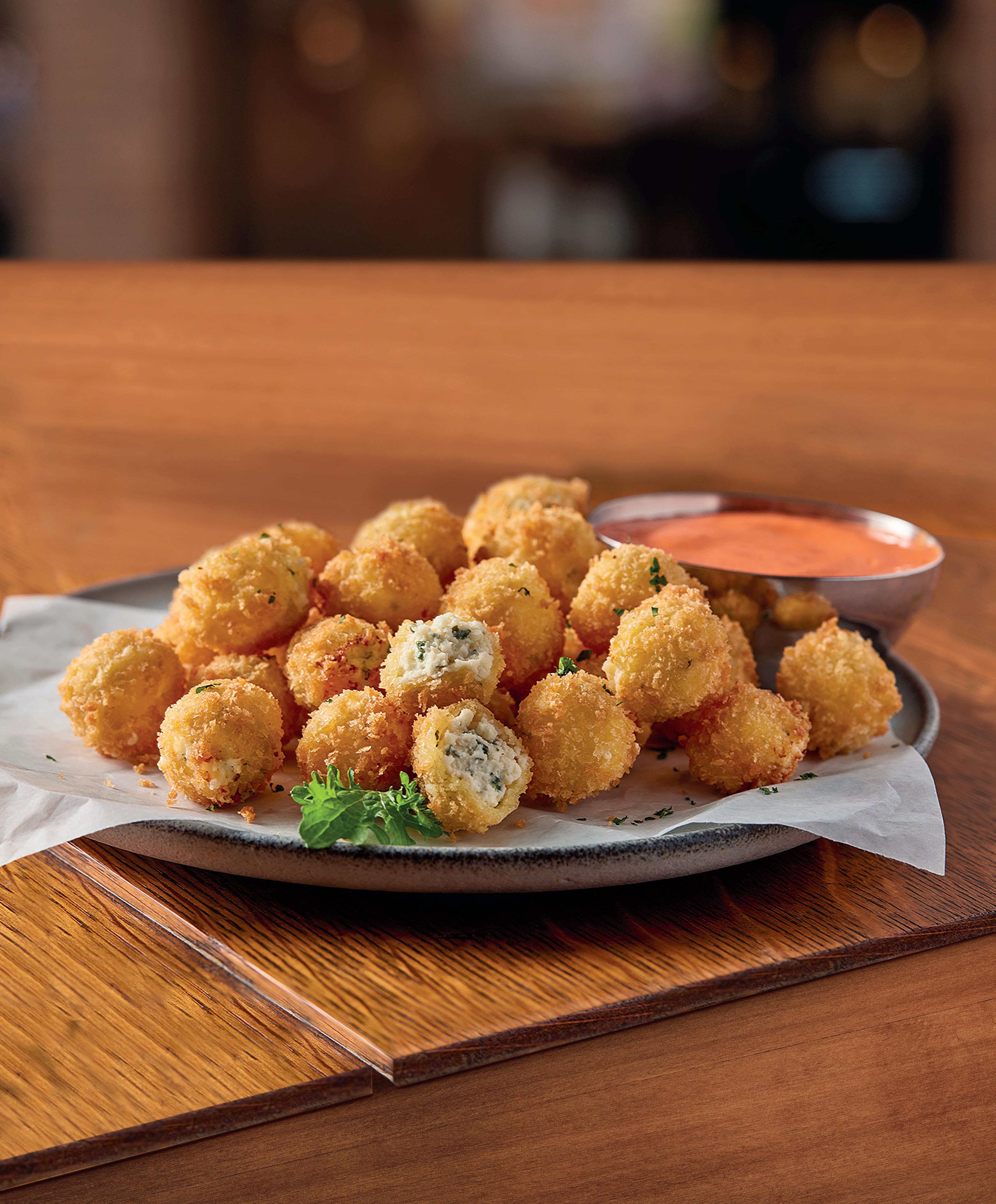
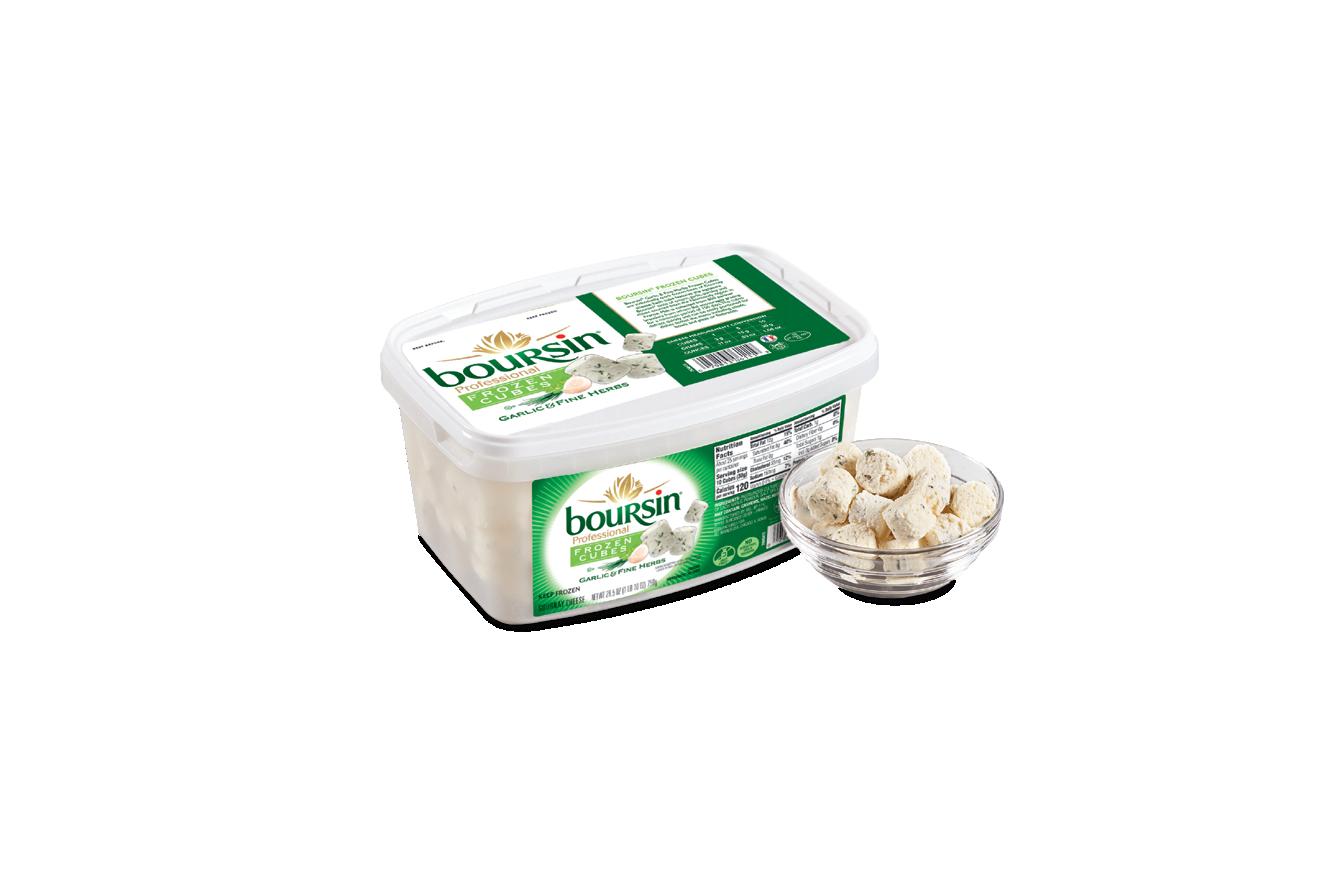


VEGAN CHEESE Marked by its exclusion of all animal products, vegan cheese is typically made from vegetables, plant-based milks, nutritional yeast, and/or seeds. It can range from soft and fresh to aged and hard.
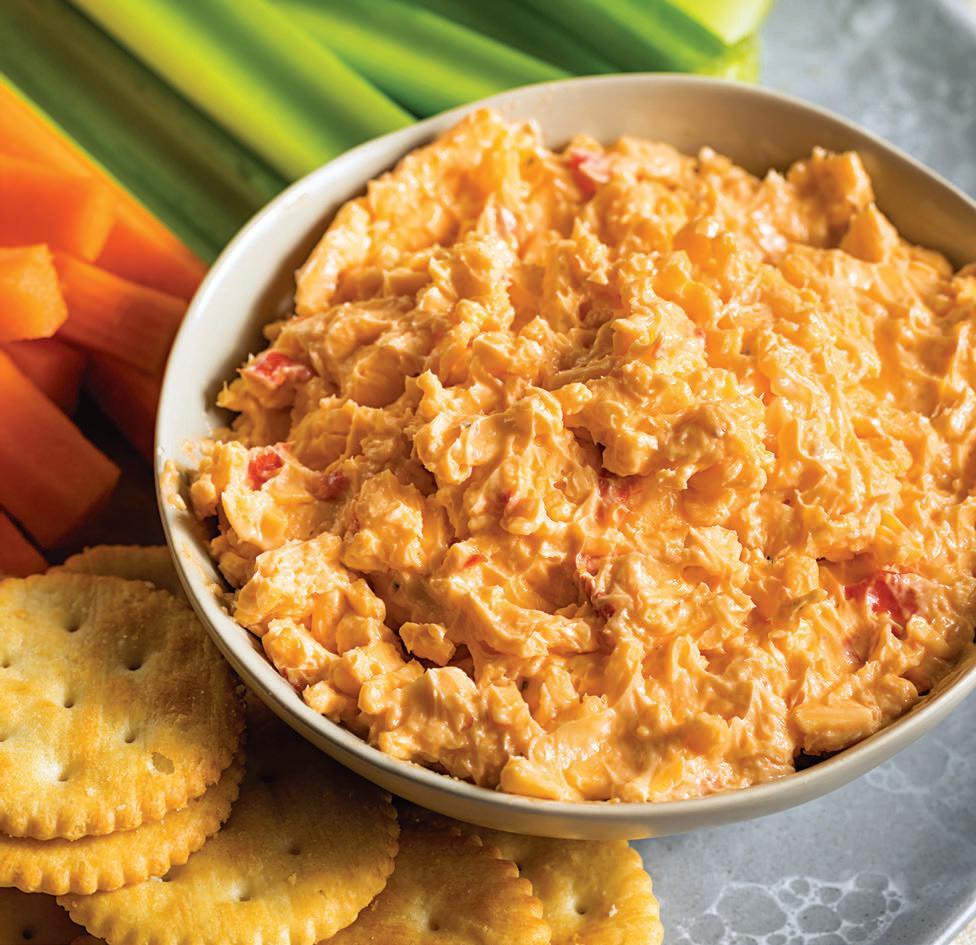
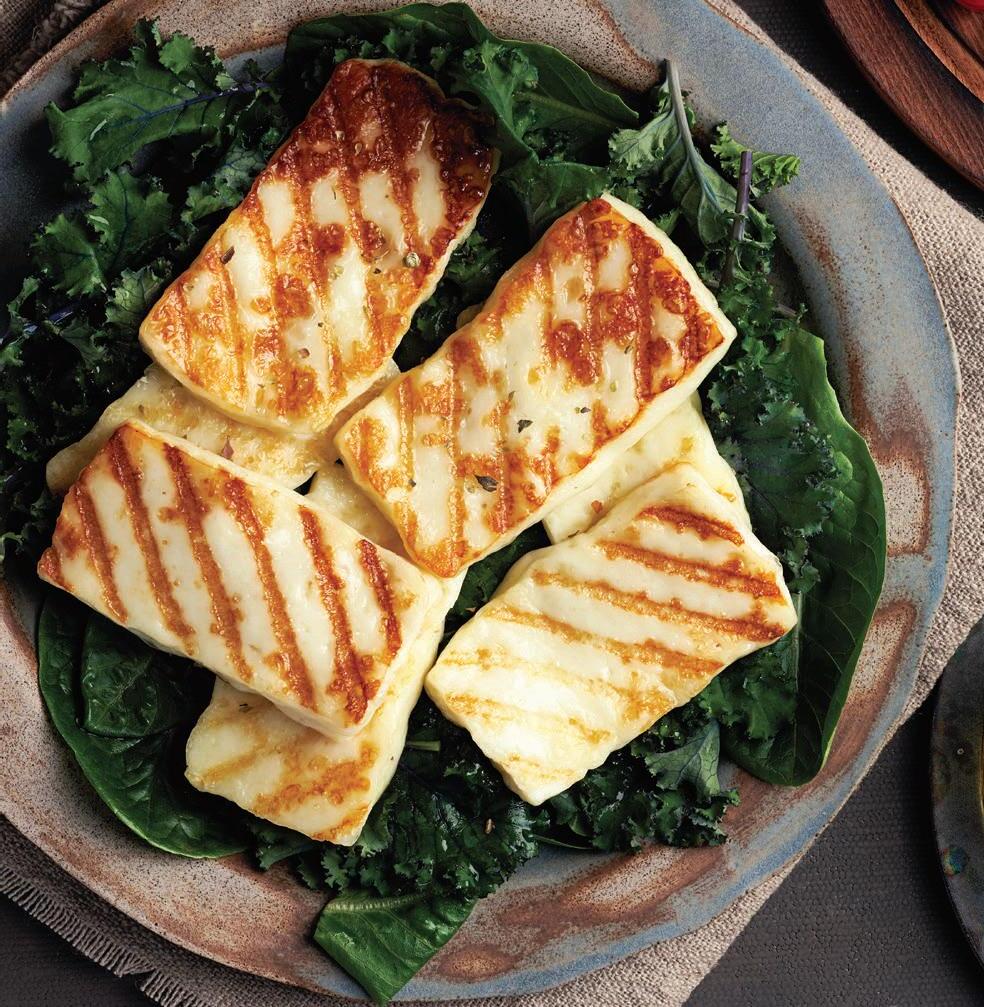
BURRATA Mozzarella’s creamier cousin, burrata is encased in solid cheese while the insides contain a buffalo milk cheese known as stracciatella.
CONSUMERS
MENU EXAMPLE:


Unreal Reuben: Plant-based Corn’d Beef and Roasted Turkey, sauerkraut, vegan provolone, and yellow mustard. Stateside Deli
MENU ADOPTION CYCLE: CHEESE
INCEPTION Trends start here. Found in mostly finedining and ethnic independents, inception-stage trends exemplify originality in flavor, preparation, and presentation.
MENU EXAMPLE: Burrata with Grilled Peaches: Baby lettuce and white balsamic glaze. Cook and the Corkn // CORAL SPRINGS, FL
ADOPTION Found at fast-casual and casual independents, adoption-stage trends grow their base via lower price points and simpler prep methods. Still differentiated, these trends often feature premium and/or generally authentic ingredients.
PROLIFERATION Proliferation-stage trends show up at casual and quick-service restaurants. They are adjusted for mainstream appeal. Often combined with popular applications (burgers, pastas, etc.), these trends have become familiar to many.
4. UBIQUITY Ubiquity-stage trends are found everywhere—these trends have reached maturity and can be found across all sectors of the food industry. Though often diluted by this point, their inception-stage roots are still recognizable.
TRENDING ON THE MENU // Cheese
1. Juustoleipa
2. Délice de Bourgogne
1. Cotija
2. Havarti
1. Smoked Cheese
2. Pimiento Cheese
1. Gouda
ADOBE STOCK (2)
2. Feta
3. Chihuahua
4. Halloumi
3. Mascarpone
FRIED
4. Gruyere
HALLOUMI CHEESE
PIMIENTO CHEESE SPREAD
3. Fresh Mozzarella
4. Beer Cheese
44 INDUSTRY-WIDE ISSUE MARCH 2023
3. Blue 4. Monterey Jack
Know It Have Tried It 48% 17%
CONSUMERS
// OKEMOS, MI
Know It Have Tried It 28% 15%
Equitable Pathways to Ownership

How can the franchise industry break barriers and unlock opportunities for marginalized entrepreneurs to become owners?
BY CALLIE EVERGREEN
Franchising can be one of the most powerful avenues for aspiring entrepreneurs of color. On average, Black-owned franchises earn 2.2 times more than Black-owned independent businesses, according to Oxford Economics. Yet, barriers to entry still prevail, especially for lower-income communities without access to financing or education on the opportunities available. Industry connections also go a long way, and a number of franchise businesses are passed on to younger generations from parents or other family members, which narrows the playing field.
In recent years, the franchise industry has been grappling with how to boost diverse representation in corporate leadership structures, as well as in their franchisee base. A few examples: McDonald’s U.S. committed to investing $250 million over five years to help candidates with socio-economic barriers with alternatives to traditional financing. Wendy’s launched “Own Your Opportunity,” a franchise recruitment initiative to create pathways to franchise ownership specifically for women and people of color. Ben & Jerry’s waives transfer fees for existing franchisees who sell to a minority candidate. And Yum! Brands—parent of

KFC, Pizza Hut, Taco Bell, and The Habit Burger—initiated the Yum! Franchise Accelerator, a fellowship program designed to advance underrepresented people of color and women interested in restaurant franchising.
Meanwhile, Everytable—a multichannel, fresh-prepared food business that fights for food justice—committed to investing $100 million to bolster its Social Equity Franchise Program, which provides financial capital, training, and mentorship to aspiring small business owners to help them become Everytable store owners.
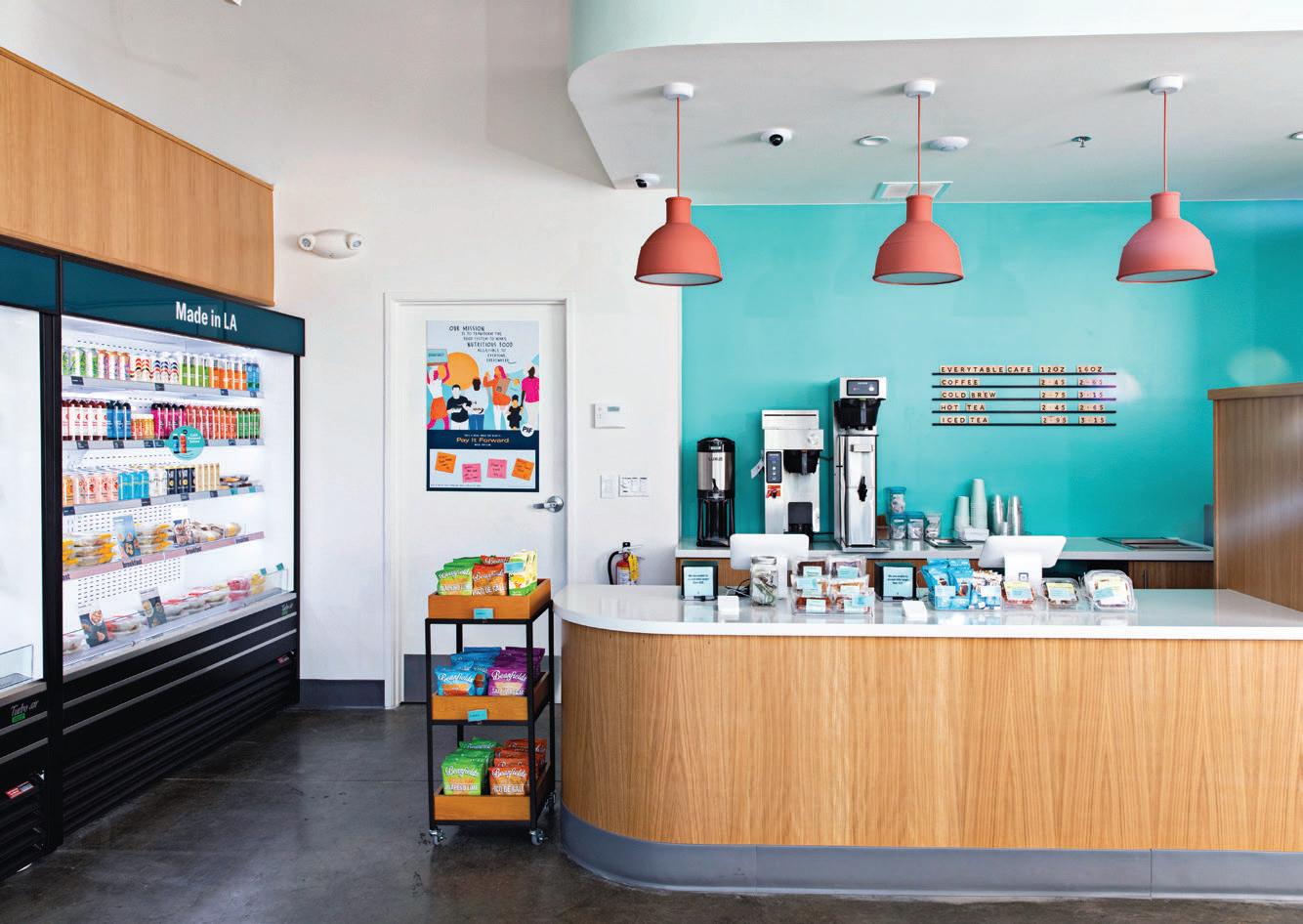
“Long term, what that means is ownership will be a large percentage of Black and brown folks who come from backgrounds where this wasn’t an opportunity they’ve been able to take advantage of,” says Bryce Fluellen, executive director of Everytable’s social equity franchise program. “They’re our partners and will grow alongside us.”
The model directly invests into marginalized entrepreneurs of color by paying qualified candidates during the training process to become a franchise owner—

{CONTINUED ON PAGE 117} FRANCHISING FORWARD EVERYTABLE (2) ®
QSR FSR MARCH 2023 INDUSTRY-WIDE ISSUE 45
EVERYTABLE PLANS TO SPEND MORE THAN $100 MILLION ON ITS SOCIAL EQUITY FRANCHISE PROGRAM. BRYCE FLUELLEN





















 FABIO VIVIANI HAS BROUGHT HIS STARDOM TO A BEVY OF THRIVING RESTAURANT CONCEPTS.
46 INDUSTRY-WIDE ISSUE MARCH 2023
FABIO VIVIANI HOSPITALITY
The FABIO of FOODSERVICE




Fabio Viviani won viewer hearts on ‘Top Chef’ and has since built a restaurant empire. Now he’s plotting his biggest business endeavor to date: franchising on both the quick and full-service sides of the industry. ➺







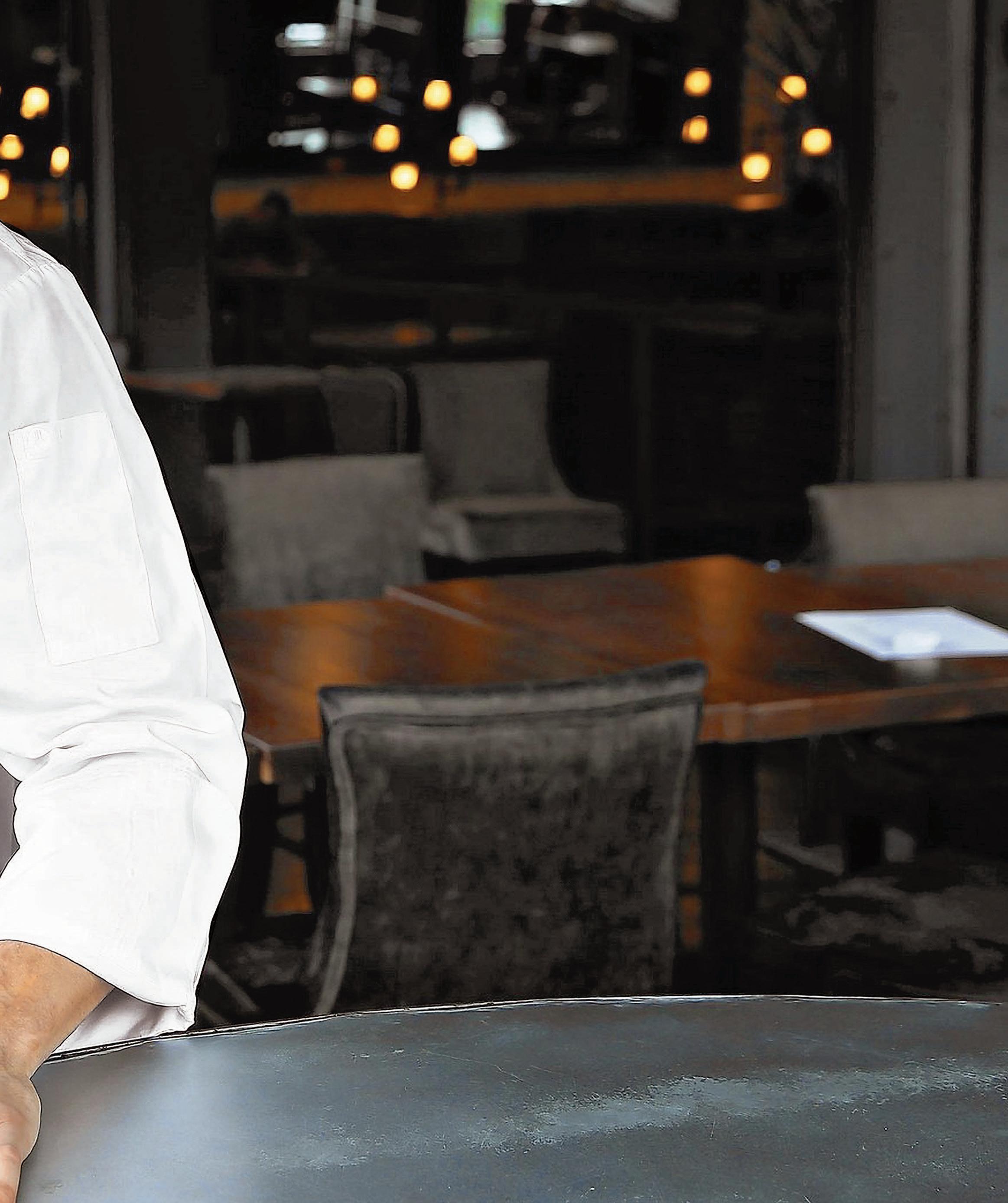 / BY NICOLE DUNCAN













FABIO VIVIANI
QSR FSR
MARCH 2023 INDUSTRY-WIDE ISSUE 47











































































THE PORTFOLIO ADDITION YOU’VE BEEN LOOKING FOR 1,175+ Cafes opened nationwide $1M+ Systemwide Average Net Revenues* 60/40 Smoothie-to-food menu mix Ride our wave of growth by 2022 fundtm #top$core Highest across all categories Ranked 10 years in a row “ The economics, volume and footprint make Tropical Smoothie Cafe an attractive brand that you can develop quickly.” ROGER WAGNER Multi-Unit/Multi-Brand Franchise Owner *$1,009,803 System Wide Average Net Revenues. Based on our fiscal year ending 12/26/2021 and includes 768 Restaurants that were open for at least 12 months as of 12/26/2021. Excludes non-traditional locations and Restaurants that were not open for at least 357 days in 2021. This information appears in Item 19 of our Franchise Disclosure Document. Your results may di er. There is no assurance that you will do as well. This information is not intended as an o er to sell or the solicitation of an o er to buy a franchise. It is for information purposes only. The o ering is by prospectus only. Currently, the following states regulate the o er and sale of franchises: California, Hawaii, Illinois, Indiana, Maryland, Michigan, Minnesota (File No. F-9894), New York, North Dakota, Oregon, Rhode Island, South Dakota, Virginia, Washington and Wisconsin. If you are a resident of or want to locate a franchise in one of these states, we will not o er you a franchise unless and until we have complied with applicable pre-sale registration and disclosure requirements in your state. New York State Disclaimer: This advertisement is not an o ering. An o ering can only be made by prospectus filed first with the Department of Law of the State of New York. Such filing does not constitute approval by the Department of Law. CALIFORNIA DISCLAIMER: THESE FRANCHISES HAVE BEEN REGISTERED UNDER THE FRANCHISE INVESTMENT LAW OF THE STATE OF CALIFORNIA. SUCH REGISTRATION DOES NOT CONSTITUTE APPROVAL, RECOMMENDATION OR ENDORSEMENT BY THE COMMISSIONER OF CORPORATIONS NOR A FINDING BY THE COMMISSIONER THAT THE INFORMATION PROVIDED HEREIN IS TRUE, COMPLETE AND NOT MISLEADING. ©2023 Tropical Smoothie Cafe, LLC, 1117 Perimeter Center West, Suite W200, Atlanta, GA 30338. Join our Franchise Family and help us Inspire Better.™ tropicalsmoothiefranchise.com | (770) 609-2987 Scan me to fi nd out more
Becoming More



ARE KITCHENS Female Friendly?


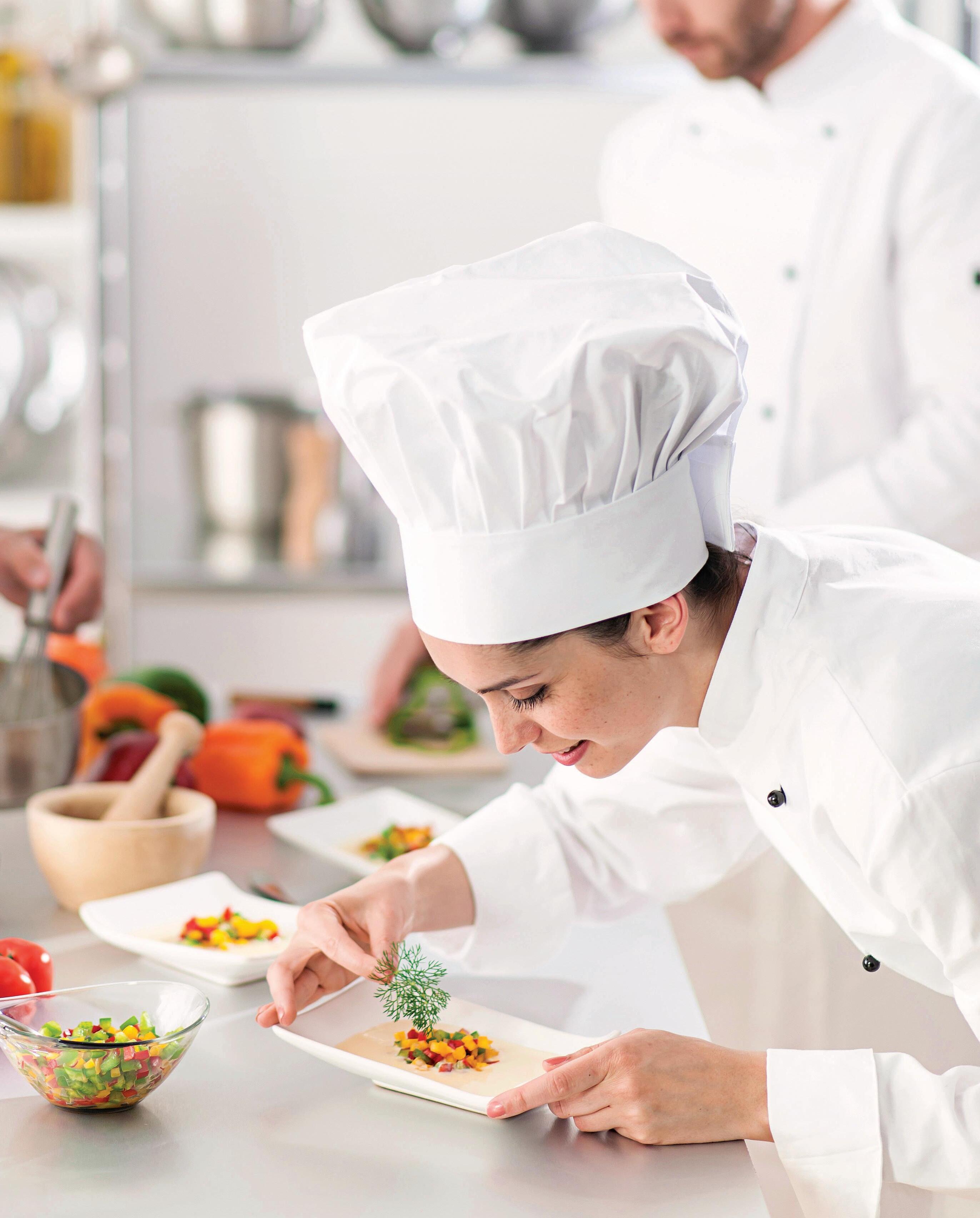
WHY SOME WOMEN BELIEVE THERE IS GROWING MOMENTUM TOWARD A MORE EQUITABLE INDUSTRY.





SPONSORED BY SMITHFIELD CULINARY
ADOBE STOCK FSR x QSR Smithfield 8pg Insert March 2023.indd 1 2/9/23 3:05 PM
When James Beard Award
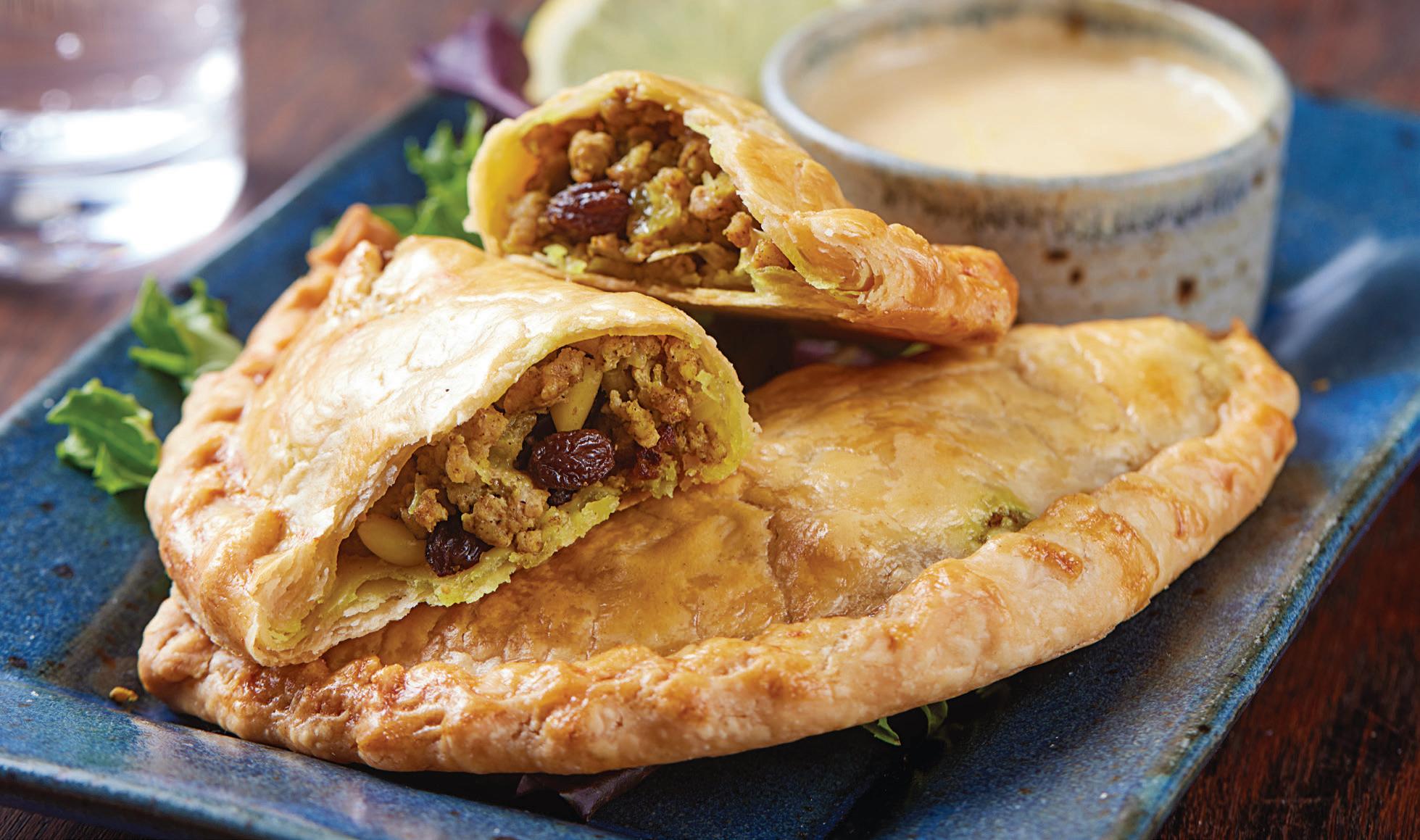
Winning Chef Debbie Gold started working in the industry, there was a dearth of women holding positions in the kitchen. She identified this as a paradox of sorts.
“I always thought it was funny,” Gold says, “because if you read histories of chefs of the past, they all learned from their mother, or grandmother. But for some reason, when it came to restaurants, (people thought) we couldn’t do it.”
The lack of women in restaurant kitchens persists, especially when it comes to the most
SPONSORED BY SMITHFIELD CULINARY
coveted positions. In 2022, The Bureau of Labor Statistics found that just 22.8 percent of head chefs in the U.S. were female. The inequity is even more stark at the country’s top restaurants: research by Chef’s Pencil showed that just 6 percent of restaurants that received Michelin stars in 2022 were led by women. It’s an imbalance that is likely rooted in prejudice. Don’t
believe it? Ask a woman who is a chef, and they’ll likely tell you a story about the obstacles they faced due to their gender.
“I was told early in my career: ‘You can be an amazing wife, an amazing parent, or an amazing chef,’” says Melissa Chickerneo, corporate executive chef at Behind the Scenes Catering. “‘You can do two of these things, but never three.’ And every day, I try to prove that person wrong.”
Kristine Subido, director of culinary at LinkedIn, Bon Appetit Management Company, concurs with Chickerneo’s sentiment, saying that being told what she couldn’t do has only motivated her to work harder.
“If you’re also younger, you’re walking in the kitchen, you get a lot of looks,” she says. “They think you’re the salad, or pastry (chef)... but you want to win
“If you read histories of chefs of the past, they all learned from their mother, or grandmother.”
SMITHFIELD CULINARY
FSR x QSR Smithfield 8pg Insert March 2023.indd 2 2/8/23 1:48 PM
GROUND PORK EMPANADAS, BY CHEF LYNN HAY.
She Said It BEST
at the game, and prove them wrong. So you kick their butt on the line.”
SHE BRINGS THE HEAT
Smithfield Culinary recently launched a campaign, “She Brings the Heat,” designed to shine a light on women, like Gold, Chickerneo, and Subido, who have held or currently hold top positions at industry brands.



a lot to the table in respect to things like creativity and leadership—and it’s important for other women to see that.”
The company believes equity and representation of all kinds can help organizations become better at what they do. Peck and her colleague, Amy Shesto, senior director of corporate sales at Smithfield Culinary, point to extensive research that’s shown better outcomes for organizations that strive toward equitable practices.
The company strongly feels it’s a topic that should be discussed more often—and hopes that the discussion will inspire more women to pursue careers in the restaurant industry.
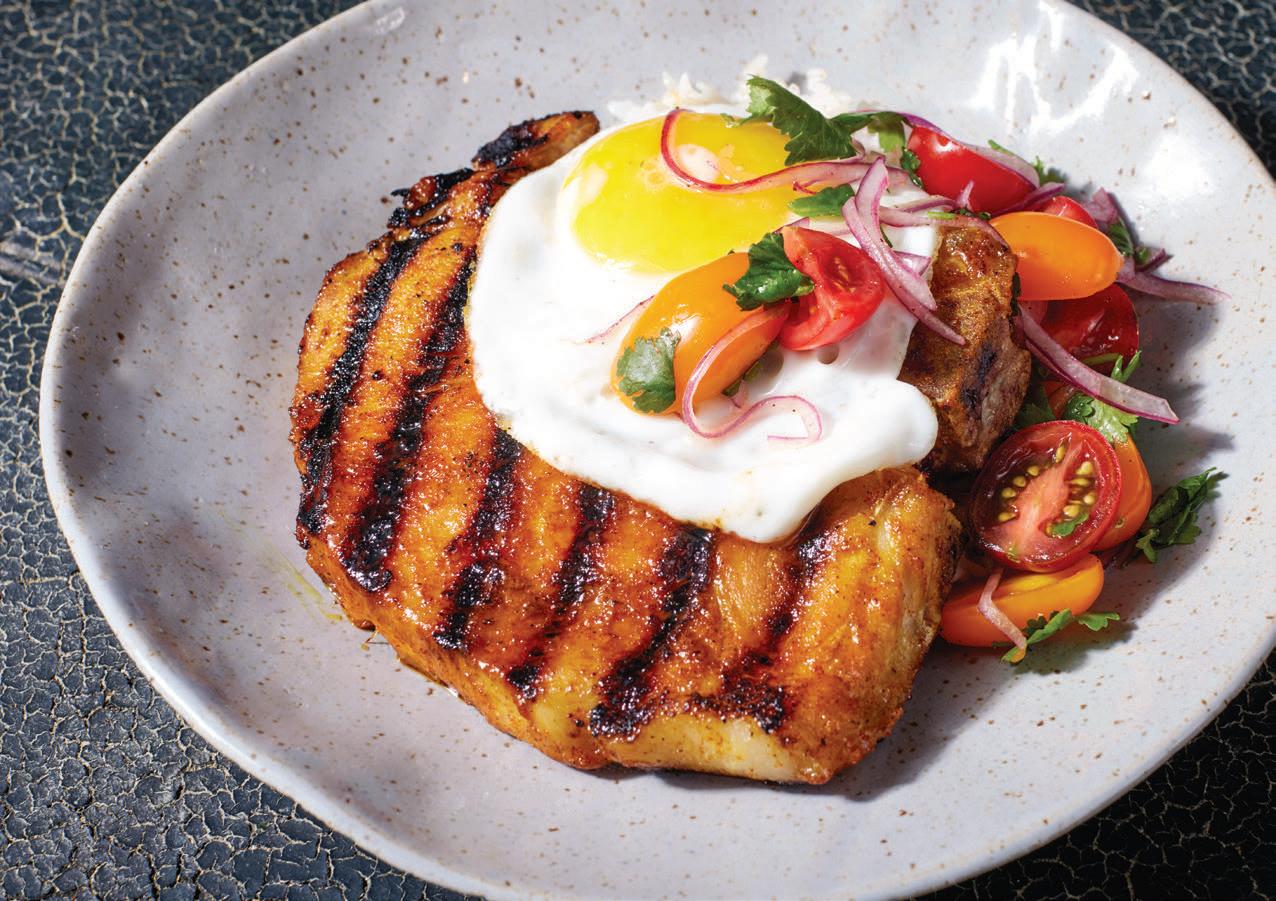
“We’re already seeing more and more women in the foodservice industry,” says Charlotte Peck, regional sales manager at Smithfield Culinary. “But they’re not always getting the attention they deserve, such as this media attention. Because women bring
“A diverse group of people is a powerful thing,” Shesto says. “Having those different perspectives brings different, more positive conclusions to everything that you’re trying to do. Whether it’s a male-female, or right-brainleft-brain thing, it just changes the outcome when you’re confronted with a problem.”
Shesto also nods toward female chefs as a potential solution to one of the industry’s most pressing issues. If finding
 SPONSORED BY SMITHFIELD CULINARY
“When I started, there were very few women in the kitchen. Which I always thought was funny, because if you read histories of chefs of the past, they all learned from their mother, or grandmothers.”
Debbie Gold
JAMES BEARD AWARD WINNING CHEF
“I was told early in my career: ‘You can either be an amazing wife, an amazing parent, or an amazing chef. You can do two of these things, but never three.’ And every day, I try to prove that person wrong.”
Melissa Chickerneo CORPORATE EXECUTIVE CHEF, BEHIND THE SCENES CATERING
SMITHFIELD CULINARY (3)
FSR x QSR Smithfield 8pg Insert March 2023.indd 3 2/8/23 1:48 PM
FILIPINOSTYLE PORK CHOP, BY CHEF KRISTINE SUBIDO.
if you can't stand






Women have always brought innovations and clout to the individual kitchens and communities they serve. And now, more than ever, the heat is on. Today, virtually half the enrolled undergraduates at a leading culinary institution are women. As their creations continue to bring inspiration to new chefs daily, we’ll be there to help provide the resources.

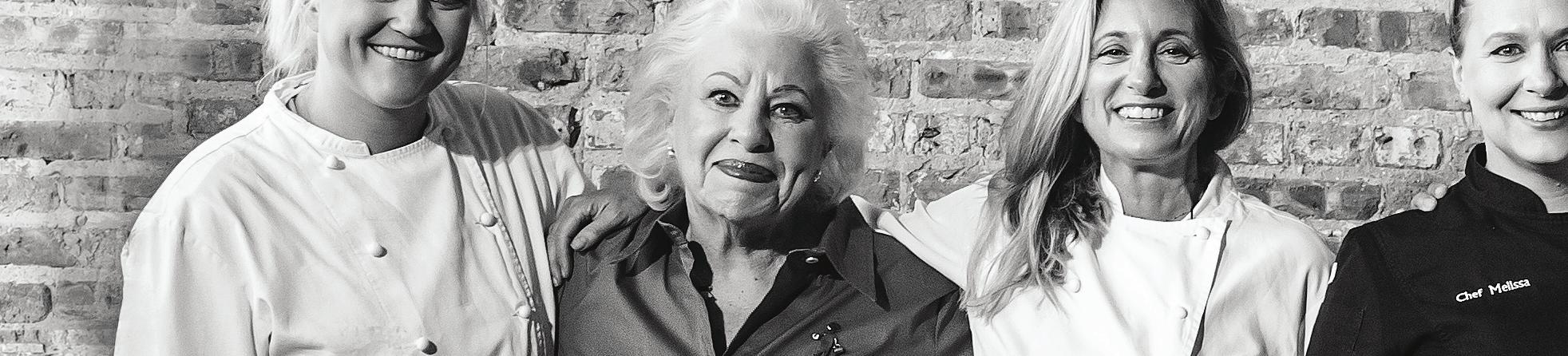
® FSR x QSR Smithfield 8pg Insert March 2023.indd 4 2/9/23 8:34 AM




stand heat... the To get more insights and inspiration, visit SmithfieldCulinary.com/SBTH. FSR x QSR Smithfield 8pg Insert March 2023.indd 5 2/9/23 8:34 AM
great candidates to fill back-ofhouse positions is truly a priority for restaurant leaders, she says, building an industry that is a fulfilling place to work for anyone and everyone should be a topof-mind focus.
“Labor has obviously been everyone’s largest challenge since COVID,” Shesto says. “So how can we not only support women, but support people, in general, interested in the foodservice environment? If we have no chefs, we have no restaurants. So how can we begin to grow that number of really great applicants? This feels like a good place to start.”
WORK-LIFE BALANCE
An ongoing conversation connected to labor woes surrounds work-life balance—or lack thereof. As has been widely reported, many restaurant workers left the industry during the pandemic, with many reporting that they sought a more balanced lifestyle.

The long, grueling nights and weekends can be especially challenging for primary caregivers, or those who aspire to be. “Chefs are sometimes working 90 hours a week,” Peck says. “So work-life balance is a very real
“Starting out in the industry, I’ve found myself wondering, ‘Is it possible? Can I do it?’ in terms of having a family and a balanced lifestyle. And hearing (other female chefs), and their experiences, is incredibly inspirational. Because it shows that it is possible.”
Grace Goudie


“There are so many di erent pathways right now. The possibilities are endless. So if you’re interested in foodservice, find a spot for yourself.”

SPONSORED BY SMITHFIELD CULINARY
EXECUTIVE CHEF AT SCRATCHBOARD KITCHEN
Suzy Wagner
OWNER AND HEAD CHEF AT THE CHEF’S DAUGHTER
“We’re already seeing more and more women in the foodservice industry.”
SMITHFIELD CULINARY (3)
FSR x QSR Smithfield 8pg Insert March 2023.indd 6 2/8/23 1:48 PM
KC WILD WINGS, BY CHEF DEBBIE GOLD.
issue, especially if you’re trying to have a family.”
During a summit of female chefs that was part of a video series for Smithfield’s “She Brings the Heat” campaign, seeking a balance between a career and raising a family was an oft-discussed topic. After hearing chefs who were also mothers describe those challenges and how they overcame them, at least one of those chefs was feeling more bullish about her ability to have a family if she stayed in the industry.
“I’ve found myself wondering, ‘Is it possible, can I do it?’ in terms of having a family and a balanced lifestyle,” says Grace Goudie, executive chef at Scratchboard Kitchen in Arling-
ton Heights, Illinois. “And hearing (from other female chefs) about their experiences is incredibly inspirational. Because it shows that it is possible.”
OPTIMISTIC OUTLOOK


Goudie’s experience is exactly what Shesto, Peck, and the Smithfield team were hoping for when they first conceived of the “She Brings the Heat” initiative.
“As with anything in life, success breeds success,” Shesto says.
“More women leaders in the restaurant industry would make more younger folks aspire to follow that path.”


There’s evidence that this is
already happening. For example, The Culinary Institute of America reports that nearly half of its current student body—over 48 percent—are young women studying with ambitions to enter the industry. Whether or not they get a shot at the top level will likely depend on how much support they receive along the way. A larger network of women to mentor young female chefs can only be a positive influence on those prospects.
“There are so many different pathways right now,” says Suzy Wagner, owner and head chef at The Chef’s Daughter. “The possibilities are endless. So if you’re interested in foodservice, (you ought to be able to) find a spot for yourself.” BY
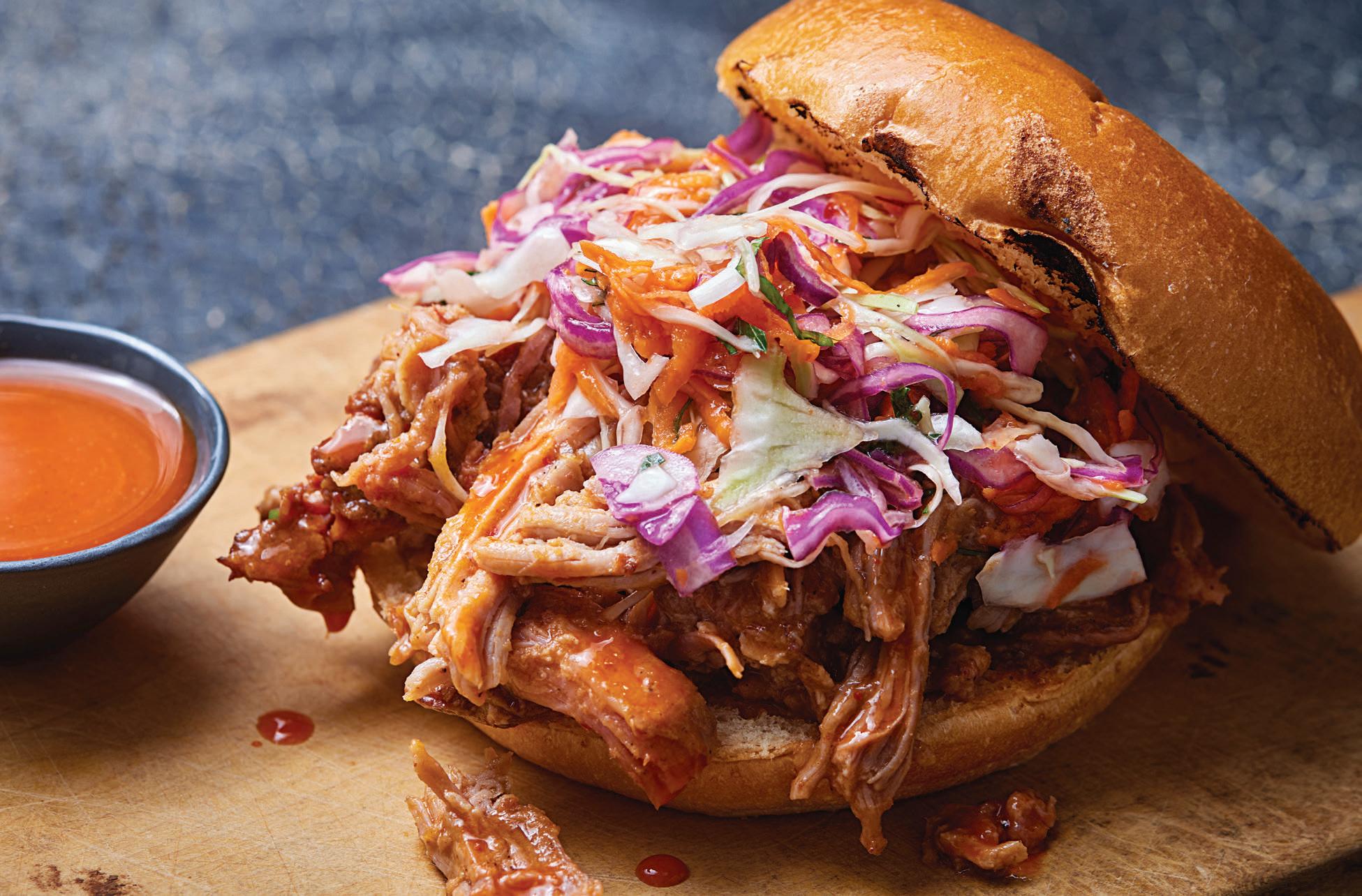 CHARLIE POGACAR
SPONSORED BY SMITHFIELD CULINARY
“Hearing (from other female chefs) about their experiences is incredibly inspirational.”
SMITHFIELD CULINARY
FSR x QSR Smithfield 8pg Insert March 2023.indd 7 2/9/23 3:01 PM
PULLED PORK SANDWICH, BY CHEF MELISSA CHICKERNEO.
THE HEAT IS ON.

To get more insights and inspiration, visit SmithfieldCulinary.com/SBTH.





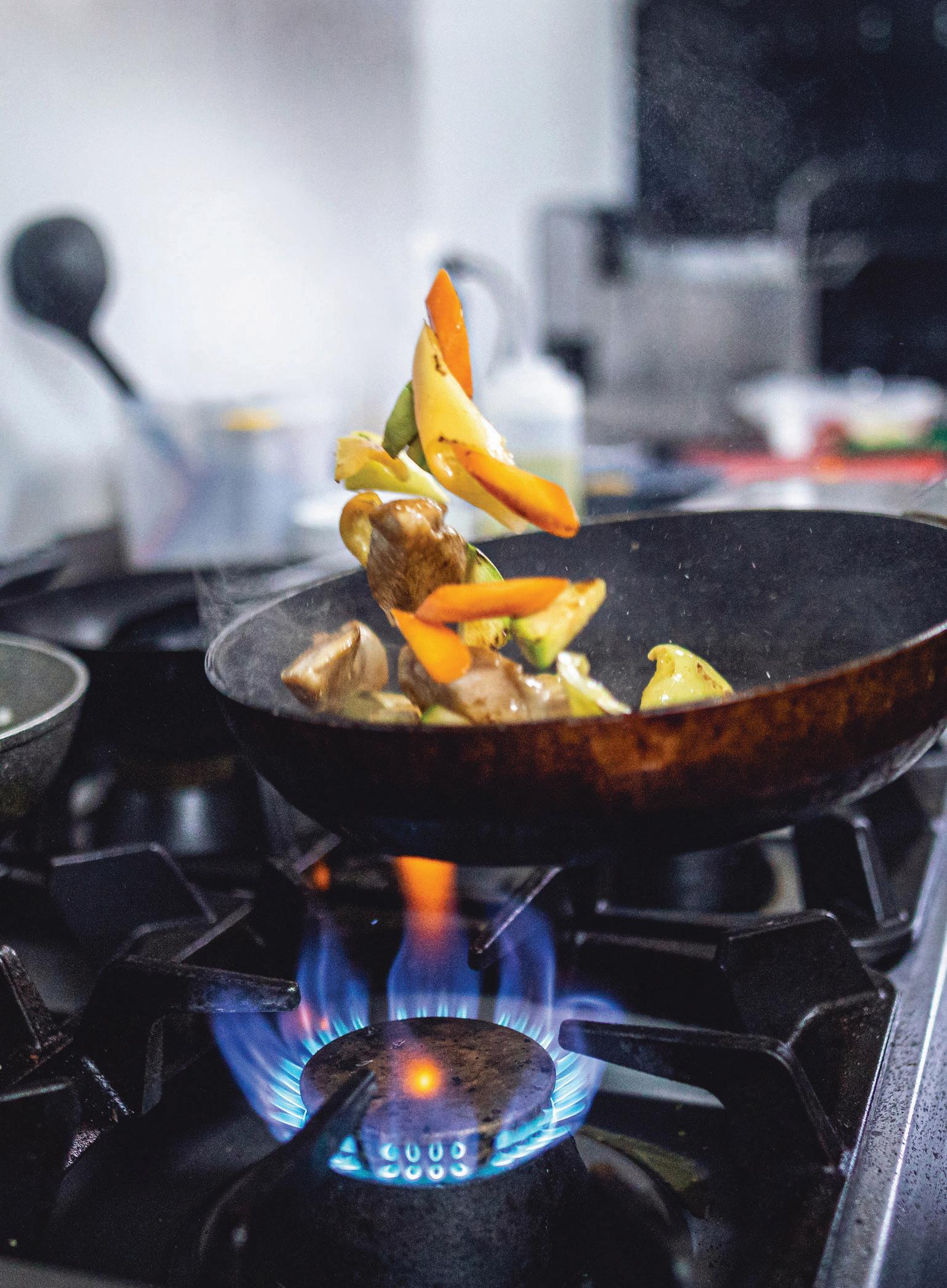


FSR x QSR Smithfield 8pg Insert March 2023.indd 8 2/9/23 8:36 AM
To this day, Fabio Viviani still doesn’t get the frozen yogurt hype.
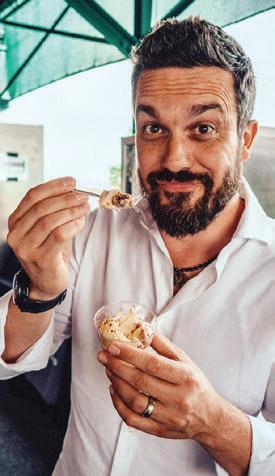
The craze first swept the nation a decade ago, and never at any point did he understand the appeal— at least not from an operator’s perspective.
“Why would you want to go into a business that has 100 perishable ingredients? Why would you want to go in a business that is completely seasonal or completely limiting your category of reach?” Viviani says. “I was baffled by all those yogurt places popping up. I was like, ‘How many people eat yogurt? It’s that big of a deal?’ And now they were popping up like mushrooms.”
For a veteran restaurateur like Viviani who always has an eye trained on business opportunities, the goal is to “limit the amount of things that could possibly go wrong,” especially with concepts that are potential growth vehicles.
As of now, he’s betting on two brands in particular: full-service sports bar/grill Chuck Lager America’s Tavern and dessert quick serve JARS Sweets and Things. And Viviani’s track record shows he’s got a penchant for picking winners.
“The segments are there; the opportunities are there. You’ve just got to bet on the right horse to be able to finish the track. And we have the expertise, the ability, and the understanding of the trends and what’s going on,” he says.
COMING TO AMERICA
Viviani’s journey into the restaurant world began well before he immigrated to the U.S. Born and bred in one of the world’s culinary meccas, Florence, Italy, he grew up with an affinity for gastronomy that evolved into a professional calling; he trained in culinary school but still considers himself mostly self-taught.
Similarly, his business acumen proved to be innate. By the age of 27, he owned five restaurants and two nightclubs, and in 2005 he sold those businesses, which helped his family retire. After a decade of hustle with little respite, Viviani was ready for a break—or so he thought.
“I just wanted to take a long vacation,” he says. “So I saved a little bit of money and moved to the United States. Two months in, I realized
that I wasn’t built for vacation so I started to look for a job.”
Viviani applied for a work permit, and a few years later, his first restaurant on American soil, Café Firenze, opened in Moorpark, California. Three more Italian restaurants followed, but by then, the chef’s reach was expanding beyond the Los Angeles area, thanks to Bravo’s “Top Chef,” which, while only in its fifth season, had already started to amass a fervent following.
Viviani wasn’t crowned the victor (that honor went to Hosea Rosenberg), but he did make an indelible impression, with his Italian lilt and vivacious personality; viewers even voted him the Fan Favorite. Viviani returned to Bravo for season eight, which marked the first “Top Chef: All-Stars.” Since then, he’s made numerous TV appearances and even launched a YouTube series, “Fabio’s Kitchen,” which just wrapped its fifth season.
Whereas some competing chefs leave the kitchen for the limelight, Viviani kept his feet firmly planted in foodservice. Still, his ambition stretched further than culinary creativity alone. He was ready to build an empire.
“The segments are there; the opportunities are there. You’ve just got to bet on the right horse to be able to finish the track. And we have the expertise, the ability, and the understanding of the trends and what’s going on.”
“I absolutely love cooking and I love spending time in the kitchen, but I didn’t come to the United States to get a job. I came to build a legacy for my family [and] provide myself and a ton of other people great careers,” he says. “I don’t look at folks that work with me as employees or as the chefs or as servers. I look at everybody as possible business partners.”
To that end, many cooks, servers, and other employees who started with Viviani years ago have risen in the ranks and now help run a group of 60-plus restaurants and other hospitality venues. Partnerships have also been a cornerstone of Viviani’s growth trajectory. After establishing himself in Southern California, he teamed up with DineAmic Hospitality to open a slew of new restaurants in Chicago, including a couple that expanded the chef’s repertoire beyond Italian and Mediterranean cuisine.
Viviani has made Chicago his homebase, but his footprint encompasses most corners of the country, from Florida up to Boston, Ohio to Indiana, Illinois to Michigan, and California. Along the way, a handful of these restaurants have expanded to a few units; he’s also built a small ecosystem of buffet-style fast casuals within the Morongo Casino Resort & Spa in Cabazon, California.
FABIO VIVIANI HOSPITALITY FABIO VIVIANI MARCH 2023 INDUSTRY-WIDE ISSUE 49
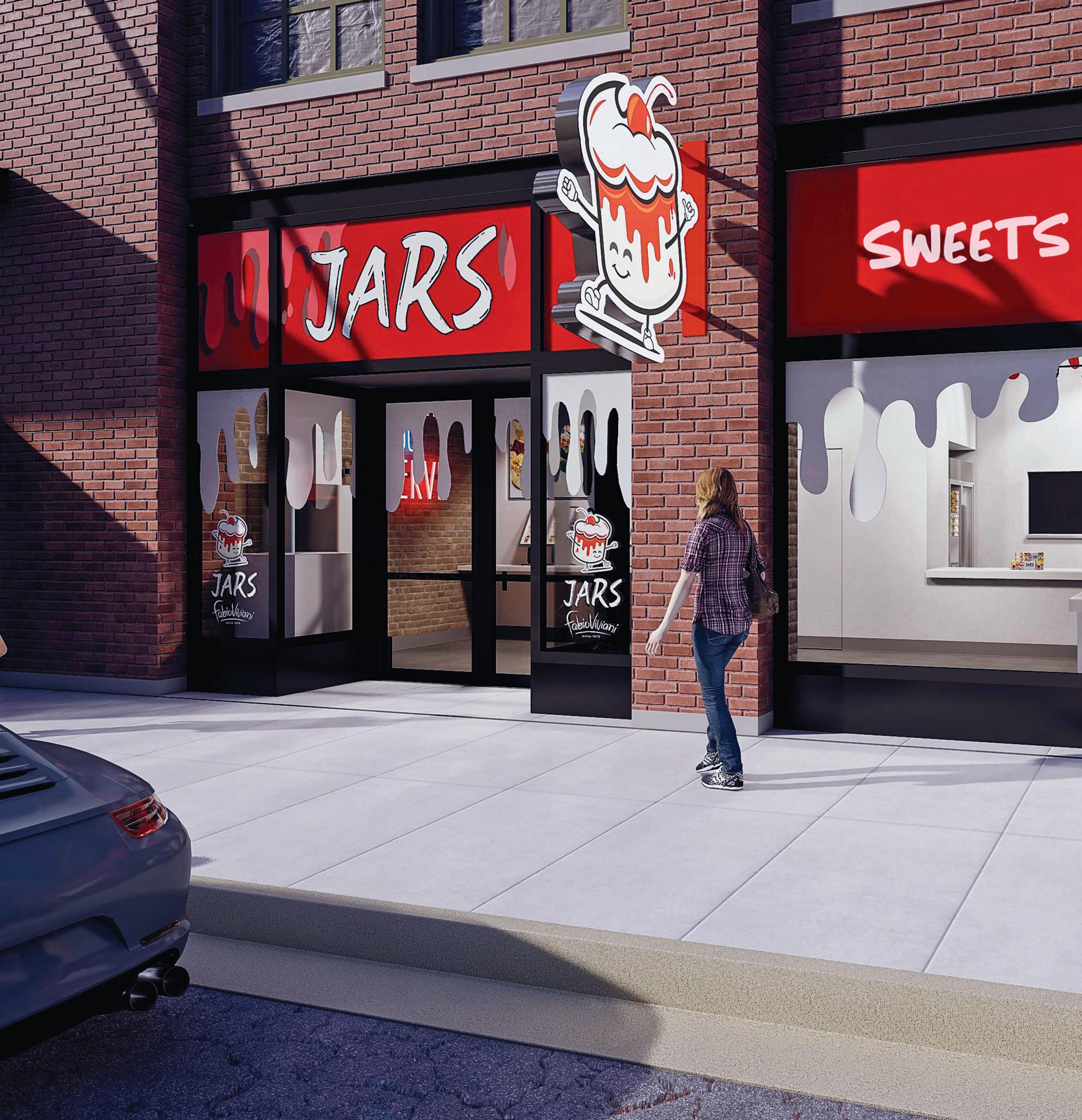
FABIO VIVIANI
50 INDUSTRY-WIDE ISSUE MARCH 2023
JARS MIGHT JUST OFFER THE HIGHEST-GROWTH POTENTIAL OF VIVIANI’S BRANDS.
DECONSTRUCTING DESSERT
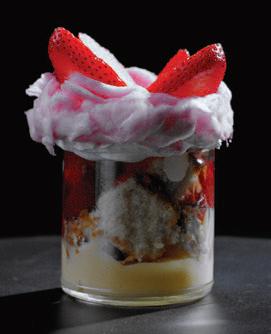
It’s only recently that Viviani has focused on chain growth in earnest. While others at Fabio Viviani Hospitality continue running and expanding the portfolio of restaurants, he’s concentrating on Chuck Lager and JARS. He doesn’t have a targeted unit count in mind for Chuck Lager but believes it could work in the top 75 U.S. markets. For JARS, the scale would be even larger, given the operational ease, diminutive space requirement, and low entry cost.
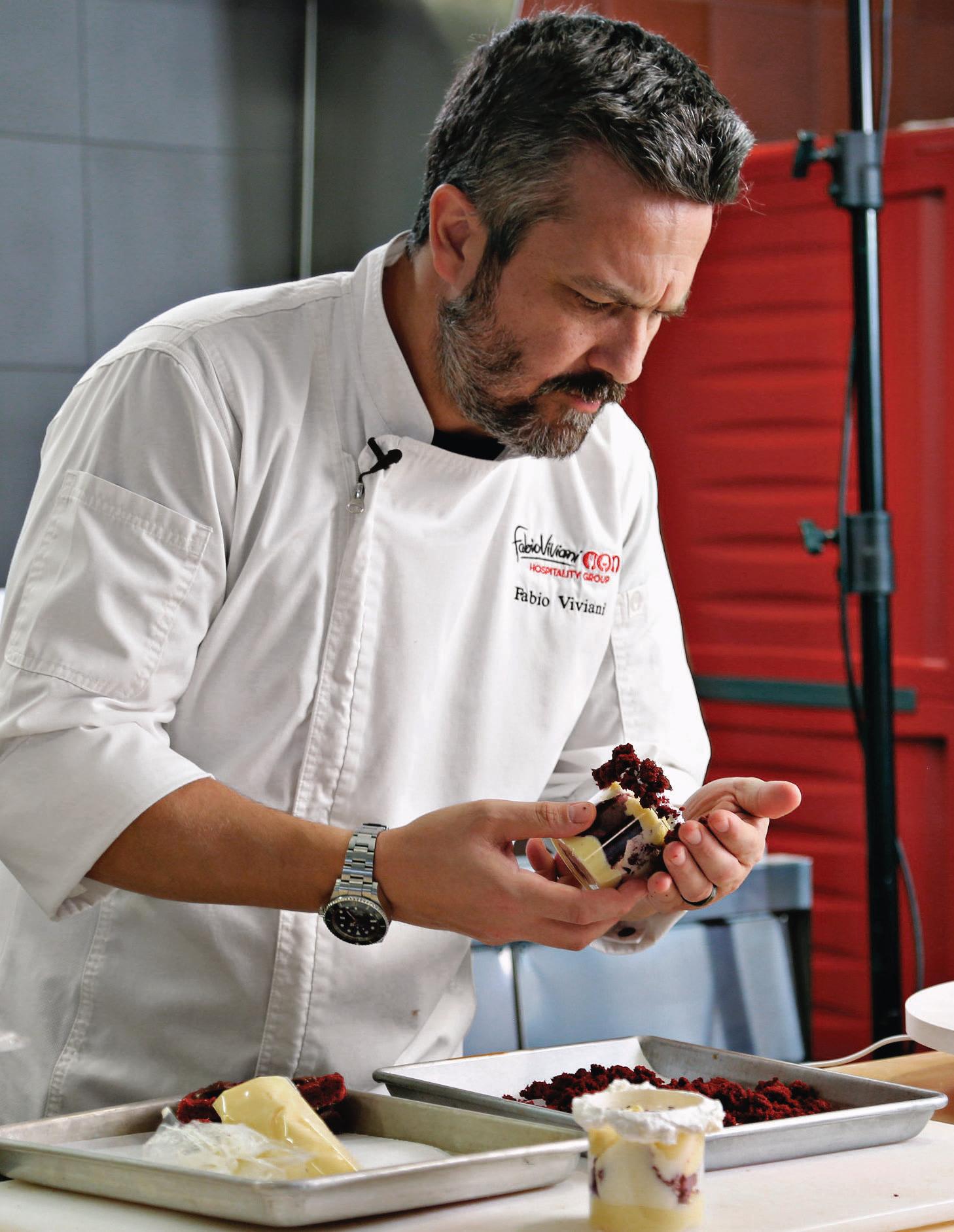
“JARS is the first [quick-service restaurant] in the food business dessert category that does not require a kitchen to function. You don’t need a grease trap; you don’t need fryers, ovens, mixers, stand mixers. You don’t need recipes, you
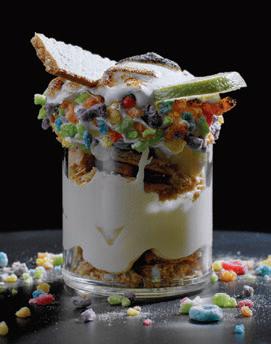
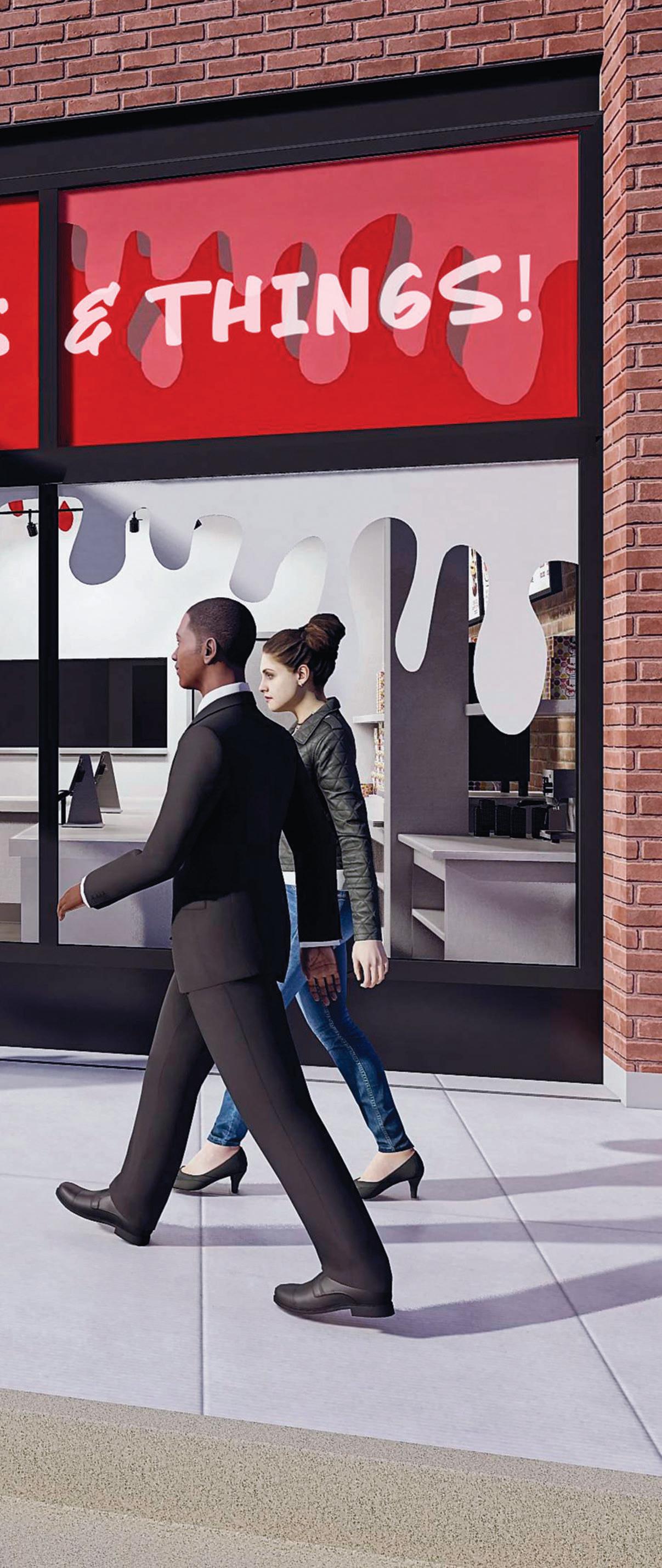
FABIO VIVIANI HOSPITALITY (4) FABIO VIVIANI MARCH 2023 INDUSTRY-WIDE ISSUE 51
JARS IS PRIMED TO EXPAND, WITH A MODEL THAT DOESN’T NEED A KITCHEN TO FUNCTION.
don’t need cooking, [and ] you have virtually no waste,” Viviani says.
JARS forges relationships with pastry producers and bakeries to lessen the operational burden; at the store level, the only prep is assembling the jars—no cooking or baking required. Franchisees who grow to more than one location in a designated market can rent a commissary kitchen to streamline the back end and boost their unit economics.
Viviani advises franchisees to open their first JARS in a space that’s larger than the bare minimum. He says the concept could operate well in 750 square feet or so, but a range closer to 1,000–1,500 square feet allows for a little more breathing room. But after that initial store, future locations could squeeze into smaller spots like former laundromats or retail shops.
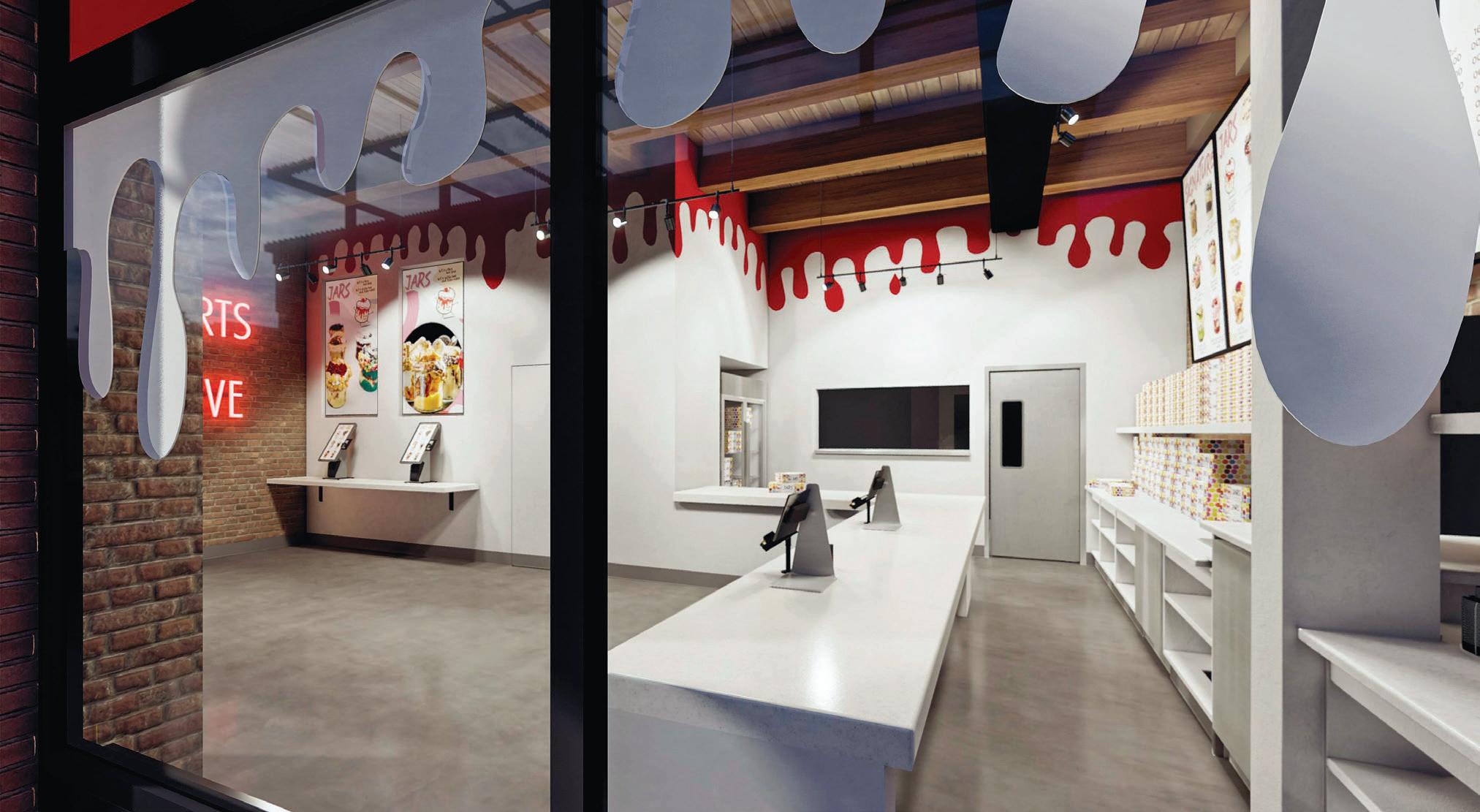
“I always tell people that you only have one chance to open your first door,” Viviani says. “You want that much [space] in the first one because you never know how busy you’re going to get. And if you get really busy, then you’re going to need a little bit of storage for some dry goods, for boxes. So it’s always good to have a few extra 100 square feet.”
He likens JARS to a marketing company that happens to make delicious sweets. Within a year of JARS’ announcement in fall 2021, the brand had amassed more than half a billion impressions though it had yet to open a single storefront. The first location debuted in Chicago’s West Loop in January, and more locations in Dallas, San Francisco, and New Jersey are expected to follow. At press time, JARS had sold 50-plus franchise territories.
Going back to Viviani’s bafflement around frozen yogurt, the restaurateur sees JARS as the perfect antidote. For one, it’s not a seasonal product like fro-yo, ice cream, and other simi-
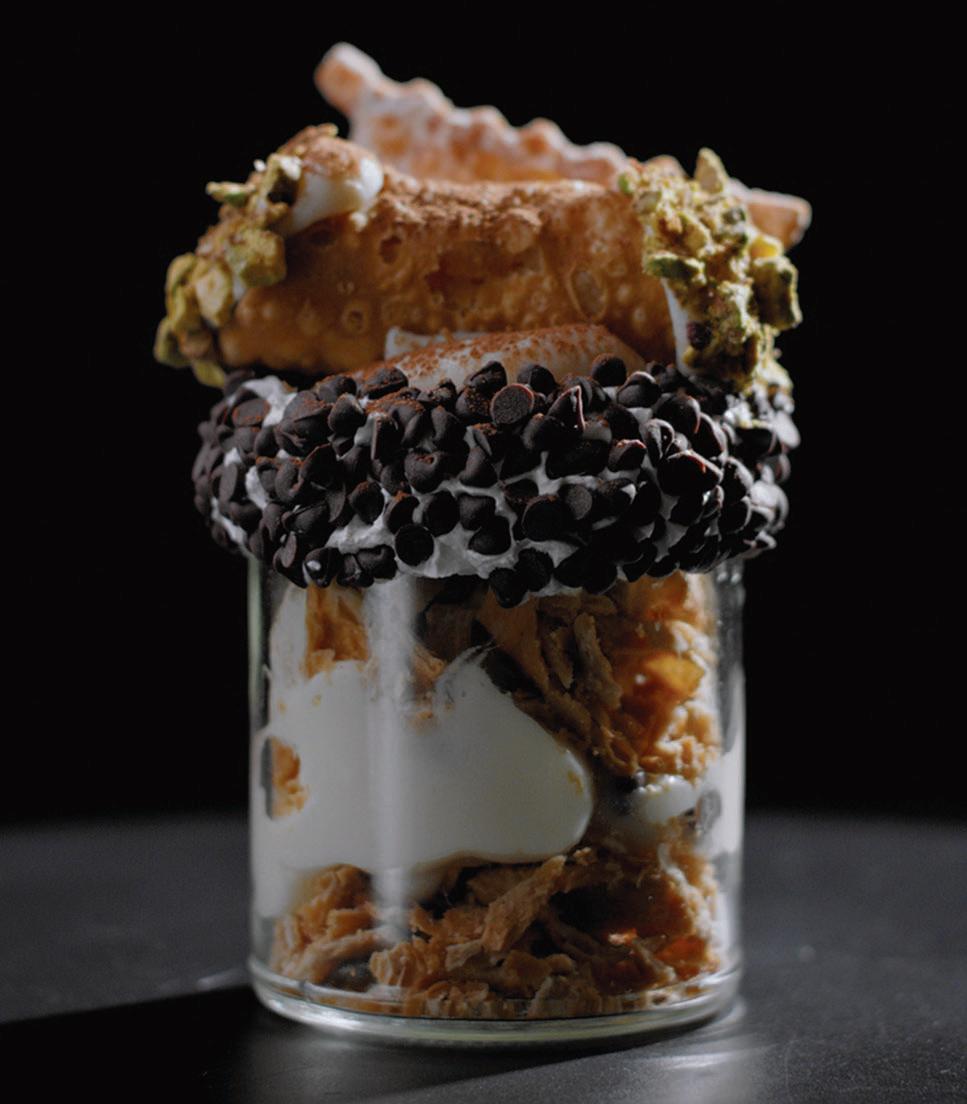

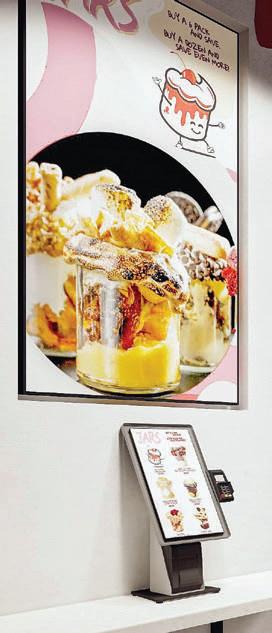
FABIO VIVIANI HOSPITALITY
FABIO VIVIANI 52 INDUSTRY-WIDE ISSUE MARCH 2023
JARS OPERATES LIKE A MARKING COMPANY, WHICH ALSO HAPPENS TO MAKE A CRAVEABLE DESSERT PRODUCT.
(4)
Successful LTOs manage to strike the right balance of mixing the new with the familiar. Introducing new chocolatefocused treats can be a great way for restaurants to generate more interest in their dessert menu—the traditional mainstay for boosting margins.
Consumers pay attention to brand names, and leveraging brands known for their high quality offers a path for restaurants to increase profitability and enhance the customer experience. Take Ghirardelli, America’s longest continuously operating chocolate manufacturer. Independent research has found that 90 percent of consumers across the country are aware of the Ghirardelli brand, and 30 percent of consumers have recently purchased it.
The rapidly growing fast-casual restaurant concept Freddy’s Frozen Custard & Steakburgers partnered with Ghirardelli
through the brand’s Made with Ghirardelli program to showcase a commitment to using the highest quality ingredients. The Made with Ghirardelli program allows restaurants to leverage the premium experience customers expect from Ghirardelli to generate higher sales.
“We have found that featuring the Ghirardelli name on our menu item increases our guests’ purchase intent and willingness to pay,” says Rick Petralia, director of menu strategy and innovation at Freddy’s Frozen Custard & Steakburgers. “In concept testing, we found that the scores for the Ghirardelli-branded item surpassed the un-branded alternative.”
Freddy’s also featured the Ghirardelli name on point-of-purchase signage and found a positive effect on guests’ perception of the menu item. Over the past 12 months, as Petralia notes, the Frozen Hot Chocolate Shake Made with Ghirardelli
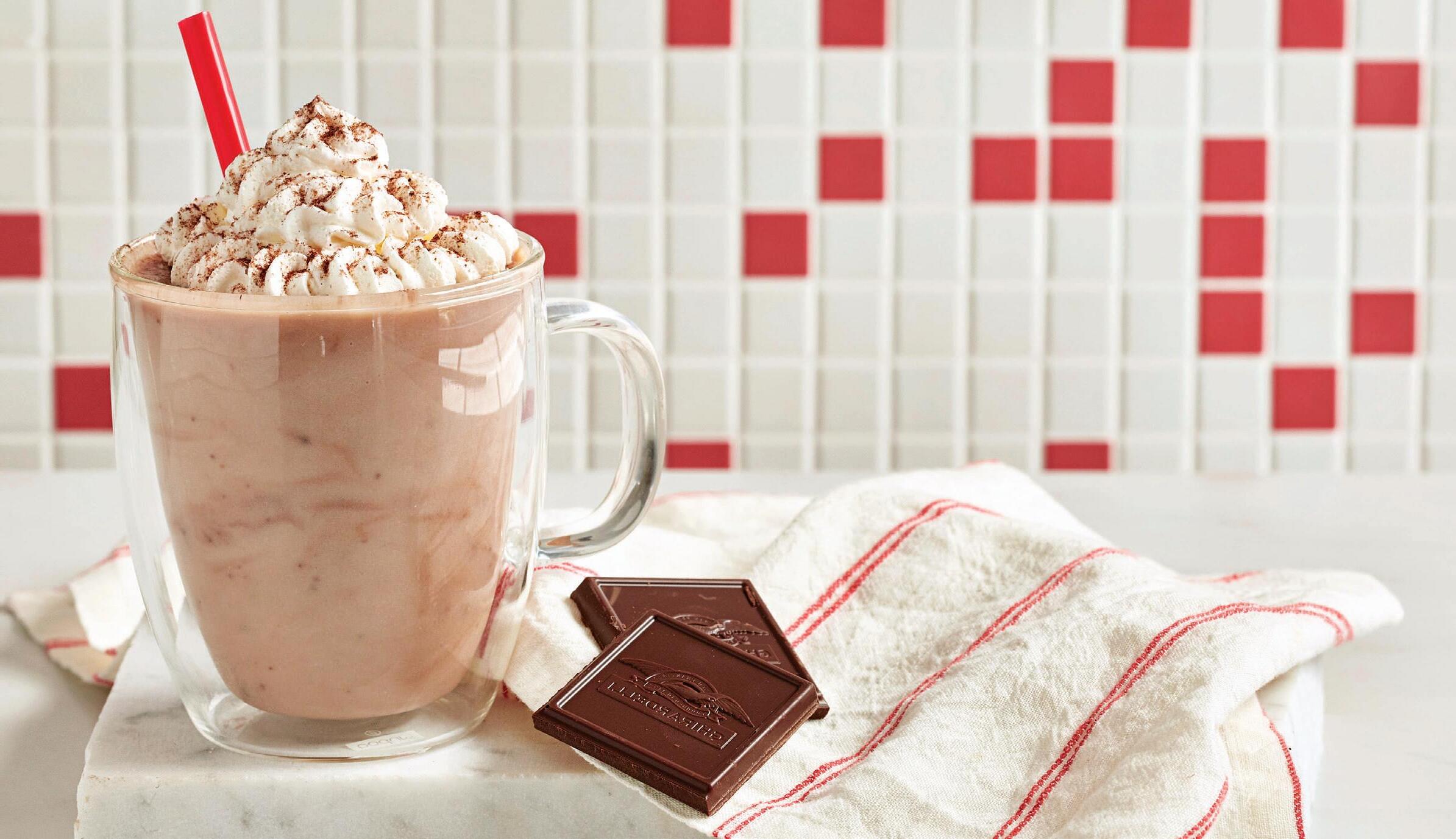
has been one of the brand’s best-selling limited-time custard items. During the colder winter months, he says sales nearly doubled over the previous year’s LTO—increasing franchisee profits.



“The brand lift for any chocolate-oriented beverage or dessert made with Ghirardelli is strong,” says Chris Eklem, vice president of professional products at Ghirardelli. “When consumers decide to indulge in a dessert, they are more likely to view products made with Ghirardelli as a special treat.” In fact, independent research found that 80 percent of consumers who see the Made with Ghirardelli logo on a menu perceive the whole restaurant as higher quality—creating a halo effect that restaurant brands can use to their advantage.
The Made with Ghirardelli program has rigorous standards, with equally high potential rewards. Ghirardelli’s Professional Products team works with brands to support successful launches of chocolate-forward beverages and desserts. “We work closely with the operator to develop and test their items made with our chocolate before they hit the menu, and we’ve seen how consumers respond: Sales can significantly increase for the operator when they use the Made with Ghirardelli program,” Eklem says.
The Ghirardelli team listens to operators to evolve their offerings. For example, they recently introduced a five-pound bag of nine different varieties of chocolate to provide chefs greater versatility, flexibility, and convenience.
Working with a widely recognized and trusted brand offers a proven sales lift. “Promoting a premium product like Ghirardelli will elevate your brand overall in the minds of your guests as one that provides the highest-quality ingredients,” Petralia says.
BY KARA PHELPS
MARCH 2023 / SPONSORED CONTENT INDUSTRY-WIDE ISSUE 53 SPONSORED BY GHIRARDELLI
Widely recognized for its premium quality, Ghirardelli offers a halo effect to restaurants.
To learn more about
to
Made
Ghirardelli program, visit ghirardelli.com/mwg.
‘Made with Ghirardelli’ Program Helped Freddy’s Nearly Double LTO Sales
how
implement the
with
FREDDY'S FROZEN CUSTARD & STEAKBURGERS
lar products. Furthermore, it’s well-positioned to eliminate the veto vote.
“Can you please find me one person that doesn’t like dessert? Now, if you have a medical condition or you’re on a specific diet or you don’t need sugar—I get it, fine. But in this case the niche is the people that don’t eat dessert. I can name 100 people, and 98 will gladly have dessert,” he says.
The concept’s product niche might be its jar format, but the menu options pull from across the dessert category and include cakes (strawberry shortcake, birthday cake, chocolate cake), pie ( key lime, banana cream, lemon meringue, apple), s’mores, orange creamsicle, banana split, tiramisu, and more.
In terms of revenue projections, JARS won’t be a quick serve that smashes any AUV records, but Viviani expects operators to see robust returns
given the low cost of getting in the game. That was always part of the plan: to stimulate restaurant growth by making the business less intimidating to would-be operators.
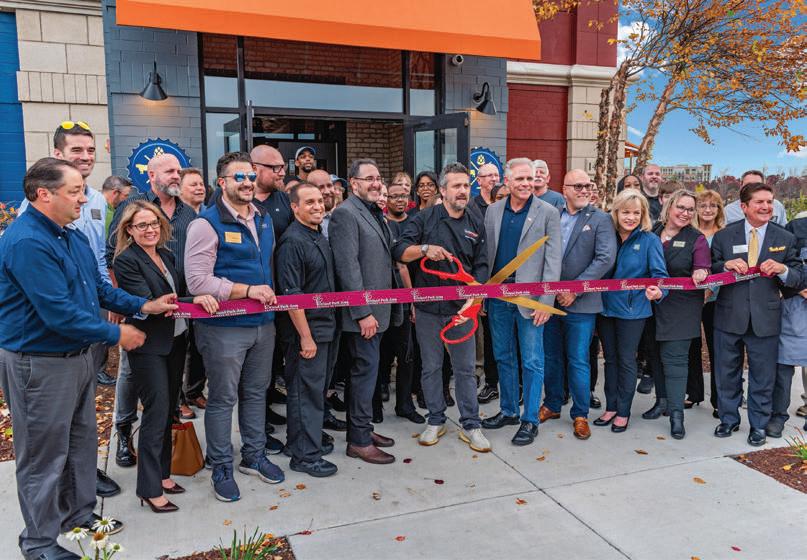
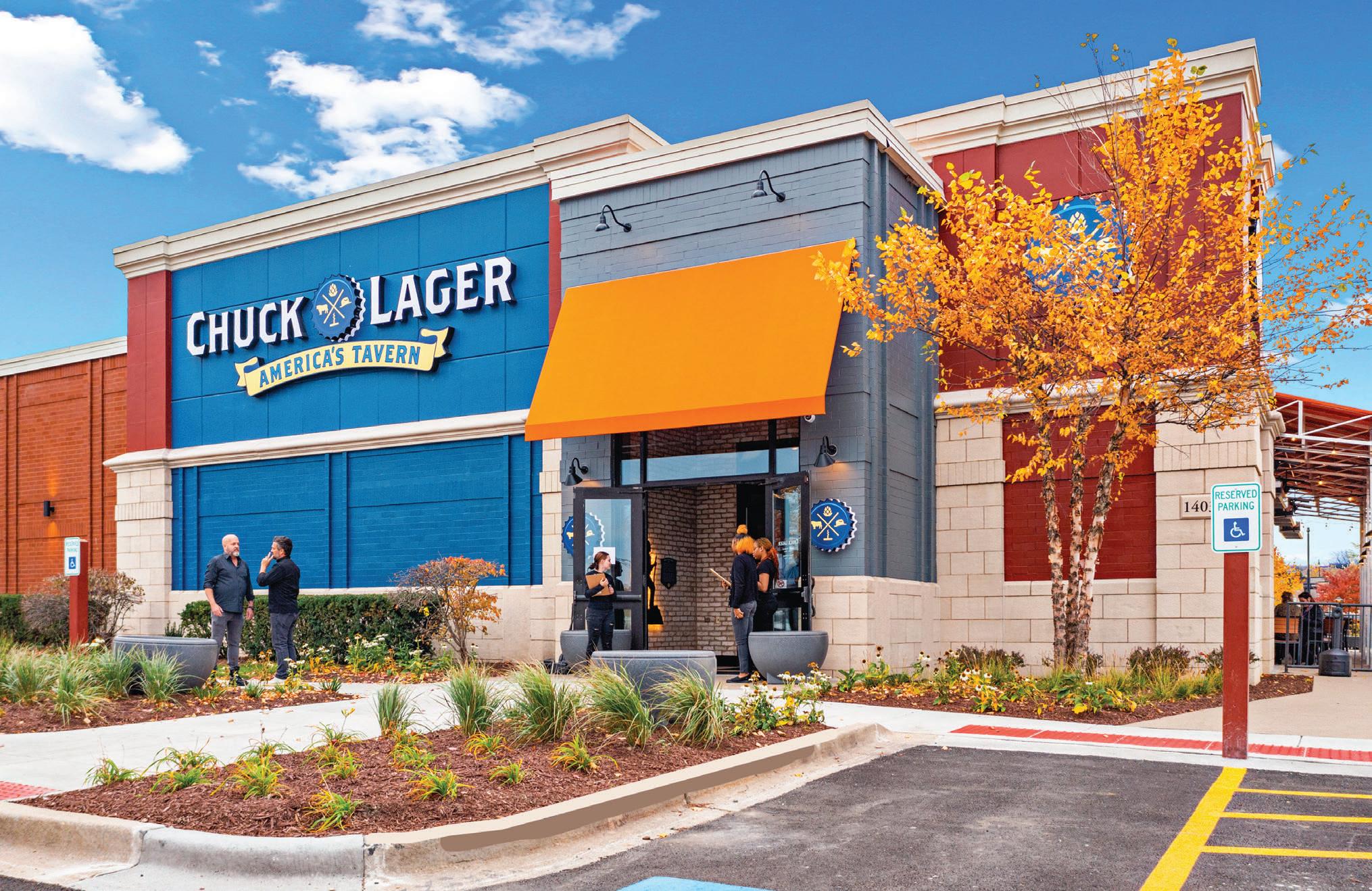
“We had to for different levels of pain tolerance in the business. We want to have a fast casual with very little headache in running them and little expertise needed,” he says. “A JARS location might never make $10 million because of the square footage and the offerings, but if you can make 15–20 percent to a healthy bottom line at $1.5 million in sales, that’s a lot of money considering you probably aren’t going to spend that much to build one.”
THE TAVERN FOR TOMORROW
At face value, Chuck Lager and JARS couldn’t be more different. One is a sports bar with New American fare, draft beer, cocktails, and bourbon; the other specializes in colorful confections that seem made for Instagram. But when Viviani talks about what differentiates each concept from category competitors, the reasons echo one another. In addition to having the support of a proven hospitality group, both have a low bar-
FABIO VIVIANI HOSPITALITY (2)
CHUCK LAGER REQUIRES LESS THAN $1 MILLION UPFRONT TO OPEN.
FABIO VIVIANI 54 INDUSTRY-WIDE ISSUE MARCH 2023
“We had to create a different solution for different levels of pain tolerance in the business. We want to have a fast casual with very little headache in running them and little expertise needed.”


rier of entry.
“The labor market has changed a lot in the last couple of years; that’s why the two restaurants we are really focusing on for national growth are the two that are the easiest ones to run,” Viviani says.
Chuck Lager requires less than $1 million upfront to open—something Viviani says is all but unheard of in full service. Although it can’t fit in extra small spaces like JARS, the restaurant’s streamlined operations makes the process easier and opens Chuck Lager up to second-generation real estate.
“I have other restaurants, but they are the one-offs and the bigger projects that cost a lot of money to open. So the ability to be very nimble with Chuck Lager and open in a second-gen
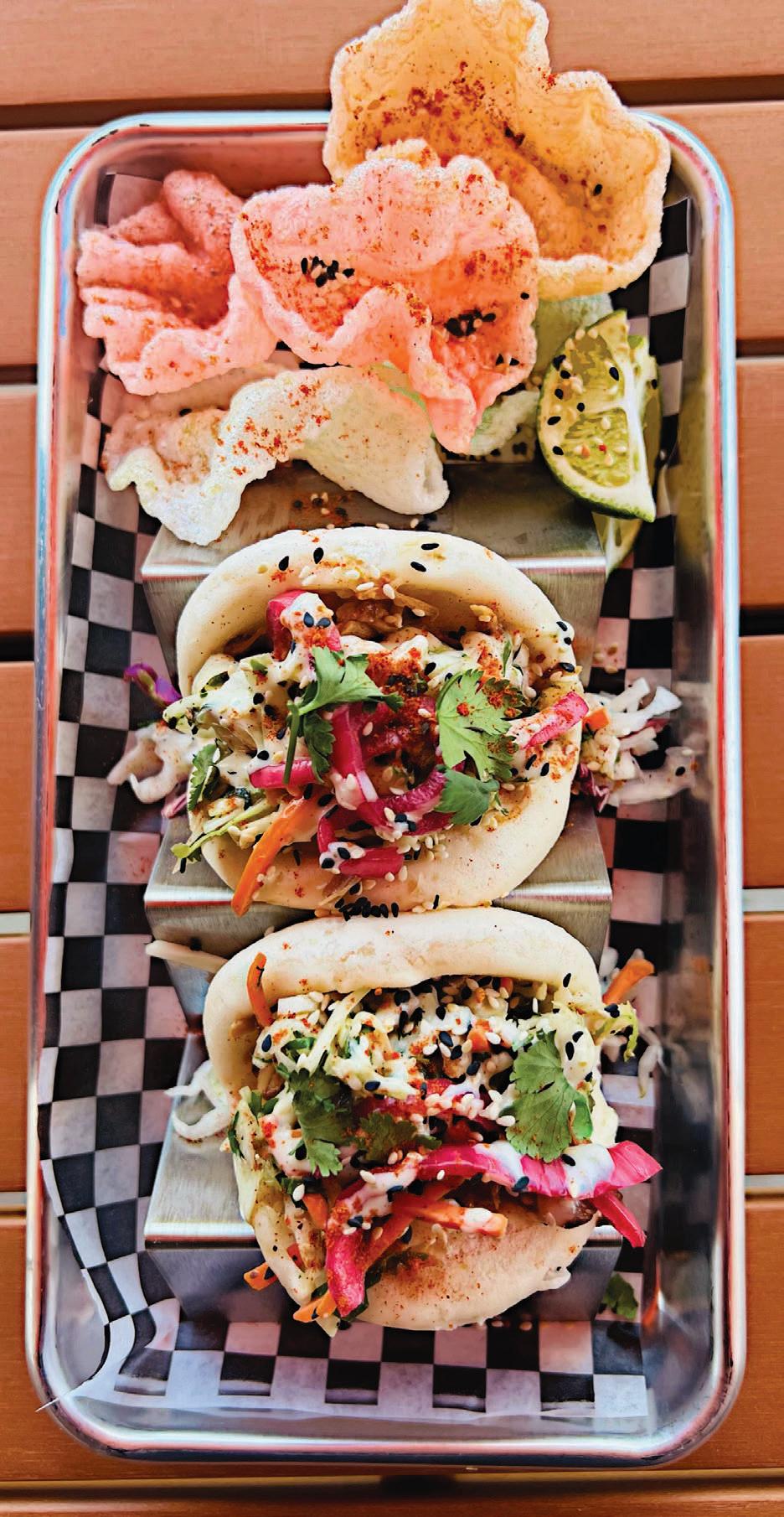
space—which there are plenty of them—and to show very strong financials, easy execution, a not-complicated menu—which still offers a great quality and variety—is fundamental for the growth of the brand,” Viviani says.
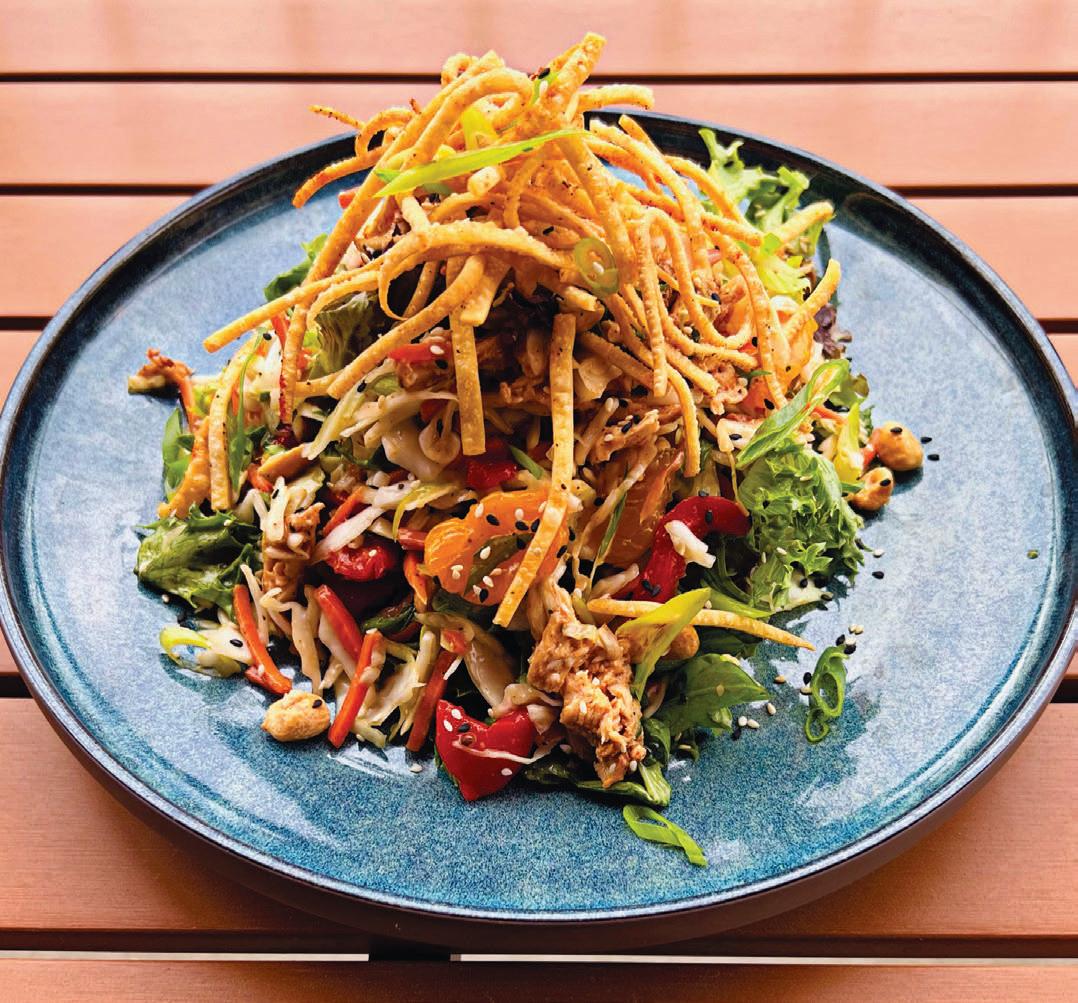
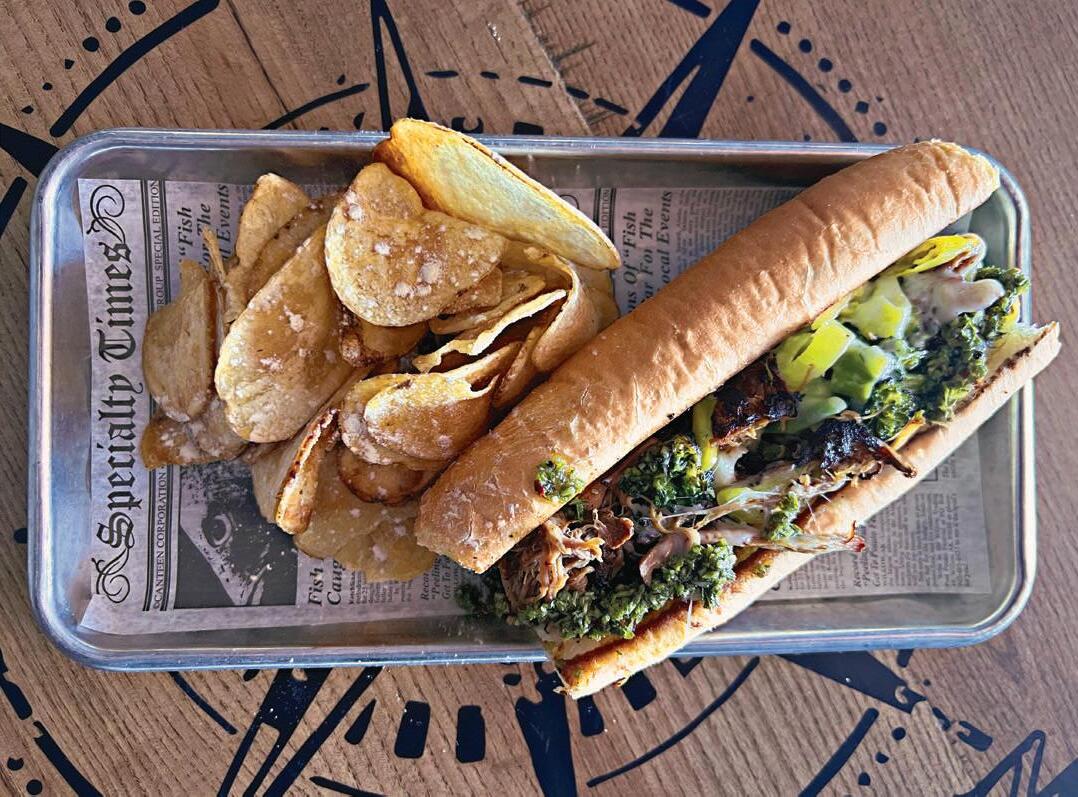
He describes Chuck Lager as an elevated “hybrid between a sports bar and an American tavern.” Part of that identity is rooted in the restaurant’s namesake. The real Chuck Lager, Viviani says, has lived an extraordinary life, and his accomplishments were embellished to the point of brand lore. (According to the restaurant’s website, he was born on Mount Kilimanjaro and has made numerous archeological discoveries.)
While these claims are more legend than fact, Lager’s adventurous spirit and world travels are
FABIO VIVIANI HOSPITALITY (3) FABIO VIVIANI 56 INDUSTRY-WIDE ISSUE MARCH 2023
THE FOOD AT CHUCK LAGER IS PART SPORTS BAR, PART AMERICAN TAVERN.
A Sweet Heat Treat
New Creamy Mango Habanero Bites from Revel EatsTM are a crazy good way to add craveable gastropubstyle fl avor to any menu! These premium, chef-inspired appetizers are filled with cream cheese, sweet mango, and spicy habanero peppers, covered in a crispy, buttery coating. The Next Generation of Appetizers Has Arrived.
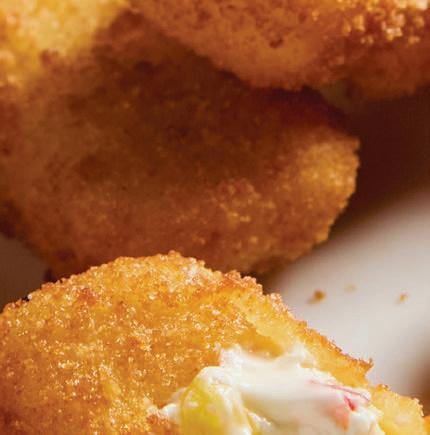
To learn more, scan to code or visit:
ajinomotofoodservice.com





























reflected in the menu.
In addition to gastropub staples like burgers and wings, the selection includes Italian favorites, such as Fabio’s Meatballs, the Tuscan Chicken Sandwich, as well as globally inspired fare, like the Aztec Burger, Coconut Curry Chili, and Wonton Tuna Tacos. The menu is chef-inspired but still approachable, Viviani says, which presents the brand as an especially desirable tenant for landlords, even those in high-end shopping centers.
Chuck Lager’s marriage of familiar and lessknown, American and international, approachable and elevated, is also a natural byproduct of the partnership at its base.
Viviani teamed up with Colby Restaurant Group to bring the brand to life. Where Viviani brings a culinary perspective and experience taking restaurants from idea to reality, Craig and Michael Colby bring franchise expertise; the pair are Red Robin and Walk-On’s operators.
Chuck Lager has seven units on tap for 2023, which would push the 4-year-old brand into the double digits by year-end.
And after the pandemic forced many restaurants to shutter their doors, the real estate market is looking favorable for restaurants like it that can adapt to fit a variety of spaces.
“There’s a lot of land [up] for grabs, especially post-pandemic when unfortunately a lot of restaurants went out of business,” Viviani says. “For Chuck Lager, it’s very easy to convert a secondgeneration space because there is minimal kitchen requirement to develop menus and we have engineered the way of doing it that doesn’t require a lot of construction.”
And though Chuck Lager and JARS are just getting started with their expansion plans, Viviani sees their long-term viability as a given. In addition to their franchising allure, the pair were also built with future consumers in mind.
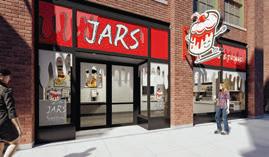
“I appeal to the next 30 years of diners. And that’s exactly what Chuck Lager does, and that’s exactly what JARS does. [ They] are catering to the next 30 years worth of educated food crowd,” he says. “If you think about it, the American chain restaurant hasn’t really changed much in the last 15 years. The big players are the same, usual suspects, and they’re getting obsolete.”
Indeed, many of these legacy chains are aging right alongside their most frequent customers and failing to bring in the next generation.
Viviani says millennials and even younger diners are more knowledgeable about food than his

parents will ever be.
“If I take my mom and dad to Macaroni Grill, they’re going to be thrilled. The alfredo sauce, infinite bread, plain salad, and good, but overcooked, pasta—my dad is all about it,” he says. “But if I take my cousins to it, they’re going to be like, ‘Fabio, what are we doing here? Why don’t we go to the local, new, up-and-coming, Instagrammable, chef-driven shop?’”
Viviani’s solution? Create concepts, like Chuck Lager and JARS, that will attract the young, digitally dialed-in foodies but also appeal to older generations through a fresh take on classic dishes.
CREATING THE ROPES
When Viviani talks about Chuck Lager and JARS, it’s easy to forget that, as of the end of 2022, the former only had four units and the latter zero. He speaks with such enthusiasm and authority that a listener can’t help but visualize the reality he’s painting.
“Take a note, and then you can check your note in five years: JARS will be the biggest dessert [quick serve] in the United States within the next five to seven years. Mark my words on it,” he says.
While such a statement could be dismissed as little more than a sales pitch from an especially charismatic businessman, Viviani’s track record speaks for itself.
He’s not one to brag, but he also won’t downplay his or his team’s many successes.
Over the past 15 years, he’s built an expansive portfolio—one he expects to double in girth over the next few years. His restaurants also weathered the pandemic without a single one permanently shuttering.
He hopes this resume will serve as yet another incentive for prospective operators.
The restaurant industry is never without risks, but as Viviani said earlier, it’s all a matter of betting on the right horse. And while his opinion may be biased, Chuck Lager and JARS are the two he’d bet on.
“With all due respect to a lot of franchise groups out there, I’m not a career changer. I’m not a former lawyer who got into baking and now has a dessert company,” he adds.
“We are a hospitality development company. So every possible downfall of the industry, we are ahead of the game. We don’t have to learn the systems; we don’t have to learn the ropes—we’re creating the ropes.”
FABIO VIVIANI HOSPITALITY (3), HEADSHOT: JOHN R. BOEHM
FABIO VIVIANI 58 INDUSTRY-WIDE ISSUE MARCH 2023
“We don’t have to learn the systems; we don’t have to learn the ropes—we’re creating the ropes.”
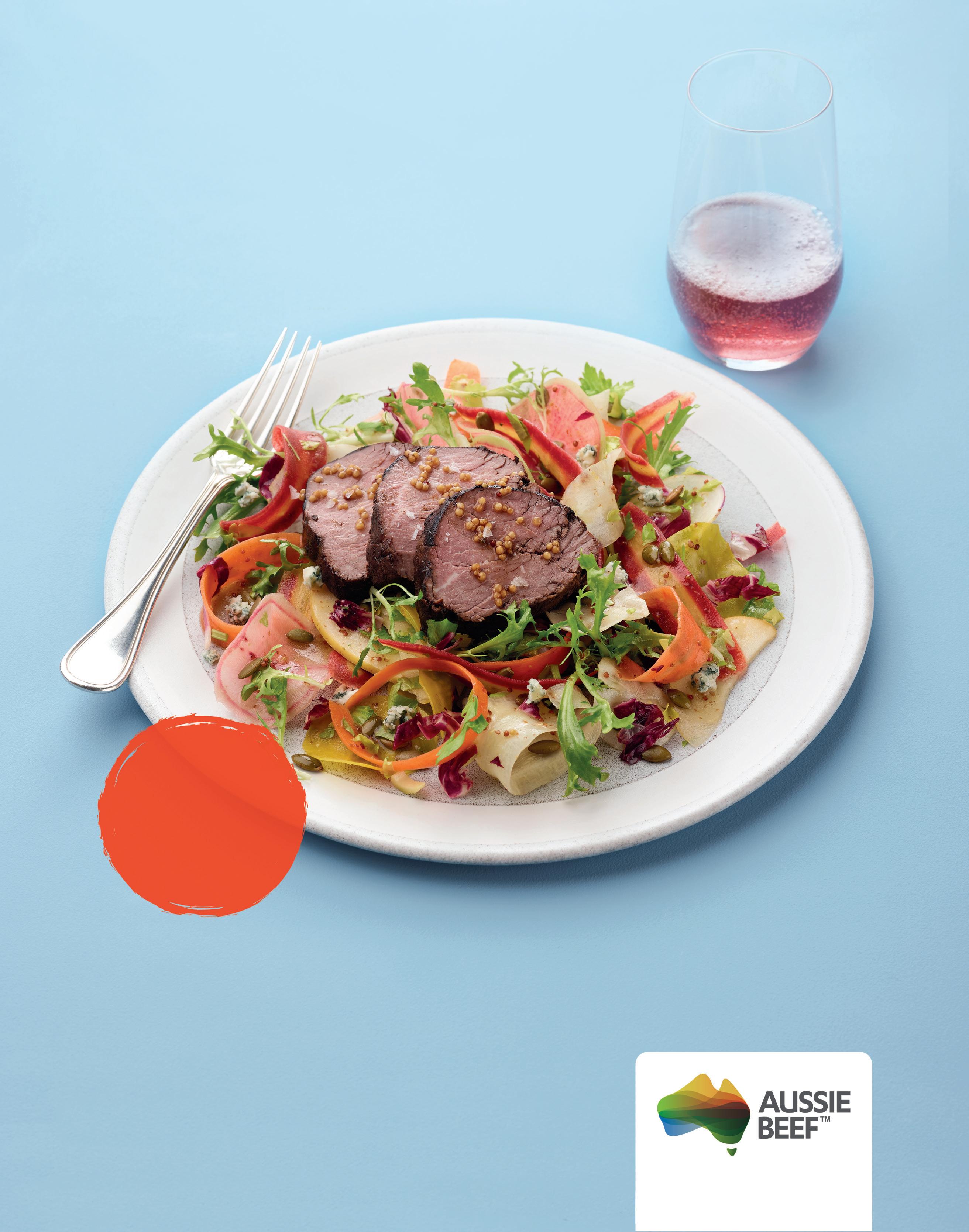 / BY DANNY KLEIN
The Fast-Food Dining Room Lives On




In 2015, a time that now feels like a digital Stone Age for restaurants, CAVA CEO Brett Schulman recognized a potential hazard. Mobile devices and digital ordering systems were turning food procurement into an Amazon-esque experience. The ability to build and customize meals for pickup had the potential to further bifurcate the sector. While the divide between convenience and experience was nothing novel to full- and quick-service operators, the idea this dichotomy could exist within the latter was something new. ¶ Even in fast food and fast casual, technology was cracking wide a world where guests held the controls more than ever. Nearly every guest in every market now had a drive-thru in the palm of their hands. “Omnichannel” might not have been in the common restaurant vernacular, but it was a concept plenty of operators were building toward without realizing it. ¶ And it was the customer taking them there.

Reports of its demise appear greatly exaggerated. But that doesn’t mean it hasn’t evolved.
CAVA TIM ROBISON QSR FSR 60 INDUSTRY-WIDE ISSUE MARCH 2023
FEW BRANDS HAVE AS MANY FORMATS AS CAVA, AND THERE’S A GOOD REASON FOR EACH ONE OF THEM.




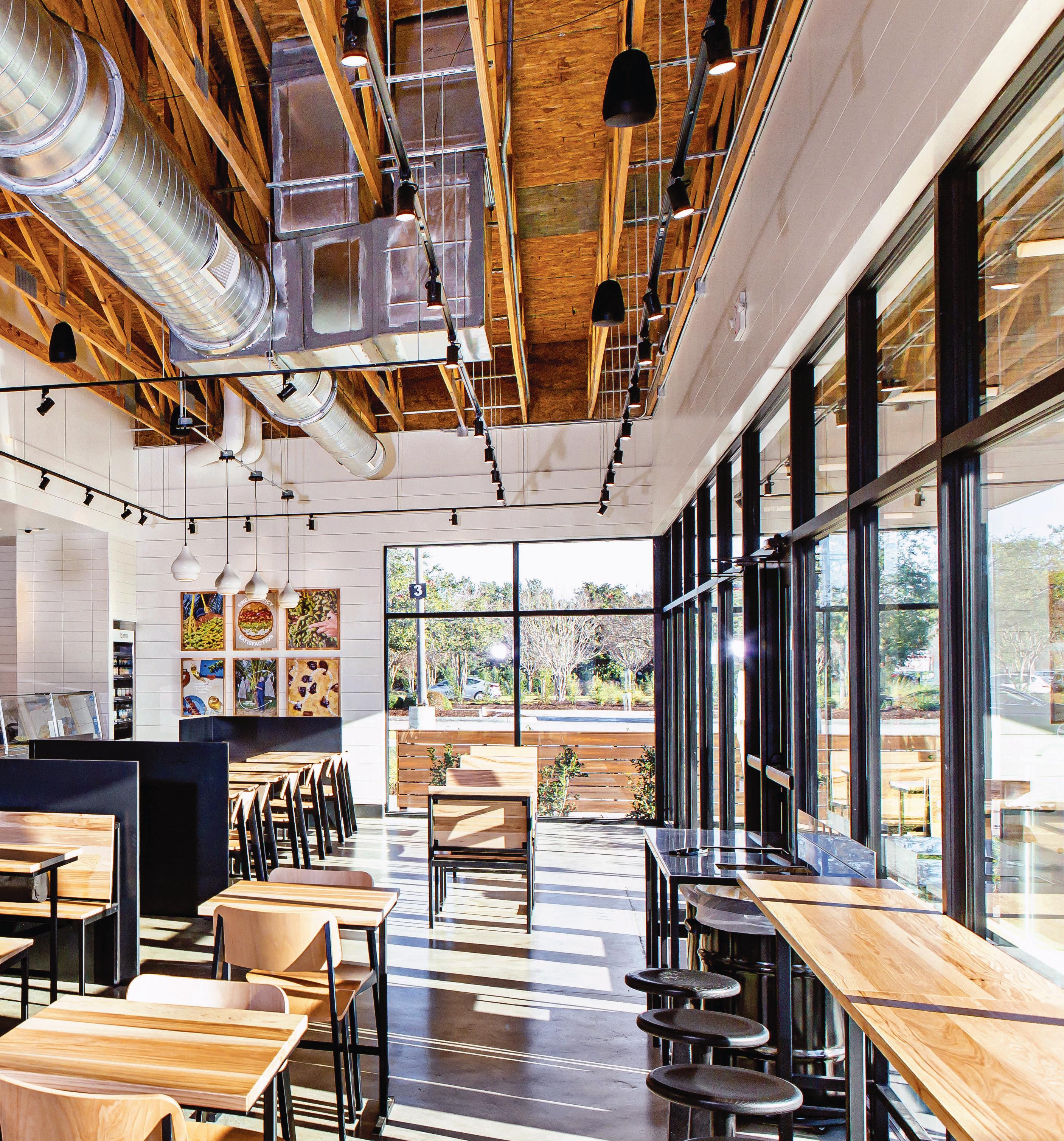
FUTURE OF QUICK SERVICE
MARCH 2023 INDUSTRY-WIDE ISSUE 61
For Schulman, a cofounder of the Mediterranean chain, whose roots owe to full service, the 2015 idea a diner might walk in and compete with CAVA’s digital business was a prophetic concern. “There’s nothing more frustrating than being in our assembly line format and waiting for your order to be built and having a team member build a digital order in front of you and you have to wait. That’s not what we wanted,” Schulman says.
CAVA, like Chipotle and others, began installing dedicated makelines for digital production. While this fix was a straightforward one—expand capacity for a growing channel—it bespoke a vision
drive-thru turned in the worst year-over-year performance at 10.2 percent in November, lower than the year-ago period. In fact, month-over-month drive-thru trends have held stable since May 2022. Meanwhile, dine-in climbed 29.6 percent in the month after growing 37.1 percent in October. Takeout was 20.6 percent higher and delivery 11.5 percent, although that, too, has declined versus previous months.
This illuminates what could prove a lasting view of post-COVID foodservice: Higher drivethru usage than 2019, but with an arrow that’s leveled out; sustained preference and interest in off-premises streams; yet with clear evidence one of 2020’s doomsday predictions turned out to be a prisoner-of-the-moment reaction.
“We always felt the demise of the dining room was greatly exaggerated,” Schulman says. “It wasn’t an either or; it was an ‘and.’”
THE FUTURE IS CHOICE
All of CAVA’s channels have grown “significantly” over 2019, Schulman says. As a percentage, digital is off its peak, but the dollars have grown—a common reality these days. The mix of digital slid as in-restaurant business rebounded. At CAVA, roughly 63 percent of its sales currently are dine-in.

of quick service that COVID-19 poured lighter fluid on. As regulations and safety precautions shuttered lobbies nationwide, restaurants began plotting the future of the dining room. When the front door reopened, would customers return? And if they did, what would they want? How would it mesh with digital behaviors accelerated by the pandemic?
According to the National Restaurant Association, nearly three years removed from COVID’s onset, 16 percent fewer people are dining on-premises than before. Yet the Association claims the gap has been entirely covered by off-premises business. Delivery is 5 percent higher than 2019 and carryout 3 percent lower. Drive-thru, however, sits 13 percent above pre-COVID marks and today accounts for 39 percent of all restaurant traffic, per an article in The Washington Post.
There’s little debate the pandemic trailed a disrupted and changed sector in its wake. But there is room to ask whether it was the asteroid some predicted. Data from Revenue Management Solutions showed, among revenue channels,
“I think what we all learned through the pandemic was we are social beings. We’re humans,” Schulman says. “We love connection. We long for that connection.”
Socialization has been the heartbeat of hospitality for as long as its existed. What’s changed now are the terms. Making food available where and when a guest wants has become the table stakes of convenience. And that doesn’t exclude the dining room.
CAVA opened 83 locations in 2022 (including conversions of Zoës Kitchen venues) in seven new states and 10 fresh markets. It also debuted seven digital drive-thru pick up lanes to bring its total to 17.
Those drive-thrus began hitting the field in 2019 as a way for suburban customers to gain greater access to the brand. Schulman, as a father of three, understood the limitations of guests who didn’t—or couldn’t (car seats)—get out of their vehicles to pick up food. The locations boast dedicated second digital makelines for the pickup window as well as in-restaurant serving lines for dine-in customers. “Guests love the optionality of both those channels,” Schulman says, “depending on CAVA (2),
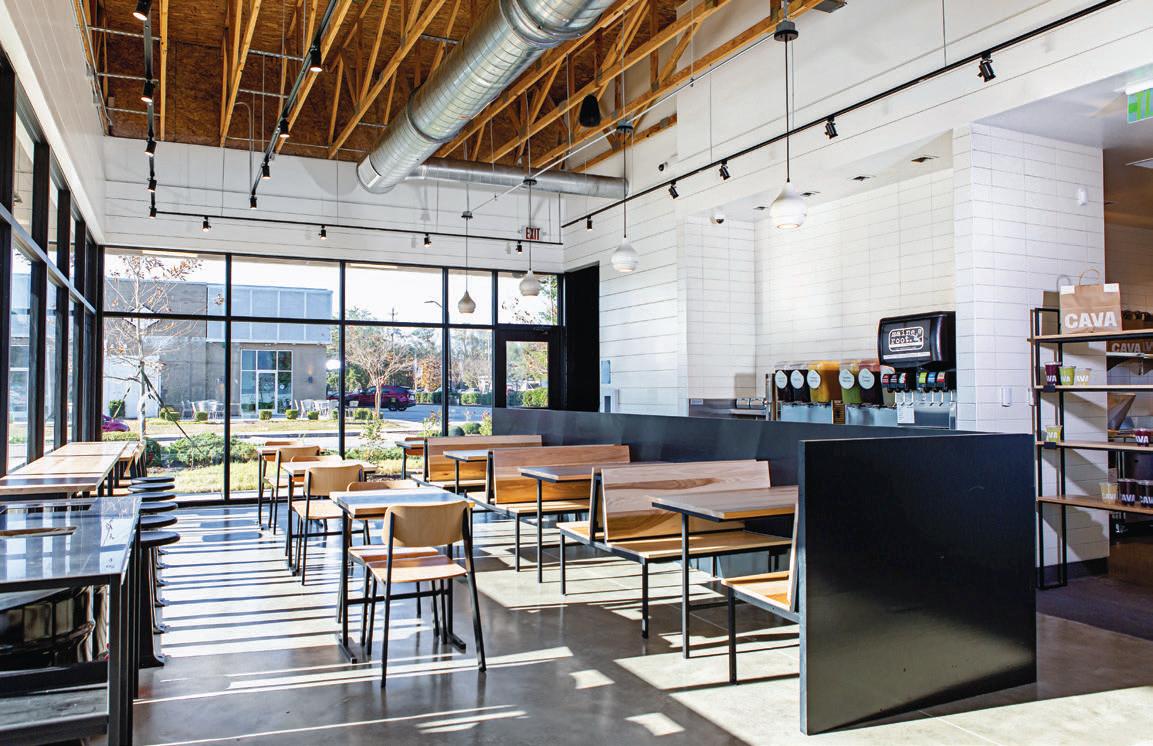
FUTURE OF QUICK SERVICE
INTERIOR: TIM ROBISON
ABOUT 63 PERCENT OF CAVA’S SALES TODAY ARE DINE-IN.
62 INDUSTRY-WIDE ISSUE MARCH 2023
BRETT SCHULMAN
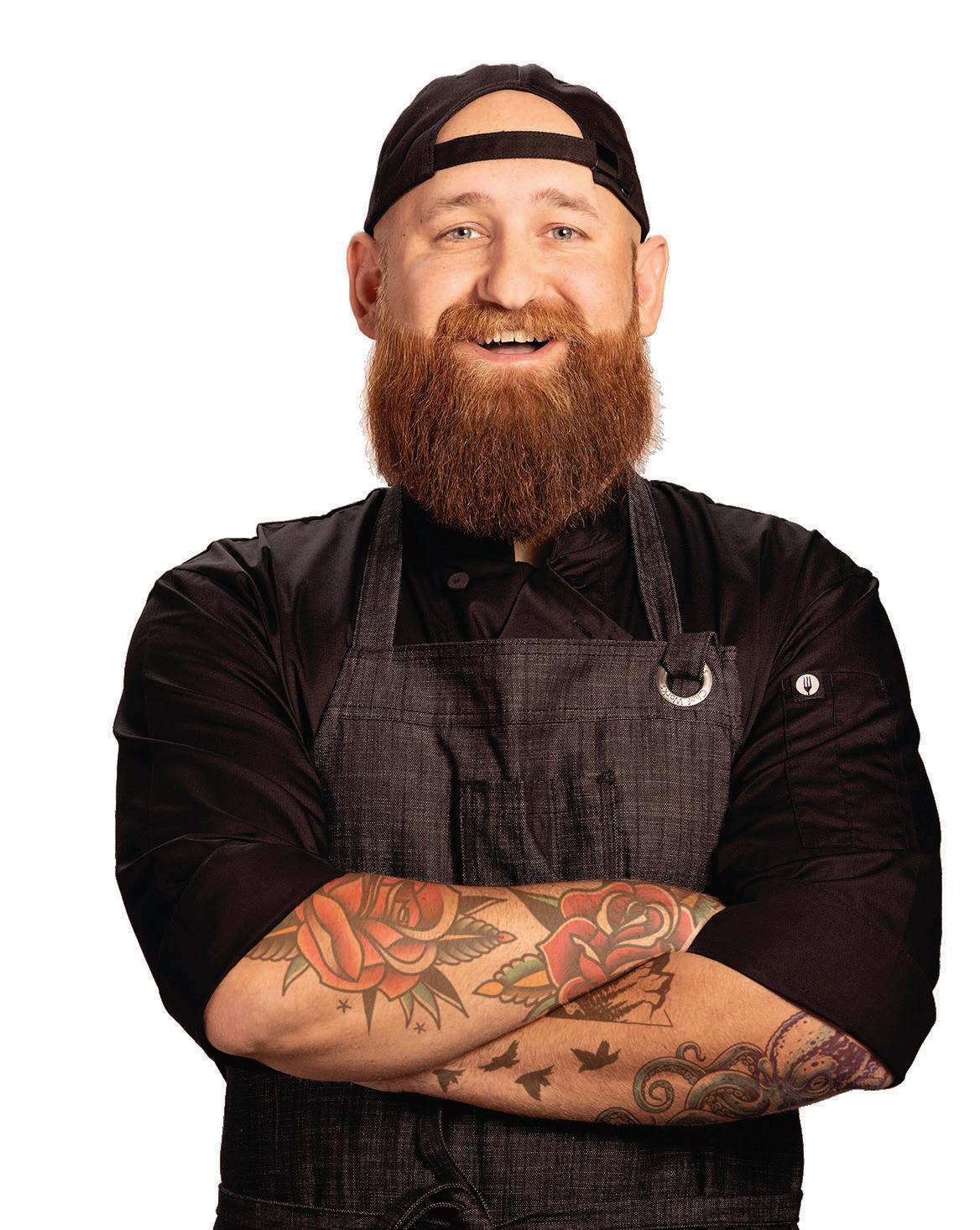

YOU make the best fries. We make EASY. End-to-end cooking oil solution for always on delivery, filtration, monitoring, and recycling. Get Started 888-796-4997 rti-inc.com
what their need is on a given occasion, time of day, lunch or dinner.”
A melding of two worlds is taking shape across quick service. Restaurants are rewiring their digital ecosystems and building infrastructure to manage order flow. CAVA directs its own digital order platforms that it built internally. There are capabilities now to throttle so restaurants can serve how many orders they’ve received in a given timeframe, “so that they’re not just drinking from a firehouse,” Schulman says. Simply, the ability to put a time of pickup on an order confirmation for guests and actually deliver against that promise.
And where this is connecting coming out of COVID is from a format perspective; how brands are orienting their kitchen production to meet physical and digital demand catered to whatever the trade area requires. “That can come to life in many ways,” Schulman says.
Imagine New York City CAVAs without indining seats, but with multiple digital makelines alongside an in-restaurant serving one. Or a suburban venue with 80 seats, two makelines, and a pickup shelf. Even more, a digital drive-thru pickup lane with a dining room. CAVA has taken things a step further, testing a “digital kitchen” and a “hybrid kitchen.” The latter, slated to open in Vienna, Virginia, serves dine-in guests (there’s a big office market there) and also touts expanded catering production and digital order capabilities. CAVA’s digital kitchen is strictly for digital order pickup as well as catering—a channel the brand has been building behind the scenes recently.
“This format diversification and optionality gives us increased flexibility from a real estate standpoint to flex up and flex down depending on the needs of the trade area,” Schulman says.
THE NEXT GEN OF DESIGN
Over the summer, Wendy’s CFO Gunther Plosch relayed a story to investors. He had just walked through the brand’s “Global Next Gen” prototype. “Finally,” he said, “we are embracing digital in our design.”
Wendy’s began building traditional units under this banner last fall. Arguably, the blockbuster feature was a delivery pickup window built on the outside of the unit. It’s a feature that doesn’t replace the drive-thru (that’s still live) but rather creates a dedicated handoff point, complemented with paired parking, for order-ahead customers to grab food to go. Namely, the window will keep
Wendy’s goal mirrored CAVA’s in many ways: Reduce friction for consumers and crews, and develop an experience where digital and in-store don’t detract from each other.
delivery couriers out of the dining room and shift traffic from the drive-thru line. In addition, Wendy’s devised dedicated mobile order pickup spots, with mobile pickup shelving inside.
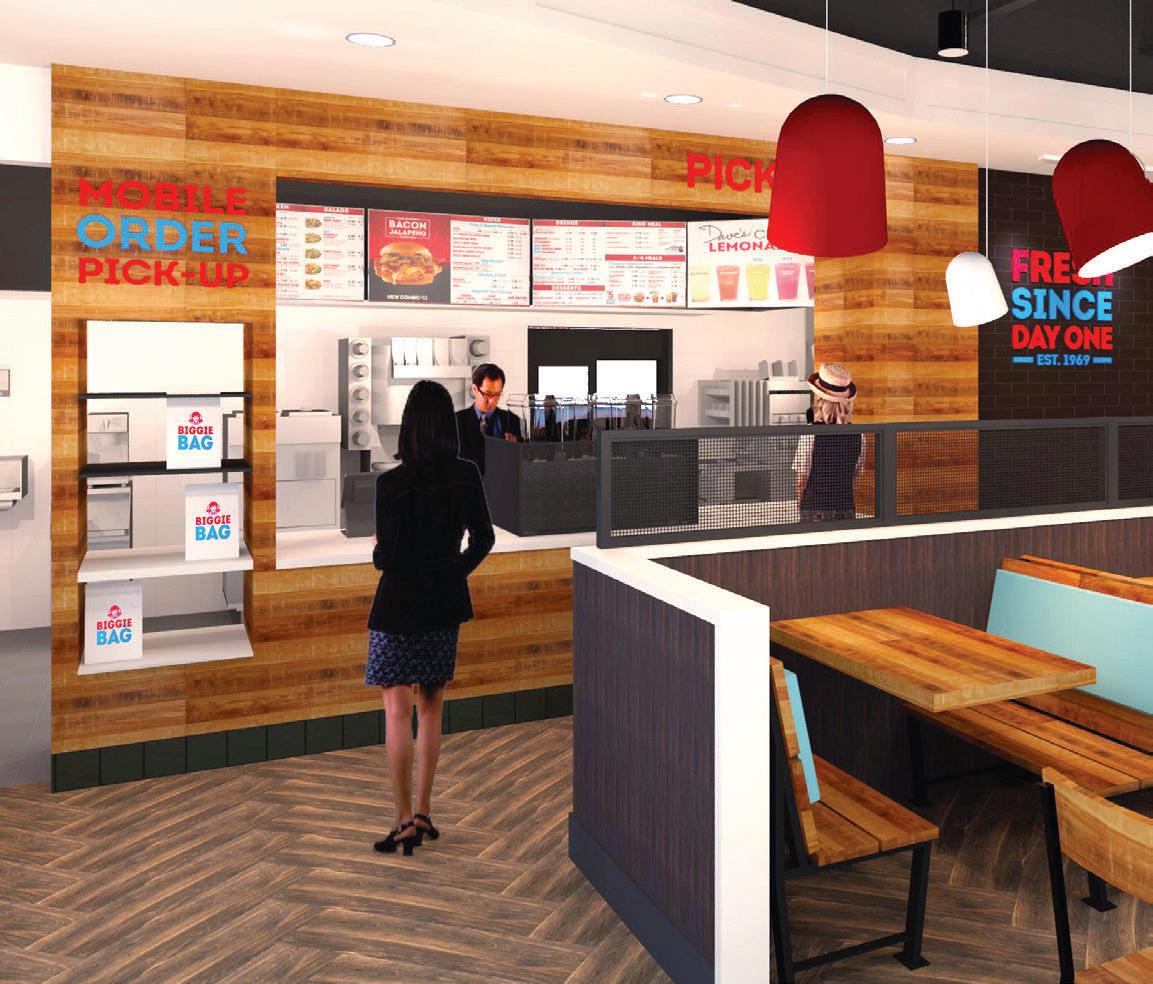
In-store, Wendy’s built a galley style kitchen that runs from the front to the back of the restaurant and increases oversight for employees regardless of what channel they’re working on; better efficiency at the point of sale and the ability for workers to slide between positions. Or, as Plosch put it, “way less steps to get all of your tasks done.”
In essence, Wendy’s goal mirrored CAVA’s in many ways: Reduce friction for consumers and crews, and develop an experience where digital and in-store don’t detract from each other. It’s not so much about creating harmony between the two as it’s providing tools for each to operate seamlessly.
Wendy’s president, international and chief development officer, Abigail Pringle, says the Global Next Gen restaurant is conceptualized to handle 400 times the digital capacity of the chain’s current volume. “Technology powers everything from the point of sale, grills, to the new back-office platform designed to streamline general manager tasks,” she says. On the grill note, she’s referencing Wendy’s DSG 2.0 grills that speed cook times from 155 to 80 seconds and provide even cooking.
The exterior walk-up window, Pringle adds, will address Wendy’s off-premises and digital growth. In Q2, digital comprised just over 9 percent of overall domestic sales, up 2.5 per-
WENDY’S
FUTURE OF QUICK SERVICE 64 INDUSTRY-WIDE ISSUE MARCH 2023
WENDY’S GLOBAL NEXT GEN MODEL FLOWS TECH THROUGH THE DINING EXPERIENCE.


Did Your Business Receive PPP? Either way, You Still Qualify for ERC! What is ERC? Bottom Line Savings helps business owners receive money back from the Employee Retention Credit (ERC) federal grant. This ERC program differs greatly from the Paycheck Protection Program (PPP) and is much easier to apply for. Bottom Line will submit and collect a few important documents making this program turnkey for our owners. ************************************ You don’t need a sales reduction to qualify for ERC. Operational impacts to your business will qualify you as well. ************************************ Your business could be getting up to $8,000 - $26,000 per employee in Employee Retention Credits (ERC) even if you received PPP loans. Apply today and an ERC Specialist will contact you directly. Please visit www.tryerc.com Our experts at Bottom Line will help you maximize your refund! As a valued partner, Bottom Line will: • Identify how you qualify for the ERC Program • Outline your specific ERC calculations to maximize the credit • Help you claim the credit • Ensure proper payroll tracking and documentation Referral Programs Available www.refererc.com
cent, quarter-over-quarter. This as total loyalty members and monthly active users grew 5 percent versus Q1, exiting the period at record highs.
However, it’s also a signal to Wendy’s dinein customer. Removing delivery traffic from the drive-thru will speed up in-store service, too, Pringle says, “benefitting customers with shorter wait times in line.” The same is true of redirecting delivery order traffic away from the front counter. “This ensures the crew are focused on taking and fulfilling dine-in customer orders quickly, efficiently, and accurately,” Pringle says. “Less traffic at the POS also makes it easier for our digital customers to quickly locate their orders on the new integrated front counter grab-and-go shelving.”
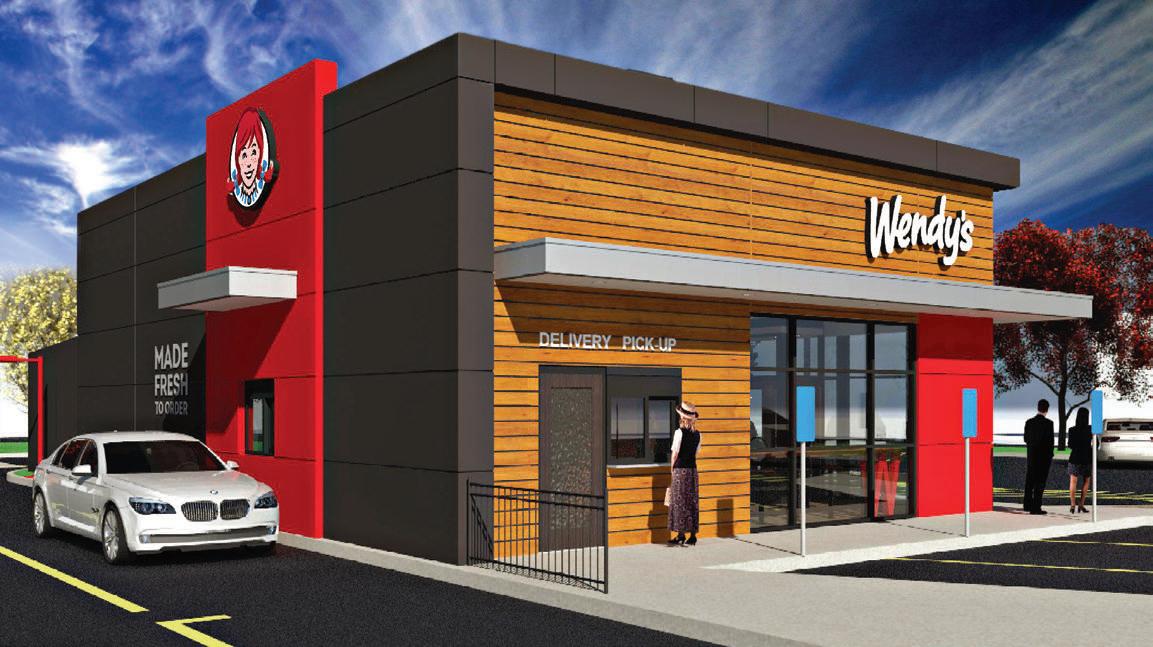
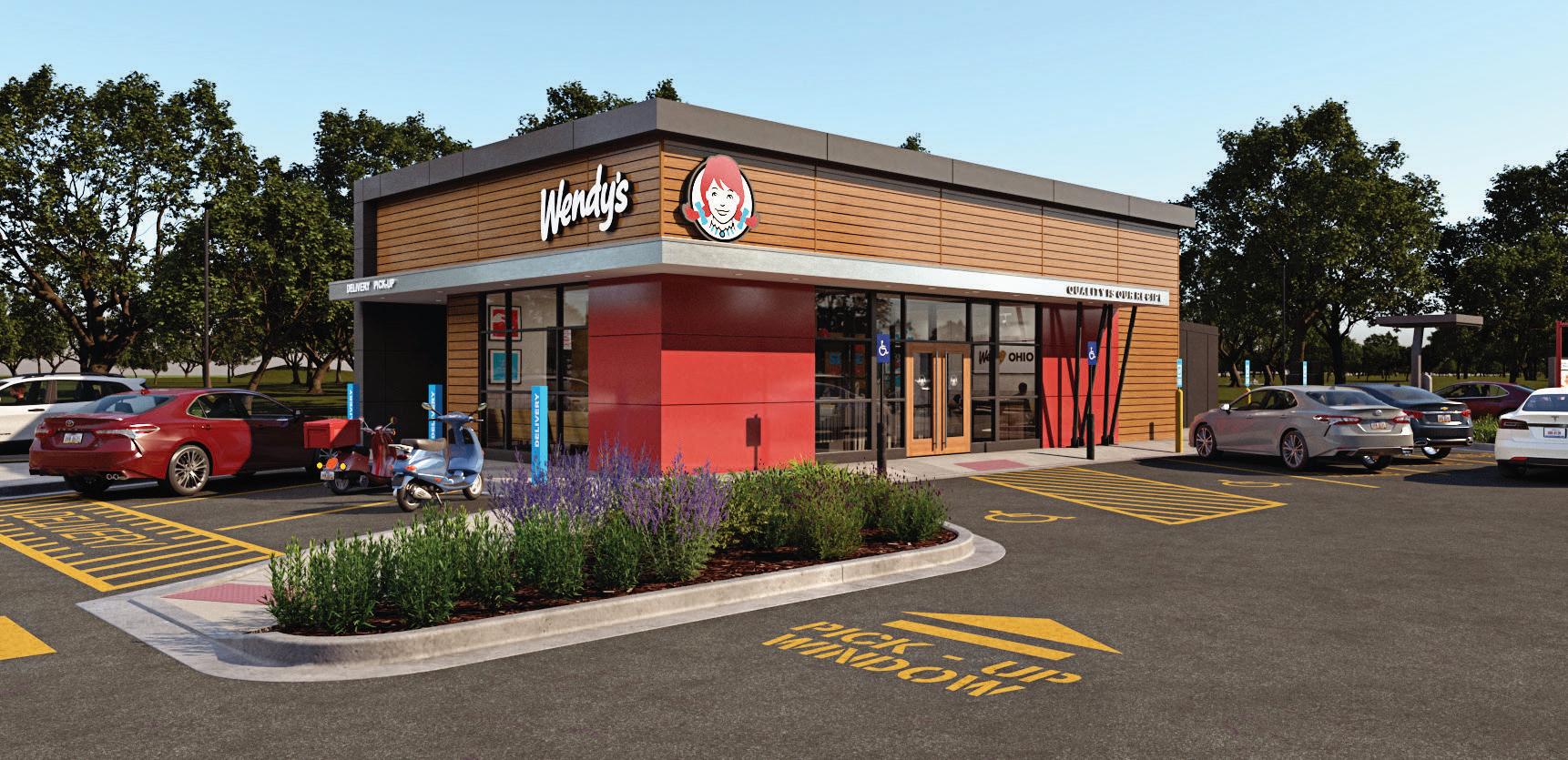
What it all does, dressed down, is make it easier for employees to focus on creating positive guest experiences, and to humanize what’s become a transactional event in countless quickservice circles.
“Dine-in service looks different than it did just a few years ago, and customer preferences have changed,” Pringle says. “To meet our customers where and how they want to enjoy Wendy’s, we offer a variety of ordering options including through kiosks and the Wendy’s App. For those customers who order ahead, mobile pickup spots and grab-and-go shelves make it quick and easy to
retrieve orders. These options allow customers to interact with us using the platform of their choice.”
At this turn in the COVID bounceback, Pringle says drive-thru remains strong. The pandemic heightened a shift the brand was already seeing, and which has been widely true across quick-service’s largest players—a migration from dine-in to drive-thru. She anticipates preferences for mobile ordering and delivery to continue growing. But even so, it’s not a point that’s going to pull focus from dining rooms altogether. Wendy’s sees the landscape as an opportunity to bring more Wendy’s to more people in more ways, Pringle says, and use those channels to inspire future visits. “With each technology advancement, new partnership, and market entry, we’re continuously optimizing the way we serve our customers,” she says.
THE SEGMENT DEFINITION
Shake Shack launched what it terms “Shack Track” at the start of the pandemic. CFO Katie Fogertey says the brand saw how many of the fast pivots from the early days of COVID had become permanent functions, including implementing multi-channel delivery, enhancing digital pre-ordering, and expanding Shake Shack’s fulfillment capabilities. Shack Track wasn’t a one-face solution—it’s an acknowledgment of the choice guests now have.
Shack Track includes pickup shelves, curbside pickup, pickup windows, and drive-thru units, of which 11 operated as of January, with 10–15 more on deck for 2023. “The need to enhance and alter the physical restaurant to meet the needs of digital was so important to Shake Shack that today, all new restaurants we open have some aspect of Shack Track,” Fogertey says.
This is an especially revealing development at a fast casual like Shake Shack, which was founded by Michelin-starred restaurateur Danny Meyer. Once the chain evolved from hot dog cart to brick-and-mortar, it crashed preconceived notions of what quick-service experience could look like for a changing generation of consumers. More inviting and modern elements. Agile real estate. Food that took a bit longer to come out but sold its product on ethos and quality.
None of those playbooks have wilted; Shake Track is just the manifestation of what Fogertey calls, “convenience without compromise.”
“Shack Track aims to tackle many challenges that have arisen from building a rapidly growing
WENDY’S (2) FUTURE OF QUICK SERVICE
66 INDUSTRY-WIDE ISSUE MARCH 2023
WENDY’S IS WORKING TO ALLEVIATE CAPACITY IN THE DRIVE-THRU BY OFFERING MORE ACCESS POINTS.
We Have

INVENTORY
Don’t let supply chain issues slow you down. We are fully stocked and ready to deliver!
6 MODELS TO FIT YOUR KITCHEN!
SAFE COUNTERTOP FRYER OIL DISPOSAL HAS ALWAYS BEEN AN ISSUE—WE ARE YOUR SOLUTION!
THE ISSUE: Safe fryer oil disposal.
THE SOLUTION: The Shortening Shuttles® allow you to safely and easily transport hot oil to the dumpster.
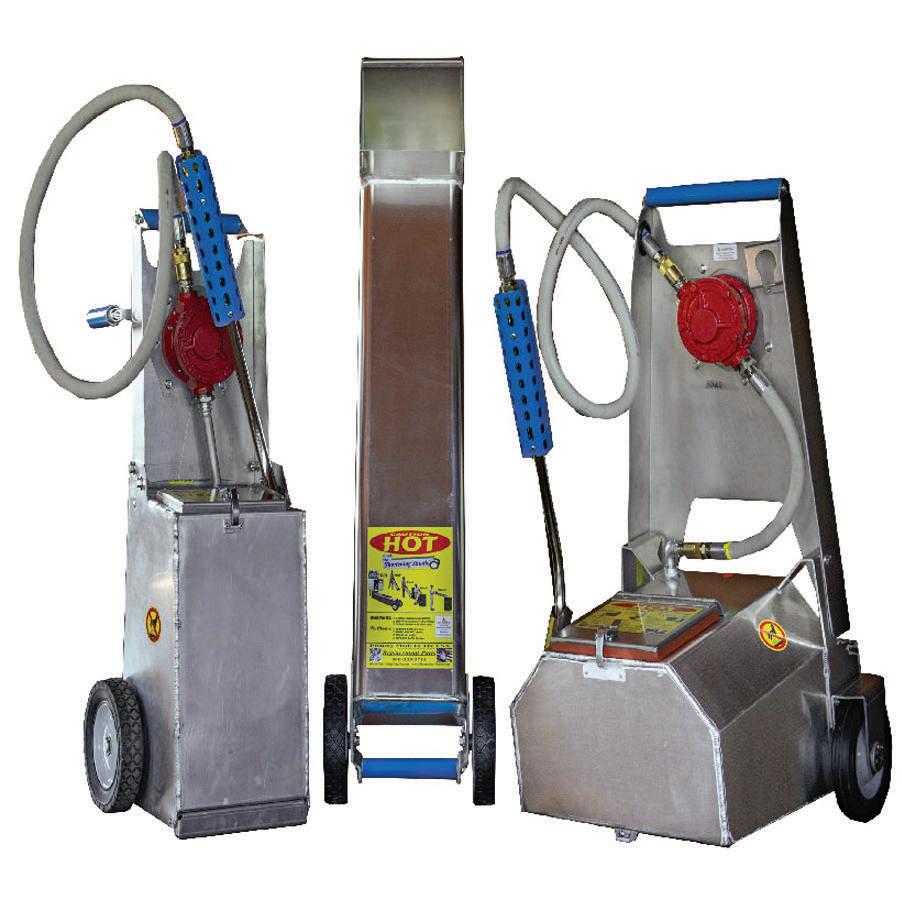

THE ISSUE: Limited space for necessary equipment.
THE SOLUTION: Small foot print of 14" x 19" x 37" tall. Generous capacity of 5.5 gallons. The new SS-645 MINI FITS!
THE ISSUE: Quality. There is so much junk out there folks are reluctant to buy ‘more junk.’
THE SOLUTION: 30+ experienced industry provider of PROVEN quality equipment.
+Menus might be shrinking, but comfort food is sticking around.
Worcester Industrial Products SAFE WASTE OIL TRANSPORT
• Shortening-Shuttle.com • 800-533-5711 • sales@shortening-shuttle.com •
ADOBE STOCK
digital business while maintaining our commitment to the traditional dine-in business,” she says. “We wanted to be able to provide our restaurants and team members the tools to best handle the increase in digital sales. We worked hard over the past two-and-a-half years to identify opportunities to improve the overall omnichannel guest journey as well as the work of our team members.”
Like others, Shake Shack watched off-premises surge across 2020 and into 2021. But its gains today are coming from customers walking into stores, Fogertey says. “Which is great for our business.”
And thanks to investments made outside the four walls, the Shake Shack customer today has more points of access than ever. Guests can download the app and skip the line. Ordering ahead for pickup has proven a sizable time saver, Fogertey says. It streamlines what’s often a busy and crowded order line as well. “This also provides us with a unique opportunity to communicate with our guests on a much more personal level that we didn’t have prior to our digital business,” she says.
Last year alone, Shake Shack appreciated more than a million app downloads. Come Q3, 4.5 million guests had made a first-time purchase in the chain’s owned digital channels. “But, our digital journeys go beyond the app,” Fogertey says. “We also anticipate seeing more guests interacting with
our kiosks. A good portion of guests prefer them over traditional cashiers when given the choice, as they’re fun to explore and visually helpful when it comes to customizing a menu item. Our app and kiosk are also helpful tools for our team members, as they allow our team members to focus more on guest service and hospitality.”
Let’s circle the kiosk note. Shake Shack announced in Q3 it planned to put kiosks in every location by the end of 2023. At that point, about half of stores had them. Kiosks represent Shake Shack’s most profitable channel and produce its highest in-store checks. Restaurants with kiosks also boast better labor utilization rates than those without.
Fogertey says kiosks give Shake Shack a lever to lean on to streamline labor and address the front-of-house opportunity. Internal data shows a “good portion” of guests prefer them over traditional cashiers given the option. In many units, Shake Shack has five or six kiosks alongside one or two cash registers.
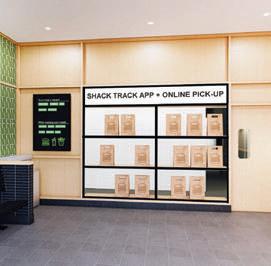
Does this offer a model of another quick-service dining room of tomorrow? The easy answer is, it depends. To Fogertey’s point, you have to see how customers react. She’s watched many guests walk in and go right to the kiosk. They tell the brand they enjoy the ability to sit with the menu
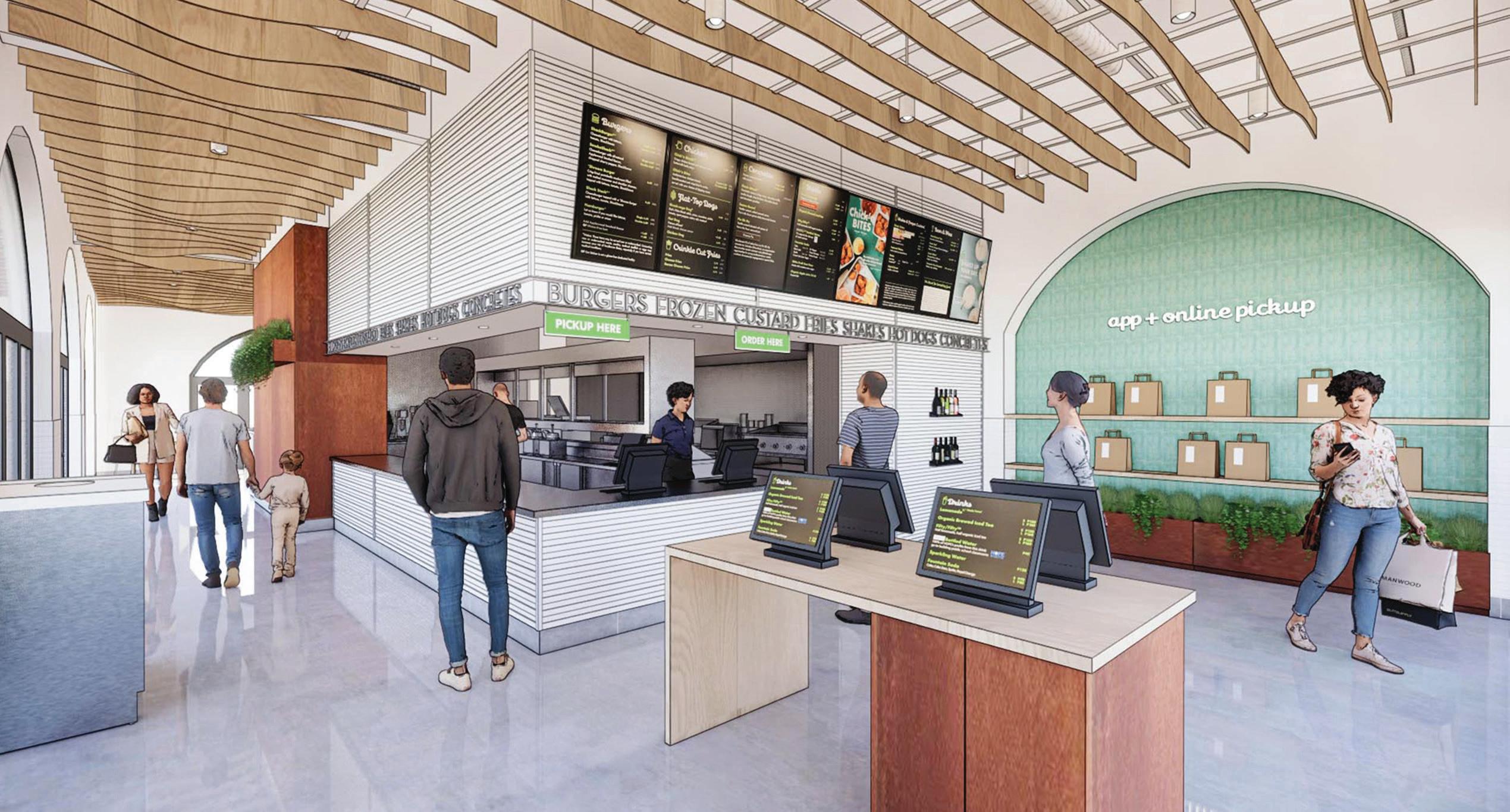
SHAKE SHACK (3) FUTURE OF QUICK SERVICE 68 INDUSTRY-WIDE ISSUE MARCH 2023
SHAKE SHACK HAS BUILDS FOR EVERY NEED AND GUEST, FROM WALK-UP WINDOWS TO KIOSKS TO DRIVE-THRU.

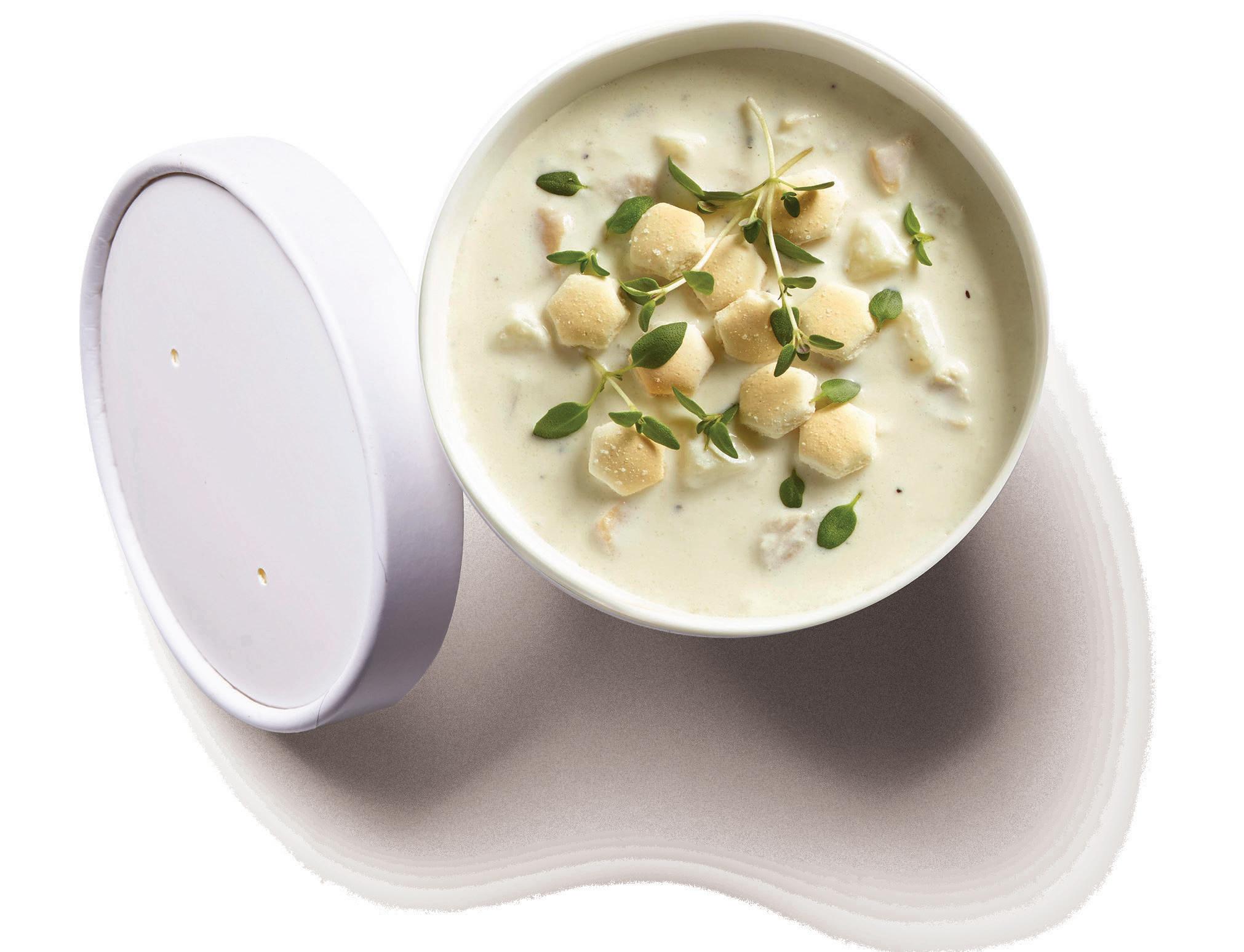
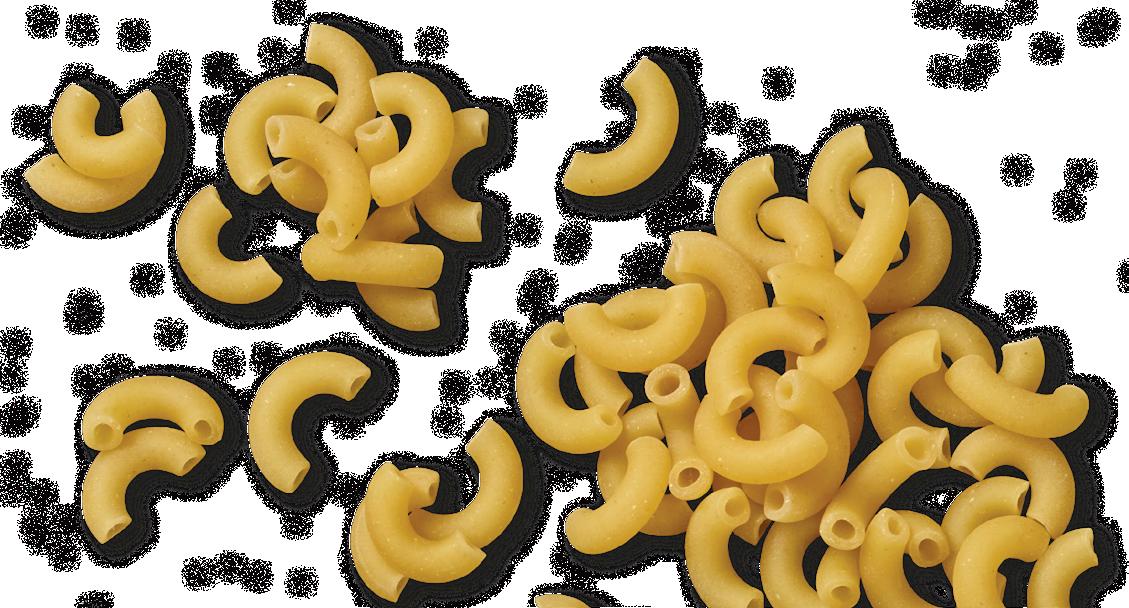
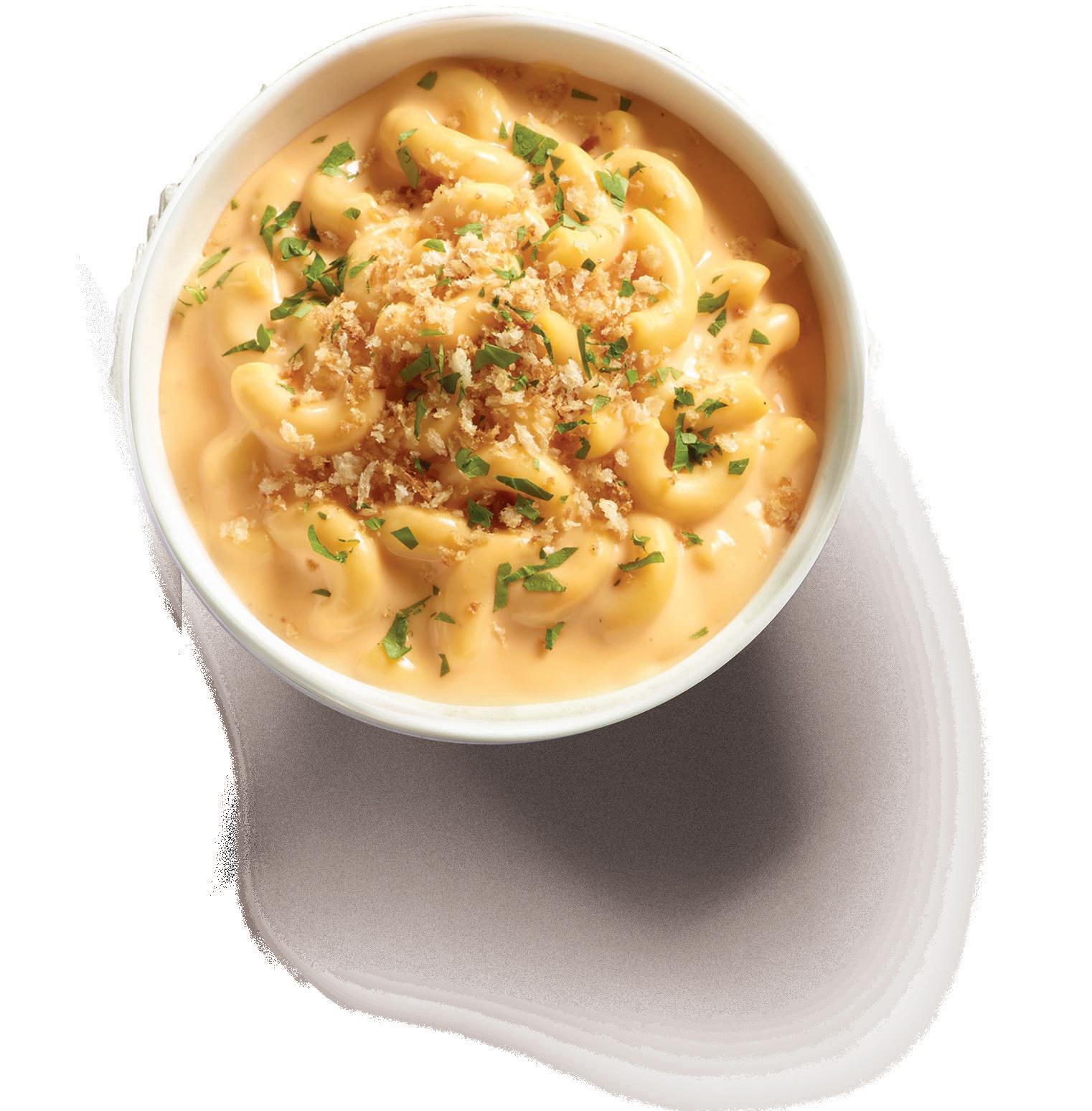
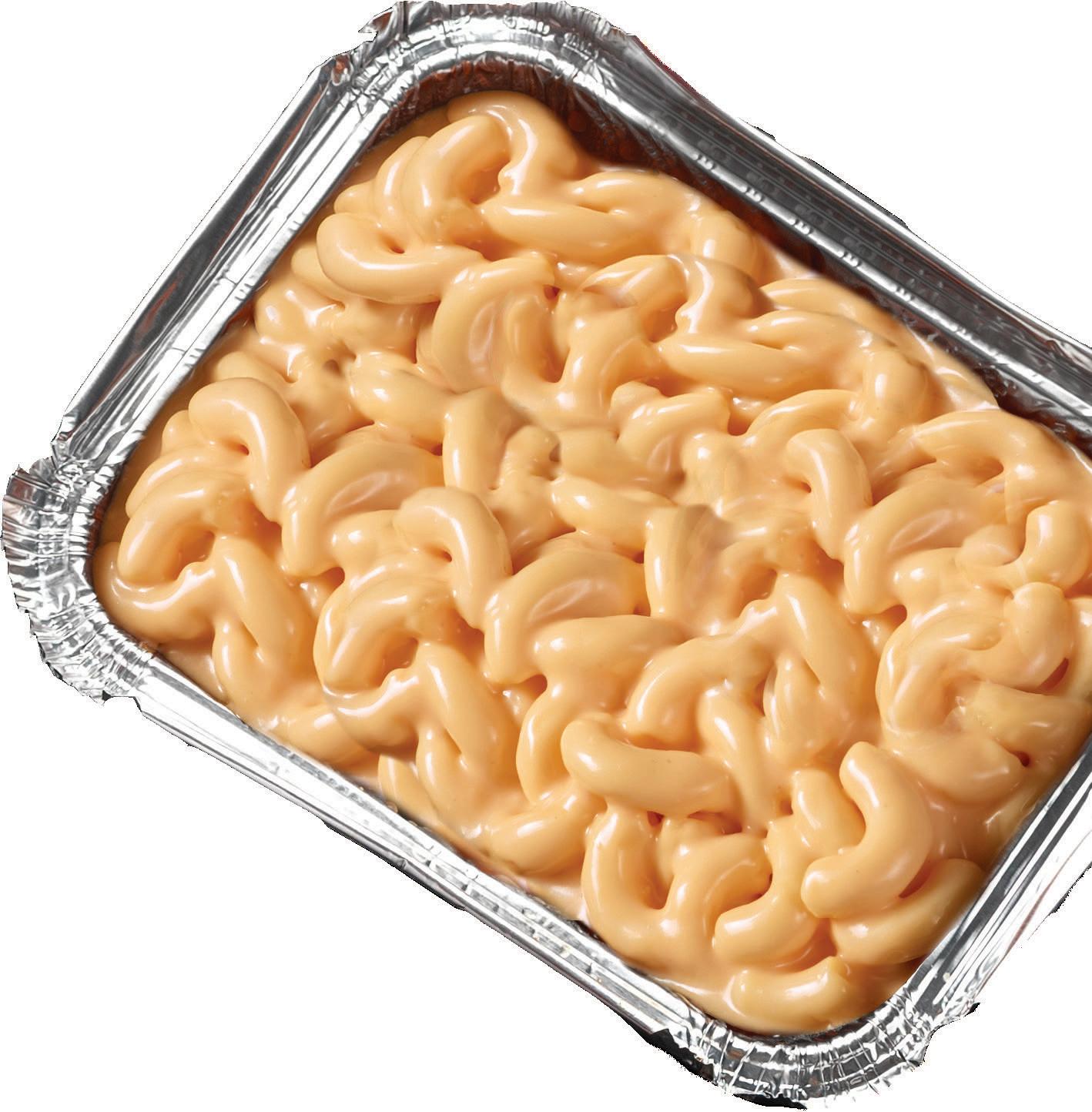
A partner you can count on.
- Our Family of Brands -
blountfinefoods.com/food-service
and page through. Shake Shack saw this translate through orders as kiosk users tacked on premium offerings. Guests viewed LTOs and navigated order flow with upsell throughout. “We’re having a burger, we’re going to have our shake and our fry and our lemonade,” Fogertey noted earlier. “And they can visually see all of that.”
“Our digital team developed a kiosk experience that helps guests navigate our menu and premium add-ons more easily for some than the traditional menu board,” she says. “… Kiosks also help our team members be more efficient and, over the long term, our investments will allow us to expand our digital and omnichannel ecosystem.”
More than anything, it’s become a conversation that considers all parts to the equation. Digital can unlock ways for brands to provide experience through improved levels of access, convenience, and connection. “Hospitality is at the center of everything we do at Shake Shack,” Fogertey says. “That used to be limited to just inShack. Now, with digital tools and more channels, we are focused on delivering hospitality across the omnichannel.”
ONE SIZE DOESN’T FIT ALL
Something that also can’t be disputed about COVID’s harshest stretch, when dining rooms went dark, is that quick-serves discovered labor optimization through digital means.
Zach Flanzman, president and COO of 17-unit Brown Bag Seafood, says, despite the chaos, the fast casual was never as efficient as it was during that rocky period. You could manage an entire operation with three people in the kitchen.
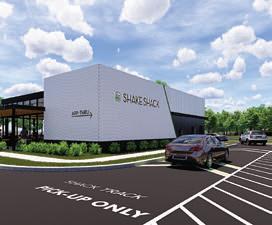
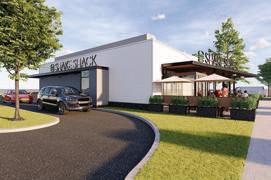
“So coming out of COVID, it’s a hard shift to go back to accepting a higher labor figure when we had gotten used to running things really efficiently,” he says. And that’s not to mention the continual climb in labor costs these days, from what it takes to recruit to hourly pay and broader benefits.
It’s why, Flanzman says, it makes sense for a lot of brands to divest a bit from the in-store experience and let customers have a second-fiddle experience in favor of digital traffic.
“I think, largely, it’s what has created a situation where we now see many brands find their way into a middle ground where they accept the fact the guest experience in-store is not what it used to be,” he says. Some brands, he portends, are even being deliberate about diminishing dine-
in so guests will head to digital channels.
With that in mind, Brown Bag went the other direction. The company has a culture card called “10 out of 10” that’s clear from day one of orientation and throughout training, from dishwasher to manager. It’s an uncomplicated notion that guest experience comes first. Flanzman says Brown Bag consciously, at times, sacrifices financially to make this happen. “Could we take a couple of bodies out of our stores if we were willing to sacrifice that? Absolutely,” he says. “But in general, we still believe the in-store experience is extremely important to maintaining loyal guests and, for that matter, our business flow.”
It starts with a realization that Brown Bag’s dining room is its best customer acquisition tool. If Flanzman wanted to impress a guest, he’d bring them inside and let them experience the circular offering. What the store smells and looks like, how the food presents coming out. The effect is far different than getting a bag dropped off on your doorstep, or even taking food from the counter and racing back outside.
“I trust our team. I trust our operations. I trust the dining rooms. I trust the atmosphere,” he says. “Everything, to actually lend to that experience and enrich it versus just having a quick pickup order.”
On a weekly and monthly basis, Brown Bag measures those “10 of 10” traits and informs teams how they’re doing. Unlike Shake Shack, Flanzman doesn’t see kiosks vibing with what customers expect of Brown Bag. He wants people to be able to grab a laptop and sit down, and know they’ll engage with employees from start to finish of their visit. There’s no assembly line at Brown Bag, so the idea of customers seeing digital orders prioritized isn’t as much a visual concern as it’s an operational one. Brown Bag has settings on its KDS and different ticket time goals for off-premises orders. Employees are trained on prioritization, which generally means third-party delivery or digital orders are placed under in-store. The latter are the only ticket times Brown Bag measures, tracks, and evaluates operations on.
The fast casual’s in-store and off-premises business splits evenly. That’s hardly an easy mix to manage but it comes down to setting the bar where it needs to be set. “It’s a question of, do we care? Or are we OK that the bar has lowered because there are financial benefits of [off-premises] and customers are ordering more online now and most of them don’t care?” Flanzman says. “If
SHAKE SHACK (3)
SHAKE SHACK’S DRIVE-THRUS HAVE HELPED IT SCALE UP IN THE SUBURBS.
FUTURE OF QUICK SERVICE 70 INDUSTRY-WIDE ISSUE MARCH 2023
Brown Bag’s dining room is its best customer acquisition tool. If Flanzman wanted to impress a guest, he’d bring them inside and let them experience the circular offering.
indulgence Take the effort out of
Transforming your vegetable creations into something amazing just got easier. Fire ‘n Ice® fire-roasted individually quick frozen (IQF) vegetables offer sophistication, fresh flavor, and an indulgent culinary experience every time.
Fire ‘n Ice fire-roasted IQF vegetables deliver mouth-watering, artisan appeal that will make any finished product a culinary delight.
Fire-Roasted IQF Vegetables
• Choose from a complete range of vegetables, from artichokes to zucchini
• Create unique customizable blends

• Consistent quality and fresh flavor without preparation costs or food waste
• Ideal for foodservice offerings, plant-based entrées, and better-for-you comfort foods.
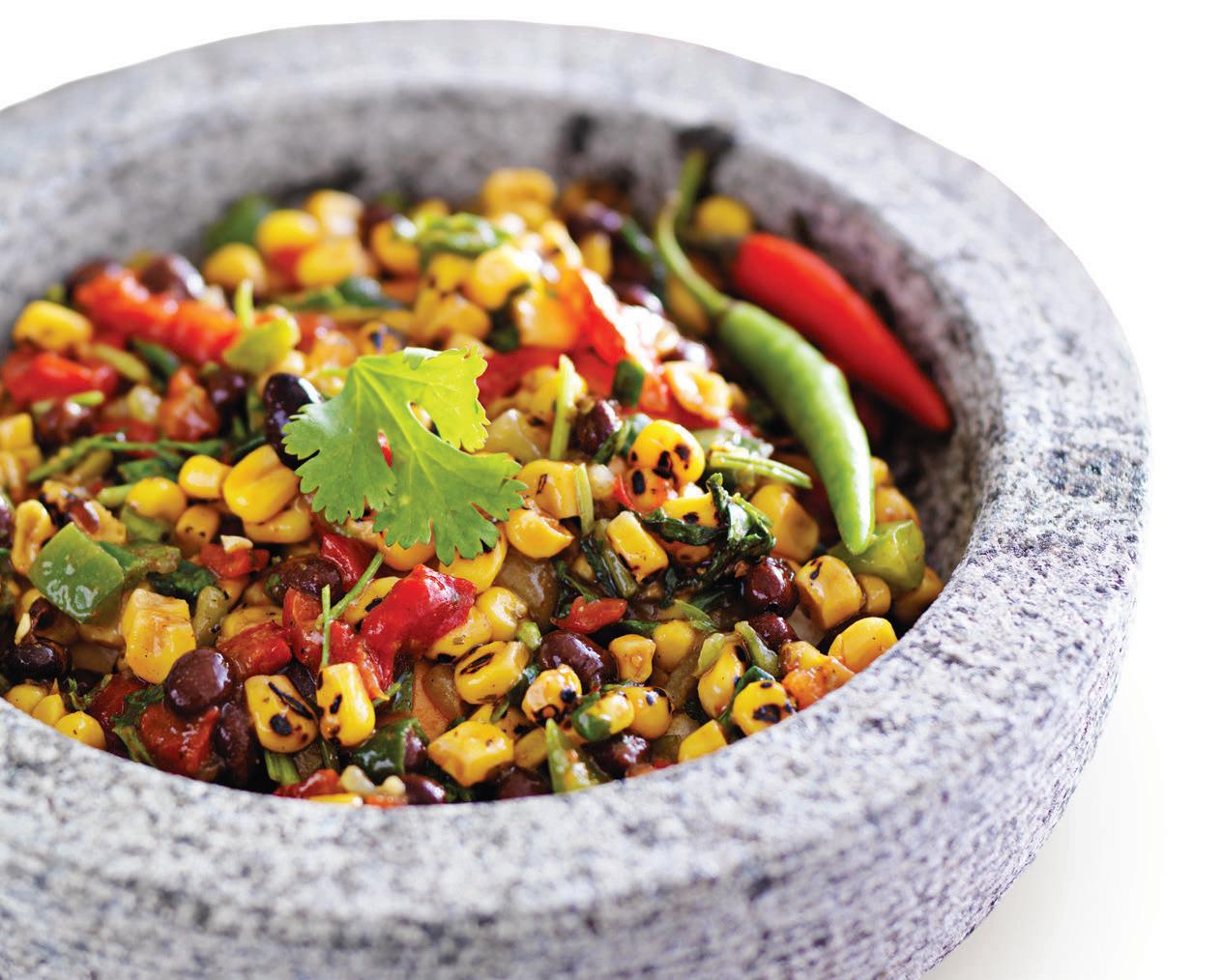
How can we help your product deliver fire-roasted flare?
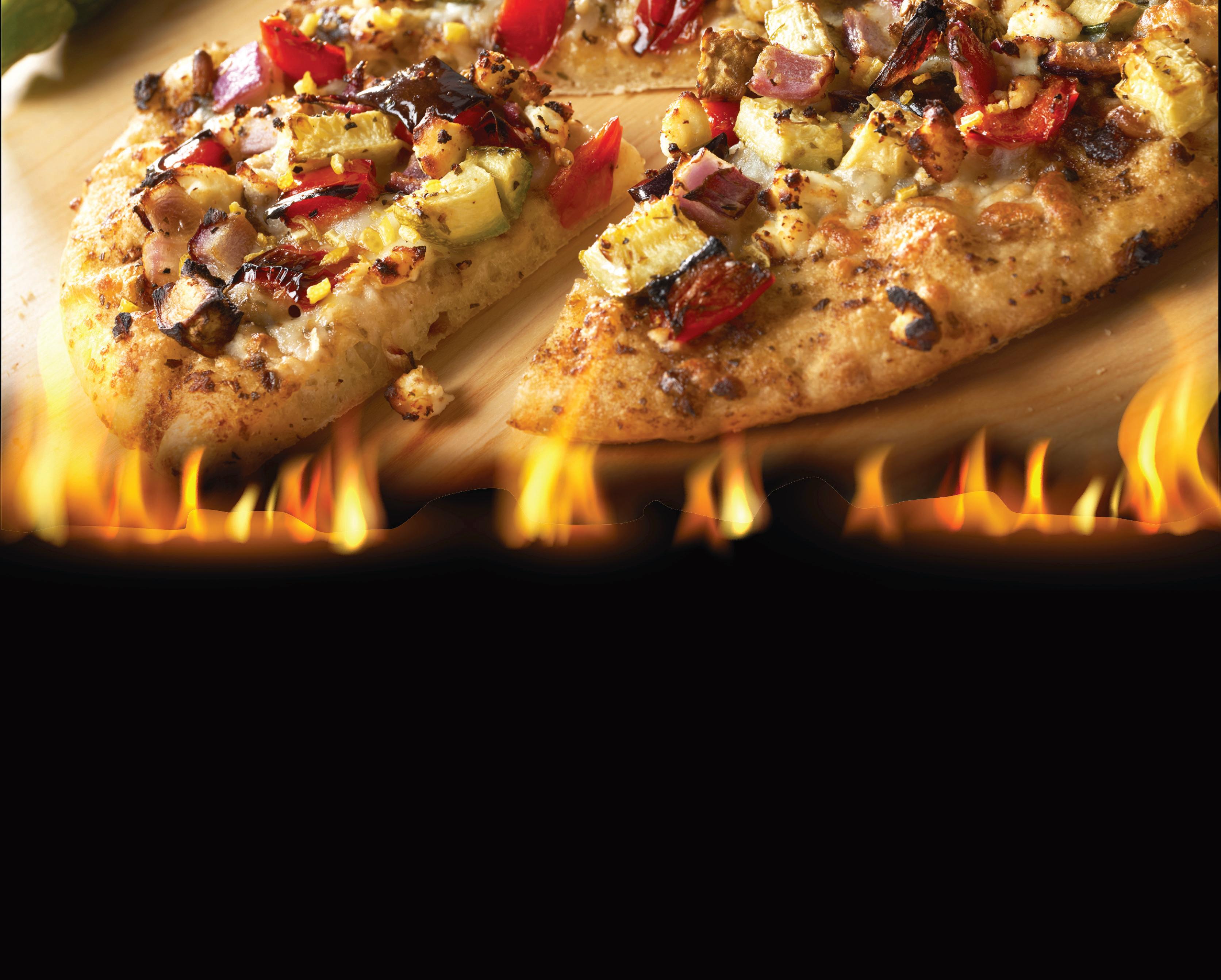
Let’s talk!
vandrunenfarms.com/fire-roasted-vegetables sales@vandrunen.com | 888-452-6853
they come in-store, are we just willing to accept the fact that they’re not? Are they going to have a fantastic experience? Maybe we can give them an OK experience? That’s not how we think about it.”
THE BRAND DNA
One of the defining elements of Roy Rogers is its Fixin’s Bar, stocked with fresh sliced vegetables and other adds. When COVID’s impact pulsed, the brand closed the buffet-style feature and instead allowed customers to request a “Fixin’s Cup” just as they would condiments or napkins.
Roy Rogers co-president Jim Plamondon says the decision was made like so many those days— “I was thinking, ‘how do you get past the next day?’” he recalls.
Plamondon wasn’t sure if it would come back, evolve, stay as a to-go product, or, really, what might await. But accelerate to 2023 and the Fixin’s Bar is alive and well. What this proved to Roy Rogers and countless chains navigating a postpandemic picture is customers might have taken on new behaviors or come to expect others, but many of the reasons they went to restaurants in the first place haven’t changed.
During the pandemic, Roy Rogers’ drive-thru accounted for 100 percent of sales. It dropped to about 70 percent when dining rooms first reopened and is now settling in the high 50 percent range. So in-store represents roughly 30–35 percent of business. Pre-COVID, drive-thru was about 50 percent. While dining rooms aren’t quite where they were previously (you have to factor delivery and pickup into the equation now) it’s unequivocally a noteworthy percentage of Roy Rogers’ take.
A good example? Look at the Fixin’s Bar again. Initially, Roy Rogers opened one side since that’s all guest traffic supported. Both are open today and customers are coming in just to access it.
Plamondon says it’s as clear now as it’s ever been that Roy Rogers’ brand and experience is different from large-scale peers like McDonald’s and Burger King—chains that boasted 70 percent-plus business through the drive-thru lane prior to the crisis.
“We’re still about hospitality. I think that’s what sets us apart. We have higher quality food. And then I think our associates and our people are nicer and continue that relationship with the guest and not just funnel everything through technology,” he says.
Plamondon admits it’s become more difficult
to provide exceptional guest experience amid the labor shortage. Roy Rogers is staffed in the midto high-80s at the hourly level. The brand has ROY
ROGERS / TOM LESSER
FUTURE OF QUICK SERVICE 72 INDUSTRY-WIDE ISSUE MARCH 2023
ROY ROGERS’ FIXIN’S BAR WAS ONE OF THE FIRST THINGS CUSTOMERS CLAMORED FOR WHEN DINING ROOMS REOPENED.
paid signing bonuses for crew members, which it’s never done before—something Roy Rogers stages over time to ensure employees stick around.
For some managers, the brand is paying $3,000–$5,000. “That’s just the way of the world,” he says.
But like Brown Bag, labor is a cost Roy Rogers is willing to dig into its coffers for to ensure it doesn’t blend in with the fast-food field. “We make it a really important point to be able to hire people with social skills. We call it the ‘Spirit to Serve,” Plamondon says.


In October, Roy Rogers lifted the lid on a new design. The model keeps the brand’s nostalgic look but spins modern with natural wood, neutral colors, and warm lightning.


Inside, there’s updated tech, including new electronic menuboards and LED fixtures. Countertops were expanded and some items removed to allow for more drive-thru. Roy Rogers is also implementing digital menuboards in the lane as well.
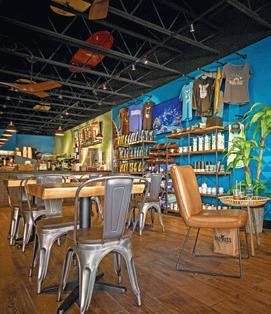
The dining room menuboards have made a big splash since it enables restaurants to advertise the menu according to the daypart. When it was static, units had to showcase breakfast, lunch, and dinner all at once. Now, with digital, they can devote entirely to whatever’s featured ( breakfast in the morning, etc. ) There’s less clutter, more pictures, and an ability to highlight LTOs.
And in another switch seen throughout the industry of late, the new build is smaller inside. Quick-serves are moving toward this scaled-down footprint for myriad reasons. One is the acceptance digital is taking up a larger portion of the business. So a bigger kitchen makes more sense than a larger dining room. The other is to improve ROI and create buildings that can fit on more compact parcels of land. It’s become increasingly difficult for restaurants to chart larger locations since land is more expensive and rarer to come by.
All said, the dining room at Roy Rogers isn’t going anywhere “because of who we are,” Plamondon notes. “And we’ve always had a nicer environment in our dining rooms. And I really mean that. I’m not just saying that this from a brand speak,” he says. “… When we do remodels, we really make sure that the environment is nicer. You see people who are there to engage with one another. You see more groups of people, families.” One hallmark feature is communal tables, which are in every restaurant.
“We feel like our place is more like a bar,” Plamondon adds. “It’s like ‘Cheers,’ where peo-
ple come and spend a little bit more time eating and staying there and using the Fixin’s Bar. It’s just different.”

THE HABITUAL OCCASION ENDURES
Count Scott Snyder, the CEO of Bad Ass Coffee of Hawaii, among those operators who feel the death of dine-in was premature. Need proof? Snyder turns to, of all places, Taylor Swift. Her Eras Tour sent Ticketmaster into shambles, even leading to some fans filing a class-action lawsuit against the company. Regardless of the logistics or controversy, it sent a pretty clear message, Snyder says. “People want to gather again, and in big numbers,” he says. “They want to be with other people. And coffee being such a social and communal sort of product and experience, we think it’s important.”

In no arena is this experience versus convenience query surfacing more than coffee. What does the “third place” even look like anymore? Mobile order and pay and delivery drove 72 percent of Starbucks’ total sales volume in North America in Q4, with delivery accounting for more than 4 percent of sales—up 35 percent year over year. Some 90 percent of new store growth going forward will include drive-thrus.
Perhaps it was coming already, but definitely thanks to COVID, Snyder thinks the “third place” will become a less prominent feature in coffee shops across America. Internally, the Bad Ass team debated what this might mean and why it was unfurling. “What we’ve come up with is there are so many people working from home now that when they come to the coffee shop in the middle of the day, it’s a rest,” Snyder says. “That takes us back to the café, right? They want a place. They’ve got to get away from the computer; get out of the living room or their study. So when they come to the café, it’s a rest, an escape. They want to sit down and enjoy the meal.”
Back in August, the morning daypart was mixing 51 percent at Starbucks, with 65 percent of it occurring before noon, above pre-virus results. That quarter (Q3) marked the fifth consecutive period of positive comps growth in the a.m. But even with routines snapping back and morning occasions returning, it’s clear coffee has evolved from just a habitual segment to one that’s providing the break and indulgent treat Snyder referenced. Case in point—the rocket ship that is cold coffee, which accounted
BAD ASS COFFEE OF HAWAII (4)
“People want to gather again, and in big numbers,” says Scott Snyder. “They want to be with other people. And coffee being such a social and communal sort of product and experience, we think it’s important.”
BAS ASS COFFEE HAS A LOT OF RUNWAY AHEAD, AND THAT INCLUDES BUILDS WITHOUT DINING ROOMS AS WELL AS THOSE WITH THEM.
FUTURE OF QUICK SERVICE 74 INDUSTRY-WIDE ISSUE MARCH 2023 {CONTINUED ON PAGE 117}
SCOTT SNYDER
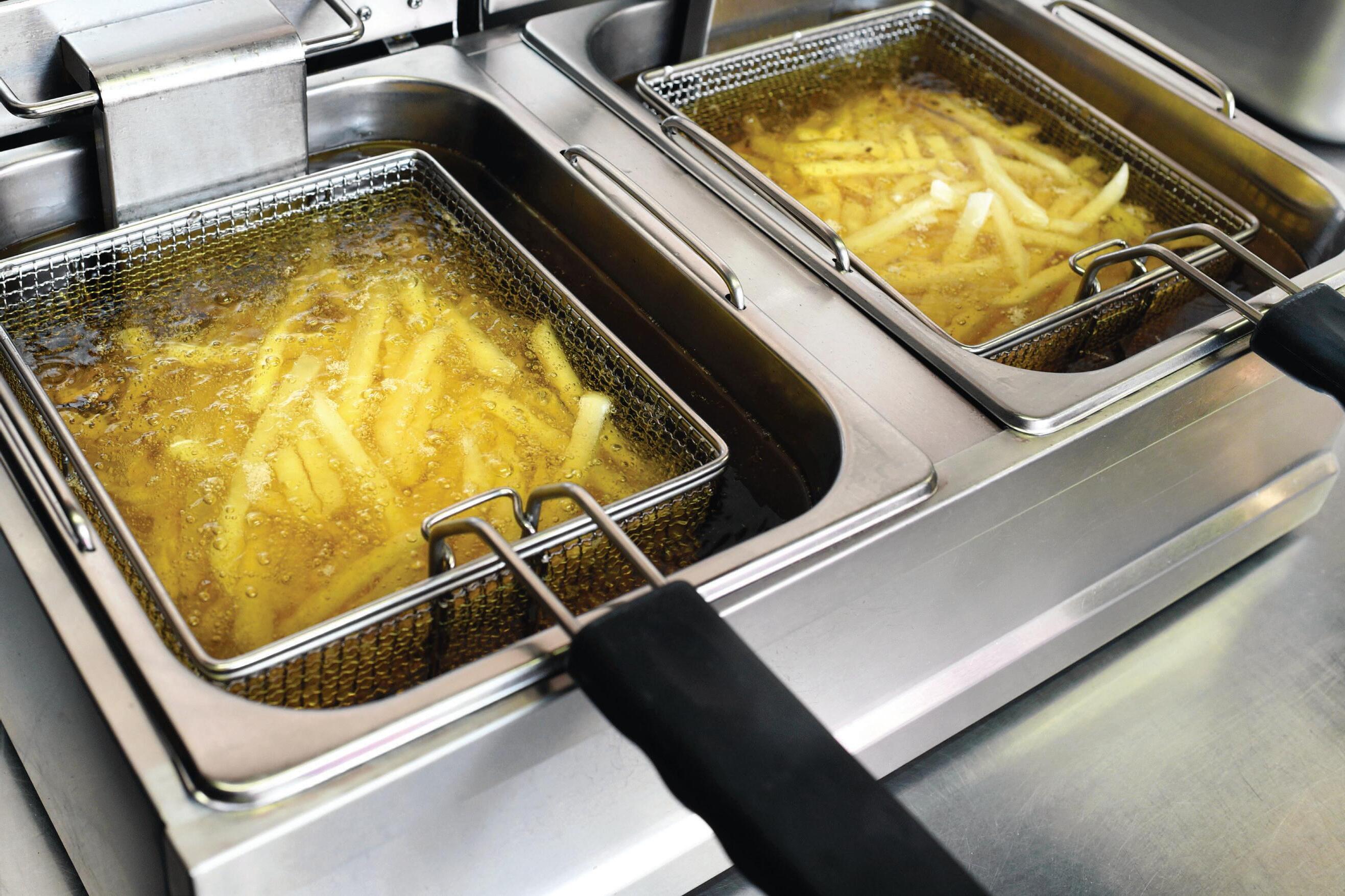

®
NextGen Casual Blurs Lines and Breaks Rules
/ BY CALLIE EVERGREEN
NextGen Casual Blurs Lines and Breaks Rules
NextGen Casual Blurs Lines and Breaks Rules
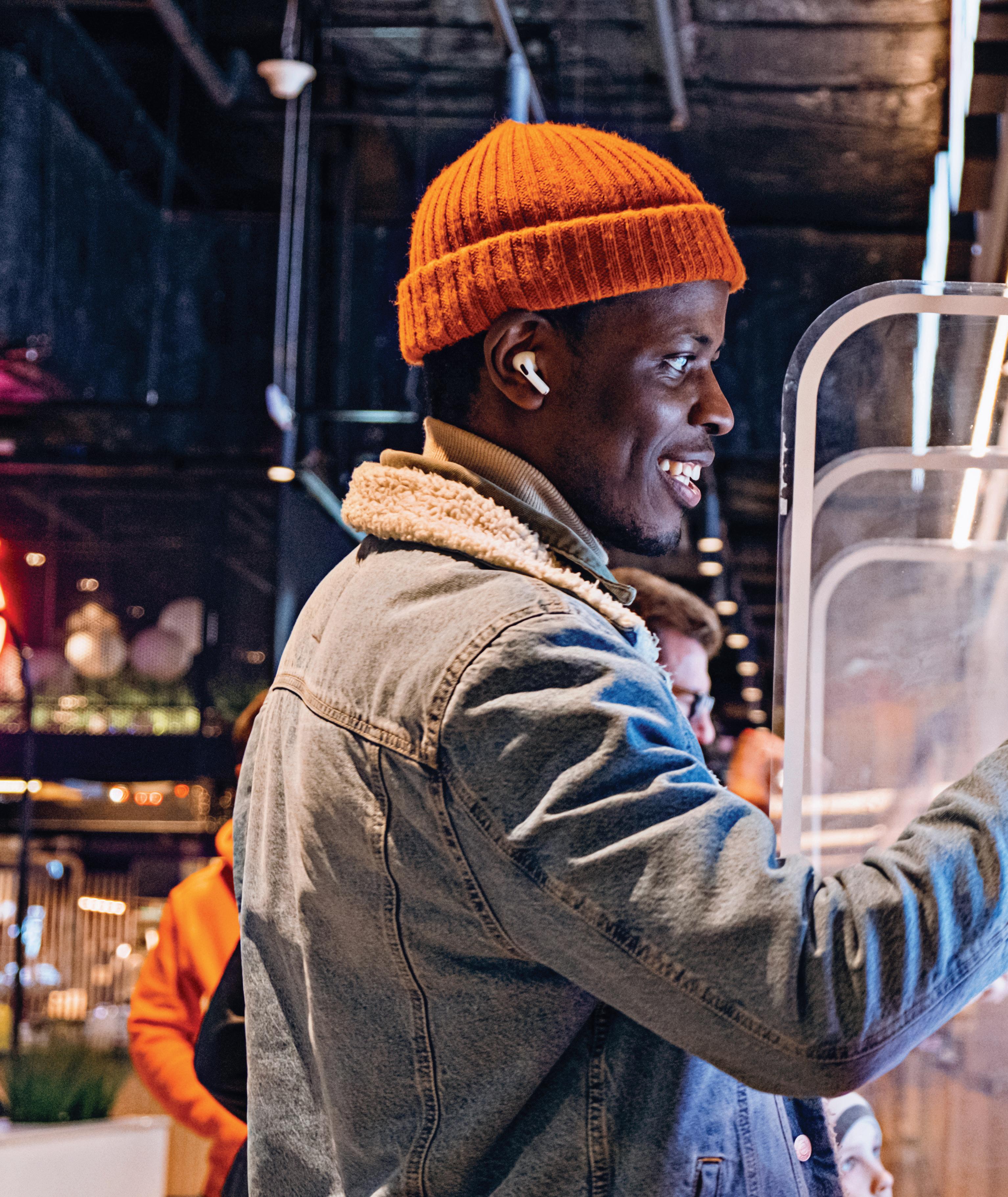
QSR FSR 76 INDUSTRY-WIDE ISSUE MARCH 2023
From drive-thrus and QR codes to virtual food halls, the lines dividing full-service restaurants from fast-casual and quick-service concepts continue to blur, as the next generation of restaurateurs adapt to the new waves of tech and convenienceseeking customers.
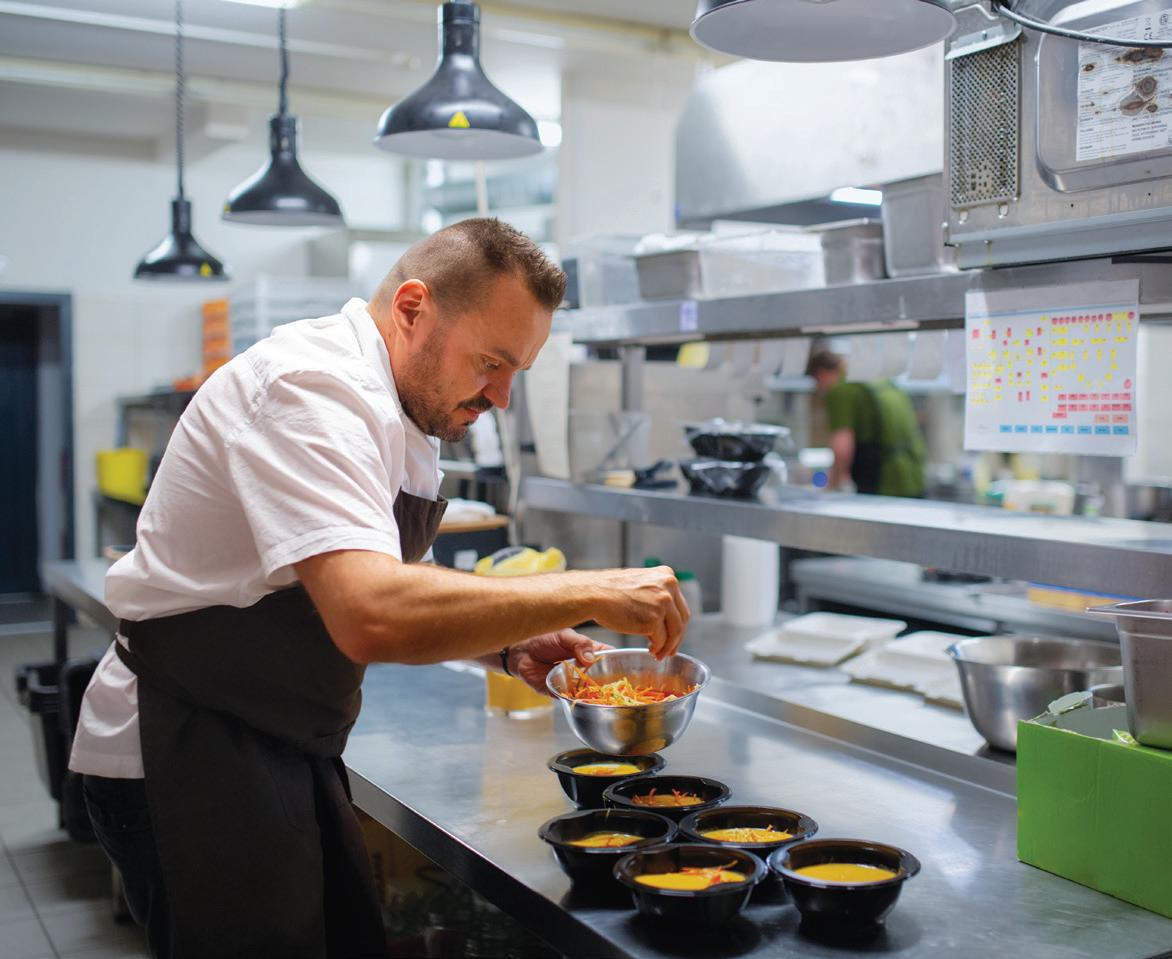
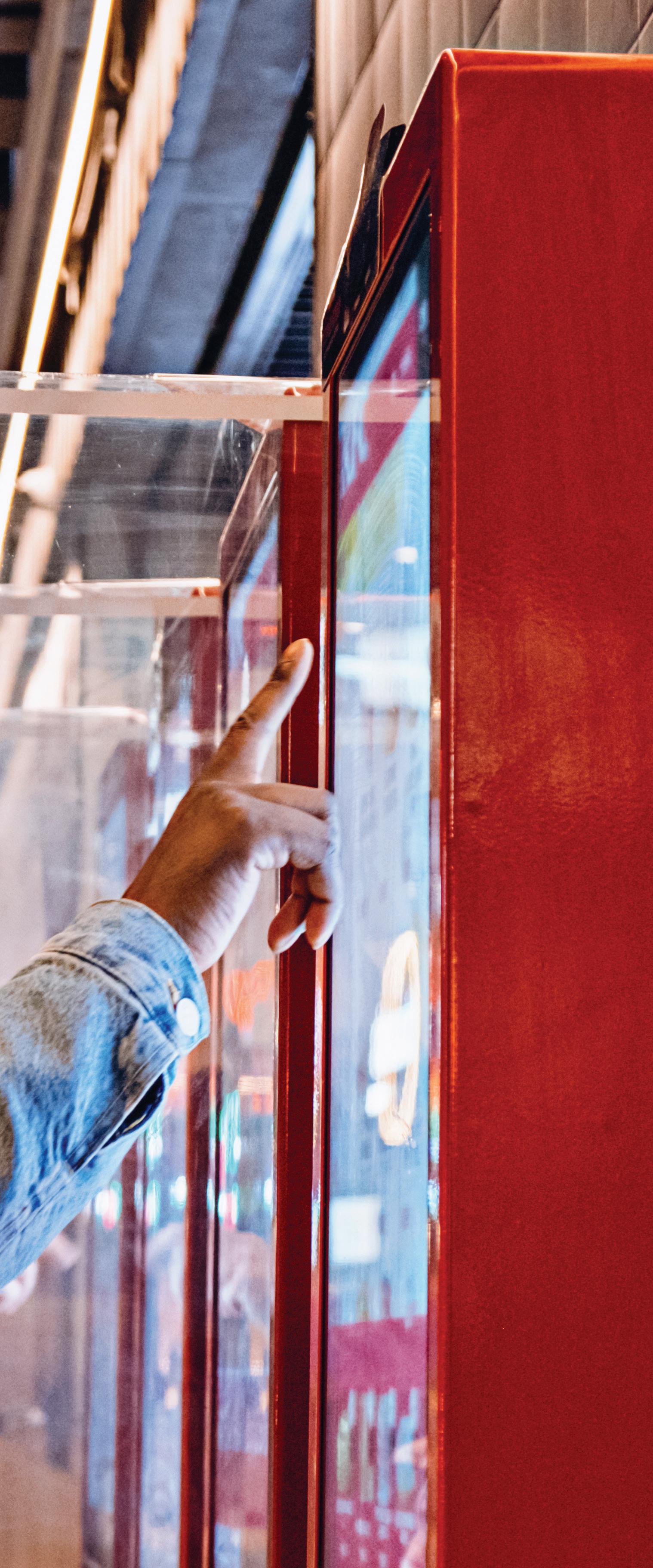
Rules Rules Rules Rules
Learn the rules so you know how to break them properly, so the saying goes. What was once basically taboo for traditional full-service restaurants—like integrating drive-thrus and other off-premises channels into operations—became essential during the pandemic to survive. And the restaurants and executives who come out on top aren’t lagging behind in trends, but are leading the way for others to follow.
NEXTGEN CASUAL
SELF-SERVICE KIOSK: ADOBE STOCK WIFESUN, CHEF PREPPING TAKEAWAY BOWLS: ADOBE STOCK HALFPOINT MARCH 2023 INDUSTRY-WIDE ISSUE 77
Investing in and implementing the latest technology—or not doing so—is one of the key differences separating NextGen Casual restaurants from competitors. Smokey Bones Bar & Fire Grill, an affiliate of Sun Capital Partners with more than 60 locations across 16 states, is one such example. Since 2020, the casual-dining chain more than doubled its off-premises business, launched two virtual brands, opened two ghost kitchens, and added its first drive-thru in 2022.
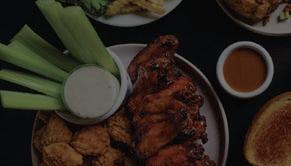
“We made a lot of tech investments to drive business and be an innovator says James O’Reilly, a former and Sonic Drive-In executive, ida-based Smokey Bones in array of benefits, those investments importantly led to an improved guest experience.
The guest experience was the driving factor for Smokey Bones when first considering implementing a drive-thru, O’Reilly says, as it asked itself how the majority of restaurant guests want to access off-premises.
“Nobody ever said casual dining can’t [ have drive-thrus],” he says, “so obsessively focusing on the guest and taking more of an outside-in view leads you to thinking, from a guest point of view, why wouldn’t a drive-thru be a good idea?”
In addition to increasing digital orders, a purposefully designed off-premises operation also improves the on-premises experience, since it leads to less interruptions from delivery drivers walking in when a guest is inside trying to enjoy their meal, O’Reilly notes.
The virtual brand world emerged as another large growth opportunity for Smokey Bones to explore. In October 2022, it launched BiteHall, a virtual food hall concept that took five brands— Smokey Bones, The Wing Experience, Burger Experience, plus two new virtual brands, Bowl Market and Tender Box—and combined them under one umbrella and website.
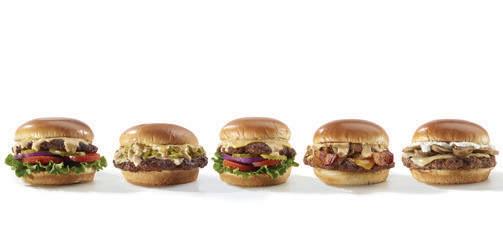
The idea stemmed from thinking about the guest experience (sound familiar?), and in this case, multiple guests who may not want to eat the same thing for dinner or have multiple delivery charges. BiteHall has one ticket, one delivery fee, and one service fee.
“We’re designing it to be an Amazon-like experience, where you can cross shop from different brands with different menus,” O’Reilly says. “It’s really exciting, and I believe it’s in its absolute infancy.”
BiteHall took a year to develop, and O’Reilly’s
team started by looking at what menu categories could drive growth from a guestfacing standpoint while being relatively easy to execute in restaurants—without overcomplicating operations, importantly. For example, BiteHall would not add a virtual pizza brand at this point, since they don’t have pizza ovens restaurants, operators preparing protein-based entrees, which is the majority of our business. Meat is what we do,” he says, which led to Burger Experience and The Wing Experience. “There’s no other restaurant chain that has 50 flavors for wings.”
Chicken-centric Tender Box, meanwhile, offers crowd-pleasing combos such as chicken and waffles, chicken and donuts, and Carolina dipped tenders.
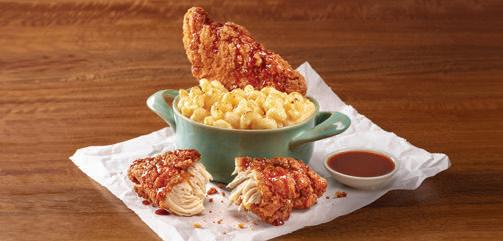
“The way we’re managing it from the back of house and BiteHall standpoint allows us to efficiently execute all these items without compromising,” O’Reilly adds. That meant investing in back-of-house technology to essentially create a mini kitchen line with a dedicated flow for virtual brands, separate from dine-in entrees.
Changing off-premises packaging to BiteHall branding was an easy simplifying solution, and also allows for cross-promotion by featuring the logos and brief descriptions of all BiteHall brands. DoorDash Drive is the company’s fulfillment partner for all off-premises orders, though Smokey Bones does some in-house delivery for its catering business.
While on-premises orders comprised 80 to 90 percent of business in 2019 when O’Reilly joined, the brand has now grown its off-premises platform to nearly 50 percent over three years. And based on the early consumer response to BiteHall, O’Reilly plans on investing more into the platform in 2023.
“The blurring of the lines has been more of an outcome than a goal in and of itself,” O’Reilly says. “If trying to make a virtual brand experience less complicated for restaurants and for guests,
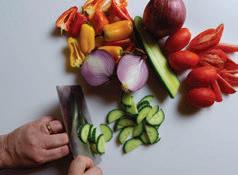

NEXTGEN CASUAL SMOKEY BONES BAR & FIRE GRILL BITEHALL (2) ABOUT US OUR BRANDS FEATURED BITES ALL THE BITES IN ONE SITE
78 INDUSTRY-WIDE ISSUE MARCH 2023
VIRTUAL BRANDS REMAIN A POWERFUL TOOL FOR FULL-SERVICE OPERATORS TO REACH OFF-PREMISESFOCUSED GUESTS.
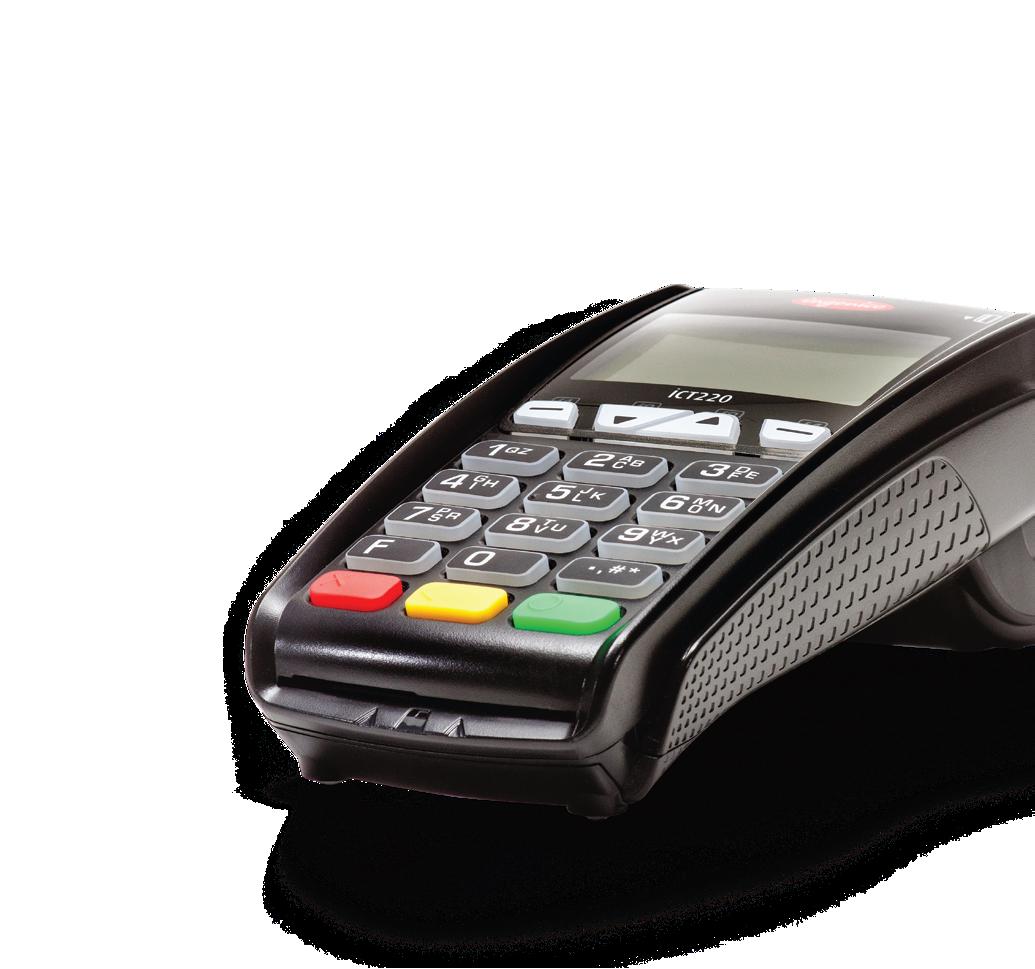
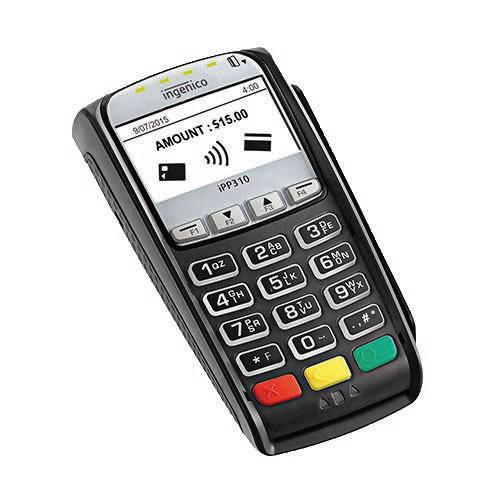
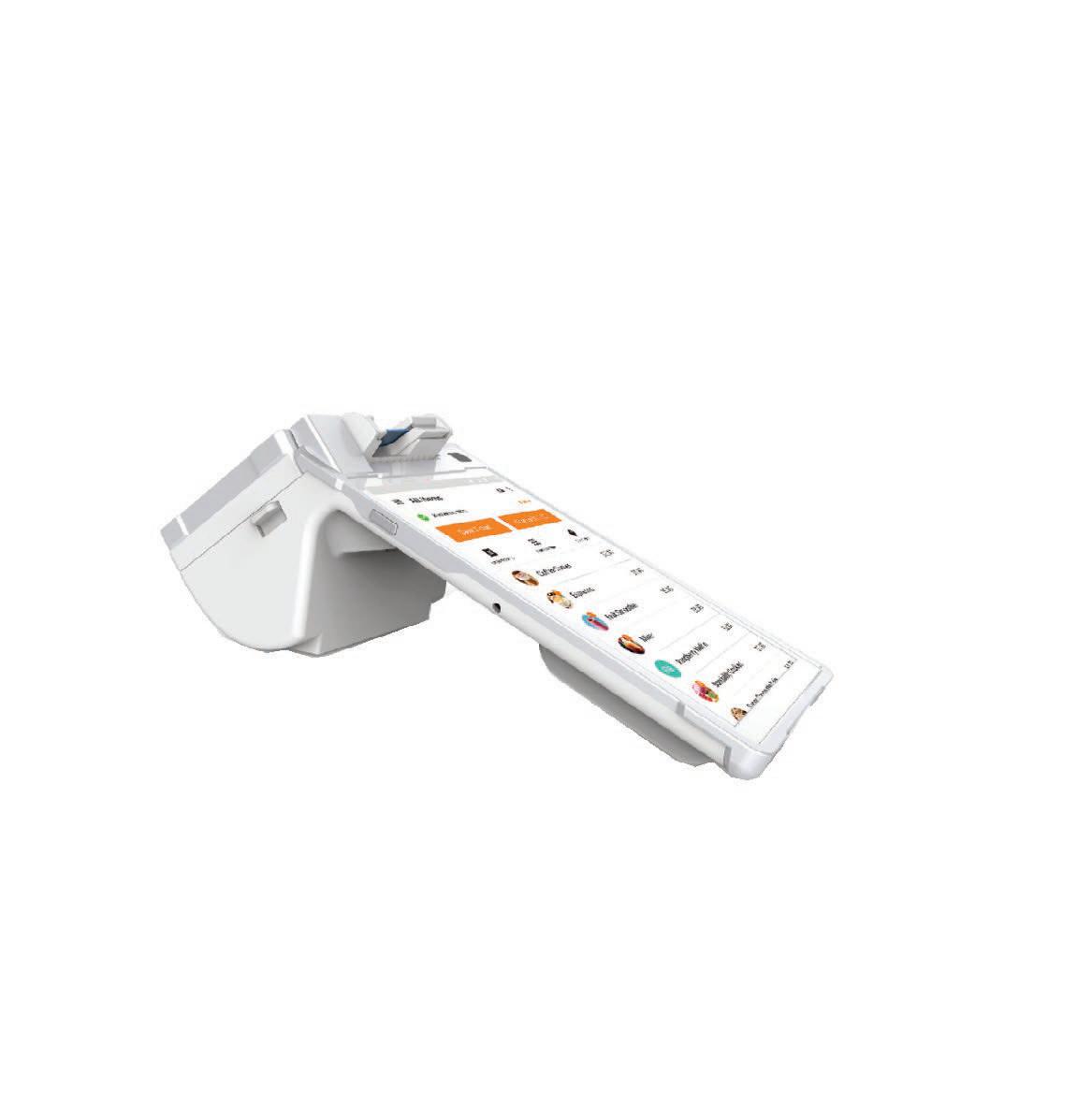

• FREE NFC & EMV-Ready Terminal & Pin Pad or wireless terminal. • Accept payments in-store, online, or on-the-go. OPTIONAL PROGRAMS: EDGE: The Best CASH DISCOUNT PROGRAM from North American Bancard Are you ready to get rid of the impact of payment processing costs on your business? With the Edge Cash Discount program you will enjoy the same profit margins from cash payments as you do from non-cash payments. • Point of Sale Systems Recommendations, Solutions & Integrations • Accept EBT/Snap Low Transaction Fee Accept EMV/NFC (Apple Pay, ETC.) EBT, Snap, Checks and more Next Day Funding with weekend settlement Rates as low as .05%* REDUCE YOUR CREDIT CARD PROCESSING FEES FREE Credit Card Terminal Placement Wireless/Landline/High-Speed/Dial-Up Easy setup (with no setup fees and quick approvals) Seamless integration with your current POS $295** towards your early termination fee (if you have one) with your current processor Access to Payments Hub - our secure, online merchant portal Free paper** GROW YOUR BUSINESS. PARTNER WITH NAB TODAY! 866.481.4604 © 2022 North American Bancard, LLC (NAB). All rights reserved. NAB is a registered ISO of BMO Harris Bank N.A., Chicago, IL, Citizens Bank N.A., Providence, RI, The Bancorp Bank, Philadelphia, PA, and First Fresno Bank, Fresno CA. American Express may require separate approval. *Durbin regulated Check Card percentage rate. A per transaction fee will also apply. **Some restrictions apply. This advertisement is sponsored by an ISO of North American Bancard. Apple Pay is a trademark of Apple. WWW.NYNAB.COM INTEGRATE WITH YOUR POS
then we’ll do that. If providing guests with more choices is what they want, then that’s something we can do.”
FINDING EFFICIENCIES, GIVING PEOPLE TIME BACK
bartaco, a 26-unit upscale street taco and cocktail concept based in Arlington, Virginia, has always prided itself on a simple service model. In 2010 when the first restaurant opened, customers ordered by filling out a paper card like a sushi order, since most consumers were ordering four to five small bites.
When the pandemic required a more touchless ordering format, bartaco began playing around with a feature on Olo, a New York Citybased company that develops digital ordering and delivery programs for restaurants, to create a QR code menu.
During bartaco’s busiest months in the spring and summer, peak patio season, restaurants would often have two-hour wait times. After implementing the new ordering method, the restaurant discovered food and drinks were moving significantly more quickly to tables, and guests appreciated the ability to continue ordering food whenever they wanted at the tap of a screen. And when tables turn faster and check averages go up, both customers and staff reap the rewards.
“It really resonated with customers. They liked the idea of on-demand hospitality, which is what we call it,” says Scott Lawton, CEO and cofounder of bartaco. “It also gave us a really scalable labor
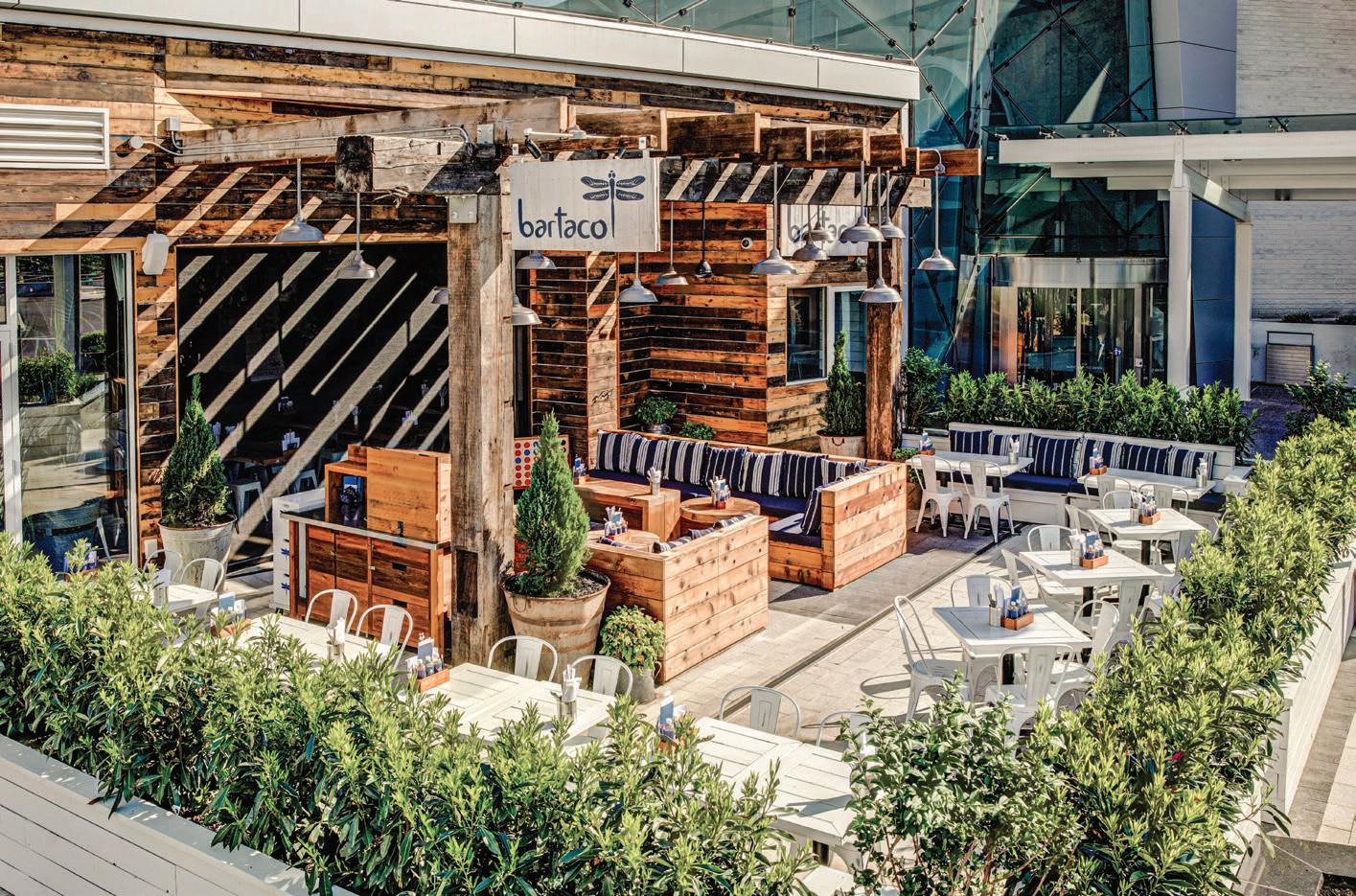

model, so that we can actually invest more in the people who are taking care of our customers in different ways, just by removing the remedial task of a waiter walking to tables and taking orders.”
Investing more in people isn’t just talk for Lawton, who raised wages for staff—including the back of house—to anywhere starting from $19 up to $36 an hour after tips. While many restaurant executives complained of so-called lazy younger generations and not being able to find any workers, one bartaco unit had a backlog of more than 2,000 job applications in the fall of 2022.
“Their lives changed. Some stopped working two jobs and were able to spend more time with their kids, and there’s no going back from that,” Lawton says. “We’re super proud of the fact that a dishwasher at our company makes $55,000 to $65,000 working 40 hours. We created a living wage, which is a big part of NextGen. We gave people time back.”
As the pandemic waned, bartaco found customers still craving human interaction and hospitality, which led them to creating a new manager position. At a prototypical bartaco that seats about 180 customers, six service leaders divide up the dining room in zones, making sure touch points are happening and guests feel taken care of.
And with 90 percent of customers ordering at tables on their mobile devices, the opportunity opened up to capture more data and continue customizing guest experiences. About an hour after dining at bartaco, guests receive a survey with five questions about their experience. If they fill it out, they receive a “taco token,” or a virtual free taco that goes into their virtual taco wallet, Lawton explains. That basically just means the next time they go to bartaco, they get a free taco.
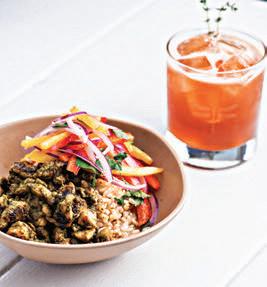
“It’s a thank you for giving us the feedback and encourages you to come back again, so we think it’s worth it,” he says. “We don’t want to use the data in a way that we feel annoying to customers, constantly poking them, getting them to do things. We want to figure out how we can let the digital relationships be a continuation of the relationship we have with them in the restaurants, which is very genuine.”
bartaco receives a report each day that scores every service leader based on guest feedback—with as many as 200 responses from tables per day— which determines leader bonuses and allows the brand to aggregate data to see trends and new opportunities. After instituting the measuring tool in June 2022, customer sentiment increased
BARTACO (3)
BARTACO’S QR CODE MENUS HAVE UNLOCKED LABOR EFFICIENCIES IN MYRIAD WAYS.
NEXTGEN CASUAL 80 INDUSTRY-WIDE ISSUE MARCH 2023
SCOTT LAWTON

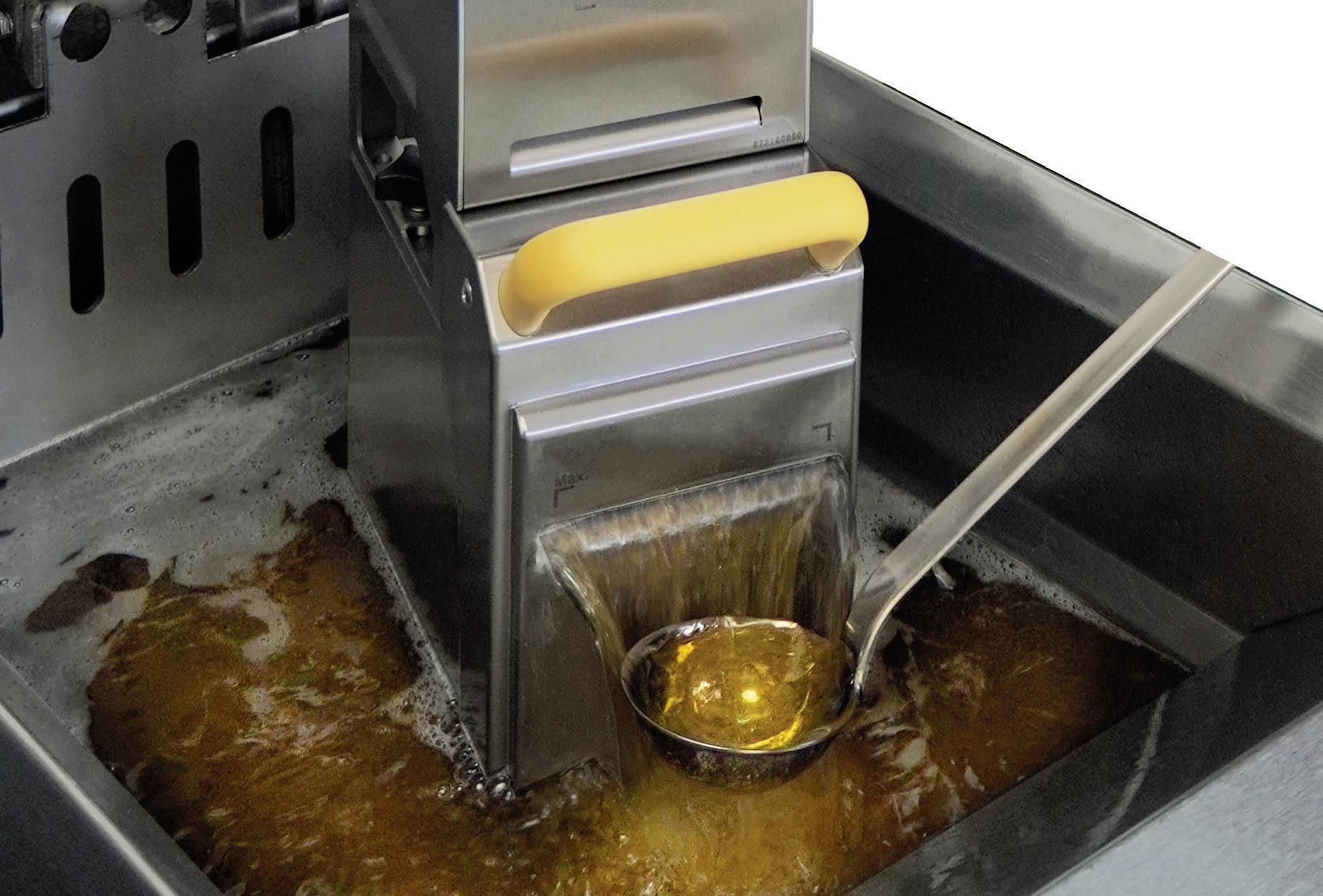
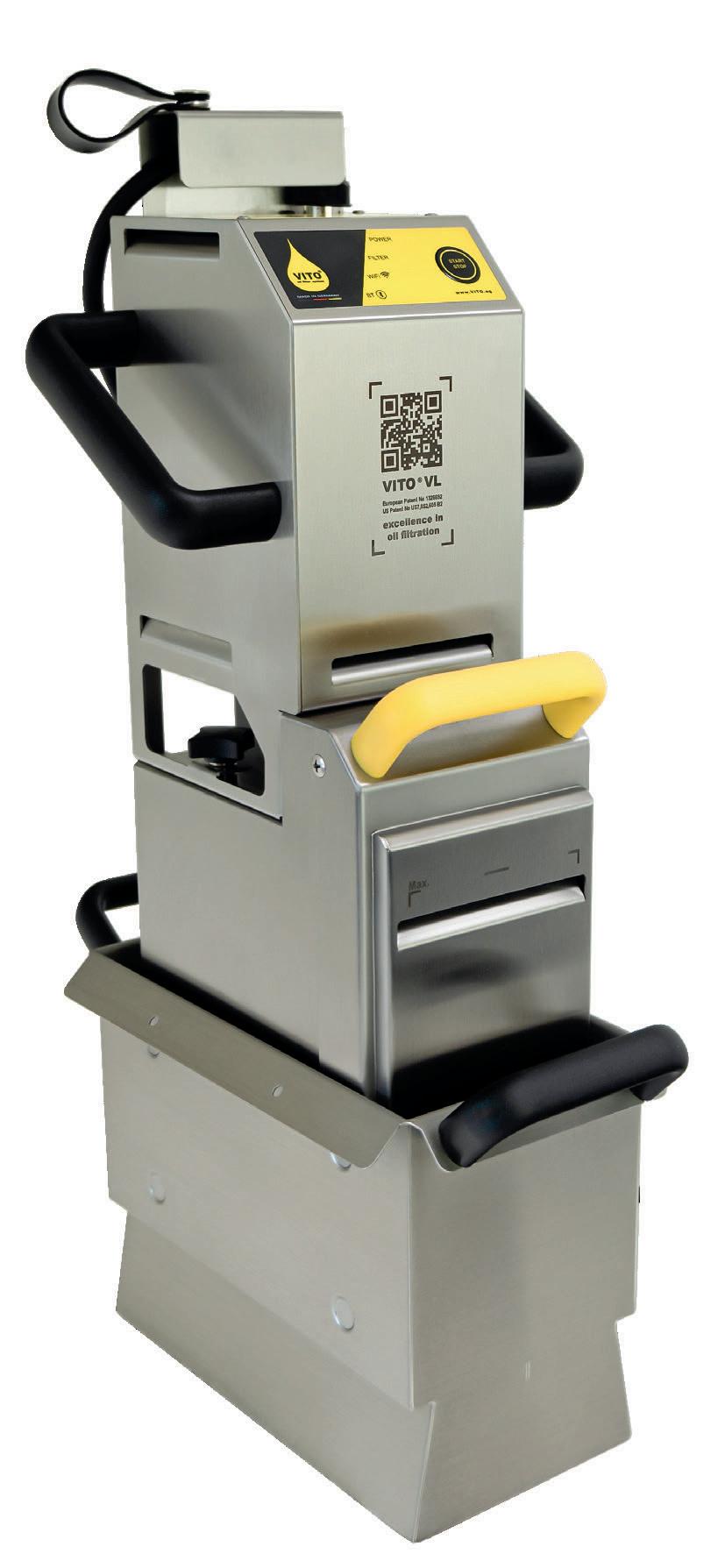











VITO Fryfilter, Inc. 847-859-0398 | info@vitofryfilter.com | www.vitofryfilter.com VITO oil filter system Ensure optimal oil quality Highest safety at work Less workload Save up to 50% of your frying oil AWARD WINNING PRODUCT - START BENEFITING NOW! Excellence in oil filtration - proven by over 50,000 satisfied customers
25 percent within two weeks.
bartaco also polled about 50,000 customers last year to get a pulse on how they liked the service style pivot and found 86 percent preferred their format compared to casual full service— which shocked Lawton, he admits.
“There’s still a big place for a full-service, white tablecloth experience where the phone gets put away,” Lawton notes. “I think there’s always a place for that. But I do think there is this sort of interesting area that’s between quick service and full service that exists for the right brands and the right clientele, which is getting bigger and bigger, where they can have an elevated, experiential meal that also leverages digital in order to keep it affordable.”
Chris Artinian, CEO of 40-unit Condado Tacos, agrees with Lawton’s assessment. As another taco- and margarita-centric concept, Columbus, Ohio-based Condado Tacos learned to carefully thread the needle between creating a high-quality destination spot and marrying that with convenience.
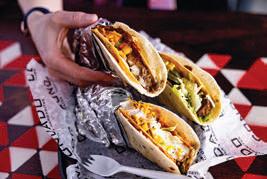
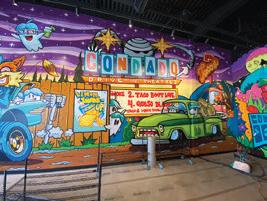
“It’s such a new way to think about dining, being a full-service restaurant that can create an excellent dining experience, but also a fast to-go experience with high speed and accuracy,” Artinian says. “Not everyone has been able to create that and meet the needs of guests on both fronts. We’re seeing more brands trying to break through that opportunity, and it’s easier said than done.”
Boasting a 37 percent mix of spirits and beverages within in-house dining, Condado leans heavily on marketing itself as a go-to social destination to meet friends and grab drinks on Thursday, Friday, and Saturday nights. Graffiti art made by local community members covers the walls of the light-hearted restaurant, while upbeat music (and plenty of flowing booze) create a fun atmosphere.
“Given our price point and with all the things going on with the economy, we’re still really approachable. We say we’re the best time you can have for under $20,” Artinian says. “Most fast-casual locations don’t have a vibrant beverage scene.”
Every quarter, the restaurant launches a new featured beverage, taco, and dip to keep the experience fresh for customers, who can choose from a myriad of order and pickup options. Growing exponentially year-over-year, off-premises orders currently mix about 30 to 35 percent of Condado Tacos’ overall business, Artinian says.
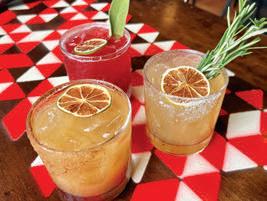
“Leveraging the use of various different tech-
nologies available and implementing them quickly, we were able to create an excellent option for guests to choose us in an alternative way than dining in, but also for a quick lunch or dinner on the way to the soccer field,” he says.
Yet, Artinian also highlights the importance of hospitality and friendly interactions with guests as a key defining factor of being a NextGen Casual restaurant. At Condado Tacos, that culture is driven by celebrating staff members’ individuality by not requiring them to wear uniforms.
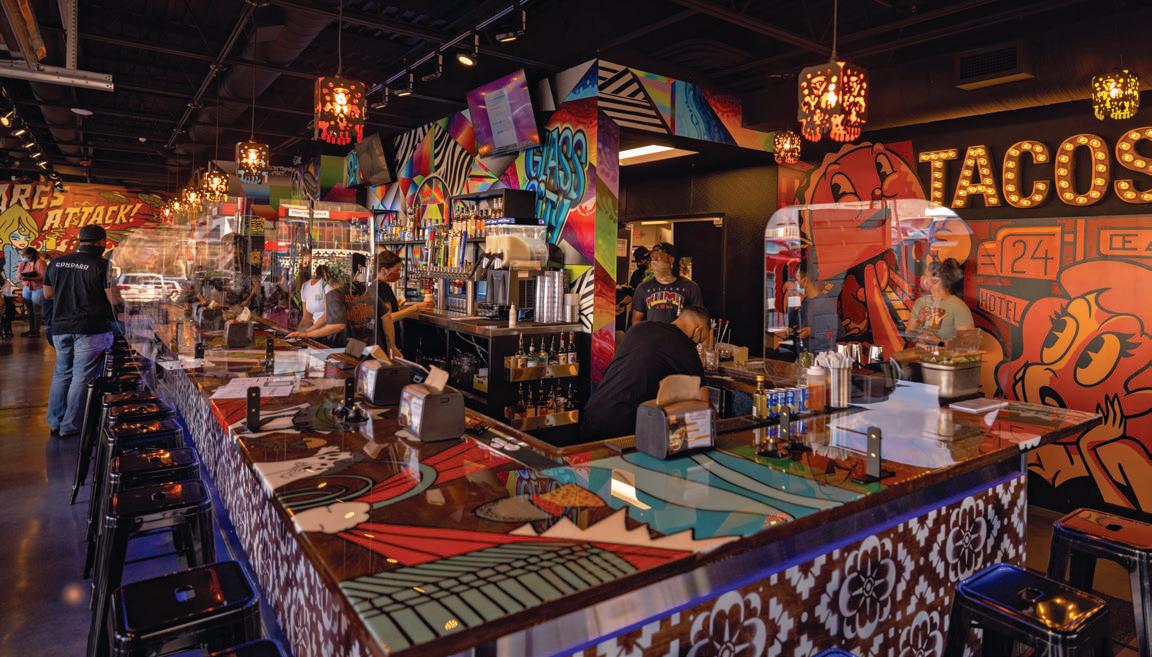
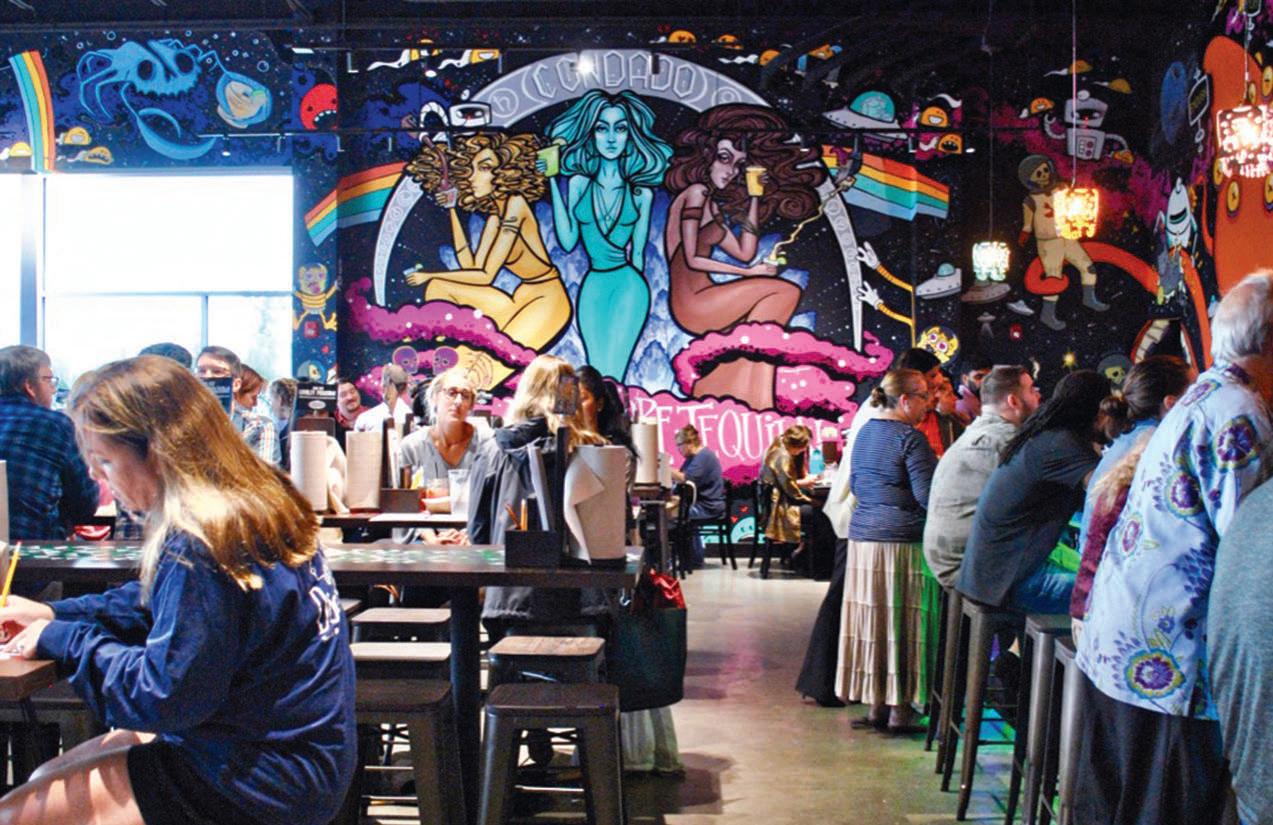
“It allows folks to be themselves,” Artinian notes. “We’re in hospitality; it’s supposed to be fun, and teams really appreciate that part, come as you are. It translates to our guests and helps in attracting better talent and great people in turn.”
As new technology emerges and consumers continue craving more convenience, restaurateurs of the future will continue evolving to meet the next generation’s speedy expectations, yet also deliver noteworthy experiences.
CALLIE EVERGREEN IS THE EDITOR OF FSR. SHE CAN BE REACHED AT CEVERGREEN@WTWHMEDIA.COM.
CONDADO TACOS (4) NEXTGEN CASUAL 82 INDUSTRY-WIDE ISSUE MARCH 2023
CONDADO TACOS PRIDES ITSELF ON BEING ABLE TO SERVE GUESTS QUICKLY, OR OFFER THEM A LONG VISIT IF THAT’S WHAT THEY SHOWED UP FOR.
over 180 with endless possibilites
Spices& Seasonings discover

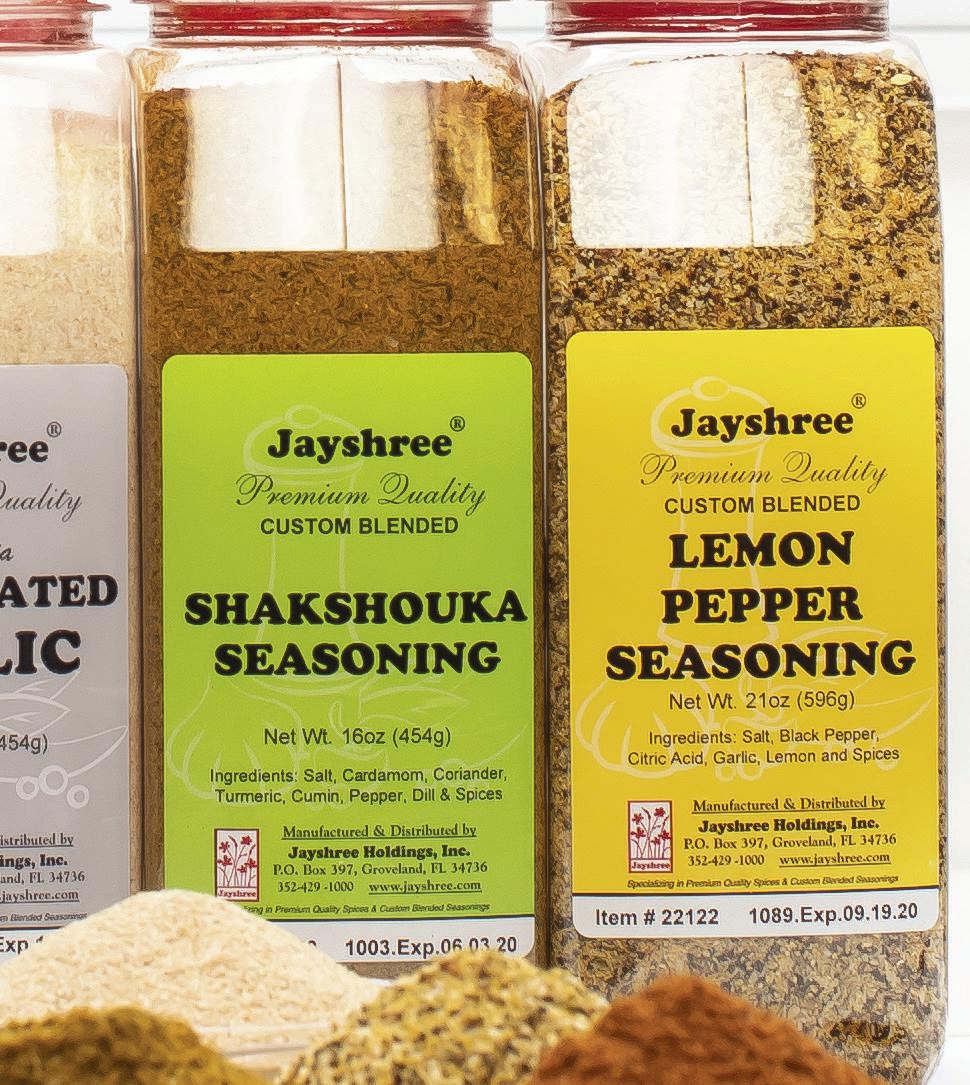
Chefs count on the quality and freshness of our spices when creating their unique menus.
Over 180 Spices and seasonings, including custom blends, made from the freshest herbs, hand-selected from around the world.
Clean label spices - free from MSG, gluten, additives, preservatives, and dyes. Small batch blending and manufacturing that never sits in distribution.
From concept to creation, our cutting-edge spice lab can accomodate full roll outs in as little as 5 days, delivering consistent quality products straight to your restaurant.

.ja






shree.com

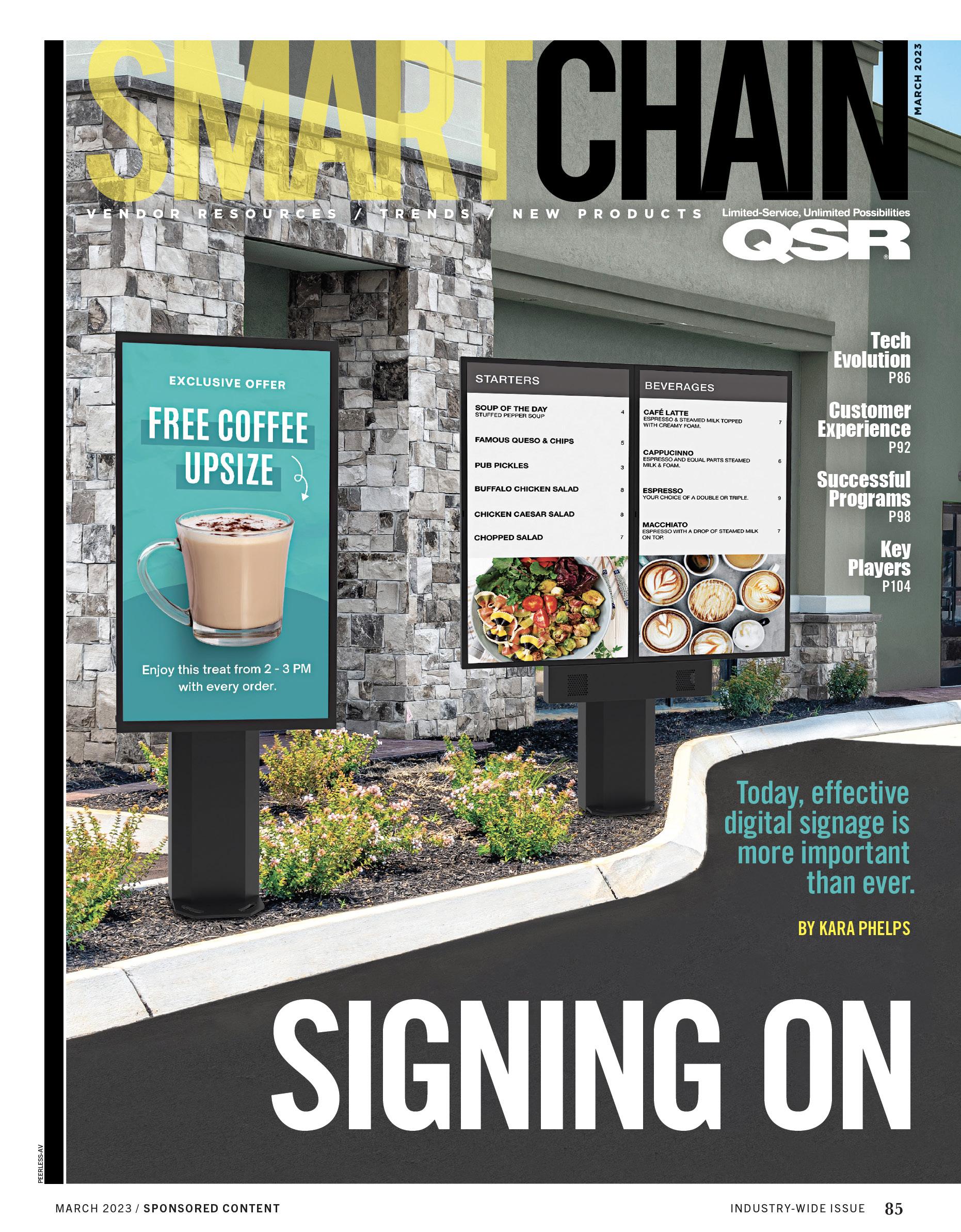
SmartChain Digital Signage
Signs of Change
The usage and capabilities of digital signage are transforming.
Just a few short years ago, digital signage was considered a relatively straightforward way to create appealing visuals and to ensure consistent messaging across multiple locations. Brands who adopted any form of digital signage at all could rest assured customers would see them as modern and technologically savvy.
The world of digital displays was still in its infancy, however. “In the beginning, digital signage was often looked at as an alternative to static displays,” says Jay Burdette, senior director at Panasonic Connect of North America “It had a ‘techy’ appeal to operators, demonstrating to their customers that they were innovative. Now digital signage has progressed to be a tool that allows operators to have total control of their messaging, data, and customer experience.”
Today, more and more quick-service and fast-casual brands see digital signage as a necessity. Their presence at the drive thru, in the dining room, and at the counter has exploded since the onset of the COVID-19 pandemic. “It’s hardly something you can ignore when walking out in public,” says Brian Kim, chief commercial officer for DSA Signage “We’re especially seeing in real time the increase of digital signage throughout many different quick-service restaurants across the United States.”
Brands faced severe labor shortages, supply chain issues, increased costs, and decreased revenue during COVID-19 lockdowns, and a large number still struggle with similar issues today. Many turned to digital signage to upsell, change menu items and prices faster, compensate for the lack of an indoor dining experience, and otherwise help solve the problems of a volatile marketplace.
While drive thrus made up as much as 70 percent of sales before COVID, many restaurants saw 100 percent of their sales move to the drive-thru window when dining rooms closed. “Some brands were not ready to process 100 percent of their orders through the drive thru and struggled with high-volume orders and slow speed during rush hour,” says Chloé Bisiaux, director of products at Acrelec. “Digital signage helped to fill the void.”
That trend has leveled off somewhat since lockdowns lifted, but it seems the preference for drive-thru ordering is here to stay. According to The NPD Group, drive-thru orders increased by 20 percent from February 2020 through February
2022. That uptick is expected to continue— consumer behavior has shifted, and quickservice brands are adapting to better serve them. “Many quick-service restaurants are now adjusting their procedures and even their physical structures to meet the needs of a modern customer base that, generally, desires less interaction, faster ser-
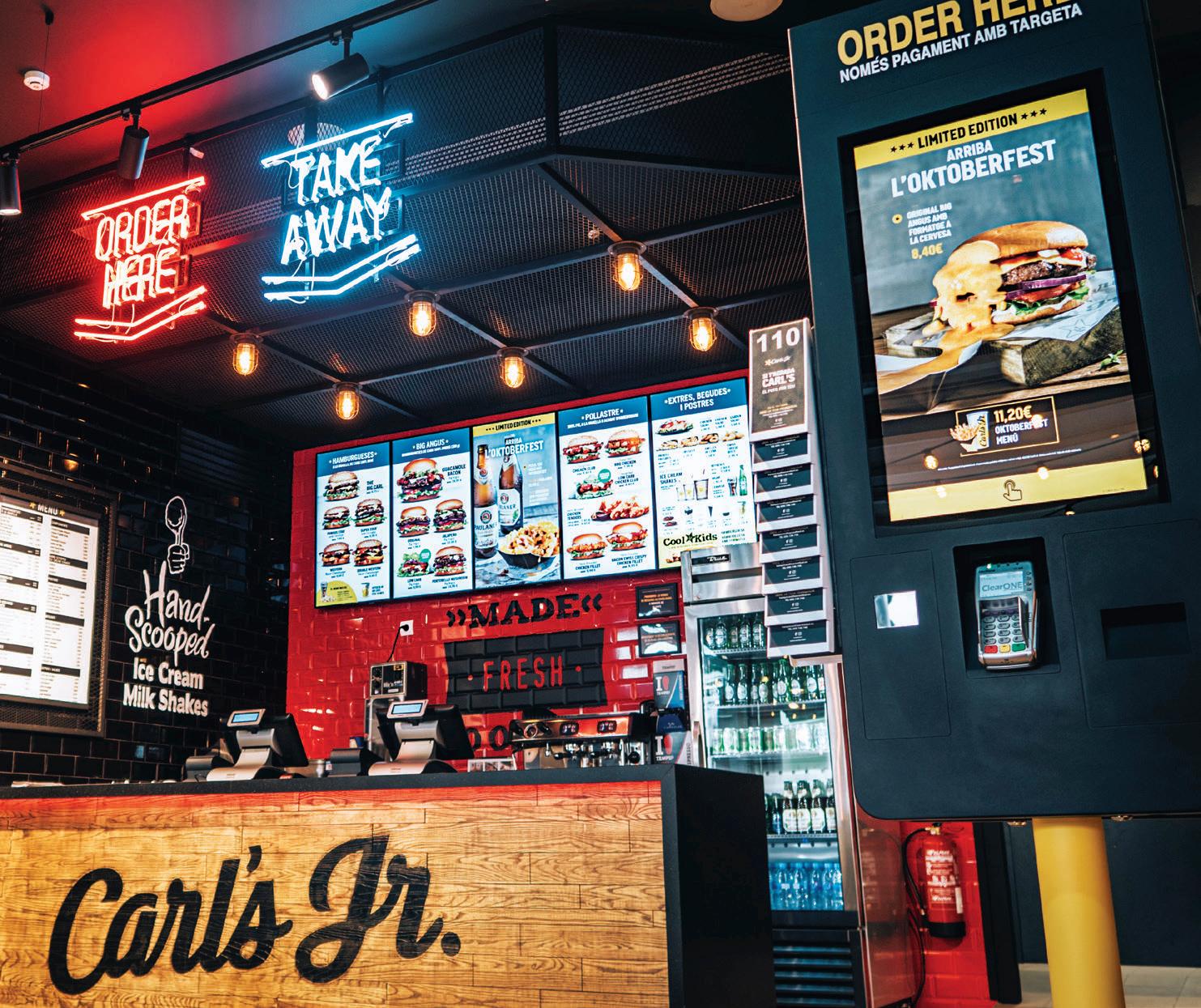
86 INDUSTRY-WIDE ISSUE SPONSORED CONTENT / MARCH 2023
ACRELEC
Acrelec
“A growing percentage of sales happen without the customer setting foot inside the building.”
Designed for MORE
MORE revenue. MORE upsell. MORE expertise.
Bring operational efficiencies to your restaurant and elevate your self-ordering experience with ACRELEC’s kiosk solutions, equipped with Glory Cash Payment Systems. The industry leader with over 80,000 installations worldwide, ACRELEC’s innovative technology and personalized AI-driven ordering optimizes your customer journey while increasing the average check by up to 30% more.
acrelec.com/kiosk | marketing.KIOSK@acrelec.com
Copyright 2021 Acrelec. All rights reserved.
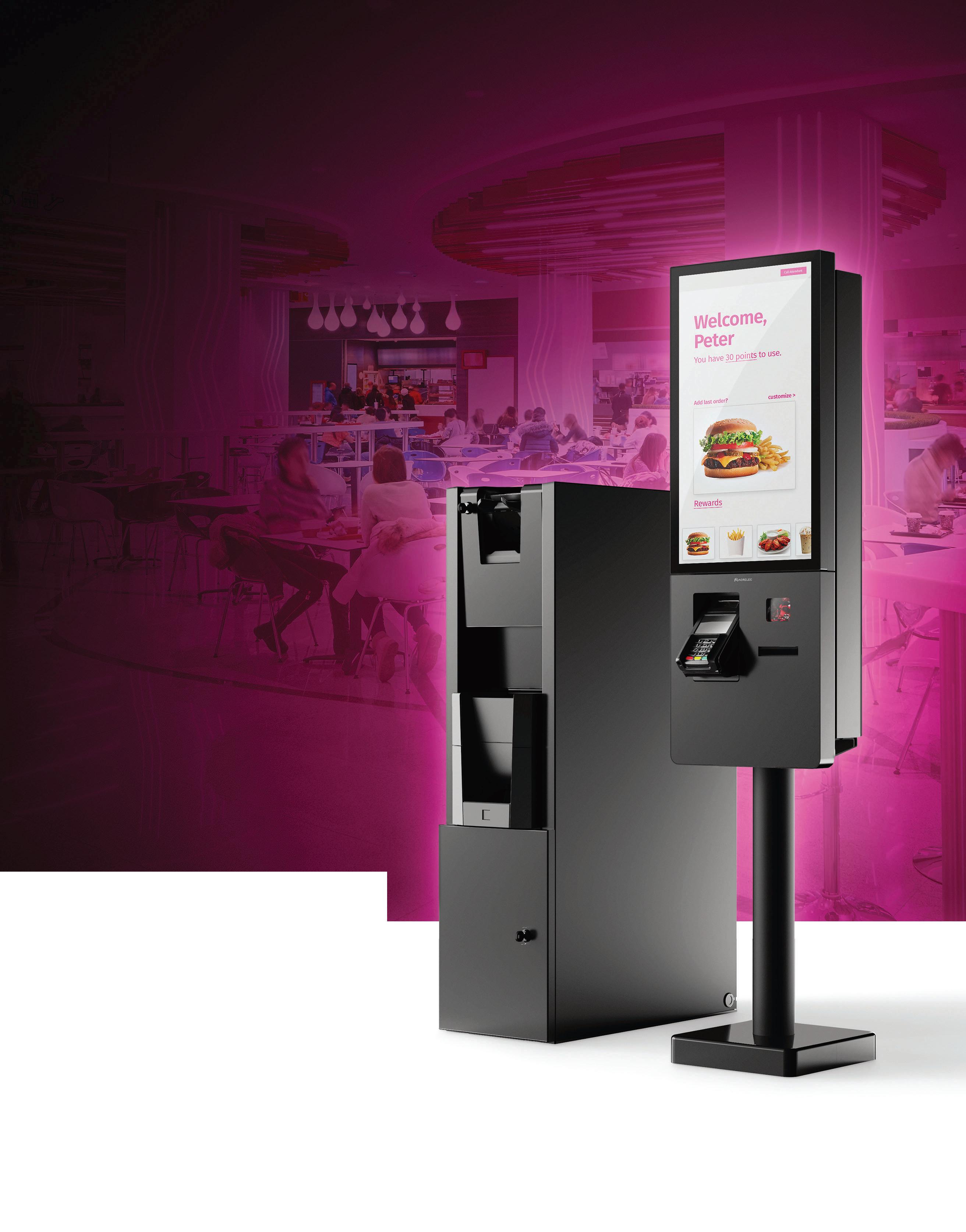
SmartChain Digital Signage
vice, more information, and personalized attention,” says David Boerlin, digital signage key account manager at LG Business Solutions USA .
The widespread adoption of digital signage took place alongside complete overhauls of drive thrus, from the addition of new mobile pick-up lanes to the elimination of dining rooms altogether in new store prototypes. Brands have begun to
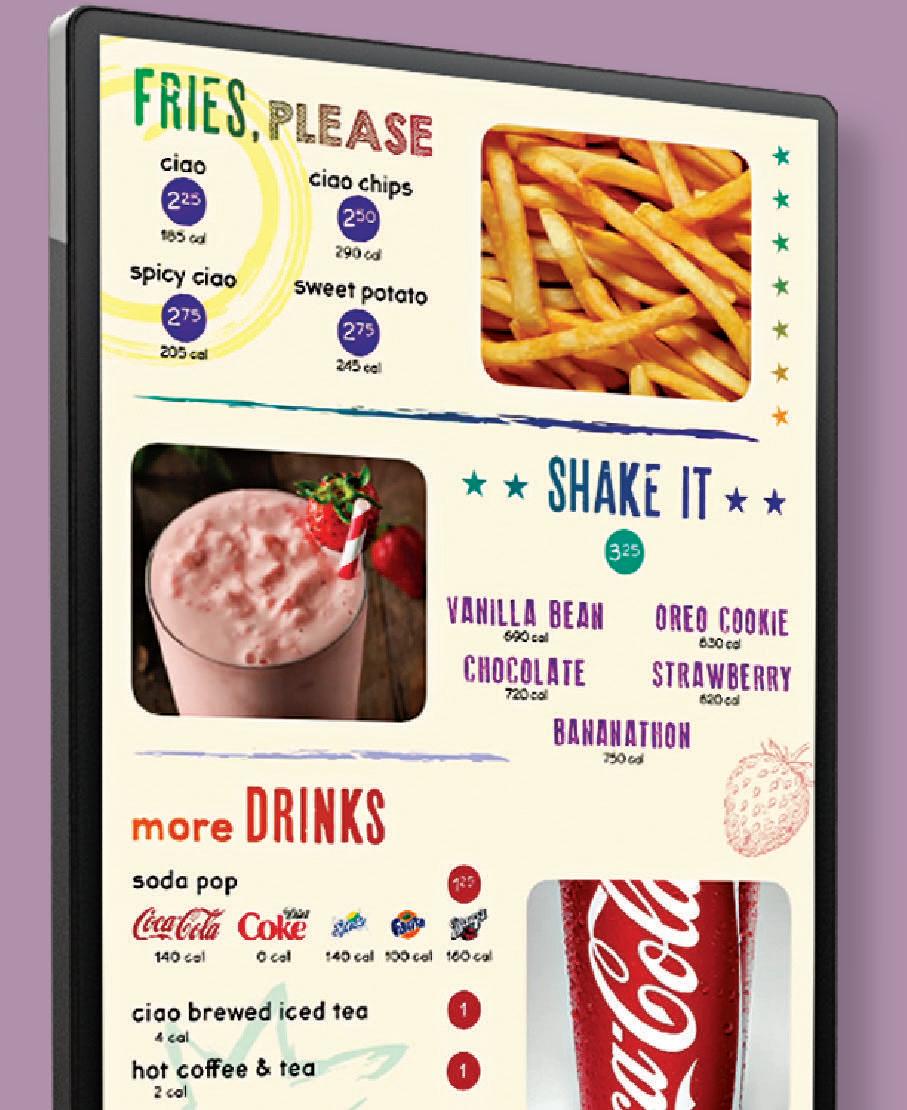
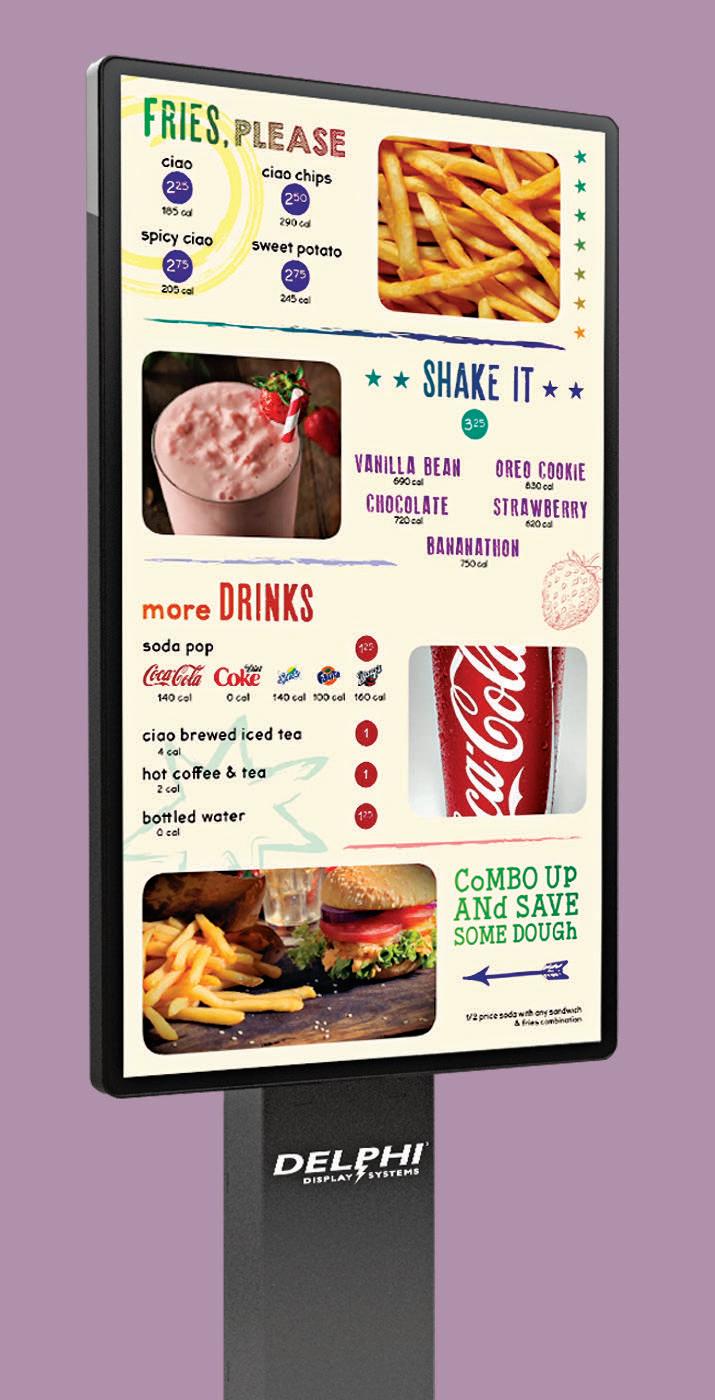
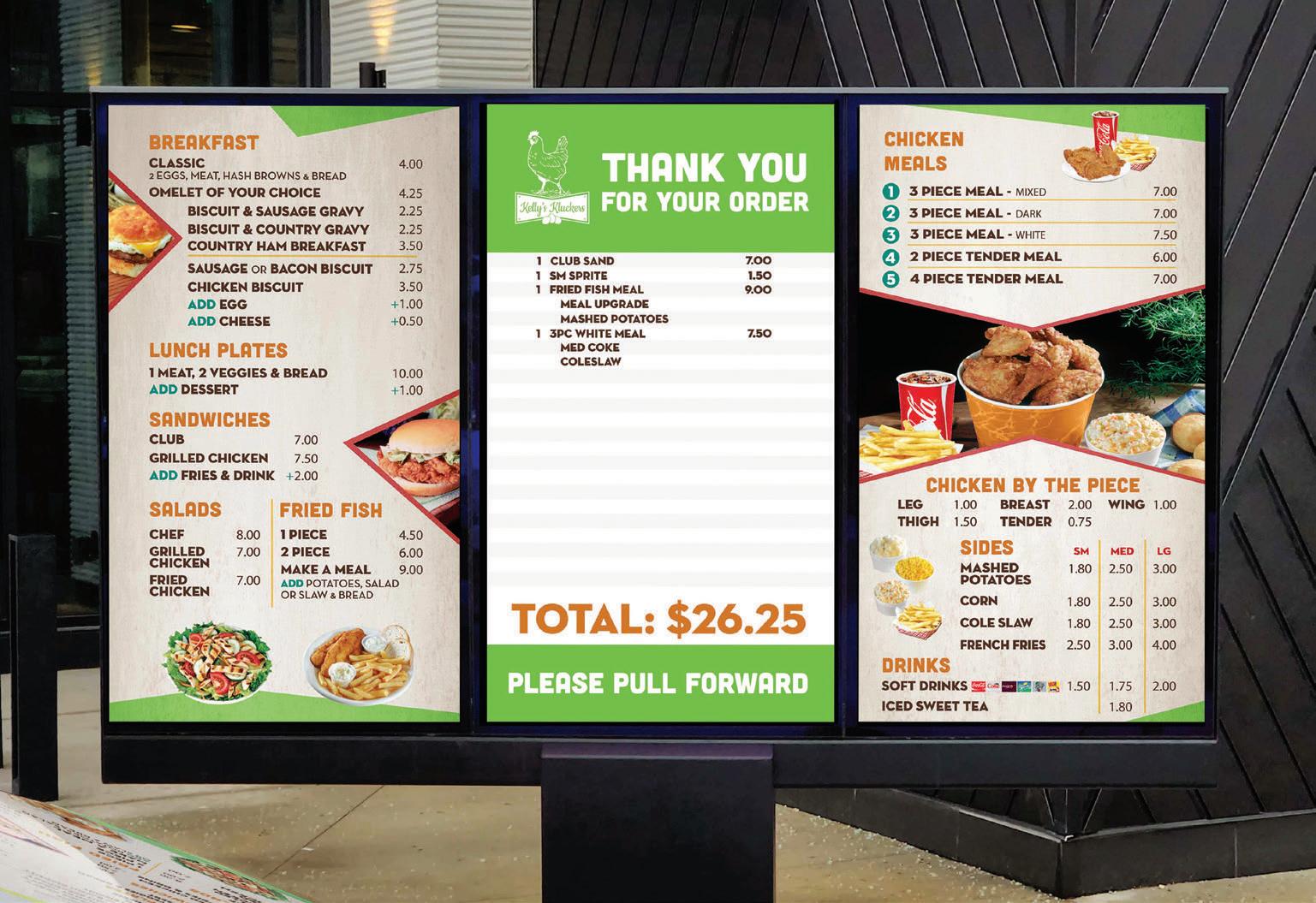
tion—according to Visix.com, 47 percent of Americans recall seeing a specific ad or message on digital signage in the past week, while 55 percent recall seeing a specific message on an outdoor digital billboard. Vibrancy, brightness, and the potential for animation all play a role— and there’s always room for innovation.
“Taking the more captivating experience digital signage provides a step fur-
technology. The benefits have expanded to encompass everything from eye-catching visuals and consistent messaging to data analytics and artificial intelligence (AI). Digital signage can now integrate with point-of-sale, enterprise resource planning, and human capital management systems to improve staffing and inventory planning while making the customer journey more personalized and interactive.
rethink time-tested strategies for marketing and operations. “Historically, people spent more money on the interior of the building, but since the pandemic, brands have realized that they have to invest more on the outside—a growing percentage of sales happen without the customer setting foot inside the building, whether through a drive thru or a pick-up lane or window for app orders,” says Gary Kurtz, vice president of sales and marketing at The Howard Company
Digital signage is already proven effective at drawing and holding atten-
ther, it is predicted that the future of digital signage can evolve to holographic, 3D, or metaverse-like displays,” says Megan Zeller, senior director of business development at Peerless-AV. “While interactive signage has been at the forefront of digital signage emerging trends and innovations, this additional step of immersion can provide a whole new experience for quickservice restaurants advertising what they have to offer.”
As more and more brands began to adopt digital signage, the last few years have brought significant advancements in
“In a word, digital signage is just continuing to get ‘smarter,’” says Jay Leedy, senior manager of business development at Sony Electronics. “We can automate marketing workflows and tailor content to the desired customer experience like never before.”
More than ever before, customers today want an immersive experience. The look and feel of a brand’s mobile app or website should match the look and feel of the drive-thru and dining room, and with a coordinated content strategy, digital displays can play a major role. “In the future, customer interactions with digital signage will be multi-channel and seamless across all devices and locations,” says Ken Neeld, president and CEO of Delphi Display Systems
Consumers have become extremely comfortable interacting with tech, and
88 INDUSTRY-WIDE ISSUE SPONSORED CONTENT / MARCH 2023
DELPHI DISPLAY SYSTEMS, THE HOWARD COMPANY
The Howard Company
“In a word, digital signage is just continuing to get ‘smarter.’”
Delphi
Display Systems
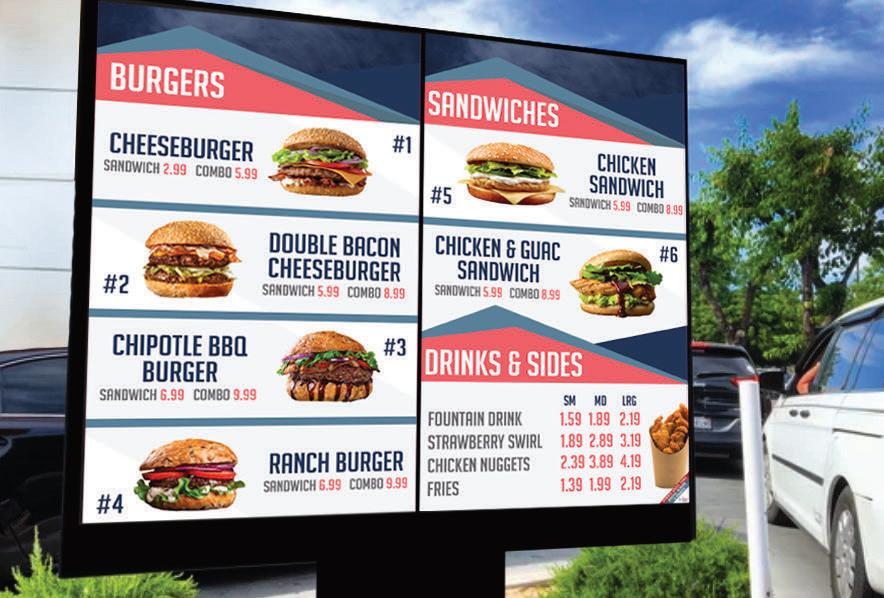
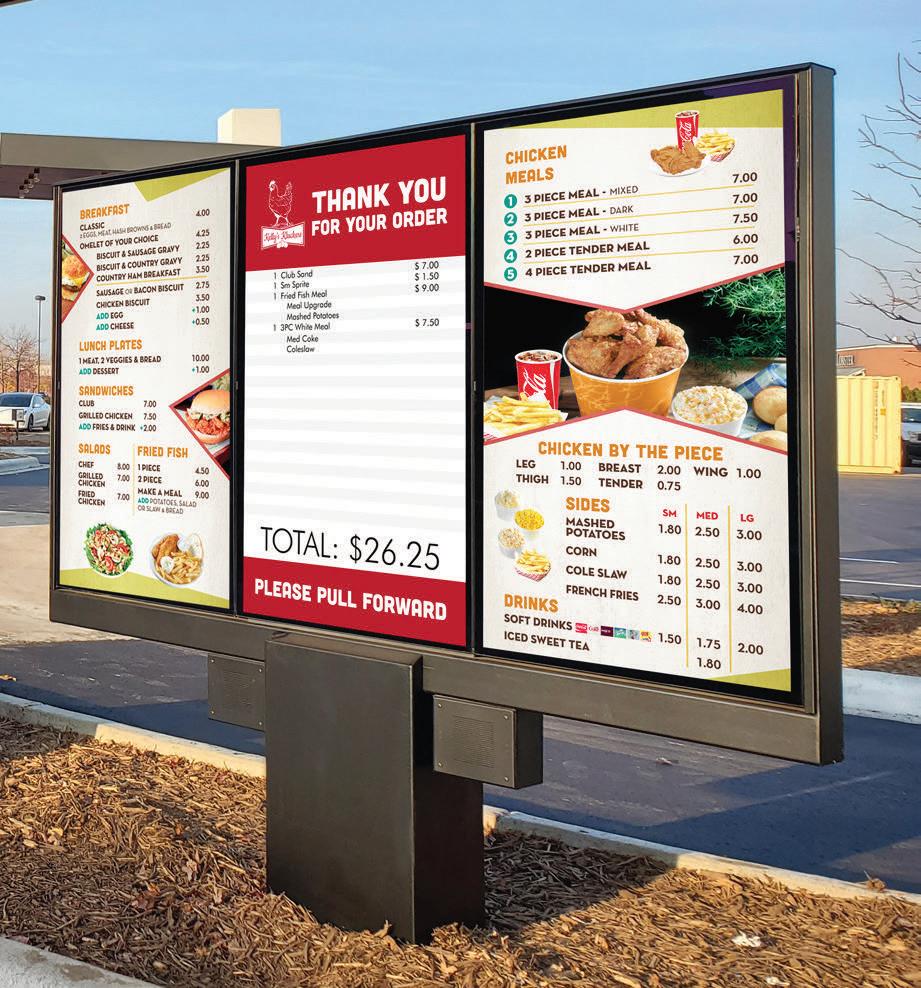
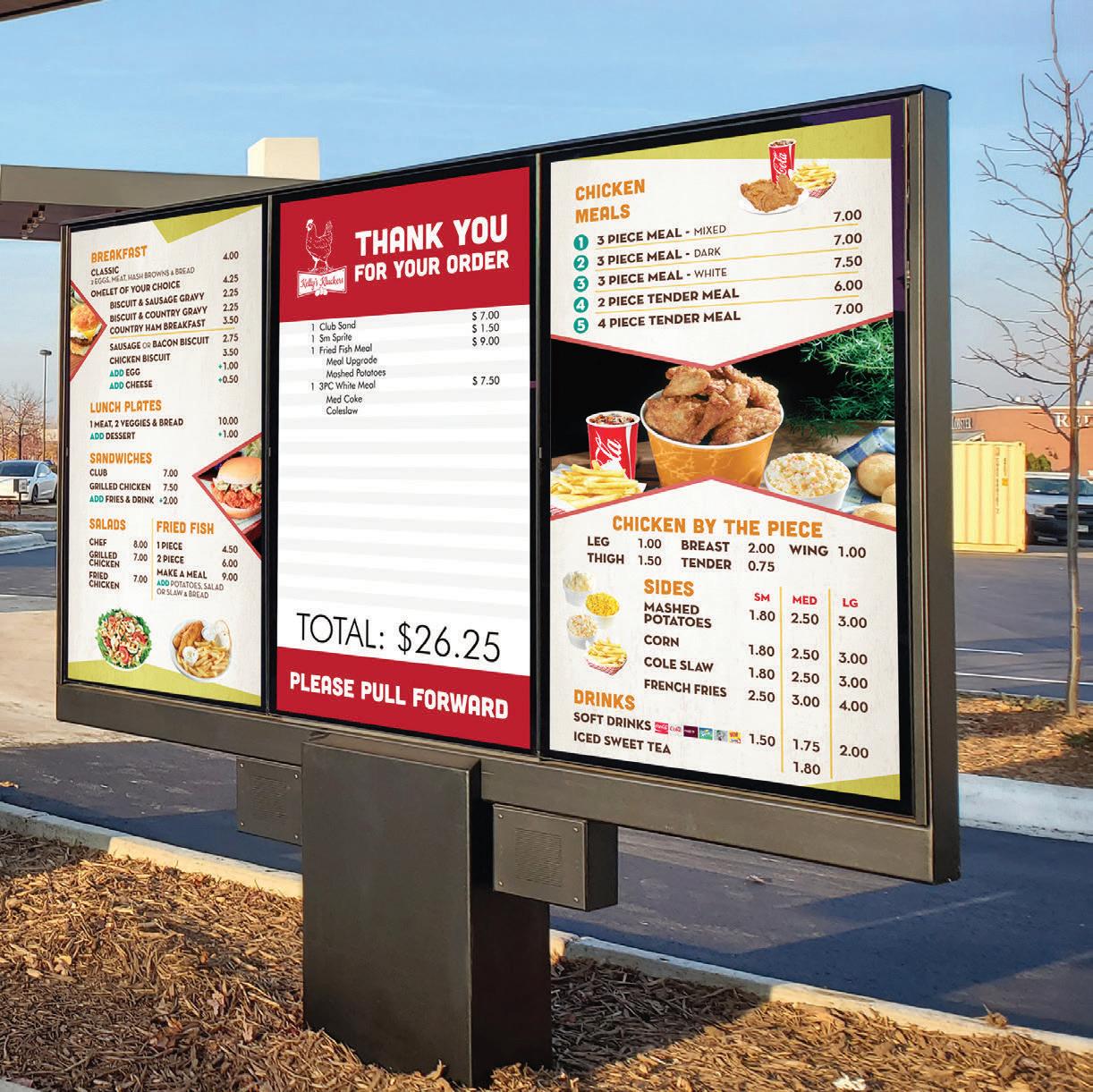
SmartChain Digital Signage
they’re changing their patterns of behavior to minimize human interactions and increase interactions with screens. As front-of-house operations get more automated, the latest innovations in digital signage focus on creating smart, intuitive, user-friendly interfaces with brands.
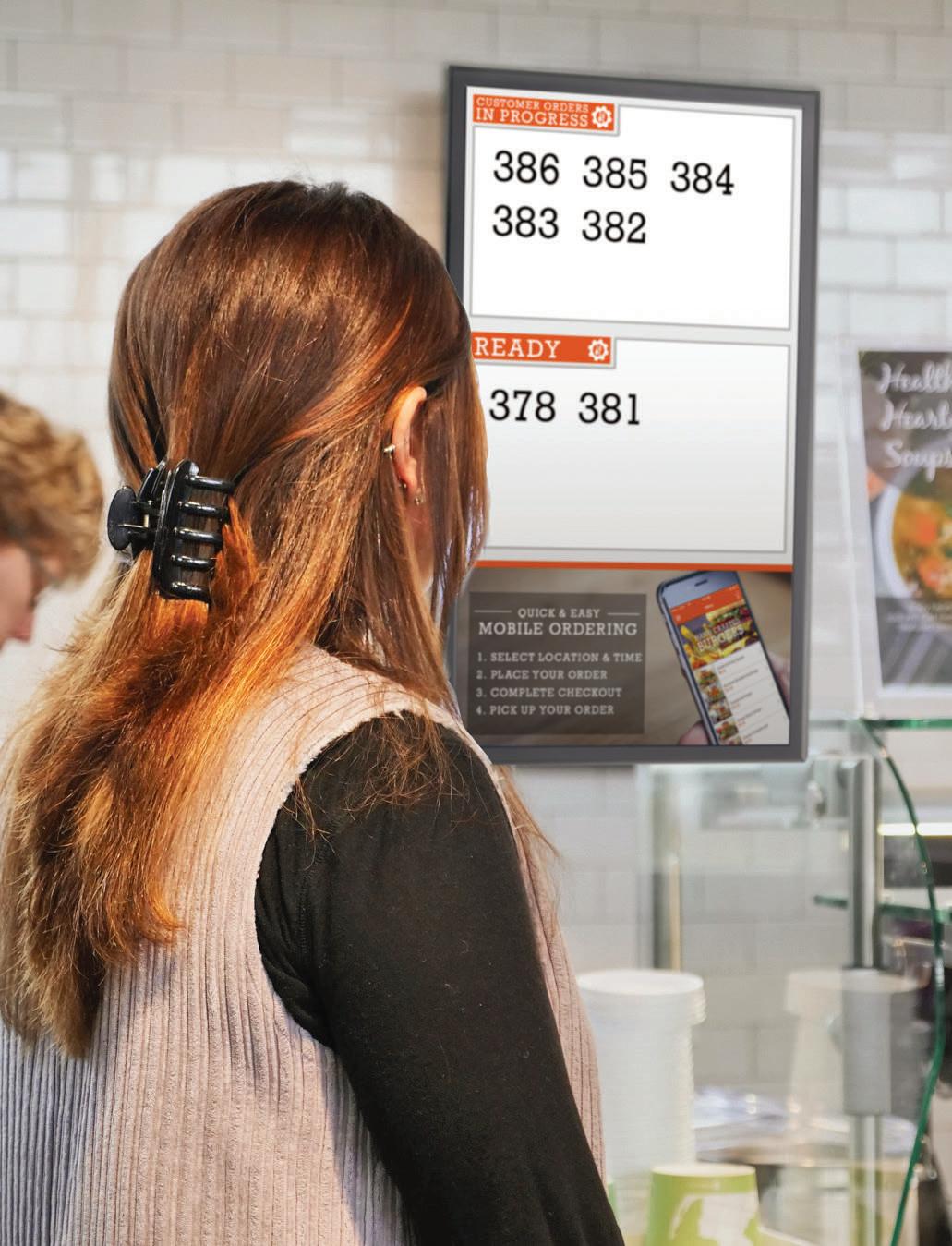
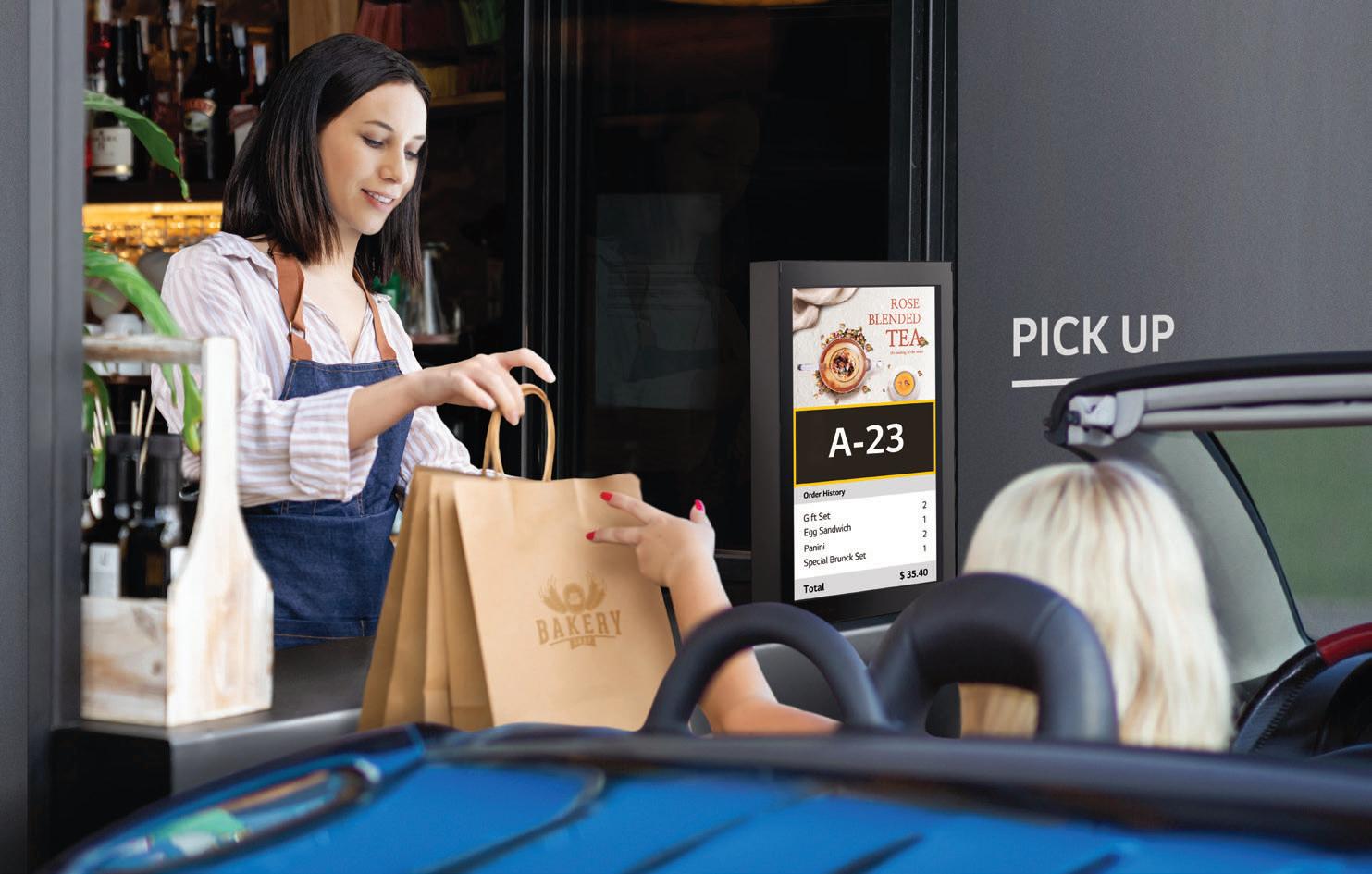
“We are actually seeing new advancements in automation, such as automated order-taking and mobile preordering, brought into existing channels,” says Matthew Simpson, head of new product and design at Coates Group. “Using an automated voice service or ordering ahead via mobile, we are seeing less human interaction in the drive thru (or instore), so dynamic and integrated digital signage is key to facilitating and enhancing the ordering experience as it becomes the first—and in some cases sole—point of contact and confirmation for the customers. I think digital signage will need to replicate and evoke human connection and emotion in the future of a more automated store.”
While technology surrounding personalization continues to improve and become more accurate, customers may not always want the latest developments right away. Personalization invokes an emotional response in consumers—whether it’s positive or negative is determined by sentiment in popular culture and individual preferences.
Data sources like loyalty programs, cameras, and geofencing can bring digital signage a phenomenal degree of personalization if customers are ready. Customers may be more comfortable with some personalized experiences than others, and restaurant leaders must also stay aware of privacy laws. When foodservice brands can find the right mix of personalization for their unique customer base, they’re poised to thrive. “API architecture drives integrations with many data sources and applications of digital signage, i.e., integrating with customer detection, geofencing, and computer vision to provide personalized experiences,” says Lindsay Petrovic, vice president of hospitality product management at NCR. “The future is available now, but it’s waiting on
the industry and customer sentiment to change to want the level of personalization that is currently available.”
Increased personalization can bring benefits for customers and restaurants, although it also comes with increased security risk. Lax security at any data touchpoint, including digital displays, may expose sensitive information—from customers or the business itself—to malicious activity. “The future of digital signage must also continue to make advances when it comes to security,” says Theresa Hannen, marketing manager at LSI Industries. “Every connection to a network is a security risk that has the potential to be hacked. While this potential is possible anywhere, operators should be certain to discuss security with every software vendor they work with.”
The evidence points to digital signage being highly effective at improving profitability for a restaurant location. A QSR magazine study from 2021 found that moving away from analog menuboards in the drive thru and adopting digital signage helps restaurants increase service volume by 9.1 percent. From the time customers order their food to the time they receive it, digital menuboards can save, on average, 30 to 45 seconds. This helps restaurants increase throughput as well as customer satisfaction.
“When done right, digital signage can be an owner’s second strongest resource, right after the value of their employees,” Hannen says.
In the past, digital signage was more common at larger concepts due to the larger upfront investment required to install the infrastructure, but as technology advances, it’s getting more affordable— placing the benefits within easier reach for smaller brands. “The future looks like a more affordable digital drive-thru experience that can not only improve operations for the large quick-service restaurant brands, but also for the independent operators as well,” says Dina Veenhuis, business development account manager at UniStructures. “As it stands, many smaller brands are being left out of the conversation due to cost-prohibitive technology, but that will be changing soon.”
90 INDUSTRY-WIDE ISSUE SPONSORED CONTENT / MARCH 2023
LG BUSINESS SOLUTIONS USA, NCR
SC LG Business Solutions USA
NCR
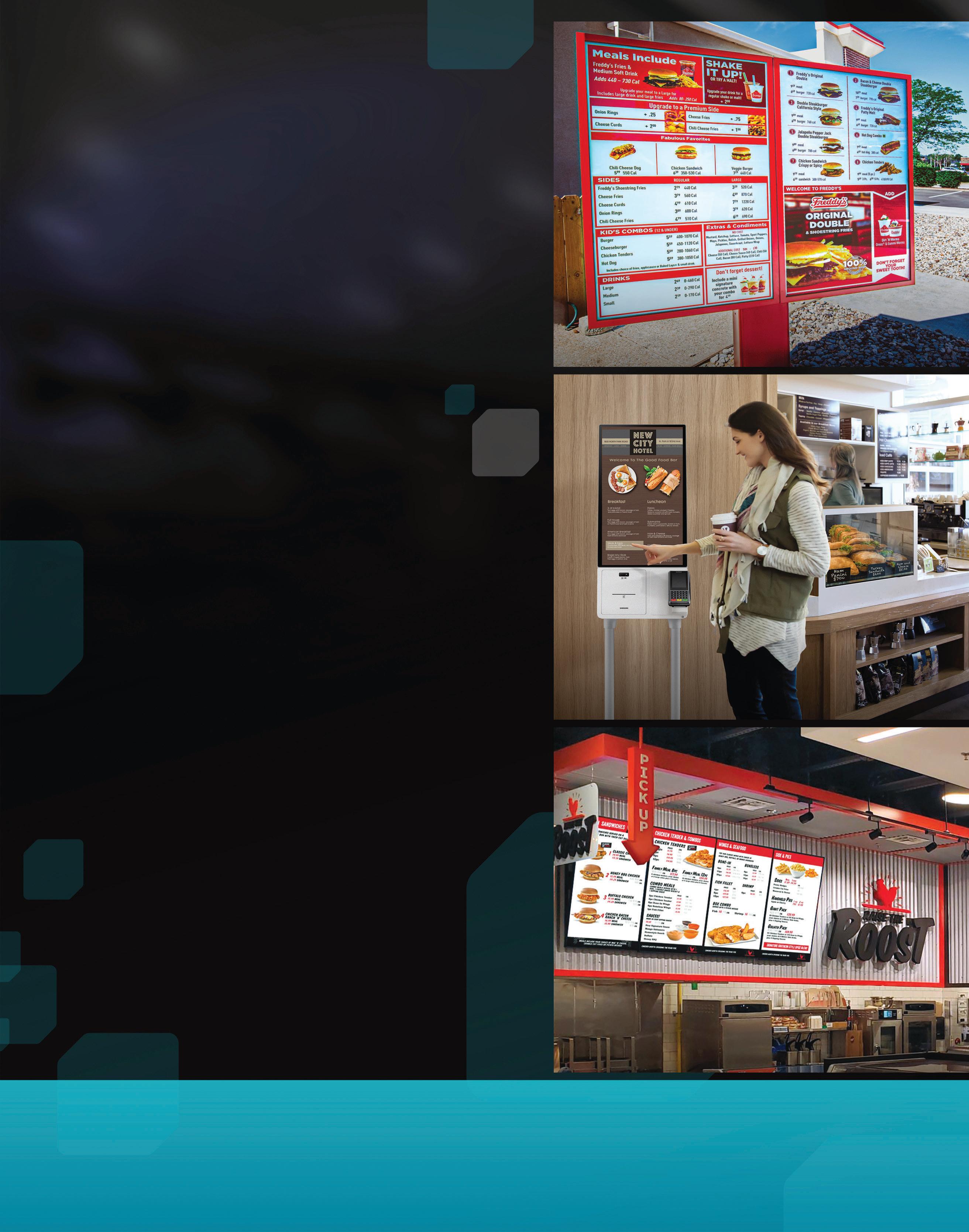
Winning Over Customers
What do customers expect from digital signage?
and daypart changes, but there’s more to it. “The ability to easily adapt and update digital signage also improves the customer experience by making sure all information is communicated in a way that is fast and easy to read when skimming a menu or product description,” Zeller says. Regularly updated messaging helps keep consumers from tuning out.
“People are becoming used to being entertained while they are being sold to,” says Gary Kurtz, vice president of sales and marketing for The Howard Company “When it comes to menu technology, people expect to see the best that the company has to offer. You know you are seeing what that company wants you to see in the first five seconds.”
These are challenging criteria to meet, but with the right strategy, operators can find success. “You have mere seconds to convey what you want the consumer to know,” Kurtz says. “Make sure your best information catches the eye and get rid of what is superfluous.”
As the competition for consumers’ attention grows steeper, quickserve restaurants must do more to draw their customers’ eyes away from their smartphones and other devices and engage them with messaging. “A successful digital signage program engages the target customer from the time they enter the location of the signage installation to the time they leave with targeted and relevant content,” says Ken
Neeld, president and CEO of Delphi Display Systems
The window for winning attention is narrow, and the bar for quality is high. Short attention spans dominate the market. “When it comes to digital signage, consumers want easily digest-
ible and quick information, especially when it comes to quick-service restaurants where efficiency is key,” says Megan Zeller, senior director of business development at Peerless-AV “Having legible content design, along with a display that is made specifically for the environment it is placed in, is imperative to making sure proper resolution, brightness, and overall clarity are achieved.”
Digital displays must be able to showcase animated and visually appealing content. These tactics can be used to draw and hold attention without overwhelming the viewer. It’s also critical that digital signage be easy to update—of course, staff must be able to update prices, limited-time offers,
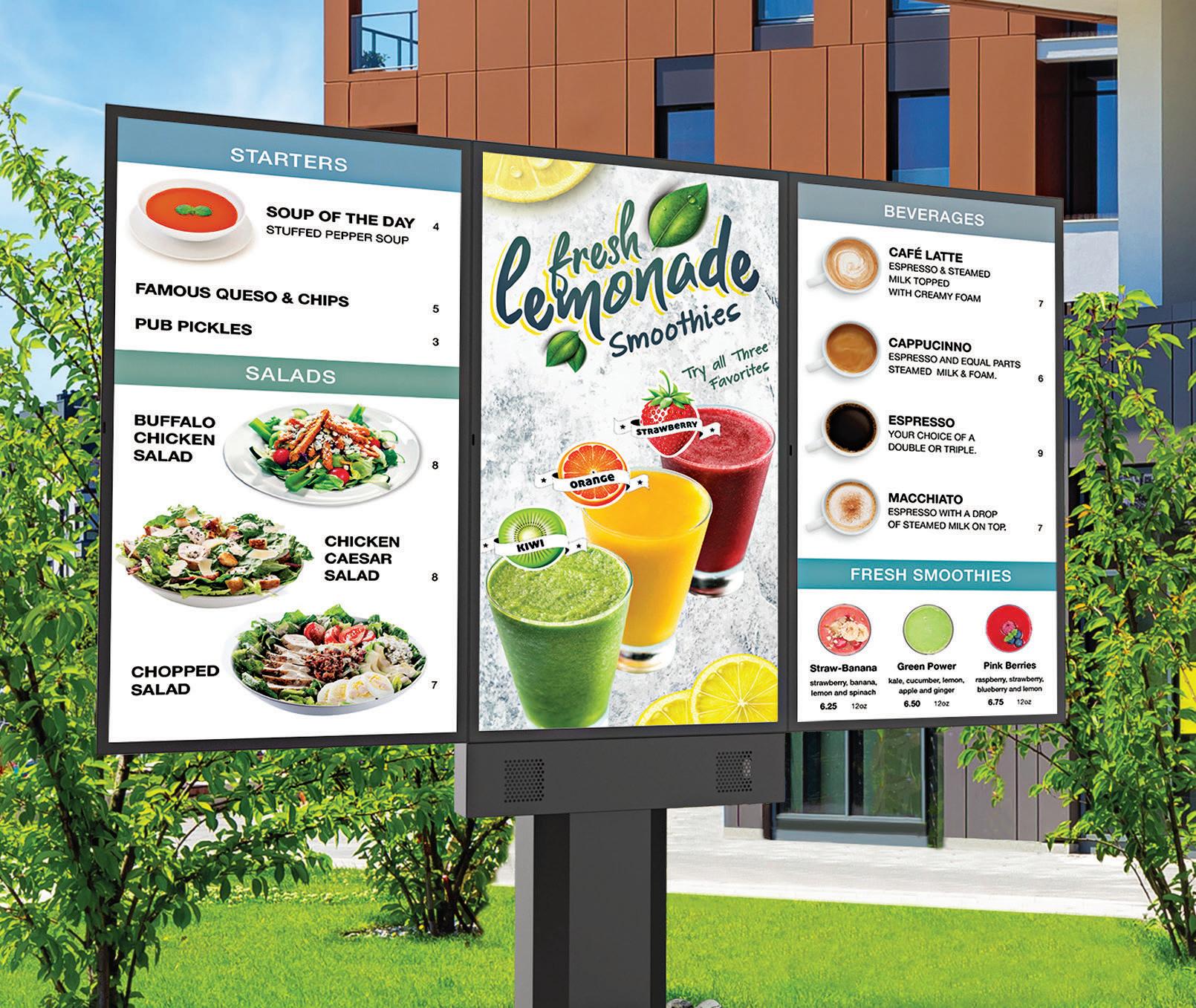
“The one thing that dominates consumer’s expectations is interactivity,” says William Bear, vice president of sales and marketing for Crimson AV. “This is driven by ubiquitous smartphone usage setting the standard of interaction. This ports over to digital signage. On the heels of interactivity is ease of use (‘don’t make me think’) and speed of entry and response. This all goes in the experience and begets loyalty and return business.”
Restaurants can use innovative technology like artificial intelligence (ai) to surprise and delight customers as they place their orders. The digital drive-thru experience can now include live upselling influenced by customer choices, in a manner similar to a casual dining server
92 INDUSTRY-WIDE ISSUE SPONSORED CONTENT / MARCH 2023
SmartChain Digital Signage
PEERLESS-AV
Peerless-AV



























































































































































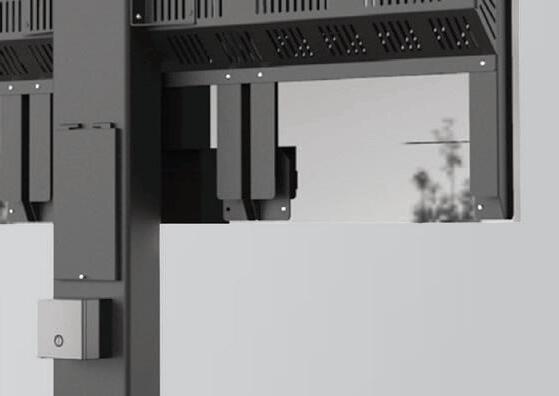


















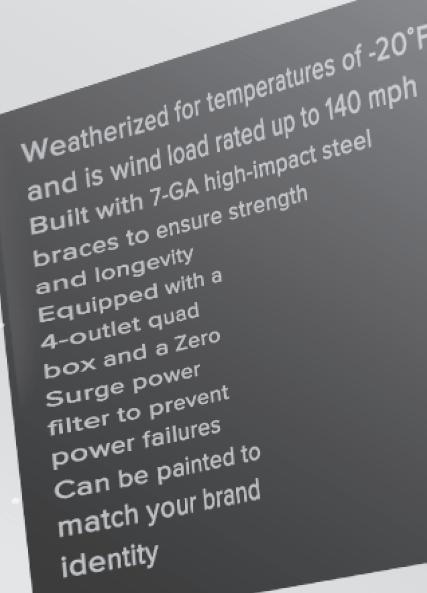







#MoreThanMounts Need help? Contact us anytime. 866.668.6888 www.crimsonav.com #MoreThanMounts #DigitalMenuBoards Free Standing Digital Menu Boards Wall Mounted or Ceiling Mounted Menu Board Systems Indoor & Outdoor Digital Menu Boards for QSR and Retail Menu Board Systems for temperatures load rated 7-GA high-impact ensure strength Zero prevent painted brand • and is wind • • • -20 WMLU [x3] *Applies to QSR355 mounts only QSR355-SAM [front] QSR355-SAM [rear]
SmartChain Digital Signage
working a table. “Let’s say a customer orders a sandwich, side, and beverage. Using AI, the digital menu board can present an amazing banana crème milkshake on the display, and your customer now adds that to their check as an impulse purchase,” says Theresa Hannen, marketing manager at LSI Industries
Impulse items like sweets and snacks have always performed well as upsell opportunities at the point of sale, of course. They’re also the best candidates for digital signage campaigns throughout the store, according to David Vance, vice president of quick-service restaurant sales at Mood Media
“One of the most common mistakes I see out there today is campaigning around a common product or pricing,” Vance says. “For example, if a cheeseburger is a core product and a known entity to one’s consumer base, the digital signage campaign around it usually falls flat or becomes ‘static.’ Most walk into a quick-service restaurant establishment
knowing what they are going to purchase, so the key is to hone in on the impulse and secondary purchases. Baked goods, add-ons, sweets, and caffeinated drinks not only play well on a screen but also are high-margin products for the operator.”
Digital signage platforms suggest addon menu items reliably and consistently, given the right direction and the right integrations. “Digital systems never fail to upsell and cross-sell if set up properly and integrated with the POS,” Kurtz says. “Also, it is much easier to 86 items from a menu with digital signs—and it looks a lot better than having items crossed out or covered with tape.”
Of course, even the best signage strategy can’t make up for confusing or just plain inaccurate messaging. Information on displays should be correct and simple to read and digest. “At the bare minimum, customers expect digital signage to be accurate,” says Jay Leedy, senior manager of business development at Sony Electronics. “Don’t promote what you
can’t offer, and incentive what you have a lot of. In the drive thru, order confirmation screens on digital signage have grown to become expected. Customers are also expecting to understand at a glance what deals are being promoted and new additions to the menu.”
Upsells and cross-sells mean nothing, however, when a customer opens a meal container to find the wrong order. Restaurants can significantly reduce order inaccuracy in the drive thru by implementing order confirmation screens. “A limitation of most drive-thru journeys is order inaccuracy,” says Chloé Bisiaux, director of products at Acrelec “Customers frequently use the lobby rather than the drive thru because they are more confident that their order will be correct when ordered inside. A digital signage solution offers increased order accuracy by displaying POS data in realtime. Customers can see exactly what is selected on the digital menuboard. Any modifications or substitutions made to
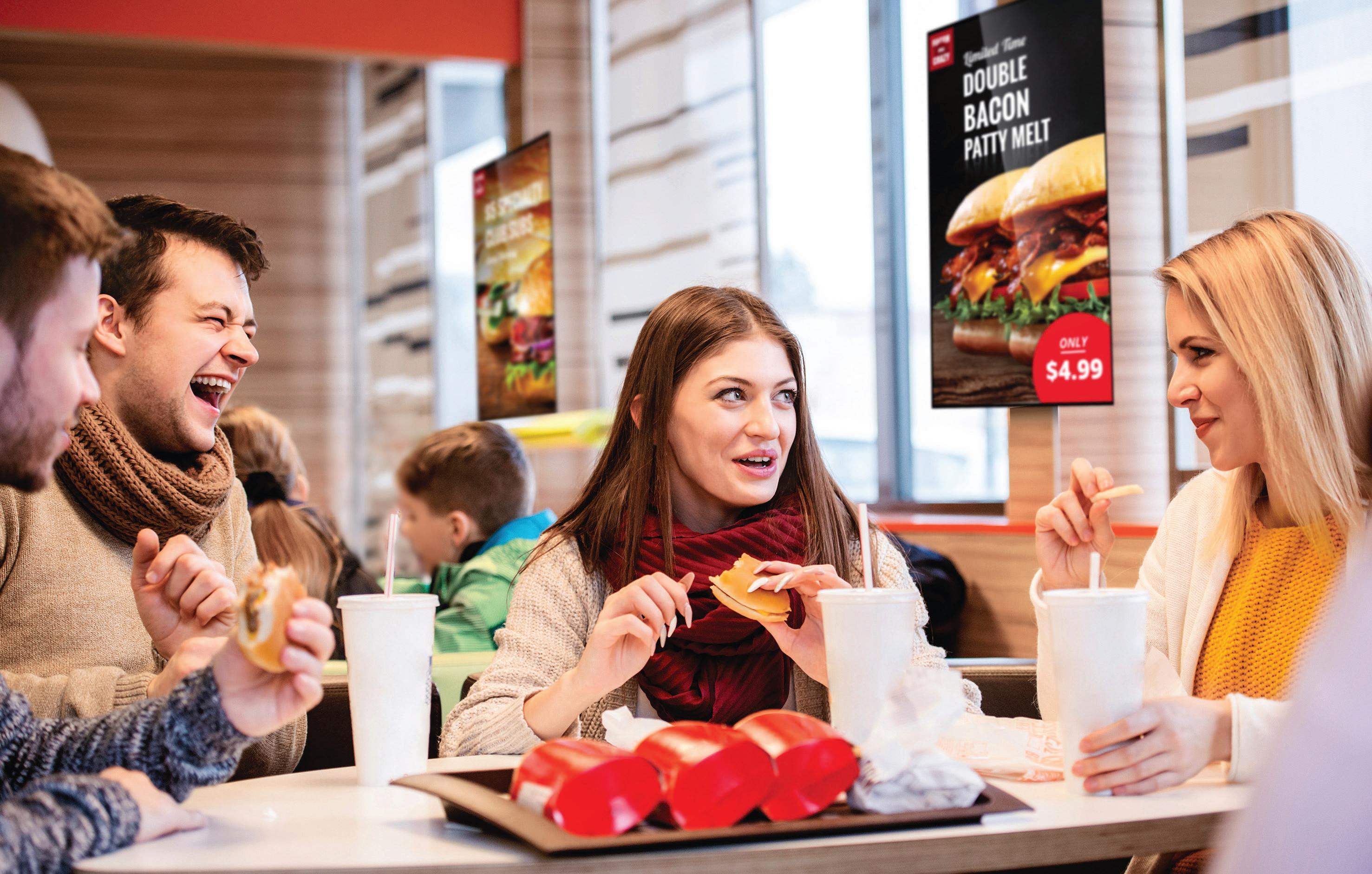
94 INDUSTRY-WIDE ISSUE SPONSORED CONTENT / MARCH 2023
MOOD MEDIA
Mood Media
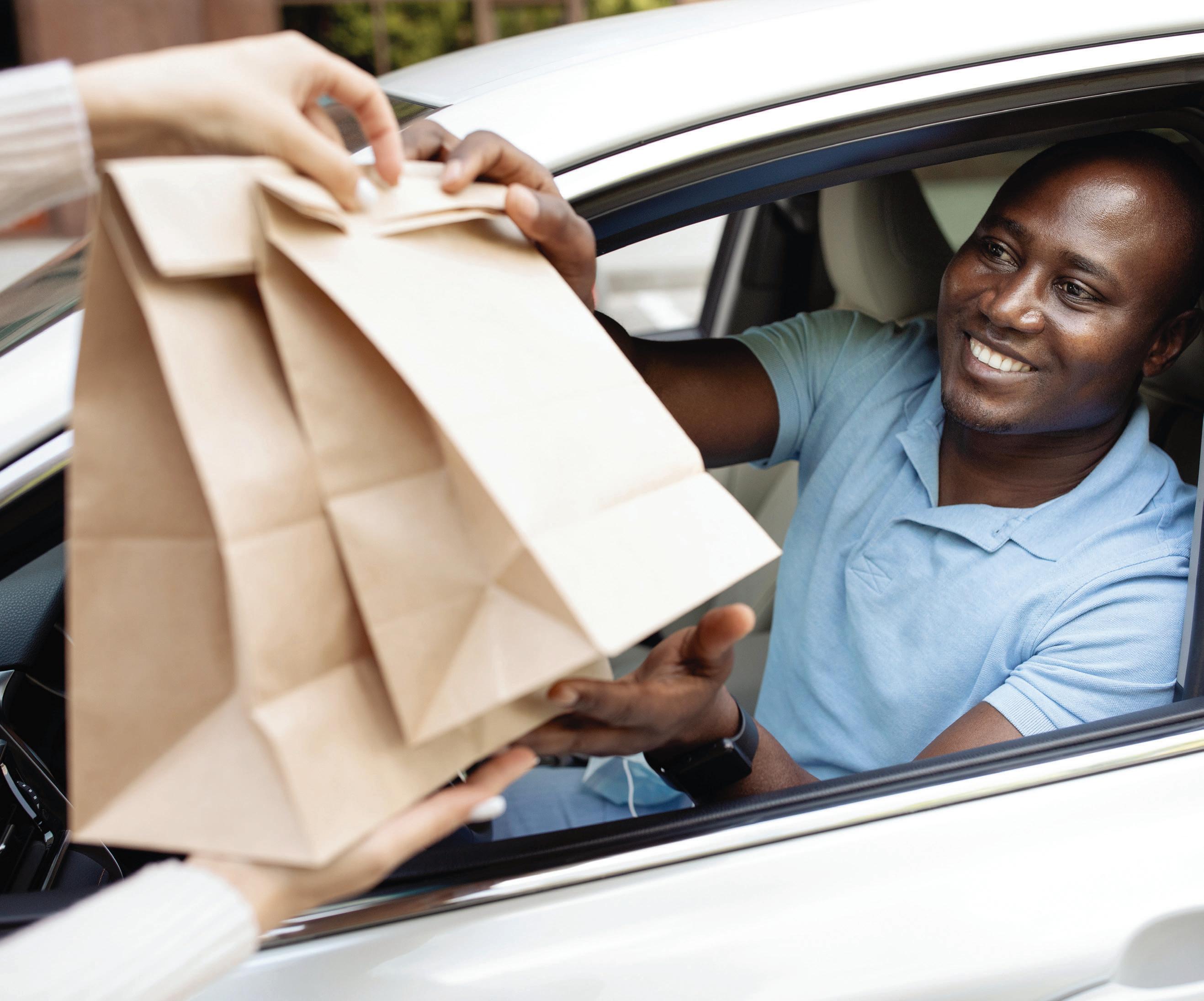
MOOD:MEDIA™ NEED A BETTER DRIVE-THRU SOLUTION? WE HEAR YOU LOUD & CLEAR. Don’t let unreliable headset systems slow down your sales. With dependable QSR System Solutions from Mood Media, you can expect crystal clear transactions that keep customers coming back. + Full systems including headsets, timers, and more + Flexible maintenance programs for any budget + On-site service in every zip code + Reliable 24/7 phone support + Equipment exchanges & repairs Faster queues. Fewer mistakes. Amplify the Drive-Thru Experience. Visit moodmedia.com/qsr to learn more.
SmartChain Digital Signage
the order will appear in ‘Order View,’ and employees don’t have to repeat the order back to diners, saving time in the customer journey.”
Operators can also add order confirmation to existing display boards, rather than investing in new equipment. “The latest digital display and content management solutions even offer the ability to segment a large display into separate con-
est-selling and most profitable items and placing them at the top of the menu—and at other high-visibility locations on the menuboard—to help drive increased sales. He also suggests using pre-sell boards in conjunction with point-of-order boards to reinforce key messaging with customers. “The effectiveness of the digital signage solution is dependent on the content that is displayed and the data-driven
agement at NCR. “Offering a loyalty or rewards program creates an additional opportunity to engage with your customers and it can be promoted on your digital signage to drive additional memberships. Expanding beyond just menus and utilizing screens for order status or order pickup displays—as well as different screen formats like shelf edge—all help improve the customer experience.”
tent areas, so operators can add order confirmation to drive thrus without requiring a dedicated screen,” says David Boerlin, digital signage
key account manager at LG Business Solutions USA
According to Hannen, quick-service restaurant locations that embrace drivethru order confirmation with suggestive selling strategies see an increase in revenue and a decrease in food waste—all due to increased order accuracy. Order confirmation is now extremely common, “even across customer demographics that do not engage in technologies such as loyalty programs or order-ahead pickup meals,” Hannen says.
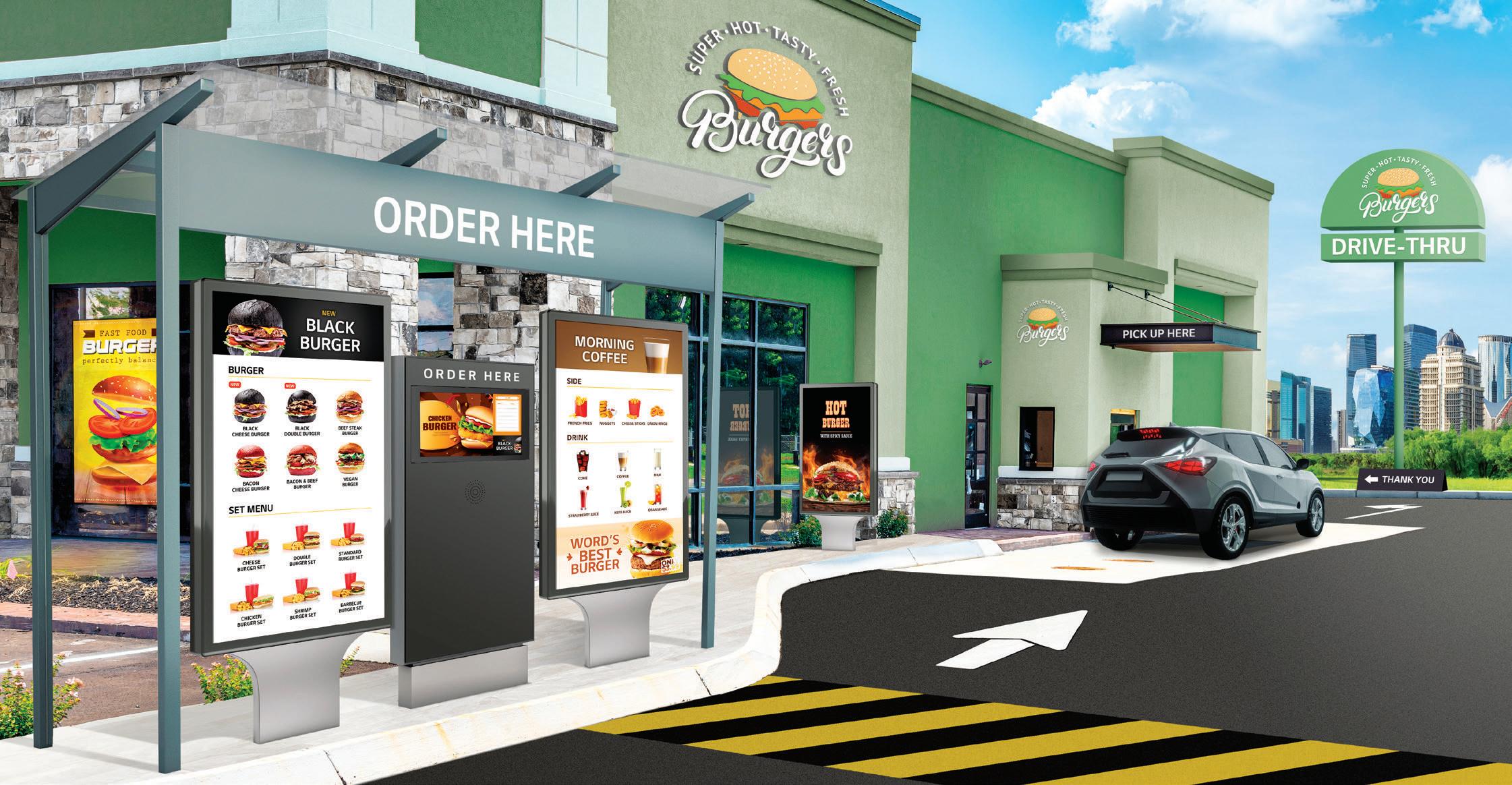
In terms of overall strategy, Arjun Wadwalkar, group product manager at Xenial, recommends identifying the high-
dynamic content optimization capabilities that rely on system integrations,” Wadwalkar says.
Brands want to improve order accuracy and speed in the drive thru as well as inside the restaurant, while at the same time creating personalized experiences that keep guests coming back for more. Menuboards are a great start, but a much broader and richer world of digital signage exists in service of fine-tuning customer satisfaction and retention. “Digital signage can drive a great guest experience by helping improve the guest wait times, communication, personalization through self-displays or suggestive selling, and accuracy of pickup to provide a seamless guest experience,” says Lindsay Petrovic, vice president of hospitality product man-
In fact, the most effective digital signage prioritizes the customer experience. Along with the restaurant’s website, apps, and other digital touchpoints, digital signage helps craft a seamless experience for any consumer who encounters the brand. Regardless of where they choose to interact with the brand, they should feel the interface is intuitive, streamlined, and familiar. “Operators must take a customer experience-led approach to digital signage,” says Tom Cameron, director of strategic design at Coates Group. “They must start by understanding and defining a target state experience, then leveraging digital signage as simply a single touchpoint within a connected ecosystem of physical and digital touchpoints within the customer experience.” SC
96 INDUSTRY-WIDE ISSUE SPONSORED CONTENT / MARCH 2023
LG BUSINESS SOLUTIONS USA
LG Business Solutions USA

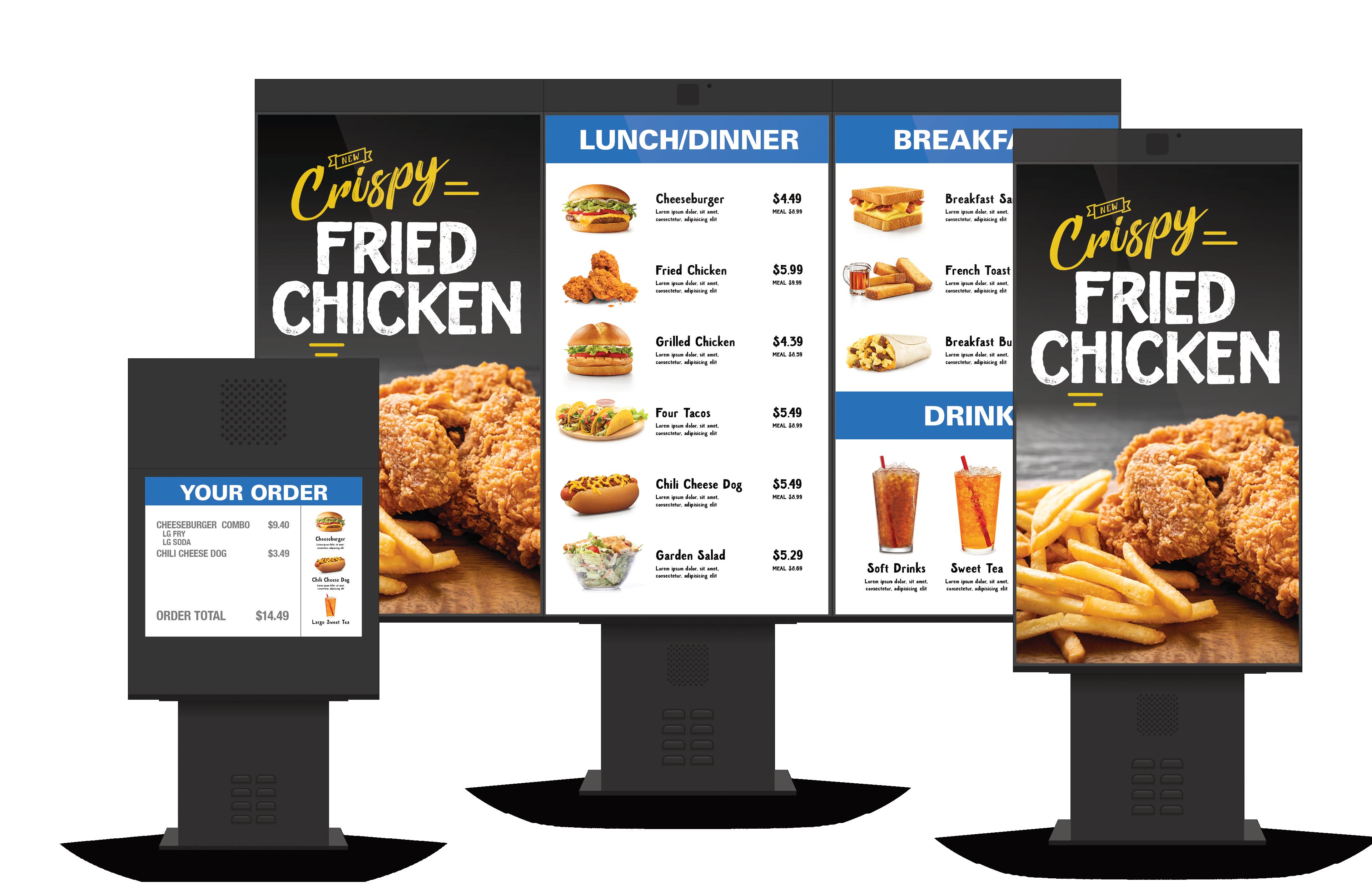




Delight Your Customers with Vibrant Signage Discover how Xenial menu boards can help drive revenue growth in-store and in the drive-thru. www.xenial.com | sales@xenial.com Feature Rich and Future Proofed Signage Capture Customer Attention Boost Sales & Check Sizes Simplify Menu & Pricing Management Reduce Total Cost of Ownership
Digital Success
A high-performing digital signage program starts with a solid foundation.
first place,” says William Bear, vice president of sales and marketing at CrimsonAV
“This starts with asking why you want digital signage, and the second part is what you want digital signage to do for you. The third part is ROI expectations and measurements. We call this the business part of digital signage under the umbrella of the objectives.”
According to Petrovic, effective digital signage programs are driven by strong cross-functional collaboration. This starts with a campaign-level focus on personalization, selling high-margin items, driving repeat business, and so on. It requires a strong content management solution to support business needs across multiple locations and channels, as well as solid integrations with POS systems to make day-to-day operations as smooth as possible. Commercial-grade hardware and services plans round out the foundation.
Digital signage plays a pivotal role in most restaurant brand strategies. Restaurants use digital displays and software platforms to ensure a cohesive digital customer experience—and a competitive edge in the market.
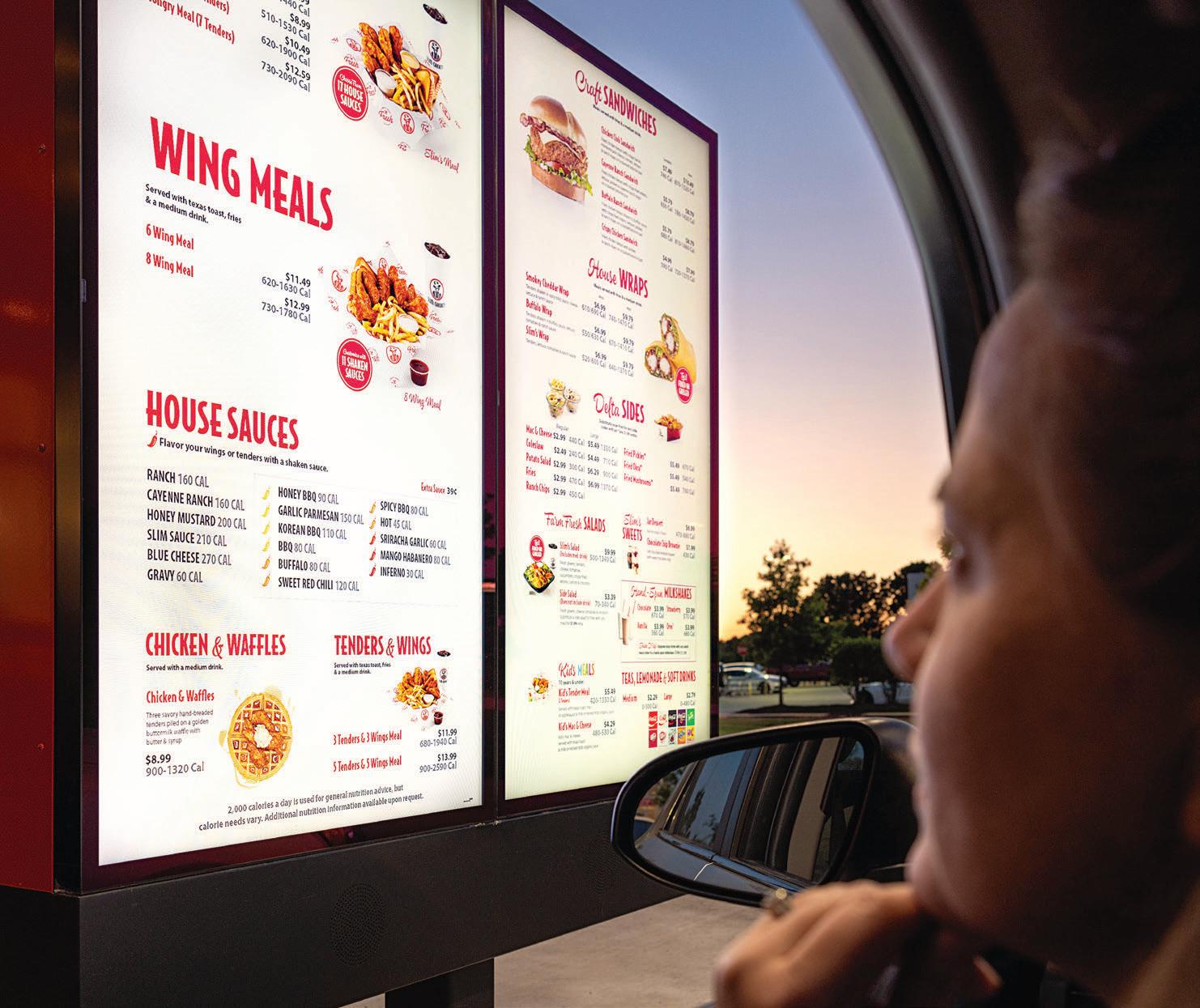
“Digital signage enables restaurant operators to drive a differentiated brand experience and better connect with their guests through dynamic, engaging content delivered via state-of-the-art displays,” says Lindsay Petrovic, vice president of hospitality product management at NCR. “This is accomplished through a combination of hardware, software, and services that drives a complete digital guest experience for restaurant brands, result-
ing in faster customer service times and increased margins.”
What makes a successful digital signage program? The physical components are easy enough to understand—the display and mount or kiosk, media player, network connectivity, content, and content management. “What is not so simple is a three-part evaluation and the rationale for employing digital signage in the
Of course, this foundation is built on a rock-solid understanding of one’s customers and their preferences. From there, restaurants can build out messaging and invest in technology that best suits the demands of operators, employees, and guests. “Most people are switching from static signs to having digital and interactive signage that captures the audience, so with the innovations that you’re seeing with smart technology or with artificial intelligence, you get to identify your client base as they come close to your brand and have a message that’s very much tailored to their needs,” says
Shokouh Shafiei, CEO of DSA Signage
These elements create the basis from which restaurants can expand.
“Understanding what success looks like, while also planning for scale and innovation, will ensure the program can evolve as
98 INDUSTRY-WIDE ISSUE SPONSORED CONTENT / MARCH 2023
SmartChain Digital Signage
DSA SIGNAGE
DSA Signage
“ You get to identify your client base as they come close to your brand.”






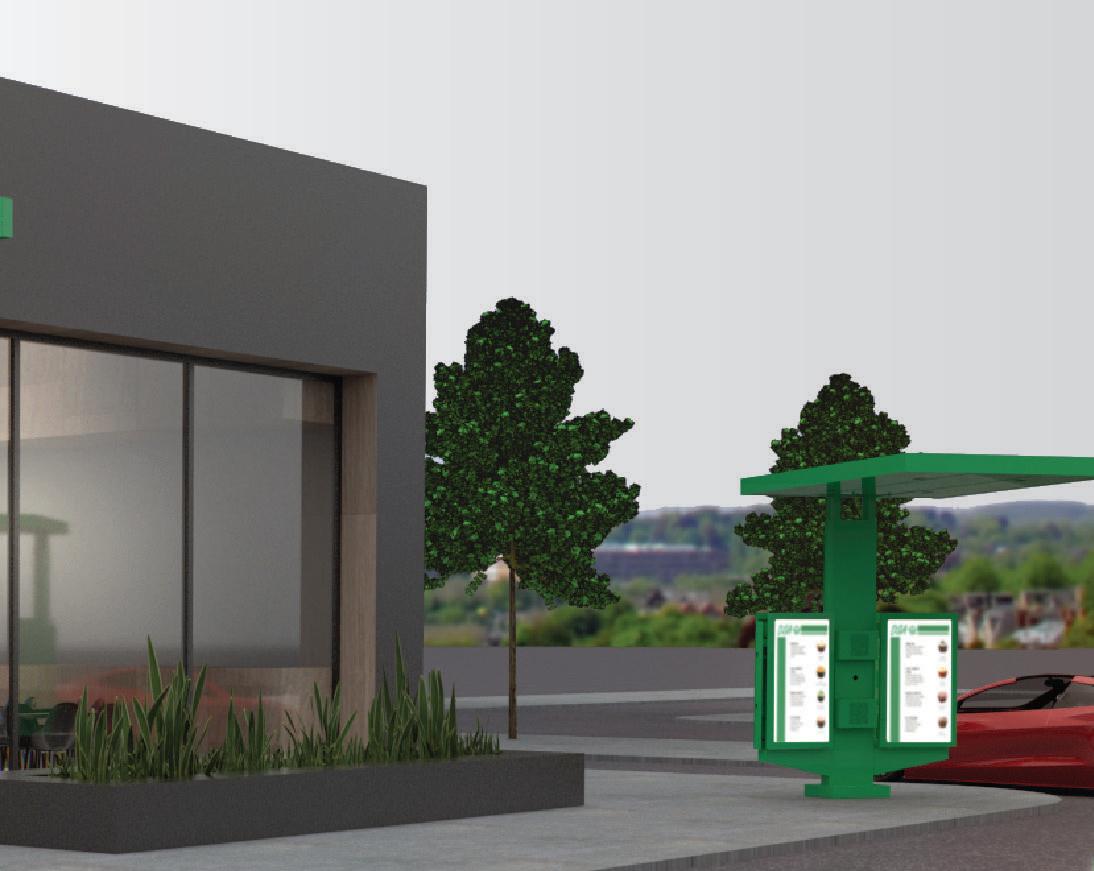







BUILD YOUR OWN Drive-Thru Drive-Thru Drive-Thru 1 1 1 Pick Your Menu Boards Static Digital Hybrid 2 2 2 Pick Your Size Single Double Triple Custom 3 3 3 Top It O Fresh Additions Order Point Additional Wing Canopy Color Black Custom 4 4 4 On The Side Clearance Bar Directional Sign Bollard Speaker Post We design and manufacture unique static & digital drive-thru solutions BRIGHTEN YOUR BRAND 866-333-0670 www.dsasignage.com dsasignage
SmartChain Digital Signage
stakeholder expectations mature,” says Jay Leedy, senior manager of business development at Sony Electronics “In many respects, this begins and ends with a well-defined content strategy. Who is the audience? Who is defining creative direction and producing content? What team will be responsible for approving and publishing content? How will assets be deployed, managed, and supported over the life of your investment?”
satisfaction. The strategy should include creating a calendar, testing different variations of the content, and, after some time in use, doing an honest and thorough assessment of the results. After all, one of the best things about digital signs is they can be changed almost instantly.”
The success or failure of digital signage programs hinges upon the measurable quality of the content—and how effec-
alone digital sign displaying a menu cannot match the omnichannel expectations of consumers anymore.”
Good content is critical to engaging restaurant guests, but it can also help reach other stakeholders. Due to ongoing labor shortages, supply chain issues, and employee communication woes, it’s becoming more important than ever to keep employees informed about the business. “With today’s challenges, digital signage can and should be incorporated as a conduit to not only one’s consumers, but the employees themselves,” says David Vance, vice president of quick-service restaurant sales at Mood Media “I think most would agree that an informed and educated employee makes a stronger employee. By deploying digital signage and a screen in the back of the house or breakroom, though the pass-thru video option of digital signage, benefits, community involvement, new employment opportunities, training, and even messaging from the executive leadership can be executed on a daily basis.”
“Without a good strategy, it may not make sense to invest in digital signage,” says Gary Kurtz, vice president of sales and marketing at The Howard Company. “The marketing and operations teams should sit down for an honest discussion of goals and the content has to be designed to meet the operational and sales goals of the business. And there may be some other important objectives like developing the brand story and customer
tively marketing teams and their partners can reach customers. “The most important component of a successful digital signage program is to have a solid content management service partner,” says C.J. Mays, director of sales and marketing at UniStructures With the right partner, restaurant brands can experiment and refine their strategy quickly.
One common successful strategy is personalization, which is making rapid strides in foodservice. “Personalization and loyalty brought over from mobile and online are growing, and digital signage needs to be fed from technology inputs, dynamically changing at rapid speeds,” says Matthew Simpson, head of new product and design at Coates Group. “A stand-
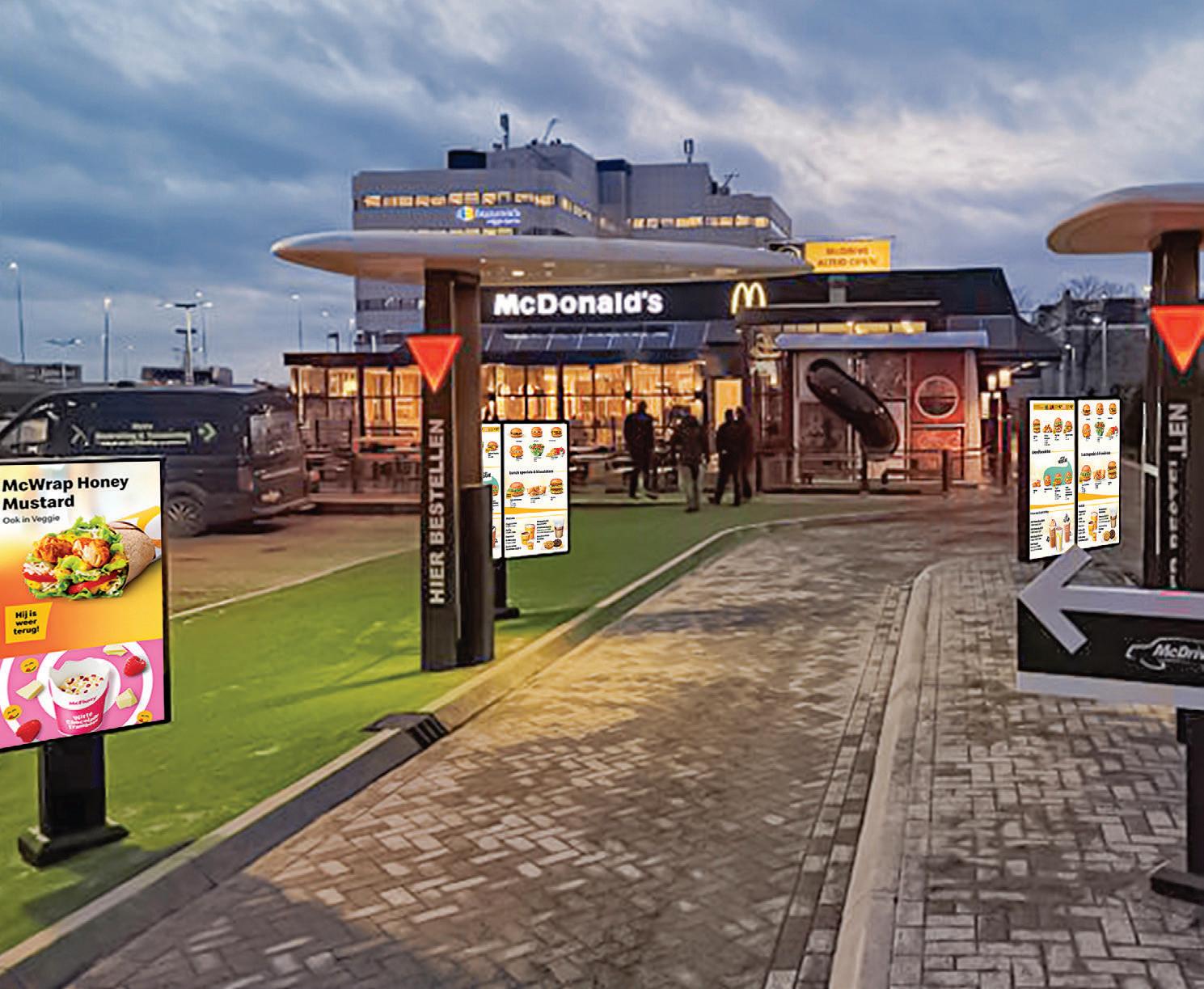
Hardware—specifically the number and type of displays in use across any given location—can have an impact on the effectiveness of a brand’s content. “For quick-service restaurants, with displays inside and outside, utilizing a single display manufacturer can simplify compatibility, support, and content delivery, ensuring that all components work correctly together and each display can be adjusted using the same interface,” says David Boerlin, digital signage key account manager at LG Business Solutions USA “The more displays a location has, the more important it is to have immediate control over the content.”
In order to serve the right content to the right people at the right time, it’s essential for digital signage platforms to be network-connected, integrated, and cloud-based. “Menu or pricing changes performed once are populated everywhere the menu is published, including the dining room, the drive thru, third-party services, and online,” says Arjun Wadwalkar, group product manager at Xenial “Central sign-in enables the brand to not only extend permissions to the appropriate
100 INDUSTRY-WIDE ISSUE SPONSORED CONTENT
MARCH 2023
/
COATES GROUP
Coates Group
“
Without a good strategy, it may not make sense to invest in digital signage.”
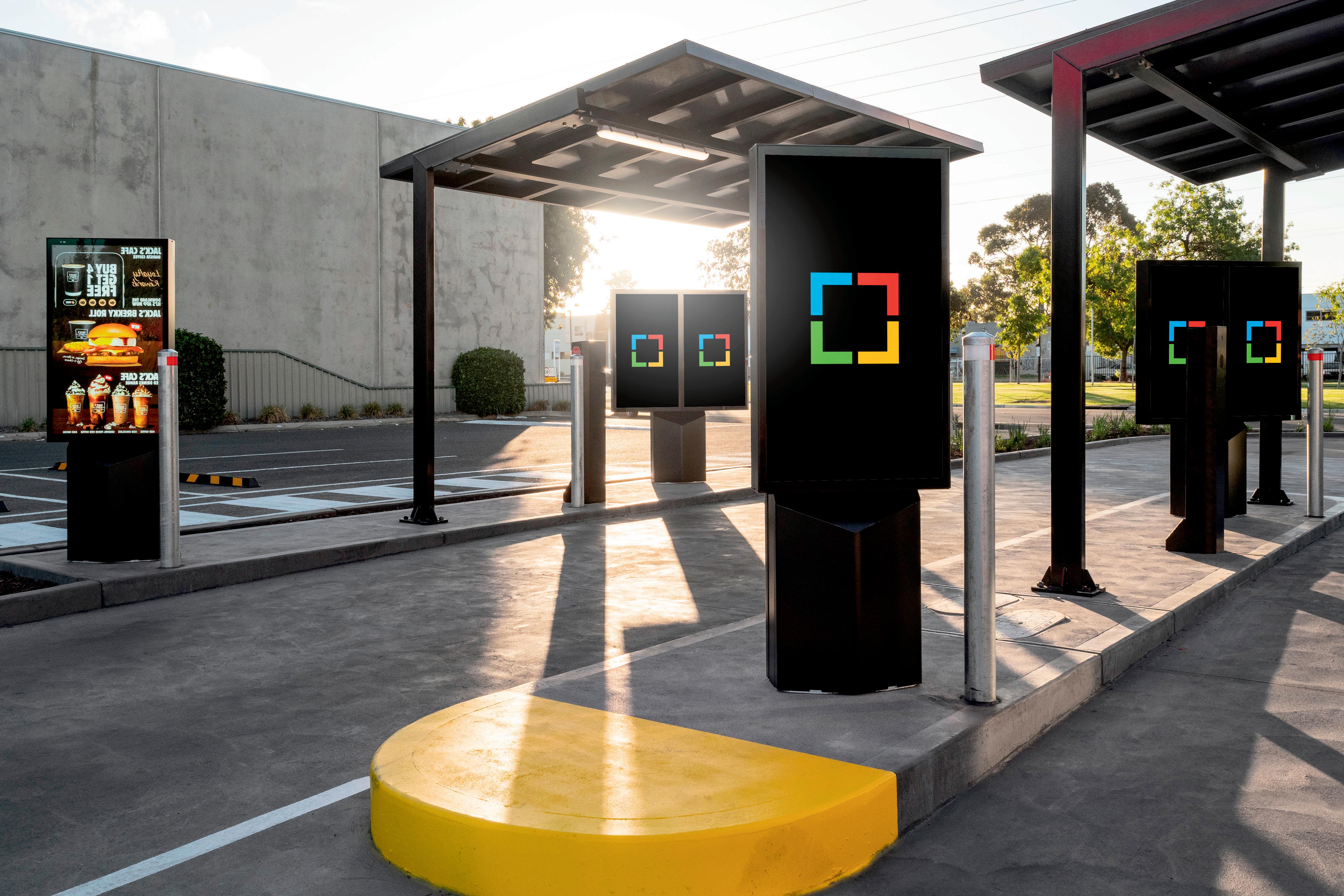

For more information: CoatesGroup.com info@coatesgroup.com Leading the Industry Immersive Customer Experiences Powered by Digital Hardware & Switchboard™ CMS
SmartChain Digital Signage
people and levels in the organization but also control some aspects of the menu while enabling local managers to change other aspects or menu items.”
Operators must consider what size and configuration of digital signage would optimize the viewing experience—and it can vary depending on each sign’s unique purpose and messaging. “Digital signage is most successful when it is high-qual-
ity and eye-catching while being easy to read and understand,” says Megan Zeller, senior director of business development at Peerless-AV. “This makes choosing solutions equipped with high-resolution and adequate brightness a key component of success. Another way to guarantee digital signage will perform at its best is to select an option that is optically bonded and polarized.” Polarization helps ensure any customers wearing sunglasses can easily view the screen.
For outdoor-rated displays, a key aspect to consider is their Ingress Protection (ip) rating. “Displays with an IP rating of 66 or higher will be waterproof and weatherproof for rain, snow, or other outdoor factors,” Zeller says.
Indoors or outdoors, successful digital signage increases engagement and
improves brand perception. “Above the typical menu list being displayed on the screen, it is now possible to add a video wall (a video playing across several screens like a huge monitor) to attract potential customers outside the restaurant to enter,” says Chloé Bisiaux, director of products at Acrelec. “Additionally, indoor menu boards attract the attention of the customers placing their orders on self-ordering kiosks. To further enhance the customer journey, digital signage can communicate with other technology solutions to create a highly personalized customer experience, build loyalty, and increase average check size.”
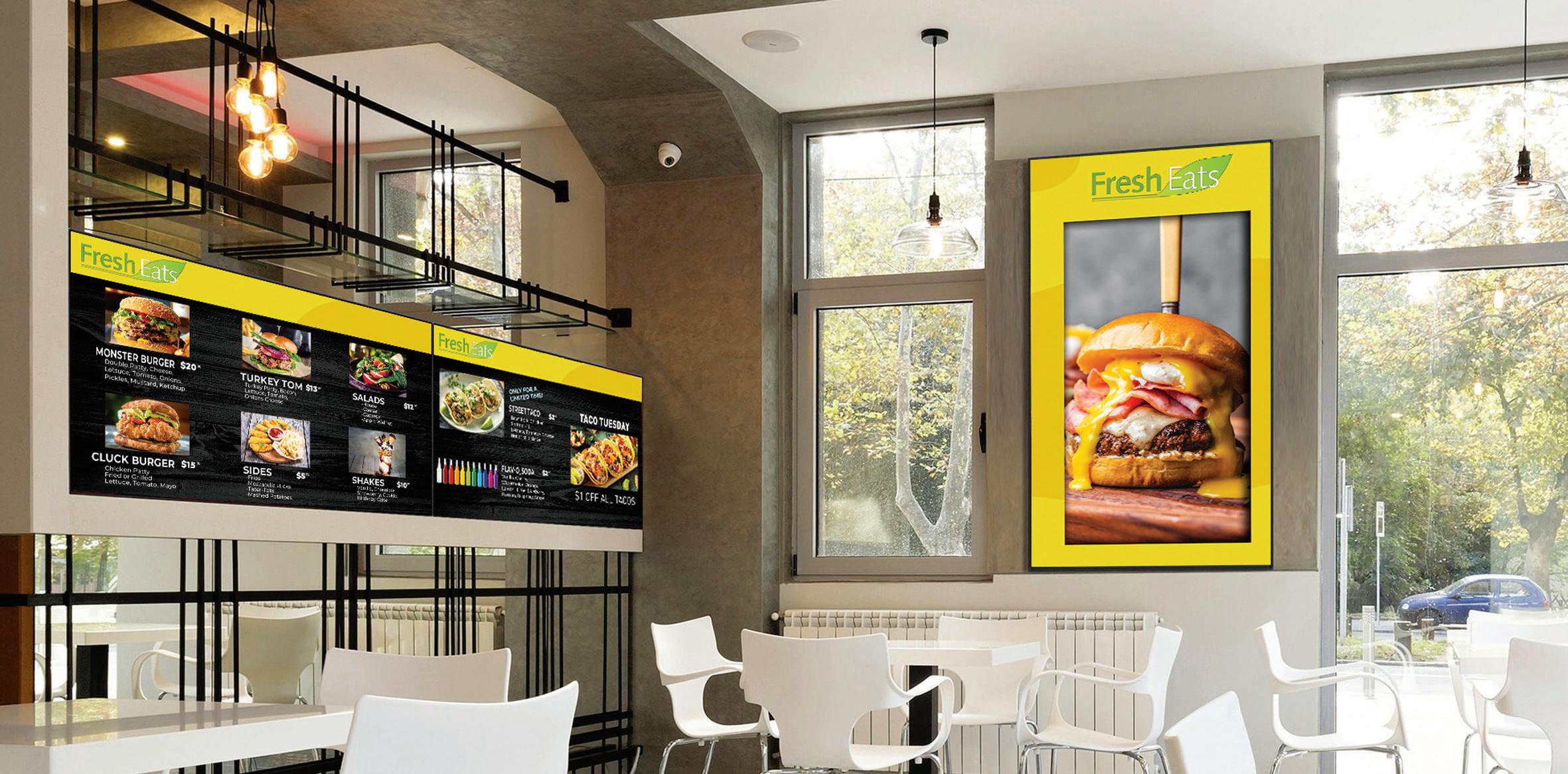
Project coordination, installation, and service level agreements (slas) also contribute in significant ways to the success of a brand’s digital signage. Restaurants must make an effort to define product lead time, rollout schedules, and logistics and staging requirements from the start of the project. For installation, it’s important to secure qualified engineers, project managers, and experienced technicians. And
in turn, over the lifetime of the initiative, SLAs help maintain peak performance.
“SLAs are critical to the ongoing success of the program,” says Jay Burdette, senior director of Panasonic Connect of North America “It is important to ensure what the warranty of your equipment is and how the supplier manages replacement models when components fail. Will the exchange be the exact model, or will it be a ‘similar’ model? If you require onsite support, other questions would be, what is the response time to service the system when it goes offline? Is that acceptable to your downtime requirements? If not, can back-up redundancy features be added within your budget to meet your brand’s specific requirements?”
In the end, it’s simple. “A successful digital signage program is one that accomplishes the goals it was created for,” says Theresa Hannen, marketing manager at LSI Industries. “While that may boil down to increasing ROI, the strategies to accomplish this begin with—and depend on—an improved customer experience.” SC
102 INDUSTRY-WIDE ISSUE SPONSORED CONTENT / MARCH 2023
PANASONIC CONNECT OF NORTH AMERICA
“SLAs are critical to the ongoing success of the program.”
Panasonic Connect of North America
Delphi Display Systems
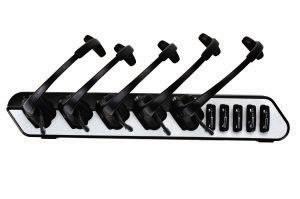
The Industry Leader in QSR Technology Solutions

DIGITAL MENU BOARDS
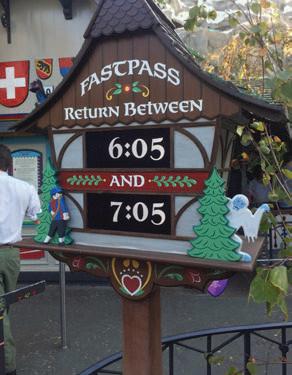
DRIVE THRU TIMING SYSTEMS
Delphi’s indoor and outdoor digital menu board solutions are designed for QSR and Fast Casual business owners seeking to modernize their restaurant with full control over dynamic menu content via our Insight Engage™ 3.0 cloud-based content management system. The system supports on-screen order confirmation and dynamic pricing capability with integrations to most point-of-sale systems. Engage 3.0 has been designed to be easy to use, while supporting the most sophisticated menu design and programming requirements.
DRIVE THRU ORDER CONFIRMATION
Delphi’s Insight Track™ timing systems provide QSRs with actionable real-time speed of service data in the drive-thru. Our Focus On feature identifies immediate service bottlenecks that need attention to keep the drive thru running at maximum efficiency. Further enhance your system with Score™, our cloud based competition ranking leaderboard that allows multiple stores to compete on a variety of performance metrics.
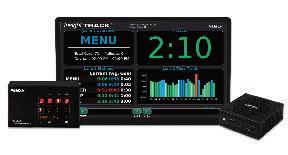
DIGITAL SIGNAGE
Delphi delivers a wide variety of indoor and outdoor digital signage solutions, from promotional to video wall displays available in both LCD and LED formats.
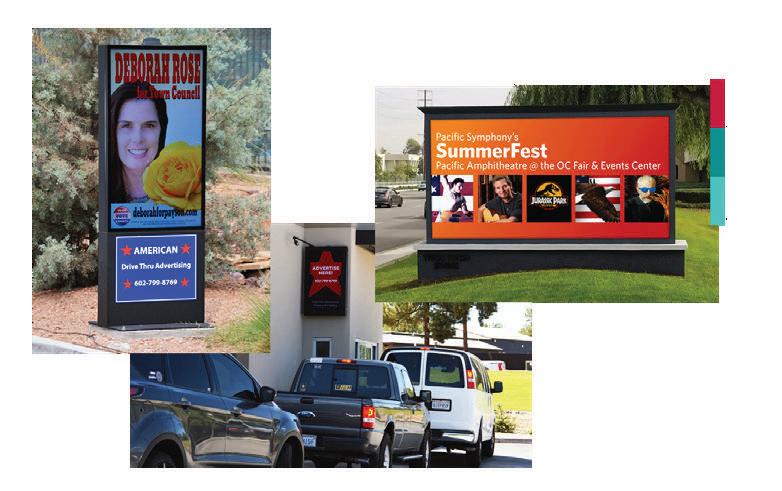
INTERACTIVE SMART KIOSKS
Seamlessly integrating with most QSR point-of-sale systems, our Endura® line of order confirmation solutions improve order accuracy, speed-of-service and customer satisfaction, leading to increased revenues and profits. Now available with new two-way video option to enhance communication with your customers.
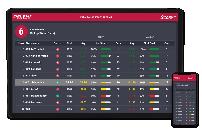
DRIVE-THRU COMMUNICATIONS
Delphi’s Visera™ line of Interactive Smart Kiosks serve as ideal digital solutions for QSRs seeking to provide interactive engagement and self-service options for their customers or employees.
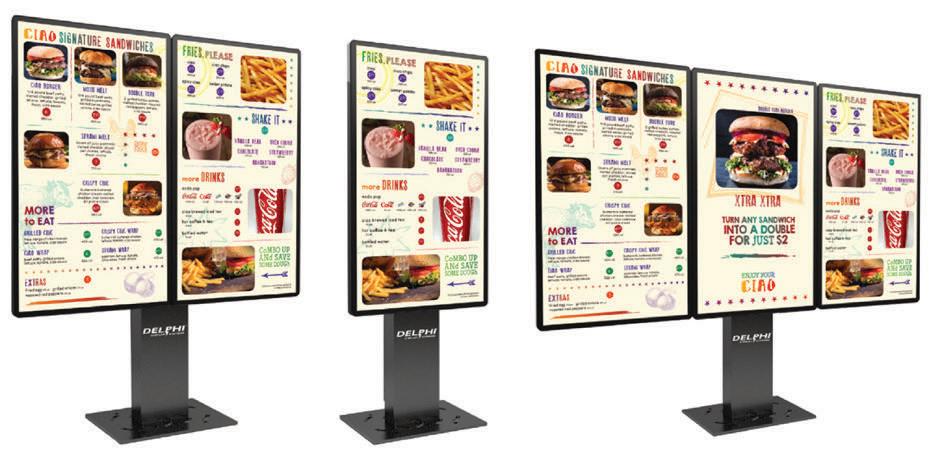
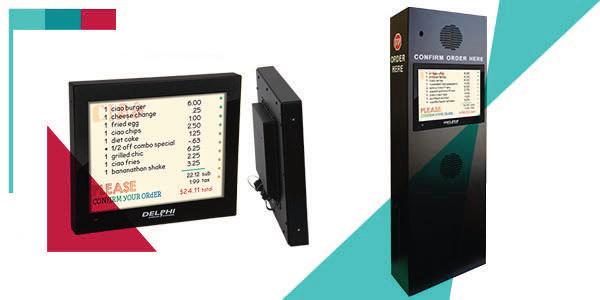
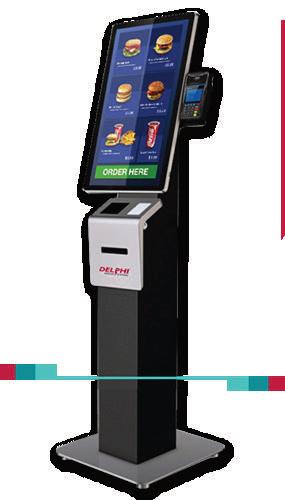
Providing clear communications is key to quality customer experiences and productive teamwork in the drive-thru. Delphi offers the Par G5 state-of-the-art wireless headset system available as a key component of our total drive thru technology package. The G5 is fully integrated with Delphi’s Insight Track timing system.
714.825.3495 www.DelphiDisplay.com QSRInfo@DelphiDisplay.com Contact us Today to boost your QSR performance! Mention promo code QSR22A for our special package discount
SmartChain Key players
Acrelec


1327 W. Washington Blvd.
Chicago, IL 60607
877-334-9737
acrelec.com/odmb




Acrelec is a global technology company focused on reinventing the customer experience for restaurant and retail brands. Leveraging decades of software, hardware, and service expertise, we develop and integrate new platforms that increase customer engagement, optimize efficiency, and improve operations for the world’s leading smart stores.
Coates Group

112 N. May St. Chicago, IL 60611 312-374-1365 coatesgroup.com
Coates Group is a global technology and digital merchandising solutions provider creating immersive experiences for some of the world’s leading brands. Our proprietary content management system, Switchboard, enables dynamic and personalized customer journeys across our range of innovative hardware products—a suite of indoor and outdoor digital solutions, self-order kiosks, and more.
Creative Realities, Inc.







888-323-3633
cri.com
Whether it’s at the drive thru, a kiosk, or at the counter—at Creative Realities, we integrate hardware, CMS software, and content for exceptional guest ordering and digital signage experiences. Flexible, purpose-built end-to-end solutions that can scale as you grow. Let your journey begin with a partner you can trust.
CrimsonAV
512 Lindberg Lane Northbrook, IL 60062
866-668-6888
crimsonav.com
CrimsonAV is an industry-leading AV design and manufacturing company with more than 20 years of experience in ProAV. Crimson offers “More than Mounts,” with kiosks, racks, and dvLED solutions. Crimson delivers superior products at maximum value, but it is our customer experience that makes CrimsonAV your best choice.


Delphi Display Systems, Inc.







3550 Hyland Ave. Costa Mesa, CA 92626 800-456-0060
delphidisplay.com
Innovators of best-in-class consumer engagement and business optimization solutions, Delphi Display Systems has been a technology leader in the quick-service restaurant industry for over 20 years. With over 40,000 locations in more than 75 countries, Delphi’s offerings include indoor and outdoor digital menuboards, order confirmation displays, drive-thru timing systems, cloudbased content management systems, and realtime performance ranking leaderboards.
DSA Signage
2321 E. Gladwick St. Rancho Dominguez, CA 90220 866-691-1682

drivethru.dsasignage.com/buildyourown
DSA Signage is a U.S. manufacturer of UL Listed signage solutions, including indoor and outdoor, digital, and illuminated menuboards. Our inhouse team of engineers can work with an existing design or create a new solution, using only the best components for extended durability and offering competitive lead times.



104 INDUSTRY-WIDE ISSUE SPONSORED CONTENT / MARCH 2023
The Howard Company
1375 N. Barker Road
Brookfield, WI 53045
262-782-6000
howardcompany.com

The Howard Company is the nation’s leader in drive-thru equipment and digital menuboards, providing end-to-end solutions, including equipment, installation, graphic design, digital support, and content management. We also offer printed graphics. Through our products and services, we connect our customers with their customers.
LG Business Solutions USA





2000 Millbrook Drive
Lincolnshire, IL 60069
888-865-3026
lgsolutions.com
The LG Electronics USA Business Solutions division serves commercial display customers in the U.S. lodging and hospitality, digital signage, systems integration, healthcare, education, government, and industrial markets. With its dedicated engineering and customer support team, LG Business Solutions USA delivers business-tobusiness technology solutions tailored to the particular needs of business environments.
LSI Industries

10000 Alliance Road
Cincinnati, OH 45242
800-436-7800
lsicorp.com
From concept through installation, LSI provides display solutions. We design and manufacture customized ways to connect with your customers including digital signage, menu boards, graphics, displays, and lighting. We are experts at project management for complex, multi-site construction, engineering, and branding projects, as well as ongoing content management.
Mood Media
2100 S. IH 35, Suite 201 Austin, TX 78704
800-345-5000 moodmedia.com

Mood Media is the world’s leading experiential media company that maximizes the customer experience and provides value for businesses and brands worldwide. Our fully integrated solutions leverage advanced digital technology, curated and original creative content, and design expertise to make every shopping and guest experience more personal and more engaging.
NCR
864 Spring St. NW Atlanta, GA 30308
888-679-7147 ncr.com/restaurants
NCR helps restaurant brands transform, connect, and run their technology platform. Trusted by more than 50 of the top brands, NCR provides deep industry expertise and services with a unified commerce platform that enables brands to delight their customers in every interaction, liberate staff from manual tasks, and accelerate innovation.
Panasonic Connect
2 Riverfront Plaza
Newark, NJ 07102
201-392-4181
na.panasonic.com/us/clearconnect

Panasonic Connect is a B2B company offering device hardware and professional services for the connected enterprise. Our diverse portfolio includes self-ordering kiosk, POS hardware, BOH solutions, and drive-thru communication systems. By working with our customers and ecosystem of partners, we provide the right technologies to address our customers’ needs.

MARCH 2023 / SPONSORED CONTENT INDUSTRY-WIDE ISSUE 105 Key players SmartChain
SmartChain Key players
Peerless-AV
2300 White Oak Circle
Aurora, IL 60502
630-375-5100
peerless-av.com

For over 80 years, passion and innovation continue to drive Peerless-AV forward. We proudly design and manufacture the highest-quality products ideal for restaurant applications, including outdoor displays and digital menu boards, dvLED and LCD video wall systems, complete integrated kiosks, and more. Peerless-AV develops meaningful relationships and delivers world-class service.
Sony Electronics

115 W. Century Road, Suite 250 Paramus, NJ 07652
201-930-1000
pro.sony
Sony Electronics’ Professional Display Solutions group develops and manufactures technologies to enrich professional applications. The company offers A/V, presentation, imaging, audio, projection, and display solutions for the B2B market that are developed using customer feedback. With flexible sizes, price points, and form factors, Sony provides versatile options and consultative expertise.
Uni-Structures, Inc.

8540 Cobb Center Drive, Suite 100
Kennesaw, GA 30152
770-499-2000
unistructures.com
Uni-Structures, Inc. manufactures, ships, and installs drive-thru components to create solutions that will maximize through-put and enhance customer satisfaction.
Xenial
3420 Toringdon Way, Suite 400 Charlotte, NC 28277 704-295-7000
xenial.com


Xenial™ is a leading complete technology solutions platform for the quick-service restaurant (QSR) industry. With more than 35 years of experience, Xenial is a proud subsidiary of Global Payments—a Fortune 500 company—and is present in 62 countries, serving 51,000 locations including 20 of the top 50 QSR brands in the U.S.

106 INDUSTRY-WIDE ISSUE SPONSORED CONTENT / MARCH 2023
www.QSRmagazine.com/smartchain Download Our Full Range of Smart Chain Reports Today! SCreport_1-3S.indd 1 9/13/18 2:47 PM
Gaming the System
after you see what we’ve done with your material, you’ll understand how to create more games.’
Then we can create the additional components that aren’t in a printed piece, which would be motion and audio, as well as feedback. It really is amazing how you can do that. We had a meeting with 1Huddle, and that really encouraged us to go after it. They immediately flip your training materials into games for you to reference and understand, and then they input it into their system, their dashboard.
BY ISABELLA SHERK
As technology becomes increasingly essential to all facets of a restaurant operation, brands and third-party partners are exploring how new advancements can enhance onboarding and training. For hot dog and burger concept Dog Haus, that meant teaming up with 1Huddle to put a fresh spin on the process. The training platform uses gamification to turn employee handbooks into interactive games that team members play in lieu of traditional training seminars and reading.
CJ Ramirez, executive vice presi-
dent of marketing at Dog Haus, says the program enhances how employees engage with the material; the interactive format also fits the varied learning styles different people have. These games, he adds, are especially helpful for servers at Dog Haus Biergarten, a full-service version of the original fast casual.
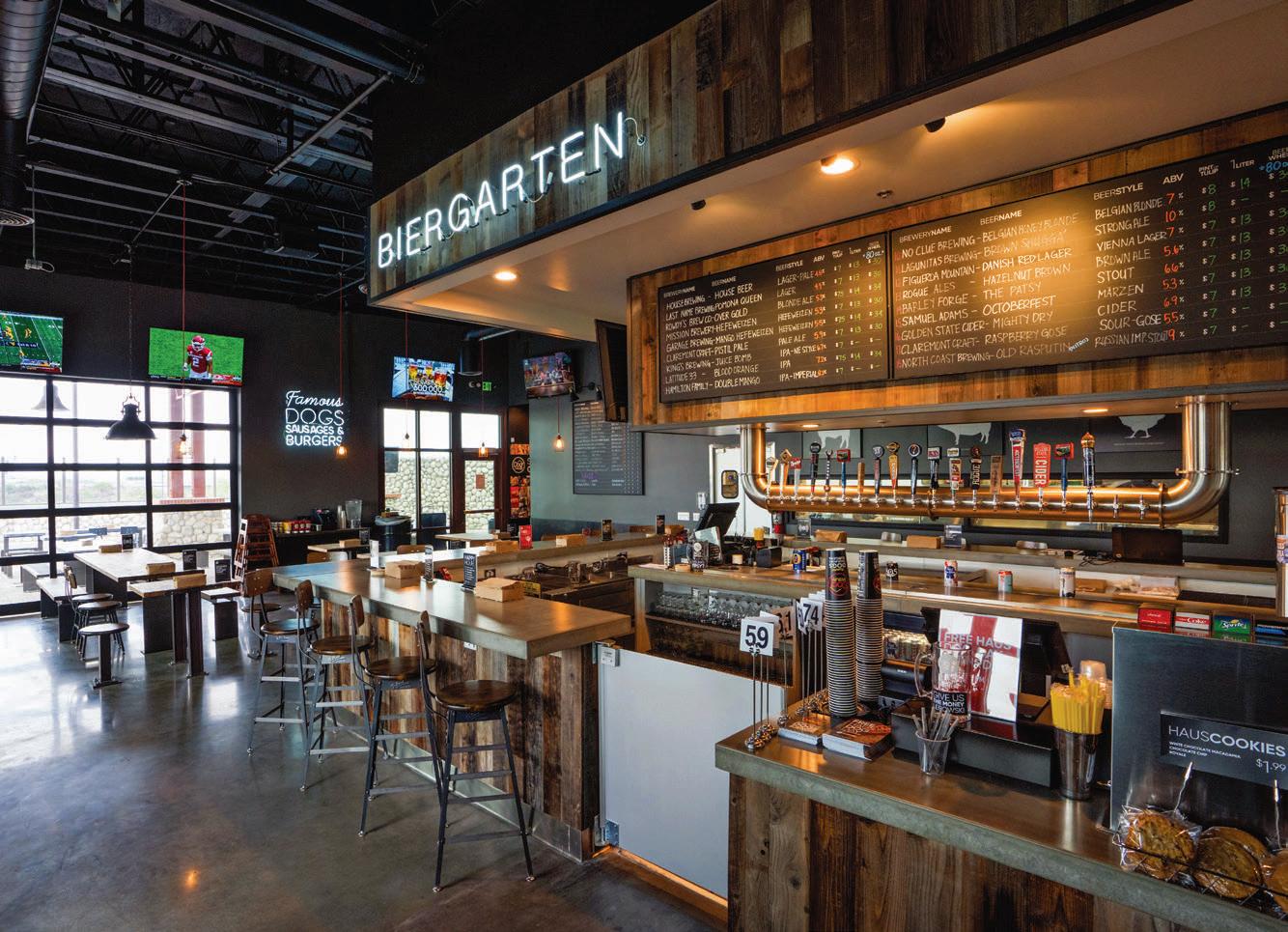
Dog Haus is committed to being a technology-forward company, Ramirez says, so instilling that mindset from the very beginning ensures employees understand and champion this ethos. Here, he offers a behind-the-scenes look into the new onboarding process.
HOW DID YOU TURN ONBOARDING INTO A LITERAL GAME?
1Huddle made it super turnkey. They said, ‘Give us all your training manuals, and we’ll turn them into games; if you don’t like what we’ve done, go ahead and edit them, but we think that
HOW
HAVE STAFF REACTED TO THE ‘GAMIFICATION’?
Logistically, on the user side, all they need is a mobile device and a login, so it’s super easy. I think one more layer is that we have found a way to incentivize the user to play the games. Early on, there was a question regarding, ‘Am I allowed to play at work?’ We had to re-engineer the expectation, so we incorporated playtime in the work shift. We work with our franchisees to implement that type of approach and then we move to monitoring who’s playing and recognizing those that accumulate the most points or play for the longest period of time or the ultimate top player in their location, in their state, or in the company.
WHAT DIFFERENTIATES YOUR ONBOARDING PROCESS FROM OTHER TECH-FORWARD ONES?
1Huddle gives us that ability to reach everybody in their learning style, so that’s really where we’re taking it to the next level. When we initially started years ago, we thought one game was enough for everybody, but we’ve learned it isn’t when you account for learning styles. We try to make the games as dynamic as possible.
The feedback we’re receiving from our users is, ‘This is really fun. It works for me.’ Employees are surprised that they begin to enjoy learning. So for us, that’s really positive feedback. Now the negative feedback is, ‘Why do I need to play it again? It’s the same game from last month.’ And we say yes, but it’s part
THE SCENES
BEHIND
Dog Haus is making the onboarding experience more tech-forward and interactive.
DOG HAUS
EMPLOYEES WANT TO TRAIN WHERE THEIR LIVES TAKE PLACE—ON THEIR MOBILE PHONES.
MARCH 2023 INDUSTRY-WIDE ISSUE 107
QSR FSR
EDUCATE YOURSELF
(Did
of a package; it’s a curriculum. Comments like that are answered with ‘Yeah, but it’s going to make you faster at it, and it’s just reinforcing the information. And then people say OK, I get it.’
HOW HAS THE NEW SYSTEM HELPED YOUR SERVERS?
We always want to maintain our stance that everything we say and everything we do is genuine; we’re not making stuff up. So, the most important thing is for our team members to be well informed because the best interaction is natural. If they can answer quickly as opposed to just reading the script off, that’s very important for them.
For example, with bartenders, when someone says, ‘This is a pretty good beer, but it might be a little hoppy for me. I’d like to try something else,’ we encourage them to add personal touches. We let our team members share their personal experiences. That’s really one of the hardest questions.
We train all the time, and the most challenging question you get is, ‘What’s your favorite hot dog, burger, or beer. What we like to say is you can have a favorite, because at Dog Haus, the menu is so wide.
You can eat light, or you can leave with a very full stomach; there’s a wide selection. But you really have to contextualize what they are in the mood for, because it demonstrates to the receiver that staff know more than just the menu. When someone asks, ‘What’s your favorite?’ and the question is answered with an immediate item, it does not allow for the team member to educate the customer on our full menu.
WHY IS THIS PROGRAM THE RIGHT FIT FOR YOUR COMPANY CULTURE?


We’re in the middle of opening about seven locations, so it’s crazy. Everyone is onboarding at different times and we’re making sure everyone is playing the franchisee game, the employee game, the general manager game—all of this curriculum we have out there. Pretty much everybody that’s part of the Dog Haus world is using technology because our brand is very technology-forward, and that attracts a lot of franchisees to us.
When we go through Discovery Days, they ask me to tell them more about the technology, about what type of general manager they should hire.
In the past, if you were lucky, you would hire someone to run your store with 20 or 30 years of experience who came out of some of the best restaurant brands that we all know today.
But my question is, how adaptable are they and how comfortable are they with technology? Because we use a lot of tech at Dog Haus, and if you hire someone that’s not comfortable with tech, that’s a problem.
WWW.QSRMAGAZINE.COM/WEBINARS
QSR’s webinar series tackles hot topics in foodservice—and best of all, you can learn from the comfort of your own office. Take a deep dive into our collection today!
Webinar_Educate_1_2V.indd 1 2/15/23 10:52 AM 108 INDUSTRY-WIDE ISSUE MARCH 2023
we mention they’re free?)
®

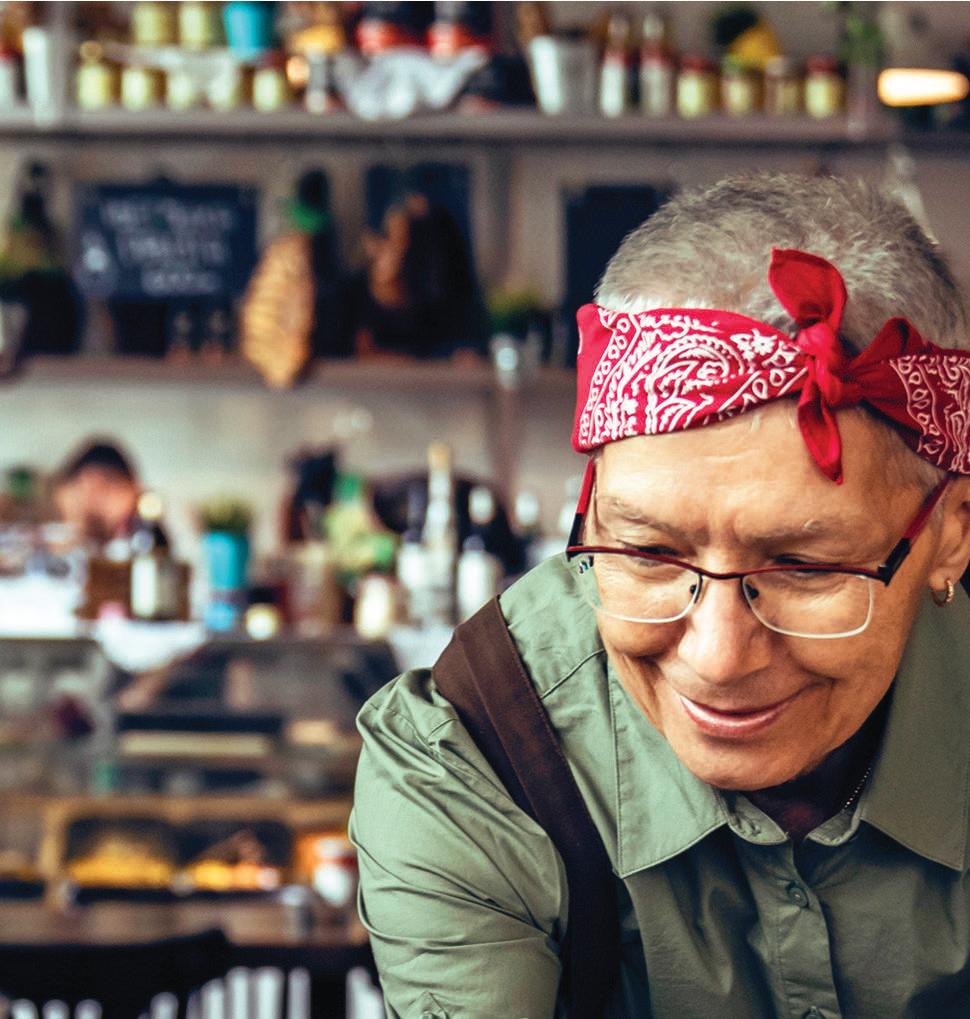





Innovation on Display
While such systems have been around for years, operators have increasingly adopted KDS to alleviate growing labor pressure, speed up kitchens, and streamline the operations between the front of the house, kitchens, and online and delivery platforms.
At First Watch, where the average cook touts seven years with the brand, some initially balked at the change. But it didn’t take long for crews to embrace the technology—particularly true for cooks who had already worked in KDS kitchens.
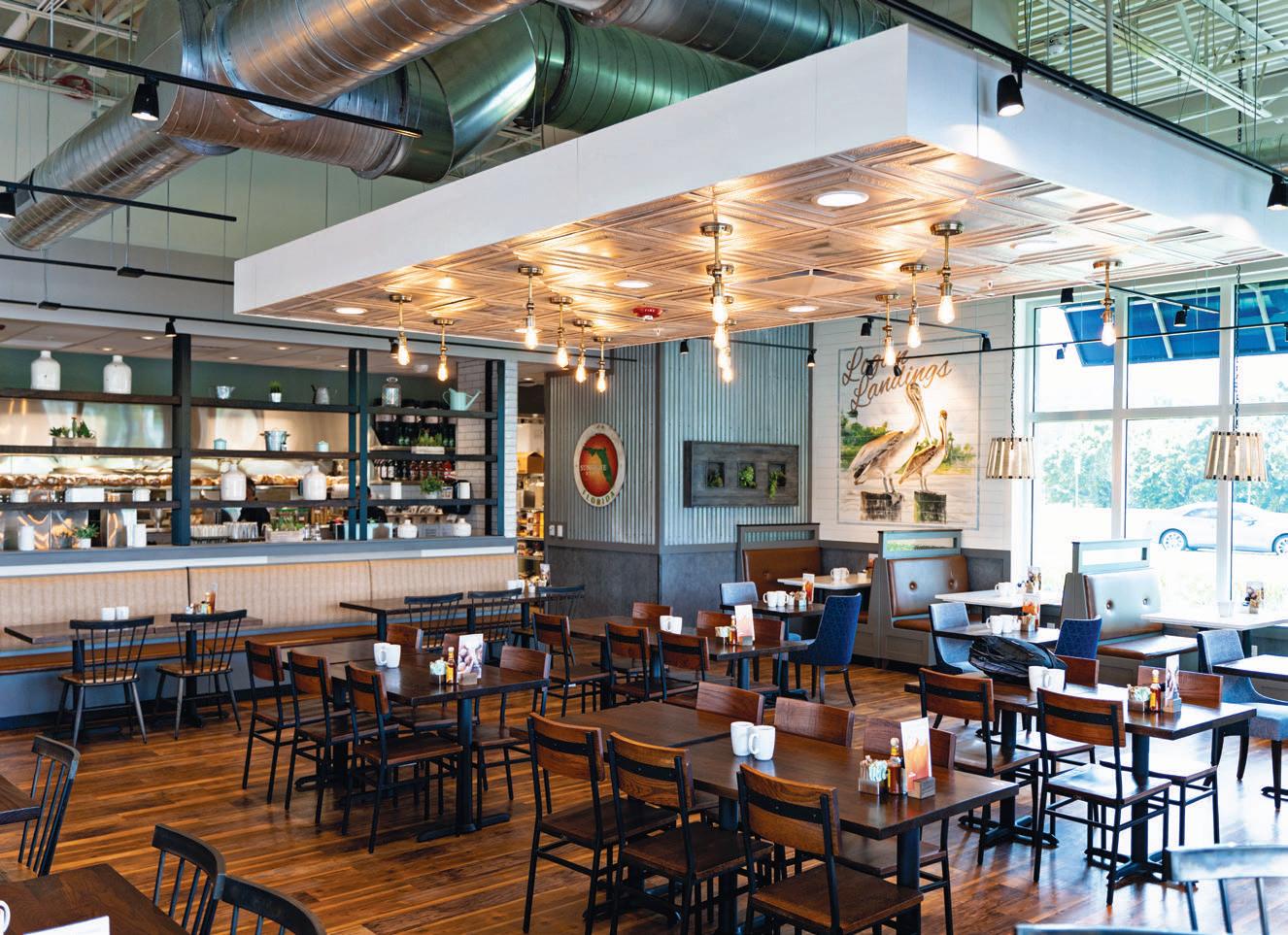
“Change is hard,” Jones says. “[ But] I think that everyone likes the new system better after they’ve used it—for some, it’s only a shift, for some it’s a week— they understand the benefits of it.” Since coming to the brand in the fall of 2021, Jones says he’s been to nearly 300 First Watch stores, most of which have implemented KDS. Not once has anyone requested reverting back to the old call system. While the brand is still measuring the overall impact of the new system on ticket times, Jones says early data show important gains that should help with both customer satisfaction and staff retention.
For most of its 40-year history, First Watch relied on paper checks to move orders in and out of kitchens. Up until a few years ago, servers wrote out orders on green tickets. In the back of house, the most senior person would often manage those tickets, calling orders to various stations. It required careful orchestration as the person at the helm measured the various cook times for eggs, meats, and pancakes.
In the best cases, all items hit the plating station at the same time. “It took a lot of skill, and a very skillful helmer
to make that happen,” says Dan Jones, chief operations officer at First Watch, which boasts nearly 500 stores.
But with a kitchen display system, or KDS, the pressure is off the employee helming the kitchen. Instead, the technology tells each station what and when to fire—automatically synchronizing various cooking times to ensure an entire order is ready at the same time. After testing KDS in five restaurants in late 2021, the breakfast and lunch chain began implementing the technology across all its company-owned stores last year.
“KDS is part of a larger focus for First Watch to support our operators, to make their jobs easier,” Jones says. “And this was one of those things that allows us to train a little more effectively, bring new team members up to speed faster, and provide a little more consistency in the kitchen.”
“We’re still evaluating and learning how to use that,” he says. “I would say early read is it makes it easier for our kitchens to execute. So, we know that’s a win for us. And that’s going to pay off long term.”
KDS is a key part of Empower Delivery’s value proposition. A spin-off of ClusterTruck, the vertically integrated virtual restaurant, Empower Delivery is a software company that powers delivery-centric restaurants.
“KDS is critical to making the system work,” CEO Meredith Sandland says. “And that’s because it’s the KDS that is communicating to the different workers at the different stations when to do what.”
Sandland describes Empower Delivery’s software as holistic. While taking orders from customers, managing kitchen stations and routing drivers, the software remains constantly


INNOVATE
The KDS, while hardly new to the industry, has reemerged into the operational spotlight.
FIRST WATCH
BY KEVIN HARDY
QSR FSR
110 INDUSTRY-WIDE ISSUE MARCH 2023
FIRST WATCH RECENTLY BEGAN ROLLING KDS ACROSS ITS FLEET.











Are You Missing Half of What FSR Has to Offer? Sign Up for Our FS Insider E-letter! EXCLUSIVE CONTENT FROM FSR EDITORS SELECT CONTENT FROM FSR MAGAZINE LATEST INDUSTRY HEADLINES FSRmagazine.com/FSInsider 4X A WEEK
resource-aware.
“So, it integrates the consumer journey, product journey and the logistics journey all into one system. As a result, everything is timed to perfection, meaning that there’s no latency in the system,” she says. “There’s higher utilization. As a result, it’s more profitable, it’s faster, the consumer gets a fresher, hotter product. No one’s ever waiting.”

In practice, the software does what other KDS systems do: it tells the kitchen to fire a burger a few minutes before building items that take less time like sandwiches or salads. But it also keeps constant track of delivery driver availability. That means if no drivers are expected to be available soon, orders won’t appear in the queue. That reduces stress in kitchens—a lesson first learned at ClusterTruck. Each day, the virtual brand’s downtown Indianapolis kitchen pumps out more than 1,000 orders, including many large group orders.
“You would think oh my gosh, it would be crazy, right? They’d be like shouting at each other and dropping things and wondering where stuff was all the time. And it’s not. It’s absolutely silent, super calm. Everyone’s just jamming away doing their thing,” Sandland says. “And the reason is because they’re only being asked to do the immediate next thing that needs to get done and so there’s no stress of like a backup that they can’t do anything about.”
Over time, the software can also learn about variances across locations, which may have different staffing abilities and physical layouts. If pizzas, for instance, take longer in some kitchens, the software can adjust accordingly. Sundland says the software was built with an eye toward a more automated future.


“You can imagine that over time, while today that KDS is telling a worker what to do at a station, it becomes now much easier for the software system to tell a machine what to do at a station,” she says.

Zach Goldstein views ever-advancing kitchen display systems as just part of the restaurant technology evolution. The CEO and founder of loyalty technology Thanx, Goldstein says the industry’s growing share of digital orders puts less importance on traditional point of sale systems.
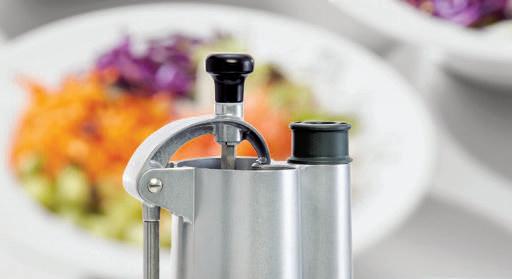
“I think what we’re seeing is a broader trend,” he says. “That is the declining criticality of the point of sale, and new ways for restaurants to operate. And if you stop treating the point of sale as the central operation hub of a restaurant and instead treat digital and, frankly, the customer as the center, you start with a world that starts making other elements of the restaurant technology more and more important.”
Smarter kitchen display systems even incorporate loyalty. They can notify line cooks of past diner preferences and food allergies. Or they can simply notify kitchens that they’re preparing food for a top customer, not unlike a hotel loyalty program can notify a front desk clerk.
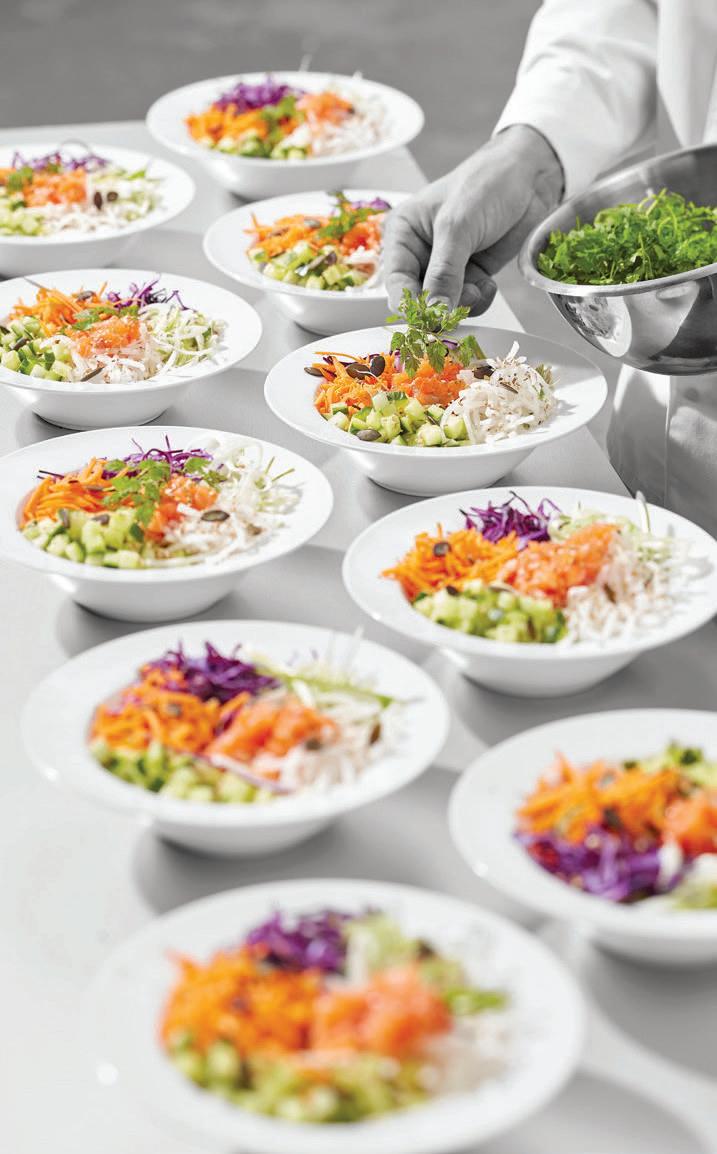
“How would it change the experience in the kitchen if you know that this person is one of your top 1 percent customers?” Goldstein says. “Presumably, you give it a little extra care, you make sure that the presentation was perfect, you ensure that you are firing it at the exact right time, so that all the dishes are at the same readiness. There are things you could do differently with that information and historically, that information does not make it to the kitchen.”
These new technologies span the front and back of house, Goldestein says, and put the customer at the center of a restaurant operation.
“You’re really putting the customer at the center of your restaurant as opposed to the point of sale at the center of your restaurant,” he says. “I think that’s why KDS [models] are kind of seeing more attention now.”
KEVIN HARDY IS A REGULAR CONTRIBUTOR TO QSR AND FSR AND IS BASED IN KANSAS CITY. 112 INDUSTRY-WIDE ISSUE MARCH 2023
INNOVATE / CONTINUED FROM PAGE 110
OUTSIDE INSIGHTS
Delivery, and the Battle for Control
BY CHRIS BAGGOTT
The dysfunction of third-party delivery implies a large risk for most restaurant brands. We simply can’t control off-premises problems once the food leaves our restaurant’s four walls. For those restaurants focused on quality, hospitality, and experience, the delivery ecosystem that has developed to date fails to ensure the very things our restaurant brands are built on.
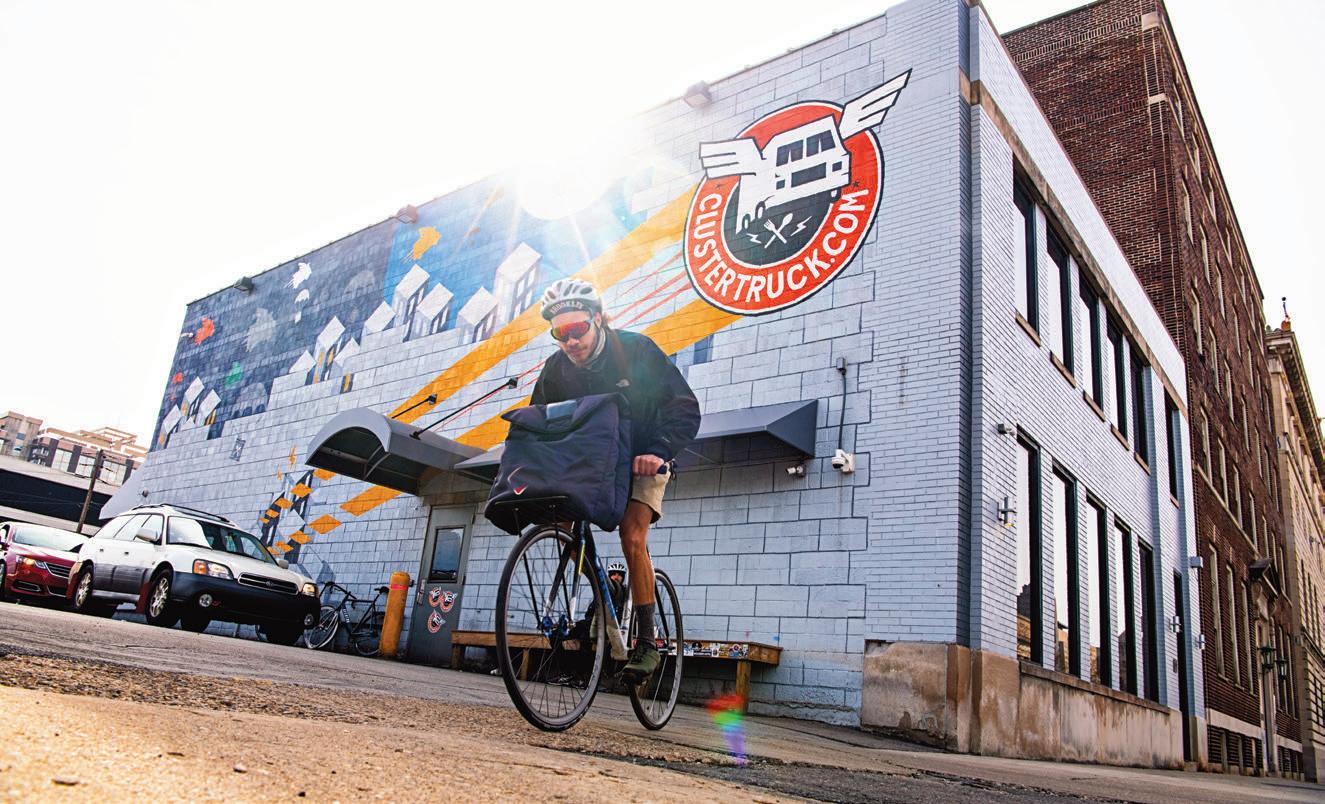
We developed software six years ago for Clustertruck, my vision for a vertically integrated virtual restaurant and ghost kitchen, which has allowed us to take control of our off-premises delivery business.
THE DELIVERY DILEMMA
Delivery has never truly worked. It’s too expensive. It takes too long. The quality and accuracy aren’t great. And restaurants are struggling to make money with it. Yet, customers want it. Restaurants are in the customer-service business, and it’s our job to figure out how to meet our guests’ demands.
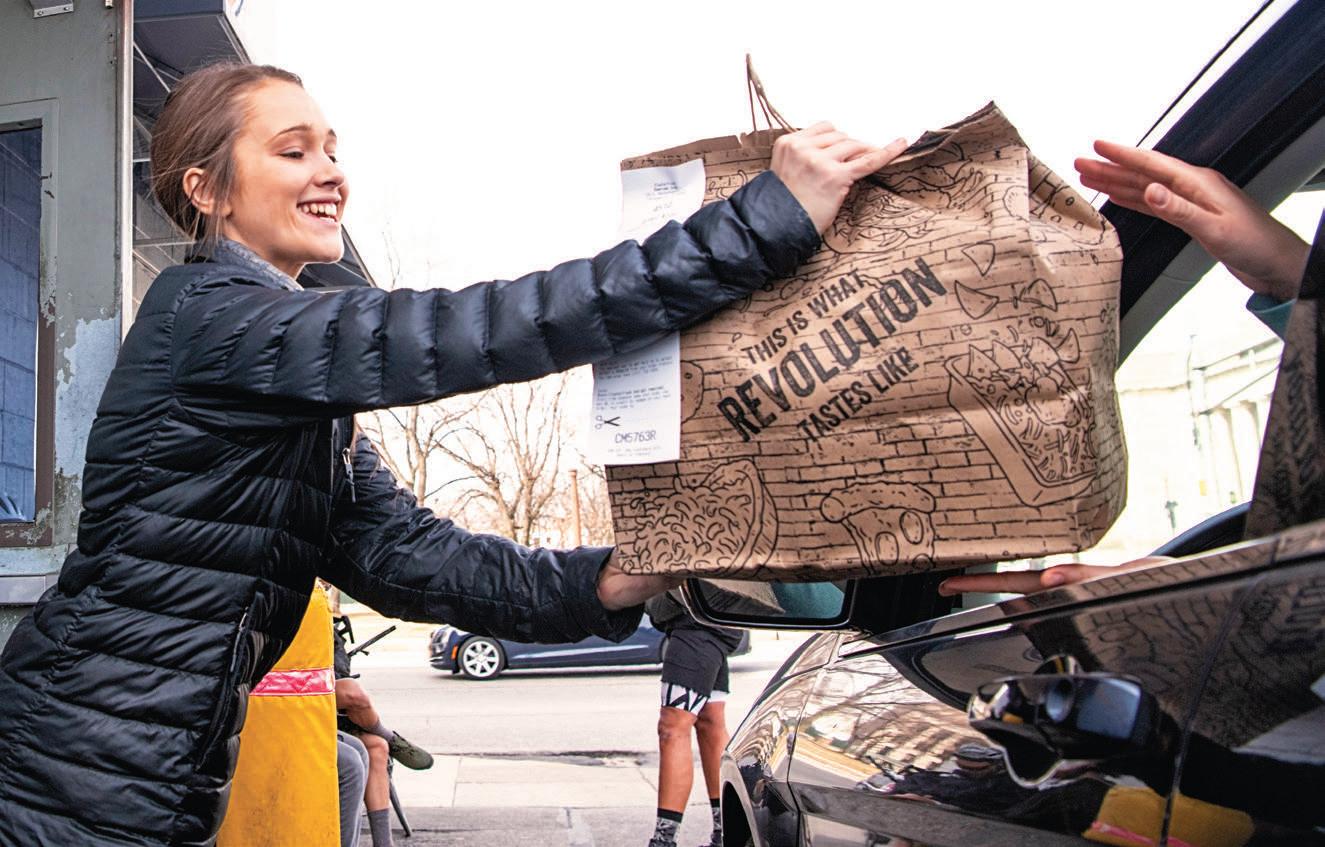
Trying to solve the problems in delivery with a fifteenth piece of software, new shelving, and team member training does not resolve the root cause of the challenge. The root cause? There are too many factors over which restaurants lack control for the operations of the delivery process to succeed. This
complex system adds time to the delivery process, and time is the enemy of food quality.
The biggest operational issue with delivery and pick-up has to do with timing. Restaurant operations fail to sync with delivery driver schedules, or vice versa, because they are two sep-
arate entities. Restaurant orders are started in the back of the house before there is even a driver secured, which leaves a customer’s food order waiting for anywhere from 5 minutes to a half hour before getting picked up by the driver. In that time, the food sits. Who knows when the delivery driver will
The consumer need is not going away, so there must be a better solution.
CLUSTERTRUCK (2)
QSR FSR
MARCH 2023 INDUSTRY-WIDE ISSUE 113
CAN OPERATORS REGAIN AN UPPER HAND WITH DELIVERY?
show up after the meal is fired? What’s more, there’s no guarantee that pickup orders sitting on shelves in the front of the house are picked up by the right customer. Someone could take another customer’s order by accident—or even on purpose. In some cases, the driver may never even show up, resulting in a guest who does not receive their meal, and a restaurant that has to throw out a perfectly good meal with no revenue to show for it.
Once the food leaves the restaurant, quality is further challenged. Any mistake made in the kitchen cannot be remedied the same way a server checking on a table could make adjustments. Restaurants cannot control the ambient temperature in the driver’s car, or the angle at which the food is carried. If a driver chooses to “self batch” (operate on two platforms at the same time, picking up several different orders from different restaurants headed to different homes), the time from pickup at the restaurant to delivery at the guest’s door may be even longer than anticipated. The entire system is almost designed to ensure poor quality, off-temperature meals.
CONTROL IS CRITICAL
The need for delivery is not going away, so there must be a better solution, and the solution must address the enemy of time. If a driver is delivering food 45 minutes after it has been packaged, it’s not going to satisfy the customer’s expectations, or the restaurateur’s for that matter.
The only solution is a vertical solution, one that is designed to instruct kitchens to cook food at a time that’s been coordinated with other food items in the order and driver ability to take the order to its destination. The happy side-effect of this coordination? The driver’s time is also optimized because the cook time of the food is based on the proximity of the driver. In a system this tightly coordinated, both line cooks and delivery drivers are better utilized, which drives up satisfaction
for the workers and reduces costs for the restaurants and their guests.
Restaurant general managers and back-of-house expediters are already stressed with the demands of the operation. How are these individuals to keep track of hundreds of orders, each involving multiple meals cooked on different stations, each destined for a different address delivered by a different driver? What seems impossible for humans to do is easy for the right software.
Why this can only be solved with a complete software solution.
The era of delivery has presented challenges that many restaurants simply aren’t equipped to handle. I started ClusterTruck as a virtual restaurant and ghost kitchen. Right away I realized that, in order to really be successful with delivery, I had to solve the timing issue. The solution we see being the most effective when it comes to solving the delivery problem of controlled quality of food orders is a purpose-built delivery system using software housed in a dedicated delivery-only facility.
Restaurant operators don’t have time to schedule and coordinate delivery. Instead, they need software solutions that can manage it all for them, keeping the consumer, kitchen and delivery drivers in sync.
Here’s what restaurant operators need in a delivery software solution:
• Native first-party ordering. Delivery software should make it easy to have a digital relationship directly between a restaurant and its guests.
• Dedicated driver app. The best delivery software solutions keep the delivery aspect in-house. Focus on keeping drivers busy and in-sync with the kitchen so that food is delivered promptly and at low cost.
• Smart firing. Get a system that offers smart fire times to flag the kitchen staff when it’s time to fire an order.
Make sure it coordinates with your kitchen display system (kds) and expo station.
• End-to-end solution. Choose a delivery software system that takes care of all coordination, including accommodating for busy meal times and long waits. A purpose-built, end-to-end solution will coordinate the consumer ordering, the drivers, and the smart KDS to ensure the most efficient, profitable, low-cost and high-quality product possible.
Software solutions help enable delivery as an integral aspect of restaurant operations—not just an afterthought that’s causing more stress in the kitchen. When operators can rely on a delivery system that works, they can rely on putting out a better product for their customers. And in this era, customer confidence means everything.
DELIVER BETTER
If a restaurant is going to incorporate delivery into the brand’s growth plans, operators have to keep control of product quality without placing undue stress on the kitchen team.
The right software solution will help signal staff that food should be cooked as the delivery driver is arriving. No more food sitting out and waiting for pick-up. No more drivers sitting around waiting for food. The right software can save time, improve the working environment for both back-of-house and delivery drivers, and elevate the consumer experience.
CHRIS BAGGOTT IS A SOFTWARE INNOVATOR TURNED RESTAURATEUR. HE IS THE FOUNDER OF CLUSTERTRUCK, THE LARGEST AND MOST PROFITABLE GHOST KITCHEN IN AMERICA. HE ALSO OPERATES GRIGGSBY’S STATION AND THE MUG. SEEING THE CHALLENGES OF RESTAURANTS FIRST-HAND, PARTICULARLY IN DEALING WITH INCREASING CONSUMER DEMAND FOR DELIVERY, HE AND CO-FOUNDER DAN MCFADDEN CREATED SOFTWARE TO POWER CLUSTERTRUCK. THAT SOFTWARE, EMPOWER DELIVERY, IS NOW AVAILABLE TO ALL RESTAURANTS SEEKING TO CONTROL THEIR OWN DELIVERY DESTINY.
OUTSIDE INSIGHTS / CONTINUED FROM PAGE 113
114 INDUSTRY-WIDE ISSUE MARCH 2023
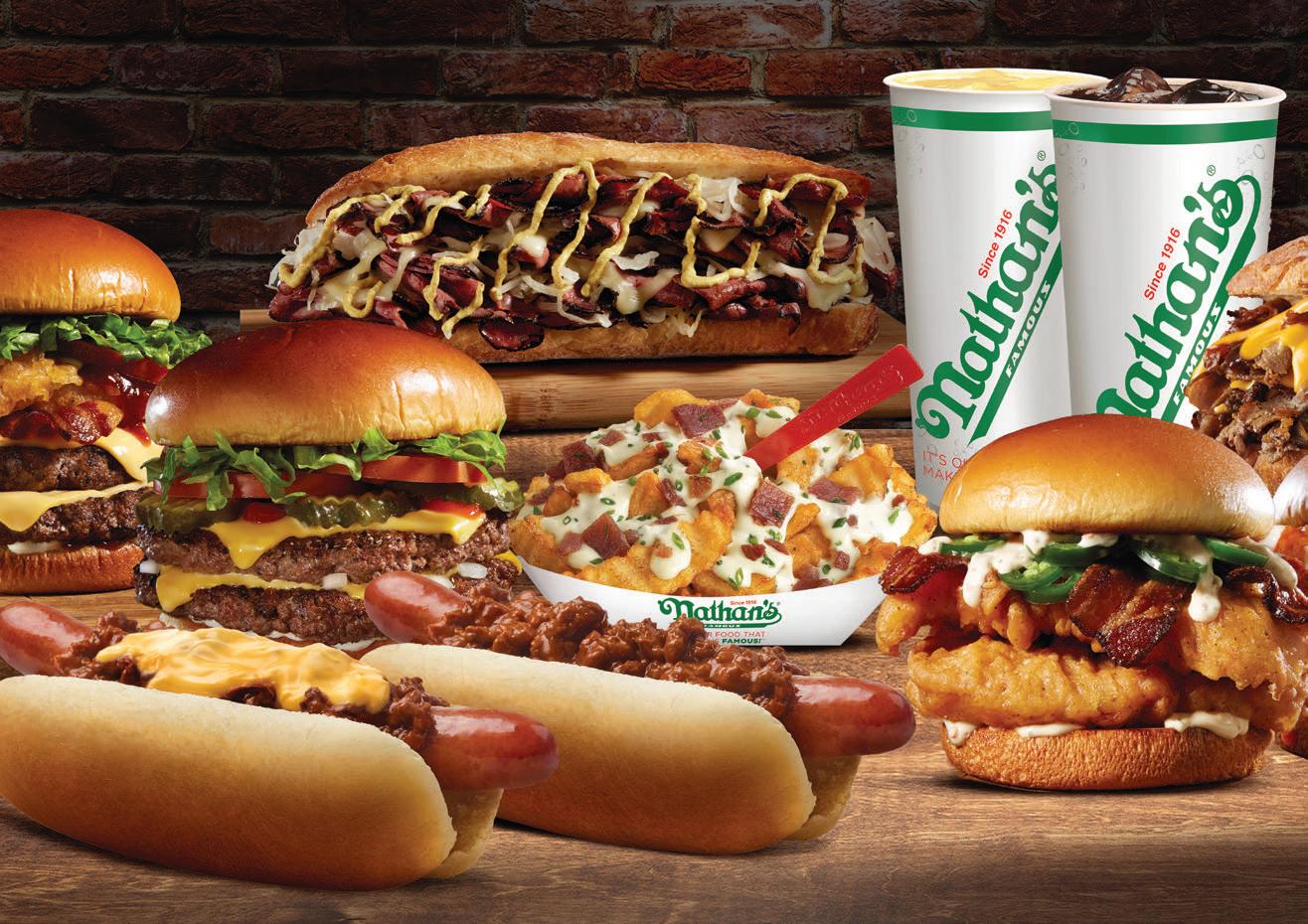











PROTECTYOURCOMFORTABLE,WELCOMINGDININGEXPERIENCE PROTECT insidetemperatures KEEPflyinginsectsout, chemical-free KEEPvehicleexhaust& cigarettesmokeout Whenthedoorisopen: CONTACTUSTODAY844.708.2500 SCANNOW aircurtains forbeautifulentrances Saveenergyandcreatehealthy,comfortableenvironments. MARCH 2023 INDUSTRY-WIDE ISSUE 115
Brix wasn’t sure how it would perform or if it would resonate with customers. So it was very much welcomed news when Friendly’s discovered that new, younger consumers who value convenience and speed were responding well to the new store.
The innovation doesn’t stop there either. The legacy chain, with roughly 130 restaurants mainly in the Northeast, has tested drive-thrus in a casual-dining environment. The restaurant believes it could work since 30 percent of sales come from ice cream, an item that can be made swiftly.
“So adding drive-thrus to our restaurants, you’ll see a bigger push for us next year as well to be able to again extend who we attract, extend when we can attract those guests, not just in the core daypart breakfast, lunch, and dinner, but the in-between daypart hours, especially late-night when we have drive-thru and people want to pick up an ice cream, sundae, or cone,” Mityas says. “And that’s been very a real big benefit in terms of things that we’ve been testing and what we will continue to push for next year.”
As for the sister concepts—Red Mango, Orange Leaf, Smoothie Factory, Souper Salad, Humble Donuts, and Greenz—the single-minded mission to grow remains the same. Fifteen to 20 locations are expected to open in 2023 among these chains. This includes the elimination of Smoothie Factory as a brand and transitioning to Smoothie Factory + Kitchen—signaling to guests that it intends to put just as much emphasis on its food menu. This means more attention toward toast wraps, salads, and flatbreads. The first is a franchised unit in North Richland Hills, Texas, and more are to come throughout the year.
In addition to this reimagination, Smoothie Factory has been used as a virtual brand in Friendly’s kitchens, a move that’s added AUV without increased labor. Mityas says the combination works well since the two concepts already share many ingredients. The
CEO notes that several franchisees are on board, and more virtual brand locations will pop up this year. Brix also plans to partner with a group that will package Smoothie Factory as a ghost concept in restaurants outside of Friendly’s, similar to Wow Bao.
“Talking to [ Wow Bao CEO Geoff Alexander] and taking a page out of his playbook, it’s how do we extend Smoothie Factory, for instance, into other restaurants outside of our chain as well,” Mityas says. “So you’re going to see us do a lot more of that next year. You’re going to see us not only continue to do virtual brands of ours and others but also extend our brands as virtual brands into other restaurants.”
Meanwhile, Orange Leaf is looking to lean into its identity as the “Willy Wonka of frozen yogurt,” Mityas says. The chain is introducing new flavors and toppings around an updated store design. Typically, customers get their frozen yogurt from the machine and walk down a path to the toppings bar and check out. With the new prototype, the toppings bar is not in line, but a separate section beside the yogurt machines. The redesign is meant to encourage fun and creativity, including clear cups so guests can show off their unique mixtures on social media. Orange Leaf has tested the format in corporate stores and has seen success. The hope is to continue that momentum in new franchisee prototypes in Omaha, Nebraska. More should open in the next 12–24 months.
Mityas describes Red Mango as a frozen yogurt concept for adults—a meal replacement and an opportunity to eat healthier. So similar to Smoothie Factory, the brand is transitioning to Red Mango Cafe to showcase a better variety, like more food options and boba tea.
“We have some phenomenal Red Mangoes out there,” Mityas says. “Everywhere from airports and college campuses and standalone centers across the country, and our franchisees are telling us we need more. People want to come in more often than just for their
frozen yogurt.”
Red Mango will also serve as a cobrand with an upcoming automated concept, Pizza Jukebox. Mityas envisions these locations being inside grocery stores—something that resembles how Subway and McDonald’s fit into Walmart. The pizza brand is part theater and part food. The idea is to have consumers watch the robot put toppings on the pizza and move it into the oven. The whole process takes three minutes and happens without a human hand.
“The experience is going to be as neat for consumers as the food,” Mityas says. “So it’s obviously very visual. There’ll be very clear glass and the ability to see everything working in the design. And so more to come on that, but we’re very excited about it. Very excited about launching a new brand like that, especially in a very heavy tech way. It’s always fun to introduce and debut a new brand and see what the customer reaction will be and see if we can grow this.”
To Mityas, growth involves organic development and M&A. One of his major objectives has been to expand Brix’s portfolio, which shouldn’t be difficult since the company has shared services that allow for new acquisitions to fit in easily.
To be more exact, he is looking for at least two to three concepts in the next 12–18 months. The company has already explored several options and cuisines that would best mesh with the current collection of brands.
“There’s daypart and occasion opportunities and there’s geographic expansion opportunities, especially with some of these smaller, faster-growing brands out there that we believe we can help energize and kick start their growth in a franchisee/franchisor model, and that’s really what we’re going to be all about,” Mityas says.
ONES TO WATCH / CONTINUED FROM INSERT AT PAGE 32
116 INDUSTRY-WIDE ISSUE MARCH 2023
BEN COLEY IS THE EDITOR OF QSR. HE CAN BE REACHED AT BCOLEY@WTWHMEDIA.COM
and they don’t need to pay anything out of pocket initially, which differentiates Everytable from other diversity incentive programs. Once a candidate becomes a franchise owner, they then have an extended payback period.
“The only thing you have to come to the table with is commitment, your ability, and your perseverance,” says Fluellen, a master chef who joined Everytable after operating a full-service catering company in Los Angeles. Fluellen has been fighting for food justice and social equity for more than 20 years, and has helped implement strategic programs at Starbucks, Magic Johnson Enterprises, and the American Heart Association.
Based in Southern California with about 50 locations open, Everytable trains candidates on everything from labor complexities and customer interactions to local store marketing, plus provides one-on-one weekly mentoring sessions.
“We’re providing a career pathway for individuals. How do you get from dishwasher to director of operations? Is it visible? Are there steps in place? What do I need to accomplish as an individual to get there?” Fluellen says.
Still, lack of education and awareness of opportunities remain one of the biggest obstacles to becoming a franchise owner.
“I think sometimes that can still be somewhat of a secret, particularly for frontline workers. You see an individual in a certain executive leadership position, and it seems so out of reach for people who are living day-to-day on the ground in the kitchen, in the front of house or back of house. We’re making some investments there,” Fluellen says.
Fluellen also throws in a word of caution to restaurant leaders and franchisors: Don’t make a lofty statement or commit to a diversity initiative if you don’t have a plan on how to make it happen.
“You have to put in the work; what is this going to take to really be sustainable? It takes a real conversation,
because what you don’t want to do is talk about impacting peoples’ lives, get people excited about opportunities, then not be able to follow through on it,” Fluellen says.
Assessing an organization’s current diversity, equity, and inclusion baseline is a crucial first step to developing any sort of equity program, says Kendal Tyre, who co-leads law firm Nixon Peabody’s franchising and distribution team as well as the firm’s DEI Strategic Services offering.
Restaurant leaders should find a way to analyze the issues stakeholders are calling attention to, gather best practices from around the industry to come up with solutions, then implement a way to monitor progress, Tyre says. “That’s what we’re seeing has worked.”
The International Franchise Association, for example, launched MinorityFran to help IFA member brands recruit more minority franchisees into their systems, plus undertook implementing a franchise census to collect more statistics on diversity within its system. IFA also launched the Black Franchise Leadership Council, which pulls a number of franchisors and their executive team leaders into training seminars that address issues in financing structures and how to increase Black franchise ownership in their systems.
“Diversity issues as we identify them today are different than 10 years ago. What’s most important is to create an institution that has a DEI [diversity, equity, and inclusion] framework that can adjust with the times, and provide the feedback and change in practices to accommodate the changes in the marketplace,” Tyre says.
“People are really looking for a silver bullet to address DEI issues, and the silver bullet really doesn’t exist, because DEI issues will always be a part of the conversation,” he adds.
for 75 percent of Starbucks’ beverage sales in that same period.
For Bad Ass, Snyder wants to find the balance quick-serves today are looking for. Dining rooms are getting smaller and the brand is opening more drive-thrus. Yet, again, it’s not forgetting about what happens inside.
“Is the [café ] going to be in all of our stores? Nope. But we still think that’s an important element. Especially in store locations that serve as the hub of that community,” Snyder says.
And it brings up a broader goal of making sure experiential brands flood every opportunity with their core equities. Whether somebody is rolling through the drive-thru or grabbing to go, they’re greeted with the same “aloha” that’s critical to the Bad Ass mantra.
“From our standpoint, we’ve never thought that the café was dead,” Snyder says. “I think that has a lot to do with what type of brand we have. Are we adapting? Of course we’ve adapted. We designed models for pure convenience and for throughput, and for drive-thru. Or for walk-up windows. But our core business is still about our heritage, Ohana, family.”
Bad Ass has a double-drive model and a modular version it’s working on that would combine the drive-thru as well as dedicated parking spots out front for curbside. Some will flex the ability to have outside or even rooftop café seating. Models, Snyder says, built to meet the needs of guests and also the needs of the location.
Yet that brand purpose will translate throughout and along the same lines repeated by operators in this story. The restaurant customer has not been shy about what they expect barreling into a fresh era of quick service. “It comes down to, do people have a choice?” Snyder said.
FRANCHISING FORWARD / CONTINUED FROM PAGE 45
CALLIE EVERGREEN IS THE EDITOR OF FSR. SHE CAN BE REACHED AT CEVERGREEN@ WTWHMEDIA.COM.
DANNY KLEIN IS THE EDITORIAL DIRECTOR OF QSR AND FSR. HE CAN BE REACHED AT DKLEIN@ WTWHMEDIA.COM.
MARCH 2023 INDUSTRY-WIDE ISSUE 117
THE FAST-FOOD DINING ROOM LIVES ON / CONTINUED FROM PAGE 74
take orders rapidly, and expedite the pace, as Chick-fil-A and In-N-Out have long displayed.
Krupp adds handhelds “shouldn’t affect the pacing of the meal,” either, in the event somebody isn’t trying to expedite their dinner. “Guests can still time out their own experience,” he says.
Most of these devices are designed to be understood quickly by servers and require minimal training. It potentially leads to higher wages, too, because guests are often prompted to leave between 18–20 percent tips.
Krupp acknowledges handhelds won’t fit in at most fine-dining eateries “because asking the guest to be part of paying the check is counter-intuitive to the experience.”
“The check average is high enough where the server doesn’t have to rush the table,” he adds.
Krupp notes handhelds appeal to people of all ages—GenXers, millennials, and even Baby Boomers who are used to check-out terminals at Walmart, Target, and most supermarkets these days. Additionally, the payment exchange reduces fraud since a server isn’t walking away with a guest’s card.
But Krupp conceded effectiveness still depends on the restaurant’s implementation. “Don’t force the handheld device into someone’s face,” he say.
Paul Macaluso, CEO of 80-plus-unit Another Broken Egg Cafe, introduced a trial of its handhelds in several locations in fall 2020. It then adopted it across all its full-service eateries in January 2022.
“We needed to upgrade our pointof-sale system holistically because it was 20 years old,” he says. Further, post-pandemic, the NextGen Casual chain struck relationships with several third-party deliverers including DoorDash, GrubHub, and Uber Eats. “We needed a POS system that would allow integration of all third parties,” Macaluso says. Previously, Another Broken Egg used iPad tablets throughout the restaurant, which were cumbersome and inefficient.
During its trial, the cloud-based system worked and made each server’s life easier, Macaluso says. Instead of having to write orders down in a notebook, and then deliver them to the kitchen, orders were injected instantaneously. During busy brunch, when guests are often waiting, service sped up.
In fact, Another Broken Egg conducted a time study and discovered it reduced ordering time by 3.6 minutes per group and servers could handle 12 percent more tables. In a restaurant with 40 tables, it amounted to serving an additional two tables per hour. Handhelds also made kitchen staff more efficient since orders came in directly, faster, without having to navigate four or five tablets.
Since customers also didn’t have to wait around for payment, they kept their credit card on the table, the pace quickened, and diners were happy, as was the server, Macaluso says.
The only issue that surfaced, Macaluso adds, was WiFi, because the handhelds run on them, and some restaurant locations had to have their WiFi systems upgraded to accommodate their signal.
Most guests, he says, “tend to be supportive and excited. It empowers the guest to make the transaction faster.”
To train staff, Another Broken Egg asked them to review a 10-minute video produced by its POS manufacturer, Revel Systems, and then each manager had a staff meeting of about 10 minutes to discuss how it would be implemented at every location. “For most servers, it was intuitive,” Macaluso says.
He sees additional benefits since guests are more inclined toward selfservice. “They could create a kiosk and allow guests to order by themselves,” he says.
“It’s been time-saving for the guests, there’s more efficiency for our staff and that leads to higher sales and profits,” Macaluso adds.
AD INDEX:
OPERATIONS / CONTINUED FROM PAGE 36 Ajinomoto Foods . . . . . . . . . . . . . . . . . . 57 909-477-4700 | Ajinomotofoodservice.com American Express . . . . . . . . . . . . . . . . 109 877-569-5497 creditcard.americanexpress.com Barilla Insert barillaFS.com/frozen Bel Foodservice . . . . . . . . . . . . . 39, 41, 43 312-462-1500 | belbrandsfoodservice.com BelGioioso Cheese . . . . . . . . . . . . . . . . . . 1 920-863-2123 | belgioioso.com/foodservice Berner 115 844-708-2500 | berneraircurtains.com Blount Fine Foods 69 blountfinefoods.com/food-service Brakebush . . . . . . . . . . . . . . . . . . 16, Insert brakebushchicken.com/crispy Cargill TNT . . . . . . . . . . . . . . . . . . . . . . 21 800-373-6515 | tntburgers.com Dallas Group . . . . . . . . . . . . . . . . . . . . . 75 800-367-4188 | magnesol.com ERC BottomLine Concepts . . . . . . . . . 65 212-668-1111 | tryerc.com FatzFoodz Delivery . . . . . . . . . . . . . . . . 55 202-840-8958 | fatzfoodzrunners.com Frank’s Red Hot . . . . . . . Inside Back Cover 800-322-7742 McCormickForChefs.com/Franks-Means-Buffalo Handy Seafood 25 800-426-3977 | handyseafood.com Jayshree 83 352-429-1000 | www.Jayshree.com Johnsonville Foodservice . . . . . . . . . . . . 3 800-837-5391 Foodservice.Johnsonville.com Lamb Weston 22, 23 800-766-7783 | go.lambweston.com/simplifry Land O’Lakes 30, 31 Landolakesfoodservice.com 118 INDUSTRY-WIDE ISSUE MARCH 2023
GARY STERN IS A REGULAR CONTRIBUTOR TO QSR AND FSR. HE IS BASED IN NEW YORK CITY.
19, Back Cover 866-729-7187 Redgoldfoodservice.com/sample-requests
888-796-4997 | rti-inc.com
| rfdrivethru.com

Robot Coupe
800-824-1646 | robot-coupe.com

Simplot Inside Front, 34, 35 208-780-8200 | simplotfoods.com


Smithfield. Insert 888-327-6526 SmithfieldCulinary.com/SBTH
Stratas Foods. 7 888-404-1004 | StratasFoods.com

S-Net. 119 844-986-1949 | qsr.snetconnect.com
Texas Pete Cover Tip Texaspete.com
Services
| tri-techservices.com



Smoothie

McCormick
. . . . . . . . . . . . . . . . 8 855-552-9797 McCormickForChefs.com/McCormick-Culinary Meat & Livestock Australia . . . . . . . . . 59
Melinda’s
Sauce. . . . . . . . . . . . . . . 73 taste.melindas.com/pages/90-days-free Mike’s Hot Honey . . . . . . . . . . . . . . 28, 29 212-655-0574
Nathan’s Famous. . . . . . . . . . . . . . . . . 115 800-NATHANS
NorthAmerican Bancard . . . . . . . . . . . 79 866-481-4604
North
Smokehouse. . . . . . . . . 33 800-258-4304
Paperchase. . . . . . . . . . . . . . . . . . . . 14, 15 646-964-4182
Progressive Commercial. . . . . . . . . . . . 11 888-806-9598
. . . . . . . . . . . . . .
Restaurant Technologies . . . . . . . . . . . 63
RF Technologies . . . . . . . . . . . . 5, 13, 119
Culinary
foodservice.aussiebeefandlamb.com
Hot
| mikeshothoney.com/sample
x.306 | nathansfamous.com
| NYNAB.com
Country
| NCSmokehouse.com
| pchase.com
| ProgressiveCommercial.com Red Gold.
800-598-2370
112
TriTech
. . . . . . . . . . . . . . . . . . 84 336-358-6151
Tropical
. . . . . . . . . . . . . . . . . 48 770-609-2987 tropicalsmoothiefranchise.com Van Drunen Farms. . . . . . . . . . . . . . . . . 71 888-452-6853 vandrunenfarms.com/fire-roasted-vegetables Vito Fryfilter 81 847-859-0398 | vitofryfilter.com Worcester. 67 800-533-5711 | Shortening-Shuttle.com SMART CHAIN . . . . . . . . . . . . 83-106 Acrelec 87 877-334-9737 | acrelec.com/kiosk Coates Group 101 312-374-1365 | CoatesGroup.com CreativeRealities. 91 888-323-3633 | Cri.com Crimson AV. 93 866-668-6888 | crimsonav.com Delphi Display 103 714-825-3495 | DelphiDisplay.com DSA Signage. 99 866-333-0670 | dsasignage.com Mood Media 95 800-345-5000 | moodmedia.com/qsr The Howard Company. . . . . . . . . . . . . . 89 800-782-6222 | howardcompany.com Xenial . . . . . . . . . . . . . . . . . . . . . . . . . . . 97 800-253-8664 | Xenial.com SPONSORED CONTENT Ghirardelli. . . . . . . . . . . . . . . . . . . . . . . . 53 888-970-6970 | ghirardelli.com Meat & Livestock Australia . . . . . . . . . 27 Foodservice.aussiebeefandlamb.com MARCH 2023 INDUSTRY-WIDE ISSUE 119
The AttitudeDo-Right
Shipley Do-Nuts CEO Clifton Rutledge is bringing decades of experience to a legacy brand ready for its next act.

franchisees while still providing excellent customer experience. For example, we’re currently rolling out online ordering, which is being very well received by our guests and raising our average ticket for our franchisees. Later this year, we’ll be launching a loyalty program and gift cards that can be redeemed at any Shipley Do-Nuts.
What was your first job? I was a busboy at Bonanza Family Steak House at the age of 14.
What’s your favorite menu item at Shipley Do-Nuts? This may be a controversial pick, but I just love our kolaches. I know, we have the World’s Greatest Do-Nut and I pick the kolache, but I stand by my choice.
I’VE BEEN IN THE RESTAURANT business
since I was a kid and, basically, I never left. In my more than 30 years in the quick-service space, I worked my way up to become COO at Whataburger and then moved on to become CEO at Bojangles Restaurants, COO at Jacks Family Restaurants, and now, CEO at Shipley.
What I love about Shipley is its rich history as an iconic Texas brand that is so beloved. Shipley is a part of their lives—it’s where they went with their grandparents, parents and now their kids, making memories while enjoying The World’s Greatest Do-Nut together. Shipley was family owned until 2021, and under our new ownership, we are focusing on growth and innovation for our next 85 years. We are unifying and updating the company’s systems and processes so we can scale for rapid growth and support
We’ve also launched a new coffee program to provide a consistent, highquality coffee experience across our entire system. Can you believe we were serving something like 35 different kinds of coffee across our system until just recently? The new coffee, which includes a new hot coffee and two flavors of cold brew, will not only improve guest experience but also drive sales as people realize that Shipley is not only the best do-nut around but that we also offer great coffee to go with it. But growth is the biggest story for us right now.
We have agreements in place to expand our footprint into Georgia and Maryland and increase our presence in existing markets. We’re still building out Dallas-Fort Worth and expanding across north, south, and central Texas. We believe we will double in size over the next five years. We’ve also entered our largest community partnership to date as the Official Coffee, Cold Brew, and Do-Nut of the Houston Cougars. This multi-year partnership with University of Houston Athletics will help them build their new stadium and bring awareness of our brand to new visiting teams and fans as they enter the Big 12.
What’s your favorite cuisine aside from Shipley Do-Nuts? I enjoy fine dining, and I love a good meal at Bludorn, a locally owned restaurant in Houston. It’s very rooted in the flavors of the Gulf Coast with French inspiration.
Who inspires you as a leader? My grandfather. He was a wonderful man of integrity with an impeccable work ethic. He was a World War II hero who led by example and his great actions versus just his words. He was definitely a man’s man who portrayed great strength, but also had a kind, gentle heart.
What’s the best piece of advice that other restaurant executives should hear? Understand that leadership is a privilege and do not take it for granted.
What are some of your interests outside of work? Hunting, fishing, and golf. I love to be outdoors.
START TO FINISH
SHIPLEY DO-NUTS
CLIFTON RUTLEDGE
® ®
120 INDUSTRY-WIDE ISSUE MARCH 2023
QSR FSR




Often Imitated, Never Duplicated. Frank’s RedHot® is the hot sauce that started the Buffalo wing craze in Buffalo, NY in 1964. *McCORMICK’S CALCULATION BASED IN PART ON DATA REPORTED BY INFORMATION RESOURCES, INC. USING McCORMICK’S CUSTOM DEFINITIONS. To learn more about Frank’s RedHot®, visit McCormickForChefs.com/Franks-Means-Buffalo ©2021 McCormick & Company, Inc. 24-1 Schilling Road, Hunt Valley, MD 21031 • 800-322-SPICE (7742)
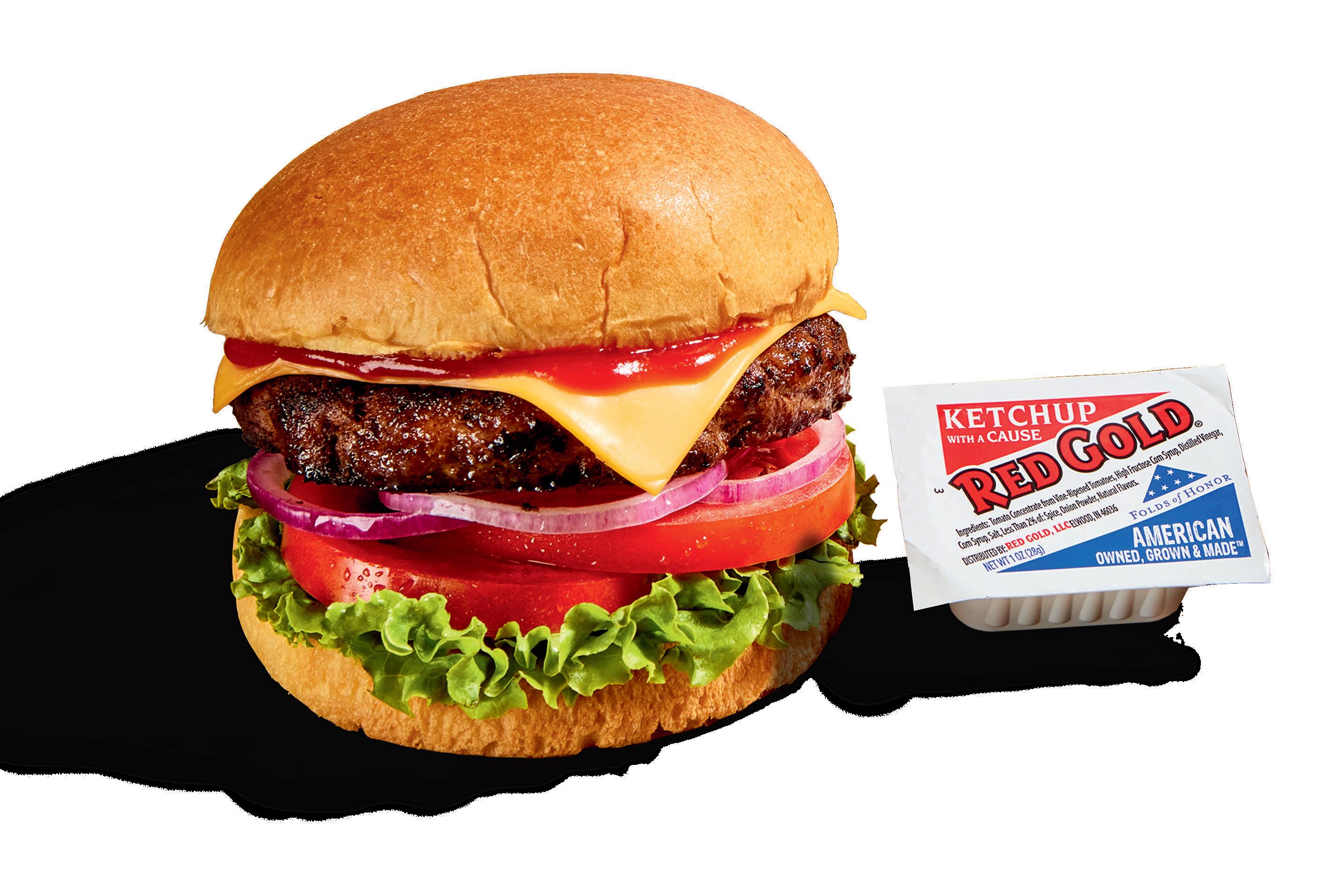
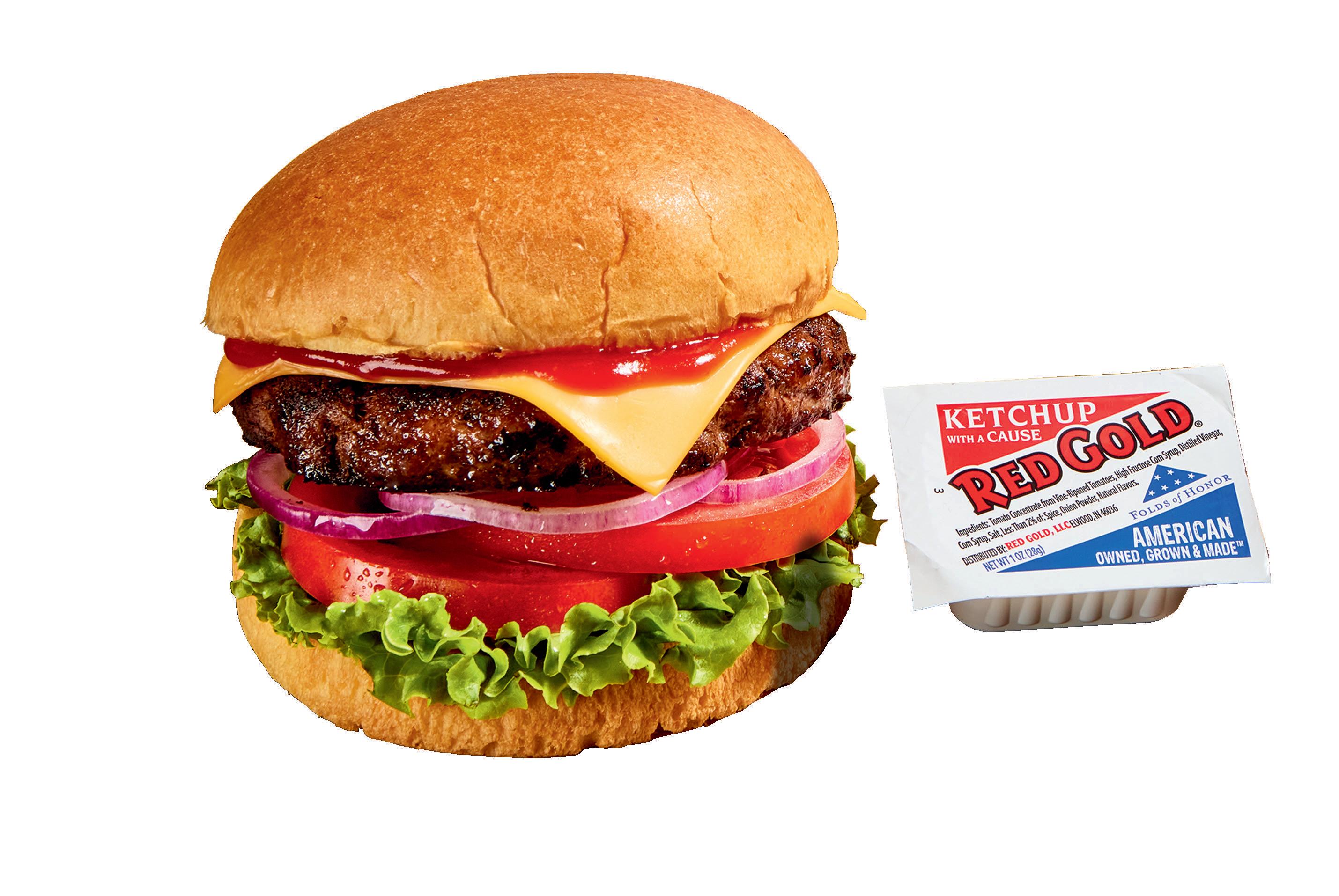
Serving ketchup and our country. Red Gold is a registered trademark of Red Gold, LLC. Elwood, IN RG-1352-0822 Ketchup with a Cause. You can’t beat the taste of Red Gold Ketchup, and now you can get it in a convenient 1 oz. dunk cup! With its thick, tangy tomato flavor and the perfect balance of sweet and sour notes—it’s a delicious flavor As proud supporters of the Folds of Honor Foundation, Red Gold helps to provide educational support to the spouses and children of deceased or disabled U.S. service members. That means, when you serve Red Gold, you’re serving the families of our fallen troops, too. you can feel good about serving. Request a sample today of the 1 oz. Red Gold Ketchup that’s easy to love and easy to share at Redgoldfoodservice.com/sample-requests RedGoldTomatoes.com/FoldsOfHonor
