Tompkins Flanges
Mary C. Gannon • Editor-in-Chief

Mary C. Gannon • Editor-in-Chief
OVER THE PAST TWO MONTHS, members of the fluid power industry have gathered multiple times — for the National Fluid Power Association’s Annual Conference in New Orleans and CONEXPO/CON-AGG in Las Vegas. The global industry also gathered in Germany for the International Fluid Power Conference presented by the Institute for Fluid Power Drives and Systems at RTW Aachen University, while in the coming weeks, the International Fluid Power Society meets for its spring meeting in Savannah. And the one theme that is shining through is a general sense of optimism for the industry and its users despite a somewhat unstable geopolitical climate.
At the NFPA meeting, for example, outgoing president David Price kicked the business meeting off talking about the resilience of our industry, and how its members have survived challenging times and come through stronger on the other side. “The best way I can describe it is that this industry takes grit and perseverance. Because what we do matters. Our work is important and is vital to this industry throughout America and abroad. The oil that flows through the components that we all make in this room and the systems that we support is the lifeblood of our customers,” Price said. “Machinery manufacturing in the US supports about 13 million jobs today. It also contributes $3 trillion in economic output.”
Price did note it’s difficult to ignore the challenges with workforce, adding that as of late last year, there were more than 400,000 manufacturing jobs open. Longer term, with nearshoring underway, millions more roles will need to be filled. “That's something everyone this room feels, whether it's hiring, training or just finding the right people to grow your businesses,”
he said. “And the customers, they want better efficiency, more connectivity, more sustainable solutions, and they expect reliability every time. So we're all navigating this complex environment together. We're all bringing new technology to existing systems, alternative solutions, and all of it while managing cost.”
Later, Lauren Saidel-Baker, CFA, Economist with ITR Economics, highlighted that despite volatility and challenges in the market, the macro economy is showing signs of life. “We're starting to see the business cycle improvement. The less good news is that improvement is coming very gradually. This is not like flipping a switch and turning the economy right up. This is really a slow momentum build. Things are gradually getting better. There are still some unknowns out there, But as I look at the economy today, I'm not seeing runaway growth rates, but I am seeing pockets of opportunity,” she said.
Saidel-Baker highlighted that hydraulics and pneumatics shipments have reached their low point and “are in a very clear and confirmed recovery trend.” While beverage and plastics are stagnant, aerospace has not peaked yet and agriculture, mining, and construction are in recovery modes.
Similarly, at CONEXPO, the mood was positive, with most fluid power manufacturers upbeat about the show, attendance and the impact it would have on their business in the long-term. More than 140,000 attended the show, and exhibitors were positive about their booth experiences. OEMs sold machines directly at the show and as many fluid power companies indicated, leads were up and deals were made. This shows a construction market in that recovery mode, as economists are predicting.
And as the IFPS prepares to meet, Donna Pollander, ACA, CEO, International Fluid Power Society, said that the IFPS is seeing a similar sense of optimism from members and the board. “One of the most encouraging indicators for us is the activity around workforce development. Certification testing is up, and we’re seeing increased sales of educational books and training modules,” Pollander said. “That tells us companies are continuing to invest in their people and recognize the importance of building strong technical foundations across their teams.”
Pollander said there is a positive outlook about upcoming and new training opportunities and particularly strong interest in foundational and fundamental training, as well as the Support Associate certification. “Organizations are looking for ways to get new employees productive faster while strengthening the core knowledge of their existing workforce,” she said. “Just as important, we’re not hearing much concern about the industry’s economic outlook. The tone of the conversations we’re having is constructive and forward-looking. Overall, the momentum around training, certification, and workforce development gives us a lot of confidence that the industry is on a steady, upward path.”

It’s always a great feeling to end the first quarter on such a positive note. Are you seeing similar outlooks in your industries? We’d love to hear from you! FPW

Mary C. Gannon • Editor-in-Chief mgannon@wtwhmedia.com linkedin.com/in/marygannonramsak
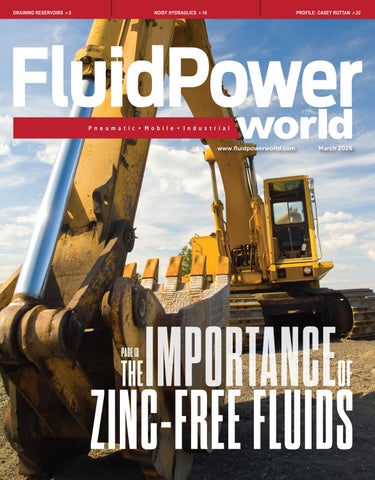
Examining the growing importance of zinc-free hydraulic fluids
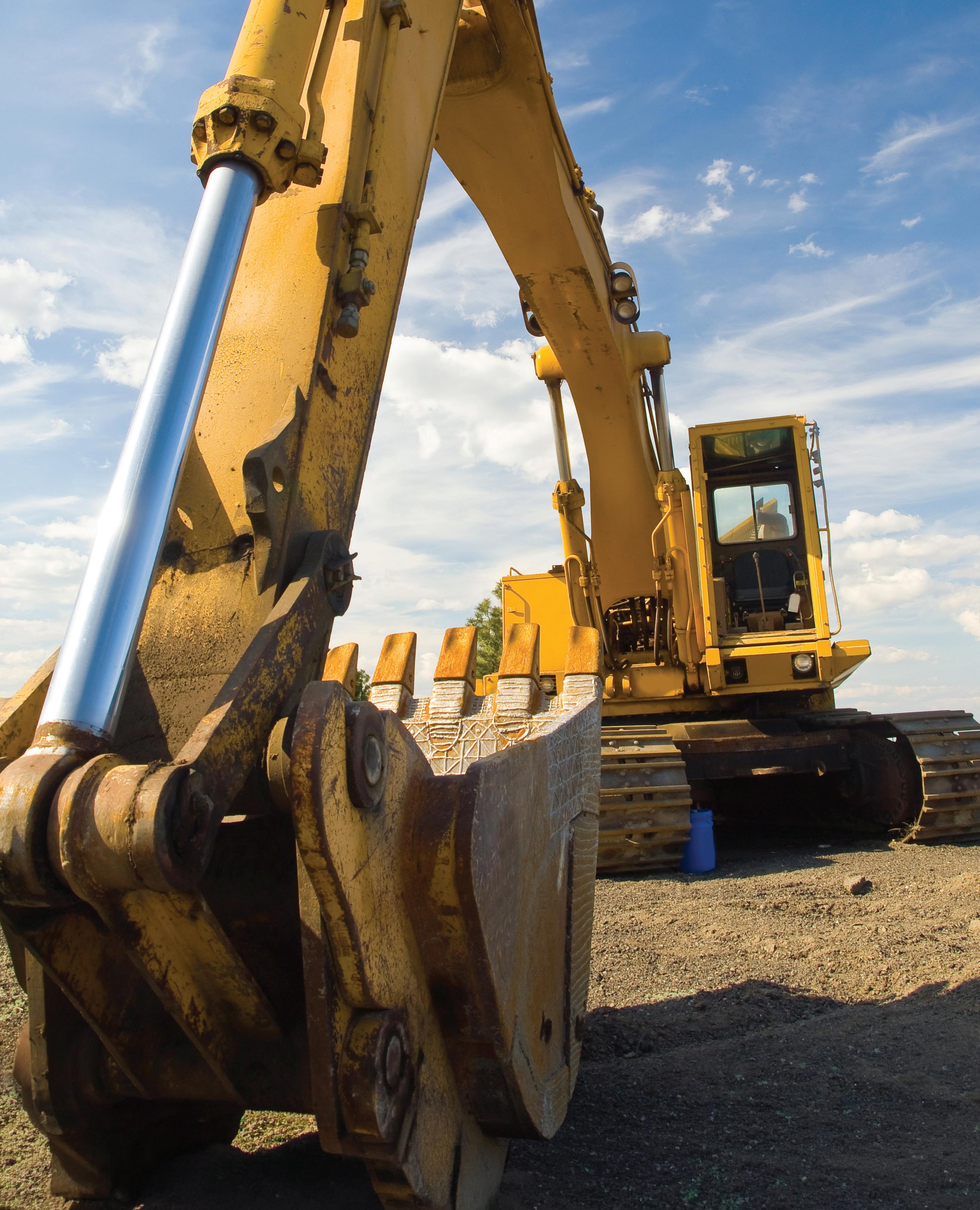
In an increasing number of end-use applications, zinc-free hydraulic fluids are becoming desirable to minimize impact, particularly in sensitive environments.
Why are we putting up with noisy hydraulics?
Noise is often inevitable in hydraulic systems, but discovering its sources can help you to better design your systems to alleviate some of it.
Casey Ruttan: jack of all hydraulic trades
Throughout his 20-plus year career, Casey Ruttan has taught, troubleshooted and helped design fluid power systems and schematics.



EDITORIAL
VP, Editorial Director
Paul J. Heney pheney@wtwhmedia.com
Editor-in-Chief, FPW
Mary Gannon mgannon@wtwhmedia.com
Contributing Editor Josh Cosford
Contributing Editor Carl Dyke
MARKETING
VP, Marketing Annie Wissner awissner@wtwhmedia.com
Digital Marketing Manager
Taylor Meade tmeade@wtwhmedia.com

www.nfpa.com

VP, Creative Services
Matthew Claney mclaney@wtwhmedia.com
Art Director, FPW
Erica Naftolowitz enaftolowitz@wtwhmedia.com
Art Director, FPW Digital Eric Summers esummers@wtwhmedia.com
Director, Audience Growth Rick Ellis rellis@wtwhmedia.com
Senior Associate, Audience Development Marie Claussell mclaussell@wtwhmedia.com
SALES
Amanda Buehner abuehner@wtwhmedia.com
Ryan Ashdown 216-316-6691 rashdown@wtwhmedia.com
Jami Brownlee 224.760.1055 jbrownlee@wtwhmedia.com
Jack Gillerlain 773.909.2718 jgillerlain@wtwhmedia.com
Susan Powers 708.341.3370 spowers@wtwhmedia.com
Judy Pinsel 630.538.2638 jpinsel@wtwhmedia.com


• Fax: 888.543.2447
FLUID POWER WORLD does not pass judgment on subjects of controversy nor enter into dispute with or between any individuals or organizations. FLUID POWER WORLD is also an independent forum for the expression of opinions relevant to industry issues. Letters to the editor and by-lined articles express the views of the author and not necessarily of the publisher or the publication. Every effort is made to provide accurate information; however, publisher assumes no responsibility for accuracy of submitted advertising and editorial information. Non-commissioned articles and news releases cannot be acknowledged. Unsolicited materials cannot be returned nor will this organization assume responsibility for their care.
FLUID POWER WORLD does not endorse any products, programs or services of advertisers or editorial contributors. Copyright© 2025 by WTWH Media, LLC. No part of this publication may be reproduced in any form or by any means, electronic or mechanical, or by recording, or by any information storage or retrieval system, without written permission from the publisher.
Customer Service Manager
Stephanie Hulett shulett@wtwhmedia.com
Customer Service Representative
Tracy Powers tpowers@wtwhmedia.com
Customer Service Representative
JoAnn Martin jmartin@wtwhmedia.com
Customer Service Representative
Renee Massey-Linston renee@wtwhmedia.com
Customer Service Representative
Trinidy Longgood tlonggood@wtwhmedia.com
CEO Matt Logan mlogan@wtwhmedia.com
Co-Founders
Scott McCafferty Mike Emich






SUBSCRIPTION RATES: Free and controlled circulation to qualified subscribers. Nonqualified persons may subscribe at the following rates: U.S. and possessions: 1 year: $125; 2 years: $200; 3 years: $275; Canadian and foreign, 1 year: $195; only US funds are accepted. Single copies $15 each. Subscriptions are prepaid, and check or money orders only.
SUBSCRIBER SERVICES: To order a subscription please visit our web site at www.fluidpowerworld.com
FLUID POWER WORLD (ISSN 2375-3641) is published six times a year: in February, April, June, August, October, and December by WTWH Media, LLC; 1111 Superior Ave., Suite 2600, Cleveland, Ohio 44114. Periodicals postage paid at Cleveland, OH & additional mailing offices.
POSTMASTER: Send address changes to: Fluid Power World, 1111 Superior Ave., Suite 2600, Cleveland, OH 44114



Josh Cosford • Contributing Editor
OVER THE COURSE OF THE TRADE SHOW
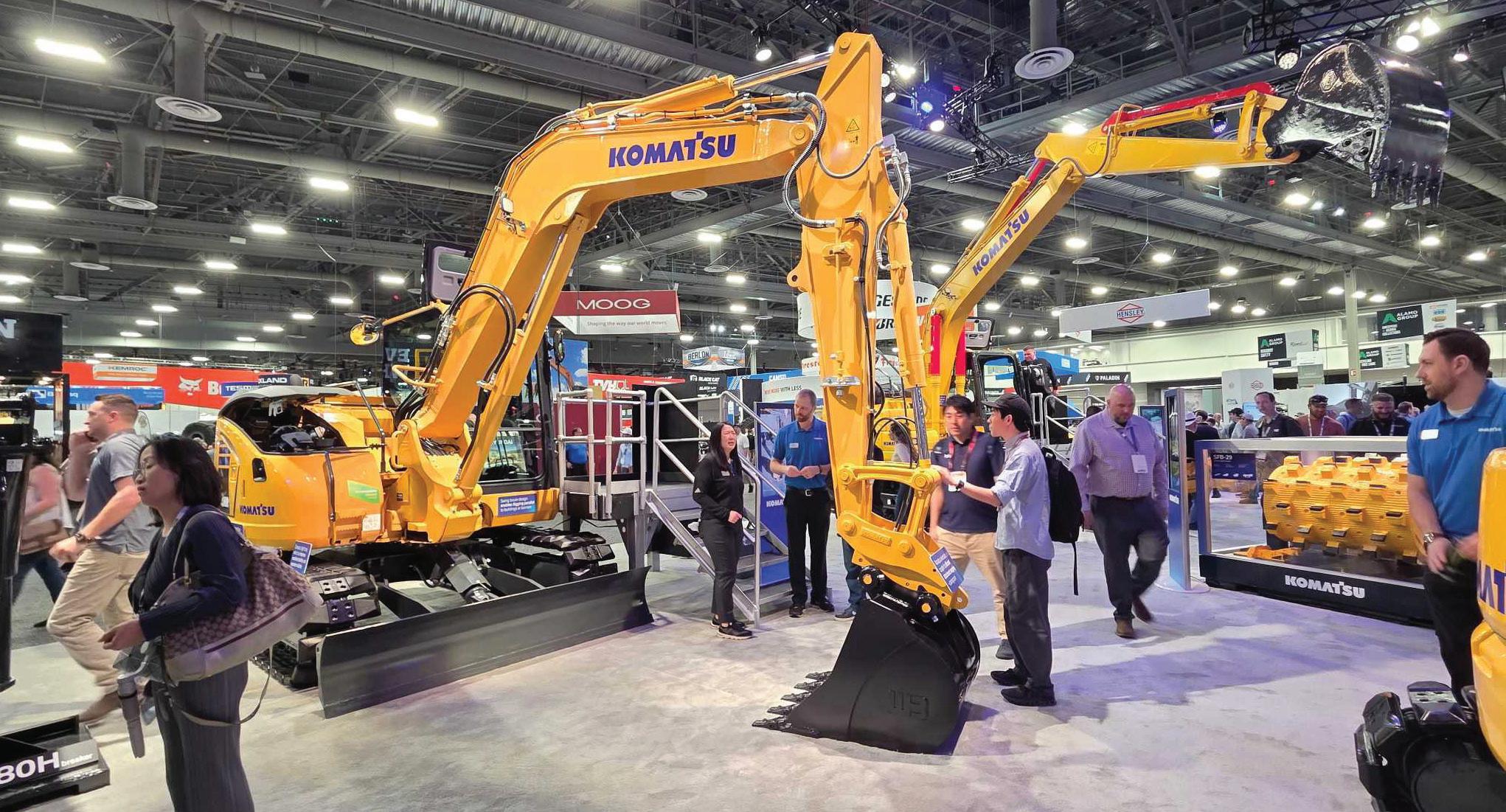
week, I averaged almost 17,000 steps per day. Indeed, the 2026 CONEXPO/CON-AGG exhibition was absolutely massive, but I took advantage of their (slow and infrequent) lot shuttles. In most cases, it would have been faster to walk, but I made the rookie error of wearing dress shoes on day one. That mistake aside, this show is so large that I’d say very few people could have visited every exhibitor.
Overall, the show was great, and it's clear that mobile hydraulic machinery is transitioning to electrification, albeit more slowly than one might think. I did see some trends and made some observations, so here are the top five things I learned at the 2026 CONEXPO trade show:
1. Electrification of hydraulics is moving away from analog electronics and into digital electronics. The proliferation of Controller Area Networks (CAN) is increasingly popular, and the future is digital. Each node in the system, whether a valve controller or a pressure transducer, will now be its own microcomputer that accepts programming signals and also outputs whatever data is asked of it. We no longer need a centralized CPU to handle every input and output. Whether Bluetooth or CAN, these systems skip traditional analog outputs such
as 4-20 mA, reducing wiring to and from each individual valve, pump, or sensor.
2. Robots are everywhere, and now they're hydraulic. Various OEMs offered both remote-controlled and autonomous hydraulic robots, with brush mowers appearing to be a popular option for many. I also saw robotic drilling, material handling, forklifts, and ditch-digging machines. Hydac, in particular, displayed their robotic mini-excavator prototype, which used a combination of linear and angle sensors to allow full automation.
3. Hydraulic cylinders are still king. Everywhere I went, manufacturers offered technologies that replaced wheel-drive systems or various versions of electrically driven hydraulic pumps. However, despite technological advancements, electric linear actuators remain bulky, slow, and underpowered. Sure, they operate independently of a centralized hydraulic pump, but a hydraulic (or air) cylinder is about as perfect a linear actuator as can be.
4. Wires will soon be a thing of the past. I realized this when I was discussing the Bluetooth pressure transducers one exhibitor offered. They offer live, accurate pressure readings, and the free app logs data such as peak pressure, average pressure,
and the number of cycles, all powered by a watch battery with a three-month lifespan. Why supply even a digital servo valve with four CAN wires when it can be powered by advanced lithium batteries and controlled wirelessly?
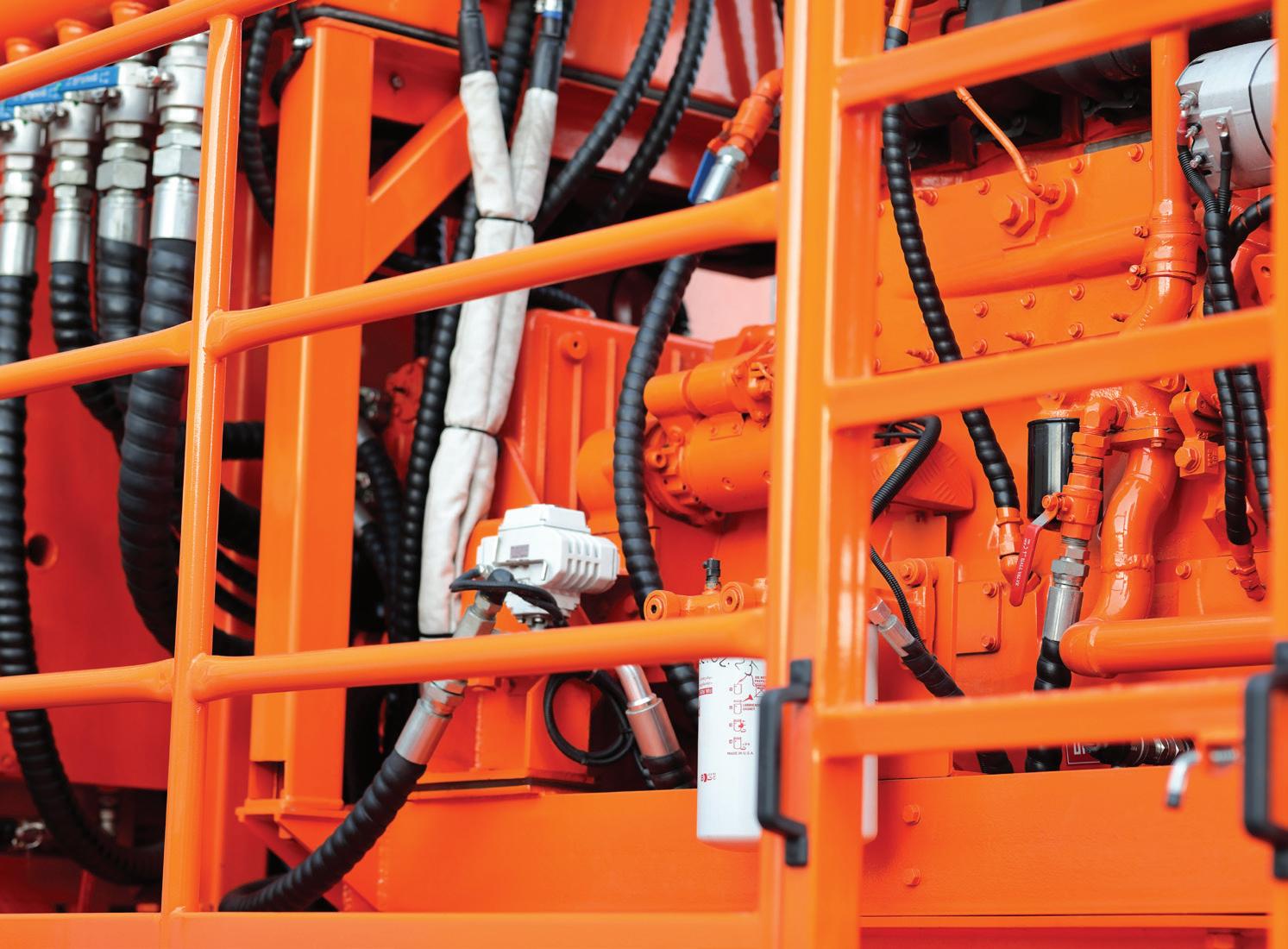
5. Hydraulic machinery is going nowhere, perhaps ever. Despite all the electric technology at the show, the vast majority of the machines were traditional hydraulics operated by electric valves. The all-electric machines were few and far between, and mostly offered by startups with less experience in the mobile machinery realm. Despite me poking my nose into as many undercarriages and open panels as I could, there was an overwhelming presence of hydraulic valve manifolds, electroproportional sectional valves, and a surprising number of lever valves.
Sure, most machines now eschew traditional panels of switchgear and pressure gauges in favor of digital displays and HMI panels, but the machines are otherwise fundamentally hydraulic. I found that most manufacturers displayed their advanced technology from a "look at what we can do" perspective, but when I dug deeper, many admitted none of their customers are currently using it.
Despite missing the event during the 2020 COVID year and just being too busy to attend in 2023, I will definitely be back in three years for the 2029 show. There is so much to see, and technology is moving too quickly for me to miss another show. Do you think it's too early for me to book a daybed at the Circa Stadium Swim? FPW

Josh Cosford • Contributing Editor jcosford@higginson.ca linkedin.com/in/joshcosford
technician who services and repairs hydraulics, especially including work on power units, leave this article for a moment and go ask them, "What's the craziest thing you've seen inside an old reservoir?" My own answer isn't so memorable; it's just a half-collapsed suction filter that was entirely detached from the suction port. However, I once asked the same question of a colleague with three decades of experience, to which he grimly responded, "A raccoon."
Indeed, such an experience warrants justification to the question posed in the article's title. Apparently, hydraulic oil is a reasonable facsimile of formaldehyde, and a shocking amount of that poor animal was intact. But it certainly warrants complete drainage of the reservoir to clean any remaining organic matter, especially clumps of fur that can clog the suction strainer (if installed) and small ports, passages, and valves, as well as other components.
If you're a regular reader, you know I don't condone arbitrarily changing your hydraulic oil because all efforts should be made to clean and dry it, no matter what. But sometimes the entire system should be drained to allow for a deep cleaning, and part of the draining and refilling process requires a filter cart that cleans your oil twice during such maintenance. Unless your oil is near-black from oxidation or has the consistency of mocha hair gel, you can reuse it most of the time. But of course, those reasons for completely draining your oil are obvious.
In most cases, it's obvious when you should drain your hydraulic oil, such as after catastrophic failures that result in rapid, excessive saturation with metal wear particles. A flashlight shone into the reservoir will reflect back a metallic sheen, which is a sure sign that your oil needs immediate offline filtration. Thus, it should not be left to the machine's filtration package to sort out. If larger chunks of metal or debris are discovered, you'll need to drain the tank to pull apart valve stacks, cartridge valves
and actuators you suspect were infected by the influx of debris.
Pulling off a D05 valve from an assembled hydraulic system causes a small stream of flow as higher components drain, at best. Still, suppose huge cylinders, lines, accumulators or the reservoir itself reside higher than your valve, you can expect your manifold to drain with the vigor of a New York City fire hydrant opened for children on a sweltering summer day. So, unless you have a method to block your oil from taking the path of least resistance, replacing major components often warrants draining the hydraulic oil.
Sometimes there are accidental reasons to drain your hydraulic oil, such as a massive influx of water from rain, submersion or a fire suppression system that found its way into the breather cap. Luckily, water settles to the bottom of the tank, so be sure first to use the tank's drain port rather than suck it all out with your
filter cart, which will just deposit itself into your temporary holding container, where it will wait to be transferred right back again if not dealt with.
Finally, sometimes the footsteps of time sneak up on you from behind, and a few decades of operational sediment needs to be scraped and scoured from the bottom of the reservoir. Experienced technicians know to stick a long, thin object down to the bottom of a reservoir suspected of neglect and drag it across the bottom to feel for bare steel or a sandbar. If the latter is discovered, it's time to drain the reservoir and clean it thoroughly.
Completely draining your hydraulic system is a lot of work, and I really do recommend you do so only with a filter cart, since the primary reason we drain them is to remove contamination. There's no point in refilling it with dirty oil, because the whole point of draining your hydraulic system is to clean it. FPW

Ron Marshall • Contributing Editor
IT ALL STARTED ON A TUESDAY morning. Dave, a seasoned mechanic, walked onto the shop floor and felt something was off. The familiar din of the pneumatic machines sounded … weaker. He glanced at the main compressor gauge. 86 psi. For years, it had been humming along between 90 and 100. He found Sarah, the new maintenance supervisor, who calmly explained it was her call.
“It's a simple way to cut our energy bill,” she said. But for Dave, this simple fix felt like a major risk. What about the sudden surges in demand that could bring a production line to a halt?
The case for cutting back Sarah’s argument was rooted in solid numbers. She explained that for every 2 psi they lowered the pressure, they shaved about 1% off the compressor's energy bill. That’s a direct saving that goes straight to the bottom line. Furthermore, she pointed out that higher pressure actually creates waste. Every tiny, unregulated leak or open valve in the shop was now consuming less air simply because the pressure was lower. It was a clear, logical case for efficiency. The higher the pressure, the more money was literally vanishing into thin air. Sarah saw the high pressure not as a safety net, but as an expensive habit.
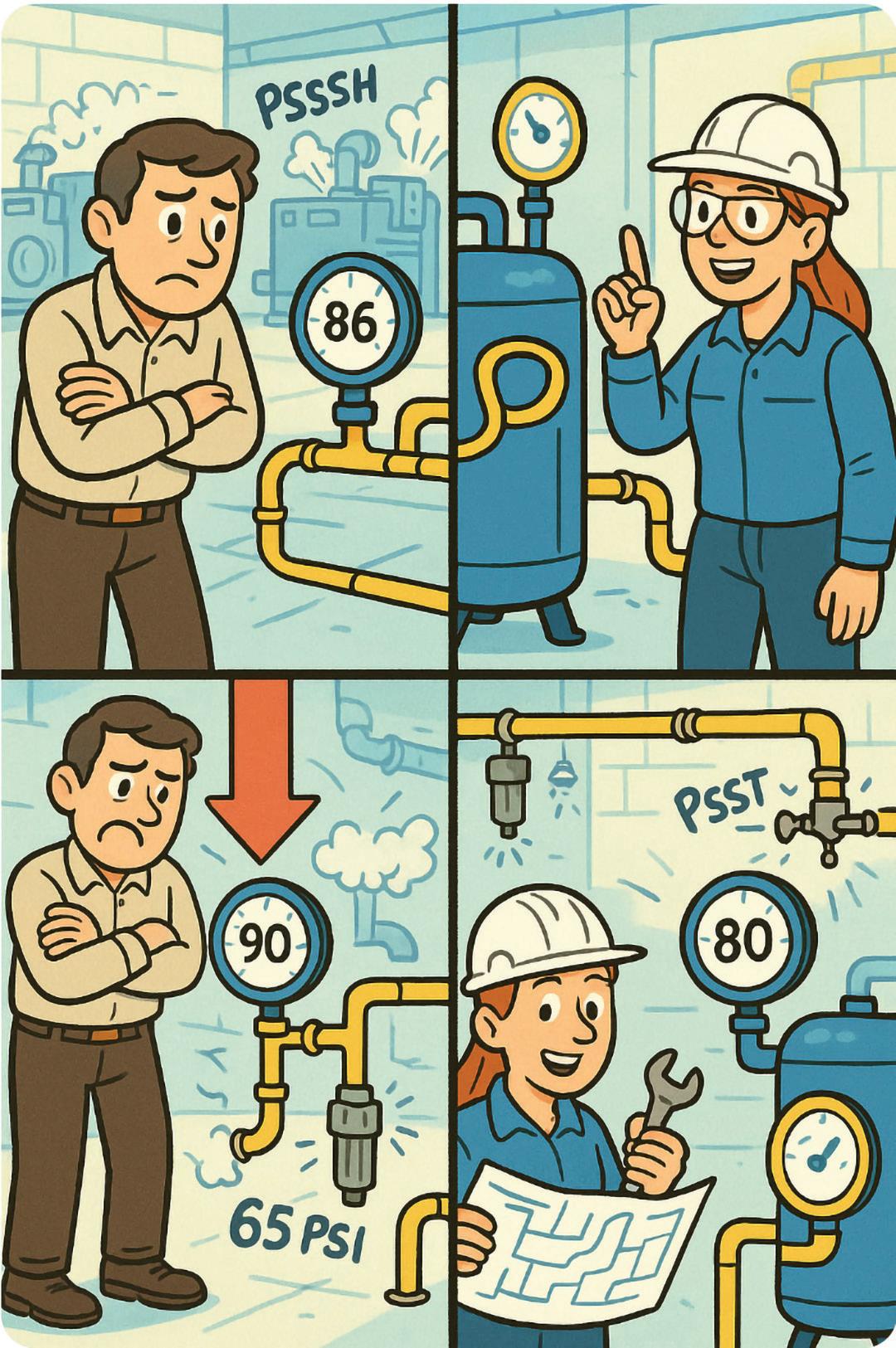
pipes, aging filters, and inefficient connectors were strangling the airflow, creating massive pressure drops along the way. The high pressure at the start was just a brute-force solution to compensate for an inefficient system.
The debate shifted from a simple number to the health of the entire system. Instead of just cranking the pressure back up, Dave took on the challenge. He meticulously mapped the system, identifying the bottlenecks where pressure was being lost. He worked to replace clogged filters, install properly sized piping to key machines, and fix dozens of small leaks. The result was transformative. With the system optimized, a steady 80 psi was now reaching the tools, even with the main compressor set lower than ever before. They discovered the old setting wasn’t a buffer; it was a band-aid. By fixing the system’s core problems, they could run at an even lower pressure, saving more money while improving performance.
Dave wasn’t convinced. He argued that the extra pressure was their buffer, a crucial
reserve of power needed to handle sudden, high-demand tasks without stumbling. To him, risking a production stoppage for a 1% saving felt like a terrible trade-off. This is where the real problem surfaced. The number on the main compressor wasn’t the number that mattered. While the compressor might be putting out 90 psi, the tool at the end of the line could be getting as little as 65 psi. Decades of undersized
The showdown at 86 psi taught them a valuable lesson. True efficiency isn’t just about turning a dial down; it’s about understanding the entire journey from the compressor to the tool. They stopped arguing about a single number and started collaborating on a smarter system, proving that the best savings come from working smarter, not just harder. FPW

Unlock the Full Power of Hydraulics — One Component at a Time
Join us for Hydraulic Systems Unlocked, a six-part webinar series designed for fluid power engineers, OEM designers, and maintenance professionals. Each session explores a key hydraulic component — valves, cylinders, pumps, filtration, hoses — culminating in a final system integration discussion with our experts. Whether you're specifying components, troubleshooting issues, or optimizing system layouts, this series delivers the knowledge and tools to power better hydraulic performance.
Thursday, May 14
Hydraulic Valves: Precision Control for Smarter Systems
Thursday, May 21
Hydraulic Cylinders: The Workhorses of Linear Motion
Thursday, May 28
Pumps & Motors: Power and Performance in Motion
Thursday, June 4
Filtration & Sealing: Contamination Control as a Design Priority
Thursday, June 11
Hose Assemblies: Safe, Flexible Fluid Connections
Thursday, June 18
Hydraulics in Harmony: Integrating Components for Efficient System Design
By Jermaine Perry • Sales Manager, Daughtridge Sales, an MCE Automation company
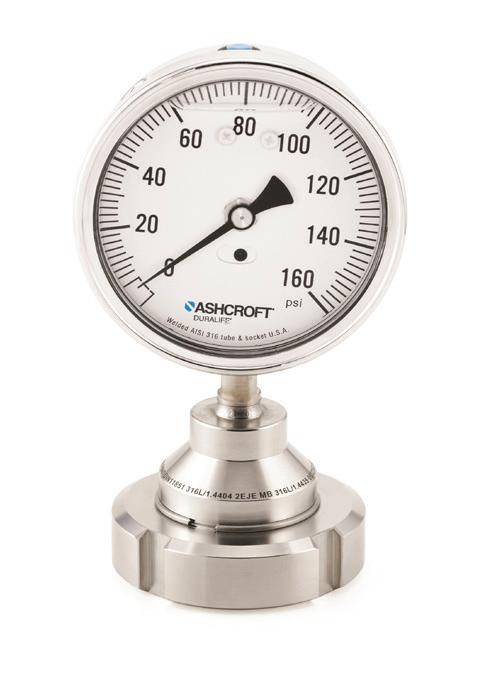
— food and beverage, pharmaceutical, biotech — and you’ll see pressure gauges everywhere. They’re mounted on tanks, filtration systems, and process lines.
Their familiarity makes them dangerous. Pressure gauges are sometimes treated as commodity items, something to replace quickly when they fail, ideally with whatever looks “close enough.” But in sanitary processes, the wrong gauge can contaminate product, shut down production, trigger regulatory scrutiny, or cause losses that dwarf the cost of the instrument itself.
When a gauge fails, the priority is restoring operation, not always evaluating whether the original gauge was appropriate for the process in the first place. Over time, this leads to systems filled with instrumentation that may function mechanically but are fundamentally mismatched to the application. In sanitary environments, that mismatch can be costly.
Not all pressure gauges are created equal, and in sanitary systems, the differences matter. Sanitary pressure gauges are designed with specific goals in mind:
• Prevent contamination
• Survive aggressive cleaning and sterilization
• Maintain accuracy under thermal and mechanical stress
• Protect both product and personnel
To achieve this, sanitary gauges typically feature:
• Crevice-free, smooth external surfaces
• Stainless steel or specialty alloy construction compatible with process media
• Seals that isolate the sensing element from the process
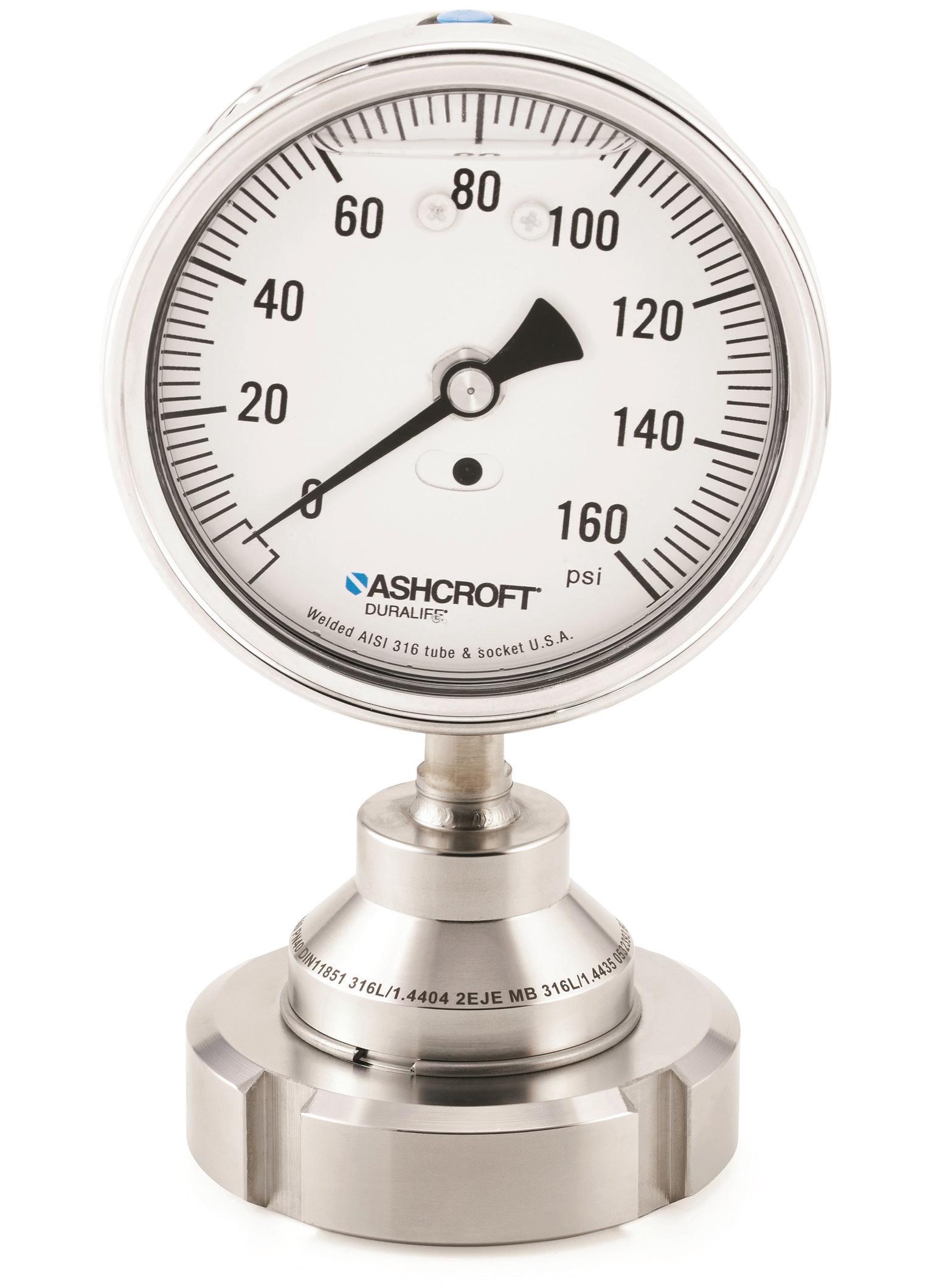
• Food-grade or non-toxic fill fluids
• Designs compatible with clean-in-place (CIP) and sterilize-in-place (SIP) procedures
Standard industrial or commercial gauges, by contrast, are often threaded, difficult to clean, filled with non-food-grade fluids, and not engineered to withstand repeated sterilization cycles. In non-sanitary environments, that may be acceptable. In sanitary processes, it introduces risk.
One of the most dangerous aspects of improper gauge selection is that failure doesn’t always look like a broken needle or a visible leak. In real-world sanitary environments, failure often shows up as:
• Fill fluid leaks that contaminate product
• Residue buildup inside threaded connections
• Seal degradation after repeated CIP/SIP cycles
• Inaccurate readings caused by clamp stress or improper installation
• Microbial harborage points that evade routine cleaning
It’s easy to underestimate the downstream impact of a small component failure. In one large beverage facility, a pressure gauge installed in a sanitary process failed under pressure and leaked non-edible fill fluid into the product stream. The result was discarded batches, halted production, and losses that quickly reached six figures. The gauge itself cost a few hundred dollars.
Consider the real costs associated with an incorrect or failed gauge:
• Lost product and batch disposal
• Production downtime and rescheduling
• Emergency maintenance labor
• Regulatory exposure or documentation gaps
• Brand and customer trust erosion
When viewed through that lens, the difference between a low-cost commercial gauge and a purpose-built sanitary gauge becomes insignificant.
Many of the most problematic gauge installations are inherited.
Plants that have been operating for decades often have instrumentation that has “always

worked,” even if it no longer meets current process demands, cleaning requirements, or compliance expectations. In some facilities, gauges remain in service for 20 years or more, long past their ideal lifespan.
As processes evolve, products change, and cleaning protocols become more stringent, legacy instrumentation can become a liability. One of the most effective ways to reduce risk is also the simplest: Ask better questions before replacing or installing a gauge.
Key considerations include:
• What process media is this gauge exposed to?
Material compatibility matters over time.
• Is this location subject to CIP or SIP cycles?
Not all gauges are designed to survive repeated sterilization.
• What pressure range is required?
Oversized ranges reduce accuracy; undersized ranges invite damage.
• Does this application require traceable calibration or certification?
This is especially critical in pharmaceutical and regulated environments.
• How is the gauge mounted and clamped?
Improper installation can introduce stress that affects readings.
• When was it last calibrated or evaluated?
Accuracy drifts until it matters most.
Pressure gauges are small, inexpensive, and easy to overlook. But in sanitary systems, they directly interface with product, pressure, and people. That makes them far more consequential than their size suggests.
The plants that experience the fewest surprises periodically question the assumptions baked into their systems, especially the ones that haven’t been revisited in years.
In sanitary systems, questioning instrumentation is a sign of operational maturity. Because when it comes to pressure gauges, the real risk isn’t failure; it’s complacency. FPW


In an increasing number of end-use applications, zincfree hydraulic fluids are becoming desirable to minimize impact, particularly in sensitive environments.
By Jared Cornett, Product Manager, Industrial Oils, Lubrizol
FLUIDS PLAY AN IMPORTANT ROLE in making the modern world work. They are found in countless applications that many take for granted, providing essential power transmission in a wide variety of industrial machinery. Without them, many of today’s industries would grind to a halt.
And that’s why monitoring the ongoing shift in demand for hydraulic fluid formulations is so important. Throughout much of the history of hydraulics, zinc-based additives have been commonly used to infuse fluids with important characteristics that contribute to reliable performance. But in recent years, zinc has come under greater scrutiny. Especially in environmentally sensitive applications where hydraulic fluid leaks are more likely to escape into a waterway, for instance— zinc-free fluids are becoming more desirable to a range of users.
While zinc-based fluids will not lose majority market share in the industry, shifting demand has become self-evident. According to recent research from Kline + Company, zinc-free hydraulic fluids in North America and Europe are projected to experience a compound annual growth rate (CAGR) of 4.25% from 2024 to 2029, whereas demand for traditional zinc-based fluids is expected to be flat or decline over that same period.
Let’s explore the impacts of these significant shifts in fluid formulation requirements, as well as the necessity of seeking out high-performance alternative additive chemistries that can reliably replace zinc without compromising performance.
First, it’s worth considering the sheer volume of hydraulic fluids found within critical industrial applications across industries:
• A typical mining shovel, responsible for the high-intensity job of moving rocks and earth on mining sites, is serviced with approximately 900 liters of hydraulic fluid per drain interval.
• A backhoe, found in countless indus-

trial and construction sites around the world, is serviced with anywhere from 19 to 75 liters of hydraulic fluid per drain interval depending on the size of the vehicle.
ACCORDING TO A 2016 STUDY1, IT IS ESTIMATED THAT APPROXIMATELY 50% OF ALL LUBRICANTS SOLD WORLDWIDE END UP WITHIN THE NATURAL ENVIRONMENT RATHER THAN BEING PROPERLY DISPOSED OF OR RECYCLED.
• A common tractor used in farming applications is serviced with around 180 liters of hydraulic fluid per drain interval.
• An excavator is serviced with approximately 180 liters of hydraulic fluid per drain interval.
Across these applications (and others), leak potential is significant. According to a 2016 study¹, it is estimated that approximately 50% of all lubricants sold worldwide end up within the natural environment rather than being properly disposed of or recycled.
This figure is attributable to a number of factors, including incorrect handling, circuit leaks, spillage during service, or other means. But no matter the source, fluids escaping into the environment is of increasing concern in environmentally sen-

sitive applications — and it’s driving the ongoing increase in demand towards reliable alternatives.
While increasingly stringent regulatory measures play some role in the drive toward zinc-free fluids, several marketbased factors are also influencing this trend.
For example, major OEMs are increasingly recommending zinc-free fluids, including Komatsu, Hitachi, and others. Elsewhere, corporate responsibility and sustainability initiatives are at play, as well as changing market perceptions of zincbased products — for example, major paper producer Charmin has pledged to source materials from sustainable forests, where zinc-free fluids are recommended
for major certifications.
Elsewhere, several specific industries are seeing a more prominent shift to zincfree fluids, including:
• Mining. In North America, newer U.S. Mine Safety and Health Administration requirements have pushed site managers toward recommending zinc-free fluids.
• Construction. The U.S. Clean Water Act supports the use of zinc-free fluids in North America, heavily influencing construction projects near waterfronts. Meanwhile, sustainability goals and REACH have the most influence in Europe. End users are adopting such fluids accordingly.
• Marine. Here, zinc-free formulations are used around the globe, driven by OEMs in the space in alignment with
IDEALLY, ZINC-FREE ADDITIVE SOLUTIONS SHOULD HELP MAXIMIZE FORMULATION FLEXIBILITY, WITH COMPATIBILITY AND READ ACROSS A RANGE OF GROUP II BASE OILS.
international and regional standards and marine guidelines.
• Forestry. Sustainable forestry has become more prominent in both Europe and North America. Specifically, zinc-free fluids are recommended in forests certified by the Forest Stewardship Council (FSC) in the United States as well as those certified by the Programme for the Endorsement of Forest Certification (PEFC) in Europe.
To begin understanding challenges associated with formulating high-performance hydraulic fluids, without the zinc additives that fluid manufacturers have relied upon for decades, it’s worth a refresher on the multipronged role that hydraulic oils play in critical applications.
Primarily, hydraulic fluids are responsible for the smooth and reliable transmission of power throughout the hydraulic circuit that enables a piece of industrial equipment to perform its intended function. For example, it enables hydraulic forklifts to lift heavy weights. However, these fluids maintain critical secondary roles that are no less important, including:
• Effective lubrication and wear protection for metallic parts throughout the hydraulic circuit.
• Heat dissipation to prevent heat-related malfunction or compromised performance.
• Contamination control and filterability to protect the circuit from unwanted particulates.
Zinc additives have long been important to maintain these performance properties. In particular, zinc has delivered reliable
wear protection both in hydraulic applications as well as many other industrial fluids, and formulating without a reliable alternative has historically been a challenge.
Indeed, early-generation zinc-free fluids struggled to gain significant market traction. For hydraulic fluid formulators, zinc alternatives were required at cost-prohibitive treat rates in order to maintain adequate wear performance. Meanwhile, many early zinc-free formulations failed to meet stringent OEM specifications (including BoschRexroth, Parker Denison, and Danfoss), ruling out their use in machinery under threat of voided warranties.
Consider the consequences of underperforming fluids. Inadequate wear protection can lead to premature hydraulic pump failure, for example. Such a failure could drag a mining site to a halt, leading to significant lost profits for operators.
As demand for zinc-free hydraulic fluids continues to grow, the global lubricants industry has been pursuing the development of reliable alternatives that can deliver the performance benefits OEMs and end users have come to expect from traditional hydraulic fluids.
With such a challenge comes opportunity, however. Lubrizol has approached zinc alternatives as a way to deliver overall performance enhancements in zinc-free fluids while enabling flexibility for formulators. These include:
Formulation flexibility. There is also the matter of efficient manufacturing and pro-
duction, and optimized additive science can help here as well. Ideally, zinc-free additive solutions should help maximize formulation flexibility, with compatibility and read across a range of Group II base oils. These attributes can help formulators go to market with zinc-free products more quickly and efficiently, contributing to more cost-effective product launches for a market where demand for such products is increasing.
Antiwear properties. New zinc-free alternatives have been identified that deliver outstanding performance earlier generation fluids were historically unable to achieve. Today’s additives have demonstrated minimal wear in a series of industry-standard and OEM-specific testing protocols, including the Parker Dennison T6H20C pump test, the Eaton 35Vq and 104C pump tests, and most impressively, the Bosch Rexroth pump test. For OEMs and end users, such performance translates to reduced downtime, extended equipment life, and lower overall cost of ownership for critical machinery. Oxidative performance and thermal stability. By demonstrating advanced oxidation performance and thermal stability, new zinc-free additive technology has been shown to contribute to extended oil drain intervals. Such performance has been observed in several stringent testing protocols, including the Turbine Oil Oxidation Stability Test (TOST) per the ASTM D943 standard and the Bosch Rexroth A2F10 pump test.
Cleanliness and filterability. Optimal zinc-free fluids must be formulated to handle water, air, and other contaminants that
may exist in dirty application environments. Here, a zinc-free alternative should show optimal air release performance (via ASTM D3427 testing standards), lower water acidity generation (ASTM D2619), excellent wet and dry filterability (ISO 13357), and minimal sludge production (ASTM D4310).
Smooth operation and control. Zincfree additives must be able to contribute to precise operation and smooth control of hydraulic equipment. Additives can provide such performance with excellent air release and foam control attributes to enable this kind of performance, allowing OEMs and end users to experience efficient operation and responsive control.
For hydraulic fluid formulators, these attributes cannot be compromised for reliable end-use performance in demanding applications. Zinc-free hydraulic fluids stand to become increasingly important in the coming years as sustainability initiatives and environmental policy evolve. For fluid formulators, it is worth proactive investigation into the advanced chemistries that can help you capitalize the need for such products, contributing to effective and reliable hydraulic performance everywhere. FPW
Lubrizol Lubrizol.com

1Madanhire, I., and Mbohwa, C., “Lubricant Additive Impacts on Human Health and Environment,” Mitigating Environmental Impact of Petroleum Lubricants, 17. Springer 2016



From the original STAUFF Pipe Clamps to our Metric Tube Fittings and Quick Release Couplings, STAUFF offers port-to-port hydraulic solutions, components, and accessories for hydraulic systems and applications.
STAUFF is your trusted source for industrial and mobile fluid power components and solutions worldwide.

www.stauffusa.com




Noise is often inevitable in hydraulic systems, but discovering its sources can help you to better design your systems to alleviate some of it.
By Josh Cosford, Contributing Editor

MONDAY MORNING TRAFFIC , lineups at the Krispy Kreme drive-through, and teenagers; all crap we just put up with every day with nary more than a shrug. I’m officially adding noisy hydraulics to this list, because we fluid power professionals and machine designers have given up on making them quiet, just as we have long-ago abandoned hope of our teens cleaning their rooms.
But why? Why should we simply accept that hydraulic power units should sound like a Tie Fighter flyby looped on 78-speed (that one’s for the Gen Xers)? The loworder harmonics produced by gear and piston pump ripple will sometimes find conduit tubes and pipes, or even structural bars and plates, that adore the resonant frequency and want to sing along.
Mid-and high-order harmonics, however, are the whiny and screechy tinny sounds emitted from many power units that make your blood curdle when it hits a particular note. Harmonics are the multiples of the fundamental note that occur because hydraulic pumps create discrete pressure wave events rather than a continuous and pure sine wave tone. A pump with a 100 Hz fundamental is just an expression of its rate of repeating those pressure wave events, and any waveform that is not a pure sine wave (such as from a single voice synthesizer keyboard) contains harmonics.
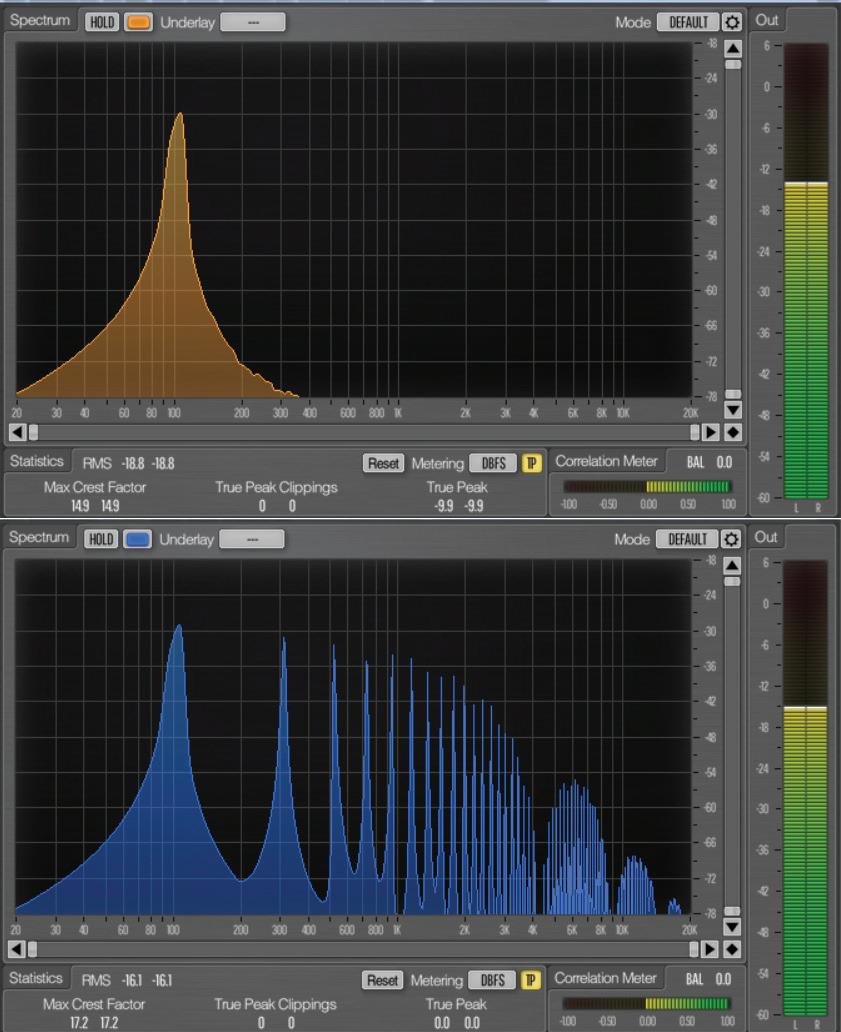
Every multiple of the fundamental frequency is called its Order, so 200 Hz is the 2nd Order harmonic, 400 Hz is the 4th order harmonic, and 2000 Hz is the 20th Order harmonic (Figure 1). The fundamental frequency and its amplitude (loudness)
are generally a product of the pump itself, although anything in or on the power unit with a matching resonant frequency can increase the amplitude of that note. The same is true for the harmonics — a single piece of tube might have a resonant frequency matching one of the pump harmonic frequencies, which increases the amplitude of that harmonic. It’s very much like the singing wine glasses, where circular rubbing of the glass’s rim creates a specific note reflecting the mechanical shape of the glass, its mass, and the amount of water contained within it.
Human ears are sensitive to the 2-5 kHz range, so when harmonics scream in your ear around this range, we find it particularly hair-raising. The complexity of noise possible with hydraulic power units is nearly impossible to predict — the pump,
FIGURE 1. EVERY MULTIPLE OF THE FUNDAMENTAL FREQUENCY IS CALLED ITS ORDER, SO 200 HZ IS THE 2ND ORDER HARMONIC, 400 HZ IS THE 4TH ORDER HARMONIC, AND 2000 HZ IS THE 20TH ORDER HARMONIC, AS DEMONSTRATED HERE.
reservoir, plumbing, cutouts, brackets, coolers, and valves/manifolds all contribute their own unique auditory signatures to create a recipe for each power unit. Each component may also be part of a cascading resonance and resulting harmonic nightmare, further adding to the pain.
Sometimes we get lucky, and the pump’s fundamental frequency is entirely dissonant from every component’s resonant frequency, and very little is amplified enough to offensive levels. But surely there is a way to leave out the guesswork? I’m going to present to you two methods, one of which offers a ballpark-only system of measuring resonant frequency, while the other offers a precise method of measuring.
The first is using a simple tone generator on your phone, which you can probably download for free. Then find a very loud, um, loudspeaker, which you can rent from a music store — something with a self-powered 15 in. woofer and capability of 125 dB or louder. Some new models may already have Bluetooth capability, but if not, you’ll need a receiver or mixer that can send a signal to the loudspeaker.
Once you have your rig, place the speaker as close as possible to the various major components — reservoir, pump/ motor group, cooler, filter assembly, and tubes (if they’re already made) — one at a time, of course. Now, starting at 20 Hz on your tone generator, very slowly sweep upwards while keeping one gentle hand on the component. When you feel the component vibrate intensely, you’re close to discovering its resonant frequency. Sweep up and down to pinpoint its most aggressive vibration frequency, write it down, and then move on to the next component or assembly (Figure 2). Remember
that large items, such as a reservoir or a high-volume air/oil cooler, can have multiple modes/frequencies.
If you’d like to get more precise with your measurements, you can purchase a shakerstyle vibrator used for non-destructive testing. You’re not trying to break anything, so you’ll only need a small one, which will be better suited for higher frequency operation, anyway. These units will come with a control unit to set the vibration frequency, and you can set the unit directly on large objects, or small objects can be mounted on the shaker itself.
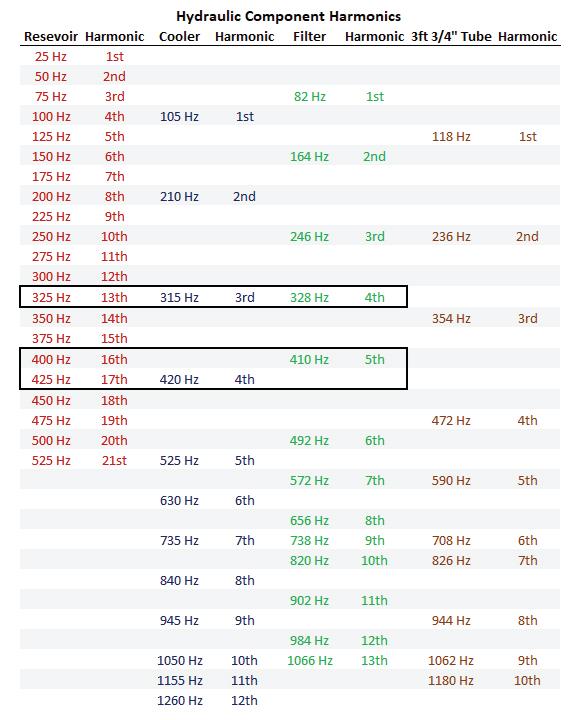
You will then obtain a vibration analysis system commonly used by maintenance departments to provide early detection of bearing and pump failures. Their sensors can be mounted directly to the component being measured, taking the guesswork out of the “calibrated hand” method. Then, just as before, sweep from around 20-10,000 Hz and observe the resulting chart for the peak amplitude and the frequency. If you have multiple items with similar resonant frequencies or harmonics of those frequencies, you may need to pay attention to them later. I’ve created an example chart that shows imaginary fundamental and harmonic frequencies of a res-
These neighboring harmonics may or may not cause problems, and you won’t know until you finish assembling the power unit and testing it.
ervoir, cooler, filter, and a piece of 3-foot ¾ in. ID tube. Around 400-425 Hz, the reservoir, cooler, and filter share somewhat close harmonics, but they probably don't compound much to worry about. However, you can see that around 315-328 Hz, the reservoir’s 13th harmonic aligns fairly closely to the 3rd and 4th harmonics of the cooler and filter, respectively.
These neighboring harmonics may or may not cause problems, and you won’t know until you finish assembling the power unit and testing it. If the pump’s fundamental frequency is anywhere around 315-328 Hz, it’s likely that your power unit is going to sound like hot garbage. But don’t fret just yet – once the power unit is assembled and filled with oil, the frequencies and amplitude will change. You’ll see attenuation (getting quieter) and a lowering of fundamental (resonant) frequencies as the increased mass from the oil interacts with all the components, especially the reservoir.
Your original test isn’t garbage, but feel free to test again after assembly to see how much everything has changed. It’s possible the predicted issues with the reservoir, cooler, and filter may still exist, but at a lower frequency. To correct these issues, use the same benefit that hydraulic oil provides you — change the mass of the component. You can mount heavy magnets to steel parts, change the length/diameter of tubes and pipes, switch to longer baskets on filters, or any other option to change the size and mass of an item.
Is all this too much to worry about? Nine times out of ten, yes. However, some customers have stipulations about maximum sound pressure level, which, even when shown to be within specification using a calibrated meter, may prevent final sign-off due to harsh harmonics. Or, at one meter up and one meter out, the dB reading could vary widely depending on which of the 360º around the power unit you measured it from. Using this system helps you avoid assembling an orchestra of raucous Tie Fighters in the first place, saving you time
and money on every subsequent build. And if this editorial piece is a bit niche and has you wondering, “Why the hell is Josh writing about this?” it’s because I’m a DJ/Producer, believe it or not. Understanding these sound engineering concepts is part of the music production process. I kind of keep my electronic music hobby separate from my fluid power career because not many in our industry care much about raves, clubs, and house music. If you do, check me out on all the platforms — my DJ name is Crozford. FPW
CASEY RUTTAN WORKS ON THE STEERING AND MAIN HYDRAULIC PUMP ON AN OLDER MODEL TRACTOR, SHOWING HIS SKILL SET FROM SIMPLE TO COMPLEX HYDRAULIC SYSTEMS.

Throughout his 20-plus year career, Casey Ruttan has taught, troubleshooted, and helped design fluid power systems and schematics.
By Mary C. Gannon, Editor-in-Chief
Casey Ruttan, owner of HydraulicSchematic.com and a business development consultant with First Coast Hydraulic Repair in Jacksonville, Florida, has held a variety of roles throughout his fluid power career. He entered the field almost by chance. Ruttan’s career began in IT and call center management, where he worked for about 10 years. When the tech bust occurred, he decided he wanted to work with his hands.
He went back to school for a oneyear Mechanical Techniques program at Loyalist College in Ontario. He initially wanted to work in the electrical trades but was quickly discouraged from that career because he is color blind. He then started investigating working as a millwright but was turned off when his call to the local union was rejected.
“Later that year during the course, a local hydraulic shop owner came to speak to our class. He was an onsite service guy and a master troubleshooter,” Ruttan said. “He asked a couple technical questions during his talk, and I was the only one that got them right, so he hired me right after the talk. I finished school and started at that local shop the day after graduation.”
Throughout that first job, he explored several ways to engage with customers, using his IT skills to create manuals for customer use.
“I’ve always been interested in systems and how things come together so moving from the computer world where I built networks, repaired computers, and then into technical call center management, it was an easy transition into industrial hydraulics,” he said. “I was able to offer my first company the ability to sell systems with manuals and catalog cuts that I would scan and put together into a book style and the customers loved it. That brought a real value to that company, and they let me get involved in projects and system designs early. A few years later I took over the onsite service side of the business and the fellow that taught me moved on to a local engineering firm.”
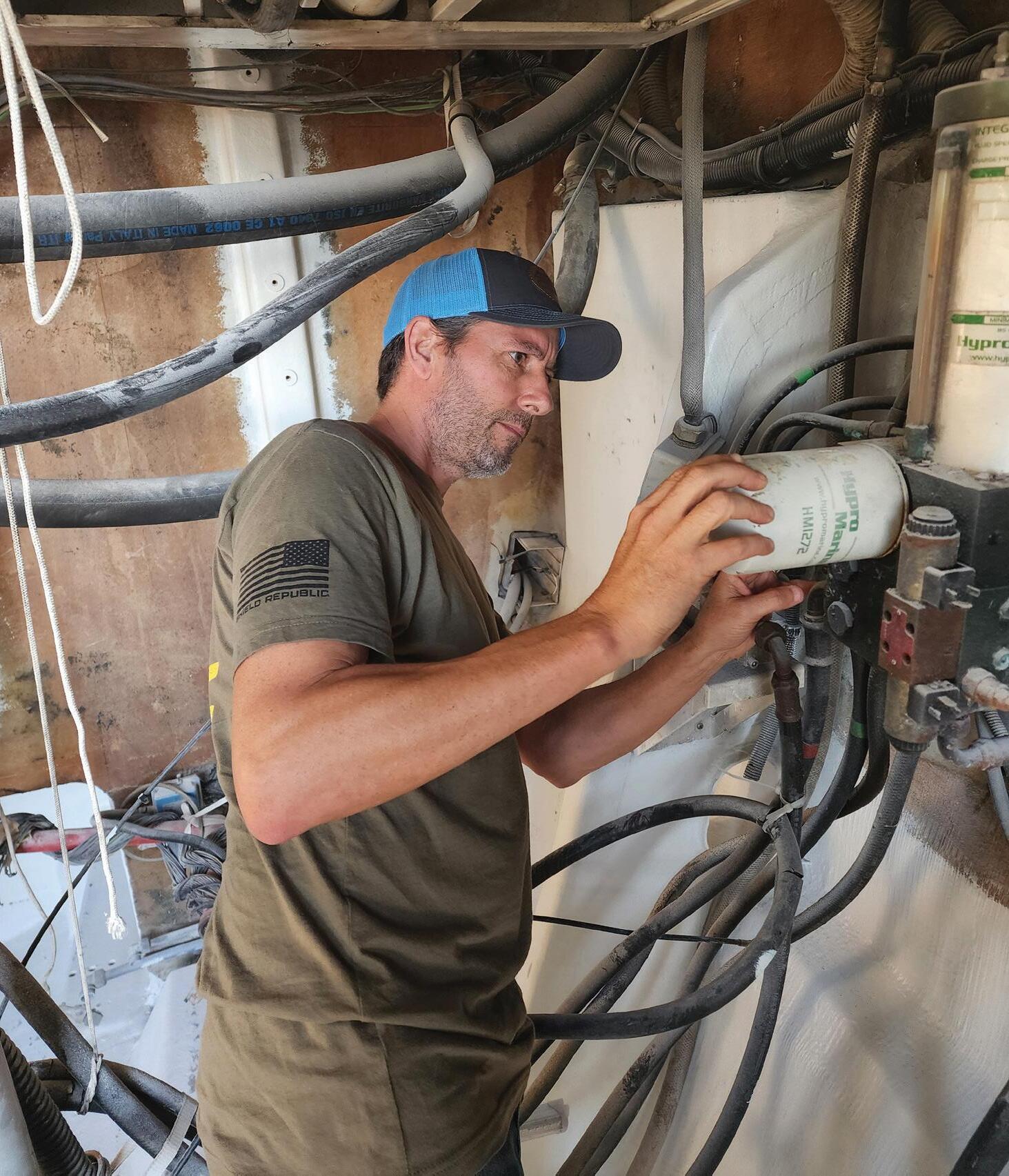
He was always comfortable with public speaking and training others during his IT days, so after about five years working in fluid power, Loyalist College approached him about teaching in the same program that he graduated from. “Naturally, I jumped at it. A few years after that, I got approached by the founder of The Hydraulic Safety Authority of Canada (now called the International Hydraulic Safety Authority) to help him launch that training program. I also jumped at that and had a blast for about two years getting that off the ground,” Ruttan said.
He then moved into a human safety and performance program in Western Canada. He started in sales there and later became a teacher and consultant of that program. In 2017, a skiing accident took him out of work. He returned to Ottawa, Ontario, where he met his now wife, a U.S. citizen. This set them on a journey to move to the United States in 2023. Once there, he and his wife started a company that provides fluid power consulting and business
development services. They also manage the business side of First Coast Hydraulic Repair and provide technical consulting services to them and several others. He built them a website, developed a logo and branding while also consulting with customers on issues they are encountering with their systems.
Last year, he launched hydraulicschematic.com to provide professional hydraulic schematics for maintenance managers, equipment owners, and service providers. He often helps with undocumented machinery, retrofits, or handwritten sketches.
“Fixing broken machines, designing new ones, and seeing them come to life is really cool for me,” Ruttan said. “When someone says, we don’t care what it costs, just get it done, it opens the door to being creative and to really do the best job I can do. That’s really rewarding.”
His day-to-day often involves a lot of the minute details one gets when running a company, such as setting up new customers, fielding technical calls, invoicing, pricing, profit margins, marketing, website building and management, and even buying office and shop supplies. But the most exciting part of his job is seeing a project through to completion. “I spend a lot of time fielding service calls for troubleshooting and installation of new systems and designing new systems,” he said. “I’m really good at finding hard-tofind items. I’m the guy that says yes when everyone else has said no. The most exciting aspect is the happy handshake from a customer.”
He loves solving problems that others struggle with and making a system work as it should. Recently, Ruttan was involved in a retrofit for a brand-new skid steer. The customer was lifting and holding a special platform for it and needed to operate another attachment that would be in motion all the time. “They had installed valves on a previous model that were complicated and what I thought was a bit over engineered. The existing directional valve had a closed-center condition so I knew that could present an issue as well,” he said. “We installed a simple counterbalance valve to start, and it was very noisy, it sung like a canary! The engineer from one of the top cartridge valve dealers in America was helping me with this so we put our heads together and came up with a modulating counterbalance valve that did the job beautifully.”
He said this project required constant, clear communication and a willingness by all parties to try a couple different scenarios before getting it perfect. “When the first set of valves was noisy and didn’t work, it wasn’t a shock. We moved on to the next option in the process and voila! It worked,” he said. “Now they order those valves from me in a kit a few at a time and we’ve got a long-term solution.”
Ruttan believes that the basis of fluid power won’t change much, as the fundamentals won’t change. For example,
he recently worked on a cylinder rebuild from an elevator installed in 1949.
“We’re still building many of the same systems we were 50 years ago, we’re still rebuilding components in much of the same ways. There has been some innovation with IoT devices and sensors. But the industry is slow to respond,” he said. “The principles of fluid power have not changed, and those principles won’t change as long as we have gravity. It’s just going to become more automated.”
But, he noted, that doesn’t mean the old-school way of thinking shouldn’t change. He said it is time for the old guard to change hands with younger generations, as it’s time for new fluid power experts to steer the industry into the future. He points to a combination of low entry-level wages, limited access to ownership opportunities, and business succession models that prioritize financial outcomes for current owners over long-term sustainability.
“If we want younger people to come in, we need to offer better pay, more support, and real opportunities,” he says. “If we don’t, our industry is going to die!”
He challenges young people considering a career in fluid power to think about its many benefits, though. “If you like to learn, ask questions, and solve problems, you can’t go wrong working in fluid power,” he said. “If you don’t mind speaking up when everyone in the room is looking at you for the answer, this is for you.”
Despite the challenges, Ruttan remains optimistic. He sees opportunities to expand his schematic services, grow his consulting work, and become involved in larger, more innovative projects.
“I want to be part of something big,” he says. “Something that pushes the industry forward.” FPW

By Mary C. Gannon • Editor-in-Chief
FLUID POWER RESEARCH
will host the 2026 International Maha Fluid Power Conference September 8 to 10, bringing some of the finest minds in fluid power together for two days to network, exchange ideas, and present recent research trends in fluid power and motion control technologies and their applications to mobile, aerospace, and industrial applications. The conference will include technical presentations, keynote lectures, and social events. There will also be an expo to display latest components and applications of latest actuation technologies.

Andrea Vacca, Maha Fluid Power Faculty Chair, and Professor of Mechanical Engineering and Agricultural & Biological Engineering, said the recruiting event will return, giving companies registered for the conference a free opportunity to connect with Purdue students from different departments looking for job opportunities. The NFPA will assist with this part of the program, Vacca said.
Vacca noted that the 2024 event was very successful and despite uncertainty in the market, he expects 2026 to surpass that year’s program. “We had close to 300 people in 2024, which, for this type of technical and research event, is good,” he said “And that was thanks to the company people coming, which can be rare to see in these types of academic events. The lineup of speakers is not yet final, but we already have a good lineup this year.”
Current keynote presentations include discussions from Shawn Horner, Vice President, Technology and Innovation, Parker Hannifin; Steffen Haack, Chief Executive Officer and Enrique Busquets , Vice President, Business Area Leader Mobile Solutions, Bosch Rexroth; Jeff Herrin, Senior Vice President, Innovation and Development, Danfoss Power Solutions; Alberto Frulli, Fluid Power Engineering Director and Stefano Fiorati, Powertrain Innovation Director, Case New Holland; Jim Van De Ven, Professor, Mechanical Engineering, University of Minnesota; Jürgen Weber, Chair of Fluid-Mechatronic Systems, TU Dresden; Noah Manring, Professor, Mechanical and Aerospace Engineering, University of Missouri; and Eric Lanke, President/CEO, National Fluid Power Association.
Although the official call for paper abstracts is complete, organizers are still welcoming technical contributions from academia and industry on all topics related to fluid power and motion control systems, such as novel fluid power components and systems, solutions for system electrification, condition monitoring, noise and vibration, soft robot-
ics, alternative prime movers, tribology and fluid, pneumatics, etc. In 2024, about half of the presentations were academic and the other half were from industry, Vacca noted, and he said he expects similar for this year’s iteration.
Peer reviewed paper contributions will be published, SCOPUS indexed and published open access. A selection of the best papers (up to eight) will be published in the International Journal of Fluid Power (indexed in IEEE Xplore). The conference will also feature "presentation only" technical contributions, by either academia or industry.
Additionally, an outdoor exhibit will occur next to the conference sessions, and it will be open to all the Purdue’s students and conference delegates. Tents and a dedicated parking space for demonstration vehicles will be available. “We use an area outside the campus where we put machines from our lab, some mini excavators, a couple of tractors, and a couple of compact loaders,” Vacca said.
The conference will also feature the 2026 Monika Ivantysynova Medal Award. This award recognizes individuals with early association with Purdue (as student, post doc, visiting researcher, and junior faculty) that have distinguished themselves for career achievements in fluid power and related industry. The award is dedicated to Prof. Monika Ivantysynova, one of the most accomplished individuals in fluid power, and founder of the Maha Fluid Power Research Center.
Sponsorship opportunities are available for participating companies. Conference sponsors will appear on the conference program and website and will have the possibility to provide promotional material to the conference delegates.
Registration will open soon. Visit https://engineering.purdue.edu/ Maha/conferences/2026/2026_MahaConference for more details. FPW


ABSTRACT SUBMISSIONS ARE NOW BEING ACCEPTED for the 20th Scandinavian International Conference on Fluid Power, SICFP, June 1-3, 2027. Abstracts are due by May 31 and full papers will be accepted until October 31.
The conference is organized by the Laboratory of Innovative Hydraulics and Automation (IHA) at Tampere University, Finland. It is arranged on a biannual basis alternating between Tampere University and Linköping University. The SICFP Conference is a forum for exchanging information on the latest developments in off-road machinery, robotics and other applications of fluid power from industry and academia. Fluid power is in an exciting stage of transformation, from perspectives of digitalization, intelligence, automation, and sustainability.
SICFP is one of the world’s largest scientific conferences on fluid power and offers users, manufacturers, and scientists an international forum to exchange experiences in the area of hydraulic and pneumatic drives and controls.
It will be held at the Tampere Hall convention center. On the first day, the symposium provides a framework for presentations and demonstrations of fundamentals. The following two days of the conference cover a wide variety of application and technology orientated topics in parallel sessions. This will be accompanied by an exhibition at which various manufacturers will present their latest innovations.
“Fluid power offers advantages to the central drive and automation technology in many mobile and industrial applications,” said Tatiana Minav, Associate Professor (Hybrid drives) at Tampere University and chairwoman of SICFP ‘27. “Although the energy transition is leading to a change in prime movers, fluid power is still indispensable as a drive technology. With its key advantages like robustness and power density in addition to an increased focus on sustainability, digitalization and AI, fluid power can enable future key technologies. Thus it supports the global net-zero emissions target an the transformation of our society.”
Topics should be focused on zero-emission transition technologies for mobile machinery, such as:
• Novel, efficient and intelligent components and systems
• Digital and switched fluid power systems
• Intelligent controls
• Condition monitoring and predictive maintenance
• Noise and vibration mitigation
• Novel thermal management
• Functional safety
• Machine and fleet management
• Robotics, automation and autonomy
Authors are invited to submit titles and abstracts of proposed papers for SICFP’27 by May 31. Abstracts (maximum 500 words) should clearly outline the purpose, methodology, key results, and conclusions of the work. Submissions should highlight the novelty of the contribution and its relevance to fluid power and mobile machinery. Supporting figures may be included to clarify the main ideas or illustrate preliminary findings.
All abstracts will undergo a technical review by members of the Scientific Committee to ensure quality, relevance, and alignment with the conference themes. Successful authors will be invited to prepare a full paper and presentation. At least one author of each accepted contribution is expected to register for the conference and present the work.
Visit events.tuni.fi/sicfp2027 for more details and for abstract submission details. FPW