The work of Several studies, and the Hud Technical Assistance groups is being dovetailed to guide Nashville’s path to address homelessness and help create a successful Housing first community.
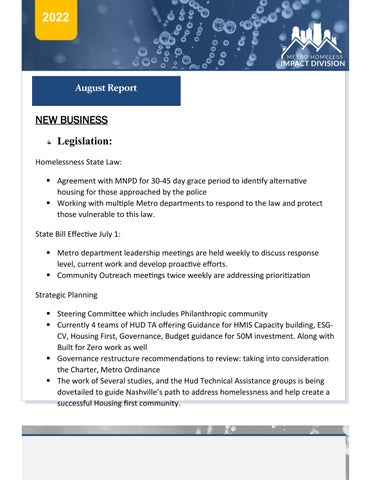
2022 August Report NEW BUSINESS
Legislation: Homelessness State Law:
Agreement with MNPD for 30-45 day grace period to identify alternative housing for those approached by the police Working with multiple Metro departments to respond to the law and protect those vulnerable to this law.
Strategic Planning Steering Committee which includes Philanthropic community
State Bill Effective July 1: Metro department leadership meetings are held weekly to discuss response level, current work and develop proactive efforts. Community Outreach meetings twice weekly are addressing prioritization
Currently 4 teams of HUD TA offering Guidance for HMIS Capacity building, ESGCV, Housing First, Governance, Budget guidance for 50M investment. Along with Built for Zero work as well Governance restructure recommendations to review: taking into consideration the Charter, Metro Ordinance

Funding
Was$50Millioncleared by the ARP Committee however, Metro Council decided to defer the vote until October. Next Steps …. are committed to working closely with Metro Council on moving forward the Mayor’s much needed proposed $50 million investment, providing clarity and correction of misinformation presented by some in the community regarding plans for the funding use. Ensure Council is further informed and comfortable with the funding use Increased strategic planning meetings of the $50M committee comprised of multiple Metro department representatives This work is in addition to the over 20 pages provided to Council prior to the deferred vote that describes how we would begin investing in a Housing-First approach to get folks the mental health, substance abuse and medical support they need. This is especially urgent as the winter months approach many hours with HPC committees, over 5 hours of Covid Oversight Committee meetings for their review, along with the provided documentation to Council.
2022
We
2022 Additional funding source planning Working with HUD TA on best practices to utilize the remaining ESG CV funds NOW extended until Sept 23. Possible reallocation from other communities will have until June 2024 to expense The Mayor’s Office “Housing First” funding proposal. $50M Historical investment All initiatives will be housing focused to expense funds that is aligned with the results of the strategic work. Federal NOFO just released for Unsheltered and Rural Communities Critical interim housing and sheltering for our Nashville Neighbors Last year was the deadliest year for our displaced Nashville Neighbors Some measures we are taking: Family Emergency Shelter Crisis due to decreased space and capacity for families Shelter committee and key stakeholders are devising an emergency plan to address the need with a partnership of 2 Gen funds. Extreme Heat precautions include coordination between MTA, Metro Public Libraries, Deployment of water and sunscreen, connection between Metro Health Dept. for educational material and life saving supplies, also OEM reviewing alerts for Cooling stations MHID Outreach hosting Quarterly events across the 4 quadrants No more of the status quo as we become a housing first community, I urge us to become a more Solutions based community (it is not enough to just say “No”) Encampment prioritization includes reviewing Health, Safety, location, and size
We
Great success last month at Metro Permanent Supportive Housing Project groundbreaking. will review and monitor the timeline until project completion.
Also reviewing how we can use the space until then.
Shangri-La is reviewing locations for Affordable Housing to discuss housing creation.
2022 Housing Cultivation
Several conversations are starting with Developers to create space for 30% and below AMI Landlord Engagement Team is rebuilding and will be searching for a Program Manager. Weather Shelter Plan 2022-2023
Metro Will open and operate an overnight overflow shelter staffed by Metro employees at a Metro facility as a supplement to existing community-based shelter operations. The shelter is intended to operate as a supplement (not replace) existing sheltering and to be utilized primarily for the following reasons:
1. To provide overflow capacity on nights when the low temperature might result in the number of guests exceeds the capacity of the existing system.
Reporting Metro Extreme
2. To provide options for those that cannot utilize the exiting shelter system
(Proposed based on last year’s recommendations and accommodations)
Operationalized: Metro will open the shelter when the temperature is predicted to be 28 degrees Fahrenheit or below, as determined by the Office of Emergency Management (OEM) and based on the National Weather Service’s forecast for the 37203 zip code. The determination will be made by noon on the day prior to the day the shelter is scheduled to open. Please note: The Homelessness Planning Council (HPC) voted and Metro Social Services agreed that the temperature should be lifted to accommodate 32 degrees Fahrenheit. This year proved to be a staff capacity issue due to the ongoing Pandemic. This will be reviewed for the 2022-2023 Extreme Weather season and written into the drafted RFP for this scope of work.
2022 because of particular circumstances, needs, or barriers.
Information from 2019-2020, 2020-2021, and 2021-2022 Sheltering Seasons Metro has operated the overflow shelter since 2013 but below you will find data for the last three years of operations. Please note a steady annual increase in nights of operation at the current 28 degrees Fahrenheit; 18 nights of service during 2019-2020 26 nights of service during 2020-2021 40 nights of service during 2021-2022 The CDC guidelines for the Covid-19 Pandemic altered the approach for sheltering for the last 2 years. This year Metro Extreme Weather overflow shelter was co-located in the same building that provided sheltering services for Covid positive individuals experiencing life without a home.
2022 Homeless Management Information System (HMIS) Data
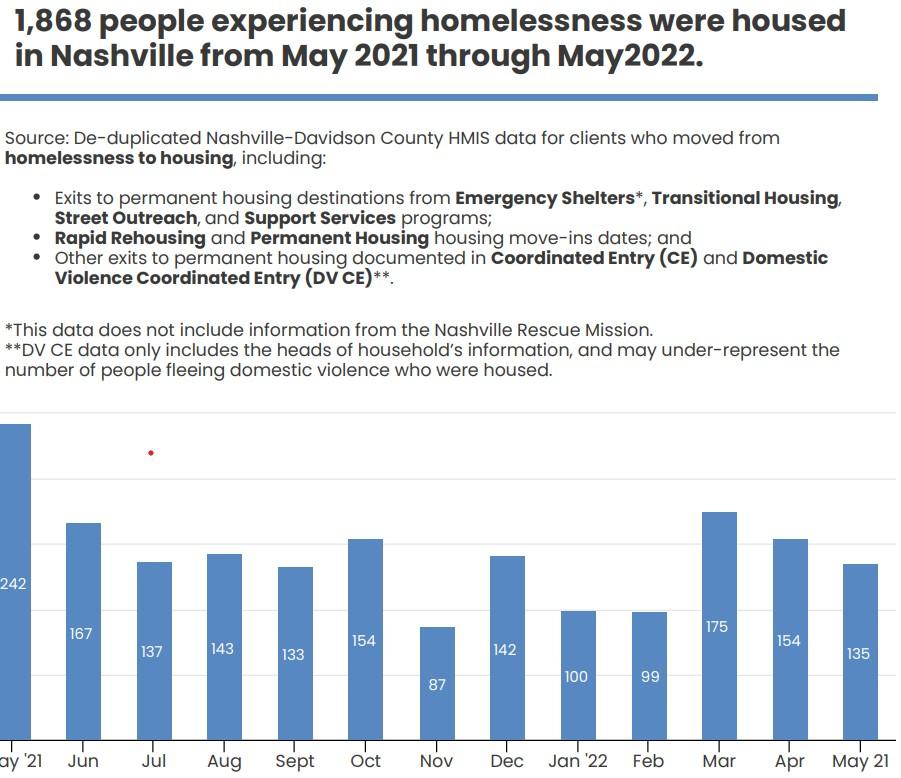
2022 Coordinated Entry (CE) We have noticed an increase in Family and Individuals being entered into the Coordinated Entry Jan Feb Mar April May How many YYA are on the BNL at the end of the month? 116 139 144 177 186 How many individuals on the BNL at the end of the month? 1296 1448 1462 1582 1657 How many Veterans are on the BNL at the end of the month? 168 171 173 176 174 How many families are on the BNL at the end of the month? 272 304 309 360 382 How many DV/IPV Survivor households are on the BNL at the end of the month? 212 222 235 263 270
2022 System. In general, measures taken to reach a quality By Name List involve increased MHID staff capacity, good data quality at CE entry, timeliness of CE exits, adherence to inactive policy and ensuring that your community has full and equitable coverage for access. Temporary changes are being made to the current CE process as it relates to families and individuals living in encampments.outdoor Six (6) month Review
2022 N ew Business: Continued work on moving forward plans for the Mayor’s historic proposed $50 million investment in homelessness Continued planning of historic Metro-funded Micro Housing Community Identifying permanent home for Homelessness Planning Council (HPC) meeting Challenges Successes Pandemic Abrupt Leadership departure Staff turnover Community Unrest Governance Political Metro Bill Political State Bill Hiring during this economic Successful Camp Housing Unprecedented days of cold weather sheltering 2019: 18, 2020: 26, 2021: 40Days 5% Decrease in PIT numbers Increased Staff Capacity Increased DevelopmentProfessionalOpportunities Strengthened relationship with Metro Departments Extended Coordinated Entry Access Increased Funding Investments Strategic Plan Refresh State of Nashville Homelessness Study Increased Public and Political Will Increased Focus on Racial Equity Groundbreaking of Metro Permanent Supportive Housing
2022